Upgrade to Pro — share decks privately, control downloads, hide ads and more …

Developing Structured 3D Applications with Dart...

Sponsored · SiteGround - Reliable hosting with speed, security, and support you can count on. →

Developing Structured 3D Applications with Dart and WebGL

Avatar for Don Olmstead

Don Olmstead

June 21, 2012

More Decks by Don Olmstead

Other Decks in Programming

Transcript

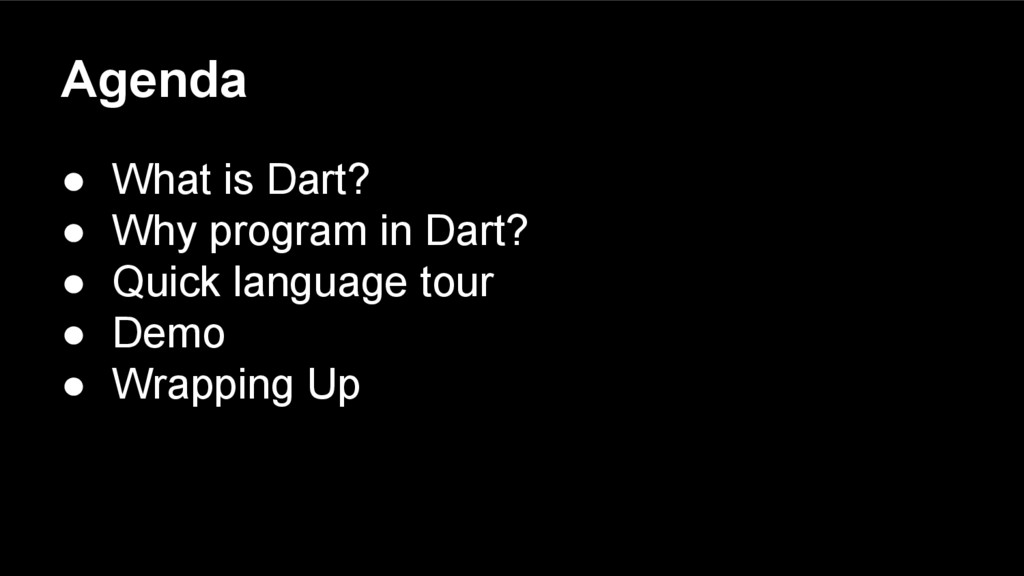
  1. • What is Dart? • Why program in Dart? •

    Quick language tour • Demo • Wrapping Up Agenda
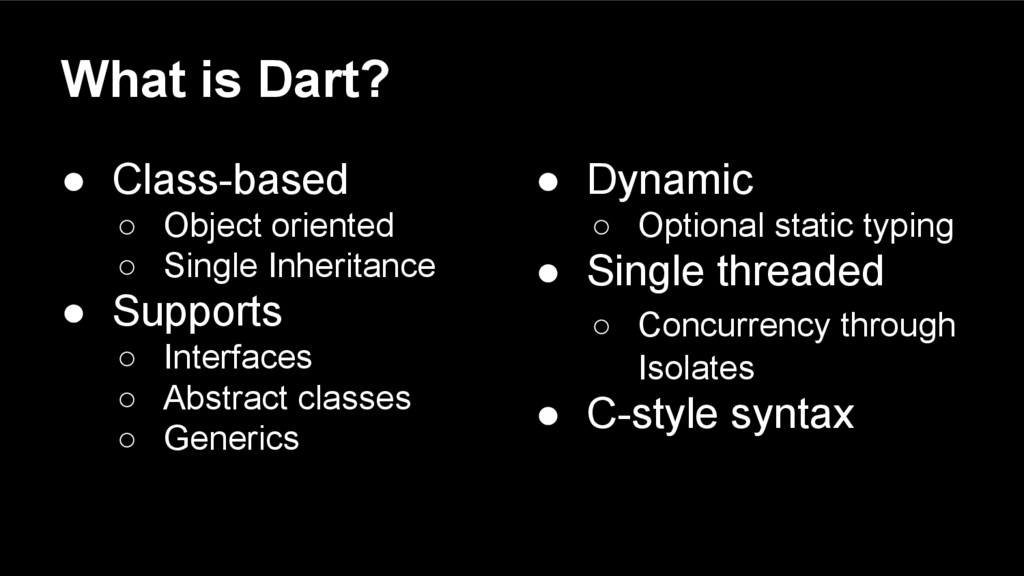
  2. What is Dart? • Class-based ◦ Object oriented ◦ Single

    Inheritance • Supports ◦ Interfaces ◦ Abstract classes ◦ Generics • Dynamic ◦ Optional static typing • Single threaded ◦ Concurrency through Isolates • C-style syntax
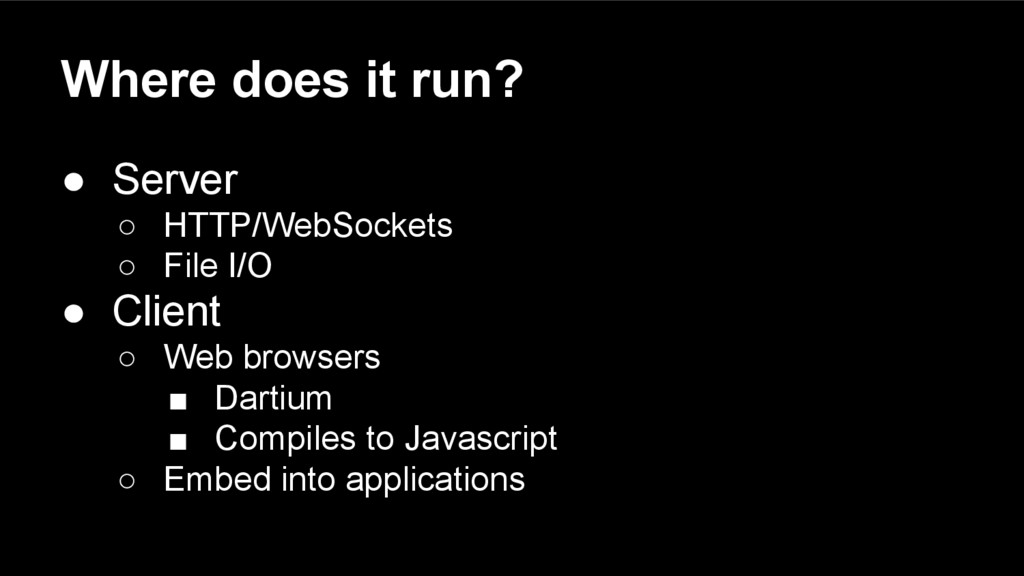
  3. Where does it run? • Server ◦ HTTP/WebSockets ◦ File

    I/O • Client ◦ Web browsers ▪ Dartium ▪ Compiles to Javascript ◦ Embed into applications
  4. JS isn't built for large applications • No support for

    third party libraries ◦ Lack of standard libraries • Difficult to determine structure of an application • 3D applications are complex to build!
  5. Dart is built for large applications • Library support ◦

    #import('Foo'); ◦ #library('Bar'); • Package management ◦ Dart package manager - pub ◦ Handles dependencies • Documentation generator ◦ Inline documentation ◦ Markdown for formatting
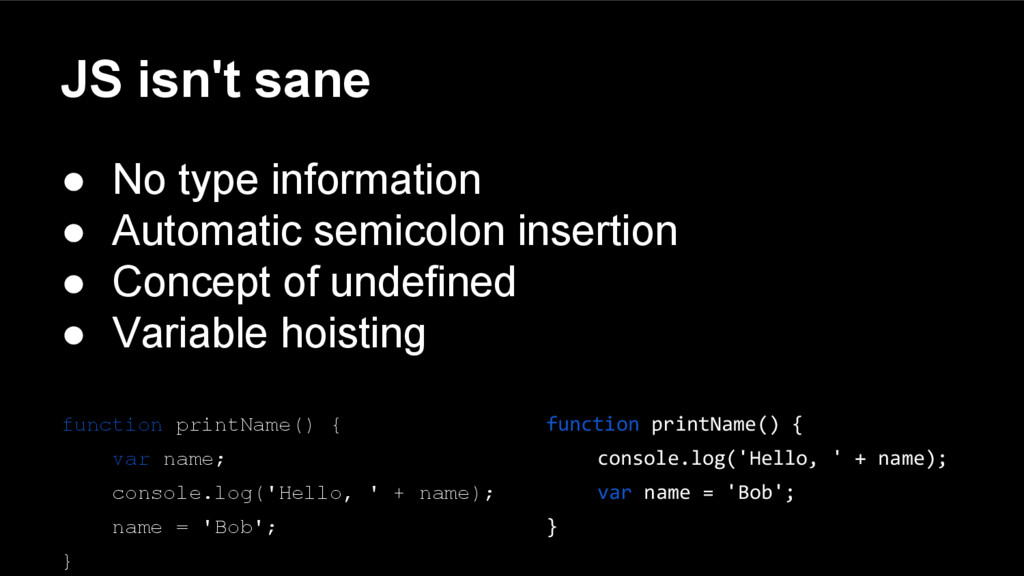
  6. JS isn't sane • No type information • Automatic semicolon

    insertion • Concept of undefined • Variable hoisting function printName() { console.log('Hello, ' + name); var name = 'Bob'; } function printName() { var name; console.log('Hello, ' + name); name = 'Bob'; }
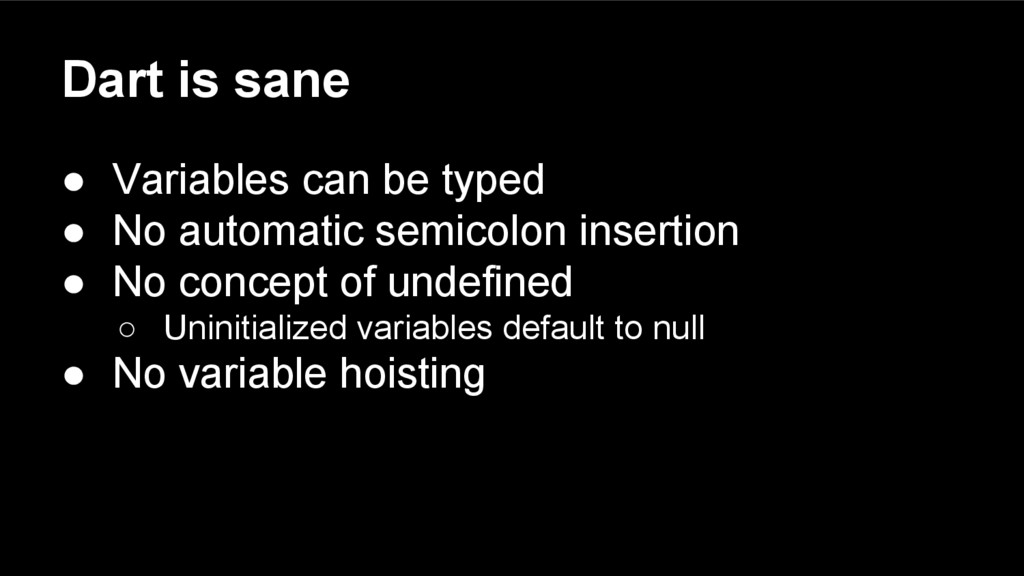
  7. Dart is sane • Variables can be typed • No

    automatic semicolon insertion • No concept of undefined ◦ Uninitialized variables default to null • No variable hoisting
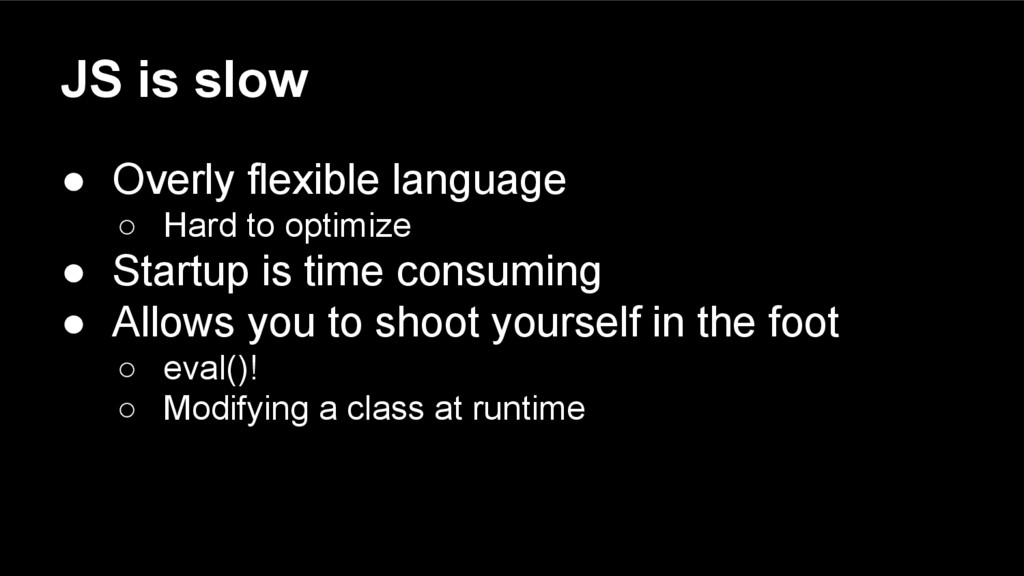
  8. JS is slow • Overly flexible language ◦ Hard to

    optimize • Startup is time consuming • Allows you to shoot yourself in the foot ◦ eval()! ◦ Modifying a class at runtime
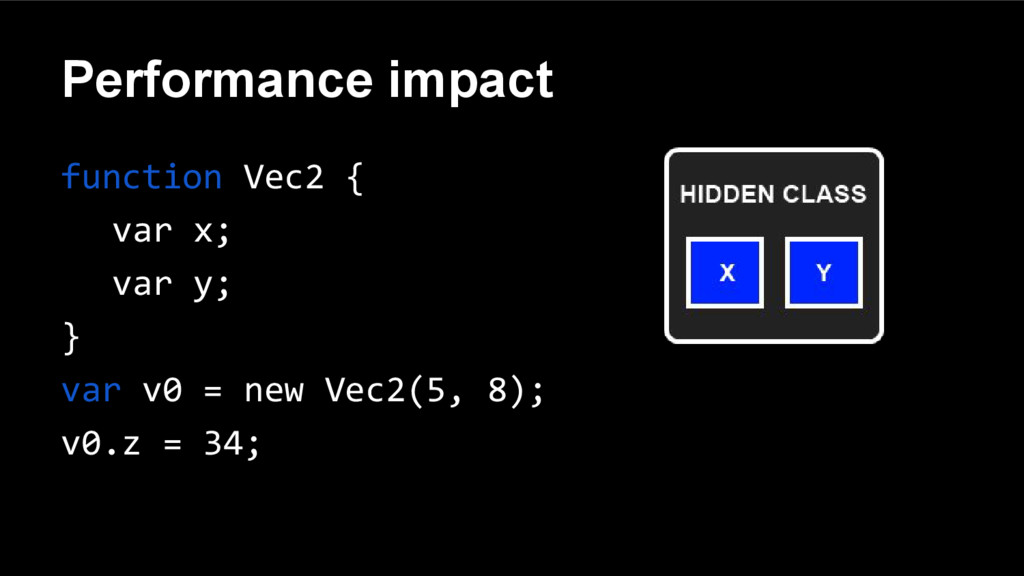
  9. Performance impact function Vec2 { var x; var y; }

    var v0 = new Vec2(5, 8); v0.z = 34;
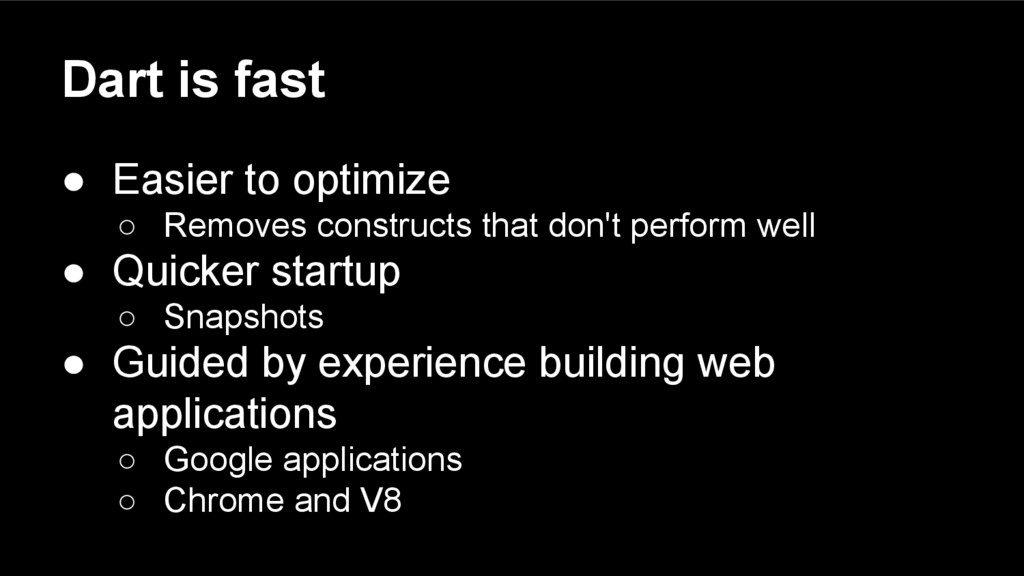
  10. Dart is fast • Easier to optimize ◦ Removes constructs

    that don't perform well • Quicker startup ◦ Snapshots • Guided by experience building web applications ◦ Google applications ◦ Chrome and V8
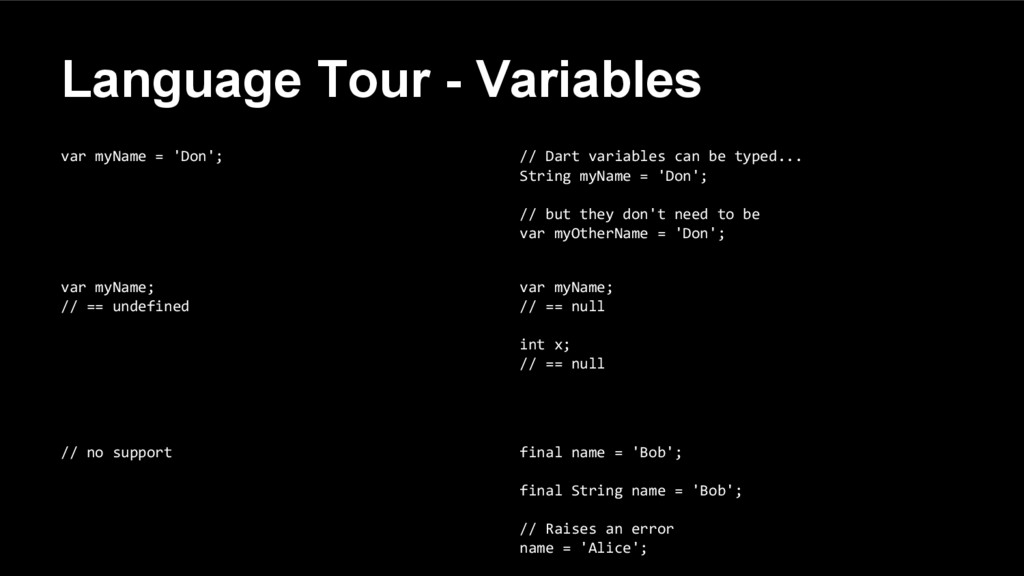
  11. Language Tour - Variables var myName = 'Don'; // Dart

    variables can be typed... String myName = 'Don'; // but they don't need to be var myOtherName = 'Don'; var myName; // == undefined var myName; // == null int x; // == null // no support final name = 'Bob'; final String name = 'Bob'; // Raises an error name = 'Alice';
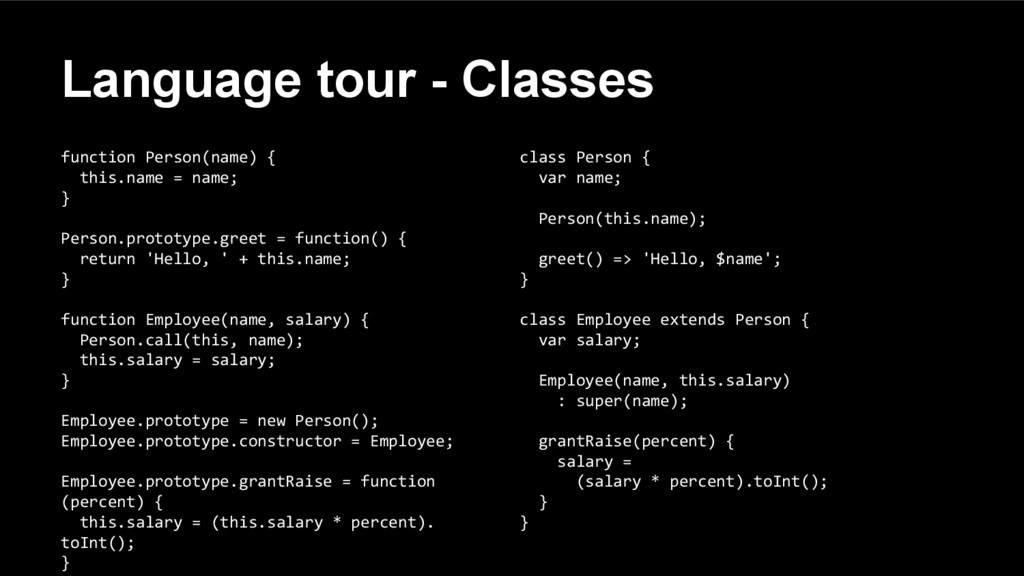
  12. Language tour - Classes function Person(name) { this.name = name;

    } Person.prototype.greet = function() { return 'Hello, ' + this.name; } function Employee(name, salary) { Person.call(this, name); this.salary = salary; } Employee.prototype = new Person(); Employee.prototype.constructor = Employee; Employee.prototype.grantRaise = function (percent) { this.salary = (this.salary * percent). toInt(); } class Person { var name; Person(this.name); greet() => 'Hello, $name'; } class Employee extends Person { var salary; Employee(name, this.salary) : super(name); grantRaise(percent) { salary = (salary * percent).toInt(); } }
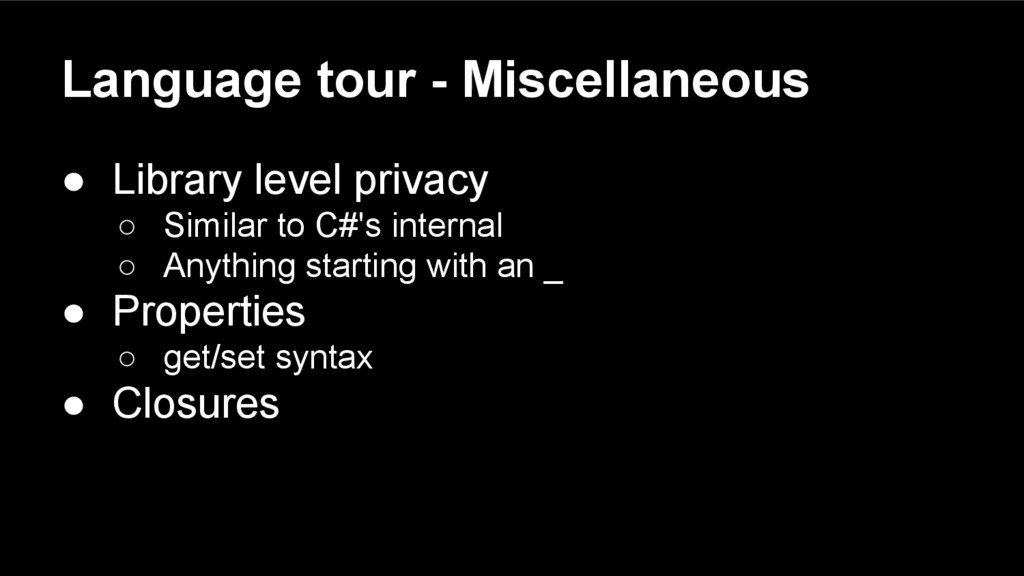
  13. Language tour - Miscellaneous • Library level privacy ◦ Similar

    to C#'s internal ◦ Anything starting with an _ • Properties ◦ get/set syntax • Closures
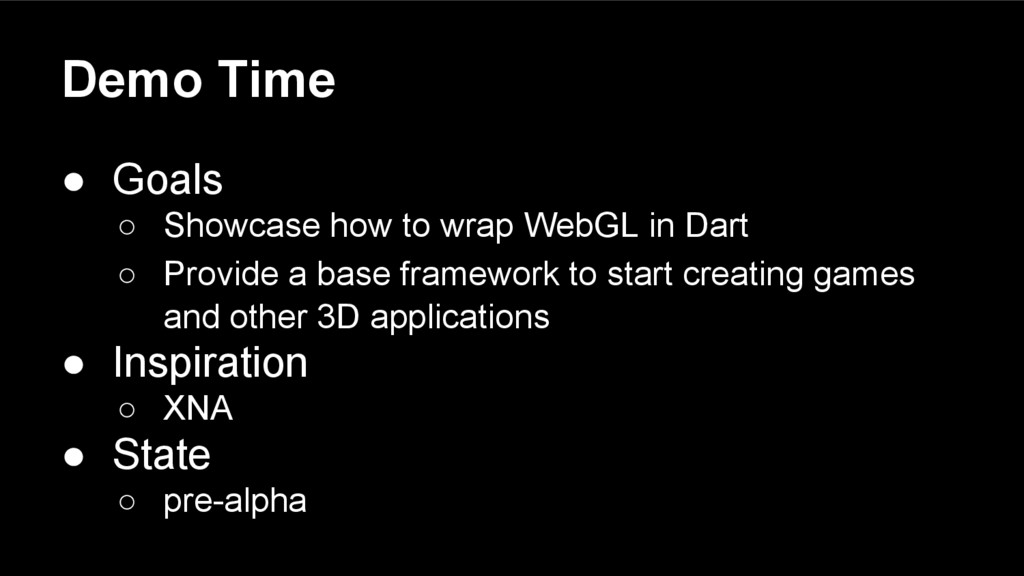
  14. Demo Time • Goals ◦ Showcase how to wrap WebGL

    in Dart ◦ Provide a base framework to start creating games and other 3D applications • Inspiration ◦ XNA • State ◦ pre-alpha
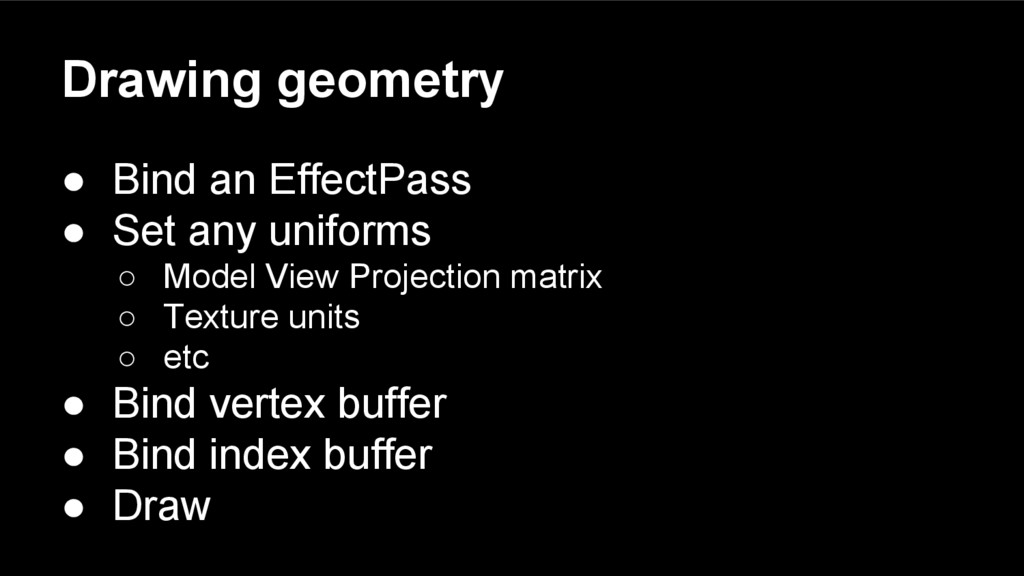
  15. Drawing geometry • Bind an EffectPass • Set any uniforms

    ◦ Model View Projection matrix ◦ Texture units ◦ etc • Bind vertex buffer • Bind index buffer • Draw
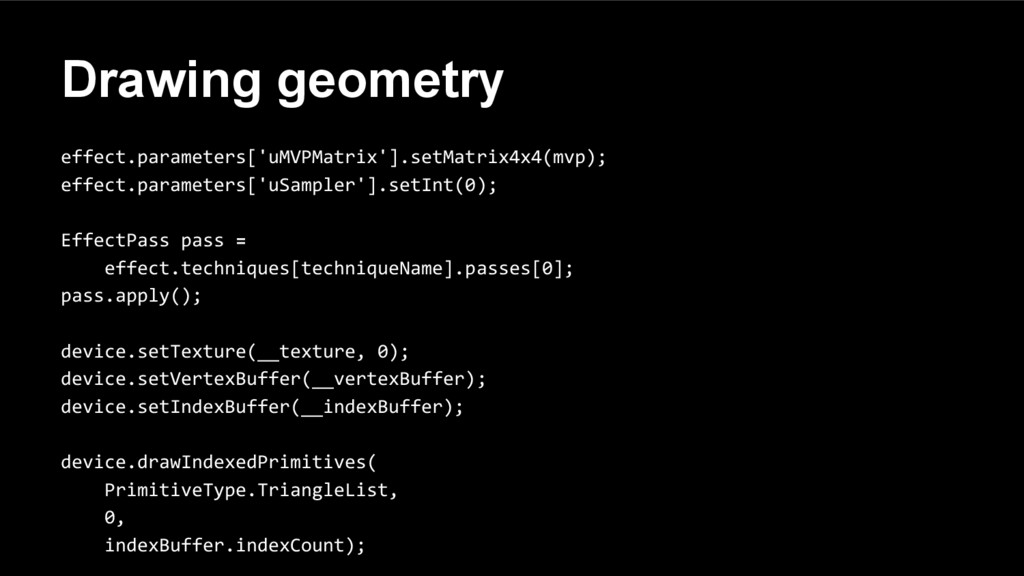
  16. Drawing geometry effect.parameters['uMVPMatrix'].setMatrix4x4(mvp); effect.parameters['uSampler'].setInt(0); EffectPass pass = effect.techniques[techniqueName].passes[0]; pass.apply(); device.setTexture(__texture,

    0); device.setVertexBuffer(__vertexBuffer); device.setIndexBuffer(__indexBuffer); device.drawIndexedPrimitives( PrimitiveType.TriangleList, 0, indexBuffer.indexCount);
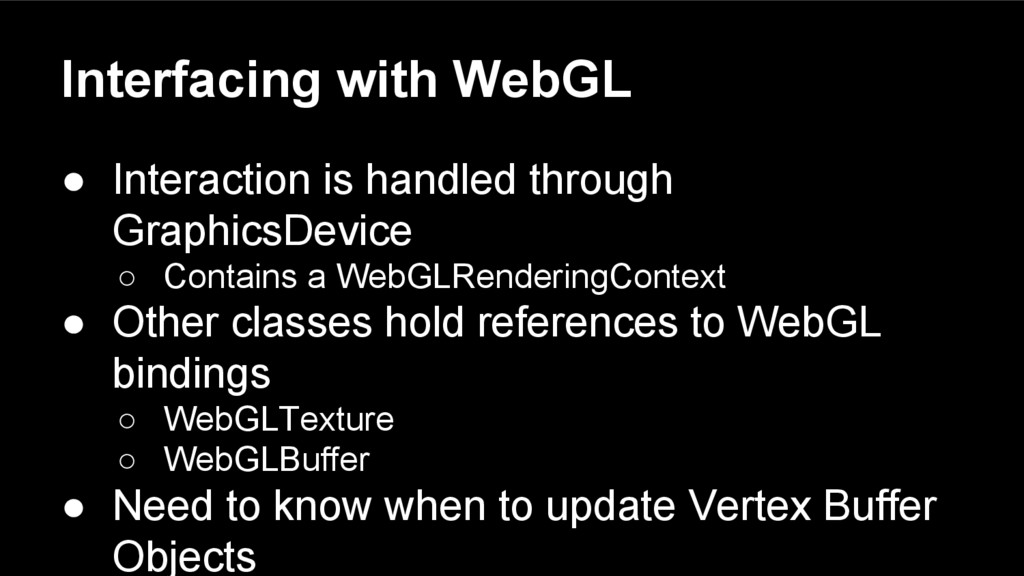
  17. Interfacing with WebGL • Interaction is handled through GraphicsDevice ◦

    Contains a WebGLRenderingContext • Other classes hold references to WebGL bindings ◦ WebGLTexture ◦ WebGLBuffer • Need to know when to update Vertex Buffer Objects
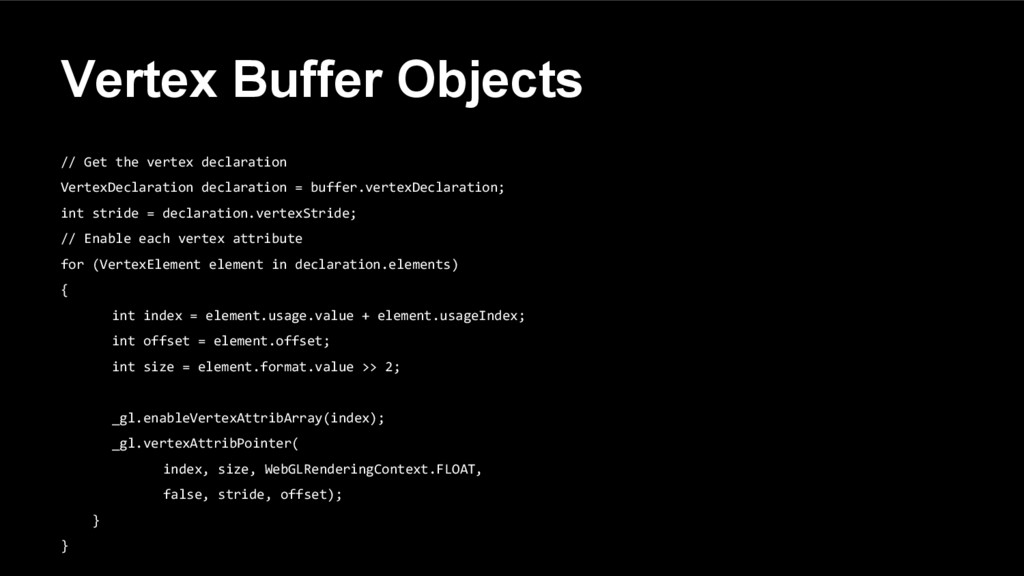
  18. Vertex Buffer Objects // Get the vertex declaration VertexDeclaration declaration

    = buffer.vertexDeclaration; int stride = declaration.vertexStride; // Enable each vertex attribute for (VertexElement element in declaration.elements) { int index = element.usage.value + element.usageIndex; int offset = element.offset; int size = element.format.value >> 2; _gl.enableVertexAttribArray(index); _gl.vertexAttribPointer( index, size, WebGLRenderingContext.FLOAT, false, stride, offset); } }
  19. Dart's future • Dart is pre-release • You can help

    shape it! ◦ Download the SDK ◦ Discuss the language on the mailing list ◦ Submit suggestions
  20. Wrapping up • Dart simplifies development of modern web applications

    ◦ Easier to develop large applications • Dart is built for performance ◦ 3D applications require speed • Dart comes with batteries included ◦ IDE and core libraries available out of the box