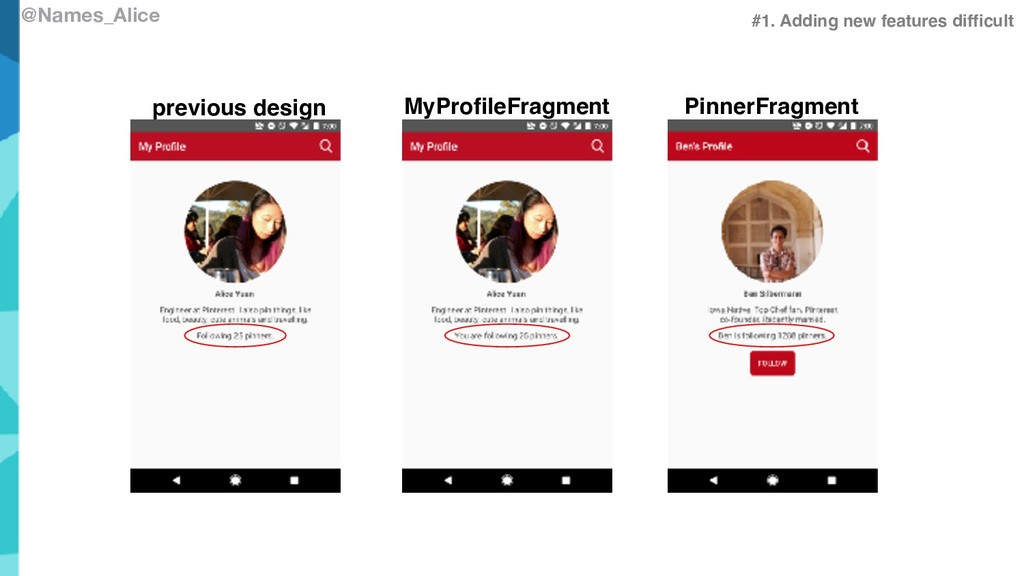
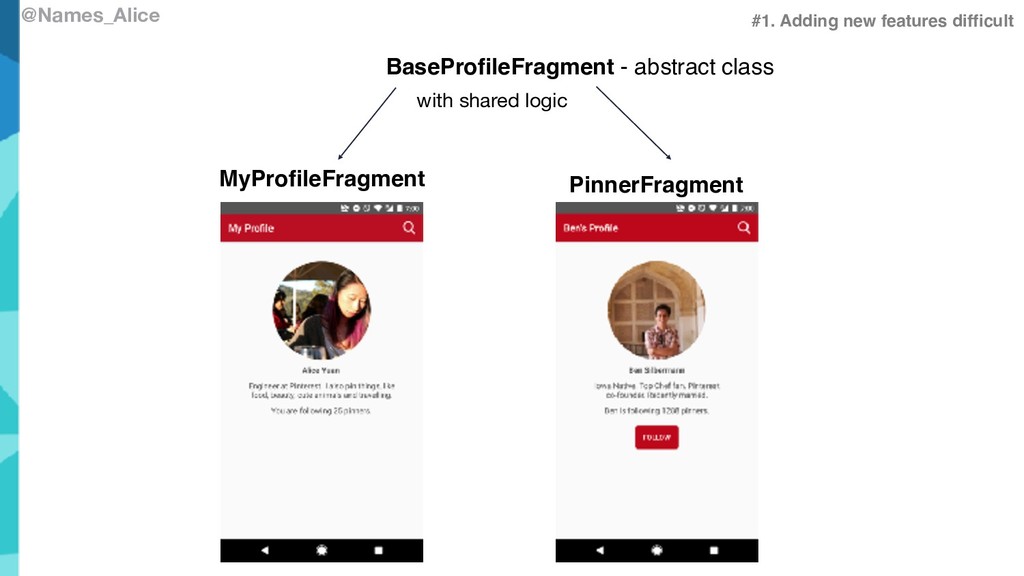
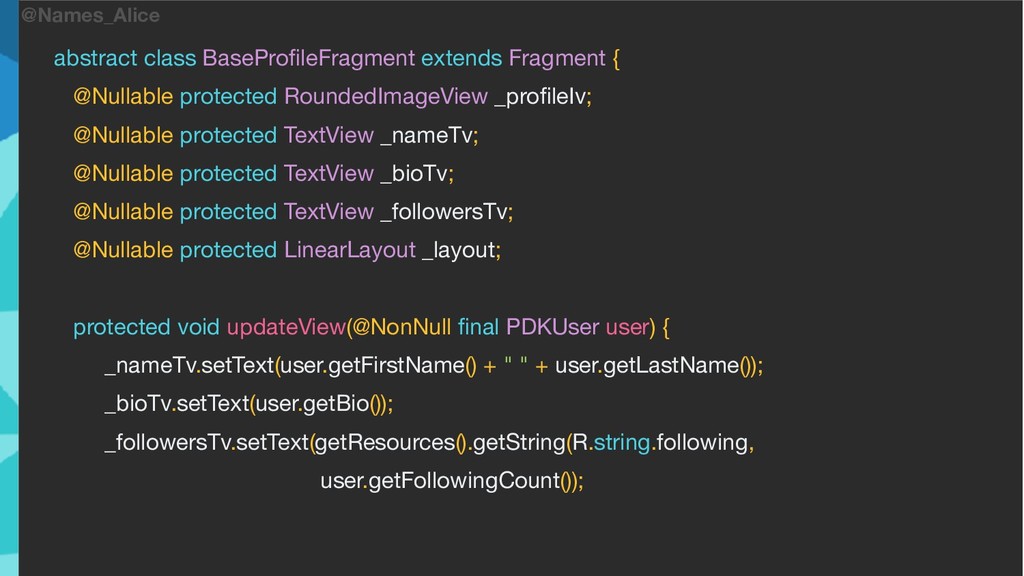
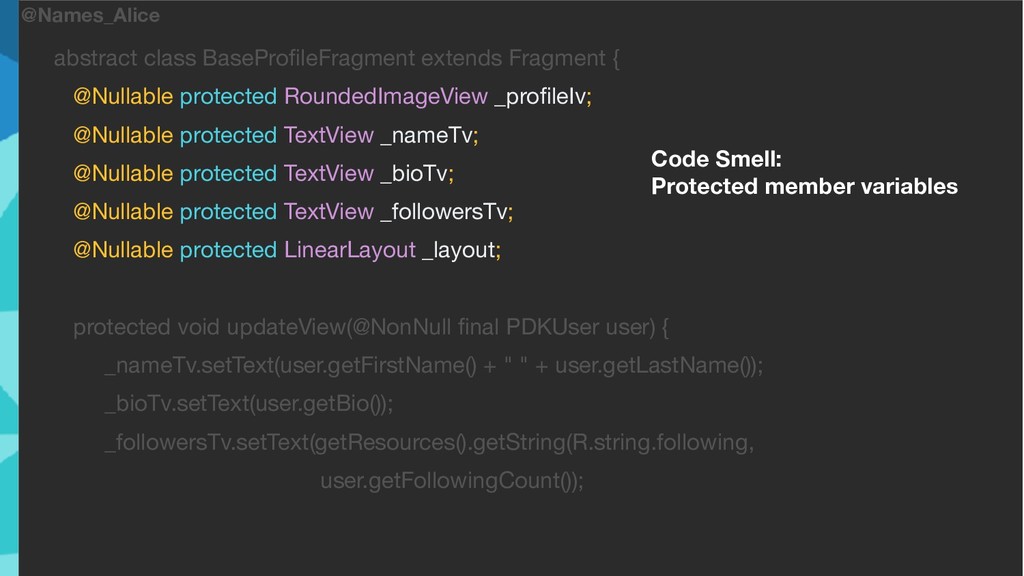
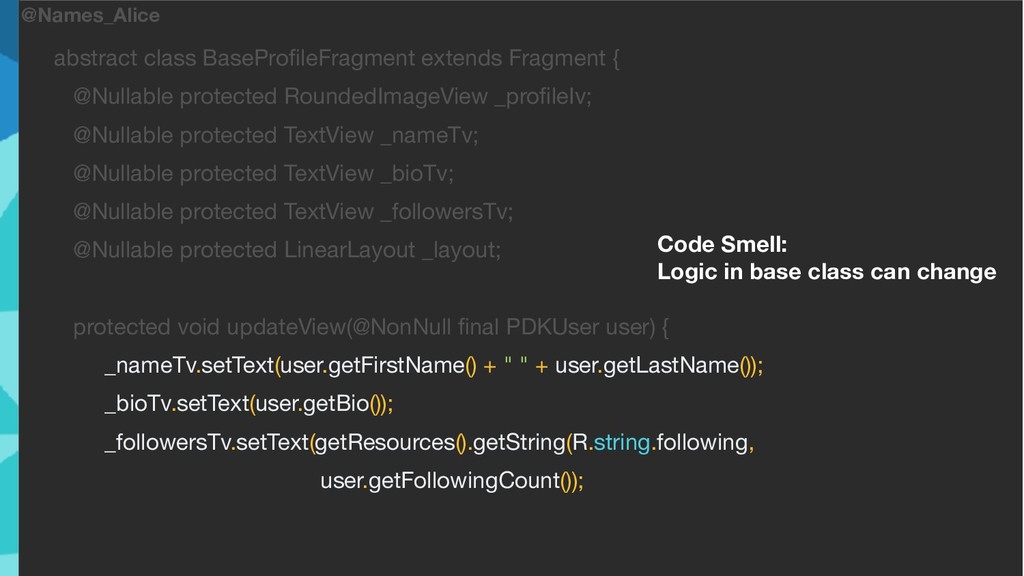
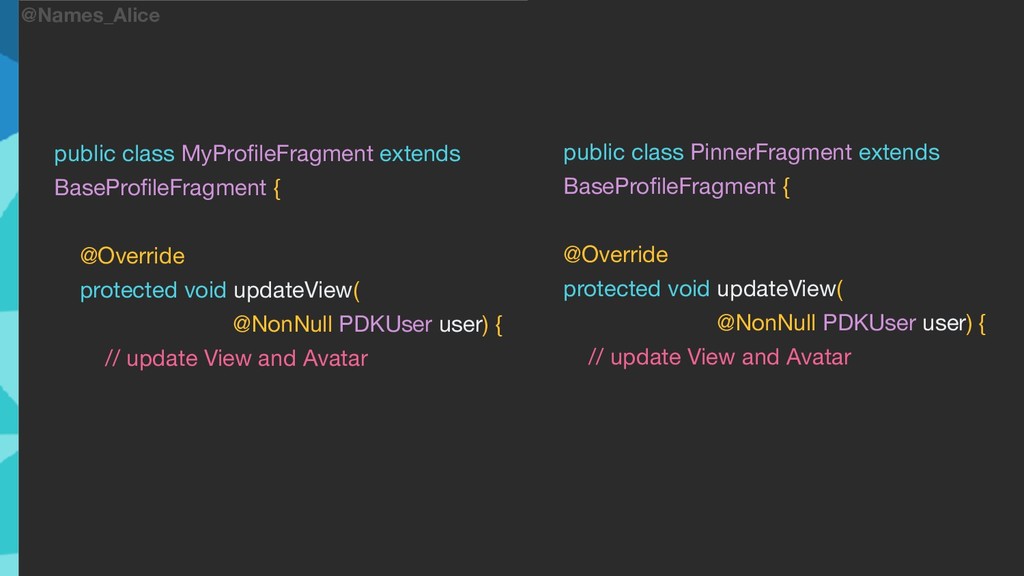
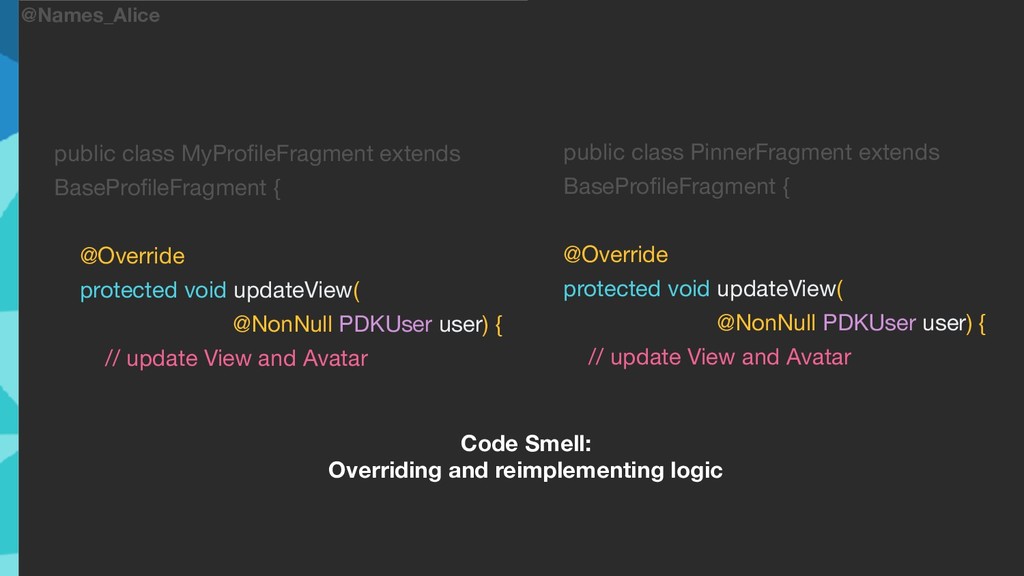
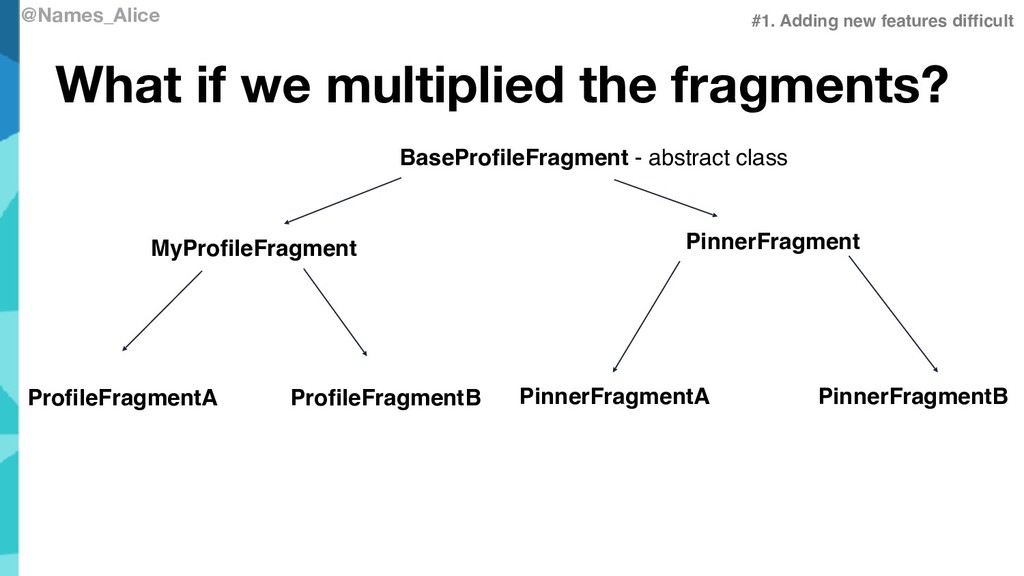
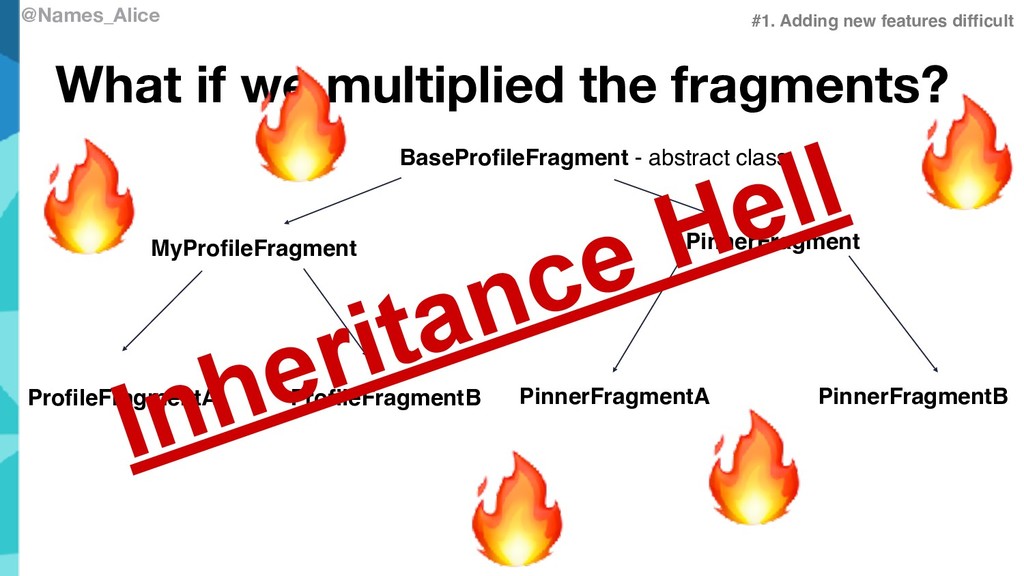
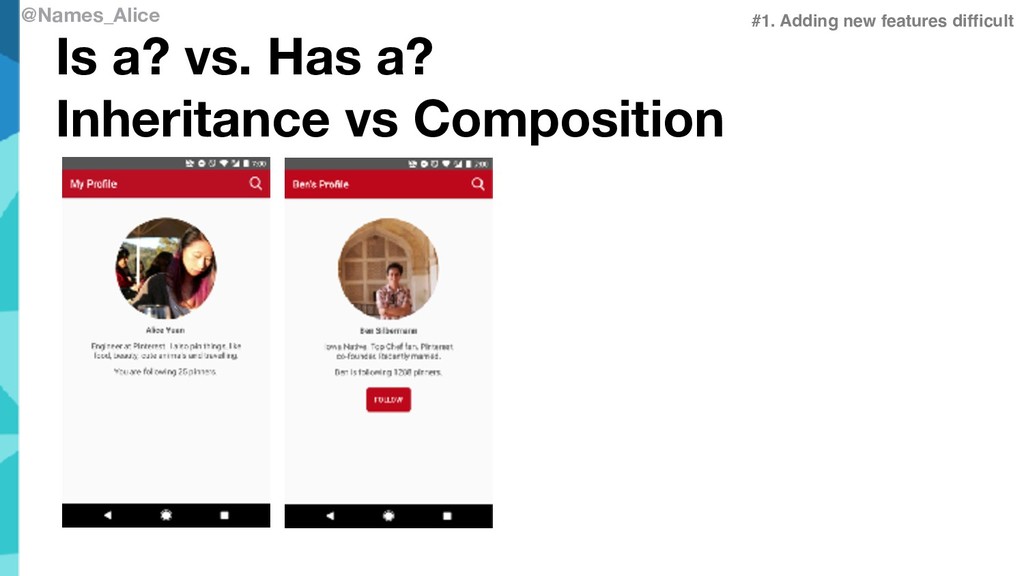
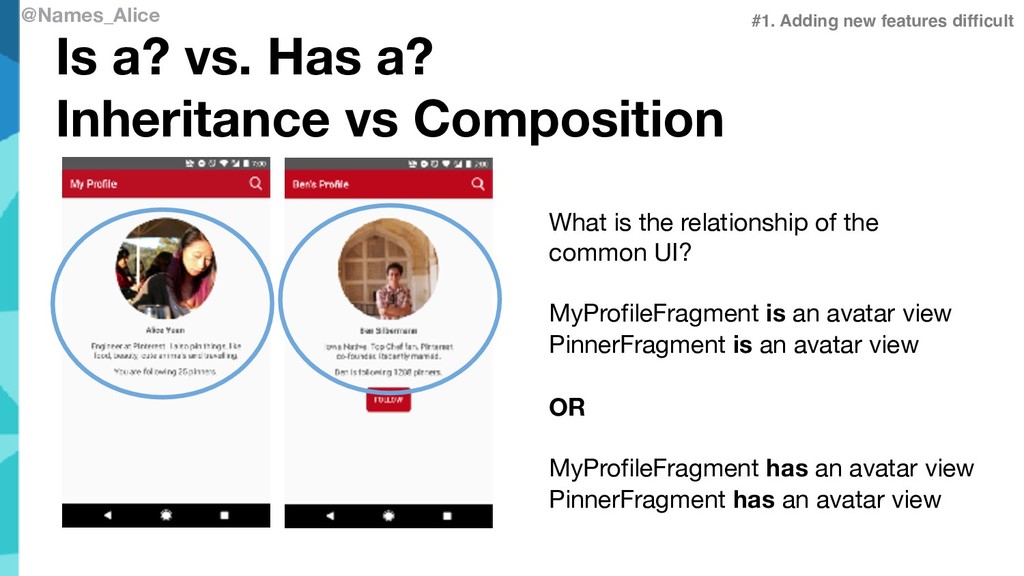
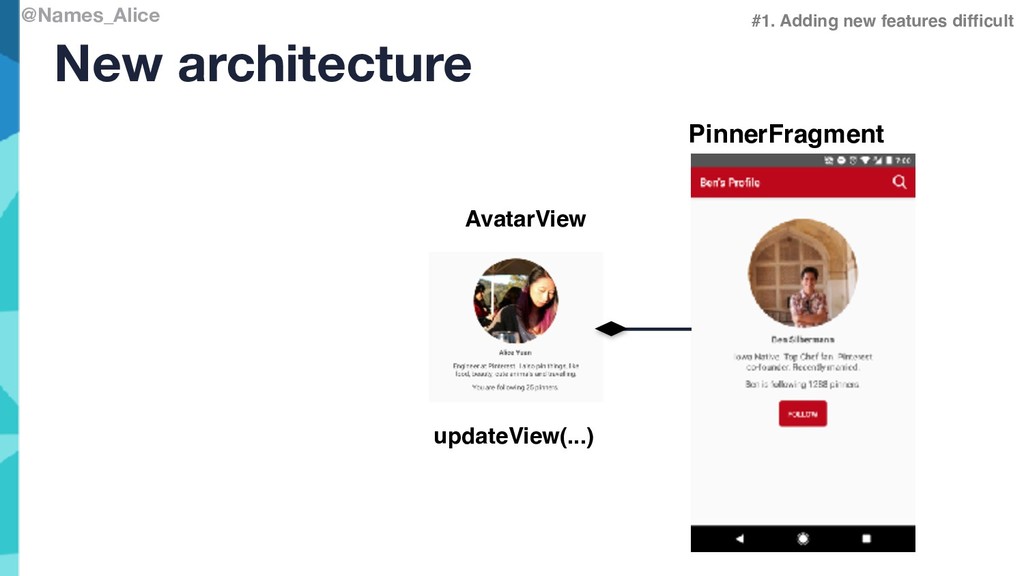
is an avatar view PinnerFragment is an avatar view OR MyProfileFragment has an avatar view PinnerFragment has an avatar view Is a? vs. Has a? Inheritance vs Composition #1. Adding new features difficult
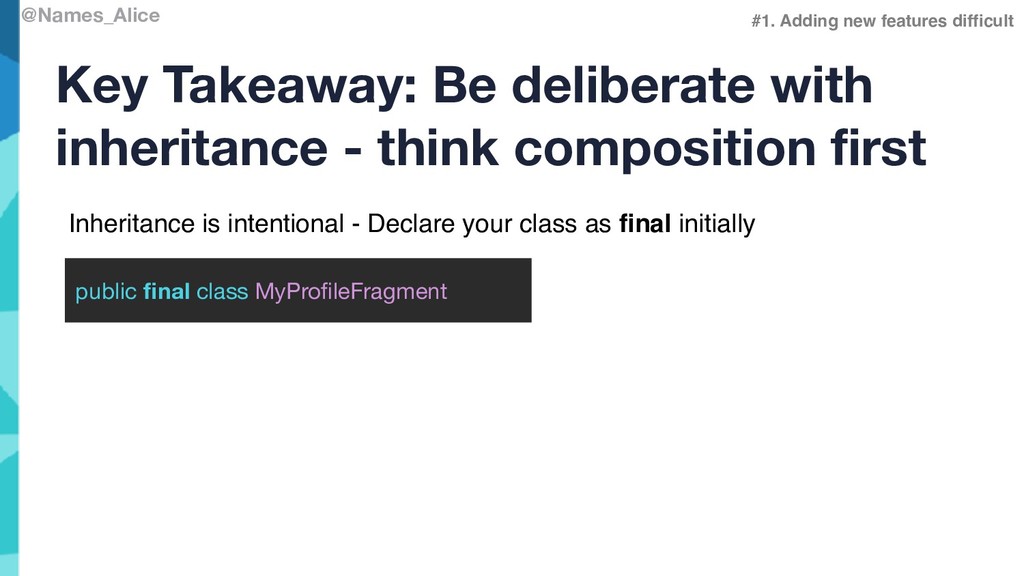
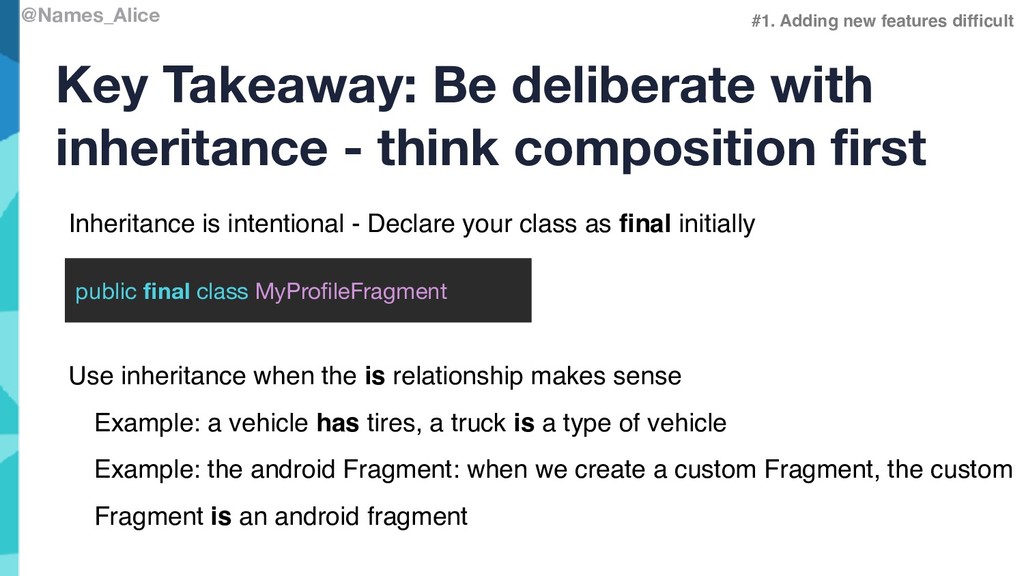
initially Key Takeaway: Be deliberate with inheritance - think composition first #1. Adding new features difficult public final class MyProfileFragment Use inheritance when the is relationship makes sense Example: a vehicle has tires, a truck is a type of vehicle Example: the android Fragment: when we create a custom Fragment, the custom Fragment is an android fragment
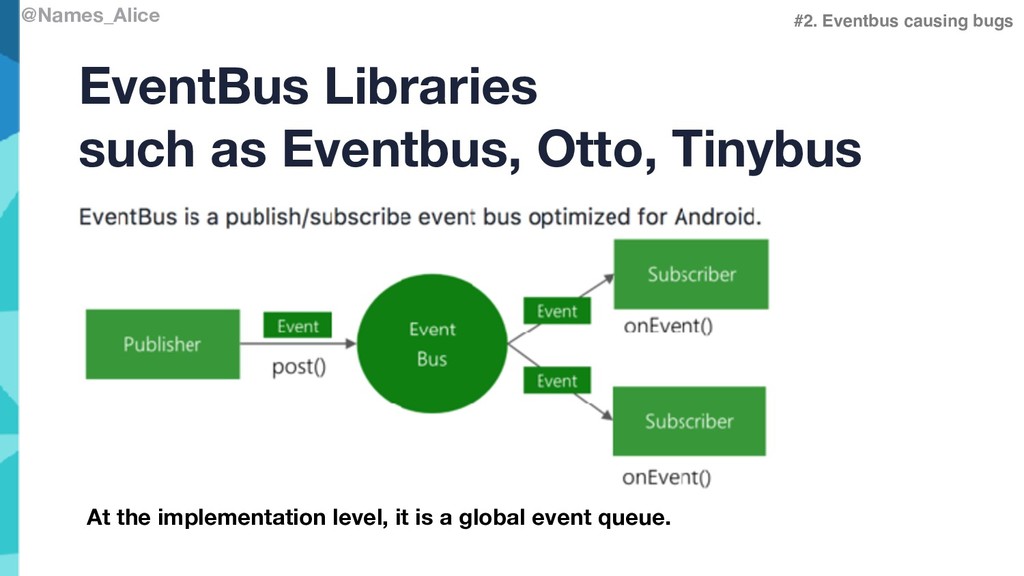
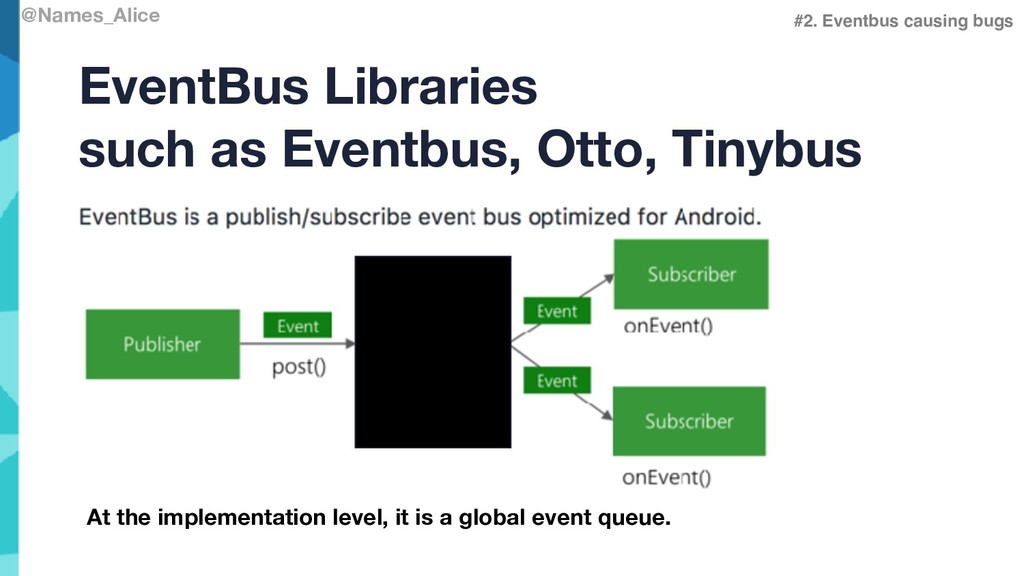
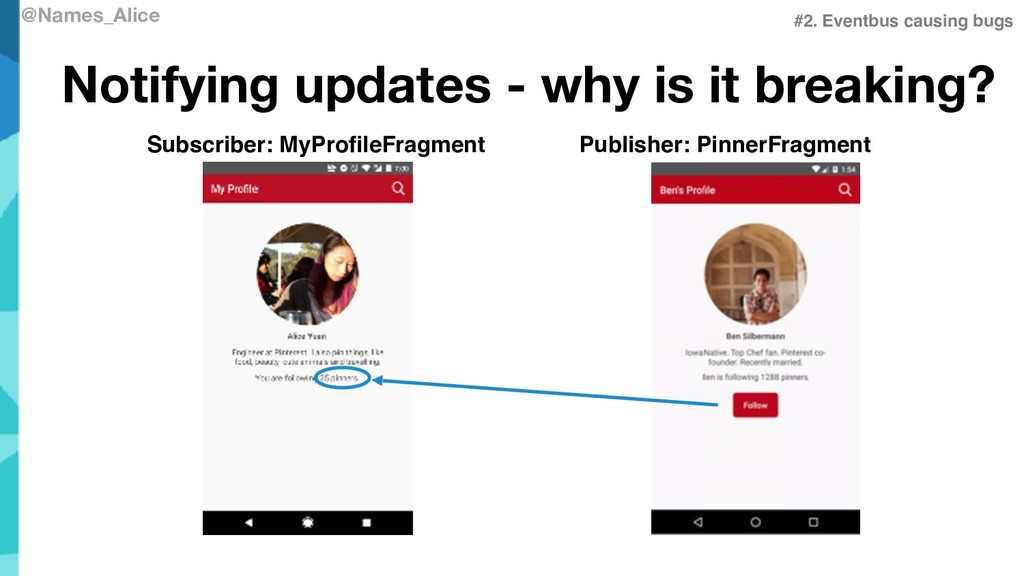
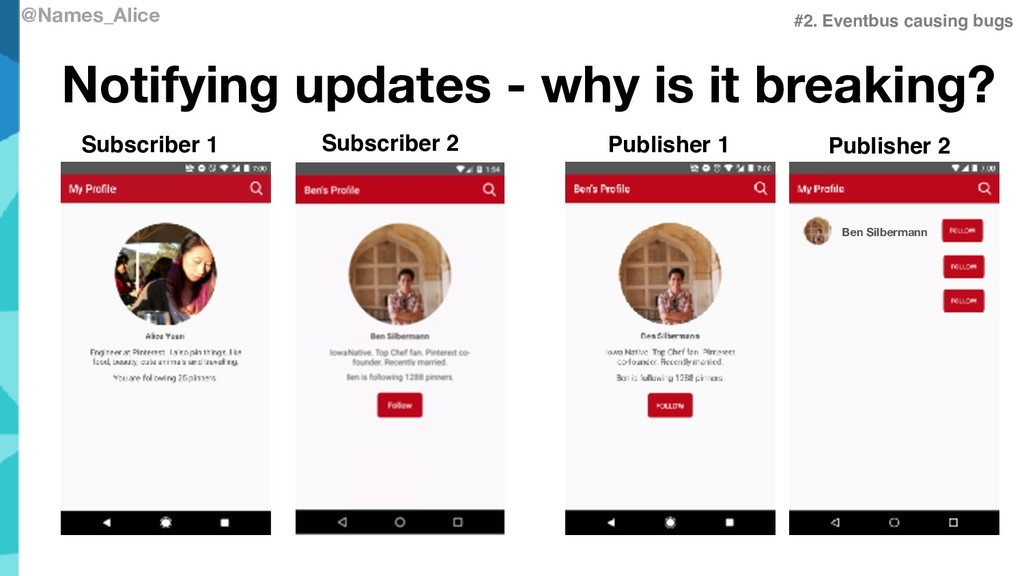
listening • As we add more events it decreases reliability and maintainability of the code • A pain to write tests for • Thus, only use eventbus when the client does not care if the event is consumed or not eg. Logging events are consumed by the server #2. Eventbus causing bugs Because it’s decoupled, Eventbus libraries have many pitfalls
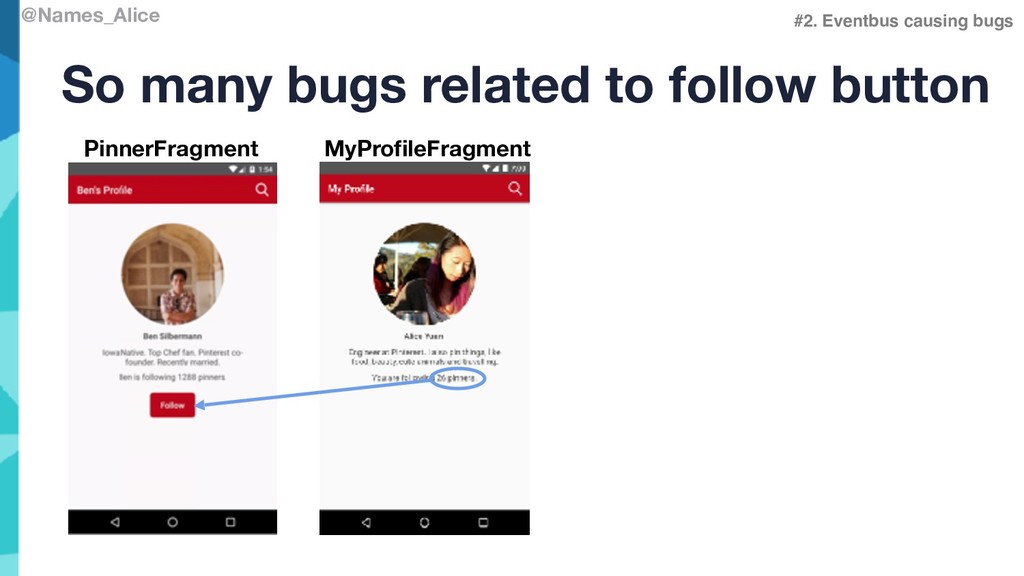
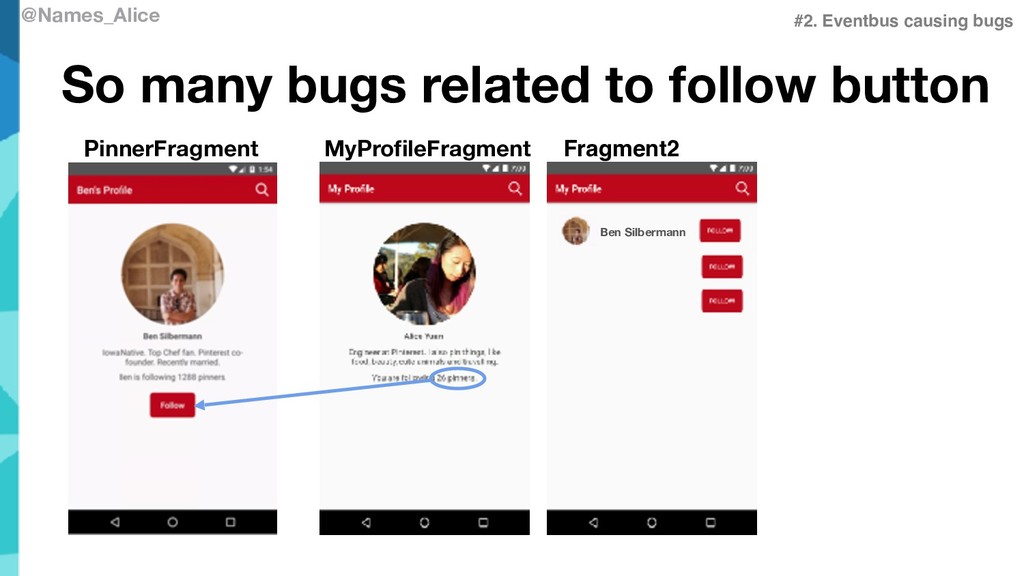
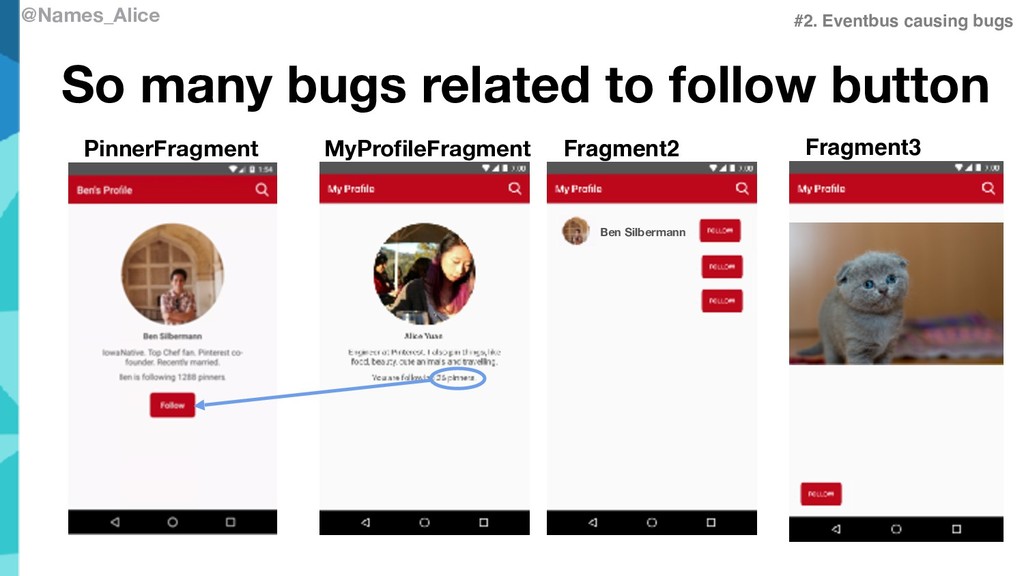
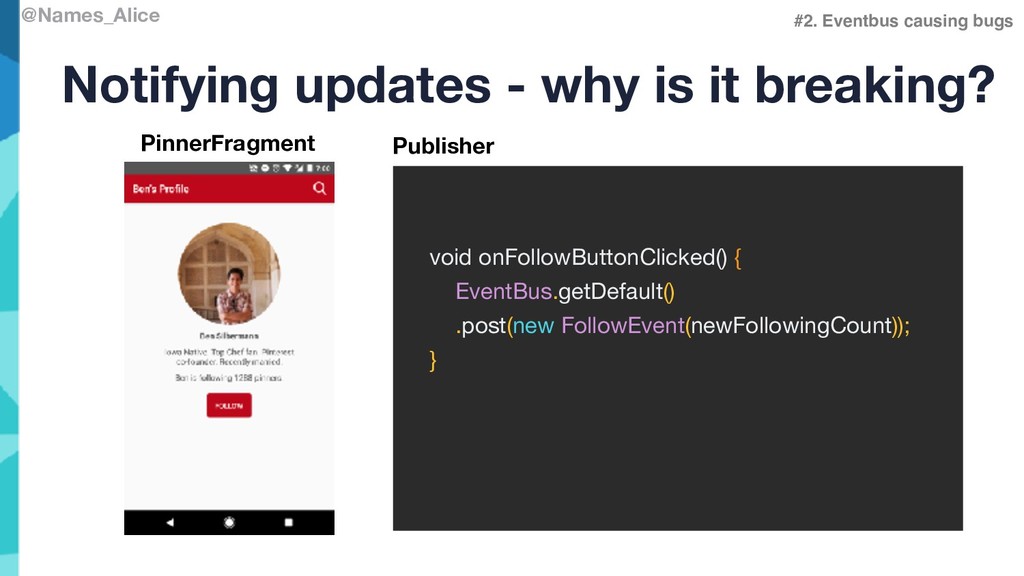
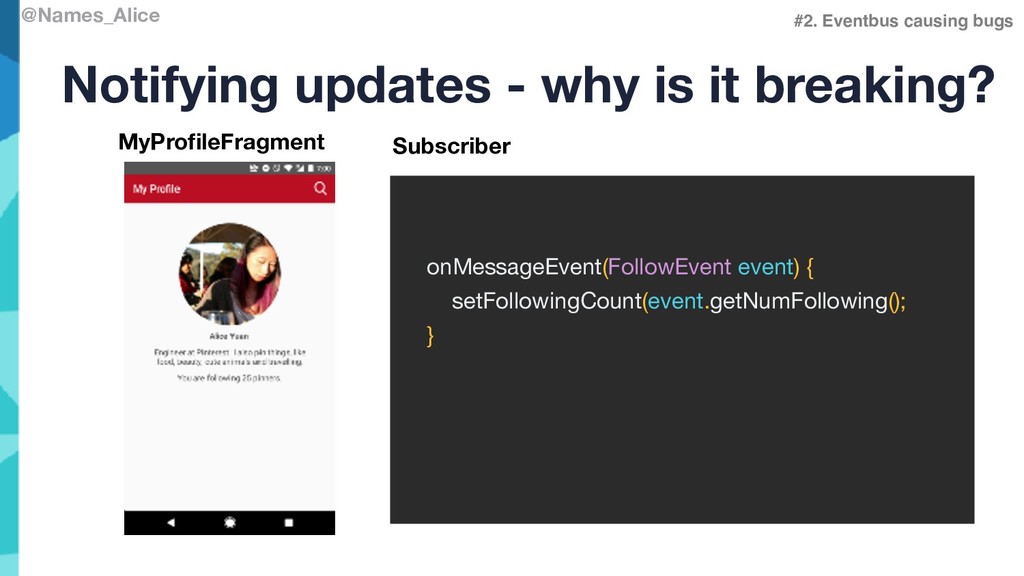
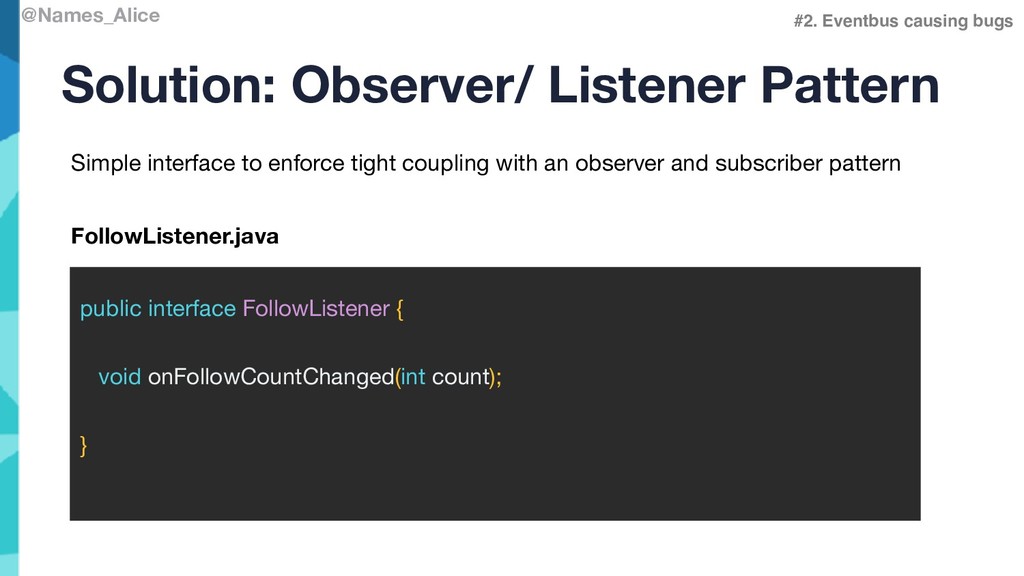
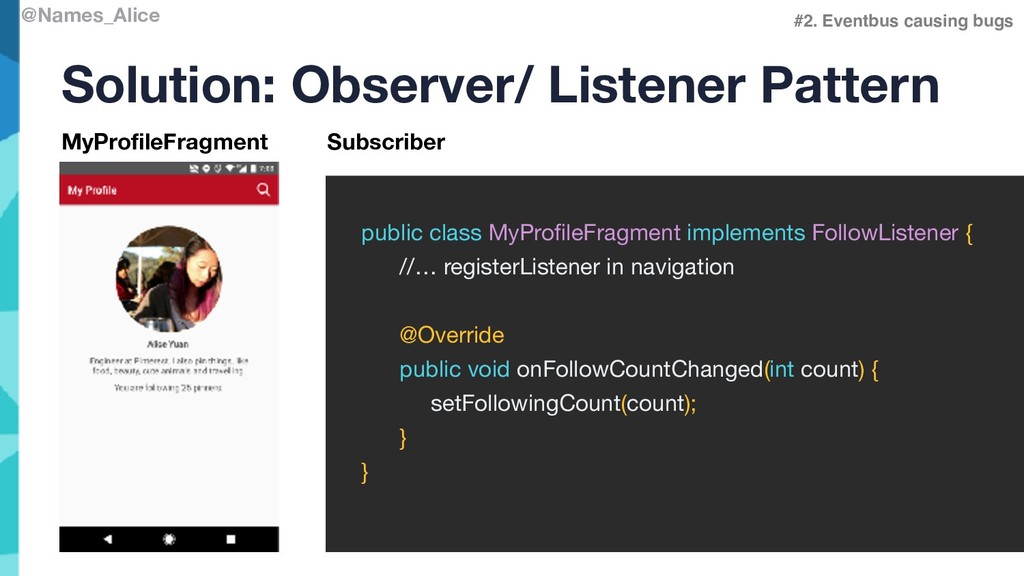
coupling with an observer and subscriber pattern #2. Eventbus causing bugs public interface FollowListener { void onFollowCountChanged(int count); } FollowListener.java
public class MyProfileFragment implements FollowListener { //… registerListener in navigation @Override public void onFollowCountChanged(int count) { setFollowingCount(count); } } Subscriber
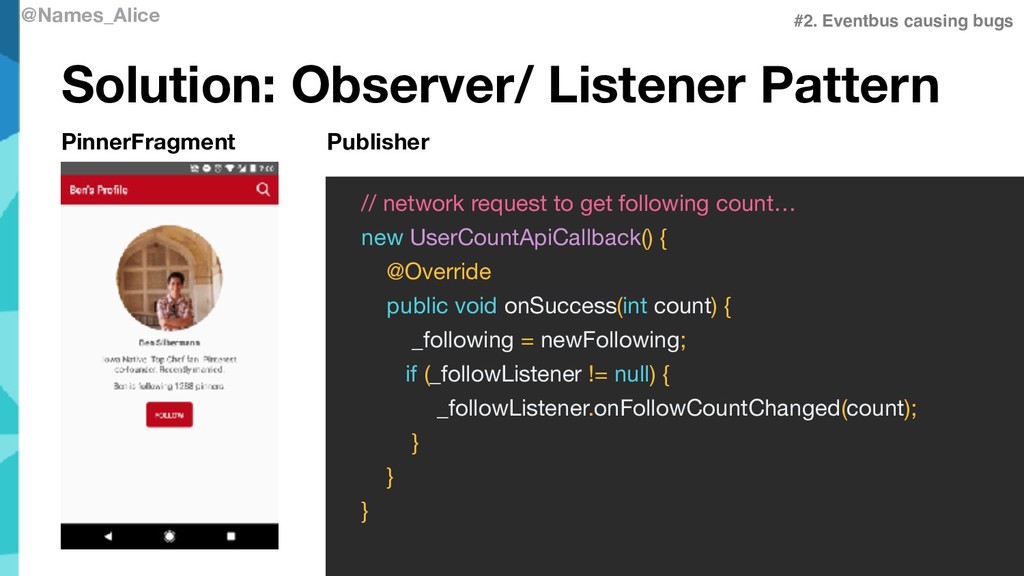
network request to get following count… new UserCountApiCallback() { @Override public void onSuccess(int count) { _following = newFollowing; if (_followListener != null) { _followListener.onFollowCountChanged(count); } } } Publisher PinnerFragment
benefits from loose coupling • Use event bus for places where loose coupling makes sense • Use an Observable/ Listener pattern otherwise Key Takeaway: EventBus Libraries are often abused due to its simplicity #2. Eventbus causing bugs
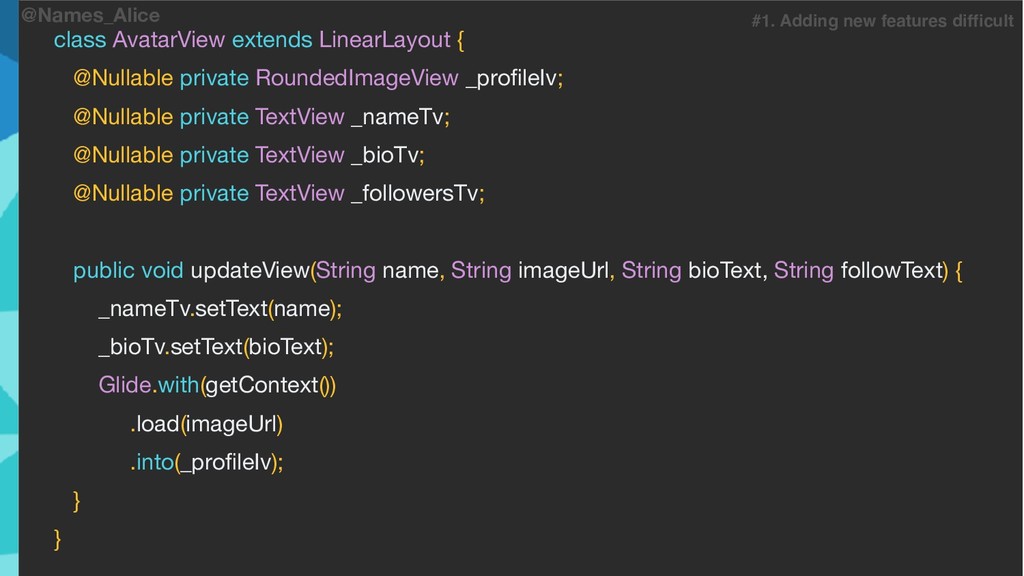
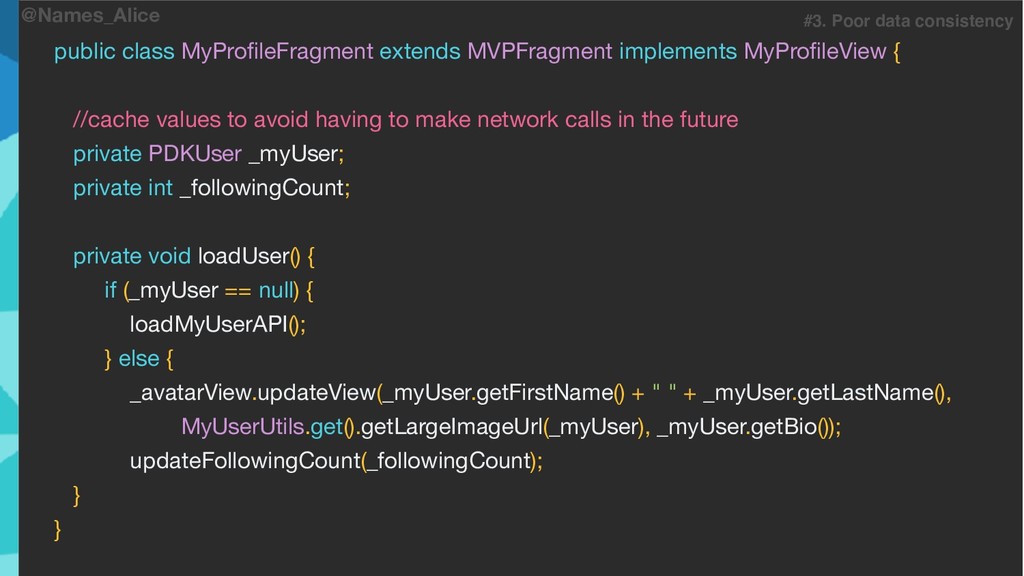
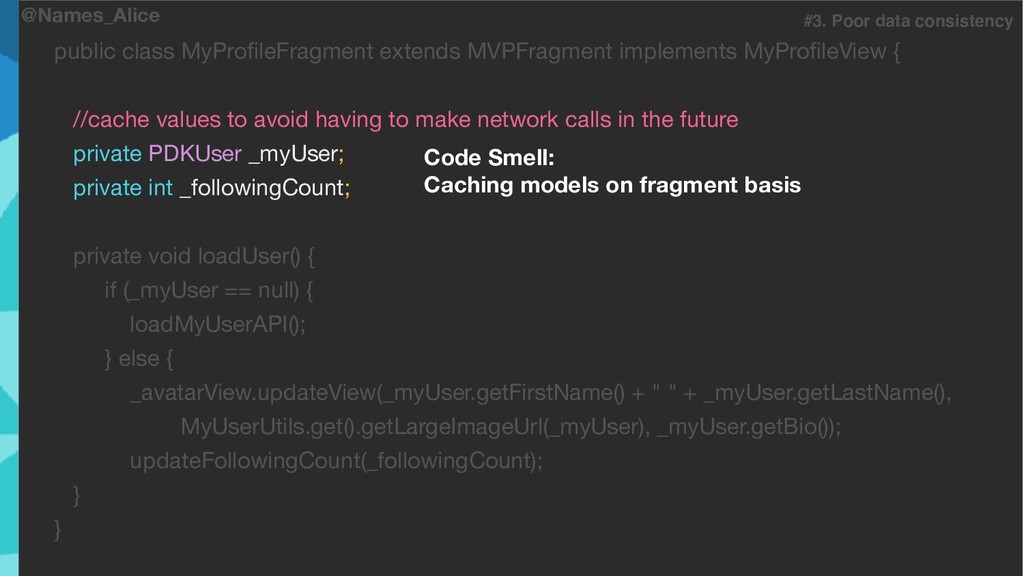
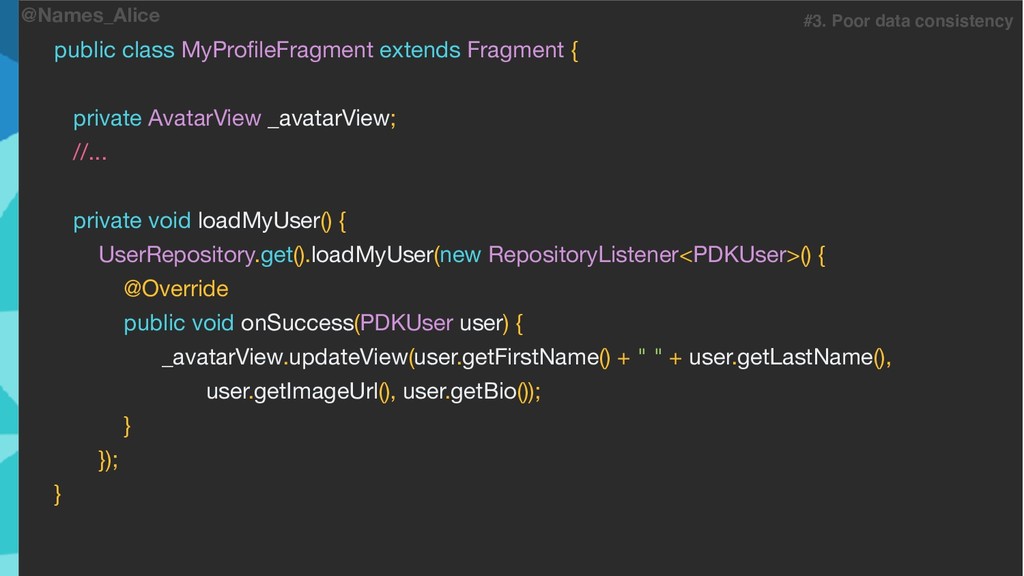
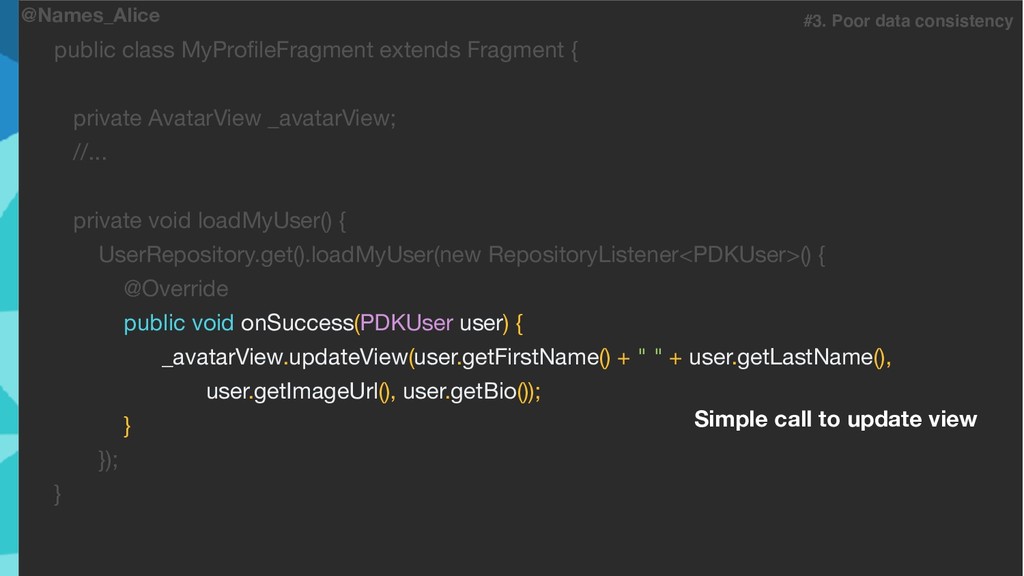
values to avoid having to make network calls in the future private PDKUser _myUser; private int _followingCount; private void loadUser() { if (_myUser == null) { loadMyUserAPI(); } else { _avatarView.updateView(_myUser.getFirstName() + " " + _myUser.getLastName(), MyUserUtils.get().getLargeImageUrl(_myUser), _myUser.getBio()); updateFollowingCount(_followingCount); } } Code Smell: Caching models on fragment basis @Names_Alice #3. Poor data consistency
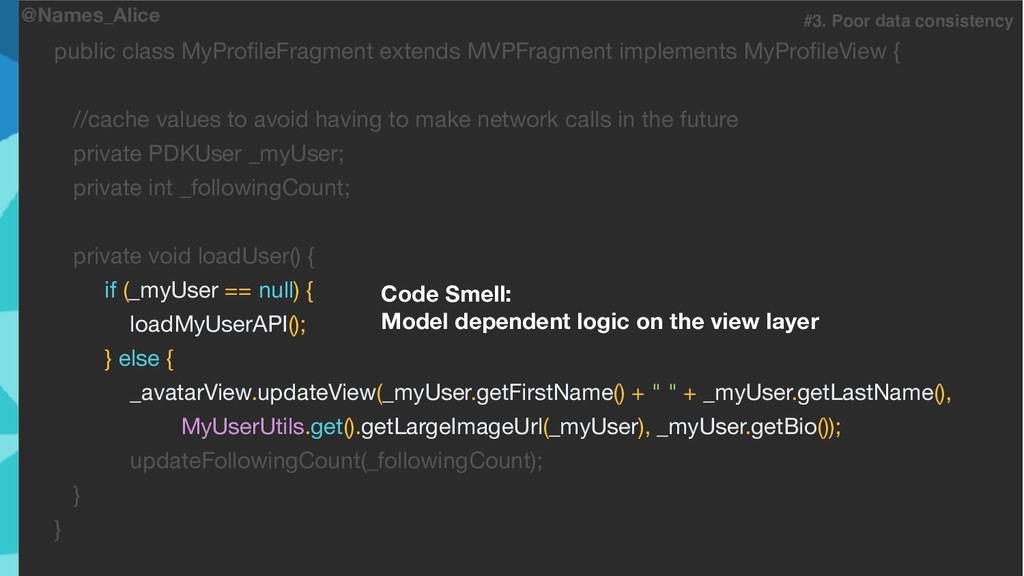
values to avoid having to make network calls in the future private PDKUser _myUser; private int _followingCount; private void loadUser() { if (_myUser == null) { loadMyUserAPI(); } else { _avatarView.updateView(_myUser.getFirstName() + " " + _myUser.getLastName(), MyUserUtils.get().getLargeImageUrl(_myUser), _myUser.getBio()); updateFollowingCount(_followingCount); } } Code Smell: Model dependent logic on the view layer @Names_Alice #3. Poor data consistency
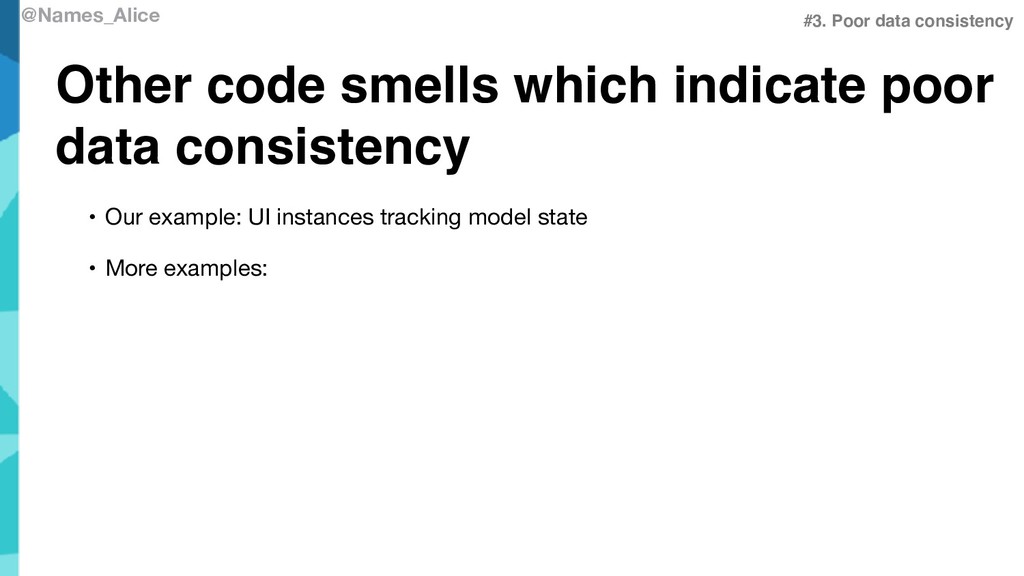
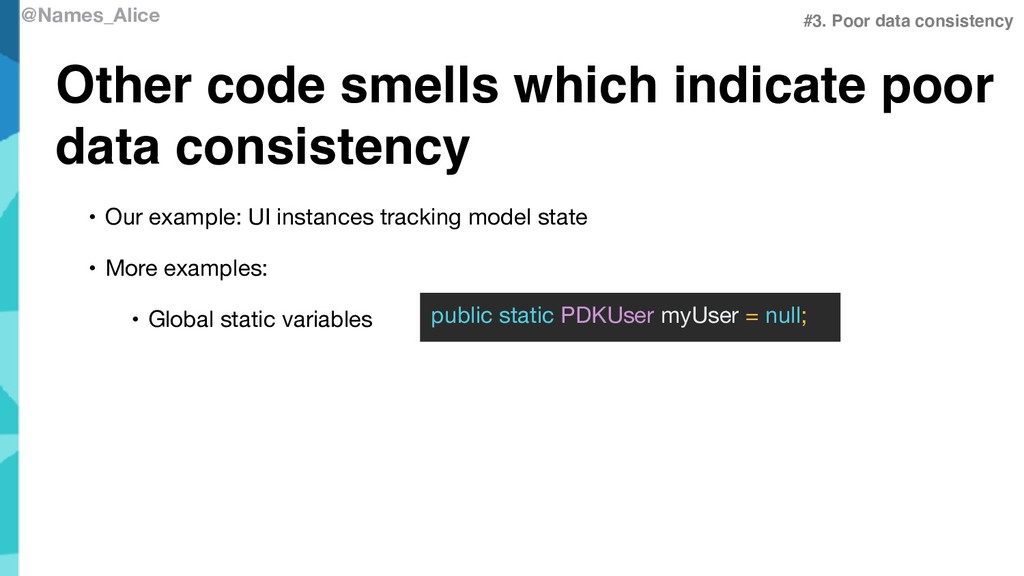
Poor data consistency • Our example: UI instances tracking model state • More examples: • Global static variables • Variables hidden through a singletons. Often a utils class pattern public static PDKUser myUser = null; class MyUserUtils { String doSomethingWithUserName(String userName) { myUser.setUserName(userName); // ... logic happens }
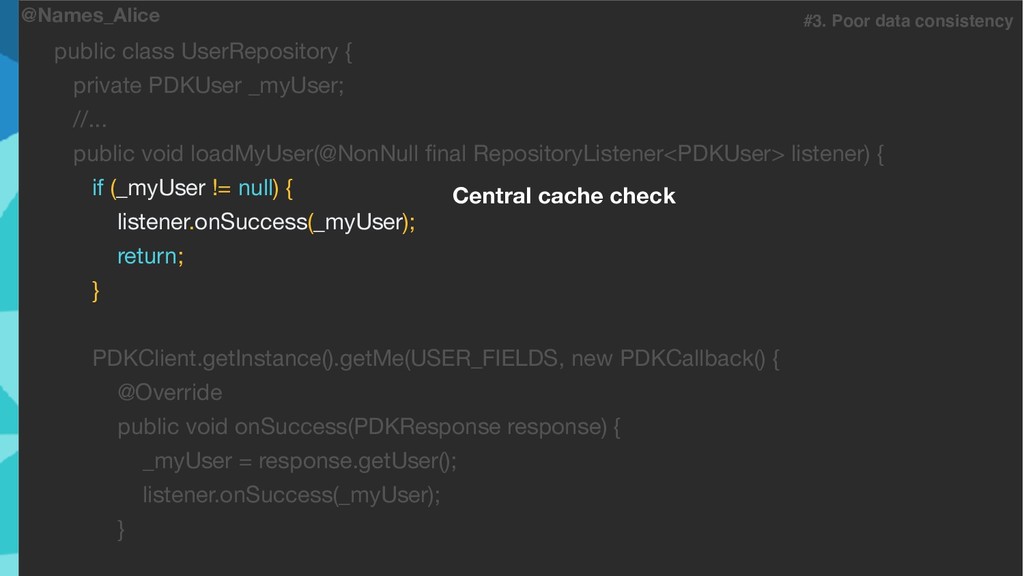
solved with a listener pattern • More complex example: chaining data calls, returning more than one type data response • rxJava can solve this through Observable stream • There exist libraries that adapt network callbacks into rxJava Observables for you Repository with RxJava #3. Poor data consistency
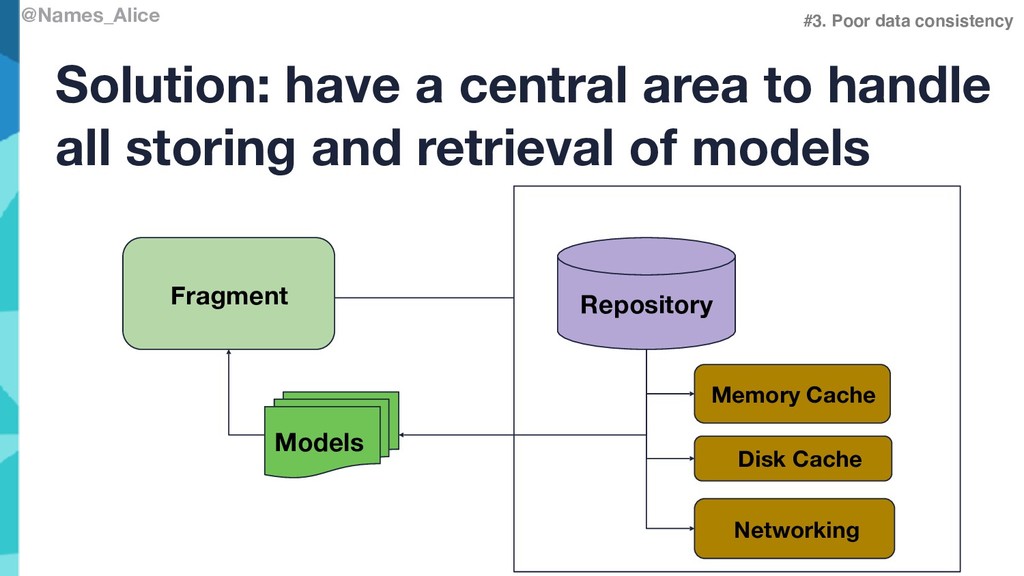
retrieve models #3. Poor data consistency • Stop storing instances of models in your fragments! • Ensure data consistency regardless of where we’re retrieving or storing our models • Store and fetch models in a central area
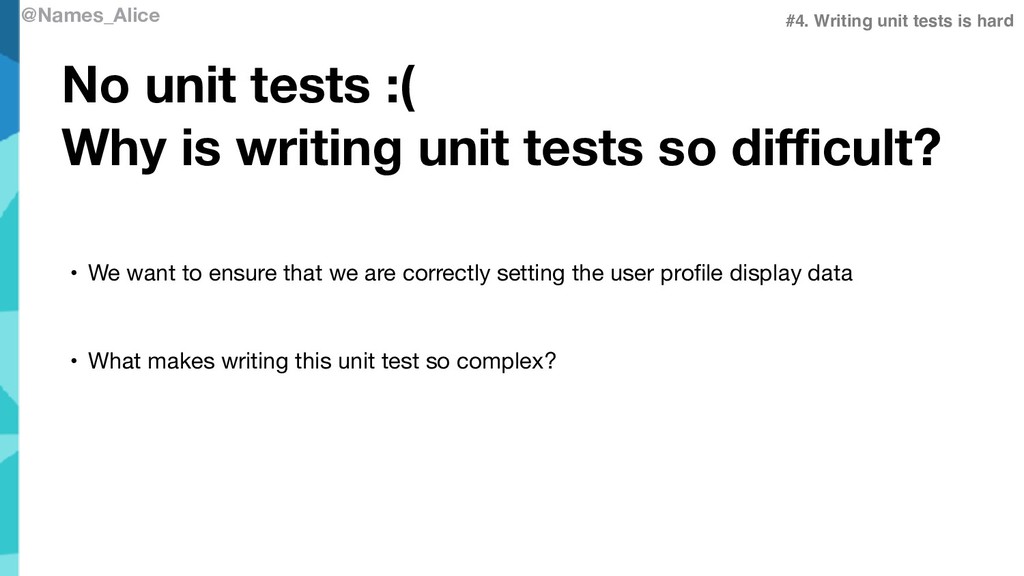
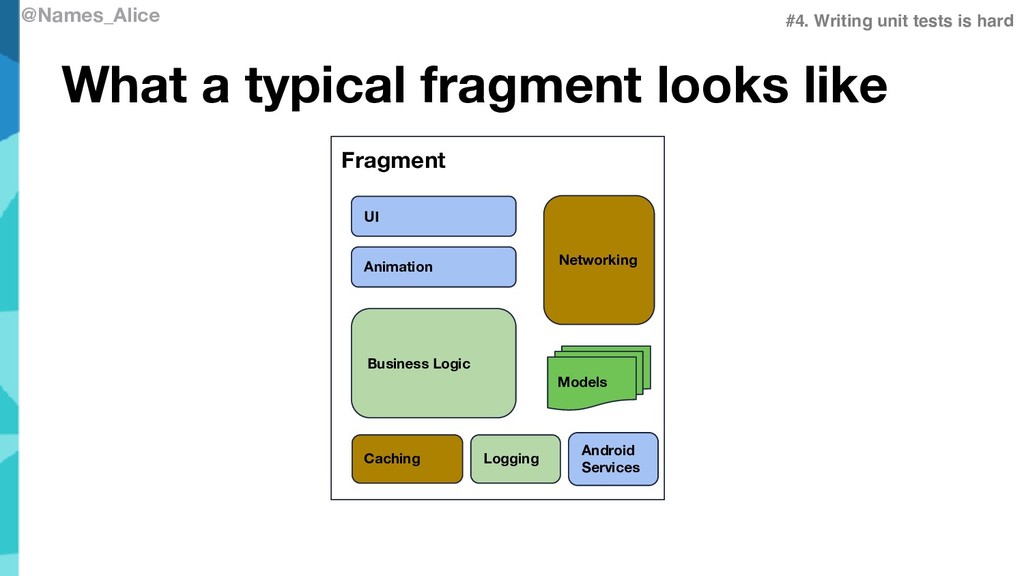
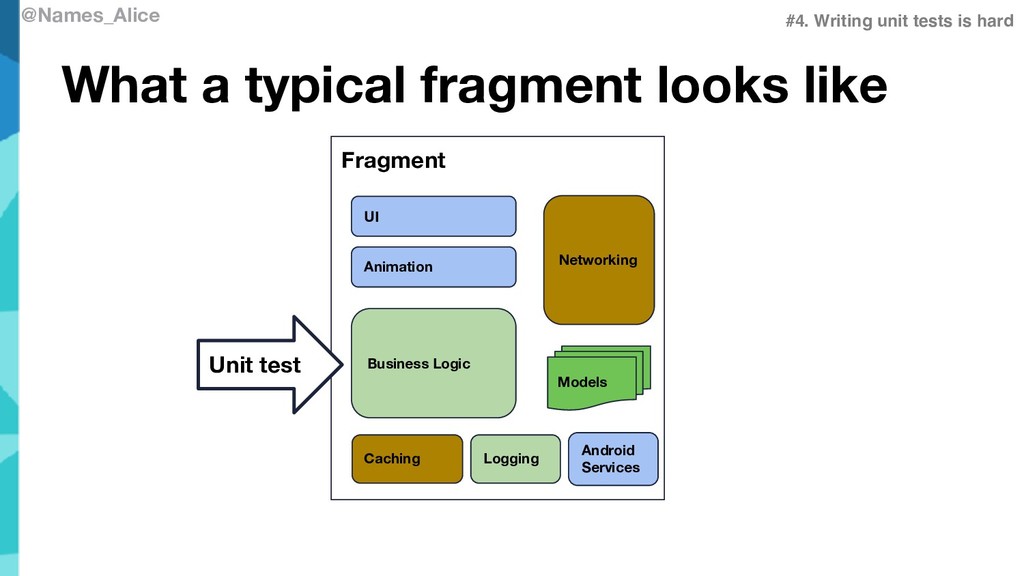
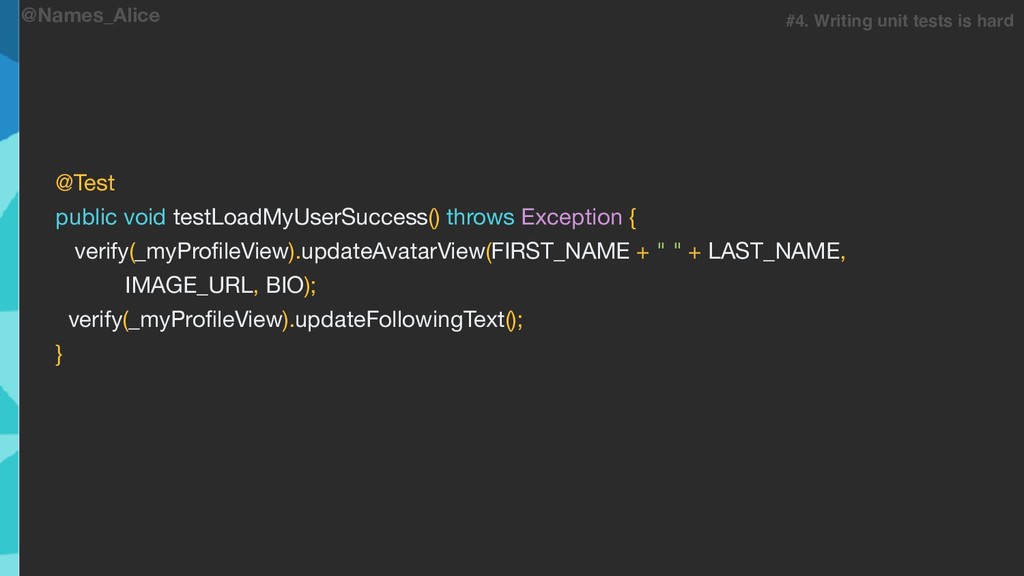
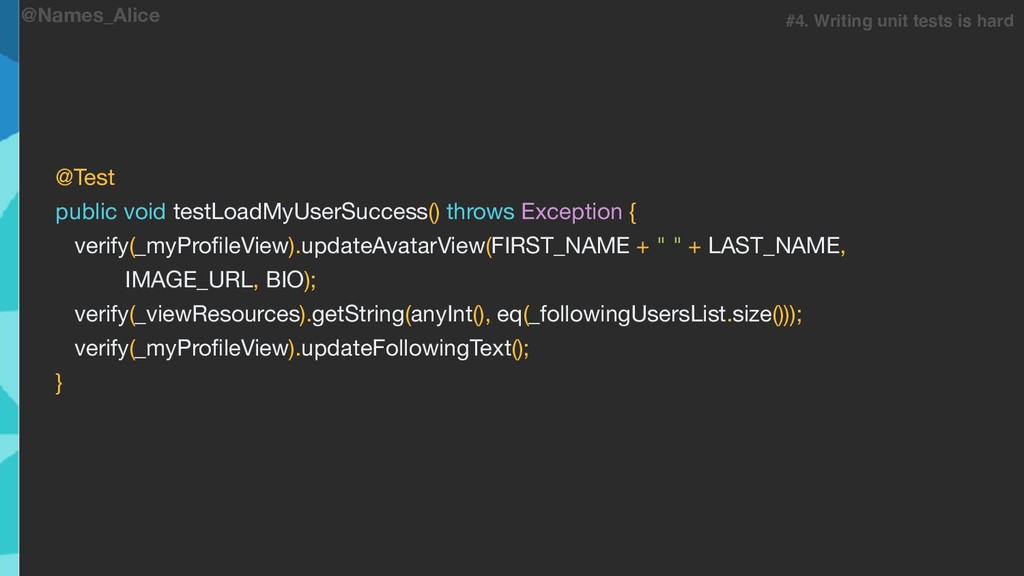
so difficult? • We want to ensure that we are correctly setting the user profile display data • What makes writing this unit test so complex? #4. Writing unit tests is hard
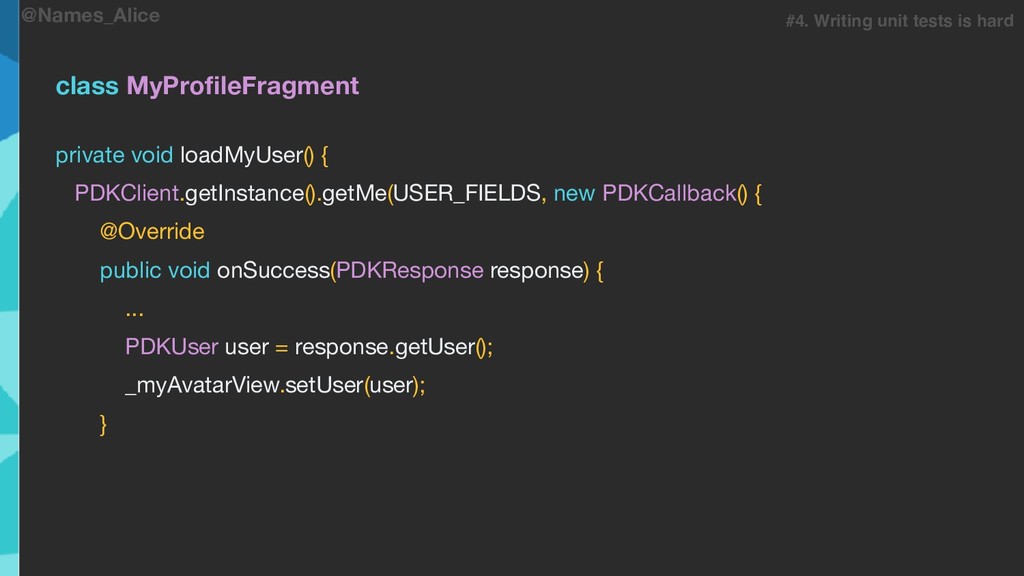
public void onSuccess(PDKResponse response) { ... PDKUser user = response.getUser(); _myAvatarView.setUser(user); } class MyProfileFragment @Names_Alice #4. Writing unit tests is hard
public void onSuccess(PDKResponse response) { ... PDKUser user = response.getUser(); _myAvatarView.setUser(user); } class MyProfileFragment Mock network callback @Names_Alice #4. Writing unit tests is hard
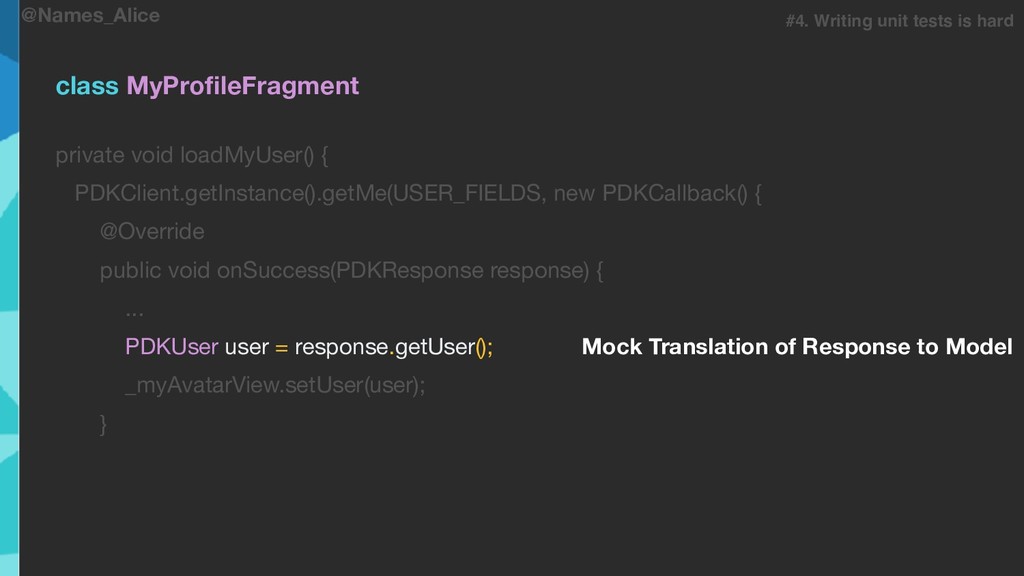
public void onSuccess(PDKResponse response) { ... PDKUser user = response.getUser(); _myAvatarView.setUser(user); } class MyProfileFragment Mock Translation of Response to Model @Names_Alice #4. Writing unit tests is hard
public void onSuccess(PDKResponse response) { ... PDKUser user = response.getUser(); _myAvatarView.setUser(user); } class MyProfileFragment Mock Android Framework UI using Roboelectric @Names_Alice #4. Writing unit tests is hard
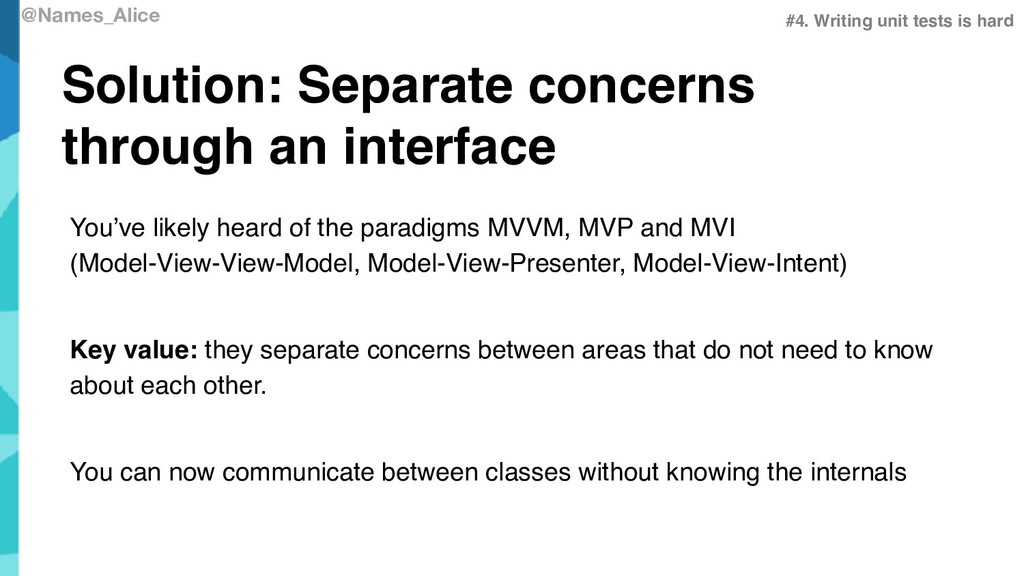
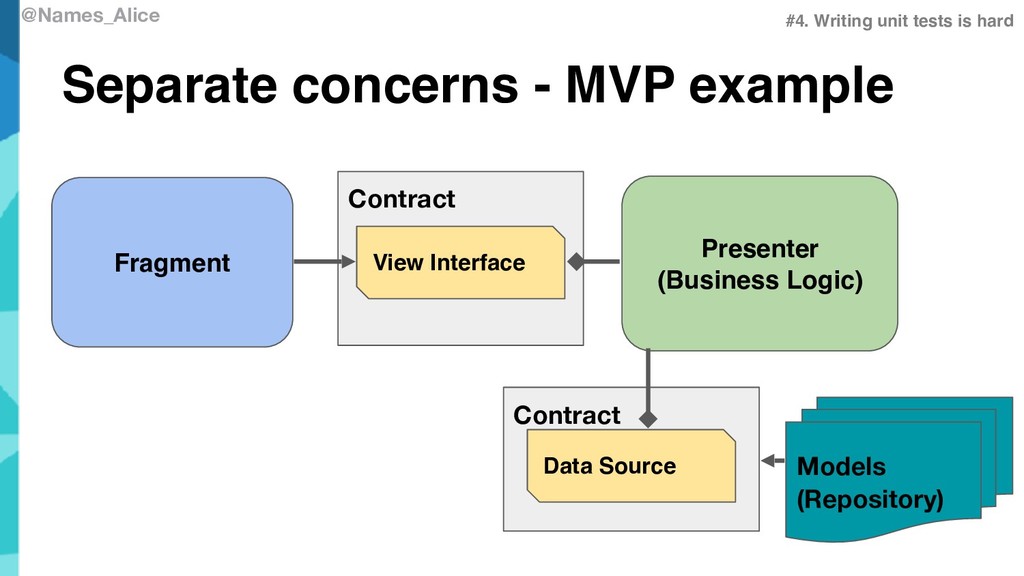
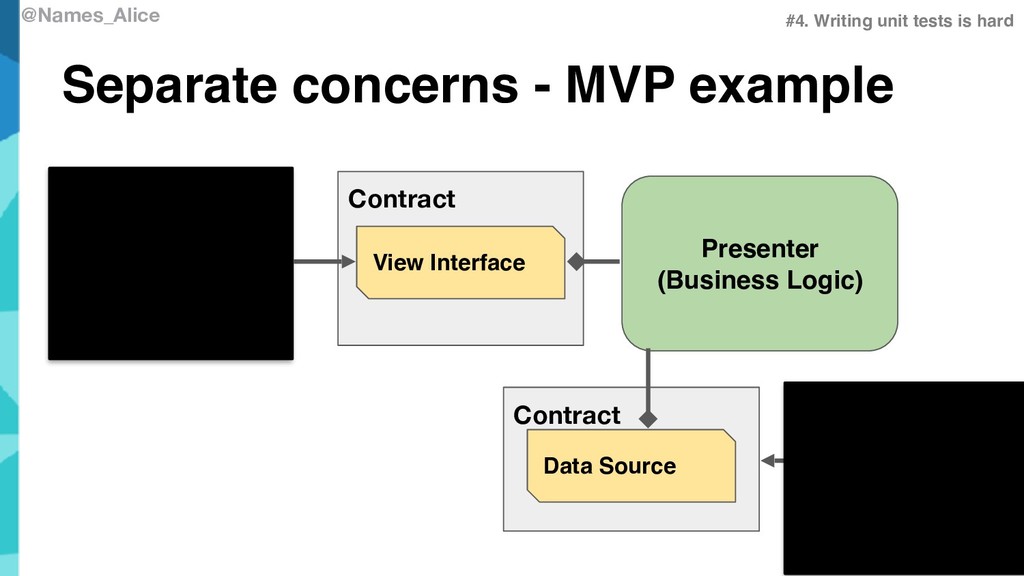
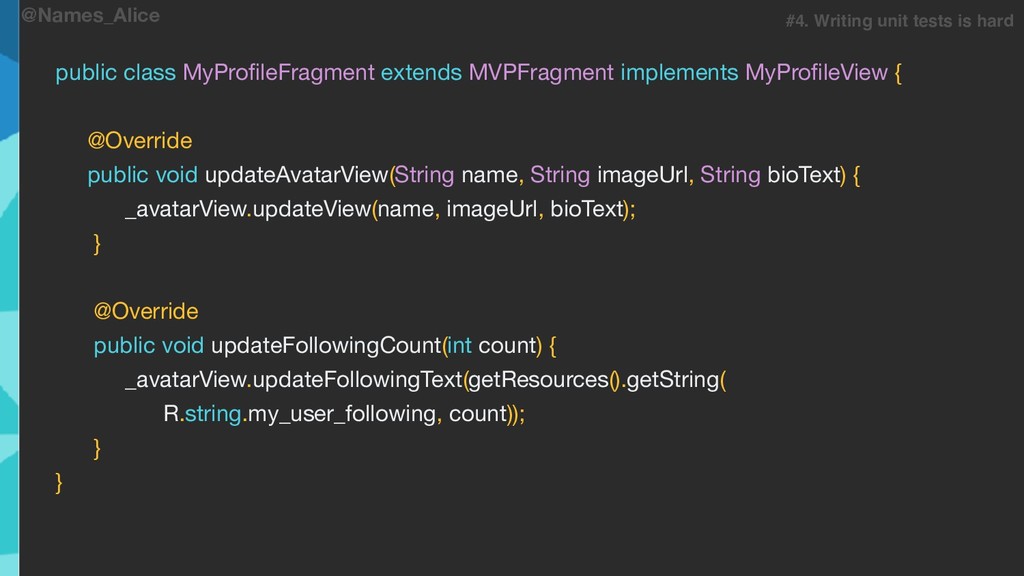
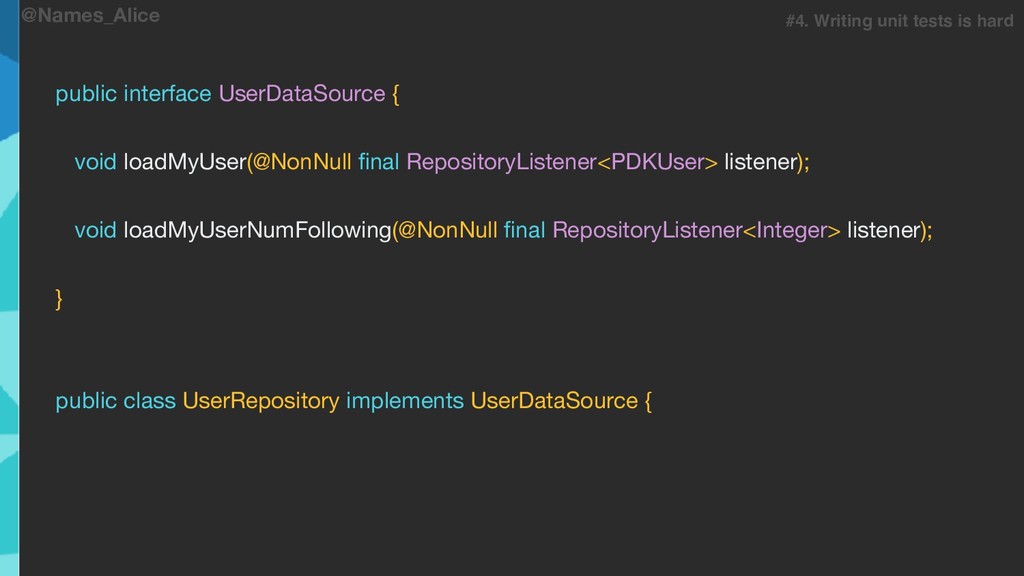
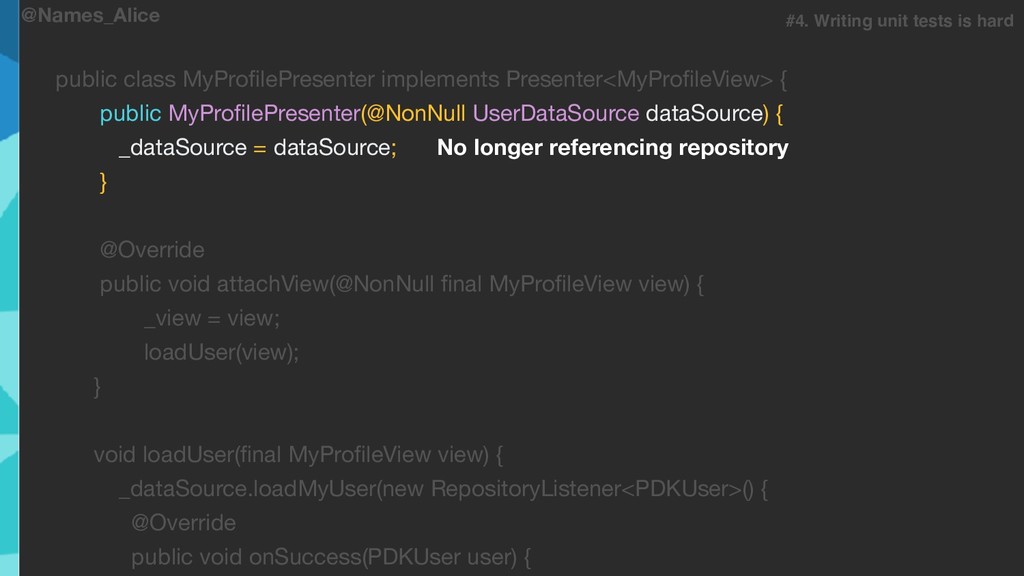
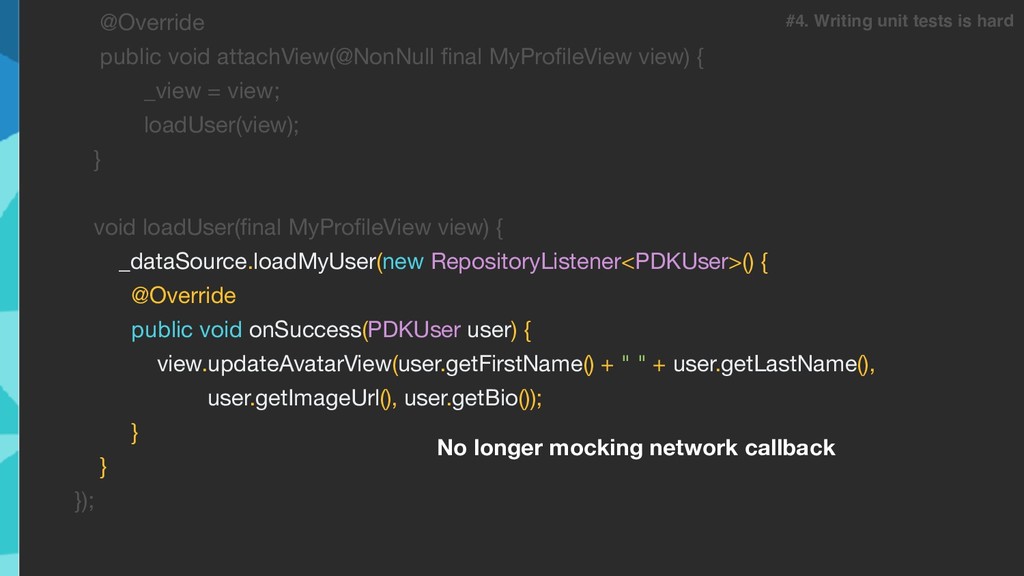
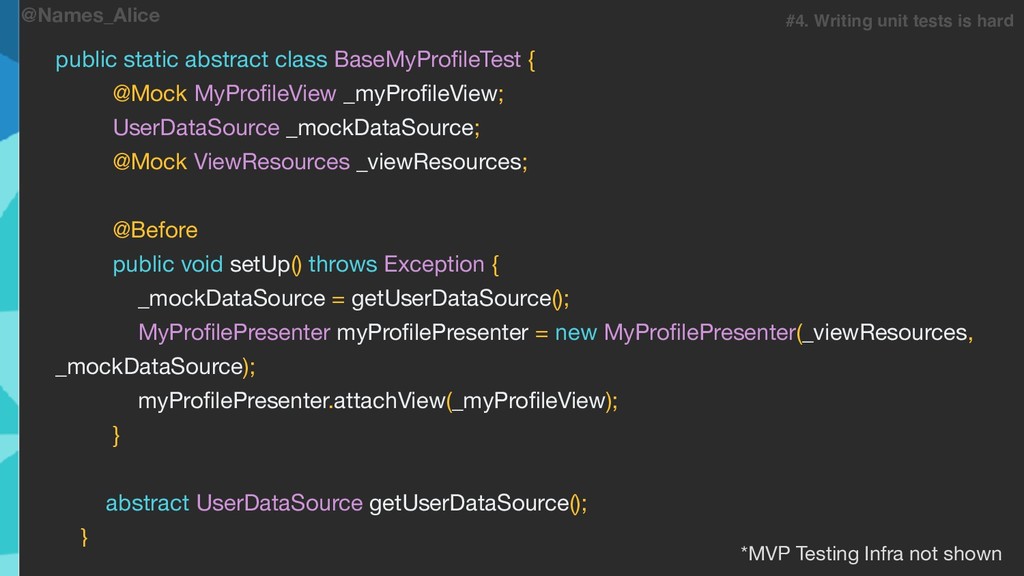
of the paradigms MVVM, MVP and MVI (Model-View-View-Model, Model-View-Presenter, Model-View-Intent) Key value: they separate concerns between areas that do not need to know about each other. You can now communicate between classes without knowing the internals #4. Writing unit tests is hard
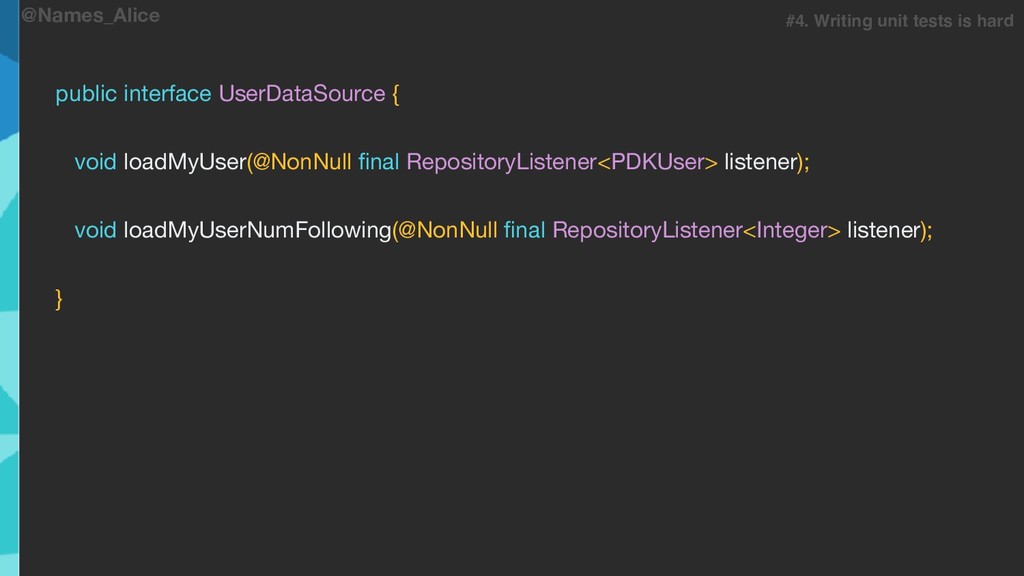
void loadMyUserNumFollowing(@NonNull final RepositoryListener<Integer> listener); } public class UserRepository implements UserDataSource { @Names_Alice #4. Writing unit tests is hard
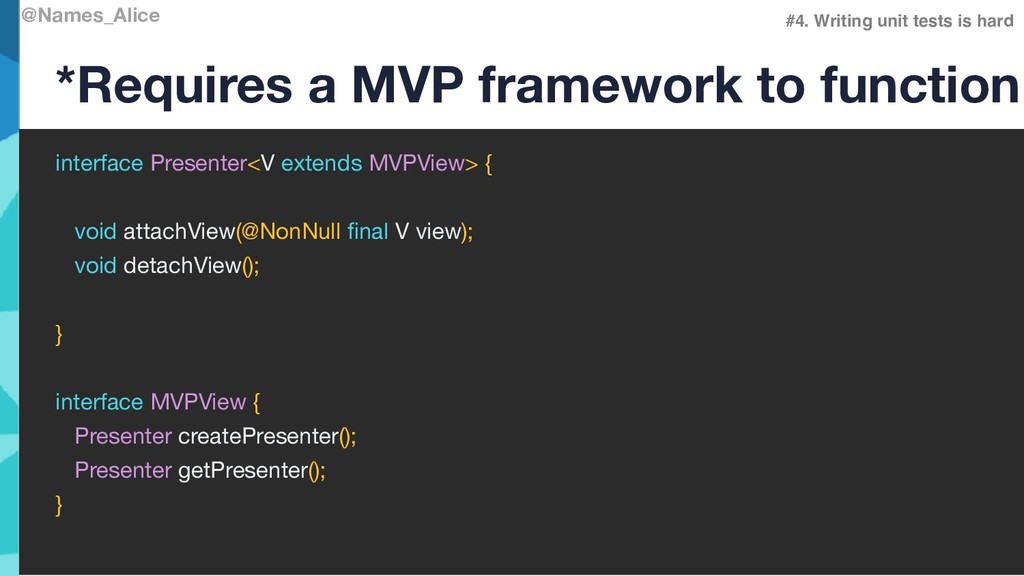
view); void detachView(); } interface MVPView { Presenter createPresenter(); Presenter getPresenter(); } *Requires a MVP framework to function #4. Writing unit tests is hard
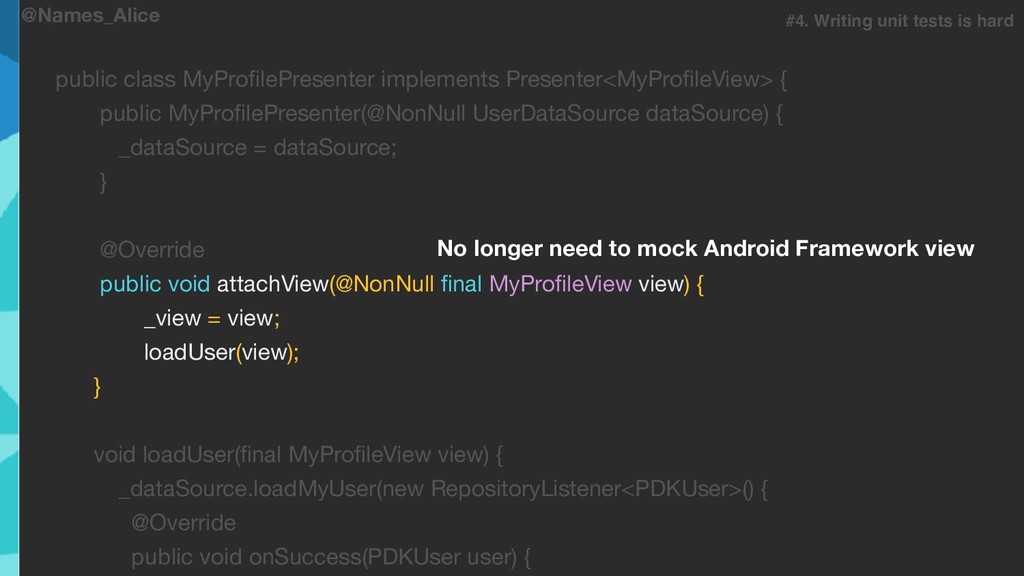
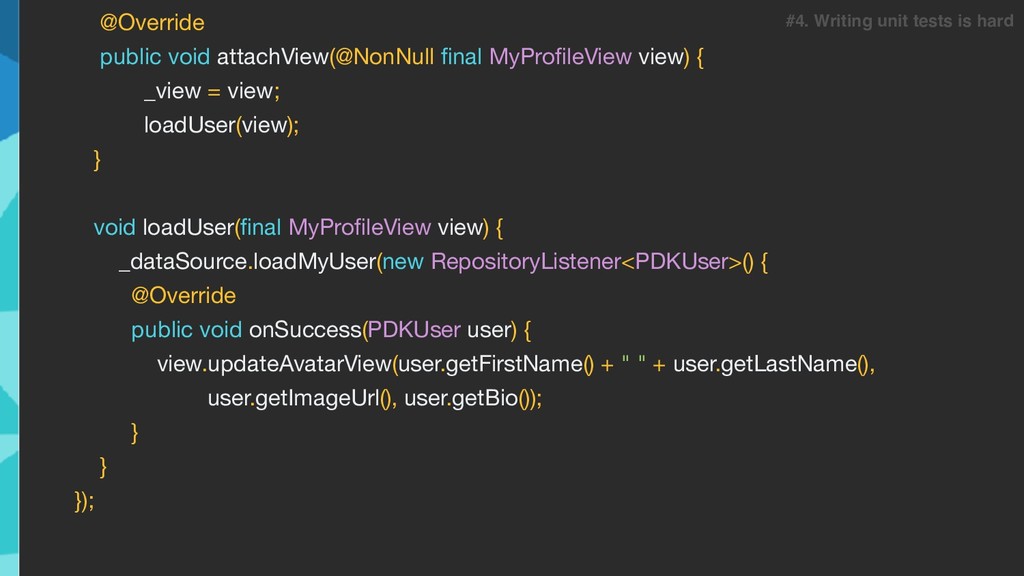
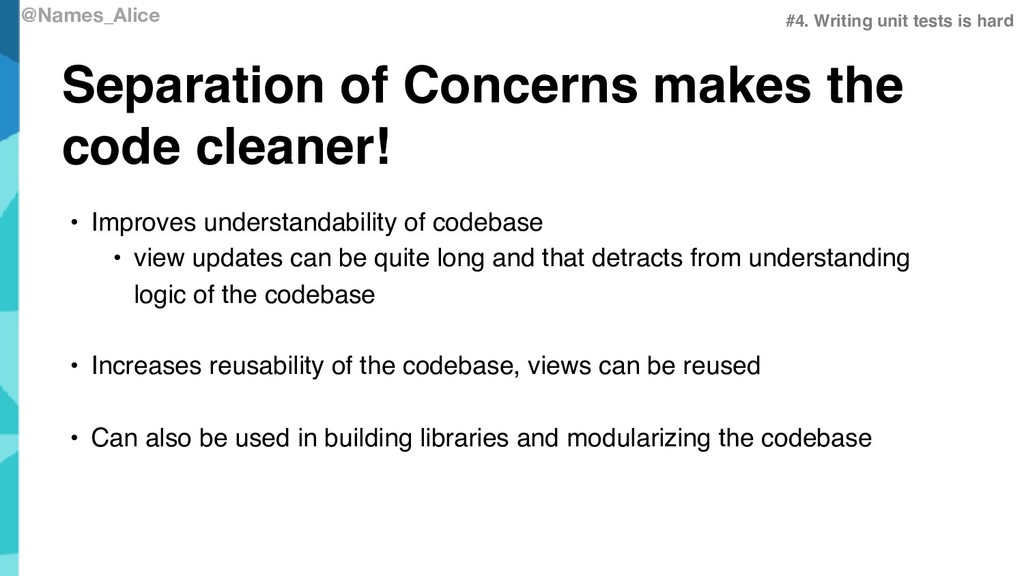
understandability of codebase • view updates can be quite long and that detracts from understanding logic of the codebase • Increases reusability of the codebase, views can be reused • Can also be used in building libraries and modularizing the codebase #4. Writing unit tests is hard
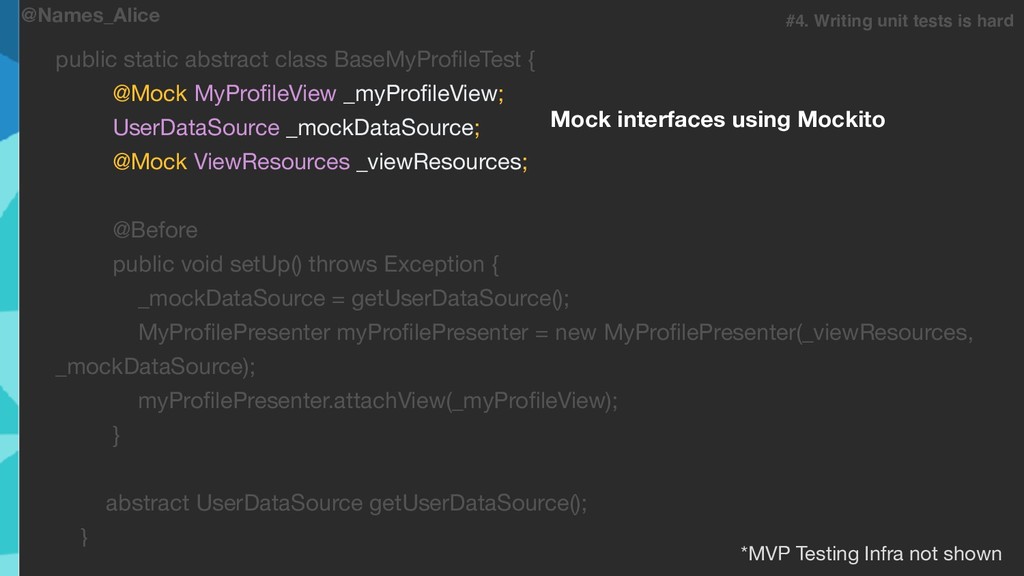
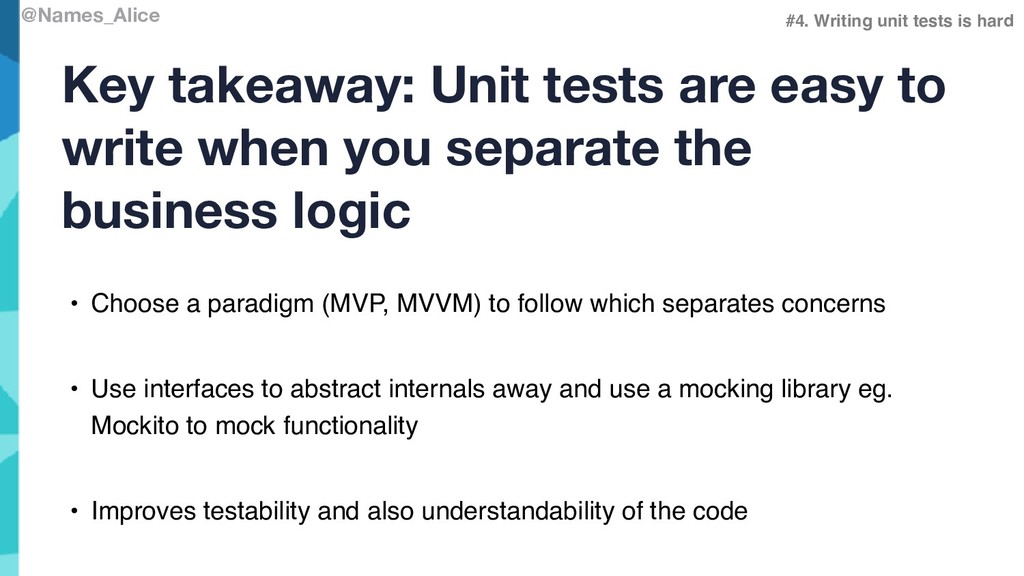
you separate the business logic • Choose a paradigm (MVP, MVVM) to follow which separates concerns • Use interfaces to abstract internals away and use a mocking library eg. Mockito to mock functionality • Improves testability and also understandability of the code #4. Writing unit tests is hard
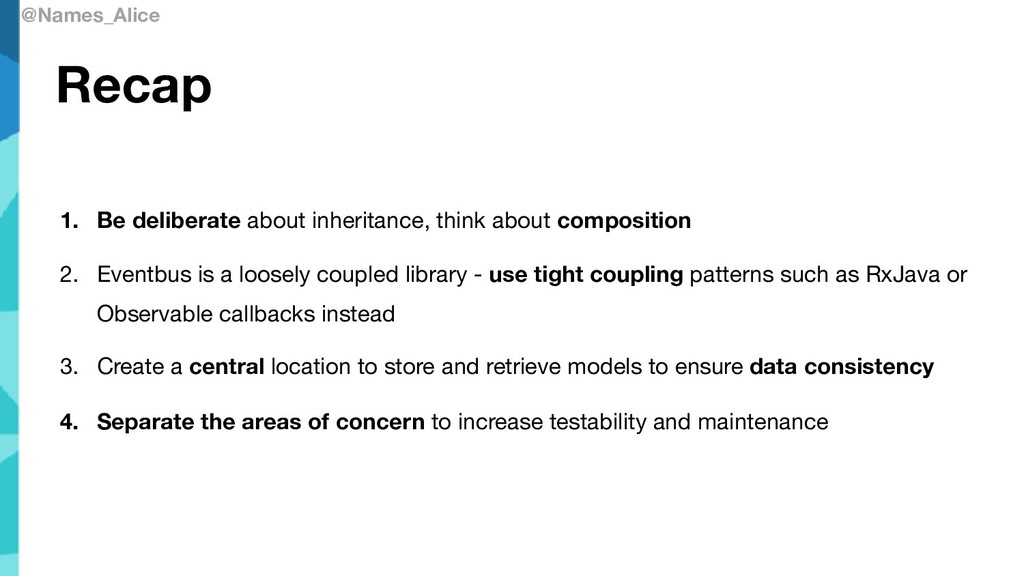
Eventbus is a loosely coupled library - use tight coupling patterns such as RxJava or Observable callbacks instead 3. Create a central location to store and retrieve models to ensure data consistency 4. Separate the areas of concern to increase testability and maintenance Recap
It’s the 21st century — STOP using EVENTBUS! https://medium.com/@gmirchev90/ its-21st-century-stop-using-eventbus-3ff5d9c6a00f 3. MVC vs MVP vs MVVM vs MVI? https://academy.realm.io/posts/mvc-vs-mvp-vs- mvvm-vs-mvi-mobilization-moskala/ 4. Implementing MVVM using LiveData, RxJava and Dagger https:// proandroiddev.com/mvvm-architecture-using-livedata-rxjava-and-new-dagger- android-injection-639837b1eb6c 5. SOLID Principles made easy https://hackernoon.com/solid-principles-made- easy-67b1246bcdf Suggested Reading Materials


 droidcon_berlin_2018
 naokihaba
 yub0n
yub0n
 yutobara
 shihochan
 neuecc
 chobishiba
 guaca
guaca
 optim
optim
 akihisaikeda
 deka_morita
 y0hgi
y0hgi
 rollbear
 rasmusluckow
 baasie
 skoyamalab
 marcoroth
 tammielis
 destraynor
 katarinadahlin
 minecr
 aleyda
 michaelherold
 seathinner
 stephenakadiri
![@Names_Alice Alice Yuan Android Engineer [email protected] @Names_Alice Poor Programming Patterns](https://files.speakerdeck.com/presentations/b44d6ccc29484aea876df4f6a9058a2c/slide_0.jpg)

























![Thanks! You ask me questions at: [email protected] @Names_Alice Find my](https://files.speakerdeck.com/presentations/b44d6ccc29484aea876df4f6a9058a2c/slide_101.jpg)