Share
Embed
Transcript
47 slides
-
Jon Markoff Developer Advocate Best practices for enterprise app development
on Android .droidconBerlin -
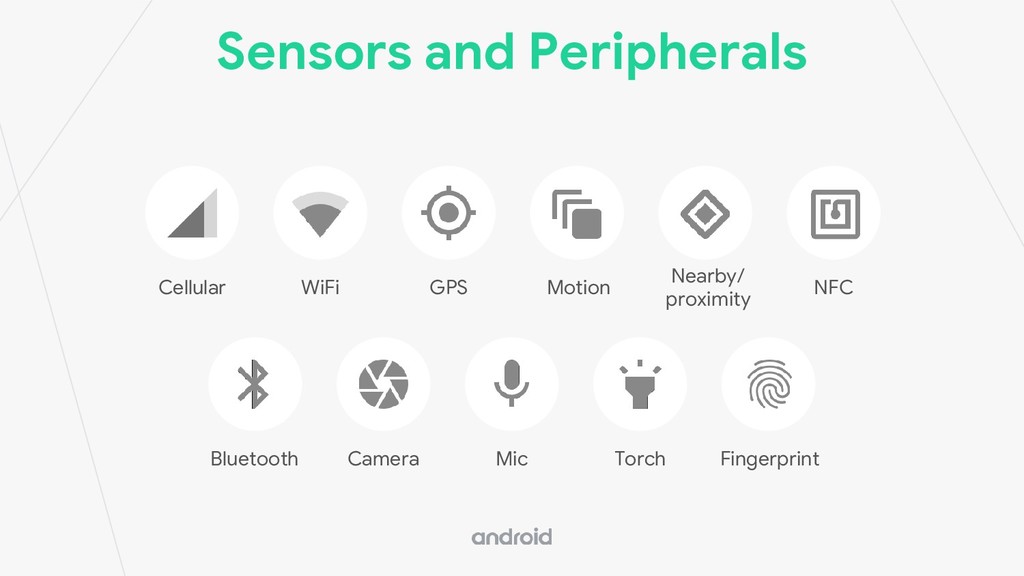
Cellular WiFi GPS Motion Nearby/ proximity NFC Bluetooth Camera Mic
Torch Fingerprint Sensors and Peripherals -
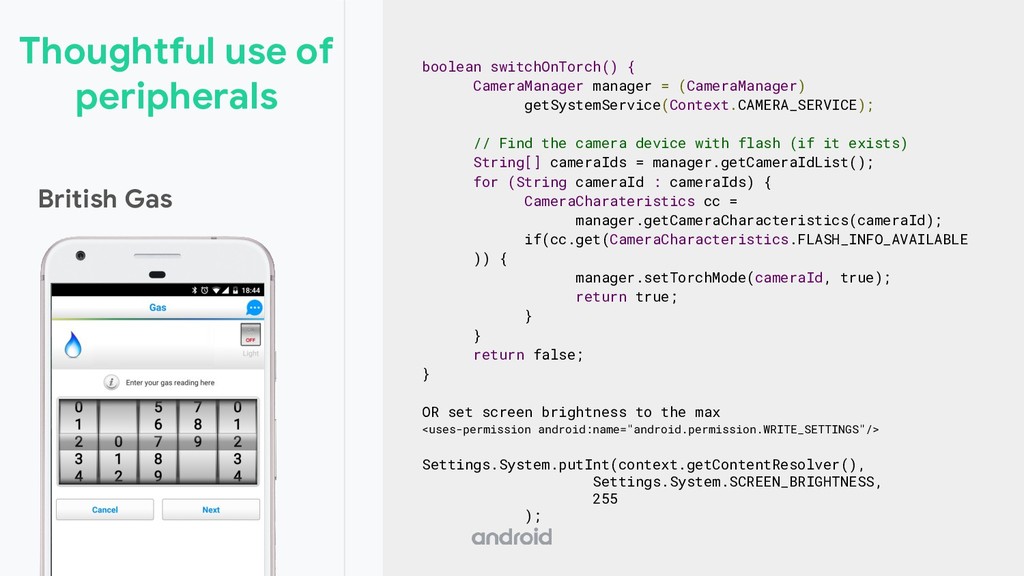
British Gas boolean switchOnTorch() { CameraManager manager = (CameraManager) getSystemService(Context.CAMERA_SERVICE);
// Find the camera device with flash (if it exists) String[] cameraIds = manager.getCameraIdList(); for (String cameraId : cameraIds) { CameraCharateristics cc = manager.getCameraCharacteristics(cameraId); if(cc.get(CameraCharacteristics.FLASH_INFO_AVAILABLE )) { manager.setTorchMode(cameraId, true); return true; } } return false; } OR set screen brightness to the max <uses-permission android:name="android.permission.WRITE_SETTINGS"/> Settings.System.putInt(context.getContentResolver(), Settings.System.SCREEN_BRIGHTNESS, 255 ); Thoughtful use of peripherals -
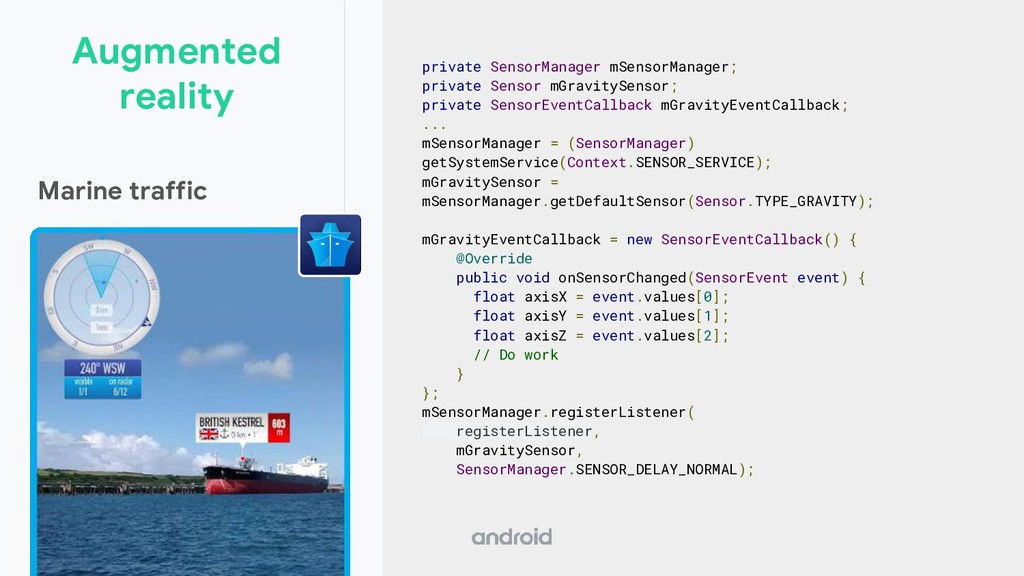
Marine traffic private SensorManager mSensorManager; private Sensor mGravitySensor; private SensorEventCallback
mGravityEventCallback; ... mSensorManager = (SensorManager) getSystemService(Context.SENSOR_SERVICE); mGravitySensor = mSensorManager.getDefaultSensor(Sensor.TYPE_GRAVITY); mGravityEventCallback = new SensorEventCallback() { @Override public void onSensorChanged(SensorEvent event) { float axisX = event.values[0]; float axisY = event.values[1]; float axisZ = event.values[2]; // Do work } }; mSensorManager.registerListener( registerListener, mGravitySensor, SensorManager.SENSOR_DELAY_NORMAL); Augmented reality -
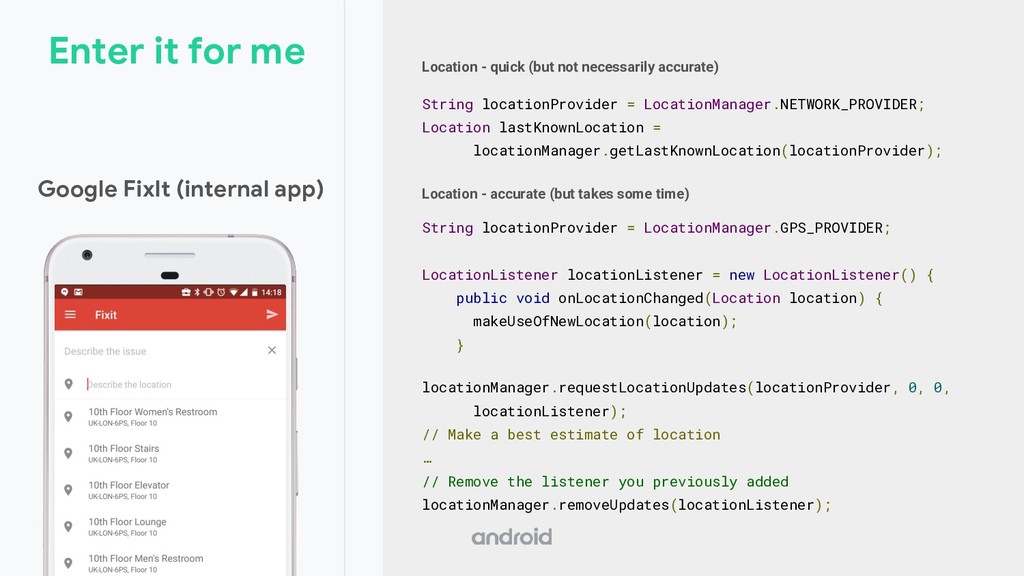
Google FixIt (internal app) Location - quick (but not necessarily
accurate) String locationProvider = LocationManager.NETWORK_PROVIDER; Location lastKnownLocation = locationManager.getLastKnownLocation(locationProvider); Location - accurate (but takes some time) String locationProvider = LocationManager.GPS_PROVIDER; LocationListener locationListener = new LocationListener() { public void onLocationChanged(Location location) { makeUseOfNewLocation(location); } locationManager.requestLocationUpdates(locationProvider, 0, 0, locationListener); // Make a best estimate of location … // Remove the listener you previously added locationManager.removeUpdates(locationListener); Enter it for me -
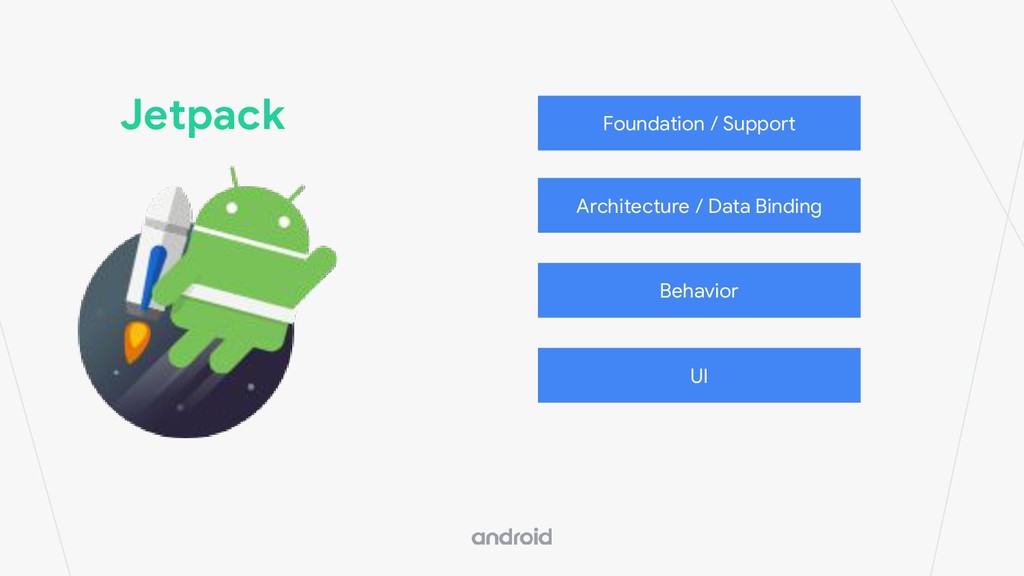
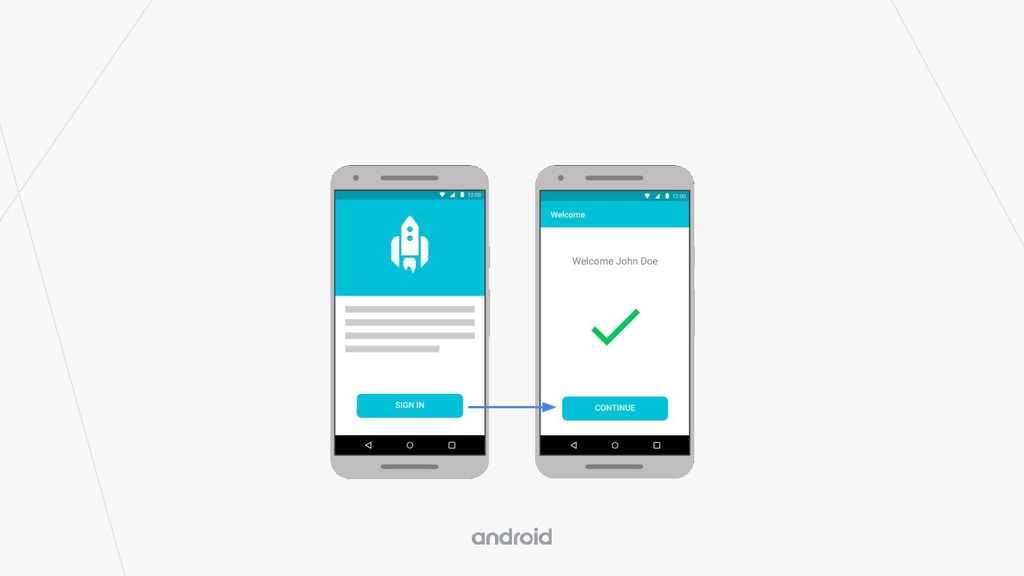
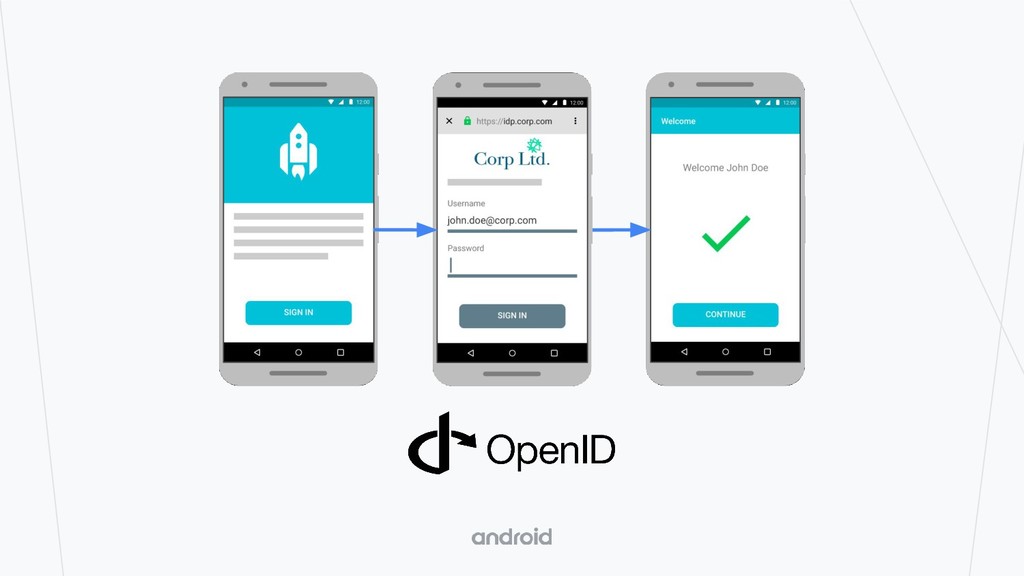
WOW SO MUCH VERY Build Jetpack Security Single Sign On
Managed Android -
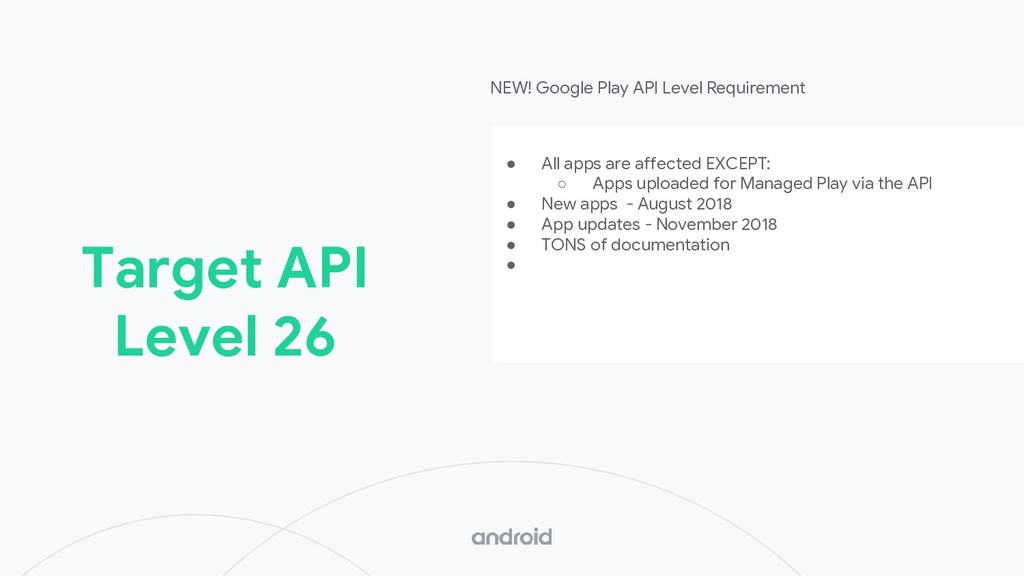
Target API Level 26 • All apps are affected EXCEPT:
◦ Apps uploaded for Managed Play via the API • New apps - August 2018 • App updates - November 2018 • TONS of documentation • NEW! Google Play API Level Requirement -
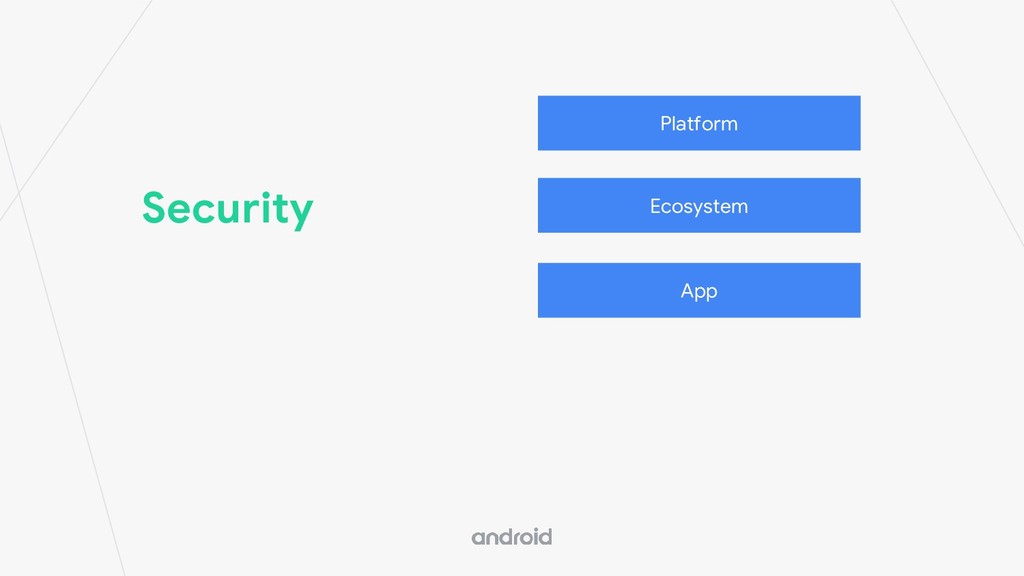
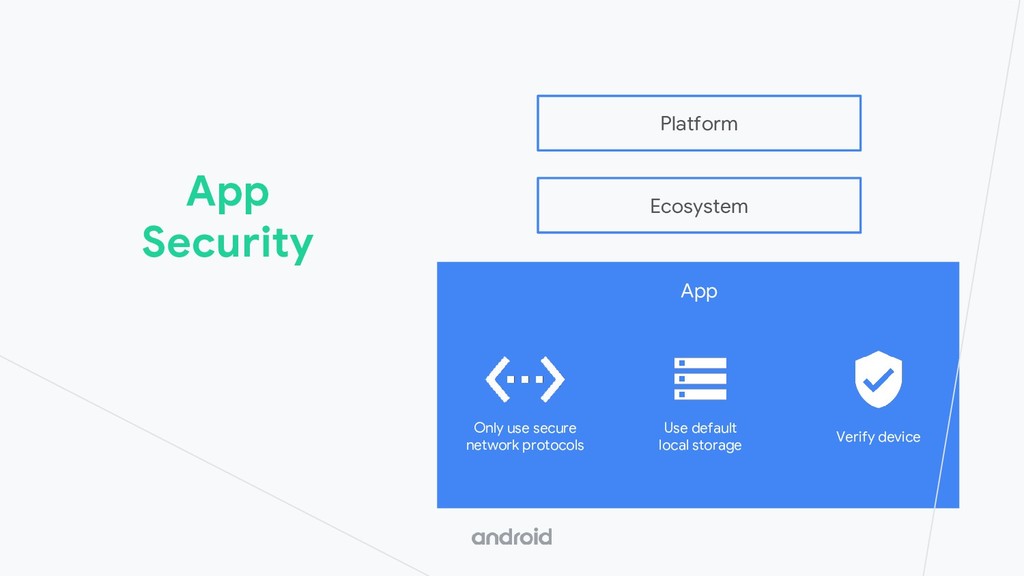
Platform Ecosystem Only use secure network protocols Use default local
storage Verify device App App Security -
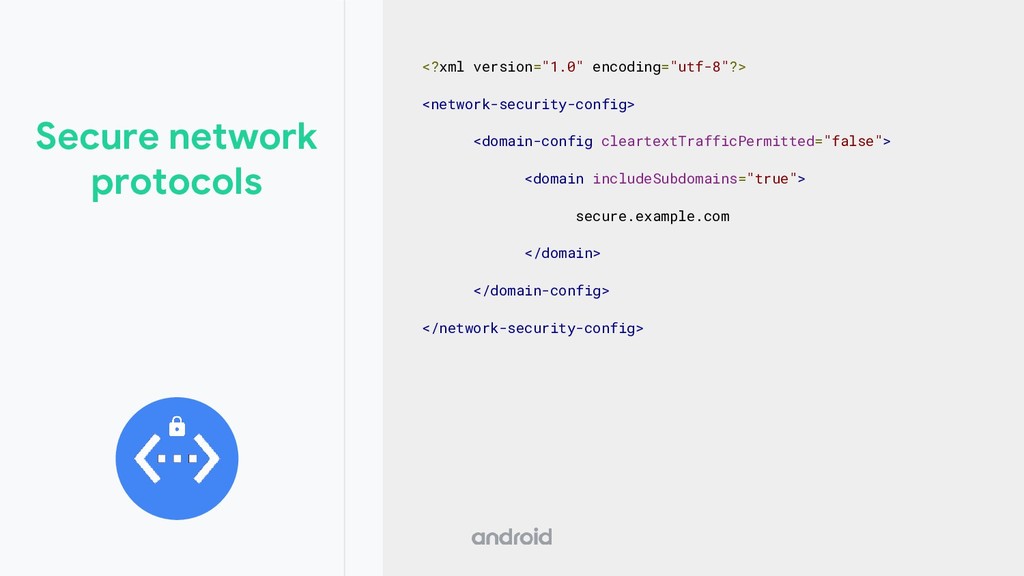
Secure network protocols <?xml version="1.0" encoding="utf-8"?> <network-security-config> <domain-config cleartextTrafficPermitted="false"> <domain
includeSubdomains="true"> secure.example.com </domain> </domain-config> </network-security-config> -
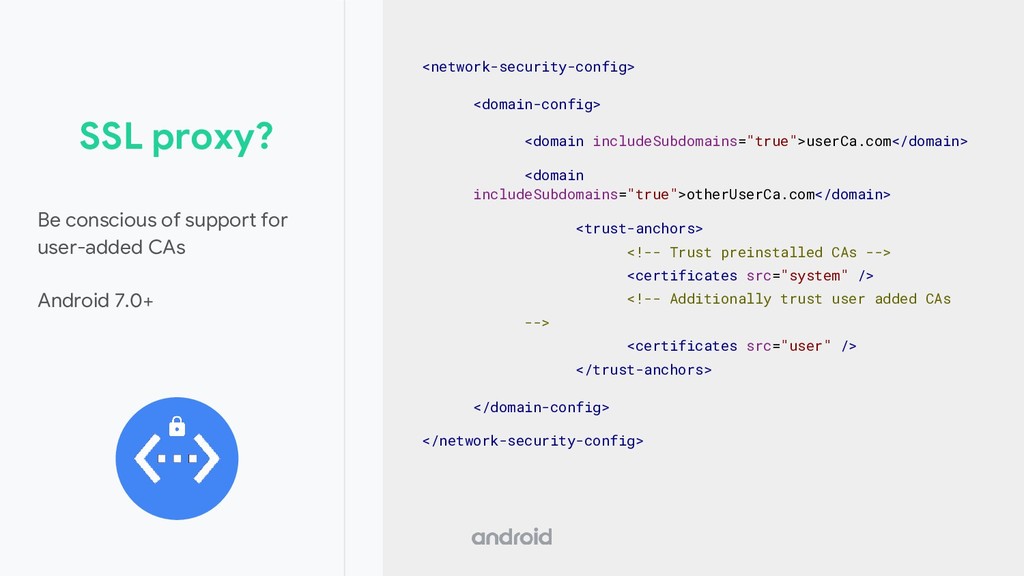
SSL proxy? <network-security-config> <domain-config> <domain includeSubdomains="true">userCa.com</domain> <domain includeSubdomains="true">otherUserCa.com</domain> <trust-anchors> <!--
Trust preinstalled CAs --> <certificates src="system" /> <!-- Additionally trust user added CAs --> <certificates src="user" /> </trust-anchors> </domain-config> </network-security-config> Be conscious of support for user-added CAs Android 7.0+ -
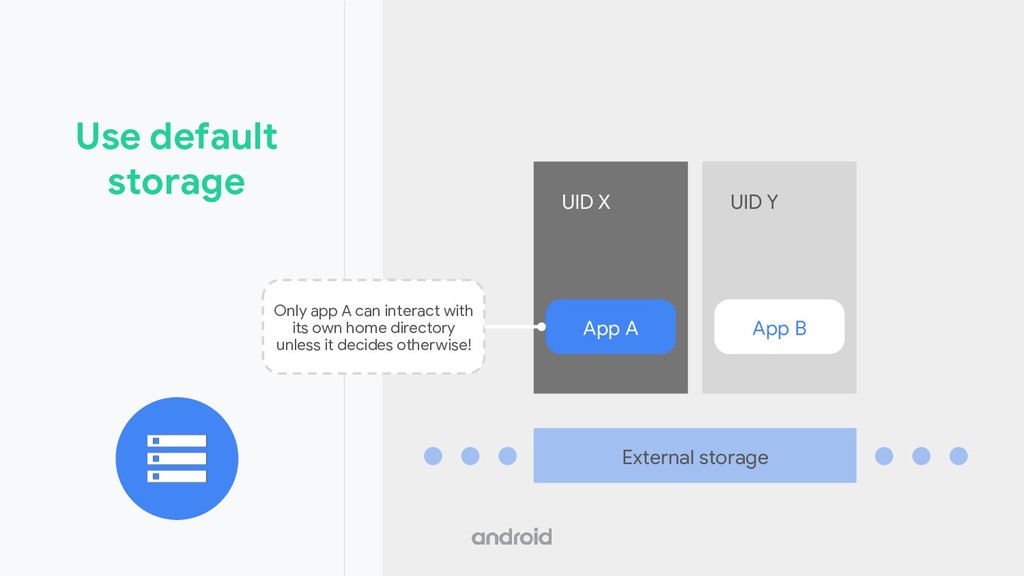
Use default storage External storage UID Y App B UID
X Only app A can interact with its own home directory unless it decides otherwise! App A -
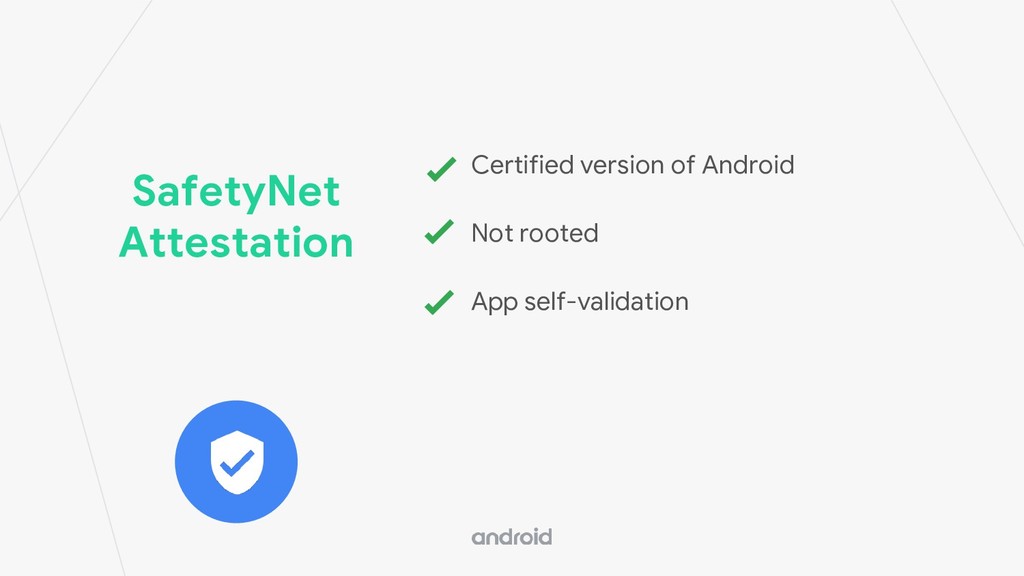
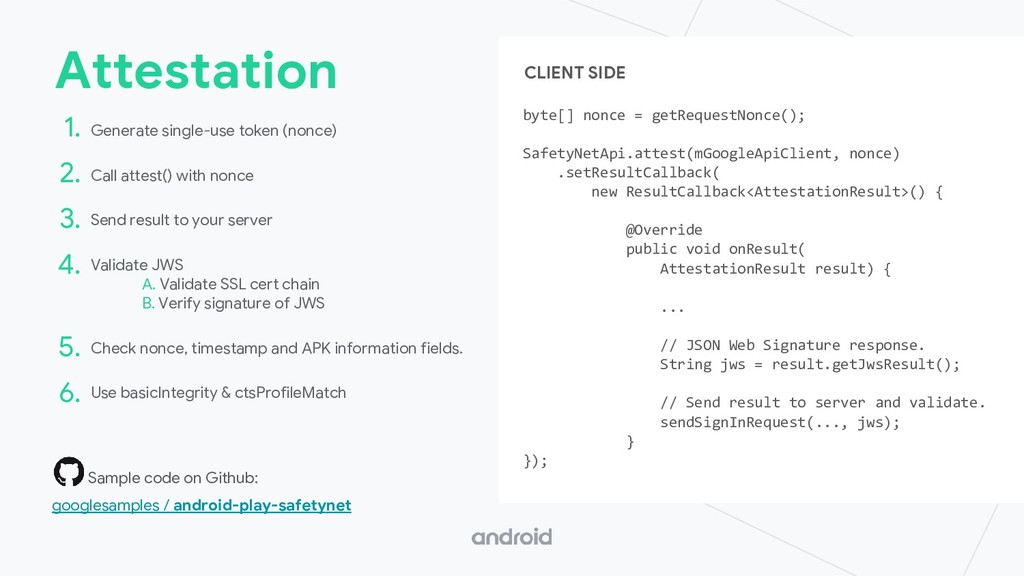
Attestation Generate single-use token (nonce) Call attest() with nonce Send
result to your server Validate JWS A. Validate SSL cert chain B. Verify signature of JWS Check nonce, timestamp and APK information fields. Use basicIntegrity & ctsProfileMatch 1. 2. 3. 4. 5. 6. byte[] nonce = getRequestNonce(); SafetyNetApi.attest(mGoogleApiClient, nonce) .setResultCallback( new ResultCallback<AttestationResult>() { @Override public void onResult( AttestationResult result) { ... // JSON Web Signature response. String jws = result.getJwsResult(); // Send result to server and validate. sendSignInRequest(..., jws); } }); CLIENT SIDE Sample code on Github: googlesamples / android-play-safetynet -
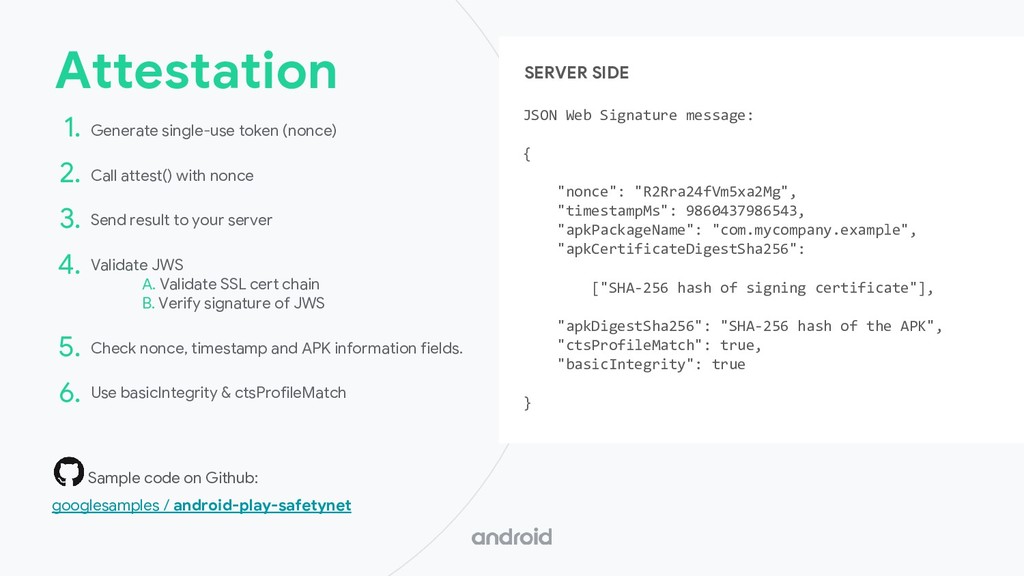
Attestation Generate single-use token (nonce) Call attest() with nonce Send
result to your server Validate JWS A. Validate SSL cert chain B. Verify signature of JWS Check nonce, timestamp and APK information fields. Use basicIntegrity & ctsProfileMatch 1. 2. 3. 4. 5. 6. JSON Web Signature message: { "nonce": "R2Rra24fVm5xa2Mg", "timestampMs": 9860437986543, "apkPackageName": "com.mycompany.example", "apkCertificateDigestSha256": ["SHA-256 hash of signing certificate"], "apkDigestSha256": "SHA-256 hash of the APK", "ctsProfileMatch": true, "basicIntegrity": true } SERVER SIDE Sample code on Github: googlesamples / android-play-safetynet -
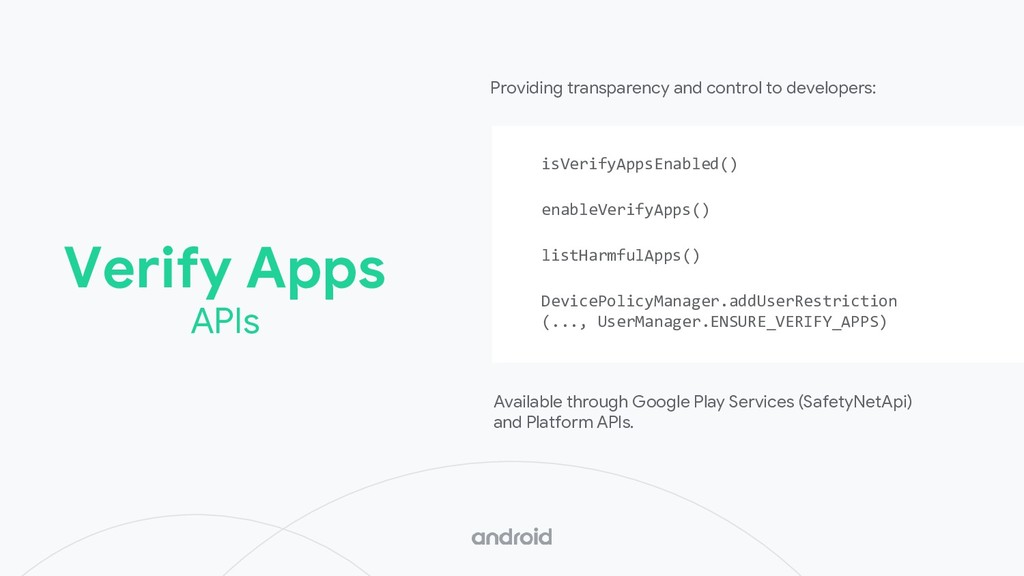
APIs Verify Apps isVerifyAppsEnabled() enableVerifyApps() listHarmfulApps() DevicePolicyManager.addUserRestriction (..., UserManager.ENSURE_VERIFY_APPS) Available
through Google Play Services (SafetyNetApi) and Platform APIs. Providing transparency and control to developers: -
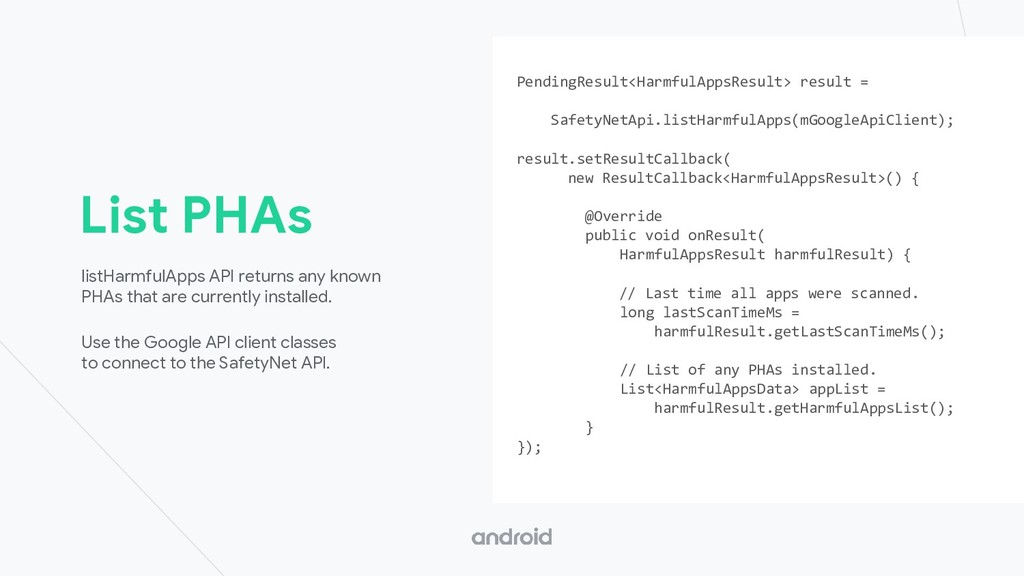
List PHAs listHarmfulApps API returns any known PHAs that are
currently installed. Use the Google API client classes to connect to the SafetyNet API. PendingResult<HarmfulAppsResult> result = SafetyNetApi.listHarmfulApps(mGoogleApiClient); result.setResultCallback( new ResultCallback<HarmfulAppsResult>() { @Override public void onResult( HarmfulAppsResult harmfulResult) { // Last time all apps were scanned. long lastScanTimeMs = harmfulResult.getLastScanTimeMs(); // List of any PHAs installed. List<HarmfulAppsData> appList = harmfulResult.getHarmfulAppsList(); } }); -
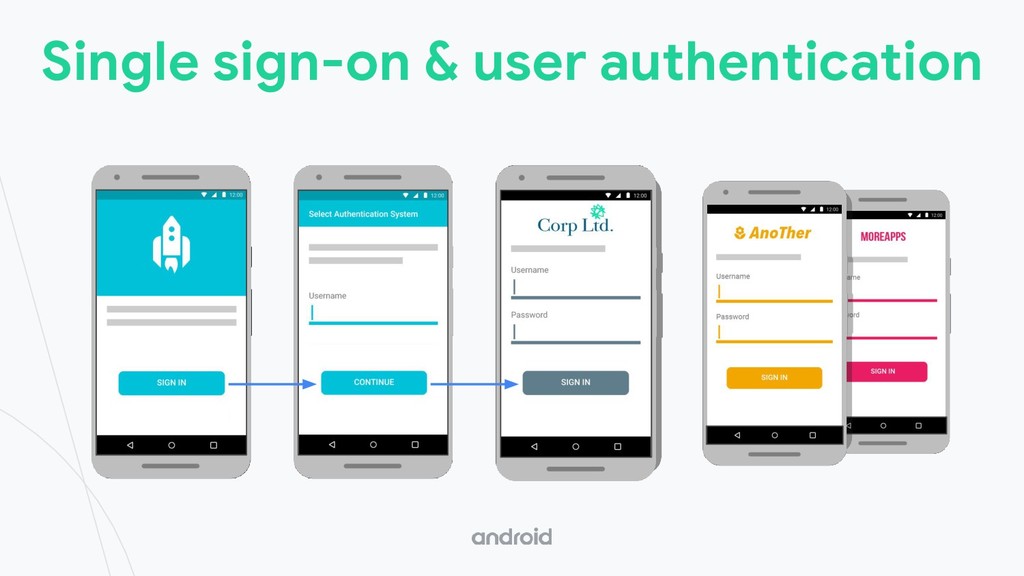
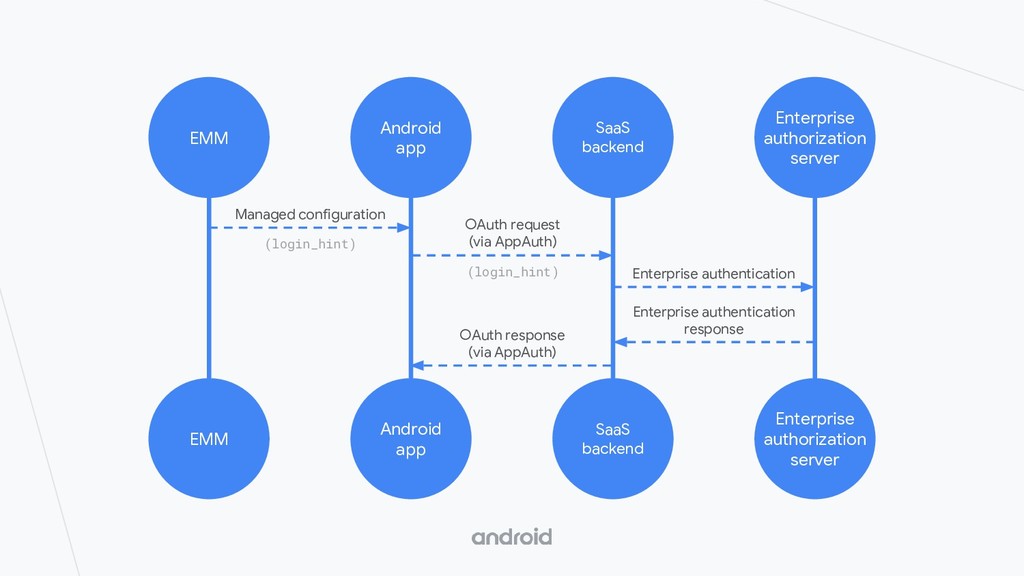
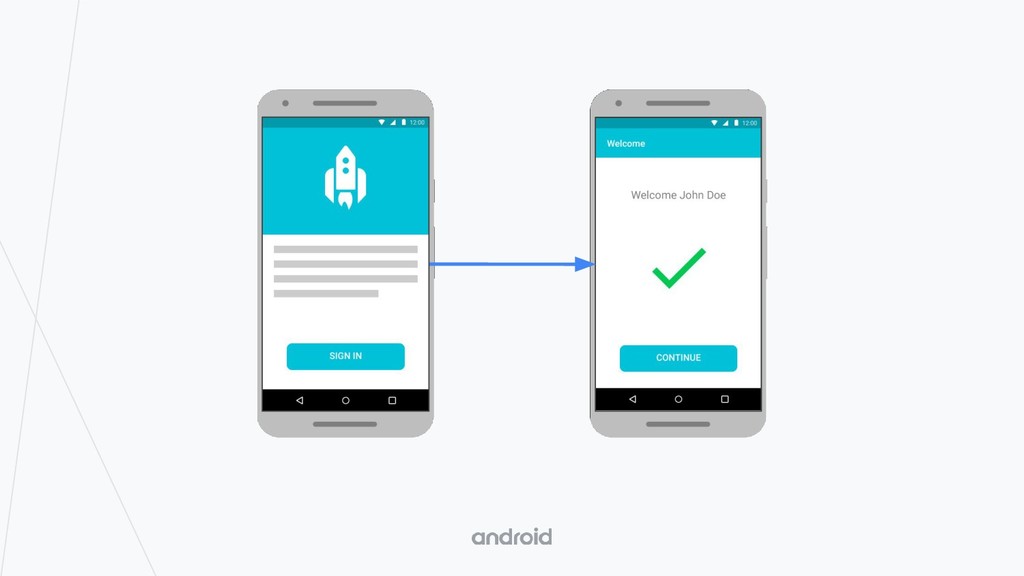
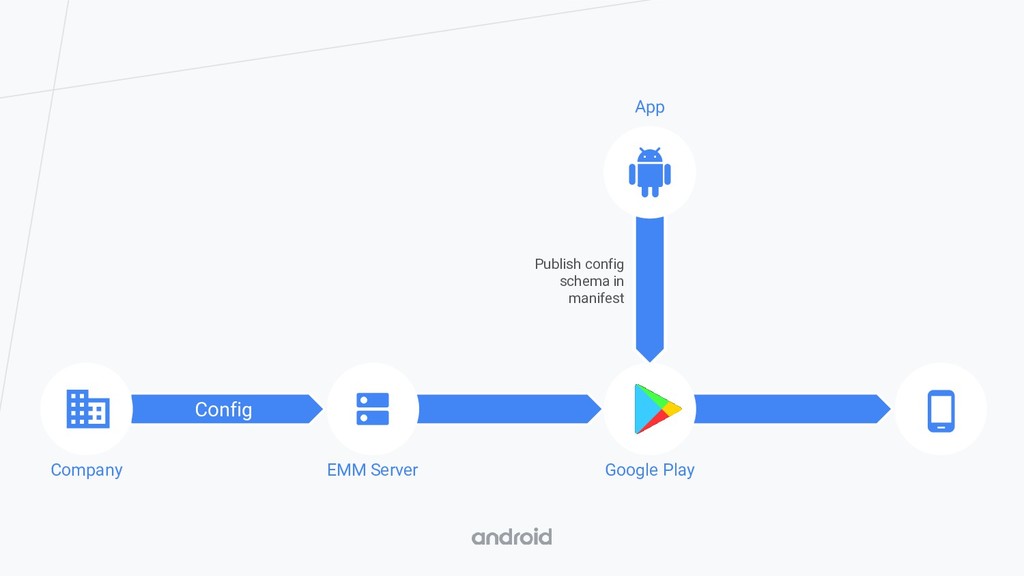
SaaS backend Android app EMM SaaS backend Android app OAuth
request (via AppAuth) Managed configuration Enterprise authorization server (login_hint) (login_hint) OAuth response (via AppAuth) Enterprise authentication Enterprise authentication response EMM Enterprise authorization server -
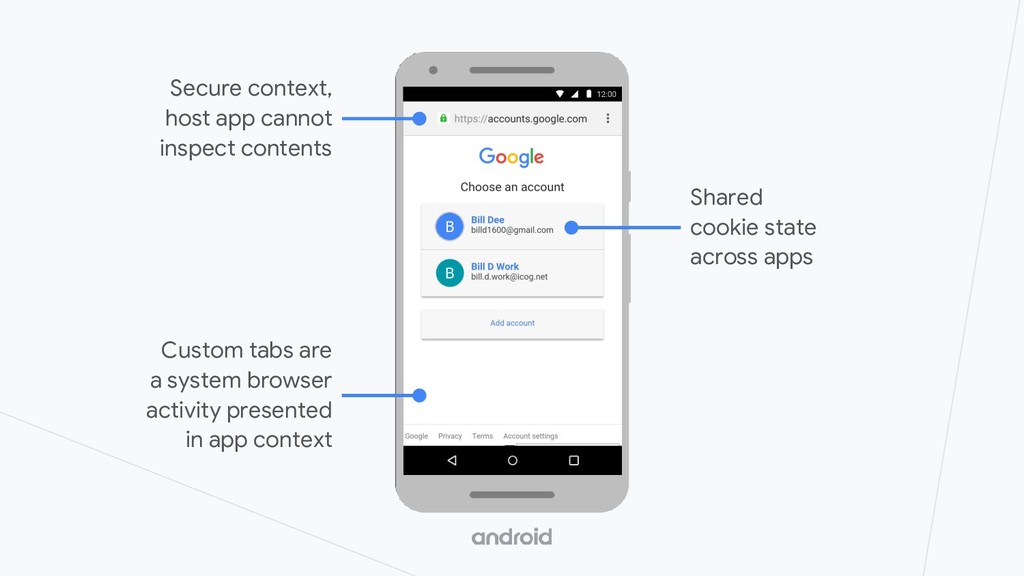
B Secure context, host app cannot inspect contents Shared cookie
state across apps Custom tabs are a system browser activity presented in app context -
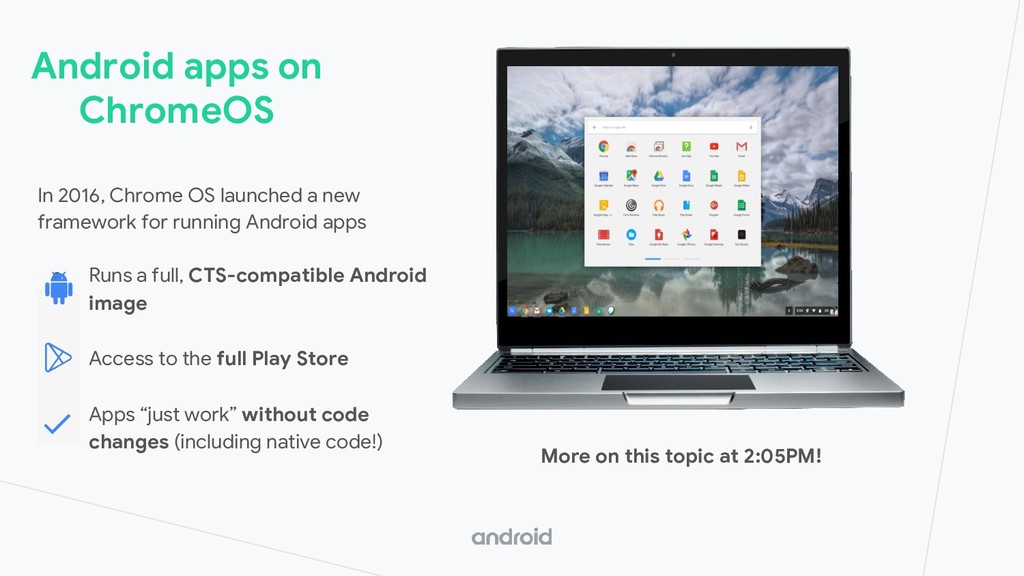
In 2016, Chrome OS launched a new framework for running
Android apps • Runs a full, CTS-compatible Android image • Access to the full Play Store • Apps “just work” without code changes (including native code!) Android apps on ChromeOS More on this topic at 2:05PM! -
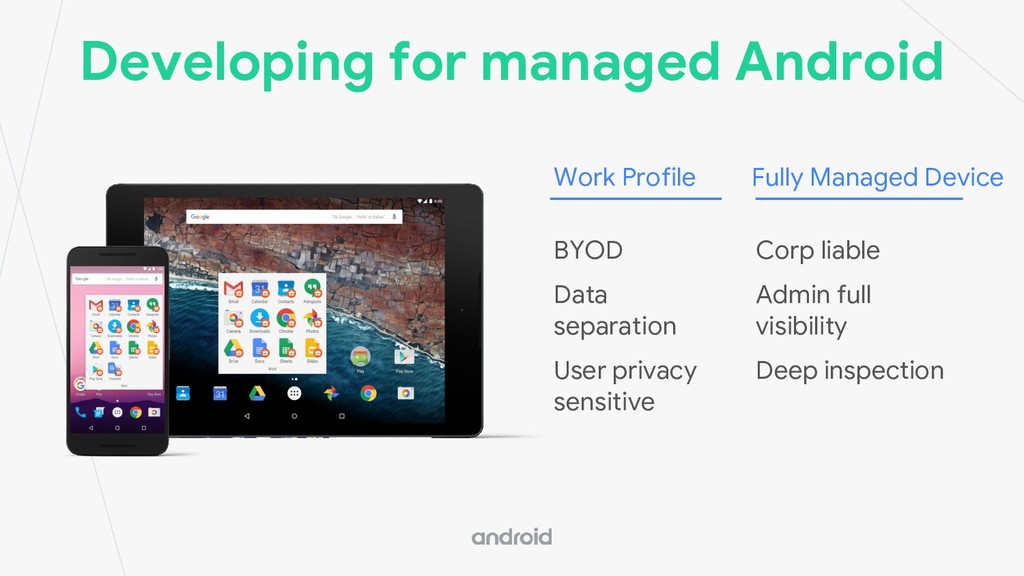
Work Profile Fully Managed Device BYOD Data separation User privacy
sensitive Corp liable Admin full visibility Deep inspection Developing for managed Android -
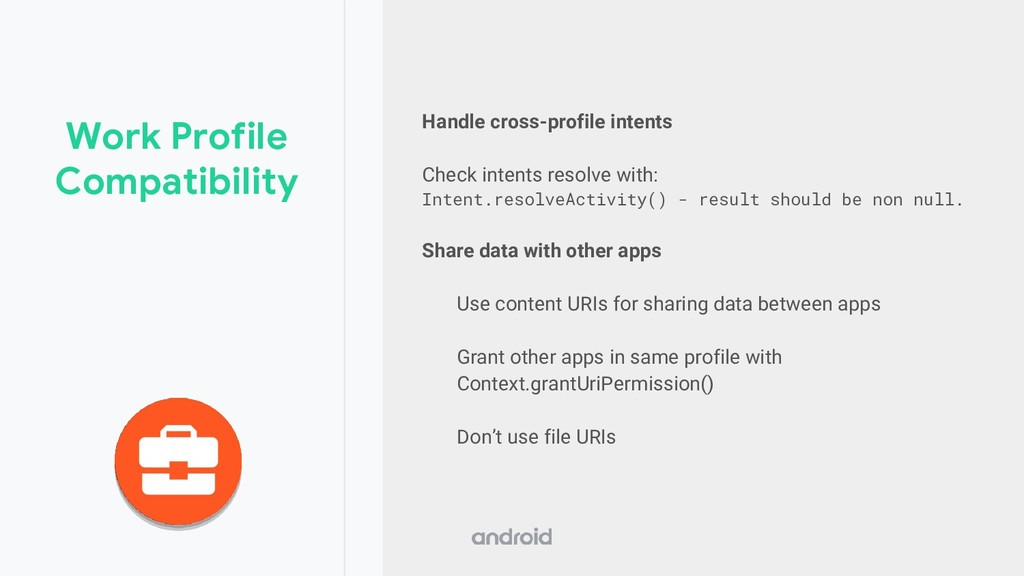
Work Profile Compatibility Handle cross-profile intents Check intents resolve with:
Intent.resolveActivity() - result should be non null. Share data with other apps Use content URIs for sharing data between apps Grant other apps in same profile with Context.grantUriPermission() Don’t use file URIs -
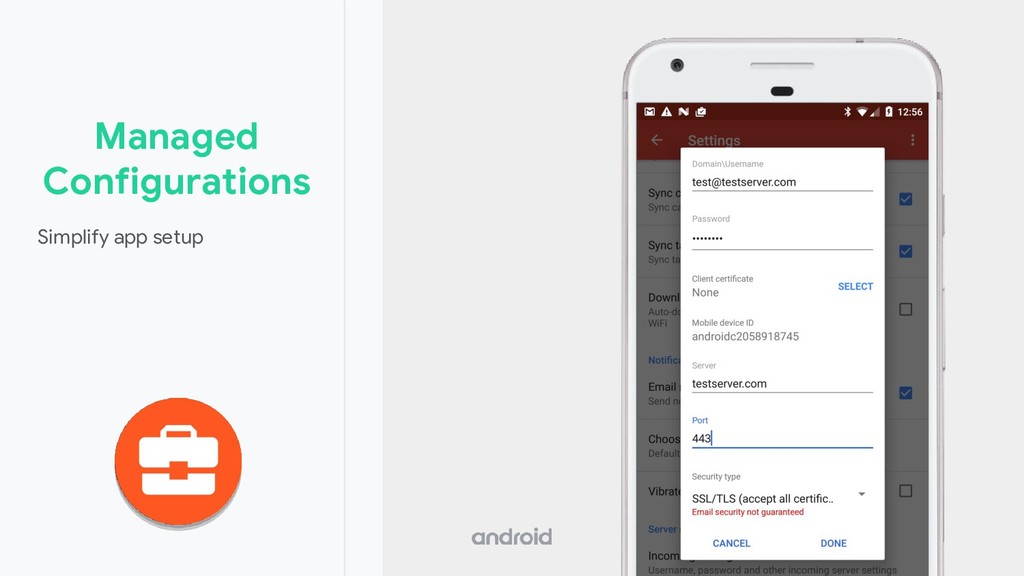
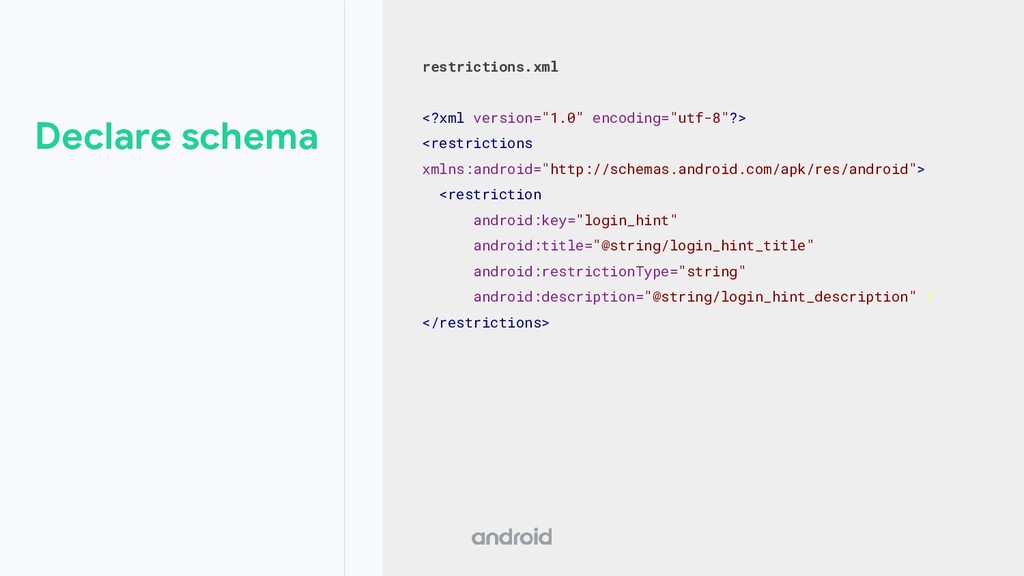
Declare schema restrictions.xml <?xml version="1.0" encoding="utf-8"?> <restrictions xmlns:android="http://schemas.android.com/apk/res/android"> <restriction android:key="login_hint"
android:title="@string/login_hint_title" android:restrictionType="string" android:description="@string/login_hint_description" / </restrictions> -
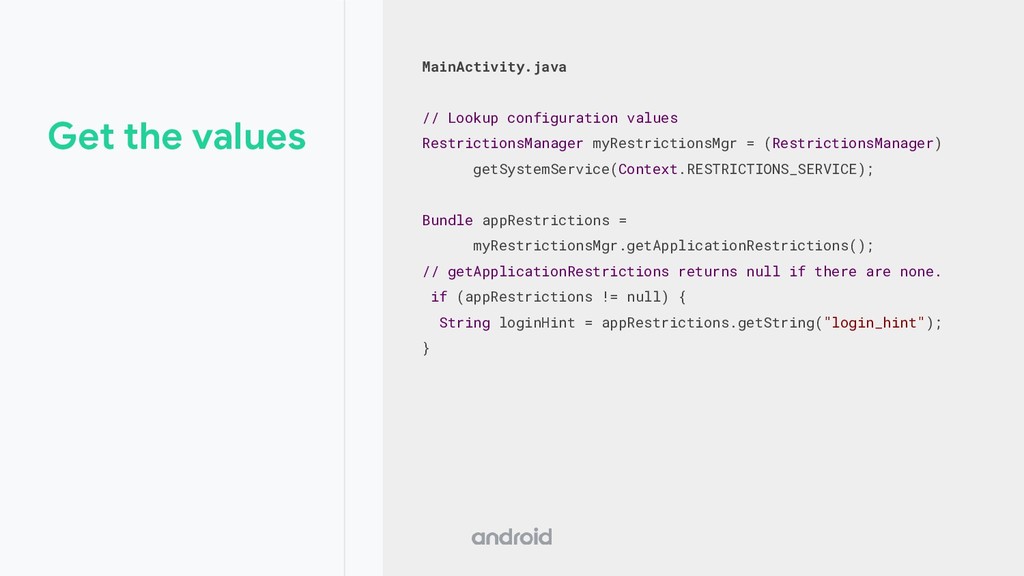
Get the values MainActivity.java // Lookup configuration values RestrictionsManager myRestrictionsMgr
= (RestrictionsManager) getSystemService(Context.RESTRICTIONS_SERVICE); Bundle appRestrictions = myRestrictionsMgr.getApplicationRestrictions(); // getApplicationRestrictions returns null if there are none. if (appRestrictions != null) { String loginHint = appRestrictions.getString("login_hint"); } -
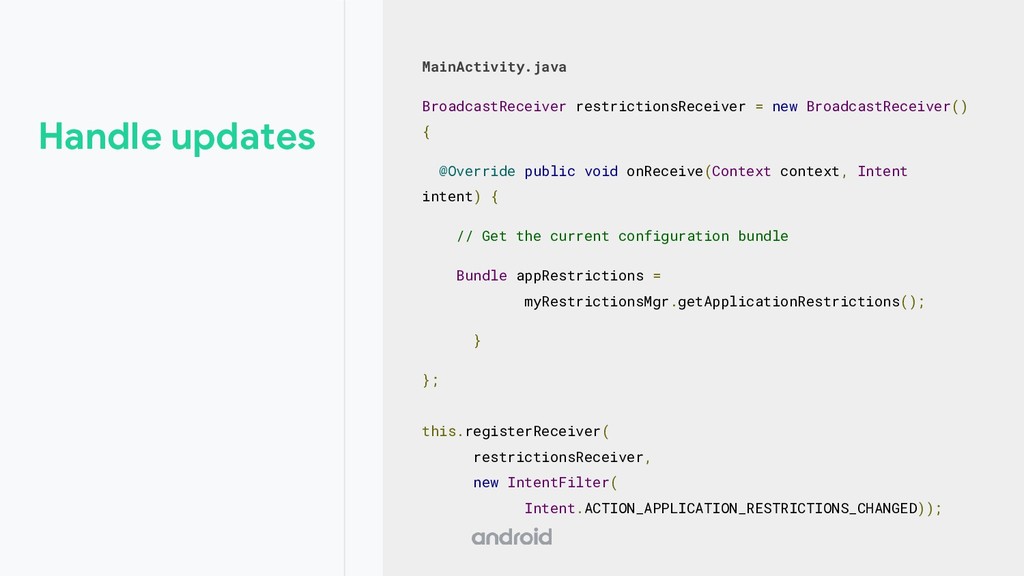
Handle updates MainActivity.java BroadcastReceiver restrictionsReceiver = new BroadcastReceiver() { @Override
public void onReceive(Context context, Intent intent) { // Get the current configuration bundle Bundle appRestrictions = myRestrictionsMgr.getApplicationRestrictions(); } }; this.registerReceiver( restrictionsReceiver, new IntentFilter( Intent.ACTION_APPLICATION_RESTRICTIONS_CHANGED)); -
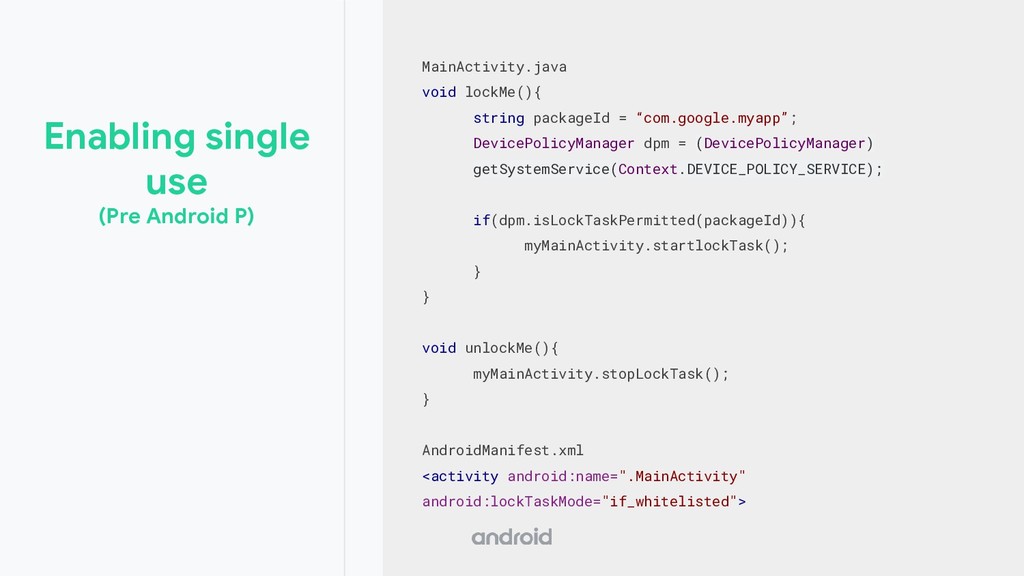
Enabling single use (Pre Android P) MainActivity.java void lockMe(){ string
packageId = “com.google.myapp”; DevicePolicyManager dpm = (DevicePolicyManager) getSystemService(Context.DEVICE_POLICY_SERVICE); if(dpm.isLockTaskPermitted(packageId)){ myMainActivity.startlockTask(); } } void unlockMe(){ myMainActivity.stopLockTask(); } AndroidManifest.xml <activity android:name=".MainActivity" android:lockTaskMode="if_whitelisted"> -
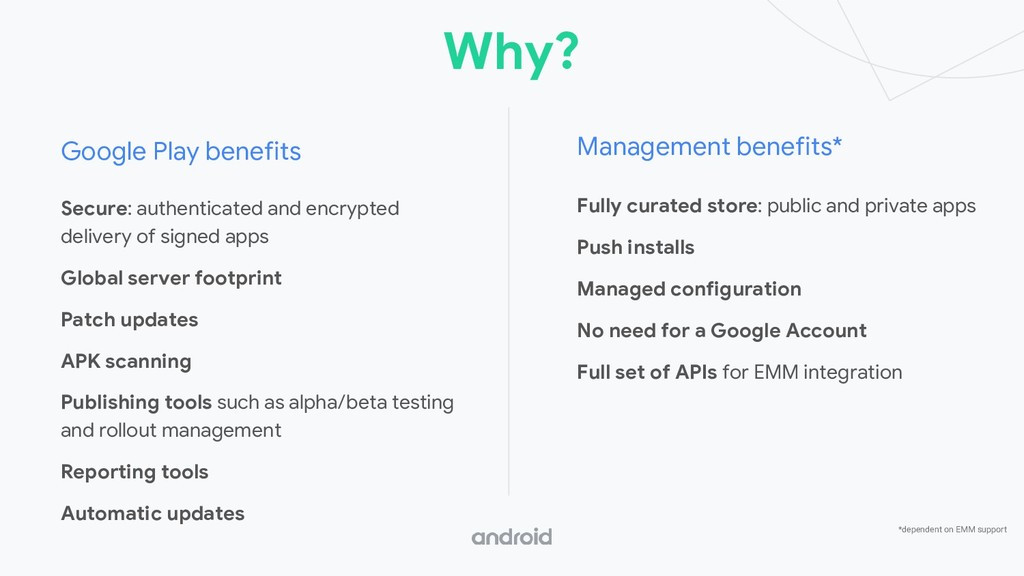
Management benefits* Fully curated store: public and private apps Push
installs Managed configuration No need for a Google Account Full set of APIs for EMM integration Google Play benefits Secure: authenticated and encrypted delivery of signed apps Global server footprint Patch updates APK scanning Publishing tools such as alpha/beta testing and rollout management Reporting tools Automatic updates *dependent on EMM support Why? -
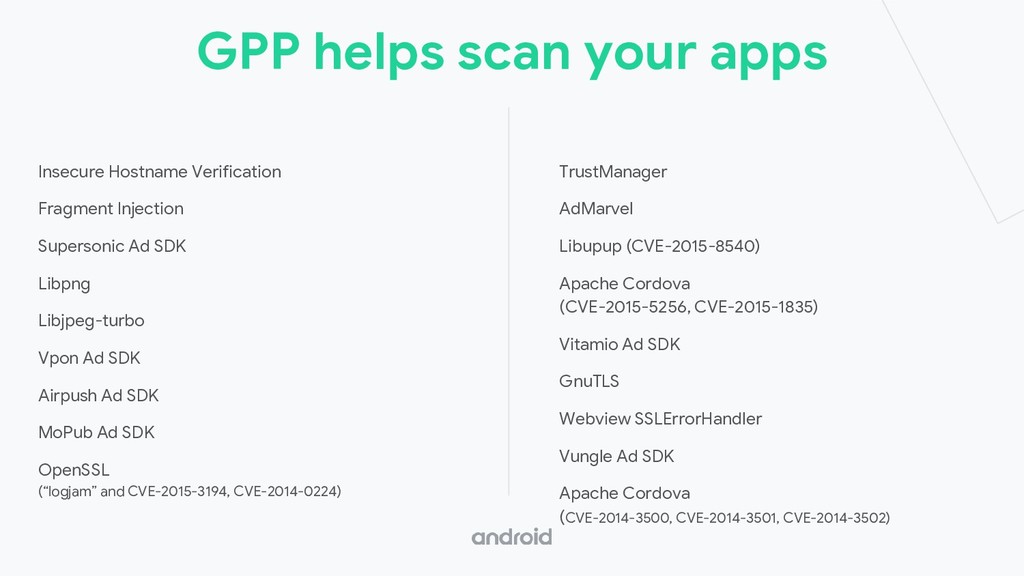
Insecure Hostname Verification Fragment Injection Supersonic Ad SDK Libpng Libjpeg-turbo
Vpon Ad SDK Airpush Ad SDK MoPub Ad SDK OpenSSL (“logjam” and CVE-2015-3194, CVE-2014-0224) TrustManager AdMarvel Libupup (CVE-2015-8540) Apache Cordova (CVE-2015-5256, CVE-2015-1835) Vitamio Ad SDK GnuTLS Webview SSLErrorHandler Vungle Ad SDK Apache Cordova (CVE-2014-3500, CVE-2014-3501, CVE-2014-3502) GPP helps scan your apps -
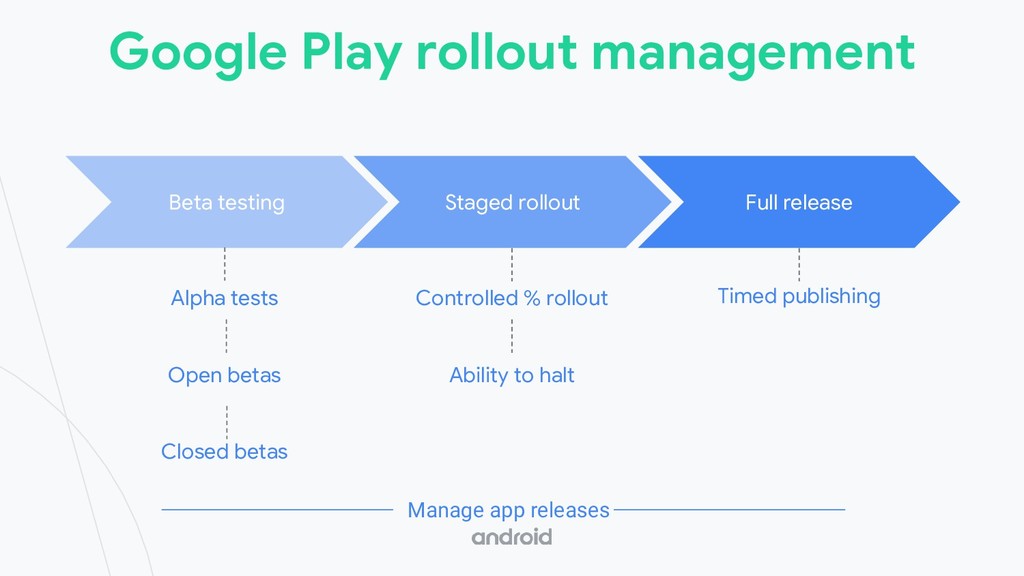
Beta testing Alpha tests Open betas Closed betas Manage app
releases Staged rollout Controlled % rollout Ability to halt Full release Timed publishing Google Play rollout management -
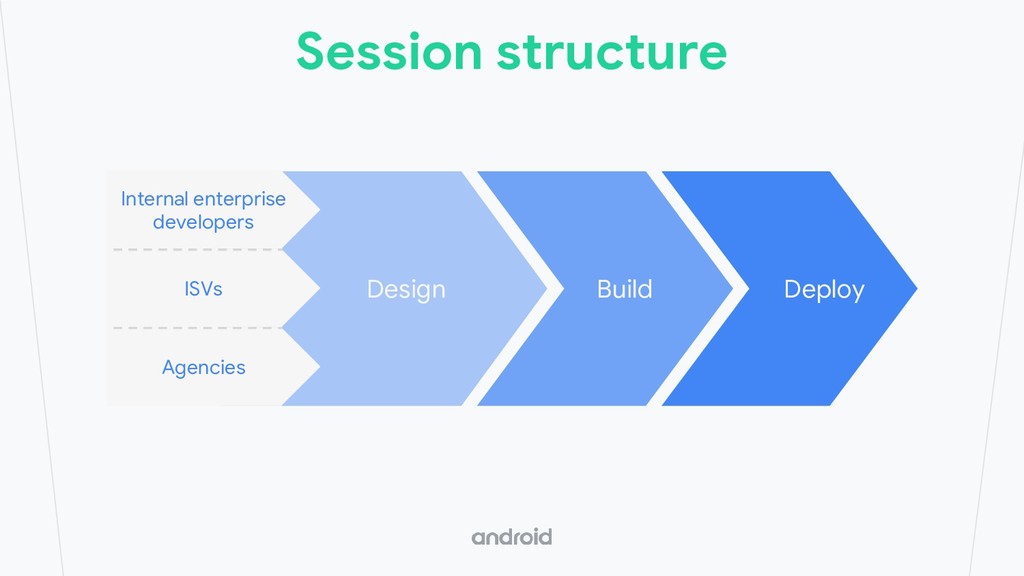
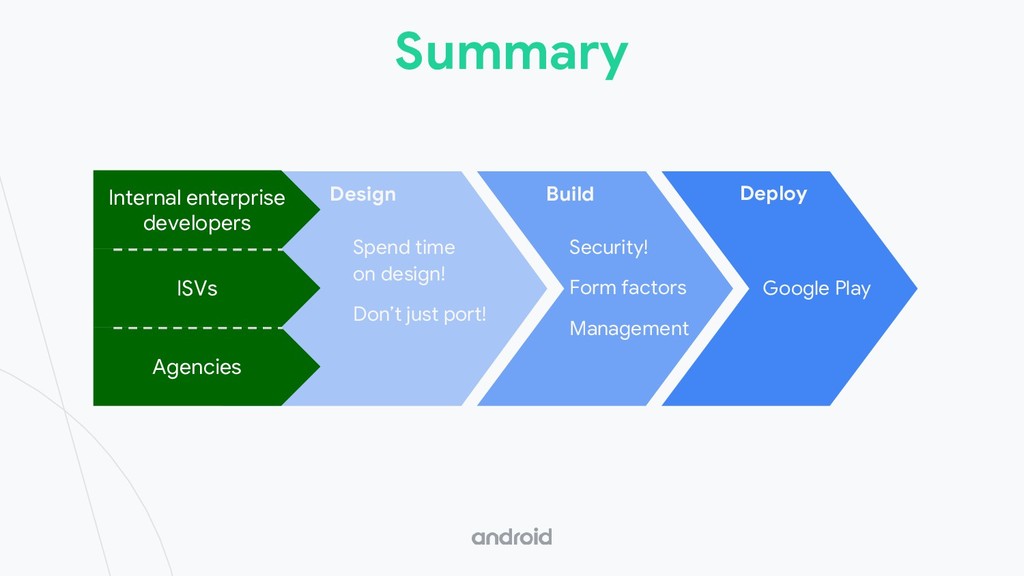
Design Spend time on design! Don’t just port! Internal enterprise
developers ISVs Agencies Build Security! Form factors Management Deploy Google Play Summary