Upgrade to PRO for Only $50/Year—Limited-Time Offer! 🔥

FY 2024: MDC 2 and 3 - Ear and Eye

Avatar for e4health e4health PRO
March 29, 2024
960

FY 2024: MDC 2 and 3 - Ear and Eye

Avatar for e4health

e4health PRO

March 29, 2024
Tweet

Transcript

  1. H I M | C O D I N G

    & C D I | H E A LT H I T | R E V C Y C L E Empowering Better Health e4health tackles healthcare’s data, quality and revenue challenges empowering your providers to focus on better care.
  2. MDC 2 and 3 Diseases and Disorders of the Eye

    and Ear, Nose, Mouth and Throat
  3. Objectives • Review MDC-2 and 3 Diseases and Disorders of

    the Eye and Ear, Nose, Mouth and Throat with a focus on selected diagnoses and procedures • Learner will acquire a basic understanding of the diagnoses and procedures included in MDC-2 and 3 • Discuss Query opportunities in MDC-2 and 3 • Review coding clinics relevant to the chosen topics in each DRG
  4. MDC 17- MS- DRGs (Medical) • 834 ACUTE LEUKEMIA WITHOUT

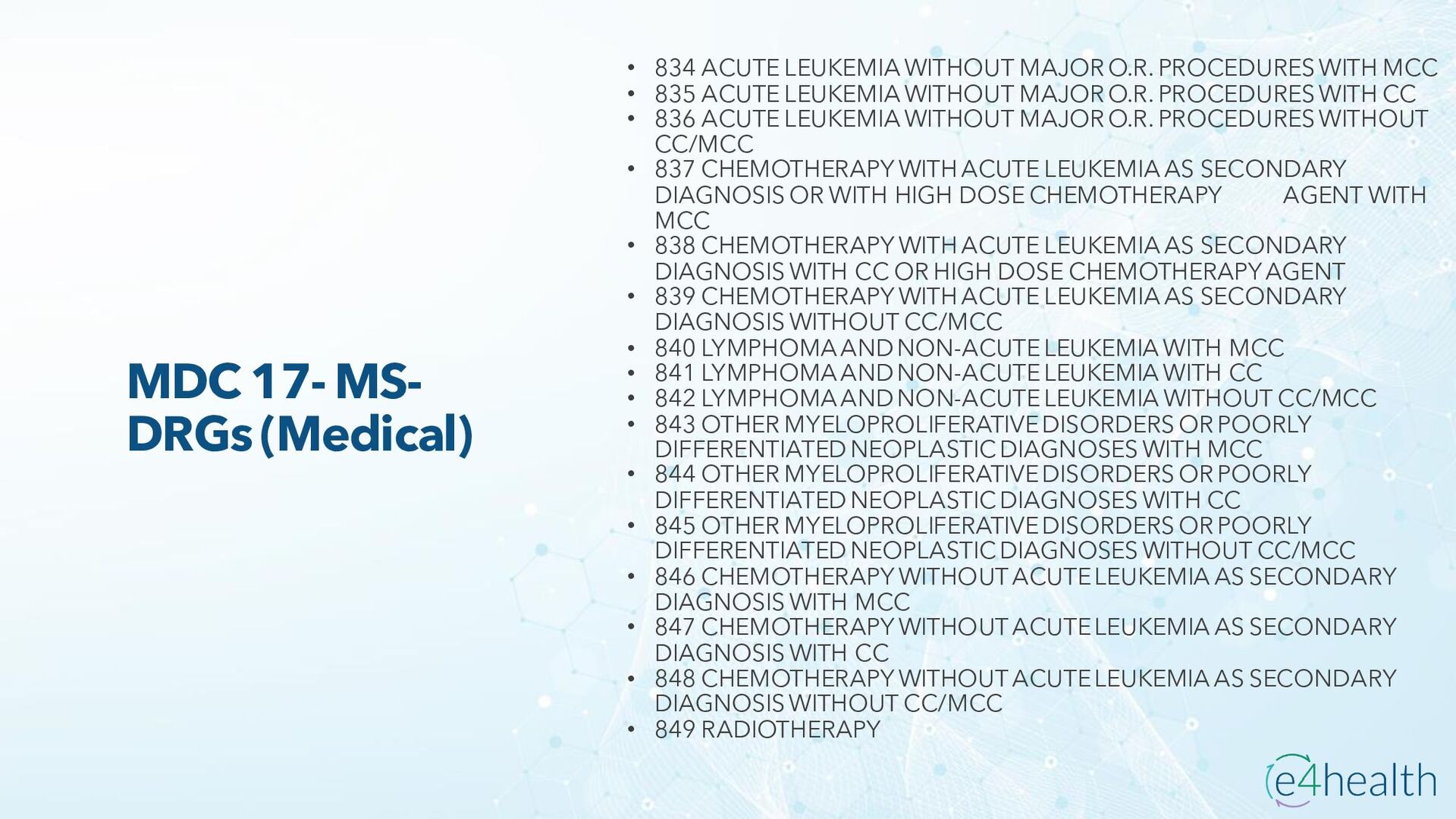
    MAJOR O.R. PROCEDURES WITH MCC • 835 ACUTE LEUKEMIA WITHOUT MAJOR O.R. PROCEDURES WITH CC • 836 ACUTE LEUKEMIA WITHOUT MAJOR O.R. PROCEDURES WITHOUT CC/MCC • 837 CHEMOTHERAPY WITH ACUTE LEUKEMIA AS SECONDARY DIAGNOSIS OR WITH HIGH DOSE CHEMOTHERAPY AGENT WITH MCC • 838 CHEMOTHERAPY WITH ACUTE LEUKEMIA AS SECONDARY DIAGNOSIS WITH CC OR HIGH DOSE CHEMOTHERAPY AGENT • 839 CHEMOTHERAPY WITH ACUTE LEUKEMIA AS SECONDARY DIAGNOSIS WITHOUT CC/MCC • 840 LYMPHOMA AND NON-ACUTE LEUKEMIA WITH MCC • 841 LYMPHOMA AND NON-ACUTE LEUKEMIA WITH CC • 842 LYMPHOMA AND NON-ACUTE LEUKEMIA WITHOUT CC/MCC • 843 OTHER MYELOPROLIFERATIVE DISORDERS OR POORLY DIFFERENTIATED NEOPLASTIC DIAGNOSES WITH MCC • 844 OTHER MYELOPROLIFERATIVE DISORDERS OR POORLY DIFFERENTIATED NEOPLASTIC DIAGNOSES WITH CC • 845 OTHER MYELOPROLIFERATIVE DISORDERS OR POORLY DIFFERENTIATED NEOPLASTIC DIAGNOSES WITHOUT CC/MCC • 846 CHEMOTHERAPY WITHOUT ACUTE LEUKEMIA AS SECONDARY DIAGNOSIS WITH MCC • 847 CHEMOTHERAPY WITHOUT ACUTE LEUKEMIA AS SECONDARY DIAGNOSIS WITH CC • 848 CHEMOTHERAPY WITHOUT ACUTE LEUKEMIA AS SECONDARY DIAGNOSIS WITHOUT CC/MCC • 849 RADIOTHERAPY
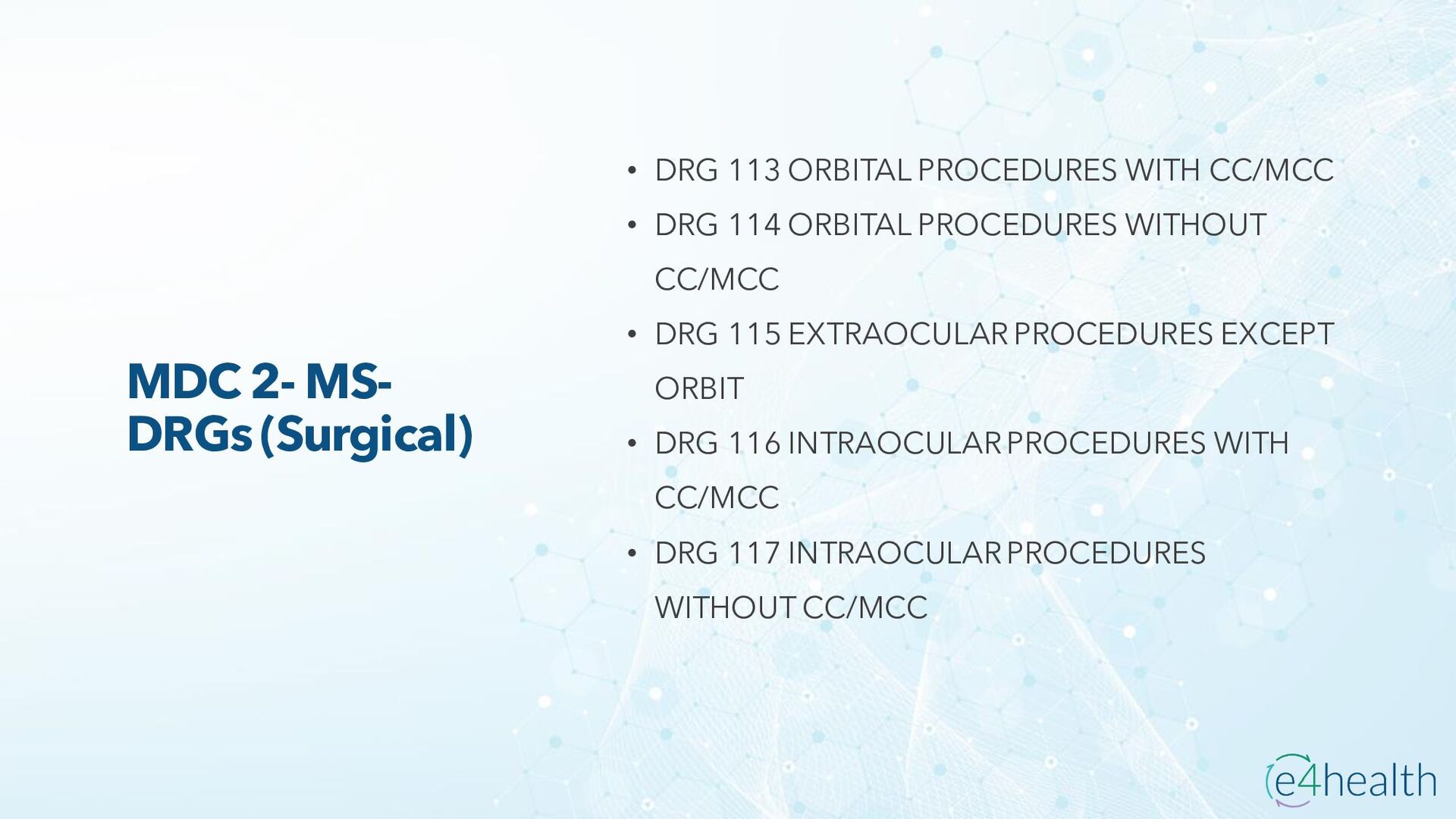
  5. MDC 2- MS- DRGs (Surgical) • DRG 113 ORBITAL PROCEDURES

    WITH CC/MCC • DRG 114 ORBITAL PROCEDURES WITHOUT CC/MCC • DRG 115 EXTRAOCULAR PROCEDURES EXCEPT ORBIT • DRG 116 INTRAOCULAR PROCEDURES WITH CC/MCC • DRG 117 INTRAOCULAR PROCEDURES WITHOUT CC/MCC
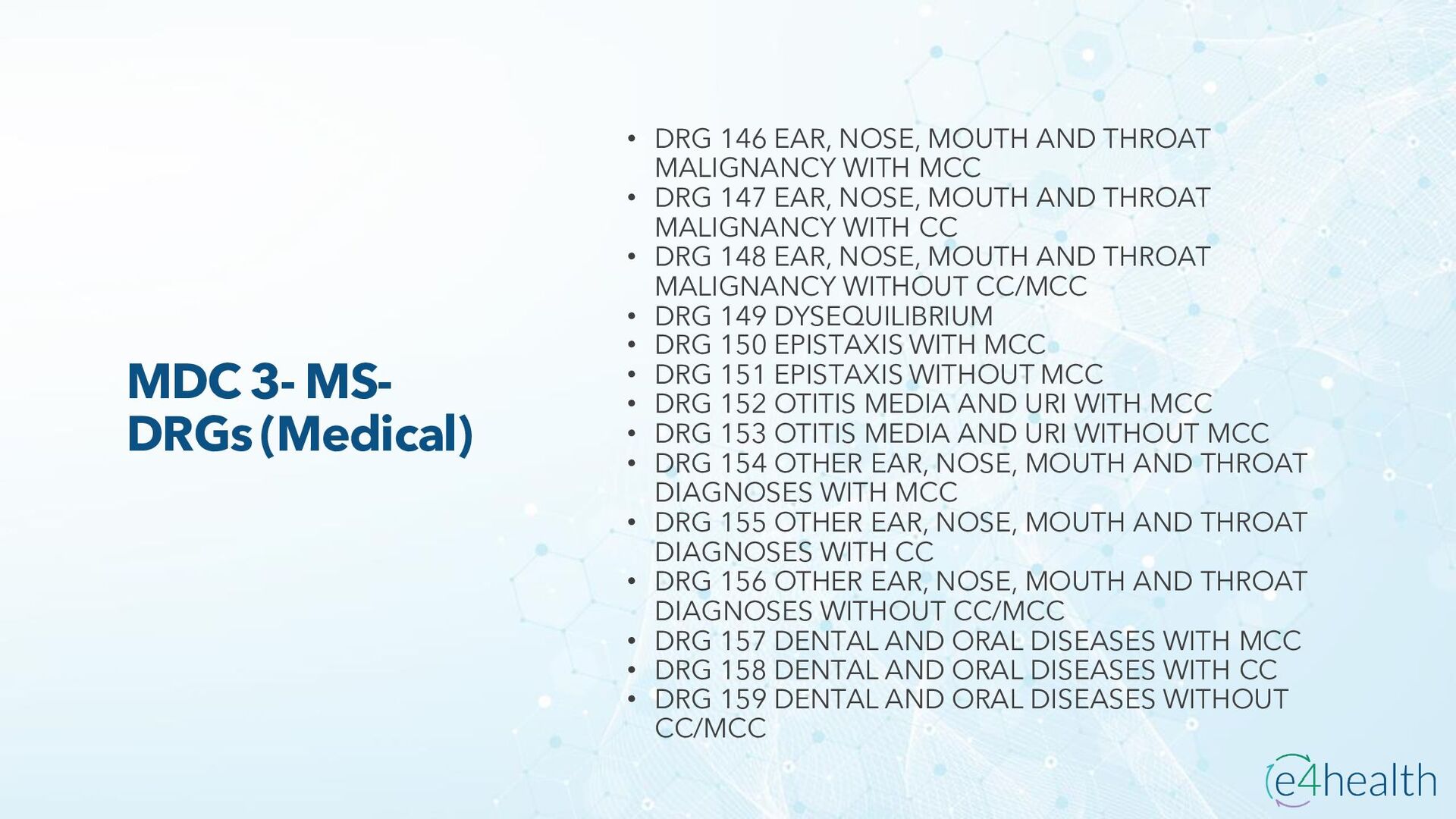
  6. MDC 3- MS- DRGs (Medical) • DRG 146 EAR, NOSE,

    MOUTH AND THROAT MALIGNANCY WITH MCC • DRG 147 EAR, NOSE, MOUTH AND THROAT MALIGNANCY WITH CC • DRG 148 EAR, NOSE, MOUTH AND THROAT MALIGNANCY WITHOUT CC/MCC • DRG 149 DYSEQUILIBRIUM • DRG 150 EPISTAXIS WITH MCC • DRG 151 EPISTAXIS WITHOUT MCC • DRG 152 OTITIS MEDIA AND URI WITH MCC • DRG 153 OTITIS MEDIA AND URI WITHOUT MCC • DRG 154 OTHER EAR, NOSE, MOUTH AND THROAT DIAGNOSES WITH MCC • DRG 155 OTHER EAR, NOSE, MOUTH AND THROAT DIAGNOSES WITH CC • DRG 156 OTHER EAR, NOSE, MOUTH AND THROAT DIAGNOSES WITHOUT CC/MCC • DRG 157 DENTAL AND ORAL DISEASES WITH MCC • DRG 158 DENTAL AND ORAL DISEASES WITH CC • DRG 159 DENTAL AND ORAL DISEASES WITHOUT CC/MCC
  7. MDC 3- MS- DRGs (Surgical) • DRG 140 MAJOR HEAD

    AND NECK PROCEDURES WITH MCC • DRG 141 MAJOR HEAD AND NECK PROCEDURES WITH CC • DRG 142 MAJOR HEAD AND NECK PROCEDURES WITHOUT CC/MCC • DRG 143 OTHER EAR, NOSE, MOUTH AND THROAT O.R. PROCEDURES WITH MCC • DRG 144 OTHER EAR, NOSE, MOUTH AND THROAT O.R. PROCEDURES WITH CC • DRG 145 OTHER EAR, NOSE, MOUTH AND THROAT O.R. PROCEDURES WITHOUT CC/MCC • DRG 135 SINUS AND MASTOID PROCEDURES WITH CC/MCC • DRG 136 SINUS AND MASTOID PROCEDURES WITHOUT CC/MCC • DRG 137 MOUTH PROCEDURES WITH CC/MCC • DRG 138 MOUTH PROCEDURES WITHOUT CC/MCC • DRG 139 SALIVARY GLAND PROCEDURES
  8. MS-DRG 121 and 122 Acute Major Eye Infections With CC/MCC

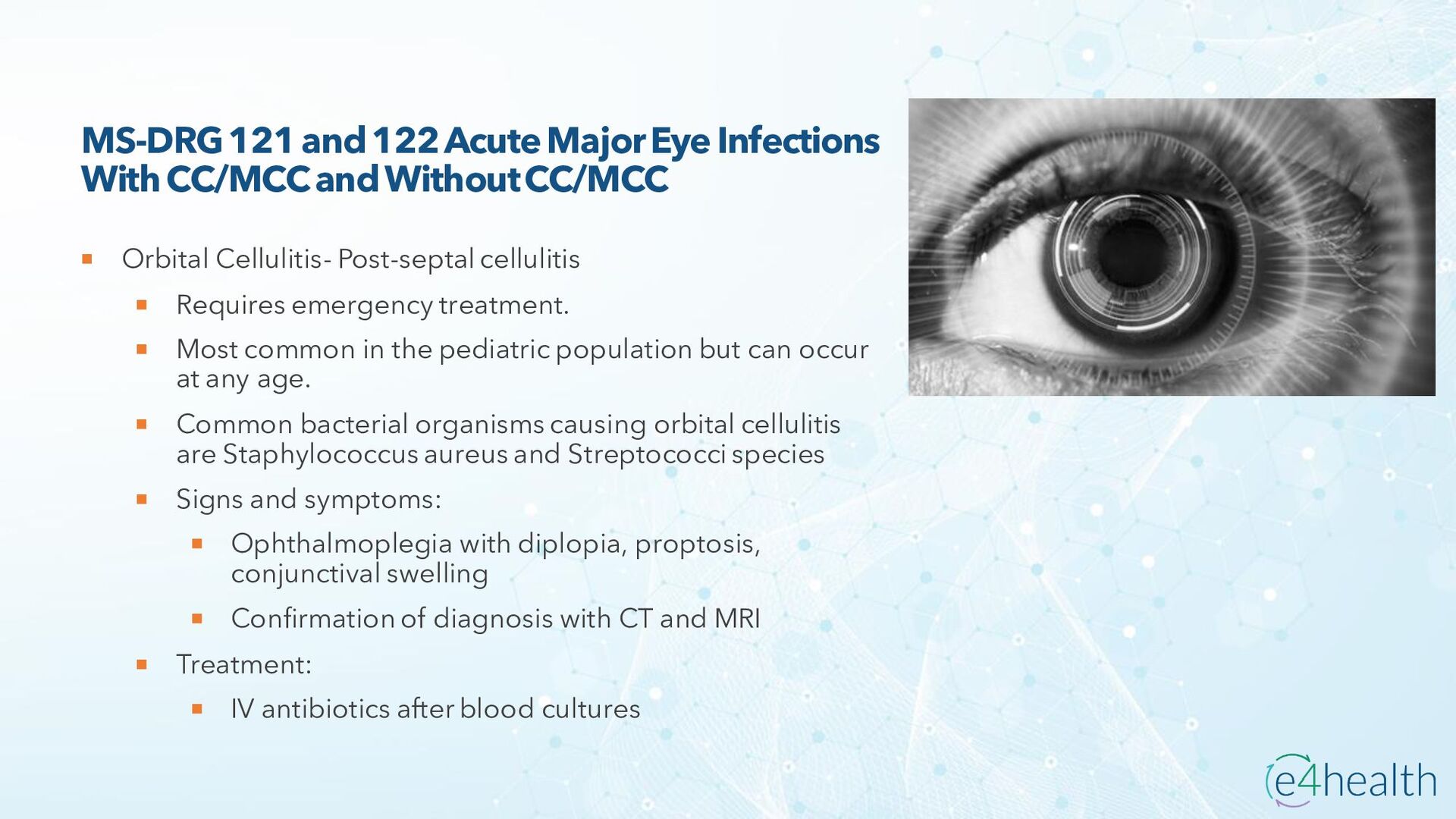
    and Without CC/MCC  Orbital Cellulitis- Post-septal cellulitis  Requires emergency treatment.  Most common in the pediatric population but can occur at any age.  Common bacterial organisms causing orbital cellulitis are Staphylococcus aureus and Streptococci species  Signs and symptoms:  Ophthalmoplegia with diplopia, proptosis, conjunctival swelling  Confirmation of diagnosis with CT and MRI  Treatment:  IV antibiotics after blood cultures
  9. MS-DRG 121 and 122 Acute Major Eye Infections With CC/MCC

    and Without CC/MCC • Orbital Cellulitis- Post-septal cellulitis - Query opportunities • Identification of complications • Extension into surrounding tissues • Abscess identified on imaging • Laterality • Sepsis is uncommon, but very possible, review for clinical indicators
  10. Periorbital Cellulitis - Coding Clinic Fourth Quarter 2016 Page 36

    • Subcategory L03.21, Cellulitis and acute lymphangitis of face, has been expanded to specifically identify periorbital cellulitis (L03.213). • Periorbital cellulitis is an infection or inflammation of the eyelid or skin around the eye. Cellulitis around the orbit of the eye and the preseptal area is not to be confused with orbital cellulitis or postseptal cellulitis, which affects the orbit, can affect the eye, and is a more severe infection. Periorbital cellulitis is confined to the soft tissues that are anterior to the orbital septum. • The American Academy of Pediatrics requested a unique code to better identify periorbital cellulitis since this condition may require more intensive evaluation and management than a simple cellulitis of the face. Prior to this change, there were no ICD-10-CM codes to specifically describe a patient that has been identified as having periorbital cellulitis.
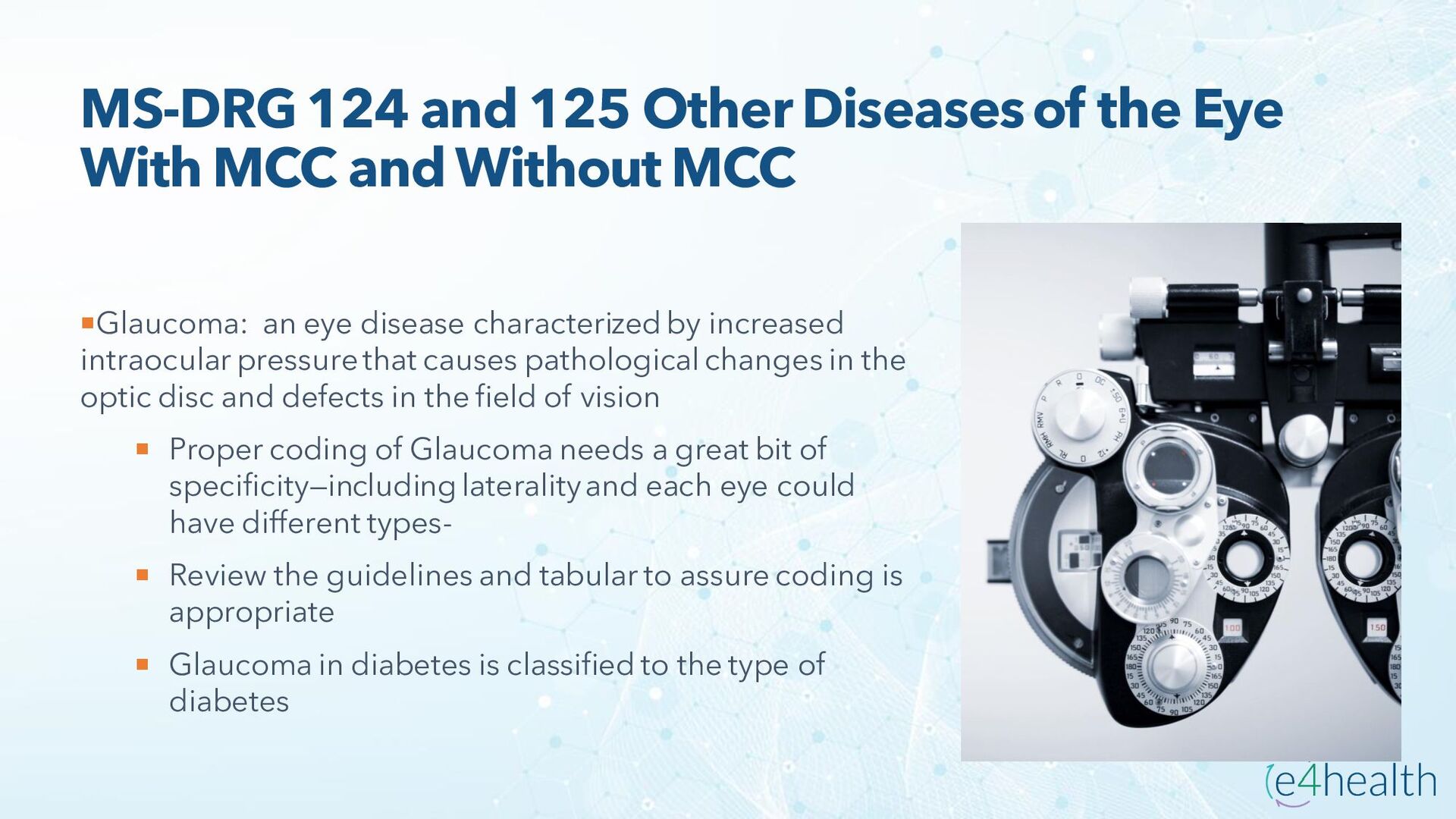
  11. MS-DRG 124 and 125 Other Diseases of the Eye With

    MCC and Without MCC Glaucoma: an eye disease characterized by increased intraocular pressure that causes pathological changes in the optic disc and defects in the field of vision  Proper coding of Glaucoma needs a great bit of specificity—includinglaterality and each eye could have different types-  Review the guidelines and tabular to assure coding is appropriate  Glaucoma in diabetes is classified to the type of diabetes
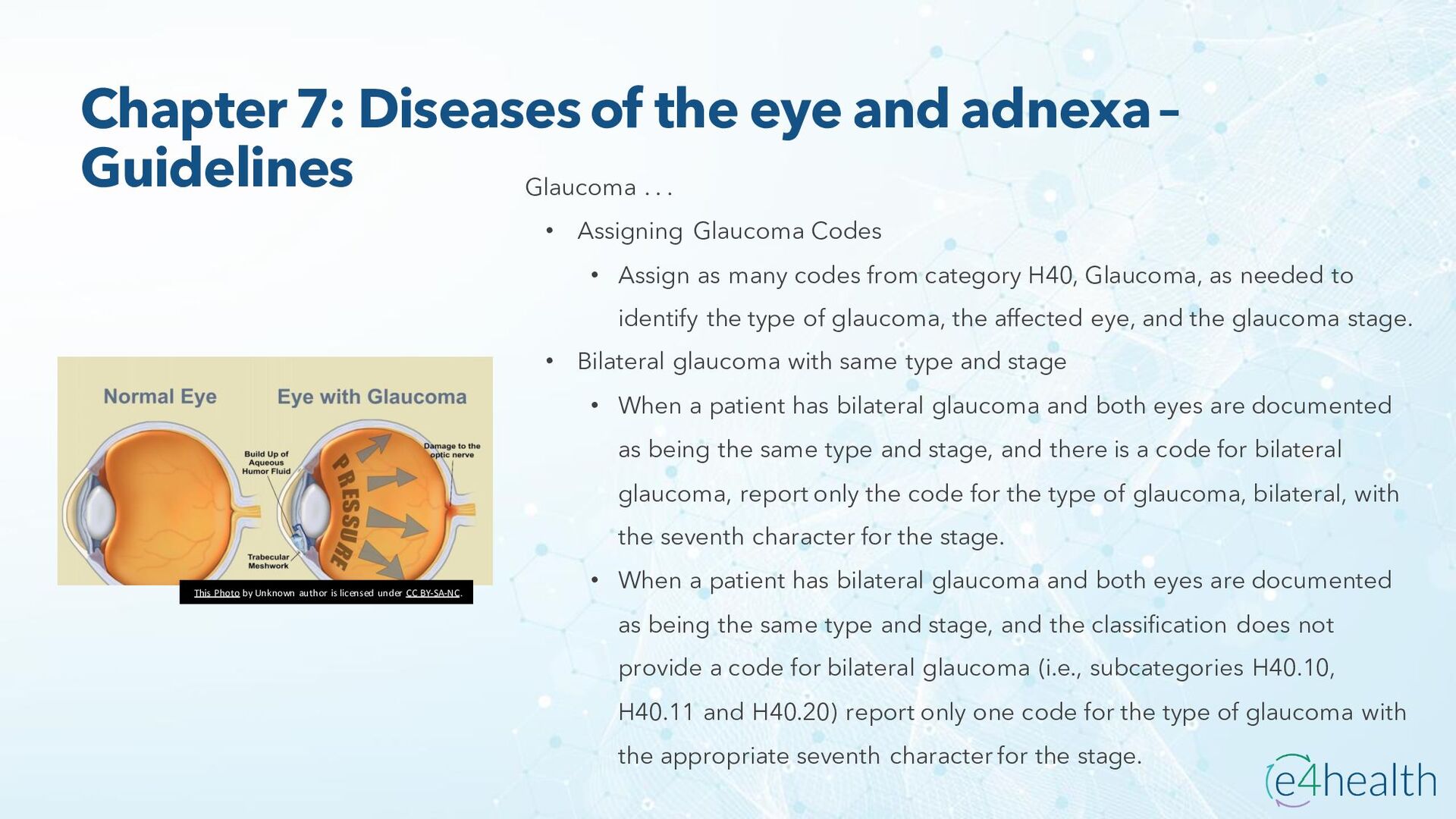
  12. Chapter 7: Diseases of the eye and adnexa – Guidelines

    Glaucoma . . . • Assigning Glaucoma Codes • Assign as many codes from category H40, Glaucoma, as needed to identify the type of glaucoma, the affected eye, and the glaucoma stage. • Bilateral glaucoma with same type and stage • When a patient has bilateral glaucoma and both eyes are documented as being the same type and stage, and there is a code for bilateral glaucoma, report only the code for the type of glaucoma, bilateral, with the seventh character for the stage. • When a patient has bilateral glaucoma and both eyes are documented as being the same type and stage, and the classification does not provide a code for bilateral glaucoma (i.e., subcategories H40.10, H40.11 and H40.20) report only one code for the type of glaucoma with the appropriate seventh character for the stage. This Photo by Unknown author is licensed under CC BY-SA-NC.
  13. Glaucoma . . . (continued) • Bilateral glaucoma stage with

    different types or stages • When a patient has bilateral glaucoma and each eye is documented as having a different type or stage, and the classification distinguishes laterality, assign the appropriate code for each eye rather than the code for bilateral glaucoma. • When a patient has bilateral glaucoma and each eye is documented as having a different type, and the classification does not distinguish laterality (i.e., subcategories H40.10, H40.11 and H40.20), assign one code for each type of glaucoma with the appropriate seventh character for the stage. • When a patient has bilateral glaucoma and each eye is documented as having the same type, but different stage, and the classification does not distinguish laterality (i.e., subcategories H40.10, H40.11 and H40.20), assign a code for the type of glaucoma for each eye with the seventh character for the specific glaucoma stage documented for each eye. Chapter 7: Diseases of the eye and adnexa – Guidelines
  14. MS-DRG 146, 147 and 148 Ear, Nose, Mouth and Throat

    Malignancy With MCC, With CC and Without CC/MCC • Documentation Considerations for ENT Malignancy • Each anatomical location is documented - avoid generalizations such as mouth or neck. • Metastatic sites should all be documented and coded. • Secondary diagnoses that are not integral to the cancer diagnosis should be documented and coded. • Query Considerations • Use previous records and documentation if there is a history of diagnosis documented but no evidence of treatment, or surgical intervention. Query if unsure to make sure the diagnoses are accurately captured. • Query when there is evidence of metastatic sites, and no documentation. • Query for documentation of pathology results if available
  15. MDC 2 and 3 – Query opportunities Query opportunities to

    look for clinical indicators of: • Acute respiratory failure • Aspiration pneumonia • Malnutrition/Cachexia • Chemotherapy induced pancytopenia • Dehydration • Acute renal failure • Complications of procedure or device: • Tracheostomy site infection • Sepsis due to device
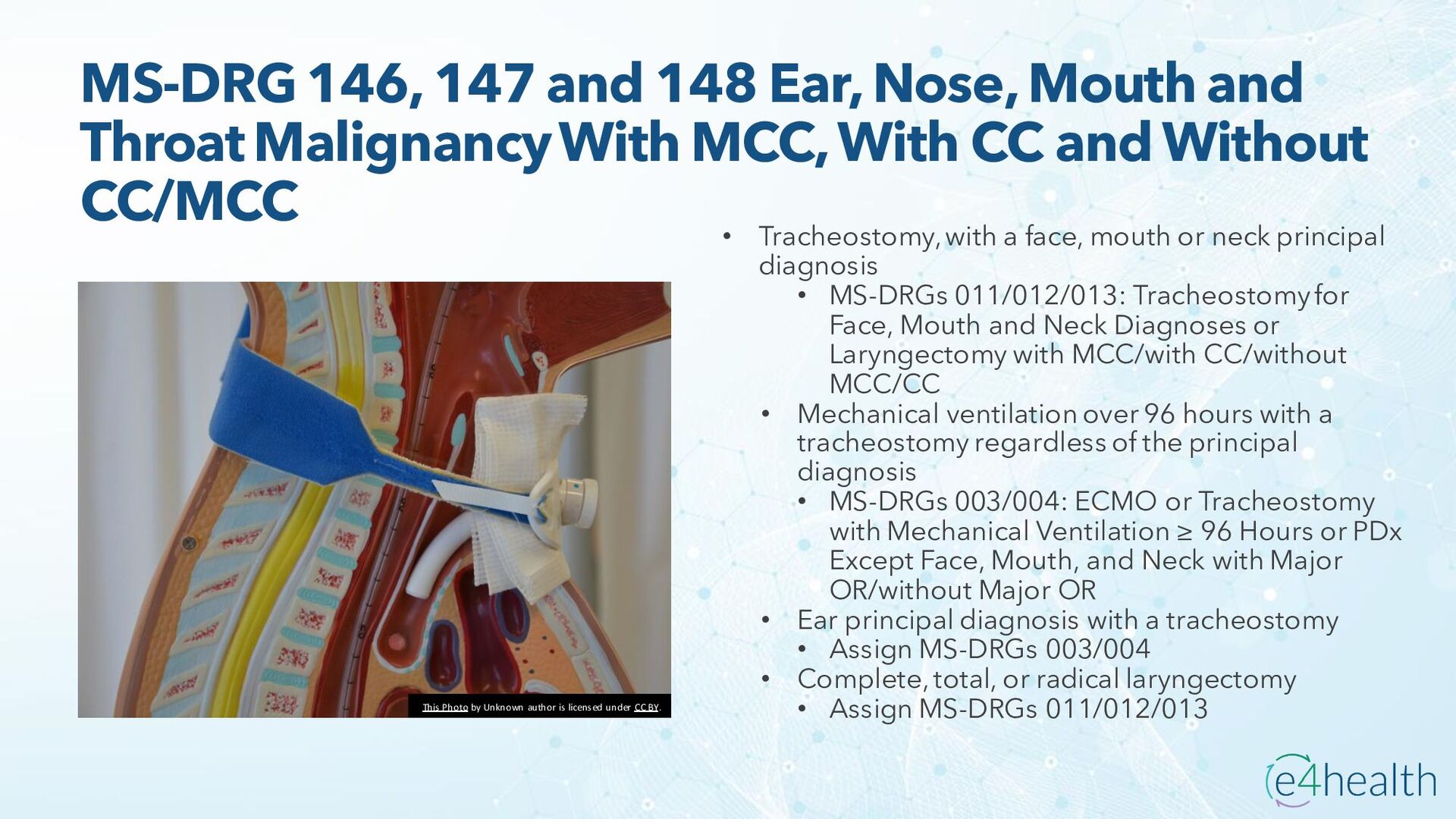
  16. MS-DRG 146, 147 and 148 Ear, Nose, Mouth and Throat

    Malignancy With MCC, With CC and Without CC/MCC • Tracheostomy, with a face, mouth or neck principal diagnosis • MS-DRGs 011/012/013: Tracheostomy for Face, Mouth and Neck Diagnoses or Laryngectomy with MCC/with CC/without MCC/CC • Mechanical ventilation over 96 hours with a tracheostomy regardless of the principal diagnosis • MS-DRGs 003/004: ECMO or Tracheostomy with Mechanical Ventilation ≥ 96 Hours or PDx Except Face, Mouth, and Neck with Major OR/without Major OR • Ear principal diagnosis with a tracheostomy • Assign MS-DRGs 003/004 • Complete, total, or radical laryngectomy • Assign MS-DRGs 011/012/013 This Photo by Unknown author is licensed under CC BY.
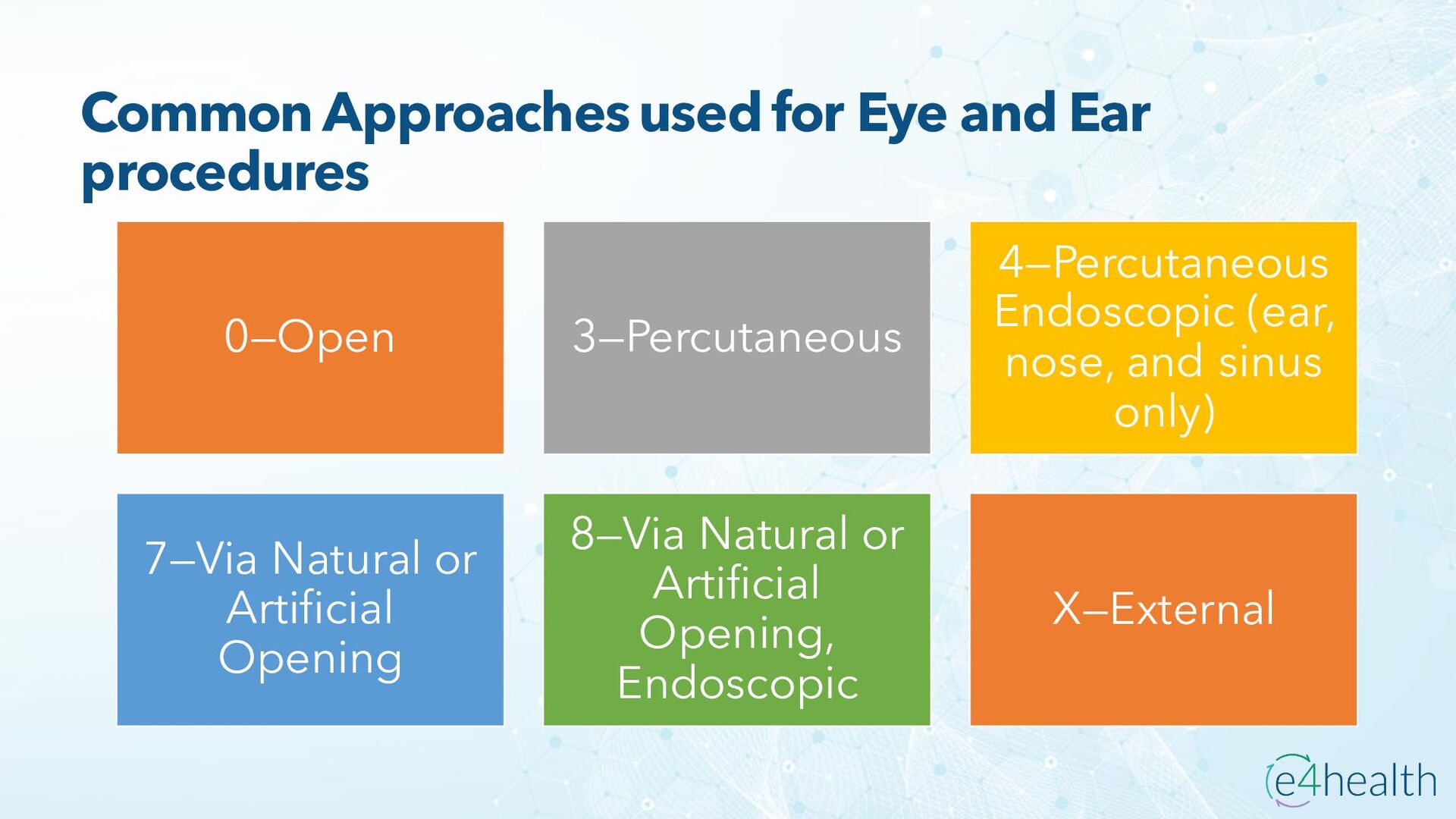
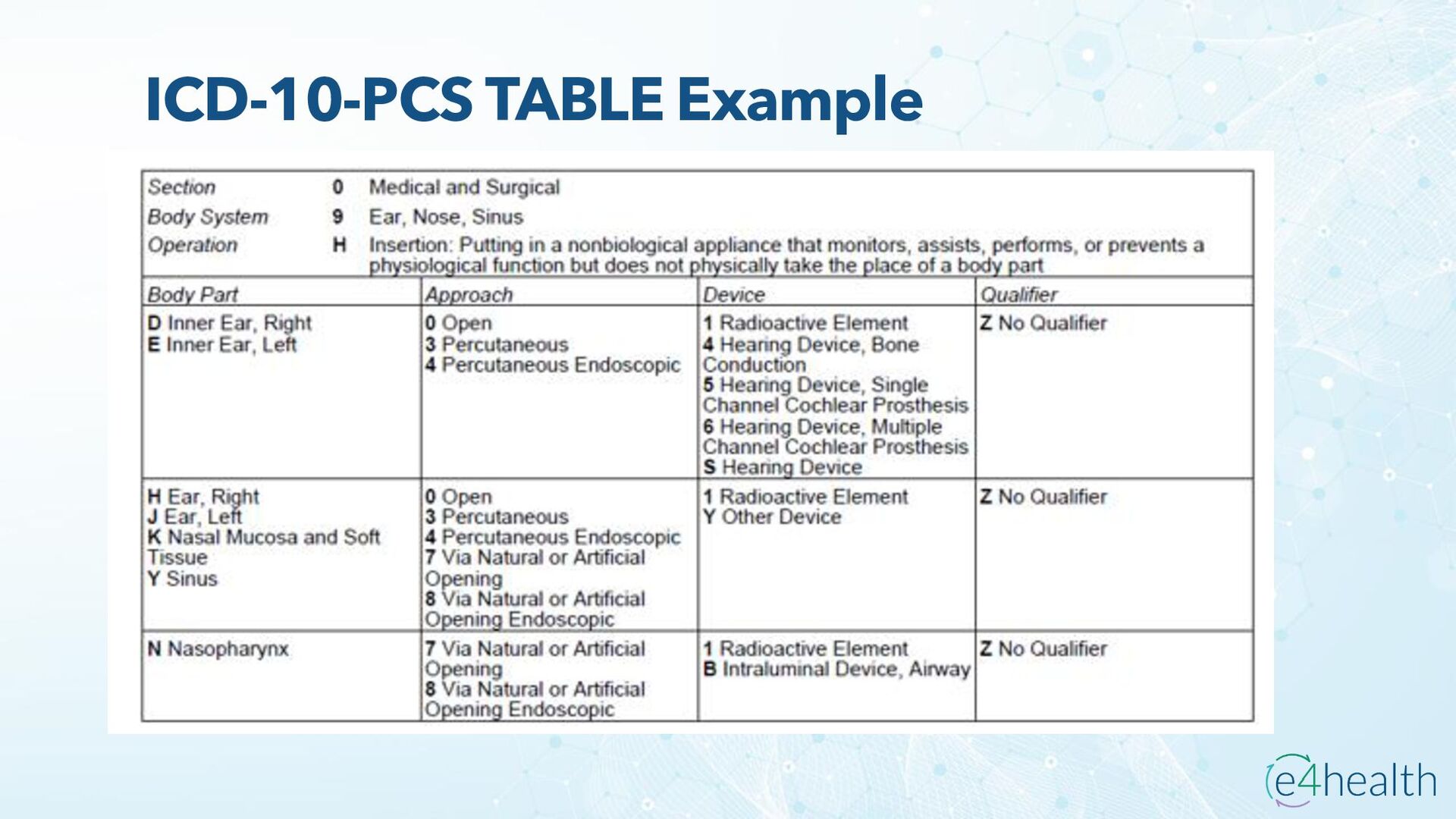
  17. Common Approaches used for Eye and Ear procedures 0—Open 3—Percutaneous

    4—Percutaneous Endoscopic (ear, nose, and sinus only) 7—Via Natural or Artificial Opening 8—Via Natural or Artificial Opening, Endoscopic X—External
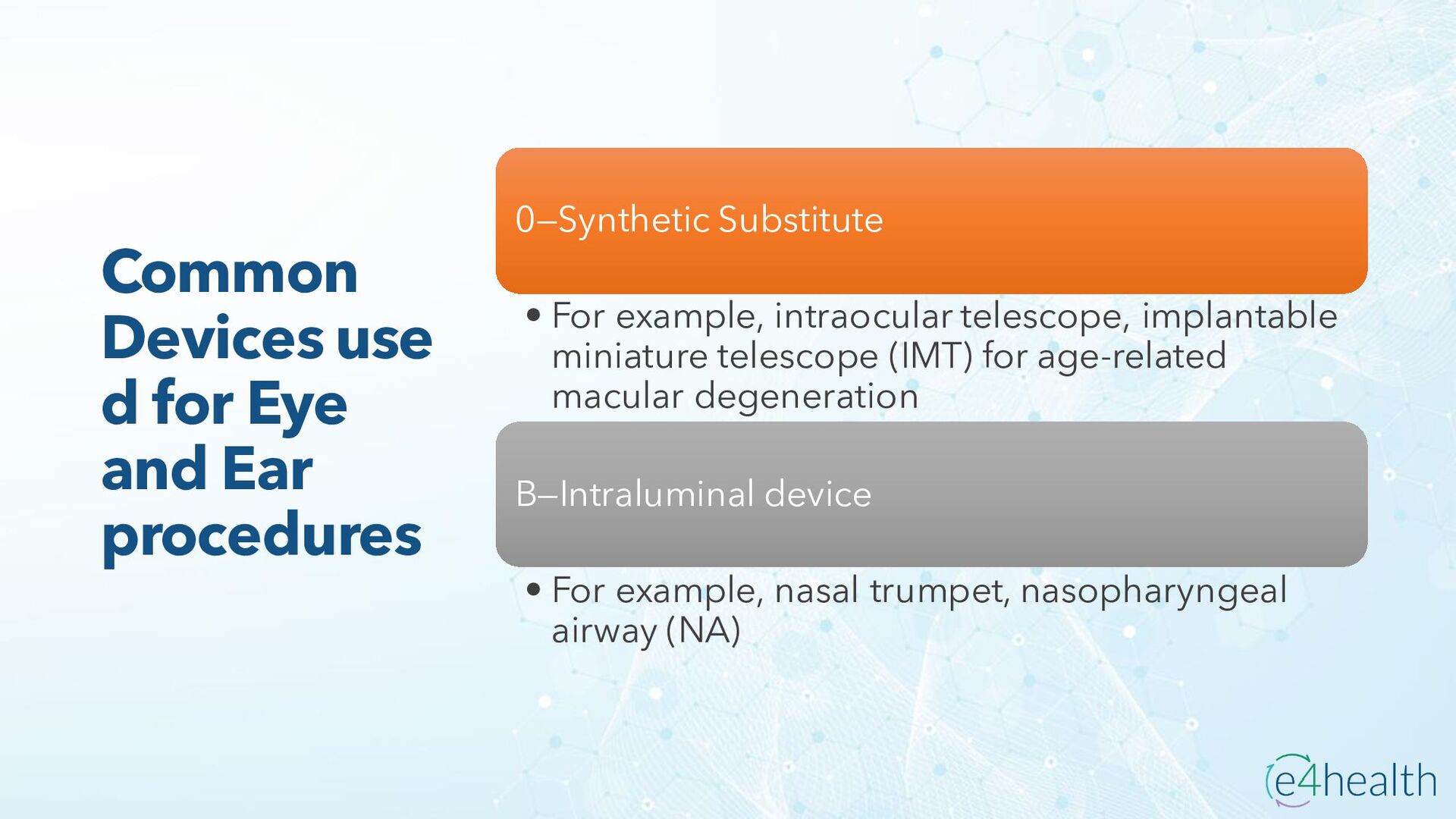
  18. Common Devices use d for Eye and Ear procedures 0—Synthetic

    Substitute • For example, intraocular telescope, implantable miniature telescope (IMT) for age-related macular degeneration B—Intraluminal device • For example, nasal trumpet, nasopharyngeal airway (NA)
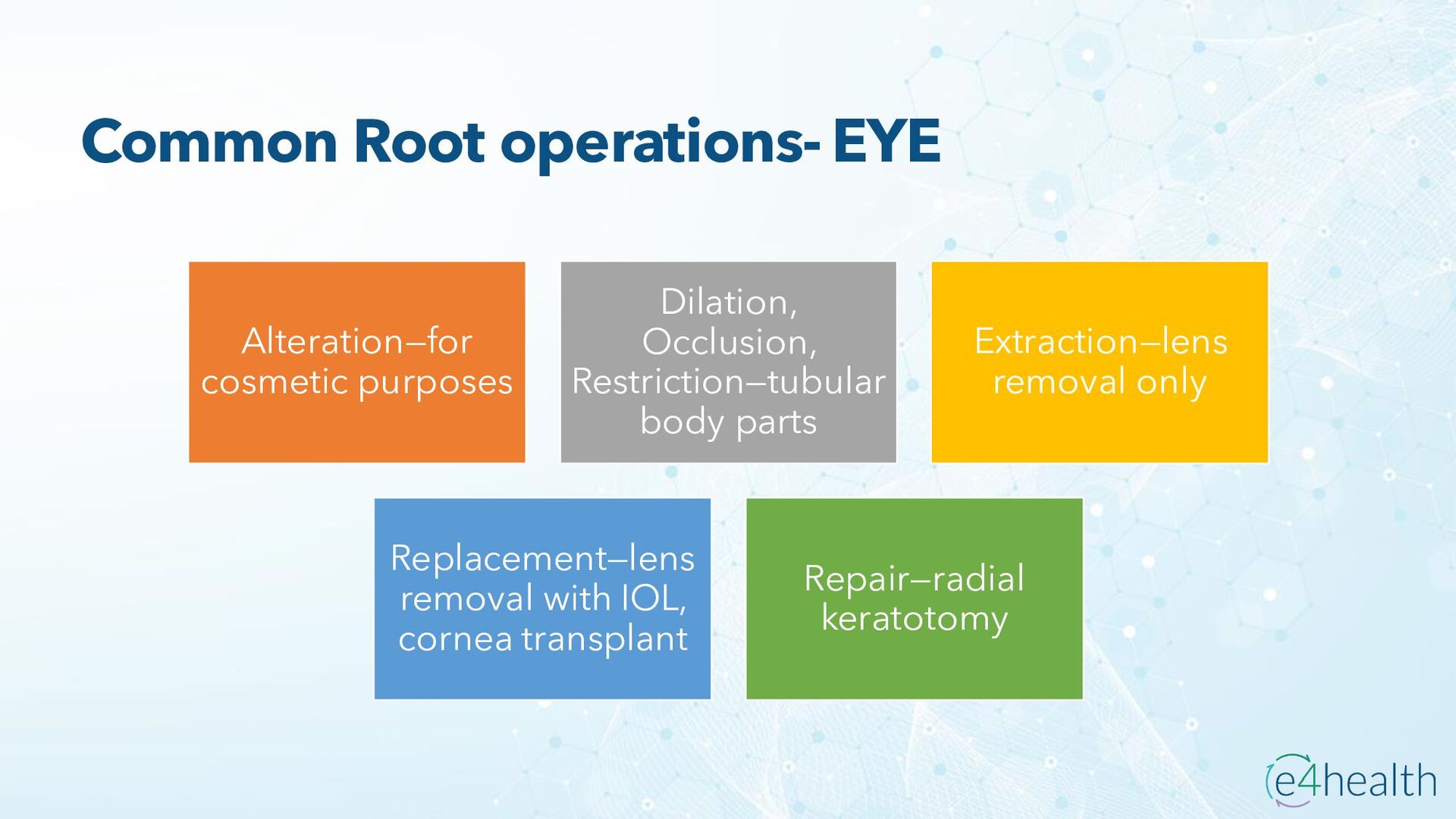
  19. Common Root operations- EYE Alteration—for cosmetic purposes Dilation, Occlusion, Restriction—tubular

    body parts Extraction—lens removal only Replacement—lens removal with IOL, cornea transplant Repair—radial keratotomy
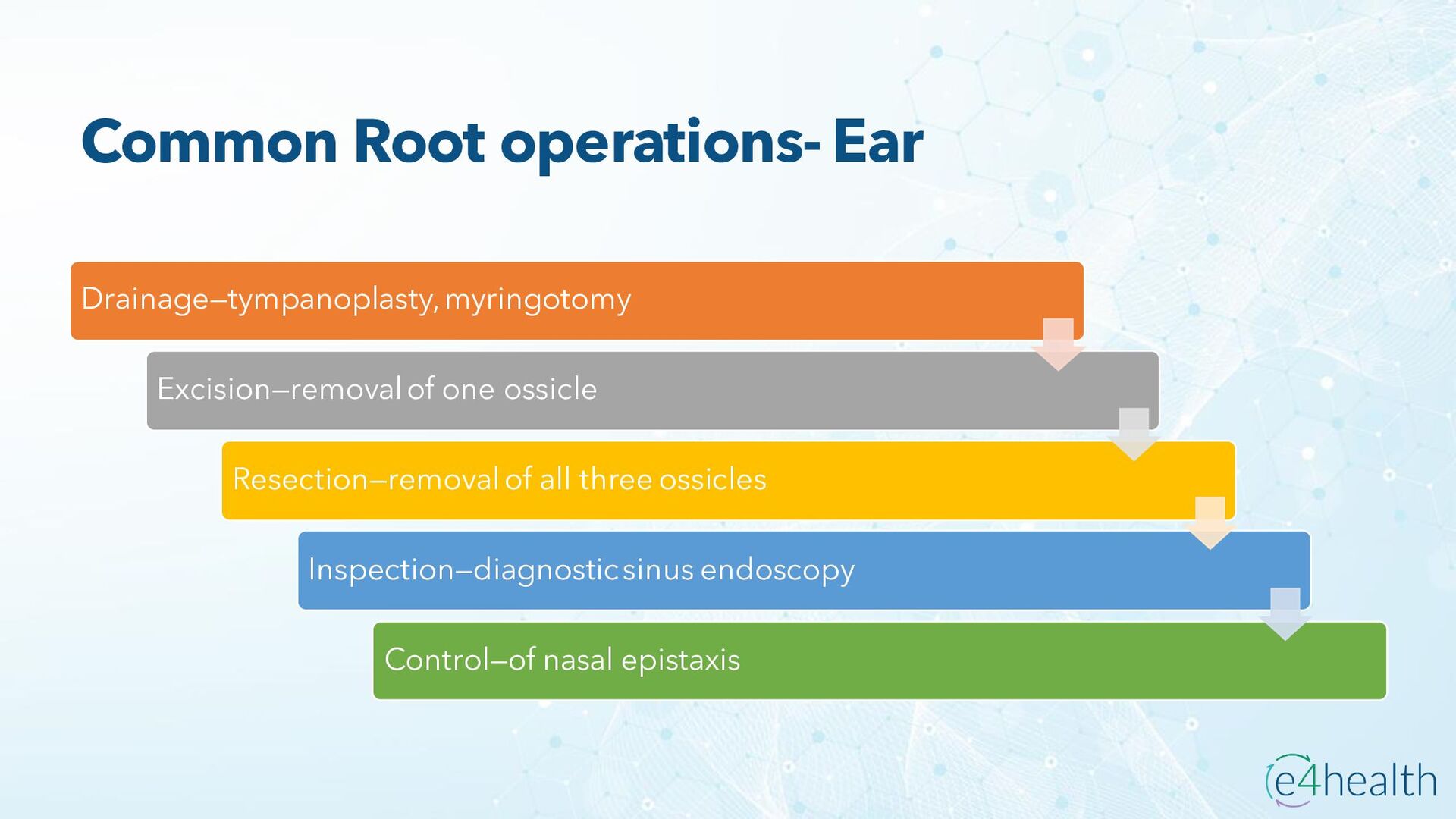
  20. Common Root operations- Ear Drainage—tympanoplasty, myringotomy Excision—removal of one ossicle

    Resection—removal of all three ossicles Inspection—diagnostic sinus endoscopy Control—of nasal epistaxis
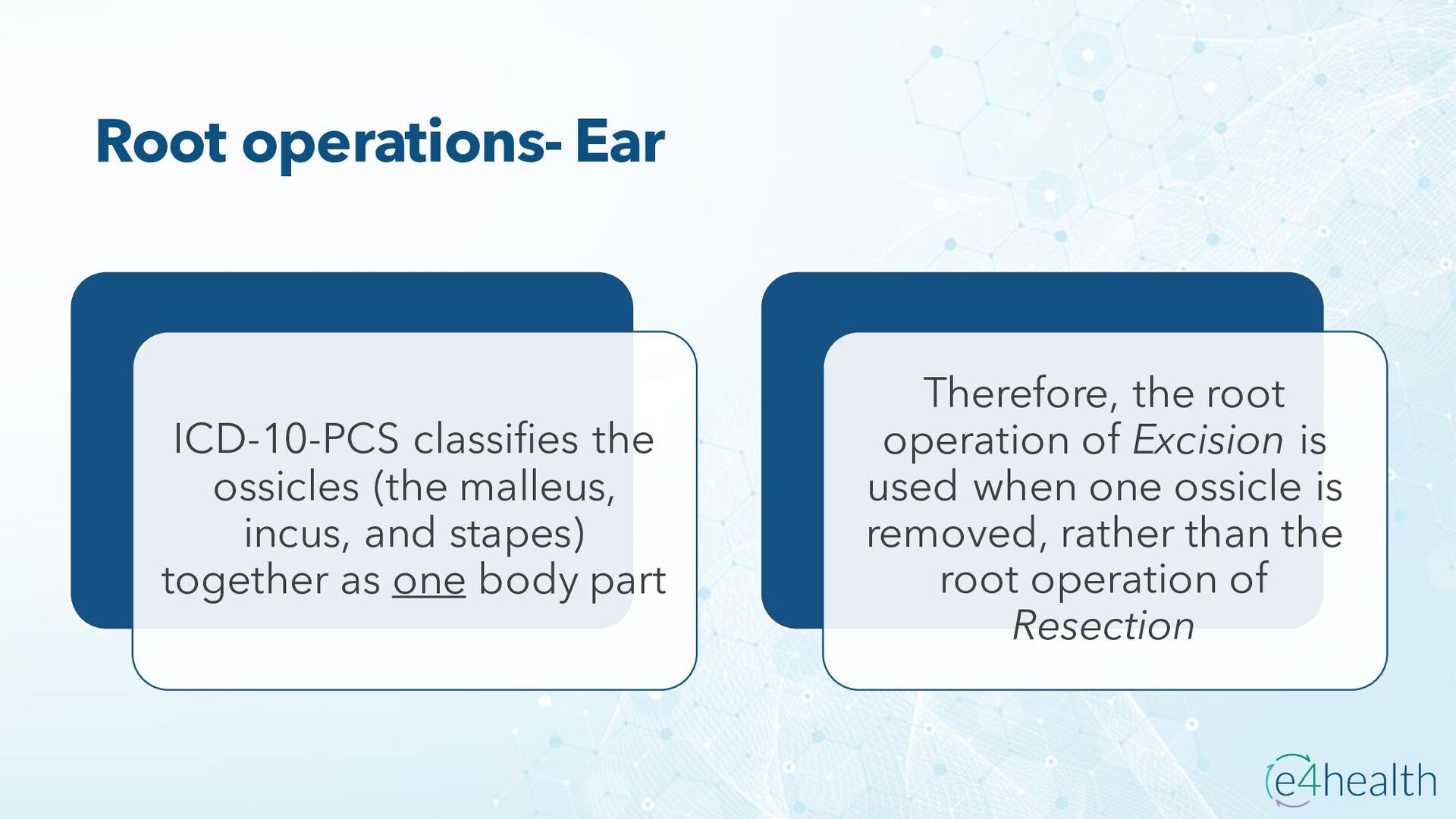
  21. Root operations- Ear ICD-10-PCS classifies the ossicles (the malleus, incus,

    and stapes) together as one body part Therefore, the root operation of Excision is used when one ossicle is removed, rather than the root operation of Resection
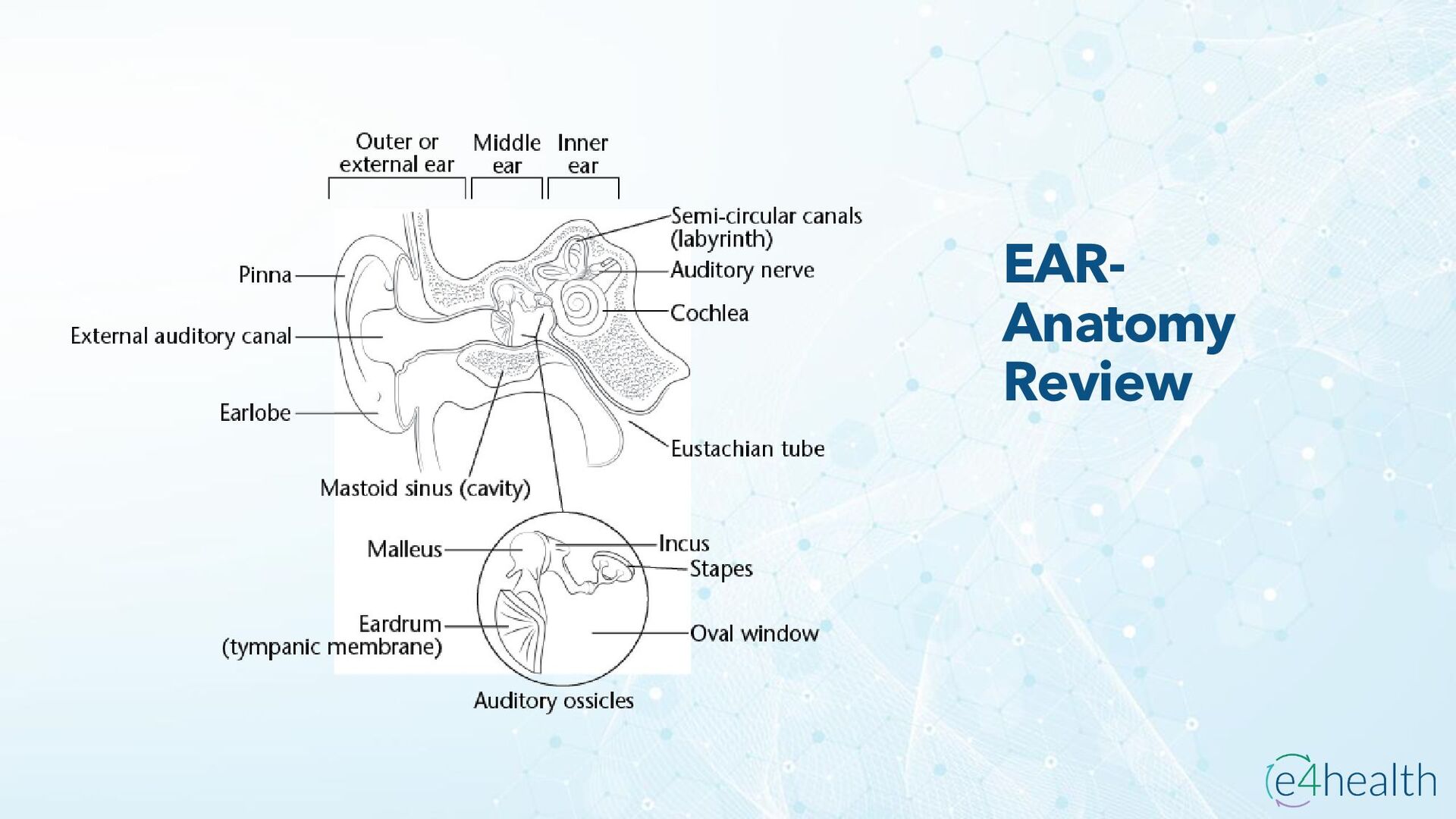
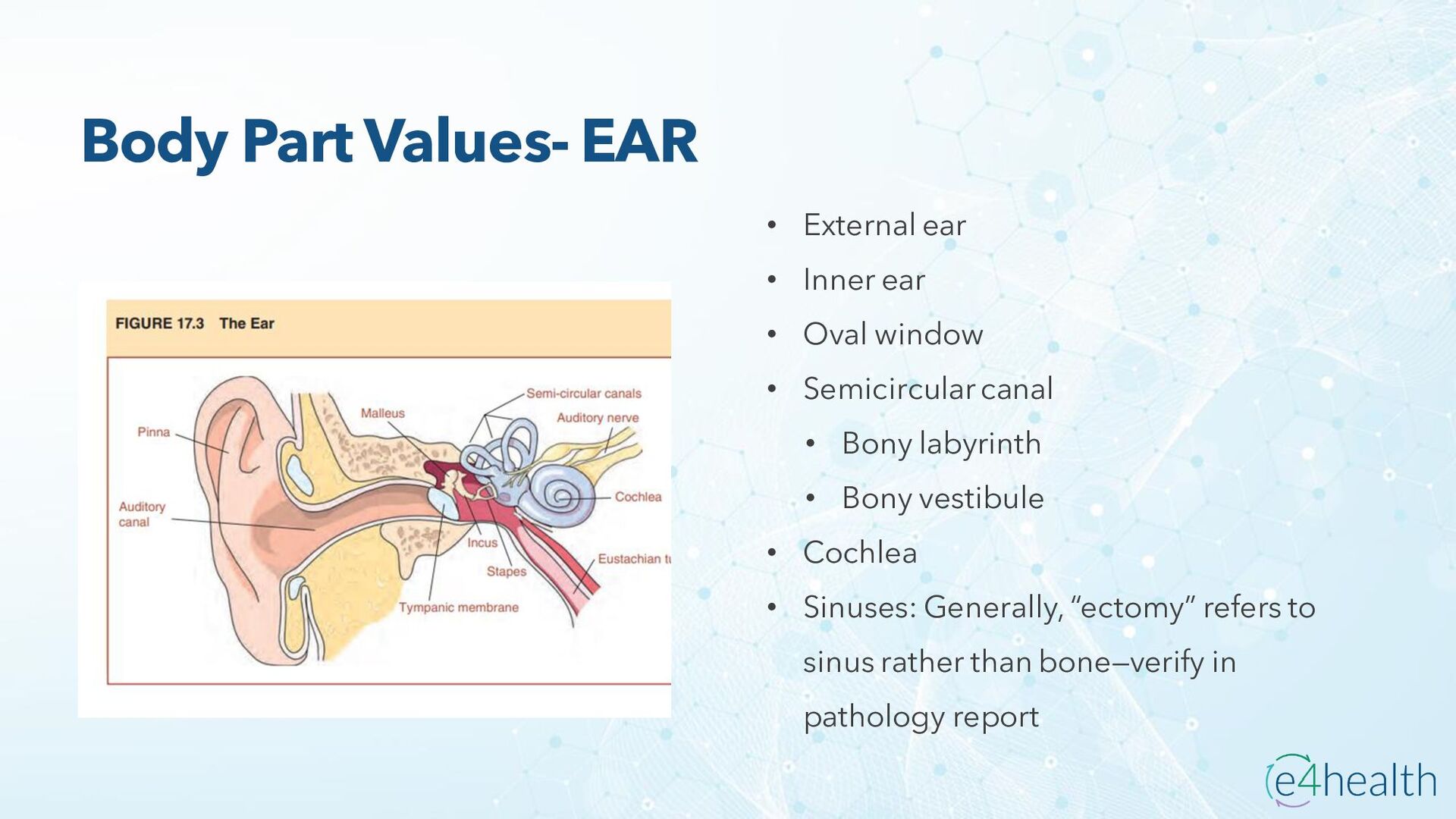
  22. Body Part Values- EAR • External ear • Inner ear

    • Oval window • Semicircular canal • Bony labyrinth • Bony vestibule • Cochlea • Sinuses: Generally, “ectomy” refers to sinus rather than bone—verify in pathology report
  23. References • ICD-10-CM Guidelines April 1 2023 FY23 (cms.gov) •

    AHA ICD-10-CM and ICD-10-PCS Coding Handbook • ICD-10-PCS: An Applied Approach 2023 • Cengage: 3-2-1 CODE IT! • Medical Terminology Systems: A Body Systems Approach with Medical Language Lab • ICD-10-PCS: An Applied Approach, 2023