Upgrade to Pro — share decks privately, control downloads, hide ads and more …

Heuristics for Service Boundaries

Heuristics for Service Boundaries

When identifying microservice boundaries, it is not enough to consider domains only. Other forces like organisational communication structures, and time, strongly suggest that you also should include other criteria in your considerations. Based on real-world experience of numerous projects, this talk takes a pragmatic walk and explores some of these other heuristics which should also be shaping your microservice decomposition thinking. These considerations may not on the surface seem that obvious, but if ignored, can just as easily lead to project failure. So whether you’ve already been through a painful project which tried to decompose boundaries by the book and failed, or you’re looking for some insight into other considerations often not spoken about, this talk is for you.

Avatar for Erich Eichinger

Erich Eichinger

November 06, 2018

Other Decks in Technology

Transcript

  1. 2 Heuristics for Service Boundaries About • Lead Consultant at

    OpenCredo • Much longer in Software Delivery than I am willing to admit • Hands on software development consultancy • Cloud Native; Data Engineering & ML @oakinger
  2. 3 Heuristics for Service Boundaries Why am I here? •

    Wrote blog post: https://opencredo.com/identify-service-boundary- heuristics/ • “Things I wish someone had told me” • share my thoughts around those heuristics @oakinger
  3. 4 Heuristics for Service Boundaries Where am I coming from?

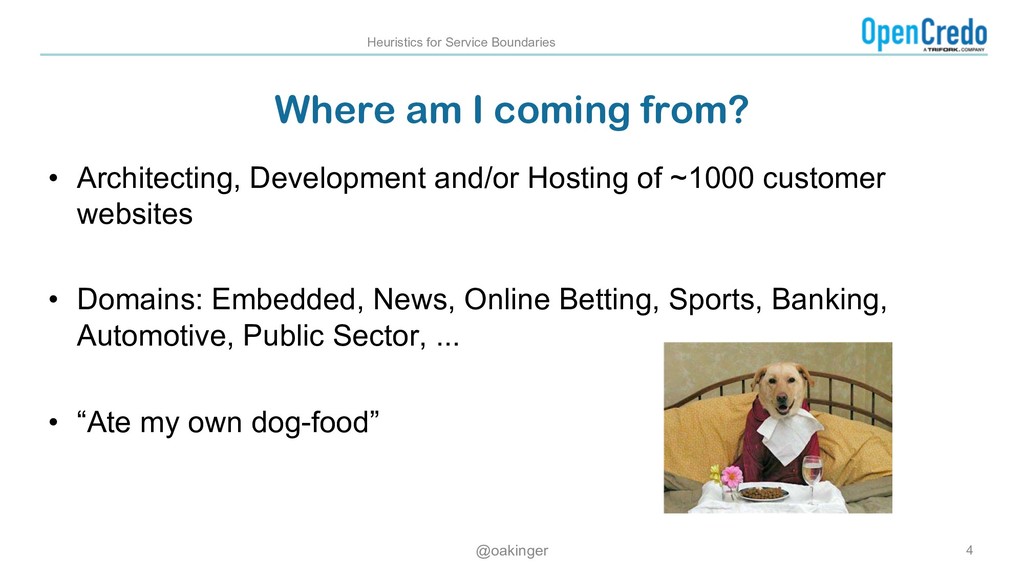
    • Architecting, Development and/or Hosting of ~1000 customer websites • Domains: Embedded, News, Online Betting, Sports, Banking, Automotive, Public Sector, ... • “Ate my own dog-food” @oakinger
  4. 5 Heuristics for Service Boundaries A naive approach... (don’t try

    this at home) ... unless you can make sure you’ll be far away when the first change request comes in... @oakinger
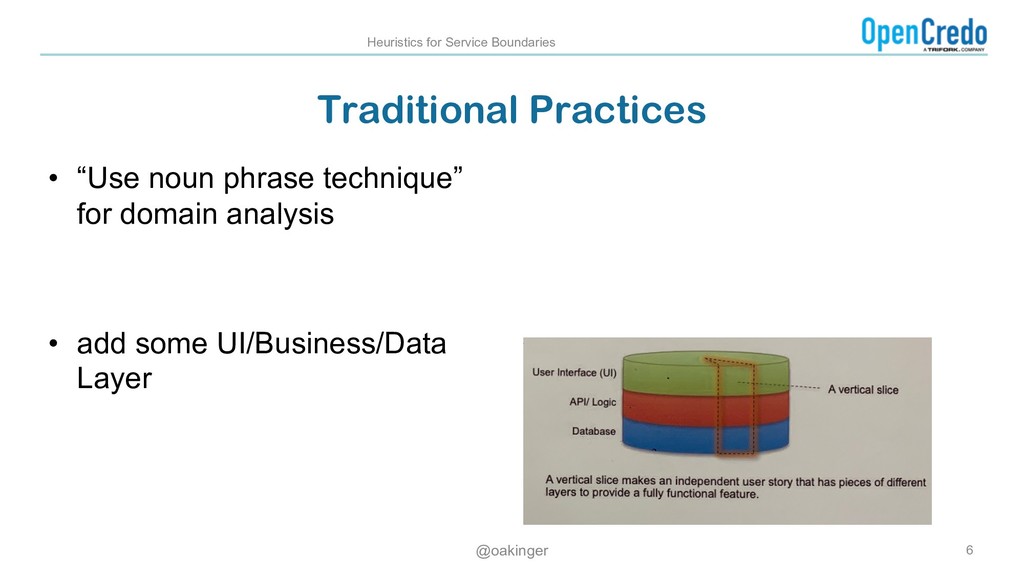
  5. 6 Heuristics for Service Boundaries Traditional Practices • “Use noun

    phrase technique” for domain analysis • add some UI/Business/Data Layer @oakinger
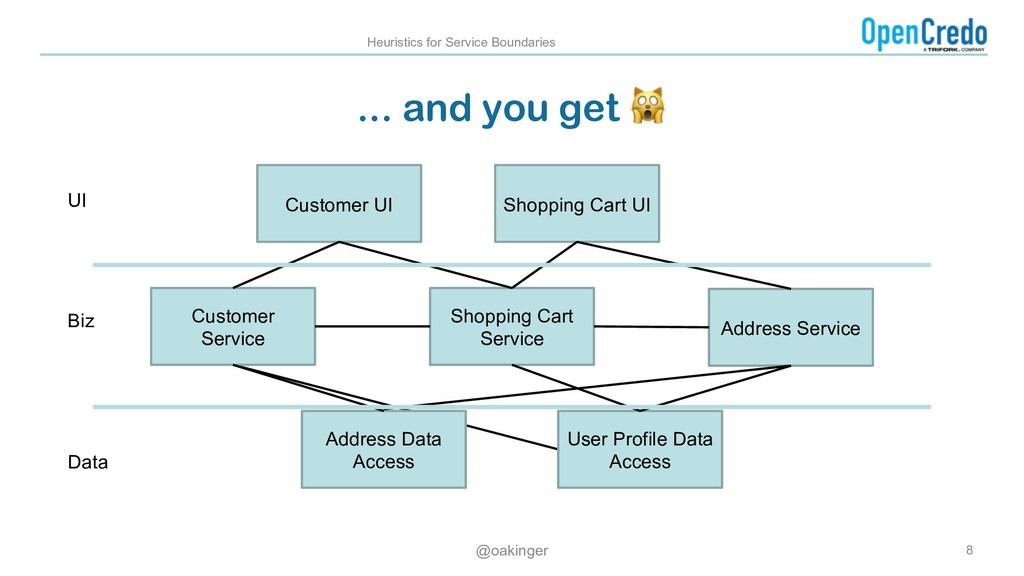
  6. 8 Heuristics for Service Boundaries ... and you get !

    @oakinger Customer Service Customer UI Shopping Cart Service Shopping Cart UI Address Service Address Data Access User Profile Data Access UI Biz Data
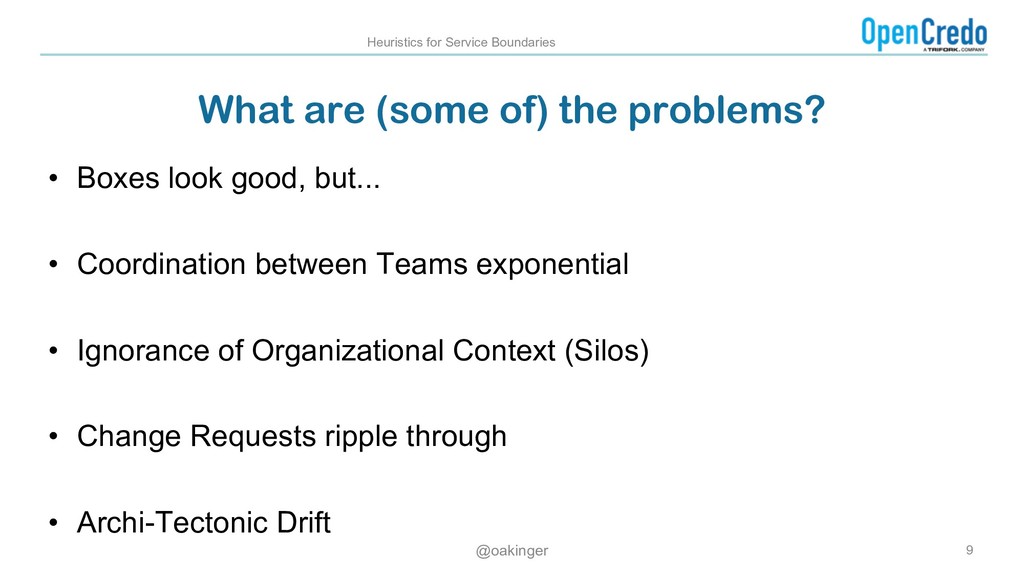
  7. 9 Heuristics for Service Boundaries What are (some of) the

    problems? • Boxes look good, but... • Coordination between Teams exponential • Ignorance of Organizational Context (Silos) • Change Requests ripple through • Archi-Tectonic Drift @oakinger
  8. 10 Heuristics for Service Boundaries Real World Service-Orientation • “Bob

    Books a Vacation”: – https://dannorth.net/classic-soa/ • “Starbucks doesn’t use 2-phase commit” – https://www.enterpriseintegrationpatterns.com/ramblings/18_starbucks.html @oakinger
  9. 11 Heuristics for Service Boundaries Service Attributes • Independent delivery

    pipeline (planning, implementation, deployment) • Owned by one team • Decentralized governance • Independent Data-Storage • Ownership of Communication Interfaces • Clear Terminology (aka “ubiquitous language”) • If user-facing, it comes with its own UI @oakinger
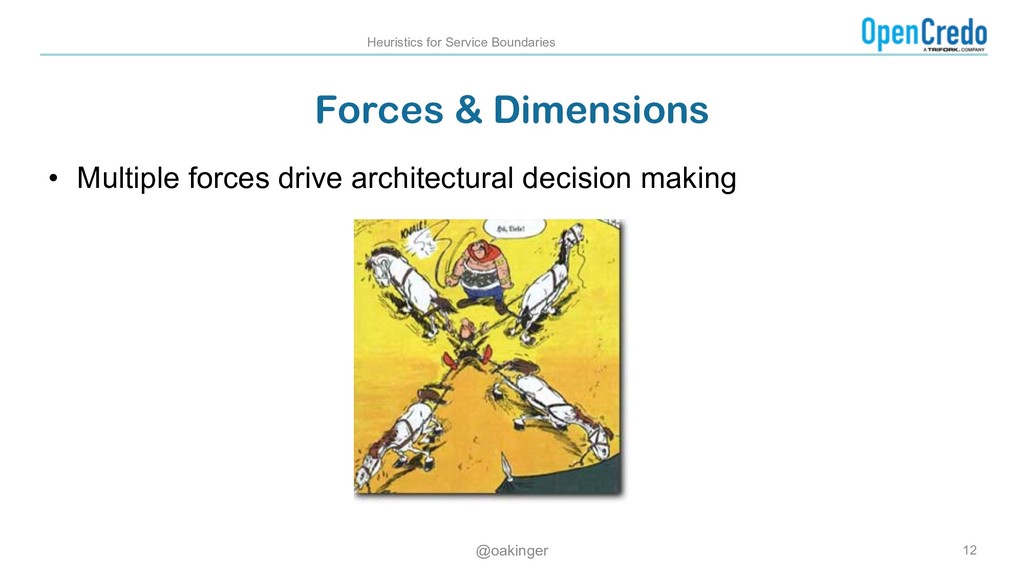
  10. 12 Heuristics for Service Boundaries Forces & Dimensions • Multiple

    forces drive architectural decision making @oakinger
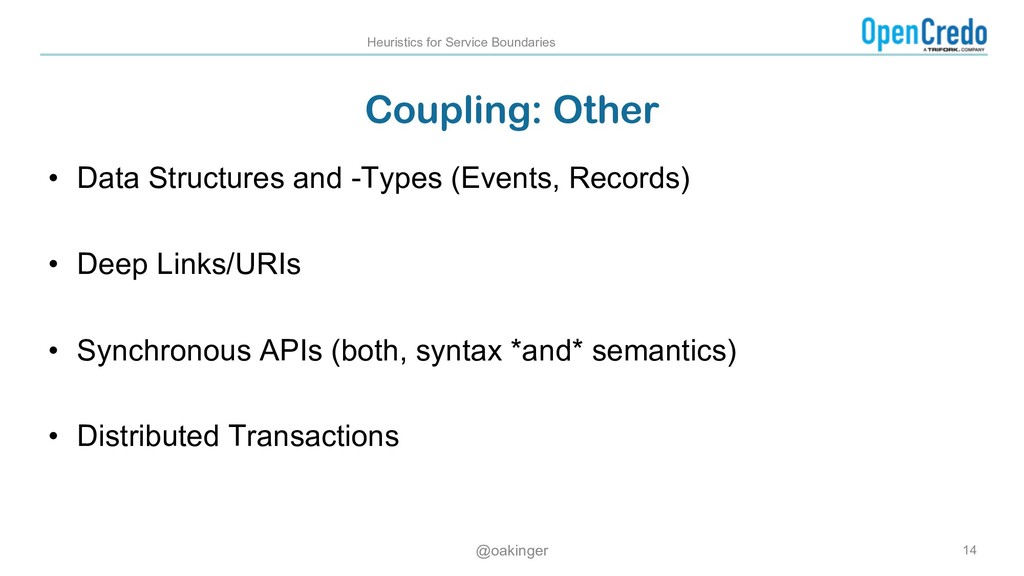
  11. 14 Heuristics for Service Boundaries Coupling: Other • Data Structures

    and -Types (Events, Records) • Deep Links/URIs • Synchronous APIs (both, syntax *and* semantics) • Distributed Transactions @oakinger
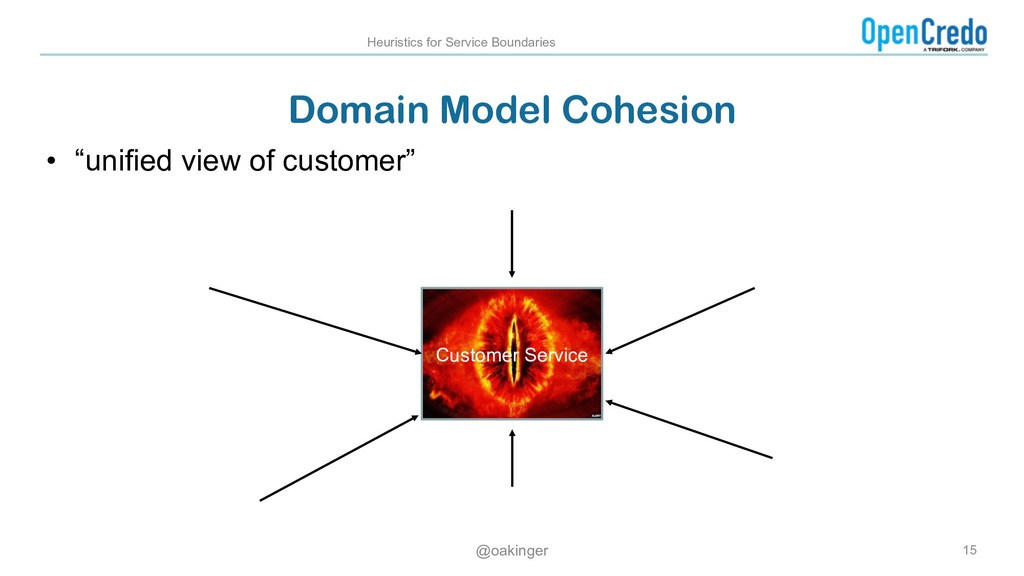
  12. 15 Heuristics for Service Boundaries Domain Model Cohesion • “unified

    view of customer” @oakinger Customer Service
  13. 16 Heuristics for Service Boundaries Domain Model Cohesion (II) •

    “Customer” in Accounting is very different from “Customer” in Support • Leads to unrelated changes in the same service => Bounded Context (Domain Driven Design) @oakinger
  14. 17 Heuristics for Service Boundaries Stable vs. Unstable • Over

    time some services will mature and stabilize • Other services are under constant change or may even get retired => Isolate Stable from Unstable services @oakinger
  15. 18 Heuristics for Service Boundaries Load • What if a

    batch process hits your API? => Instead of hardening the entire service, better isolate/specialize high frequency/large payload consumer API from others @oakinger
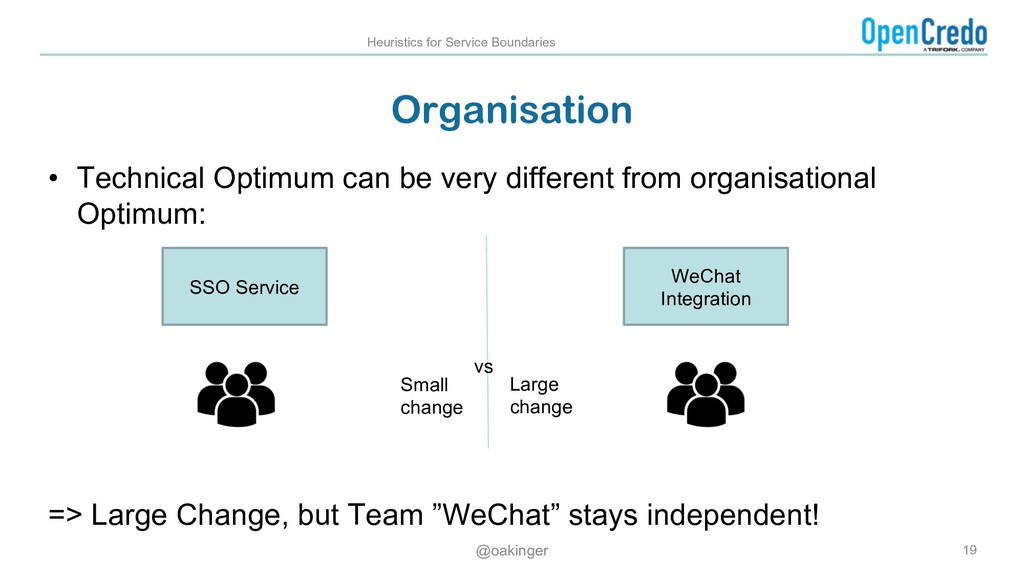
  16. 19 Heuristics for Service Boundaries Organisation • Technical Optimum can

    be very different from organisational Optimum: => Large Change, but Team ”WeChat” stays independent! @oakinger SSO Service WeChat Integration Small change Large change vs
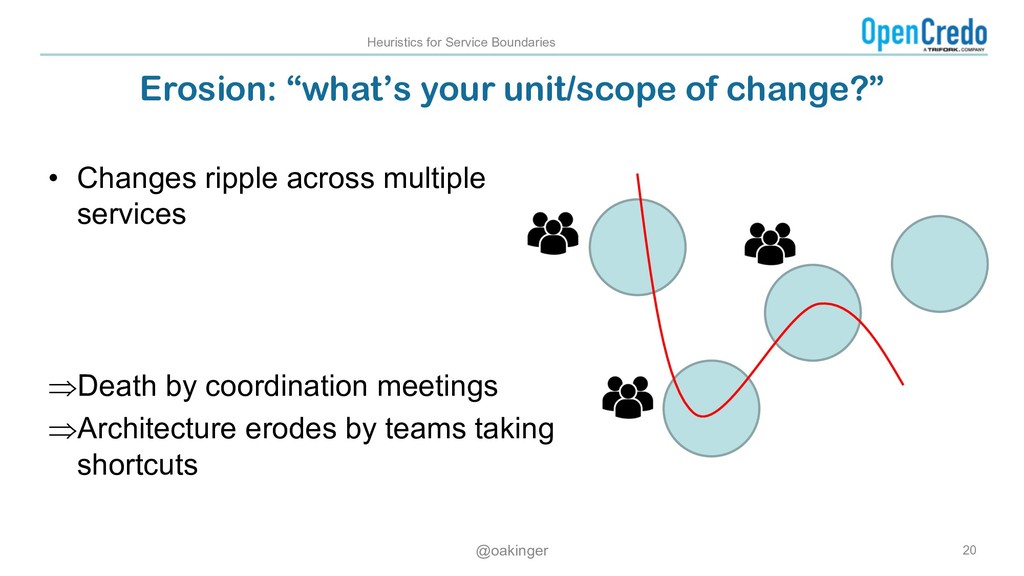
  17. 20 Heuristics for Service Boundaries Erosion: “what’s your unit/scope of

    change?” • Changes ripple across multiple services ÞDeath by coordination meetings ÞArchitecture erodes by teams taking shortcuts @oakinger
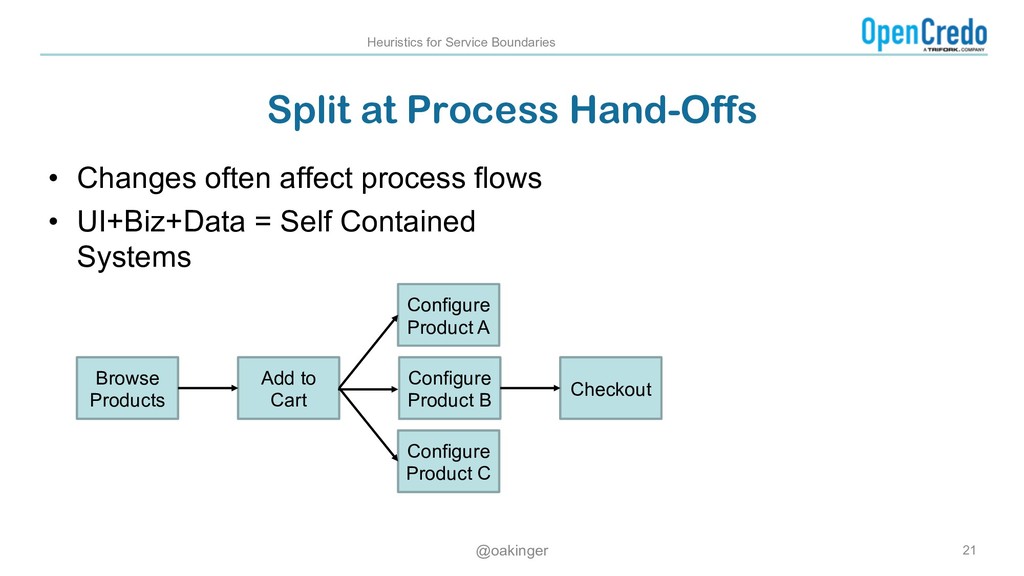
  18. 21 Heuristics for Service Boundaries Split at Process Hand-Offs •

    Changes often affect process flows • UI+Biz+Data = Self Contained Systems @oakinger Browse Products Add to Cart Configure Product A Checkout Configure Product B Configure Product C
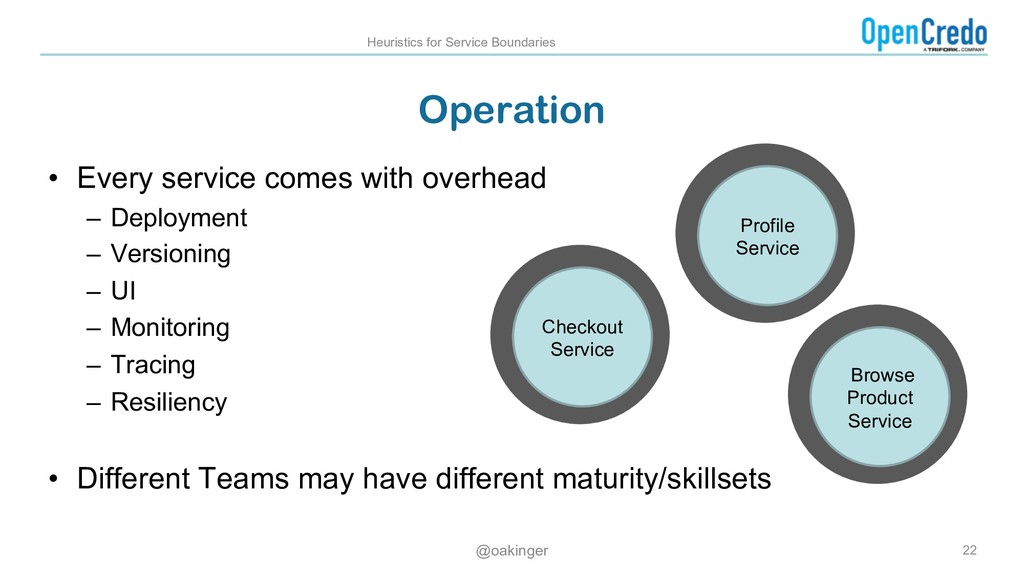
  19. 22 Heuristics for Service Boundaries Operation • Every service comes

    with overhead – Deployment – Versioning – UI – Monitoring – Tracing – Resiliency • Different Teams may have different maturity/skillsets @oakinger Checkout Service Checkout Service Checkout Service Profile Service Checkout Service Browse Product Service
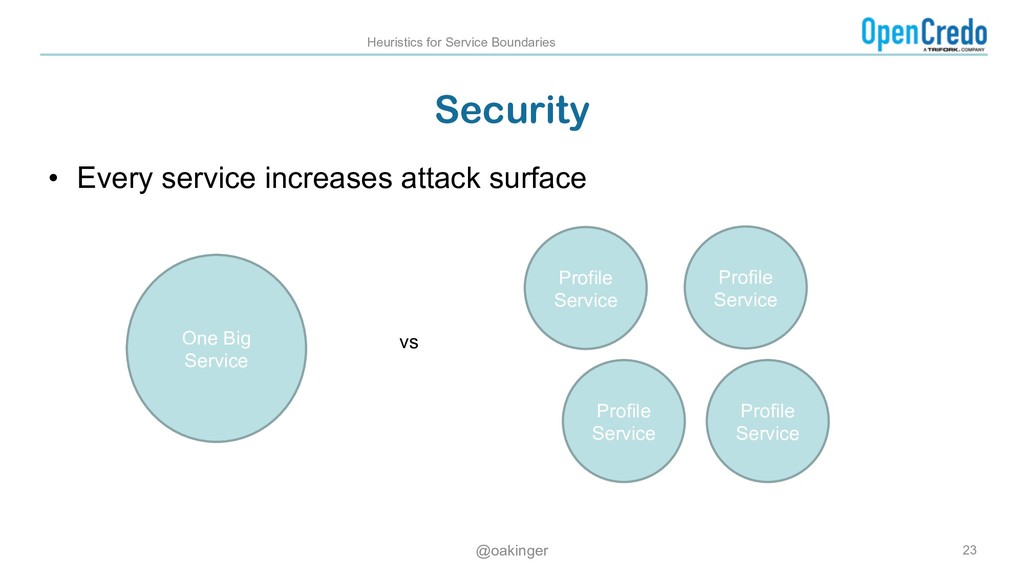
  20. 23 Heuristics for Service Boundaries Security • Every service increases

    attack surface @oakinger One Big Service Profile Service Profile Service Profile Service Profile Service vs
  21. 24 Heuristics for Service Boundaries Most of all: time! •

    Time may invalidate underlying assumptions – functions move around – service retirement • We learn over time – Example Batch API overload • Learning & Response requires agility on all levels – Reduce entry/exit costs for services (e.g. with containers) – Observability @oakinger
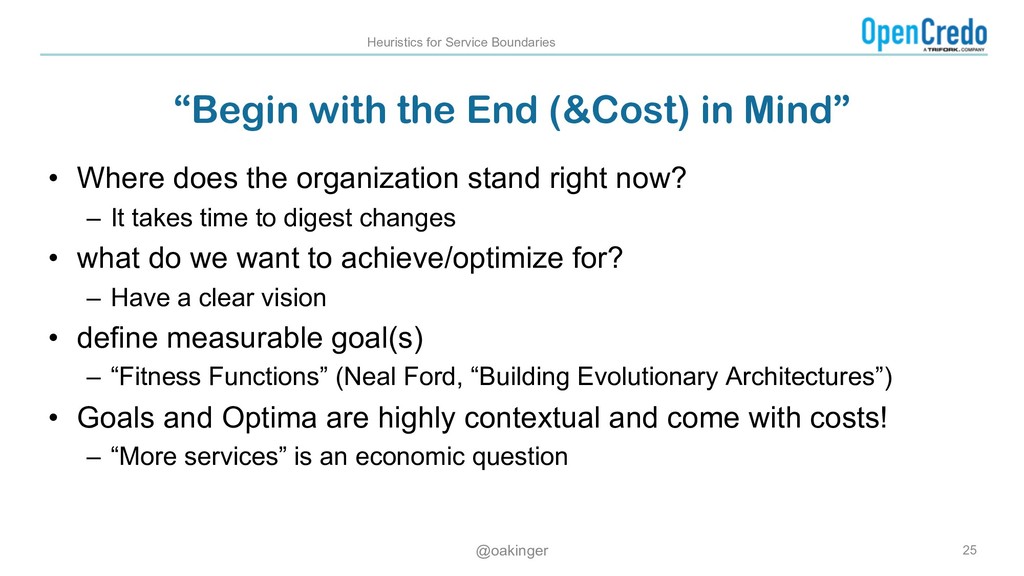
  22. 25 Heuristics for Service Boundaries “Begin with the End (&Cost)

    in Mind” • Where does the organization stand right now? – It takes time to digest changes • what do we want to achieve/optimize for? – Have a clear vision • define measurable goal(s) – “Fitness Functions” (Neal Ford, “Building Evolutionary Architectures”) • Goals and Optima are highly contextual and come with costs! – “More services” is an economic question @oakinger
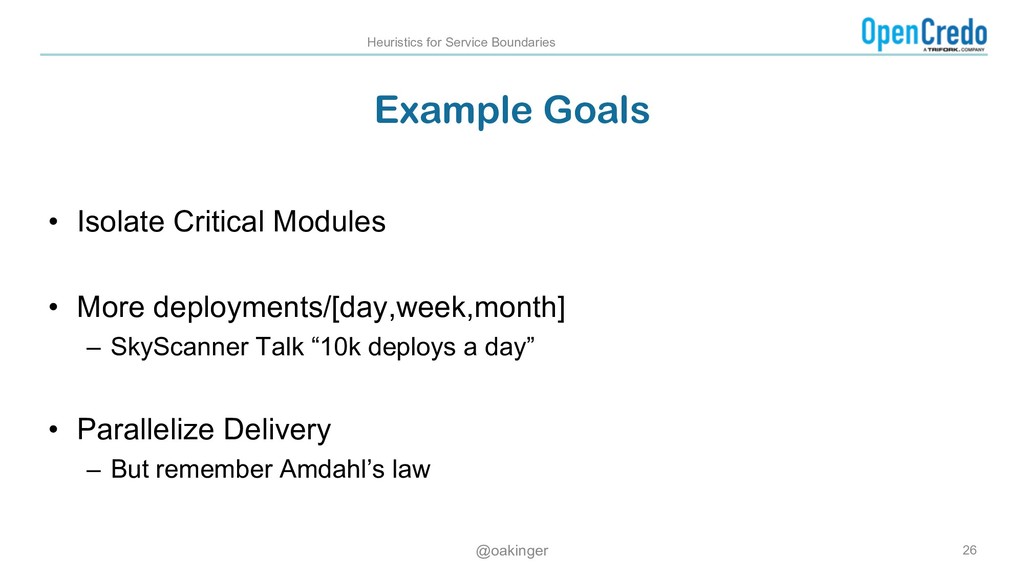
  23. 26 Heuristics for Service Boundaries Example Goals • Isolate Critical

    Modules • More deployments/[day,week,month] – SkyScanner Talk “10k deploys a day” • Parallelize Delivery – But remember Amdahl’s law @oakinger
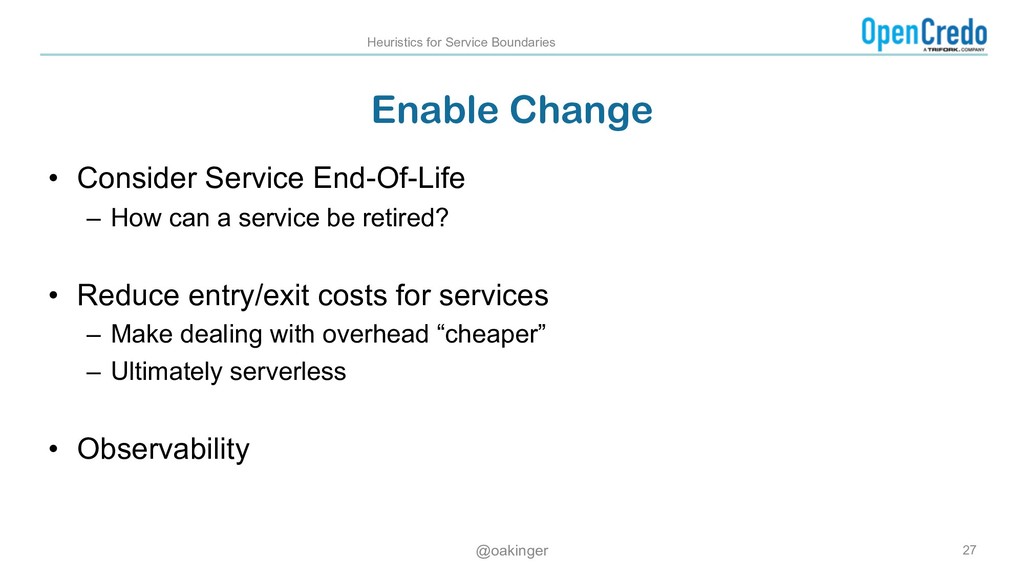
  24. 27 Heuristics for Service Boundaries Enable Change • Consider Service

    End-Of-Life – How can a service be retired? • Reduce entry/exit costs for services – Make dealing with overhead “cheaper” – Ultimately serverless • Observability @oakinger
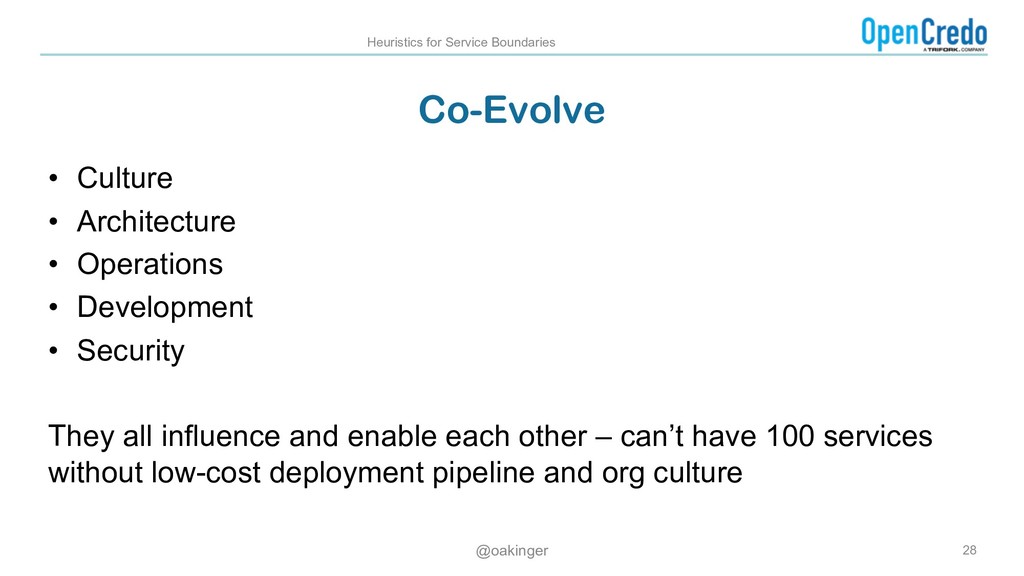
  25. 28 Heuristics for Service Boundaries Co-Evolve • Culture • Architecture

    • Operations • Development • Security They all influence and enable each other – can’t have 100 services without low-cost deployment pipeline and org culture @oakinger
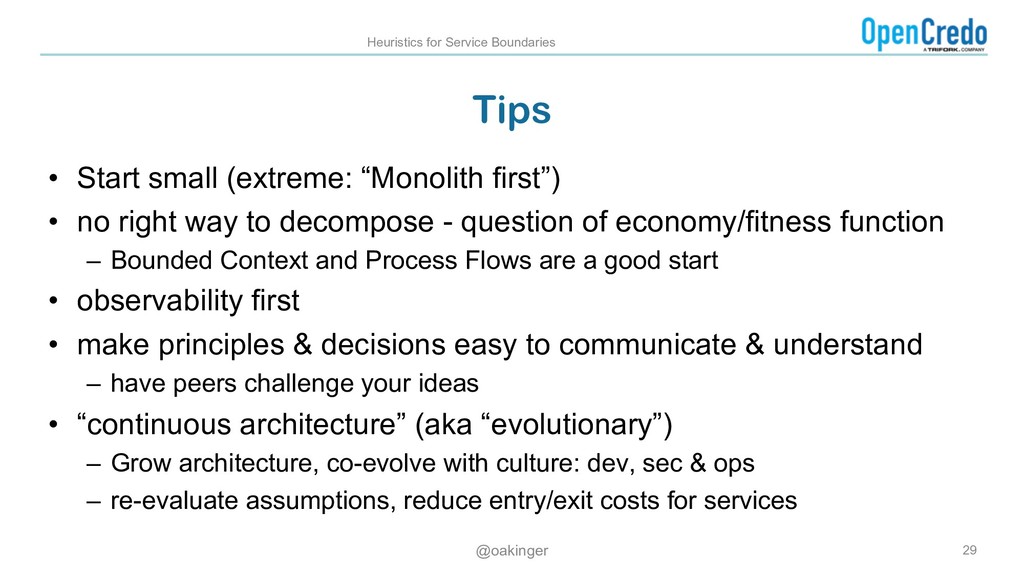
  26. 29 Heuristics for Service Boundaries Tips • Start small (extreme:

    “Monolith first”) • no right way to decompose - question of economy/fitness function – Bounded Context and Process Flows are a good start • observability first • make principles & decisions easy to communicate & understand – have peers challenge your ideas • “continuous architecture” (aka “evolutionary”) – Grow architecture, co-evolve with culture: dev, sec & ops – re-evaluate assumptions, reduce entry/exit costs for services @oakinger
  27. 30 Heuristics for Service Boundaries Thanks! Catch me on Twitter

    @oakinger Blog with catalogue of heuristics (and lots of related links): https://opencredo.com/identify-service-boundary-heuristics/ @oakinger