Upgrade to Pro — share decks privately, control downloads, hide ads and more …

Why Engineering EPC Companies Are Game Changers...

Sponsored · Your Podcast. Everywhere. Effortlessly. Share. Educate. Inspire. Entertain. You do you. We'll handle the rest. →

Why Engineering EPC Companies Are Game Changers for Complex Projects

Modern infrastructure and industrial builds demand precision, coordination, and risk mitigation—precisely what engineering EPC companies deliver. At Avocet DEA, our multidisciplinary teams combine engineering depth, procurement acumen, and construction know-how to drive project success in energy, environment, utilities, and beyond.

Other Decks in Business

Transcript

  1. Why Engineering EPC Companies Are Game Changers for Complex Projects

    Modern infrastructure and industrial builds demand precision, coordination, and risk mitigation—precisely what engineering EPC companies deliver. At Avocet DEA, our multidisciplinary teams combine engineering depth, procurement acumen, and construction know-how to drive project success in energy, environment, utilities, and beyond. 1. What Makes an Engineering EPC Company Different? An EPC company integrates: •​ Engineering: Concept evolution, technical design, feasibility assessments​ •​ Procurement: Vendor sourcing, logistics, quality and cost control​ •​ Construction: Execution, site coordination, systems installation, and commissioning​ The major advantage lies in single-point accountability—clients work through one entity instead of managing fragmented vendors. Projects move faster, budgets stay on track, and risks become more manageable. 2. Why EPC is Ideal for Critical Builds Key benefits include: •​ Turnkey Delivery: From concept through handover, no gaps in responsibility​ •​ Fixed Contracts: Clear cost boundaries, schedule certainty, limited financial surprises​ •​ Risk Management: EPC firms commit to performance, timing, and delivery risks​ •​ Efficiency & Integration: Seamless design-to-procurement-to-construction handoffs​ EPC works especially well in regulated environments, industrial settings, and government-funded infrastructure where compliance and safety can’t be compromised. 3. Sector-Focused Capabilities of Engineering EPC Firms
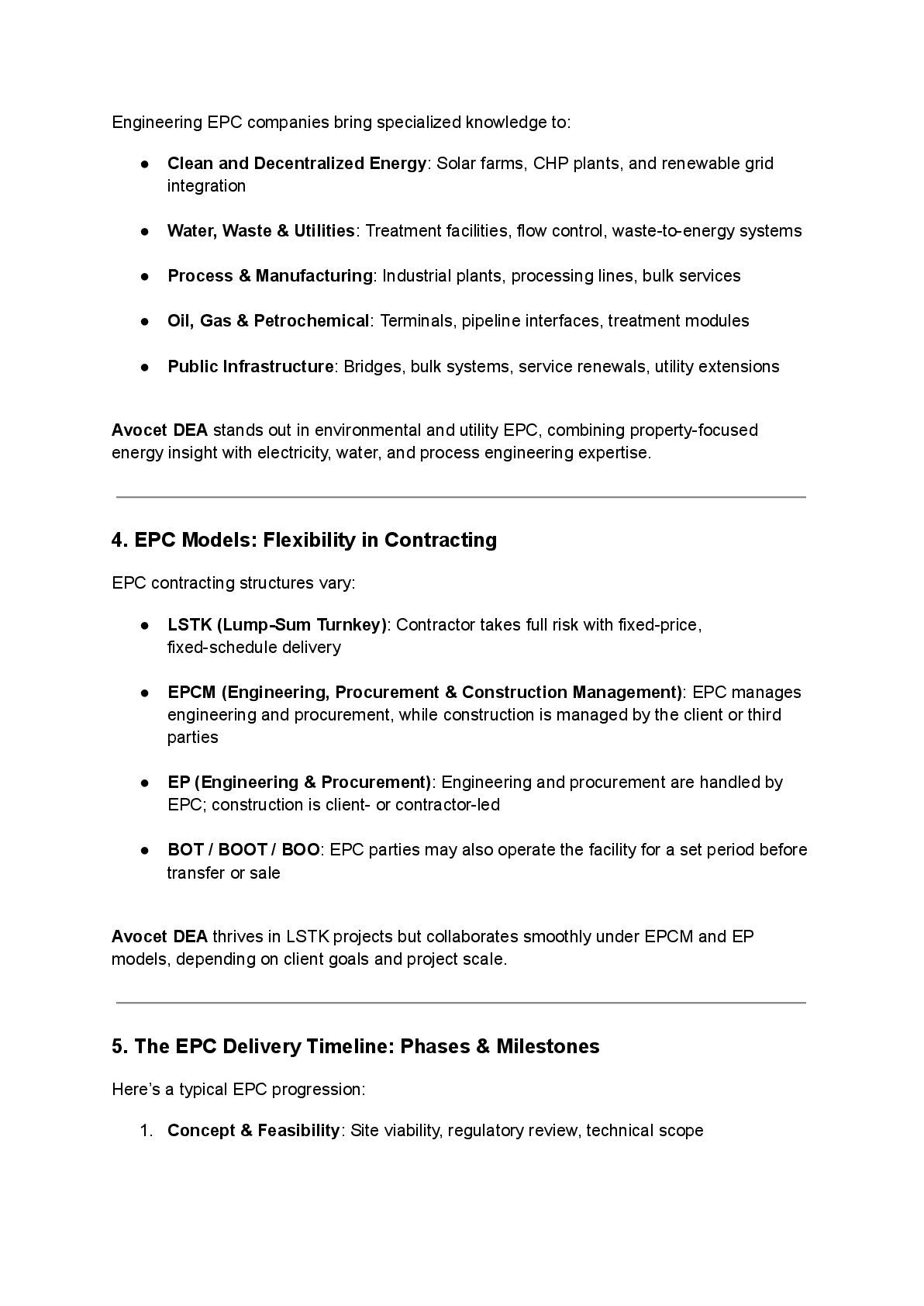
  2. Engineering EPC companies bring specialized knowledge to: •​ Clean and

    Decentralized Energy: Solar farms, CHP plants, and renewable grid integration​ •​ Water, Waste & Utilities: Treatment facilities, flow control, waste-to-energy systems​ •​ Process & Manufacturing: Industrial plants, processing lines, bulk services​ •​ Oil, Gas & Petrochemical: Terminals, pipeline interfaces, treatment modules​ •​ Public Infrastructure: Bridges, bulk systems, service renewals, utility extensions​ Avocet DEA stands out in environmental and utility EPC, combining property-focused energy insight with electricity, water, and process engineering expertise. 4. EPC Models: Flexibility in Contracting EPC contracting structures vary: •​ LSTK (Lump-Sum Turnkey): Contractor takes full risk with fixed-price, fixed-schedule delivery​ •​ EPCM (Engineering, Procurement & Construction Management): EPC manages engineering and procurement, while construction is managed by the client or third parties​ •​ EP (Engineering & Procurement): Engineering and procurement are handled by EPC; construction is client- or contractor-led​ •​ BOT / BOOT / BOO: EPC parties may also operate the facility for a set period before transfer or sale​ Avocet DEA thrives in LSTK projects but collaborates smoothly under EPCM and EP models, depending on client goals and project scale. 5. The EPC Delivery Timeline: Phases & Milestones Here’s a typical EPC progression: 1.​ Concept & Feasibility: Site viability, regulatory review, technical scope​
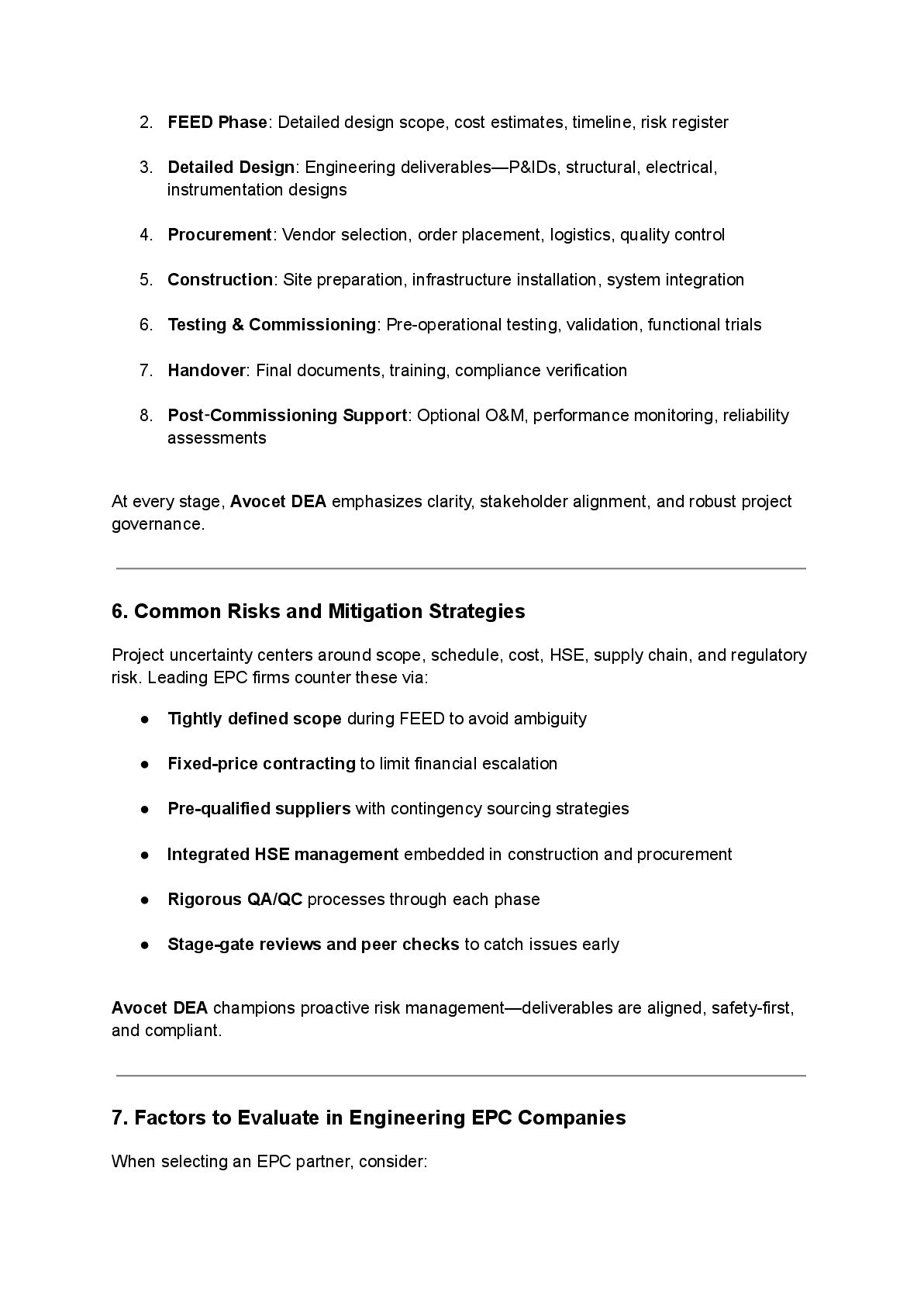
  3. 2.​ FEED Phase: Detailed design scope, cost estimates, timeline, risk

    register​ 3.​ Detailed Design: Engineering deliverables—P&IDs, structural, electrical, instrumentation designs​ 4.​ Procurement: Vendor selection, order placement, logistics, quality control​ 5.​ Construction: Site preparation, infrastructure installation, system integration​ 6.​ Testing & Commissioning: Pre-operational testing, validation, functional trials​ 7.​ Handover: Final documents, training, compliance verification​ 8.​ Post‑Commissioning Support: Optional O&M, performance monitoring, reliability assessments​ At every stage, Avocet DEA emphasizes clarity, stakeholder alignment, and robust project governance. 6. Common Risks and Mitigation Strategies Project uncertainty centers around scope, schedule, cost, HSE, supply chain, and regulatory risk. Leading EPC firms counter these via: •​ Tightly defined scope during FEED to avoid ambiguity​ •​ Fixed-price contracting to limit financial escalation​ •​ Pre-qualified suppliers with contingency sourcing strategies​ •​ Integrated HSE management embedded in construction and procurement​ •​ Rigorous QA/QC processes through each phase​ •​ Stage-gate reviews and peer checks to catch issues early​ Avocet DEA champions proactive risk management—deliverables are aligned, safety-first, and compliant. 7. Factors to Evaluate in Engineering EPC Companies When selecting an EPC partner, consider:
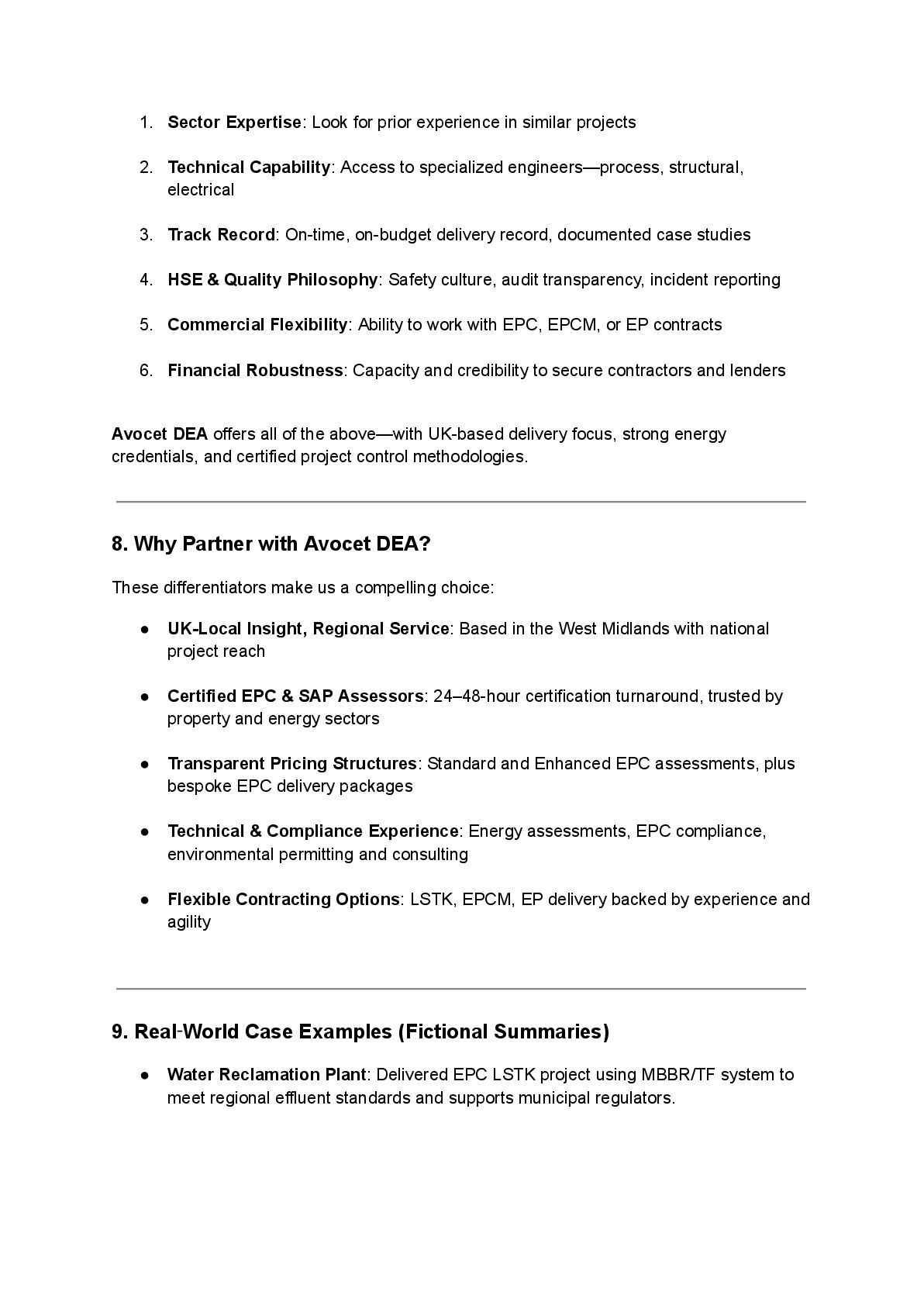
  4. 1.​ Sector Expertise: Look for prior experience in similar projects​

    2.​ Technical Capability: Access to specialized engineers—process, structural, electrical​ 3.​ Track Record: On-time, on-budget delivery record, documented case studies​ 4.​ HSE & Quality Philosophy: Safety culture, audit transparency, incident reporting​ 5.​ Commercial Flexibility: Ability to work with EPC, EPCM, or EP contracts​ 6.​ Financial Robustness: Capacity and credibility to secure contractors and lenders​ Avocet DEA offers all of the above—with UK-based delivery focus, strong energy credentials, and certified project control methodologies. 8. Why Partner with Avocet DEA? These differentiators make us a compelling choice: •​ UK-Local Insight, Regional Service: Based in the West Midlands with national project reach​ •​ Certified EPC & SAP Assessors: 24–48-hour certification turnaround, trusted by property and energy sectors​ •​ Transparent Pricing Structures: Standard and Enhanced EPC assessments, plus bespoke EPC delivery packages​ •​ Technical & Compliance Experience: Energy assessments, EPC compliance, environmental permitting and consulting​ •​ Flexible Contracting Options: LSTK, EPCM, EP delivery backed by experience and agility​ 9. Real‑World Case Examples (Fictional Summaries) •​ Water Reclamation Plant: Delivered EPC LSTK project using MBBR/TF system to meet regional effluent standards and supports municipal regulators.​
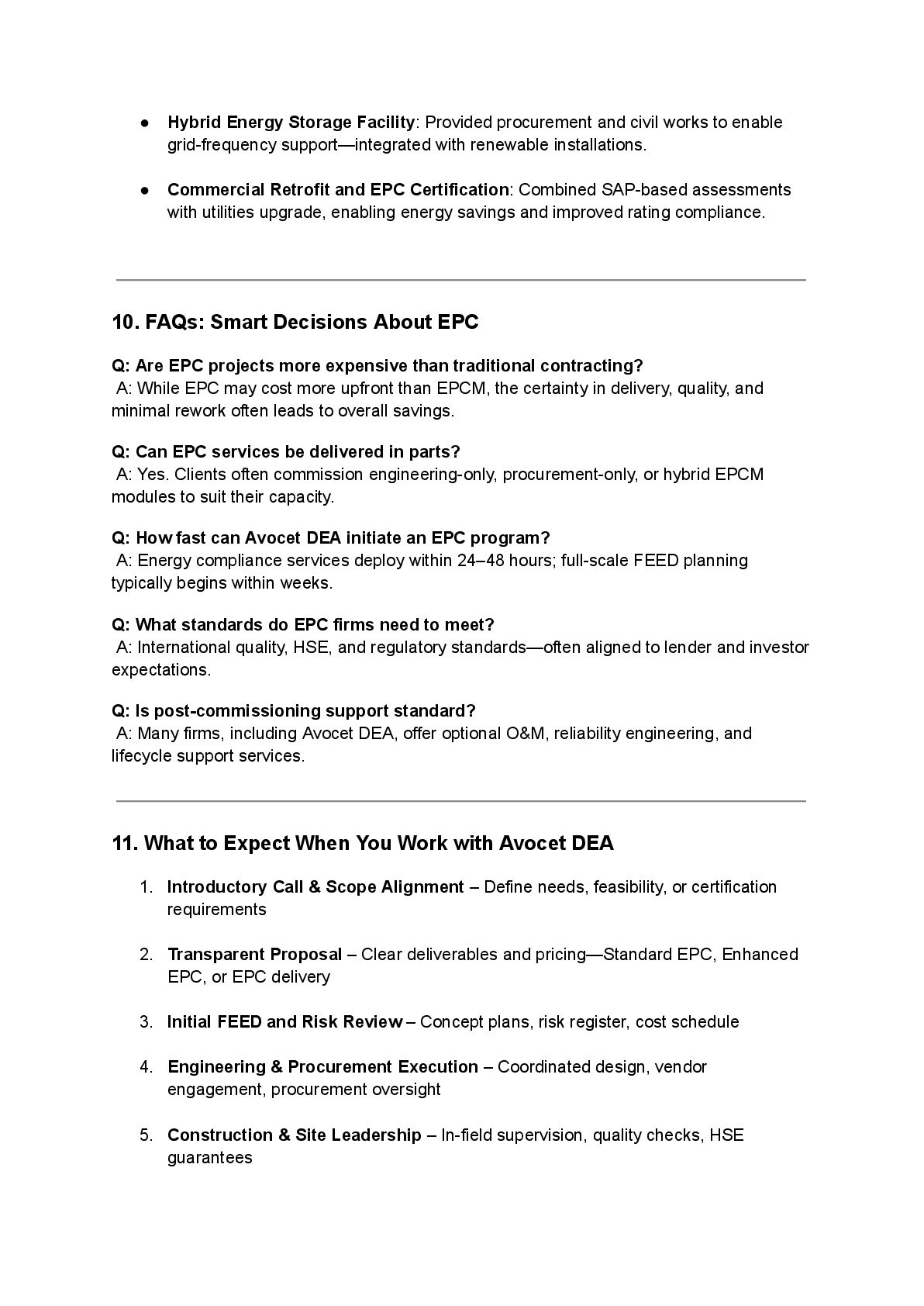
  5. •​ Hybrid Energy Storage Facility: Provided procurement and civil works

    to enable grid-frequency support—integrated with renewable installations.​ •​ Commercial Retrofit and EPC Certification: Combined SAP-based assessments with utilities upgrade, enabling energy savings and improved rating compliance.​ 10. FAQs: Smart Decisions About EPC Q: Are EPC projects more expensive than traditional contracting?​ A: While EPC may cost more upfront than EPCM, the certainty in delivery, quality, and minimal rework often leads to overall savings. Q: Can EPC services be delivered in parts?​ A: Yes. Clients often commission engineering-only, procurement-only, or hybrid EPCM modules to suit their capacity. Q: How fast can Avocet DEA initiate an EPC program?​ A: Energy compliance services deploy within 24–48 hours; full-scale FEED planning typically begins within weeks. Q: What standards do EPC firms need to meet?​ A: International quality, HSE, and regulatory standards—often aligned to lender and investor expectations. Q: Is post-commissioning support standard?​ A: Many firms, including Avocet DEA, offer optional O&M, reliability engineering, and lifecycle support services. 11. What to Expect When You Work with Avocet DEA 1.​ Introductory Call & Scope Alignment – Define needs, feasibility, or certification requirements​ 2.​ Transparent Proposal – Clear deliverables and pricing—Standard EPC, Enhanced EPC, or EPC delivery​ 3.​ Initial FEED and Risk Review – Concept plans, risk register, cost schedule​ 4.​ Engineering & Procurement Execution – Coordinated design, vendor engagement, procurement oversight​ 5.​ Construction & Site Leadership – In-field supervision, quality checks, HSE guarantees​
  6. 6.​ Commissioning & Handover – System audits, operational readiness, client

    training, required documentation​ 7.​ Optional Extended Support – O&M, lifecycle optimization, spare inventory planning​ 12. Wrapping Up Engineering EPC companies provide holistic solutions that translate complex project visions into tangible, operational facilities. Whether you’re tackling energy, utilities, environmental, or industrial infrastructure, EPC contractors like Avocet DEA combine accountability, technical rigor, and schedule reliability. At Avocet DEA, we deliver certified compliance through our energy and EPC expertise, paired with full-scale project delivery for capital construction—from initial FEED to commissioning.