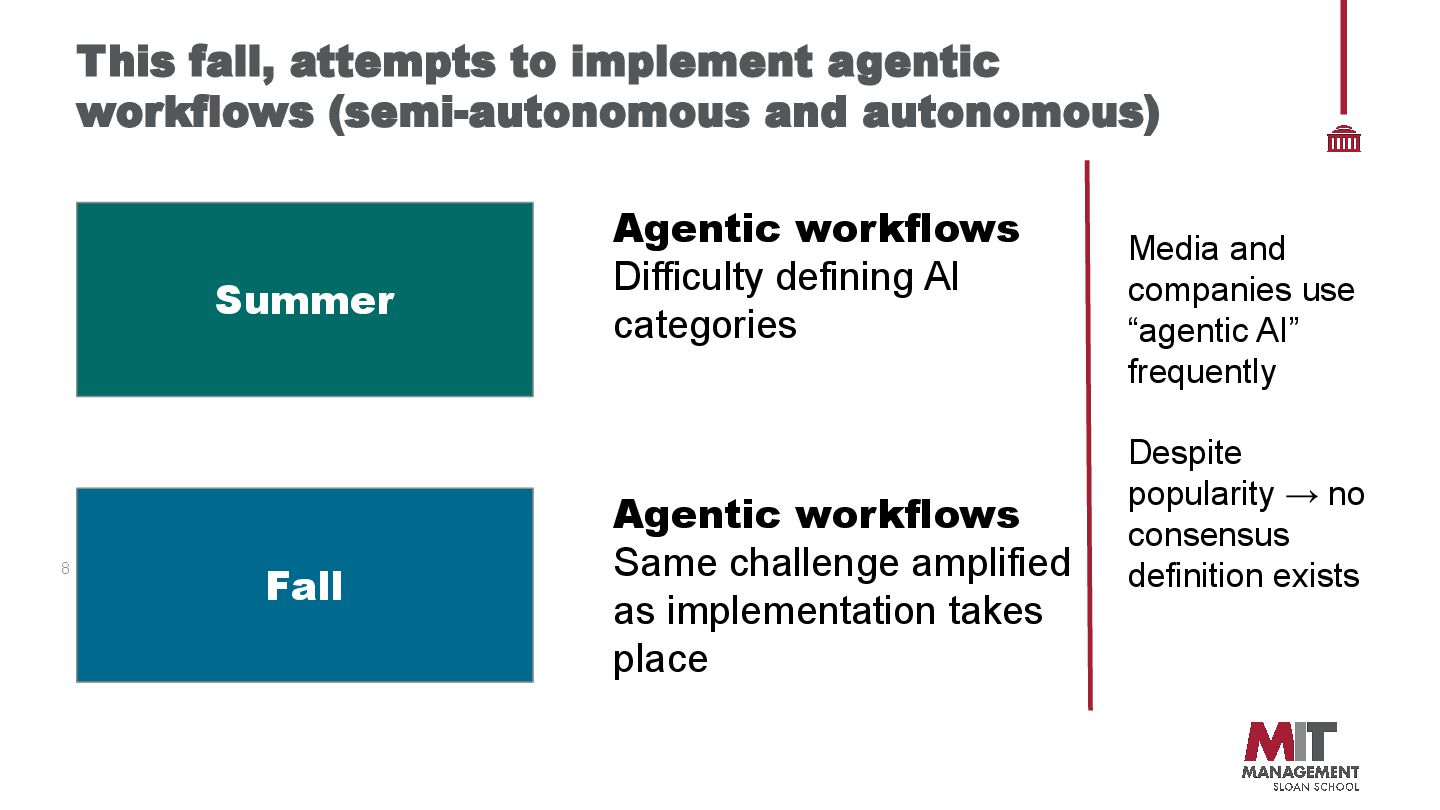
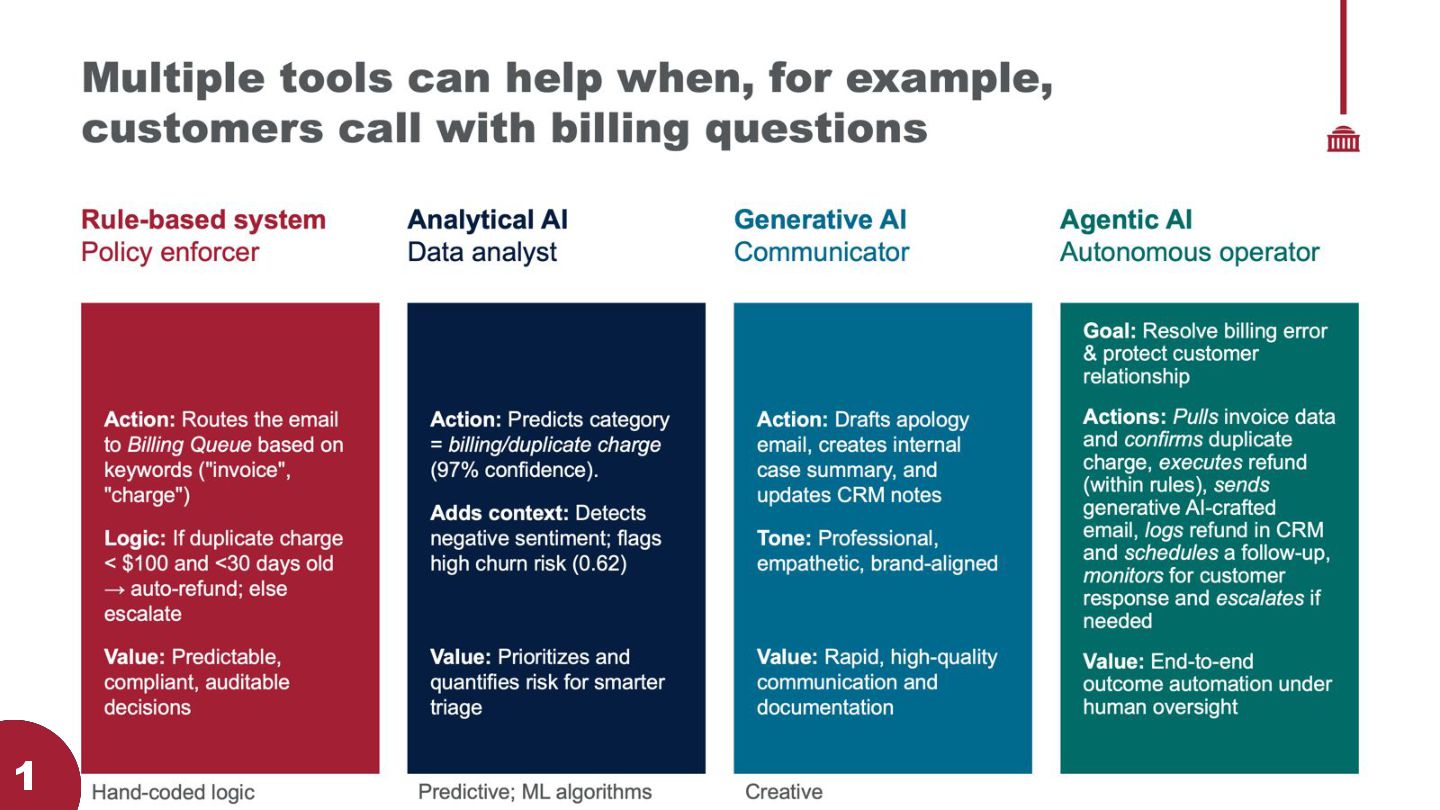
workflows Same challenge amplified as implementation takes place This fall, attempts to implement agentic workflows (semi-autonomous and autonomous) Media and companies use “agentic AI” frequently Despite popularity → no consensus definition exists 1
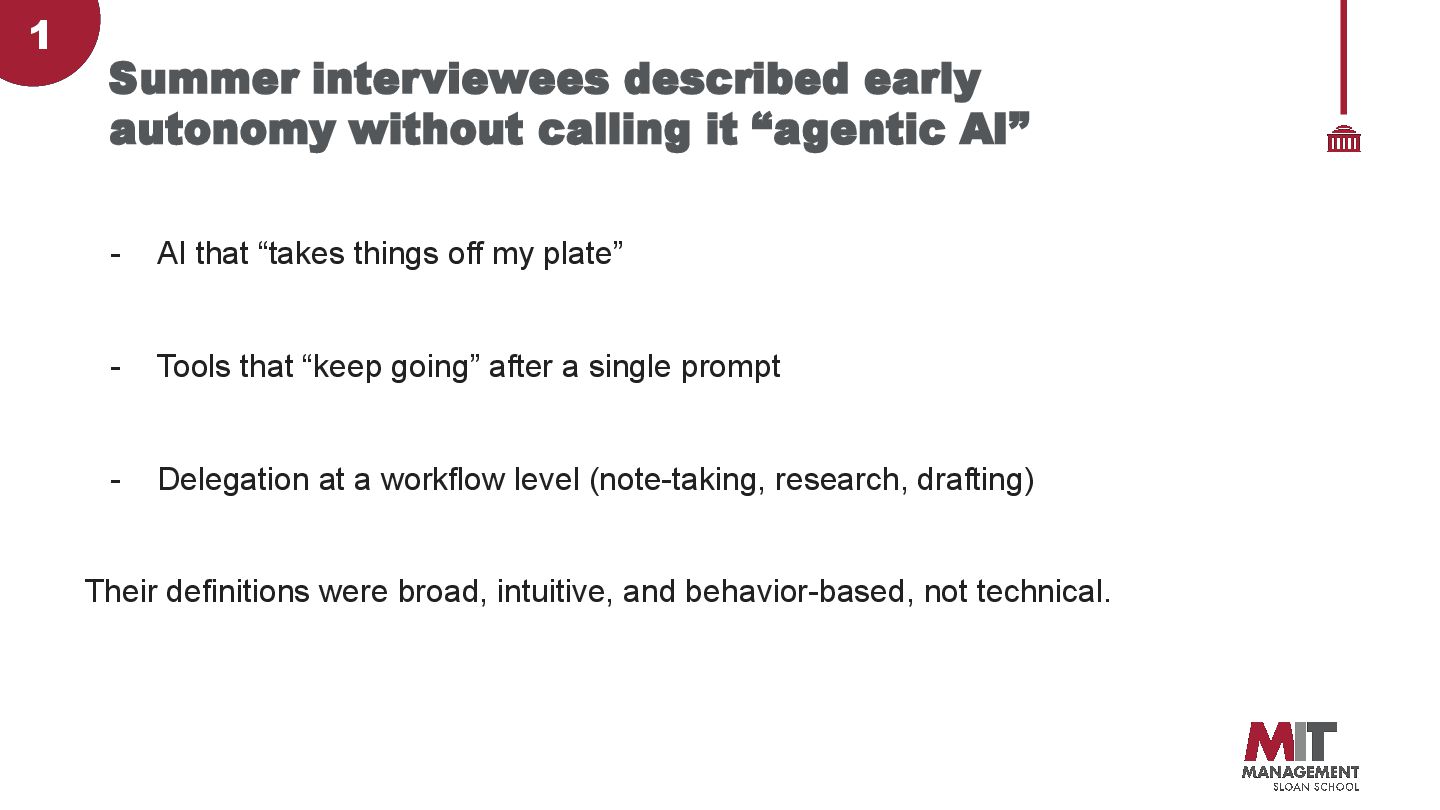
that “keep going” after a single prompt - Delegation at a workflow level (note-taking, research, drafting) Their definitions were broad, intuitive, and behavior-based, not technical. Summer interviewees described early autonomy without calling it “agentic AI” 1
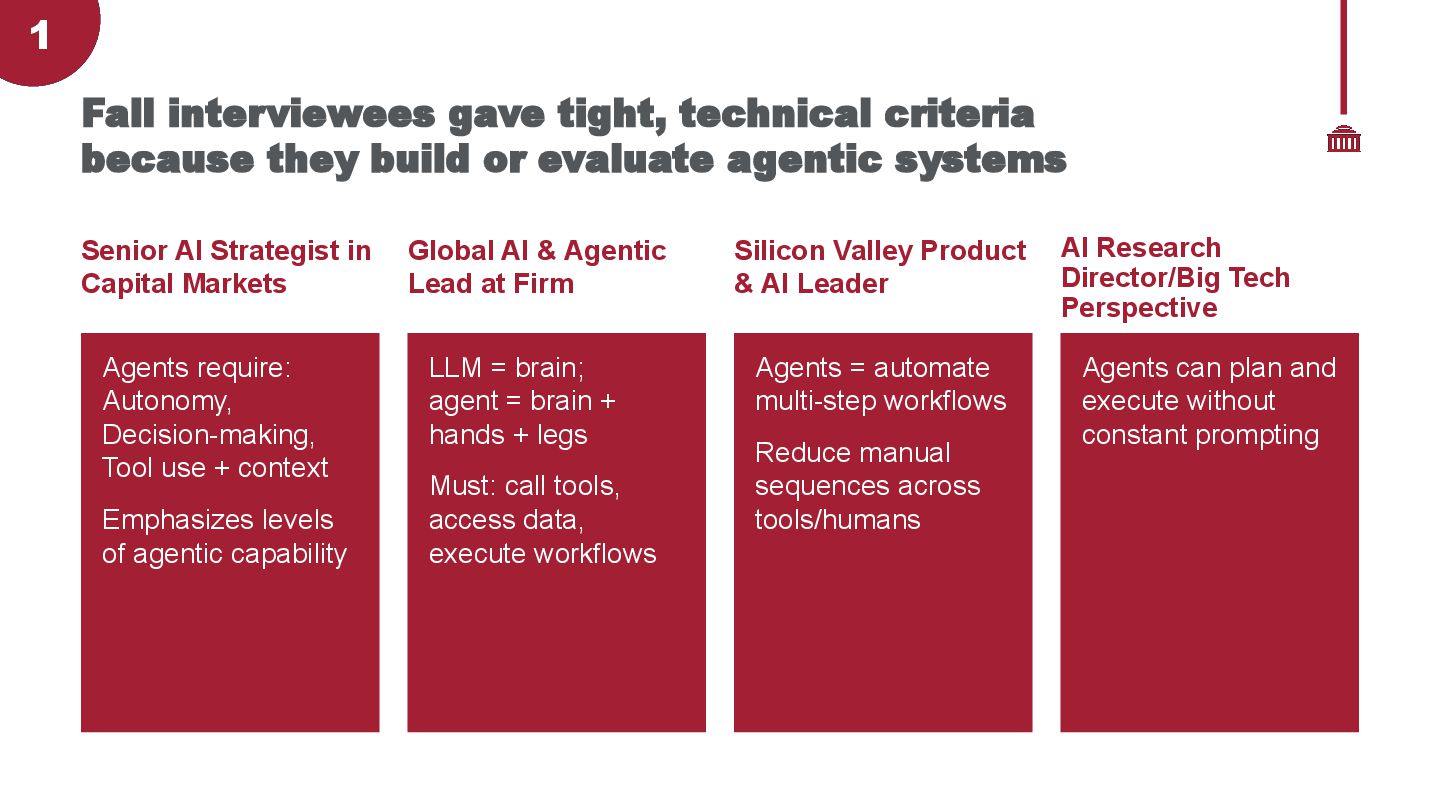
Tool use + context Emphasizes levels of agentic capability Fall interviewees gave tight, technical criteria because they build or evaluate agentic systems LLM = brain; agent = brain + hands + legs Must: call tools, access data, execute workflows Agents = automate multi-step workflows Reduce manual sequences across tools/humans Agents can plan and execute without constant prompting Global AI & Agentic Lead at Firm Silicon Valley Product & AI Leader AI Research Director/Big Tech Perspective 1
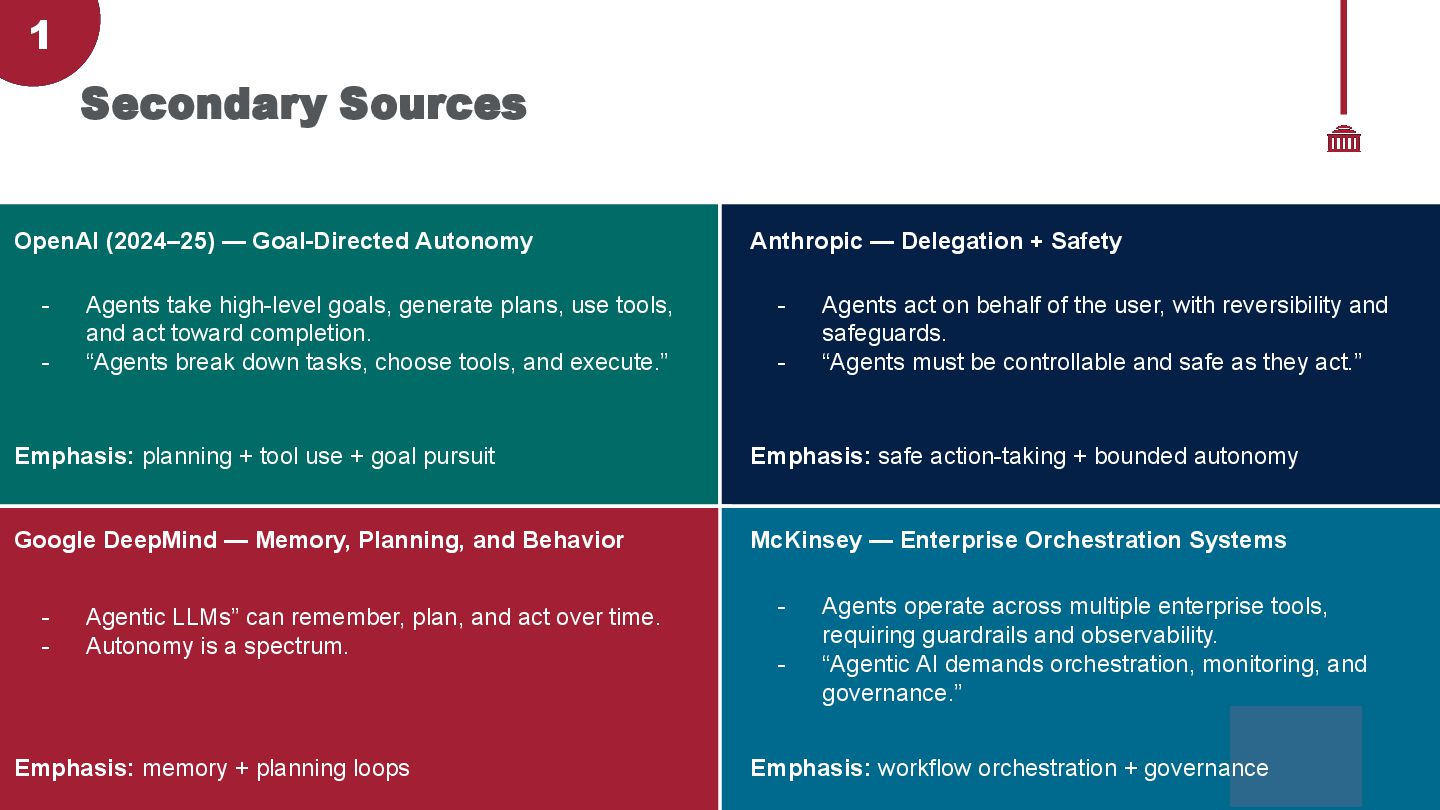
+ Safety Google DeepMind — Memory, Planning, and Behavior McKinsey — Enterprise Orchestration Systems - Agents take high-level goals, generate plans, use tools, and act toward completion. - “Agents break down tasks, choose tools, and execute.” Emphasis: planning + tool use + goal pursuit - Agents act on behalf of the user, with reversibility and safeguards. - “Agents must be controllable and safe as they act.” Emphasis: safe action-taking + bounded autonomy - Agentic LLMs” can remember, plan, and act over time. - Autonomy is a spectrum. Emphasis: memory + planning loops - Agents operate across multiple enterprise tools, requiring guardrails and observability. - “Agentic AI demands orchestration, monitoring, and governance.” Emphasis: workflow orchestration + governance 1
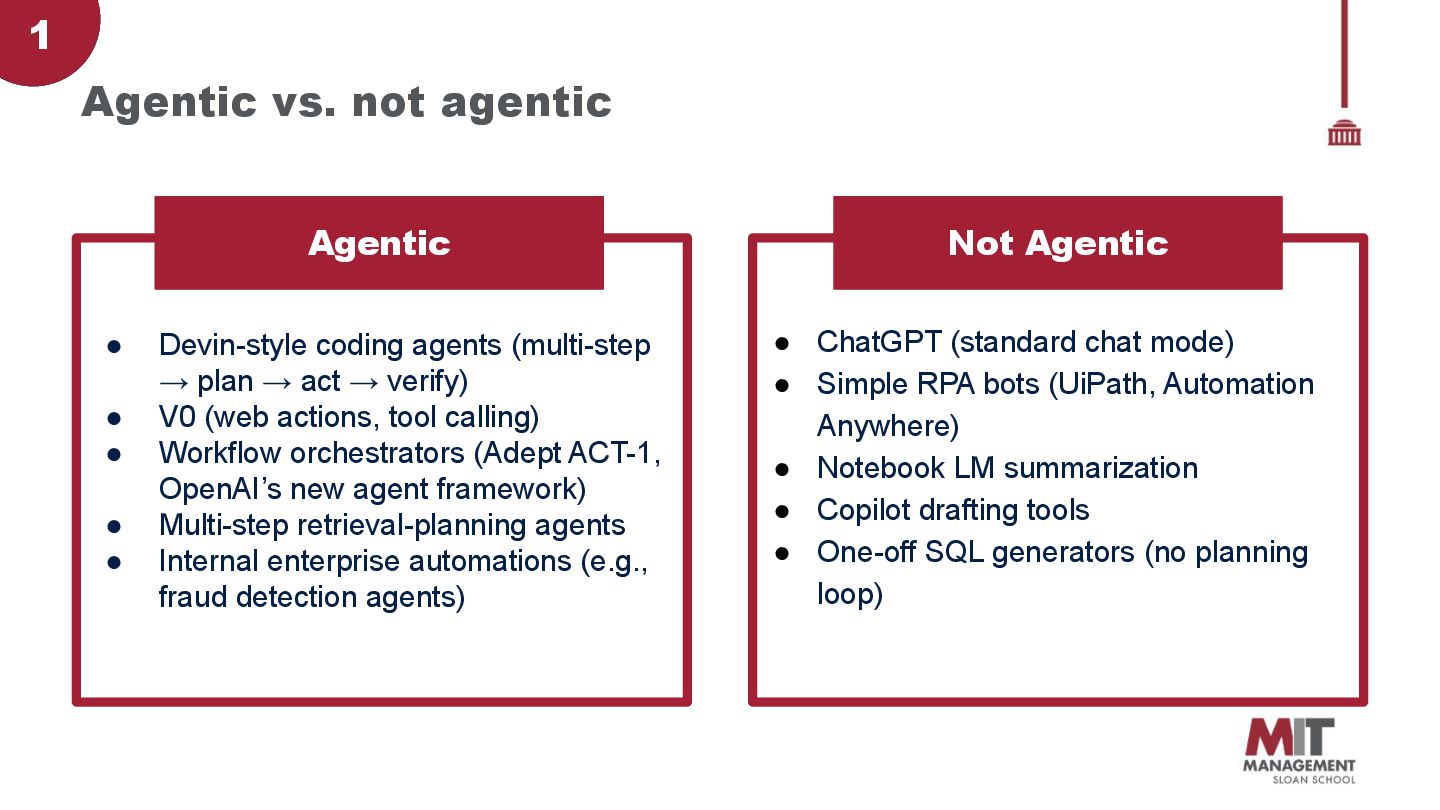
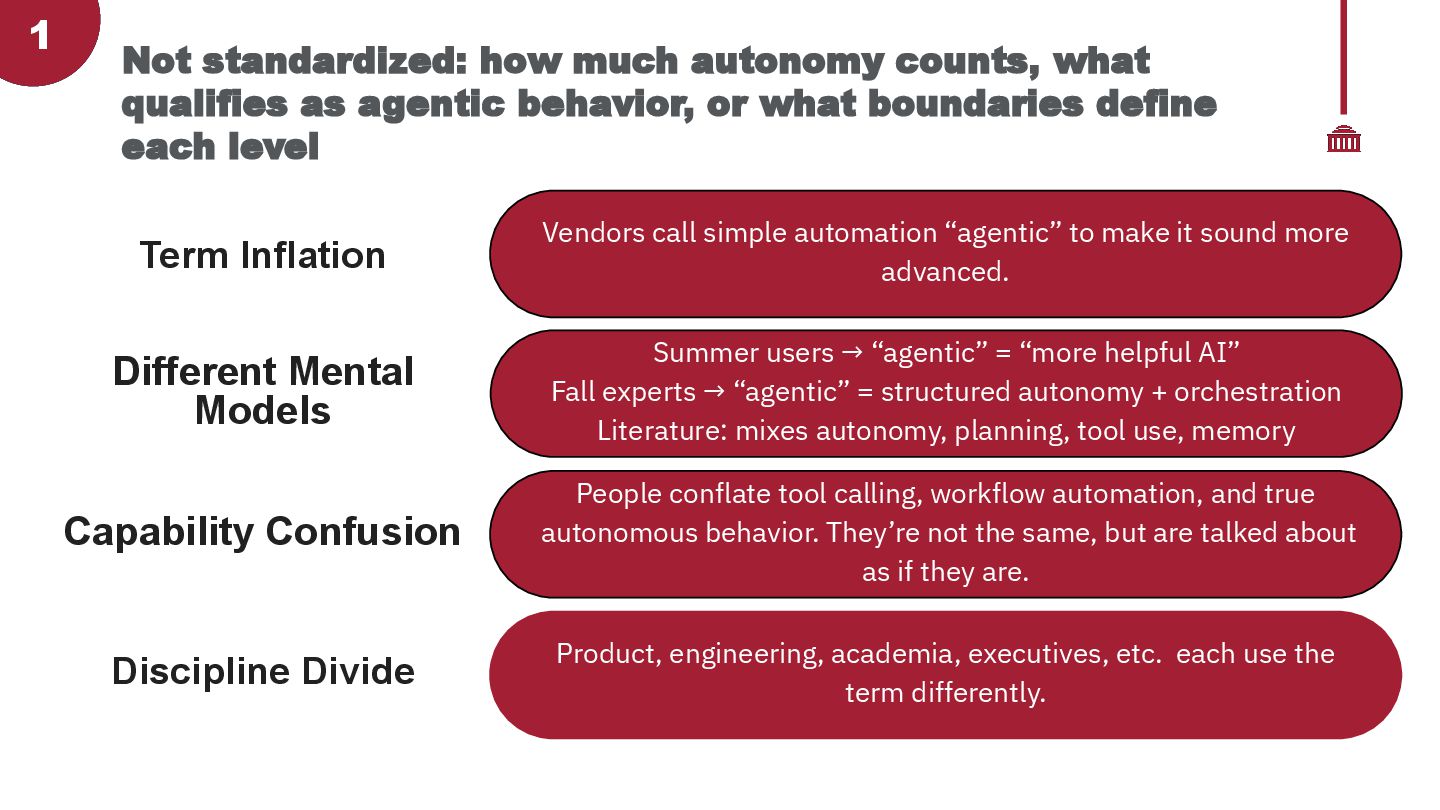
standardized: how much autonomy counts, what qualifies as agentic behavior, or what boundaries define each level Product, engineering, academia, executives, etc. each use the term differently. People conflate tool calling, workflow automation, and true autonomous behavior. They’re not the same, but are talked about as if they are. Summer users → “agentic” = “more helpful AI” Fall experts → “agentic” = structured autonomy + orchestration Literature: mixes autonomy, planning, tool use, memory Vendors call simple automation “agentic” to make it sound more advanced. 1
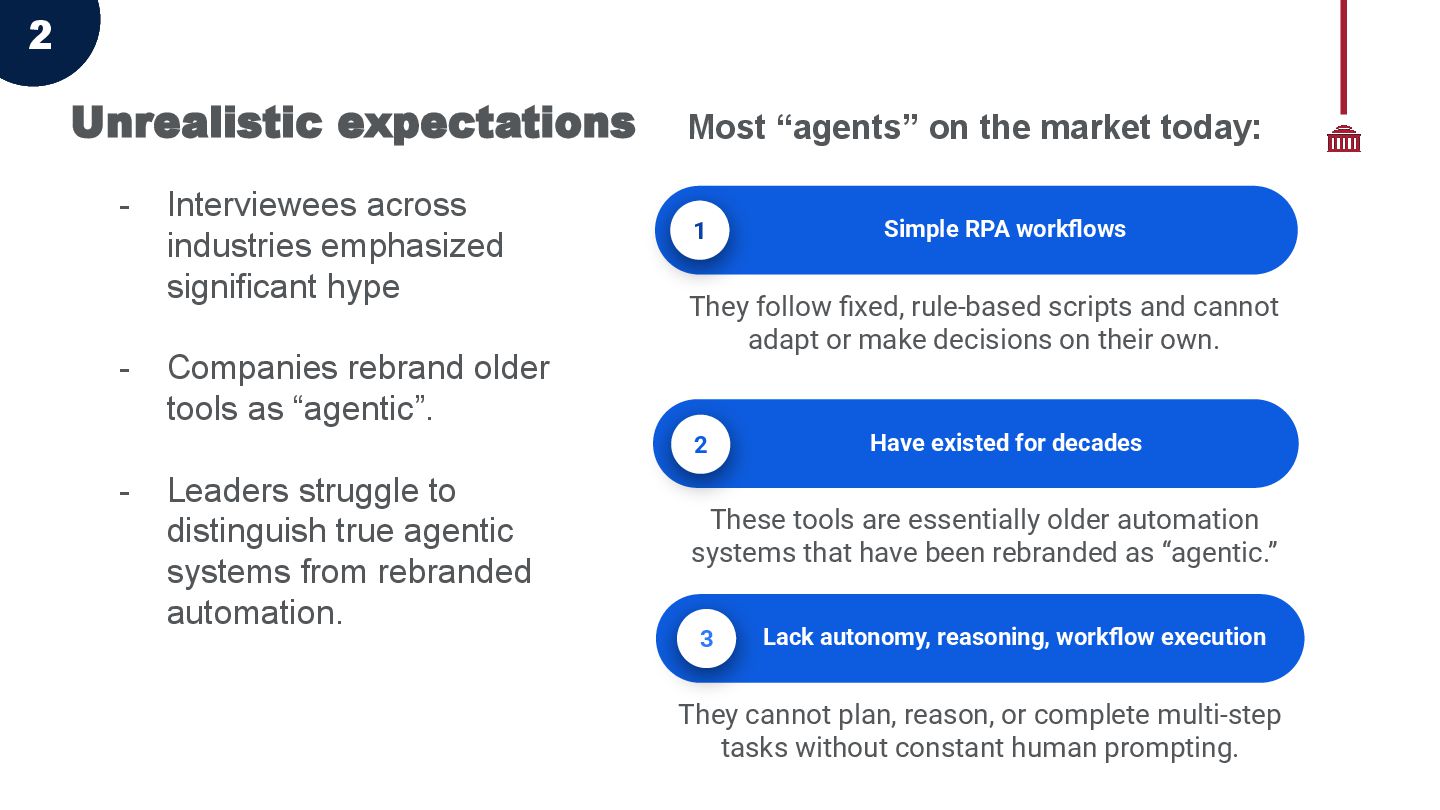
Companies rebrand older tools as “agentic”. - Leaders struggle to distinguish true agentic systems from rebranded automation. Most “agents” on the market today: 1 Simple RPA workflows They follow fixed, rule-based scripts and cannot adapt or make decisions on their own. 2 Have existed for decades These tools are essentially older automation systems that have been rebranded as “agentic.” 3 Lack autonomy, reasoning, workflow execution They cannot plan, reason, or complete multi-step tasks without constant human prompting. 2
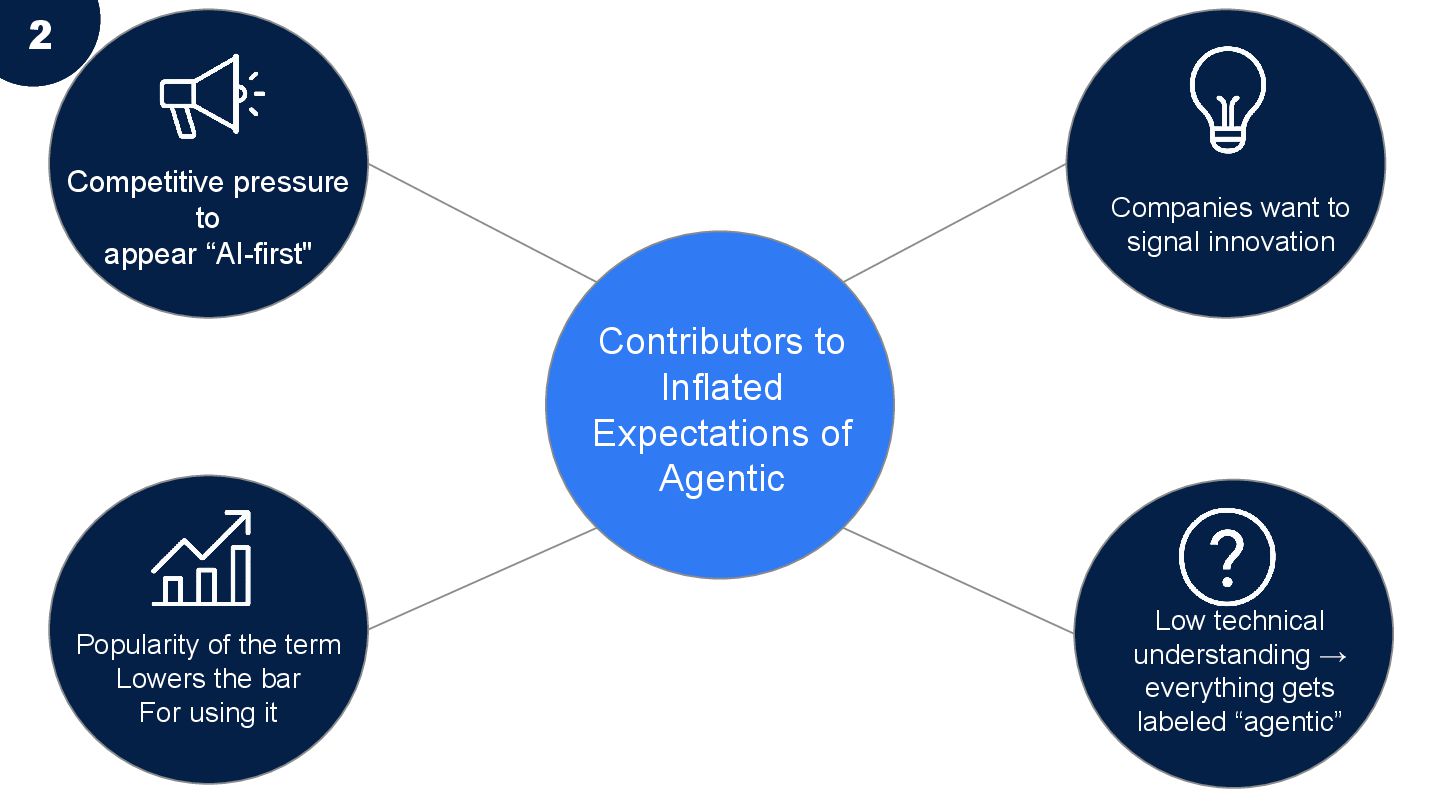
Popularity of the term Lowers the bar For using it Low technical understanding → everything gets labeled “agentic” Contributors to Inflated Expectations of Agentic 2
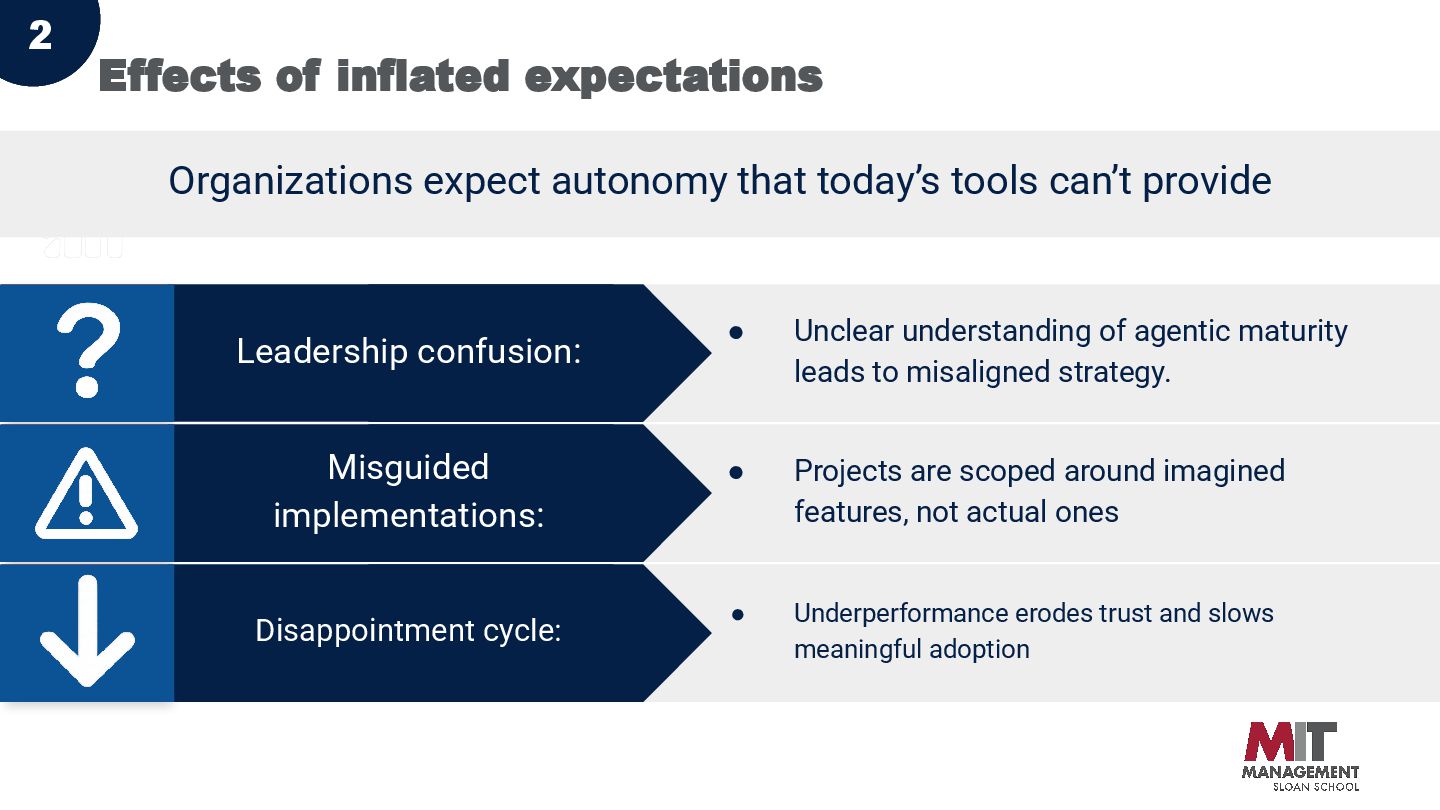
agentic maturity leads to misaligned strategy. Misguided implementations: • Projects are scoped around imagined features, not actual ones Disappointment cycle: • Underperformance erodes trust and slows meaningful adoption Organizations expect autonomy that today’s tools can’t provide 2
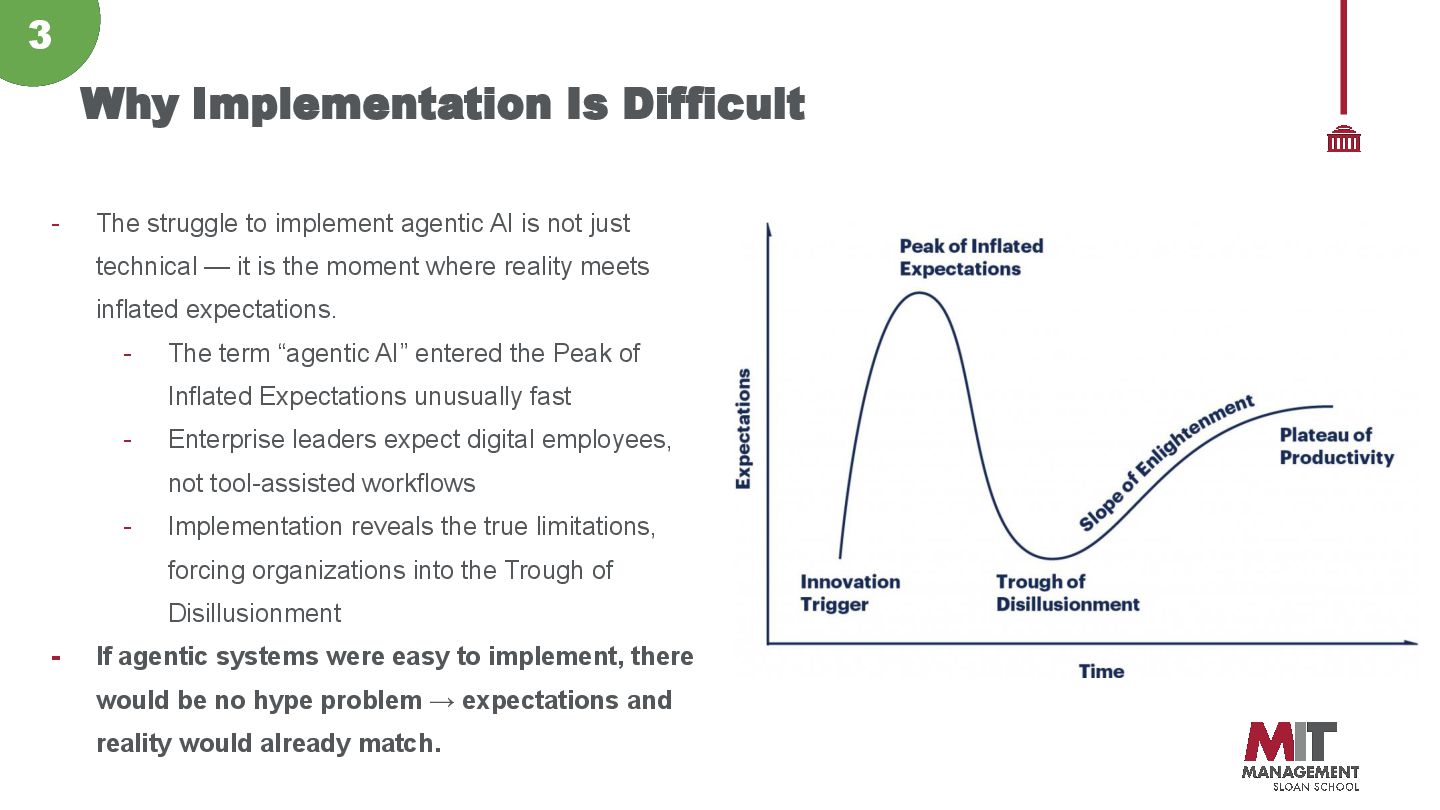
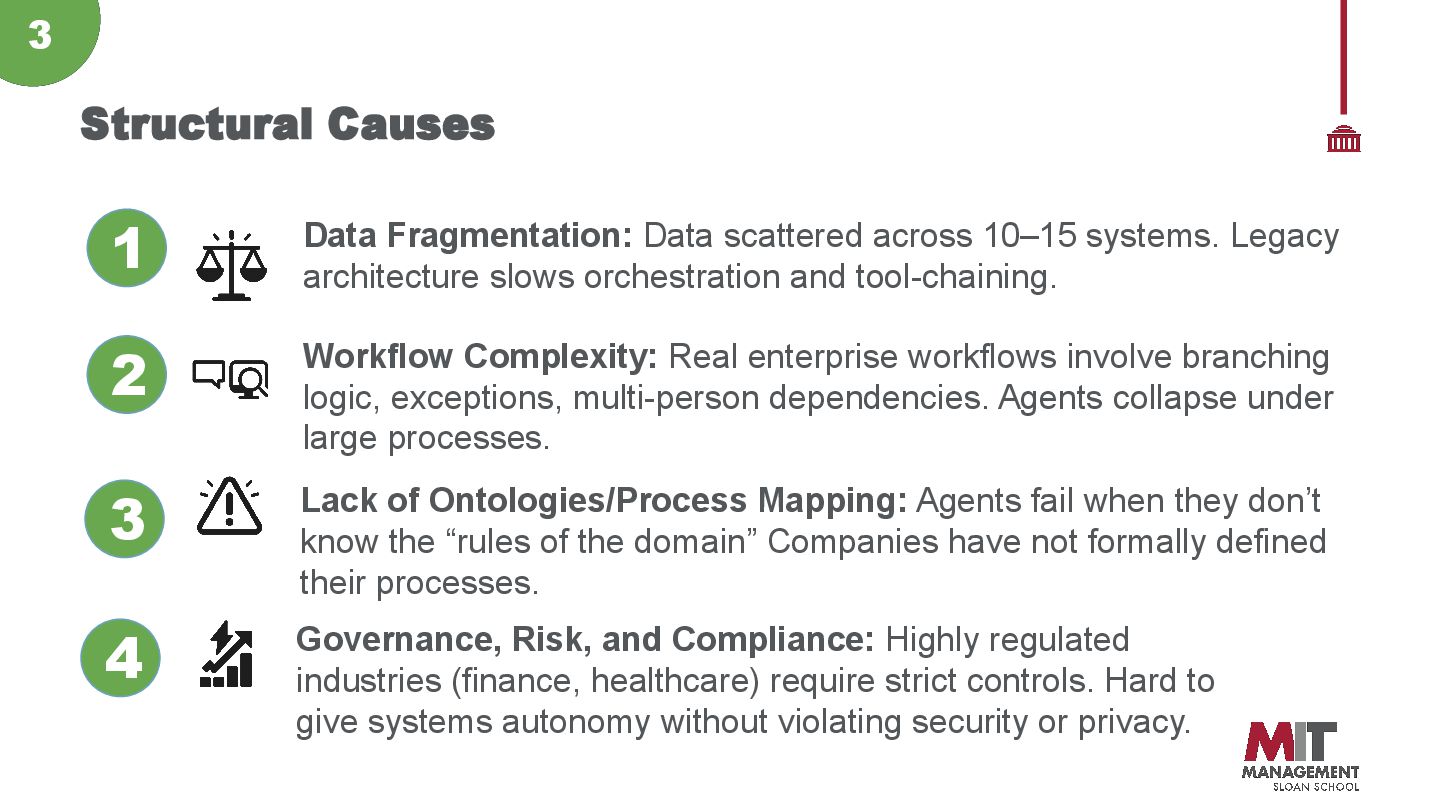
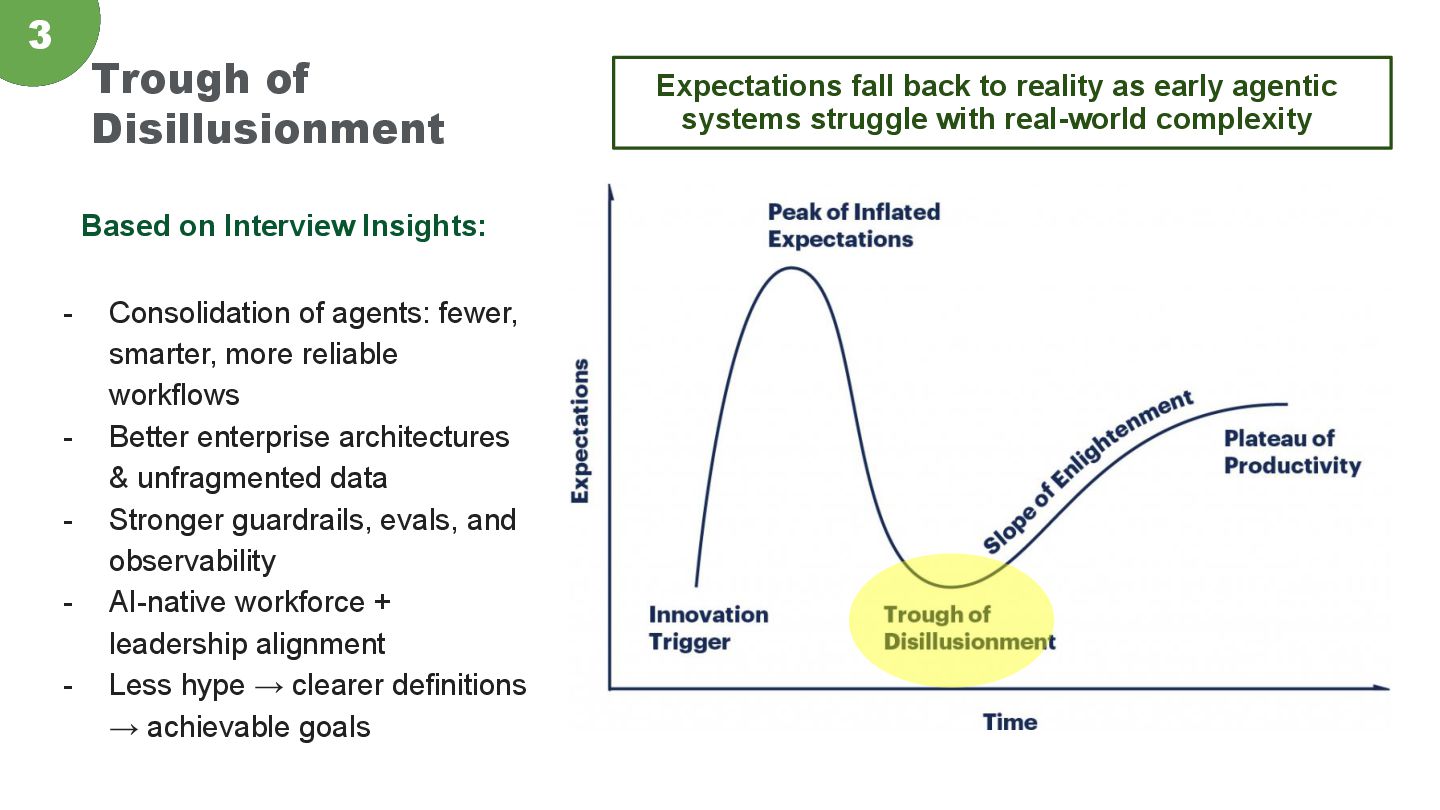
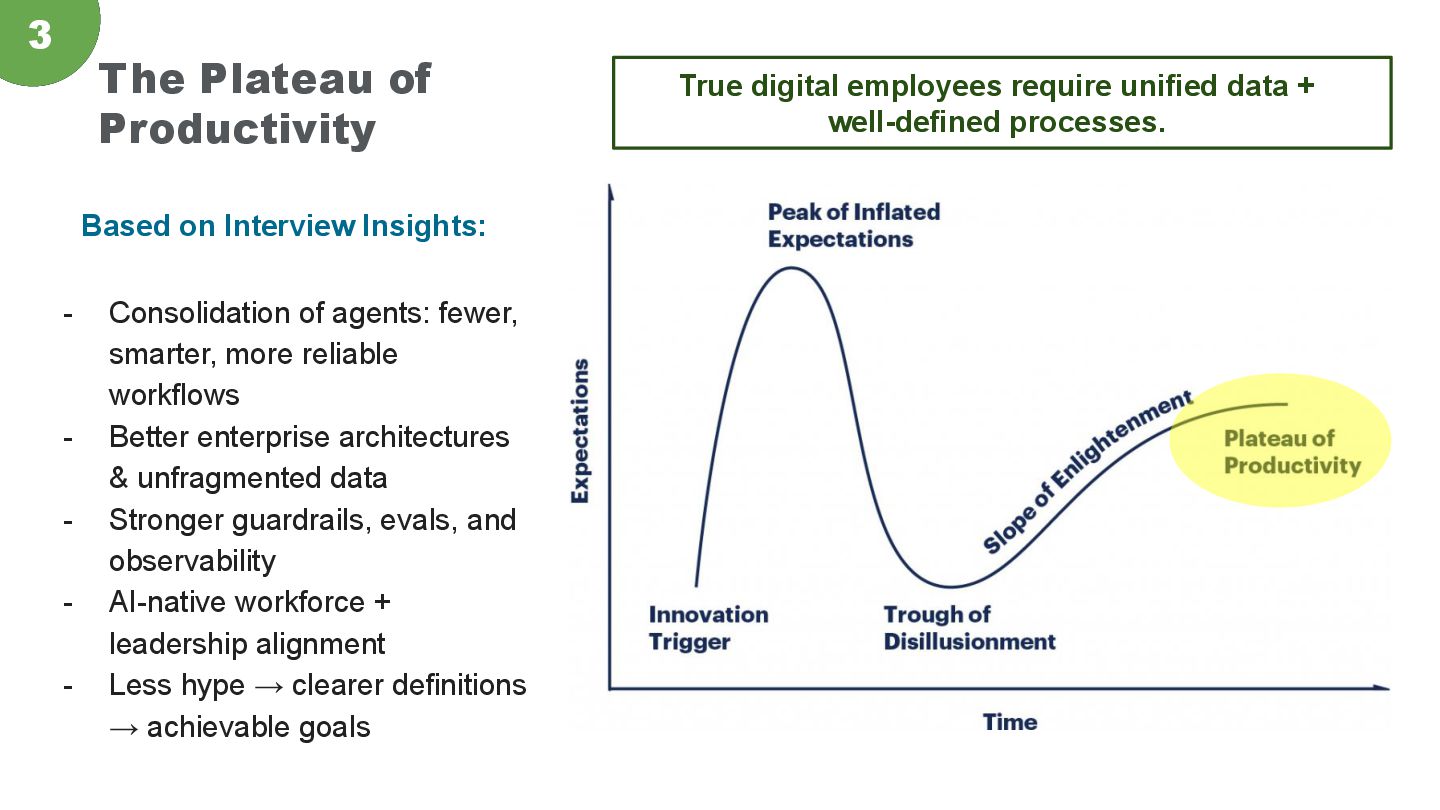
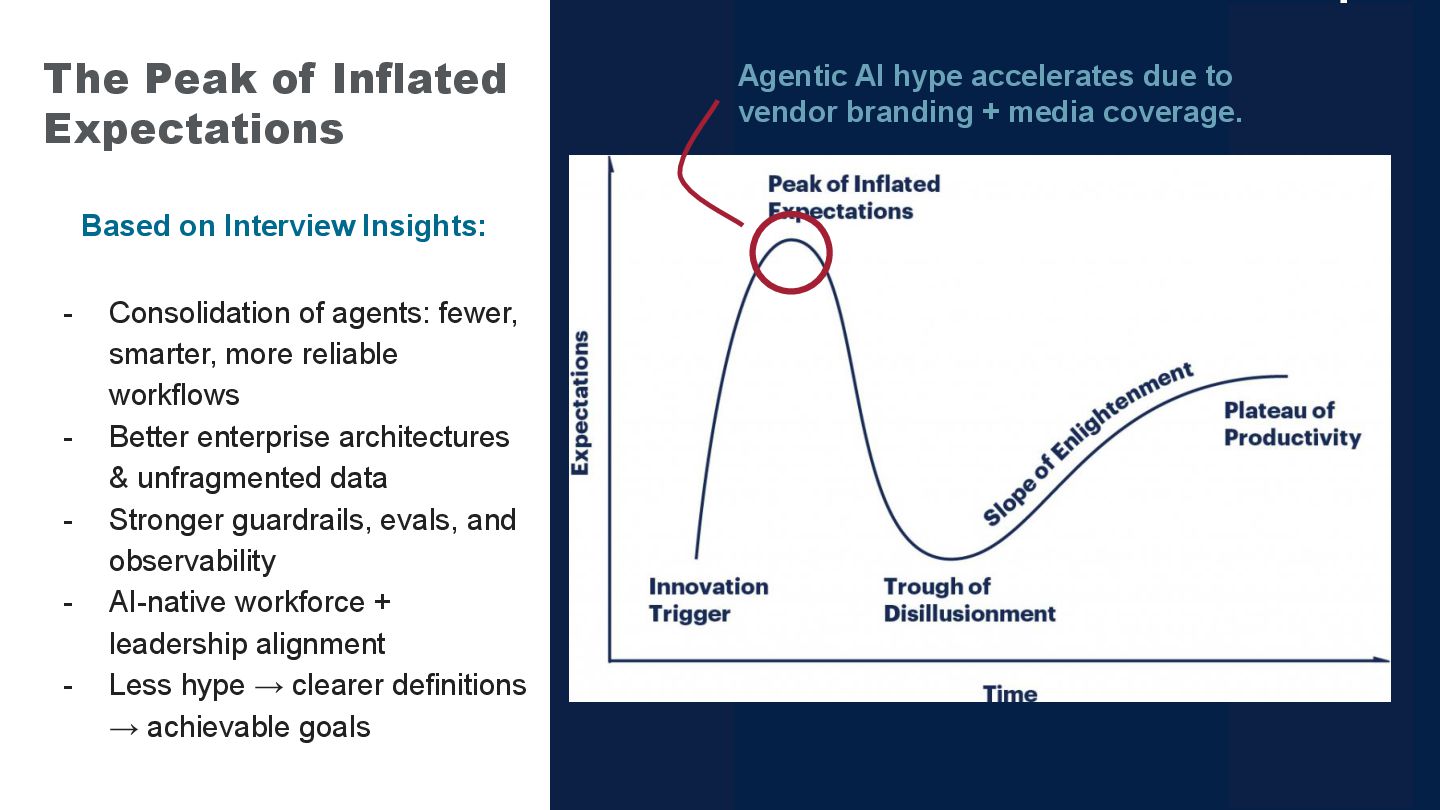
technical — it is the moment where reality meets inflated expectations. - The term “agentic AI” entered the Peak of Inflated Expectations unusually fast - Enterprise leaders expect digital employees, not tool-assisted workflows - Implementation reveals the true limitations, forcing organizations into the Trough of Disillusionment - If agentic systems were easy to implement, there would be no hype problem → expectations and reality would already match. Why Implementation Is Difficult 3
Legacy architecture slows orchestration and tool-chaining. 2 Workflow Complexity: Real enterprise workflows involve branching logic, exceptions, multi-person dependencies. Agents collapse under large processes. 3 Lack of Ontologies/Process Mapping: Agents fail when they don’t know the “rules of the domain” Companies have not formally defined their processes. 4 Governance, Risk, and Compliance: Highly regulated industries (finance, healthcare) require strict controls. Hard to give systems autonomy without violating security or privacy. 3
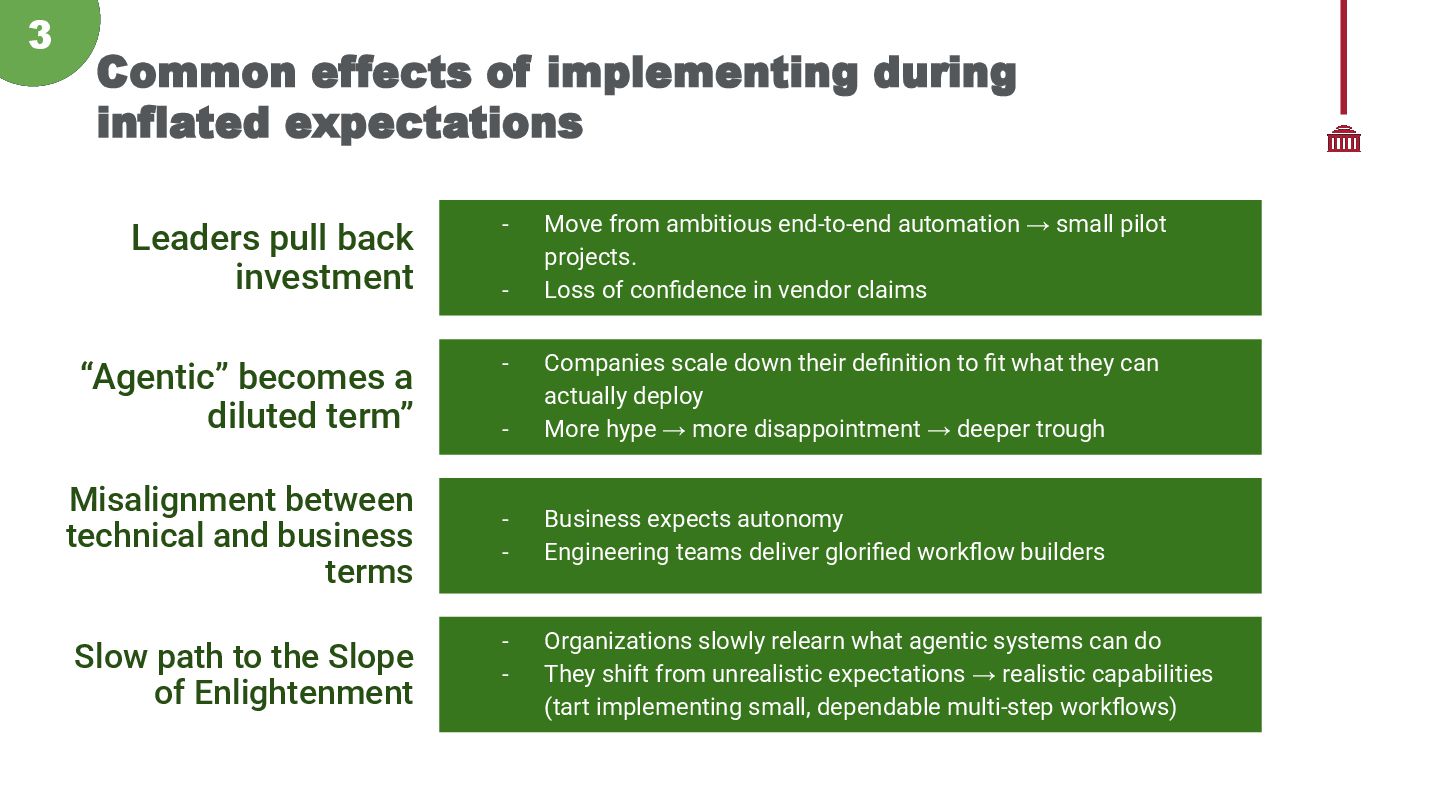
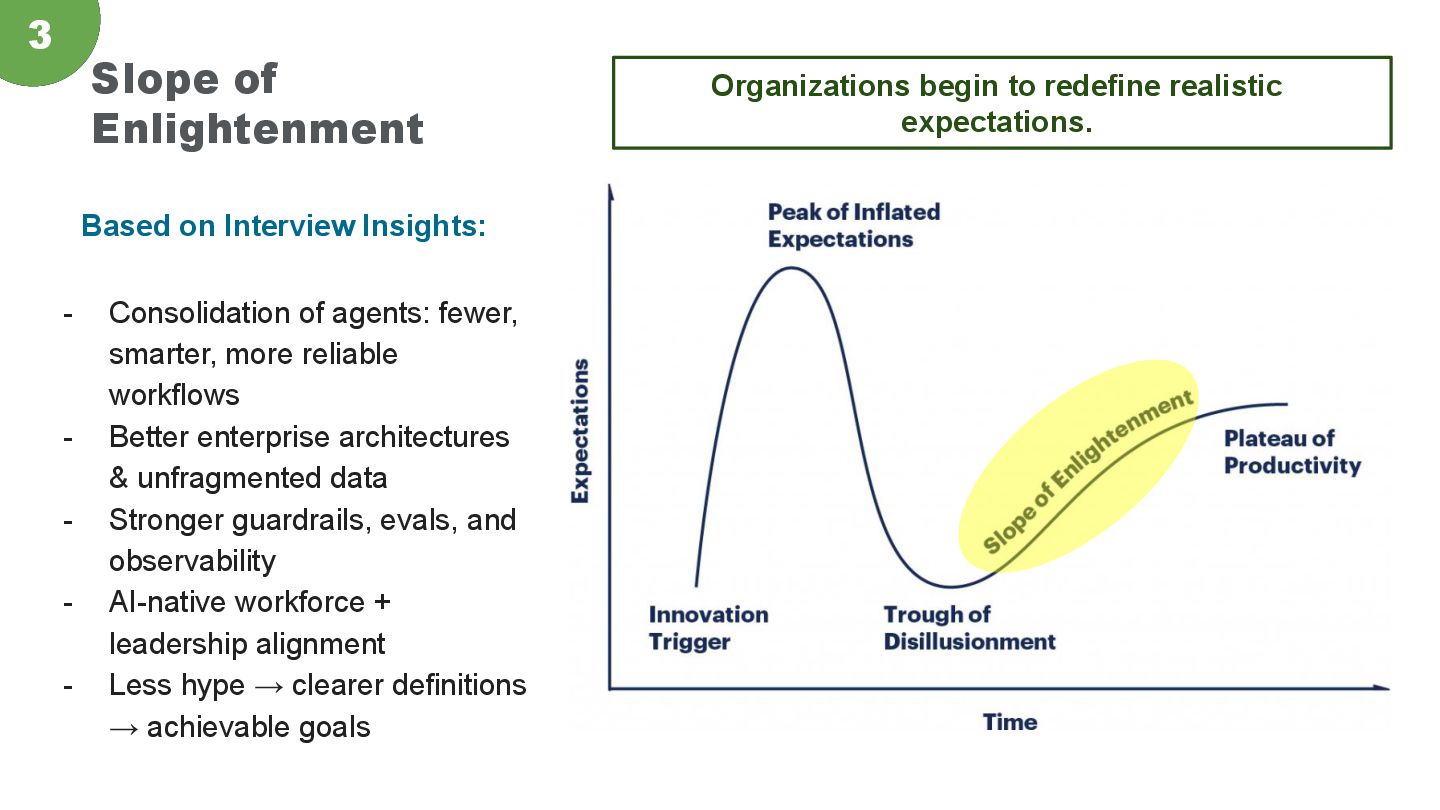
→ small pilot projects. - Loss of confidence in vendor claims “Agentic” becomes a diluted term” - Companies scale down their definition to fit what they can actually deploy - More hype → more disappointment → deeper trough Misalignment between technical and business terms - Business expects autonomy - Engineering teams deliver glorified workflow builders Slow path to the Slope of Enlightenment - Organizations slowly relearn what agentic systems can do - They shift from unrealistic expectations → realistic capabilities (tart implementing small, dependable multi-step workflows) Common effects of implementing during inflated expectations 3
agents: fewer, smarter, more reliable workflows - Better enterprise architectures & unfragmented data - Stronger guardrails, evals, and observability - AI-native workforce + leadership alignment - Less hype → clearer definitions → achievable goals Expectations fall back to reality as early agentic systems struggle with real-world complexity 3
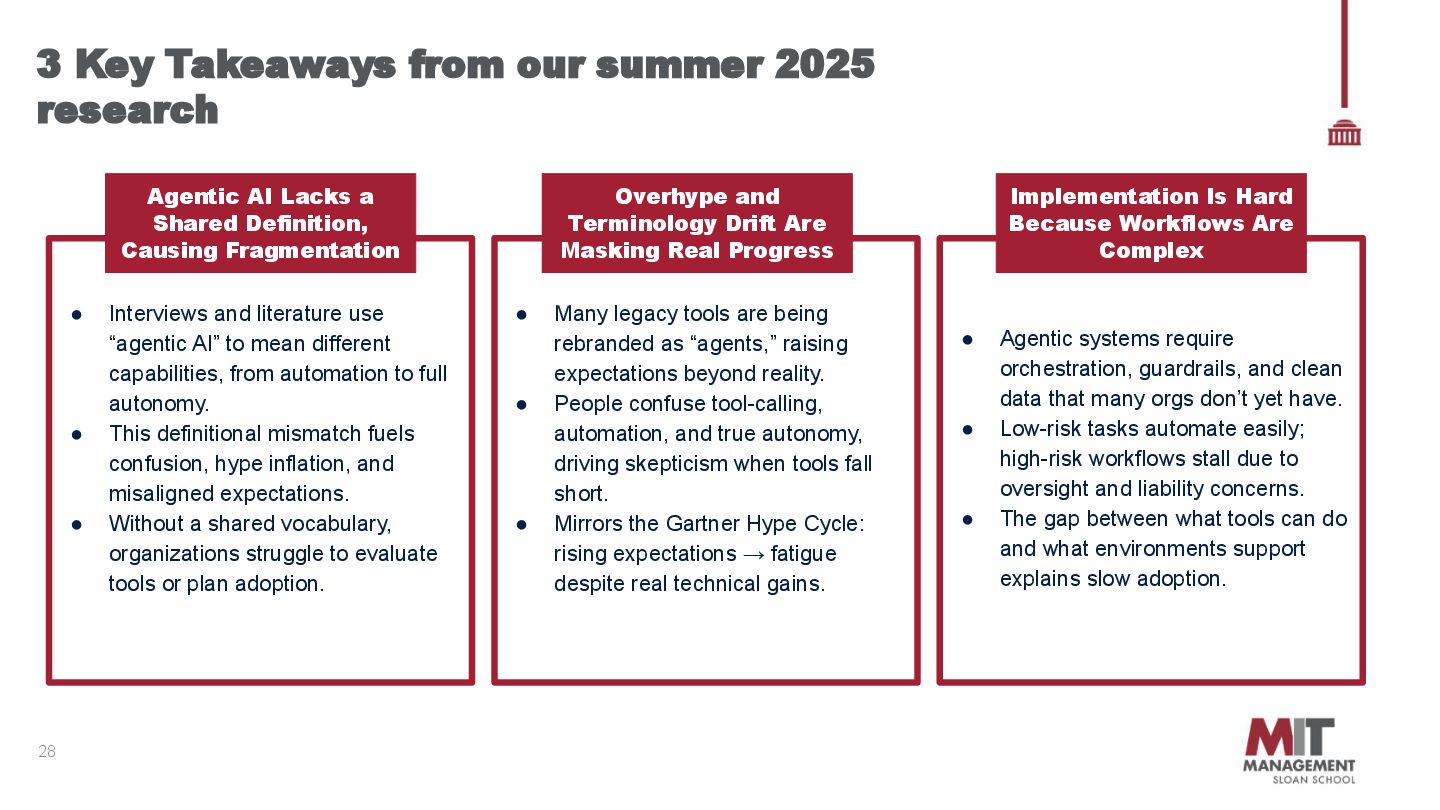
Many legacy tools are being rebranded as “agents,” raising expectations beyond reality. • People confuse tool-calling, automation, and true autonomy, driving skepticism when tools fall short. • Mirrors the Gartner Hype Cycle: rising expectations → fatigue despite real technical gains. Overhype and Terminology Drift Are Masking Real Progress • Agentic systems require orchestration, guardrails, and clean data that many orgs don’t yet have. • Low-risk tasks automate easily; high-risk workflows stall due to oversight and liability concerns. • The gap between what tools can do and what environments support explains slow adoption. Implementation Is Hard Because Workflows Are Complex • Interviews and literature use “agentic AI” to mean different capabilities, from automation to full autonomy. • This definitional mismatch fuels confusion, hype inflation, and misaligned expectations. • Without a shared vocabulary, organizations struggle to evaluate tools or plan adoption. Agentic AI Lacks a Shared Definition, Causing Fragmentation
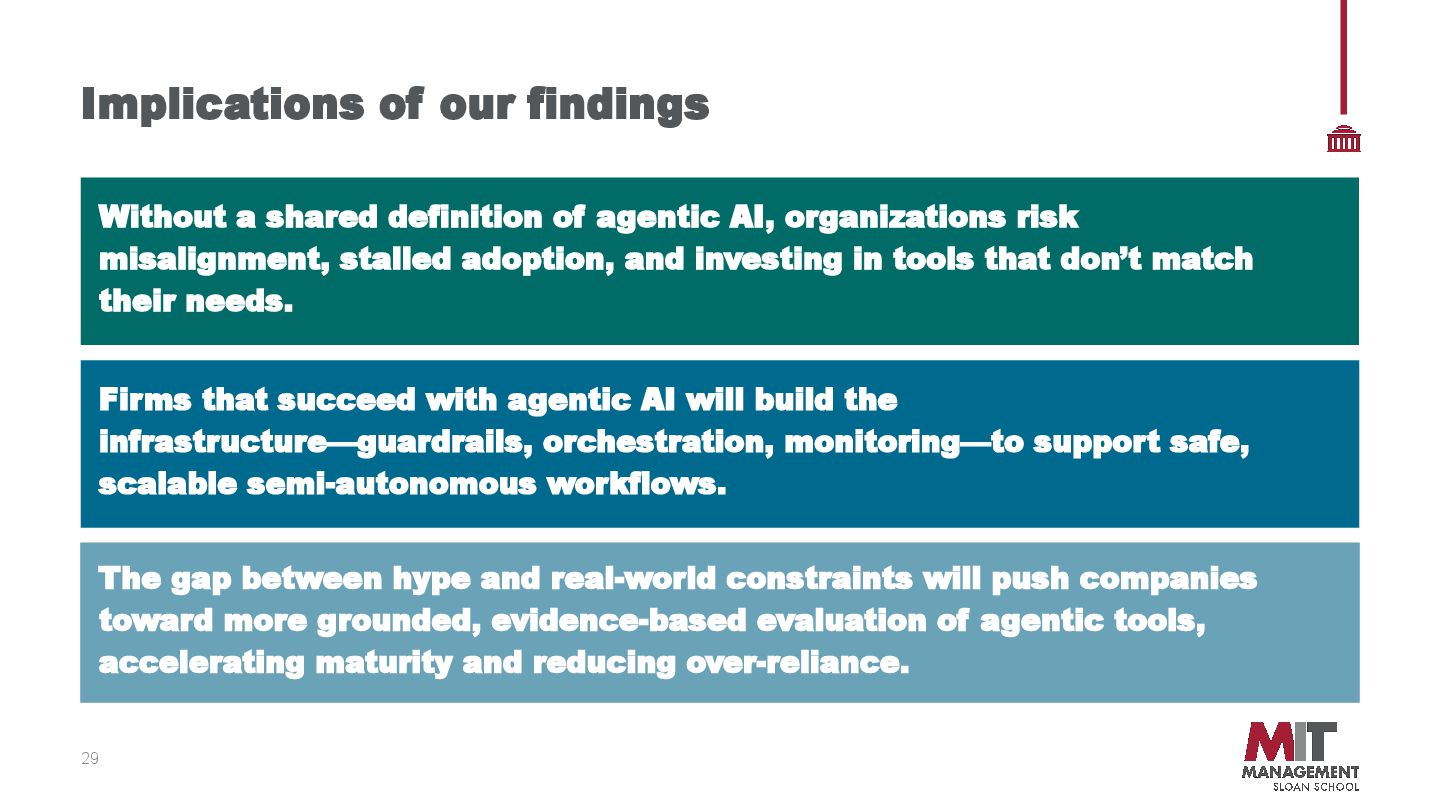
before 3 slides Without a shared definition of agentic AI, organizations risk misalignment, stalled adoption, and investing in tools that don’t match their needs. Firms that succeed with agentic AI will build the infrastructure—guardrails, orchestration, monitoring—to support safe, scalable semi-autonomous workflows. The gap between hype and real-world constraints will push companies toward more grounded, evidence-based evaluation of agentic tools, accelerating maturity and reducing over-reliance.
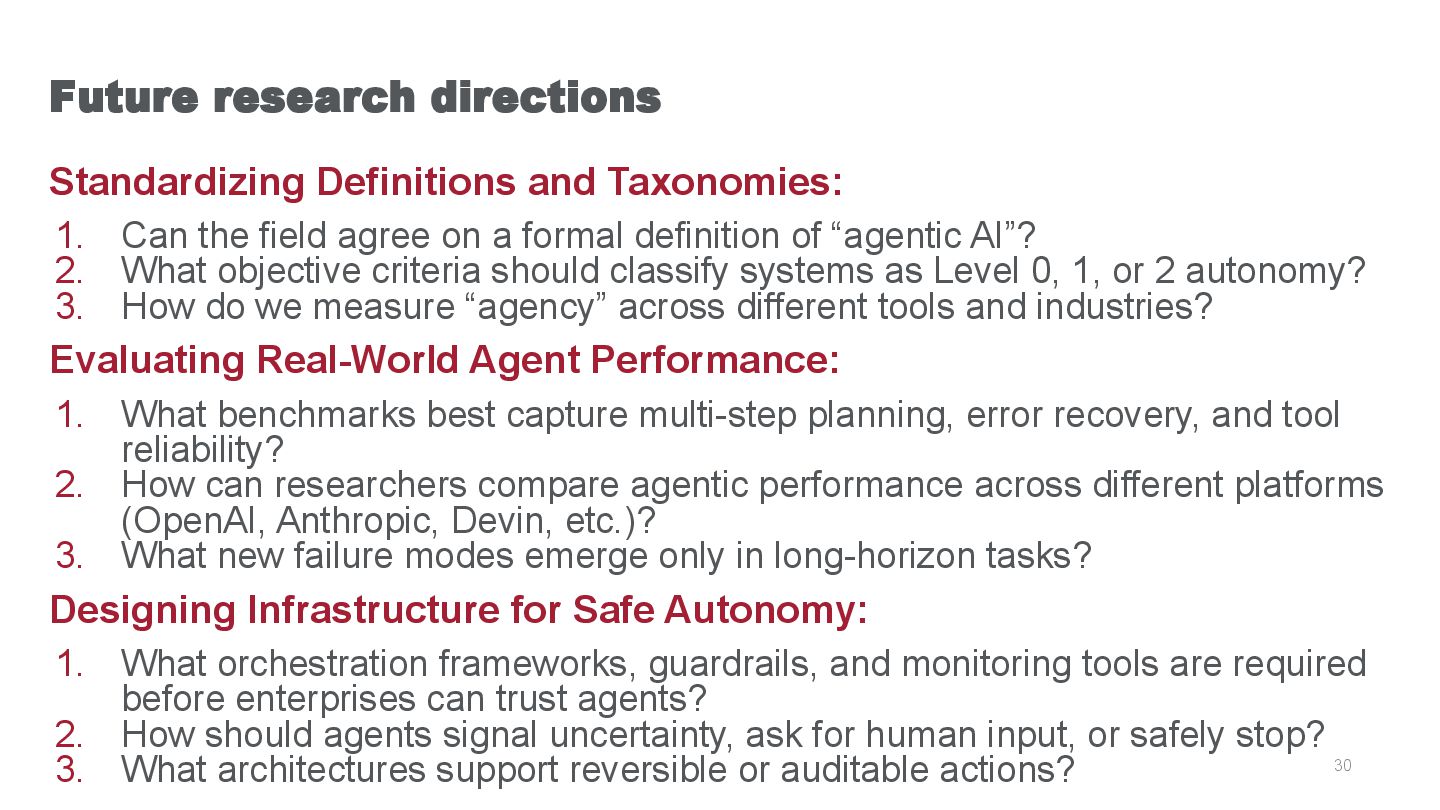
field agree on a formal definition of “agentic AI”? 2. What objective criteria should classify systems as Level 0, 1, or 2 autonomy? 3. How do we measure “agency” across different tools and industries? Evaluating Real-World Agent Performance: 1. What benchmarks best capture multi-step planning, error recovery, and tool reliability? 2. How can researchers compare agentic performance across different platforms (OpenAI, Anthropic, Devin, etc.)? 3. What new failure modes emerge only in long-horizon tasks? Designing Infrastructure for Safe Autonomy: 1. What orchestration frameworks, guardrails, and monitoring tools are required before enterprises can trust agents? 2. How should agents signal uncertainty, ask for human input, or safely stop? 3. What architectures support reversible or auditable actions? 30
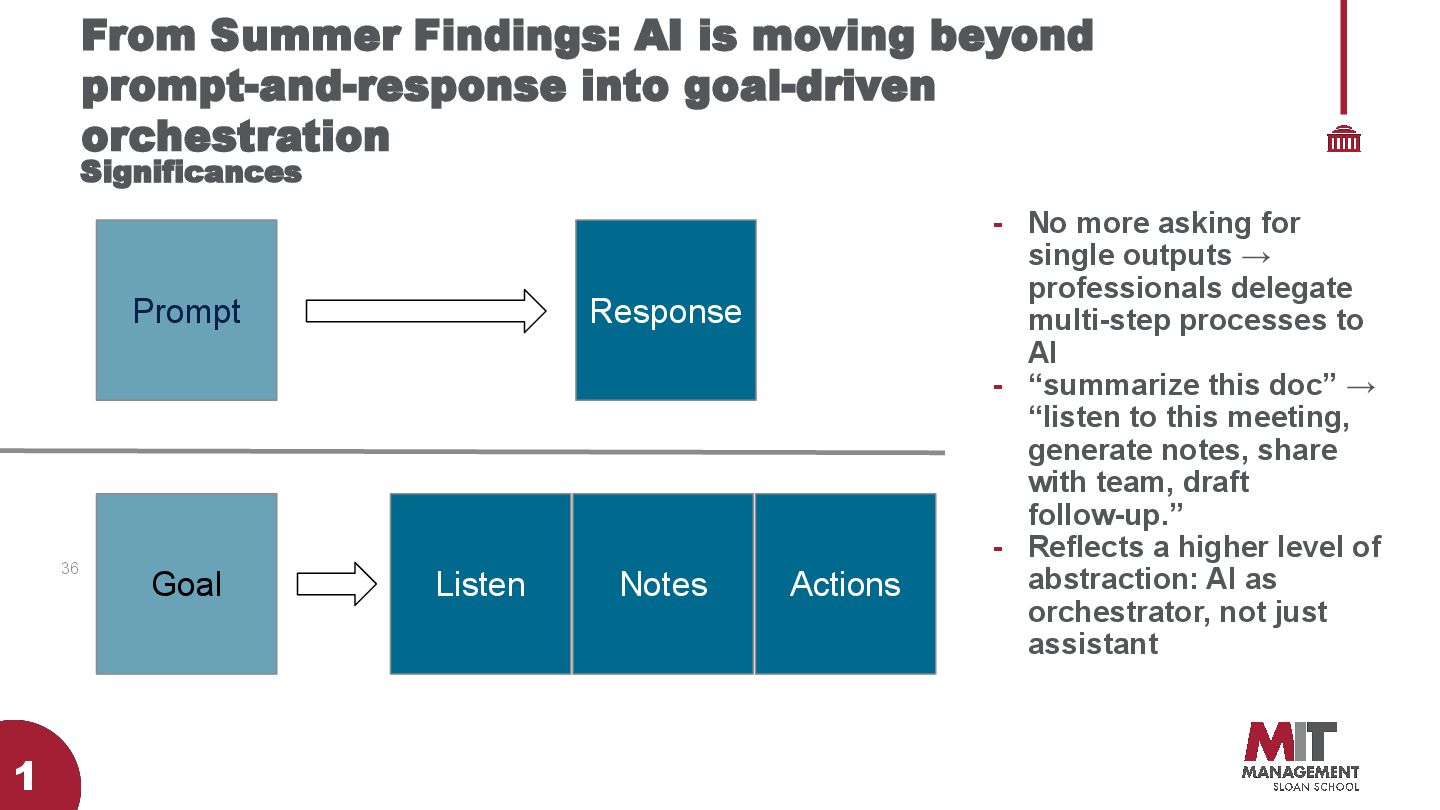
multi-step processes to AI - “summarize this doc” → “listen to this meeting, generate notes, share with team, draft follow-up.” - Reflects a higher level of abstraction: AI as orchestrator, not just assistant 36 From Summer Findings: AI is moving beyond prompt-and-response into goal-driven orchestration Prompt Response Goal Actions Notes Listen Significances 1
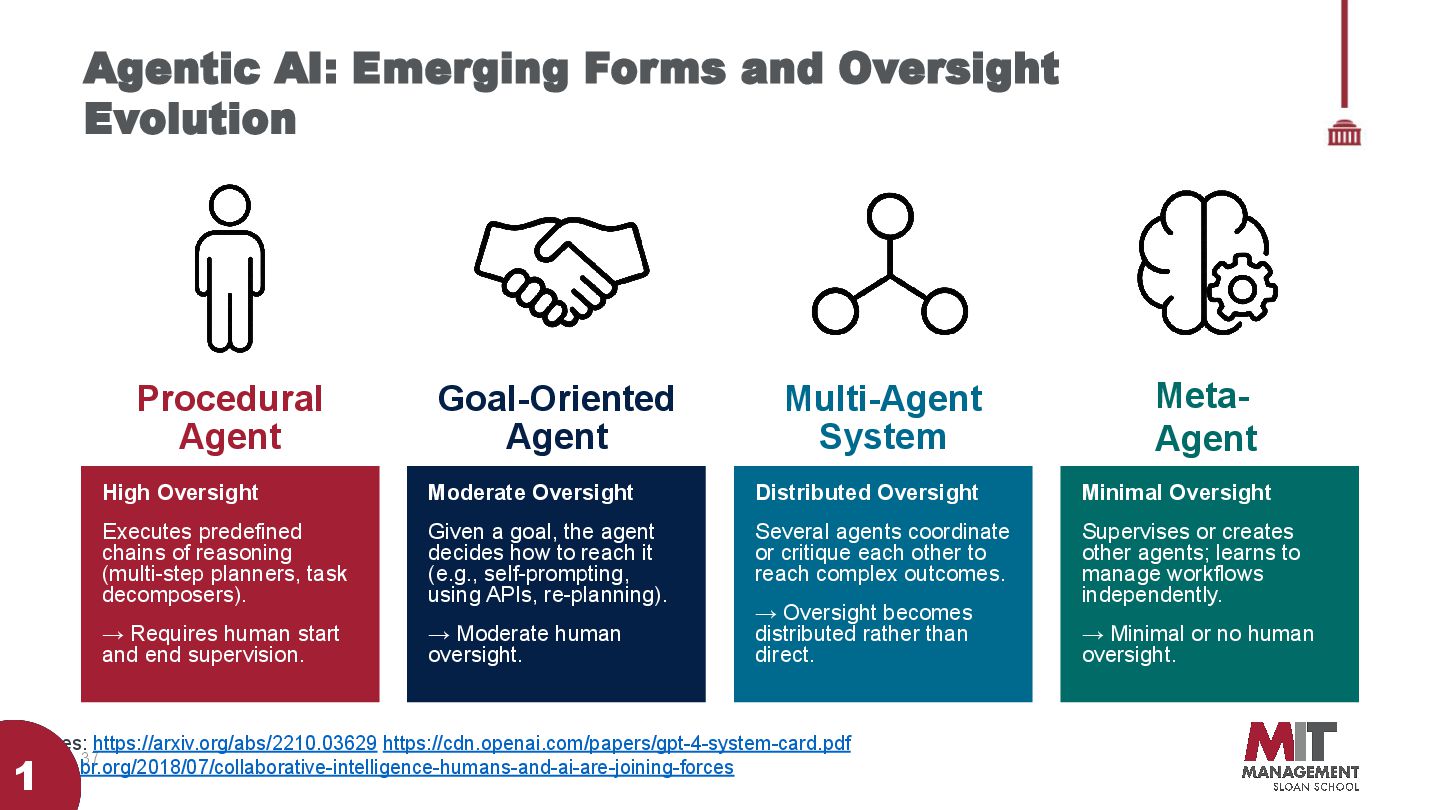
(multi-step planners, task decomposers). → Requires human start and end supervision. Goal-Oriented Agent Multi-Agent System Meta- Agent Moderate Oversight Given a goal, the agent decides how to reach it (e.g., self-prompting, using APIs, re-planning). → Moderate human oversight. Distributed Oversight Several agents coordinate or critique each other to reach complex outcomes. → Oversight becomes distributed rather than direct. Minimal Oversight Supervises or creates other agents; learns to manage workflows independently. → Minimal or no human oversight. Agentic AI: Emerging Forms and Oversight Evolution Sources: https://arxiv.org/abs/2210.03629 https://cdn.openai.com/papers/gpt-4-system-card.pdf https://hbr.org/2018/07/collaborative-intelligence-humans-and-ai-are-joining-forces 1
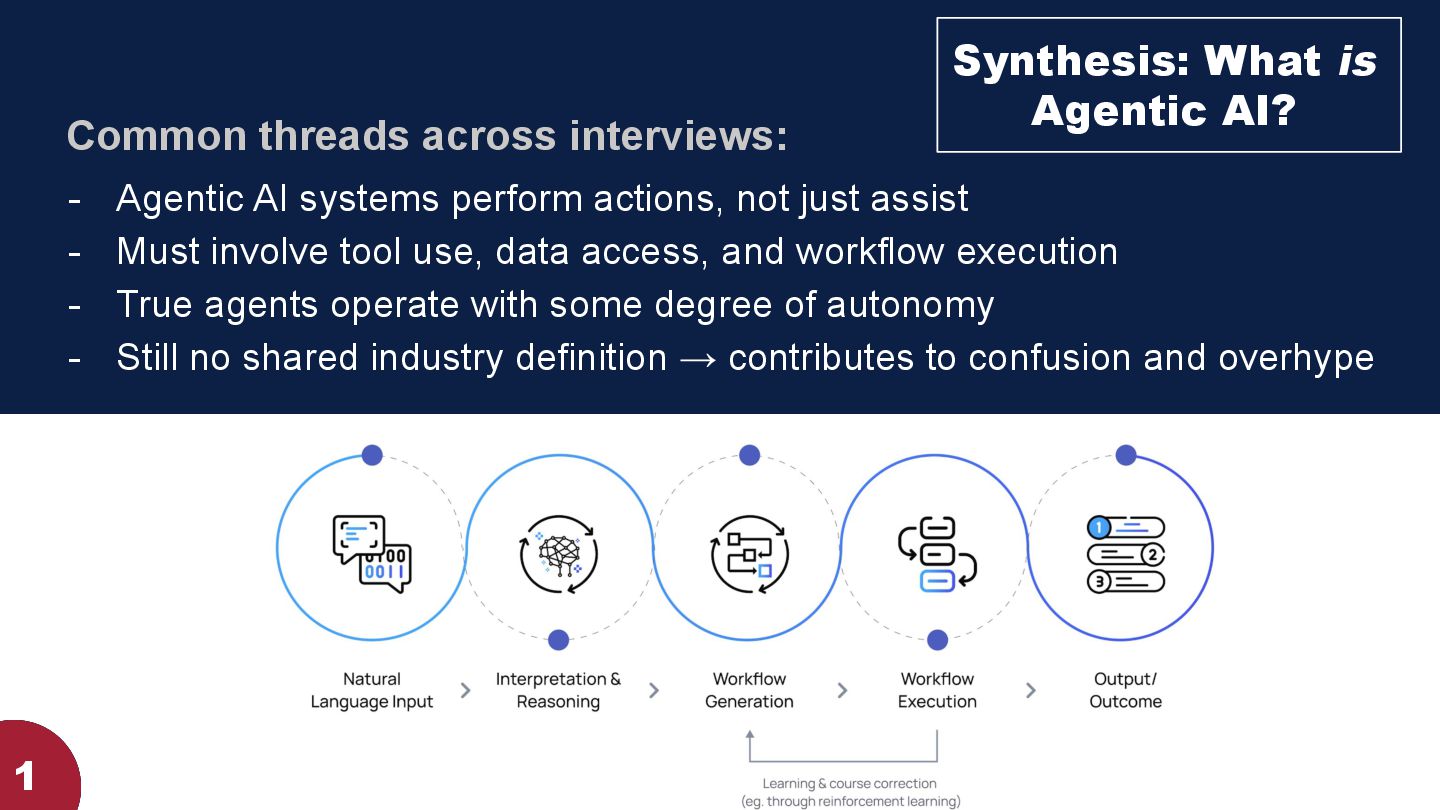
not just assist - Must involve tool use, data access, and workflow execution - True agents operate with some degree of autonomy - Still no shared industry definition → contributes to confusion and overhype Synthesis: What is Agentic AI? 1


 erfertic
 cassininazir
 hannesfritz
 lara
 akademiya2063
 kimpetersen
 keithpitt
 mclloyd
 akosma
 michaelherold
 lcolladotor
 schroneko
 marketingsoph