Professor Melissa Webster Summer 2026 UROP IT SLOAN SCHOO F MANAGEMENT Making AI Meaningful, Legitimate, and Actionable: How communication shapes employee AI adoption
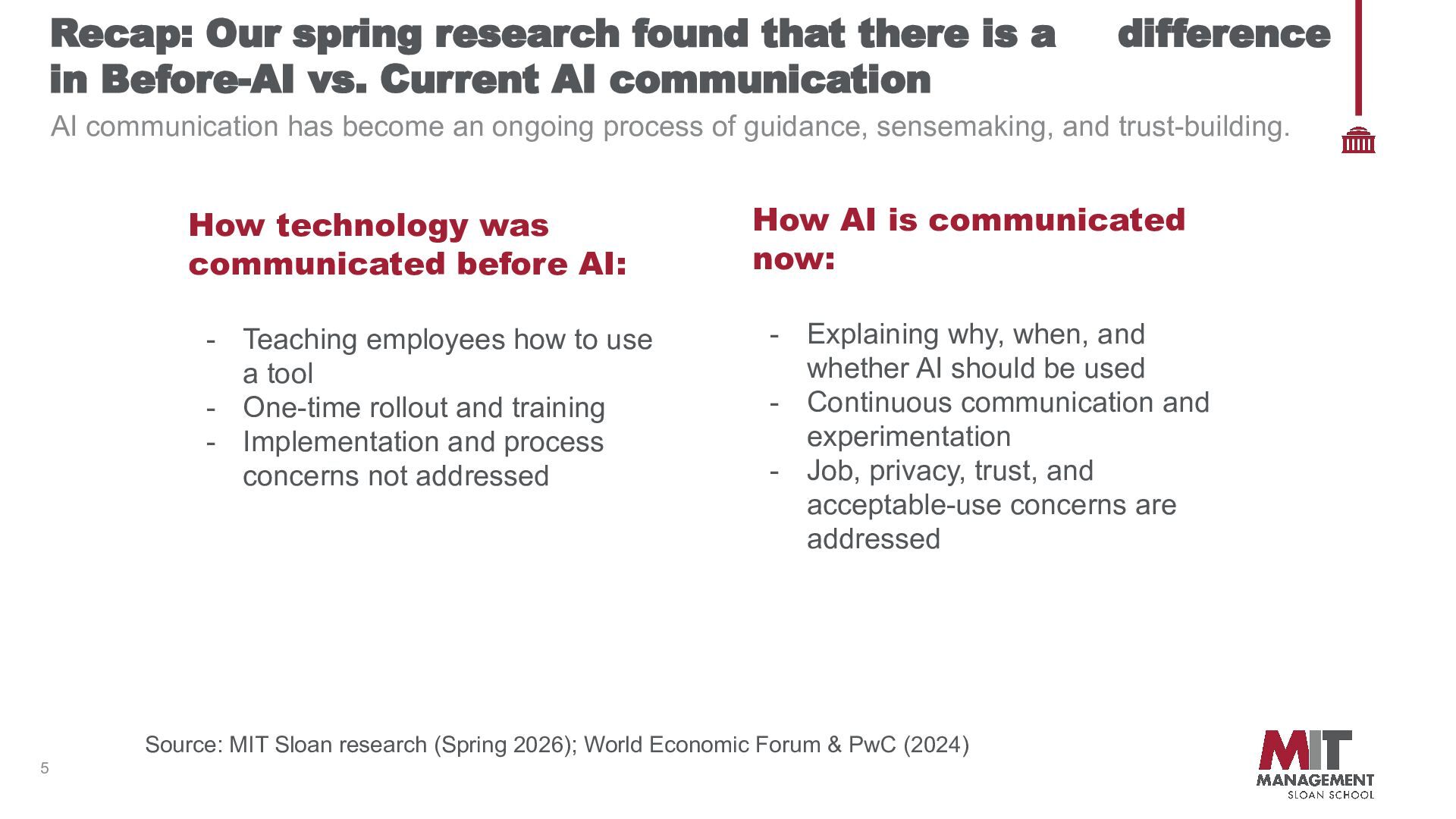
Before-AI vs. Current AI communication difference AI communication has become an ongoing process of guidance, sensemaking, and trust-building. How technology was communicated before AI: How AI is communicated now: - Teaching employees how to use a tool - One-time rollout and training - Implementation and process concerns not addressed - Explaining why, when, and whether AI should be used - Continuous communication and experimentation - Job, privacy, trust, and acceptable-use concerns are addressed Source: MIT Sloan research (Spring 2026); World Economic Forum & PwC (2024) 5
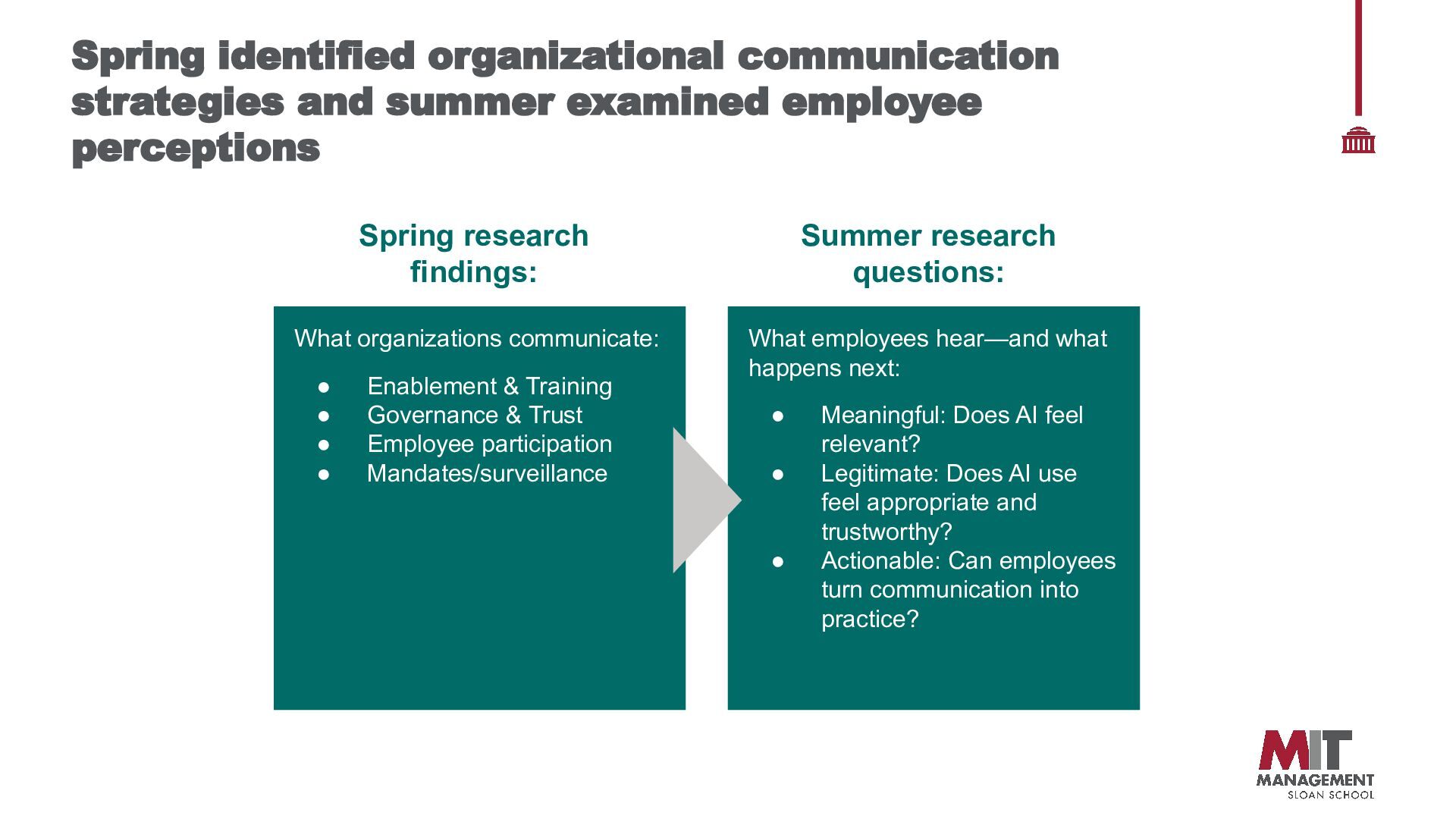
Spring research findings: Summer research questions: What organizations communicate: What employees hear—and what happens next: • • • • Enablement & Training Governance & Trust Employee participation Mandates/surveillance • • • Meaningful: Does AI feel relevant? Legitimate: Does AI use feel appropriate and trustworthy? Actionable: Can employees turn communication into practice?
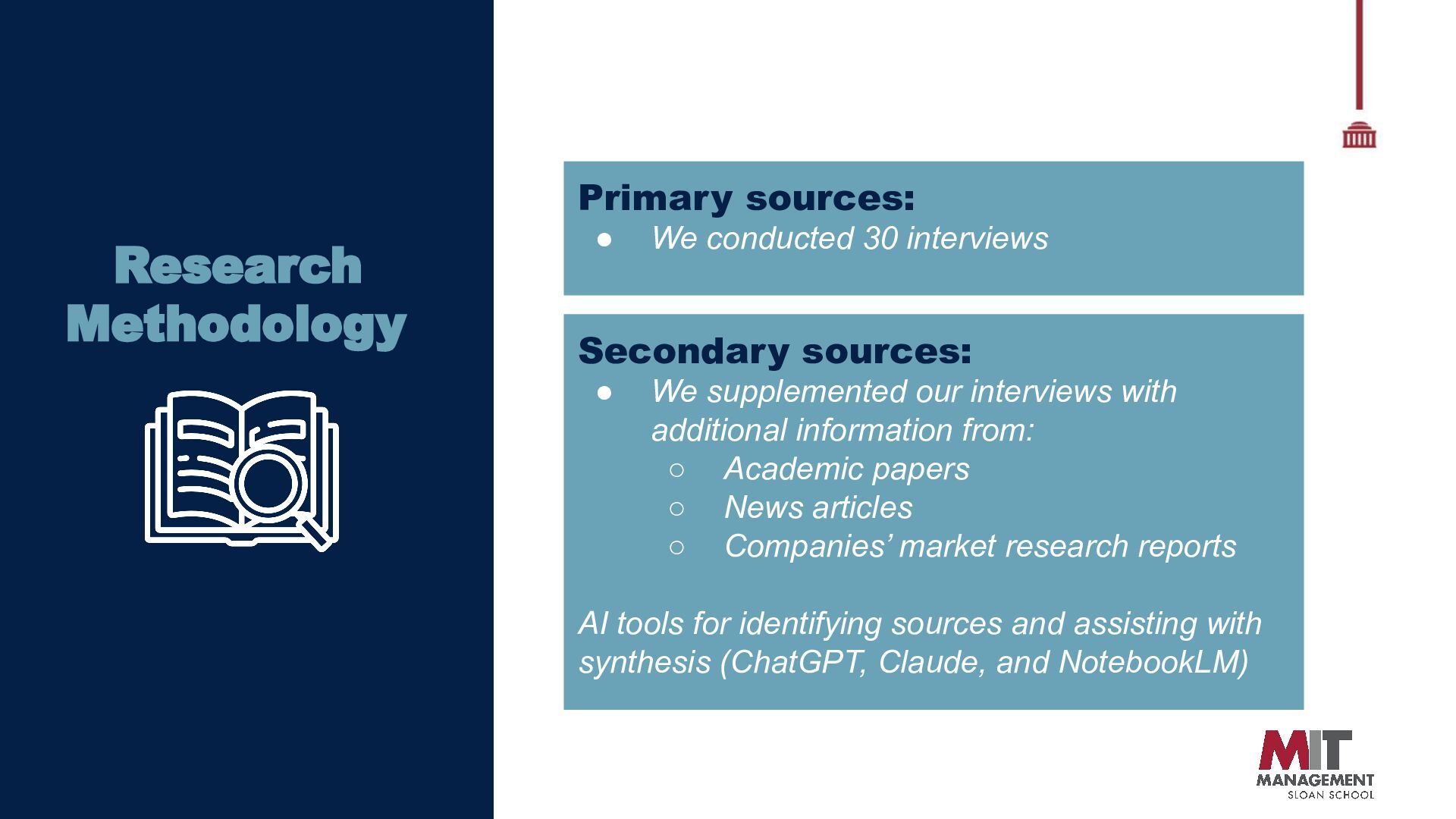
sources: • We supplemented our interviews with additional information from: ◦ Academic papers ◦ News articles ◦ Companies’ market research reports AI tools for identifying sources and assisting with synthesis (ChatGPT, Claude, and NotebookLM)
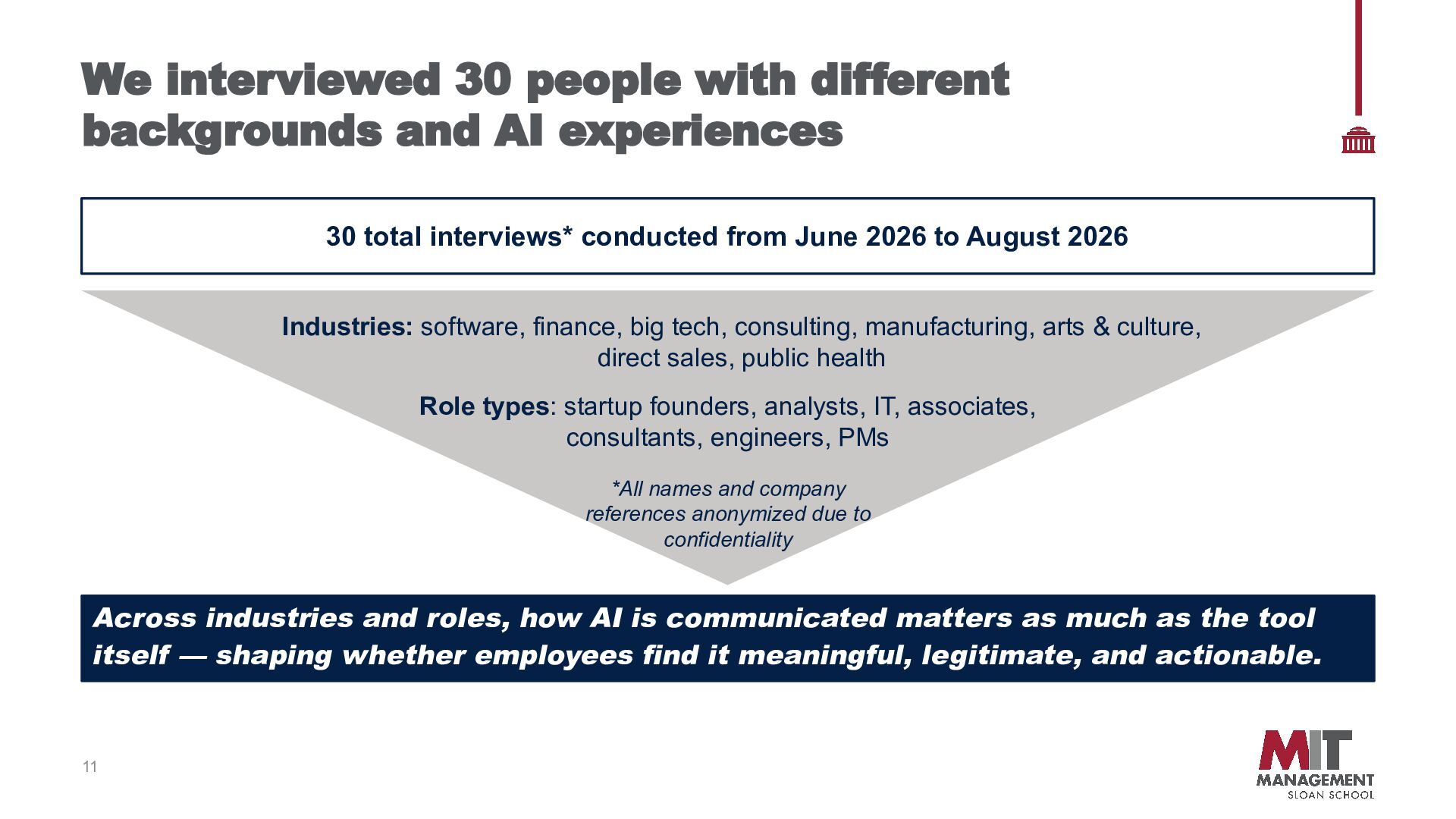
30 total interviews* conducted from June 2026 to August 2026 Industries: software, finance, big tech, consulting, manufacturing, arts & culture, direct sales, public health Role types: startup founders, analysts, IT, associates, consultants, engineers, PMs *All names and company references anonymized due to confidentiality Across industries and roles, how AI is communicated matters as much as the tool itself — shaping whether employees find it meaningful, legitimate, and actionable. 11
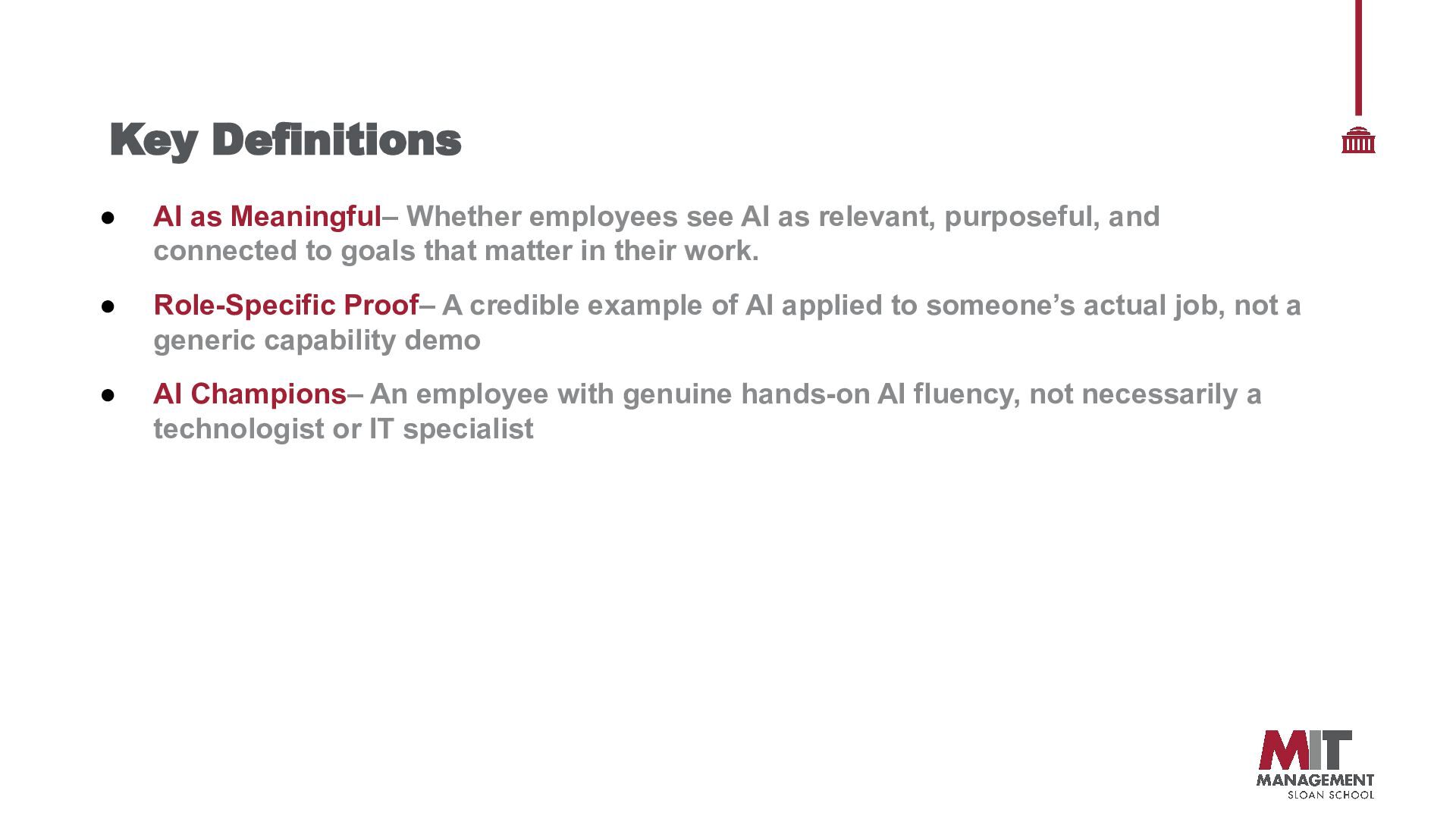
as relevant, purposeful, and connected to goals that matter in their work. • Role-Specific Proof– A credible example of AI applied to someone’s actual job, not a generic capability demo • AI Champions– An employee with genuine hands-on AI fluency, not necessarily a technologist or IT specialist
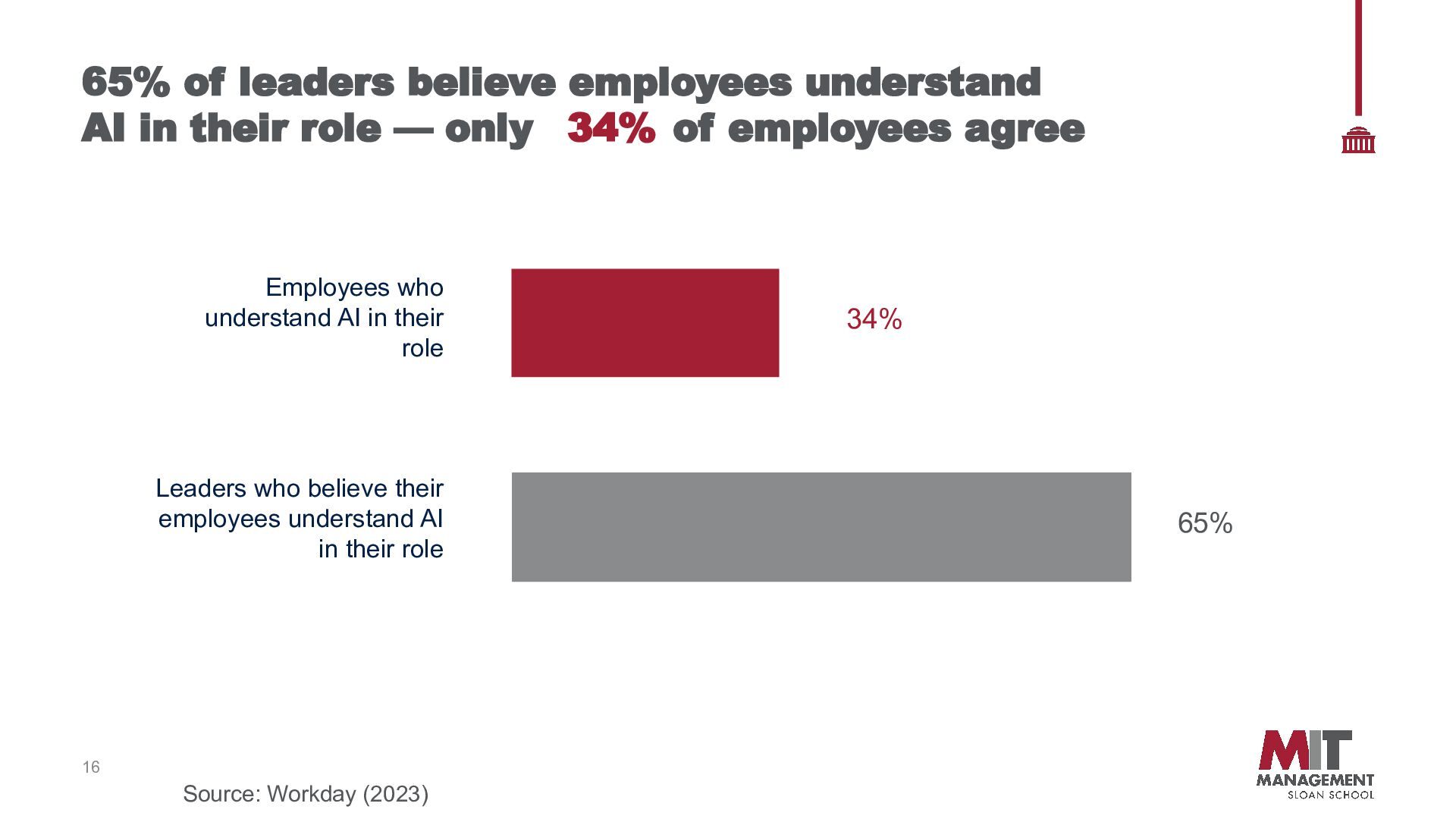
— only 34% of employees agree Employees who understand AI in their role Leaders who believe their employees understand AI in their role 16 Source: Workday (2023) 34% 65%
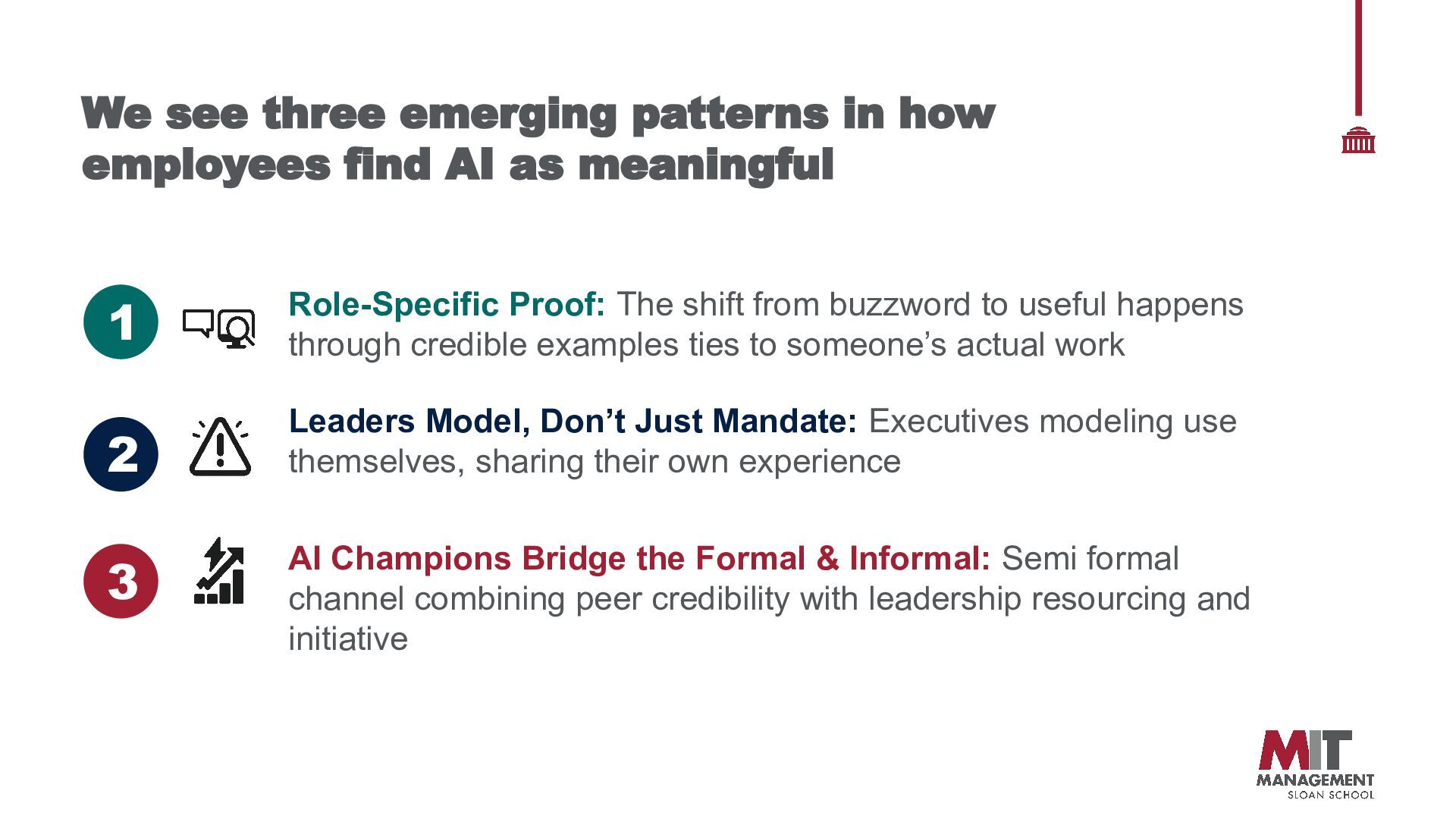
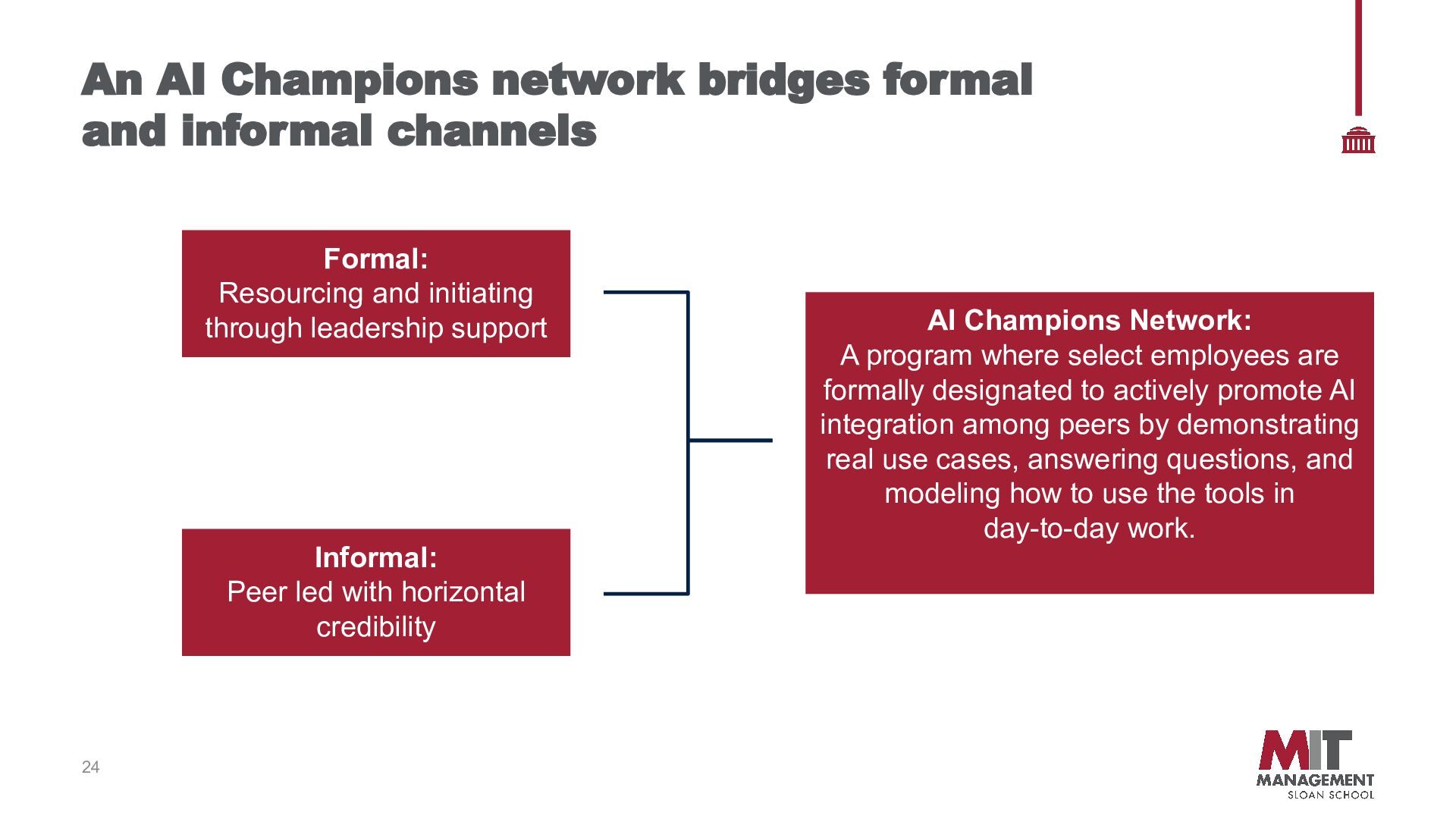
as meaningful 1 Role-Specific Proof: The shift from buzzword to useful happens through credible examples ties to someone’s actual work 2 Leaders Model, Don’t Just Mandate: Executives modeling use themselves, sharing their own experience 3 AI Champions Bridge the Formal & Informal: Semi formal channel combining peer credibility with leadership resourcing and initiative
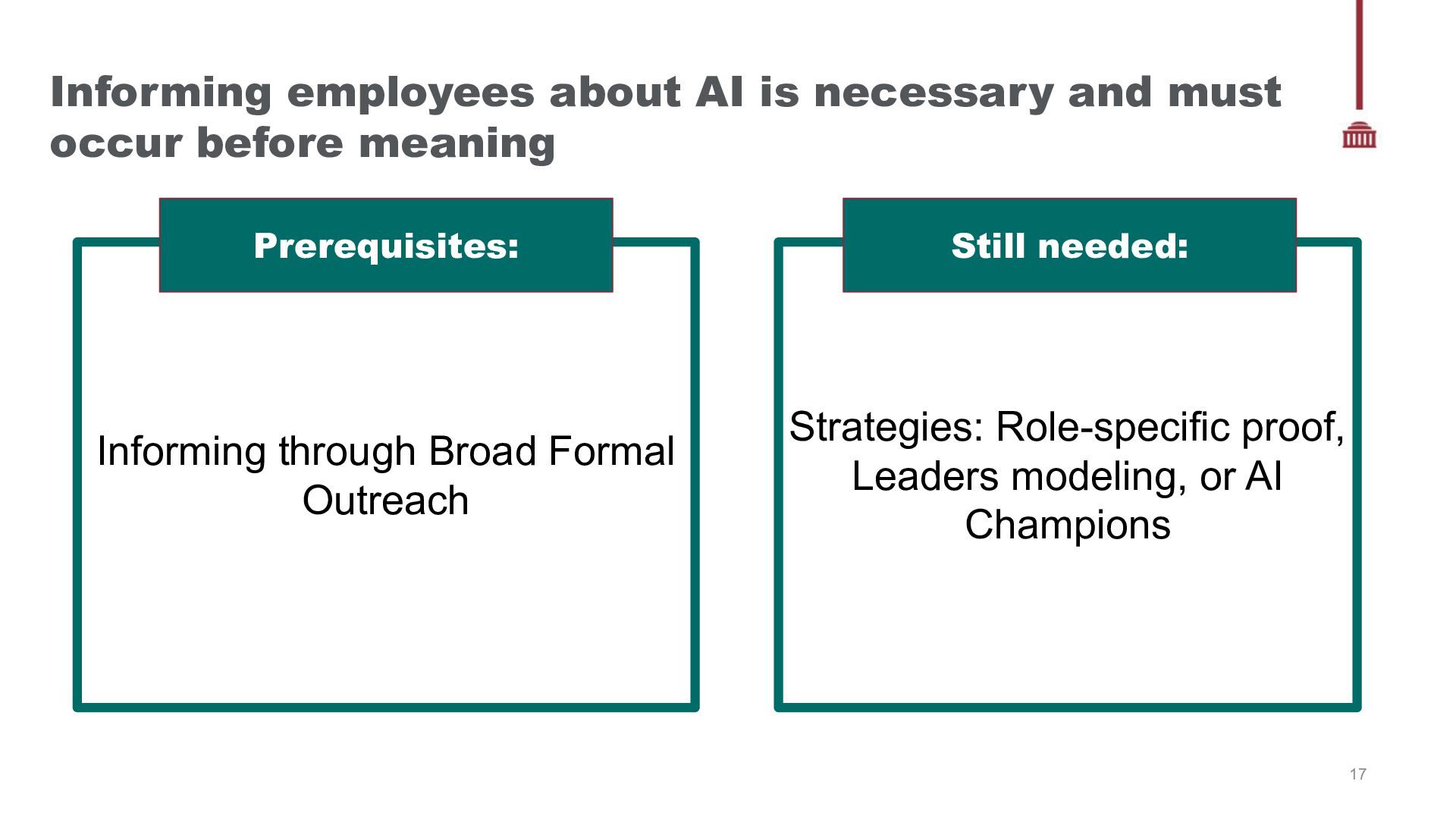
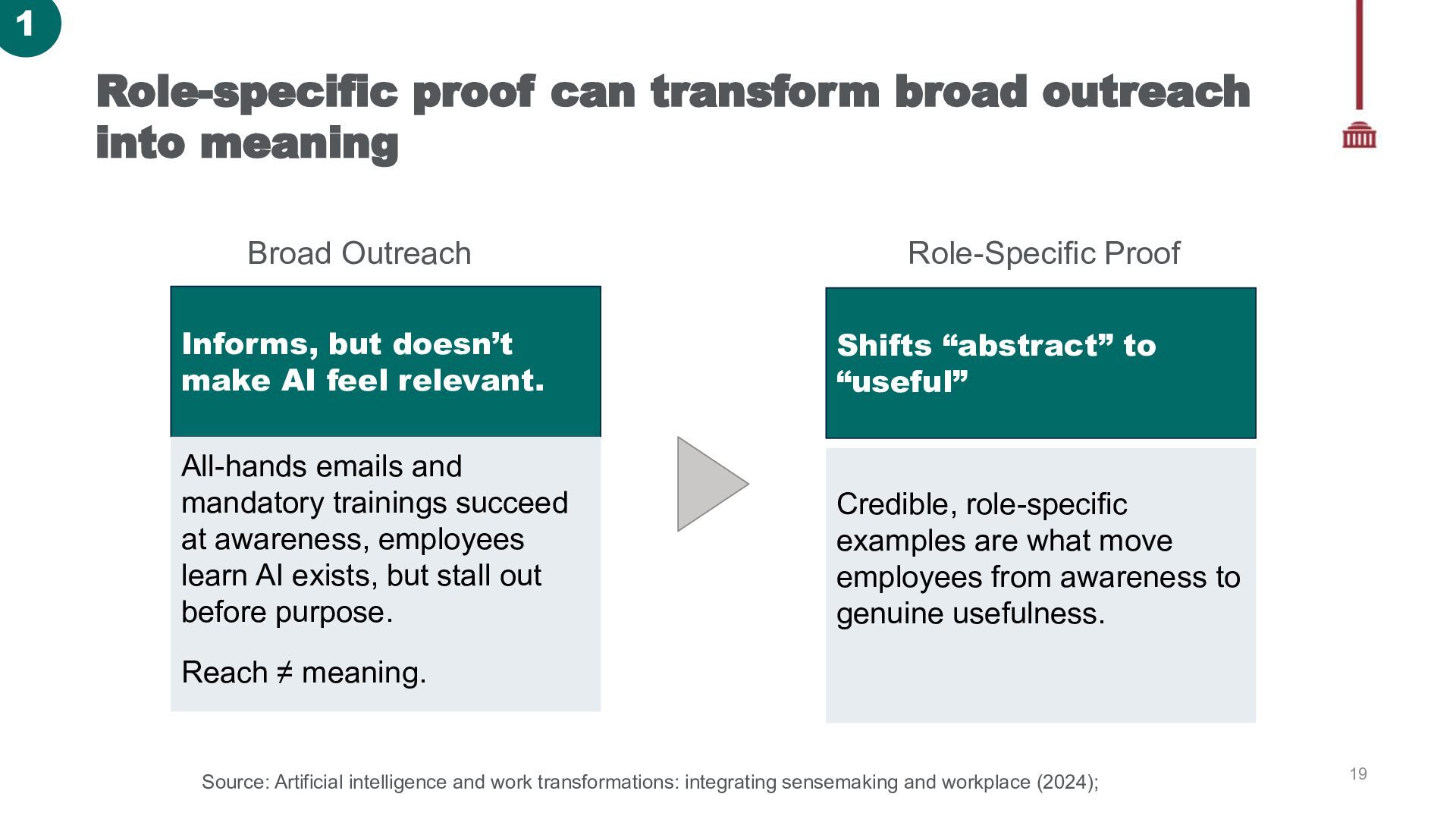
Outreach Role-Specific Proof Informs, but doesn’t make AI feel relevant. Shifts “abstract” to “useful” All-hands emails and mandatory trainings succeed at awareness, employees learn AI exists, but stall out before purpose. Credible, role-specific examples are what move employees from awareness to genuine usefulness. Reach ≠ meaning. Source: Artificial intelligence and work transformations: integrating sensemaking and workplace (2024); 19
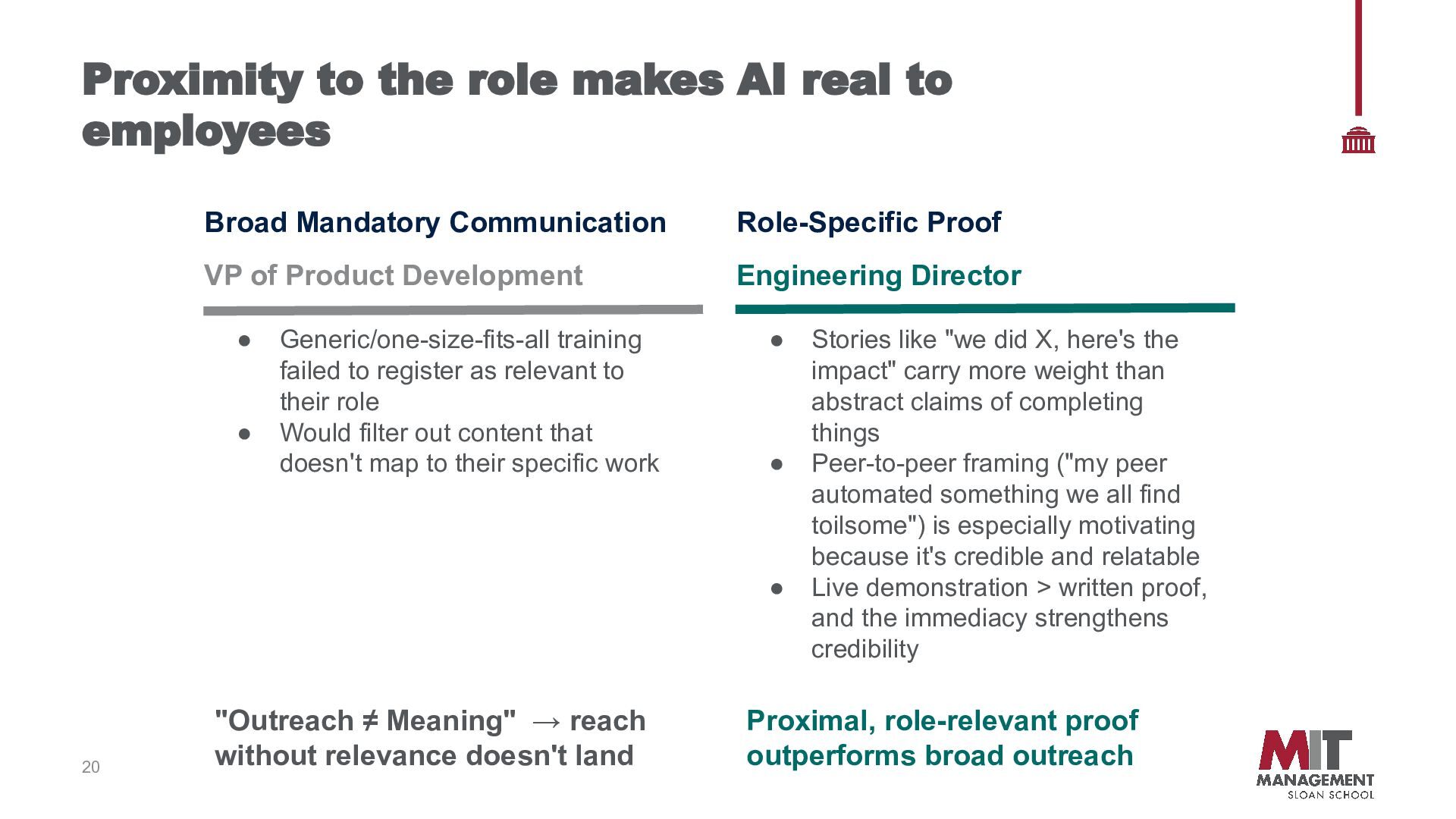
Mandatory Communication Role-Specific Proof VP of Product Development Engineering Director • • Generic/one-size-fits-all training failed to register as relevant to their role Would filter out content that doesn't map to their specific work • • • 20 "Outreach ≠ Meaning" → reach without relevance doesn't land Stories like "we did X, here's the impact" carry more weight than abstract claims of completing things Peer-to-peer framing ("my peer automated something we all find toilsome") is especially motivating because it's credible and relatable Live demonstration > written proof, and the immediacy strengthens credibility Proximal, role-relevant proof outperforms broad outreach
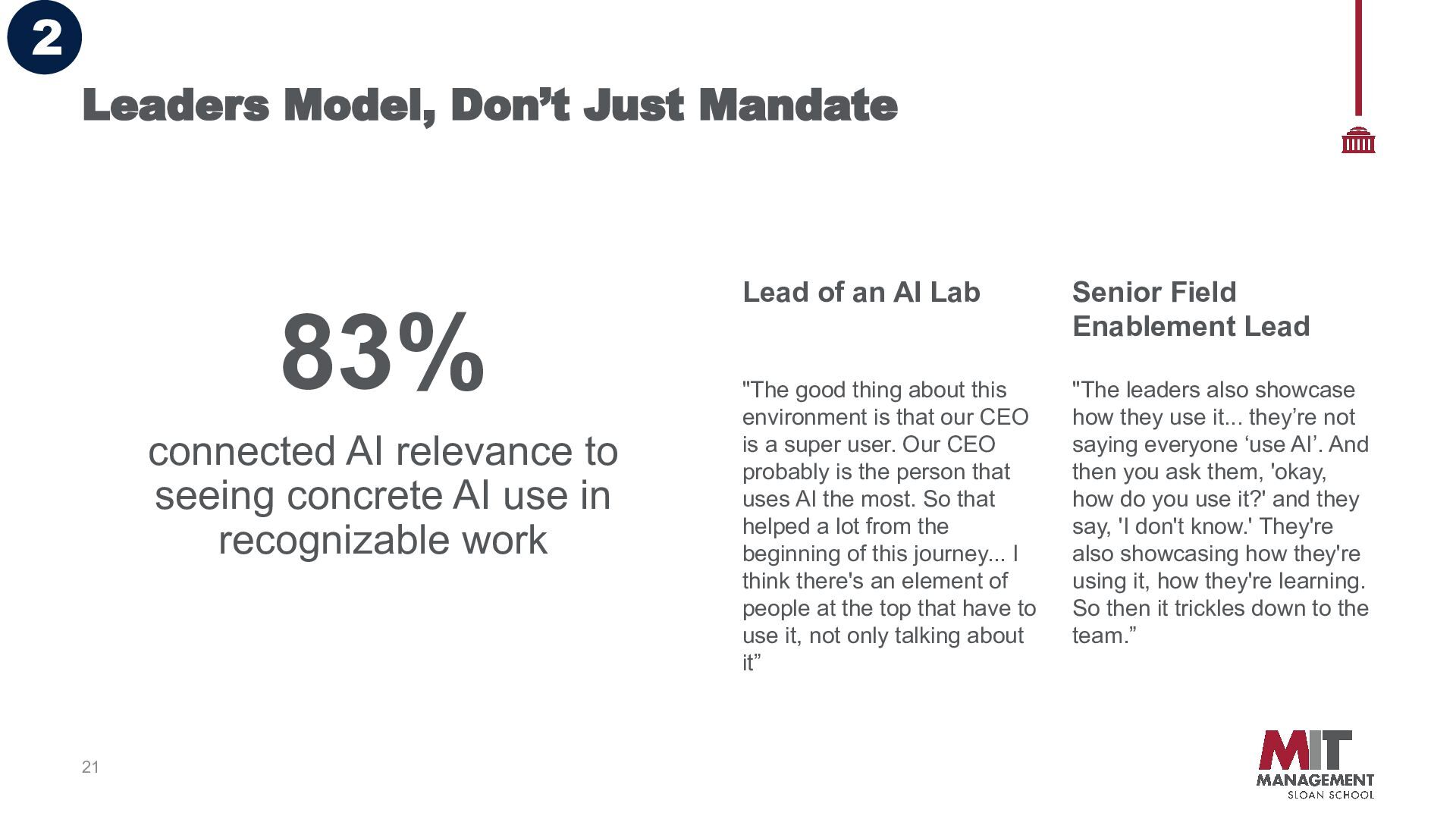
to seeing concrete AI use in recognizable work 21 Lead of an AI Lab Senior Field Enablement Lead "The good thing about this environment is that our CEO is a super user. Our CEO probably is the person that uses AI the most. So that helped a lot from the beginning of this journey... I think there's an element of people at the top that have to use it, not only talking about it” "The leaders also showcase how they use it... they’re not saying everyone ‘use AI’. And then you ask them, 'okay, how do you use it?' and they say, 'I don't know.' They're also showcasing how they're using it, how they're learning. So then it trickles down to the team.”
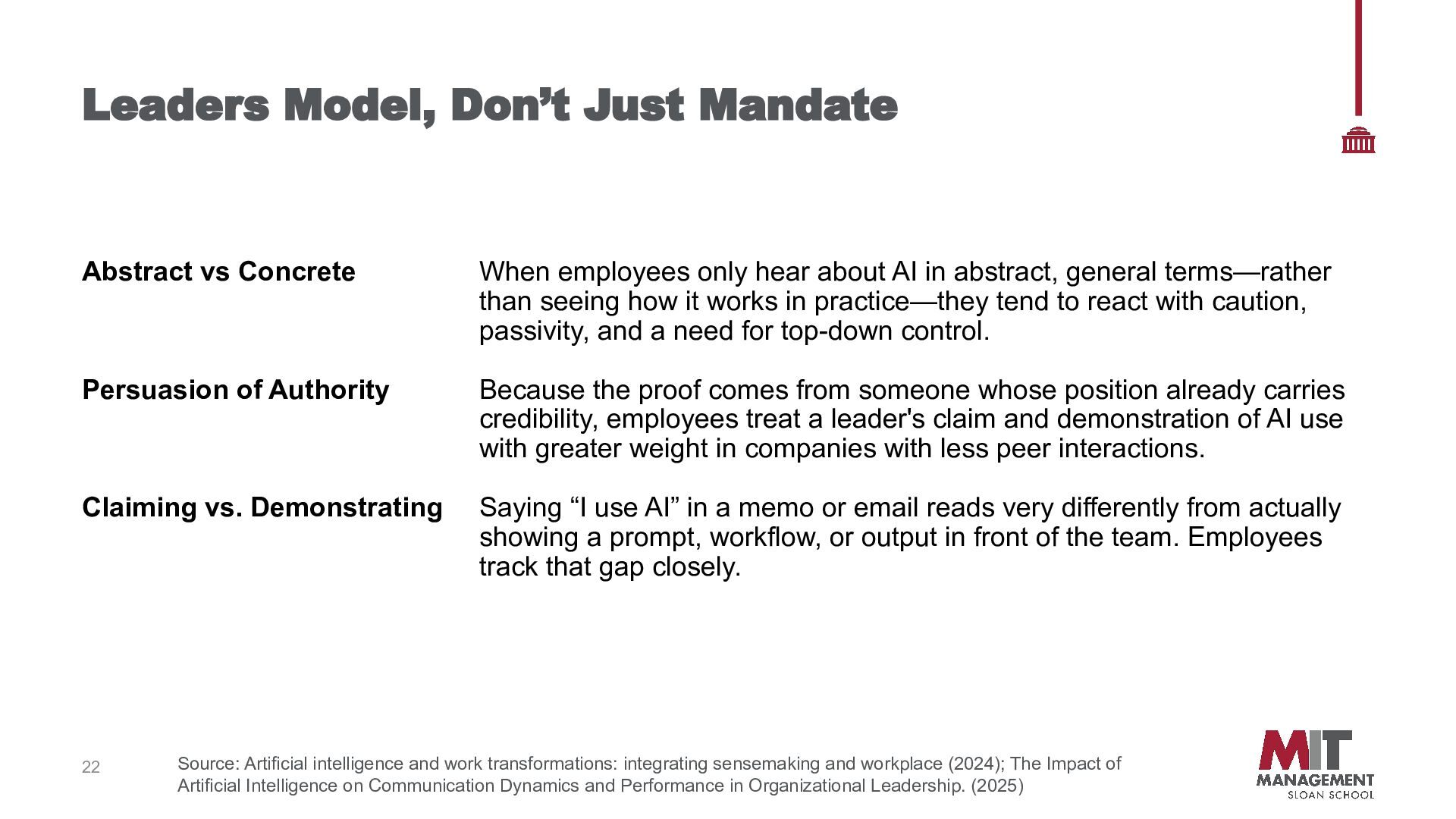
only hear about AI in abstract, general terms—rather than seeing how it works in practice—they tend to react with caution, passivity, and a need for top-down control. Persuasion of Authority Because the proof comes from someone whose position already carries credibility, employees treat a leader's claim and demonstration of AI use with greater weight in companies with less peer interactions. Claiming vs. Demonstrating Saying “I use AI” in a memo or email reads very differently from actually showing a prompt, workflow, or output in front of the team. Employees track that gap closely. 22 Source: Artificial intelligence and work transformations: integrating sensemaking and workplace (2024); The Impact of Artificial Intelligence on Communication Dynamics and Performance in Organizational Leadership. (2025)
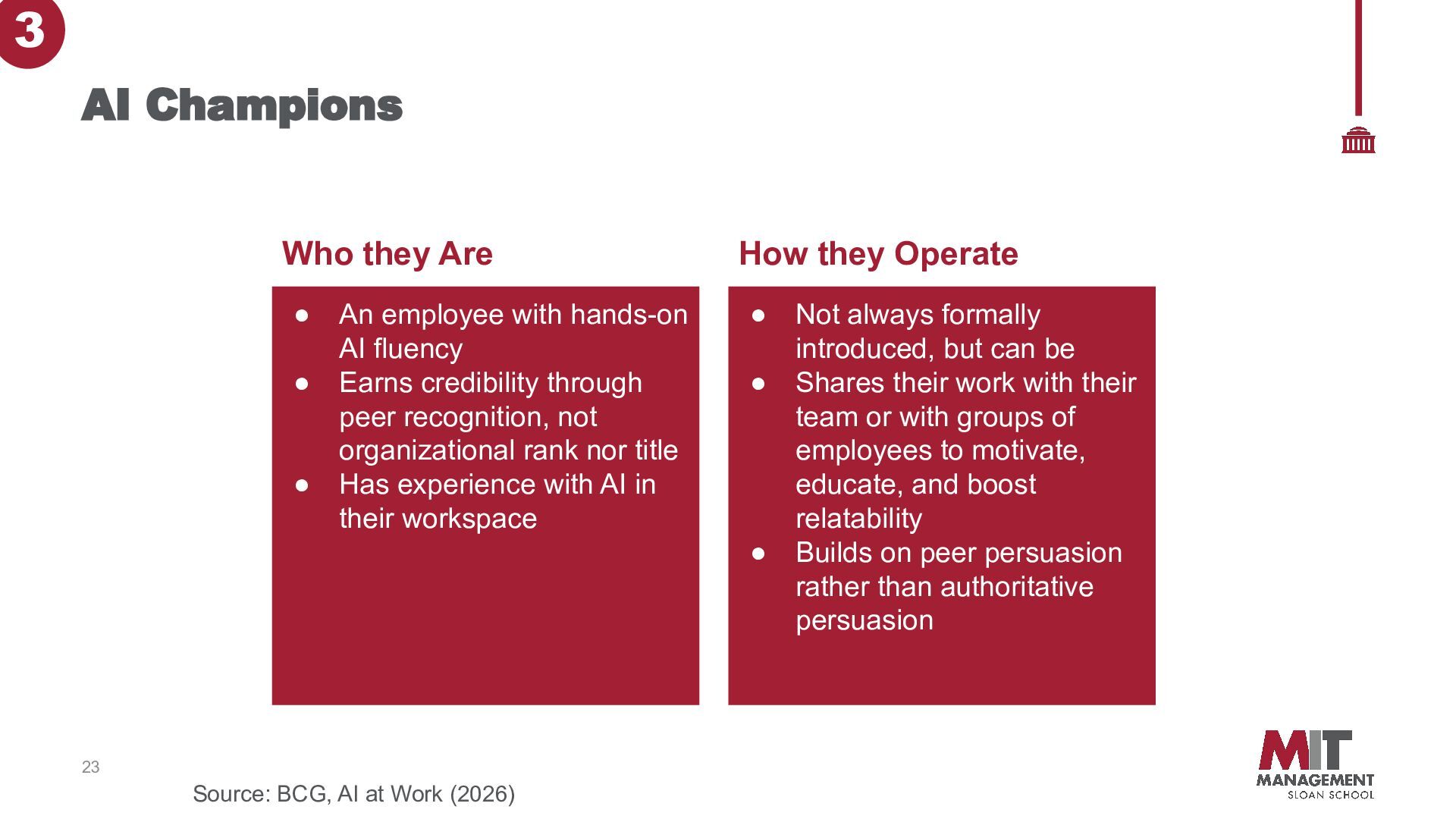
An employee with hands-on AI fluency • Earns credibility through peer recognition, not organizational rank nor title • Has experience with AI in their workspace • Not always formally introduced, but can be • Shares their work with their team or with groups of employees to motivate, educate, and boost relatability • Builds on peer persuasion rather than authoritative persuasion 23 Source: BCG, AI at Work (2026)
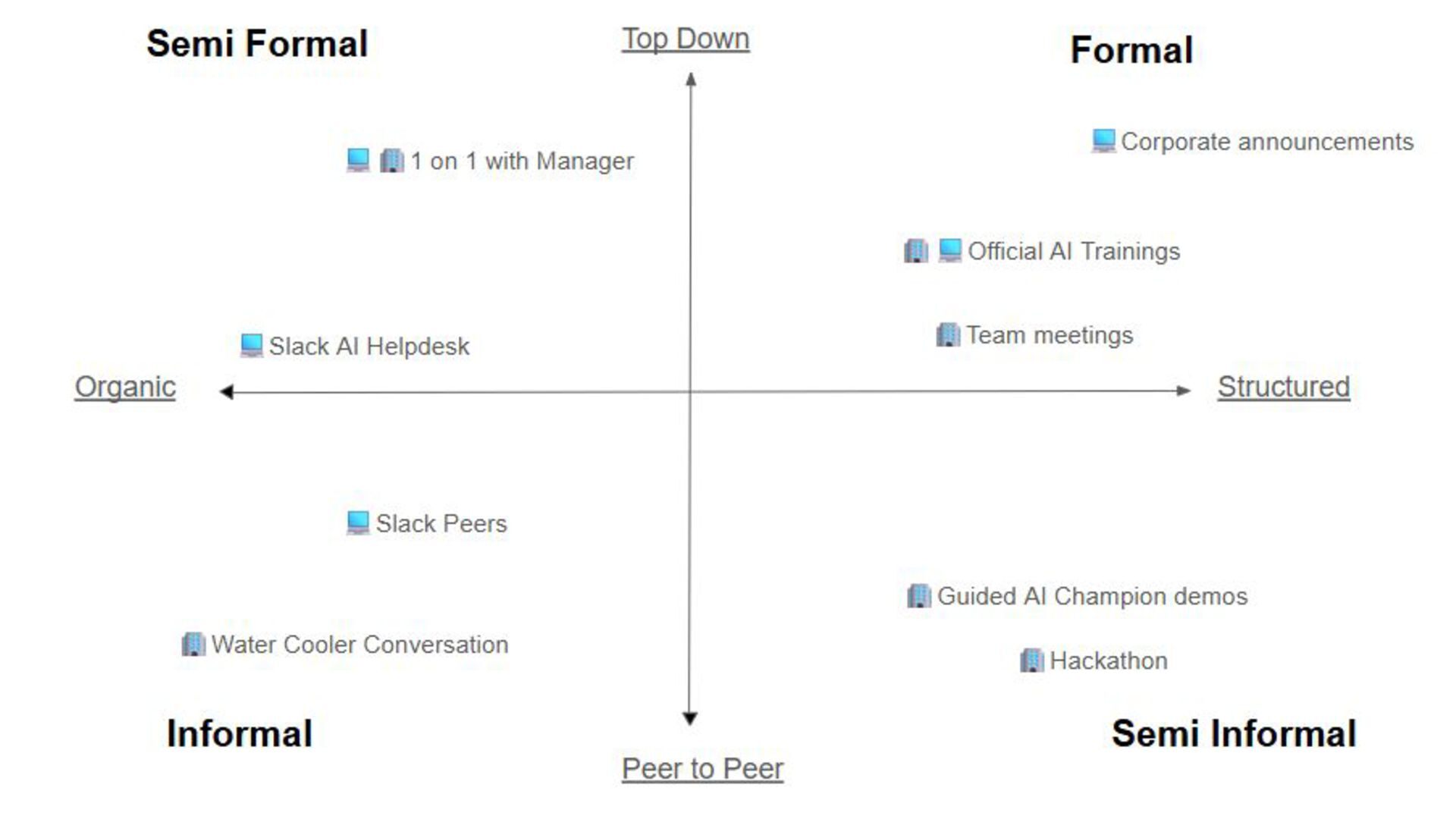
Resourcing and initiating through leadership support Informal: Peer led with horizontal credibility 24 AI Champions Network: A program where select employees are formally designated to actively promote AI integration among peers by demonstrating real use cases, answering questions, and modeling how to use the tools in day-to-day work.
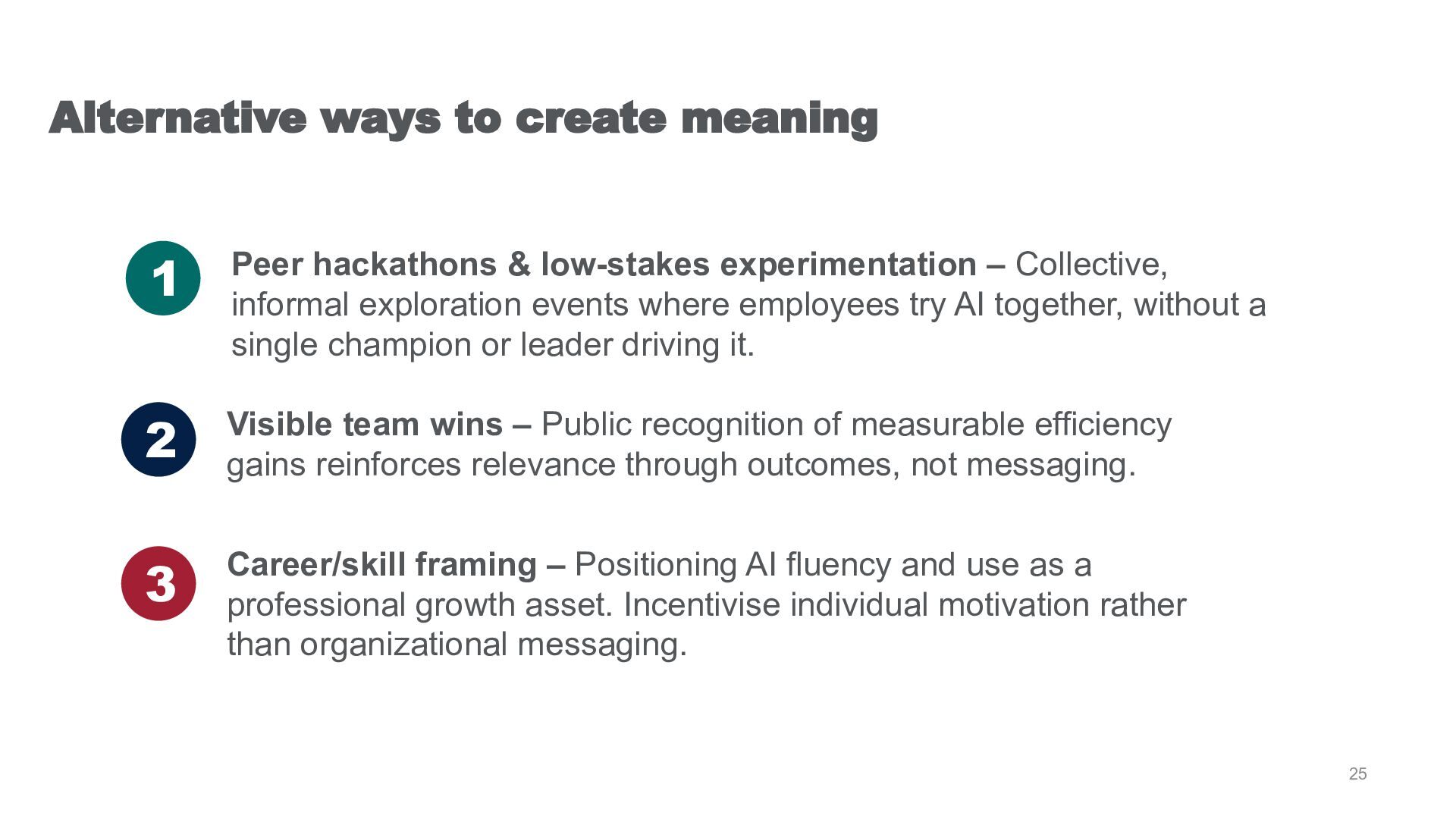
experimentation – Collective, informal exploration events where employees try AI together, without a single champion or leader driving it. 2 Visible team wins – Public recognition of measurable efficiency gains reinforces relevance through outcomes, not messaging. 3 Career/skill framing – Positioning AI fluency and use as a professional growth asset. Incentivise individual motivation rather than organizational messaging. 25
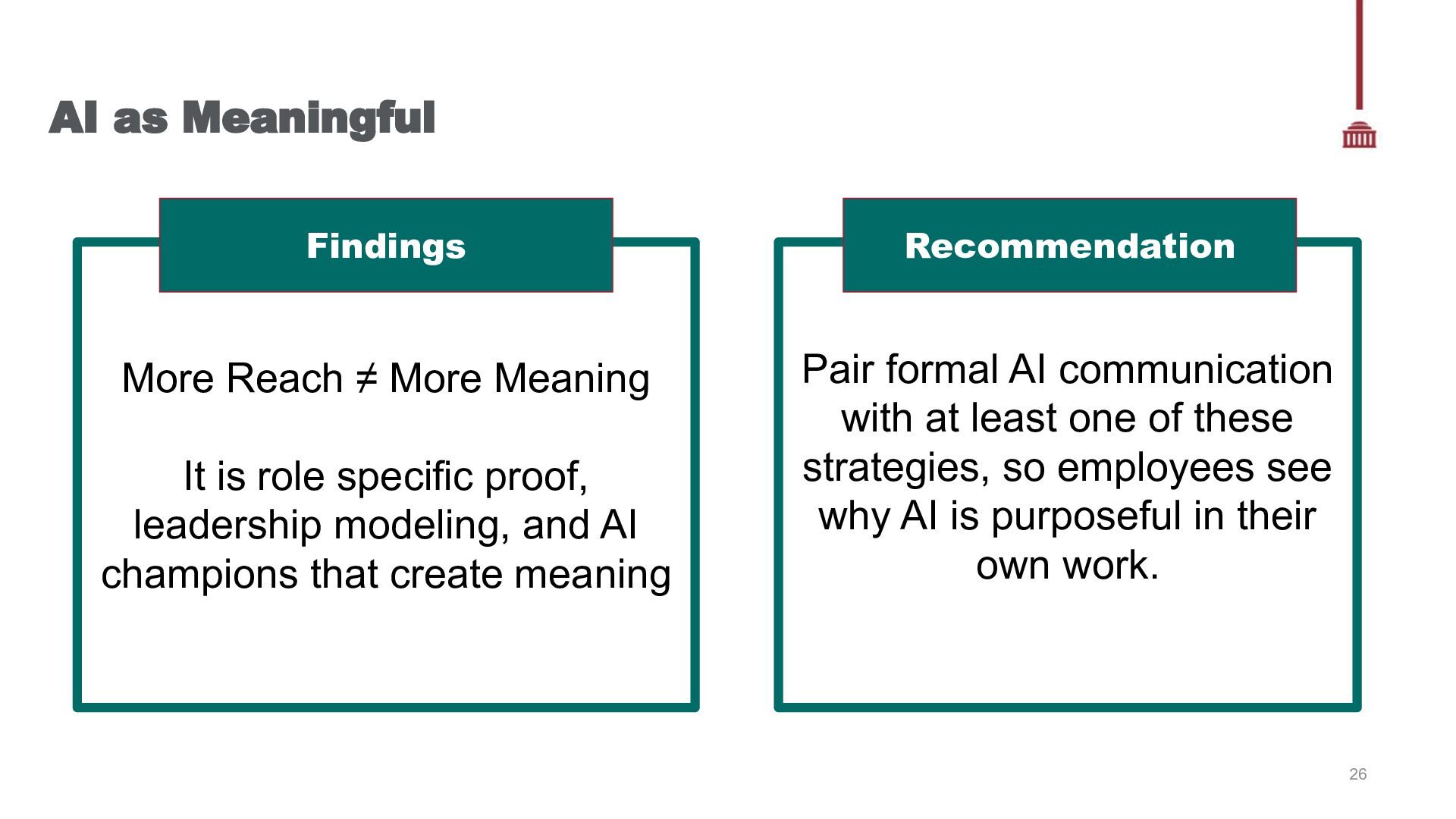
Pair formal AI communication with at least one of these strategies, so employees see why AI is purposeful in their own work. It is role specific proof, leadership modeling, and AI champions that create meaning 26
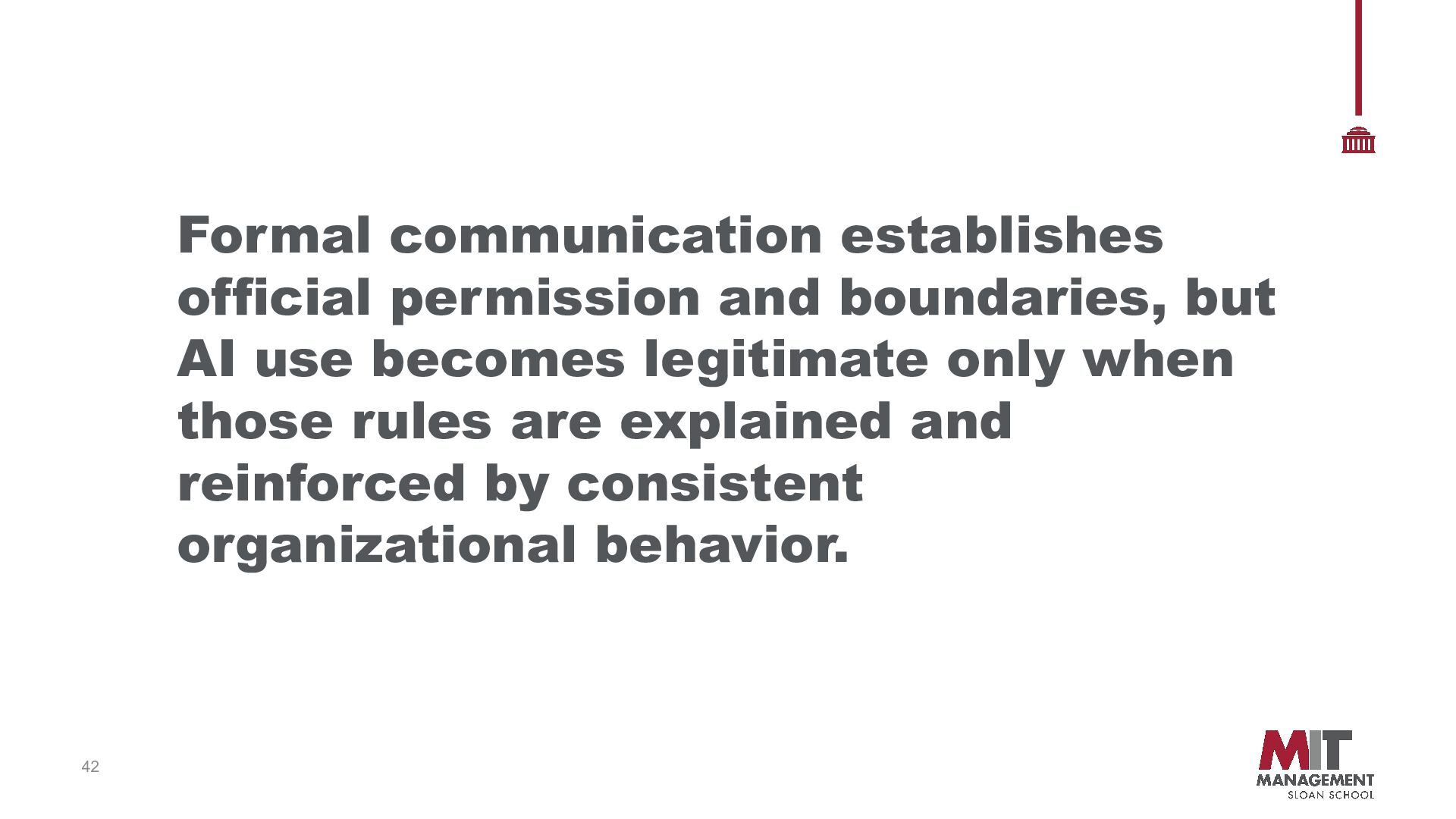
becomes legitimate only when those rules are explained and reinforced by consistent organizational behavior. 1. Clear explicit guardrails make AI legitimate 30
becomes legitimate only when those rules are explained and reinforced by consistent organizational behavior. 1. Clear explicit guardrails make AI legitimate 2. Prohibition without explanation or alternatives undermine legitimacy 31
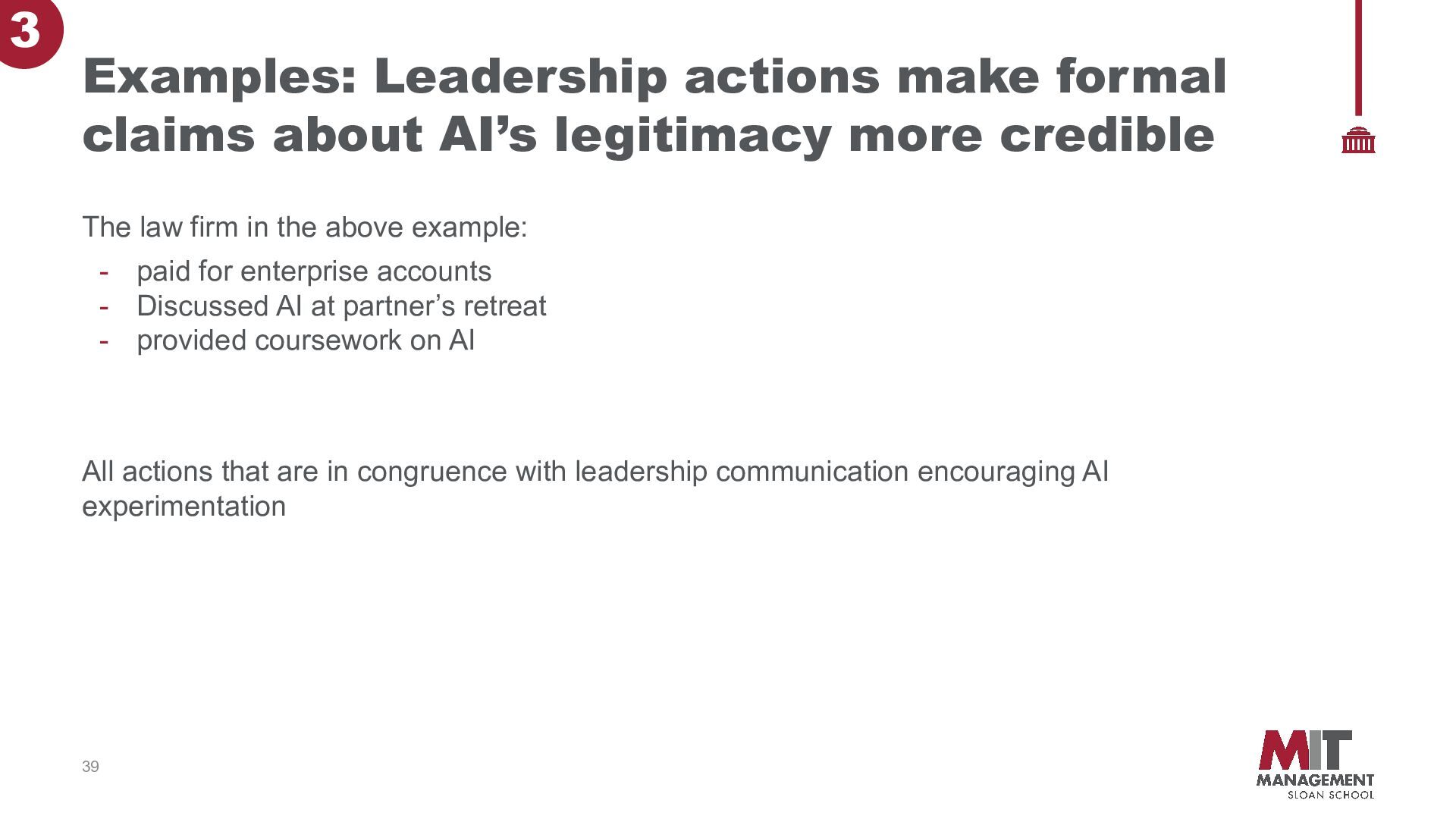
becomes legitimate only when those rules are explained and reinforced by consistent organizational behavior. 1. Clear explicit guardrails make AI legitimate 2. Prohibition without explanation or alternatives undermine legitimacy 3. Leadership actions make formal claims about AI’s legitimacy more credible 32
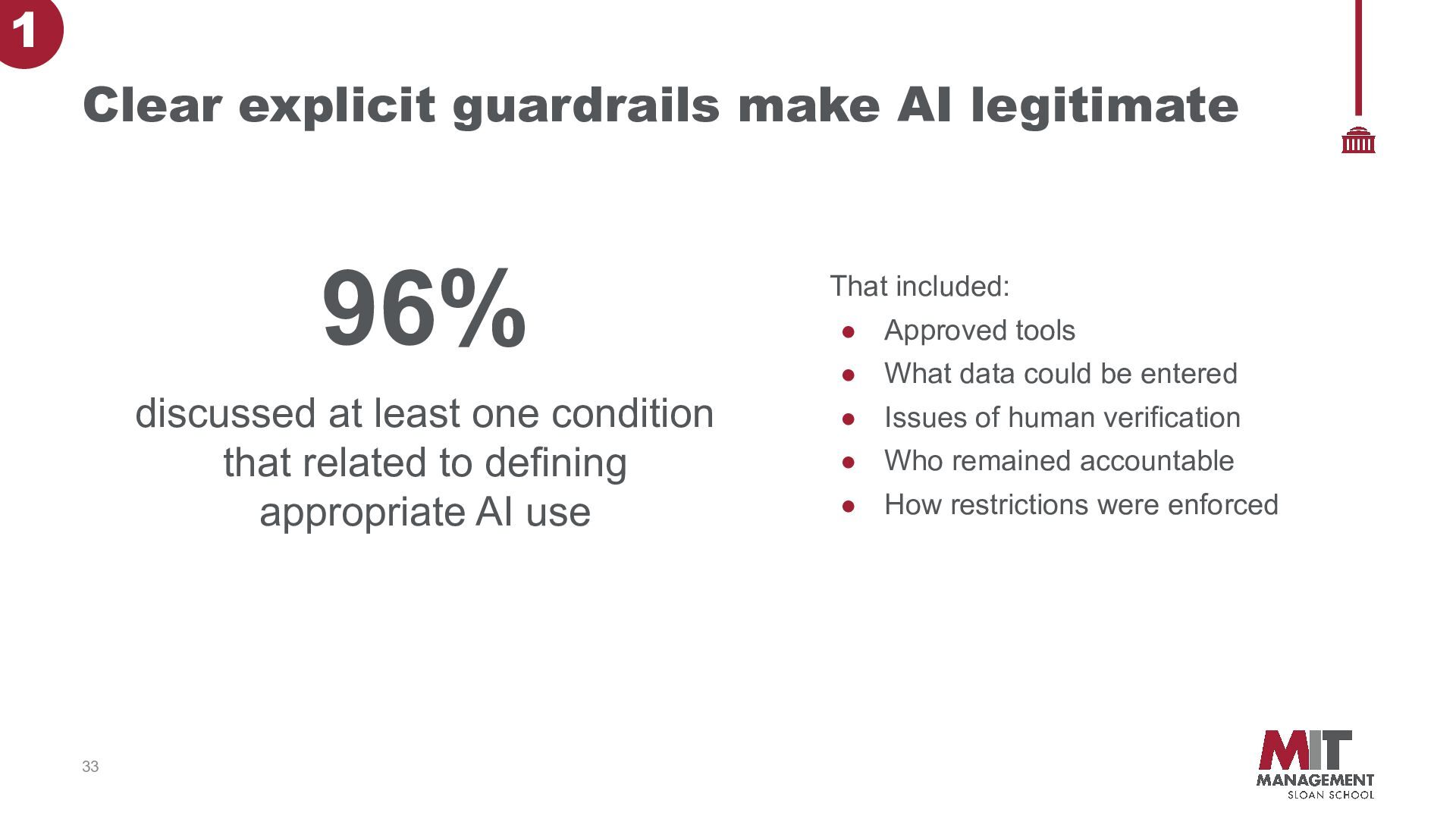
least one condition that related to defining appropriate AI use 33 That included: • Approved tools • What data could be entered • Issues of human verification • Who remained accountable • How restrictions were enforced
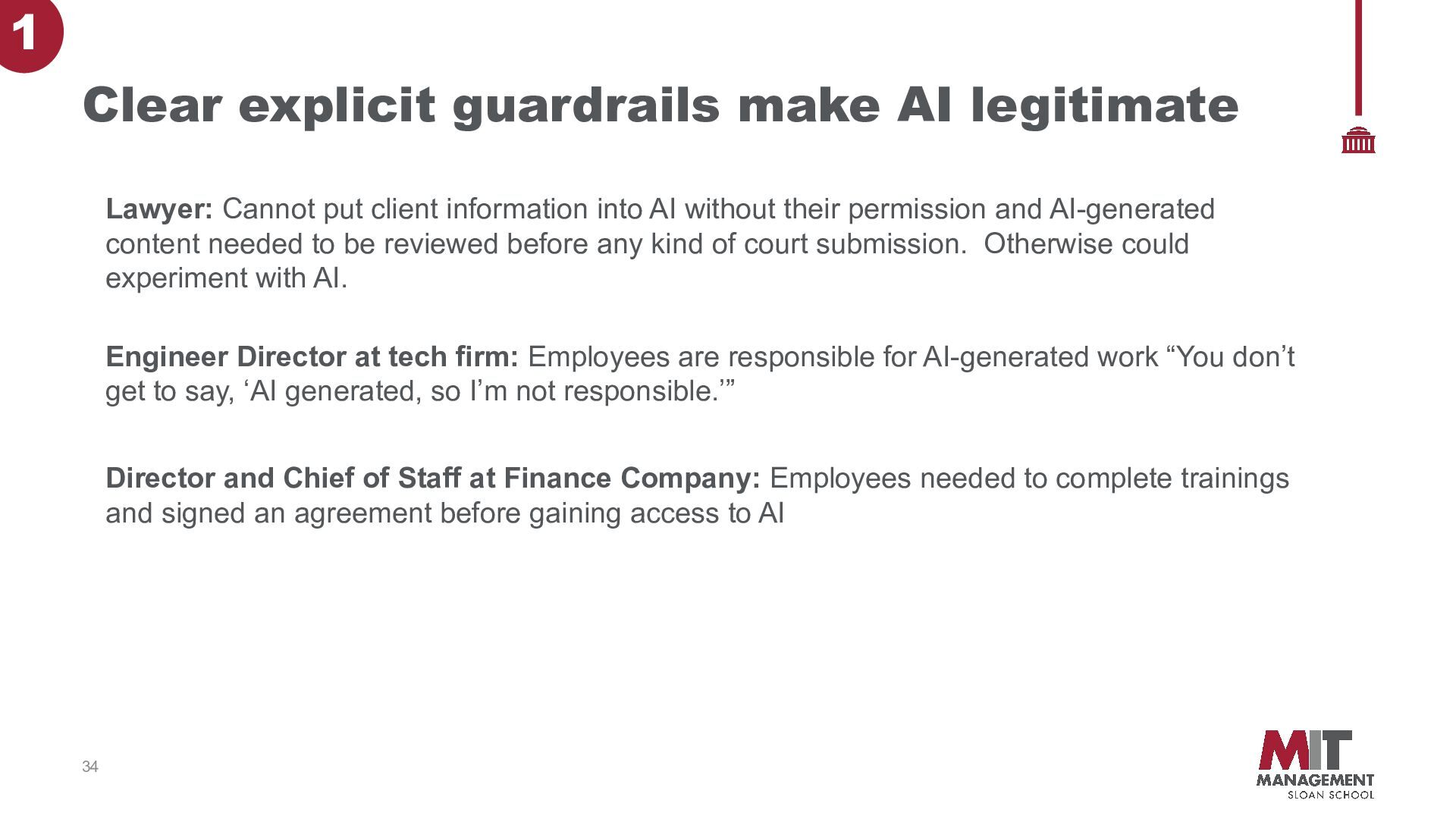
client information into AI without their permission and AI-generated content needed to be reviewed before any kind of court submission. Otherwise could experiment with AI. Engineer Director at tech firm: Employees are responsible for AI-generated work “You don’t get to say, ‘AI generated, so I’m not responsible.’” Director and Chief of Staff at Finance Company: Employees needed to complete trainings and signed an agreement before gaining access to AI 34
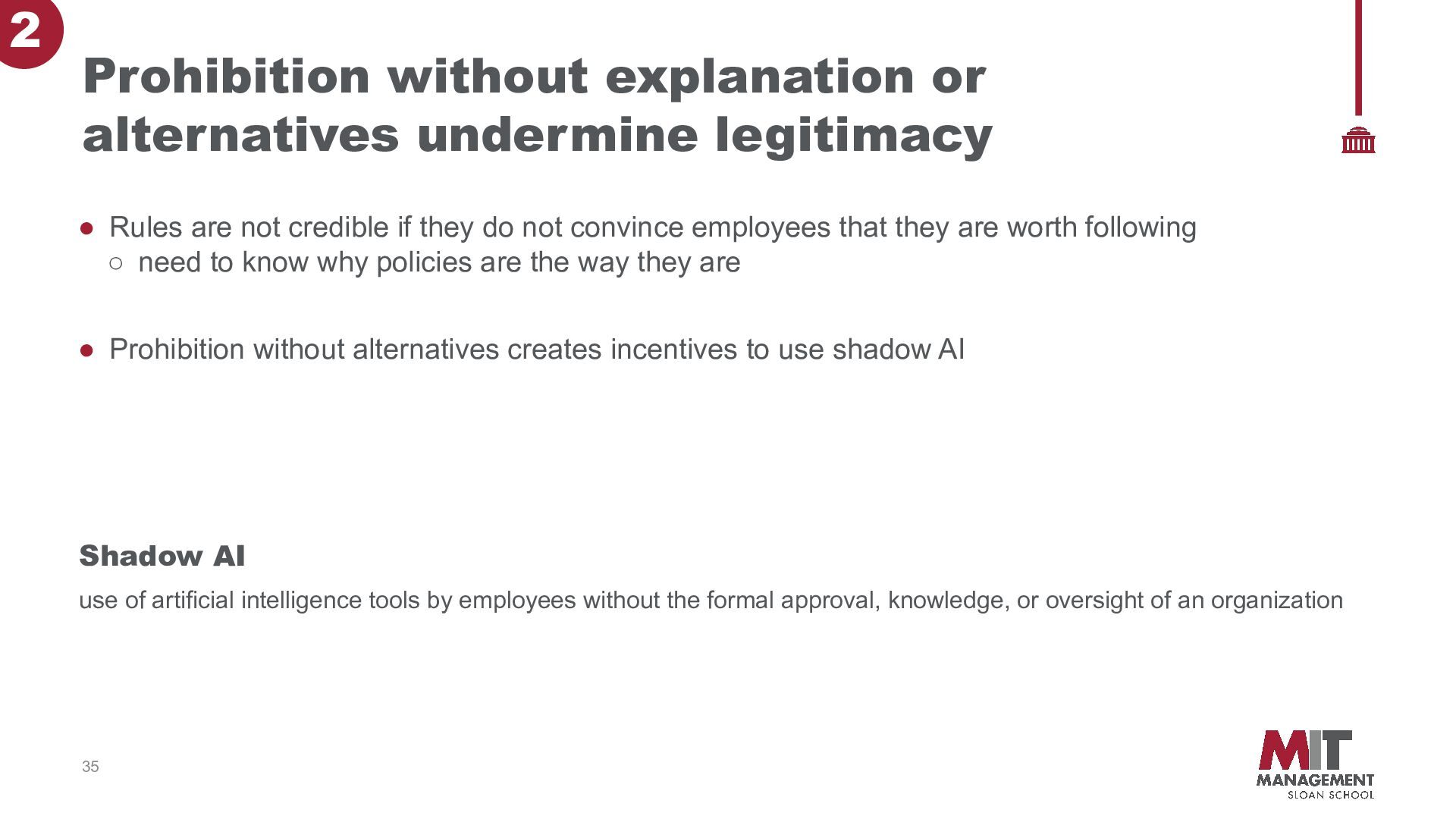
are not credible if they do not convince employees that they are worth following ◦ need to know why policies are the way they are • Prohibition without alternatives creates incentives to use shadow AI Shadow AI use of artificial intelligence tools by employees without the formal approval, knowledge, or oversight of an organization 35
it. I think you have to offer options… ‘Don’t use [DeepSeek]. You can use ChatGPT.’ …What are you trying to build, and let’s see if we have something that you can use instead of just… saying, ‘This is the law.’” Senior Director at Manufacturing Company 36
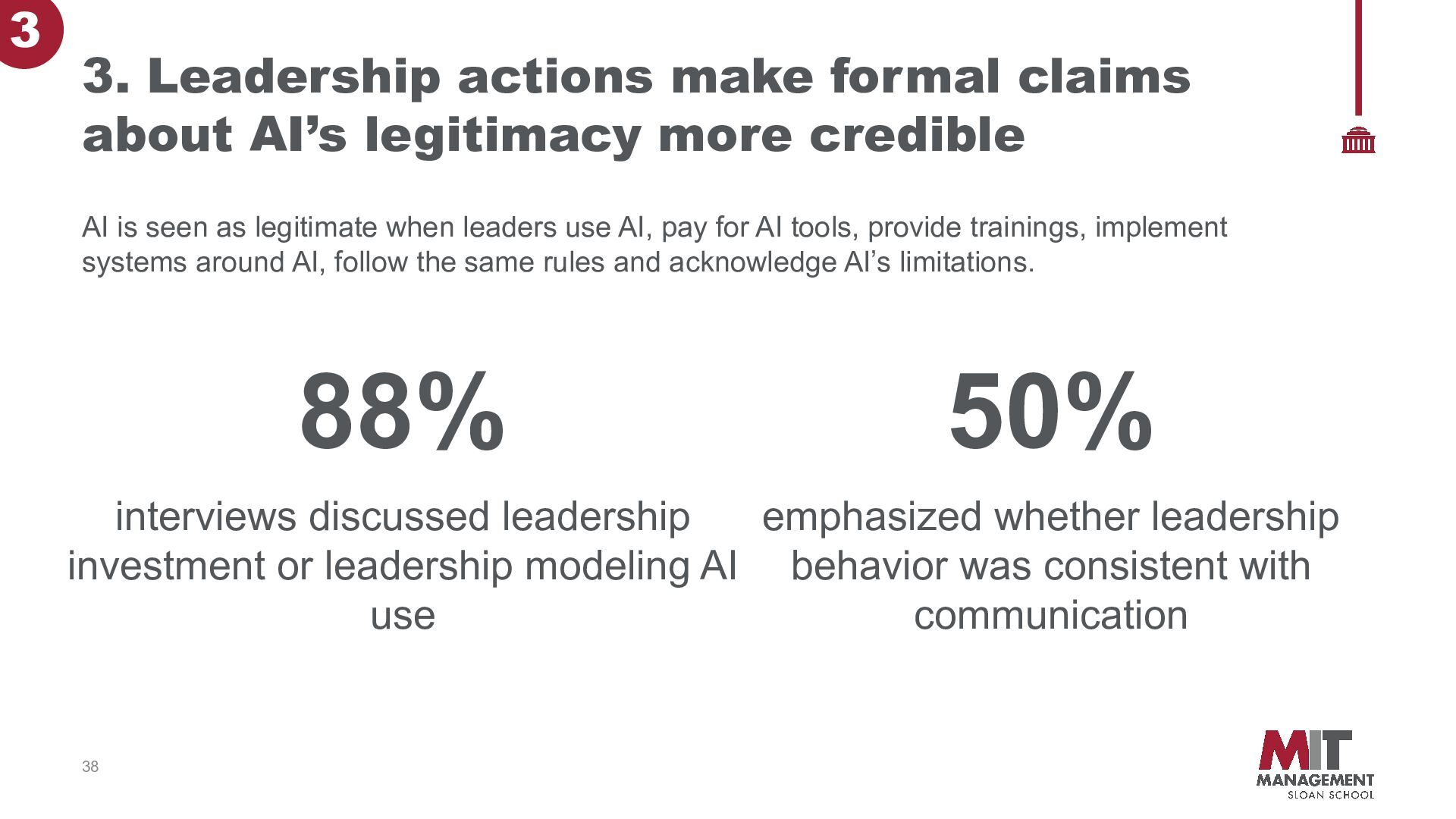
more credible AI is seen as legitimate when leaders use AI, pay for AI tools, provide trainings, implement systems around AI, follow the same rules and acknowledge AI’s limitations. 88% 50% interviews discussed leadership emphasized whether leadership investment or leadership modeling AI behavior was consistent with use communication 38
more credible The law firm in the above example: - paid for enterprise accounts - Discussed AI at partner’s retreat - provided coursework on AI All actions that are in congruence with leadership communication encouraging AI experimentation 39
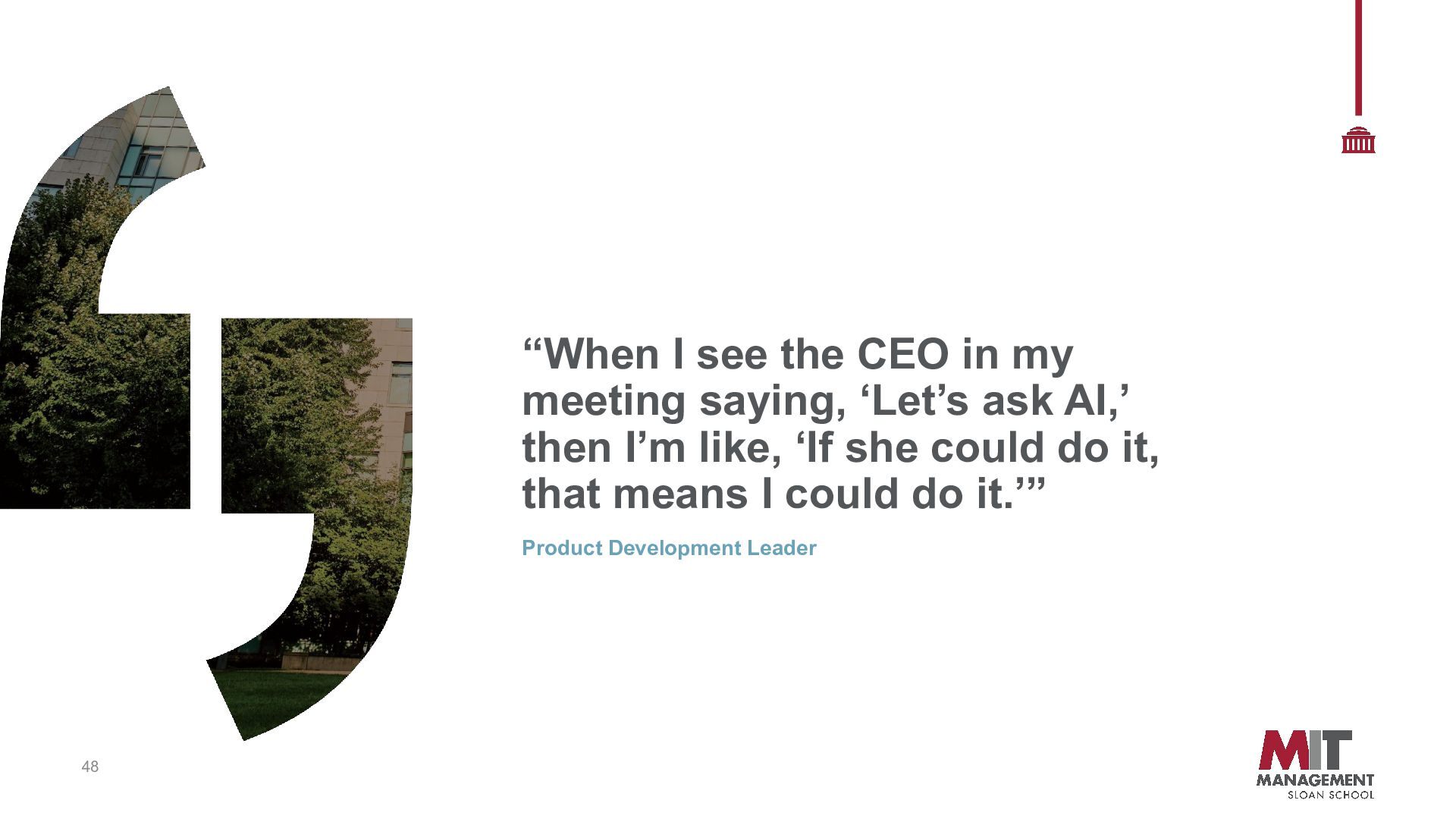
employees should not be using any other AI outside of Copilot for work purposes.” Yet, “I’ve heard executives…literally pick up their cell phones in a meeting and say, ‘Let me ask my friend ChatGPT.’” VP of Product Development at Real Estate Company 41
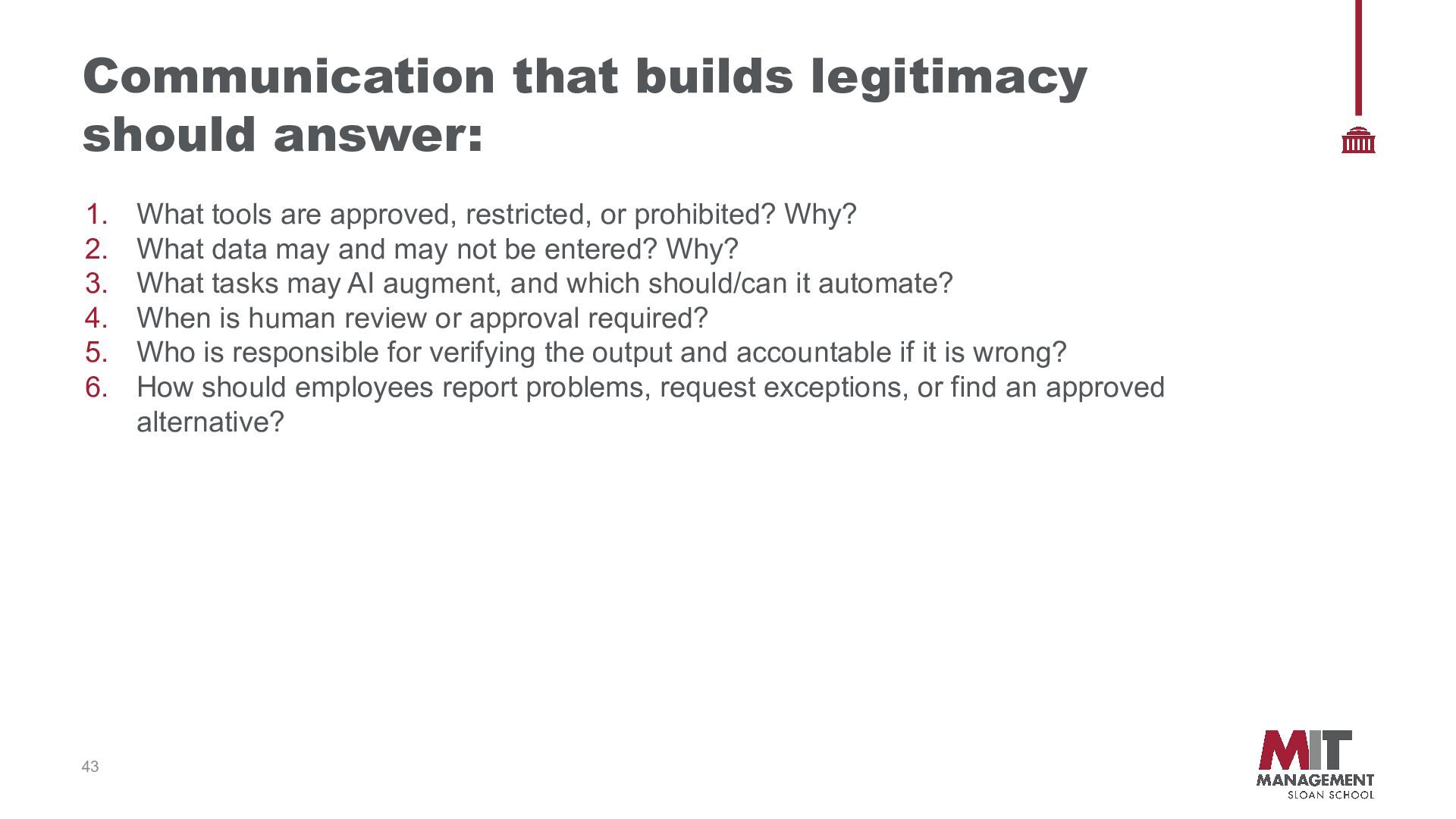
5. 6. 43 What tools are approved, restricted, or prohibited? Why? What data may and may not be entered? Why? What tasks may AI augment, and which should/can it automate? When is human review or approval required? Who is responsible for verifying the output and accountable if it is wrong? How should employees report problems, request exceptions, or find an approved alternative?
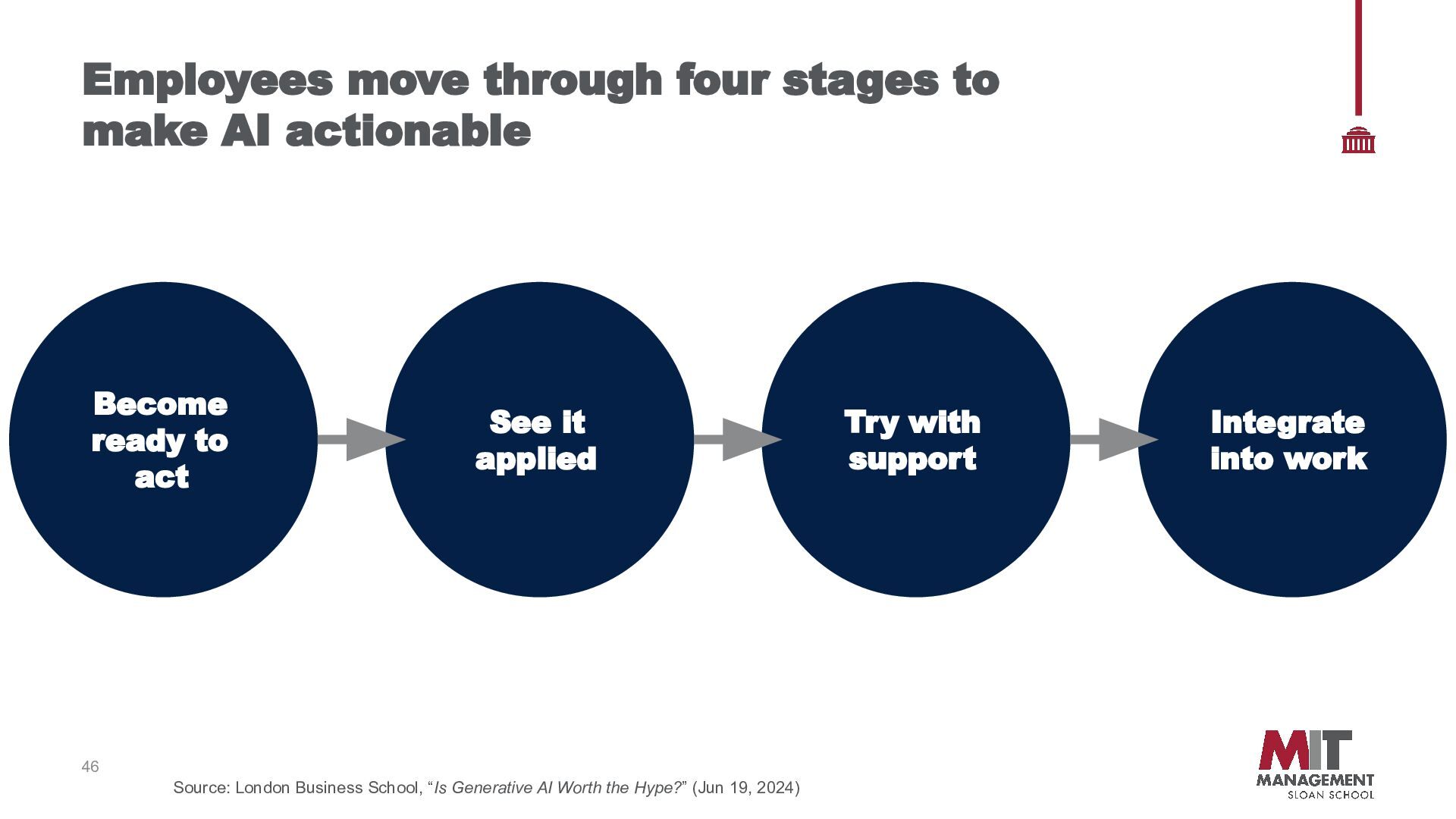
Become ready to act See it applied 46 Source: London Business School, “Is Generative AI Worth the Hype?” (Jun 19, 2024) Try with support Integrate into work
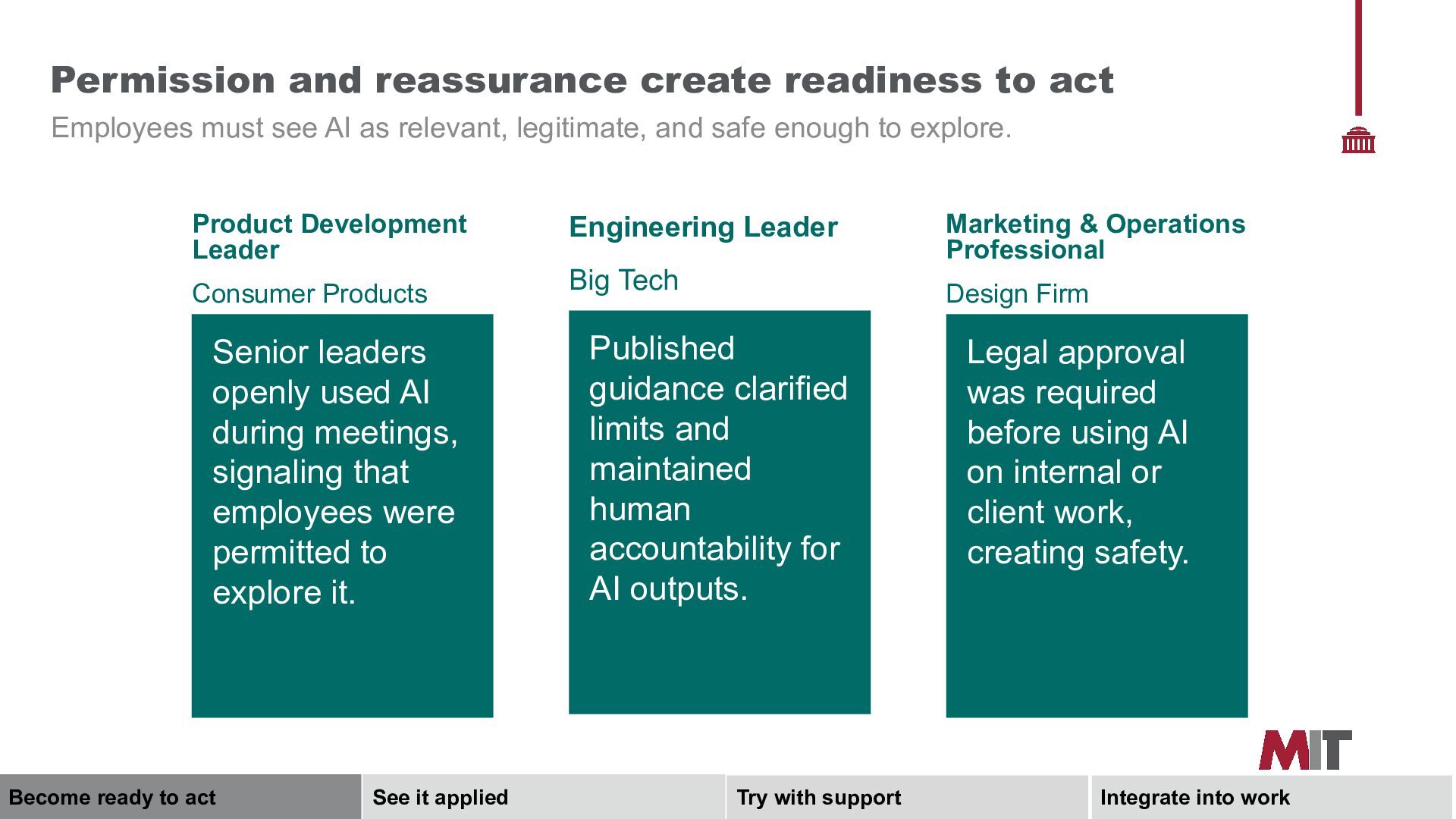
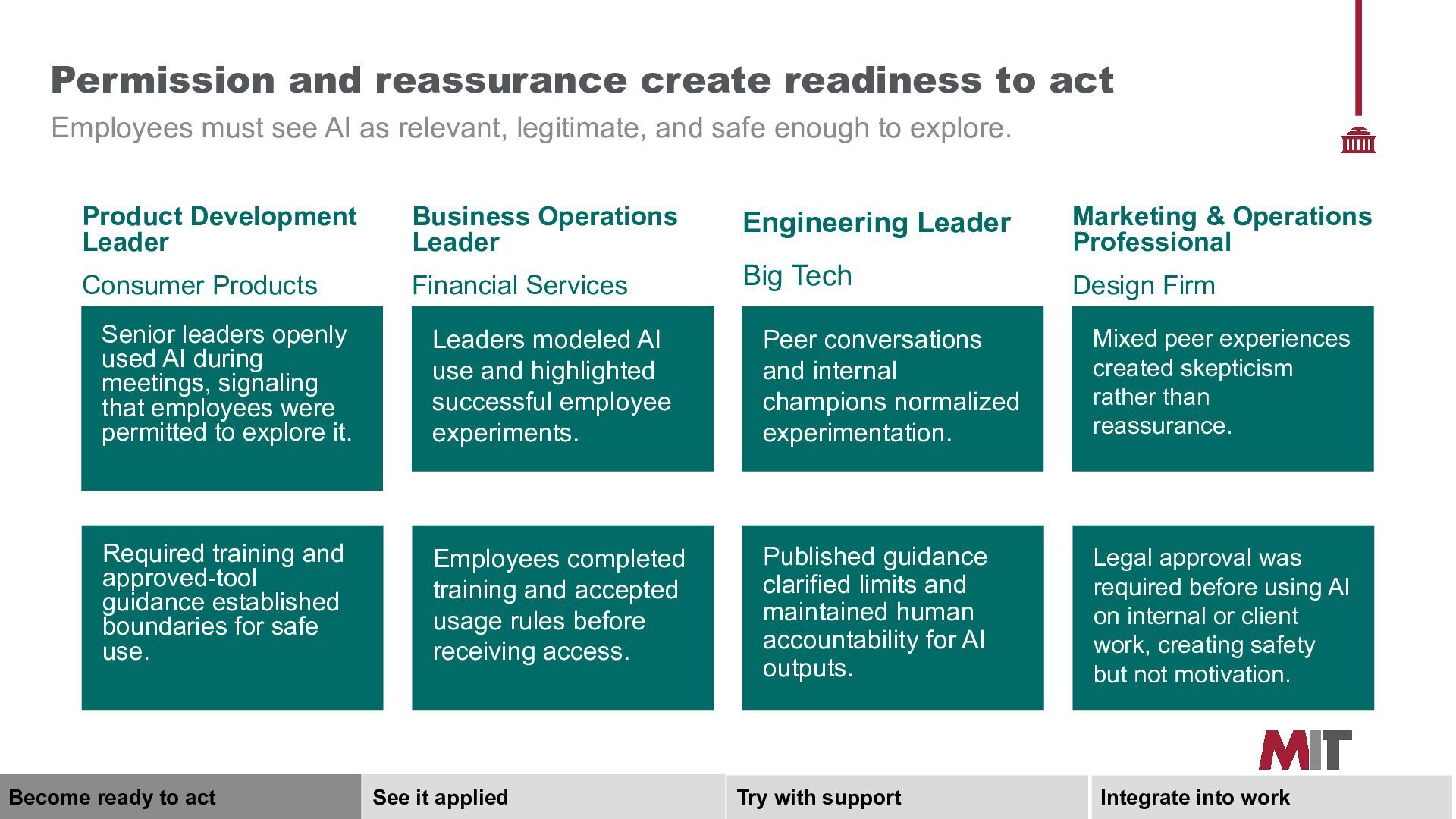
AI as relevant, legitimate, and safe enough to explore. Product Development Leader Consumer Products Senior leaders openly used AI during meetings, signaling that employees were permitted to explore it. Become ready to act See it applied Engineering Leader Big Tech Marketing & Operations Professional Design Firm Published guidance clarified limits and maintained human accountability for AI outputs. Try with support Legal approval was required before using AI on internal or client work, creating safety. Integrate into work
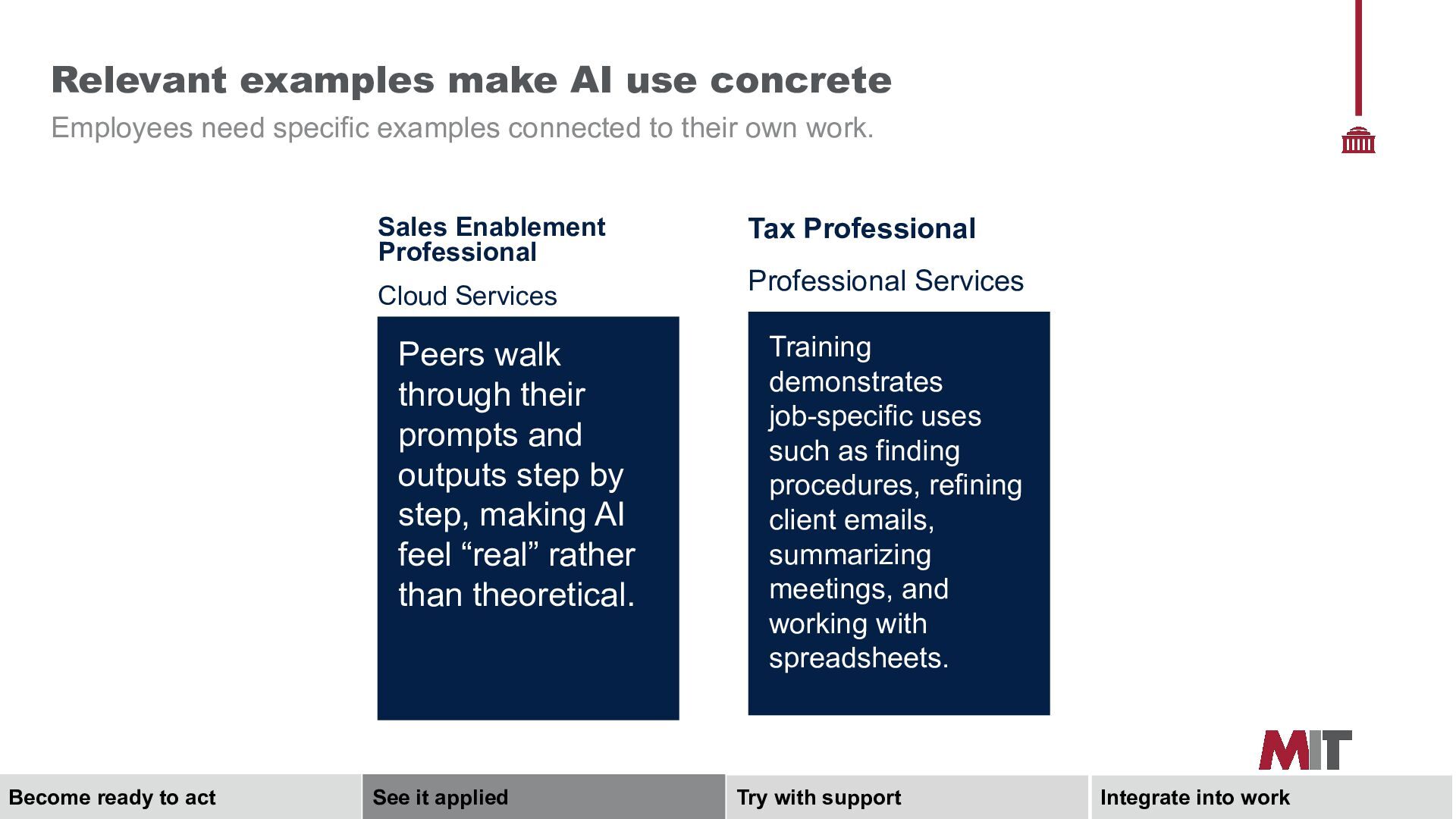
connected to their own work. Sales Enablement Professional Cloud Services Peers walk through their prompts and outputs step by step, making AI feel “real” rather than theoretical. Become ready to act See it applied Tax Professional Professional Services Training demonstrates job-specific uses such as finding procedures, refining client emails, summarizing meetings, and working with spreadsheets. Try with support Integrate into work
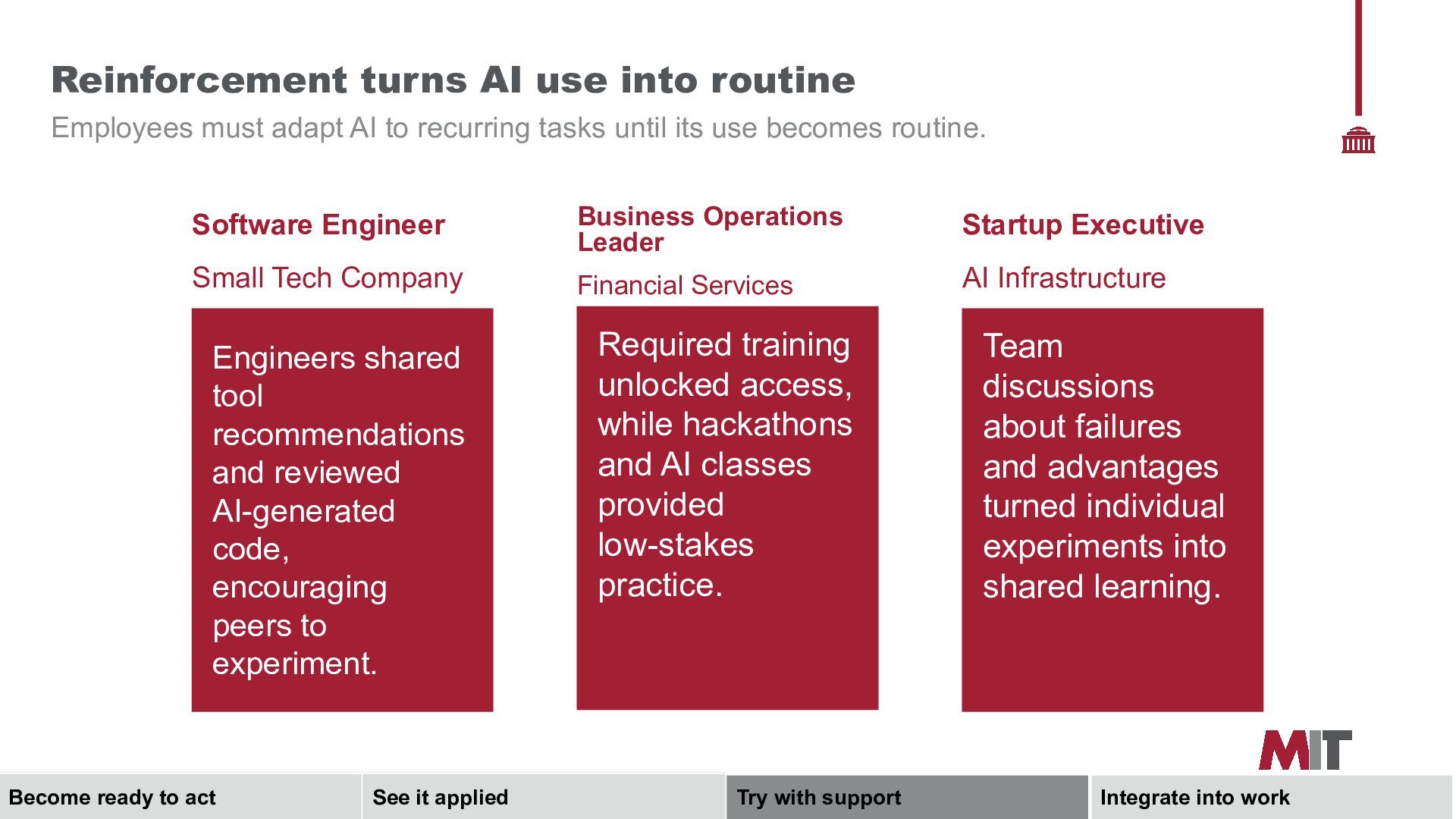
to recurring tasks until its use becomes routine. Software Engineer Business Operations Leader Startup Executive Small Tech Company Financial Services AI Infrastructure Engineers shared tool recommendations and reviewed AI-generated code, encouraging peers to experiment. Trust vs.ready Oversight Become to act Required training unlocked access, while hackathons and AI classes provided low-stakes practice. Increasing Automation See it applied Cultural / Skill Divide Try with support Team discussions about failures and advantages turned individual experiments into shared learning. Scaling Small Teams Integrate into work
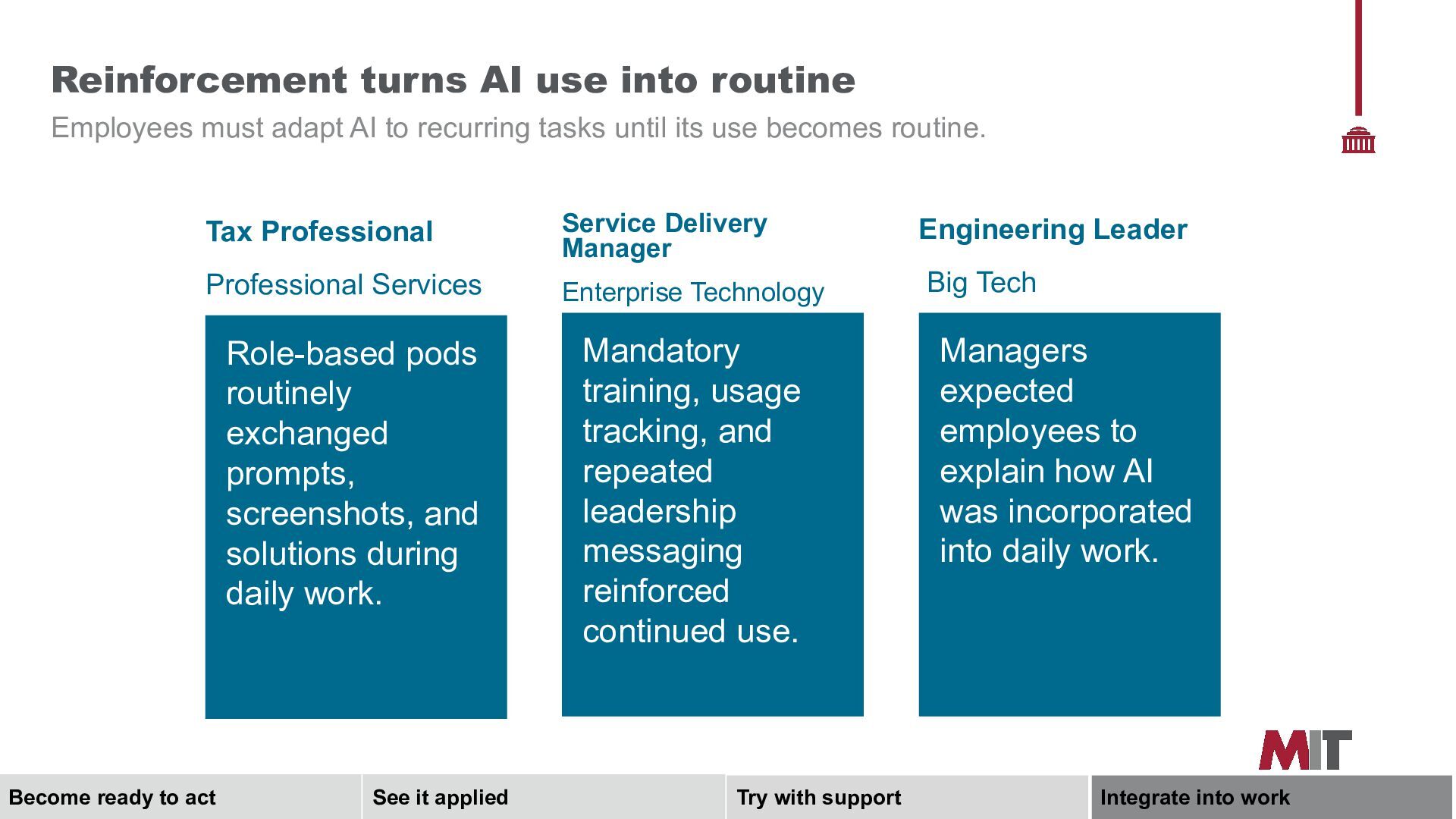
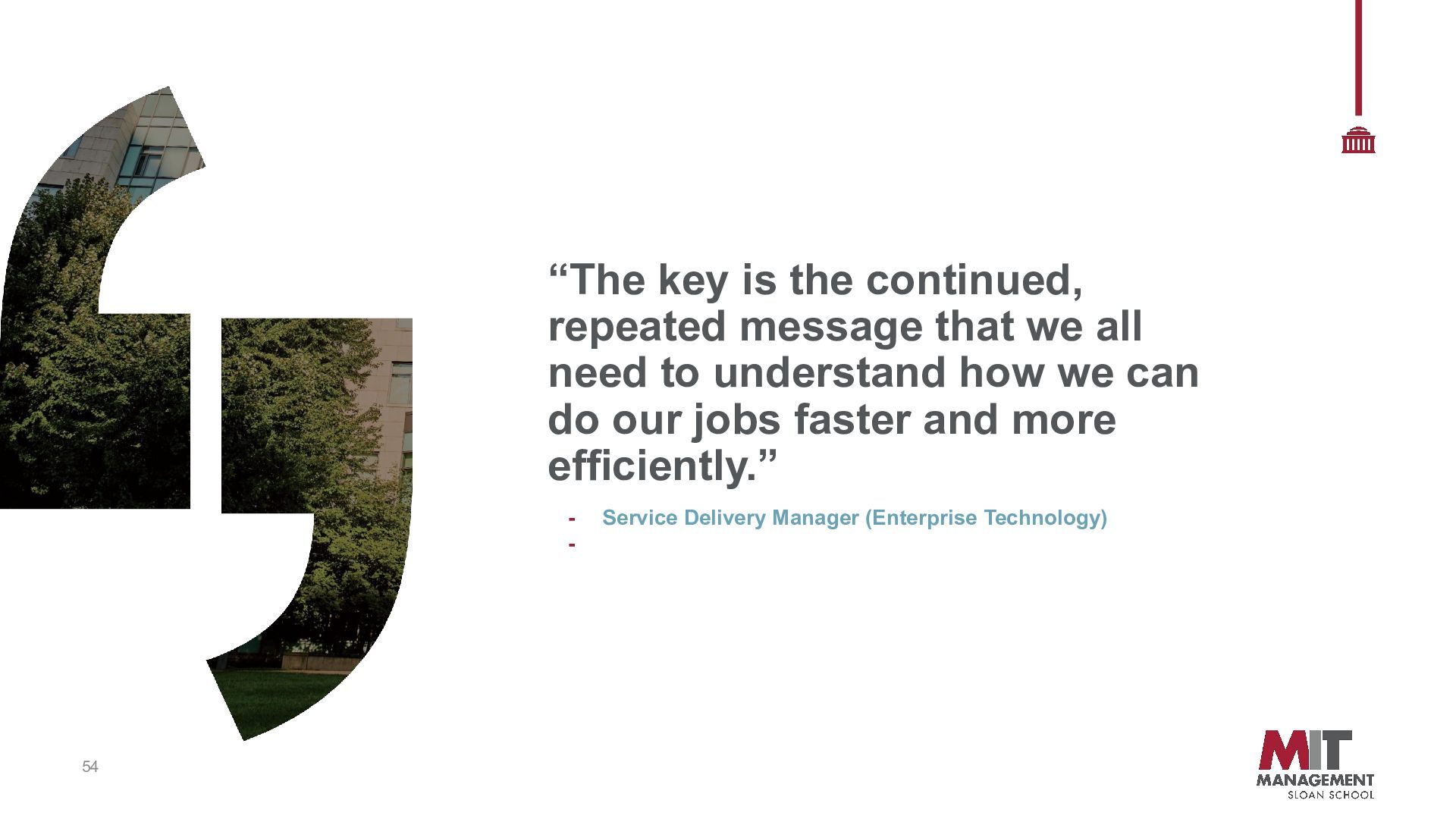
to recurring tasks until its use becomes routine. Tax Professional Service Delivery Manager Engineering Leader Professional Services Enterprise Technology Big Tech Role-based pods routinely exchanged prompts, screenshots, and solutions during daily work. Mandatory training, usage tracking, and repeated leadership messaging reinforced continued use. Become ready to act See it applied Try with support Managers expected employees to explain how AI was incorporated into daily work. Integrate into work
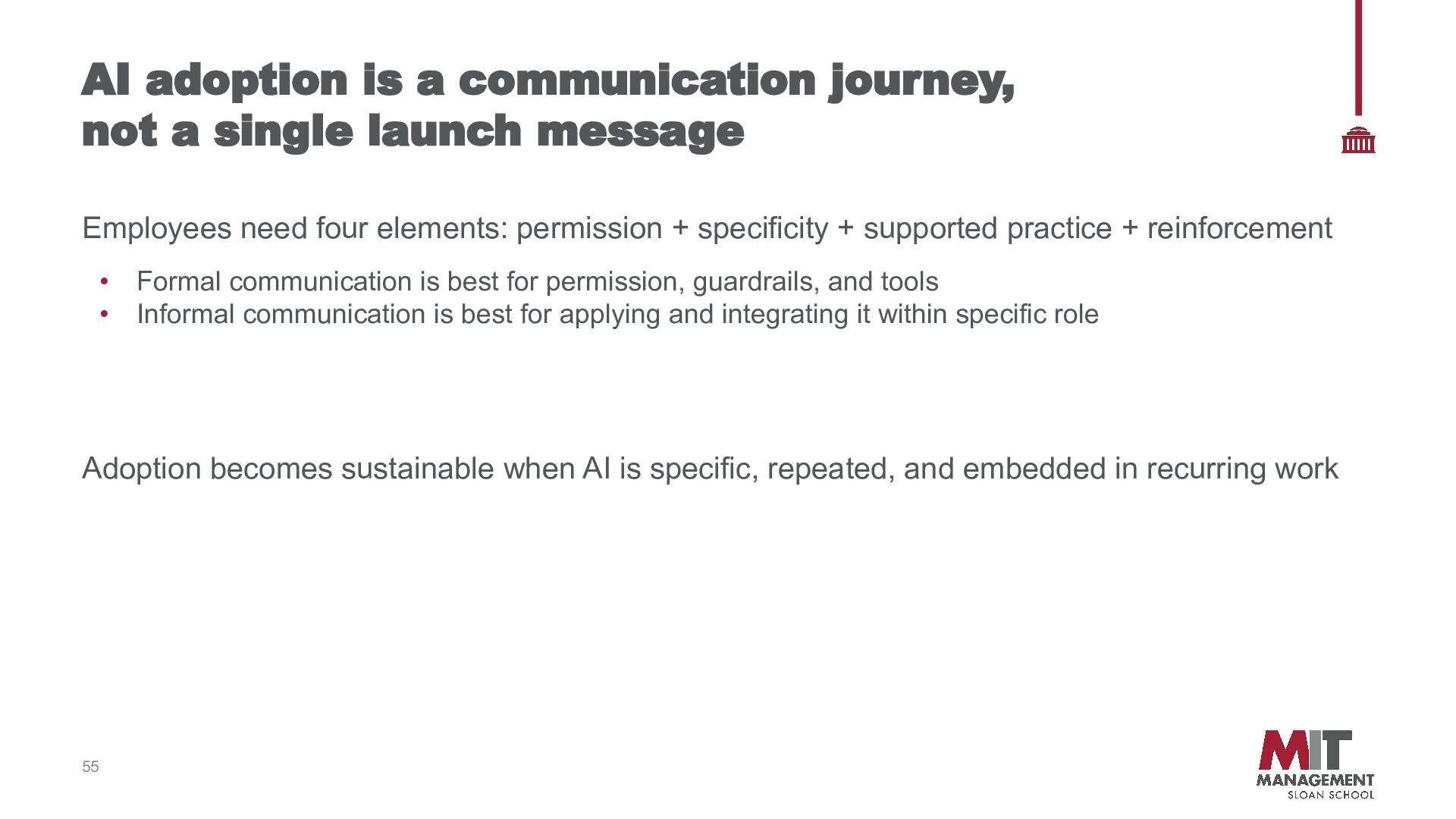
message Employees need four elements: permission + specificity + supported practice + reinforcement • • Formal communication is best for permission, guardrails, and tools Informal communication is best for applying and integrating it within specific role Adoption becomes sustainable when AI is specific, repeated, and embedded in recurring work 55
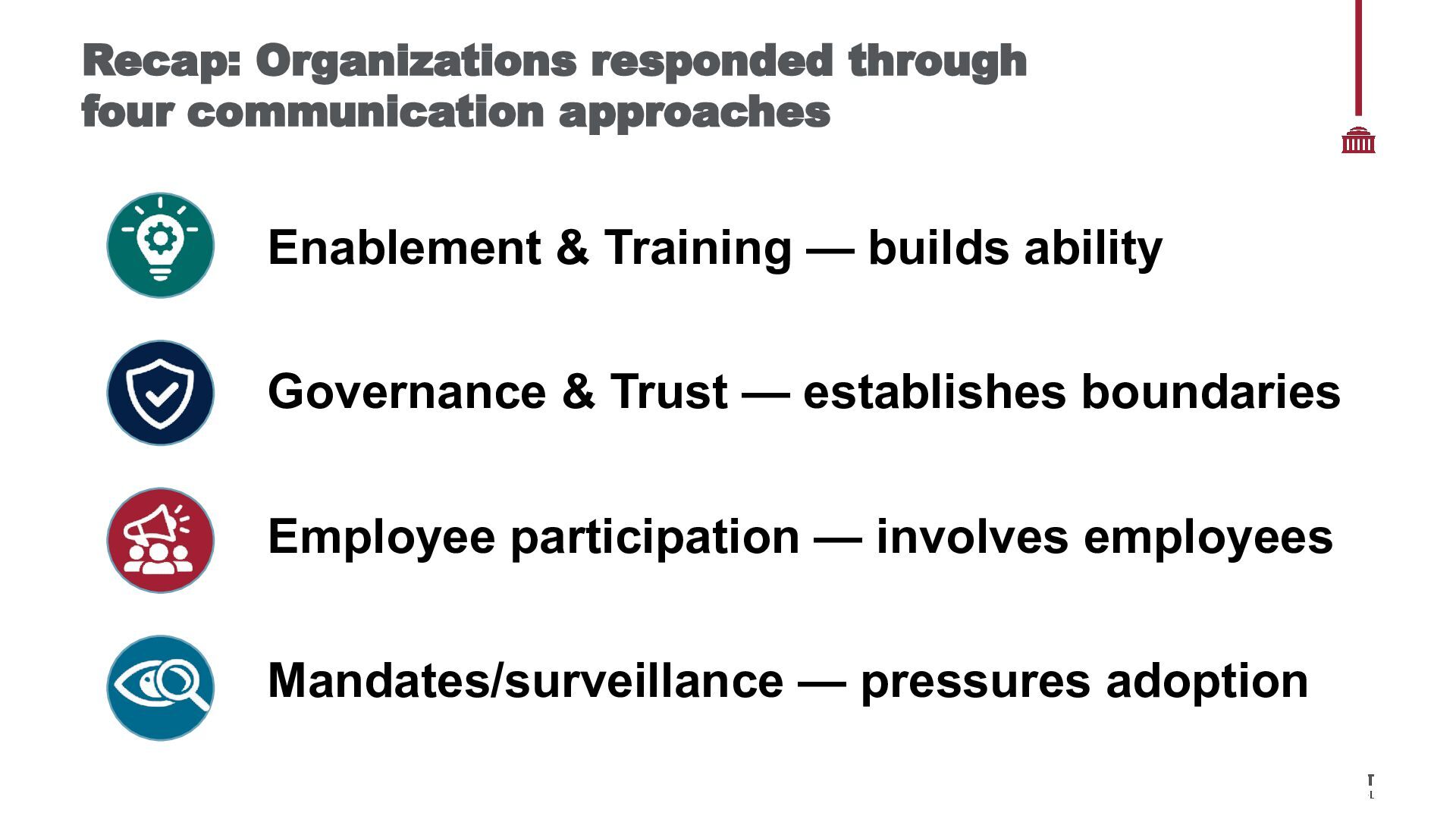
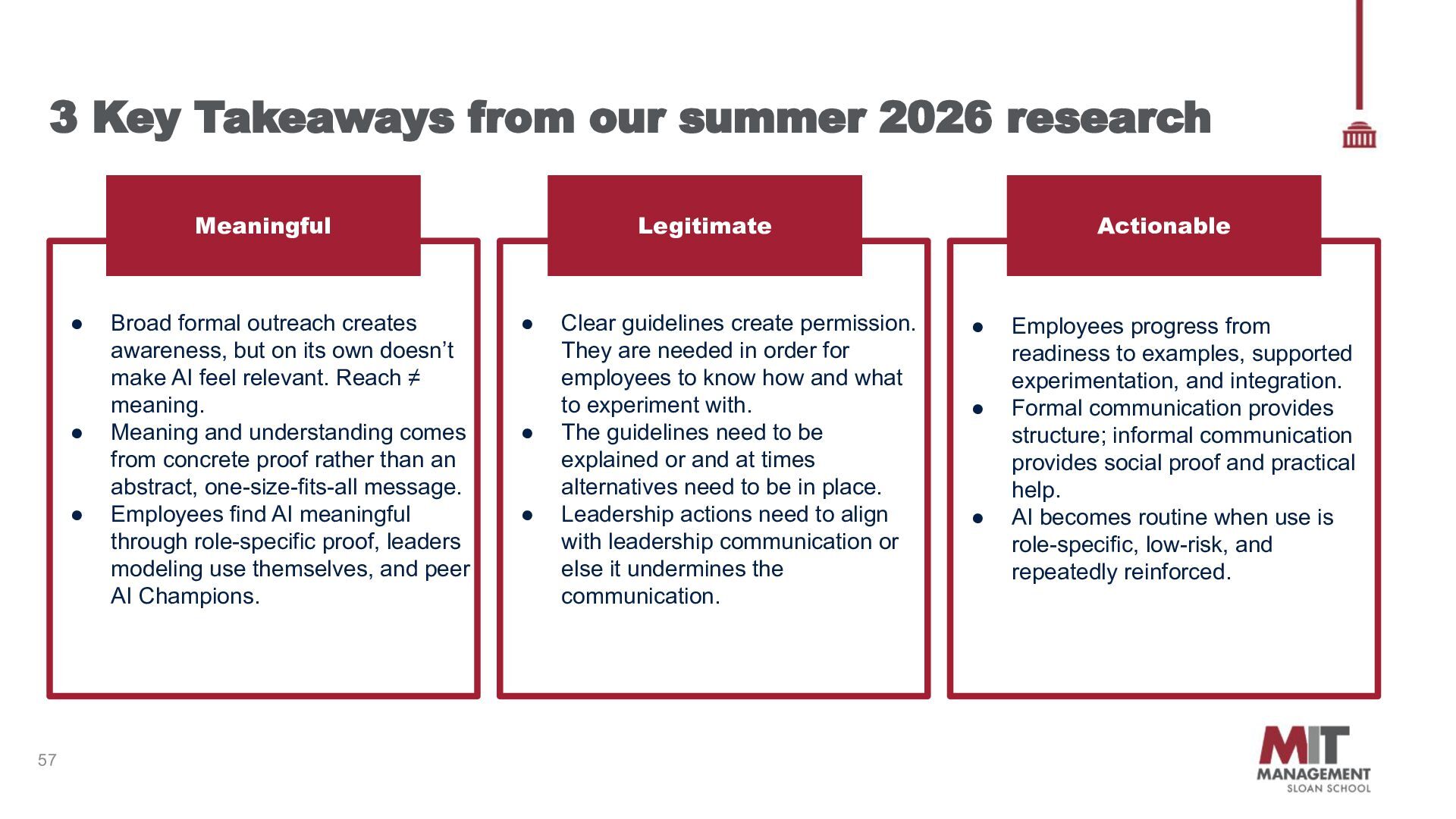
• • • 57 Broad formal outreach creates awareness, but on its own doesn’t make AI feel relevant. Reach ≠ meaning. Meaning and understanding comes from concrete proof rather than an abstract, one-size-fits-all message. Employees find AI meaningful through role-specific proof, leaders modeling use themselves, and peer AI Champions. • • • Clear guidelines create permission. They are needed in order for employees to know how and what to experiment with. The guidelines need to be explained or and at times alternatives need to be in place. Leadership actions need to align with leadership communication or else it undermines the communication. Actionable • • • Employees progress from readiness to examples, supported experimentation, and integration. Formal communication provides structure; informal communication provides social proof and practical help. AI becomes routine when use is role-specific, low-risk, and repeatedly reinforced.
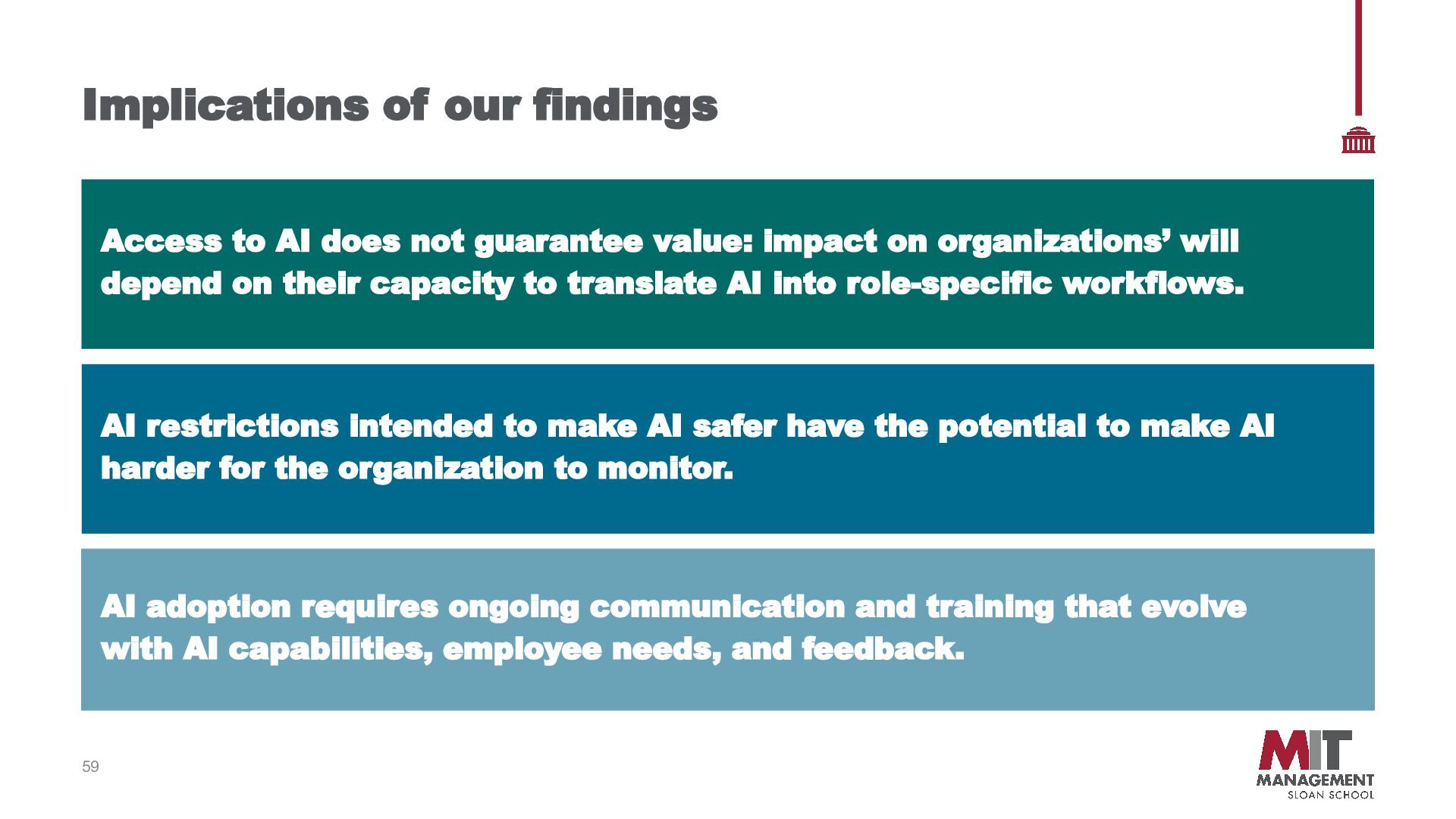
slidesimpact on organizations’ will Access to AIof does not guarantee depend on their capacity to translate AI into role-specific workflows. AI restrictions intended to make AI safer have the potential to make AI harder for the organization to monitor. AI adoption requires ongoing communication and training that evolve with AI capabilities, employee needs, and feedback. 59
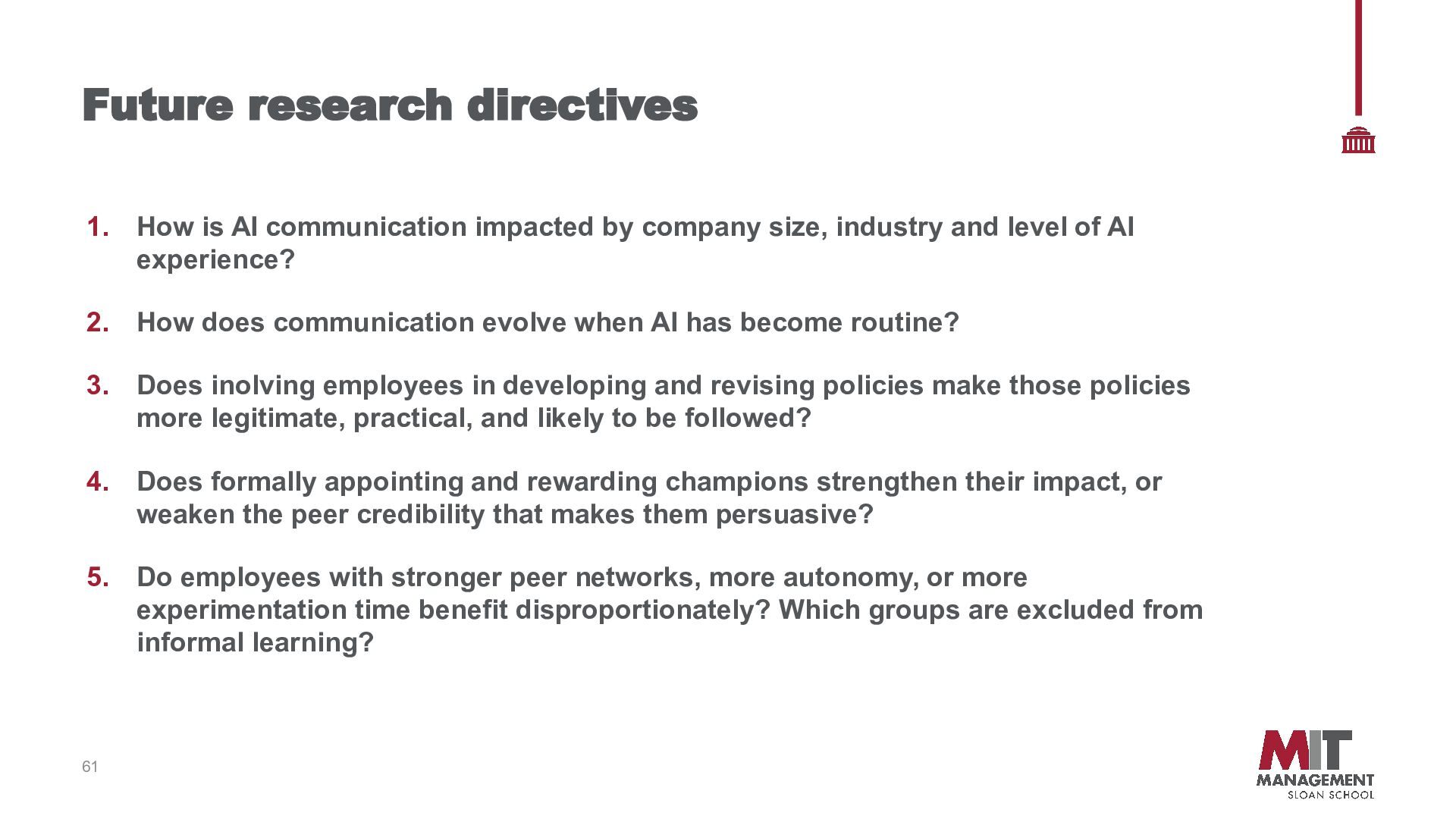
company size, industry and level of AI experience? 2. How does communication evolve when AI has become routine? 3. Does inolving employees in developing and revising policies make those policies more legitimate, practical, and likely to be followed? 4. Does formally appointing and rewarding champions strengthen their impact, or weaken the peer credibility that makes them persuasive? 5. Do employees with stronger peer networks, more autonomy, or more experimentation time benefit disproportionately? Which groups are excluded from informal learning? 61
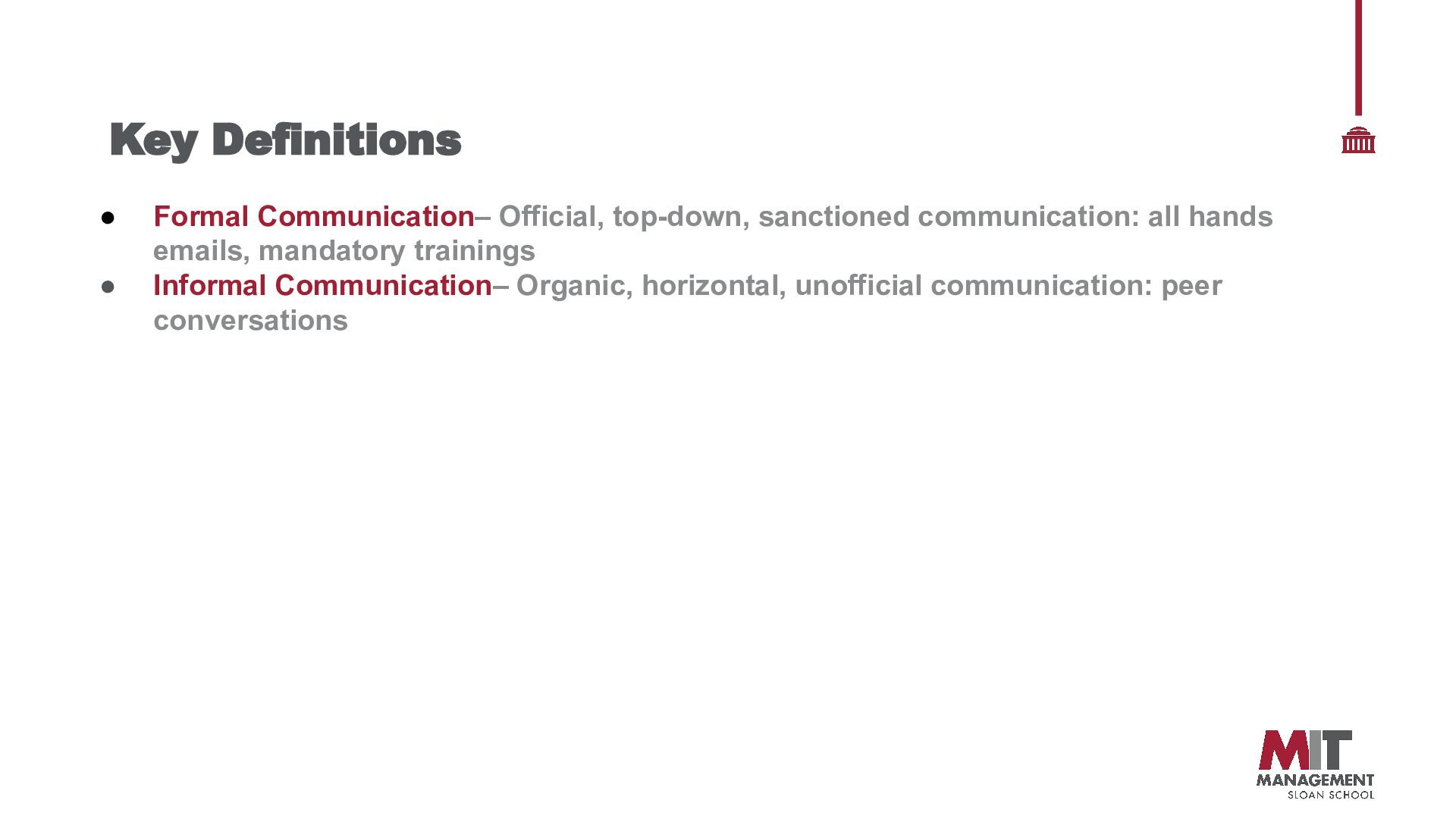
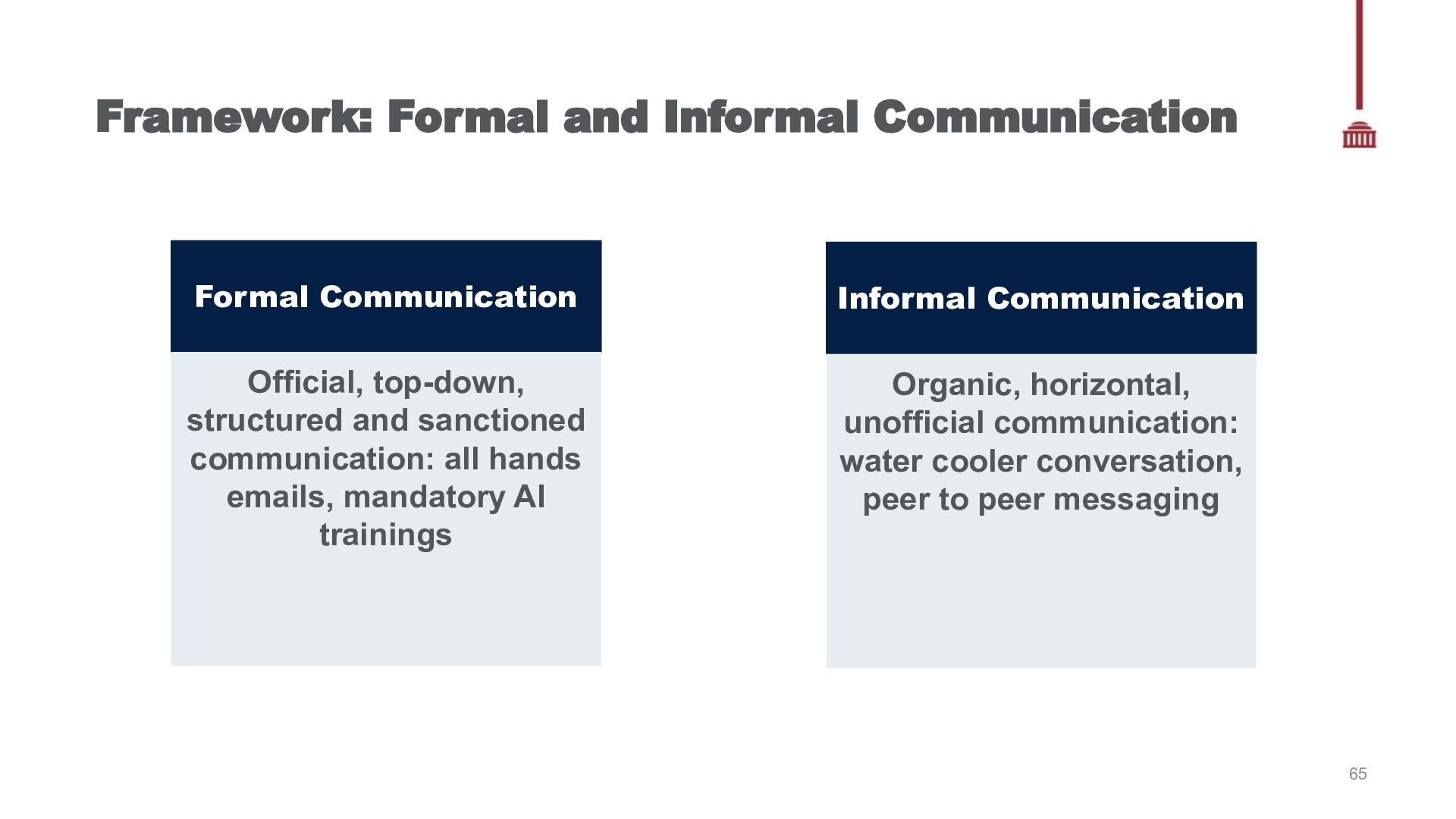
top-down, structured and sanctioned communication: all hands emails, mandatory AI trainings Organic, horizontal, unofficial communication: water cooler conversation, peer to peer messaging 65
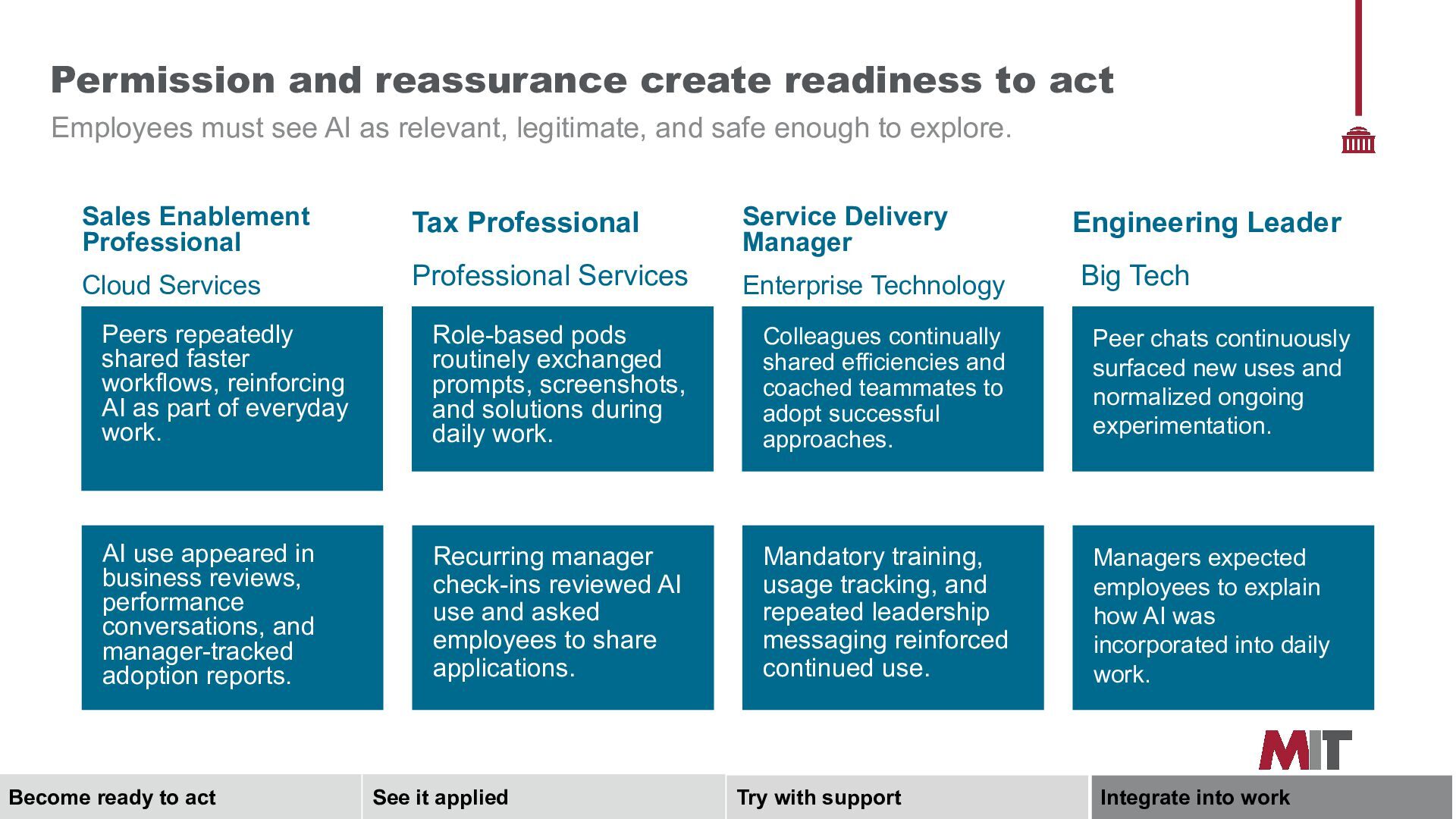
AI as relevant, legitimate, and safe enough to explore. Sales Enablement Professional Tax Professional Service Delivery Manager Engineering Leader Cloud Services Professional Services Enterprise Technology Big Tech Peers repeatedly shared faster workflows, reinforcing AI as part of everyday work. Role-based pods routinely exchanged prompts, screenshots, and solutions during daily work. Colleagues continually shared efficiencies and coached teammates to adopt successful approaches. Peer chats continuously surfaced new uses and normalized ongoing experimentation. AI use appeared in business reviews, performance conversations, and manager-tracked adoption reports. Recurring manager check-ins reviewed AI use and asked employees to share applications. Mandatory training, usage tracking, and repeated leadership messaging reinforced continued use. Managers expected employees to explain how AI was incorporated into daily work. Become ready to act See it applied Try with support Integrate into work
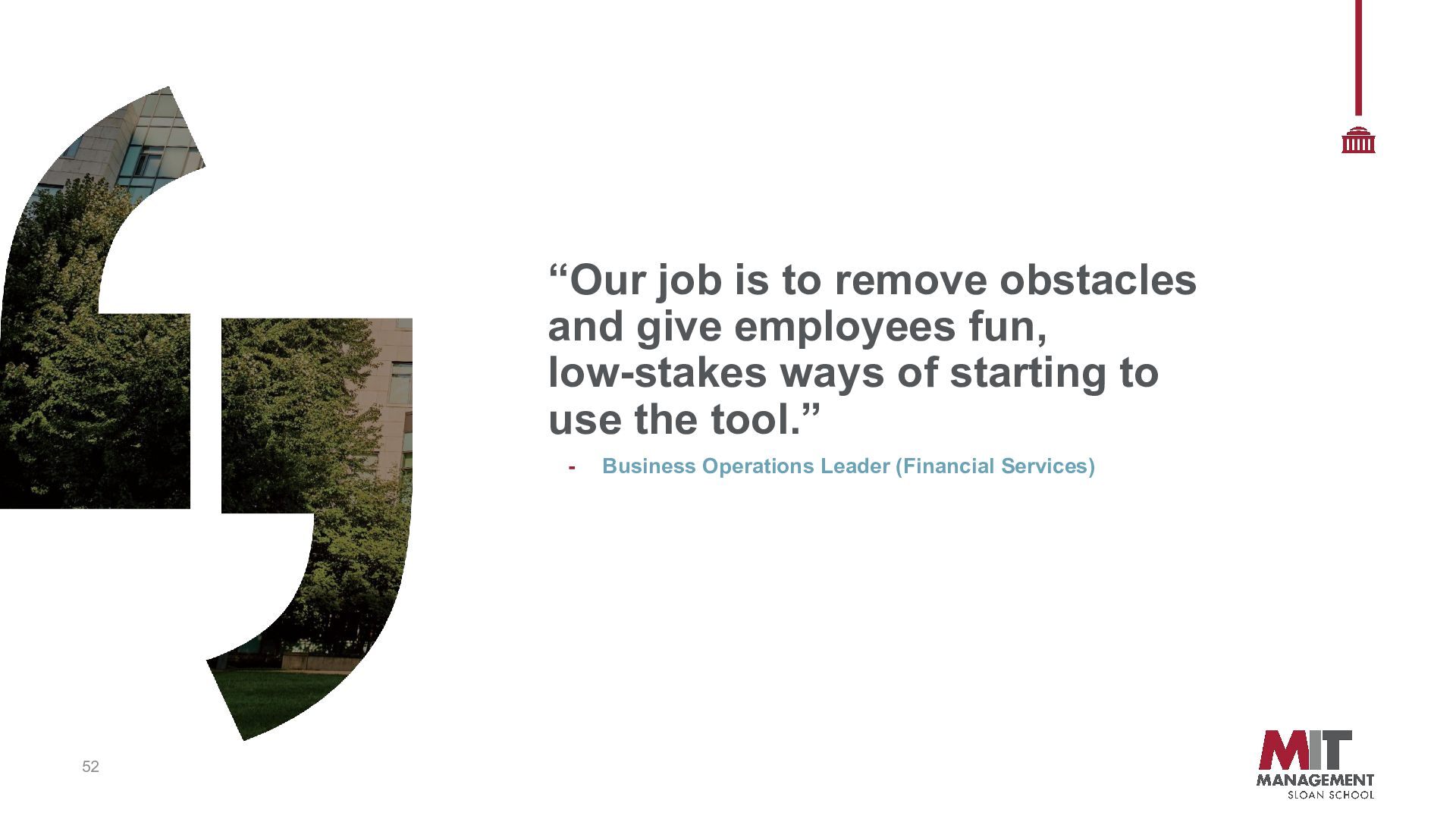
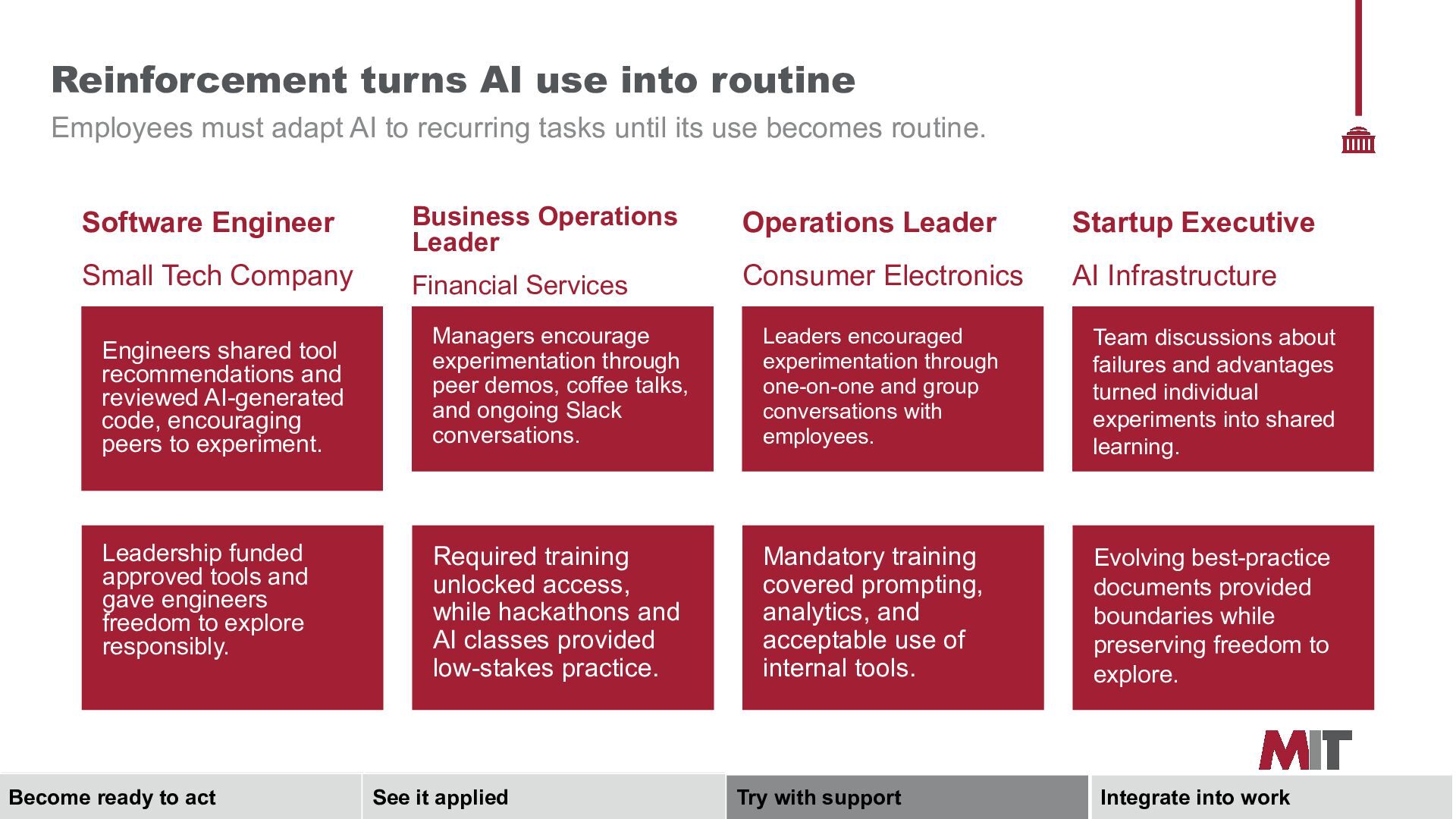
to recurring tasks until its use becomes routine. Software Engineer Business Operations Leader Operations Leader Startup Executive Small Tech Company Financial Services Consumer Electronics AI Infrastructure Engineers shared tool recommendations and reviewed AI-generated code, encouraging peers to experiment. Leadership funded approved tools and gave engineers freedom to explore responsibly. Trust vs.ready Oversight Become to act Managers encourage experimentation through peer demos, coffee talks, and ongoing Slack conversations. Leaders encouraged experimentation through one-on-one and group conversations with employees. Team discussions about failures and advantages turned individual experiments into shared learning. Required training unlocked access, while hackathons and AI classes provided low-stakes practice. Mandatory training covered prompting, analytics, and acceptable use of internal tools. Evolving best-practice documents provided boundaries while preserving freedom to explore. Increasing Automation See it applied Cultural / Skill Divide Try with support Scaling Small Teams Integrate into work
AI as relevant, legitimate, and safe enough to explore. Product Development Leader Business Operations Leader Engineering Leader Marketing & Operations Professional Consumer Products Financial Services Big Tech Design Firm Senior leaders openly used AI during meetings, signaling that employees were permitted to explore it. Leaders modeled AI use and highlighted successful employee experiments. Peer conversations and internal champions normalized experimentation. Mixed peer experiences created skepticism rather than reassurance. Required training and approved-tool guidance established boundaries for safe use. Employees completed training and accepted usage rules before receiving access. Published guidance clarified limits and maintained human accountability for AI outputs. Legal approval was required before using AI on internal or client work, creating safety but not motivation. Become ready to act See it applied Try with support Integrate into work


 erfertic
 nonsquared
 codingconduct
 marktimemedia
 soysaucechin
 apolaine
 speakerdeck
 lindahogenes
 carmenintech
 khoart
 ipullrank
 varn
 aleyda