Upgrade to Pro — share decks privately, control downloads, hide ads and more …

How AI is Changing Entry Level Jobs

Avatar for Emery Fertic Emery Fertic
September 15, 2026
11

How AI is Changing Entry Level Jobs

Avatar for Emery Fertic

Emery Fertic

September 15, 2026

More Decks by Emery Fertic

Transcript

  1. Redefinition, Not Elimination Alice Lee August 2026 IT SLOAN SCHOO

    F MANAGEMENT How AI is Changing Entry Level Jobs
  2. Melissa Webster Our Interviewees The rest of my research group

    (Emery Fertic, and Alma Erro) MIT Researchers and Professors’, David Autor, Seb Murray, Daron Acemoglu, Georgios Petropoulos, Peter Dizikes, Andrew McAfee and Frank Nagle. • IT SLOAN SCHOO F MANAGEMENT Special thank you to:
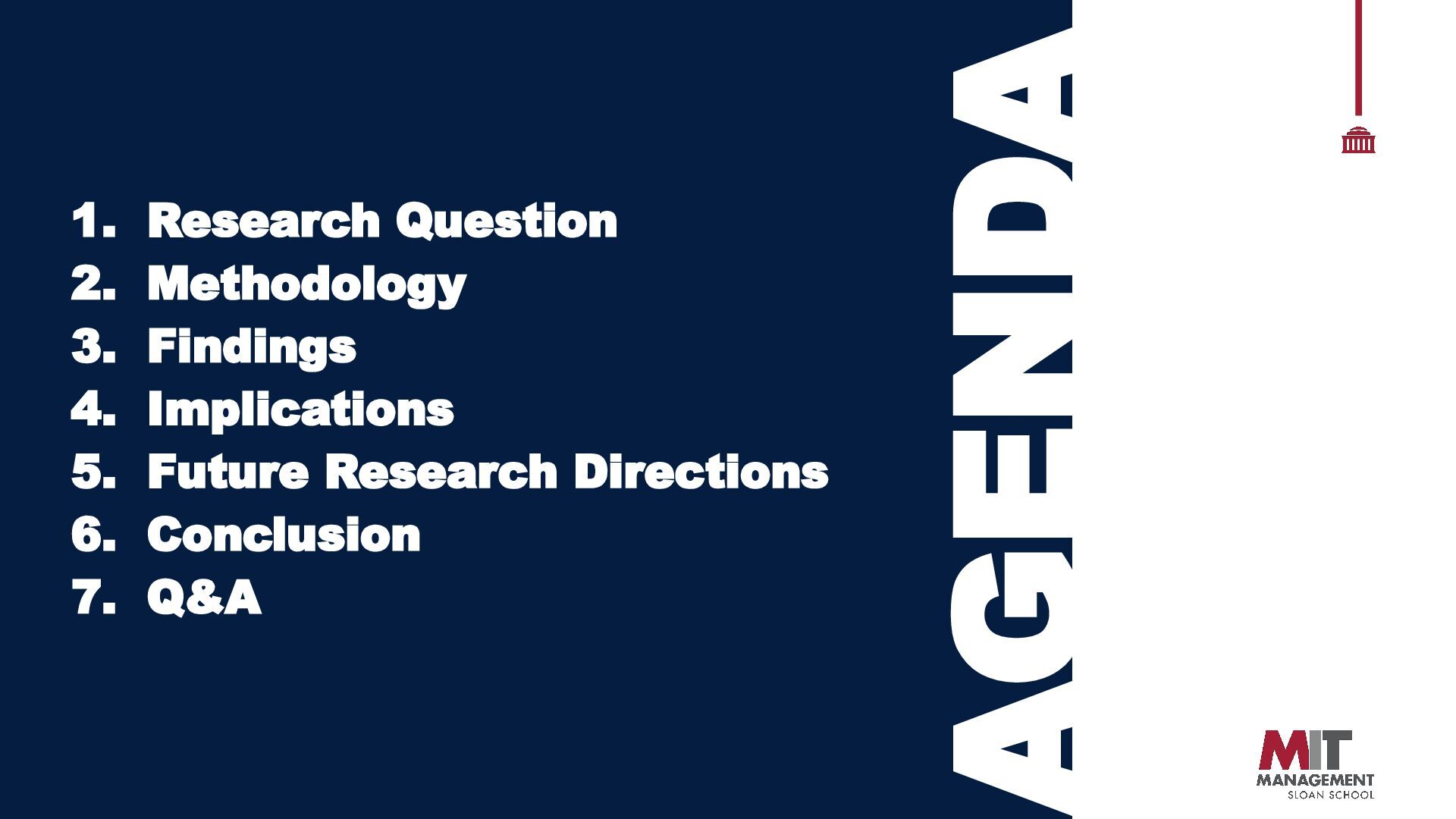
  3. AGENDA 1. Research Question 2. Methodology 3. Findings 4. Implications

    5. Future Research Directions 6. Conclusion 7. Q&A
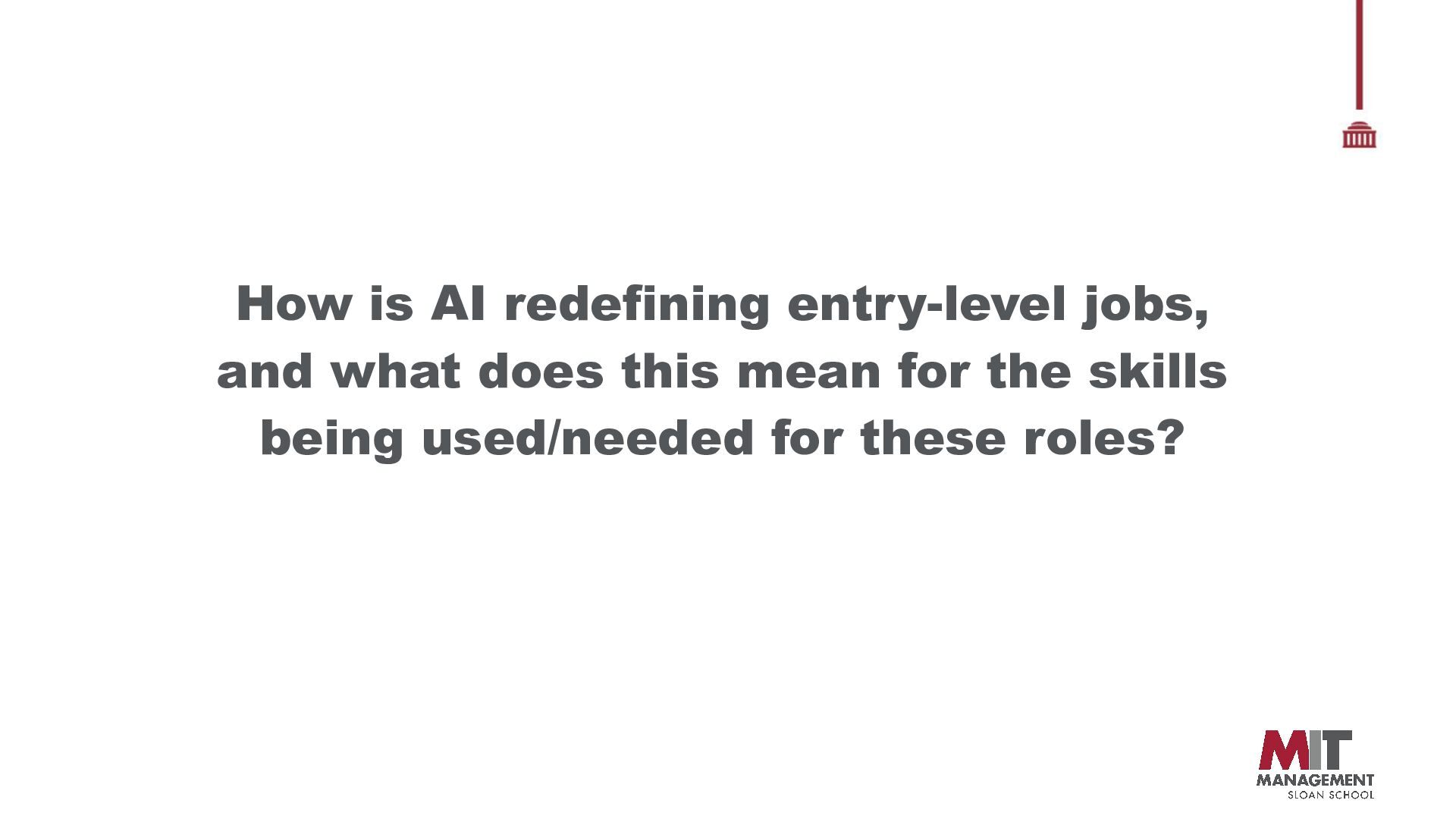
  4. How is AI redefining entry-level jobs, and what does this

    mean for the skills being used/needed for these roles?
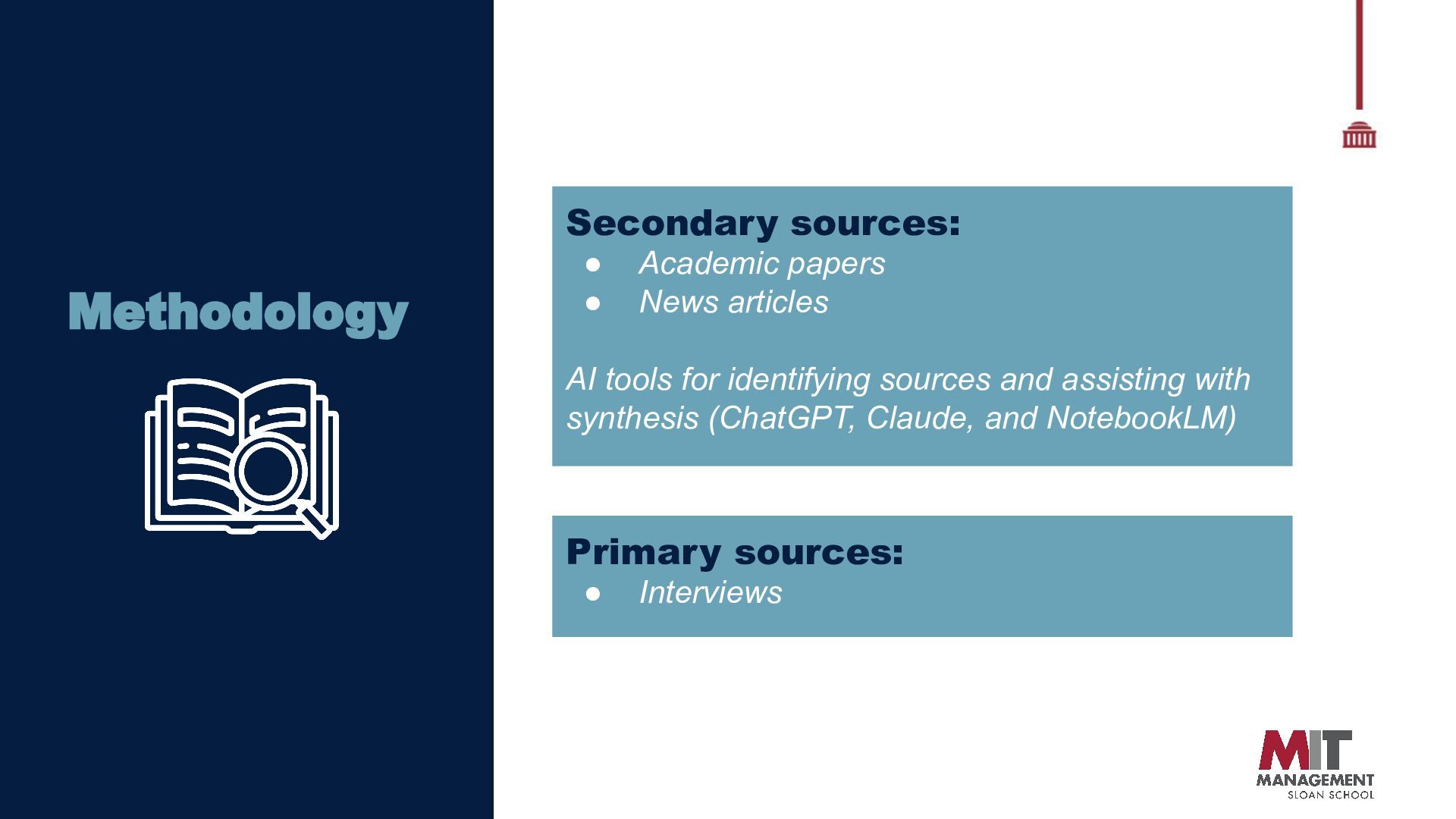
  5. Secondary sources: Methodology • • Academic papers News articles AI

    tools for identifying sources and assisting with synthesis (ChatGPT, Claude, and NotebookLM) Primary sources: • Interviews
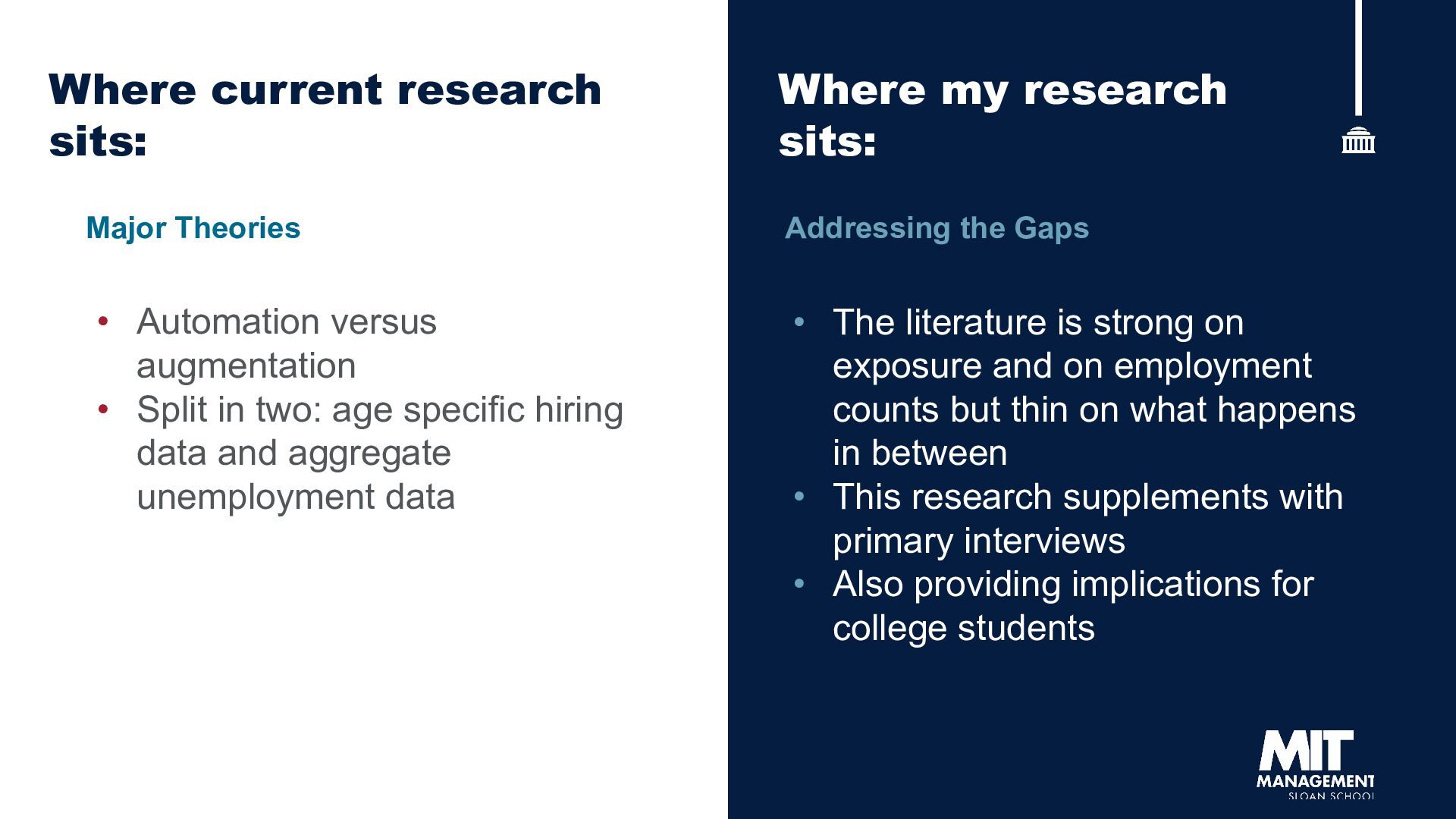
  6. Where current research sits: Where my research sits: Major Theories

    Addressing the Gaps • Automation versus augmentation • Split in two: age specific hiring data and aggregate unemployment data • The literature is strong on exposure and on employment counts but thin on what happens in between • This research supplements with primary interviews • Also providing implications for college students
  7. 3 Findings ➔ Redefinition at the level of the task

    ➔ The skills that matter are shifting ➔ The disruption is real — but narrow and early
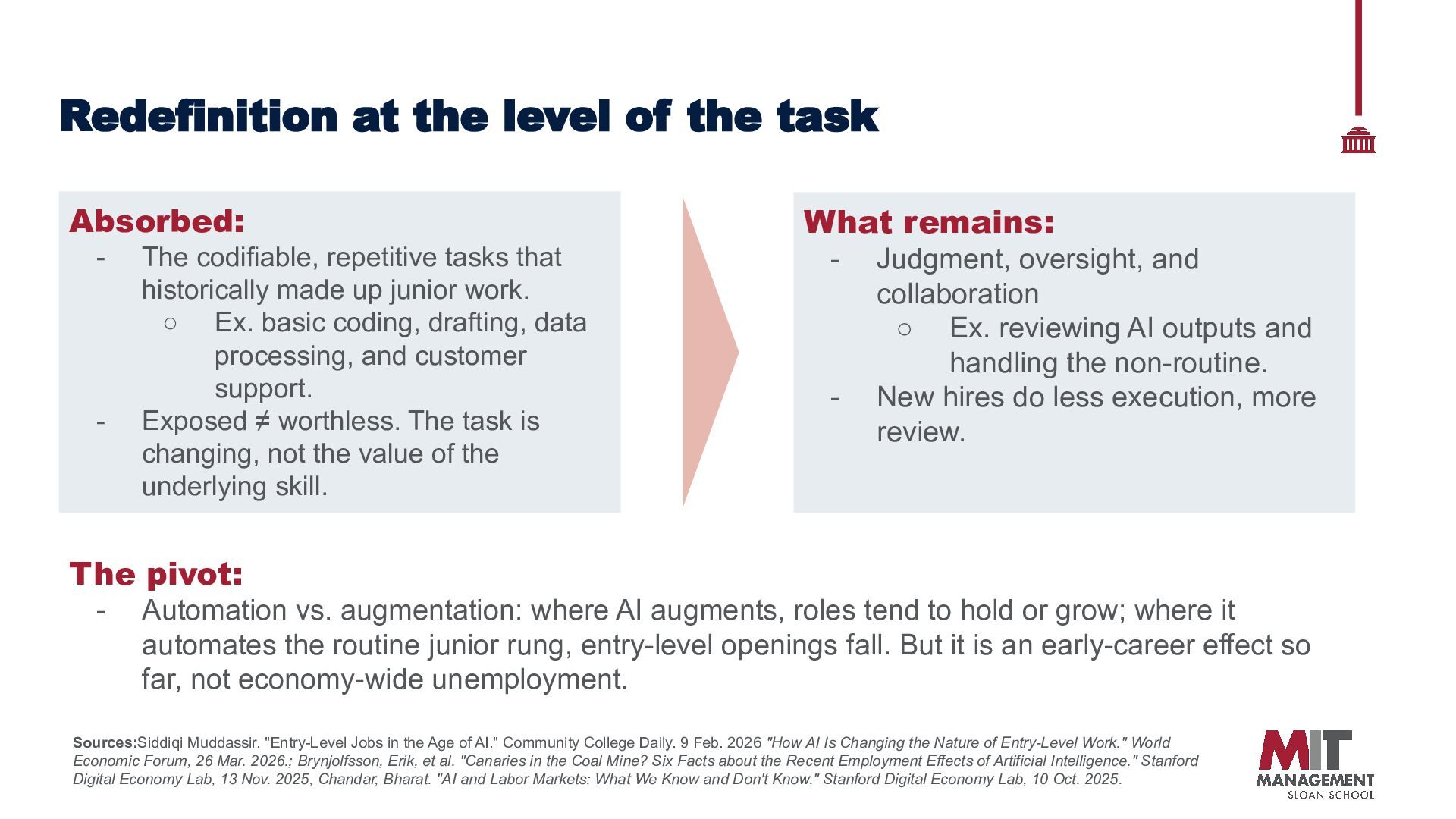
  8. Redefinition at the level of the task Absorbed: - -

    The codifiable, repetitive tasks that historically made up junior work. ◦ Ex. basic coding, drafting, data processing, and customer support. Exposed ≠ worthless. The task is changing, not the value of the underlying skill. What remains: - - Judgment, oversight, and collaboration ◦ Ex. reviewing AI outputs and handling the non-routine. New hires do less execution, more review. The pivot: - Automation vs. augmentation: where AI augments, roles tend to hold or grow; where it automates the routine junior rung, entry-level openings fall. But it is an early-career effect so far, not economy-wide unemployment. Sources:Siddiqi Muddassir. "Entry-Level Jobs in the Age of AI." Community College Daily. 9 Feb. 2026 "How AI Is Changing the Nature of Entry-Level Work." World Economic Forum, 26 Mar. 2026.; Brynjolfsson, Erik, et al. "Canaries in the Coal Mine? Six Facts about the Recent Employment Effects of Artificial Intelligence." Stanford Digital Economy Lab, 13 Nov. 2025, Chandar, Bharat. "AI and Labor Markets: What We Know and Don't Know." Stanford Digital Economy Lab, 10 Oct. 2025.
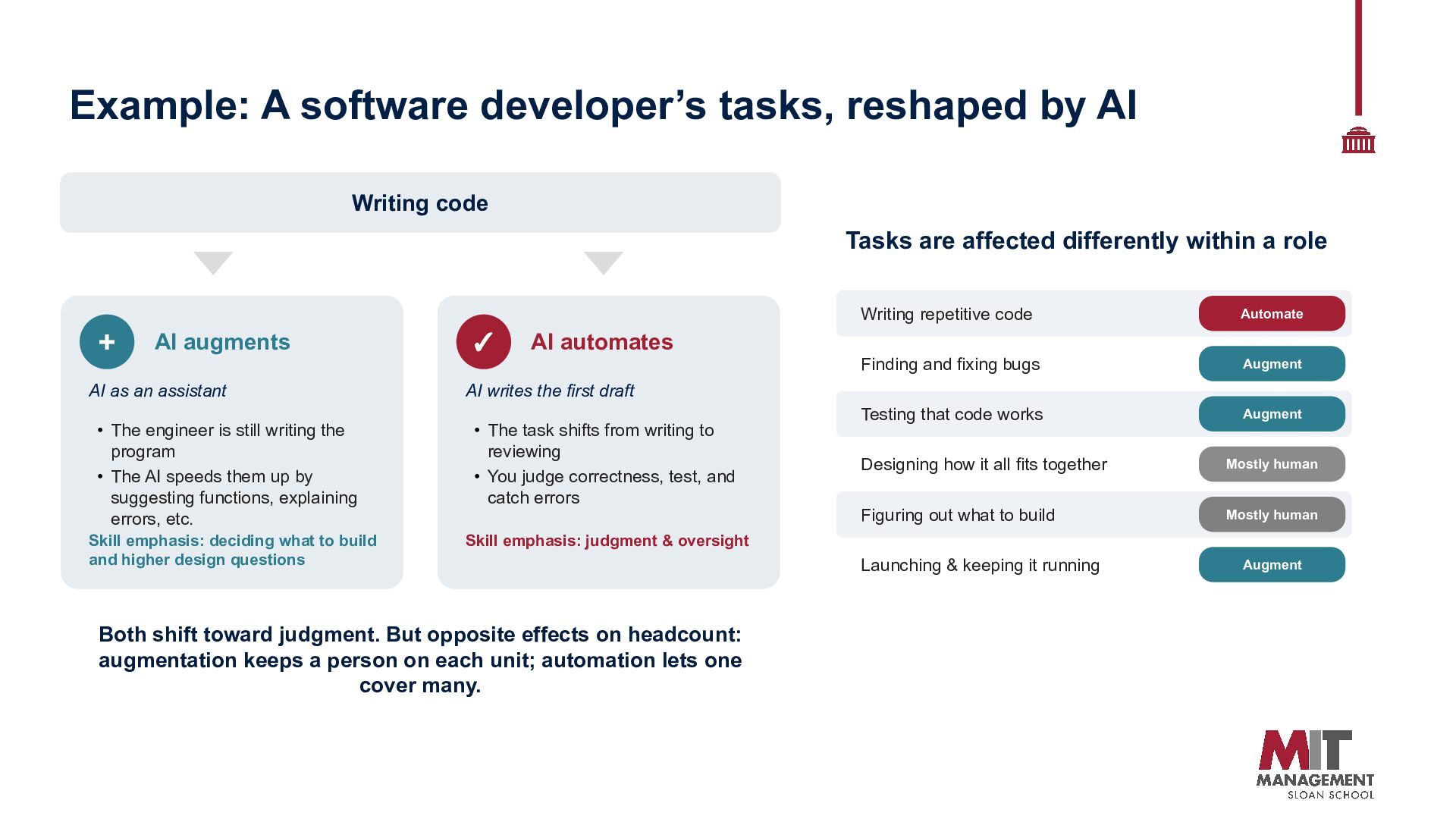
  9. Example: A software developer’s tasks, reshaped by AI Writing code

    Tasks are affected differently within a role + AI augments ✓ Writing repetitive code Automate Finding and fixing bugs Augment Testing that code works Augment AI automates AI as an assistant AI writes the first draft • The engineer is still writing the program • The AI speeds them up by suggesting functions, explaining errors, etc. • The task shifts from writing to reviewing • You judge correctness, test, and catch errors Skill emphasis: deciding what to build and higher design questions Skill emphasis: judgment & oversight Both shift toward judgment. But opposite effects on headcount: augmentation keeps a person on each unit; automation lets one cover many. Designing how it all fits together Mostly human Figuring out what to build Mostly human Launching & keeping it running Augment
  10. 3 Findings ➔ Redefinition at the level of the task

    ➔ The skills that matter are shifting ➔ The disruption is real — but narrow and early
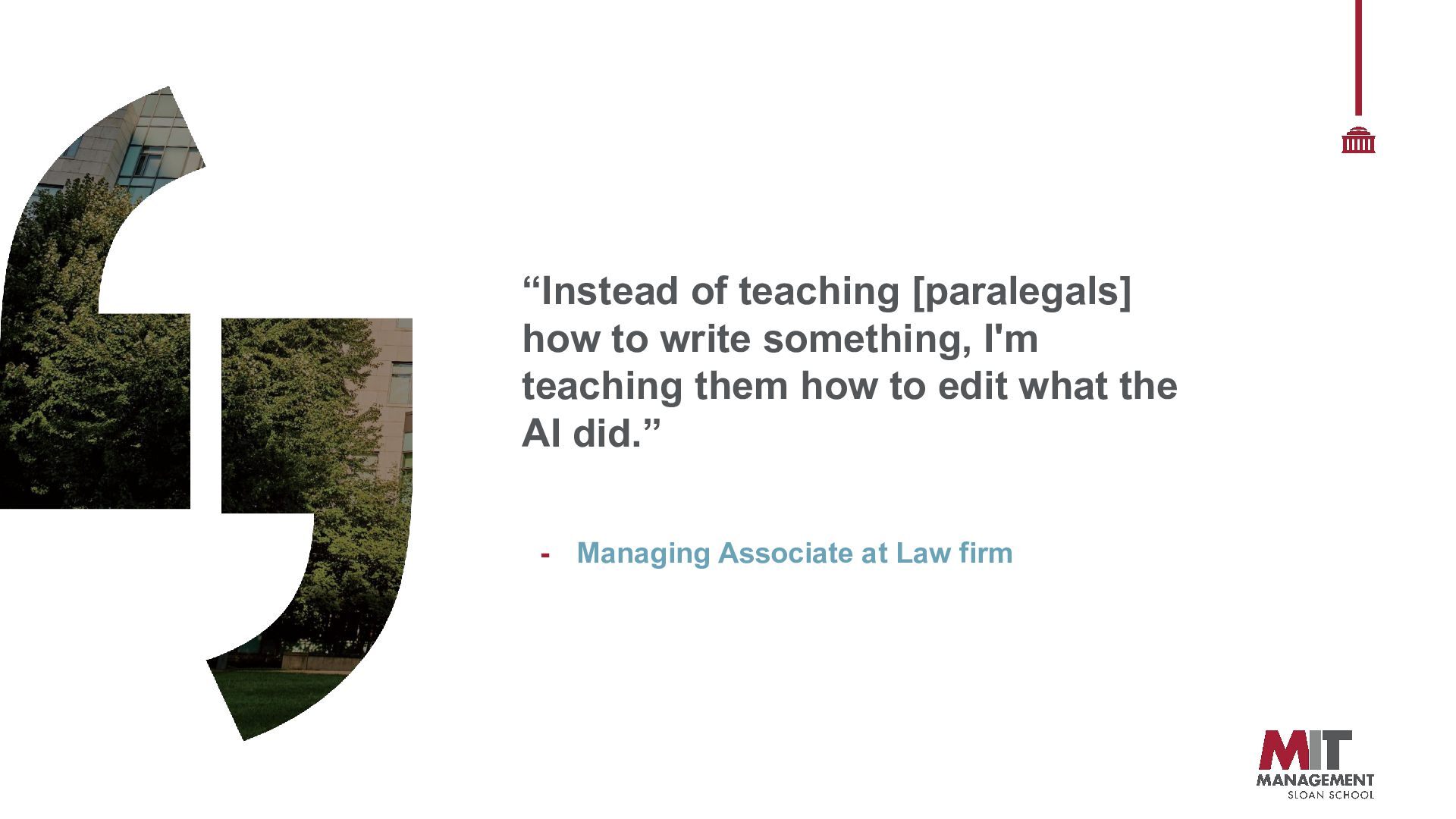
  11. “Instead of teaching [paralegals] how to write something, I'm teaching

    them how to edit what the AI did.” - Managing Associate at Law firm
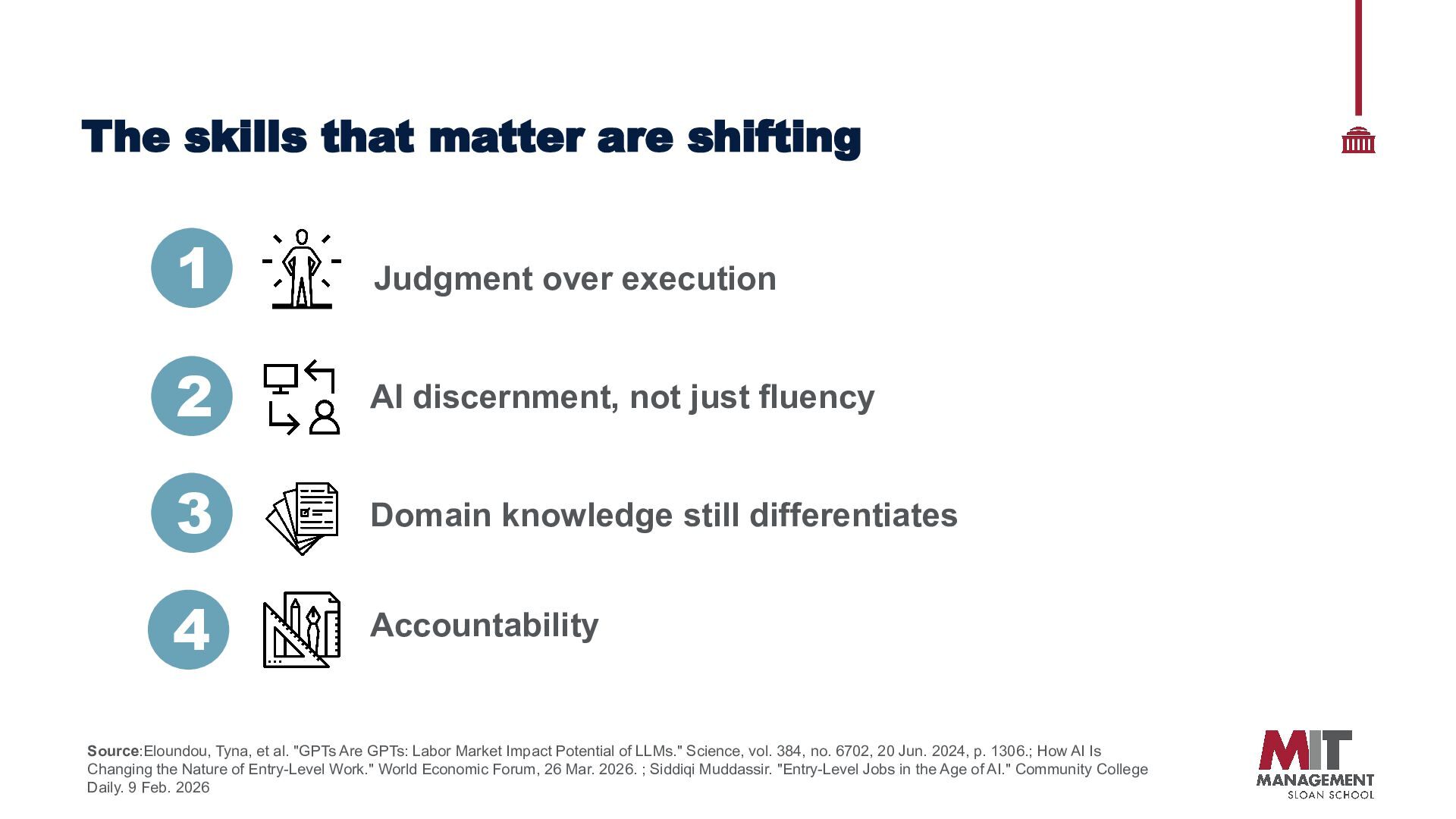
  12. The skills that matter are shifting 1 Judgment over execution

    2 AI discernment, not just fluency 3 Domain knowledge still differentiates 4 Accountability Source:Eloundou, Tyna, et al. "GPTs Are GPTs: Labor Market Impact Potential of LLMs." Science, vol. 384, no. 6702, 20 Jun. 2024, p. 1306.; How AI Is Changing the Nature of Entry-Level Work." World Economic Forum, 26 Mar. 2026. ; Siddiqi Muddassir. "Entry-Level Jobs in the Age of AI." Community College Daily. 9 Feb. 2026
  13. 3 Findings ➔ Redefinition at the level of the task

    ➔ The skills that matter are shifting ➔ The disruption is real — but narrow and early
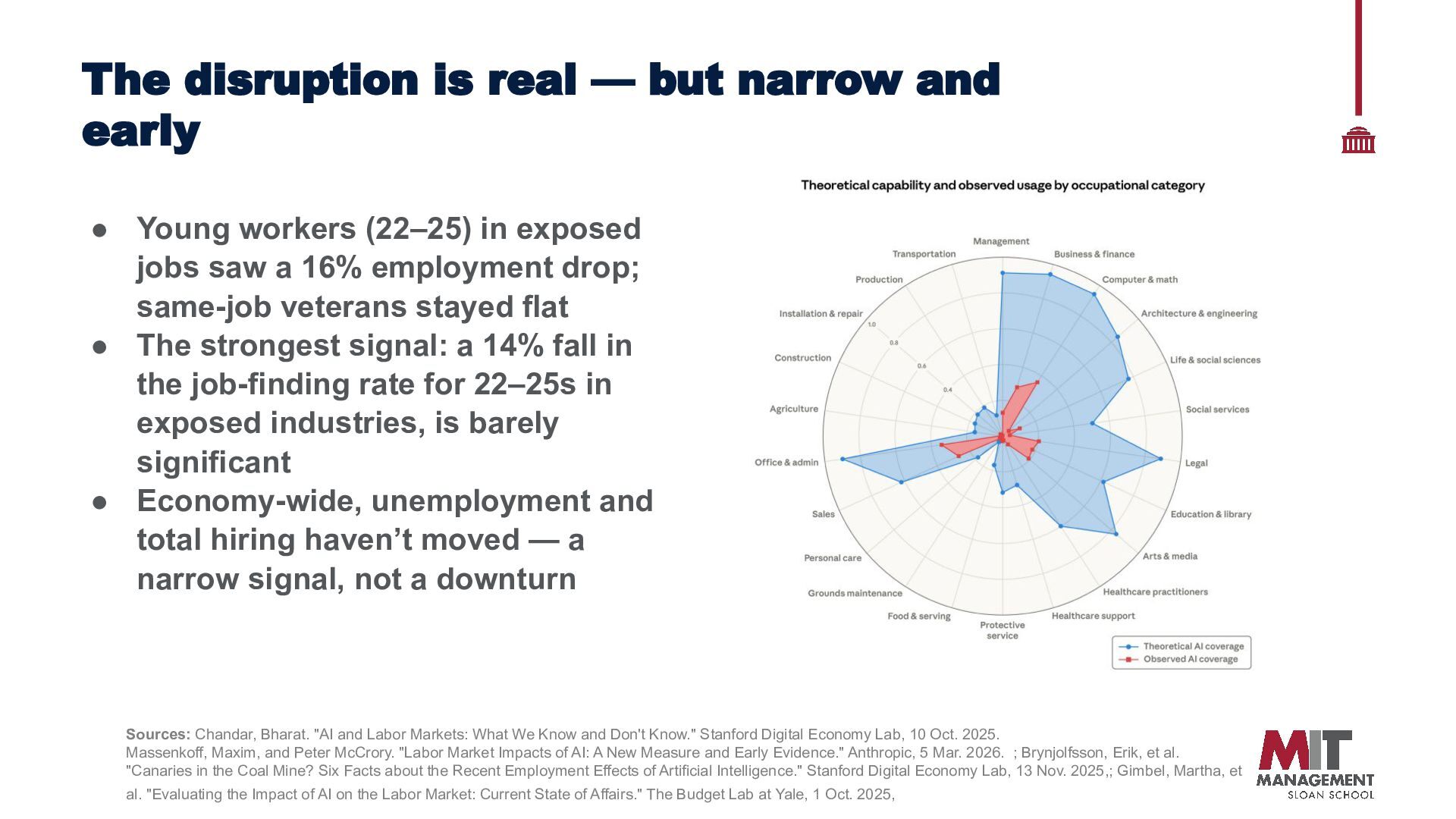
  14. The disruption is real — but narrow and early •

    Young workers (22–25) in exposed jobs saw a 16% employment drop; same-job veterans stayed flat • The strongest signal: a 14% fall in the job-finding rate for 22–25s in exposed industries, is barely significant • Economy-wide, unemployment and total hiring haven’t moved — a narrow signal, not a downturn Sources: Chandar, Bharat. "AI and Labor Markets: What We Know and Don't Know." Stanford Digital Economy Lab, 10 Oct. 2025. Massenkoff, Maxim, and Peter McCrory. "Labor Market Impacts of AI: A New Measure and Early Evidence." Anthropic, 5 Mar. 2026. ; Brynjolfsson, Erik, et al. "Canaries in the Coal Mine? Six Facts about the Recent Employment Effects of Artificial Intelligence." Stanford Digital Economy Lab, 13 Nov. 2025,; Gimbel, Martha, et al. "Evaluating the Impact of AI on the Labor Market: Current State of Affairs." The Budget Lab at Yale, 1 Oct. 2025,
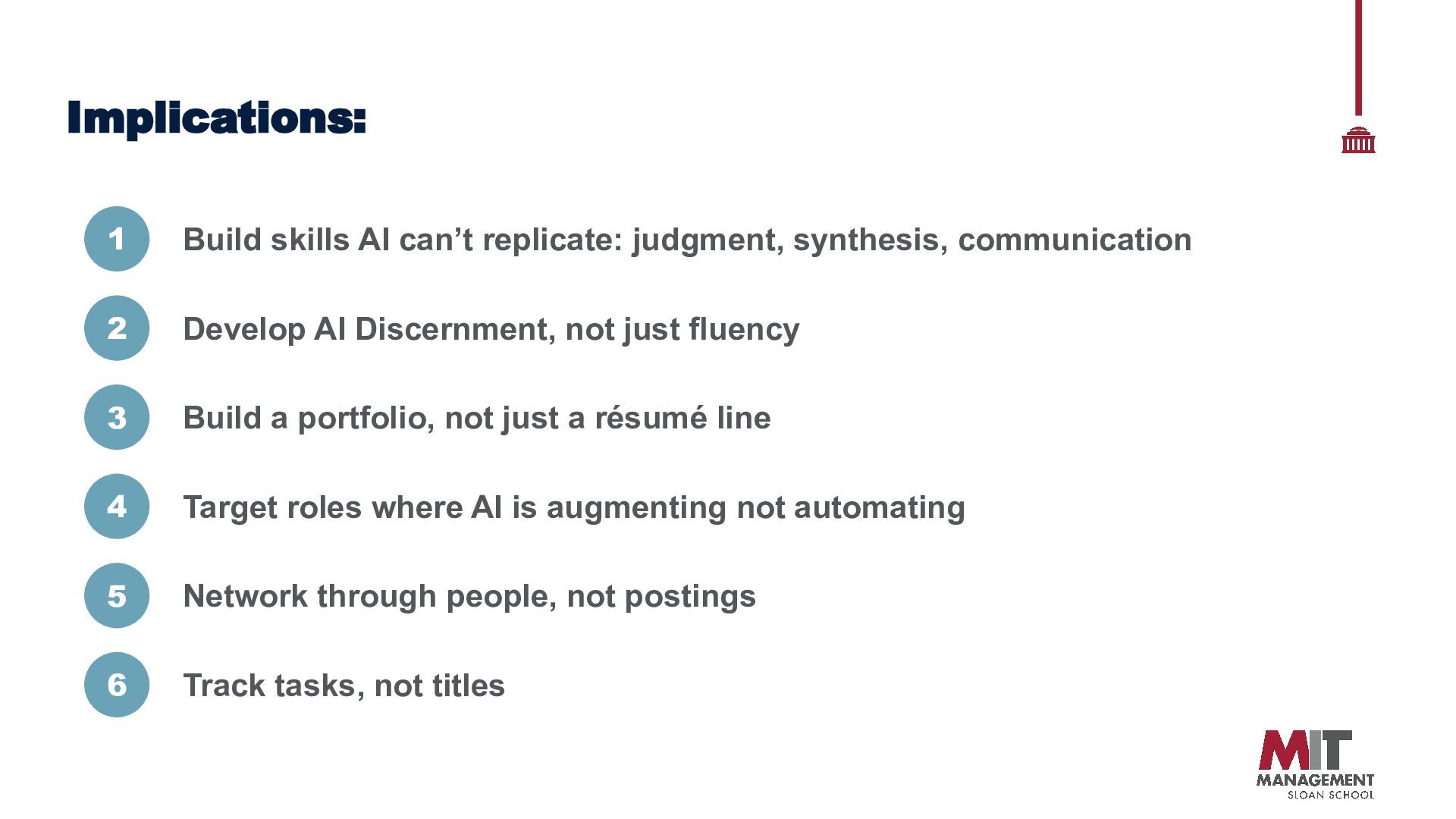
  15. Implications: 1 Build skills AI can’t replicate: judgment, synthesis, communication

    2 Develop AI Discernment, not just fluency 3 Build a portfolio, not just a résumé line 4 Target roles where AI is augmenting not automating 5 Network through people, not postings 6 Track tasks, not titles
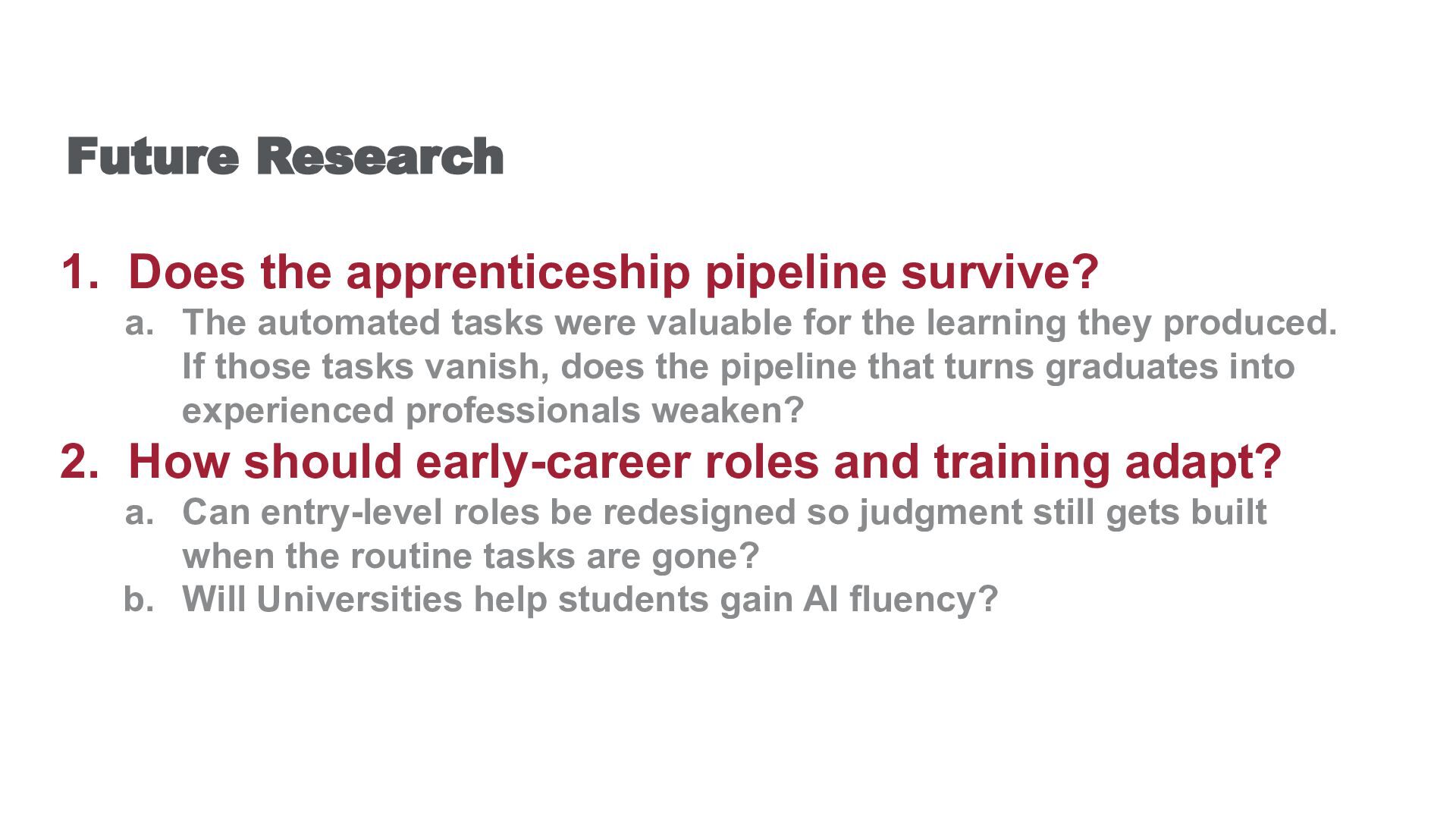
  16. Future Research 1. Does the apprenticeship pipeline survive? a. The

    automated tasks were valuable for the learning they produced. If those tasks vanish, does the pipeline that turns graduates into experienced professionals weaken? 2. How should early-career roles and training adapt? a. Can entry-level roles be redesigned so judgment still gets built when the routine tasks are gone? b. Will Universities help students gain AI fluency?
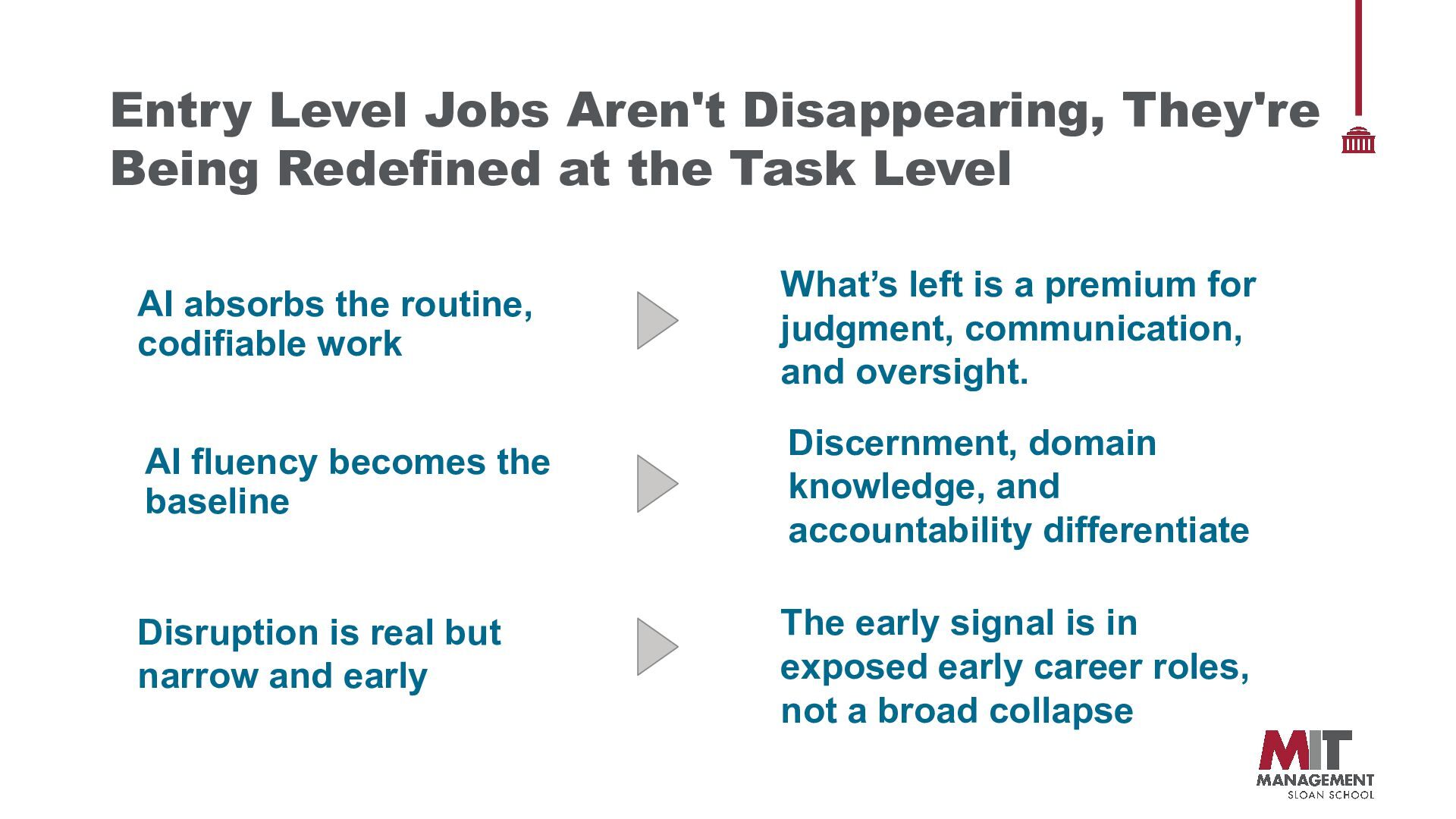
  17. Entry Level Jobs Aren't Disappearing, They're Being Redefined at the

    Task Level AI absorbs the routine, codifiable work What’s left is a premium for judgment, communication, and oversight. AI fluency becomes the baseline Discernment, domain knowledge, and accountability differentiate Disruption is real but narrow and early The early signal is in exposed early career roles, not a broad collapse
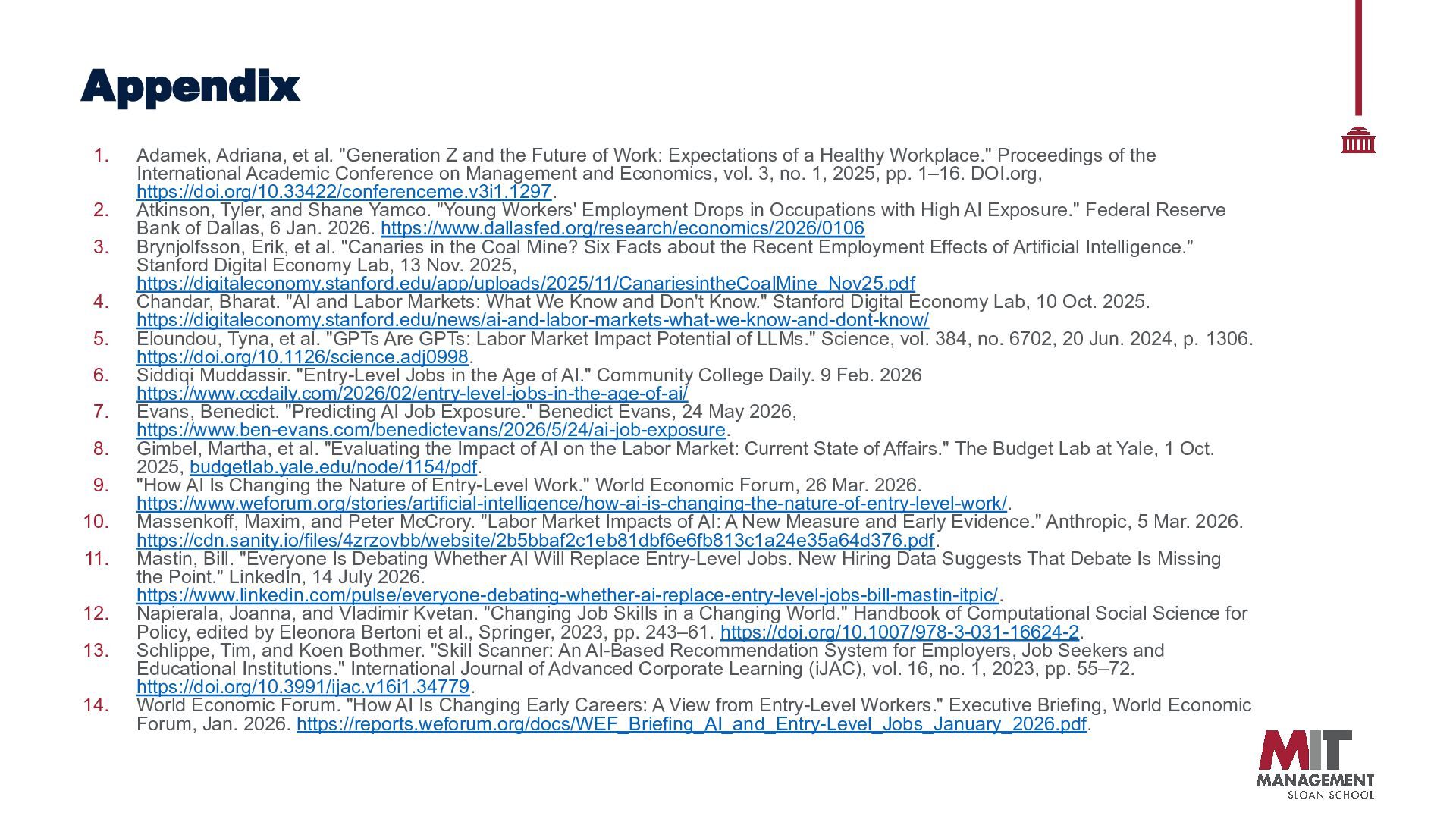
  18. Appendix 1. 2. 3. 4. 5. 6. 7. 8. 9.

    10. 11. 12. 13. 14. Adamek, Adriana, et al. "Generation Z and the Future of Work: Expectations of a Healthy Workplace." Proceedings of the International Academic Conference on Management and Economics, vol. 3, no. 1, 2025, pp. 1–16. DOI.org, https://doi.org/10.33422/conferenceme.v3i1.1297. Atkinson, Tyler, and Shane Yamco. "Young Workers' Employment Drops in Occupations with High AI Exposure." Federal Reserve Bank of Dallas, 6 Jan. 2026. https://www.dallasfed.org/research/economics/2026/0106 Brynjolfsson, Erik, et al. "Canaries in the Coal Mine? Six Facts about the Recent Employment Effects of Artificial Intelligence." Stanford Digital Economy Lab, 13 Nov. 2025, https://digitaleconomy.stanford.edu/app/uploads/2025/11/CanariesintheCoalMine_Nov25.pdf Chandar, Bharat. "AI and Labor Markets: What We Know and Don't Know." Stanford Digital Economy Lab, 10 Oct. 2025. https://digitaleconomy.stanford.edu/news/ai-and-labor-markets-what-we-know-and-dont-know/ Eloundou, Tyna, et al. "GPTs Are GPTs: Labor Market Impact Potential of LLMs." Science, vol. 384, no. 6702, 20 Jun. 2024, p. 1306. https://doi.org/10.1126/science.adj0998. Siddiqi Muddassir. "Entry-Level Jobs in the Age of AI." Community College Daily. 9 Feb. 2026 https://www.ccdaily.com/2026/02/entry-level-jobs-in-the-age-of-ai/ Evans, Benedict. "Predicting AI Job Exposure." Benedict Evans, 24 May 2026, https://www.ben-evans.com/benedictevans/2026/5/24/ai-job-exposure. Gimbel, Martha, et al. "Evaluating the Impact of AI on the Labor Market: Current State of Affairs." The Budget Lab at Yale, 1 Oct. 2025, budgetlab.yale.edu/node/1154/pdf. "How AI Is Changing the Nature of Entry-Level Work." World Economic Forum, 26 Mar. 2026. https://www.weforum.org/stories/artificial-intelligence/how-ai-is-changing-the-nature-of-entry-level-work/. Massenkoff, Maxim, and Peter McCrory. "Labor Market Impacts of AI: A New Measure and Early Evidence." Anthropic, 5 Mar. 2026. https://cdn.sanity.io/files/4zrzovbb/website/2b5bbaf2c1eb81dbf6e6fb813c1a24e35a64d376.pdf. Mastin, Bill. "Everyone Is Debating Whether AI Will Replace Entry-Level Jobs. New Hiring Data Suggests That Debate Is Missing the Point." LinkedIn, 14 July 2026. https://www.linkedin.com/pulse/everyone-debating-whether-ai-replace-entry-level-jobs-bill-mastin-itpic/. Napierala, Joanna, and Vladimir Kvetan. "Changing Job Skills in a Changing World." Handbook of Computational Social Science for Policy, edited by Eleonora Bertoni et al., Springer, 2023, pp. 243–61. https://doi.org/10.1007/978-3-031-16624-2. Schlippe, Tim, and Koen Bothmer. "Skill Scanner: An AI-Based Recommendation System for Employers, Job Seekers and Educational Institutions." International Journal of Advanced Corporate Learning (iJAC), vol. 16, no. 1, 2023, pp. 55–72. https://doi.org/10.3991/ijac.v16i1.34779. World Economic Forum. "How AI Is Changing Early Careers: A View from Entry-Level Workers." Executive Briefing, World Economic Forum, Jan. 2026. https://reports.weforum.org/docs/WEF_Briefing_AI_and_Entry-Level_Jobs_January_2026.pdf.