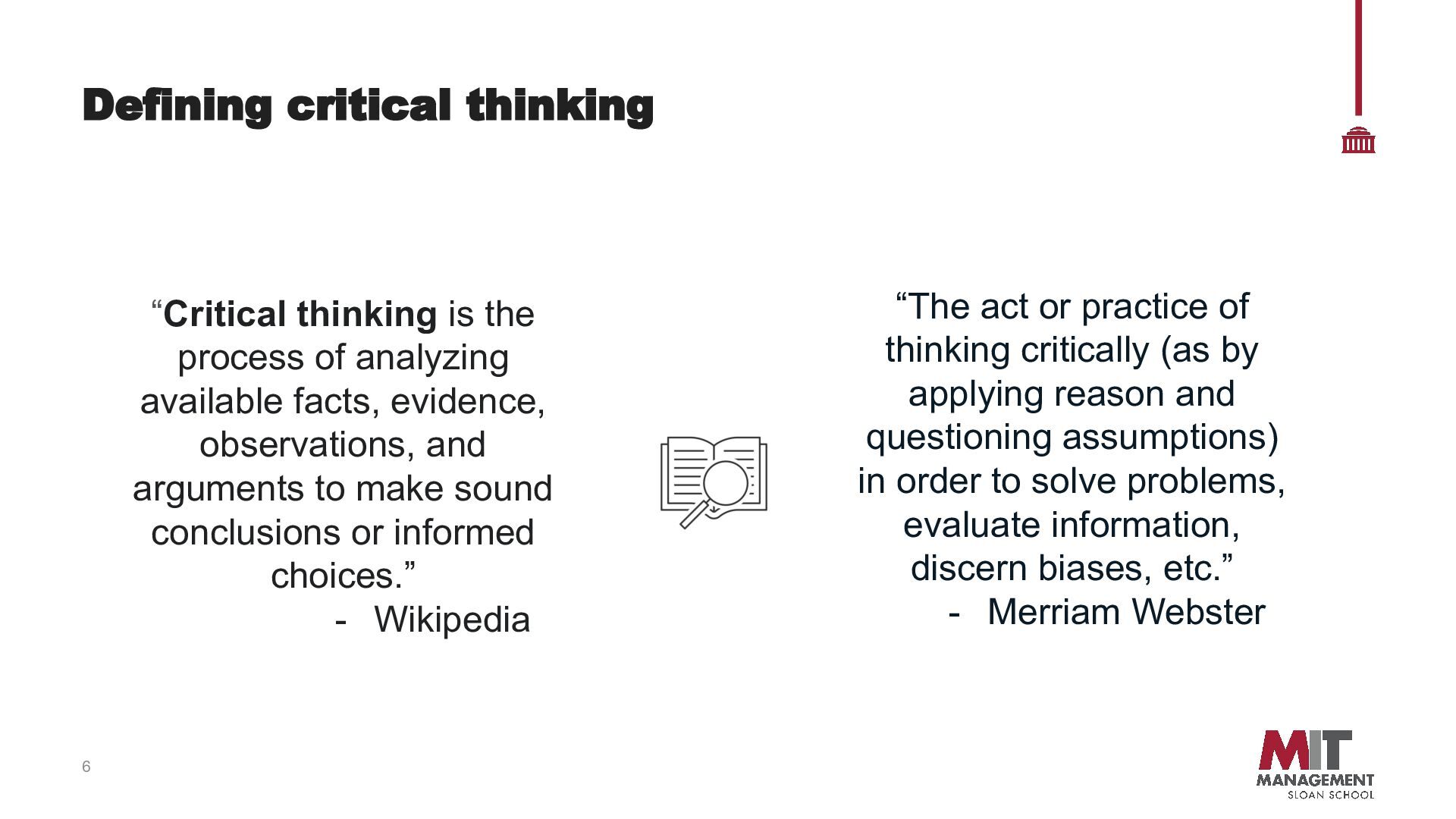
analyzing available facts, evidence, observations, and arguments to make sound conclusions or informed choices.” - Wikipedia “The act or practice of thinking critically (as by applying reason and questioning assumptions) in order to solve problems, evaluate information, discern biases, etc.” - Merriam Webster
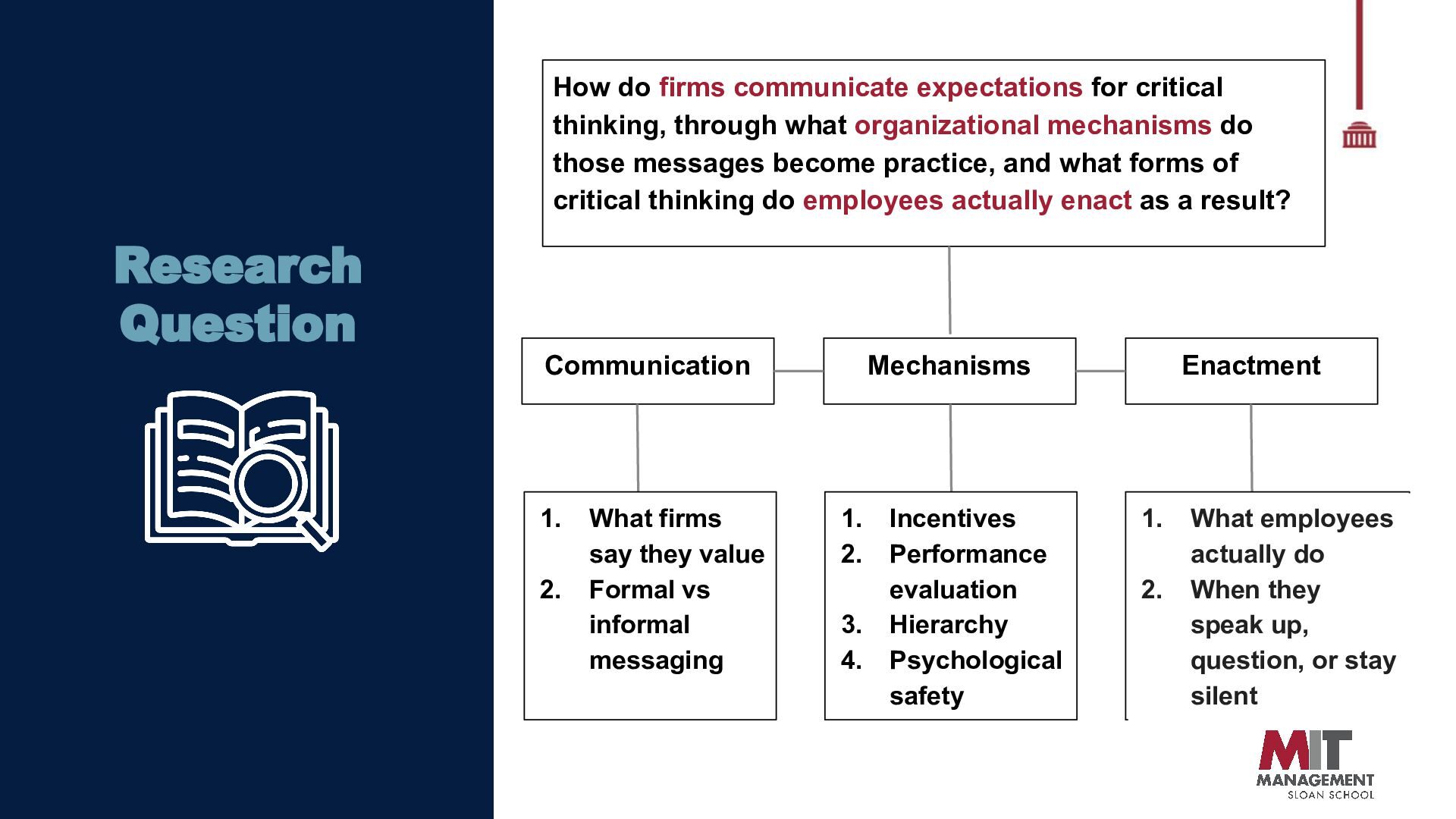
through what organizational mechanisms do those messages become practice, and what forms of critical thinking do employees actually enact as a result? Communication Mechanisms Enactment 1. What firms say they value 2. Formal vs informal messaging 1. Incentives 2. Performance evaluation 3. Hierarchy 4. Psychological safety 1. What employees actually do 2. When they speak up, question, or stay silent
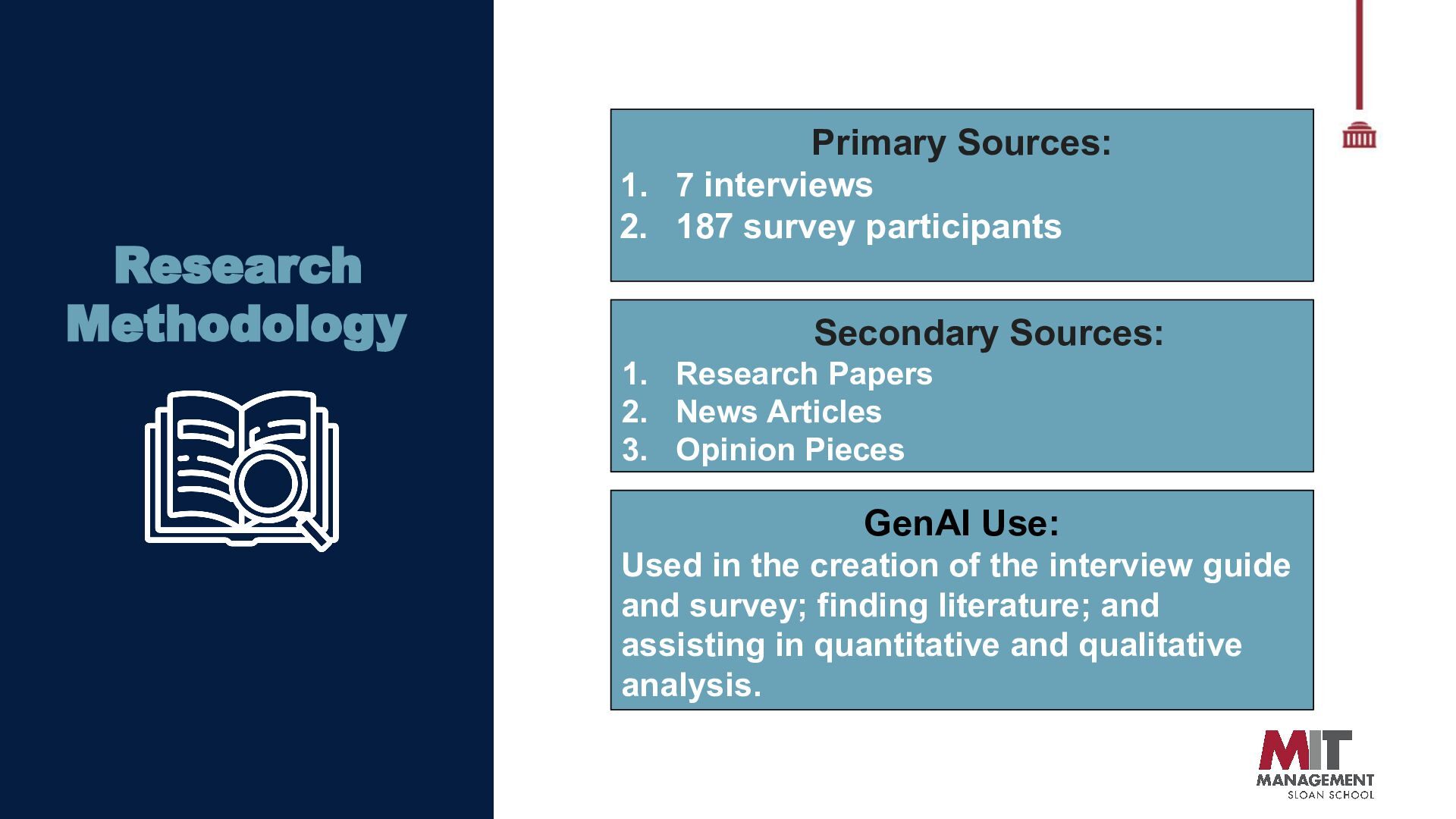
participants Secondary Sources: 1. Research Papers 2. News Articles 3. Opinion Pieces GenAI Use: Used in the creation of the interview guide and survey; finding literature; and assisting in quantitative and qualitative analysis.
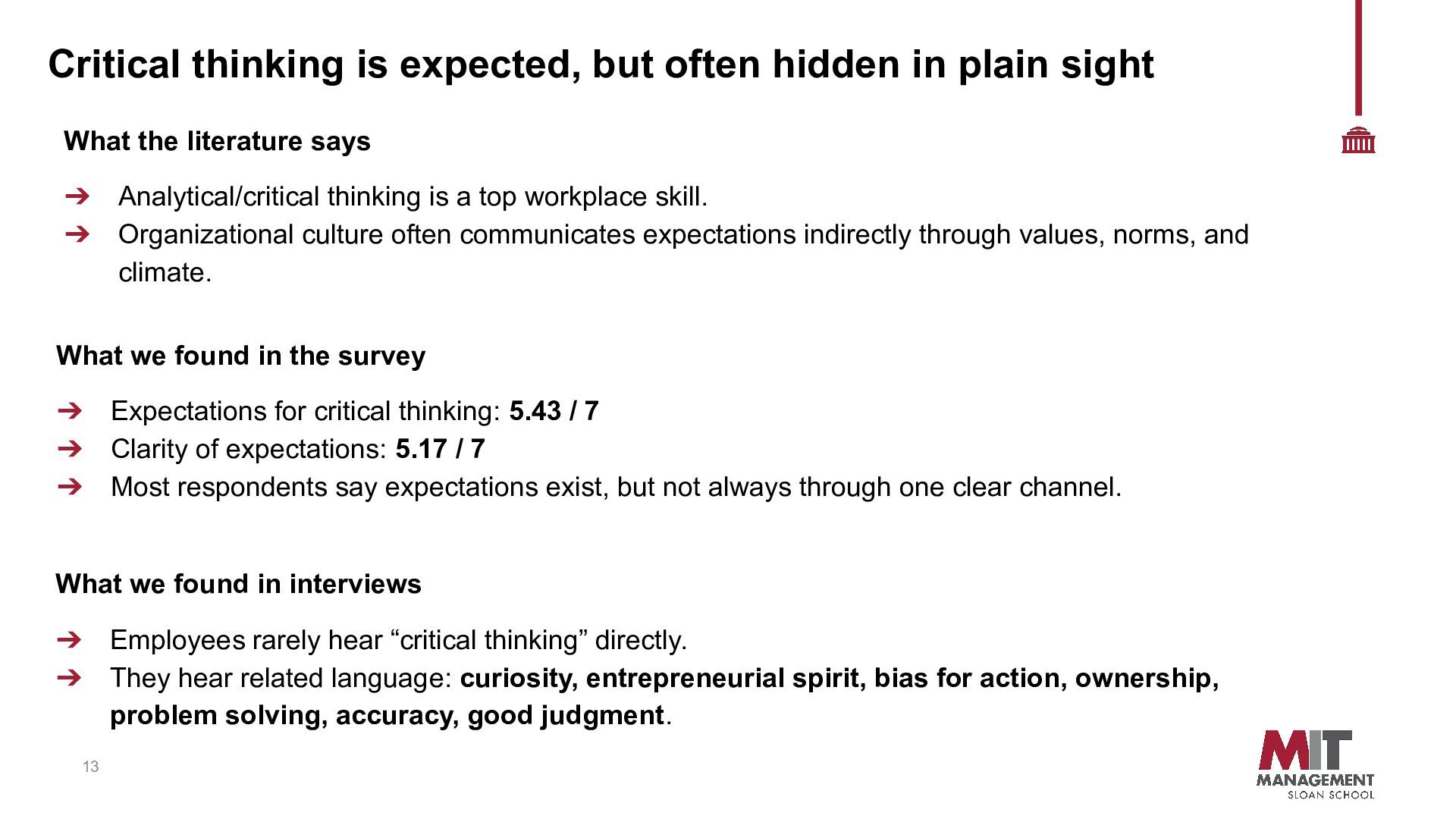
sight What the literature says ➔ Analytical/critical thinking is a top workplace skill. ➔ Organizational culture often communicates expectations indirectly through values, norms, and climate. What we found in the survey ➔ Expectations for critical thinking: 5.43 / 7 ➔ Clarity of expectations: 5.17 / 7 ➔ Most respondents say expectations exist, but not always through one clear channel. What we found in interviews ➔ Employees rarely hear “critical thinking” directly. ➔ They hear related language: curiosity, entrepreneurial spirit, bias for action, ownership, problem solving, accuracy, good judgment.
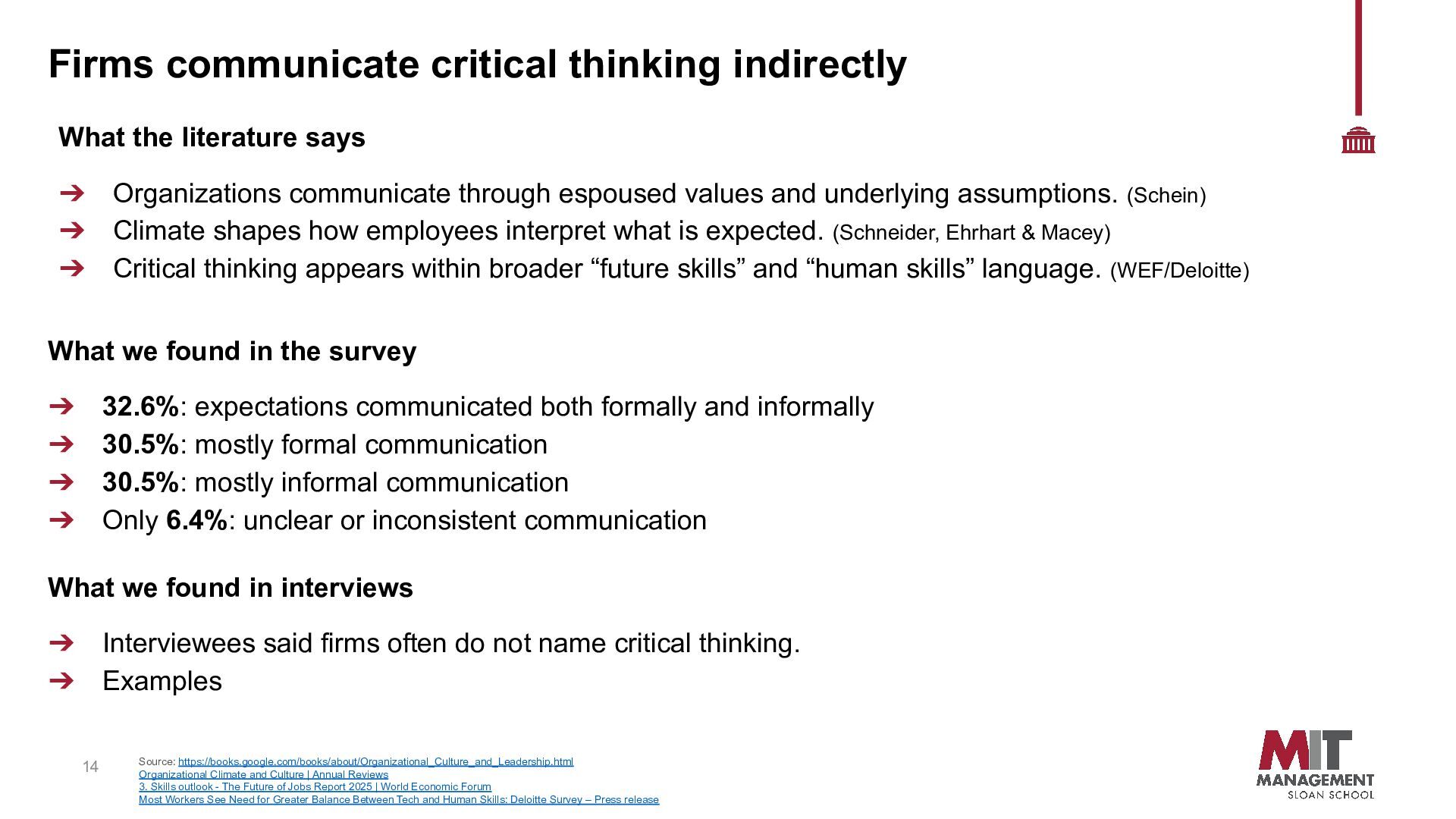
➔ Organizations communicate through espoused values and underlying assumptions. (Schein) ➔ Climate shapes how employees interpret what is expected. (Schneider, Ehrhart & Macey) ➔ Critical thinking appears within broader “future skills” and “human skills” language. (WEF/Deloitte) Source: https://books.google.com/books/about/Organizational_Culture_and_Leadership.html Organizational Climate and Culture | Annual Reviews 3. Skills outlook - The Future of Jobs Report 2025 | World Economic Forum Most Workers See Need for Greater Balance Between Tech and Human Skills: Deloitte Survey – Press release What we found in the survey ➔ 32.6%: expectations communicated both formally and informally ➔ 30.5%: mostly formal communication ➔ 30.5%: mostly informal communication ➔ Only 6.4%: unclear or inconsistent communication What we found in interviews ➔ Interviewees said firms often do not name critical thinking. ➔ Examples
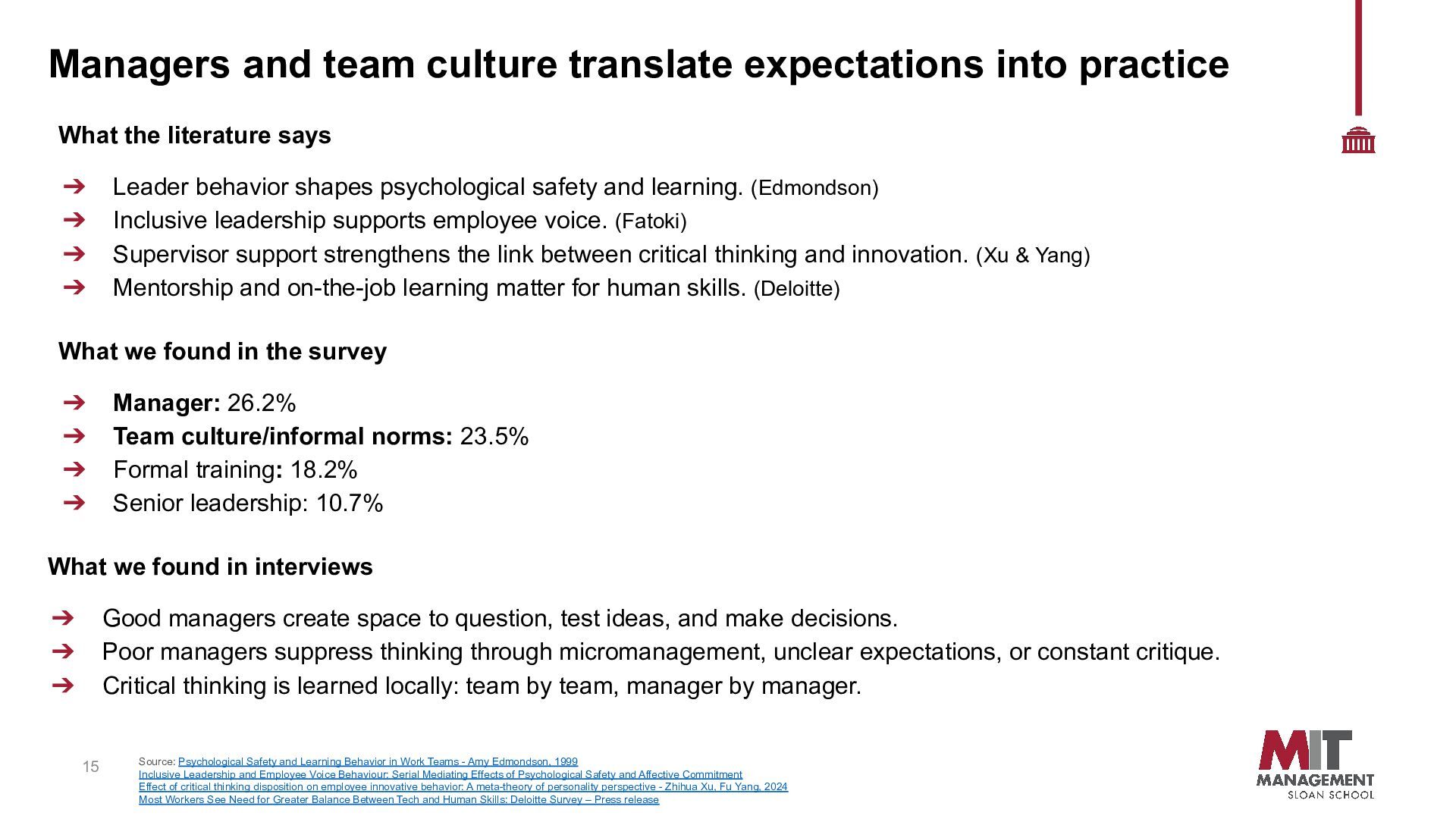
the literature says ➔ Leader behavior shapes psychological safety and learning. (Edmondson) ➔ Inclusive leadership supports employee voice. (Fatoki) ➔ Supervisor support strengthens the link between critical thinking and innovation. (Xu & Yang) ➔ Mentorship and on-the-job learning matter for human skills. (Deloitte) Source: Psychological Safety and Learning Behavior in Work Teams - Amy Edmondson, 1999 Inclusive Leadership and Employee Voice Behaviour: Serial Mediating Effects of Psychological Safety and Affective Commitment Effect of critical thinking disposition on employee innovative behavior: A meta-theory of personality perspective - Zhihua Xu, Fu Yang, 2024 Most Workers See Need for Greater Balance Between Tech and Human Skills: Deloitte Survey – Press release What we found in the survey ➔ Manager: 26.2% ➔ Team culture/informal norms: 23.5% ➔ Formal training: 18.2% ➔ Senior leadership: 10.7% What we found in interviews ➔ Good managers create space to question, test ideas, and make decisions. ➔ Poor managers suppress thinking through micromanagement, unclear expectations, or constant critique. ➔ Critical thinking is learned locally: team by team, manager by manager.
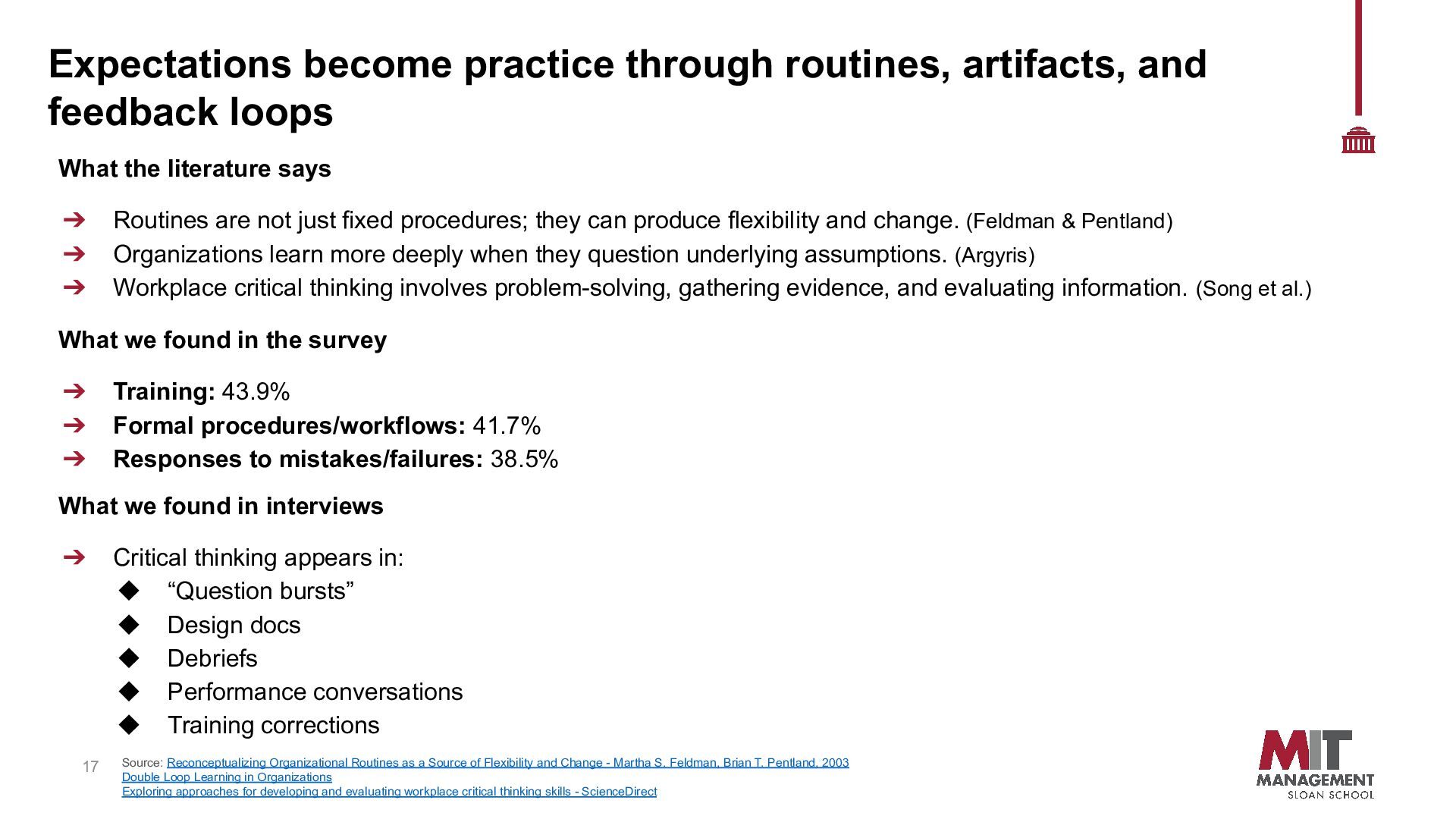
What the literature says ➔ Routines are not just fixed procedures; they can produce flexibility and change. (Feldman & Pentland) ➔ Organizations learn more deeply when they question underlying assumptions. (Argyris) ➔ Workplace critical thinking involves problem-solving, gathering evidence, and evaluating information. (Song et al.) Source: Reconceptualizing Organizational Routines as a Source of Flexibility and Change - Martha S. Feldman, Brian T. Pentland, 2003 Double Loop Learning in Organizations Exploring approaches for developing and evaluating workplace critical thinking skills - ScienceDirect What we found in the survey ➔ Training: 43.9% ➔ Formal procedures/workflows: 41.7% ➔ Responses to mistakes/failures: 38.5% What we found in interviews ➔ Critical thinking appears in: ◆ “Question bursts” ◆ Design docs ◆ Debriefs ◆ Performance conversations ◆ Training corrections
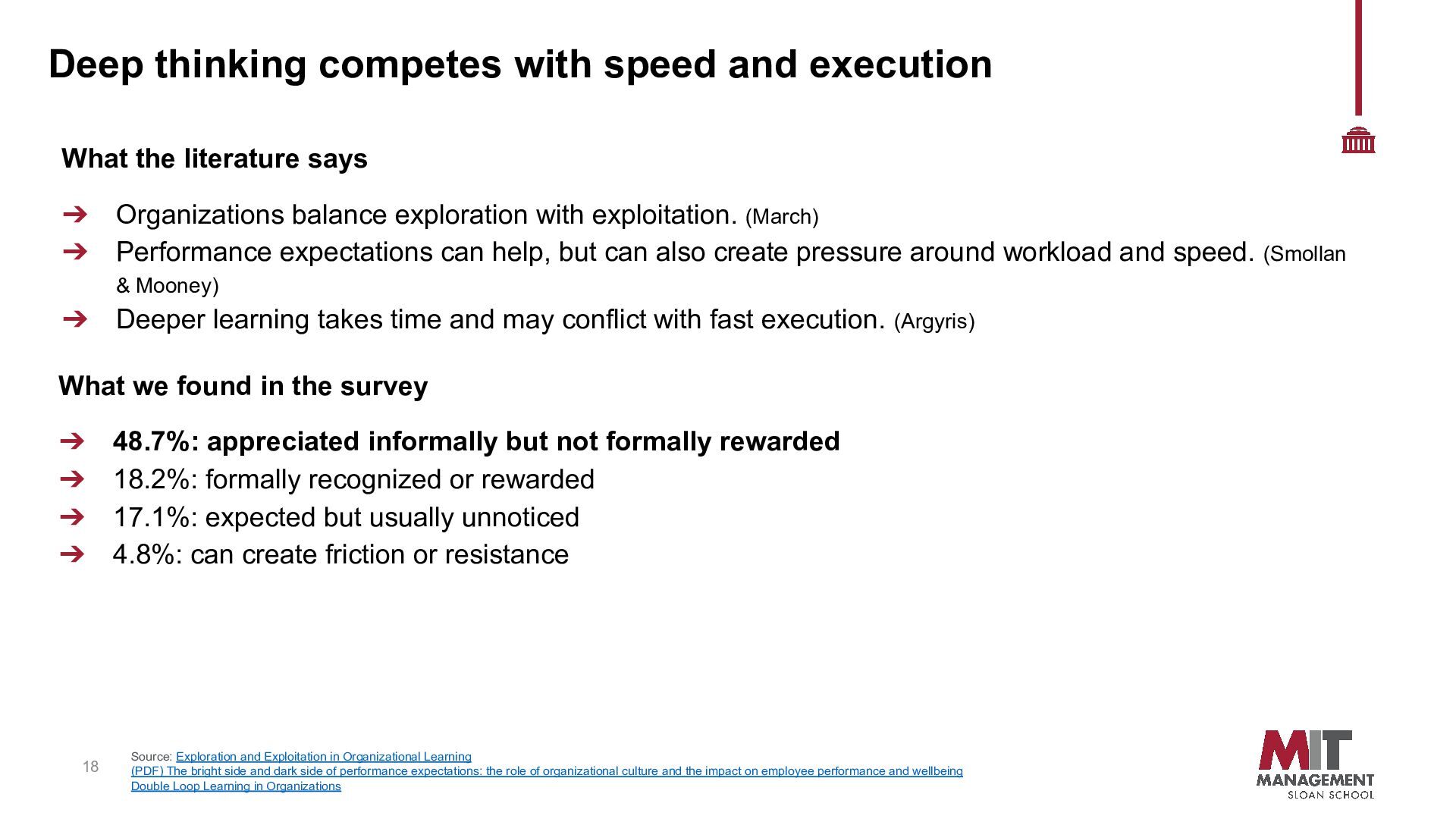
literature says ➔ Organizations balance exploration with exploitation. (March) ➔ Performance expectations can help, but can also create pressure around workload and speed. (Smollan & Mooney) ➔ Deeper learning takes time and may conflict with fast execution. (Argyris) Source: Exploration and Exploitation in Organizational Learning (PDF) The bright side and dark side of performance expectations: the role of organizational culture and the impact on employee performance and wellbeing Double Loop Learning in Organizations What we found in the survey ➔ 48.7%: appreciated informally but not formally rewarded ➔ 18.2%: formally recognized or rewarded ➔ 17.1%: expected but usually unnoticed ➔ 4.8%: can create friction or resistance
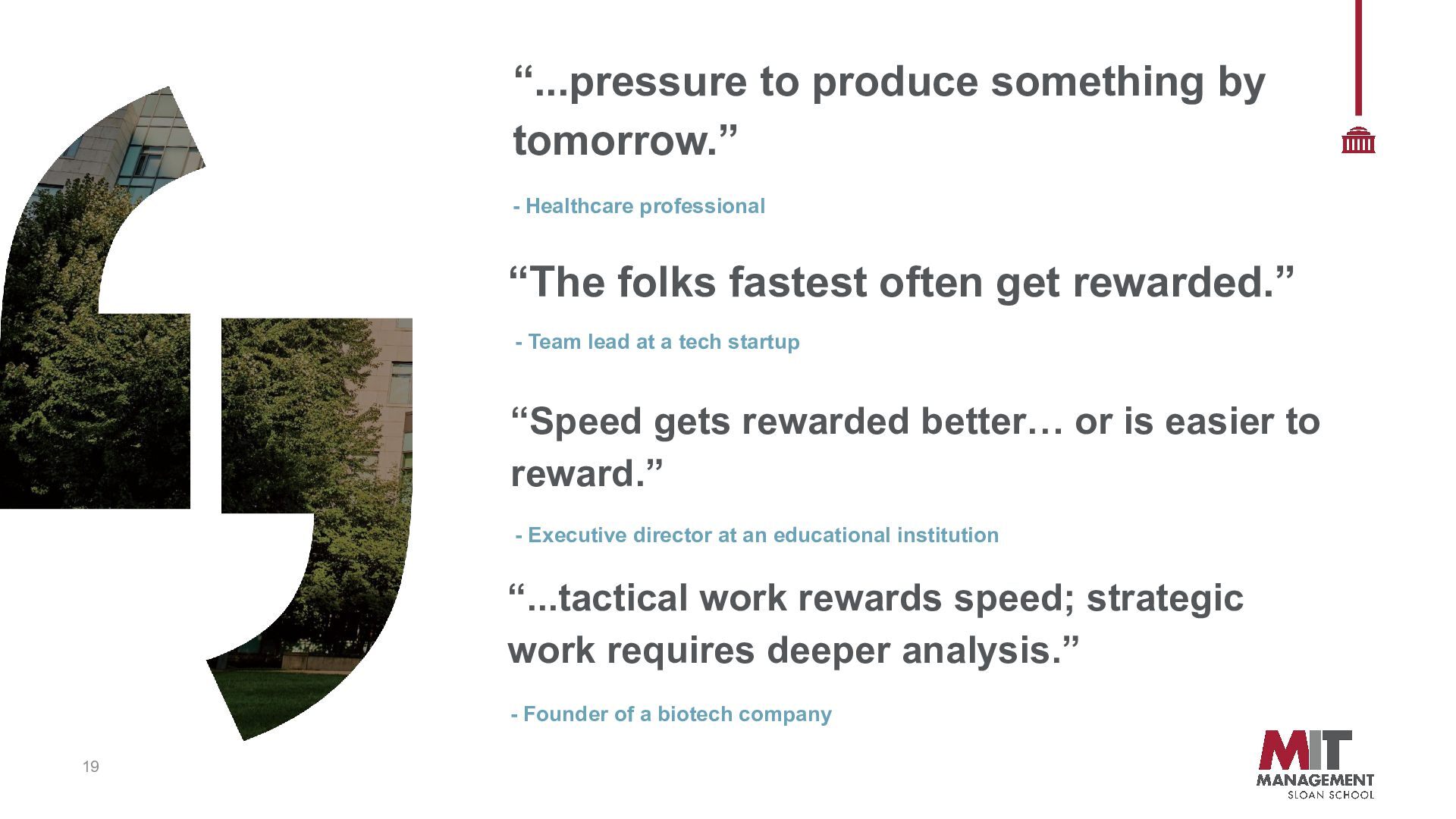
“The folks fastest often get rewarded.” - Team lead at a tech startup “Speed gets rewarded better… or is easier to reward.” - Executive director at an educational institution “...tactical work rewards speed; strategic work requires deeper analysis.” - Founder of a biotech company
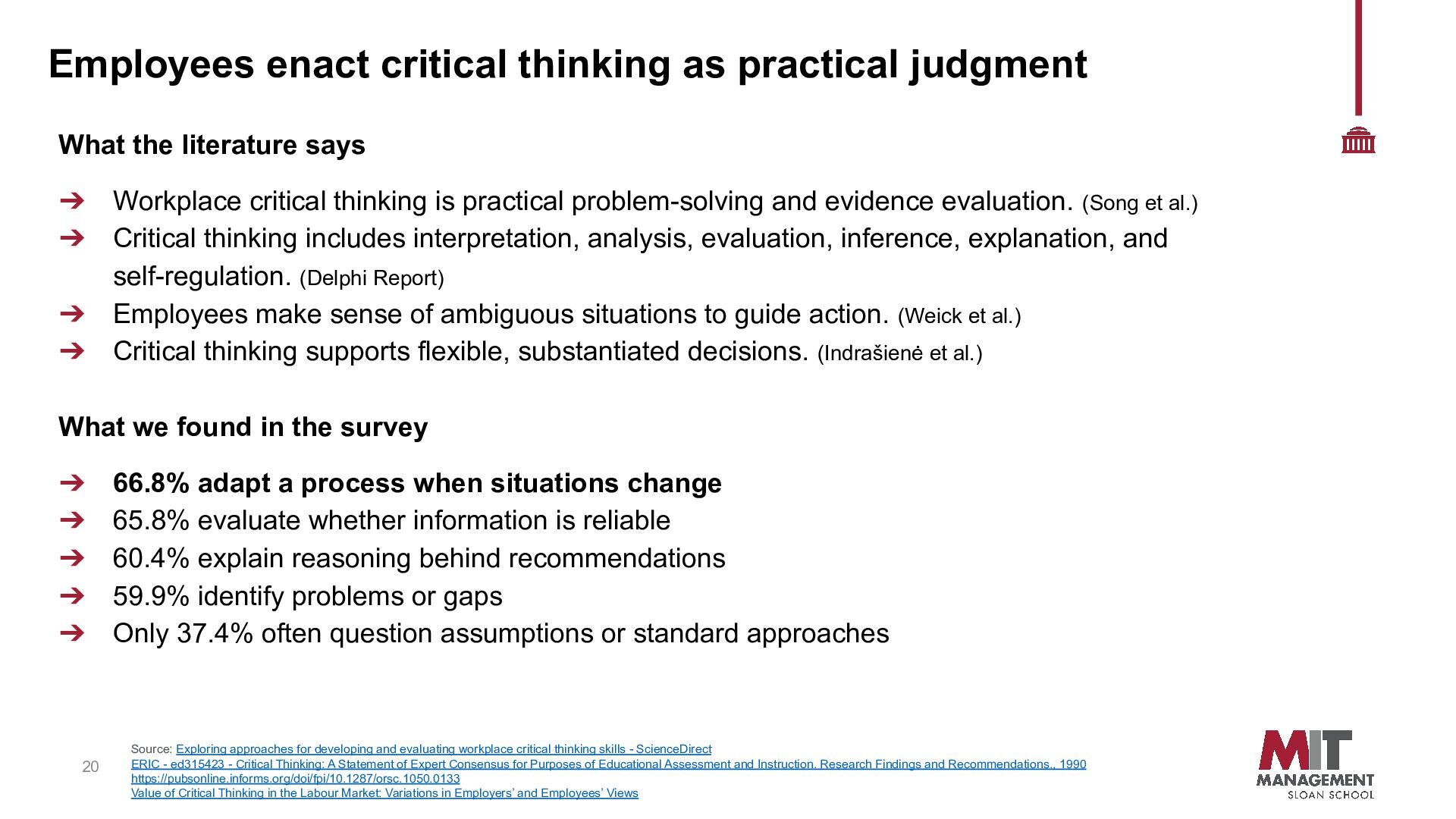
literature says ➔ Workplace critical thinking is practical problem-solving and evidence evaluation. (Song et al.) ➔ Critical thinking includes interpretation, analysis, evaluation, inference, explanation, and self-regulation. (Delphi Report) ➔ Employees make sense of ambiguous situations to guide action. (Weick et al.) ➔ Critical thinking supports flexible, substantiated decisions. (Indrašienė et al.) Source: Exploring approaches for developing and evaluating workplace critical thinking skills - ScienceDirect ERIC - ed315423 - Critical Thinking: A Statement of Expert Consensus for Purposes of Educational Assessment and Instruction. Research Findings and Recommendations., 1990 https://pubsonline.informs.org/doi/fpi/10.1287/orsc.1050.0133 Value of Critical Thinking in the Labour Market: Variations in Employers’ and Employees’ Views What we found in the survey ➔ 66.8% adapt a process when situations change ➔ 65.8% evaluate whether information is reliable ➔ 60.4% explain reasoning behind recommendations ➔ 59.9% identify problems or gaps ➔ Only 37.4% often question assumptions or standard approaches
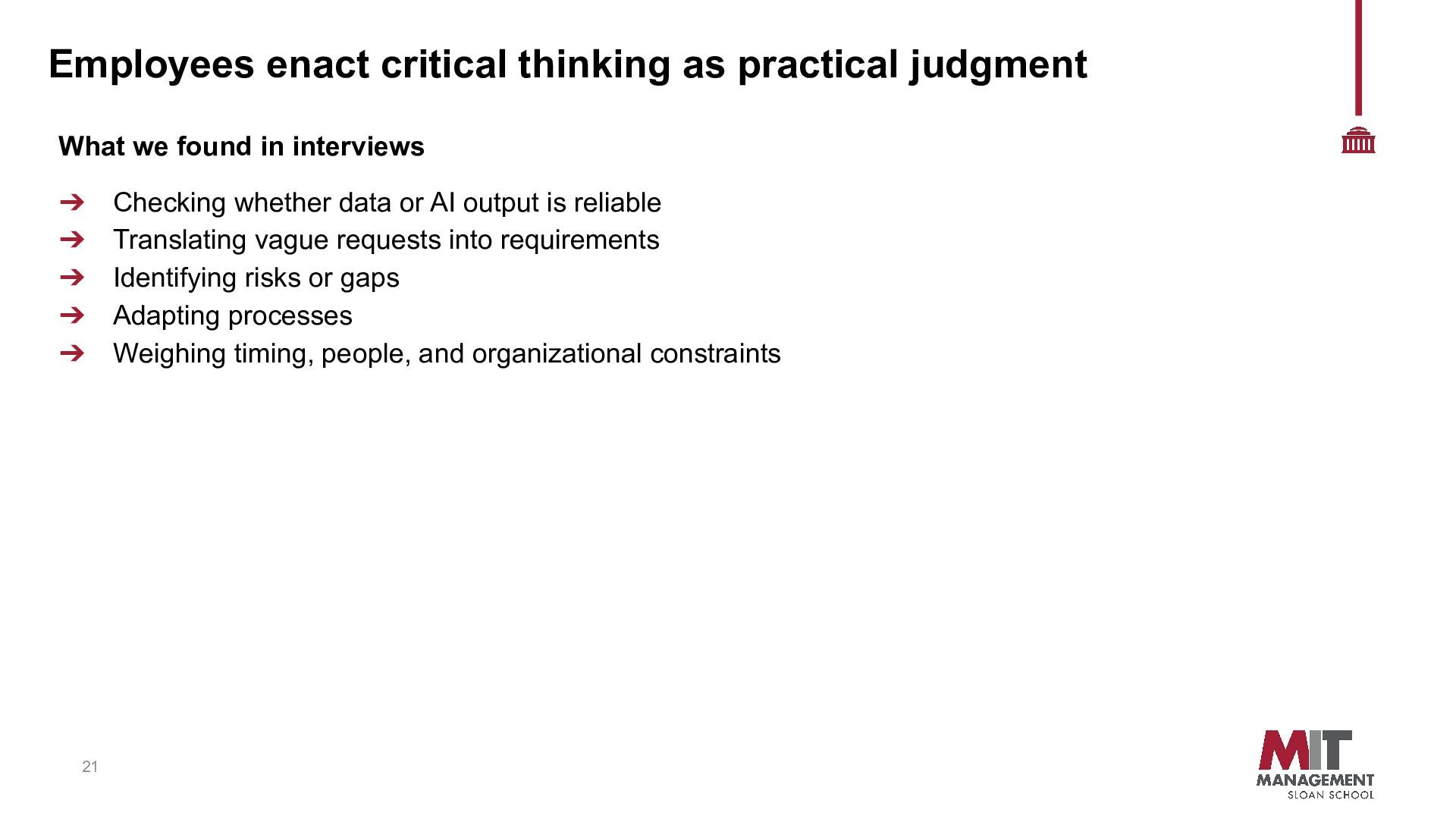
found in interviews ➔ Checking whether data or AI output is reliable ➔ Translating vague requests into requirements ➔ Identifying risks or gaps ➔ Adapting processes ➔ Weighing timing, people, and organizational constraints
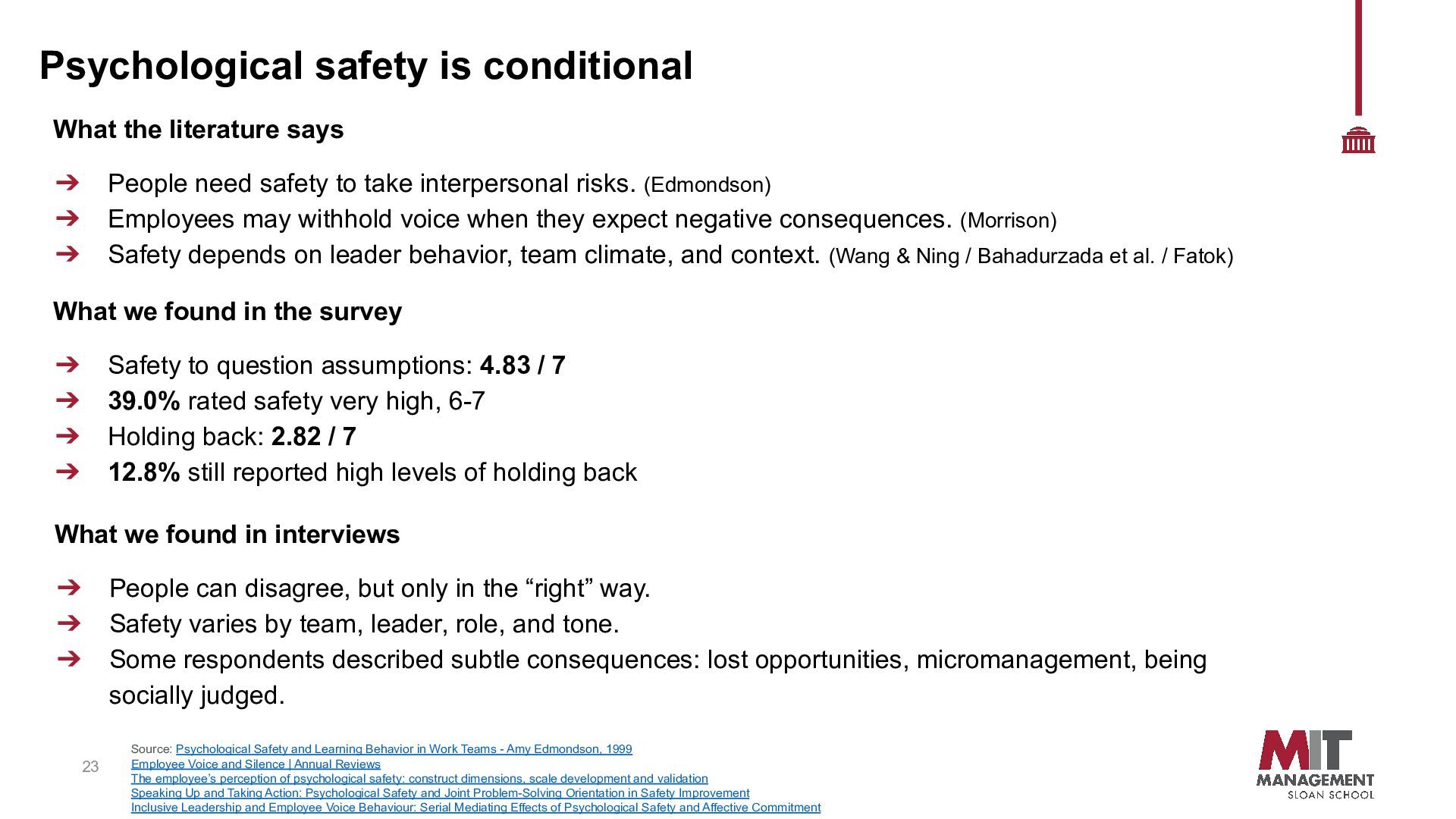
People need safety to take interpersonal risks. (Edmondson) ➔ Employees may withhold voice when they expect negative consequences. (Morrison) ➔ Safety depends on leader behavior, team climate, and context. (Wang & Ning / Bahadurzada et al. / Fatok) Source: Psychological Safety and Learning Behavior in Work Teams - Amy Edmondson, 1999 Employee Voice and Silence | Annual Reviews The employee’s perception of psychological safety: construct dimensions, scale development and validation Speaking Up and Taking Action: Psychological Safety and Joint Problem-Solving Orientation in Safety Improvement Inclusive Leadership and Employee Voice Behaviour: Serial Mediating Effects of Psychological Safety and Affective Commitment What we found in the survey ➔ Safety to question assumptions: 4.83 / 7 ➔ 39.0% rated safety very high, 6-7 ➔ Holding back: 2.82 / 7 ➔ 12.8% still reported high levels of holding back What we found in interviews ➔ People can disagree, but only in the “right” way. ➔ Safety varies by team, leader, role, and tone. ➔ Some respondents described subtle consequences: lost opportunities, micromanagement, being socially judged.
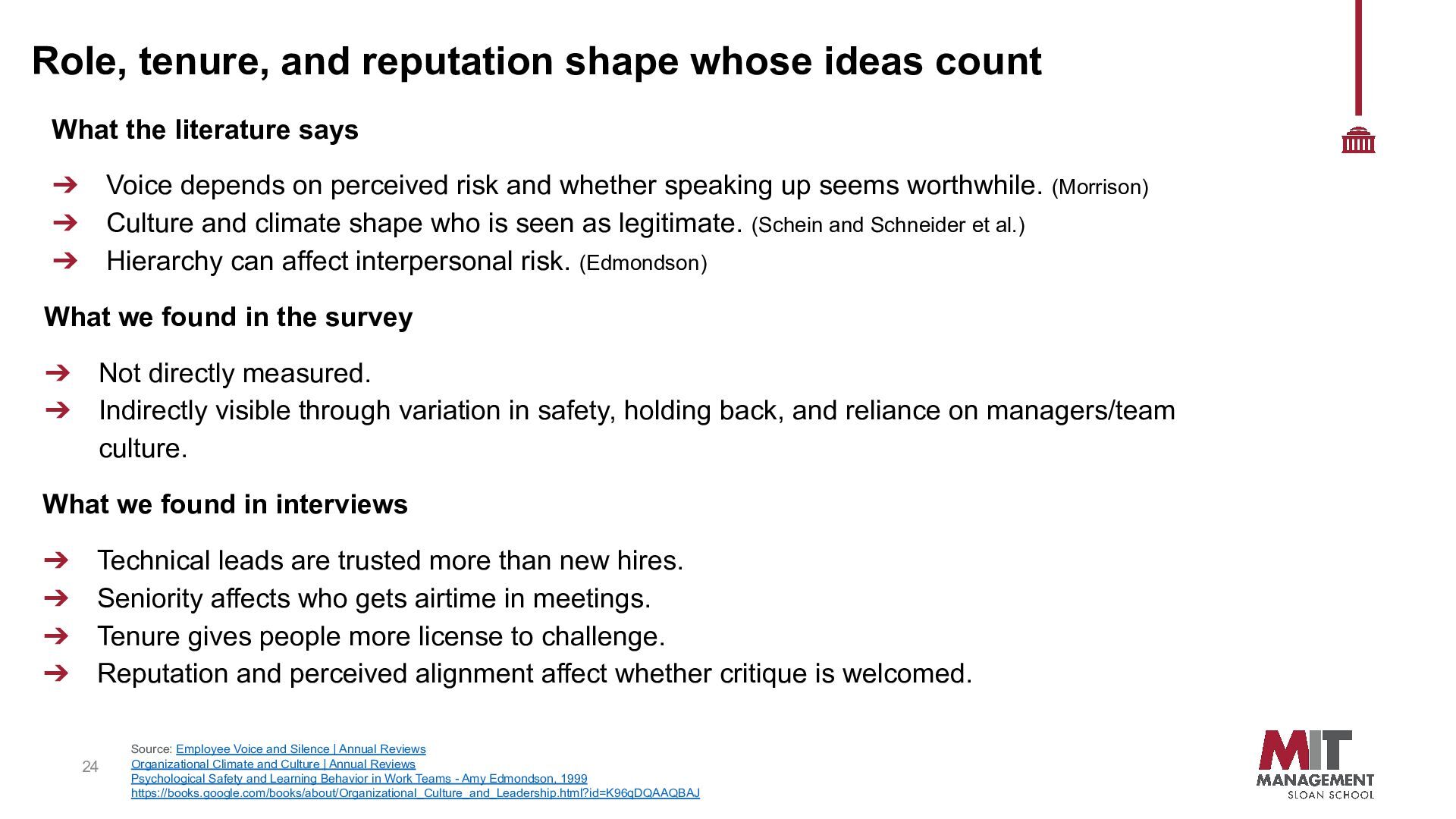
the literature says ➔ Voice depends on perceived risk and whether speaking up seems worthwhile. (Morrison) ➔ Culture and climate shape who is seen as legitimate. (Schein and Schneider et al.) ➔ Hierarchy can affect interpersonal risk. (Edmondson) Source: Employee Voice and Silence | Annual Reviews Organizational Climate and Culture | Annual Reviews Psychological Safety and Learning Behavior in Work Teams - Amy Edmondson, 1999 https://books.google.com/books/about/Organizational_Culture_and_Leadership.html?id=K96qDQAAQBAJ What we found in the survey ➔ Not directly measured. ➔ Indirectly visible through variation in safety, holding back, and reliance on managers/team culture. What we found in interviews ➔ Technical leads are trusted more than new hires. ➔ Seniority affects who gets airtime in meetings. ➔ Tenure gives people more license to challenge. ➔ Reputation and perceived alignment affect whether critique is welcomed.
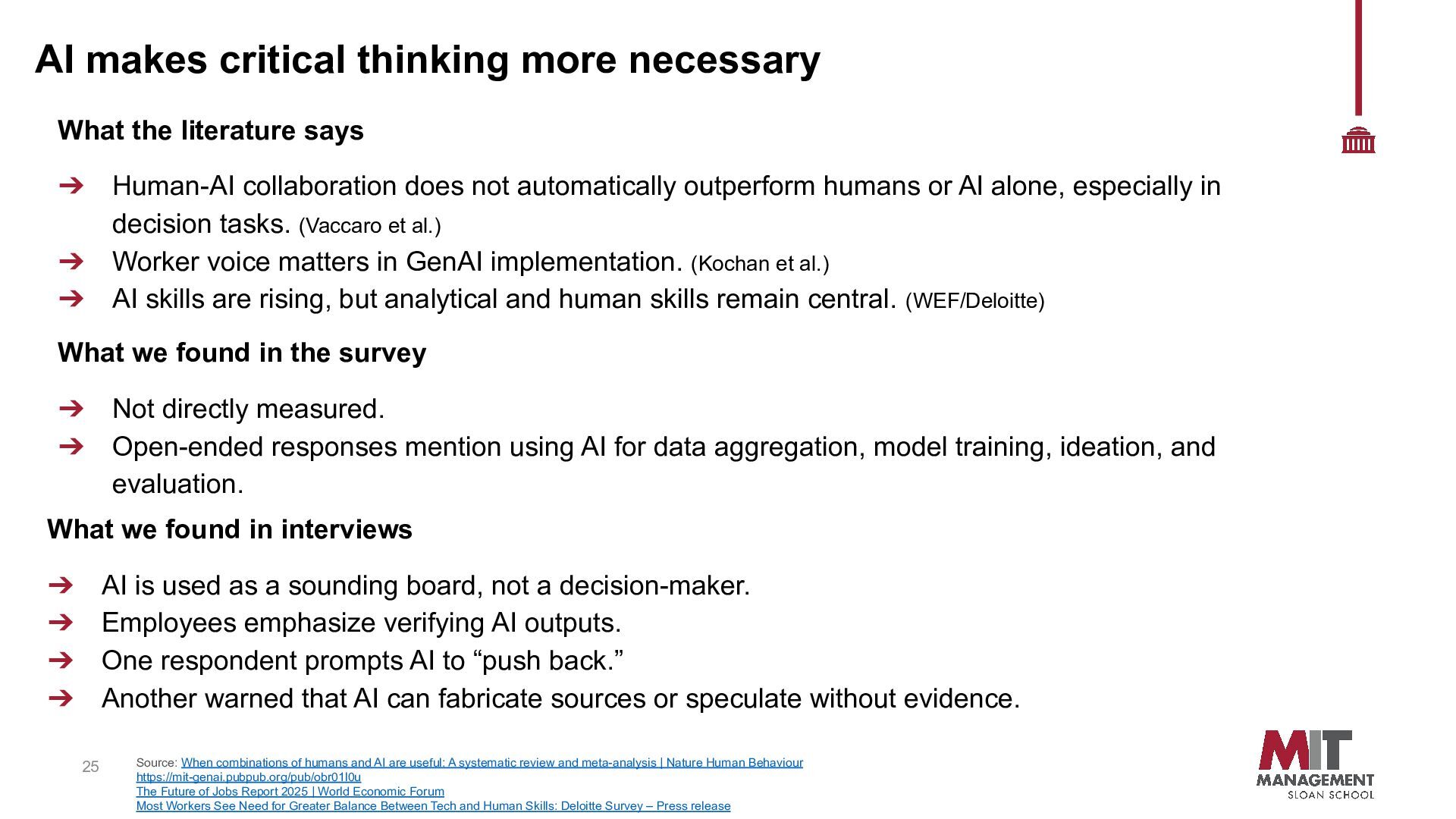
says ➔ Human-AI collaboration does not automatically outperform humans or AI alone, especially in decision tasks. (Vaccaro et al.) ➔ Worker voice matters in GenAI implementation. (Kochan et al.) ➔ AI skills are rising, but analytical and human skills remain central. (WEF/Deloitte) Source: When combinations of humans and AI are useful: A systematic review and meta-analysis | Nature Human Behaviour https://mit-genai.pubpub.org/pub/obr01l0u The Future of Jobs Report 2025 | World Economic Forum Most Workers See Need for Greater Balance Between Tech and Human Skills: Deloitte Survey – Press release What we found in the survey ➔ Not directly measured. ➔ Open-ended responses mention using AI for data aggregation, model training, ideation, and evaluation. What we found in interviews ➔ AI is used as a sounding board, not a decision-maker. ➔ Employees emphasize verifying AI outputs. ➔ One respondent prompts AI to “push back.” ➔ Another warned that AI can fabricate sources or speculate without evidence.
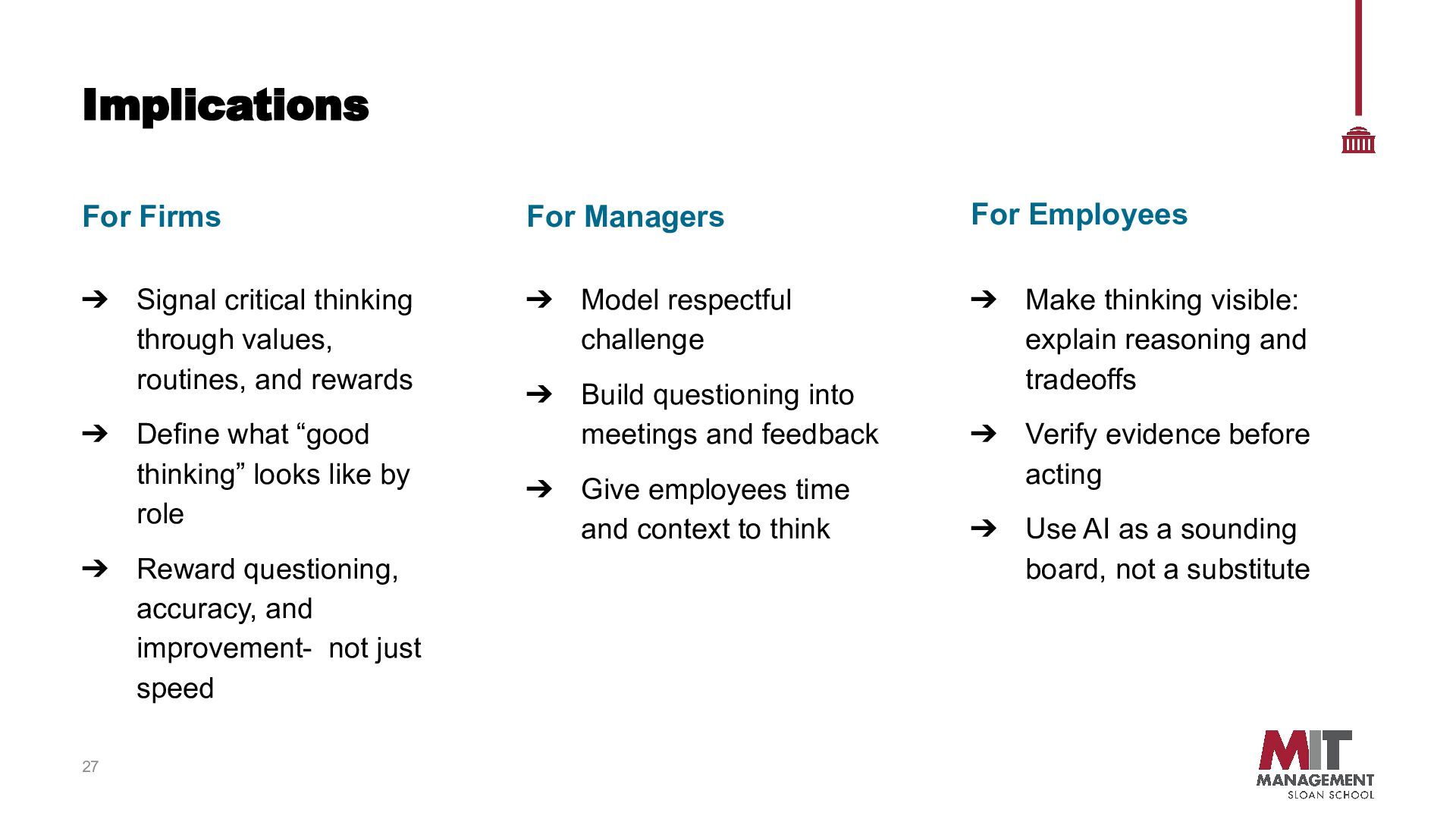
routines, and rewards ➔ Define what “good thinking” looks like by role ➔ Reward questioning, accuracy, and improvement- not just speed For Employees ➔ Make thinking visible: explain reasoning and tradeoffs ➔ Verify evidence before acting ➔ Use AI as a sounding board, not a substitute For Managers ➔ Model respectful challenge ➔ Build questioning into meetings and feedback ➔ Give employees time and context to think
“critical thinking” into values like curiosity, ownership, and judgment Mechanisms: ➔ Which channels make expectations clearest: managers, training, reviews, or team norms ➔ How tone, timing, and hierarchy affect whether questioning is welcomed ➔ How employees learn informal rules about what is safe to challenge ➔ How leaders communicate the balance between speed and deeper thinking ➔ How AI changes expectations for evidence-checking, questioning, and judgment


 erfertic
 smashingmag
 zakiyama
 lauravandoore
 katarinadahlin
 cassininazir
 trallard
 lara
 ipullrank
 schlessera
 pwiseman
 danielanewman