social dynamics AI presents? What are different ways to understand AI versus previous technologies? Why might we question the speed of integration and application, both public and private?
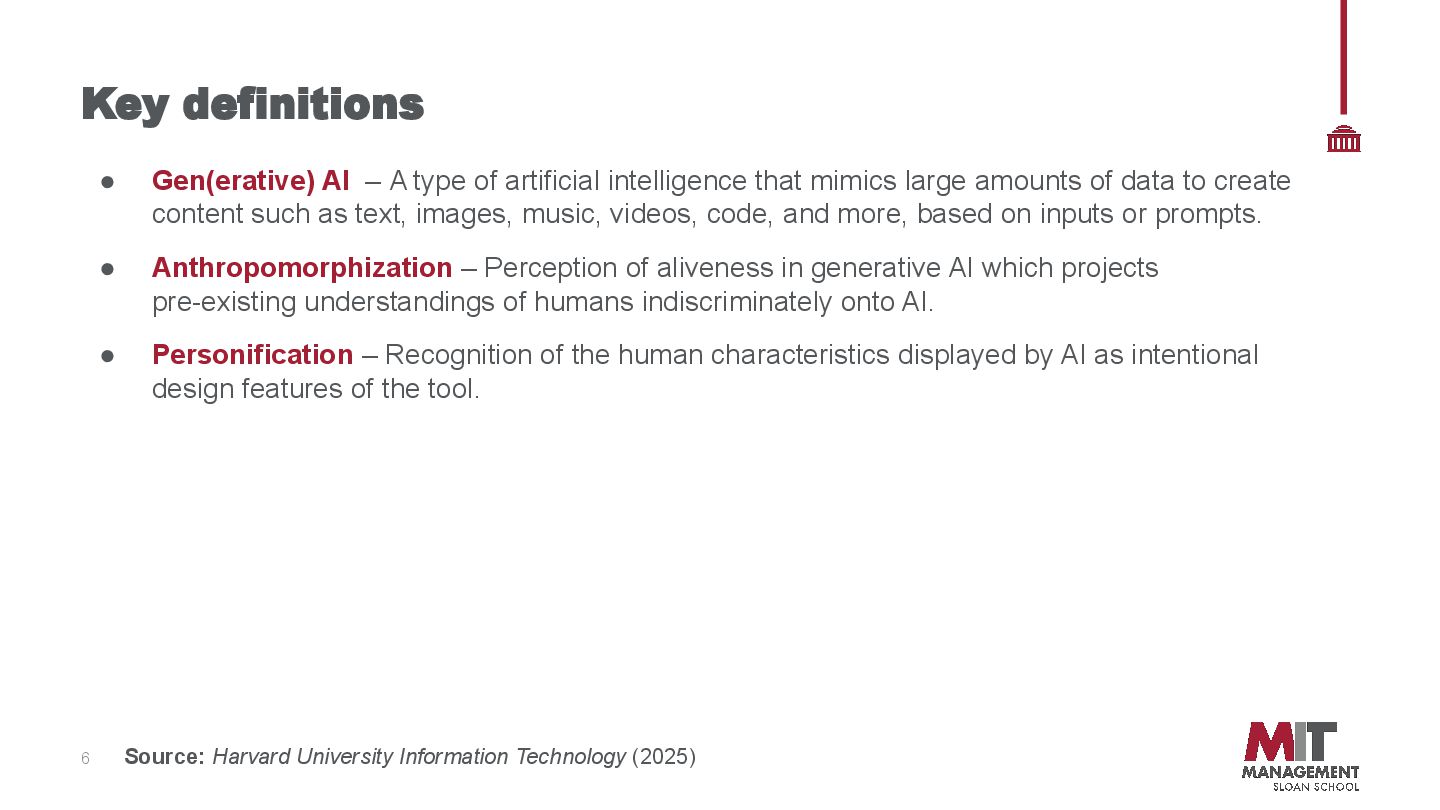
artificial intelligence that mimics large amounts of data to create content such as text, images, music, videos, code, and more, based on inputs or prompts. • Anthropomorphization – Perception of aliveness in generative AI which projects pre-existing understandings of humans indiscriminately onto AI. • Personification – Recognition of the human characteristics displayed by AI as intentional design features of the tool. Source: Harvard University Information Technology (2025)
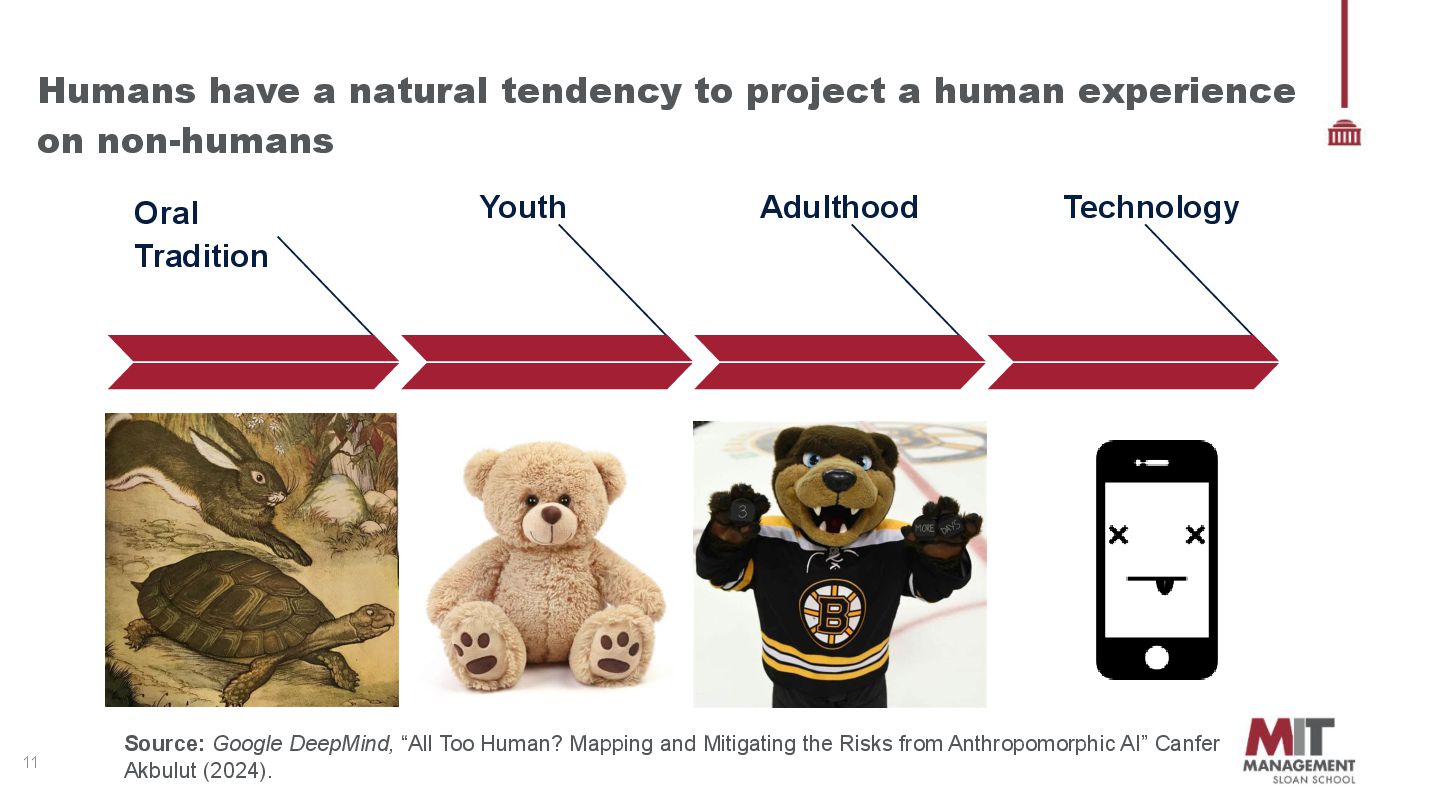
on non-humans Oral Tradition 11 Youth Adulthood Technology Source: Google DeepMind, “All Too Human? Mapping and Mitigating the Risks from Anthropomorphic AI” Canfer Akbulut (2024).
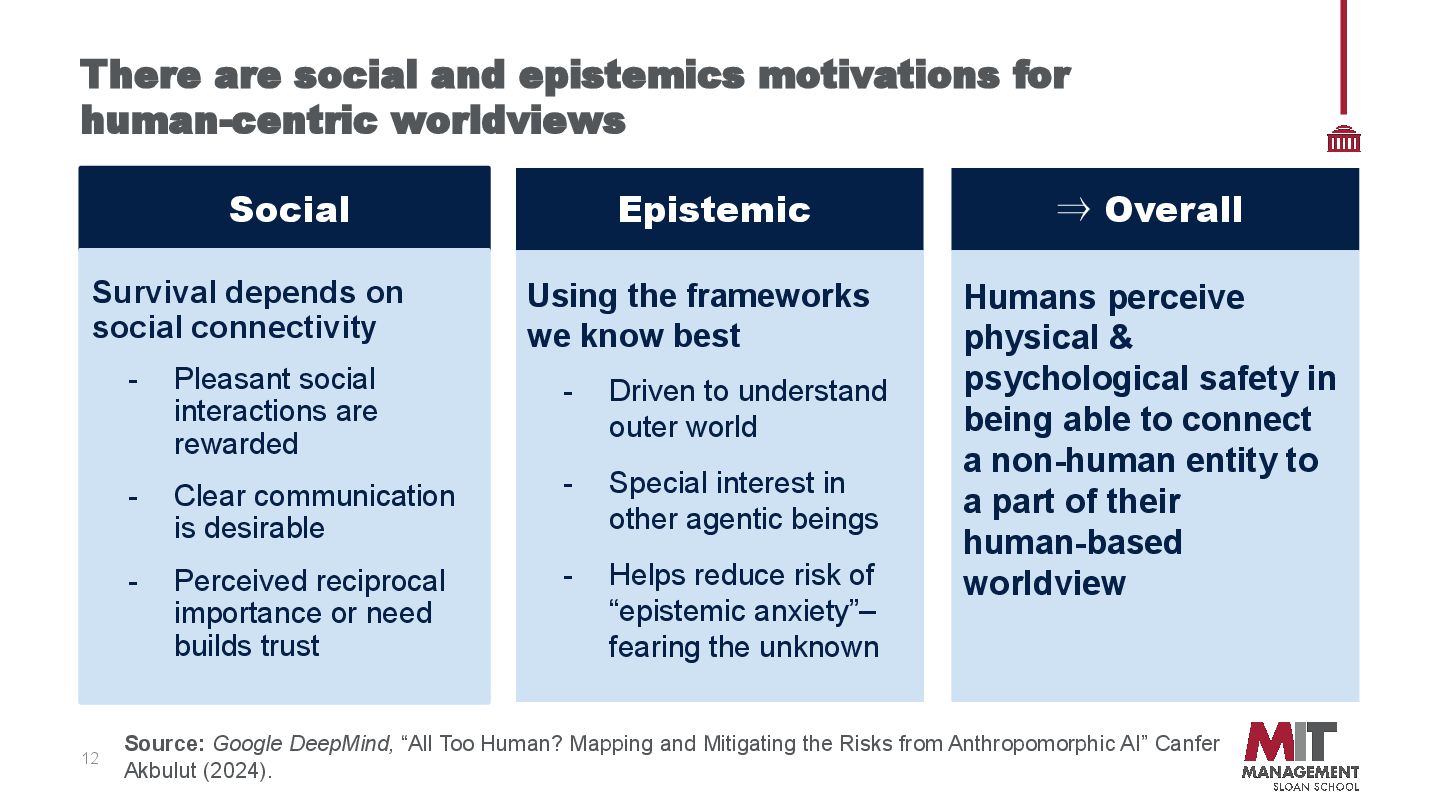
Epistemic ⇒ Overall 12 Source: Google DeepMind, “All Too Human? Mapping and Mitigating the Risks from Anthropomorphic AI” Canfer Akbulut (2024). Using the frameworks we know best - Driven to understand outer world - Special interest in other agentic beings - Helps reduce risk of “epistemic anxiety”– fearing the unknown Survival depends on social connectivity - Pleasant social interactions are rewarded - Clear communication is desirable - Perceived reciprocal importance or need builds trust Humans perceive physical & psychological safety in being able to connect a non-human entity to a part of their human-based worldview
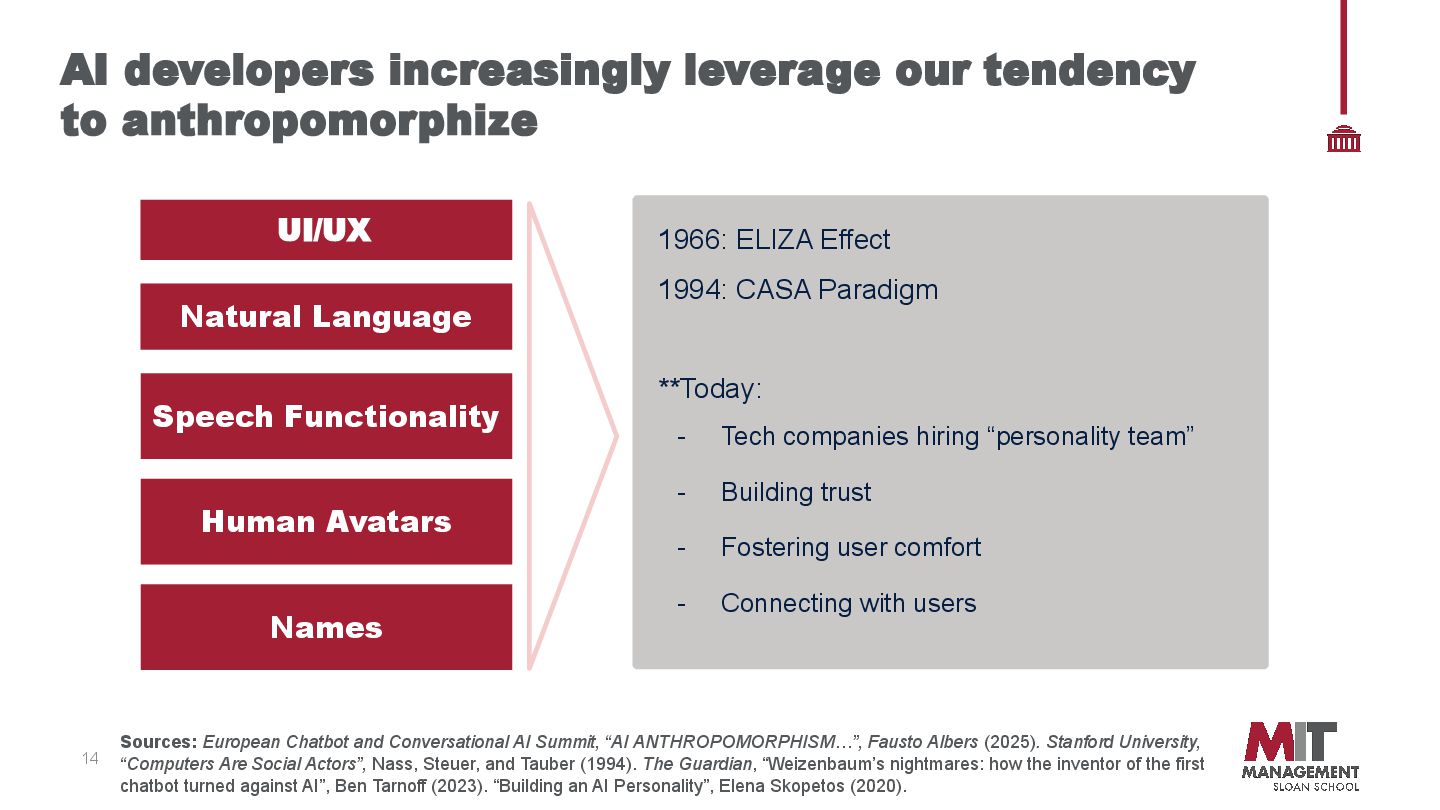
Language Speech Functionality 1966: ELIZA Effect 1994: CASA Paradigm **Today: - Tech companies hiring “personality team” - Building trust - Fostering user comfort - Connecting with users 14 Sources: European Chatbot and Conversational AI Summit, “AI ANTHROPOMORPHISM…”, Fausto Albers (2025). Stanford University, “Computers Are Social Actors”, Nass, Steuer, and Tauber (1994). The Guardian, “Weizenbaum’s nightmares: how the inventor of the first chatbot turned against AI”, Ben Tarnoff (2023). “Building an AI Personality”, Elena Skopetos (2020). Human Avatars Names
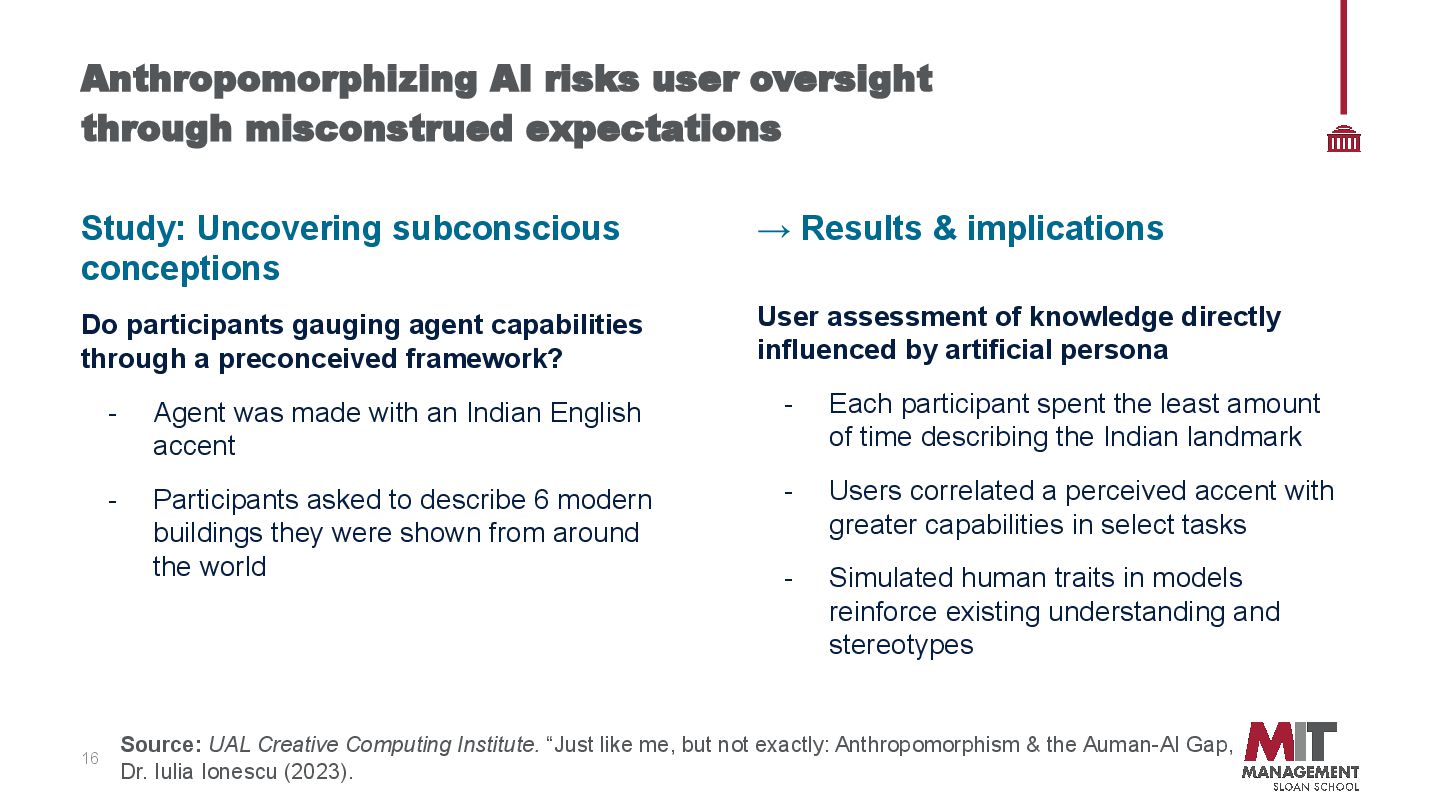
a preconceived framework? - Agent was made with an Indian English accent - Participants asked to describe 6 modern buildings they were shown from around the world → Results & implications User assessment of knowledge directly influenced by artificial persona - Each participant spent the least amount of time describing the Indian landmark - Users correlated a perceived accent with greater capabilities in select tasks - Simulated human traits in models reinforce existing understanding and stereotypes 16 Anthropomorphizing AI risks user oversight through misconstrued expectations Source: UAL Creative Computing Institute. “Just like me, but not exactly: Anthropomorphism & the Auman-AI Gap, Dr. Iulia Ionescu (2023).
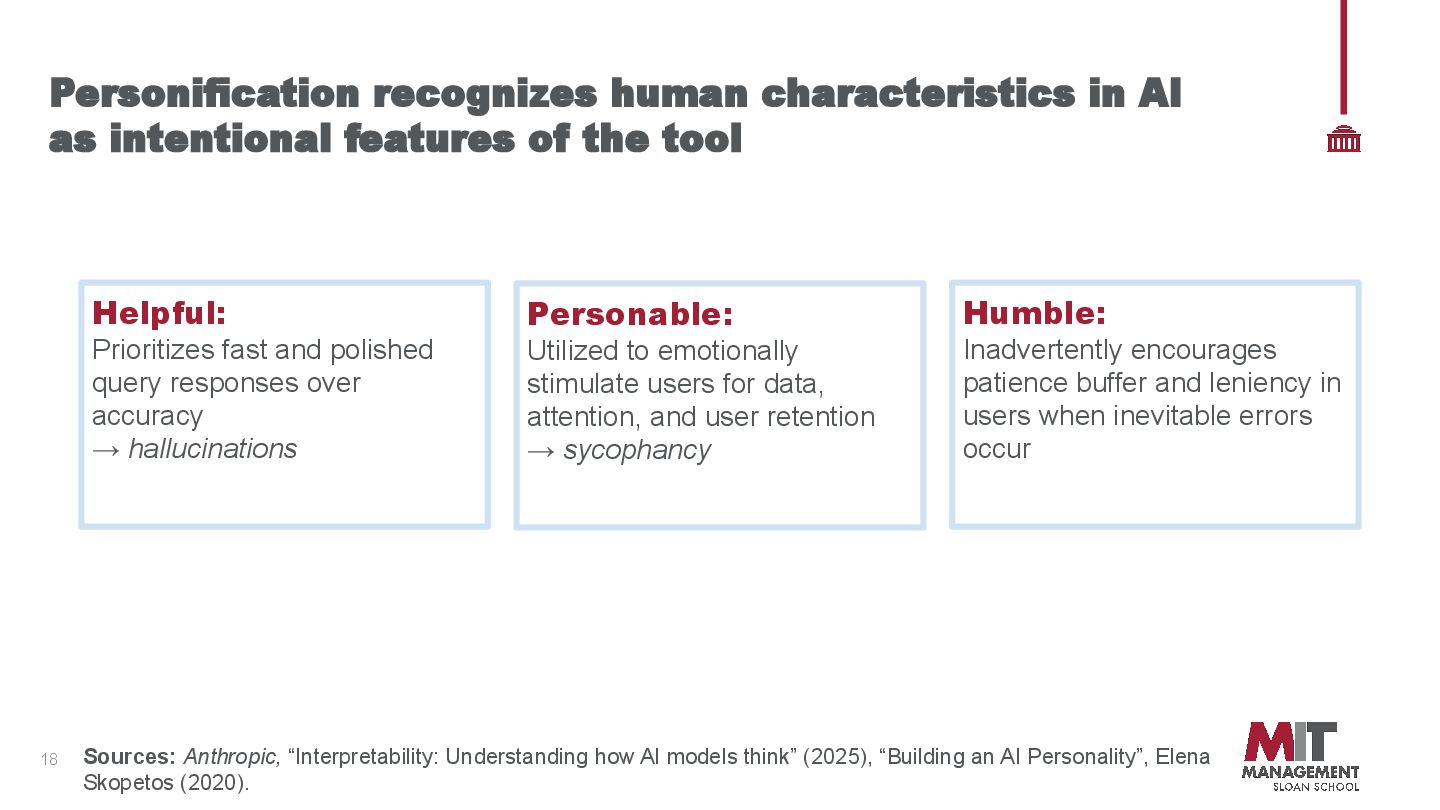
hallucinations Personable: Utilized to emotionally stimulate users for data, attention, and user retention → sycophancy Humble: Inadvertently encourages patience buffer and leniency in users when inevitable errors occur Personification recognizes human characteristics in AI as intentional features of the tool 18 Sources: Anthropic, “Interpretability: Understanding how AI models think” (2025), “Building an AI Personality”, Elena Skopetos (2020).
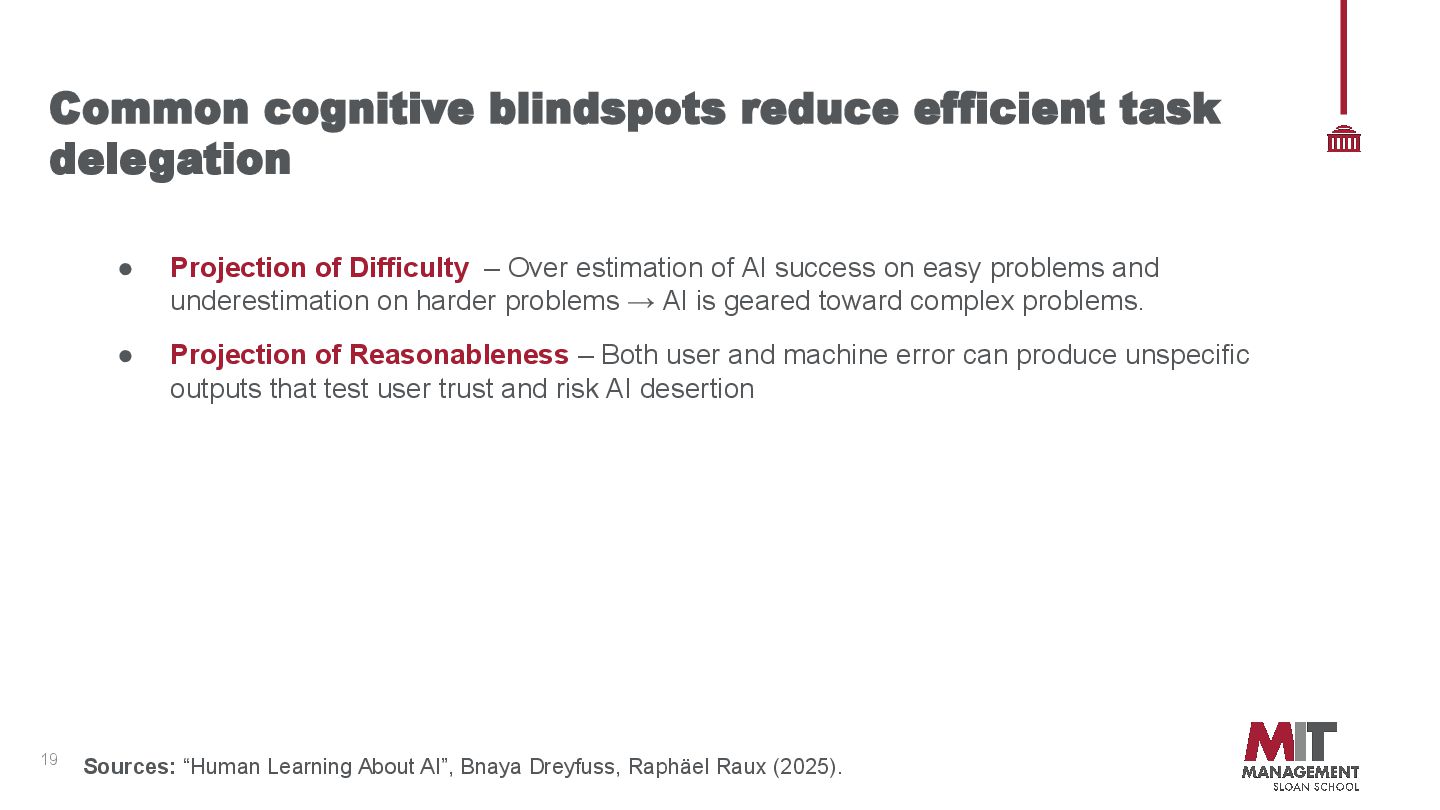
Learning About AI”, Bnaya Dreyfuss, Raphäel Raux (2025). • Projection of Difficulty – Over estimation of AI success on easy problems and underestimation on harder problems → AI is geared toward complex problems. • Projection of Reasonableness – Both user and machine error can produce unspecific outputs that test user trust and risk AI desertion
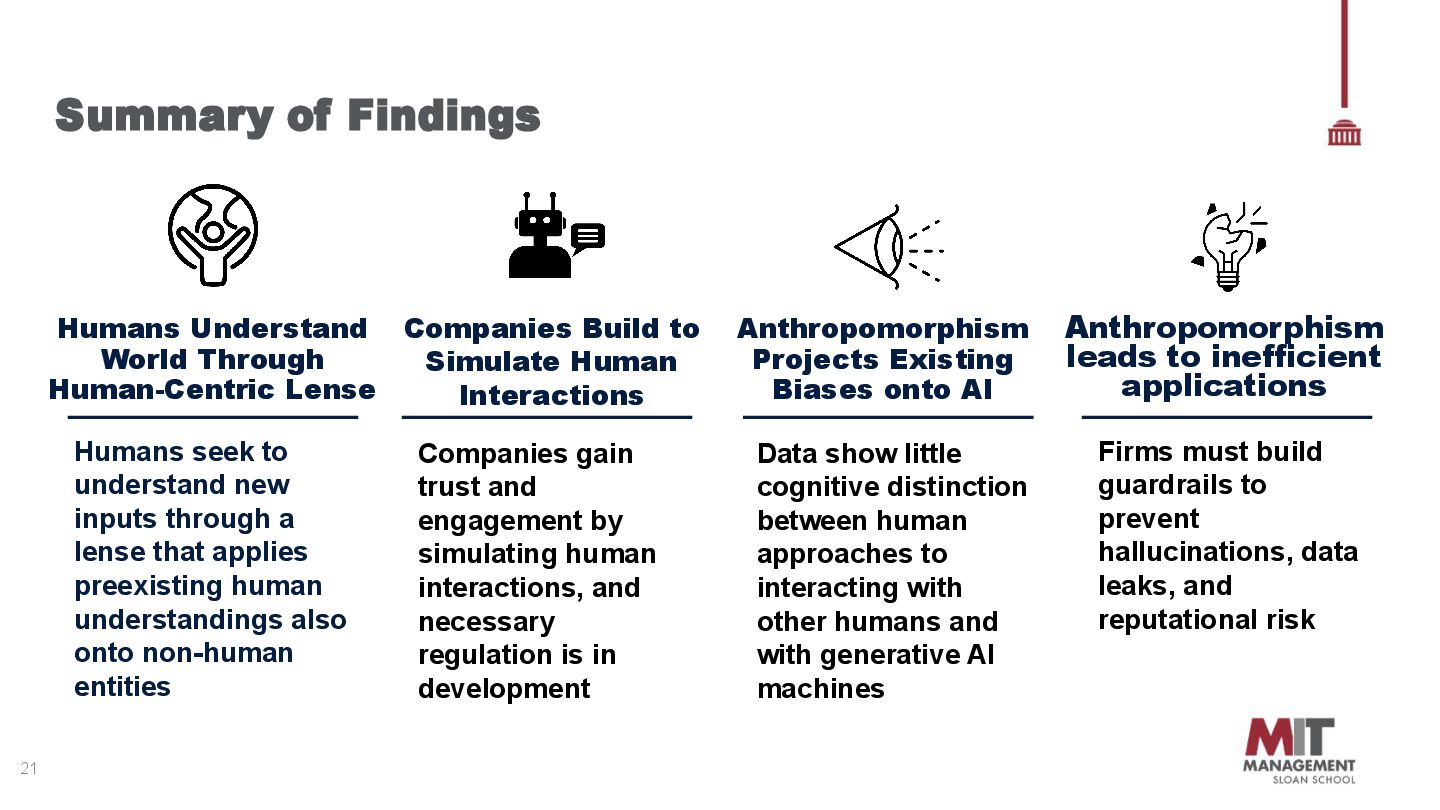
seek to understand new inputs through a lense that applies preexisting human understandings also onto non-human entities Companies Build to Simulate Human Interactions Companies gain trust and engagement by simulating human interactions, and necessary regulation is in development Anthropomorphism Projects Existing Biases onto AI Data show little cognitive distinction between human approaches to interacting with other humans and with generative AI machines Anthropomorphism leads to inefficient applications Firms must build guardrails to prevent hallucinations, data leaks, and reputational risk 21 Sources: Reuters, “J.P. Morgan launches in-house chatbot as AI-based research analyst, FT reports” (Jul 26, 2024) Quartz, Morgan Stanley has a new OpenAI-powered assistant for its financial advisors” (Aug 6, 2024)
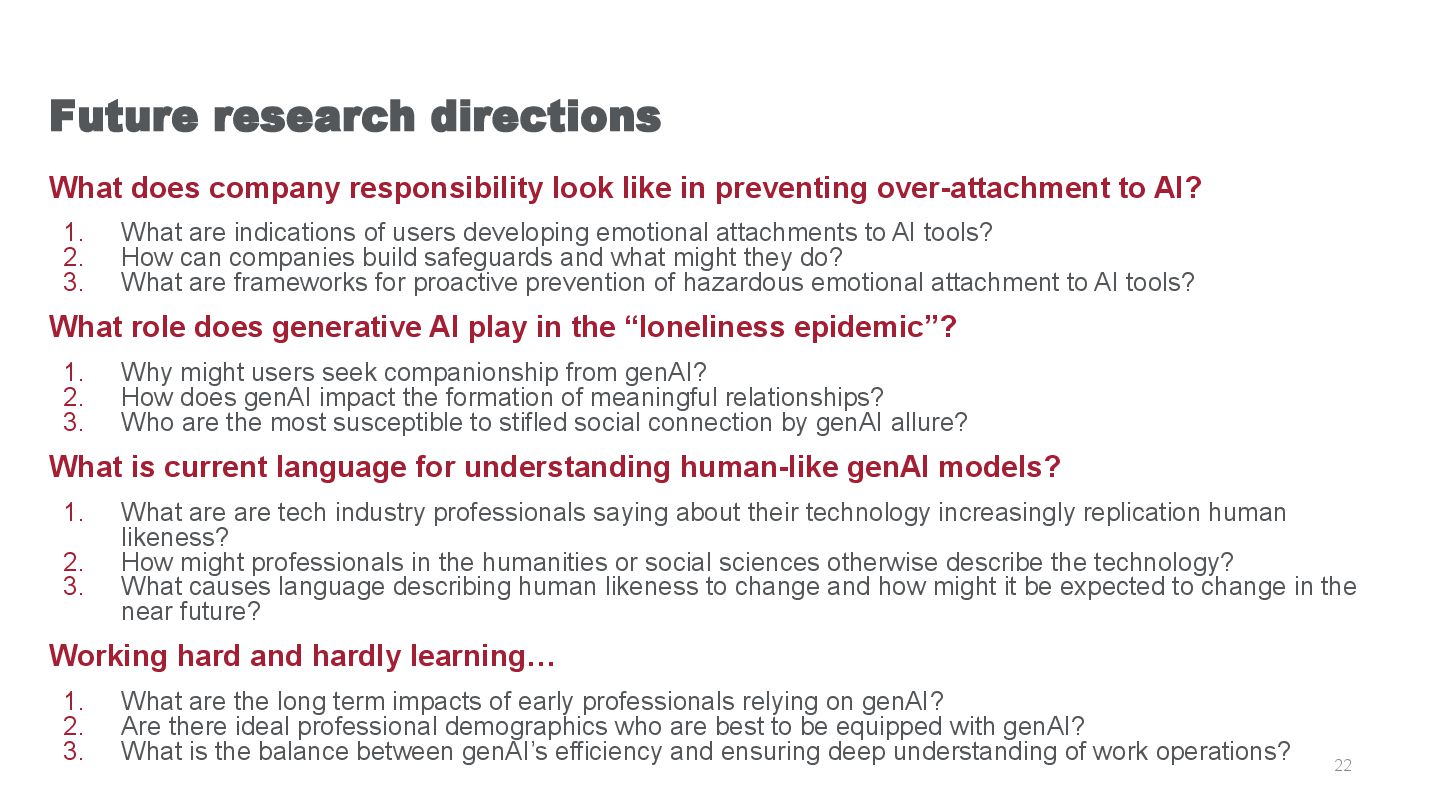
preventing over-attachment to AI? 1. What are indications of users developing emotional attachments to AI tools? 2. How can companies build safeguards and what might they do? 3. What are frameworks for proactive prevention of hazardous emotional attachment to AI tools? What role does generative AI play in the “loneliness epidemic”? 1. Why might users seek companionship from genAI? 2. How does genAI impact the formation of meaningful relationships? 3. Who are the most susceptible to stifled social connection by genAI allure? What is current language for understanding human-like genAI models? 1. What are are tech industry professionals saying about their technology increasingly replication human likeness? 2. How might professionals in the humanities or social sciences otherwise describe the technology? 3. What causes language describing human likeness to change and how might it be expected to change in the near future? Working hard and hardly learning… 1. What are the long term impacts of early professionals relying on genAI? 2. Are there ideal professional demographics who are best to be equipped with genAI? 3. What is the balance between genAI’s efficiency and ensuring deep understanding of work operations? 22


 erfertic
 satai
 tattaka
 hellosct1
 kohlerjohannes
 sokikatayama
 izumiyama_lab
 naok615
 yukiar
 sishi2026
 afroscript
 koide3
 tomonom
 samanthasiow
 honnibal
 akademiya2063
 davidcarrasco
 aleyda
 michaelherold
 mayunak
 destraynor
 cassininazir
 keithpitt
 tamaranovitovic
 csswizardry