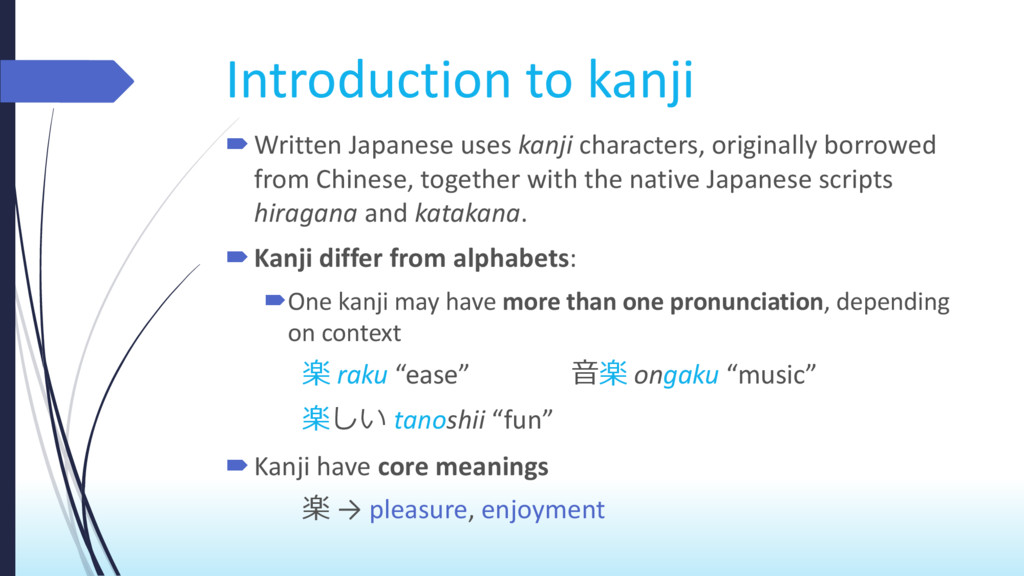
from Chinese, together with the native Japanese scripts hiragana and katakana. Kanji differ from alphabets: One kanji may have more than one pronunciation, depending on context 楽 raku “ease” 音楽 ongaku “music” 楽しい tanoshii “fun” Kanji have core meanings 楽 → pleasure, enjoyment
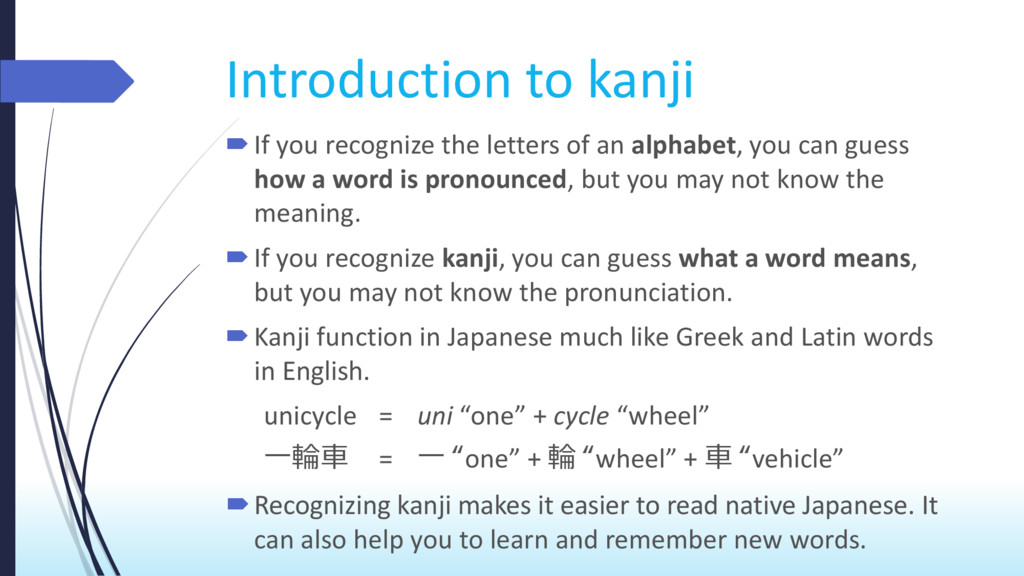
alphabet, you can guess how a word is pronounced, but you may not know the meaning. If you recognize kanji, you can guess what a word means, but you may not know the pronunciation. Kanji function in Japanese much like Greek and Latin words in English. unicycle = uni “one” + cycle “wheel” 一輪車 = 一 “one” + 輪 “wheel” + 車 “vehicle” Recognizing kanji makes it easier to read native Japanese. It can also help you to learn and remember new words.
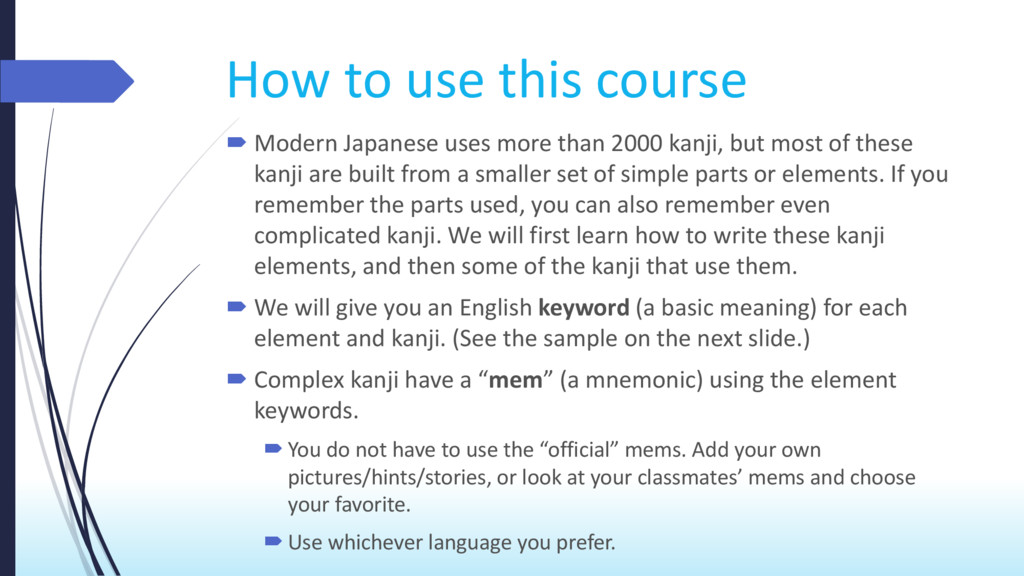
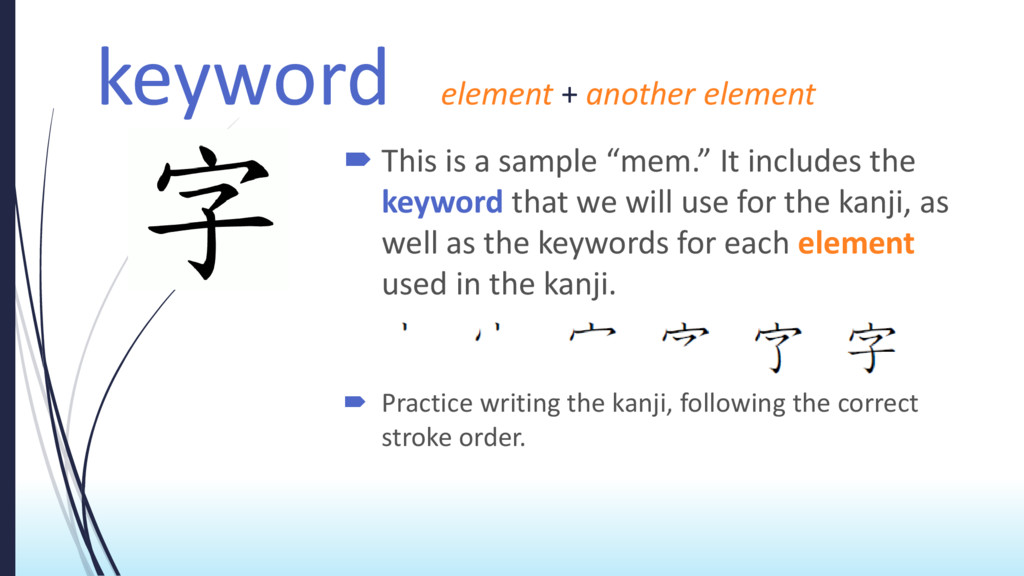
than 2000 kanji, but most of these kanji are built from a smaller set of simple parts or elements. If you remember the parts used, you can also remember even complicated kanji. We will first learn how to write these kanji elements, and then some of the kanji that use them. We will give you an English keyword (a basic meaning) for each element and kanji. (See the sample on the next slide.) Complex kanji have a “mem” (a mnemonic) using the element keywords. You do not have to use the “official” mems. Add your own pictures/hints/stories, or look at your classmates’ mems and choose your favorite. Use whichever language you prefer.
“mem.” It includes the keyword that we will use for the kanji, as well as the keywords for each element used in the kanji. Practice writing the kanji, following the correct stroke order.
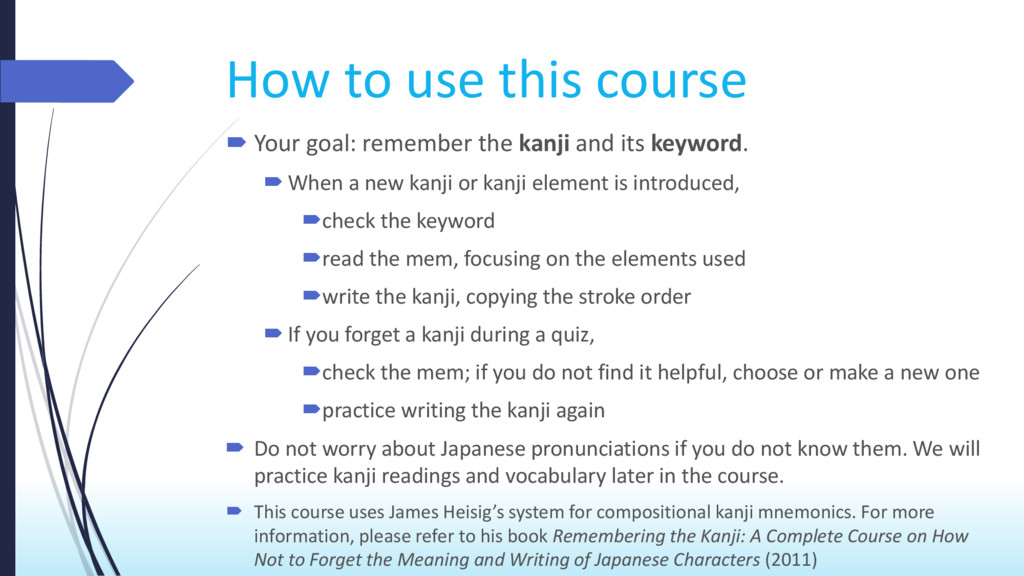
kanji and its keyword. When a new kanji or kanji element is introduced, check the keyword read the mem, focusing on the elements used write the kanji, copying the stroke order If you forget a kanji during a quiz, check the mem; if you do not find it helpful, choose or make a new one practice writing the kanji again Do not worry about Japanese pronunciations if you do not know them. We will practice kanji readings and vocabulary later in the course. This course uses James Heisig’s system for compositional kanji mnemonics. For more information, please refer to his book Remembering the Kanji: A Complete Course on How Not to Forget the Meaning and Writing of Japanese Characters (2011)


 etardiff
 marktimemedia
 deanohume
 chriscoyier
 jnunemaker
 cassininazir
 gr2m
gr2m
 reverentgeek
 lauravandoore
 malarkey
 pedronauck
.png) helenjbeal
helenjbeal
 eileencodes