Share
Embed
LSE The focus beyond Low Latency
LSE, exactpro, extent conference, trading, latency
Obninsk, 2 March, 2013
LSE The focus beyond Low Latency
EXTENT Trading Technology Trends & Quality Assurance
Eric Benedetti, Luciano Zanetti
Head of Technology Products Development & Head of Technology Equity Products LSEG
2 March 2013

Transcript
35 slides
-
1 The focus beyond Low Latency EXTENT Trading Technology Trends
& Quality Assurance Eric Benedetti, Luciano Zanetti Head of Technology Products Development & Head of Technology Equity Products LSEG 3 March 2013 -
2 Agenda 1. Introduction 2. Key features from the Borsa
Italiana migration to MIT 3. MIT convergence road map for LSE, Borsa and Turquoise 4. Group Ticker Plant 5. Group Trading Interface 6. Sponsored Access 7. Conclusion -
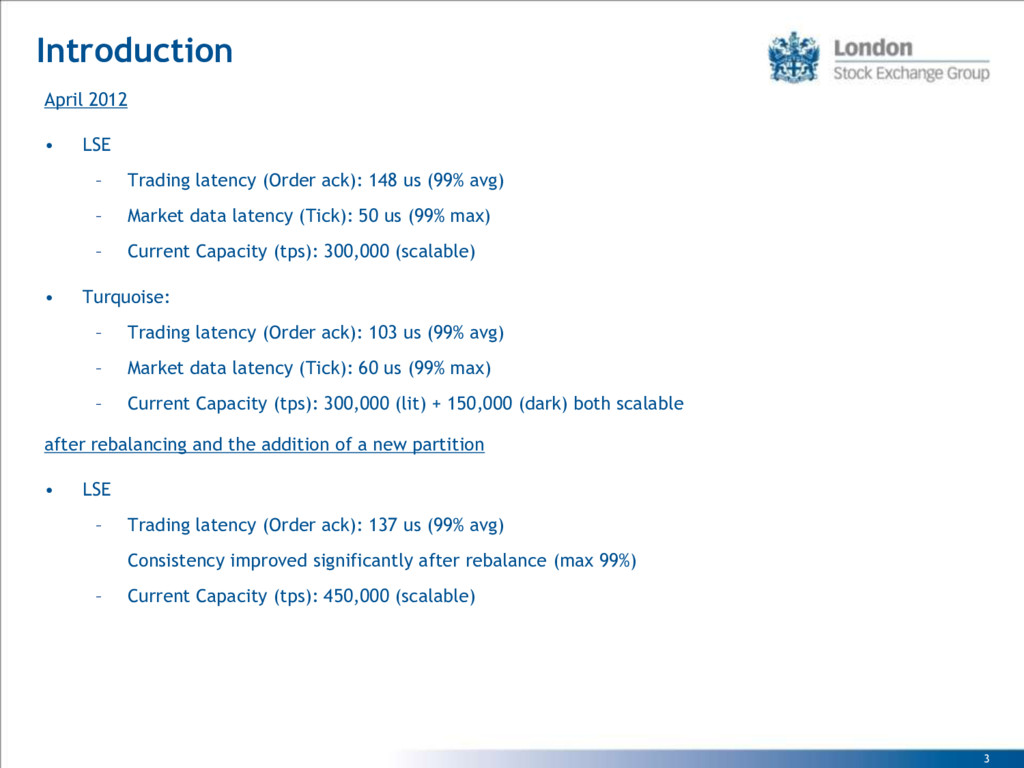
3 Introduction April 2012 • LSE – Trading latency (Order
ack): 148 us (99% avg) – Market data latency (Tick): 50 us (99% max) – Current Capacity (tps): 300,000 (scalable) • Turquoise: – Trading latency (Order ack): 103 us (99% avg) – Market data latency (Tick): 60 us (99% max) – Current Capacity (tps): 300,000 (lit) + 150,000 (dark) both scalable after rebalancing and the addition of a new partition • LSE – Trading latency (Order ack): 137 us (99% avg) Consistency improved significantly after rebalance (max 99%) – Current Capacity (tps): 450,000 (scalable) -
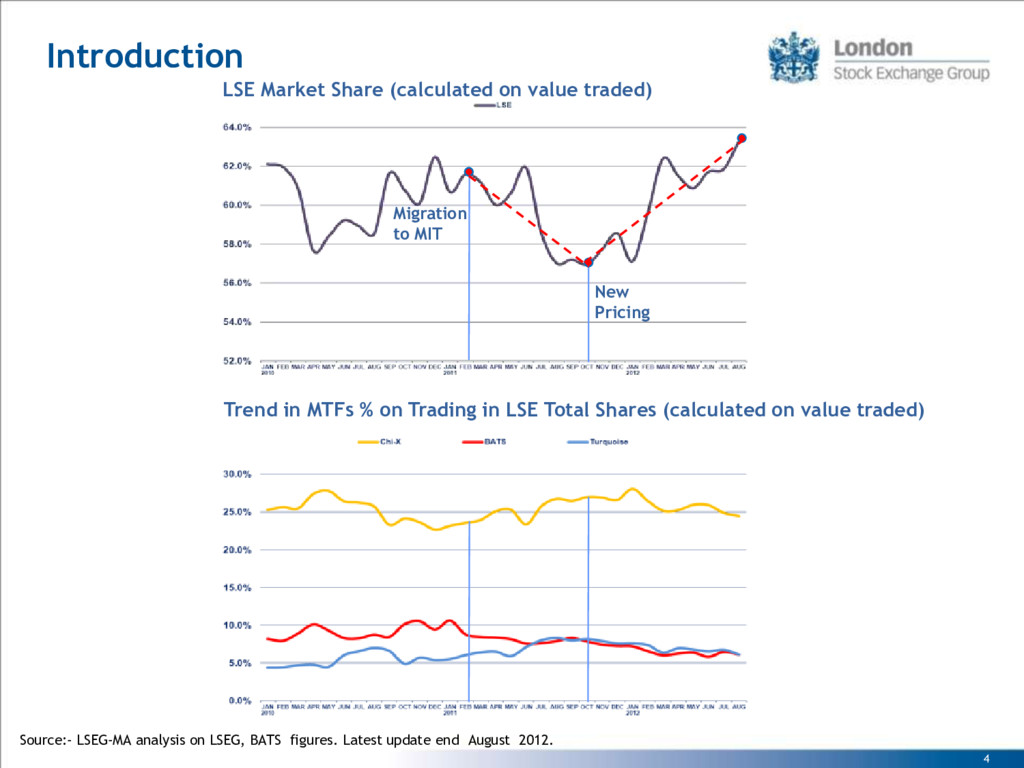
4 LSE Market Share (calculated on value traded) Trend in
MTFs % on Trading in LSE Total Shares (calculated on value traded) Source:- LSEG-MA analysis on LSEG, BATS figures. Latest update end August 2012. Migration to MIT New Pricing Introduction -
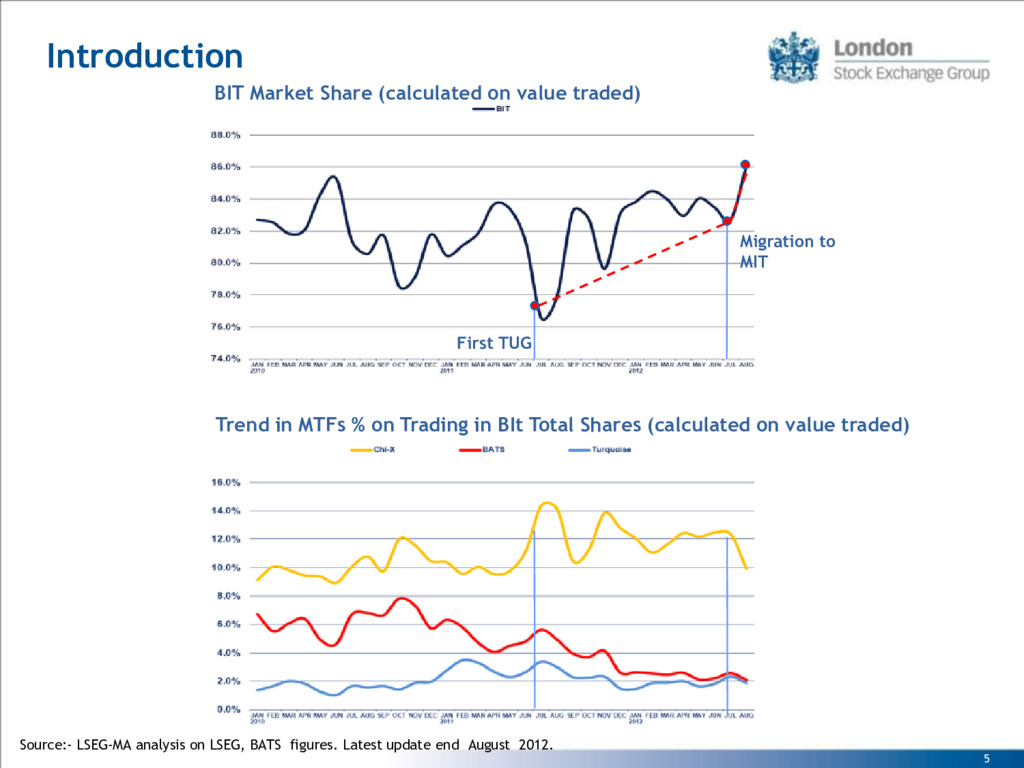
5 Trend in MTFs % on Trading in BIt Total
Shares (calculated on value traded) BIT Market Share (calculated on value traded) Source:- LSEG-MA analysis on LSEG, BATS figures. Latest update end August 2012. Migration to MIT First TUG Introduction -
6 Agenda 1. Introduction 2. Key features from the Borsa
Italiana migration to MIT 3. MIT convergence road map for LSE, Turquoise and Oslo 4. The Group Ticker Plant 5. Group Trading Interface 6. Sponsored Access 7. Conclusion -
7 New Trading Functionalities • Order Imbalance during auction calls
• Stamping VWAP in Execution Reports of Orders & Quotes • Stop and Stop Limit Orders • Market to Limit Orders • Cancel on disconnect • Named Orders • Cross Orders & BTFs -
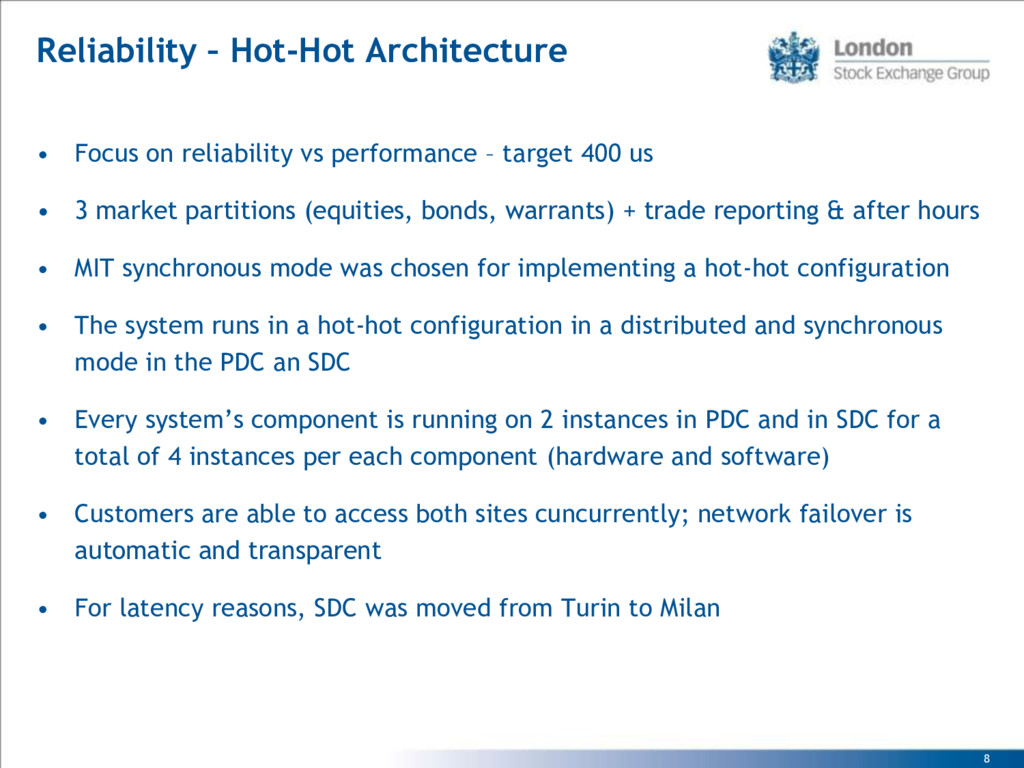
8 Reliability – Hot-Hot Architecture • Focus on reliability vs
performance – target 400 us • 3 market partitions (equities, bonds, warrants) + trade reporting & after hours • MIT synchronous mode was chosen for implementing a hot-hot configuration • The system runs in a hot-hot configuration in a distributed and synchronous mode in the PDC an SDC • Every system’s component is running on 2 instances in PDC and in SDC for a total of 4 instances per each component (hardware and software) • Customers are able to access both sites cuncurrently; network failover is automatic and transparent • For latency reasons, SDC was moved from Turin to Milan -
9 • PDC and SDC are synchronized at transaction level.
Every transaction is committed on both sites before the ack is returned to clients • Market data is disseminated by each site independently • Each single logical or physical component, market partition, or the full site can failover independently and automatically to SDC in a completely transparent way • The system is able to automatically recover: the fail of any primary hardware or software system component of PDC the fail of any primary AND secondary hardware or software component the fail of one or more single market partitions the fail of the entire PDC the partial or full fail of SDC without impacting PDC • The system guarantees no loss of trades or orders Reliability – MIT Synch mode -
10 MIT Exchange SDC Milan MIT Exchange PDC Milan Customer
EMS Sync copy 1 Order entry 4 Execution report 2 Sync confirmation 3 Async Trade Capture Report 5 < 300 us Customer OMS Reliability – Trading consistency -
11 Customer front-ends MIT Exchange SDC Milan MIT Exchange PDC
Milan Customers Incoming order Channel B t+150 us Channel A t ms t+300 us Customer front-ends 1. Channel B delay 300 us 2. Arbitration A vs B 3. Request retrasmission Reliability – Market Data consistency -
12 Agenda 1. Introduction 2. Key features from the Borsa
Italiana migration to MIT 3. MIT convergence road map for LSE, Turquoise and Oslo 4. The Group Ticker Plant 5. Group Trading Interface 6. Sponsored Access 7. Conclusion -
13 Aug Sep Oct Nov Dec Jan Feb Mar Apr
May Jun Jul Aug Jun May Jul 2012 2013 LSE (MIT Ex release 9) TNP (MIT Ex release 9) LSE Release 9 decommission TNP Release 9 decommission QA LSE MIT Build CDS Go live Release 18 BIT + OB (MIT Ex release 16) BIT + OB + LSE (release 18) BITTarget BIT (MIT Ex release 14) QA CDS Go live OB Target BIT (MIT release 18) BIT migration to release 18 LSE migration backward compatibile BA MIT Build QA CDS LSE Target MIT Build QA TQ Target CDS LSEG convergence roadmap Go live MIT Build QA CDS TQ -
14 Benefits of the Convergence • Customers and ISVs have
one protocol for all the equities markets costs for Customers can be reduced • Functionalities developed for one market can be re-used for other markets better time to market & product development cost can be shared • Each market can maintain its own market model no need to harmonize • Releases can be deployed at predefined time windows for all markets improvement of Customers planning and budgeting • MIT has one Exchange release to maintain for all markets Implementation cost efficiency • Same Technology Operations team can operate different markets in different geographical locations Operational cost efficiency -
15 • New Business requirements - These include: o iceberg
order enhancements o optional self-execution prevention o visible or hidden indicator on passive order Execution Reports. • Group Ticker Plant Integration (GTP) – Changes will be introduced into the MIT Exchange system in order to be tightly integrated with the new version of the GTP system. Thanks to hardware accelerated components, GTP 2 will be able to disseminate tick by tick price increments (L2 market data) faster than the current ITCH market data feed. • Group Trading Interface Integration (GTI) – Ahead of planned availability of new interface for actual use in December 2013, we need to build a connection into the matching engine. Release 8 provides this link which, when activated, will allow GTI to run initially in parallel to the existing Fix and Native Gateways. Additional enhancements -
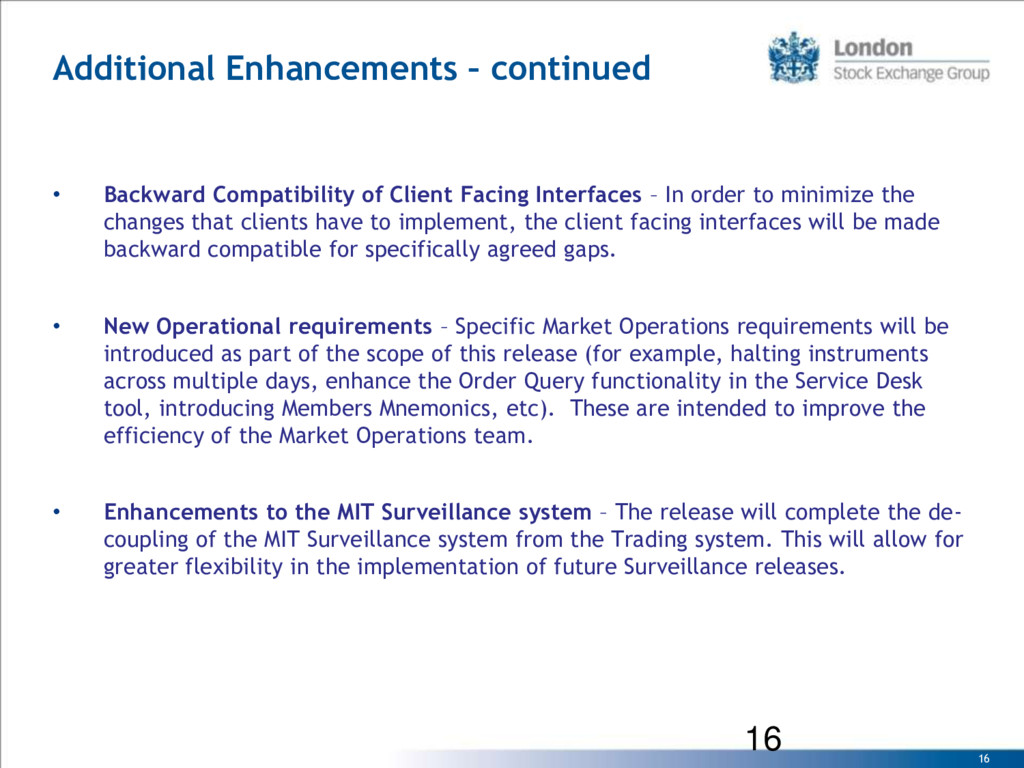
16 Additional Enhancements – continued • Backward Compatibility of Client
Facing Interfaces – In order to minimize the changes that clients have to implement, the client facing interfaces will be made backward compatible for specifically agreed gaps. • New Operational requirements – Specific Market Operations requirements will be introduced as part of the scope of this release (for example, halting instruments across multiple days, enhance the Order Query functionality in the Service Desk tool, introducing Members Mnemonics, etc). These are intended to improve the efficiency of the Market Operations team. • Enhancements to the MIT Surveillance system – The release will complete the de- coupling of the MIT Surveillance system from the Trading system. This will allow for greater flexibility in the implementation of future Surveillance releases. 16 -
17 Agenda 1. Introduction 2. Key features from the Borsa
Italiana migration to MIT 3. MIT convergence road map for LSE, Turquoise and Oslo 4. The Group Ticker Plant 5. Group Trading Interface 6. Sponsored Access 7. Conclusion -
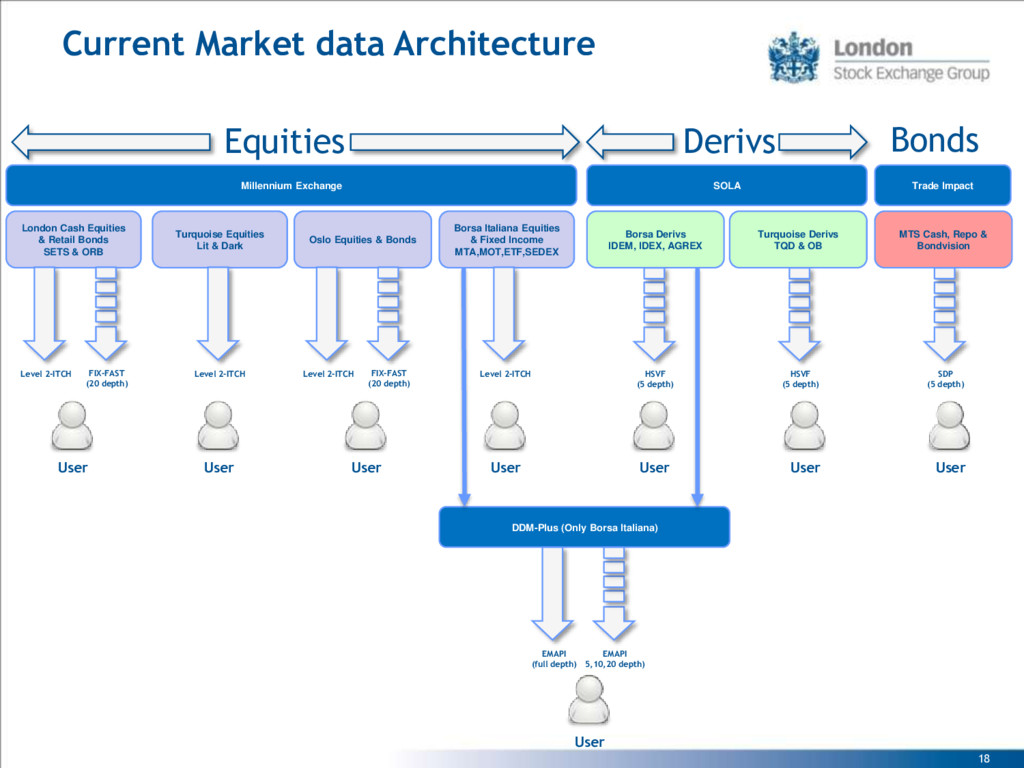
18 Current Market data Architecture London Cash Equities & Retail
Bonds SETS & ORB Turquoise Equities Lit & Dark Millennium Exchange Equities Level 2-ITCH FIX-FAST (20 depth) Level 2-ITCH Borsa Italiana Equities & Fixed Income MTA,MOT,ETF,SEDEX Level 2-ITCH User User User User Borsa Derivs IDEM, IDEX, AGREX Turquoise Derivs TQD & OB SOLA Derivs HSVF (5 depth) HSVF (5 depth) User User MTS Cash, Repo & Bondvision Trade Impact Bonds SDP (5 depth) User DDM-Plus (Only Borsa Italiana) EMAPI (full depth) EMAPI 5,10,20 depth) User Oslo Equities & Bonds Level 2-ITCH FIX-FAST (20 depth) -
19 • All LSEG market data will be delivered on
a single bespoke protocol – Binary, bandwidth efficient 10 level snapshot feed (intelligent throttling) – Binary, performant protocol for tick by tick full depth OB feed – Binary, flexible TCP/IP protocol for recovery and reference data download • Data delivered by load balanced IP Multicast channels • Hardware assisted data delivery (FPGA) technology • Hot-Hot architecture disseminating from Primary and Secondary sites • Independent Primary and Secondary Data Centres in London and Milan Introducing our Ticker Plant -
20 • Real Time incremental Level 1 Best Bid and
Offer Service (Top Of the Book) • Snapshot service for 10 levels MBO and MBP (150 ms time interval) • Intelligent throttling: non-latency sensitive messages delivered in multi- message UDP packets whereas latency sensitive messages delivered in single message UDP packets • Enriched reference data package delivered on the wire (unicast) • Rich statistics package • FTSE indices disseminated Phase 1: live in Nov 2012 -
21 • Launch of FTSE First – the most popular
FTSE indices including the FTSE100, FTSE250, FTSE All Share and FTSE MIB calculated incrementally by the Ticker Plant on next generation technology and delivered directly to Exchange hosted customers • market gateways on FPGA for latency reduction Phase 1.1: live in Feb 2013 -
22 • Turquoise equities integration • Real Time full depth
incremental service (full depth) • New levels of technical performance (introduction of FPGA fr cliens data dissemination) Phase 2: planned for Jul 2013 -
23 GTP Target Architecture Turquoise Derivs EDX & OB Borsa
Derivs IDEM & IDEX SOLA London Cash Equities & Retail Bonds SETS & ORB Turquoise Equities Lit & Dark Borsa Italiana Equities & Fixed Income MTA,MOT,ETF,SEDEX Millennium Exchange Oslo Equities & Bonds MTS Cash, Repo & Bondvision Trade Impact Equities Derivs Bonds HSVF (5 depth) GTP Replay & Recovery Ref Data Level 2 snapshot (10 depth) User FIX-FAST FPGA feed User FPGA feed FPGA feed User HSVF (5 depth) User SDP (5 depth) User Level 1 & 2 MBO (full depth) FTSE -
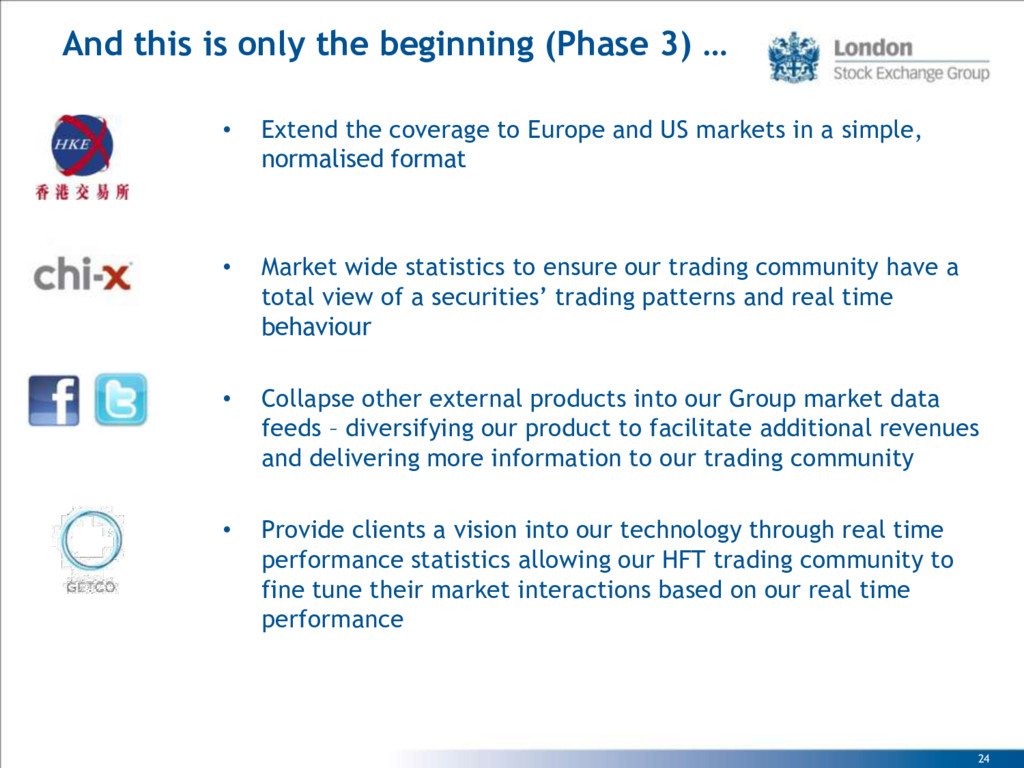
24 • Extend the coverage to Europe and US markets
in a simple, normalised format • Market wide statistics to ensure our trading community have a total view of a securities’ trading patterns and real time behaviour • Collapse other external products into our Group market data feeds – diversifying our product to facilitate additional revenues and delivering more information to our trading community • Provide clients a vision into our technology through real time performance statistics allowing our HFT trading community to fine tune their market interactions based on our real time performance And this is only the beginning (Phase 3) … -
25 Agenda 1. Introduction 2. Key features from the Borsa
Italiana migration to MIT 3. MIT convergence road map for LSE, Turquoise and Oslo 4. The Group Ticker Plant 5. Group Trading Interface 6. Sponsored Access 7. Conclusion -
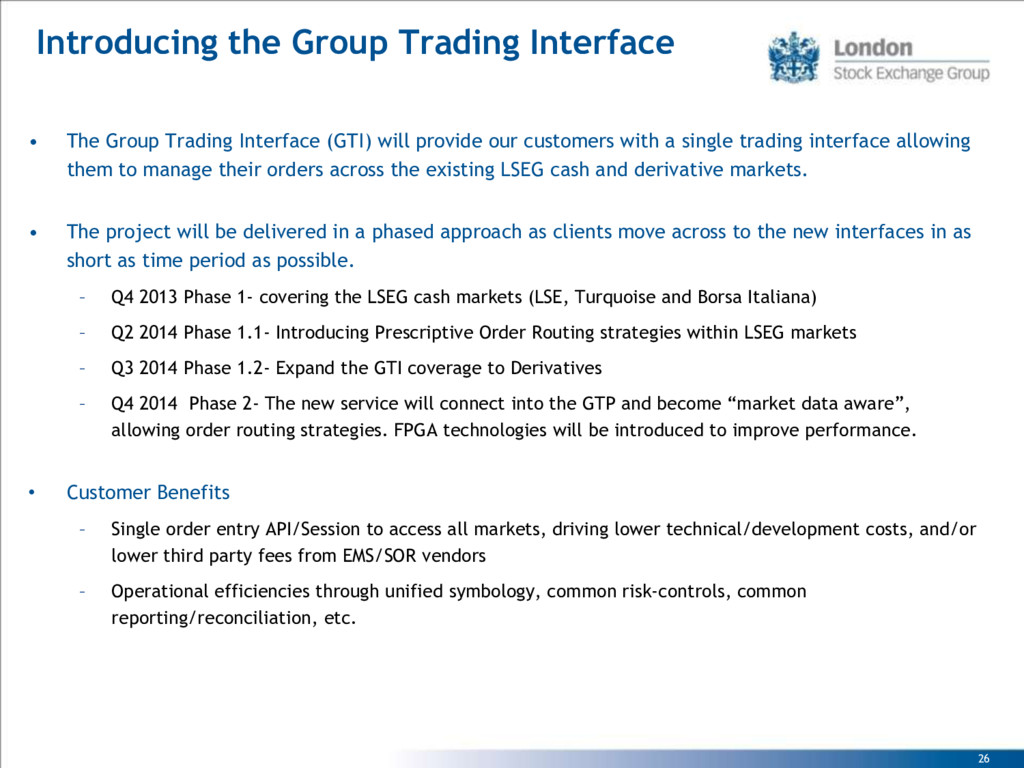
26 Introducing the Group Trading Interface • The Group Trading
Interface (GTI) will provide our customers with a single trading interface allowing them to manage their orders across the existing LSEG cash and derivative markets. • The project will be delivered in a phased approach as clients move across to the new interfaces in as short as time period as possible. – Q4 2013 Phase 1- covering the LSEG cash markets (LSE, Turquoise and Borsa Italiana) – Q2 2014 Phase 1.1- Introducing Prescriptive Order Routing strategies within LSEG markets – Q3 2014 Phase 1.2- Expand the GTI coverage to Derivatives – Q4 2014 Phase 2- The new service will connect into the GTP and become “market data aware”, allowing order routing strategies. FPGA technologies will be introduced to improve performance. • Customer Benefits – Single order entry API/Session to access all markets, driving lower technical/development costs, and/or lower third party fees from EMS/SOR vendors – Operational efficiencies through unified symbology, common risk-controls, common reporting/reconciliation, etc. -
27 Market access current architecture Borsa Derivs IDEM, IDEX, AGREX
Turquoise Derivs TQD & OB SOLA Derivs MTS Cash, Repo & Bondvision Trade Impact Bonds London Cash Equities & Retail Bonds SETS & ORB Turquoise Equities Lit & Dark Millennium Exchange Equities Borsa Italiana Equities & Fixed Income MTA,MOT,ETF,SEDEX Native & FIX User Native & FIX User Native & FIX User SAIL & FIX User SAIL & FIX User SDP User -
28 GTI Market access Target architecture Borsa Derivs IDEM, IDEX,
AGREX Turquoise Derivs TQD & OB SOLA Derivs MTS Cash, Repo & Bondvision Trade Impact Bonds London Cash Equities & Retail Bonds SETS & ORB Turquoise Equities Lit & Dark Millennium Exchange Equities Borsa Italiana Equities & Fixed Income MTA,MOT,ETF,SEDEX GTi Native & FIX User -
29 Agenda 1. Introduction 2. Key features from the Borsa
Italiana migration to MIT 3. MIT convergence road map for LSE, Turquoise and Oslo 4. The Group Ticker Plant 5. Group Trading Interface 6. Sponsored Access 7. Conclusion -
30 Introducing the new Sponsored Access • Exchange participants (Members)
are allowed to provide trading access to non-exchange members through their membership. However Members must demonstrate that they have adequate risk controls measures set up to prevent these Sponsored participants (i.e. non-exchange members) from trading beyond a limit the member can be financially responsible for. • Borsa Italiana requires Members to enforce these risk control mechanisms. • In order to support the above mentioned requirements Borsa Italiana wants to introduce the Sponsored Access functionality which supports validations and other features required by Borsa Italiana Trading System to allow Sponsored Access trading. • Borsa Italiana should provide to the Clients a Sponsor Portal that allows, via GUI, the configuration in real time of all the parameters needed to manage the risk control mechanism. -
31 New Sponsored Access validations The following risk validations are
required by Borsa Italiana: • Price Band Validation – Prevent orders from Sponsored Users with an overly aggressive price from entering the order book and trading. • Maximum Gross Consideration – Prevent Sponsored Users from trading beyond a threshold specified in a configurable currency (e.g. Euros, Great Britain Pounds etc). The gross consideration is the sum of all trades and value of all open orders of the current trading day. • Maximum Order Value – Prevent orders (limit and market) with an uncommonly large order value from entering the order book. • Maximum Order Quantity – Prevent orders from Sponsored Users with an uncommonly large order size from entering the order book. • Order Capacity - Prevent orders from Sponsored Users with an unexpected Capacity of the order. • Account Type - Prevent orders from Sponsored Users with an unexpected Account Type of the order. • Restricted Instrument List – With this feature, the Sponsor User would be able to update their Sponsored Users’ restricted instrument lists. • Maximum Message Rate – it’s requested, as technical requirement, to validate that the incoming rate injected by the Sponsored User does not exceed the Maximum Message Rate (number of transactions per second) configured by the Sponsor User. -
32 Sponsored Access Target solution Borsa Derivs IDEM, IDEX, AGREX
Turquoise Derivs TQD & OB SOLA Derivs MTS Cash, Repo & Bondvision Trade Impact Bonds London Cash Equities & Retail Bonds SETS & ORB Turquoise Equities Lit & Dark Millennium Exchange Equities Borsa Italiana Equities & Fixed Income MTA,MOT,ETF,SEDEX Sponsored Access Execution report Member Native & FIX Sponsored -
33 Sponsor Access Service GTP MIT Trading and Information SA
GTW SA GTW PostTrade SA GTW SA GTW Sponsored User Drop copy Member NATIVE FIX 5.0 FIX 5.0 Member Supervisor Wkst Sponsored Access logical architecture -
34 Agenda 1. Introduction 2. Key features from the Borsa
Italiana migration to MIT 3. MIT convergence road map for LSE, Turquoise and Oslo 4. The Group Ticker Plant 5. Group Trading Interface 6. Sponsored Access 7. Conclusion -
35 Conclusion • LSEG continues to lead in trading systems
performance thanks to its Millennium IT low latency technology • Performance is relevant, however other aspects can make the difference between success and failure. We have seen only some of them: 1. Functionally rich systems to support the launch of new products 2. Top reliability 3. Architecture flexibility 4. Market data consolidation (GTP) 5. Market access standardization (GTI & GSPO) 6. Efficient development and operational models • LSEG is active on each one of these fronts as it is on Performance to continue to improve the quality of our services
 exactpro
 ivry_presentationmaterials
 yuutosi
 silmin_
 sansantech
 kamadamakoto
 jirtosterone
 carta_engineering
 kworkdev
 ren8k
 yama3133
 imuta
 yusuke427
 aleyda
 jmmastey
 reverentgeek
 cassininazir
 skipperchong
 ivargrimstad
 katarinadahlin
 chrislema
 akihiro_kokubo
 mongodb
 tammielis