Explore Power UV Curing Lamps for fast industrial curing and Amalgam UV Lamps for high-output UV disinfection, with insights into applications, performance, maintenance, and system selection.
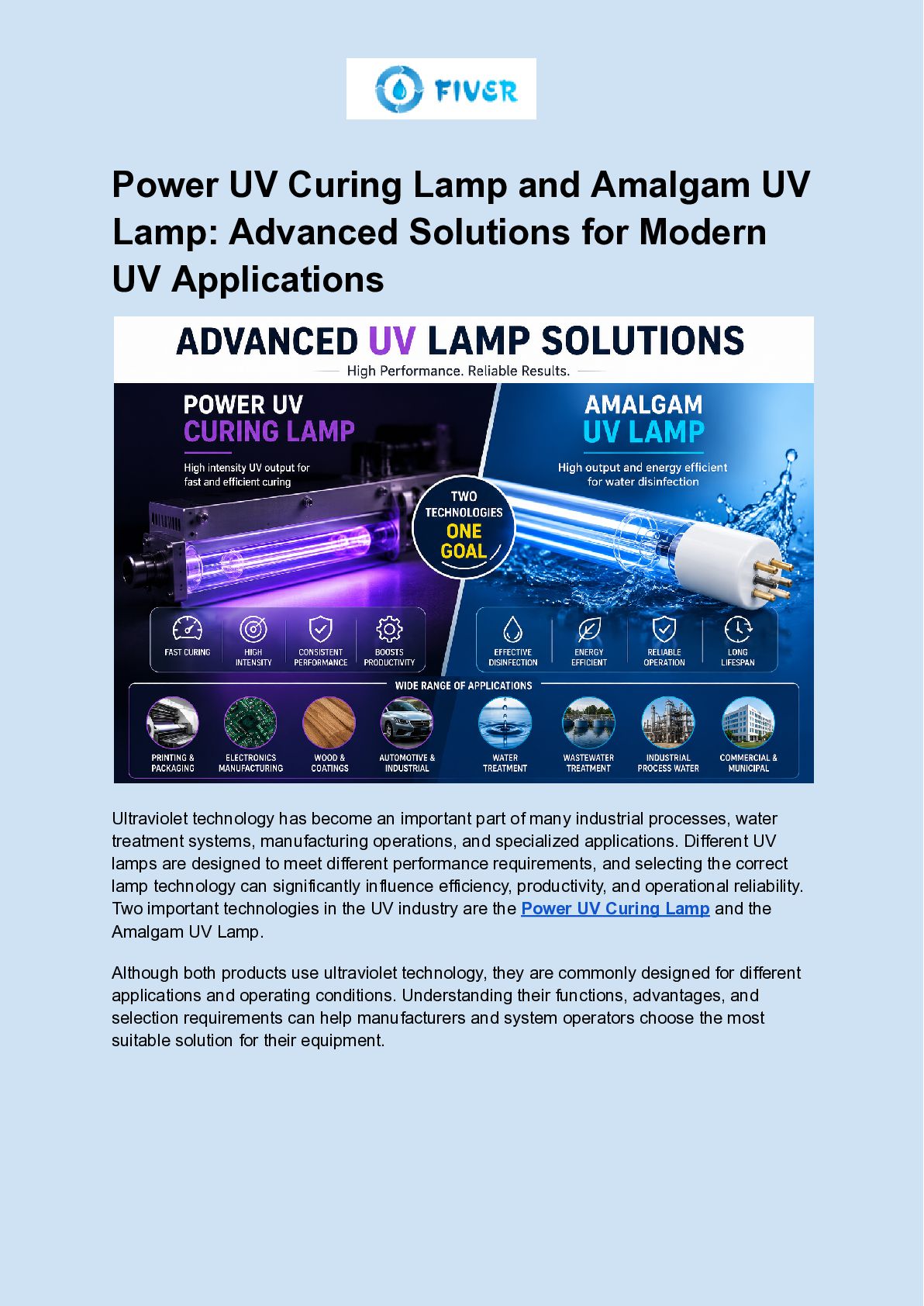
UV Lamp: Advanced Solutions for Modern UV Applications Ultraviolet technology has become an important part of many industrial processes, water treatment systems, manufacturing operations, and specialized applications. Different UV lamps are designed to meet different performance requirements, and selecting the correct lamp technology can significantly influence efficiency, productivity, and operational reliability. Two important technologies in the UV industry are the Power UV Curing Lamp and the Amalgam UV Lamp. Although both products use ultraviolet technology, they are commonly designed for different applications and operating conditions. Understanding their functions, advantages, and selection requirements can help manufacturers and system operators choose the most suitable solution for their equipment.
A Power UV Curing Lamp is designed to generate intense ultraviolet energy for industrial curing processes. UV curing is widely used to rapidly cure or harden inks, coatings, adhesives, varnishes, and other UV-sensitive materials. Traditional drying processes may require significant time and heat. UV curing technology can provide a faster alternative when compatible materials and properly designed equipment are used. The UV energy initiates a chemical reaction within specially formulated materials, allowing the surface or coating to cure quickly. A Power UV Curing Lamp can be used in several industries, including: • • • • • • • Printing and packaging Electronics manufacturing Wood coating Automotive components Plastic processing Adhesive bonding Industrial surface finishing High-intensity UV lamps are particularly useful in production environments where speed and consistency are important. A reliable UV curing system can help manufacturers increase production efficiency while maintaining consistent curing performance. Why Power and Stability Matter The effectiveness of a Power UV Curing Lamp depends on more than simply generating a high level of electrical power. The lamp must produce suitable UV energy at wavelengths required by the material being cured. System performance can also be affected by factors such as lamp intensity, exposure time, distance from the target surface, reflector design, cooling conditions, and conveyor speed. A properly designed curing system balances these factors to achieve consistent results. Too little UV energy may result in incomplete curing, while excessive exposure may affect certain materials or generate unnecessary heat. For this reason, modern UV curing equipment often includes carefully designed power supplies, reflectors, cooling systems, and control technology.
Amalgam UV Lamp is commonly used in UV disinfection applications, particularly where high UV output and energy efficiency are required. Amalgam lamp technology uses a mercury amalgam to support stable operation and strong UV output under suitable conditions. These lamps are widely used in water treatment applications, including drinking water systems, wastewater treatment, industrial process water, and large commercial facilities. One of the important advantages of an Amalgam UV Lamp is its ability to provide high UV output in applications requiring significant treatment capacity. Depending on system design, amalgam lamps can be suitable for continuous operation and large-volume water treatment. However, the performance of any UV lamp depends on correct installation, compatible electrical control, proper cooling, and regular maintenance. Different Applications, Different Requirements The Power UV Curing Lamp and Amalgam UV Lamp are designed to address different technical requirements. A curing lamp is generally focused on delivering ultraviolet energy for rapid material curing. The system must be matched with the UV-sensitive ink, adhesive, or coating being processed. An amalgam lamp is generally associated with germicidal and disinfection applications, where the objective is to deliver an appropriate UV dose for microbial control. Because their applications differ, the lamp type, power supply, reactor or curing chamber, cooling arrangement, and reflector design may also differ. Selecting the wrong lamp technology can reduce efficiency and negatively affect overall system performance. The Importance of Power Supply Technology Both lamp technologies depend on reliable electrical control. A professional power supply or electronic ballast provides the conditions required to start and operate the lamp. For a Power UV Curing Lamp, stable electrical operation helps maintain consistent UV intensity during production. For an Amalgam UV Lamp, a compatible electronic ballast helps support stable lamp operation and reliable UV output during long operating cycles.
include protection features and monitoring capabilities. Depending on the design, these can help detect abnormal operating conditions and support preventive maintenance. Maintenance and Long-Term Performance Regular maintenance is essential for both UV curing and UV disinfection systems. Lamps gradually experience changes in output as they accumulate operating hours. Reflectors, quartz components, cooling systems, and electrical connections should also be inspected regularly. For curing systems, reflectors should be kept clean because surface contamination can reduce the amount of UV energy directed toward the material. For water treatment systems using an Amalgam UV Lamp, quartz sleeves should be inspected and cleaned to prevent deposits from reducing UV transmission. Following recommended replacement schedules can help operators maintain consistent performance and avoid unexpected downtime. Choosing the Right UV Technology When selecting a Power UV Curing Lamp or an Amalgam UV Lamp, it is important to begin with the specific application. Consider factors such as: 1. Required UV application 2. Operating power 3. Required UV output 4. Production or water flow capacity 5. Electrical compatibility 6. Cooling requirements 7. System size 8. Maintenance requirements The complete system should be considered rather than selecting a lamp based only on its power rating. Conclusion Both the Power UV Curing Lamp and the Amalgam UV Lamp represent valuable technologies within the growing UV industry. While UV curing lamps are widely used for fast
amalgam lamps are important for high-performance UV disinfection applications. Choosing the correct lamp technology, using a compatible power supply, and following proper maintenance practices can improve efficiency and long-term reliability. As industries continue to demand faster manufacturing processes and more effective treatment technologies, advanced UV lamp solutions will remain an important part of modern industrial and environmental systems.