Upgrade to Pro — share decks privately, control downloads, hide ads and more …

Plastic Waste Can Become an Industrial Resource

Sponsored · Your Podcast. Everywhere. Effortlessly. Share. Educate. Inspire. Entertain. You do you. We'll handle the rest. →

Plastic Waste Can Become an Industrial Resource

Discover how non-recyclable plastic waste can be safely and efficiently transformed into a valuable industrial resource through controlled co-processing. Brought to you by K Ganesan & Co Group of Companies, this presentation explores dual recovery pathways for energy and materials, detailing rigorous quality control protocols, upstream reliability, and sustainable waste management solutions within high-temperature industrial systems.

Learn more at K Ganesan & Co Group of Companies.

Other Decks in Science

Transcript

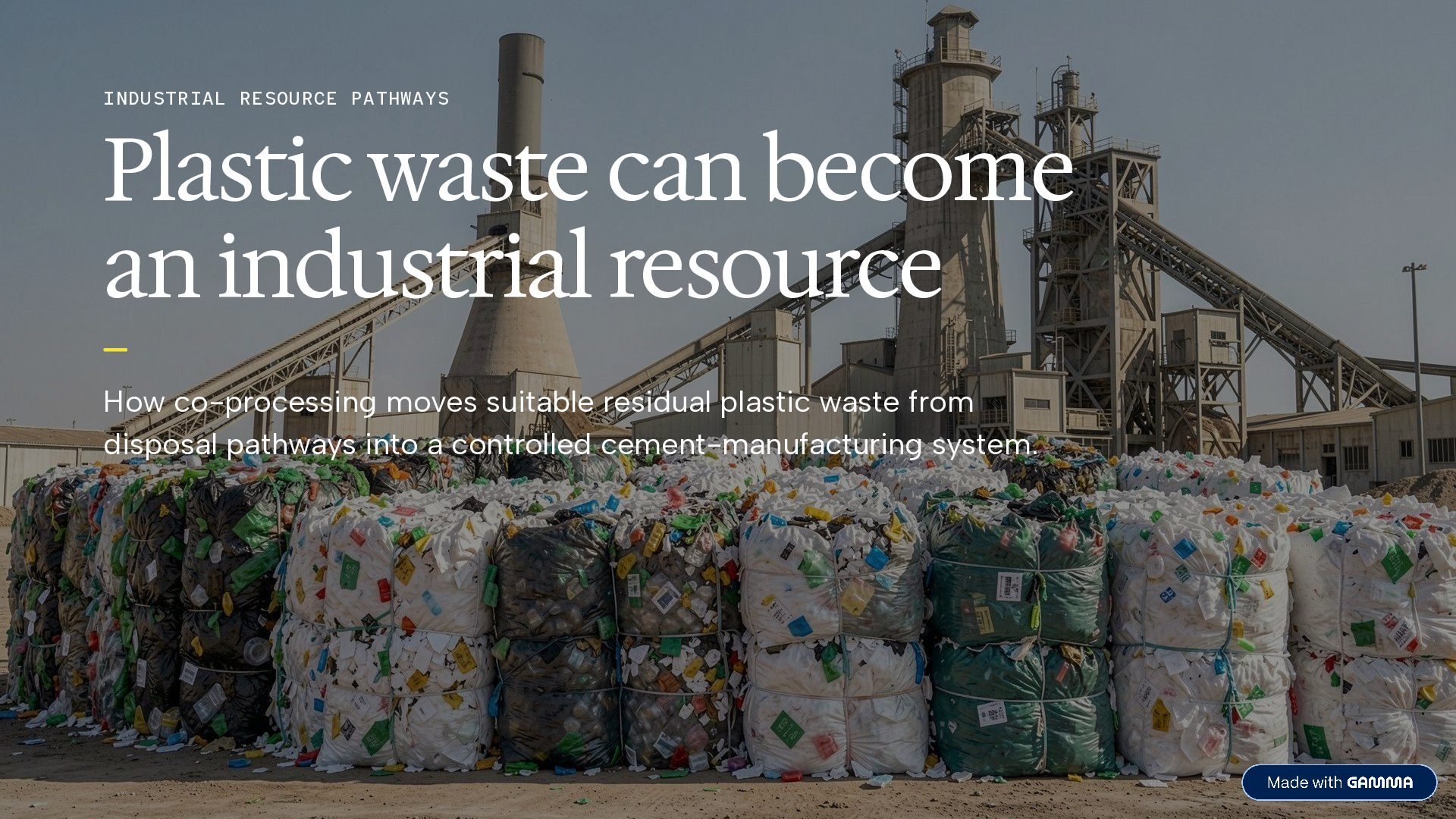
  1. INDUSTRIAL RESOURCE PATHWAYS Plastic waste can become an industrial resource

    How co-processing moves suitable residual plastic waste from disposal pathways into a controlled cement-manufacturing system.
  2. What Plastic Waste Co-Processing Means Suitable residual plastic waste is

    prepared and used as an alternative fuel and/or raw material in a controlled cement-manufacturing process. Reduction, reuse, and recycling remain the priority. Co-processing manages only the fraction that cannot be practically recycled. PRIORITY ORDER Reduce, reuse, recycle Co-processing is the controlled end point for the residual fraction.
  3. 1. How This Presentation Is Organized Why the pathway matters

    2. What happens before the kiln 3. How the kiln stage works 4. How the chain is managed 5. What responsible co-processing should deliver
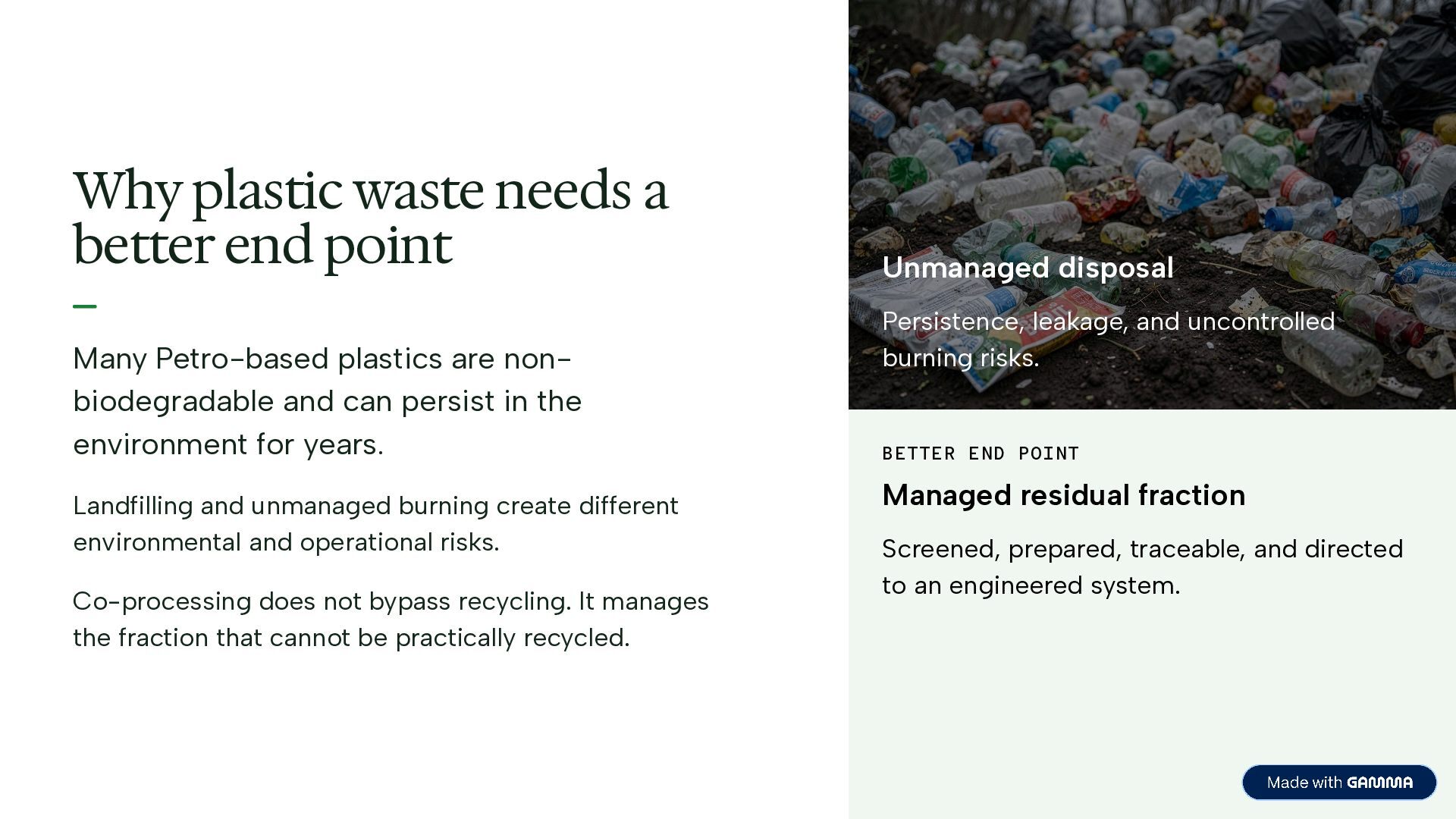
  4. Why plastic waste needs a better end point Many Petro-based

    plastics are nonbiodegradable and can persist in the environment for years. Landfilling and unmanaged burning create different environmental and operational risks. Co-processing does not bypass recycling. It manages the fraction that cannot be practically recycled. Unmanaged disposal Persistence, leakage, and uncontrolled burning risks. BETTER END POINT Managed residual fraction Screened, prepared, traceable, and directed to an engineered system.
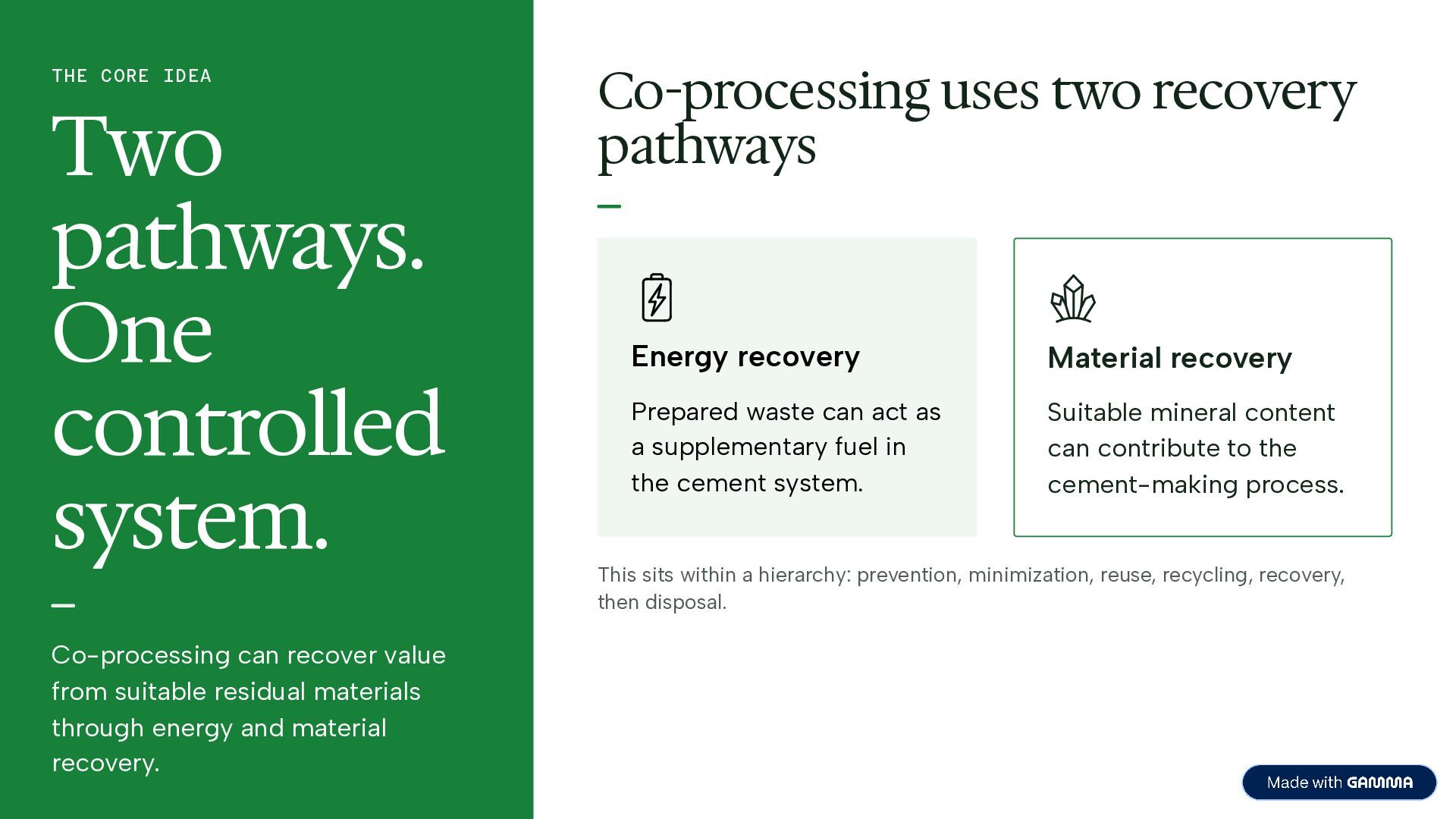
  5. THE CORE IDEA Two pathways. One controlled system. Co-processing can

    recover value from suitable residual materials through energy and material recovery. Co-processing uses two recovery pathways Energy recovery Material recovery Prepared waste can act as a supplementary fuel in the cement system. Suitable mineral content can contribute to the cement-making process. This sits within a hierarchy: prevention, minimization, reuse, recycling, recovery, then disposal.
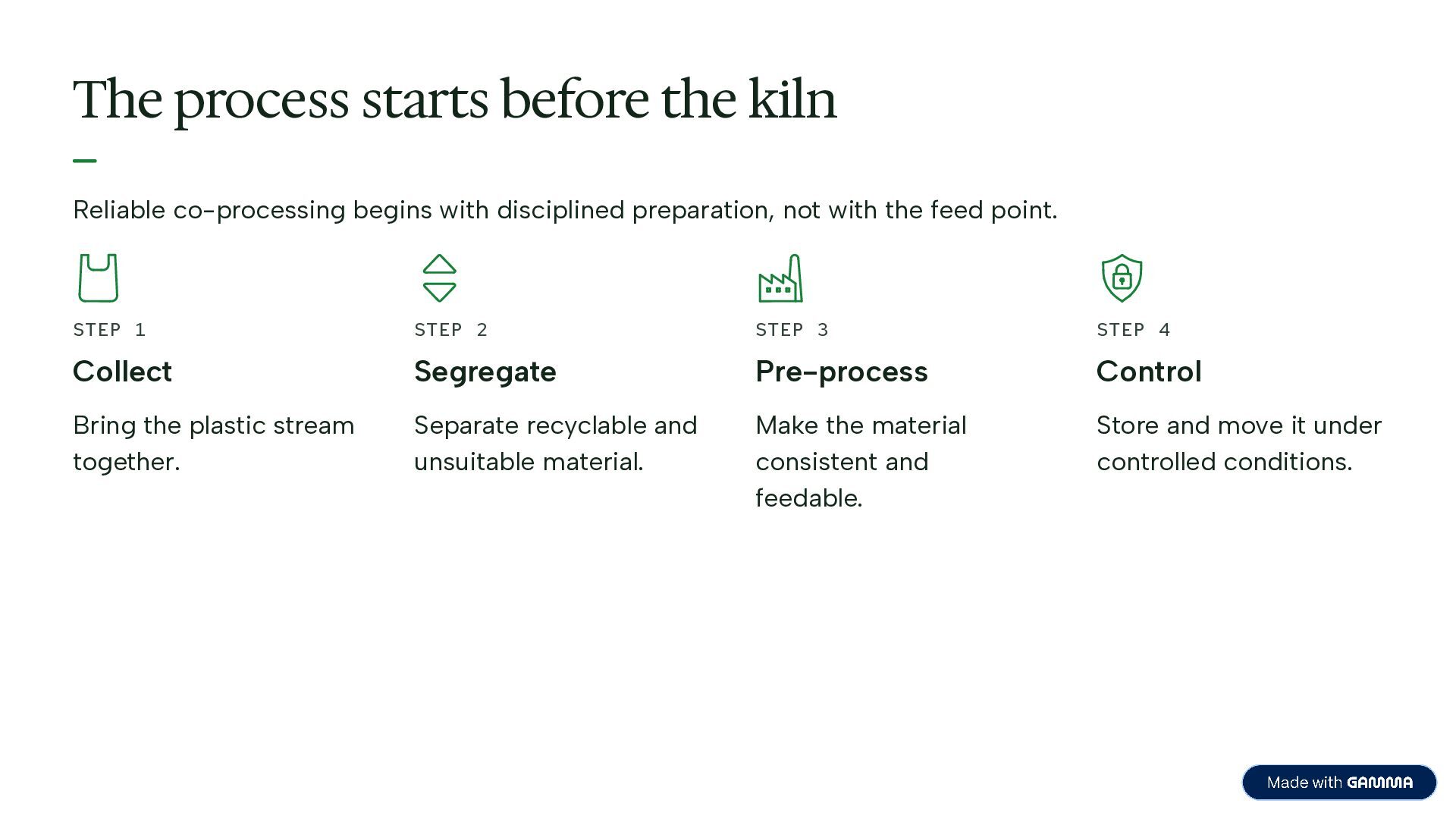
  6. The process starts before the kiln Reliable co-processing begins with

    disciplined preparation, not with the feed point. STEP 1 STEP 2 STEP 3 STEP 4 Collect Segregate Pre-process Control Bring the plastic stream together. Separate recyclable and unsuitable material. Make the material consistent and feedable. Store and move it under controlled conditions.
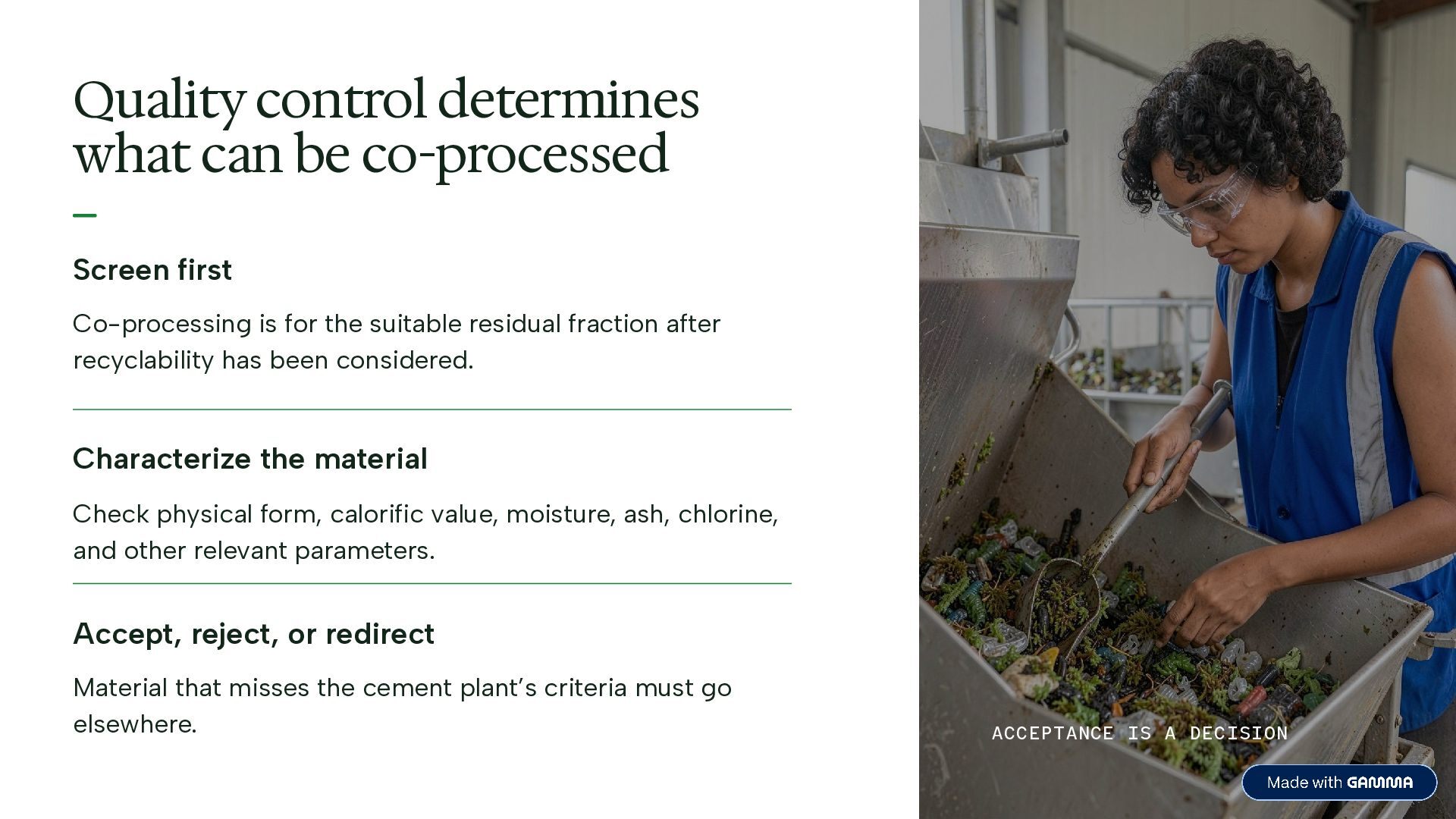
  7. Quality control determines what can be co-processed Screen first Co-processing

    is for the suitable residual fraction after recyclability has been considered. Characterize the material Check physical form, calorific value, moisture, ash, chlorine, and other relevant parameters. Accept, reject, or redirect Material that misses the cement plant’s criteria must go elsewhere. ACCEPTANCE IS A DECISION
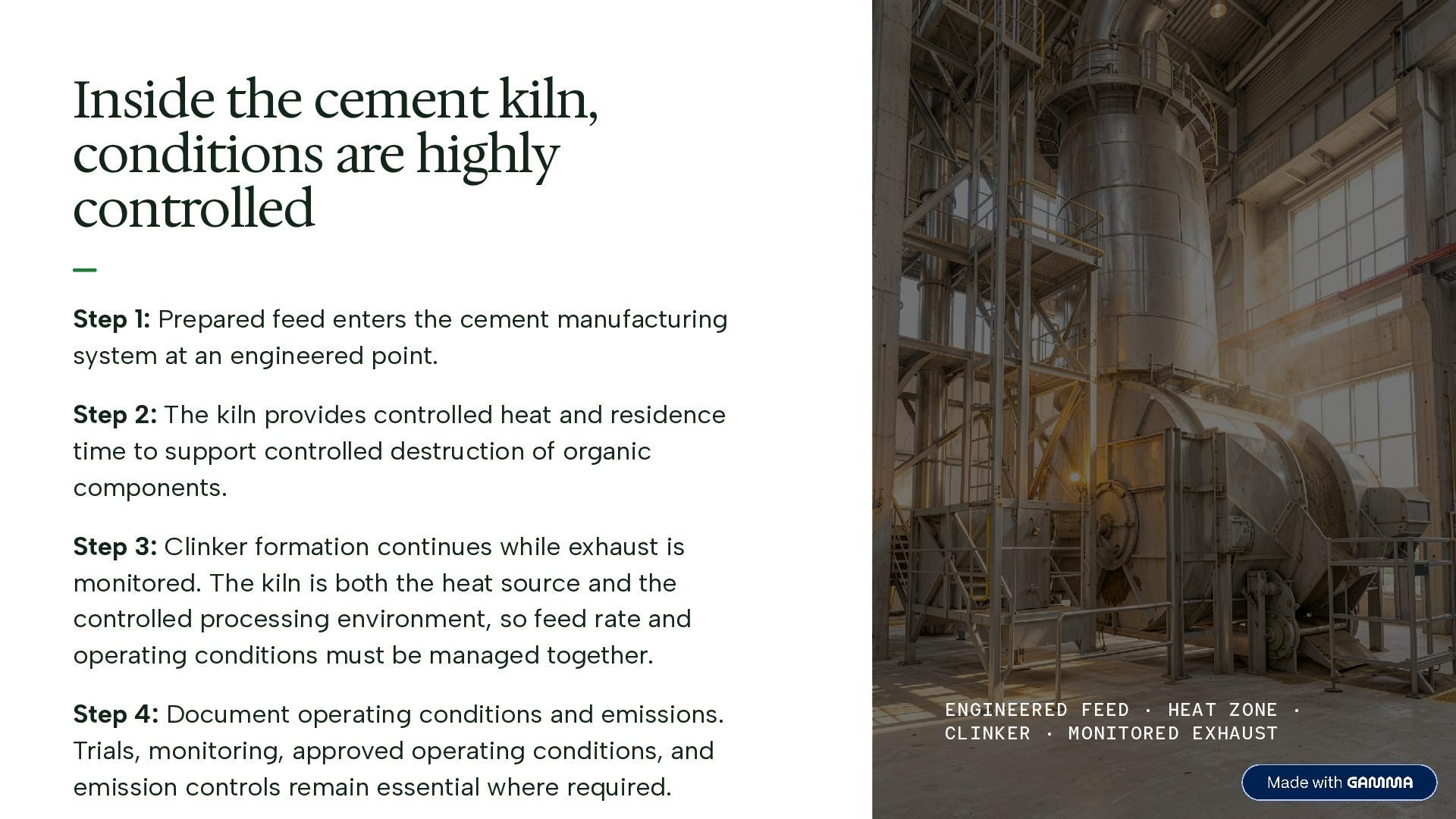
  8. Inside the cement kiln, conditions are highly controlled Step 1:

    Prepared feed enters the cement manufacturing system at an engineered point. Step 2: The kiln provides controlled heat and residence time to support controlled destruction of organic components. Step 3: Clinker formation continues while exhaust is monitored. The kiln is both the heat source and the controlled processing environment, so feed rate and operating conditions must be managed together. Step 4: Document operating conditions and emissions. Trials, monitoring, approved operating conditions, and emission controls remain essential where required. ENGINEERED FEED · HEAT ZONE · CLINKER · MONITORED EXHAUST
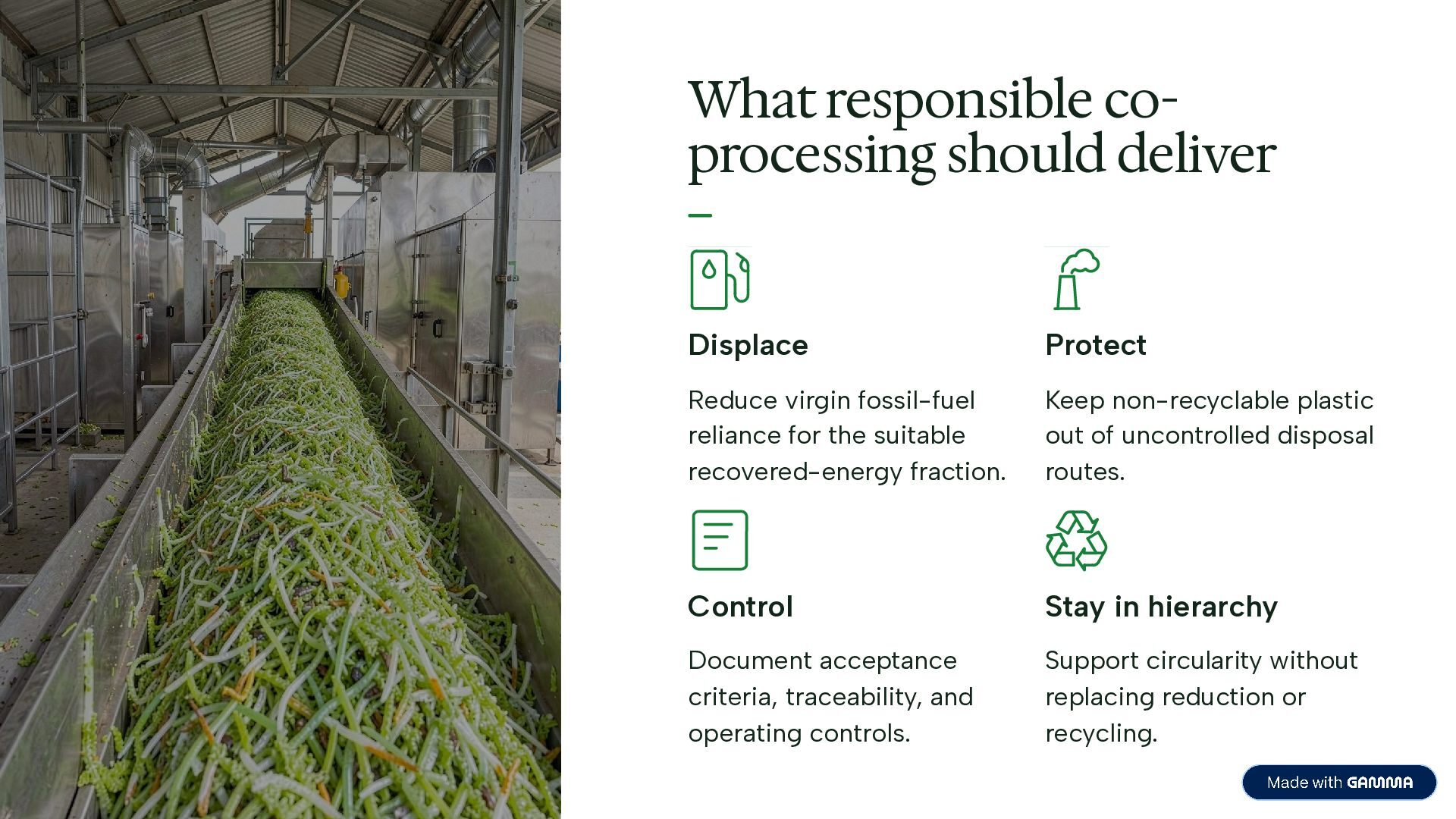
  9. What responsible coprocessing should deliver Displace Protect Reduce virgin fossil-fuel

    reliance for the suitable recovered-energy fraction. Keep non-recyclable plastic out of uncontrolled disposal routes. Control Stay in hierarchy Document acceptance criteria, traceability, and operating controls. Support circularity without replacing reduction or recycling.
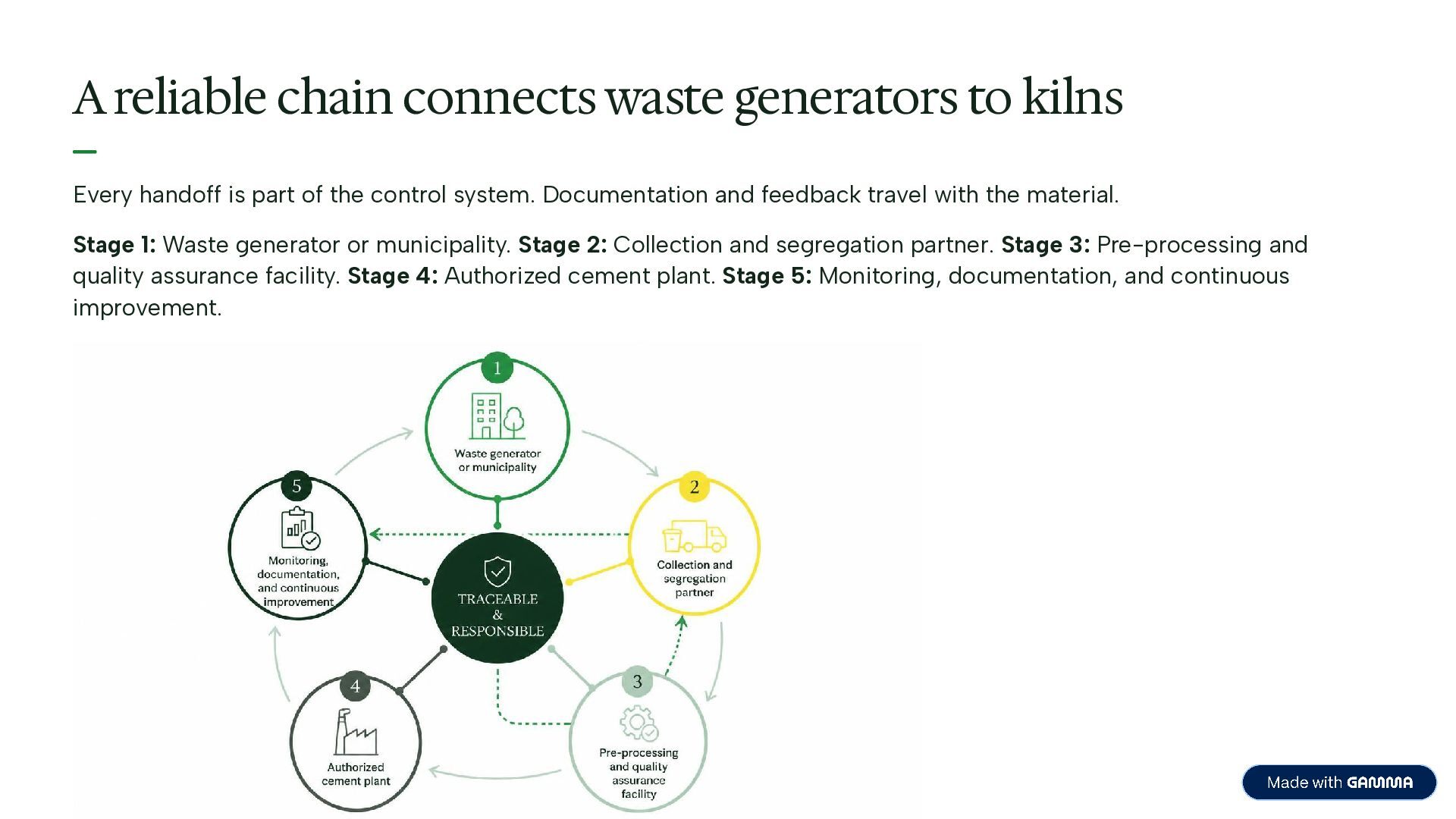
  10. A reliable chain connects waste generators to kilns Every handoff

    is part of the control system. Documentation and feedback travel with the material. Stage 1: Waste generator or municipality. Stage 2: Collection and segregation partner. Stage 3: Pre-processing and quality assurance facility. Stage 4: Authorized cement plant. Stage 5: Monitoring, documentation, and continuous improvement.
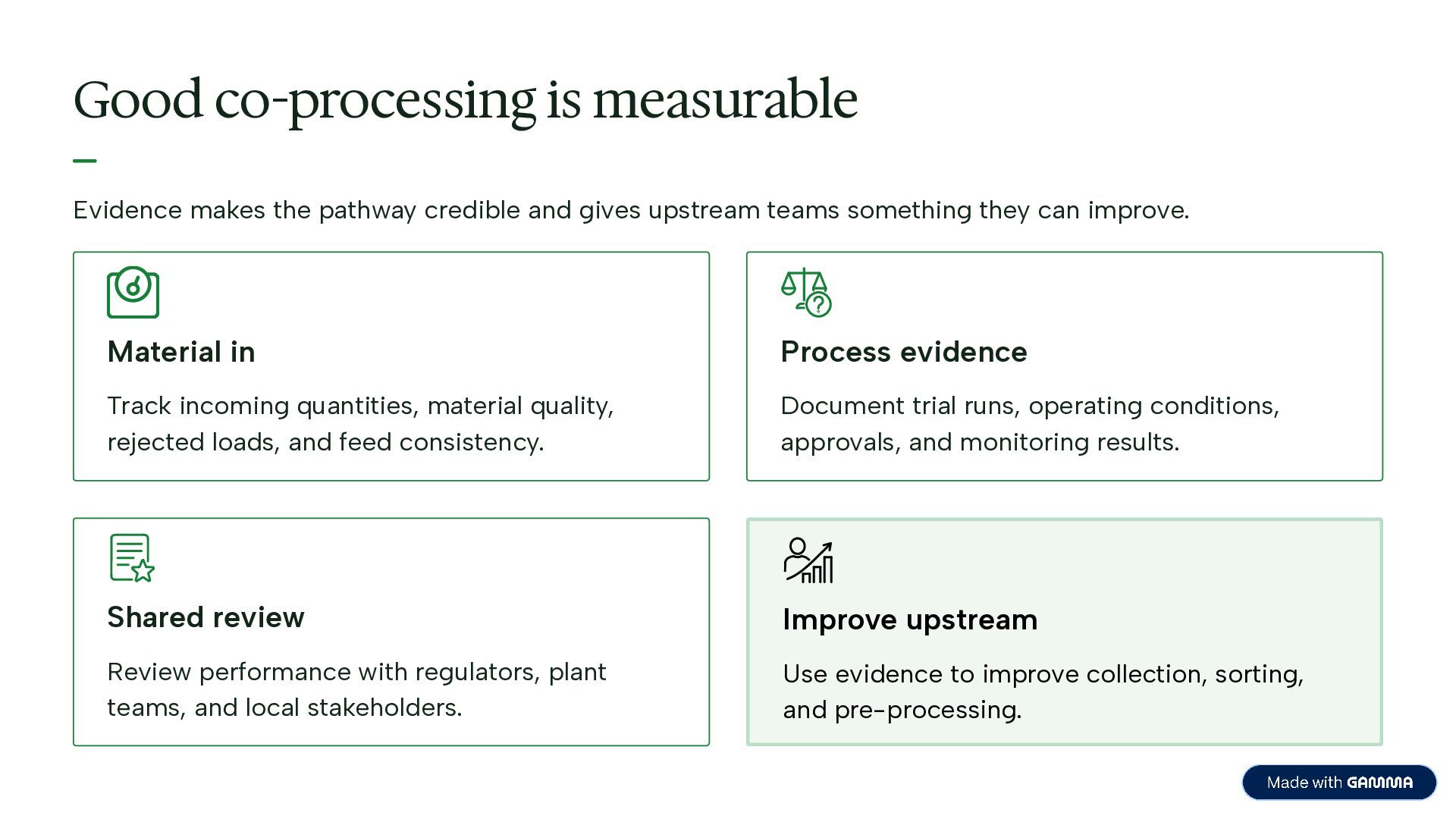
  11. Good co-processing is measurable Evidence makes the pathway credible and

    gives upstream teams something they can improve. Material in Process evidence Track incoming quantities, material quality, rejected loads, and feed consistency. Document trial runs, operating conditions, approvals, and monitoring results. Shared review Improve upstream Review performance with regulators, plant teams, and local stakeholders. Use evidence to improve collection, sorting, and pre-processing.
  12. THE PRACTICAL TAKEAWAY Prepare carefully. Feed responsibly. Monitor continuously. Plastic

    waste co-processing works best as a controlled, evidence-led pathway for the right residual materials: prepare carefully, feed responsibly, monitor continuously. K Ganesan & Co Group of Companies