Education: ◦ Lahore University of Management Sciences (LUMS), BSc. CS ◦ University of Illinois at Urbana Champaign (UIUC), Masters in CS ◦ University of Chicago, Masters in Applied Data Science • Work: ◦ Google ▪ Real-Time Data Flow • Kafka + Pub/Sub ▪ Data Processing Pipelines • Apache Beam ◦ Argonne National Laboratory ▪ Reinforcement Learning
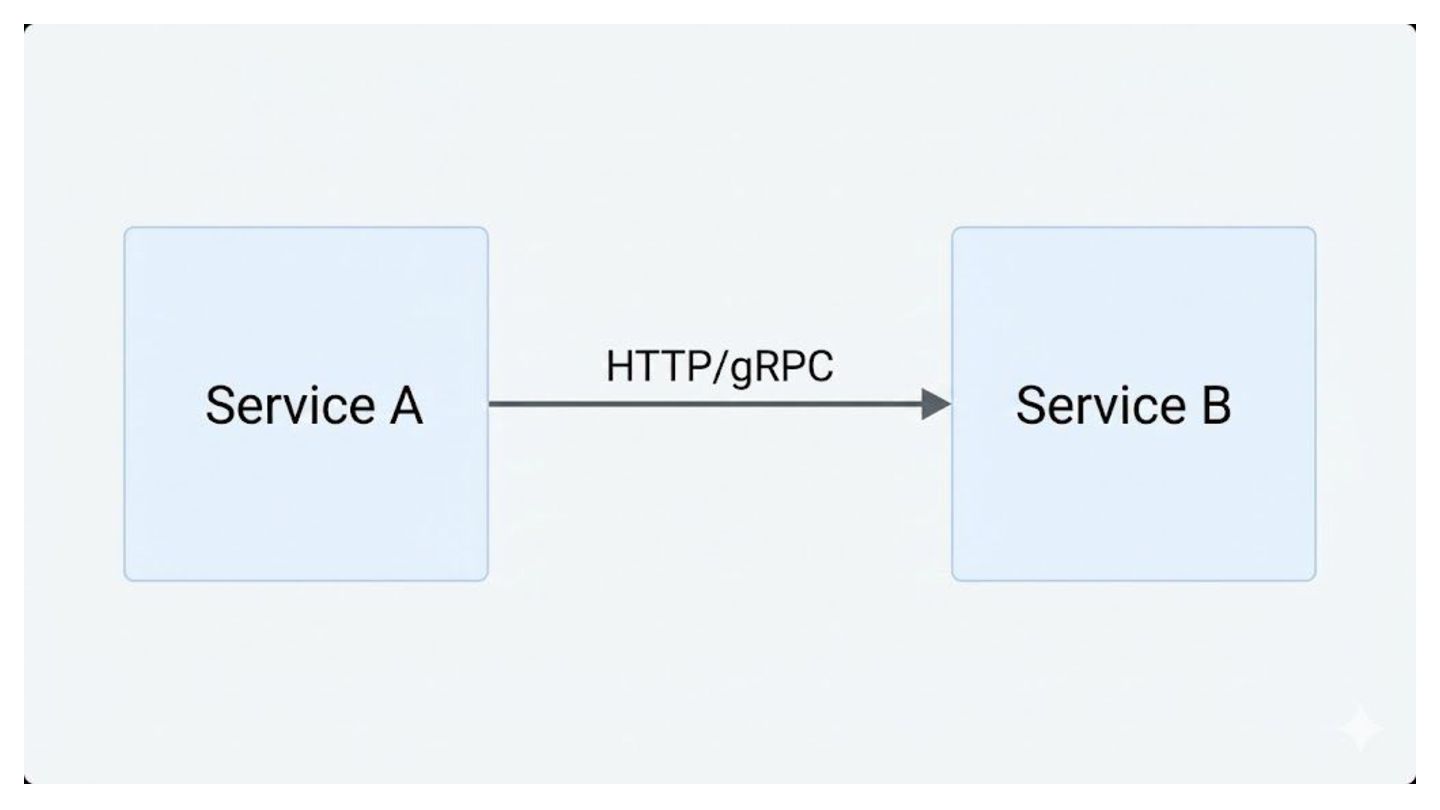
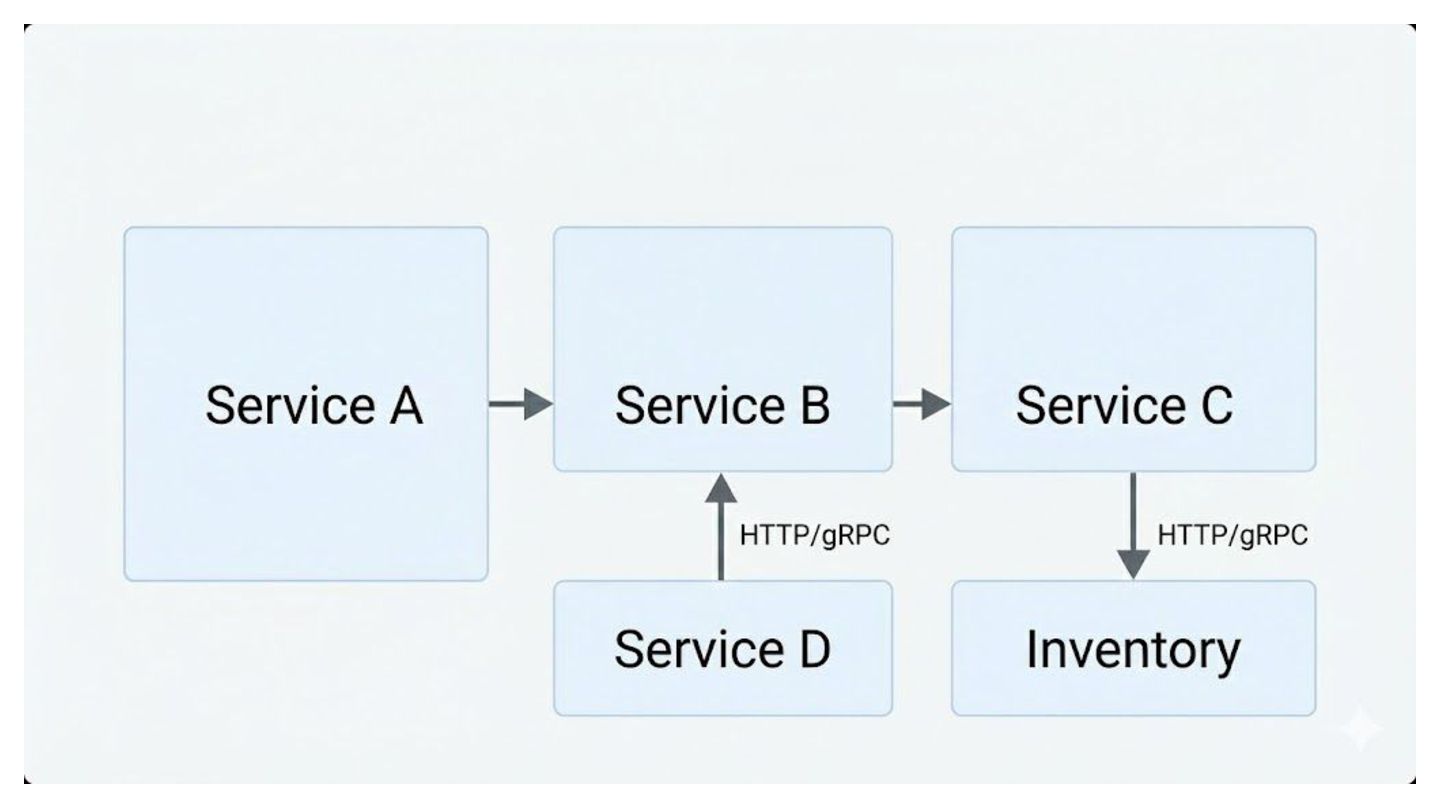
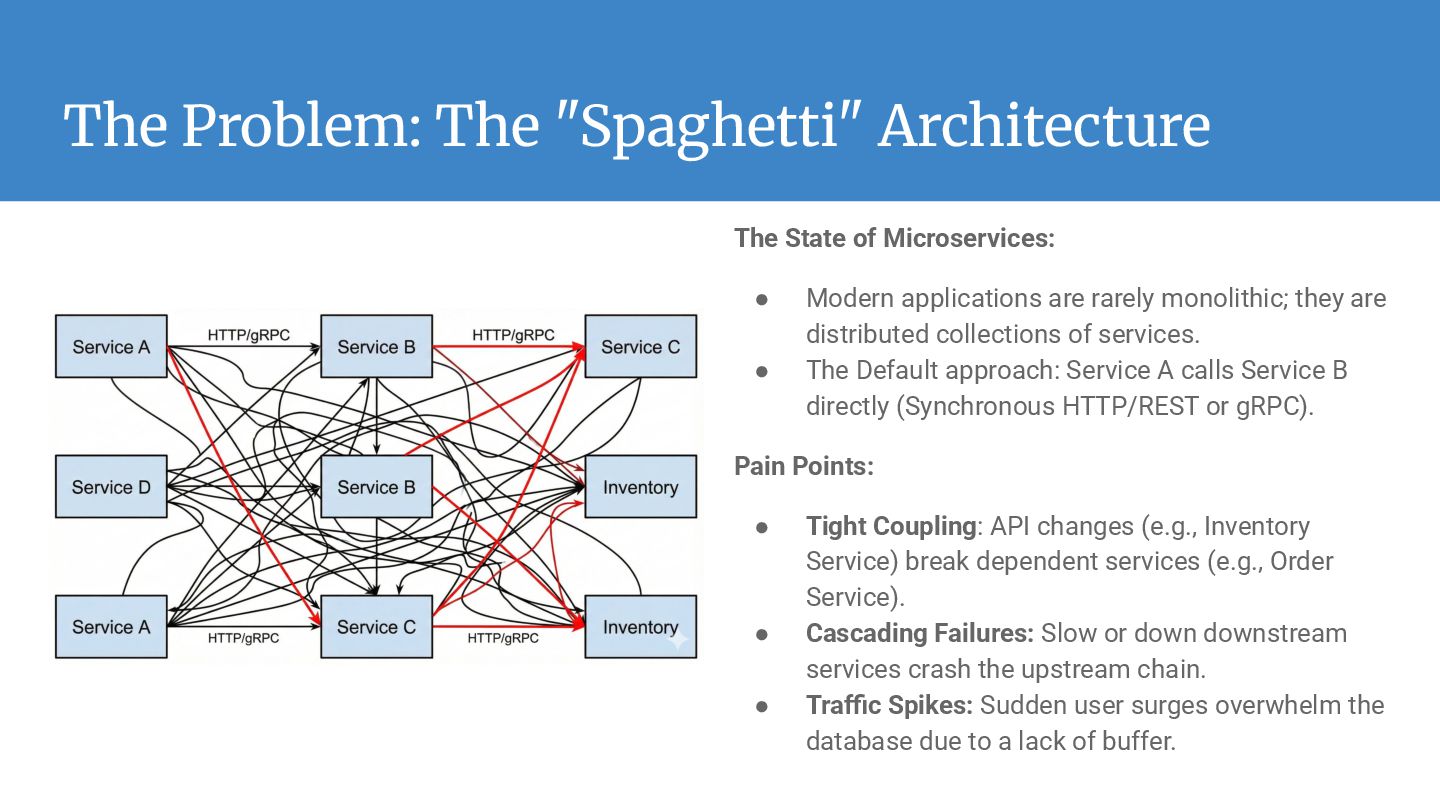
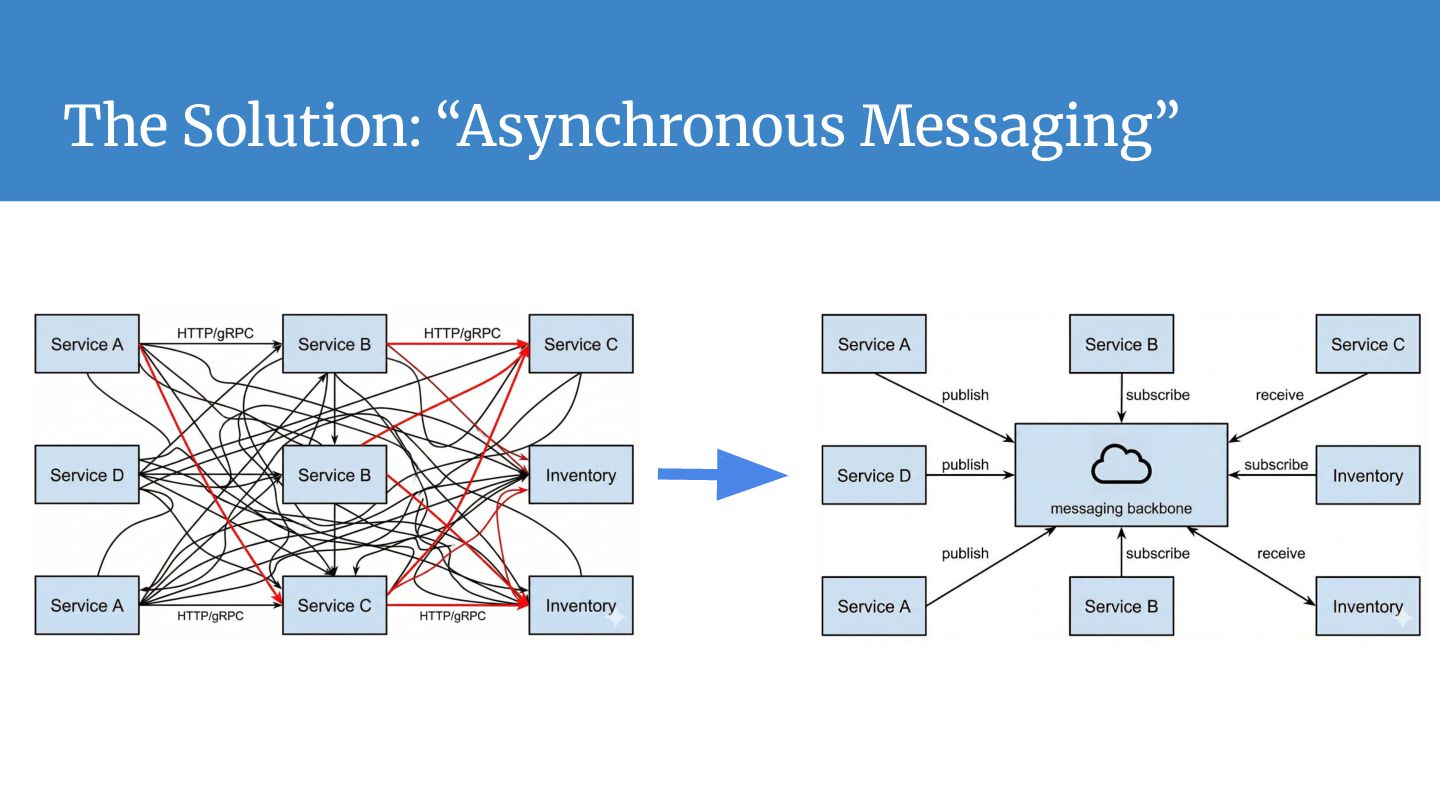
Modern applications are rarely monolithic; they are distributed collections of services. • The Default approach: Service A calls Service B directly (Synchronous HTTP/REST or gRPC). Pain Points: • Tight Coupling: API changes (e.g., Inventory Service) break dependent services (e.g., Order Service). • Cascading Failures: Slow or down downstream services crash the upstream chain. • Traffic Spikes: Sudden user surges overwhelm the database due to a lack of buffer.
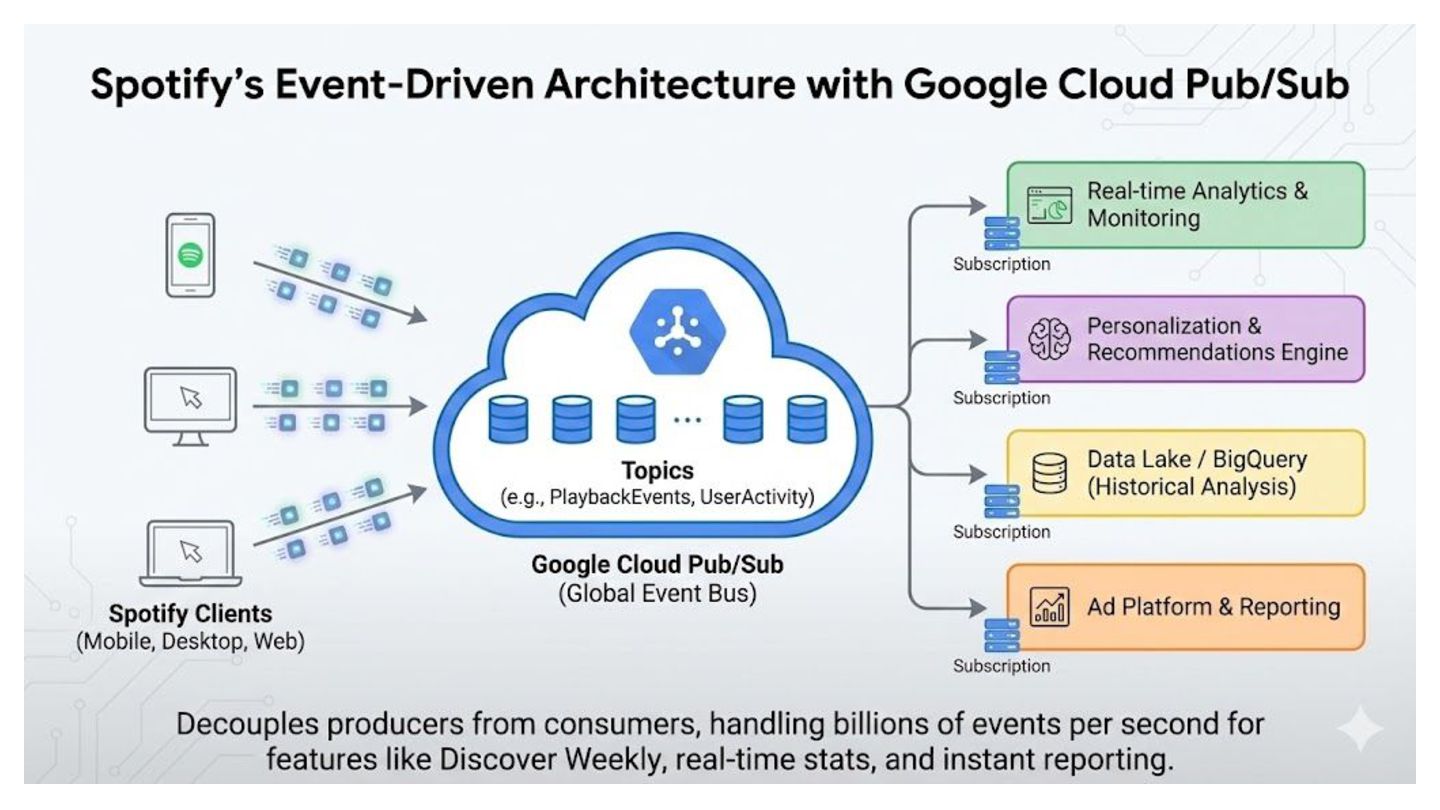
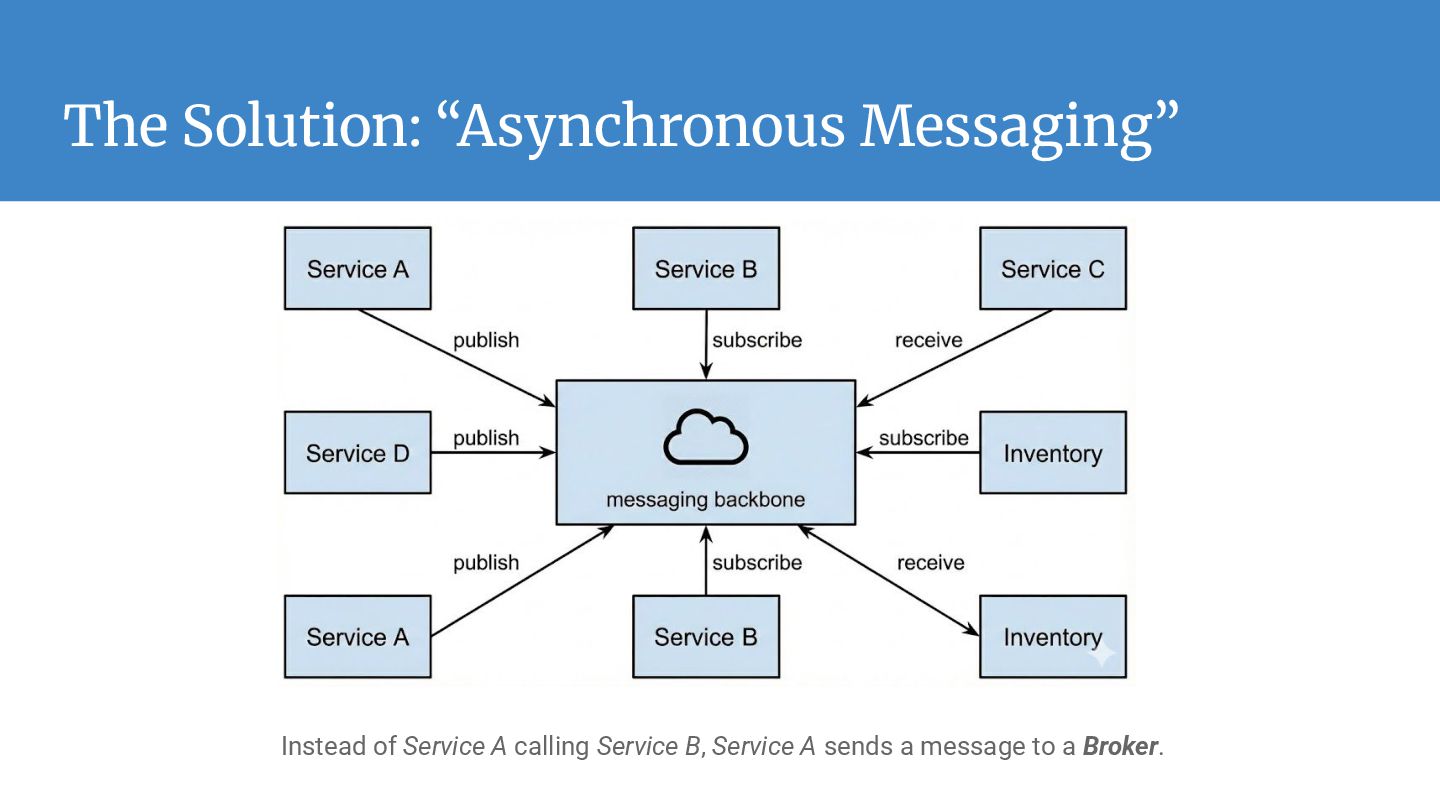
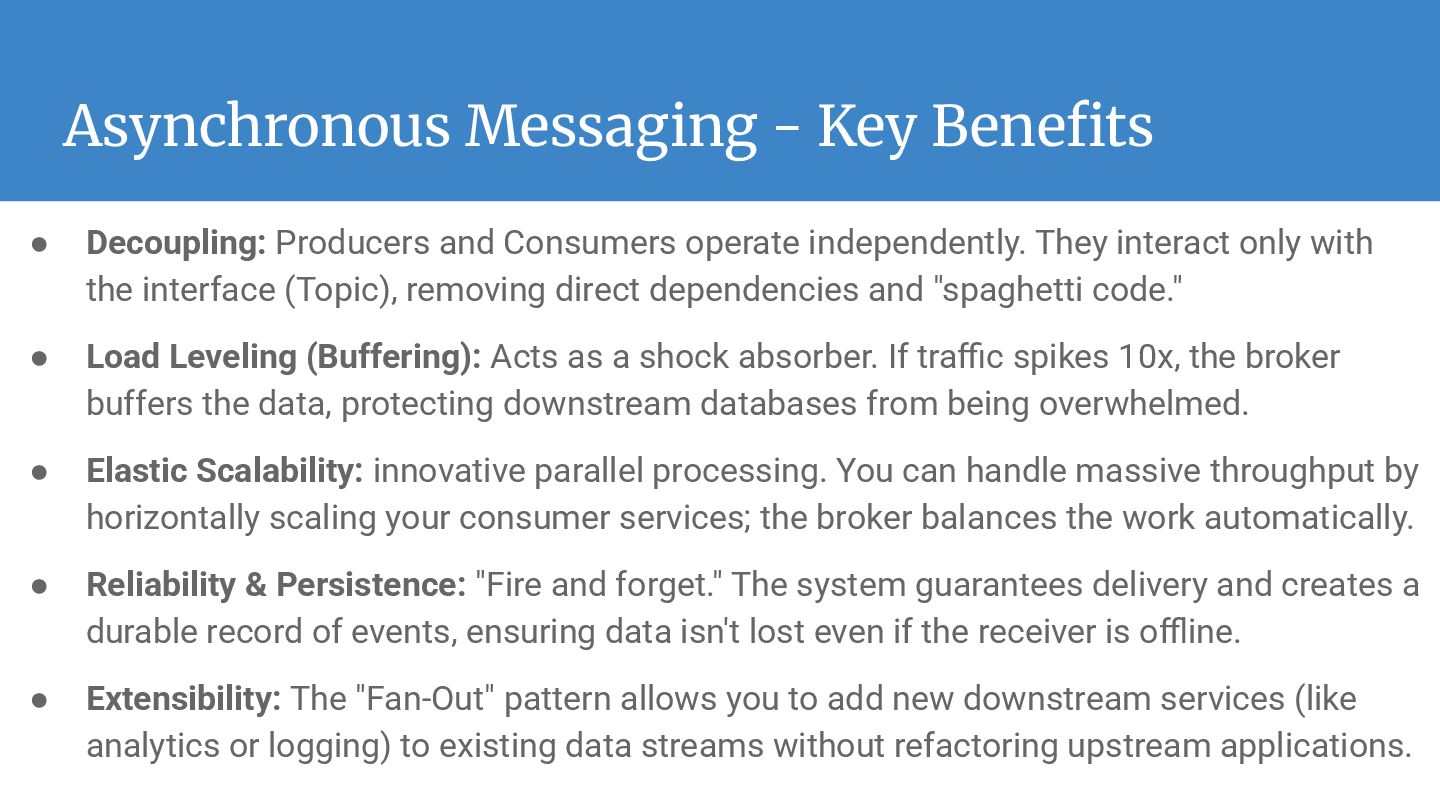
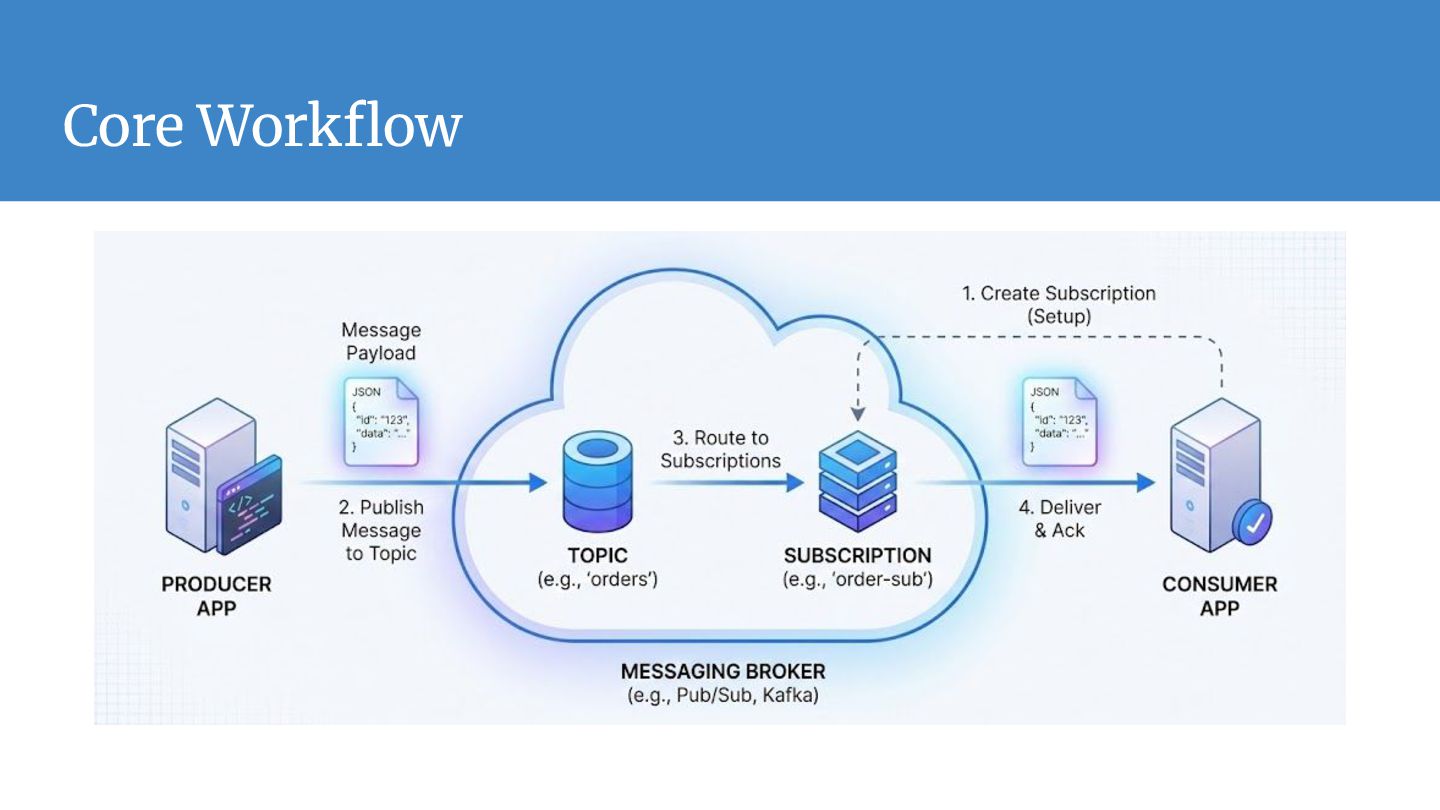
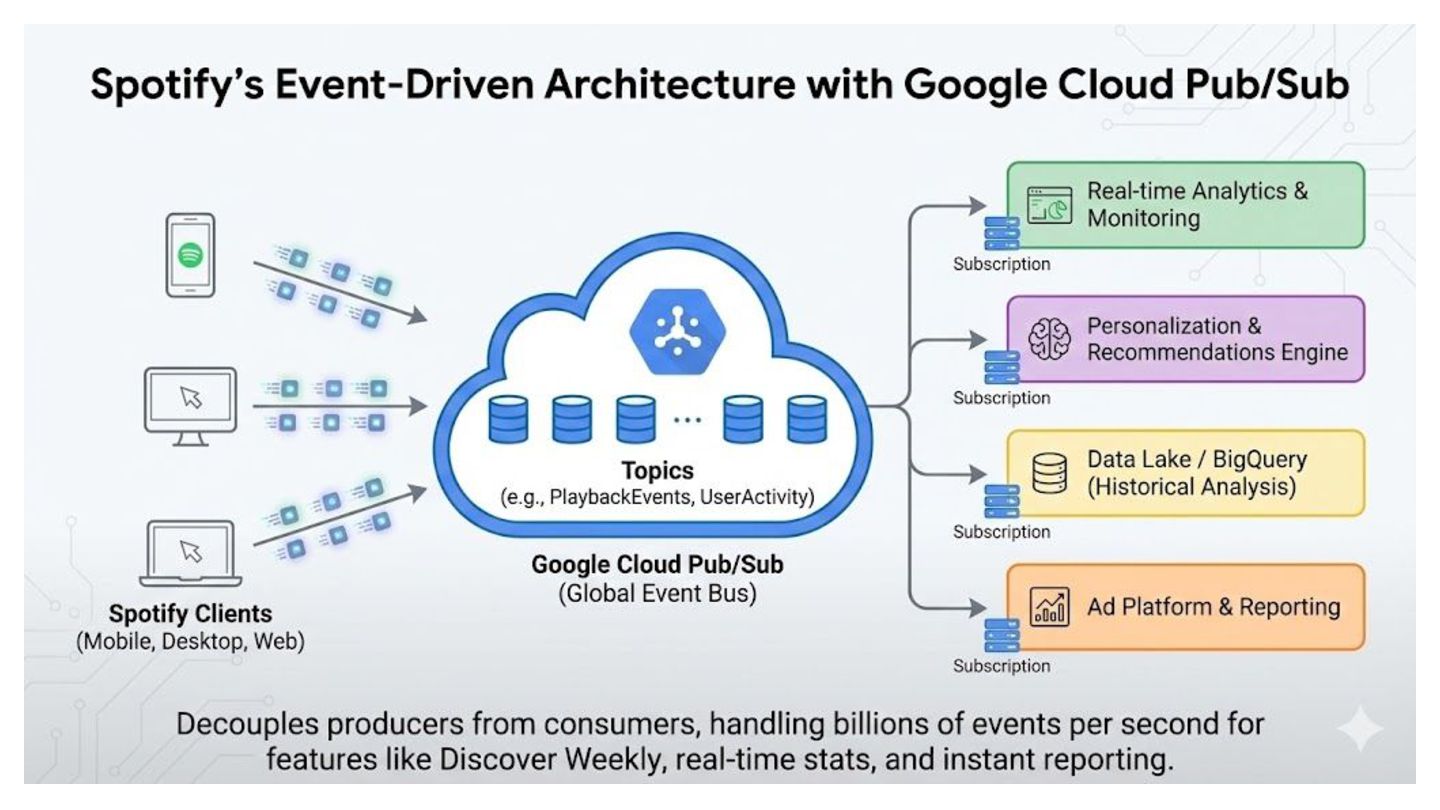
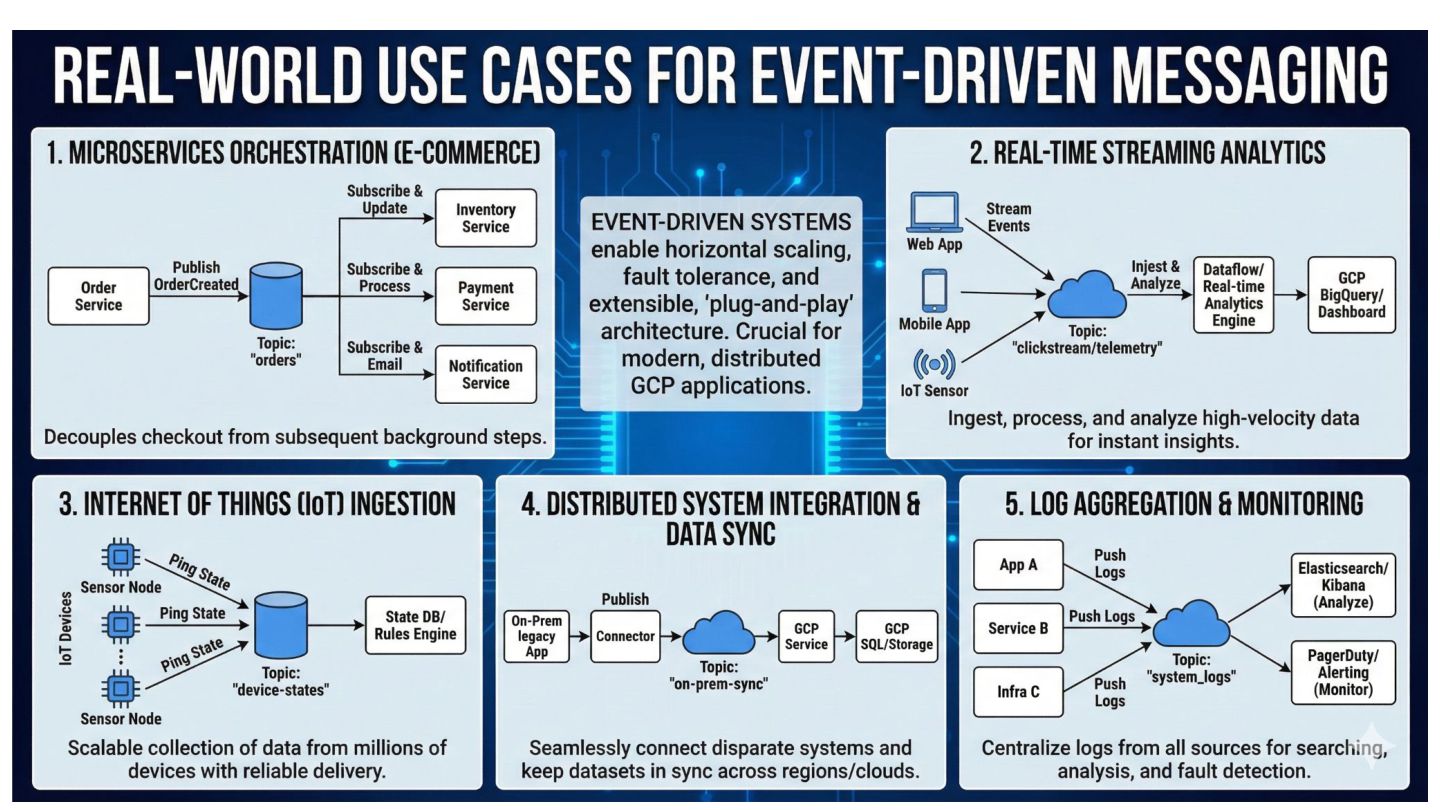
operate independently. They interact only with the interface (Topic), removing direct dependencies and "spaghetti code." • Load Leveling (Buffering): Acts as a shock absorber. If traffic spikes 10x, the broker buffers the data, protecting downstream databases from being overwhelmed. • Elastic Scalability: innovative parallel processing. You can handle massive throughput by horizontally scaling your consumer services; the broker balances the work automatically. • Reliability & Persistence: "Fire and forget." The system guarantees delivery and creates a durable record of events, ensuring data isn't lost even if the receiver is offline. • Extensibility: The "Fan-Out" pattern allows you to add new downstream services (like analytics or logging) to existing data streams without refactoring upstream applications.
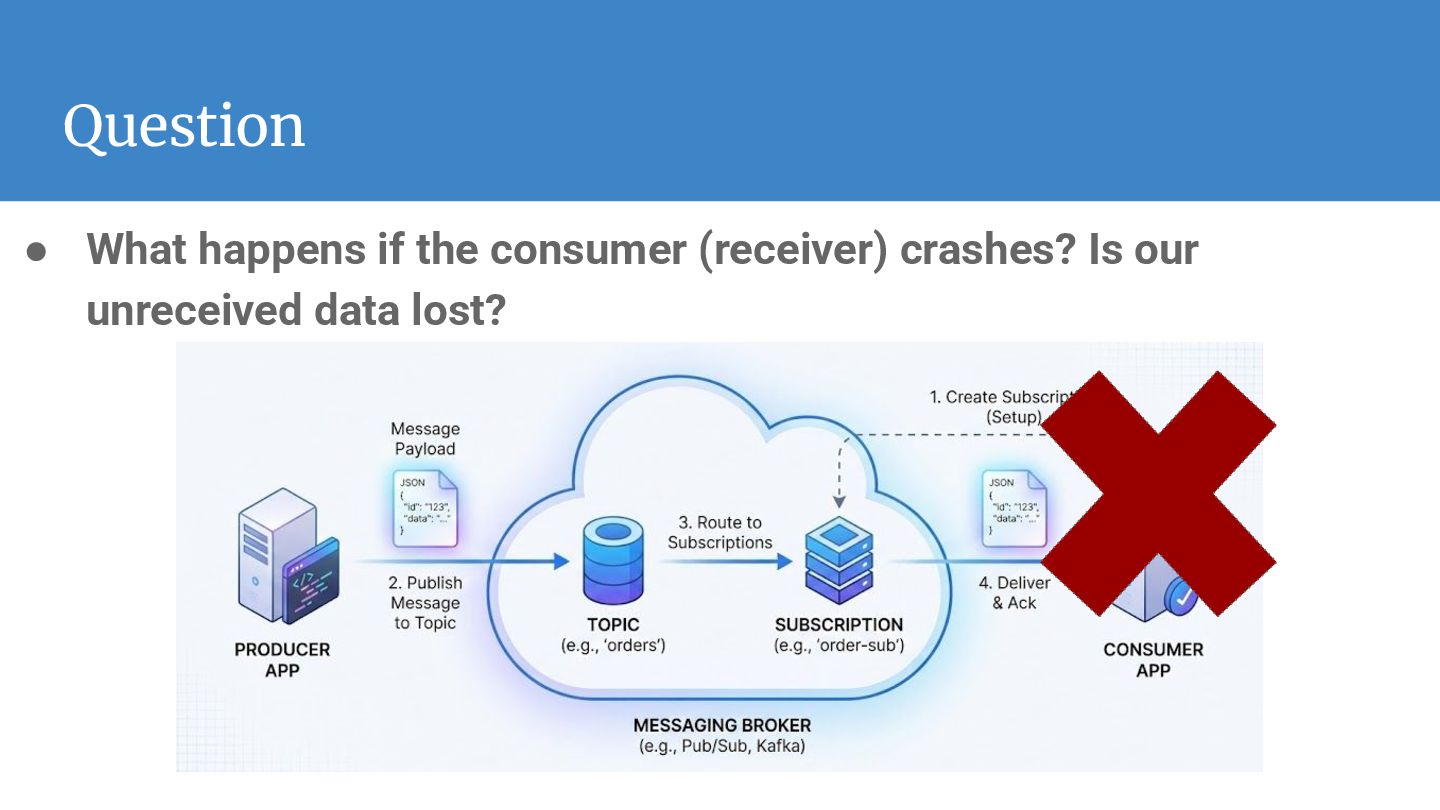
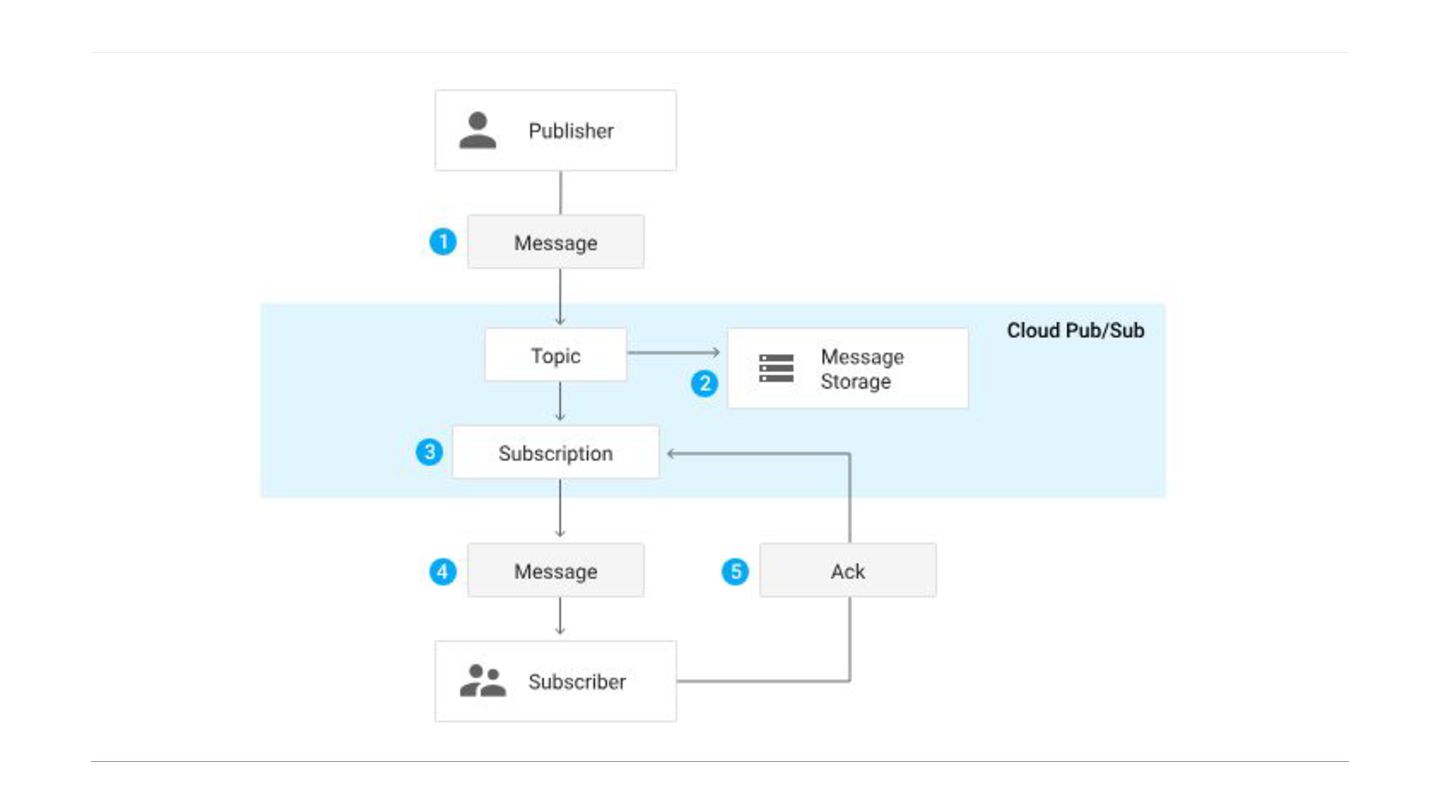
our unreceived data lost? ◦ No, data is not lost. ◦ The broker persists the message (stores it safely) until the receiver comes back online and acknowledges that it has processed it. ◦ Your data "waits" in the queue rather than disappearing.
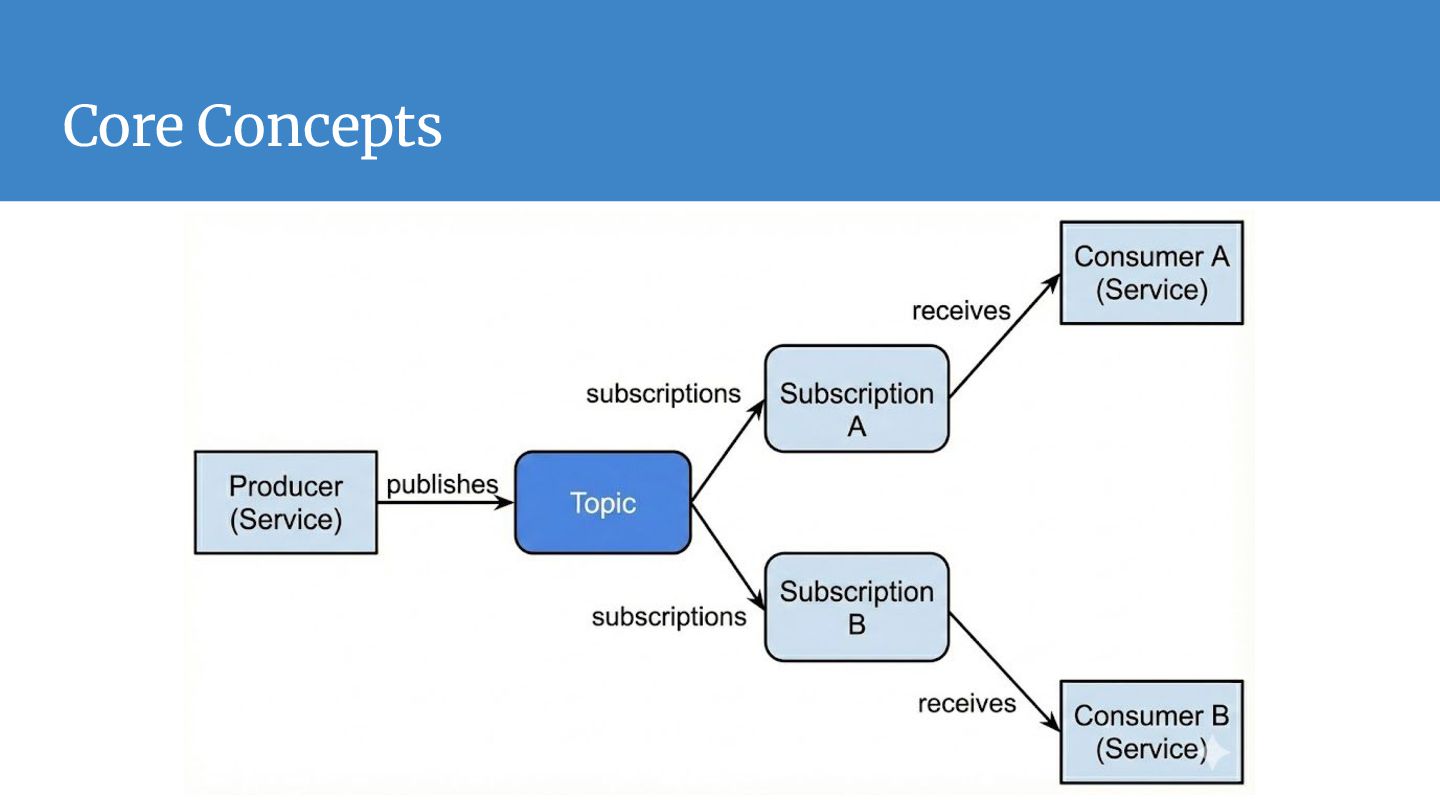
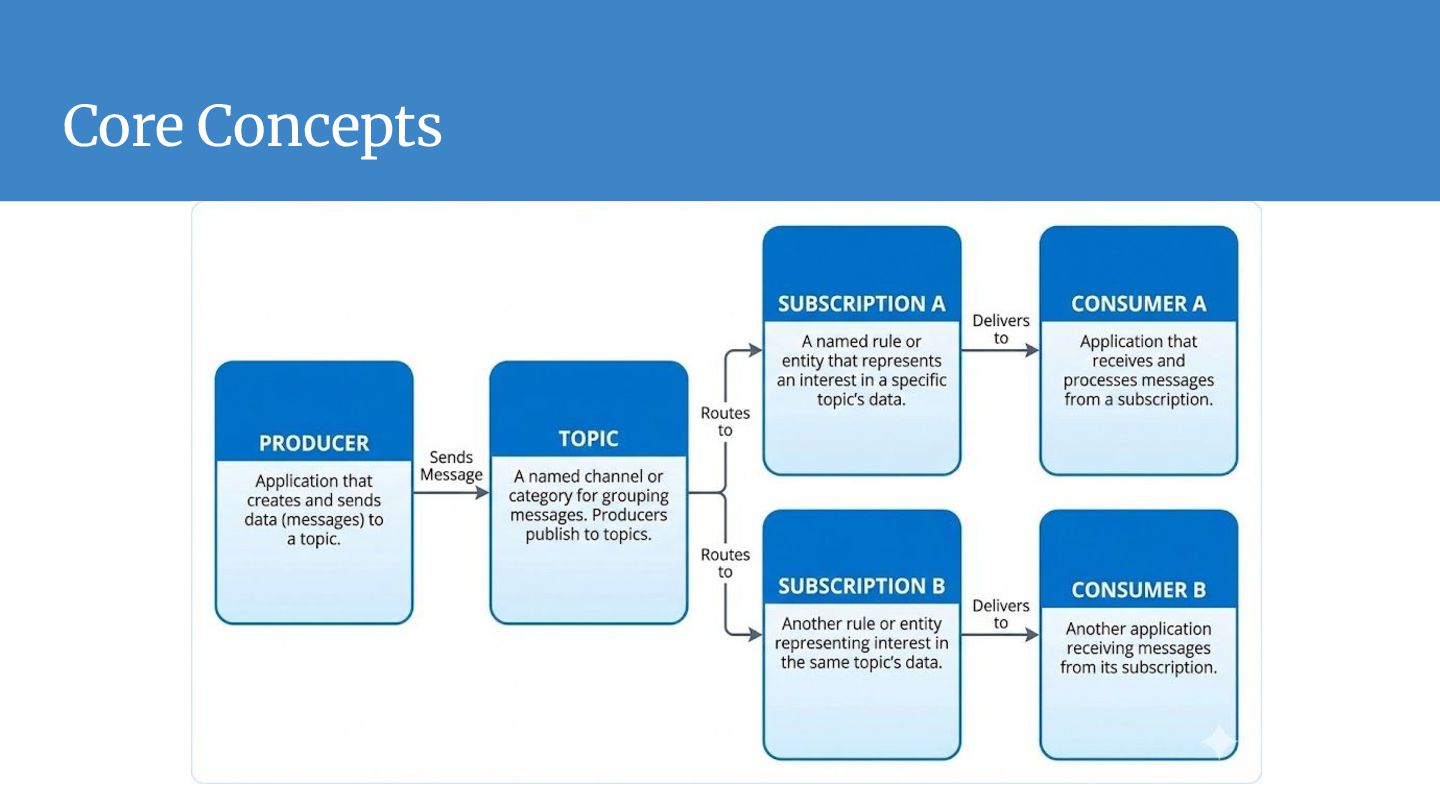
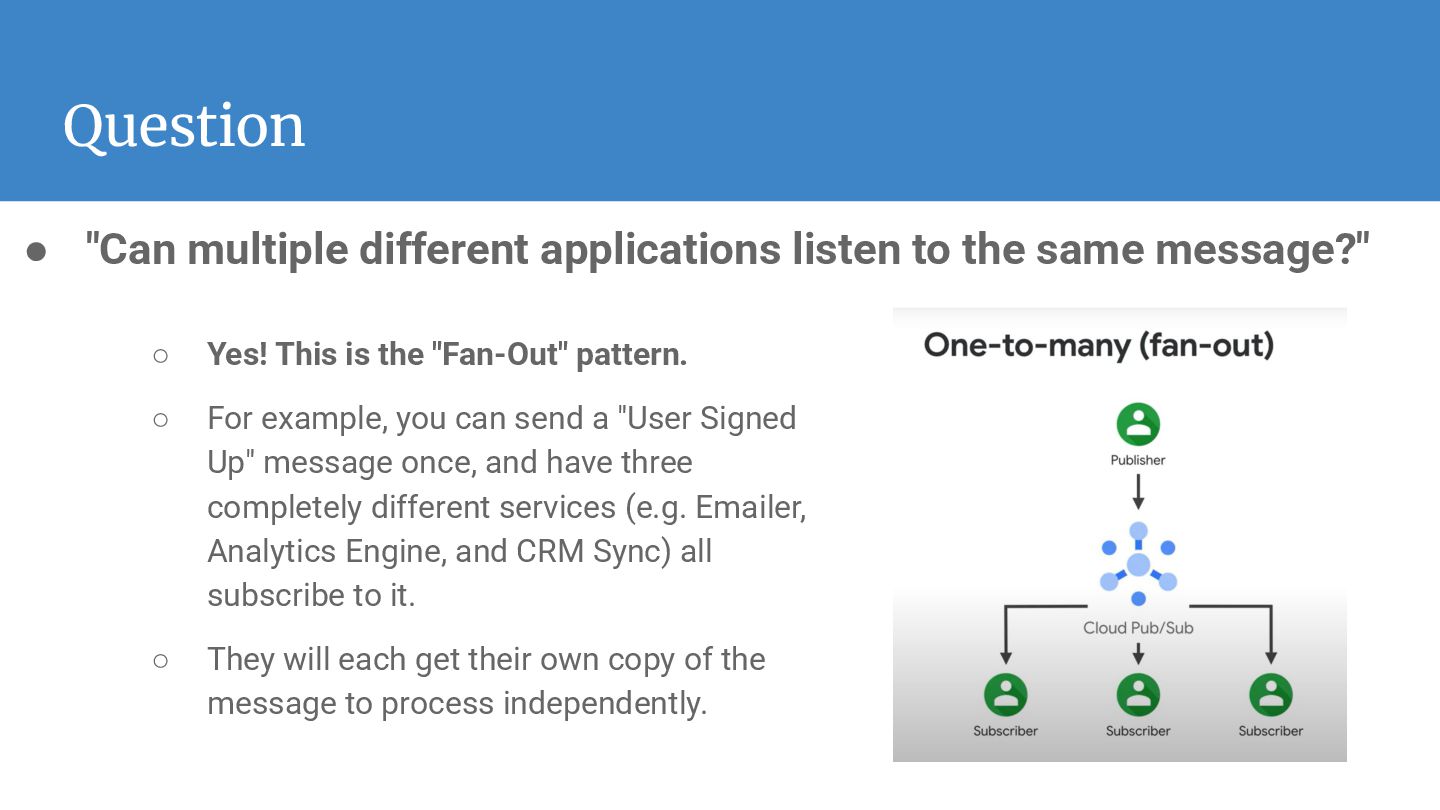
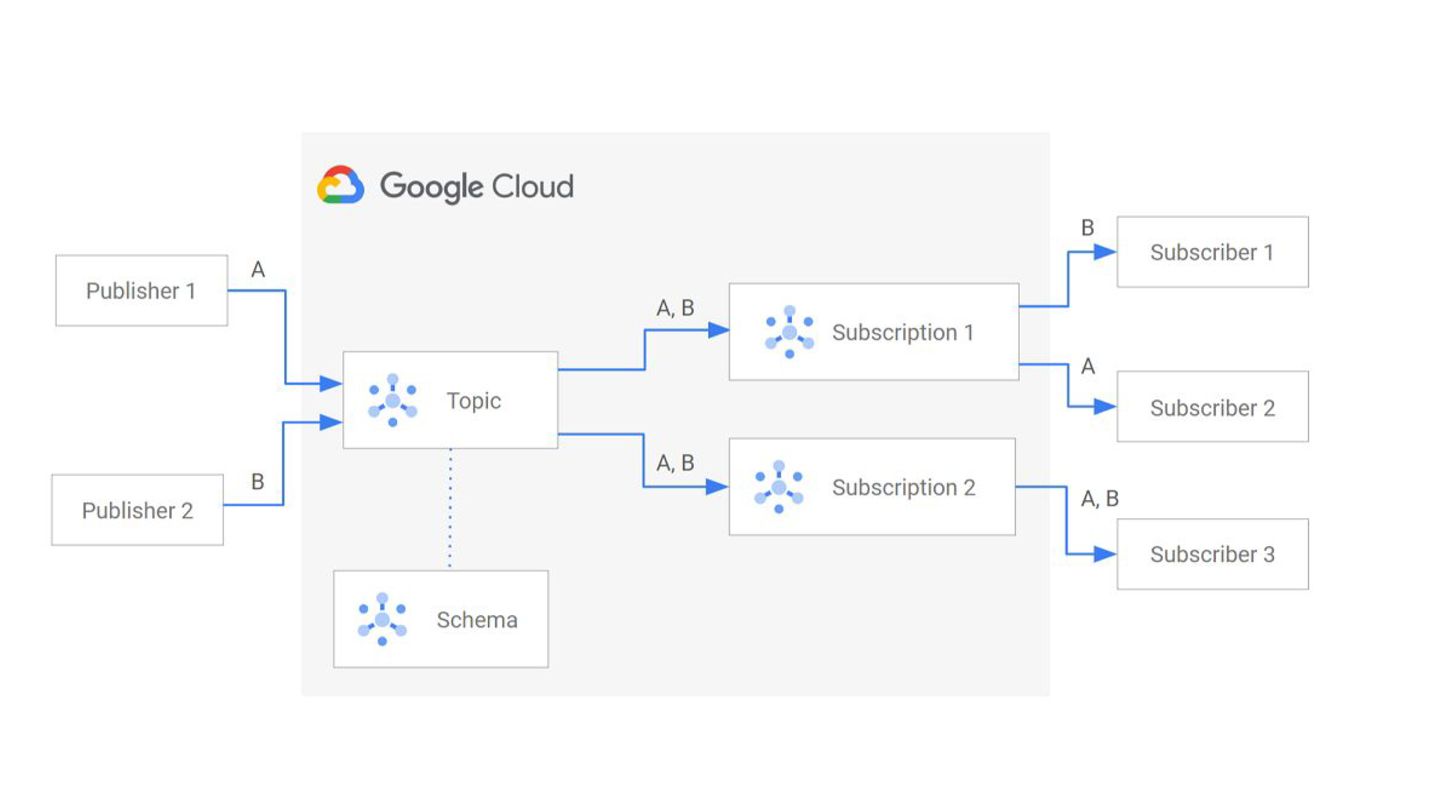
message?" ◦ Yes! This is the "Fan-Out" pattern. ◦ For example, you can send a "User Signed Up" message once, and have three completely different services (e.g. Emailer, Analytics Engine, and CRM Sync) all subscribe to it. ◦ They will each get their own copy of the message to process independently.
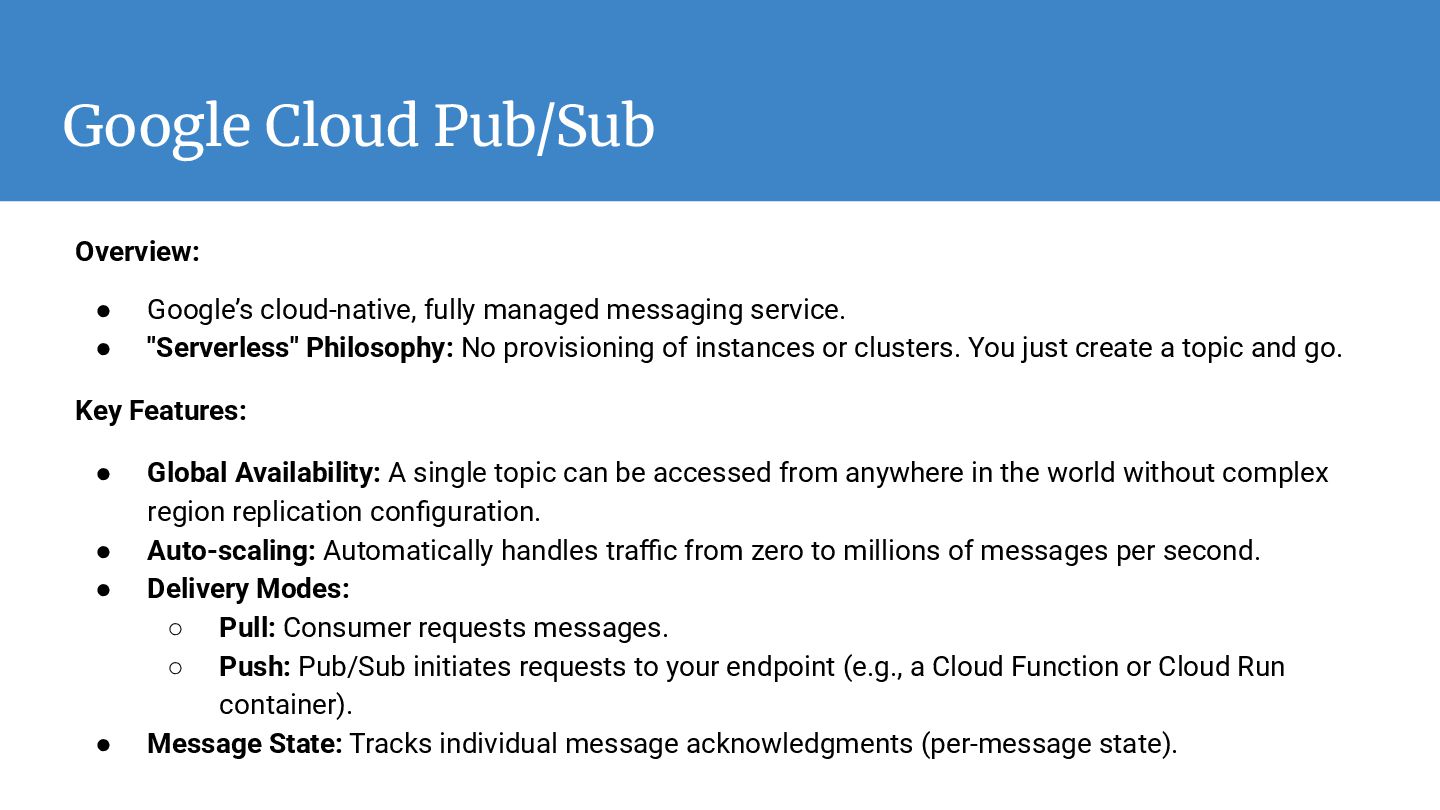
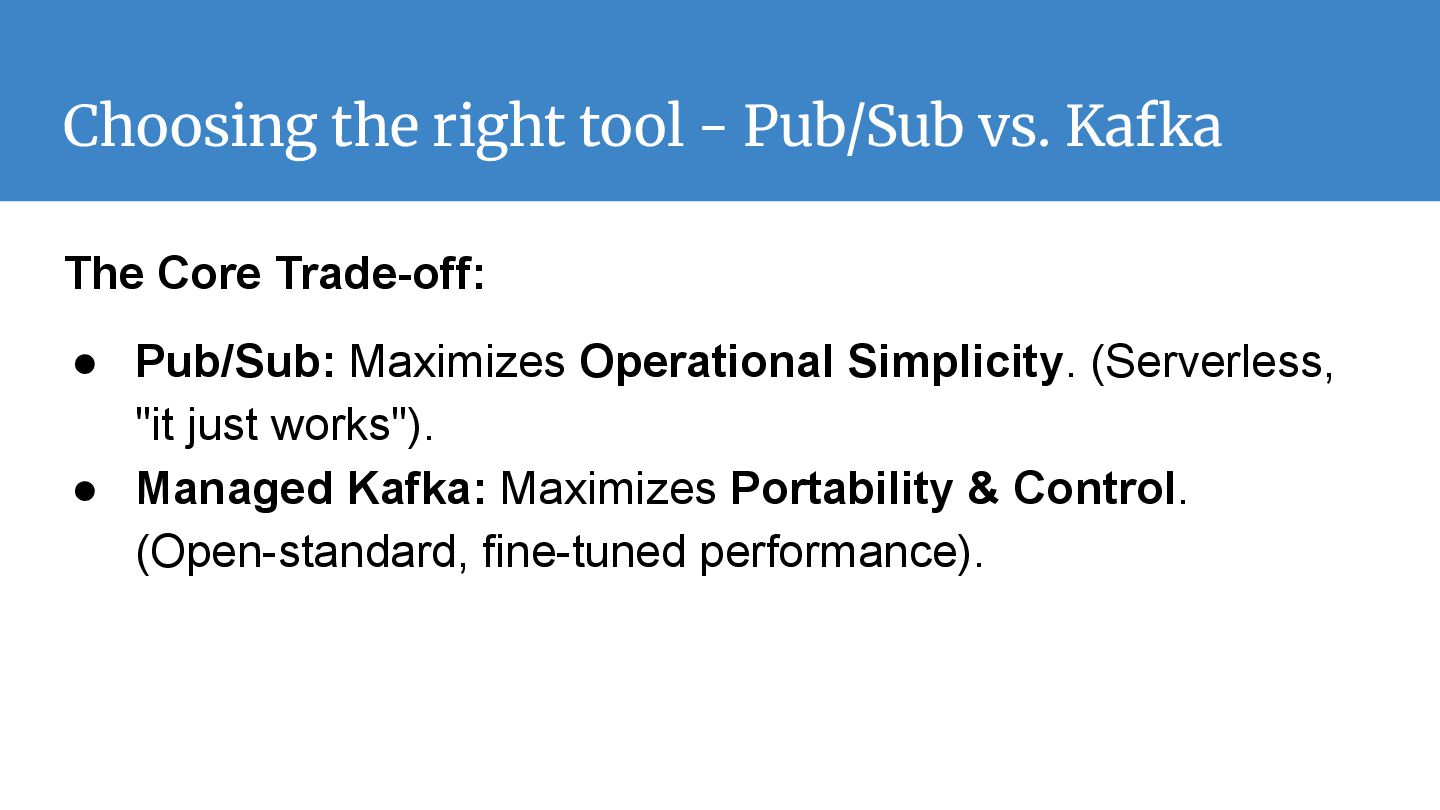
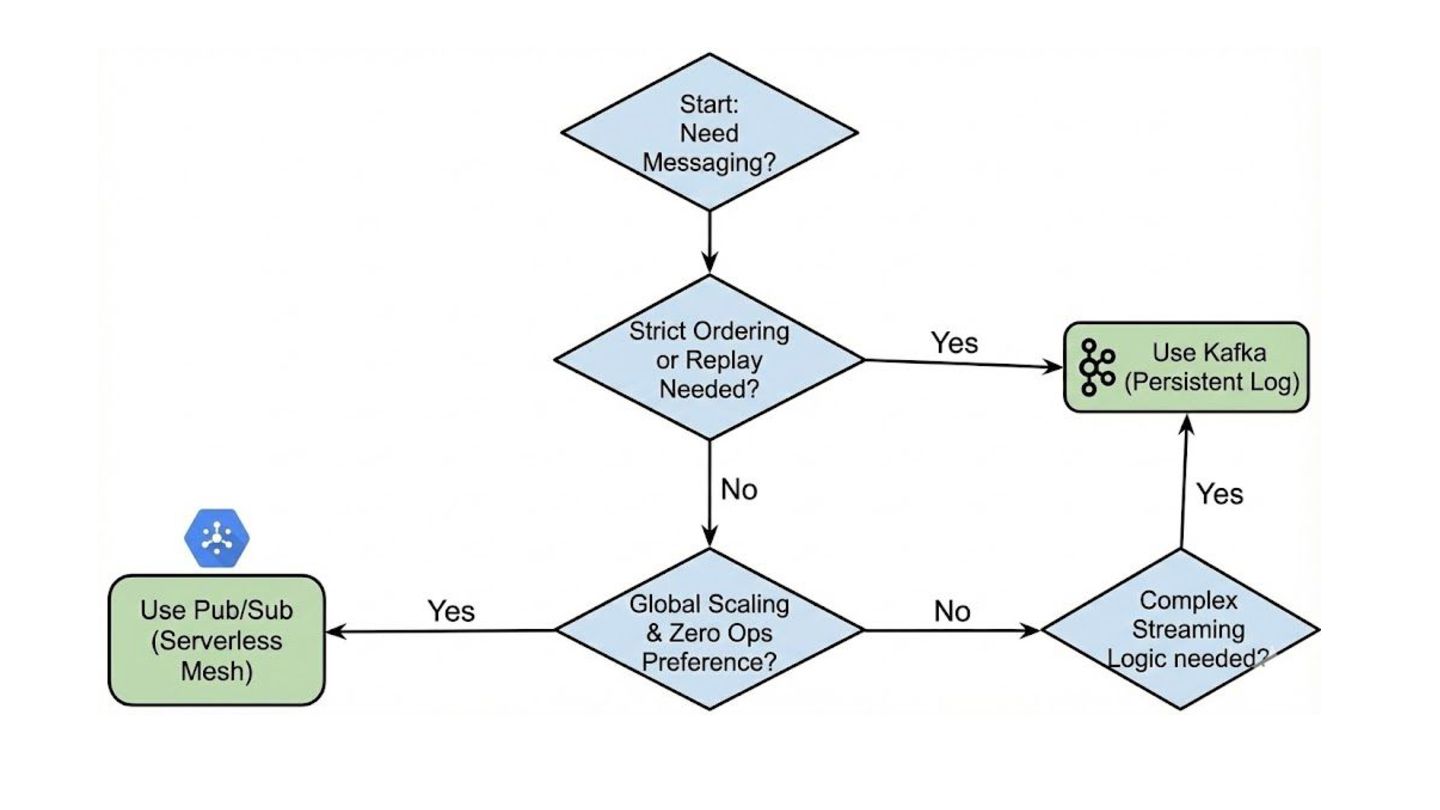
service. • "Serverless" Philosophy: No provisioning of instances or clusters. You just create a topic and go. Key Features: • Global Availability: A single topic can be accessed from anywhere in the world without complex region replication configuration. • Auto-scaling: Automatically handles traffic from zero to millions of messages per second. • Delivery Modes: ◦ Pull: Consumer requests messages. ◦ Push: Pub/Sub initiates requests to your endpoint (e.g., a Cloud Function or Cloud Run container). • Message State: Tracks individual message acknowledgments (per-message state).
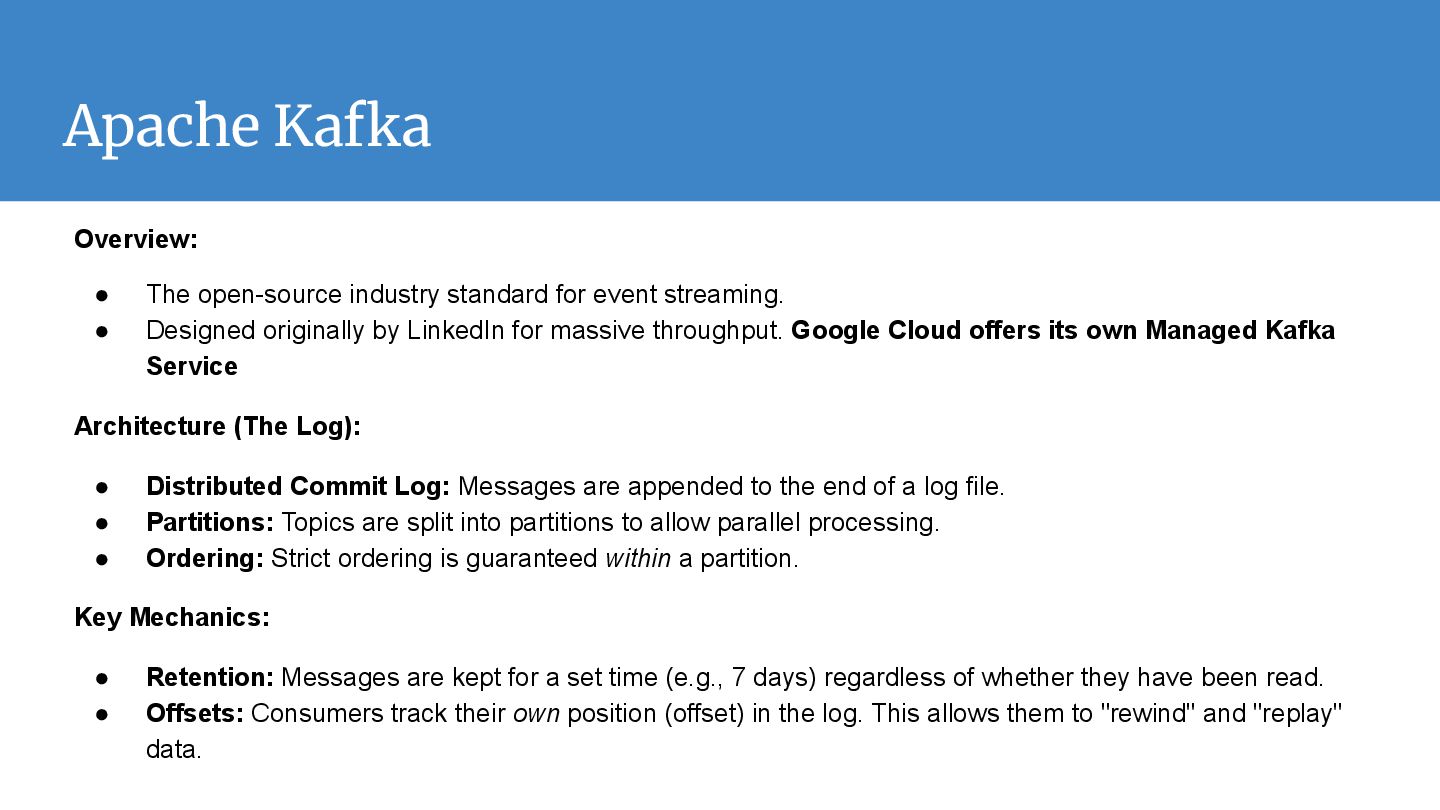
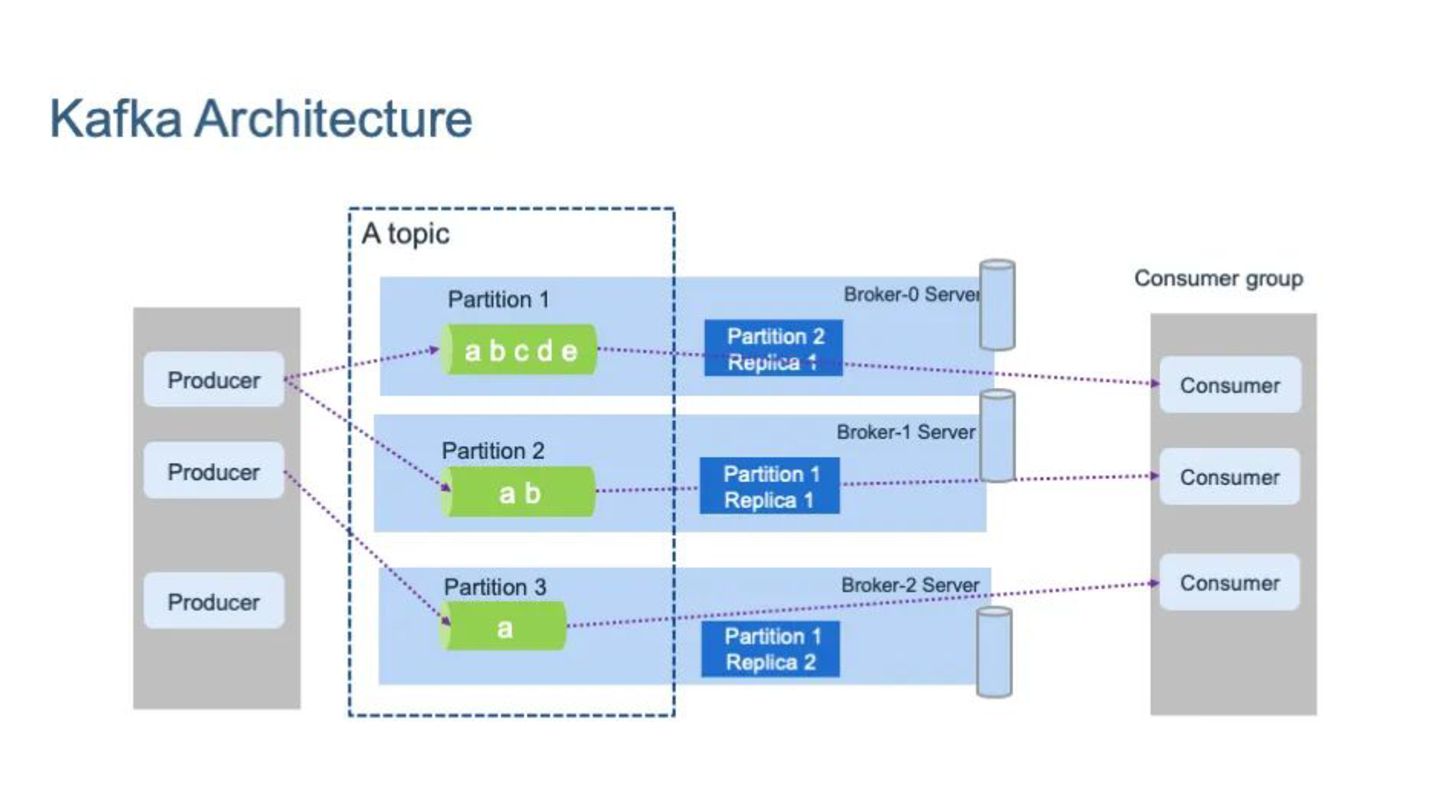
streaming. • Designed originally by LinkedIn for massive throughput. Google Cloud offers its own Managed Kafka Service Architecture (The Log): • Distributed Commit Log: Messages are appended to the end of a log file. • Partitions: Topics are split into partitions to allow parallel processing. • Ordering: Strict ordering is guaranteed within a partition. Key Mechanics: • Retention: Messages are kept for a set time (e.g., 7 days) regardless of whether they have been read. • Offsets: Consumers track their own position (offset) in the log. This allows them to "rewind" and "replay" data.
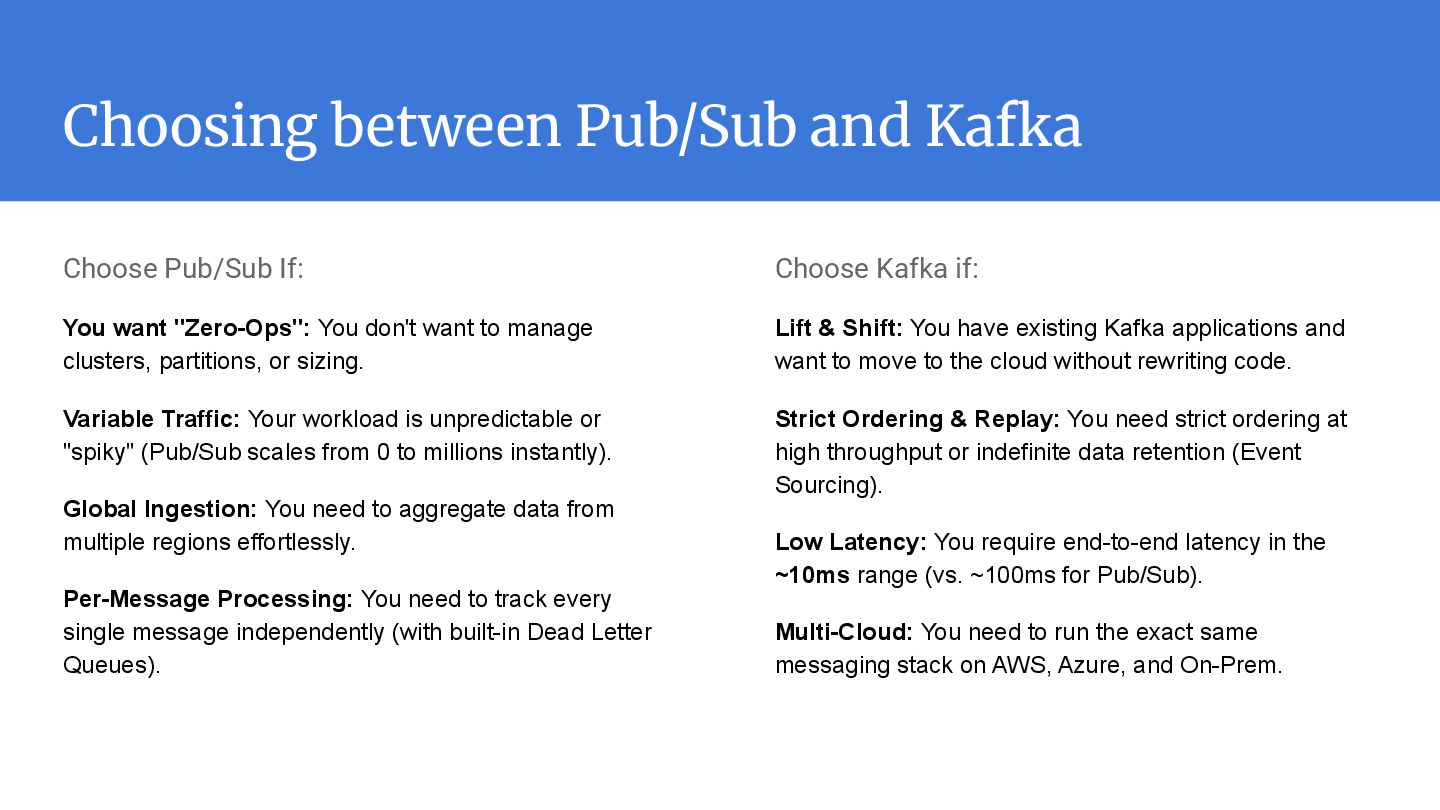
"Zero-Ops": You don't want to manage clusters, partitions, or sizing. Variable Traffic: Your workload is unpredictable or "spiky" (Pub/Sub scales from 0 to millions instantly). Global Ingestion: You need to aggregate data from multiple regions effortlessly. Per-Message Processing: You need to track every single message independently (with built-in Dead Letter Queues). Choose Kafka if: Lift & Shift: You have existing Kafka applications and want to move to the cloud without rewriting code. Strict Ordering & Replay: You need strict ordering at high throughput or indefinite data retention (Event Sourcing). Low Latency: You require end-to-end latency in the ~10ms range (vs. ~100ms for Pub/Sub). Multi-Cloud: You need to run the exact same messaging stack on AWS, Azure, and On-Prem.
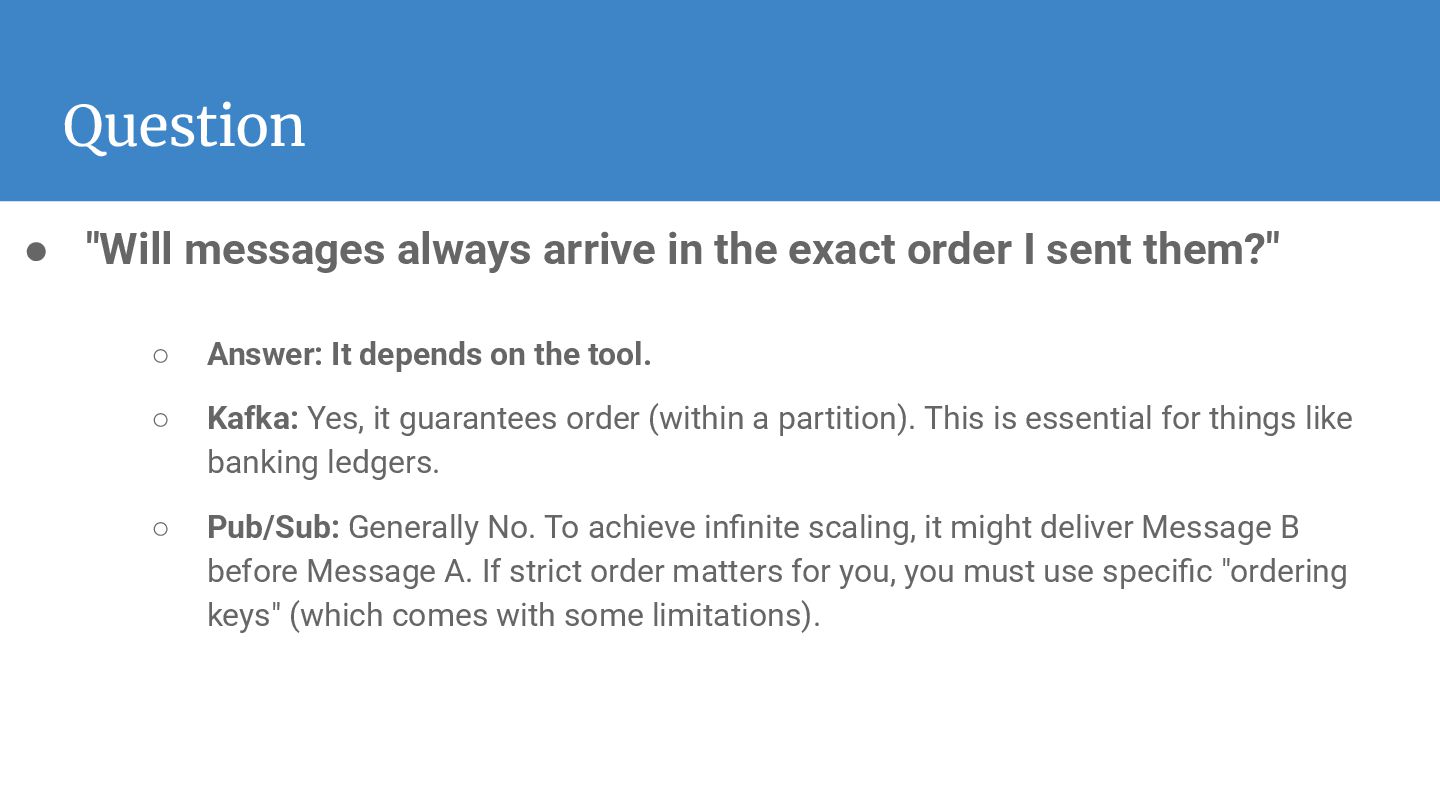
I sent them?" ◦ Answer: It depends on the tool. ◦ Kafka: Yes, it guarantees order (within a partition). This is essential for things like banking ledgers. ◦ Pub/Sub: Generally No. To achieve infinite scaling, it might deliver Message B before Message A. If strict order matters for you, you must use specific "ordering keys" (which comes with some limitations).


 gdglahore
 tosite
 mpyw
mpyw
 satoshi256kbyte
 oku053
 myus4a
 florets1
 armondando
 sts11142
 ayumu_yamaguchi
 glassfiber
 irinanazarova
 bells17
 schroneko
 rkendrick25
 thirion
 davetheseo
 jct
jct
 bethany
 akademiya2063
 lynnandtonic
 letsgokoyo
 michielstock
 brad_frost
 addyosmani