Share
Embed
Collaborative Digital Pedagogy: Teaching Digital Humanities in the Classroom through Faculty-Librarian Collaborations
Paper presentation at the 2014 IFLA Information Literacy Section satellite meeting in Limerick, Ireland.
Harriett Green
August 14, 2014
Transcript
13 slides
-
Collabora've Digital Pedagogy Teaching Digital Humani'es in the
Classroom through Faculty-‐Librarian Collabora'ons Harrie= Green, University of Illinois at Urbana-‐Champaign IFLA Informa'on Literacy Satellite Conference August 14-‐15, 2014 -
Today’s Talk • Background: Digital literacy, metaliteracy, digital
pedagogy • Case studies – English – Media Studies – Architecture • Poten'al for collabora'on in digital pedagogy between librarians and instructors -
MetaLiteracy Informa'on Fluency Visual Media
Cyberliteracy [email protected] @greenharr “Informa'on literacy is the metaliteracy for the digital age because it provides the higher order thinking to engage with mul'ple document types through various media formats in collabora've environments…. Metaliteracy provides an all-‐ inclusive core for engaging with individuals and ideas in digital environments.” —Mackey and Jacobson (2011) Metaliteracy -
Digital Pedagogy “Digital pedagogy is the use of electronic
elements to enhance or to change to [sic] experience of educa'on.” –MLA Digital Pedagogy Unconference “Students and learners should be central in mapping the terrain of digital pedagogy. Educa'onal ins'tu'ons should dedicate themselves to suppor'ng this work…. Digital pedagogy is less about knowing and more a rampant process of unlearning, play, and rediscovery.” —Jesse Stommel, Hybrid Pedagogy [email protected] @greenharr -
Role of Librarians • Rapidly growing body of work
as digital collec'ons and scholarship services develop in libraries • Courtney and Dalmau (2011): Victorian Women Writers Project and English graduate seminar • 2013 Journal of Library Administra7on special issue on digital humani'es and libraries: Sula, Vinopal, Posner [email protected] @greenharr -
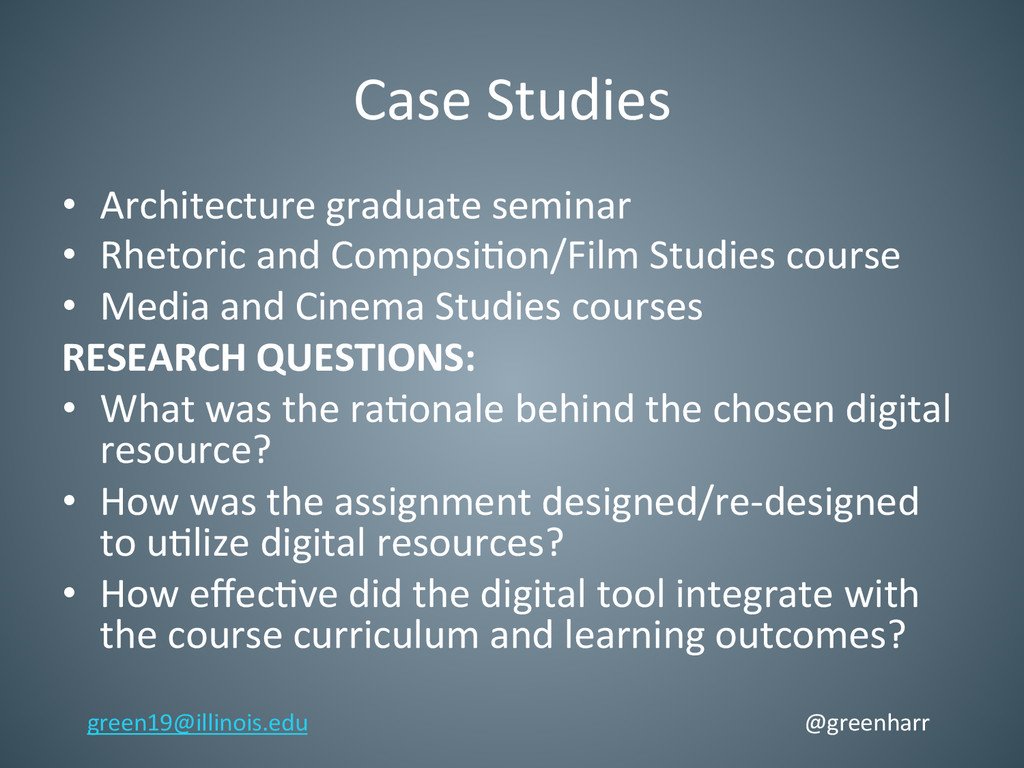
Case Studies • Architecture graduate seminar • Rhetoric
and Composi'on/Film Studies course • Media and Cinema Studies courses RESEARCH QUESTIONS: • What was the ra'onale behind the chosen digital resource? • How was the assignment designed/re-‐designed to u'lize digital resources? • How effec've did the digital tool integrate with the course curriculum and learning outcomes? [email protected] @greenharr -
Architecture • Digital research collec'ons: ARTStor •
Publishing plajorms: Wordpress, Weebly, Wix, Google Sites, Omeka Tool Selec'on • Digital publishing: Guide to Digital History • Essay + computer generated designs Assignment Design • Class digital journal: h=p:// modernutopias.wordpress.com Results [email protected] @greenharr -
Rhetoric/Composi'on • Library catalog, Academic Search Premier • Omeka.net:
www.omeka.net Tool Selec'on • Website + standard essays • Focus on documentary film Assignment Design • Omeka.net exhibit with final paper • New modes of digital wri'ng Results [email protected] @greenharr -
Media and Cinema Studies • Scalar: h=p://scalar.usc.edu •
Voyant: h=p://voyant-‐tools.org • Easel.ly: h=p://easel.ly Tool Selec'on • Media Ethics: Scalar site • Study Abroad: Scalar sites with digital analyses Assignment Design • Media Ethics: mul'-‐media sites • Study Abroad: Scalar sites showcasing digital analyses Results [email protected] @greenharr -
The awareness, aotude and ability of individuals to
appropriately use digital tools and facili'es to iden'fy, access, manage, integrate, evaluate, analyze and synthesize digital resources, construct new knowledge, create media expressions, and communicate with others, in the context of specific life situa'ons, in order to enable construc've social ac'on; and to reflect upon this process. (Mar'n and Grudzecki 2010) • Enhancing cogni've development and assessment prac'ces through curriculum interven'ons that make use of new affordances of digital technologies. • Suppor'ng learning communi'es to work collabora'vely in problem solving and the co-‐construc'on of knowledge. • Working collabora'vely in a mul'disciplinary team to create useful, prac'cal tools. • Increasing authen'city and overcoming access issues. (Gillen and Barton 2010) Metaliteracy Digital Literacies [email protected] @greenharr -
Digital Pedagogy and Learning Outcomes Toward Digital Literacies
• Discover, access, and evaluate digital content for research • Develop scholarly cri7que via synthesis of visual and textual content • Engage in a collabora7ve learning environment • Build authen7c transferrable skills and digital tool competencies through experien7al learning [email protected] @greenharr -
The Future of Digital Pedagogy and IL? “We
must develop a par'cipa've pedagogy, assisted by digital media and networked publics, that focuses on catalyzing, inspiring, nourishing, facilita'ng, and guiding literacies essen'al to individual and collec've life in the 21st century. –Howard Rheingold, 2010 [email protected] @greenharr -
Thank you! Harrie= Green English and Digital Humani'es
Librarian University of Illinois at Urbana-‐Champaign [email protected] TwiDer: @greenharr