Upgrade to Pro — share decks privately, control downloads, hide ads and more …

How to Source Lab Grown Diamond Tennis Bracelet...

How to Source Lab Grown Diamond Tennis Bracelets for Wholesale and Private-Label Jewellery Collections

Learn how to source lab grown diamond tennis bracelets for wholesale and private-label jewellery collections, including quality checks, supplier selection, pricing, and customisation.

Avatar for Grown Diamond Corporation

Grown Diamond Corporation

October 15, 2026

Other Decks in Business

Transcript

  1. How to Source Lab Grown Diamond Tennis Bracelets for Wholesale

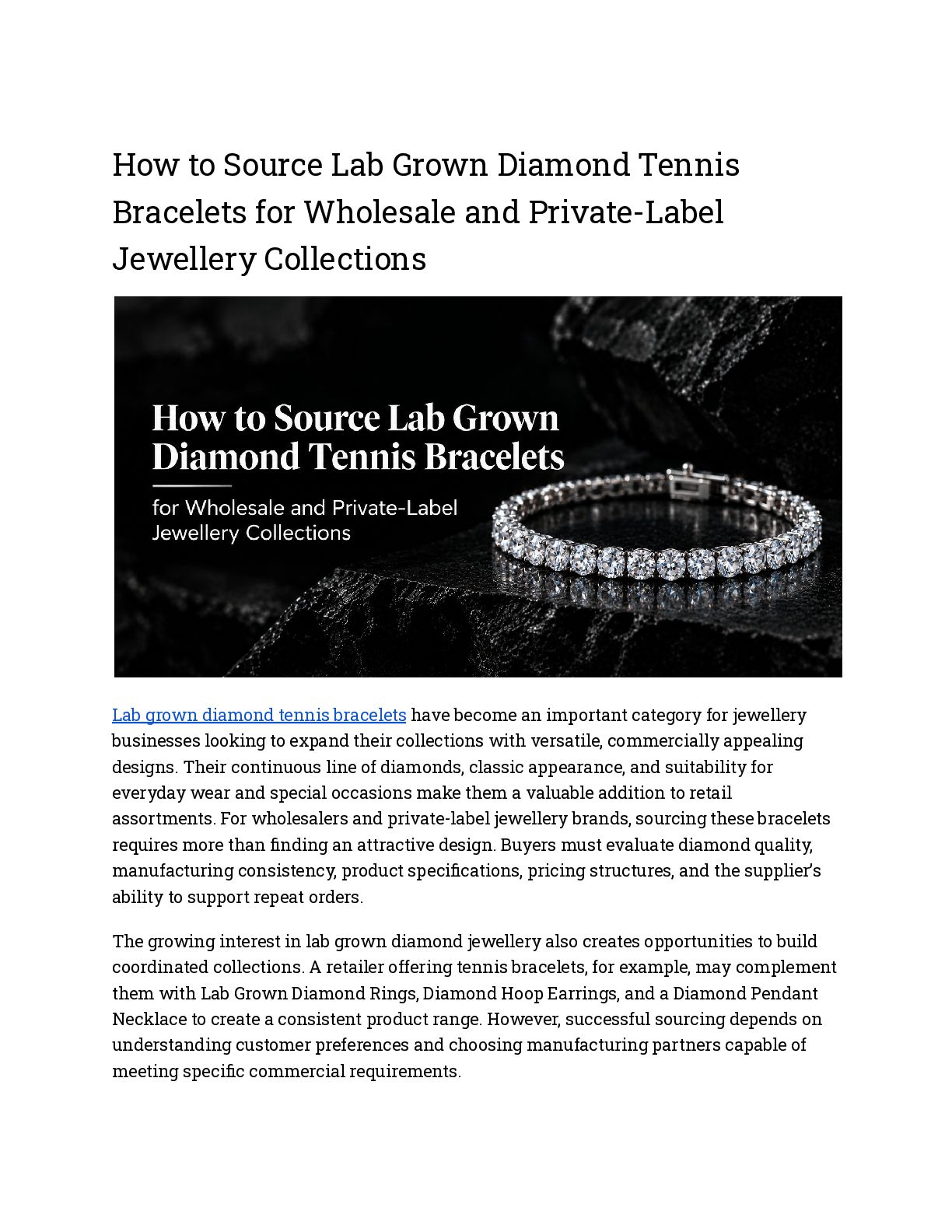
    and Private-Label Jewellery Collections Lab grown diamond tennis bracelets have become an important category for jewellery businesses looking to expand their collections with versatile, commercially appealing designs. Their continuous line of diamonds, classic appearance, and suitability for everyday wear and special occasions make them a valuable addition to retail assortments. For wholesalers and private-label jewellery brands, sourcing these bracelets requires more than finding an attractive design. Buyers must evaluate diamond quality, manufacturing consistency, product specifications, pricing structures, and the supplier’s ability to support repeat orders. The growing interest in lab grown diamond jewellery also creates opportunities to build coordinated collections. A retailer offering tennis bracelets, for example, may complement them with Lab Grown Diamond Rings, Diamond Hoop Earrings, and a Diamond Pendant Necklace to create a consistent product range. However, successful sourcing depends on understanding customer preferences and choosing manufacturing partners capable of meeting specific commercial requirements.
  2. Businesses exploring options such as a Hearts and Arrows Diamond

    design or collections featuring different diamond shapes should begin by defining their target market and product positioning. Companies such as Grown Diamond Corp operate within the broader diamond manufacturing and supply sector, where product selection, quality standards, and dependable business relationships are essential considerations for professional buyers. This guide explains how jewellery retailers, wholesalers, and private-label businesses can source lab grown diamond tennis bracelets strategically, from evaluating suppliers to developing collections that support long-term growth. 1. Define Your Wholesale and Private-Label Requirements Before approaching manufacturers, establish the purpose of the collection. A wholesaler supplying independent jewellery stores may prioritise proven designs, competitive pricing, and ready-to-order inventory. A private-label brand, on the other hand, may require distinctive settings, customised specifications, branded packaging, and exclusive designs. Start by identifying the customer segment, expected retail price range, preferred metal, diamond quality, and anticipated order volume. These details help suppliers provide relevant quotations rather than generic product catalogues. For example, a premium collection may focus on carefully matched diamonds, refined finishing, and detailed quality documentation. A more accessible collection might prioritise consistent appearance, practical construction, and a range of bracelet lengths to suit different customers. Private-label buyers should also clarify whether they need existing designs adapted to their brand or completely new manufacturing specifications. Confirming these requirements early reduces misunderstandings and makes supplier comparisons more meaningful. 2. Evaluate Diamond Quality and Consistency Diamond quality is one of the most important considerations when sourcing tennis bracelets. Because a bracelet contains a sequence of individual stones, differences in colour, clarity, cut, and visual appearance can become noticeable across the finished piece.
  3. Review the 4Cs The traditional 4Cs—cut, colour, clarity, and carat

    weight—provide a useful framework for assessing diamonds. Buyers should establish acceptable ranges for each characteristic instead of relying on broad descriptions such as premium quality. Cut quality deserves particular attention because it influences brilliance and light performance. A well-cut round brilliant cut diamond can create the bright, consistent appearance commonly associated with classic tennis bracelets. Buyers should also consider how the diamonds look when arranged together, as individual stone grades do not automatically guarantee a visually uniform bracelet. Colour and clarity requirements should reflect the intended price point and design. Higher grades may be appropriate for some premium collections, but the most commercially suitable specification depends on customer expectations and the overall appearance of the finished jewellery. Check matching across the bracelet Unlike a single-stone product, a tennis bracelet must maintain visual continuity along its entire length. Ask the manufacturer how diamonds are sorted and matched, whether the same specifications are maintained across production batches, and how quality checks are documented. Where certification or grading reports are offered, clarify whether they cover individual diamonds, selected stones, or the finished jewellery. Do not assume that every stone in a multi-diamond bracelet has a separate grading report. 3. Choose the Right Diamond Shapes and Bracelet Designs Classic tennis bracelets typically feature round diamonds, but modern jewellery collections can incorporate a wider range of shapes and setting styles. The right choice depends on the collection’s aesthetic, manufacturing capabilities, and intended customer. Round diamonds remain a practical starting point because their symmetrical appearance works well in continuous settings. Buyers interested in alternative designs can explore a princess cut diamond for a geometric look or a radiant cut diamond for a rectangular silhouette with brilliant-style faceting.
  4. Other shapes can support more distinctive product development. A Cushion

    Cut Diamond offers a softer, squared outline, while an oval cut diamond can introduce an elongated appearance. A pear shaped diamond, lab grown marquise diamond, or heart shaped diamond may be more suitable for specialised designs or coordinated statement pieces than for a conventional tennis bracelet. More unusual cutting styles, including the portuguese cut diamond, can inspire distinctive collections, although buyers should confirm stone availability, matching requirements, and production feasibility before committing to an order. Similarly, an elongated cushion cut diamond or antique cushion cut diamond may suit complementary jewellery designs aimed at customers seeking vintage-inspired aesthetics. When evaluating designs, consider the following: •​ Stone size and proportions: Confirm the dimensions of individual diamonds and the overall visual density of the bracelet. •​ Setting style: Compare prong, bezel, and other available settings based on appearance, security, and maintenance. •​ Bracelet profile: Assess flexibility, comfort, and how the bracelet sits on the wrist. •​ Design consistency: Ensure that the selected shape and setting can be reproduced accurately for future orders. The goal is to develop a commercially coherent collection rather than simply offering as many shapes as possible. 4. Assess Manufacturing Capabilities and Supplier Reliability A supplier’s ability to deliver consistent products over time is just as important as the initial sample. Wholesale and private-label buyers should evaluate manufacturing processes, quality-control procedures, communication, and production capacity before establishing a long-term relationship. Begin by requesting information about the supplier’s experience with tennis bracelets, available diamond specifications, metal options, customisation services, and typical production timelines. Ask whether the business handles manufacturing directly or sources finished products from third parties. This distinction can affect communication, quality oversight, and the ability to make design adjustments. Request a sample or inspect a representative finished product before placing a substantial order. Examine the setting alignment, clasp mechanism, finishing, flexibility, and overall
  5. appearance. Check whether the diamonds are securely set and whether

    the bracelet feels comfortable during normal movement. It is also worth reviewing how the supplier handles defective products, manufacturing discrepancies, and replacement requests. Clear procedures can help reduce commercial risk when products are distributed across multiple retail locations. Grown Diamond Corporation is one example of a company operating in the diamond manufacturing and supply space. As with any prospective supplier, buyers should assess the specific products, commercial terms, production capabilities, and quality documentation relevant to their own requirements rather than relying on general brand claims alone. 5. Understand Pricing, Minimum Orders, and Lead Times Wholesale pricing depends on several variables, including diamond specifications, total carat weight, metal type, bracelet length, setting complexity, order quantity, and customisation requirements. Buyers should compare quotations against identical or closely matched specifications to avoid misleading price comparisons. A lower unit price does not necessarily represent better value if the product requires extensive reworking, arrives late, or fails to meet agreed quality standards. Consider the total landed cost, including shipping, insurance, import duties where applicable, packaging, and any relevant taxes. Before confirming an order, obtain written details about: •​ Minimum order quantities and price breaks for larger volumes. •​ Sample costs and whether they can be credited against bulk orders. •​ Production timelines and dispatch estimates. •​ Payment schedules and currency terms. •​ Shipping arrangements, insurance, and customs documentation. •​ Return, repair, replacement, and warranty policies. Lead times should be assessed against the retail calendar. Jewellery businesses may need stock well before seasonal promotions, gifting periods, or new collection launches. Buyers should also establish how quickly a supplier can repeat an order and whether matching stones and materials are likely to remain available.
  6. For private-label programmes, confirm whether customised products require additional development

    time and whether design changes after sample approval affect the delivery schedule. 6. Build a Distinctive Private-Label Collection Private-label sourcing gives jewellery businesses greater control over product positioning, design details, packaging, and customer experience. However, successful differentiation requires a clear product strategy rather than simply adding a logo to an existing bracelet. Start with a core design that can be manufactured consistently. From there, consider variations in bracelet length, metal colour, diamond size, setting style, and overall finish. A carefully planned range can serve different price points without creating an unnecessarily complicated inventory. The collection can also be developed around complementary jewellery categories. For example, Lab Grown Diamond Rings and Women's Diamond Rings can provide coordinating options for customers who prefer matching pieces. A Lab Grown Diamond Pendant, lab grown diamond studs, or Lab Grown Diamond Bangles can broaden the assortment while maintaining a consistent visual identity. Diamond Hoop Earrings and a Diamond Pendant Necklace can also work alongside tennis bracelets in gift-oriented or occasion-based collections. These related categories allow retailers to present coordinated styling options and encourage customers to explore more than one product. When working with a manufacturer, specify which elements must remain consistent across the collection. These may include metal colour, diamond matching standards, setting proportions, finishing, branding, and packaging. Approve production samples before authorising the full order, and document the specifications so future batches can be compared against the original. 7. Confirm Documentation, Traceability, and Product Claims Transparency is increasingly important in the diamond jewellery supply chain. Buyers should understand how their supplier identifies lab grown diamonds, maintains product records, and supports claims made in product descriptions.
  7. Request documentation appropriate to the product and transaction. Depending on

    the supplier and market, this may include invoices, diamond identification or grading reports where available, metal specifications, product descriptions, and shipping documentation. Lab grown diamonds are diamonds produced through technological processes rather than geological formation. Their origin should be represented accurately in wholesale catalogues, invoices, packaging, and customer-facing product information. Avoid descriptions that could confuse lab grown diamonds with mined diamonds or imply certifications that have not been provided. If the supplier makes claims about sustainability, ethical sourcing, or environmental performance, ask what evidence supports those statements. Broad claims should not replace verifiable information about manufacturing practices, materials, or supply-chain processes. For retailers selling into different markets, it is also important to check applicable disclosure, labelling, advertising, and consumer-protection requirements. Clear product information supports customer confidence and reduces the risk of misunderstandings after a purchase. 8. Plan Inventory and Manage Reordering Effective inventory planning helps jewellery businesses balance product availability with working capital. Tennis bracelets can be offered in multiple combinations of diamond size, total carat weight, metal colour, and bracelet length, but stocking every possible variation may create unnecessary complexity. Use sales data, customer enquiries, and retailer feedback to identify the most promising specifications. Begin with a focused selection of core designs and expand when demand supports additional variants. Wholesale distributors can also consider a mix of ready-to-ship products and made-to-order options, depending on their customers’ purchasing patterns. Before finalising the assortment, ask suppliers which specifications are regularly available and which require individual production. Confirm whether repeat orders can maintain the original diamond matching, setting dimensions, and finishing. This is particularly important for private-label businesses that need consistent products across multiple stores or sales channels.
  8. A documented product specification sheet can help buyers compare samples,

    inspect incoming stock, and communicate changes to manufacturers. Include stone specifications, metal details, dimensions, clasp design, product identifiers, and approved reference photographs. Businesses building a broader diamond jewellery assortment may also find it useful to track tennis bracelets alongside coordinated products, such as Hearts and Arrows Diamond jewellery and other diamond-set designs. The objective is to maintain a balanced collection that reflects actual demand rather than purchasing inventory based solely on supplier availability. 9. Create a Practical Supplier Evaluation Process A structured evaluation process makes supplier selection more objective and reduces the risk of overlooking important details. Instead of focusing exclusively on price, compare potential manufacturers across several operational and product-related factors. Consider the following questions when assessing a prospective supplier: •​ Can the supplier consistently meet the required diamond specifications and quality standards? •​ Are samples representative of the products that will be delivered in bulk? •​ Can the manufacturer accommodate private-label designs and repeat orders? •​ Are minimum quantities, production schedules, and payment terms clearly documented? •​ Does the supplier provide appropriate product documentation and transparent diamond-origin disclosures? •​ Are communication, quality disputes, repairs, and replacements handled through defined procedures? Request comparable quotations from multiple suppliers and record the differences in specifications, costs, and delivery terms. Where possible, conduct a sample evaluation before making a long-term commitment. Grown Diamond Corp is a potential starting point for businesses researching diamond manufacturing and wholesale supply options. Prospective buyers should contact the company to establish which tennis bracelet designs, specifications, and private-label arrangements are currently available, then evaluate those offerings against their business requirements.
  9. A careful sourcing process creates a stronger foundation for supplier

    relationships, consistent inventory, and future collection development. Conclusion Sourcing lab grown diamond tennis bracelets for wholesale and private-label jewellery collections requires a balanced approach to product quality, manufacturing capability, pricing, and supply-chain transparency. Buyers who establish clear specifications, inspect samples, verify documentation, and agree on repeat-order requirements are better positioned to develop collections that meet customer expectations. The most effective strategy is to begin with a focused range, identify reliable manufacturing partners, and expand the assortment according to market demand. Coordinating tennis bracelets with complementary products, including diamond rings, pendants, earrings, and bangles, can also create a more cohesive retail offering. Whether a business is sourcing established designs or developing a distinctive private-label range, Grown Diamond Corporation and other prospective suppliers should be evaluated against consistent commercial and quality criteria. With thorough planning and clear communication, jewellery retailers, wholesalers, and private-label buyers can build dependable sourcing relationships and develop lab grown diamond collections designed for long-term commercial success.