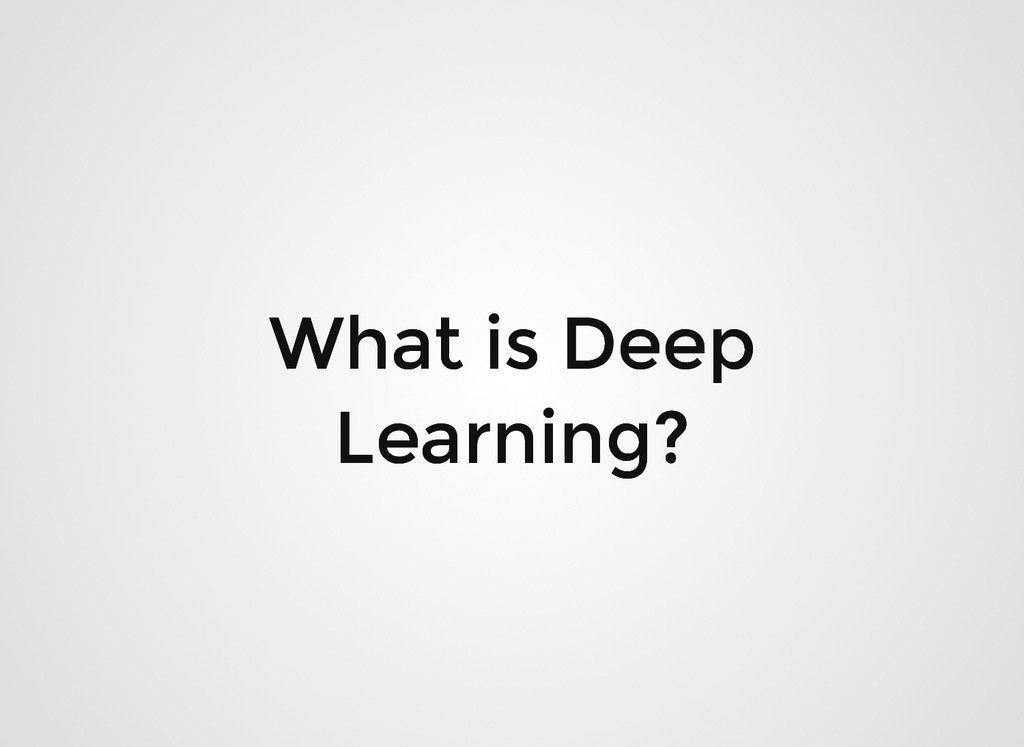
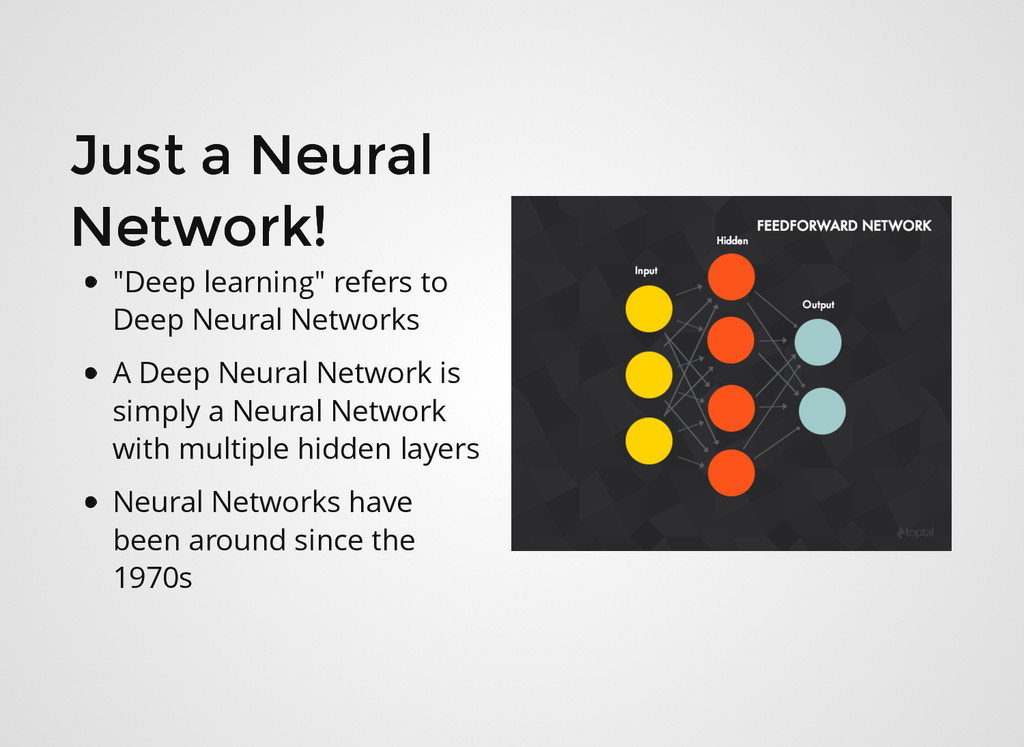
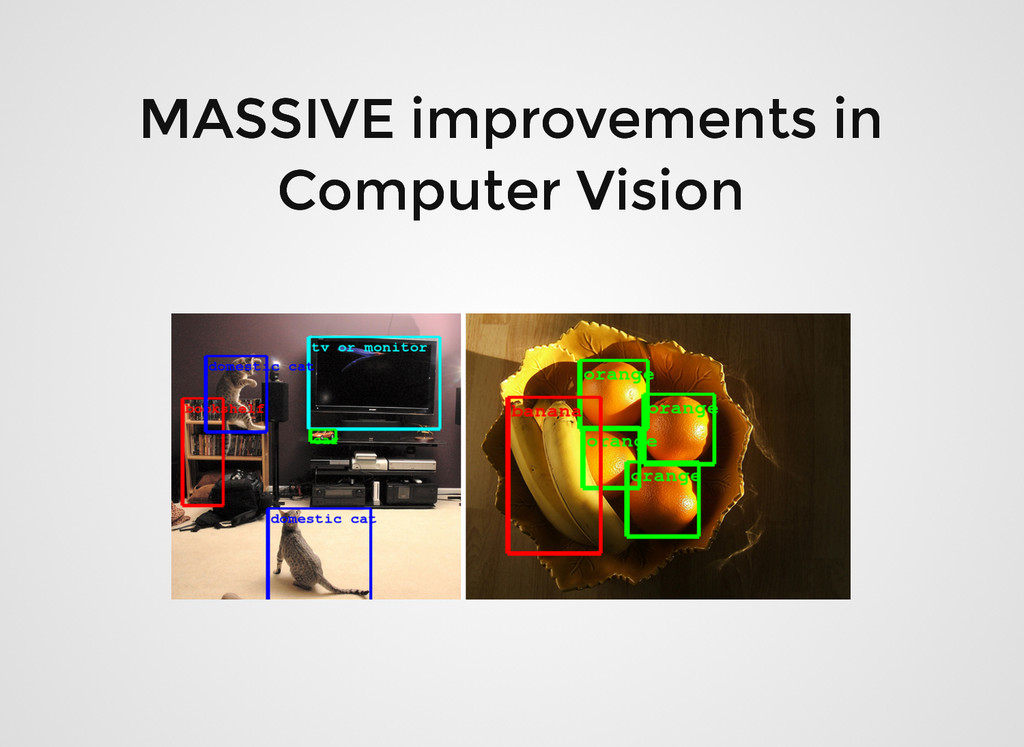
refers to Deep Neural Networks A Deep Neural Network is simply a Neural Network with multiple hidden layers Neural Networks have been around since the 1970s
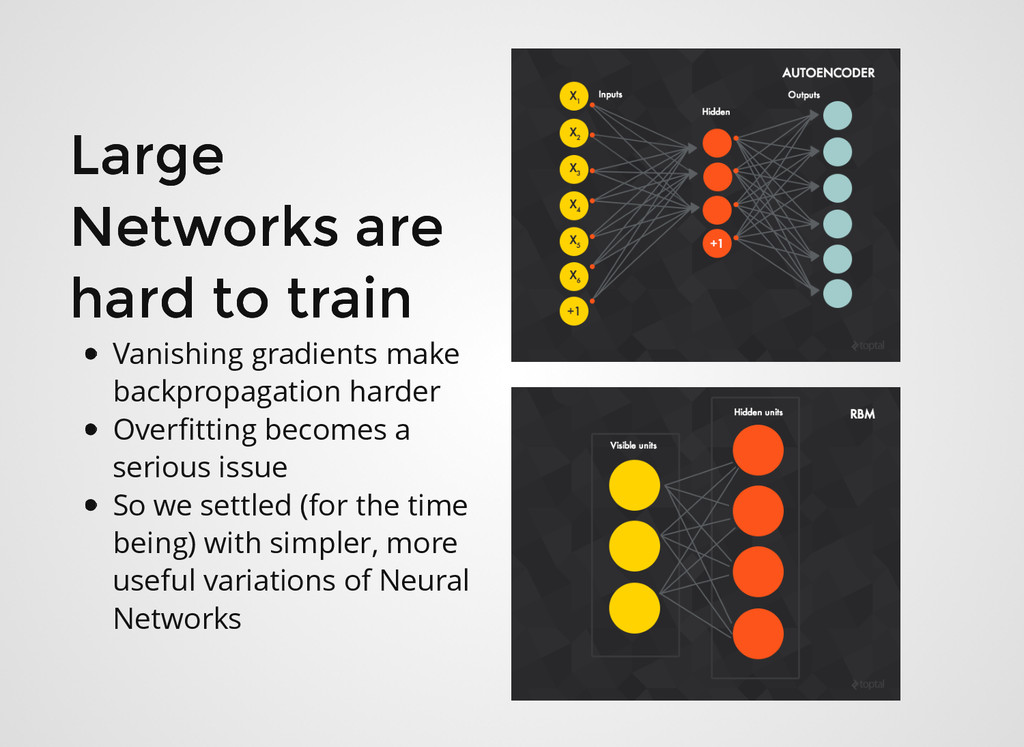
to train Vanishing gradients make backpropagation harder Overfitting becomes a serious issue So we settled (for the time being) with simpler, more useful variations of Neural Networks
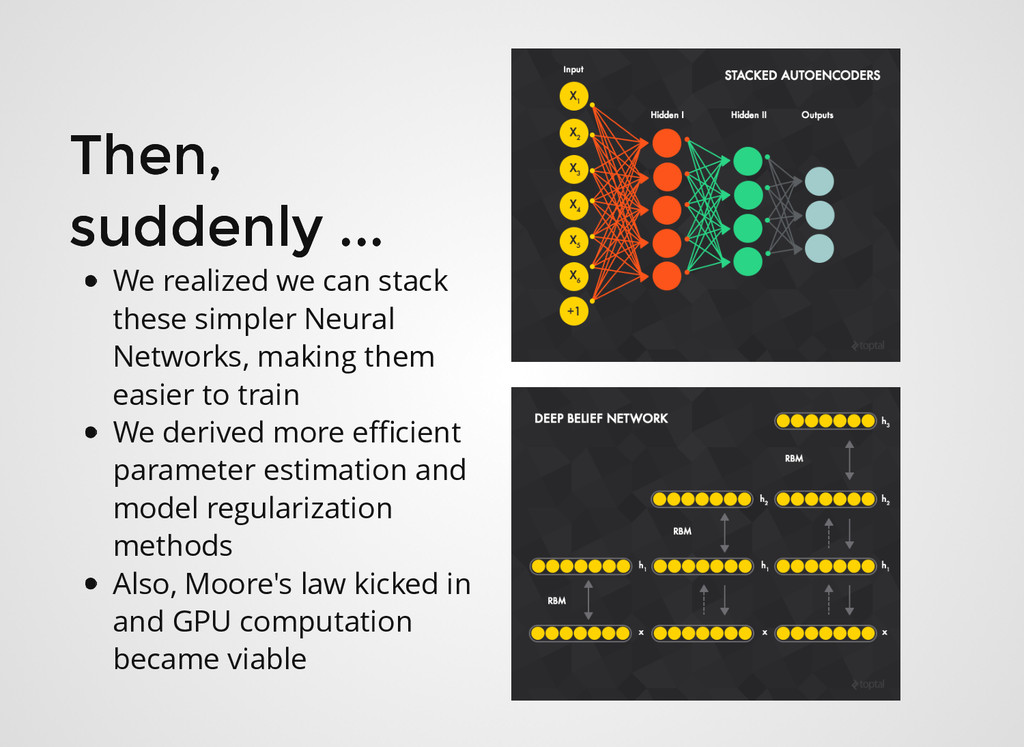
stack these simpler Neural Networks, making them easier to train We derived more efficient parameter estimation and model regularization methods Also, Moore's law kicked in and GPU computation became viable
chief) has built a state- of-the-art speech recognition system with Deep Learning Their dataset: 7000 hours of conversation couple with background noise synthesis for a total of 100,000 hours They processed this through a massive GPU cluster
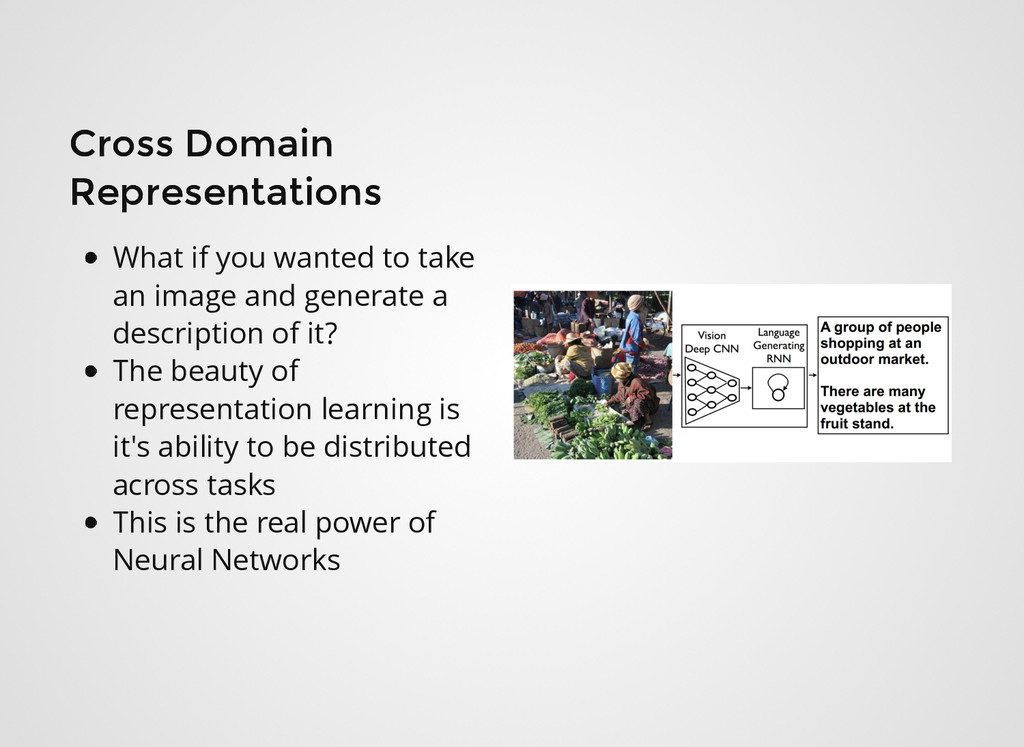
to take an image and generate a description of it? The beauty of representation learning is it's ability to be distributed across tasks This is the real power of Neural Networks
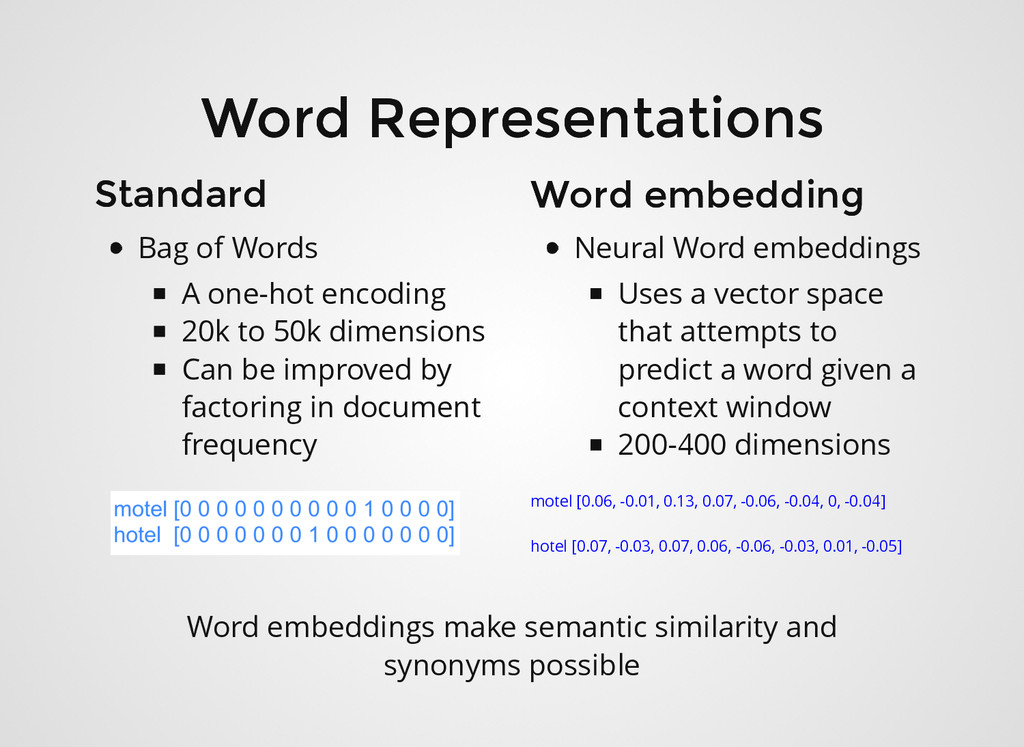
50k dimensions Can be improved by factoring in document frequency Word embedding Word embedding Neural Word embeddings Uses a vector space that attempts to predict a word given a context window 200-400 dimensions motel [0.06, -0.01, 0.13, 0.07, -0.06, -0.04, 0, -0.04] hotel [0.07, -0.03, 0.07, 0.06, -0.06, -0.03, 0.01, -0.05] Word Representations Word Representations Word embeddings make semantic similarity and synonyms possible
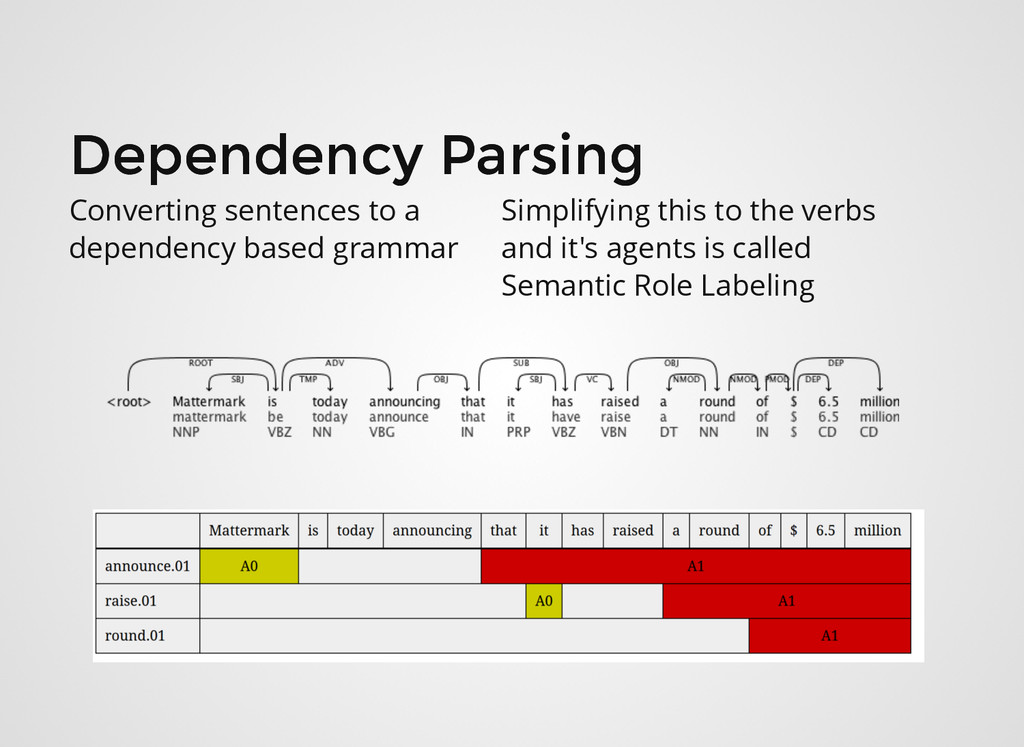
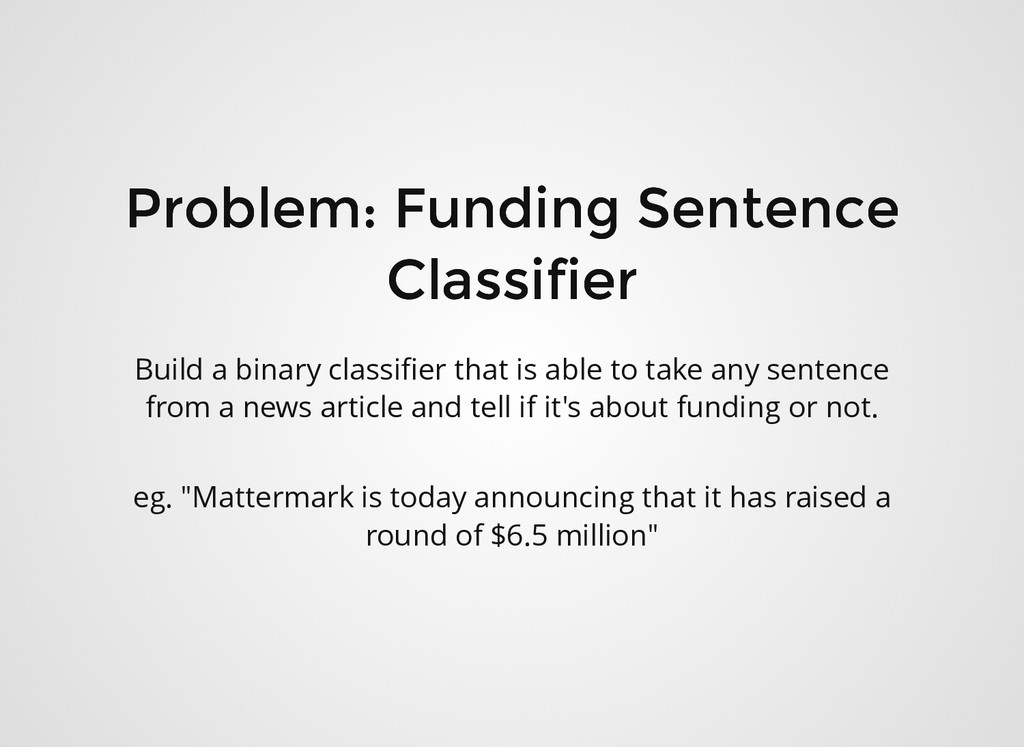
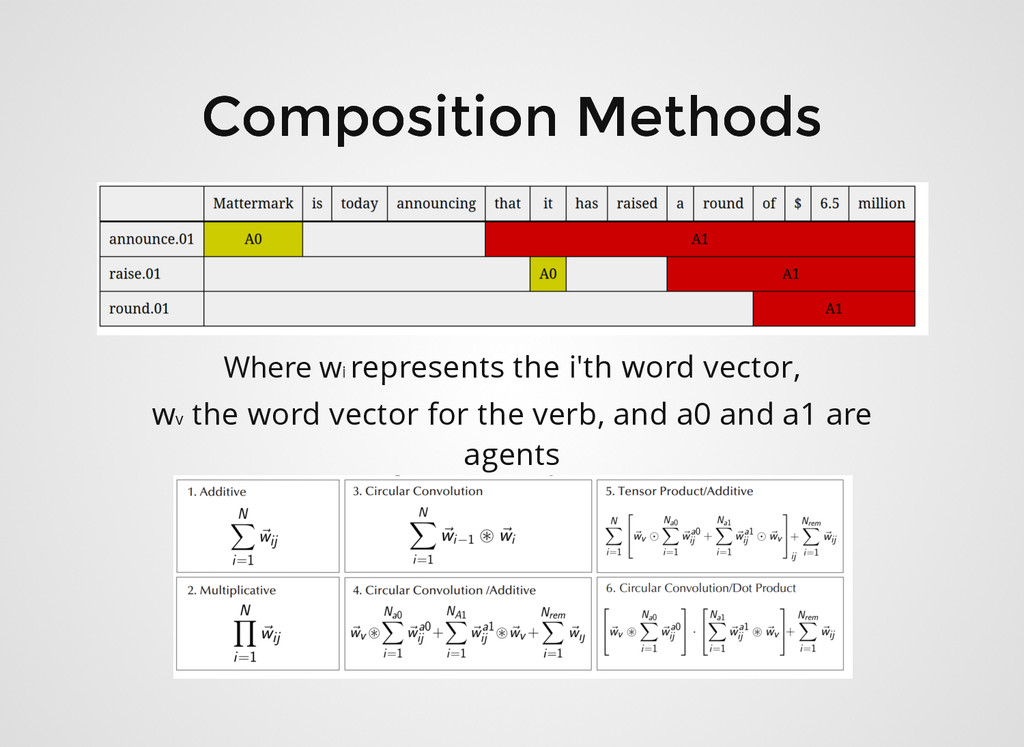
binary classifier that is able to take any sentence from a news article and tell if it's about funding or not. eg. "Mattermark is today announcing that it has raised a round of $6.5 million"
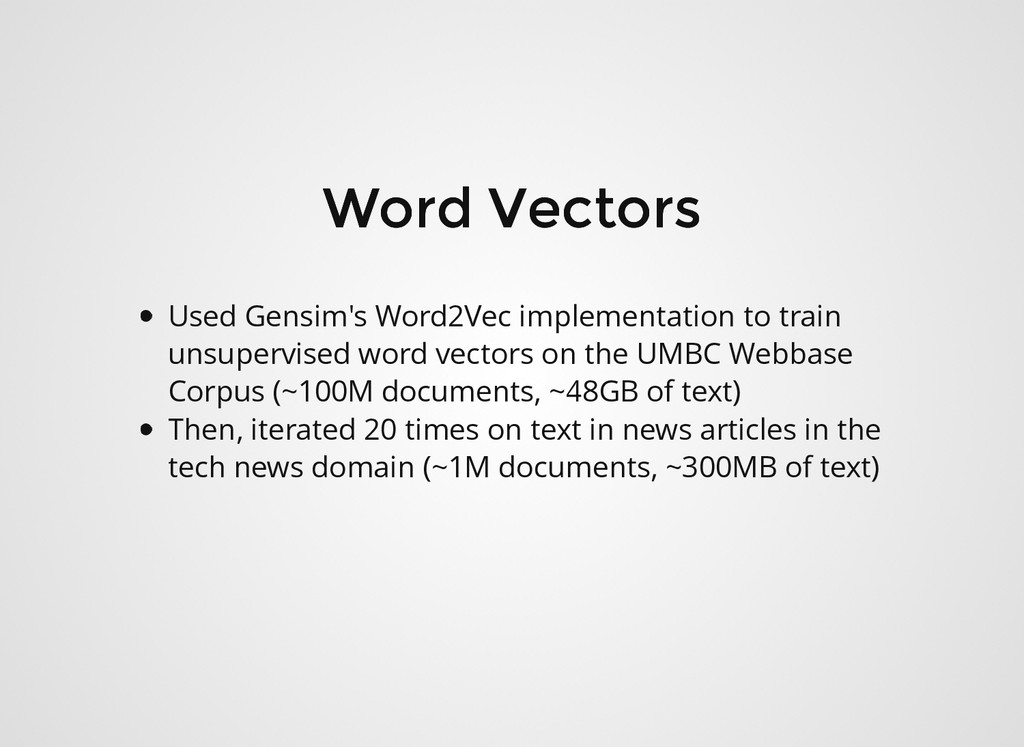
unsupervised word vectors on the UMBC Webbase Corpus (~100M documents, ~48GB of text) Then, iterated 20 times on text in news articles in the tech news domain (~1M documents, ~300MB of text)
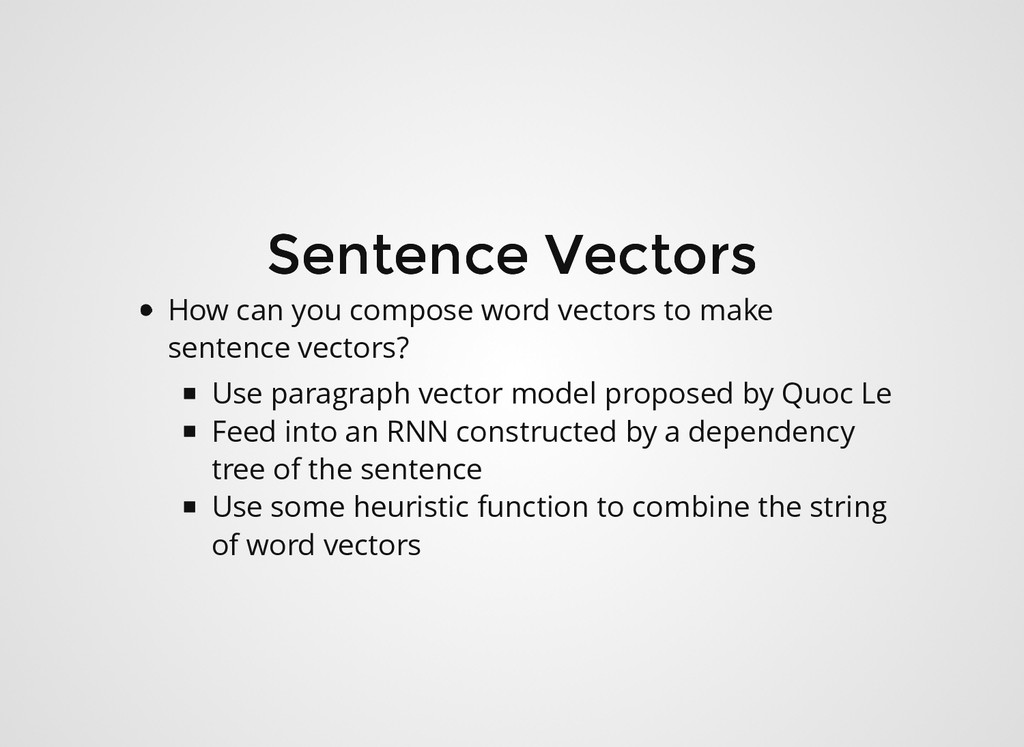
to make sentence vectors? Use paragraph vector model proposed by Quoc Le Feed into an RNN constructed by a dependency tree of the sentence Use some heuristic function to combine the string of word vectors
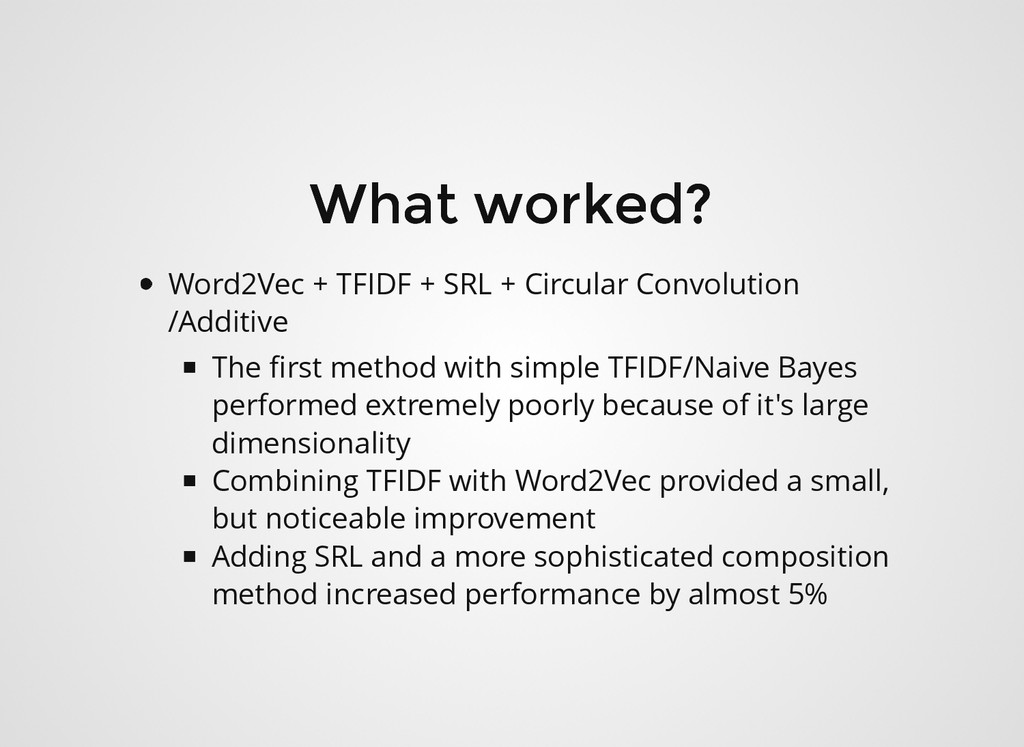
Circular Convolution /Additive The first method with simple TFIDF/Naive Bayes performed extremely poorly because of it's large dimensionality Combining TFIDF with Word2Vec provided a small, but noticeable improvement Adding SRL and a more sophisticated composition method increased performance by almost 5%
Can we apply this method to generate general purpose document vectors? We are currently using LDA (a topic analysis method) or simple TFIDF to create document vectors How will this method compare to the already proposed paragraph vector method by Quoc Le? Can we associate these document vectors with much smaller query strings? eg. Search for artificial intelligence against our companies and get better results than keyword search


 hakka_labs
 harutiro
 yama3133
 foursue
 shumei_ito
 ynisqa1988
 toshimaru
 pauli
pauli
 kawametho
 nayuts
 thkt
thkt
 ueponx
 mot_techtalk
 geshan
 brad_frost
 baasie
 andyhume
 ryanjones
 rkaga
rkaga
 jonrohan
 3n
3n
 marcduiker
 oripsolob
 sugarenia
 jacobian