Settings Professor Suzanne Crowe, AM Associate Director, Burnet Institute, Professor of Infectious Diseases Monash University Consultant Physician The Alfred Hospital Melbourne Director, St Vincent’s Health Australia Catholic AIDS Conference Melbourne, 2014
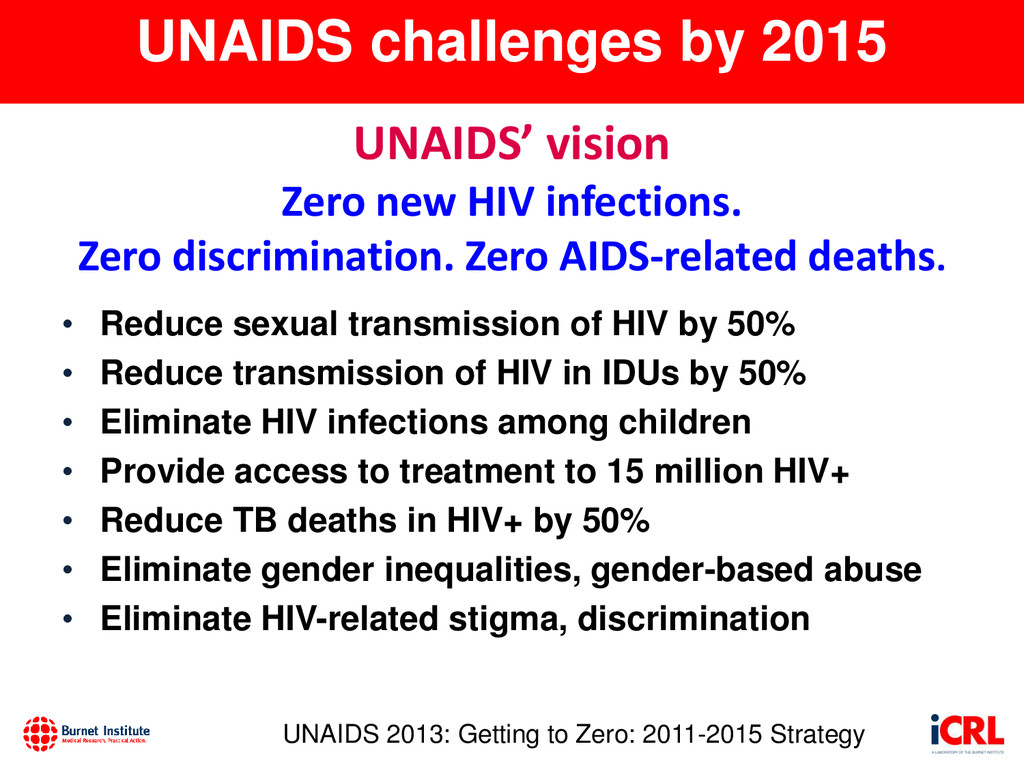
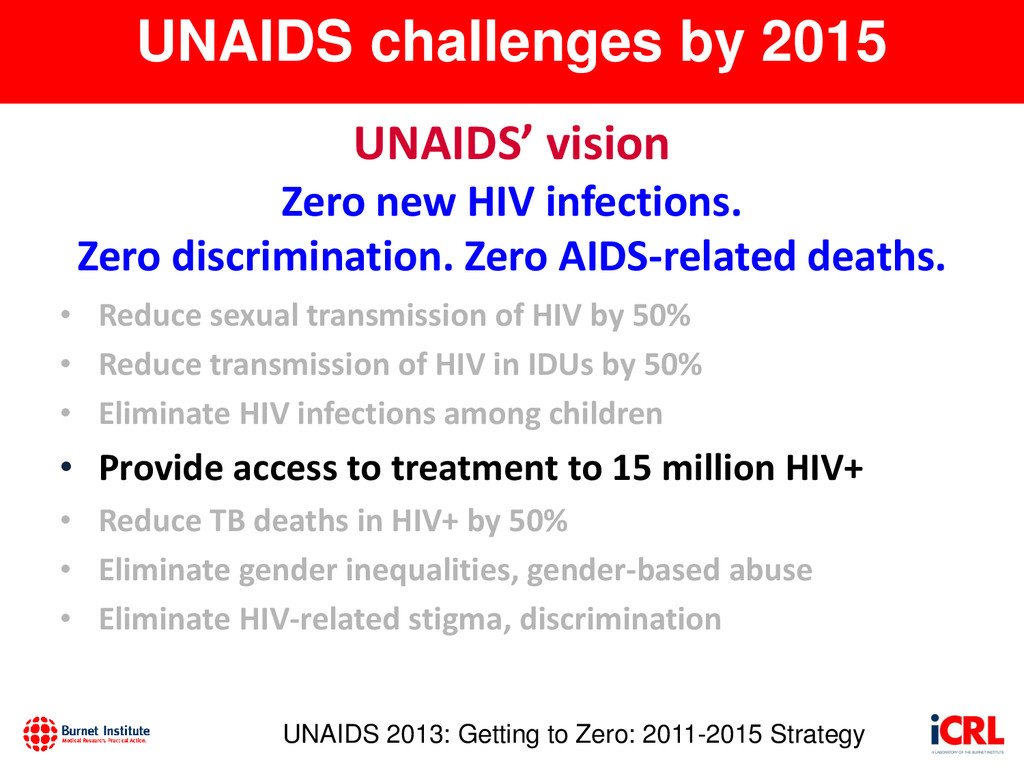
by 50% • Reduce transmission of HIV in IDUs by 50% • Eliminate HIV infections among children • Provide access to treatment to 15 million HIV+ • Reduce TB deaths in HIV+ by 50% • Eliminate gender inequalities, gender-based abuse • Eliminate HIV-related stigma, discrimination UNAIDS’ vision Zero new HIV infections. Zero discrimination. Zero AIDS-related deaths. UNAIDS 2013: Getting to Zero: 2011-2015 Strategy
by 50% • Reduce transmission of HIV in IDUs by 50% • Eliminate HIV infections among children • Provide access to treatment to 15 million HIV+ • Reduce TB deaths in HIV+ by 50% • Eliminate gender inequalities, gender-based abuse • Eliminate HIV-related stigma, discrimination UNAIDS’ vision Zero new HIV infections. Zero discrimination. Zero AIDS-related deaths. UNAIDS 2013: Getting to Zero: 2011-2015 Strategy
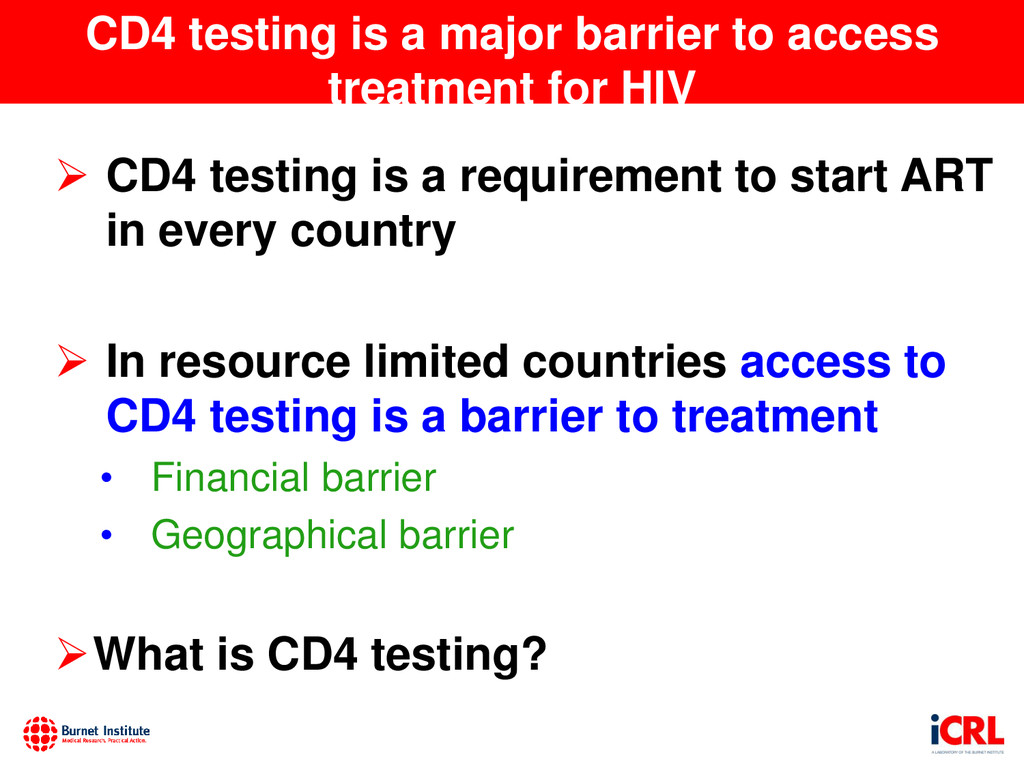
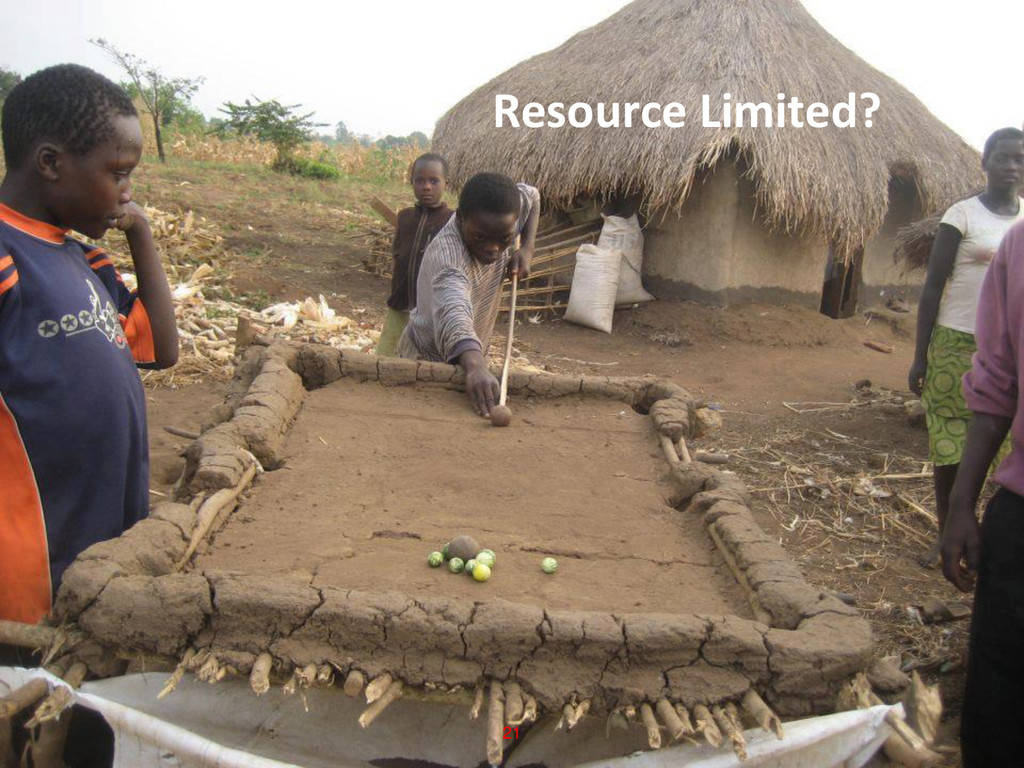
every country In resource limited countries access to CD4 testing is a barrier to treatment • Financial barrier • Geographical barrier What is CD4 testing? CD4 testing is a major barrier to access treatment for HIV
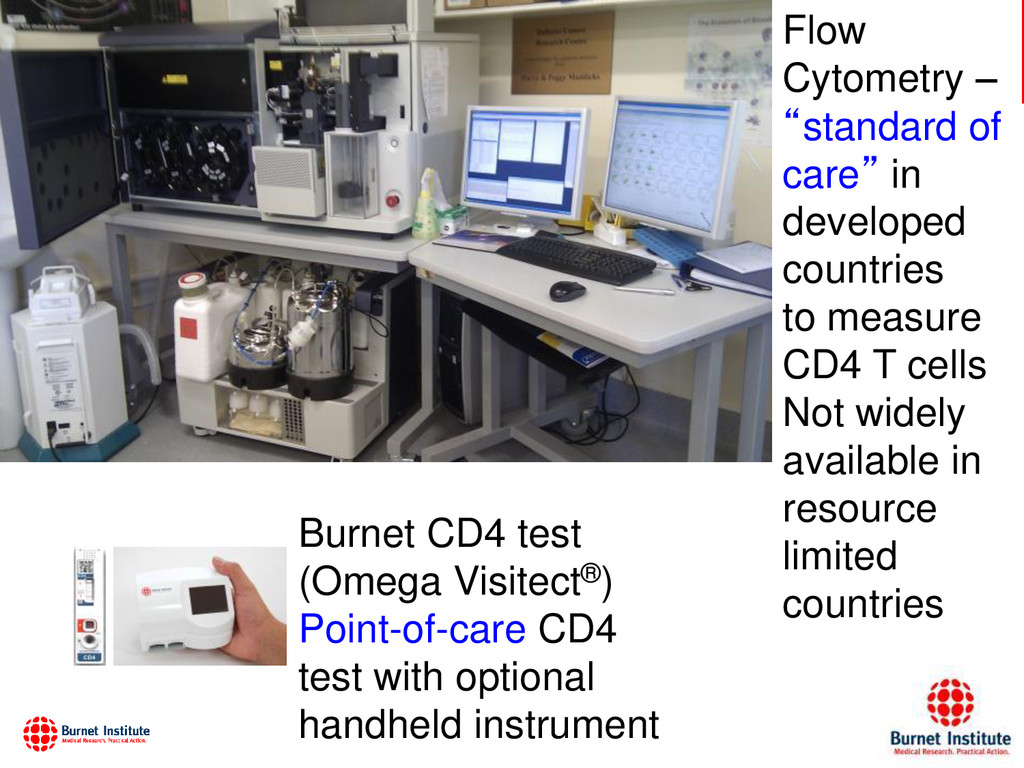
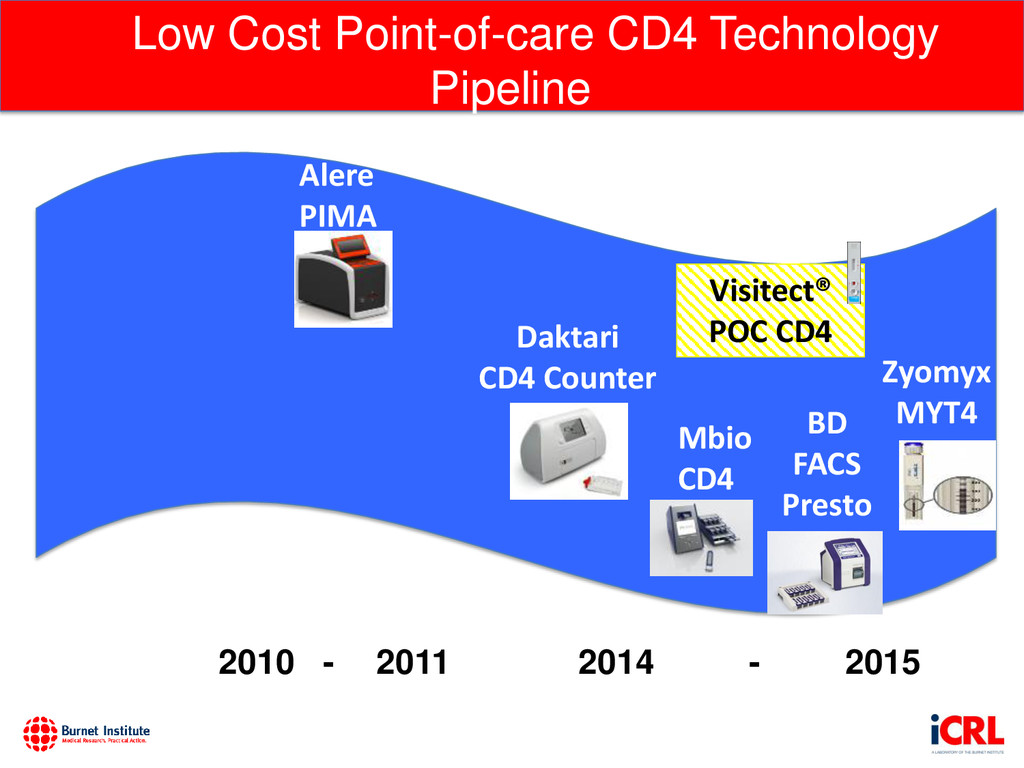
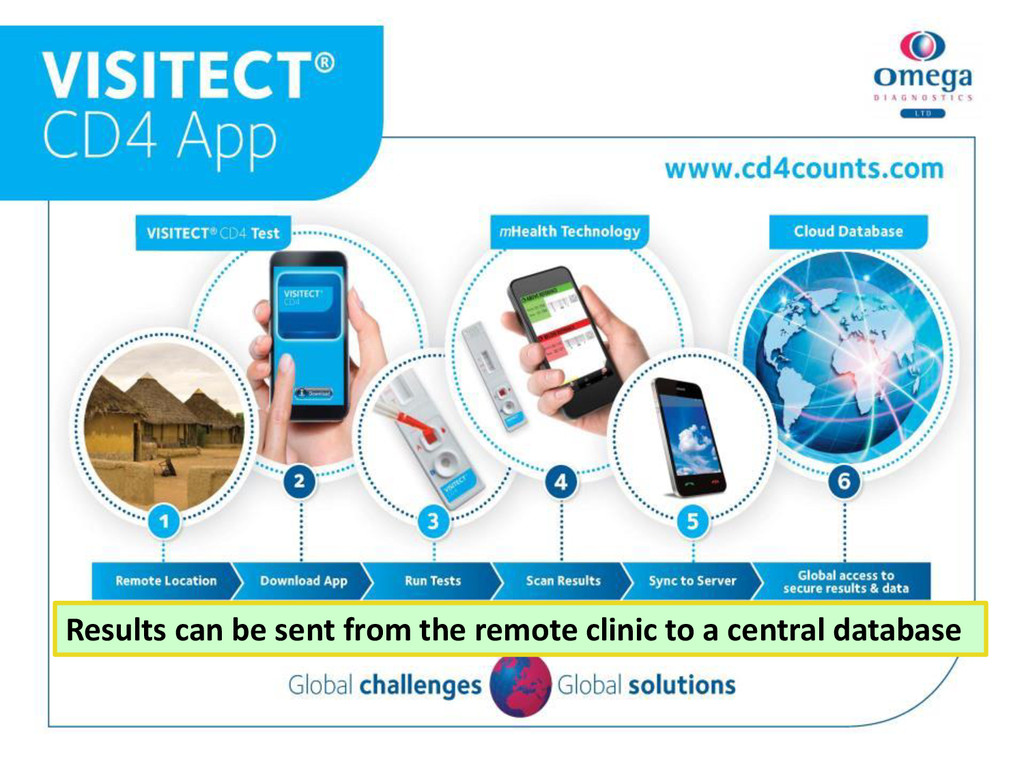
measure CD4 T cells Not widely available in resource limited countries Burnet CD4 test (Omega Visitect®) Point-of-care CD4 test with optional handheld instrument
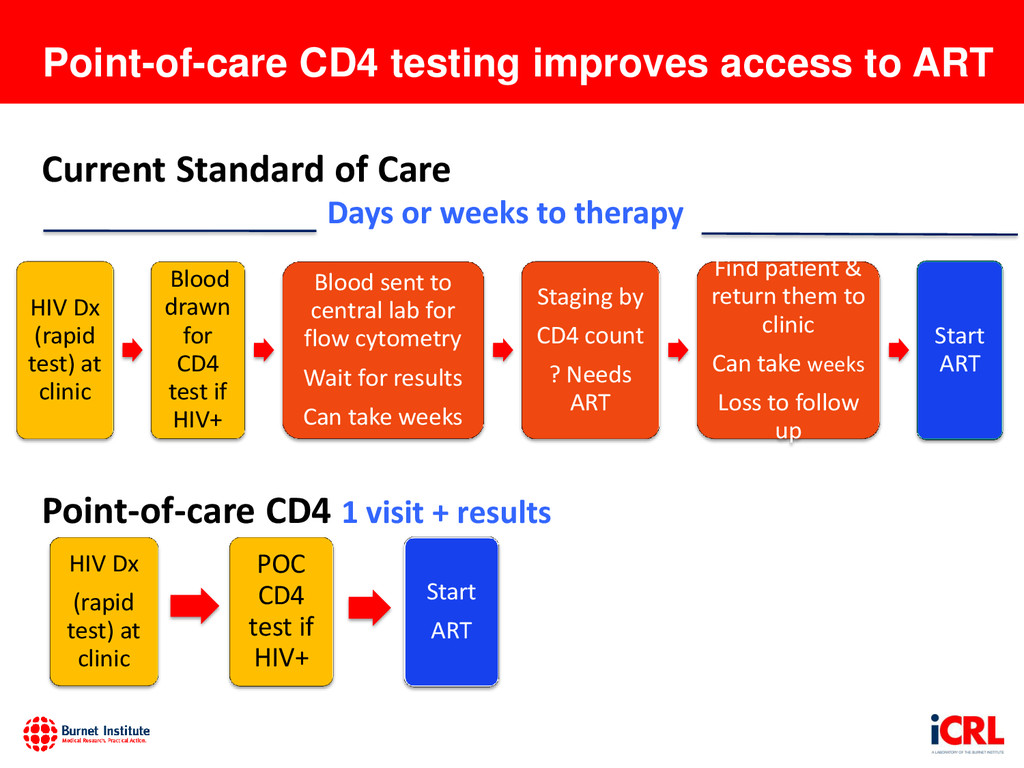
test) at clinic POC CD4 test if HIV+ Start ART Point-of-care CD4 1 visit + results HIV Dx (rapid test) at clinic Blood drawn for CD4 test if HIV+ Blood sent to central lab for flow cytometry Wait for results Can take weeks Staging by CD4 count ? Needs ART Find patient & return them to clinic Can take weeks Loss to follow up Start ART Current Standard of Care Days or weeks to therapy
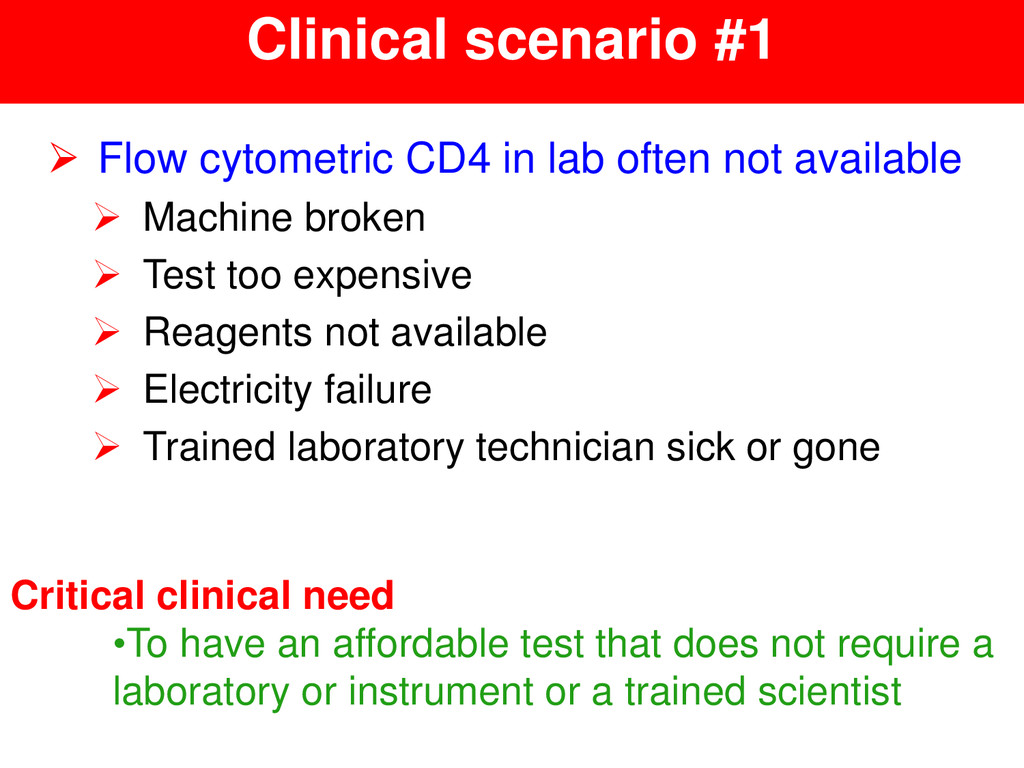
not available Machine broken Test too expensive Reagents not available Electricity failure Trained laboratory technician sick or gone Critical clinical need •To have an affordable test that does not require a laboratory or instrument or a trained scientist
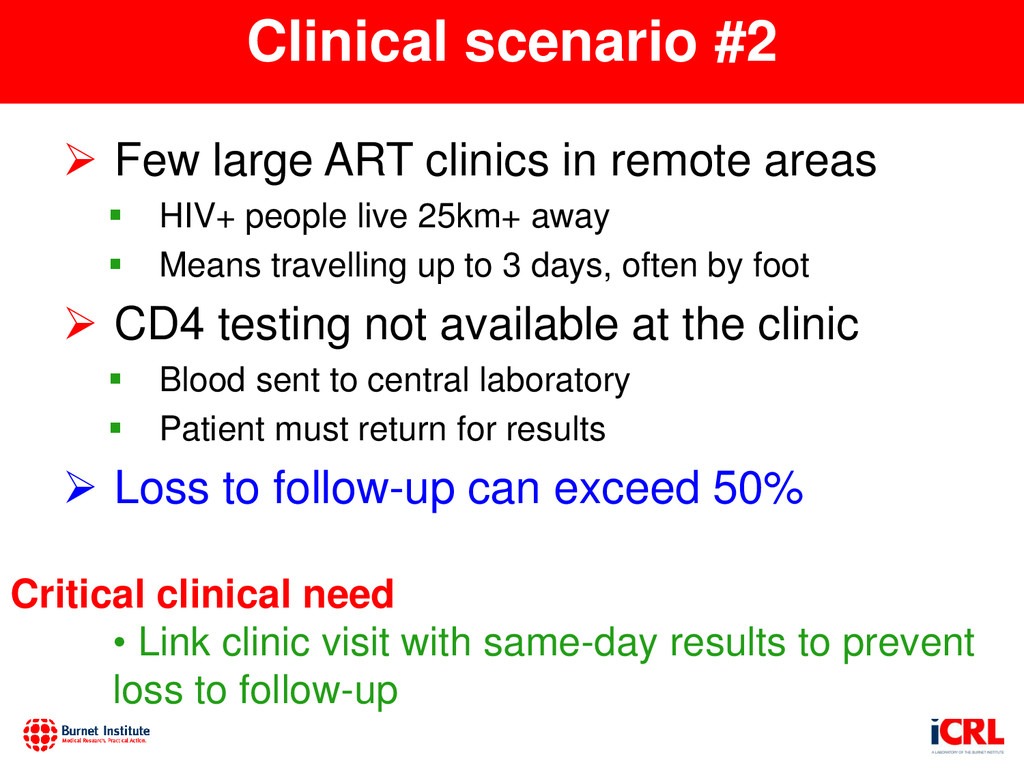
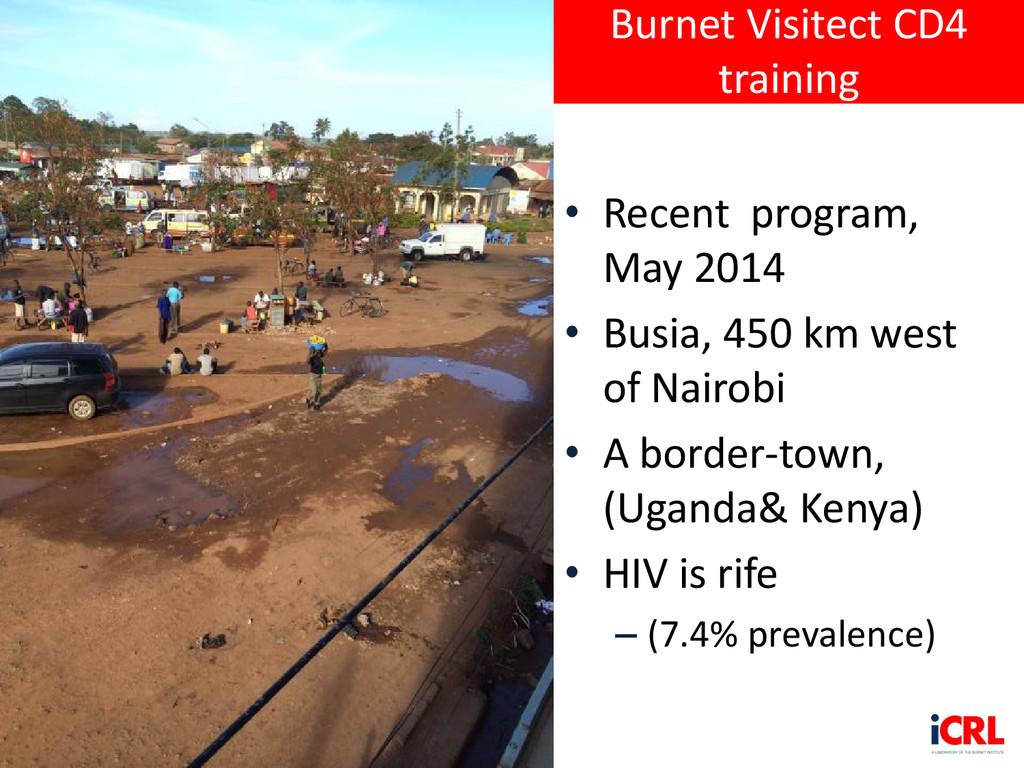
areas HIV+ people live 25km+ away Means travelling up to 3 days, often by foot CD4 testing not available at the clinic Blood sent to central laboratory Patient must return for results Loss to follow-up can exceed 50% Critical clinical need • Link clinic visit with same-day results to prevent loss to follow-up
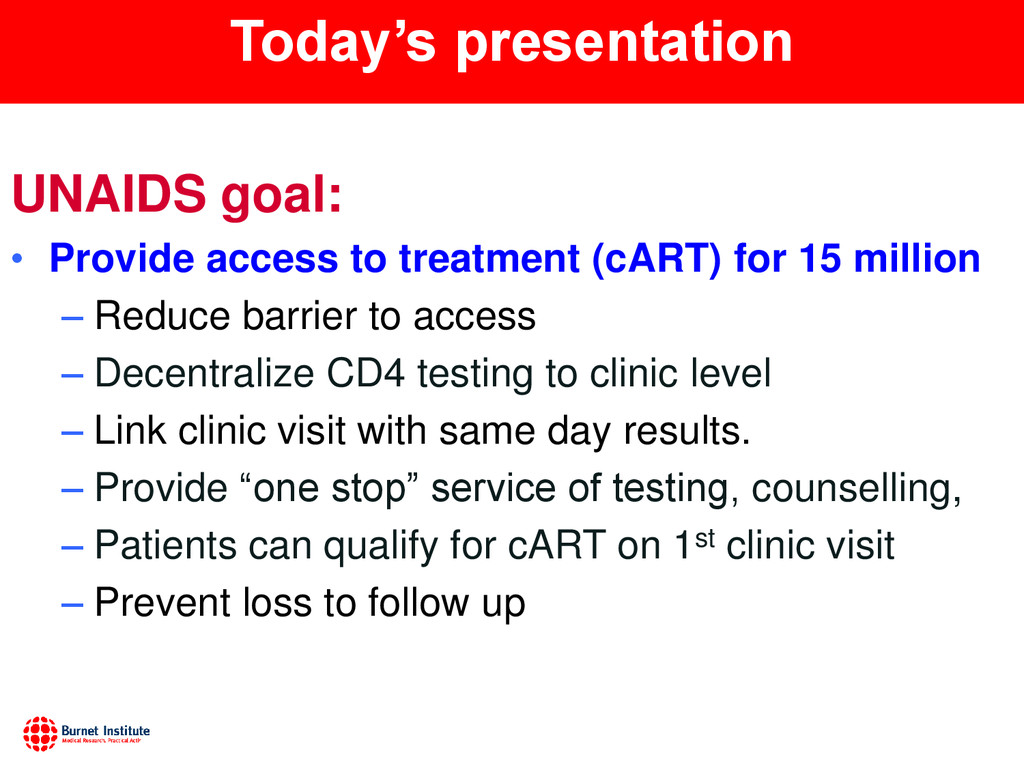
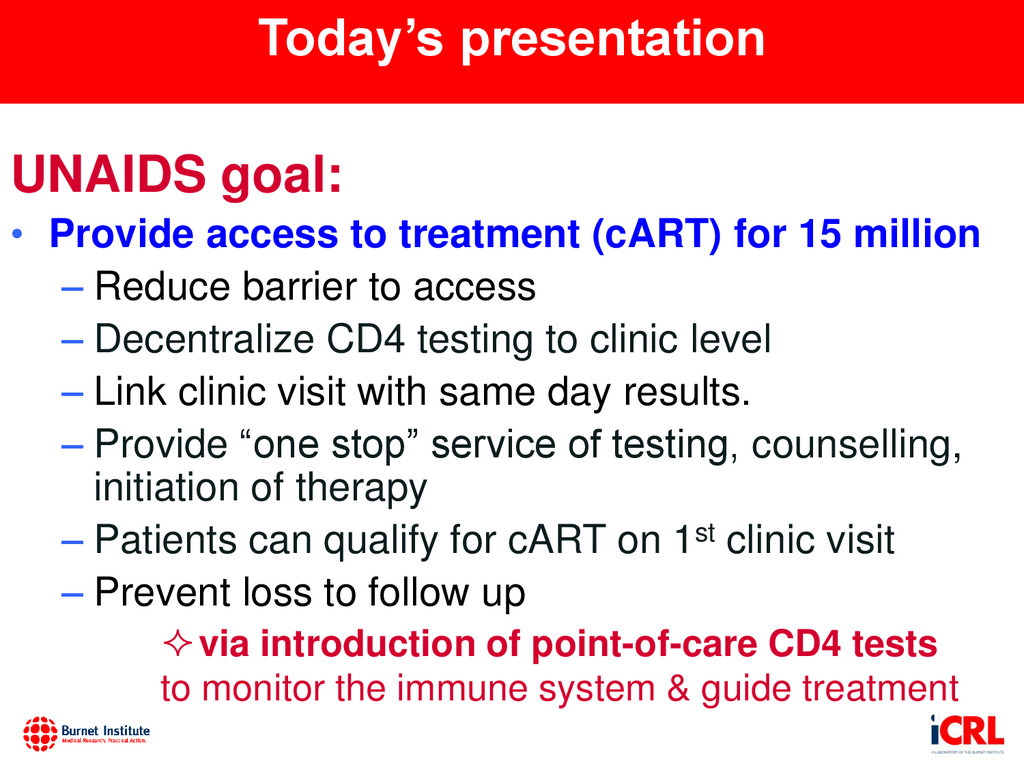
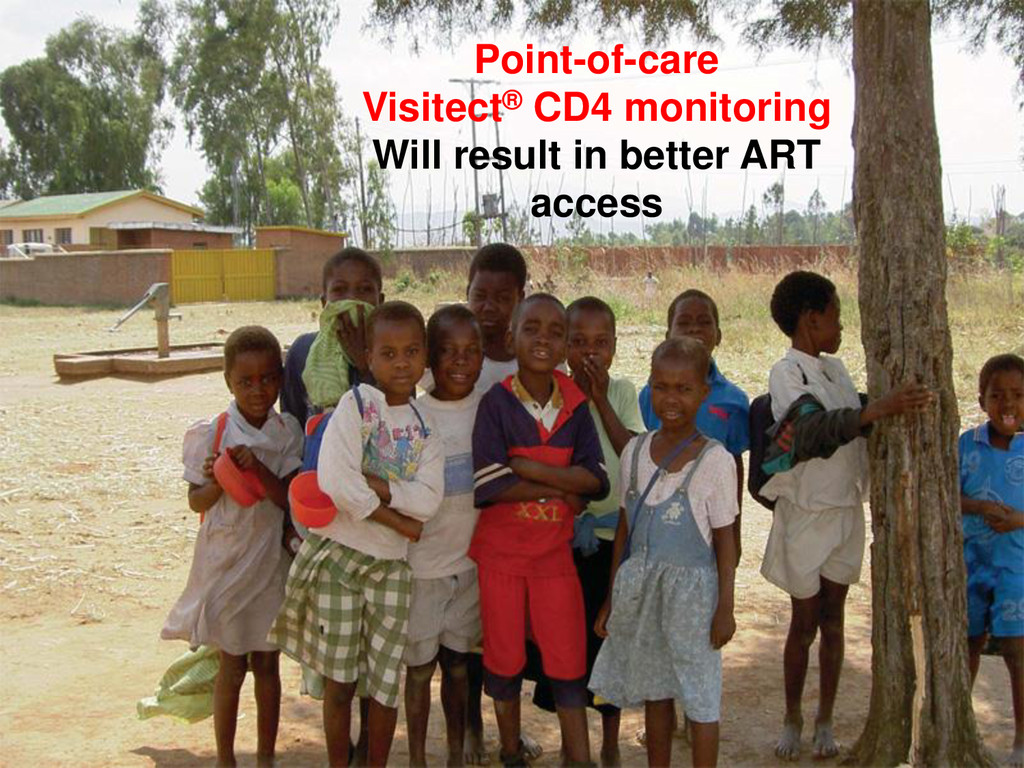
for 15 million – Reduce barrier to access – Decentralize CD4 testing to clinic level – Link clinic visit with same day results. – Provide “one stop” service of testing, counselling, – Patients can qualify for cART on 1st clinic visit – Prevent loss to follow up via introduction of point-of-care (POC) tests to monitor the immune system and guide when to start treatment via introduction of point-of-care (POC) tests to monitor the immune system and guide when to start treatment
for 15 million – Reduce barrier to access – Decentralize CD4 testing to clinic level – Link clinic visit with same day results. – Provide “one stop” service of testing, counselling, initiation of therapy – Patients can qualify for cART on 1st clinic visit – Prevent loss to follow up via introduction of point-of-care (POC) tests to monitor the immune system and guide when to start treatment via introduction of point-of-care CD4 tests to monitor the immune system & guide treatment
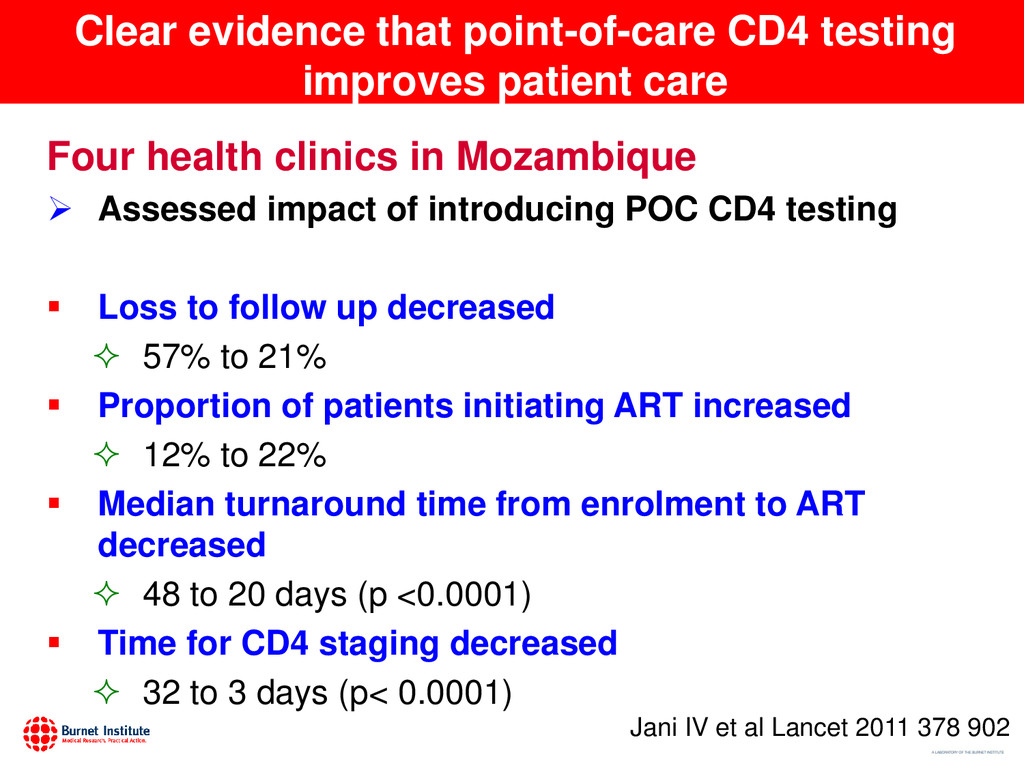
POC CD4 testing Loss to follow up decreased 57% to 21% Proportion of patients initiating ART increased 12% to 22% Median turnaround time from enrolment to ART decreased 48 to 20 days (p <0.0001) Time for CD4 staging decreased 32 to 3 days (p< 0.0001) Jani IV et al Lancet 2011 378 902 Clear evidence that point-of-care CD4 testing improves patient care
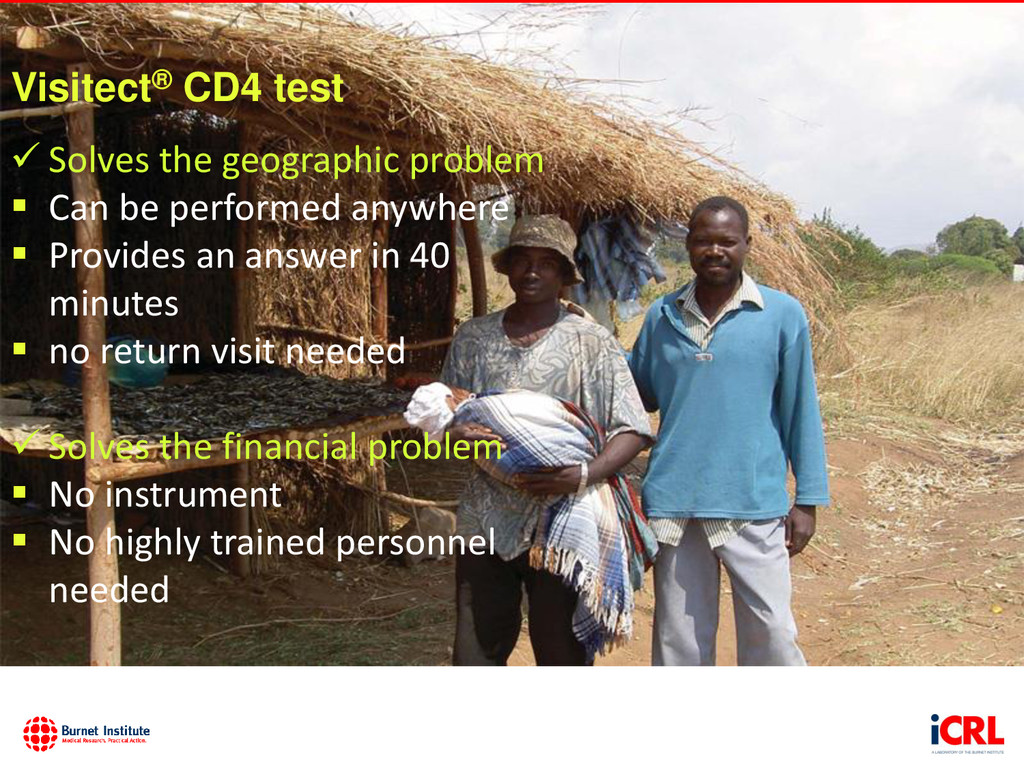
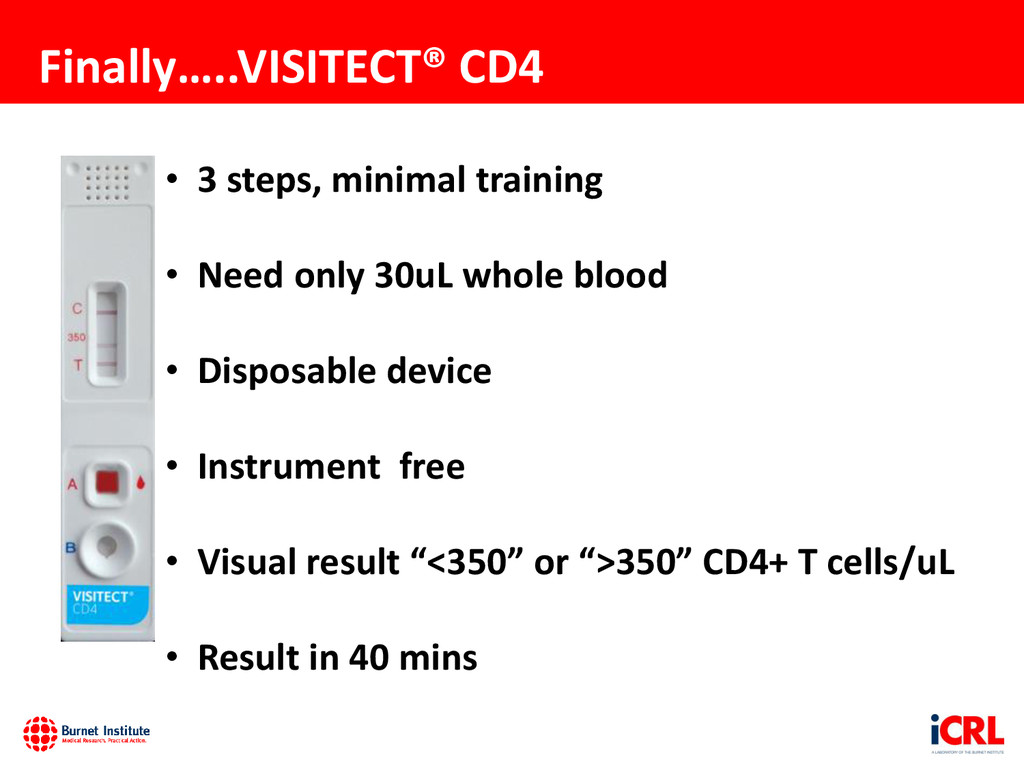
Provides an answer in 40 minutes no return visit needed Solves the financial problem No instrument No highly trained personnel needed Visitect® CD4 test
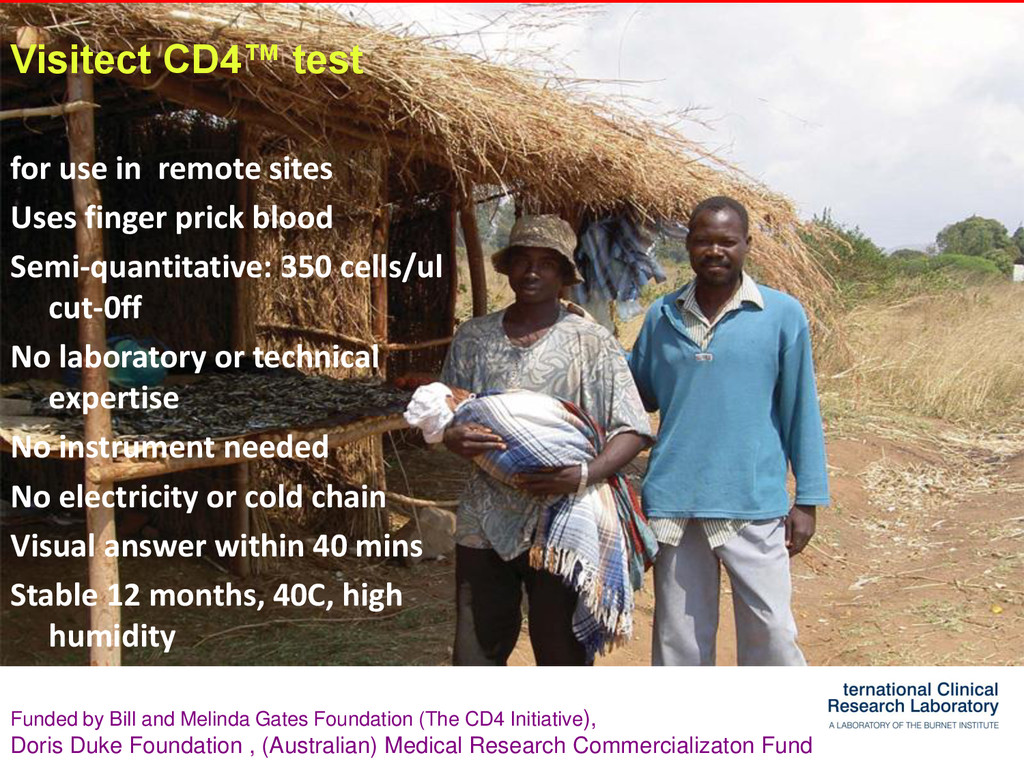
350 cells/ul cut-0ff No laboratory or technical expertise No instrument needed No electricity or cold chain Visual answer within 40 mins Stable 12 months, 40C, high humidity Funded by Bill and Melinda Gates Foundation (The CD4 Initiative), Doris Duke Foundation , (Australian) Medical Research Commercializaton Fund Visitect CD4™ test
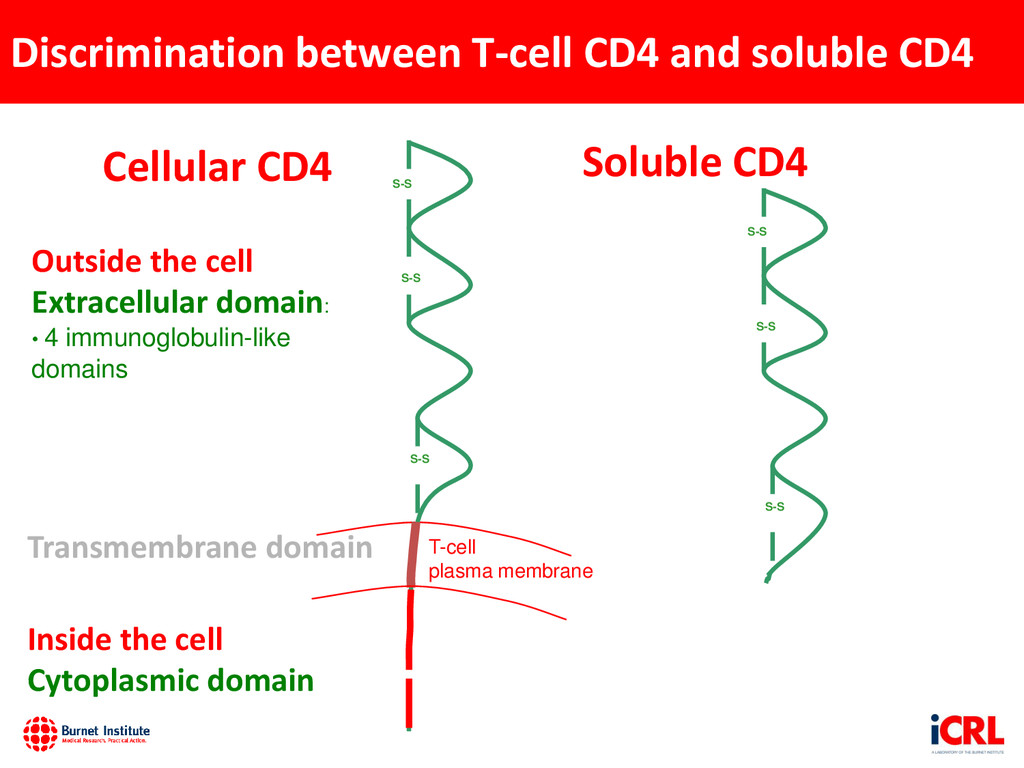
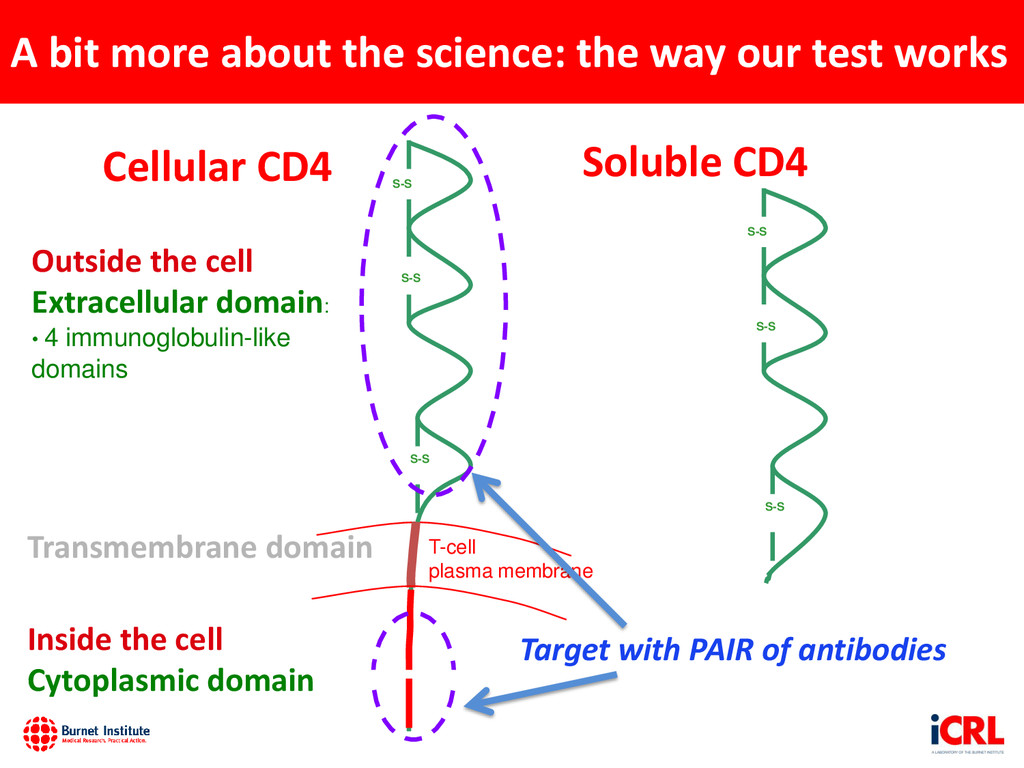
domain Cellular CD4 T-cell plasma membrane S-S S-S S-S S-S S-S S-S Soluble CD4 Target with PAIR of antibodies A bit more about the science: the way our test works Inside the cell Cytoplasmic domain
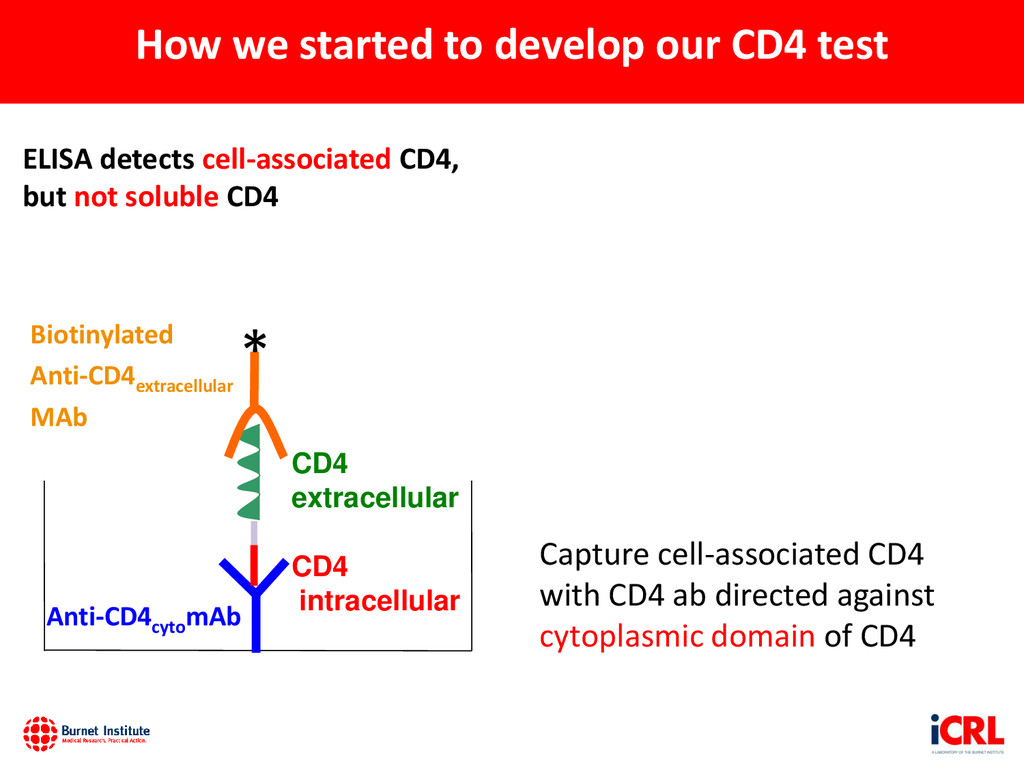
CD4 intracellular Anti-CD4cyto mAb Biotinylated Anti-CD4extracellular MAb ELISA detects cell-associated CD4, but not soluble CD4 Capture cell-associated CD4 with CD4 ab directed against cytoplasmic domain of CD4 *
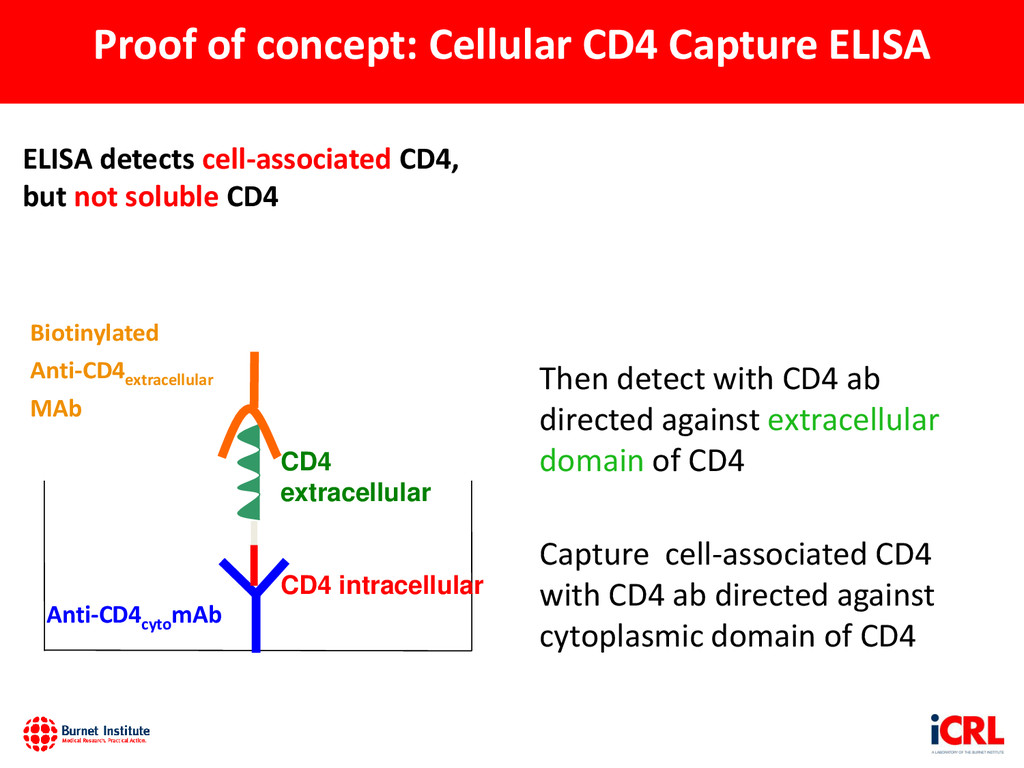
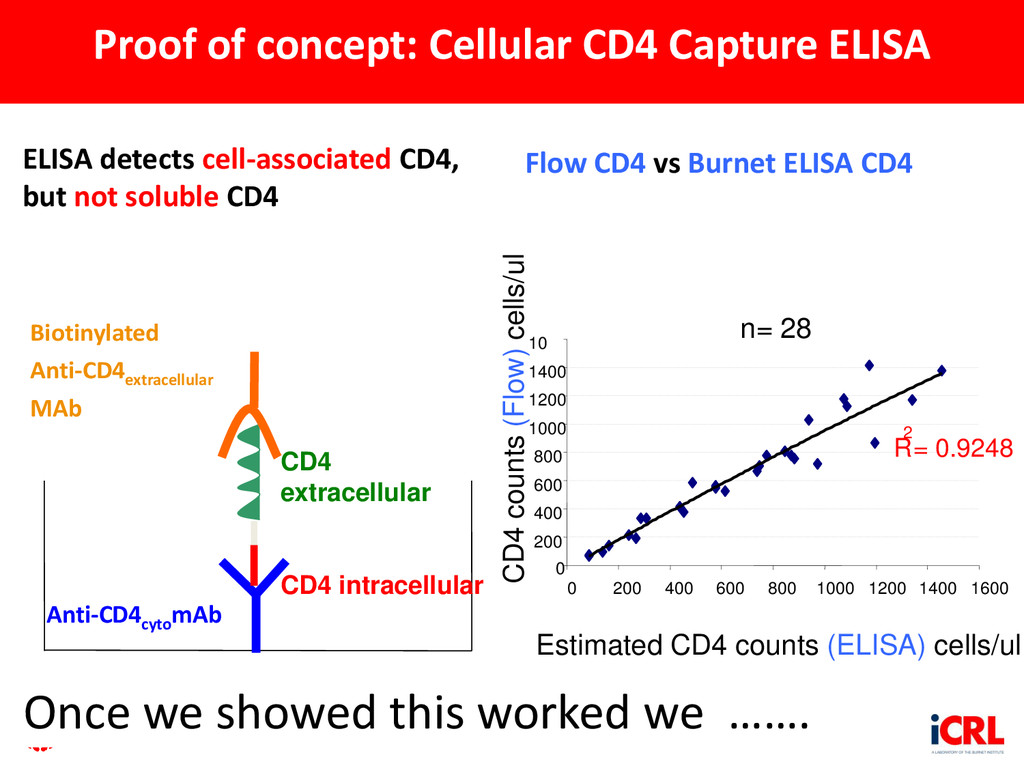
intracellular Anti-CD4cyto mAb Biotinylated Anti-CD4extracellular MAb ELISA detects cell-associated CD4, but not soluble CD4 Capture cell-associated CD4 with CD4 ab directed against cytoplasmic domain of CD4 Then detect with CD4 ab directed against extracellular domain of CD4
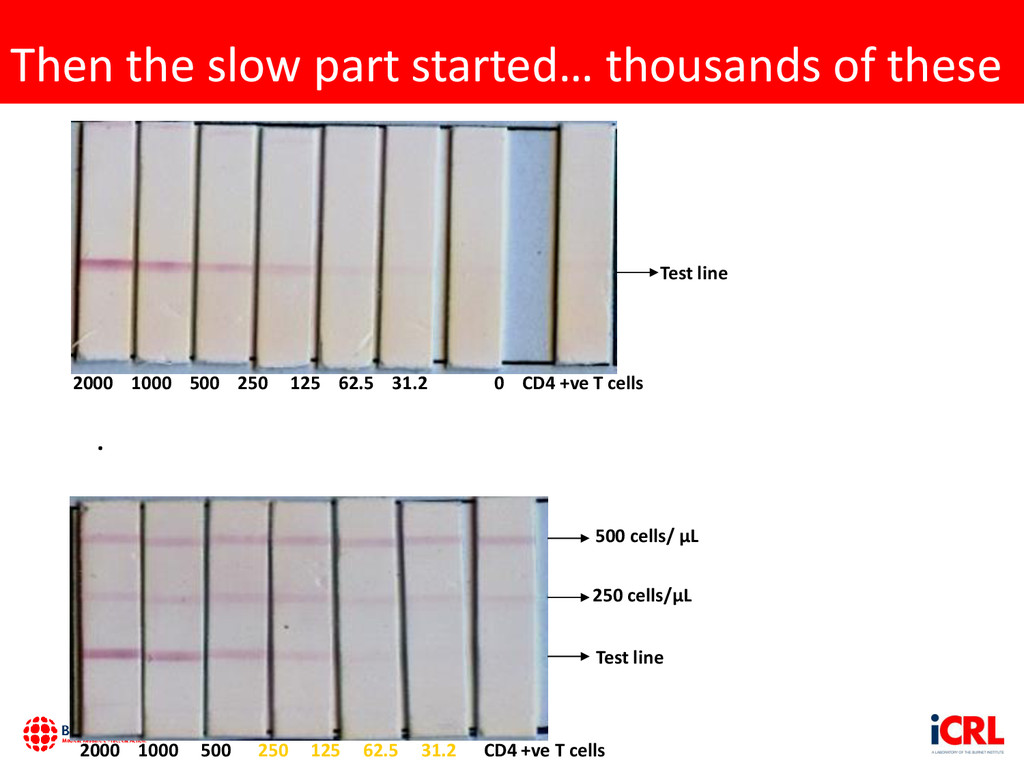
T cells Test line . 500 cells/ µL 250 cells/µL Test line 2000 1000 500 250 125 62.5 31.2 CD4 +ve T cells Then the slow part started… thousands of these
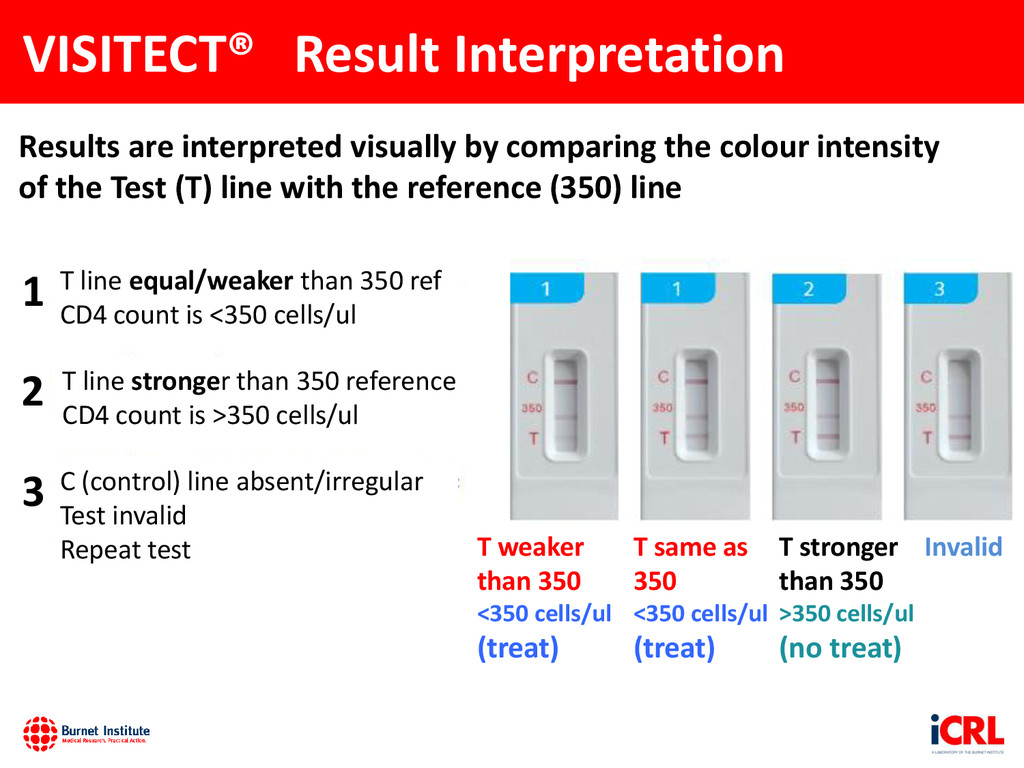
350 <350 cells/ul (treat) T stronger than 350 >350 cells/ul (no treat) Results are interpreted visually by comparing the colour intensity of the Test (T) line with the reference (350) line T line equal/weaker than 350 ref CD4 count is <350 cells/ul T line stronger than 350 reference CD4 count is >350 cells/ul C (control) line absent/irregular Test invalid Repeat test T weaker than 350 <350 cells/ul (treat)
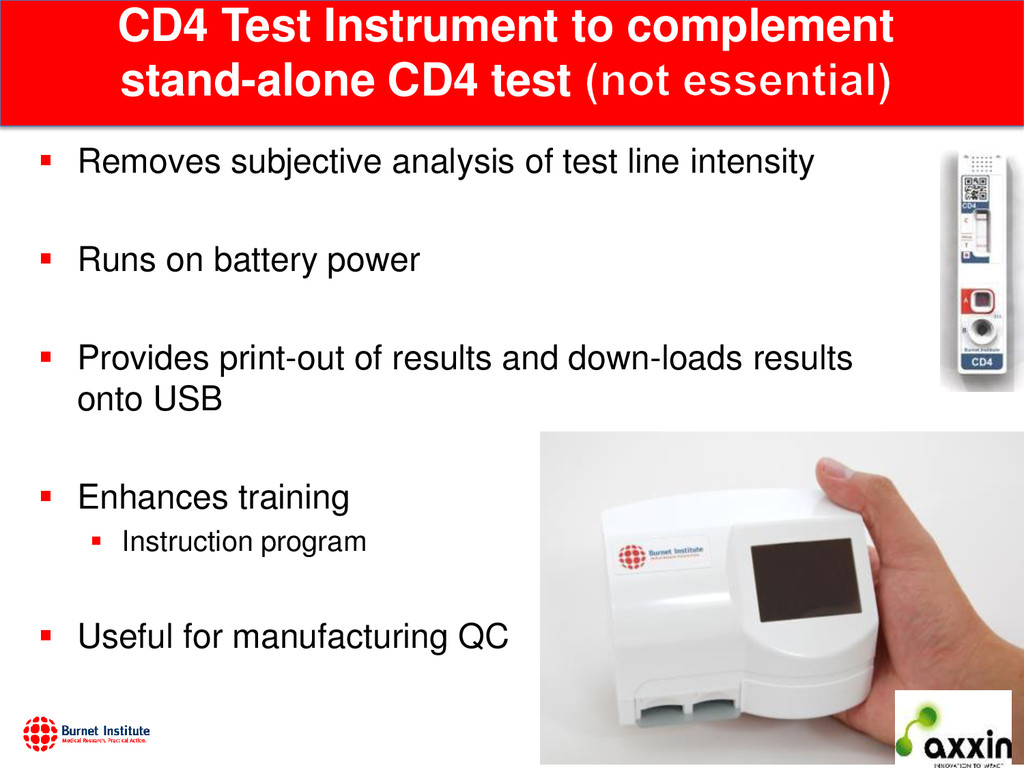
on battery power Provides print-out of results and down-loads results onto USB Enhances training Instruction program Useful for manufacturing QC CD4 Test Instrument to complement stand-alone CD4 test
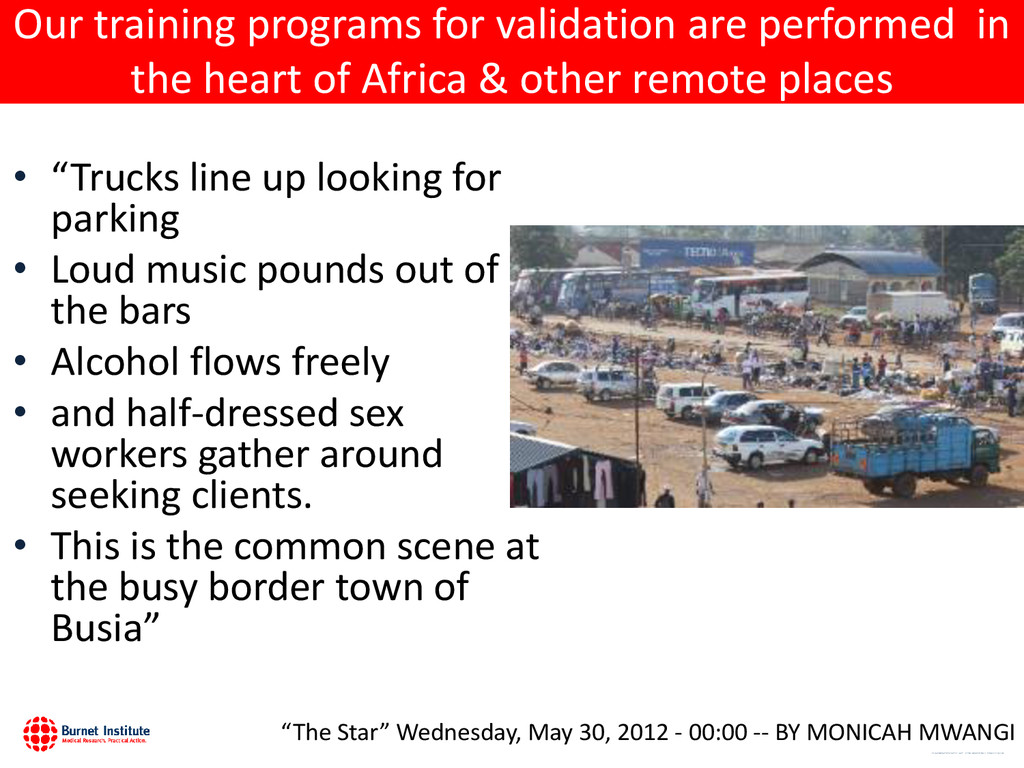
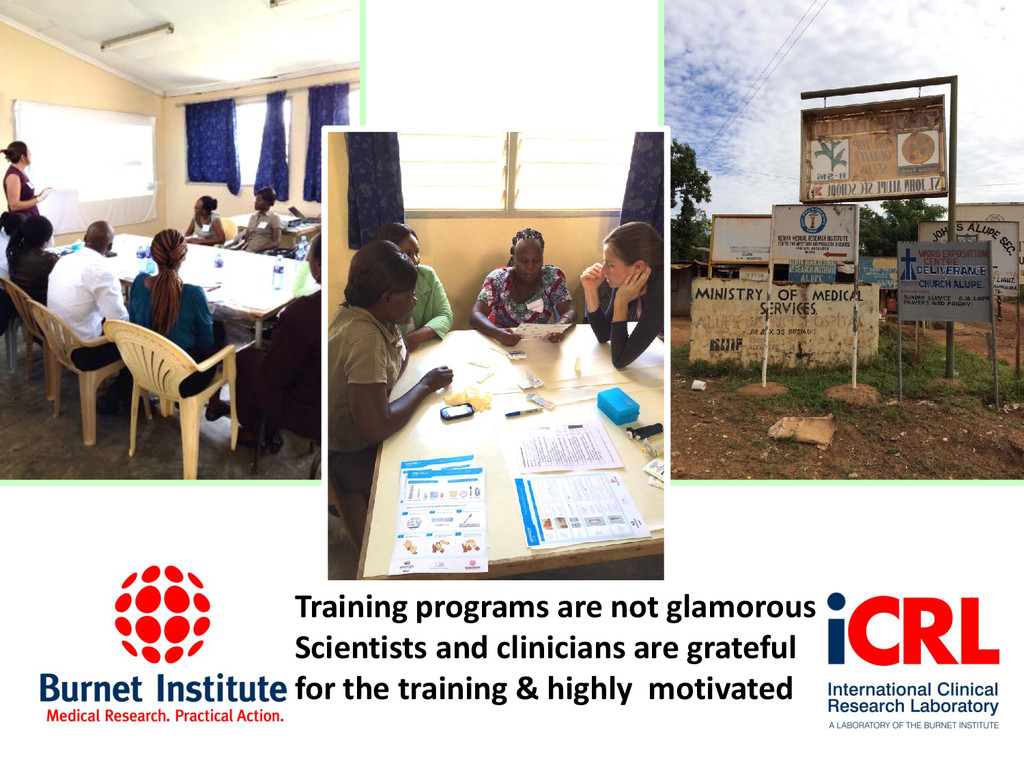
of Africa & other remote places • “Trucks line up looking for parking • Loud music pounds out of the bars • Alcohol flows freely • and half-dressed sex workers gather around seeking clients. • This is the common scene at the busy border town of Busia” “The Star” Wednesday, May 30, 2012 - 00:00 -- BY MONICAH MWANGI
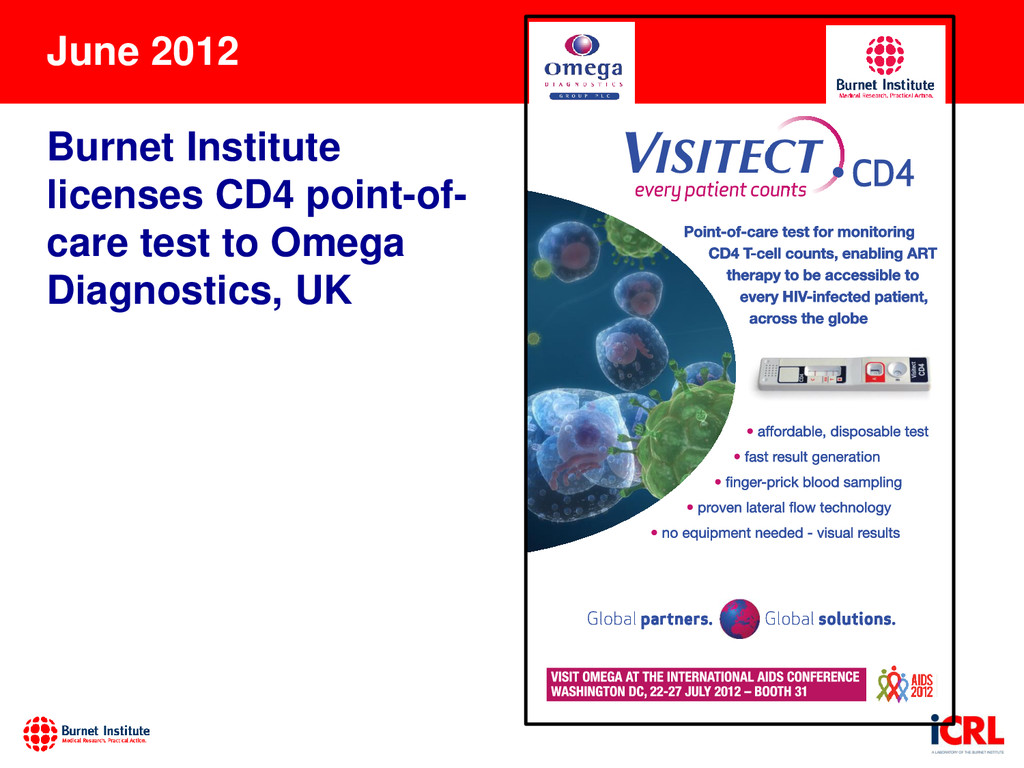
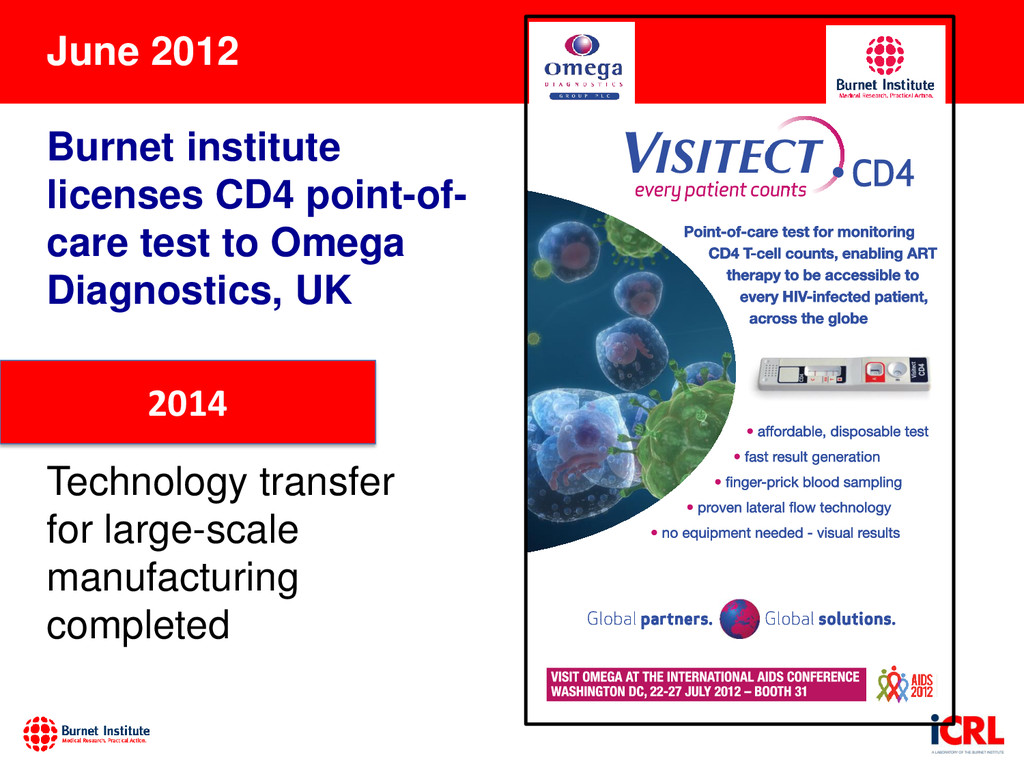
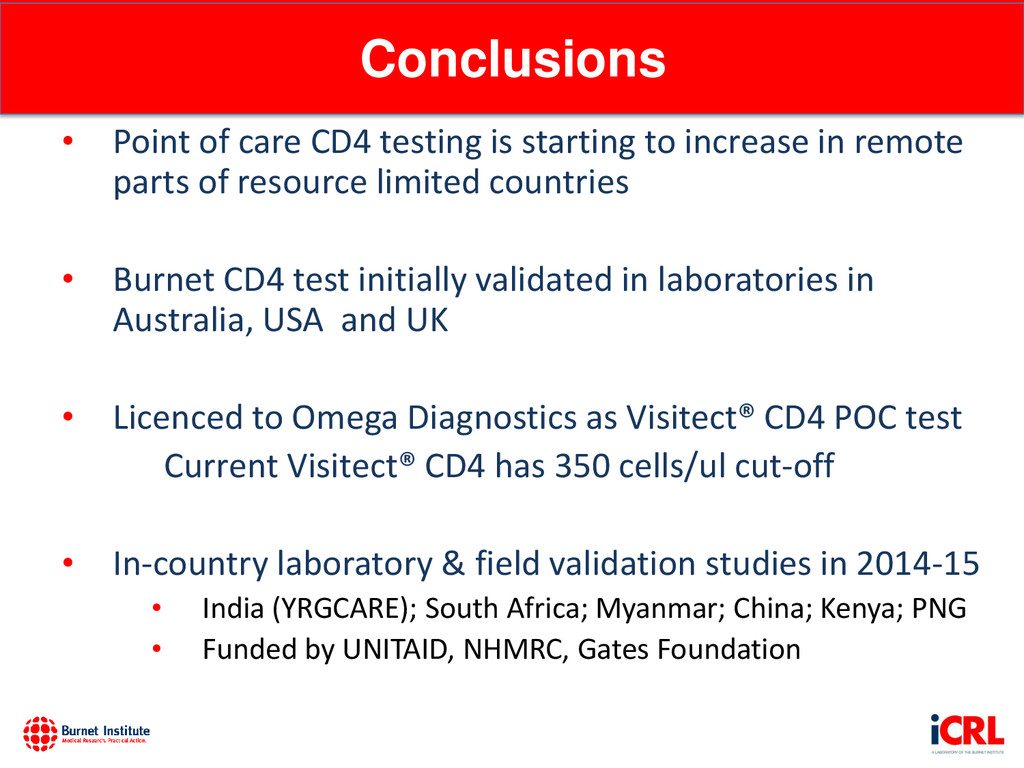
in remote parts of resource limited countries • Burnet CD4 test initially validated in laboratories in Australia, USA and UK • Licenced to Omega Diagnostics as Visitect® CD4 POC test Current Visitect® CD4 has 350 cells/ul cut-off • In-country laboratory & field validation studies in 2014-15 • India (YRGCARE); South Africa; Myanmar; China; Kenya; PNG • Funded by UNITAID, NHMRC, Gates Foundation Conclusions
Prof David Anderson •Ms Mary Garcia •Ms Adele Lee Wriede •Ms Robyn Lloyd •Ms Eman Aleksic •Ms Serina Cucuzza •Dr Alison Greenway •Dr Stanley Luchters •Dr Imogen Elsum •Axxin, Melbourne •Mr Andrew Lysikatos •Mr Bill Hopper •Rush Univ, Chicago •Prof Alan Landay •Duke University, NC •Prof Tom Denny •YRG Care, Chennai •Ass Professor P Balakrishnan •Prof Suniti Soloman •University of Witwatersrand •Prof Wendy Stevens •Prof Leslie Scott •Kirby Institute, Sydney •David Wilson • Doris Duke Foundation , Bill & Melinda Gates Foundation ACH2, NHMRC, UNITAID Omega Diagnostics Group PLC Andrew Shepherd Mike Iddon


 hivaidscathconf
 bkeepers
 chriscoyier
 kimpetersen
 csswizardry
 schroneko
 uxyall
 stephenakadiri
 charlesmeaden
 hannesfritz
 mfonobong
 rkendrick25
 oripsolob