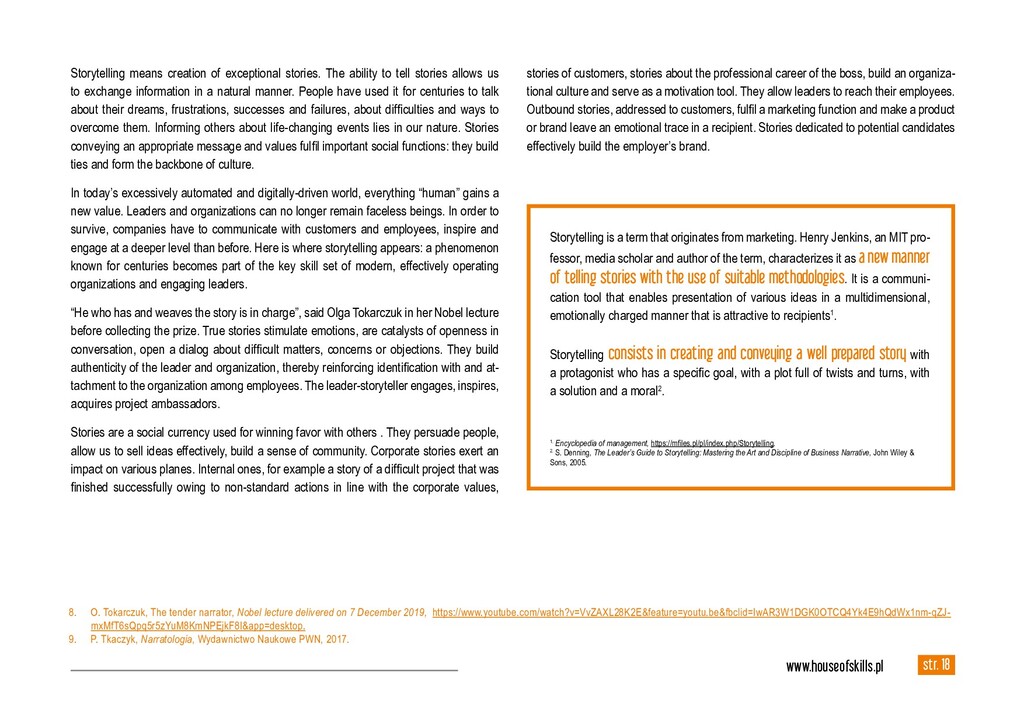
ability to tell stories allows us to exchange information in a natural manner. People have used it for centuries to talk about their dreams, frustrations, successes and failures, about difficulties and ways to overcome them. Informing others about life-changing events lies in our nature. Stories conveying an appropriate message and values fulfil important social functions: they build ties and form the backbone of culture. In today’s excessively automated and digitally-driven world, everything “human” gains a new value. Leaders and organizations can no longer remain faceless beings. In order to survive, companies have to communicate with customers and employees, inspire and engage at a deeper level than before. Here is where storytelling appears: a phenomenon known for centuries becomes part of the key skill set of modern, effectively operating organizations and engaging leaders. “He who has and weaves the story is in charge”, said Olga Tokarczuk in her Nobel lecture before collecting the prize. True stories stimulate emotions, are catalysts of openness in conversation, open a dialog about difficult matters, concerns or objections. They build authenticity of the leader and organization, thereby reinforcing identification with and at- tachment to the organization among employees. The leader-storyteller engages, inspires, acquires project ambassadors. Stories are a social currency used for winning favor with others . They persuade people, allow us to sell ideas effectively, build a sense of community. Corporate stories exert an impact on various planes. Internal ones, for example a story of a difficult project that was finished successfully owing to non-standard actions in line with the corporate values, stories of customers, stories about the professional career of the boss, build an organiza- tional culture and serve as a motivation tool. They allow leaders to reach their employees. Outbound stories, addressed to customers, fulfil a marketing function and make a product or brand leave an emotional trace in a recipient. Stories dedicated to potential candidates effectively build the employer’s brand. Storytelling is a term that originates from marketing. Henry Jenkins, an MIT pro- fessor, media scholar and author of the term, characterizes it as a new manner of telling stories with the use of suitable methodologies. It is a communi- cation tool that enables presentation of various ideas in a multidimensional, emotionally charged manner that is attractive to recipients1. Storytelling consists in creating and conveying a well prepared story with a protagonist who has a specific goal, with a plot full of twists and turns, with a solution and a moral2. 1. Encyclopedia of management, https://mfiles.pl/pl/index.php/Storytelling. 2. S. Denning, The Leader’s Guide to Storytelling: Mastering the Art and Discipline of Business Narrative, John Wiley & Sons, 2005. 8. O. Tokarczuk, The tender narrator, Nobel lecture delivered on 7 December 2019, https://www.youtube.com/watch?v=VvZAXL28K2E&feature=youtu.be&fbclid=IwAR3W1DGK0OTCQ4Yk4E9hQdWx1nm-qZJ- mxMfT6sQpq5r5zYuM8KmNPEjkF8I&app=desktop. 9. P. Tkaczyk, Narratologia, Wydawnictwo Naukowe PWN, 2017.


 loglass2019
 arid2
arid2
 natsumidnx
 tamagakiyuya
 todatomohiro
 hrm
hrm
 gatechnologies
.jpg) ikuodanaka
ikuodanaka
 hr1nursing
 kazuyama88
 takeuchigroup
 aleyda
 erikaheidi
 tammyeverts
 akademiya2063
 seathinner
 skipperchong
 csswizardry
 lauravandoore
 jmmastey
 codingconduct
 keathley