Share
Embed
Overview of Compute Engine (Aug 2015)
Ian Lewis
August 25, 2015
Transcript
32 slides
-
For the past 15 years, Google has been building out
the world’s fastest, most powerful, highest quality cloud infrastructure on the planet. -
• Pioneering data center efficiency • Financed over 250 Megawatts
of new wind power • First data centers to receive ISO 14001 certification • 100% carbon neutral Our Commitment to Environmental Responsibility -
Networking Management Networking Big Data Storage Mobile Developer Tools Compute
Engine App Engine Container Engine Google Cloud Platform Compute Compute -
Networking Management Networking Big Data Storage Mobile Developer Tools Compute
Engine App Engine Container Engine Google Cloud Platform Compute Compute -
Compute Resources - US, Europe and Asia zones - Fast
SDN-Based virtual networking Consistently Fast - Fast VM Provisioning - Consistent Performance Cost Effective - Sub-Hour Billing - No IOPS charges for Block Storage - VMs not required for Load balancing Google Compute Engine -
Cores CPU to Memory ratio More memory 1 2 4
8 More CPU (Shared) 16 Instances to suit diverse workloads 32 Compute Engine VMs: • Debian, CentOS, SUSE, RHEL, Ubuntu, Windows (Beta • shared core or 1 - 32 cores • Up to 208 GB of RAM -
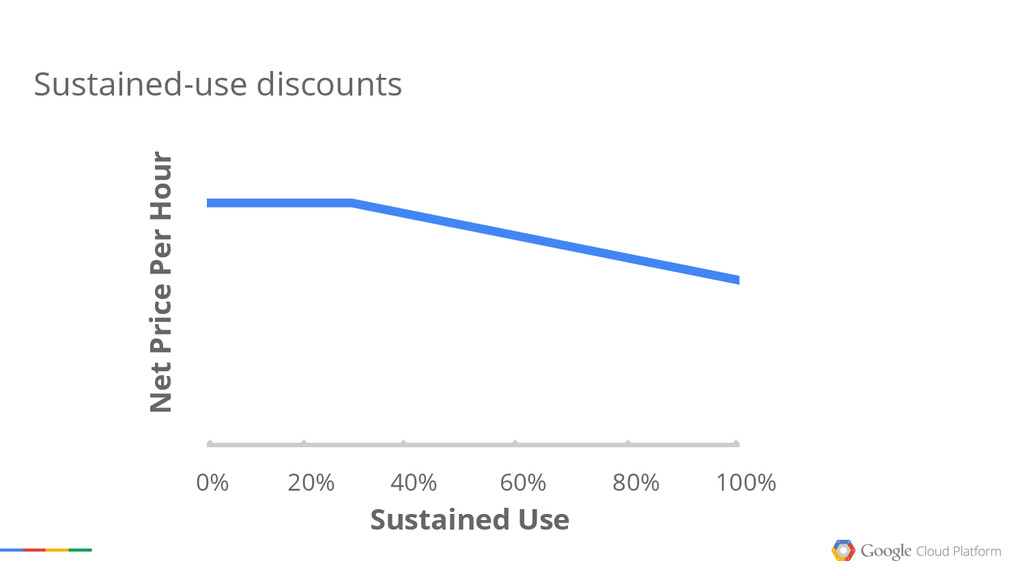
100% 0% 20% 40% 60% 80% Sustained Use Sustained-use discounts
Net Price Per Hour Sustained-use discounts -
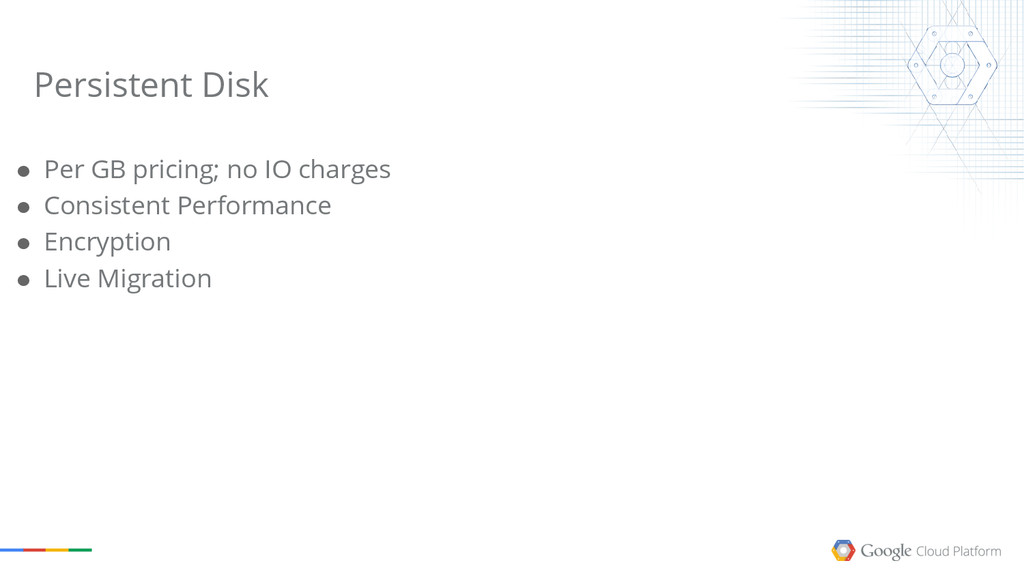
• Per GB pricing; no IO charges • Consistent Performance
• Encryption • Live Migration Persistent Disk Persistent Disk -
• Per GB pricing; no IO charges • Consistent Performance
• Encryption • Live Migration Persistent Disk SSD PD Standard PD Local SSD Persistent Disk • Sub-ms latency • 1-4 x 375 GB partitions • Storage redundancy • Checksums • Snapshots • 1GB-10TB -
• Per GB pricing; no IO charges • Consistent Performance
• Encryption • Live Migration Persistent Disk SSD PD Standard PD Local SSD Persistent Disk • Sub-ms latency • 1-4 x 375 GB partitions • Storage redundancy • Checksums • Snapshots • 1GB-10TB 200 30 80 Local SSD IOPS/GB (log scale) 0 Standard PD 15 6 SSD PD 2 -
RO RW • Attach/Detach Data disks on the fly •
Mount Read-Write on a single VM • Mount Read-Only on many VMs Persistent Disk Attach/Mount options -
Management Networking Compute Big Data Storage Mobile Developer Tools Load
Balancing Google Cloud Platform Networking -
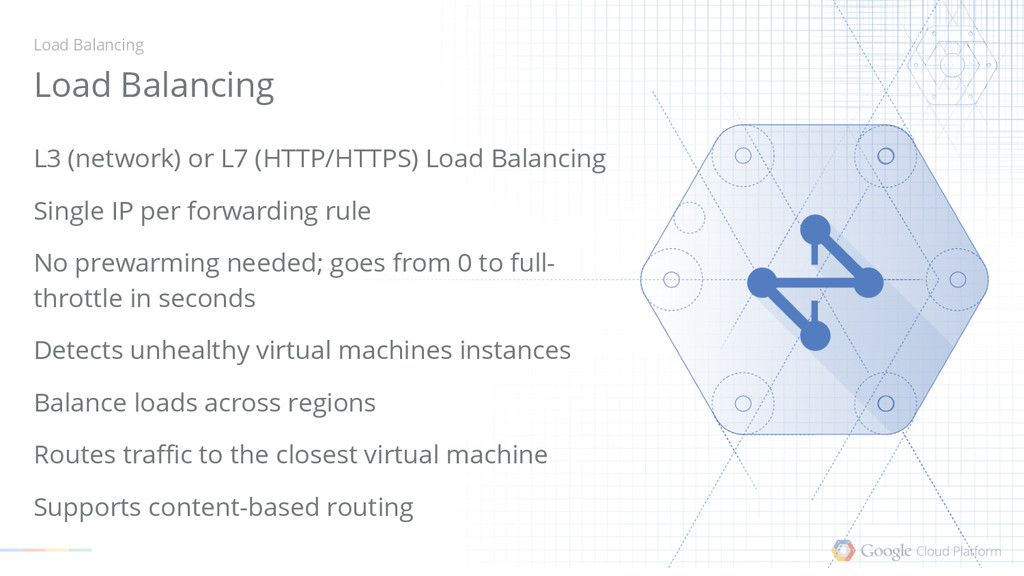
Load Balancing Load Balancing L3 (network) or L7 (HTTP/HTTPS) Load
Balancing Single IP per forwarding rule No prewarming needed; goes from 0 to full- throttle in seconds Detects unhealthy virtual machines instances Balance loads across regions Routes traffic to the closest virtual machine Supports content-based routing -
Load Balancing HTTP/HTTPS Load Balancing (Beta) Cross Region Load Balancing
Content Based Load Balancing -
Network Load Balancing Load Balancing Incoming Requests Forwarding Rule X
Target Pool Health Check -
• TCP and UDP (plus VPN protocols) • IP addresses
• public: static and ephemeral • internal: ephemeral with automatic DNS • Network groups & firewall rules • rules applied to instances via tags • Gateways, routing and VPNs Networking Internet Networking -
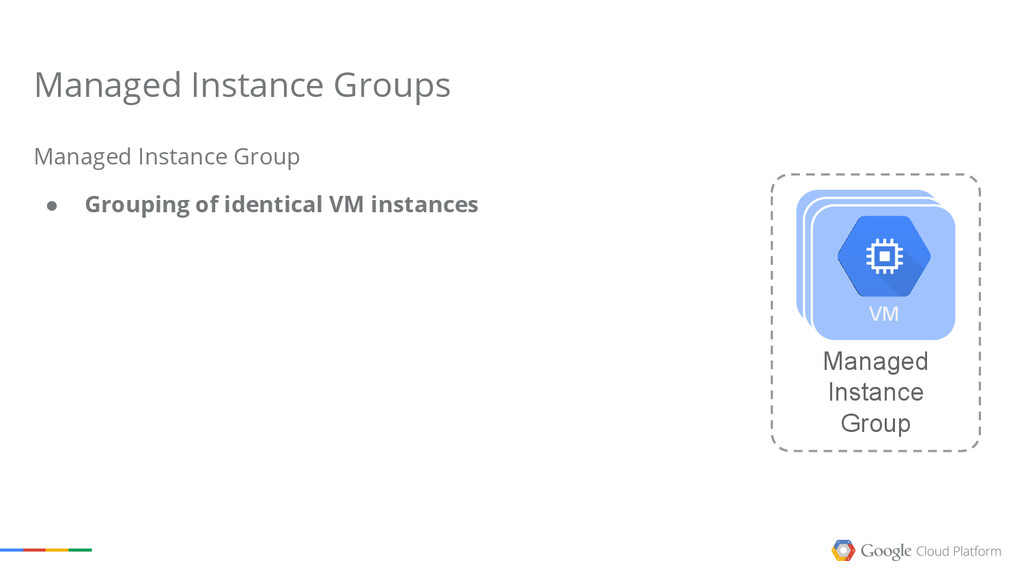
Managed Instance Group • Grouping of identical VM instances Managed
Instance Group VM VM VM Managed Instance Groups -
create/ destroy VMs Instance Group Manager Managed Instance Group VM
VM VM Managed Instance Group • Grouping of identical VM instances • Provisioned and monitored by Instance Group Manager Instance Group Manager -
create/ destroy VMs Instance Group Manager Instance Template Instance Template
Managed Instance Group VM VM VM Managed Instance Group • Grouping of identical VM instances • Provisioned and monitored by Instance Group Manager • Instance Templates separate configuration from provisioning Instance Templates -
Managed Instance Group destroy/ recreate VMs Instance Group Updater Rolling
Update VM VM VM New Template Managed Instance Group • Grouping of identical VM instances • Provisioned and monitored by Instance Group Manager • Instance Templates separate configuration from provisioning • Rolling Updates applied by instance Group Updater Instance Group Updater -
Managed Instance Group create/ destroy VMs Instance Group Manager actuator
monitor Autoscaler Cloud Monitoring utilisation VM VM VM Pub/Sub Topic Compute Engine Autoscaler -
Just Like Regular VMs • Same configurations, OSes, performance, tools,
etc. More Cost Effective • Flat pricing: < 50% regular VM rates Reasonable, Predictable Limitations • 24h uptime limit • Chance of early preemption by system (~10-20%) ◦ No preemptions due to other customers’ Preemptible VM requests • Pre-termination notice to allow for clean shutdown Preemptible VMs: What Batch -
Flexibility Gives Google Efficiency • Limited time “lease” and preemption
improve fleet allocation efficiency • Google can pass on the savings to you: win-win! “Regular” VMs are Suboptimal for Batch Use Cases • Always-on, infinite duration nature is not needed for batch type jobs • 99.95% continuous uptimes are designed for “serving” needs, not batch • Embarrassingly parallel jobs are often fault-tolerant to loss of worker nodes • Batch jobs might not hit best sustained use pricing thresholds Preemptible VMs: Why Batch -
• Log processing, Analytics, Big Data (Hadoop, MapReduce, etc.) •
Rendering • Media transcoding • Financial modeling and simulation • Continuous integration - automated build and testing • Genomics Preemptible VMs: Typical Use Cases Batch