Upgrade to Pro
— share decks privately, control downloads, hide ads and more …
Speaker Deck
Sign up for free
Menu
Search
Features
All features
Private URLs
Password Protection
Custom URLS
Scheduled publishing
Remove Branding
Restrict embedding
Deck Collections
Notes
Features
All features
Private URLs
Password Protection
Custom URLS
Scheduled publishing
Remove Branding
Restrict embedding
Deck Collections
Notes
Explore
Featured decks
Featured speakers
Programming
Technology
Storyboards
Explore
Featured decks
Featured speakers
Programming
Technology
Storyboards
Pricing
Search
Sign in
Sign up for free
RTCA Dr Steve Howell - Trust in CFD for modelli...
Search
Sponsored
·
Your Podcast. Everywhere. Effortlessly.
Share. Educate. Inspire. Entertain. You do you. We'll handle the rest.
→
IES Events
October 26, 2026
40
0
Share
Embed
Copy iframe code
Copy JS code
Copy link
Start on current slide
RTCA Dr Steve Howell - Trust in CFD for modelling air pollution dispersion in urban areas
IES Events
October 26, 2026
More Decks by IES Events
See All by IES Events
RTCA Darren Watson - The OEP’s assessment of progress in improving the natural environment in England and the focus
iesevents
0
19
RTCA Susan Zappala - UK APAS
iesevents
0
38
RTCA Dr Helen Davies - The Lung Chemistry Model in Python: A new computational model for predicting asthma exacerbation risk from indoor air pollutants
iesevents
0
22
RTCA Keynote Dr Gary Fuller - Measurement challenges in a regulatory context
iesevents
0
23
RTCA Matthew Clark - Regional Local Authority and bringing healthier air to schools
iesevents
0
25
RTCA Dr Clare Beattie - Evaluation of the effect of PM2.5 due to domestic solid fuel burning on health outcomes in Scotland
iesevents
0
23
RTCA Kieran Laxen - The impact of climate change on regulatory dispersion modelling
iesevents
0
26
RTCA Prof David Carslaw - A new approach to making ambient measurements to quantify both vehicle emissions and concentration source apportionment
iesevents
0
17
RTCA Dr Nosha Assareh - The UK Compliance Air Quality Modelling System: Methods, components, and policy applications
iesevents
0
24
Featured
See All Featured
Site-Speed That Sticks
csswizardry
13
1.6k
Writing Fast Ruby
sferik
630
63k
Design of three-dimensional binary manipulators for pick-and-place task avoiding obstacles (IECON2024)
konakalab
0
660
Claude Code どこまでも/ Claude Code Everywhere
nwiizo
68
60k
Put a Button on it: Removing Barriers to Going Fast.
kastner
60
4.6k
Easily Structure & Communicate Ideas using Wireframe
afnizarnur
194
17k
Why Your Marketing Sucks and What You Can Do About It - Sophie Logan
marketingsoph
0
470
Highjacked: Video Game Concept Design
rkendrick25
PRO
2
560
We Are The Robots
honzajavorek
0
440
Kristin Tynski - Automating Marketing Tasks With AI
techseoconnect
PRO
0
590
Building an army of robots
kneath
307
47k
Max Prin - Stacking Signals: How International SEO Comes Together (And Falls Apart)
techseoconnect
PRO
0
530
Transcript
TT260802-PR-001-B IES Routes to Clean Air (21 October 2026) –
Trust in CFD for modelling air pollution dispersion in urban areas Trust in CFD for modelling air pollution dispersion in urban areas Steve Howell (Abercus) 21 October 2026 www.abercus.com Abercus 7 Queen’s Gardens Aberdeen AB15 4YD www.abercus.com © 2026 Abercus. All Rights Reserved. www.abercus.com 3
TT260802-PR-001-B IES Routes to Clean Air (21 October 2026) –
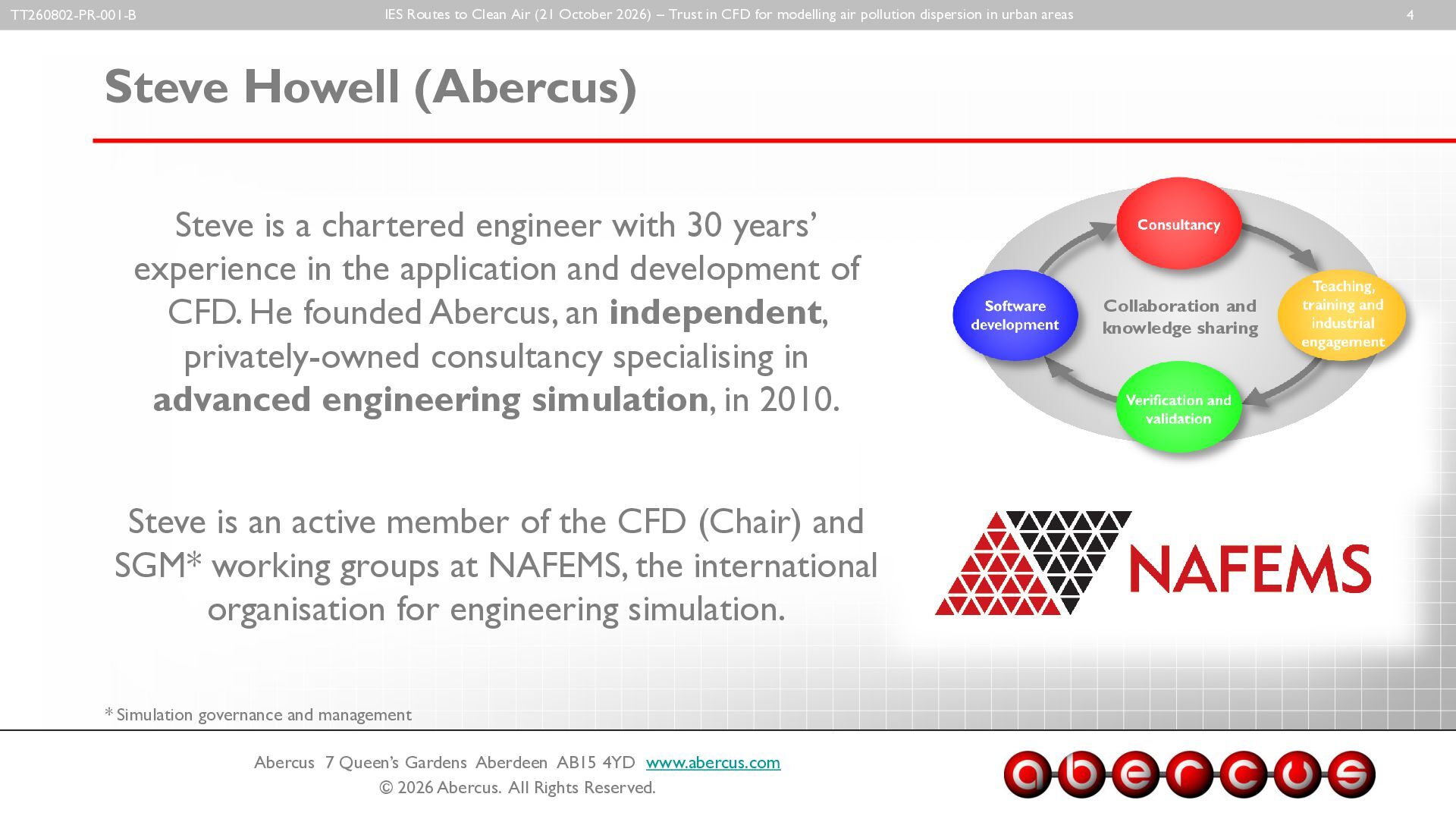
Trust in CFD for modelling air pollution dispersion in urban areas 4 Steve Howell (Abercus) Steve is a chartered engineer with 30 years’ experience in the application and development of CFD. He founded Abercus, an independent, privately-owned consultancy specialising in advanced engineering simulation, in 2010. Collaboration and knowledge sharing Steve is an active member of the CFD (Chair) and SGM* working groups at NAFEMS, the international organisation for engineering simulation. * Simulation governance and management www.abercus.com Abercus 7 Queen’s Gardens Aberdeen AB15 4YD www.abercus.com © 2026 Abercus. All Rights Reserved. www.abercus.com
IES Routes to Clean Air (21 October 2026) – Trust
in CFD for modelling air pollution dispersion in urban areas TT260802-PR-001-B 5 Agenda • Introduction. • VVUQ framework – NAFEMS/ASME. • CFD for modelling air pollution in urban areas: This presentation is hyperlinked. Click on the title bar to return to this agenda. Click on the relevant item in the list on the left to jump to the associated slides later in the presentation. – Atmospheric stability. – Dense gas dispersion. – Chemistry (NOx oxidation). – Presentation of results. • Lessons from parallel industries. • Closing remarks. www.abercus.com Abercus 7 Queen’s Gardens Aberdeen AB15 4YD www.abercus.com © 2026 Abercus. All Rights Reserved. www.abercus.com
TT260802-PR-001-B IES Routes to Clean Air (21 October 2026) –
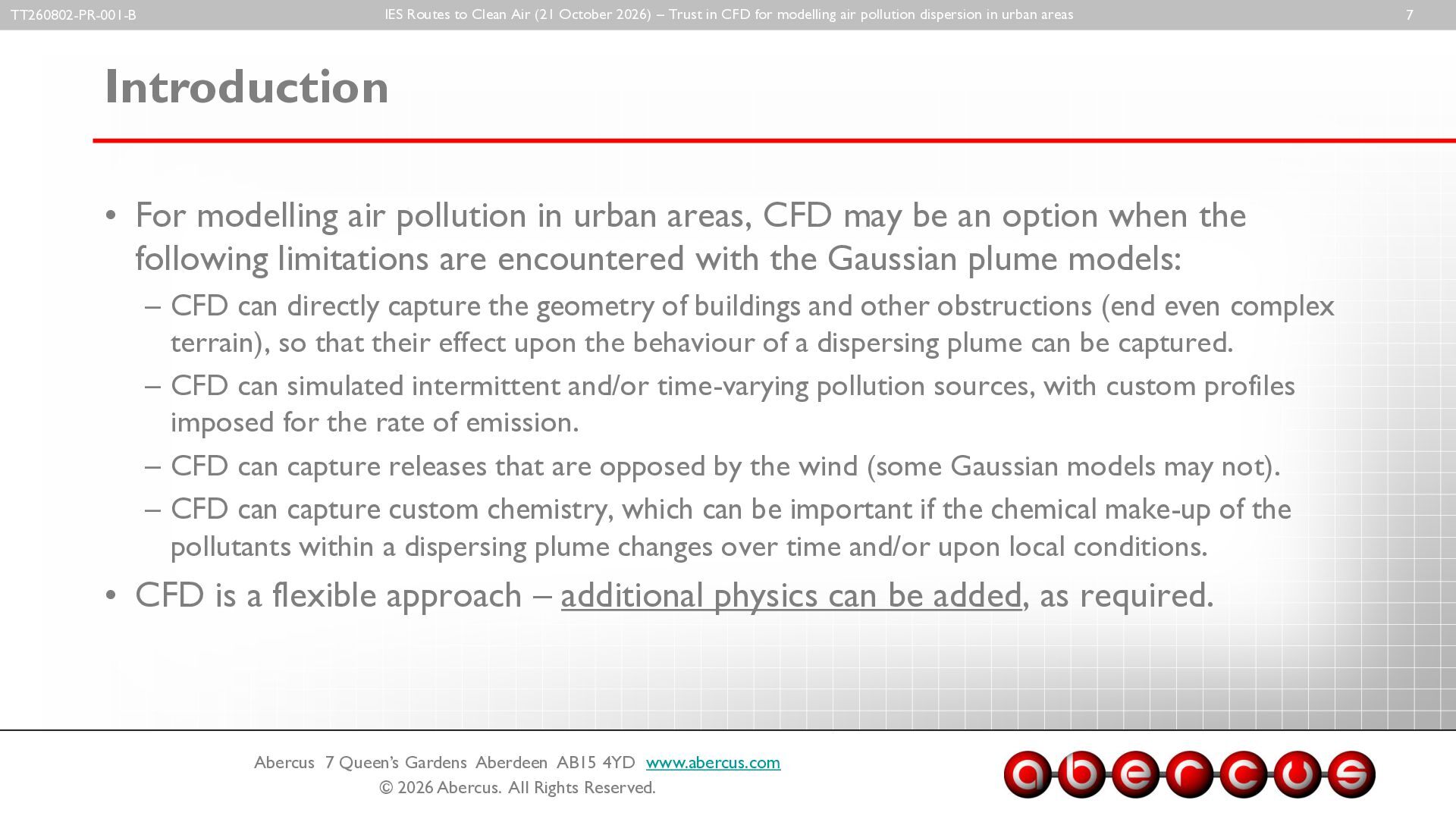
Trust in CFD for modelling air pollution dispersion in urban areas 6 Introduction • Gaussian plume models are the default tools for modelling air pollution dispersion in urban areas. However, for some applications they may have limitations, in which case Computational Fluid Dynamics (CFD) may offer a useful alternative. • CFD is a first-principles physics-based approach for simulating fluid behaviour which is used across many industry sectors, for example: – Automotive/Formula 1 – Aerospace – Defense – Energy sector – Medical – Built environment – Marine – Food • CFD is a flexible approach – additional physics can be added, as required. www.abercus.com Abercus 7 Queen’s Gardens Aberdeen AB15 4YD www.abercus.com © 2026 Abercus. All Rights Reserved. www.abercus.com
TT260802-PR-001-B IES Routes to Clean Air (21 October 2026) –
Trust in CFD for modelling air pollution dispersion in urban areas Introduction • For modelling air pollution in urban areas, CFD may be an option when the following limitations are encountered with the Gaussian plume models: – CFD can directly capture the geometry of buildings and other obstructions (end even complex terrain), so that their effect upon the behaviour of a dispersing plume can be captured. – CFD can simulated intermittent and/or time-varying pollution sources, with custom profiles imposed for the rate of emission. – CFD can capture releases that are opposed by the wind (some Gaussian models may not). – CFD can capture custom chemistry, which can be important if the chemical make-up of the pollutants within a dispersing plume changes over time and/or upon local conditions. • CFD is a flexible approach – additional physics can be added, as required. www.abercus.com Abercus 7 Queen’s Gardens Aberdeen AB15 4YD www.abercus.com © 2026 Abercus. All Rights Reserved. www.abercus.com 7
IES Routes to Clean Air (21 October 2026) – Trust
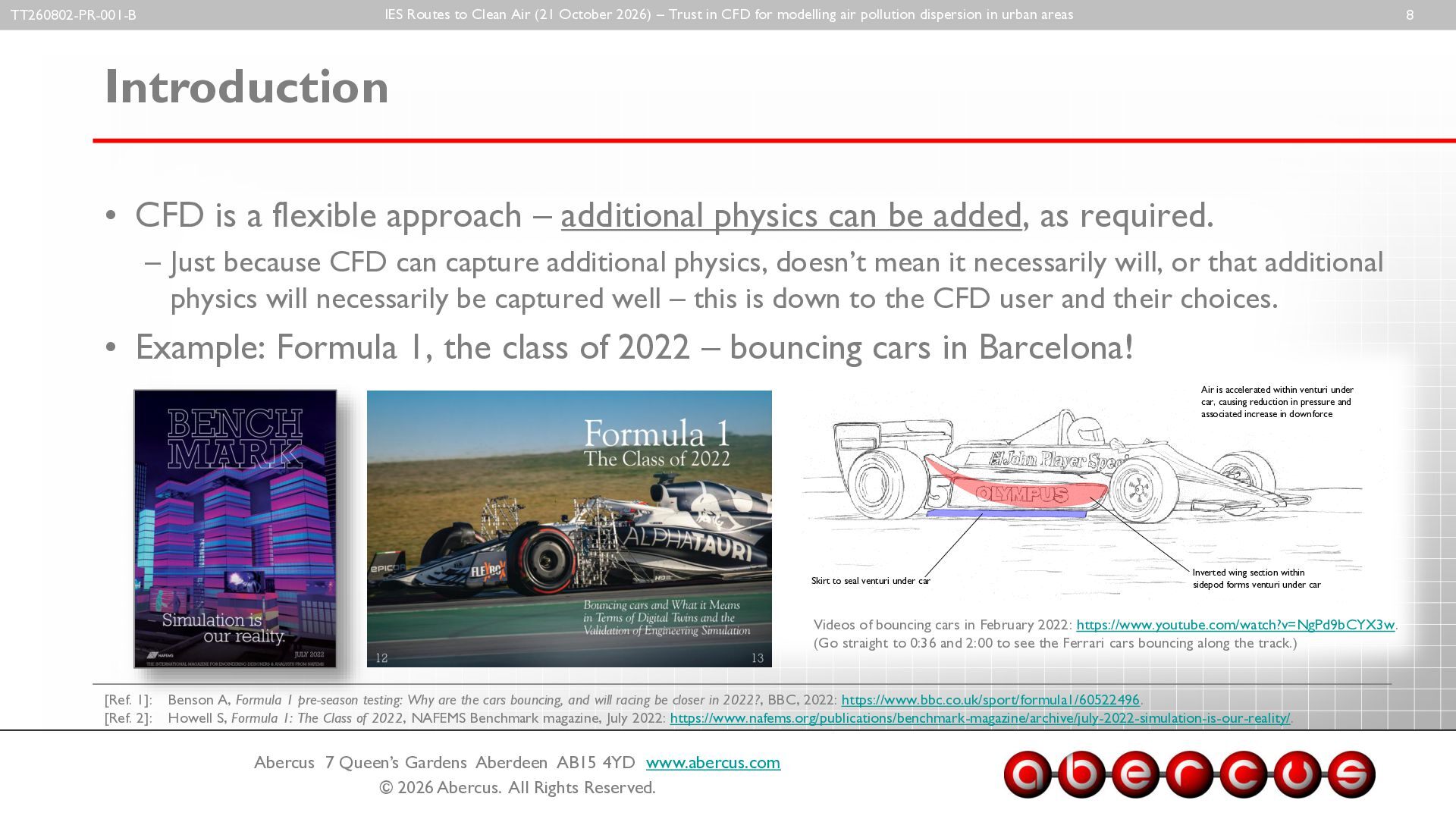
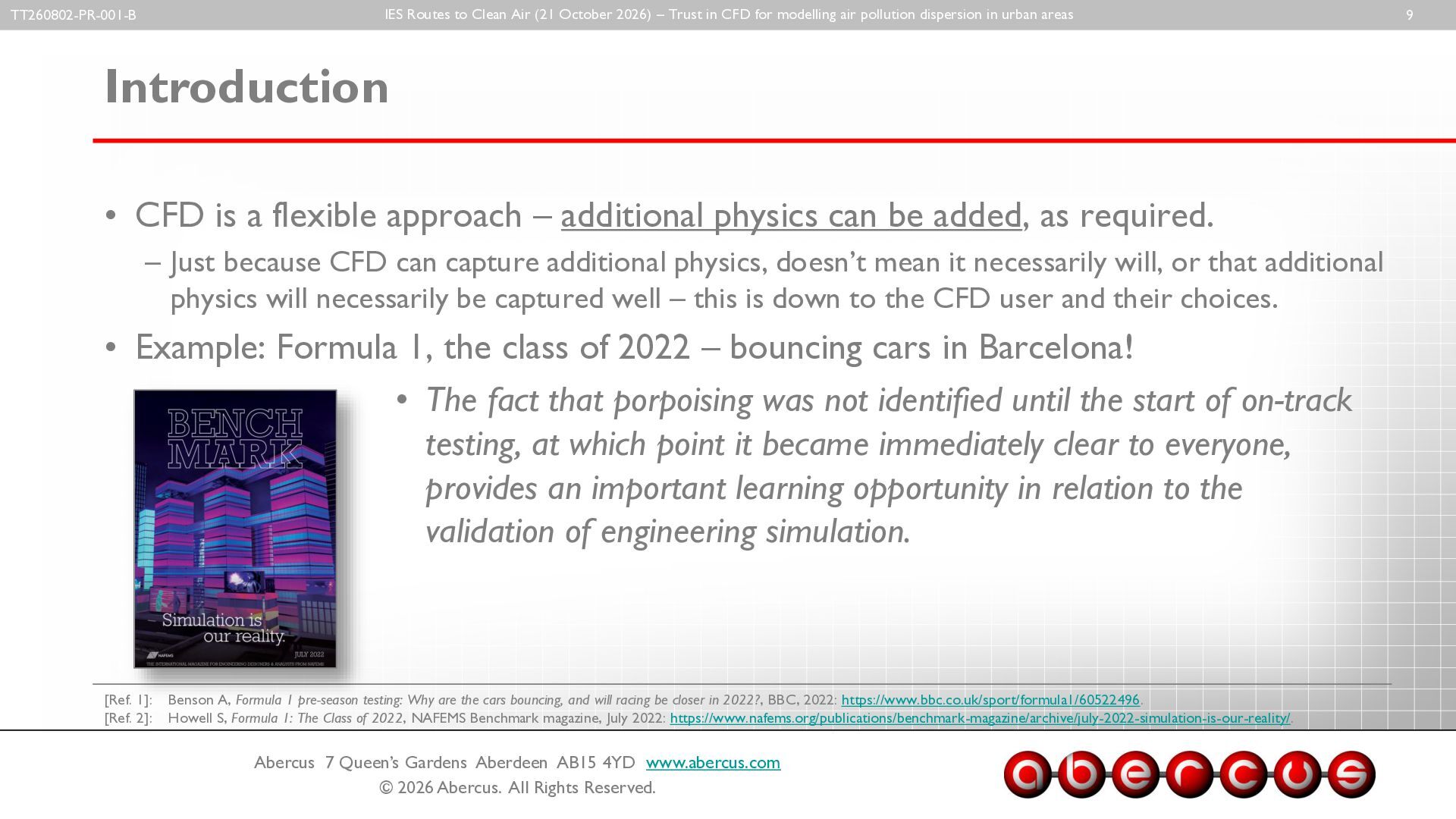
in CFD for modelling air pollution dispersion in urban areas TT260802-PR-001-B 8 Introduction • CFD is a flexible approach – additional physics can be added, as required. – Just because CFD can capture additional physics, doesn’t mean it necessarily will, or that additional physics will necessarily be captured well – this is down to the CFD user and their choices. • Example: Formula 1, the class of 2022 – bouncing cars in Barcelona! Air is accelerated within venturi under car, causing reduction in pressure and associated increase in downforce Inverted wing section within sidepod forms venturi under car Skirt to seal venturi under car Videos of bouncing cars in February 2022: https://www.youtube.com/watch?v=NgPd9bCYX3w. (Go straight to 0:36 and 2:00 to see the Ferrari cars bouncing along the track.) [Ref. 1]: [Ref. 2]: Benson A, Formula 1 pre-season testing: Why are the cars bouncing, and will racing be closer in 2022?, BBC, 2022: https://www.bbc.co.uk/sport/formula1/60522496. Howell S, Formula 1: The Class of 2022, NAFEMS Benchmark magazine, July 2022: https://www.nafems.org/publications/benchmark-magazine/archive/july-2022-simulation-is-our-reality/. www.abercus.com Abercus 7 Queen’s Gardens Aberdeen AB15 4YD www.abercus.com © 2026 Abercus. All Rights Reserved. www.abercus.com
IES Routes to Clean Air (21 October 2026) – Trust
in CFD for modelling air pollution dispersion in urban areas TT260802-PR-001-B Introduction • CFD is a flexible approach – additional physics can be added, as required. – Just because CFD can capture additional physics, doesn’t mean it necessarily will, or that additional physics will necessarily be captured well – this is down to the CFD user and their choices. • Example: Formula 1, the class of 2022 – bouncing cars in Barcelona! • The fact that porpoising was not identified until the start of on-track testing, at which point it became immediately clear to everyone, provides an important learning opportunity in relation to the validation of engineering simulation. [Ref. 1]: [Ref. 2]: Benson A, Formula 1 pre-season testing: Why are the cars bouncing, and will racing be closer in 2022?, BBC, 2022: https://www.bbc.co.uk/sport/formula1/60522496. Howell S, Formula 1: The Class of 2022, NAFEMS Benchmark magazine, July 2022: https://www.nafems.org/publications/benchmark-magazine/archive/july-2022-simulation-is-our-reality/. www.abercus.com Abercus 7 Queen’s Gardens Aberdeen AB15 4YD www.abercus.com © 2026 Abercus. All Rights Reserved. www.abercus.com 9
IES Routes to Clean Air (21 October 2026) – Trust
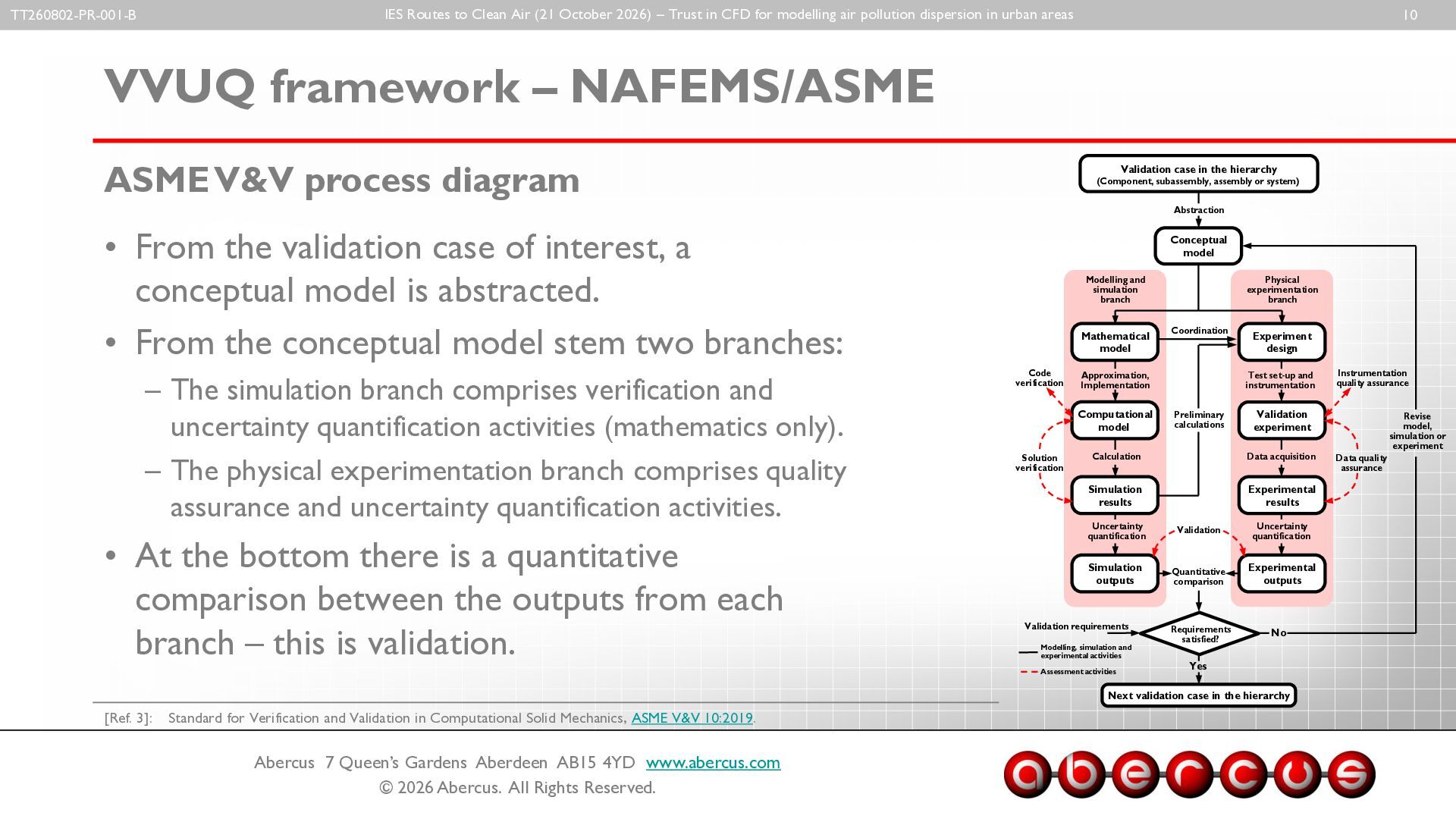
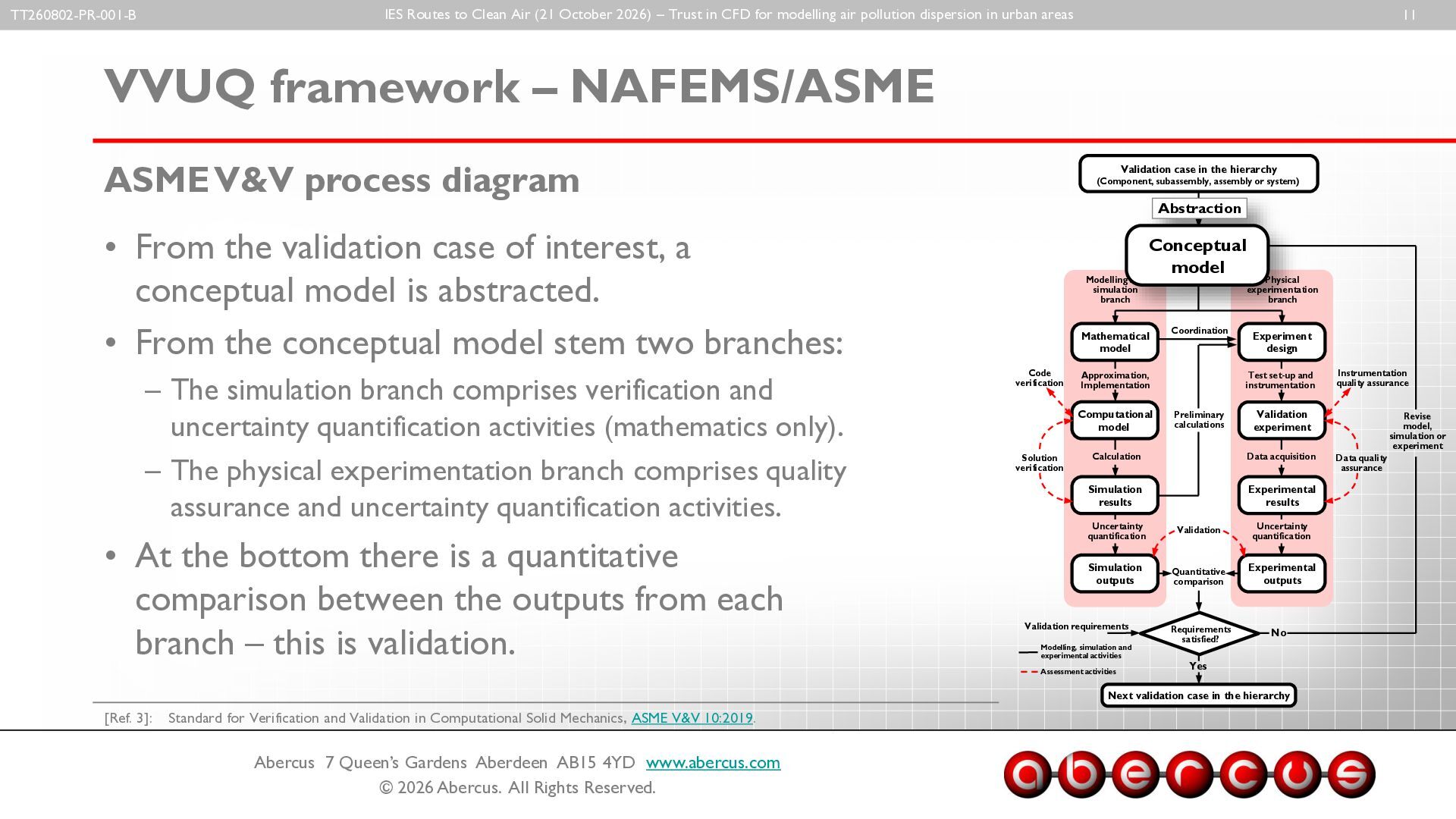
in CFD for modelling air pollution dispersion in urban areas TT260802-PR-001-B 10 VVUQ framework – NAFEMS/ASME ASME V&V process diagram Validation case in the hierarchy (Component, subassembly, assembly or system) Abstraction • From the validation case of interest, a conceptual model is abstracted. • From the conceptual model stem two branches: – The simulation branch comprises verification and uncertainty quantification activities (mathematics only). – The physical experimentation branch comprises quality assurance and uncertainty quantification activities. Conceptual model Modelling and simulation branch Mathematical model Code verification • At the bottom there is a quantitative comparison between the outputs from each branch – this is validation. Coordination Approximation, Implementation Computational model Solution verification Physical experimentation branch Experiment design Test set-up and instrumentation Preliminary calculations Validation experiment Calculation Data acquisition Simulation results Experimental results Uncertainty quantification Validation Uncertainty quantification Simulation outputs Quantitative comparison Experimental outputs Requirements satisfied? No Validation requirements Modelling, simulation and experimental activities Assessment activities Yes Next validation case in the hierarchy [Ref. 3]: Standard for Verification and Validation in Computational Solid Mechanics, ASME V&V 10:2019. www.abercus.com Abercus 7 Queen’s Gardens Aberdeen AB15 4YD www.abercus.com © 2026 Abercus. All Rights Reserved. www.abercus.com Instrumentation quality assurance Revise model, simulation or experiment Data quality assurance
IES Routes to Clean Air (21 October 2026) – Trust
in CFD for modelling air pollution dispersion in urban areas TT260802-PR-001-B 11 VVUQ framework – NAFEMS/ASME ASME V&V process diagram Validation case in the hierarchy (Component, subassembly, assembly or system) Abstraction Abstraction • From the validation case of interest, a conceptual model is abstracted. • From the conceptual model stem two branches: – The simulation branch comprises verification and uncertainty quantification activities (mathematics only). – The physical experimentation branch comprises quality assurance and uncertainty quantification activities. Modelling and simulation branch Conceptual Conceptual model model Mathematical model Code verification Approximation, Implementation Computational model Solution verification • At the bottom there is a quantitative comparison between the outputs from each branch – this is validation. Coordination Physical experimentation branch Experiment design Test set-up and instrumentation Preliminary calculations Validation experiment Calculation Data acquisition Simulation results Experimental results Uncertainty quantification Validation Uncertainty quantification Simulation outputs Quantitative comparison Experimental outputs Requirements satisfied? No Validation requirements Modelling, simulation and experimental activities Assessment activities Yes Next validation case in the hierarchy [Ref. 3]: Standard for Verification and Validation in Computational Solid Mechanics, ASME V&V 10:2019. www.abercus.com Abercus 7 Queen’s Gardens Aberdeen AB15 4YD www.abercus.com © 2026 Abercus. All Rights Reserved. www.abercus.com Instrumentation quality assurance Revise model, simulation or experiment Data quality assurance
IES Routes to Clean Air (21 October 2026) – Trust
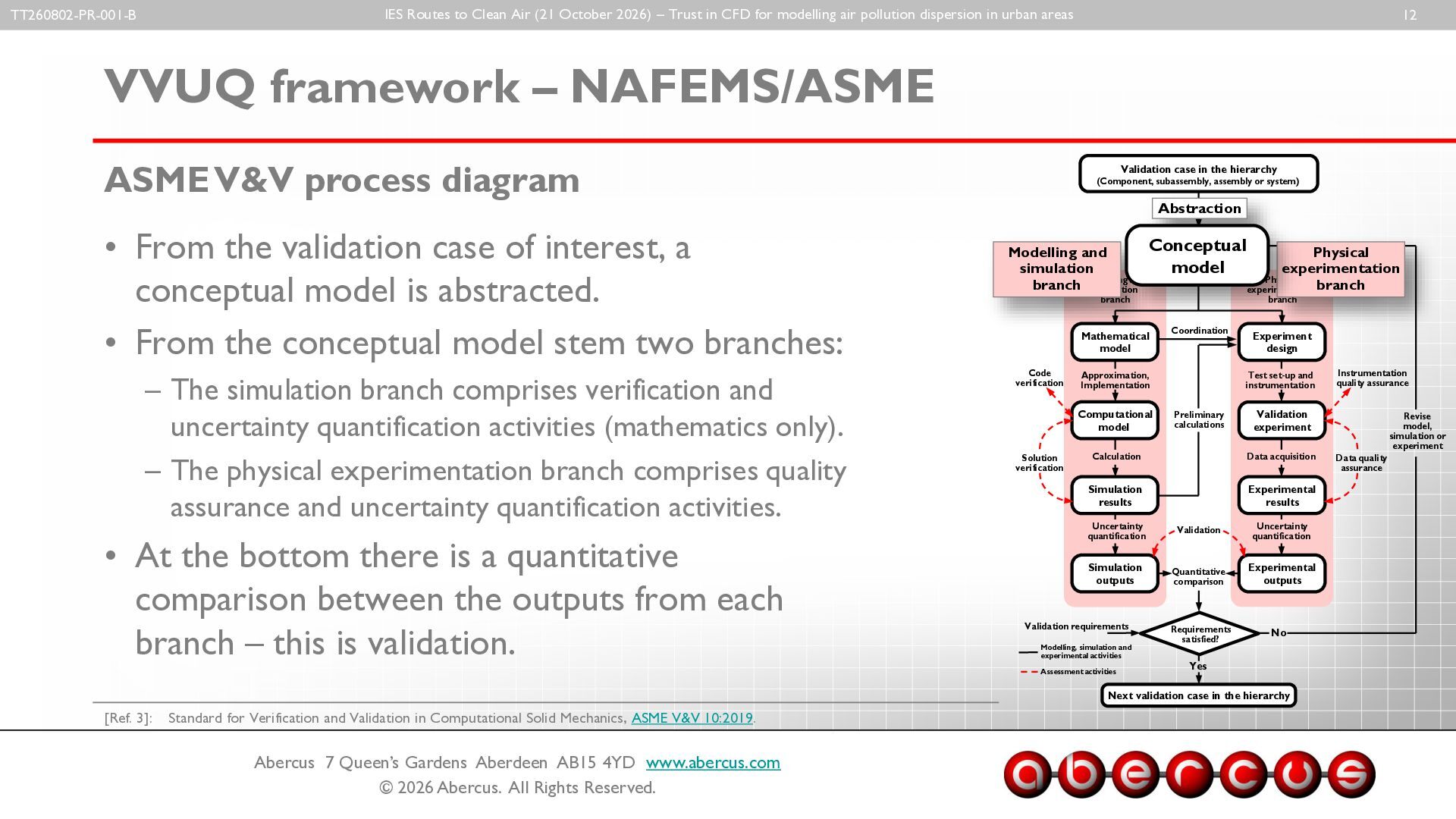
in CFD for modelling air pollution dispersion in urban areas TT260802-PR-001-B 12 VVUQ framework – NAFEMS/ASME ASME V&V process diagram Validation case in the hierarchy (Component, subassembly, assembly or system) Abstraction Abstraction • From the validation case of interest, a conceptual model is abstracted. • From the conceptual model stem two branches: – The simulation branch comprises verification and uncertainty quantification activities (mathematics only). – The physical experimentation branch comprises quality assurance and uncertainty quantification activities. Conceptual Conceptual model Physical Modelling and model experimentation simulation and Physical branch Modelling simulation experimentationbranch branch Mathematical model Code verification • At the bottom there is a quantitative comparison between the outputs from each branch – this is validation. Coordination Approximation, Implementation Computational model Solution verification branch Experiment design Test set-up and instrumentation Preliminary calculations Validation experiment Calculation Data acquisition Simulation results Experimental results Uncertainty quantification Validation Uncertainty quantification Simulation outputs Quantitative comparison Experimental outputs Requirements satisfied? No Validation requirements Modelling, simulation and experimental activities Assessment activities Yes Next validation case in the hierarchy [Ref. 3]: Standard for Verification and Validation in Computational Solid Mechanics, ASME V&V 10:2019. www.abercus.com Abercus 7 Queen’s Gardens Aberdeen AB15 4YD www.abercus.com © 2026 Abercus. All Rights Reserved. www.abercus.com Instrumentation quality assurance Revise model, simulation or experiment Data quality assurance
IES Routes to Clean Air (21 October 2026) – Trust
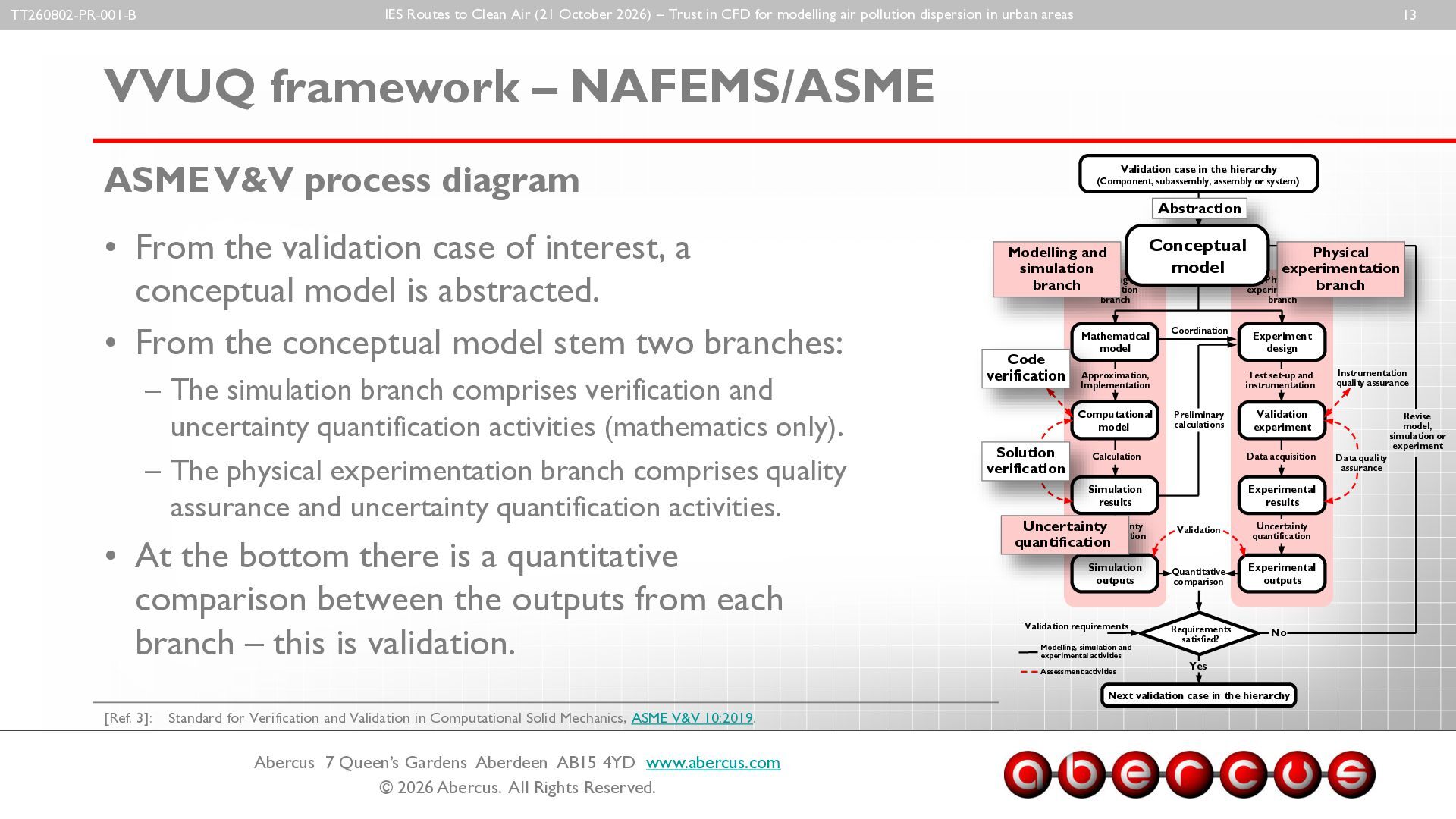
in CFD for modelling air pollution dispersion in urban areas TT260802-PR-001-B 13 VVUQ framework – NAFEMS/ASME ASME V&V process diagram Validation case in the hierarchy (Component, subassembly, assembly or system) Abstraction Abstraction • From the validation case of interest, a conceptual model is abstracted. • From the conceptual model stem two branches: – The simulation branch comprises verification and uncertainty quantification activities (mathematics only). – The physical experimentation branch comprises quality assurance and uncertainty quantification activities. • At the bottom there is a quantitative comparison between the outputs from each branch – this is validation. Conceptual Conceptual model Physical Modelling and model experimentation simulation and Physical branch Modelling simulation experimentationbranch branch Code Code verification verification Mathematical model Coordination Approximation, Implementation Computational model Solution Solution verification verification branch Experiment design Test set-up and instrumentation Preliminary calculations Validation experiment Calculation Data acquisition Simulation results Experimental results Uncertainty Uncertainty quantification quantification Validation Uncertainty quantification Simulation outputs Quantitative comparison Experimental outputs Requirements satisfied? No Validation requirements Modelling, simulation and experimental activities Assessment activities Yes Next validation case in the hierarchy [Ref. 3]: Standard for Verification and Validation in Computational Solid Mechanics, ASME V&V 10:2019. www.abercus.com Abercus 7 Queen’s Gardens Aberdeen AB15 4YD www.abercus.com © 2026 Abercus. All Rights Reserved. www.abercus.com Instrumentation quality assurance Revise model, simulation or experiment Data quality assurance
IES Routes to Clean Air (21 October 2026) – Trust
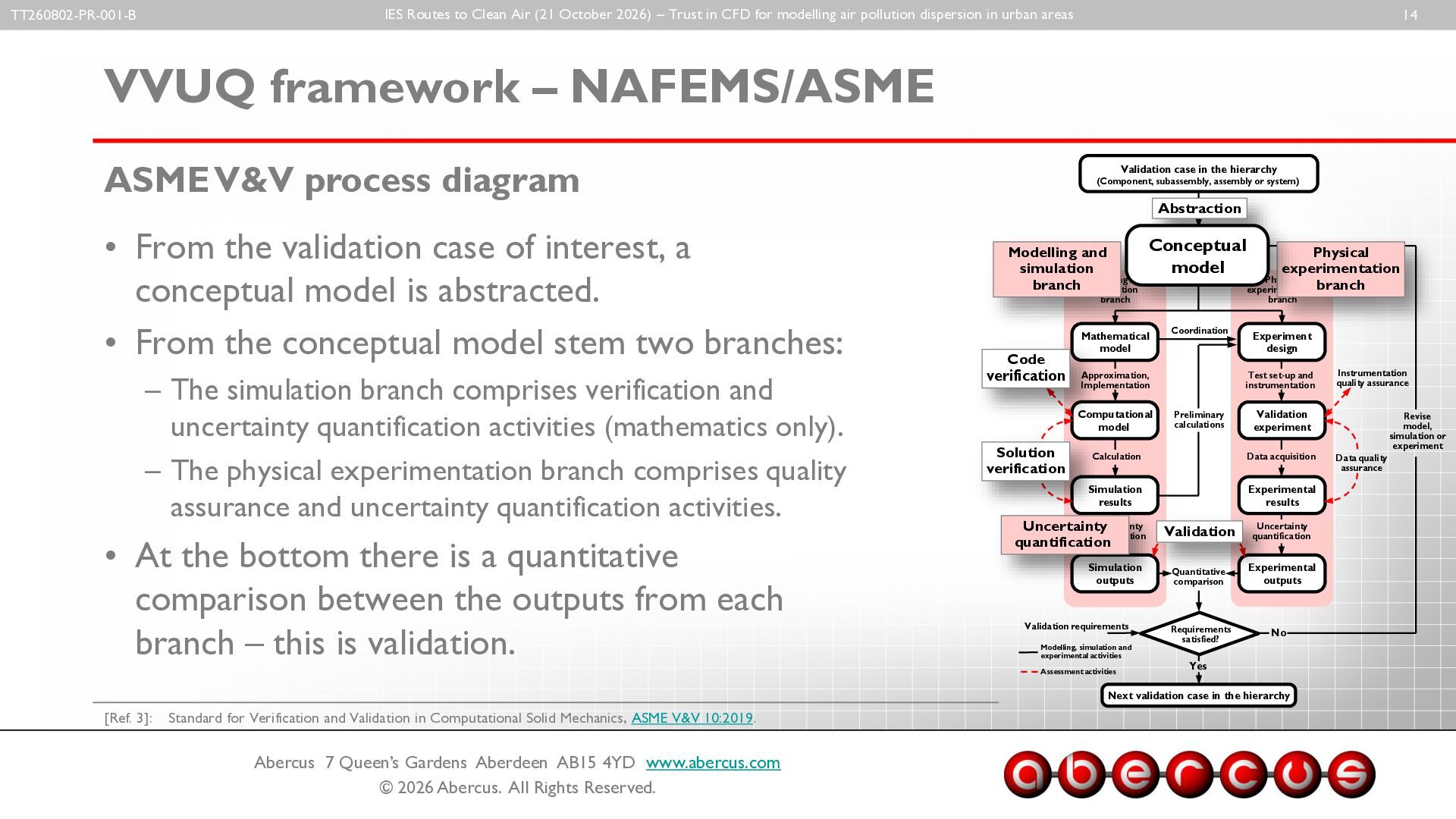
in CFD for modelling air pollution dispersion in urban areas TT260802-PR-001-B 14 VVUQ framework – NAFEMS/ASME ASME V&V process diagram Validation case in the hierarchy (Component, subassembly, assembly or system) Abstraction Abstraction • From the validation case of interest, a conceptual model is abstracted. • From the conceptual model stem two branches: – The simulation branch comprises verification and uncertainty quantification activities (mathematics only). – The physical experimentation branch comprises quality assurance and uncertainty quantification activities. • At the bottom there is a quantitative comparison between the outputs from each branch – this is validation. Conceptual Conceptual model Physical Modelling and model experimentation simulation and Physical branch Modelling simulation experimentationbranch branch Code Code verification verification Mathematical model Coordination Approximation, Implementation Computational model Solution Solution verification verification branch Experiment design Test set-up and instrumentation Preliminary calculations Validation experiment Calculation Data acquisition Simulation results Experimental results Uncertainty Uncertainty quantification quantification Simulation outputs Validation requirements Modelling, simulation and experimental activities Assessment activities Validation Validation Uncertainty quantification Quantitative comparison Experimental outputs Requirements satisfied? No Yes Next validation case in the hierarchy [Ref. 3]: Standard for Verification and Validation in Computational Solid Mechanics, ASME V&V 10:2019. www.abercus.com Abercus 7 Queen’s Gardens Aberdeen AB15 4YD www.abercus.com © 2026 Abercus. All Rights Reserved. www.abercus.com Instrumentation quality assurance Revise model, simulation or experiment Data quality assurance
TT260802-PR-001-B IES Routes to Clean Air (21 October 2026) –
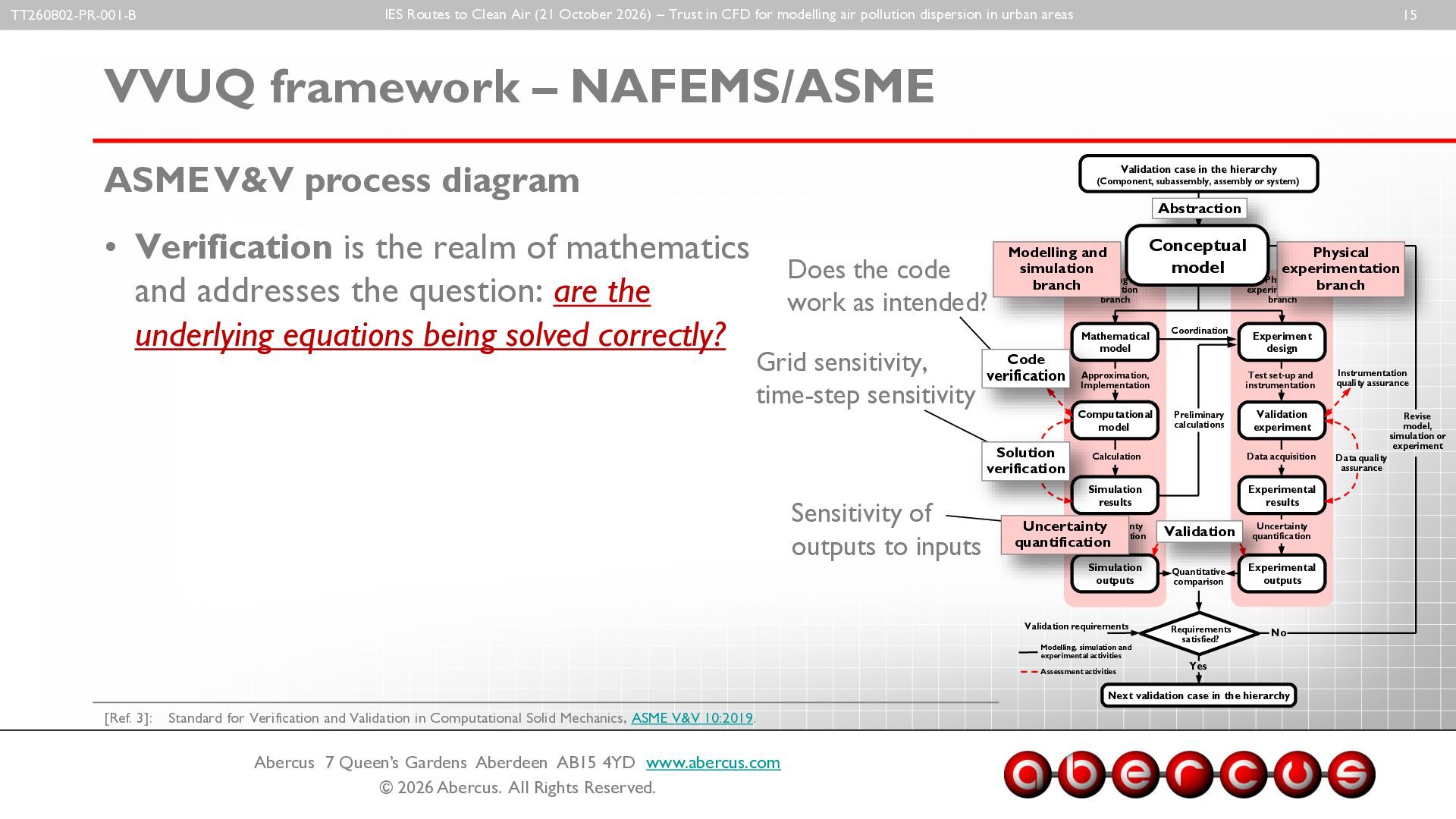
Trust in CFD for modelling air pollution dispersion in urban areas 15 VVUQ framework – NAFEMS/ASME ASME V&V process diagram Validation case in the hierarchy (Component, subassembly, assembly or system) Abstraction Abstraction • Verification is the realm of mathematics and addresses the question: are the underlying equations being solved correctly? Conceptual Does the code work as intended? Conceptual model Physical Modelling and model experimentation simulation and Physical branch Modelling simulation experimentationbranch branch Code Grid sensitivity, verification time-step sensitivity Code verification Solution Solution verification verification Sensitivity of outputs to inputs Mathematical model branch Coordination Approximation, Implementation Computational model Experiment design Test set-up and instrumentation Preliminary calculations Validation experiment Calculation Data acquisition Simulation results Experimental results Uncertainty Uncertainty quantification quantification Simulation outputs Validation requirements Modelling, simulation and experimental activities Assessment activities Validation Validation Uncertainty quantification Quantitative comparison Experimental outputs Requirements satisfied? No Yes Next validation case in the hierarchy [Ref. 3]: Standard for Verification and Validation in Computational Solid Mechanics, ASME V&V 10:2019. www.abercus.com Abercus 7 Queen’s Gardens Aberdeen AB15 4YD www.abercus.com © 2026 Abercus. All Rights Reserved. www.abercus.com Instrumentation quality assurance Revise model, simulation or experiment Data quality assurance
TT260802-PR-001-B IES Routes to Clean Air (21 October 2026) –
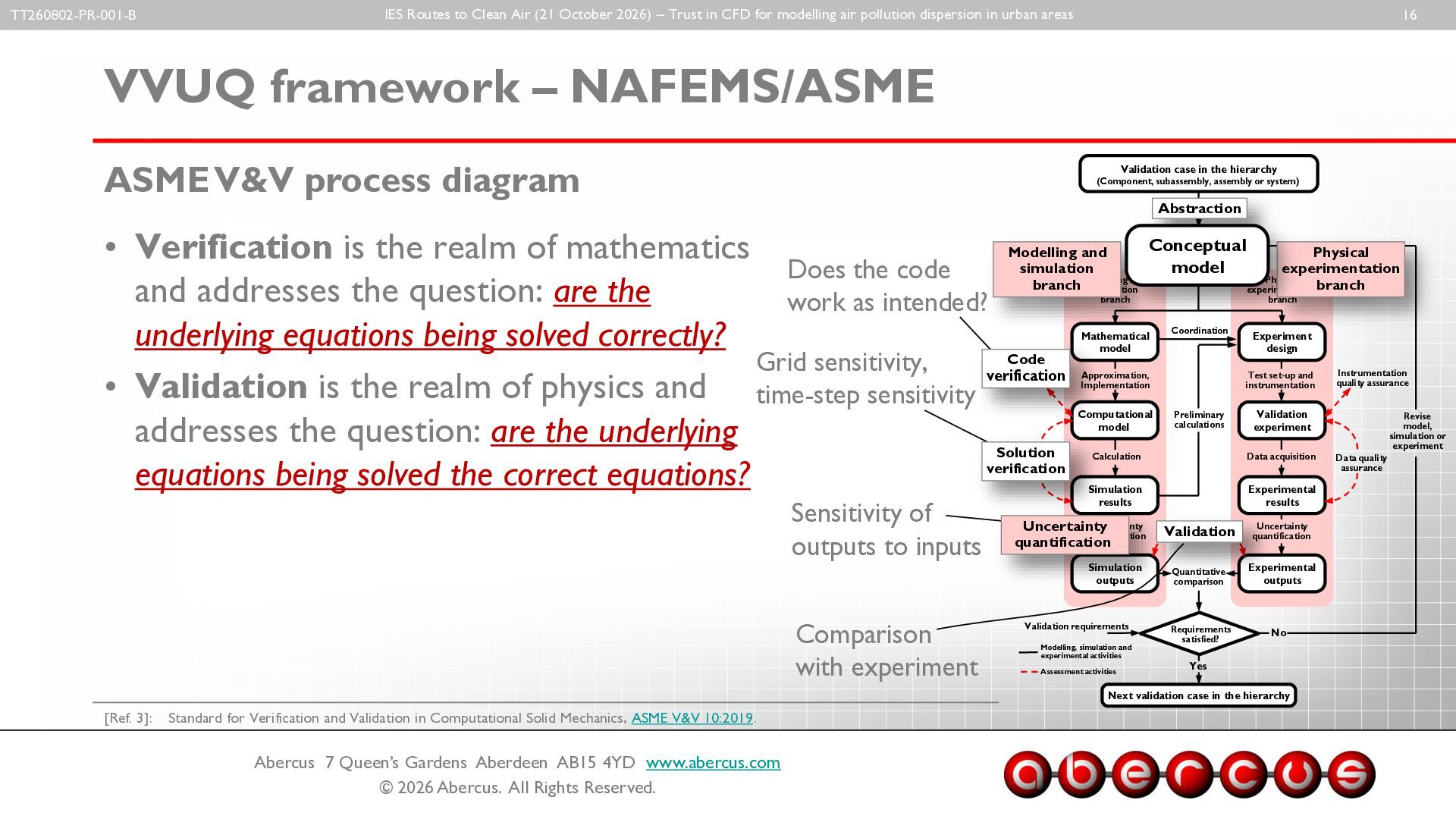
Trust in CFD for modelling air pollution dispersion in urban areas 16 VVUQ framework – NAFEMS/ASME ASME V&V process diagram Validation case in the hierarchy (Component, subassembly, assembly or system) Abstraction Abstraction Modelling and • Verification is the realm of mathematics simulation Does the code branch and addresses the question: are the work as intended? underlying equations being solved correctly? Code Grid sensitivity, verification • Validation is the realm of physics and time-step sensitivity addresses the question: are the underlying Solution verification equations being solved the correct equations? Modelling and simulation branch Conceptual Conceptual model model Mathematical model Code verification Solution verification Sensitivity of outputs to inputs Coordination Experiment design Test set-up and instrumentation Preliminary calculations Data acquisition Simulation results Experimental results Simulation outputs Validation requirements Modelling, simulation and experimental activities Assessment activities Validation Validation Uncertainty quantification Quantitative comparison Experimental outputs Requirements satisfied? No Yes Next validation case in the hierarchy [Ref. 3]: Standard for Verification and Validation in Computational Solid Mechanics, ASME V&V 10:2019. www.abercus.com Abercus 7 Queen’s Gardens Aberdeen AB15 4YD www.abercus.com © 2026 Abercus. All Rights Reserved. www.abercus.com Instrumentation quality assurance Validation experiment Calculation Uncertainty Uncertainty quantification quantification Comparison with experiment branch Approximation, Implementation Computational model Physical experimentation Physical experimentationbranch Revise model, simulation or experiment Data quality assurance
TT260802-PR-001-B IES Routes to Clean Air (21 October 2026) –
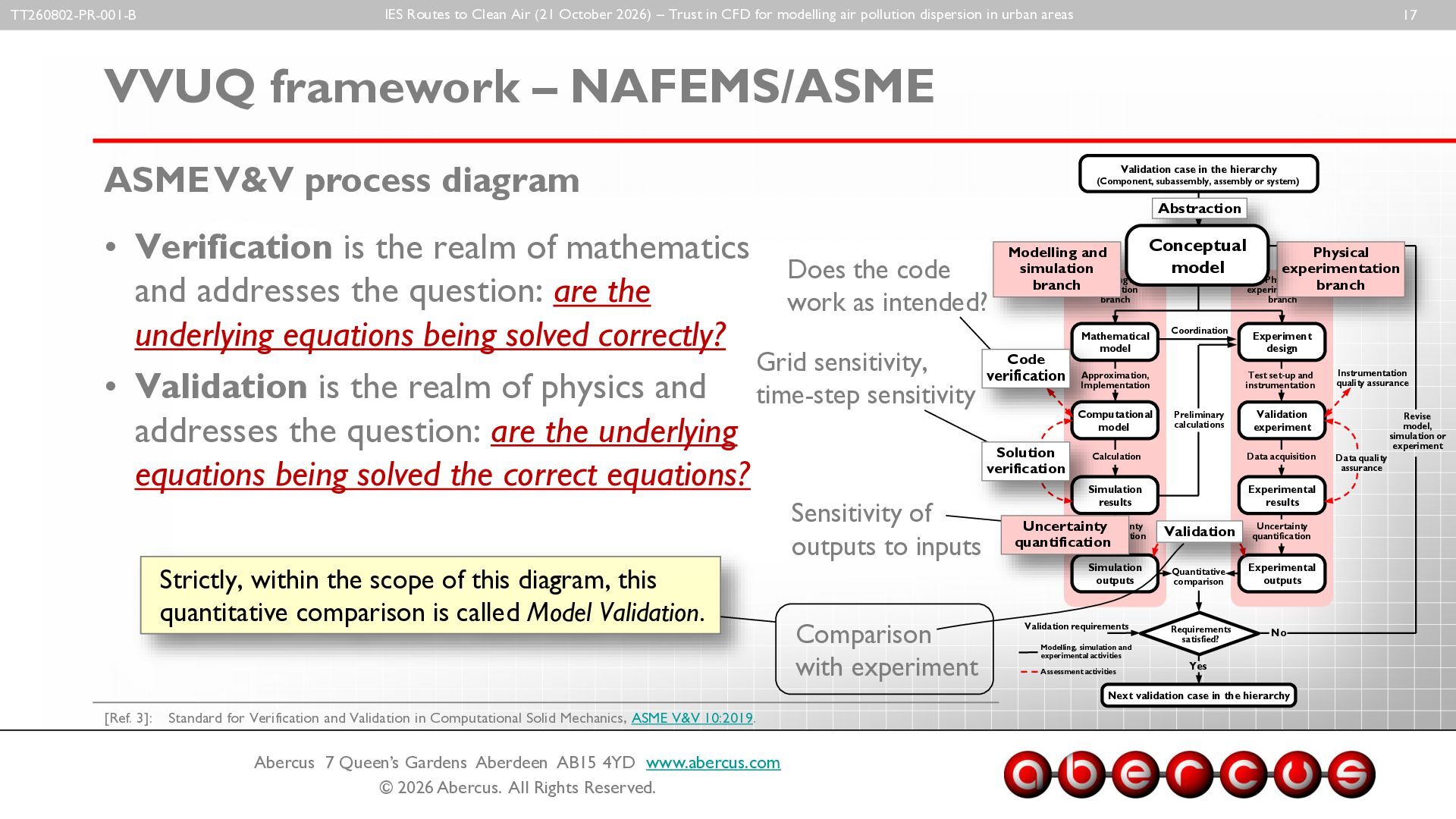
Trust in CFD for modelling air pollution dispersion in urban areas 17 VVUQ framework – NAFEMS/ASME ASME V&V process diagram Validation case in the hierarchy (Component, subassembly, assembly or system) Abstraction Abstraction Modelling and • Verification is the realm of mathematics simulation Does the code branch and addresses the question: are the work as intended? underlying equations being solved correctly? Code Grid sensitivity, verification • Validation is the realm of physics and time-step sensitivity addresses the question: are the underlying Solution verification equations being solved the correct equations? Modelling and simulation branch Conceptual Conceptual model model Mathematical model Code verification Solution verification Sensitivity of outputs to inputs Strictly, within the scope of this diagram, this quantitative comparison is called Model Validation. Coordination Experiment design Test set-up and instrumentation Preliminary calculations Data acquisition Simulation results Experimental results Simulation outputs Validation requirements Modelling, simulation and experimental activities Assessment activities Validation Validation Uncertainty quantification Quantitative comparison Experimental outputs Requirements satisfied? No Yes Next validation case in the hierarchy [Ref. 3]: Standard for Verification and Validation in Computational Solid Mechanics, ASME V&V 10:2019. www.abercus.com Abercus 7 Queen’s Gardens Aberdeen AB15 4YD www.abercus.com © 2026 Abercus. All Rights Reserved. www.abercus.com Instrumentation quality assurance Validation experiment Calculation Uncertainty Uncertainty quantification quantification Comparison with experiment branch Approximation, Implementation Computational model Physical experimentation Physical experimentationbranch Revise model, simulation or experiment Data quality assurance
IES Routes to Clean Air (21 October 2026) – Trust
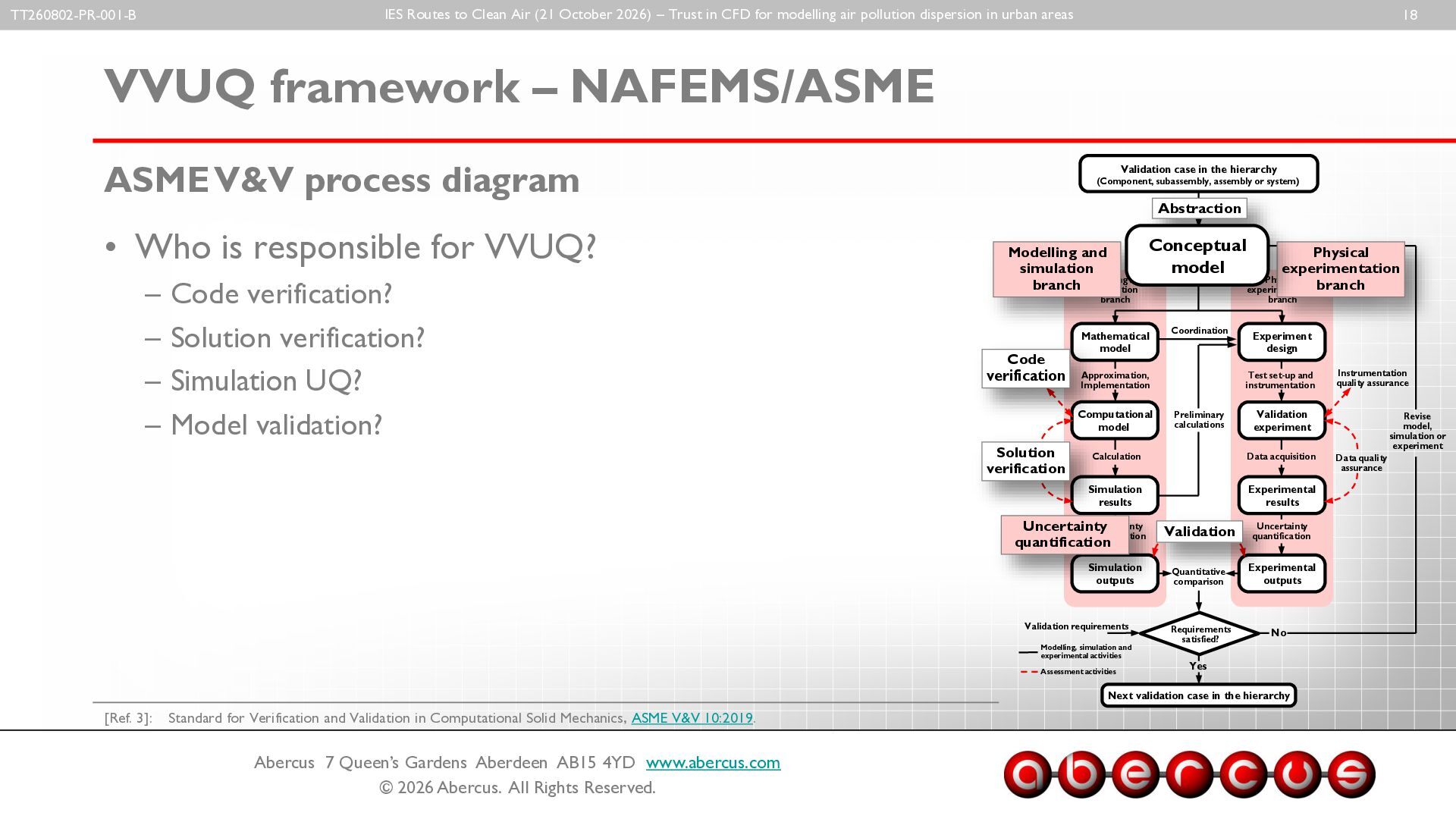
in CFD for modelling air pollution dispersion in urban areas TT260802-PR-001-B 18 VVUQ framework – NAFEMS/ASME ASME V&V process diagram Validation case in the hierarchy (Component, subassembly, assembly or system) Abstraction Abstraction • Who is responsible for VVUQ? Conceptual Conceptual model Physical Modelling and model experimentation simulation and Physical branch Modelling simulation experimentationbranch – Code verification? – Solution verification? – Simulation UQ? – Model validation? branch Code Code verification verification Mathematical model Coordination Approximation, Implementation Computational model Solution Solution verification verification branch Experiment design Test set-up and instrumentation Preliminary calculations Validation experiment Calculation Data acquisition Simulation results Experimental results Uncertainty Uncertainty quantification quantification Simulation outputs Validation requirements Modelling, simulation and experimental activities Assessment activities Validation Validation Uncertainty quantification Quantitative comparison Experimental outputs Requirements satisfied? No Yes Next validation case in the hierarchy [Ref. 3]: Standard for Verification and Validation in Computational Solid Mechanics, ASME V&V 10:2019. www.abercus.com Abercus 7 Queen’s Gardens Aberdeen AB15 4YD www.abercus.com © 2026 Abercus. All Rights Reserved. www.abercus.com Instrumentation quality assurance Revise model, simulation or experiment Data quality assurance
IES Routes to Clean Air (21 October 2026) – Trust
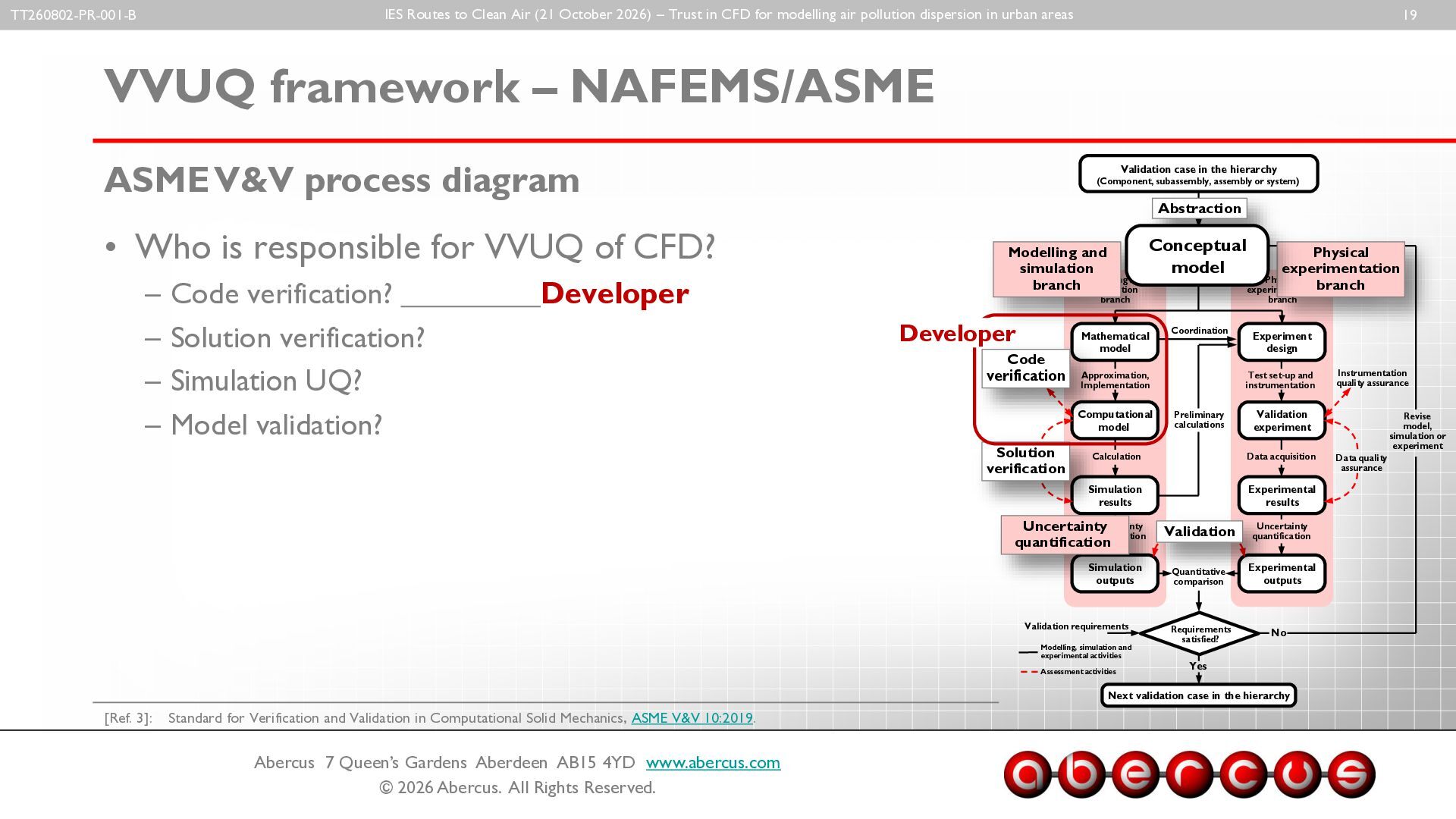
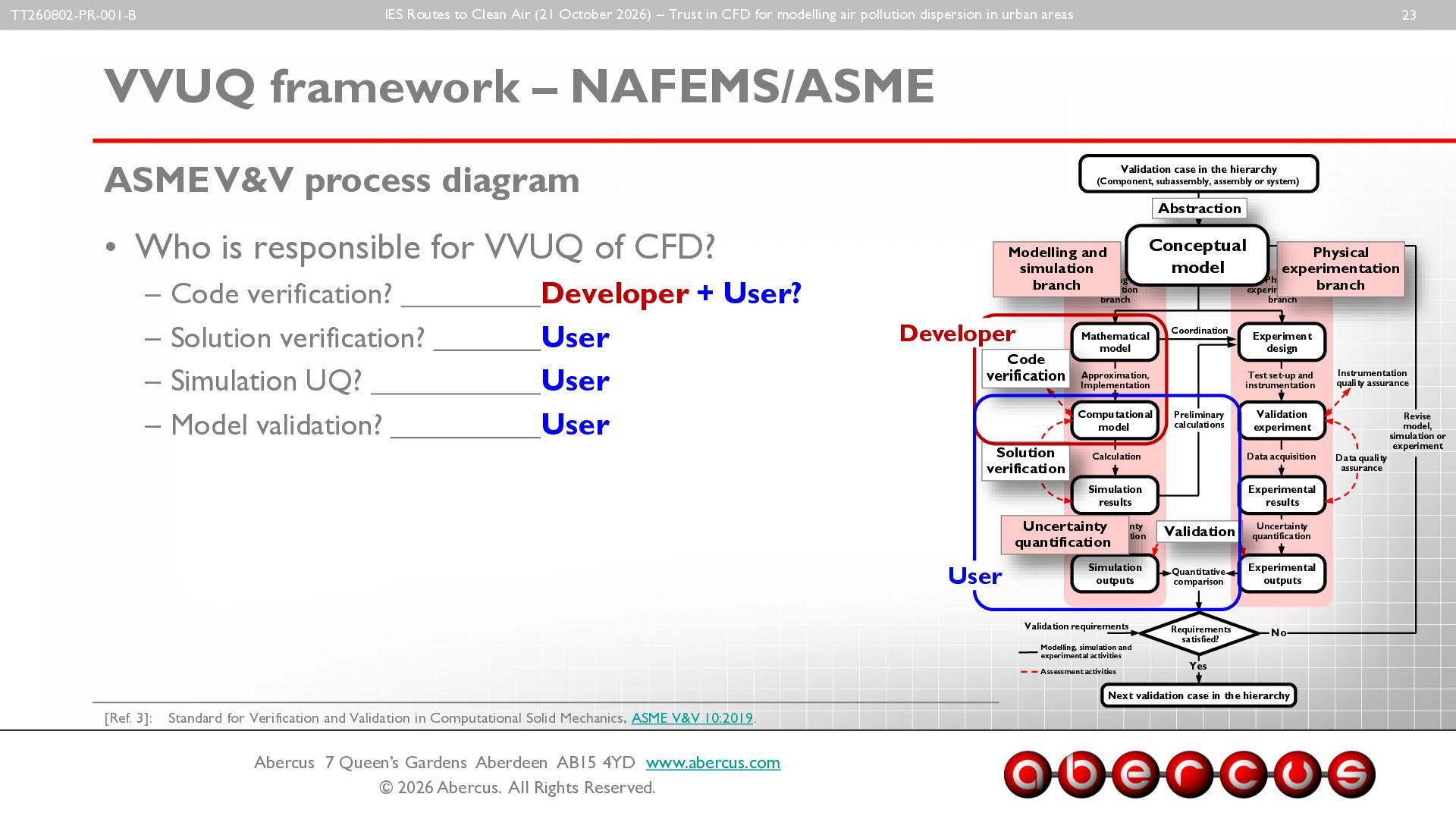
in CFD for modelling air pollution dispersion in urban areas TT260802-PR-001-B 19 VVUQ framework – NAFEMS/ASME ASME V&V process diagram Validation case in the hierarchy (Component, subassembly, assembly or system) Abstraction Abstraction • Who is responsible for VVUQ of CFD? – Code verification? – Solution verification? – Simulation UQ? – Model validation? Developer Conceptual Conceptual model Physical Modelling and model experimentation simulation and Physical branch Modelling simulation experimentationbranch branch Developer Code Code verification verification Mathematical model Coordination Approximation, Implementation Computational model Solution Solution verification verification branch Experiment design Test set-up and instrumentation Preliminary calculations Validation experiment Calculation Data acquisition Simulation results Experimental results Uncertainty Uncertainty quantification quantification Simulation outputs Validation requirements Modelling, simulation and experimental activities Assessment activities Validation Validation Uncertainty quantification Quantitative comparison Experimental outputs Requirements satisfied? No Yes Next validation case in the hierarchy [Ref. 3]: Standard for Verification and Validation in Computational Solid Mechanics, ASME V&V 10:2019. www.abercus.com Abercus 7 Queen’s Gardens Aberdeen AB15 4YD www.abercus.com © 2026 Abercus. All Rights Reserved. www.abercus.com Instrumentation quality assurance Revise model, simulation or experiment Data quality assurance
IES Routes to Clean Air (21 October 2026) – Trust
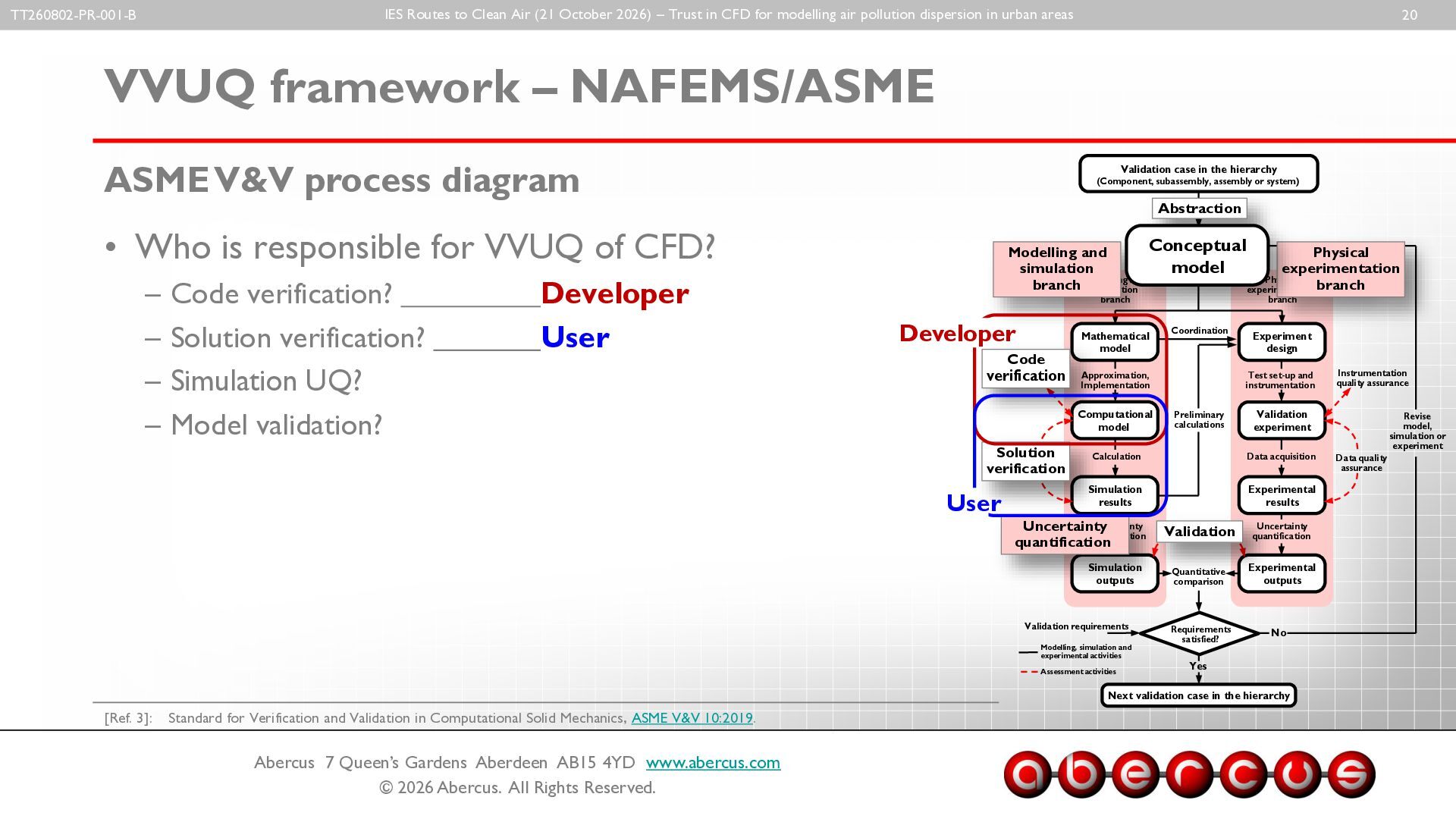
in CFD for modelling air pollution dispersion in urban areas TT260802-PR-001-B 20 VVUQ framework – NAFEMS/ASME ASME V&V process diagram Validation case in the hierarchy (Component, subassembly, assembly or system) Abstraction Abstraction • Who is responsible for VVUQ of CFD? – Code verification? – Solution verification? – Simulation UQ? – Model validation? Developer User Conceptual Conceptual model Physical Modelling and model experimentation simulation and Physical branch Modelling simulation experimentationbranch branch Developer Code Code verification verification Mathematical model User Coordination Approximation, Implementation Computational model Solution Solution verification verification branch Experiment design Test set-up and instrumentation Preliminary calculations Validation experiment Calculation Data acquisition Simulation results Experimental results Uncertainty Uncertainty quantification quantification Simulation outputs Validation requirements Modelling, simulation and experimental activities Assessment activities Validation Validation Uncertainty quantification Quantitative comparison Experimental outputs Requirements satisfied? No Yes Next validation case in the hierarchy [Ref. 3]: Standard for Verification and Validation in Computational Solid Mechanics, ASME V&V 10:2019. www.abercus.com Abercus 7 Queen’s Gardens Aberdeen AB15 4YD www.abercus.com © 2026 Abercus. All Rights Reserved. www.abercus.com Instrumentation quality assurance Revise model, simulation or experiment Data quality assurance
IES Routes to Clean Air (21 October 2026) – Trust
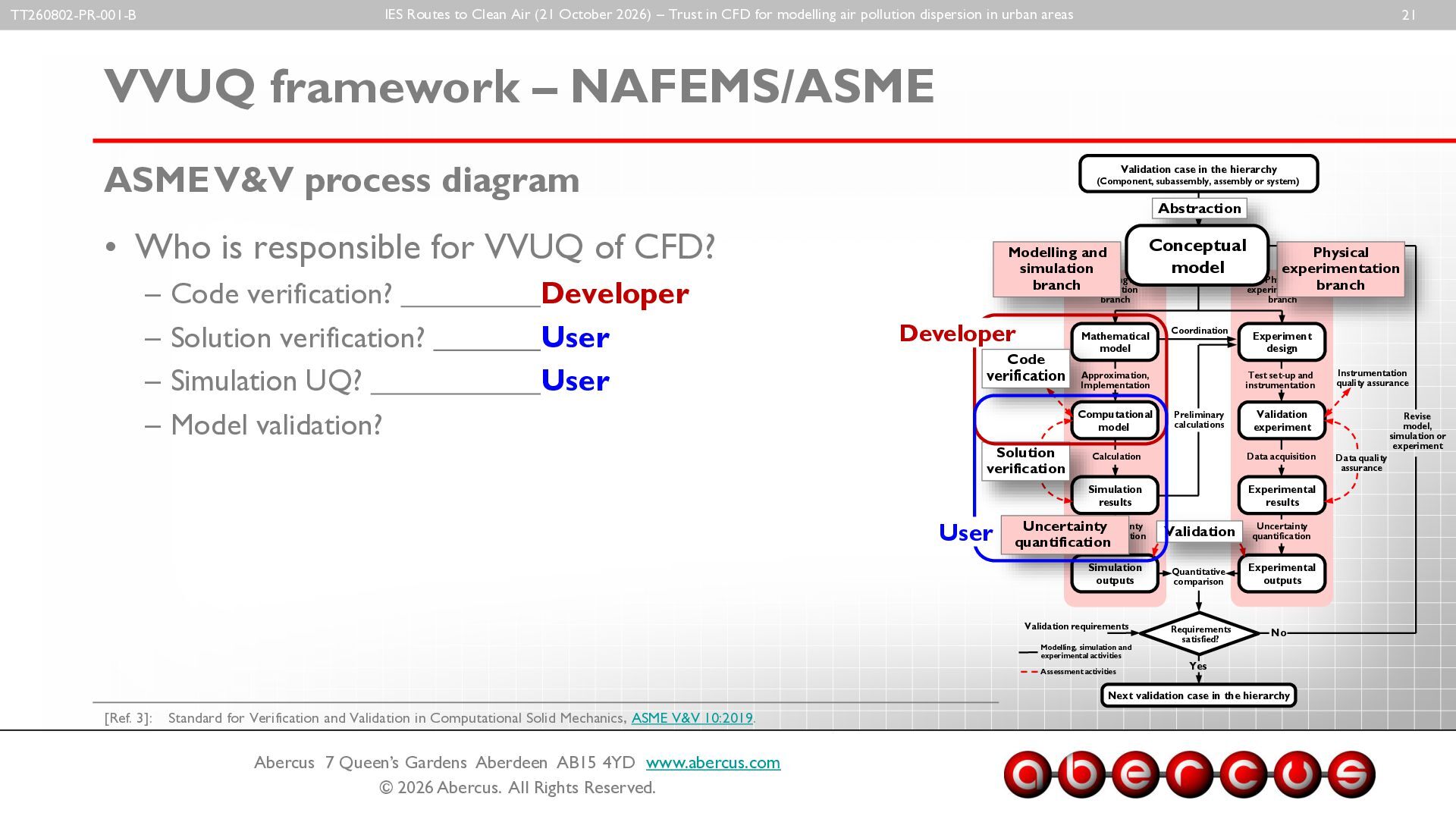
in CFD for modelling air pollution dispersion in urban areas TT260802-PR-001-B 21 VVUQ framework – NAFEMS/ASME ASME V&V process diagram Validation case in the hierarchy (Component, subassembly, assembly or system) Abstraction Abstraction • Who is responsible for VVUQ of CFD? – Code verification? – Solution verification? – Simulation UQ? – Model validation? Developer User User Conceptual Conceptual model Physical Modelling and model experimentation simulation and Physical branch Modelling simulation experimentationbranch branch Developer Code Code verification verification Mathematical model User Coordination Approximation, Implementation Computational model Solution Solution verification verification branch Experiment design Test set-up and instrumentation Preliminary calculations Validation experiment Calculation Data acquisition Simulation results Experimental results Uncertainty Uncertainty quantification quantification Simulation outputs Validation requirements Modelling, simulation and experimental activities Assessment activities Validation Validation Uncertainty quantification Quantitative comparison Experimental outputs Requirements satisfied? No Yes Next validation case in the hierarchy [Ref. 3]: Standard for Verification and Validation in Computational Solid Mechanics, ASME V&V 10:2019. www.abercus.com Abercus 7 Queen’s Gardens Aberdeen AB15 4YD www.abercus.com © 2026 Abercus. All Rights Reserved. www.abercus.com Instrumentation quality assurance Revise model, simulation or experiment Data quality assurance
IES Routes to Clean Air (21 October 2026) – Trust
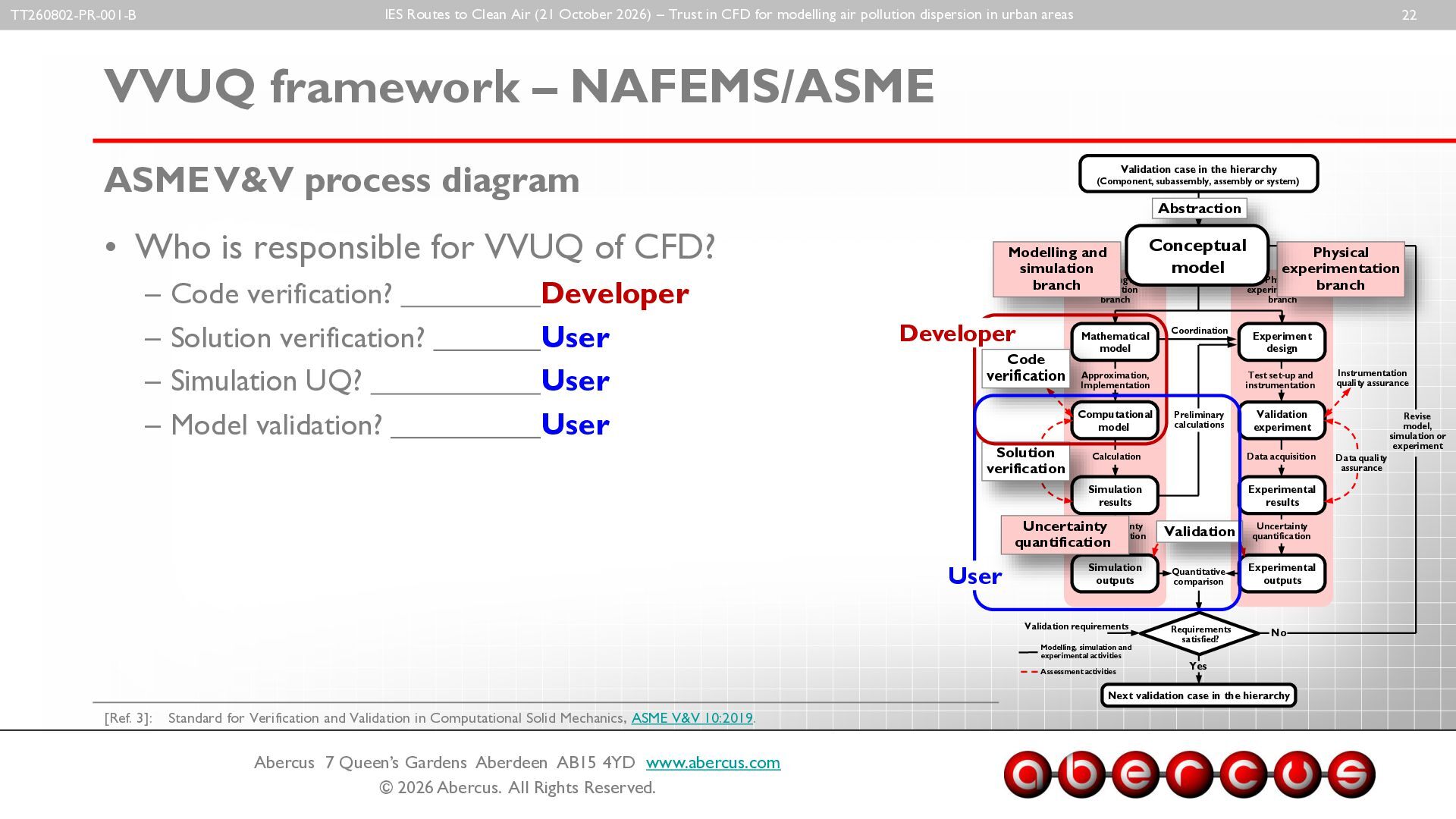
in CFD for modelling air pollution dispersion in urban areas TT260802-PR-001-B 22 VVUQ framework – NAFEMS/ASME ASME V&V process diagram Validation case in the hierarchy (Component, subassembly, assembly or system) Abstraction Abstraction • Who is responsible for VVUQ of CFD? – Code verification? – Solution verification? – Simulation UQ? – Model validation? Developer User User User Conceptual Conceptual model Physical Modelling and model experimentation simulation and Physical branch Modelling simulation experimentationbranch branch Developer Code Code verification verification Mathematical model Experiment design Test set-up and instrumentation Preliminary calculations Data acquisition Simulation results Experimental results Simulation outputs Validation requirements Modelling, simulation and experimental activities Assessment activities Validation Validation Uncertainty quantification Quantitative comparison Experimental outputs Requirements satisfied? No Yes Next validation case in the hierarchy [Ref. 3]: Standard for Verification and Validation in Computational Solid Mechanics, ASME V&V 10:2019. www.abercus.com Abercus 7 Queen’s Gardens Aberdeen AB15 4YD www.abercus.com © 2026 Abercus. All Rights Reserved. www.abercus.com Instrumentation quality assurance Validation experiment Calculation Uncertainty Uncertainty quantification quantification User Coordination Approximation, Implementation Computational model Solution Solution verification verification branch Revise model, simulation or experiment Data quality assurance
IES Routes to Clean Air (21 October 2026) – Trust
in CFD for modelling air pollution dispersion in urban areas TT260802-PR-001-B 23 VVUQ framework – NAFEMS/ASME ASME V&V process diagram Validation case in the hierarchy (Component, subassembly, assembly or system) Abstraction Abstraction • Who is responsible for VVUQ of CFD? – Code verification? – Solution verification? – Simulation UQ? – Model validation? Developer + User? User User User Conceptual Conceptual model Physical Modelling and model experimentation simulation and Physical branch Modelling simulation experimentationbranch branch Developer Code Code verification verification Mathematical model Experiment design Test set-up and instrumentation Preliminary calculations Data acquisition Simulation results Experimental results Simulation outputs Validation requirements Modelling, simulation and experimental activities Assessment activities Validation Validation Uncertainty quantification Quantitative comparison Experimental outputs Requirements satisfied? No Yes Next validation case in the hierarchy [Ref. 3]: Standard for Verification and Validation in Computational Solid Mechanics, ASME V&V 10:2019. www.abercus.com Abercus 7 Queen’s Gardens Aberdeen AB15 4YD www.abercus.com © 2026 Abercus. All Rights Reserved. www.abercus.com Instrumentation quality assurance Validation experiment Calculation Uncertainty Uncertainty quantification quantification User Coordination Approximation, Implementation Computational model Solution Solution verification verification branch Revise model, simulation or experiment Data quality assurance
TT260802-PR-001-B IES Routes to Clean Air (21 October 2026) –
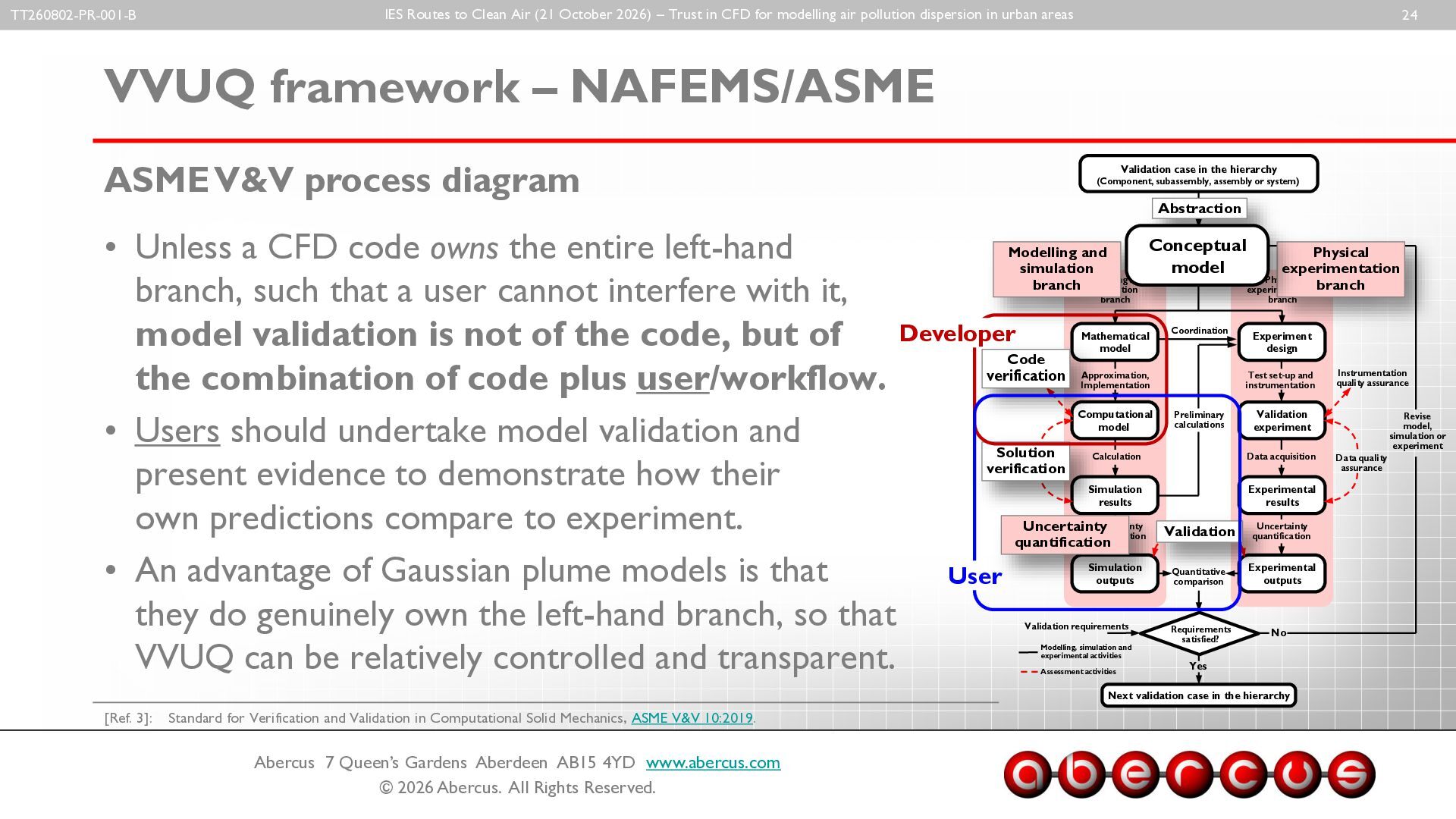
Trust in CFD for modelling air pollution dispersion in urban areas 24 VVUQ framework – NAFEMS/ASME ASME V&V process diagram Validation case in the hierarchy (Component, subassembly, assembly or system) Abstraction Abstraction Modelling and • Unless a CFD code owns the entire left-hand simulation branch branch, such that a user cannot interfere with it, Developer model validation is not of the code, but of Code verification the combination of code plus user/workflow. • Users should undertake model validation and Solution verification present evidence to demonstrate how their own predictions compare to experiment. Uncertainty quantification • An advantage of Gaussian plume models is that User they do genuinely own the left-hand branch, so that VVUQ can be relatively controlled and transparent. Modelling and simulation branch Conceptual Conceptual model model Mathematical model Code verification Solution verification branch Coordination Approximation, Implementation Computational model Physical experimentation Physical experimentationbranch Experiment design Test set-up and instrumentation Preliminary calculations Validation experiment Calculation Data acquisition Simulation results Experimental results Uncertainty quantification Validation Validation Uncertainty quantification Simulation outputs Quantitative comparison Experimental outputs Requirements satisfied? No Validation requirements Modelling, simulation and experimental activities Assessment activities Yes Next validation case in the hierarchy [Ref. 3]: Standard for Verification and Validation in Computational Solid Mechanics, ASME V&V 10:2019. www.abercus.com Abercus 7 Queen’s Gardens Aberdeen AB15 4YD www.abercus.com © 2026 Abercus. All Rights Reserved. www.abercus.com Instrumentation quality assurance Revise model, simulation or experiment Data quality assurance
IES Routes to Clean Air (21 October 2026) – Trust
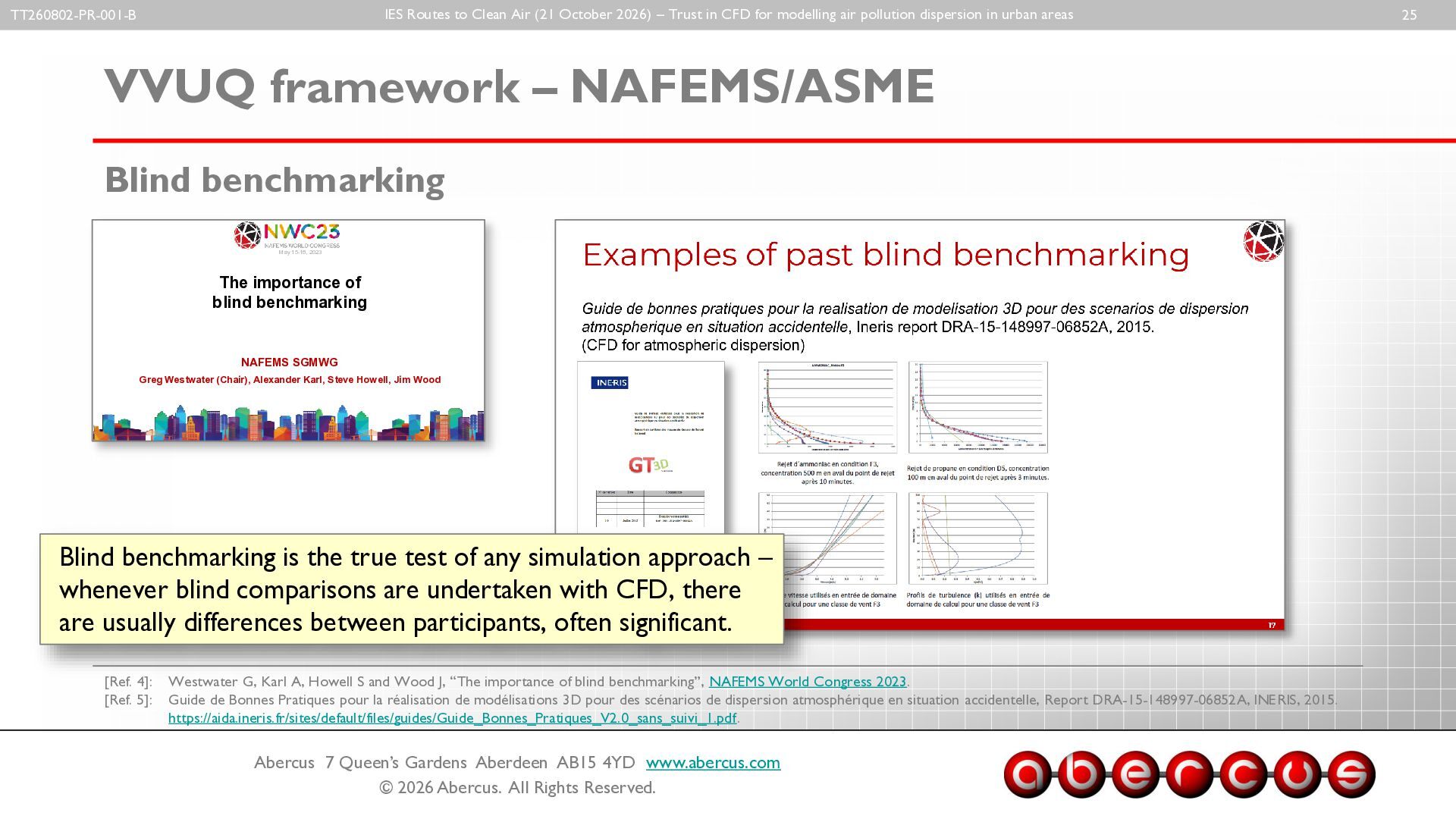
in CFD for modelling air pollution dispersion in urban areas TT260802-PR-001-B VVUQ framework – NAFEMS/ASME Blind benchmarking May 15-18, 2023 The importance of blind benchmarking NAFEMS SGMWG Greg Westwater (Chair), Alexander Karl, Steve Howell, Jim Wood NAFEMS World Congress 2023 | Tampa, Florida, USA | May 15-18 2023 2 Blind benchmarking is the true test of any simulation approach – whenever blind comparisons are undertaken with CFD, there are usually differences between participants, often significant. [Ref. 4]: [Ref. 5]: Westwater G, Karl A, Howell S and Wood J, “The importance of blind benchmarking”, NAFEMS World Congress 2023. Guide de Bonnes Pratiques pour la réalisation de modélisations 3D pour des scénarios de dispersion atmosphérique en situation accidentelle, Report DRA-15-148997-06852A, INERIS, 2015. https://aida.ineris.fr/sites/default/files/guides/Guide_Bonnes_Pratiques_V2.0_sans_suivi_1.pdf. www.abercus.com Abercus 7 Queen’s Gardens Aberdeen AB15 4YD www.abercus.com © 2026 Abercus. All Rights Reserved. www.abercus.com 25
IES Routes to Clean Air (21 October 2026) – Trust
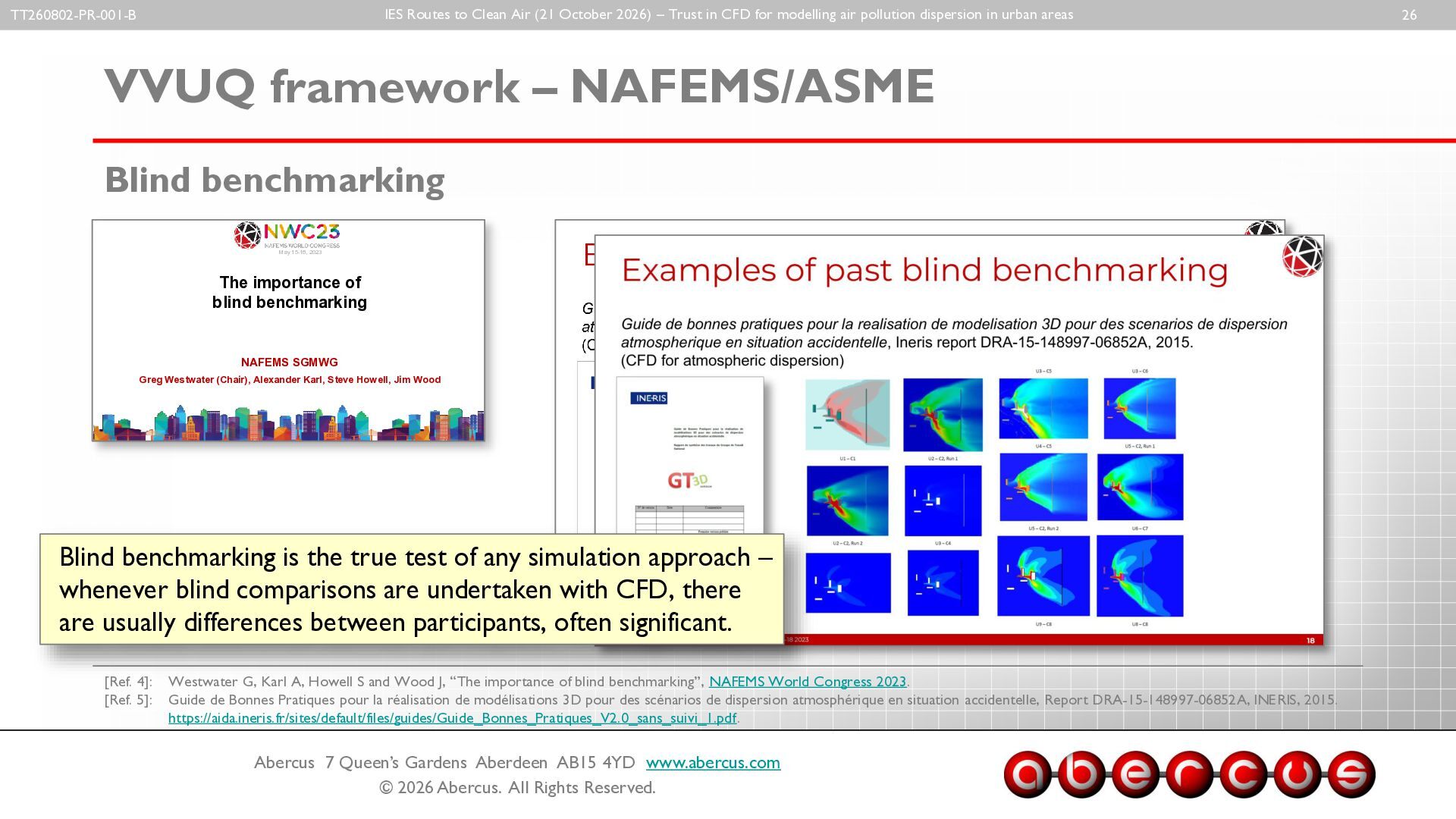
in CFD for modelling air pollution dispersion in urban areas TT260802-PR-001-B VVUQ framework – NAFEMS/ASME Blind benchmarking May 15-18, 2023 The importance of blind benchmarking NAFEMS SGMWG Greg Westwater (Chair), Alexander Karl, Steve Howell, Jim Wood NAFEMS World Congress 2023 | Tampa, Florida, USA | May 15-18 2023 2 Blind benchmarking is the true test of any simulation approach – whenever blind comparisons are undertaken with CFD, there are usually differences between participants, often significant. [Ref. 4]: [Ref. 5]: Westwater G, Karl A, Howell S and Wood J, “The importance of blind benchmarking”, NAFEMS World Congress 2023. Guide de Bonnes Pratiques pour la réalisation de modélisations 3D pour des scénarios de dispersion atmosphérique en situation accidentelle, Report DRA-15-148997-06852A, INERIS, 2015. https://aida.ineris.fr/sites/default/files/guides/Guide_Bonnes_Pratiques_V2.0_sans_suivi_1.pdf. www.abercus.com Abercus 7 Queen’s Gardens Aberdeen AB15 4YD www.abercus.com © 2026 Abercus. All Rights Reserved. www.abercus.com 26
TT260802-PR-001-B IES Routes to Clean Air (21 October 2026) –
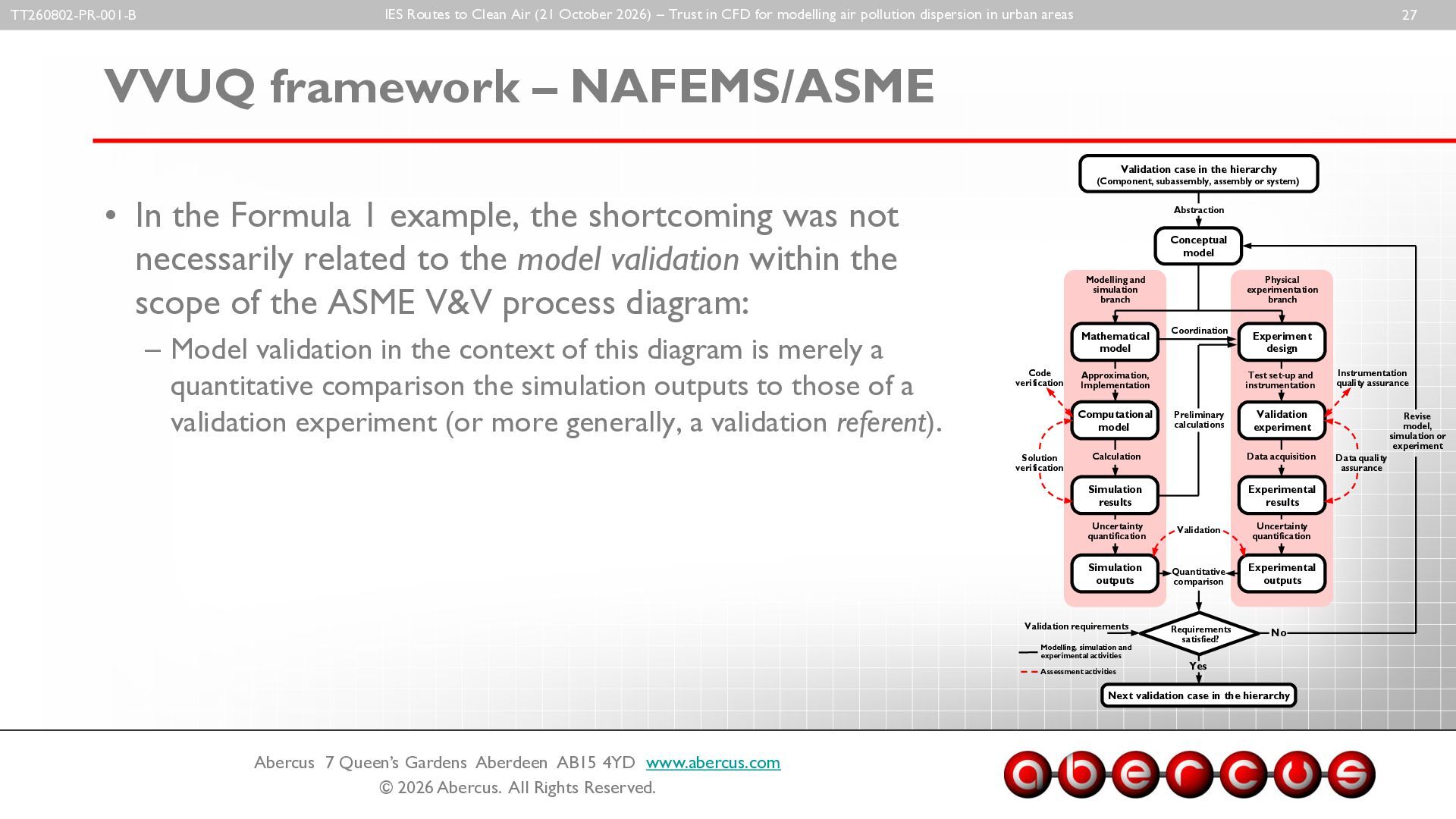
Trust in CFD for modelling air pollution dispersion in urban areas 27 VVUQ framework – NAFEMS/ASME Validation case in the hierarchy (Component, subassembly, assembly or system) • In the Formula 1 example, the shortcoming was not necessarily related to the model validation within the scope of the ASME V&V process diagram: – Model validation in the context of this diagram is merely a quantitative comparison the simulation outputs to those of a validation experiment (or more generally, a validation referent). Abstraction Conceptual model Modelling and simulation branch Mathematical model Code verification Coordination Approximation, Implementation Computational model Solution verification Physical experimentation branch Experiment design Test set-up and instrumentation Preliminary calculations Validation experiment Calculation Data acquisition Simulation results Experimental results Uncertainty quantification Validation Uncertainty quantification Simulation outputs Quantitative comparison Experimental outputs Requirements satisfied? No Validation requirements Modelling, simulation and experimental activities Assessment activities Yes Next validation case in the hierarchy www.abercus.com Abercus 7 Queen’s Gardens Aberdeen AB15 4YD www.abercus.com © 2026 Abercus. All Rights Reserved. www.abercus.com Instrumentation quality assurance Revise model, simulation or experiment Data quality assurance
TT260802-PR-001-B IES Routes to Clean Air (21 October 2026) –
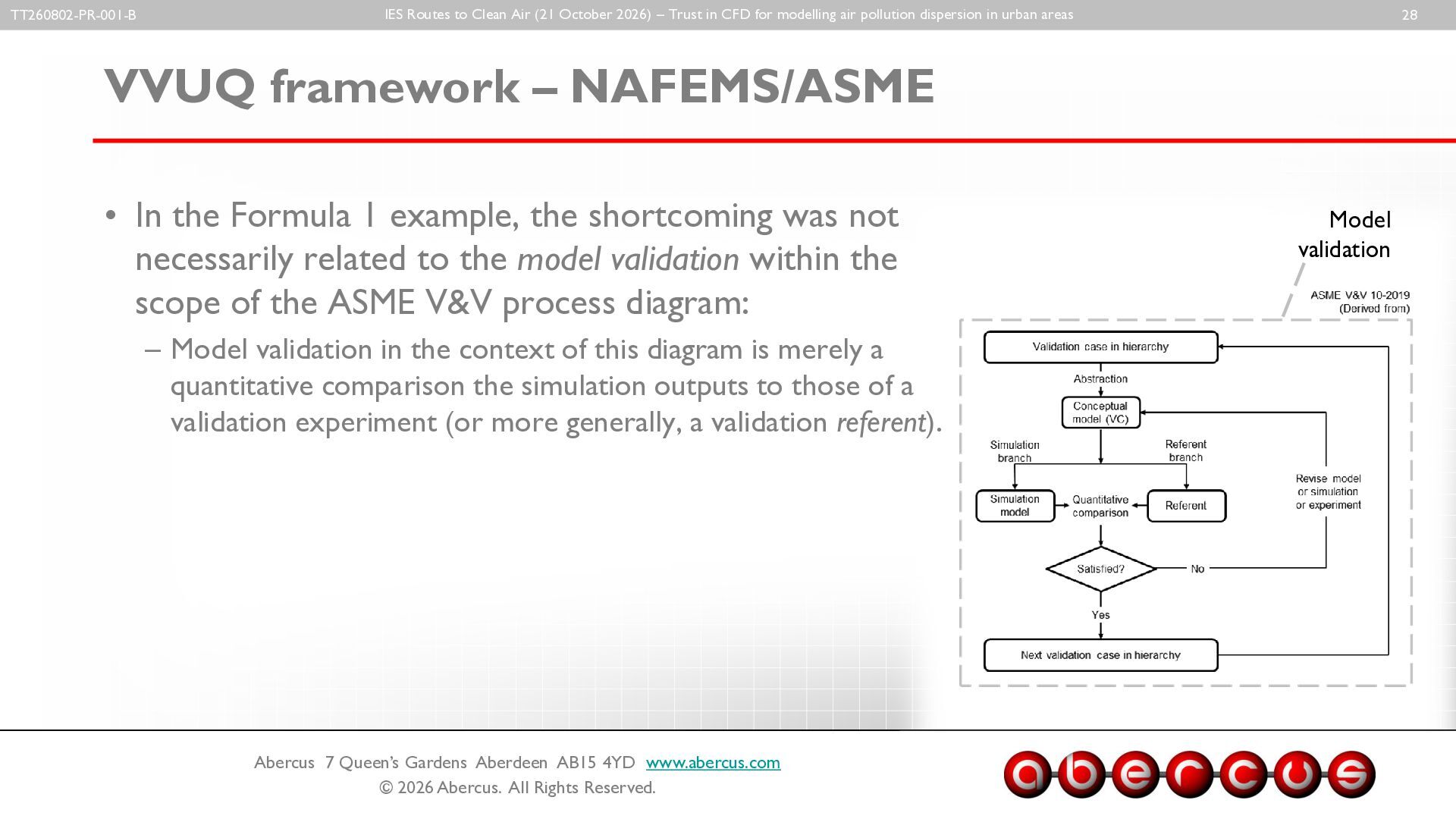
Trust in CFD for modelling air pollution dispersion in urban areas 28 VVUQ framework – NAFEMS/ASME • In the Formula 1 example, the shortcoming was not necessarily related to the model validation within the scope of the ASME V&V process diagram: Model validation – Model validation in the context of this diagram is merely a quantitative comparison the simulation outputs to those of a validation experiment (or more generally, a validation referent). www.abercus.com Abercus 7 Queen’s Gardens Aberdeen AB15 4YD www.abercus.com © 2026 Abercus. All Rights Reserved. www.abercus.com
IES Routes to Clean Air (21 October 2026) – Trust
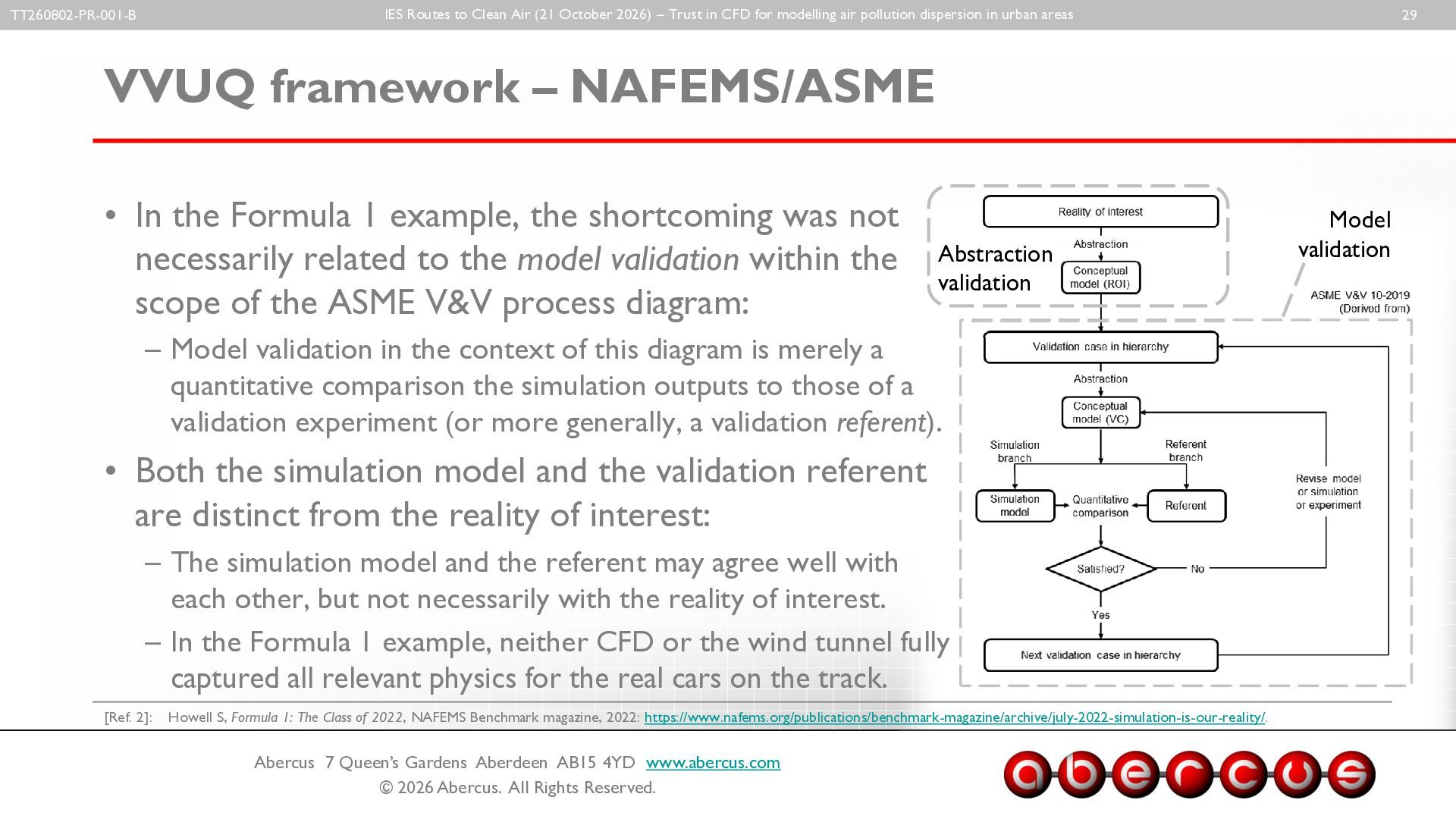
in CFD for modelling air pollution dispersion in urban areas TT260802-PR-001-B 29 VVUQ framework – NAFEMS/ASME • In the Formula 1 example, the shortcoming was not necessarily related to the model validation within the scope of the ASME V&V process diagram: Abstraction validation – Model validation in the context of this diagram is merely a quantitative comparison the simulation outputs to those of a validation experiment (or more generally, a validation referent). • Both the simulation model and the validation referent are distinct from the reality of interest: – The simulation model and the referent may agree well with each other, but not necessarily with the reality of interest. – In the Formula 1 example, neither CFD or the wind tunnel fully captured all relevant physics for the real cars on the track. [Ref. 2]: Howell S, Formula 1: The Class of 2022, NAFEMS Benchmark magazine, 2022: https://www.nafems.org/publications/benchmark-magazine/archive/july-2022-simulation-is-our-reality/. www.abercus.com Abercus 7 Queen’s Gardens Aberdeen AB15 4YD www.abercus.com © 2026 Abercus. All Rights Reserved. www.abercus.com Model validation
IES Routes to Clean Air (21 October 2026) – Trust
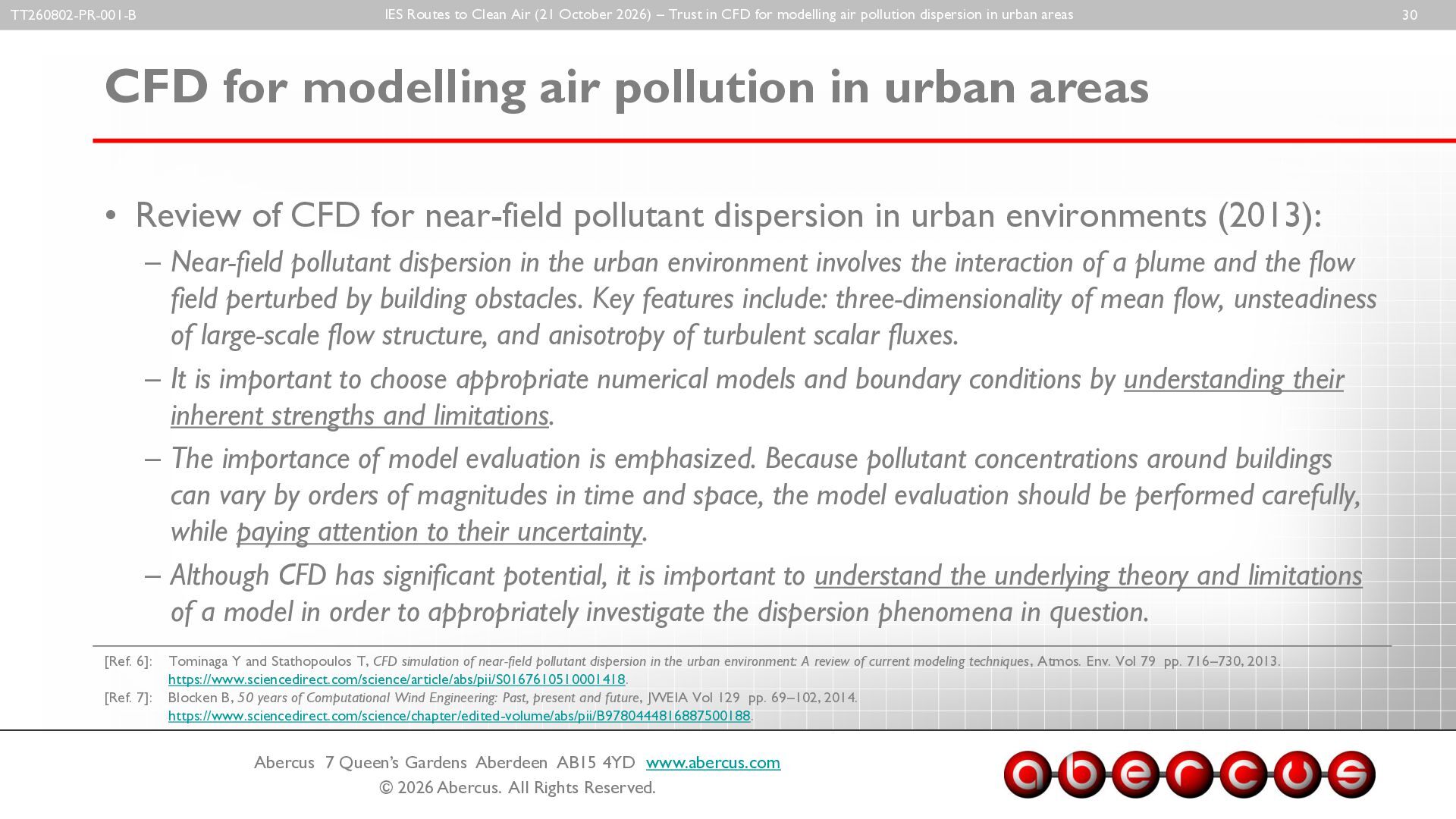
in CFD for modelling air pollution dispersion in urban areas TT260802-PR-001-B CFD for modelling air pollution in urban areas • Review of CFD for near-field pollutant dispersion in urban environments (2013): – Near-field pollutant dispersion in the urban environment involves the interaction of a plume and the flow field perturbed by building obstacles. Key features include: three-dimensionality of mean flow, unsteadiness of large-scale flow structure, and anisotropy of turbulent scalar fluxes. – It is important to choose appropriate numerical models and boundary conditions by understanding their inherent strengths and limitations. – The importance of model evaluation is emphasized. Because pollutant concentrations around buildings can vary by orders of magnitudes in time and space, the model evaluation should be performed carefully, while paying attention to their uncertainty. – Although CFD has significant potential, it is important to understand the underlying theory and limitations of a model in order to appropriately investigate the dispersion phenomena in question. [Ref. 6]: [Ref. 7]: Tominaga Y and Stathopoulos T, CFD simulation of near-field pollutant dispersion in the urban environment: A review of current modeling techniques, Atmos. Env. Vol 79 pp. 716–730, 2013. https://www.sciencedirect.com/science/article/abs/pii/S0167610510001418. Blocken B, 50 years of Computational Wind Engineering: Past, present and future, JWEIA Vol 129 pp. 69–102, 2014. https://www.sciencedirect.com/science/chapter/edited-volume/abs/pii/B9780444816887500188. www.abercus.com Abercus 7 Queen’s Gardens Aberdeen AB15 4YD www.abercus.com © 2026 Abercus. All Rights Reserved. www.abercus.com 30
IES Routes to Clean Air (21 October 2026) – Trust
in CFD for modelling air pollution dispersion in urban areas TT260802-PR-001-B CFD for modelling air pollution in urban areas Atmospheric stability • General-purpose CFD codes do not include boundary conditions for the incoming atmospheric boundary layer – this must be programmed by the CFD user: – Which model should be used? Deaves and Harris (ESDU)? Richards and Hoxey? • Can CFD solve atmospheric wind flow? – Can CFD maintain the atmospheric boundary layer within an empty domain? – Hargreaves and Wright highlight that velocity and turbulence profiles decay along the fetch of an empty CFD domain under default modelling conditions. [Ref. 8]: [Ref. 9]: Deaves DM and Harris RI, A mathematical model of the structure of strong winds, CIRIA Report 76, 1978. https://library.metoffice.gov.uk/portal/Default/en-GB/RecordView/Index/38634. Richards PJ and Hoxey RP, Appropriate boundary conditions for computational wind engineering models using the k-ε turbulence model, JWEIA Vol 46-47 pp. 145–153, 1993. https://www.sciencedirect.com/science/chapter/edited-volume/abs/pii/B9780444816887500188. [Ref. 10]: Hargreaves DM and Wright NG, On the use of the k–ε model in commercial CFD software to model the neutral atmospheric boundary layer, JWEIA Vol 95-5 pp. 355–369, 2007. https://www.sciencedirect.com/science/article/abs/pii/S016761050600136X. [Ref. 11]: Richards PJ and Norris SE, Appropriate boundary conditions for computational wind engineering models revisited, JWEIA Vol 99-4 pp. 257–266, 2011. https://www.sciencedirect.com/science/article/abs/pii/S0167610510001418. www.abercus.com Abercus 7 Queen’s Gardens Aberdeen AB15 4YD www.abercus.com © 2026 Abercus. All Rights Reserved. www.abercus.com 31
TT260802-PR-001-B IES Routes to Clean Air (21 October 2026) –
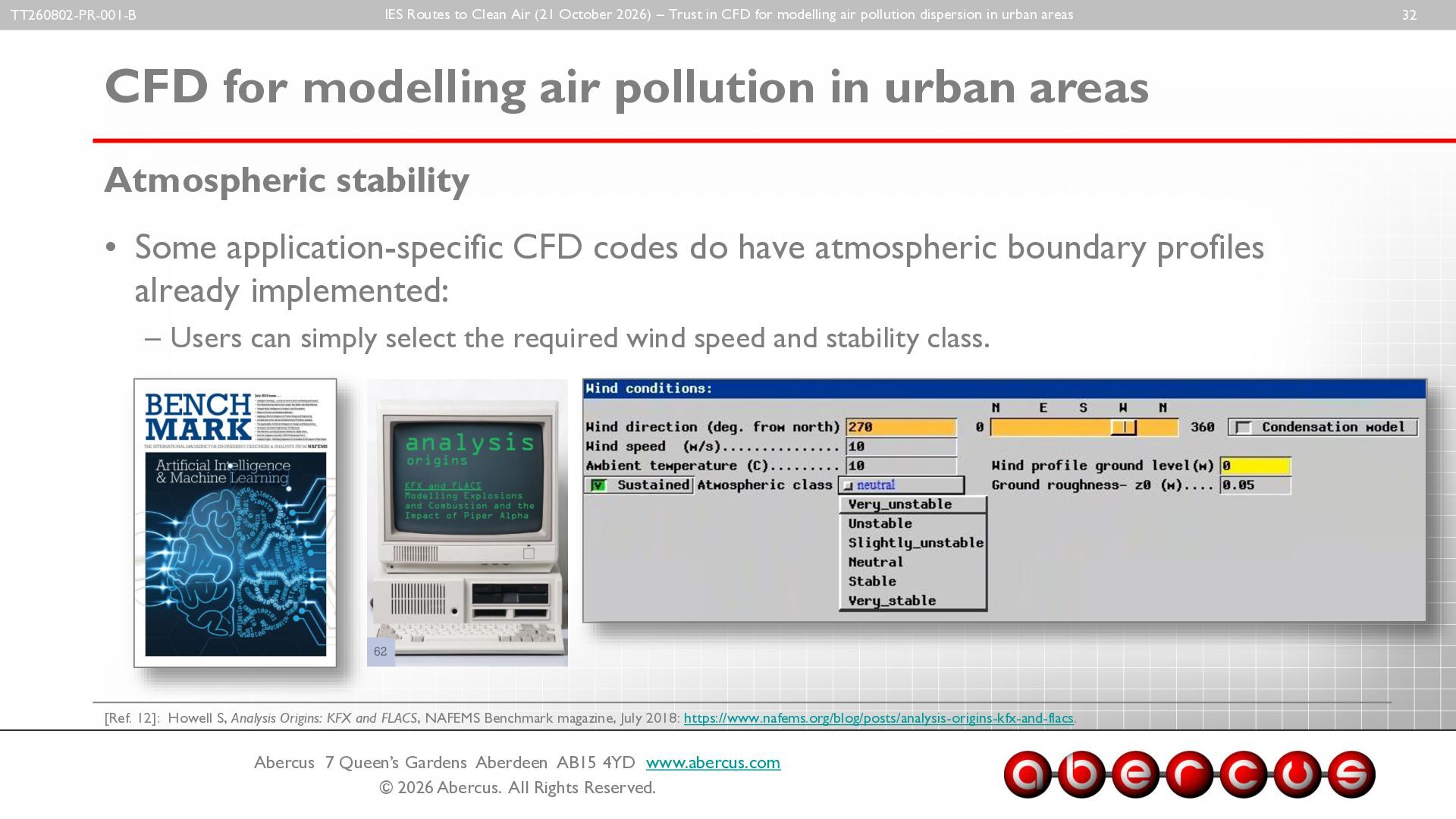
Trust in CFD for modelling air pollution dispersion in urban areas CFD for modelling air pollution in urban areas Atmospheric stability • Some application-specific CFD codes do have atmospheric boundary profiles already implemented: – Users can simply select the required wind speed and stability class. [Ref. 12]: Howell S, Analysis Origins: KFX and FLACS, NAFEMS Benchmark magazine, July 2018: https://www.nafems.org/blog/posts/analysis-origins-kfx-and-flacs. www.abercus.com Abercus 7 Queen’s Gardens Aberdeen AB15 4YD www.abercus.com © 2026 Abercus. All Rights Reserved. www.abercus.com 32
TT260802-PR-001-B IES Routes to Clean Air (21 October 2026) –
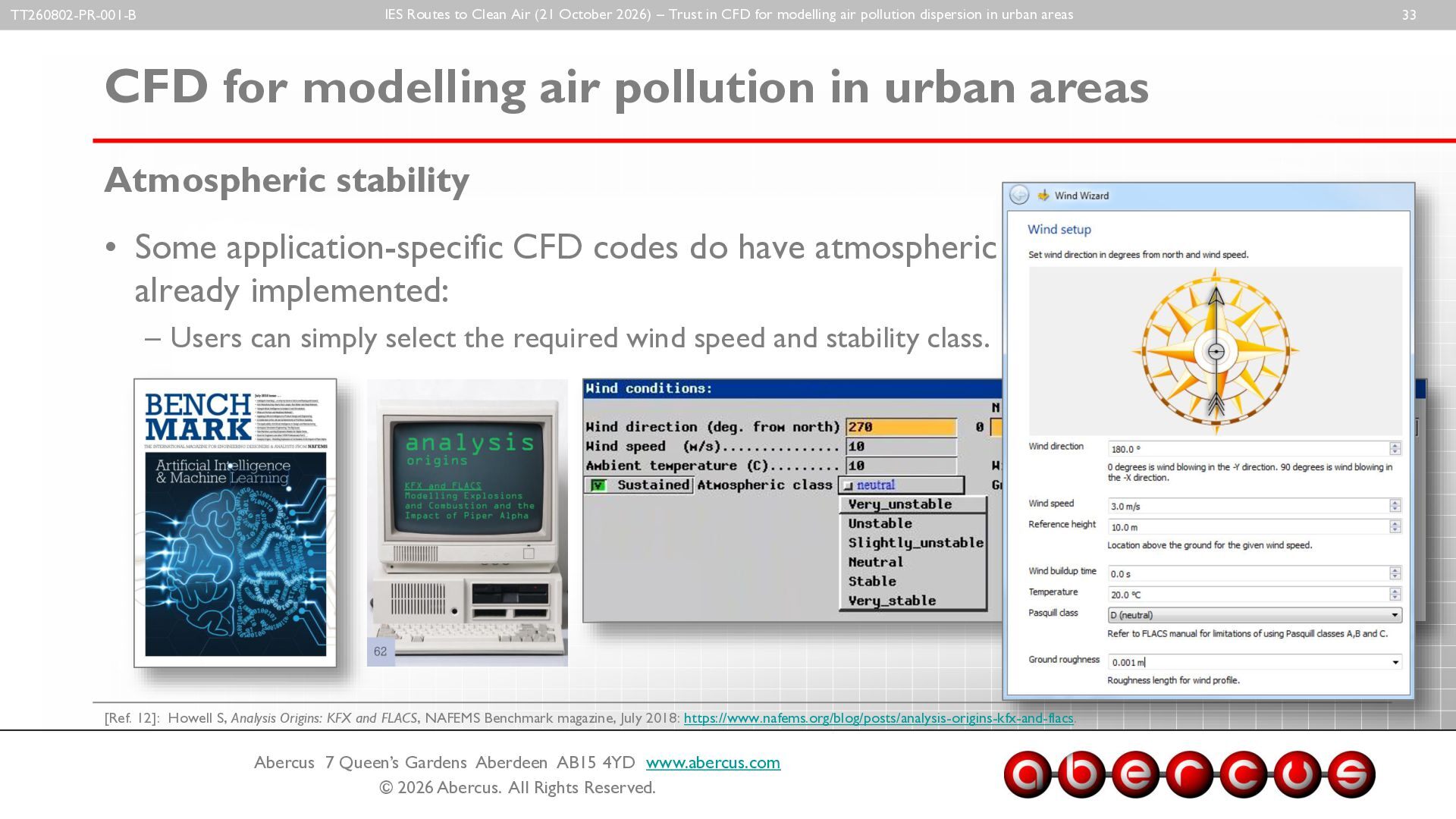
Trust in CFD for modelling air pollution dispersion in urban areas CFD for modelling air pollution in urban areas Atmospheric stability • Some application-specific CFD codes do have atmospheric boundary profiles already implemented: – Users can simply select the required wind speed and stability class. [Ref. 12]: Howell S, Analysis Origins: KFX and FLACS, NAFEMS Benchmark magazine, July 2018: https://www.nafems.org/blog/posts/analysis-origins-kfx-and-flacs. www.abercus.com Abercus 7 Queen’s Gardens Aberdeen AB15 4YD www.abercus.com © 2026 Abercus. All Rights Reserved. www.abercus.com 33
TT260802-PR-001-B IES Routes to Clean Air (21 October 2026) –
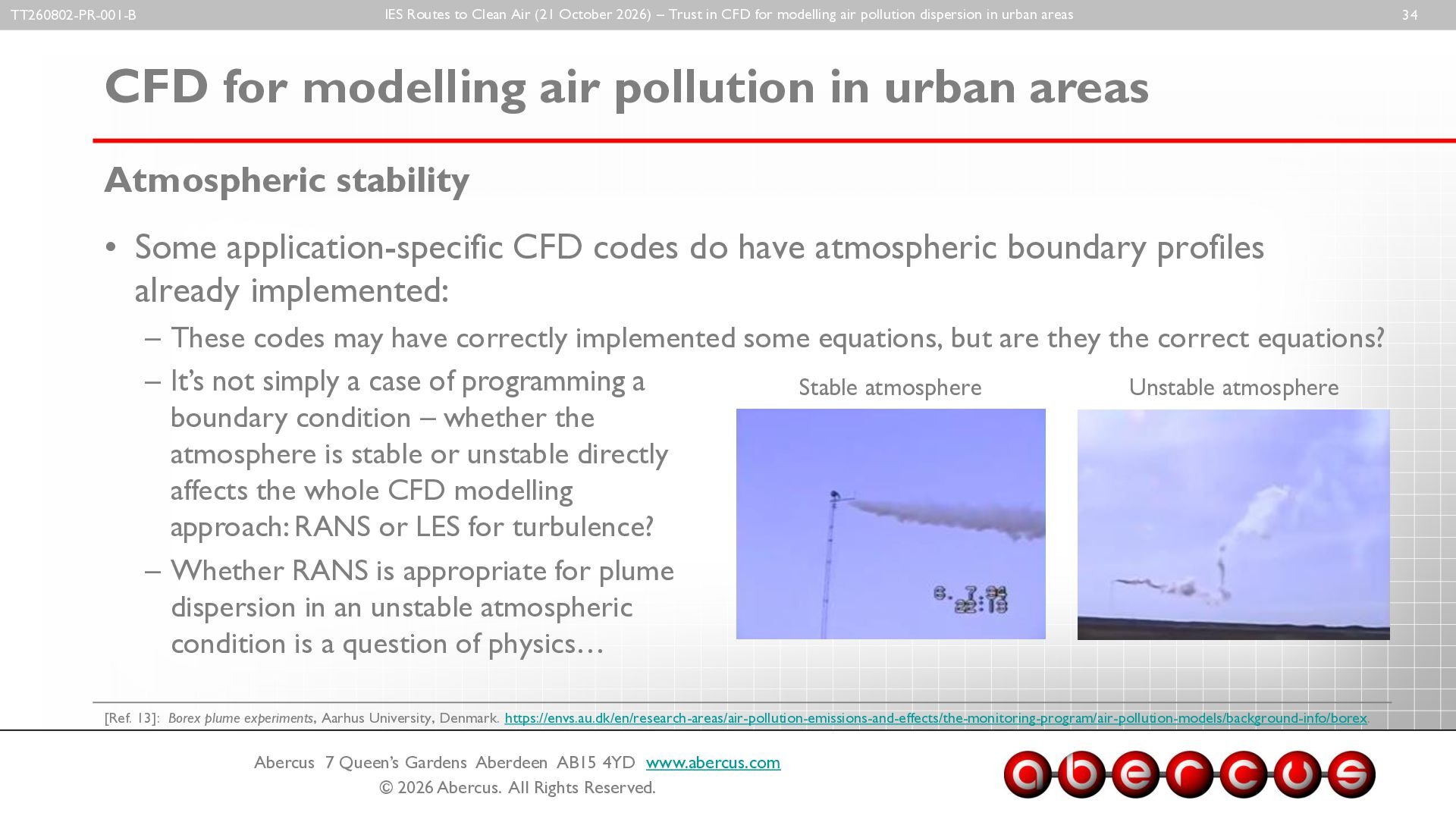
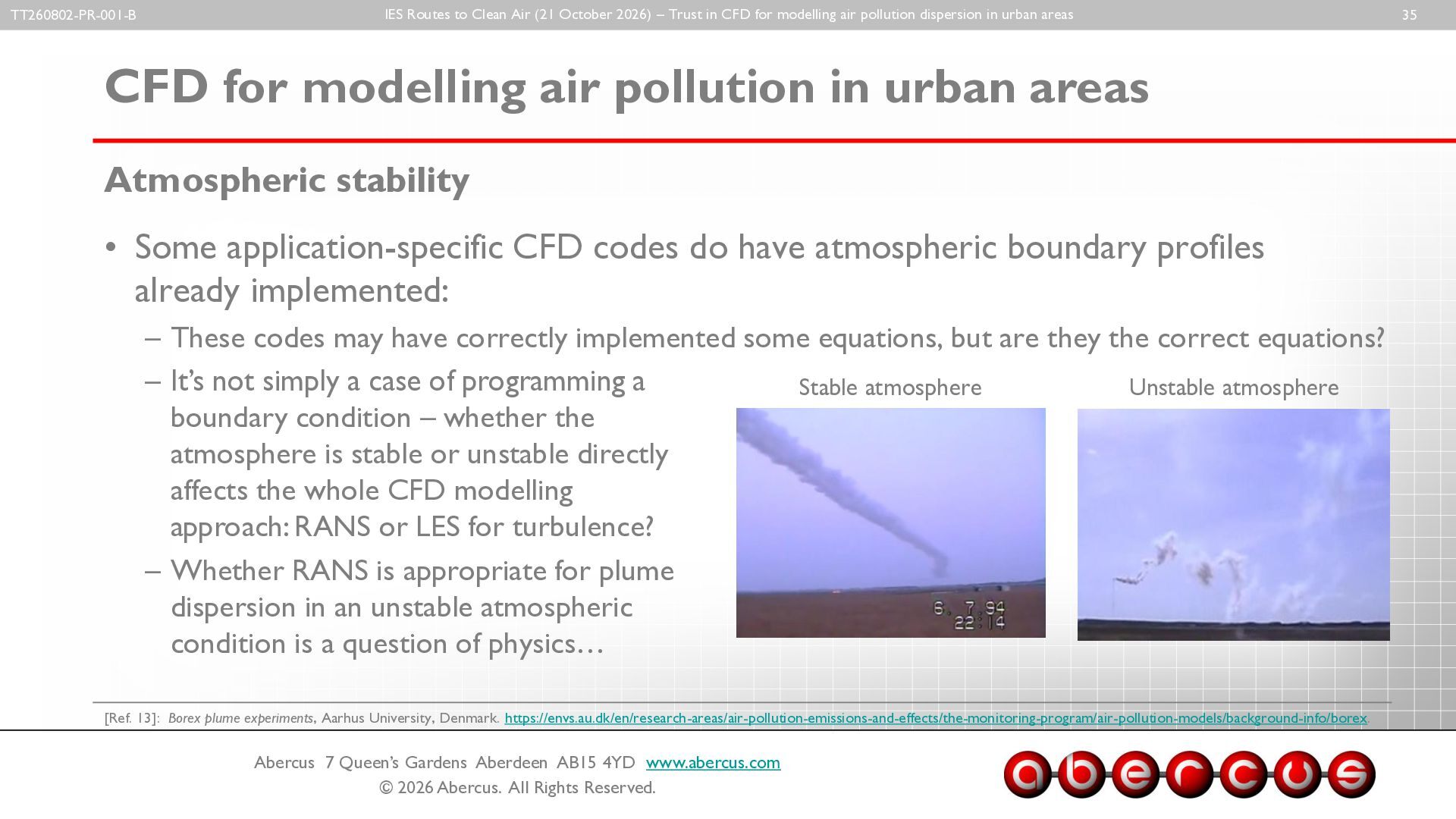
Trust in CFD for modelling air pollution dispersion in urban areas CFD for modelling air pollution in urban areas Atmospheric stability • Some application-specific CFD codes do have atmospheric boundary profiles already implemented: – These codes may have correctly implemented some equations, but are they the correct equations? – It’s not simply a case of programming a Stable atmosphere Unstable atmosphere boundary condition – whether the atmosphere is stable or unstable directly affects the whole CFD modelling approach: RANS or LES for turbulence? – Whether RANS is appropriate for plume dispersion in an unstable atmospheric condition is a question of physics… [Ref. 13]: Borex plume experiments, Aarhus University, Denmark. https://envs.au.dk/en/research-areas/air-pollution-emissions-and-effects/the-monitoring-program/air-pollution-models/background-info/borex. www.abercus.com Abercus 7 Queen’s Gardens Aberdeen AB15 4YD www.abercus.com © 2026 Abercus. All Rights Reserved. www.abercus.com 34
TT260802-PR-001-B IES Routes to Clean Air (21 October 2026) –
Trust in CFD for modelling air pollution dispersion in urban areas CFD for modelling air pollution in urban areas Atmospheric stability • Some application-specific CFD codes do have atmospheric boundary profiles already implemented: – These codes may have correctly implemented some equations, but are they the correct equations? – It’s not simply a case of programming a Stable atmosphere Unstable atmosphere boundary condition – whether the atmosphere is stable or unstable directly affects the whole CFD modelling approach: RANS or LES for turbulence? – Whether RANS is appropriate for plume dispersion in an unstable atmospheric condition is a question of physics… [Ref. 13]: Borex plume experiments, Aarhus University, Denmark. https://envs.au.dk/en/research-areas/air-pollution-emissions-and-effects/the-monitoring-program/air-pollution-models/background-info/borex. www.abercus.com Abercus 7 Queen’s Gardens Aberdeen AB15 4YD www.abercus.com © 2026 Abercus. All Rights Reserved. www.abercus.com 35
TT260802-PR-001-B IES Routes to Clean Air (21 October 2026) –
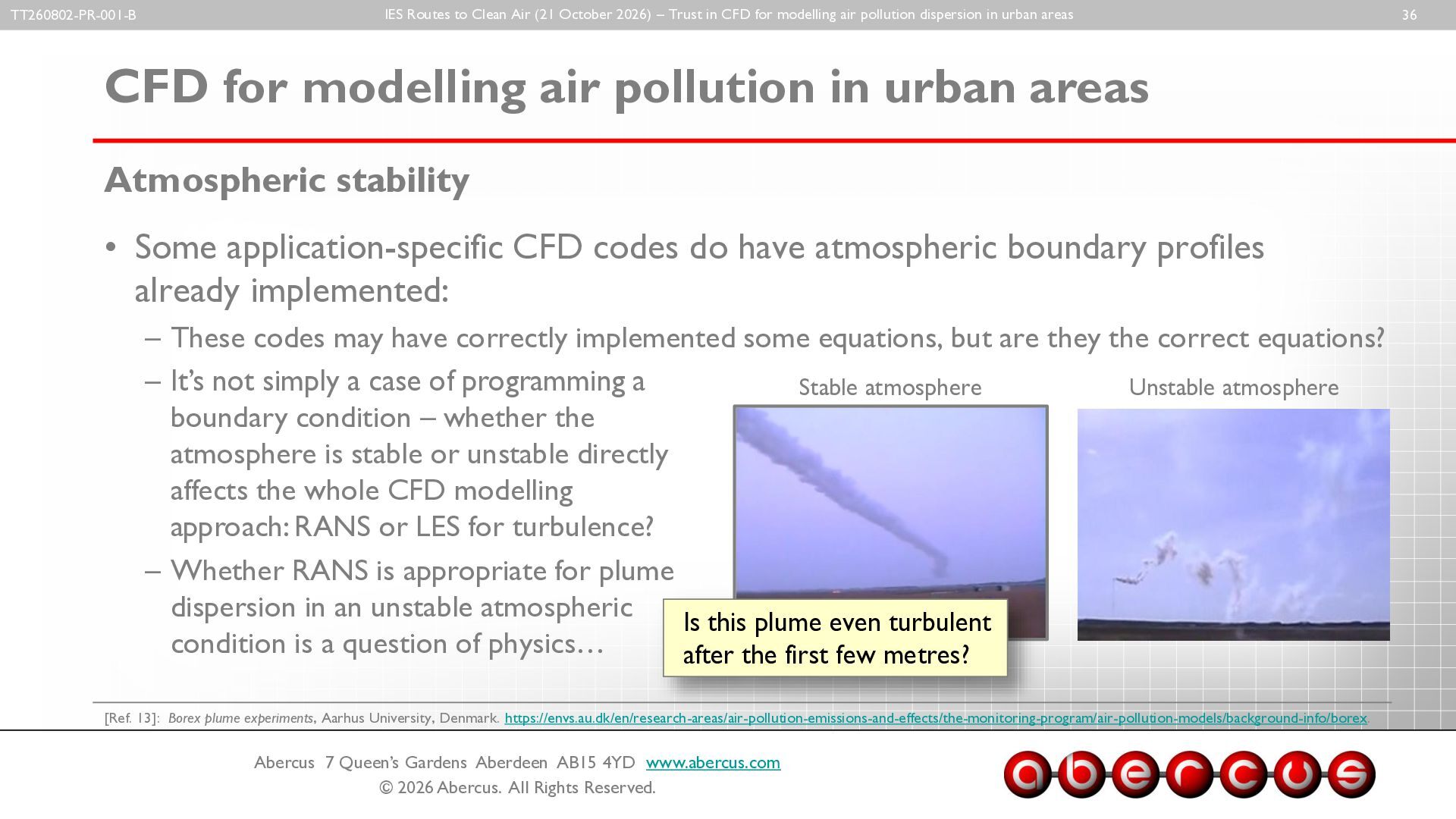
Trust in CFD for modelling air pollution dispersion in urban areas CFD for modelling air pollution in urban areas Atmospheric stability • Some application-specific CFD codes do have atmospheric boundary profiles already implemented: – These codes may have correctly implemented some equations, but are they the correct equations? – It’s not simply a case of programming a Stable atmosphere Unstable atmosphere boundary condition – whether the atmosphere is stable or unstable directly affects the whole CFD modelling approach: RANS or LES for turbulence? – Whether RANS is appropriate for plume dispersion in an unstable atmospheric Is this plume even turbulent condition is a question of physics… after the first few metres? [Ref. 13]: Borex plume experiments, Aarhus University, Denmark. https://envs.au.dk/en/research-areas/air-pollution-emissions-and-effects/the-monitoring-program/air-pollution-models/background-info/borex. www.abercus.com Abercus 7 Queen’s Gardens Aberdeen AB15 4YD www.abercus.com © 2026 Abercus. All Rights Reserved. www.abercus.com 36
IES Routes to Clean Air (21 October 2026) – Trust
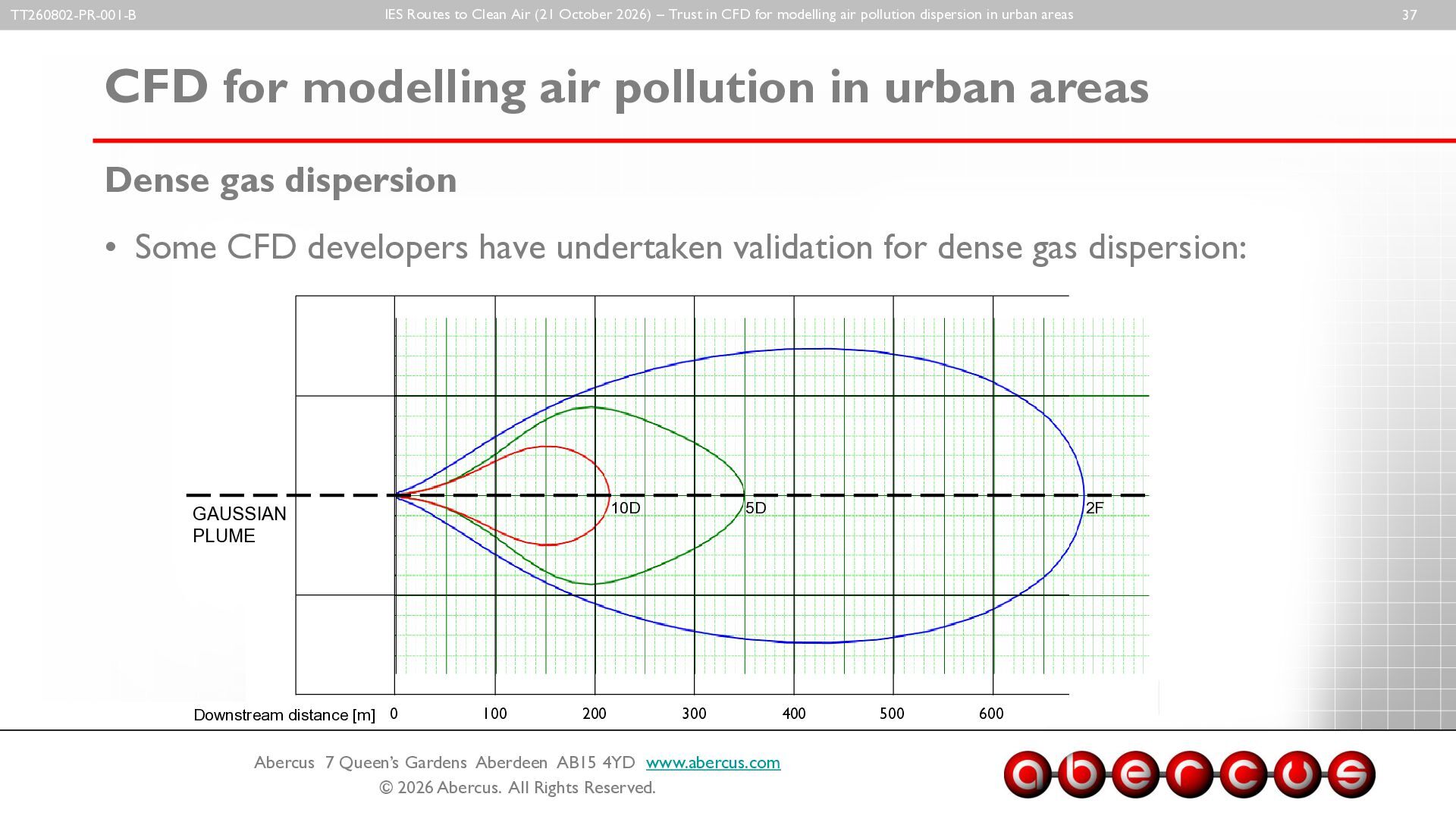
in CFD for modelling air pollution dispersion in urban areas TT260802-PR-001-B 37 CFD for modelling air pollution in urban areas Dense gas dispersion • Some CFD developers have undertaken validation for dense gas dispersion: Downstream distance [m] 0 5D 10D GAUSSIAN PLUME 100 200 300 www.abercus.com Abercus 7 Queen’s Gardens Aberdeen AB15 4YD www.abercus.com © 2026 Abercus. All Rights Reserved. 2F 400 500 600 www.abercus.com
IES Routes to Clean Air (21 October 2026) – Trust
in CFD for modelling air pollution dispersion in urban areas TT260802-PR-001-B 38 CFD for modelling air pollution in urban areas Dense gas dispersion • Some CFD developers have undertaken validation for dense gas dispersion: 2F CFD Downstream distance [m] 0 5D 10D GAUSSIAN PLUME 100 200 300 www.abercus.com Abercus 7 Queen’s Gardens Aberdeen AB15 4YD www.abercus.com © 2026 Abercus. All Rights Reserved. 2F 400 500 600 www.abercus.com
IES Routes to Clean Air (21 October 2026) – Trust
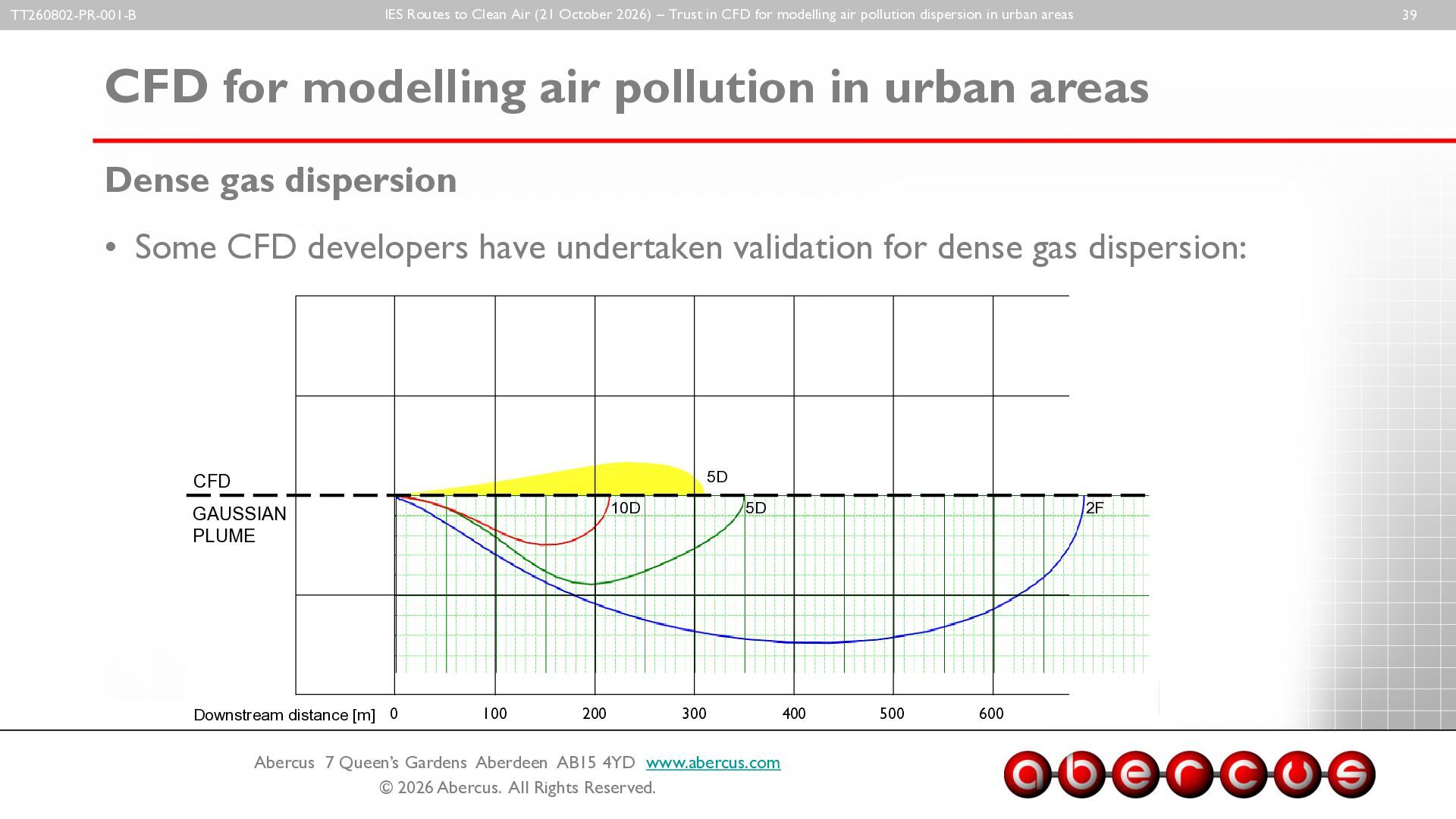
in CFD for modelling air pollution dispersion in urban areas TT260802-PR-001-B 39 CFD for modelling air pollution in urban areas Dense gas dispersion • Some CFD developers have undertaken validation for dense gas dispersion: 5D CFD Downstream distance [m] 0 5D 10D GAUSSIAN PLUME 100 200 300 www.abercus.com Abercus 7 Queen’s Gardens Aberdeen AB15 4YD www.abercus.com © 2026 Abercus. All Rights Reserved. 2F 400 500 600 www.abercus.com
IES Routes to Clean Air (21 October 2026) – Trust
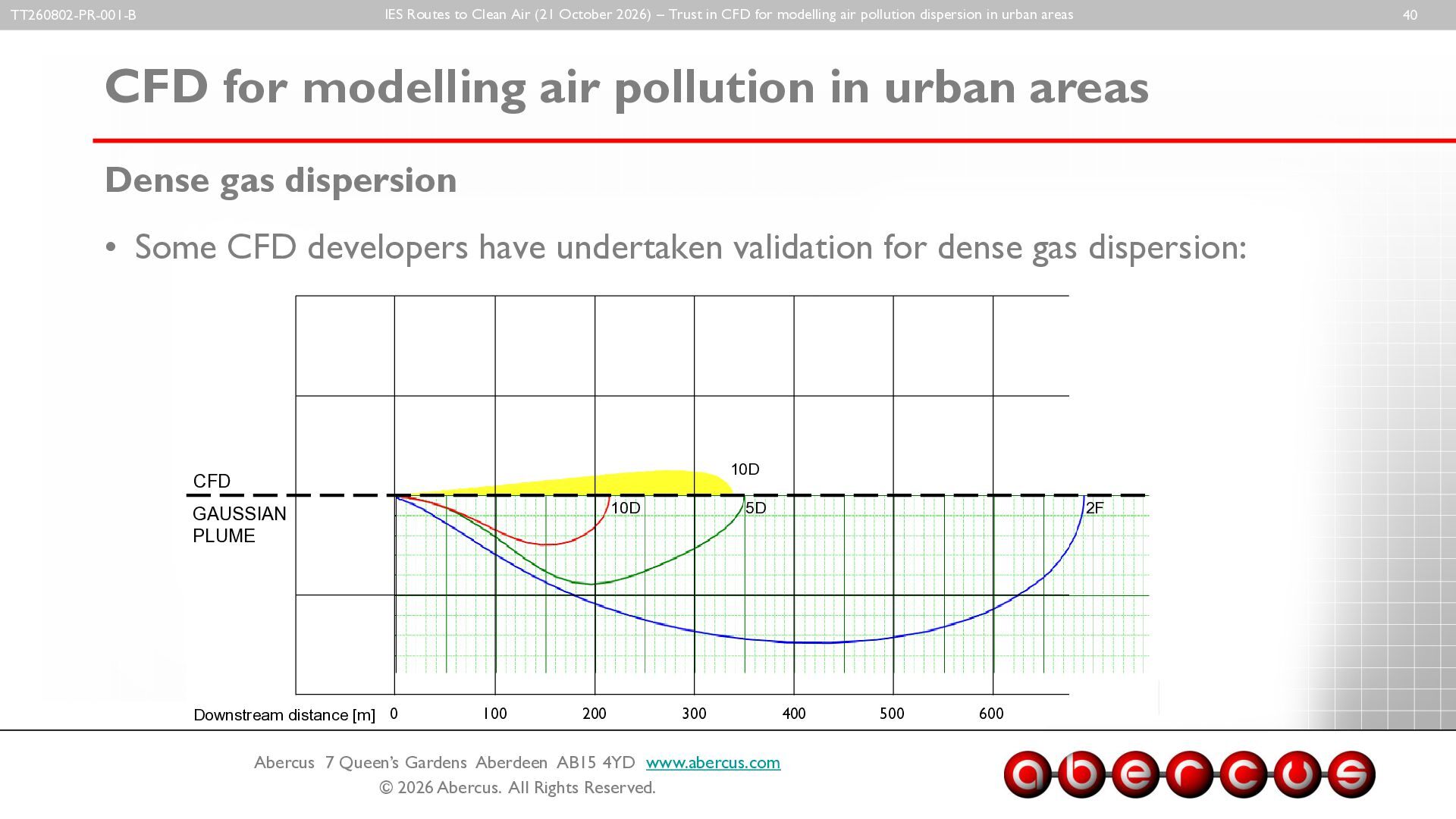
in CFD for modelling air pollution dispersion in urban areas TT260802-PR-001-B 40 CFD for modelling air pollution in urban areas Dense gas dispersion • Some CFD developers have undertaken validation for dense gas dispersion: 10D CFD Downstream distance [m] 0 5D 10D GAUSSIAN PLUME 100 200 300 www.abercus.com Abercus 7 Queen’s Gardens Aberdeen AB15 4YD www.abercus.com © 2026 Abercus. All Rights Reserved. 2F 400 500 600 www.abercus.com
IES Routes to Clean Air (21 October 2026) – Trust
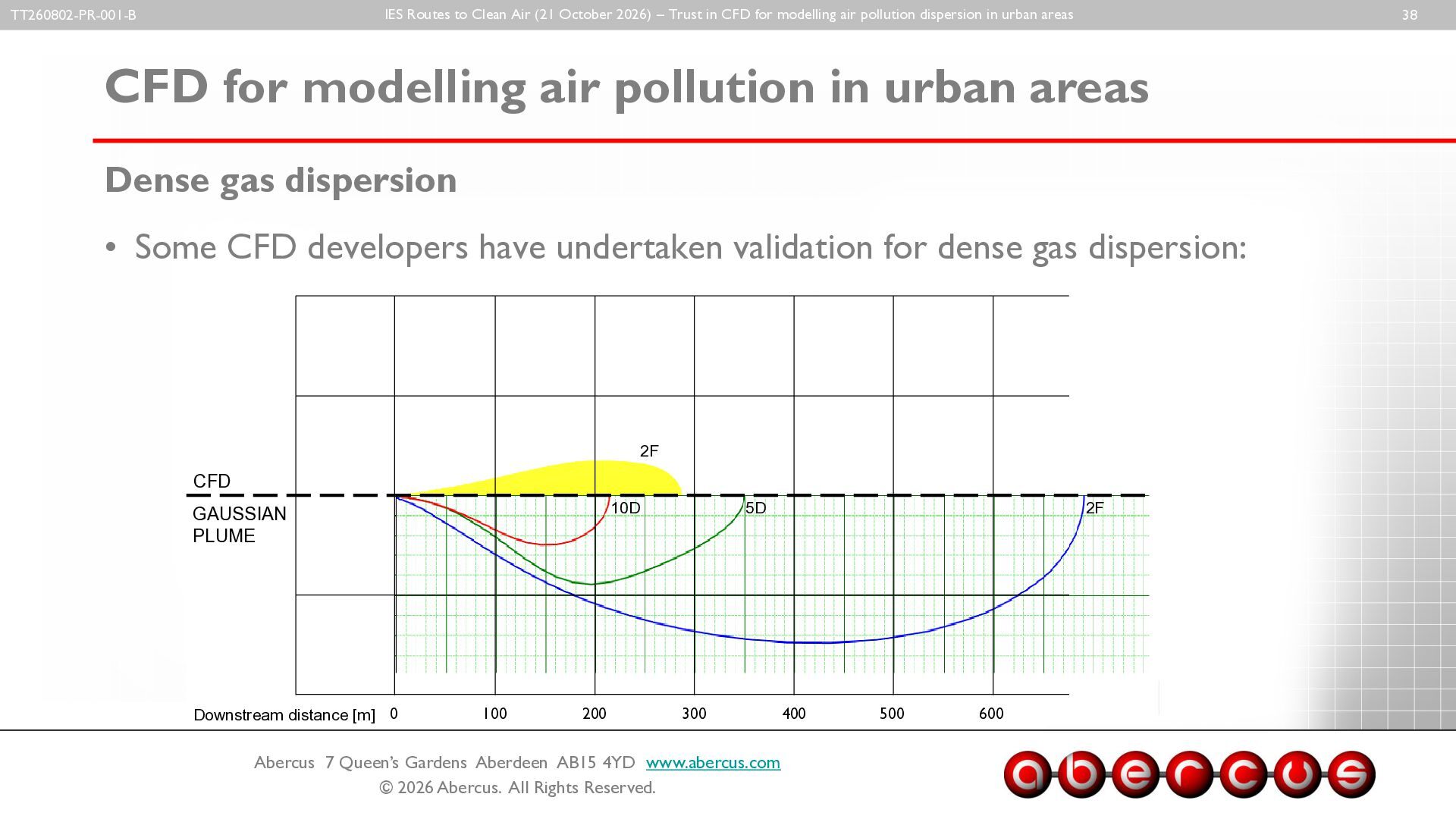
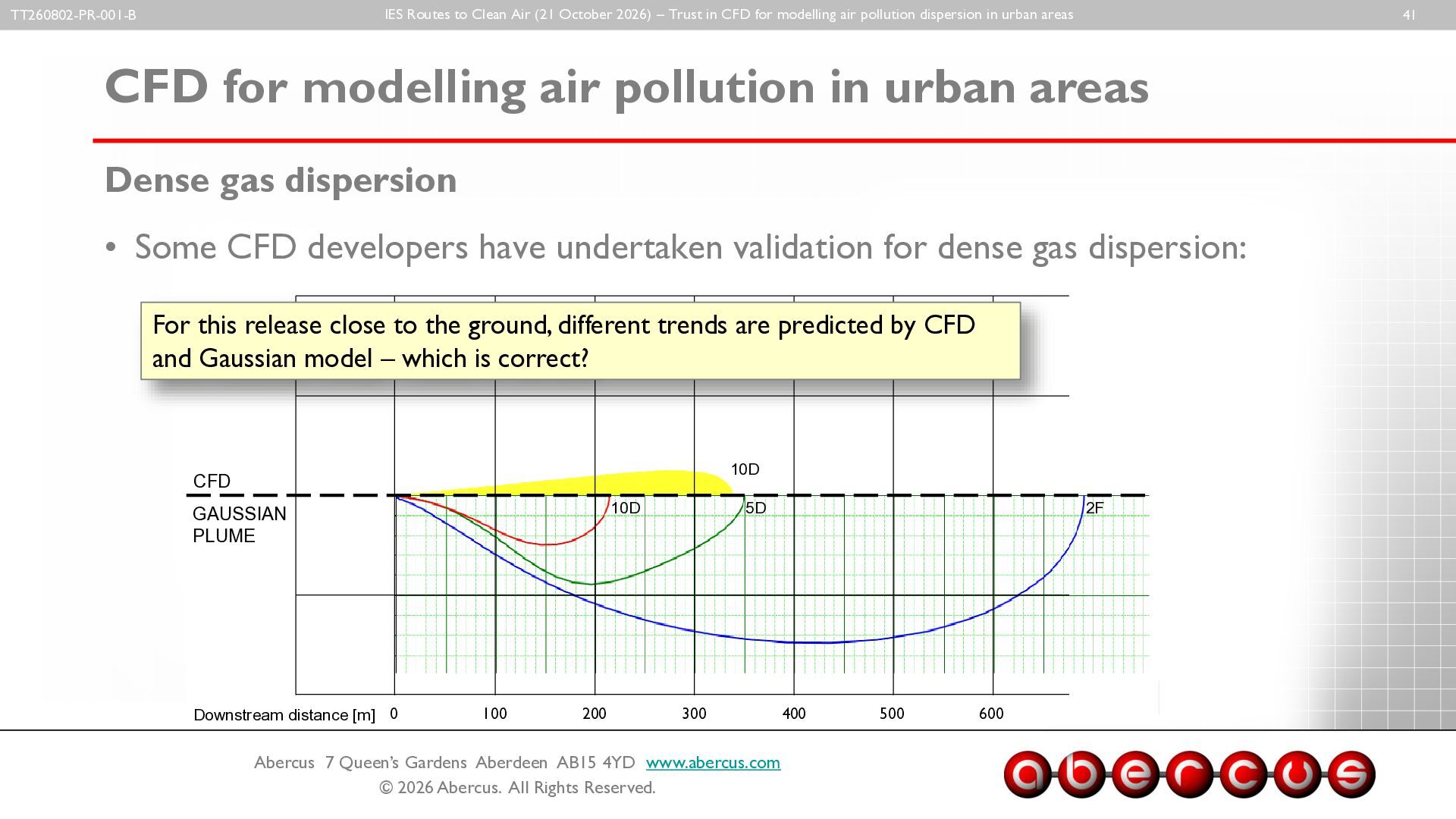
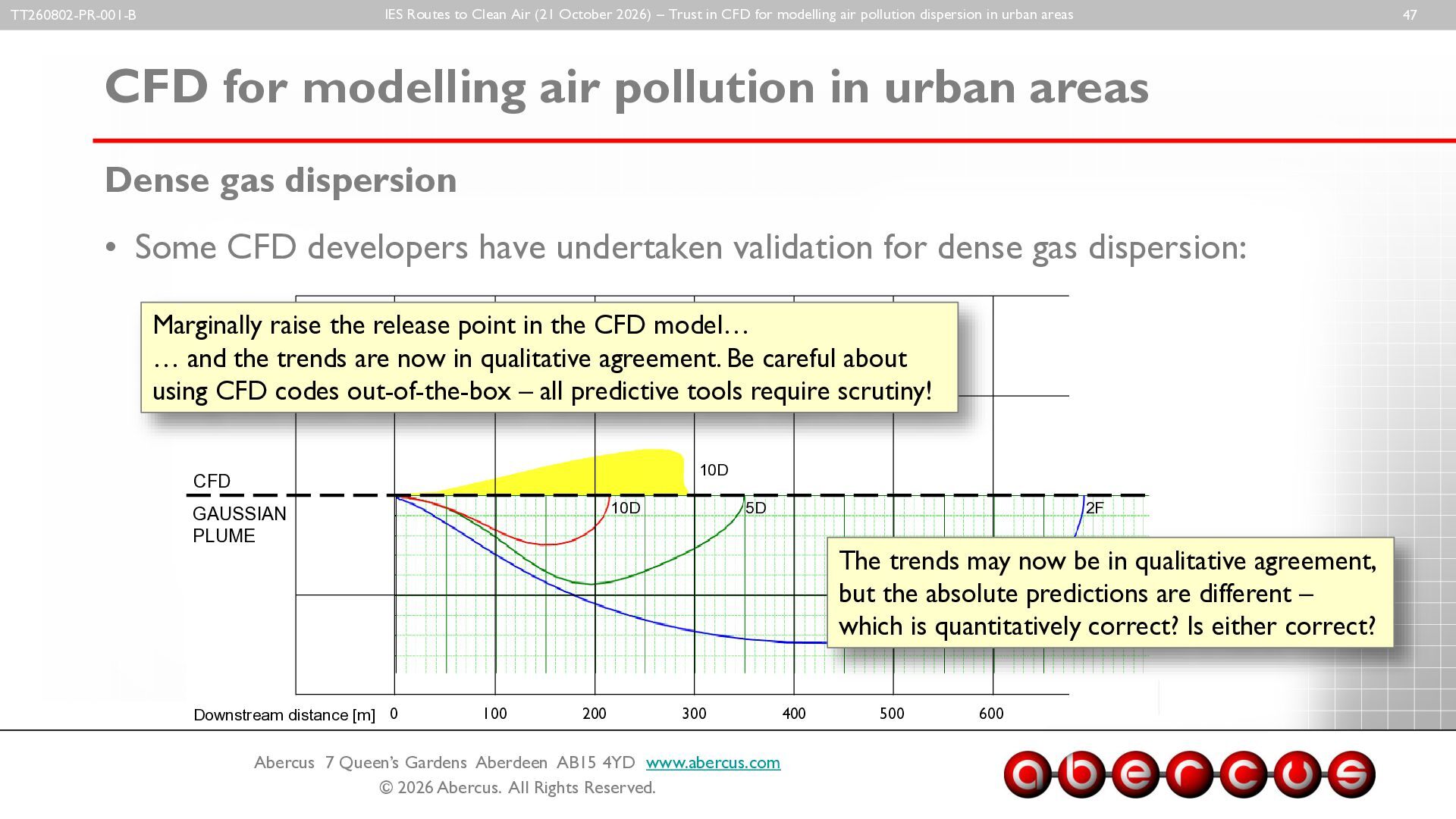
in CFD for modelling air pollution dispersion in urban areas TT260802-PR-001-B 41 CFD for modelling air pollution in urban areas Dense gas dispersion • Some CFD developers have undertaken validation for dense gas dispersion: For this release close to the ground, different trends are predicted by CFD and Gaussian model – which is correct? 10D CFD Downstream distance [m] 0 5D 10D GAUSSIAN PLUME 100 200 300 www.abercus.com Abercus 7 Queen’s Gardens Aberdeen AB15 4YD www.abercus.com © 2026 Abercus. All Rights Reserved. 2F 400 500 600 www.abercus.com
IES Routes to Clean Air (21 October 2026) – Trust
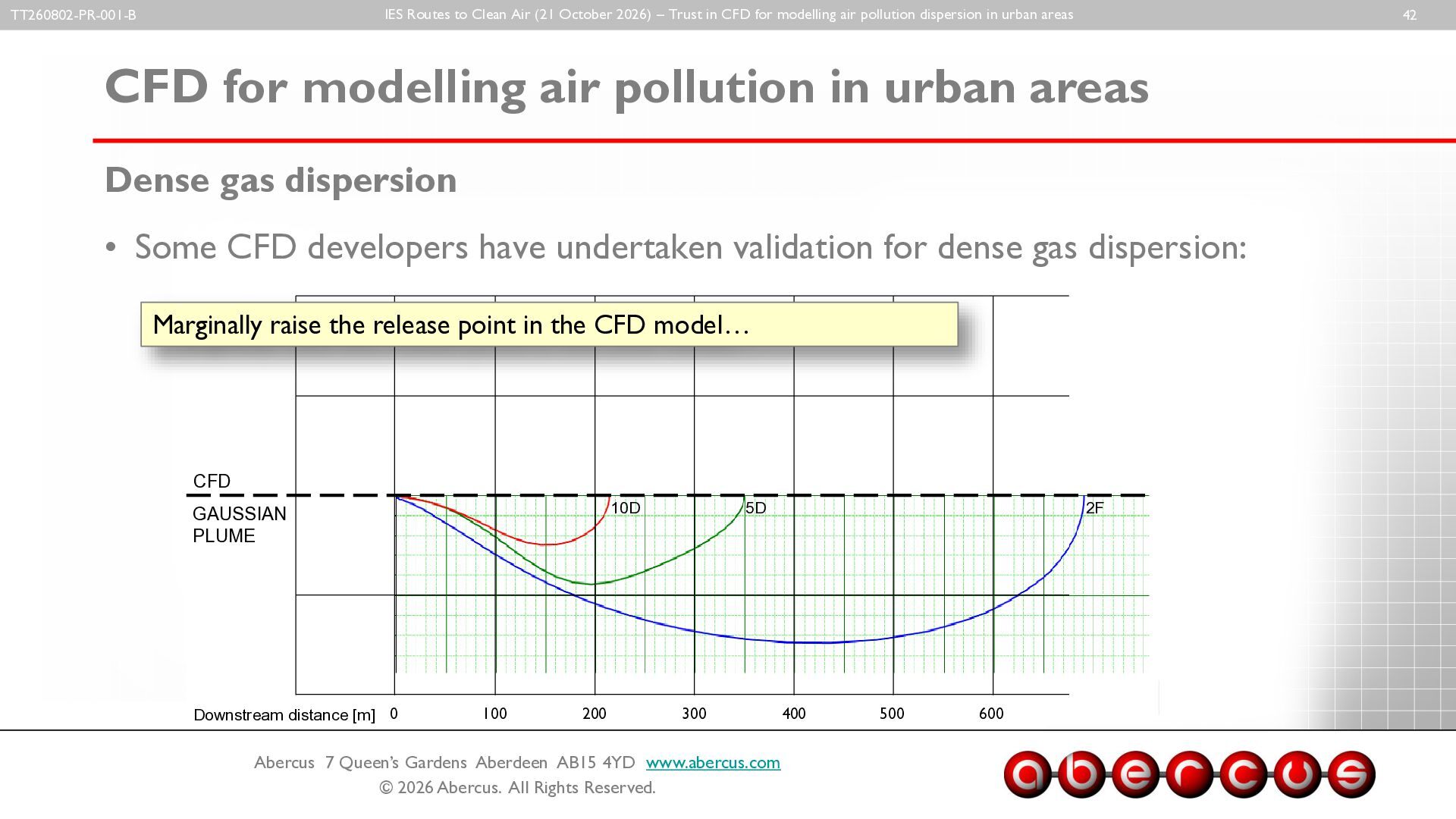
in CFD for modelling air pollution dispersion in urban areas TT260802-PR-001-B 42 CFD for modelling air pollution in urban areas Dense gas dispersion • Some CFD developers have undertaken validation for dense gas dispersion: Marginally raise the release point in the CFD model… CFD Downstream distance [m] 0 5D 10D GAUSSIAN PLUME 100 200 300 www.abercus.com Abercus 7 Queen’s Gardens Aberdeen AB15 4YD www.abercus.com © 2026 Abercus. All Rights Reserved. 2F 400 500 600 www.abercus.com
IES Routes to Clean Air (21 October 2026) – Trust
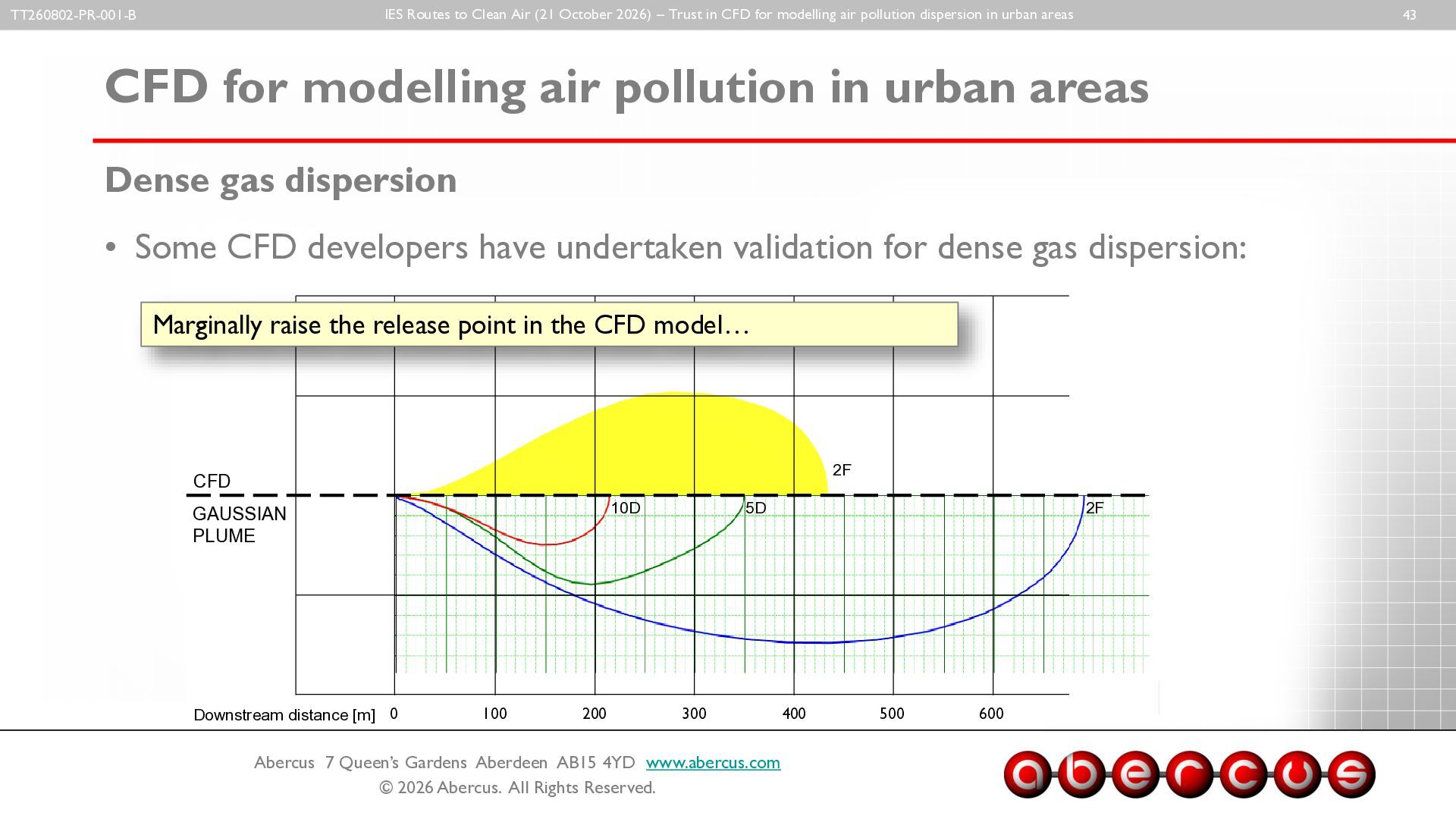
in CFD for modelling air pollution dispersion in urban areas TT260802-PR-001-B 43 CFD for modelling air pollution in urban areas Dense gas dispersion • Some CFD developers have undertaken validation for dense gas dispersion: Marginally raise the release point in the CFD model… 2F CFD Downstream distance [m] 0 5D 10D GAUSSIAN PLUME 100 200 300 www.abercus.com Abercus 7 Queen’s Gardens Aberdeen AB15 4YD www.abercus.com © 2026 Abercus. All Rights Reserved. 2F 400 500 600 www.abercus.com
IES Routes to Clean Air (21 October 2026) – Trust
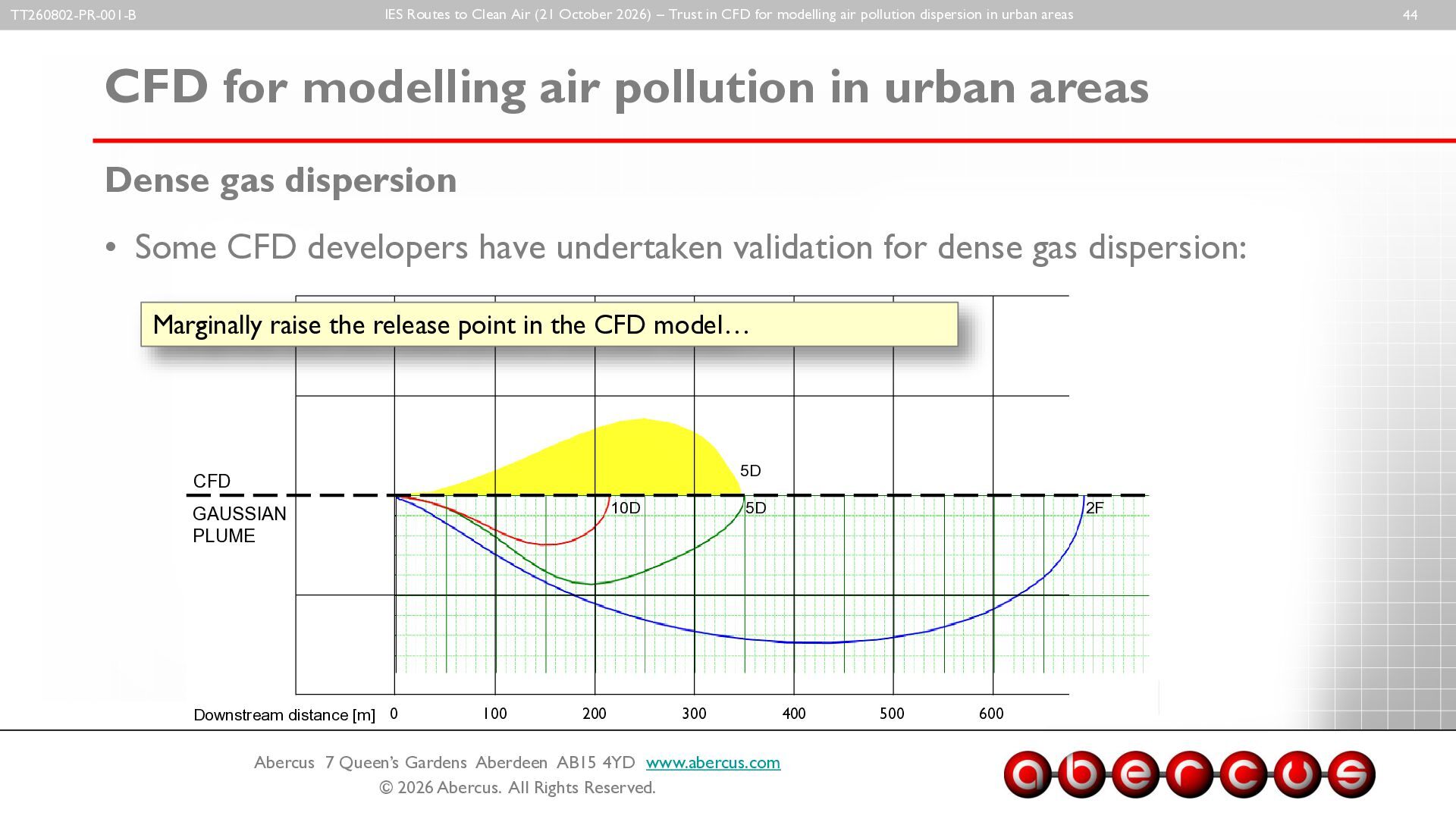
in CFD for modelling air pollution dispersion in urban areas TT260802-PR-001-B 44 CFD for modelling air pollution in urban areas Dense gas dispersion • Some CFD developers have undertaken validation for dense gas dispersion: Marginally raise the release point in the CFD model… 5D CFD Downstream distance [m] 0 5D 10D GAUSSIAN PLUME 100 200 300 www.abercus.com Abercus 7 Queen’s Gardens Aberdeen AB15 4YD www.abercus.com © 2026 Abercus. All Rights Reserved. 2F 400 500 600 www.abercus.com
IES Routes to Clean Air (21 October 2026) – Trust
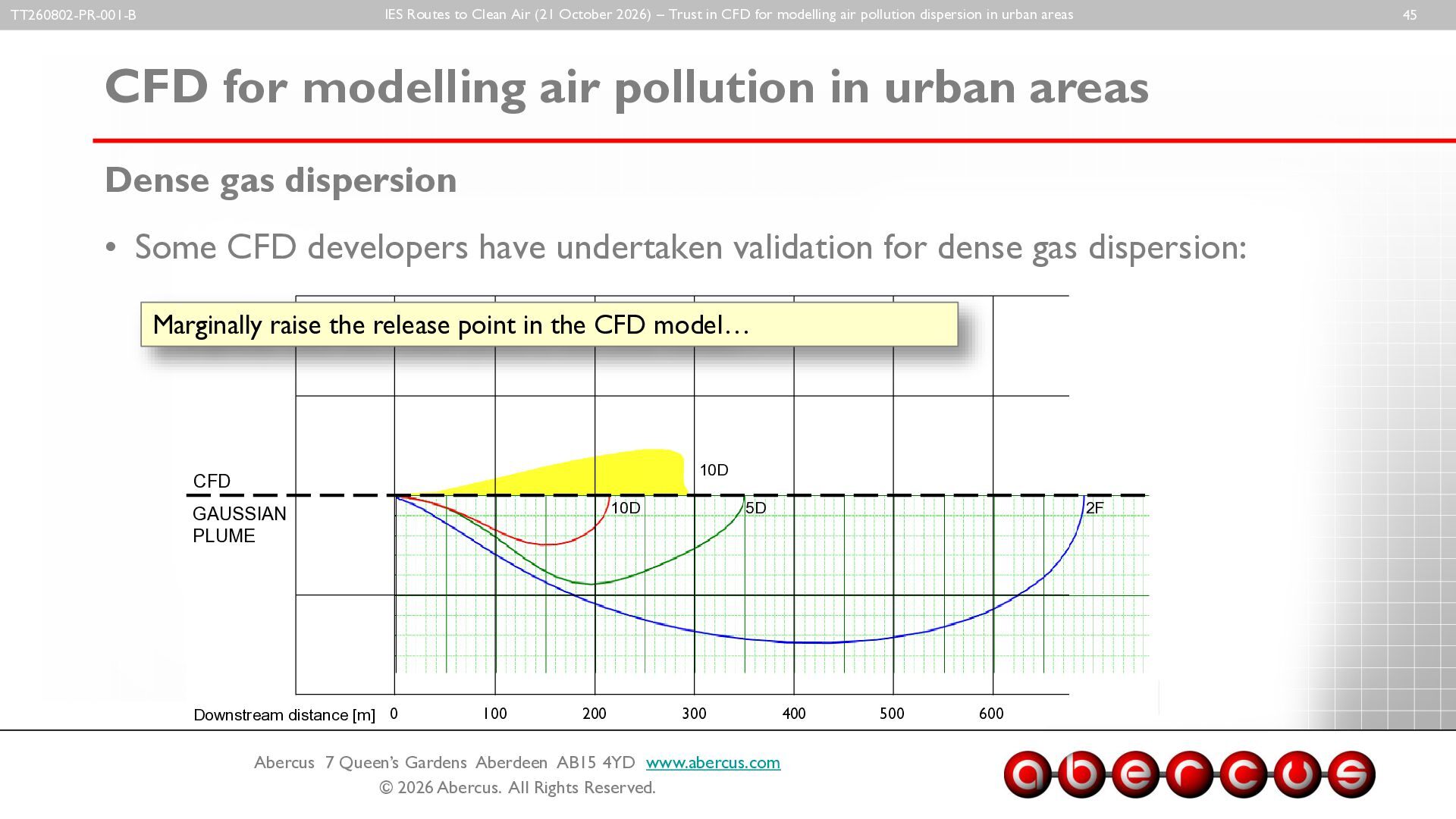
in CFD for modelling air pollution dispersion in urban areas TT260802-PR-001-B 45 CFD for modelling air pollution in urban areas Dense gas dispersion • Some CFD developers have undertaken validation for dense gas dispersion: Marginally raise the release point in the CFD model… 10D CFD Downstream distance [m] 0 5D 10D GAUSSIAN PLUME 100 200 300 www.abercus.com Abercus 7 Queen’s Gardens Aberdeen AB15 4YD www.abercus.com © 2026 Abercus. All Rights Reserved. 2F 400 500 600 www.abercus.com
IES Routes to Clean Air (21 October 2026) – Trust
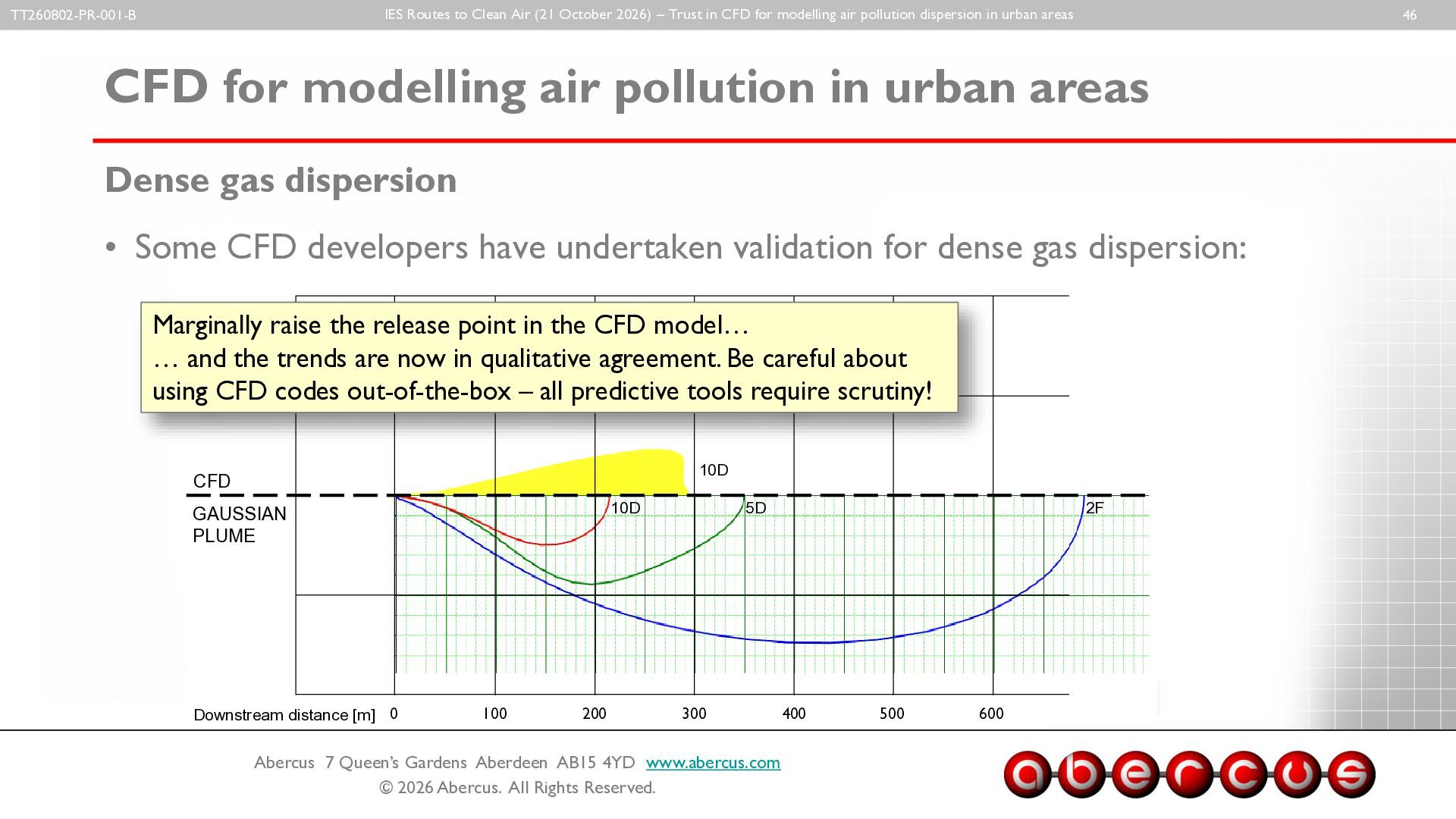
in CFD for modelling air pollution dispersion in urban areas TT260802-PR-001-B 46 CFD for modelling air pollution in urban areas Dense gas dispersion • Some CFD developers have undertaken validation for dense gas dispersion: Marginally raise the release point in the CFD model… … and the trends are now in qualitative agreement. Be careful about using CFD codes out-of-the-box – all predictive tools require scrutiny! 10D CFD Downstream distance [m] 0 5D 10D GAUSSIAN PLUME 100 200 300 www.abercus.com Abercus 7 Queen’s Gardens Aberdeen AB15 4YD www.abercus.com © 2026 Abercus. All Rights Reserved. 2F 400 500 600 www.abercus.com
IES Routes to Clean Air (21 October 2026) – Trust
in CFD for modelling air pollution dispersion in urban areas TT260802-PR-001-B 47 CFD for modelling air pollution in urban areas Dense gas dispersion • Some CFD developers have undertaken validation for dense gas dispersion: Marginally raise the release point in the CFD model… … and the trends are now in qualitative agreement. Be careful about using CFD codes out-of-the-box – all predictive tools require scrutiny! 10D CFD Downstream distance [m] 0 5D 10D GAUSSIAN PLUME 2F The trends may now be in qualitative agreement, but the absolute predictions are different – which is quantitatively correct? Is either correct? 100 200 300 www.abercus.com Abercus 7 Queen’s Gardens Aberdeen AB15 4YD www.abercus.com © 2026 Abercus. All Rights Reserved. 400 500 600 www.abercus.com
TT260802-PR-001-B IES Routes to Clean Air (21 October 2026) –
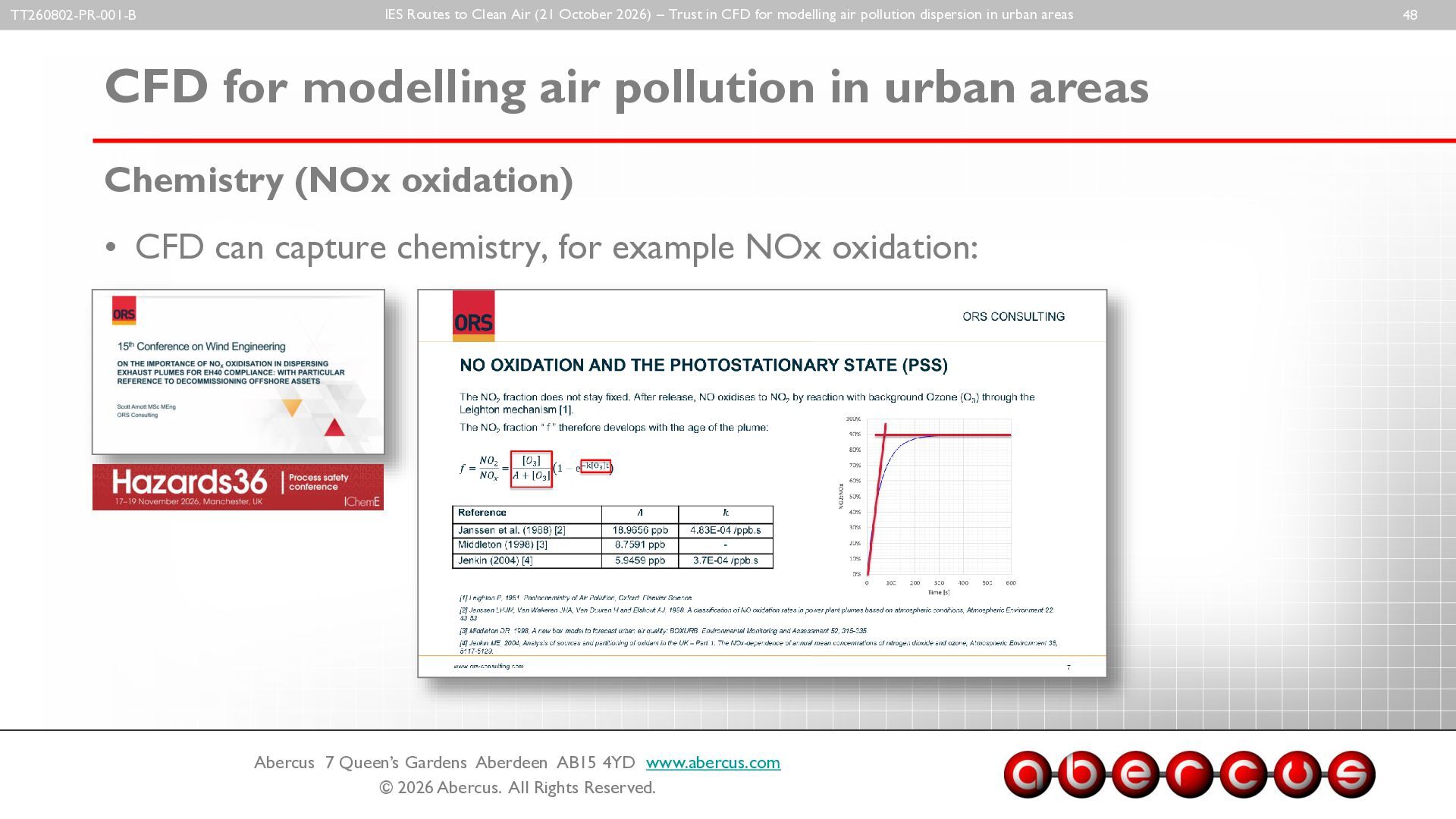
Trust in CFD for modelling air pollution dispersion in urban areas CFD for modelling air pollution in urban areas Chemistry (NOx oxidation) • CFD can capture chemistry, for example NOx oxidation: www.abercus.com Abercus 7 Queen’s Gardens Aberdeen AB15 4YD www.abercus.com © 2026 Abercus. All Rights Reserved. www.abercus.com 48
TT260802-PR-001-B IES Routes to Clean Air (21 October 2026) –
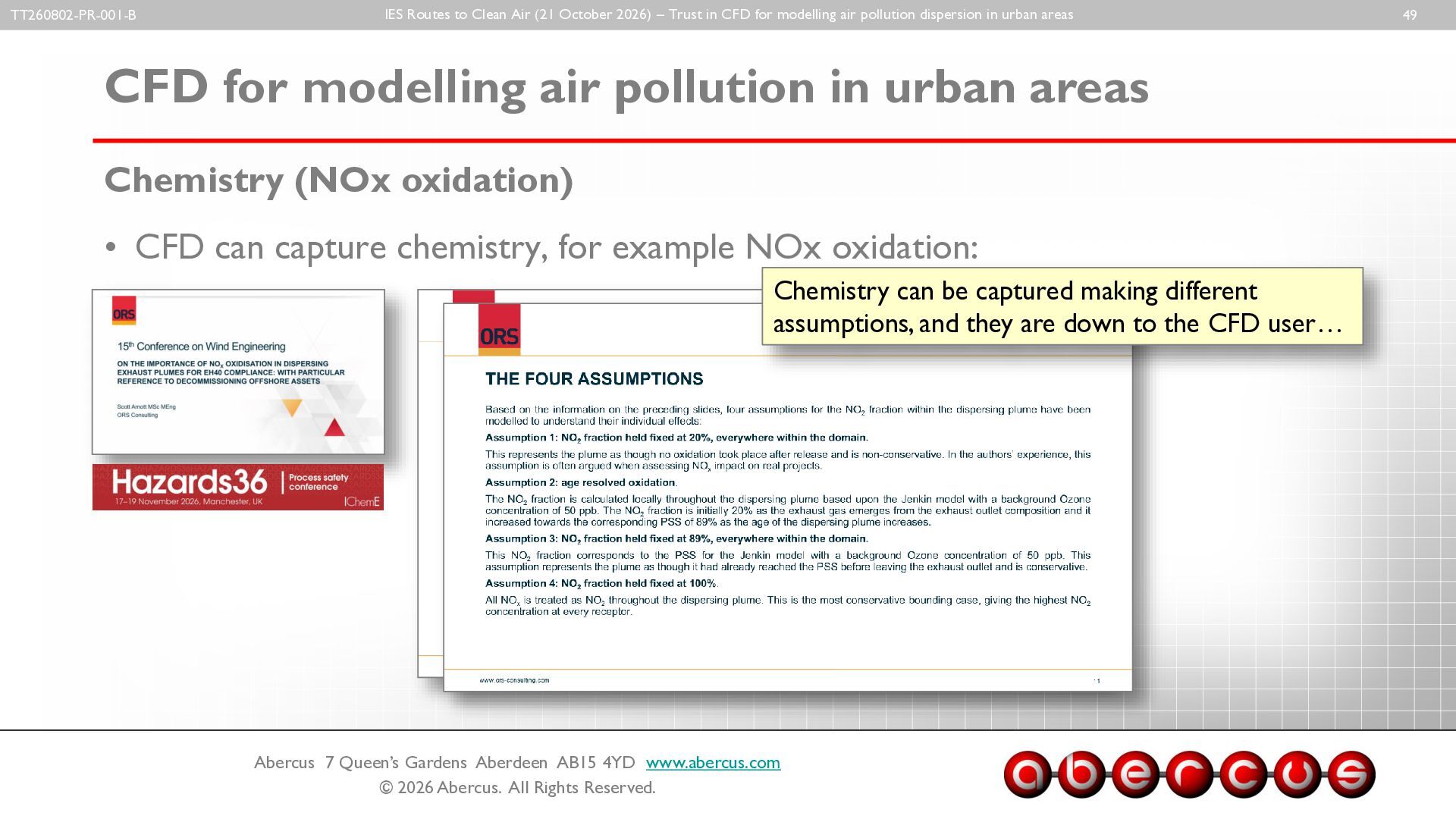
Trust in CFD for modelling air pollution dispersion in urban areas CFD for modelling air pollution in urban areas Chemistry (NOx oxidation) • CFD can capture chemistry, for example NOx oxidation: Chemistry can be captured making different assumptions, and they are down to the CFD user… www.abercus.com Abercus 7 Queen’s Gardens Aberdeen AB15 4YD www.abercus.com © 2026 Abercus. All Rights Reserved. www.abercus.com 49
TT260802-PR-001-B IES Routes to Clean Air (21 October 2026) –
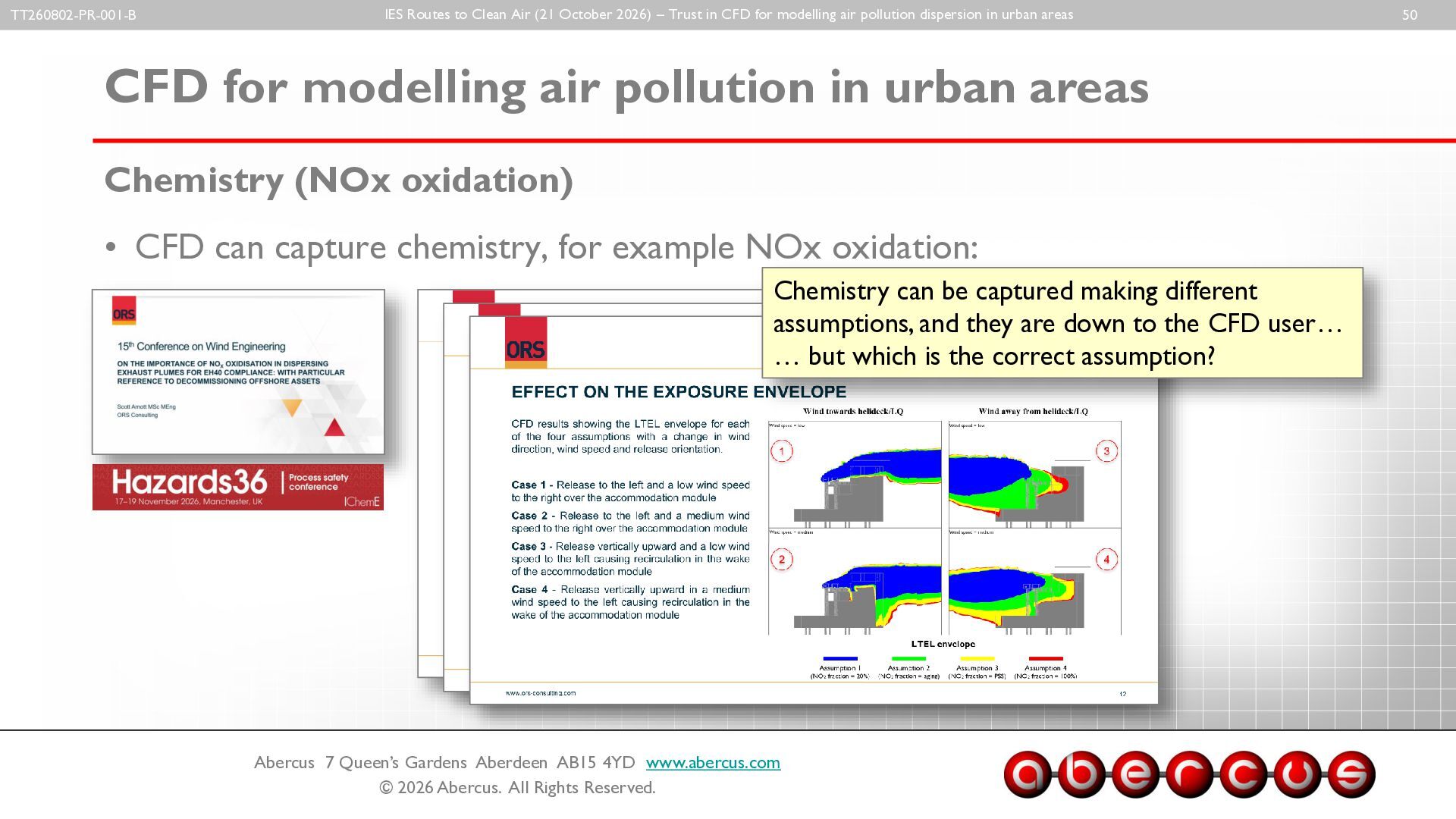
Trust in CFD for modelling air pollution dispersion in urban areas CFD for modelling air pollution in urban areas Chemistry (NOx oxidation) • CFD can capture chemistry, for example NOx oxidation: Chemistry can be captured making different assumptions, and they are down to the CFD user… … but which is the correct assumption? www.abercus.com Abercus 7 Queen’s Gardens Aberdeen AB15 4YD www.abercus.com © 2026 Abercus. All Rights Reserved. www.abercus.com 50
TT260802-PR-001-B IES Routes to Clean Air (21 October 2026) –
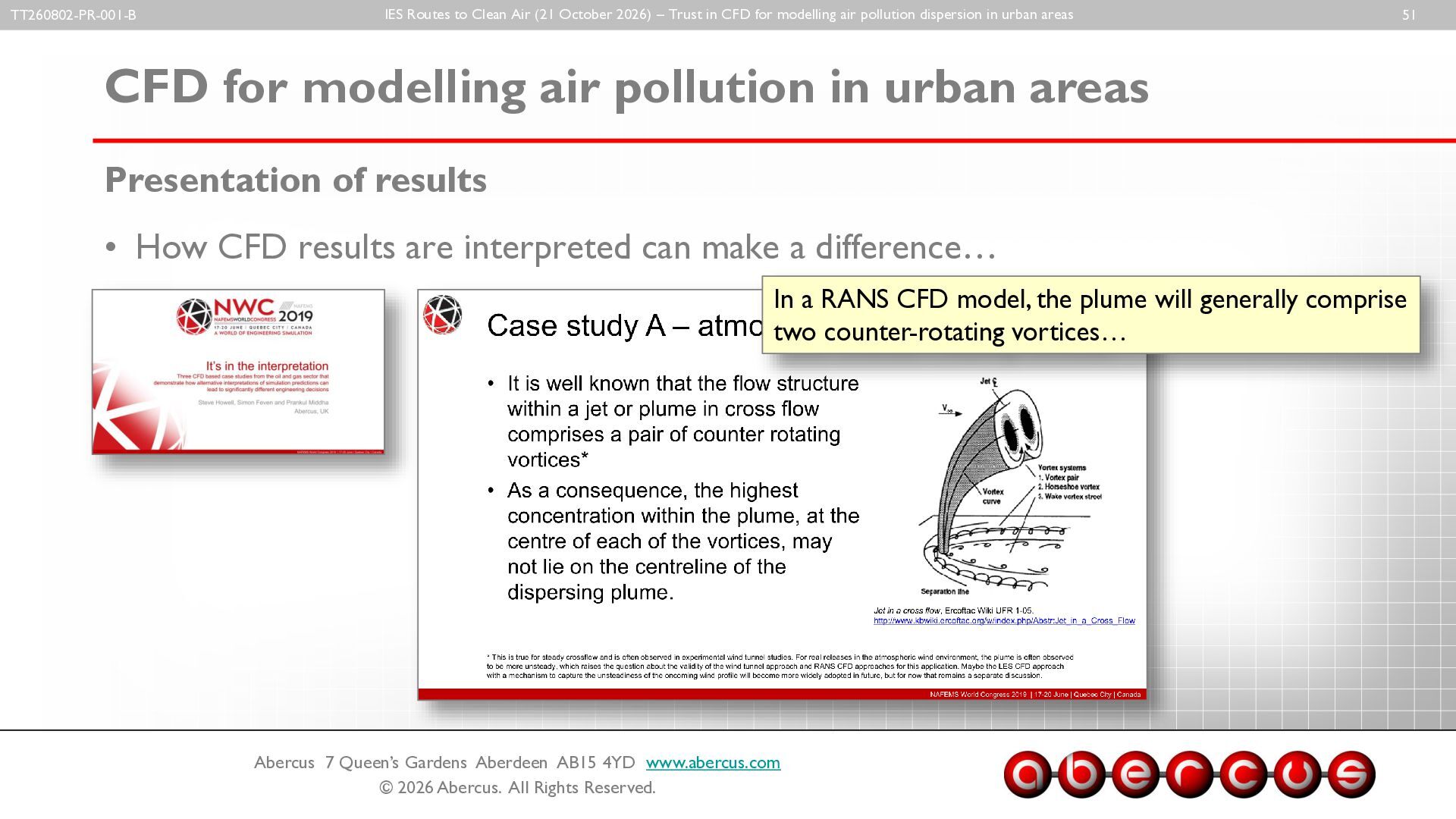
Trust in CFD for modelling air pollution dispersion in urban areas 51 CFD for modelling air pollution in urban areas Presentation of results • How CFD results are interpreted can make a difference… In a RANS CFD model, the plume will generally comprise two counter-rotating vortices… www.abercus.com Abercus 7 Queen’s Gardens Aberdeen AB15 4YD www.abercus.com © 2026 Abercus. All Rights Reserved. www.abercus.com
TT260802-PR-001-B IES Routes to Clean Air (21 October 2026) –
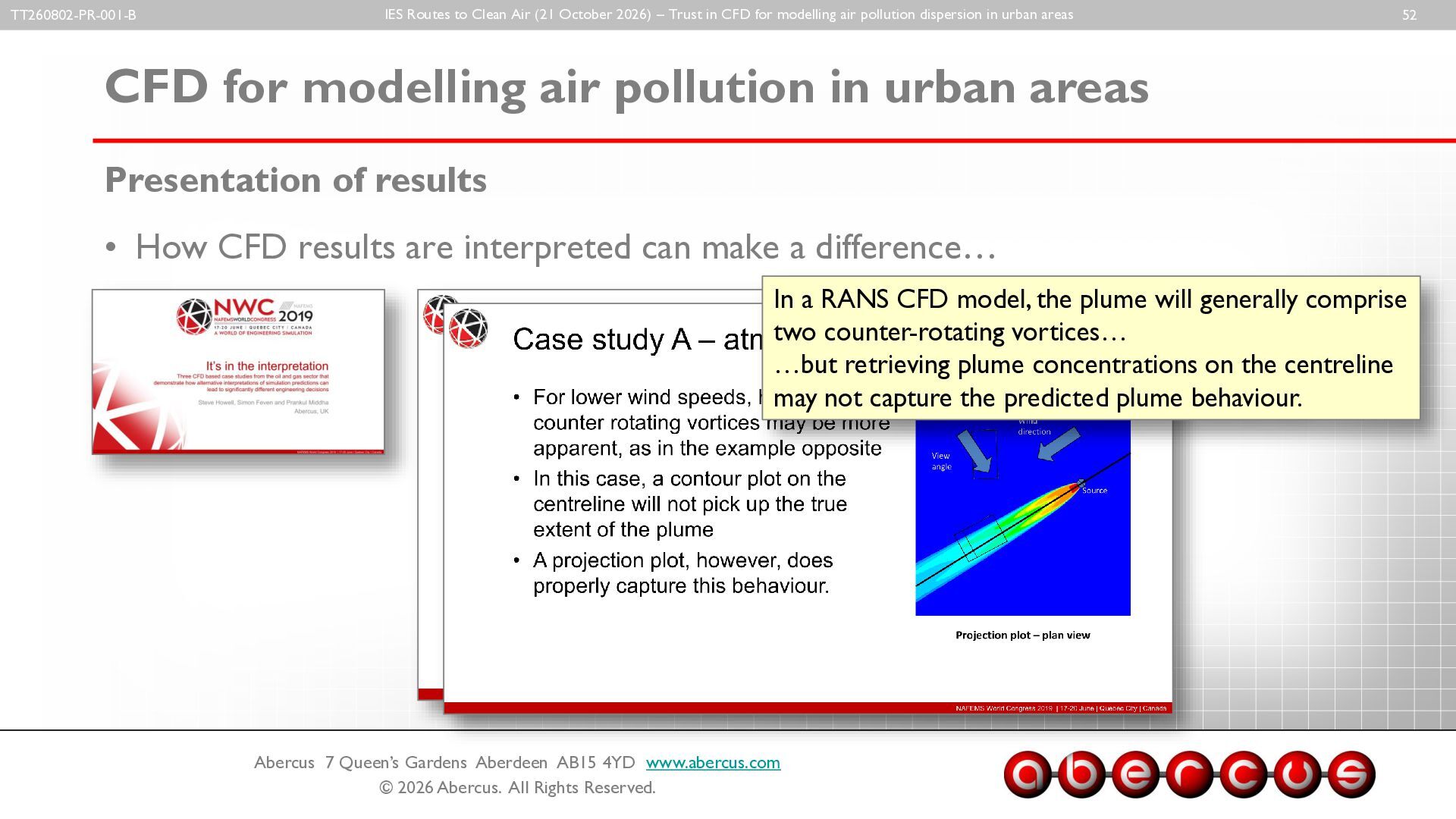
Trust in CFD for modelling air pollution dispersion in urban areas 52 CFD for modelling air pollution in urban areas Presentation of results • How CFD results are interpreted can make a difference… In a RANS CFD model, the plume will generally comprise two counter-rotating vortices… …but retrieving plume concentrations on the centreline may not capture the predicted plume behaviour. www.abercus.com Abercus 7 Queen’s Gardens Aberdeen AB15 4YD www.abercus.com © 2026 Abercus. All Rights Reserved. www.abercus.com
TT260802-PR-001-B IES Routes to Clean Air (21 October 2026) –
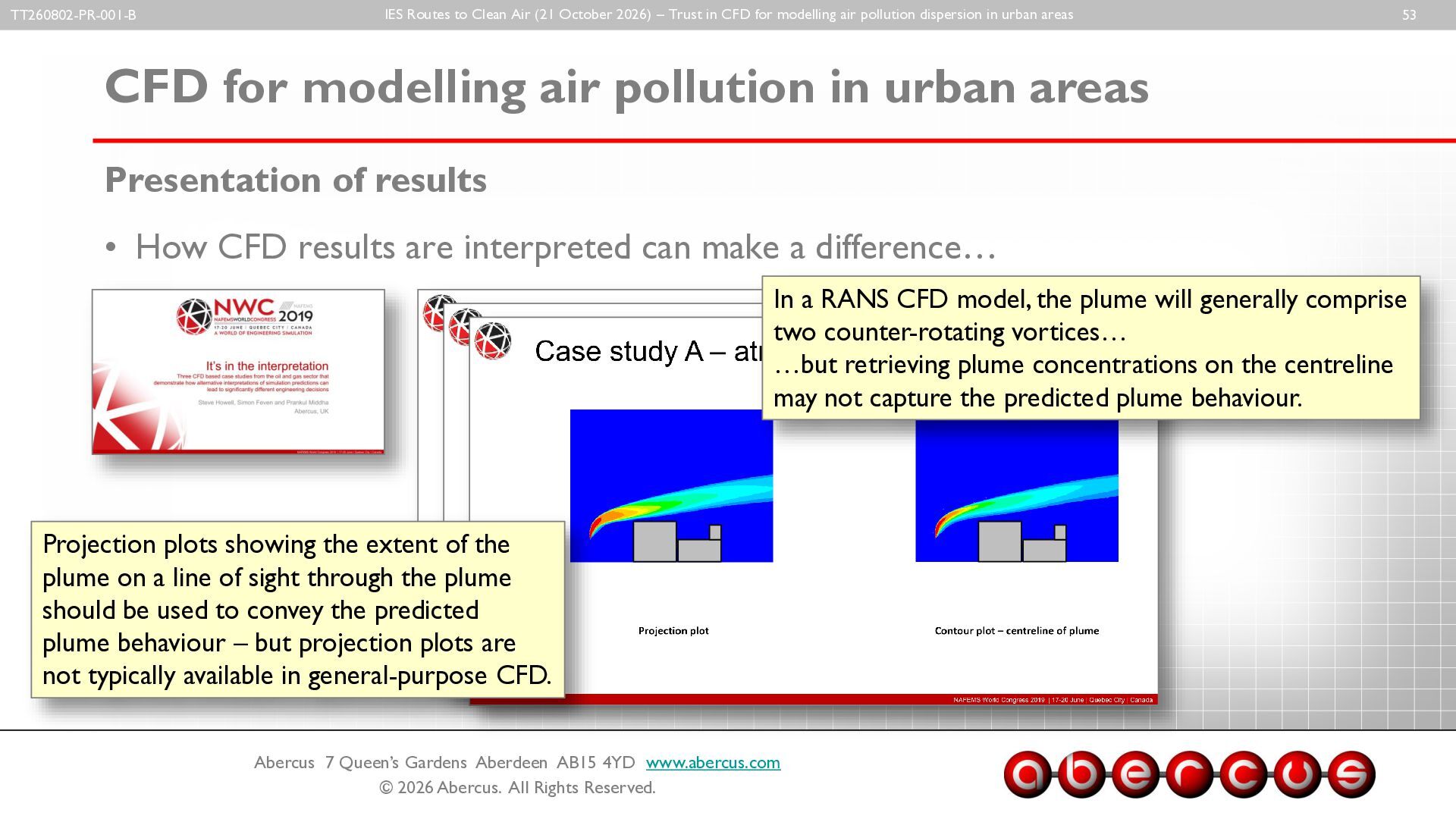
Trust in CFD for modelling air pollution dispersion in urban areas 53 CFD for modelling air pollution in urban areas Presentation of results • How CFD results are interpreted can make a difference… In a RANS CFD model, the plume will generally comprise two counter-rotating vortices… …but retrieving plume concentrations on the centreline may not capture the predicted plume behaviour. Projection plots showing the extent of the plume on a line of sight through the plume should be used to convey the predicted plume behaviour – but projection plots are not typically available in general-purpose CFD. www.abercus.com Abercus 7 Queen’s Gardens Aberdeen AB15 4YD www.abercus.com © 2026 Abercus. All Rights Reserved. www.abercus.com
TT260802-PR-001-B IES Routes to Clean Air (21 October 2026) –
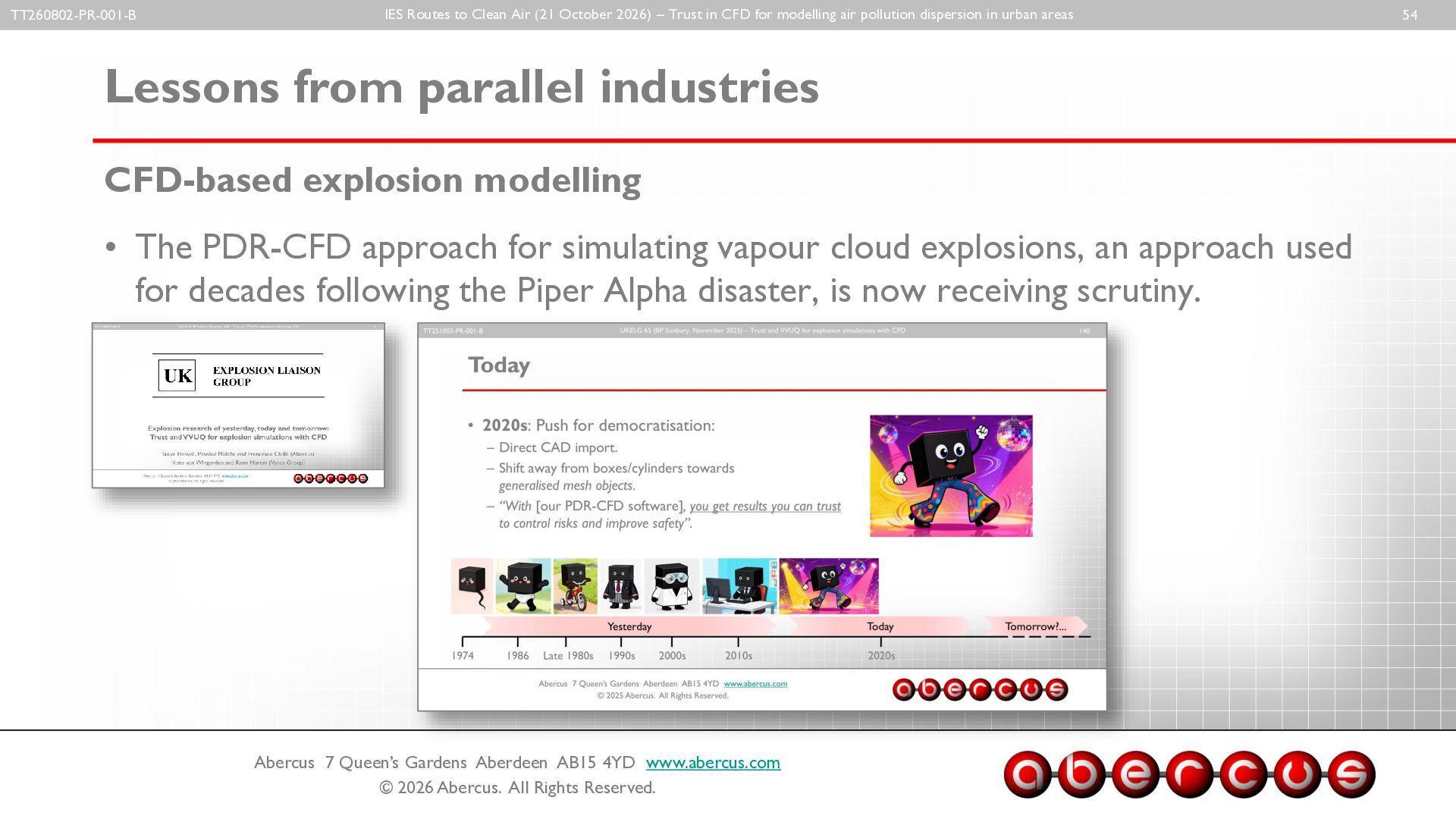
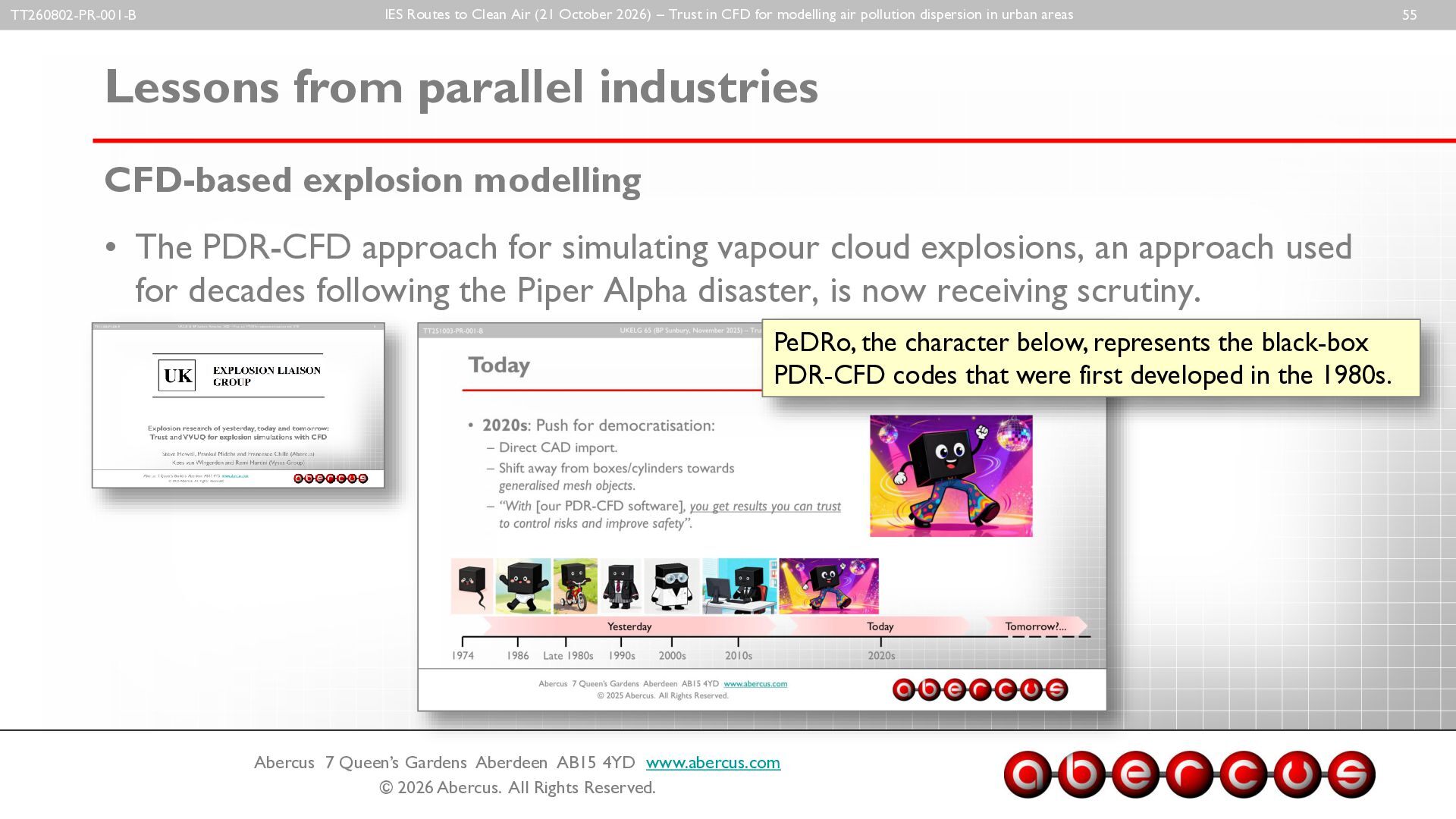
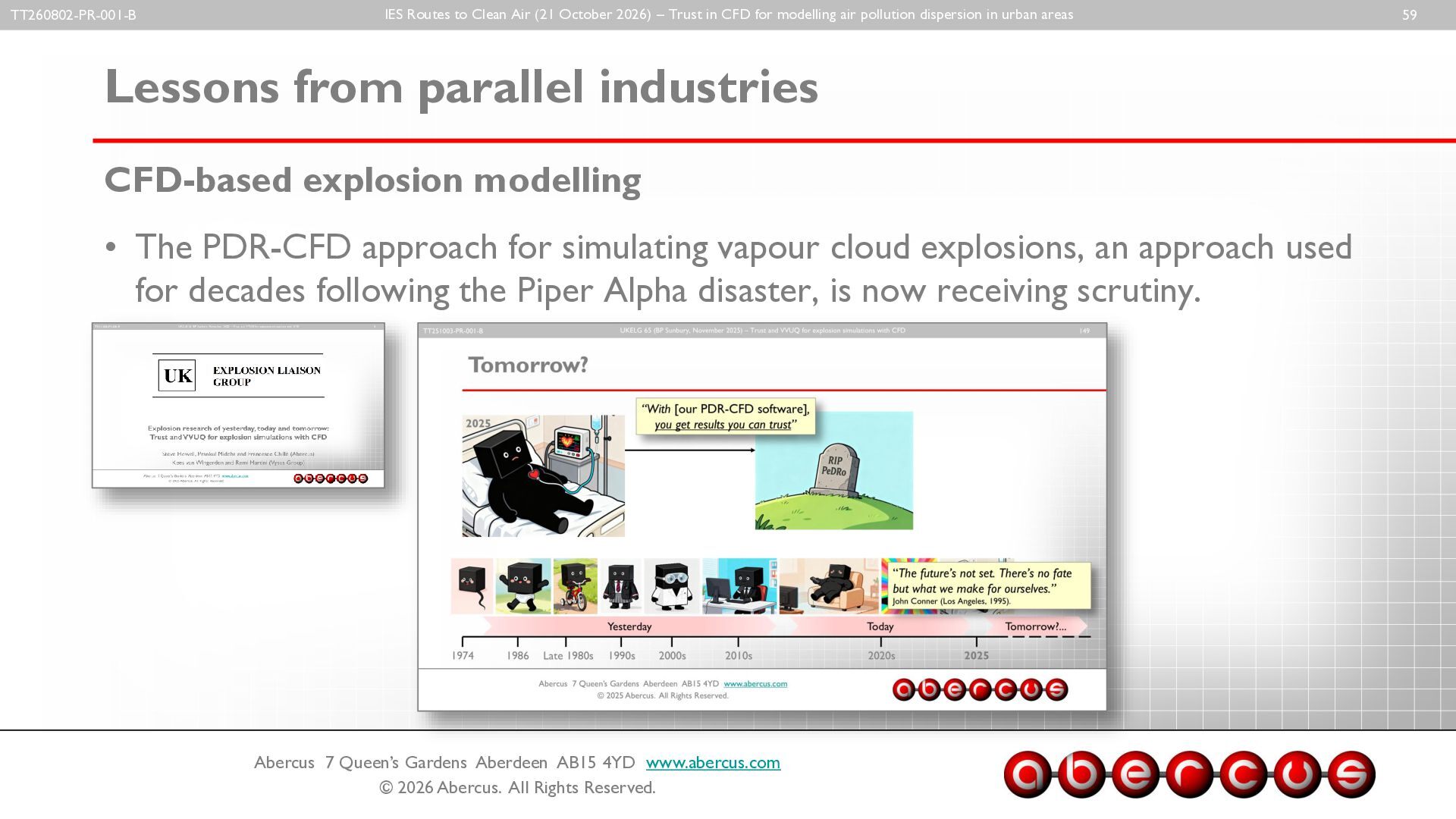
Trust in CFD for modelling air pollution dispersion in urban areas Lessons from parallel industries CFD-based explosion modelling • The PDR-CFD approach for simulating vapour cloud explosions, an approach used for decades following the Piper Alpha disaster, is now receiving scrutiny. www.abercus.com Abercus 7 Queen’s Gardens Aberdeen AB15 4YD www.abercus.com © 2026 Abercus. All Rights Reserved. www.abercus.com 54
TT260802-PR-001-B IES Routes to Clean Air (21 October 2026) –
Trust in CFD for modelling air pollution dispersion in urban areas Lessons from parallel industries CFD-based explosion modelling • The PDR-CFD approach for simulating vapour cloud explosions, an approach used for decades following the Piper Alpha disaster, is now receiving scrutiny. PeDRo, the character below, represents the black-box PDR-CFD codes that were first developed in the 1980s. www.abercus.com Abercus 7 Queen’s Gardens Aberdeen AB15 4YD www.abercus.com © 2026 Abercus. All Rights Reserved. www.abercus.com 55
TT260802-PR-001-B IES Routes to Clean Air (21 October 2026) –
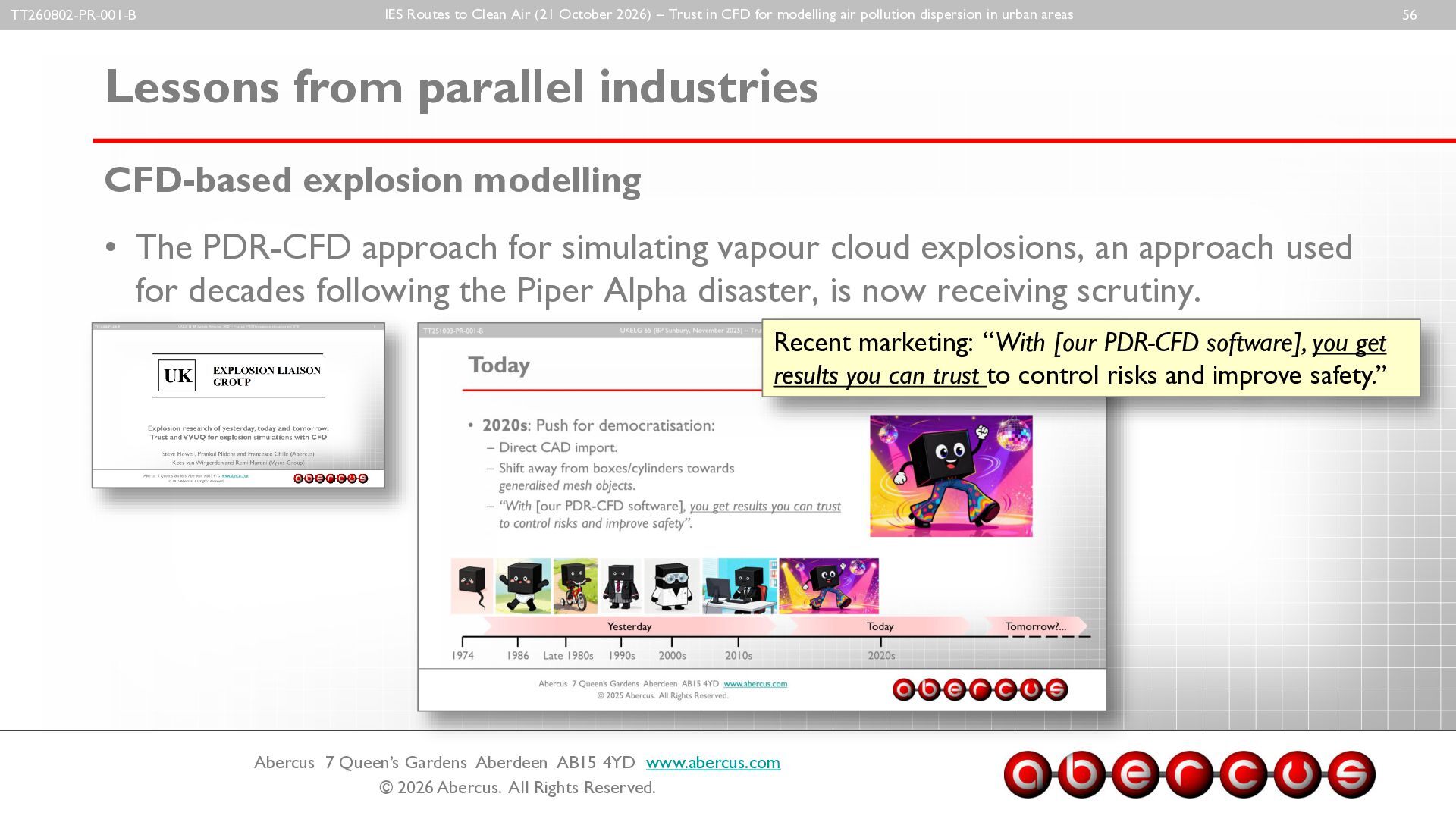
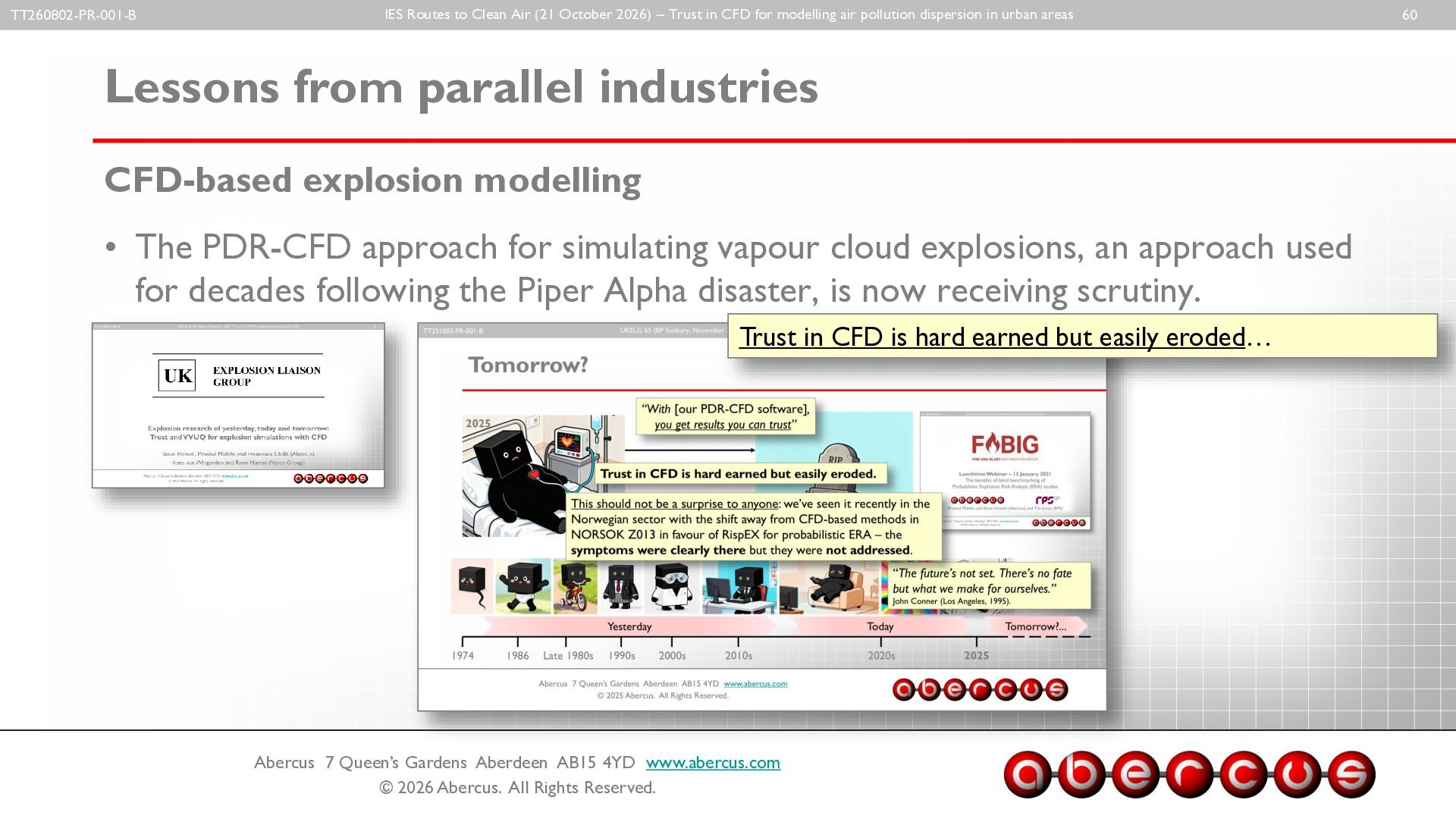
Trust in CFD for modelling air pollution dispersion in urban areas Lessons from parallel industries CFD-based explosion modelling • The PDR-CFD approach for simulating vapour cloud explosions, an approach used for decades following the Piper Alpha disaster, is now receiving scrutiny. Recent marketing: “With [our PDR-CFD software], you get results you can trust to control risks and improve safety.” www.abercus.com Abercus 7 Queen’s Gardens Aberdeen AB15 4YD www.abercus.com © 2026 Abercus. All Rights Reserved. www.abercus.com 56
TT260802-PR-001-B IES Routes to Clean Air (21 October 2026) –
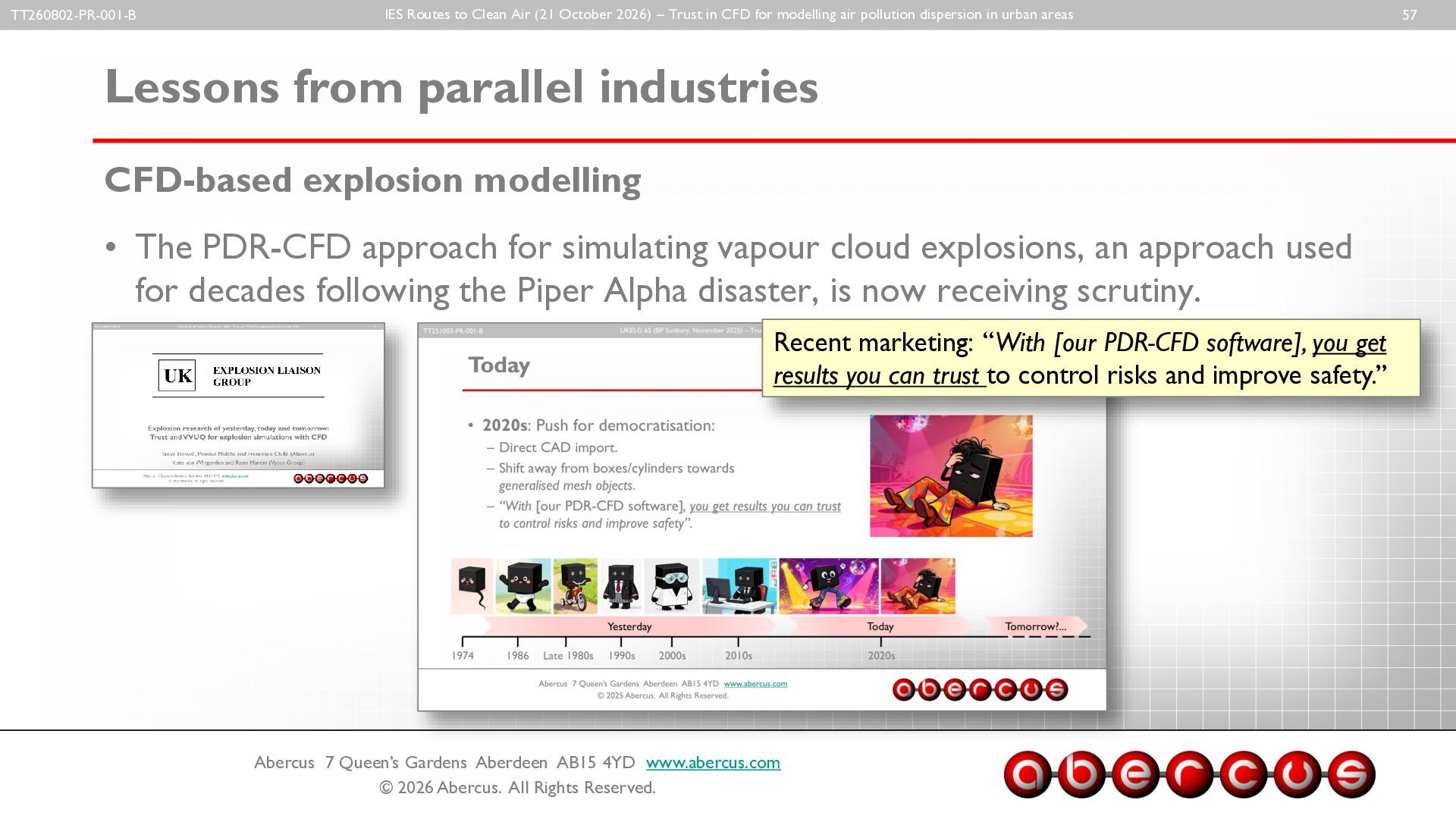
Trust in CFD for modelling air pollution dispersion in urban areas Lessons from parallel industries CFD-based explosion modelling • The PDR-CFD approach for simulating vapour cloud explosions, an approach used for decades following the Piper Alpha disaster, is now receiving scrutiny. Recent marketing: “With [our PDR-CFD software], you get results you can trust to control risks and improve safety.” www.abercus.com Abercus 7 Queen’s Gardens Aberdeen AB15 4YD www.abercus.com © 2026 Abercus. All Rights Reserved. www.abercus.com 57
TT260802-PR-001-B IES Routes to Clean Air (21 October 2026) –
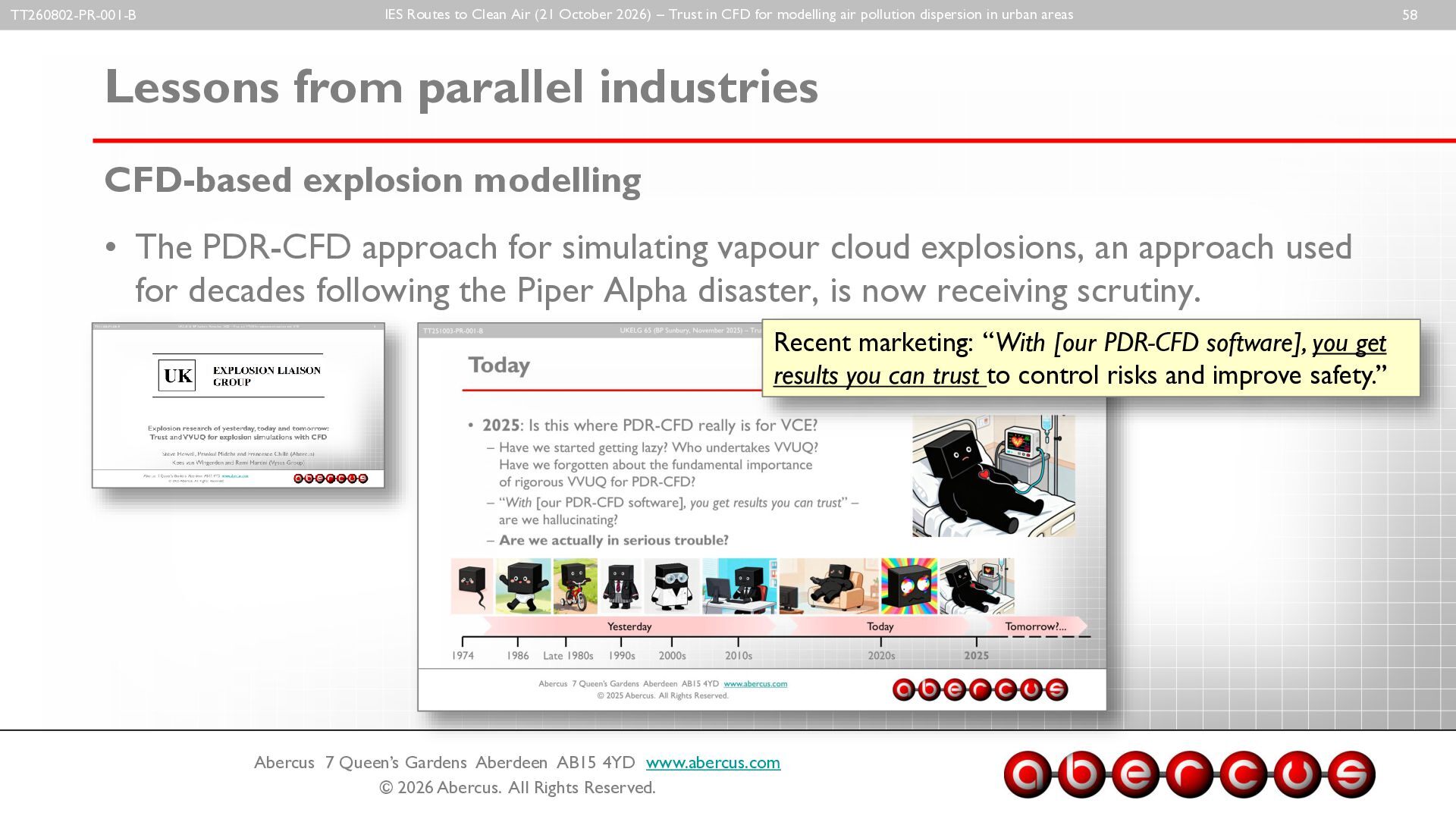
Trust in CFD for modelling air pollution dispersion in urban areas Lessons from parallel industries CFD-based explosion modelling • The PDR-CFD approach for simulating vapour cloud explosions, an approach used for decades following the Piper Alpha disaster, is now receiving scrutiny. Recent marketing: “With [our PDR-CFD software], you get results you can trust to control risks and improve safety.” www.abercus.com Abercus 7 Queen’s Gardens Aberdeen AB15 4YD www.abercus.com © 2026 Abercus. All Rights Reserved. www.abercus.com 58
TT260802-PR-001-B IES Routes to Clean Air (21 October 2026) –
Trust in CFD for modelling air pollution dispersion in urban areas Lessons from parallel industries CFD-based explosion modelling • The PDR-CFD approach for simulating vapour cloud explosions, an approach used for decades following the Piper Alpha disaster, is now receiving scrutiny. www.abercus.com Abercus 7 Queen’s Gardens Aberdeen AB15 4YD www.abercus.com © 2026 Abercus. All Rights Reserved. www.abercus.com 59
TT260802-PR-001-B IES Routes to Clean Air (21 October 2026) –
Trust in CFD for modelling air pollution dispersion in urban areas Lessons from parallel industries CFD-based explosion modelling • The PDR-CFD approach for simulating vapour cloud explosions, an approach used for decades following the Piper Alpha disaster, is now receiving scrutiny. Trust in CFD is hard earned but easily eroded… www.abercus.com Abercus 7 Queen’s Gardens Aberdeen AB15 4YD www.abercus.com © 2026 Abercus. All Rights Reserved. www.abercus.com 60
TT260802-PR-001-B IES Routes to Clean Air (21 October 2026) –
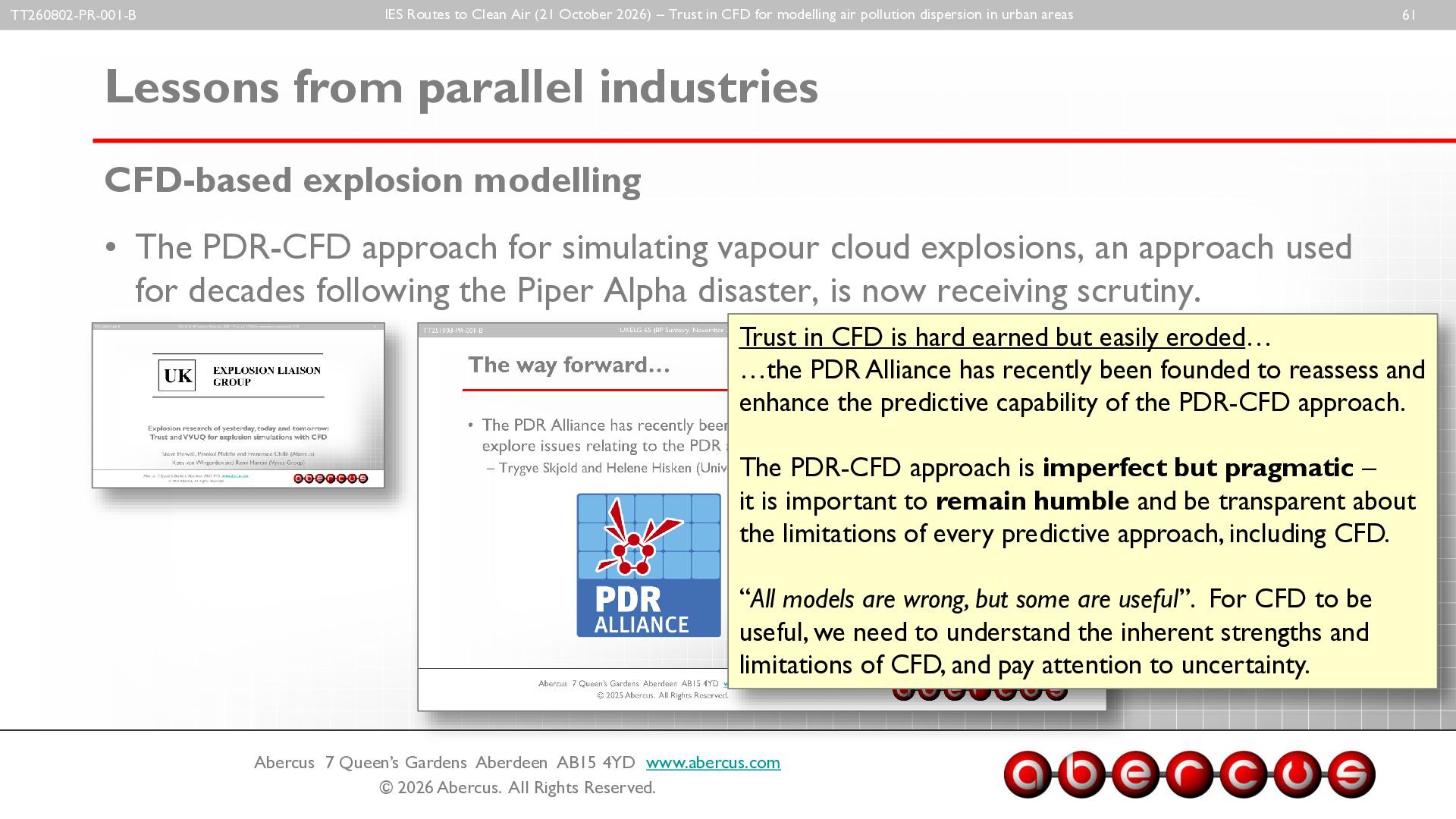
Trust in CFD for modelling air pollution dispersion in urban areas 61 Lessons from parallel industries CFD-based explosion modelling • The PDR-CFD approach for simulating vapour cloud explosions, an approach used for decades following the Piper Alpha disaster, is now receiving scrutiny. Trust in CFD is hard earned but easily eroded… …the PDR Alliance has recently been founded to reassess and enhance the predictive capability of the PDR-CFD approach. The PDR-CFD approach is imperfect but pragmatic – it is important to remain humble and be transparent about the limitations of every predictive approach, including CFD. “All models are wrong, but some are useful”. For CFD to be useful, we need to understand the inherent strengths and limitations of CFD, and pay attention to uncertainty. www.abercus.com Abercus 7 Queen’s Gardens Aberdeen AB15 4YD www.abercus.com © 2026 Abercus. All Rights Reserved. www.abercus.com
TT260802-PR-001-B IES Routes to Clean Air (21 October 2026) –
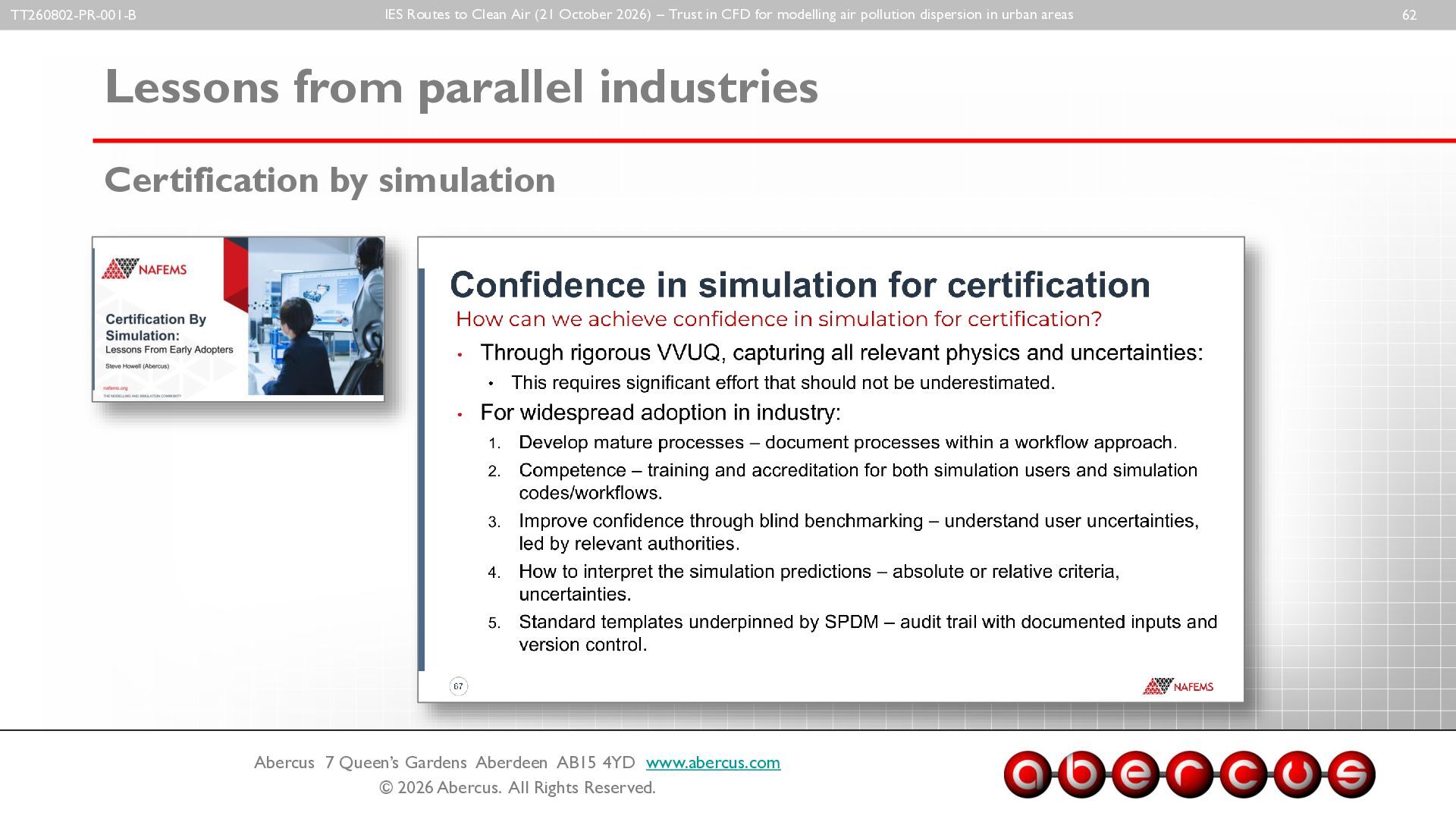
Trust in CFD for modelling air pollution dispersion in urban areas Lessons from parallel industries Certification by simulation www.abercus.com Abercus 7 Queen’s Gardens Aberdeen AB15 4YD www.abercus.com © 2026 Abercus. All Rights Reserved. www.abercus.com 62
TT260802-PR-001-B IES Routes to Clean Air (21 October 2026) –
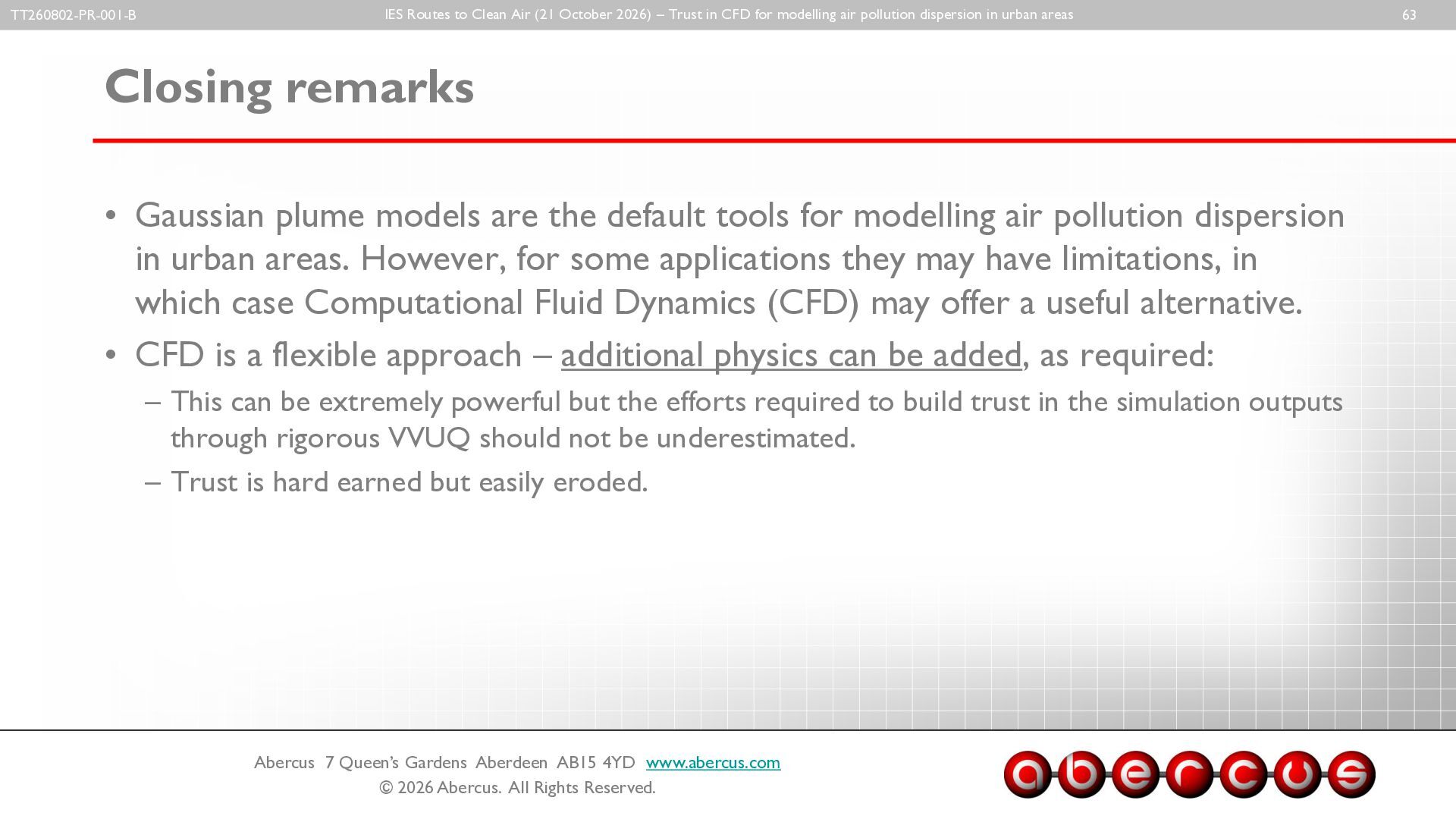
Trust in CFD for modelling air pollution dispersion in urban areas Closing remarks • Gaussian plume models are the default tools for modelling air pollution dispersion in urban areas. However, for some applications they may have limitations, in which case Computational Fluid Dynamics (CFD) may offer a useful alternative. • CFD is a flexible approach – additional physics can be added, as required: – This can be extremely powerful but the efforts required to build trust in the simulation outputs through rigorous VVUQ should not be underestimated. – Trust is hard earned but easily eroded. www.abercus.com Abercus 7 Queen’s Gardens Aberdeen AB15 4YD www.abercus.com © 2026 Abercus. All Rights Reserved. www.abercus.com 63
TT260802-PR-001-B IES Routes to Clean Air (21 October 2026) –
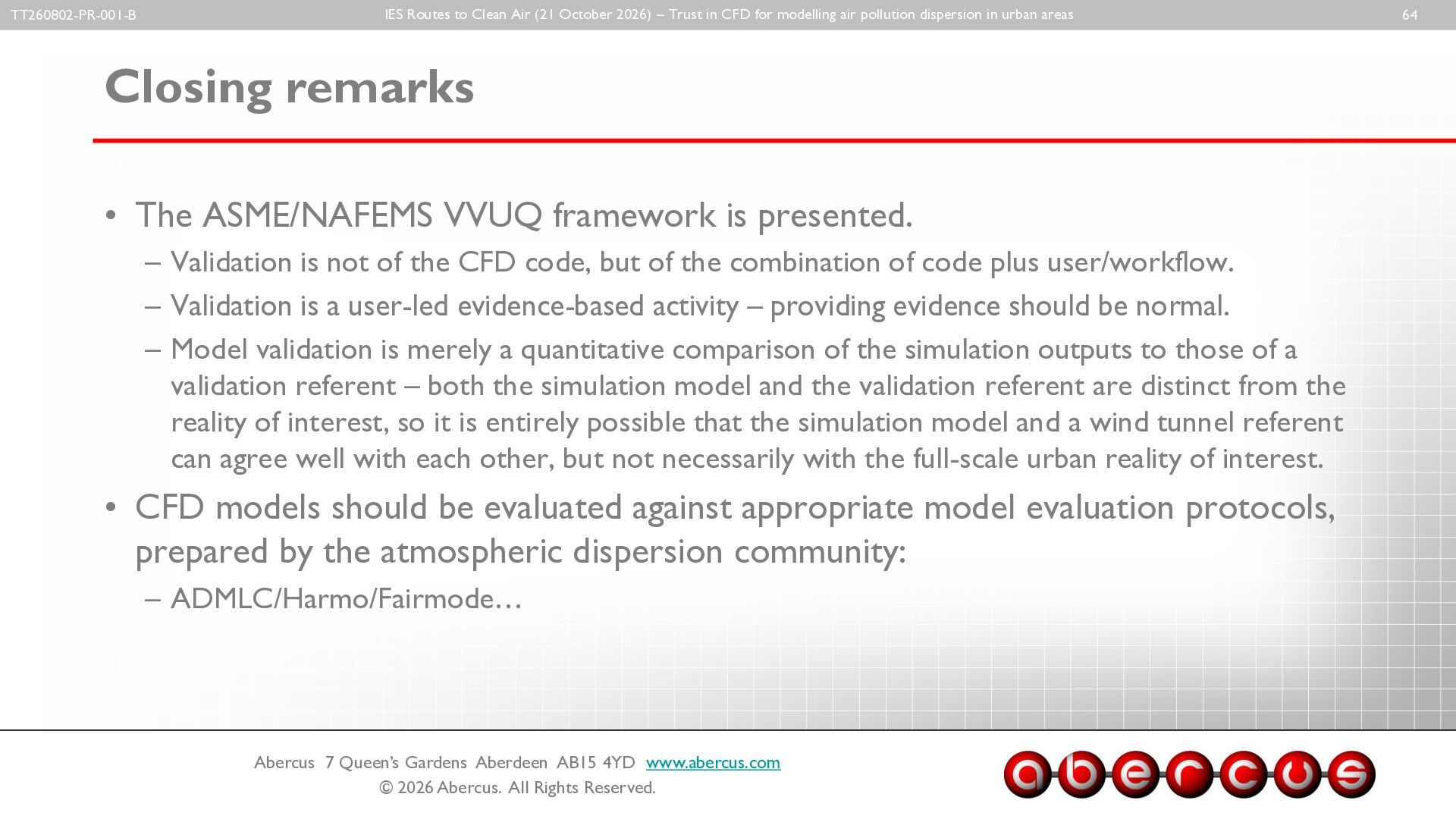
Trust in CFD for modelling air pollution dispersion in urban areas Closing remarks • The ASME/NAFEMS VVUQ framework is presented. – Validation is not of the CFD code, but of the combination of code plus user/workflow. – Validation is a user-led evidence-based activity – providing evidence should be normal. – Model validation is merely a quantitative comparison of the simulation outputs to those of a validation referent – both the simulation model and the validation referent are distinct from the reality of interest, so it is entirely possible that the simulation model and a wind tunnel referent can agree well with each other, but not necessarily with the full-scale urban reality of interest. • CFD models should be evaluated against appropriate model evaluation protocols, prepared by the atmospheric dispersion community: – ADMLC/Harmo/Fairmode… www.abercus.com Abercus 7 Queen’s Gardens Aberdeen AB15 4YD www.abercus.com © 2026 Abercus. All Rights Reserved. www.abercus.com 64
TT260802-PR-001-B IES Routes to Clean Air (21 October 2026) –
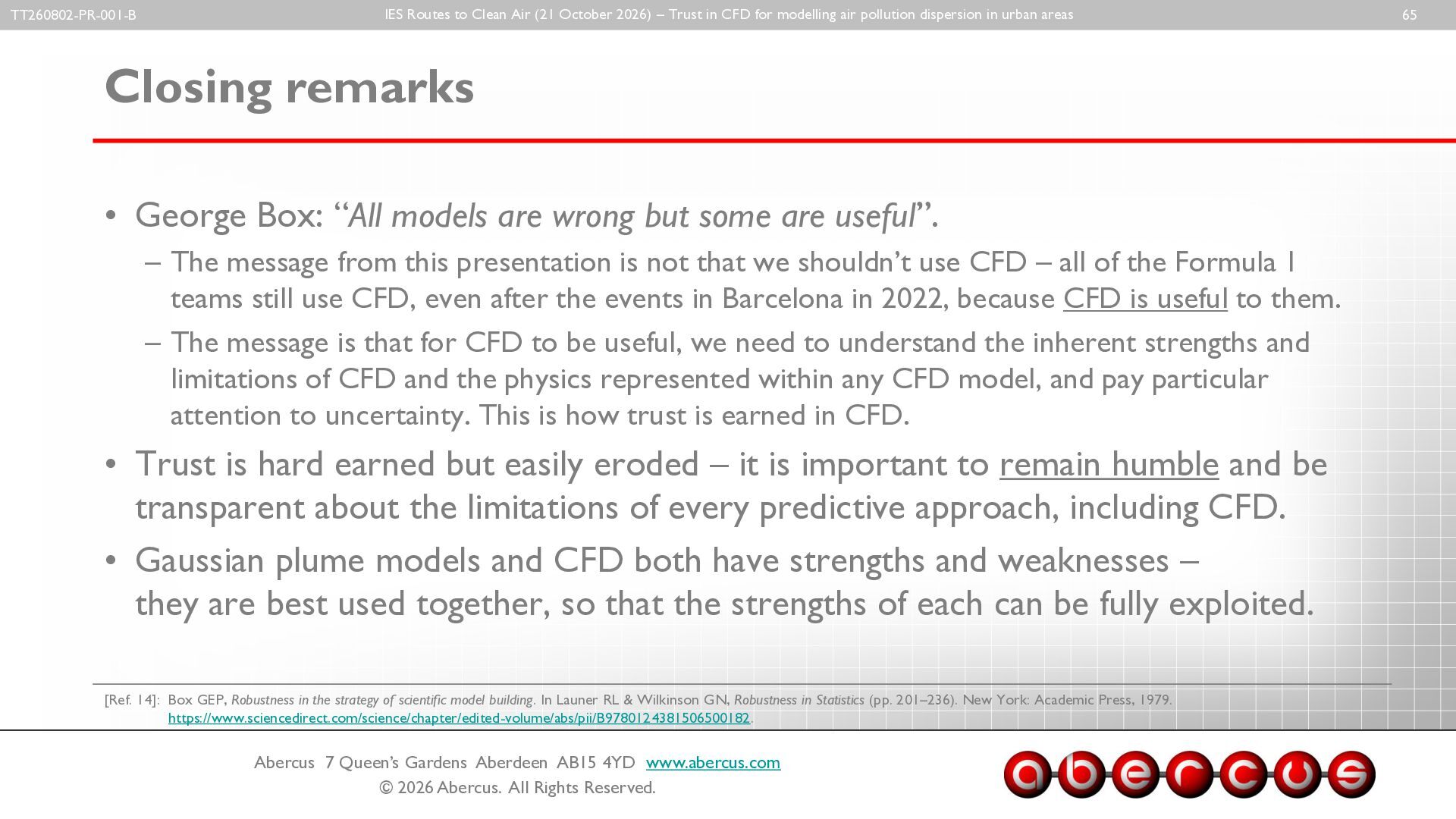
Trust in CFD for modelling air pollution dispersion in urban areas Closing remarks • George Box: “All models are wrong but some are useful”. – The message from this presentation is not that we shouldn’t use CFD – all of the Formula 1 teams still use CFD, even after the events in Barcelona in 2022, because CFD is useful to them. – The message is that for CFD to be useful, we need to understand the inherent strengths and limitations of CFD and the physics represented within any CFD model, and pay particular attention to uncertainty. This is how trust is earned in CFD. • Trust is hard earned but easily eroded – it is important to remain humble and be transparent about the limitations of every predictive approach, including CFD. • Gaussian plume models and CFD both have strengths and weaknesses – they are best used together, so that the strengths of each can be fully exploited. [Ref. 14]: Box GEP, Robustness in the strategy of scientific model building. In Launer RL & Wilkinson GN, Robustness in Statistics (pp. 201–236). New York: Academic Press, 1979. https://www.sciencedirect.com/science/chapter/edited-volume/abs/pii/B9780124381506500182. www.abercus.com Abercus 7 Queen’s Gardens Aberdeen AB15 4YD www.abercus.com © 2026 Abercus. All Rights Reserved. www.abercus.com 65
IES Routes to Clean Air (21 October 2026) – Trust
in CFD for modelling air pollution dispersion in urban areas TT260802-PR-001-B www.abercus.com Contact us Enquiries can be directed to:
[email protected]
www.abercus.com www.linkedin.com/in/drstevehowell 66


 iesevents
 csswizardry
 sferik
 konakalab
 nwiizo
 kastner
 afnizarnur
 marketingsoph
 rkendrick25
 honzajavorek
 techseoconnect
 kneath