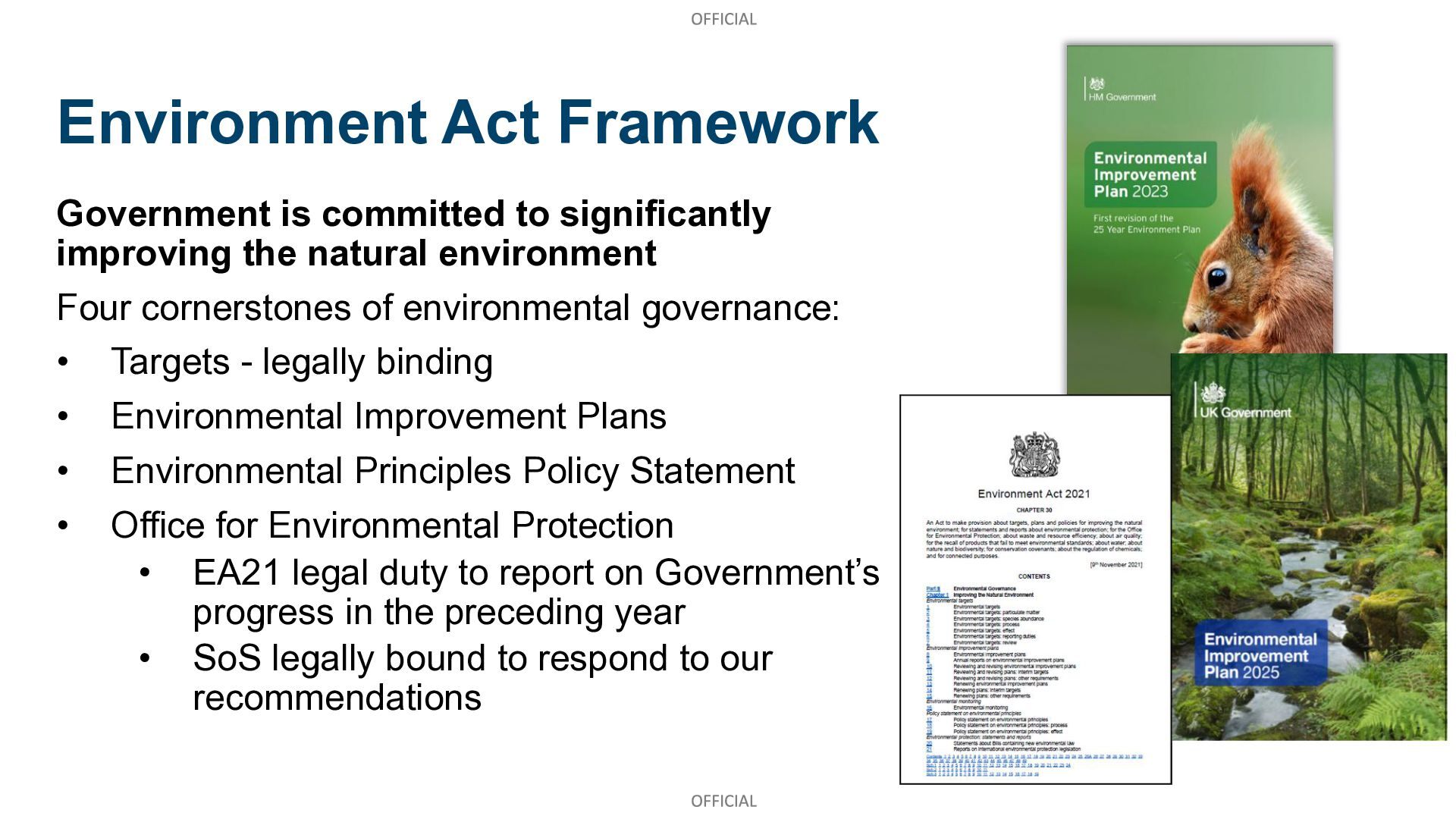
natural environment Four cornerstones of environmental governance: • Targets - legally binding • Environmental Improvement Plans • Environmental Principles Policy Statement • Office for Environmental Protection • EA21 legal duty to report on Government’s progress in the preceding year • SoS legally bound to respond to our recommendations
Act 2021 1. In our report we must report on the government’s progress that was made in the annual reporting period (i.e. April 2025 to March 2026) towards: a) improving the natural environment in accordance with the current EIP, b) towards meeting its legally binding Environment Act 2021 targets (‘EA21 targets’), and c) towards meeting its non-legally binding Environment Act 2021 interim targets (‘EA21 interim targets’). 2. In doing so, we must consider: a) the government’s Annual Progress Report (published July 2026), b) any data published by the Secretary of State under section 16 to monitor the above progress, and c) any other reports, documents or information we consider appropriate. 3. We also may consider: a. how the government’s progress could be improved, and b. the adequacy of the data published by the Secretary of State to monitor the above progress
mean? Must: • Report on progress on (a) improving the natural environment, (b) towards meeting EA21 targets and (c) towards meeting EA21 interim targets • Consider the Annual Progress Report, data published by the SoS and other reports we consider appropriate • Report on the annual reporting period - April 2025 to March 2026 – or say we cannot do so due to lack of data Can consider: • How government could improve its progress in the future and the adequacy of the data published by the SoS • Progress towards other targets and commitments that are not EA21 targets
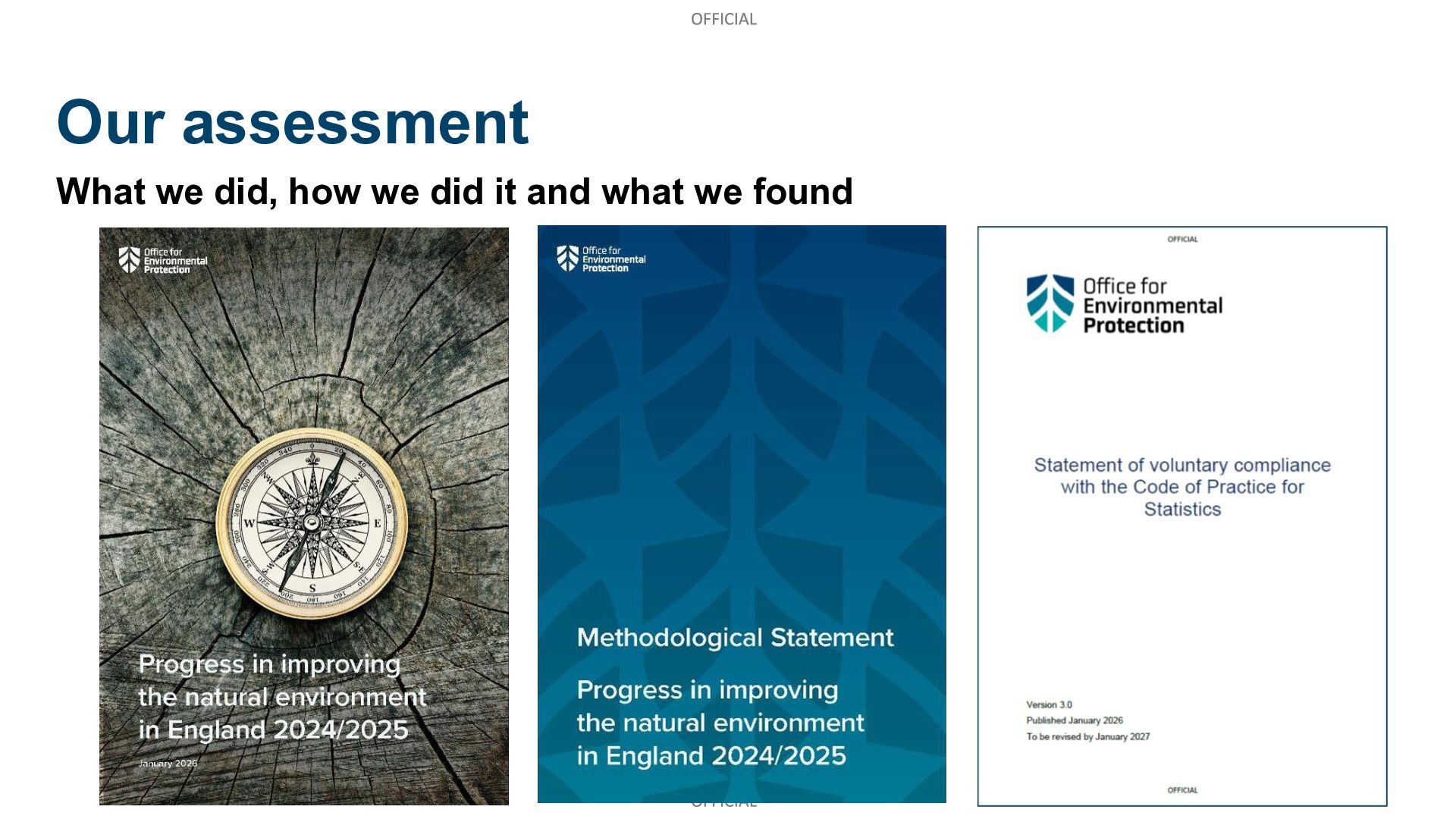
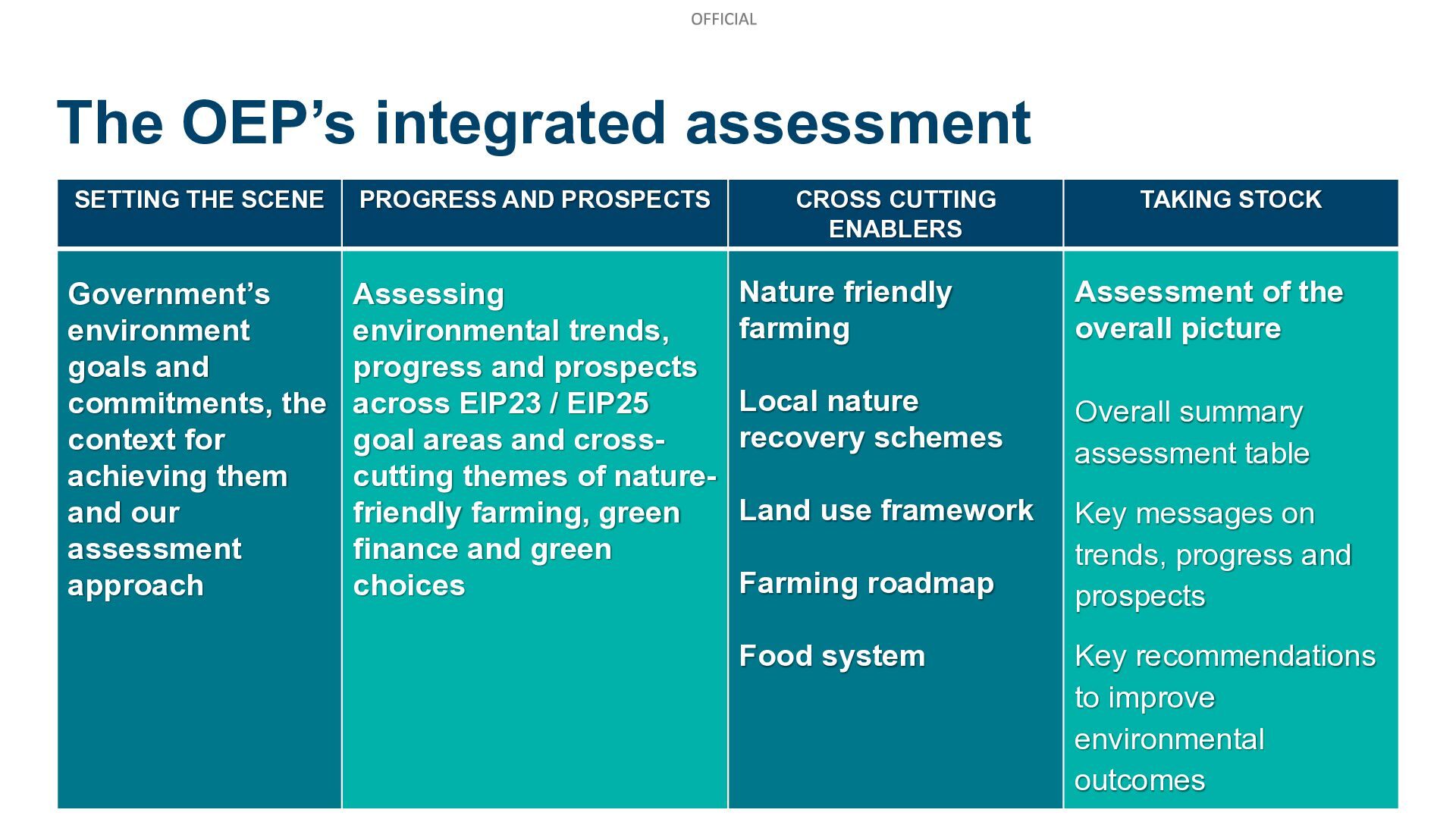
Government’s environment goals and commitments, the context for achieving them and our assessment approach Assessing environmental trends, progress and prospects across EIP23 / EIP25 goal areas and crosscutting themes of naturefriendly farming, green finance and green choices CROSS CUTTING ENABLERS TAKING STOCK Nature friendly farming Assessment of the overall picture Local nature recovery schemes Overall summary assessment table Land use framework Key messages on trends, progress and prospects Farming roadmap Food system Key recommendations to improve environmental outcomes
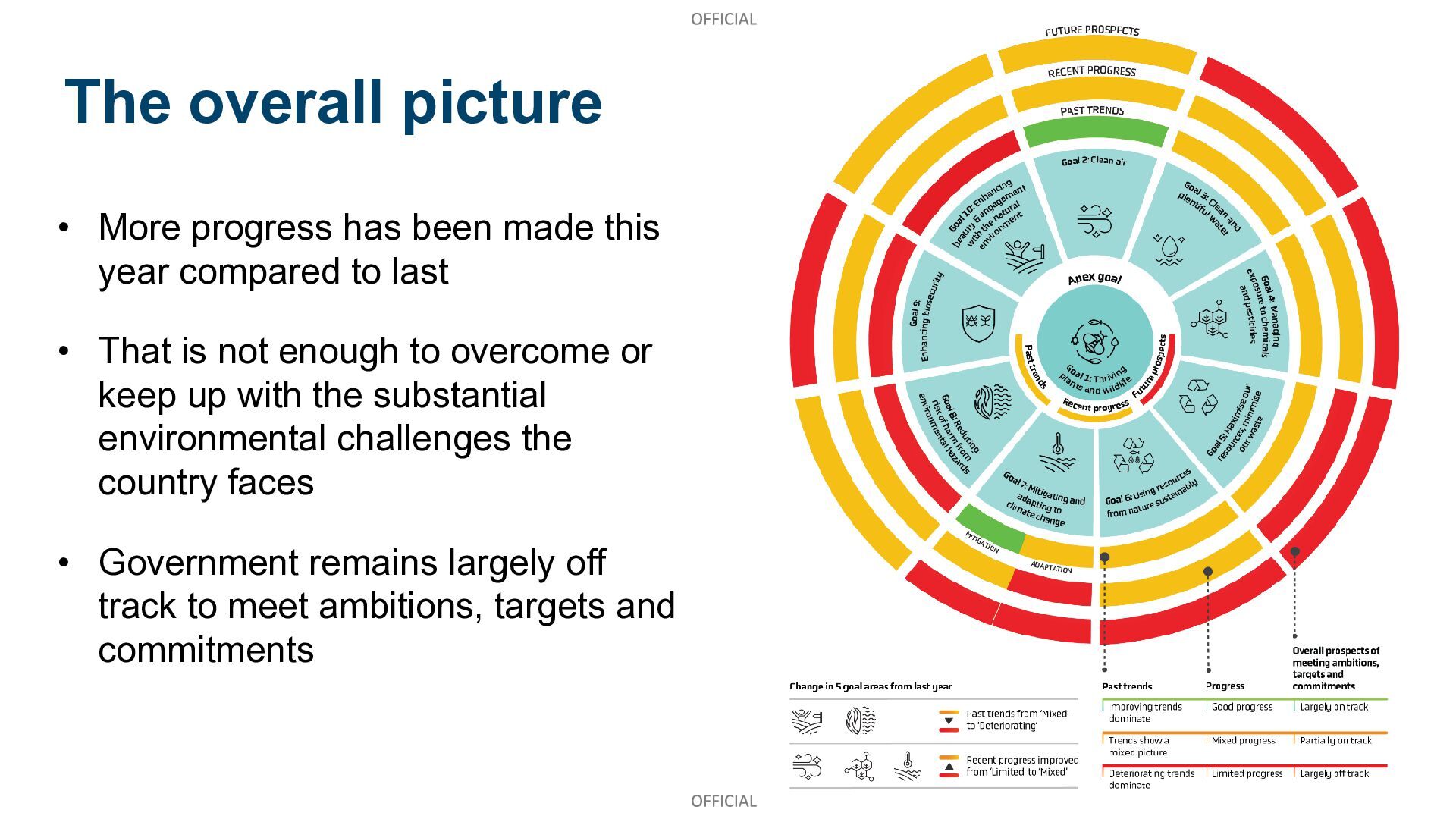
year compared to last • That is not enough to overcome or keep up with the substantial environmental challenges the country faces • Government remains largely off track to meet ambitions, targets and commitments
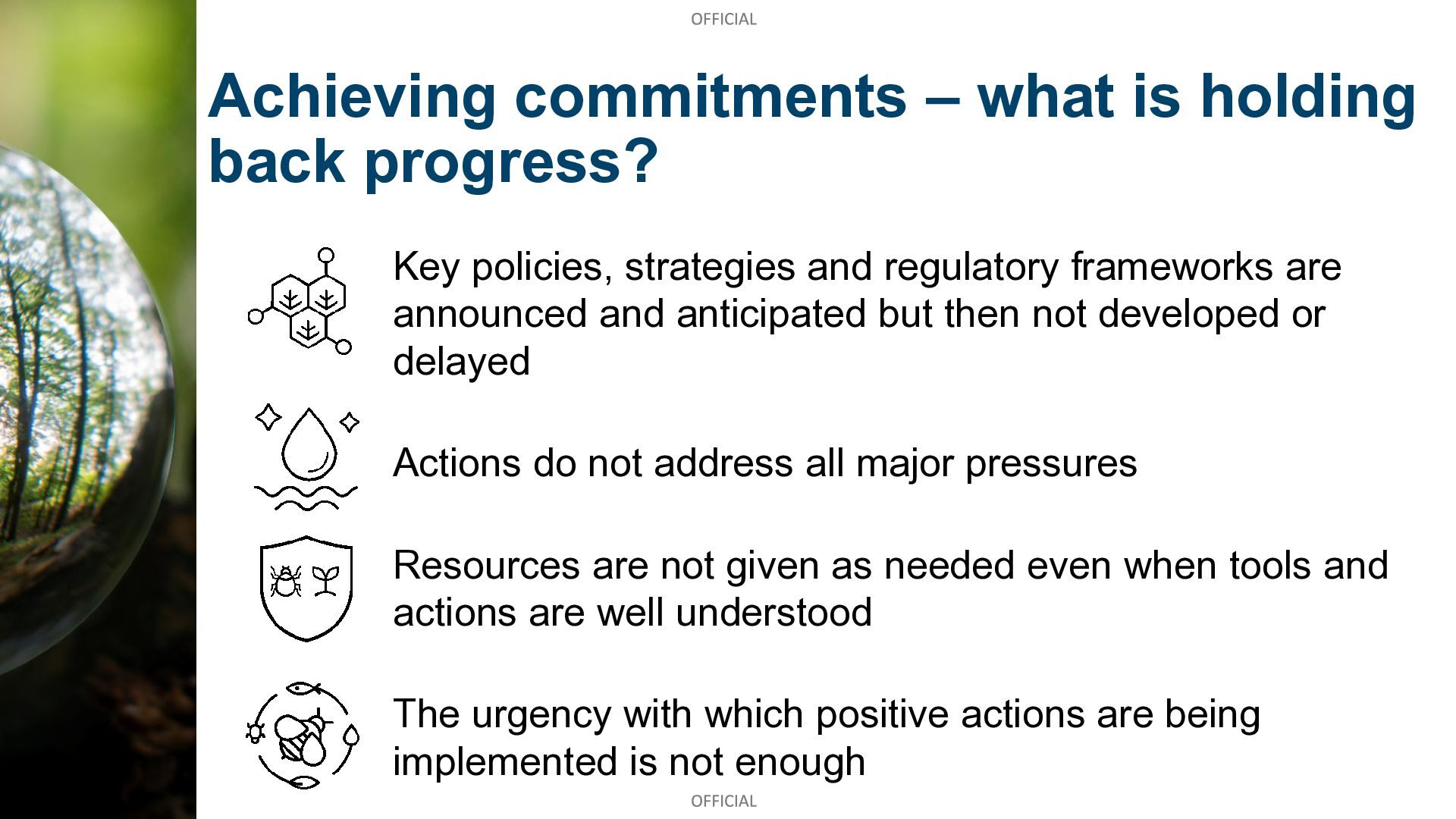
strategies and regulatory frameworks are announced and anticipated but then not developed or delayed Actions do not address all major pressures Resources are not given as needed even when tools and actions are well understood The urgency with which positive actions are being implemented is not enough
the contribution of protected sites for nature 3. Speed up action in the marine environment 4. Set out clear mechanisms for reconciling competing demands for use of land and sea 5. Develop a circular economy framework Enablers 6. Mobilise investment at the scale needed 7. Regulate more effectively 8. Harness support needed to achieve ambitions
up and scale up its efforts, and actions must be shown to stack up to make achieving targets and commitments a reality. Risks are materialising and are mounting year on year, yet there is little sense of urgency. Government’s progress continues to be too slow to keep up and overcome the environmental challenges the country now faces.
for this government. The EIP25 must inspire action and drive change across government. In turn government must catalyse action across society. It must provide the leadership and concerted effort required to deliver the significant environmental improvements to that it is committed to and that are so urgently needed.


 iesevents
 ryanjones
 frankvandijk
 rkaga
 lemiorhan
 inesmontani
 notwaldorf
 csswizardry
 leimatthew05
 tammyeverts
 sonatard
 samlambert
 elsirapls