Air Pollution Awareness Coalition • Air Quality Strategy – call for evidence Department for Environment, Food & Rural Affairs OFFICIAL | DRAFT – NOT HMG POLICY
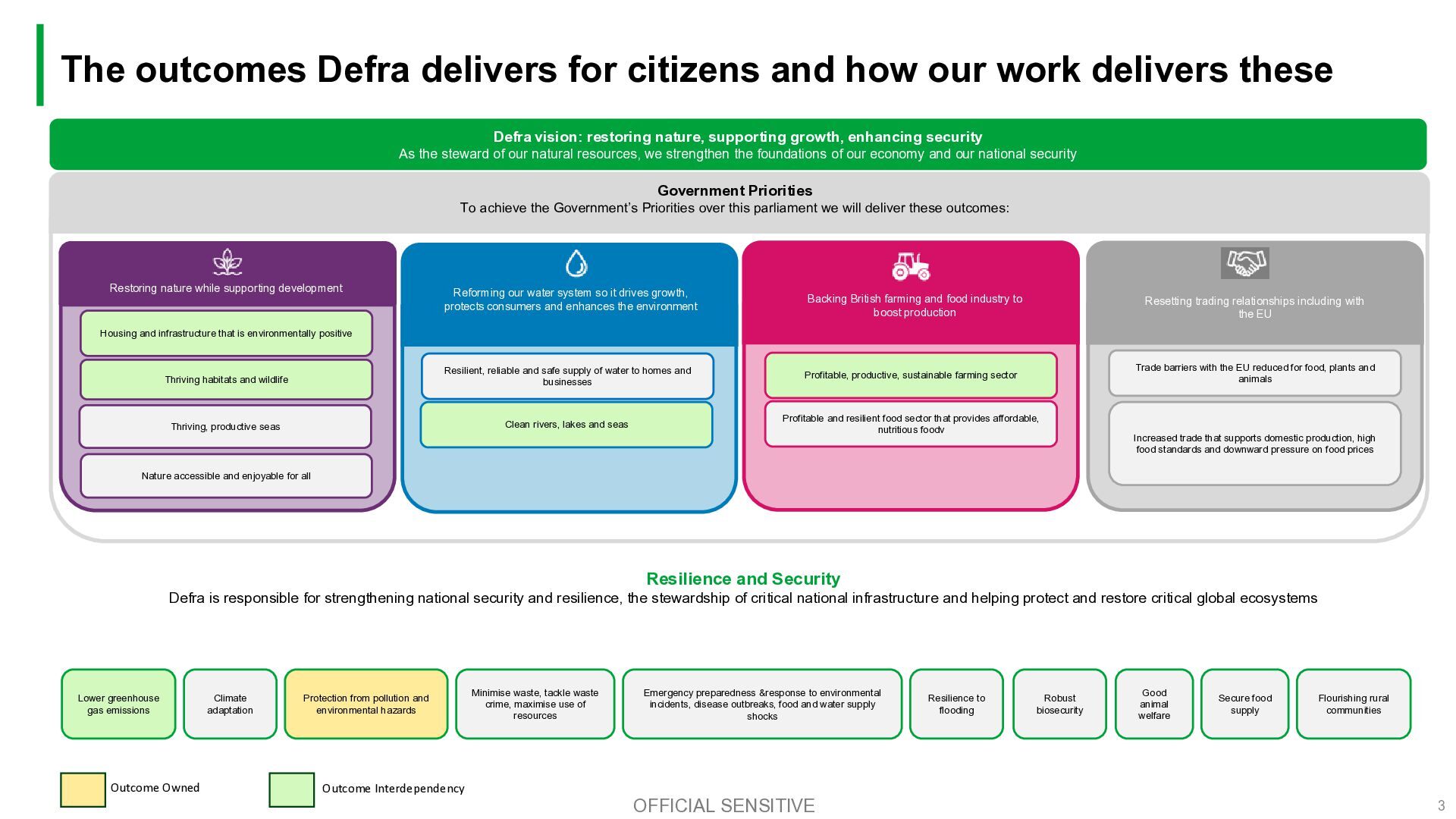
delivers these Defra vision: restoring nature, supporting growth, enhancing security As the steward of our natural resources, we strengthen the foundations of our economy and our national security Government Priorities To achieve the Government’s Priorities over this parliament we will deliver these outcomes: Restoring nature while supporting development Reforming our water system so it drives growth, protects consumers and enhances the environment Backing British farming and food industry to boost production Resetting trading relationships including with the EU Trade barriers with the EU reduced for food, plants and animals Housing and infrastructure that is environmentally positive Thriving habitats and wildlife Resilient, reliable and safe supply of water to homes and businesses Profitable, productive, sustainable farming sector Thriving, productive seas Clean rivers, lakes and seas Profitable and resilient food sector that provides affordable, nutritious foodv Increased trade that supports domestic production, high food standards and downward pressure on food prices Nature accessible and enjoyable for all Resilience and Security Defra is responsible for strengthening national security and resilience, the stewardship of critical national infrastructure and helping protect and restore critical global ecosystems - Lower greenhouse gas emissions Outcome Owned Climate adaptation Protection from pollution and environmental hazards Minimise waste, tackle waste crime, maximise use of resources Emergency preparedness &response to environmental incidents, disease outbreaks, food and water supply shocks Resilience to flooding Robust biosecurity Good animal welfare Secure food supply Flourishing rural communities Outcome Interdependency OFFICIAL SENSITIVE 3
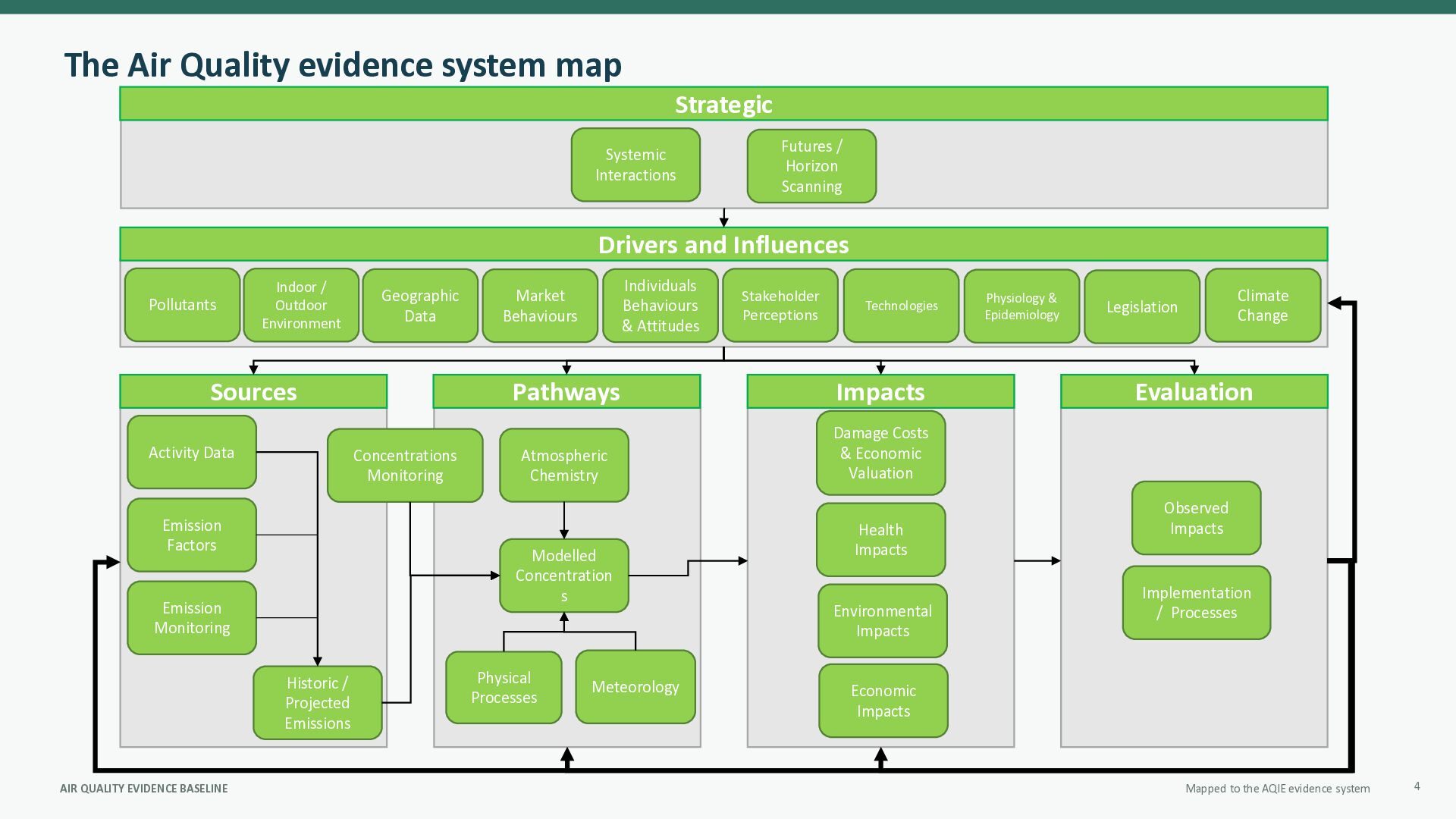
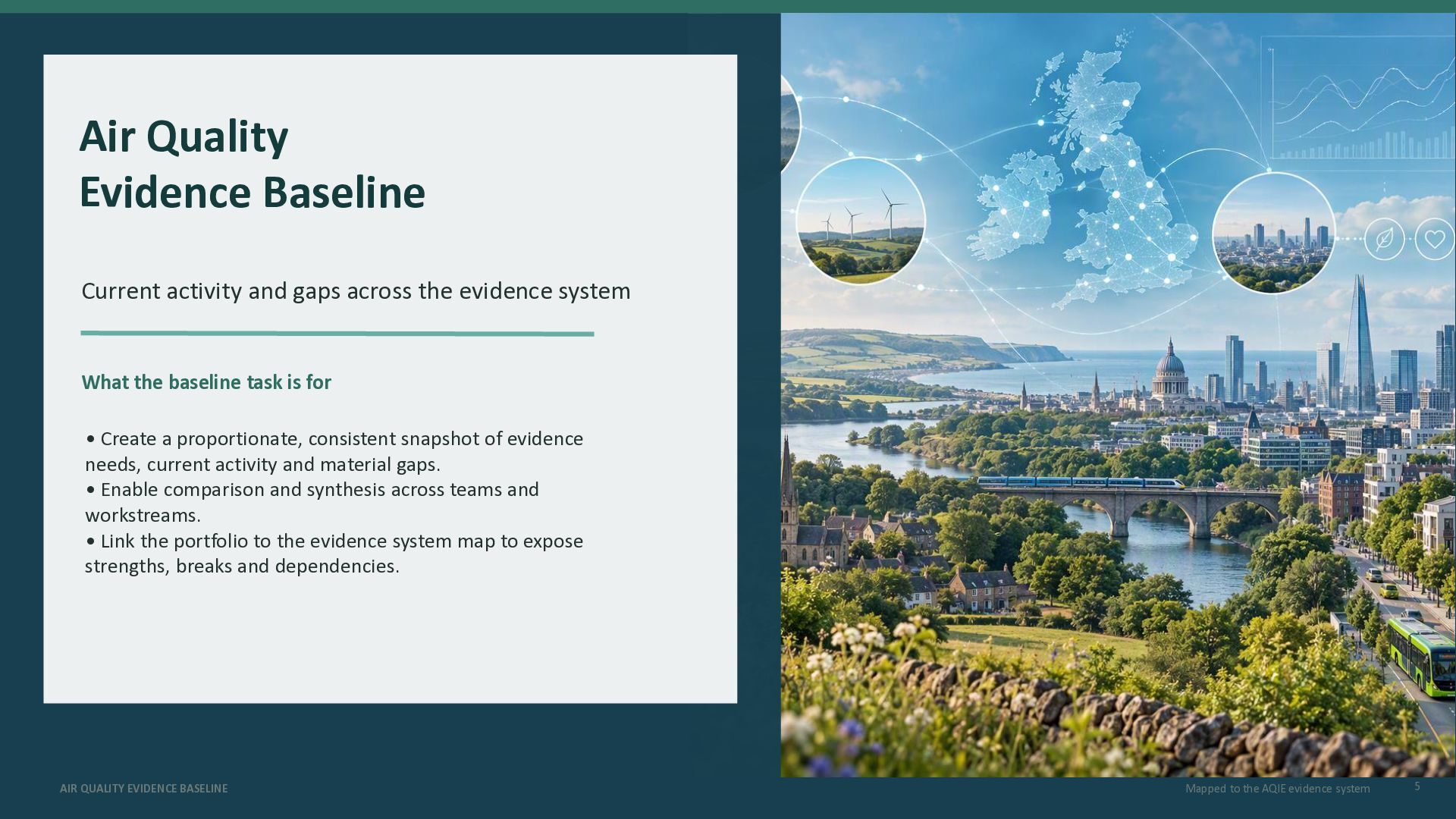
evidence system What the baseline task is for • Create a proportionate, consistent snapshot of evidence needs, current activity and material gaps. • Enable comparison and synthesis across teams and workstreams. • Link the portfolio to the evidence system map to expose strengths, breaks and dependencies. AIR QUALITY EVIDENCE BASELINE Mapped to the AQIE evidence system 5
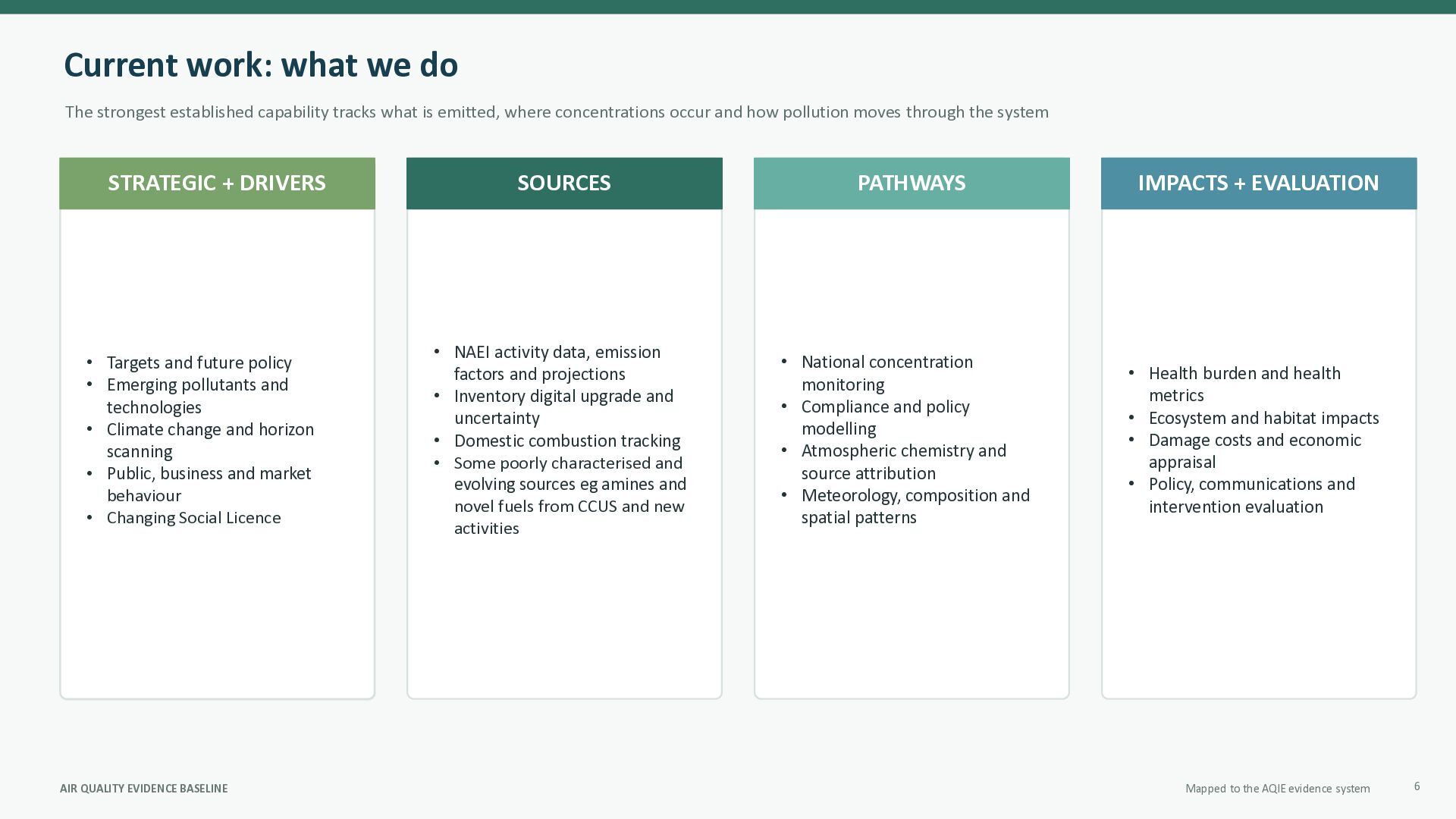
what is emitted, where concentrations occur and how pollution moves through the system STRATEGIC + DRIVERS • Targets and future policy • Emerging pollutants and technologies • Climate change and horizon scanning • Public, business and market behaviour • Changing Social Licence AIR QUALITY EVIDENCE BASELINE SOURCES PATHWAYS IMPACTS + EVALUATION • NAEI activity data, emission factors and projections • Inventory digital upgrade and uncertainty • Domestic combustion tracking • Some poorly characterised and evolving sources eg amines and novel fuels from CCUS and new activities • National concentration monitoring • Compliance and policy modelling • Atmospheric chemistry and source attribution • Meteorology, composition and spatial patterns • Health burden and health metrics • Ecosystem and habitat impacts • Damage costs and economic appraisal • Policy, communications and intervention evaluation Mapped to the AQIE evidence system 6
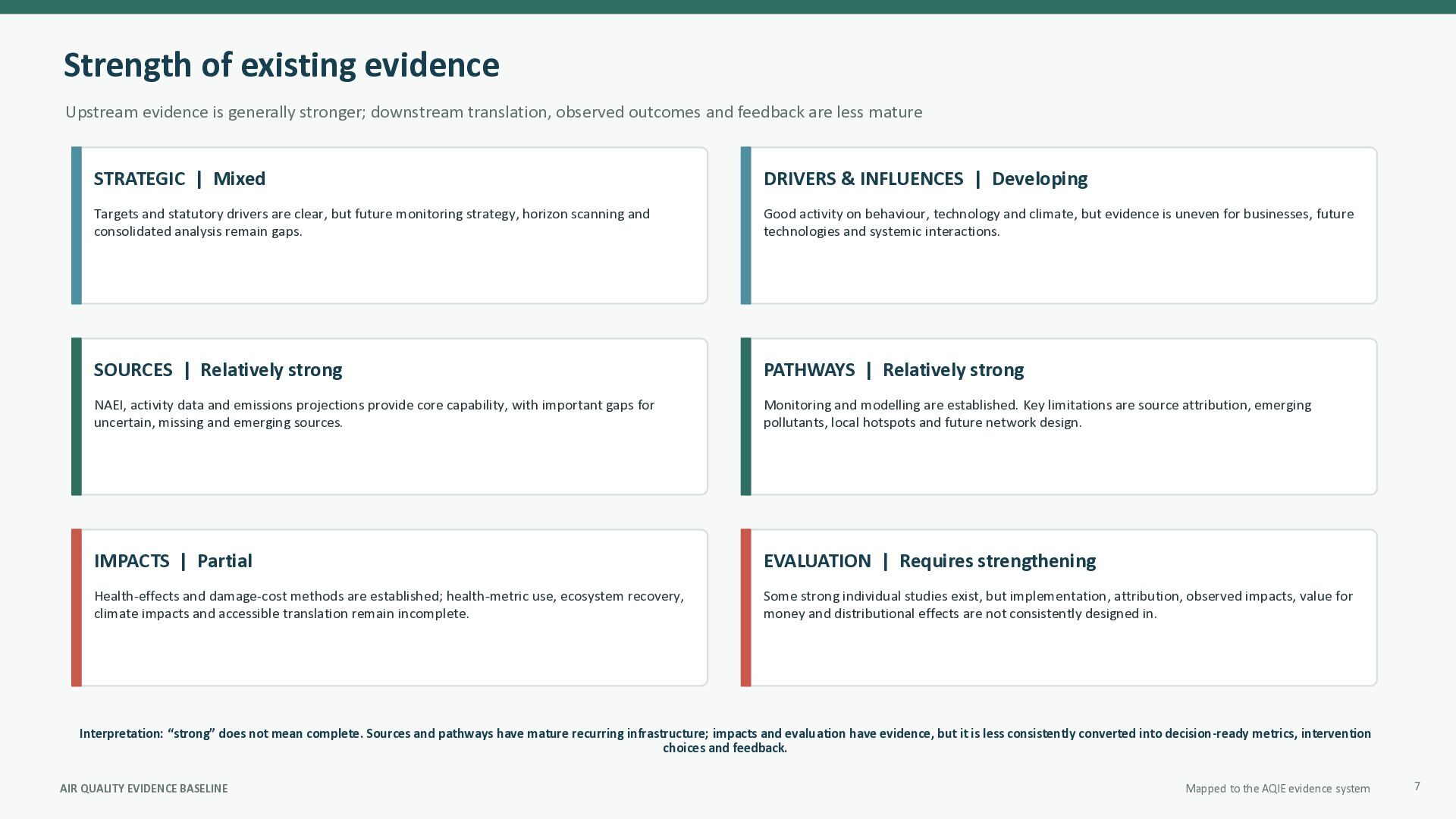
translation, observed outcomes and feedback are less mature STRATEGIC | Mixed DRIVERS & INFLUENCES | Developing Targets and statutory drivers are clear, but future monitoring strategy, horizon scanning and consolidated analysis remain gaps. Good activity on behaviour, technology and climate, but evidence is uneven for businesses, future technologies and systemic interactions. SOURCES | Relatively strong PATHWAYS | Relatively strong NAEI, activity data and emissions projections provide core capability, with important gaps for uncertain, missing and emerging sources. Monitoring and modelling are established. Key limitations are source attribution, emerging pollutants, local hotspots and future network design. IMPACTS | Partial EVALUATION | Requires strengthening Health-effects and damage-cost methods are established; health-metric use, ecosystem recovery, climate impacts and accessible translation remain incomplete. Some strong individual studies exist, but implementation, attribution, observed impacts, value for money and distributional effects are not consistently designed in. Interpretation: “strong” does not mean complete. Sources and pathways have mature recurring infrastructure; impacts and evaluation have evidence, but it is less consistently converted into decision-ready metrics, intervention choices and feedback. AIR QUALITY EVIDENCE BASELINE Mapped to the AQIE evidence system 7
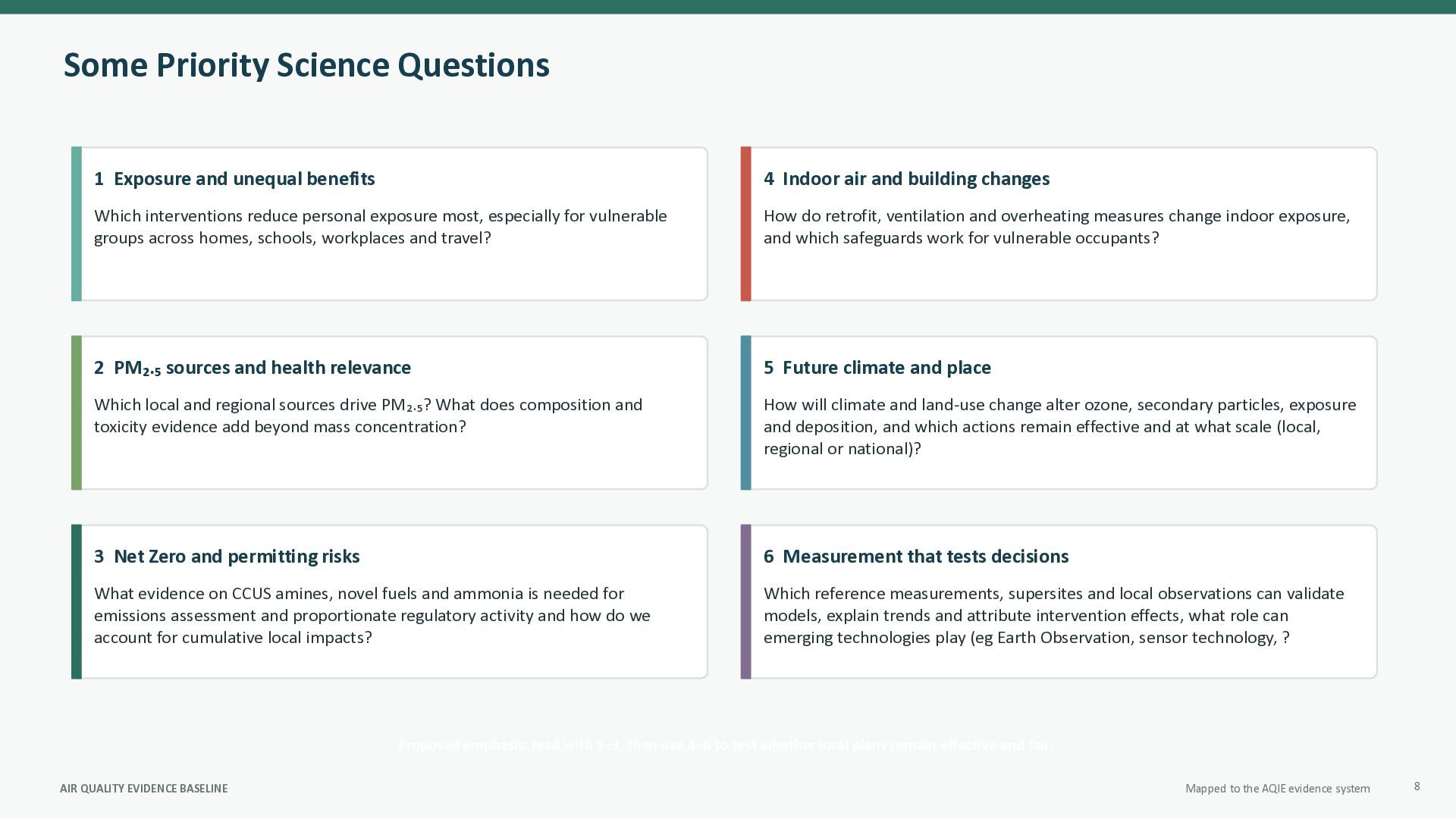
Indoor air and building changes Which interventions reduce personal exposure most, especially for vulnerable groups across homes, schools, workplaces and travel? How do retrofit, ventilation and overheating measures change indoor exposure, and which safeguards work for vulnerable occupants? 2 PM₂.₅ sources and health relevance 5 Future climate and place Which local and regional sources drive PM₂.₅? What does composition and toxicity evidence add beyond mass concentration? How will climate and land-use change alter ozone, secondary particles, exposure and deposition, and which actions remain effective and at what scale (local, regional or national)? 3 Net Zero and permitting risks 6 Measurement that tests decisions What evidence on CCUS amines, novel fuels and ammonia is needed for emissions assessment and proportionate regulatory activity and how do we account for cumulative local impacts? Which reference measurements, supersites and local observations can validate models, explain trends and attribute intervention effects, what role can emerging technologies play (eg Earth Observation, sensor technology, ? Proposed emphasis: lead with 1–3, then use 4–6 to test whether local plans remain effective and fair. AIR QUALITY EVIDENCE BASELINE Mapped to the AQIE evidence system 8
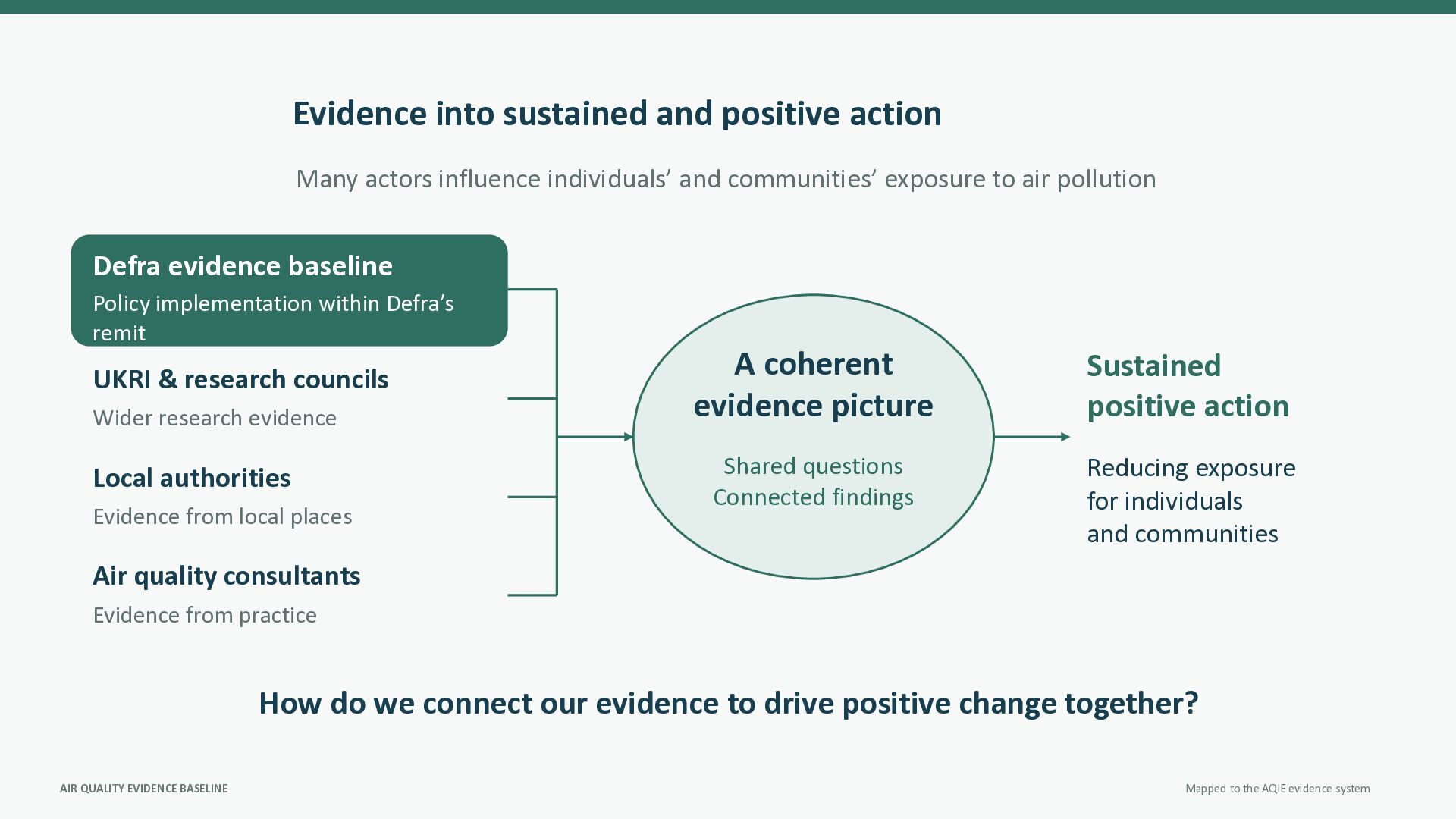
and communities’ exposure to air pollution Defra evidence baseline Policy implementation within Defra’s remit UKRI & research councils Wider research evidence Local authorities Evidence from local places A coherent evidence picture Sustained positive action Shared questions Connected findings Reducing exposure for individuals and communities Air quality consultants Evidence from practice How do we connect our evidence to drive positive change together? AIR QUALITY EVIDENCE BASELINE Mapped to the AQIE evidence system
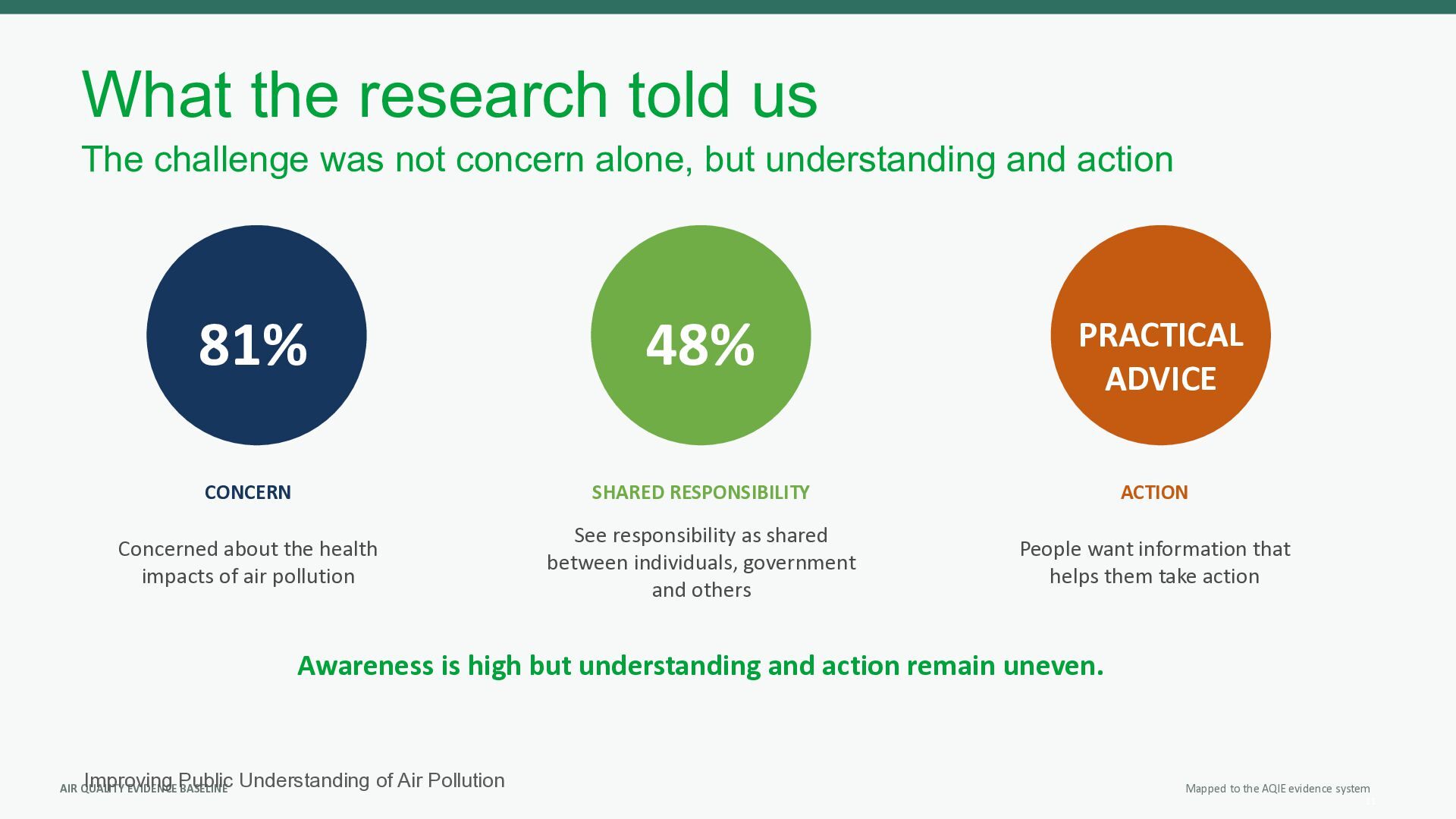
alone, but understanding and action 81% 48% 81% 48% PRACTICAL ADVICE CONCERN SHARED RESPONSIBILITY ACTION Concerned about the health impacts of air pollution See responsibility as shared between individuals, government and others People want information that helps them take action PRACTICAL ADVICE Awareness is high but understanding and action remain uneven. Improving Public Understanding of Air Pollution AIR QUALITY EVIDENCE BASELINE Mapped to the AQIE evidence system 11
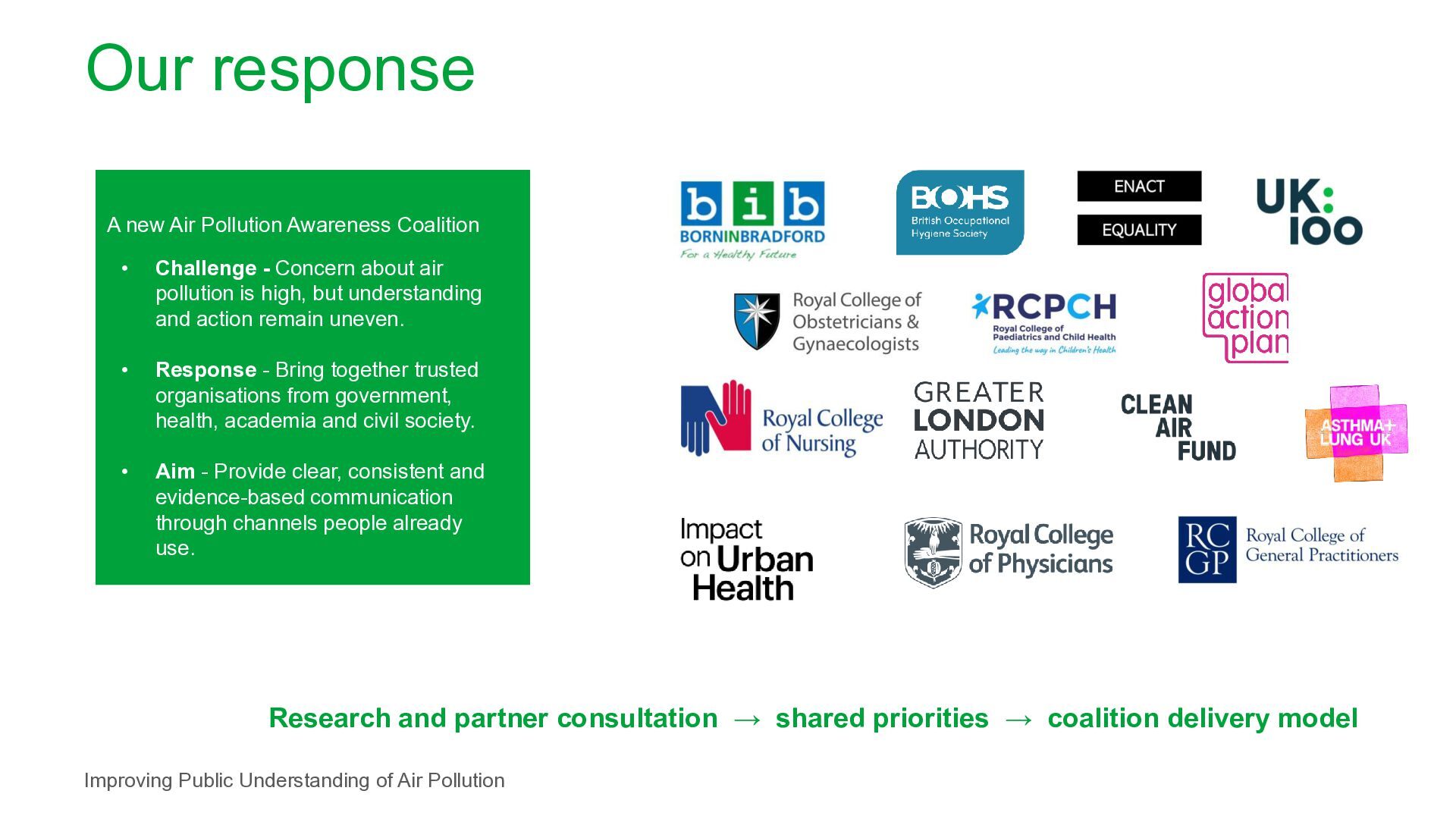
- Concern about air pollution is high, but understanding and action remain uneven. • Response - Bring together trusted organisations from government, health, academia and civil society. • Aim - Provide clear, consistent and evidence-based communication through channels people already use. Research and partner consultation → shared priorities → coalition delivery model Improving Public Understanding of Air Pollution
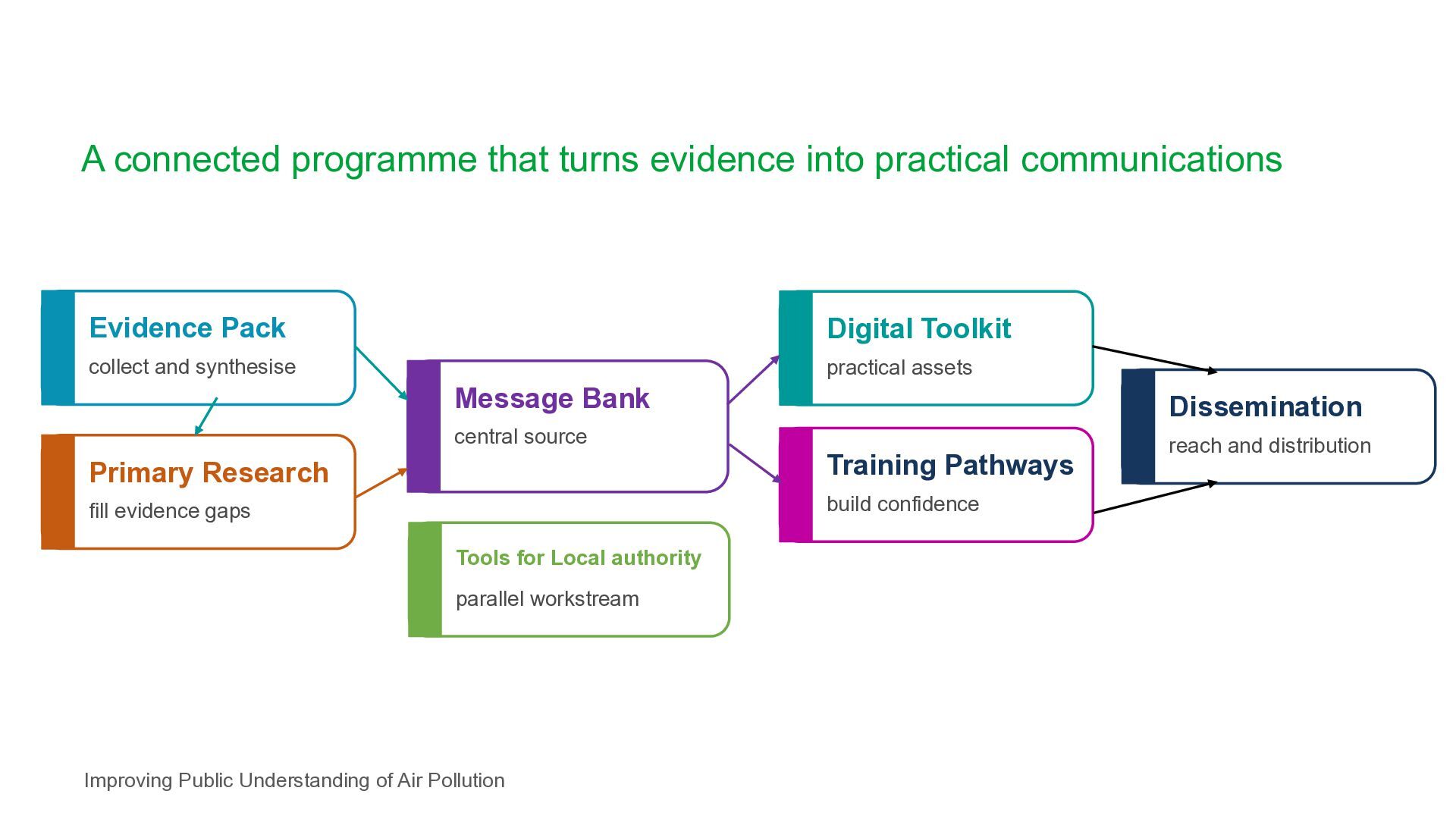
Pack Digital Toolkit collect and synthesise practical assets Message Bank Dissemination central source reach and distribution Primary Research Training Pathways fill evidence gaps build confidence Tools for Local authority parallel workstream Improving Public Understanding of Air Pollution
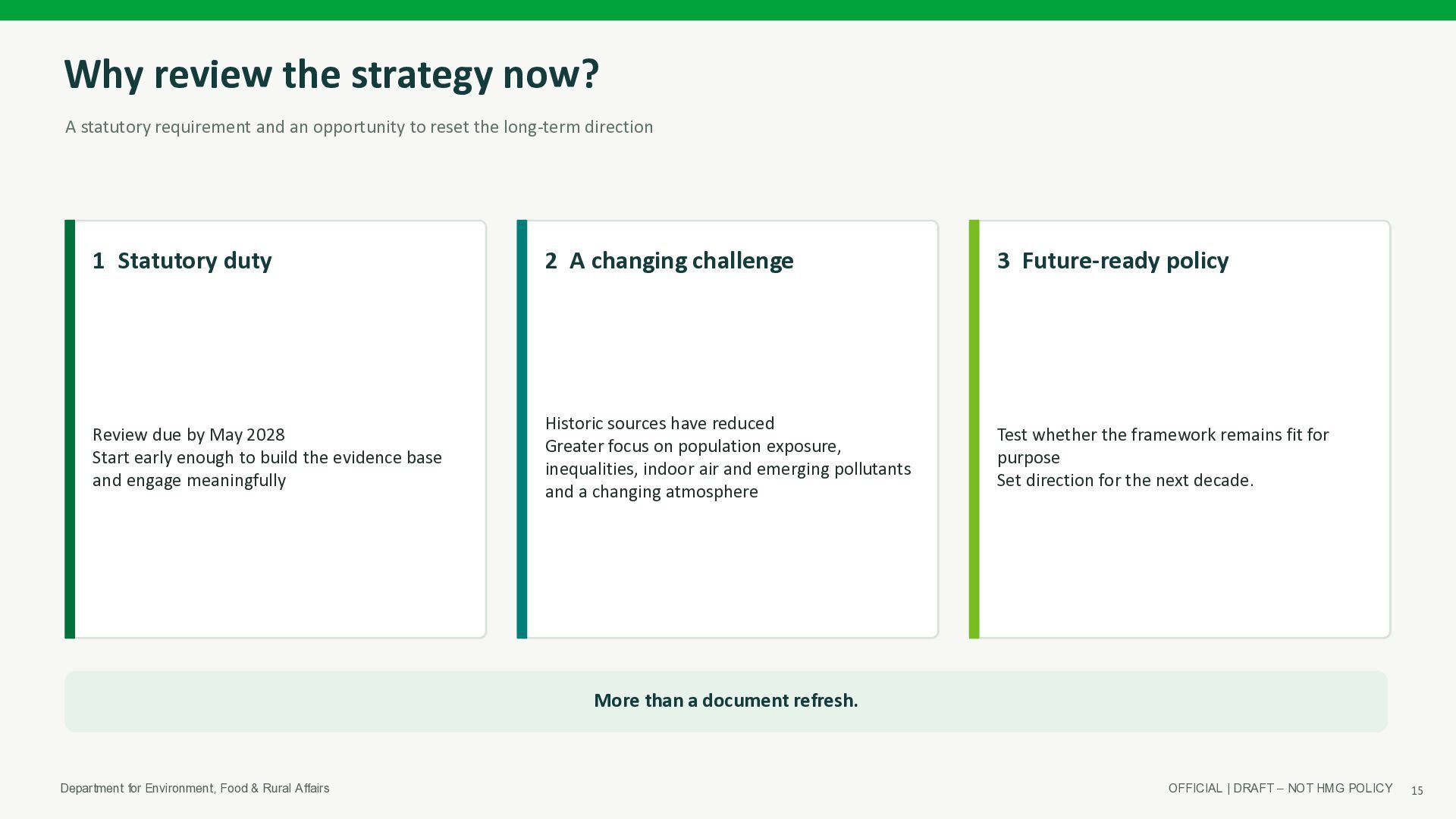
opportunity to reset the long-term direction 1 Statutory duty 2 A changing challenge 3 Future-ready policy Review due by May 2028 Start early enough to build the evidence base and engage meaningfully Historic sources have reduced Greater focus on population exposure, inequalities, indoor air and emerging pollutants and a changing atmosphere Test whether the framework remains fit for purpose Set direction for the next decade. More than a document refresh. Department for Environment, Food & Rural Affairs OFFICIAL | DRAFT – NOT HMG POLICY 15
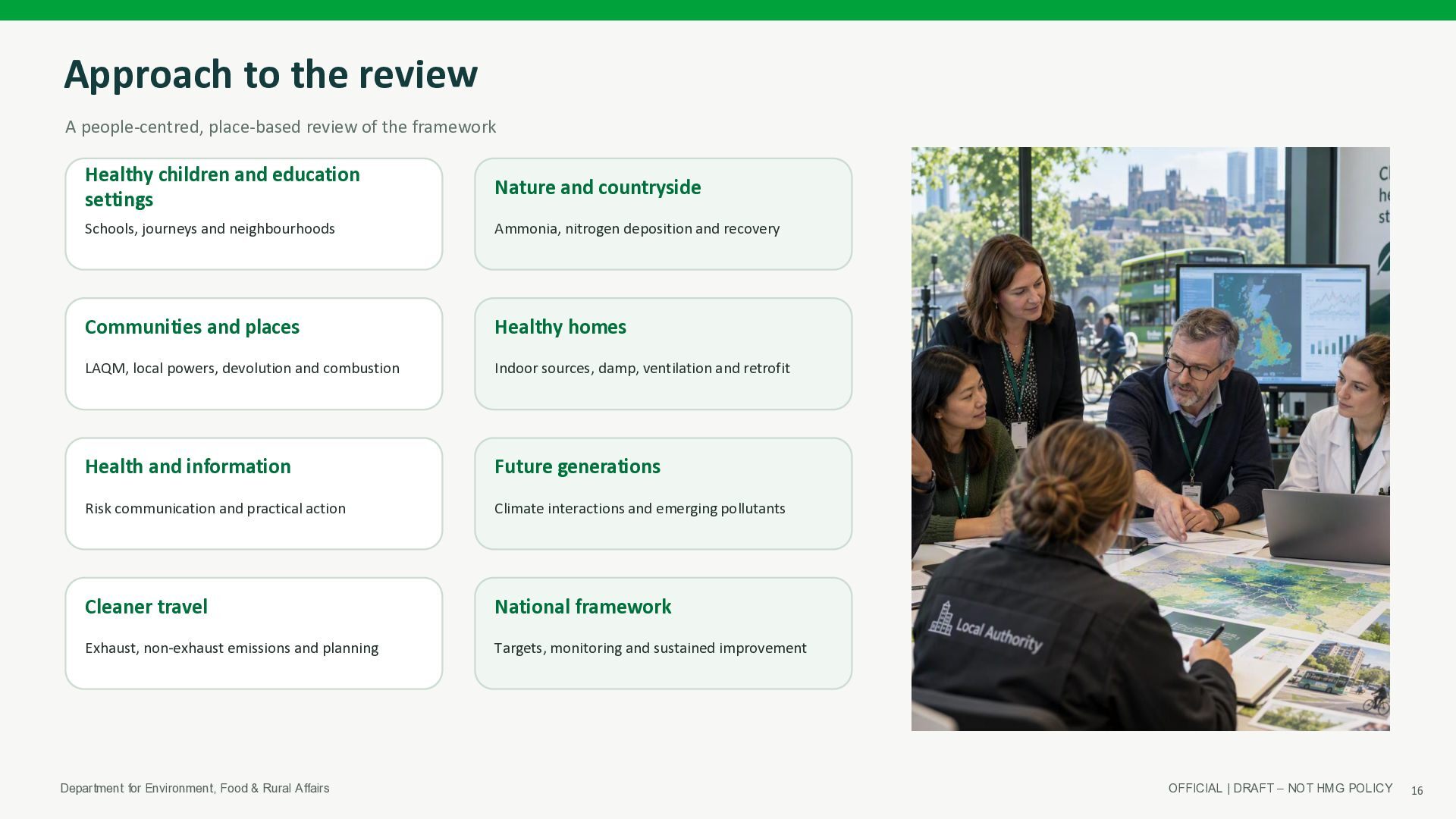
framework Healthy children and education settings Nature and countryside Schools, journeys and neighbourhoods Ammonia, nitrogen deposition and recovery Communities and places Healthy homes LAQM, local powers, devolution and combustion Indoor sources, damp, ventilation and retrofit Health and information Future generations Risk communication and practical action Climate interactions and emerging pollutants Cleaner travel National framework Exhaust, non-exhaust emissions and planning Targets, monitoring and sustained improvement Department for Environment, Food & Rural Affairs OFFICIAL | DRAFT – NOT HMG POLICY 16
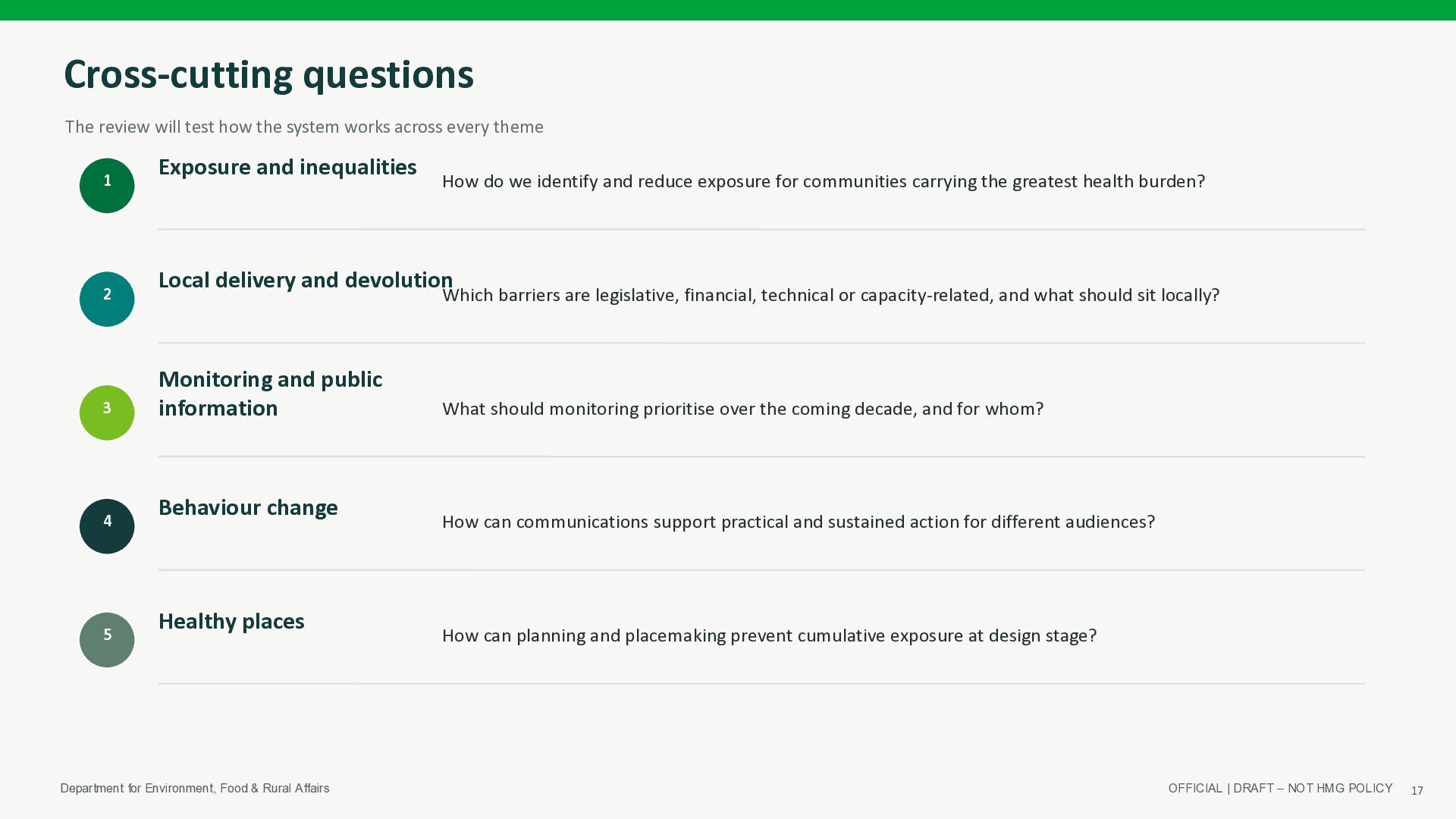
across every theme 1 2 3 4 5 Exposure and inequalities How do we identify and reduce exposure for communities carrying the greatest health burden? Local delivery and devolution Which barriers are legislative, financial, technical or capacity-related, and what should sit locally? Monitoring and public information Behaviour change Healthy places Department for Environment, Food & Rural Affairs What should monitoring prioritise over the coming decade, and for whom? How can communications support practical and sustained action for different audiences? How can planning and placemaking prevent cumulative exposure at design stage? OFFICIAL | DRAFT – NOT HMG POLICY 17
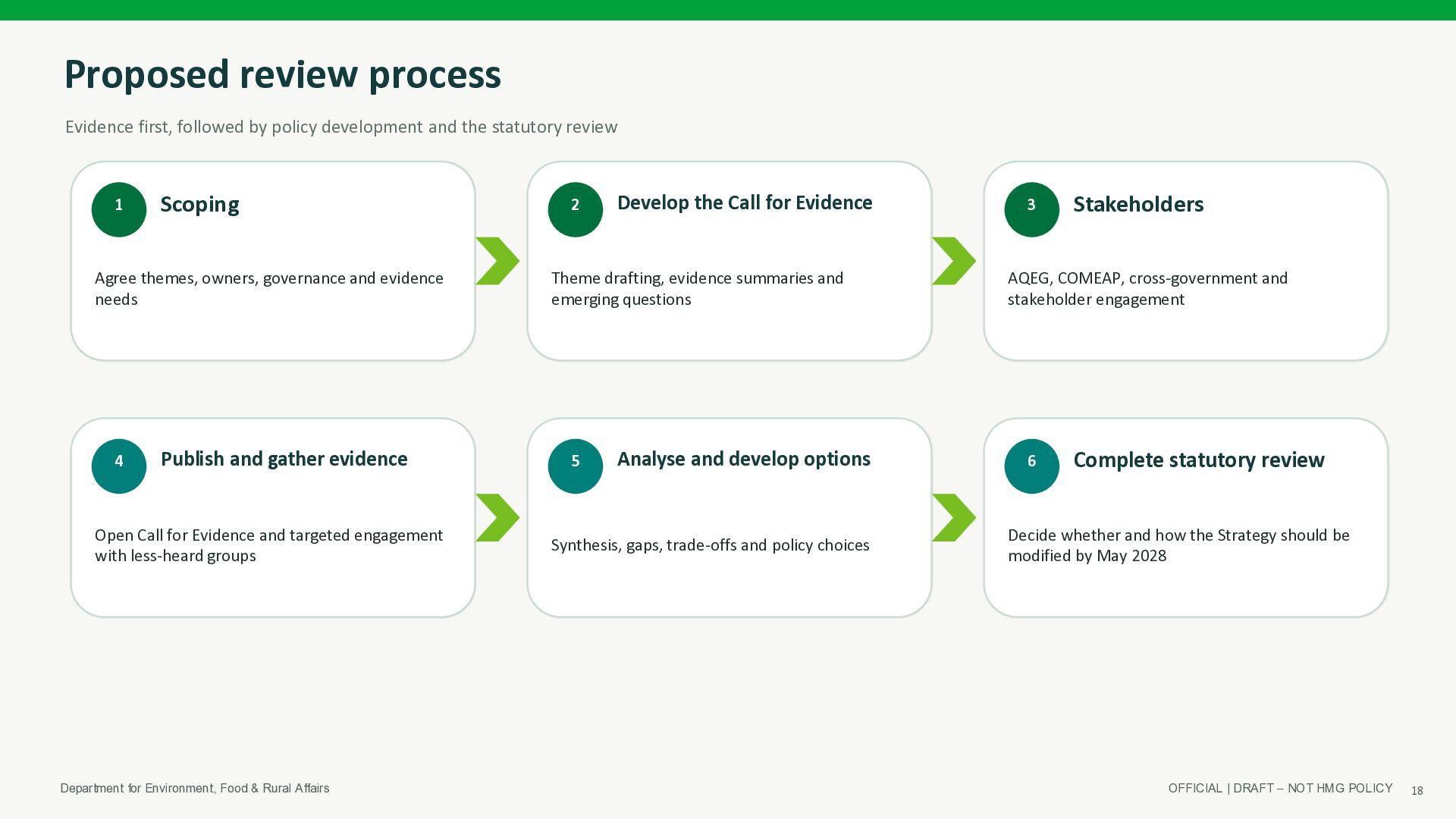
the statutory review 1 Scoping Agree themes, owners, governance and evidence needs 4 Publish and gather evidence Open Call for Evidence and targeted engagement with less-heard groups Department for Environment, Food & Rural Affairs 2 Develop the Call for Evidence Theme drafting, evidence summaries and emerging questions 5 Analyse and develop options Synthesis, gaps, trade-offs and policy choices 3 Stakeholders AQEG, COMEAP, cross-government and stakeholder engagement 6 Complete statutory review Decide whether and how the Strategy should be modified by May 2028 OFFICIAL | DRAFT – NOT HMG POLICY 18
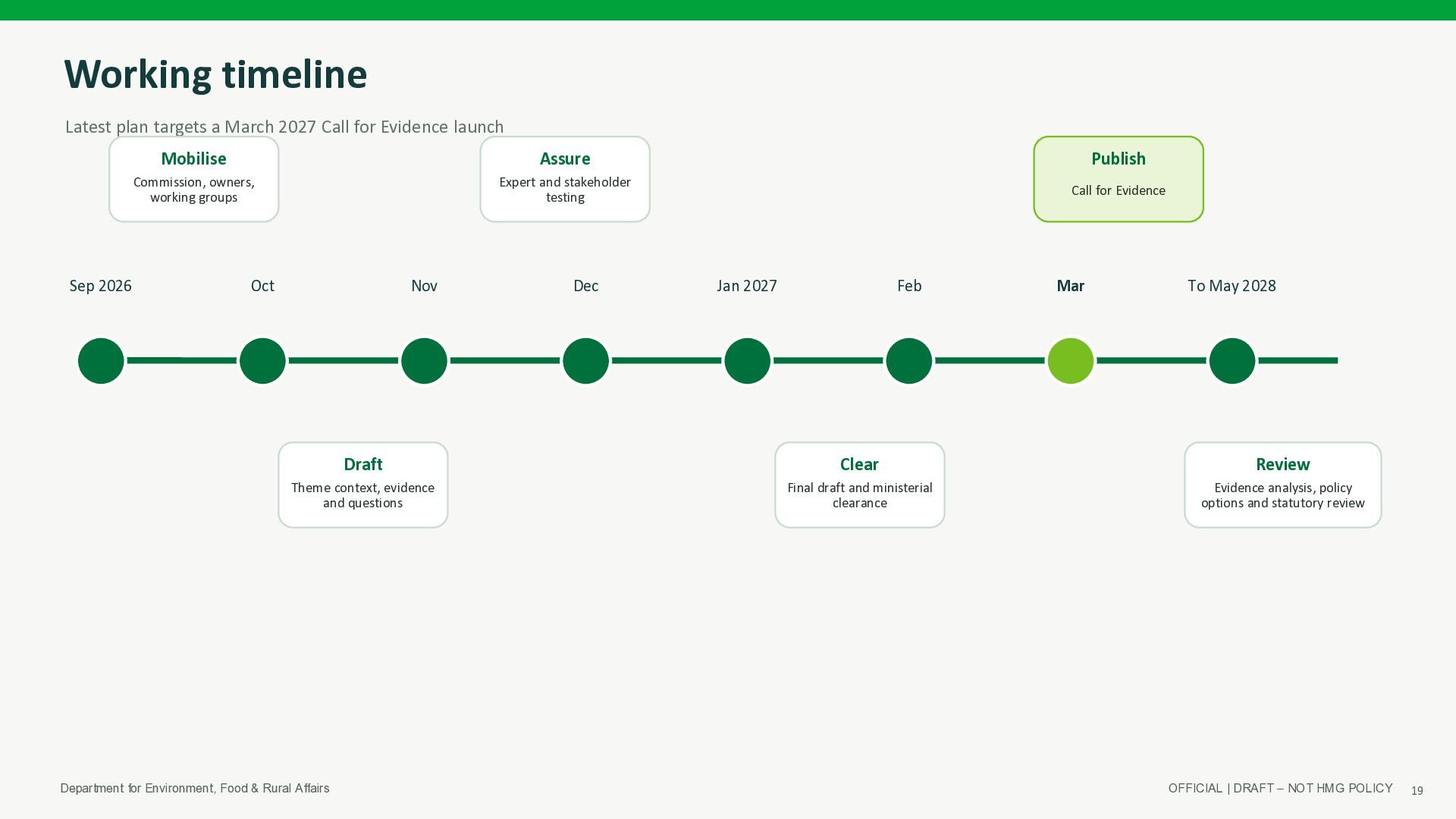
Evidence launch Sep 2026 Mobilise Assure Publish Commission, owners, working groups Expert and stakeholder testing Call for Evidence Oct Nov Dec Jan 2027 Feb Mar To May 2028 Draft Clear Review Theme context, evidence and questions Final draft and ministerial clearance Evidence analysis, policy options and statutory review Department for Environment, Food & Rural Affairs OFFICIAL | DRAFT – NOT HMG POLICY 19
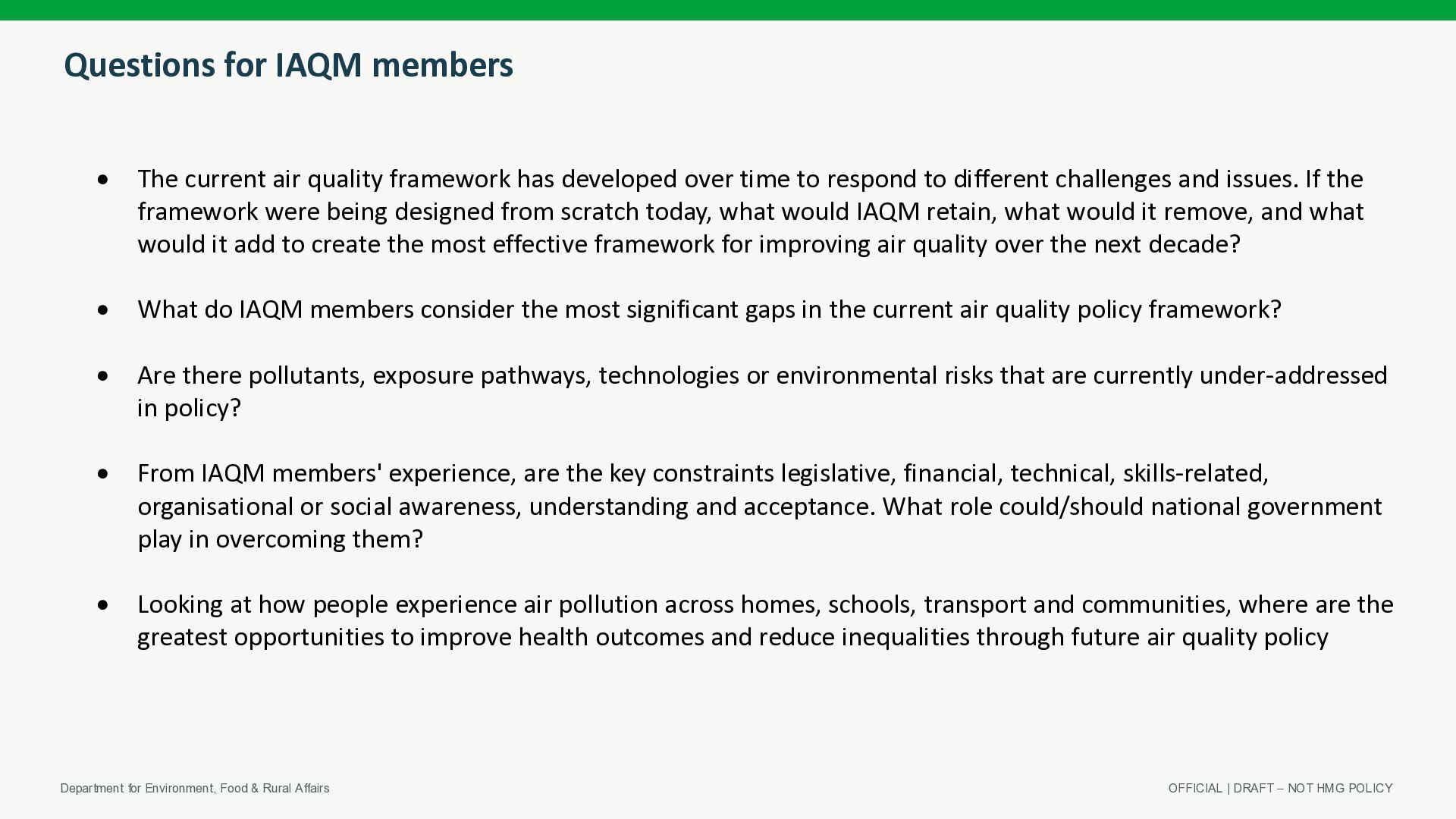
has developed over time to respond to different challenges and issues. If the framework were being designed from scratch today, what would IAQM retain, what would it remove, and what would it add to create the most effective framework for improving air quality over the next decade? • What do IAQM members consider the most significant gaps in the current air quality policy framework? • Are there pollutants, exposure pathways, technologies or environmental risks that are currently under-addressed in policy? • From IAQM members' experience, are the key constraints legislative, financial, technical, skills-related, organisational or social awareness, understanding and acceptance. What role could/should national government play in overcoming them? • Looking at how people experience air pollution across homes, schools, transport and communities, where are the greatest opportunities to improve health outcomes and reduce inequalities through future air quality policy Department for Environment, Food & Rural Affairs OFFICIAL | DRAFT – NOT HMG POLICY


 iesevents
 helmedeiros
 tmiket
 bluesmoon
 sachag
 lauravandoore
 uxyall
 quramy
 aleyda
 speakerdeck
 tammyeverts
 akademiya2063
 livdayseo