health innovation Dr Mark Elliott Assistant Professor of Healthcare Technologies and Behaviour Change Institute of Digital Healthcare, WMG University of Warwick
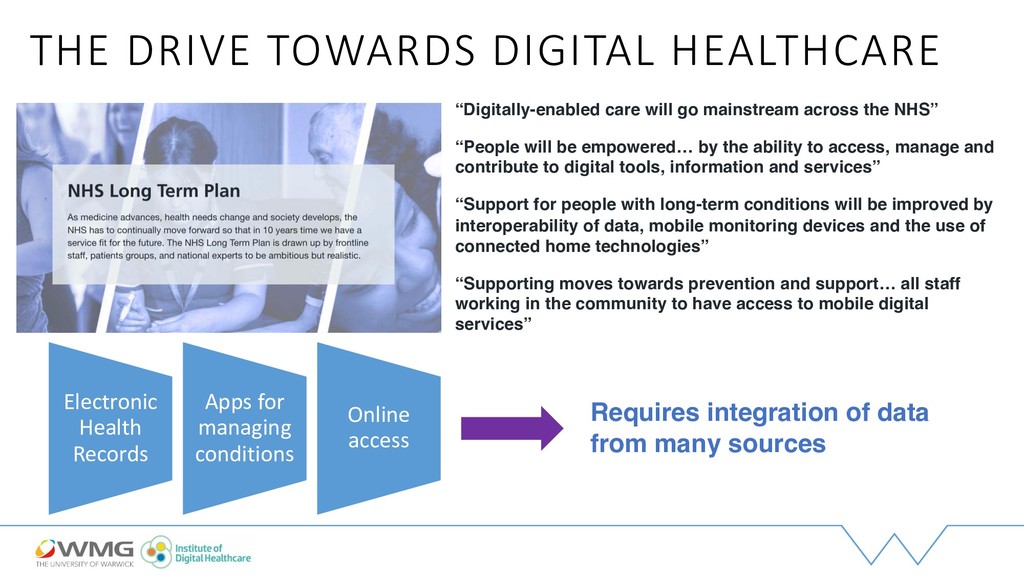
across the NHS” “People will be empowered… by the ability to access, manage and contribute to digital tools, information and services” “Support for people with long-term conditions will be improved by interoperability of data, mobile monitoring devices and the use of connected home technologies” “Supporting moves towards prevention and support… all staff working in the community to have access to mobile digital services” Electronic Health Records Apps for managing conditions Online access Requires integration of data from many sources
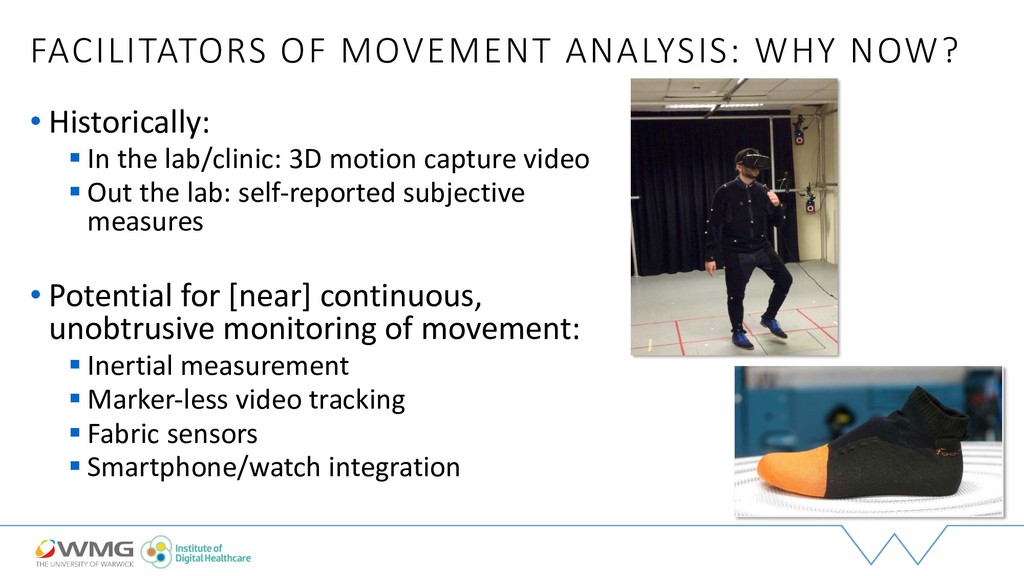
the lab/clinic: 3D motion capture video § Out the lab: self-reported subjective measures • Potential for [near] continuous, unobtrusive monitoring of movement: § Inertial measurement § Marker-less video tracking § Fabric sensors § Smartphone/watch integration
(less obtrusive) § Low power § More variables/measures • Leads to a challenge on the data side: § Data can be ’abstract’ – e.g. acceleration, pressure, bend angle § Lacks context – no observations § Data translated to clinically (or behaviourally) meaningful measures Movement Analytics: Overcoming these challenges to Monitor, Measure and Model Movement
in the UK have osteoarthritis [Versus Arthritis]. • Over 250,000 joint replacements are performed each year, primarily hip and knee [National Joint Registry]. Research projects: 1. OATech Network Data scoping project: Barriers and Opportunities for data sharing 2. Measuring compensatory movements using smartphone sensors (PhD project) 3. Pre-surgical planning for Total Hip Replacement.
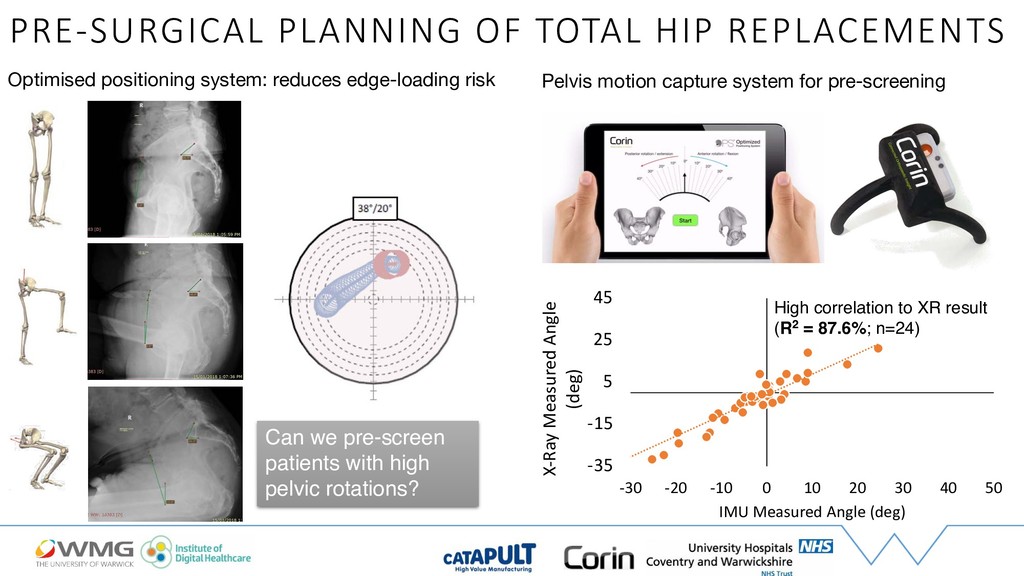
with high pelvic rotations? Pelvis motion capture system for pre-screening -35 -15 5 25 45 -30 -20 -10 0 10 20 30 40 50 X-Ray Measured Angle (deg) IMU Measured Angle (deg) High correlation to XR result (R2 = 87.6%; n=24) PRE-SURGICAL PLANNING OF TOTAL HIP REPLACEMENTS
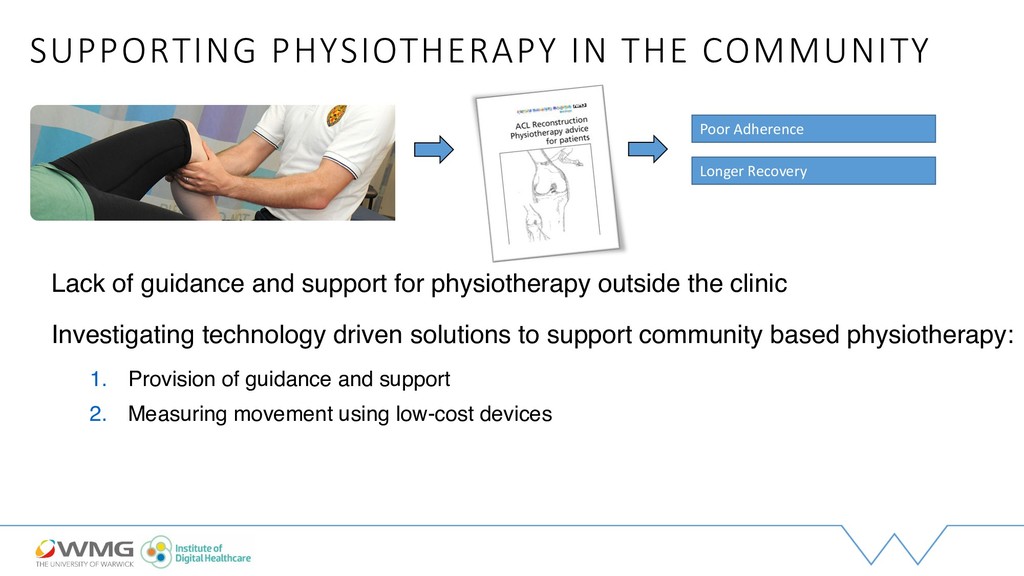
for physiotherapy outside the clinic Investigating technology driven solutions to support community based physiotherapy: 1. Provision of guidance and support 2. Measuring movement using low-cost devices Poor Adherence Longer Recovery
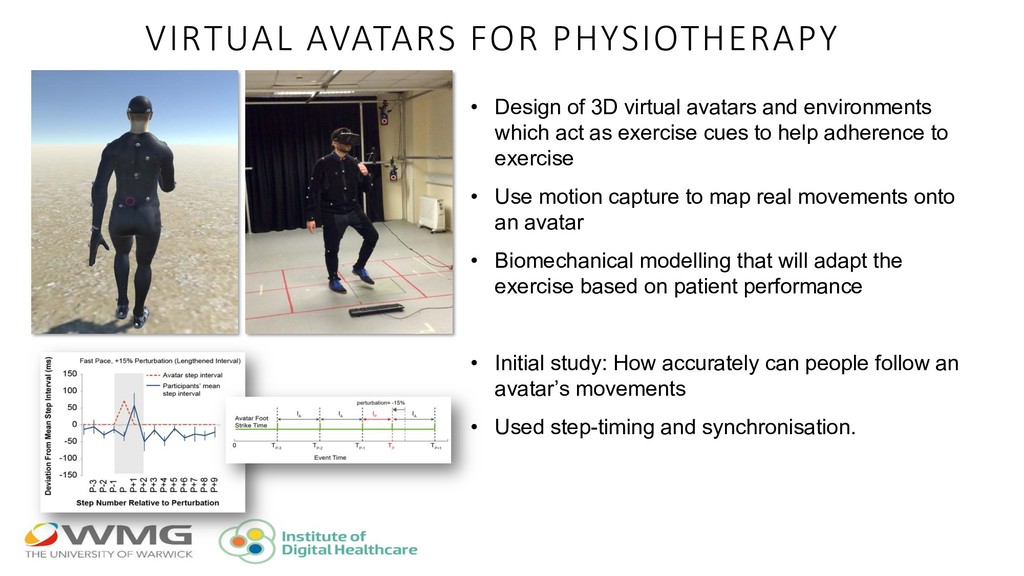
and environments which act as exercise cues to help adherence to exercise • Use motion capture to map real movements onto an avatar • Biomechanical modelling that will adapt the exercise based on patient performance • Initial study: How accurately can people follow an avatar’s movements • Used step-timing and synchronisation.
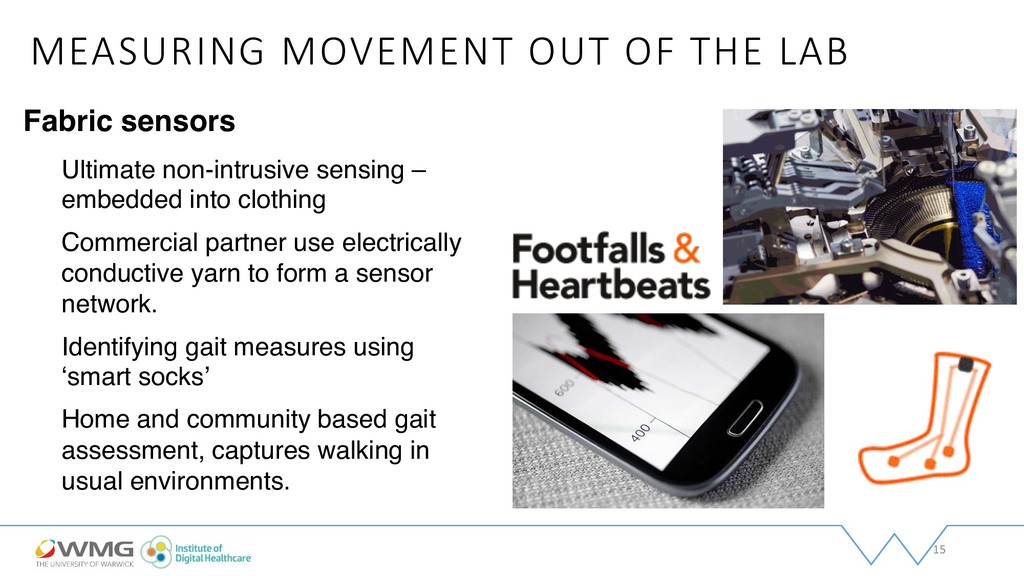
non-intrusive sensing – embedded into clothing Commercial partner use electrically conductive yarn to form a sensor network. Identifying gait measures using ‘smart socks’ Home and community based gait assessment, captures walking in usual environments.
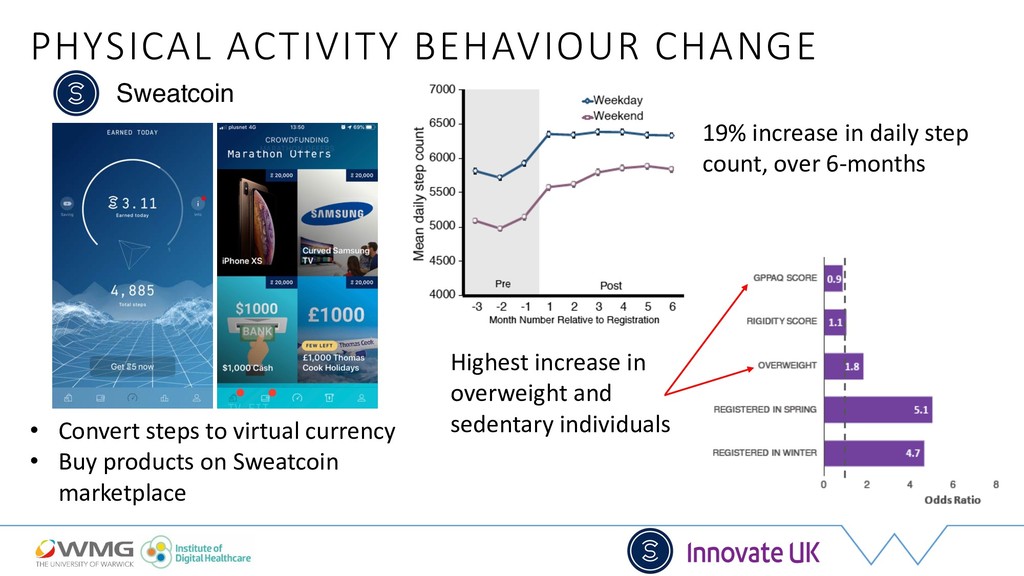
• Buy products on Sweatcoin marketplace 19% increase in daily step count, over 6-months Highest increase in overweight and sedentary individuals Sweatcoin
Richardson Xueyang Wang Rachel Wright PhD/Clinical Foundation Students Omar Khan Christian Kempton Arhem Qureshi Usama Rahman Amelia Thompson Abhinav Vepa Collaborators Prof. Theo Arvanitis Prof. Richard King Dr. Sakari Lemola Prof. Anu Realo Dr. Lukasz Walasek Prof. Mark Williams Commercial Collaborators: Corin Group Footfalls and Heartbeats Ltd Sweatco Ltd University Hospital Coventry & Warks NHS Trust THE TEAM


 im1
im1
 husengs7
 ykagano
 vivion
 maimyyym
 thkt
thkt
 yut0naga1_fa
 ishikawa_satoru
 kakehashi
 ymotongpoo
 munakata
 chack411
 shumei_ito
 baasie
 aleyda
 apolaine
 auna
auna
 techseoconnect
 reverentgeek
 csswizardry
 eitanlees
 palkan
 thekraken
 ianozsvald
 keavy
keavy