are obese 2:3 adults obese or overweight Anaemia and rickets Growing problem of household food insecurity 22% stunting (<5y) 17% women below normal BMI 30% women overweight or obese Iron and Vitamin A deficiency Common challenges: • Dietary inequality • Dietary quality • Early years • Safety, security, sufficiency, sustainability
system • A well developed urban food agenda which is not yet thinking nutrition smart • International work brings opportunity for political profile which helps to sustain leadership • Likely to attract funding opportunities • Birmingham hosting Commonwealth Games Why work internationally?
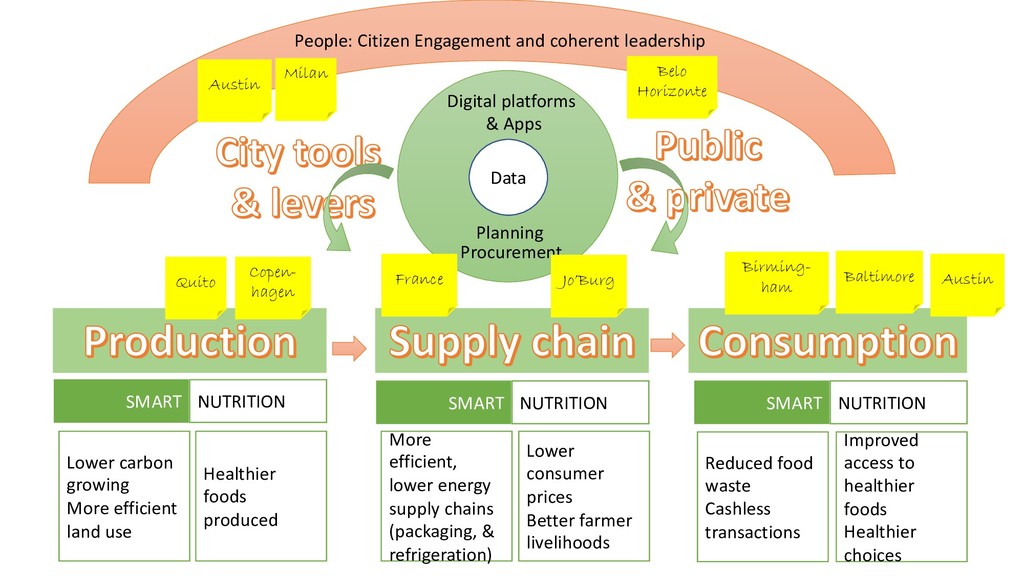
change the way that food is produced, processed, distributed and consumed. It considers food quality and equitable access, disrupting food systems that are not sustainable or cause food insecurity and malnutrition. They are by nature multi-sectoral, developed by entrepreneurs, nutritionists, public health experts, agricultural experts, policy makers, and civil society members committed to a sustainable, healthy food future. Our definition: smart nutrition cities
in both cities: An MOU has been signed by both cities to explore ØThe leverage which both city authorities have as purchasers of food for consumption in public institutions (particularly by those most vulnerable to malnutrition) ØThe infrastructure at each authorities disposal to support the promotion of nutritious food and restrict the promotion of unhealthy fast food ØThe data which can be harnessed to empower consumers to make better choices about where and what they eat and to help policy makers develop and implement the right mix of regulations to control the food on offer.
one of thirteen Local Authorities to take part in the discovery phase of the Childhood Obesity Trailblazer programme. • https://www.local.gov.uk/childhood-obesity-trailblazer-programme • Community Researchers will explore barriers to healthier eating in Soho and North Edgbaston wards. • The Food Foundation will explore opportunities for scaling up citizen engagement in Pune • A second stakeholder consultation will take place in March 2019 – we welcome the participation of the Innovation Alliance
approaches in cities • https://www.efsa.europa.eu/en/funding/calls/innovative-and-citizen- driven-food-system-approaches-cities • Single stage – results June 2019 • Budget – 6 million euros (approximately £500,000 for Birmingham) • BCC and Innovation Alliance to work together to set-up a Food Incubator specialising in supporting businesses that offer healthier, more sustainable food


 im1
 goyoki
 imuta
 ama_ch
 z63d
 visional_engineering_and_design
 masspeaks
 wadayusuke
 jcabot
 mikanichinose
 birgitta410
 inariku
 littlehands
 jonrohan
 michaelherold
 inesmontani
 stephenakadiri
 jonoalderson
 danielanewman
 marktimemedia
 aleyda
 tamaranovitovic
 trallard
 davidcarrasco
 rkendrick25