is the simulation of human intelligence processes by machines, especially computer systems. • Goal: To create systems capable of performing tasks that typically require human intelligence, such as visual perception, speech recognition, decision-making, and language translation. Categories of AI: • Narrow AI (Weak AI): Designed for a specific task (e.g., Apple's Siri, Google Search). • General AI (Strong AI): Machines possessing the ability to perform any intellectual task a human can (Still theoretical).
specialized sub-field of Machine Learning based on artificial neural networks with representation learning. • "Deep" Nature: The word "deep" refers to the use of multiple layers in the network (hidden layers) to extract higher-level features from the raw input. • How it works: It learns by examples, passing data through interconnected layers of nodes (artificial neurons) to progressively extract features and make predictions.
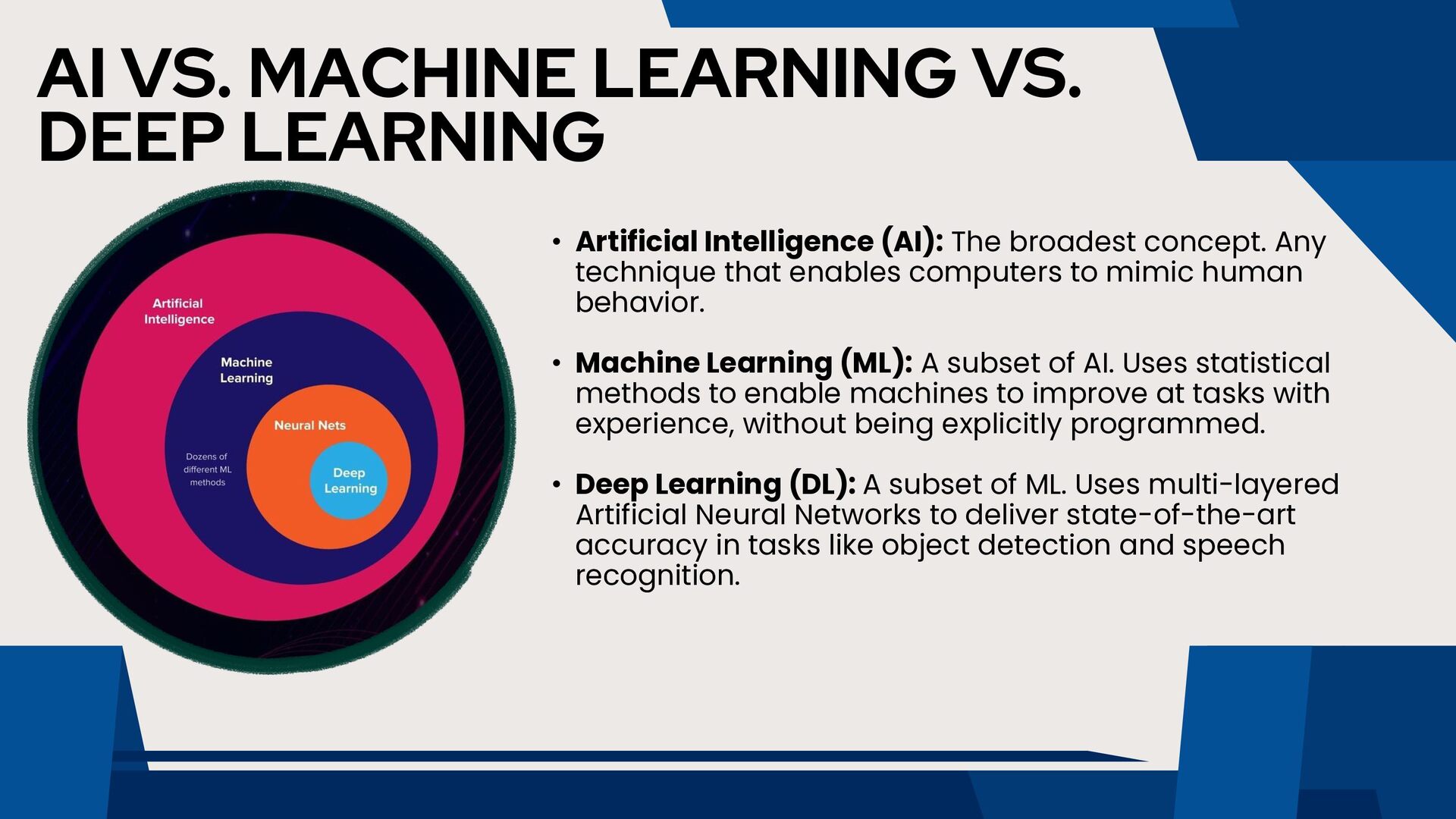
(AI): The broadest concept. Any technique that enables computers to mimic human behavior. • Machine Learning (ML): A subset of AI. Uses statistical methods to enable machines to improve at tasks with experience, without being explicitly programmed. • Deep Learning (DL): A subset of ML. Uses multi-layered Artificial Neural Networks to deliver state-of-the-art accuracy in tasks like object detection and speech recognition.
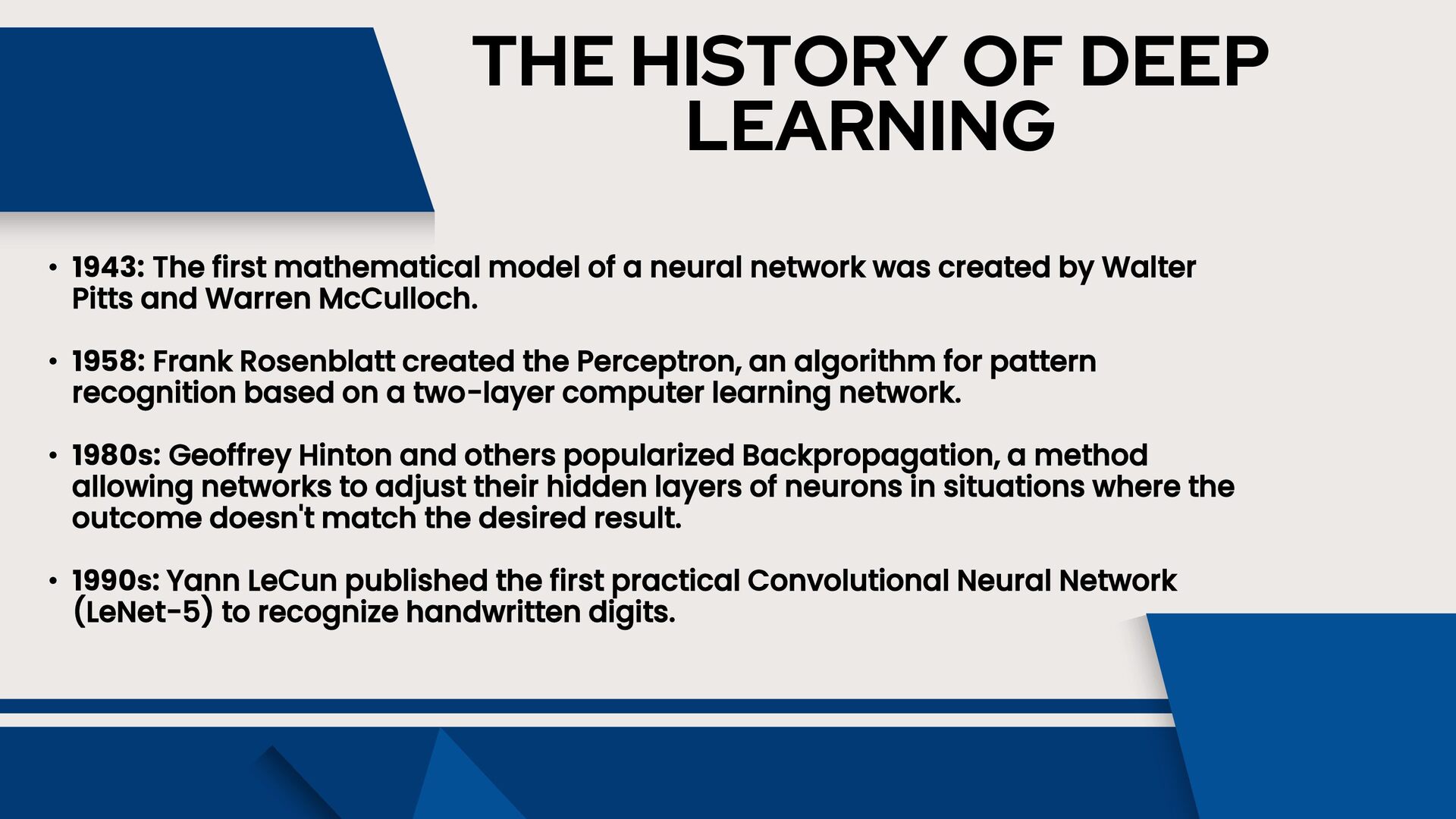
model of a neural network was created by Walter Pitts and Warren McCulloch. • 1958: Frank Rosenblatt created the Perceptron, an algorithm for pattern recognition based on a two-layer computer learning network. • 1980s: Geoffrey Hinton and others popularized Backpropagation, a method allowing networks to adjust their hidden layers of neurons in situations where the outcome doesn't match the desired result. • 1990s: Yann LeCun published the first practical Convolutional Neural Network (LeNet-5) to recognize handwritten digits.
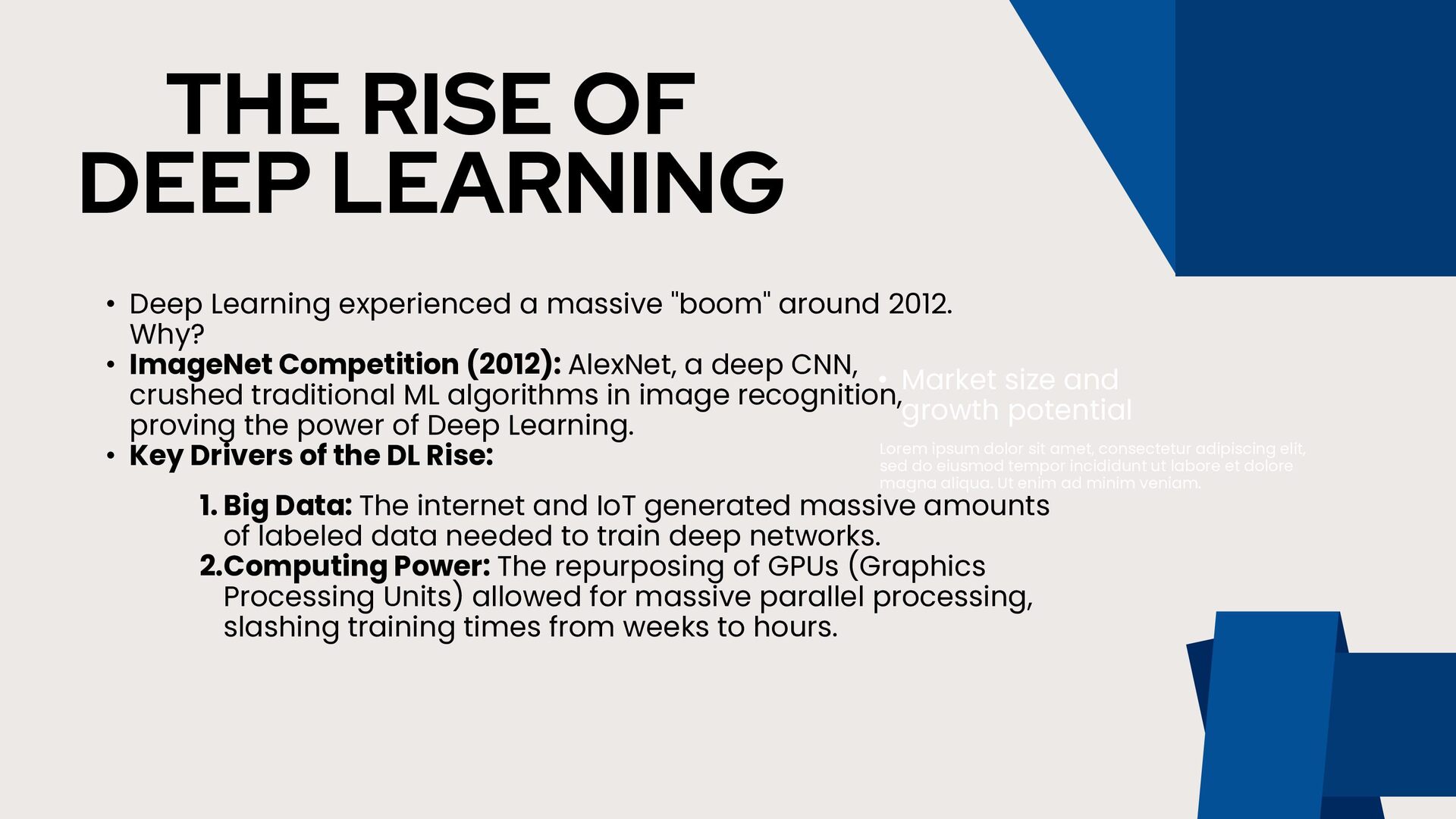
massive "boom" around 2012. Why? • ImageNet Competition (2012): AlexNet, a deep CNN, • Market size and crushed traditional ML algorithms in image recognition, growth potential proving the power of Deep Learning. Lorem ipsum dolor sit amet, consectetur adipiscing elit, • Key Drivers of the DL Rise: sed do eiusmod tempor incididunt ut labore et dolore magna aliqua. Ut enim ad minim veniam. 1. Big Data: The internet and IoT generated massive amounts of labeled data needed to train deep networks. 2.Computing Power: The repurposing of GPUs (Graphics Processing Units) allowed for massive parallel processing, slashing training times from weeks to hours.
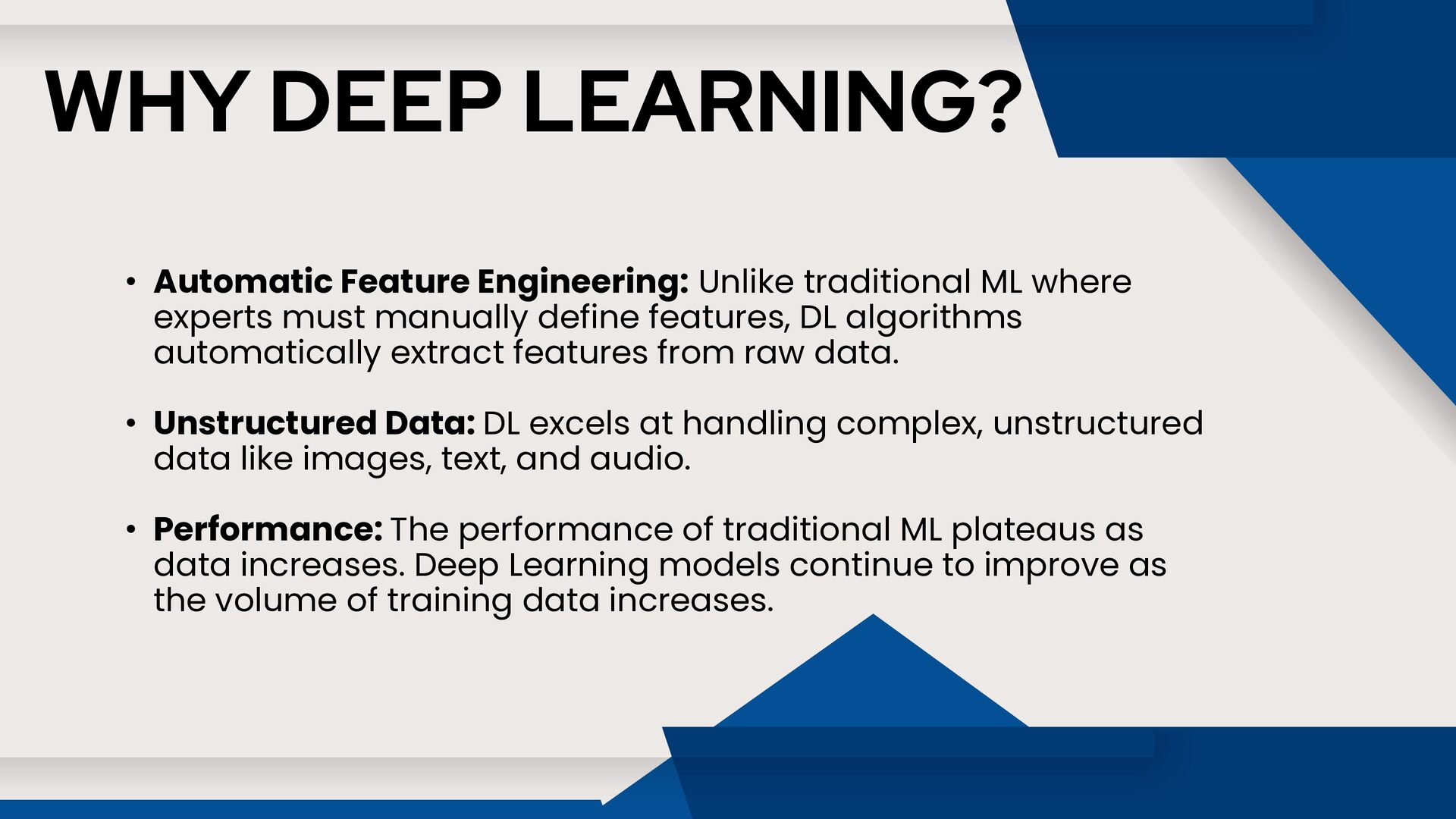
where experts must manually define features, DL algorithms automatically extract features from raw data. • Unstructured Data: DL excels at handling complex, unstructured data like images, text, and audio. • Performance: The performance of traditional ML plateaus as data increases. Deep Learning models continue to improve as the volume of training data increases.
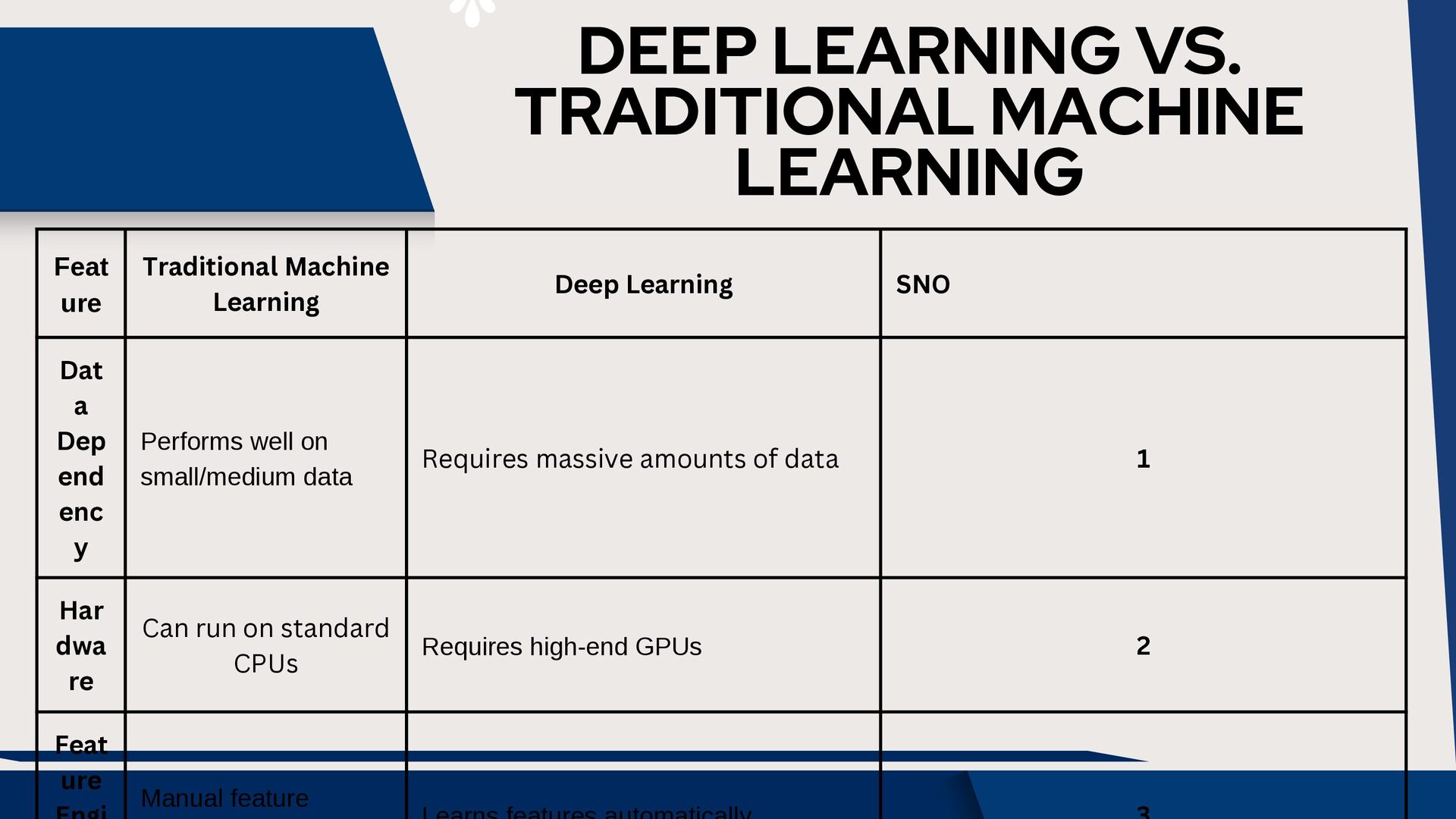
Learning Dat a Dep end enc y Performs well on small/medium data Requires massive amounts of data 1 Har dwa re Can run on standard CPUs Requires high-end GPUs 2 Feat ure Manual feature Deep Learning SNO
image generation. • Natural Language Processing (NLP): Machine translation, sentiment analysis, and chatbots (e.g., ChatGPT). • Self-Driving Cars: Processing sensor and camera data in real-time to navigate safely. • Healthcare: Early detection of diseases from X-rays and MRI scans, and drug discovery. • Entertainment: Recommendation systems (Netflix, YouTube) and deepfake technology.
human neurons via Input, Hidden, and Output layers to map complex input-output logic. • CNN (Convolutional Neural Network): A specialized deep neural network designed to process data with a grid-like topology, such as images. Unlike basic ANNs, CNNs preserve spatial relationships using filters. • Hierarchical Layers: Core architecture features Convolution (filter application to detect edges and textures), Pooling (subsampling to reduce computational cost), and Fully Connected (final classification) layers.
time-series data where current inputs are interdependent on previous steps (e.g., text, speech, financial trends). • Internal Memory: RNNs utilize feedback loops to retain hidden states from previous inputs, allowing the output to depend on the entire context, not just the current input. • Advanced RNNs (LSTM & GRU): These variants use complex "Gating" mechanisms to decide what information to remember and what to forget over long sequences. • Gradient Solutions: By using advanced units like LSTM (Long Short-Term Memory), these architectures solve the "Vanishing Gradient Problem" that makes standard RNNs struggle with long-term data dependencies.
of manual feature extraction by automatically learning complex representation patterns directly from raw, unstructured data. • The Scaling Effect: Unlike traditional machine learning models that plateau, the performance of Deep Learning models continues to improve as the volume of training data and GPU processing power increases. • Unified Framework: Deep Learning offers unique architectures for different challenges: CNNs are the gold standard for spatial data (Computer Vision), while RNNs/LSTMs dominate sequential patterns (Natural Language Processing and Time-Series analysis).


 uranoken
 3l4l5
 signer
 bvr7352
 pawan_pharm
 hiola
 robintux
 auctria
 jdbedics
 cbtlibrary
 dragon2
 ichiroc
 inesmontani
 rkaga
 palkan
 sarafernandez
 frankvandijk
 jonoalderson
 carmenintech
 lara
 colly
 konakalab
 panda_program
 tanoku