Upgrade to Pro — share decks privately, control downloads, hide ads and more …

Using MongoDB Responsibly

Sponsored · SiteGround - Reliable hosting with speed, security, and support you can count on.

Using MongoDB Responsibly

Avatar for Jeremy Mikola

Jeremy Mikola

June 07, 2012
Tweet

More Decks by Jeremy Mikola

Other Decks in Programming

Transcript

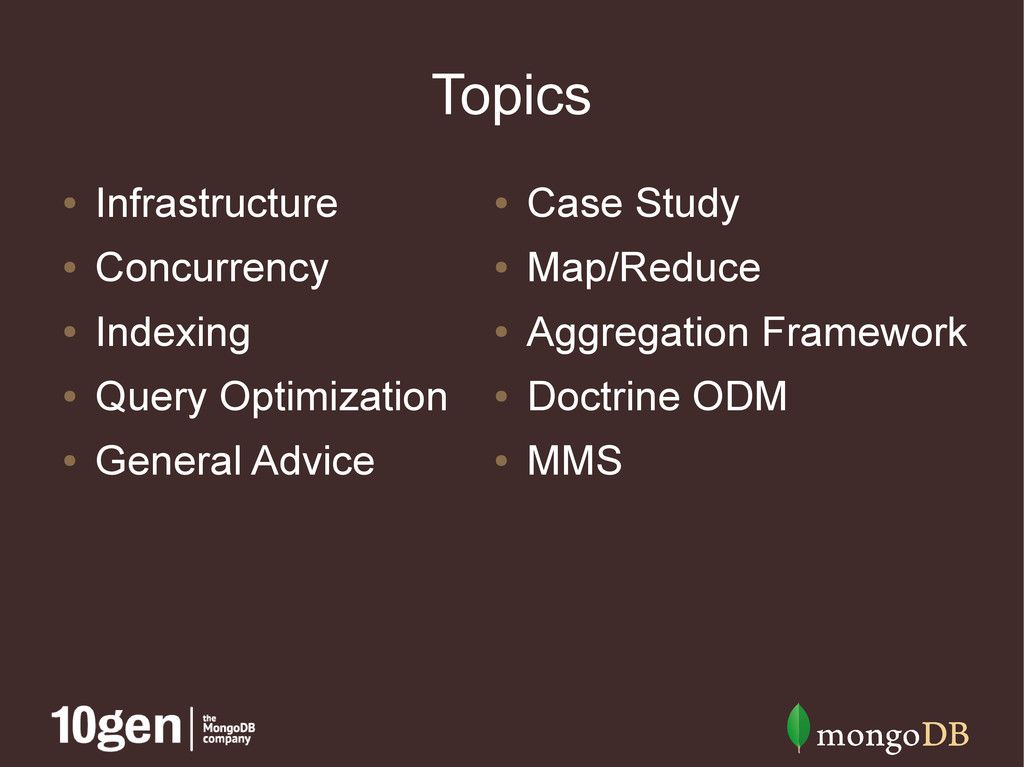
  1. Topics • Infrastructure • Concurrency • Indexing • Query Optimization

    • General Advice • Case Study • Map/Reduce • Aggregation Framework • Doctrine ODM • MMS
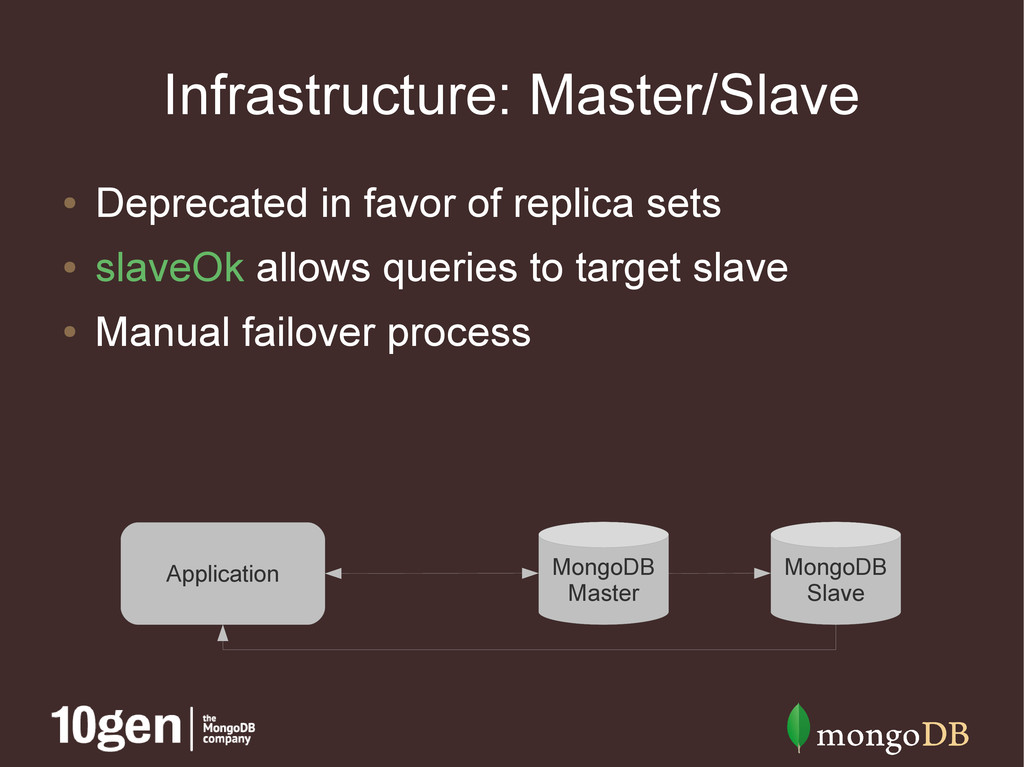
  2. Infrastructure: Master/Slave • Deprecated in favor of replica sets •

    slaveOk allows queries to target slave • Manual failover process MongoDB Master Application MongoDB Slave
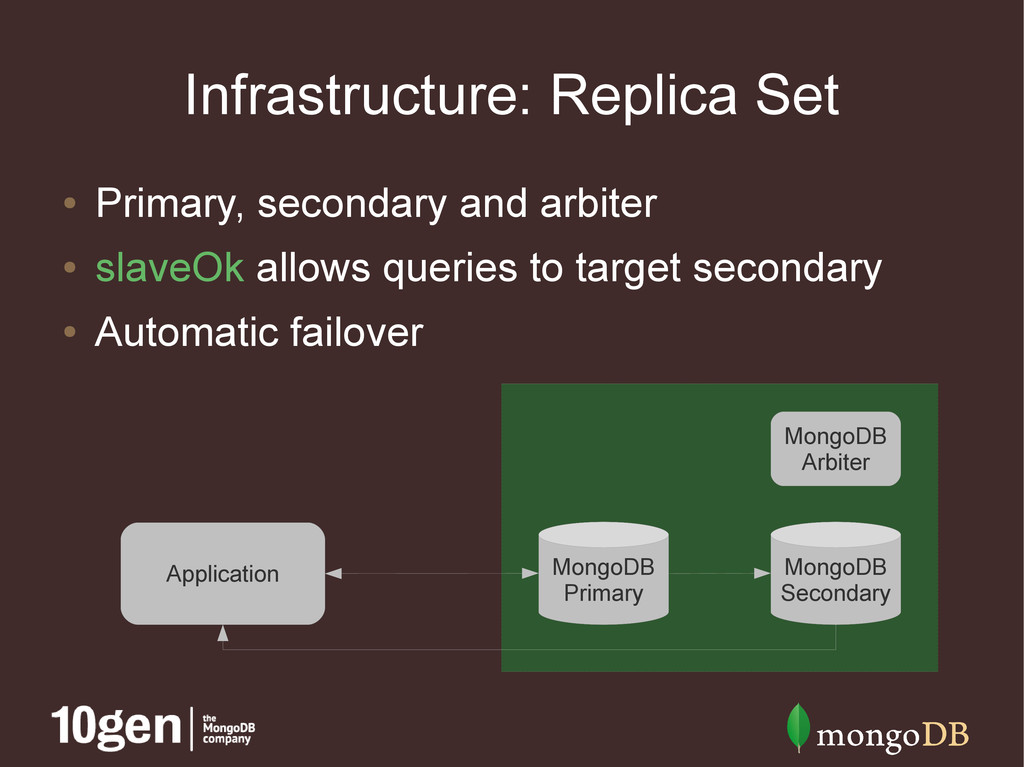
  3. Infrastructure: Replica Set • Primary, secondary and arbiter • slaveOk

    allows queries to target secondary • Automatic failover MongoDB Primary Application MongoDB Secondary MongoDB Arbiter
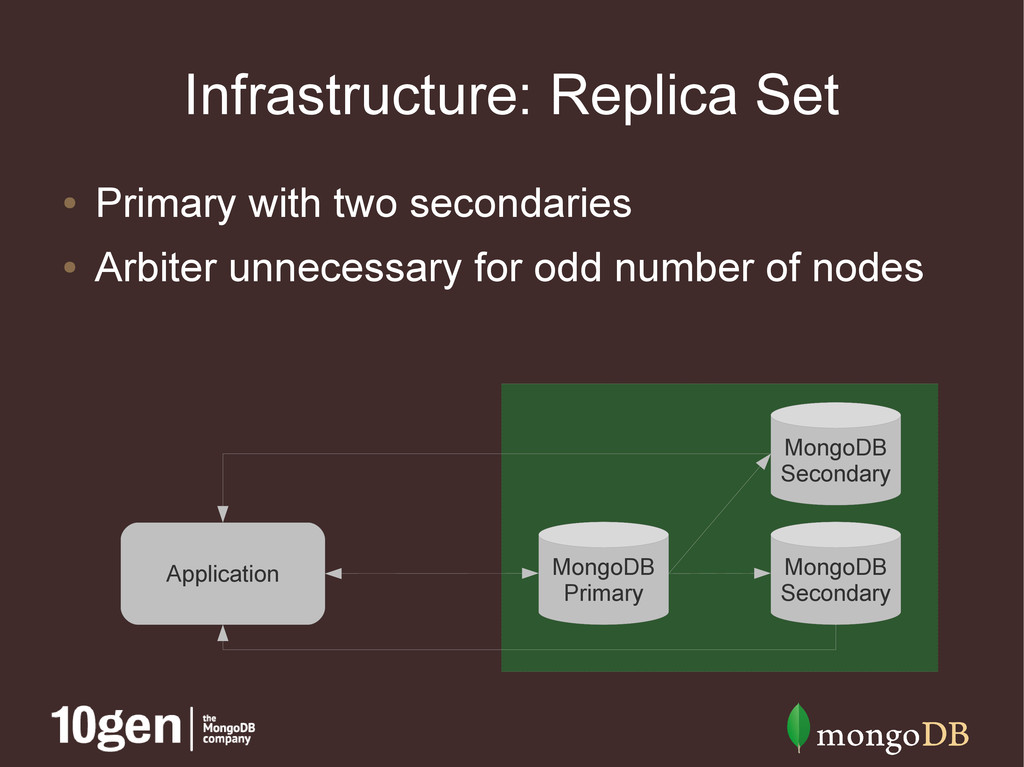
  4. Infrastructure: Replica Set • Primary with two secondaries • Arbiter

    unnecessary for odd number of nodes Application MongoDB Secondary MongoDB Secondary MongoDB Primary
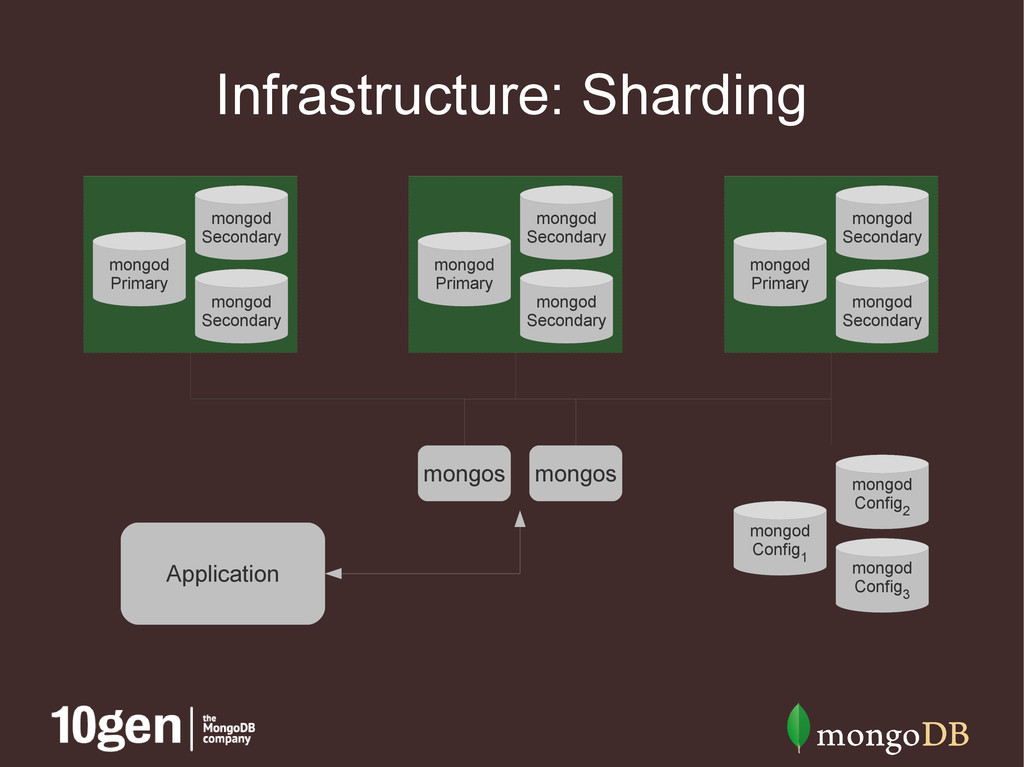
  5. Infrastructure: Sharding Application mongod Primary mongod Secondary mongod Secondary mongod

    Primary mongod Secondary mongod Secondary mongod Primary mongod Secondary mongod Secondary mongos mongos mongod Config 2 mongod Config 3 mongod Config 1
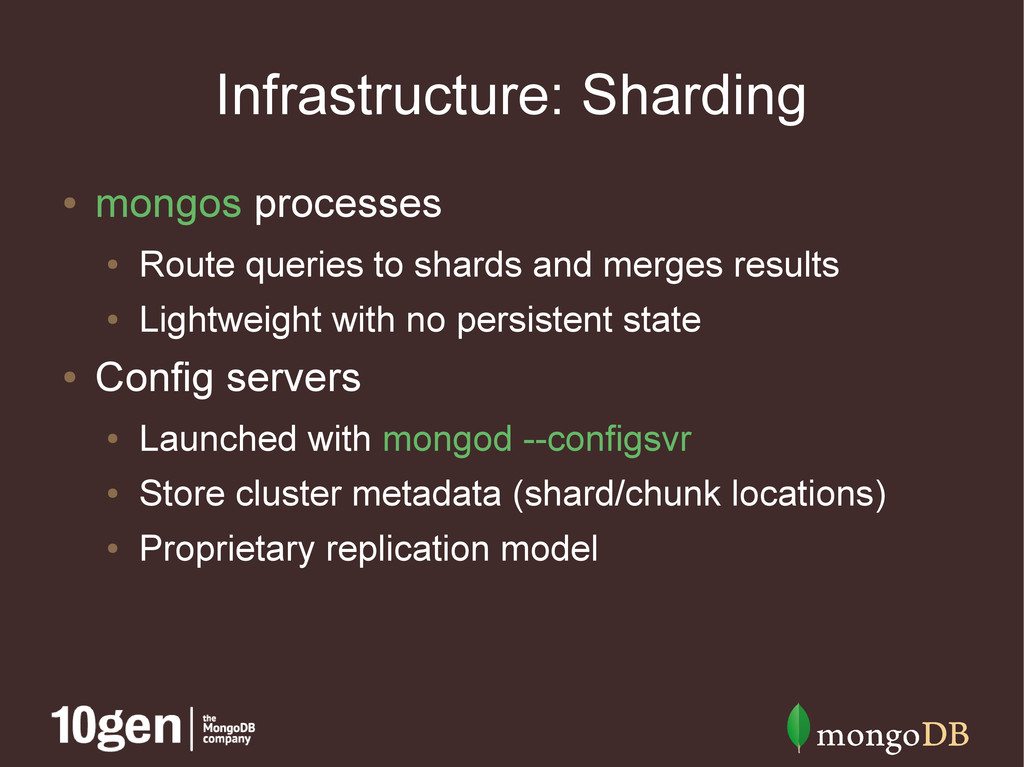
  6. Infrastructure: Sharding • mongos processes • Route queries to shards

    and merges results • Lightweight with no persistent state • Config servers • Launched with mongod --configsvr • Store cluster metadata (shard/chunk locations) • Proprietary replication model
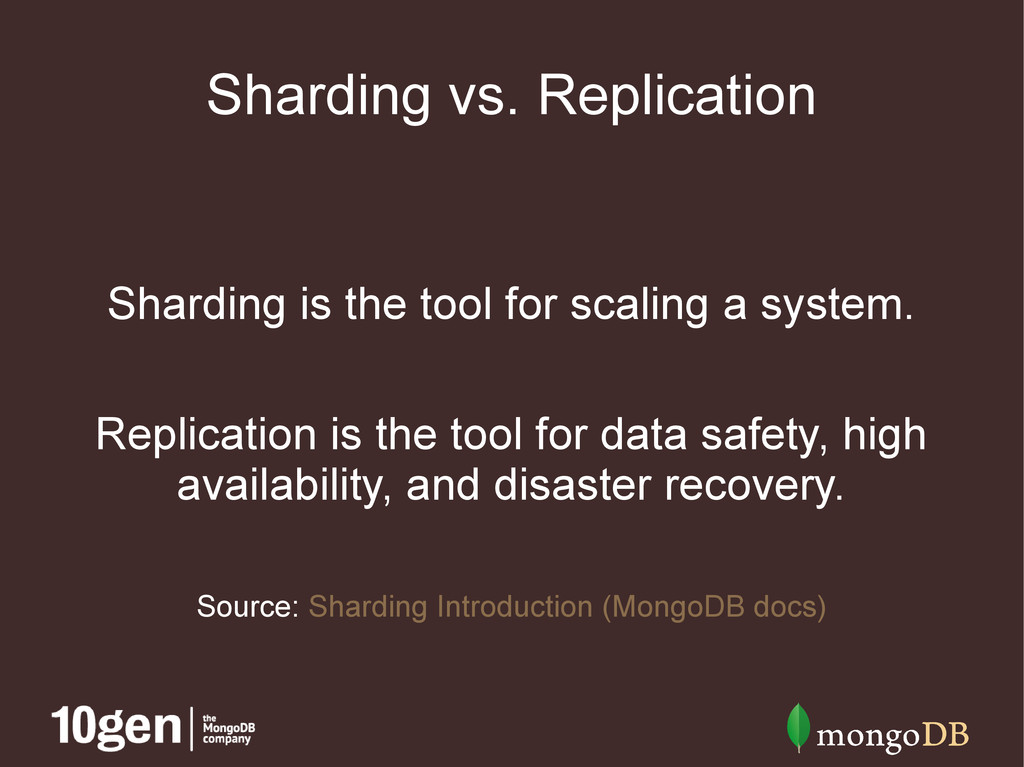
  7. Sharding vs. Replication Sharding is the tool for scaling a

    system. Replication is the tool for data safety, high availability, and disaster recovery. Source: Sharding Introduction (MongoDB docs)
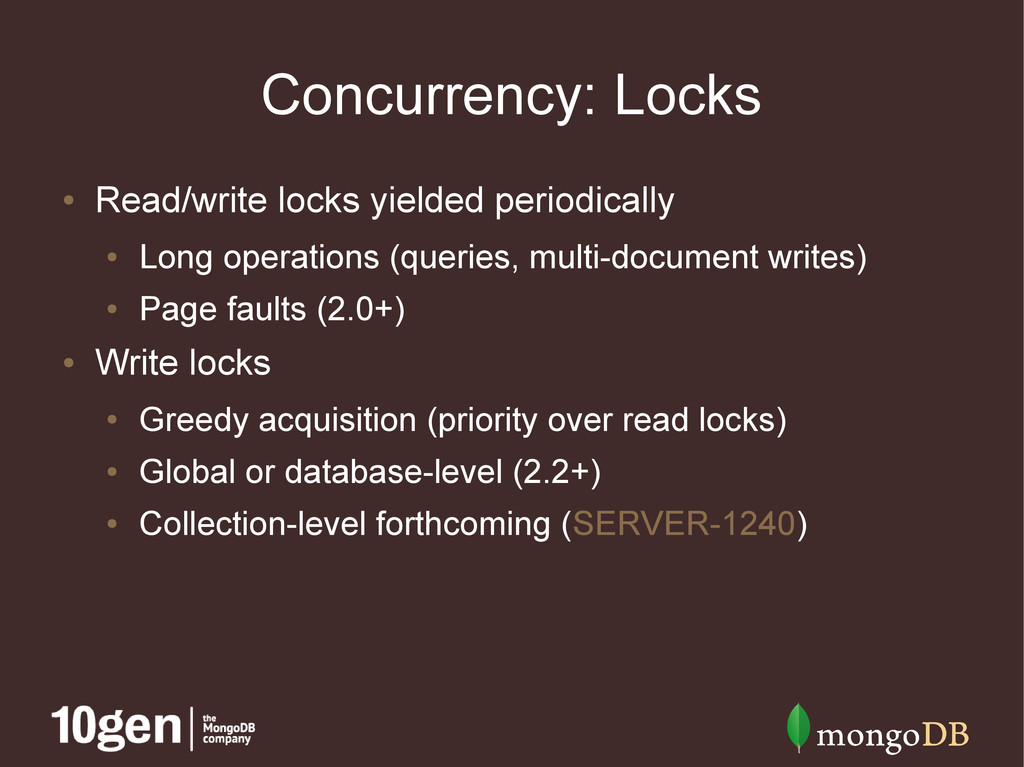
  8. Concurrency: Locks • Read/write locks yielded periodically • Long operations

    (queries, multi-document writes) • Page faults (2.0+) • Write locks • Greedy acquisition (priority over read locks) • Global or database-level (2.2+) • Collection-level forthcoming (SERVER-1240)
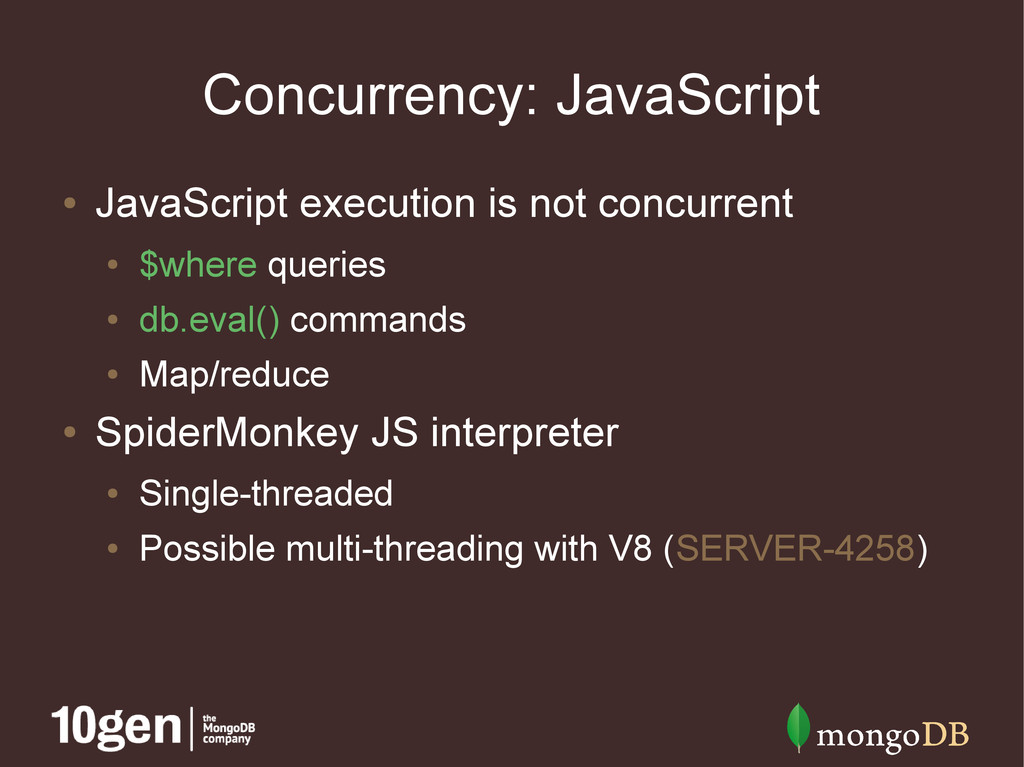
  9. Concurrency: JavaScript • JavaScript execution is not concurrent • $where

    queries • db.eval() commands • Map/reduce • SpiderMonkey JS interpreter • Single-threaded • Possible multi-threading with V8 (SERVER-4258)
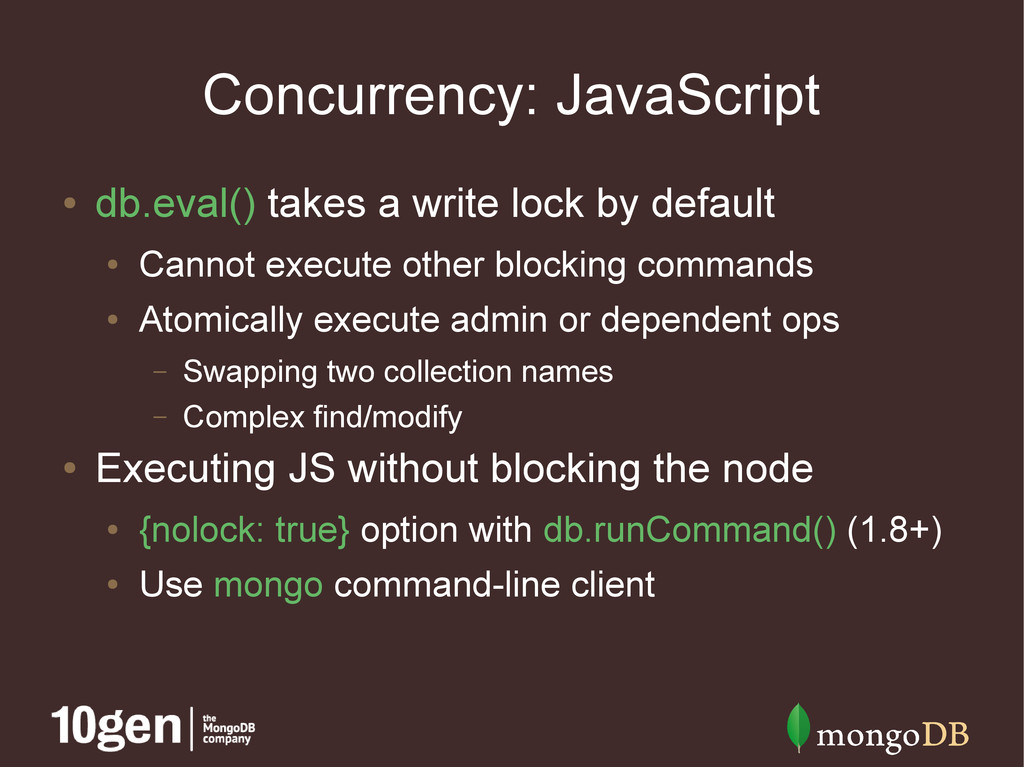
  10. Concurrency: JavaScript • db.eval() takes a write lock by default

    • Cannot execute other blocking commands • Atomically execute admin or dependent ops – Swapping two collection names – Complex find/modify • Executing JS without blocking the node • {nolock: true} option with db.runCommand() (1.8+) • Use mongo command-line client
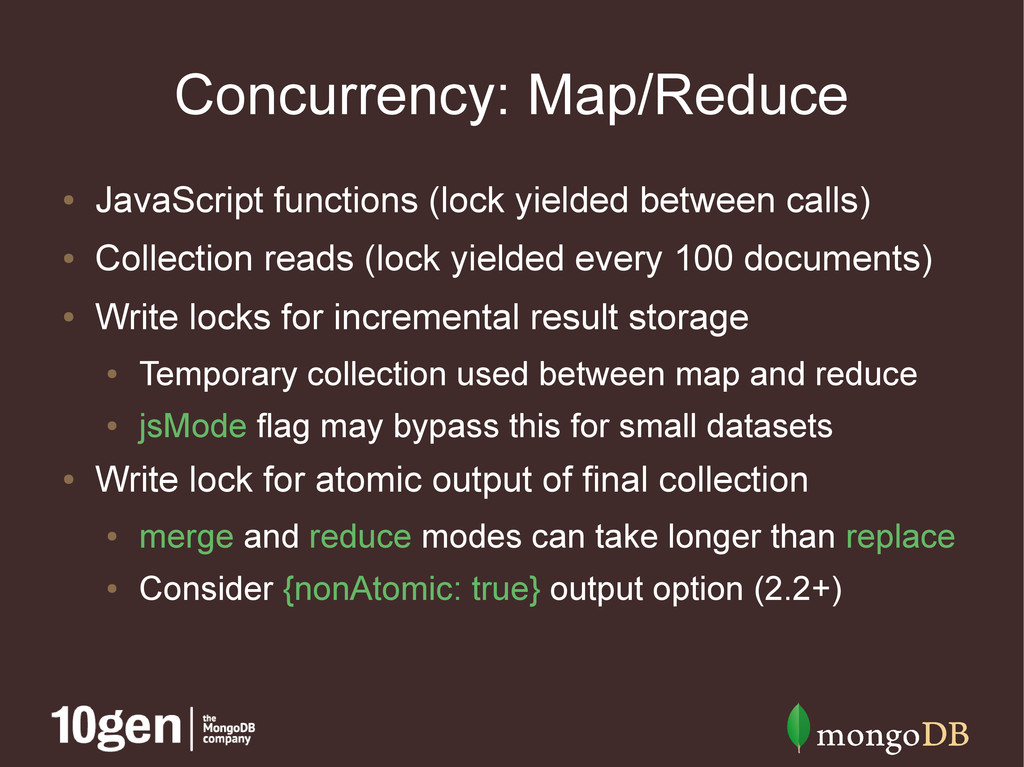
  11. Concurrency: Map/Reduce • JavaScript functions (lock yielded between calls) •

    Collection reads (lock yielded every 100 documents) • Write locks for incremental result storage • Temporary collection used between map and reduce • jsMode flag may bypass this for small datasets • Write lock for atomic output of final collection • merge and reduce modes can take longer than replace • Consider {nonAtomic: true} output option (2.2+)
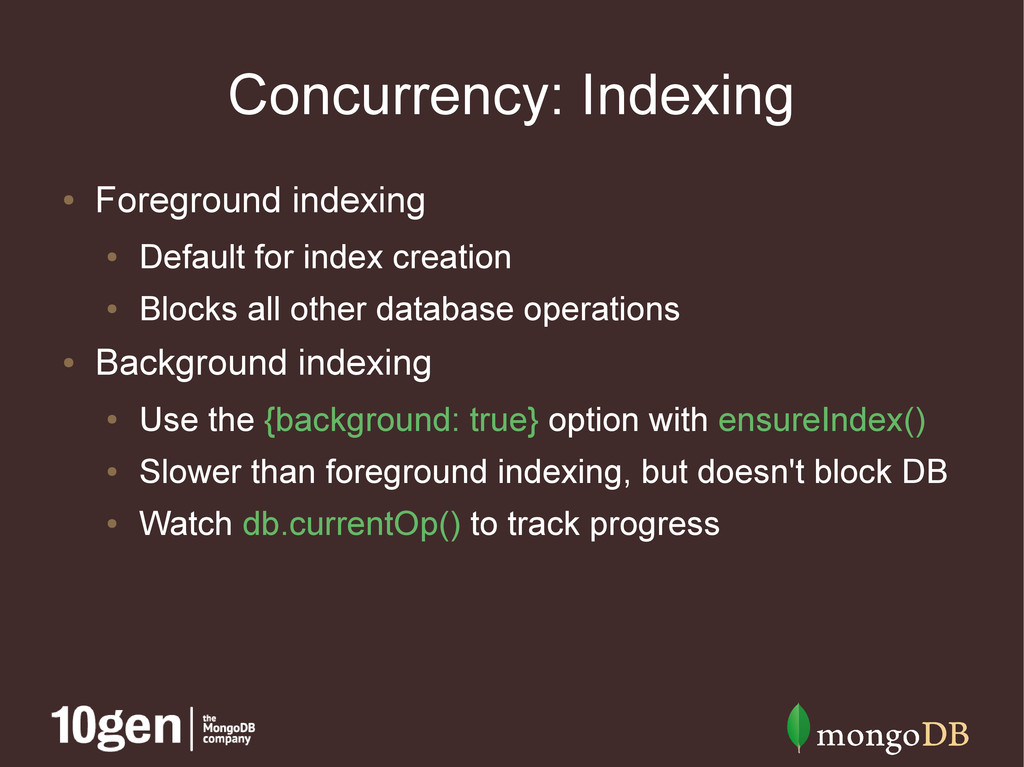
  12. Concurrency: Indexing • Foreground indexing • Default for index creation

    • Blocks all other database operations • Background indexing • Use the {background: true} option with ensureIndex() • Slower than foreground indexing, but doesn't block DB • Watch db.currentOp() to track progress
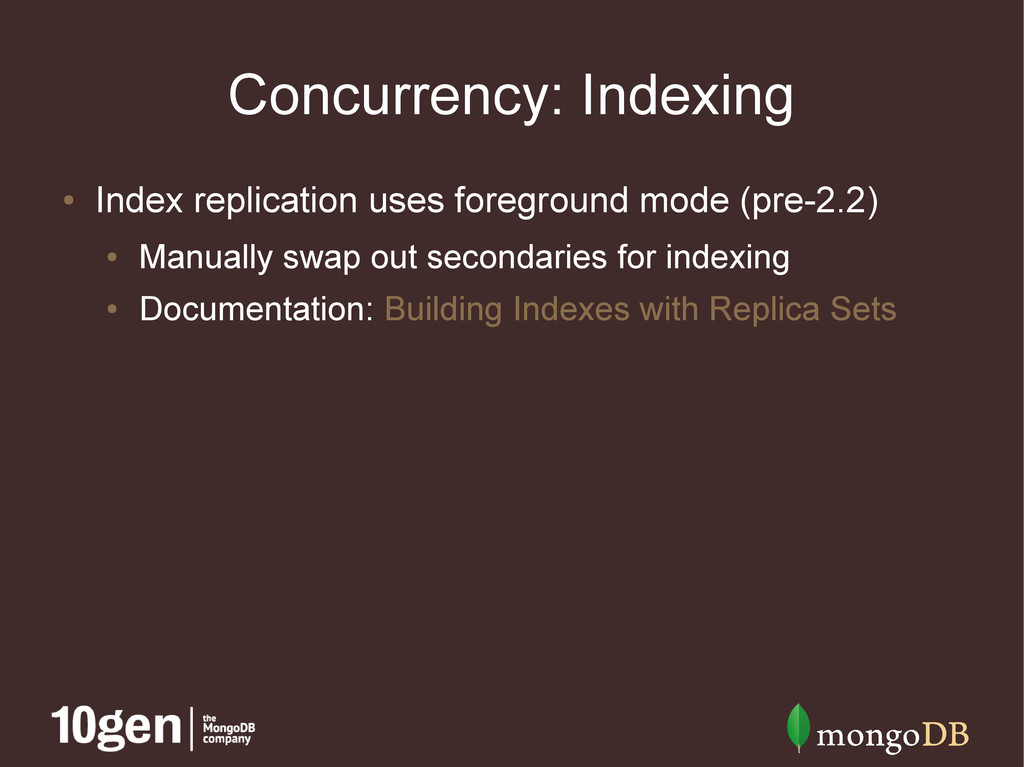
  13. Concurrency: Indexing • Index replication uses foreground mode (pre-2.2) •

    Manually swap out secondaries for indexing • Documentation: Building Indexes with Replica Sets
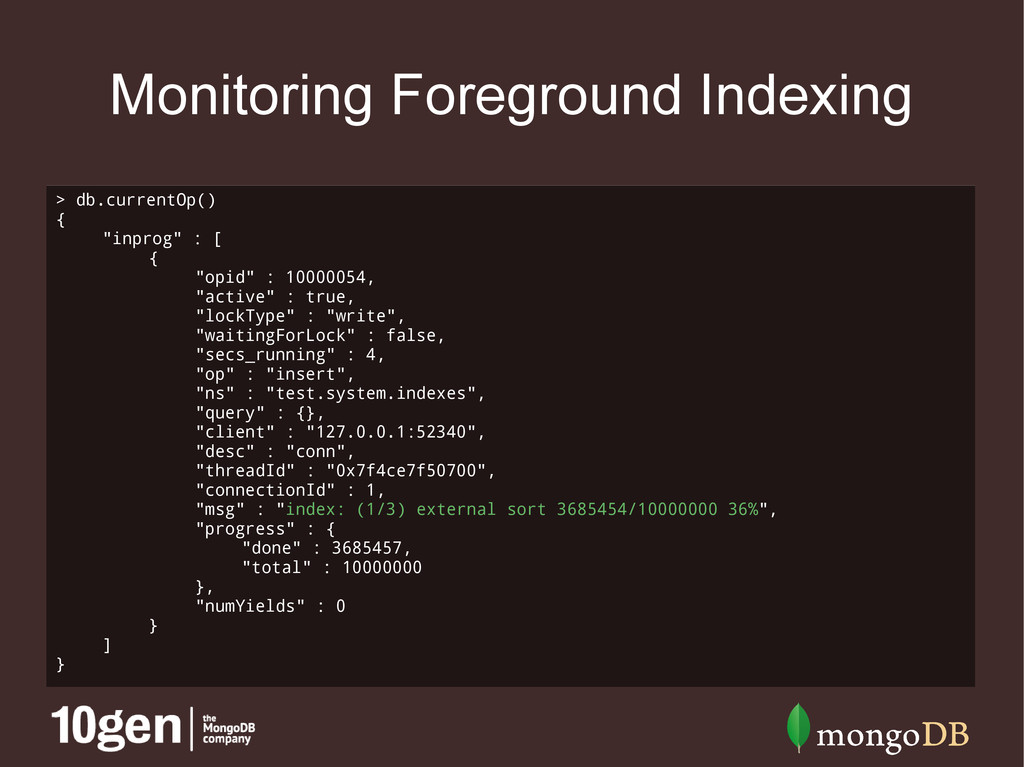
  14. Monitoring Foreground Indexing > db.currentOp() { "inprog" : [ {

    "opid" : 10000054, "active" : true, "lockType" : "write", "waitingForLock" : false, "secs_running" : 4, "op" : "insert", "ns" : "test.system.indexes", "query" : {}, "client" : "127.0.0.1:52340", "desc" : "conn", "threadId" : "0x7f4ce7f50700", "connectionId" : 1, "msg" : "index: (1/3) external sort 3685454/10000000 36%", "progress" : { "done" : 3685457, "total" : 10000000 }, "numYields" : 0 } ] }
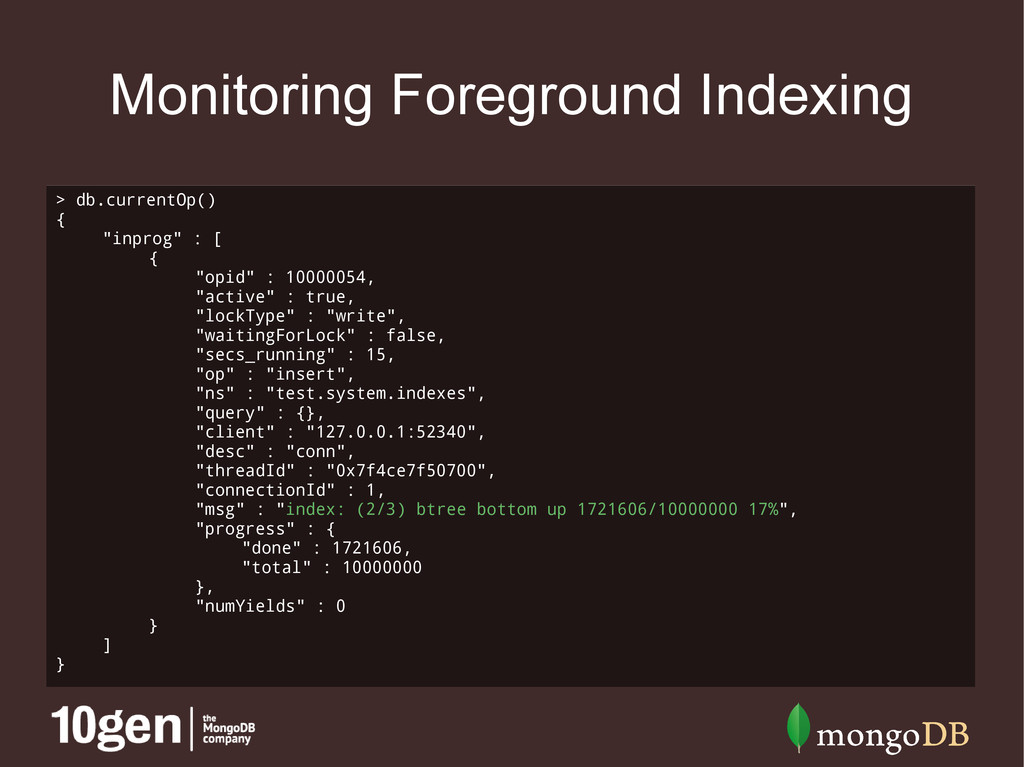
  15. Monitoring Foreground Indexing > db.currentOp() { "inprog" : [ {

    "opid" : 10000054, "active" : true, "lockType" : "write", "waitingForLock" : false, "secs_running" : 15, "op" : "insert", "ns" : "test.system.indexes", "query" : {}, "client" : "127.0.0.1:52340", "desc" : "conn", "threadId" : "0x7f4ce7f50700", "connectionId" : 1, "msg" : "index: (2/3) btree bottom up 1721606/10000000 17%", "progress" : { "done" : 1721606, "total" : 10000000 }, "numYields" : 0 } ] }
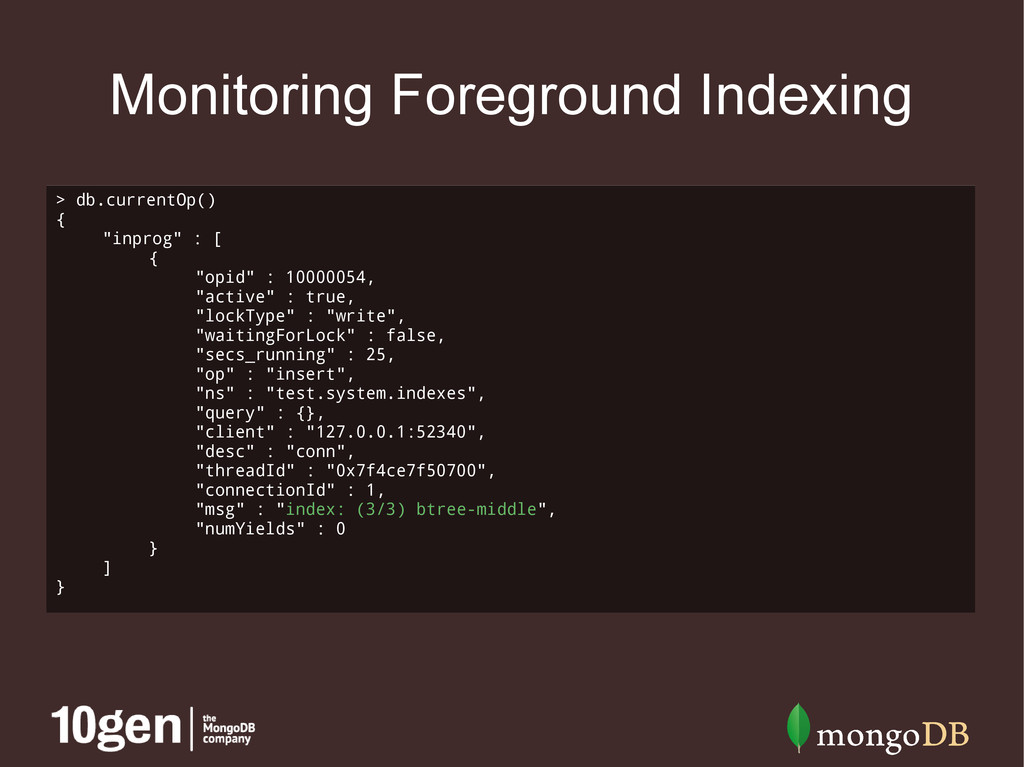
  16. Monitoring Foreground Indexing > db.currentOp() { "inprog" : [ {

    "opid" : 10000054, "active" : true, "lockType" : "write", "waitingForLock" : false, "secs_running" : 25, "op" : "insert", "ns" : "test.system.indexes", "query" : {}, "client" : "127.0.0.1:52340", "desc" : "conn", "threadId" : "0x7f4ce7f50700", "connectionId" : 1, "msg" : "index: (3/3) btree-middle", "numYields" : 0 } ] }
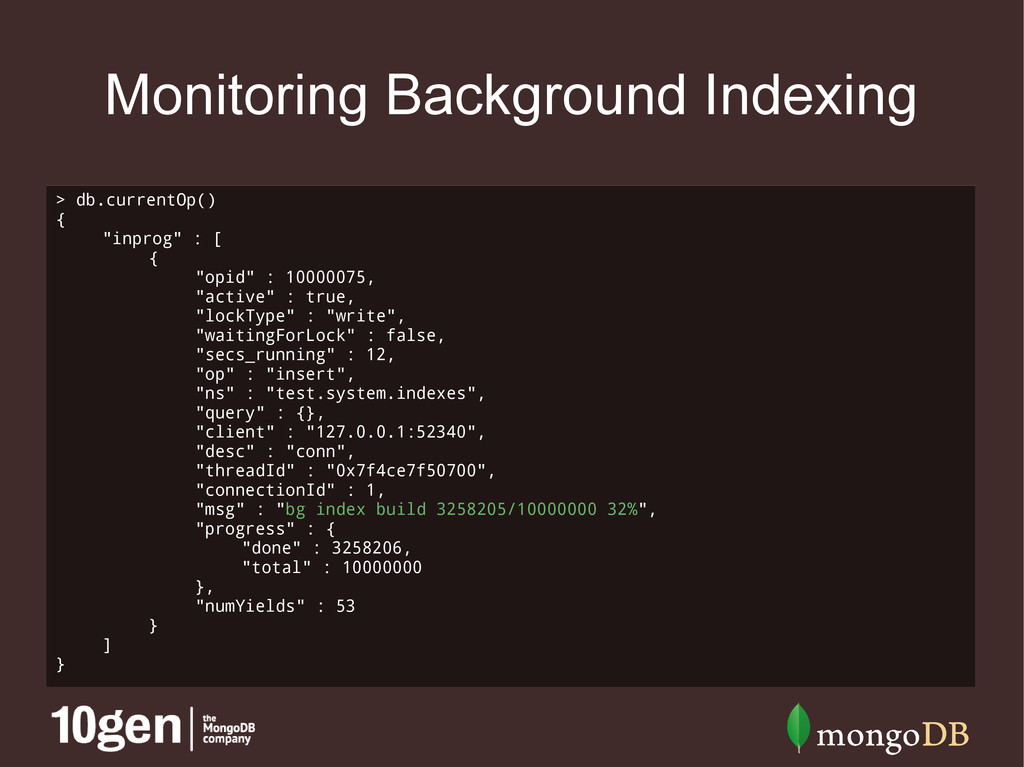
  17. Monitoring Background Indexing > db.currentOp() { "inprog" : [ {

    "opid" : 10000075, "active" : true, "lockType" : "write", "waitingForLock" : false, "secs_running" : 12, "op" : "insert", "ns" : "test.system.indexes", "query" : {}, "client" : "127.0.0.1:52340", "desc" : "conn", "threadId" : "0x7f4ce7f50700", "connectionId" : 1, "msg" : "bg index build 3258205/10000000 32%", "progress" : { "done" : 3258206, "total" : 10000000 }, "numYields" : 53 } ] }
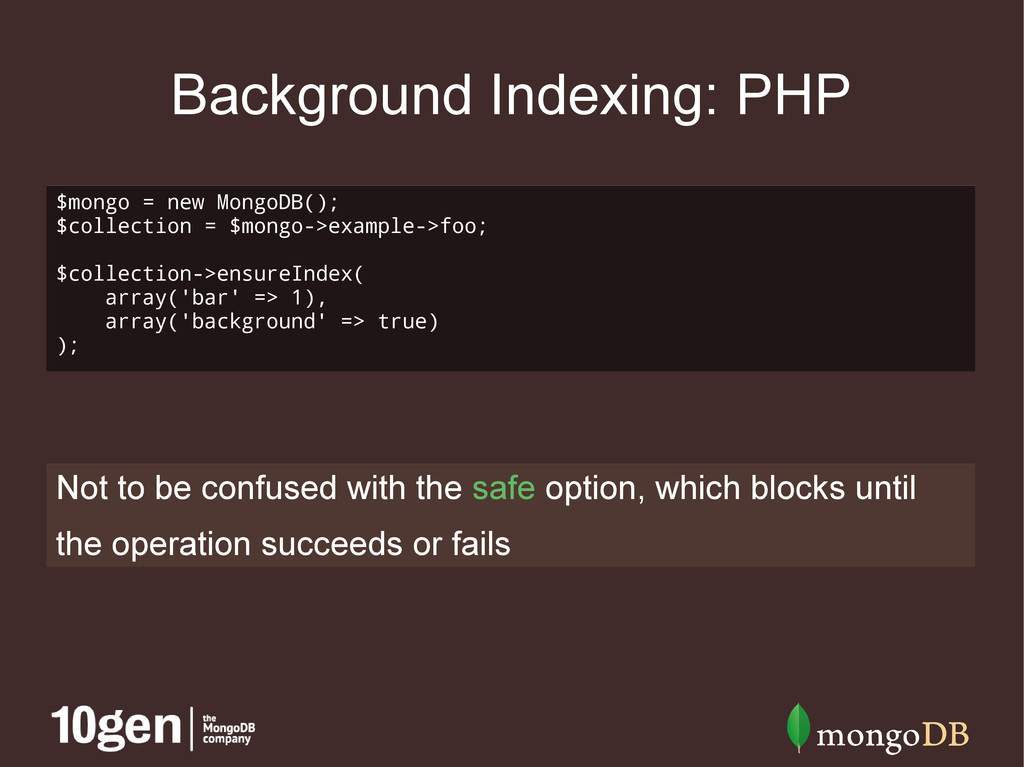
  18. Background Indexing: PHP $mongo = new MongoDB(); $collection = $mongo->example->foo;

    $collection->ensureIndex( array('bar' => 1), array('background' => true) ); Not to be confused with the safe option, which blocks until the operation succeeds or fails
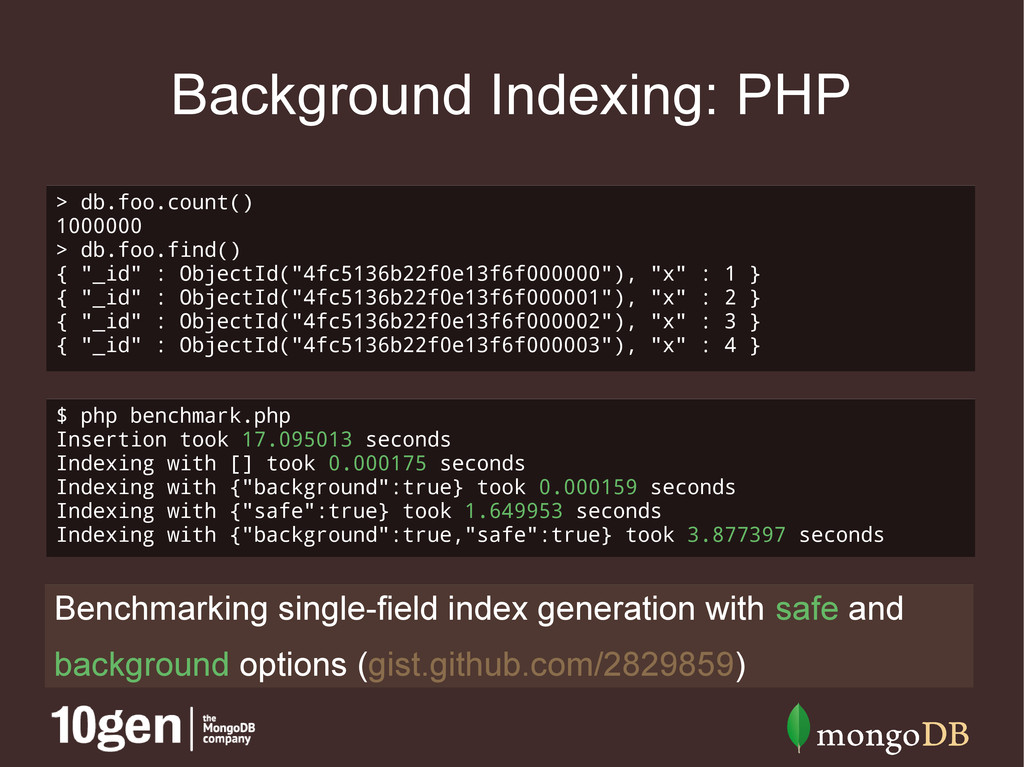
  19. Background Indexing: PHP > db.foo.count() 1000000 > db.foo.find() { "_id"

    : ObjectId("4fc5136b22f0e13f6f000000"), "x" : 1 } { "_id" : ObjectId("4fc5136b22f0e13f6f000001"), "x" : 2 } { "_id" : ObjectId("4fc5136b22f0e13f6f000002"), "x" : 3 } { "_id" : ObjectId("4fc5136b22f0e13f6f000003"), "x" : 4 } $ php benchmark.php Insertion took 17.095013 seconds Indexing with [] took 0.000175 seconds Indexing with {"background":true} took 0.000159 seconds Indexing with {"safe":true} took 1.649953 seconds Indexing with {"background":true,"safe":true} took 3.877397 seconds Benchmarking single-field index generation with safe and background options (gist.github.com/2829859)
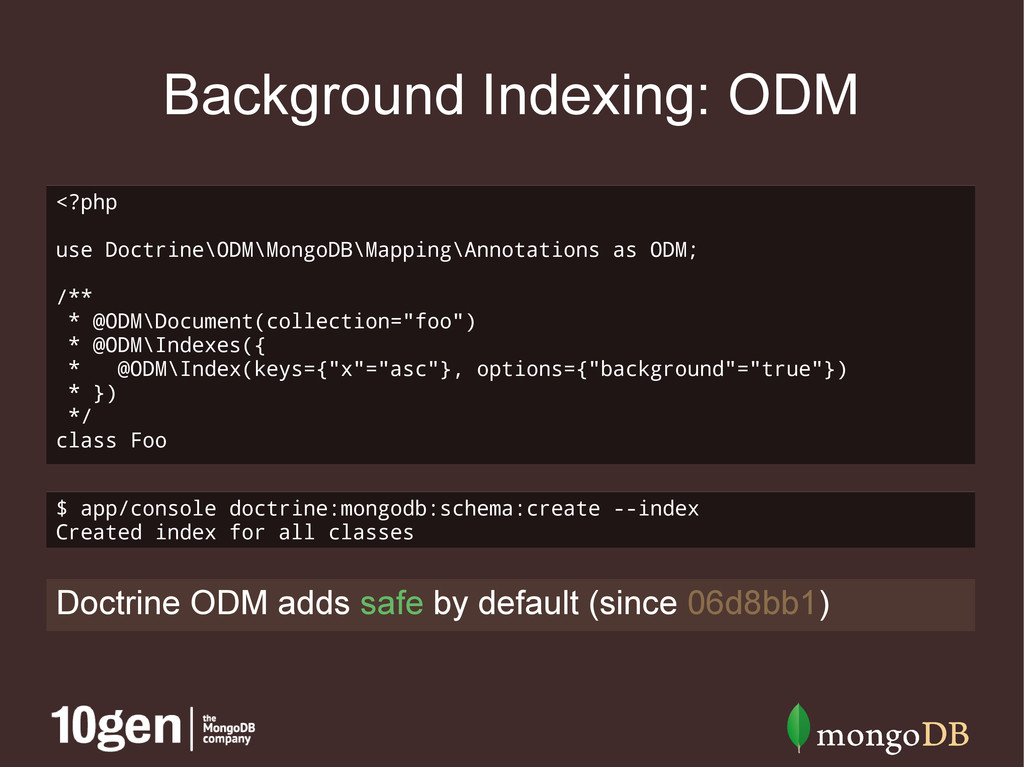
  20. Background Indexing: ODM <?php use Doctrine\ODM\MongoDB\Mapping\Annotations as ODM; /** *

    @ODM\Document(collection="foo") * @ODM\Indexes({ * @ODM\Index(keys={"x"="asc"}, options={"background"="true"}) * }) */ class Foo $ app/console doctrine:mongodb:schema:create --index Created index for all classes Doctrine ODM adds safe by default (since 06d8bb1)
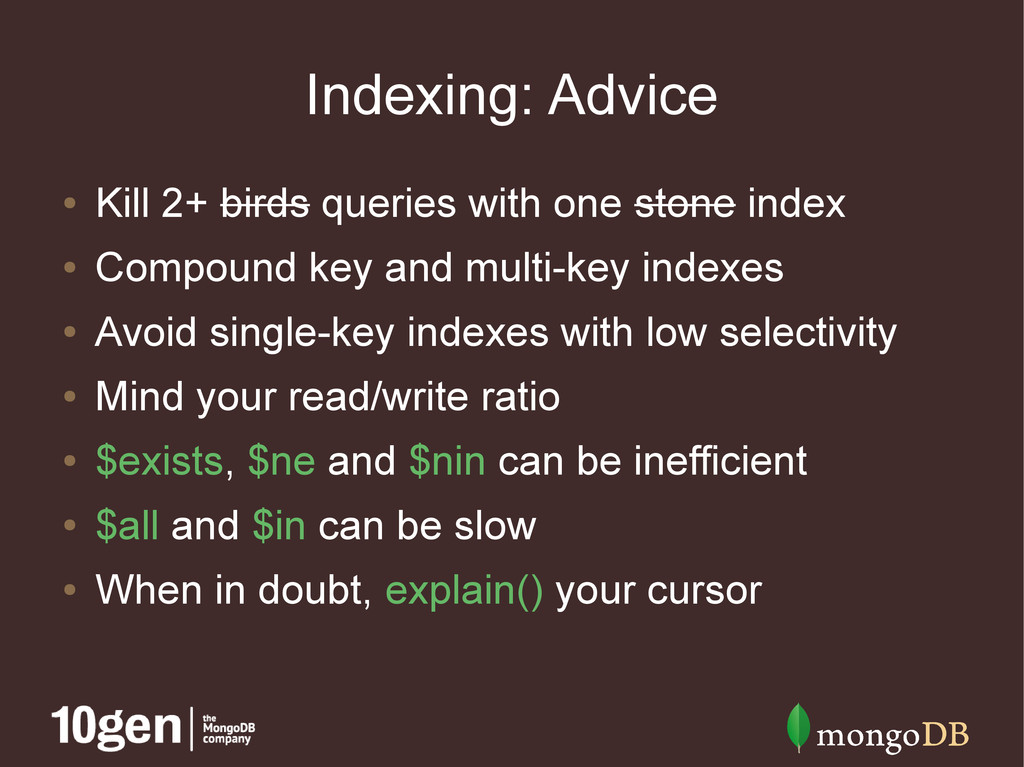
  21. Indexing: Advice • Kill 2+ birds queries with one stone

    index • Compound key and multi-key indexes • Avoid single-key indexes with low selectivity • Mind your read/write ratio • $exists, $ne and $nin can be inefficient • $all and $in can be slow • When in doubt, explain() your cursor
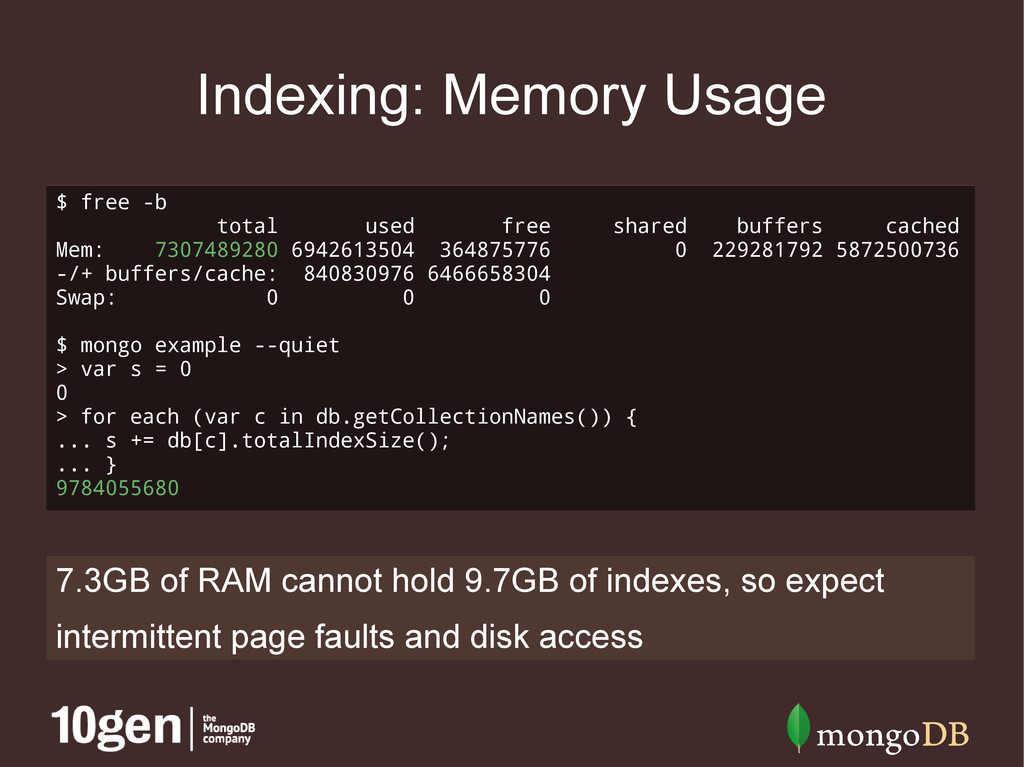
  22. Indexing: Memory Usage $ free -b total used free shared

    buffers cached Mem: 7307489280 6942613504 364875776 0 229281792 5872500736 -/+ buffers/cache: 840830976 6466658304 Swap: 0 0 0 $ mongo example --quiet > var s = 0 0 > for each (var c in db.getCollectionNames()) { ... s += db[c].totalIndexSize(); ... } 9784055680 7.3GB of RAM cannot hold 9.7GB of indexes, so expect intermittent page faults and disk access
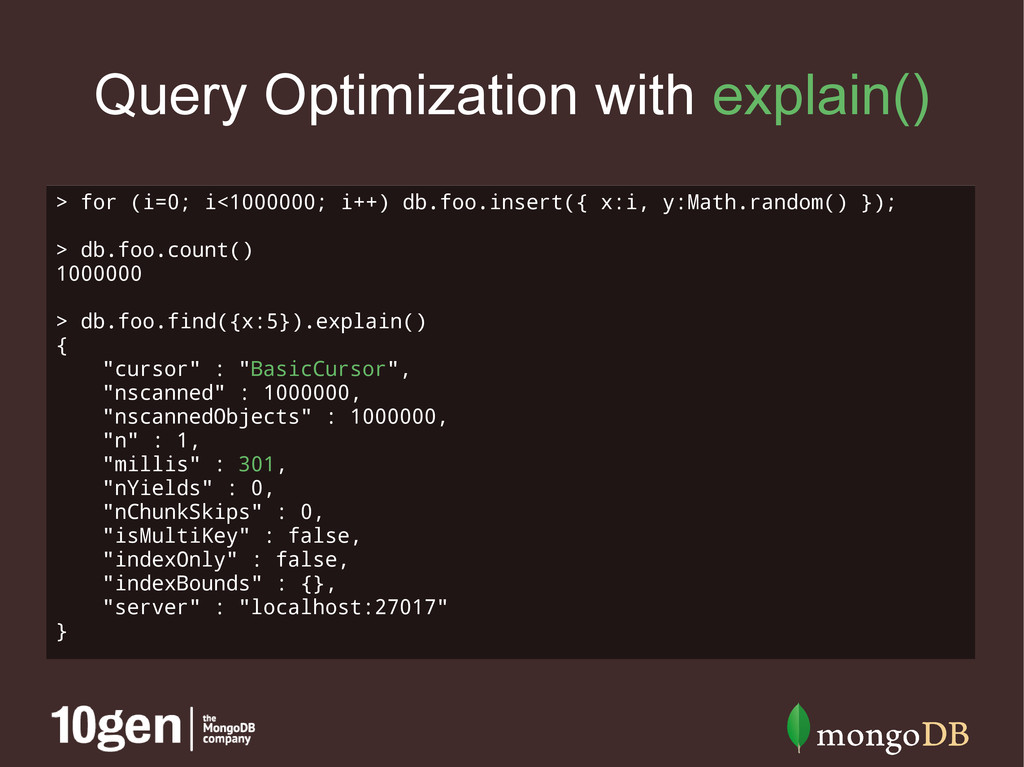
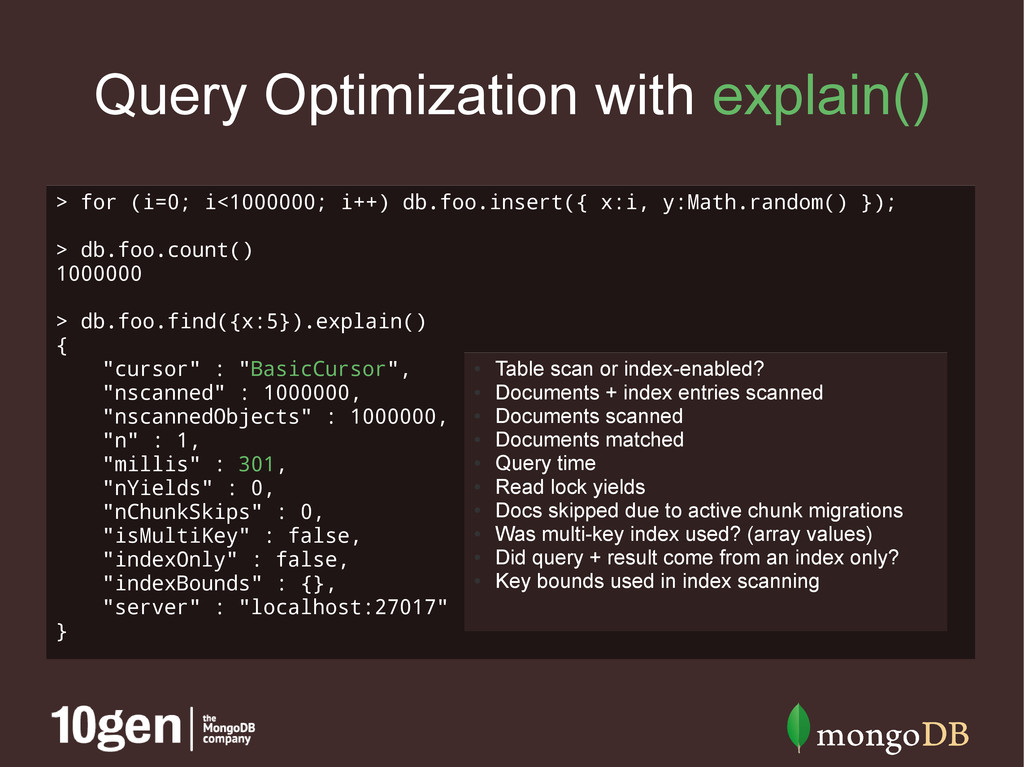
  23. Query Optimization with explain() > for (i=0; i<1000000; i++) db.foo.insert({

    x:i, y:Math.random() }); > db.foo.count() 1000000 > db.foo.find({x:5}).explain() { "cursor" : "BasicCursor", "nscanned" : 1000000, "nscannedObjects" : 1000000, "n" : 1, "millis" : 301, "nYields" : 0, "nChunkSkips" : 0, "isMultiKey" : false, "indexOnly" : false, "indexBounds" : {}, "server" : "localhost:27017" }
  24. > for (i=0; i<1000000; i++) db.foo.insert({ x:i, y:Math.random() }); >

    db.foo.count() 1000000 > db.foo.find({x:5}).explain() { "cursor" : "BasicCursor", "nscanned" : 1000000, "nscannedObjects" : 1000000, "n" : 1, "millis" : 301, "nYields" : 0, "nChunkSkips" : 0, "isMultiKey" : false, "indexOnly" : false, "indexBounds" : {}, "server" : "localhost:27017" } Query Optimization with explain() • Table scan or index-enabled? • Documents + index entries scanned • Documents scanned • Documents matched • Query time • Read lock yields • Docs skipped due to active chunk migrations • Was multi-key index used? (array values) • Did query + result come from an index only? • Key bounds used in index scanning
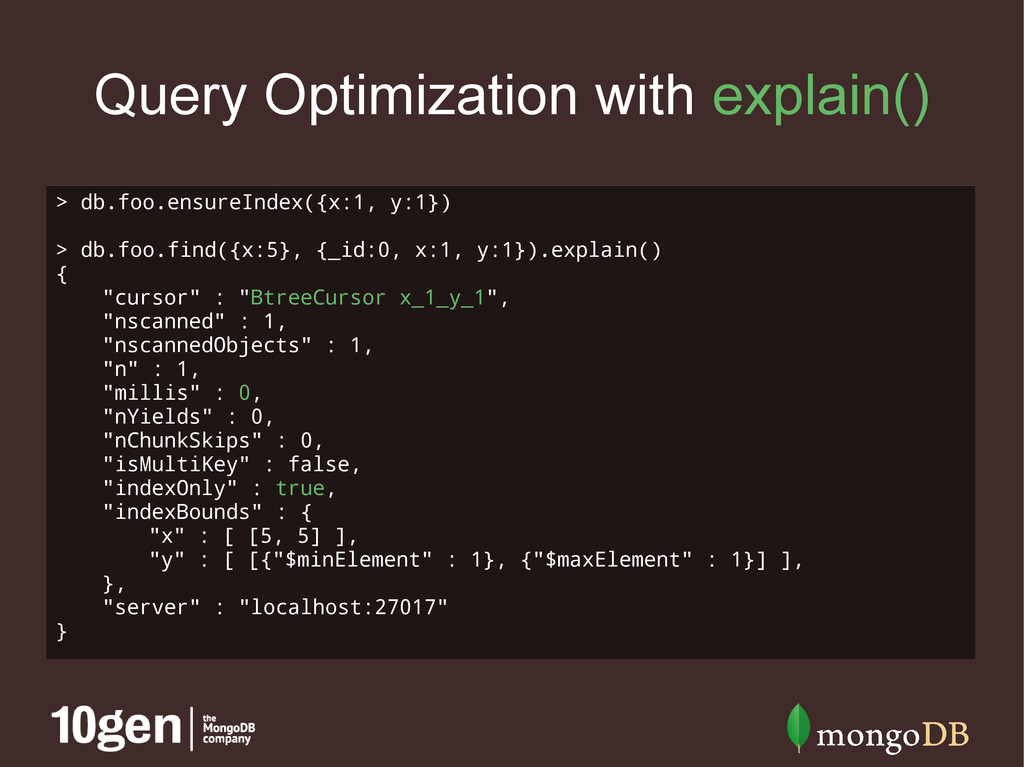
  25. Query Optimization with explain() > db.foo.ensureIndex({x:1, y:1}) > db.foo.find({x:5}, {_id:0,

    x:1, y:1}).explain() { "cursor" : "BtreeCursor x_1_y_1", "nscanned" : 1, "nscannedObjects" : 1, "n" : 1, "millis" : 0, "nYields" : 0, "nChunkSkips" : 0, "isMultiKey" : false, "indexOnly" : true, "indexBounds" : { "x" : [ [5, 5] ], "y" : [ [{"$minElement" : 1}, {"$maxElement" : 1}] ], }, "server" : "localhost:27017" }
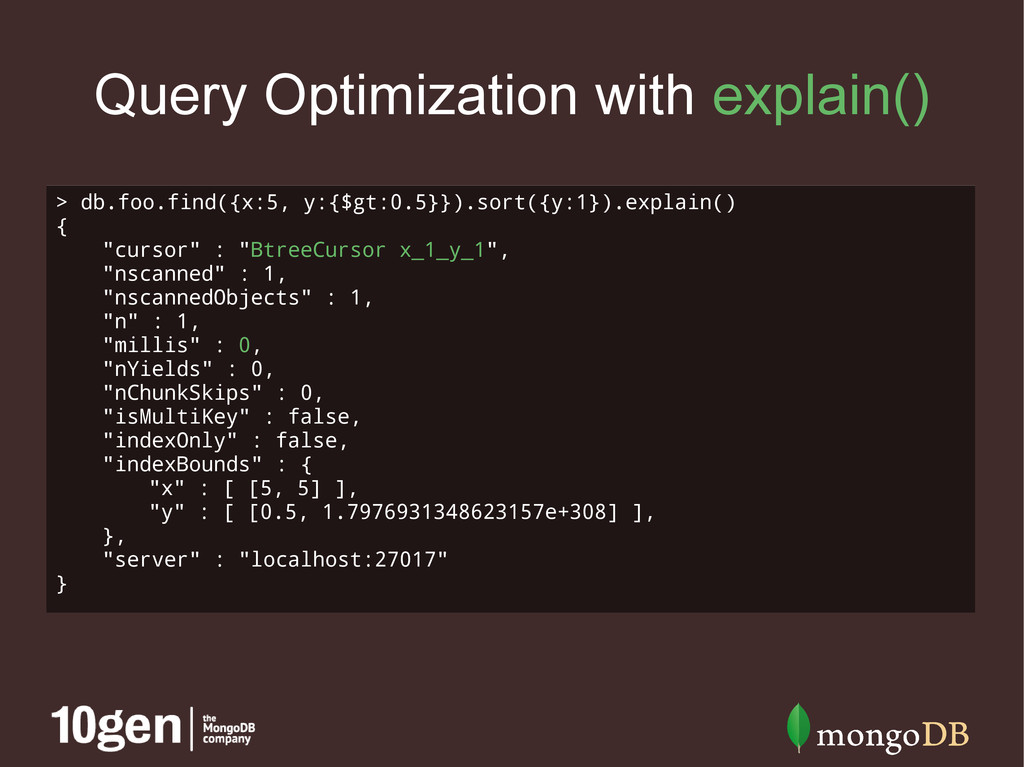
  26. Query Optimization with explain() > db.foo.find({x:5, y:{$gt:0.5}}).sort({y:1}).explain() { "cursor" :

    "BtreeCursor x_1_y_1", "nscanned" : 1, "nscannedObjects" : 1, "n" : 1, "millis" : 0, "nYields" : 0, "nChunkSkips" : 0, "isMultiKey" : false, "indexOnly" : false, "indexBounds" : { "x" : [ [5, 5] ], "y" : [ [0.5, 1.7976931348623157e+308] ], }, "server" : "localhost:27017" }
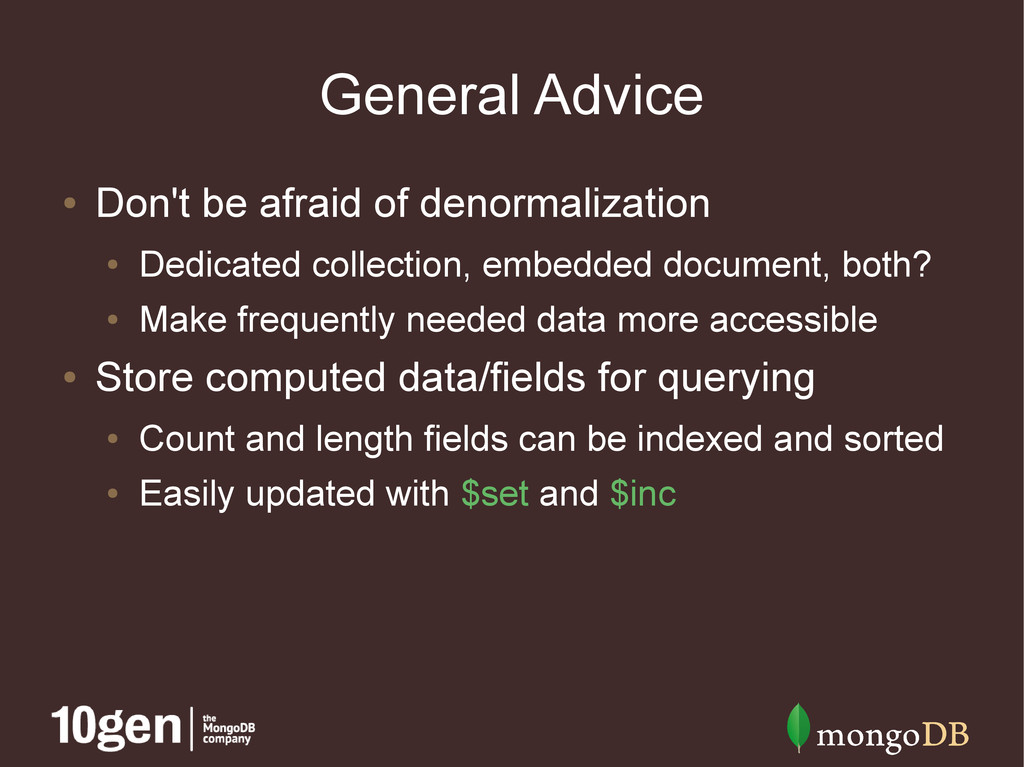
  27. General Advice • Don't be afraid of denormalization • Dedicated

    collection, embedded document, both? • Make frequently needed data more accessible • Store computed data/fields for querying • Count and length fields can be indexed and sorted • Easily updated with $set and $inc
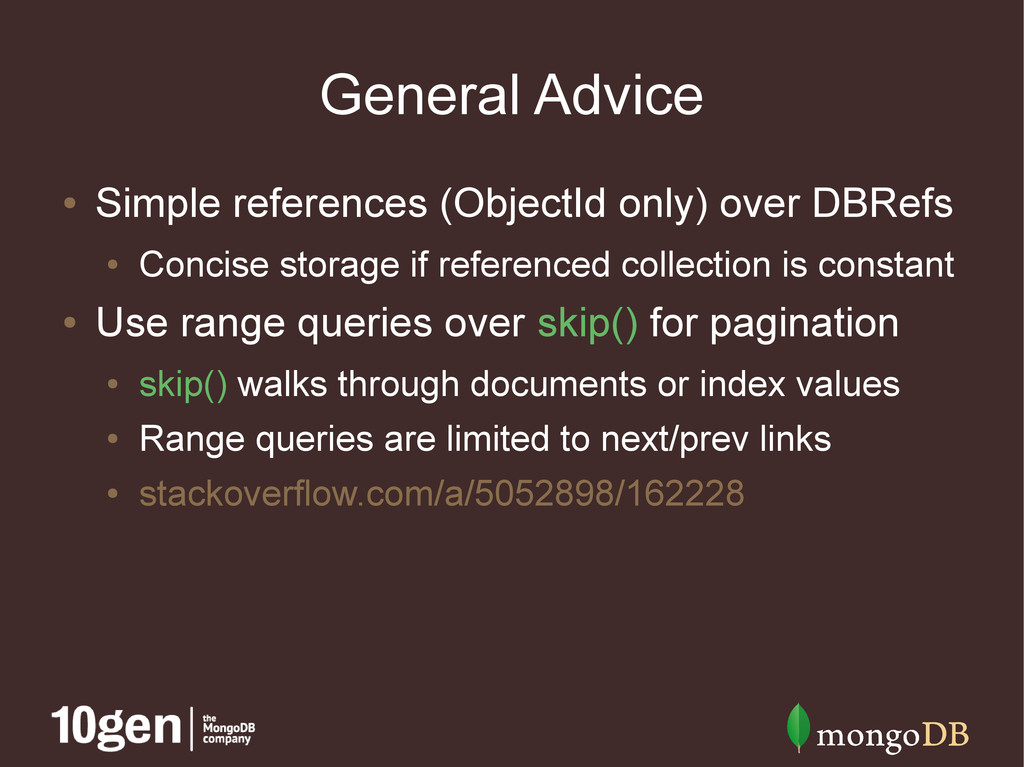
  28. General Advice • Simple references (ObjectId only) over DBRefs •

    Concise storage if referenced collection is constant • Use range queries over skip() for pagination • skip() walks through documents or index values • Range queries are limited to next/prev links • stackoverflow.com/a/5052898/162228
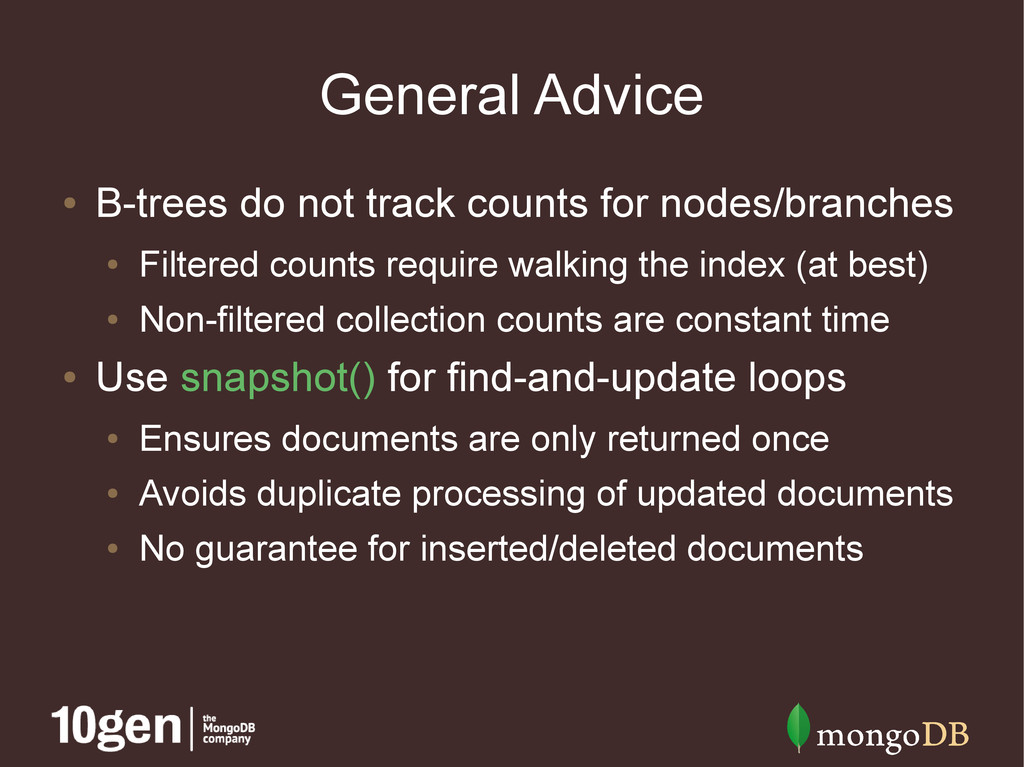
  29. General Advice • B-trees do not track counts for nodes/branches

    • Filtered counts require walking the index (at best) • Non-filtered collection counts are constant time • Use snapshot() for find-and-update loops • Ensures documents are only returned once • Avoids duplicate processing of updated documents • No guarantee for inserted/deleted documents
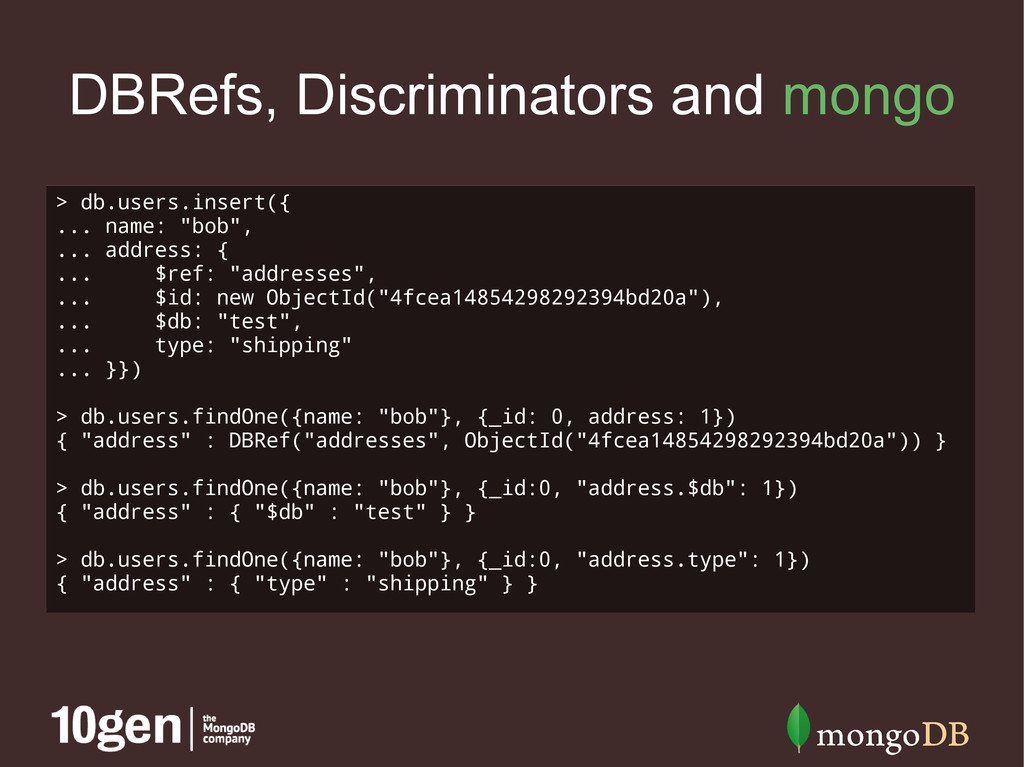
  30. DBRefs, Discriminators and mongo > db.users.insert({ ... name: "bob", ...

    address: { ... $ref: "addresses", ... $id: new ObjectId("4fcea14854298292394bd20a"), ... $db: "test", ... type: "shipping" ... }}) > db.users.findOne({name: "bob"}, {_id: 0, address: 1}) { "address" : DBRef("addresses", ObjectId("4fcea14854298292394bd20a")) } > db.users.findOne({name: "bob"}, {_id:0, "address.$db": 1}) { "address" : { "$db" : "test" } } > db.users.findOne({name: "bob"}, {_id:0, "address.type": 1}) { "address" : { "type" : "shipping" } }
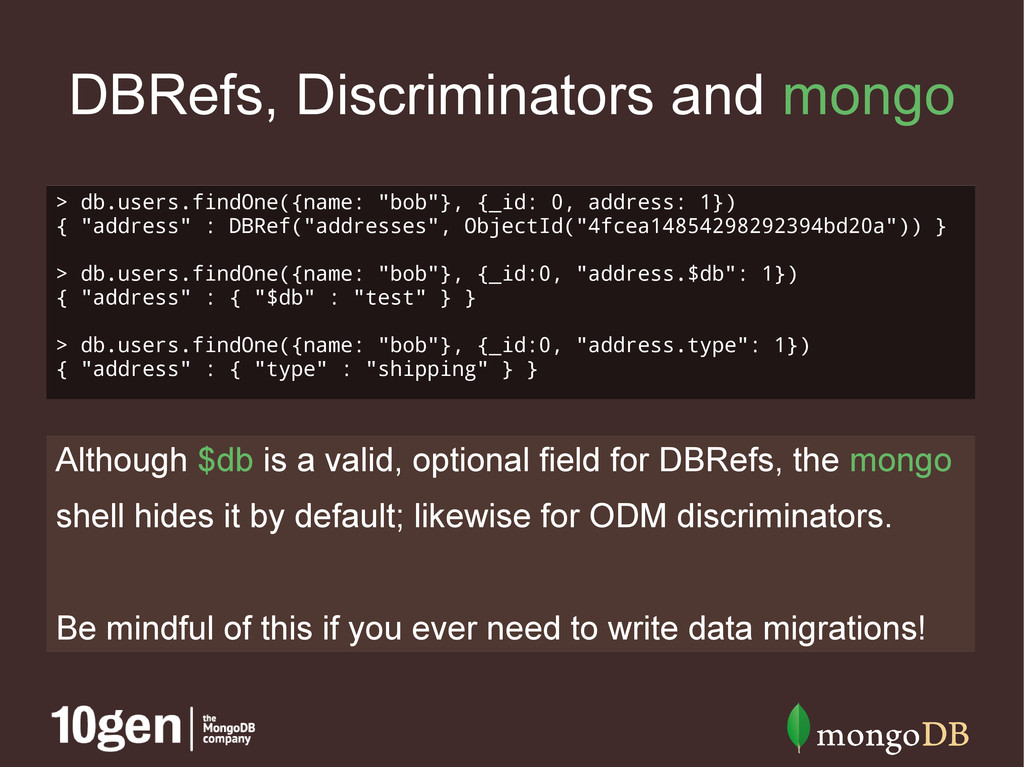
  31. DBRefs, Discriminators and mongo > db.users.findOne({name: "bob"}, {_id: 0, address:

    1}) { "address" : DBRef("addresses", ObjectId("4fcea14854298292394bd20a")) } > db.users.findOne({name: "bob"}, {_id:0, "address.$db": 1}) { "address" : { "$db" : "test" } } > db.users.findOne({name: "bob"}, {_id:0, "address.type": 1}) { "address" : { "type" : "shipping" } } Although $db is a valid, optional field for DBRefs, the mongo shell hides it by default; likewise for ODM discriminators. Be mindful of this if you ever need to write data migrations!
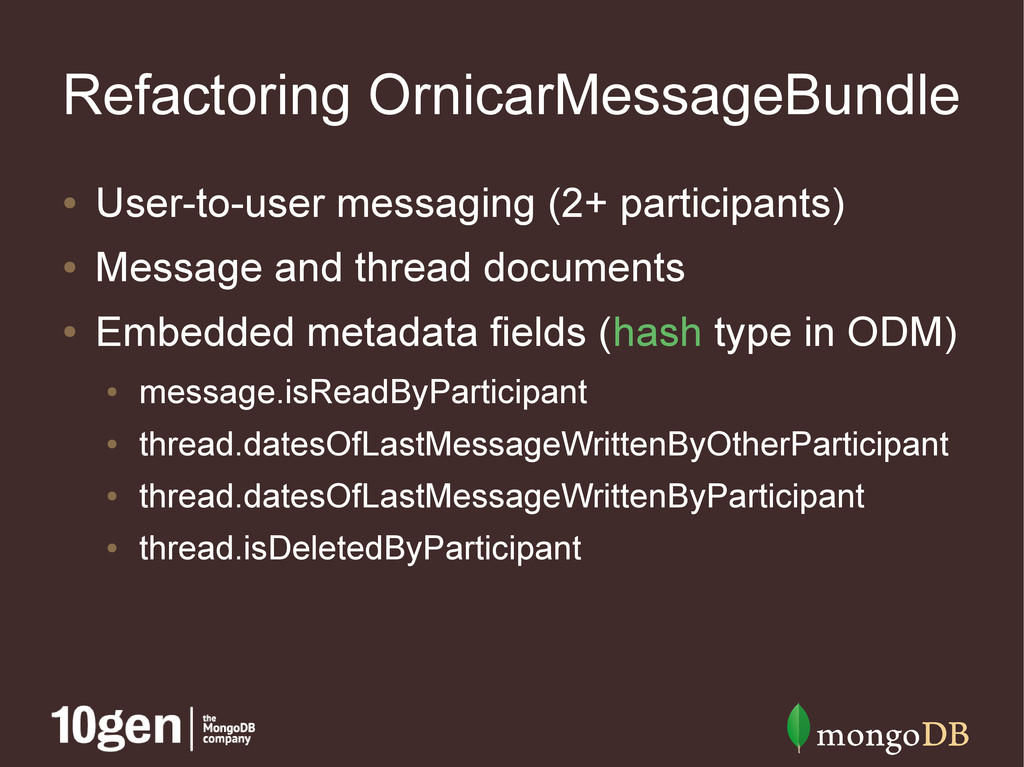
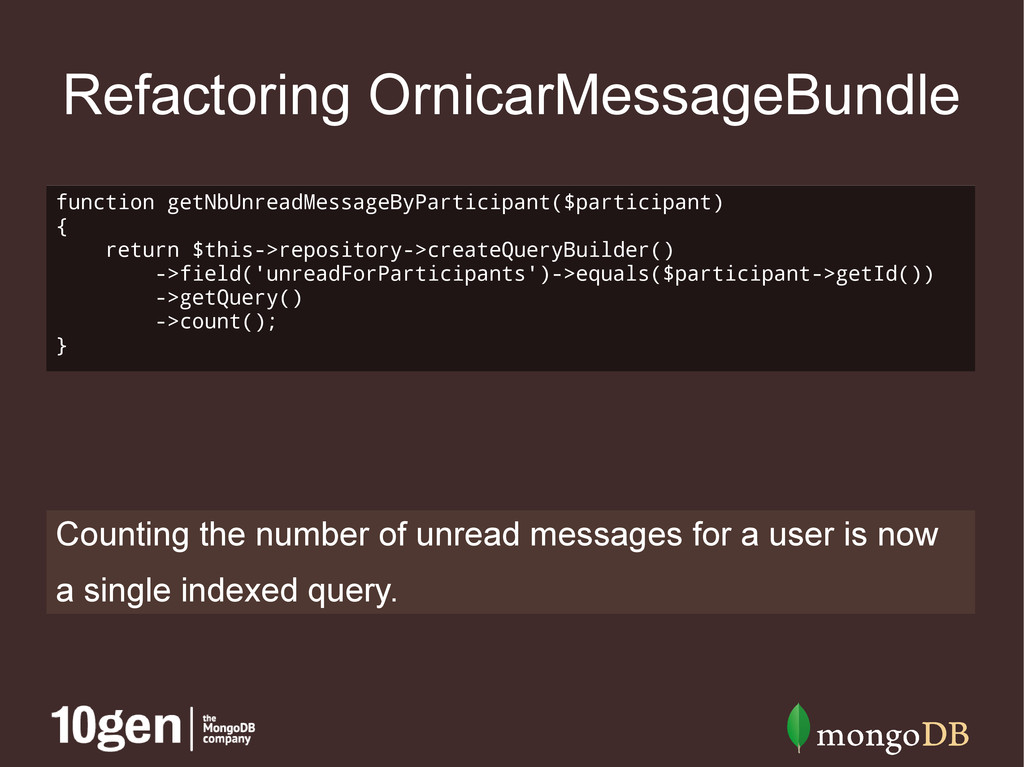
  32. Refactoring OrnicarMessageBundle • User-to-user messaging (2+ participants) • Message and

    thread documents • Embedded metadata fields (hash type in ODM) • message.isReadByParticipant • thread.datesOfLastMessageWrittenByOtherParticipant • thread.datesOfLastMessageWrittenByParticipant • thread.isDeletedByParticipant
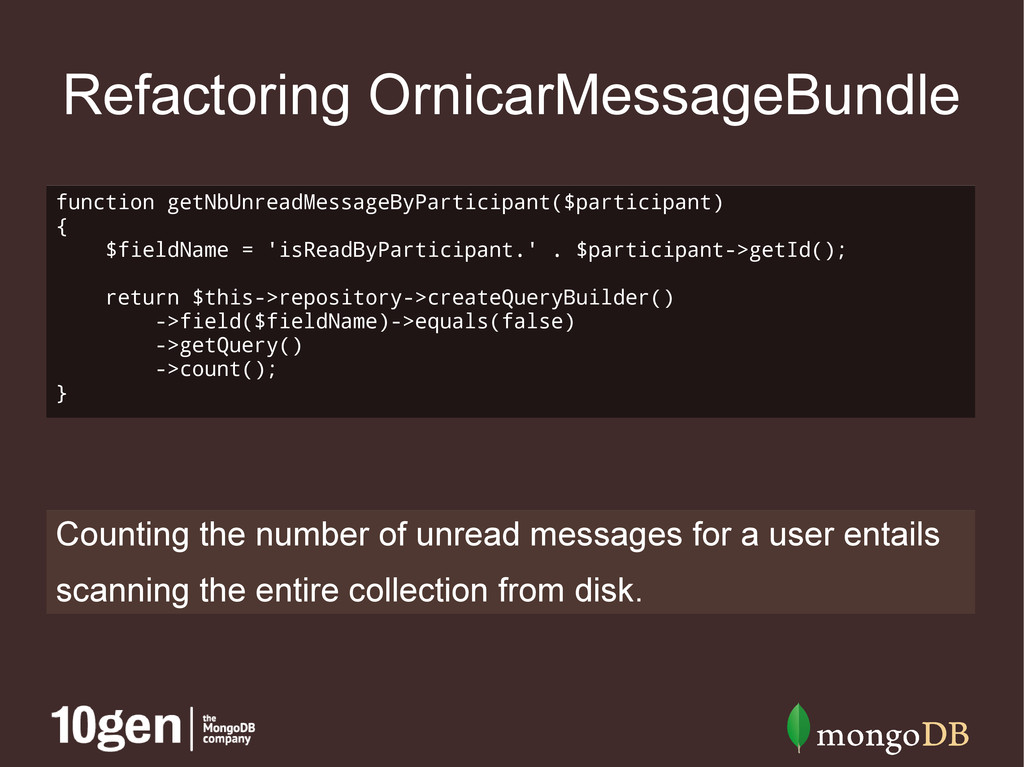
  33. Refactoring OrnicarMessageBundle function getNbUnreadMessageByParticipant($participant) { $fieldName = 'isReadByParticipant.' . $participant->getId();

    return $this->repository->createQueryBuilder() ->field($fieldName)->equals(false) ->getQuery() ->count(); } Counting the number of unread messages for a user entails scanning the entire collection from disk.
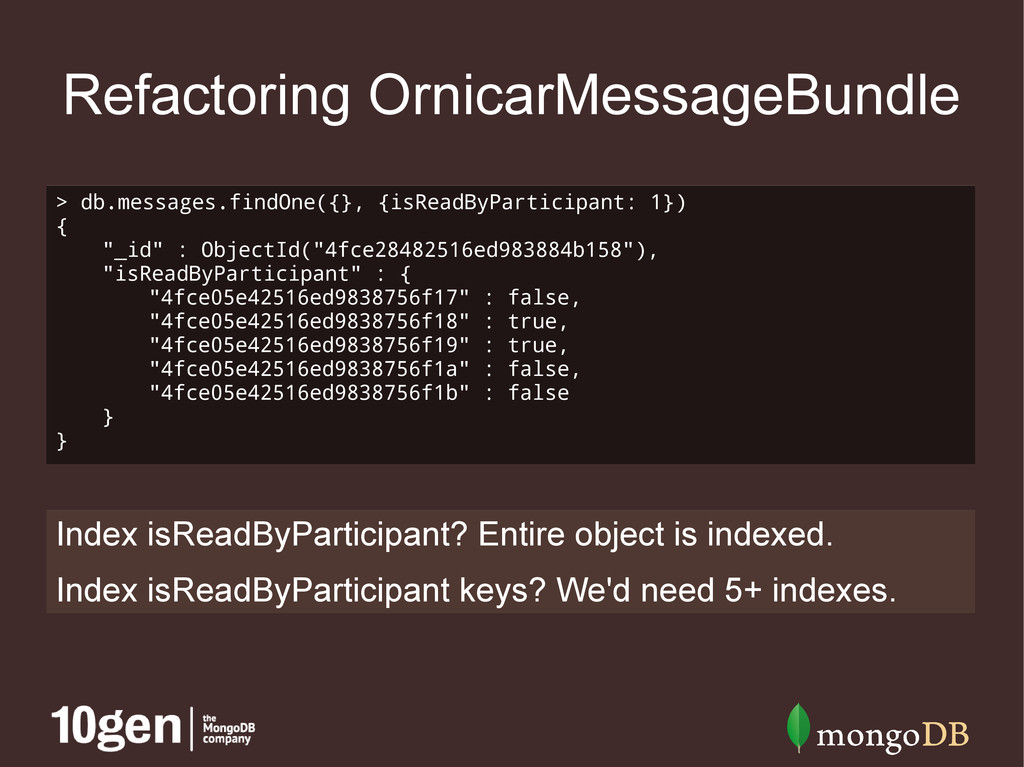
  34. Refactoring OrnicarMessageBundle > db.messages.findOne({}, {isReadByParticipant: 1}) { "_id" : ObjectId("4fce28482516ed983884b158"),

    "isReadByParticipant" : { "4fce05e42516ed9838756f17" : false, "4fce05e42516ed9838756f18" : true, "4fce05e42516ed9838756f19" : true, "4fce05e42516ed9838756f1a" : false, "4fce05e42516ed9838756f1b" : false } } Index isReadByParticipant? Entire object is indexed. Index isReadByParticipant keys? We'd need 5+ indexes.
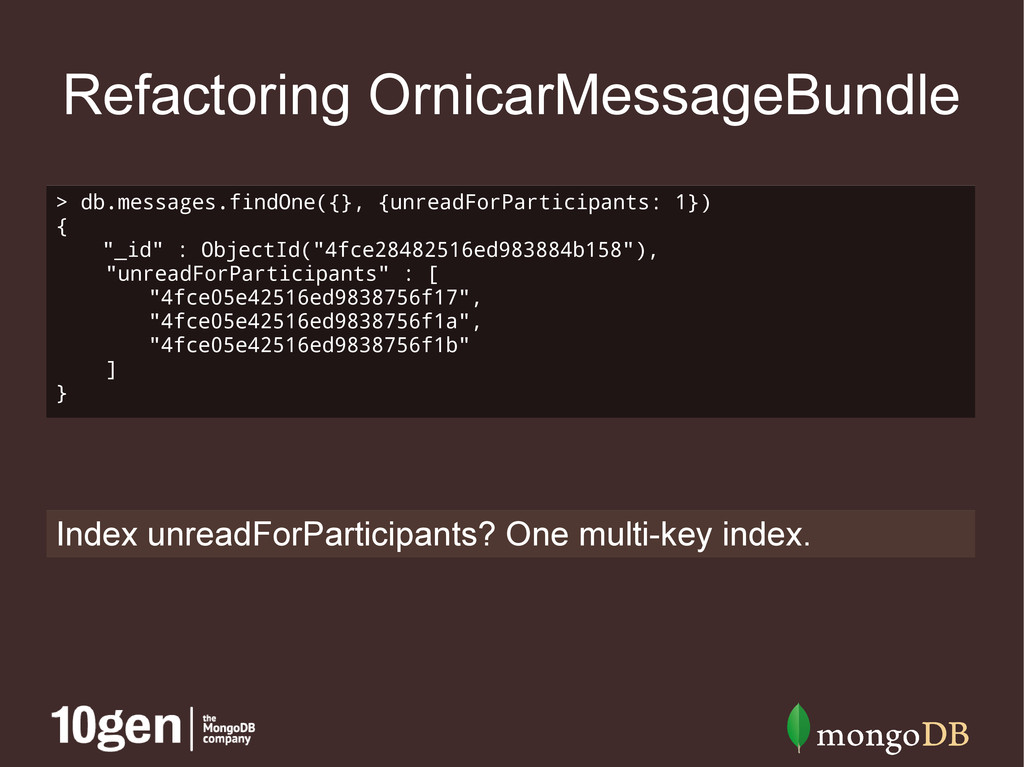
  35. Refactoring OrnicarMessageBundle > db.messages.findOne({}, {unreadForParticipants: 1}) { "_id" : ObjectId("4fce28482516ed983884b158"),

    "unreadForParticipants" : [ "4fce05e42516ed9838756f17", "4fce05e42516ed9838756f1a", "4fce05e42516ed9838756f1b" ] } Index unreadForParticipants? One multi-key index.
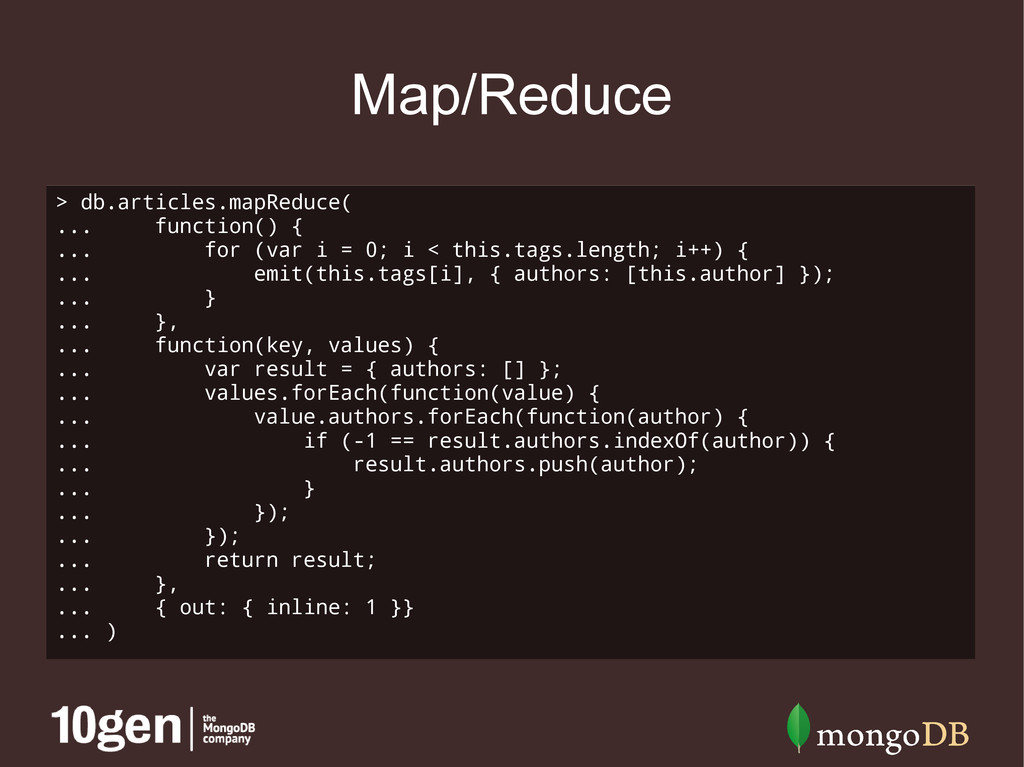
  36. Map/Reduce > db.articles.save({author: "bob", tags: ["business", "sports", "tech"]}) > db.articles.save({author:

    "jen", tags: ["politics", "tech"]}) > db.articles.save({author: "sue", tags: ["business"]}) > db.articles.save({author: "tom", tags: ["sports"]}) Generate a report with the set of authors that have written an article for each tag.
  37. Map/Reduce > db.articles.mapReduce( ... function() { ... for (var i

    = 0; i < this.tags.length; i++) { ... emit(this.tags[i], { authors: [this.author] }); ... } ... }, ... function(key, values) { ... var result = { authors: [] }; ... values.forEach(function(value) { ... value.authors.forEach(function(author) { ... if (-1 == result.authors.indexOf(author)) { ... result.authors.push(author); ... } ... }); ... }); ... return result; ... }, ... { out: { inline: 1 }} ... )
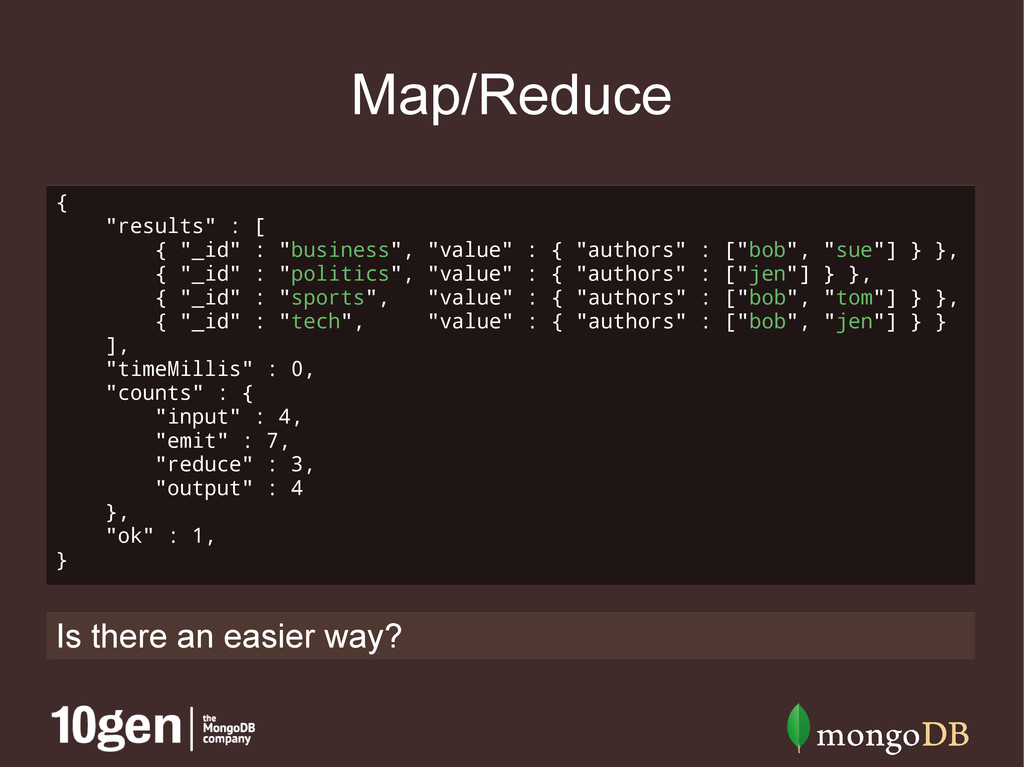
  38. Map/Reduce { "results" : [ { "_id" : "business", "value"

    : { "authors" : ["bob", "sue"] } }, { "_id" : "politics", "value" : { "authors" : ["jen"] } }, { "_id" : "sports", "value" : { "authors" : ["bob", "tom"] } }, { "_id" : "tech", "value" : { "authors" : ["bob", "jen"] } } ], "timeMillis" : 0, "counts" : { "input" : 4, "emit" : 7, "reduce" : 3, "output" : 4 }, "ok" : 1, } Is there an easier way?
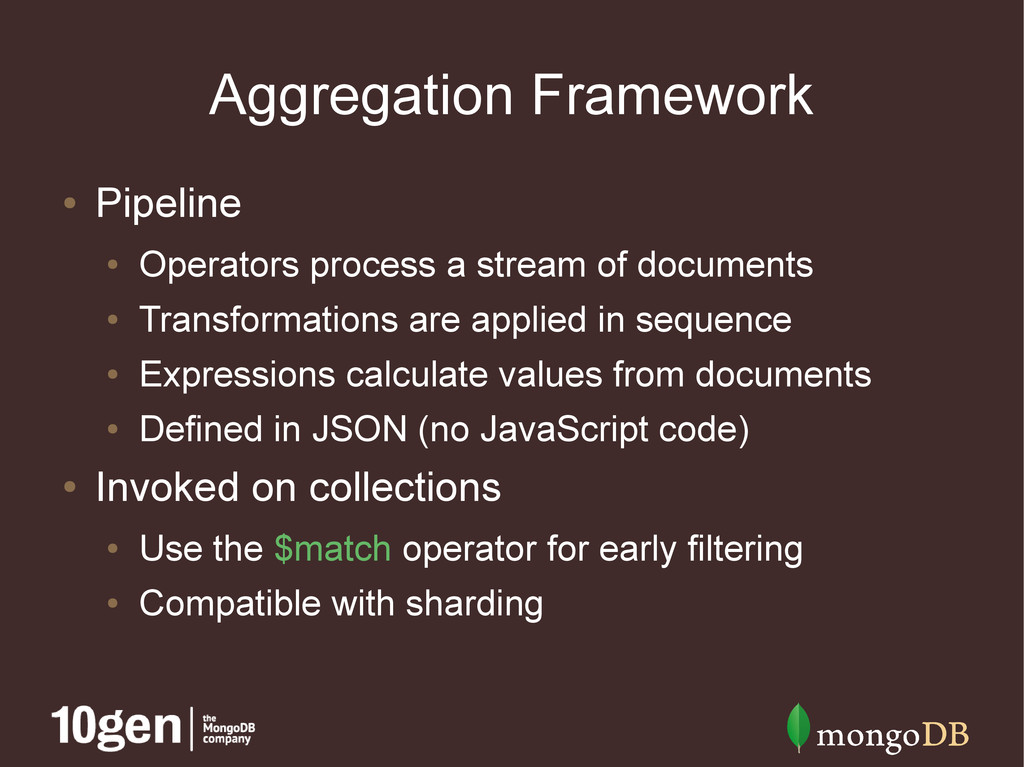
  39. Aggregation Framework • Pipeline • Operators process a stream of

    documents • Transformations are applied in sequence • Expressions calculate values from documents • Defined in JSON (no JavaScript code) • Invoked on collections • Use the $match operator for early filtering • Compatible with sharding
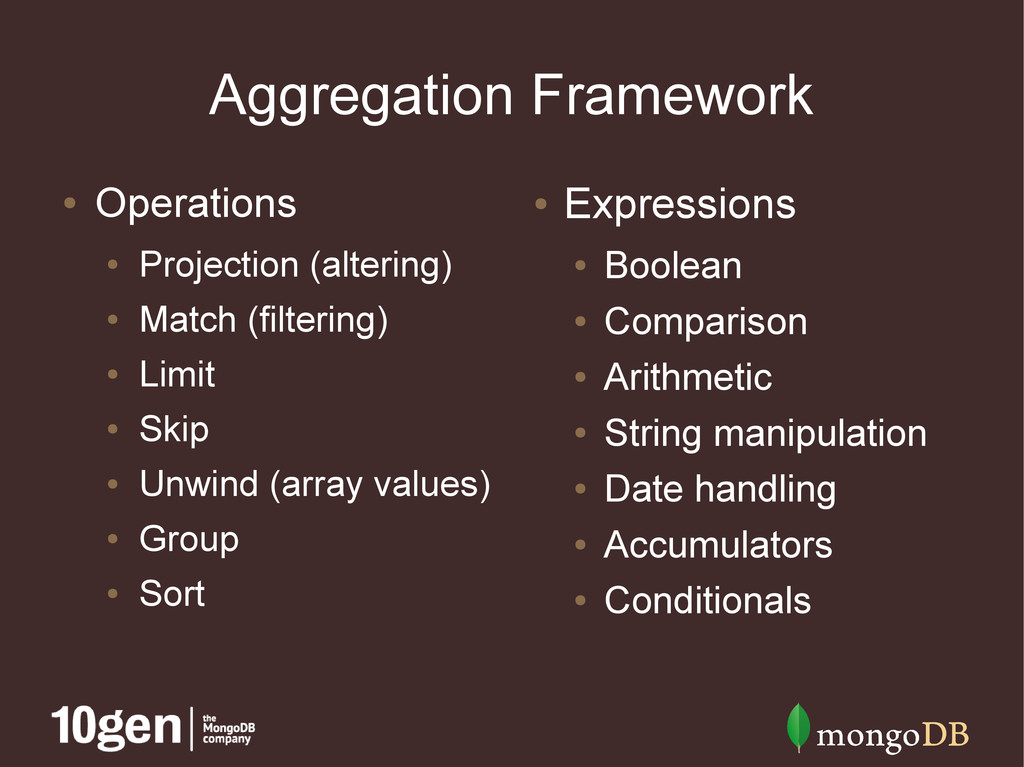
  40. Aggregation Framework • Operations • Projection (altering) • Match (filtering)

    • Limit • Skip • Unwind (array values) • Group • Sort • Expressions • Boolean • Comparison • Arithmetic • String manipulation • Date handling • Accumulators • Conditionals
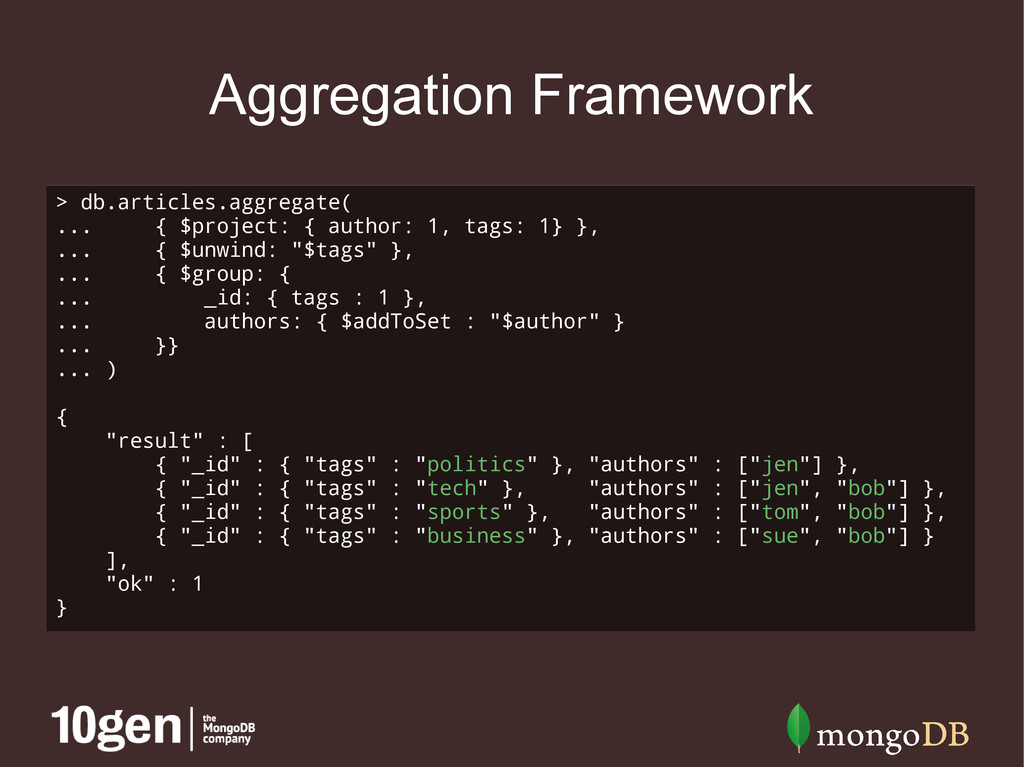
  41. Aggregation Framework > db.articles.aggregate( ... { $project: { author: 1,

    tags: 1} }, ... { $unwind: "$tags" }, ... { $group: { ... _id: { tags : 1 }, ... authors: { $addToSet : "$author" } ... }} ... ) { "result" : [ { "_id" : { "tags" : "politics" }, "authors" : ["jen"] }, { "_id" : { "tags" : "tech" }, "authors" : ["jen", "bob"] }, { "_id" : { "tags" : "sports" }, "authors" : ["tom", "bob"] }, { "_id" : { "tags" : "business" }, "authors" : ["sue", "bob"] } ], "ok" : 1 }
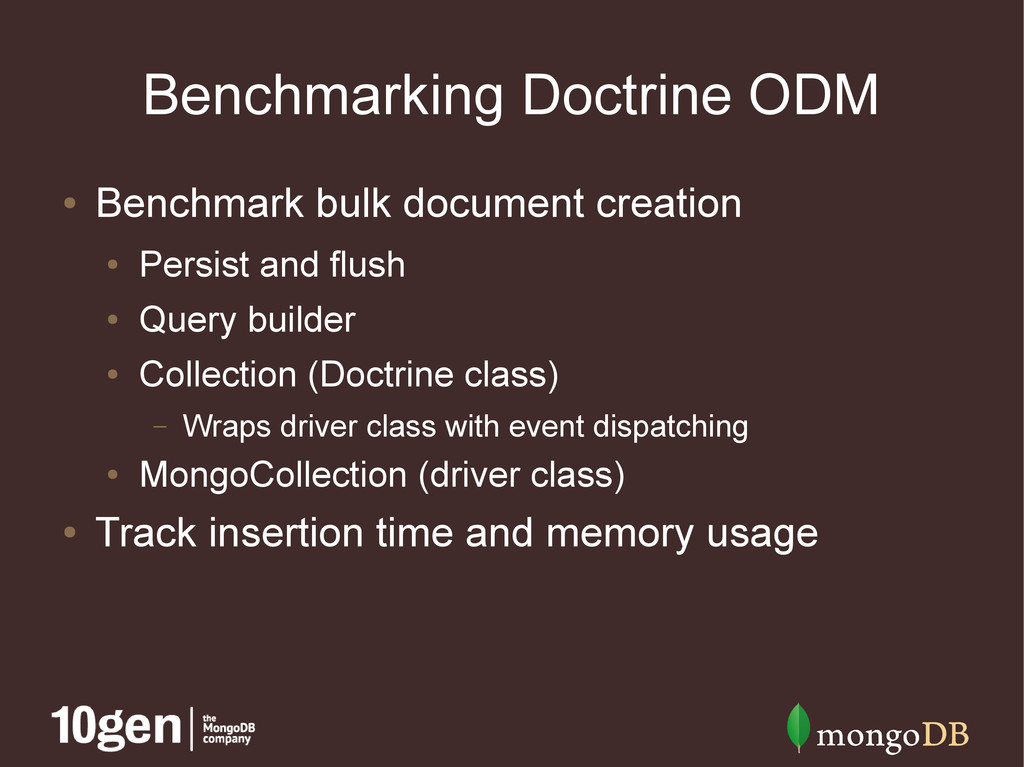
  42. Benchmarking Doctrine ODM • Benchmark bulk document creation • Persist

    and flush • Query builder • Collection (Doctrine class) – Wraps driver class with event dispatching • MongoCollection (driver class) • Track insertion time and memory usage
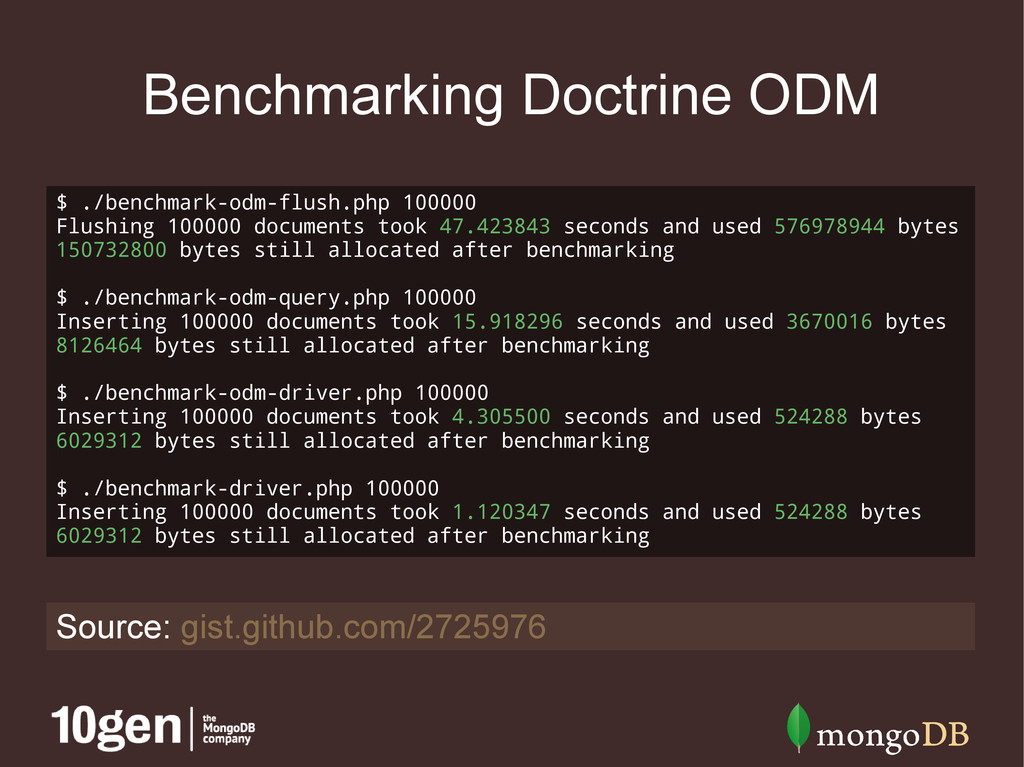
  43. Benchmarking Doctrine ODM $ ./benchmark-odm-flush.php 100000 Flushing 100000 documents took

    47.423843 seconds and used 576978944 bytes 150732800 bytes still allocated after benchmarking $ ./benchmark-odm-query.php 100000 Inserting 100000 documents took 15.918296 seconds and used 3670016 bytes 8126464 bytes still allocated after benchmarking $ ./benchmark-odm-driver.php 100000 Inserting 100000 documents took 4.305500 seconds and used 524288 bytes 6029312 bytes still allocated after benchmarking $ ./benchmark-driver.php 100000 Inserting 100000 documents took 1.120347 seconds and used 524288 bytes 6029312 bytes still allocated after benchmarking Source: gist.github.com/2725976
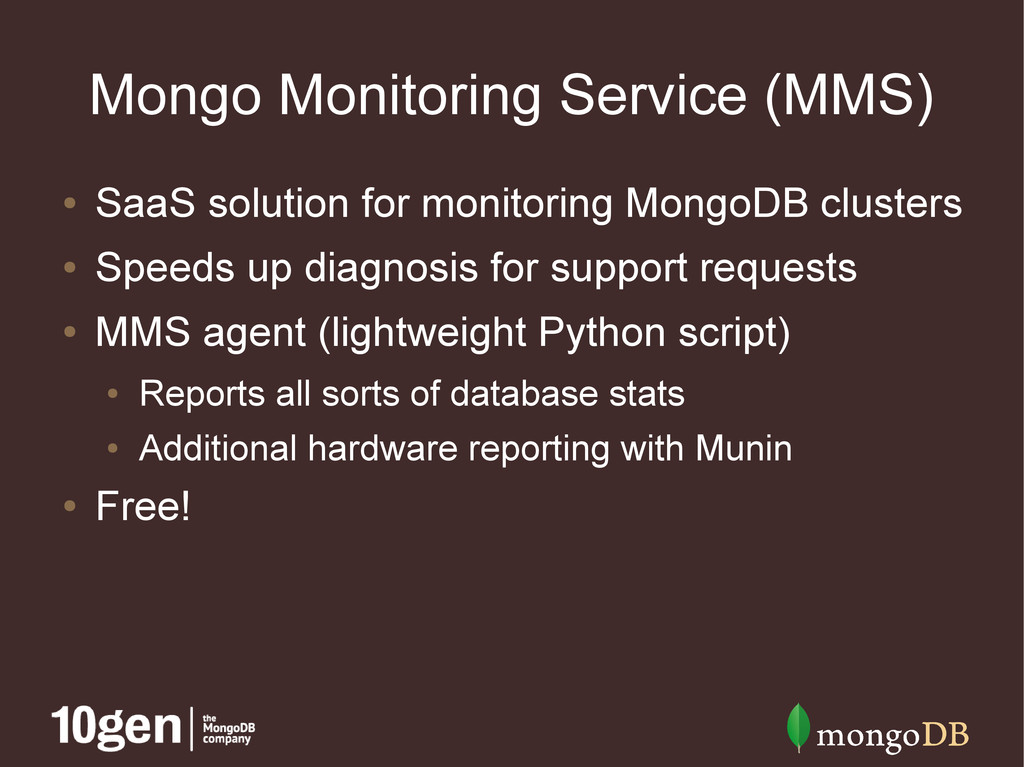
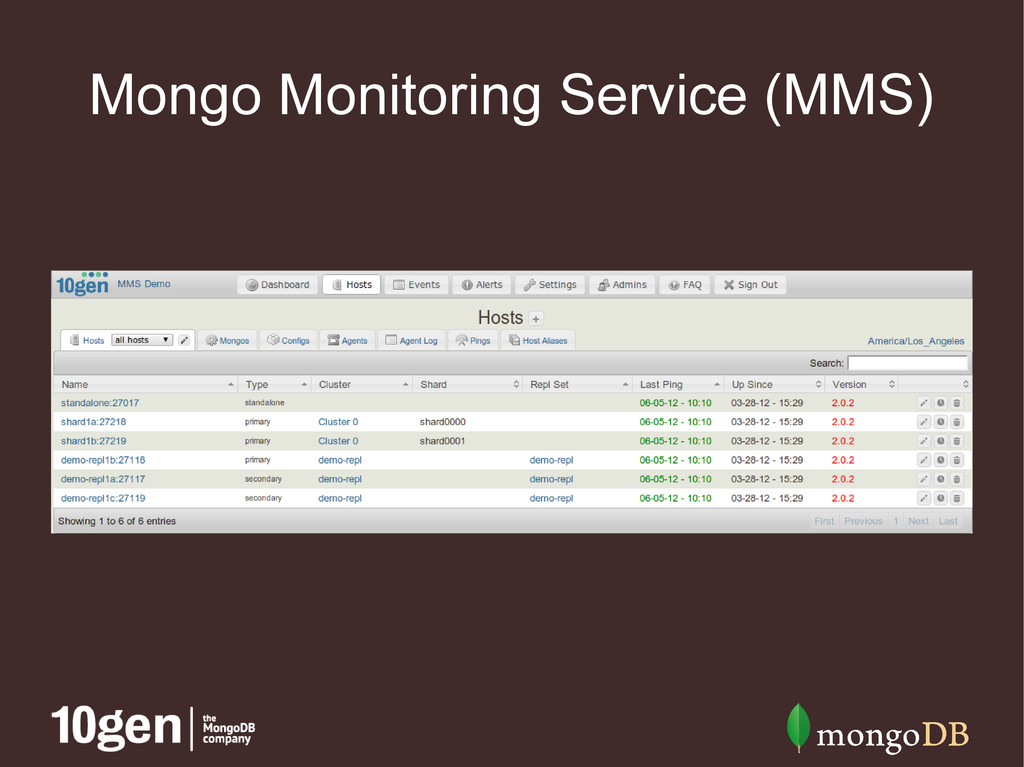
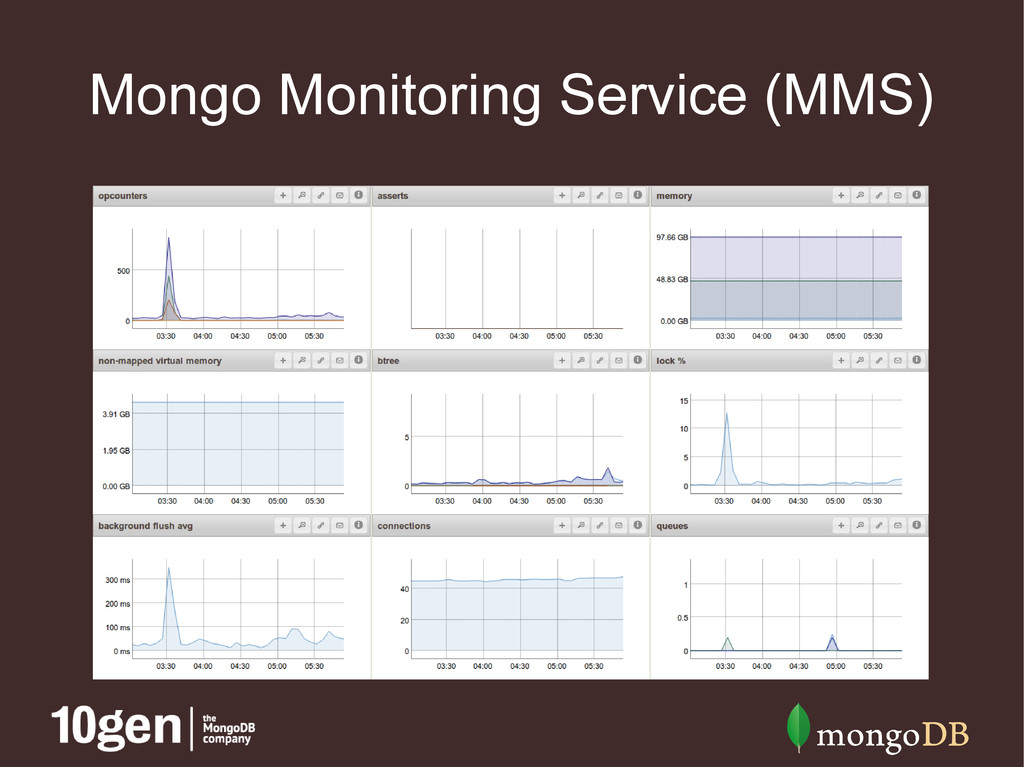
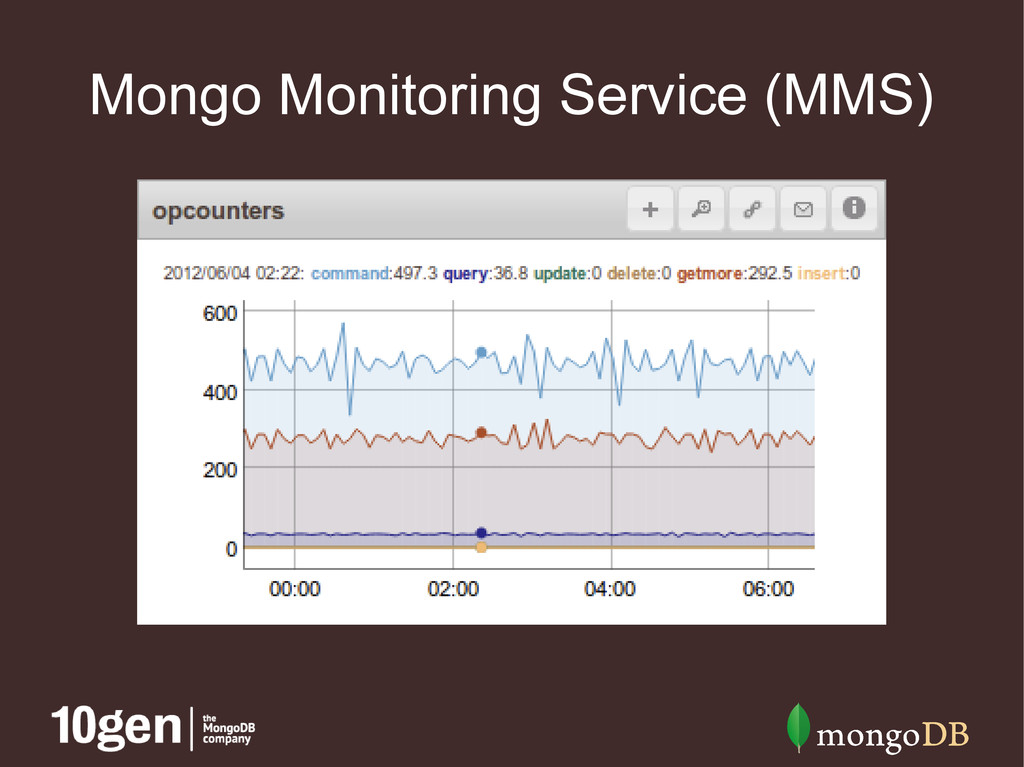
  44. Mongo Monitoring Service (MMS) • SaaS solution for monitoring MongoDB

    clusters • Speeds up diagnosis for support requests • MMS agent (lightweight Python script) • Reports all sorts of database stats • Additional hardware reporting with Munin • Free!