Upgrade to Pro — share decks privately, control downloads, hide ads and more …

PersonaBase - computational resources for data-...

Sponsored · Your Podcast. Everywhere. Effortlessly. Share. Educate. Inspire. Entertain. You do you. We'll handle the rest. →
Joni
October 21, 2026

PersonaBase - computational resources for data-driven personas

Sharing slides of our presentation at NordiCHI 2026. The paper was about developing computational resources for data-driven persona development. Data-driven personas are fictitous people that represent real groups of people, to make more people-serving decisions. Current computational resources are scattered and not always publicly available, which is why we created PersonaBase, a repository of computational resources for data-driven persona development.

The full paper: https://dl.acm.org/doi/10.1145/3829807.3829819
The PersonaBase repository: https://github.com/joolsa/PersonaBase

Salminen, J., Amin, D., Kaate, I., & Jansen, B. J. (2026). PersonaBase: Computational Resources for Advancing the Research and Practice of Data-Driven Personas. Proceedings of the 14th Nordic Conference on Human-Computer Interaction, NordiCHI ’26, 1–22. https://doi.org/10.1145/3829807.3829819

Joni

October 21, 2026

Transcript

21 slides
  1. PersonaBase: Computational Resources for Advancing the Research and Practice of

    Data-Driven Personas Joni Salminen1, Danial Amin1, Ilkka Kaate2, Bernard J. Jansen3 1University of Vaasa, Finland 2University of Turku, Finland 3University of Peking, China Email: [email protected]
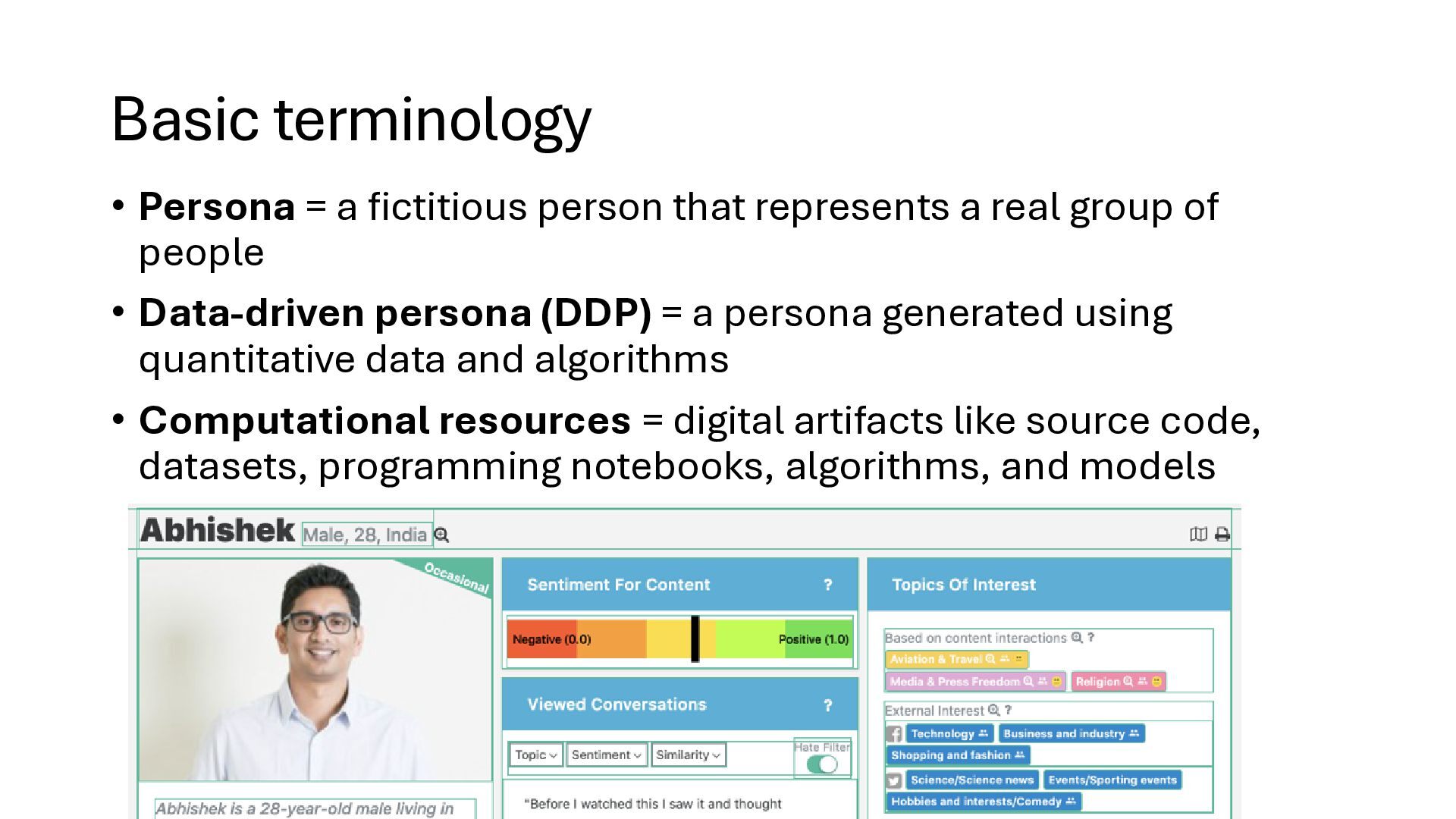
  2. Basic terminology • Persona = a fictitious person that represents

    a real group of people • Data-driven persona (DDP) = a persona generated using quantitative data and algorithms • Computational resources = digital artifacts like source code, datasets, programming notebooks, algorithms, and models
  3. The problem • Very few DDP papers share computational resources

    • This hinders vital scientific activities, including: • Replication of previous results • Building on top of previous work • Identifying baselines to compare one’s contribution against • Determining what constitutes state-of-the-art in the field
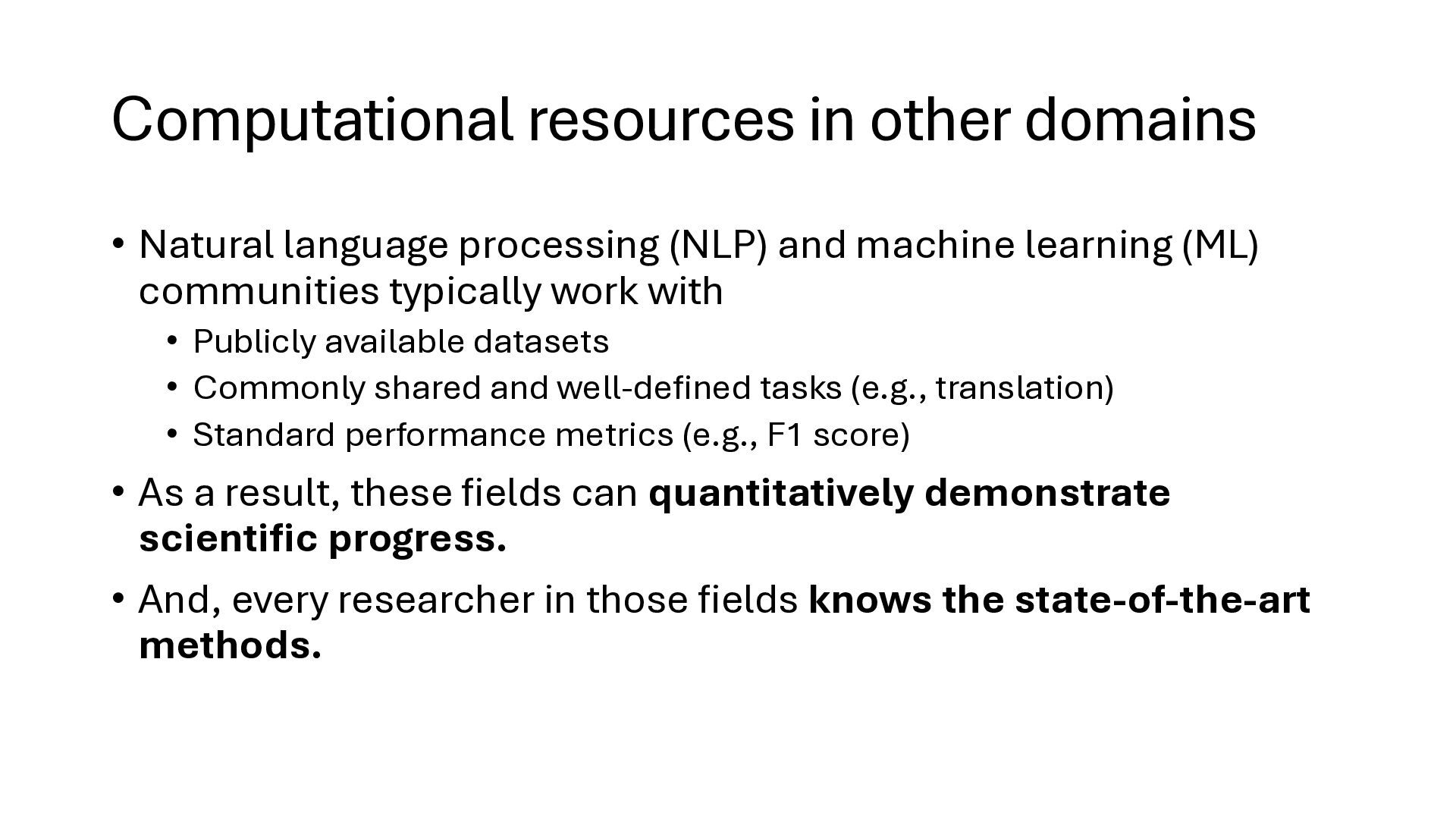
  4. Computational resources in other domains • Natural language processing (NLP)

    and machine learning (ML) communities typically work with • Publicly available datasets • Commonly shared and well-defined tasks (e.g., translation) • Standard performance metrics (e.g., F1 score) • As a result, these fields can quantitatively demonstrate scientific progress. • And, every researcher in those fields knows the state-of-the-art methods.
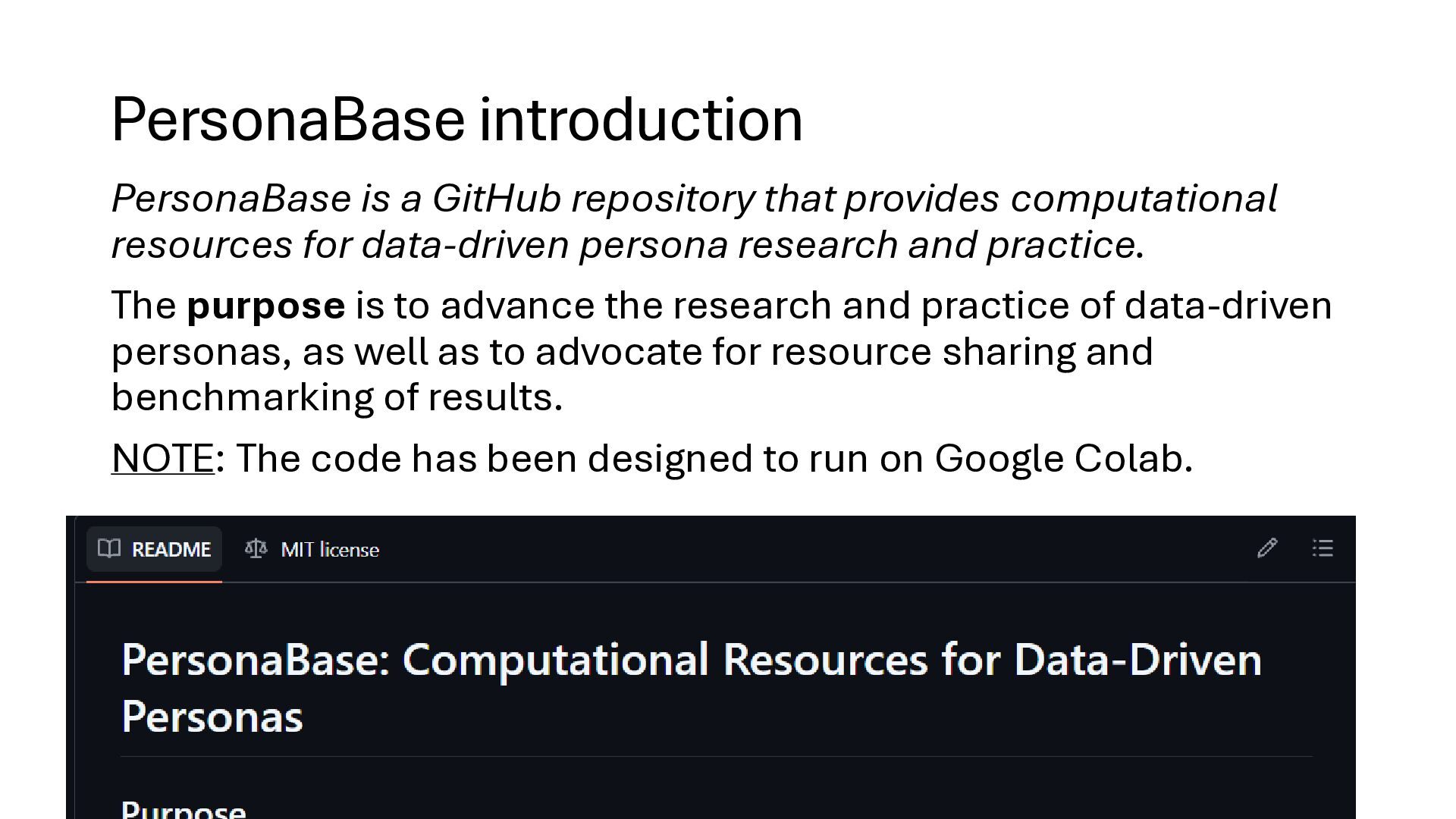
  5. PersonaBase introduction PersonaBase is a GitHub repository that provides computational

    resources for data-driven persona research and practice. The purpose is to advance the research and practice of data-driven personas, as well as to advocate for resource sharing and benchmarking of results. NOTE: The code has been designed to run on Google Colab.
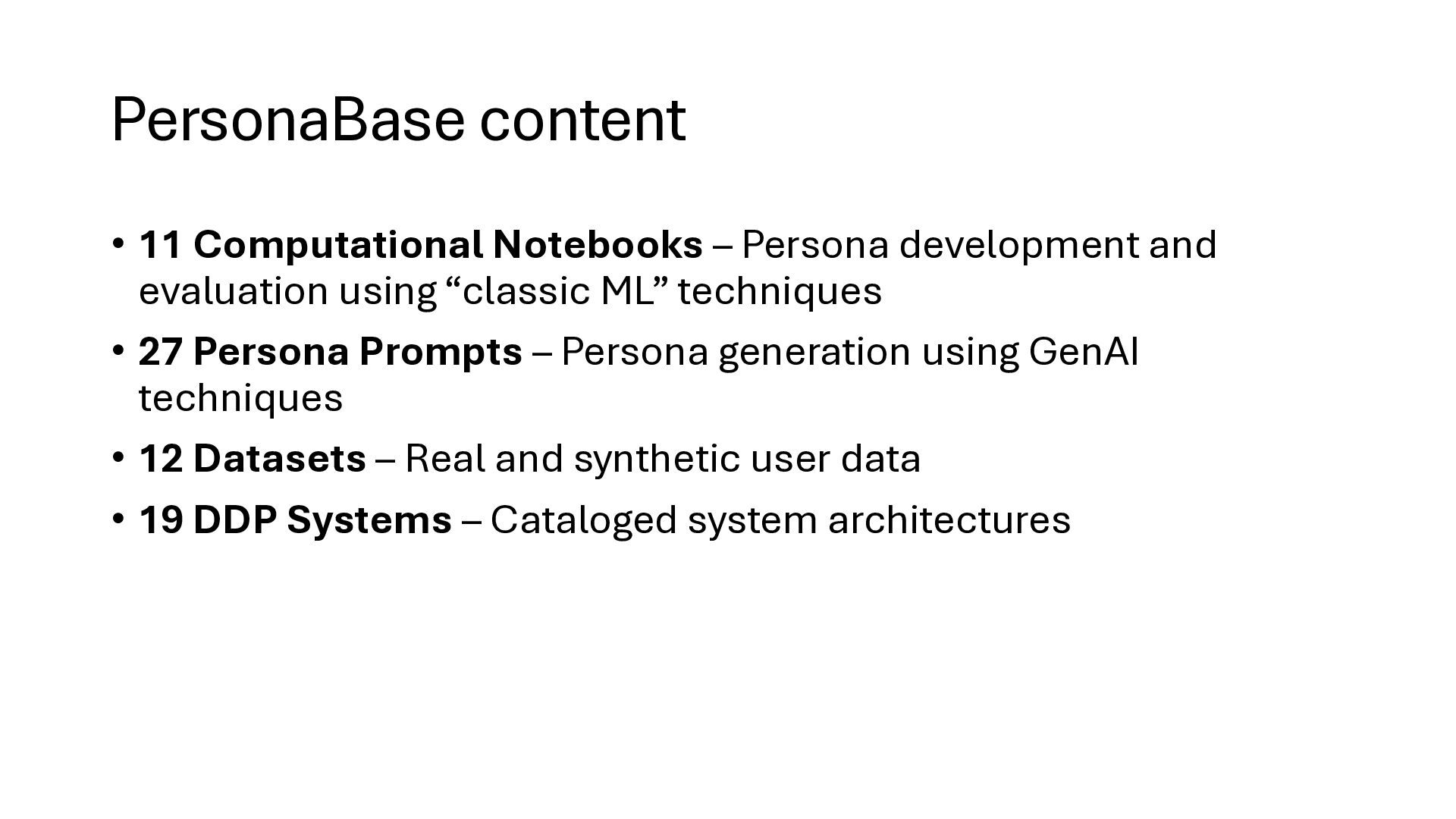
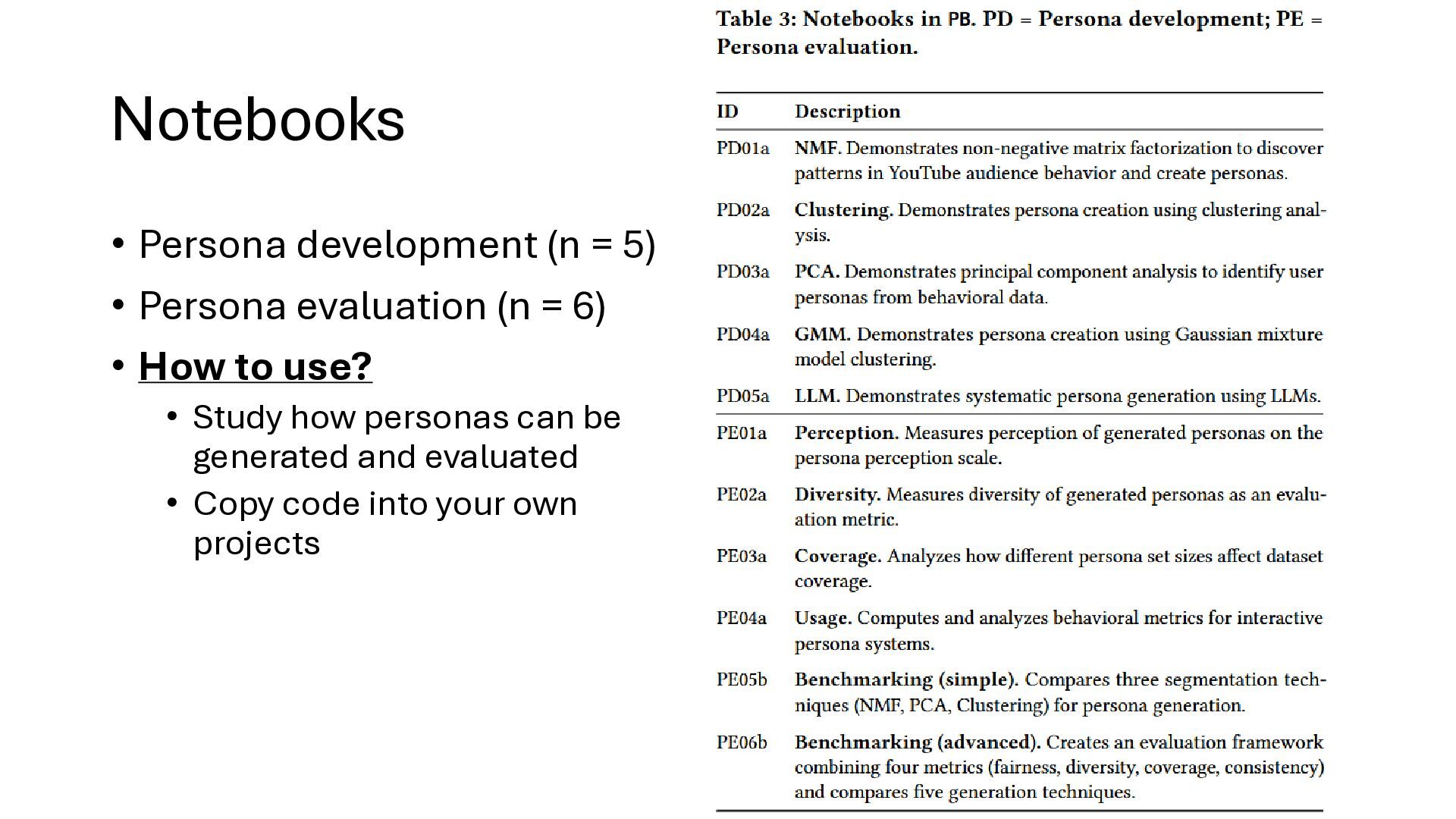
  6. PersonaBase content • 11 Computational Notebooks – Persona development and

    evaluation using “classic ML” techniques • 27 Persona Prompts – Persona generation using GenAI techniques • 12 Datasets – Real and synthetic user data • 19 DDP Systems – Cataloged system architectures
  7. Notebooks • Persona development (n = 5) • Persona evaluation

    (n = 6) • How to use? • Study how personas can be generated and evaluated • Copy code into your own projects
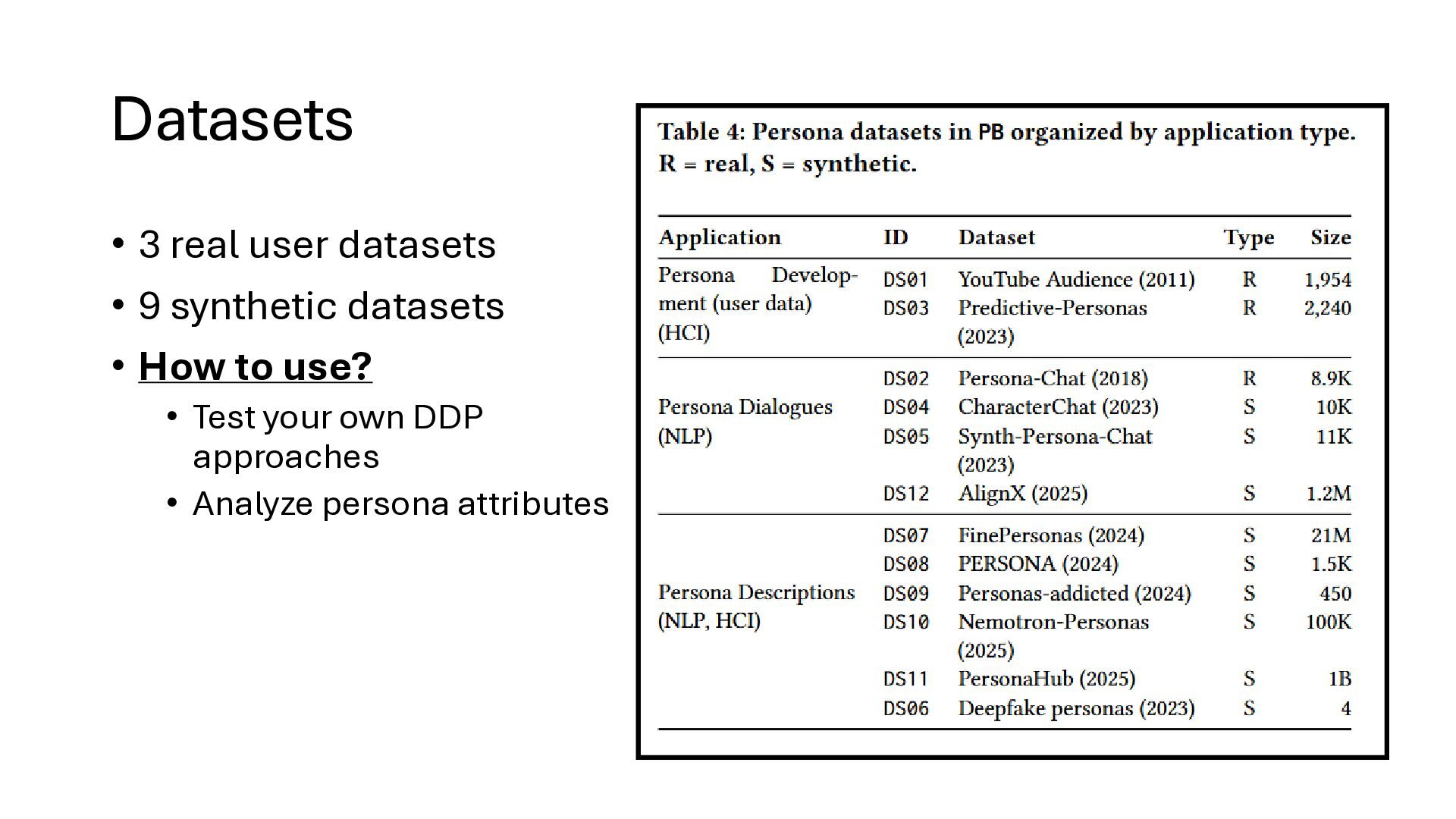
  8. Datasets • 3 real user datasets • 9 synthetic datasets

    • How to use? • Test your own DDP approaches • Analyze persona attributes
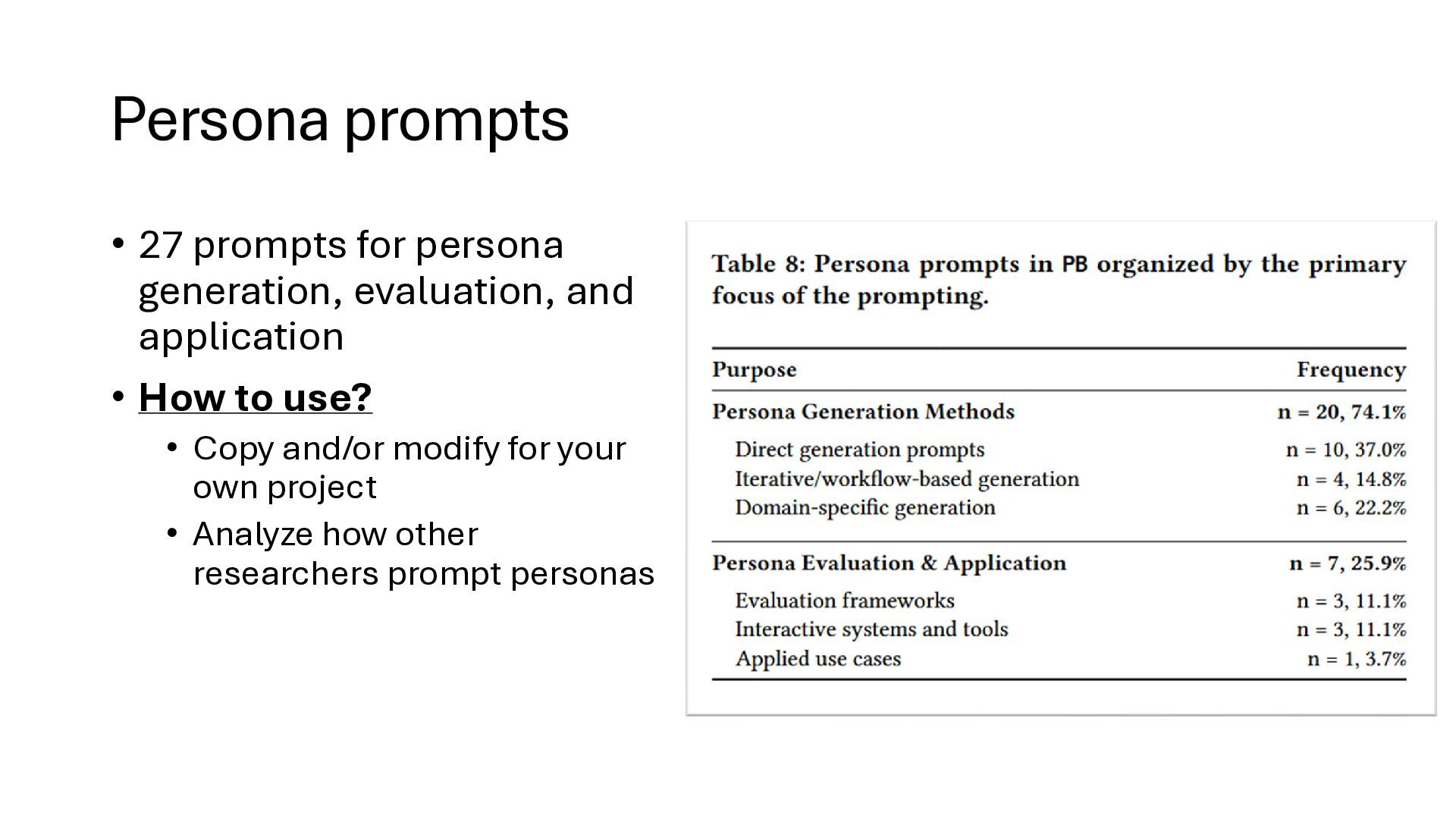
  9. Persona prompts • 27 prompts for persona generation, evaluation, and

    application • How to use? • Copy and/or modify for your own project • Analyze how other researchers prompt personas
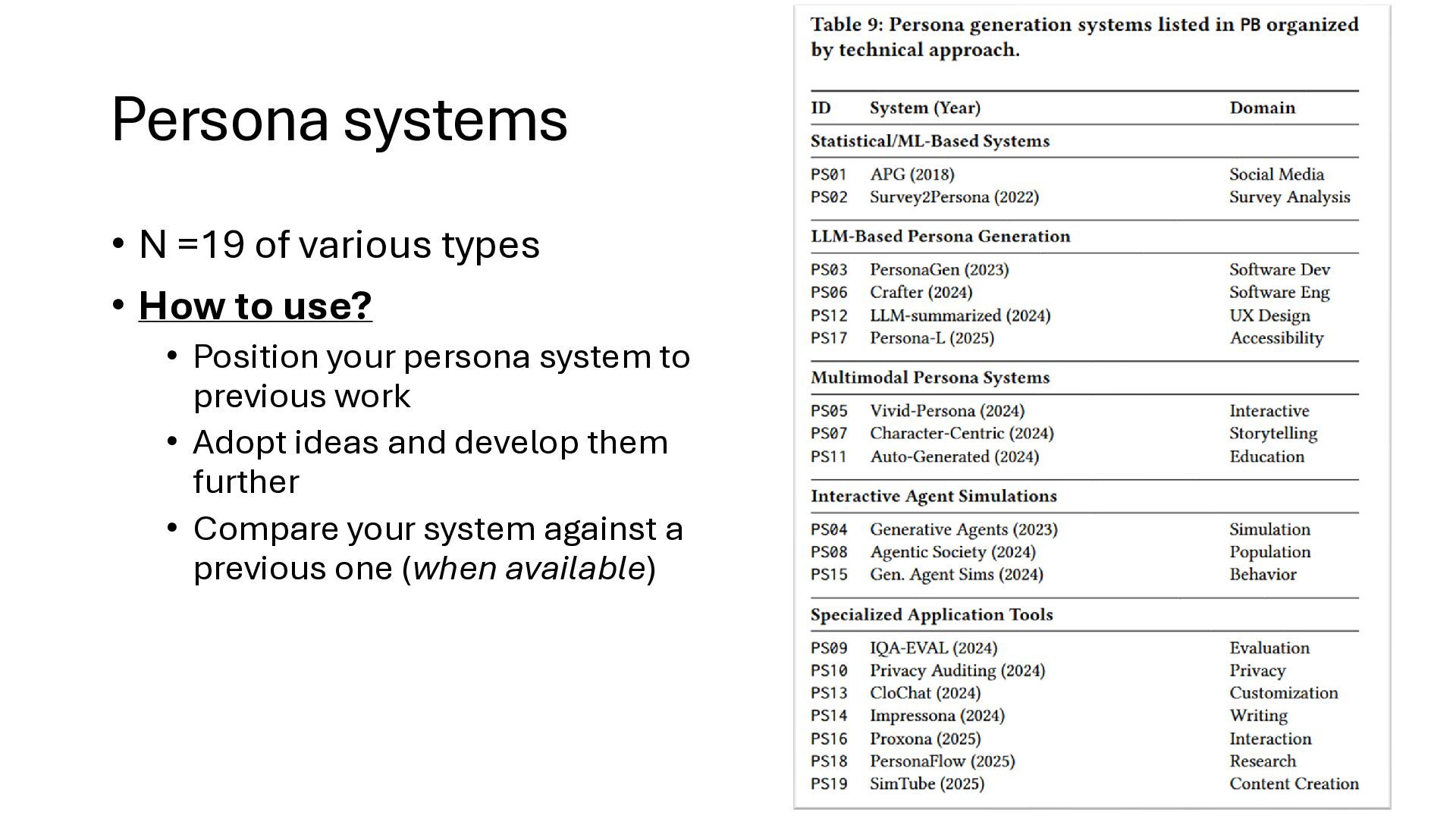
  10. Persona systems • N =19 of various types • How

    to use? • Position your persona system to previous work • Adopt ideas and develop them further • Compare your system against a previous one (when available)
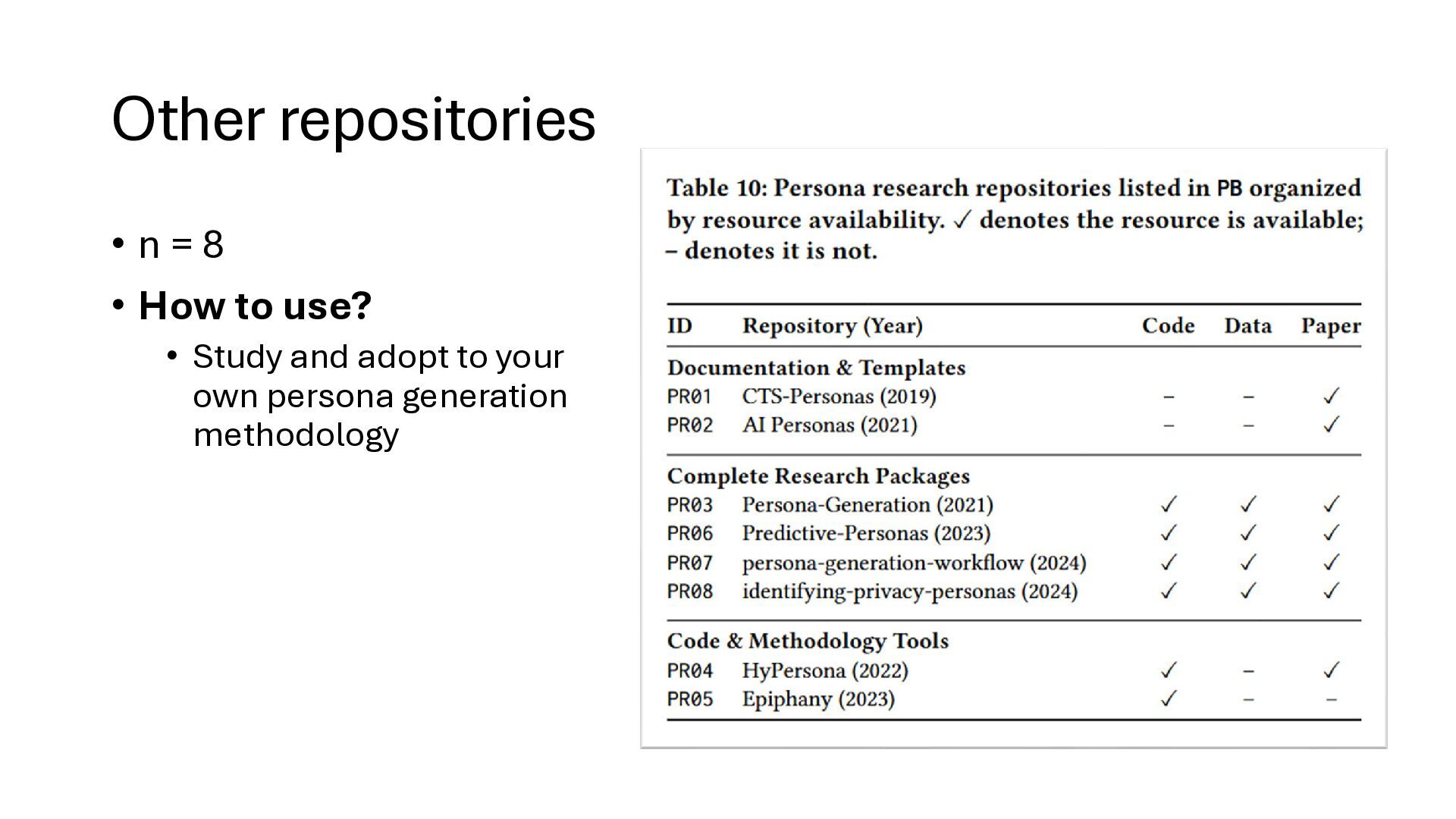
  11. Other repositories • n=8 • How to use? • Study

    and adopt to your own persona generation methodology
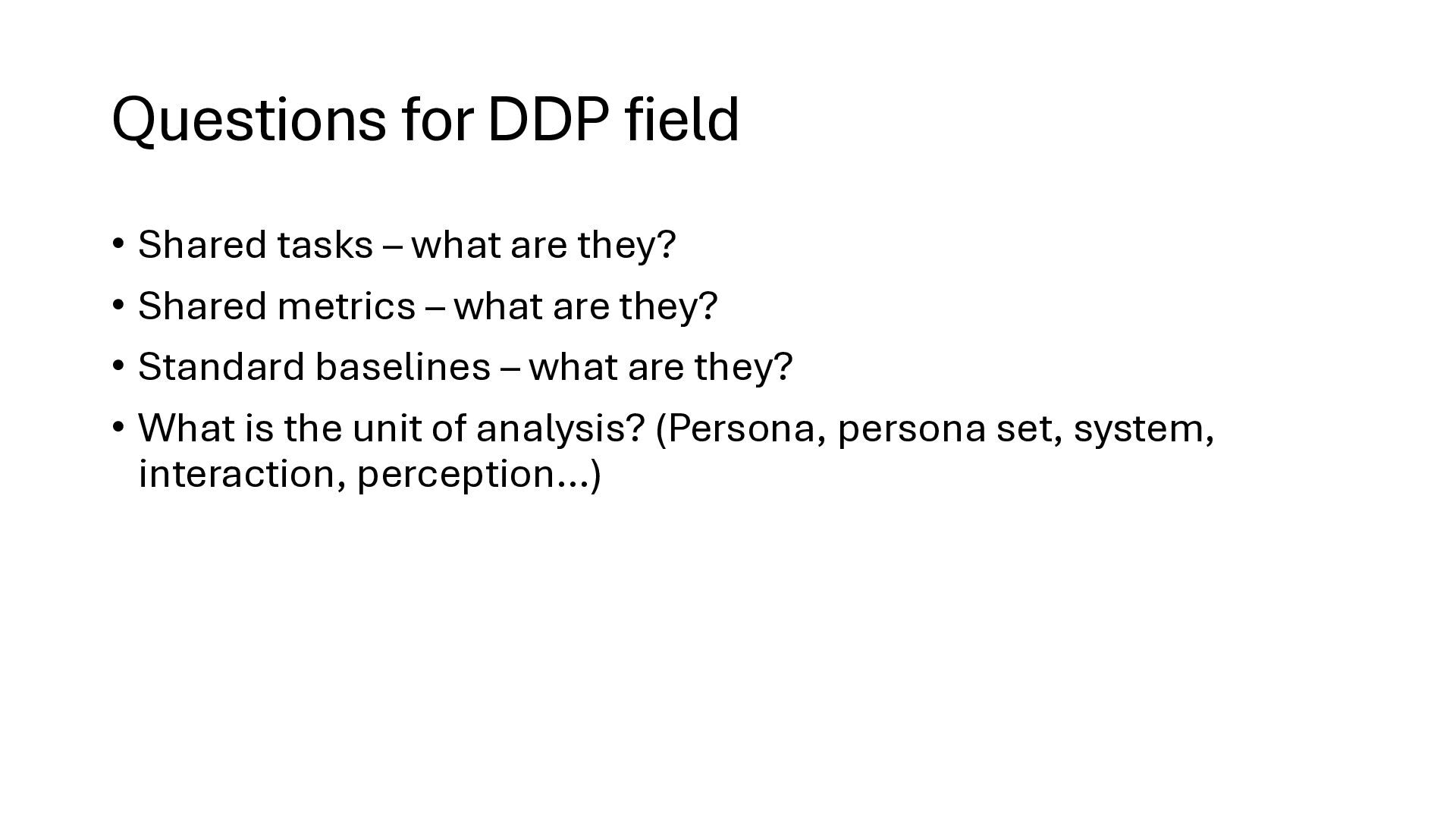
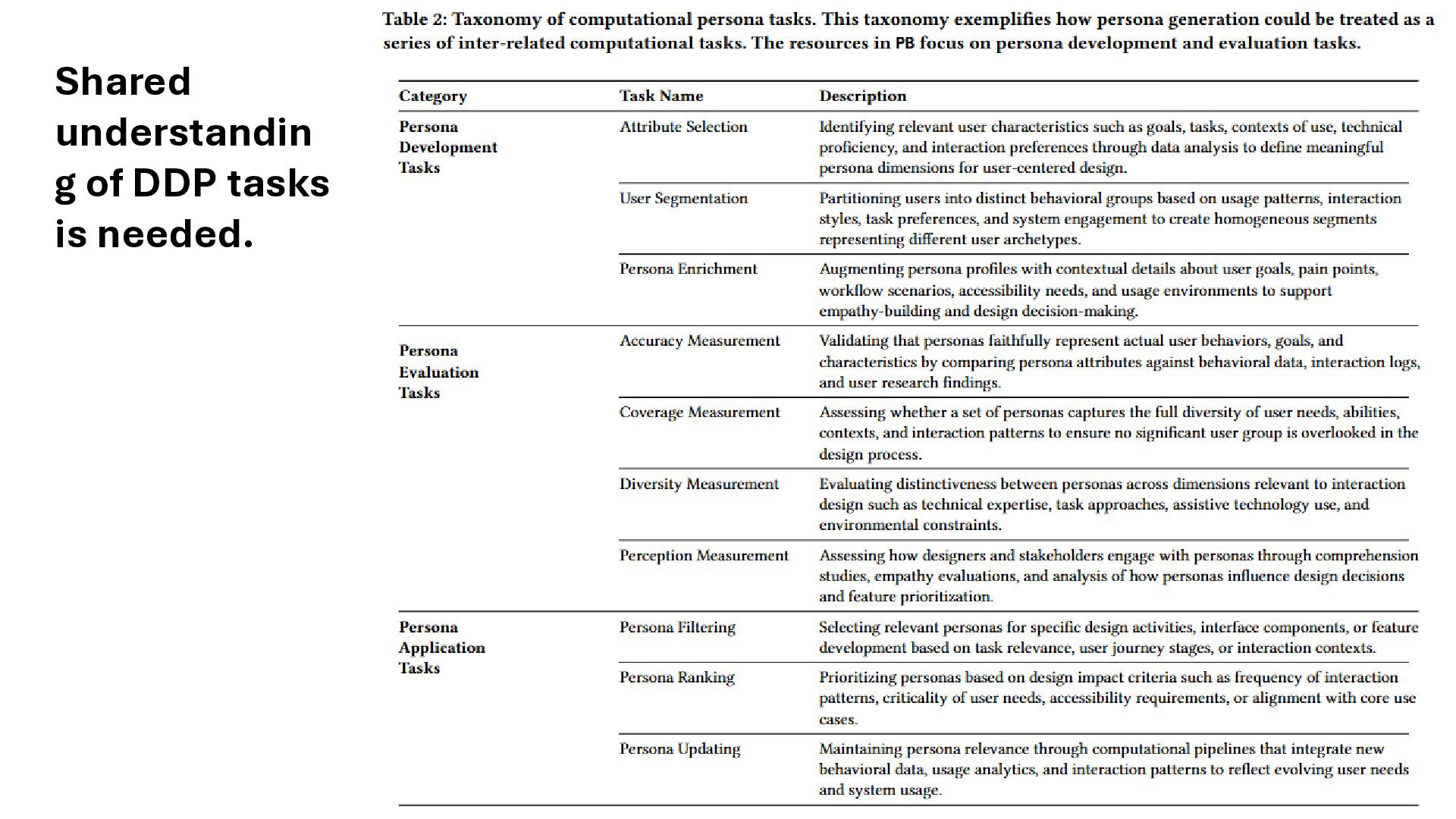
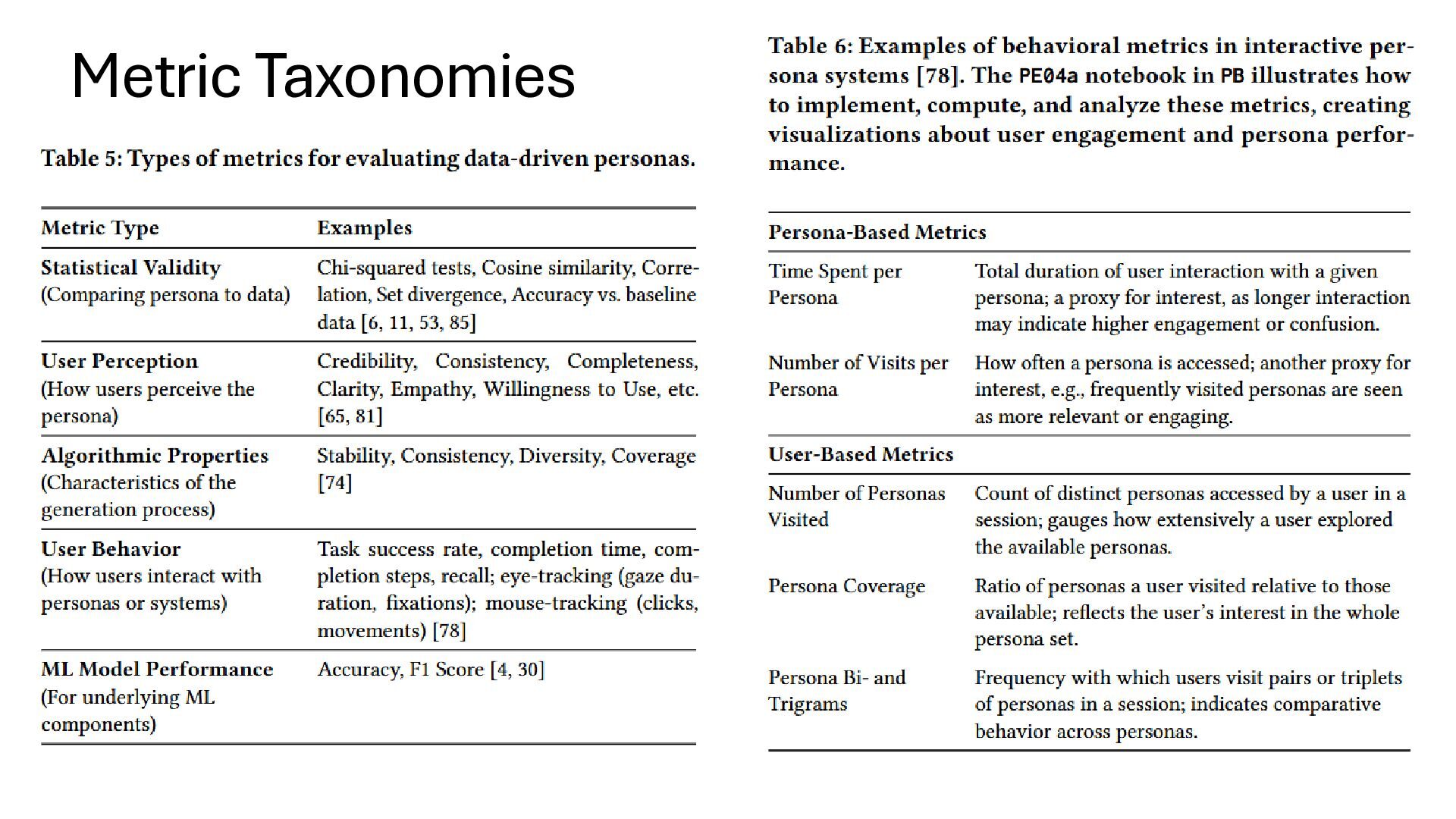
  12. Questions for DDP field • Shared tasks – what are

    they? • Shared metrics – what are they? • Standard baselines – what are they? • What is the unit of analysis? (Persona, persona set, system, interaction, perception…)
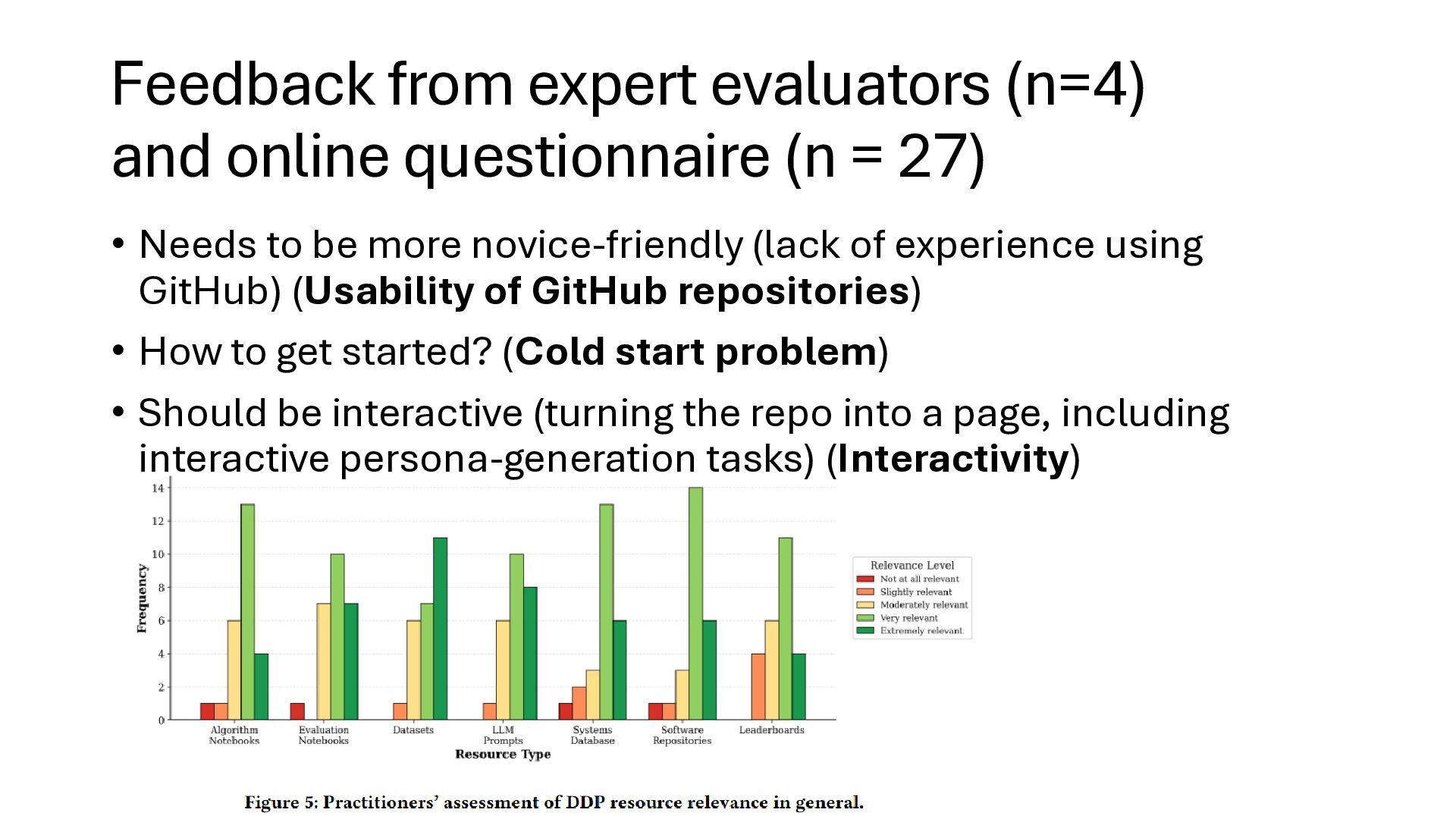
  13. Feedback from expert evaluators (n=4) and online questionnaire (n =

    27) • Needs to be more novice-friendly (lack of experience using GitHub) (Usability of GitHub repositories) • How to get started? (Cold start problem) • Should be interactive (turning the repo into a page, including interactive persona-generation tasks) (Interactivity)
  14. Questions for DDP field • Shared tasks – what are

    they? • Shared metrics – what are they? • Standard baselines – what are they? • What is the unit of analysis? (Persona, persona set, system, interaction, perception…) … we make some propositions in the paper, but this fields needs more researchers (YOU?) to tackle these issues!
  15. Thanks! Dr. Joni Salminen Email: [email protected] • Link to PersonaBase:

    https://github.com/joolsa/PersonaBase/ • Link to Persona Team: https://personateam.xyz

More Decks by Joni

Other Decks in Research