Upgrade to Pro — share decks privately, control downloads, hide ads and more …

Non-human persona perception scale (NH-PPS)

Sponsored · Your Podcast. Everywhere. Effortlessly. Share. Educate. Inspire. Entertain. You do you. We'll handle the rest. →
Joni
October 21, 2026

Non-human persona perception scale (NH-PPS)

Sharing slides of our presentation at NordiCHI. The paper was about developing a survey instrument to measure users' perceptions of non-human personas. Non-human personas are fictitious characters that represent real groups of non-human entities, such as animals. Their purpose is to communicate these entities' needs and circumstances for human decision makers, so as to make non-human perspectives "audible" in decision making.

The full paper: https://dl.acm.org/doi/10.1145/3829807.3829855
The NH-PPS scale: https://jonisalminen.com/non-human-persona-perception-scale-nh-pps/

Salminen, J., Nielsen, L., Ahmed, F., Xuan, T. T. T., Patil, R., Kaate, I., Amin, D., & Jansen, B. J. (2026). Reconceptualizing the Persona Perception Scale for Non-Human Personas: A Formative Validation Study. Proceedings of the 14th Nordic Conference on Human-Computer Interaction, NordiCHI ’26, 1–19. https://doi.org/10.1145/3829807.3829855

Joni

October 21, 2026

Transcript

18 slides
  1. Reconceptualizing the Persona Perception Scale for NonHuman Personas: A Formative

    Validation Study Joni Salminen, Lene Nielsen, Farhan Ahmed, Trang Thi Thu Xuan, Rajat Patil, Ilkka Kaate, Danial Amin, Bernard J. Jansen
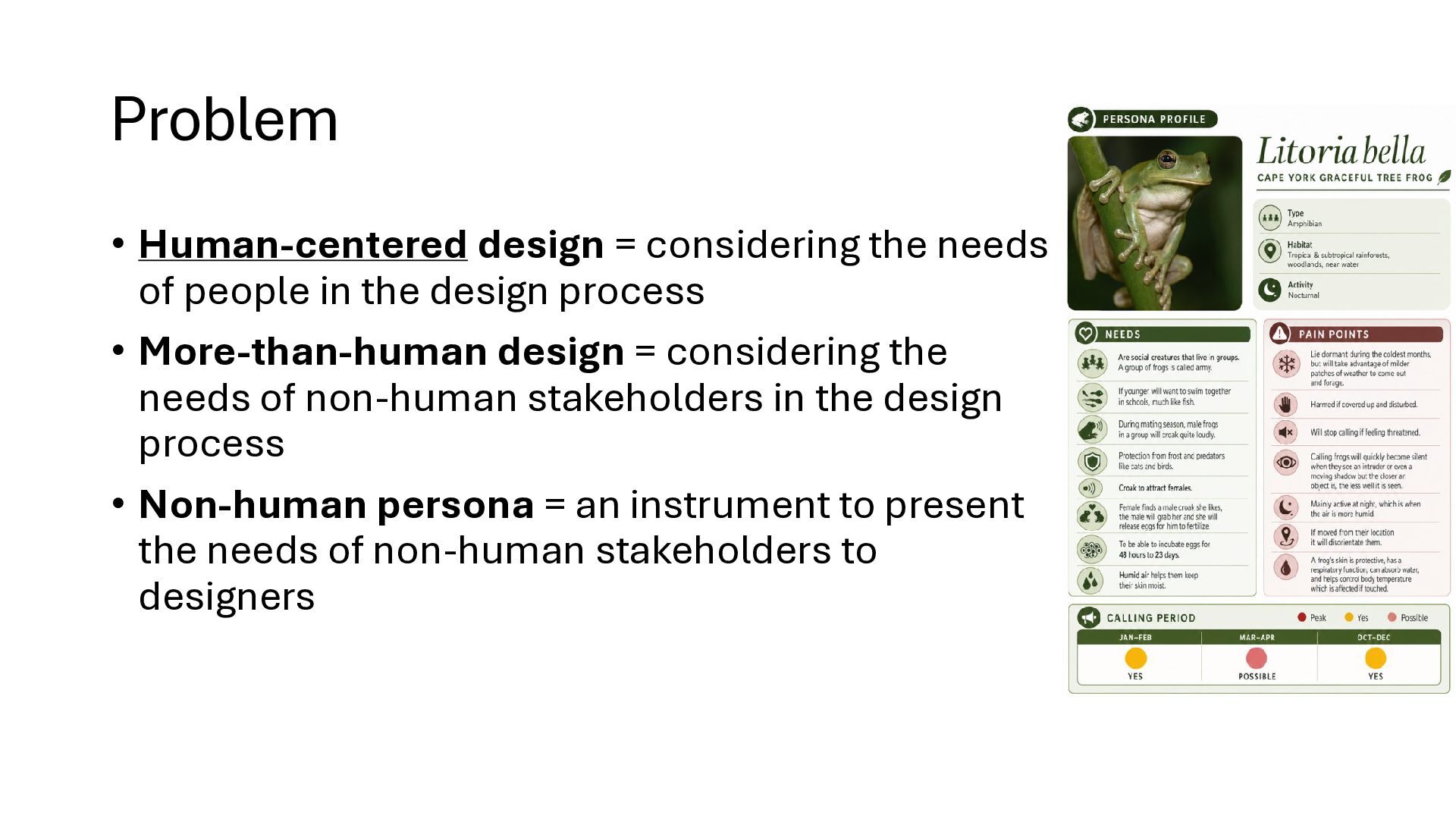
  2. Problem • Human-centered design = considering the needs of people

    in the design process • More-than-human design = considering the needs of non-human stakeholders in the design process
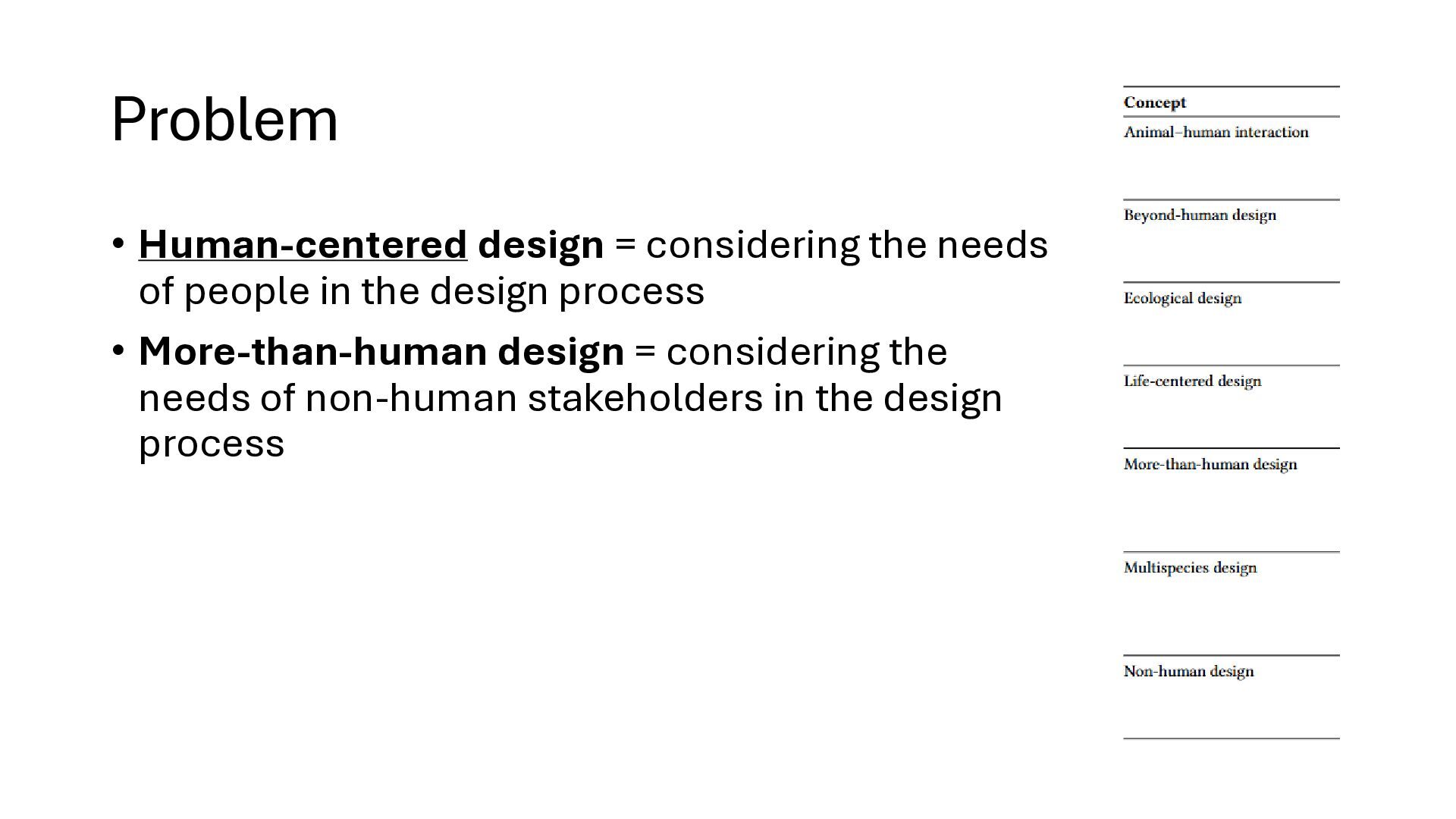
  3. Problem • Human-centered design = considering the needs of people

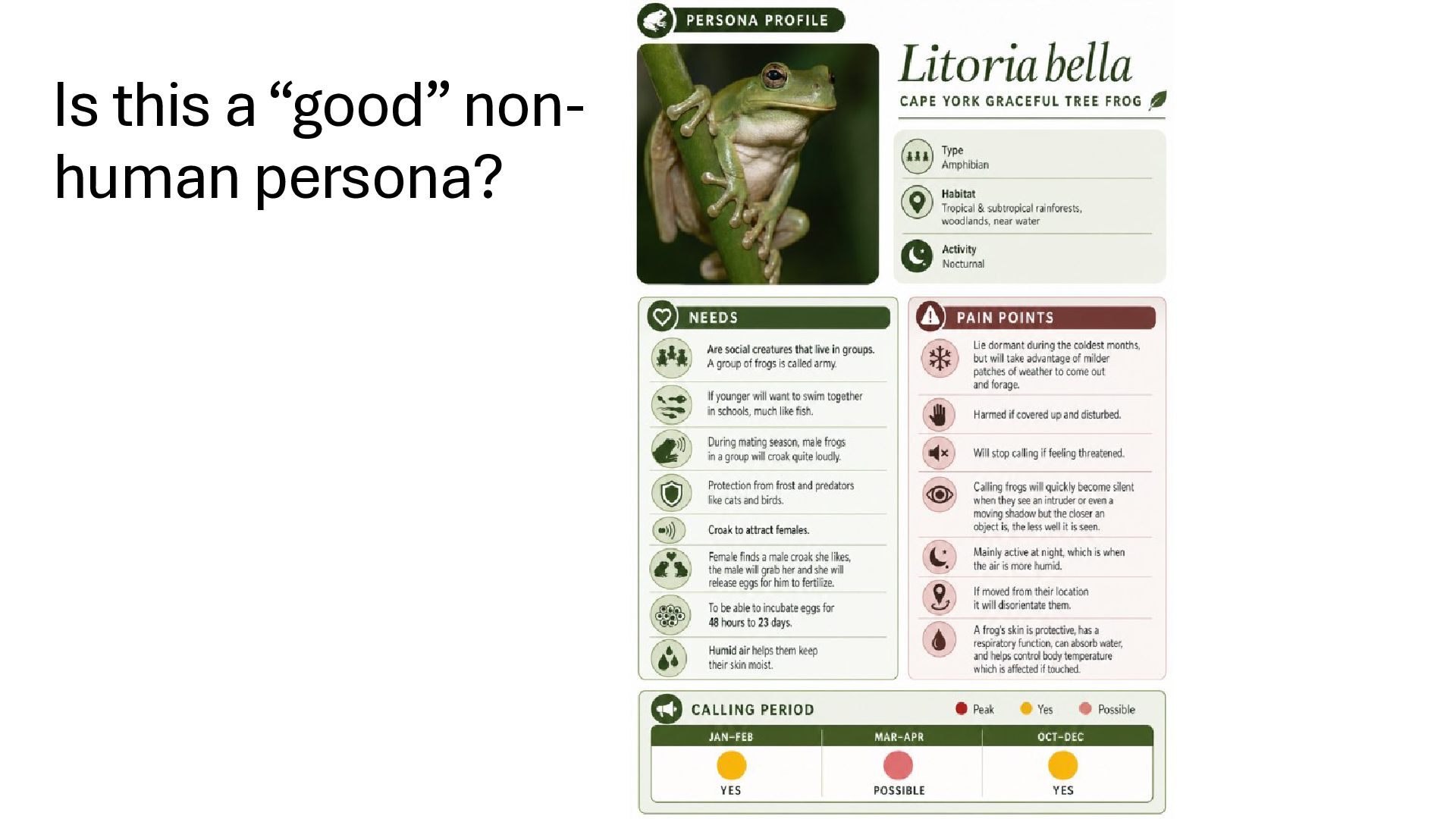
    in the design process • More-than-human design = considering the needs of non-human stakeholders in the design process • Non-human persona = an instrument to present the needs of non-human stakeholders to designers
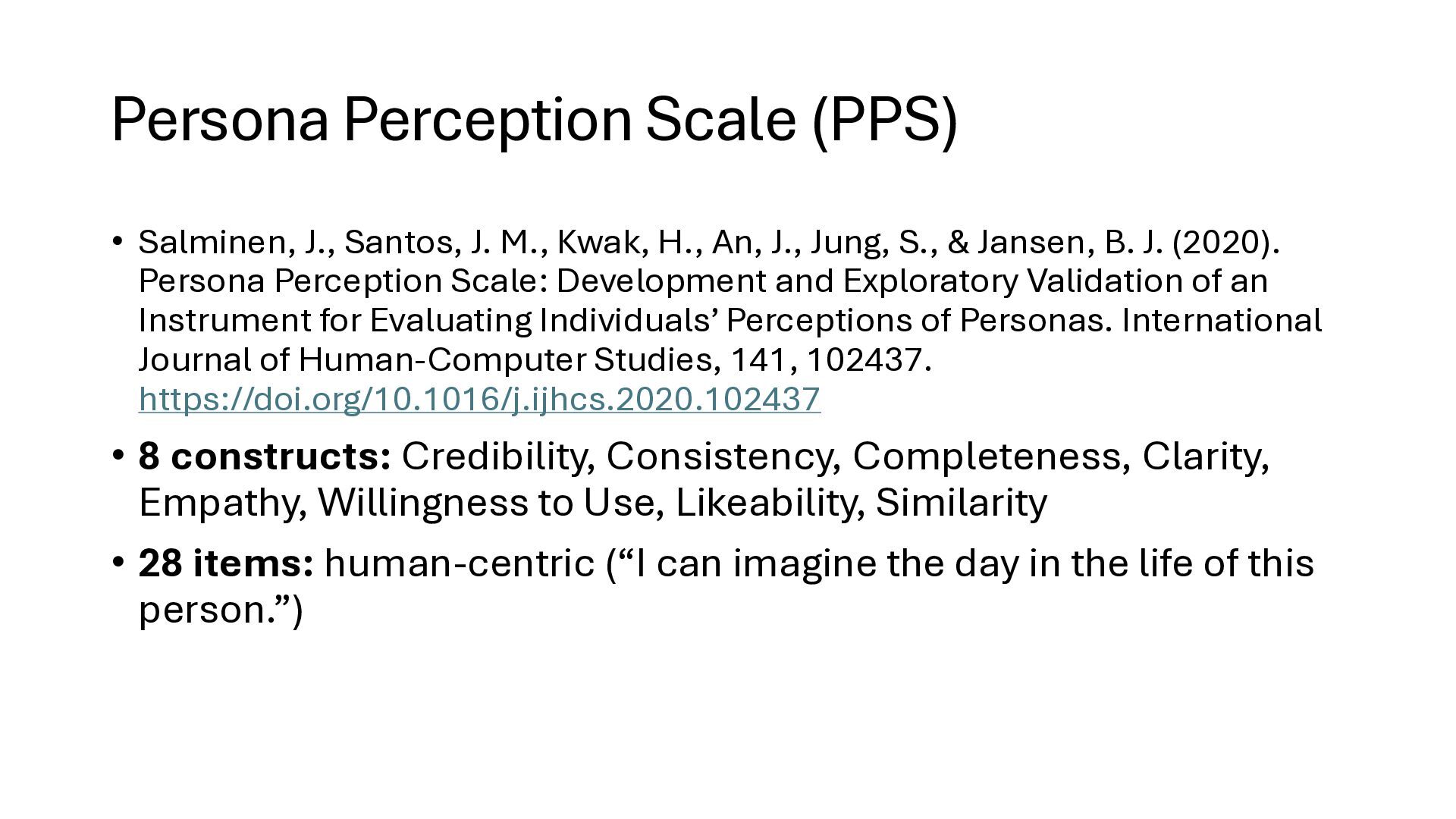
  4. Persona Perception Scale (PPS) • Salminen, J., Santos, J. M.,

    Kwak, H., An, J., Jung, S., & Jansen, B. J. (2020). Persona Perception Scale: Development and Exploratory Validation of an Instrument for Evaluating Individuals’ Perceptions of Personas. International Journal of Human-Computer Studies, 141, 102437. https://doi.org/10.1016/j.ijhcs.2020.102437 • 8 constructs: Credibility, Consistency, Completeness, Clarity, Empathy, Willingness to Use, Likeability, Similarity • 28 items: human-centric (“I can imagine the day in the life of this person.”)
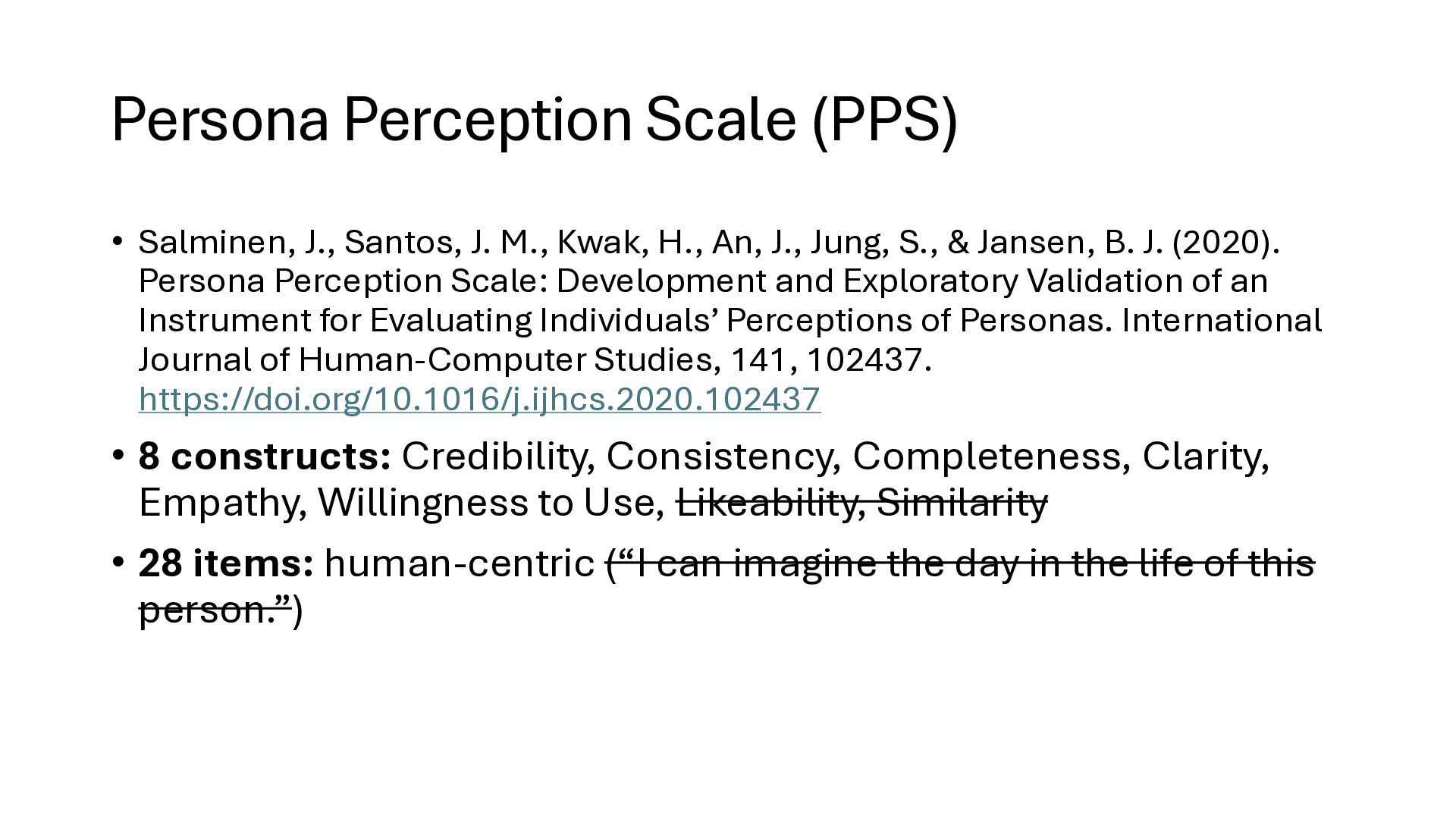
  5. Persona Perception Scale (PPS) • Salminen, J., Santos, J. M.,

    Kwak, H., An, J., Jung, S., & Jansen, B. J. (2020). Persona Perception Scale: Development and Exploratory Validation of an Instrument for Evaluating Individuals’ Perceptions of Personas. International Journal of Human-Computer Studies, 141, 102437. https://doi.org/10.1016/j.ijhcs.2020.102437 • 8 constructs: Credibility, Consistency, Completeness, Clarity, Empathy, Willingness to Use, Likeability, Similarity • 28 items: human-centric (“I can imagine the day in the life of this person.”)
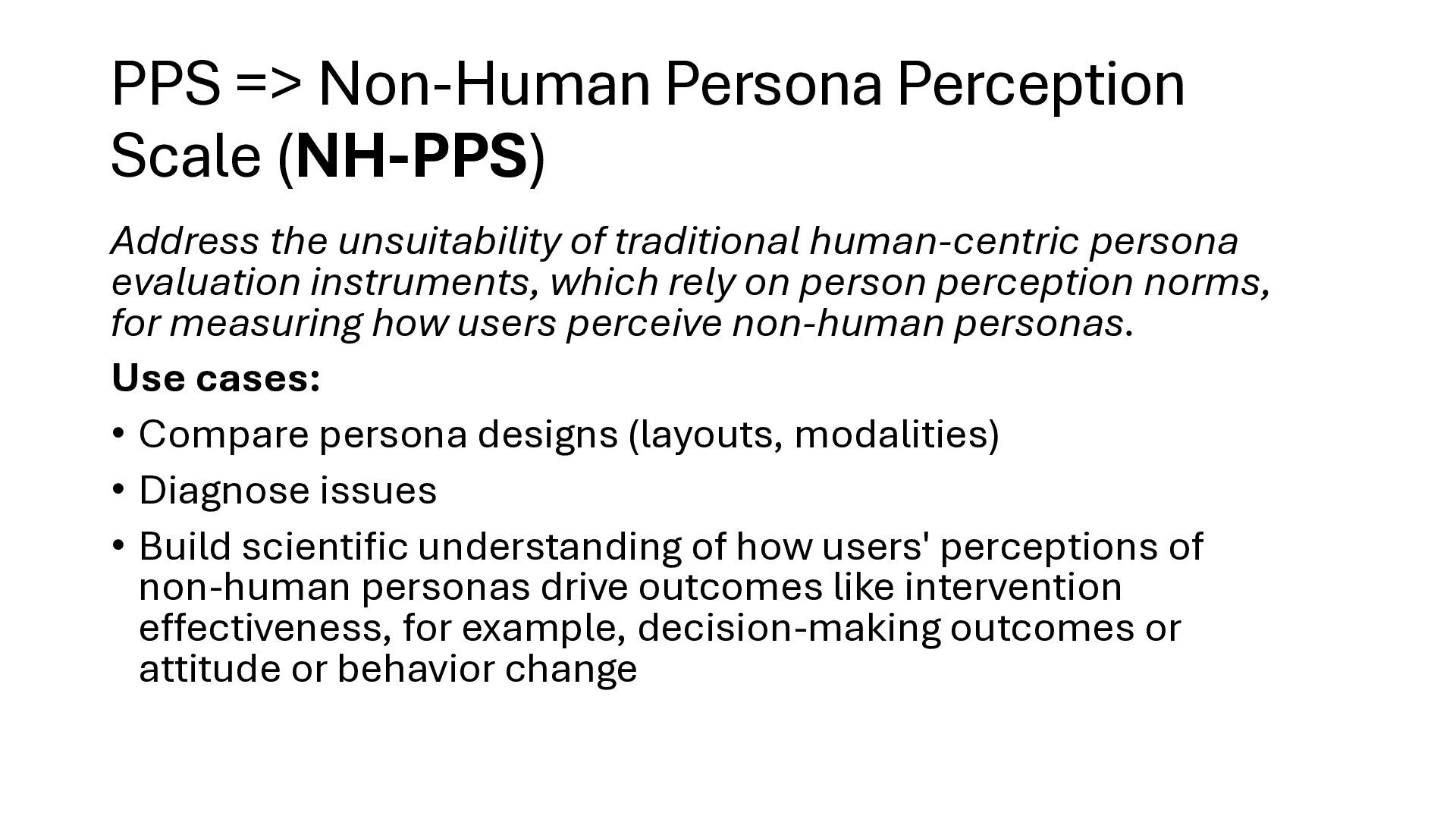
  6. PPS => Non-Human Persona Perception Scale (NH-PPS) Address the unsuitability

    of traditional human-centric persona evaluation instruments, which rely on person perception norms, for measuring how users perceive non-human personas. Use cases: • Compare persona designs (layouts, modalities) • Diagnose issues • Build scientific understanding of how users' perceptions of non-human personas drive outcomes like intervention effectiveness, for example, decision-making outcomes or attitude or behavior change
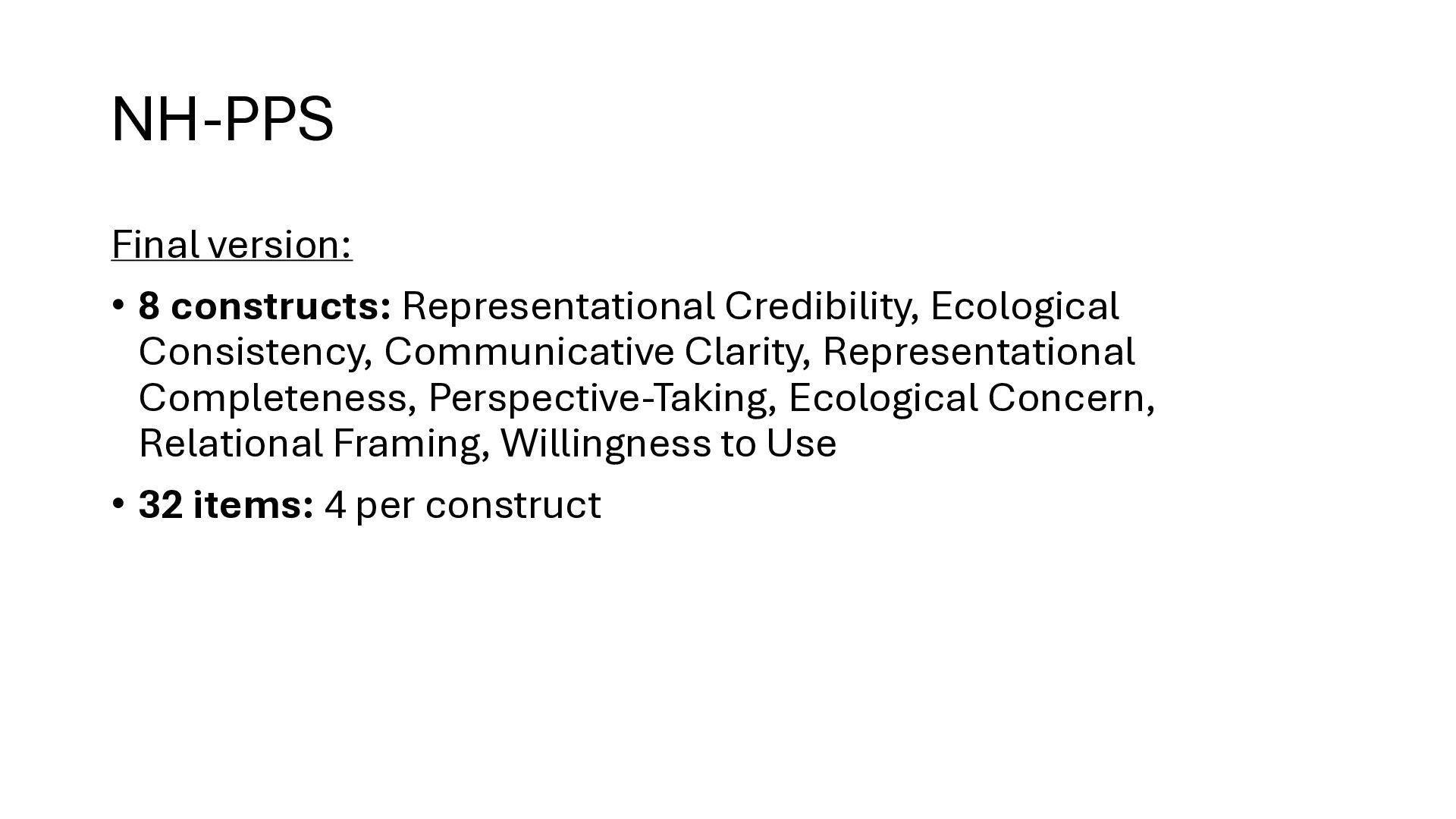
  7. NH-PPS Final version: • 8 constructs: Representational Credibility, Ecological Consistency,

    Communicative Clarity, Representational Completeness, Perspective-Taking, Ecological Concern, Relational Framing, Willingness to Use • 32 items: 4 per construct
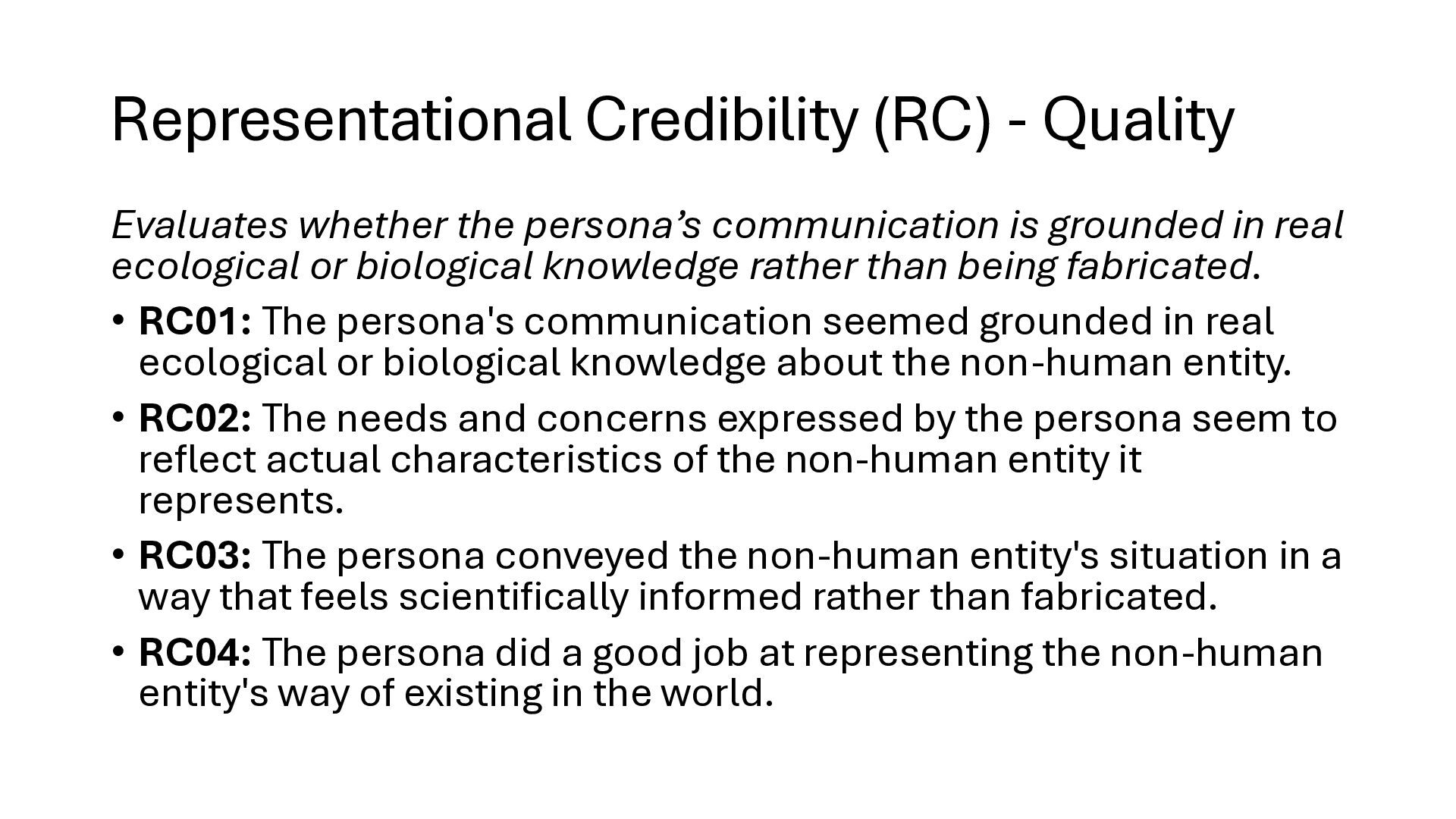
  8. Representational Credibility (RC) - Quality Evaluates whether the persona’s communication

    is grounded in real ecological or biological knowledge rather than being fabricated. • RC01: The persona's communication seemed grounded in real ecological or biological knowledge about the non-human entity. • RC02: The needs and concerns expressed by the persona seem to reflect actual characteristics of the non-human entity it represents. • RC03: The persona conveyed the non-human entity's situation in a way that feels scientifically informed rather than fabricated. • RC04: The persona did a good job at representing the non-human entity's way of existing in the world.
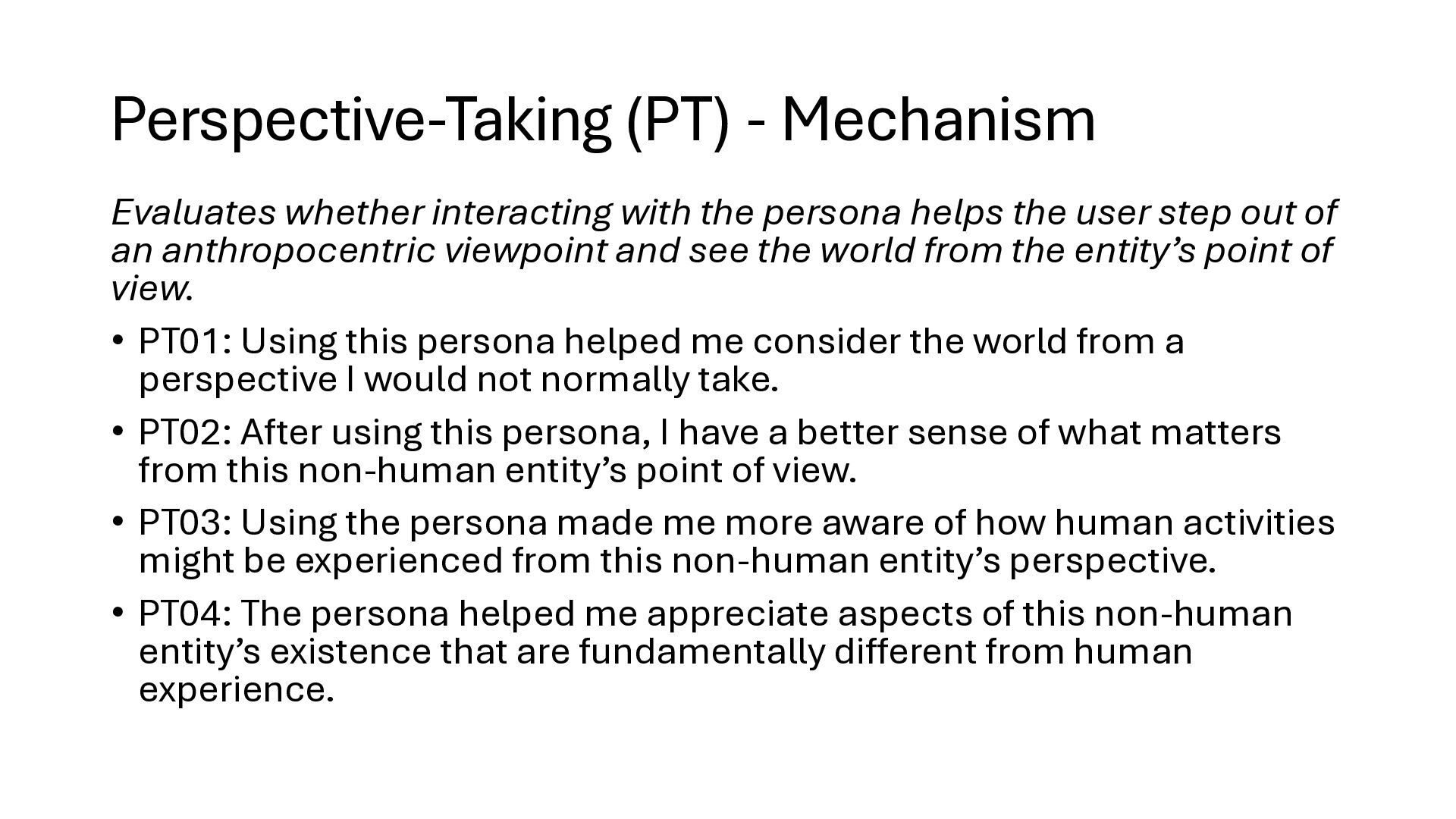
  9. Perspective-Taking (PT) - Mechanism Evaluates whether interacting with the persona

    helps the user step out of an anthropocentric viewpoint and see the world from the entity’s point of view. • PT01: Using this persona helped me consider the world from a perspective I would not normally take. • PT02: After using this persona, I have a better sense of what matters from this non-human entity’s point of view. • PT03: Using the persona made me more aware of how human activities might be experienced from this non-human entity’s perspective. • PT04: The persona helped me appreciate aspects of this non-human entity’s existence that are fundamentally different from human experience.
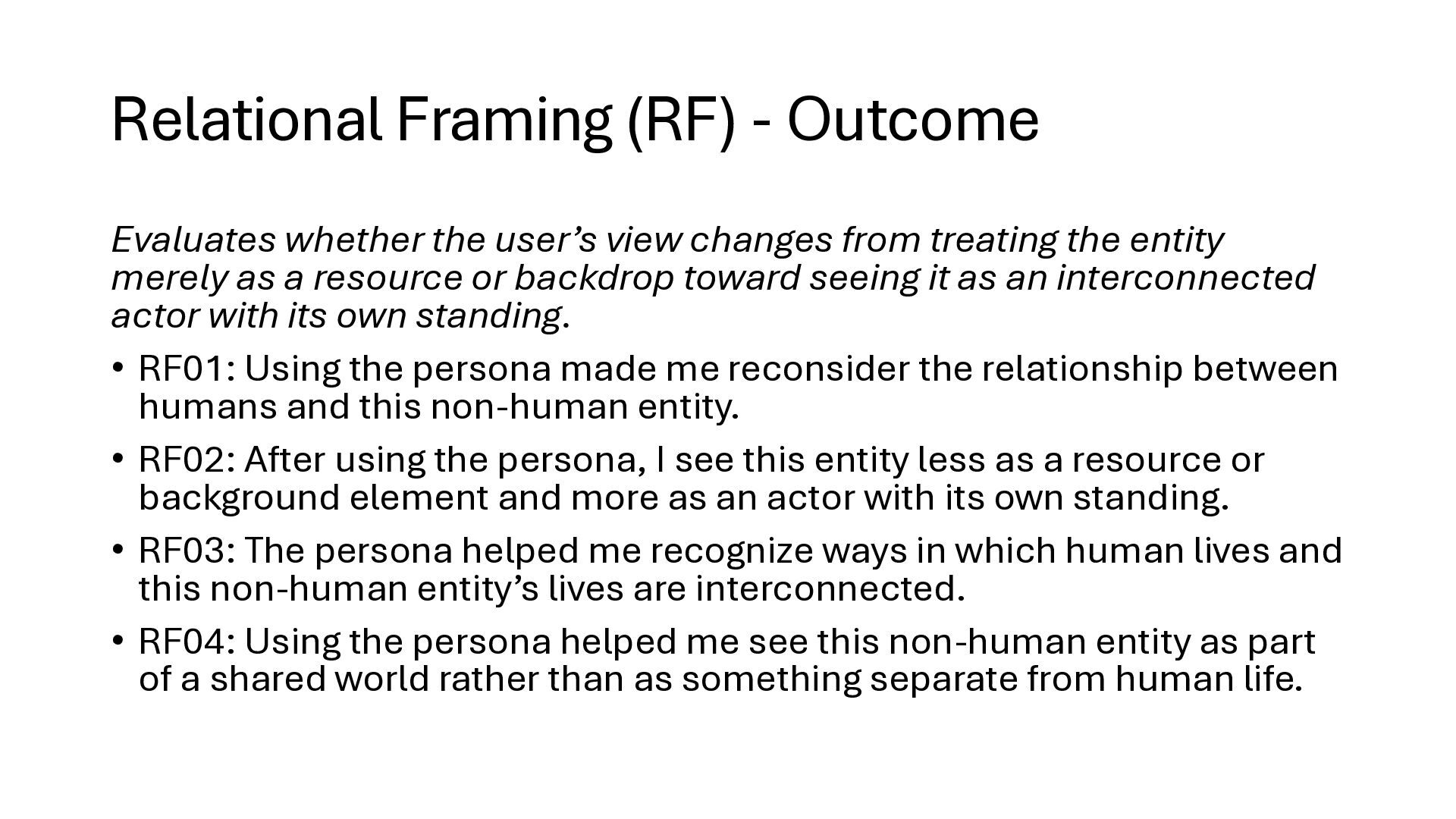
  10. Relational Framing (RF) - Outcome Evaluates whether the user’s view

    changes from treating the entity merely as a resource or backdrop toward seeing it as an interconnected actor with its own standing. • RF01: Using the persona made me reconsider the relationship between humans and this non-human entity. • RF02: After using the persona, I see this entity less as a resource or background element and more as an actor with its own standing. • RF03: The persona helped me recognize ways in which human lives and this non-human entity’s lives are interconnected. • RF04: Using the persona helped me see this non-human entity as part of a shared world rather than as something separate from human life.
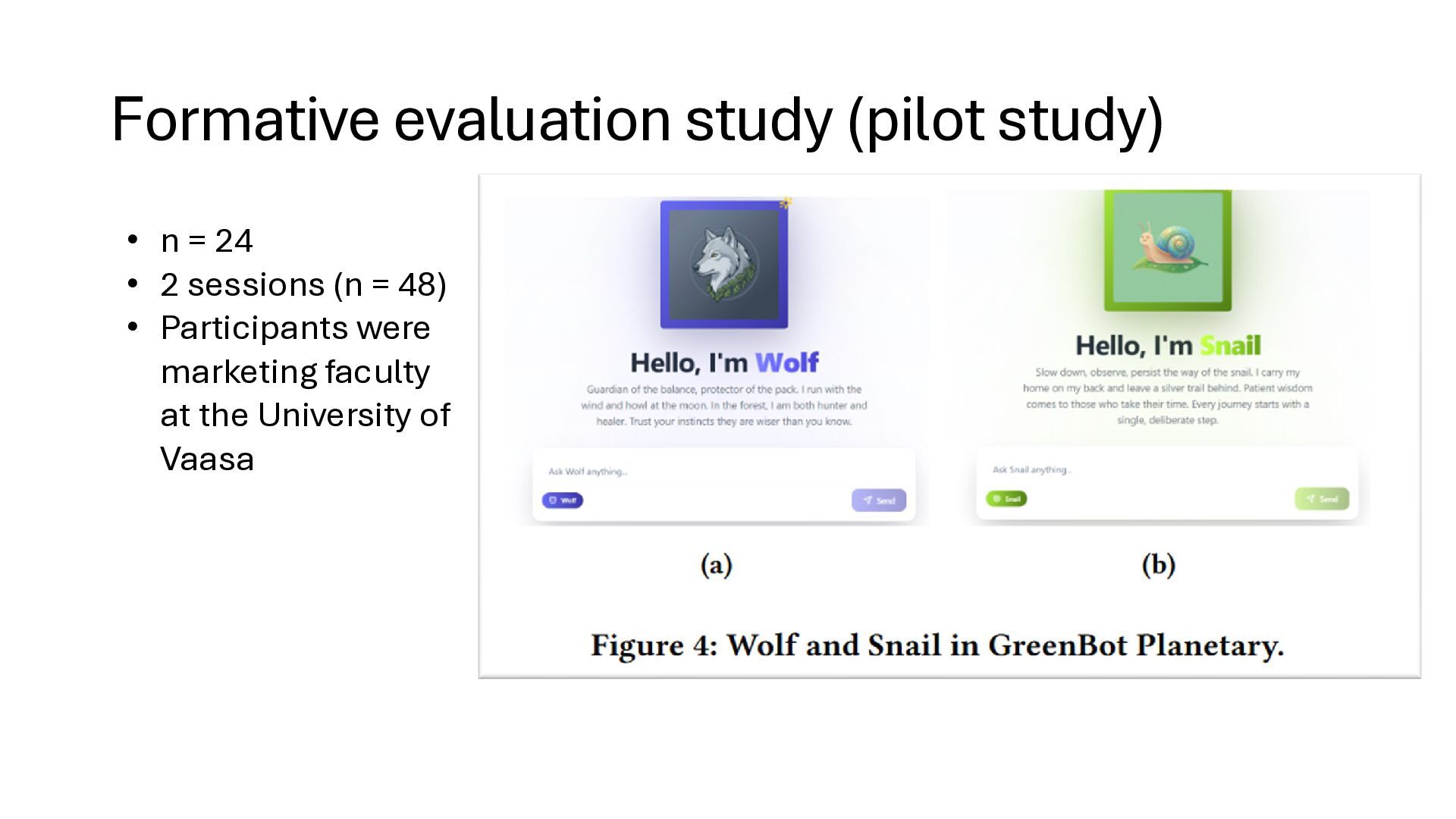
  11. Formative evaluation study (pilot study) • n = 24 •

    2 sessions (n = 48) • Participants were marketing faculty at the University of Vaasa
  12. Next steps • Larger validation study (n > 200) •

    Test NH-PPS with • Profiles vs chat • Charismatic vs non-charismatic species • Biological vs non-biological entities (e.g., AI agents) • Lay people vs subject-matter experts Interested in collaboration? Just reach out: [email protected]

More Decks by Joni

Other Decks in Research