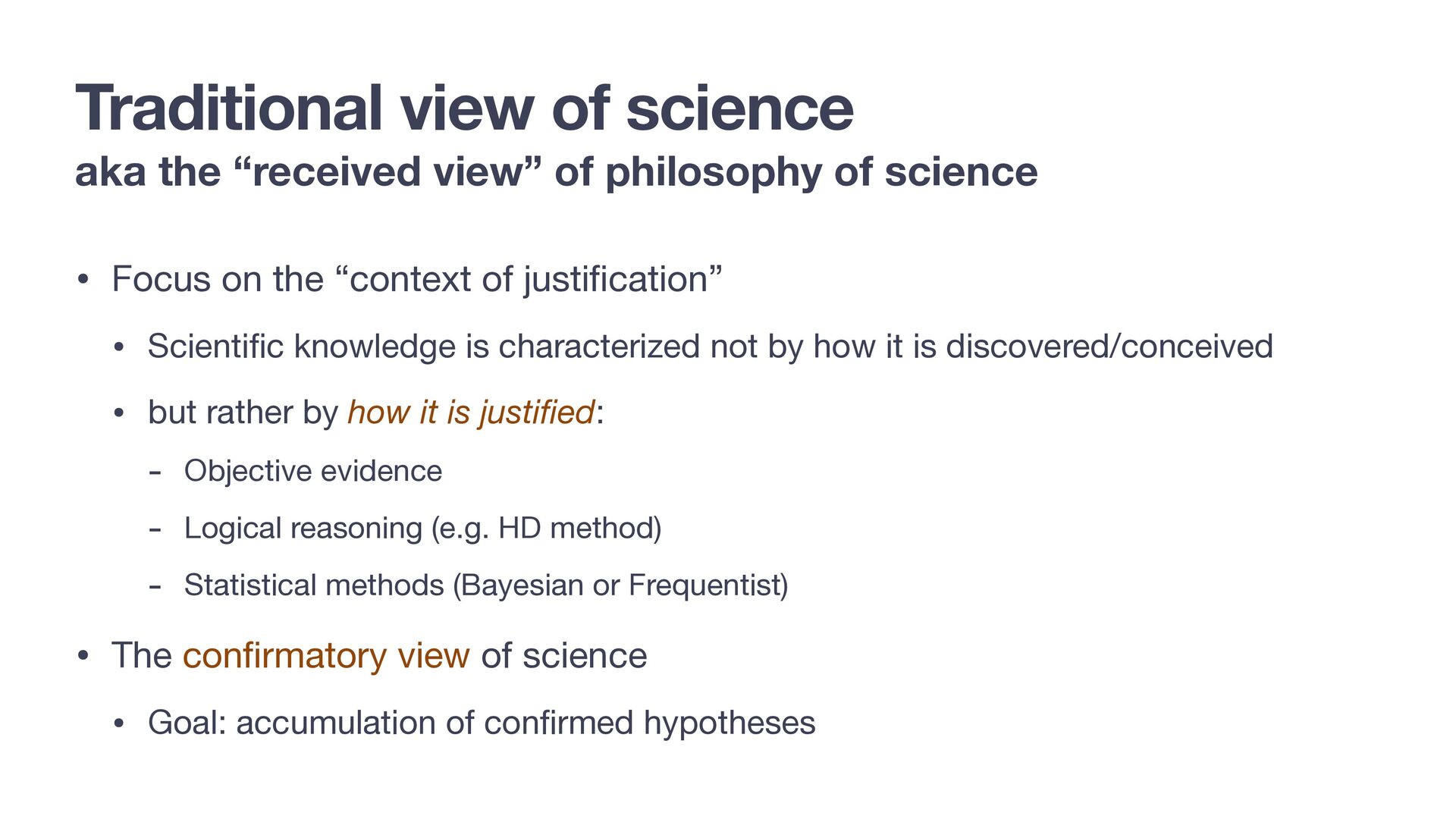
of science • Focus on the “context of justi fi cation” • Scienti fi c knowledge is characterized not by how it is discovered/conceived • but rather by how it is justi fi ed: - Objective evidence - Logical reasoning (e.g. HD method) - Statistical methods (Bayesian or Frequentist) • The con fi rmatory view of science • Goal: accumulation of con fi rmed hypotheses
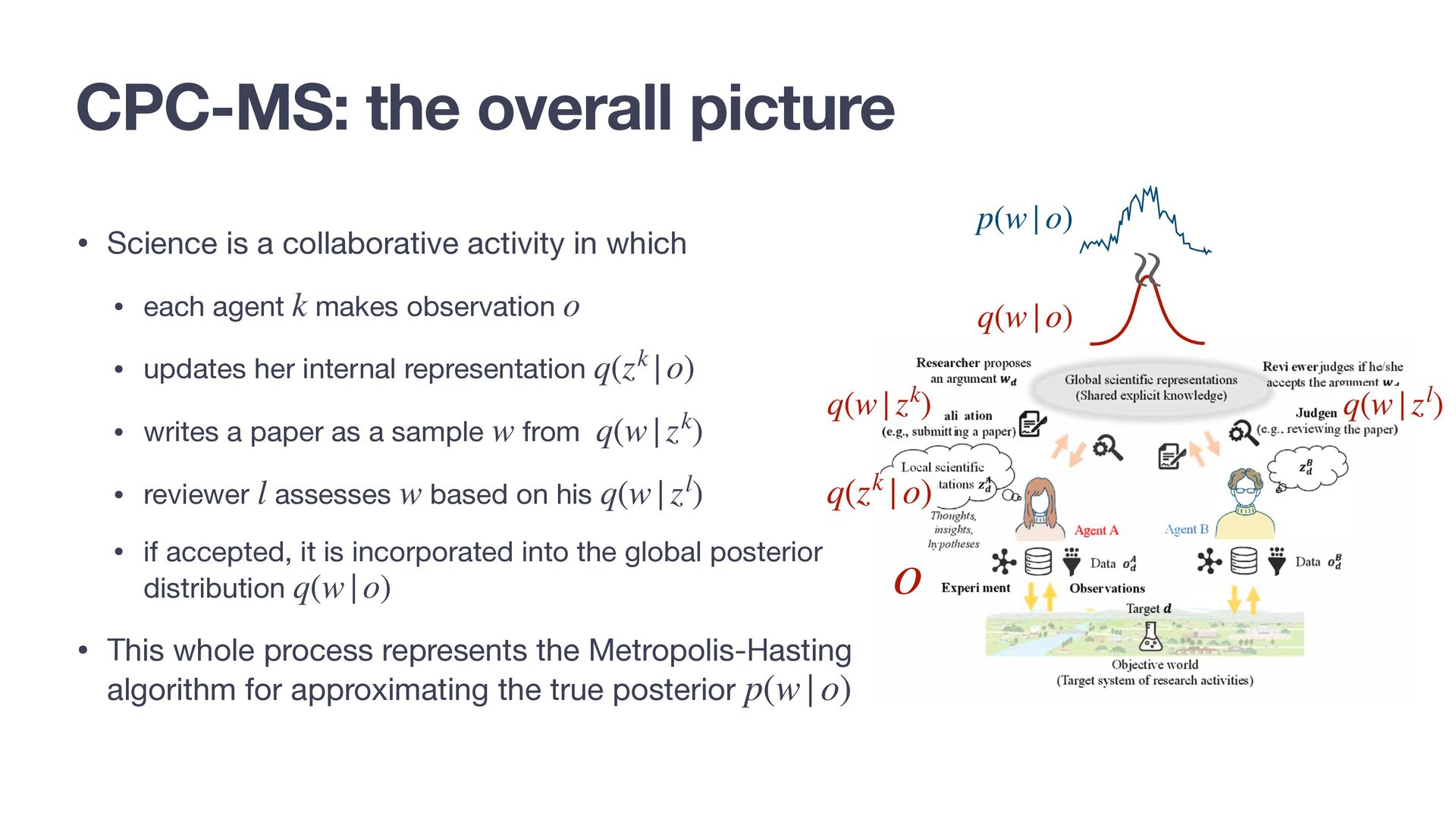
in which • each agent makes observation • updates her internal representation • writes a paper as a sample from • reviewer assesses based on his • if accepted, it is incorporated into the global posterior distribution • This whole process represents the Metropolis-Hasting algorithm for approximating the true posterior k o q(zk |o) w q(w|zk) l w q(w|zl) q(w|o) p(w|o) o q(zk |o) q(w|zk) q(w|zl) q(w|o) p(w|o) ≈
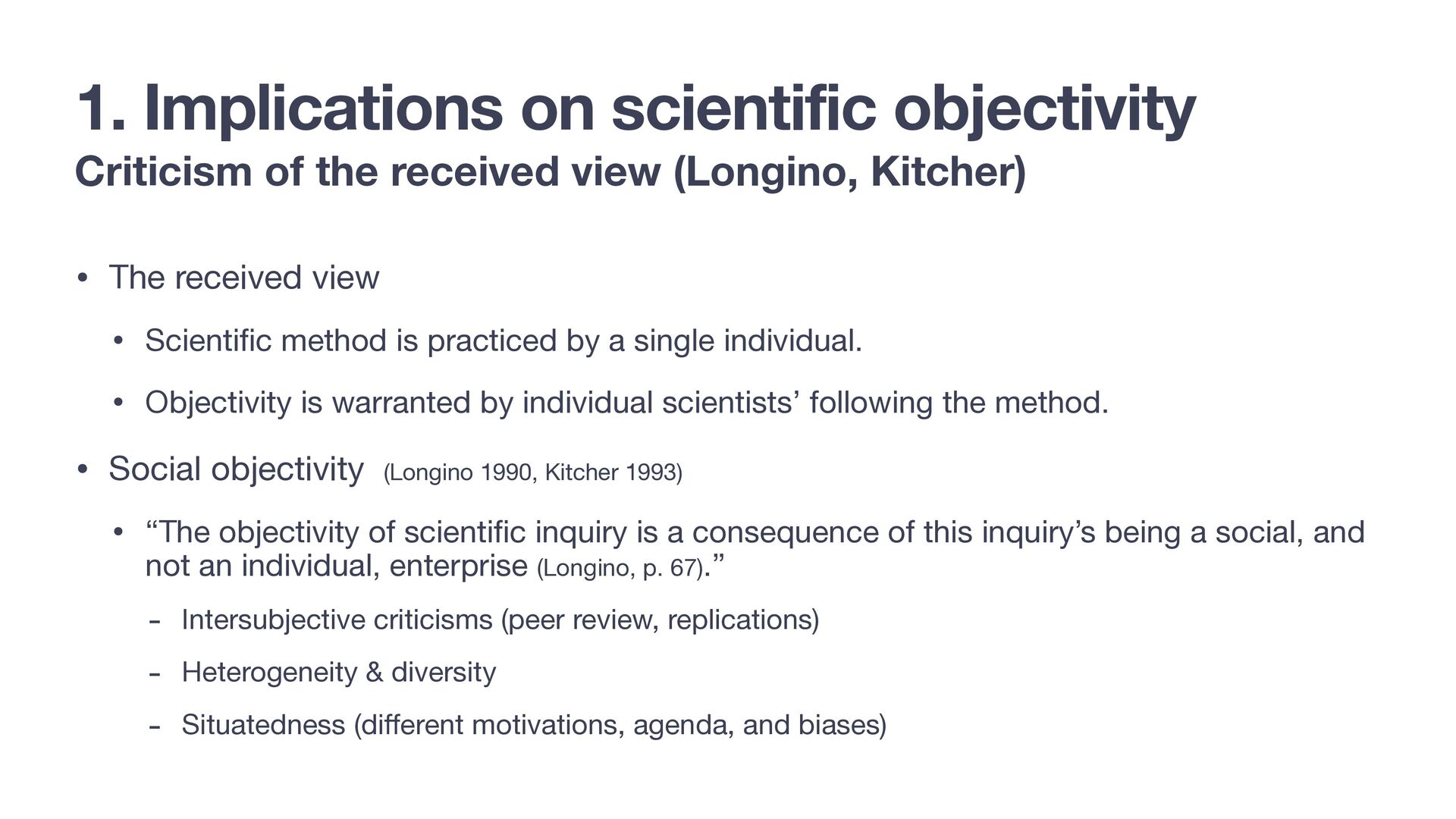
(Longino, Kitcher) • The received view • Scienti fi c method is practiced by a single individual. • Objectivity is warranted by individual scientists’ following the method. • Social objectivity (Longino 1990, Kitcher 1993) • “The objectivity of scienti fi c inquiry is a consequence of this inquiry’s being a social, and not an individual, enterprise (Longino, p. 67).” - Intersubjective criticisms (peer review, replications) - Heterogeneity & diversity - Situatedness (di ff erent motivations, agenda, and biases)
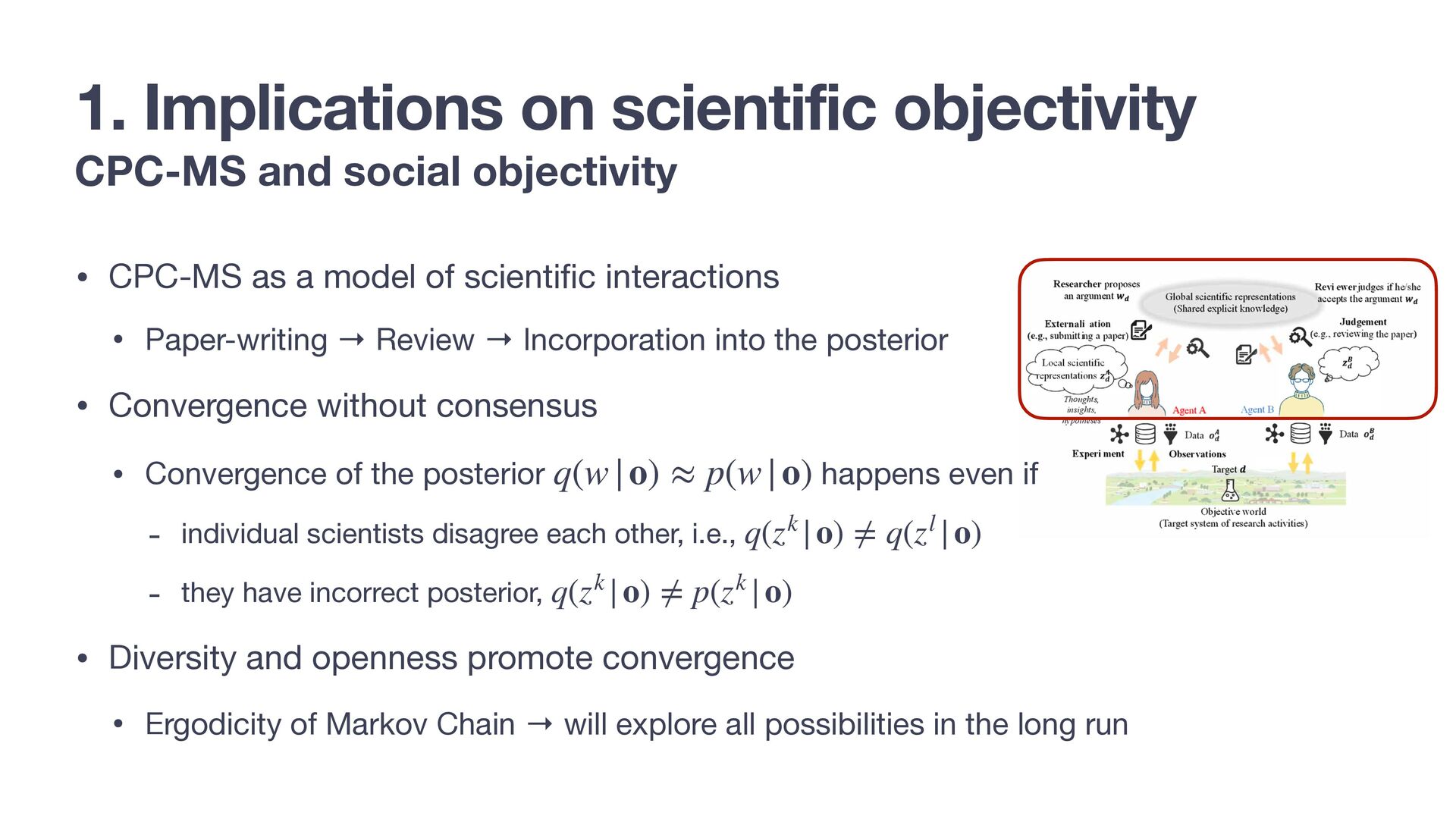
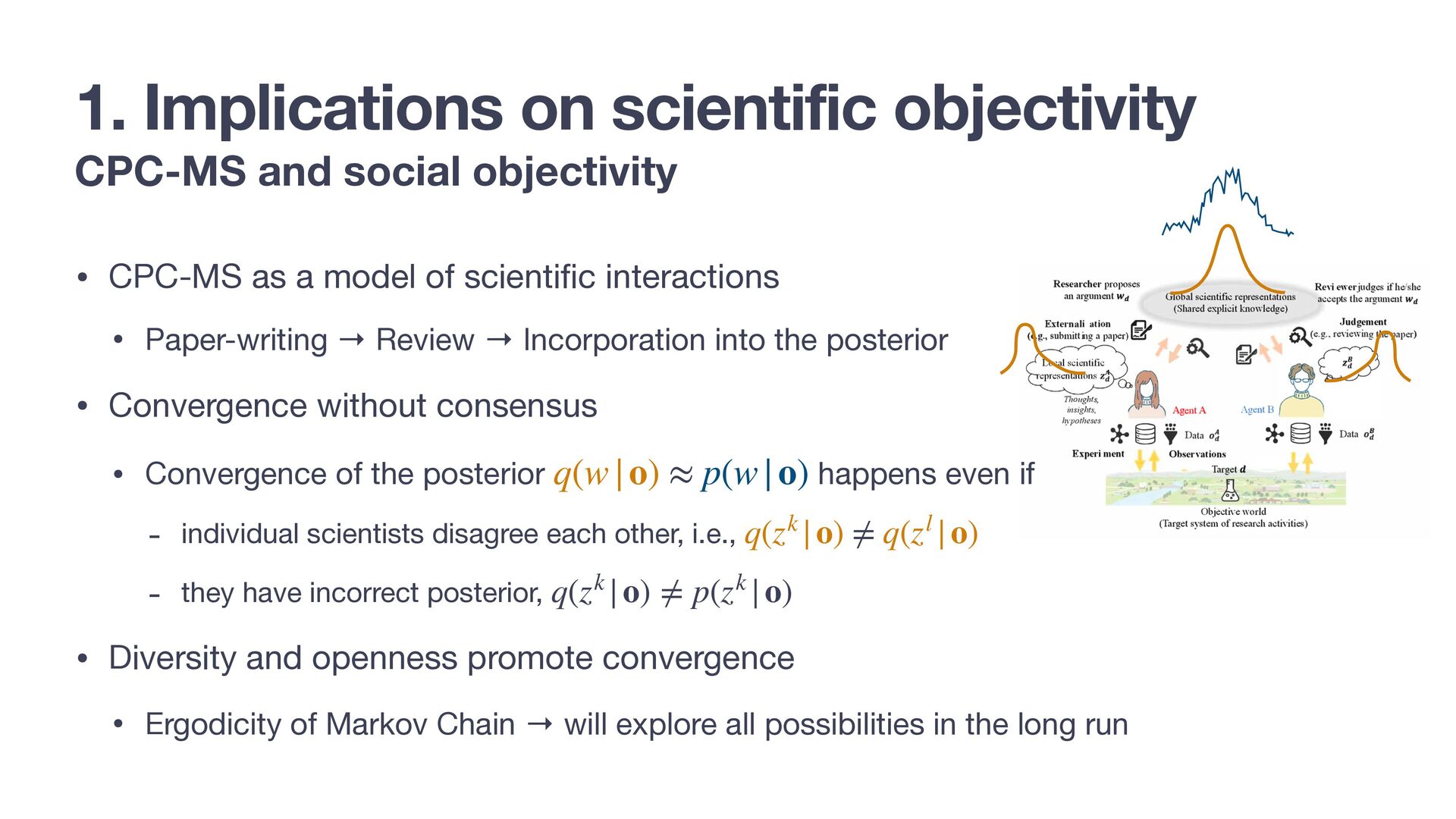
CPC-MS as a model of scienti fi c interactions • Paper-writing → Review → Incorporation into the posterior • Convergence without consensus • Convergence of the posterior happens even if - individual scientists disagree each other, i.e., - they have incorrect posterior, • Diversity and openness promote convergence • Ergodicity of Markov Chain → will explore all possibilities in the long run q(w|o) ≈ p(w|o) q(zk |o) ≠ q(zl |o) q(zk |o) ≠ p(zk |o)
CPC-MS as a model of scienti fi c interactions • Paper-writing → Review → Incorporation into the posterior • Convergence without consensus • Convergence of the posterior happens even if - individual scientists disagree each other, i.e., - they have incorrect posterior, • Diversity and openness promote convergence • Ergodicity of Markov Chain → will explore all possibilities in the long run q(w|o) ≈ p(w|o) q(zk |o) ≠ q(zl |o) q(zk |o) ≠ p(zk |o)
c progress • Progress = accumulation of (con fi rmed) knowledge? • Di ffi culties 1. Incommensurability between scienti fi c revolutions (Kuhn) • No common standard between old/new paradigm. • How to say that the new paradigm is “better” than the old one? 2. Pessimistic induction • Many scienti fi c theories ended up being refuted. So no accumulation after all?
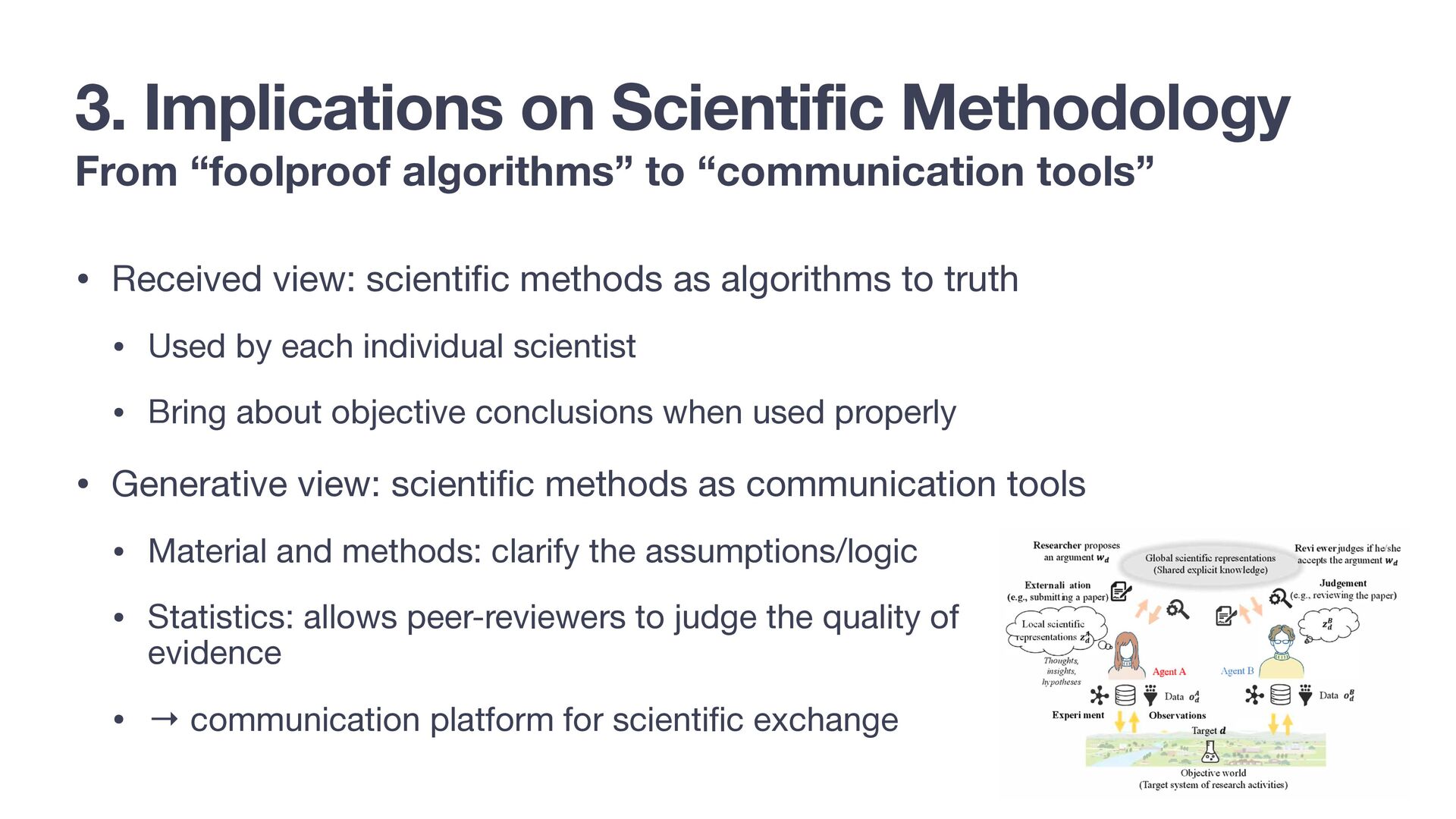
tools” • Received view: scienti fi c methods as algorithms to truth • Used by each individual scientist • Bring about objective conclusions when used properly • Generative view: scienti fi c methods as communication tools • Material and methods: clarify the assumptions/logic • Statistics: allows peer-reviewers to judge the quality of evidence • → communication platform for scienti fi c exchange
CPC-MS as a model of Social Objectivity • Diversity promotes convergence w/o consensus 2. Scienti fi c Progress • Progress in terms of predictive performance, even between di ff erent paradigms 3. Scienti fi c Methodology • Statistics as “communication tools” that facilitate the MHNG


 junotk
 michielstock
 akasan
 institutdelelevage
.jpg) ktatsuya
ktatsuya
 syuchimu
 jagupath
 konakalab
 hanbao
 brainpadpr
 tagtag
 peterdesmet
 tammyeverts
 davidcarrasco
 afnizarnur
 eileencodes
 coloredviolet
 aleyda
 schlessera
 tammielis
 axbom
axbom
 andyhume
 soudai
![Jun Otsuka (Kyoto University, [email protected]) 2024/10/26 From Confirmation to](https://files.speakerdeck.com/presentations/fc255c8271c74781a9fbb3a611badea9/slide_0.jpg)