Upgrade to Pro — share decks privately, control downloads, hide ads and more …

SciPy2015

 SciPy2015

Deep Learning: Tips From The Road
https://github.com/kastnerkyle/SciPy2015

Kyle Kastner

July 09, 2015

Transcript

22 slides
  1. Deep Learning Tips from the Road CRASH COURSE Kyle Kastner

    Université de Montréal - MILA Intern - IBM Watson @ Yorktown Heights
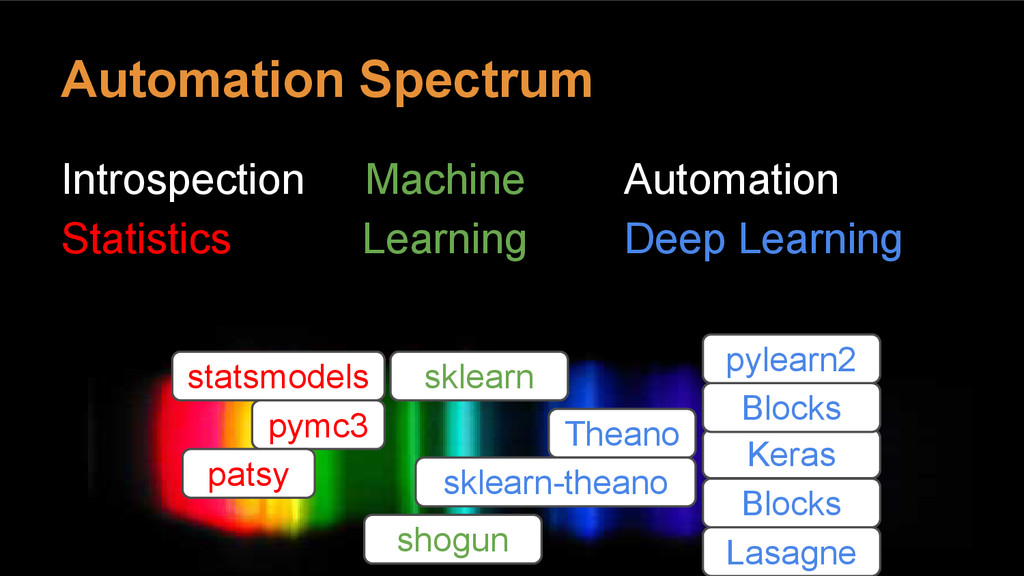
  2. Automation Spectrum Introspection Machine Automation Statistics Learning Deep Learning sklearn

    statsmodels pymc3 Theano Keras Blocks Lasagne Blocks pylearn2 sklearn-theano patsy shogun
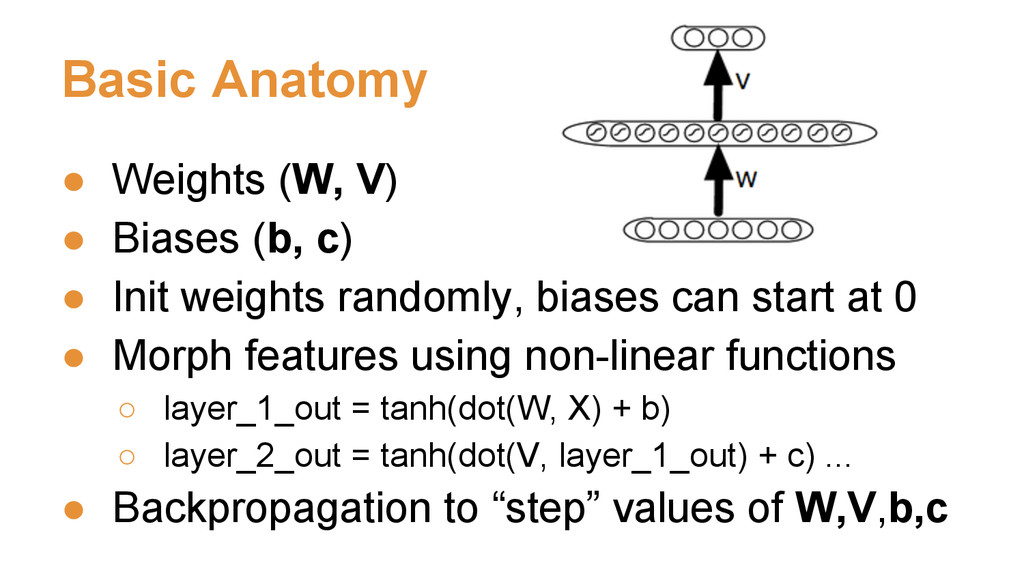
  3. Basic Anatomy • Weights (W, V) • Biases (b, c)

    • Init weights randomly, biases can start at 0 • Morph features using non-linear functions ◦ layer_1_out = tanh(dot(W, X) + b) ◦ layer_2_out = tanh(dot(V, layer_1_out) + c) ... • Backpropagation to “step” values of W,V,b,c
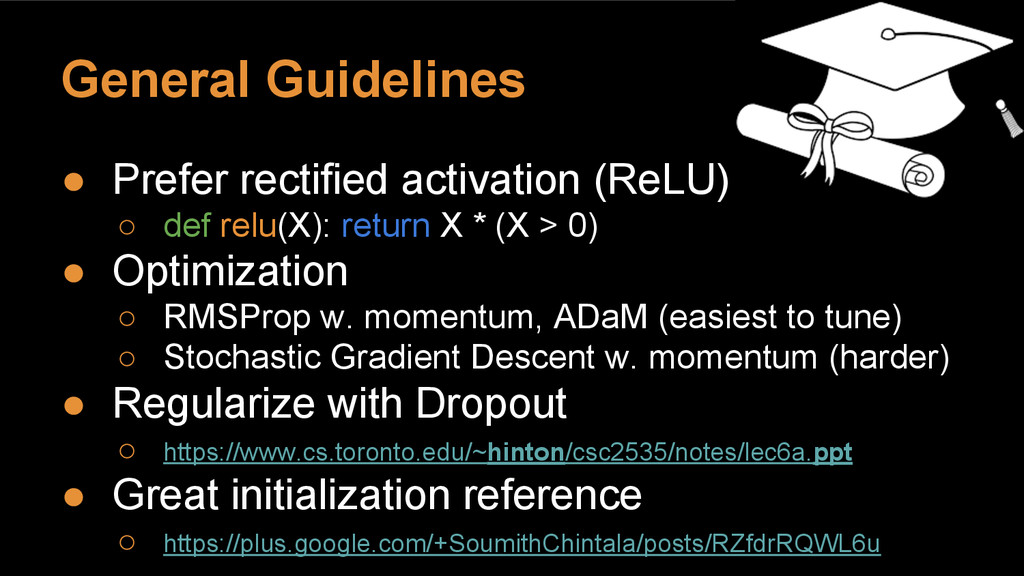
  4. General Guidelines • Prefer rectified activation (ReLU) ◦ def relu(X):

    return X * (X > 0) • Optimization ◦ RMSProp w. momentum, ADaM (easiest to tune) ◦ Stochastic Gradient Descent w. momentum (harder) • Regularize with Dropout ◦ https://www.cs.toronto.edu/~hinton/csc2535/notes/lec6a.ppt • Great initialization reference ◦ https://plus.google.com/+SoumithChintala/posts/RZfdrRQWL6u
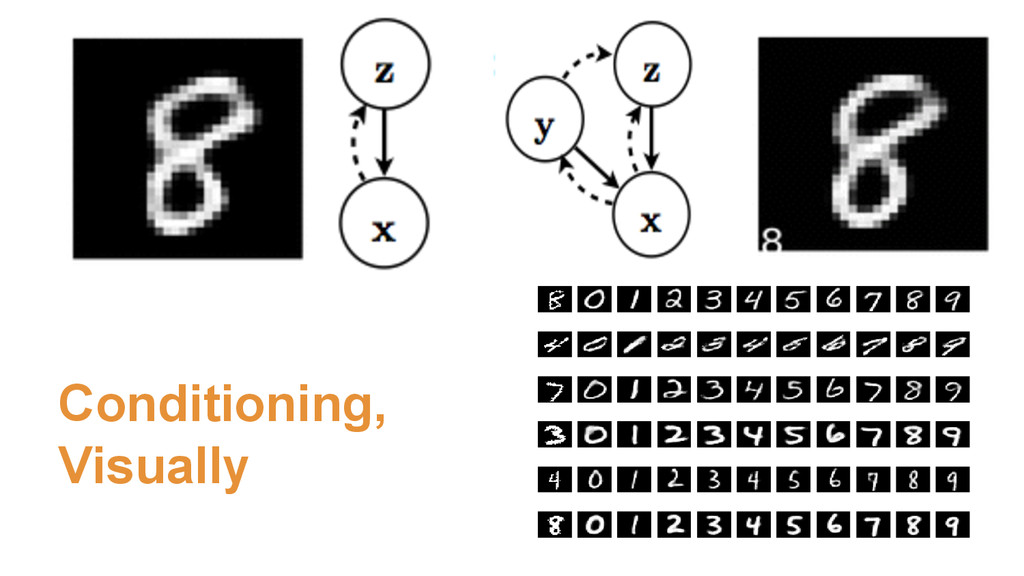
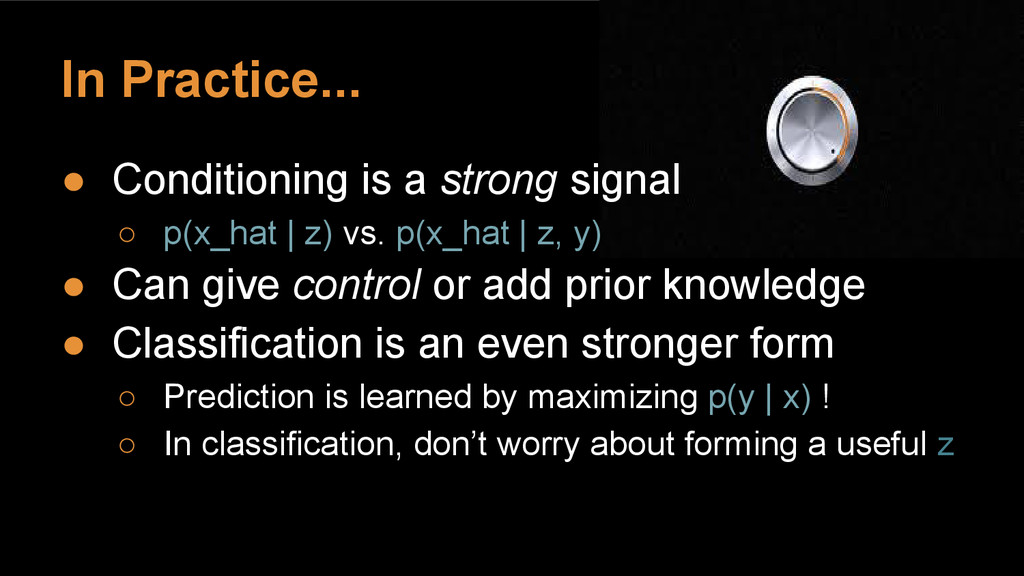
  5. In Practice... • Conditioning is a strong signal ◦ p(x_hat

    | z) vs. p(x_hat | z, y) • Can give control or add prior knowledge • Classification is an even stronger form ◦ Prediction is learned by maximizing p(y | x) ! ◦ In classification, don’t worry about forming a useful z
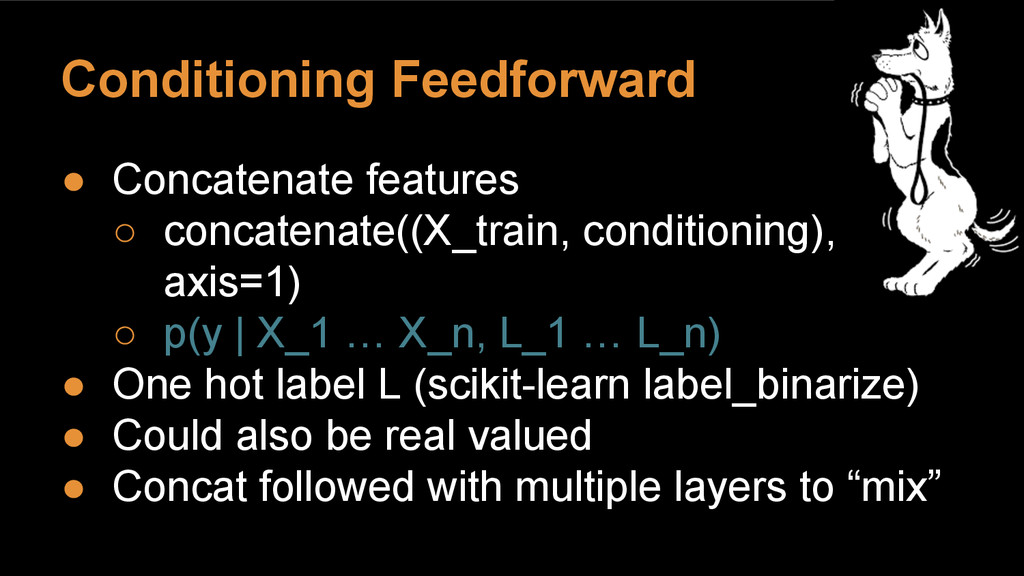
  6. Conditioning Feedforward • Concatenate features ◦ concatenate((X_train, conditioning), axis=1) ◦

    p(y | X_1 … X_n, L_1 … L_n) • One hot label L (scikit-learn label_binarize) • Could also be real valued • Concat followed with multiple layers to “mix”
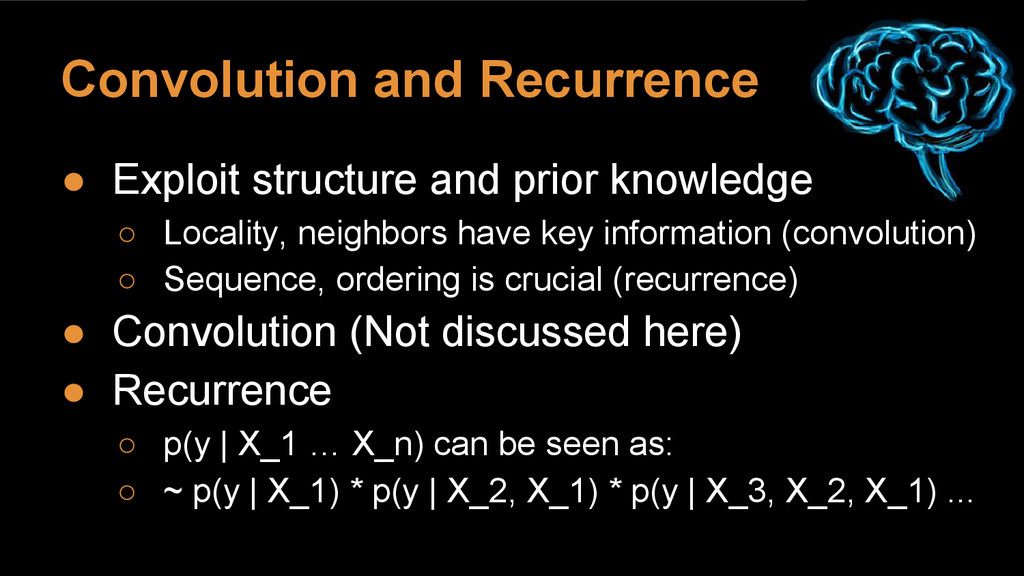
  7. Convolution and Recurrence • Exploit structure and prior knowledge ◦

    Locality, neighbors have key information (convolution) ◦ Sequence, ordering is crucial (recurrence) • Convolution (Not discussed here) • Recurrence ◦ p(y | X_1 … X_n) can be seen as: ◦ ~ p(y | X_1) * p(y | X_2, X_1) * p(y | X_3, X_2, X_1) ...
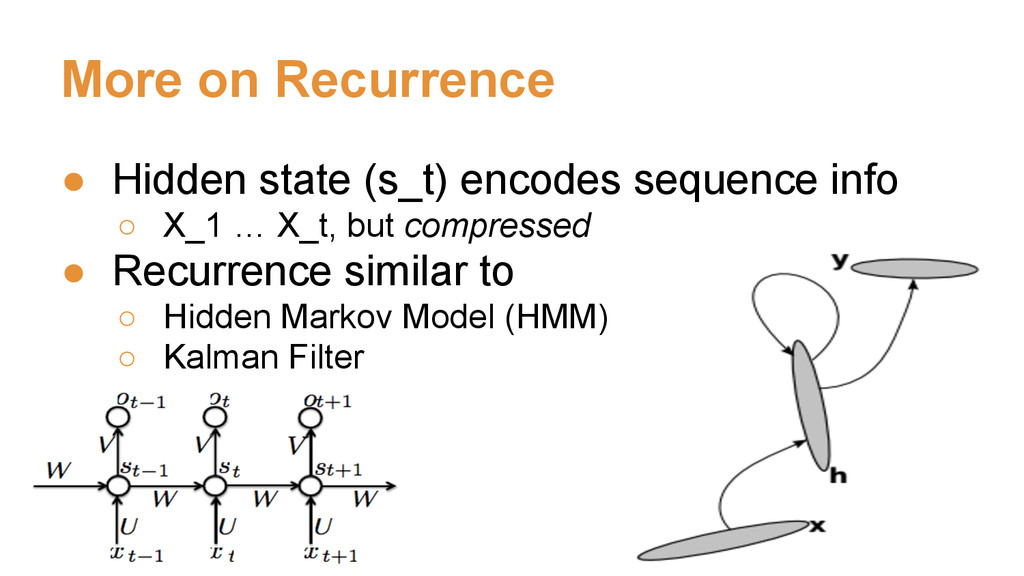
  8. More on Recurrence • Hidden state (s_t) encodes sequence info

    ◦ X_1 … X_t, but compressed • Recurrence similar to ◦ Hidden Markov Model (HMM) ◦ Kalman Filter
  9. Yet More On Recurrence • Initialize hidden state to be

    orthogonal ◦ Use U from U, S, V = svd(randn_init) • Long short term memory or gated recurrent ◦ {LSTM, GRU} fancy recurrent activations • {Sentences, dialogues, sounds} are sequences ◦ Many-to-one (sequence recognition) ◦ Many-to-many (sequence to sequence) ◦ One-to-many (sequence generation) ◦ Many-to-one-to-many (encode-decode)
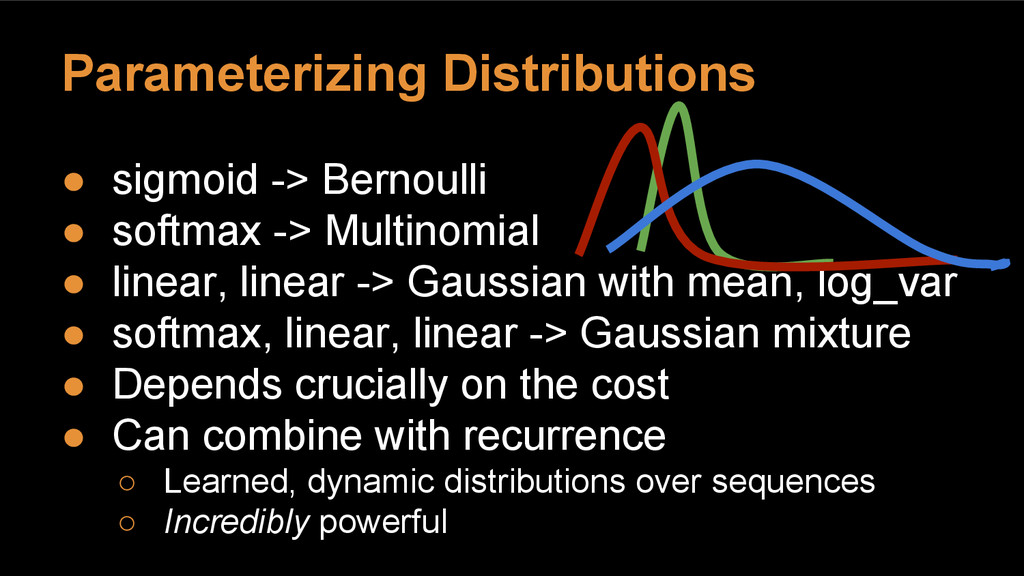
  10. Parameterizing Distributions • sigmoid -> Bernoulli • softmax -> Multinomial

    • linear, linear -> Gaussian with mean, log_var • softmax, linear, linear -> Gaussian mixture • Depends crucially on the cost • Can combine with recurrence ◦ Learned, dynamic distributions over sequences ◦ Incredibly powerful
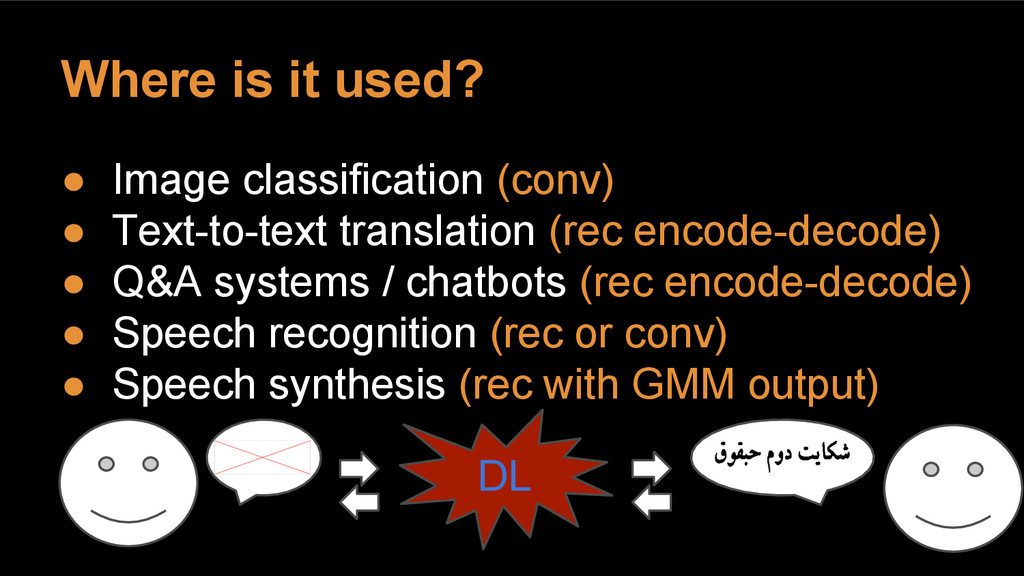
  11. Where is it used? • Image classification (conv) • Text-to-text

    translation (rec encode-decode) • Q&A systems / chatbots (rec encode-decode) • Speech recognition (rec or conv) • Speech synthesis (rec with GMM output) DL
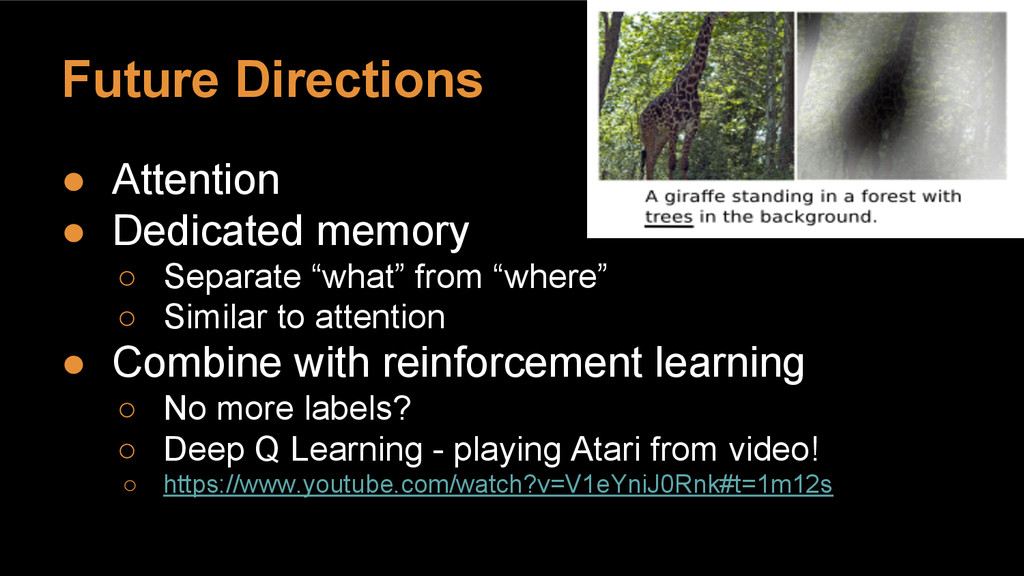
  12. Future Directions • Attention • Dedicated memory ◦ Separate “what”

    from “where” ◦ Similar to attention • Combine with reinforcement learning ◦ No more labels? ◦ Deep Q Learning - playing Atari from video! ◦ https://www.youtube.com/watch?v=V1eYniJ0Rnk#t=1m12s
  13. Takeaways and Opinions • Can use deep learning like graphical

    modeling ◦ Different tools, same conceptual idea ◦ Conditional probability modeling is key • Put knowledge in model structure, not features • Let features be learned from data • Use conditioning to control or constrain
  14. Thanks! @kastnerkyle Repo with slides and links https://github.com/kastnerkyle/SciPy2015 Slides will

    be uploaded to https://speakerdeck.com/kastnerkyle sklearn-theano, a scikit-learn compatible library for using pretrained networks : http: //sklearn-theano.github.io/ Neural network tutorial by @NewMu / Alec Radford : https://github. com/Newmu/Theano-Tutorials Theano Deep Learning Tutorials: http://deeplearning.net/tutorial/
  15. Deep Learning Book (Goodfellow, Courville, Bengio): http://www.iro.umontreal.ca/~bengioy/dlbook/ Deep Learning Course

    (Courville): https://ift6266h15.wordpress.com/ Deep Learning Course (Larochelle): https://www.youtube.com/playlist? list=PL6Xpj9I5qXYEcOhn7TqghAJ6NAPrNmUBH Encode Decode with Attention (Bahdanau, Cho, Bengio): http://arxiv.org/abs/1409.0473 Caption Generation (Xu, Ba, Kiros et. al.): http://arxiv.org/abs/1502.03044 Generating Sequences with Recurrent Neural Networks (Graves): http://arxiv.org/abs/1308.0850 Depth Map Prediction From A Single Image (Eigen, Puhrsch, Fergus): http://arxiv.org/abs/1406.2283 Semi Supervised Learning (Kingma, Rezende, Mohamed, Welling): http://arxiv.org/abs/1406.5298 Neural Networks Coursera (Hinton): https://www.coursera.org/course/neuralnets Understanding The Difficulties in Training Deep Feedforward Networks (Glorot, Bengio): http://jmlr. org/proceedings/papers/v9/glorot10a/glorot10a.pdf Advances in Optimizing Recurrent Nerural Networks (Pascanu, Boulanger-Lewandowski, Bengio): http://arxiv.org/abs/1212.0901 References and Links
  16. Where is it used? • Image classification • Text-to-text translation

    • Q&A systems / chatbots • Speech recognition • Speech synthesis • Usually many, many datapoints
  17. Deep Learning, Simple Concepts • Universal function approximators • Learn

    the features • Expect hierarchy in learned features ◦ y = h(g(f(x)) ◦ {h, g, f} are functions • Classification ◦ Learn p(y | x) = h(g(f(x))
  18. When To Use Feedforward • Use for modeling p(y |

    X_1 … X_n) ◦ X_1 … X_n represent features • Initialize with Xavier method ◦ +- 4 * sqrt(6. / (in_sz + out_sz)) uniform ◦ +- 0.01 uniform or 0.01 std randn can work ◦ Great reference: https://plus.google. com/+SoumithChintala/posts/RZfdrRQWL6u
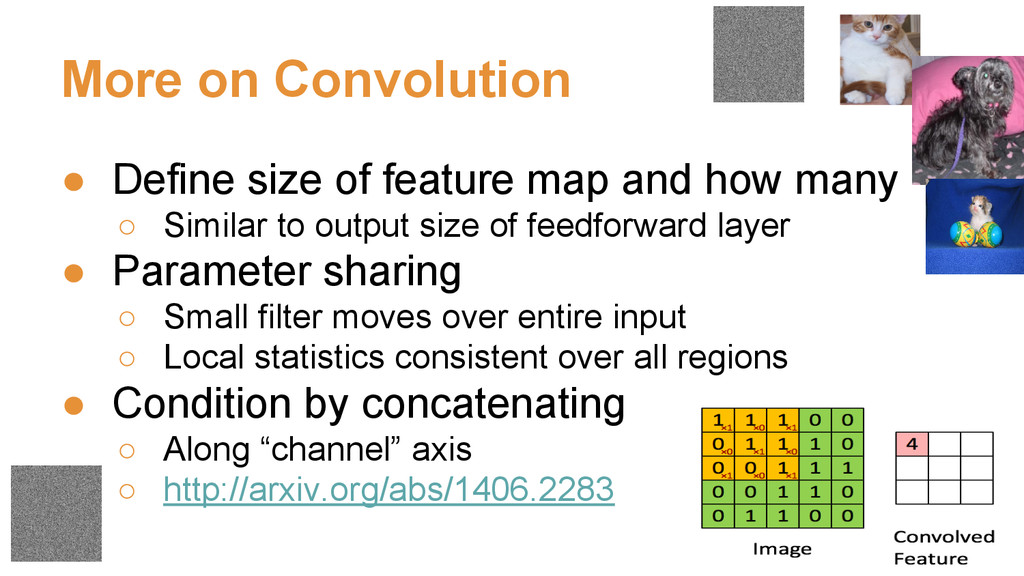
  19. More on Convolution • Define size of feature map and

    how many ◦ Similar to output size of feedforward layer • Parameter sharing ◦ Small filter moves over entire input ◦ Local statistics consistent over all regions • Condition by concatenating ◦ Along “channel” axis ◦ http://arxiv.org/abs/1406.2283

More Decks by Kyle Kastner

Other Decks in Research