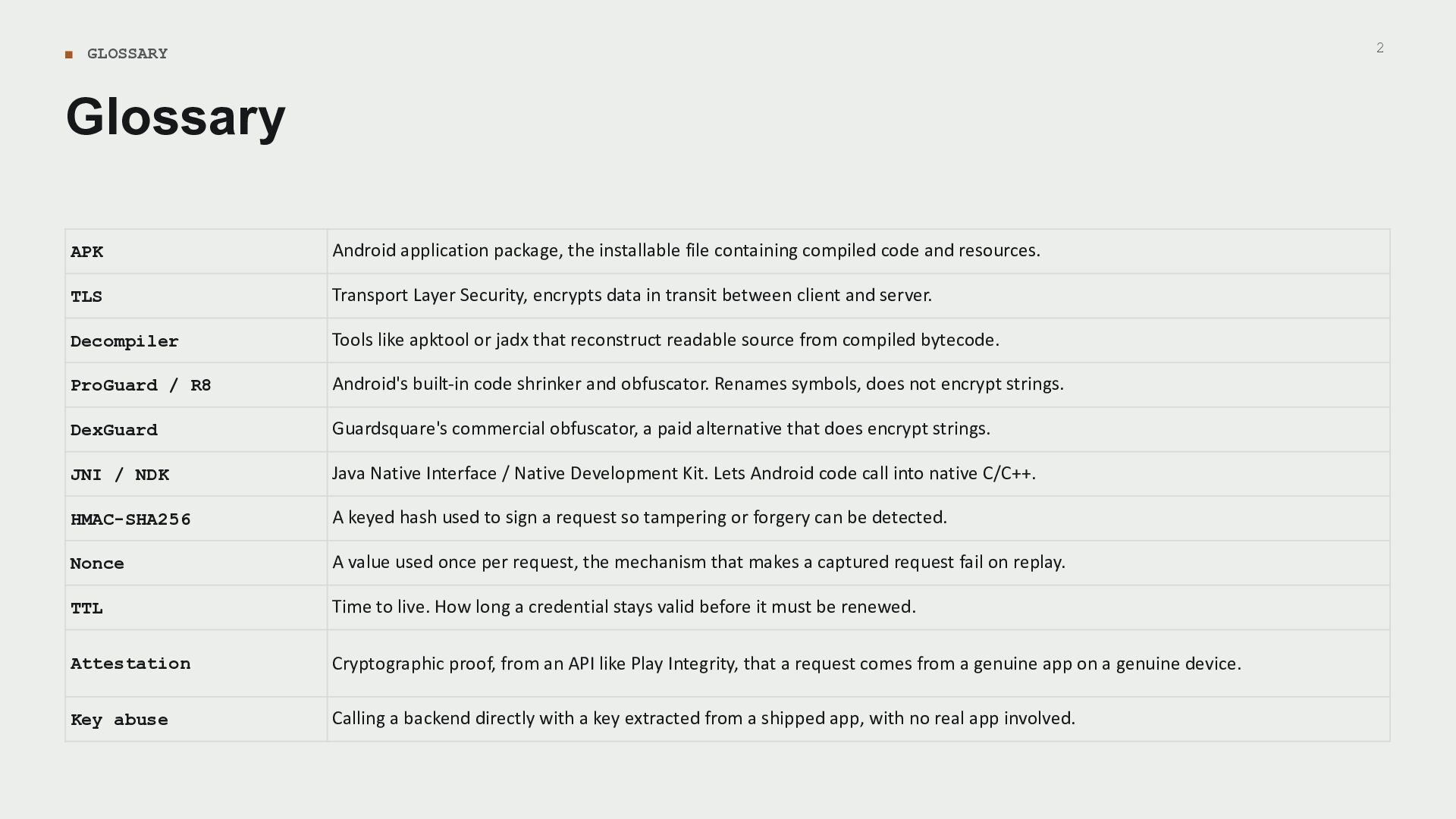
file containing compiled code and resources. TLS Transport Layer Security, encrypts data in transit between client and server. Decompiler Tools like apktool or jadx that reconstruct readable source from compiled bytecode. ProGuard / R8 Android's built-in code shrinker and obfuscator. Renames symbols, does not encrypt strings. DexGuard Guardsquare's commercial obfuscator, a paid alternative that does encrypt strings. JNI / NDK Java Native Interface / Native Development Kit. Lets Android code call into native C/C++. HMAC-SHA256 A keyed hash used to sign a request so tampering or forgery can be detected. Nonce A value used once per request, the mechanism that makes a captured request fail on replay. TTL Time to live. How long a credential stays valid before it must be renewed. Attestation Cryptographic proof, from an API like Play Integrity, that a request comes from a genuine app on a genuine device. Key abuse Calling a backend directly with a key extracted from a shipped app, with no real app involved.
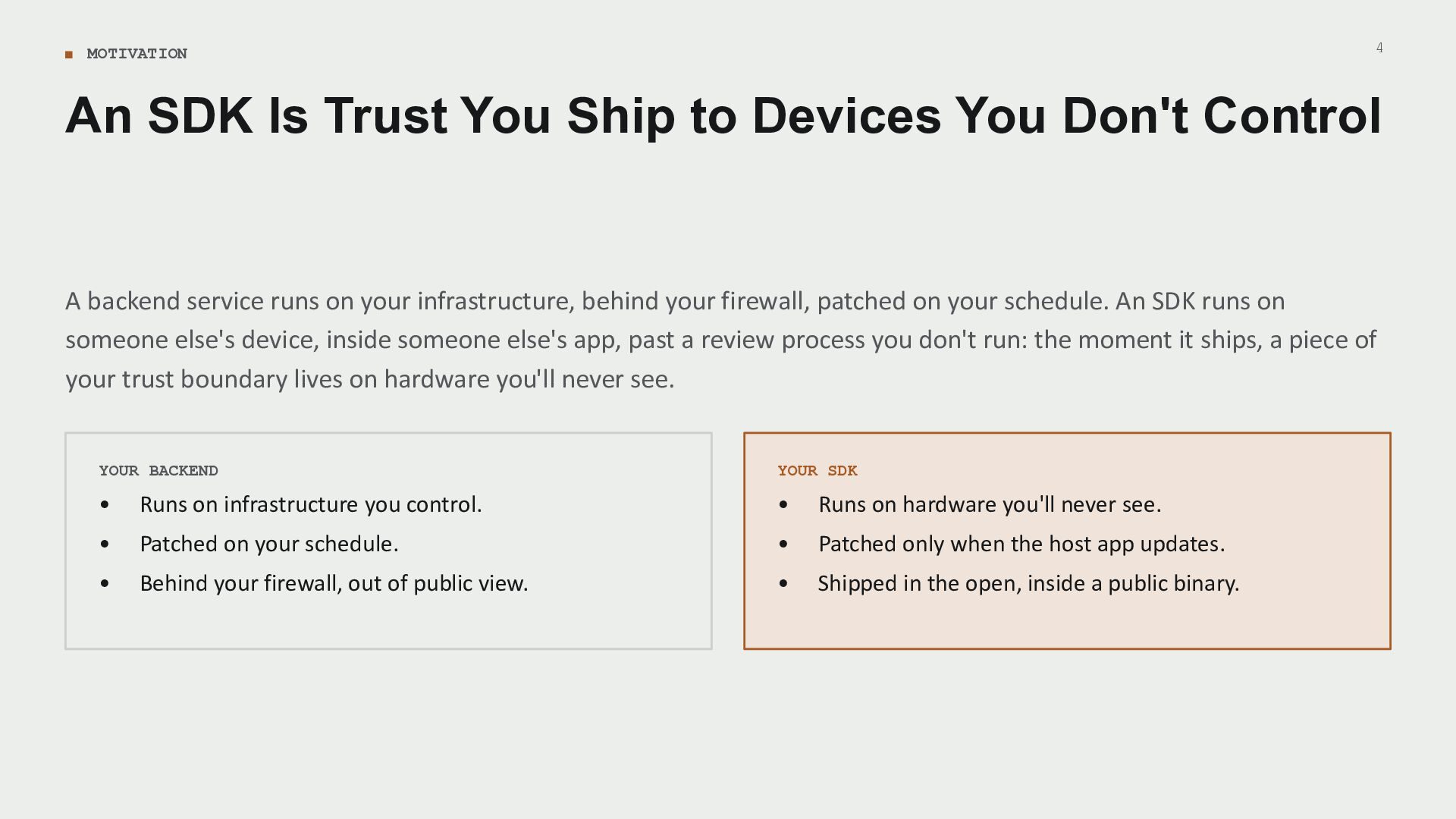
Devices You Don't Control A backend service runs on your infrastructure, behind your firewall, patched on your schedule. An SDK runs on someone else's device, inside someone else's app, past a review process you don't run: the moment it ships, a piece of your trust boundary lives on hardware you'll never see. YOUR BACKEND YOUR SDK • Runs on infrastructure you control. • Runs on hardware you'll never see. • Patched on your schedule. • Patched only when the host app updates. • Behind your firewall, out of public view. • Shipped in the open, inside a public binary.
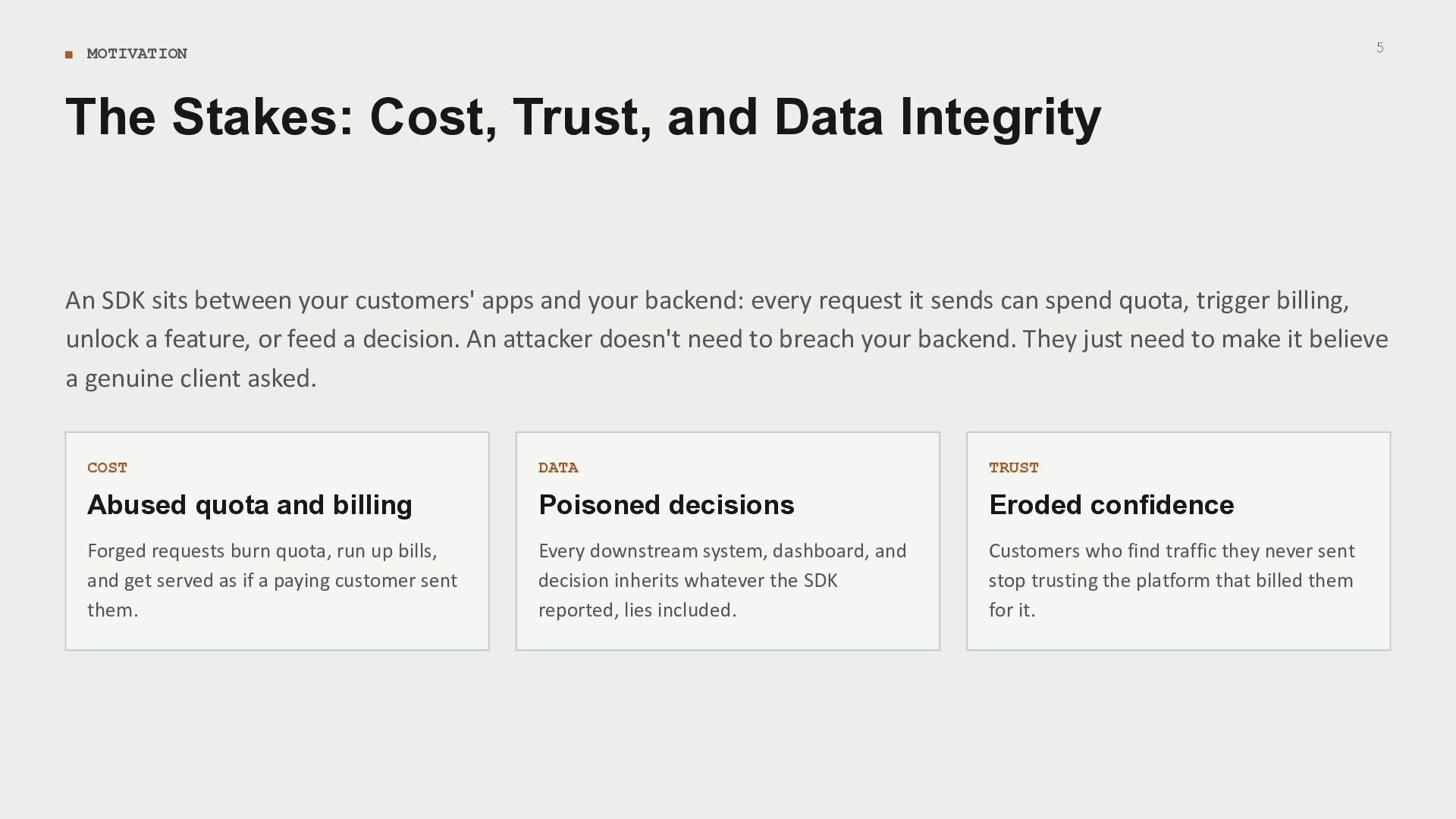
An SDK sits between your customers' apps and your backend: every request it sends can spend quota, trigger billing, unlock a feature, or feed a decision. An attacker doesn't need to breach your backend. They just need to make it believe a genuine client asked. COST DATA TRUST Abused quota and billing Poisoned decisions Eroded confidence Forged requests burn quota, run up bills, and get served as if a paying customer sent them. Every downstream system, dashboard, and decision inherits whatever the SDK reported, lies included. Customers who find traffic they never sent stop trusting the platform that billed them for it.
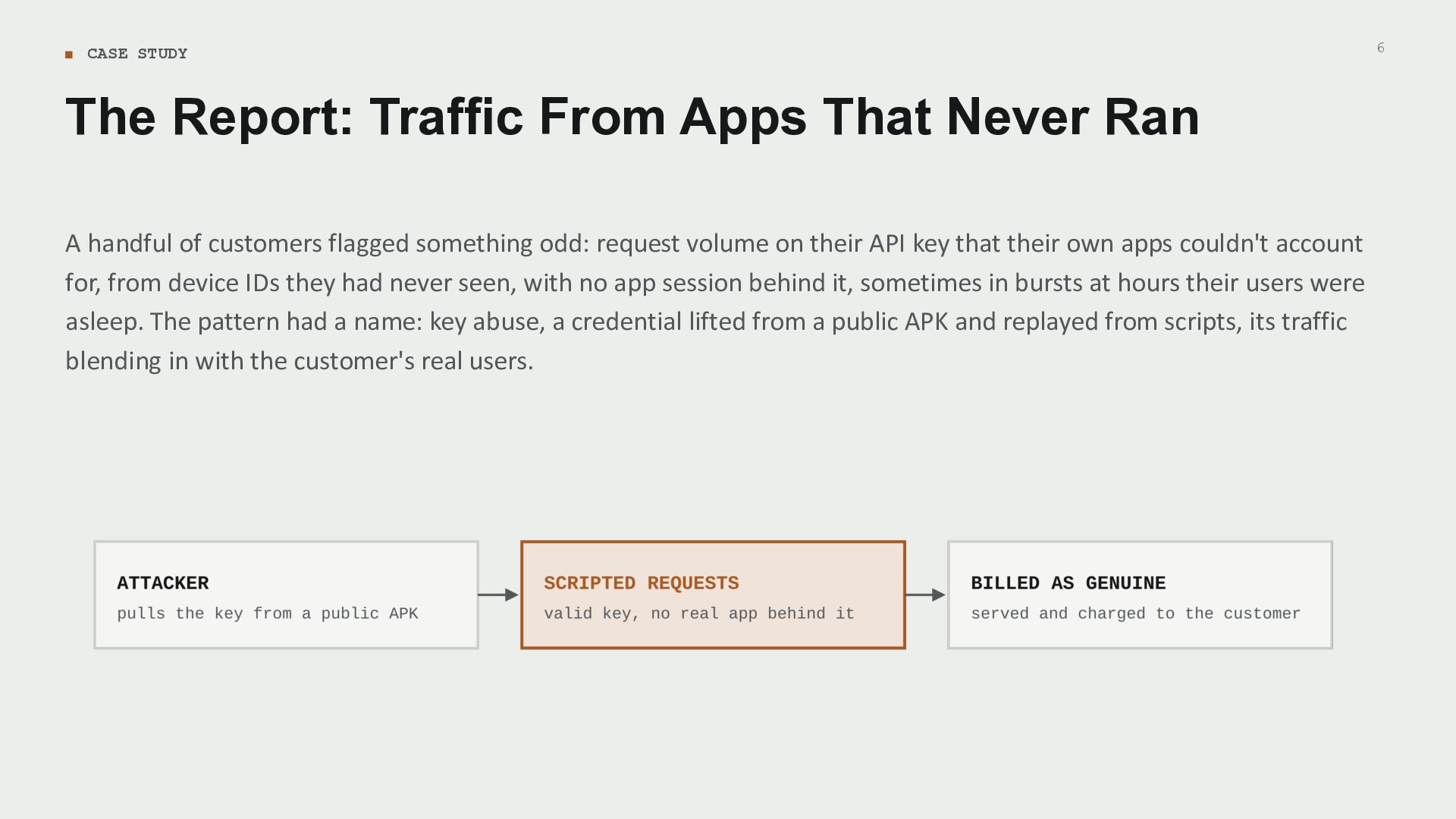
Ran A handful of customers flagged something odd: request volume on their API key that their own apps couldn't account for, from device IDs they had never seen, with no app session behind it, sometimes in bursts at hours their users were asleep. The pattern had a name: key abuse, a credential lifted from a public APK and replayed from scripts, its traffic blending in with the customer's real users. 6
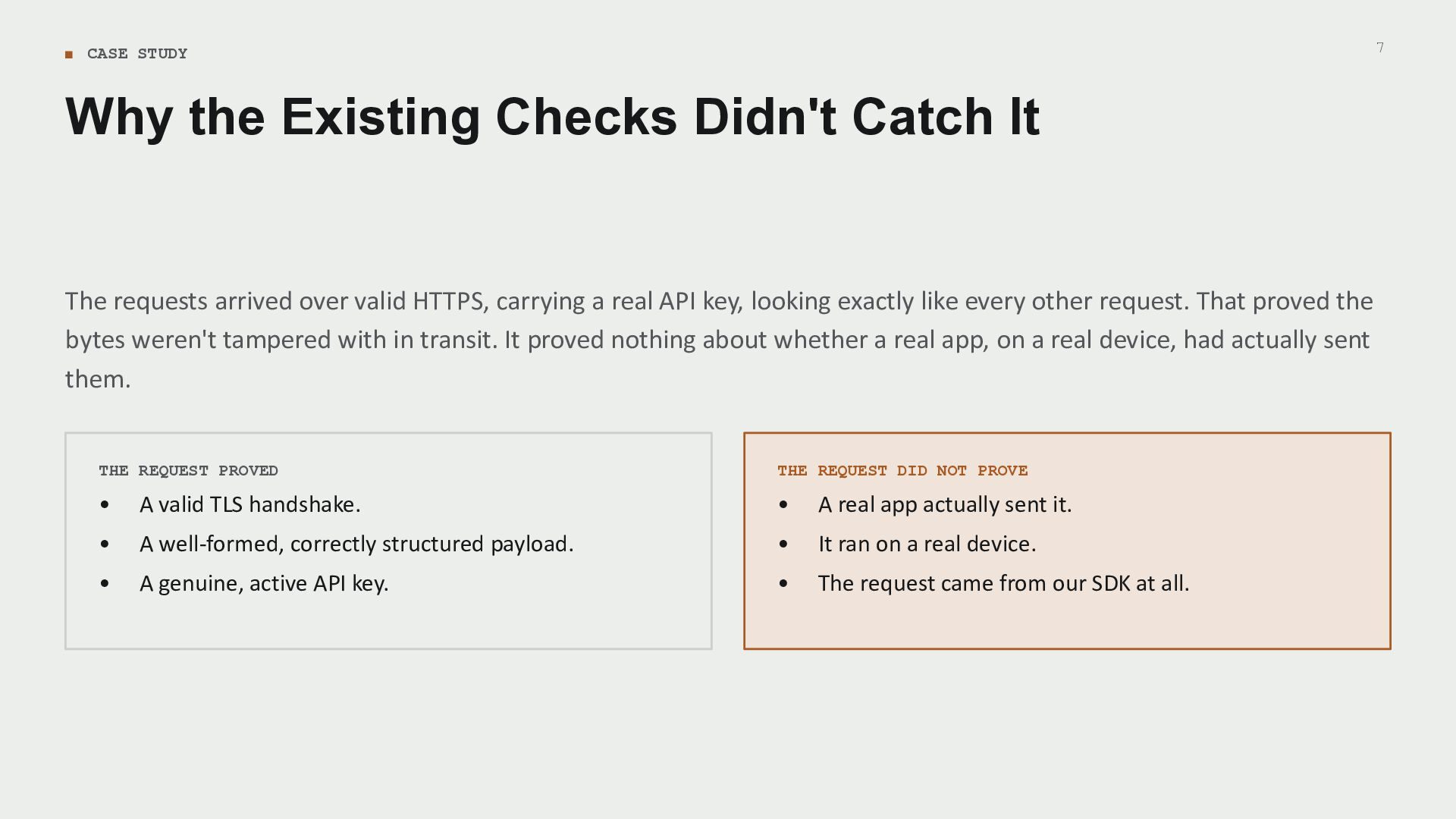
It The requests arrived over valid HTTPS, carrying a real API key, looking exactly like every other request. That proved the bytes weren't tampered with in transit. It proved nothing about whether a real app, on a real device, had actually sent them. THE REQUEST PROVED THE REQUEST DID NOT PROVE • A valid TLS handshake. • A real app actually sent it. • A well-formed, correctly structured payload. • It ran on a real device. • A genuine, active API key. • The request came from our SDK at all.
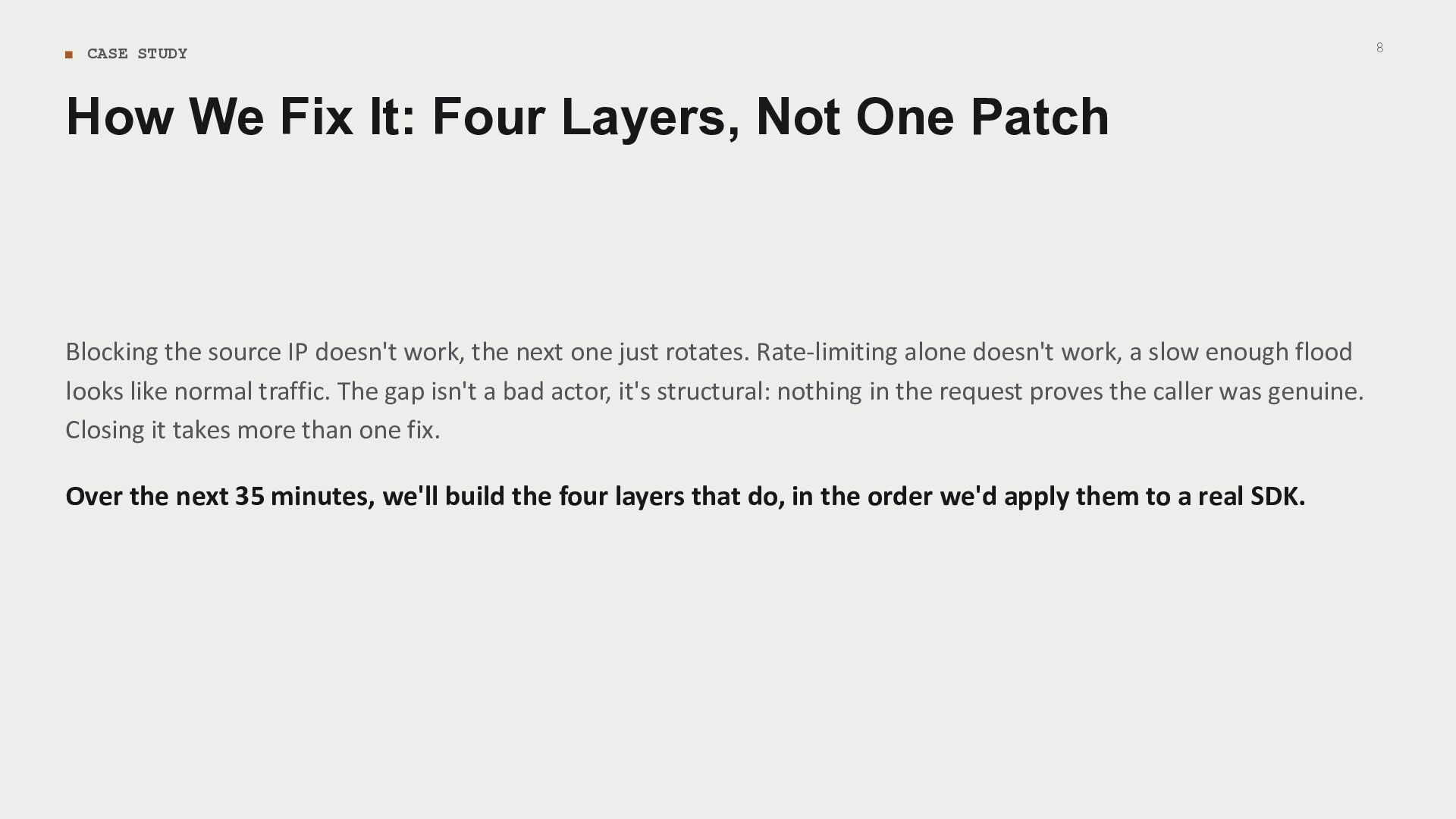
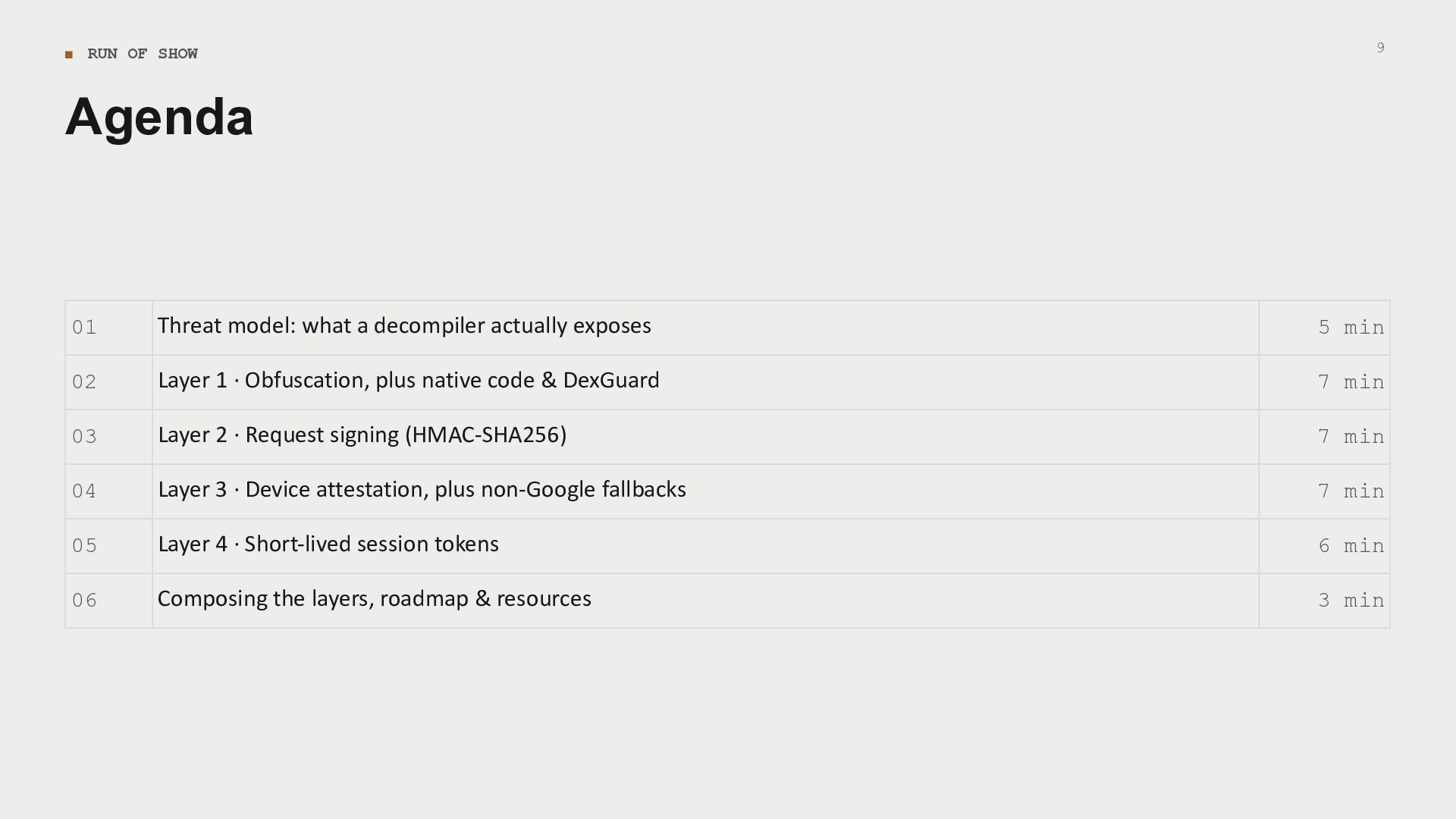
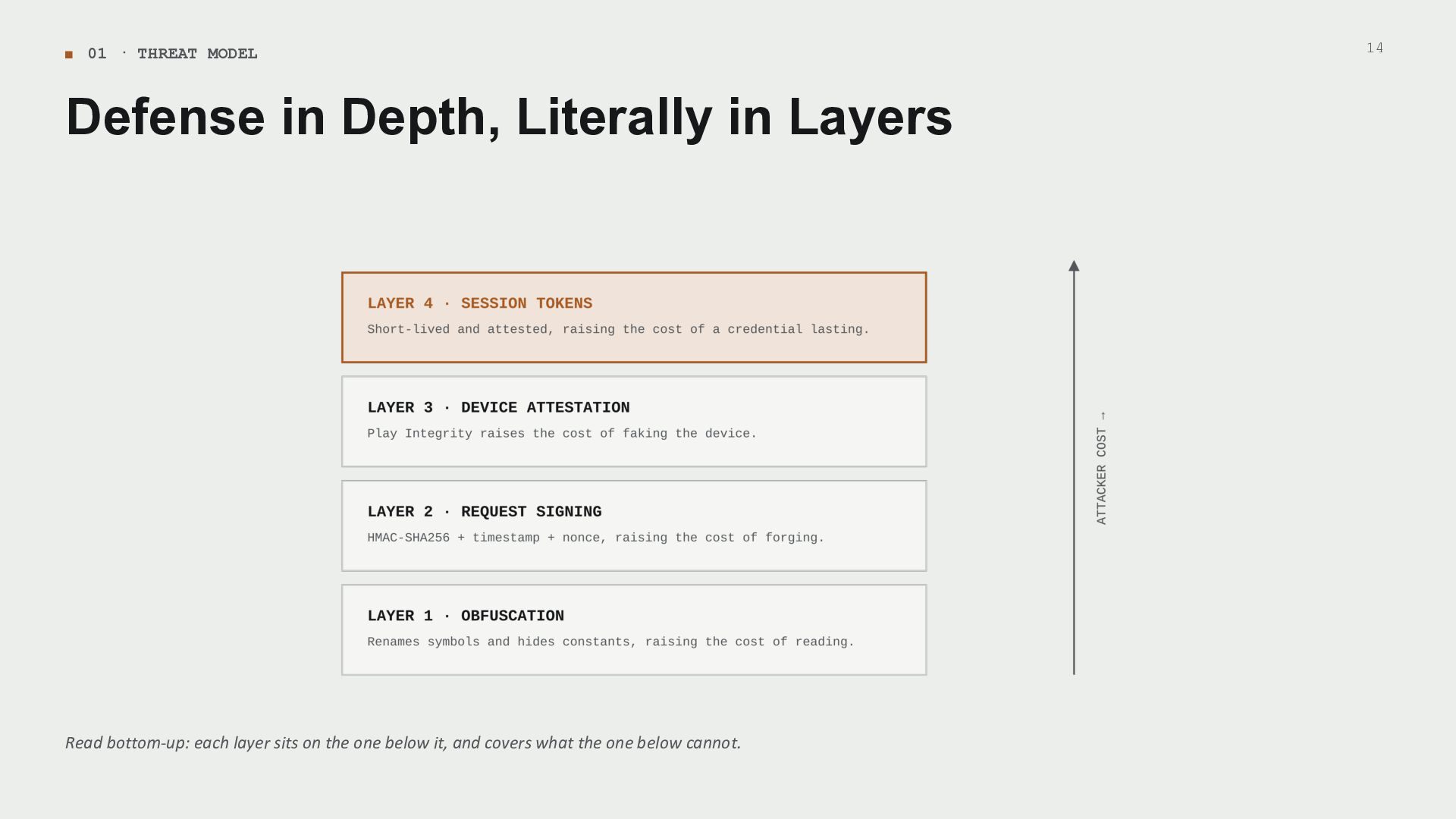
One Patch Blocking the source IP doesn't work, the next one just rotates. Rate-limiting alone doesn't work, a slow enough flood looks like normal traffic. The gap isn't a bad actor, it's structural: nothing in the request proves the caller was genuine. Closing it takes more than one fix. Over the next 35 minutes, we'll build the four layers that do, in the order we'd apply them to a real SDK. 8
the Examples Every code sample in this talk is written against a generic SDK that talks to its own backend, a stand-in for the pattern, not a specific product. The mechanisms transfer directly: obfuscation, signing, attestation, and short-lived tokens work the same way regardless of what your SDK actually does. Adjust the field names, the endpoints, and the specific integrity checks that matter, to your own use case.
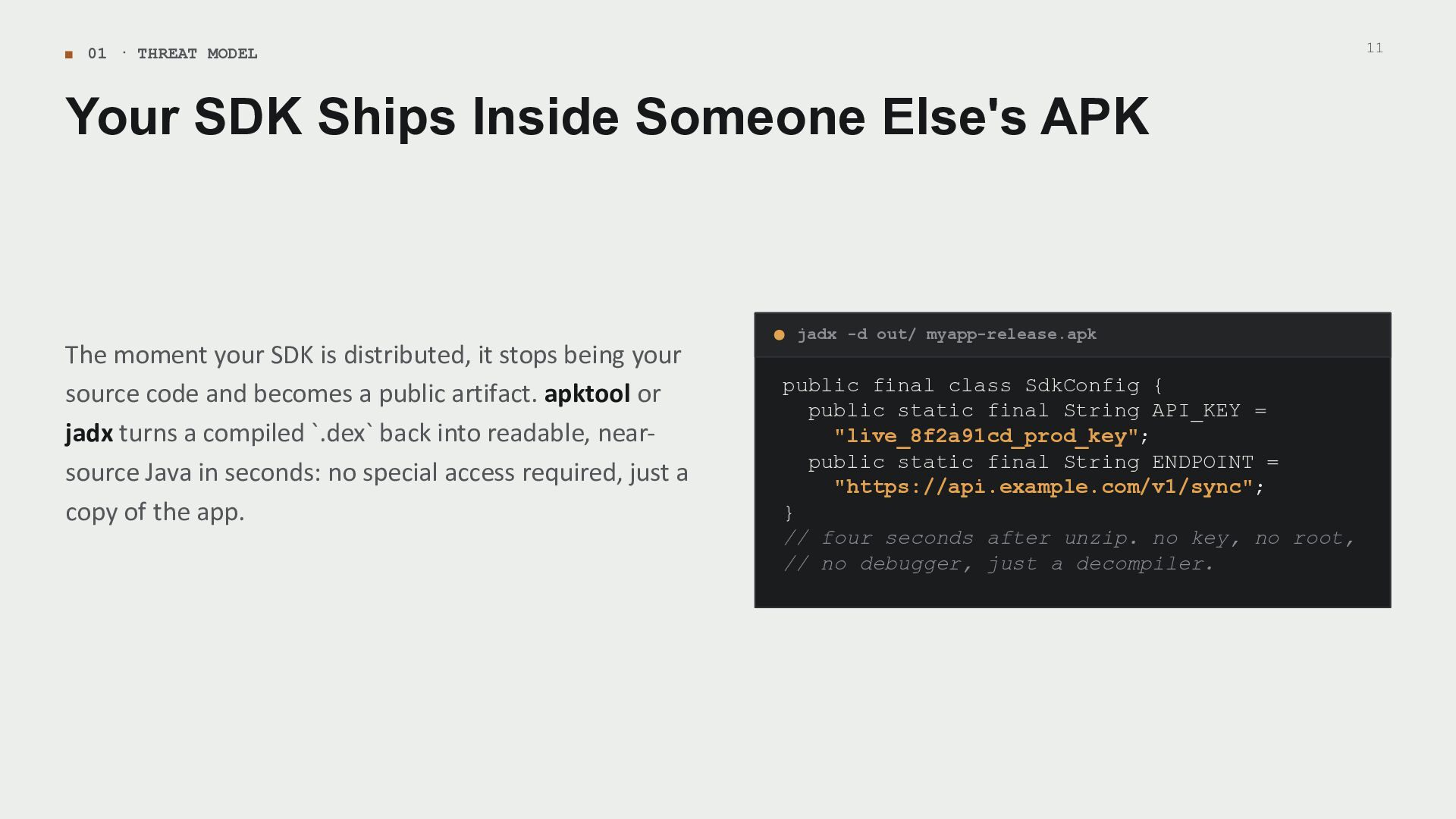
Someone Else's APK The moment your SDK is distributed, it stops being your source code and becomes a public artifact. apktool or jadx turns a compiled `.dex` back into readable, nearsource Java in seconds: no special access required, just a copy of the app. jadx -d out/ myapp-release.apk public final class SdkConfig { public static final String API_KEY = "live_8f2a91cd_prod_key"; public static final String ENDPOINT = "https://api.example.com/v1/sync"; } // four seconds after unzip. no key, no root, // no debugger, just a decompiler.
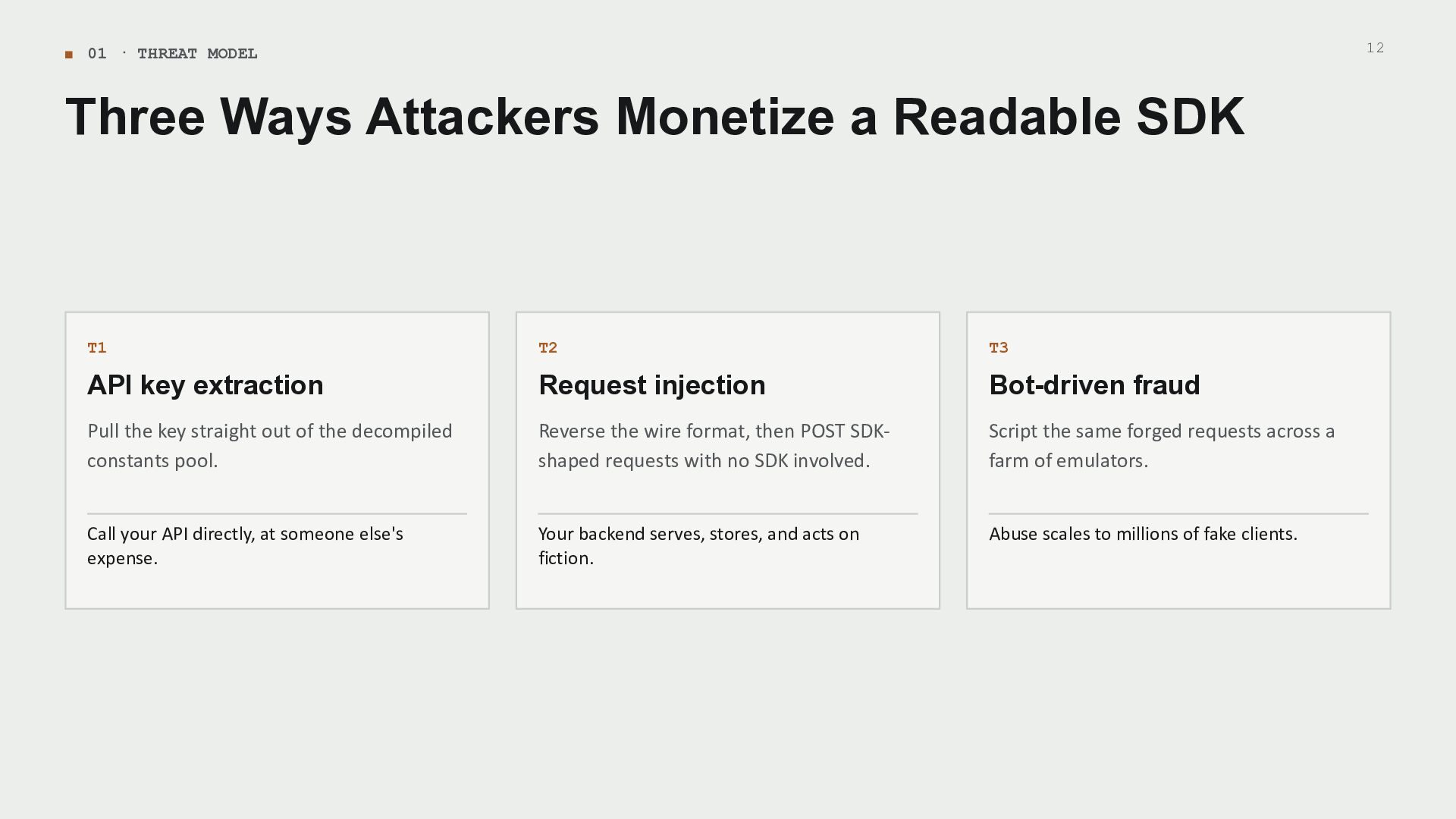
a Readable SDK T1 T2 T3 API key extraction Request injection Bot-driven fraud Pull the key straight out of the decompiled constants pool. Reverse the wire format, then POST SDKshaped requests with no SDK involved. Script the same forged requests across a farm of emulators. Call your API directly, at someone else's expense. Your backend serves, stores, and acts on fiction. Abuse scales to millions of fake clients.
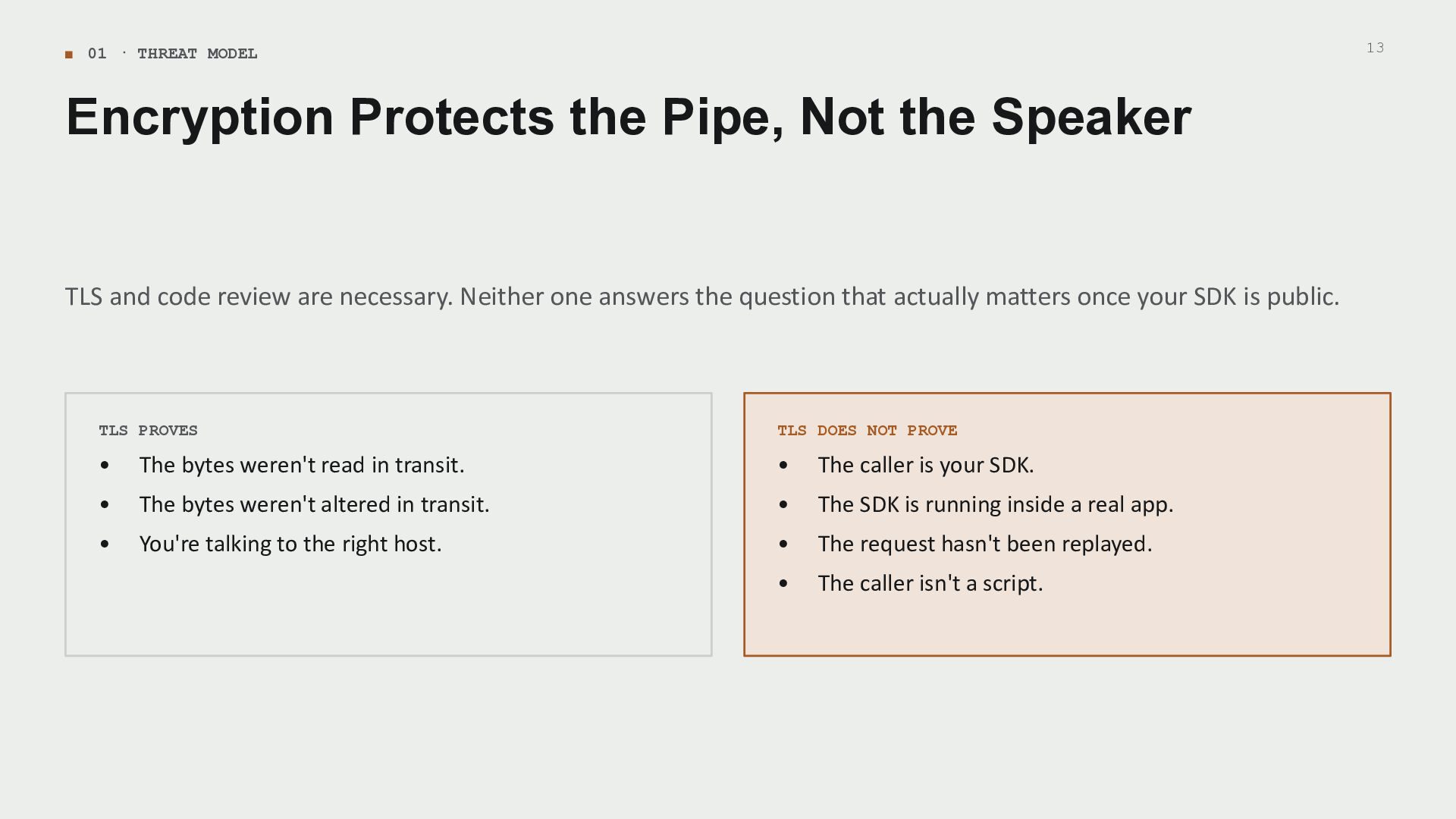
Not the Speaker TLS and code review are necessary. Neither one answers the question that actually matters once your SDK is public. TLS PROVES TLS DOES NOT PROVE • The bytes weren't read in transit. • The caller is your SDK. • The bytes weren't altered in transit. • The SDK is running inside a real app. • You're talking to the right host. • The request hasn't been replayed. • The caller isn't a script.
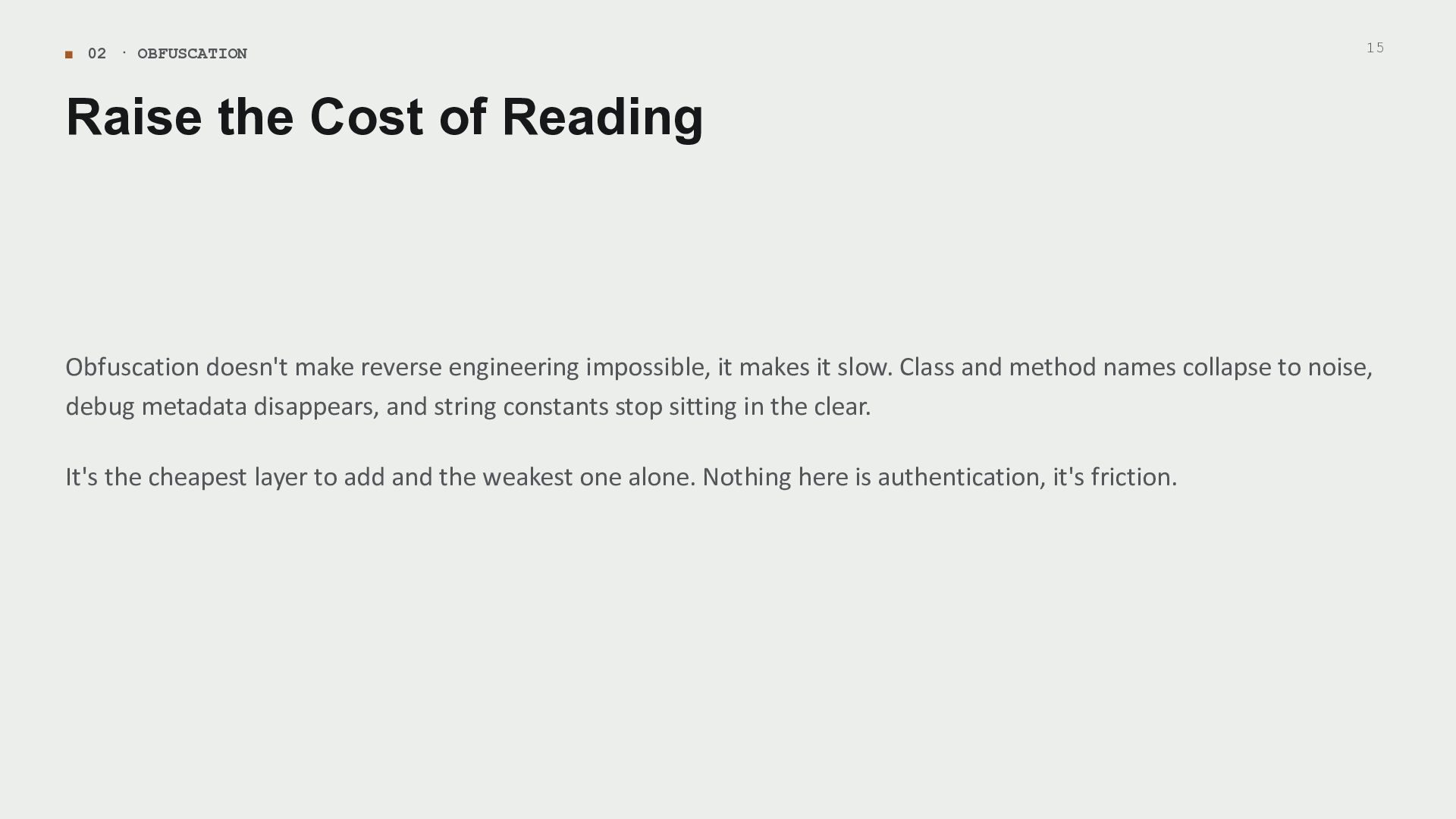
Obfuscation doesn't make reverse engineering impossible, it makes it slow. Class and method names collapse to noise, debug metadata disappears, and string constants stop sitting in the clear. It's the cheapest layer to add and the weakest one alone. Nothing here is authentication, it's friction.
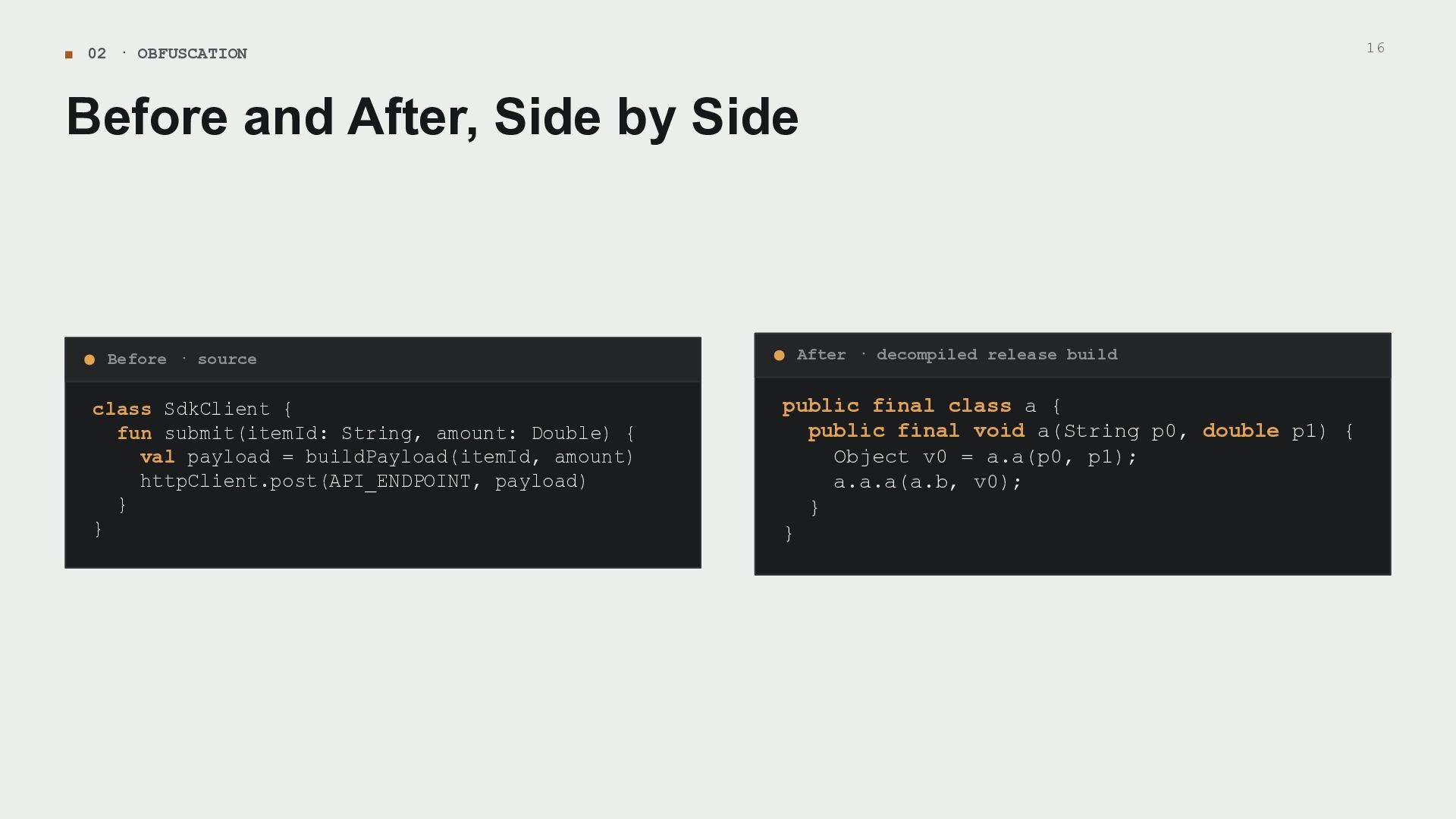
Side Before · source class SdkClient { fun submit(itemId: String, amount: Double) { val payload = buildPayload(itemId, amount) httpClient.post(API_ENDPOINT, payload) } } After · decompiled release build public final class a { public final void a(String p0, double p1) { Object v0 = a.a(p0, p1); a.a.a(a.b, v0); } }
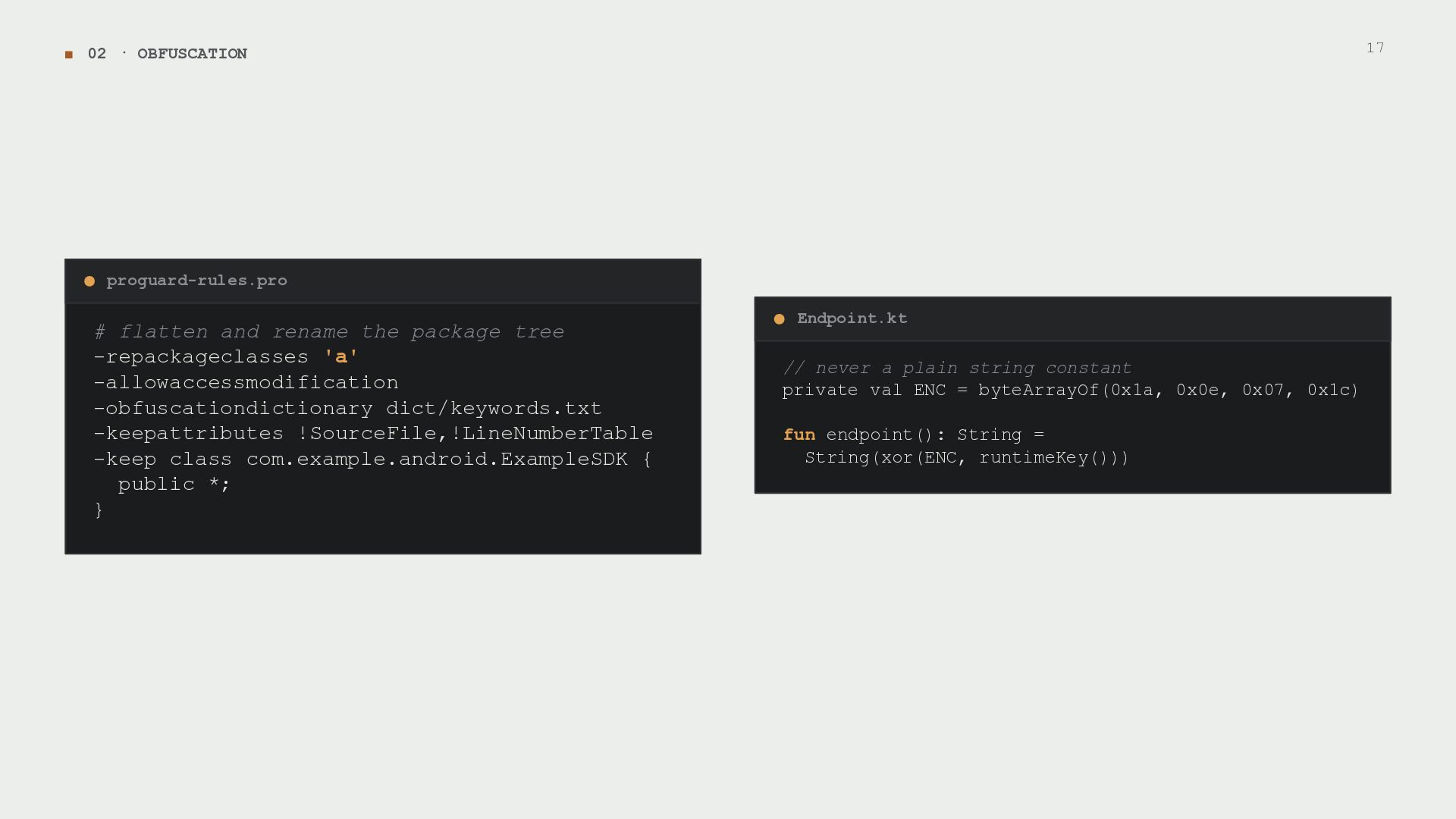
the package tree -repackageclasses 'a' -allowaccessmodification -obfuscationdictionary dict/keywords.txt -keepattributes !SourceFile,!LineNumberTable -keep class com.example.android.ExampleSDK { public *; } Endpoint.kt // never a plain string constant private val ENC = byteArrayOf(0x1a, 0x0e, 0x07, 0x1c) fun endpoint(): String = String(xor(ENC, runtimeKey()))
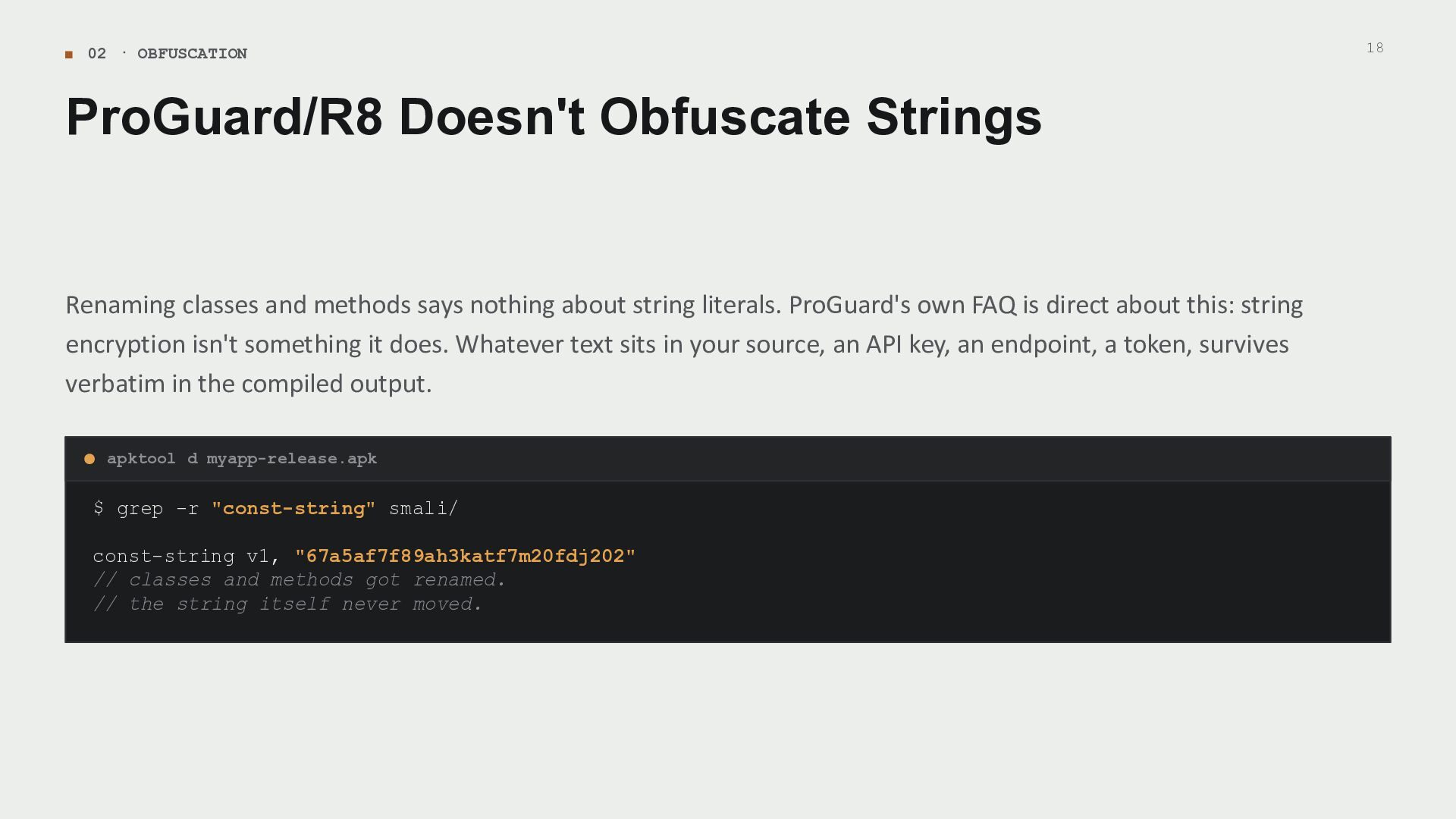
and methods says nothing about string literals. ProGuard's own FAQ is direct about this: string encryption isn't something it does. Whatever text sits in your source, an API key, an endpoint, a token, survives verbatim in the compiled output. apktool d myapp-release.apk $ grep -r "const-string" smali/ const-string v1, "67a5af7f89ah3katf7m20fdj202" // classes and methods got renamed. // the string itself never moved. 18
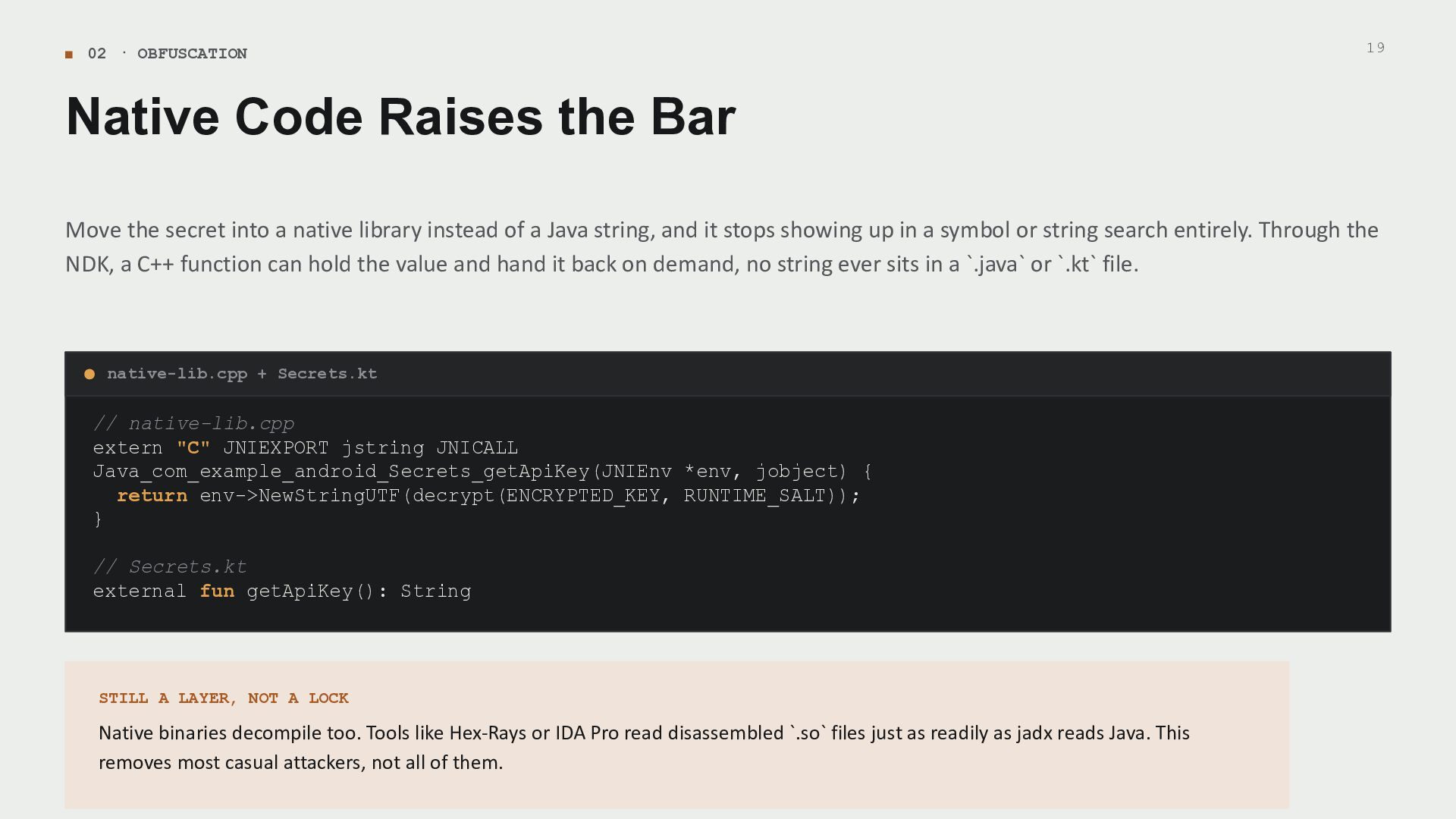
Move the secret into a native library instead of a Java string, and it stops showing up in a symbol or string search entirely. Through the NDK, a C++ function can hold the value and hand it back on demand, no string ever sits in a `.java` or `.kt` file. native-lib.cpp + Secrets.kt // native-lib.cpp extern "C" JNIEXPORT jstring JNICALL Java_com_example_android_Secrets_getApiKey(JNIEnv *env, jobject) { return env->NewStringUTF(decrypt(ENCRYPTED_KEY, RUNTIME_SALT)); } // Secrets.kt external fun getApiKey(): String STILL A LAYER, NOT A LOCK Native binaries decompile too. Tools like Hex-Rays or IDA Pro read disassembled `.so` files just as readily as jadx reads Java. This removes most casual attackers, not all of them.
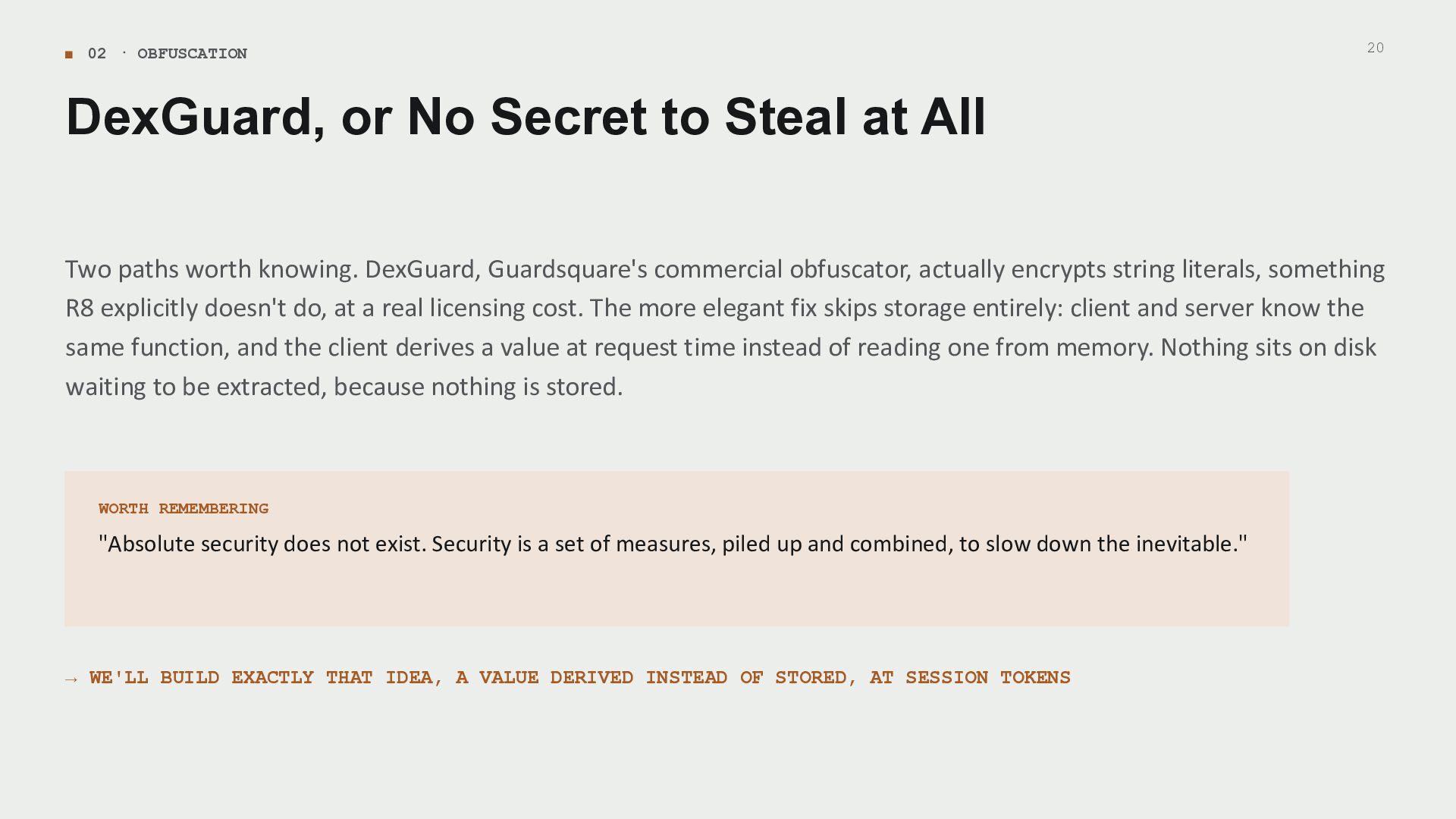
Steal at All Two paths worth knowing. DexGuard, Guardsquare's commercial obfuscator, actually encrypts string literals, something R8 explicitly doesn't do, at a real licensing cost. The more elegant fix skips storage entirely: client and server know the same function, and the client derives a value at request time instead of reading one from memory. Nothing sits on disk waiting to be extracted, because nothing is stored. WORTH REMEMBERING "Absolute security does not exist. Security is a set of measures, piled up and combined, to slow down the inevitable." → WE'LL BUILD EXACTLY THAT IDEA, A VALUE DERIVED INSTEAD OF STORED, AT SESSION TOKENS
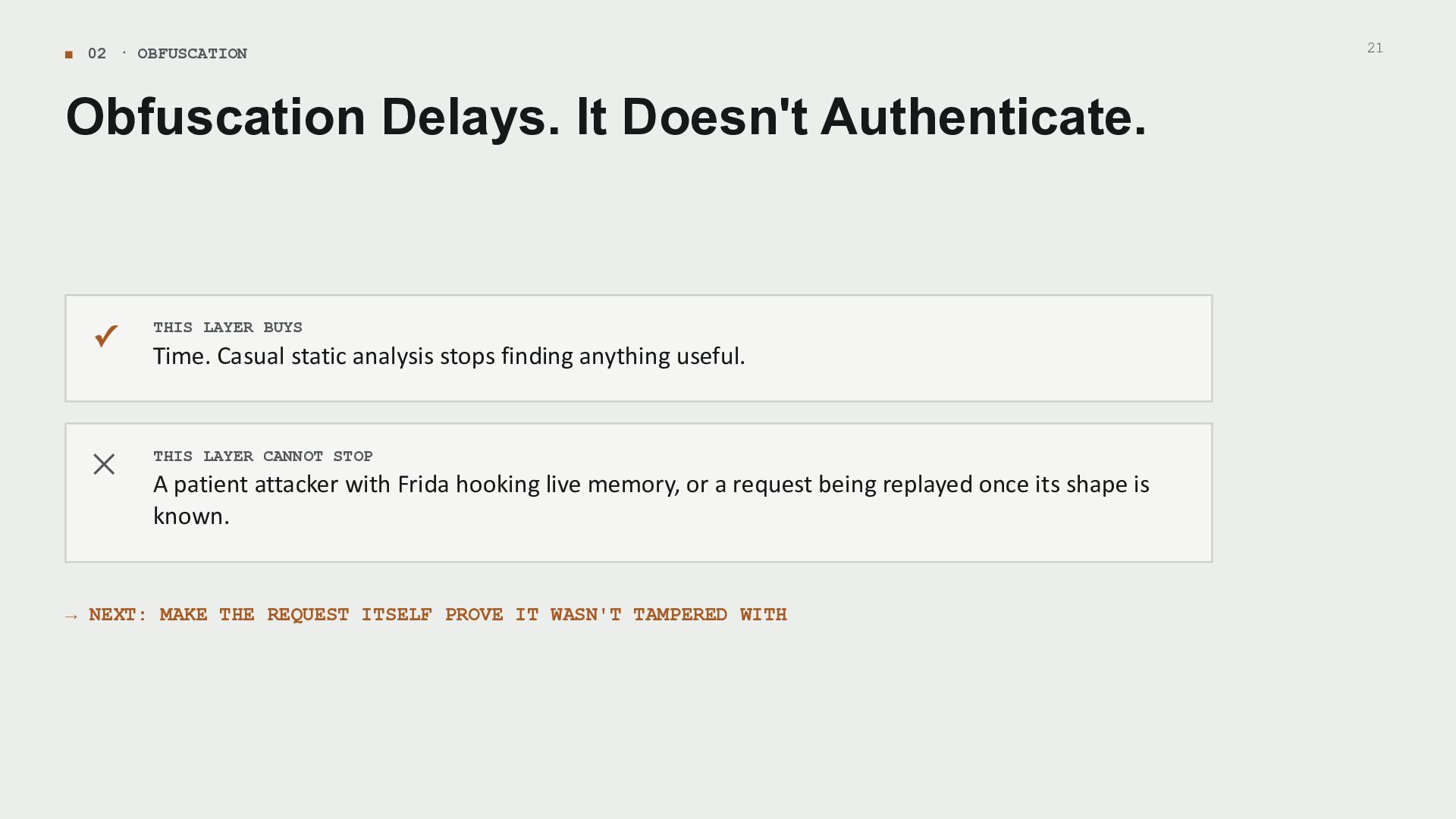
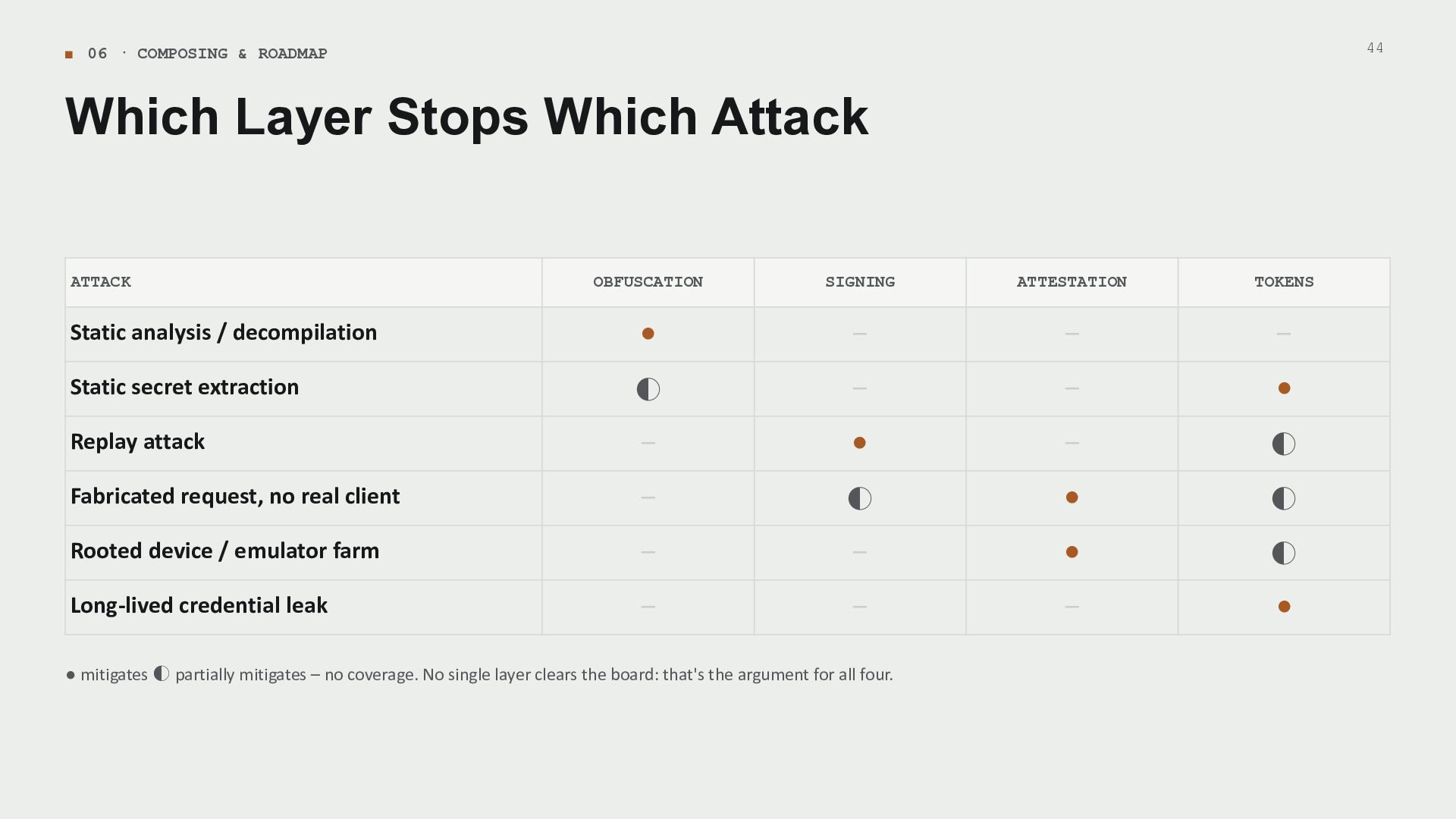
THIS LAYER BUYS ✕ THIS LAYER CANNOT STOP Time. Casual static analysis stops finding anything useful. A patient attacker with Frida hooking live memory, or a request being replayed once its shape is known. → NEXT: MAKE THE REQUEST ITSELF PROVE IT WASN'T TAMPERED WITH 21
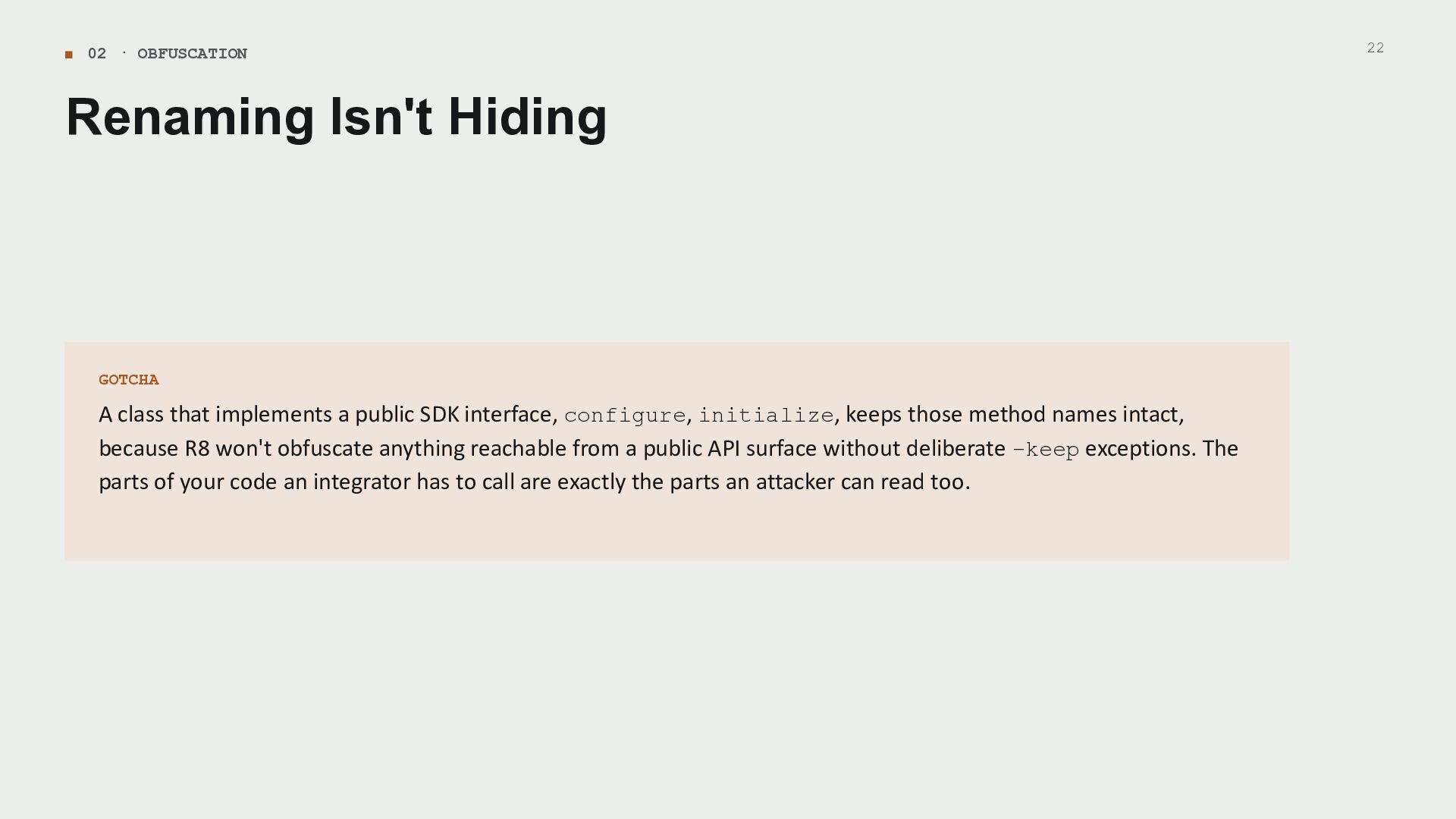
that implements a public SDK interface, configure, initialize, keeps those method names intact, because R8 won't obfuscate anything reachable from a public API surface without deliberate -keep exceptions. The parts of your code an integrator has to call are exactly the parts an attacker can read too. 22
Fabrication Once an attacker has seen one real request, from a network capture or reversed code, nothing stops them replaying it verbatim, or handcrafting new payloads that look identical, straight from a script with no app and no SDK involved at all.
Stops DROP THIS AND THIS HAPPENS Timestamp A captured request replays successfully forever. No expiry window at all. Nonce A request replays any number of times within the timestamp window. Body hash The signature no longer covers the payload. An attacker swaps in a different body and keeps a valid signature on the headers. Secret key There's no signature at all. Any client can construct a request that looks identical to a genuine one.
Home ✓ THIS LAYER BUYS ✕ THIS LAYER CANNOT STOP Immunity to replay and to naive fabrication: a request without the secret can't produce a valid signature. The secret itself being extracted from the binary. We've hardened how a request is authenticated, not what is making it. → NEXT: PROVE THE REQUEST COMES FROM A GENUINE DEVICE 27
GOTCHA A ±5 minute timestamp window isn't a fixed rule, it's a dial. Too wide and you've reopened a replay window; too narrow and ordinary clock drift on real devices starts producing false rejections. Tune it against your own telemetry, not a default someone else picked. 28
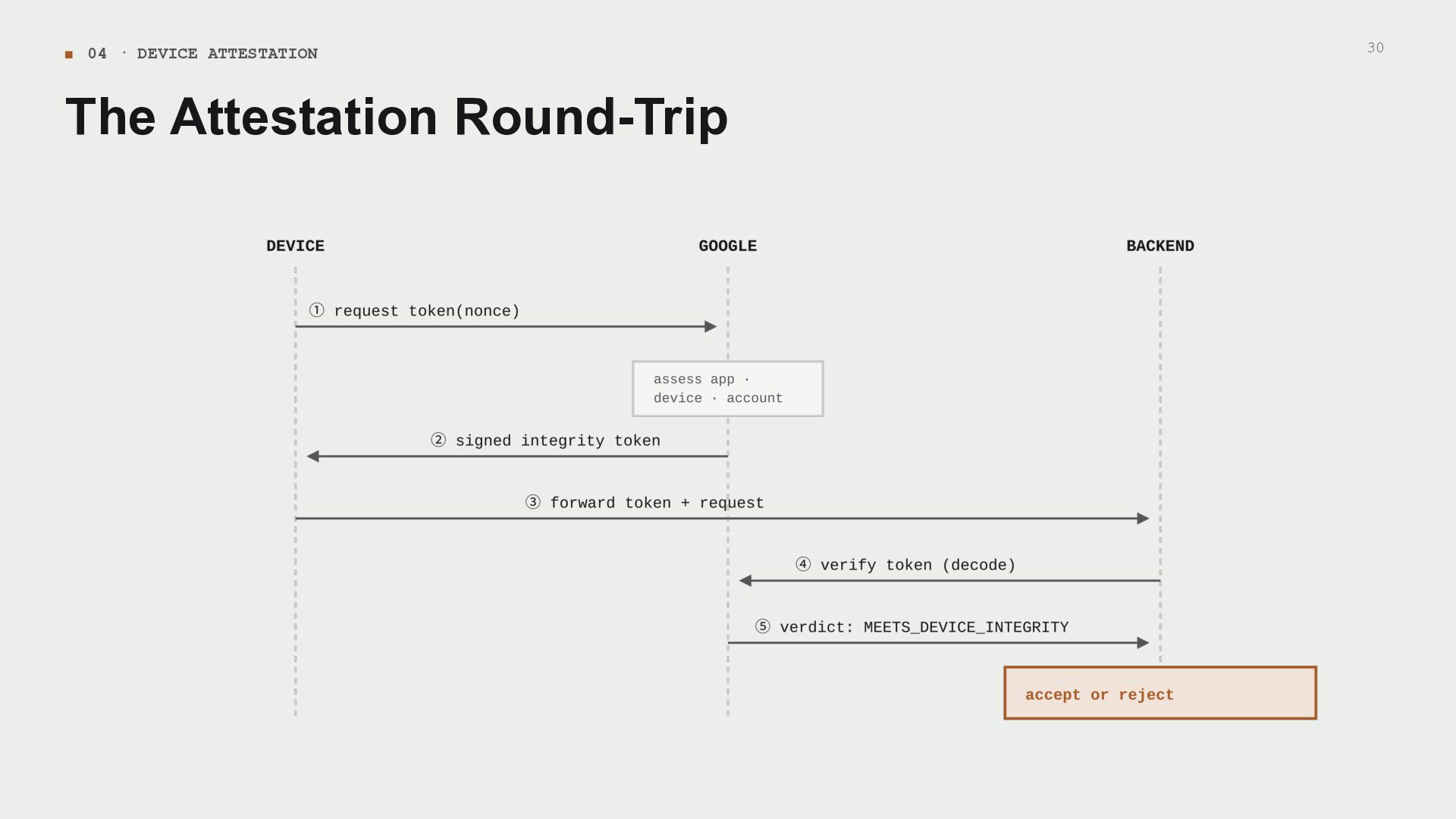
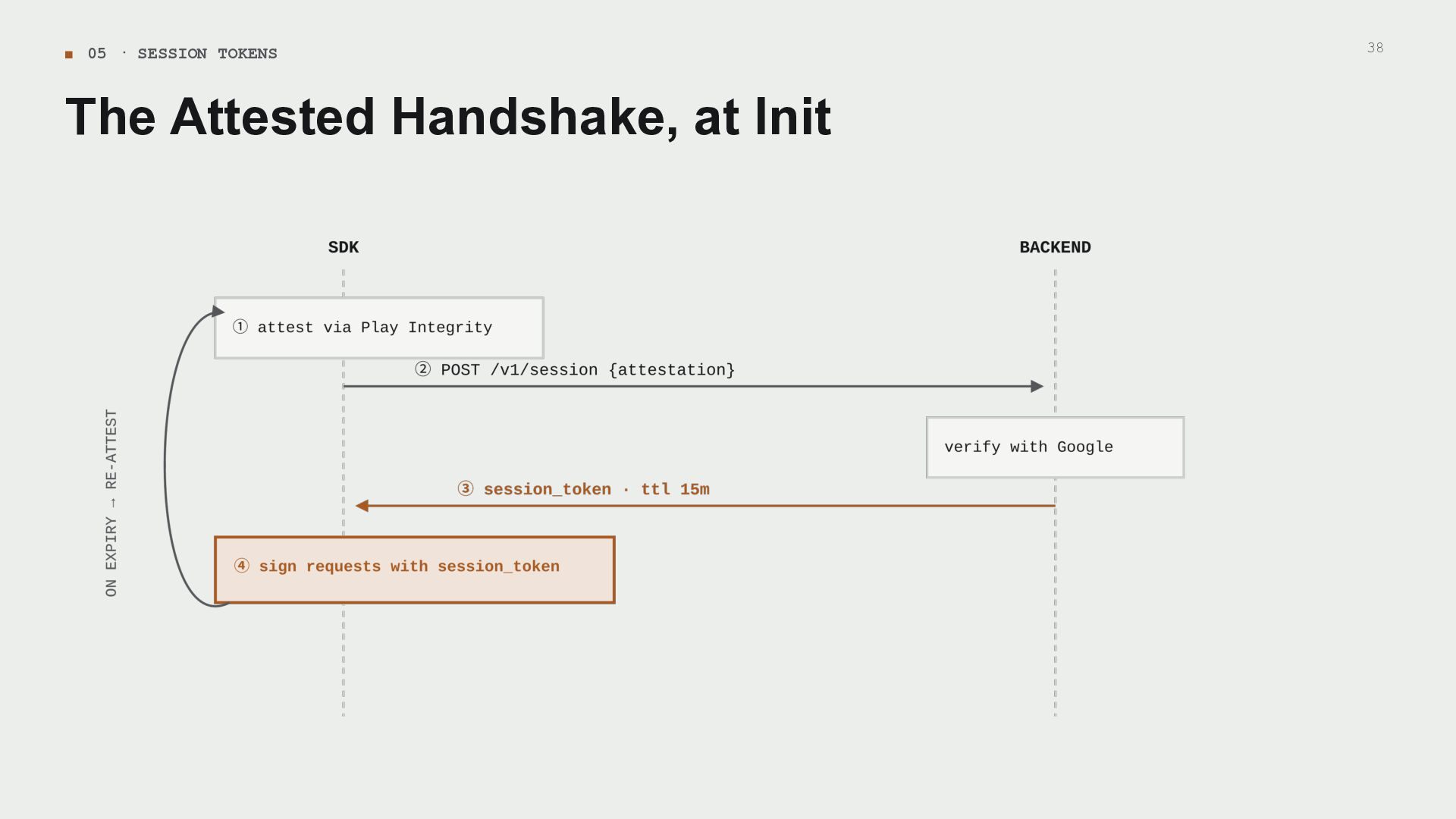
App + Device The Play Integrity API lets a device ask Google to vouch, cryptographically, for three things at once: the app binary matches what you published, the device passes Google's integrity checks, and the Play account behind it is in good standing. 29
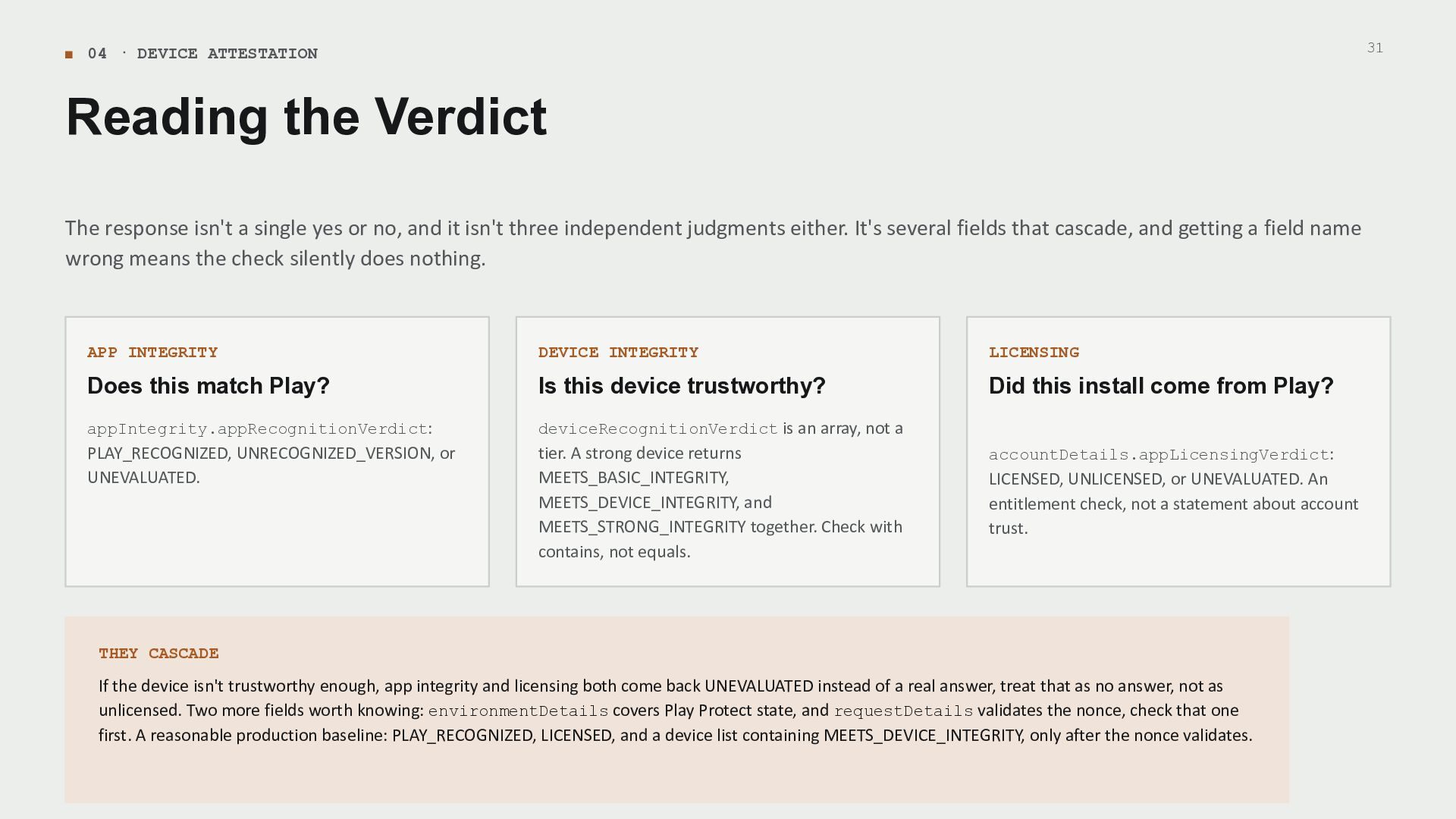
response isn't a single yes or no, and it isn't three independent judgments either. It's several fields that cascade, and getting a field name wrong means the check silently does nothing. APP INTEGRITY DEVICE INTEGRITY LICENSING Does this match Play? Is this device trustworthy? Did this install come from Play? appIntegrity.appRecognitionVerdict: deviceRecognitionVerdict is an array, not a PLAY_RECOGNIZED, UNRECOGNIZED_VERSION, or UNEVALUATED. tier. A strong device returns MEETS_BASIC_INTEGRITY, MEETS_DEVICE_INTEGRITY, and MEETS_STRONG_INTEGRITY together. Check with contains, not equals. accountDetails.appLicensingVerdict: LICENSED, UNLICENSED, or UNEVALUATED. An entitlement check, not a statement about account trust. THEY CASCADE If the device isn't trustworthy enough, app integrity and licensing both come back UNEVALUATED instead of a real answer, treat that as no answer, not as unlicensed. Two more fields worth knowing: environmentDetails covers Play Protect state, and requestDetails validates the nonce, check that one first. A reasonable production baseline: PLAY_RECOGNIZED, LICENSED, and a device list containing MEETS_DEVICE_INTEGRITY, only after the nonce validates.
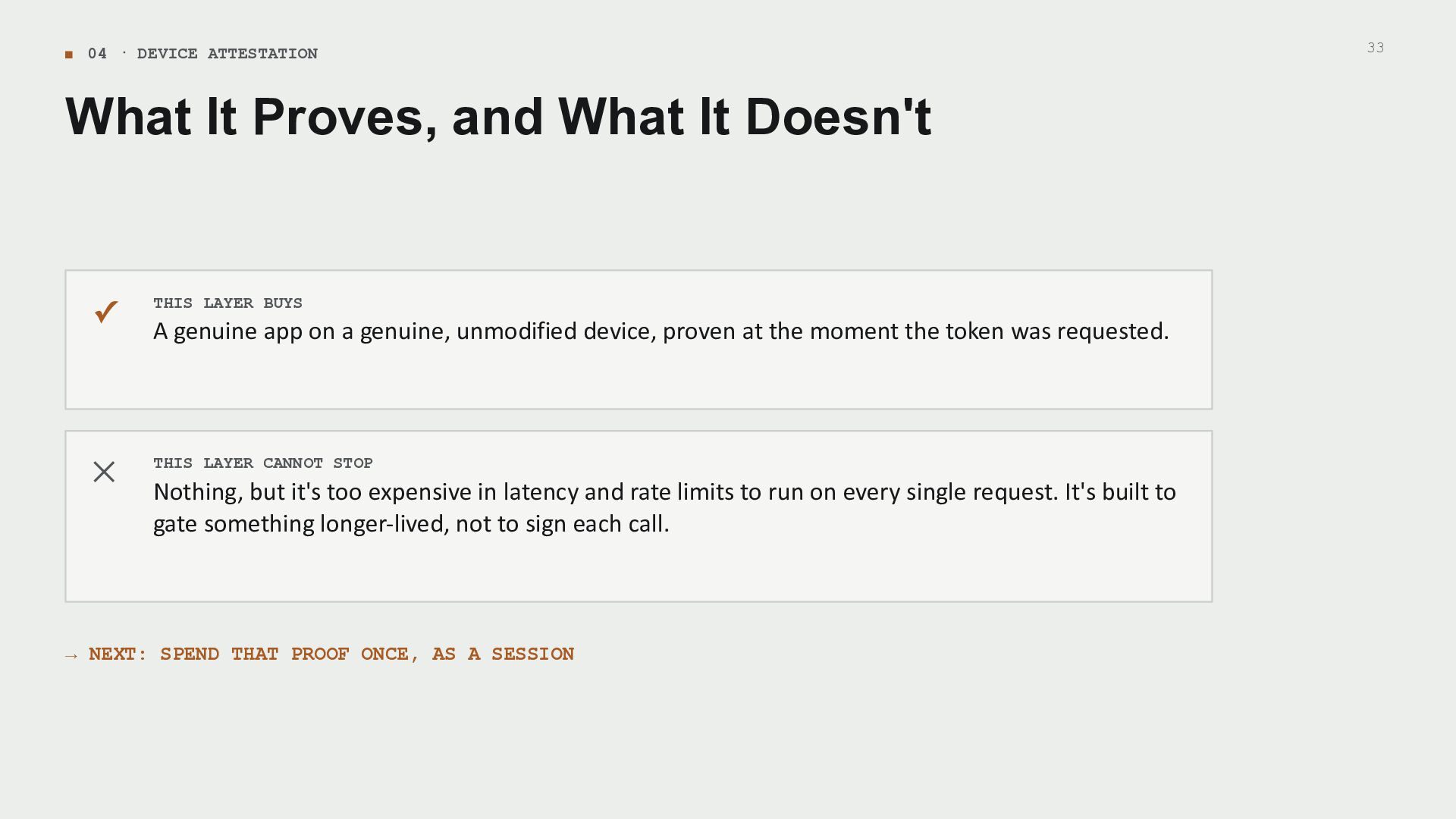
It Doesn't ✓ THIS LAYER BUYS ✕ THIS LAYER CANNOT STOP A genuine app on a genuine, unmodified device, proven at the moment the token was requested. Nothing, but it's too expensive in latency and rate limits to run on every single request. It's built to gate something longer-lived, not to sign each call. → NEXT: SPEND THAT PROOF ONCE, AS A SESSION 33
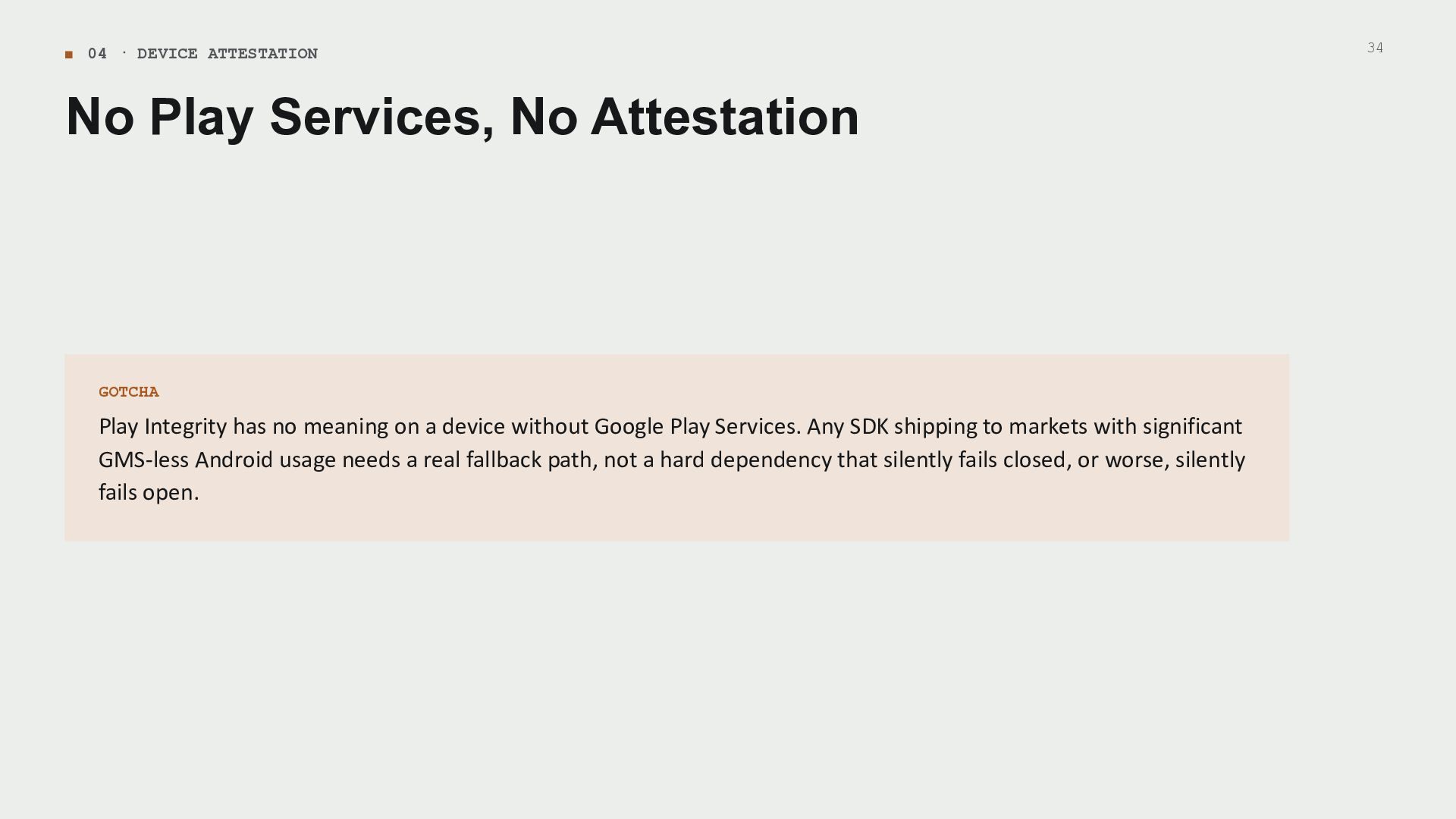
GOTCHA Play Integrity has no meaning on a device without Google Play Services. Any SDK shipping to markets with significant GMS-less Android usage needs a real fallback path, not a hard dependency that silently fails closed, or worse, silently fails open. 34
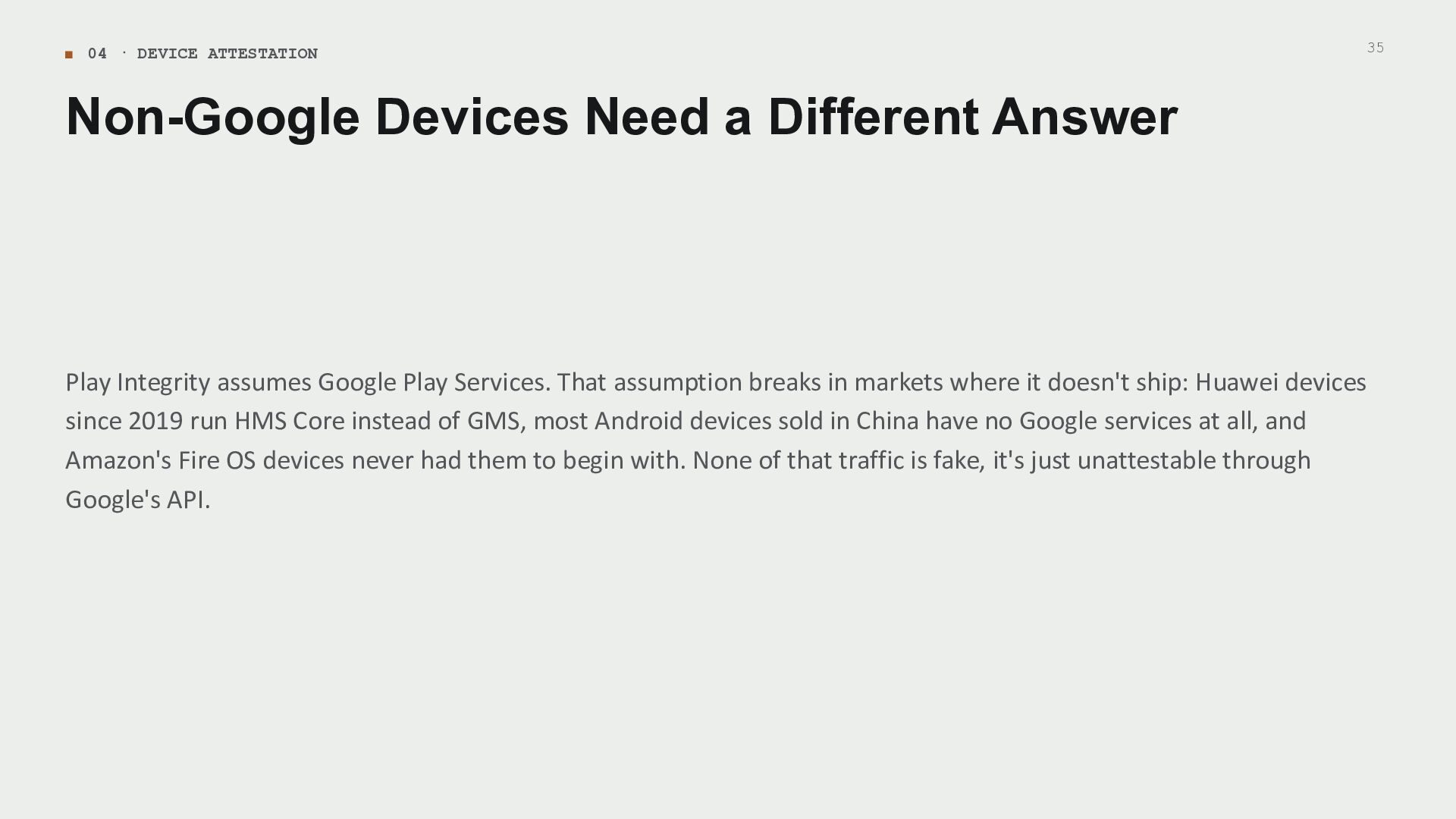
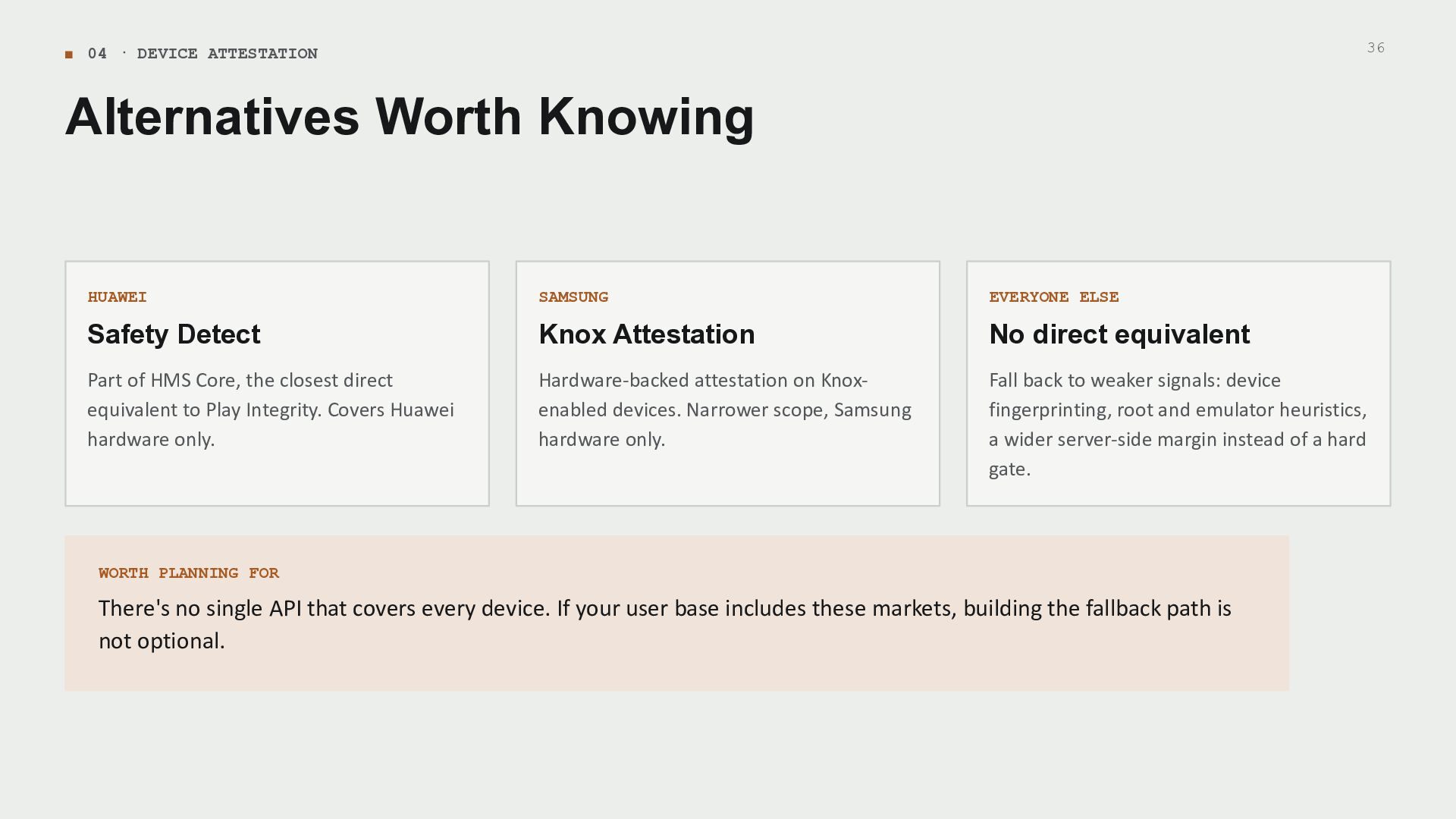
Different Answer Play Integrity assumes Google Play Services. That assumption breaks in markets where it doesn't ship: Huawei devices since 2019 run HMS Core instead of GMS, most Android devices sold in China have no Google services at all, and Amazon's Fire OS devices never had them to begin with. None of that traffic is fake, it's just unattestable through Google's API.
SAMSUNG EVERYONE ELSE Safety Detect Knox Attestation No direct equivalent Part of HMS Core, the closest direct equivalent to Play Integrity. Covers Huawei hardware only. Hardware-backed attestation on Knoxenabled devices. Narrower scope, Samsung hardware only. Fall back to weaker signals: device fingerprinting, root and emulator heuristics, a wider server-side margin instead of a hard gate. WORTH PLANNING FOR There's no single API that covers every device. If your user base includes these markets, building the fallback path is not optional.
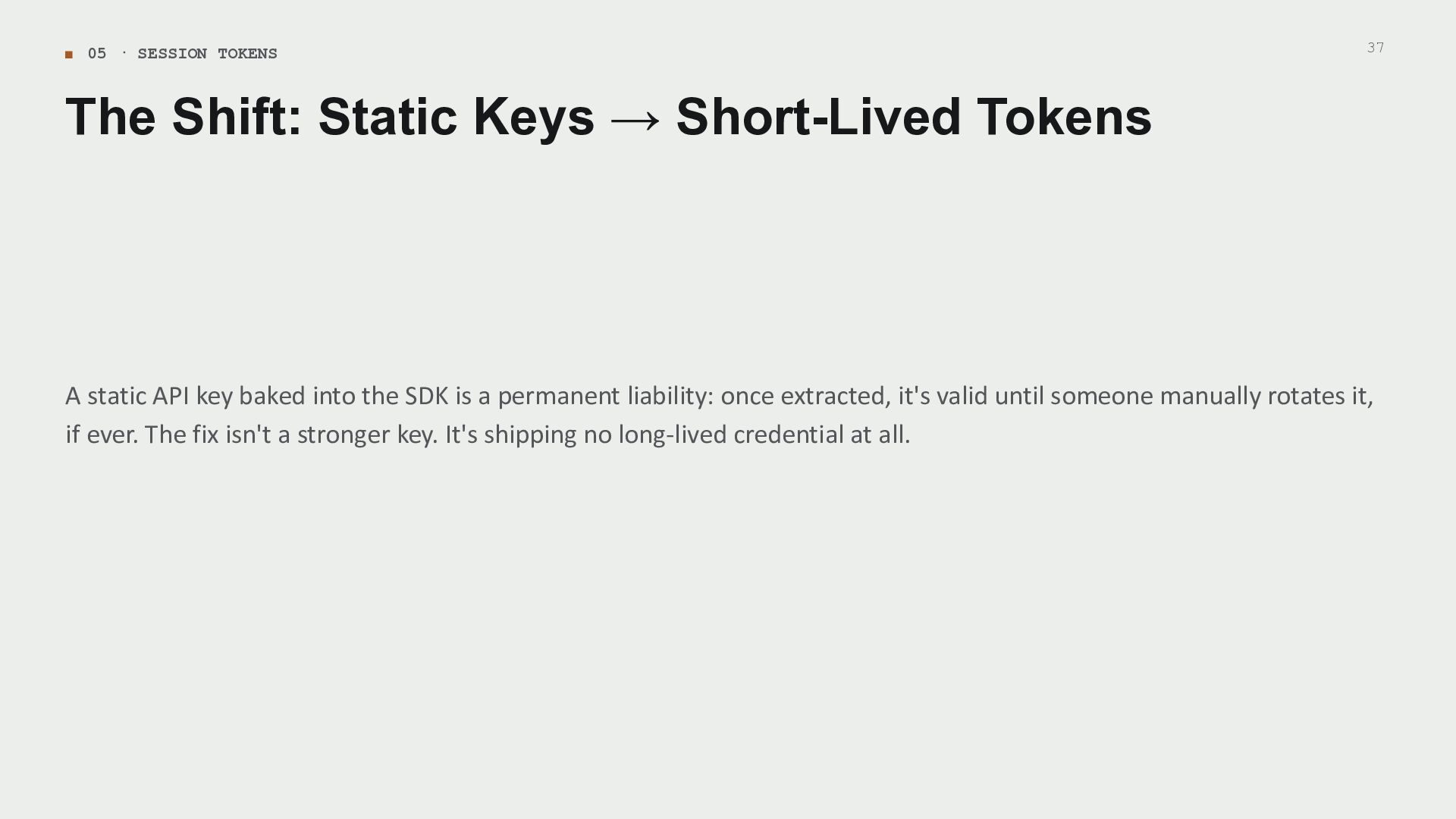
→ Short-Lived Tokens A static API key baked into the SDK is a permanent liability: once extracted, it's valid until someone manually rotates it, if ever. The fix isn't a stronger key. It's shipping no long-lived credential at all.
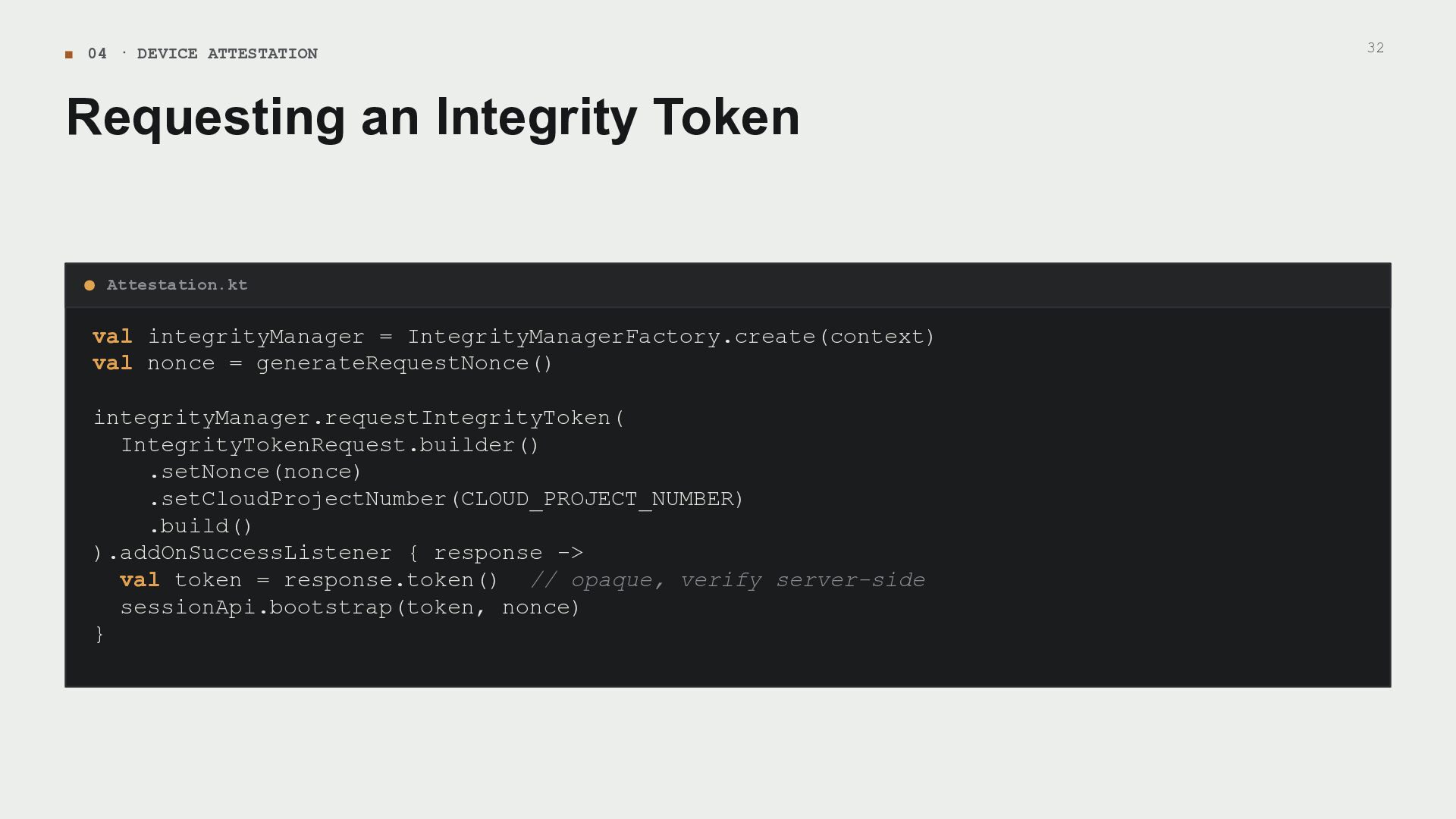
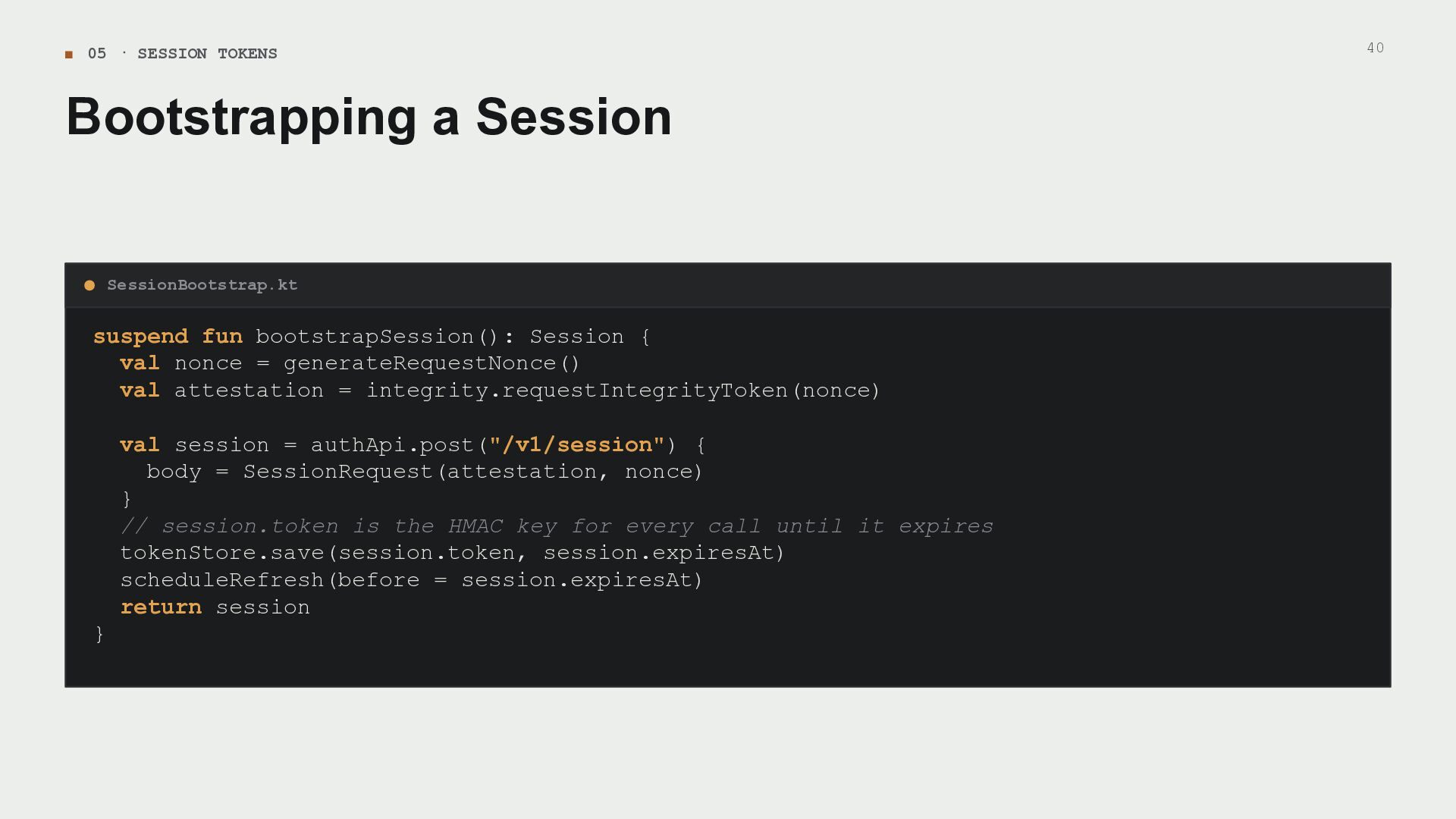
fun bootstrapSession(): Session { val nonce = generateRequestNonce() val attestation = integrity.requestIntegrityToken(nonce) val session = authApi.post("/v1/session") { body = SessionRequest(attestation, nonce) } // session.token is the HMAC key for every call until it expires tokenStore.save(session.token, session.expiresAt) scheduleRefresh(before = session.expiresAt) return session } 40
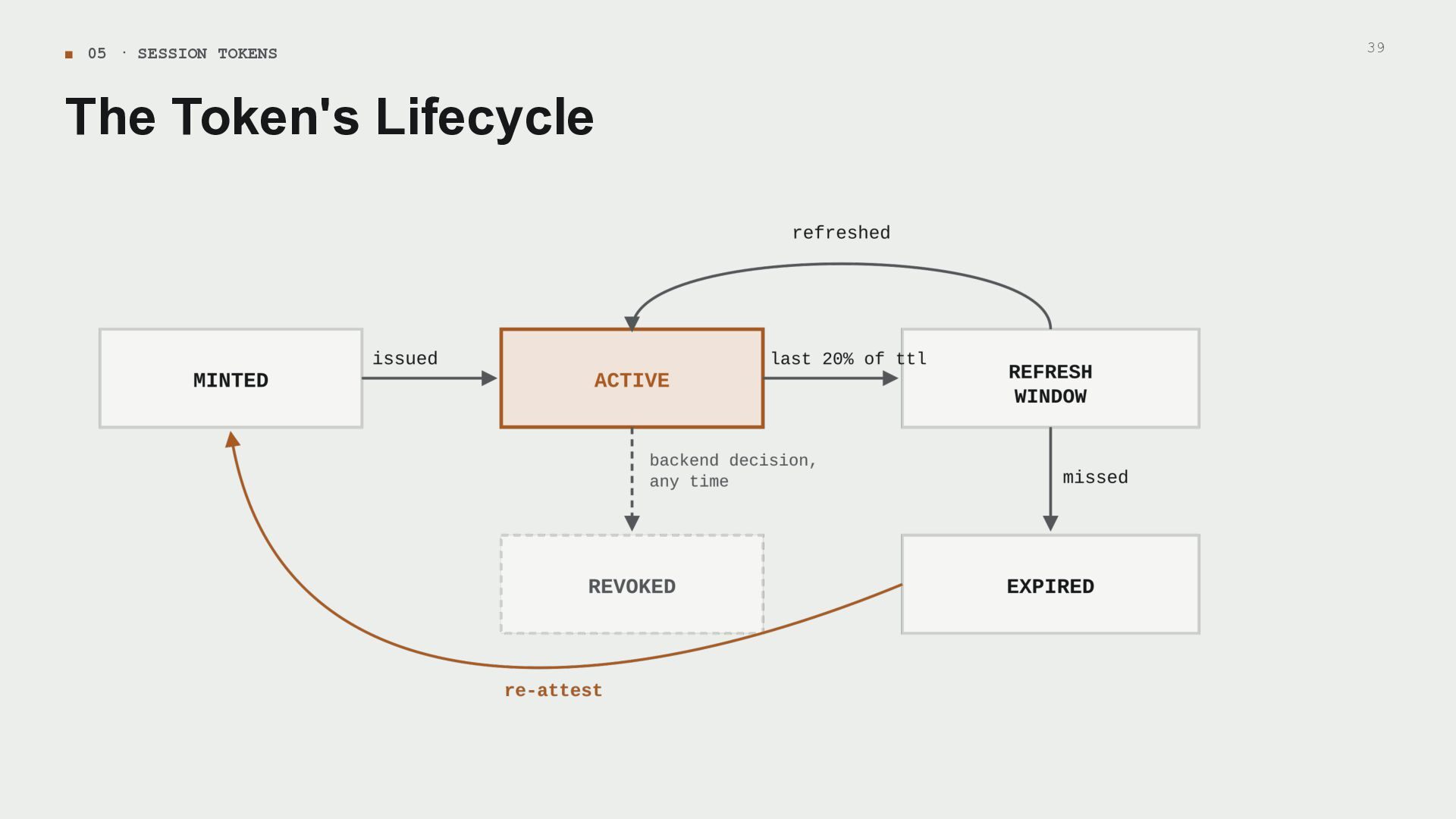
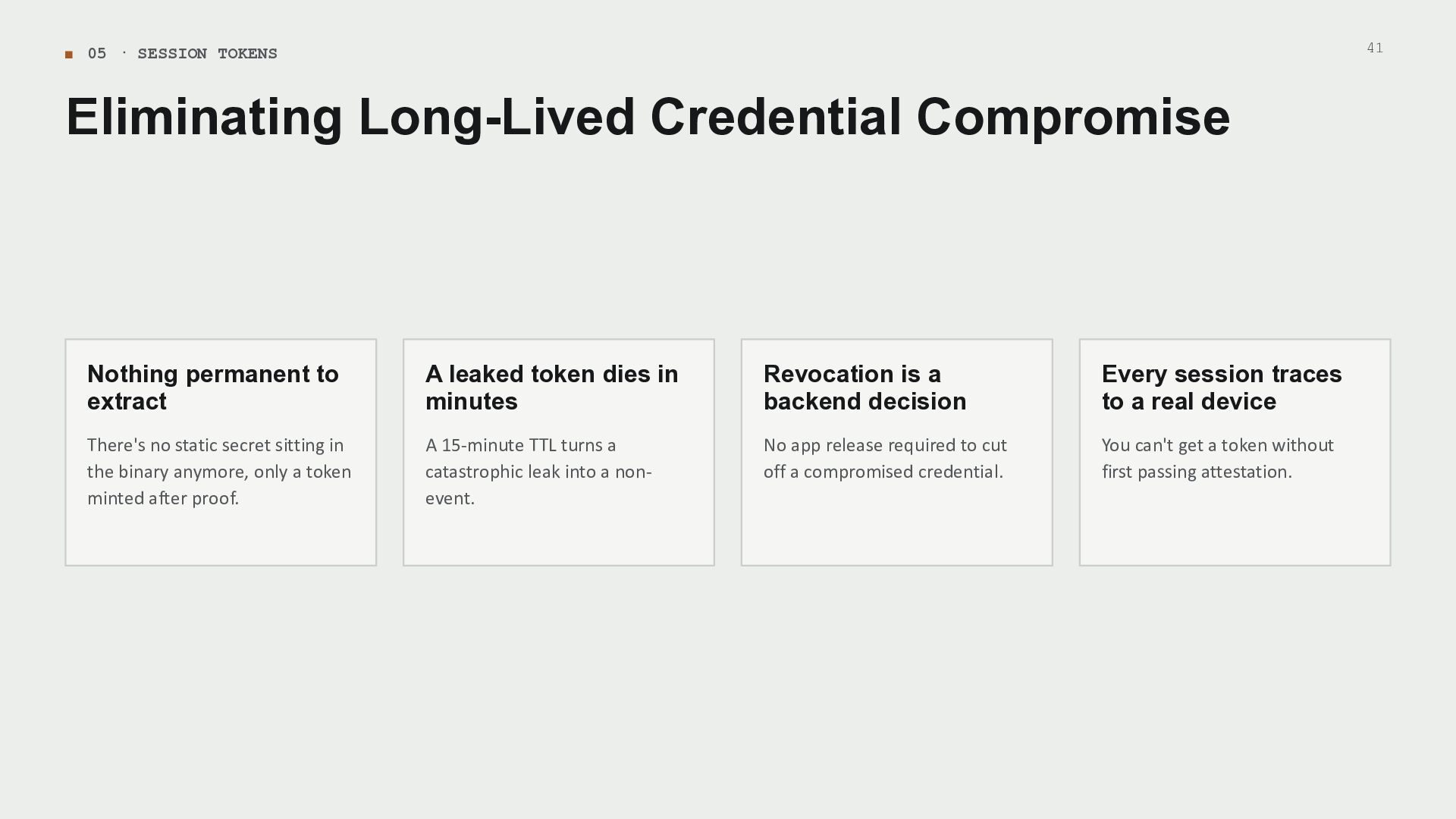
Nothing permanent to extract A leaked token dies in minutes Revocation is a backend decision Every session traces to a real device There's no static secret sitting in the binary anymore, only a token minted after proof. A 15-minute TTL turns a catastrophic leak into a nonevent. No app release required to cut off a compromised credential. You can't get a token without first passing attestation.
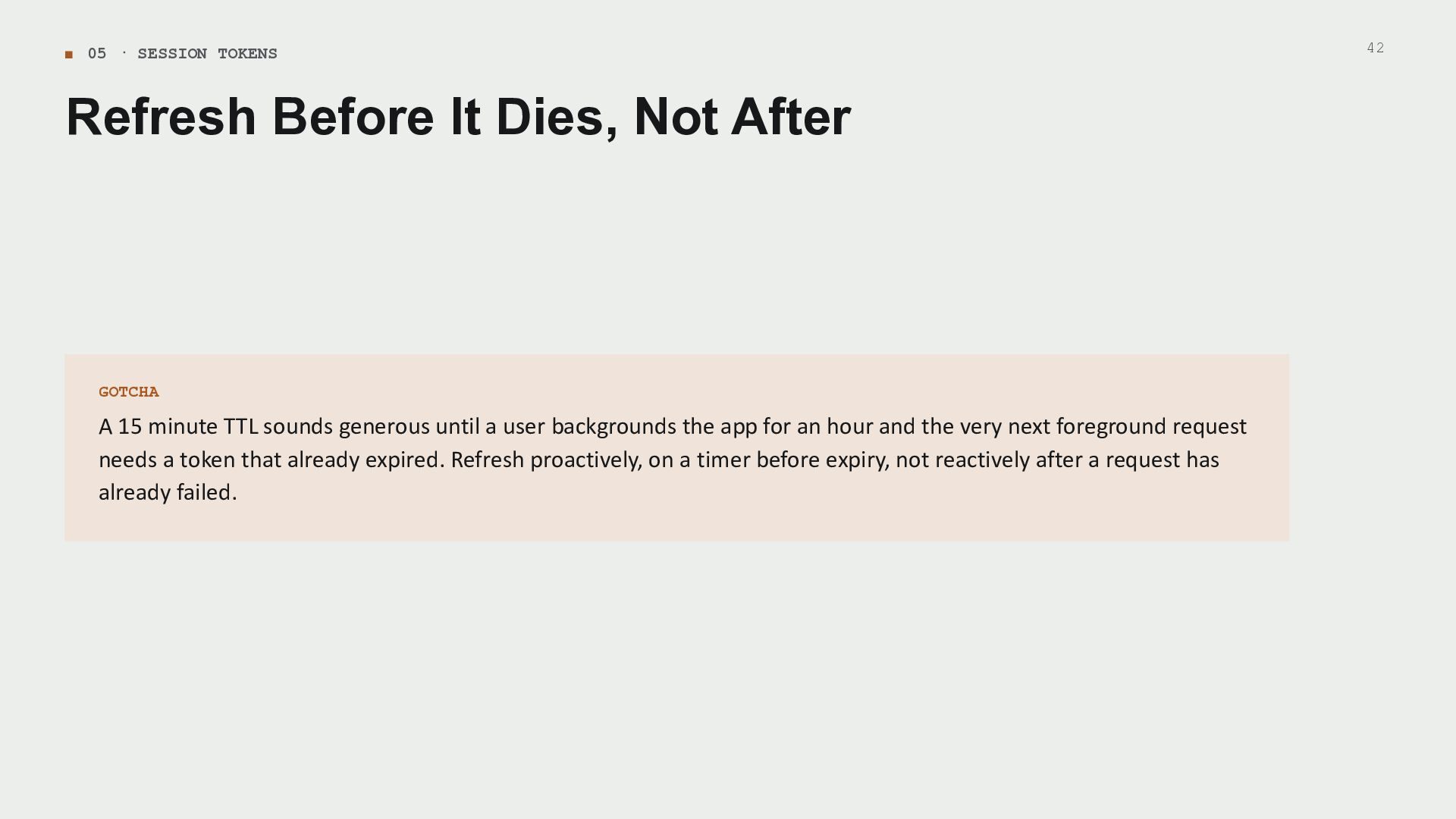
After GOTCHA A 15 minute TTL sounds generous until a user backgrounds the app for an hour and the very next foreground request needs a token that already expired. Refresh proactively, on a timer before expiry, not reactively after a request has already failed. 42
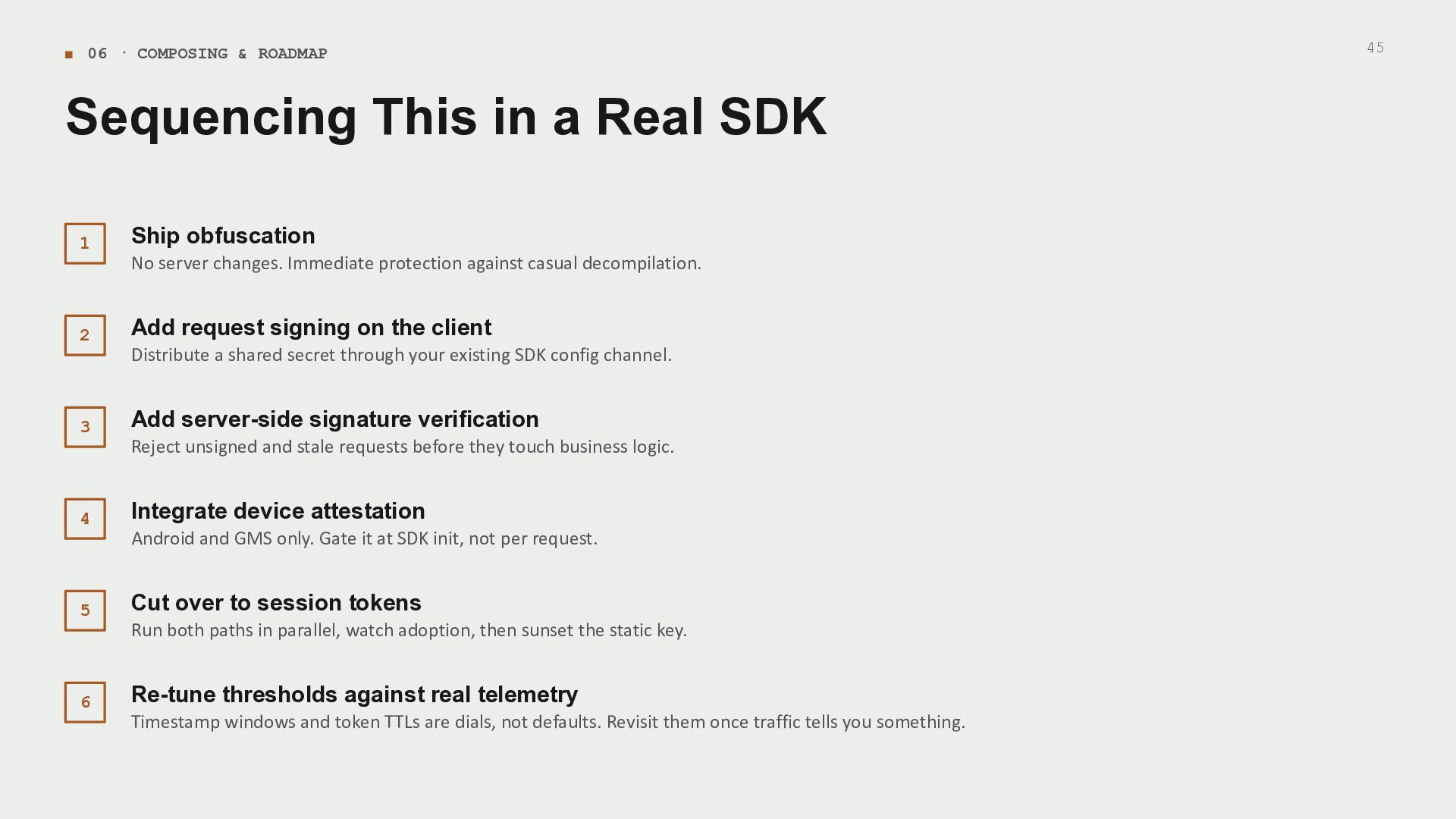
Real SDK 1 Ship obfuscation No server changes. Immediate protection against casual decompilation. 2 Add request signing on the client Distribute a shared secret through your existing SDK config channel. 3 Add server-side signature verification Reject unsigned and stale requests before they touch business logic. 4 Integrate device attestation Android and GMS only. Gate it at SDK init, not per request. 5 Cut over to session tokens Run both paths in parallel, watch adoption, then sunset the static key. 6 Re-tune thresholds against real telemetry Timestamp windows and token TTLs are dials, not defaults. Revisit them once traffic tells you something. 45
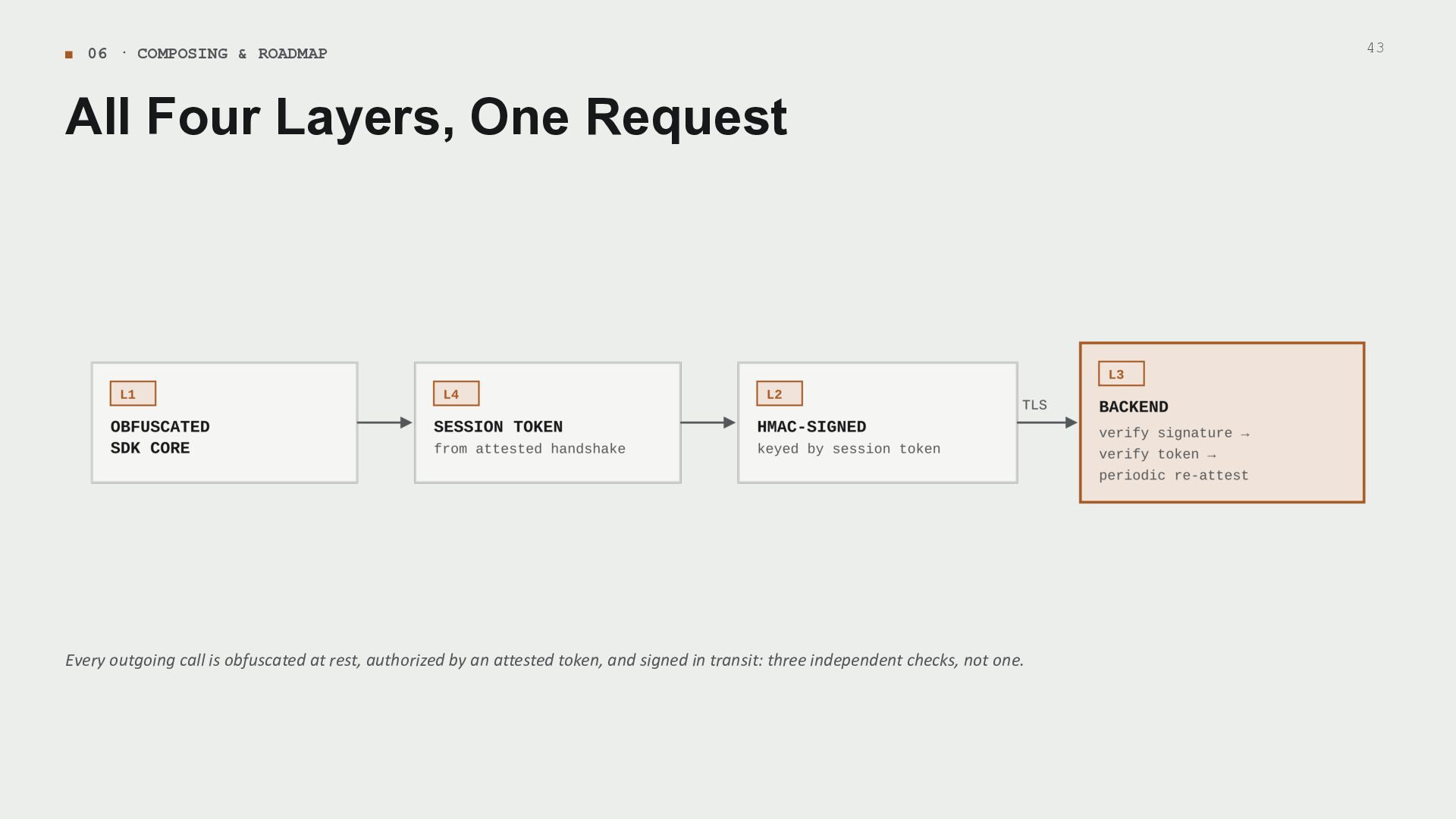
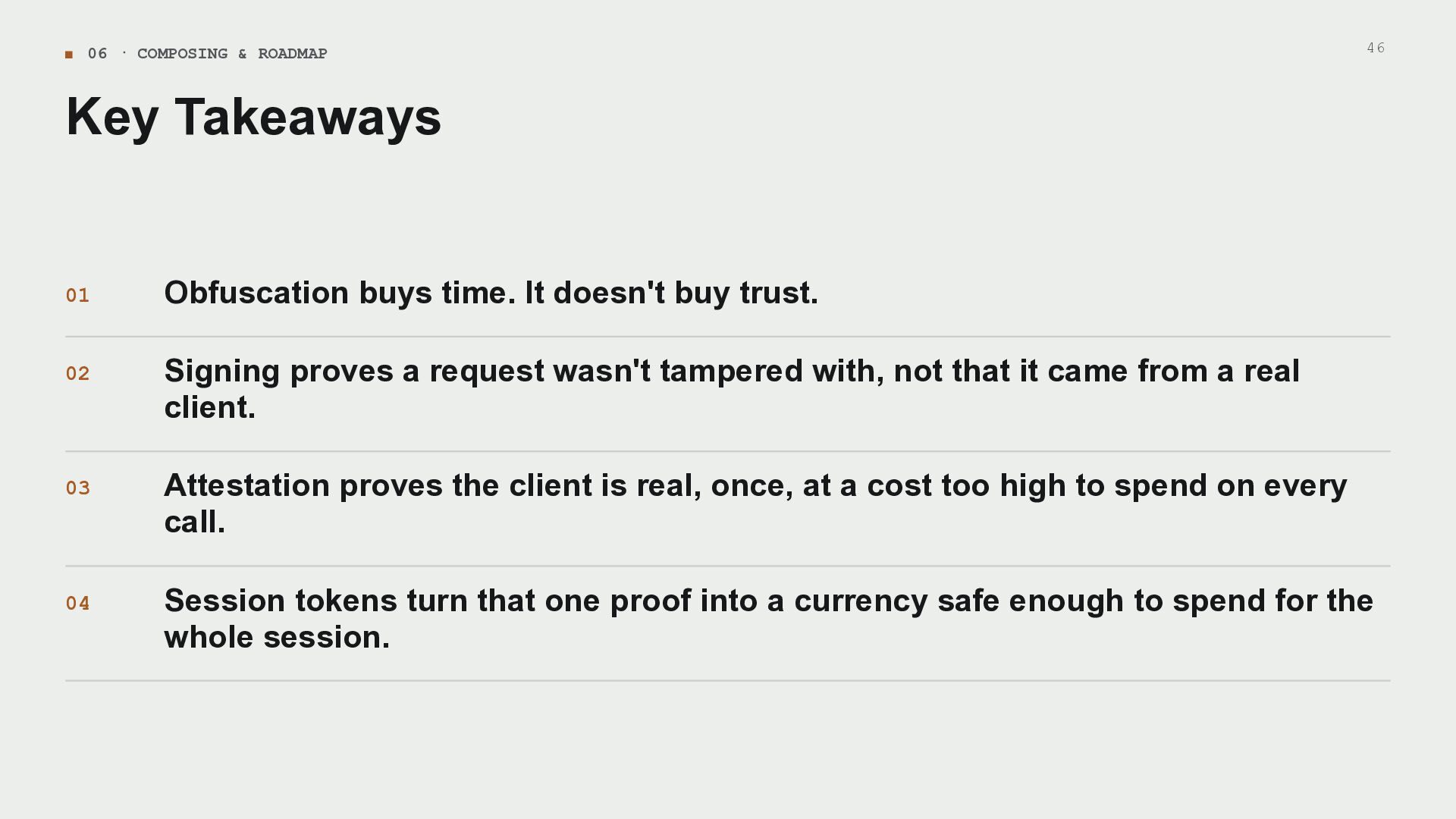
Obfuscation buys time. It doesn't buy trust. 02 Signing proves a request wasn't tampered with, not that it came from a real client. 03 Attestation proves the client is real, once, at a cost too high to spend on every call. 04 Session tokens turn that one proof into a currency safe enough to spend for the whole session.
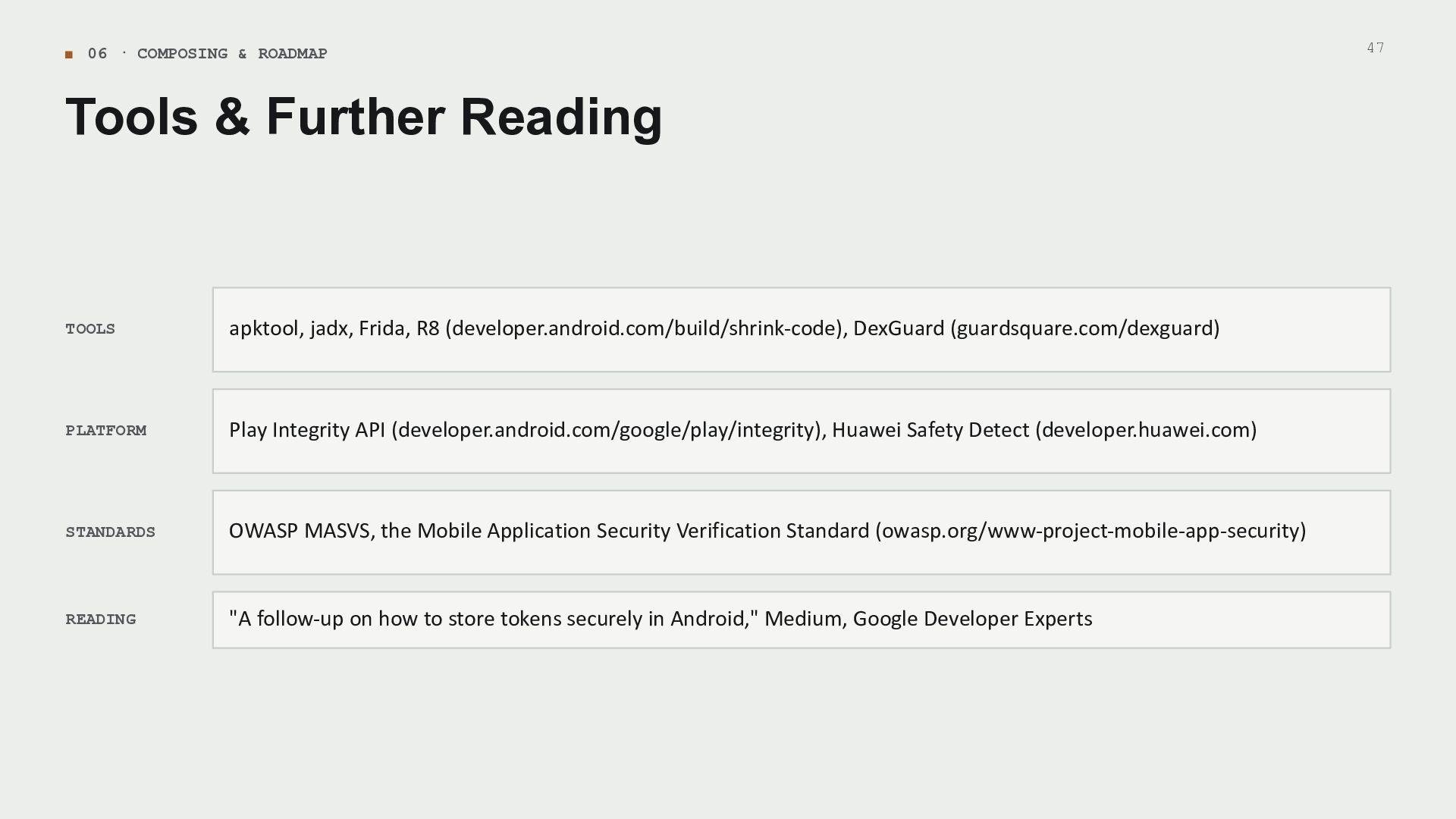
TOOLS apktool, jadx, Frida, R8 (developer.android.com/build/shrink-code), DexGuard (guardsquare.com/dexguard) PLATFORM Play Integrity API (developer.android.com/google/play/integrity), Huawei Safety Detect (developer.huawei.com) STANDARDS OWASP MASVS, the Mobile Application Security Verification Standard (owasp.org/www-project-mobile-app-security) READING "A follow-up on how to store tokens securely in Android," Medium, Google Developer Experts 47
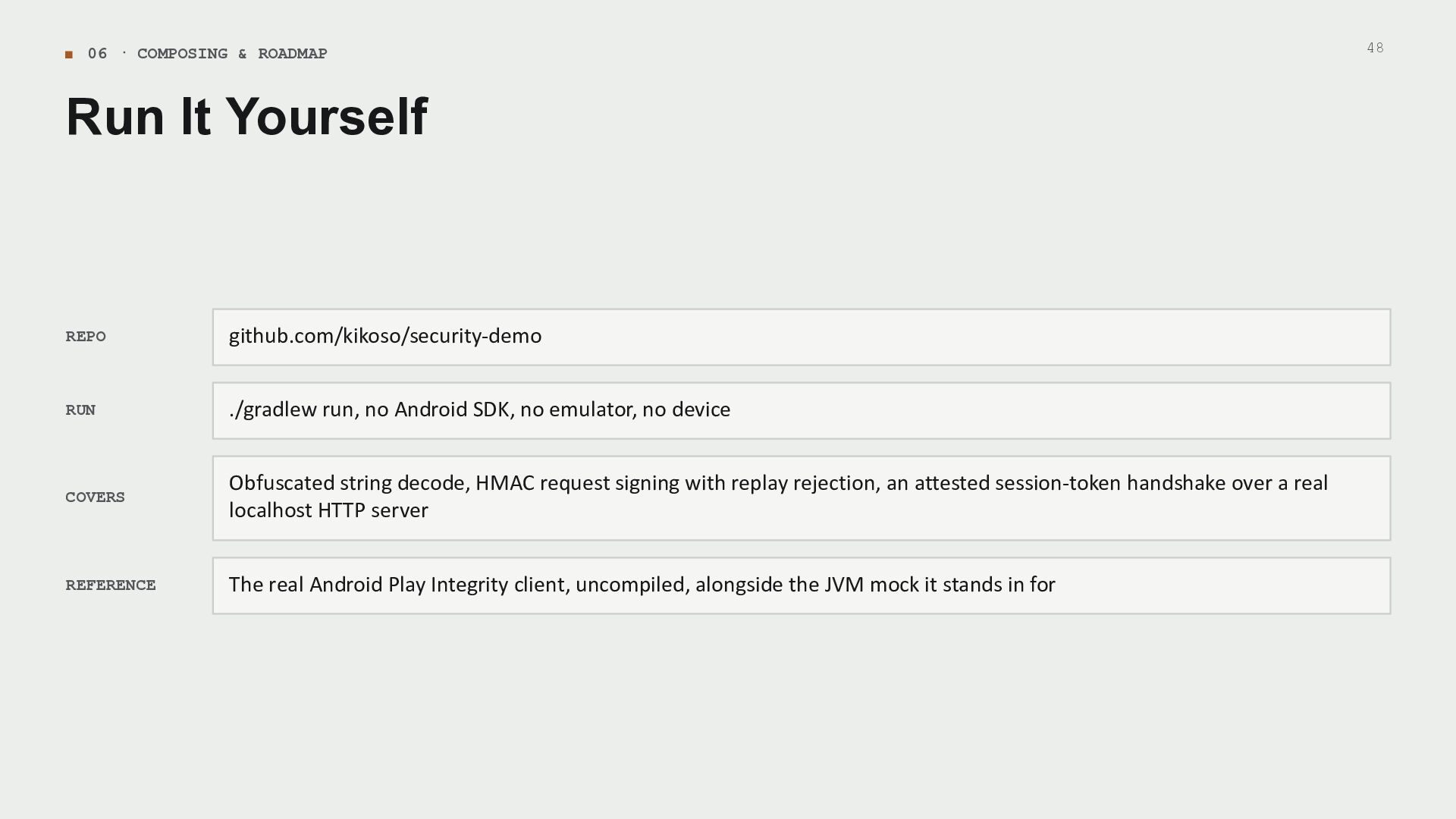
github.com/kikoso/security-demo RUN ./gradlew run, no Android SDK, no emulator, no device COVERS Obfuscated string decode, HMAC request signing with replay rejection, an attested session-token handshake over a real localhost HTTP server REFERENCE The real Android Play Integrity client, uncompiled, alongside the JVM mock it stands in for 48


 kikoso
 raeminkang
 leegeunhyeok
 rshindo
 lef237
 fornewid
 ivargrimstad
 simas
 aoshi
 sorah
 omatty198
 skryukov
 l2hyunwoo
 rkendrick25
 mayatellez
 axbom
 schlessera
 leimatthew05
 matthewcrist
 lara
 jakevdp
 marktimemedia
 thekraken
 sergeychernyshev
 badams