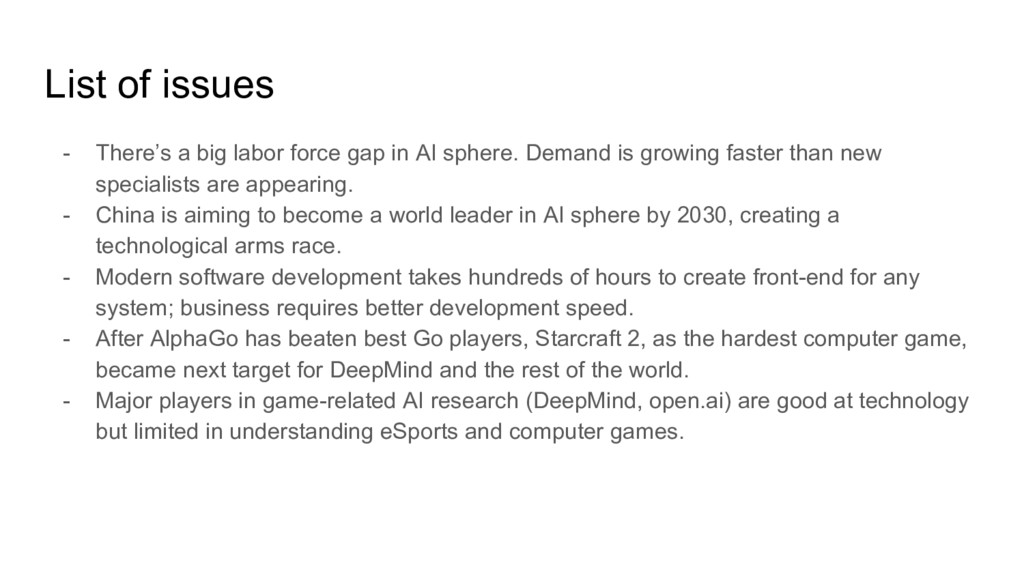
in AI sphere. Demand is growing faster than new specialists are appearing. - China is aiming to become a world leader in AI sphere by 2030, creating a technological arms race. - Modern software development takes hundreds of hours to create front-end for any system; business requires better development speed. - After AlphaGo has beaten best Go players, Starcraft 2, as the hardest computer game, became next target for DeepMind and the rest of the world. - Major players in game-related AI research (DeepMind, open.ai) are good at technology but limited in understanding eSports and computer games.
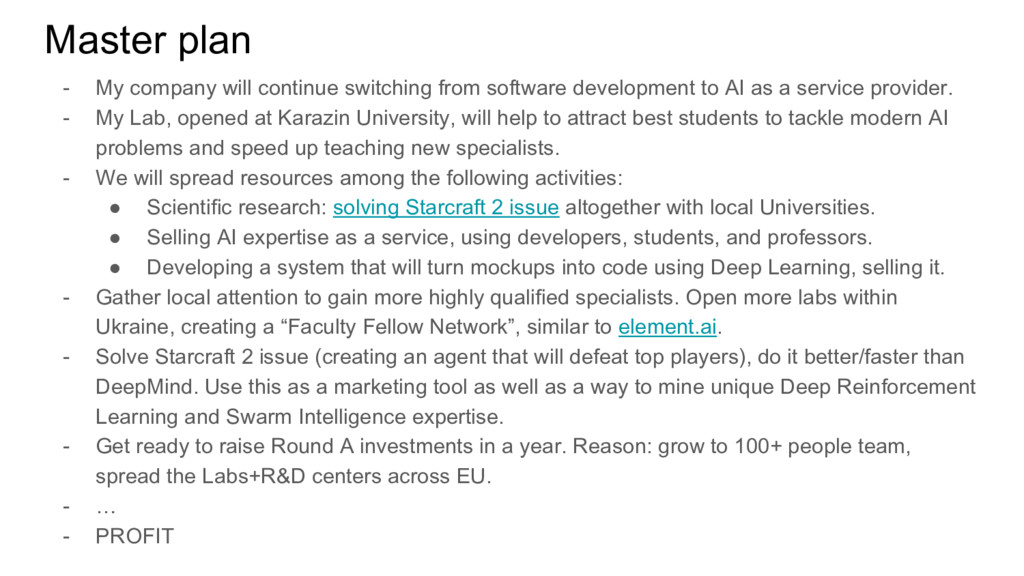
development to AI as a service provider. - My Lab, opened at Karazin University, will help to attract best students to tackle modern AI problems and speed up teaching new specialists. - We will spread resources among the following activities: • Scientific research: solving Starcraft 2 issue altogether with local Universities. • Selling AI expertise as a service, using developers, students, and professors. • Developing a system that will turn mockups into code using Deep Learning, selling it. - Gather local attention to gain more highly qualified specialists. Open more labs within Ukraine, creating a “Faculty Fellow Network”, similar to element.ai. - Solve Starcraft 2 issue (creating an agent that will defeat top players), do it better/faster than DeepMind. Use this as a marketing tool as well as a way to mine unique Deep Reinforcement Learning and Swarm Intelligence expertise. - Get ready to raise Round A investments in a year. Reason: grow to 100+ people team, spread the Labs+R&D centers across EU. - … - PROFIT
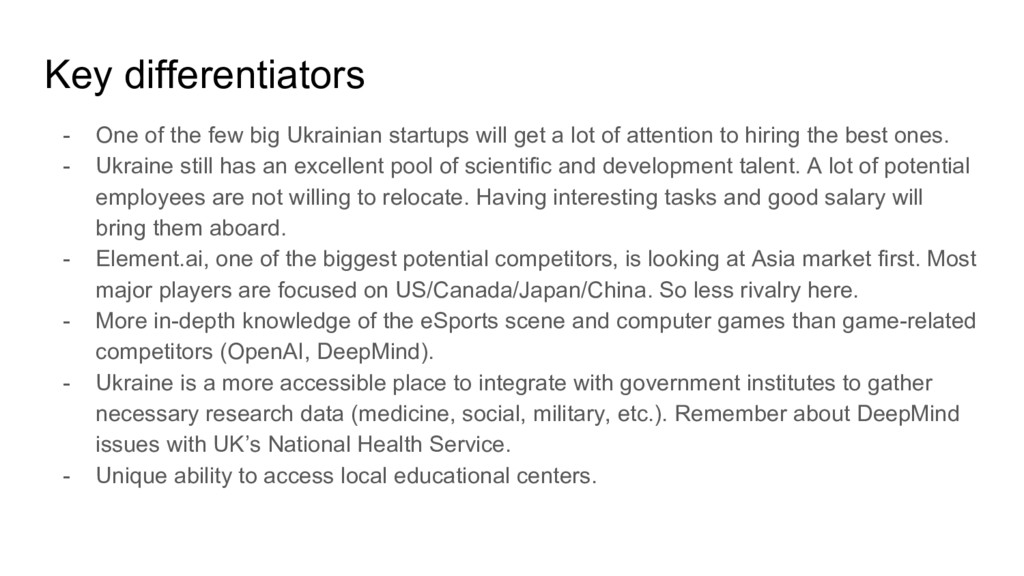
will get a lot of attention to hiring the best ones. - Ukraine still has an excellent pool of scientific and development talent. A lot of potential employees are not willing to relocate. Having interesting tasks and good salary will bring them aboard. - Element.ai, one of the biggest potential competitors, is looking at Asia market first. Most major players are focused on US/Canada/Japan/China. So less rivalry here. - More in-depth knowledge of the eSports scene and computer games than game-related competitors (OpenAI, DeepMind). - Ukraine is a more accessible place to integrate with government institutes to gather necessary research data (medicine, social, military, etc.). Remember about DeepMind issues with UK’s National Health Service. - Unique ability to access local educational centers.
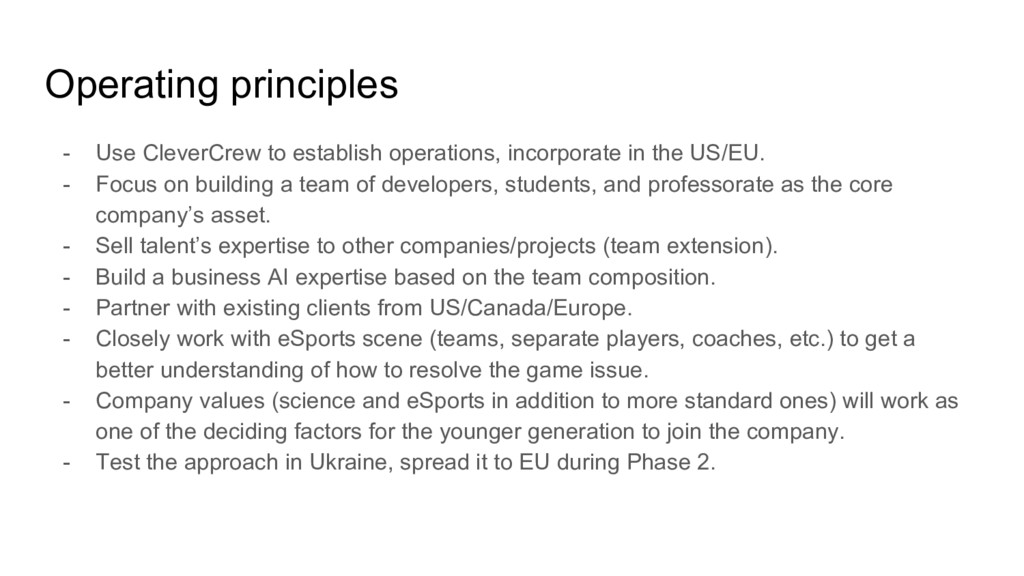
the US/EU. - Focus on building a team of developers, students, and professorate as the core company’s asset. - Sell talent’s expertise to other companies/projects (team extension). - Build a business AI expertise based on the team composition. - Partner with existing clients from US/Canada/Europe. - Closely work with eSports scene (teams, separate players, coaches, etc.) to get a better understanding of how to resolve the game issue. - Company values (science and eSports in addition to more standard ones) will work as one of the deciding factors for the younger generation to join the company. - Test the approach in Ukraine, spread it to EU during Phase 2.
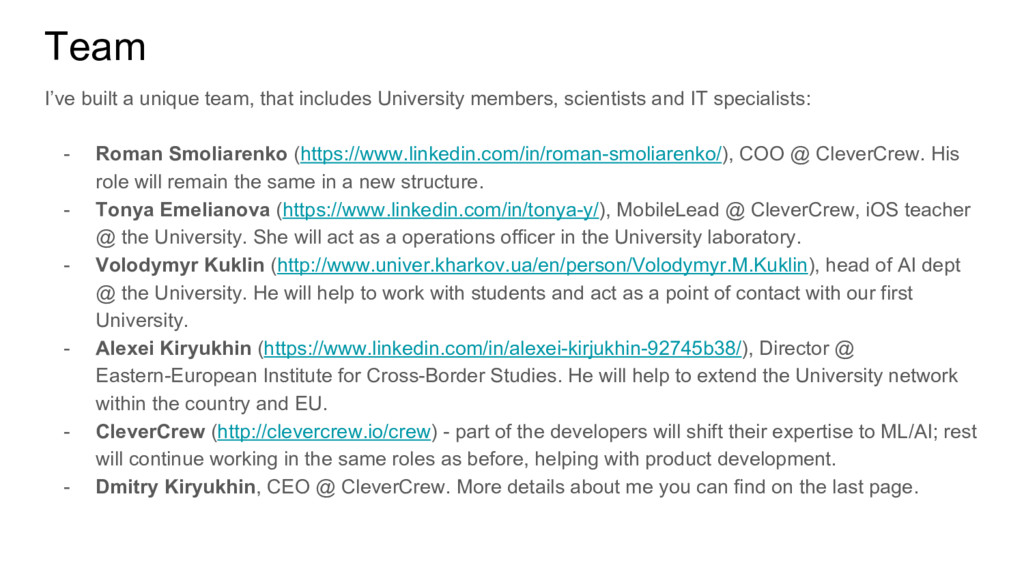
scientists and IT specialists: - Roman Smoliarenko (https://www.linkedin.com/in/roman-smoliarenko/), COO @ CleverCrew. His role will remain the same in a new structure. - Tonya Emelianova (https://www.linkedin.com/in/tonya-y/), MobileLead @ CleverCrew, iOS teacher @ the University. She will act as a operations officer in the University laboratory. - Volodymyr Kuklin (http://www.univer.kharkov.ua/en/person/Volodymyr.M.Kuklin), head of AI dept @ the University. He will help to work with students and act as a point of contact with our first University. - Alexei Kiryukhin (https://www.linkedin.com/in/alexei-kirjukhin-92745b38/), Director @ Eastern-European Institute for Cross-Border Studies. He will help to extend the University network within the country and EU. - CleverCrew (http://clevercrew.io/crew) - part of the developers will shift their expertise to ML/AI; rest will continue working in the same roles as before, helping with product development. - Dmitry Kiryukhin, CEO @ CleverCrew. More details about me you can find on the last page.
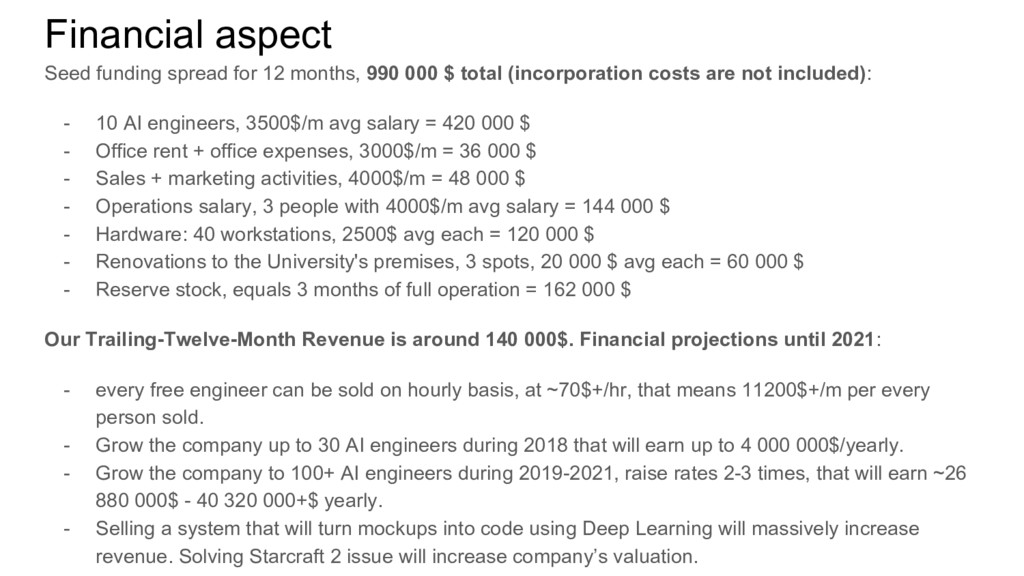
$ total (incorporation costs are not included): - 10 AI engineers, 3500$/m avg salary = 420 000 $ - Office rent + office expenses, 3000$/m = 36 000 $ - Sales + marketing activities, 4000$/m = 48 000 $ - Operations salary, 3 people with 4000$/m avg salary = 144 000 $ - Hardware: 40 workstations, 2500$ avg each = 120 000 $ - Renovations to the University's premises, 3 spots, 20 000 $ avg each = 60 000 $ - Reserve stock, equals 3 months of full operation = 162 000 $ Our Trailing-Twelve-Month Revenue is around 140 000$. Financial projections until 2021: - every free engineer can be sold on hourly basis, at ~70$+/hr, that means 11200$+/m per every person sold. - Grow the company up to 30 AI engineers during 2018 that will earn up to 4 000 000$/yearly. - Grow the company to 100+ AI engineers during 2019-2021, raise rates 2-3 times, that will earn ~26 880 000$ - 40 320 000+$ yearly. - Selling a system that will turn mockups into code using Deep Learning will massively increase revenue. Solving Starcraft 2 issue will increase company’s valuation.
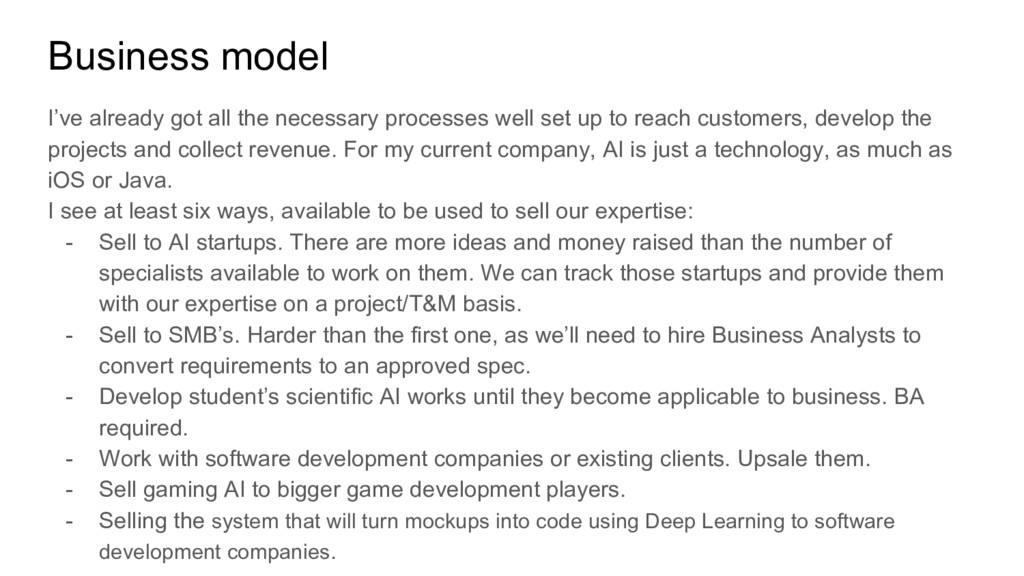
set up to reach customers, develop the projects and collect revenue. For my current company, AI is just a technology, as much as iOS or Java. I see at least six ways, available to be used to sell our expertise: - Sell to AI startups. There are more ideas and money raised than the number of specialists available to work on them. We can track those startups and provide them with our expertise on a project/T&M basis. - Sell to SMB’s. Harder than the first one, as we’ll need to hire Business Analysts to convert requirements to an approved spec. - Develop student’s scientific AI works until they become applicable to business. BA required. - Work with software development companies or existing clients. Upsale them. - Sell gaming AI to bigger game development players. - Selling the system that will turn mockups into code using Deep Learning to software development companies.
you need to know how to sell and whom to sell. My sales expertise is not a world class at that moment. Risk mitigation plan: use venture partners connections to land a couple of big customers. Or/and hire a good salesperson. - Geography. Some people tend to think that Ukraine is a risky place to invest. Risk mitigation plan: keep in touch with the government and run some local activities (science exhibitions, small eSports championships), staying visible will shut down any attempts to pressure the business. - Fail to attract top local talent. Risk mitigation plan: form company values that are different to big local players, flexibly reacting to employees demands. I’ve been working in both small and largest Ukrainian companies and knew people’s expectations. - Fail to resolve Starcraft 2 issue faster than DeepMind. Risk mitigation plan: use my game knowledge and ideas to make key decisions more quickly. Work with the game community. - Lack of experience of running 100+ people company. 30 people for the first step is doable with no issues, but I have no experience running 100+ people at once. Risk mitigation plan: temporarily move to the US/EU in to catch up with the necessary knowledge. Hire more experienced people as COO, sales and on other key positions. - Lack of research data. DeepMind has an established partnership with Blizzard. Risk mitigation plan: closely work with the community instead: replays and even larger amount of data can be gathered from both pro and amateur players, as well as some ideas.
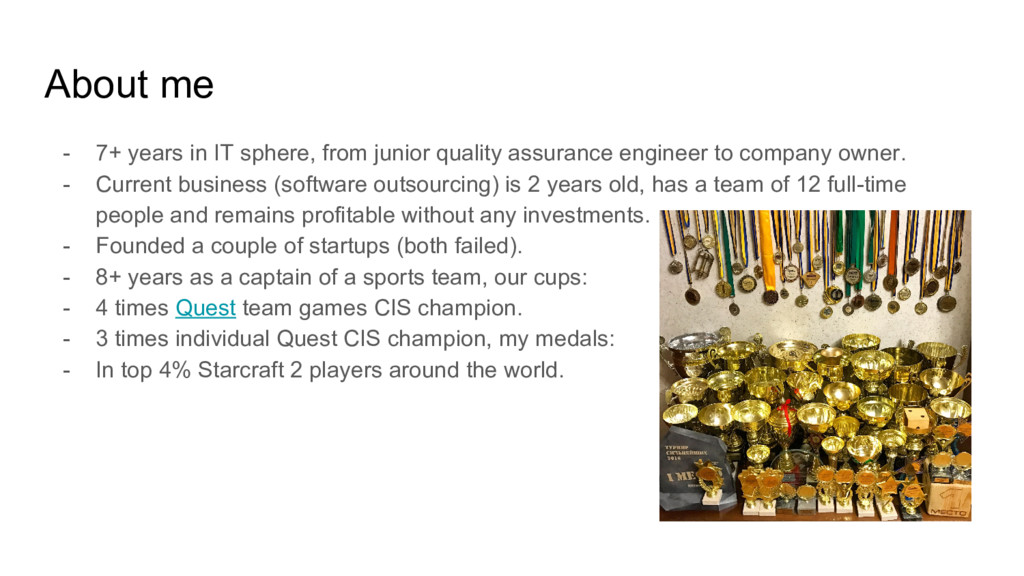
quality assurance engineer to company owner. - Current business (software outsourcing) is 2 years old, has a team of 12 full-time people and remains profitable without any investments. - Founded a couple of startups (both failed). - 8+ years as a captain of a sports team, our cups: - 4 times Quest team games CIS champion. - 3 times individual Quest CIS champion, my medals: - In top 4% Starcraft 2 players around the world.


 e5ua
 forest8810
 nakahara
 kawanotron
 hansodeeeeee
 kinsofficial
 neuroenergia
 hr1nursing
 pokotyamu
 ashisuto_career
 ikuodanaka
 progmat
 ivargrimstad
 jacobian
 jnunemaker
 palkan
 techseoconnect
 inesmontani
 codingconduct
 sstephenson
 raygrieselhuber
 greggifford
 nonsquared
 maggiecrowley