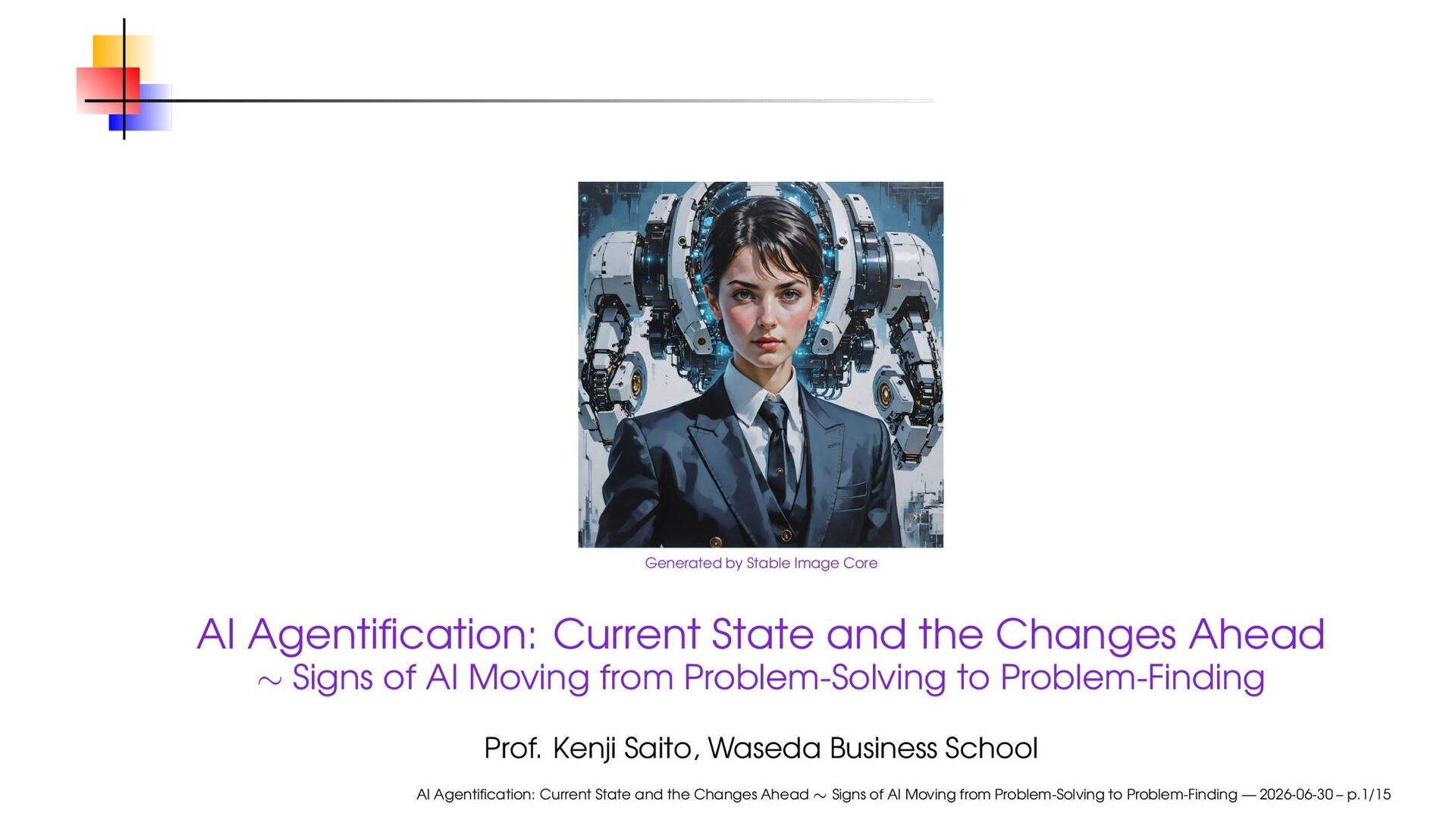
the Changes Ahead ∼ Signs of AI Moving from Problem-Solving to Problem-Finding Prof. Kenji Saito, Waseda Business School AI Agentification: Current State and the Changes Ahead ∼ Signs of AI Moving from Problem-Solving to Problem-Finding — 2026-06-30 – p.1/15
topics together (1) How far has AI (Artificial Intelligence) come? (2) Why are “agents” becoming a reality now? Agent = AI that autonomously plans and acts, retrying as needed to pursue goal achievement (3) Will AI evolve from “solving problems” to “finding problems”? I’ll show a simple demo using the agent platform Hermes Agent Agent platform is something like an OS for creating and systematically running agents Today’s keyword: iteration (loop) AI Agentification: Current State and the Changes Ahead ∼ Signs of AI Moving from Problem-Solving to Problem-Finding — 2026-06-30 – p.2/15
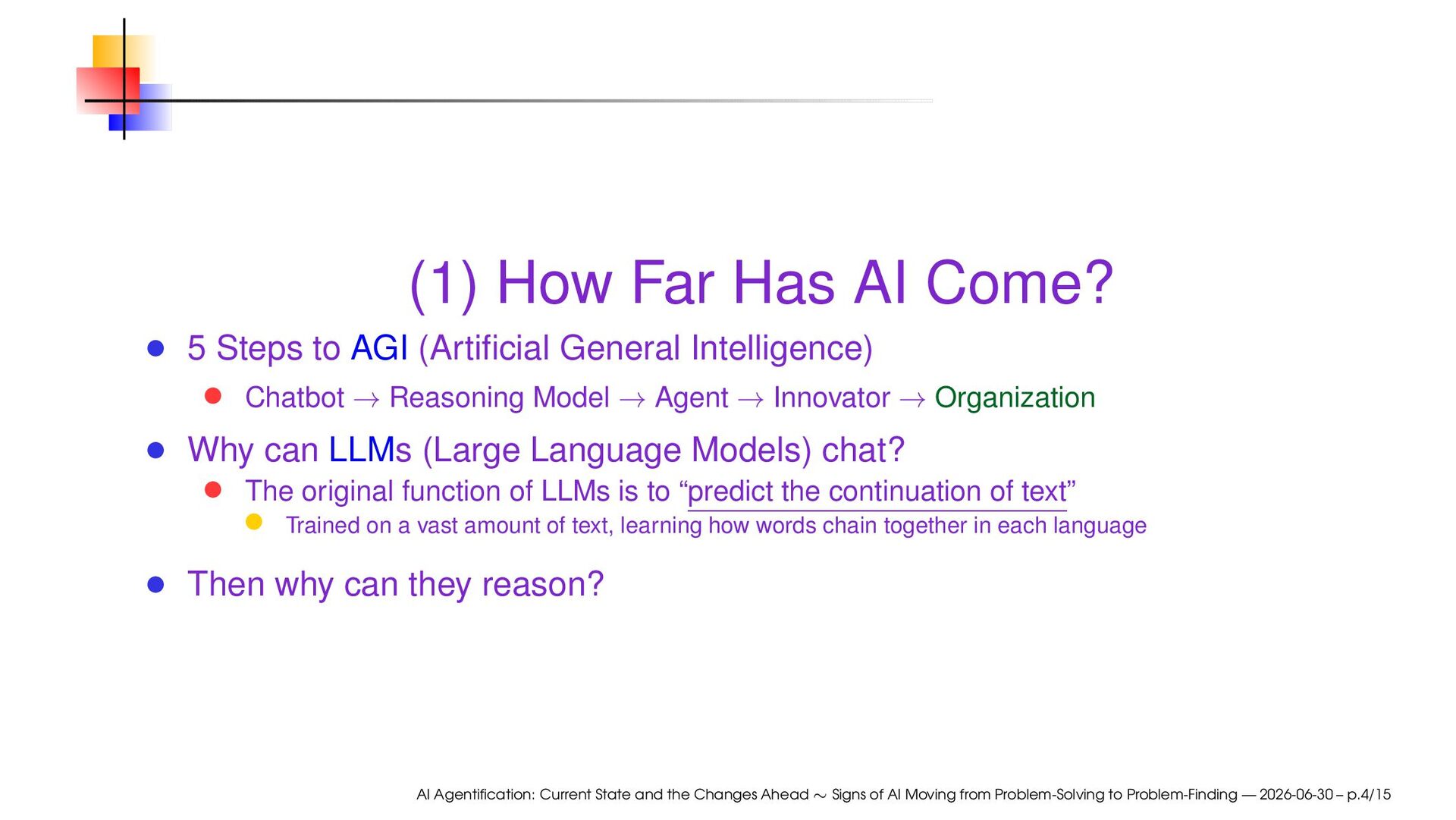
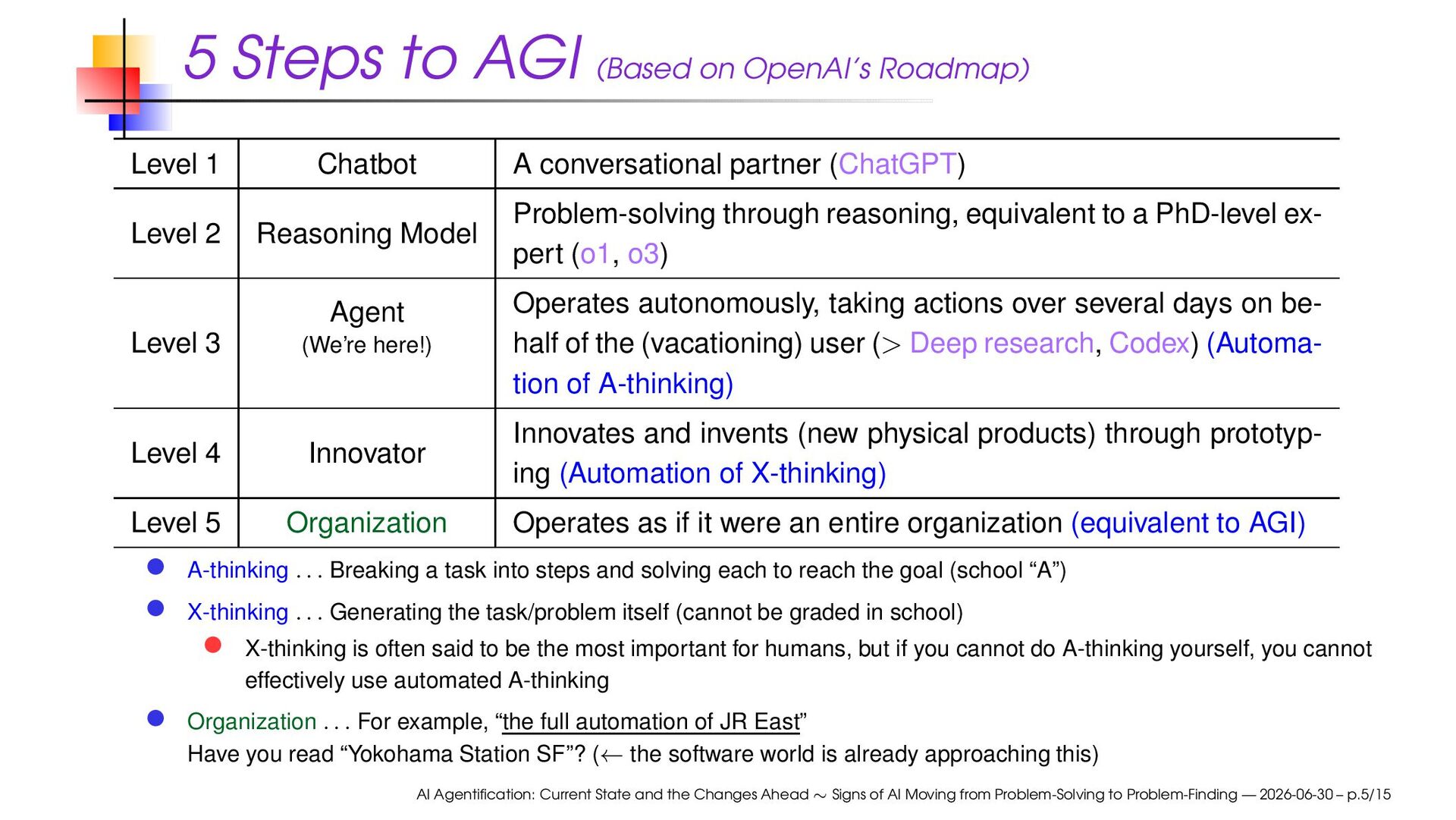
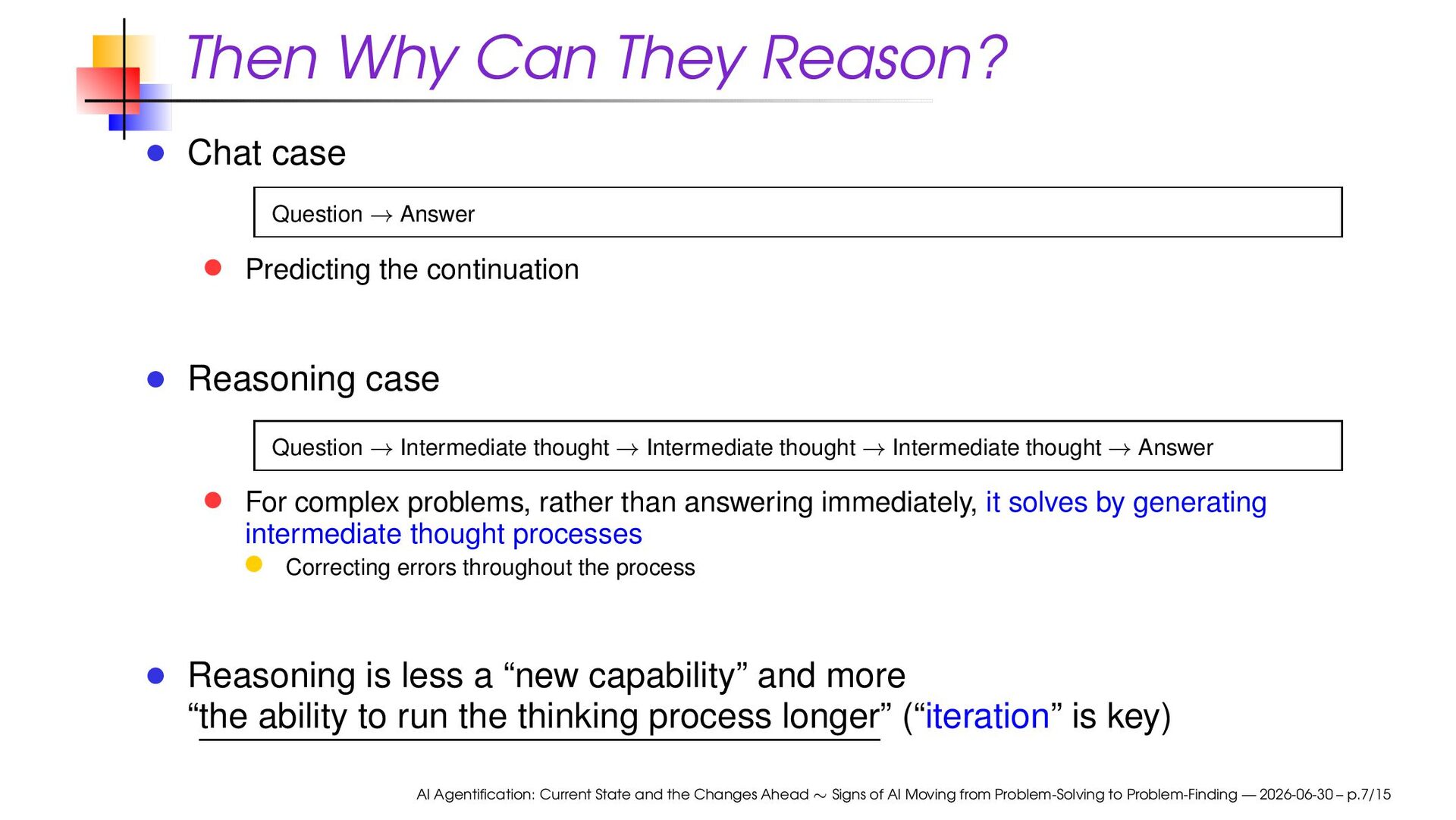
(Artificial General Intelligence) Chatbot → Reasoning Model → Agent → Innovator → Organization Why can LLMs (Large Language Models) chat? The original function of LLMs is to “predict the continuation of text” Trained on a vast amount of text, learning how words chain together in each language Then why can they reason? AI Agentification: Current State and the Changes Ahead ∼ Signs of AI Moving from Problem-Solving to Problem-Finding — 2026-06-30 – p.4/15
Chatbot A conversational partner (ChatGPT) Level 2 Reasoning Model Problem-solving through reasoning, equivalent to a PhD-level ex- pert (o1, o3) Level 3 Agent (We’re here!) Operates autonomously, taking actions over several days on be- half of the (vacationing) user (> Deep research, Codex) (Automa- tion of A-thinking) Level 4 Innovator Innovates and invents (new physical products) through prototyp- ing (Automation of X-thinking) Level 5 Organization Operates as if it were an entire organization (equivalent to AGI) A-thinking . . . Breaking a task into steps and solving each to reach the goal (school “A”) X-thinking . . . Generating the task/problem itself (cannot be graded in school) X-thinking is often said to be the most important for humans, but if you cannot do A-thinking yourself, you cannot effectively use automated A-thinking Organization . . . For example, “the full automation of JR East” Have you read “Yokohama Station SF”? (← the software world is already approaching this) AI Agentification: Current State and the Changes Ahead ∼ Signs of AI Moving from Problem-Solving to Problem-Finding — 2026-06-30 – p.5/15
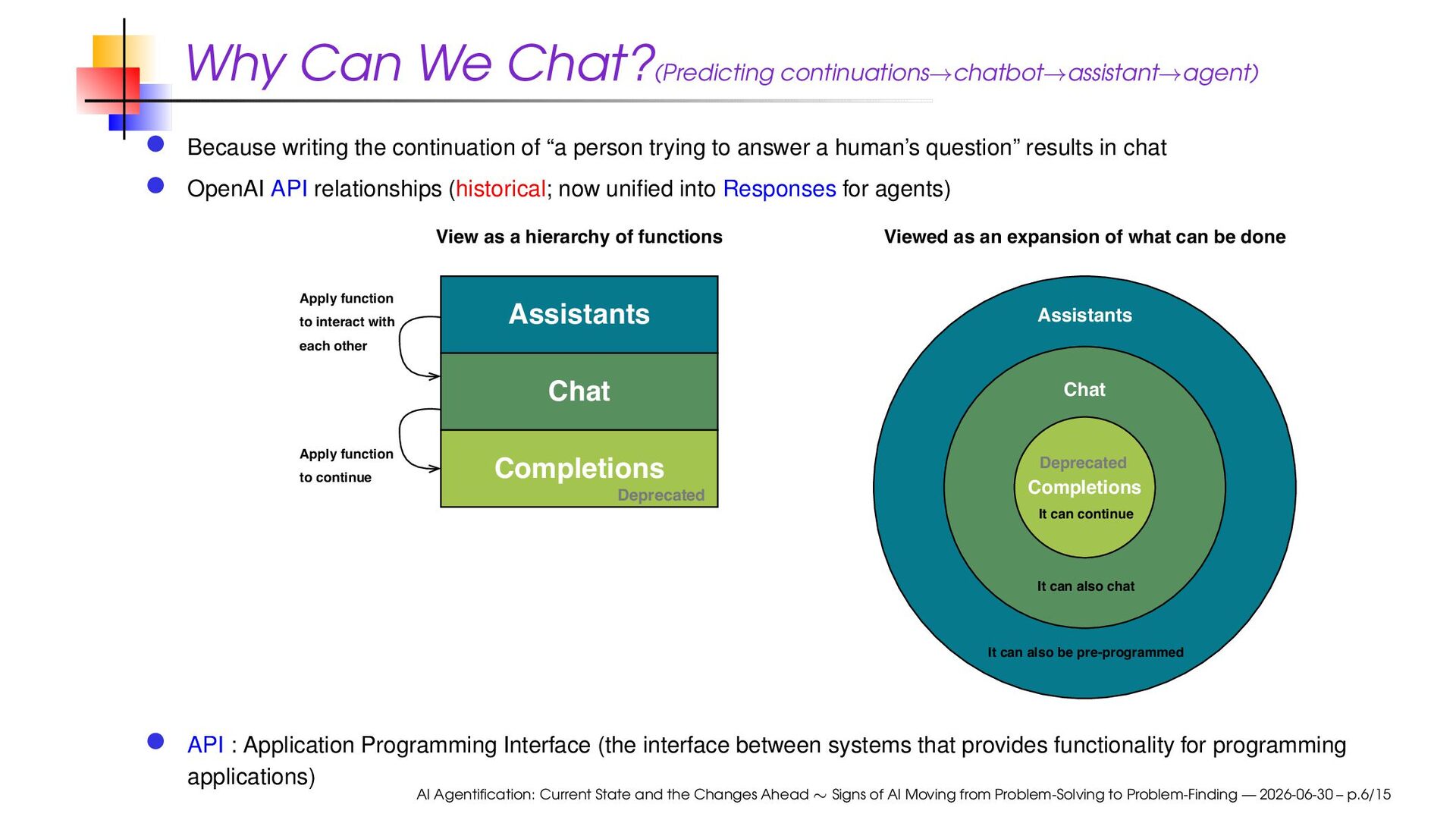
“a person trying to answer a human’s question” results in chat OpenAI API relationships (historical; now unified into Responses for agents) Assistants Chat Completions View as a hierarchy of functions Viewed as an expansion of what can be done Completions Chat Assistants It can continue It can also chat Apply function to continue Apply function to interact with each other Deprecated Deprecated It can also be pre-programmed API : Application Programming Interface (the interface between systems that provides functionality for programming applications) AI Agentification: Current State and the Changes Ahead ∼ Signs of AI Moving from Problem-Solving to Problem-Finding — 2026-06-30 – p.6/15
Predicting the continuation Reasoning case Question → Intermediate thought → Intermediate thought → Intermediate thought → Answer For complex problems, rather than answering immediately, it solves by generating intermediate thought processes Correcting errors throughout the process Reasoning is less a “new capability” and more “the ability to run the thinking process longer” (“iteration” is key) AI Agentification: Current State and the Changes Ahead ∼ Signs of AI Moving from Problem-Solving to Problem-Finding — 2026-06-30 – p.7/15
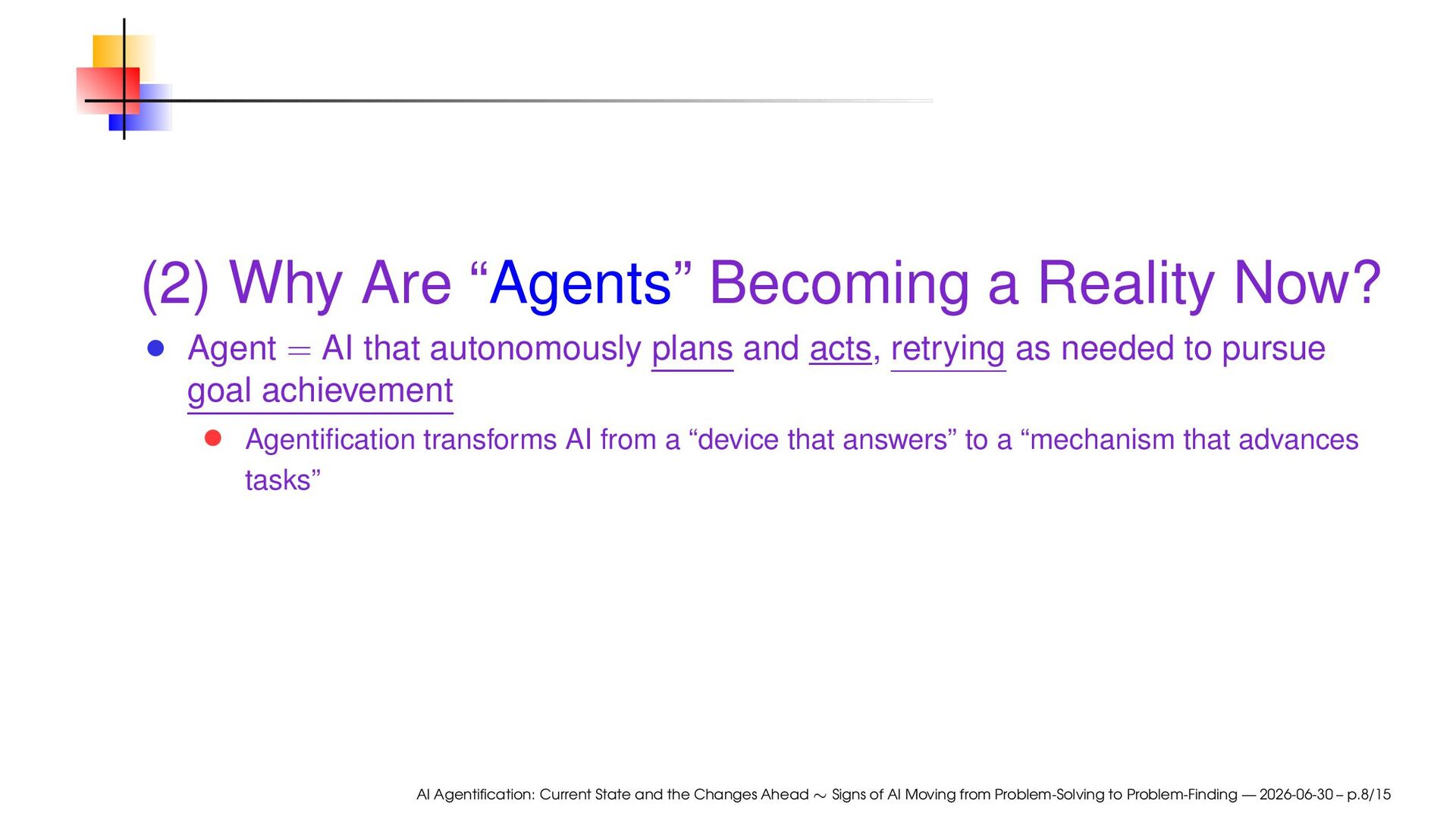
AI that autonomously plans and acts, retrying as needed to pursue goal achievement Agentification transforms AI from a “device that answers” to a “mechanism that advances tasks” AI Agentification: Current State and the Changes Ahead ∼ Signs of AI Moving from Problem-Solving to Problem-Finding — 2026-06-30 – p.8/15
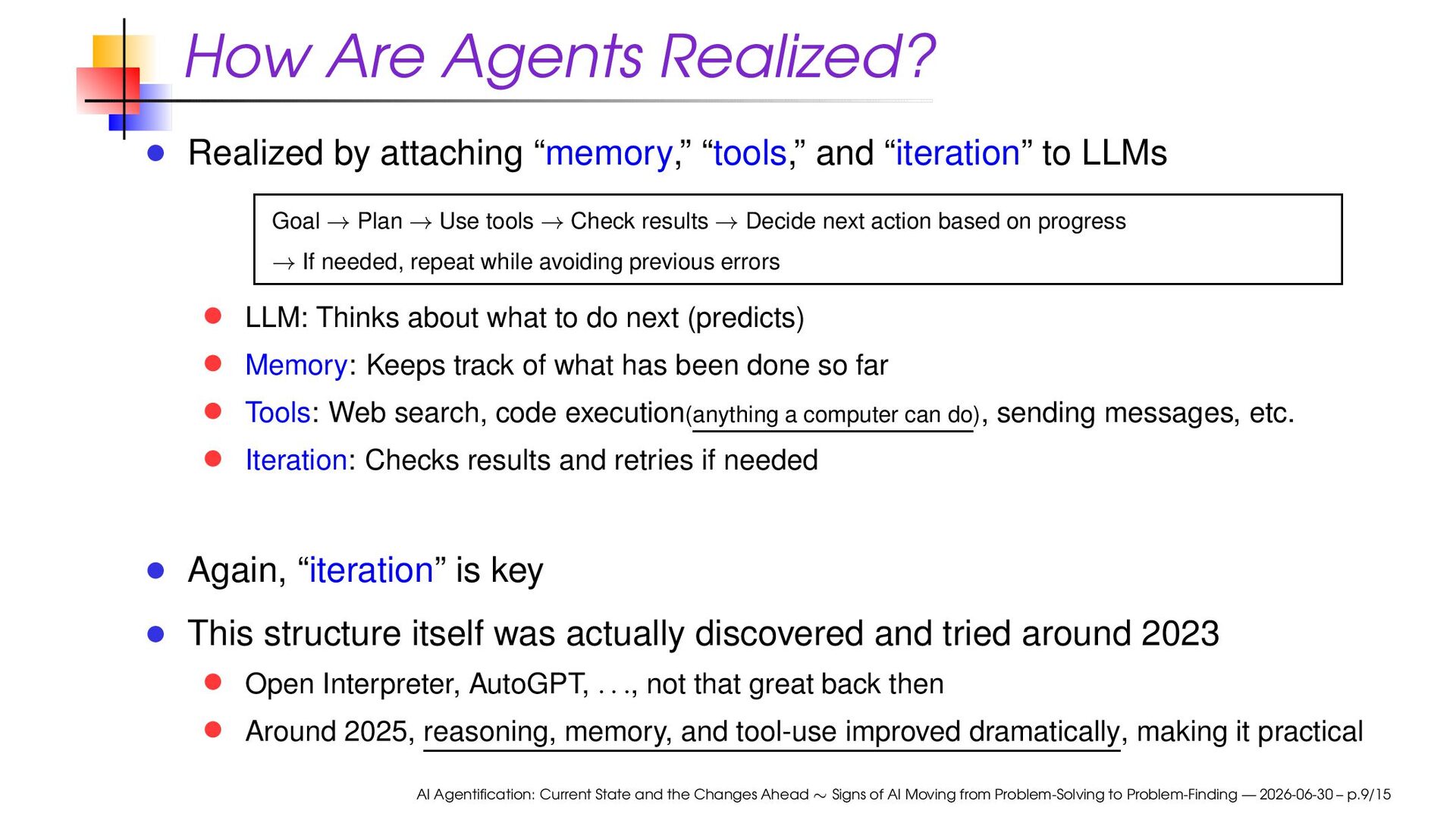
“iteration” to LLMs Goal → Plan → Use tools → Check results → Decide next action based on progress → If needed, repeat while avoiding previous errors LLM: Thinks about what to do next (predicts) Memory: Keeps track of what has been done so far Tools: Web search, code execution(anything a computer can do), sending messages, etc. Iteration: Checks results and retries if needed Again, “iteration” is key This structure itself was actually discovered and tried around 2023 Open Interpreter, AutoGPT, . . ., not that great back then Around 2025, reasoning, memory, and tool-use improved dramatically, making it practical AI Agentification: Current State and the Changes Ahead ∼ Signs of AI Moving from Problem-Solving to Problem-Finding — 2026-06-30 – p.9/15
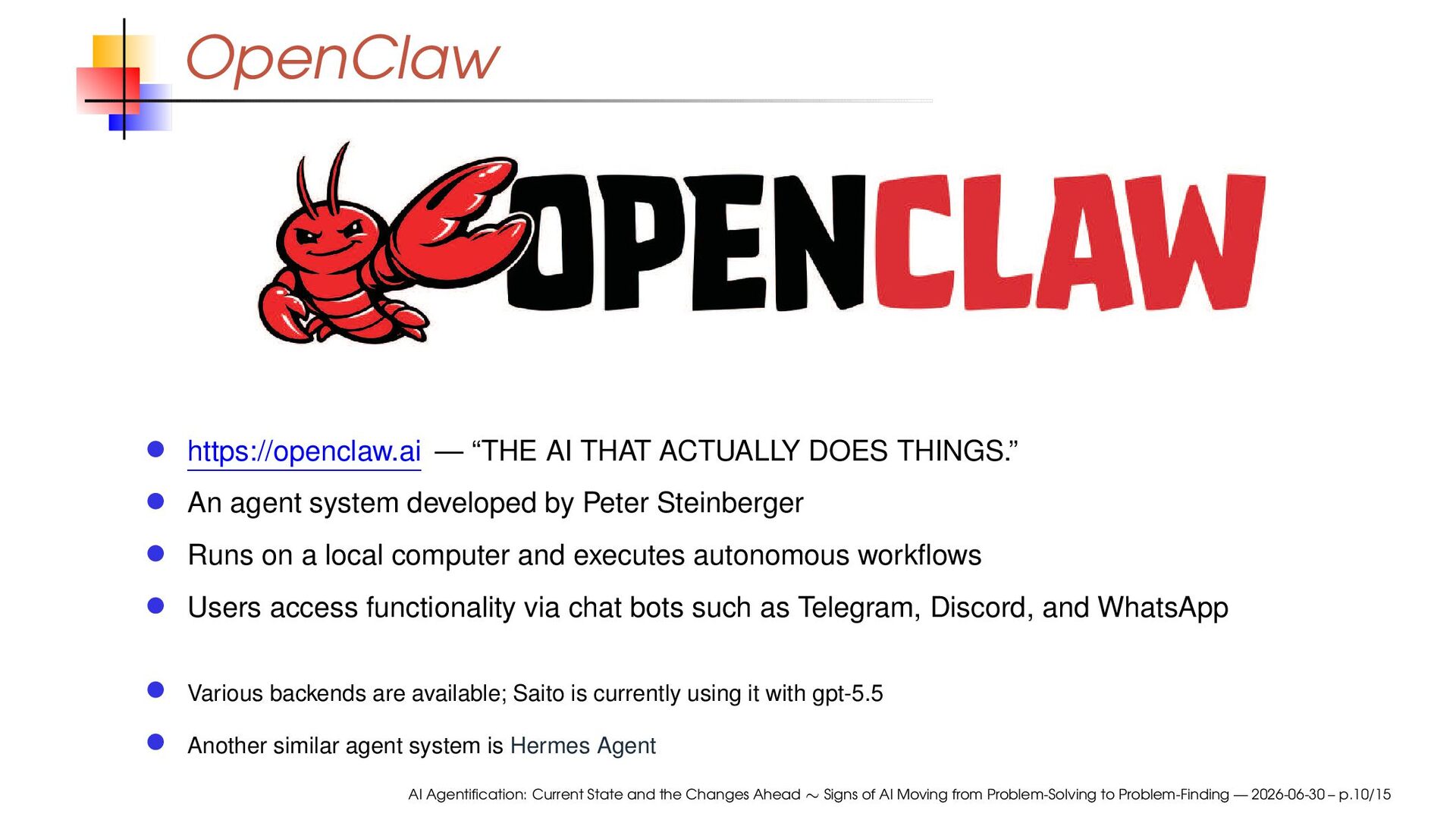
agent system developed by Peter Steinberger Runs on a local computer and executes autonomous workflows Users access functionality via chat bots such as Telegram, Discord, and WhatsApp Various backends are available; Saito is currently using it with gpt-5.5 Another similar agent system is Hermes Agent AI Agentification: Current State and the Changes Ahead ∼ Signs of AI Moving from Problem-Solving to Problem-Finding — 2026-06-30 – p.10/15
you.” An agent system developed by Nous Research Capabilities are not very different from OpenClaw, but features a self-improvement loop Learns from failures and (to some extent) fixes itself automatically The backend for this demo is gpt-5.5 AI Agentification: Current State and the Changes Ahead ∼ Signs of AI Moving from Problem-Solving to Problem-Finding — 2026-06-30 – p.11/15
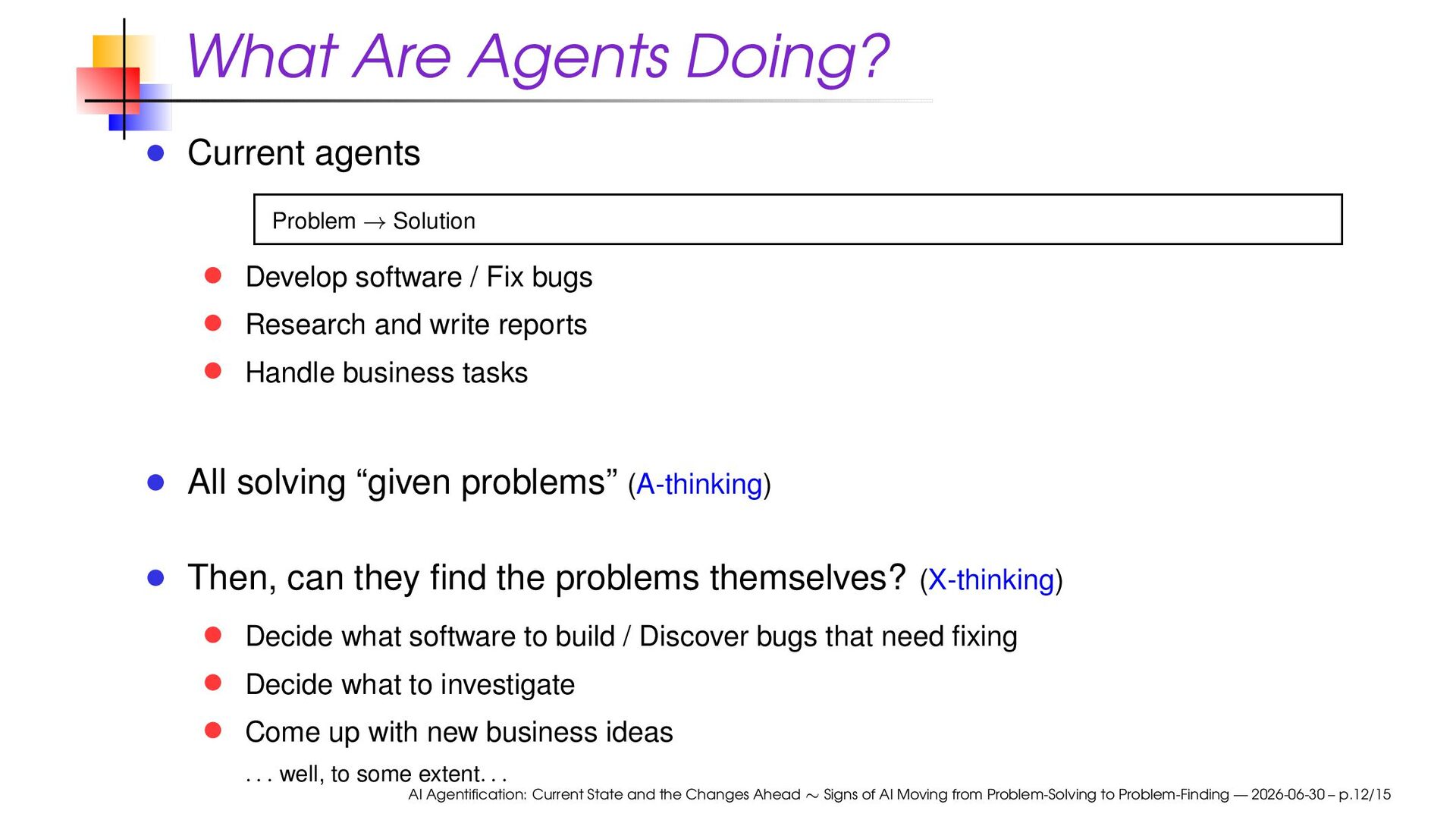
software / Fix bugs Research and write reports Handle business tasks All solving “given problems” (A-thinking) Then, can they find the problems themselves? (X-thinking) Decide what software to build / Discover bugs that need fixing Decide what to investigate Come up with new business ideas . . . well, to some extent . . . AI Agentification: Current State and the Changes Ahead ∼ Signs of AI Moving from Problem-Solving to Problem-Finding — 2026-06-30 – p.12/15
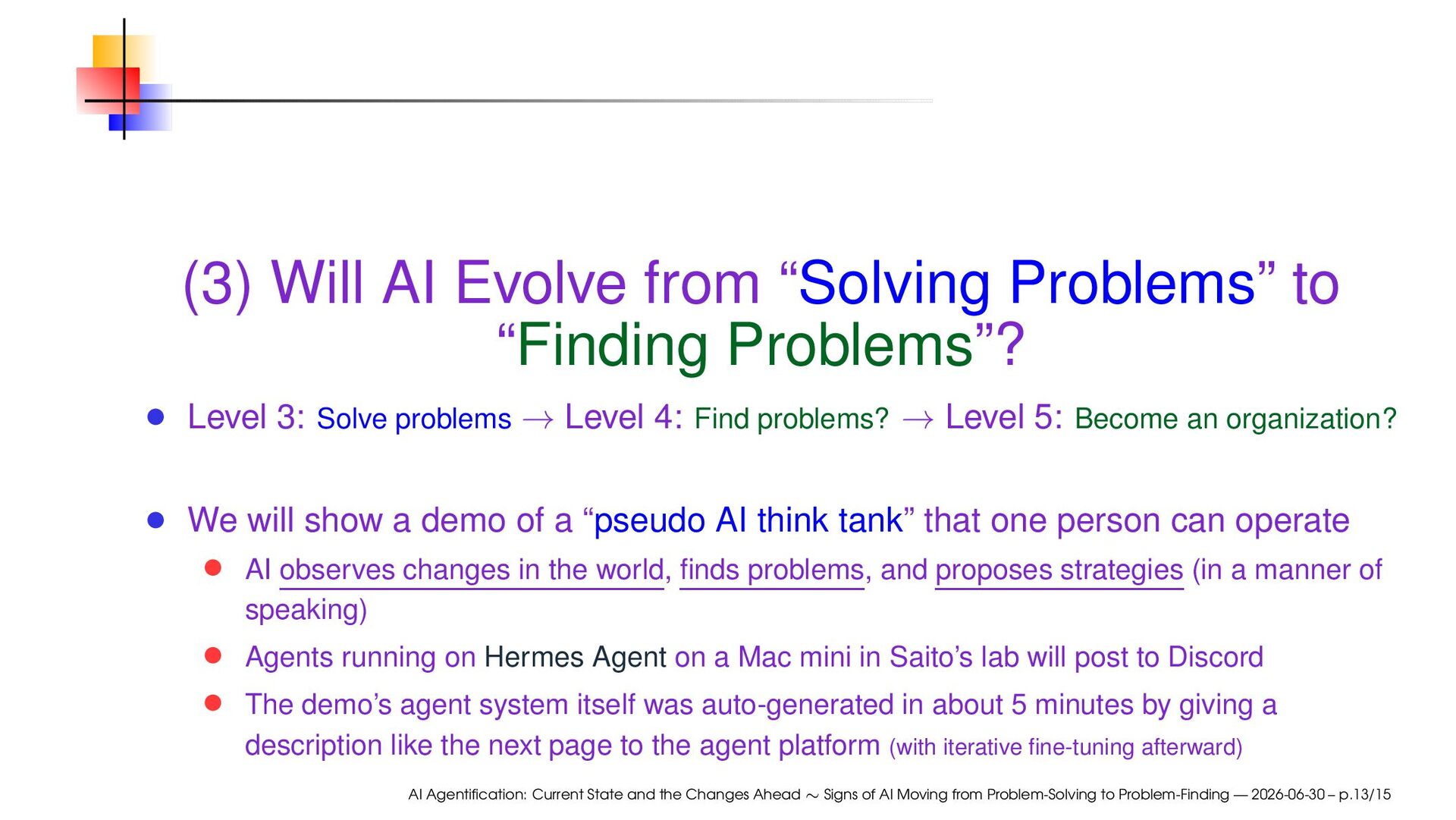
Level 3: Solve problems → Level 4: Find problems? → Level 5: Become an organization? We will show a demo of a “pseudo AI think tank” that one person can operate AI observes changes in the world, finds problems, and proposes strategies (in a manner of speaking) Agents running on Hermes Agent on a Mac mini in Saito’s lab will post to Discord The demo’s agent system itself was auto-generated in about 5 minutes by giving a description like the next page to the agent platform (with iterative fine-tuning afterward) AI Agentification: Current State and the Changes Ahead ∼ Signs of AI Moving from Problem-Solving to Problem-Finding — 2026-06-30 – p.13/15
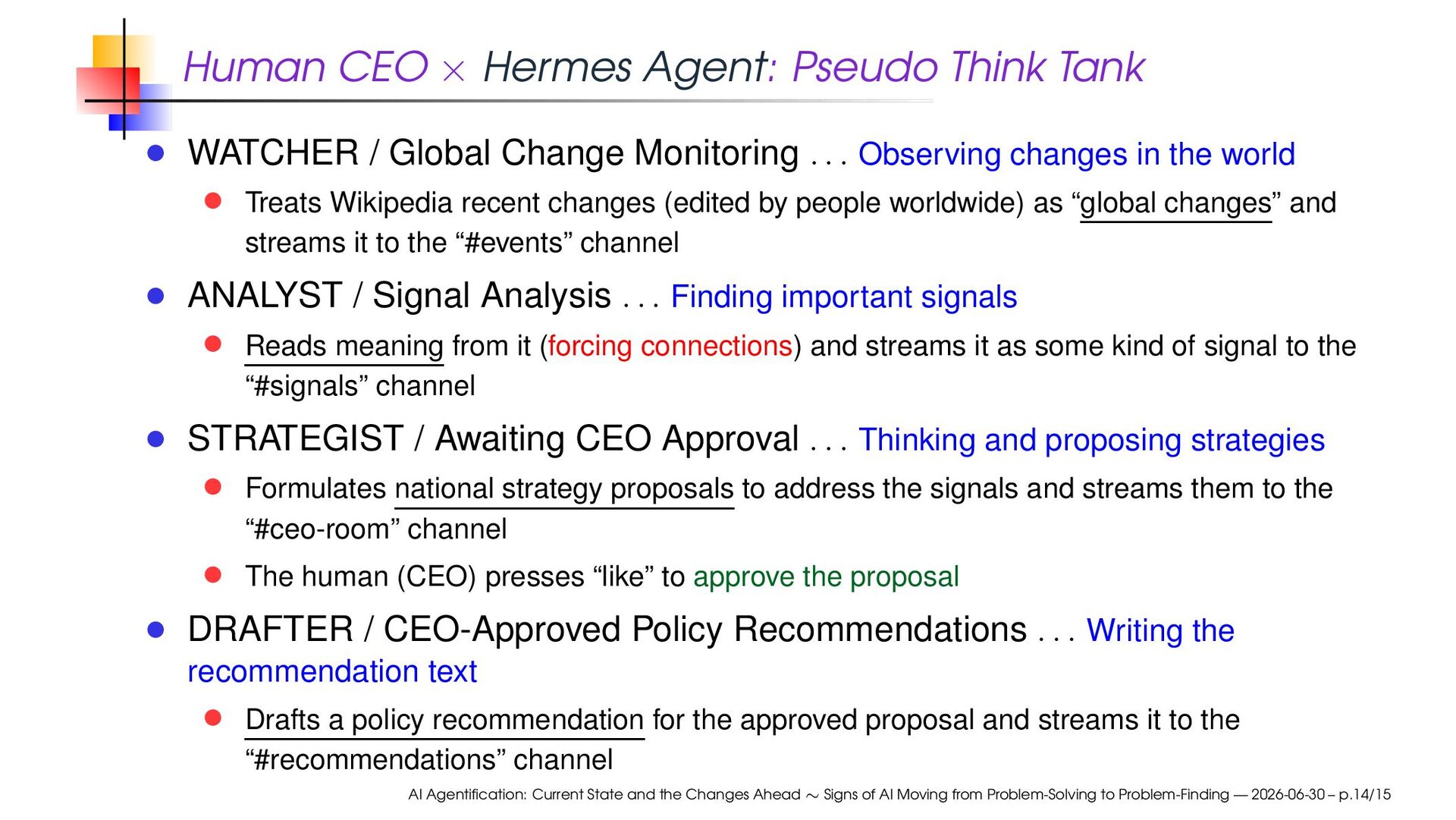
Global Change Monitoring . . . Observing changes in the world Treats Wikipedia recent changes (edited by people worldwide) as “global changes” and streams it to the “#events” channel ANALYST / Signal Analysis . . . Finding important signals Reads meaning from it (forcing connections) and streams it as some kind of signal to the “#signals” channel STRATEGIST / Awaiting CEO Approval . . . Thinking and proposing strategies Formulates national strategy proposals to address the signals and streams them to the “#ceo-room” channel The human (CEO) presses “like” to approve the proposal DRAFTER / CEO-Approved Policy Recommendations . . . Writing the recommendation text Drafts a policy recommendation for the approved proposal and streams it to the “#recommendations” channel AI Agentification: Current State and the Changes Ahead ∼ Signs of AI Moving from Problem-Solving to Problem-Finding — 2026-06-30 – p.14/15
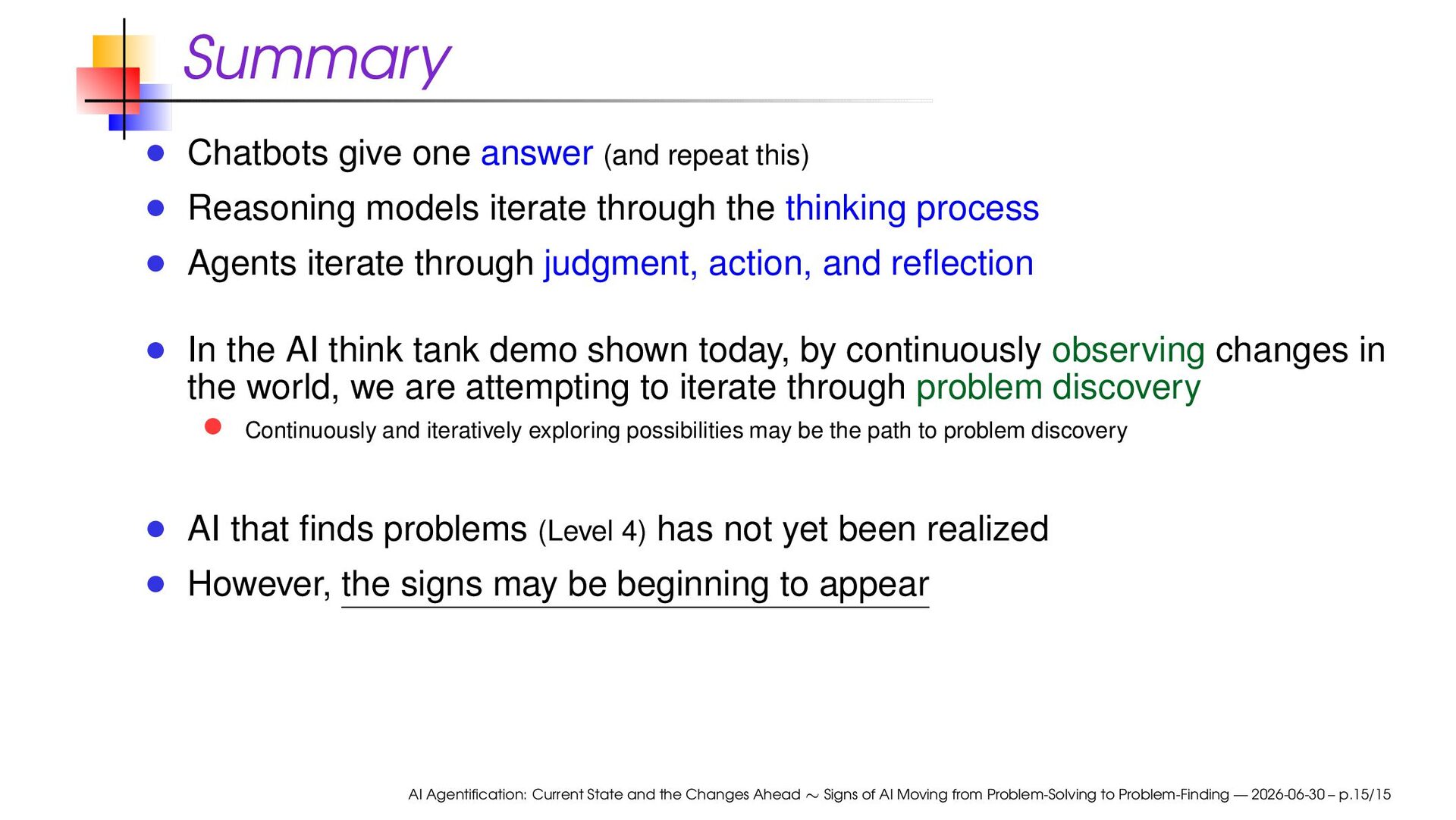
iterate through the thinking process Agents iterate through judgment, action, and reflection In the AI think tank demo shown today, by continuously observing changes in the world, we are attempting to iterate through problem discovery Continuously and iteratively exploring possibilities may be the path to problem discovery AI that finds problems (Level 4) has not yet been realized However, the signs may be beginning to appear AI Agentification: Current State and the Changes Ahead ∼ Signs of AI Moving from Problem-Solving to Problem-Finding — 2026-06-30 – p.15/15


 ks91
ks91
 kairim0
 syuchimu
 occhi
occhi
 jozono
 rfdnxbro
 pfn
pfn
 riyaamemiya
 teamlab
 kzkhykw1991
 tokuty
 yahonda
 akhino
 sabderemane
 nwiizo
 nikkihalliwell
 soudai
 aleyda
 danielanewman
 twada
twada
 kristinabergwall1
 reverentgeek
 maggiecrowley
 skipperchong
 raygrieselhuber