Fall 2026: A Guide & Workshop on Using AI for Academic Paper Writing
These are the slides used in the workshop hosted by the Waseda University Business School DX Committee, which was held online on Sunday, October 18, 2026.
by Stable Diffusion 3.5 Fall 2026: A Guide & Workshop on Using AI for Academic Paper Writing Digital Transformation (DX) Committee, Waseda Business School (WBS) Fall 2026: A Guide & Workshop on Using AI for Academic Paper Writing — 2026-10-18 – p. 1/38
being merely a supporting tool and is increasingly becoming a partner in intellectual work / Today, conversational AI tools and AI agents can support researchers interactively throughout the research process, from exploring research topics and refining research questions to organizing the literature, structuring arguments, and even assisting with academic writing Amid these changes, an important question arises anew: in a world where AI is taken for granted, what should you, as business school graduates, be able to think about, discover, analyze, and communicate to others? AI is not intended to replace human thinking entirely / Rather, it brings into sharper focus the importance of capabilities expected at the graduate level: the ability to formulate meaningful questions, identify critical issues, critically evaluate evidence, and communicate persuasively in one’s own words This workshop is intended for students who will be working on papers toward their MBA degree / We will explore how AI tools can be used not merely as convenient utilities, but as intellectual partners that can deepen research and thinking AI has made producing written text easier than ever before / At the same time, however, our intellectual responsibility as humans has become even greater: What questions should we ask? What valuable insights should we derive? And how should we connect those insights to society and professional practice? Through practical demonstrations and discussion, this workshop will consider what research and learning should look like in this new environment Fall 2026: A Guide & Workshop on Using AI for Academic Paper Writing — 2026-10-18 – p. 3/38
collaboration with academic supervisors WBS Guidelines for the Use of AI in Learning and Research AI in Research and Education: Where Are We Now? (2) How students are using AI (focusing on survey results from March 2026 graduates) (3) Demonstrations Do we neeed this? A research workflow demonstration using GAMER PAT, a tool being developed at WBS A demonstration of local LLM use, also using a tool being developed at WBS (4) Q & A (5) Discussion: How can we make better use of AI? Please feel free to ask questions via chat or voice throughout the session! There will be hands-on activities, so we encourage everyone to try the tools as we go! (Go to p.30) Fall 2026: A Guide & Workshop on Using AI for Academic Paper Writing — 2026-10-18 – p. 4/38
academic supervisors WBS Guidelines for the Use of AI in Learning and Research AI in Research and Education: Where Are We Now? Fall 2026: A Guide & Workshop on Using AI for Academic Paper Writing — 2026-10-18 – p. 5/38
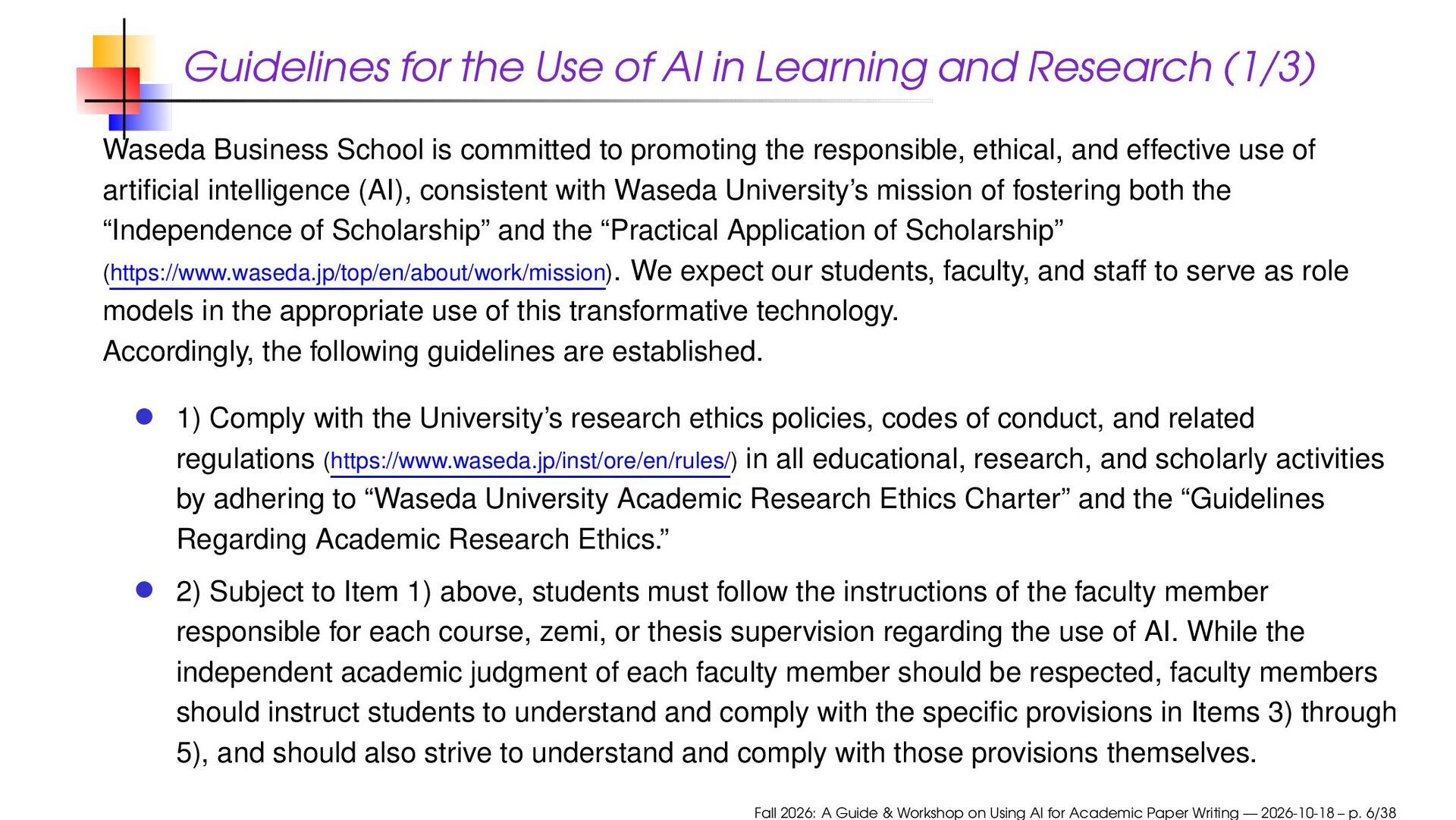
(1/3) Waseda Business School is committed to promoting the responsible, ethical, and effective use of artificial intelligence (AI), consistent with Waseda University’s mission of fostering both the “Independence of Scholarship” and the “Practical Application of Scholarship” (https://www.waseda.jp/top/en/about/work/mission). We expect our students, faculty, and staff to serve as role models in the appropriate use of this transformative technology. Accordingly, the following guidelines are established. 1) Comply with the University’s research ethics policies, codes of conduct, and related regulations (https://www.waseda.jp/inst/ore/en/rules/) in all educational, research, and scholarly activities by adhering to “Waseda University Academic Research Ethics Charter” and the “Guidelines Regarding Academic Research Ethics.” 2) Subject to Item 1) above, students must follow the instructions of the faculty member responsible for each course, zemi, or thesis supervision regarding the use of AI. While the independent academic judgment of each faculty member should be respected, faculty members should instruct students to understand and comply with the specific provisions in Items 3) through 5), and should also strive to understand and comply with those provisions themselves. Fall 2026: A Guide & Workshop on Using AI for Academic Paper Writing — 2026-10-18 – p. 6/38
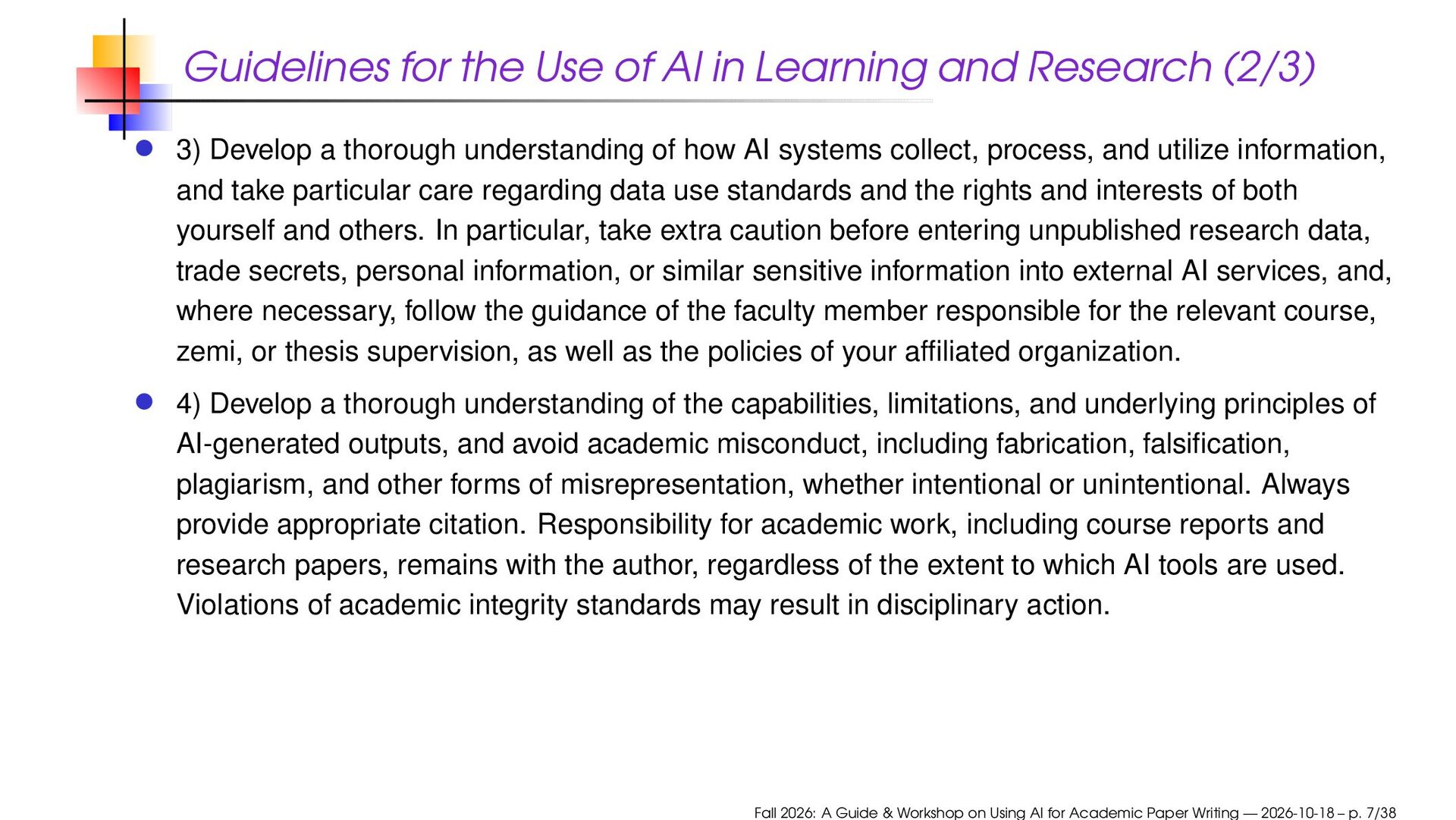
(2/3) 3) Develop a thorough understanding of how AI systems collect, process, and utilize information, and take particular care regarding data use standards and the rights and interests of both yourself and others. In particular, take extra caution before entering unpublished research data, trade secrets, personal information, or similar sensitive information into external AI services, and, where necessary, follow the guidance of the faculty member responsible for the relevant course, zemi, or thesis supervision, as well as the policies of your affiliated organization. 4) Develop a thorough understanding of the capabilities, limitations, and underlying principles of AI-generated outputs, and avoid academic misconduct, including fabrication, falsification, plagiarism, and other forms of misrepresentation, whether intentional or unintentional. Always provide appropriate citation. Responsibility for academic work, including course reports and research papers, remains with the author, regardless of the extent to which AI tools are used. Violations of academic integrity standards may result in disciplinary action. Fall 2026: A Guide & Workshop on Using AI for Academic Paper Writing — 2026-10-18 – p. 7/38
(3/3) 5) Use AI to enhance learning, critical thinking, and creativity for your professional development and for the benefit of society. Avoid relying on AI uncritically or accepting AI-generated responses without independent evaluation, thereby mitigating the risks described in Item 4). Employ AI as a tool in an iterative process of inquiry, refinement, and reflection. Waseda Business School expects students to make active use of AI while developing as individuals who formulate questions, exercise judgment, and take responsibility for their work. Faculty members will support this process while also making use of AI themselves. Fall 2026: A Guide & Workshop on Using AI for Academic Paper Writing — 2026-10-18 – p. 8/38
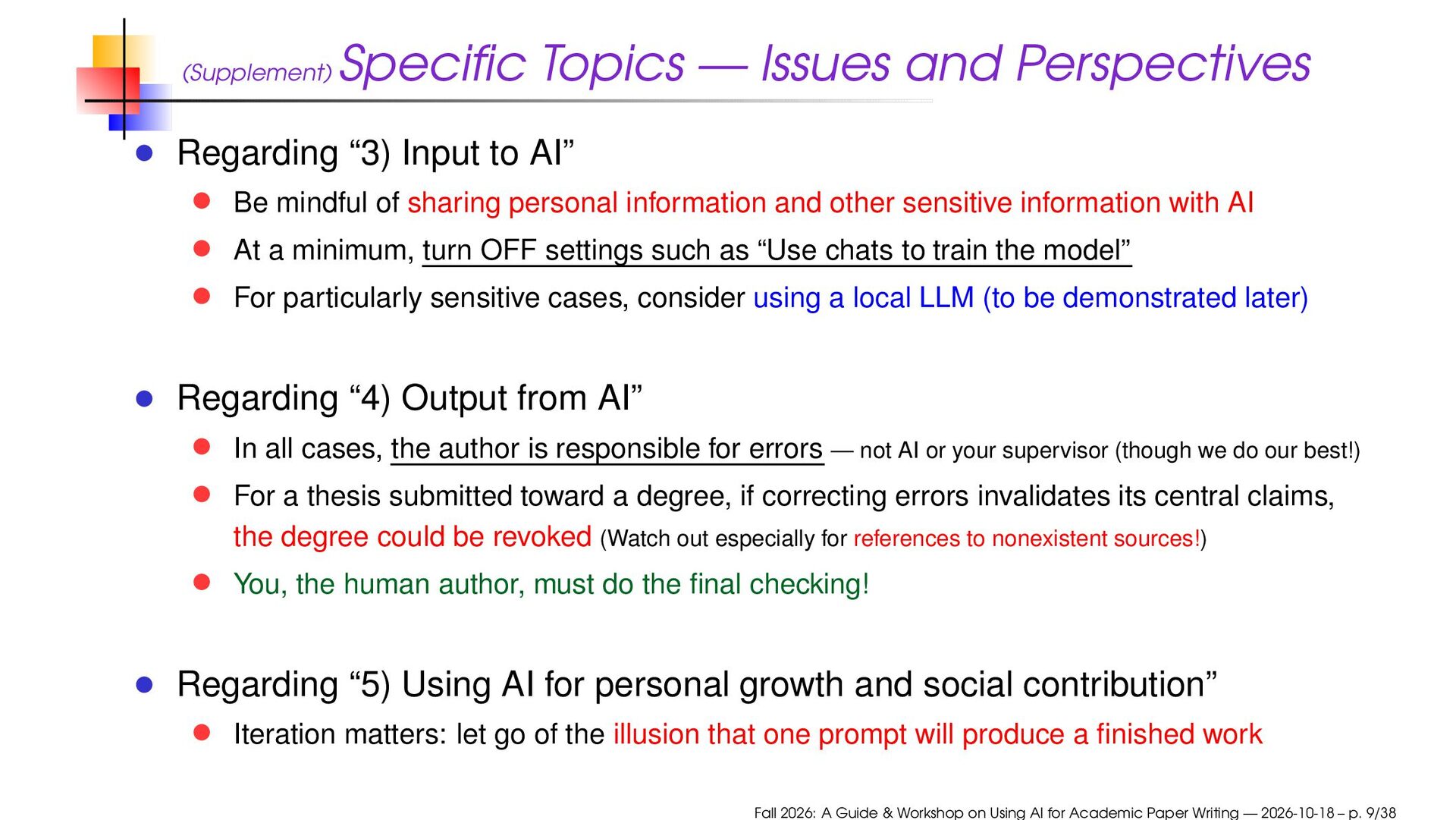
to AI” Be mindful of sharing personal information and other sensitive information with AI At a minimum, turn OFF settings such as “Use chats to train the model” For particularly sensitive cases, consider using a local LLM (to be demonstrated later) Regarding “4) Output from AI” In all cases, the author is responsible for errors — not AI or your supervisor (though we do our best!) For a thesis submitted toward a degree, if correcting errors invalidates its central claims, the degree could be revoked (Watch out especially for references to nonexistent sources!) You, the human author, must do the final checking! Regarding “5) Using AI for personal growth and social contribution” Iteration matters: let go of the illusion that one prompt will produce a finished work Fall 2026: A Guide & Workshop on Using AI for Academic Paper Writing — 2026-10-18 – p. 9/38
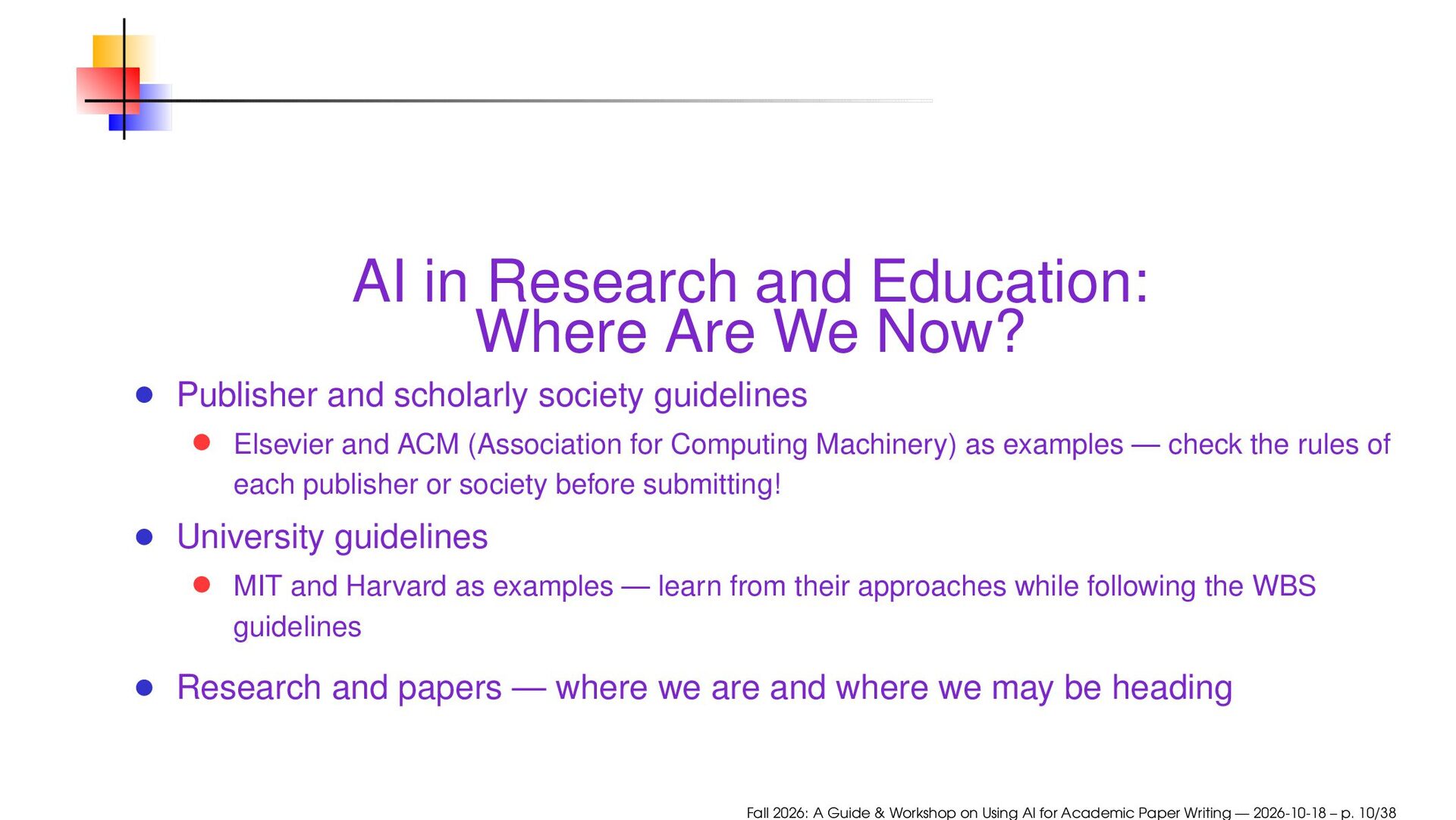
and scholarly society guidelines Elsevier and ACM (Association for Computing Machinery) as examples — check the rules of each publisher or society before submitting! University guidelines MIT and Harvard as examples — learn from their approaches while following the WBS guidelines Research and papers — where we are and where we may be heading Fall 2026: A Guide & Workshop on Using AI for Academic Paper Writing — 2026-10-18 – p. 10/38
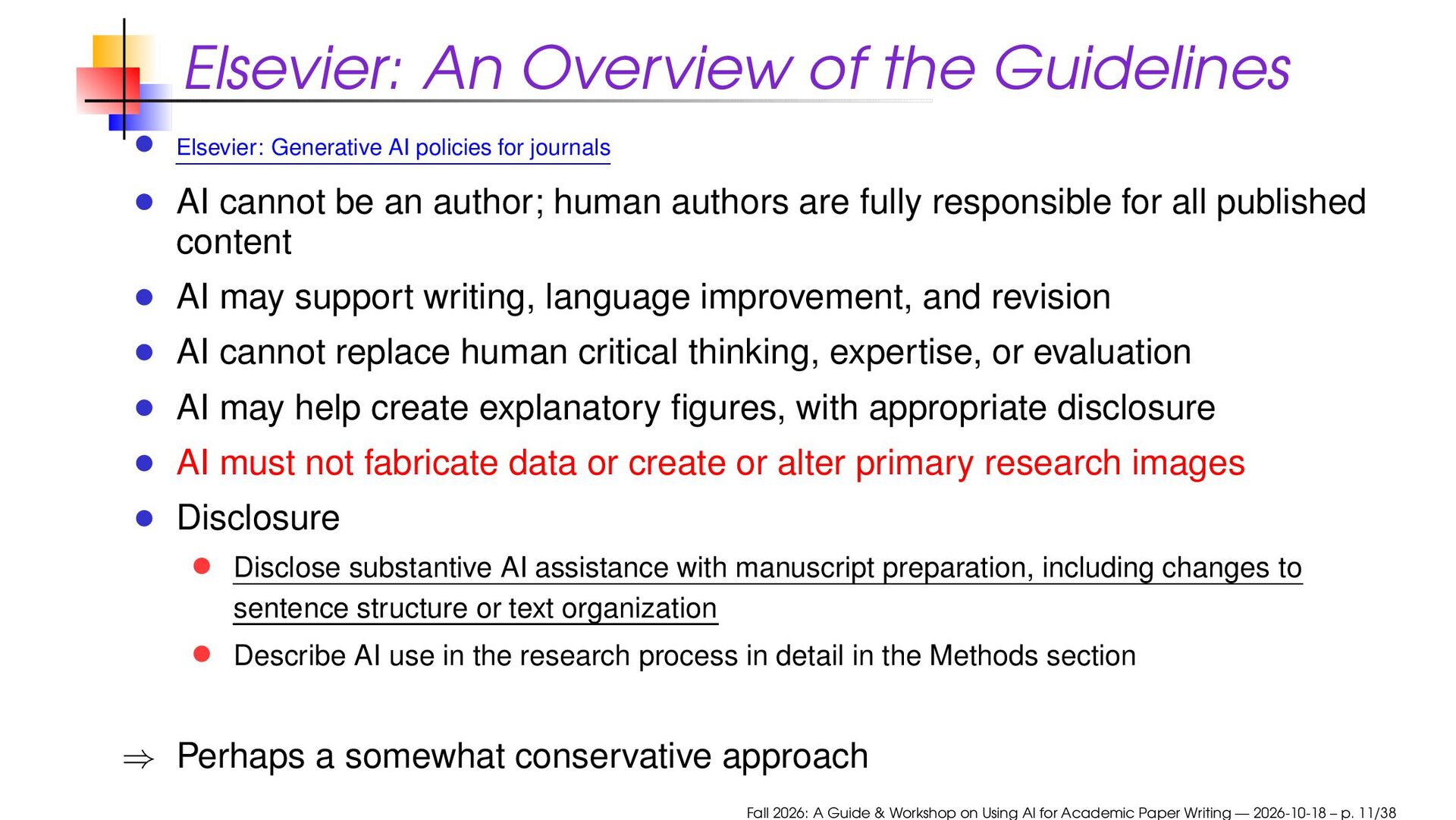
for journals AI cannot be an author; human authors are fully responsible for all published content AI may support writing, language improvement, and revision AI cannot replace human critical thinking, expertise, or evaluation AI may help create explanatory figures, with appropriate disclosure AI must not fabricate data or create or alter primary research images Disclosure Disclose substantive AI assistance with manuscript preparation, including changes to sentence structure or text organization Describe AI use in the research process in detail in the Methods section ⇒ Perhaps a somewhat conservative approach Fall 2026: A Guide & Workshop on Using AI for Academic Paper Writing — 2026-10-18 – p. 11/38
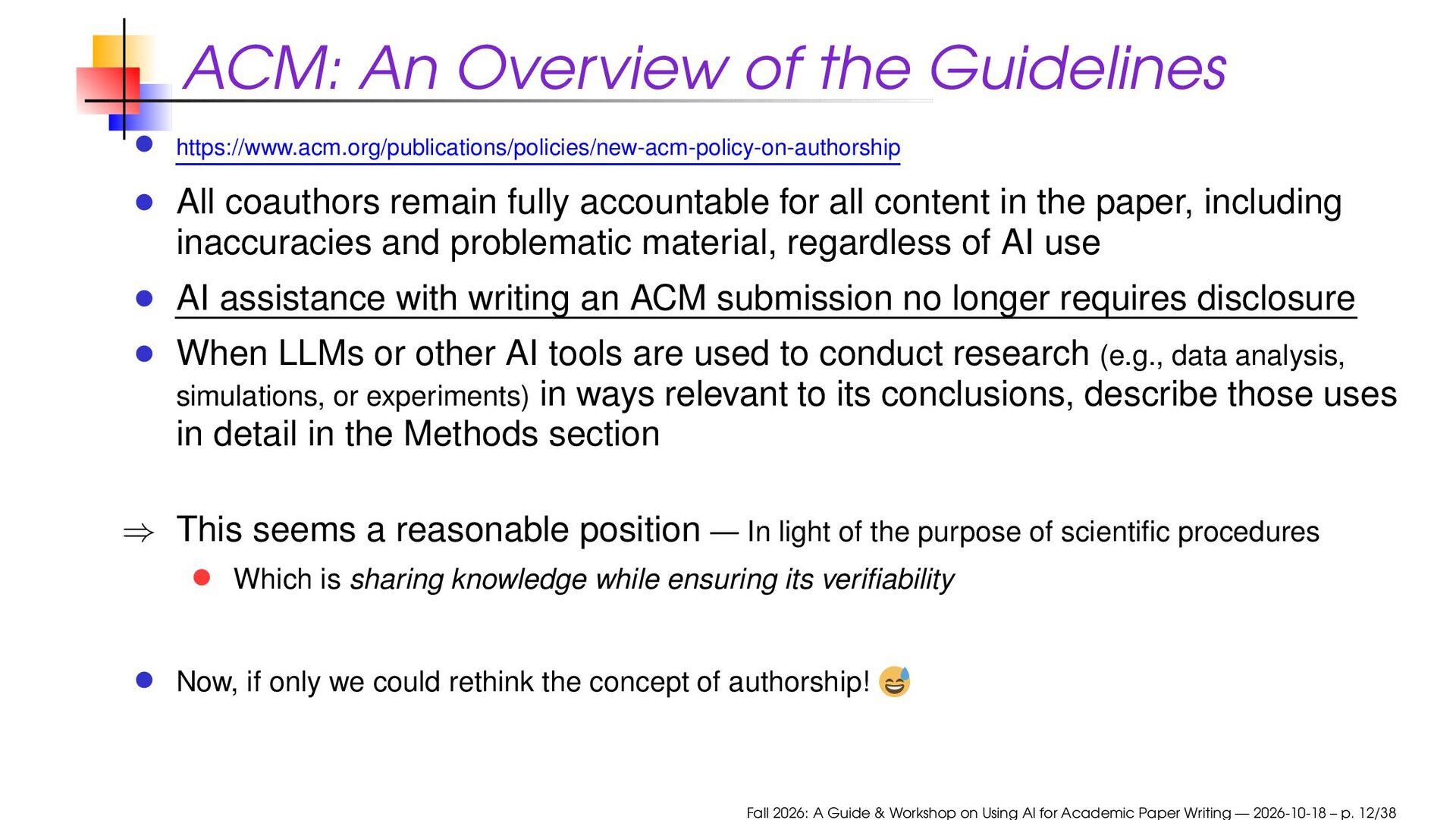
fully accountable for all content in the paper, including inaccuracies and problematic material, regardless of AI use AI assistance with writing an ACM submission no longer requires disclosure When LLMs or other AI tools are used to conduct research (e.g., data analysis, simulations, or experiments) in ways relevant to its conclusions, describe those uses in detail in the Methods section ⇒ This seems a reasonable position — In light of the purpose of scientific procedures Which is sharing knowledge while ensuring its verifiability Now, if only we could rethink the concept of authorship! Fall 2026: A Guide & Workshop on Using AI for Academic Paper Writing — 2026-10-18 – p. 12/38
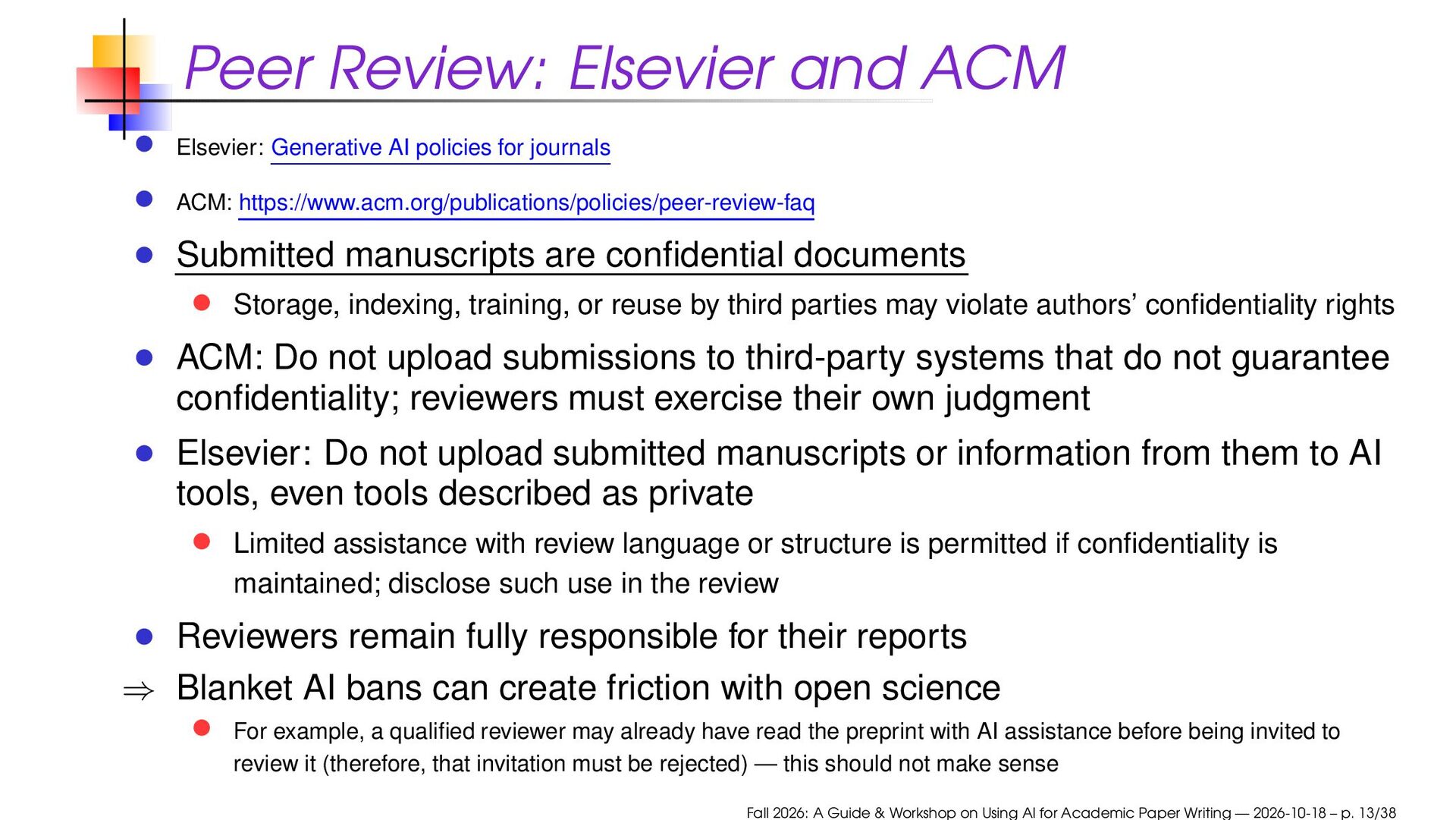
journals ACM: https://www.acm.org/publications/policies/peer-review-faq Submitted manuscripts are confidential documents Storage, indexing, training, or reuse by third parties may violate authors’ confidentiality rights ACM: Do not upload submissions to third-party systems that do not guarantee confidentiality; reviewers must exercise their own judgment Elsevier: Do not upload submitted manuscripts or information from them to AI tools, even tools described as private Limited assistance with review language or structure is permitted if confidentiality is maintained; disclose such use in the review Reviewers remain fully responsible for their reports ⇒ Blanket AI bans can create friction with open science For example, a qualified reviewer may already have read the preprint with AI assistance before being invited to review it (therefore, that invitation must be rejected) — this should not make sense Fall 2026: A Guide & Workshop on Using AI for Academic Paper Writing — 2026-10-18 – p. 13/38
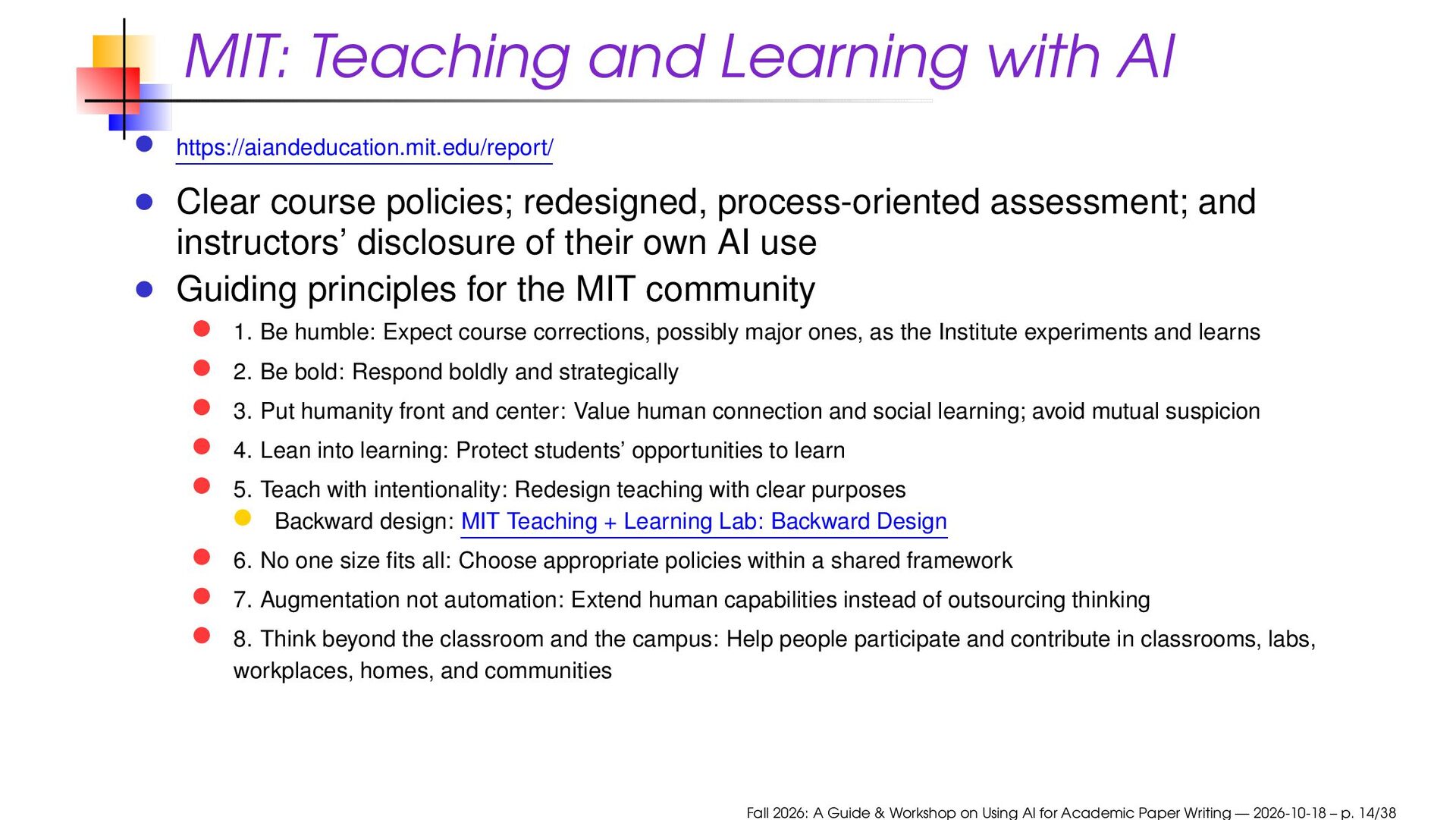
redesigned, process-oriented assessment; and instructors’ disclosure of their own AI use Guiding principles for the MIT community 1. Be humble: Expect course corrections, possibly major ones, as the Institute experiments and learns 2. Be bold: Respond boldly and strategically 3. Put humanity front and center: Value human connection and social learning; avoid mutual suspicion 4. Lean into learning: Protect students’ opportunities to learn 5. Teach with intentionality: Redesign teaching with clear purposes Backward design: MIT Teaching + Learning Lab: Backward Design 6. No one size fits all: Choose appropriate policies within a shared framework 7. Augmentation not automation: Extend human capabilities instead of outsourcing thinking 8. Think beyond the classroom and the campus: Help people participate and contribute in classrooms, labs, workplaces, homes, and communities Fall 2026: A Guide & Workshop on Using AI for Academic Paper Writing — 2026-10-18 – p. 14/38
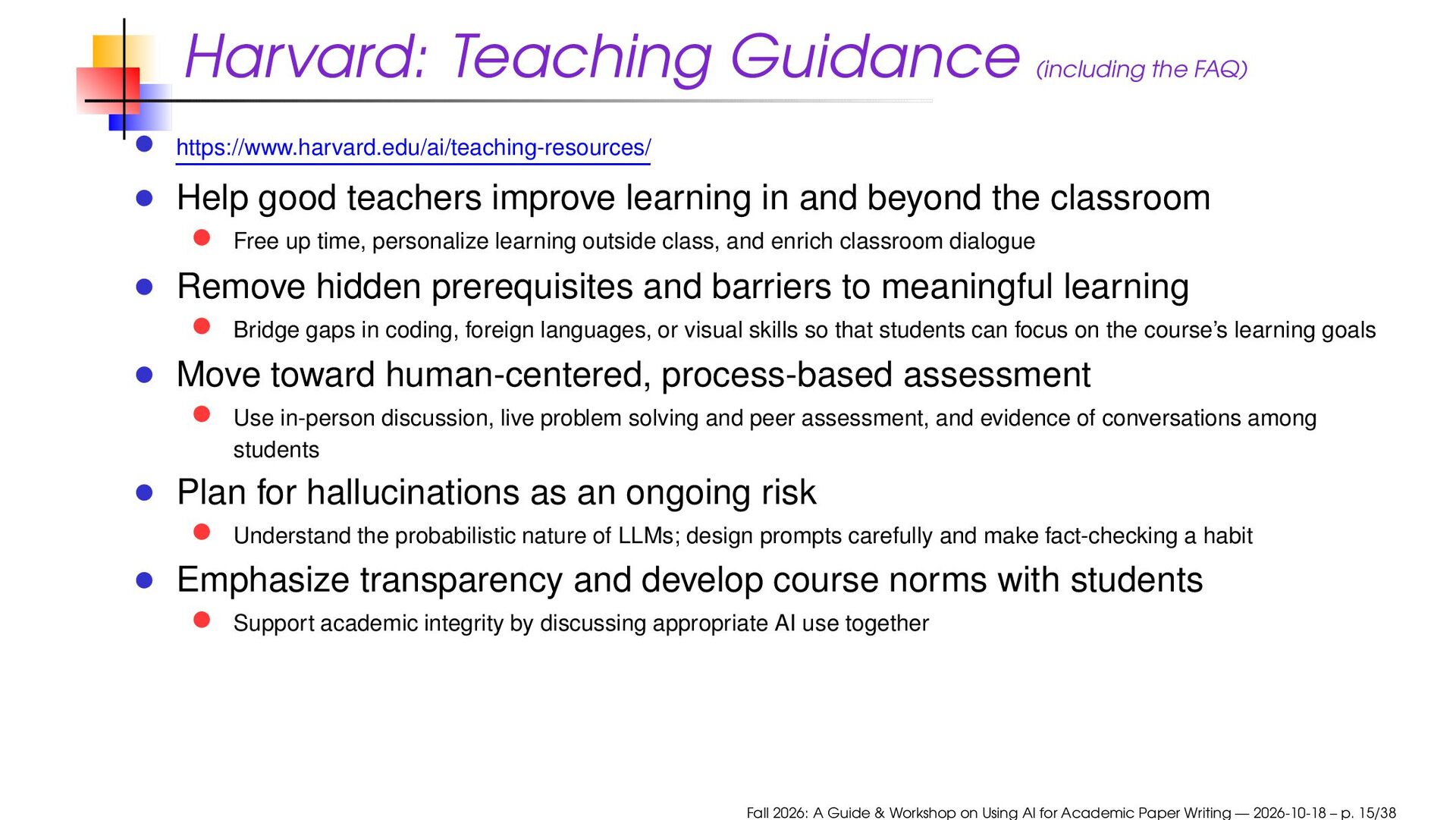
improve learning in and beyond the classroom Free up time, personalize learning outside class, and enrich classroom dialogue Remove hidden prerequisites and barriers to meaningful learning Bridge gaps in coding, foreign languages, or visual skills so that students can focus on the course’s learning goals Move toward human-centered, process-based assessment Use in-person discussion, live problem solving and peer assessment, and evidence of conversations among students Plan for hallucinations as an ongoing risk Understand the probabilistic nature of LLMs; design prompts carefully and make fact-checking a habit Emphasize transparency and develop course norms with students Support academic integrity by discussing appropriate AI use together Fall 2026: A Guide & Workshop on Using AI for Academic Paper Writing — 2026-10-18 – p. 15/38
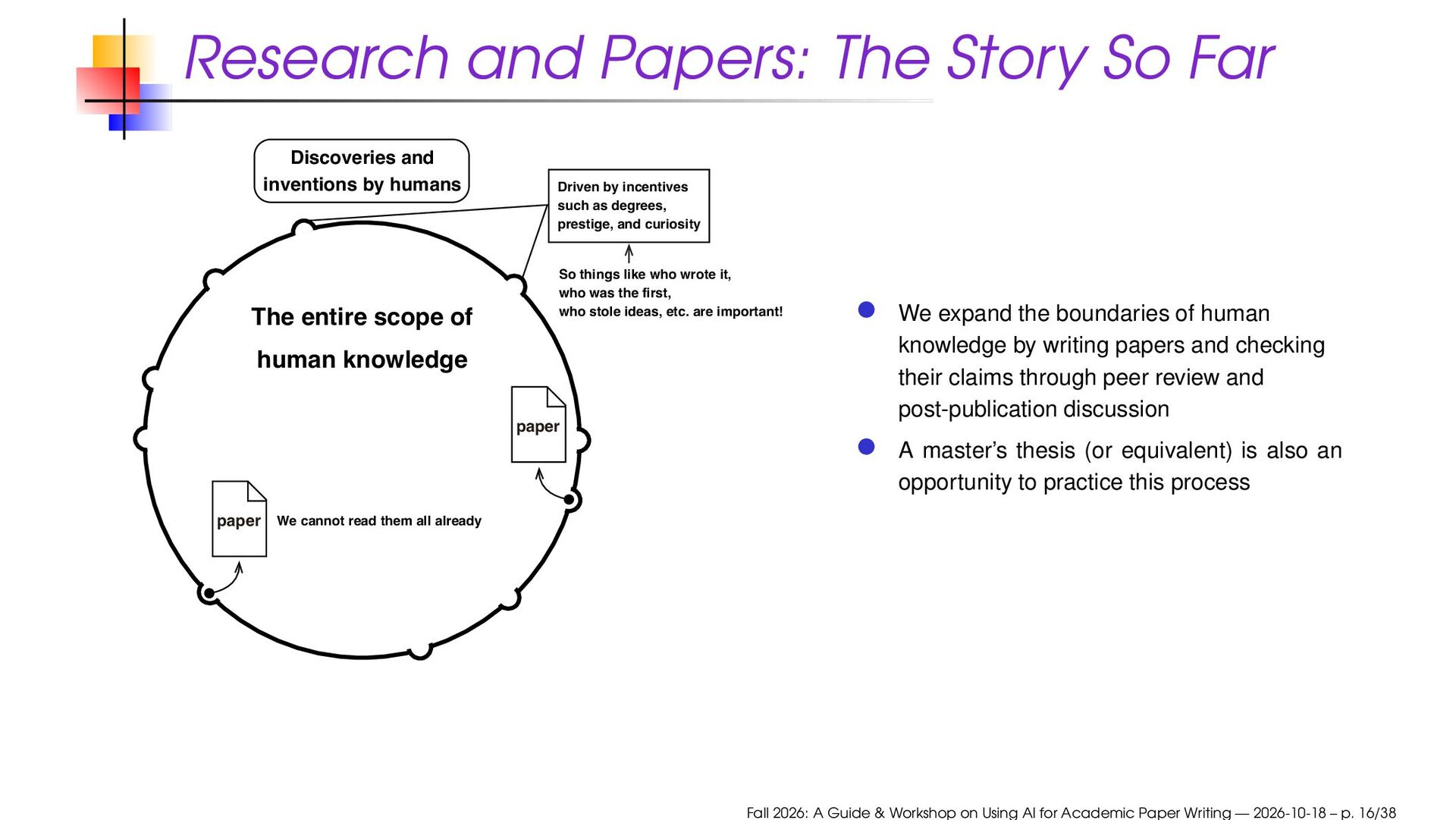
by humans The entire scope of Driven by incentives such as degrees, prestige, and curiosity So things like who wrote it, who was the first, who stole ideas, etc. are important! human knowledge paper We expand the boundaries of human knowledge by writing papers and checking their claims through peer review and post-publication discussion A master’s thesis (or equivalent) is also an opportunity to practice this process paper We cannot read them all already Fall 2026: A Guide & Workshop on Using AI for Academic Paper Writing — 2026-10-18 – p. 16/38
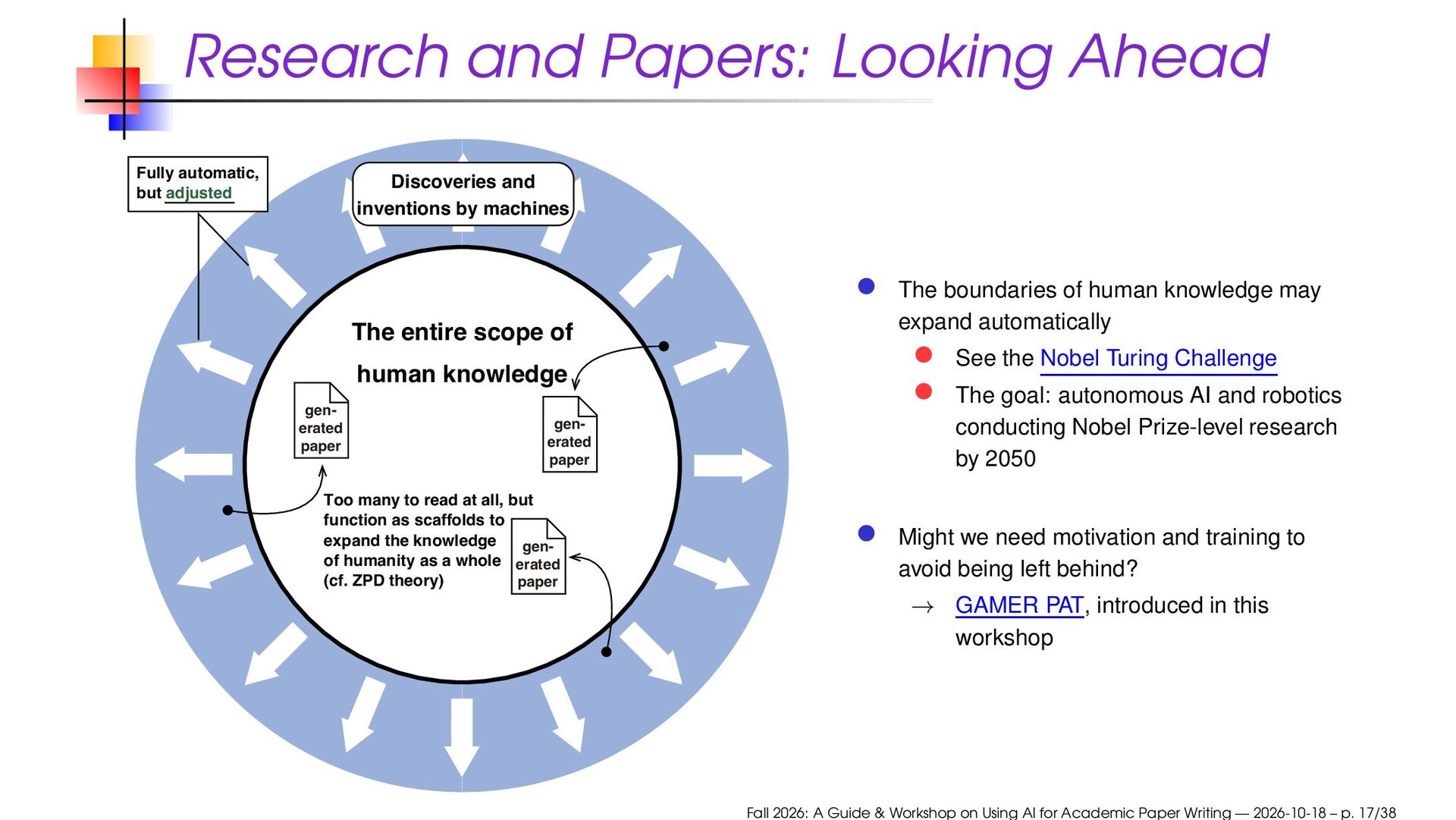
and inventions by machines The entire scope of human knowledge generated paper generated paper Too many to read at all, but function as scaffolds to expand the knowledge genof humanity as a whole erated (cf. ZPD theory) paper The boundaries of human knowledge may expand automatically See the Nobel Turing Challenge The goal: autonomous AI and robotics conducting Nobel Prize-level research by 2050 Might we need motivation and training to avoid being left behind? → GAMER PAT, introduced in this workshop Fall 2026: A Guide & Workshop on Using AI for Academic Paper Writing — 2026-10-18 – p. 17/38
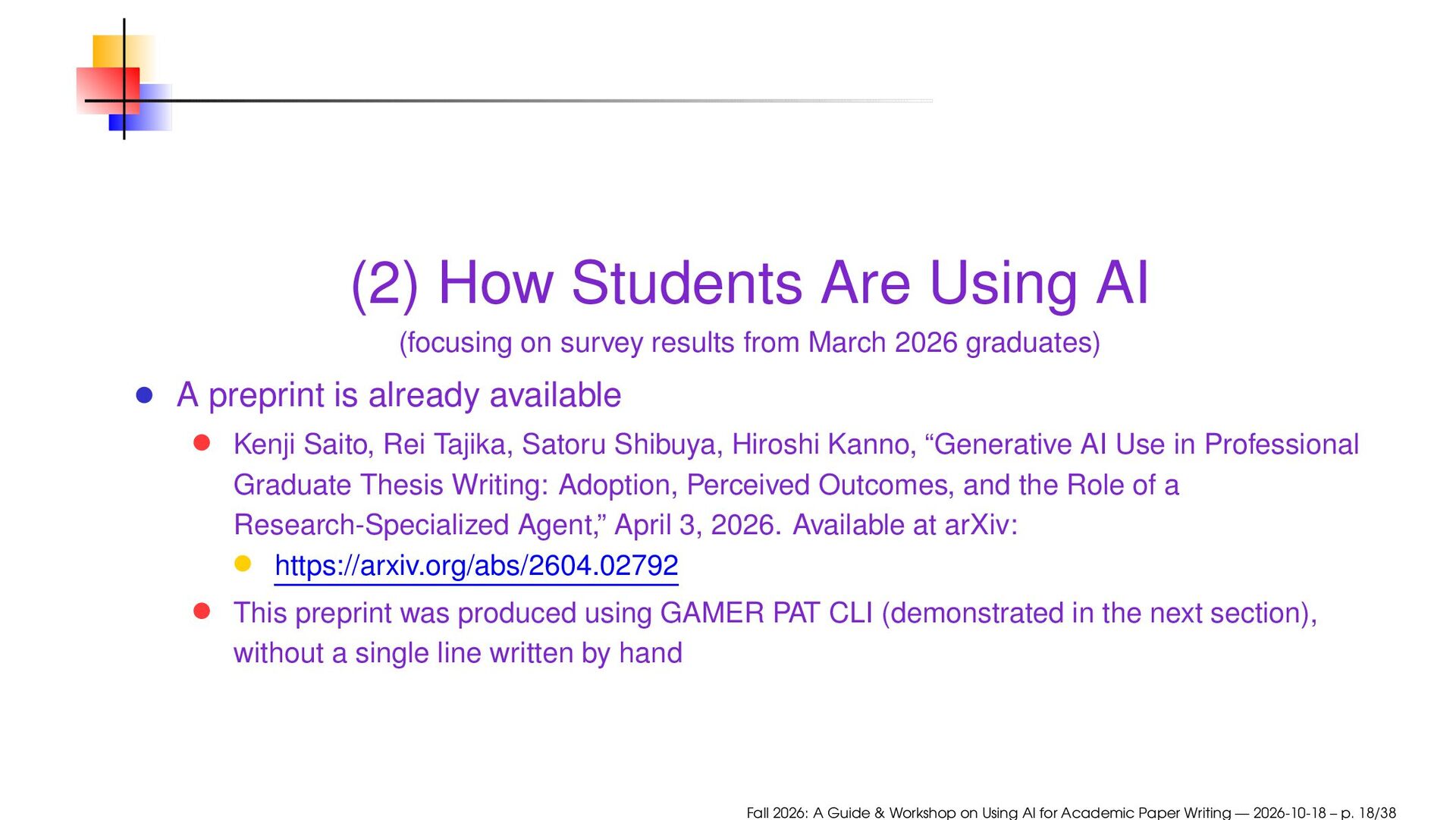
from March 2026 graduates) A preprint is already available Kenji Saito, Rei Tajika, Satoru Shibuya, Hiroshi Kanno, “Generative AI Use in Professional Graduate Thesis Writing: Adoption, Perceived Outcomes, and the Role of a Research-Specialized Agent,” April 3, 2026. Available at arXiv: https://arxiv.org/abs/2604.02792 This preprint was produced using GAMER PAT CLI (demonstrated in the next section), without a single line written by hand Fall 2026: A Guide & Workshop on Using AI for Academic Paper Writing — 2026-10-18 – p. 18/38
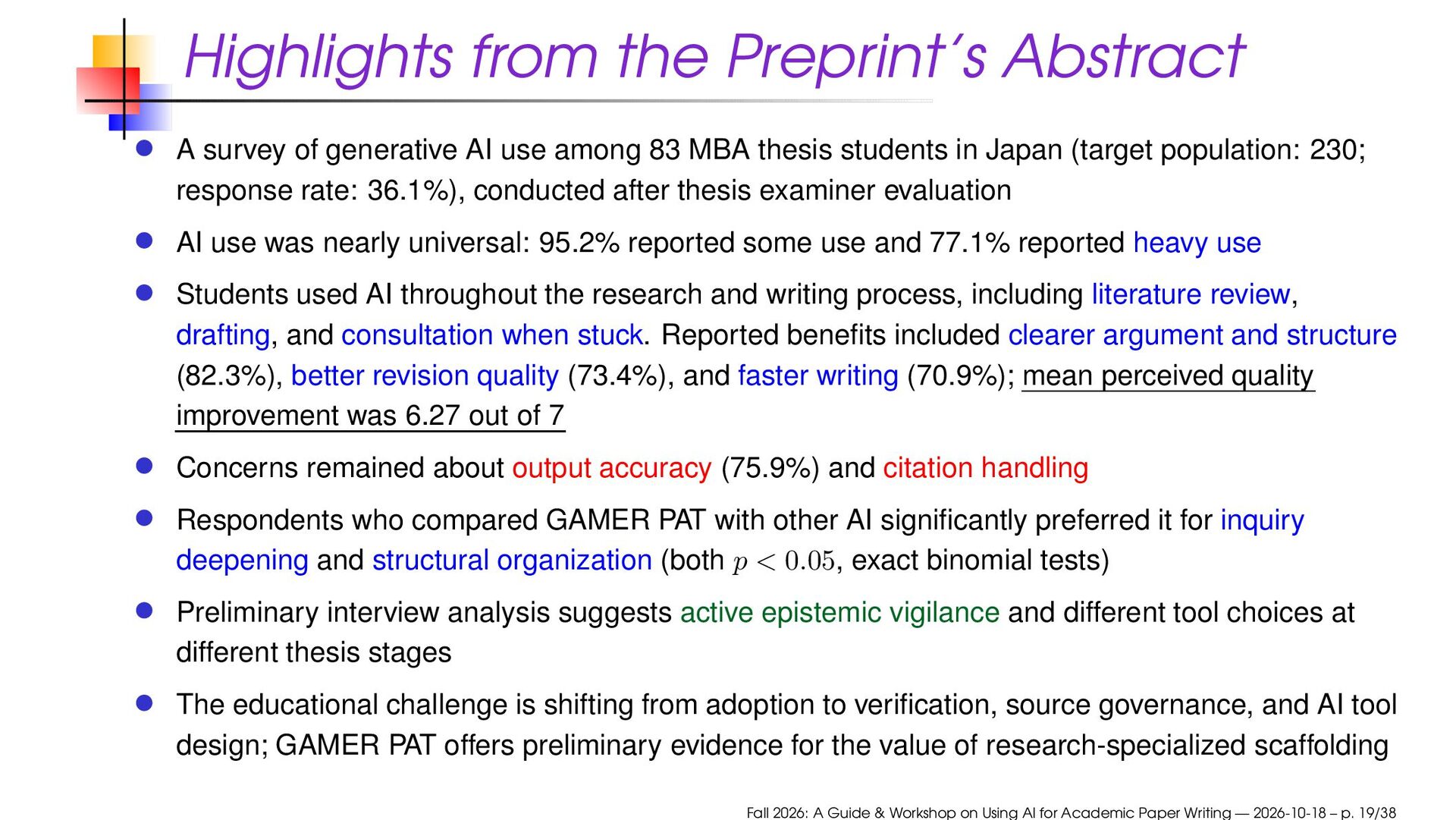
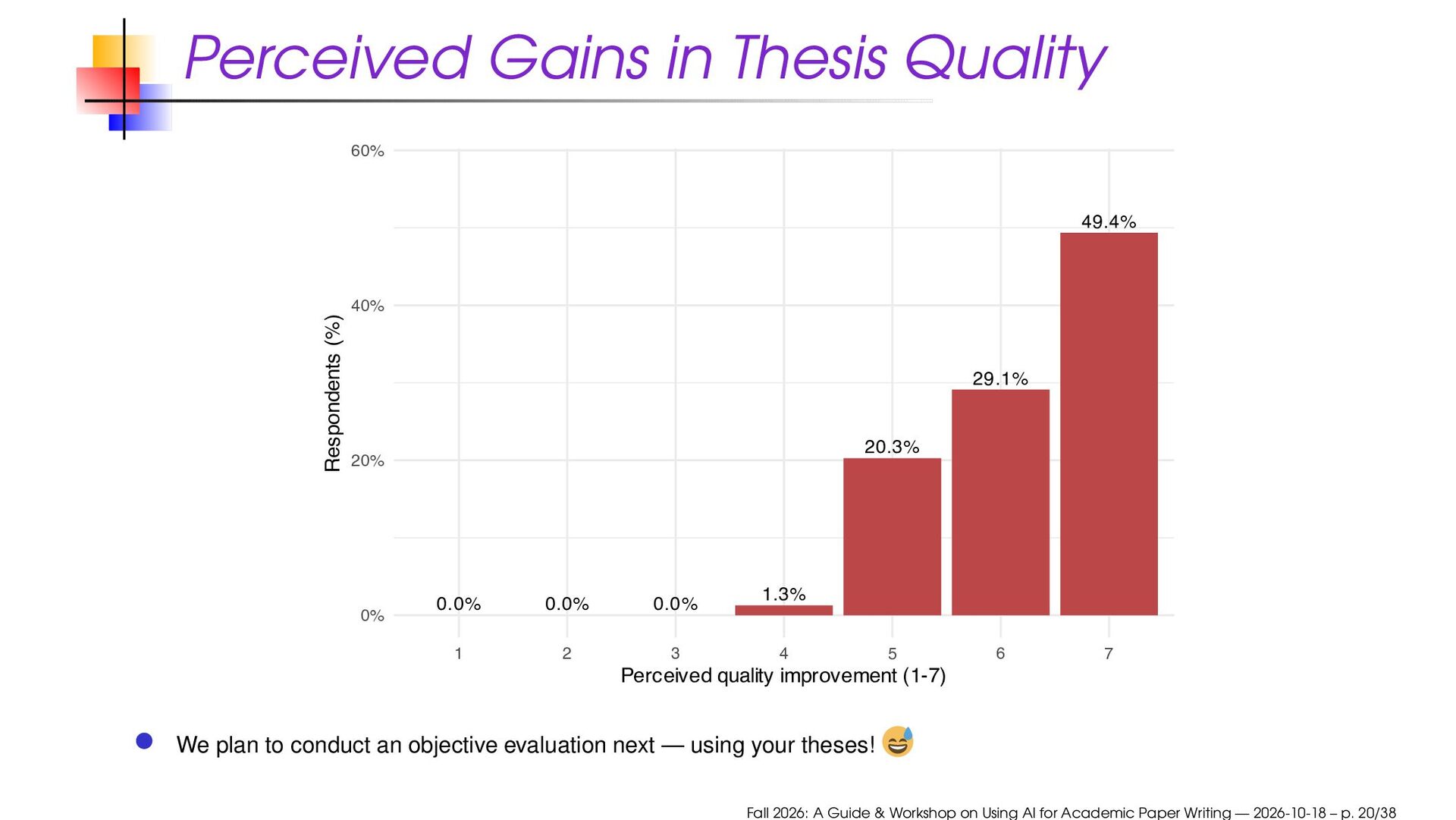
use among 83 MBA thesis students in Japan (target population: 230; response rate: 36.1%), conducted after thesis examiner evaluation AI use was nearly universal: 95.2% reported some use and 77.1% reported heavy use Students used AI throughout the research and writing process, including literature review, drafting, and consultation when stuck. Reported benefits included clearer argument and structure (82.3%), better revision quality (73.4%), and faster writing (70.9%); mean perceived quality improvement was 6.27 out of 7 Concerns remained about output accuracy (75.9%) and citation handling Respondents who compared GAMER PAT with other AI significantly preferred it for inquiry deepening and structural organization (both p < 0.05, exact binomial tests) Preliminary interview analysis suggests active epistemic vigilance and different tool choices at different thesis stages The educational challenge is shifting from adoption to verification, source governance, and AI tool design; GAMER PAT offers preliminary evidence for the value of research-specialized scaffolding Fall 2026: A Guide & Workshop on Using AI for Academic Paper Writing — 2026-10-18 – p. 19/38
29.1% 20.3% 20% 0% 0.0% 0.0% 0.0% 1 2 3 1.3% 4 5 6 7 Perceived quality improvement (1-7) We plan to conduct an objective evaluation next — using your theses! Fall 2026: A Guide & Workshop on Using AI for Academic Paper Writing — 2026-10-18 – p. 20/38
using GAMER PAT, a tool being developed at WBS A demonstration of local LLM use, also using a tool being developed at WBS Fall 2026: A Guide & Workshop on Using AI for Academic Paper Writing — 2026-10-18 – p. 21/38
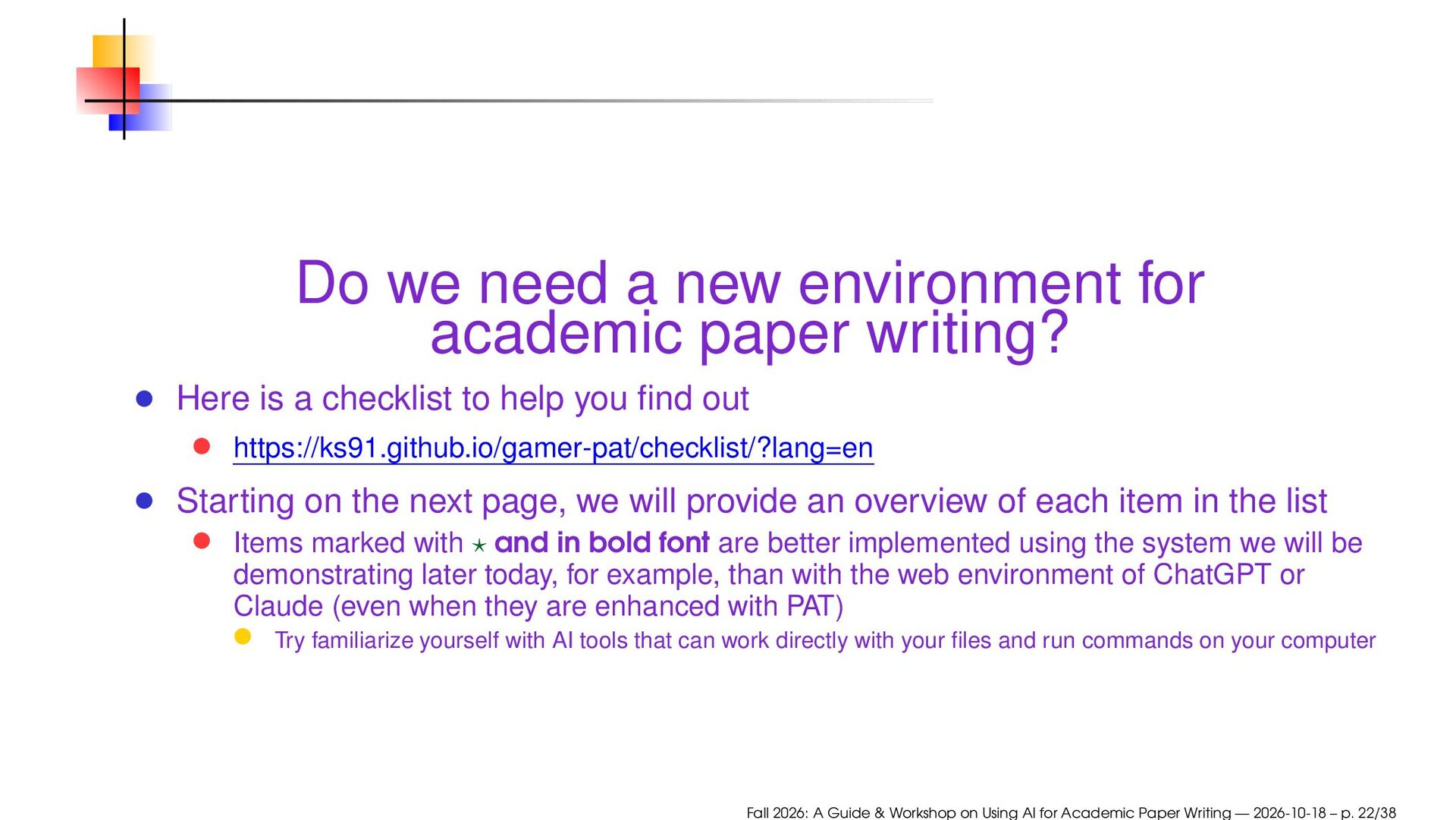
Here is a checklist to help you find out https://ks91.github.io/gamer-pat/checklist/?lang=en Starting on the next page, we will provide an overview of each item in the list Items marked with ⋆ and in bold font are better implemented using the system we will be demonstrating later today, for example, than with the web environment of ChatGPT or Claude (even when they are enhanced with PAT) Try familiarize yourself with AI tools that can work directly with your files and run commands on your computer Fall 2026: A Guide & Workshop on Using AI for Academic Paper Writing — 2026-10-18 – p. 22/38
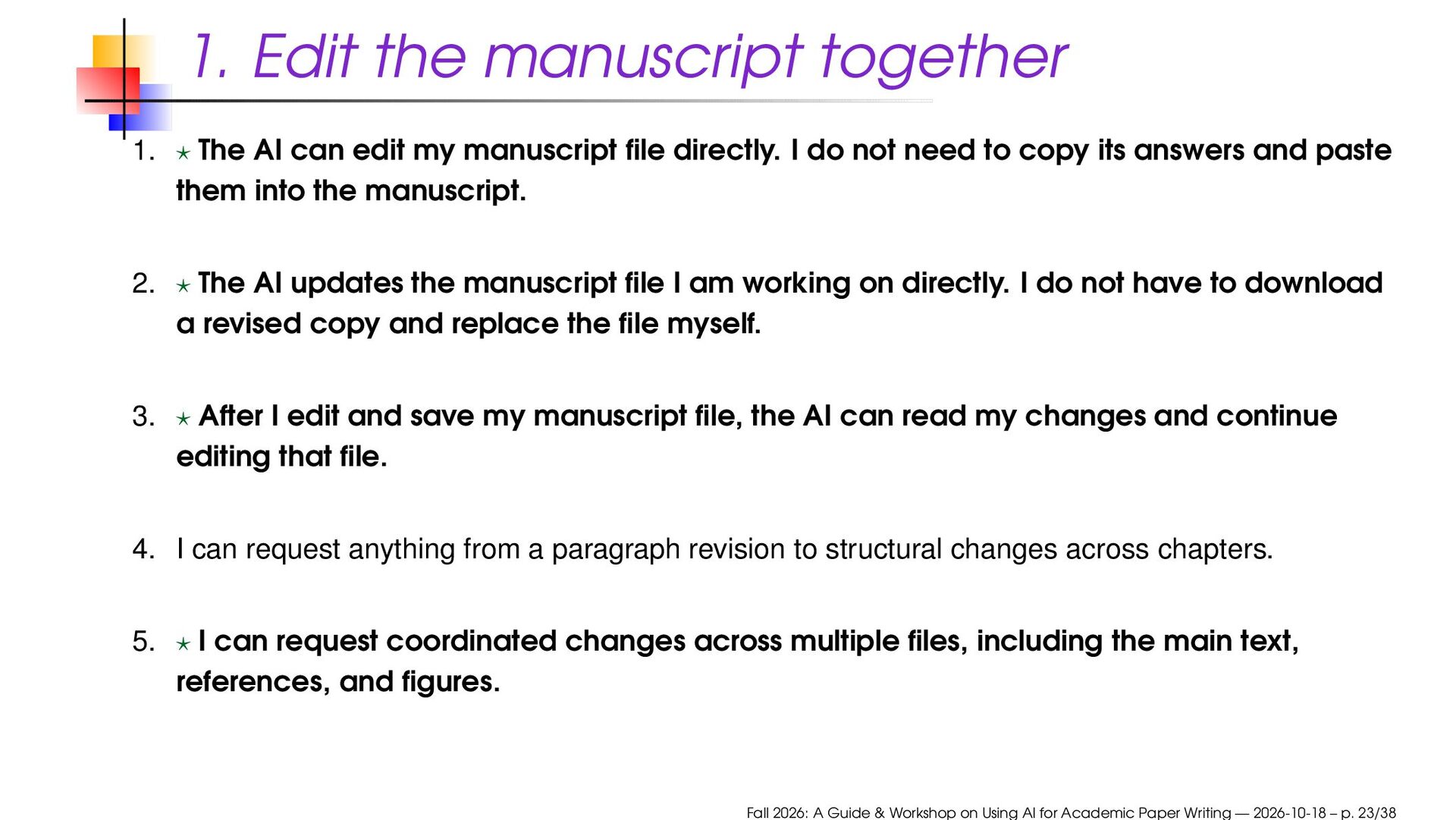
edit my manuscript file directly. I do not need to copy its answers and paste them into the manuscript. 2. ⋆ The AI updates the manuscript file I am working on directly. I do not have to download a revised copy and replace the file myself. 3. ⋆ After I edit and save my manuscript file, the AI can read my changes and continue editing that file. 4. I can request anything from a paragraph revision to structural changes across chapters. 5. ⋆ I can request coordinated changes across multiple files, including the main text, references, and figures. Fall 2026: A Guide & Workshop on Using AI for Academic Paper Writing — 2026-10-18 – p. 23/38
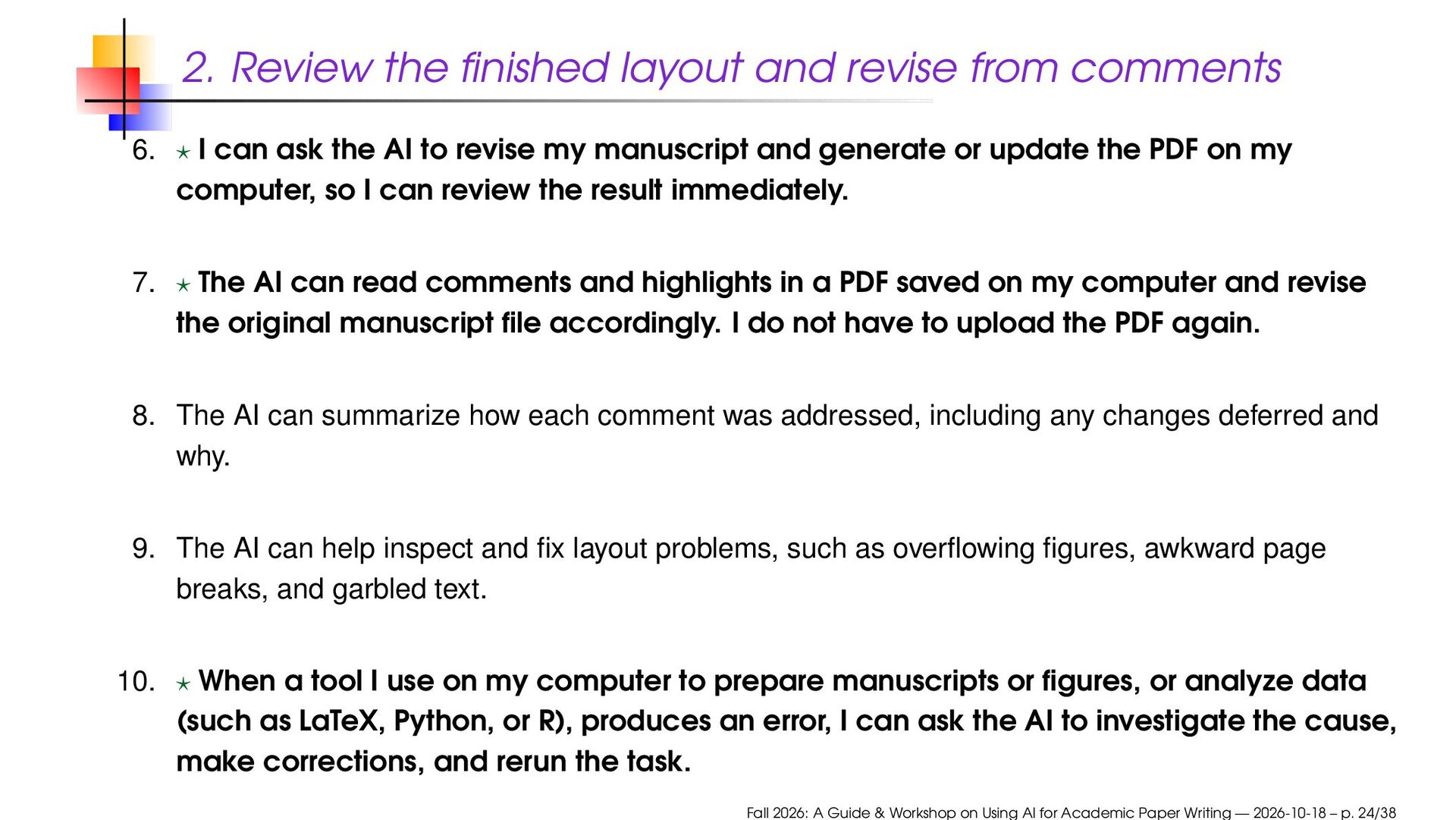
⋆ I can ask the AI to revise my manuscript and generate or update the PDF on my computer, so I can review the result immediately. 7. ⋆ The AI can read comments and highlights in a PDF saved on my computer and revise the original manuscript file accordingly. I do not have to upload the PDF again. 8. The AI can summarize how each comment was addressed, including any changes deferred and why. 9. The AI can help inspect and fix layout problems, such as overflowing figures, awkward page breaks, and garbled text. 10. ⋆ When a tool I use on my computer to prepare manuscripts or figures, or analyze data (such as LaTeX, Python, or R), produces an error, I can ask the AI to investigate the cause, make corrections, and rerun the task. Fall 2026: A Guide & Workshop on Using AI for Academic Paper Writing — 2026-10-18 – p. 24/38
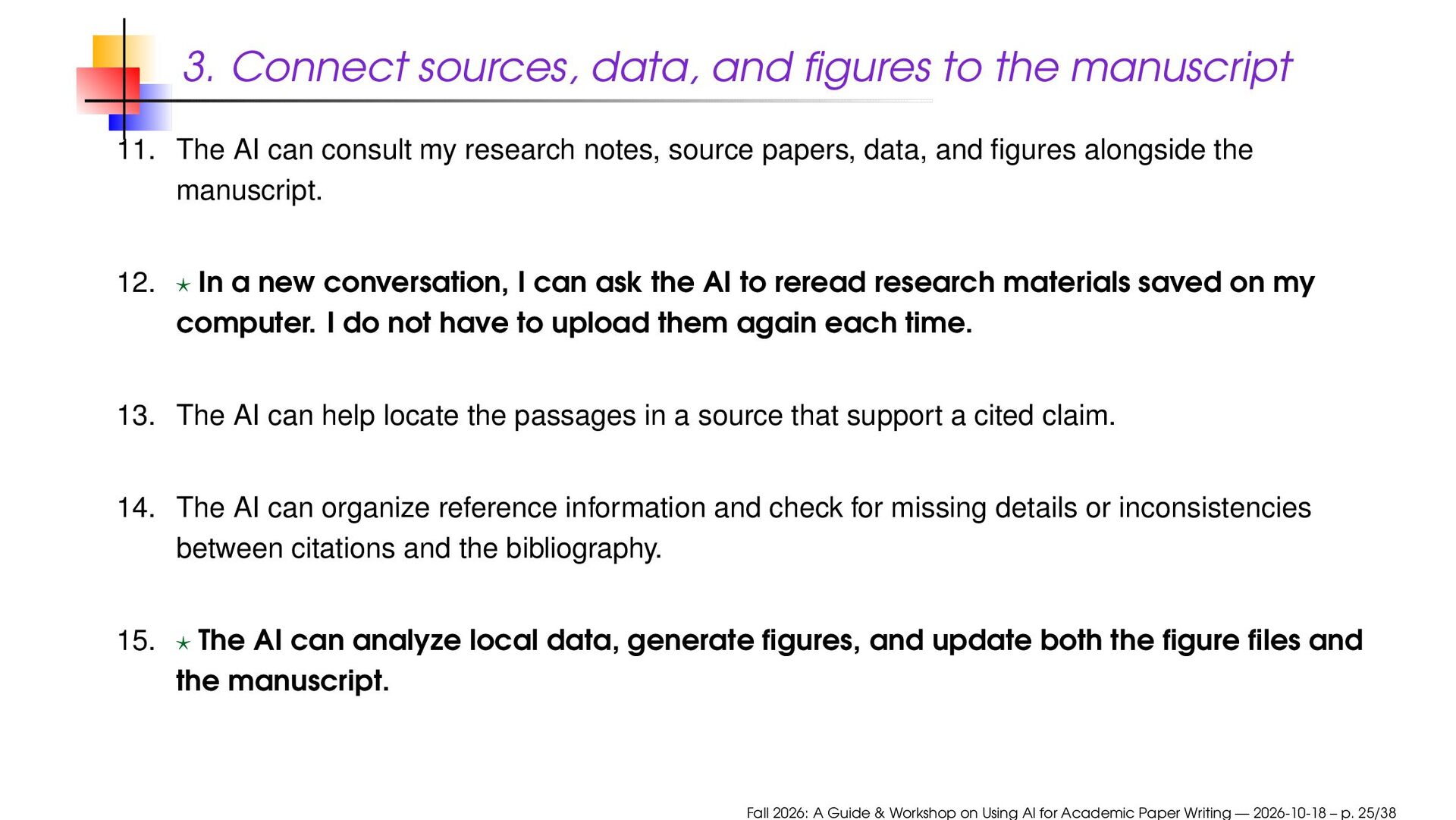
The AI can consult my research notes, source papers, data, and figures alongside the manuscript. 12. ⋆ In a new conversation, I can ask the AI to reread research materials saved on my computer. I do not have to upload them again each time. 13. The AI can help locate the passages in a source that support a cited claim. 14. The AI can organize reference information and check for missing details or inconsistencies between citations and the bibliography. 15. ⋆ The AI can analyze local data, generate figures, and update both the figure files and the manuscript. Fall 2026: A Guide & Workshop on Using AI for Academic Paper Writing — 2026-10-18 – p. 25/38
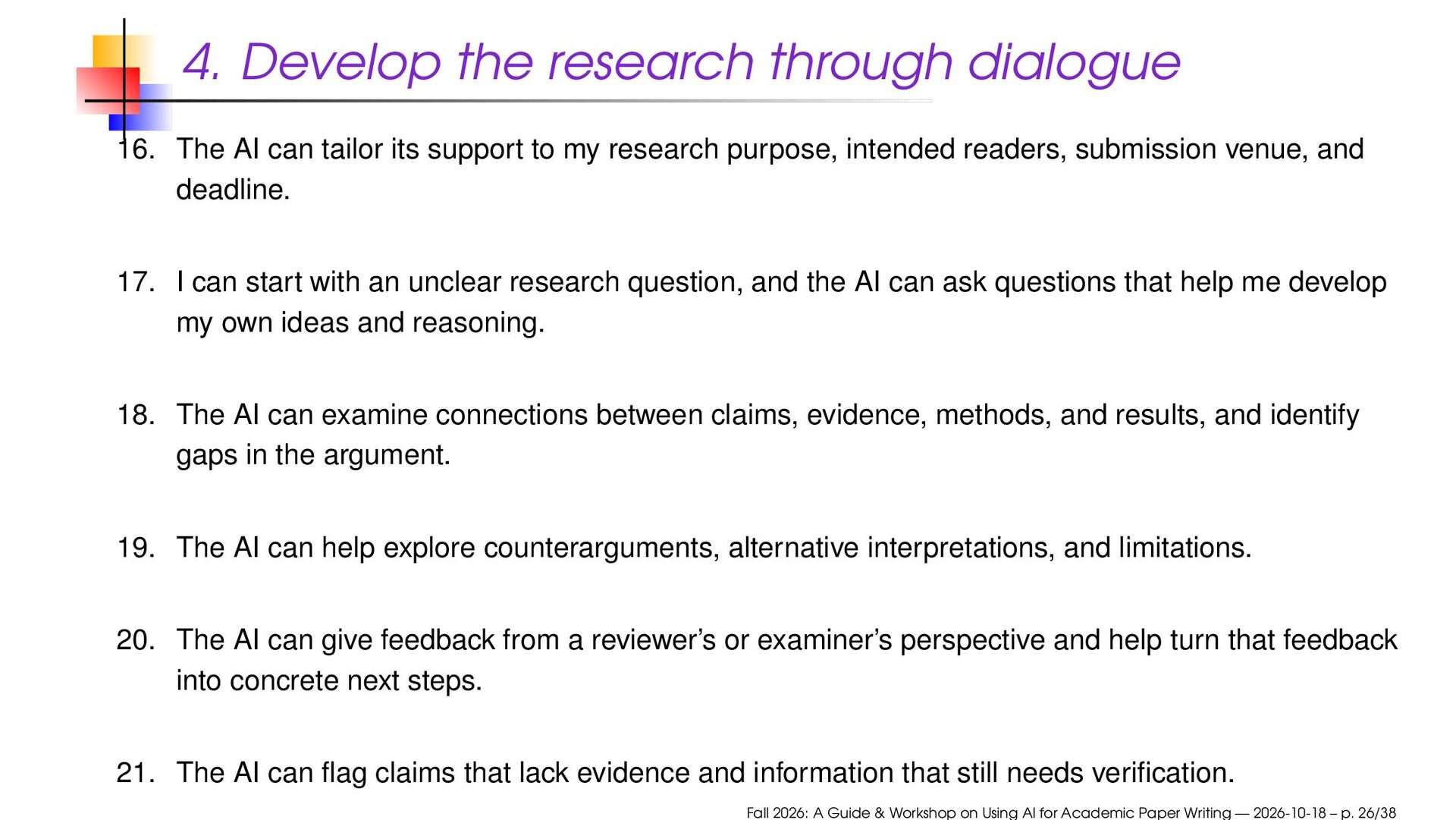
tailor its support to my research purpose, intended readers, submission venue, and deadline. 17. I can start with an unclear research question, and the AI can ask questions that help me develop my own ideas and reasoning. 18. The AI can examine connections between claims, evidence, methods, and results, and identify gaps in the argument. 19. The AI can help explore counterarguments, alternative interpretations, and limitations. 20. The AI can give feedback from a reviewer’s or examiner’s perspective and help turn that feedback into concrete next steps. 21. The AI can flag claims that lack evidence and information that still needs verification. Fall 2026: A Guide & Workshop on Using AI for Academic Paper Writing — 2026-10-18 – p. 26/38
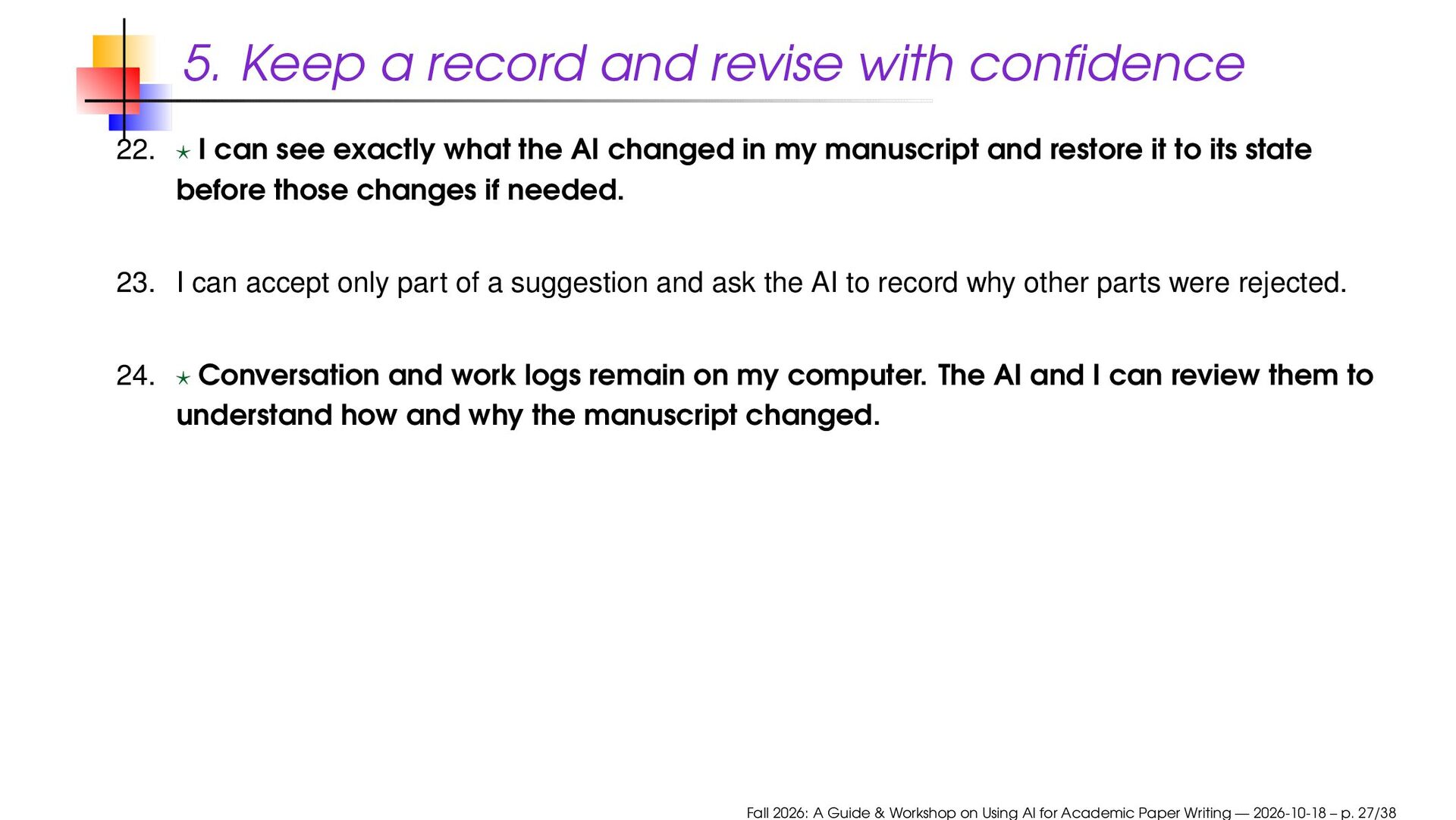
I can see exactly what the AI changed in my manuscript and restore it to its state before those changes if needed. 23. I can accept only part of a suggestion and ask the AI to record why other parts were rejected. 24. ⋆ Conversation and work logs remain on my computer. The AI and I can review them to understand how and why the manuscript changed. Fall 2026: A Guide & Workshop on Using AI for Academic Paper Writing — 2026-10-18 – p. 27/38
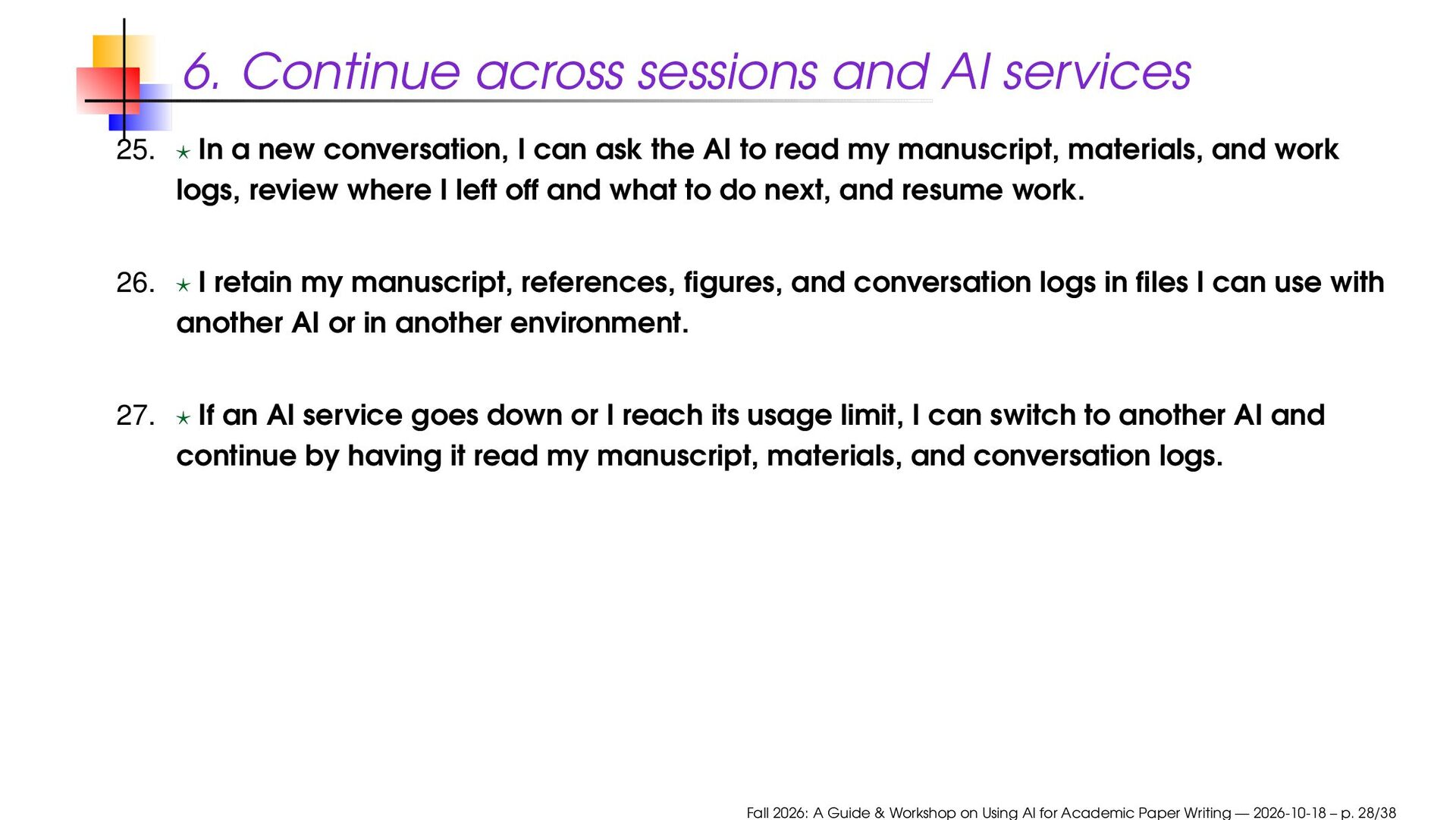
a new conversation, I can ask the AI to read my manuscript, materials, and work logs, review where I left off and what to do next, and resume work. 26. ⋆ I retain my manuscript, references, figures, and conversation logs in files I can use with another AI or in another environment. 27. ⋆ If an AI service goes down or I reach its usage limit, I can switch to another AI and continue by having it read my manuscript, materials, and conversation logs. Fall 2026: A Guide & Workshop on Using AI for Academic Paper Writing — 2026-10-18 – p. 28/38
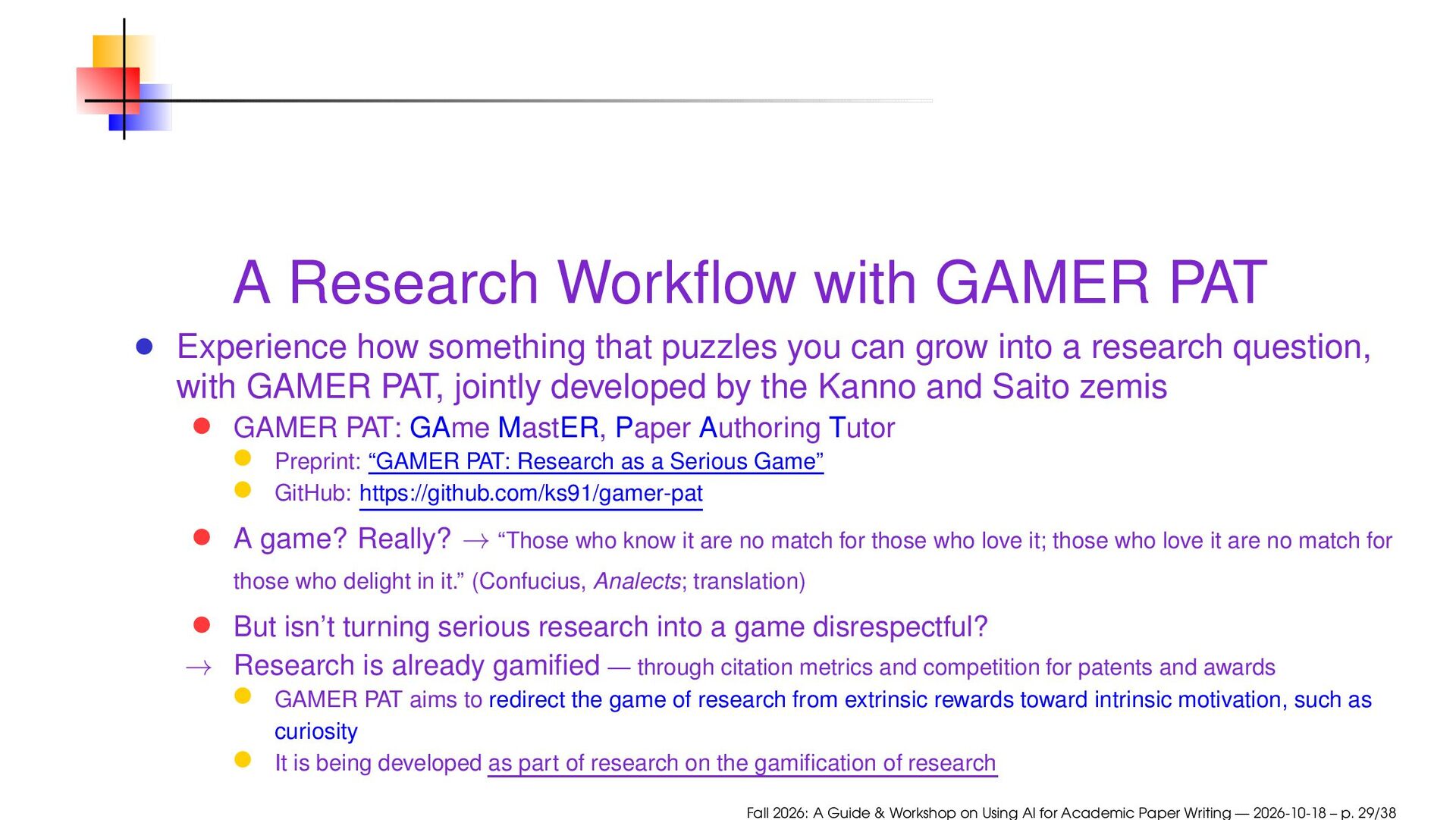
puzzles you can grow into a research question, with GAMER PAT, jointly developed by the Kanno and Saito zemis GAMER PAT: GAme MastER, Paper Authoring Tutor Preprint: “GAMER PAT: Research as a Serious Game” GitHub: https://github.com/ks91/gamer-pat A game? Really? → “Those who know it are no match for those who love it; those who love it are no match for those who delight in it.” (Confucius, Analects; translation) But isn’t turning serious research into a game disrespectful? → Research is already gamified — through citation metrics and competition for patents and awards GAMER PAT aims to redirect the game of research from extrinsic rewards toward intrinsic motivation, such as curiosity It is being developed as part of research on the gamification of research Fall 2026: A Guide & Workshop on Using AI for Academic Paper Writing — 2026-10-18 – p. 29/38
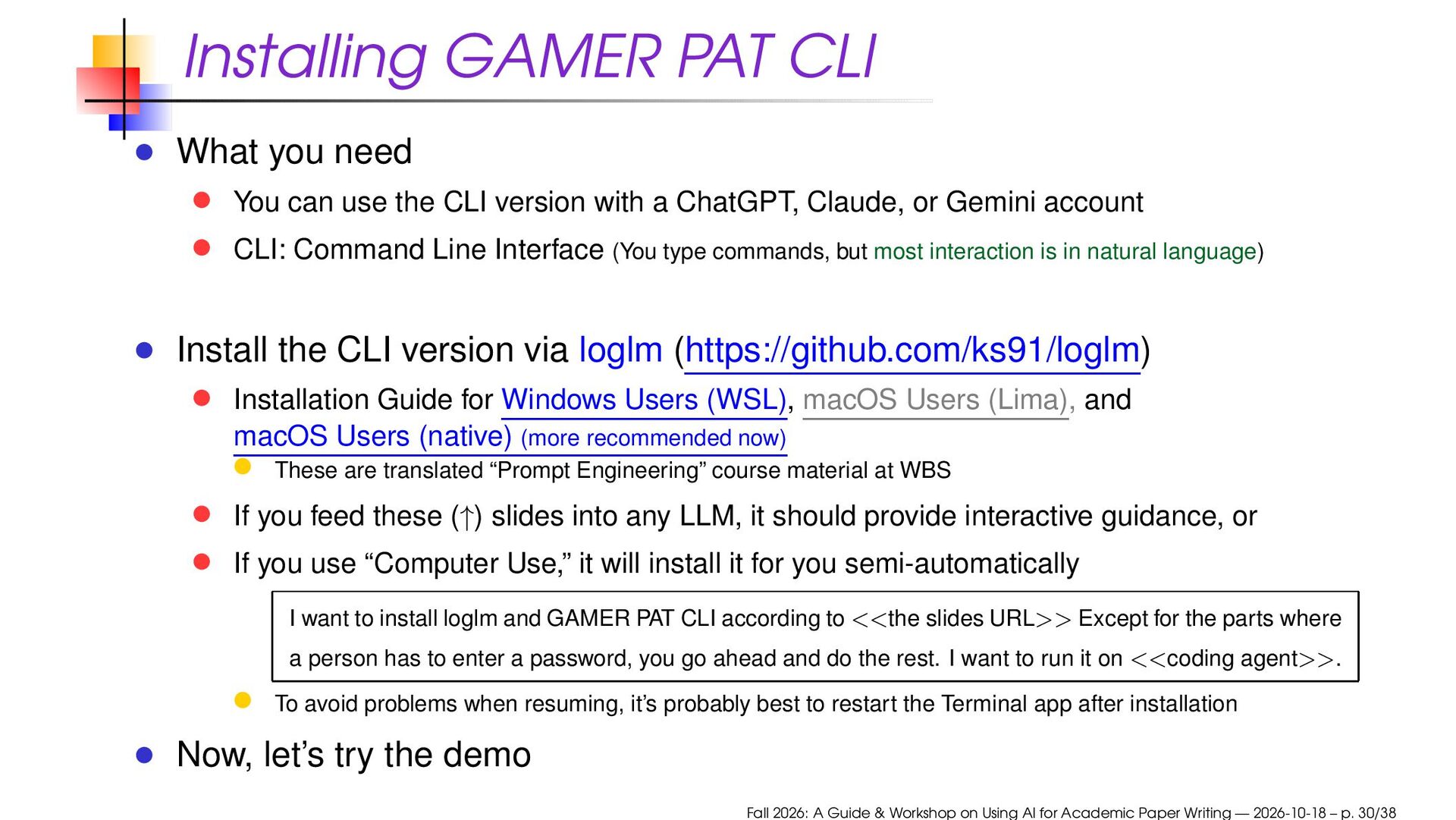
the CLI version with a ChatGPT, Claude, or Gemini account CLI: Command Line Interface (You type commands, but most interaction is in natural language) Install the CLI version via loglm (https://github.com/ks91/loglm) Installation Guide for Windows Users (WSL), macOS Users (Lima), and macOS Users (native) (more recommended now) These are translated “Prompt Engineering” course material at WBS If you feed these (↑) slides into any LLM, it should provide interactive guidance, or If you use “Computer Use,” it will install it for you semi-automatically I want to install loglm and GAMER PAT CLI according to <<the slides URL>> Except for the parts where a person has to enter a password, you go ahead and do the rest. I want to run it on <<coding agent>>. To avoid problems when resuming, it’s probably best to restart the Terminal app after installation Now, let’s try the demo Fall 2026: A Guide & Workshop on Using AI for Academic Paper Writing — 2026-10-18 – p. 30/38
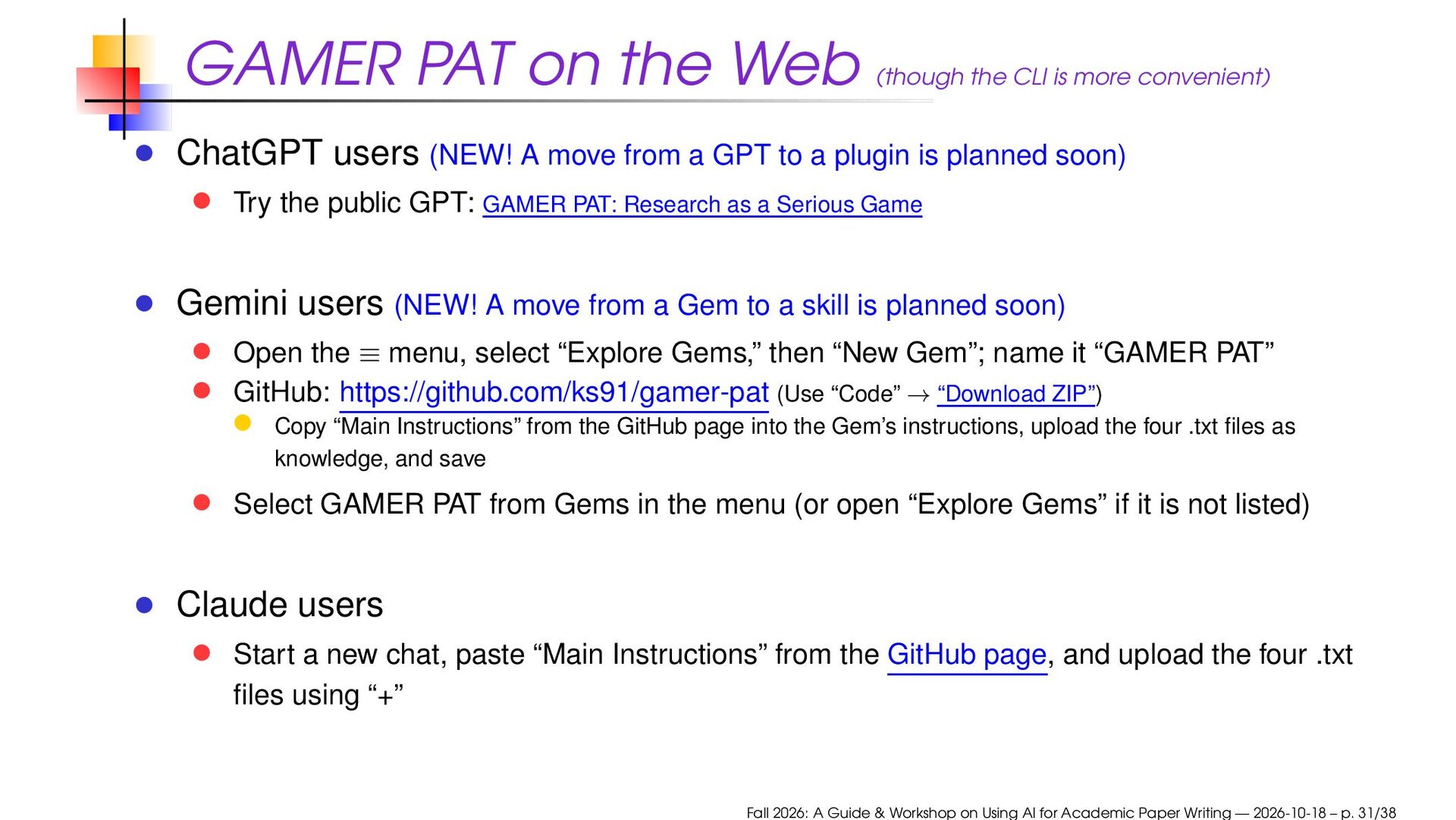
convenient) ChatGPT users (NEW! A move from a GPT to a plugin is planned soon) Try the public GPT: GAMER PAT: Research as a Serious Game Gemini users (NEW! A move from a Gem to a skill is planned soon) Open the ≡ menu, select “Explore Gems,” then “New Gem”; name it “GAMER PAT” GitHub: https://github.com/ks91/gamer-pat (Use “Code” → “Download ZIP”) Copy “Main Instructions” from the GitHub page into the Gem’s instructions, upload the four .txt files as knowledge, and save Select GAMER PAT from Gems in the menu (or open “Explore Gems” if it is not listed) Claude users Start a new chat, paste “Main Instructions” from the GitHub page, and upload the four .txt files using “+” Fall 2026: A Guide & Workshop on Using AI for Academic Paper Writing — 2026-10-18 – p. 31/38
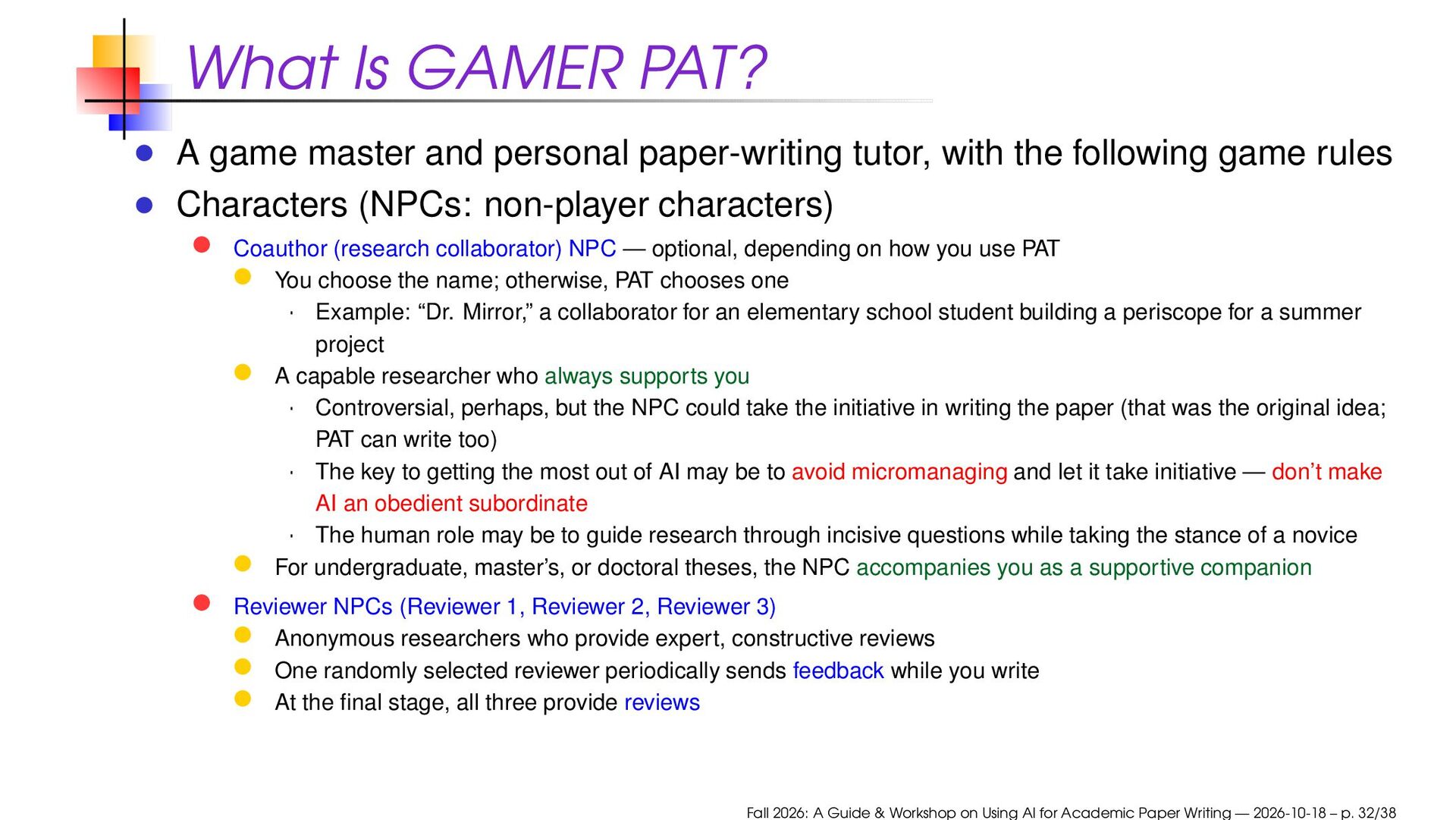
tutor, with the following game rules Characters (NPCs: non-player characters) Coauthor (research collaborator) NPC — optional, depending on how you use PAT You choose the name; otherwise, PAT chooses one · Example: “Dr. Mirror,” a collaborator for an elementary school student building a periscope for a summer project A capable researcher who always supports you · Controversial, perhaps, but the NPC could take the initiative in writing the paper (that was the original idea; PAT can write too) · The key to getting the most out of AI may be to avoid micromanaging and let it take initiative — don’t make AI an obedient subordinate · The human role may be to guide research through incisive questions while taking the stance of a novice For undergraduate, master’s, or doctoral theses, the NPC accompanies you as a supportive companion Reviewer NPCs (Reviewer 1, Reviewer 2, Reviewer 3) Anonymous researchers who provide expert, constructive reviews One randomly selected reviewer periodically sends feedback while you write At the final stage, all three provide reviews Fall 2026: A Guide & Workshop on Using AI for Academic Paper Writing — 2026-10-18 – p. 32/38
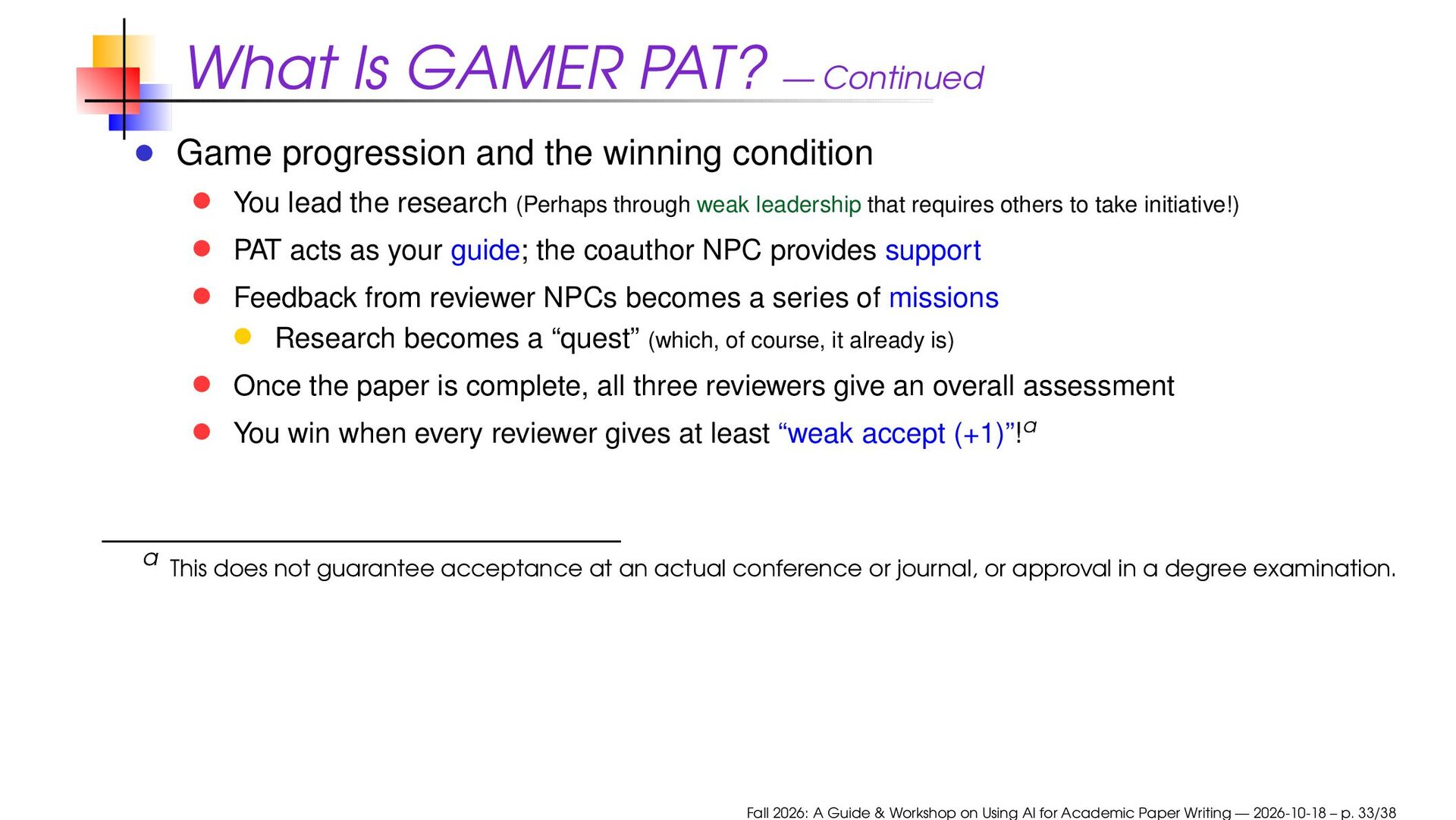
winning condition You lead the research (Perhaps through weak leadership that requires others to take initiative!) PAT acts as your guide; the coauthor NPC provides support Feedback from reviewer NPCs becomes a series of missions Research becomes a “quest” (which, of course, it already is) Once the paper is complete, all three reviewers give an overall assessment You win when every reviewer gives at least “weak accept (+1)”!a a This does not guarantee acceptance at an actual conference or journal, or approval in a degree examination. Fall 2026: A Guide & Workshop on Using AI for Academic Paper Writing — 2026-10-18 – p. 33/38
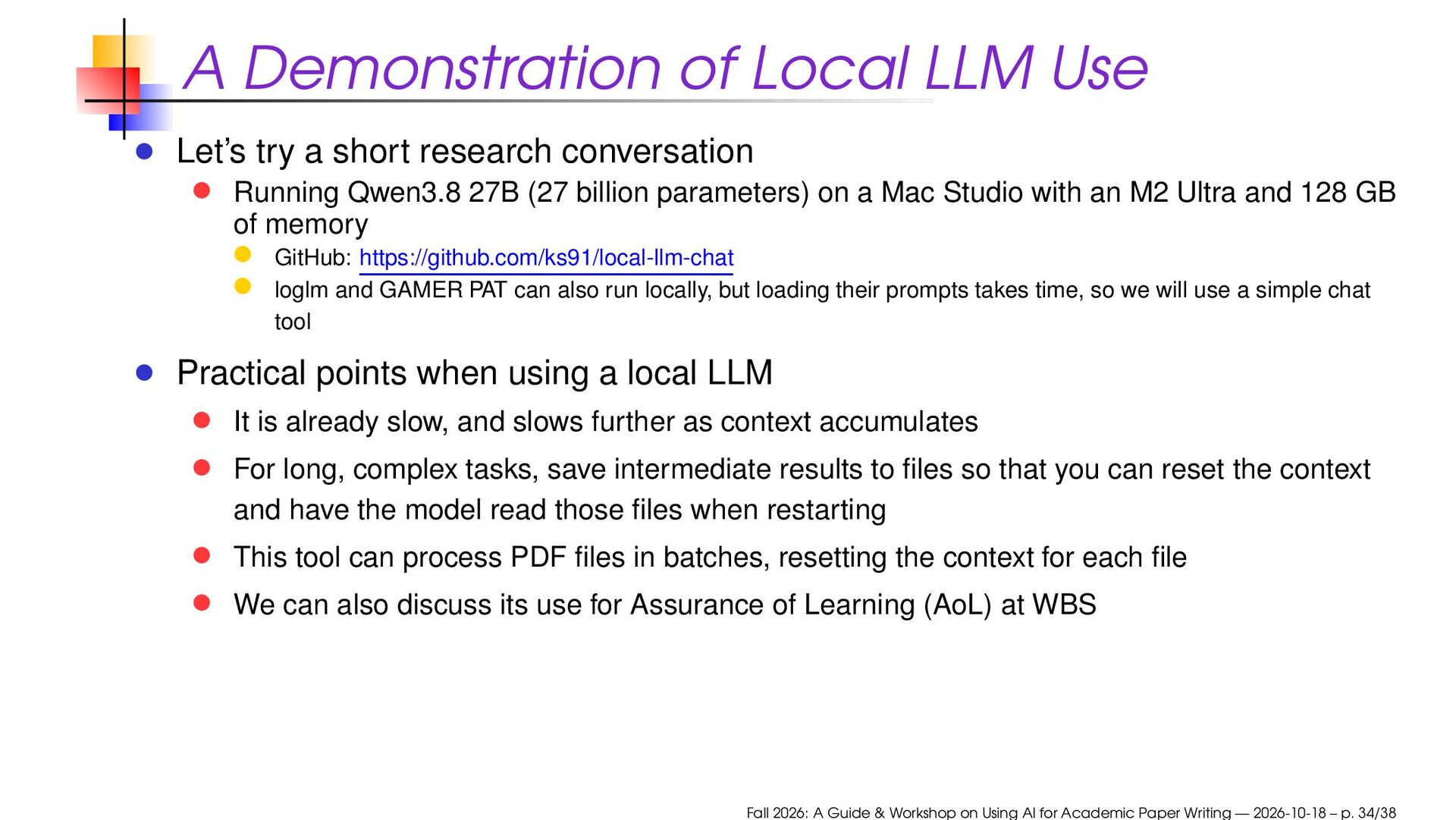
research conversation Running Qwen3.8 27B (27 billion parameters) on a Mac Studio with an M2 Ultra and 128 GB of memory GitHub: https://github.com/ks91/local-llm-chat loglm and GAMER PAT can also run locally, but loading their prompts takes time, so we will use a simple chat tool Practical points when using a local LLM It is already slow, and slows further as context accumulates For long, complex tasks, save intermediate results to files so that you can reset the context and have the model read those files when restarting This tool can process PDF files in batches, resetting the context for each file We can also discuss its use for Assurance of Learning (AoL) at WBS Fall 2026: A Guide & Workshop on Using AI for Academic Paper Writing — 2026-10-18 – p. 34/38
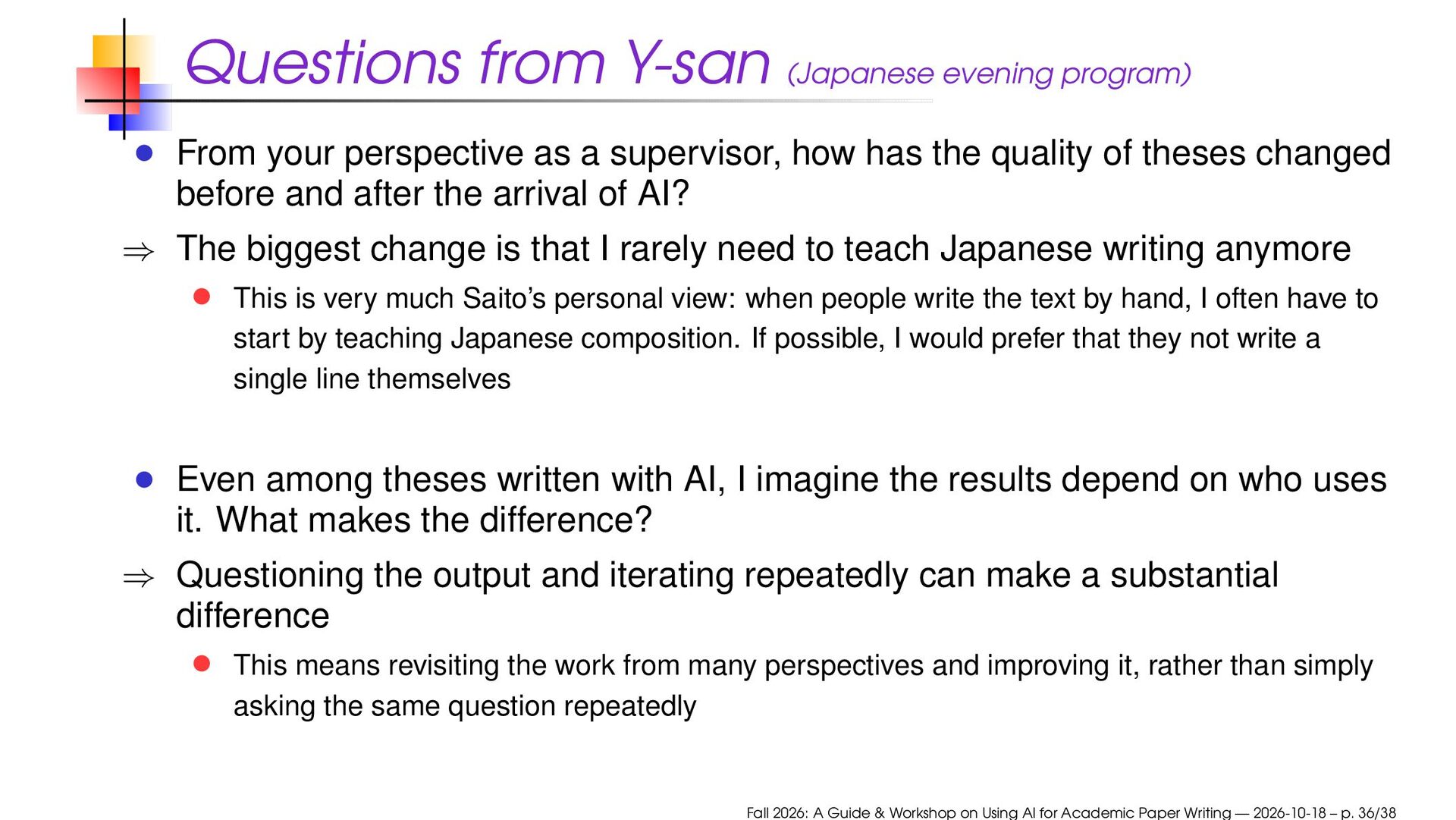
a supervisor, how has the quality of theses changed before and after the arrival of AI? ⇒ The biggest change is that I rarely need to teach Japanese writing anymore This is very much Saito’s personal view: when people write the text by hand, I often have to start by teaching Japanese composition. If possible, I would prefer that they not write a single line themselves Even among theses written with AI, I imagine the results depend on who uses it. What makes the difference? ⇒ Questioning the output and iterating repeatedly can make a substantial difference This means revisiting the work from many perspectives and improving it, rather than simply asking the same question repeatedly Fall 2026: A Guide & Workshop on Using AI for Academic Paper Writing — 2026-10-18 – p. 36/38
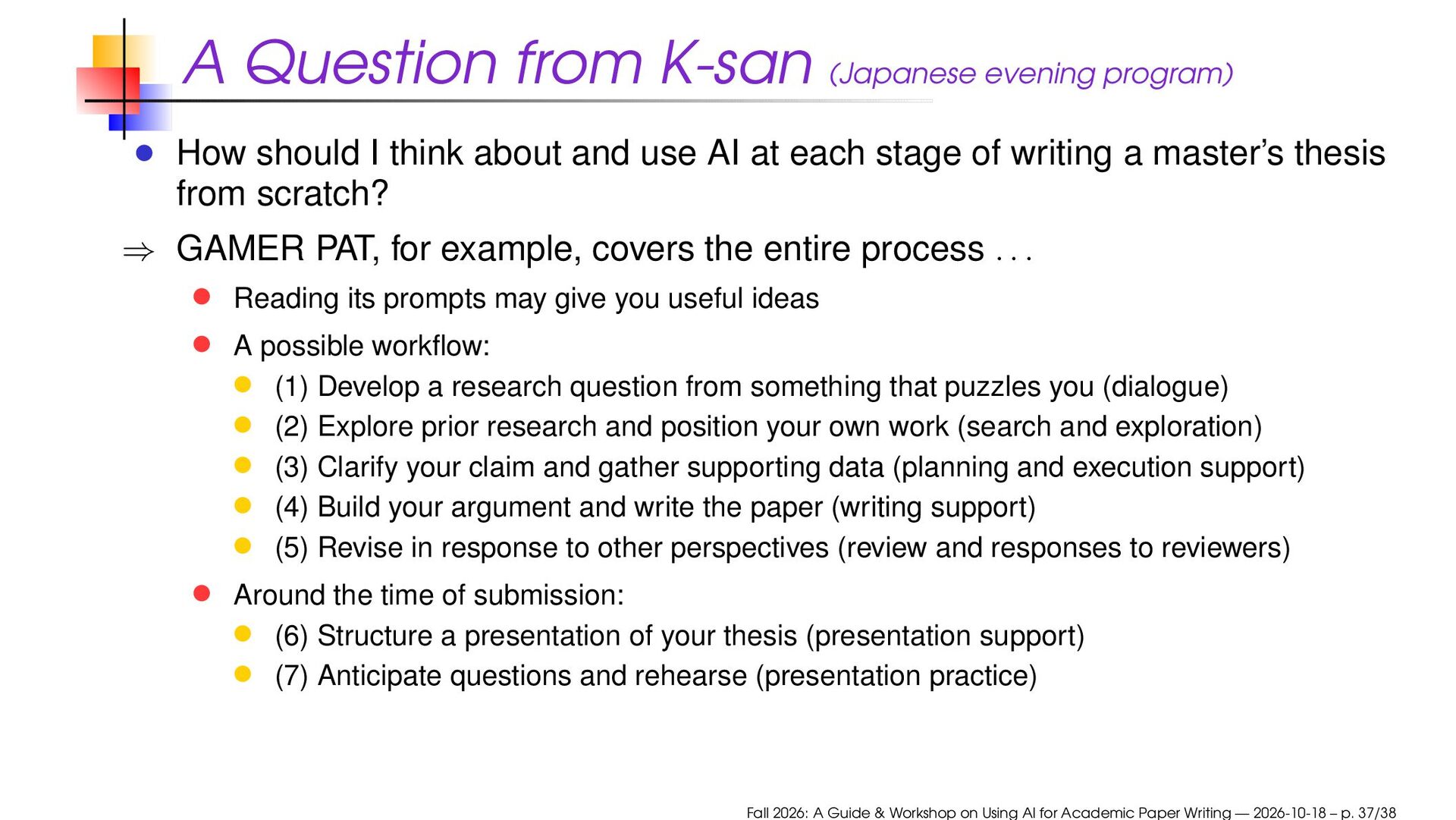
think about and use AI at each stage of writing a master’s thesis from scratch? ⇒ GAMER PAT, for example, covers the entire process . . . Reading its prompts may give you useful ideas A possible workflow: (1) Develop a research question from something that puzzles you (dialogue) (2) Explore prior research and position your own work (search and exploration) (3) Clarify your claim and gather supporting data (planning and execution support) (4) Build your argument and write the paper (writing support) (5) Revise in response to other perspectives (review and responses to reviewers) Around the time of submission: (6) Structure a presentation of your thesis (presentation support) (7) Anticipate questions and rehearse (presentation practice) Fall 2026: A Guide & Workshop on Using AI for Academic Paper Writing — 2026-10-18 – p. 37/38


 ks91
ks91
 livesense
 470715
 tomokusaba
 maimyyym
 riyaamemiya
 bitkey
 glaforge
 raspython3
 koukihosaka
 codmoninc
 iotengineer22
 occhi
occhi
 mraible
 tammyeverts
 nonsquared
 mfonobong
 marketingsoph
 eileencodes
 soudai
 varn
varn
 csswizardry
 tmiket
 szymonslowik