Slides I used for FinTech - Financial Innovation and the Internet 2026 Fall at Graduate School of Business and Finance, Waseda University on October 2, 2026.
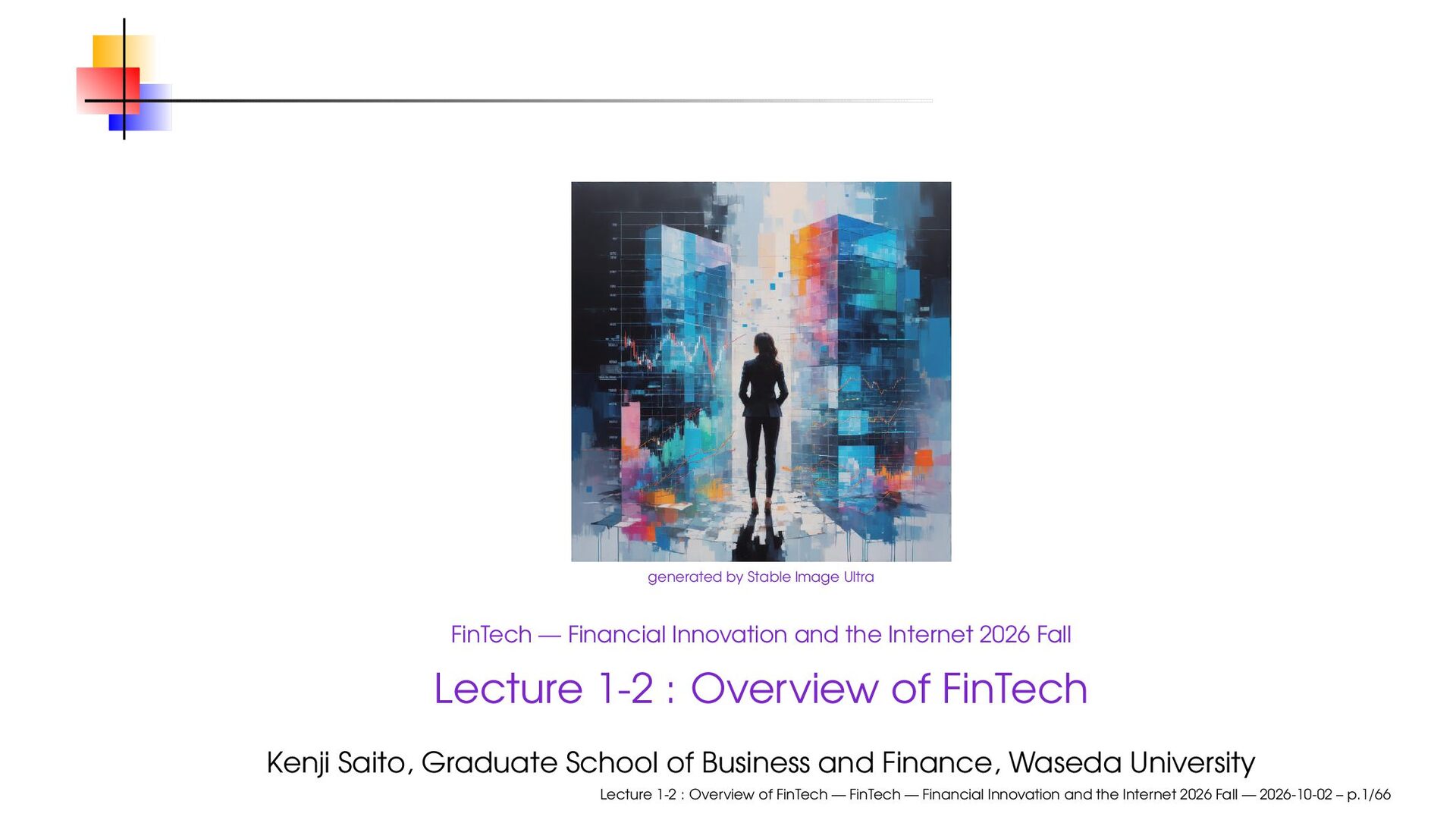
the Internet 2026 Fall Lecture 1-2 : Overview of FinTech Kenji Saito, Graduate School of Business and Finance, Waseda University Lecture 1-2 : Overview of FinTech — FinTech — Financial Innovation and the Internet 2026 Fall — 2026-10-02 – p.1/66
reviewing the lectures Recordings are shared via Dropbox and you can ask questions with time-stamped comments Of course, students are encouraged to ask questions in class The recordings could be used for research on (online) learning Transcribed for use and anonymized Will let you know when the necessity arises Lecture 1-2 : Overview of FinTech — FinTech — Financial Innovation and the Internet 2026 Fall — 2026-10-02 – p.2/66
and chat text will be posted at Moodle and Discord Note, however, that chat messages are often unnoticed I have invited you all to the Discord server of the class (continued from the past years) Let me do it again now through Zoom chat Trial automatic transcription for lectures will be posted at Discord Because it would contain many mistakes More information is available on Discord, so you have a reason to join the Discord server Furthermore, in the end, participation in Discord may become mandatory for the progress of group work Lecture 1-2 : Overview of FinTech — FinTech — Financial Innovation and the Internet 2026 Fall — 2026-10-02 – p.3/66
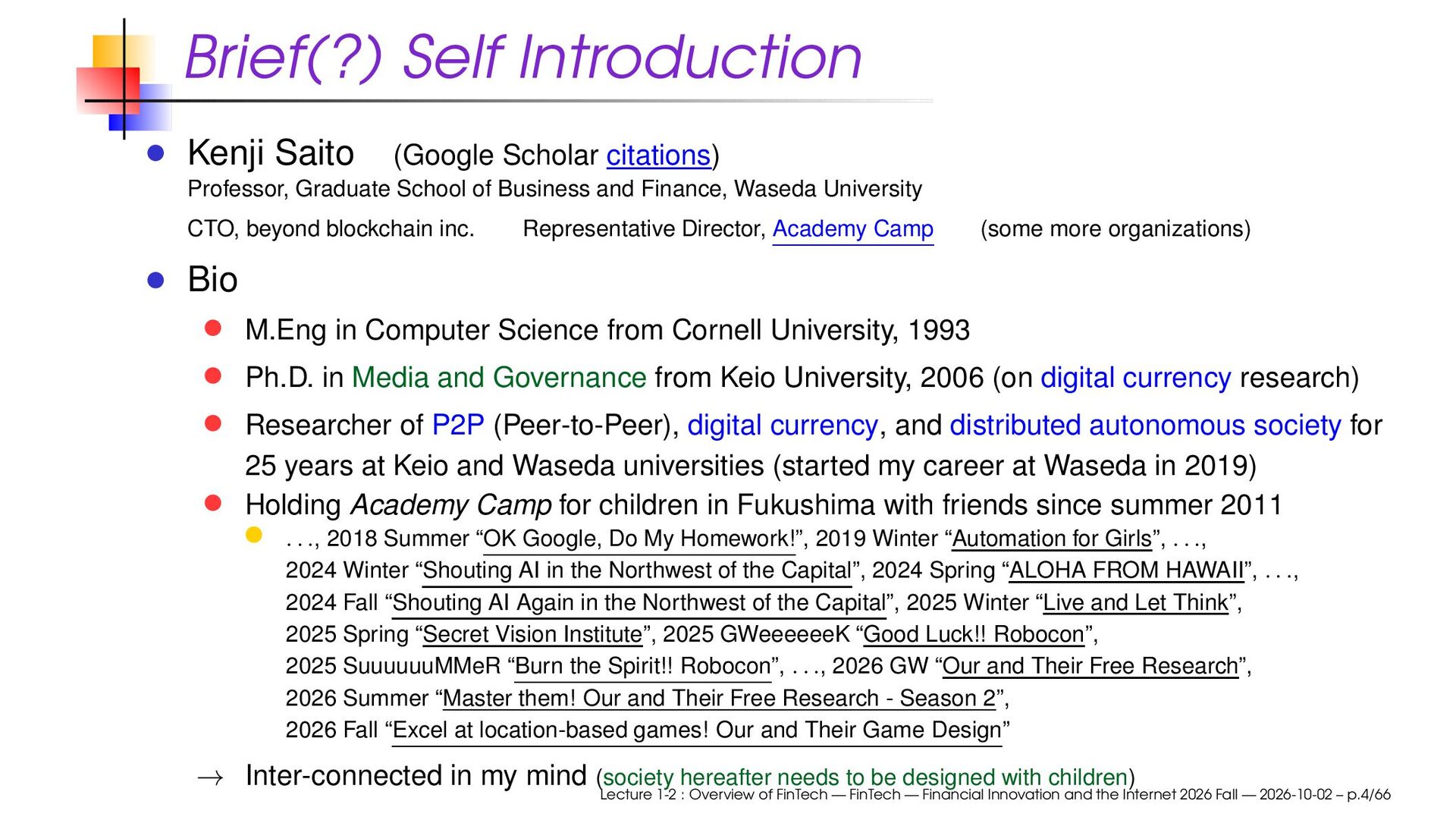
School of Business and Finance, Waseda University CTO, beyond blockchain inc. Representative Director, Academy Camp (some more organizations) Bio M.Eng in Computer Science from Cornell University, 1993 Ph.D. in Media and Governance from Keio University, 2006 (on digital currency research) Researcher of P2P (Peer-to-Peer), digital currency, and distributed autonomous society for 25 years at Keio and Waseda universities (started my career at Waseda in 2019) Holding Academy Camp for children in Fukushima with friends since summer 2011 . . ., 2018 Summer “OK Google, Do My Homework!”, 2019 Winter “Automation for Girls”, . . ., 2024 Winter “Shouting AI in the Northwest of the Capital”, 2024 Spring “ALOHA FROM HAWAII”, . . ., 2024 Fall “Shouting AI Again in the Northwest of the Capital”, 2025 Winter “Live and Let Think”, 2025 Spring “Secret Vision Institute”, 2025 GWeeeeeeK “Good Luck!! Robocon”, 2025 SuuuuuuMMeR “Burn the Spirit!! Robocon”, . . ., 2026 GW “Our and Their Free Research”, 2026 Summer “Master them! Our and Their Free Research - Season 2”, 2026 Fall “Excel at location-based games! Our and Their Game Design” → Inter-connected in my mind (society hereafter needs to be designed with children) Lecture 1-2 : Overview of FinTech — FinTech — Financial Innovation and the Internet 2026 Fall — 2026-10-02 – p.4/66
or “Saito-san” I’m more used to them Because a scholar thinks of the first graduate school they see as their parent I my case, it was the Department of Computer Science at Cornell, where we called our professors (giants of CS) by their first names Then I went to Keio University where Yukichi Fukuzawa, the founder, is the one and only “sensei” Lecture 1-2 : Overview of FinTech — FinTech — Financial Innovation and the Internet 2026 Fall — 2026-10-02 – p.5/66
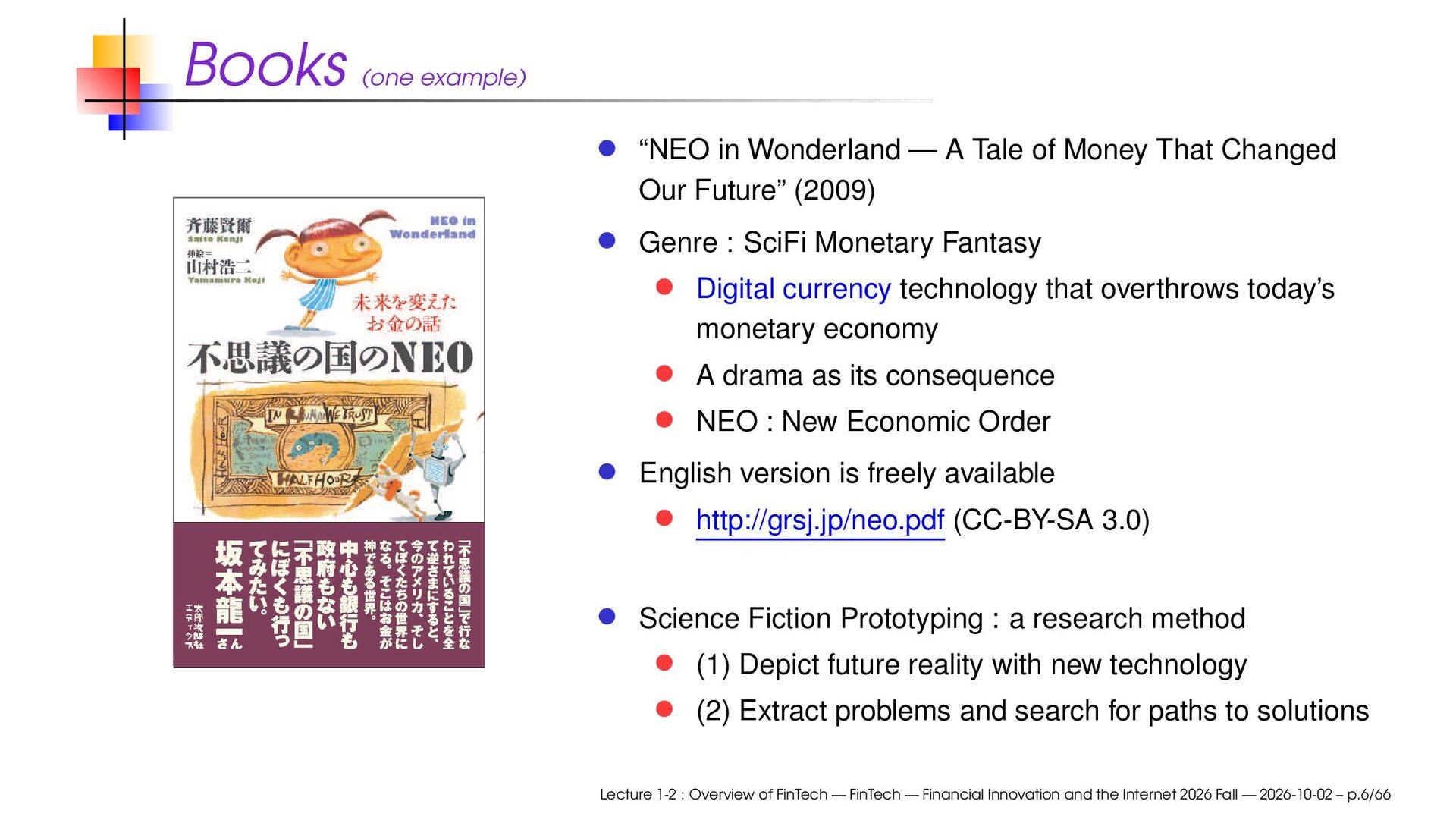
Money That Changed Our Future” (2009) Genre : SciFi Monetary Fantasy Digital currency technology that overthrows today’s monetary economy A drama as its consequence NEO : New Economic Order English version is freely available http://grsj.jp/neo.pdf (CC-BY-SA 3.0) Science Fiction Prototyping : a research method (1) Depict future reality with new technology (2) Extract problems and search for paths to solutions Lecture 1-2 : Overview of FinTech — FinTech — Financial Innovation and the Internet 2026 Fall — 2026-10-02 – p.6/66
University “Digital Transformation for Public Good” (IMBA Zemi) “Blockchain and Decentralized Finance” (Pro Finance Zemi, ending this fall) “Prompt Engineering – Applications of Generative AI” (spring) “FinTech – Financial Innovation and the Internet” (summer, in alternate years) “Cybersecurity” (summer, in alternate years) “Managing Non-profit Organizations” (winter) At School of Commerce, Waseda University “Cyber-Physical Society and Future of Finance” (spring semester) → Inter-connected in my mind, too (society hereafter needs to be designed . . . how?) https://speakerdeck.com/ks91 (just slides are published) Lecture 1-2 : Overview of FinTech — FinTech — Financial Innovation and the Internet 2026 Fall — 2026-10-02 – p.7/66
General As part of my research activities I’ve got a feeling that, in 24 years, FinTech or even the concept of finance itself will become irrelevant to our lives Lecture 1-2 : Overview of FinTech — FinTech — Financial Innovation and the Internet 2026 Fall — 2026-10-02 – p.8/66
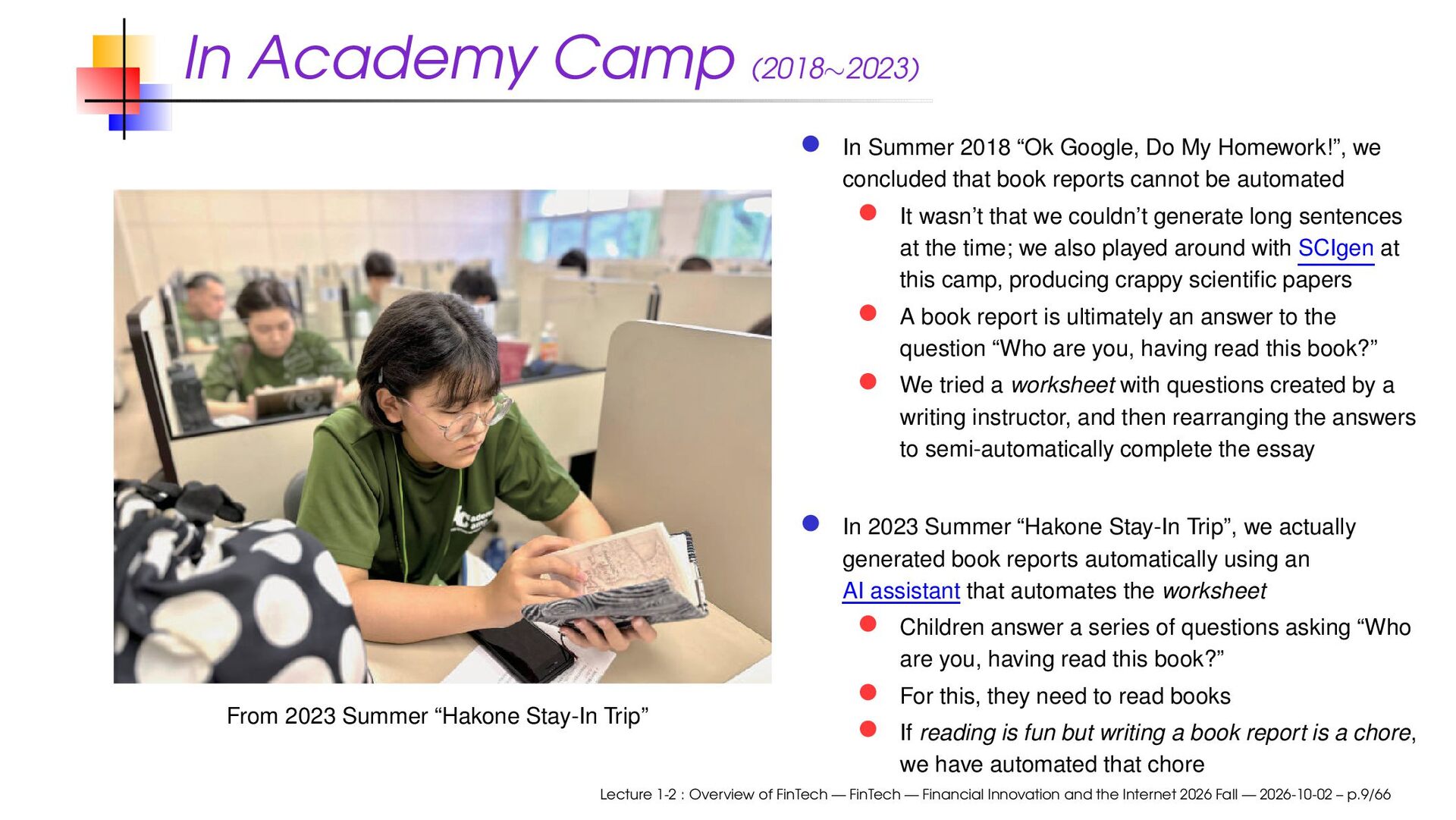
My Homework!”, we concluded that book reports cannot be automated It wasn’t that we couldn’t generate long sentences at the time; we also played around with SCIgen at this camp, producing crappy scientific papers A book report is ultimately an answer to the question “Who are you, having read this book?” We tried a worksheet with questions created by a writing instructor, and then rearranging the answers to semi-automatically complete the essay In 2023 Summer “Hakone Stay-In Trip”, we actually generated book reports automatically using an AI assistant that automates the worksheet Children answer a series of questions asking “Who are you, having read this book?” From 2023 Summer “Hakone Stay-In Trip” For this, they need to read books If reading is fun but writing a book report is a chore, we have automated that chore Lecture 1-2 : Overview of FinTech — FinTech — Financial Innovation and the Internet 2026 Fall — 2026-10-02 – p.9/66
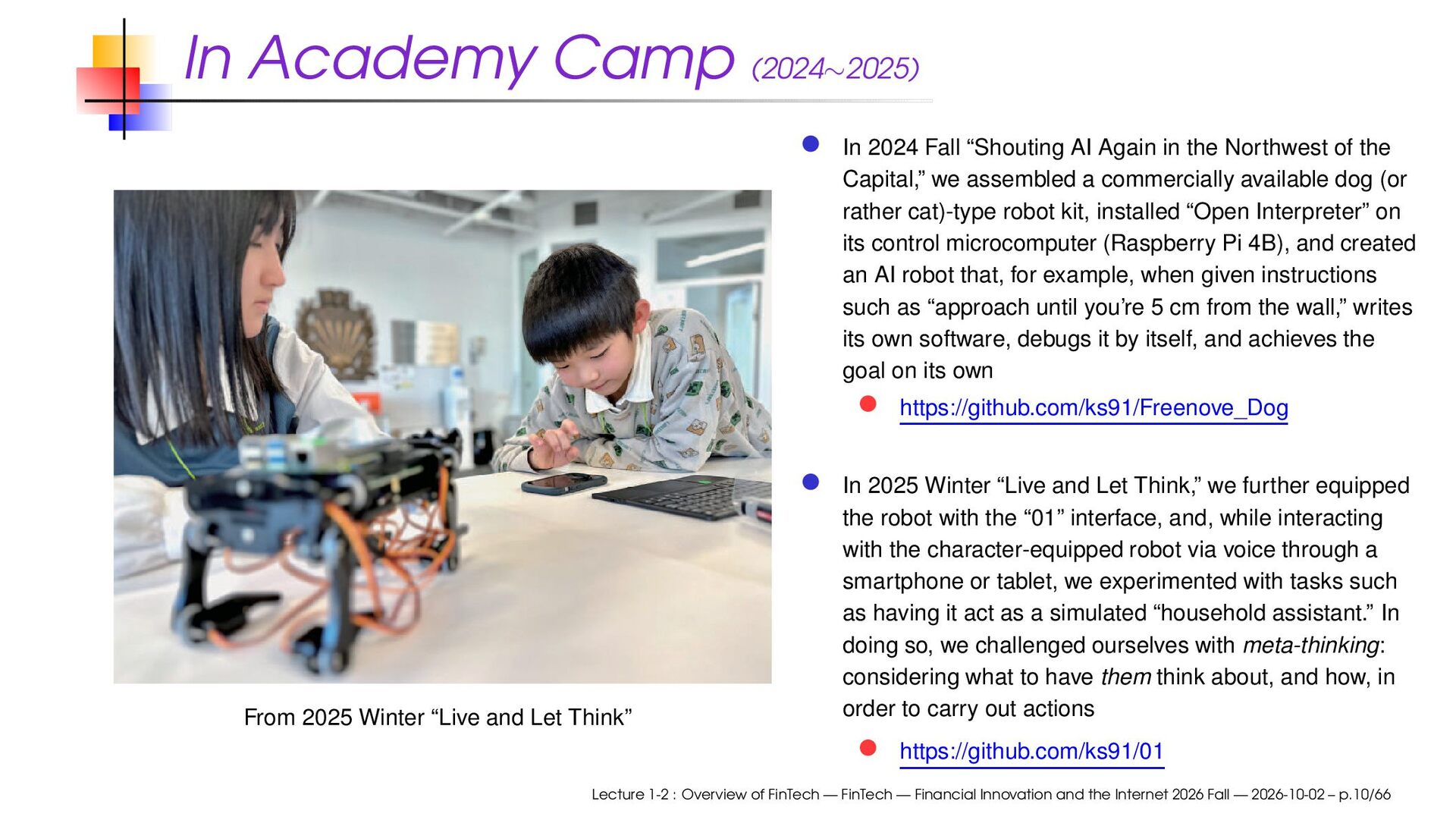
in the Northwest of the Capital,” we assembled a commercially available dog (or rather cat)-type robot kit, installed “Open Interpreter” on its control microcomputer (Raspberry Pi 4B), and created an AI robot that, for example, when given instructions such as “approach until you’re 5 cm from the wall,” writes its own software, debugs it by itself, and achieves the goal on its own https://github.com/ks91/Freenove_Dog From 2025 Winter “Live and Let Think” In 2025 Winter “Live and Let Think,” we further equipped the robot with the “01” interface, and, while interacting with the character-equipped robot via voice through a smartphone or tablet, we experimented with tasks such as having it act as a simulated “household assistant.” In doing so, we challenged ourselves with meta-thinking: considering what to have them think about, and how, in order to carry out actions https://github.com/ks91/01 Lecture 1-2 : Overview of FinTech — FinTech — Financial Innovation and the Internet 2026 Fall — 2026-10-02 – p.10/66
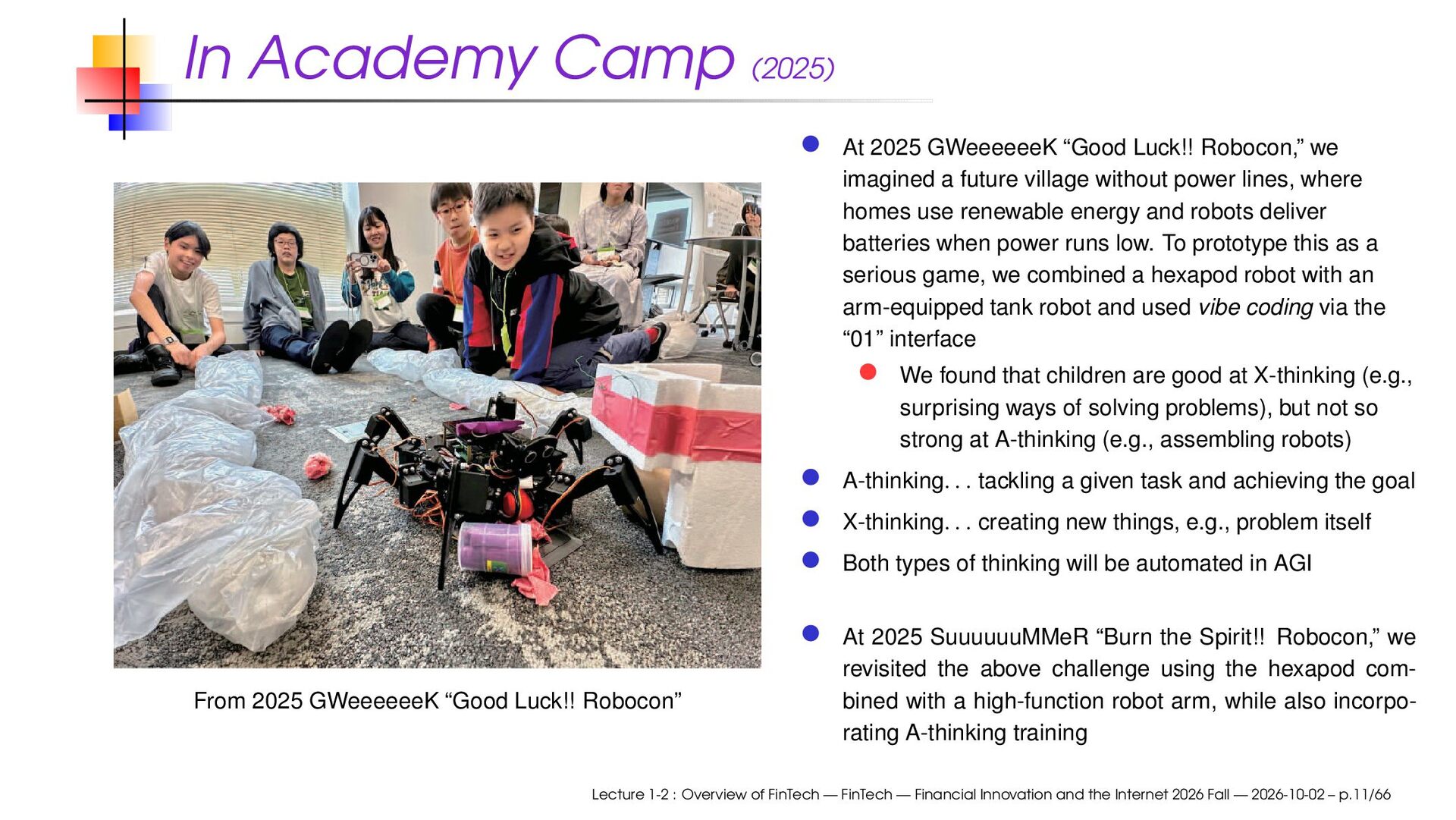
we imagined a future village without power lines, where homes use renewable energy and robots deliver batteries when power runs low. To prototype this as a serious game, we combined a hexapod robot with an arm-equipped tank robot and used vibe coding via the “01” interface We found that children are good at X-thinking (e.g., surprising ways of solving problems), but not so strong at A-thinking (e.g., assembling robots) A-thinking. . . tackling a given task and achieving the goal X-thinking. . . creating new things, e.g., problem itself Both types of thinking will be automated in AGI From 2025 GWeeeeeeK “Good Luck!! Robocon” At 2025 SuuuuuuMMeR “Burn the Spirit!! Robocon,” we revisited the above challenge using the hexapod combined with a high-function robot arm, while also incorporating A-thinking training Lecture 1-2 : Overview of FinTech — FinTech — Financial Innovation and the Internet 2026 Fall — 2026-10-02 – p.11/66
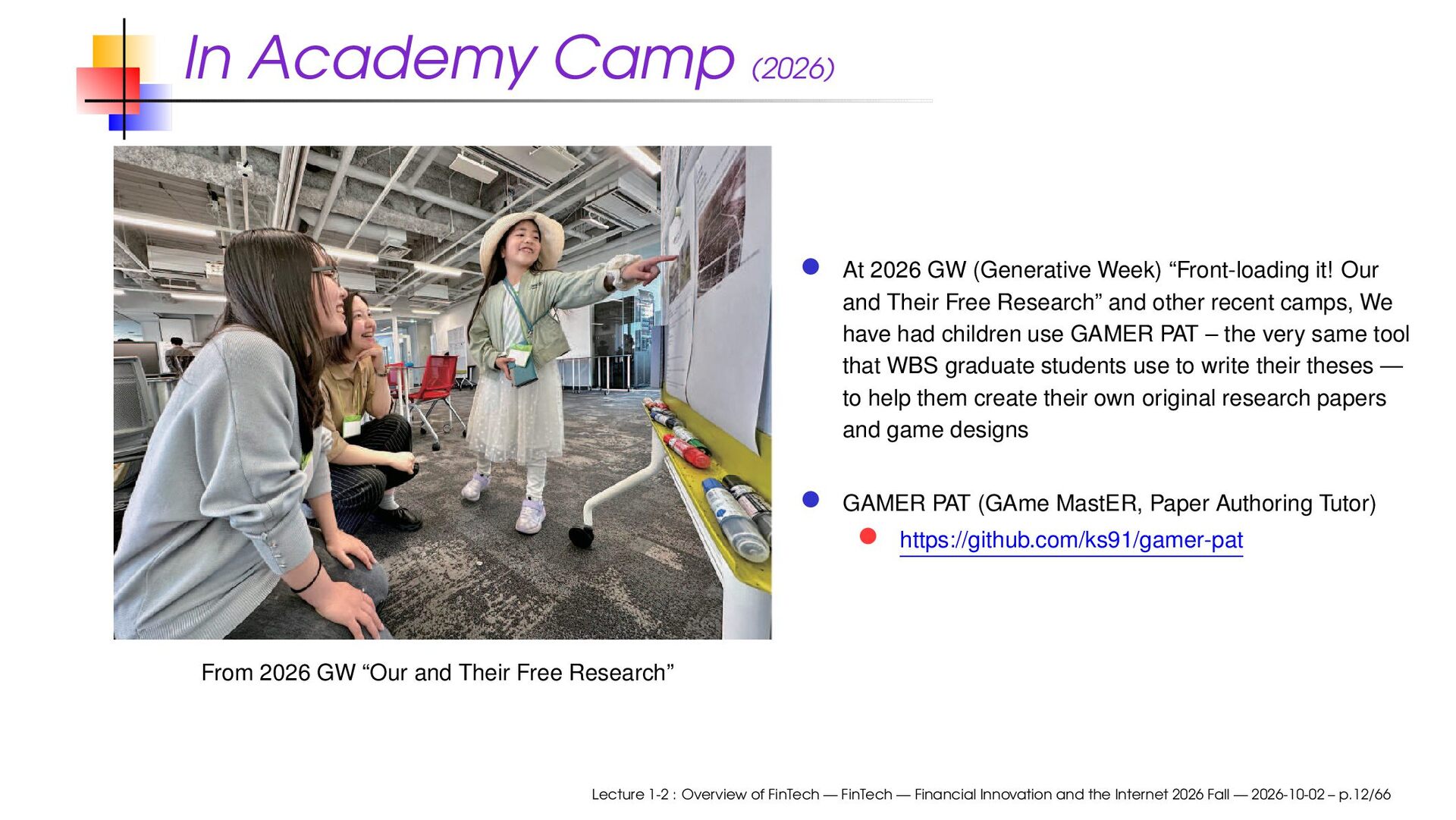
it! Our and Their Free Research” and other recent camps, We have had children use GAMER PAT – the very same tool that WBS graduate students use to write their theses — to help them create their own original research papers and game designs GAMER PAT (GAme MastER, Paper Authoring Tutor) https://github.com/ks91/gamer-pat From 2026 GW “Our and Their Free Research” Lecture 1-2 : Overview of FinTech — FinTech — Financial Innovation and the Internet 2026 Fall — 2026-10-02 – p.12/66
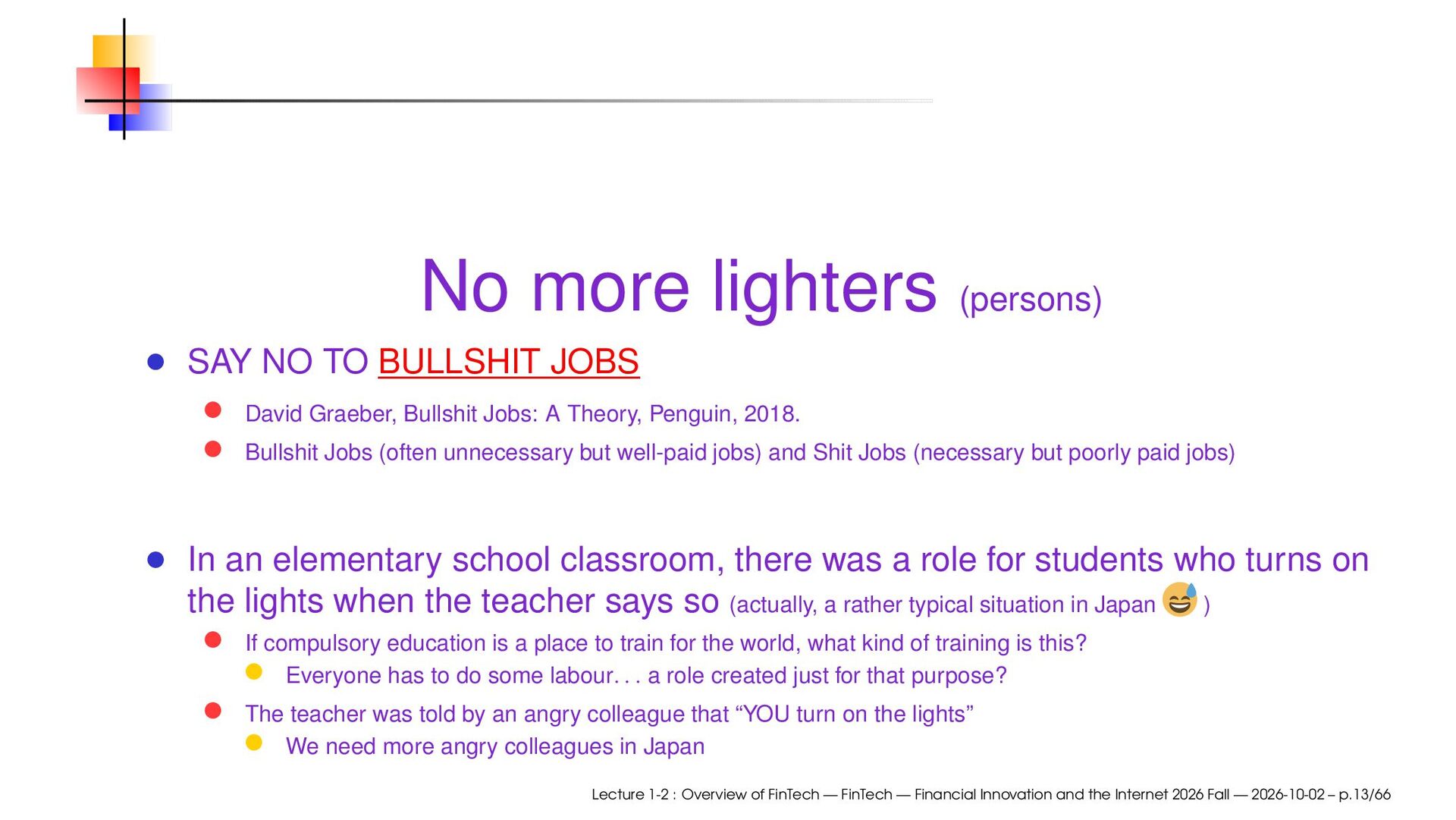
Graeber, Bullshit Jobs: A Theory, Penguin, 2018. Bullshit Jobs (often unnecessary but well-paid jobs) and Shit Jobs (necessary but poorly paid jobs) In an elementary school classroom, there was a role for students who turns on the lights when the teacher says so (actually, a rather typical situation in Japan ) If compulsory education is a place to train for the world, what kind of training is this? Everyone has to do some labour. . . a role created just for that purpose? The teacher was told by an angry colleague that “YOU turn on the lights” We need more angry colleagues in Japan Lecture 1-2 : Overview of FinTech — FinTech — Financial Innovation and the Internet 2026 Fall — 2026-10-02 – p.13/66
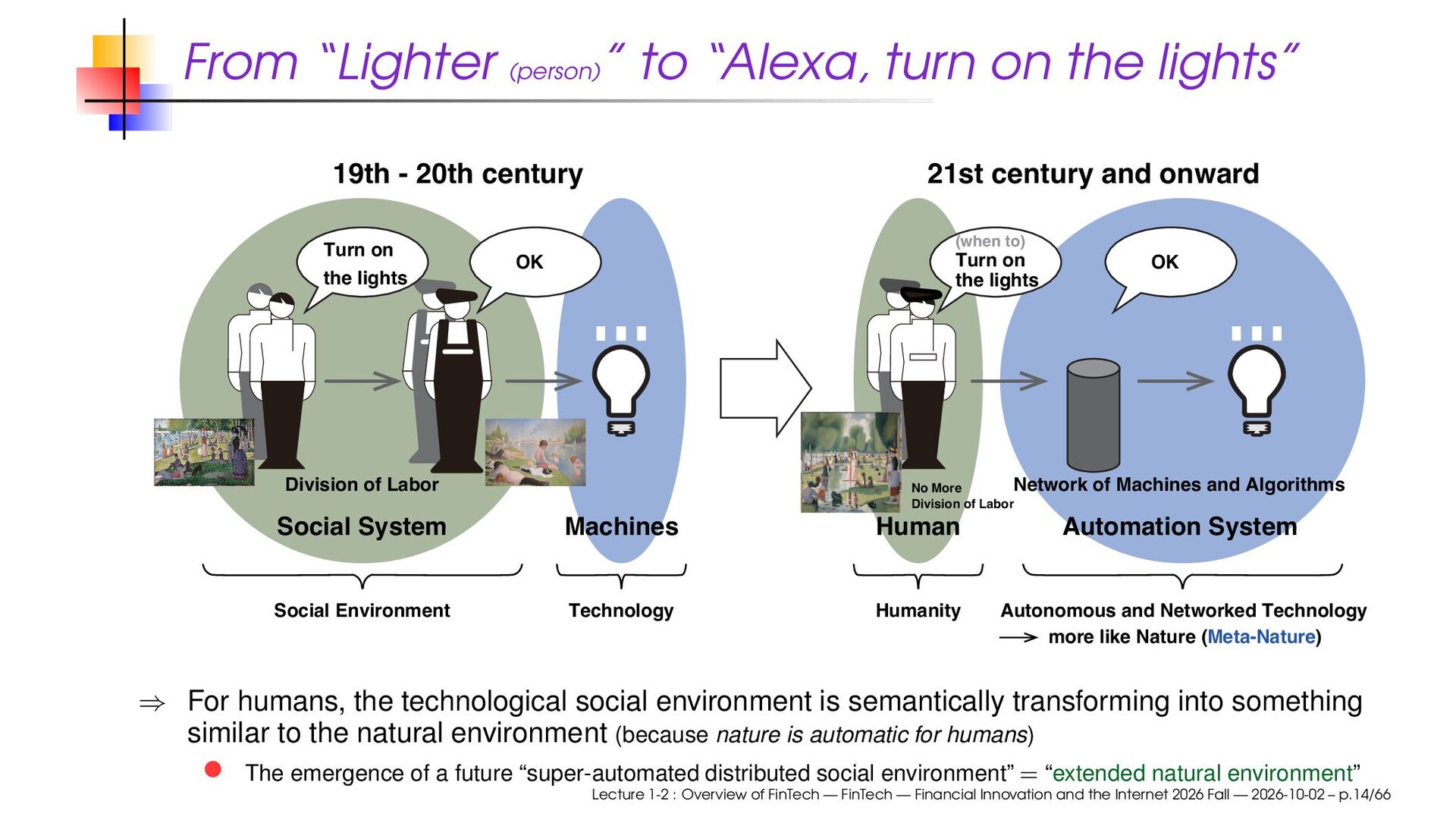
century and onward 19th - 20th century Turn on the lights (when to) Turn on the lights OK Division of Labor OK Network of Machines and Algorithms No More Division of Labor Social System Machines Human Automation System Social Environment Technology Humanity Autonomous and Networked Technology more like Nature (Meta-Nature) ⇒ For humans, the technological social environment is semantically transforming into something similar to the natural environment (because nature is automatic for humans) The emergence of a future “super-automated distributed social environment” = “extended natural environment” Lecture 1-2 : Overview of FinTech — FinTech — Financial Innovation and the Internet 2026 Fall — 2026-10-02 – p.14/66
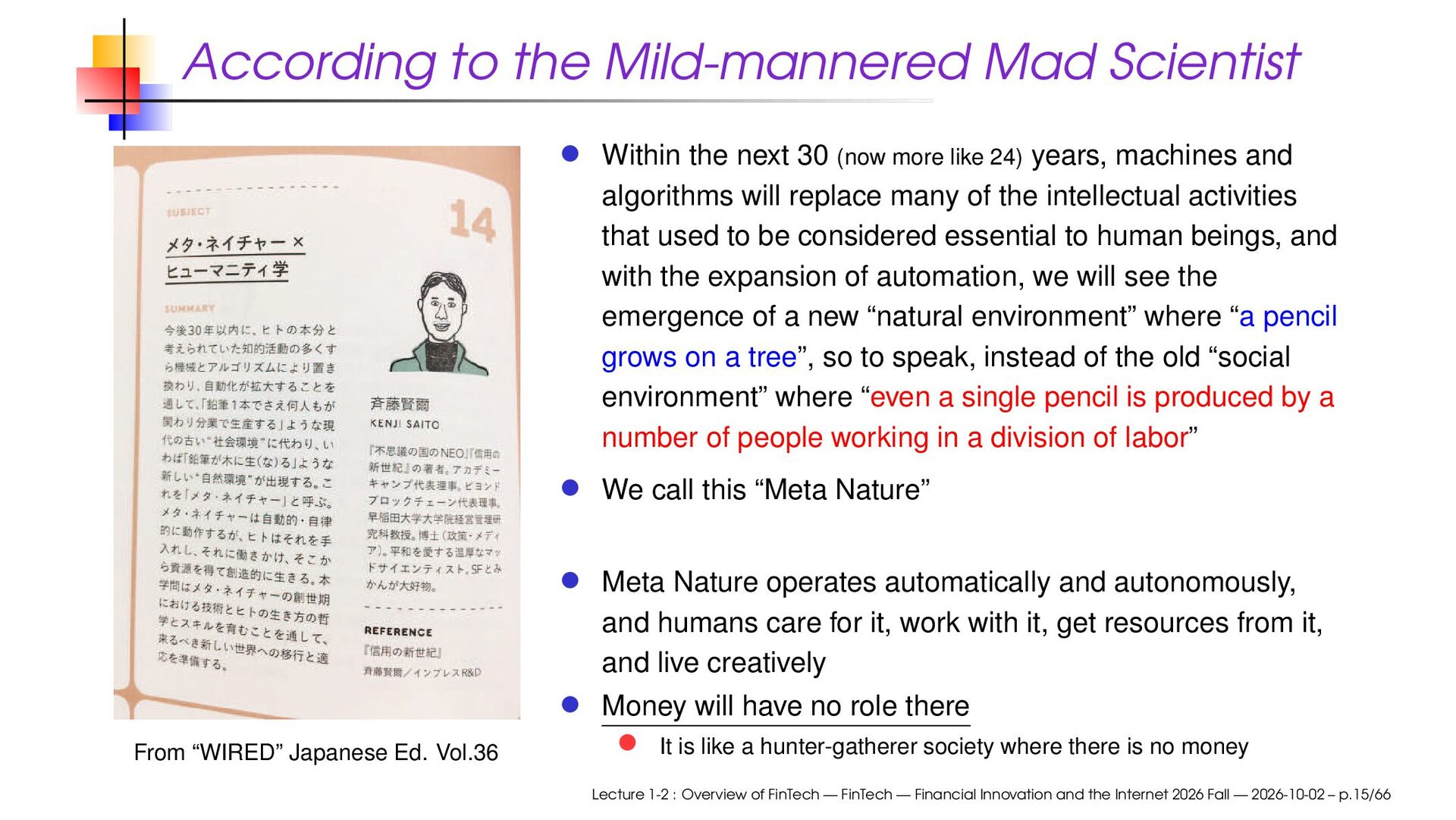
(now more like 24) years, machines and algorithms will replace many of the intellectual activities that used to be considered essential to human beings, and with the expansion of automation, we will see the emergence of a new “natural environment” where “a pencil grows on a tree”, so to speak, instead of the old “social environment” where “even a single pencil is produced by a number of people working in a division of labor” We call this “Meta Nature” Meta Nature operates automatically and autonomously, and humans care for it, work with it, get resources from it, and live creatively Money will have no role there From “WIRED” Japanese Ed. Vol.36 It is like a hunter-gatherer society where there is no money Lecture 1-2 : Overview of FinTech — FinTech — Financial Innovation and the Internet 2026 Fall — 2026-10-02 – p.15/66
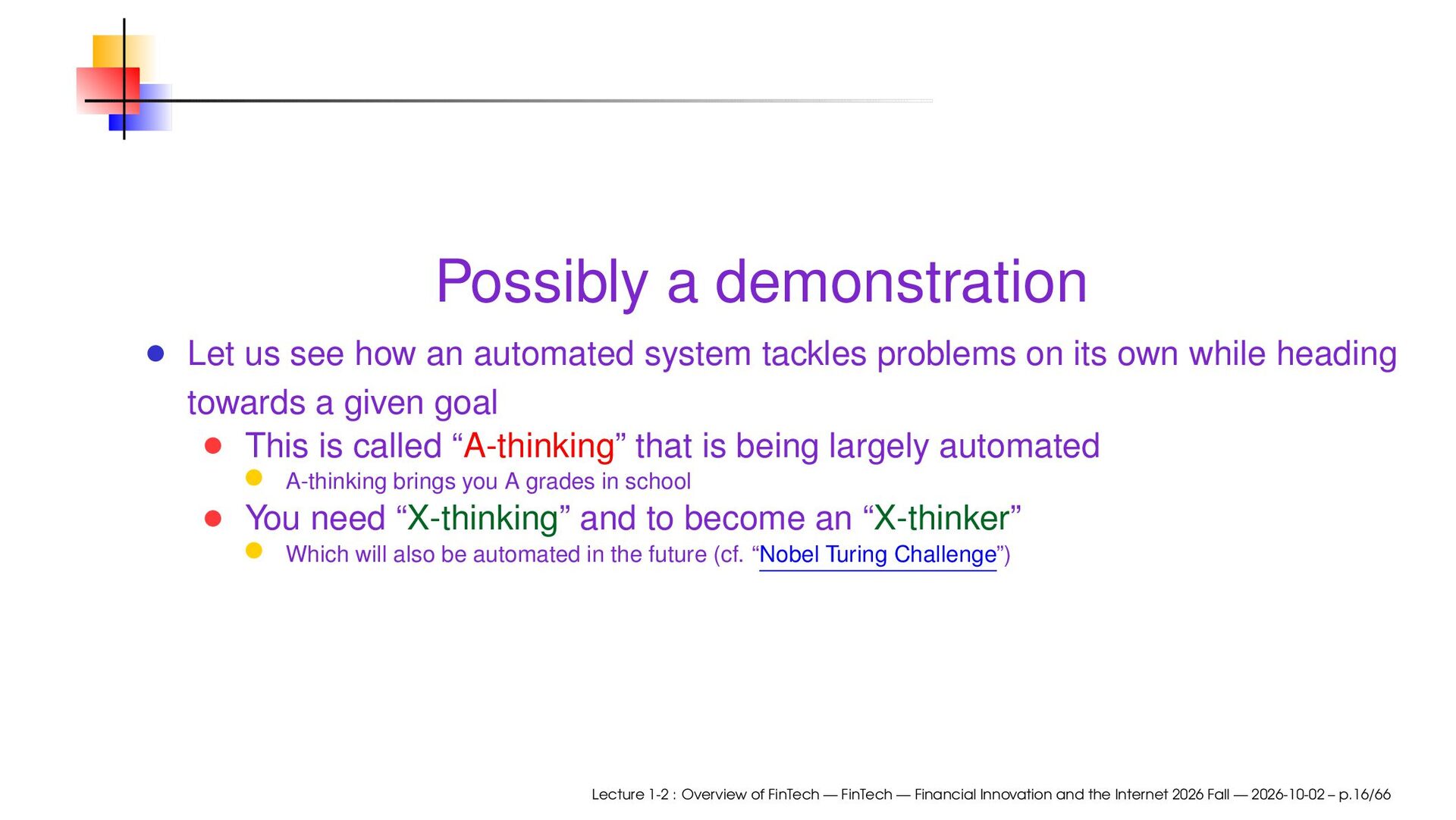
tackles problems on its own while heading towards a given goal This is called “A-thinking” that is being largely automated A-thinking brings you A grades in school You need “X-thinking” and to become an “X-thinker” Which will also be automated in the future (cf. “Nobel Turing Challenge”) Lecture 1-2 : Overview of FinTech — FinTech — Financial Innovation and the Internet 2026 Fall — 2026-10-02 – p.16/66
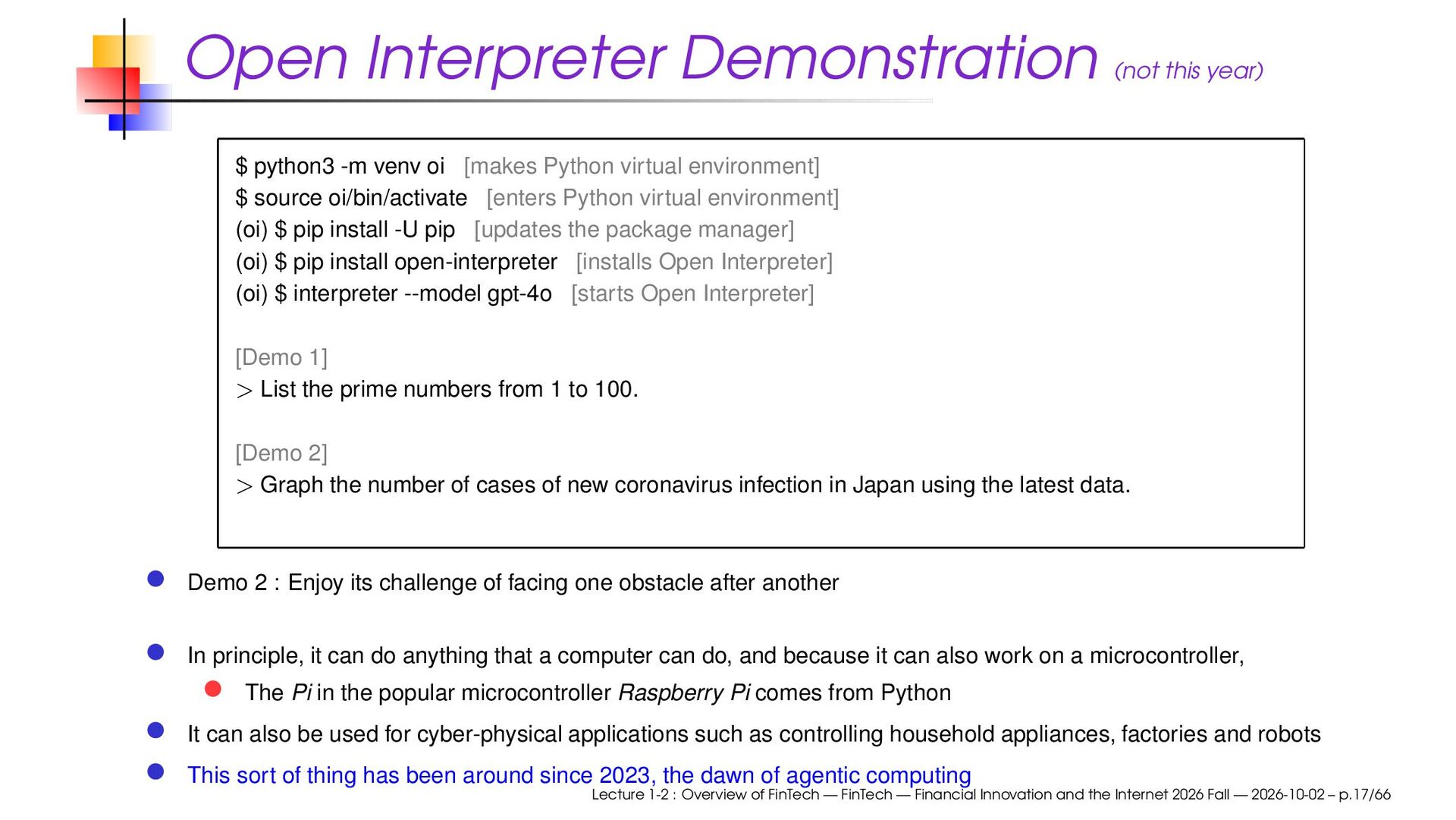
oi [makes Python virtual environment] $ source oi/bin/activate [enters Python virtual environment] (oi) $ pip install -U pip [updates the package manager] (oi) $ pip install open-interpreter [installs Open Interpreter] (oi) $ interpreter --model gpt-4o [starts Open Interpreter] [Demo 1] > List the prime numbers from 1 to 100. [Demo 2] > Graph the number of cases of new coronavirus infection in Japan using the latest data. Demo 2 : Enjoy its challenge of facing one obstacle after another In principle, it can do anything that a computer can do, and because it can also work on a microcontroller, The Pi in the popular microcontroller Raspberry Pi comes from Python It can also be used for cyber-physical applications such as controlling household appliances, factories and robots This sort of thing has been around since 2023, the dawn of agentic computing Lecture 1-2 : Overview of FinTech — FinTech — Financial Innovation and the Internet 2026 Fall — 2026-10-02 – p.17/66
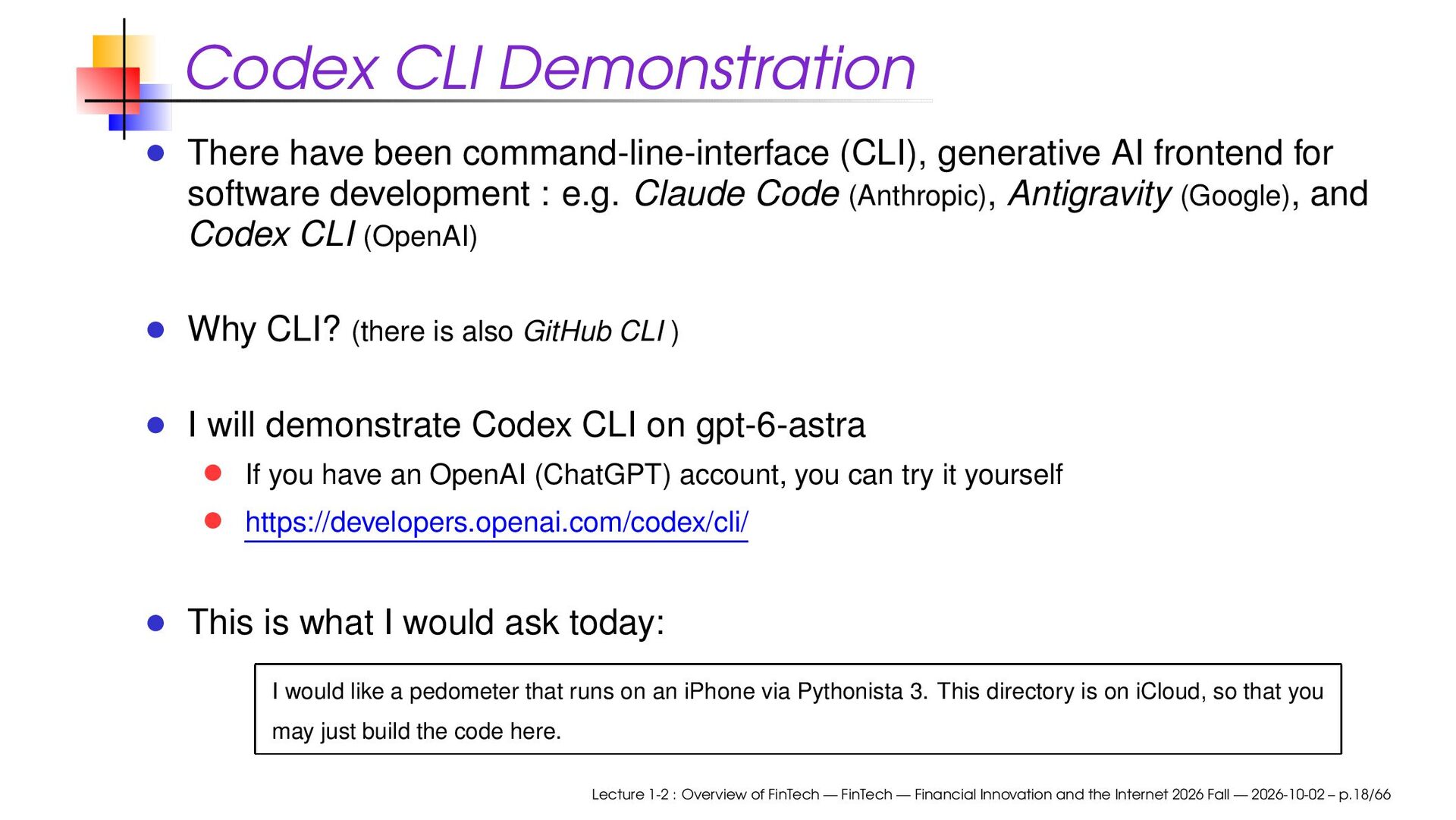
frontend for software development : e.g. Claude Code (Anthropic), Antigravity (Google), and Codex CLI (OpenAI) Why CLI? (there is also GitHub CLI ) I will demonstrate Codex CLI on gpt-6-astra If you have an OpenAI (ChatGPT) account, you can try it yourself https://developers.openai.com/codex/cli/ This is what I would ask today: I would like a pedometer that runs on an iPhone via Pythonista 3. This directory is on iCloud, so that you may just build the code here. Lecture 1-2 : Overview of FinTech — FinTech — Financial Innovation and the Internet 2026 Fall — 2026-10-02 – p.18/66
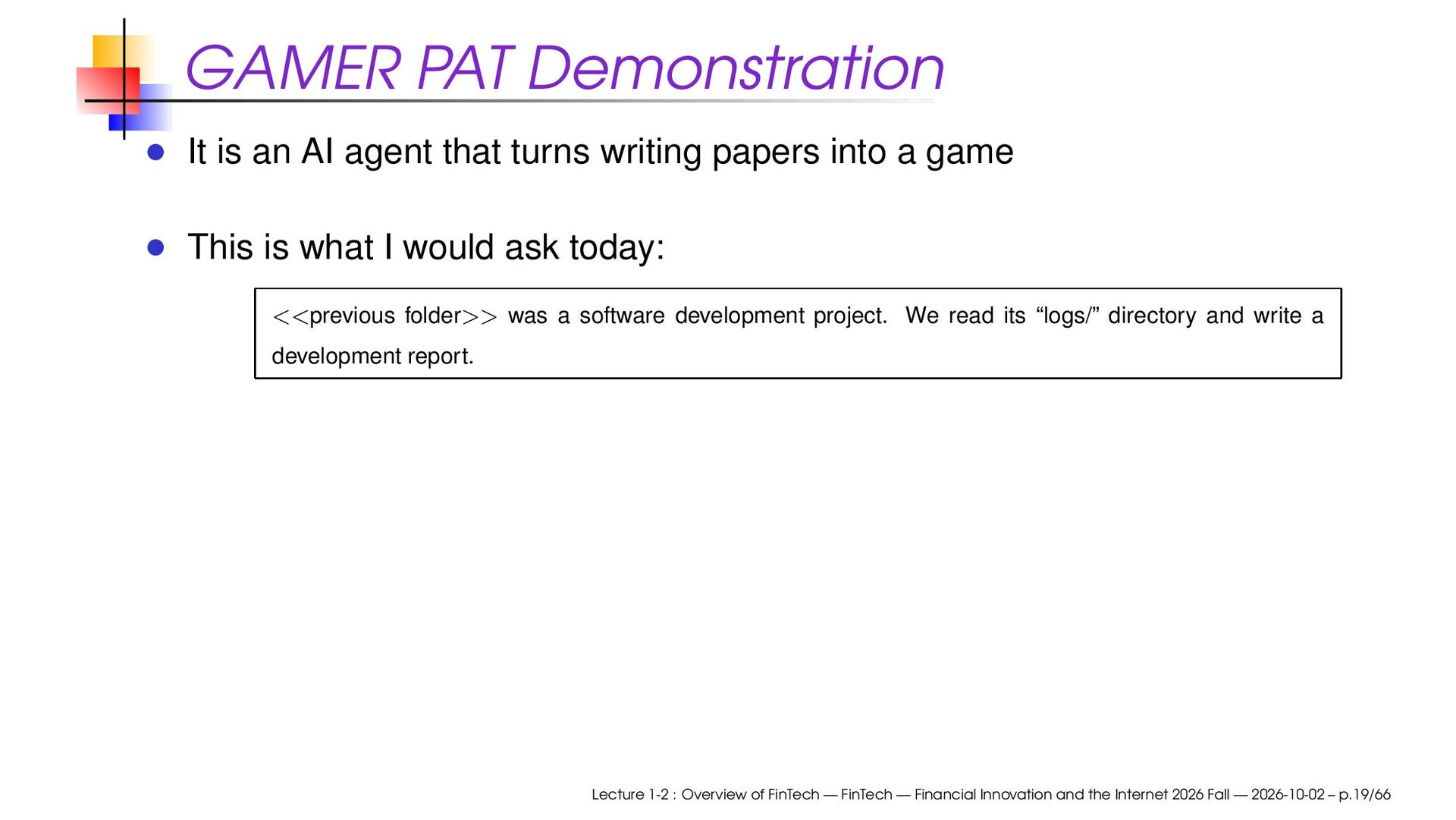
writing papers into a game This is what I would ask today: <<previous folder>> was a software development project. We read its “logs/” directory and write a development report. Lecture 1-2 : Overview of FinTech — FinTech — Financial Innovation and the Internet 2026 Fall — 2026-10-02 – p.19/66
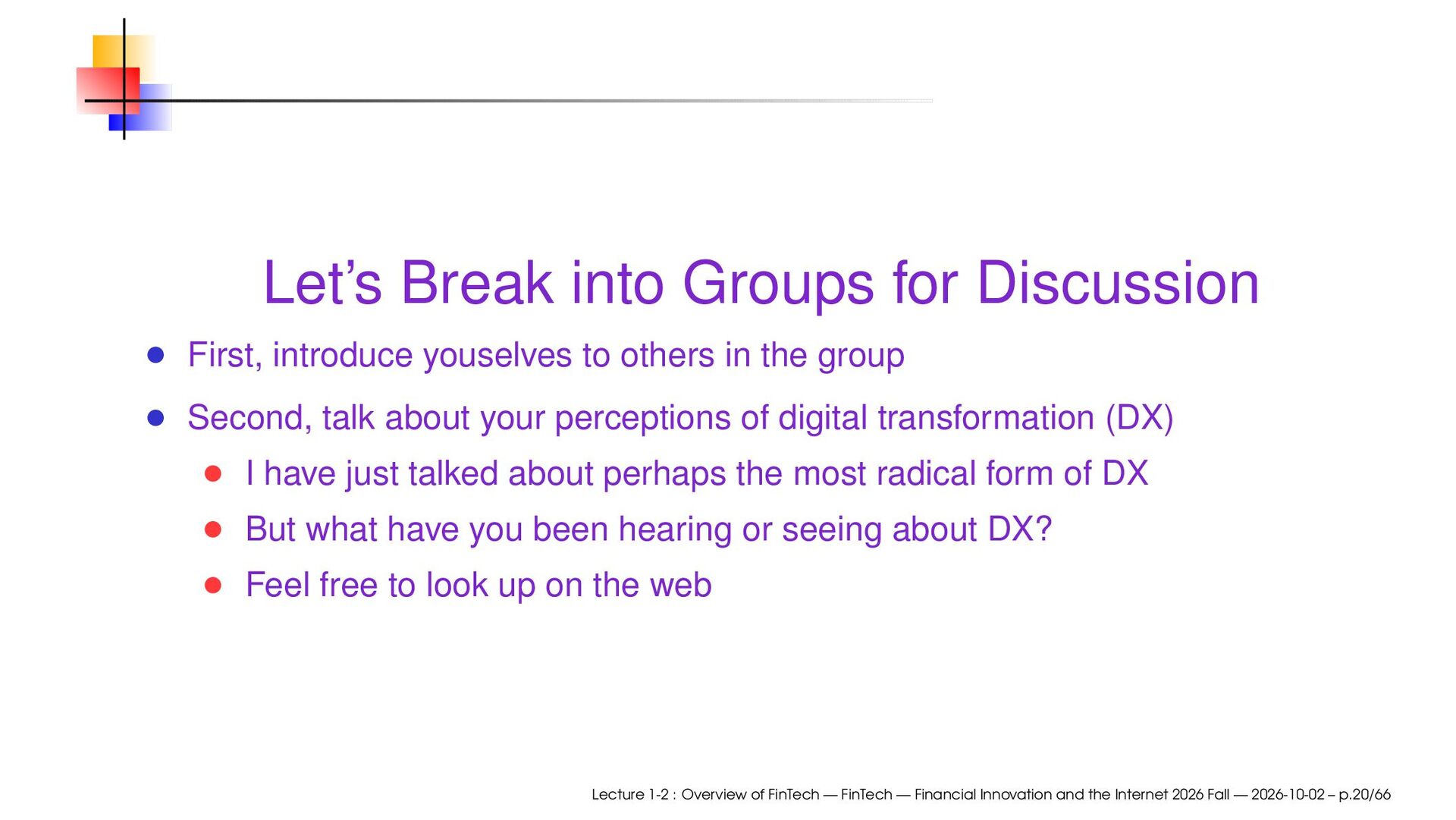
others in the group Second, talk about your perceptions of digital transformation (DX) I have just talked about perhaps the most radical form of DX But what have you been hearing or seeing about DX? Feel free to look up on the web Lecture 1-2 : Overview of FinTech — FinTech — Financial Innovation and the Internet 2026 Fall — 2026-10-02 – p.20/66
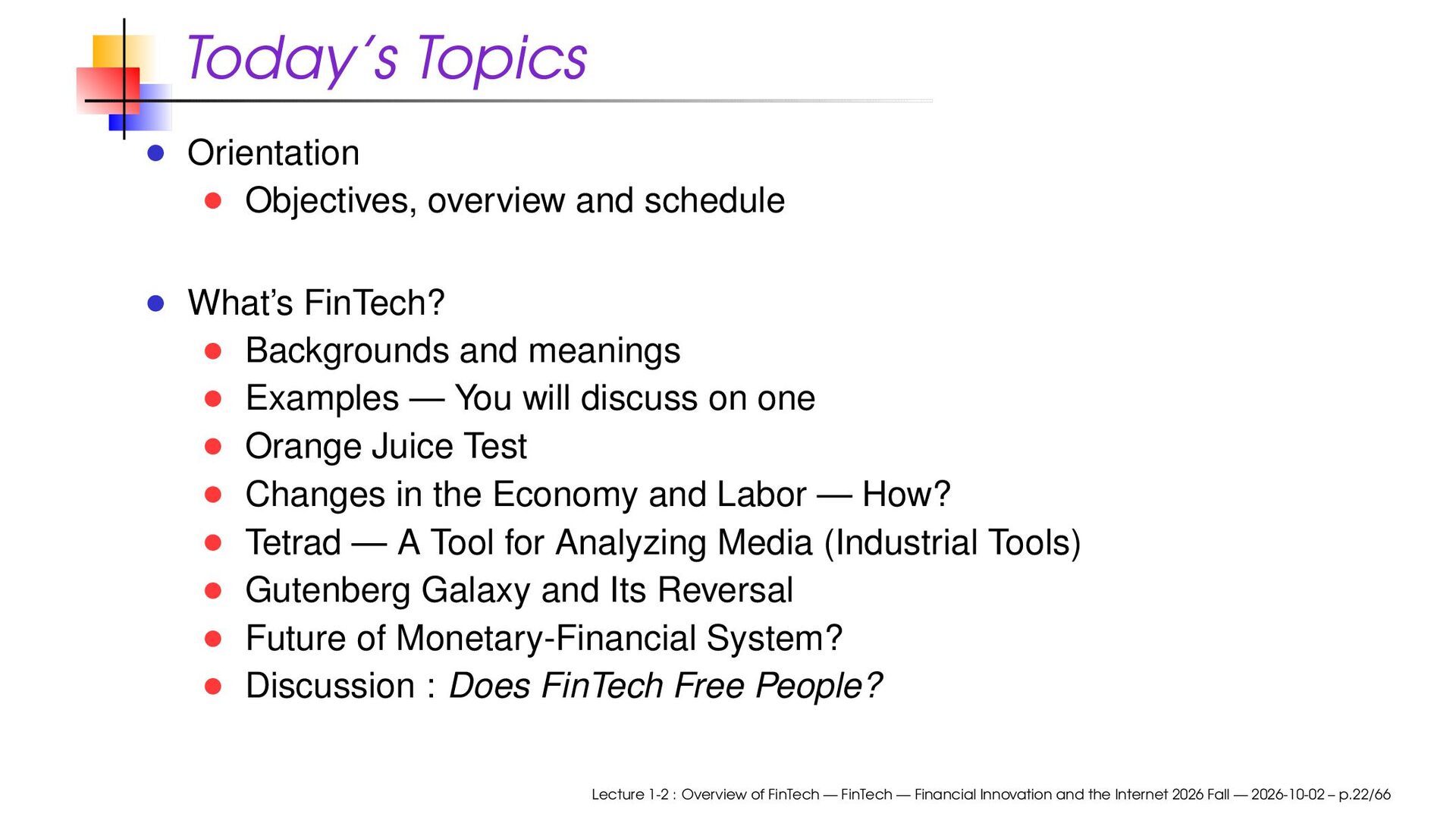
and meanings Examples — You will discuss on one Orange Juice Test Changes in the Economy and Labor — How? Tetrad — A Tool for Analyzing Media (Industrial Tools) Gutenberg Galaxy and Its Reversal Future of Monetary-Financial System? Discussion : Does FinTech Free People? Lecture 1-2 : Overview of FinTech — FinTech — Financial Innovation and the Internet 2026 Fall — 2026-10-02 – p.22/66
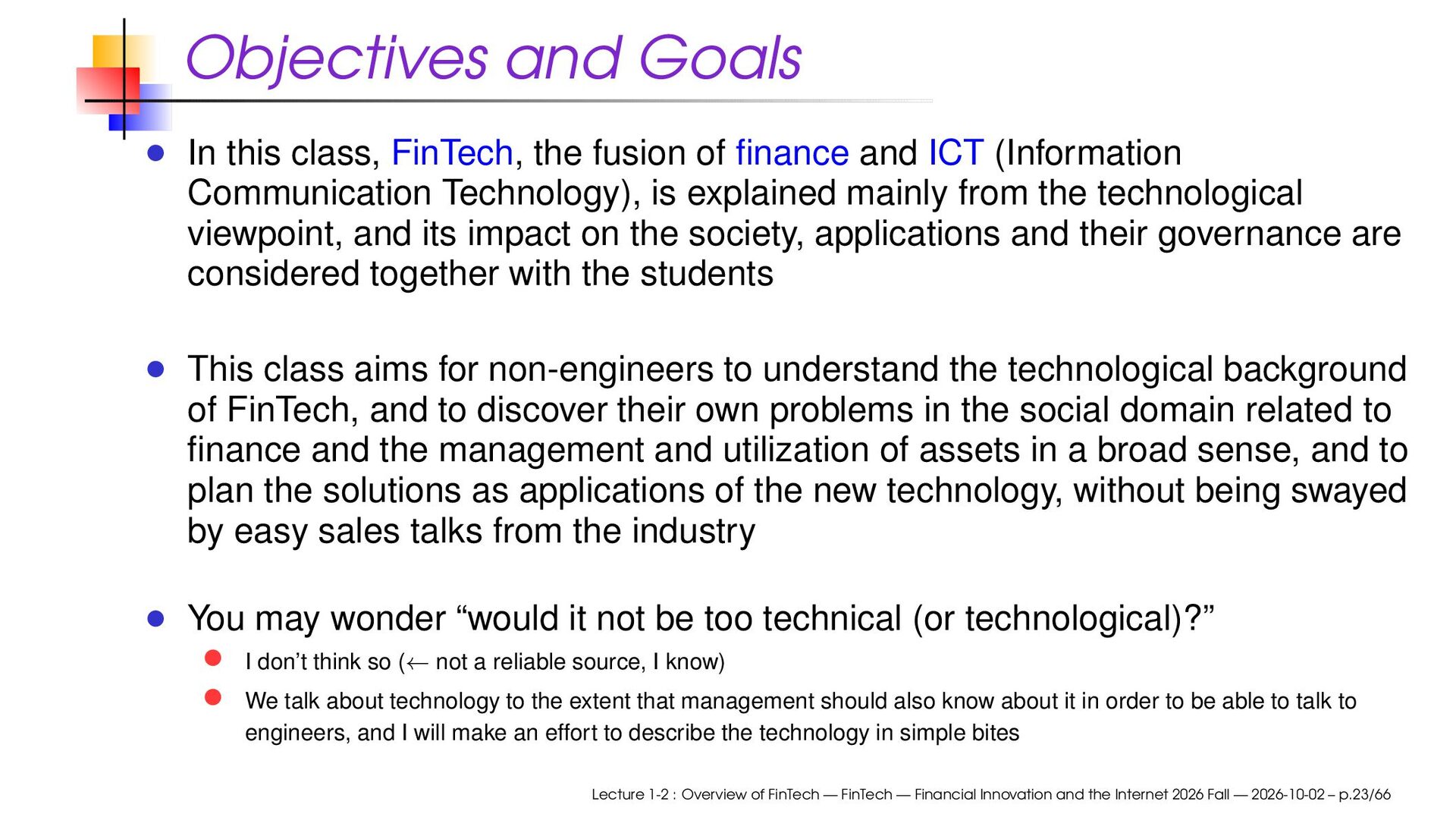
finance and ICT (Information Communication Technology), is explained mainly from the technological viewpoint, and its impact on the society, applications and their governance are considered together with the students This class aims for non-engineers to understand the technological background of FinTech, and to discover their own problems in the social domain related to finance and the management and utilization of assets in a broad sense, and to plan the solutions as applications of the new technology, without being swayed by easy sales talks from the industry You may wonder “would it not be too technical (or technological)?” I don’t think so (← not a reliable source, I know) We talk about technology to the extent that management should also know about it in order to be able to talk to engineers, and I will make an effort to describe the technology in simple bites Lecture 1-2 : Overview of FinTech — FinTech — Financial Innovation and the Internet 2026 Fall — 2026-10-02 – p.23/66
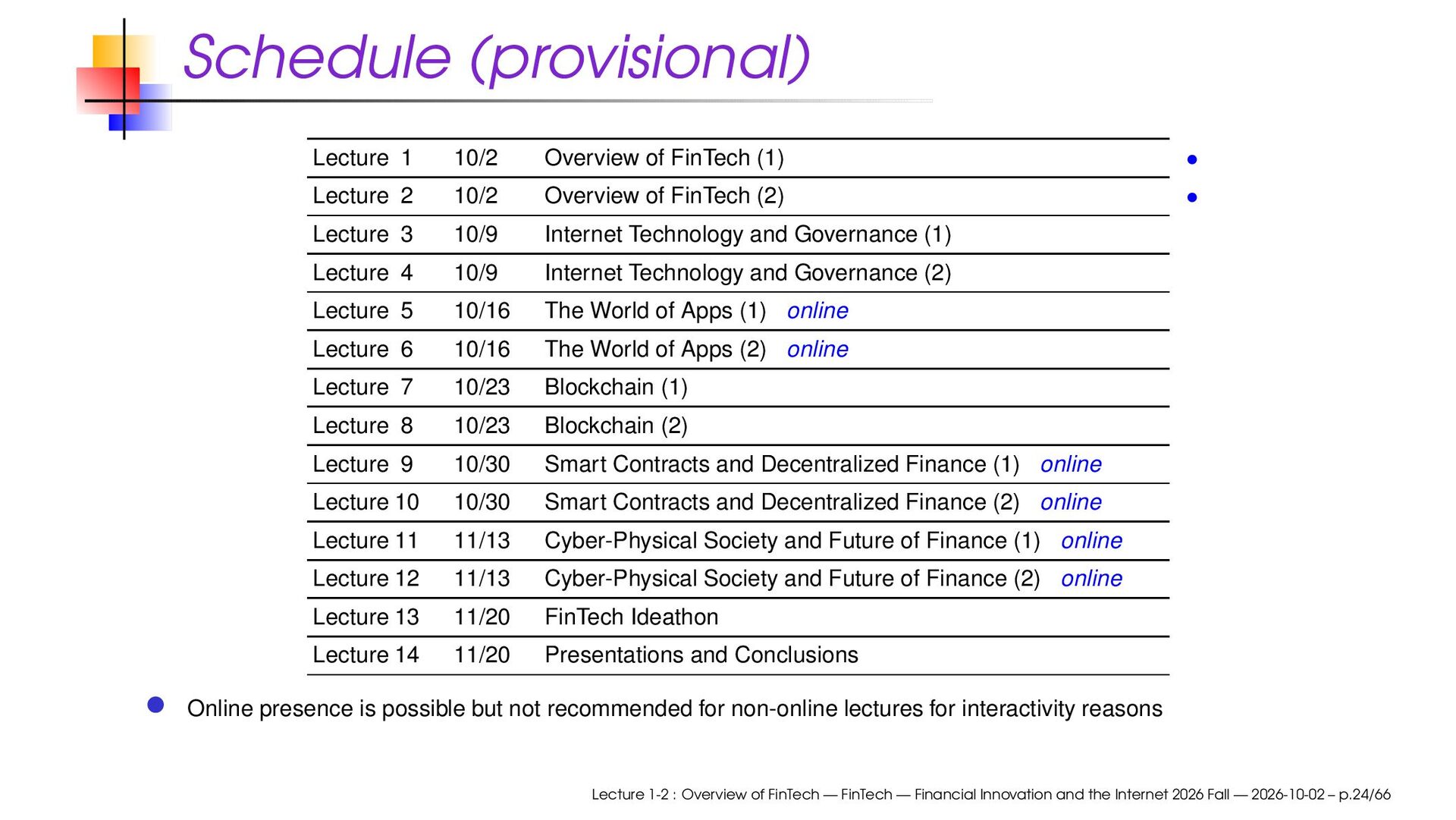
Lecture 2 10/2 Overview of FinTech (2) • Lecture 3 10/9 Internet Technology and Governance (1) Lecture 4 10/9 Internet Technology and Governance (2) Lecture 5 10/16 The World of Apps (1) online Lecture 6 10/16 The World of Apps (2) online Lecture 7 10/23 Blockchain (1) Lecture 8 10/23 Blockchain (2) Lecture 9 10/30 Smart Contracts and Decentralized Finance (1) online Lecture 10 10/30 Smart Contracts and Decentralized Finance (2) online Lecture 11 11/13 Cyber-Physical Society and Future of Finance (1) online Lecture 12 11/13 Cyber-Physical Society and Future of Finance (2) online Lecture 13 11/20 FinTech Ideathon Lecture 14 11/20 Presentations and Conclusions Online presence is possible but not recommended for non-online lectures for interactivity reasons Lecture 1-2 : Overview of FinTech — FinTech — Financial Innovation and the Internet 2026 Fall — 2026-10-02 – p.24/66
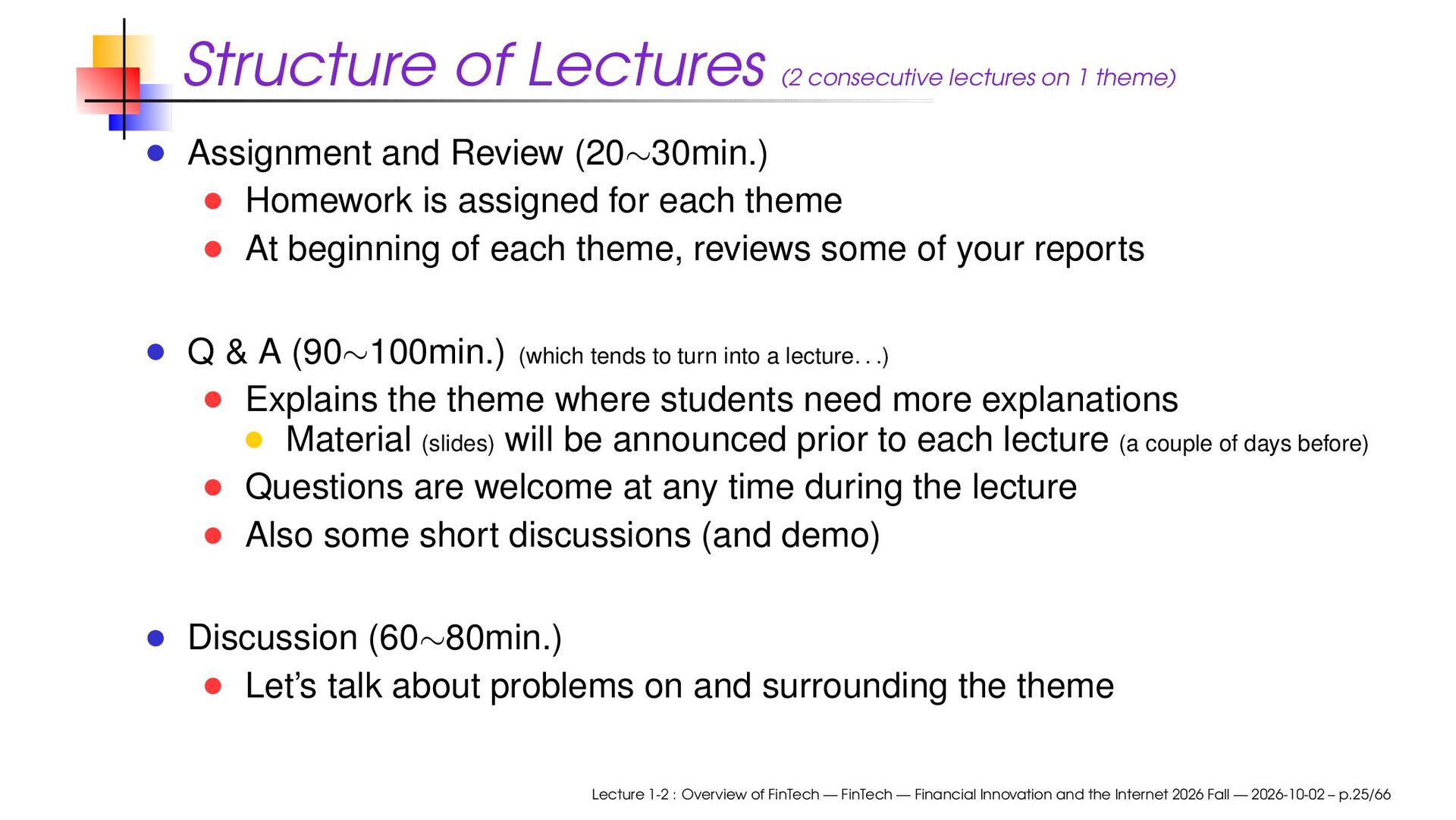
and Review (20∼30min.) Homework is assigned for each theme At beginning of each theme, reviews some of your reports Q & A (90∼100min.) (which tends to turn into a lecture. . .) Explains the theme where students need more explanations Material (slides) will be announced prior to each lecture (a couple of days before) Questions are welcome at any time during the lecture Also some short discussions (and demo) Discussion (60∼80min.) Let’s talk about problems on and surrounding the theme Lecture 1-2 : Overview of FinTech — FinTech — Financial Innovation and the Internet 2026 Fall — 2026-10-02 – p.25/66
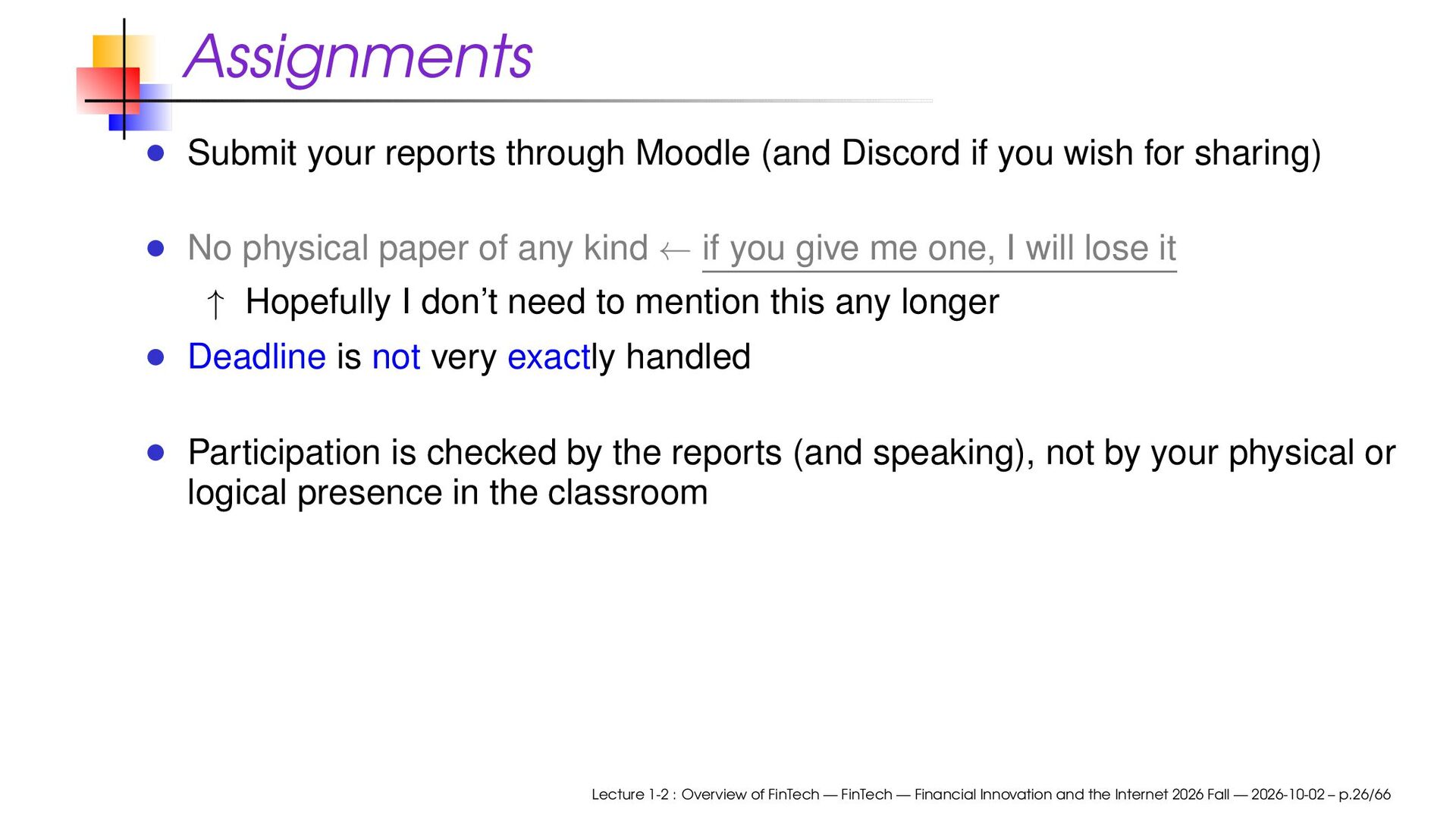
wish for sharing) No physical paper of any kind ← if you give me one, I will lose it ↑ Hopefully I don’t need to mention this any longer Deadline is not very exactly handled Participation is checked by the reports (and speaking), not by your physical or logical presence in the classroom Lecture 1-2 : Overview of FinTech — FinTech — Financial Innovation and the Internet 2026 Fall — 2026-10-02 – p.26/66
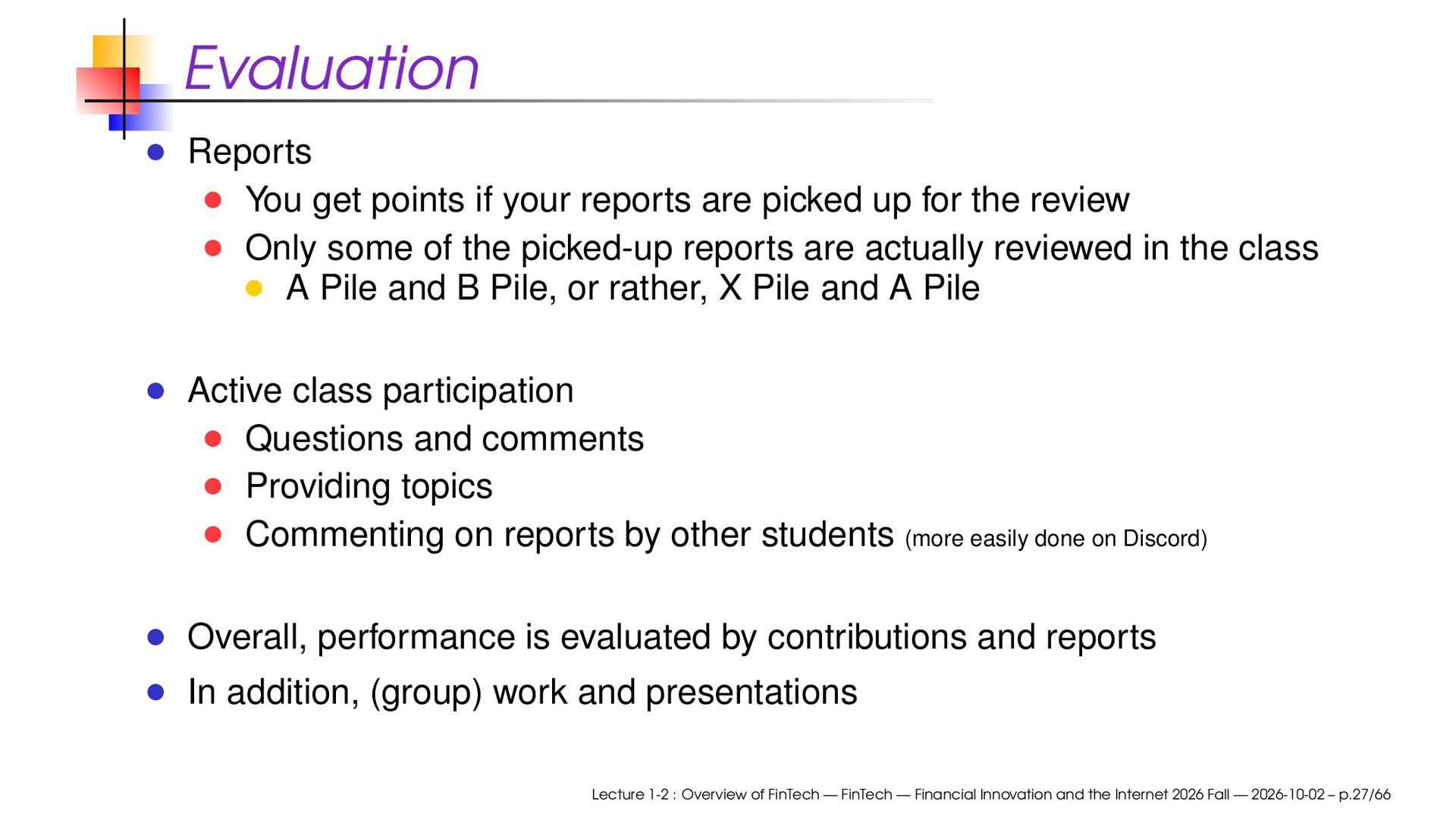
up for the review Only some of the picked-up reports are actually reviewed in the class A Pile and B Pile, or rather, X Pile and A Pile Active class participation Questions and comments Providing topics Commenting on reports by other students (more easily done on Discord) Overall, performance is evaluated by contributions and reports In addition, (group) work and presentations Lecture 1-2 : Overview of FinTech — FinTech — Financial Innovation and the Internet 2026 Fall — 2026-10-02 – p.27/66
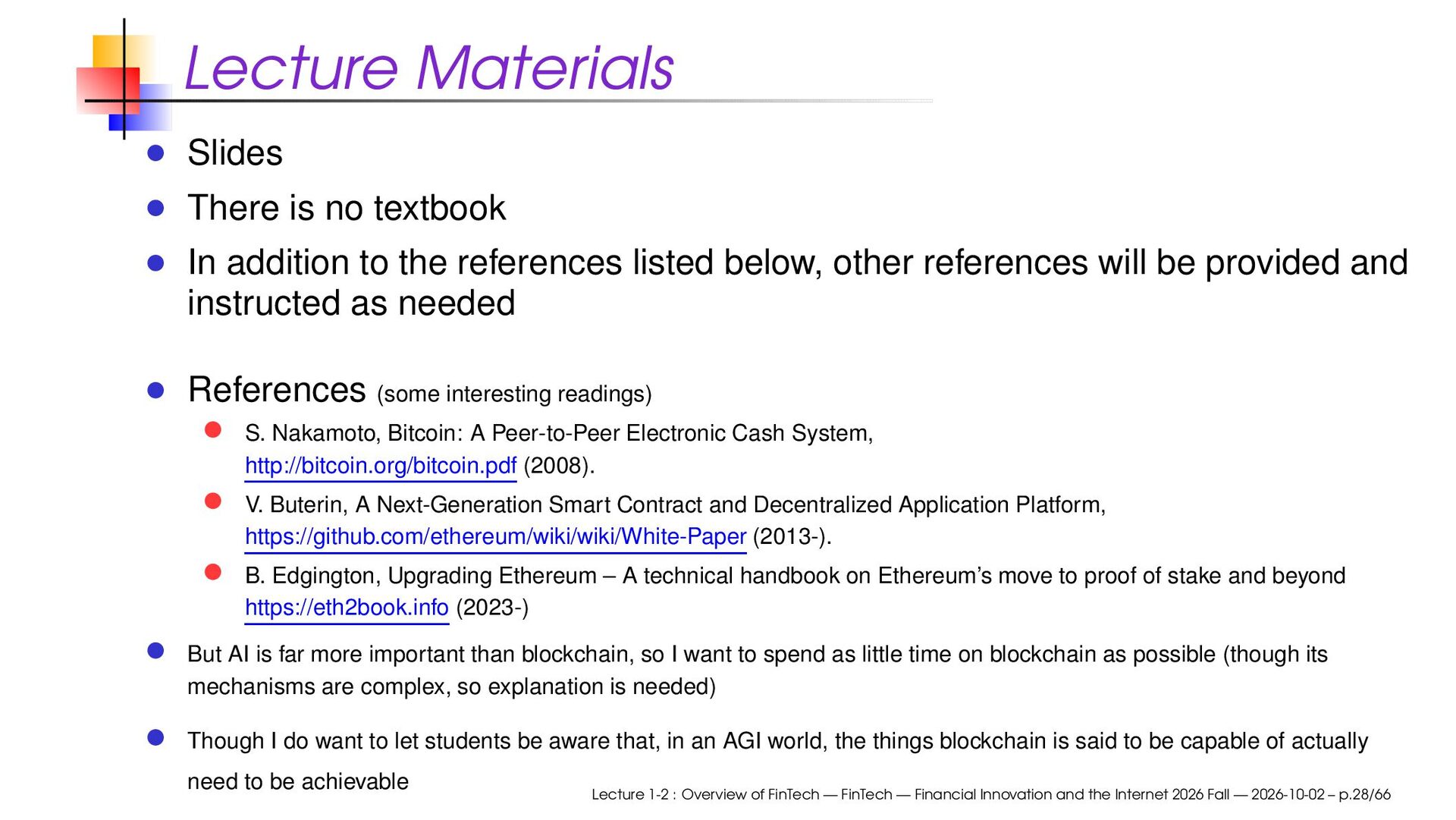
the references listed below, other references will be provided and instructed as needed References (some interesting readings) S. Nakamoto, Bitcoin: A Peer-to-Peer Electronic Cash System, http://bitcoin.org/bitcoin.pdf (2008). V. Buterin, A Next-Generation Smart Contract and Decentralized Application Platform, https://github.com/ethereum/wiki/wiki/White-Paper (2013-). B. Edgington, Upgrading Ethereum – A technical handbook on Ethereum’s move to proof of stake and beyond https://eth2book.info (2023-) But AI is far more important than blockchain, so I want to spend as little time on blockchain as possible (though its mechanisms are complex, so explanation is needed) Though I do want to let students be aware that, in an AGI world, the things blockchain is said to be capable of actually need to be achievable Lecture 1-2 : Overview of FinTech — FinTech — Financial Innovation and the Internet 2026 Fall — 2026-10-02 – p.28/66
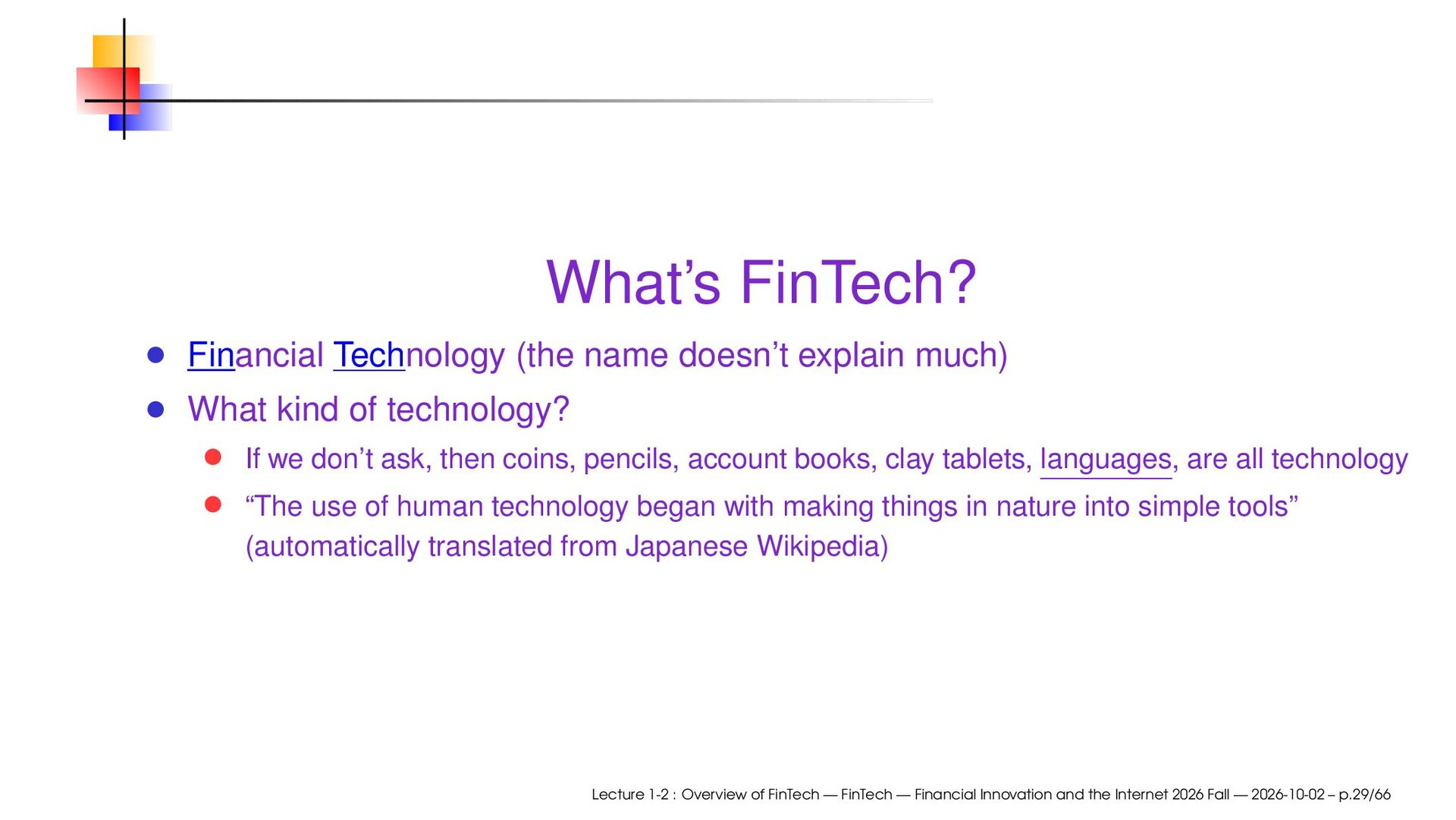
kind of technology? If we don’t ask, then coins, pencils, account books, clay tablets, languages, are all technology “The use of human technology began with making things in nature into simple tools” (automatically translated from Japanese Wikipedia) Lecture 1-2 : Overview of FinTech — FinTech — Financial Innovation and the Internet 2026 Fall — 2026-10-02 – p.29/66
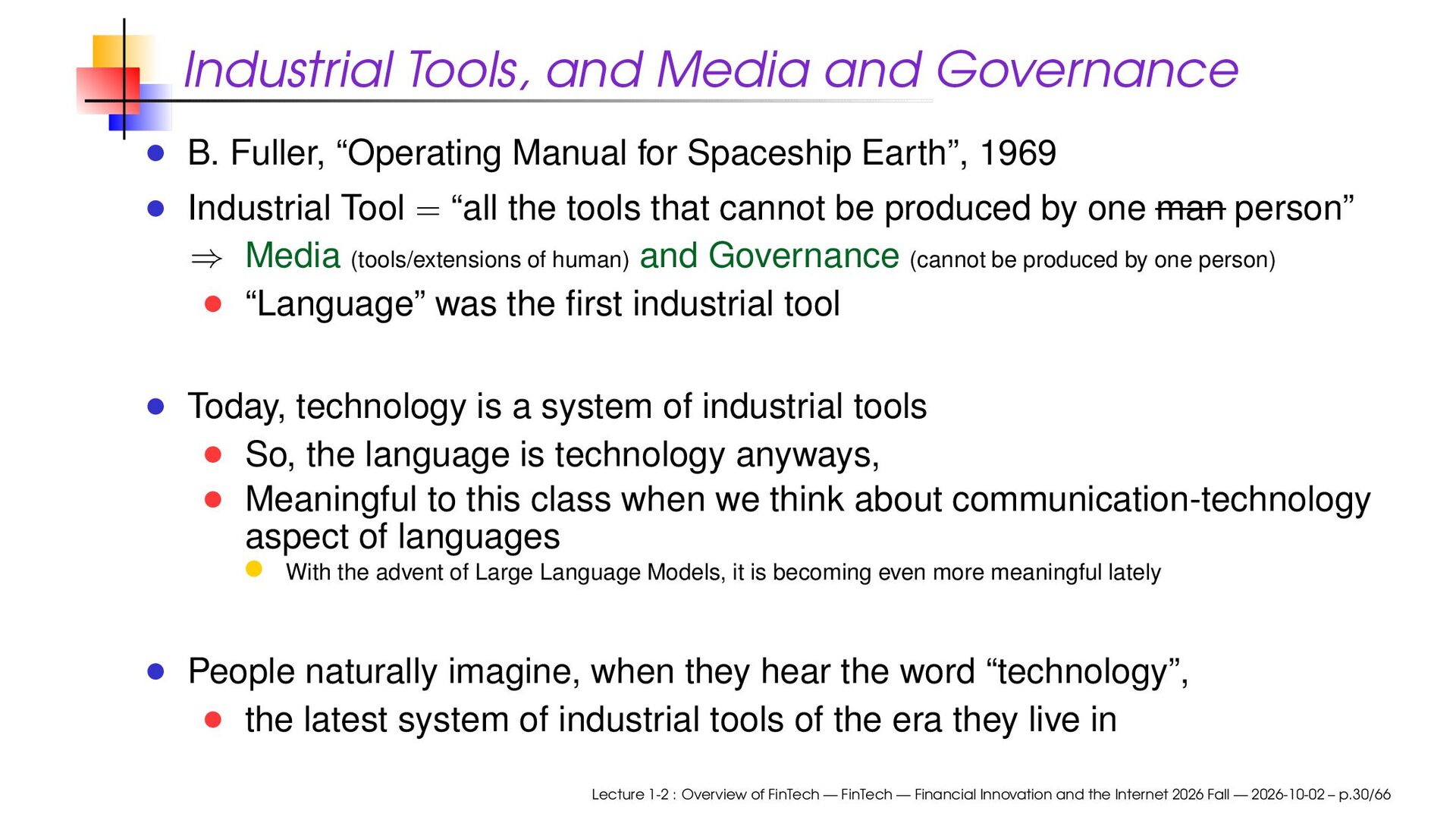
for Spaceship Earth”, 1969 Industrial Tool = “all the tools that cannot be produced by one man person” ⇒ Media (tools/extensions of human) and Governance (cannot be produced by one person) “Language” was the first industrial tool Today, technology is a system of industrial tools So, the language is technology anyways, Meaningful to this class when we think about communication-technology aspect of languages With the advent of Large Language Models, it is becoming even more meaningful lately People naturally imagine, when they hear the word “technology”, the latest system of industrial tools of the era they live in Lecture 1-2 : Overview of FinTech — FinTech — Financial Innovation and the Internet 2026 Fall — 2026-10-02 – p.30/66
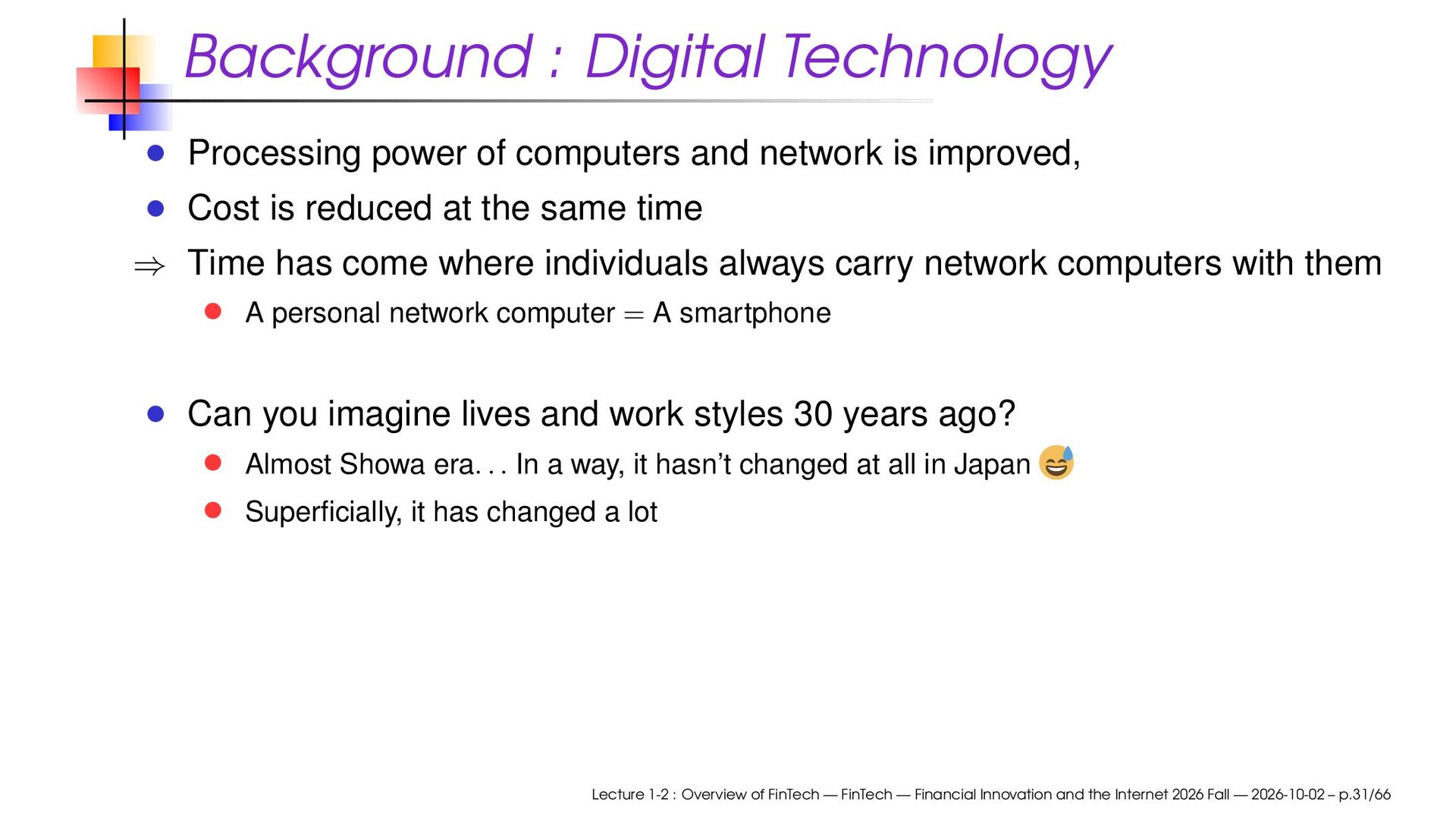
is improved, Cost is reduced at the same time ⇒ Time has come where individuals always carry network computers with them A personal network computer = A smartphone Can you imagine lives and work styles 30 years ago? Almost Showa era. . . In a way, it hasn’t changed at all in Japan Superficially, it has changed a lot Lecture 1-2 : Overview of FinTech — FinTech — Financial Innovation and the Internet 2026 Fall — 2026-10-02 – p.31/66
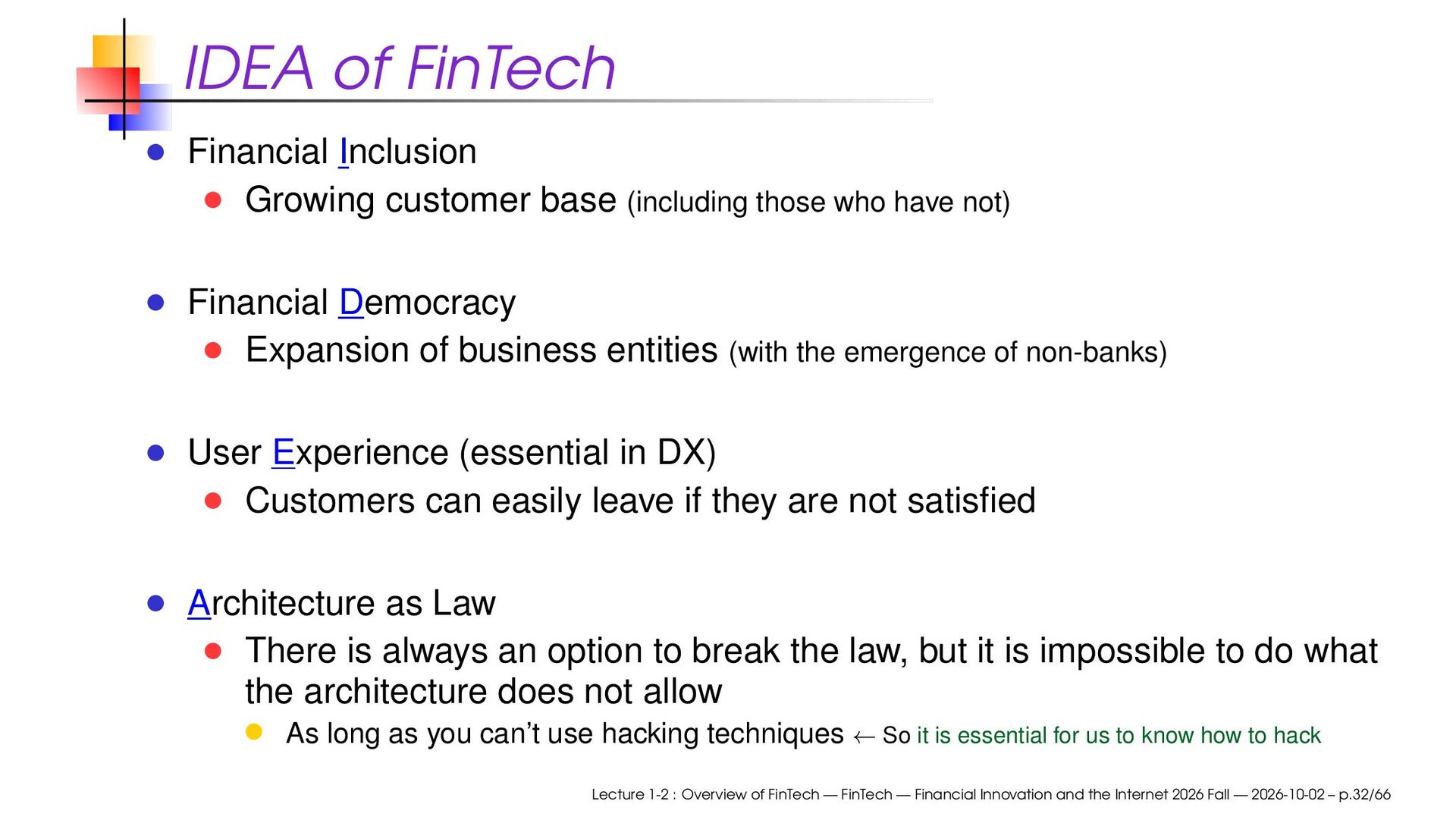
who have not) Financial Democracy Expansion of business entities (with the emergence of non-banks) User Experience (essential in DX) Customers can easily leave if they are not satisfied Architecture as Law There is always an option to break the law, but it is impossible to do what the architecture does not allow As long as you can’t use hacking techniques ← So it is essential for us to know how to hack Lecture 1-2 : Overview of FinTech — FinTech — Financial Innovation and the Internet 2026 Fall — 2026-10-02 – p.32/66
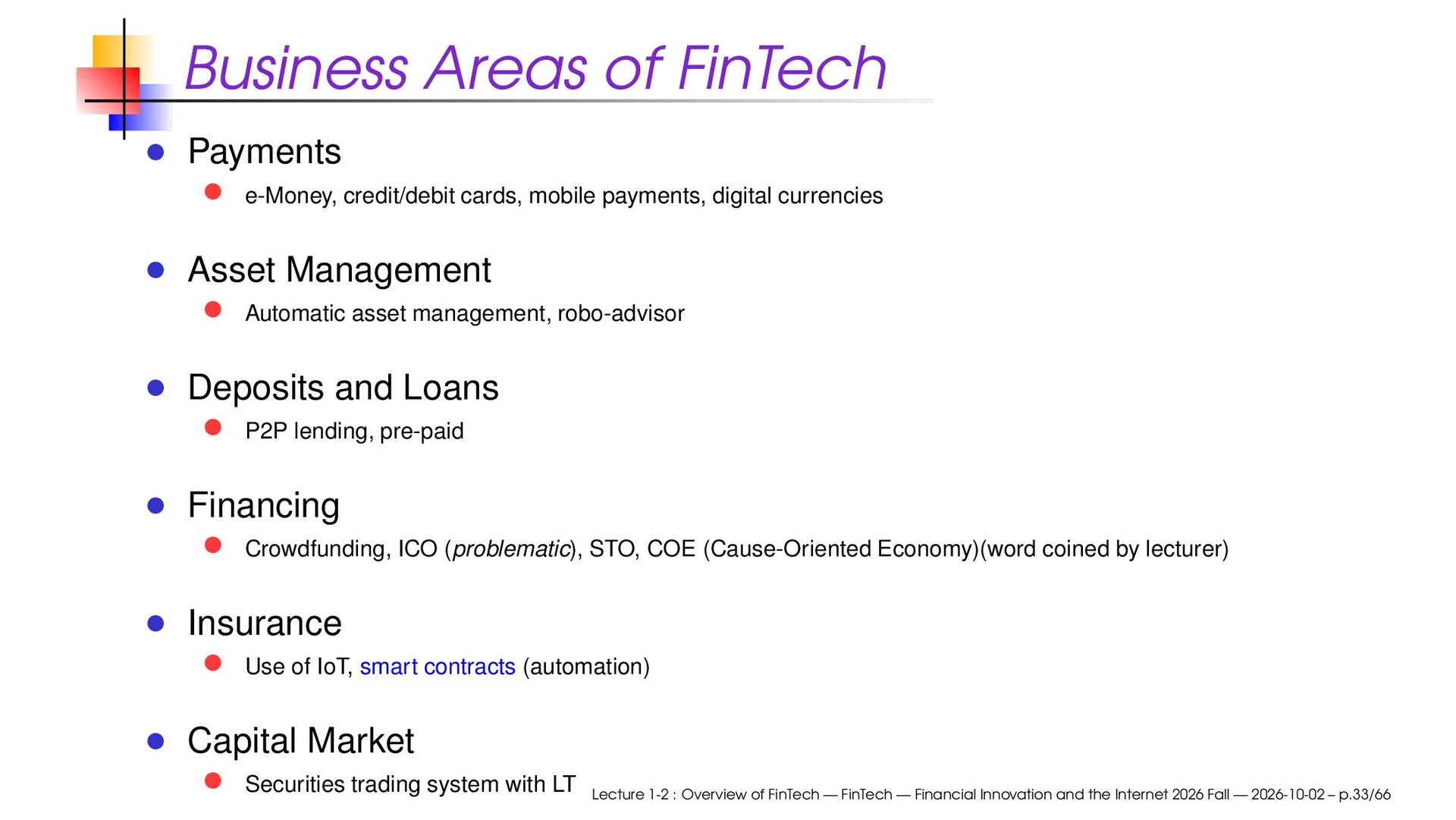
digital currencies Asset Management Automatic asset management, robo-advisor Deposits and Loans P2P lending, pre-paid Financing Crowdfunding, ICO (problematic), STO, COE (Cause-Oriented Economy)(word coined by lecturer) Insurance Use of IoT, smart contracts (automation) Capital Market Securities trading system with LT Lecture 1-2 : Overview of FinTech — FinTech — Financial Innovation and the Internet 2026 Fall — 2026-10-02 – p.33/66
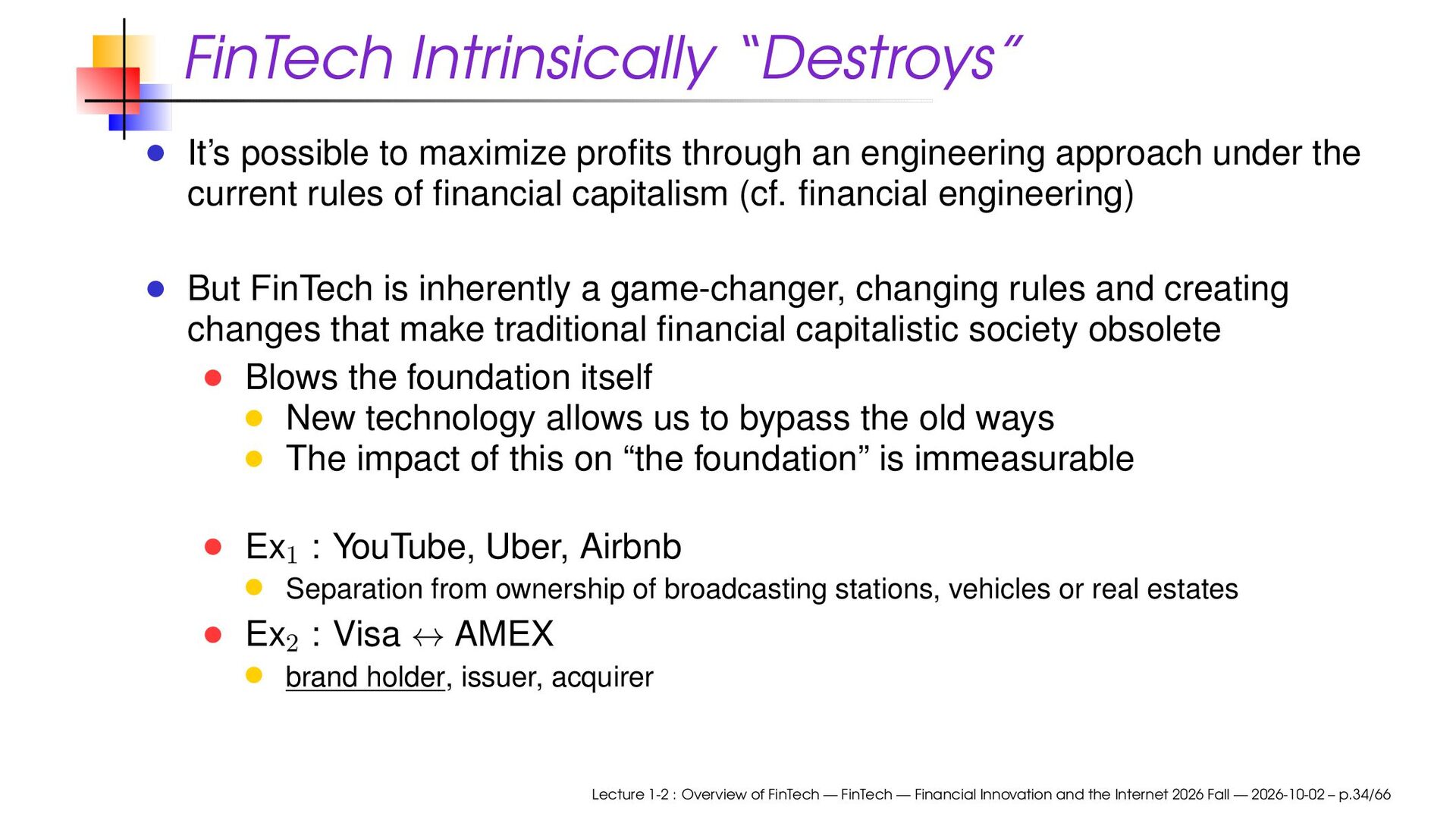
engineering approach under the current rules of financial capitalism (cf. financial engineering) But FinTech is inherently a game-changer, changing rules and creating changes that make traditional financial capitalistic society obsolete Blows the foundation itself New technology allows us to bypass the old ways The impact of this on “the foundation” is immeasurable Ex1 : YouTube, Uber, Airbnb Separation from ownership of broadcasting stations, vehicles or real estates Ex2 : Visa ↔ AMEX brand holder, issuer, acquirer Lecture 1-2 : Overview of FinTech — FinTech — Financial Innovation and the Internet 2026 Fall — 2026-10-02 – p.34/66
of FinTech Since it is so commonplace today, there will be an example of something that is not so common as a discussion topic Lecture 1-2 : Overview of FinTech — FinTech — Financial Innovation and the Internet 2026 Fall — 2026-10-02 – p.35/66
say, within a town How do you achieve it? It cannot be done? But this is also an orange juice test https://www.intercom.com/blog/the-orange-juice-test/ Lecture 1-2 : Overview of FinTech — FinTech — Financial Innovation and the Internet 2026 Fall — 2026-10-02 – p.36/66
Credit/Finance and Communications But More Broadly. . . Lecture 1-2 : Overview of FinTech — FinTech — Financial Innovation and the Internet 2026 Fall — 2026-10-02 – p.37/66
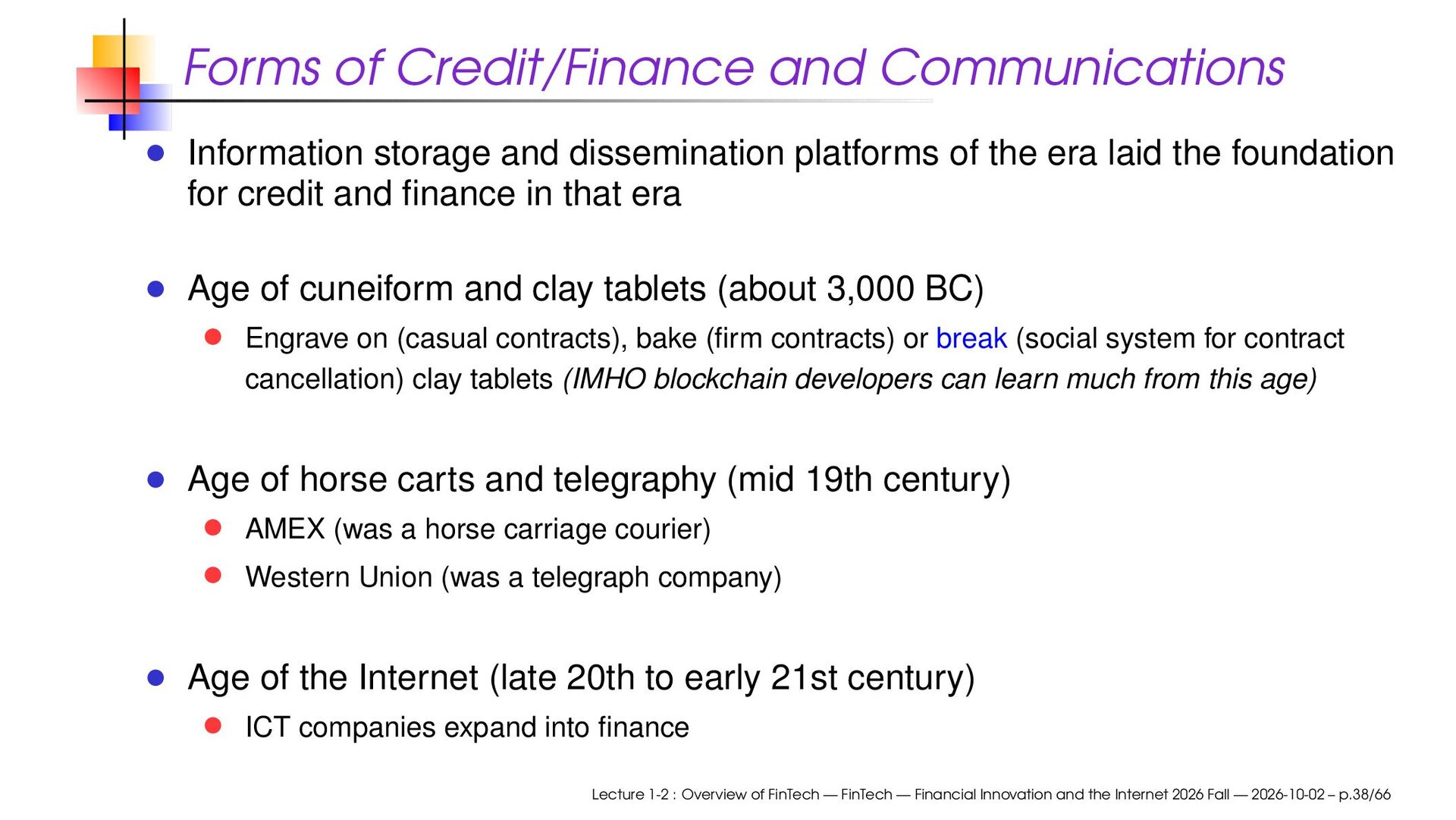
of the era laid the foundation for credit and finance in that era Age of cuneiform and clay tablets (about 3,000 BC) Engrave on (casual contracts), bake (firm contracts) or break (social system for contract cancellation) clay tablets (IMHO blockchain developers can learn much from this age) Age of horse carts and telegraphy (mid 19th century) AMEX (was a horse carriage courier) Western Union (was a telegraph company) Age of the Internet (late 20th to early 21st century) ICT companies expand into finance Lecture 1-2 : Overview of FinTech — FinTech — Financial Innovation and the Internet 2026 Fall — 2026-10-02 – p.38/66
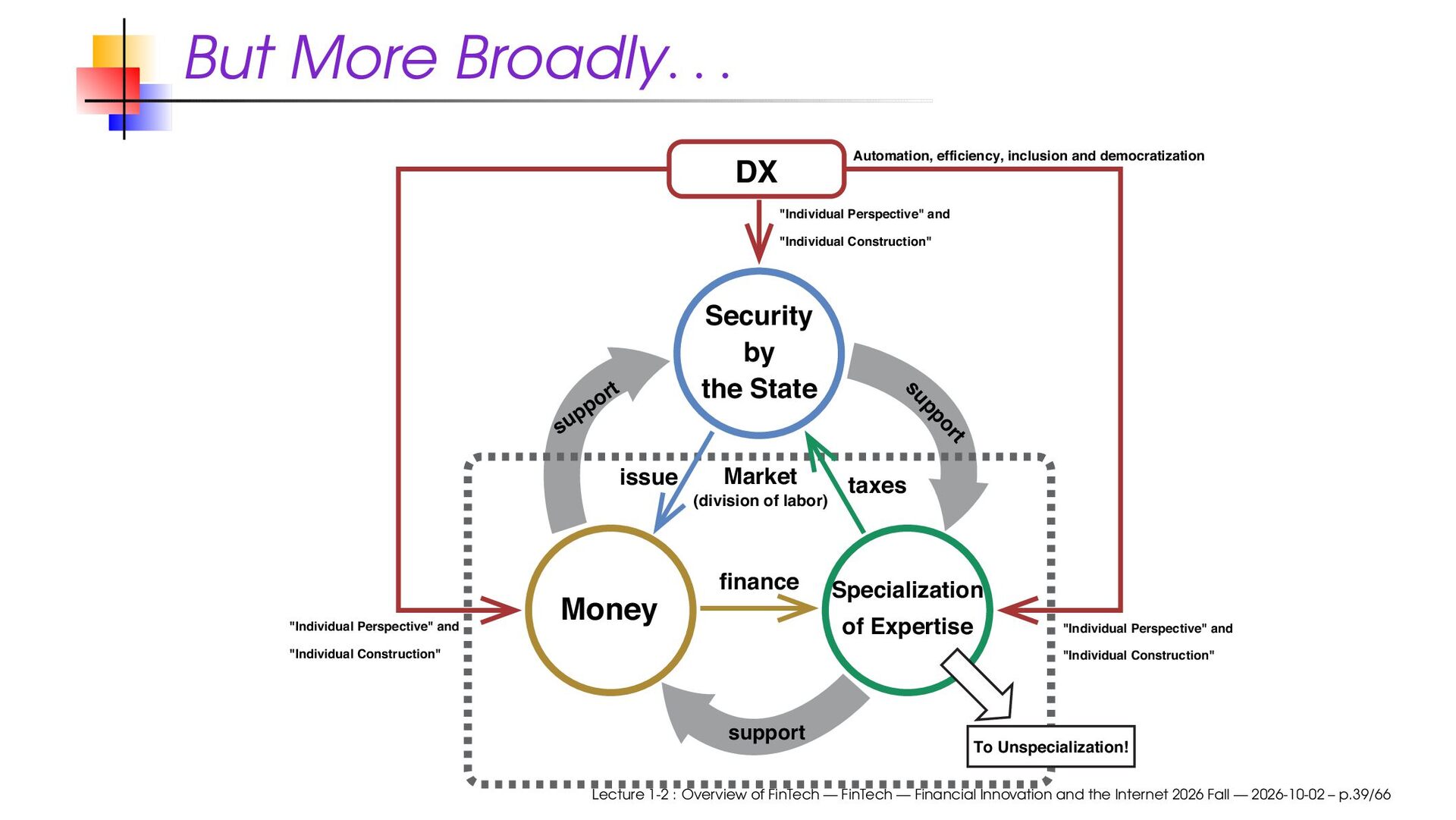
DX "Individual Perspective" and "Individual Construction" issue Market (division of labor) finance "Individual Perspective" and Money t or pp su rt o pp su Security by the State taxes Specialization of Expertise "Individual Construction" "Individual Perspective" and "Individual Construction" support To Unspecialization! Lecture 1-2 : Overview of FinTech — FinTech — Financial Innovation and the Internet 2026 Fall — 2026-10-02 – p.39/66
equal industrial tools We know that media + governance = industrial tools What haven’t you noticed lately? Lecture 1-2 : Overview of FinTech — FinTech — Financial Innovation and the Internet 2026 Fall — 2026-10-02 – p.40/66
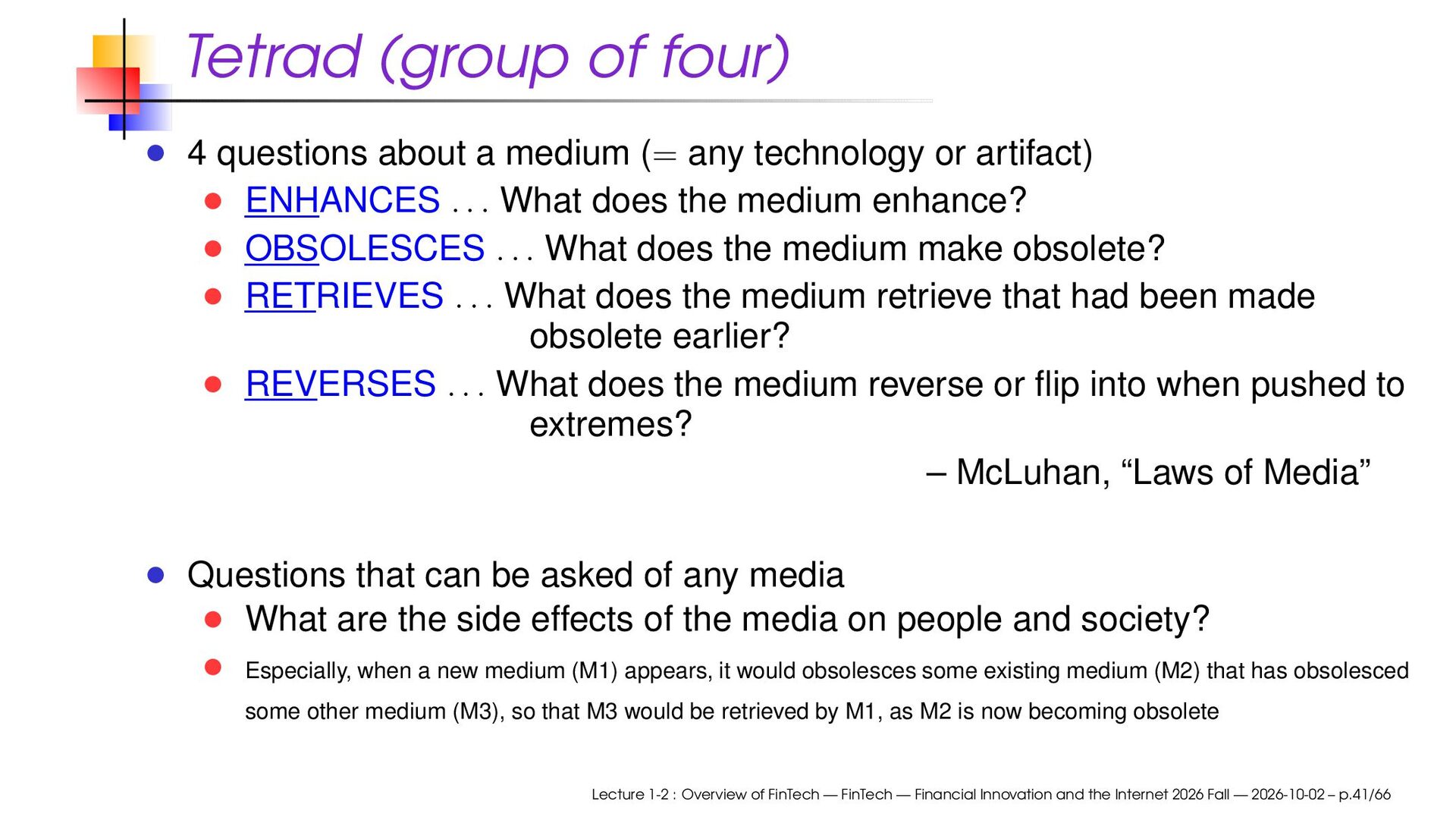
any technology or artifact) ENHANCES . . . What does the medium enhance? OBSOLESCES . . . What does the medium make obsolete? RETRIEVES . . . What does the medium retrieve that had been made obsolete earlier? REVERSES . . . What does the medium reverse or flip into when pushed to extremes? – McLuhan, “Laws of Media” Questions that can be asked of any media What are the side effects of the media on people and society? Especially, when a new medium (M1) appears, it would obsolesces some existing medium (M2) that has obsolesced some other medium (M3), so that M3 would be retrieved by M1, as M2 is now becoming obsolete Lecture 1-2 : Overview of FinTech — FinTech — Financial Innovation and the Internet 2026 Fall — 2026-10-02 – p.41/66
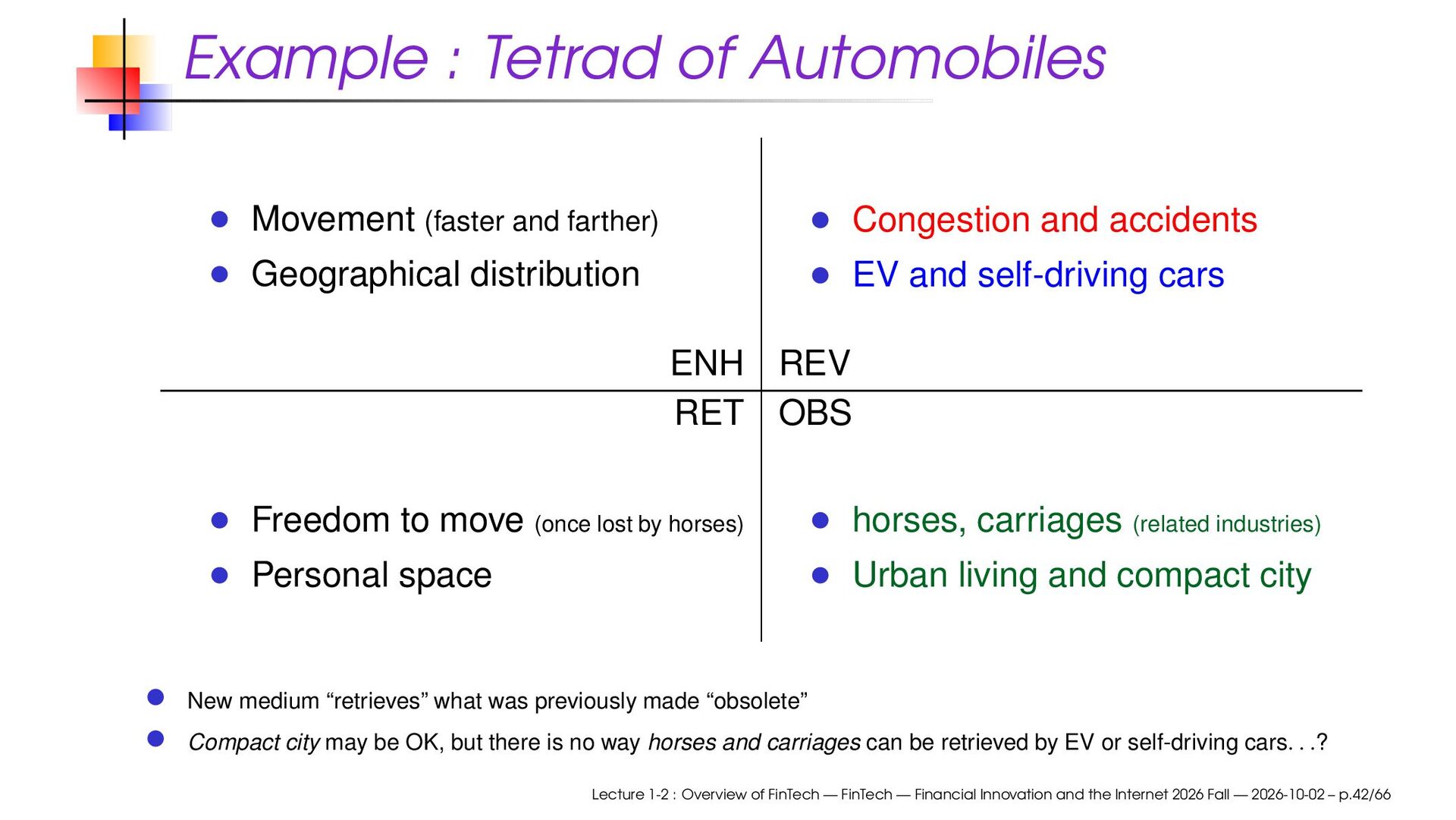
and accidents Geographical distribution EV and self-driving cars ENH REV RET OBS Freedom to move (once lost by horses) horses, carriages (related industries) Personal space Urban living and compact city New medium “retrieves” what was previously made “obsolete” Compact city may be OK, but there is no way horses and carriages can be retrieved by EV or self-driving cars. . .? Lecture 1-2 : Overview of FinTech — FinTech — Financial Innovation and the Internet 2026 Fall — 2026-10-02 – p.42/66
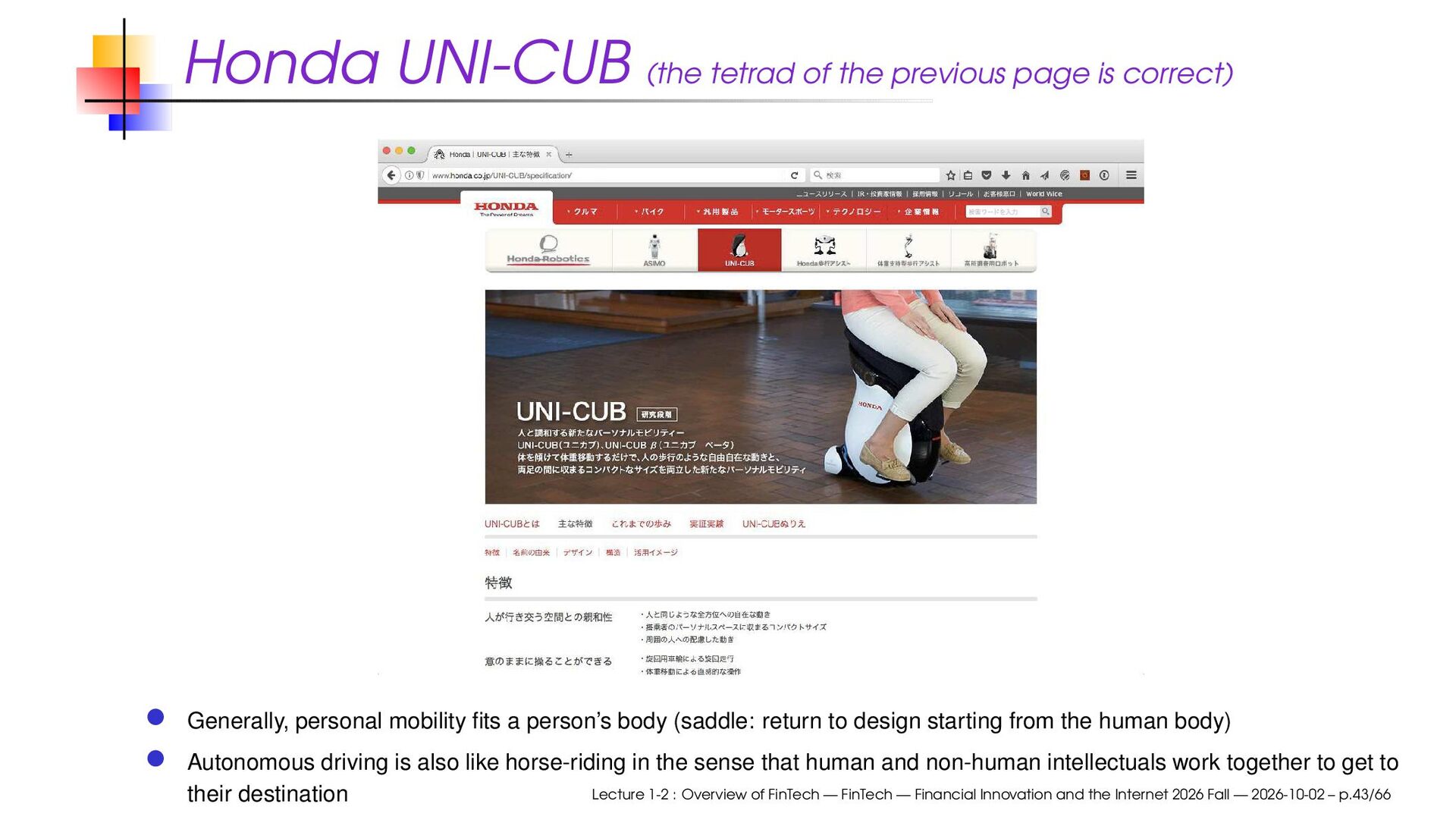
Generally, personal mobility fits a person’s body (saddle: return to design starting from the human body) Autonomous driving is also like horse-riding in the sense that human and non-human intellectuals work together to get to Lecture 1-2 : Overview of FinTech — FinTech — Financial Innovation and the Internet 2026 Fall — 2026-10-02 – p.43/66 their destination
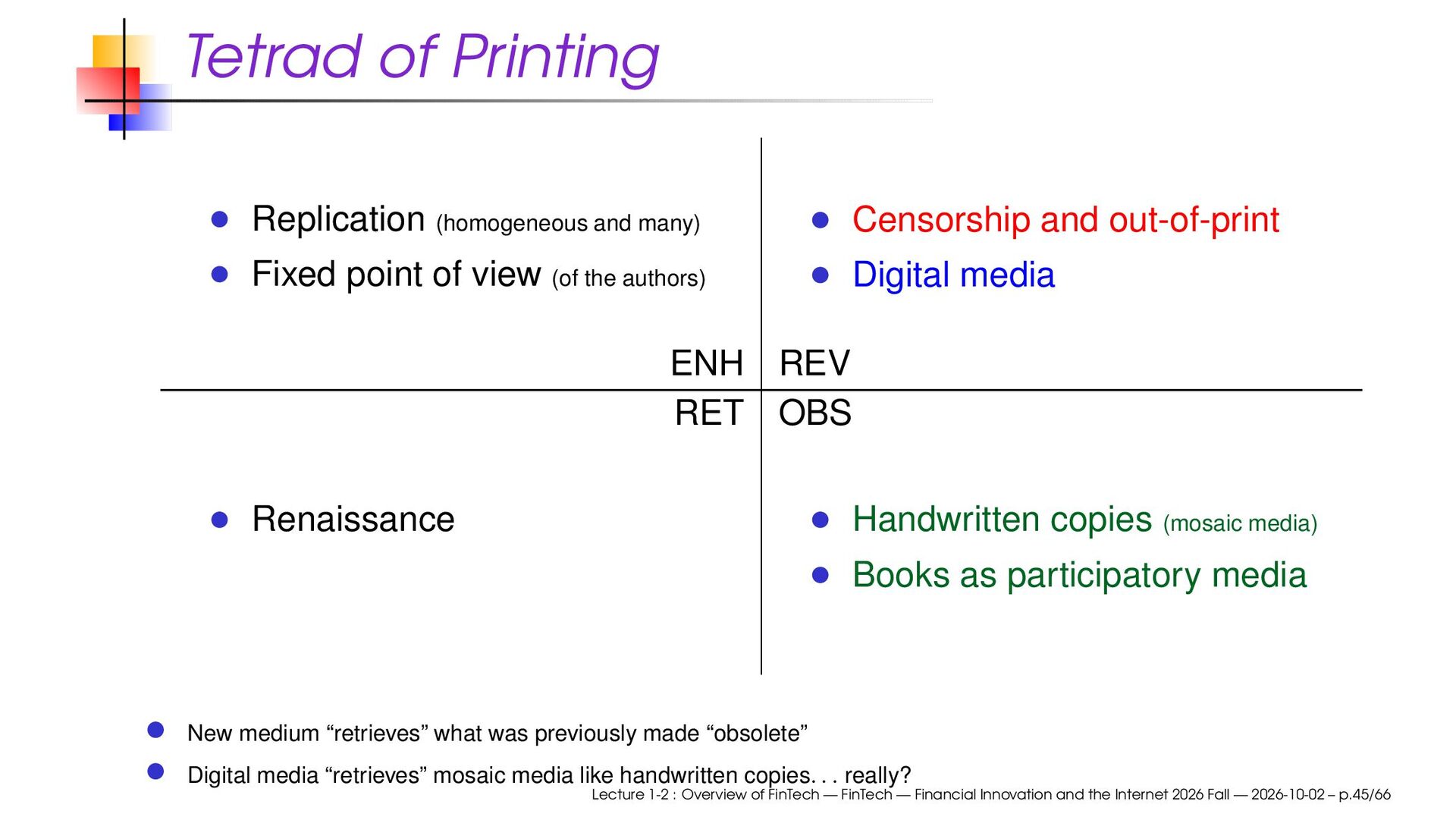
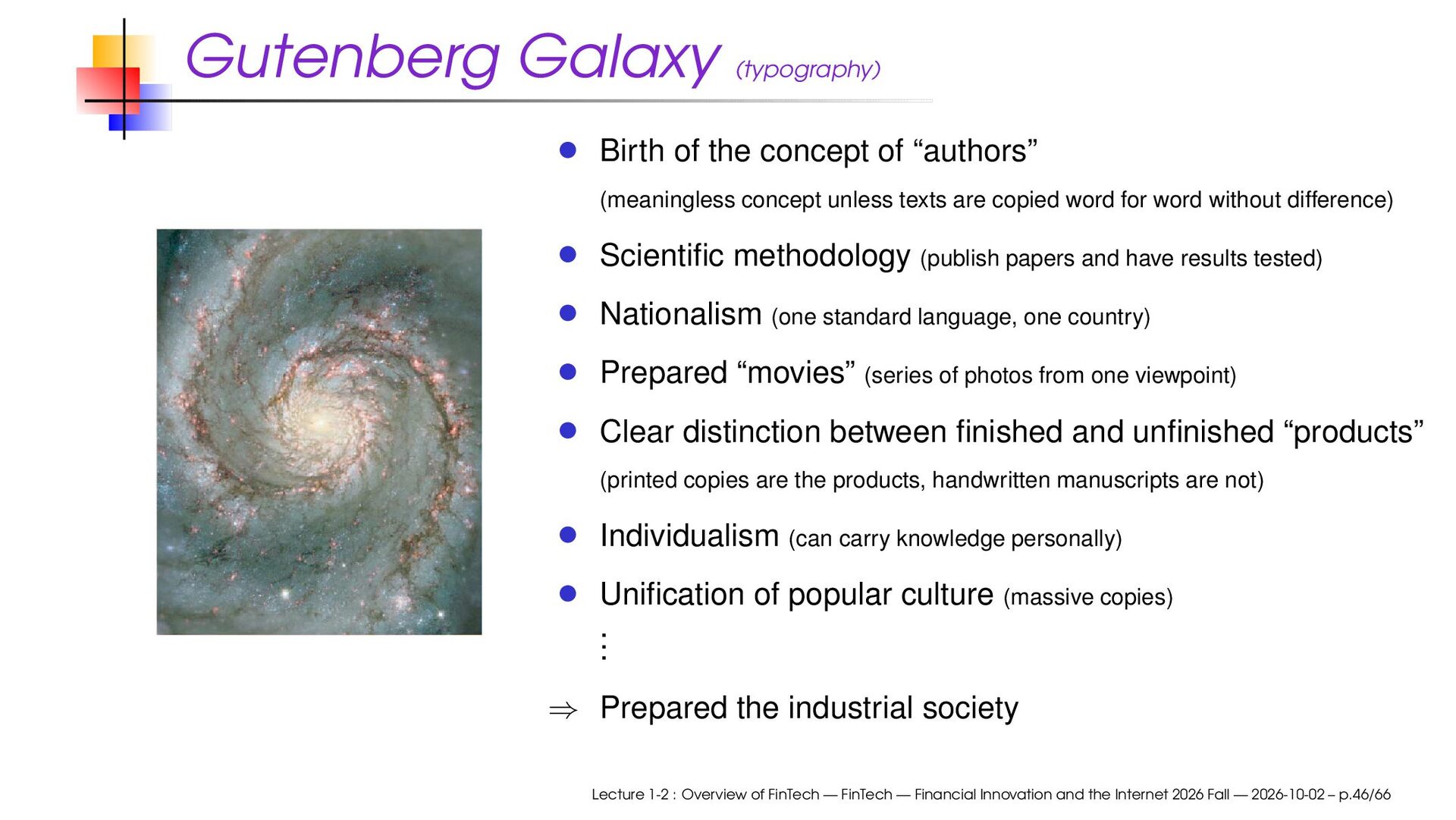
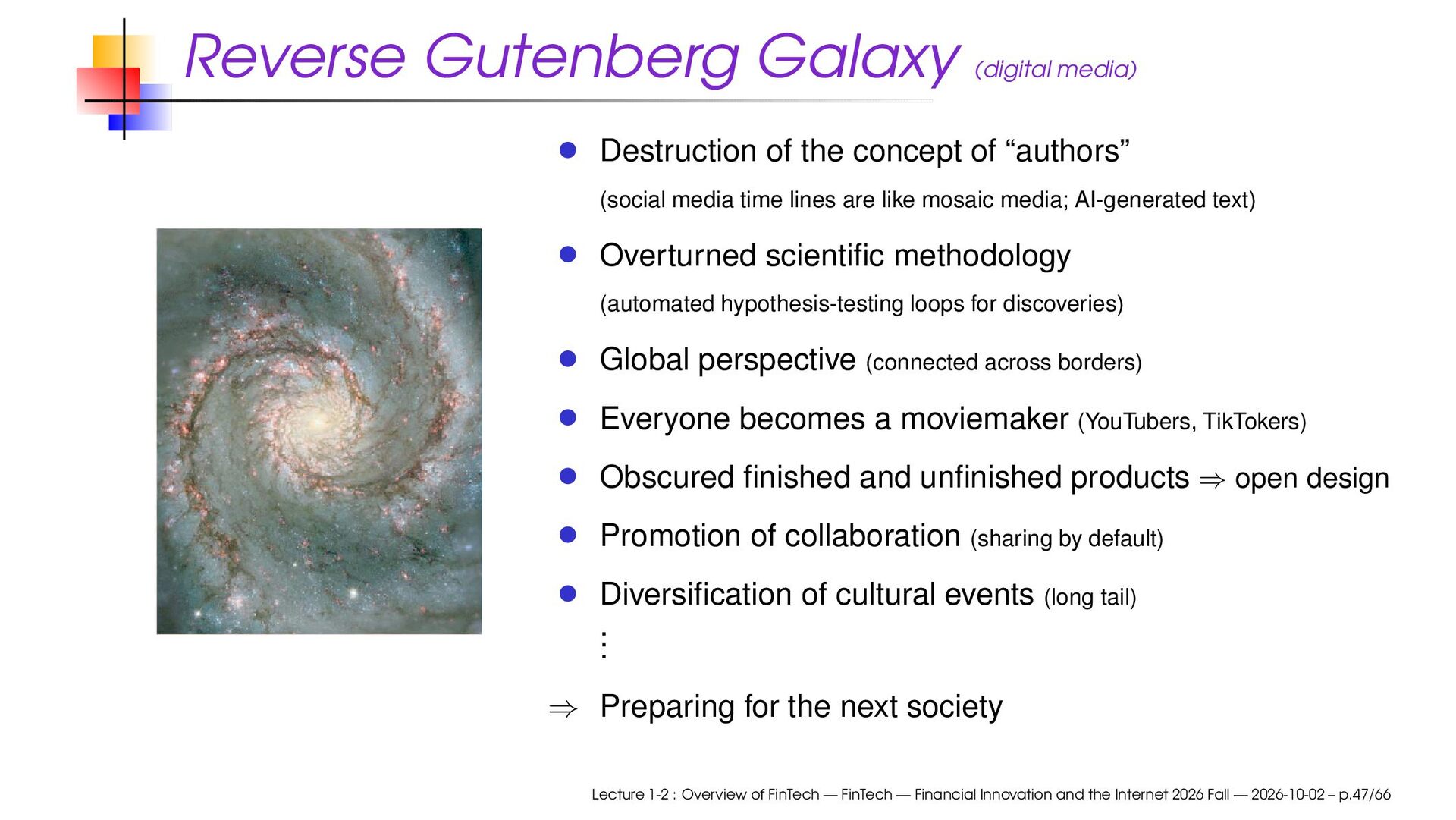
reading : McLuhan, “The Gutenberg Galaxy” And how it is being reversed with digital technology Lecture 1-2 : Overview of FinTech — FinTech — Financial Innovation and the Internet 2026 Fall — 2026-10-02 – p.44/66
Fixed point of view (of the authors) Digital media ENH REV RET OBS Renaissance Handwritten copies (mosaic media) Books as participatory media New medium “retrieves” what was previously made “obsolete” Digital media “retrieves” mosaic media like handwritten copies. . . really? Lecture 1-2 : Overview of FinTech — FinTech — Financial Innovation and the Internet 2026 Fall — 2026-10-02 – p.45/66
concept unless texts are copied word for word without difference) Scientific methodology (publish papers and have results tested) Nationalism (one standard language, one country) Prepared “movies” (series of photos from one viewpoint) Clear distinction between finished and unfinished “products” (printed copies are the products, handwritten manuscripts are not) Individualism (can carry knowledge personally) Unification of popular culture (massive copies) .. . ⇒ Prepared the industrial society Lecture 1-2 : Overview of FinTech — FinTech — Financial Innovation and the Internet 2026 Fall — 2026-10-02 – p.46/66
“authors” (social media time lines are like mosaic media; AI-generated text) Overturned scientific methodology (automated hypothesis-testing loops for discoveries) Global perspective (connected across borders) Everyone becomes a moviemaker (YouTubers, TikTokers) Obscured finished and unfinished products ⇒ open design Promotion of collaboration (sharing by default) Diversification of cultural events (long tail) .. . ⇒ Preparing for the next society Lecture 1-2 : Overview of FinTech — FinTech — Financial Innovation and the Internet 2026 Fall — 2026-10-02 – p.47/66
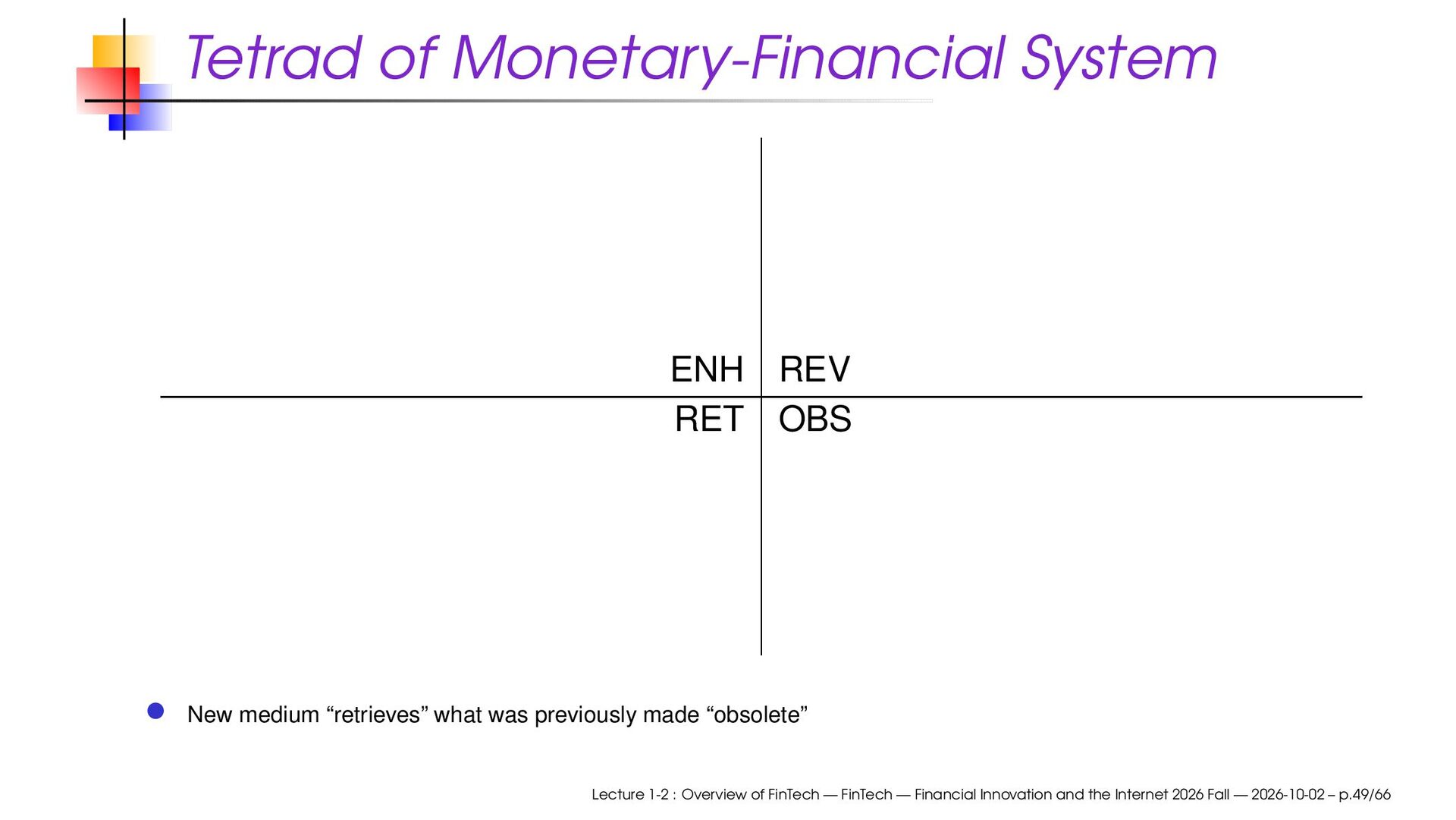
“retrieves” what was previously made “obsolete” Lecture 1-2 : Overview of FinTech — FinTech — Financial Innovation and the Internet 2026 Fall — 2026-10-02 – p.49/66
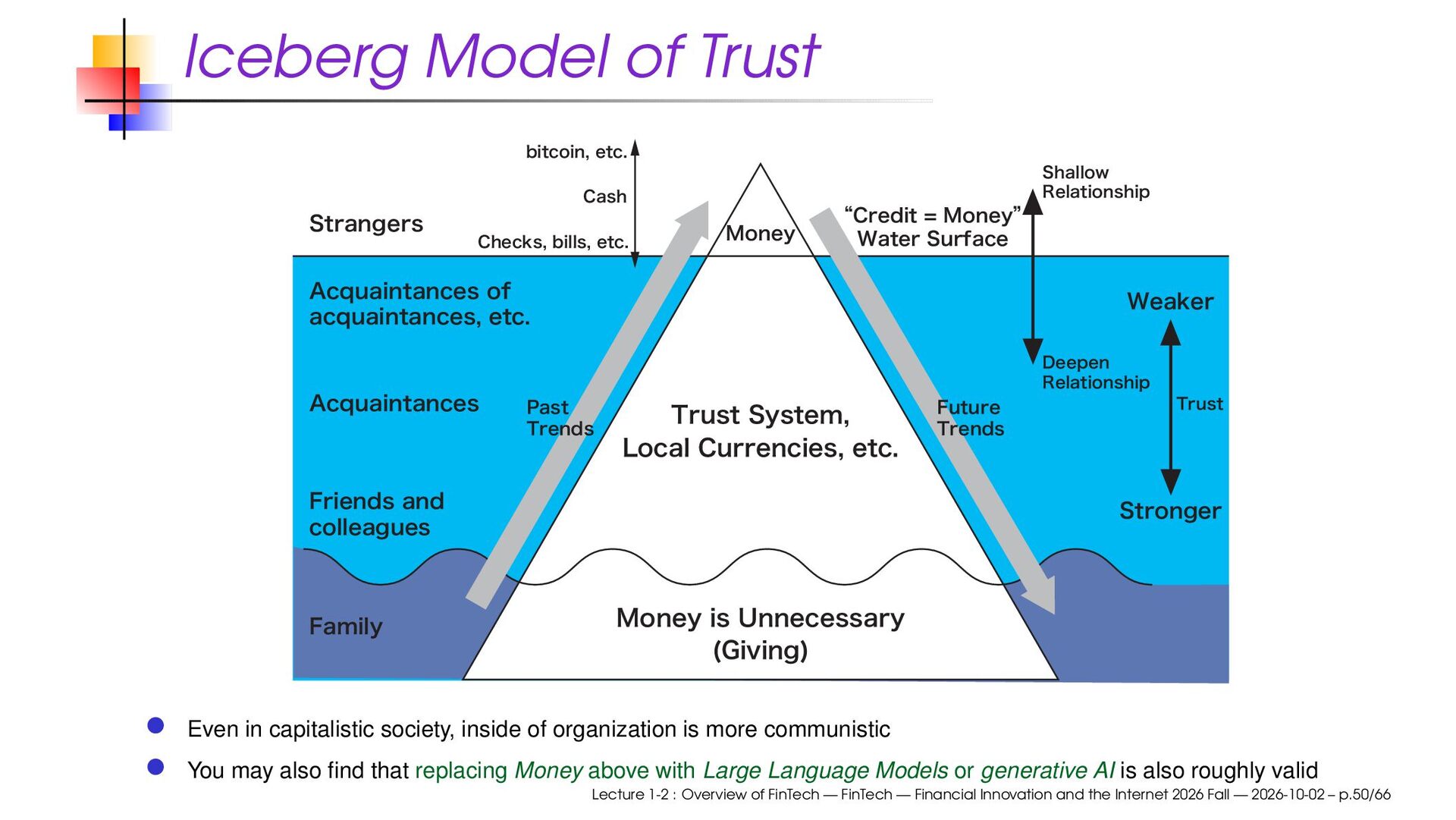
Checks, bills, etc. Money “Credit = Money” Water Surface Acquaintances of acquaintances, etc. Acquaintances Weaker Deepen Relationship Past Trends Trust System, Local Currencies, etc. Friends and colleagues Family Future Trends Trust Stronger Money is Unnecessary (Giving) Even in capitalistic society, inside of organization is more communistic You may also find that replacing Money above with Large Language Models or generative AI is also roughly valid Lecture 1-2 : Overview of FinTech — FinTech — Financial Innovation and the Internet 2026 Fall — 2026-10-02 – p.50/66
means memorable in human history What are some examples of historic companies that will continue to appear in human history textbooks, like forever? Lecture 1-2 : Overview of FinTech — FinTech — Financial Innovation and the Internet 2026 Fall — 2026-10-02 – p.51/66
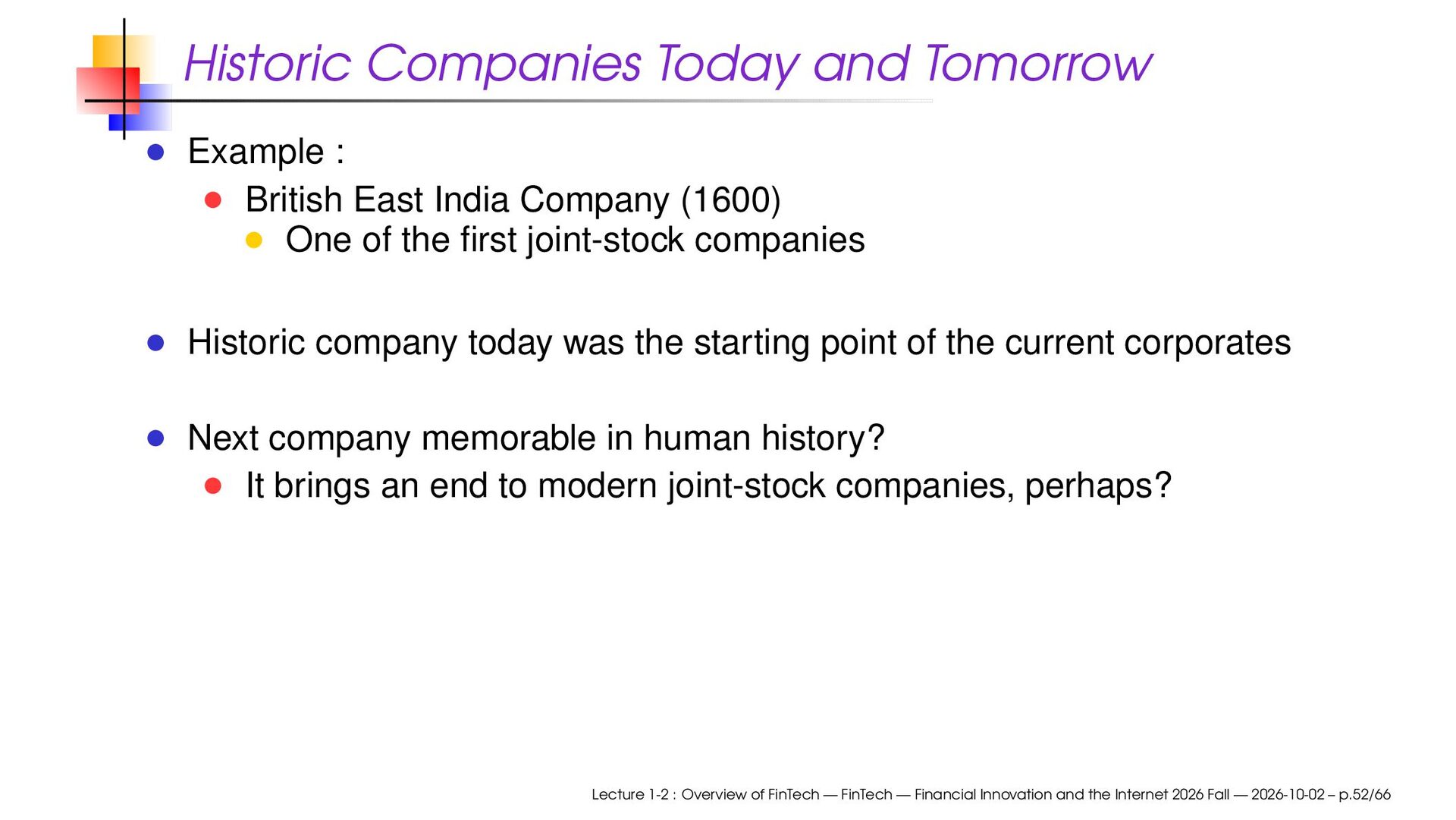
Company (1600) One of the first joint-stock companies Historic company today was the starting point of the current corporates Next company memorable in human history? It brings an end to modern joint-stock companies, perhaps? Lecture 1-2 : Overview of FinTech — FinTech — Financial Innovation and the Internet 2026 Fall — 2026-10-02 – p.52/66
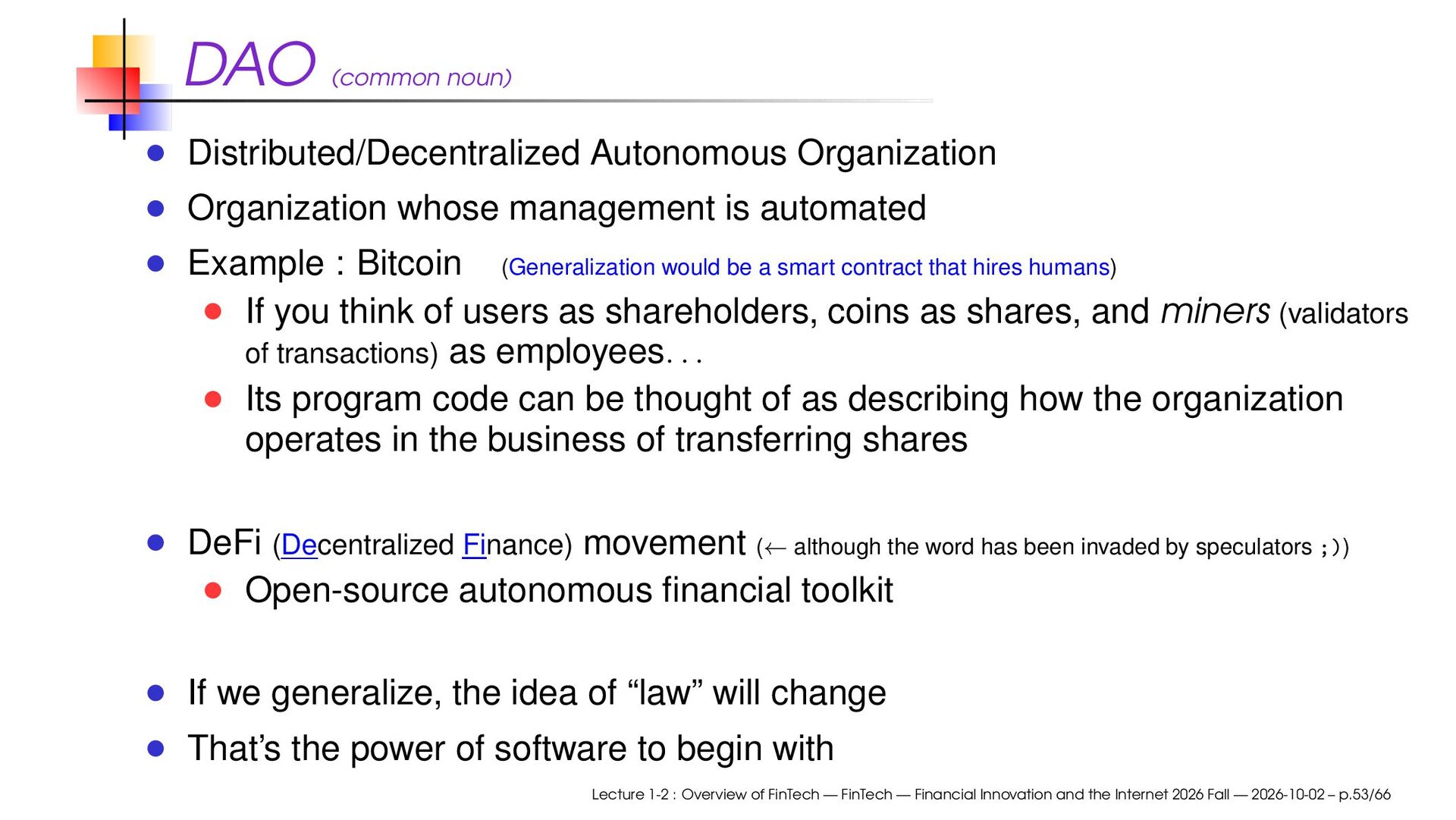
automated Example : Bitcoin (Generalization would be a smart contract that hires humans) If you think of users as shareholders, coins as shares, and miners (validators of transactions) as employees. . . Its program code can be thought of as describing how the organization operates in the business of transferring shares DeFi (Decentralized Finance) movement (← although the word has been invaded by speculators ;)) Open-source autonomous financial toolkit If we generalize, the idea of “law” will change That’s the power of software to begin with Lecture 1-2 : Overview of FinTech — FinTech — Financial Innovation and the Internet 2026 Fall — 2026-10-02 – p.53/66
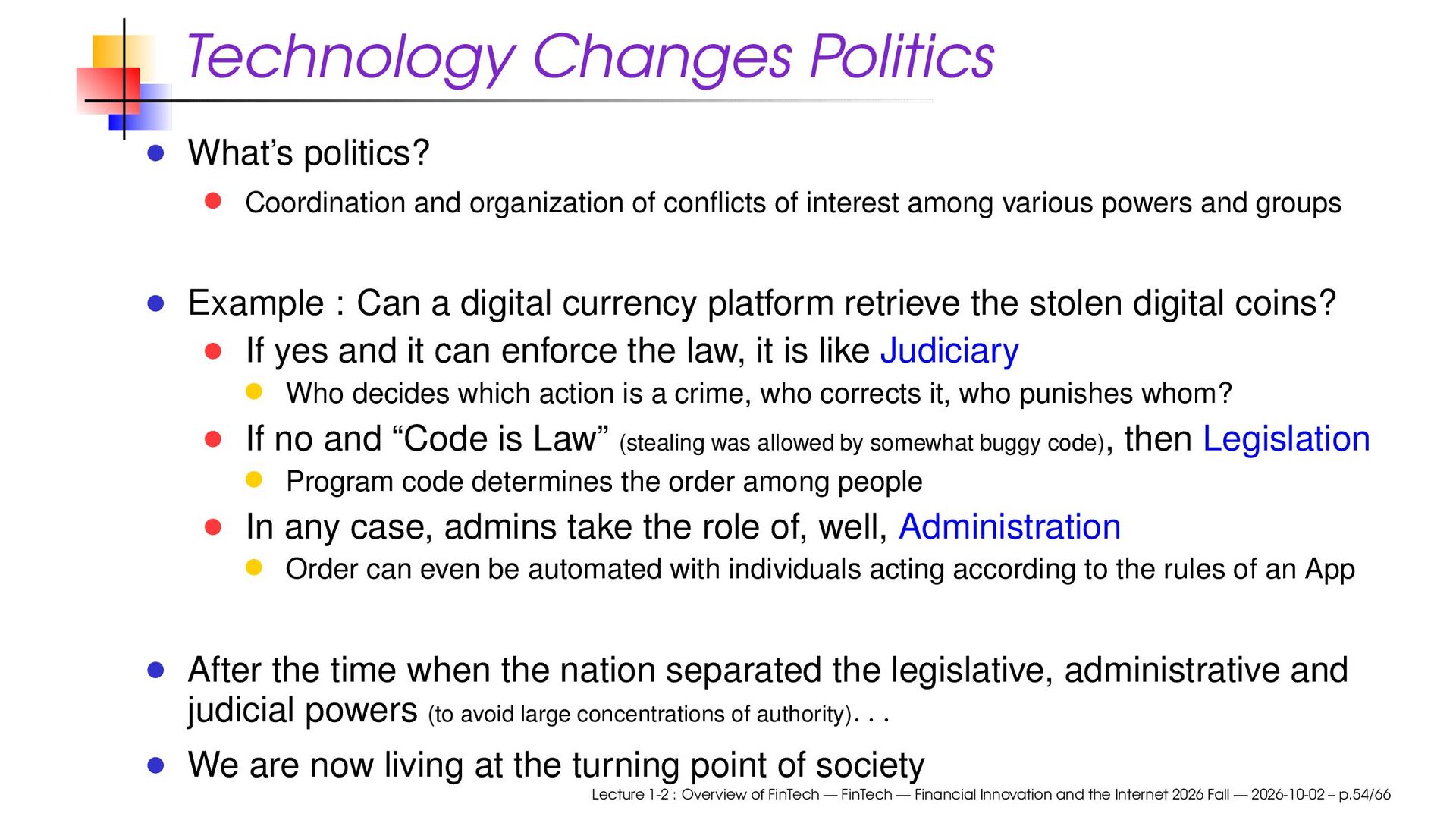
of interest among various powers and groups Example : Can a digital currency platform retrieve the stolen digital coins? If yes and it can enforce the law, it is like Judiciary Who decides which action is a crime, who corrects it, who punishes whom? If no and “Code is Law” (stealing was allowed by somewhat buggy code), then Legislation Program code determines the order among people In any case, admins take the role of, well, Administration Order can even be automated with individuals acting according to the rules of an App After the time when the nation separated the legislative, administrative and judicial powers (to avoid large concentrations of authority). . . We are now living at the turning point of society Lecture 1-2 : Overview of FinTech — FinTech — Financial Innovation and the Internet 2026 Fall — 2026-10-02 – p.54/66
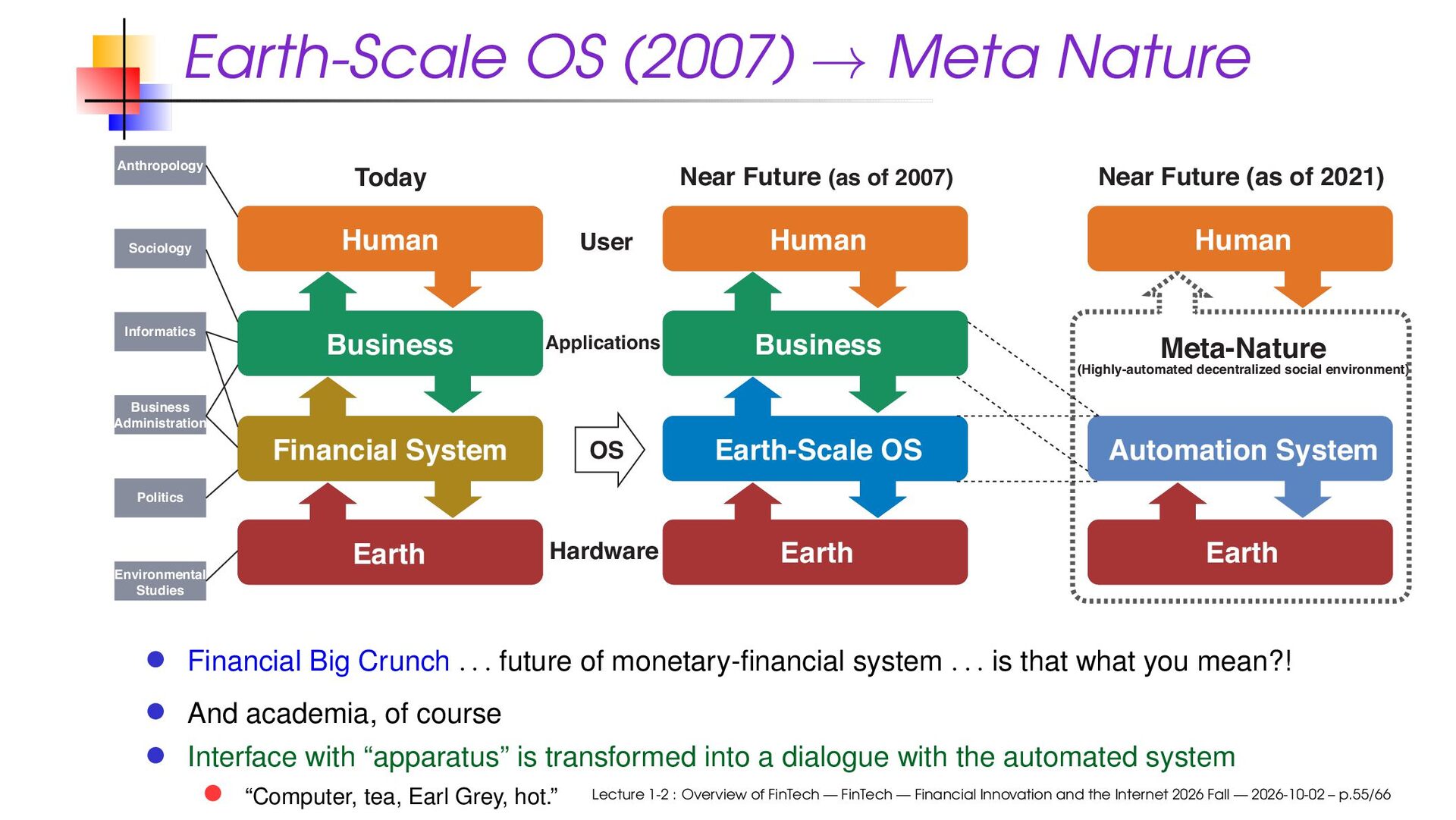
Near Future (as of 2007) Near Future (as of 2021) Human Human User Human Business Applications Business Meta-Nature (Highly-automated decentralized social environment) Business Administration Financial System OS Earth-Scale OS Automation System Earth Hardware Earth Earth Politics Environmental Studies Financial Big Crunch . . . future of monetary-financial system . . . is that what you mean?! And academia, of course Interface with “apparatus” is transformed into a dialogue with the automated system “Computer, tea, Earl Grey, hot.” Lecture 1-2 : Overview of FinTech — FinTech — Financial Innovation and the Internet 2026 Fall — 2026-10-02 – p.55/66
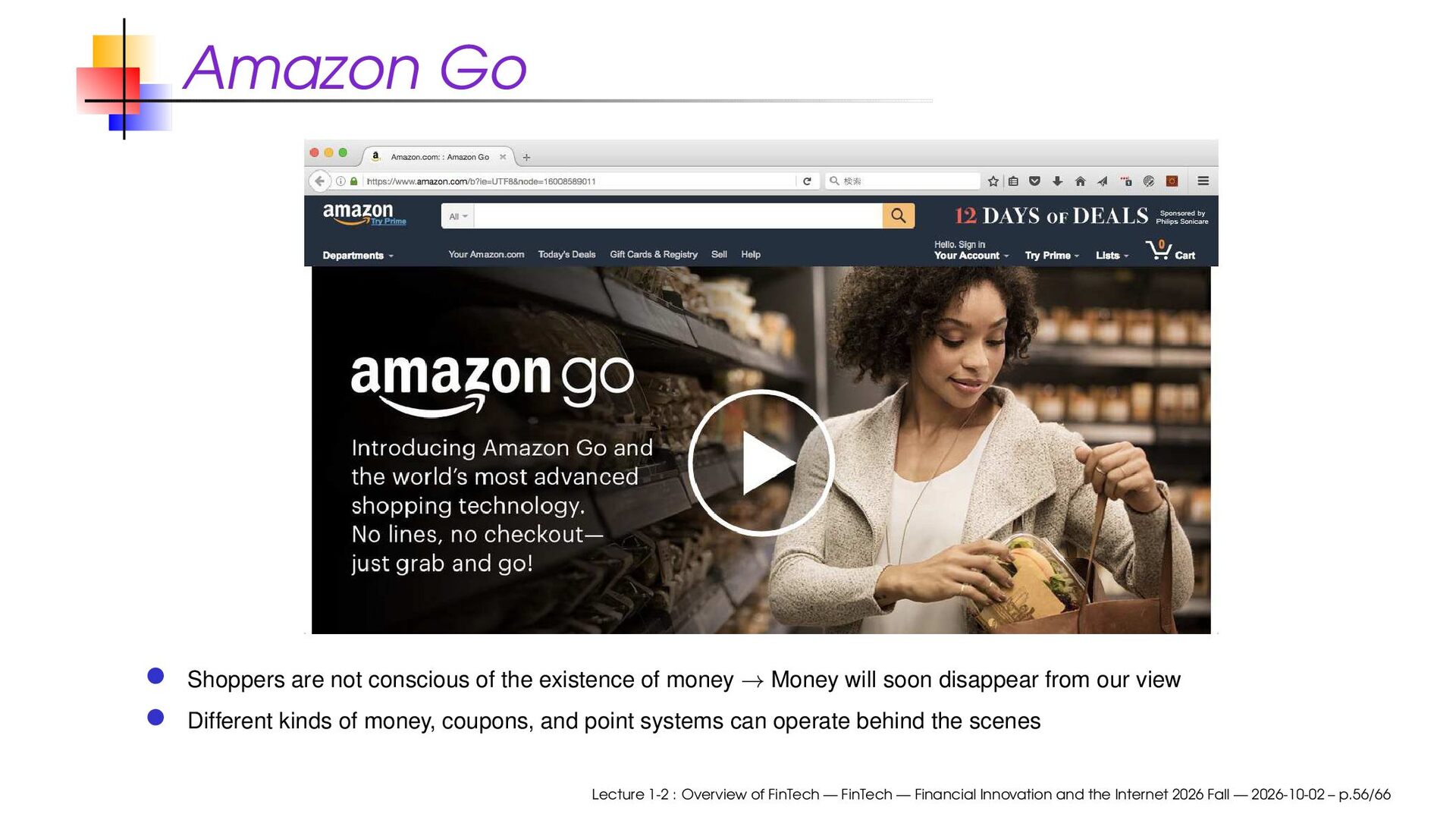
money → Money will soon disappear from our view Different kinds of money, coupons, and point systems can operate behind the scenes Lecture 1-2 : Overview of FinTech — FinTech — Financial Innovation and the Internet 2026 Fall — 2026-10-02 – p.56/66
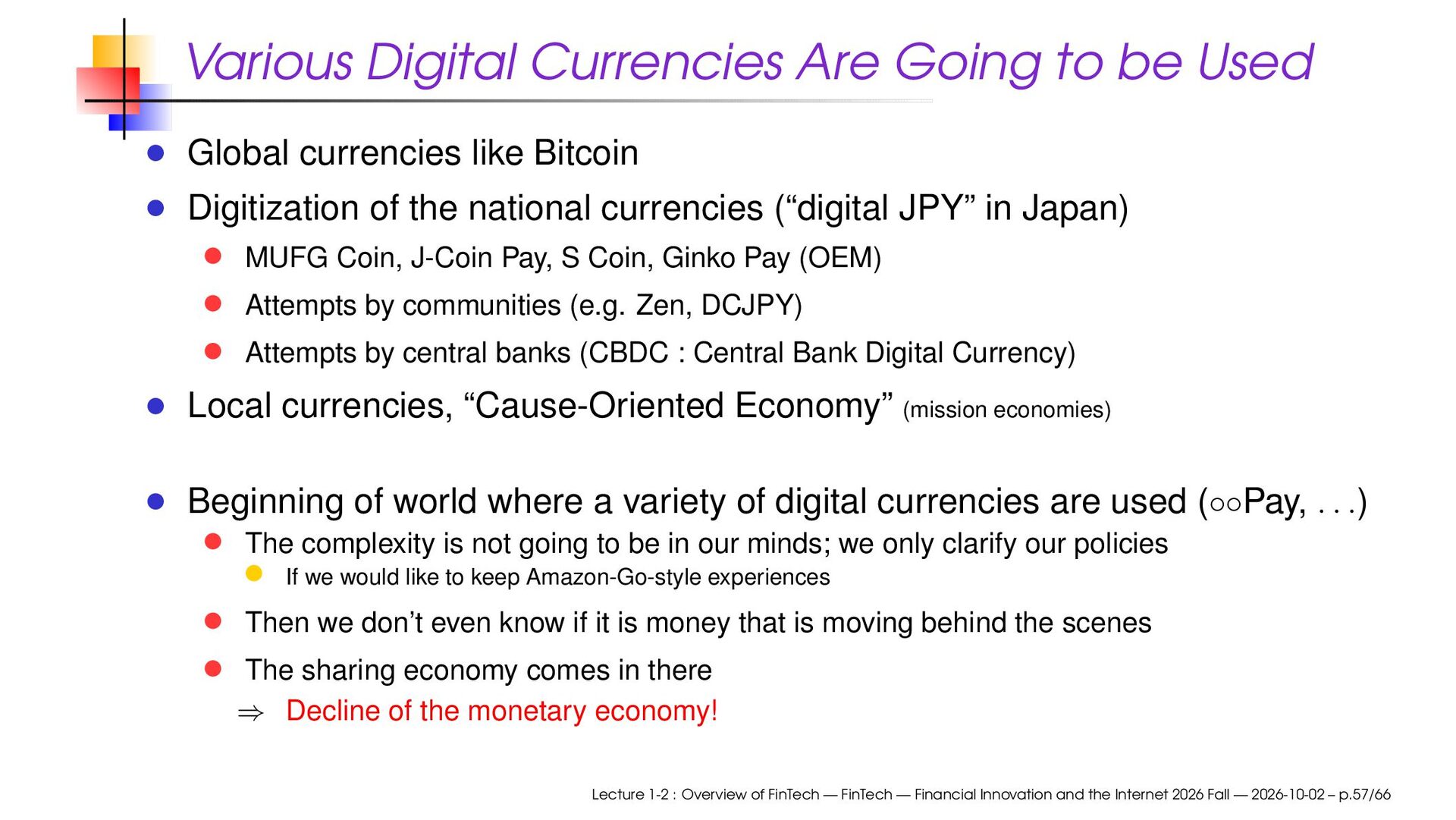
like Bitcoin Digitization of the national currencies (“digital JPY” in Japan) MUFG Coin, J-Coin Pay, S Coin, Ginko Pay (OEM) Attempts by communities (e.g. Zen, DCJPY) Attempts by central banks (CBDC : Central Bank Digital Currency) Local currencies, “Cause-Oriented Economy” (mission economies) Beginning of world where a variety of digital currencies are used (◦◦Pay, . . .) The complexity is not going to be in our minds; we only clarify our policies If we would like to keep Amazon-Go-style experiences Then we don’t even know if it is money that is moving behind the scenes The sharing economy comes in there ⇒ Decline of the monetary economy! Lecture 1-2 : Overview of FinTech — FinTech — Financial Innovation and the Internet 2026 Fall — 2026-10-02 – p.57/66
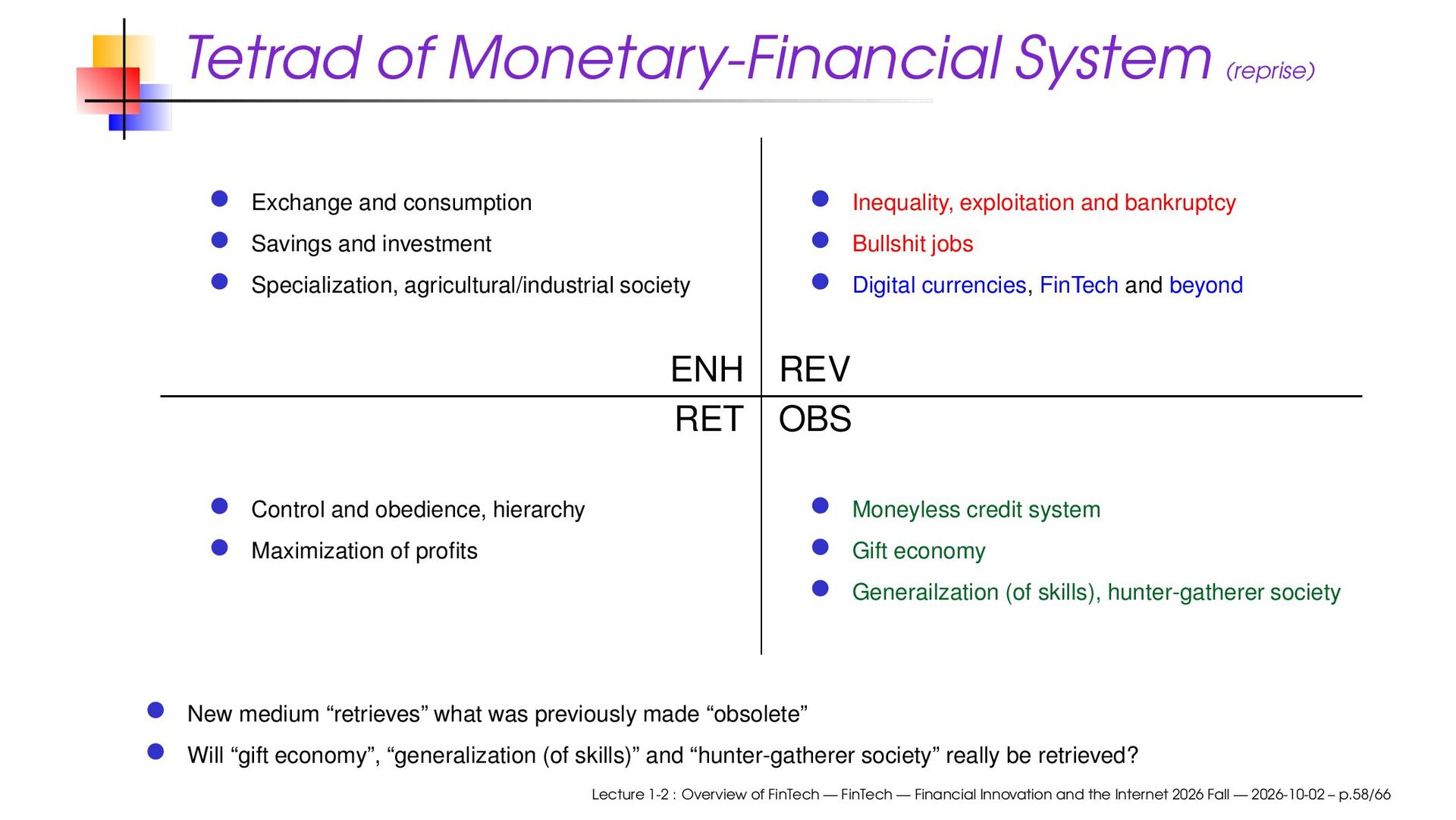
and bankruptcy Savings and investment Bullshit jobs Specialization, agricultural/industrial society Digital currencies, FinTech and beyond ENH REV RET OBS Control and obedience, hierarchy Moneyless credit system Maximization of profits Gift economy Generailzation (of skills), hunter-gatherer society New medium “retrieves” what was previously made “obsolete” Will “gift economy”, “generalization (of skills)” and “hunter-gatherer society” really be retrieved? Lecture 1-2 : Overview of FinTech — FinTech — Financial Innovation and the Internet 2026 Fall — 2026-10-02 – p.58/66
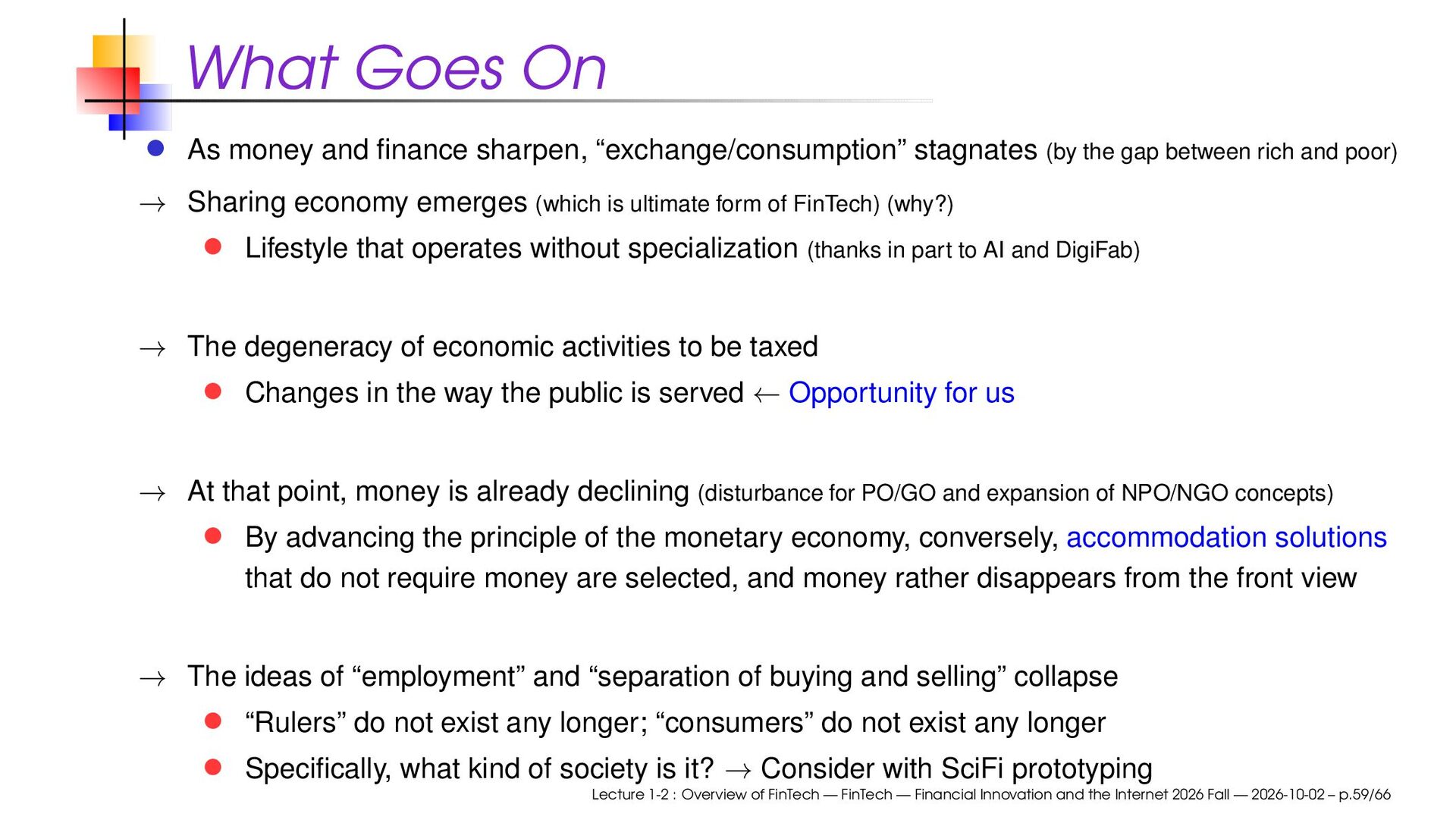
(by the gap between rich and poor) → Sharing economy emerges (which is ultimate form of FinTech) (why?) Lifestyle that operates without specialization (thanks in part to AI and DigiFab) → The degeneracy of economic activities to be taxed Changes in the way the public is served ← Opportunity for us → At that point, money is already declining (disturbance for PO/GO and expansion of NPO/NGO concepts) By advancing the principle of the monetary economy, conversely, accommodation solutions that do not require money are selected, and money rather disappears from the front view → The ideas of “employment” and “separation of buying and selling” collapse “Rulers” do not exist any longer; “consumers” do not exist any longer Specifically, what kind of society is it? → Consider with SciFi prototyping Lecture 1-2 : Overview of FinTech — FinTech — Financial Innovation and the Internet 2026 Fall — 2026-10-02 – p.59/66
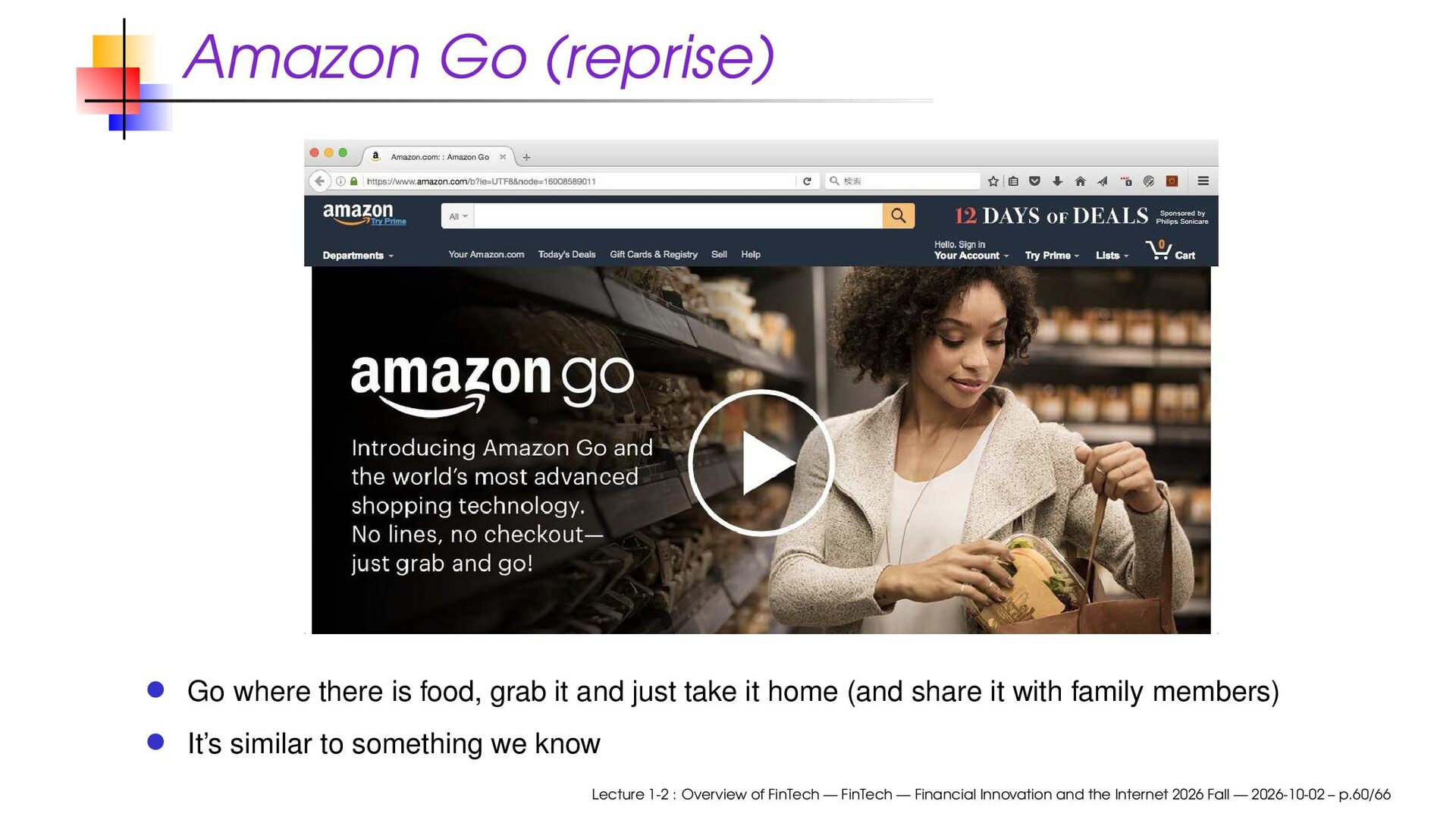
and just take it home (and share it with family members) It’s similar to something we know Lecture 1-2 : Overview of FinTech — FinTech — Financial Innovation and the Internet 2026 Fall — 2026-10-02 – p.60/66
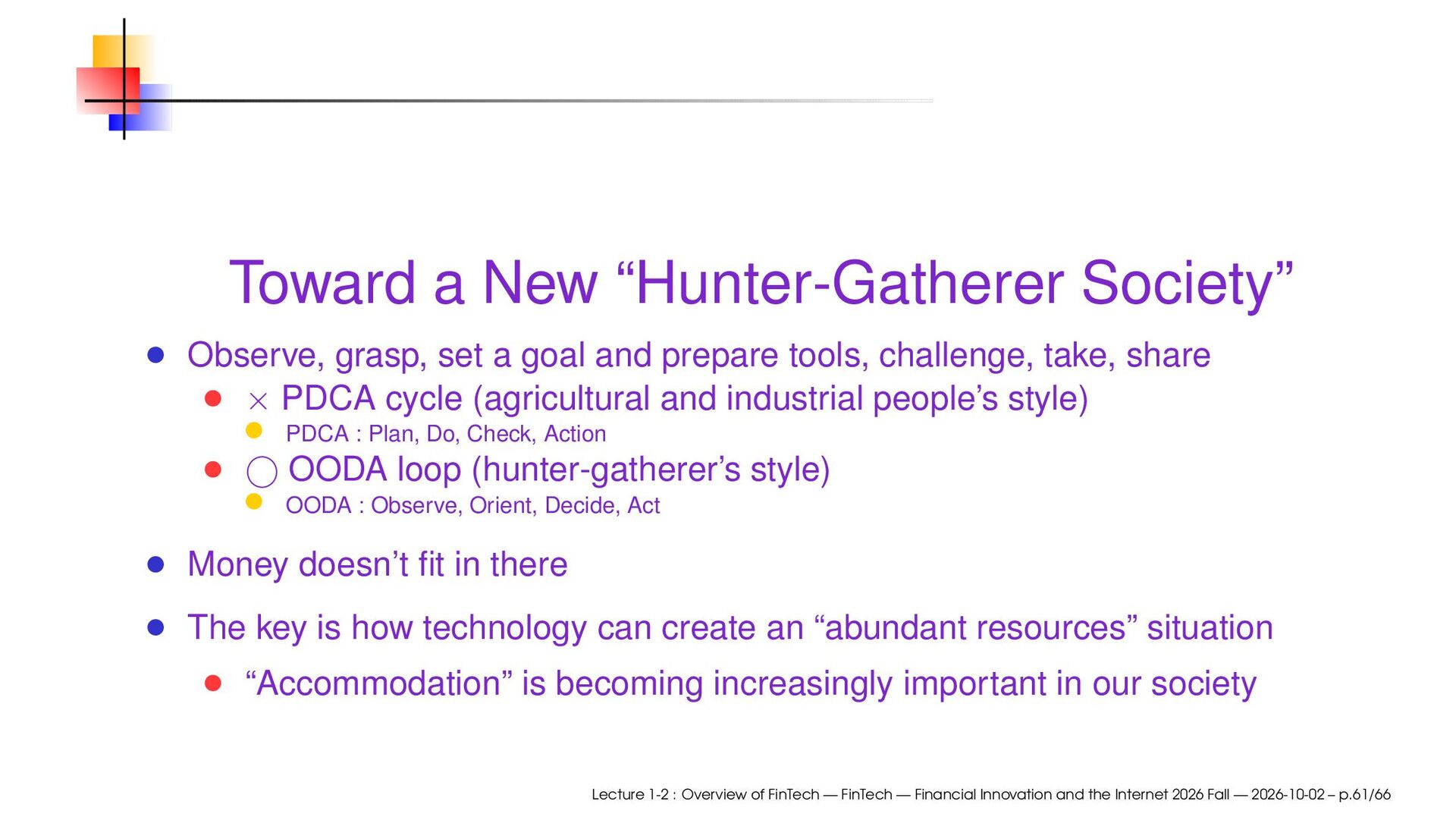
and prepare tools, challenge, take, share × PDCA cycle (agricultural and industrial people’s style) PDCA : Plan, Do, Check, Action OODA loop (hunter-gatherer’s style) OODA : Observe, Orient, Decide, Act Money doesn’t fit in there The key is how technology can create an “abundant resources” situation “Accommodation” is becoming increasingly important in our society Lecture 1-2 : Overview of FinTech — FinTech — Financial Innovation and the Internet 2026 Fall — 2026-10-02 – p.61/66
have been mainly Q & A sessions so far today But before going into a deeper discussion session, any questions? Lecture 1-2 : Overview of FinTech — FinTech — Financial Innovation and the Internet 2026 Fall — 2026-10-02 – p.62/66
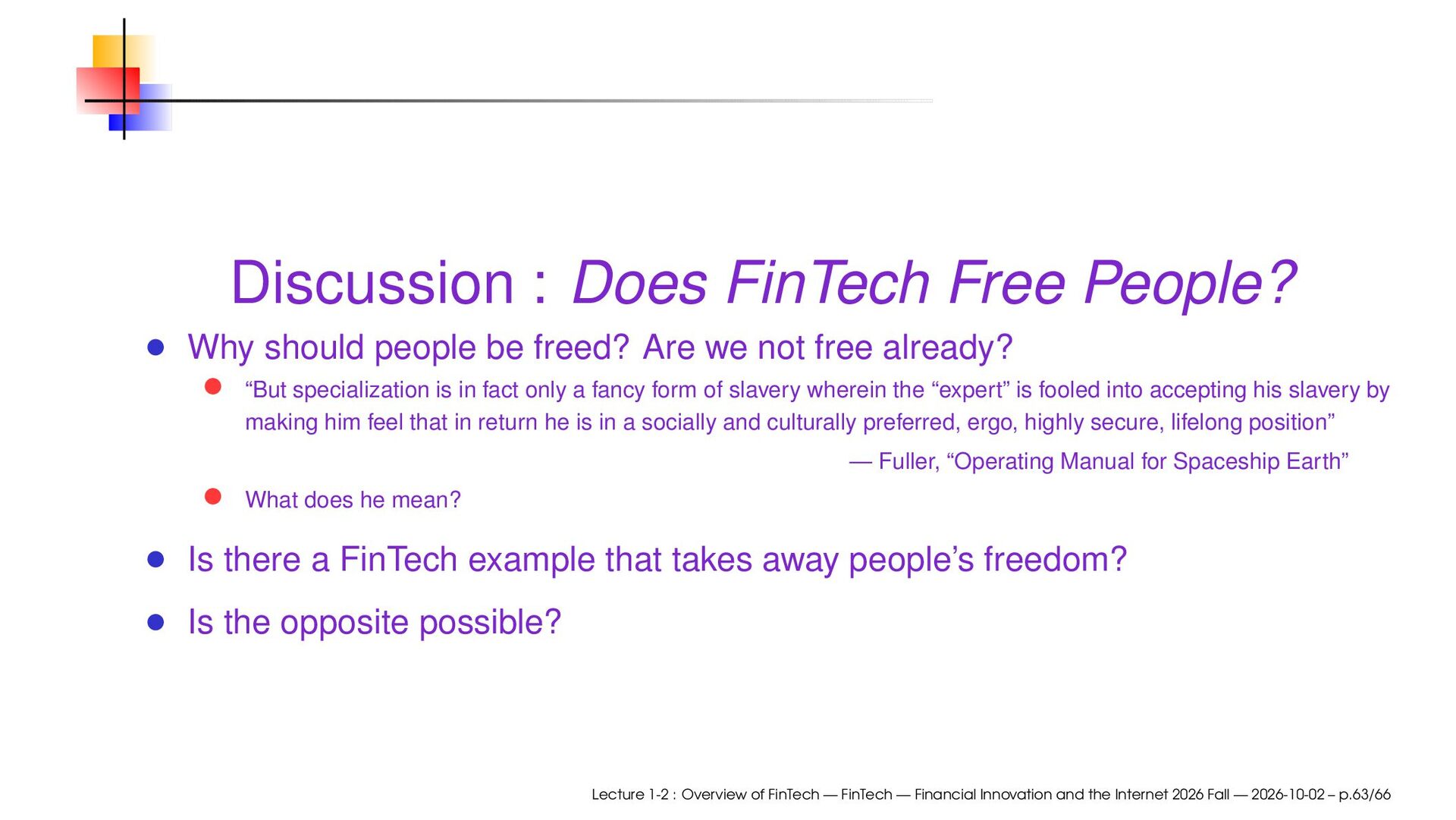
freed? Are we not free already? “But specialization is in fact only a fancy form of slavery wherein the “expert” is fooled into accepting his slavery by making him feel that in return he is in a socially and culturally preferred, ergo, highly secure, lifelong position” — Fuller, “Operating Manual for Spaceship Earth” What does he mean? Is there a FinTech example that takes away people’s freedom? Is the opposite possible? Lecture 1-2 : Overview of FinTech — FinTech — Financial Innovation and the Internet 2026 Fall — 2026-10-02 – p.63/66
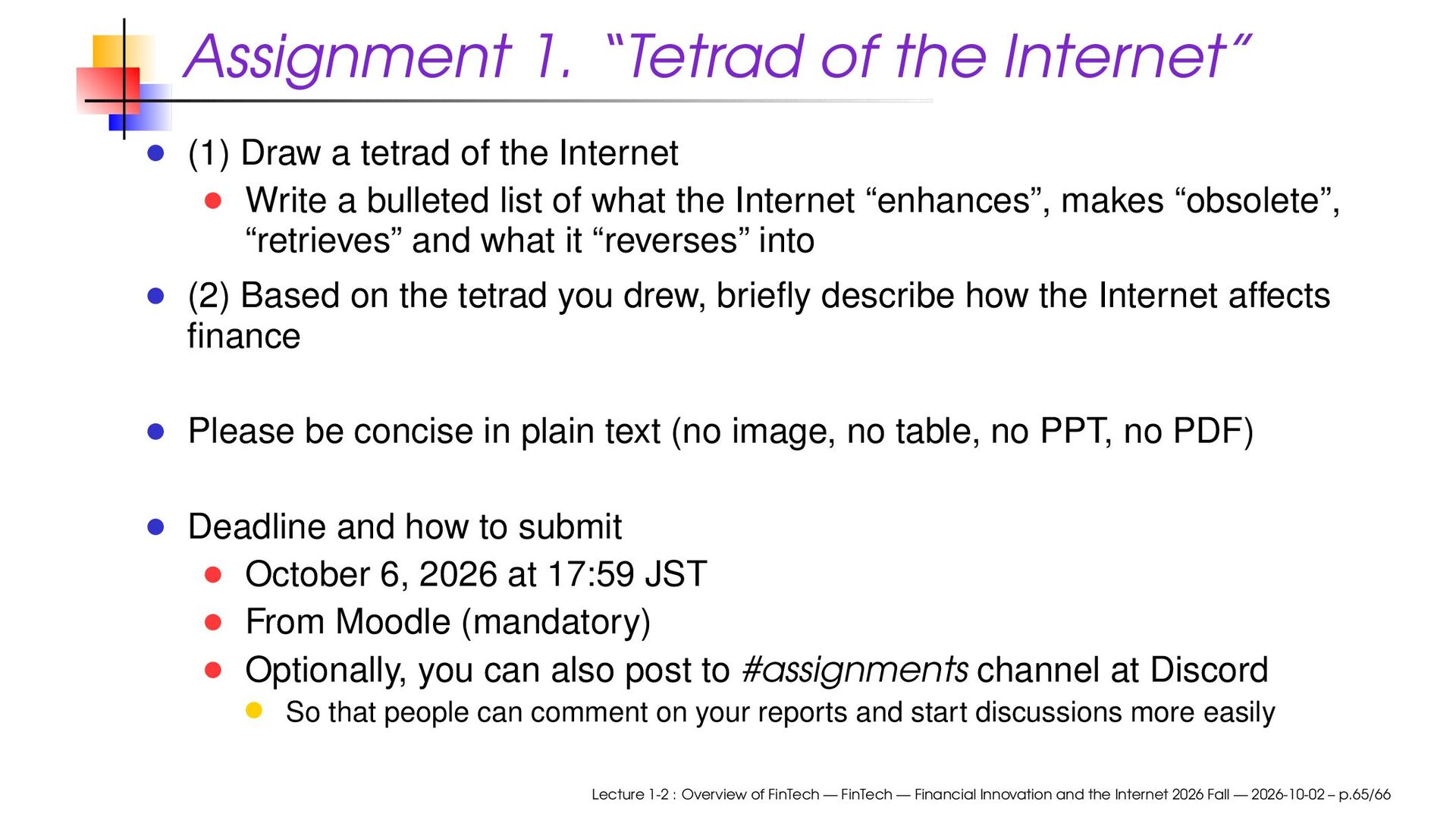
of the Internet Write a bulleted list of what the Internet “enhances”, makes “obsolete”, “retrieves” and what it “reverses” into (2) Based on the tetrad you drew, briefly describe how the Internet affects finance Please be concise in plain text (no image, no table, no PPT, no PDF) Deadline and how to submit October 6, 2026 at 17:59 JST From Moodle (mandatory) Optionally, you can also post to #assignments channel at Discord So that people can comment on your reports and start discussions more easily Lecture 1-2 : Overview of FinTech — FinTech — Financial Innovation and the Internet 2026 Fall — 2026-10-02 – p.65/66


 ks91
ks91
 namiki64
 pfn
pfn
 riyaamemiya
 kizawa2020
 tetsuya28
 prog893
 makocchi
 codmoninc
 takahashim
 tomokusaba
 syuchimu
 ezaki
ezaki
 bluesmoon
 ryanjones
 danielanewman
 tmiket
 notwaldorf
 erikaheidi
 marktimemedia
 mraible
 aemeredith
 apolaine
 mkilby
 aleyda