Slides I used for FinTech - Financial Innovation and the Internet 2026 Fall at Graduate School of Business and Finance, Waseda University on October 9, 2026.
the Internet 2026 Fall Lecture 3-4 : Internet Technology and Governance Kenji Saito, Graduate School of Business and Finance, Waseda University Lecture 3-4 : Internet Technology and Governance — FinTech — Financial Innovation and the Internet 2026 Fall — 2026-10-09 – p.1/65
reviewing the lectures Recordings are shared via Dropbox and you can ask questions with time-stamped comments Of course, students are encouraged to ask questions in class The recordings could be used for research on (online) learning Transcribed for use and anonymized Will let you know when the necessity arises Lecture 3-4 : Internet Technology and Governance — FinTech — Financial Innovation and the Internet 2026 Fall — 2026-10-09 – p.2/65
and chat text will be posted at Moodle and Discord Note, however, that chat messages are often unnoticed I have invited you all to the Discord server of the class (continued from the past years) Let me do it again now through Zoom chat Trial automatic transcription for lectures will be posted at Discord Because it would contain many mistakes More information is available on Discord, so you have a reason to join the Discord server Furthermore, in the end, participation in Discord may become mandatory for the progress of group work Lecture 3-4 : Internet Technology and Governance — FinTech — Financial Innovation and the Internet 2026 Fall — 2026-10-09 – p.3/65
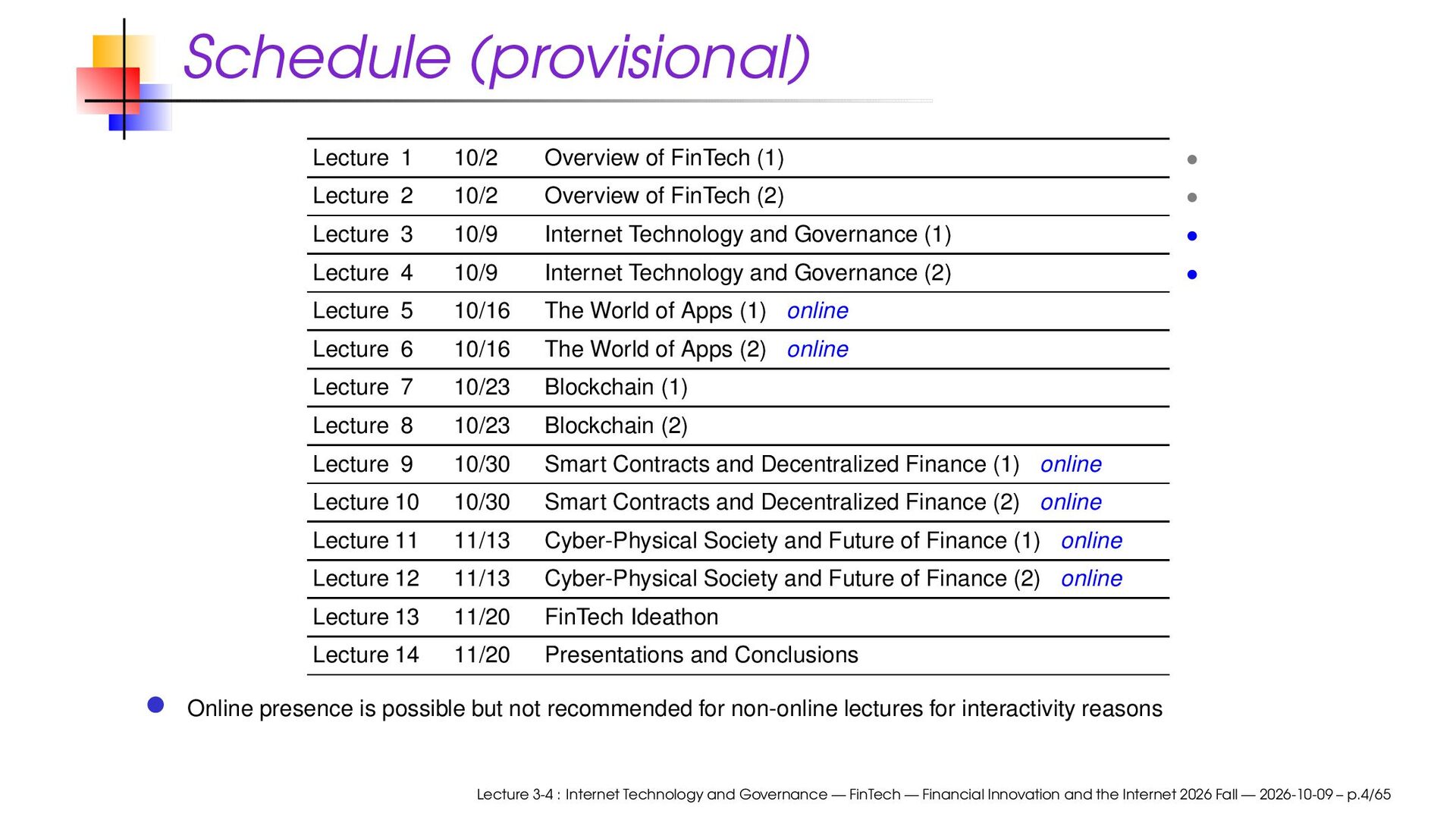
Lecture 2 10/2 Overview of FinTech (2) • Lecture 3 10/9 Internet Technology and Governance (1) • Lecture 4 10/9 Internet Technology and Governance (2) • Lecture 5 10/16 The World of Apps (1) online Lecture 6 10/16 The World of Apps (2) online Lecture 7 10/23 Blockchain (1) Lecture 8 10/23 Blockchain (2) Lecture 9 10/30 Smart Contracts and Decentralized Finance (1) online Lecture 10 10/30 Smart Contracts and Decentralized Finance (2) online Lecture 11 11/13 Cyber-Physical Society and Future of Finance (1) online Lecture 12 11/13 Cyber-Physical Society and Future of Finance (2) online Lecture 13 11/20 FinTech Ideathon Lecture 14 11/20 Presentations and Conclusions Online presence is possible but not recommended for non-online lectures for interactivity reasons Lecture 3-4 : Internet Technology and Governance — FinTech — Financial Innovation and the Internet 2026 Fall — 2026-10-09 – p.4/65
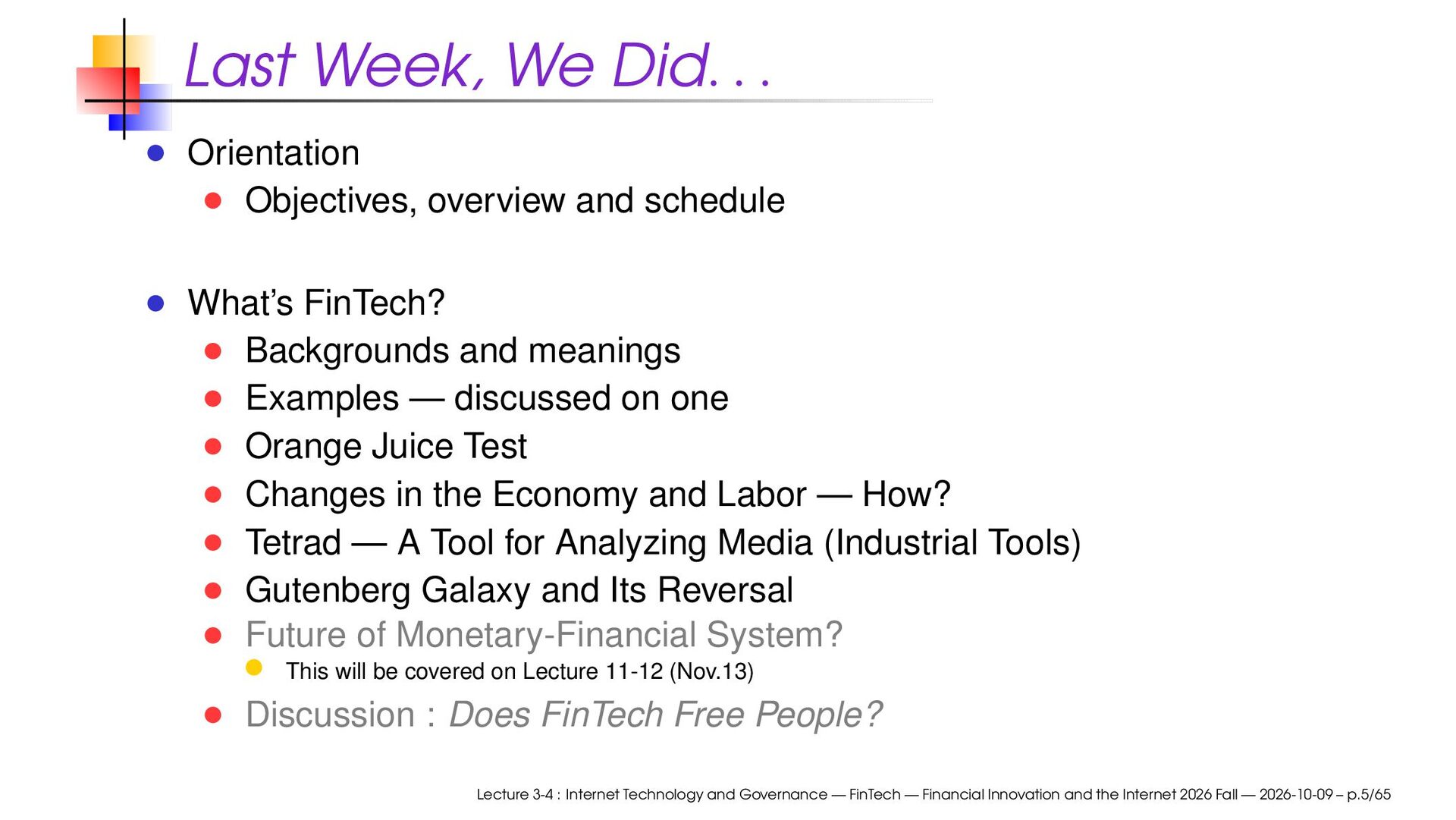
schedule What’s FinTech? Backgrounds and meanings Examples — discussed on one Orange Juice Test Changes in the Economy and Labor — How? Tetrad — A Tool for Analyzing Media (Industrial Tools) Gutenberg Galaxy and Its Reversal Future of Monetary-Financial System? This will be covered on Lecture 11-12 (Nov.13) Discussion : Does FinTech Free People? Lecture 3-4 : Internet Technology and Governance — FinTech — Financial Innovation and the Internet 2026 Fall — 2026-10-09 – p.5/65
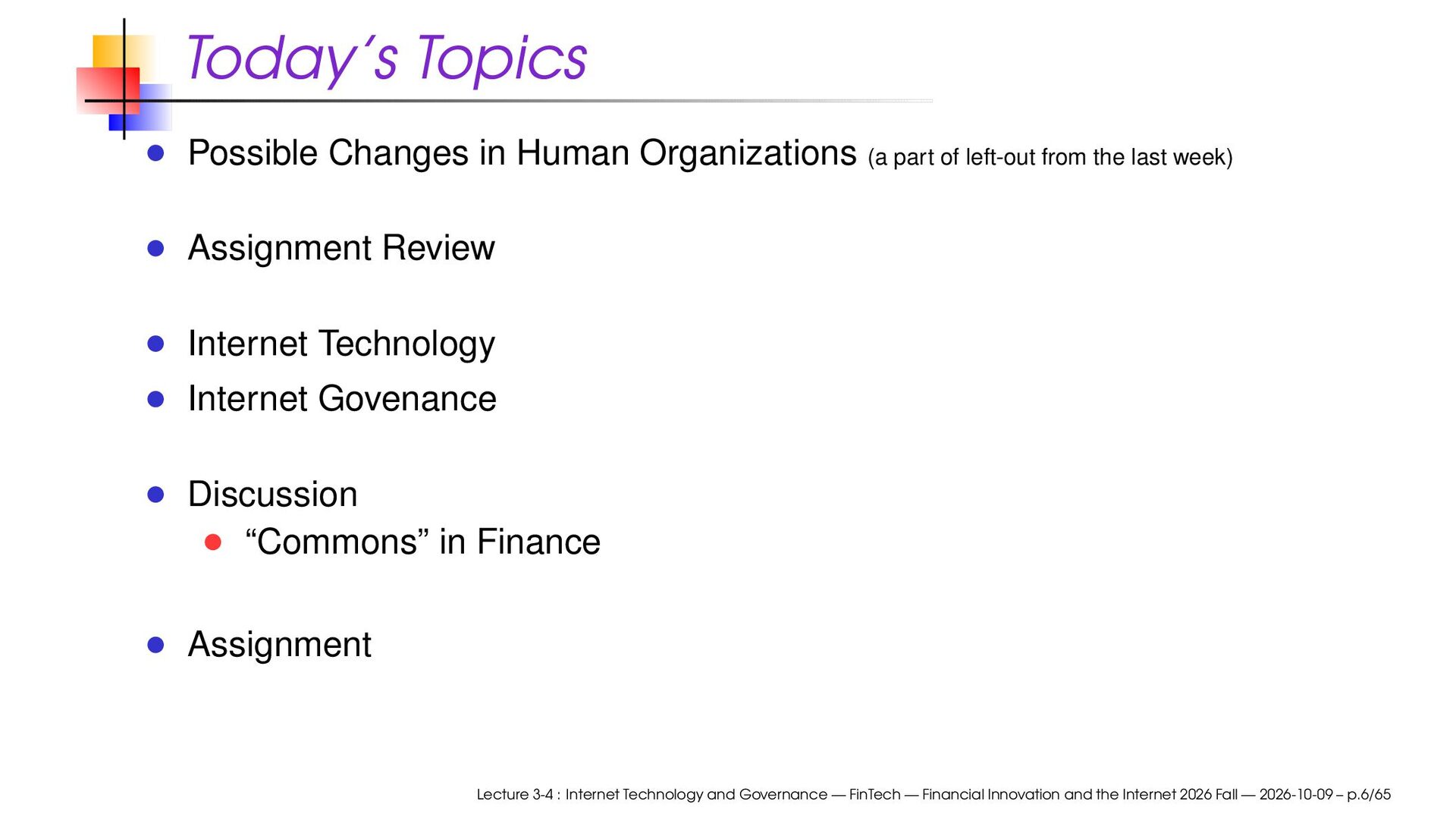
left-out from the last week) Assignment Review Internet Technology Internet Govenance Discussion “Commons” in Finance Assignment Lecture 3-4 : Internet Technology and Governance — FinTech — Financial Innovation and the Internet 2026 Fall — 2026-10-09 – p.6/65
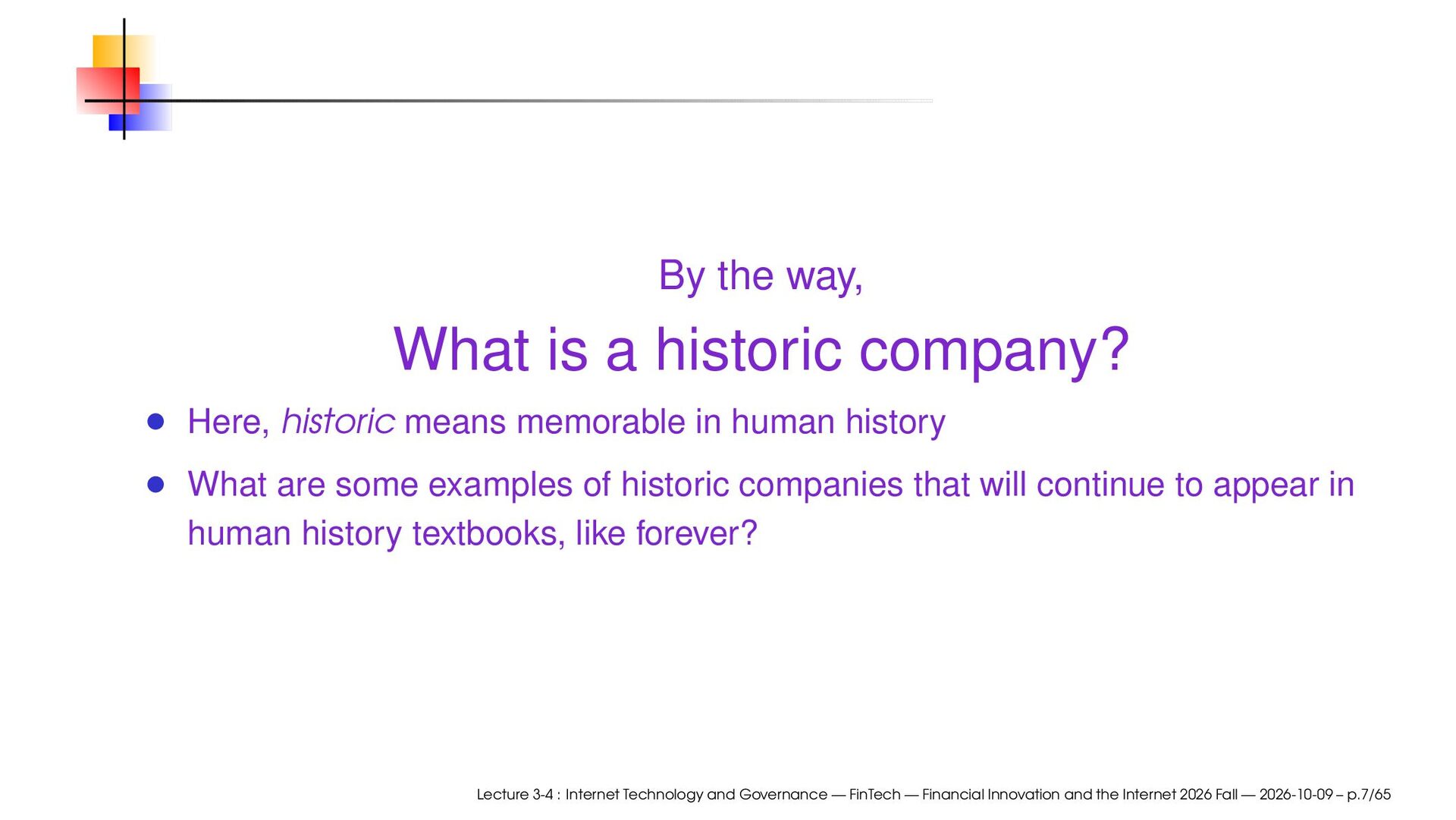
means memorable in human history What are some examples of historic companies that will continue to appear in human history textbooks, like forever? Lecture 3-4 : Internet Technology and Governance — FinTech — Financial Innovation and the Internet 2026 Fall — 2026-10-09 – p.7/65
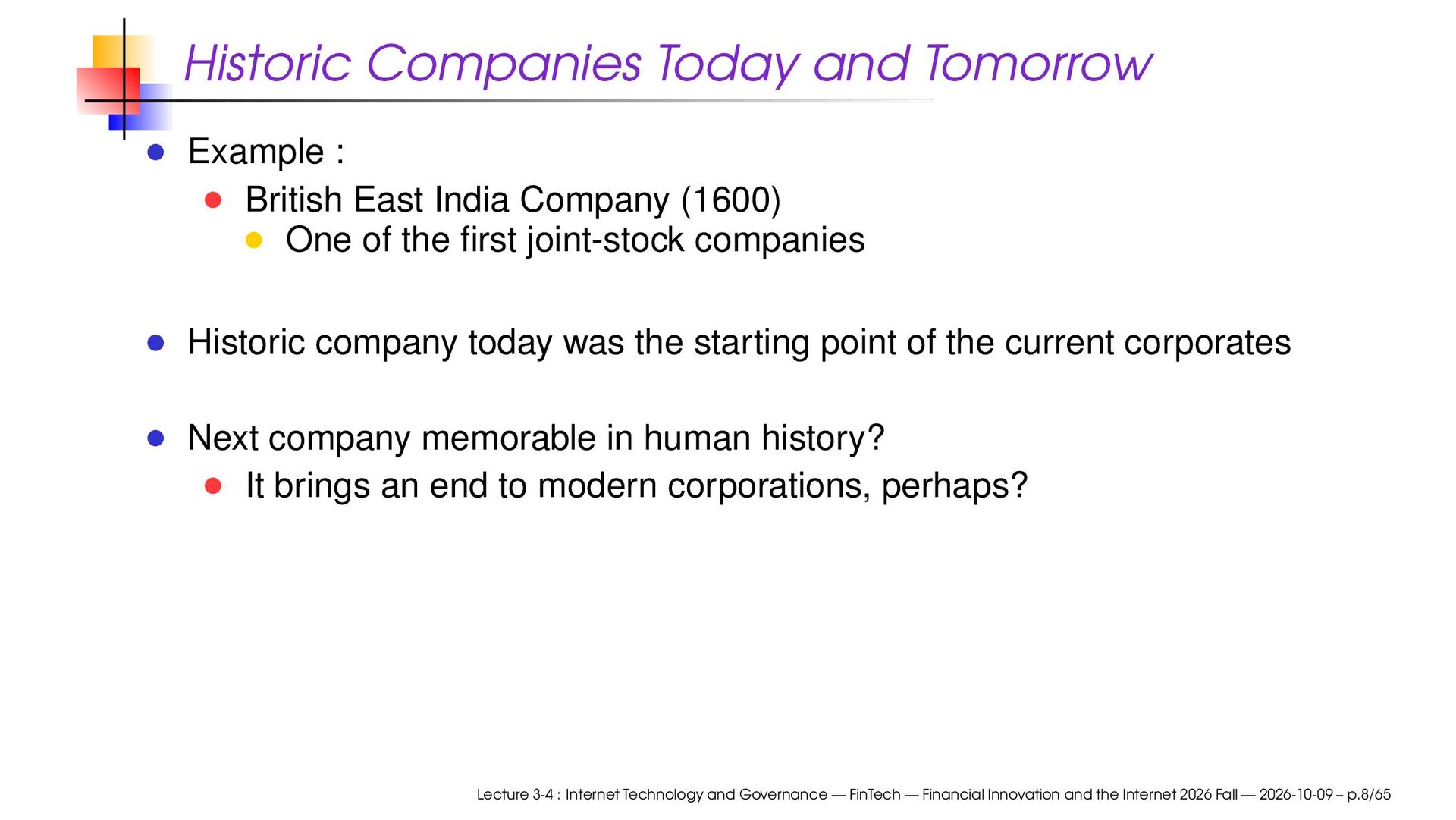
Company (1600) One of the first joint-stock companies Historic company today was the starting point of the current corporates Next company memorable in human history? It brings an end to modern corporations, perhaps? Lecture 3-4 : Internet Technology and Governance — FinTech — Financial Innovation and the Internet 2026 Fall — 2026-10-09 – p.8/65
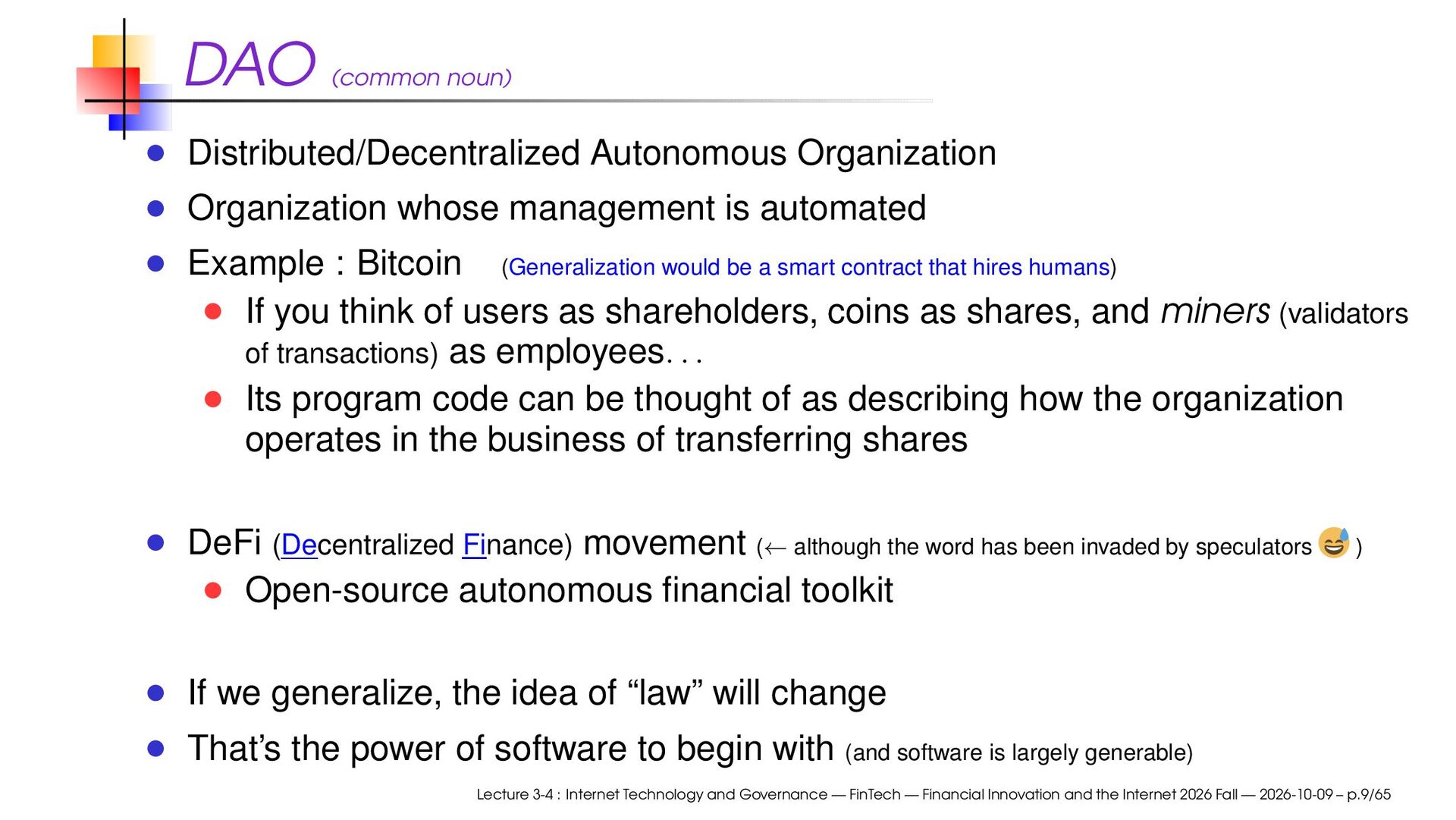
automated Example : Bitcoin (Generalization would be a smart contract that hires humans) If you think of users as shareholders, coins as shares, and miners (validators of transactions) as employees. . . Its program code can be thought of as describing how the organization operates in the business of transferring shares DeFi (Decentralized Finance) movement (← although the word has been invaded by speculators Open-source autonomous financial toolkit ) If we generalize, the idea of “law” will change That’s the power of software to begin with (and software is largely generable) Lecture 3-4 : Internet Technology and Governance — FinTech — Financial Innovation and the Internet 2026 Fall — 2026-10-09 – p.9/65
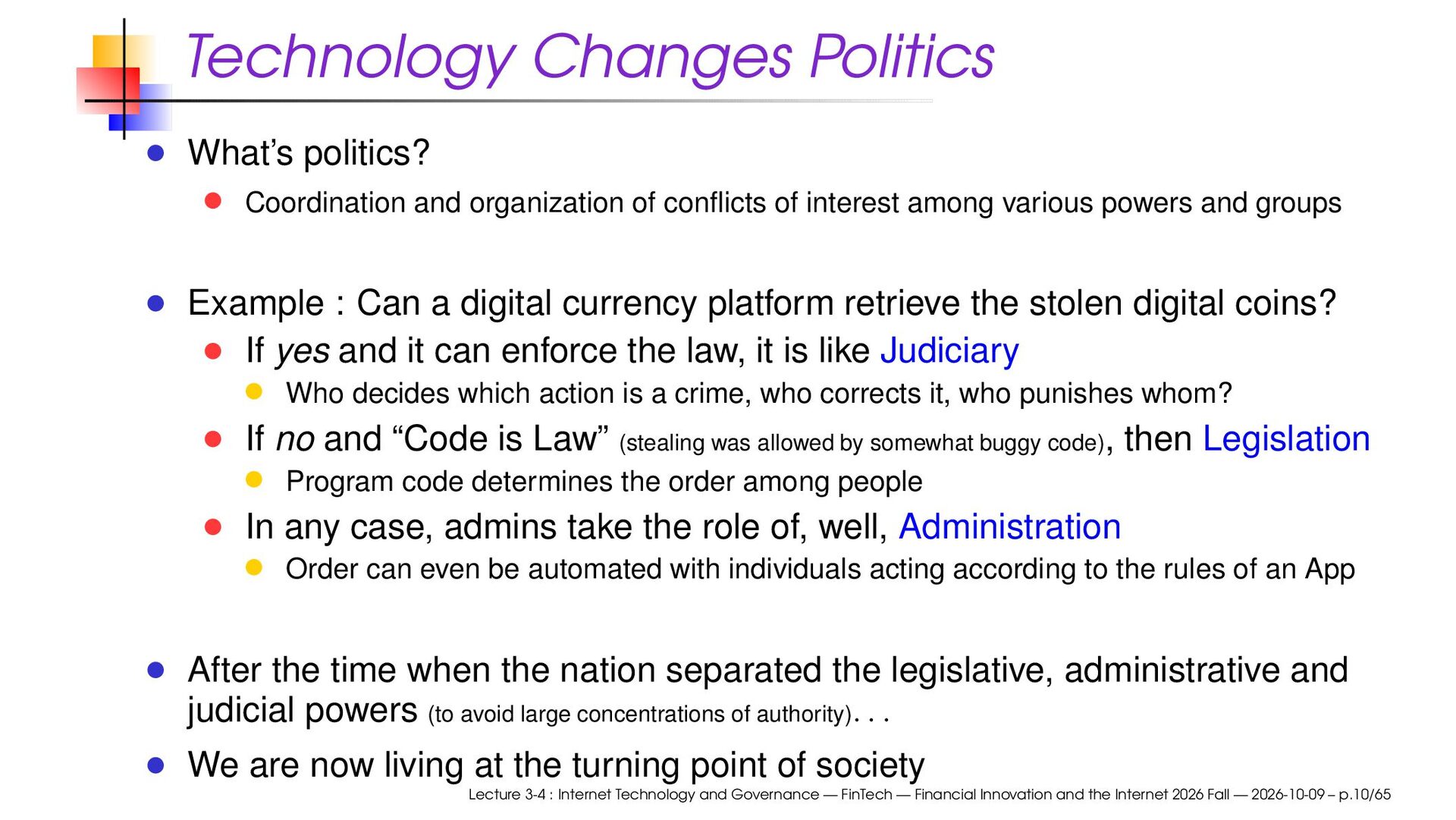
of interest among various powers and groups Example : Can a digital currency platform retrieve the stolen digital coins? If yes and it can enforce the law, it is like Judiciary Who decides which action is a crime, who corrects it, who punishes whom? If no and “Code is Law” (stealing was allowed by somewhat buggy code), then Legislation Program code determines the order among people In any case, admins take the role of, well, Administration Order can even be automated with individuals acting according to the rules of an App After the time when the nation separated the legislative, administrative and judicial powers (to avoid large concentrations of authority). . . We are now living at the turning point of society Lecture 3-4 : Internet Technology and Governance — FinTech — Financial Innovation and the Internet 2026 Fall — 2026-10-09 – p.10/65
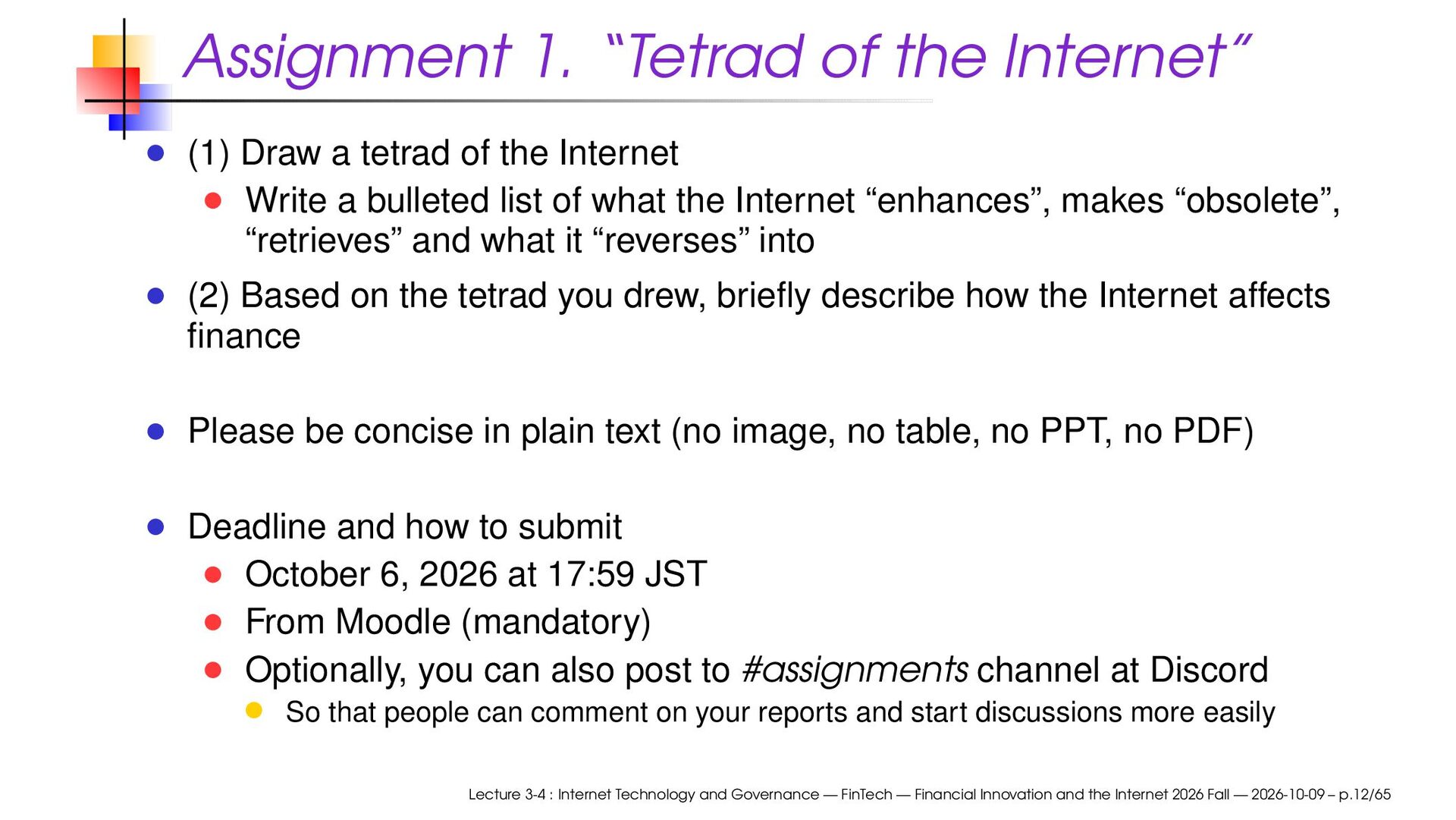
of the Internet Write a bulleted list of what the Internet “enhances”, makes “obsolete”, “retrieves” and what it “reverses” into (2) Based on the tetrad you drew, briefly describe how the Internet affects finance Please be concise in plain text (no image, no table, no PPT, no PDF) Deadline and how to submit October 6, 2026 at 17:59 JST From Moodle (mandatory) Optionally, you can also post to #assignments channel at Discord So that people can comment on your reports and start discussions more easily Lecture 3-4 : Internet Technology and Governance — FinTech — Financial Innovation and the Internet 2026 Fall — 2026-10-09 – p.12/65
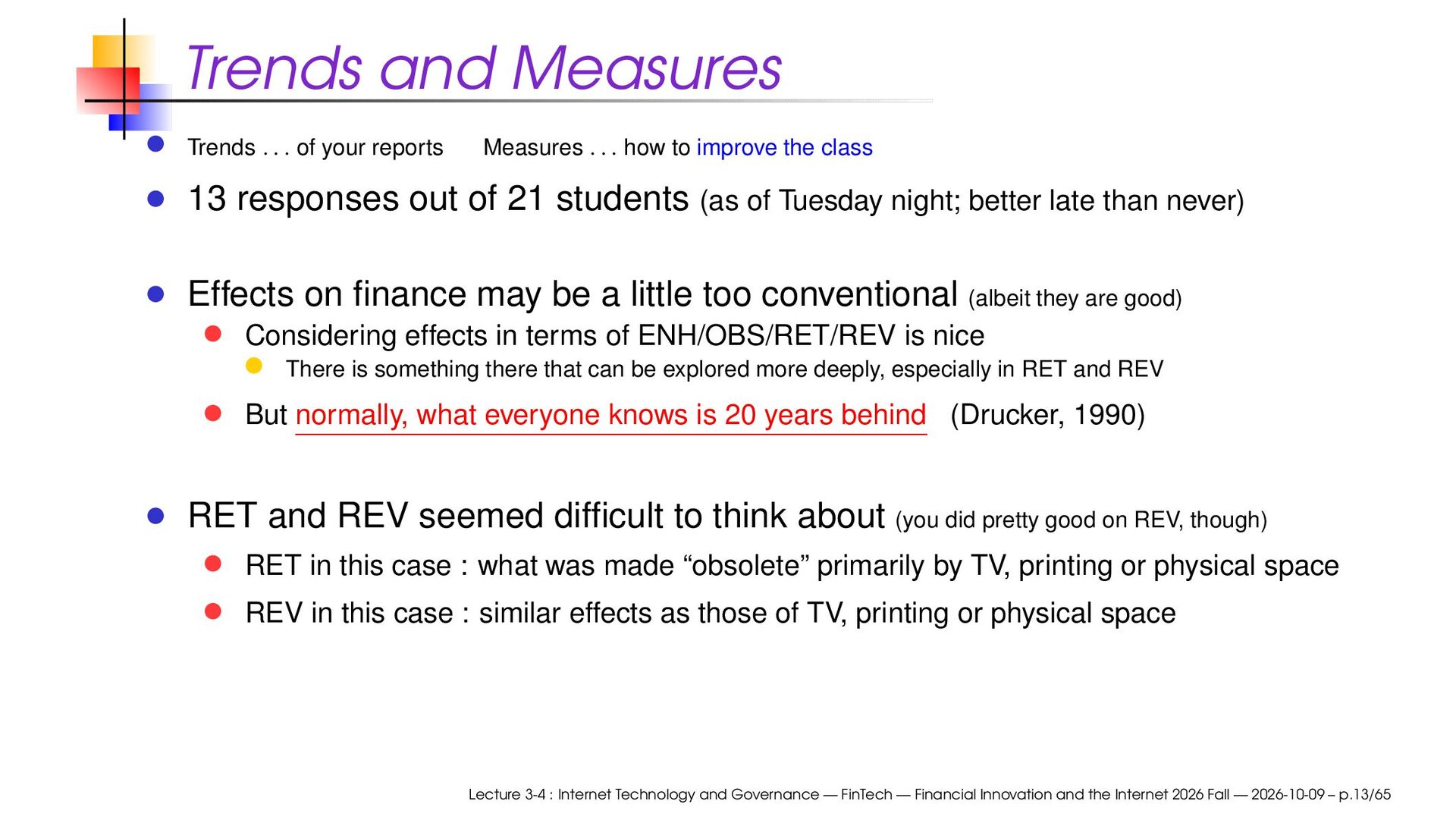
Measures . . . how to improve the class 13 responses out of 21 students (as of Tuesday night; better late than never) Effects on finance may be a little too conventional (albeit they are good) Considering effects in terms of ENH/OBS/RET/REV is nice There is something there that can be explored more deeply, especially in RET and REV But normally, what everyone knows is 20 years behind (Drucker, 1990) RET and REV seemed difficult to think about (you did pretty good on REV, though) RET in this case : what was made “obsolete” primarily by TV, printing or physical space REV in this case : similar effects as those of TV, printing or physical space Lecture 3-4 : Internet Technology and Governance — FinTech — Financial Innovation and the Internet 2026 Fall — 2026-10-09 – p.13/65
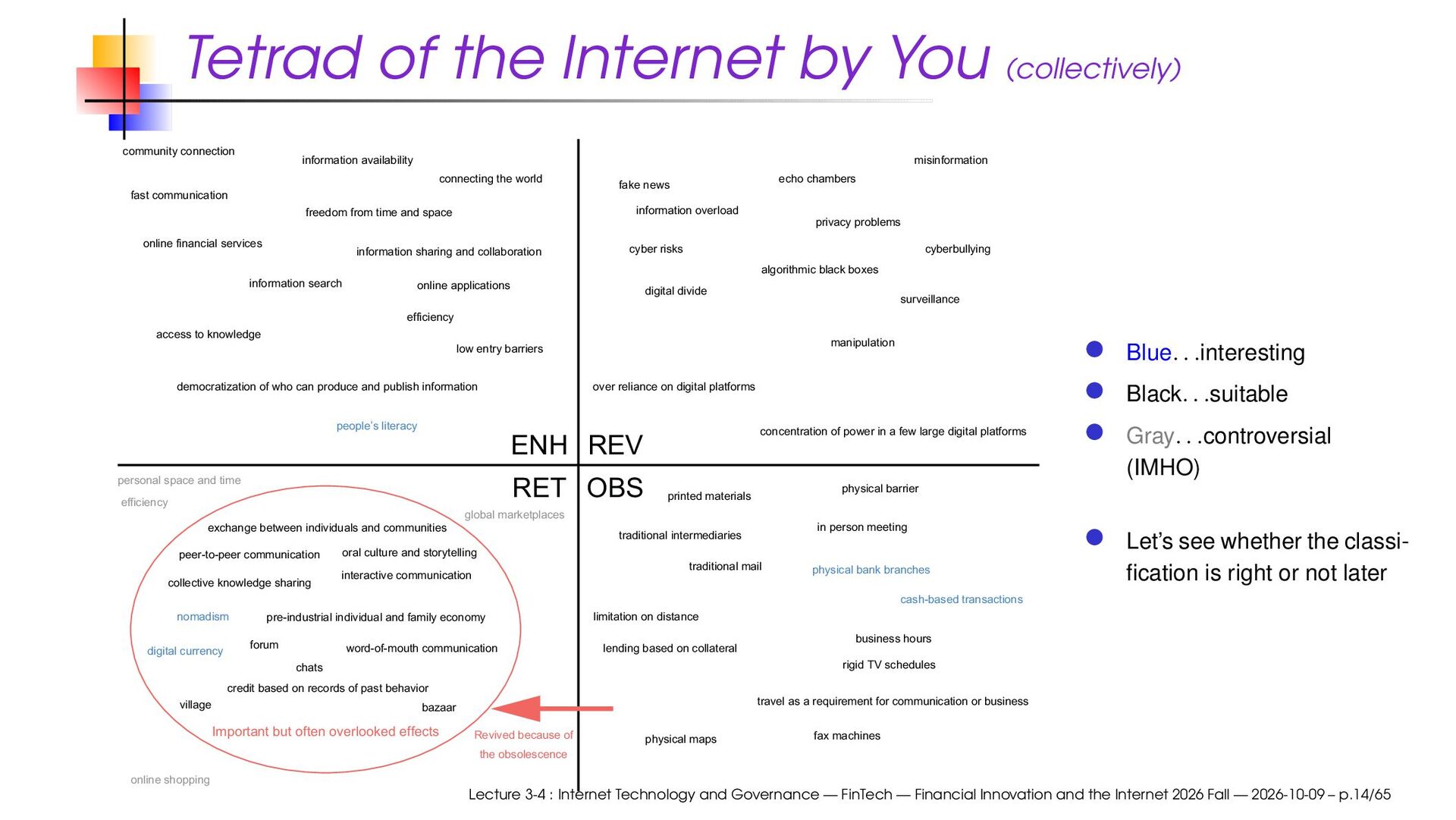
availability misinformation connecting the world fast communication information overload freedom from time and space online financial services echo chambers fake news privacy problems information sharing and collaboration cyber risks cyberbullying algorithmic black boxes information search online applications digital divide surveillance efficiency access to knowledge manipulation low entry barriers Blue. . .interesting over reliance on digital platforms democratization of who can produce and publish information people’s literacy concentration of power in a few large digital platforms ENH REV personal space and time RET OBS efficiency Black. . .suitable Gray. . .controversial (IMHO) physical barrier printed materials global marketplaces exchange between individuals and communities peer-to-peer communication collective knowledge sharing in person meeting traditional intermediaries oral culture and storytelling traditional mail interactive communication physical bank branches Let’s see whether the classification is right or not later cash-based transactions nomadism digital currency pre-industrial individual and family economy forum word-of-mouth communication limitation on distance lending based on collateral business hours rigid TV schedules chats credit based on records of past behavior village travel as a requirement for communication or business bazaar Important but often overlooked effects Revived because of physical maps fax machines the obsolescence online shopping Lecture 3-4 : Internet Technology and Governance — FinTech — Financial Innovation and the Internet 2026 Fall — 2026-10-09 – p.14/65
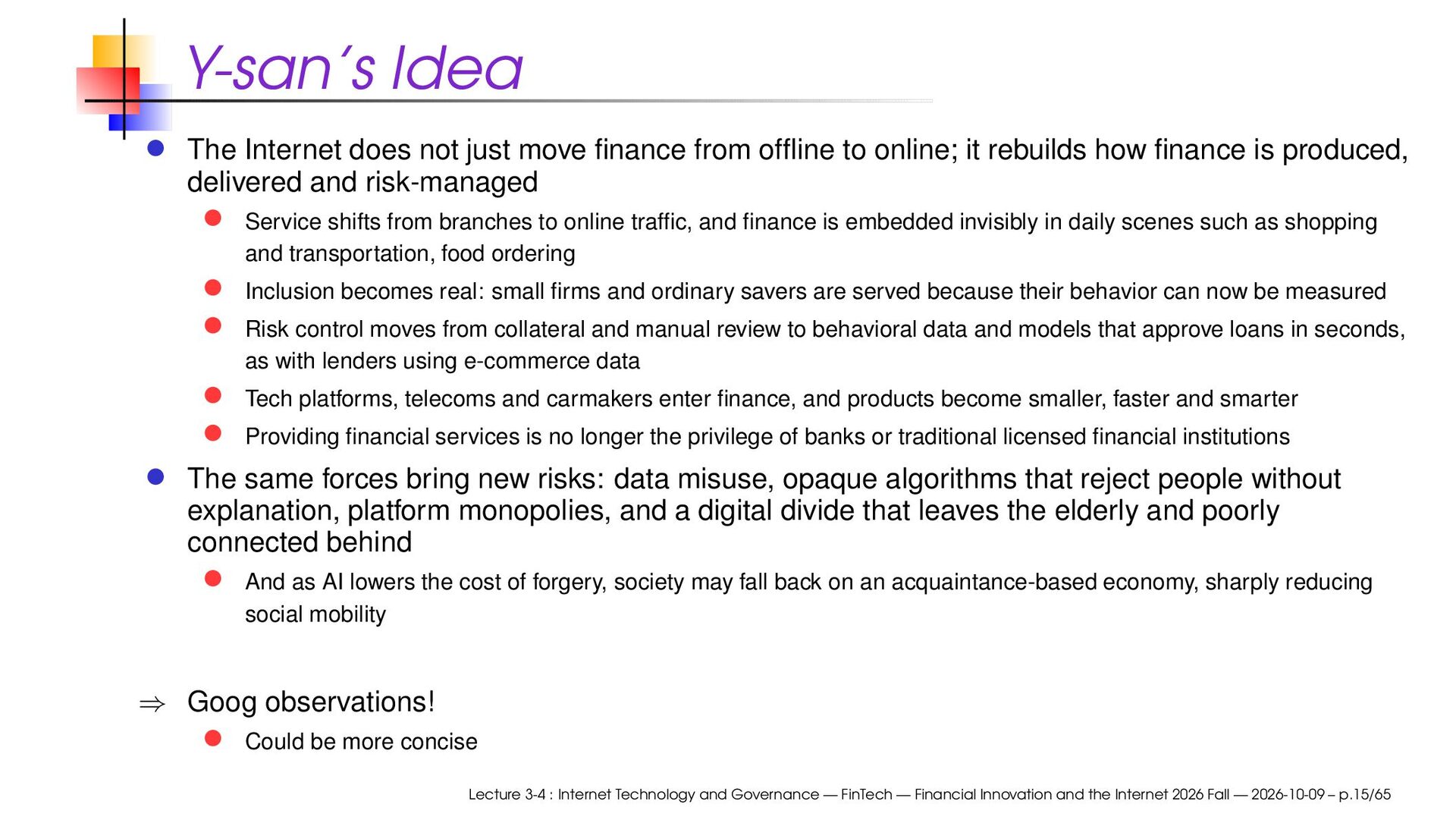
offline to online; it rebuilds how finance is produced, delivered and risk-managed Service shifts from branches to online traffic, and finance is embedded invisibly in daily scenes such as shopping and transportation, food ordering Inclusion becomes real: small firms and ordinary savers are served because their behavior can now be measured Risk control moves from collateral and manual review to behavioral data and models that approve loans in seconds, as with lenders using e-commerce data Tech platforms, telecoms and carmakers enter finance, and products become smaller, faster and smarter Providing financial services is no longer the privilege of banks or traditional licensed financial institutions The same forces bring new risks: data misuse, opaque algorithms that reject people without explanation, platform monopolies, and a digital divide that leaves the elderly and poorly connected behind And as AI lowers the cost of forgery, society may fall back on an acquaintance-based economy, sharply reducing social mobility ⇒ Goog observations! Could be more concise Lecture 3-4 : Internet Technology and Governance — FinTech — Financial Innovation and the Internet 2026 Fall — 2026-10-09 – p.15/65
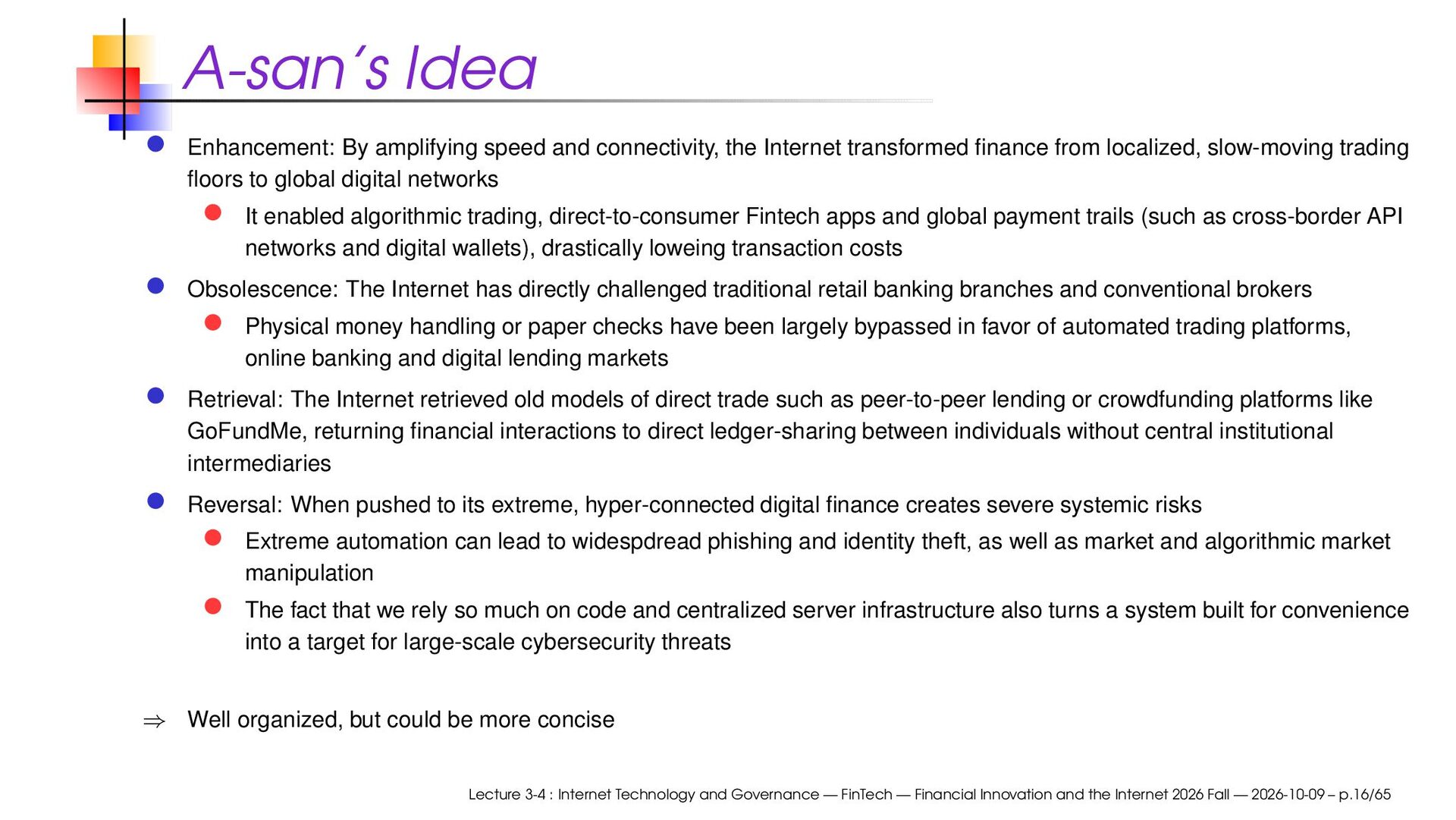
transformed finance from localized, slow-moving trading floors to global digital networks It enabled algorithmic trading, direct-to-consumer Fintech apps and global payment trails (such as cross-border API networks and digital wallets), drastically loweing transaction costs Obsolescence: The Internet has directly challenged traditional retail banking branches and conventional brokers Physical money handling or paper checks have been largely bypassed in favor of automated trading platforms, online banking and digital lending markets Retrieval: The Internet retrieved old models of direct trade such as peer-to-peer lending or crowdfunding platforms like GoFundMe, returning financial interactions to direct ledger-sharing between individuals without central institutional intermediaries Reversal: When pushed to its extreme, hyper-connected digital finance creates severe systemic risks Extreme automation can lead to widespdread phishing and identity theft, as well as market and algorithmic market manipulation The fact that we rely so much on code and centralized server infrastructure also turns a system built for convenience into a target for large-scale cybersecurity threats ⇒ Well organized, but could be more concise Lecture 3-4 : Internet Technology and Governance — FinTech — Financial Innovation and the Internet 2026 Fall — 2026-10-09 – p.16/65
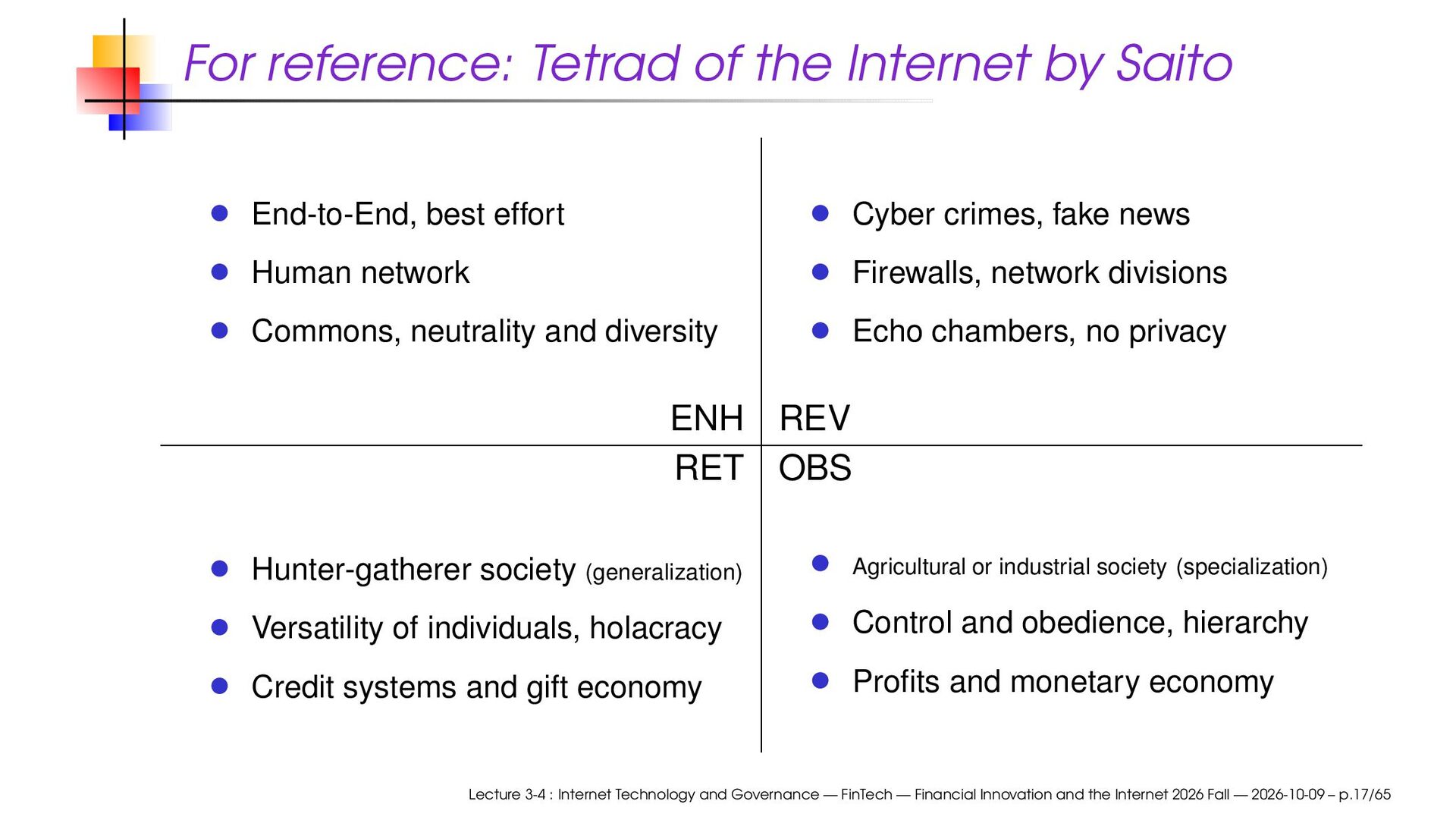
effort Cyber crimes, fake news Human network Firewalls, network divisions Commons, neutrality and diversity Echo chambers, no privacy ENH REV RET OBS Hunter-gatherer society (generalization) Agricultural or industrial society (specialization) Versatility of individuals, holacracy Control and obedience, hierarchy Credit systems and gift economy Profits and monetary economy Lecture 3-4 : Internet Technology and Governance — FinTech — Financial Innovation and the Internet 2026 Fall — 2026-10-09 – p.17/65
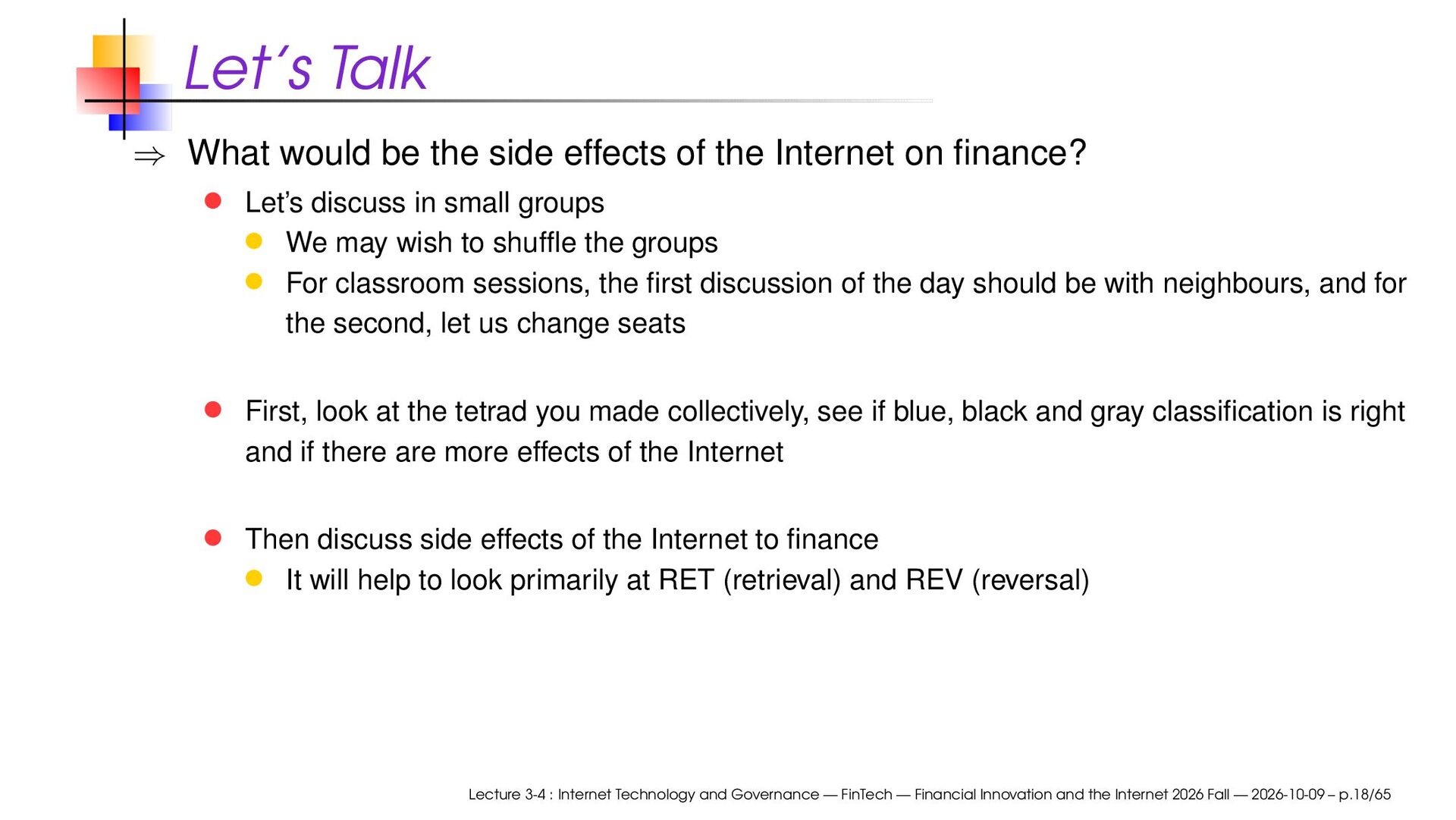
the Internet on finance? Let’s discuss in small groups We may wish to shuffle the groups For classroom sessions, the first discussion of the day should be with neighbours, and for the second, let us change seats First, look at the tetrad you made collectively, see if blue, black and gray classification is right and if there are more effects of the Internet Then discuss side effects of the Internet to finance It will help to look primarily at RET (retrieval) and REV (reversal) Lecture 3-4 : Internet Technology and Governance — FinTech — Financial Innovation and the Internet 2026 Fall — 2026-10-09 – p.18/65
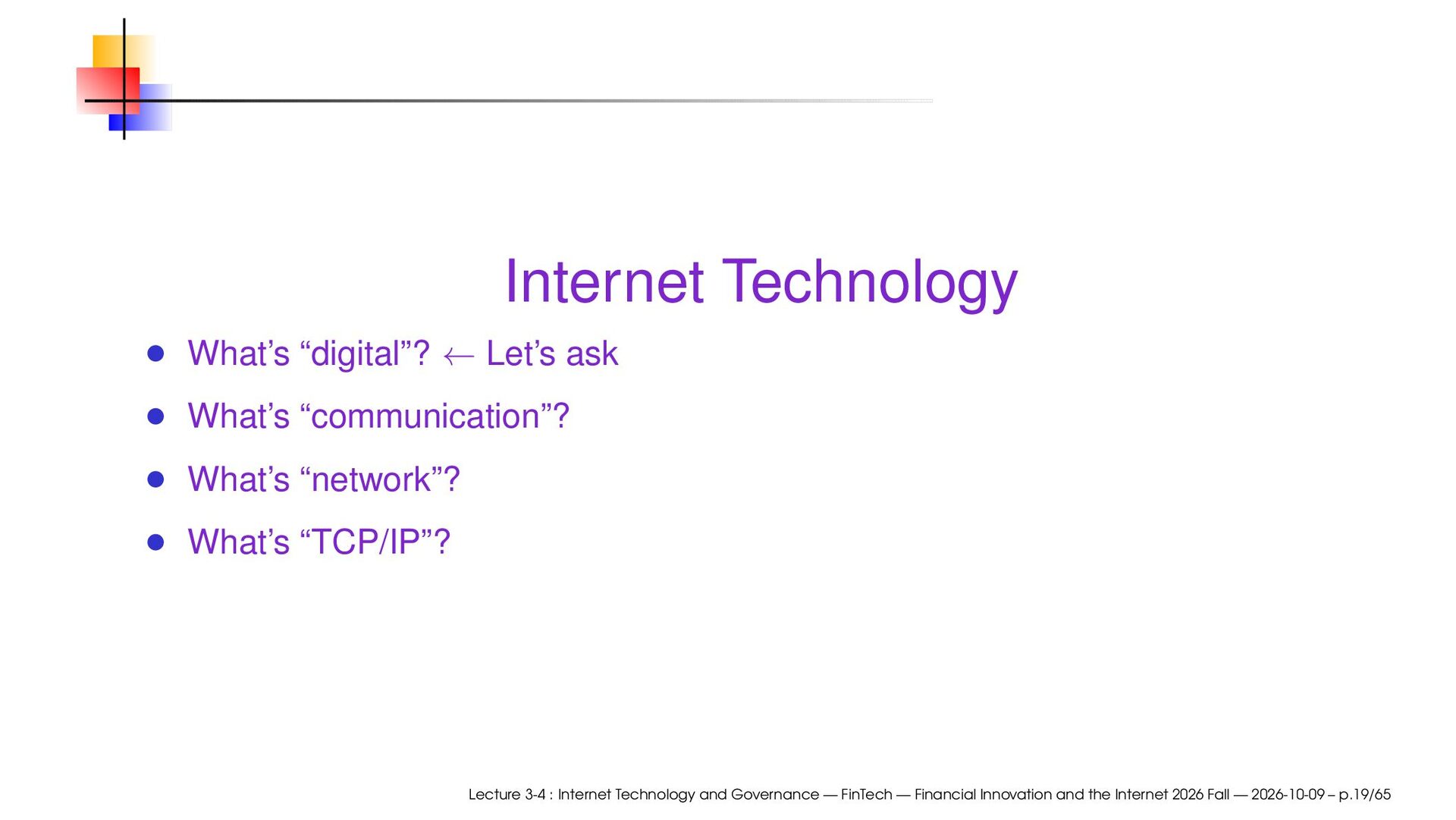
“network”? What’s “TCP/IP”? Lecture 3-4 : Internet Technology and Governance — FinTech — Financial Innovation and the Internet 2026 Fall — 2026-10-09 – p.19/65
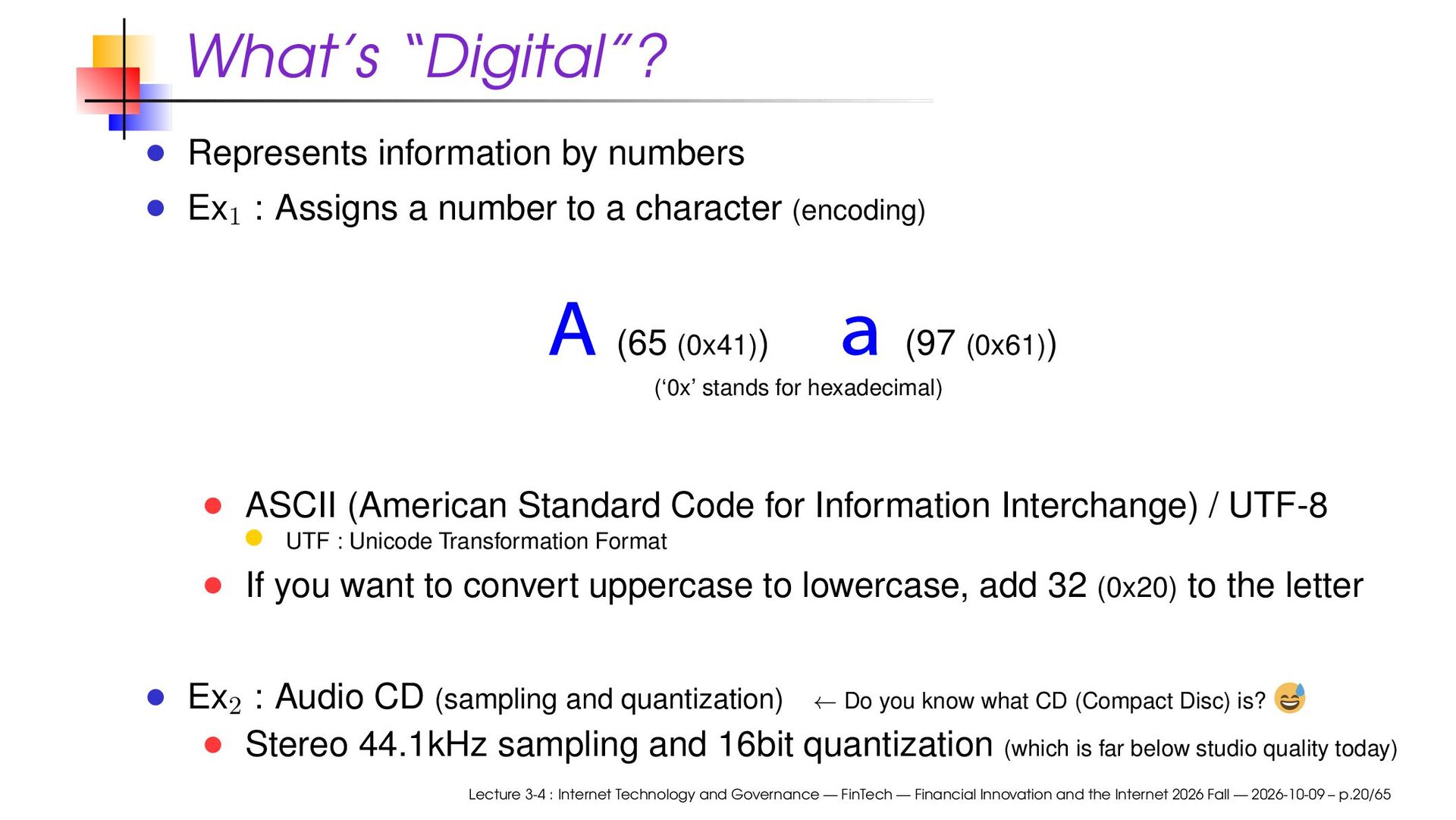
number to a character (encoding) A (65 (0x41)) a (97 (0x61)) (‘0x’ stands for hexadecimal) ASCII (American Standard Code for Information Interchange) / UTF-8 UTF : Unicode Transformation Format If you want to convert uppercase to lowercase, add 32 (0x20) to the letter Ex2 : Audio CD (sampling and quantization) ← Do you know what CD (Compact Disc) is? Stereo 44.1kHz sampling and 16bit quantization (which is far below studio quality today) Lecture 3-4 : Internet Technology and Governance — FinTech — Financial Innovation and the Internet 2026 Fall — 2026-10-09 – p.20/65
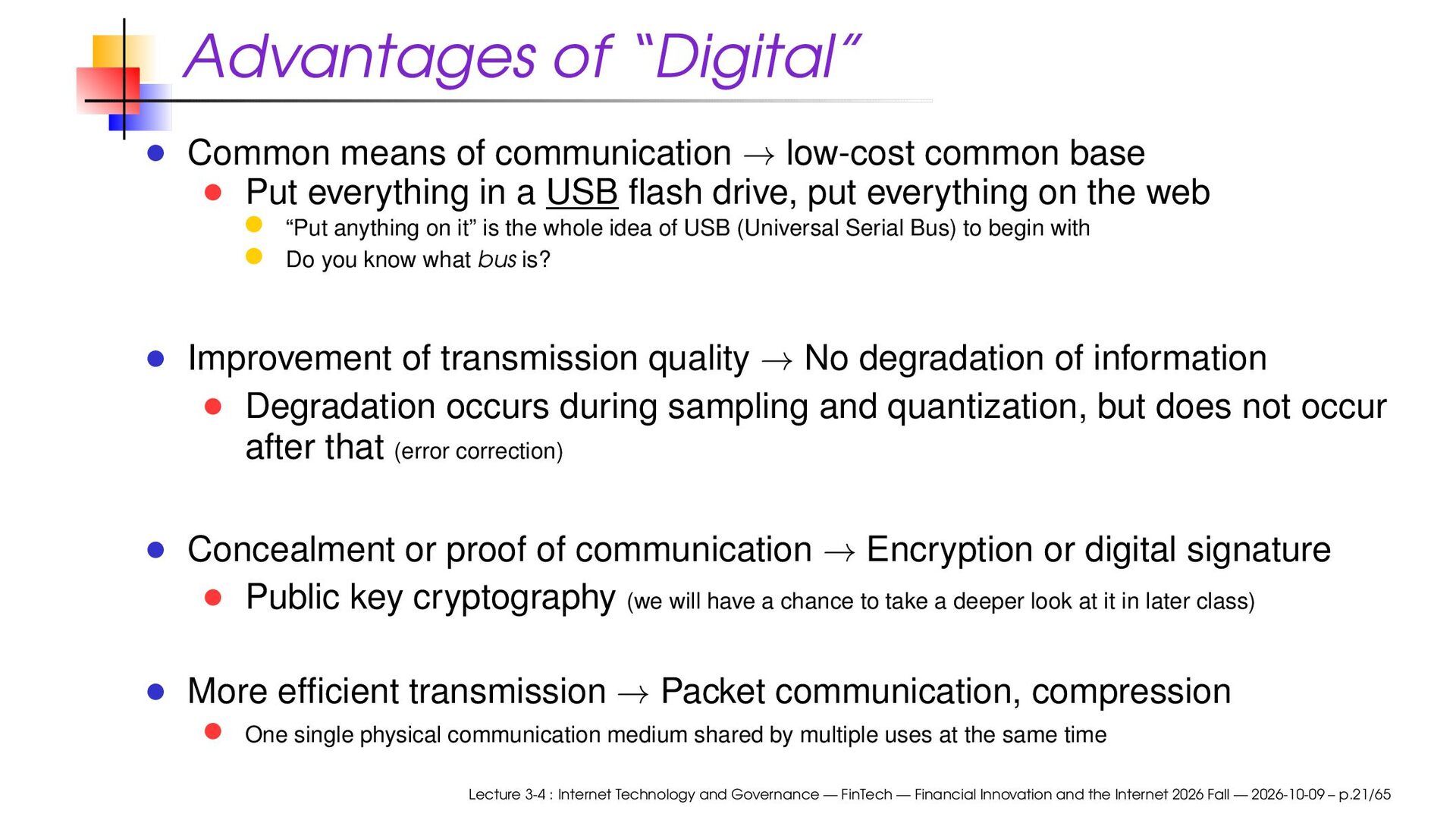
base Put everything in a USB flash drive, put everything on the web “Put anything on it” is the whole idea of USB (Universal Serial Bus) to begin with Do you know what bus is? Improvement of transmission quality → No degradation of information Degradation occurs during sampling and quantization, but does not occur after that (error correction) Concealment or proof of communication → Encryption or digital signature Public key cryptography (we will have a chance to take a deeper look at it in later class) More efficient transmission → Packet communication, compression One single physical communication medium shared by multiple uses at the same time Lecture 3-4 : Internet Technology and Governance — FinTech — Financial Innovation and the Internet 2026 Fall — 2026-10-09 – p.21/65
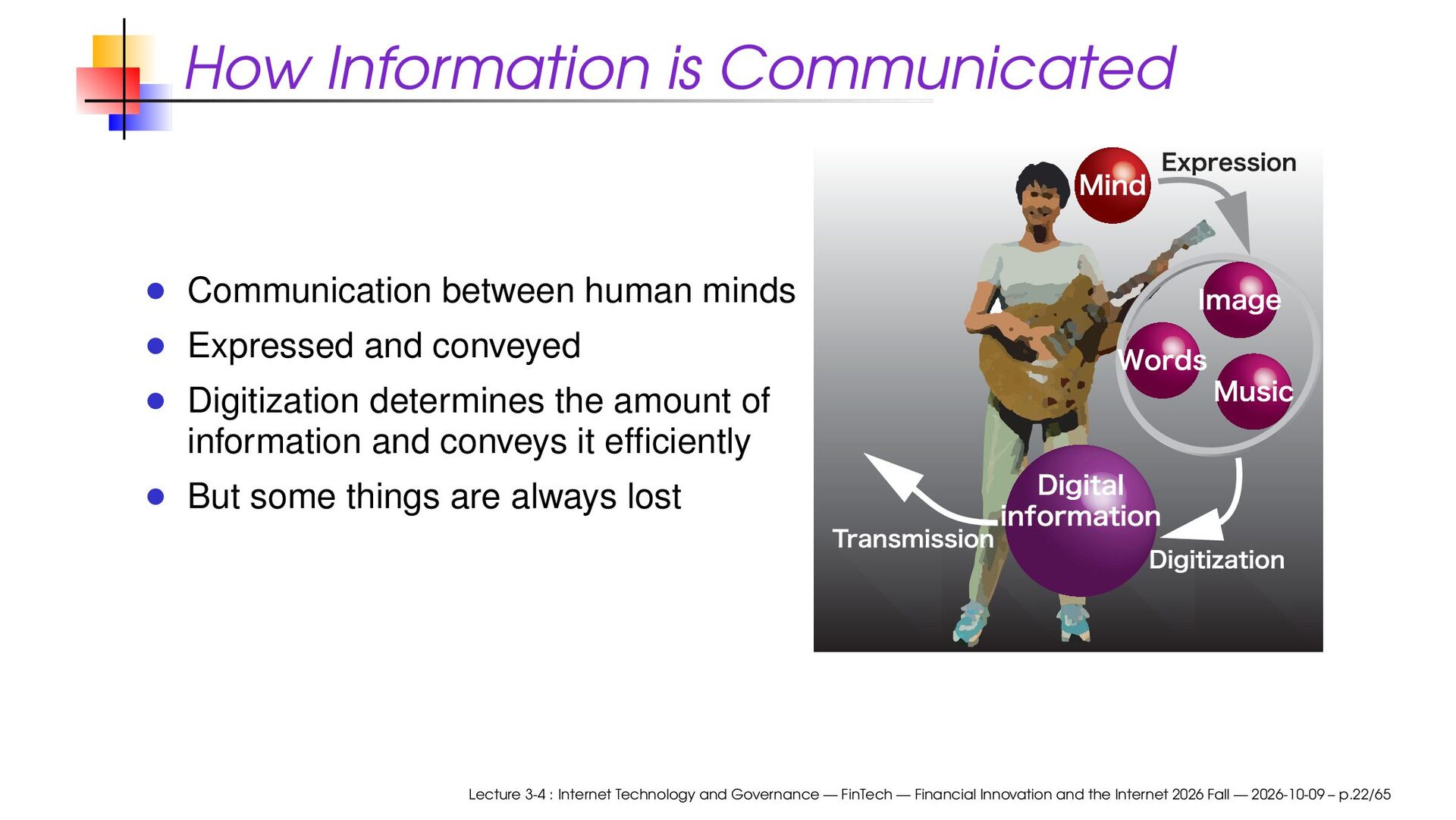
conveyed Digitization determines the amount of information and conveys it efficiently But some things are always lost Lecture 3-4 : Internet Technology and Governance — FinTech — Financial Innovation and the Internet 2026 Fall — 2026-10-09 – p.22/65
exchanged Social / requirement aspect Network of networks Technological / functional aspect What’s communication? What’s network? Lecture 3-4 : Internet Technology and Governance — FinTech — Financial Innovation and the Internet 2026 Fall — 2026-10-09 – p.23/65
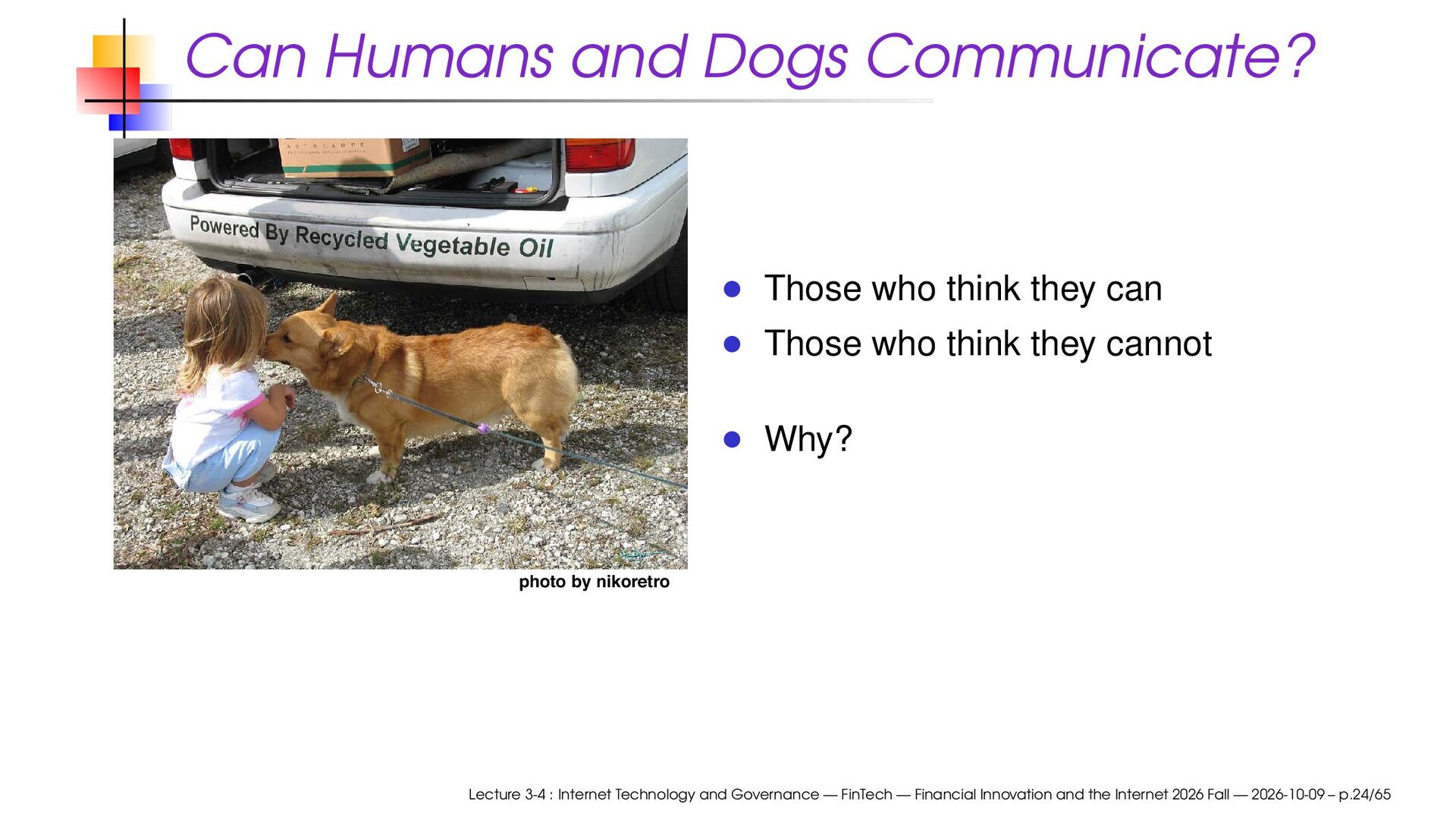
Those who think they cannot Why? photo by nikoretro Lecture 3-4 : Internet Technology and Governance — FinTech — Financial Innovation and the Internet 2026 Fall — 2026-10-09 – p.24/65
as by speech, signals, writing, or behavior 2. Interpersonal rapport — “The American Heritage Dictionary” It’s undeniable that you feel that humans and dogs feel close to each other. . . Lecture 3-4 : Internet Technology and Governance — FinTech — Financial Innovation and the Internet 2026 Fall — 2026-10-09 – p.25/65
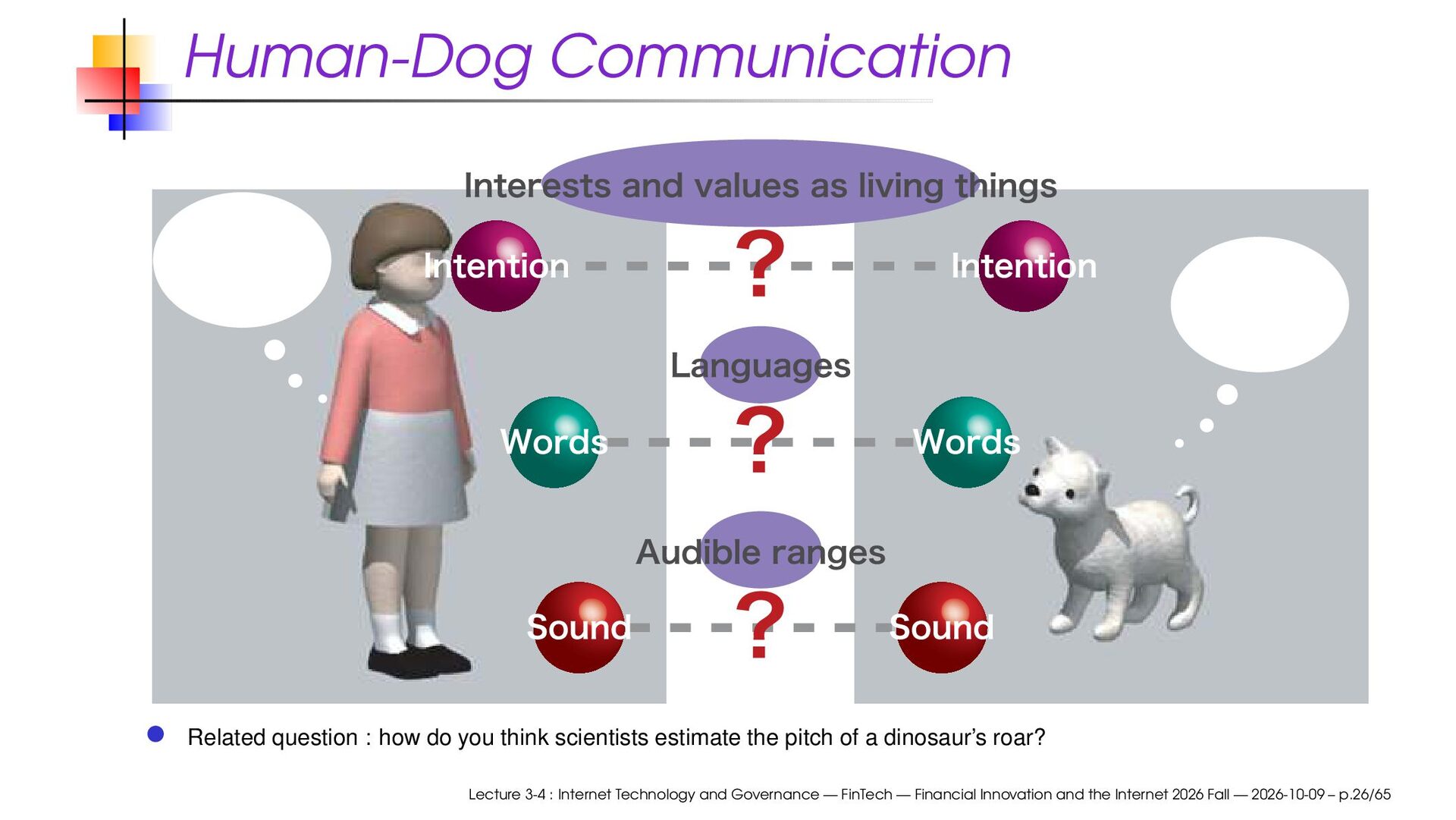
estimate the pitch of a dinosaur’s roar? Lecture 3-4 : Internet Technology and Governance — FinTech — Financial Innovation and the Internet 2026 Fall — 2026-10-09 – p.26/65
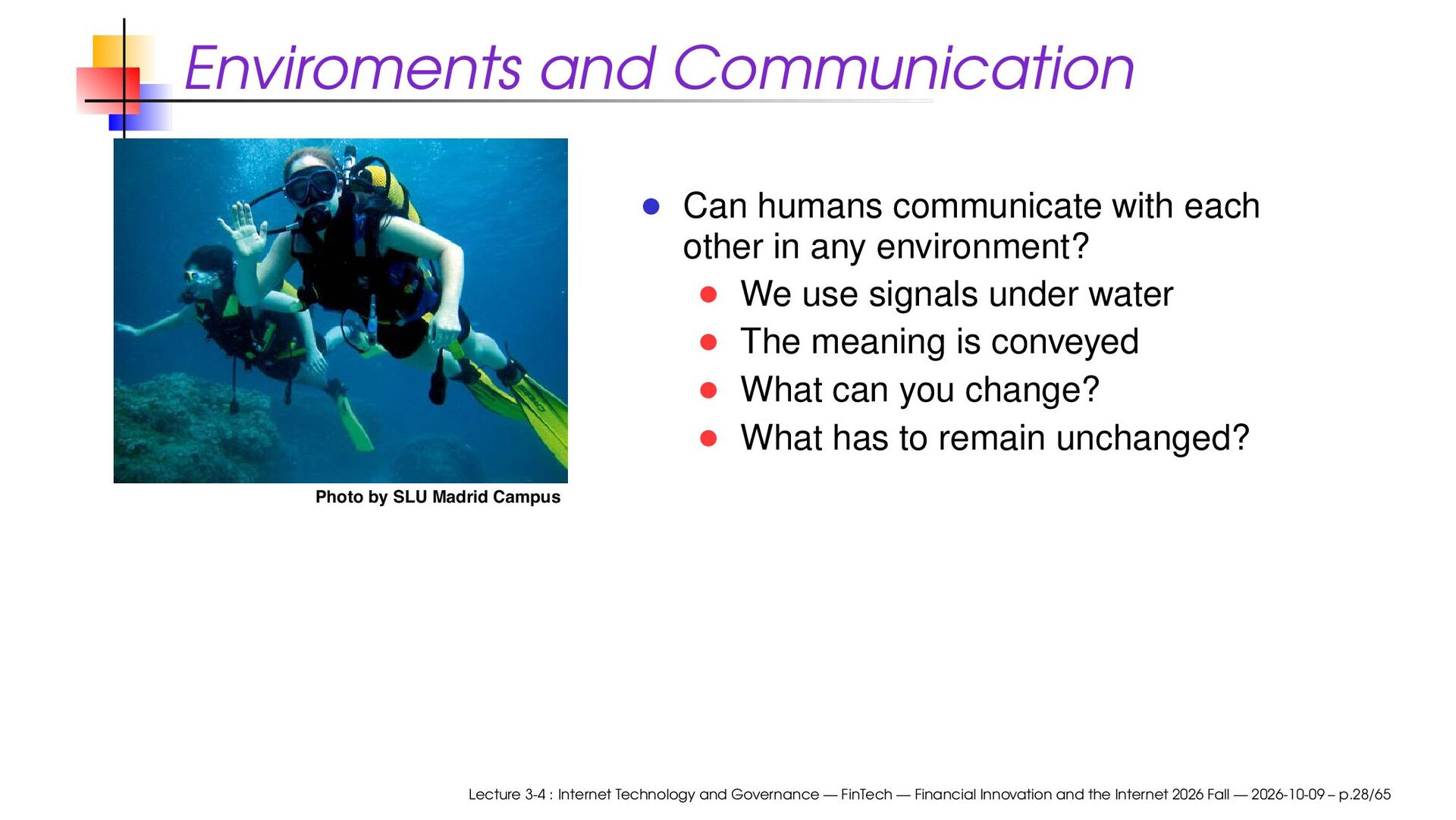
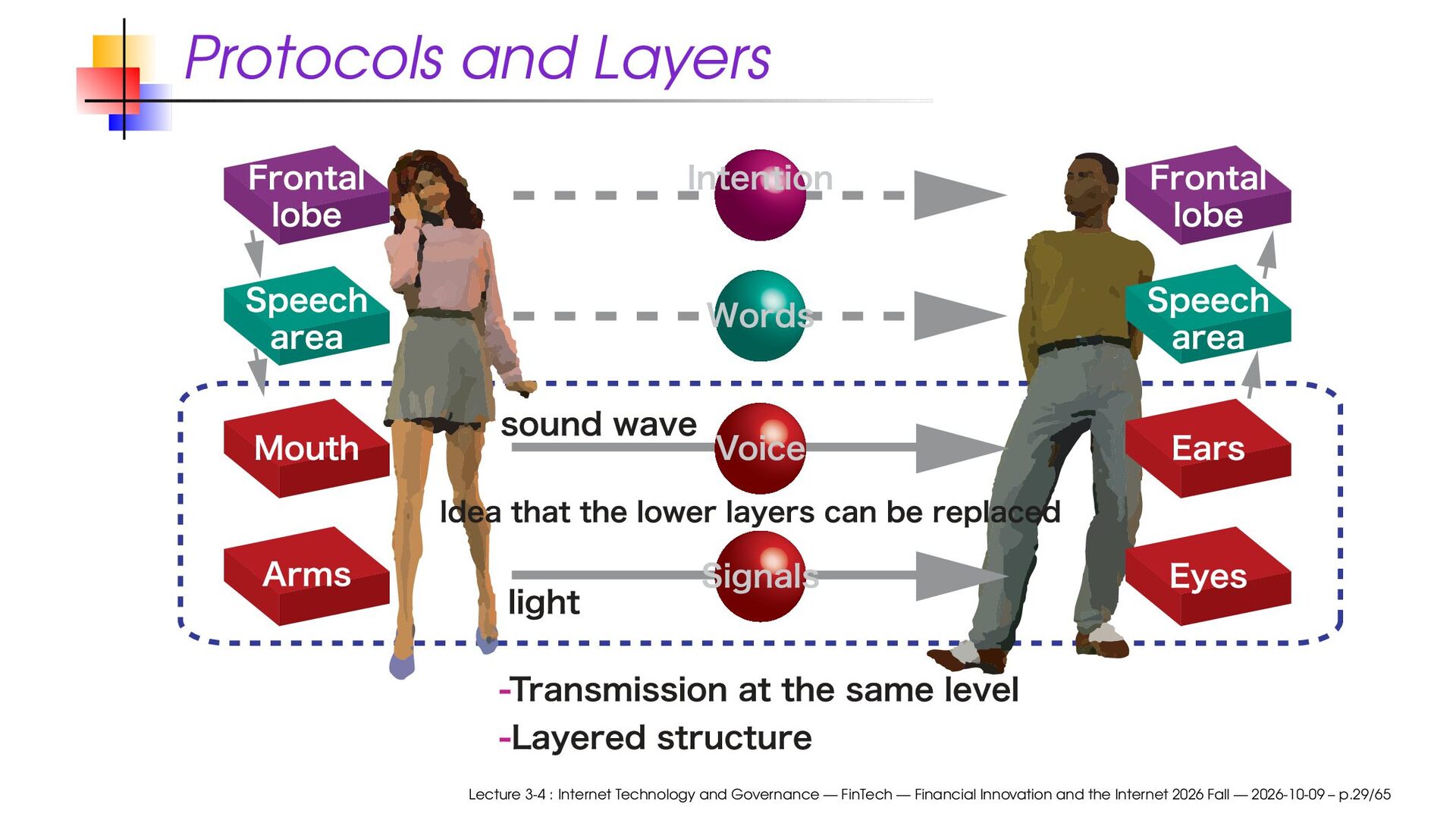
any environment? We use signals under water The meaning is conveyed What can you change? What has to remain unchanged? Photo by SLU Madrid Campus Lecture 3-4 : Internet Technology and Governance — FinTech — Financial Innovation and the Internet 2026 Fall — 2026-10-09 – p.28/65
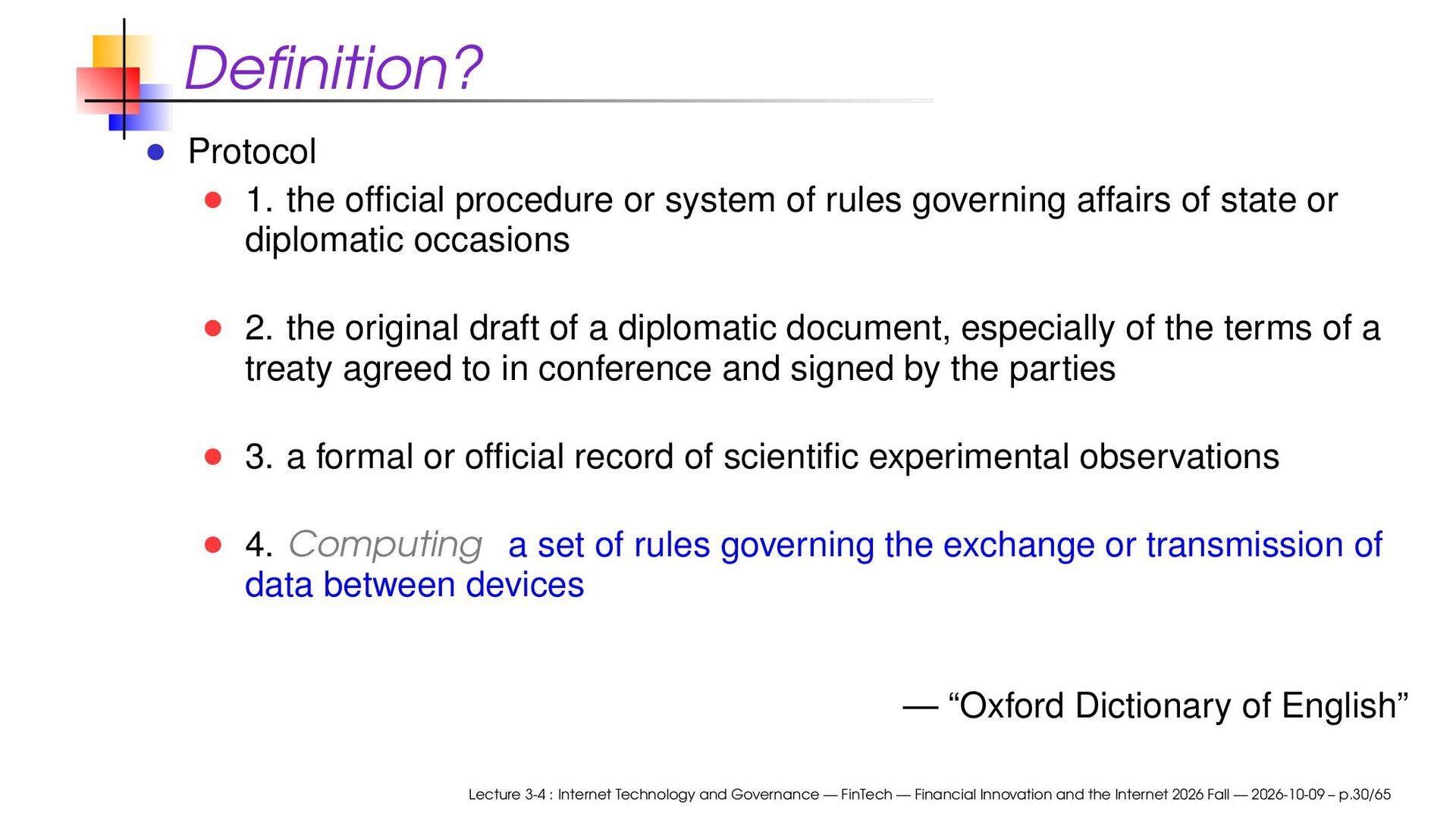
governing affairs of state or diplomatic occasions 2. the original draft of a diplomatic document, especially of the terms of a treaty agreed to in conference and signed by the parties 3. a formal or official record of scientific experimental observations 4. Computing a set of rules governing the exchange or transmission of data between devices — “Oxford Dictionary of English” Lecture 3-4 : Internet Technology and Governance — FinTech — Financial Innovation and the Internet 2026 Fall — 2026-10-09 – p.30/65
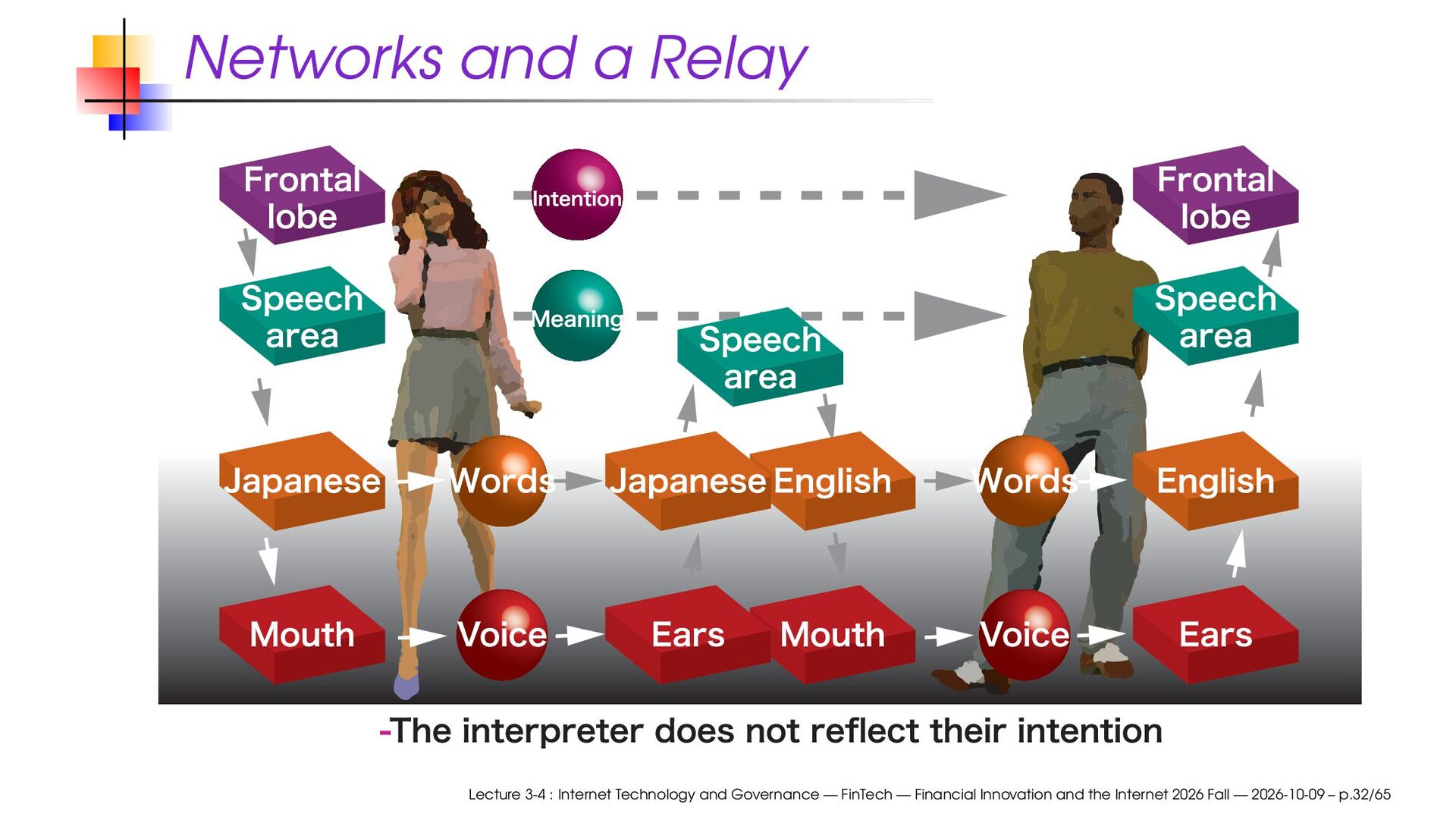
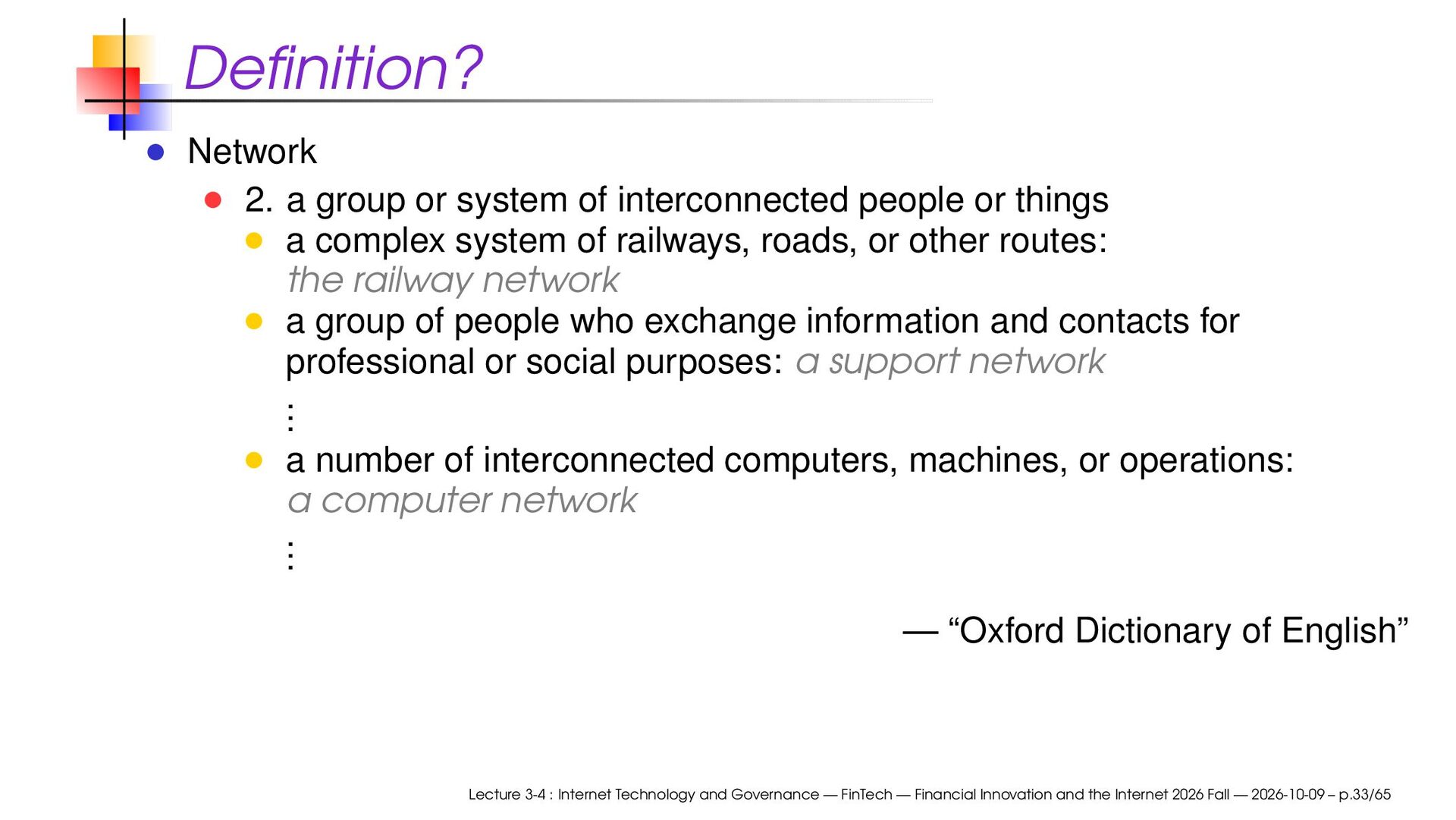
or things a complex system of railways, roads, or other routes: the railway network a group of people who exchange information and contacts for professional or social purposes: a support network .. . a number of interconnected computers, machines, or operations: a computer network .. . — “Oxford Dictionary of English” Lecture 3-4 : Internet Technology and Governance — FinTech — Financial Innovation and the Internet 2026 Fall — 2026-10-09 – p.33/65
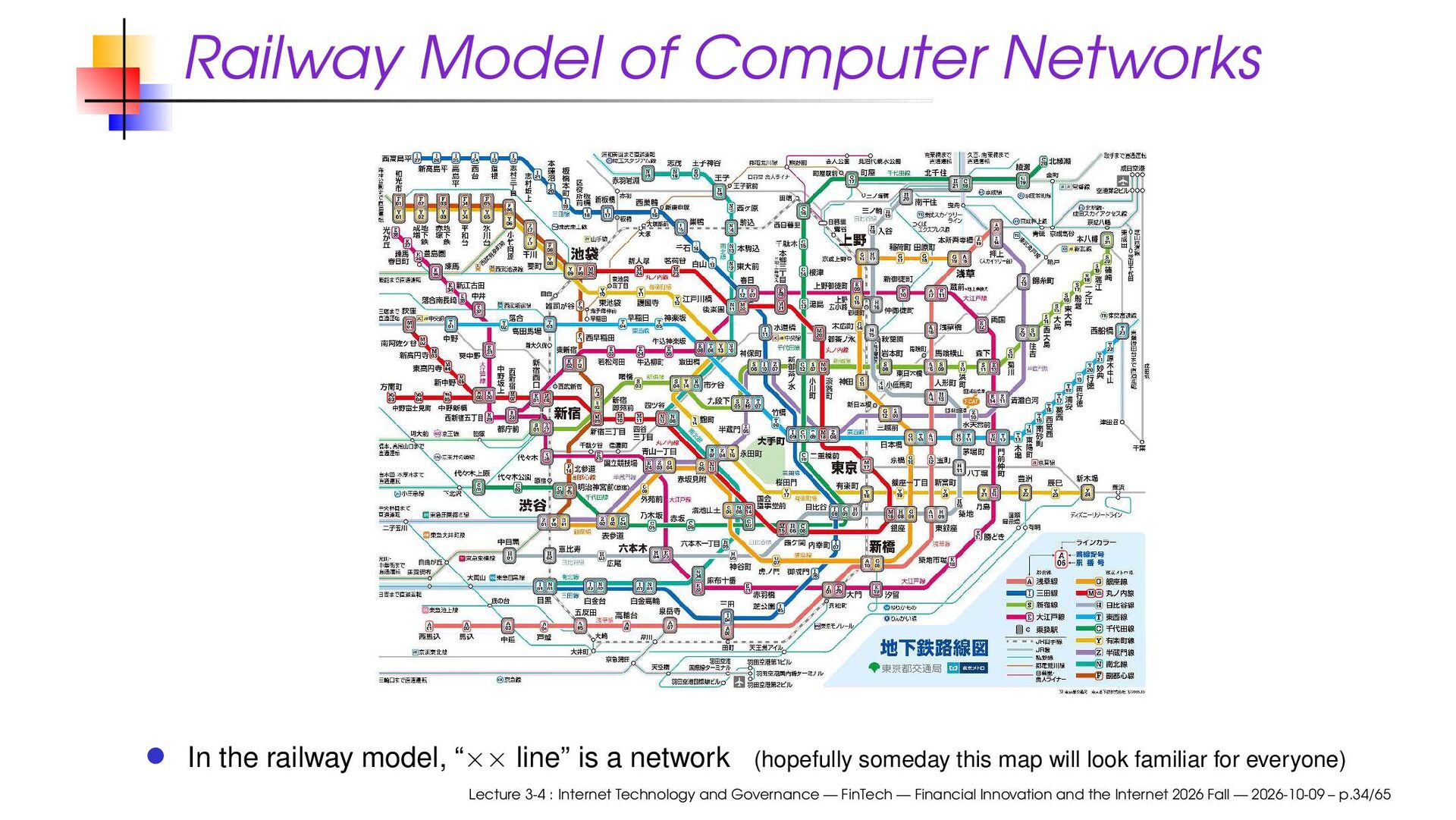
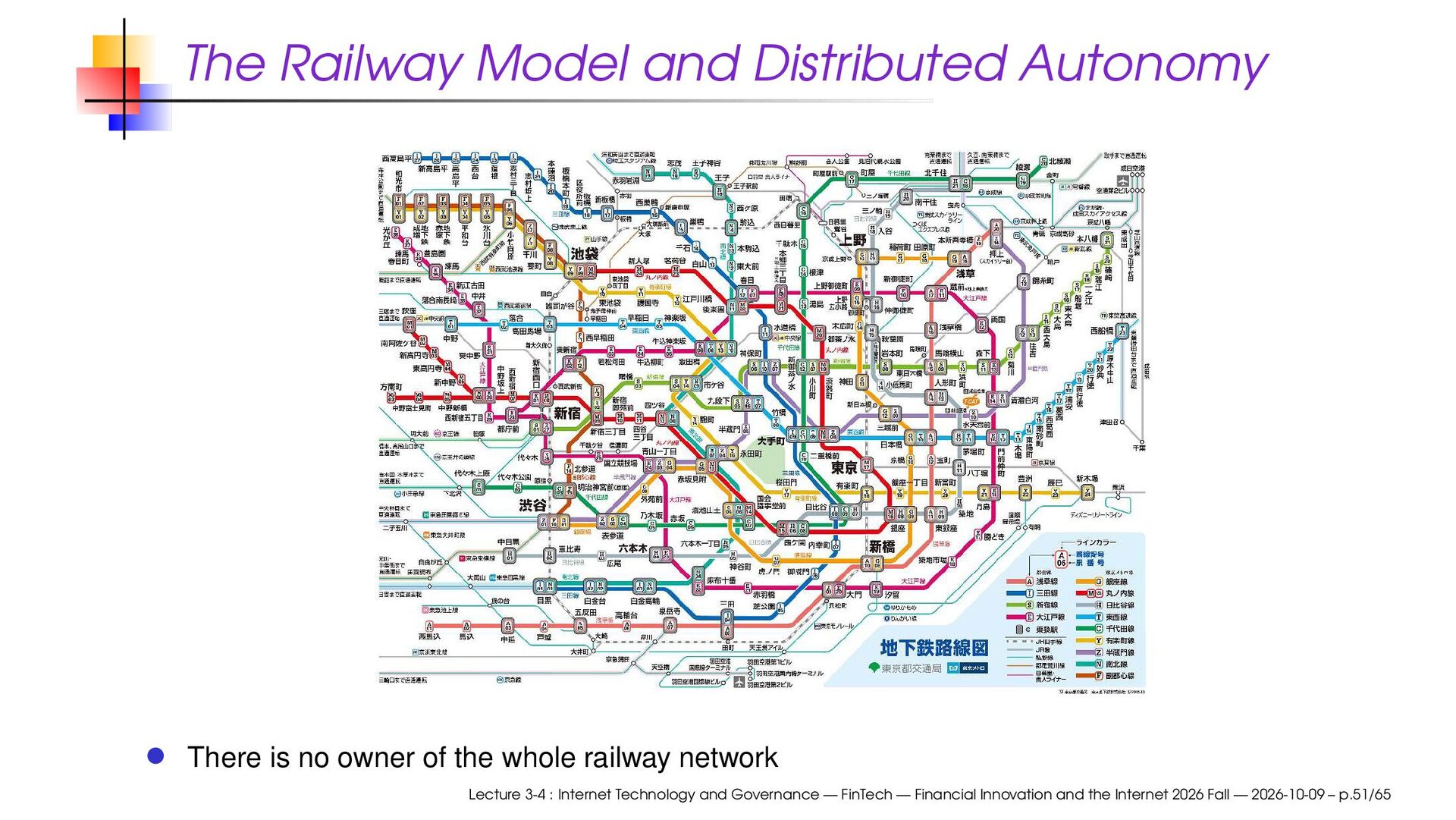
line” is a network (hopefully someday this map will look familiar for everyone) Lecture 3-4 : Internet Technology and Governance — FinTech — Financial Innovation and the Internet 2026 Fall — 2026-10-09 – p.34/65
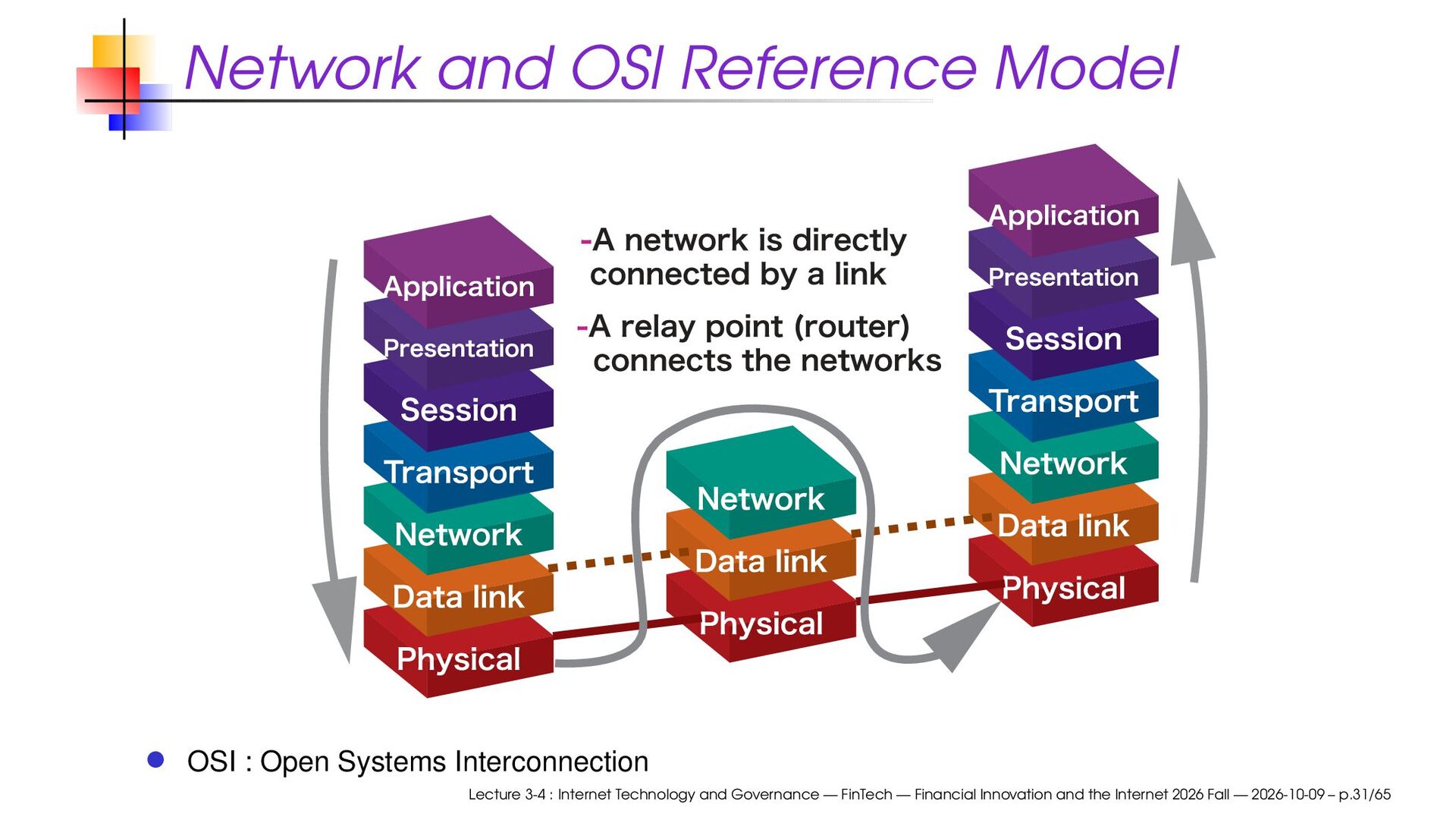
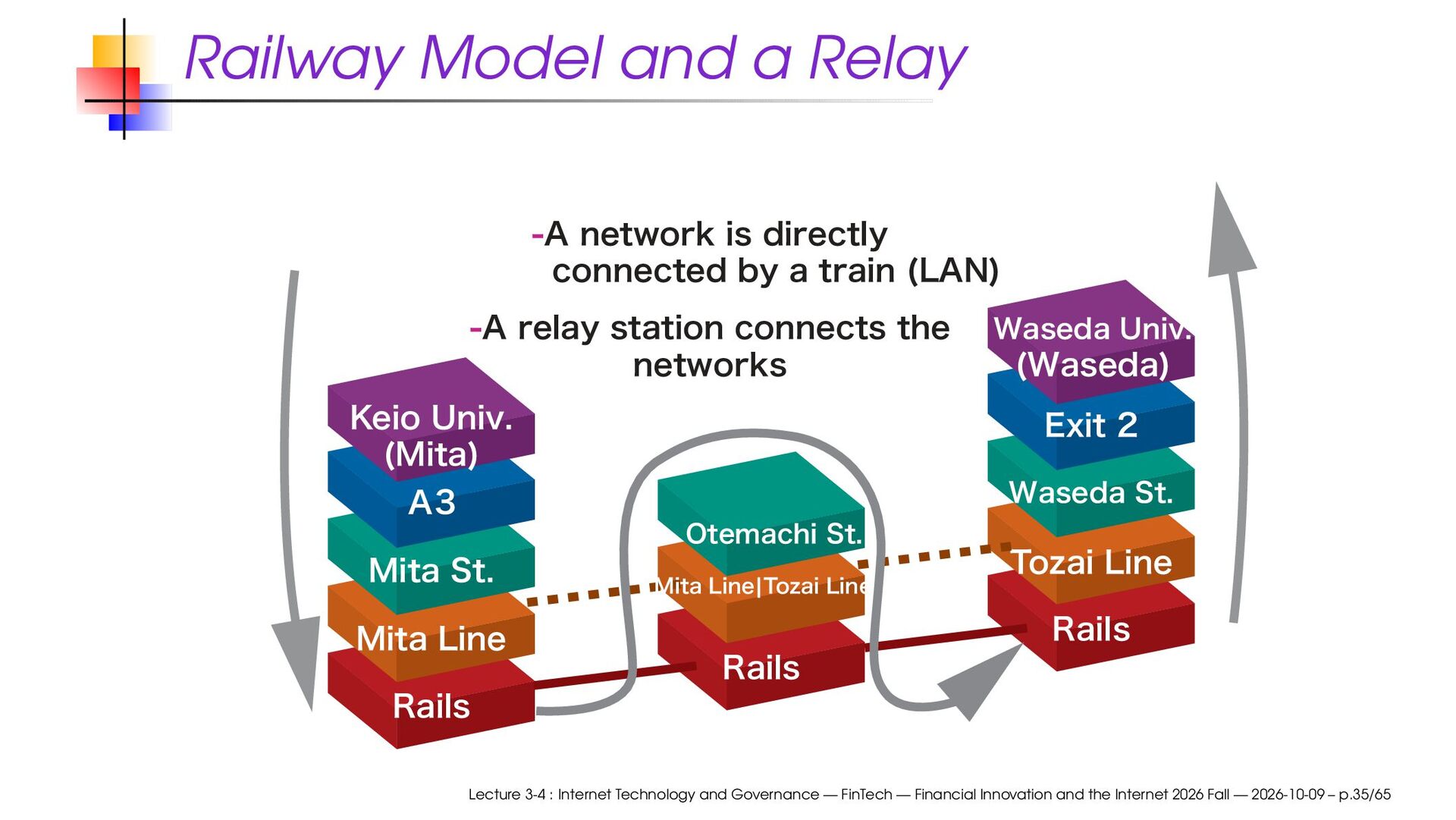
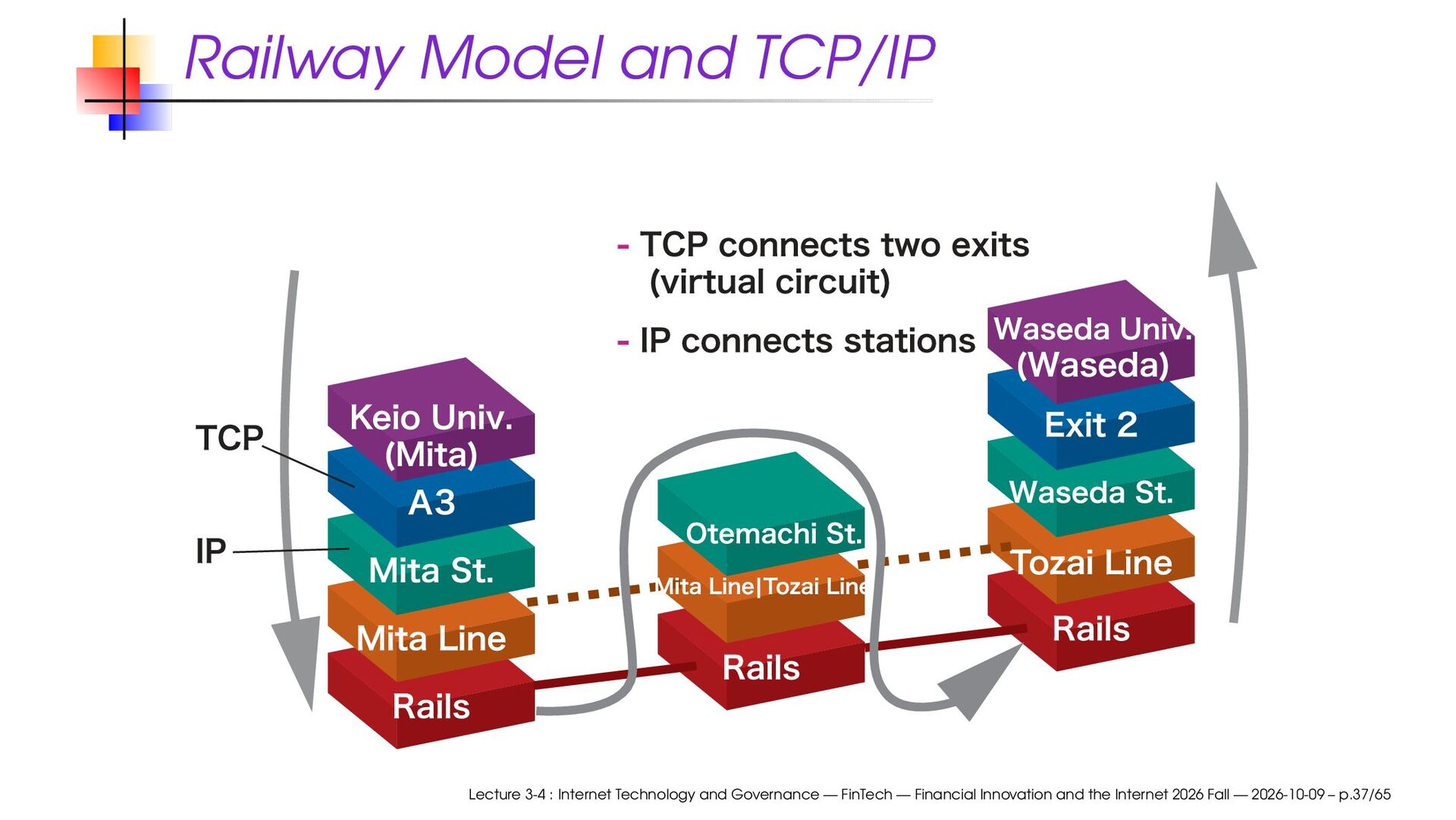
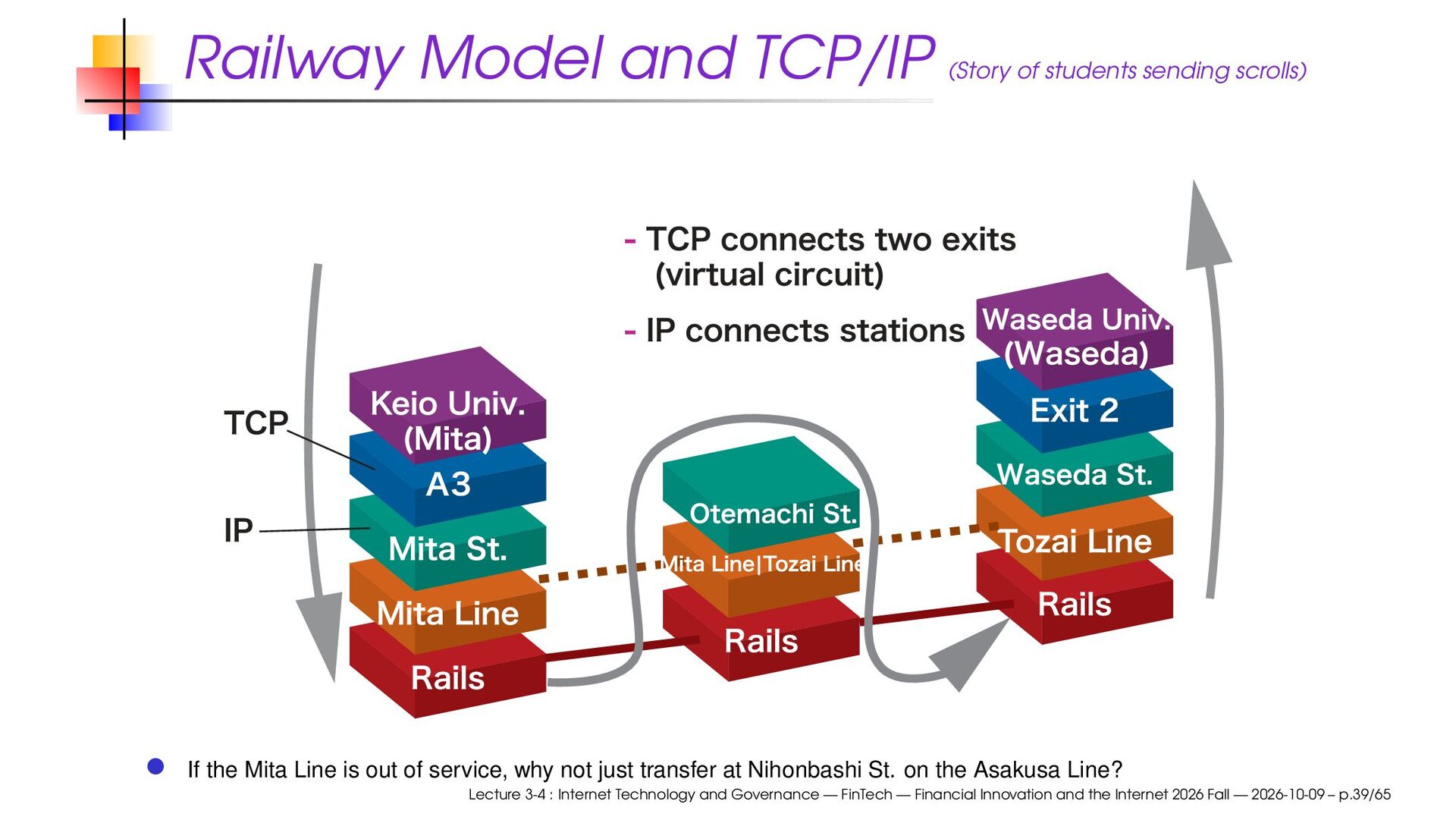
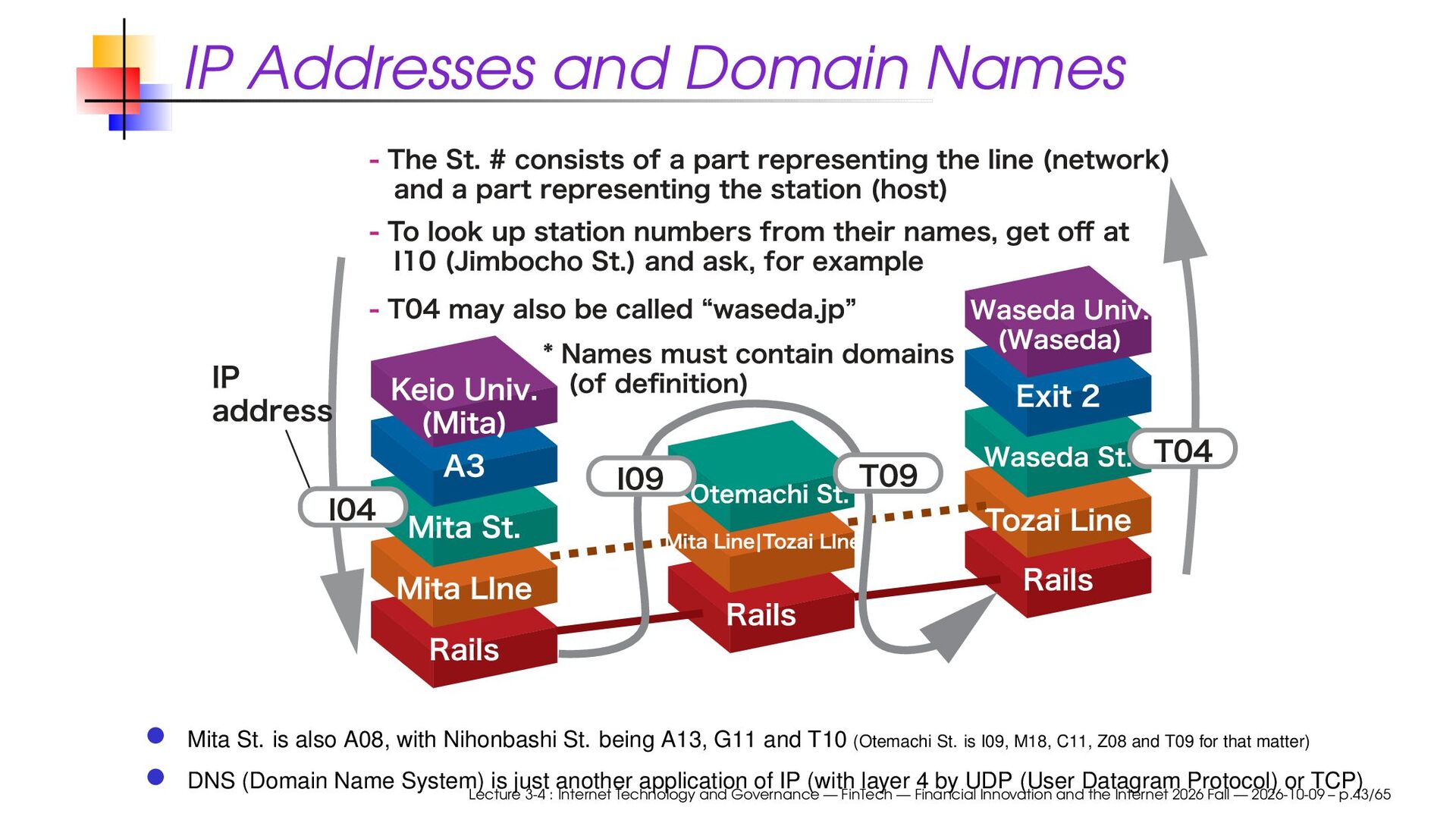
by a train (LAN) -A relay station connects the networks Keio Univ. (Mita) A3 Mita St. Mita Line Rails Waseda Univ. (Waseda) Exit 2 Otemachi St. Mita Line|Tozai Line Rails Waseda St. Tozai Line Rails Lecture 3-4 : Internet Technology and Governance — FinTech — Financial Innovation and the Internet 2026 Fall — 2026-10-09 – p.35/65
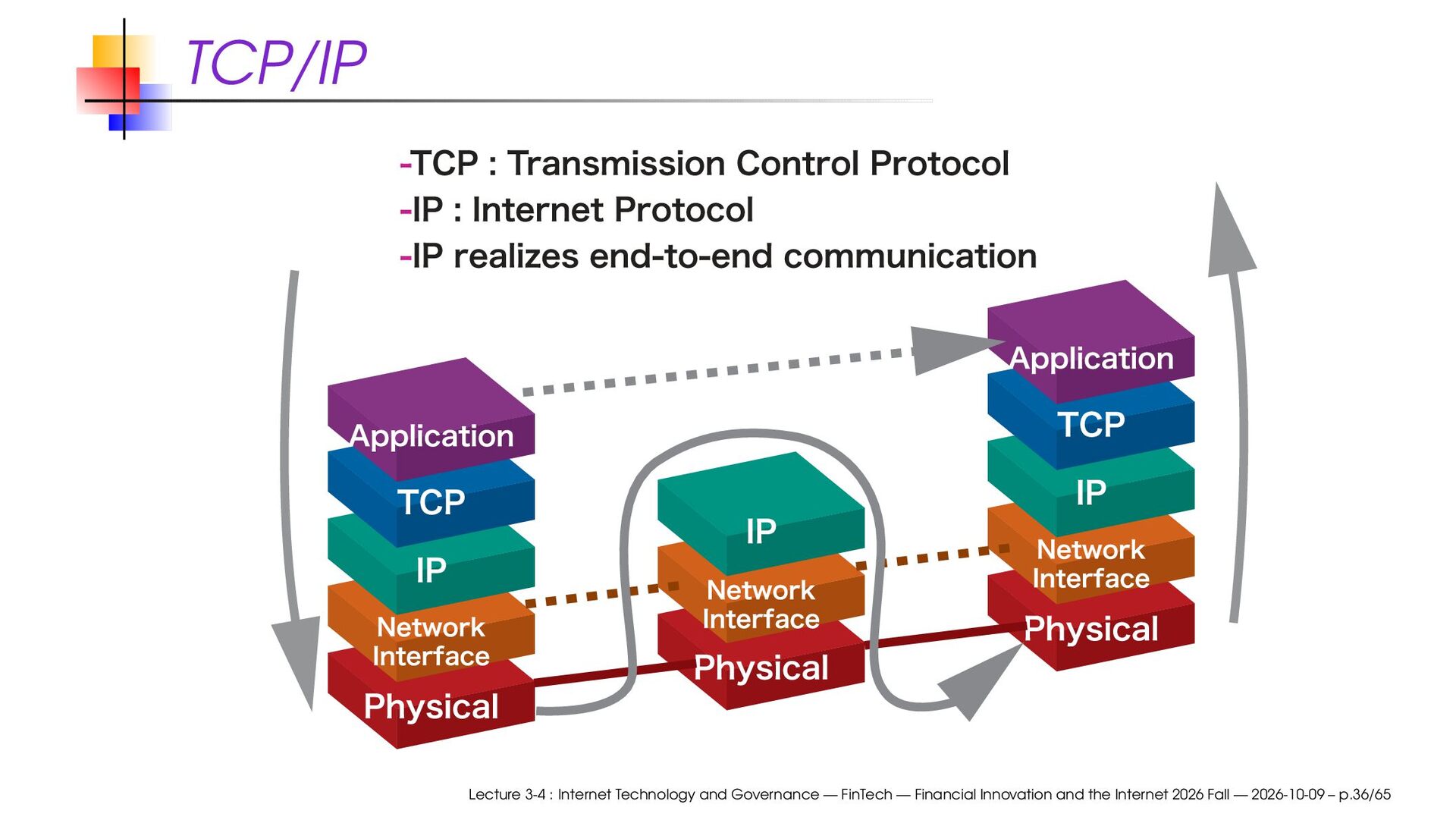
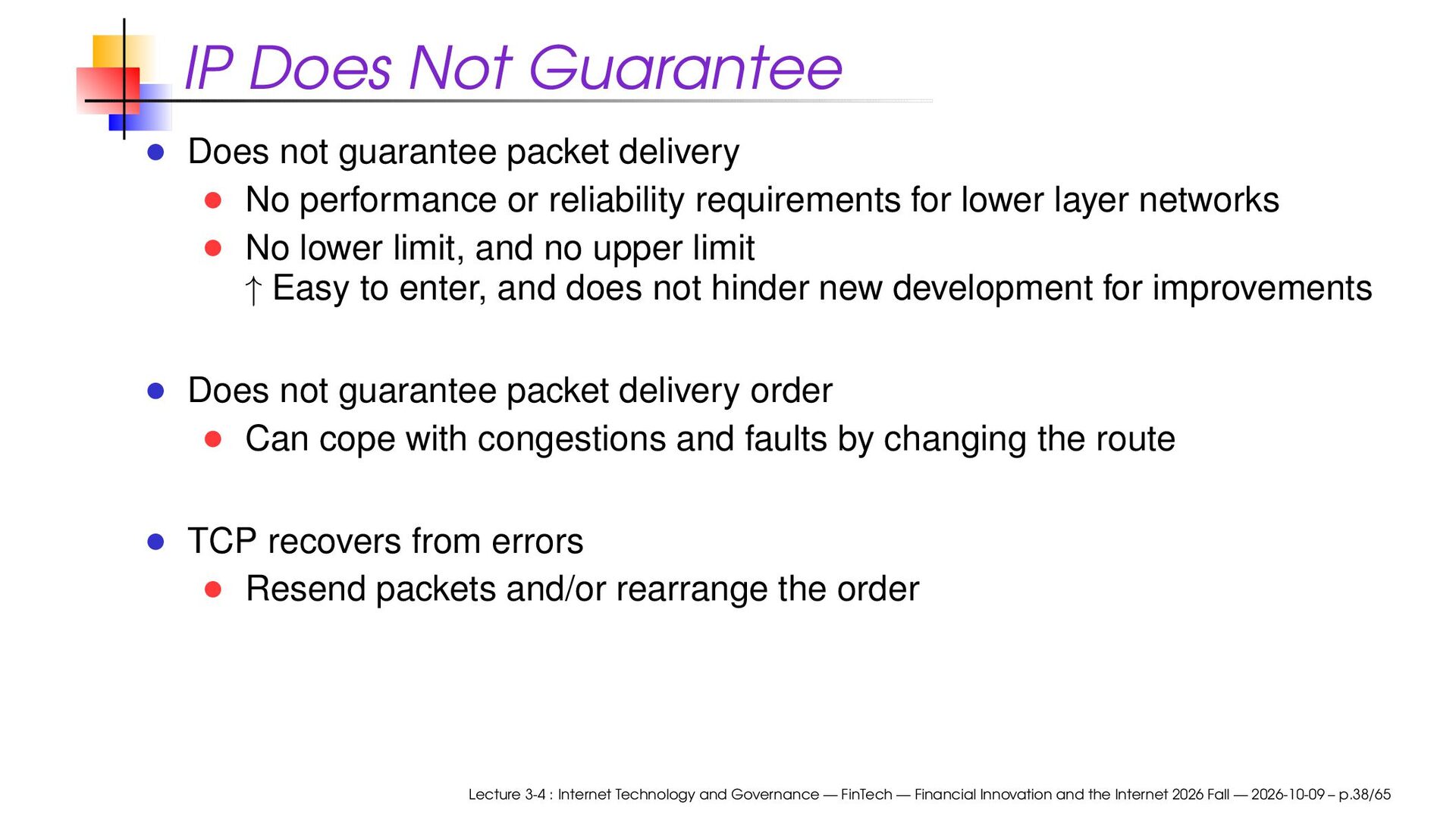
performance or reliability requirements for lower layer networks No lower limit, and no upper limit ↑ Easy to enter, and does not hinder new development for improvements Does not guarantee packet delivery order Can cope with congestions and faults by changing the route TCP recovers from errors Resend packets and/or rearrange the order Lecture 3-4 : Internet Technology and Governance — FinTech — Financial Innovation and the Internet 2026 Fall — 2026-10-09 – p.38/65
the Mita Line is out of service, why not just transfer at Nihonbashi St. on the Asakusa Line? Lecture 3-4 : Internet Technology and Governance — FinTech — Financial Innovation and the Internet 2026 Fall — 2026-10-09 – p.39/65
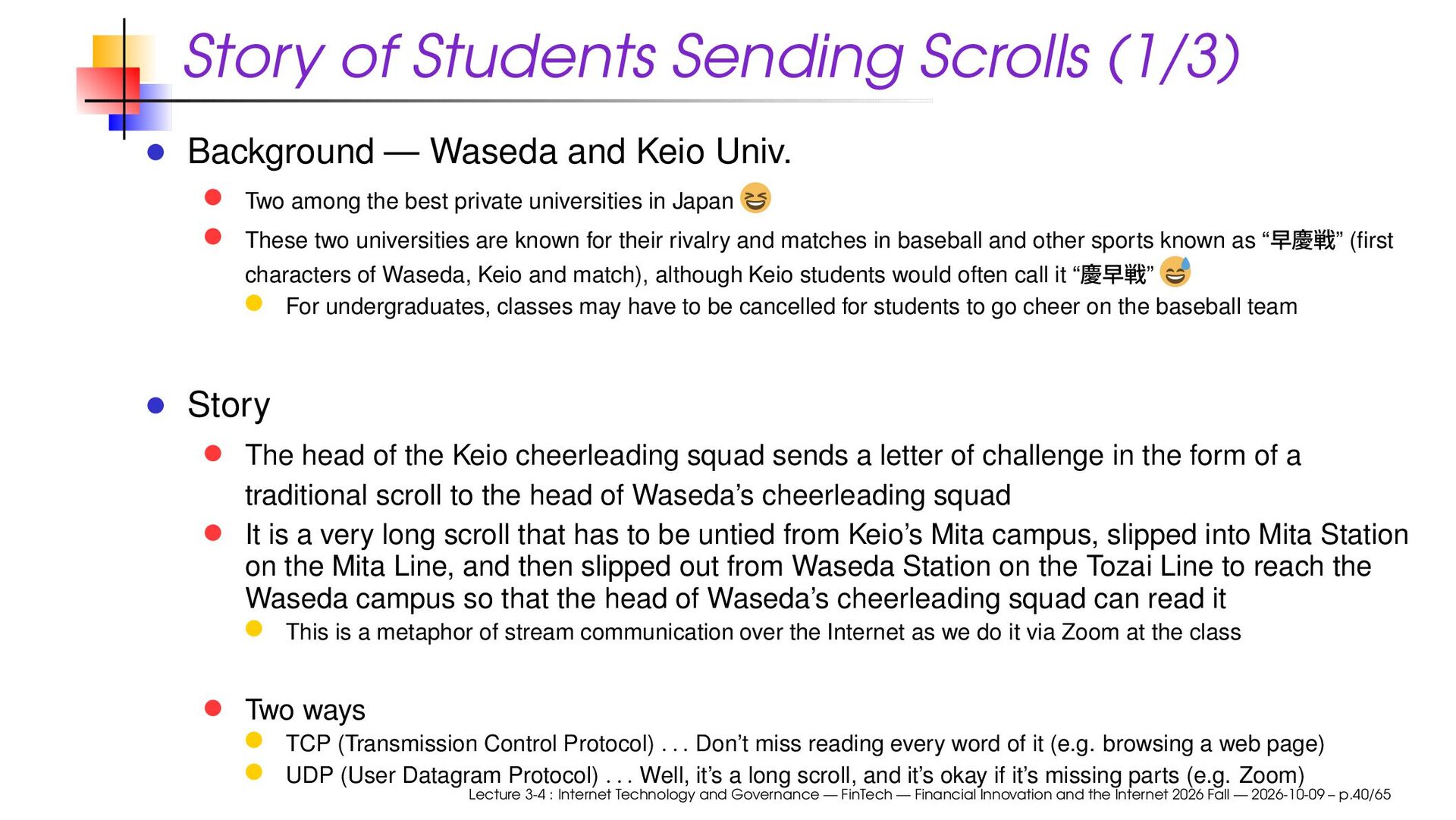
Keio Univ. Two among the best private universities in Japan These two universities are known for their rivalry and matches in baseball and other sports known as “早慶戦” (first characters of Waseda, Keio and match), although Keio students would often call it “慶早戦” For undergraduates, classes may have to be cancelled for students to go cheer on the baseball team Story The head of the Keio cheerleading squad sends a letter of challenge in the form of a traditional scroll to the head of Waseda’s cheerleading squad It is a very long scroll that has to be untied from Keio’s Mita campus, slipped into Mita Station on the Mita Line, and then slipped out from Waseda Station on the Tozai Line to reach the Waseda campus so that the head of Waseda’s cheerleading squad can read it This is a metaphor of stream communication over the Internet as we do it via Zoom at the class Two ways TCP (Transmission Control Protocol) . . . Don’t miss reading every word of it (e.g. browsing a web page) UDP (User Datagram Protocol) . . . Well, it’s a long scroll, and it’s okay if it’s missing parts (e.g. Zoom) Lecture 3-4 : Internet Technology and Governance — FinTech — Financial Innovation and the Internet 2026 Fall — 2026-10-09 – p.40/65
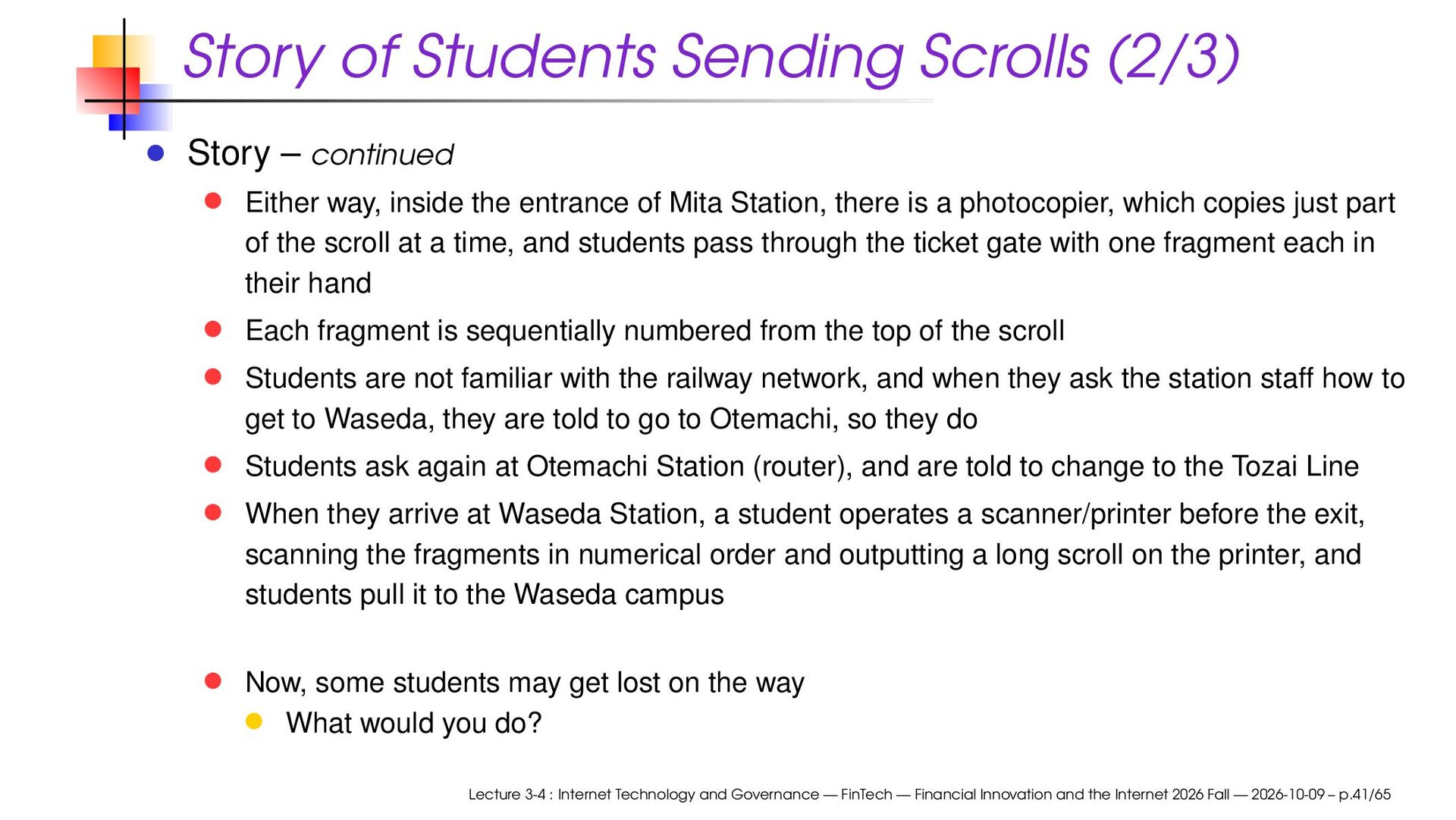
way, inside the entrance of Mita Station, there is a photocopier, which copies just part of the scroll at a time, and students pass through the ticket gate with one fragment each in their hand Each fragment is sequentially numbered from the top of the scroll Students are not familiar with the railway network, and when they ask the station staff how to get to Waseda, they are told to go to Otemachi, so they do Students ask again at Otemachi Station (router), and are told to change to the Tozai Line When they arrive at Waseda Station, a student operates a scanner/printer before the exit, scanning the fragments in numerical order and outputting a long scroll on the printer, and students pull it to the Waseda campus Now, some students may get lost on the way What would you do? Lecture 3-4 : Internet Technology and Governance — FinTech — Financial Innovation and the Internet 2026 Fall — 2026-10-09 – p.41/65
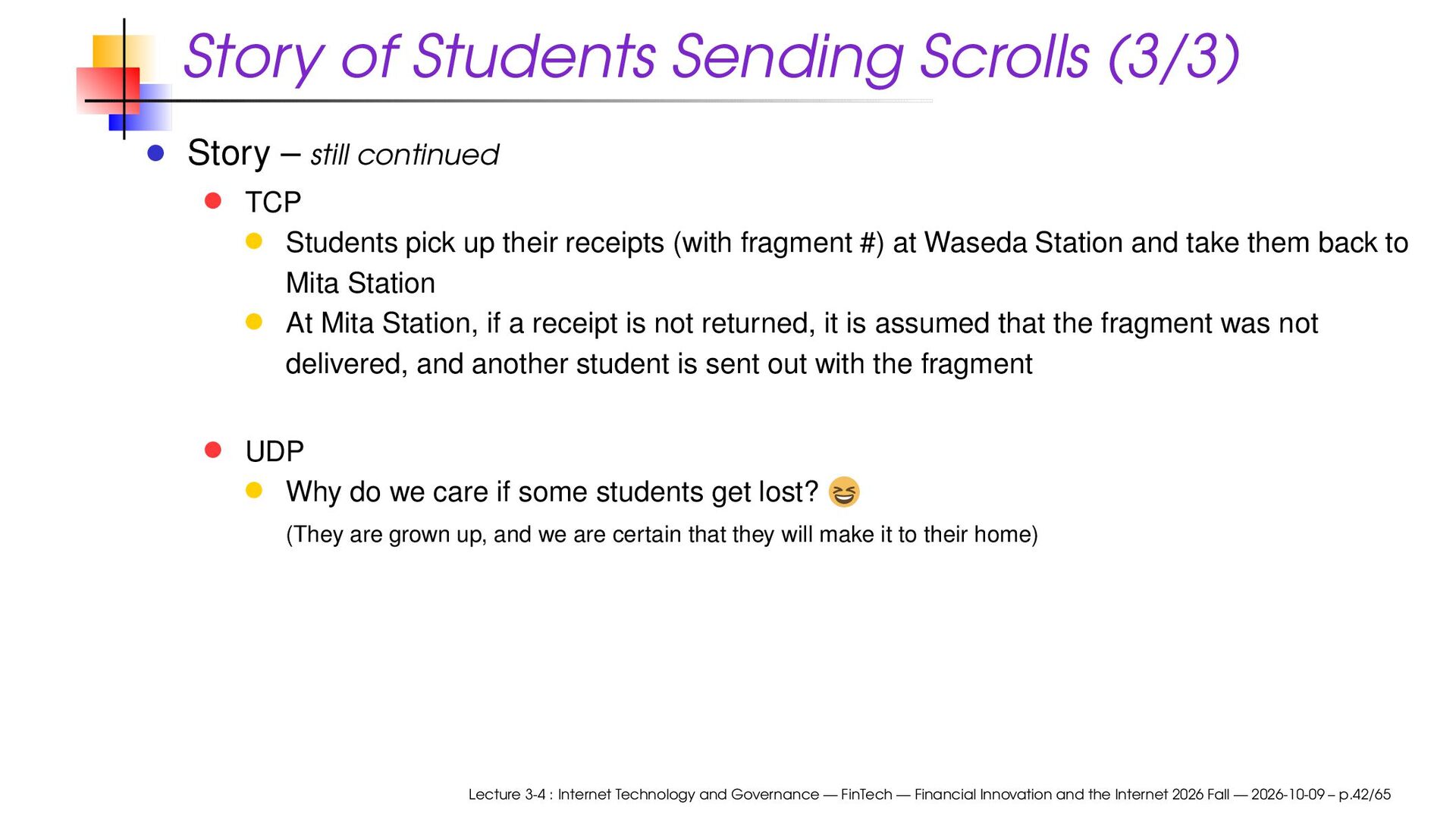
TCP Students pick up their receipts (with fragment #) at Waseda Station and take them back to Mita Station At Mita Station, if a receipt is not returned, it is assumed that the fragment was not delivered, and another student is sent out with the fragment UDP Why do we care if some students get lost? (They are grown up, and we are certain that they will make it to their home) Lecture 3-4 : Internet Technology and Governance — FinTech — Financial Innovation and the Internet 2026 Fall — 2026-10-09 – p.42/65
with Nihonbashi St. being A13, G11 and T10 (Otemachi St. is I09, M18, C11, Z08 and T09 for that matter) DNS (Domain Name System) is just another application of IP (with layer 4 by UDP (User Datagram Protocol) or TCP) Lecture 3-4 : Internet Technology and Governance — FinTech — Financial Innovation and the Internet 2026 Fall — 2026-10-09 – p.43/65
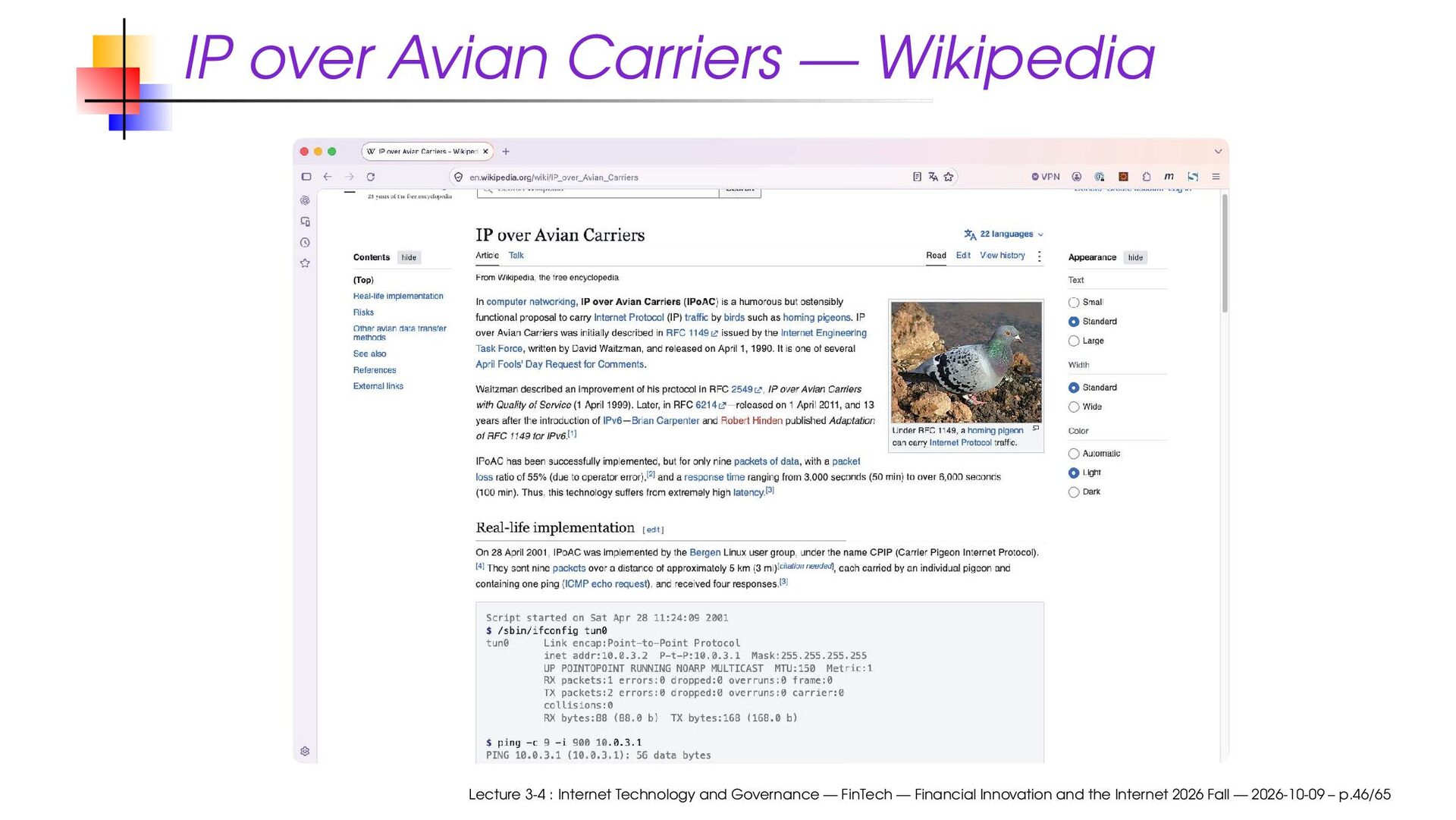
communication technology It doesn’t matter whether packets go through the satellites or the ground It could also use a homing pigeon RFC 1149 (A Standard for the Transmission of IP Datagrams on Avian Carriers) * An RFC (Request For Comments) is a publication often of Internet Standards (or jokes, or both) If there is a good communication technology, we use it IP over Everything Lecture 3-4 : Internet Technology and Governance — FinTech — Financial Innovation and the Internet 2026 Fall — 2026-10-09 – p.45/65
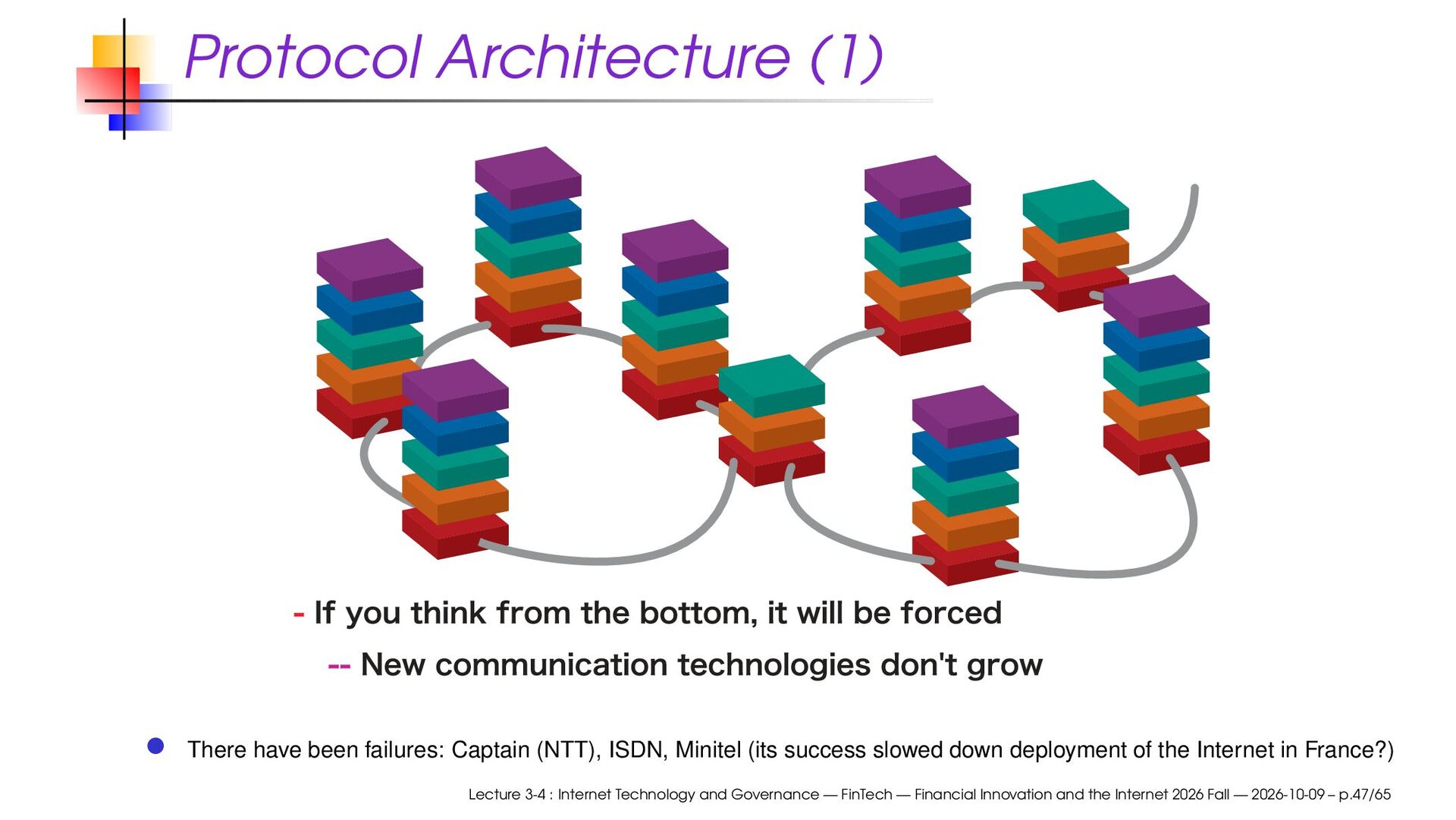
Minitel (its success slowed down deployment of the Internet in France?) Lecture 3-4 : Internet Technology and Governance — FinTech — Financial Innovation and the Internet 2026 Fall — 2026-10-09 – p.47/65
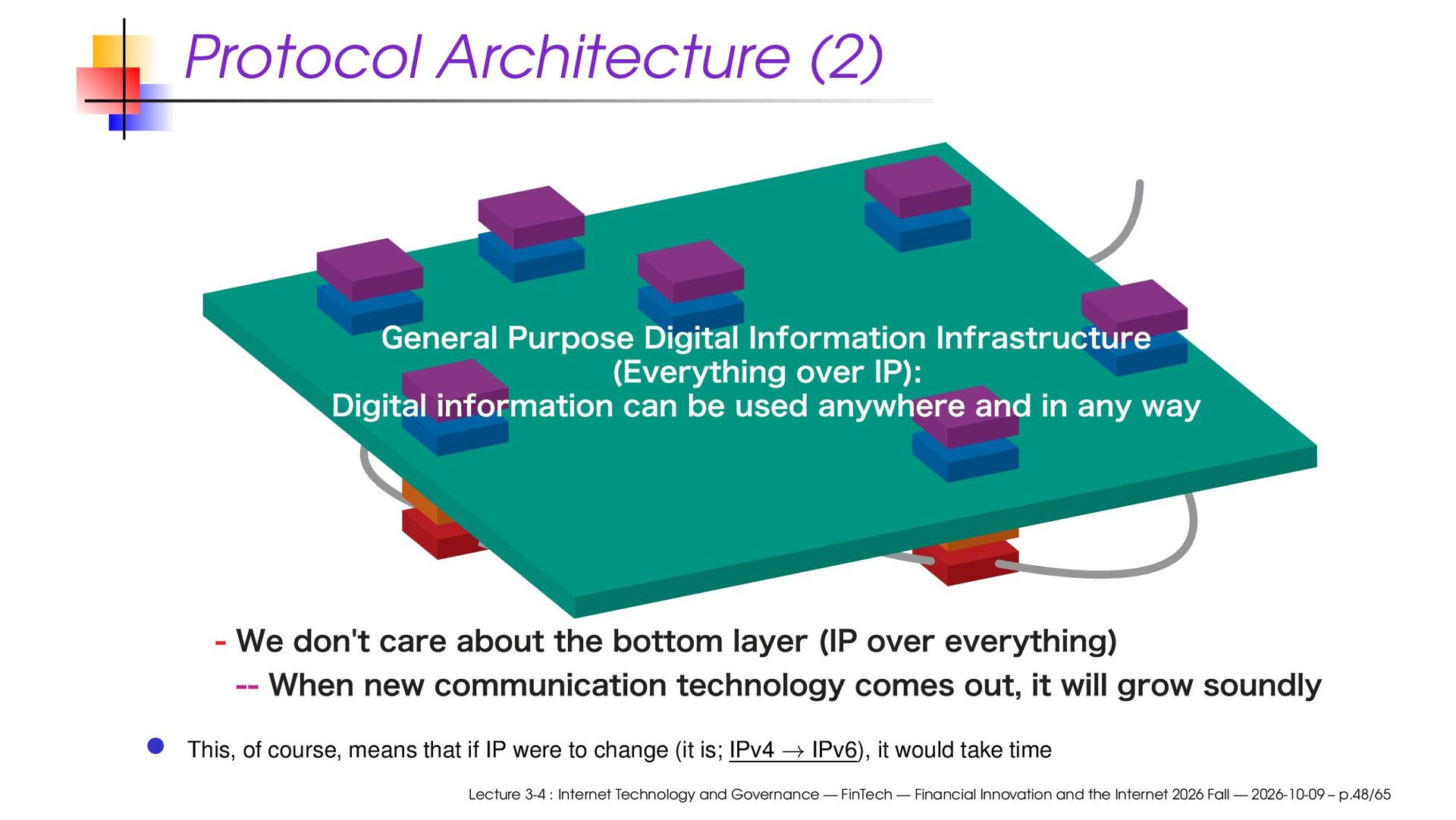
were to change (it is; IPv4 → IPv6), it would take time Lecture 3-4 : Internet Technology and Governance — FinTech — Financial Innovation and the Internet 2026 Fall — 2026-10-09 – p.48/65
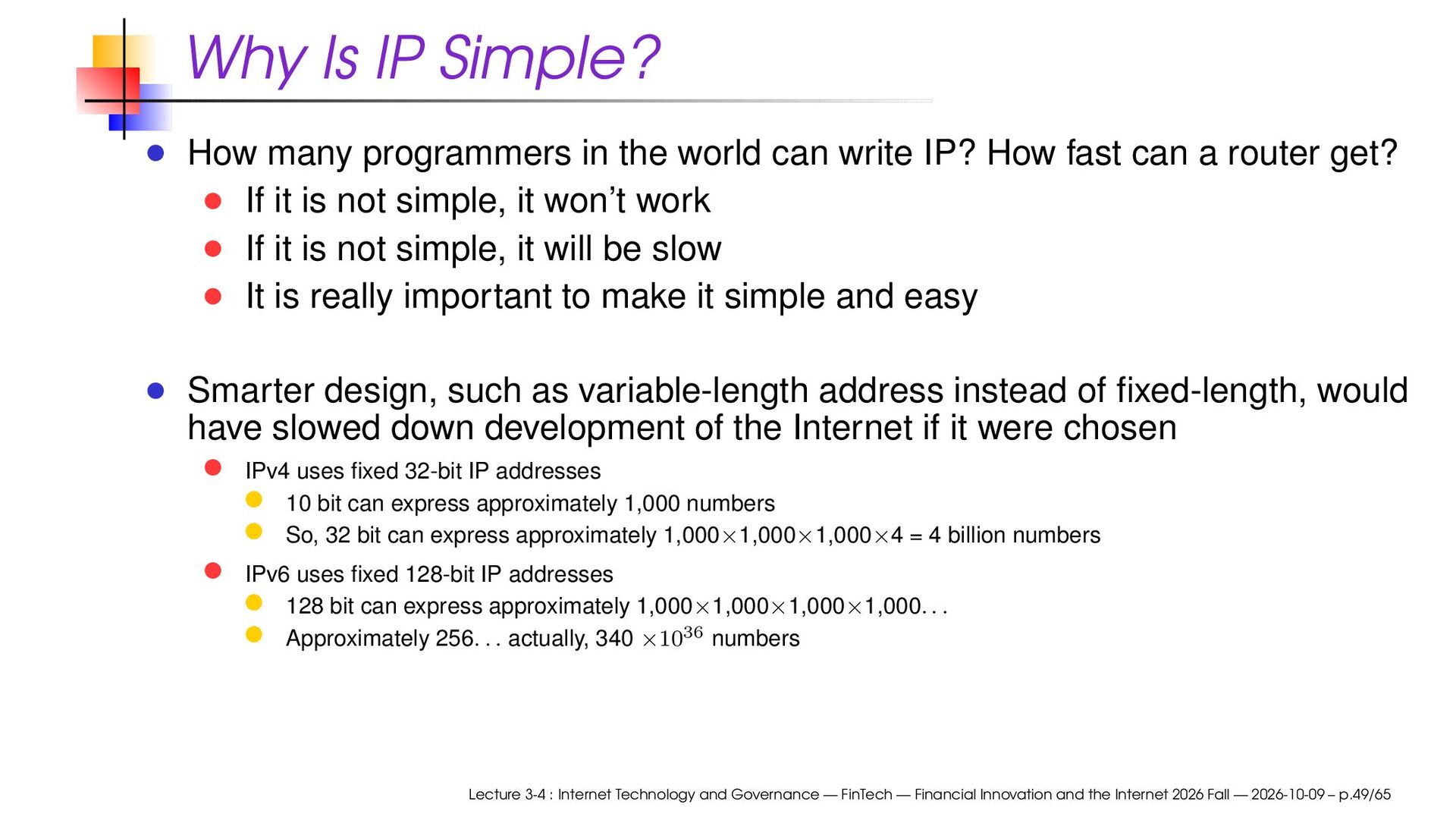
can write IP? How fast can a router get? If it is not simple, it won’t work If it is not simple, it will be slow It is really important to make it simple and easy Smarter design, such as variable-length address instead of fixed-length, would have slowed down development of the Internet if it were chosen IPv4 uses fixed 32-bit IP addresses 10 bit can express approximately 1,000 numbers So, 32 bit can express approximately 1,000×1,000×1,000×4 = 4 billion numbers IPv6 uses fixed 128-bit IP addresses 128 bit can express approximately 1,000×1,000×1,000×1,000. . . Approximately 256. . . actually, 340 ×1036 numbers Lecture 3-4 : Internet Technology and Governance — FinTech — Financial Innovation and the Internet 2026 Fall — 2026-10-09 – p.49/65
of Internet governance What the Internet means Lecture 3-4 : Internet Technology and Governance — FinTech — Financial Innovation and the Internet 2026 Fall — 2026-10-09 – p.50/65
of the whole railway network Lecture 3-4 : Internet Technology and Governance — FinTech — Financial Innovation and the Internet 2026 Fall — 2026-10-09 – p.51/65
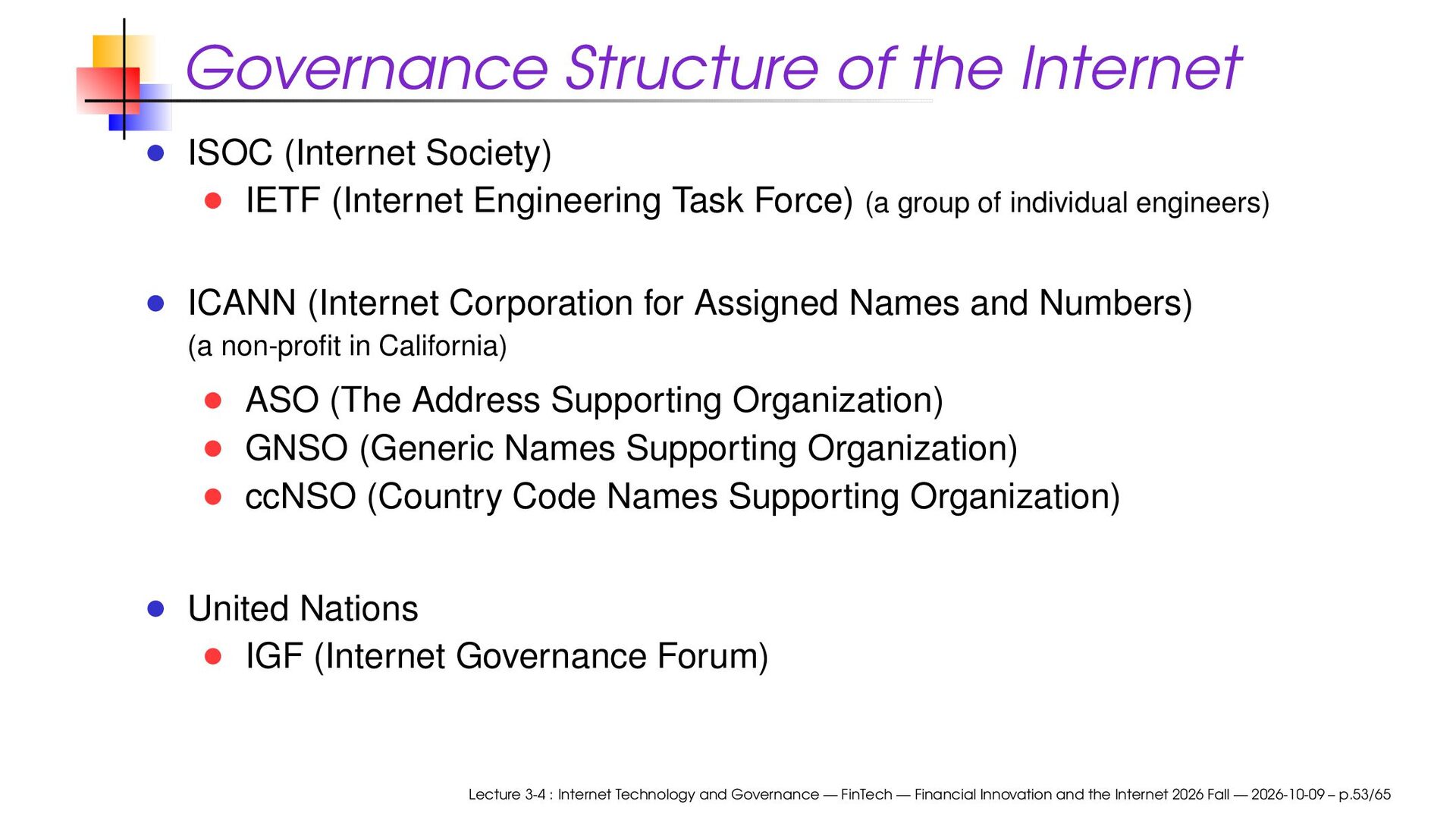
Engineering Task Force) (a group of individual engineers) ICANN (Internet Corporation for Assigned Names and Numbers) (a non-profit in California) ASO (The Address Supporting Organization) GNSO (Generic Names Supporting Organization) ccNSO (Country Code Names Supporting Organization) United Nations IGF (Internet Governance Forum) Lecture 3-4 : Internet Technology and Governance — FinTech — Financial Innovation and the Internet 2026 Fall — 2026-10-09 – p.53/65
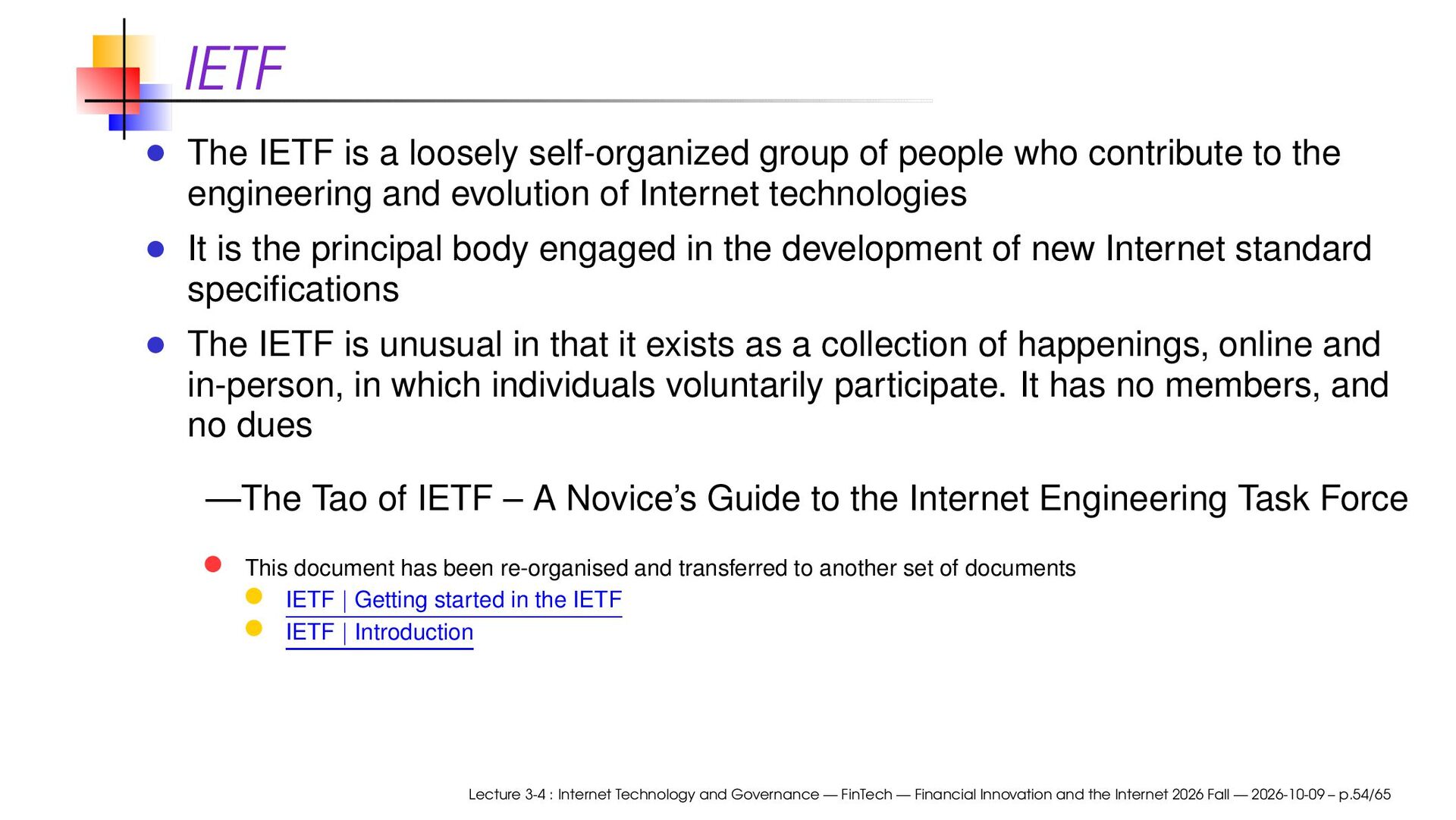
who contribute to the engineering and evolution of Internet technologies It is the principal body engaged in the development of new Internet standard specifications The IETF is unusual in that it exists as a collection of happenings, online and in-person, in which individuals voluntarily participate. It has no members, and no dues —The Tao of IETF – A Novice’s Guide to the Internet Engineering Task Force This document has been re-organised and transferred to another set of documents IETF | Getting started in the IETF IETF | Introduction Lecture 3-4 : Internet Technology and Governance — FinTech — Financial Innovation and the Internet 2026 Fall — 2026-10-09 – p.54/65
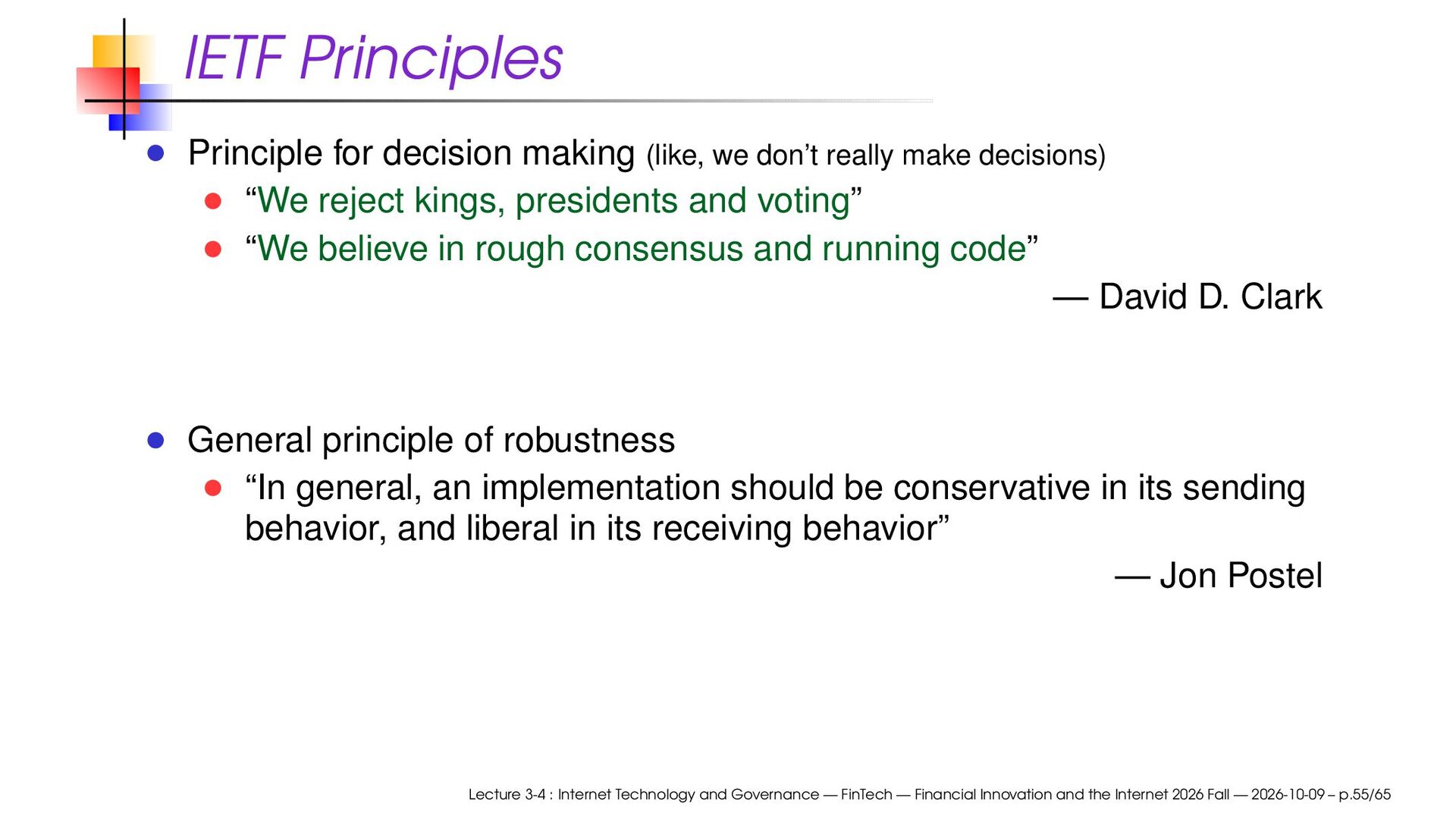
make decisions) “We reject kings, presidents and voting” “We believe in rough consensus and running code” — David D. Clark General principle of robustness “In general, an implementation should be conservative in its sending behavior, and liberal in its receiving behavior” — Jon Postel Lecture 3-4 : Internet Technology and Governance — FinTech — Financial Innovation and the Internet 2026 Fall — 2026-10-09 – p.55/65
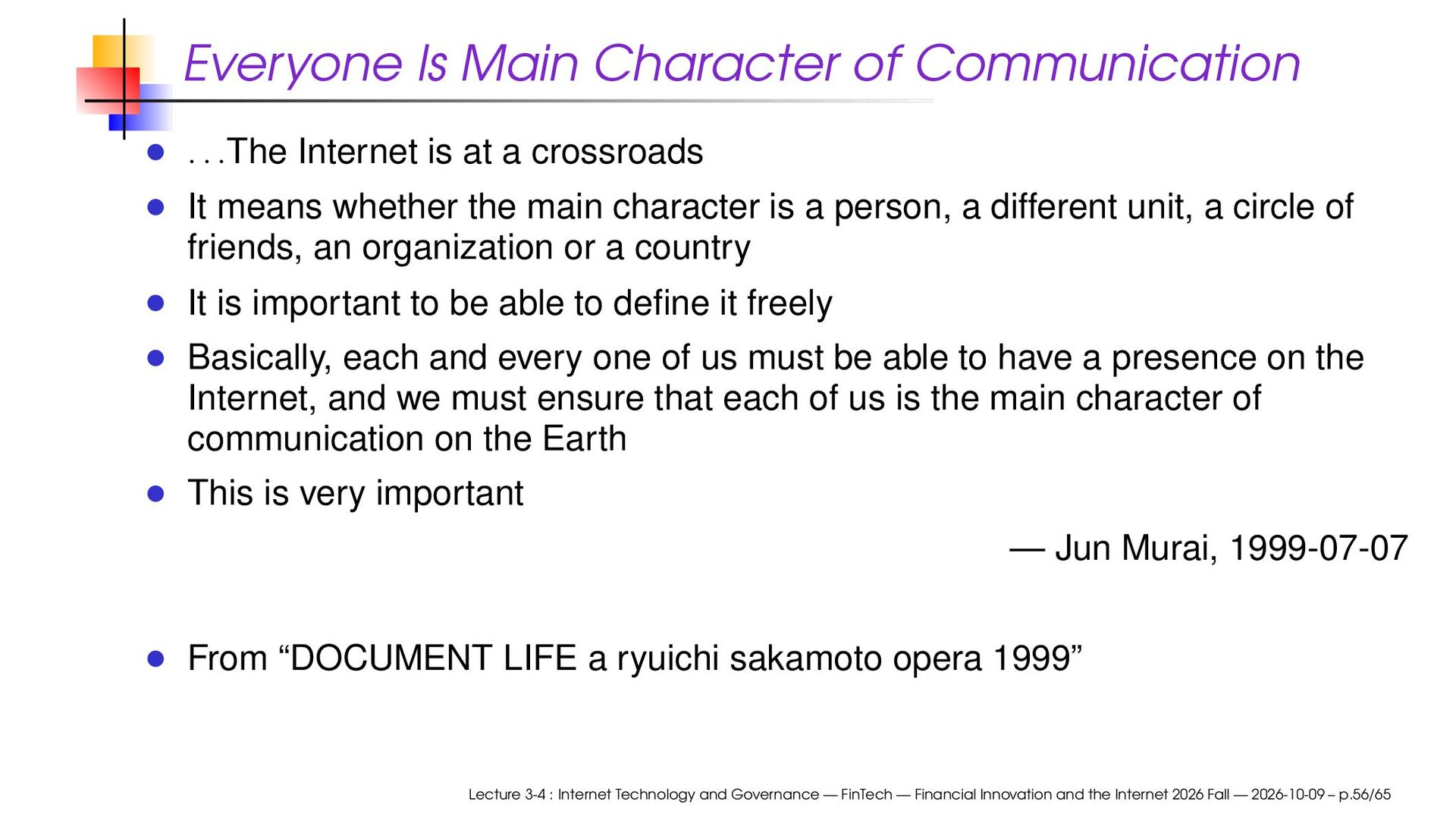
is at a crossroads It means whether the main character is a person, a different unit, a circle of friends, an organization or a country It is important to be able to define it freely Basically, each and every one of us must be able to have a presence on the Internet, and we must ensure that each of us is the main character of communication on the Earth This is very important — Jun Murai, 1999-07-07 From “DOCUMENT LIFE a ryuichi sakamoto opera 1999” Lecture 3-4 : Internet Technology and Governance — FinTech — Financial Innovation and the Internet 2026 Fall — 2026-10-09 – p.56/65
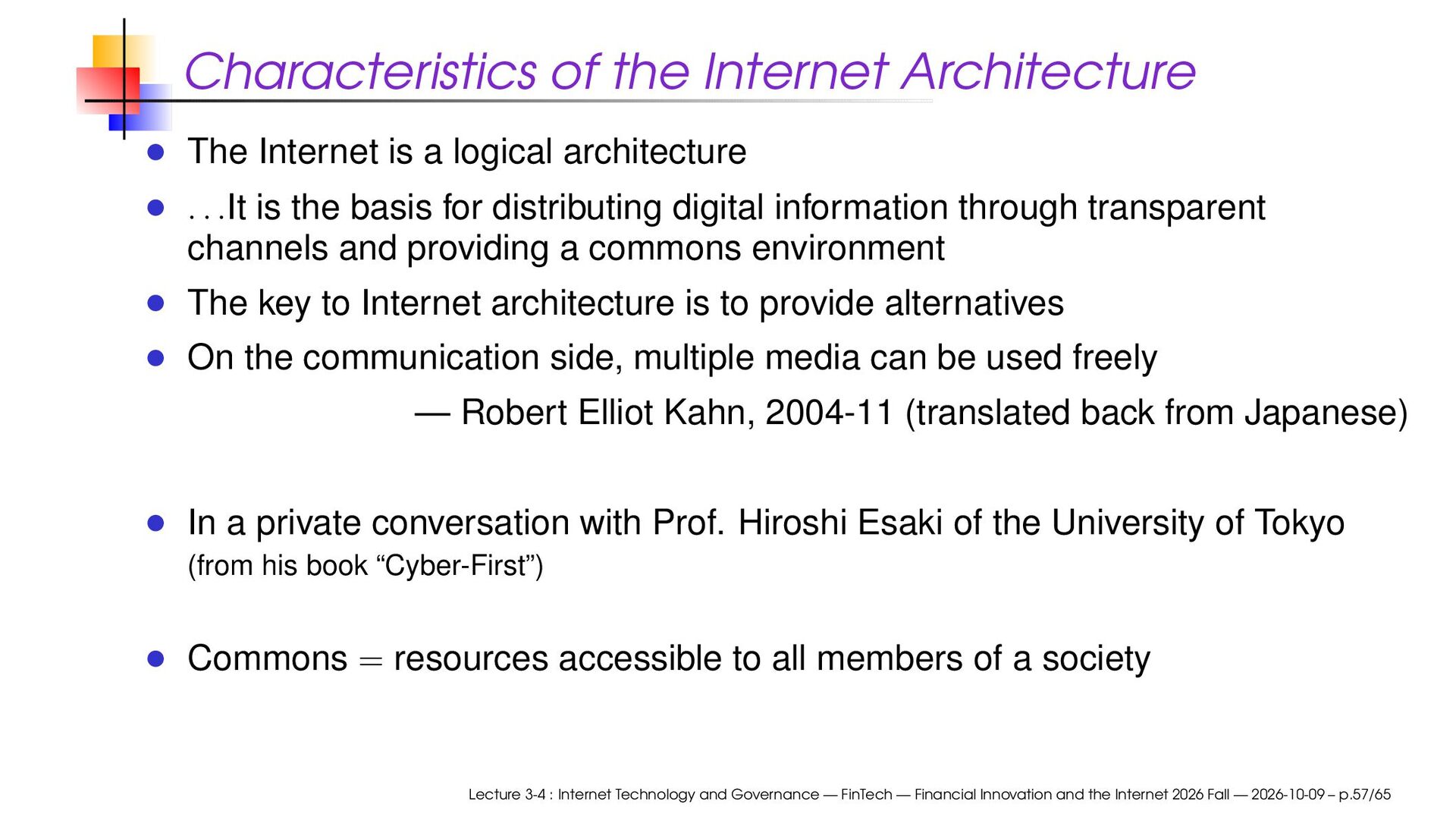
architecture . . .It is the basis for distributing digital information through transparent channels and providing a commons environment The key to Internet architecture is to provide alternatives On the communication side, multiple media can be used freely — Robert Elliot Kahn, 2004-11 (translated back from Japanese) In a private conversation with Prof. Hiroshi Esaki of the University of Tokyo (from his book “Cyber-First”) Commons = resources accessible to all members of a society Lecture 3-4 : Internet Technology and Governance — FinTech — Financial Innovation and the Internet 2026 Fall — 2026-10-09 – p.57/65
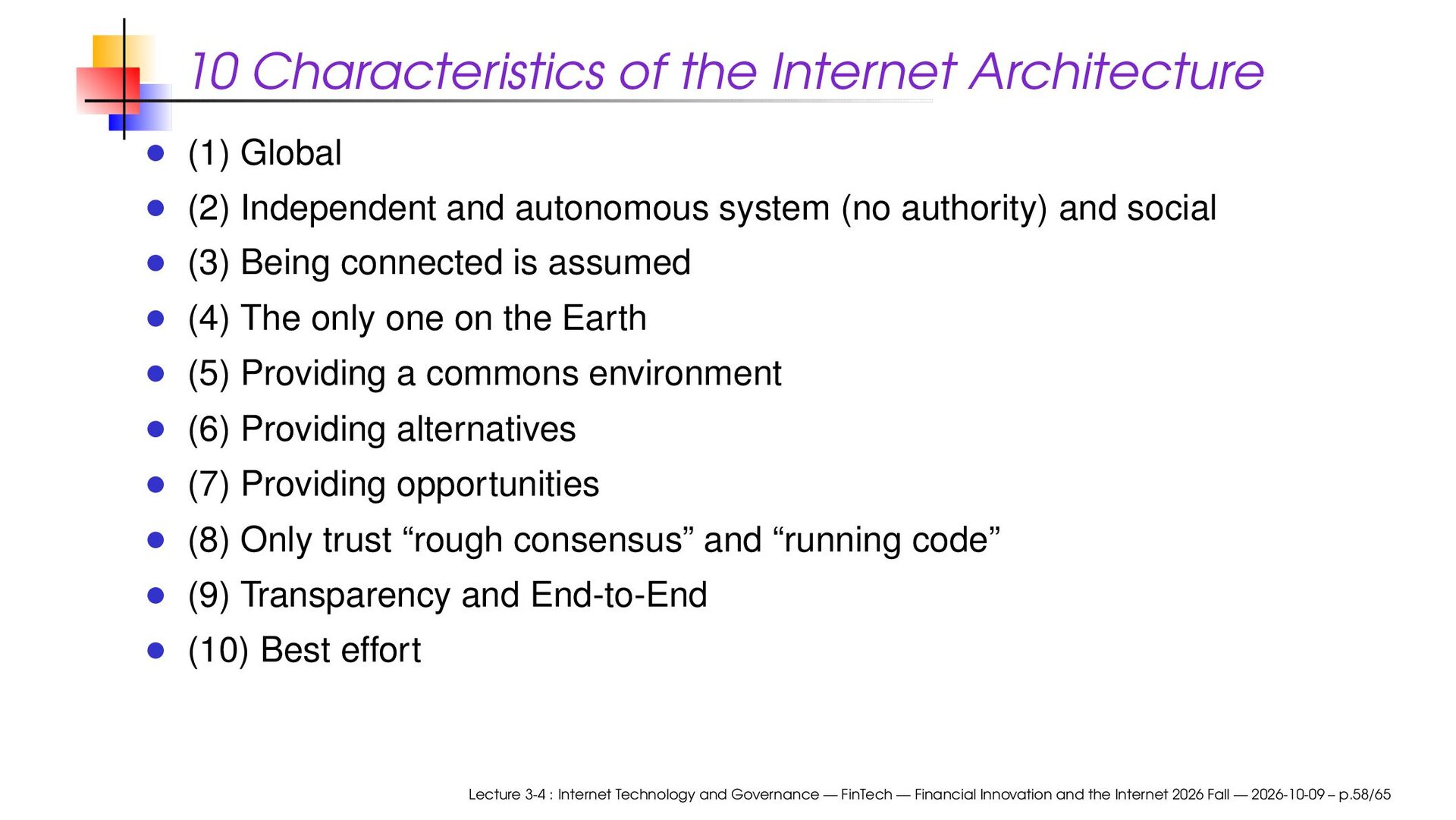
and autonomous system (no authority) and social (3) Being connected is assumed (4) The only one on the Earth (5) Providing a commons environment (6) Providing alternatives (7) Providing opportunities (8) Only trust “rough consensus” and “running code” (9) Transparency and End-to-End (10) Best effort Lecture 3-4 : Internet Technology and Governance — FinTech — Financial Innovation and the Internet 2026 Fall — 2026-10-09 – p.58/65
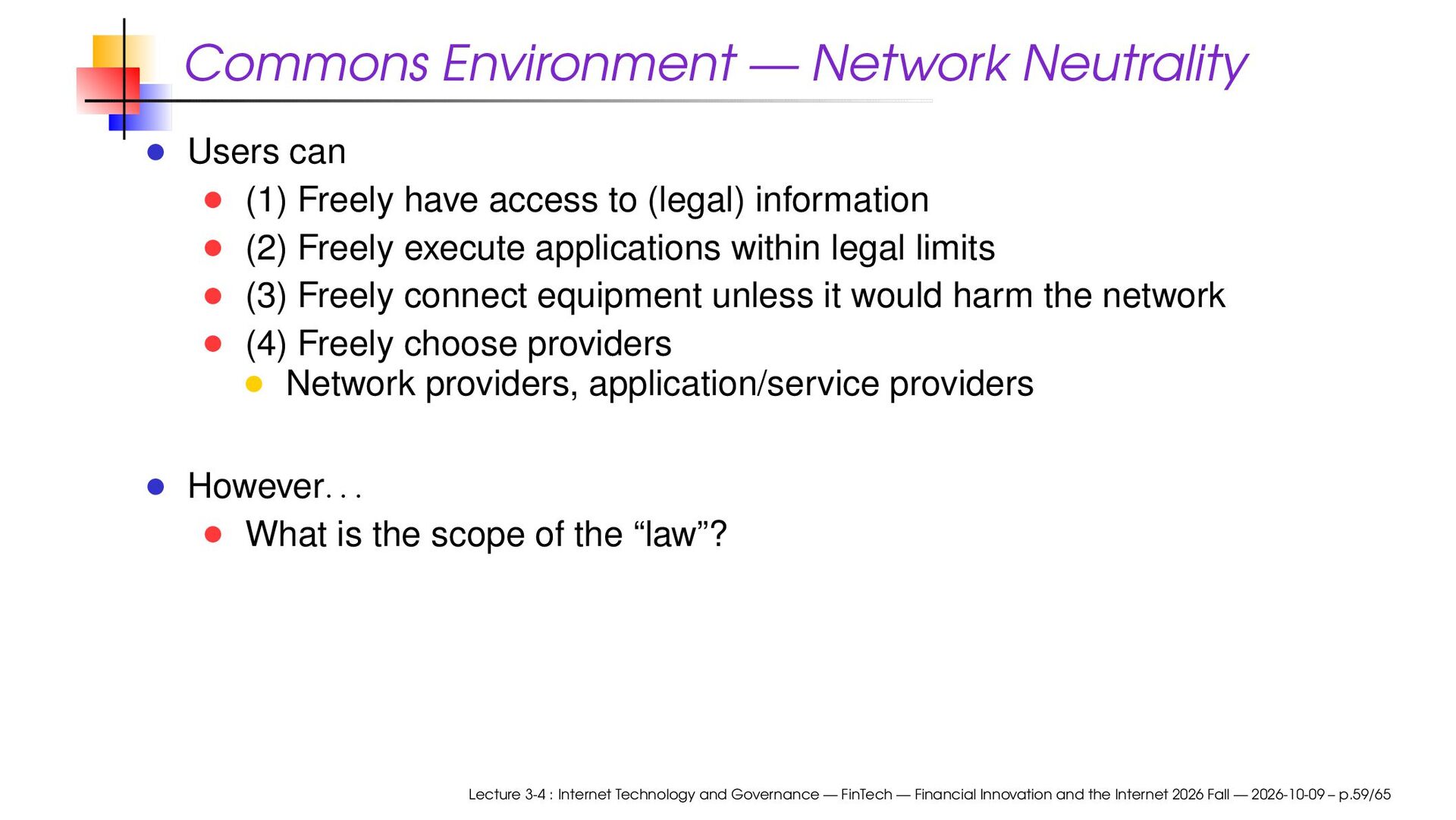
access to (legal) information (2) Freely execute applications within legal limits (3) Freely connect equipment unless it would harm the network (4) Freely choose providers Network providers, application/service providers However. . . What is the scope of the “law”? Lecture 3-4 : Internet Technology and Governance — FinTech — Financial Innovation and the Internet 2026 Fall — 2026-10-09 – p.59/65
followed, there is an incentive to make efforts to improve quality and gain market competitiveness — Hiroshi Esaki, “Cyber-First” Lecture 3-4 : Internet Technology and Governance — FinTech — Financial Innovation and the Internet 2026 Fall — 2026-10-09 – p.60/65
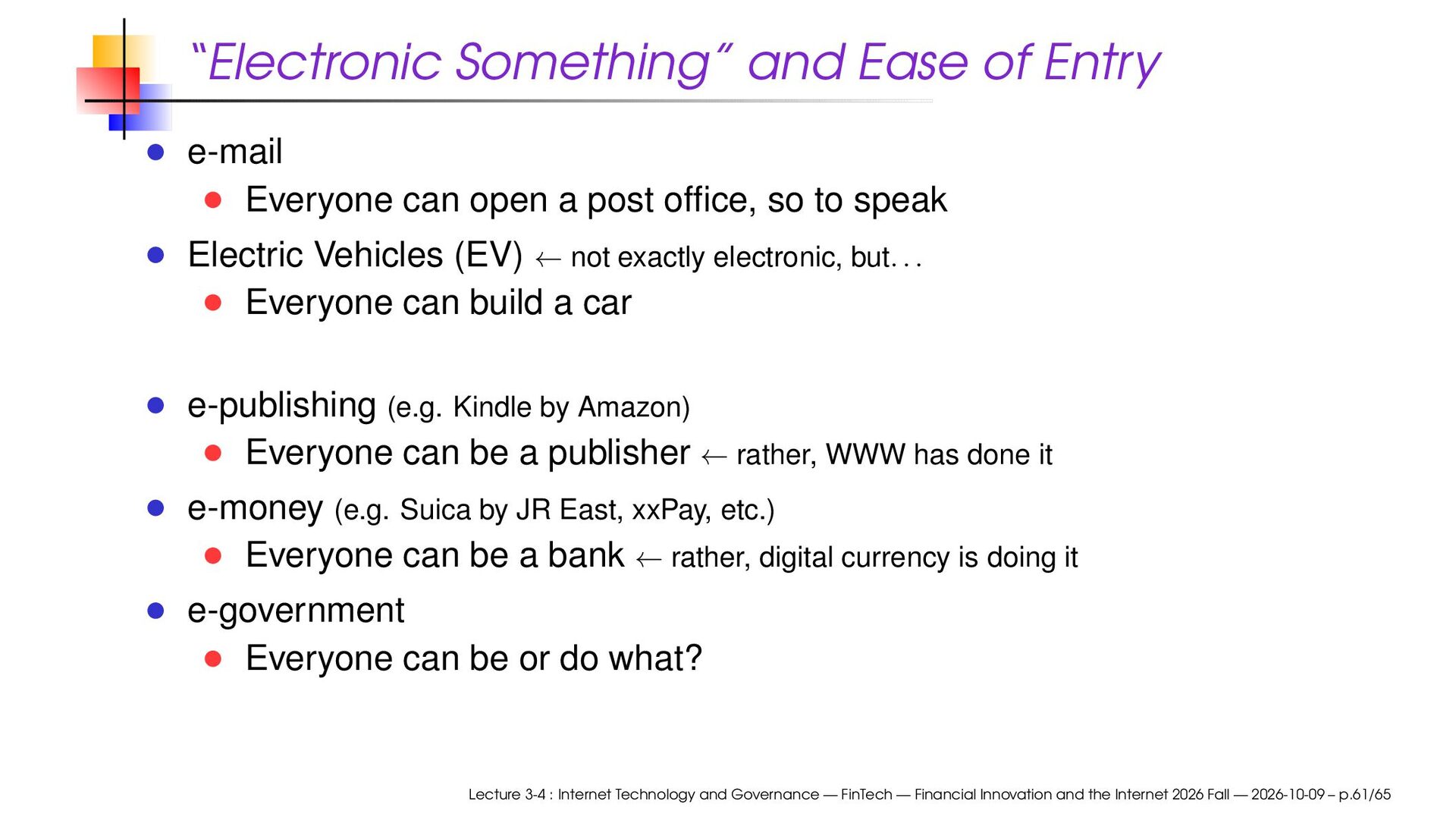
a post office, so to speak Electric Vehicles (EV) ← not exactly electronic, but. . . Everyone can build a car e-publishing (e.g. Kindle by Amazon) Everyone can be a publisher ← rather, WWW has done it e-money (e.g. Suica by JR East, xxPay, etc.) Everyone can be a bank ← rather, digital currency is doing it e-government Everyone can be or do what? Lecture 3-4 : Internet Technology and Governance — FinTech — Financial Innovation and the Internet 2026 Fall — 2026-10-09 – p.61/65
of turning monopoly into commons in some financial areas? Commons = resources accessible to all members of a society Let’s discuss in small groups Let us change seats Lecture 3-4 : Internet Technology and Governance — FinTech — Financial Innovation and the Internet 2026 Fall — 2026-10-09 – p.62/65
the next topic For example, at the time Assignment 1 was given, if you had not known in advance what you have seen today, you would have answered without knowing much about the Internet This time, you may not know what APIs are Look them up on the web or something (or ask AI . . . now, the same thing) But for example, they are what your smart phone apps are using when they need functionality from remote entities (like banks) Lecture 3-4 : Internet Technology and Governance — FinTech — Financial Innovation and the Internet 2026 Fall — 2026-10-09 – p.63/65
will publish APIs (Application Programming Interface), think of a new and unusual example application, and describe it briefly (use AI!) (2) You may add your comments or questions about the class, if any Deadline and how to submit October 13, 2026 at 17:59 JST From Moodle (Q&A Forum) (mandatory) Optionally, you can also post to #assignments channel at Discord So that your classmates can read your report, refer to it, and comment on it Just plain text, please Lecture 3-4 : Internet Technology and Governance — FinTech — Financial Innovation and the Internet 2026 Fall — 2026-10-09 – p.64/65


 ks91
ks91
 keio_smilab
 sansantech
 satoshi7
 sh_fk2
 sue445
 revsystem
 taketakekaho
 maroon1st
 yamahiro
 snoozer05
 gree_tech
 denniskardys
 keithpitt
 axbom
axbom
 aleyda
 marktimemedia
 tomoyanonymous
 katiecoart
 sabderemane
 shpigford
 lara
lara
 lfama
lfama
 soudai