Slides I used for FinTech - Financial Innovation and the Internet 2026 Fall at Graduate School of Business and Finance, Waseda University on October 16, 2026.
the Internet 2026 Fall Lecture 5-6 : The World of Apps Kenji Saito, Graduate School of Business and Finance, Waseda University Lecture 5-6 : The World of Apps — FinTech — Financial Innovation and the Internet 2026 Fall — 2026-10-09 – p. 1/57
reviewing the lectures Recordings are shared via Dropbox and you can ask questions with time-stamped comments Of course, students are encouraged to ask questions in class The recordings could be used for research on (online) learning Transcribed for use and anonymized Will let you know when the necessity arises Lecture 5-6 : The World of Apps — FinTech — Financial Innovation and the Internet 2026 Fall — 2026-10-09 – p. 2/57
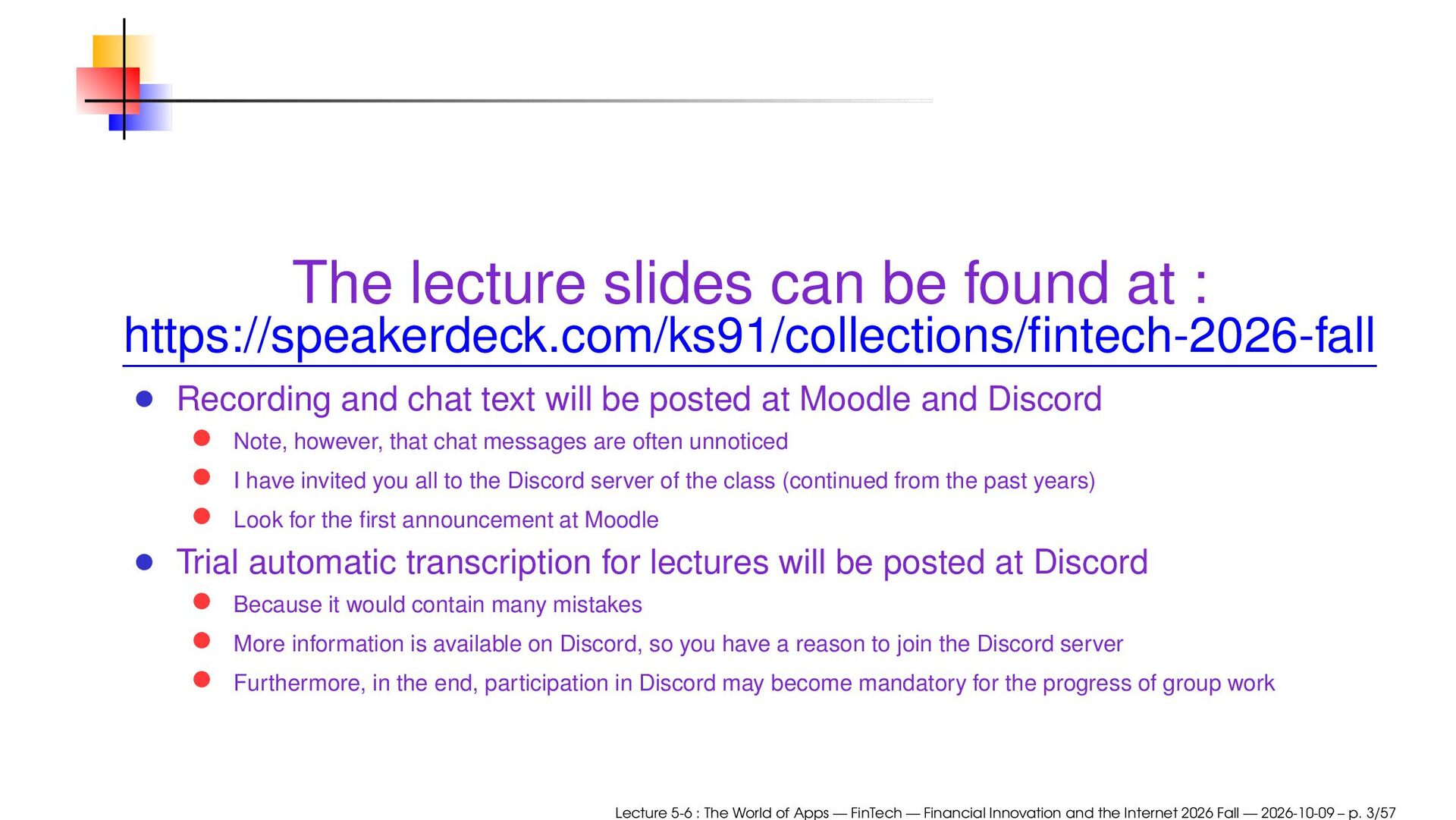
and chat text will be posted at Moodle and Discord Note, however, that chat messages are often unnoticed I have invited you all to the Discord server of the class (continued from the past years) Look for the first announcement at Moodle Trial automatic transcription for lectures will be posted at Discord Because it would contain many mistakes More information is available on Discord, so you have a reason to join the Discord server Furthermore, in the end, participation in Discord may become mandatory for the progress of group work Lecture 5-6 : The World of Apps — FinTech — Financial Innovation and the Internet 2026 Fall — 2026-10-09 – p. 3/57
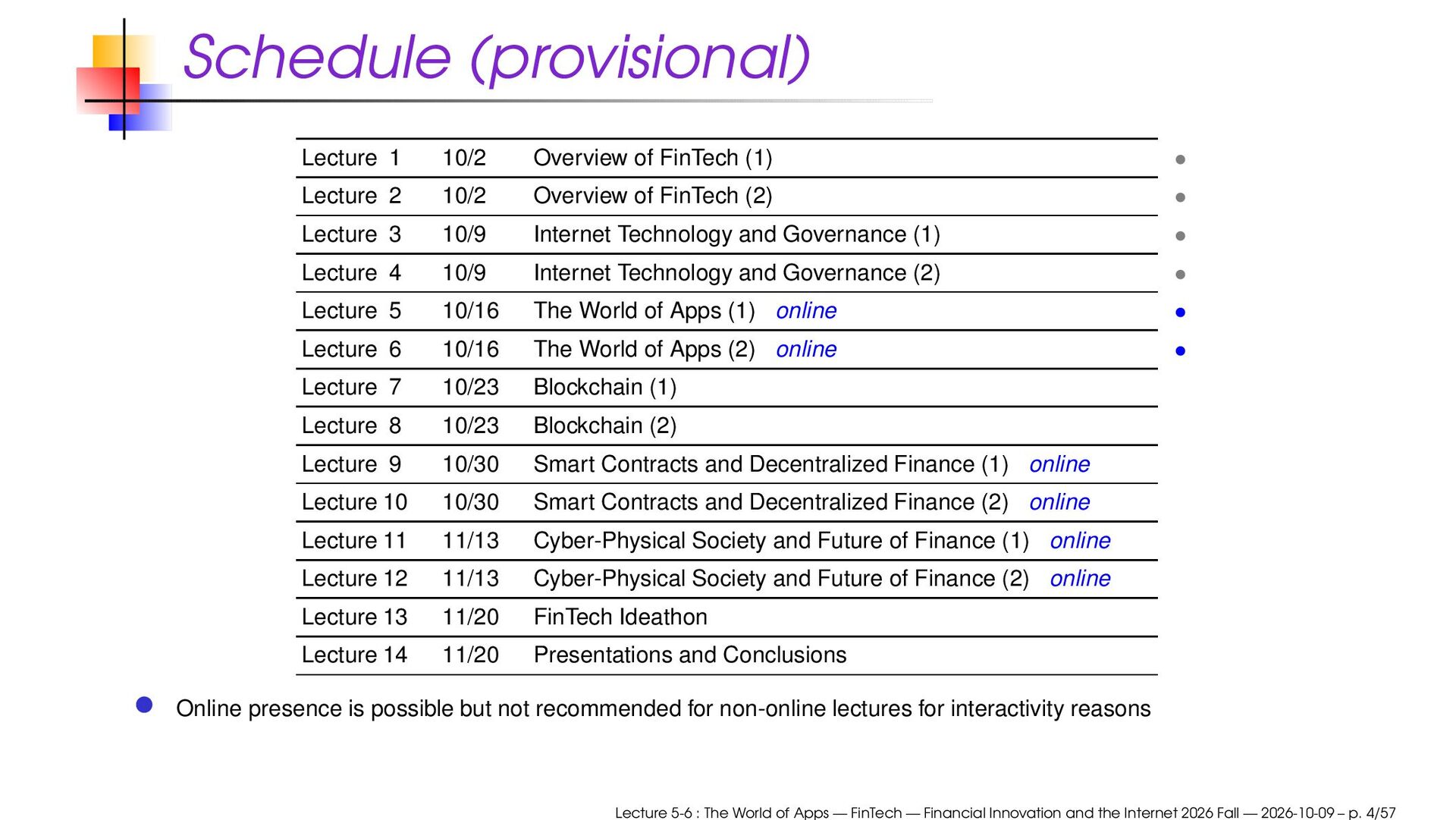
Lecture 2 10/2 Overview of FinTech (2) • Lecture 3 10/9 Internet Technology and Governance (1) • Lecture 4 10/9 Internet Technology and Governance (2) • Lecture 5 10/16 The World of Apps (1) online • Lecture 6 10/16 The World of Apps (2) online • Lecture 7 10/23 Blockchain (1) Lecture 8 10/23 Blockchain (2) Lecture 9 10/30 Smart Contracts and Decentralized Finance (1) online Lecture 10 10/30 Smart Contracts and Decentralized Finance (2) online Lecture 11 11/13 Cyber-Physical Society and Future of Finance (1) online Lecture 12 11/13 Cyber-Physical Society and Future of Finance (2) online Lecture 13 11/20 FinTech Ideathon Lecture 14 11/20 Presentations and Conclusions Online presence is possible but not recommended for non-online lectures for interactivity reasons Lecture 5-6 : The World of Apps — FinTech — Financial Innovation and the Internet 2026 Fall — 2026-10-09 – p. 4/57
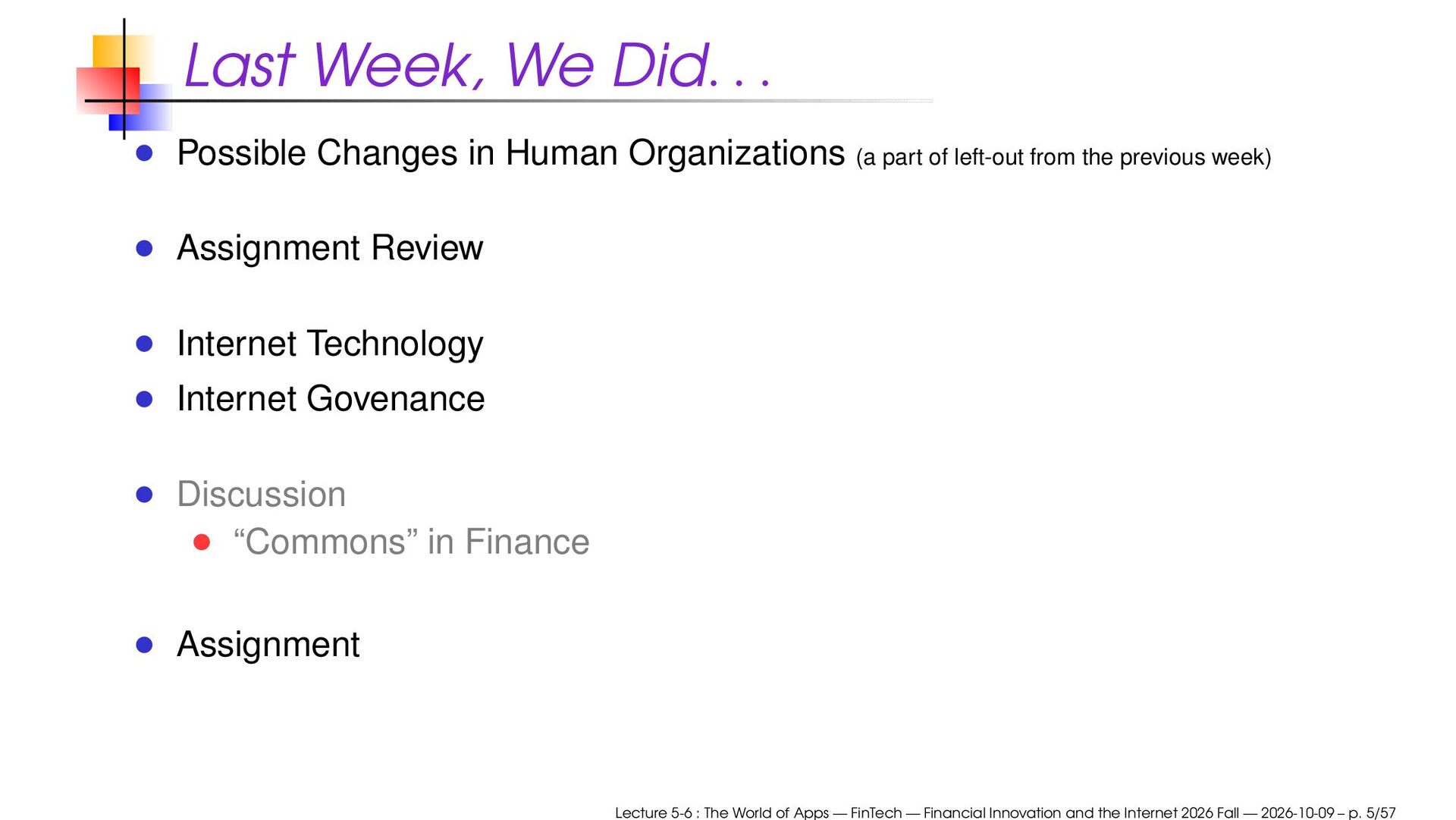
Organizations (a part of left-out from the previous week) Assignment Review Internet Technology Internet Govenance Discussion “Commons” in Finance Assignment Lecture 5-6 : The World of Apps — FinTech — Financial Innovation and the Internet 2026 Fall — 2026-10-09 – p. 5/57
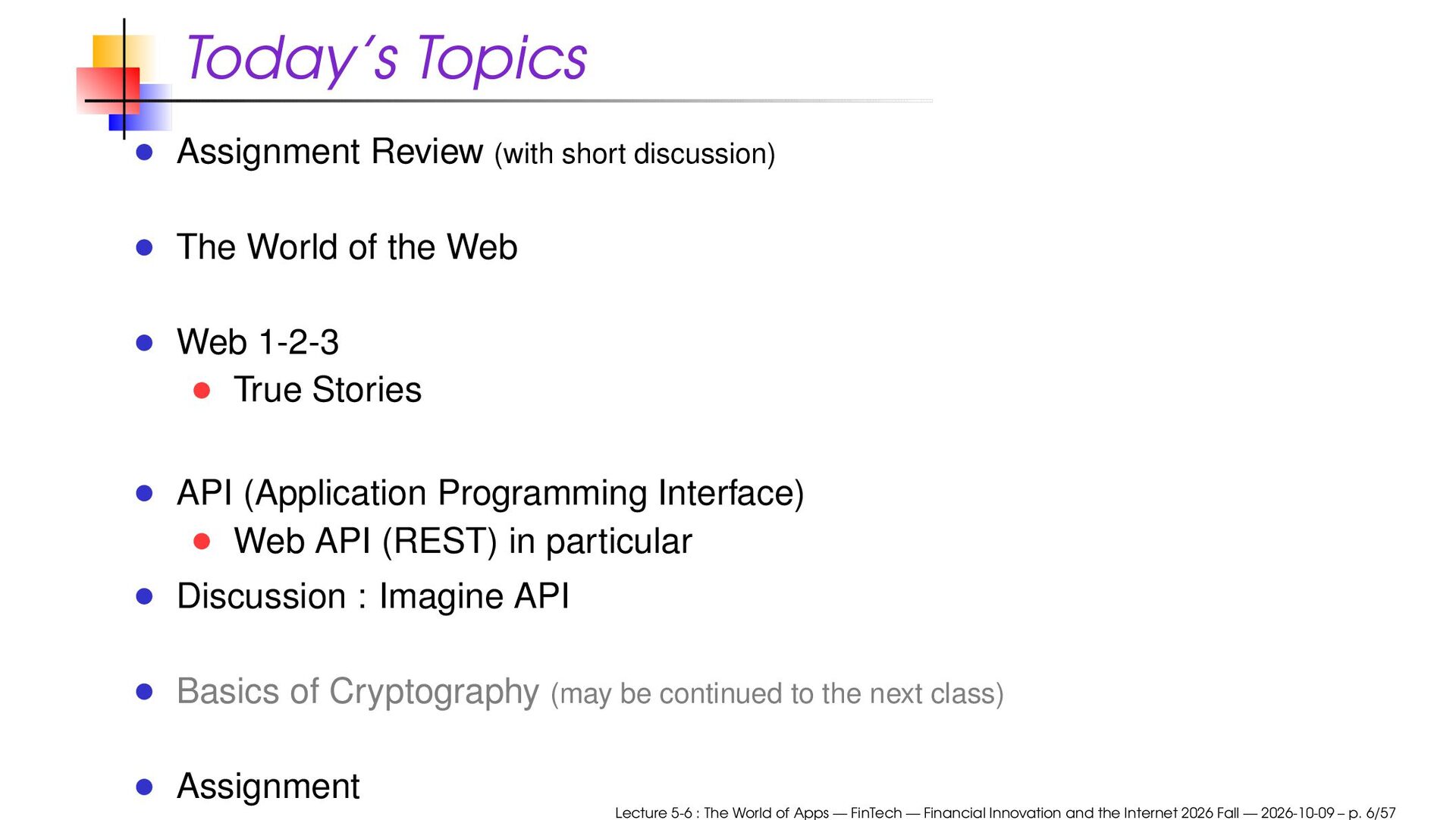
the Web Web 1-2-3 True Stories API (Application Programming Interface) Web API (REST) in particular Discussion : Imagine API Basics of Cryptography (may be continued to the next class) Assignment Lecture 5-6 : The World of Apps — FinTech — Financial Innovation and the Internet 2026 Fall — 2026-10-09 – p. 6/57
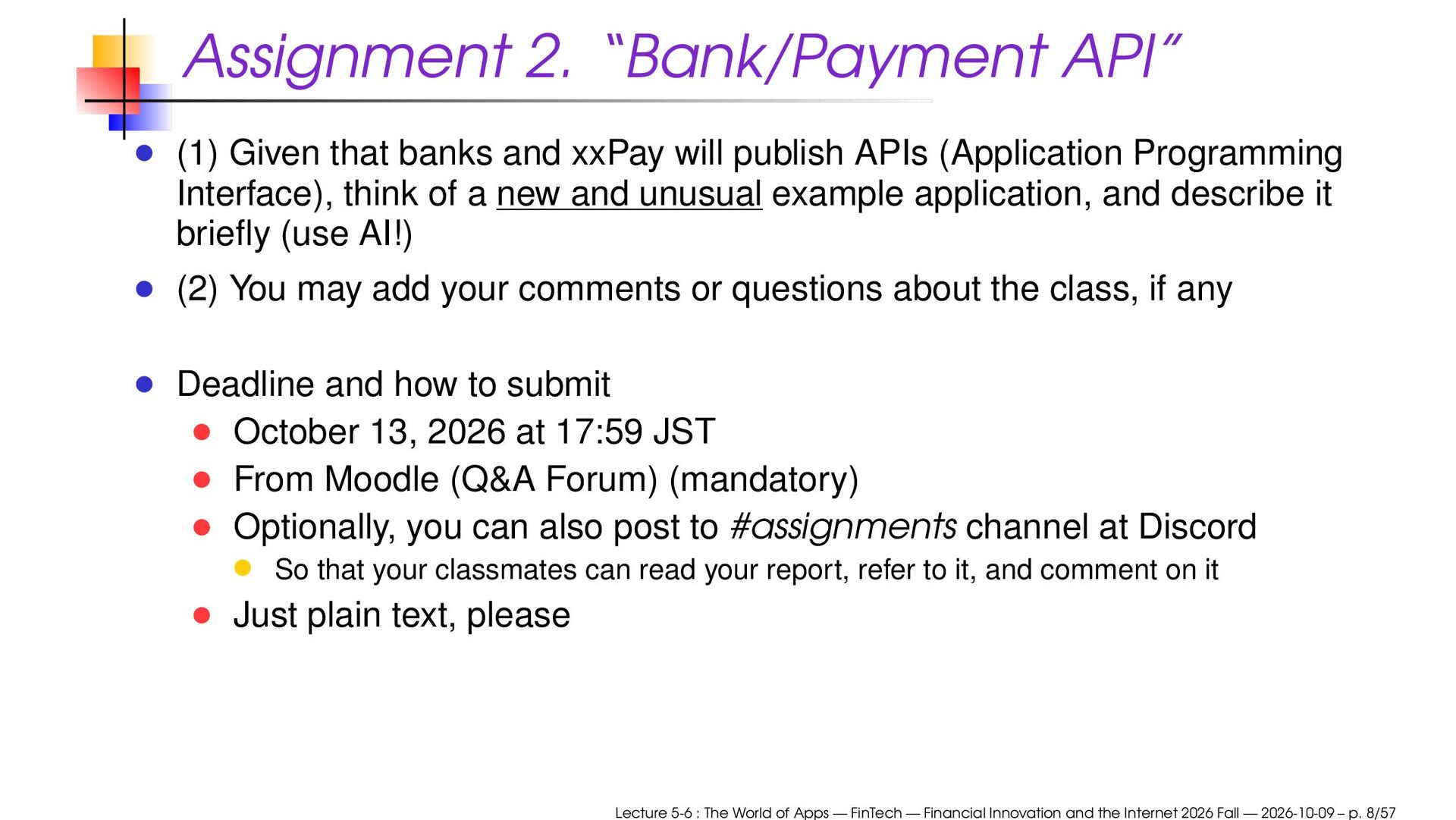
will publish APIs (Application Programming Interface), think of a new and unusual example application, and describe it briefly (use AI!) (2) You may add your comments or questions about the class, if any Deadline and how to submit October 13, 2026 at 17:59 JST From Moodle (Q&A Forum) (mandatory) Optionally, you can also post to #assignments channel at Discord So that your classmates can read your report, refer to it, and comment on it Just plain text, please Lecture 5-6 : The World of Apps — FinTech — Financial Innovation and the Internet 2026 Fall — 2026-10-09 – p. 8/57
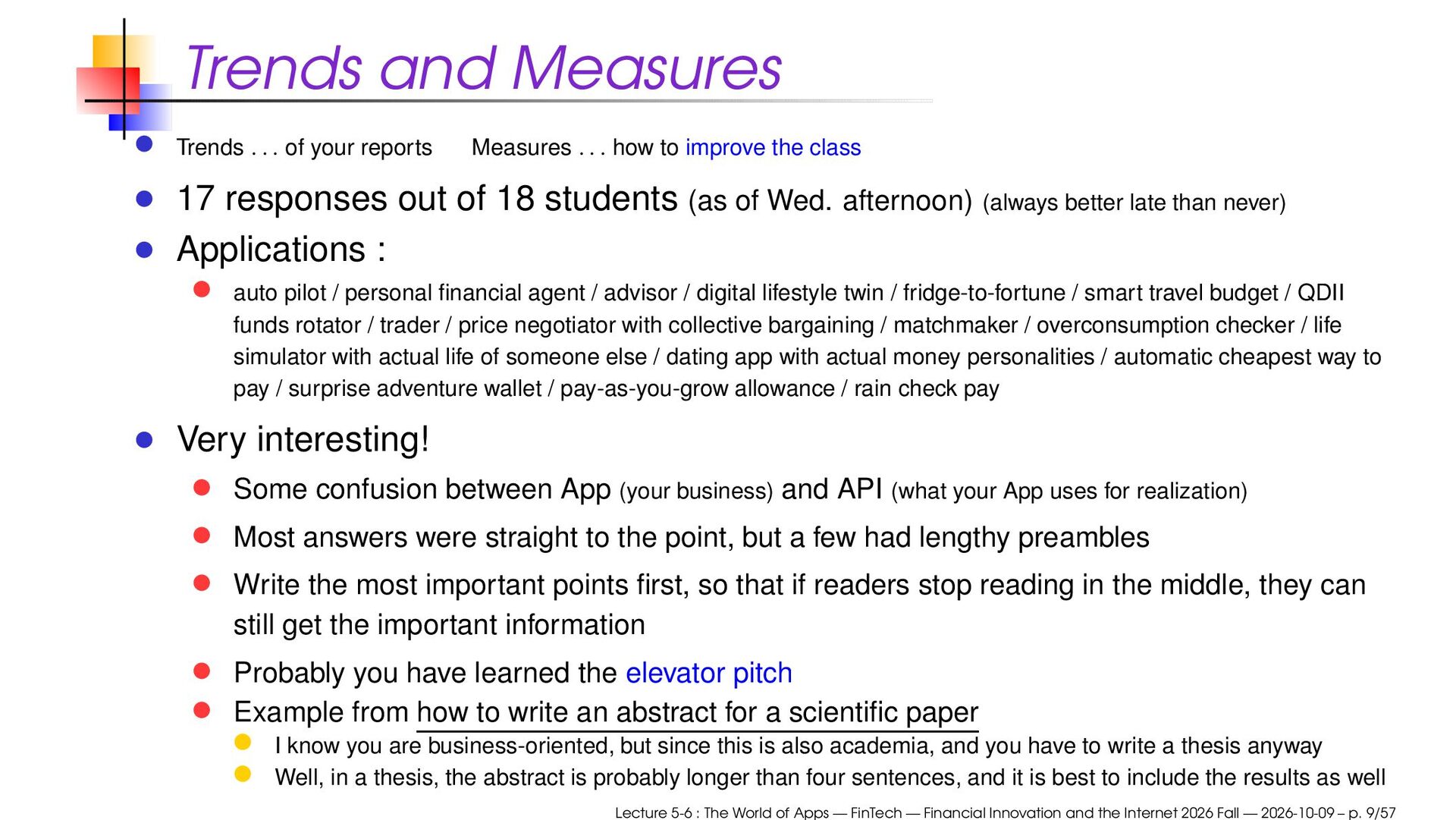
Measures . . . how to improve the class 17 responses out of 18 students (as of Wed. afternoon) (always better late than never) Applications : auto pilot / personal financial agent / advisor / digital lifestyle twin / fridge-to-fortune / smart travel budget / QDII funds rotator / trader / price negotiator with collective bargaining / matchmaker / overconsumption checker / life simulator with actual life of someone else / dating app with actual money personalities / automatic cheapest way to pay / surprise adventure wallet / pay-as-you-grow allowance / rain check pay Very interesting! Some confusion between App (your business) and API (what your App uses for realization) Most answers were straight to the point, but a few had lengthy preambles Write the most important points first, so that if readers stop reading in the middle, they can still get the important information Probably you have learned the elevator pitch Example from how to write an abstract for a scientific paper I know you are business-oriented, but since this is also academia, and you have to write a thesis anyway Well, in a thesis, the abstract is probably longer than four sentences, and it is best to include the results as well Lecture 5-6 : The World of Apps — FinTech — Financial Innovation and the Internet 2026 Fall — 2026-10-09 – p. 9/57
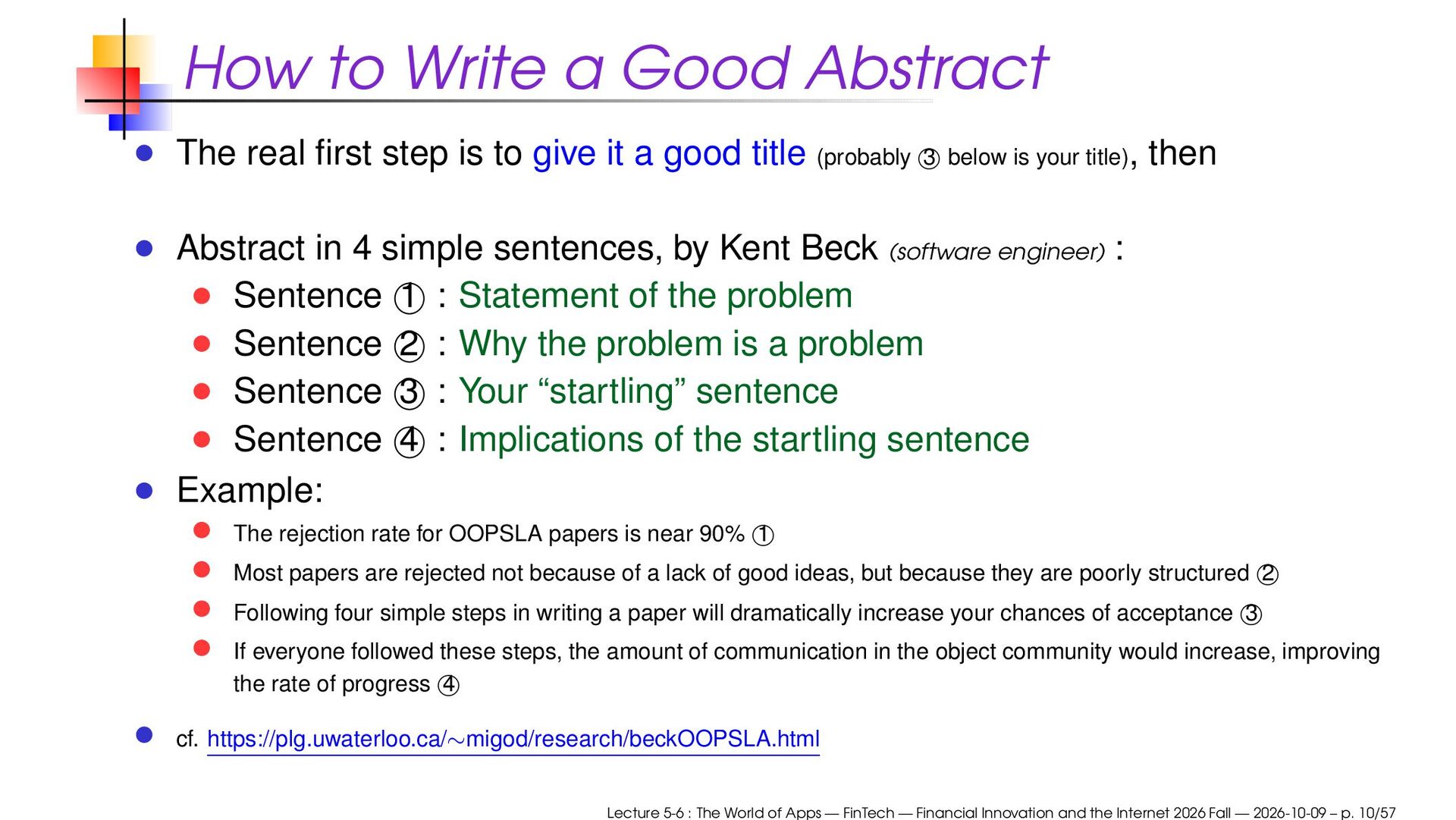
is to give it a good title (probably 3 below is your title), then Abstract in 4 simple sentences, by Kent Beck (software engineer) : Sentence 1 : Statement of the problem Sentence 2 : Why the problem is a problem Sentence 3 : Your “startling” sentence Sentence 4 : Implications of the startling sentence Example: The rejection rate for OOPSLA papers is near 90% 1 Most papers are rejected not because of a lack of good ideas, but because they are poorly structured 2 Following four simple steps in writing a paper will dramatically increase your chances of acceptance 3 If everyone followed these steps, the amount of communication in the object community would increase, improving the rate of progress 4 cf. https://plg.uwaterloo.ca/∼migod/research/beckOOPSLA.html Lecture 5-6 : The World of Apps — FinTech — Financial Innovation and the Internet 2026 Fall — 2026-10-09 – p. 10/57
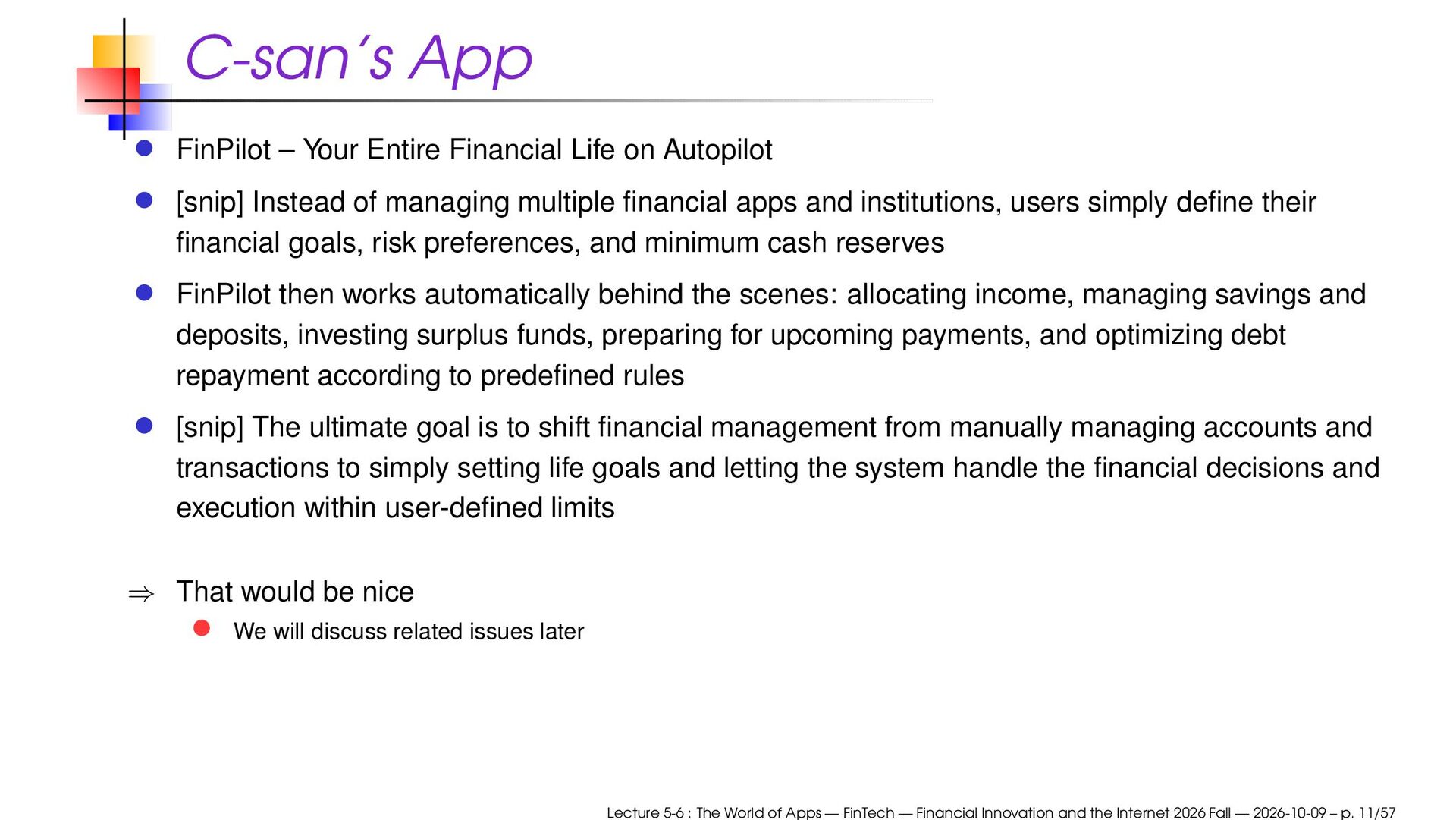
[snip] Instead of managing multiple financial apps and institutions, users simply define their financial goals, risk preferences, and minimum cash reserves FinPilot then works automatically behind the scenes: allocating income, managing savings and deposits, investing surplus funds, preparing for upcoming payments, and optimizing debt repayment according to predefined rules [snip] The ultimate goal is to shift financial management from manually managing accounts and transactions to simply setting life goals and letting the system handle the financial decisions and execution within user-defined limits ⇒ That would be nice We will discuss related issues later Lecture 5-6 : The World of Apps — FinTech — Financial Innovation and the Internet 2026 Fall — 2026-10-09 – p. 11/57
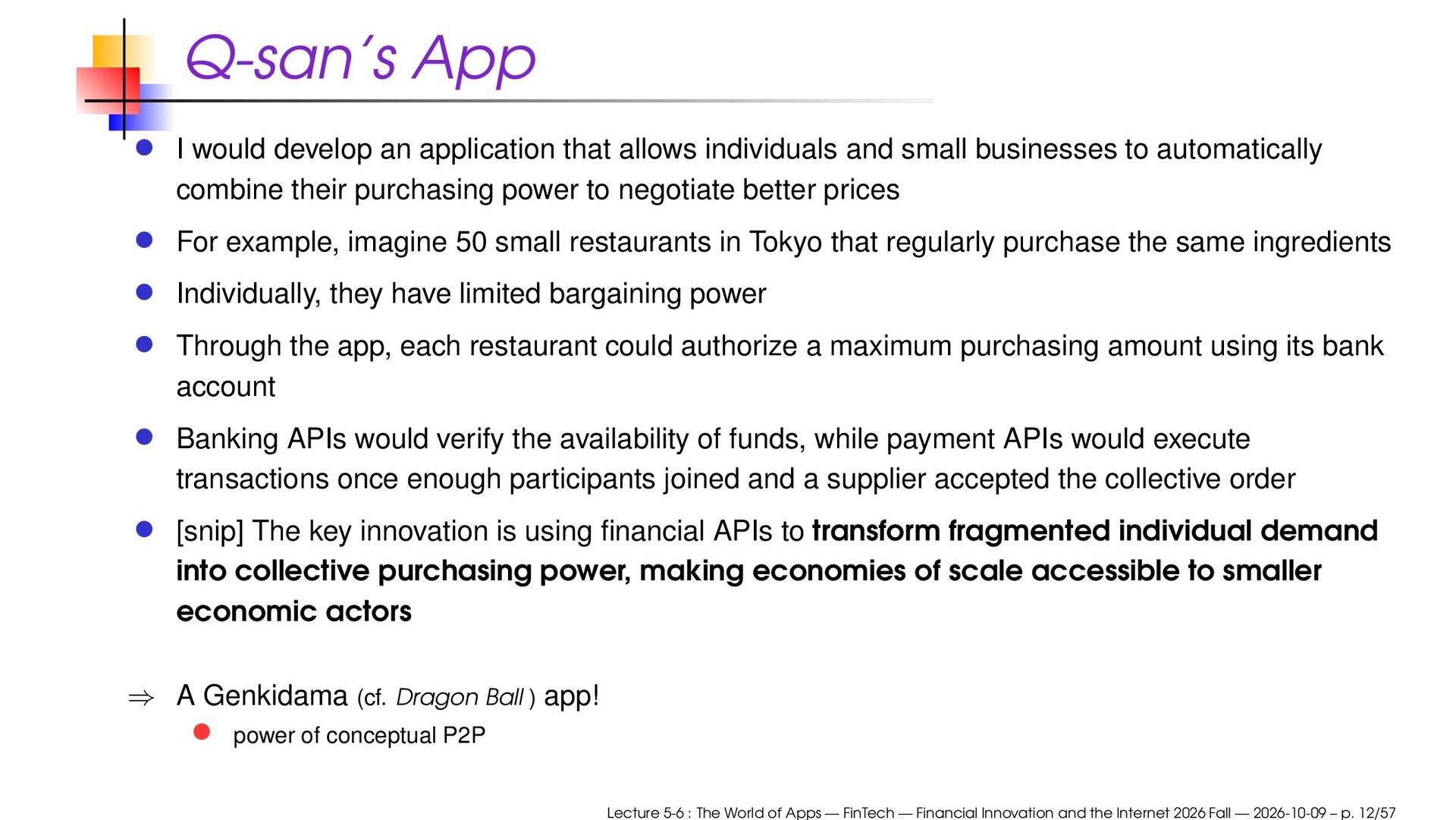
and small businesses to automatically combine their purchasing power to negotiate better prices For example, imagine 50 small restaurants in Tokyo that regularly purchase the same ingredients Individually, they have limited bargaining power Through the app, each restaurant could authorize a maximum purchasing amount using its bank account Banking APIs would verify the availability of funds, while payment APIs would execute transactions once enough participants joined and a supplier accepted the collective order [snip] The key innovation is using financial APIs to transform fragmented individual demand into collective purchasing power, making economies of scale accessible to smaller economic actors ⇒ A Genkidama (cf. Dragon Ball ) app! power of conceptual P2P Lecture 5-6 : The World of Apps — FinTech — Financial Innovation and the Internet 2026 Fall — 2026-10-09 – p. 12/57
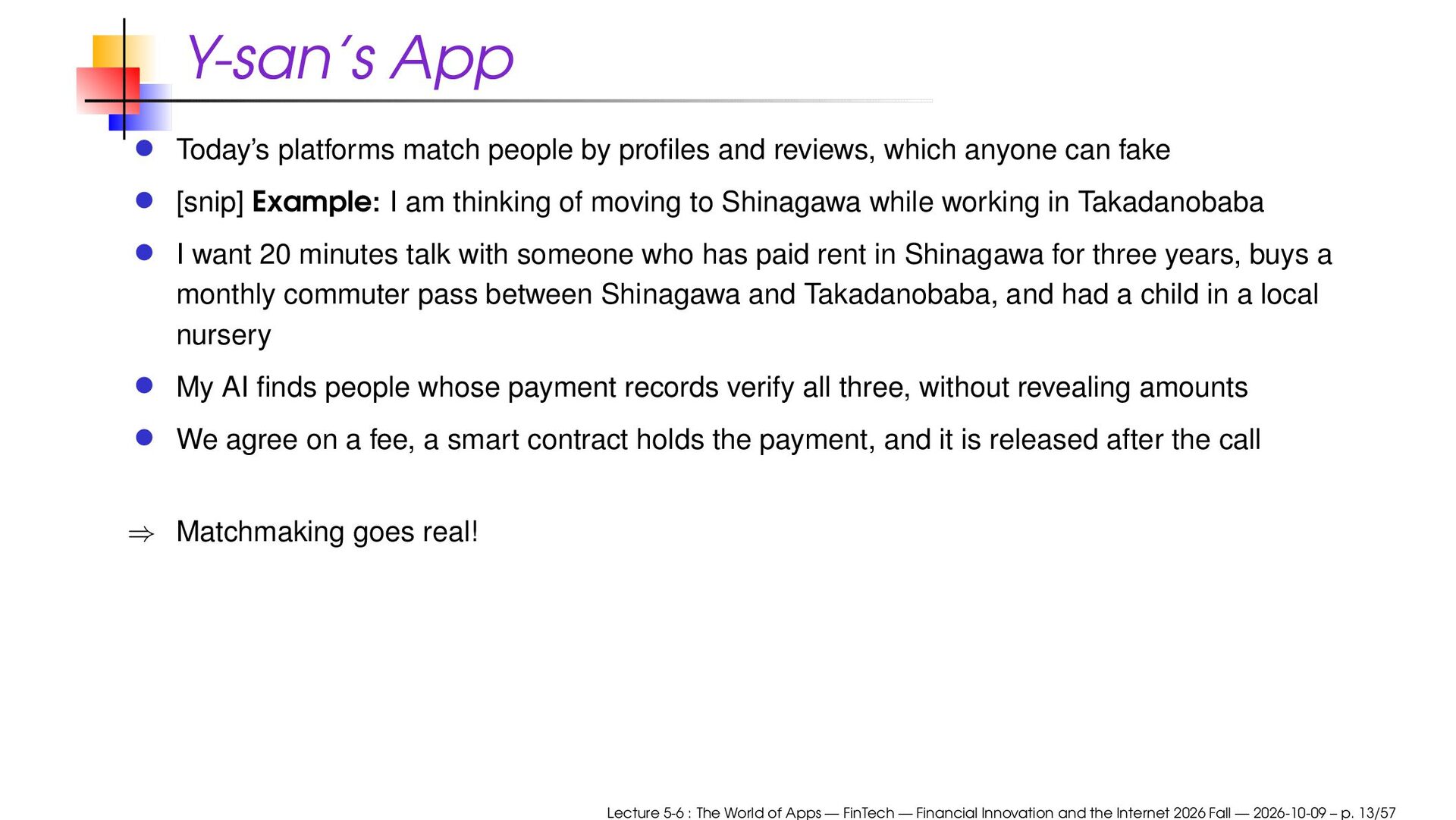
which anyone can fake [snip] Example: I am thinking of moving to Shinagawa while working in Takadanobaba I want 20 minutes talk with someone who has paid rent in Shinagawa for three years, buys a monthly commuter pass between Shinagawa and Takadanobaba, and had a child in a local nursery My AI finds people whose payment records verify all three, without revealing amounts We agree on a fee, a smart contract holds the payment, and it is released after the call ⇒ Matchmaking goes real! Lecture 5-6 : The World of Apps — FinTech — Financial Innovation and the Internet 2026 Fall — 2026-10-09 – p. 13/57
bank and xxPay APIs to match people on how they actually handle money, not on what they claim about it Today, dating apps rely on self-reported income and say nothing about spending habits With the user’s consent, the app reads their real financial data through the APIs, turns it into a verified income band and a “money personality,” and suggests partners who are compatible both in what they want and in how they spend Money becomes a topic couples can talk about openly from the first date, rather than a hidden source of conflict that surfaces after marriage ⇒ Matchmaking goes real! I left it out, but the data you provided at the beginning is also very interesting Lecture 5-6 : The World of Apps — FinTech — Financial Innovation and the Internet 2026 Fall — 2026-10-09 – p. 14/57
voice volume was occasionally a little low during the lecture, which made it hard for me to catch everything ⇒ I will try not to speak in a low voice Lecture 5-6 : The World of Apps — FinTech — Financial Innovation and the Internet 2026 Fall — 2026-10-09 – p. 15/57
world in electronics, but in software the situation seems quite different Even the Japanese government has described it as a “digital defeat” (デジタル敗戦) To give a small everyday example: when making a bank transfer, I often get an error such as “Please enter the recipient name in half-width katakana” Many Japanese systems leave full-width/half-width conversion to the user instead of normalizing input on the system side From the design principle of “be liberal in what you accept, strict in what you send” (the robustness principle), this seems puzzling What are the practical reasons behind it? For example, legacy core systems, how responsibility is divided between vendors, or the multi-layer subcontracting structure? Do you think this situation is gradually changing, or is it structurally difficult to change? ⇒ It is changing, but yes, we have problems Let’s have a short discussion (1) Lecture 5-6 : The World of Apps — FinTech — Financial Innovation and the Internet 2026 Fall — 2026-10-09 – p. 16/57
Could AI eventually replace traditional banking and payment app interfaces, allowing people to manage all their financial transactions through conversations? ⇒ Let’s have a short discussion (2) With breakout rooms Lecture 5-6 : The World of Apps — FinTech — Financial Innovation and the Internet 2026 Fall — 2026-10-09 – p. 17/57
technology and evolution of World Wide Web Consequences and problems of World Wide Web Lecture 5-6 : The World of Apps — FinTech — Financial Innovation and the Internet 2026 Fall — 2026-10-09 – p. 18/57
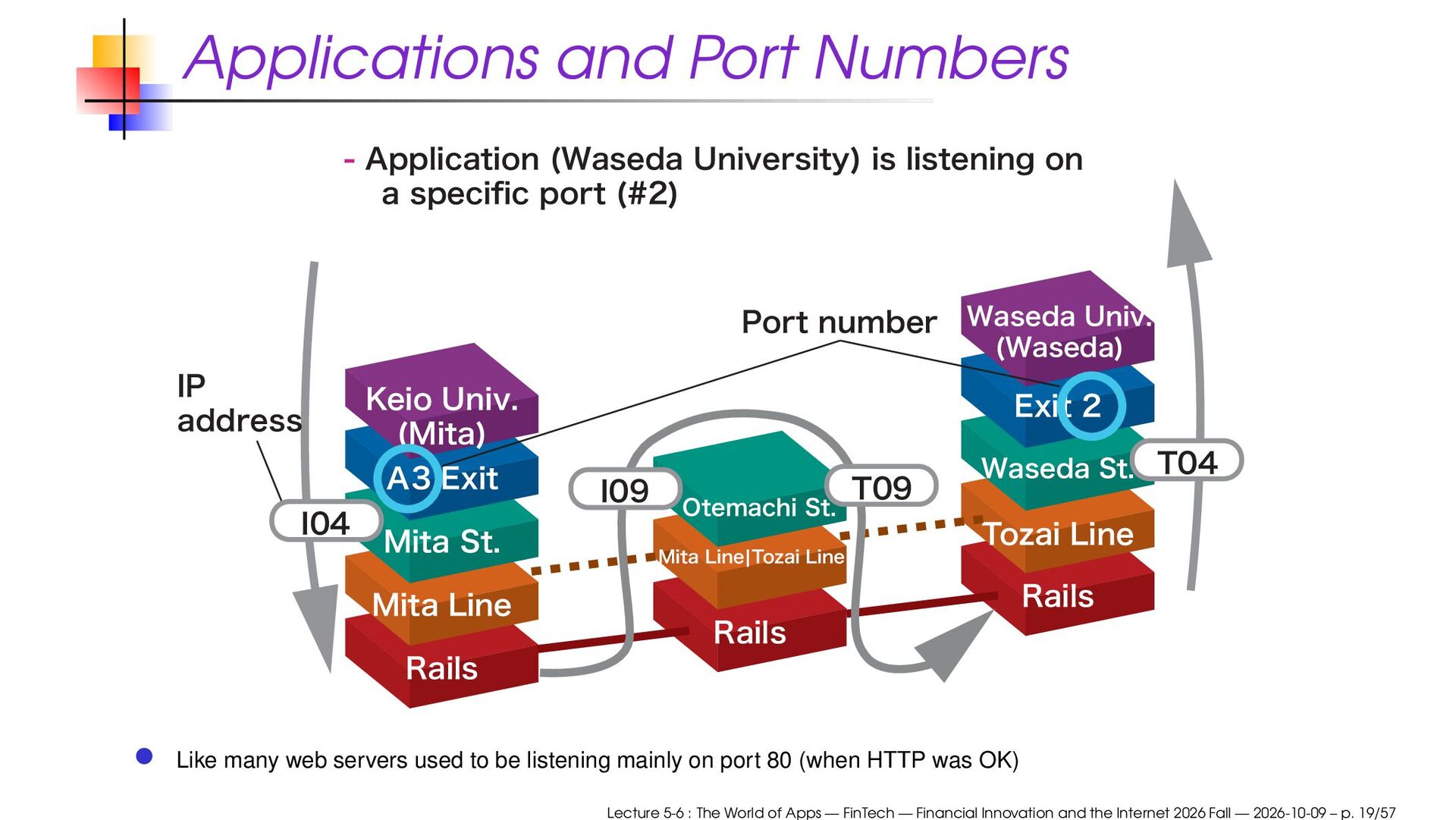
on a specific port (#2) Port number Waseda Univ. IP address I04 (Waseda) Keio Univ. (Mita) A3 Exit Mita St. Mita Line Rails Exit 2 I09 Otemachi St. Mita Line|Tozai Line T09 Waseda St. T04 Tozai Line Rails Rails Like many web servers used to be listening mainly on port 80 (when HTTP was OK) Lecture 5-6 : The World of Apps — FinTech — Financial Innovation and the Internet 2026 Fall — 2026-10-09 – p. 19/57
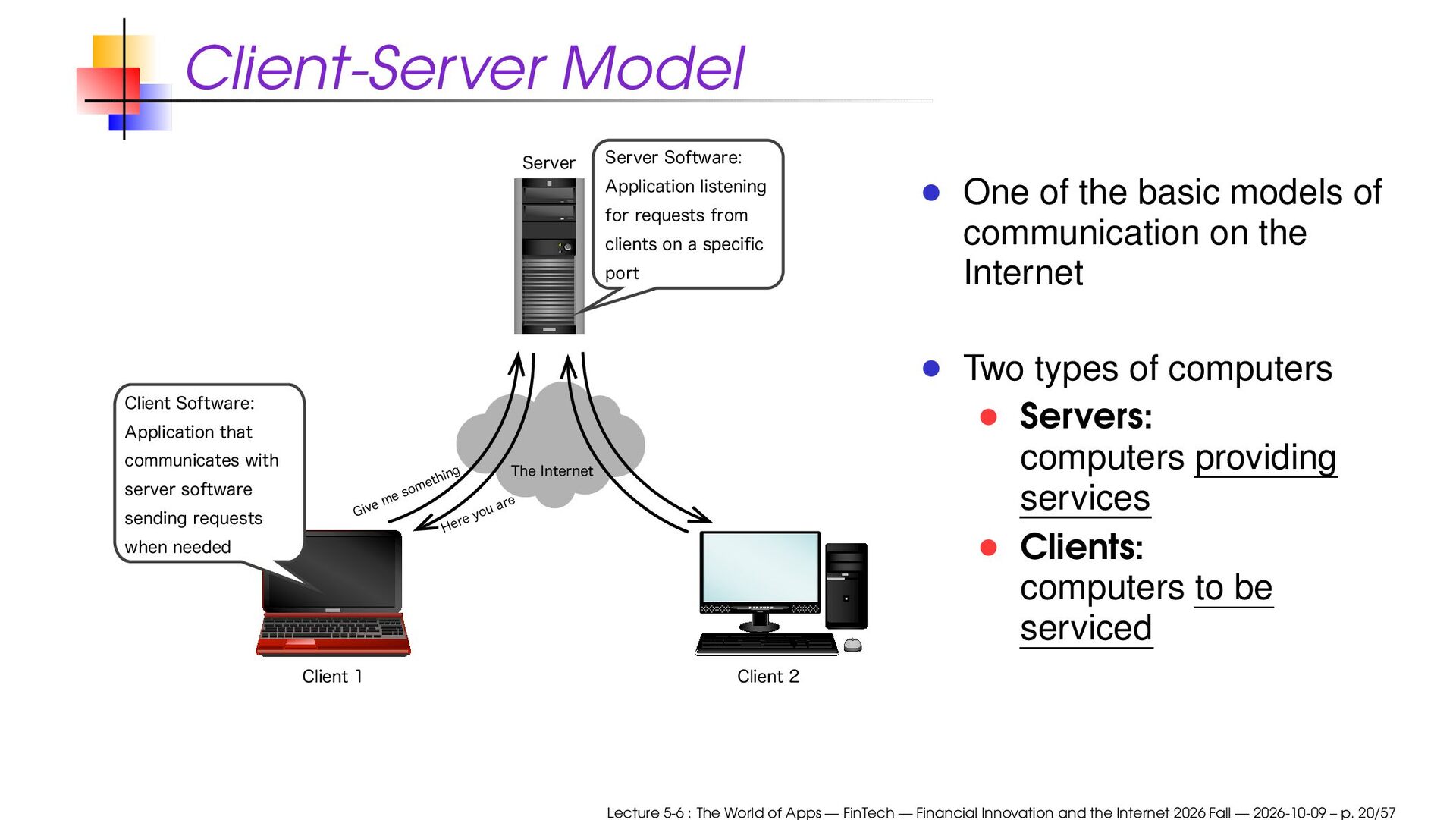
clients on a specific port Two types of computers Servers: computers providing services Clients: computers to be serviced Client Software: Application that communicates with server software sending requests e em Giv when needed Client 1 som The Internet ing eth He r ou ey One of the basic models of communication on the Internet are Client 2 Lecture 5-6 : The World of Apps — FinTech — Financial Innovation and the Internet 2026 Fall — 2026-10-09 – p. 20/57
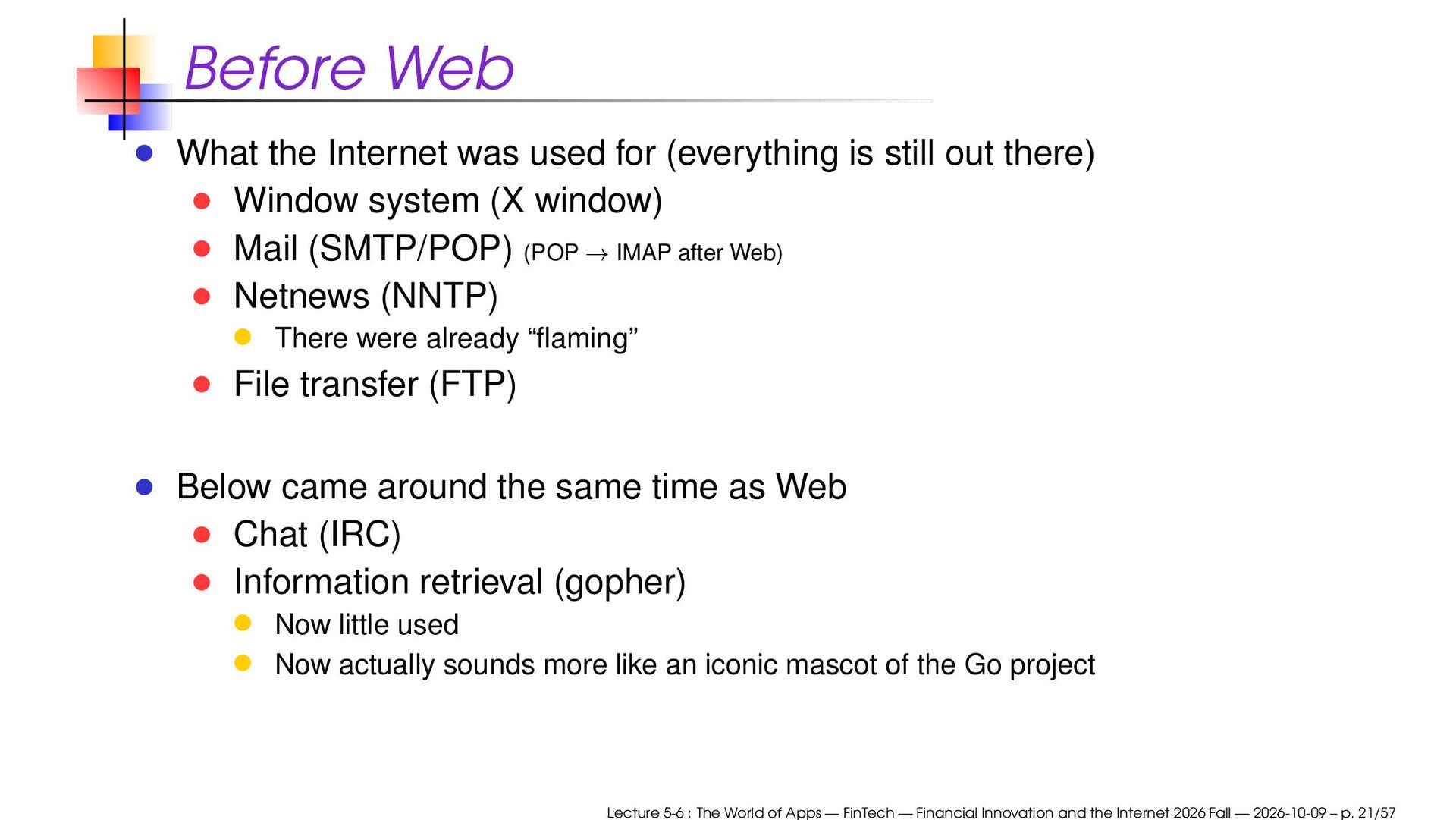
still out there) Window system (X window) Mail (SMTP/POP) (POP → IMAP after Web) Netnews (NNTP) There were already “flaming” File transfer (FTP) Below came around the same time as Web Chat (IRC) Information retrieval (gopher) Now little used Now actually sounds more like an iconic mascot of the Go project Lecture 5-6 : The World of Apps — FinTech — Financial Innovation and the Internet 2026 Fall — 2026-10-09 – p. 21/57
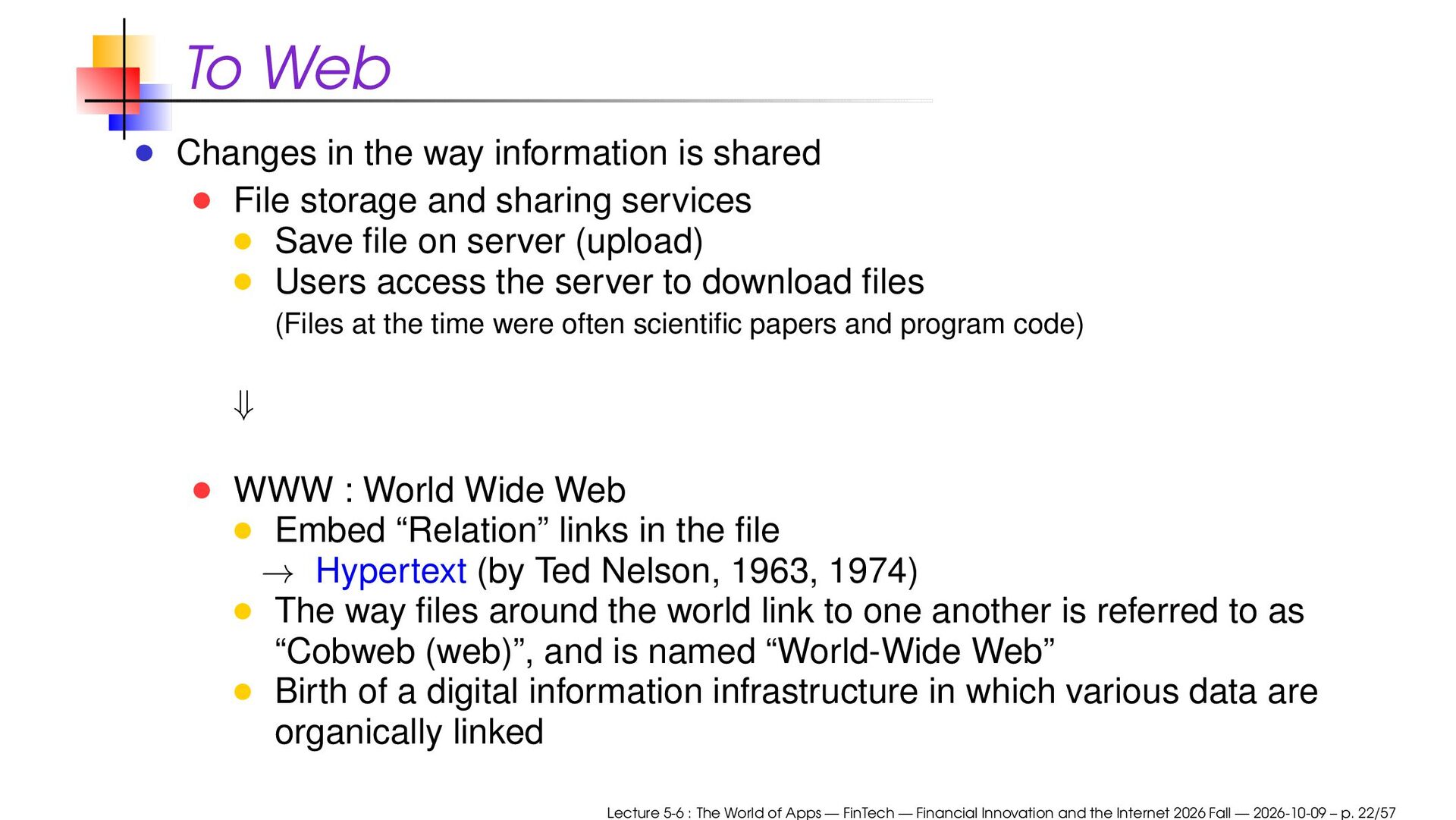
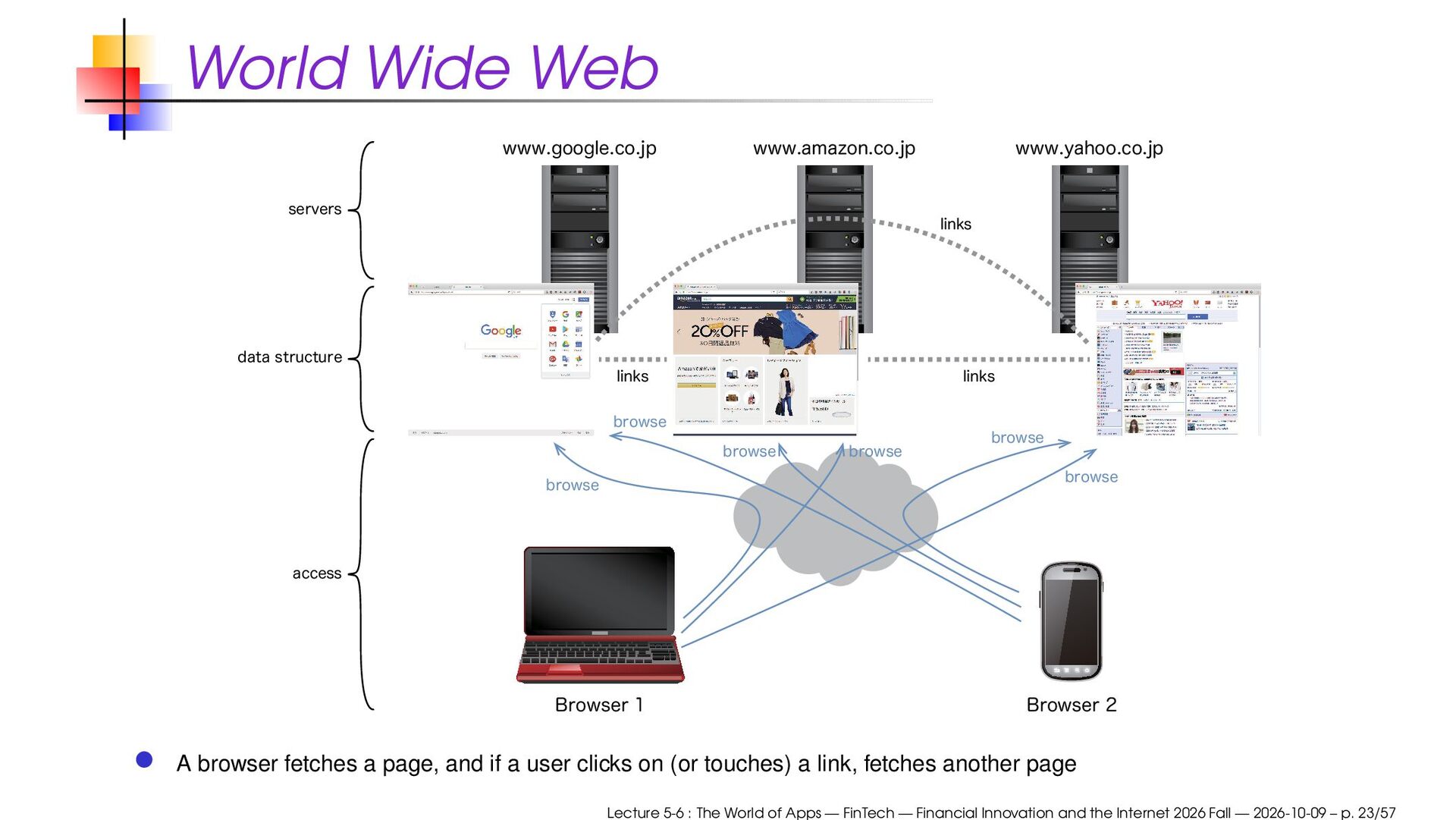
storage and sharing services Save file on server (upload) Users access the server to download files (Files at the time were often scientific papers and program code) ⇓ WWW : World Wide Web Embed “Relation” links in the file → Hypertext (by Ted Nelson, 1963, 1974) The way files around the world link to one another is referred to as “Cobweb (web)”, and is named “World-Wide Web” Birth of a digital information infrastructure in which various data are organically linked Lecture 5-6 : The World of Apps — FinTech — Financial Innovation and the Internet 2026 Fall — 2026-10-09 – p. 22/57
links links browse browse browse browse browse browse access Browser 1 Browser 2 A browser fetches a page, and if a user clicks on (or touches) a link, fetches another page Lecture 5-6 : The World of Apps — FinTech — Financial Innovation and the Internet 2026 Fall — 2026-10-09 – p. 23/57
Meeting of Hypertext and the Internet Lecture 5-6 : The World of Apps — FinTech — Financial Innovation and the Internet 2026 Fall — 2026-10-09 – p. 24/57
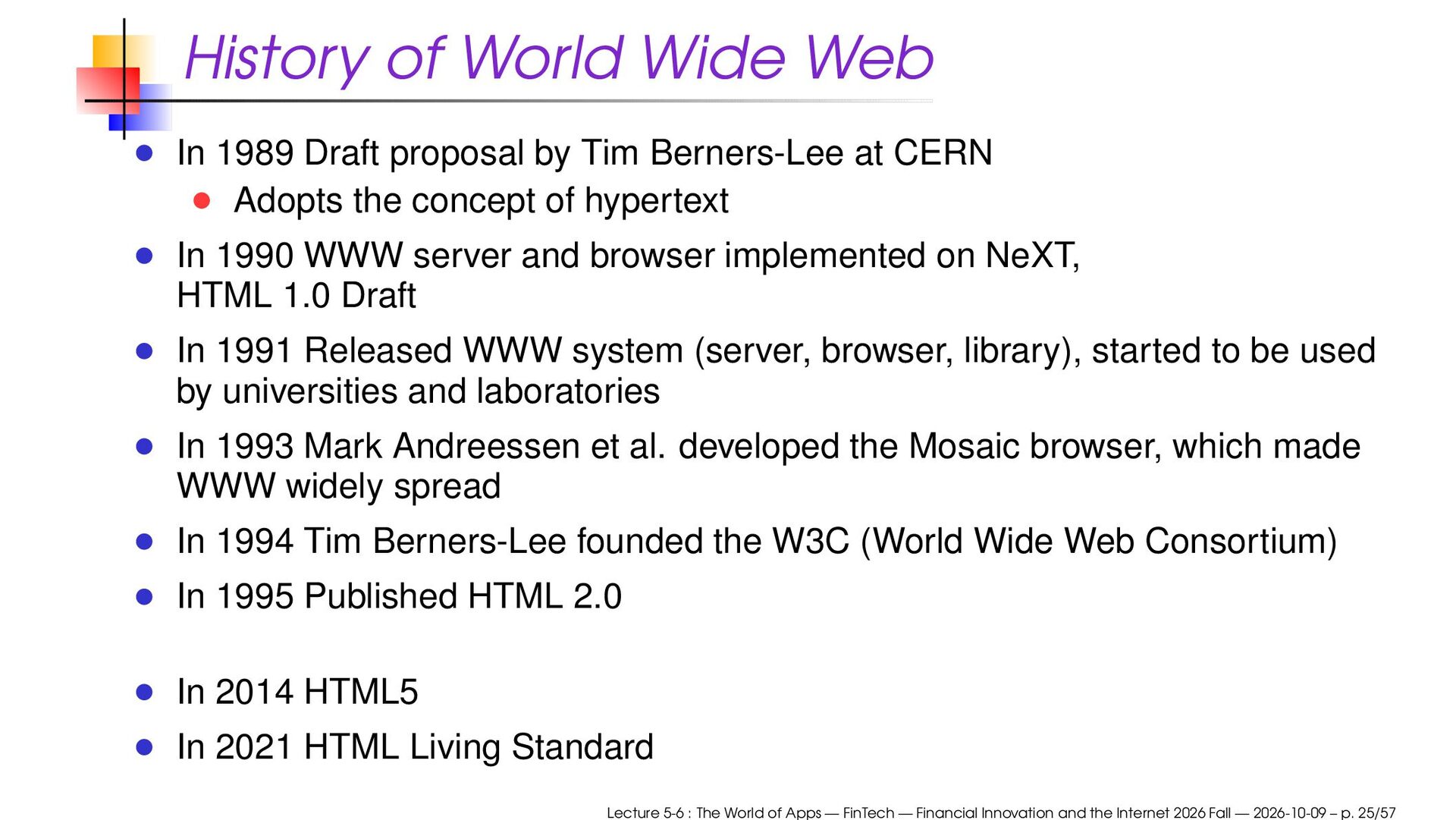
Tim Berners-Lee at CERN Adopts the concept of hypertext In 1990 WWW server and browser implemented on NeXT, HTML 1.0 Draft In 1991 Released WWW system (server, browser, library), started to be used by universities and laboratories In 1993 Mark Andreessen et al. developed the Mosaic browser, which made WWW widely spread In 1994 Tim Berners-Lee founded the W3C (World Wide Web Consortium) In 1995 Published HTML 2.0 In 2014 HTML5 In 2021 HTML Living Standard Lecture 5-6 : The World of Apps — FinTech — Financial Innovation and the Internet 2026 Fall — 2026-10-09 – p. 25/57
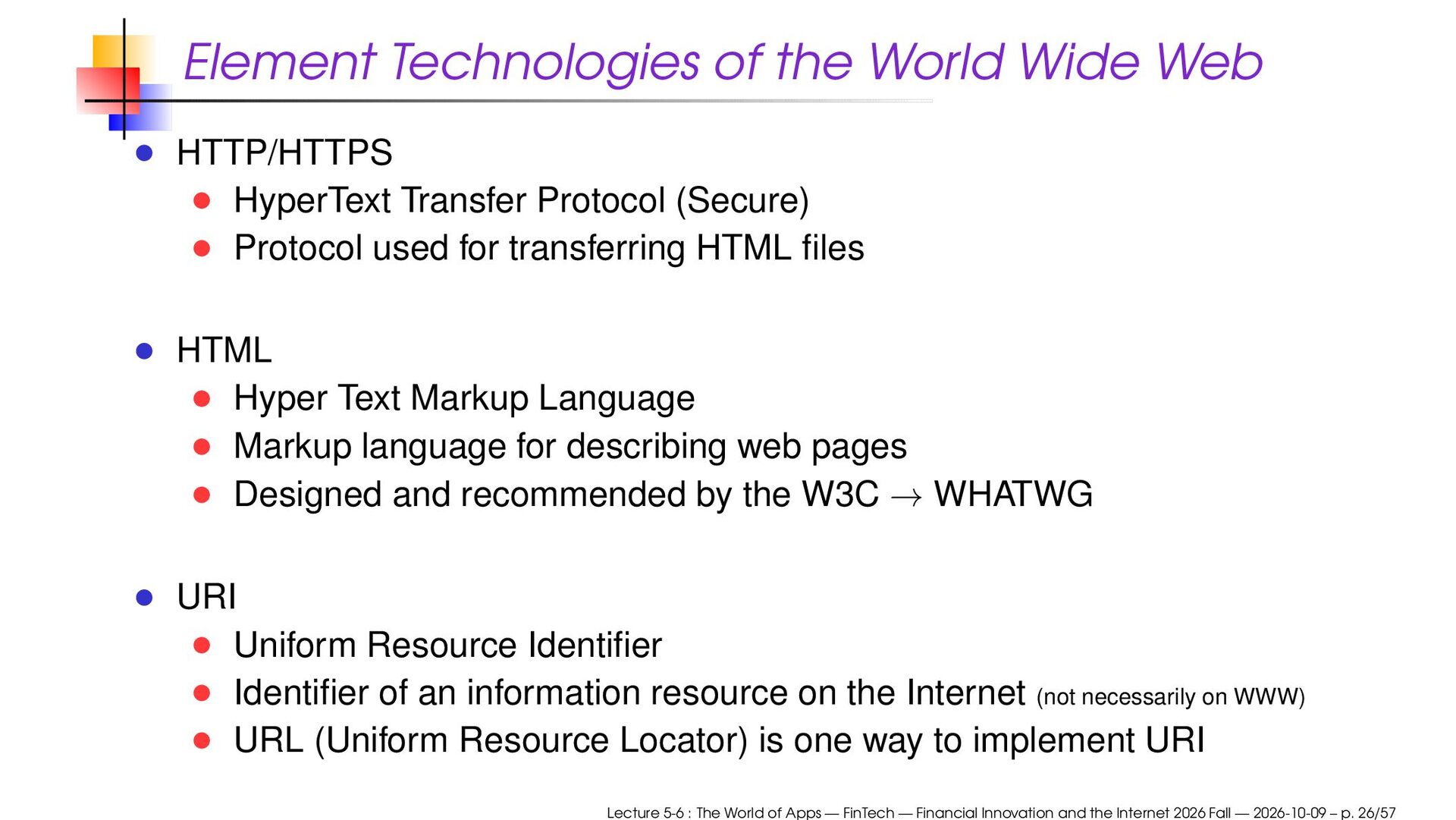
Protocol (Secure) Protocol used for transferring HTML files HTML Hyper Text Markup Language Markup language for describing web pages Designed and recommended by the W3C → WHATWG URI Uniform Resource Identifier Identifier of an information resource on the Internet (not necessarily on WWW) URL (Uniform Resource Locator) is one way to implement URI Lecture 5-6 : The World of Apps — FinTech — Financial Innovation and the Internet 2026 Fall — 2026-10-09 – p. 26/57
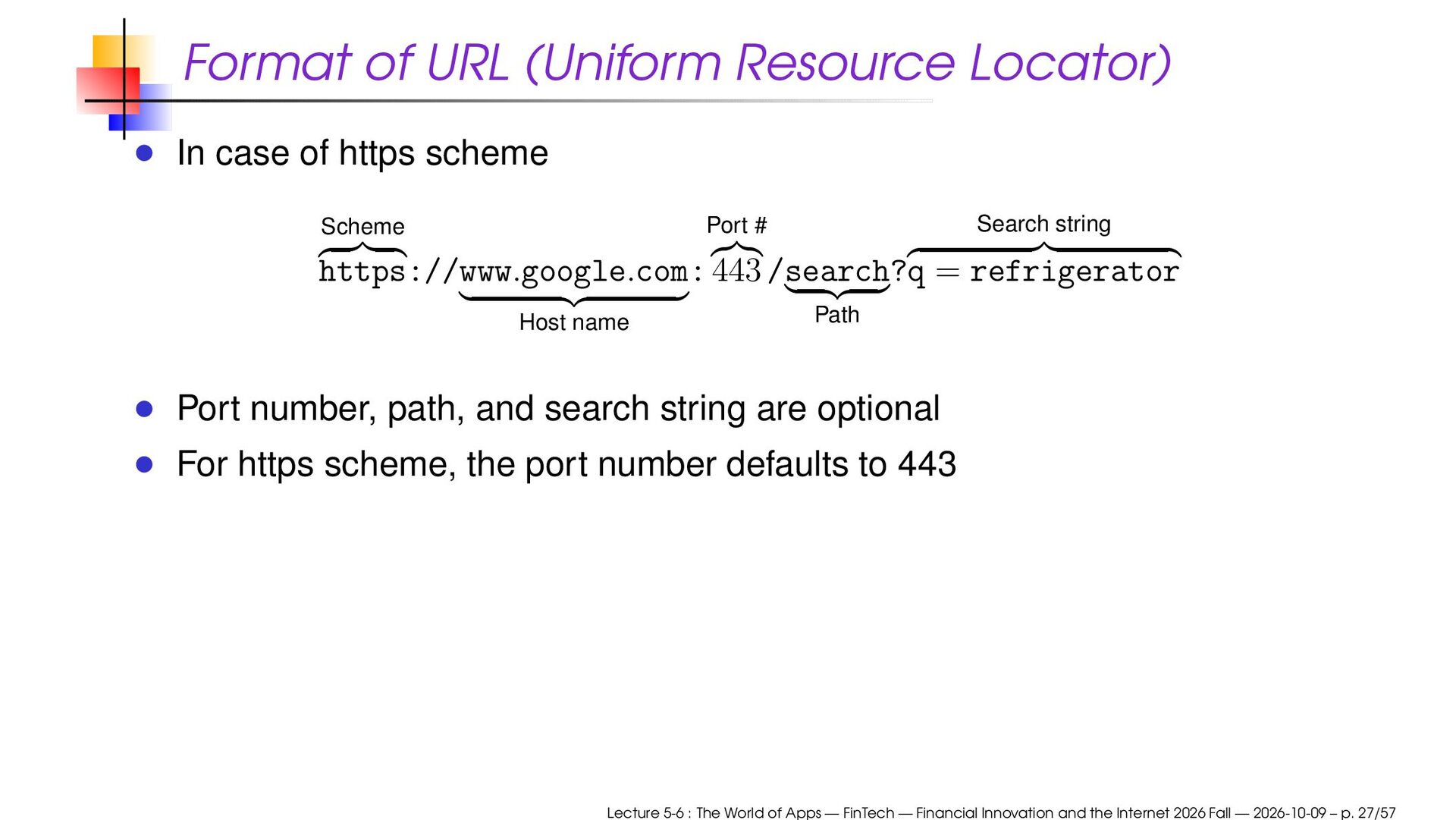
scheme Scheme Port # z }| { z}|{ Search string z }| { https://www.google.com: 443 /search | {z }?q = refrigerator | {z } Host name Path Port number, path, and search string are optional For https scheme, the port number defaults to 443 Lecture 5-6 : The World of Apps — FinTech — Financial Innovation and the Internet 2026 Fall — 2026-10-09 – p. 27/57
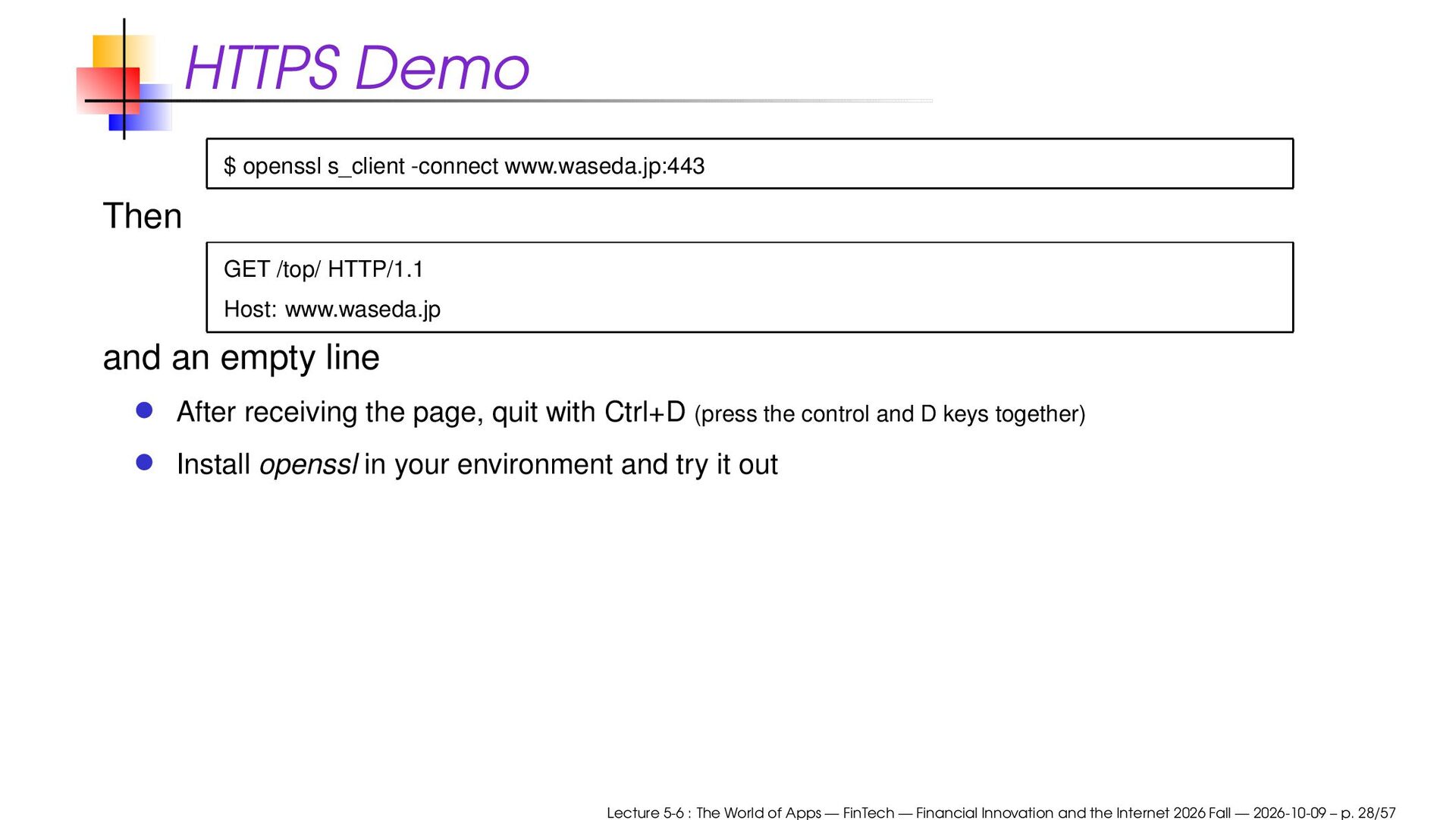
HTTP/1.1 Host: www.waseda.jp and an empty line After receiving the page, quit with Ctrl+D (press the control and D keys together) Install openssl in your environment and try it out Lecture 5-6 : The World of Apps — FinTech — Financial Innovation and the Internet 2026 Fall — 2026-10-09 – p. 28/57
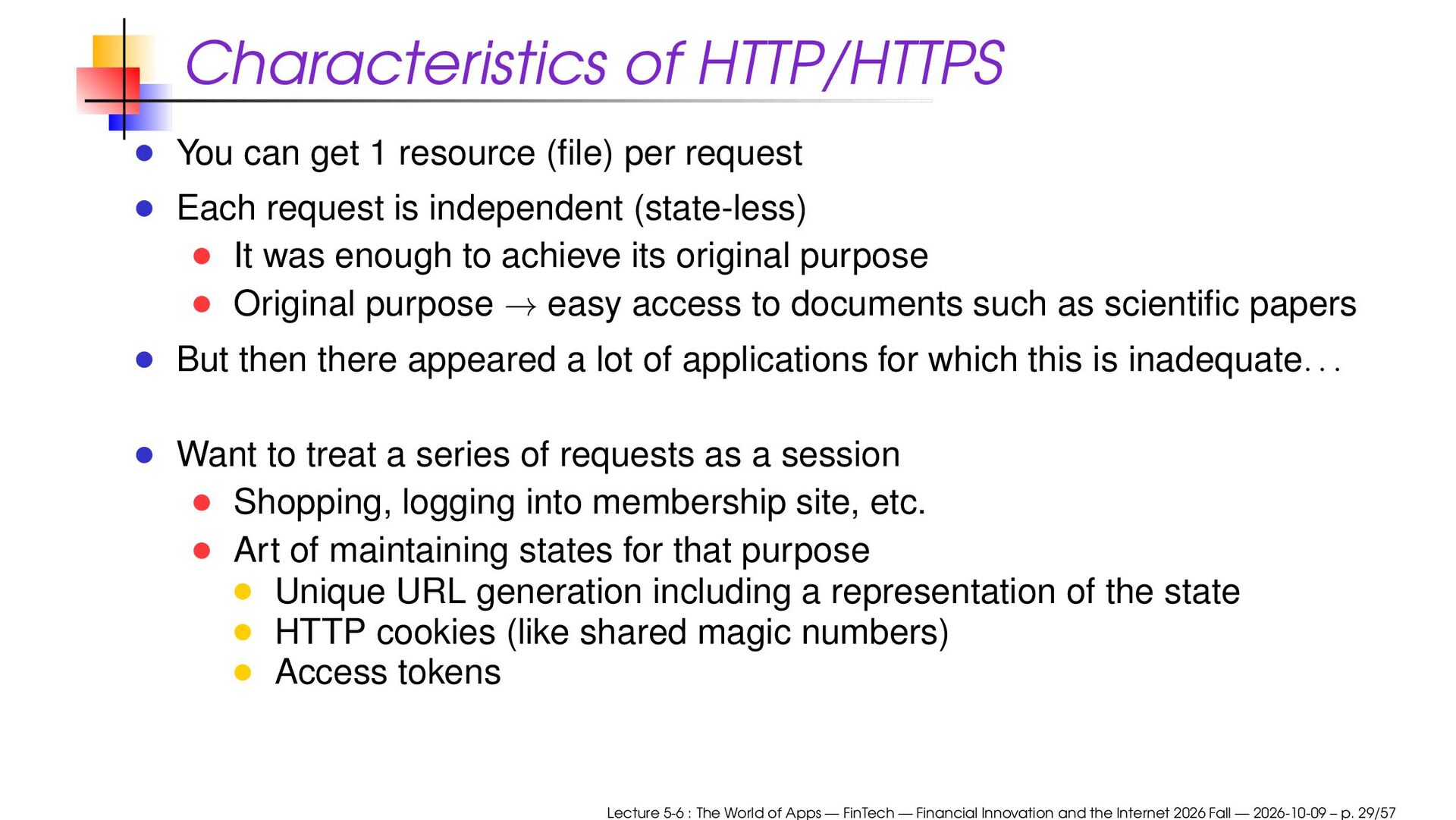
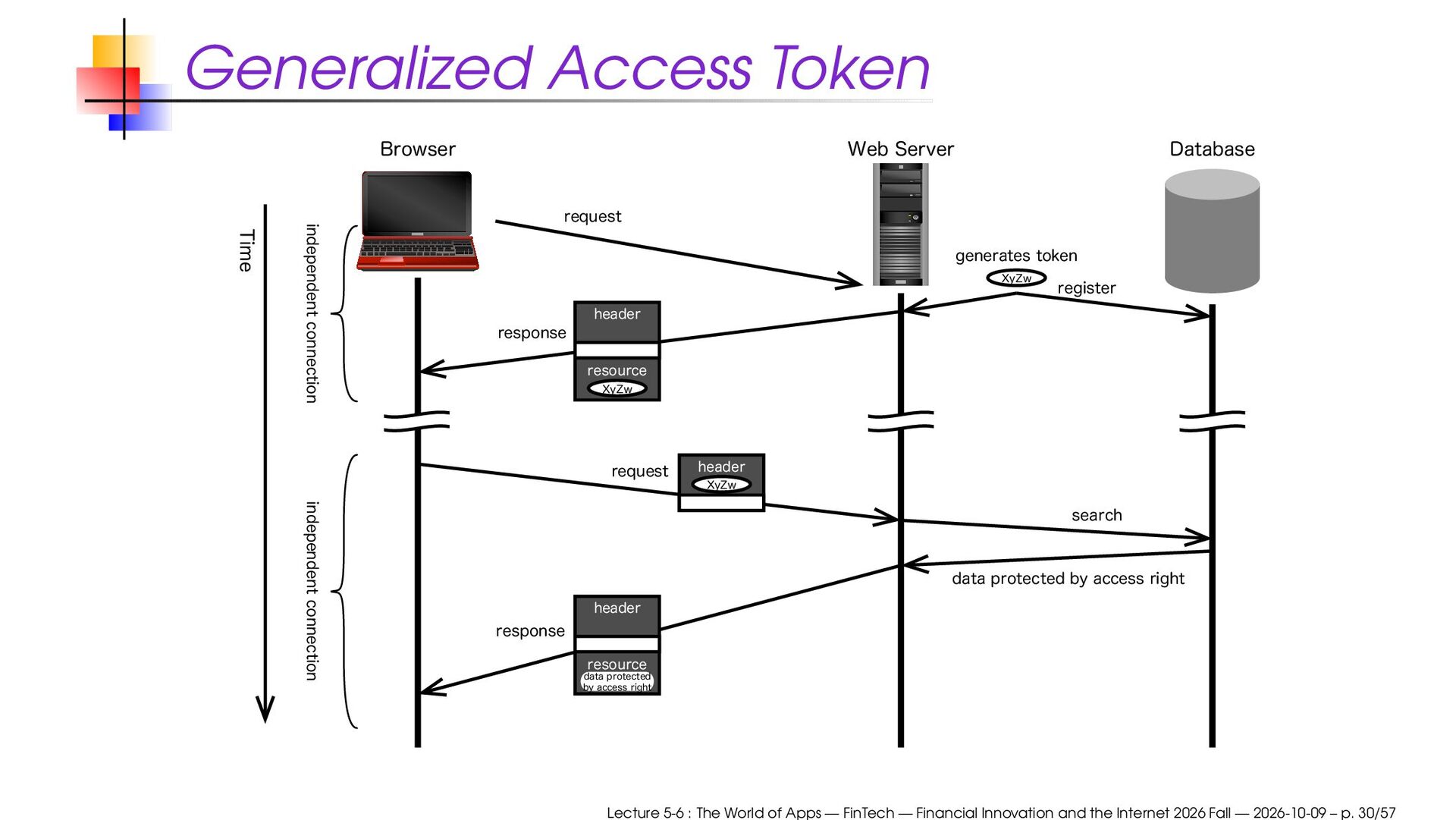
request Each request is independent (state-less) It was enough to achieve its original purpose Original purpose → easy access to documents such as scientific papers But then there appeared a lot of applications for which this is inadequate. . . Want to treat a series of requests as a session Shopping, logging into membership site, etc. Art of maintaining states for that purpose Unique URL generation including a representation of the state HTTP cookies (like shared magic numbers) Access tokens Lecture 5-6 : The World of Apps — FinTech — Financial Innovation and the Internet 2026 Fall — 2026-10-09 – p. 29/57
request generates token XyZw response register header resource XyZw request header XyZw independent connection search data protected by access right response header resource data protected by access right Lecture 5-6 : The World of Apps — FinTech — Financial Innovation and the Internet 2026 Fall — 2026-10-09 – p. 30/57
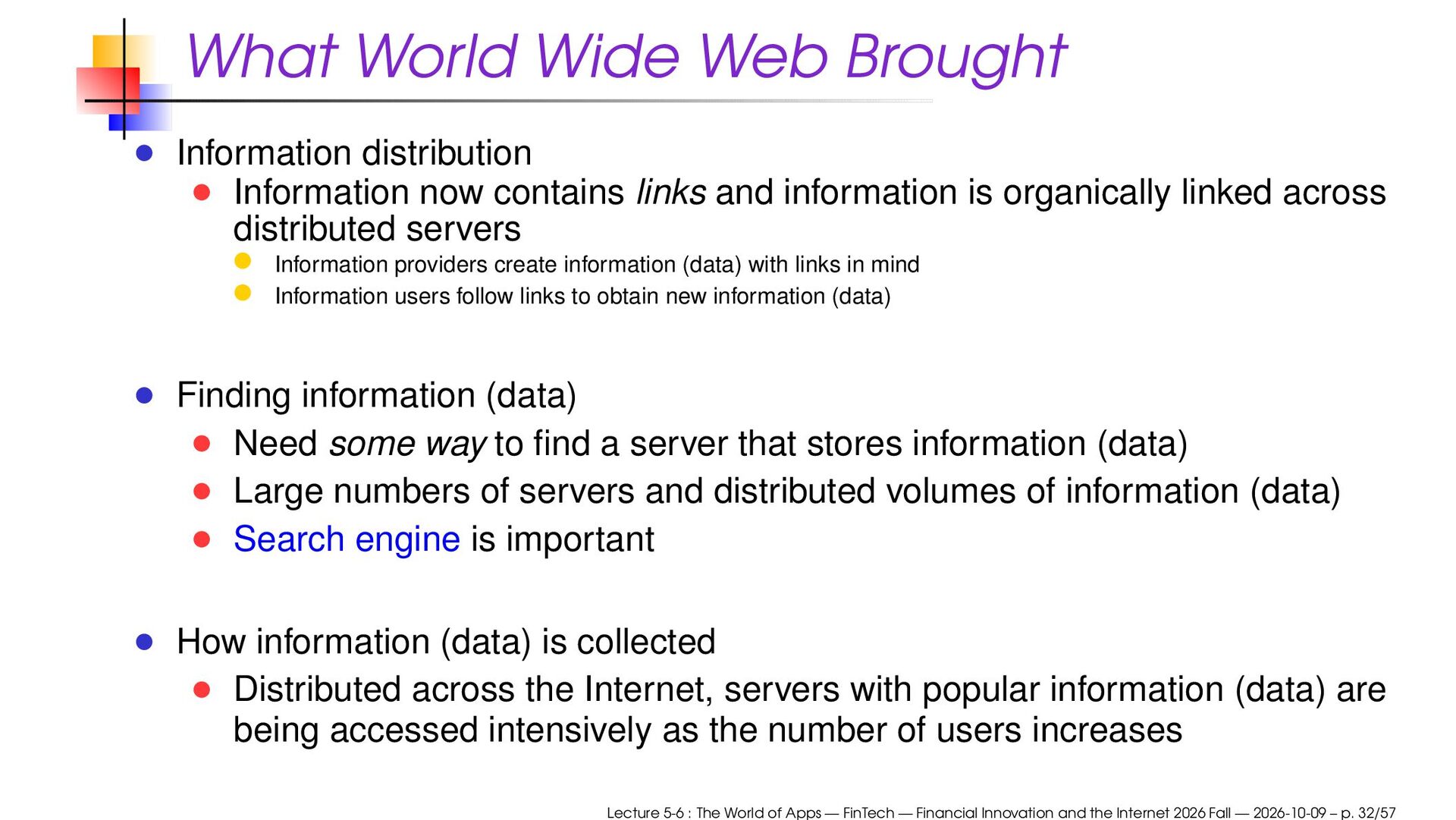
links and information is organically linked across distributed servers Information providers create information (data) with links in mind Information users follow links to obtain new information (data) Finding information (data) Need some way to find a server that stores information (data) Large numbers of servers and distributed volumes of information (data) Search engine is important How information (data) is collected Distributed across the Internet, servers with popular information (data) are being accessed intensively as the number of users increases Lecture 5-6 : The World of Apps — FinTech — Financial Innovation and the Internet 2026 Fall — 2026-10-09 – p. 32/57
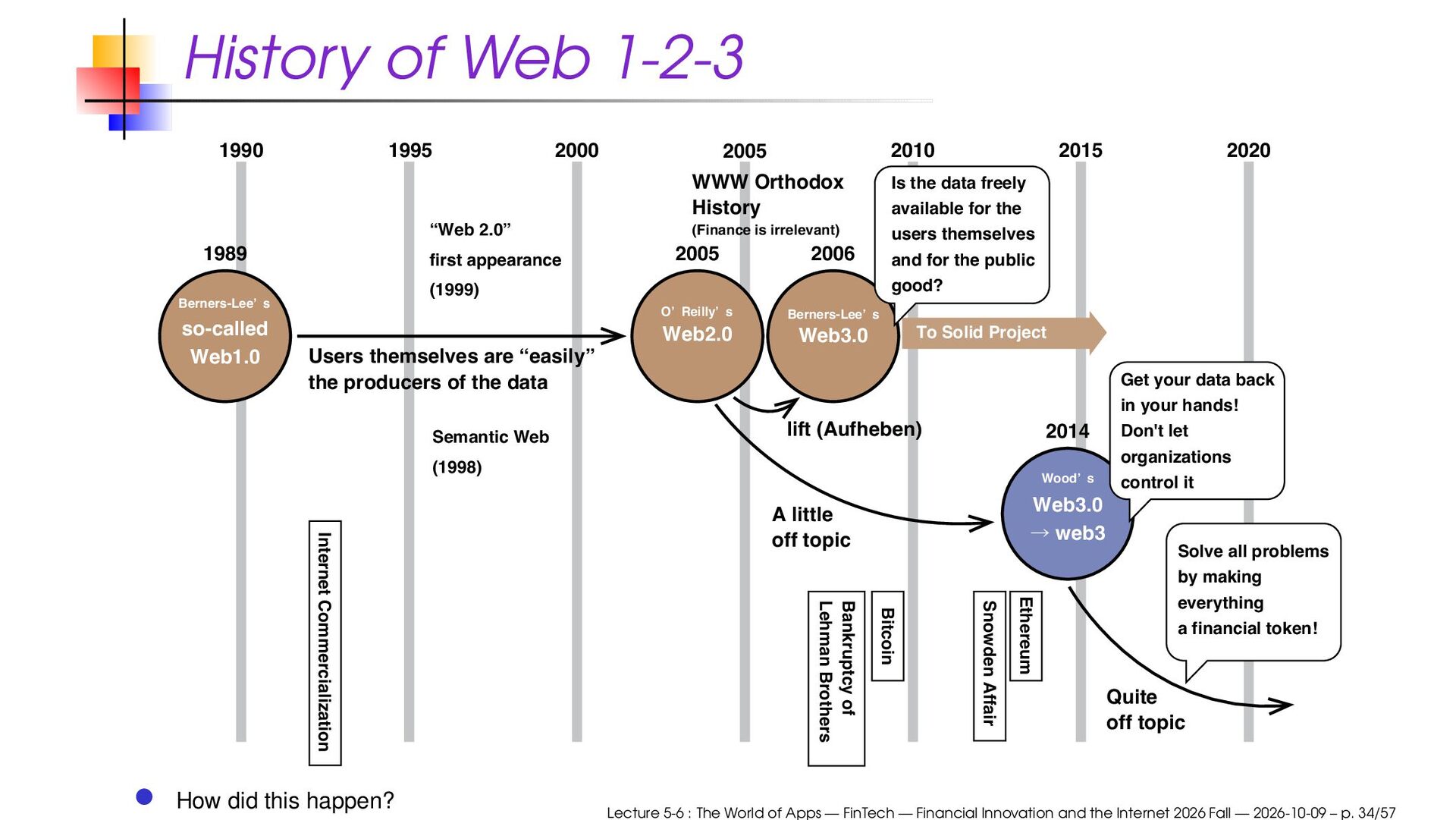
Orthodox History “Web 2.0” 1989 first appearance so-called Web1.0 Is the data freely available for the users themselves and for the public good? (Finance is irrelevant) 2005 2006 O’ Reilly’ s Berners-Lee’ s Web2.0 Web3.0 (1999) Berners-Lee’ s To Solid Project Users themselves are “easily” the producers of the data Semantic Web lift (Aufheben) 2014 (1998) Wood’ s Web3.0 → web3 A little off topic Ethereum Snowden Affair Bitcoin Bankruptcy of Lehman Brothers Internet Commercialization How did this happen? 2020 2015 Get your data back in your hands! Don't let organizations control it Solve all problems by making everything a financial token! Quite off topic Lecture 5-6 : The World of Apps — FinTech — Financial Innovation and the Internet 2026 Fall — 2026-10-09 – p. 34/57
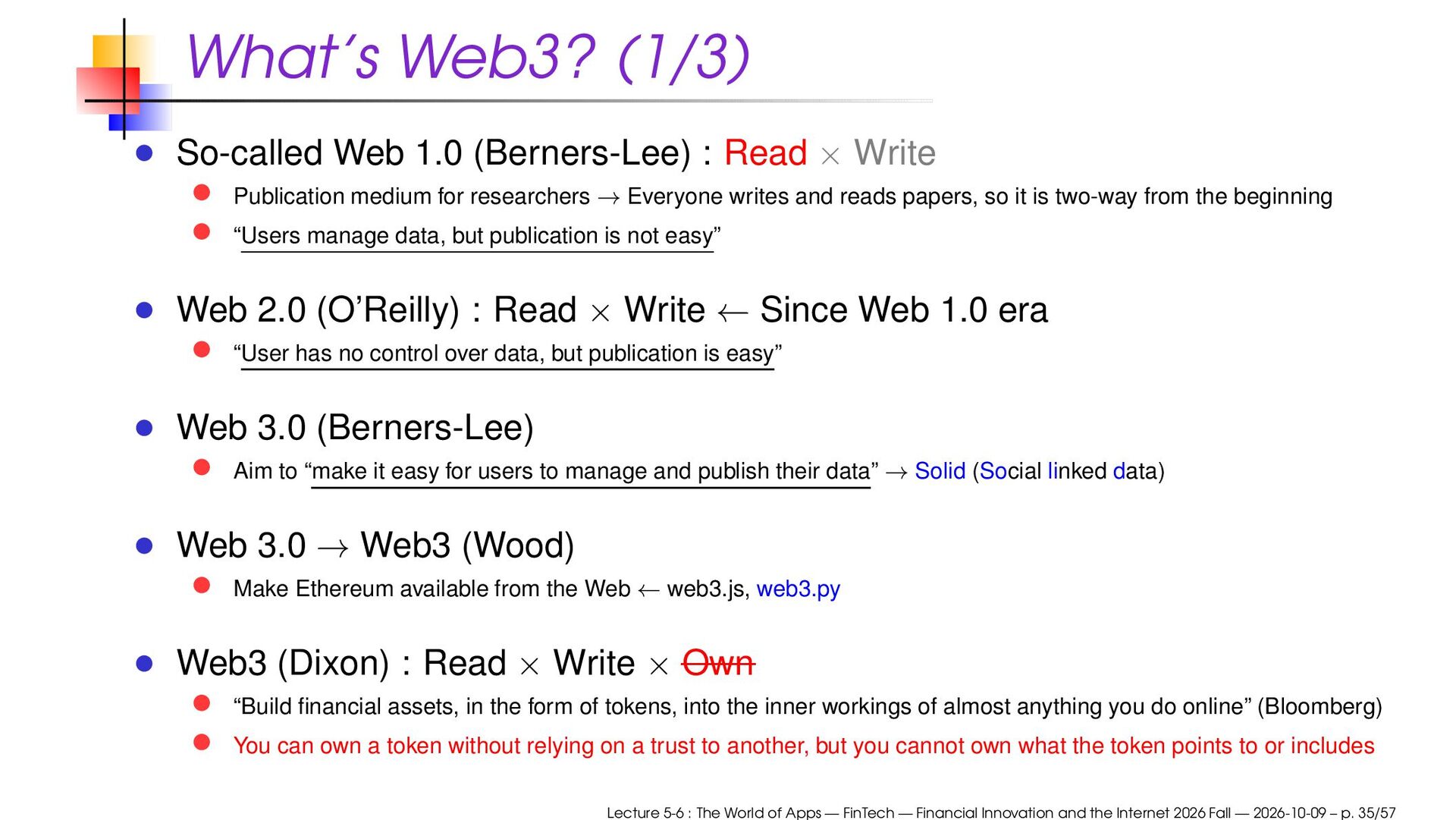
Write Publication medium for researchers → Everyone writes and reads papers, so it is two-way from the beginning “Users manage data, but publication is not easy” Web 2.0 (O’Reilly) : Read × Write ← Since Web 1.0 era “User has no control over data, but publication is easy” Web 3.0 (Berners-Lee) Aim to “make it easy for users to manage and publish their data” → Solid (Social linked data) Web 3.0 → Web3 (Wood) Make Ethereum available from the Web ← web3.js, web3.py Web3 (Dixon) : Read × Write × Own “Build financial assets, in the form of tokens, into the inner workings of almost anything you do online” (Bloomberg) You can own a token without relying on a trust to another, but you cannot own what the token points to or includes Lecture 5-6 : The World of Apps — FinTech — Financial Innovation and the Internet 2026 Fall — 2026-10-09 – p. 35/57
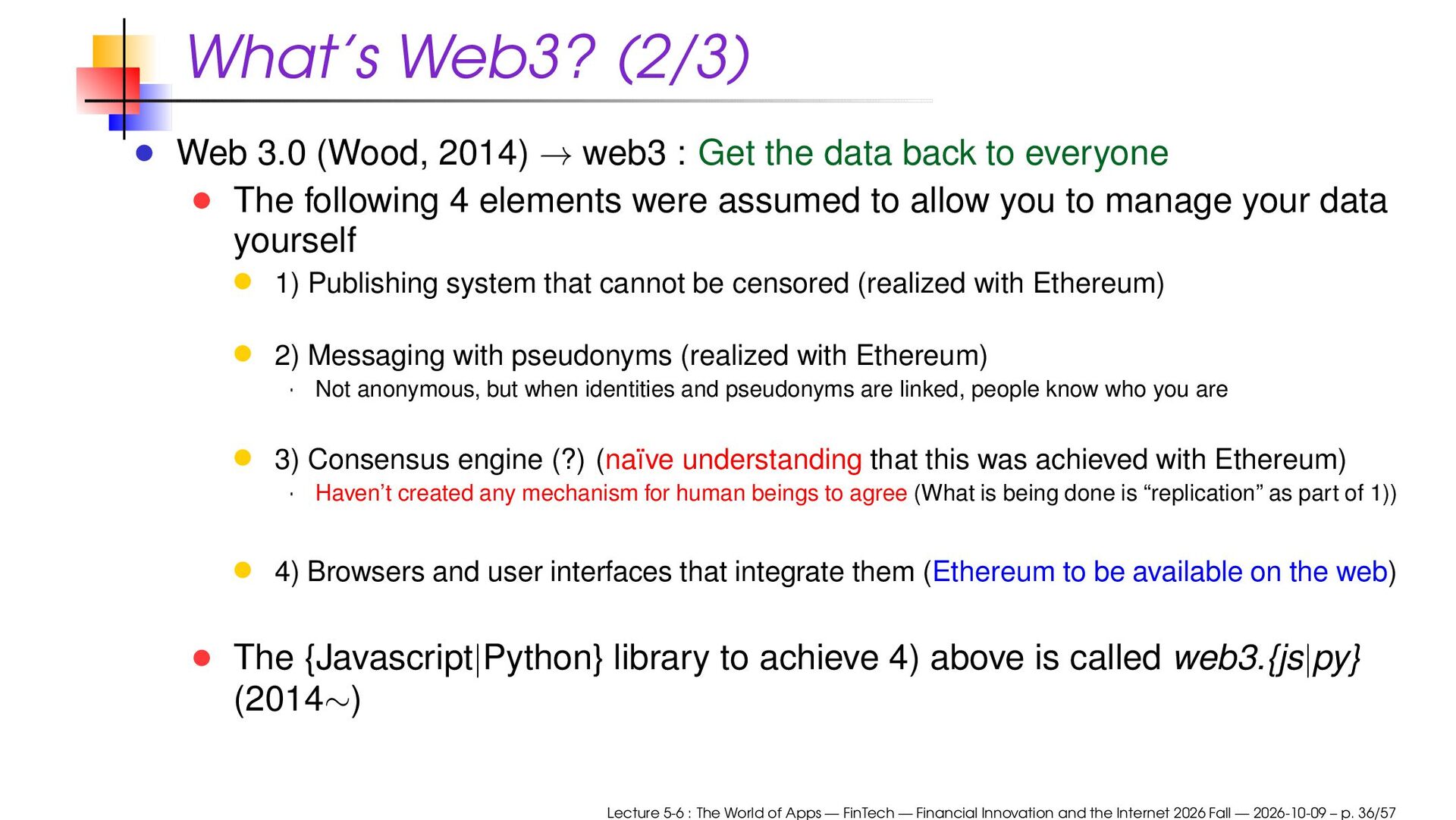
Get the data back to everyone The following 4 elements were assumed to allow you to manage your data yourself 1) Publishing system that cannot be censored (realized with Ethereum) 2) Messaging with pseudonyms (realized with Ethereum) · Not anonymous, but when identities and pseudonyms are linked, people know who you are 3) Consensus engine (?) (naïve understanding that this was achieved with Ethereum) · Haven’t created any mechanism for human beings to agree (What is being done is “replication” as part of 1)) 4) Browsers and user interfaces that integrate them (Ethereum to be available on the web) The {Javascript|Python} library to achieve 4) above is called web3.{js|py} (2014∼) Lecture 5-6 : The World of Apps — FinTech — Financial Innovation and the Internet 2026 Fall — 2026-10-09 – p. 36/57
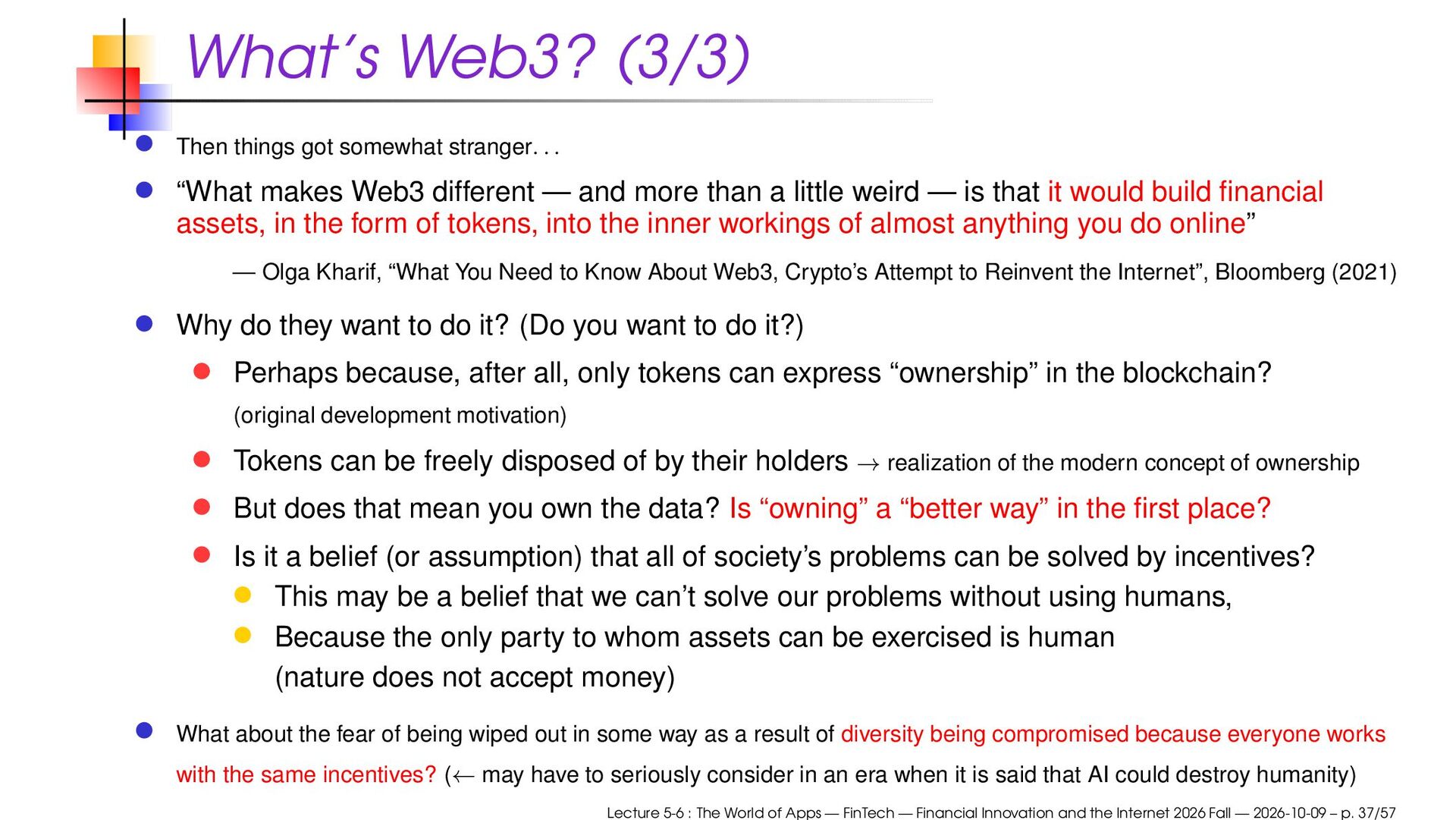
“What makes Web3 different — and more than a little weird — is that it would build financial assets, in the form of tokens, into the inner workings of almost anything you do online” — Olga Kharif, “What You Need to Know About Web3, Crypto’s Attempt to Reinvent the Internet”, Bloomberg (2021) Why do they want to do it? (Do you want to do it?) Perhaps because, after all, only tokens can express “ownership” in the blockchain? (original development motivation) Tokens can be freely disposed of by their holders → realization of the modern concept of ownership But does that mean you own the data? Is “owning” a “better way” in the first place? Is it a belief (or assumption) that all of society’s problems can be solved by incentives? This may be a belief that we can’t solve our problems without using humans, Because the only party to whom assets can be exercised is human (nature does not accept money) What about the fear of being wiped out in some way as a result of diversity being compromised because everyone works with the same incentives? (← may have to seriously consider in an era when it is said that AI could destroy humanity) Lecture 5-6 : The World of Apps — FinTech — Financial Innovation and the Internet 2026 Fall — 2026-10-09 – p. 37/57
Whatever you want to do, this class will always answer it with true stories Lecture 5-6 : The World of Apps — FinTech — Financial Innovation and the Internet 2026 Fall — 2026-10-09 – p. 38/57
application can make use of some features provided somewhere Web API : API by HTTP(S) requests In this case, features are provided by a (remote) web server Lecture 5-6 : The World of Apps — FinTech — Financial Innovation and the Internet 2026 Fall — 2026-10-09 – p. 39/57
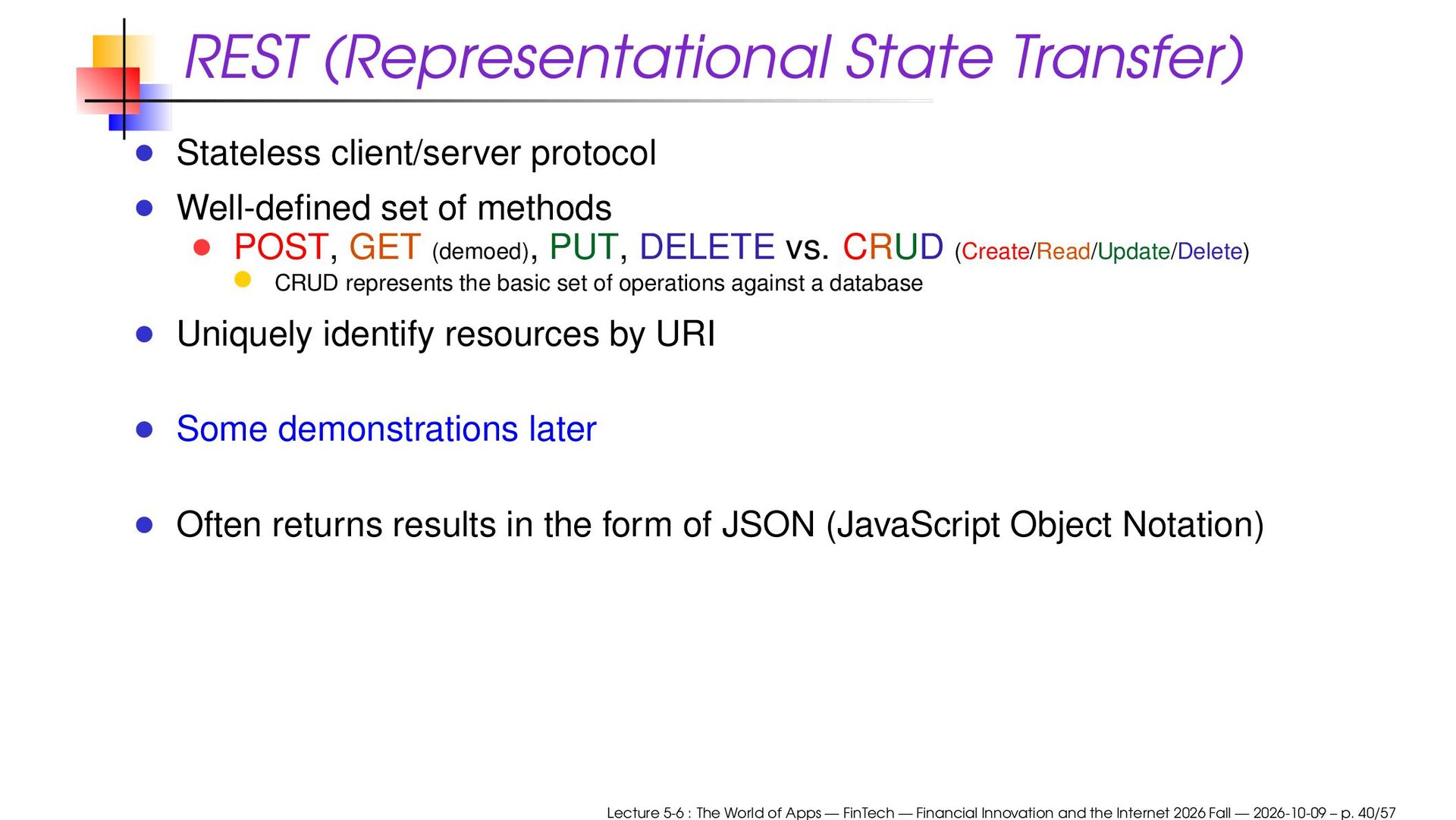
methods POST, GET (demoed), PUT, DELETE vs. CRUD (Create/Read/Update/Delete) CRUD represents the basic set of operations against a database Uniquely identify resources by URI Some demonstrations later Often returns results in the form of JSON (JavaScript Object Notation) Lecture 5-6 : The World of Apps — FinTech — Financial Innovation and the Internet 2026 Fall — 2026-10-09 – p. 40/57
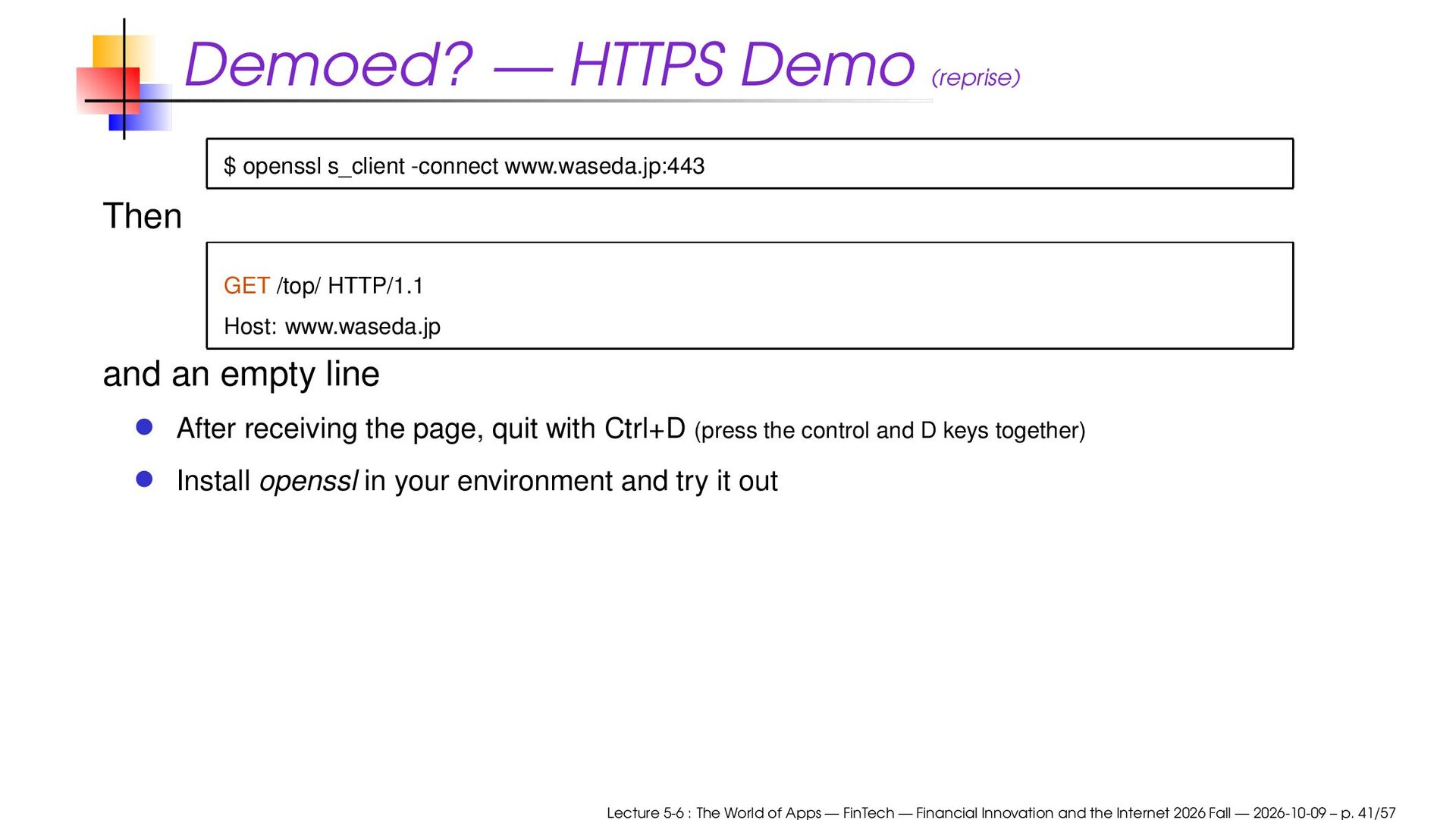
Then GET /top/ HTTP/1.1 Host: www.waseda.jp and an empty line After receiving the page, quit with Ctrl+D (press the control and D keys together) Install openssl in your environment and try it out Lecture 5-6 : The World of Apps — FinTech — Financial Innovation and the Internet 2026 Fall — 2026-10-09 – p. 41/57
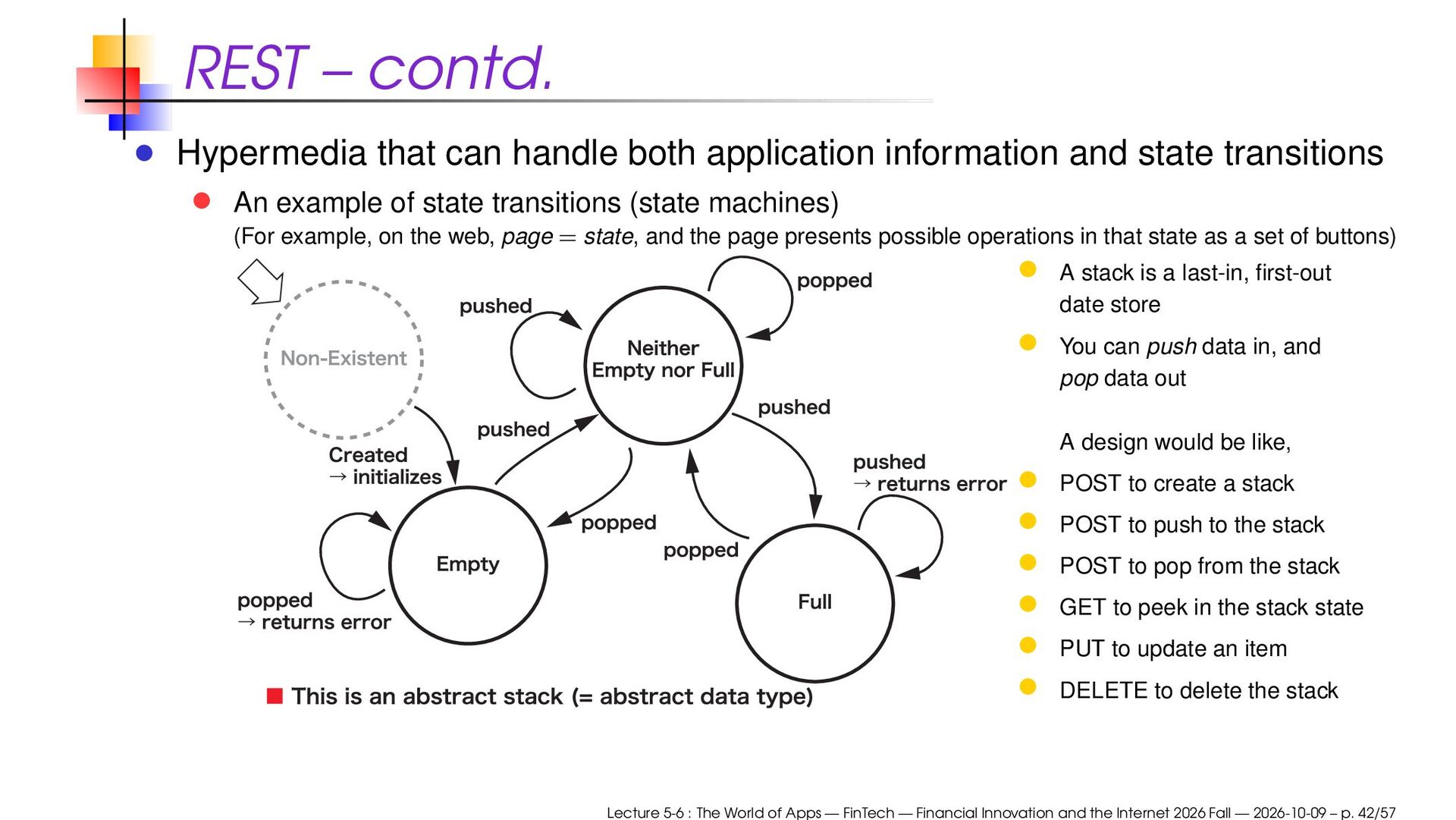
and state transitions An example of state transitions (state machines) (For example, on the web, page = state, and the page presents possible operations in that state as a set of buttons) A stack is a last-in, first-out date store You can push data in, and pop data out A design would be like, POST to create a stack POST to push to the stack POST to pop from the stack GET to peek in the stack state PUT to update an item DELETE to delete the stack Lecture 5-6 : The World of Apps — FinTech — Financial Innovation and the Internet 2026 Fall — 2026-10-09 – p. 42/57
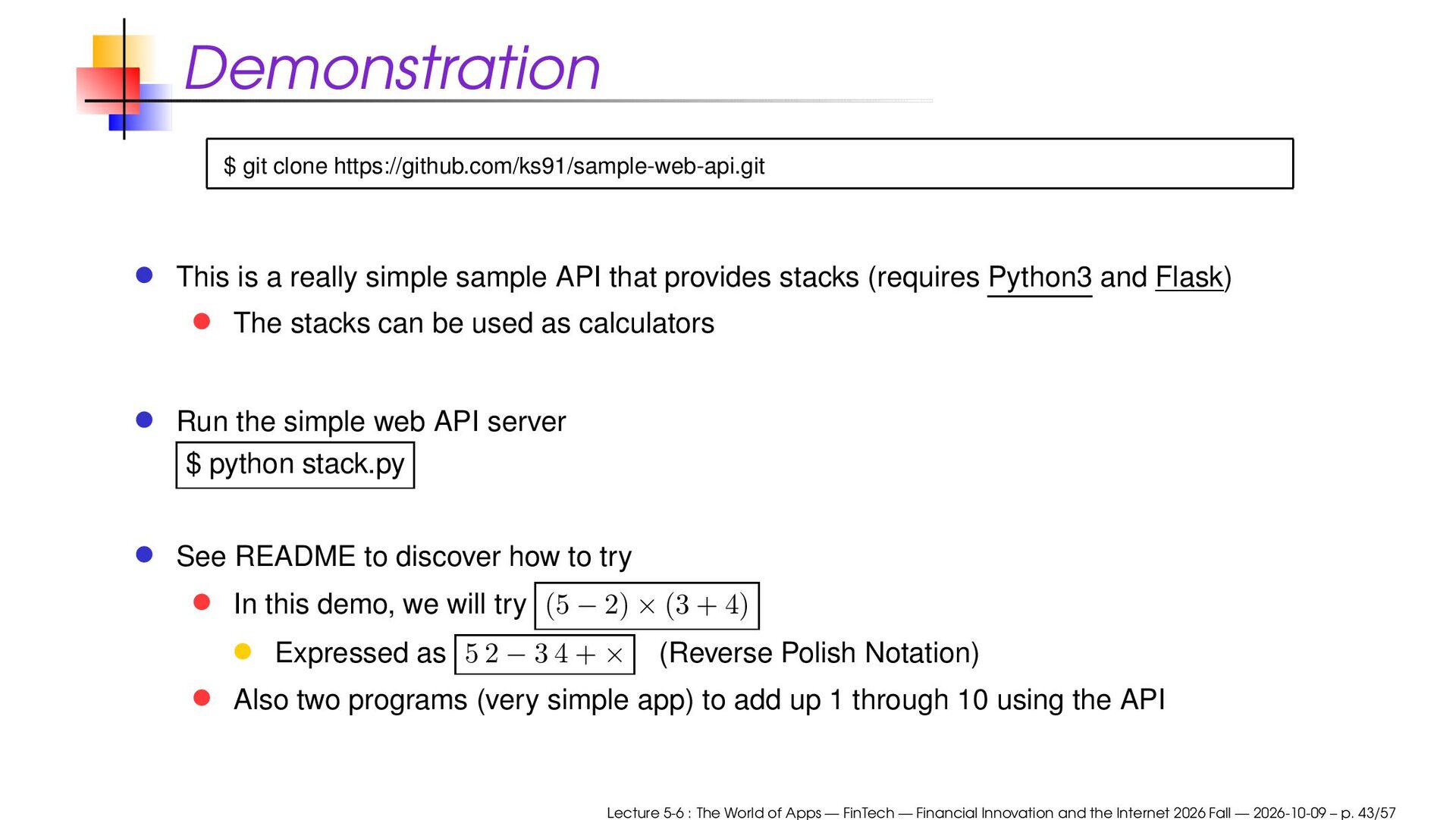
sample API that provides stacks (requires Python3 and Flask) The stacks can be used as calculators Run the simple web API server $ python stack.py See README to discover how to try In this demo, we will try (5 − 2) × (3 + 4) Expressed as 5 2 − 3 4 + × (Reverse Polish Notation) Also two programs (very simple app) to add up 1 through 10 using the API Lecture 5-6 : The World of Apps — FinTech — Financial Innovation and the Internet 2026 Fall — 2026-10-09 – p. 43/57
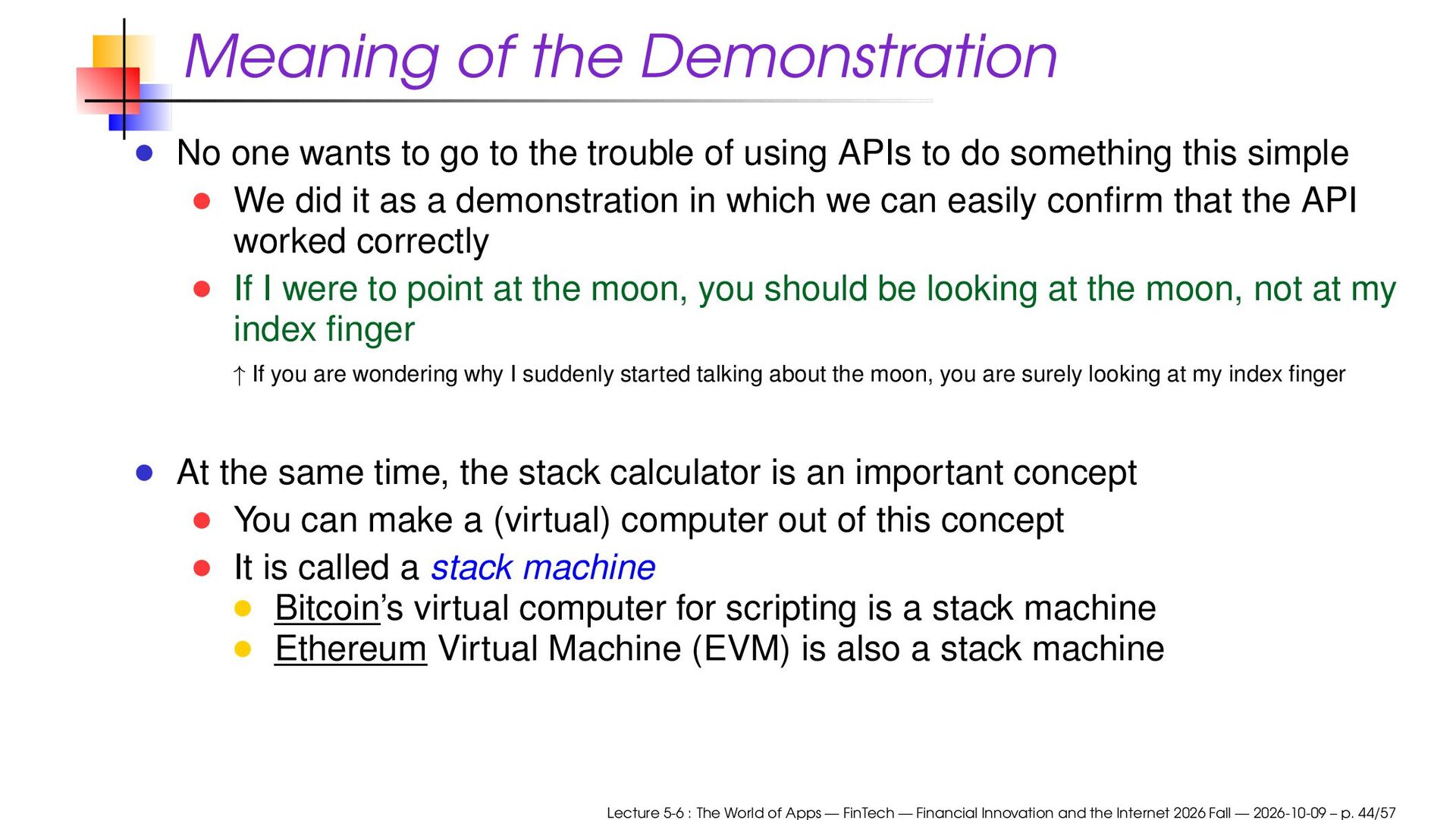
the trouble of using APIs to do something this simple We did it as a demonstration in which we can easily confirm that the API worked correctly If I were to point at the moon, you should be looking at the moon, not at my index finger ↑ If you are wondering why I suddenly started talking about the moon, you are surely looking at my index finger At the same time, the stack calculator is an important concept You can make a (virtual) computer out of this concept It is called a stack machine Bitcoin’s virtual computer for scripting is a stack machine Ethereum Virtual Machine (EVM) is also a stack machine Lecture 5-6 : The World of Apps — FinTech — Financial Innovation and the Internet 2026 Fall — 2026-10-09 – p. 44/57
banking? Roughly design With CRUD (Create/Read/Update/Delete) in mind Have you considered an API to retrieve passbook data? How can you be sure that the data is genuine? Lecture 5-6 : The World of Apps — FinTech — Financial Innovation and the Internet 2026 Fall — 2026-10-09 – p. 45/57
digital signature Zero-knowledge proof Lecture 5-6 : The World of Apps — FinTech — Financial Innovation and the Internet 2026 Fall — 2026-10-09 – p. 46/57
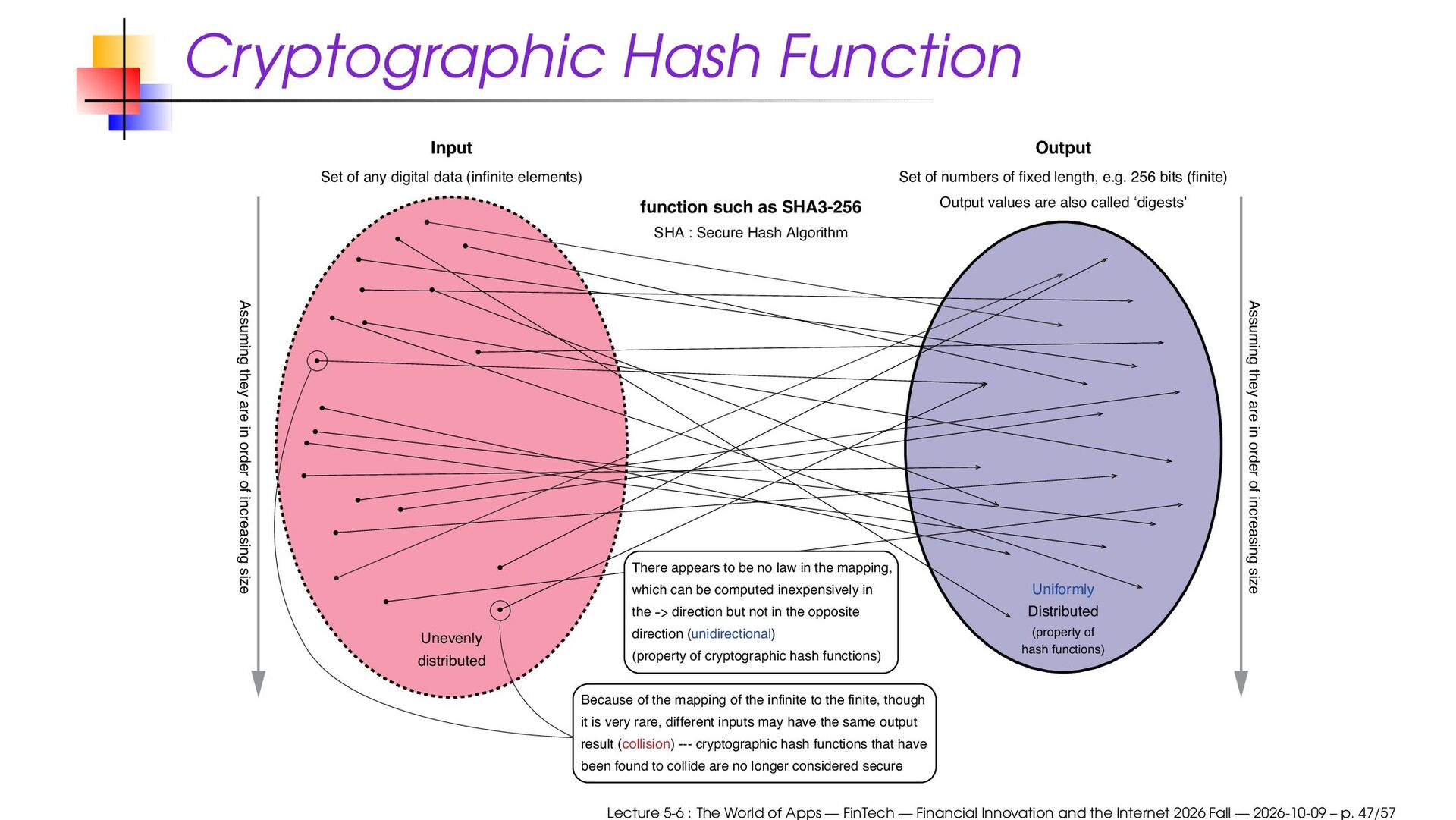
(infinite elements) Set of numbers of fixed length, e.g. 256 bits (finite) function such as SHA3-256 Output values are also called ‘digests’ SHA : Secure Hash Algorithm which can be computed inexpensively in the -> direction but not in the opposite Unevenly distributed direction (unidirectional) (property of cryptographic hash functions) Uniformly Distributed Assuming they are in order of increasing size Assuming they are in order of increasing size There appears to be no law in the mapping, (property of hash functions) Because of the mapping of the infinite to the finite, though it is very rare, different inputs may have the same output result (collision) --- cryptographic hash functions that have been found to collide are no longer considered secure Lecture 5-6 : The World of Apps — FinTech — Financial Innovation and the Internet 2026 Fall — 2026-10-09 – p. 47/57
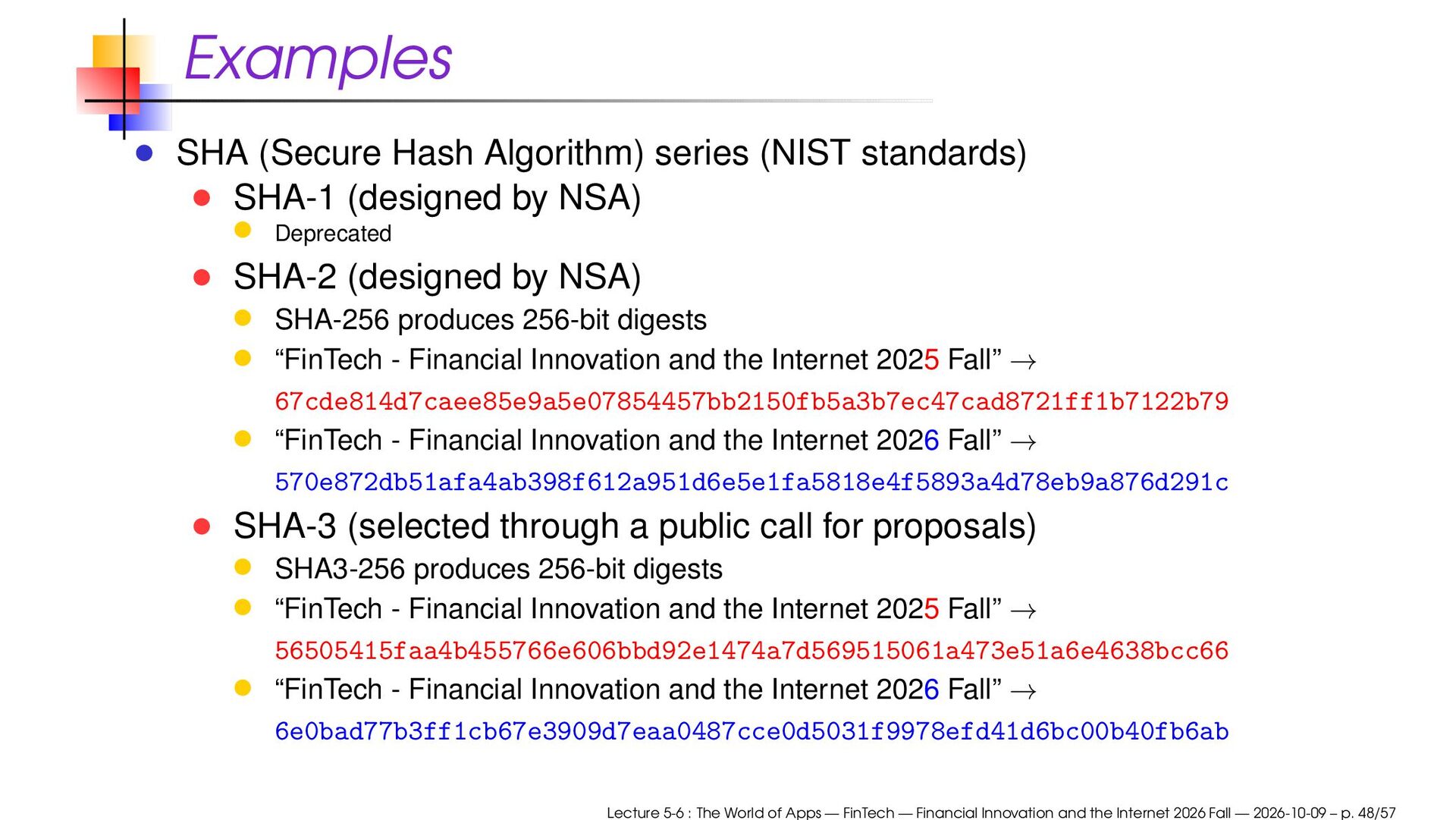
by NSA) Deprecated SHA-2 (designed by NSA) SHA-256 produces 256-bit digests “FinTech - Financial Innovation and the Internet 2025 Fall” → 67cde814d7caee85e9a5e07854457bb2150fb5a3b7ec47cad8721ff1b7122b79 “FinTech - Financial Innovation and the Internet 2026 Fall” → 570e872db51afa4ab398f612a951d6e5e1fa5818e4f5893a4d78eb9a876d291c SHA-3 (selected through a public call for proposals) SHA3-256 produces 256-bit digests “FinTech - Financial Innovation and the Internet 2025 Fall” → 56505415faa4b455766e606bbd92e1474a7d569515061a473e51a6e4638bcc66 “FinTech - Financial Innovation and the Internet 2026 Fall” → 6e0bad77b3ff1cb67e3909d7eaa0487cce0d5031f9978efd41d6bc00b40fb6ab Lecture 5-6 : The World of Apps — FinTech — Financial Innovation and the Internet 2026 Fall — 2026-10-09 – p. 48/57
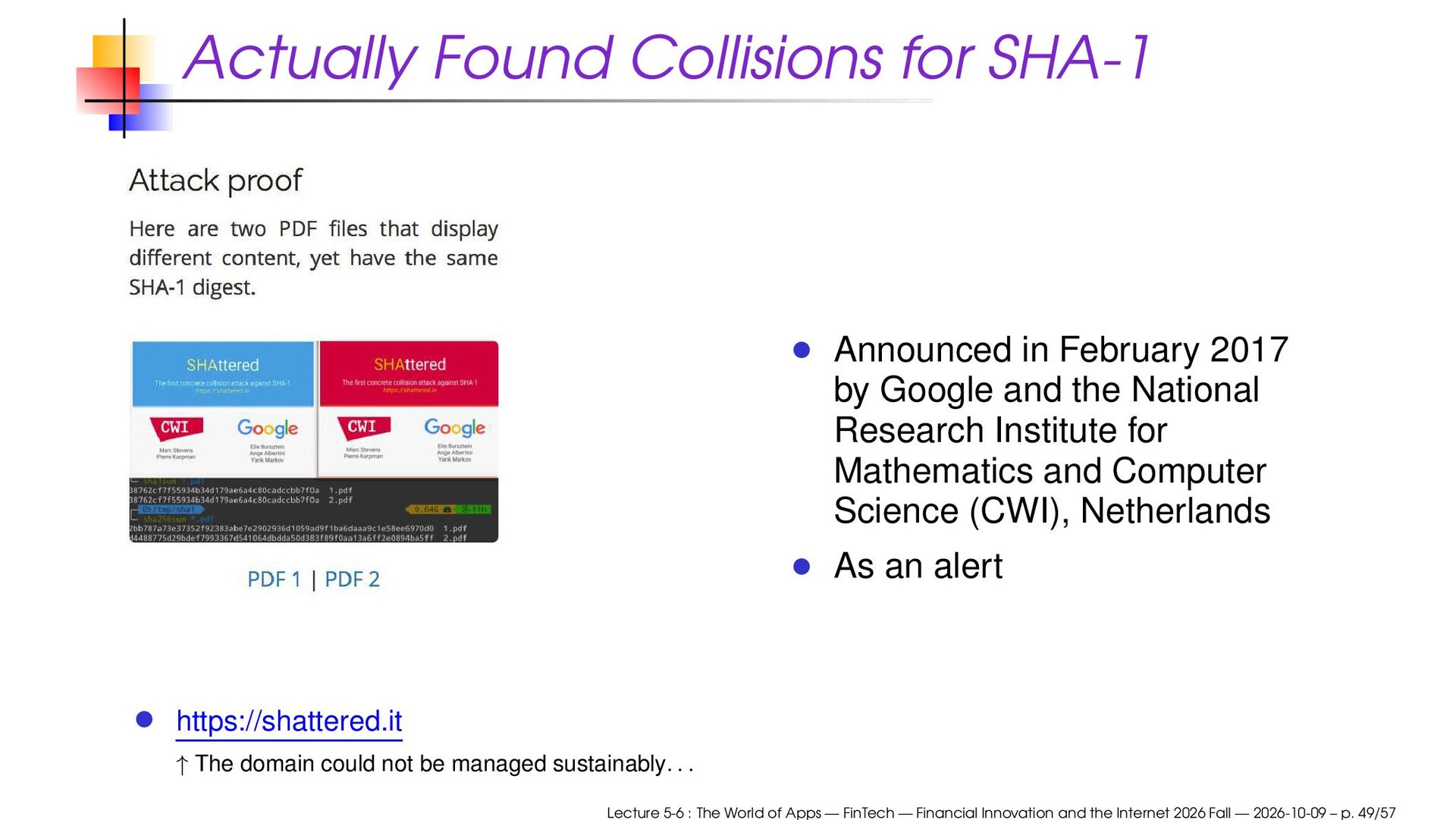
Google and the National Research Institute for Mathematics and Computer Science (CWI), Netherlands As an alert https://shattered.it ↑ The domain could not be managed sustainably. . . Lecture 5-6 : The World of Apps — FinTech — Financial Innovation and the Internet 2026 Fall — 2026-10-09 – p. 49/57
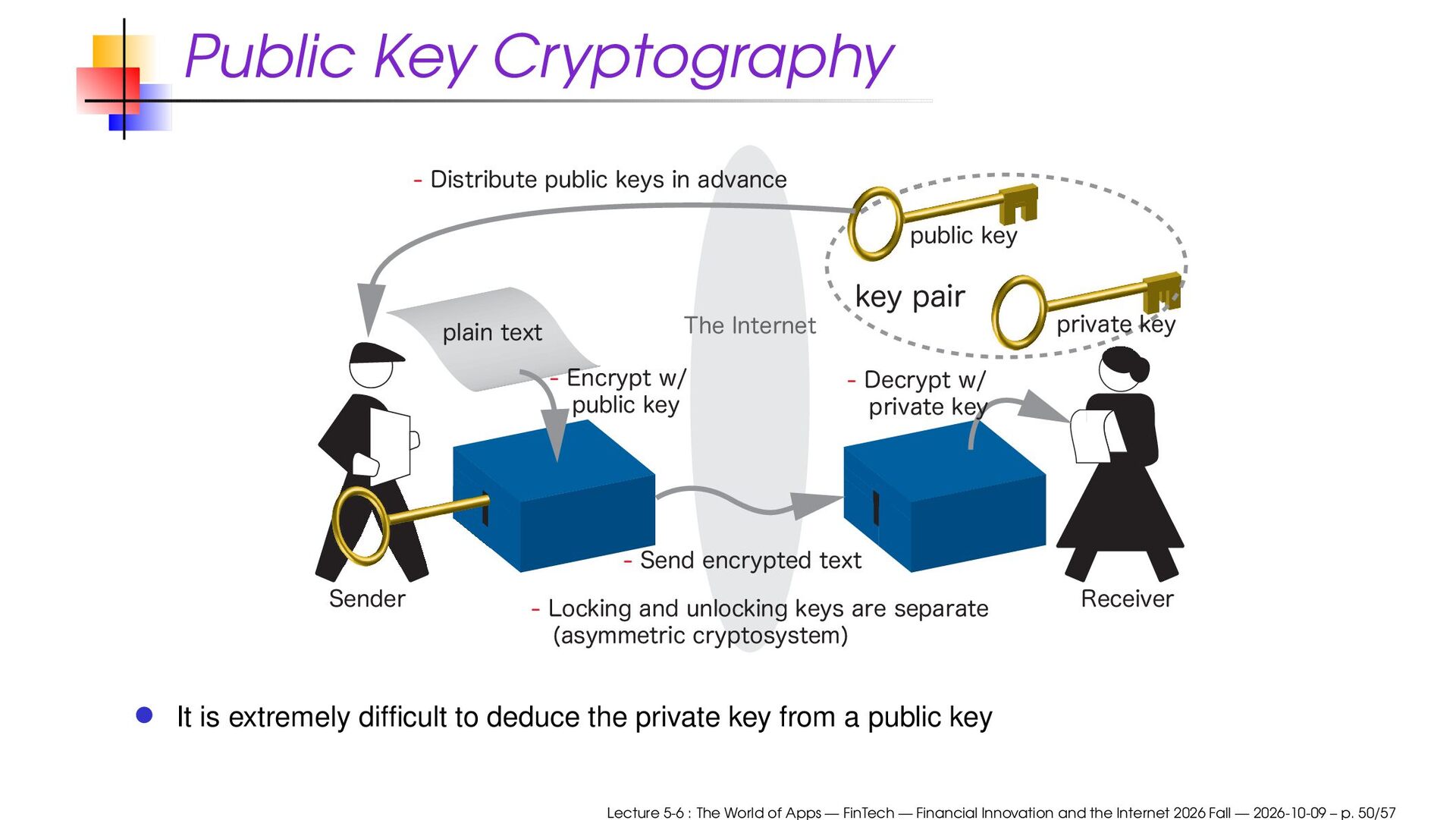
key plain text The Internet - Encrypt w/ public key key pair private key - Decrypt w/ private key - Send encrypted text Sender - Locking and unlocking keys are separate (asymmetric cryptosystem) Receiver It is extremely difficult to deduce the private key from a public key Lecture 5-6 : The World of Apps — FinTech — Financial Innovation and the Internet 2026 Fall — 2026-10-09 – p. 50/57
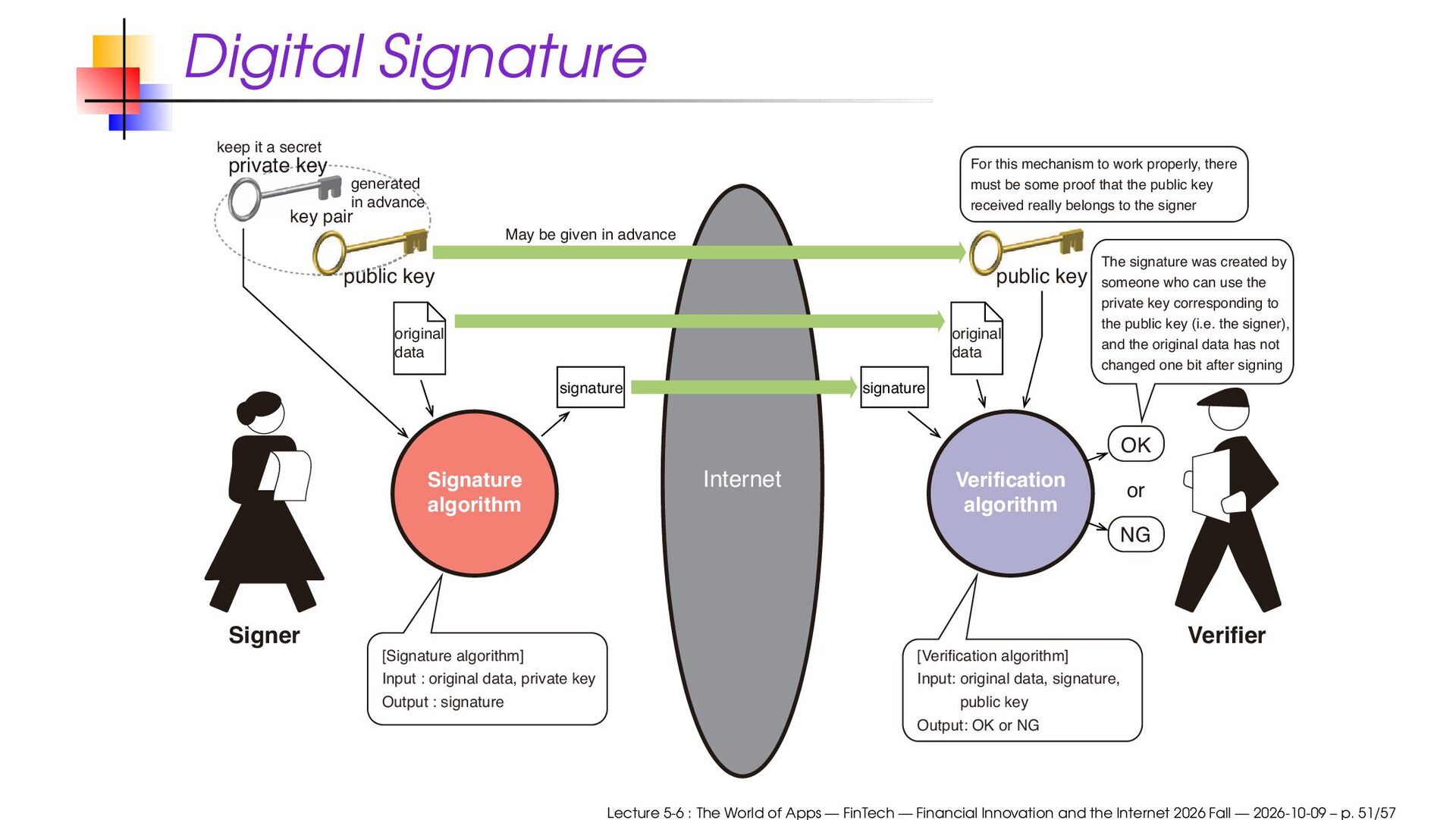
mechanism to work properly, there must be some proof that the public key received really belongs to the signer generated in advance key pair May be given in advance The signature was created by public key public key someone who can use the original data original data signature private key corresponding to the public key (i.e. the signer), and the original data has not changed one bit after signing signature OK Signature algorithm Internet Verification algorithm or NG Signer Verifier [Signature algorithm] Input : original data, private key Output : signature [Verification algorithm] Input: original data, signature, public key Output: OK or NG Lecture 5-6 : The World of Apps — FinTech — Financial Innovation and the Internet 2026 Fall — 2026-10-09 – p. 51/57
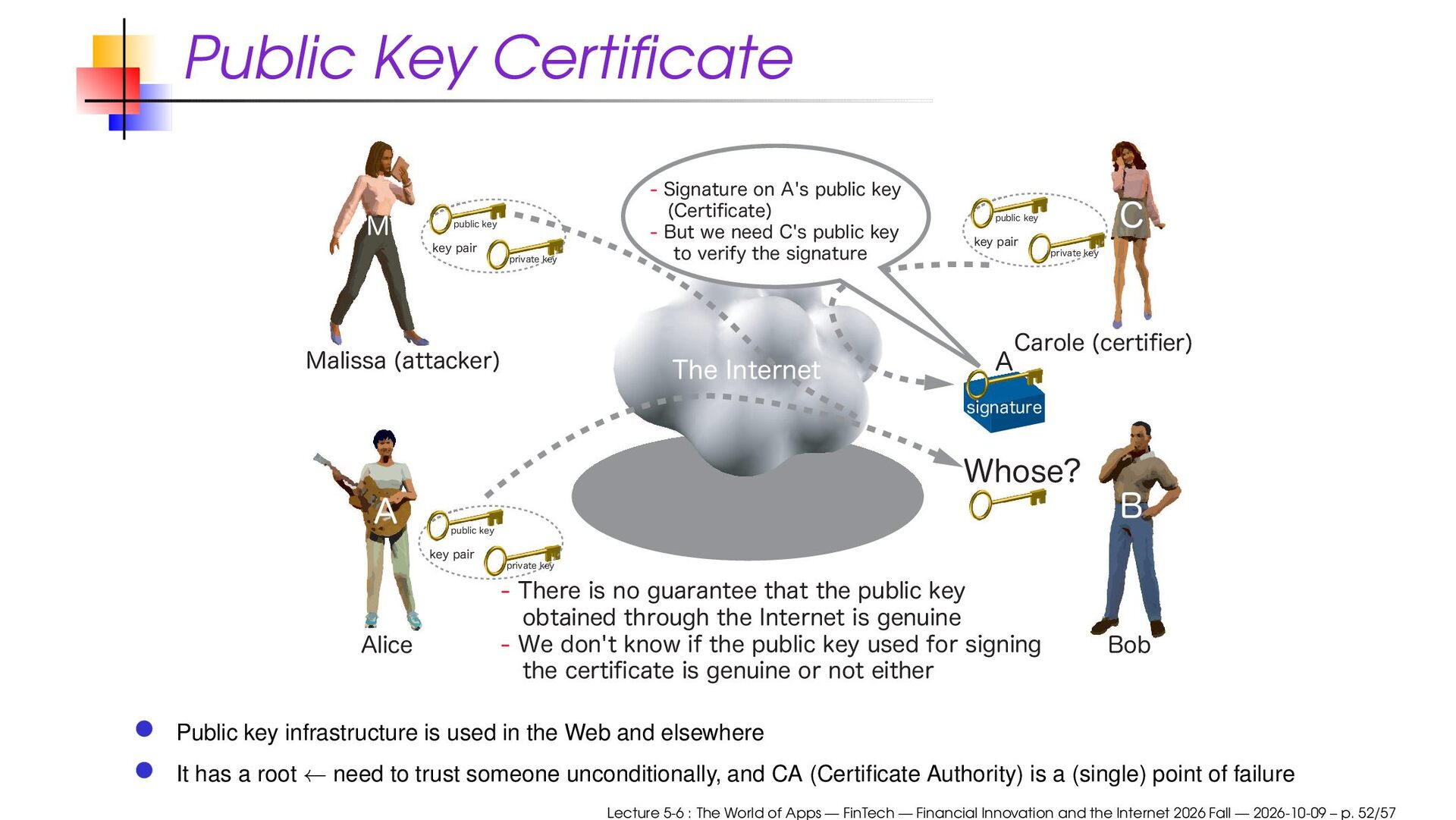
key Malissa (attacker) - Signature on A's public key (Certificate) - But we need C's public key to verify the signature The Internet C public ke key key pair A private key Carole (certifier) signature A Whose? public ke key key pair Alice B private key - There is no guarantee that the public key obtained through the Internet is genuine - We don't know if the public key used for signing the certificate is genuine or not either B b Bob Public key infrastructure is used in the Web and elsewhere It has a root ← need to trust someone unconditionally, and CA (Certificate Authority) is a (single) point of failure Lecture 5-6 : The World of Apps — FinTech — Financial Innovation and the Internet 2026 Fall — 2026-10-09 – p. 52/57
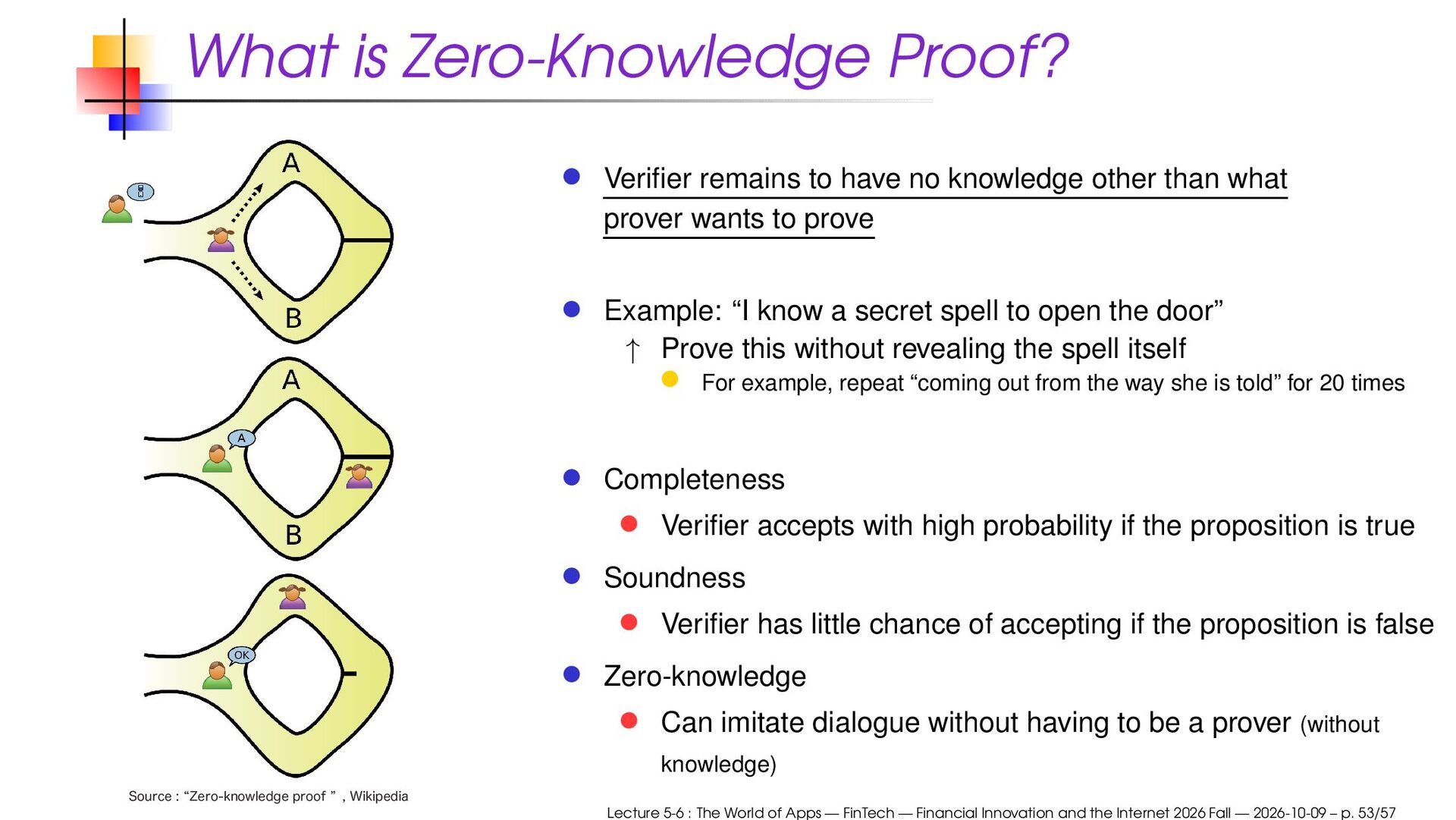
other than what prover wants to prove Example: “I know a secret spell to open the door” ↑ Prove this without revealing the spell itself For example, repeat “coming out from the way she is told” for 20 times Completeness Verifier accepts with high probability if the proposition is true Soundness Verifier has little chance of accepting if the proposition is false Zero-knowledge Can imitate dialogue without having to be a prover (without knowledge) Source : “Zero-knowledge proof ” , Wikipedia Lecture 5-6 : The World of Apps — FinTech — Financial Innovation and the Internet 2026 Fall — 2026-10-09 – p. 53/57
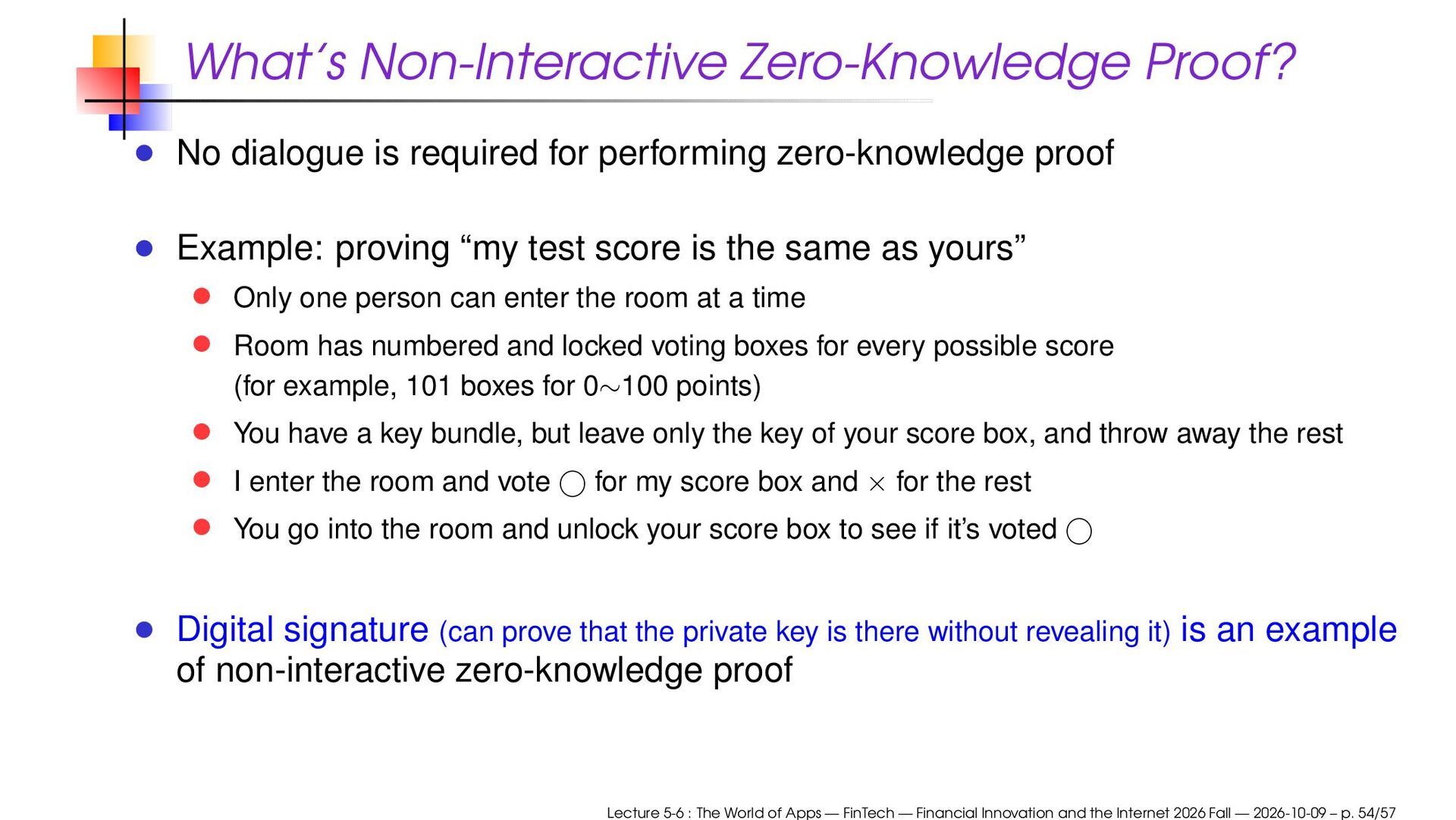
zero-knowledge proof Example: proving “my test score is the same as yours” Only one person can enter the room at a time Room has numbered and locked voting boxes for every possible score (for example, 101 boxes for 0∼100 points) You have a key bundle, but leave only the key of your score box, and throw away the rest I enter the room and vote for my score box and × for the rest You go into the room and unlock your score box to see if it’s voted Digital signature (can prove that the private key is there without revealing it) is an example of non-interactive zero-knowledge proof Lecture 5-6 : The World of Apps — FinTech — Financial Innovation and the Internet 2026 Fall — 2026-10-09 – p. 54/57
a specific example of financial services (2) If a user is an “end (edge)”, what is the “center” operated by people or an organization in the example? (3) How will the service change if that center is automated, without an organization? (4) You may add your comments or questions about the class, if any Deadline and how to submit October 20, 2026 at 17:59 JST From Moodle (mandatory) Optionally, you can also post to #assignments channel at Discord So that your classmates can read your report, refer to it, and comment on it Just plain text, and be concise, please (and please remember Kent Beck on How to Get a Paper Accepted) Lecture 5-6 : The World of Apps — FinTech — Financial Innovation and the Internet 2026 Fall — 2026-10-09 – p. 56/57


 ks91
ks91
.png) codatum
codatum
 glaforge
 kmiya84377
 y_sera15
 raspython3
 shogo4131
 codmoninc
 ueponx
 kizawa2020
 vivion
 pauli
pauli
 masakane55
 addyosmani
 eileencodes
 mraible
 reverentgeek
 katiecoart
 lemiorhan
 coloredviolet
 frankvandijk
 garrettdimon
 tmiket
 bkeepers
 palkan
![R-san’s App [snip] The idea: A dating app that uses](https://files.speakerdeck.com/presentations/23c9a3d6b99b4d62ac8c47795a34e013/slide_13.jpg)