Slides I used for FinTech - Financial Innovation and the Internet 2026 Fall at Graduate School of Business and Finance, Waseda University on October 23, 2026.
the Internet 2026 Fall Lecture 7-8 : Blockchain Kenji Saito, Graduate School of Business and Finance, Waseda University Lecture 7-8 : Blockchain — FinTech — Financial Innovation and the Internet 2026 Fall — 2026-10-23 – p. 1/62
reviewing the lectures Recordings are shared via Dropbox and you can ask questions with time-stamped comments Of course, students are encouraged to ask questions in class The recordings could be used for research on (online) learning Transcribed for use and anonymized Will let you know when the necessity arises This time, let us use the recording for testing a transcription tool I will explain what tool, and the tool will benefit all classes Please say “Hi, I’m ” when you say something, to make it easy to verify the speaker separation I need everyone’s consent to send the anonymized report to the development community Lecture 7-8 : Blockchain — FinTech — Financial Innovation and the Internet 2026 Fall — 2026-10-23 – p. 2/62
and chat text will be posted at Moodle and Discord Note, however, that chat messages are often unnoticed I have invited you all to the Discord server of the class (continued from the past years) Look for the first announcement at Moodle Trial automatic transcription for lectures will be posted at Discord Because it would contain many mistakes More information is available on Discord, so you have a reason to join the Discord server Furthermore, in the end, participation in Discord may become mandatory for the progress of group work Lecture 7-8 : Blockchain — FinTech — Financial Innovation and the Internet 2026 Fall — 2026-10-23 – p. 3/62
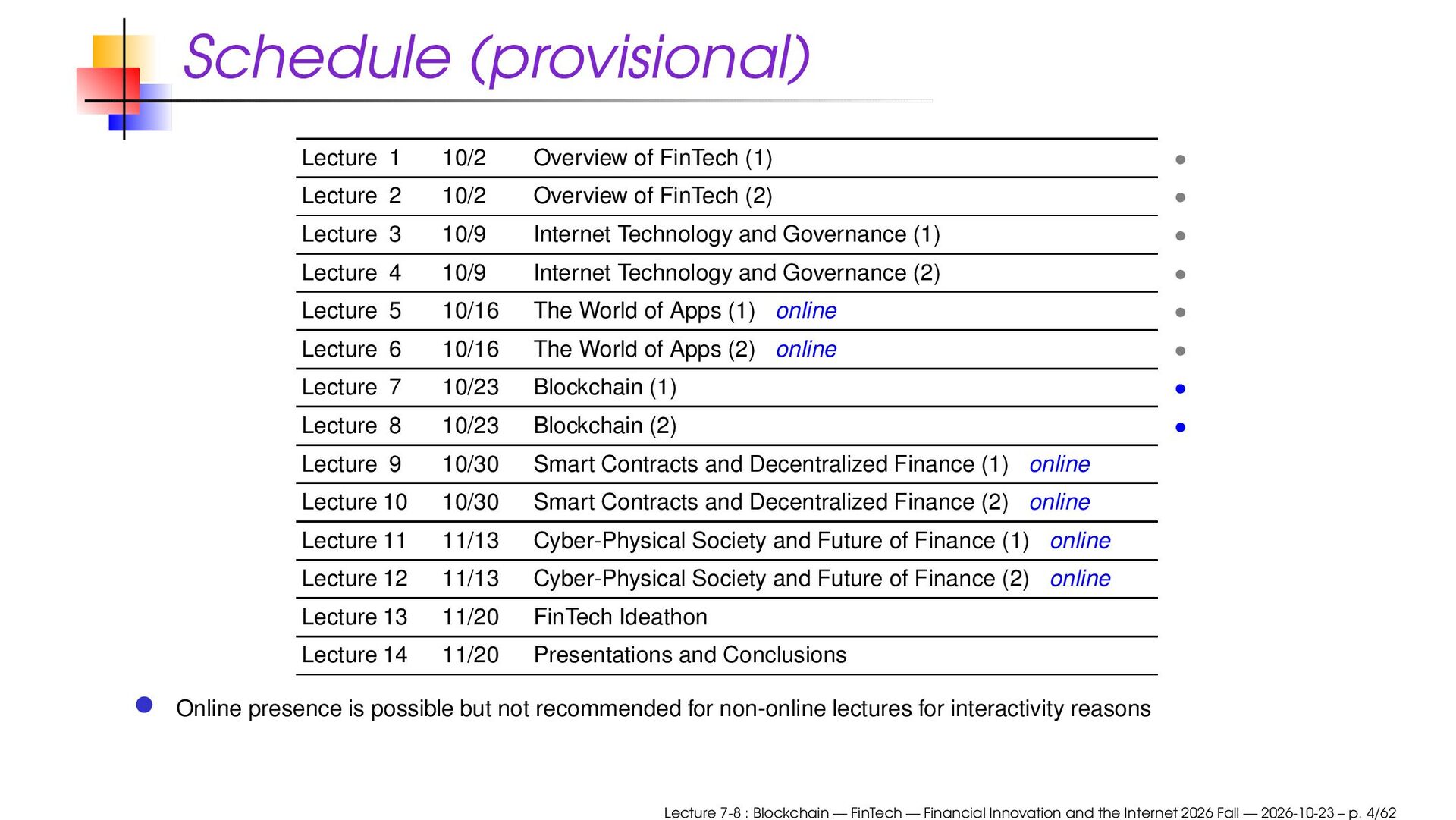
Lecture 2 10/2 Overview of FinTech (2) • Lecture 3 10/9 Internet Technology and Governance (1) • Lecture 4 10/9 Internet Technology and Governance (2) • Lecture 5 10/16 The World of Apps (1) online • Lecture 6 10/16 The World of Apps (2) online • Lecture 7 10/23 Blockchain (1) • Lecture 8 10/23 Blockchain (2) • Lecture 9 10/30 Smart Contracts and Decentralized Finance (1) online Lecture 10 10/30 Smart Contracts and Decentralized Finance (2) online Lecture 11 11/13 Cyber-Physical Society and Future of Finance (1) online Lecture 12 11/13 Cyber-Physical Society and Future of Finance (2) online Lecture 13 11/20 FinTech Ideathon Lecture 14 11/20 Presentations and Conclusions Online presence is possible but not recommended for non-online lectures for interactivity reasons Lecture 7-8 : Blockchain — FinTech — Financial Innovation and the Internet 2026 Fall — 2026-10-23 – p. 4/62
discussion) The World of the Web Web 1-2-3 True Stories API (Application Programming Interface) Web API (REST) in particular Discussion : Imagine API Basics of Cryptography (continued to today) Assignment Lecture 7-8 : Blockchain — FinTech — Financial Innovation and the Internet 2026 Fall — 2026-10-23 – p. 5/62
Blockchain Bitcoin’s “question” and “answer” / Beaker/Newspaper Model (physical model of Bitcoin) Applicability of Blockchain Impossibility and Challenges of Blockchain Brief Introduction to Upgrading and Governance of Blockchain Assignment — Science Fiction Prototyping Lecture 7-8 : Blockchain — FinTech — Financial Innovation and the Internet 2026 Fall — 2026-10-23 – p. 6/62
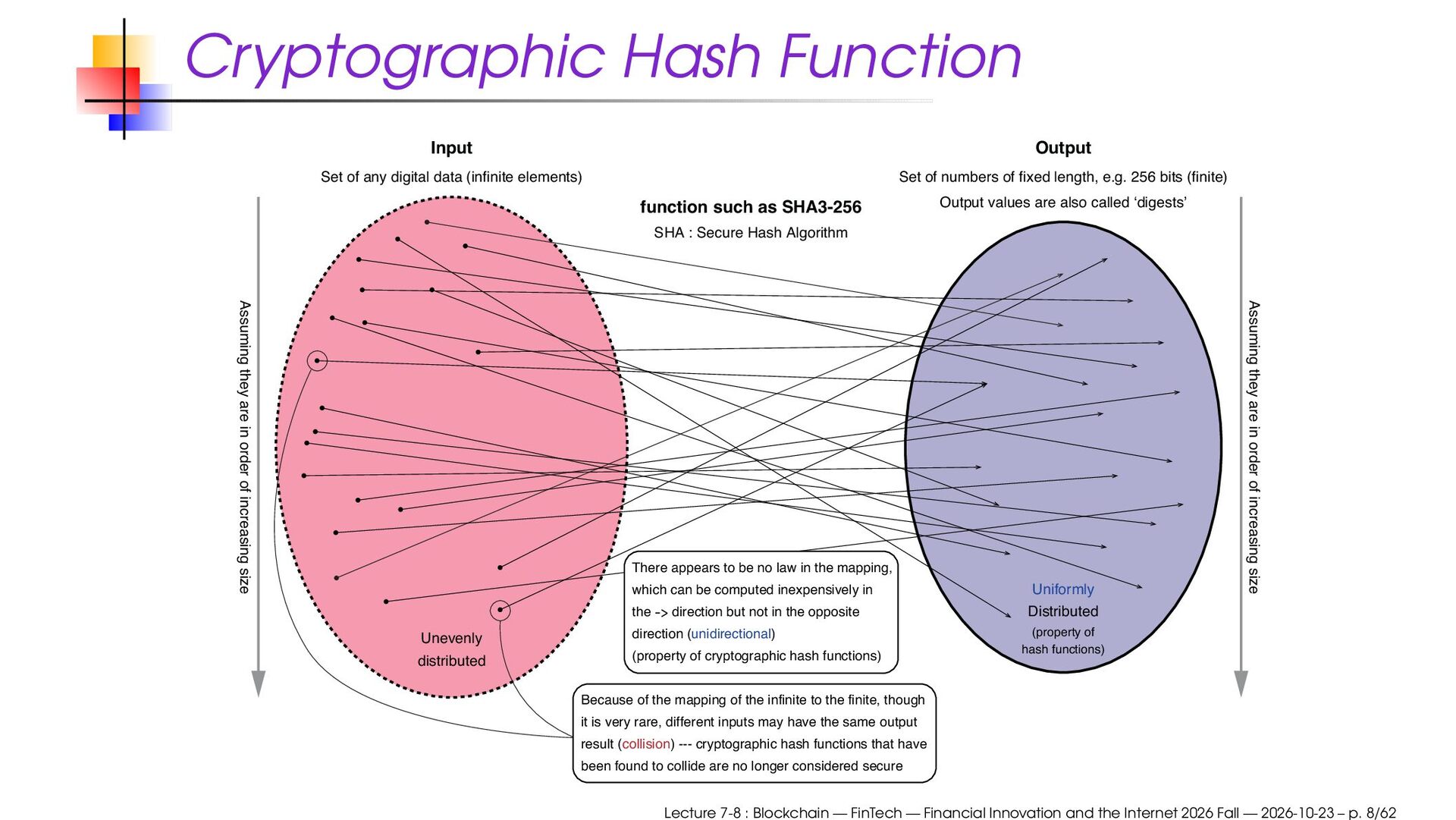
(infinite elements) Set of numbers of fixed length, e.g. 256 bits (finite) function such as SHA3-256 Output values are also called ‘digests’ SHA : Secure Hash Algorithm which can be computed inexpensively in the -> direction but not in the opposite Unevenly distributed direction (unidirectional) (property of cryptographic hash functions) Uniformly Distributed Assuming they are in order of increasing size Assuming they are in order of increasing size There appears to be no law in the mapping, (property of hash functions) Because of the mapping of the infinite to the finite, though it is very rare, different inputs may have the same output result (collision) --- cryptographic hash functions that have been found to collide are no longer considered secure Lecture 7-8 : Blockchain — FinTech — Financial Innovation and the Internet 2026 Fall — 2026-10-23 – p. 8/62
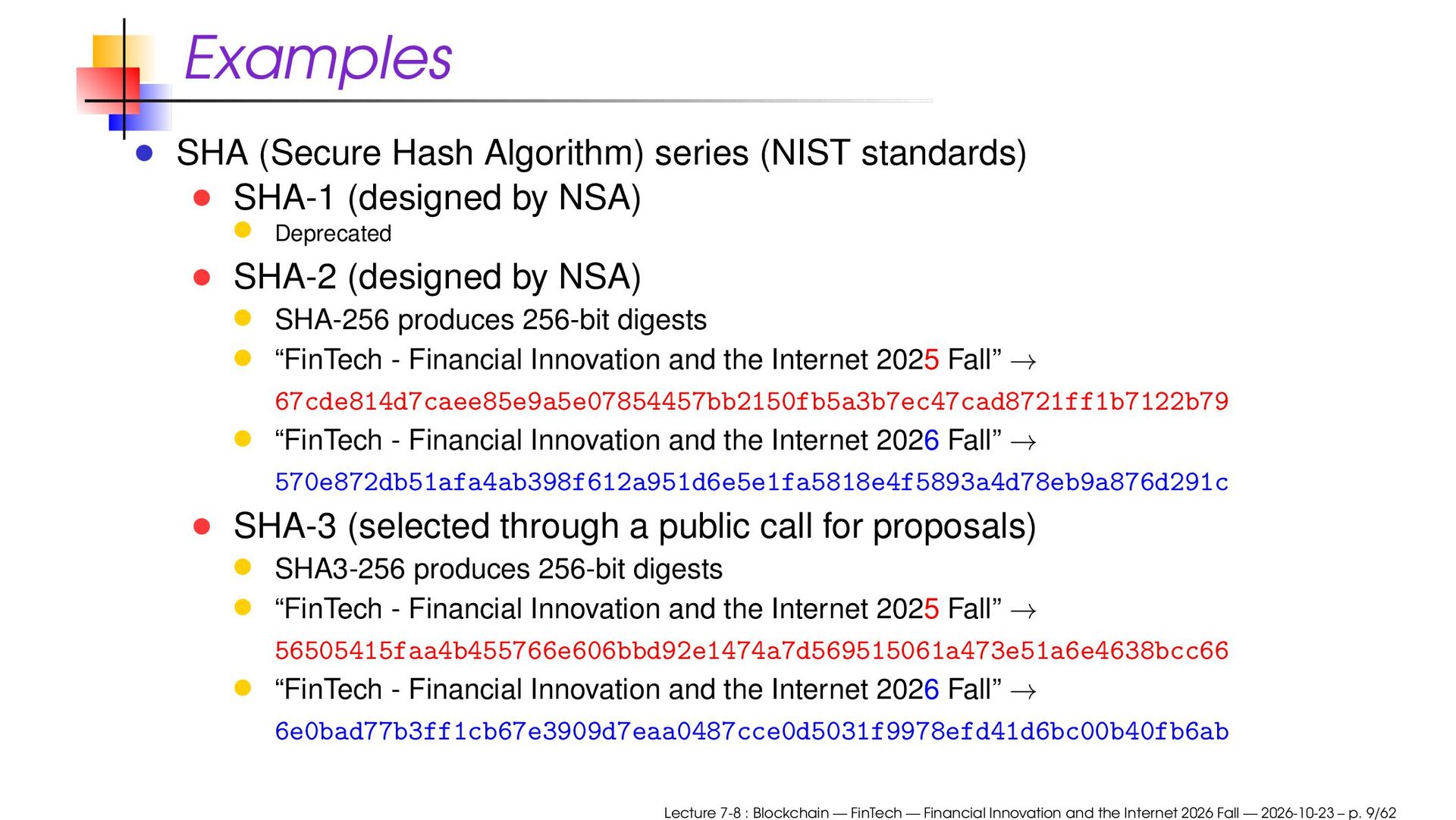
by NSA) Deprecated SHA-2 (designed by NSA) SHA-256 produces 256-bit digests “FinTech - Financial Innovation and the Internet 2025 Fall” → 67cde814d7caee85e9a5e07854457bb2150fb5a3b7ec47cad8721ff1b7122b79 “FinTech - Financial Innovation and the Internet 2026 Fall” → 570e872db51afa4ab398f612a951d6e5e1fa5818e4f5893a4d78eb9a876d291c SHA-3 (selected through a public call for proposals) SHA3-256 produces 256-bit digests “FinTech - Financial Innovation and the Internet 2025 Fall” → 56505415faa4b455766e606bbd92e1474a7d569515061a473e51a6e4638bcc66 “FinTech - Financial Innovation and the Internet 2026 Fall” → 6e0bad77b3ff1cb67e3909d7eaa0487cce0d5031f9978efd41d6bc00b40fb6ab Lecture 7-8 : Blockchain — FinTech — Financial Innovation and the Internet 2026 Fall — 2026-10-23 – p. 9/62
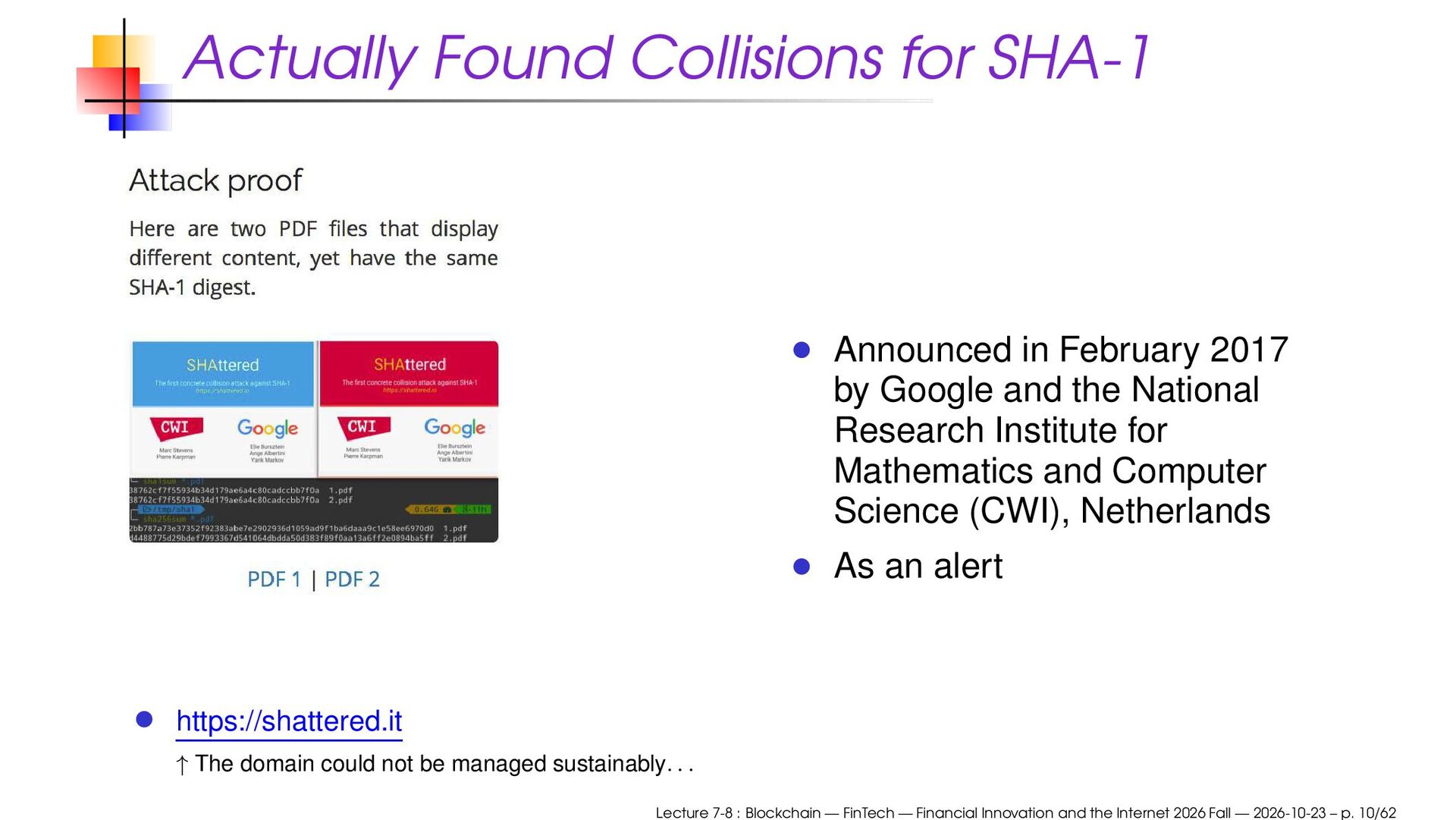
Google and the National Research Institute for Mathematics and Computer Science (CWI), Netherlands As an alert https://shattered.it ↑ The domain could not be managed sustainably. . . Lecture 7-8 : Blockchain — FinTech — Financial Innovation and the Internet 2026 Fall — 2026-10-23 – p. 10/62
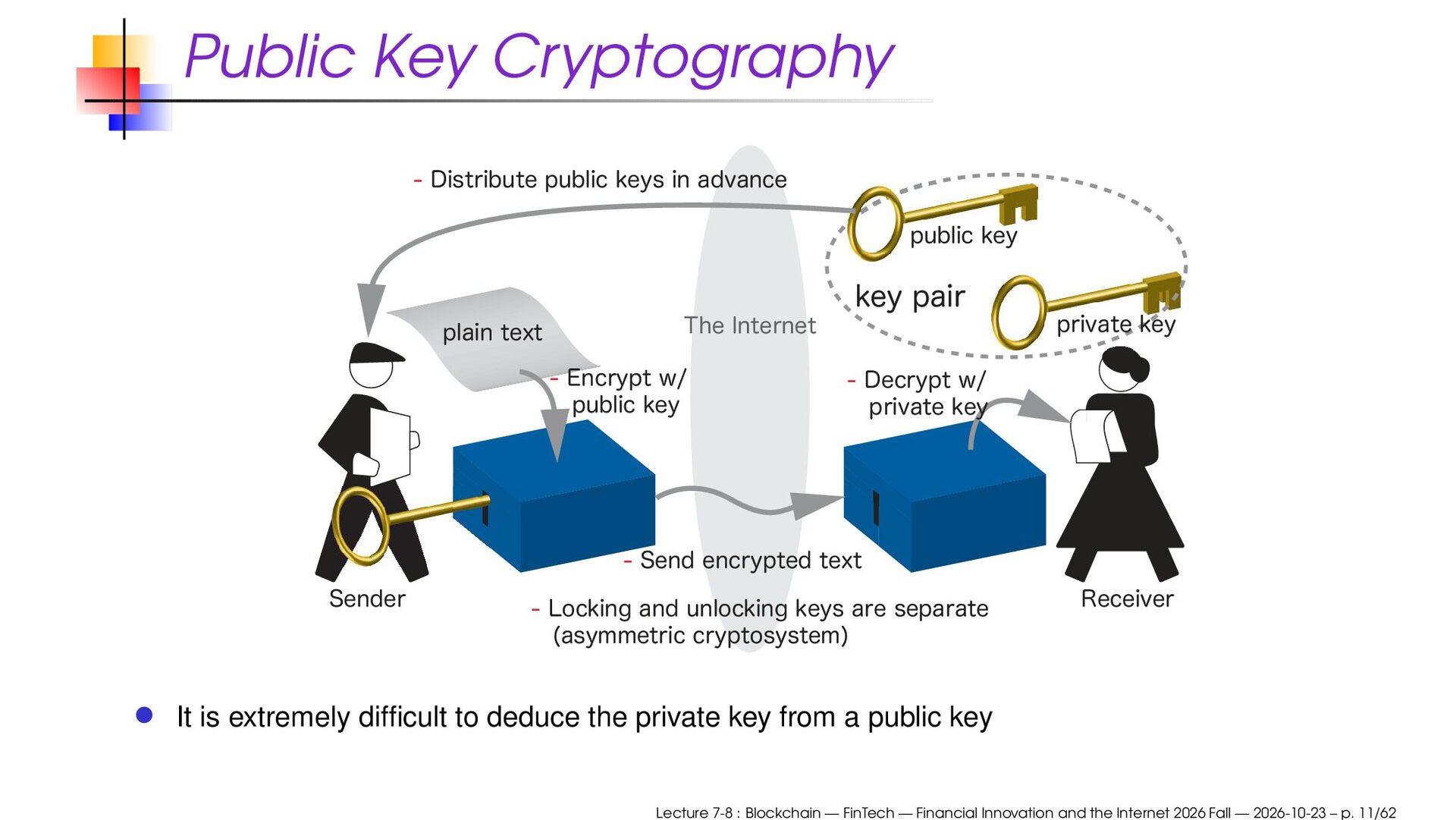
key plain text The Internet - Encrypt w/ public key key pair private key - Decrypt w/ private key - Send encrypted text Sender - Locking and unlocking keys are separate (asymmetric cryptosystem) Receiver It is extremely difficult to deduce the private key from a public key Lecture 7-8 : Blockchain — FinTech — Financial Innovation and the Internet 2026 Fall — 2026-10-23 – p. 11/62
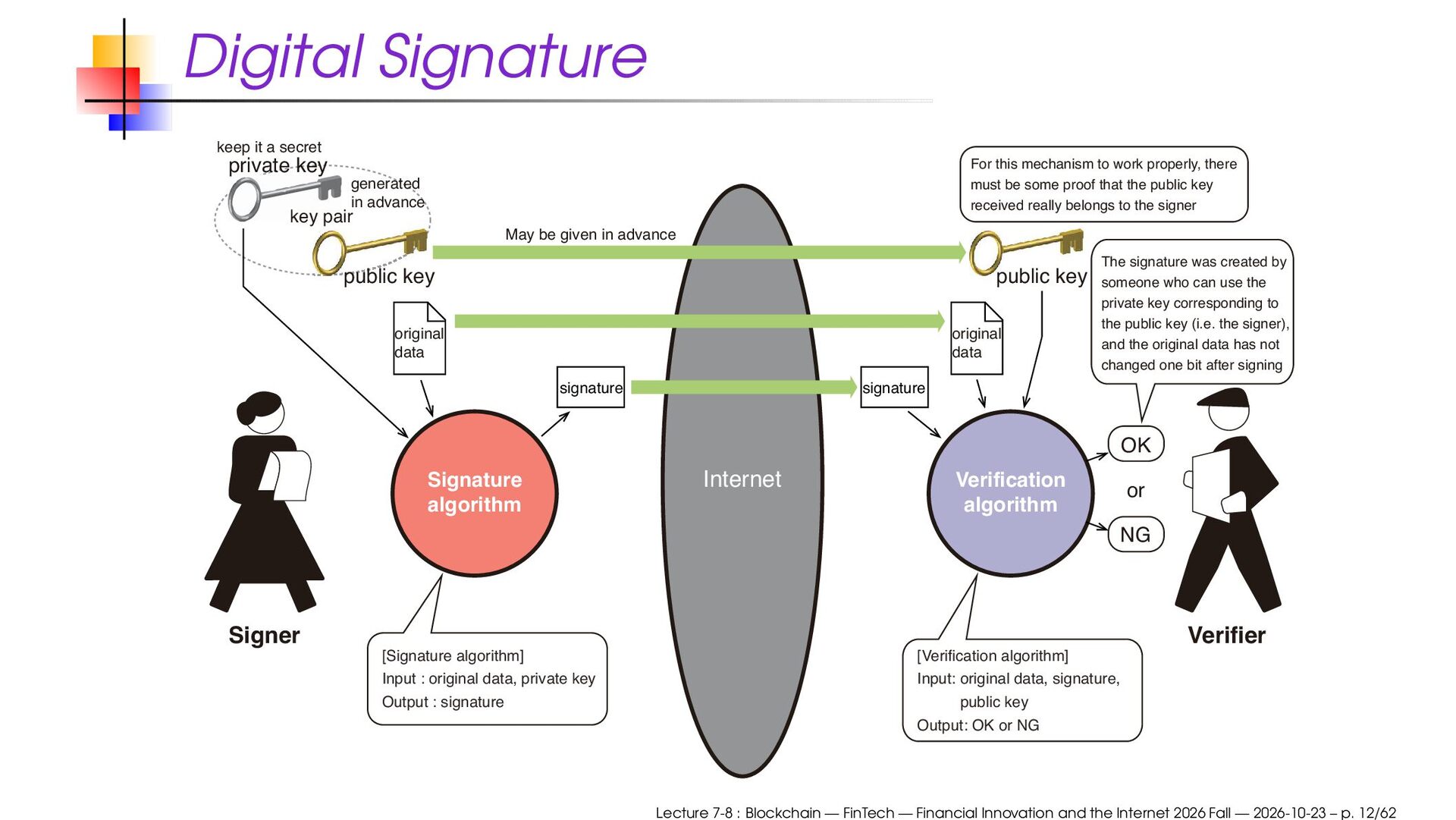
mechanism to work properly, there must be some proof that the public key received really belongs to the signer generated in advance key pair May be given in advance The signature was created by public key public key someone who can use the original data original data signature private key corresponding to the public key (i.e. the signer), and the original data has not changed one bit after signing signature OK Signature algorithm Internet Verification algorithm or NG Signer Verifier [Signature algorithm] Input : original data, private key Output : signature [Verification algorithm] Input: original data, signature, public key Output: OK or NG Lecture 7-8 : Blockchain — FinTech — Financial Innovation and the Internet 2026 Fall — 2026-10-23 – p. 12/62
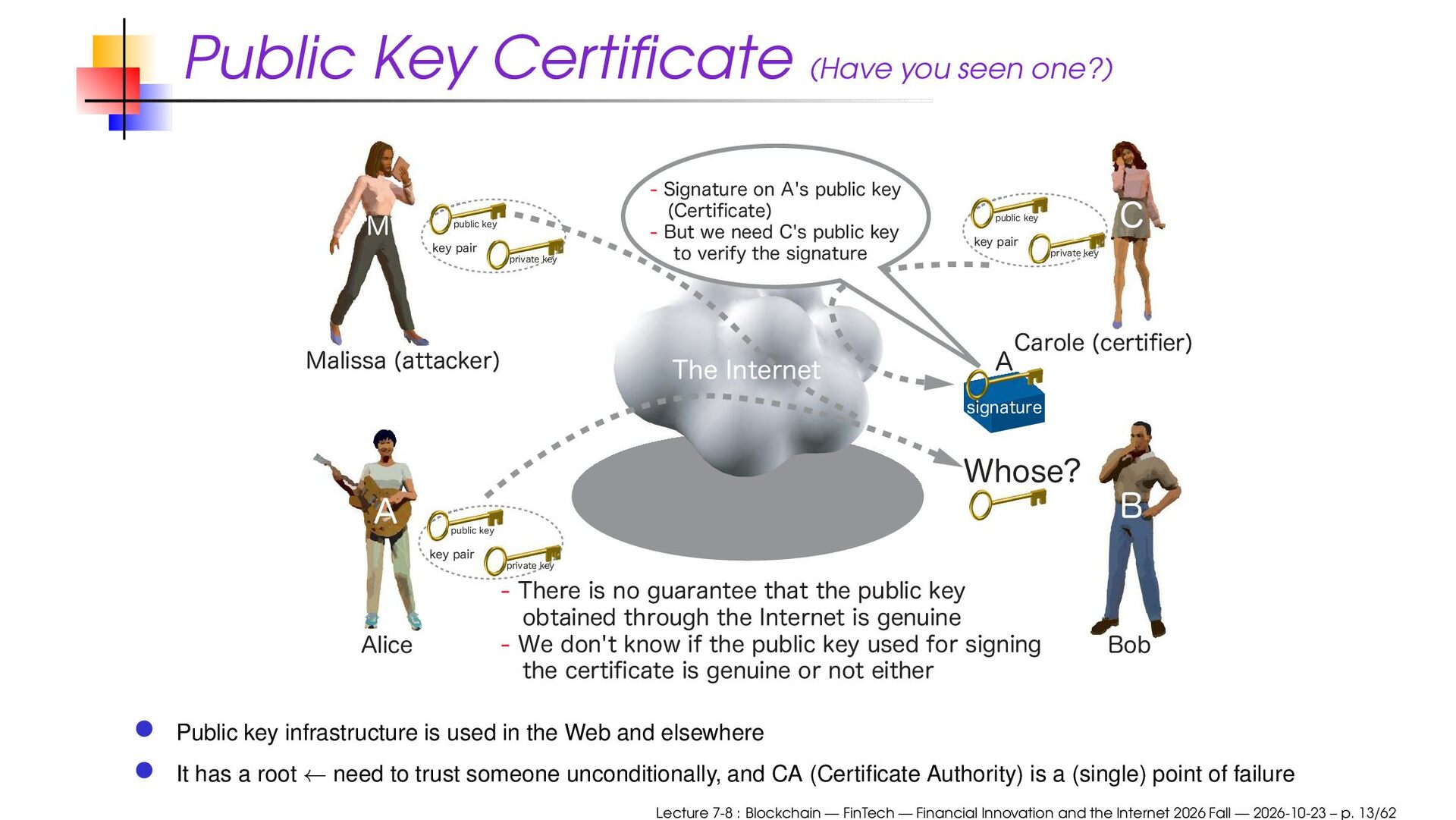
key key pair private key Malissa (attacker) - Signature on A's public key (Certificate) - But we need C's public key to verify the signature The Internet C public ke key key pair A private key Carole (certifier) signature A Whose? public ke key key pair Alice B private key - There is no guarantee that the public key obtained through the Internet is genuine - We don't know if the public key used for signing the certificate is genuine or not either B b Bob Public key infrastructure is used in the Web and elsewhere It has a root ← need to trust someone unconditionally, and CA (Certificate Authority) is a (single) point of failure Lecture 7-8 : Blockchain — FinTech — Financial Innovation and the Internet 2026 Fall — 2026-10-23 – p. 13/62
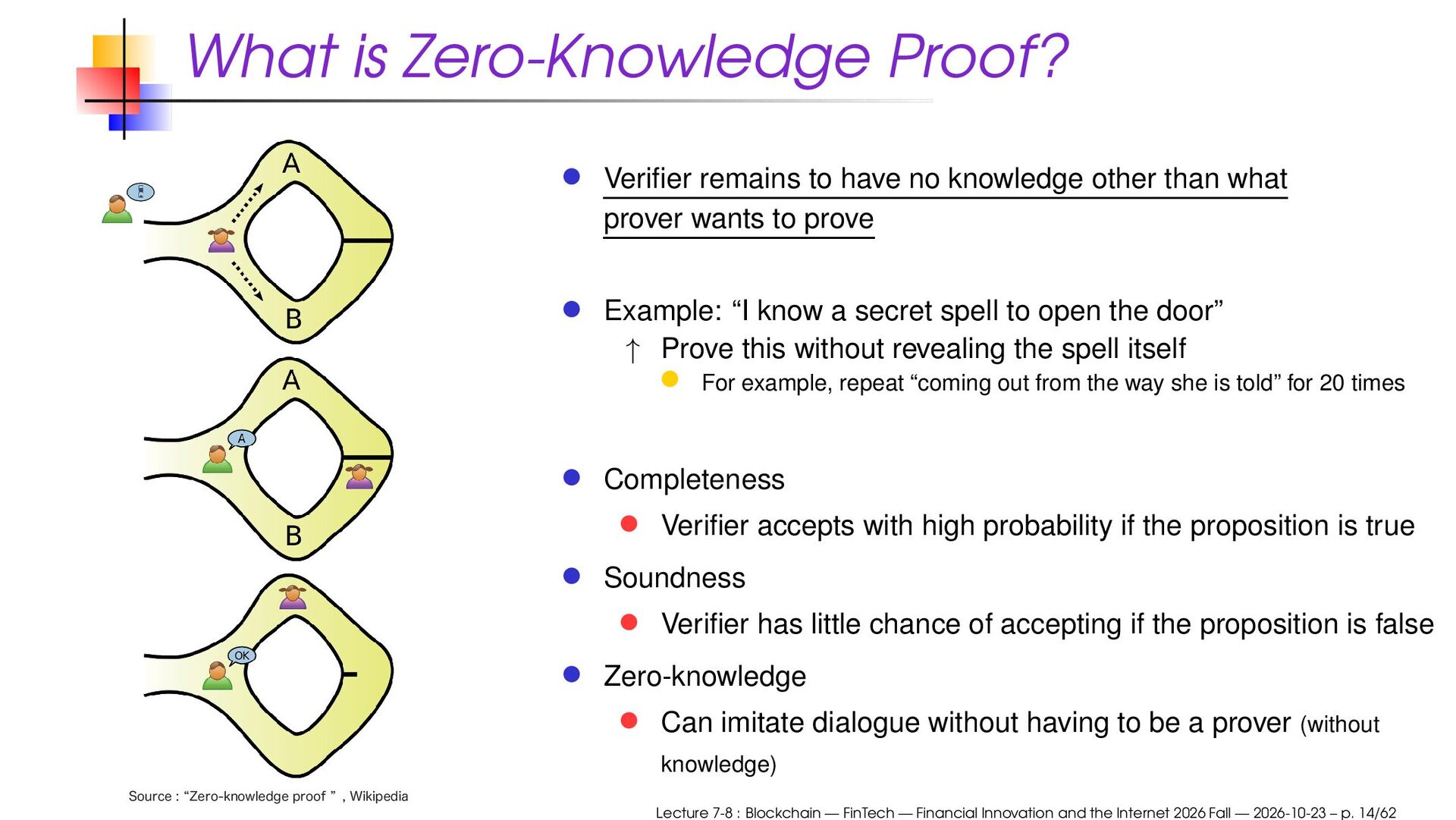
other than what prover wants to prove Example: “I know a secret spell to open the door” ↑ Prove this without revealing the spell itself For example, repeat “coming out from the way she is told” for 20 times Completeness Verifier accepts with high probability if the proposition is true Soundness Verifier has little chance of accepting if the proposition is false Zero-knowledge Can imitate dialogue without having to be a prover (without knowledge) Source : “Zero-knowledge proof ” , Wikipedia Lecture 7-8 : Blockchain — FinTech — Financial Innovation and the Internet 2026 Fall — 2026-10-23 – p. 14/62
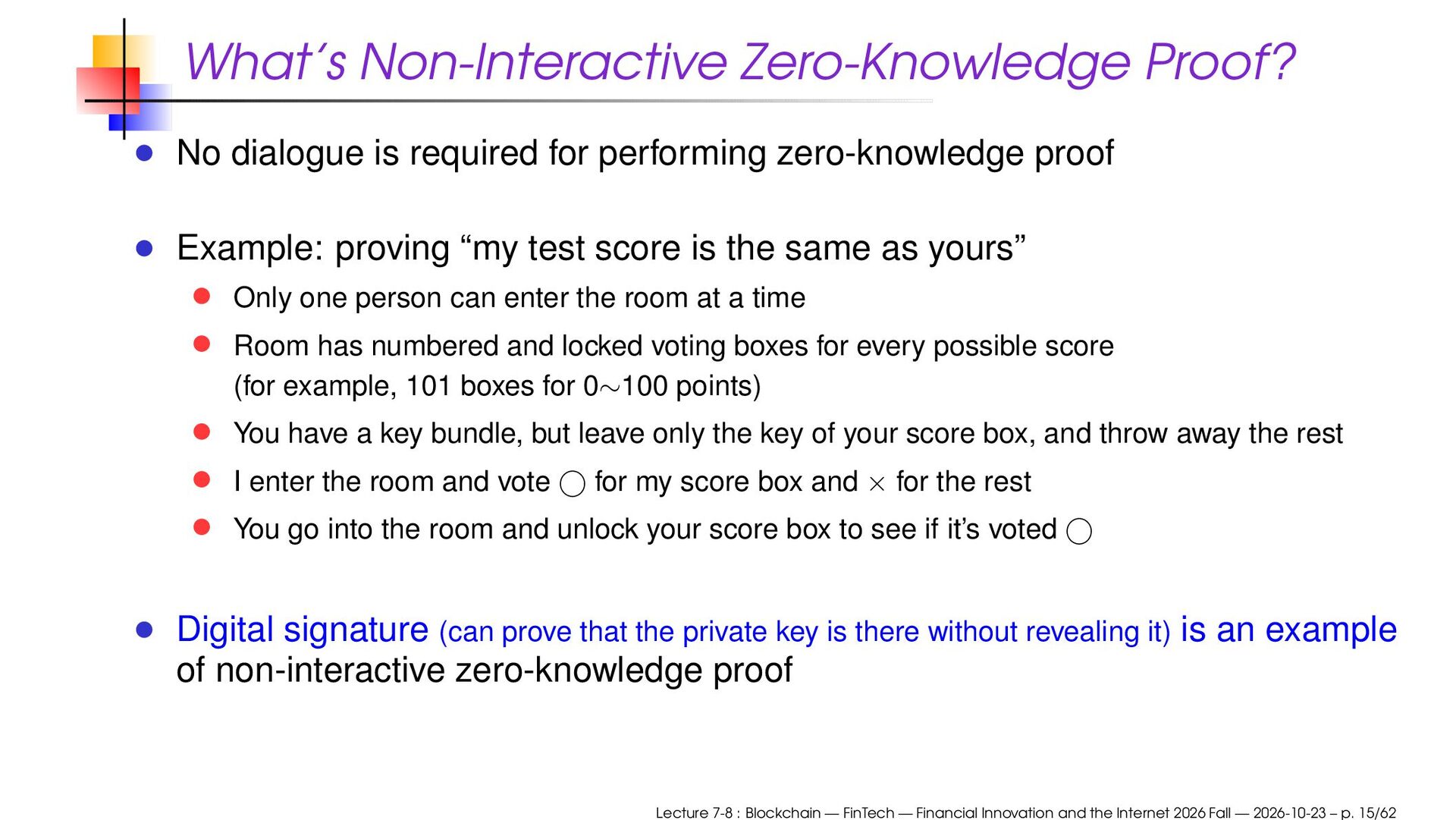
zero-knowledge proof Example: proving “my test score is the same as yours” Only one person can enter the room at a time Room has numbered and locked voting boxes for every possible score (for example, 101 boxes for 0∼100 points) You have a key bundle, but leave only the key of your score box, and throw away the rest I enter the room and vote for my score box and × for the rest You go into the room and unlock your score box to see if it’s voted Digital signature (can prove that the private key is there without revealing it) is an example of non-interactive zero-knowledge proof Lecture 7-8 : Blockchain — FinTech — Financial Innovation and the Internet 2026 Fall — 2026-10-23 – p. 15/62
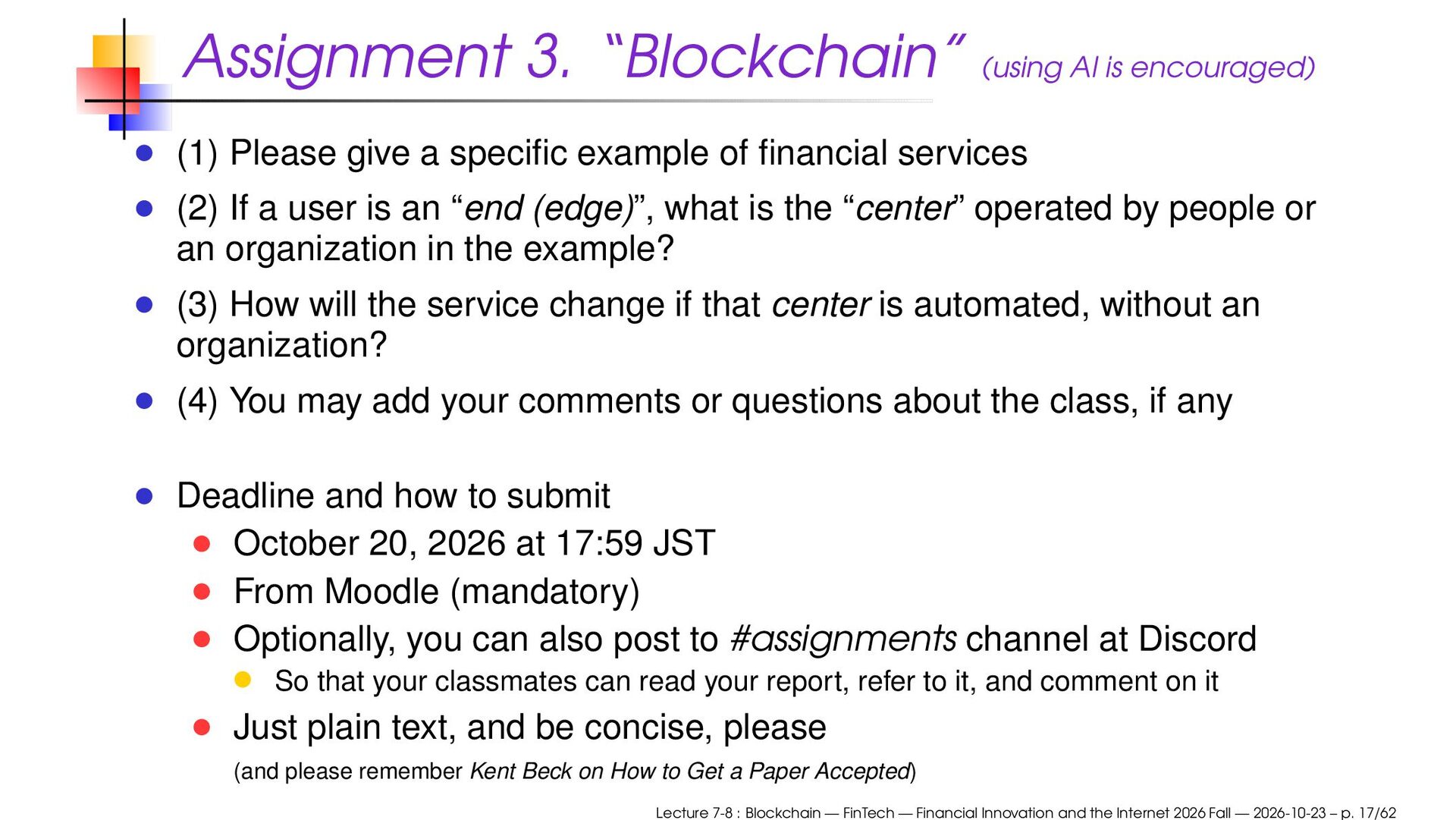
a specific example of financial services (2) If a user is an “end (edge)”, what is the “center” operated by people or an organization in the example? (3) How will the service change if that center is automated, without an organization? (4) You may add your comments or questions about the class, if any Deadline and how to submit October 20, 2026 at 17:59 JST From Moodle (mandatory) Optionally, you can also post to #assignments channel at Discord So that your classmates can read your report, refer to it, and comment on it Just plain text, and be concise, please (and please remember Kent Beck on How to Get a Paper Accepted) Lecture 7-8 : Blockchain — FinTech — Financial Innovation and the Internet 2026 Fall — 2026-10-23 – p. 17/62
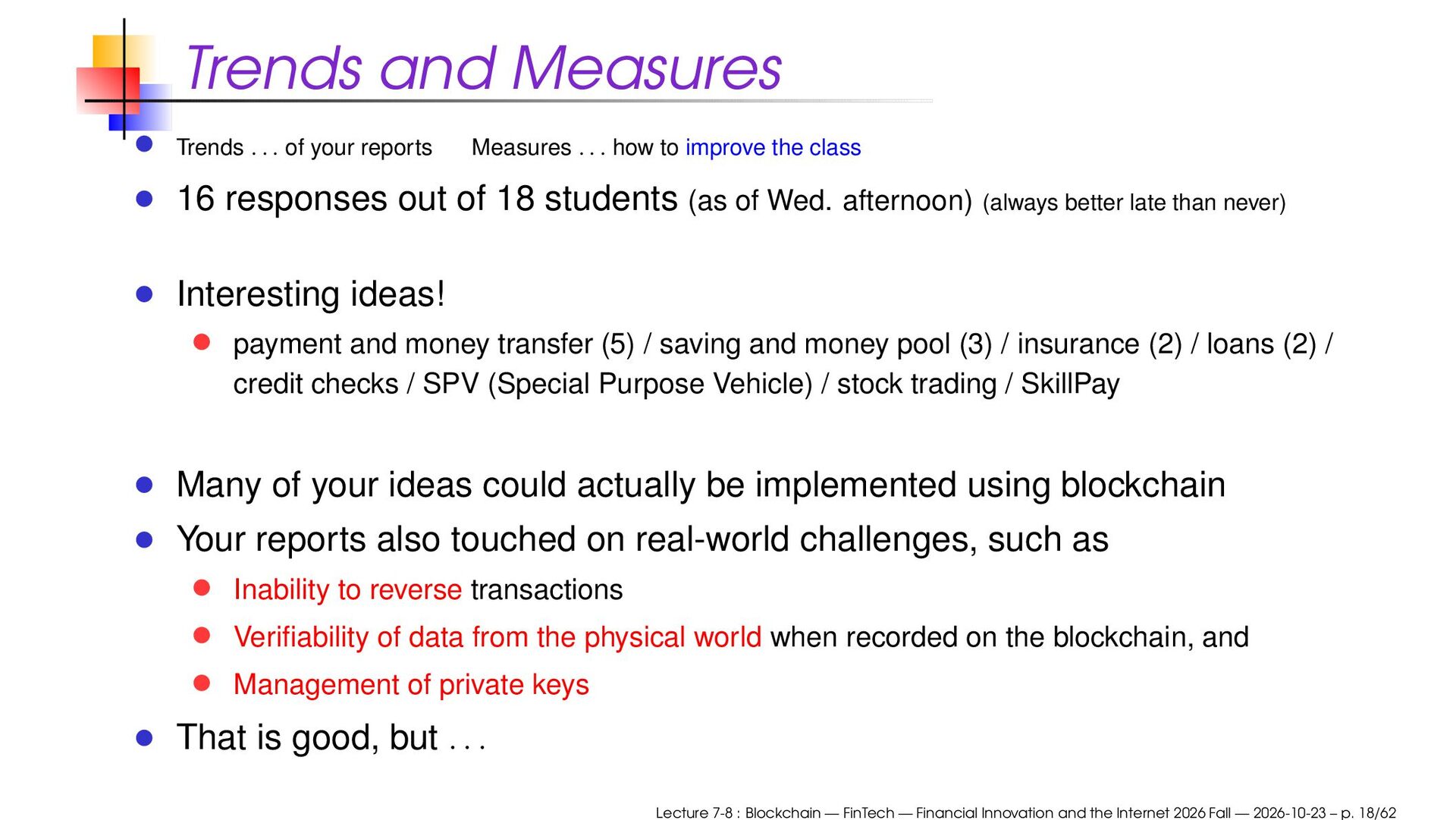
Measures . . . how to improve the class 16 responses out of 18 students (as of Wed. afternoon) (always better late than never) Interesting ideas! payment and money transfer (5) / saving and money pool (3) / insurance (2) / loans (2) / credit checks / SPV (Special Purpose Vehicle) / stock trading / SkillPay Many of your ideas could actually be implemented using blockchain Your reports also touched on real-world challenges, such as Inability to reverse transactions Verifiability of data from the physical world when recorded on the blockchain, and Management of private keys That is good, but . . . Lecture 7-8 : Blockchain — FinTech — Financial Innovation and the Internet 2026 Fall — 2026-10-23 – p. 18/62
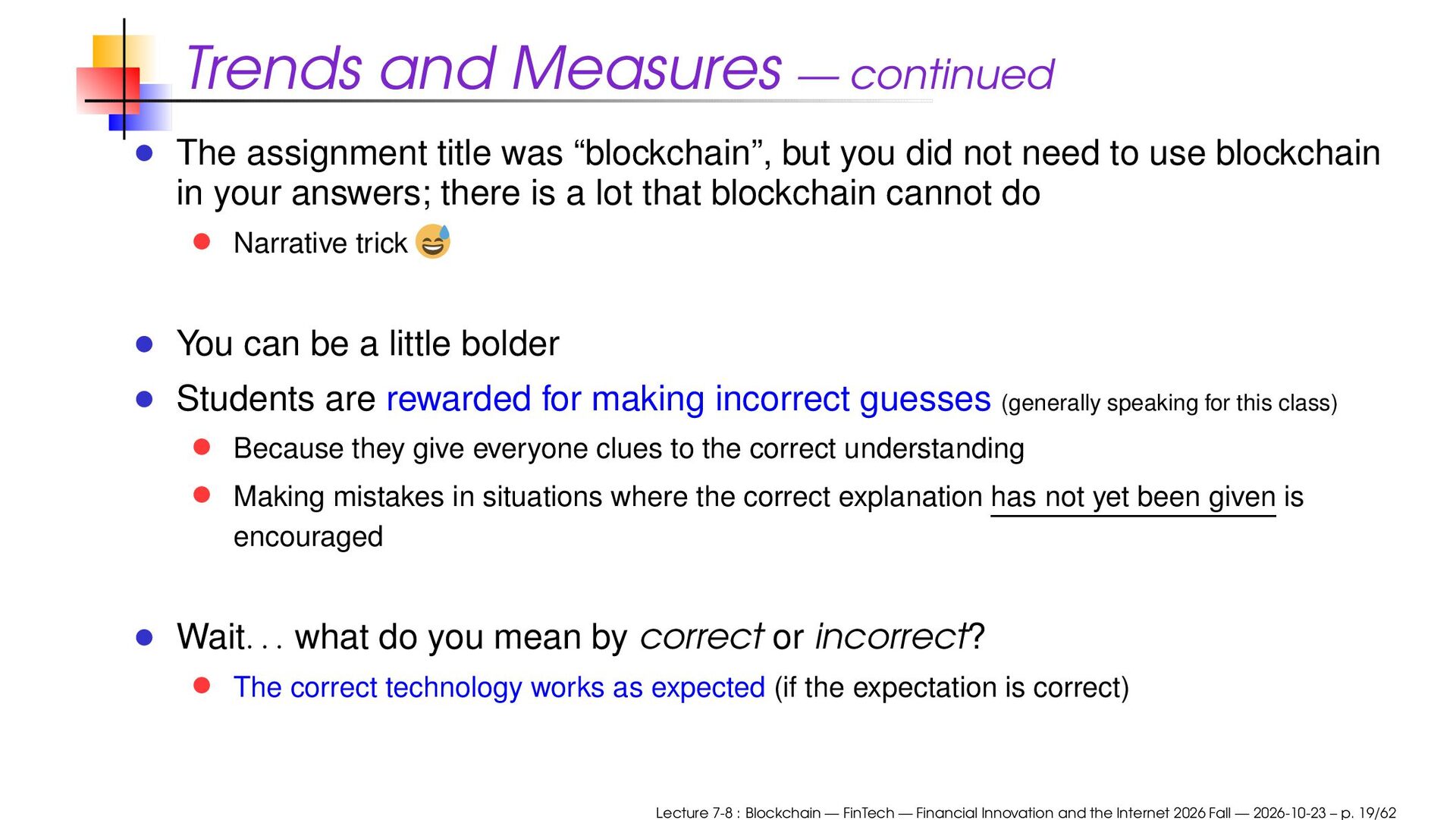
but you did not need to use blockchain in your answers; there is a lot that blockchain cannot do Narrative trick You can be a little bolder Students are rewarded for making incorrect guesses (generally speaking for this class) Because they give everyone clues to the correct understanding Making mistakes in situations where the correct explanation has not yet been given is encouraged Wait. . . what do you mean by correct or incorrect? The correct technology works as expected (if the expectation is correct) Lecture 7-8 : Blockchain — FinTech — Financial Innovation and the Internet 2026 Fall — 2026-10-23 – p. 19/62
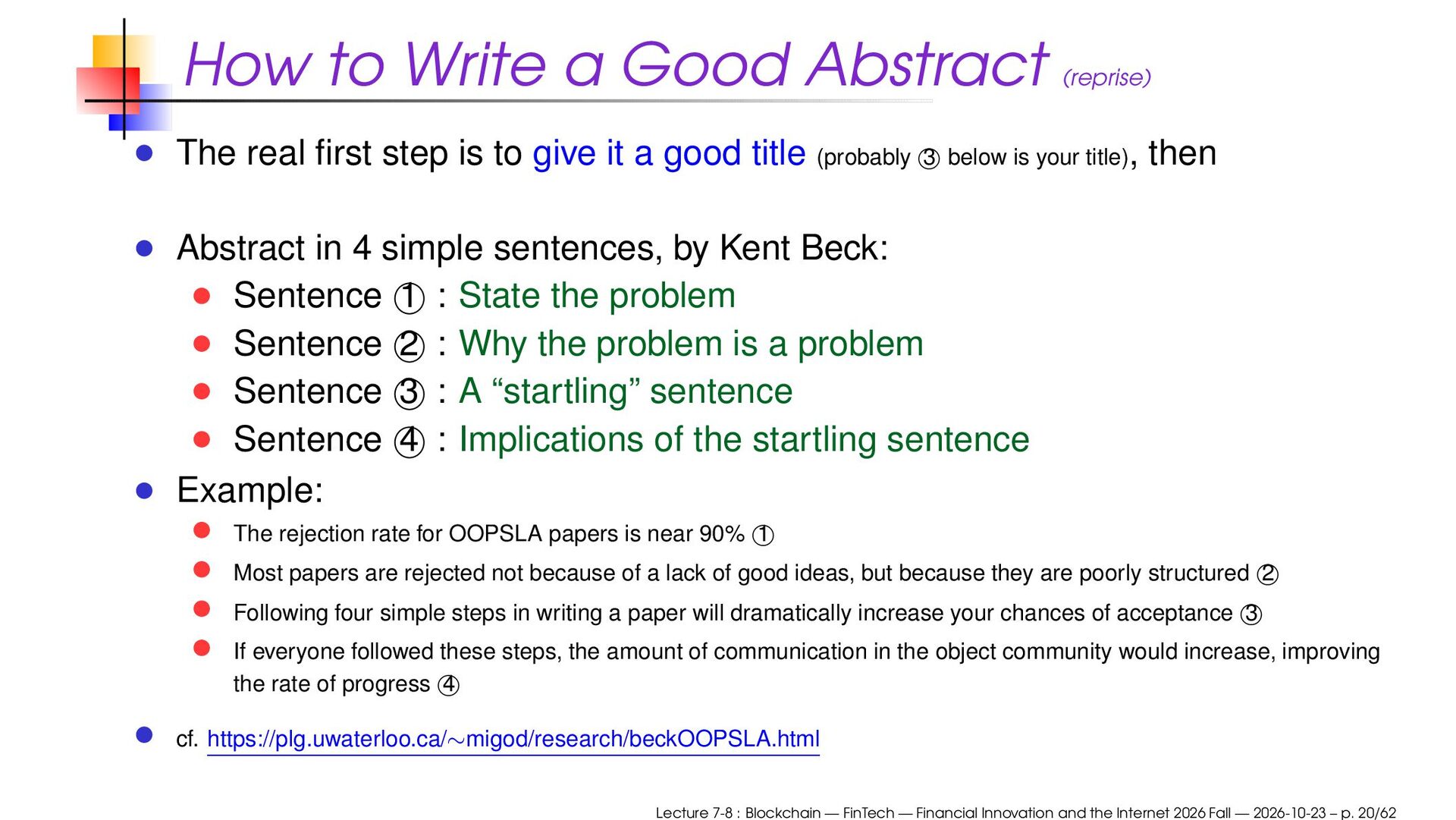
step is to give it a good title (probably 3 below is your title), then Abstract in 4 simple sentences, by Kent Beck: Sentence 1 : State the problem Sentence 2 : Why the problem is a problem Sentence 3 : A “startling” sentence Sentence 4 : Implications of the startling sentence Example: The rejection rate for OOPSLA papers is near 90% 1 Most papers are rejected not because of a lack of good ideas, but because they are poorly structured 2 Following four simple steps in writing a paper will dramatically increase your chances of acceptance 3 If everyone followed these steps, the amount of communication in the object community would increase, improving the rate of progress 4 cf. https://plg.uwaterloo.ca/∼migod/research/beckOOPSLA.html Lecture 7-8 : Blockchain — FinTech — Financial Innovation and the Internet 2026 Fall — 2026-10-23 – p. 20/62
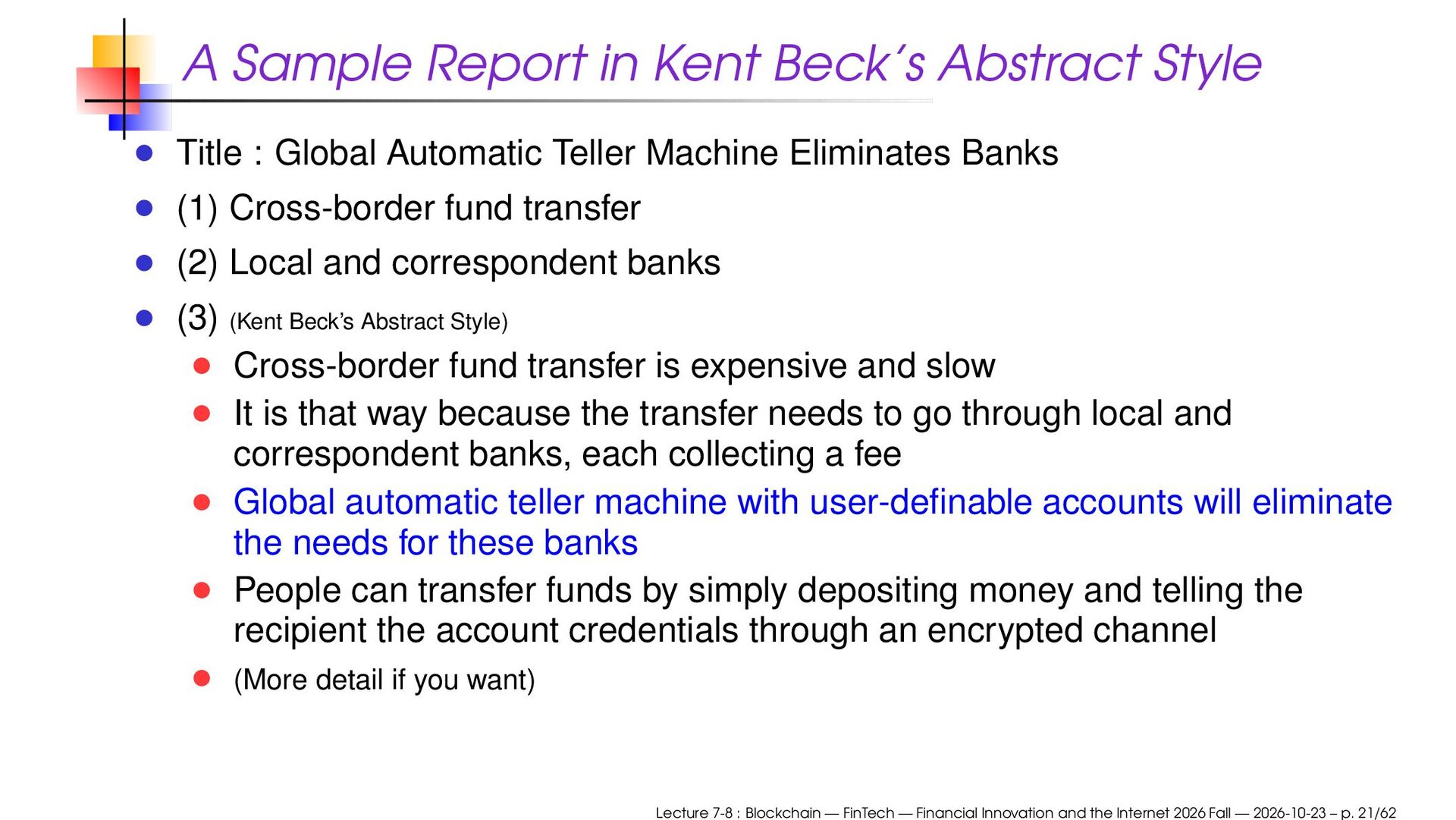
Global Automatic Teller Machine Eliminates Banks (1) Cross-border fund transfer (2) Local and correspondent banks (3) (Kent Beck’s Abstract Style) Cross-border fund transfer is expensive and slow It is that way because the transfer needs to go through local and correspondent banks, each collecting a fee Global automatic teller machine with user-definable accounts will eliminate the needs for these banks People can transfer funds by simply depositing money and telling the recipient the account credentials through an encrypted channel (More detail if you want) Lecture 7-8 : Blockchain — FinTech — Financial Innovation and the Internet 2026 Fall — 2026-10-23 – p. 21/62
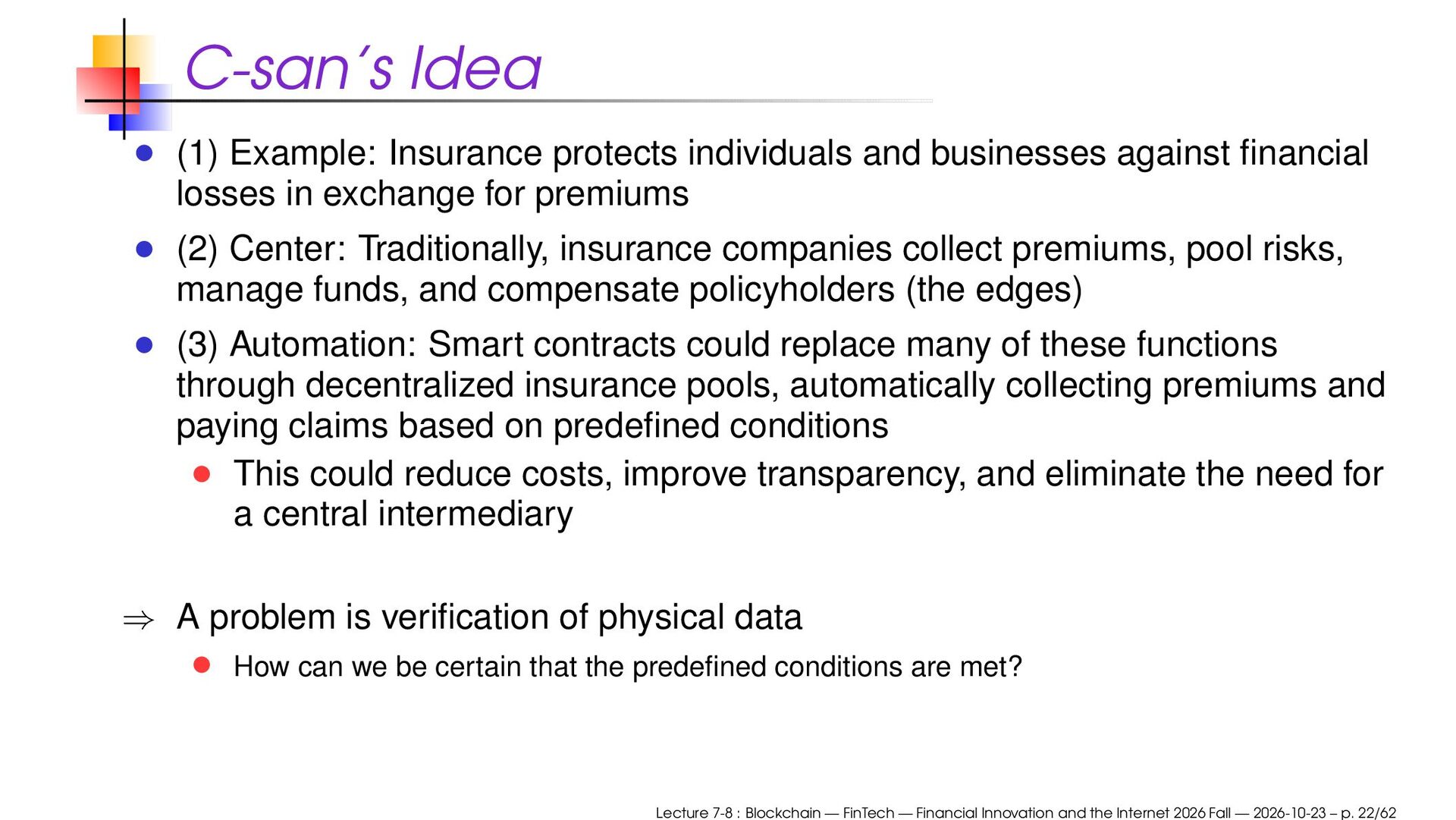
financial losses in exchange for premiums (2) Center: Traditionally, insurance companies collect premiums, pool risks, manage funds, and compensate policyholders (the edges) (3) Automation: Smart contracts could replace many of these functions through decentralized insurance pools, automatically collecting premiums and paying claims based on predefined conditions This could reduce costs, improve transparency, and eliminate the need for a central intermediary ⇒ A problem is verification of physical data How can we be certain that the predefined conditions are met? Lecture 7-8 : Blockchain — FinTech — Financial Innovation and the Internet 2026 Fall — 2026-10-23 – p. 22/62
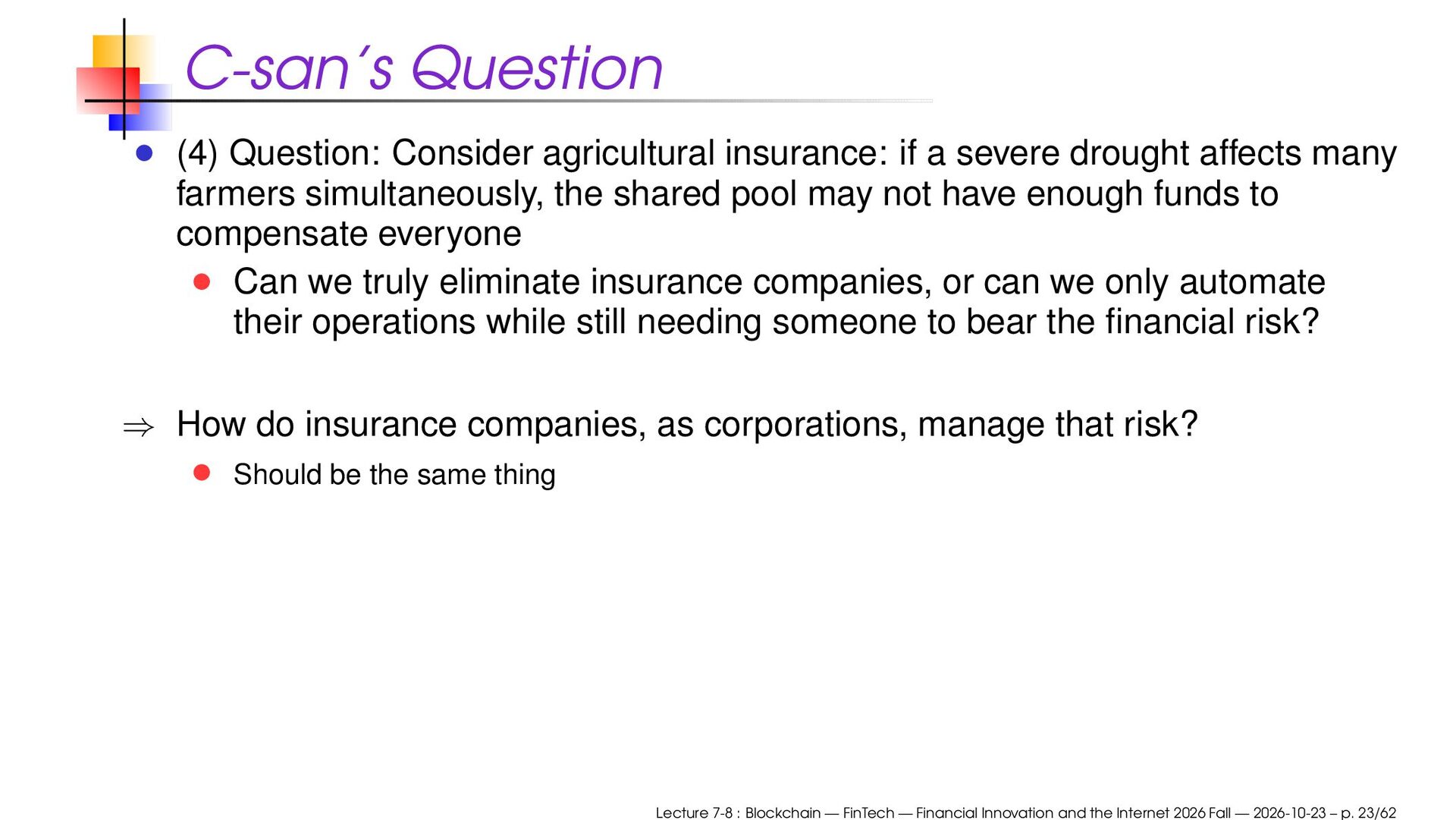
drought affects many farmers simultaneously, the shared pool may not have enough funds to compensate everyone Can we truly eliminate insurance companies, or can we only automate their operations while still needing someone to bear the financial risk? ⇒ How do insurance companies, as corporations, manage that risk? Should be the same thing Lecture 7-8 : Blockchain — FinTech — Financial Innovation and the Internet 2026 Fall — 2026-10-23 – p. 23/62
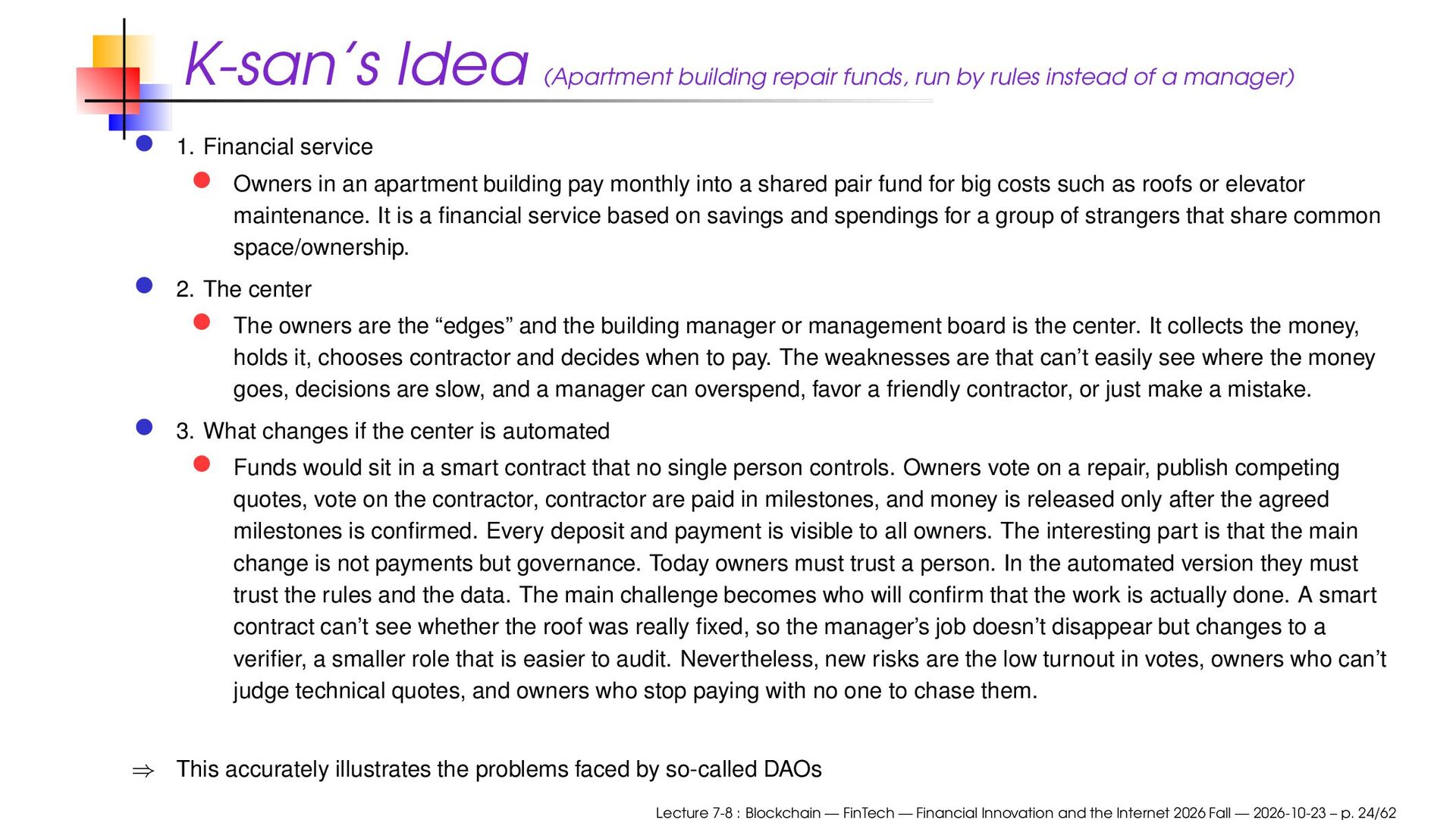
of a manager) 1. Financial service Owners in an apartment building pay monthly into a shared pair fund for big costs such as roofs or elevator maintenance. It is a financial service based on savings and spendings for a group of strangers that share common space/ownership. 2. The center The owners are the “edges” and the building manager or management board is the center. It collects the money, holds it, chooses contractor and decides when to pay. The weaknesses are that can’t easily see where the money goes, decisions are slow, and a manager can overspend, favor a friendly contractor, or just make a mistake. 3. What changes if the center is automated Funds would sit in a smart contract that no single person controls. Owners vote on a repair, publish competing quotes, vote on the contractor, contractor are paid in milestones, and money is released only after the agreed milestones is confirmed. Every deposit and payment is visible to all owners. The interesting part is that the main change is not payments but governance. Today owners must trust a person. In the automated version they must trust the rules and the data. The main challenge becomes who will confirm that the work is actually done. A smart contract can’t see whether the roof was really fixed, so the manager’s job doesn’t disappear but changes to a verifier, a smaller role that is easier to audit. Nevertheless, new risks are the low turnout in votes, owners who can’t judge technical quotes, and owners who stop paying with no one to chase them. ⇒ This accurately illustrates the problems faced by so-called DAOs Lecture 7-8 : Blockchain — FinTech — Financial Innovation and the Internet 2026 Fall — 2026-10-23 – p. 24/62
crypto through centralized platforms like moomoo, are they really benefiting from decentralization? ⇒ No Many people in the crypto community buy and sell cryptocurrencies off-chain as financial instruments, such as stocks or securities, and have nothing to do with the practical benefits of autonomy and decentralization —such as censorship resistance— that we will be discussing in this class Lecture 7-8 : Blockchain — FinTech — Financial Innovation and the Internet 2026 Fall — 2026-10-23 – p. 25/62
technologies can automate financial transactions, will we still need traditional banks in the future? ⇒ What do you think? Lecture 7-8 : Blockchain — FinTech — Financial Innovation and the Internet 2026 Fall — 2026-10-23 – p. 26/62
using a digital signature instead of a handwritten one, you can be sure that the will is authentic without having to rely on witnesses But a will is an example that cannot be digitized using conventional thinking As you know, a digital signature is made using a private key Basic premise of digital signatures is that the signer keeps the private key secret Leakage of private key, compromise of signature algorithm, and expiration of public key certificate are the three major risks of digital signatures However, a will is used only after the death of the person who signed it If the person who keeps the private key secret is not present, it can be suspected that maybe one of the heirs who has access to the private key has tampered or fabricated it Timestamps can be easily rewritten or faked —they are just numbers Even if a notary in the digital age takes care of your will, you have to be suspicious of the possibility of their collusion with your heirs Lecture 7-8 : Blockchain — FinTech — Financial Innovation and the Internet 2026 Fall — 2026-10-23 – p. 28/62
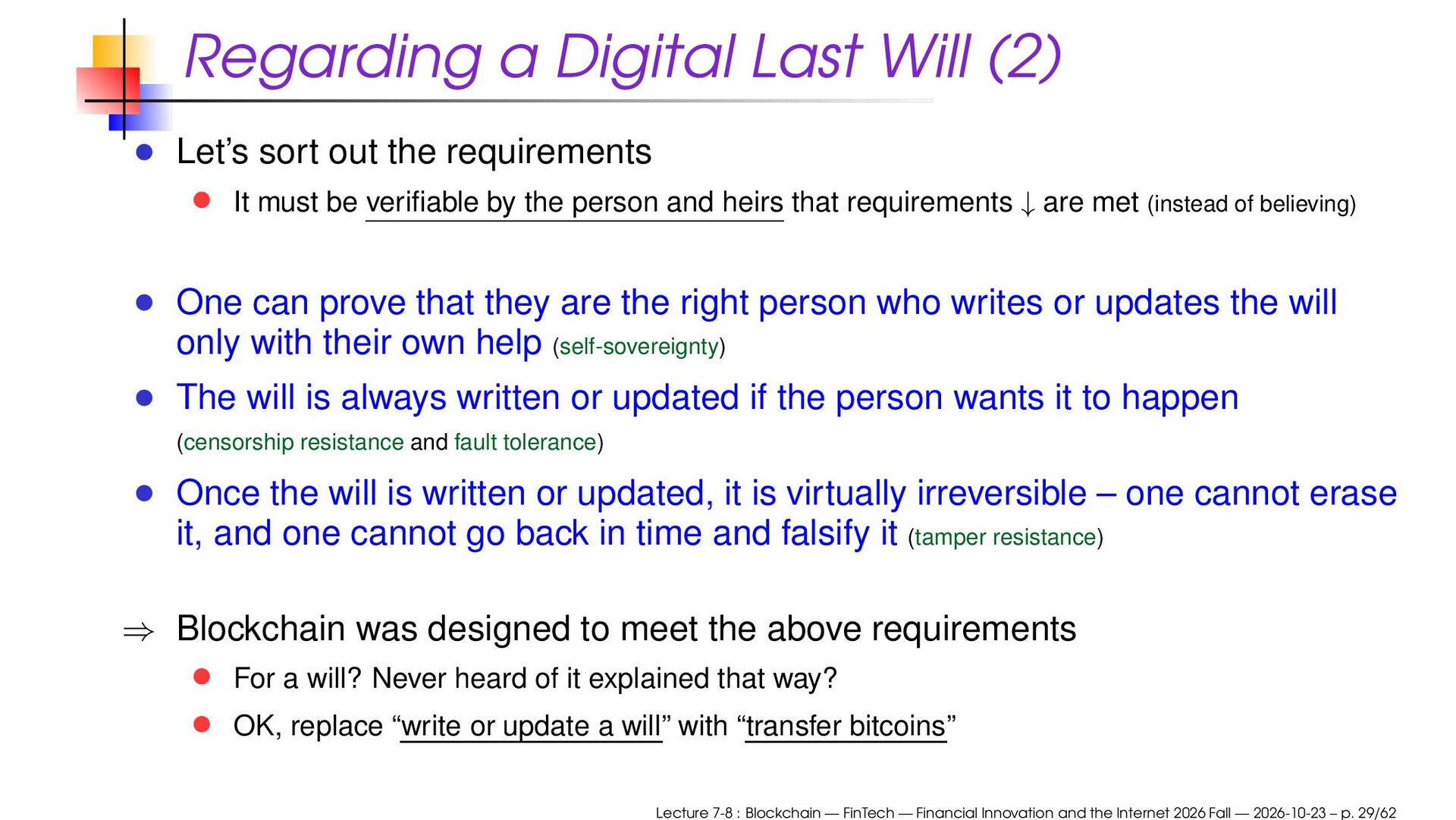
requirements It must be verifiable by the person and heirs that requirements ↓ are met (instead of believing) One can prove that they are the right person who writes or updates the will only with their own help (self-sovereignty) The will is always written or updated if the person wants it to happen (censorship resistance and fault tolerance) Once the will is written or updated, it is virtually irreversible – one cannot erase it, and one cannot go back in time and falsify it (tamper resistance) ⇒ Blockchain was designed to meet the above requirements For a will? Never heard of it explained that way? OK, replace “write or update a will” with “transfer bitcoins” Lecture 7-8 : Blockchain — FinTech — Financial Innovation and the Internet 2026 Fall — 2026-10-23 – p. 29/62
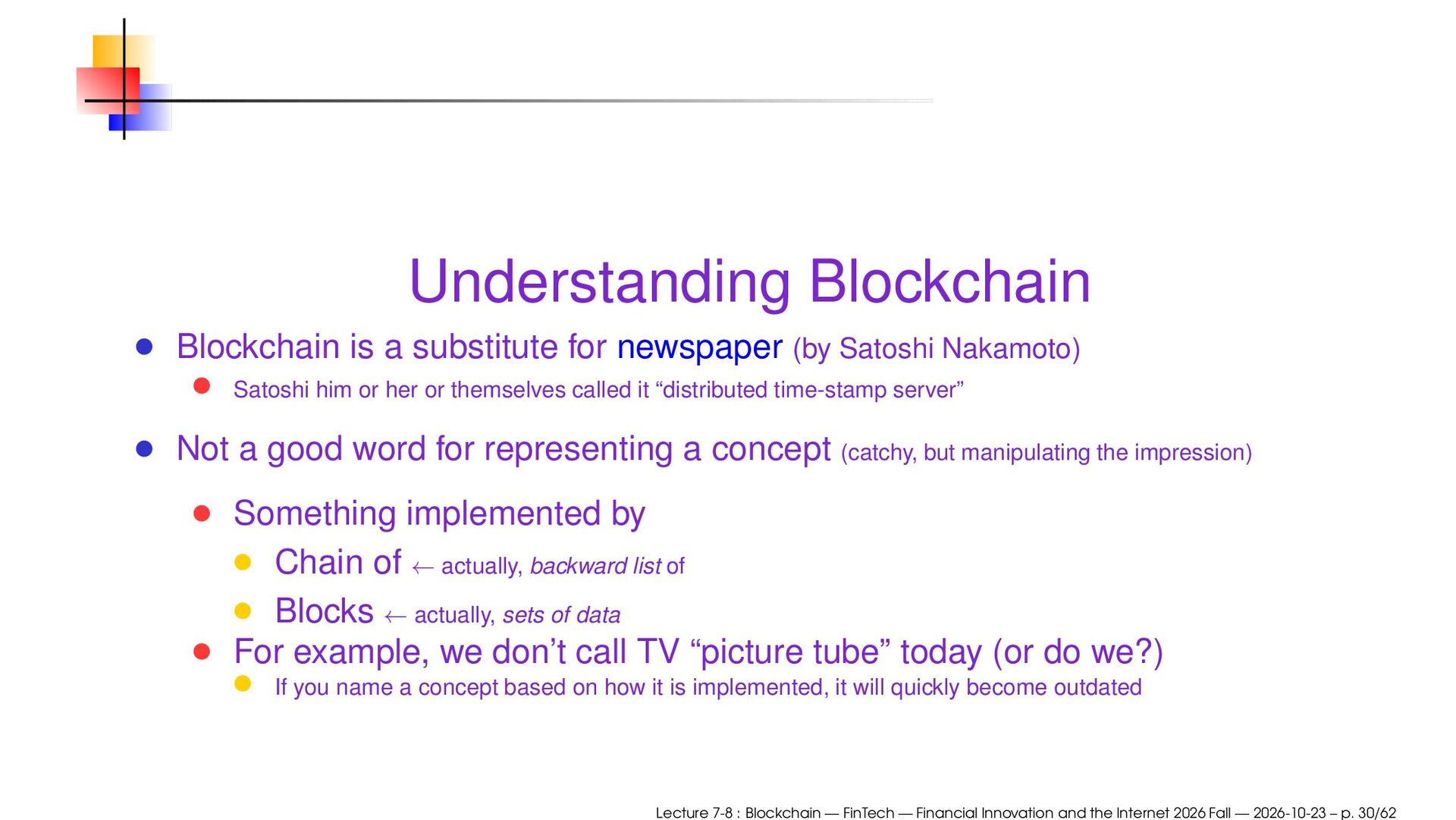
Nakamoto) Satoshi him or her or themselves called it “distributed time-stamp server” Not a good word for representing a concept (catchy, but manipulating the impression) Something implemented by Chain of ← actually, backward list of Blocks ← actually, sets of data For example, we don’t call TV “picture tube” today (or do we?) If you name a concept based on how it is implemented, it will quickly become outdated Lecture 7-8 : Blockchain — FinTech — Financial Innovation and the Internet 2026 Fall — 2026-10-23 – p. 30/62
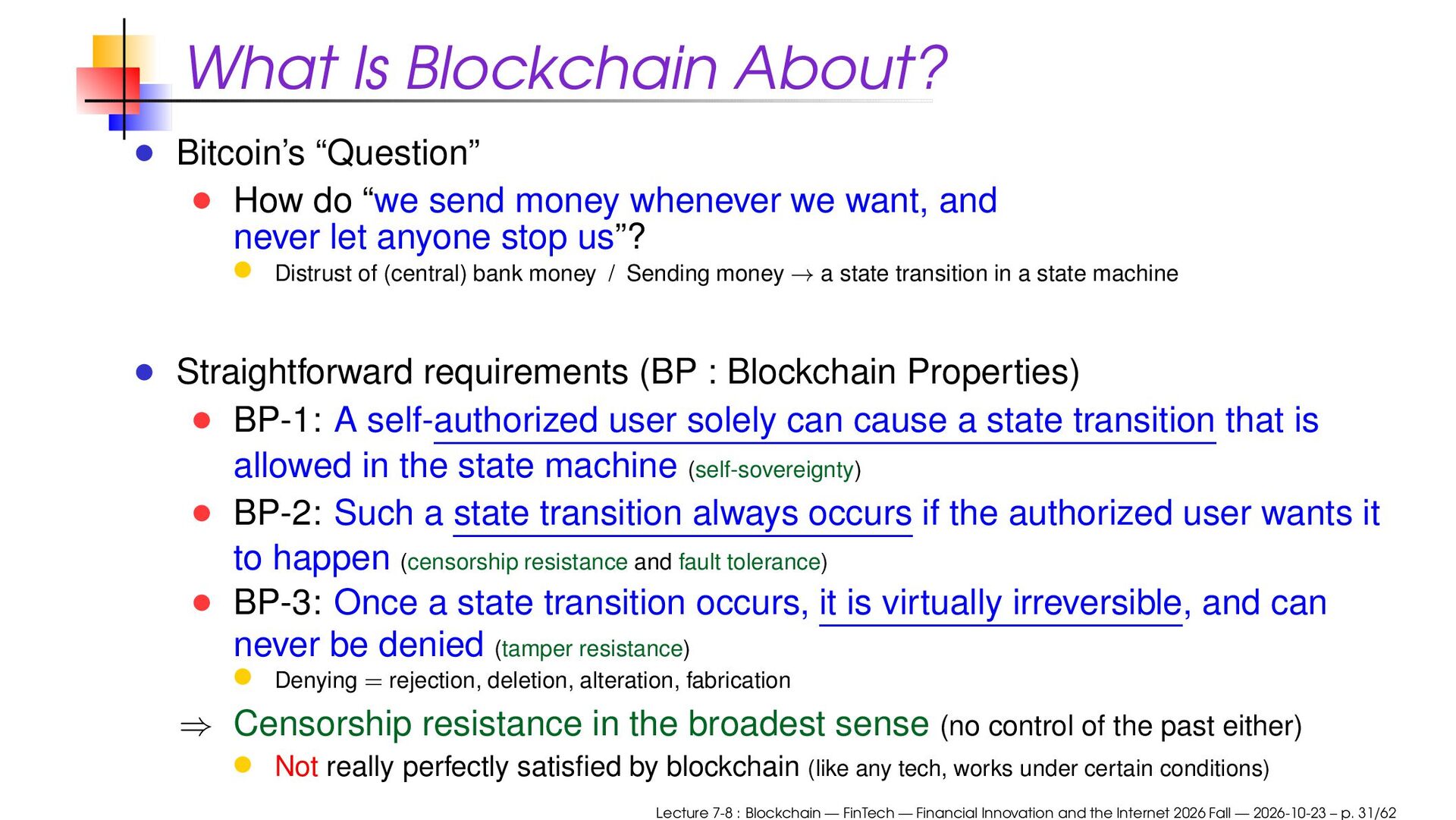
money whenever we want, and never let anyone stop us”? Distrust of (central) bank money / Sending money → a state transition in a state machine Straightforward requirements (BP : Blockchain Properties) BP-1: A self-authorized user solely can cause a state transition that is allowed in the state machine (self-sovereignty) BP-2: Such a state transition always occurs if the authorized user wants it to happen (censorship resistance and fault tolerance) BP-3: Once a state transition occurs, it is virtually irreversible, and can never be denied (tamper resistance) Denying = rejection, deletion, alteration, fabrication ⇒ Censorship resistance in the broadest sense (no control of the past either) Not really perfectly satisfied by blockchain (like any tech, works under certain conditions) Lecture 7-8 : Blockchain — FinTech — Financial Innovation and the Internet 2026 Fall — 2026-10-23 – p. 31/62
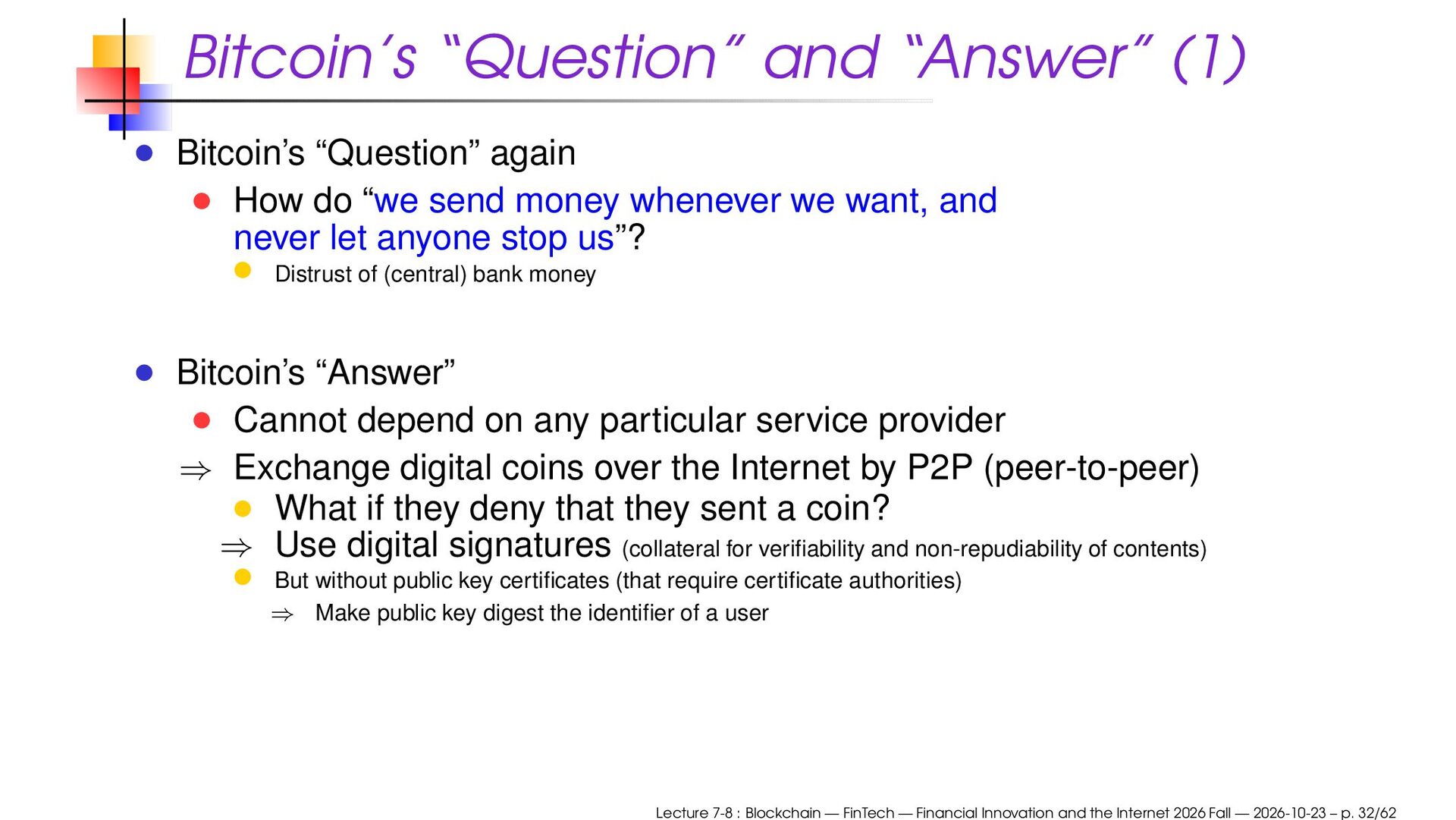
“we send money whenever we want, and never let anyone stop us”? Distrust of (central) bank money Bitcoin’s “Answer” Cannot depend on any particular service provider ⇒ Exchange digital coins over the Internet by P2P (peer-to-peer) What if they deny that they sent a coin? ⇒ Use digital signatures (collateral for verifiability and non-repudiability of contents) But without public key certificates (that require certificate authorities) ⇒ Make public key digest the identifier of a user Lecture 7-8 : Blockchain — FinTech — Financial Innovation and the Internet 2026 Fall — 2026-10-23 – p. 32/62
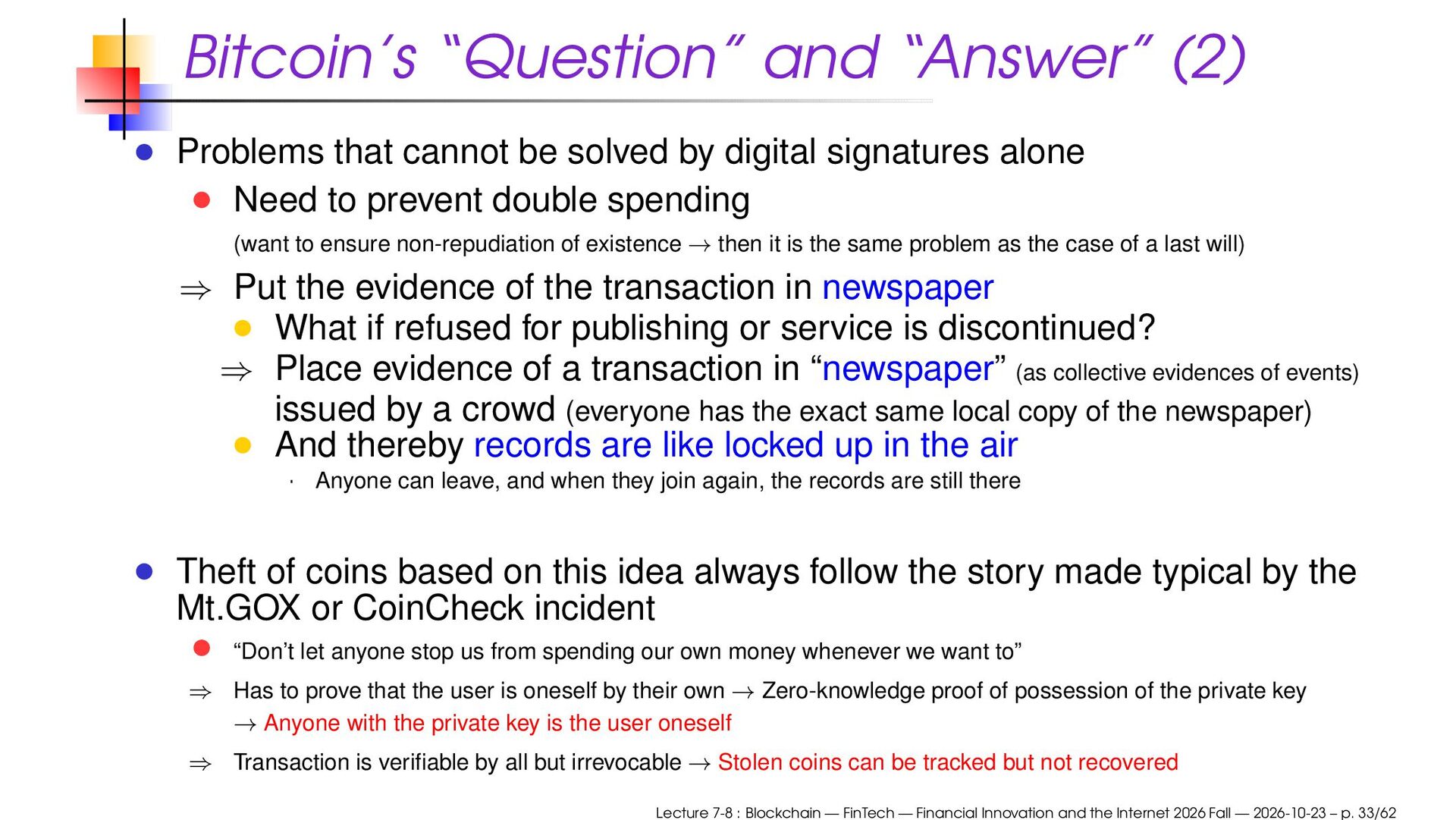
by digital signatures alone Need to prevent double spending (want to ensure non-repudiation of existence → then it is the same problem as the case of a last will) ⇒ Put the evidence of the transaction in newspaper What if refused for publishing or service is discontinued? ⇒ Place evidence of a transaction in “newspaper” (as collective evidences of events) issued by a crowd (everyone has the exact same local copy of the newspaper) And thereby records are like locked up in the air · Anyone can leave, and when they join again, the records are still there Theft of coins based on this idea always follow the story made typical by the Mt.GOX or CoinCheck incident “Don’t let anyone stop us from spending our own money whenever we want to” ⇒ Has to prove that the user is oneself by their own → Zero-knowledge proof of possession of the private key → Anyone with the private key is the user oneself ⇒ Transaction is verifiable by all but irrevocable → Stolen coins can be tracked but not recovered Lecture 7-8 : Blockchain — FinTech — Financial Innovation and the Internet 2026 Fall — 2026-10-23 – p. 33/62
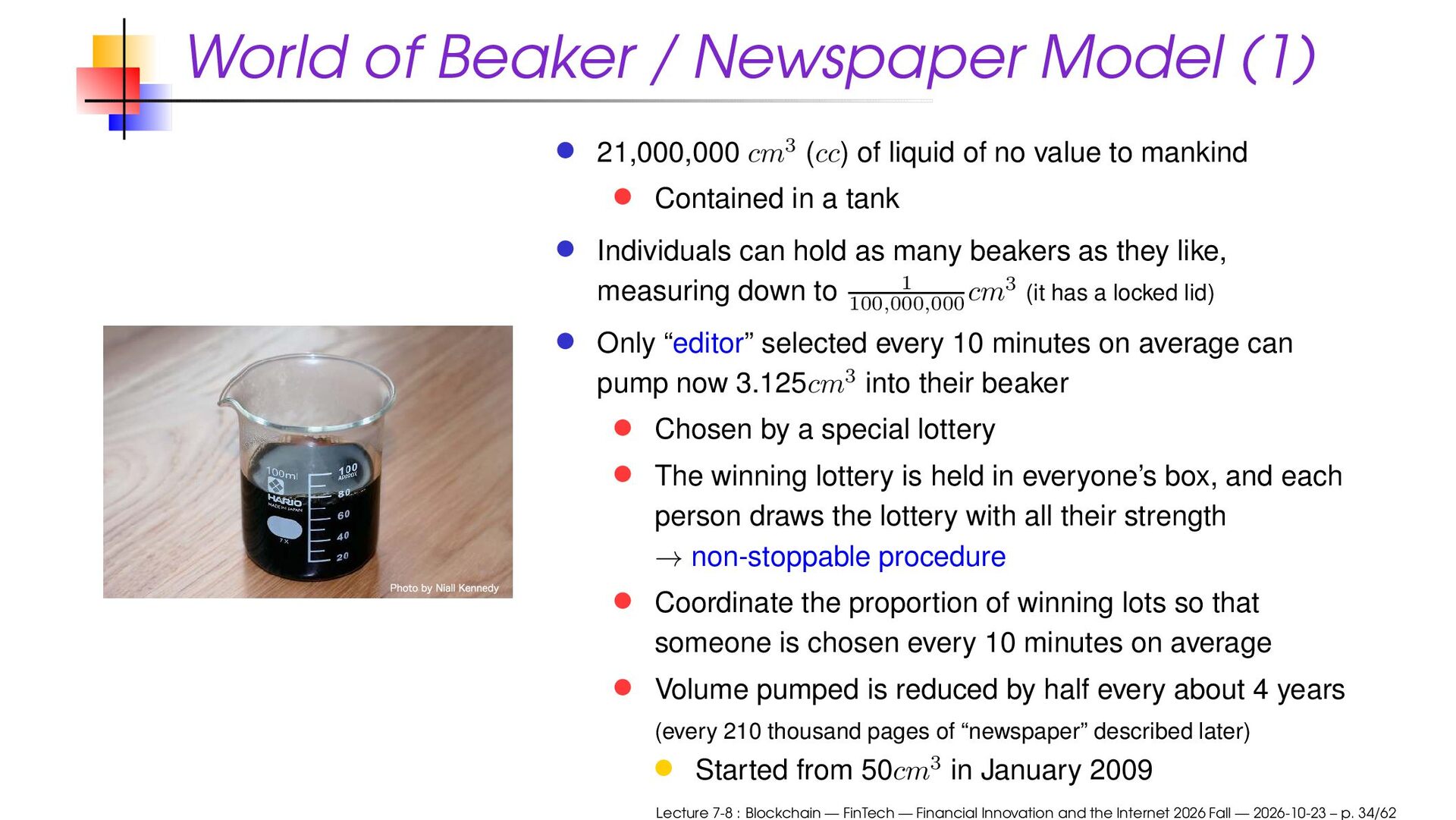
of liquid of no value to mankind Contained in a tank Individuals can hold as many beakers as they like, 1 cm3 (it has a locked lid) measuring down to 100,000,000 Only “editor” selected every 10 minutes on average can pump now 3.125cm3 into their beaker Chosen by a special lottery The winning lottery is held in everyone’s box, and each person draws the lottery with all their strength → non-stoppable procedure Coordinate the proportion of winning lots so that someone is chosen every 10 minutes on average Volume pumped is reduced by half every about 4 years (every 210 thousand pages of “newspaper” described later) Started from 50cm3 in January 2009 Lecture 7-8 : Blockchain — FinTech — Financial Innovation and the Internet 2026 Fall — 2026-10-23 – p. 34/62
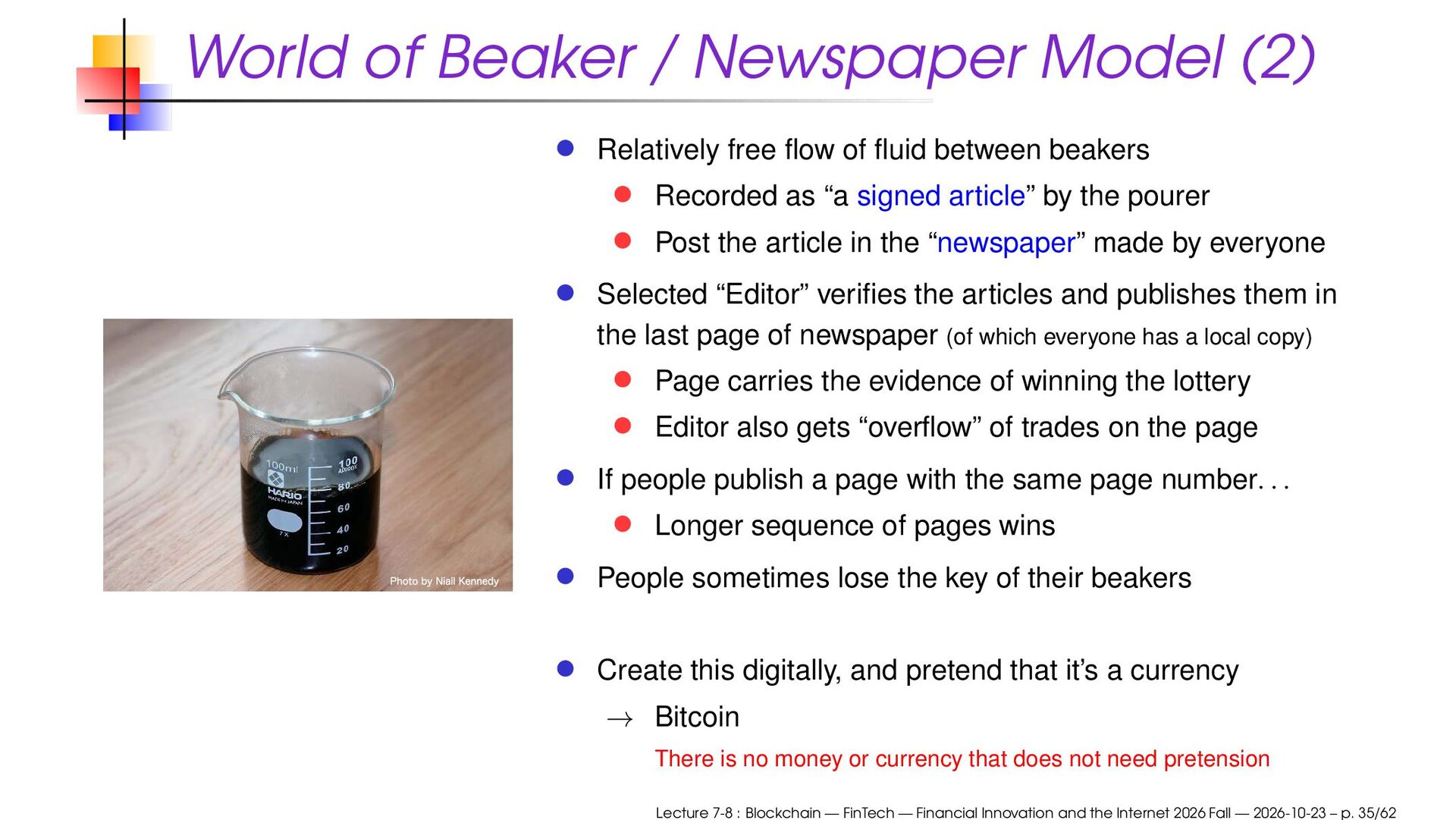
of fluid between beakers Recorded as “a signed article” by the pourer Post the article in the “newspaper” made by everyone Selected “Editor” verifies the articles and publishes them in the last page of newspaper (of which everyone has a local copy) Page carries the evidence of winning the lottery Editor also gets “overflow” of trades on the page If people publish a page with the same page number. . . Longer sequence of pages wins People sometimes lose the key of their beakers Create this digitally, and pretend that it’s a currency → Bitcoin There is no money or currency that does not need pretension Lecture 7-8 : Blockchain — FinTech — Financial Innovation and the Internet 2026 Fall — 2026-10-23 – p. 35/62
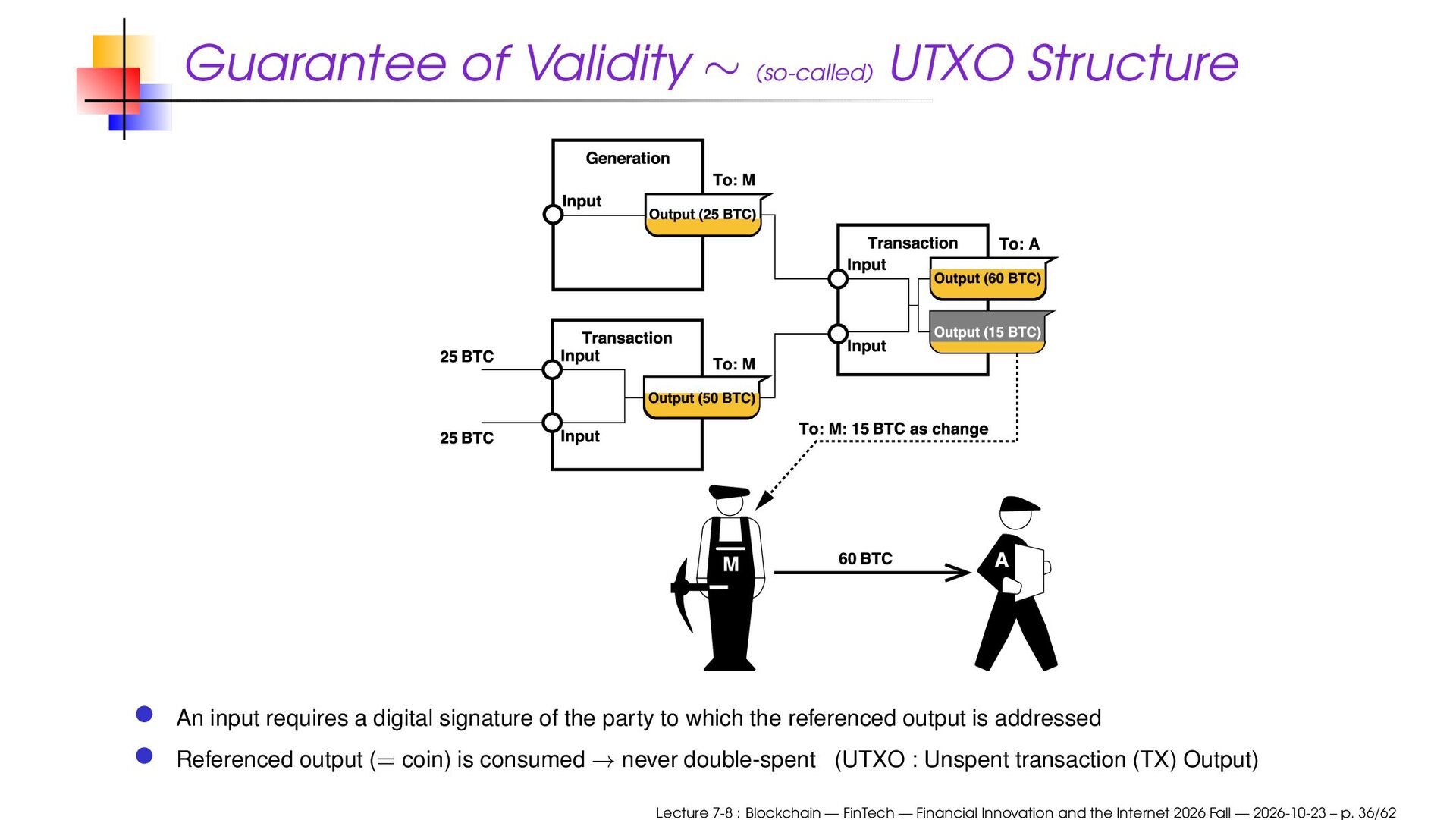
a digital signature of the party to which the referenced output is addressed Referenced output (= coin) is consumed → never double-spent (UTXO : Unspent transaction (TX) Output) Lecture 7-8 : Blockchain — FinTech — Financial Innovation and the Internet 2026 Fall — 2026-10-23 – p. 36/62
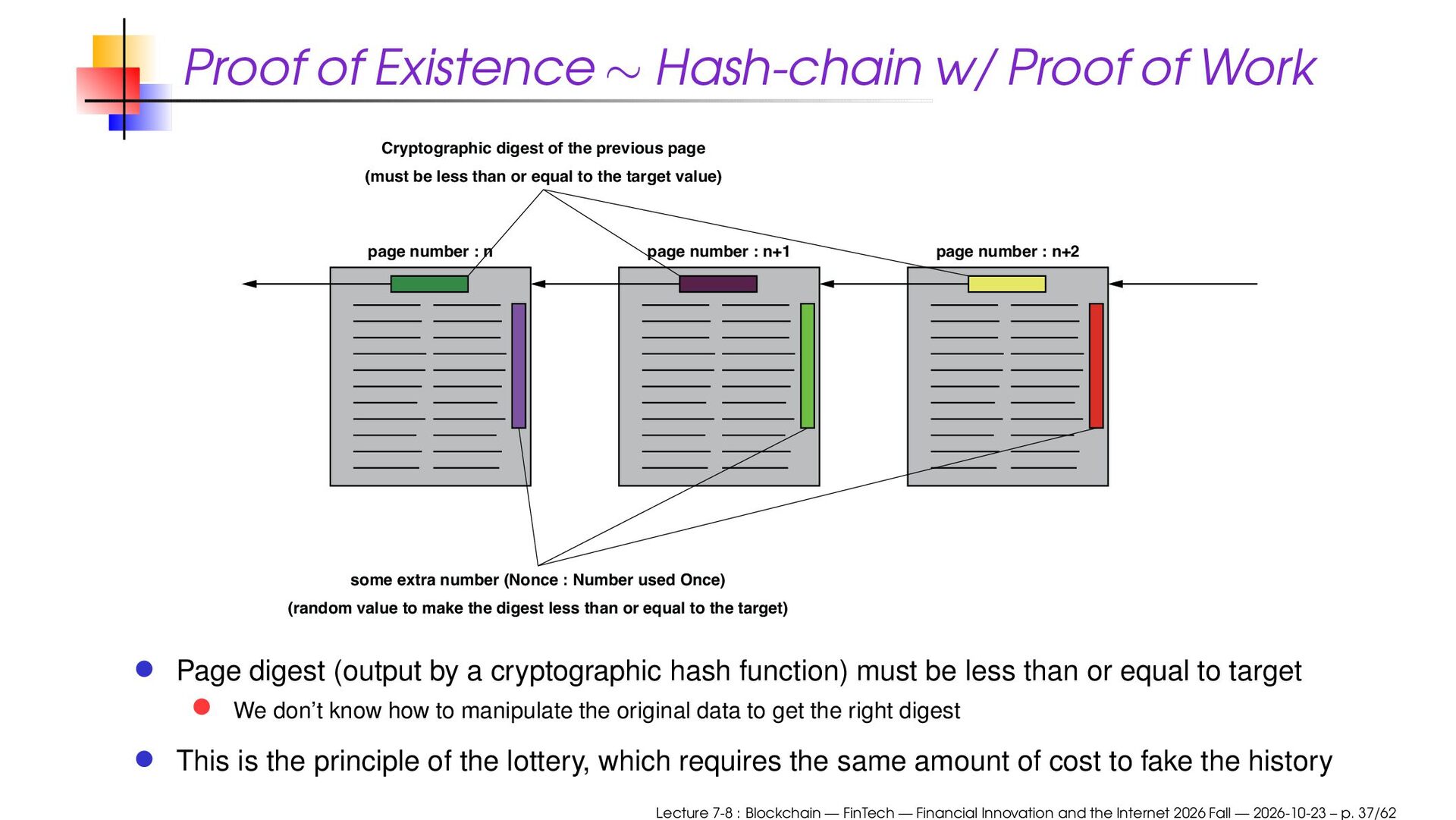
digest of the previous page (must be less than or equal to the target value) page number : n page number : n+1 page number : n+2 some extra number (Nonce : Number used Once) (random value to make the digest less than or equal to the target) Page digest (output by a cryptographic hash function) must be less than or equal to target We don’t know how to manipulate the original data to get the right digest This is the principle of the lottery, which requires the same amount of cost to fake the history Lecture 7-8 : Blockchain — FinTech — Financial Innovation and the Internet 2026 Fall — 2026-10-23 – p. 37/62
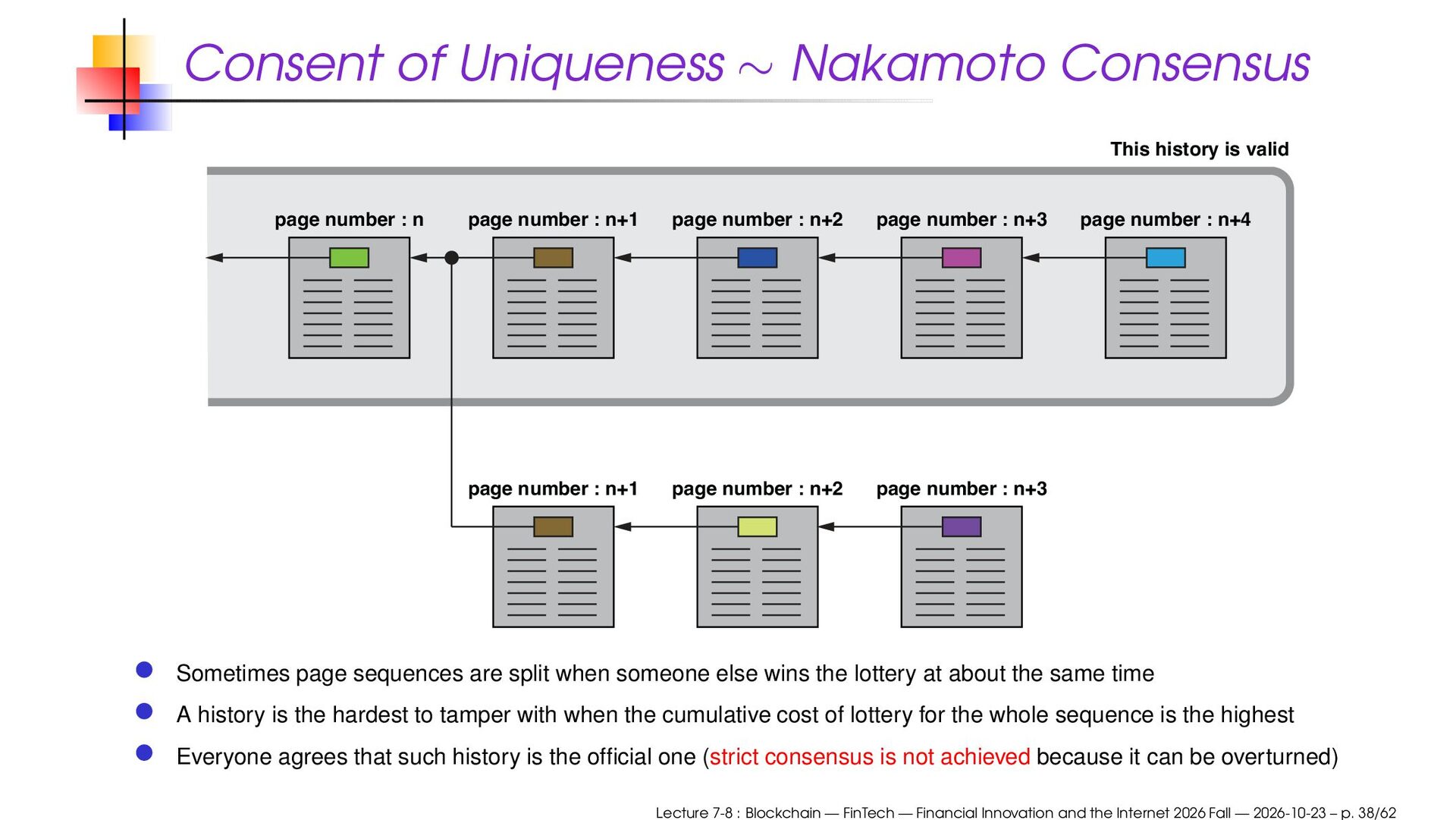
page number : n page number : n+1 page number : n+2 page number : n+3 page number : n+1 page number : n+2 page number : n+3 page number : n+4 Sometimes page sequences are split when someone else wins the lottery at about the same time A history is the hardest to tamper with when the cumulative cost of lottery for the whole sequence is the highest Everyone agrees that such history is the official one (strict consensus is not achieved because it can be overturned) Lecture 7-8 : Blockchain — FinTech — Financial Innovation and the Internet 2026 Fall — 2026-10-23 – p. 38/62
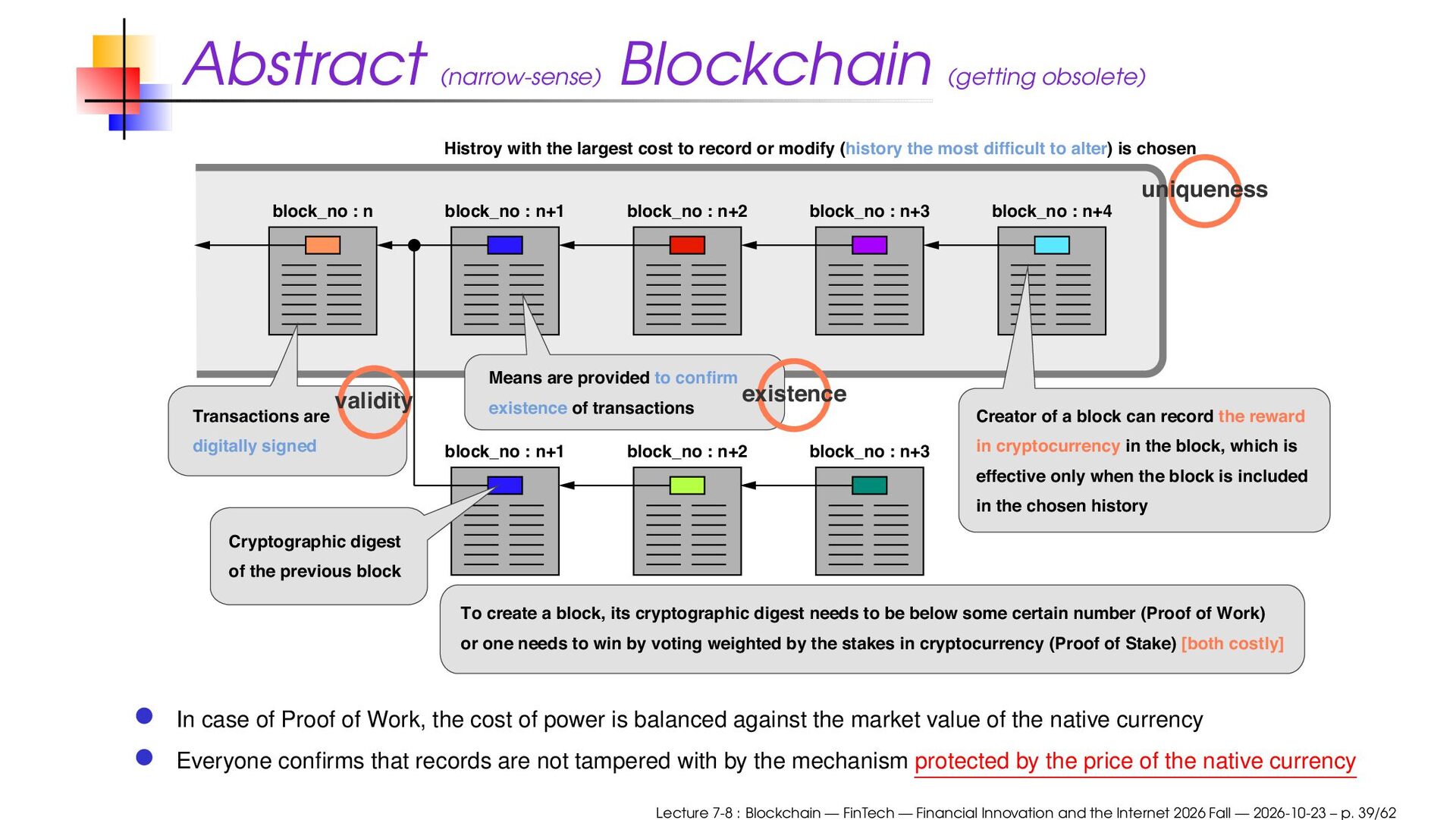
to record or modify (history the most difficult to alter) is chosen uniqueness block_no : n block_no : n+1 block_no : n+2 Means are provided to confirm Transactions are validity digitally signed existence of transactions block_no : n+1 block_no : n+3 block_no : n+4 existence block_no : n+2 Creator of a block can record the reward block_no : n+3 in cryptocurrency in the block, which is effective only when the block is included in the chosen history Cryptographic digest of the previous block To create a block, its cryptographic digest needs to be below some certain number (Proof of Work) or one needs to win by voting weighted by the stakes in cryptocurrency (Proof of Stake) [both costly] In case of Proof of Work, the cost of power is balanced against the market value of the native currency Everyone confirms that records are not tampered with by the mechanism protected by the price of the native currency Lecture 7-8 : Blockchain — FinTech — Financial Innovation and the Internet 2026 Fall — 2026-10-23 – p. 39/62
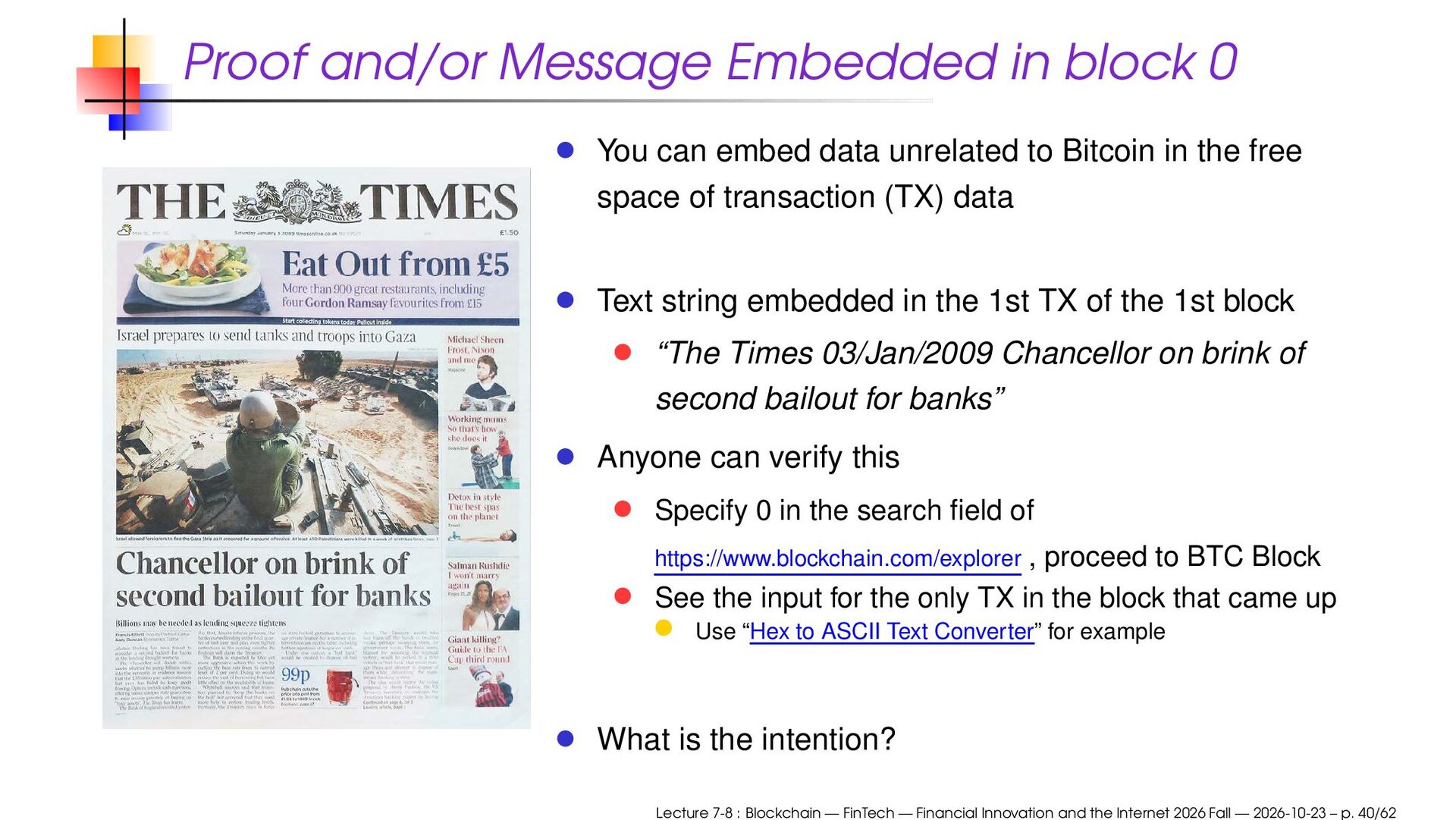
data unrelated to Bitcoin in the free space of transaction (TX) data Text string embedded in the 1st TX of the 1st block “The Times 03/Jan/2009 Chancellor on brink of second bailout for banks” Anyone can verify this Specify 0 in the search field of https://www.blockchain.com/explorer , proceed to BTC Block See the input for the only TX in the block that came up Use “Hex to ASCII Text Converter” for example What is the intention? Lecture 7-8 : Blockchain — FinTech — Financial Innovation and the Internet 2026 Fall — 2026-10-23 – p. 40/62
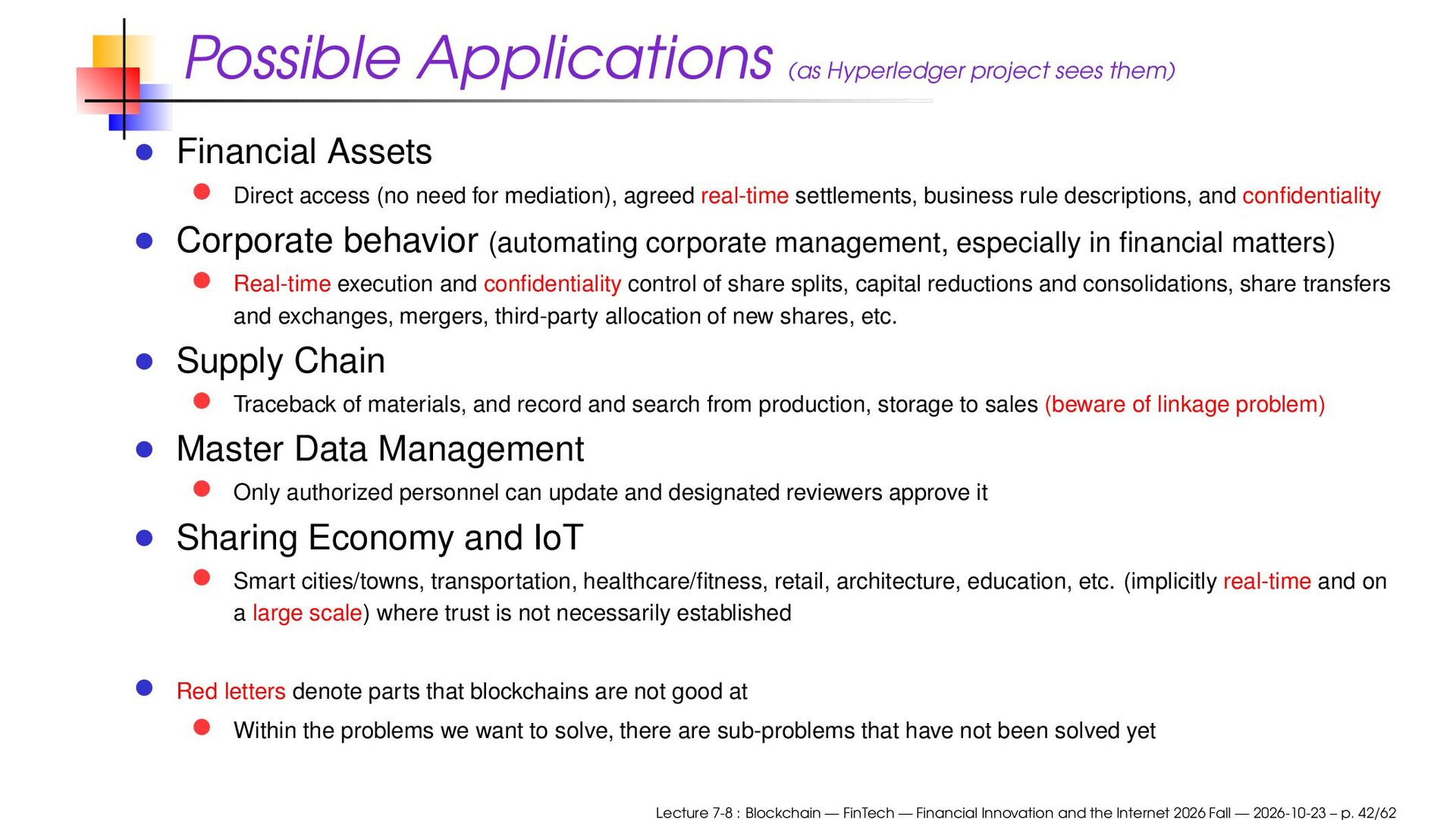
access (no need for mediation), agreed real-time settlements, business rule descriptions, and confidentiality Corporate behavior (automating corporate management, especially in financial matters) Real-time execution and confidentiality control of share splits, capital reductions and consolidations, share transfers and exchanges, mergers, third-party allocation of new shares, etc. Supply Chain Traceback of materials, and record and search from production, storage to sales (beware of linkage problem) Master Data Management Only authorized personnel can update and designated reviewers approve it Sharing Economy and IoT Smart cities/towns, transportation, healthcare/fitness, retail, architecture, education, etc. (implicitly real-time and on a large scale) where trust is not necessarily established Red letters denote parts that blockchains are not good at Within the problems we want to solve, there are sub-problems that have not been solved yet Lecture 7-8 : Blockchain — FinTech — Financial Innovation and the Internet 2026 Fall — 2026-10-23 – p. 42/62
. . Remittances that bypass banking networks That’s a huge impact Proof of Existence Ex. Proof of Existence, Everledger (in the past), . . . Embed arbitrary digests in a blockchain (piggybacking hack) There is also a method of embedding a single digest of a large number of records Proof that a record has existed and has not been tampered with Origin Certification (traceability, tracking and accounting) This is the originally intended application category of blockchain (an alternative to “newspaper”) Lecture 7-8 : Blockchain — FinTech — Financial Innovation and the Internet 2026 Fall — 2026-10-23 – p. 43/62
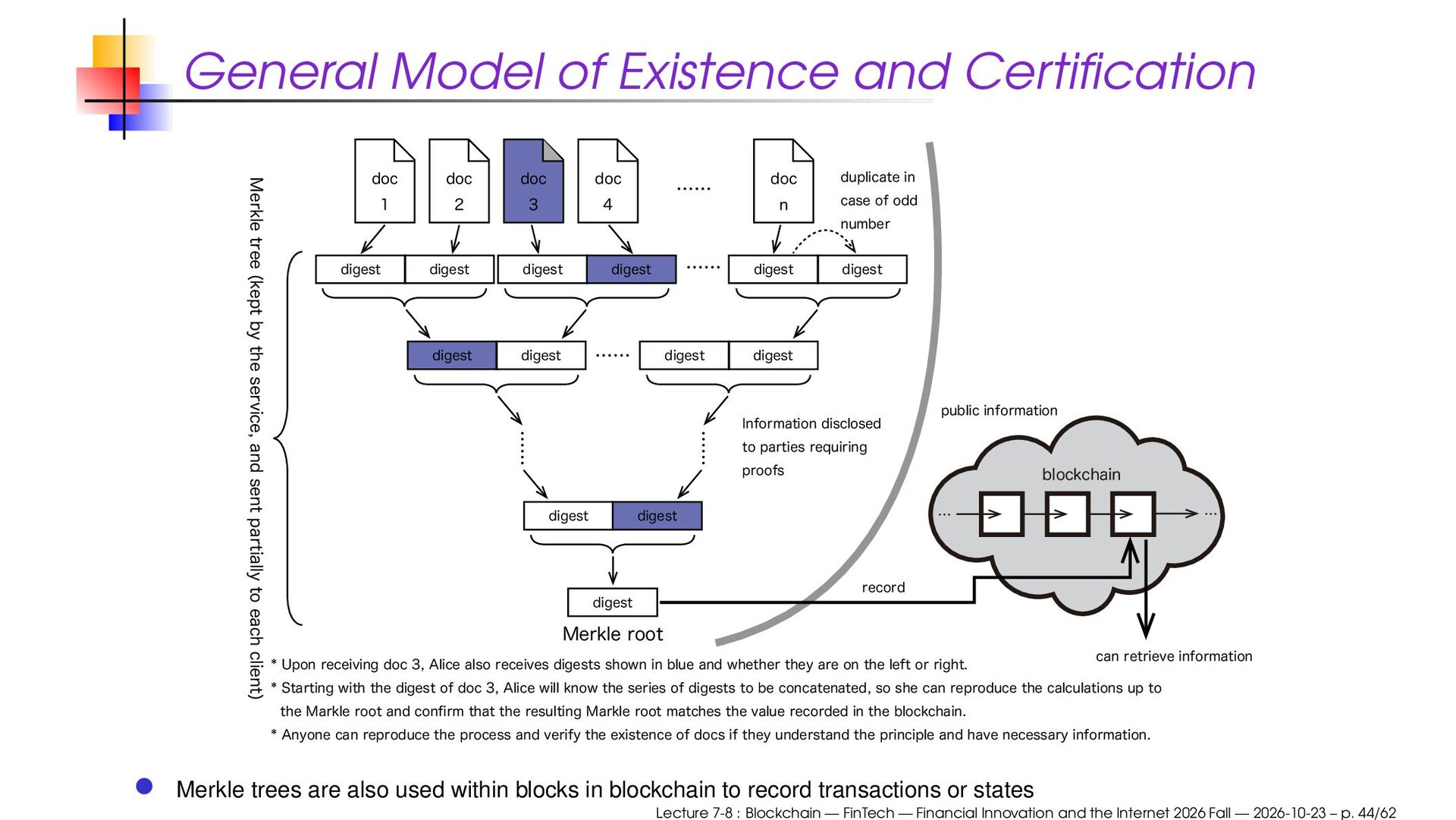
2 3 4 digest digest digest digest digest digest …… …… …… digest …… …… Merkle tree (kept by the service, and sent partially to each client) doc digest doc n digest duplicate in case of odd number digest digest Information disclosed public information to parties requiring proofs blockchain … … digest record digest Merkle root * Upon receiving doc 3, Alice also receives digests shown in blue and whether they are on the left or right. can retrieve information * Starting with the digest of doc 3, Alice will know the series of digests to be concatenated, so she can reproduce the calculations up to the Markle root and confirm that the resulting Markle root matches the value recorded in the blockchain. * Anyone can reproduce the process and verify the existence of docs if they understand the principle and have necessary information. Merkle trees are also used within blocks in blockchain to record transactions or states Lecture 7-8 : Blockchain — FinTech — Financial Innovation and the Internet 2026 Fall — 2026-10-23 – p. 44/62
of trial and error In fact, a lot of new designs are being tested If we do not have governance for (or if we do not know how to accommodate) technological changes, we cannot use it in society Lecture 7-8 : Blockchain — FinTech — Financial Innovation and the Internet 2026 Fall — 2026-10-23 – p. 45/62
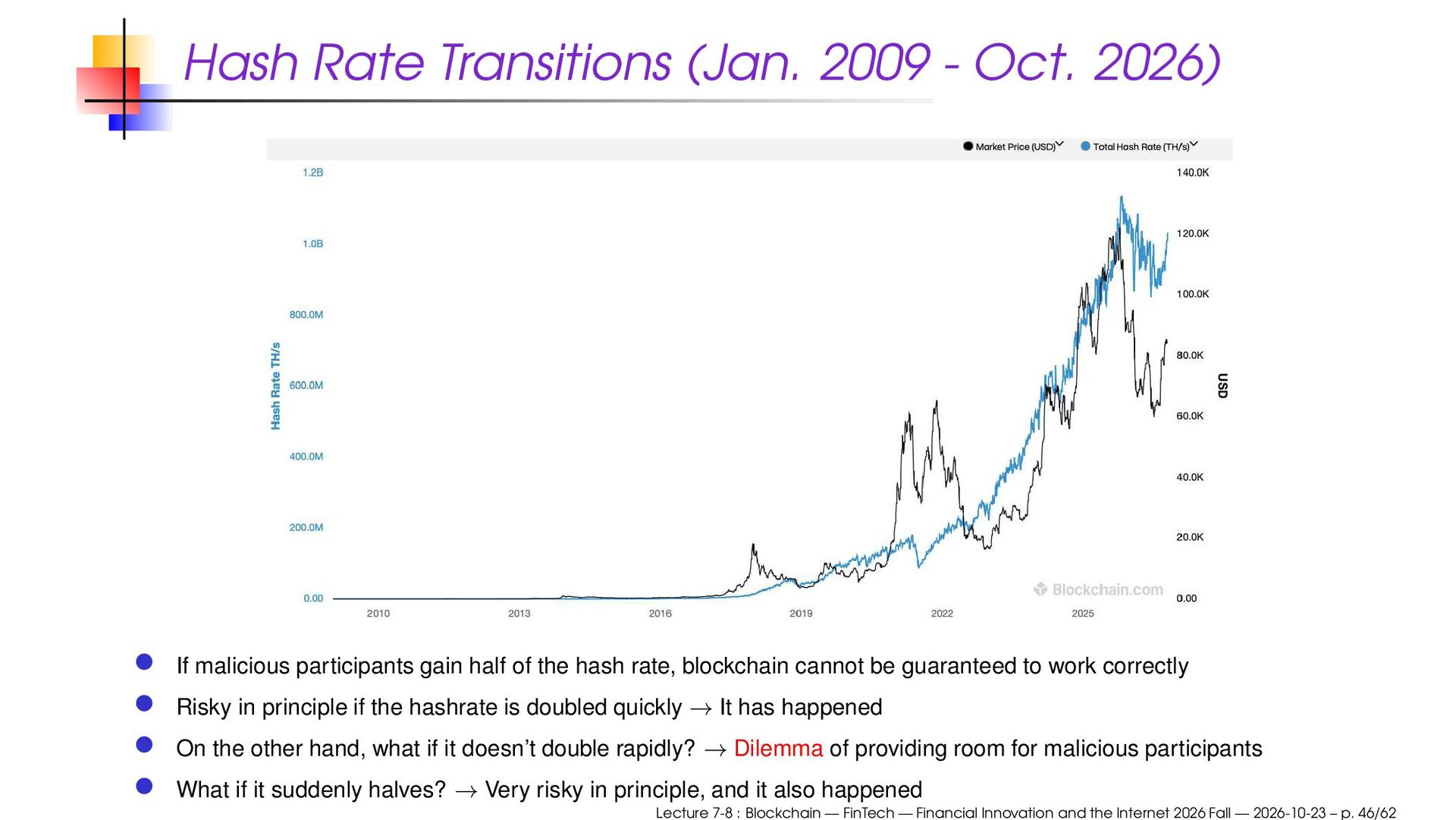
participants gain half of the hash rate, blockchain cannot be guaranteed to work correctly Risky in principle if the hashrate is doubled quickly → It has happened On the other hand, what if it doesn’t double rapidly? → Dilemma of providing room for malicious participants What if it suddenly halves? → Very risky in principle, and it also happened Lecture 7-8 : Blockchain — FinTech — Financial Innovation and the Internet 2026 Fall — 2026-10-23 – p. 46/62
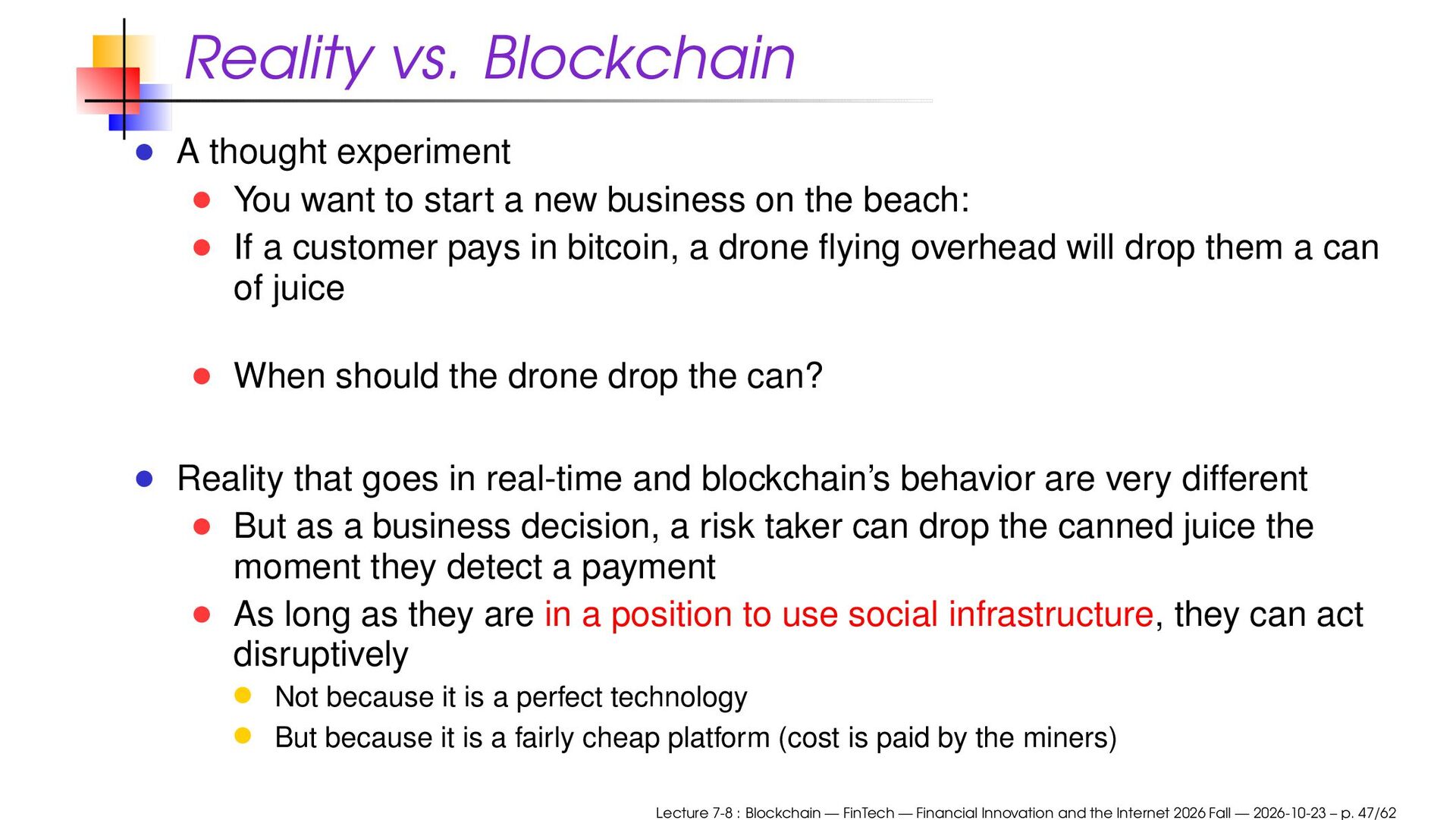
a new business on the beach: If a customer pays in bitcoin, a drone flying overhead will drop them a can of juice When should the drone drop the can? Reality that goes in real-time and blockchain’s behavior are very different But as a business decision, a risk taker can drop the canned juice the moment they detect a payment As long as they are in a position to use social infrastructure, they can act disruptively Not because it is a perfect technology But because it is a fairly cheap platform (cost is paid by the miners) Lecture 7-8 : Blockchain — FinTech — Financial Innovation and the Internet 2026 Fall — 2026-10-23 – p. 47/62
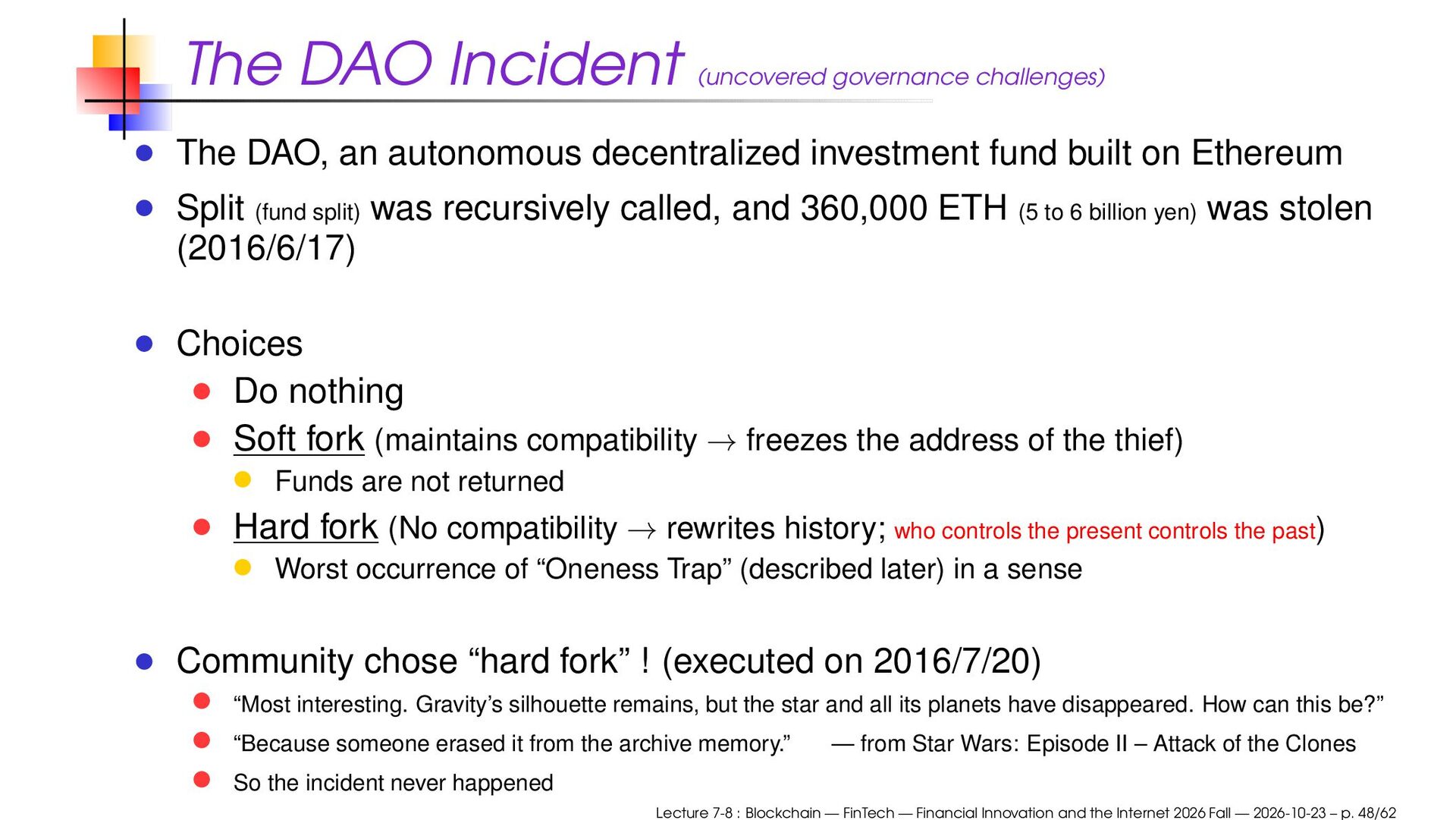
decentralized investment fund built on Ethereum Split (fund split) was recursively called, and 360,000 ETH (5 to 6 billion yen) was stolen (2016/6/17) Choices Do nothing Soft fork (maintains compatibility → freezes the address of the thief) Funds are not returned Hard fork (No compatibility → rewrites history; who controls the present controls the past) Worst occurrence of “Oneness Trap” (described later) in a sense Community chose “hard fork” ! (executed on 2016/7/20) “Most interesting. Gravity’s silhouette remains, but the star and all its planets have disappeared. How can this be?” “Because someone erased it from the archive memory.” — from Star Wars: Episode II – Attack of the Clones So the incident never happened Lecture 7-8 : Blockchain — FinTech — Financial Innovation and the Internet 2026 Fall — 2026-10-23 – p. 48/62
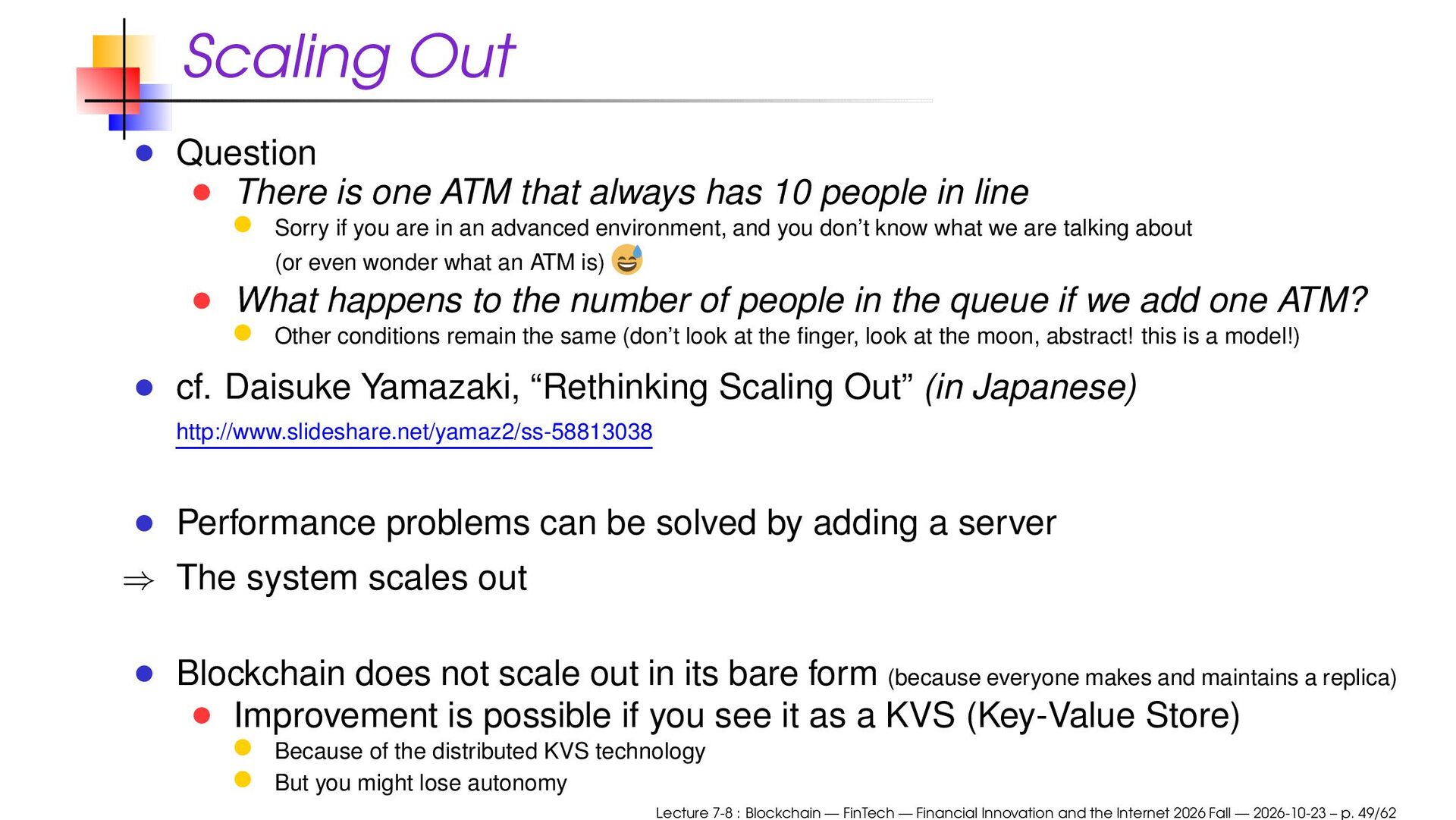
10 people in line Sorry if you are in an advanced environment, and you don’t know what we are talking about (or even wonder what an ATM is) What happens to the number of people in the queue if we add one ATM? Other conditions remain the same (don’t look at the finger, look at the moon, abstract! this is a model!) cf. Daisuke Yamazaki, “Rethinking Scaling Out” (in Japanese) http://www.slideshare.net/yamaz2/ss-58813038 Performance problems can be solved by adding a server ⇒ The system scales out Blockchain does not scale out in its bare form (because everyone makes and maintains a replica) Improvement is possible if you see it as a KVS (Key-Value Store) Because of the distributed KVS technology But you might lose autonomy Lecture 7-8 : Blockchain — FinTech — Financial Innovation and the Internet 2026 Fall — 2026-10-23 – p. 49/62
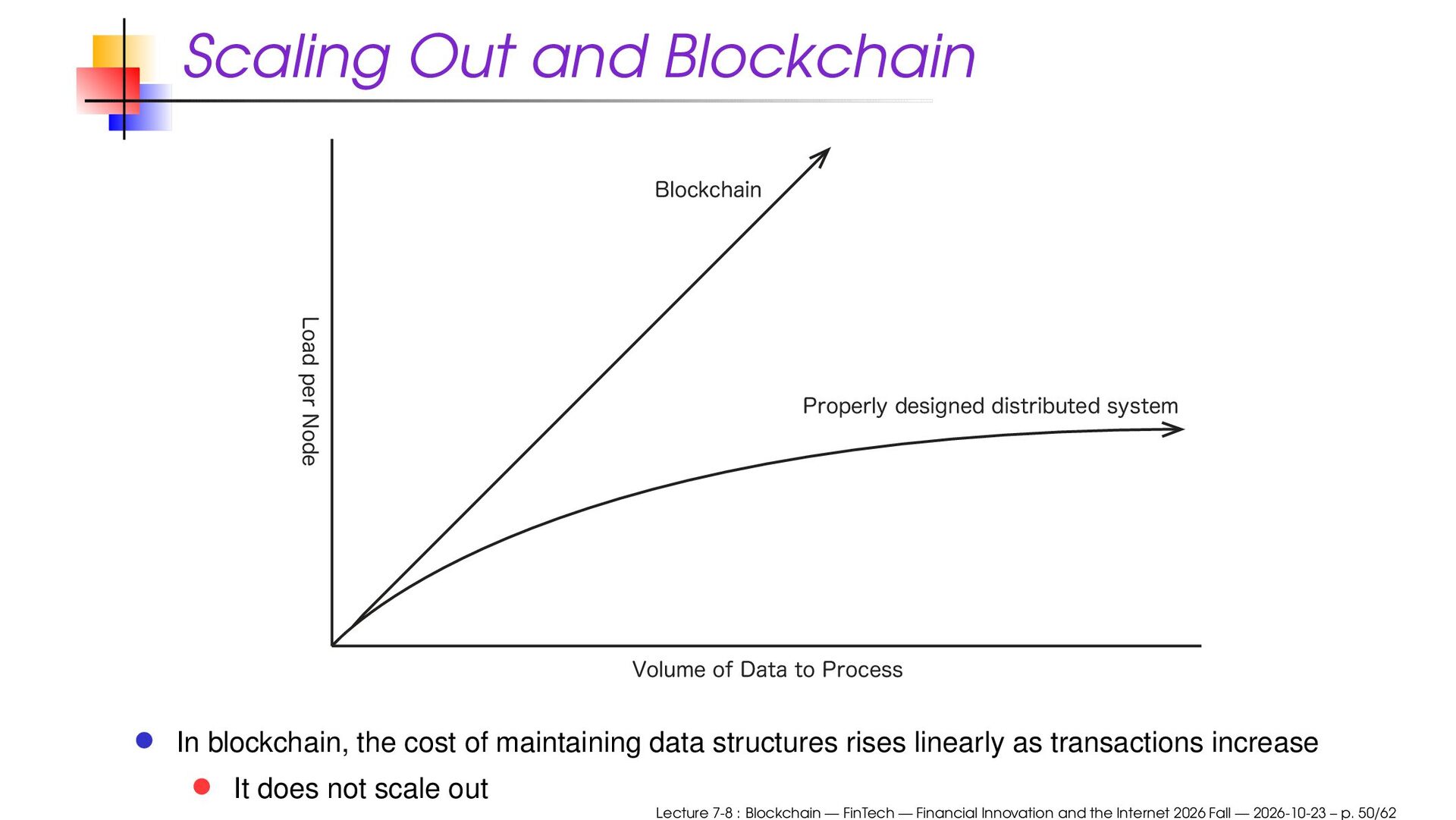
distributed system Volume of Data to Process In blockchain, the cost of maintaining data structures rises linearly as transactions increase It does not scale out Lecture 7-8 : Blockchain — FinTech — Financial Innovation and the Internet 2026 Fall — 2026-10-23 – p. 50/62
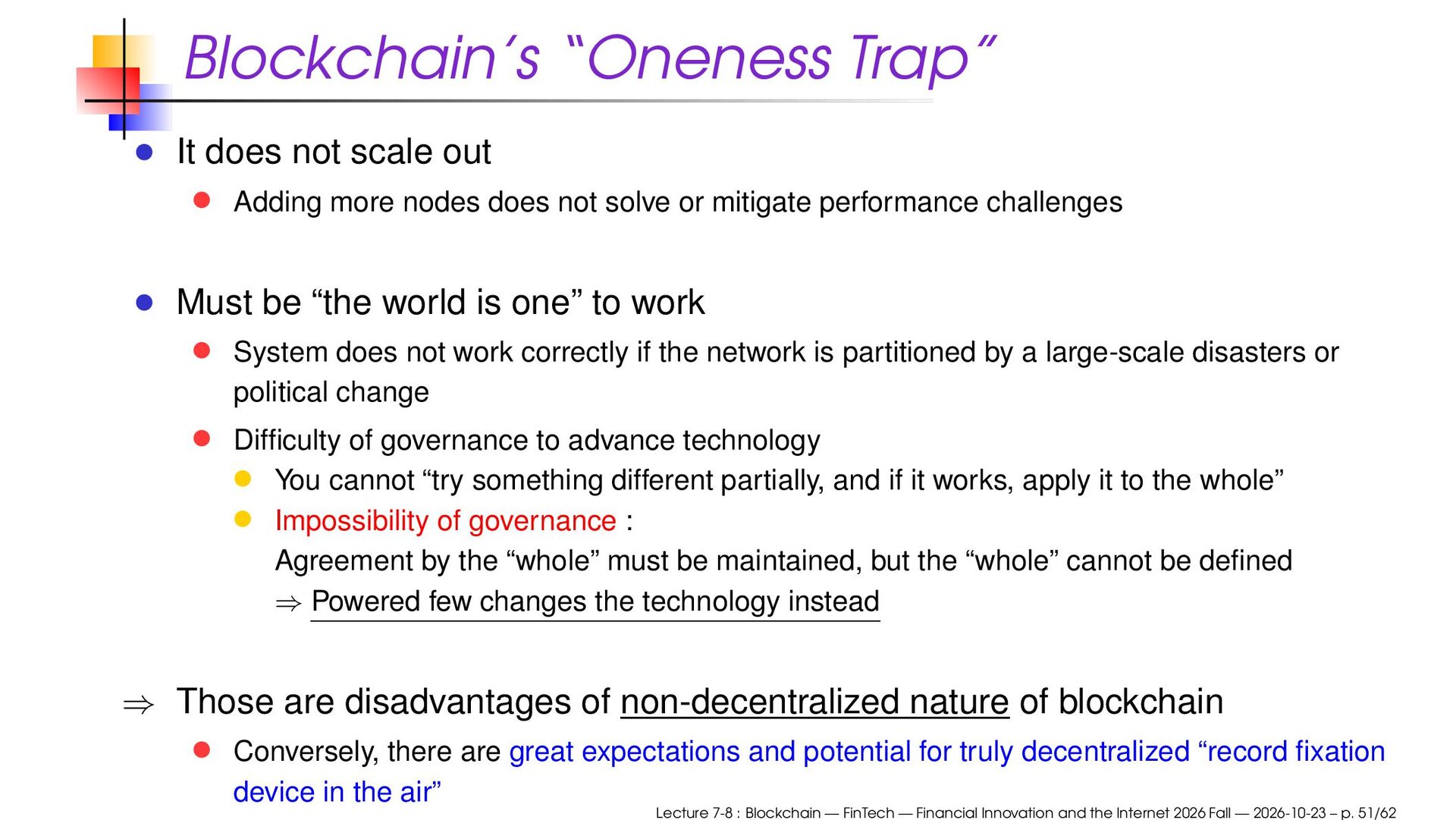
nodes does not solve or mitigate performance challenges Must be “the world is one” to work System does not work correctly if the network is partitioned by a large-scale disasters or political change Difficulty of governance to advance technology You cannot “try something different partially, and if it works, apply it to the whole” Impossibility of governance : Agreement by the “whole” must be maintained, but the “whole” cannot be defined ⇒ Powered few changes the technology instead ⇒ Those are disadvantages of non-decentralized nature of blockchain Conversely, there are great expectations and potential for truly decentralized “record fixation device in the air” Lecture 7-8 : Blockchain — FinTech — Financial Innovation and the Internet 2026 Fall — 2026-10-23 – p. 51/62
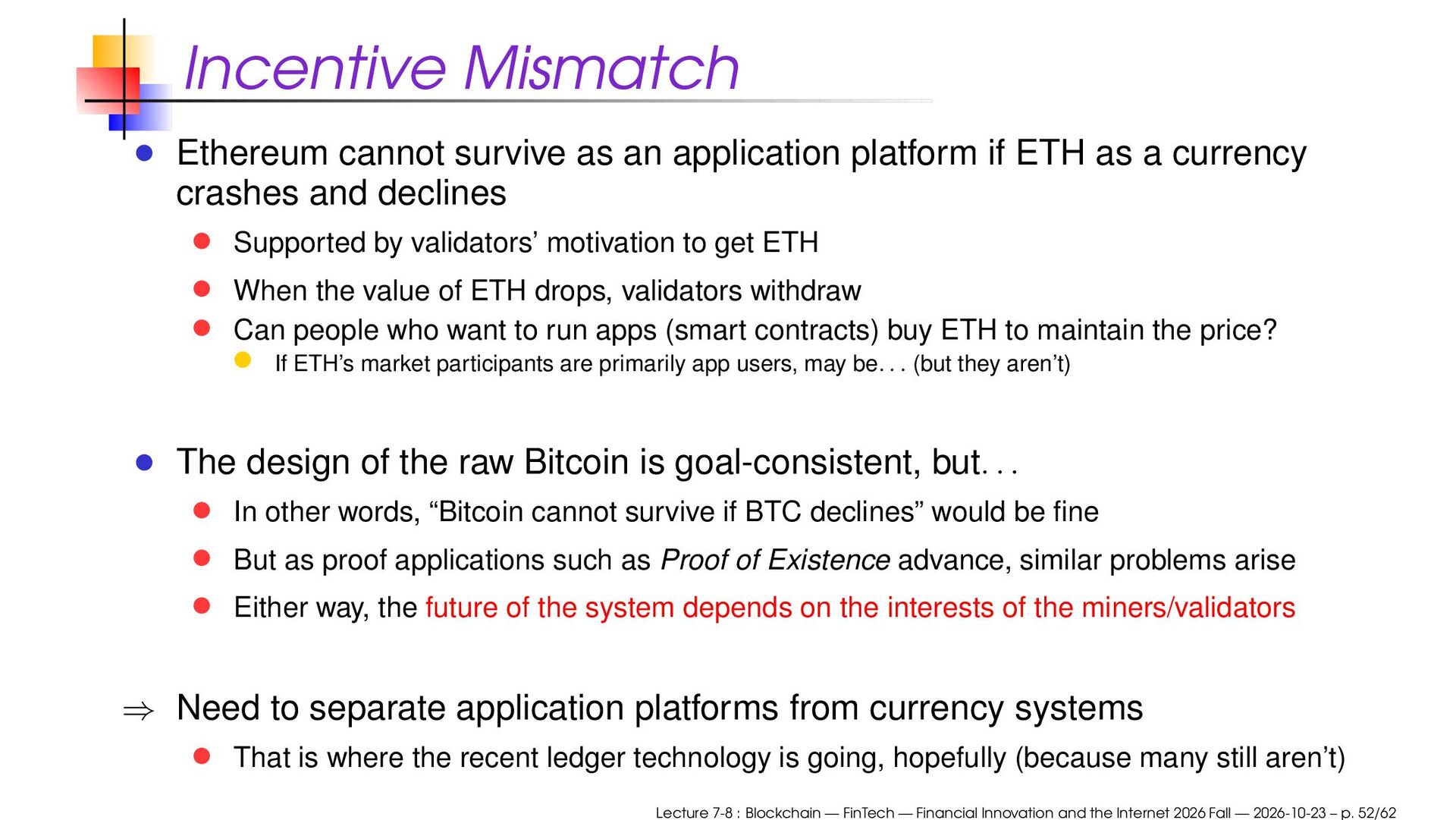
ETH as a currency crashes and declines Supported by validators’ motivation to get ETH When the value of ETH drops, validators withdraw Can people who want to run apps (smart contracts) buy ETH to maintain the price? If ETH’s market participants are primarily app users, may be. . . (but they aren’t) The design of the raw Bitcoin is goal-consistent, but. . . In other words, “Bitcoin cannot survive if BTC declines” would be fine But as proof applications such as Proof of Existence advance, similar problems arise Either way, the future of the system depends on the interests of the miners/validators ⇒ Need to separate application platforms from currency systems That is where the recent ledger technology is going, hopefully (because many still aren’t) Lecture 7-8 : Blockchain — FinTech — Financial Innovation and the Internet 2026 Fall — 2026-10-23 – p. 52/62
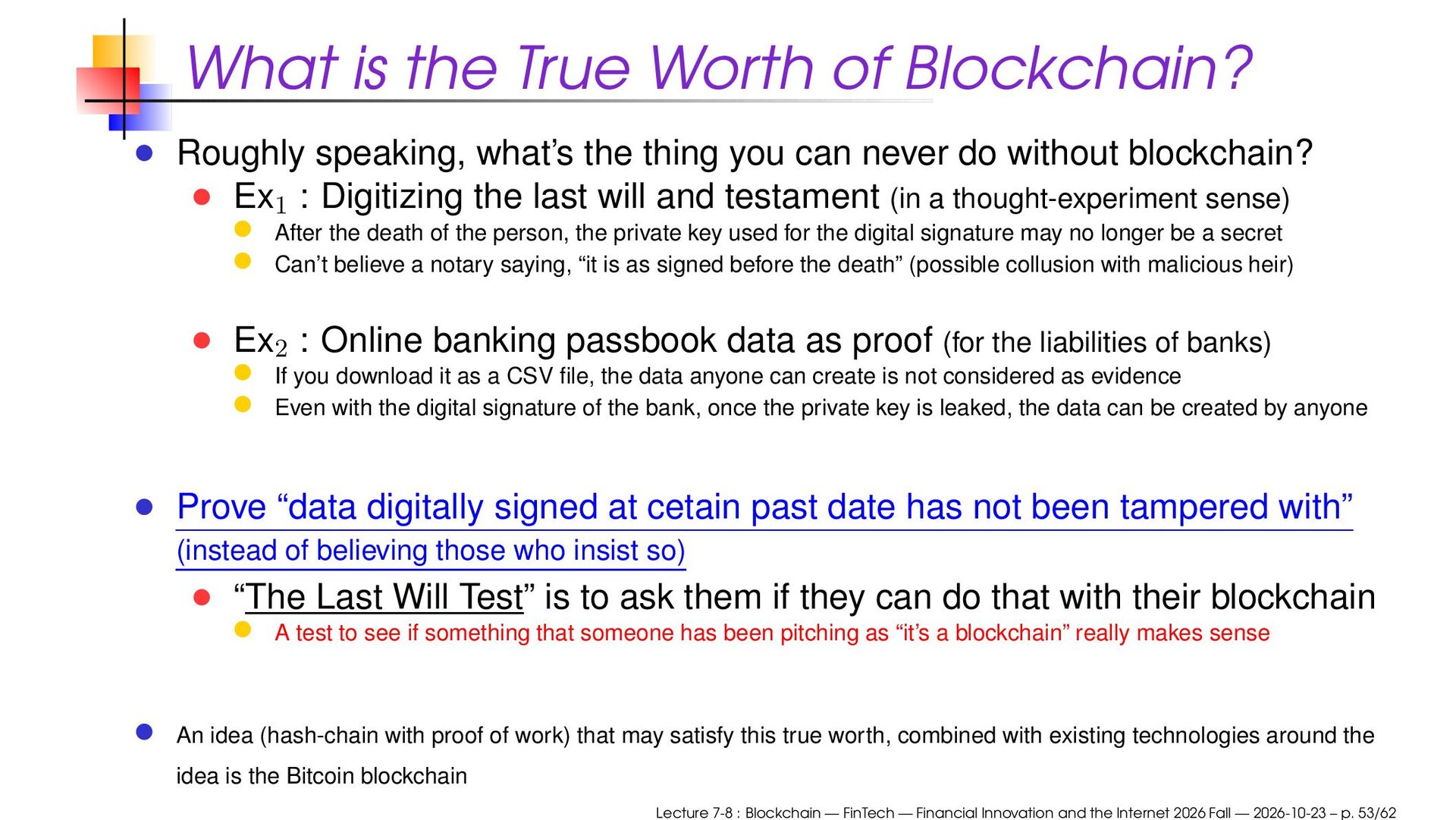
the thing you can never do without blockchain? Ex1 : Digitizing the last will and testament (in a thought-experiment sense) After the death of the person, the private key used for the digital signature may no longer be a secret Can’t believe a notary saying, “it is as signed before the death” (possible collusion with malicious heir) Ex2 : Online banking passbook data as proof (for the liabilities of banks) If you download it as a CSV file, the data anyone can create is not considered as evidence Even with the digital signature of the bank, once the private key is leaked, the data can be created by anyone Prove “data digitally signed at cetain past date has not been tampered with” (instead of believing those who insist so) “The Last Will Test” is to ask them if they can do that with their blockchain A test to see if something that someone has been pitching as “it’s a blockchain” really makes sense An idea (hash-chain with proof of work) that may satisfy this true worth, combined with existing technologies around the idea is the Bitcoin blockchain Lecture 7-8 : Blockchain — FinTech — Financial Innovation and the Internet 2026 Fall — 2026-10-23 – p. 53/62
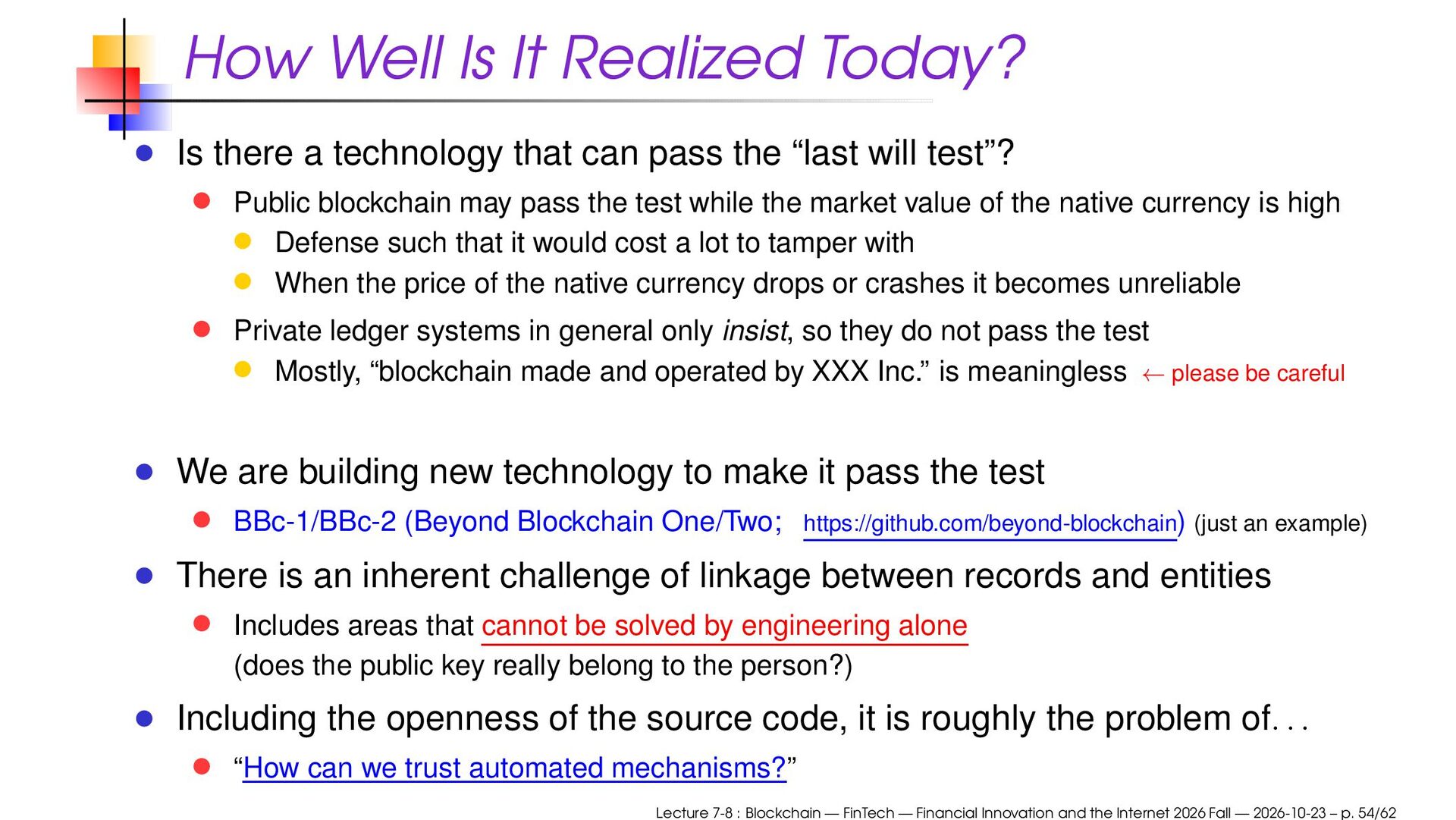
that can pass the “last will test”? Public blockchain may pass the test while the market value of the native currency is high Defense such that it would cost a lot to tamper with When the price of the native currency drops or crashes it becomes unreliable Private ledger systems in general only insist, so they do not pass the test Mostly, “blockchain made and operated by XXX Inc.” is meaningless ← please be careful We are building new technology to make it pass the test BBc-1/BBc-2 (Beyond Blockchain One/Two; https://github.com/beyond-blockchain) (just an example) There is an inherent challenge of linkage between records and entities Includes areas that cannot be solved by engineering alone (does the public key really belong to the person?) Including the openness of the source code, it is roughly the problem of. . . “How can we trust automated mechanisms?” Lecture 7-8 : Blockchain — FinTech — Financial Innovation and the Internet 2026 Fall — 2026-10-23 – p. 54/62
not left untouched, but continue to be improved But governance issues remain Lecture 7-8 : Blockchain — FinTech — Financial Innovation and the Internet 2026 Fall — 2026-10-23 – p. 55/62
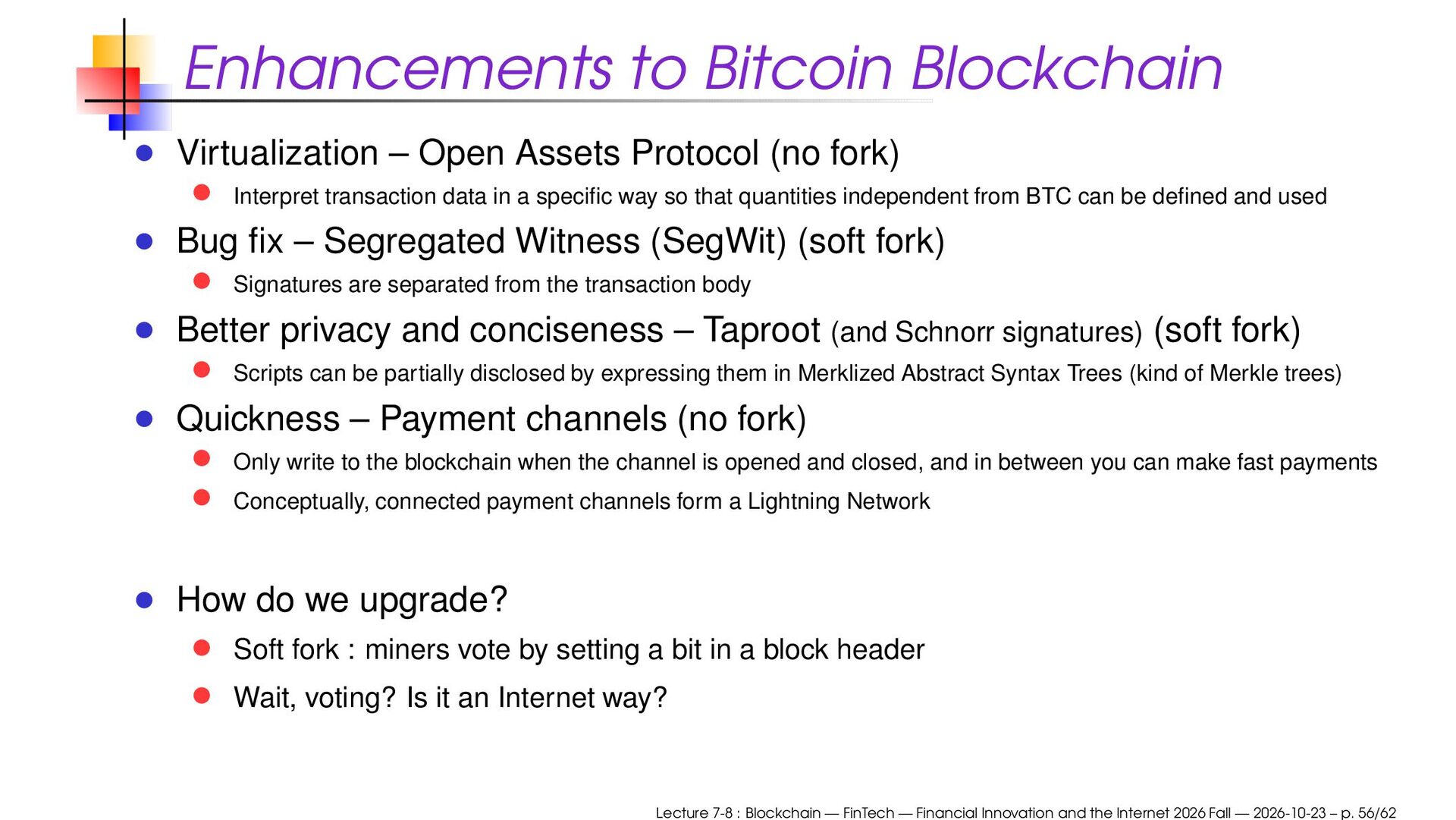
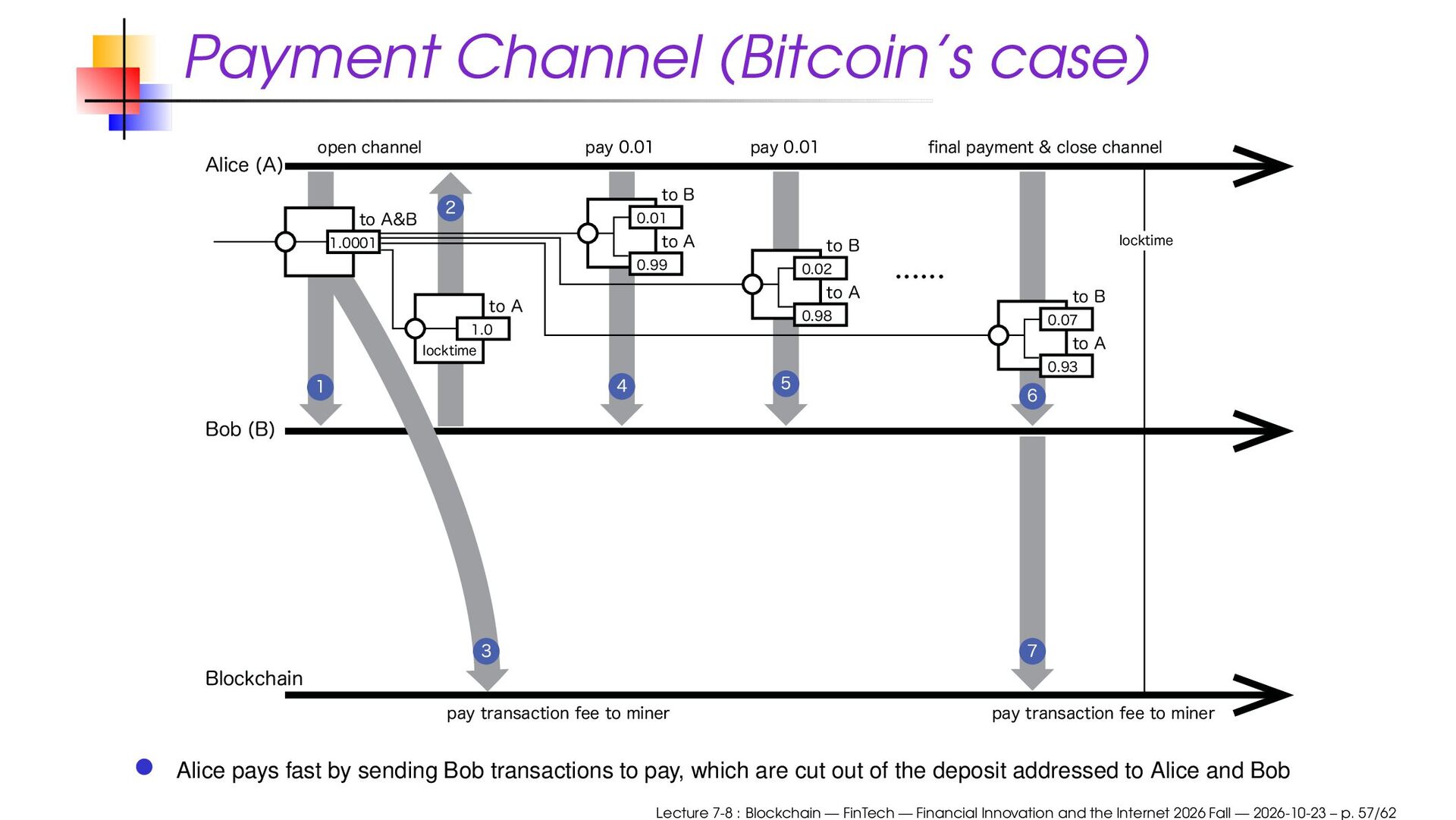
fork) Interpret transaction data in a specific way so that quantities independent from BTC can be defined and used Bug fix – Segregated Witness (SegWit) (soft fork) Signatures are separated from the transaction body Better privacy and conciseness – Taproot (and Schnorr signatures) (soft fork) Scripts can be partially disclosed by expressing them in Merklized Abstract Syntax Trees (kind of Merkle trees) Quickness – Payment channels (no fork) Only write to the blockchain when the channel is opened and closed, and in between you can make fast payments Conceptually, connected payment channels form a Lightning Network How do we upgrade? Soft fork : miners vote by setting a bit in a block header Wait, voting? Is it an Internet way? Lecture 7-8 : Blockchain — FinTech — Financial Innovation and the Internet 2026 Fall — 2026-10-23 – p. 56/62
pay 0.01 pay 0.01 final payment & close channel to B 2 0.01 to A 1.0001 to B 0.99 0.02 to A to A locktime ...... to B 0.98 1.0 0.07 to A locktime 5 4 1 0.93 6 Bob (B) Blockchain 7 3 pay transaction fee to miner pay transaction fee to miner Alice pays fast by sending Bob transactions to pay, which are cut out of the deposit addressed to Alice and Bob Lecture 7-8 : Blockchain — FinTech — Financial Innovation and the Internet 2026 Fall — 2026-10-23 – p. 57/62
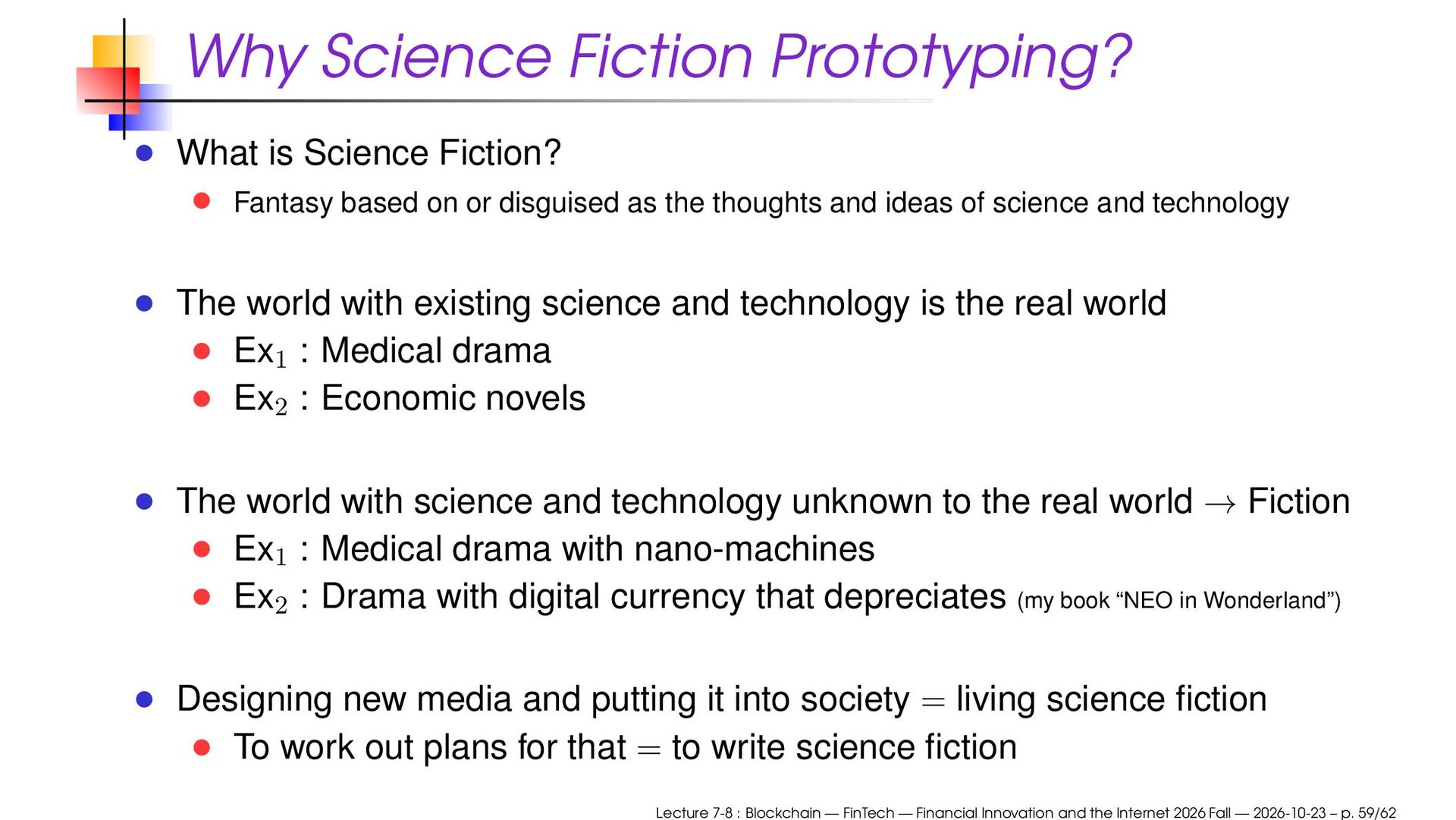
on or disguised as the thoughts and ideas of science and technology The world with existing science and technology is the real world Ex1 : Medical drama Ex2 : Economic novels The world with science and technology unknown to the real world → Fiction Ex1 : Medical drama with nano-machines Ex2 : Drama with digital currency that depreciates (my book “NEO in Wonderland”) Designing new media and putting it into society = living science fiction To work out plans for that = to write science fiction Lecture 7-8 : Blockchain — FinTech — Financial Innovation and the Internet 2026 Fall — 2026-10-23 – p. 59/62
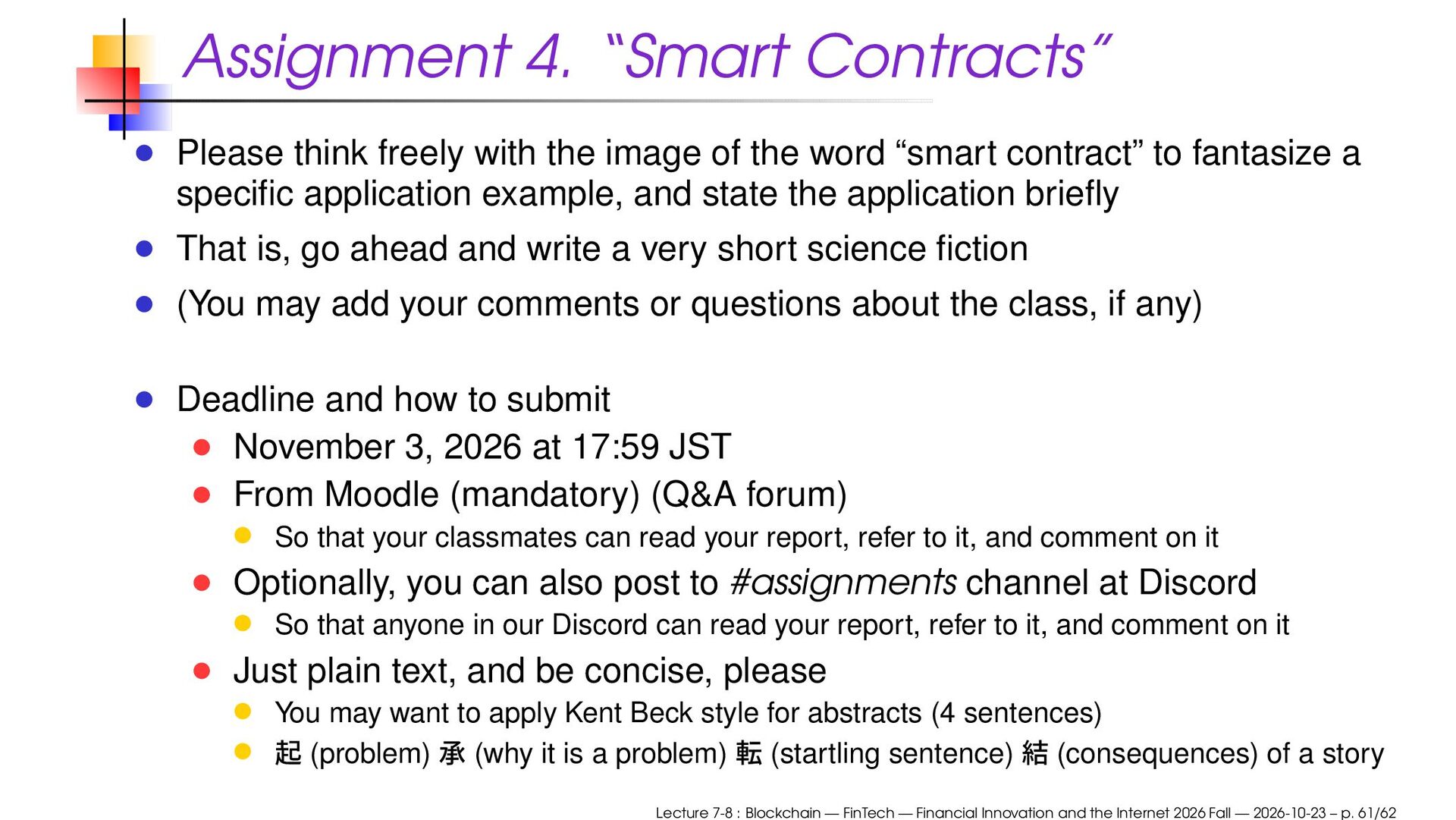
of the word “smart contract” to fantasize a specific application example, and state the application briefly That is, go ahead and write a very short science fiction (You may add your comments or questions about the class, if any) Deadline and how to submit November 3, 2026 at 17:59 JST From Moodle (mandatory) (Q&A forum) So that your classmates can read your report, refer to it, and comment on it Optionally, you can also post to #assignments channel at Discord So that anyone in our Discord can read your report, refer to it, and comment on it Just plain text, and be concise, please You may want to apply Kent Beck style for abstracts (4 sentences) 起 (problem) 承 (why it is a problem) 転 (startling sentence) 結 (consequences) of a story Lecture 7-8 : Blockchain — FinTech — Financial Innovation and the Internet 2026 Fall — 2026-10-23 – p. 61/62


 ks91
 takuroabe
 kzkhykw1991
 ueponx
 techtekt
 satomasahiro2005
 terapyon
 kizawa2020
 kentarofujii
 masakiokuda
 codmoninc
 jozono
 yamad
 wayneb77
 skipperchong
 kevinliebholz
 pedronauck
 tmiket
 axbom
 rkendrick25
 lcolladotor
 destraynor
 eileencodes
 lauravandoore
 carmenintech