Upgrade to Pro
— share decks privately, control downloads, hide ads and more …
Speaker Deck
Sign up for free
Menu
Search
Features
All features
Private URLs
Password Protection
Custom URLS
Scheduled publishing
Remove Branding
Restrict embedding
Deck Collections
Notes
Features
All features
Private URLs
Password Protection
Custom URLS
Scheduled publishing
Remove Branding
Restrict embedding
Deck Collections
Notes
Explore
Featured decks
Featured speakers
Programming
Technology
Storyboards
Explore
Featured decks
Featured speakers
Programming
Technology
Storyboards
Pricing
Search
Sign in
Sign up for free
ON-LSTM
Search
Sponsored
·
Your Podcast. Everywhere. Effortlessly.
Share. Educate. Inspire. Entertain. You do you. We'll handle the rest.
→
Zhang Yixiao
July 05, 2019
Research
240
0
Share
Embed
Copy iframe code
Copy JS code
Copy link
Start on current slide
ON-LSTM
Zhang Yixiao
July 05, 2019
More Decks by Zhang Yixiao
See All by Zhang Yixiao
CoCon
ldzhangyx
0
420
vq-cpc
ldzhangyx
0
410
MixPoet
ldzhangyx
4
480
diora
ldzhangyx
0
320
drummernet
ldzhangyx
0
280
Other Decks in Research
See All in Research
人間中心の意思決定支援AI
yukinobaba
PRO
7
4.2k
[IR Reading 2026春 論文紹介] LLM-based Listwise Reranking under the Effect of Positional Bias (ECIR 2026) /IR-Reading-2026-Spring
koheishinden
PRO
0
460
Sleuthcon Keynote - How Cybercriminals (ab)use AI
fr0gger
0
360
医療LLMの現在地〜最新研究から社会実装までを考える〜
kento1109
1
1.8k
論文読み会 SNLP2026 Tau2-Bench: Evaluating Conversational Agents in a Dual-Control Environment
s_mizuki_nlp
0
290
大規模言語モデルは誰を覚えているか / Who Do Large Language Models Memorize?
upura
0
210
Adapter les bergeries aux fortes chaleurs
institutdelelevage
PRO
0
110
Source Code Diff Revolution
tsantalis
0
180
2025年度秋葉原ウォーカブルプロジェクト調査報告 「アキバらしいウォーカブル」とは何か
izumiyama_lab
1
240
超効率化への挑戦:1bit LLMの現状と展望
yumaichikawa
0
800
論文紹介:Doc-to-LoRA: Learning to Instantly Internalize Contexts
yukako_nakano
0
190
量子サマースクール2026「量子計算機アーキテクチャ分野の概観」
youten622
1
960
Featured
See All Featured
Intergalactic Javascript Robots from Outer Space
tanoku
273
27k
Statistics for Hackers
jakevdp
799
230k
個人開発の失敗を避けるイケてる考え方 / tips for indie hackers
panda_program
123
22k
I Don’t Have Time: Getting Over the Fear to Launch Your Podcast
jcasabona
35
2.9k
My Coaching Mixtape
mlcsv
0
340
Impact Scores and Hybrid Strategies: The future of link building
tamaranovitovic
0
450
Paper Plane
katiecoart
PRO
4
53k
Designing Experiences People Love
moore
143
24k
Building a A Zero-Code AI SEO Workflow
portentint
PRO
0
760
Deep Space Network (abreviated)
tonyrice
0
350
Test your architecture with Archunit
thirion
2
2.4k
What does AI have to do with Human Rights?
axbom
PRO
1
2.4k
Transcript
ORDERED NEURONS: INTEGRATING TREE STRUCTURES INTO RECURRENT NEURAL NETWORKS (ICLR
2019, BEST PAPER AWARD
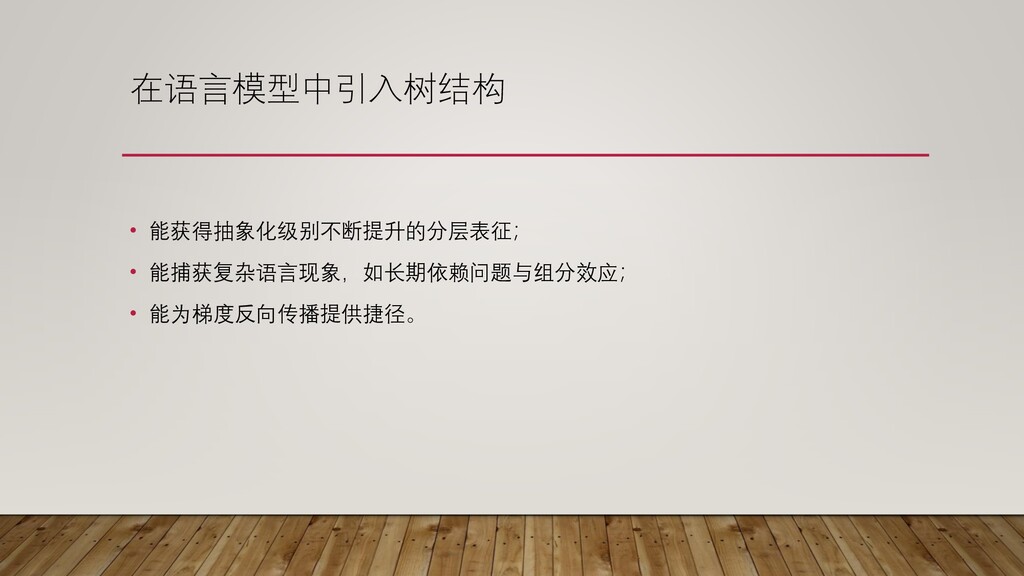
在语言模型中引入树结构 • 能获得抽象化级别不断提升的分层表征; • 能捕获复杂语言现象,如长期依赖问题与组分效应; • 能为梯度反向传播提供捷径。
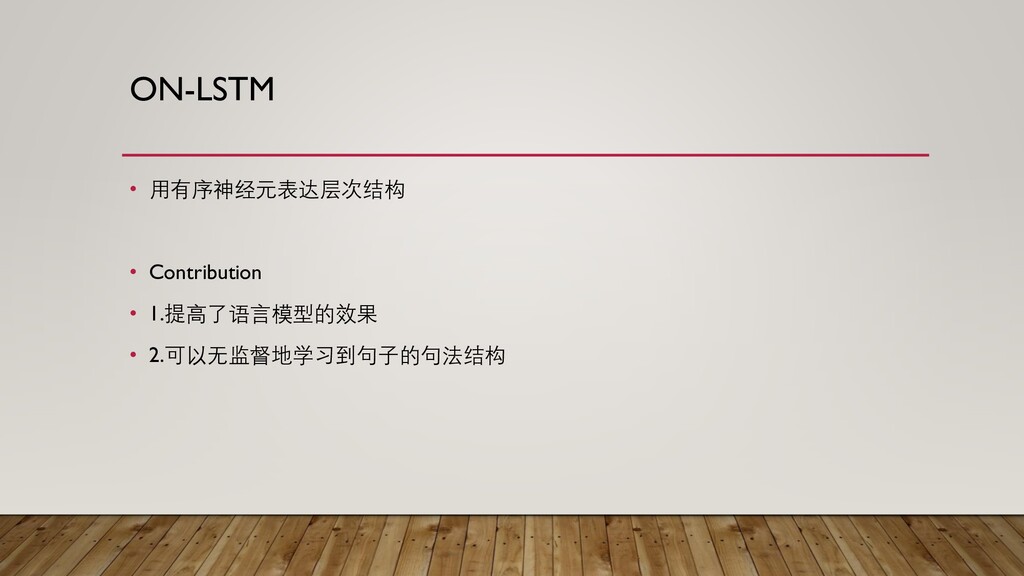
ON-LSTM • 用有序神经元表达层次结构 • Contribution • 1.提高了语言模型的效果 • 2.可以无监督地学习到句子的句法结构
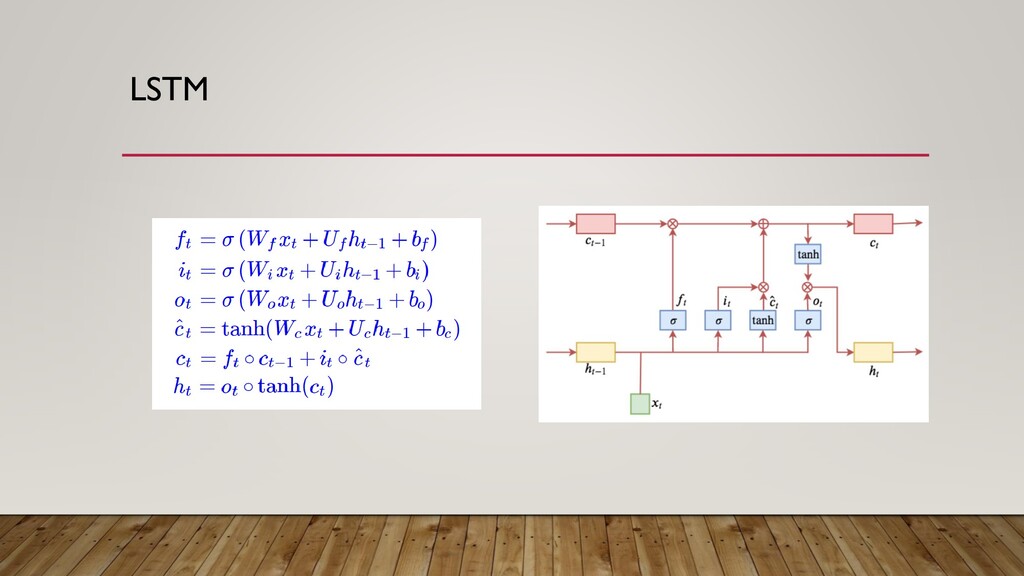
LSTM
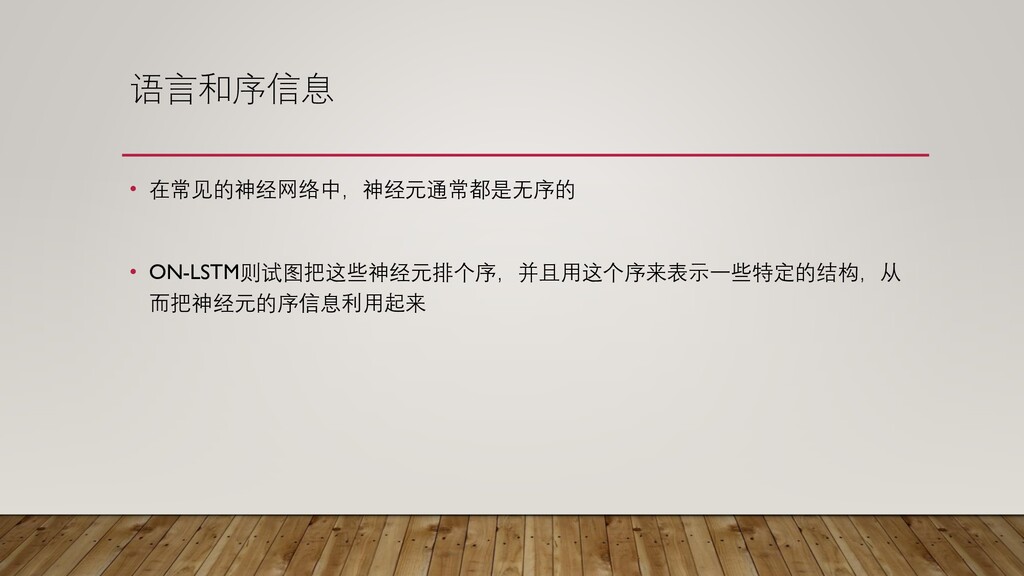
语言和序信息 • 在常见的神经网络中,神经元通常都是无序的 • ON-LSTM则试图把这些神经元排个序,并且用这个序来表示一些特定的结构,从 而把神经元的序信息利用起来
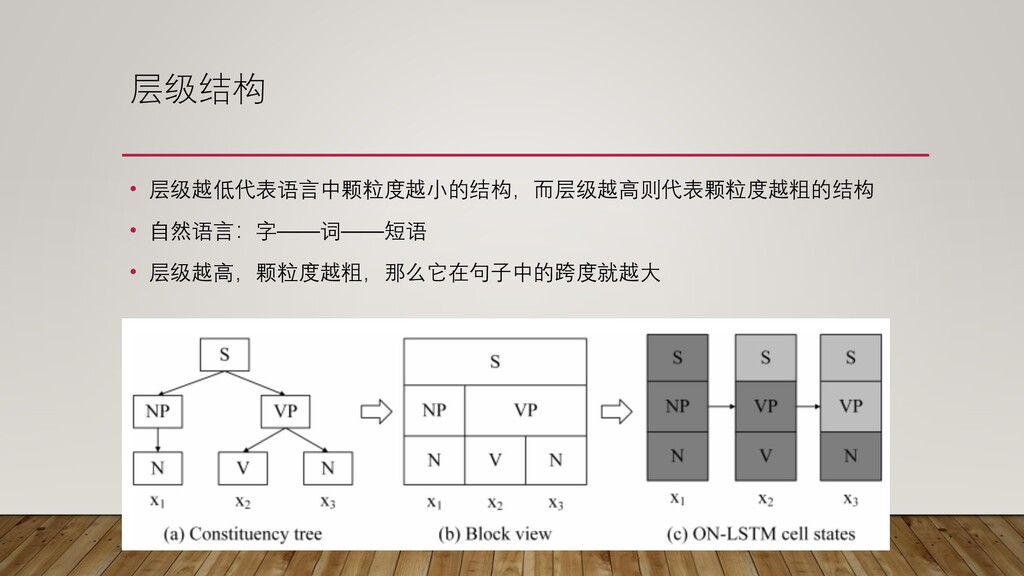
层级结构 • 层级越低代表语言中颗粒度越小的结构,而层级越高则代表颗粒度越粗的结构 • 自然语言:字——词——短语 • 层级越高,颗粒度越粗,那么它在句子中的跨度就越大
ON-LSTM的设计方向 • 层级越高,颗粒度越粗,那么它在句子中的跨度就越大 • 要求: • 1. 能区分高低层级的信息 • 2.
能让高层级的信息保留更久,底层级的信息更容易被遗忘
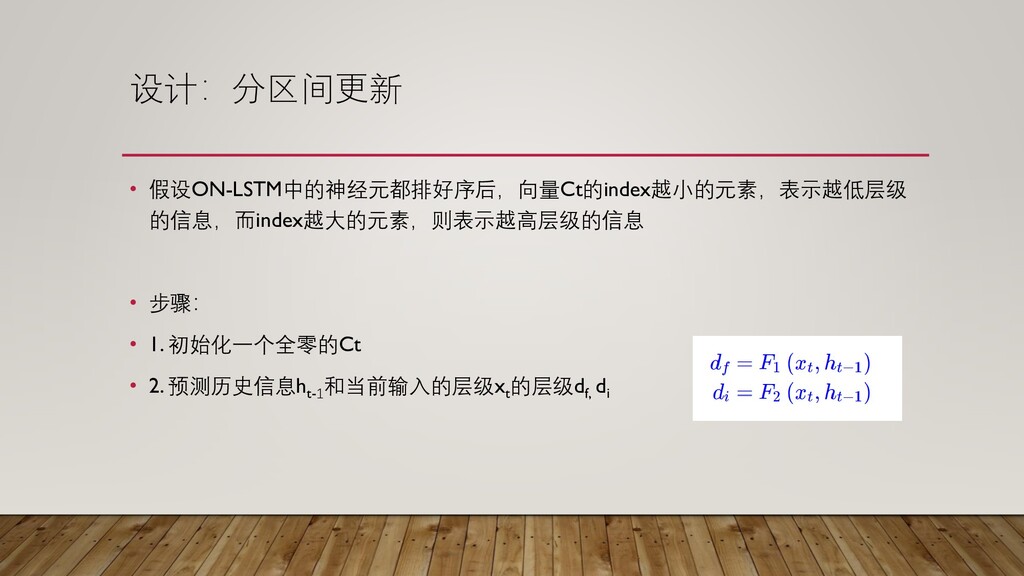
设计:分区间更新 • 假设ON-LSTM中的神经元都排好序后,向量Ct的index越小的元素,表示越低层级 的信息,而index越大的元素,则表示越高层级的信息 • 步骤: • 1. 初始化一个全零的Ct •
2. 预测历史信息ht-1 和当前输入的层级xt 的层级df, di
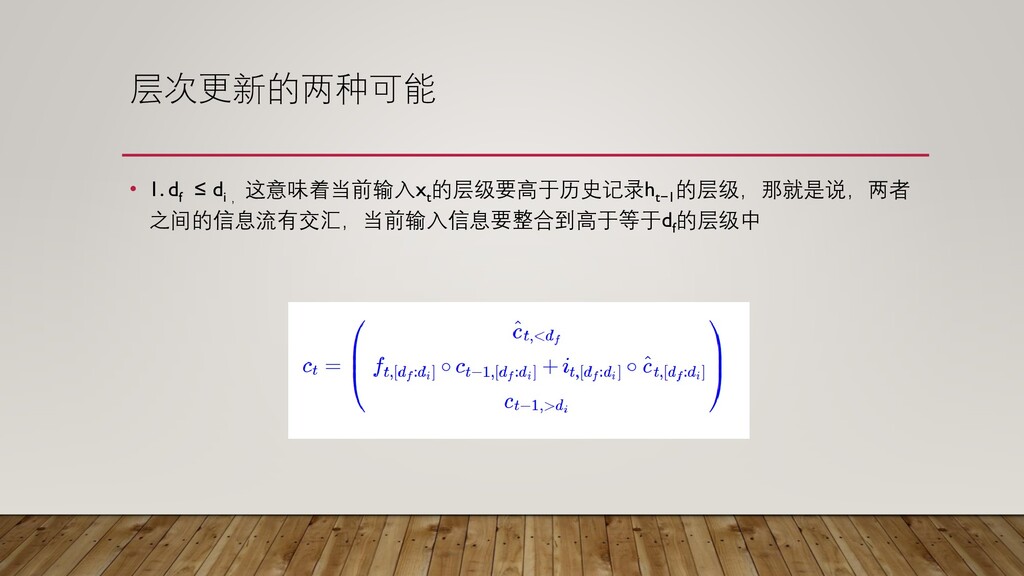
层次更新的两种可能 • 1. df ≤ di , 这意味着当前输入xt 的层级要高于历史记录ht−1 的层级,那就是说,两者
之间的信息流有交汇,当前输入信息要整合到高于等于df 的层级中
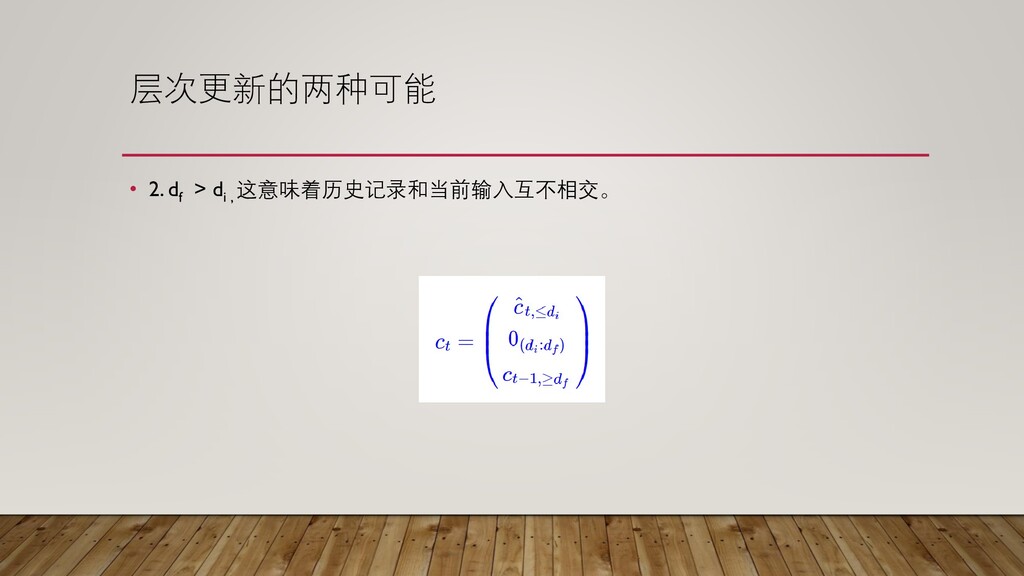
层次更新的两种可能 • 2. df > di , 这意味着历史记录和当前输入互不相交。
分层更新的作用 • 高层信息就可能保留相当长的距离(因为高层直接复制历史信息,导致历史信息可 能不断被复制而不改变); • 而低层信息在每一步输入时都可能被更新(因为低层直接复制输入,而输入是不断 改变的)。 • 所以就通过信息分级来嵌入了层级结构。 •
更通俗地说就是分组更新,更高的组信息传得更远(跨度更大),更低的组跨度更 小,这些不同的跨度就形成了输入序列的层级结构。
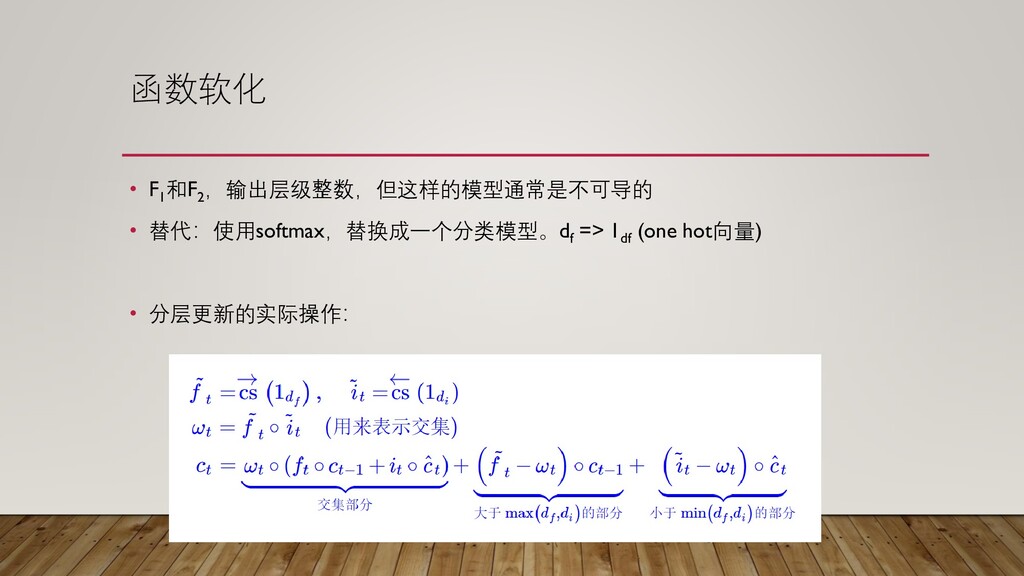
函数软化 • F1 和F2 ,输出层级整数,但这样的模型通常是不可导的 • 替代:使用softmax,替换成一个分类模型。df => 1df (one
hot向量) • 分层更新的实际操作:
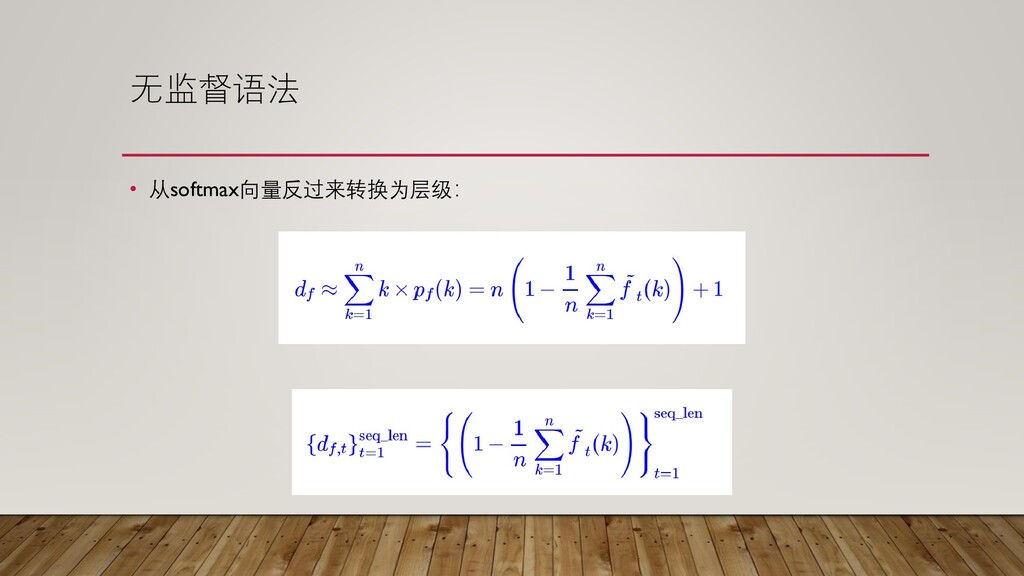
无监督语法 • 从softmax向量反过来转换为层级:
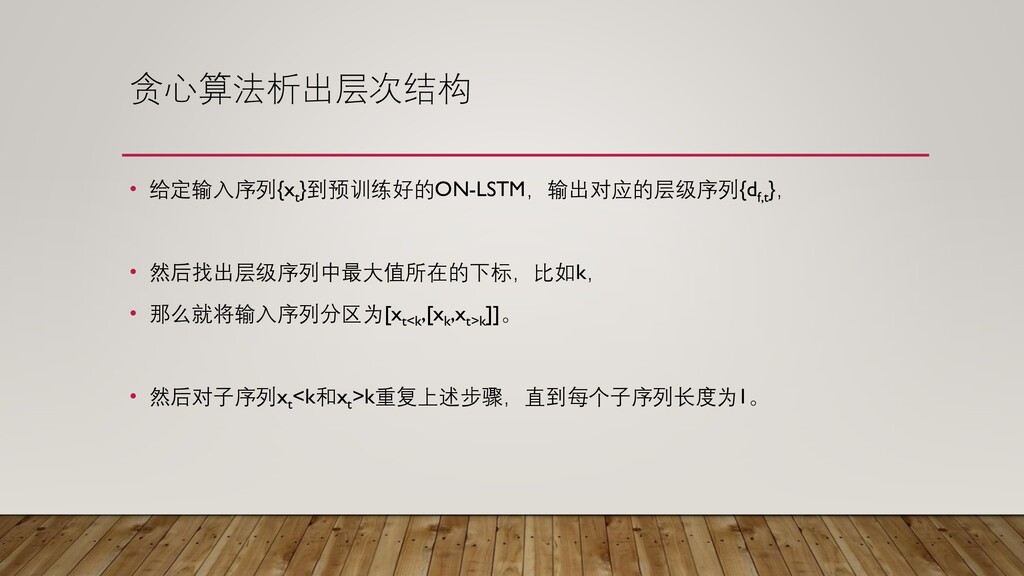
贪心算法析出层次结构 • 给定输入序列{xt }到预训练好的ON-LSTM,输出对应的层级序列{df,t }, • 然后找出层级序列中最大值所在的下标,比如k, • 那么就将输入序列分区为[xt<k ,[xk
,xt>k ]]。 • 然后对子序列xt <k和xt >k重复上述步骤,直到每个子序列长度为1。
None


 ldzhangyx
 yukinobaba
 koheishinden
 fr0gger
 kento1109
 s_mizuki_nlp
 upura
upura
 institutdelelevage
 tsantalis
 izumiyama_lab
 yumaichikawa
 yukako_nakano
 youten622
 tanoku
 jakevdp
 panda_program
 jcasabona
 mlcsv
mlcsv
 tamaranovitovic
 katiecoart
 moore
moore
 portentint
 tonyrice
 thirion
 axbom
axbom