Upgrade to Pro — share decks privately, control downloads, hide ads and more …

Airflow Beyond Python: New Languages for Tasks ...

Avatar for Lee Wei Lee Wei
October 11, 2026

Airflow Beyond Python: New Languages for Tasks and Workflows

Avatar for Lee Wei

Lee Wei

October 11, 2026

More Decks by Lee Wei

Other Decks in Programming

Transcript

  1. Airflow Beyond Python: New Languages for Tasks and Workflows Jason

    (Zhe-You) Liu Wei Lee Apache Airflow Committer Apache Airflow PMC Member Community Over Code Glasgow 2026 · Airflow Contributor Days
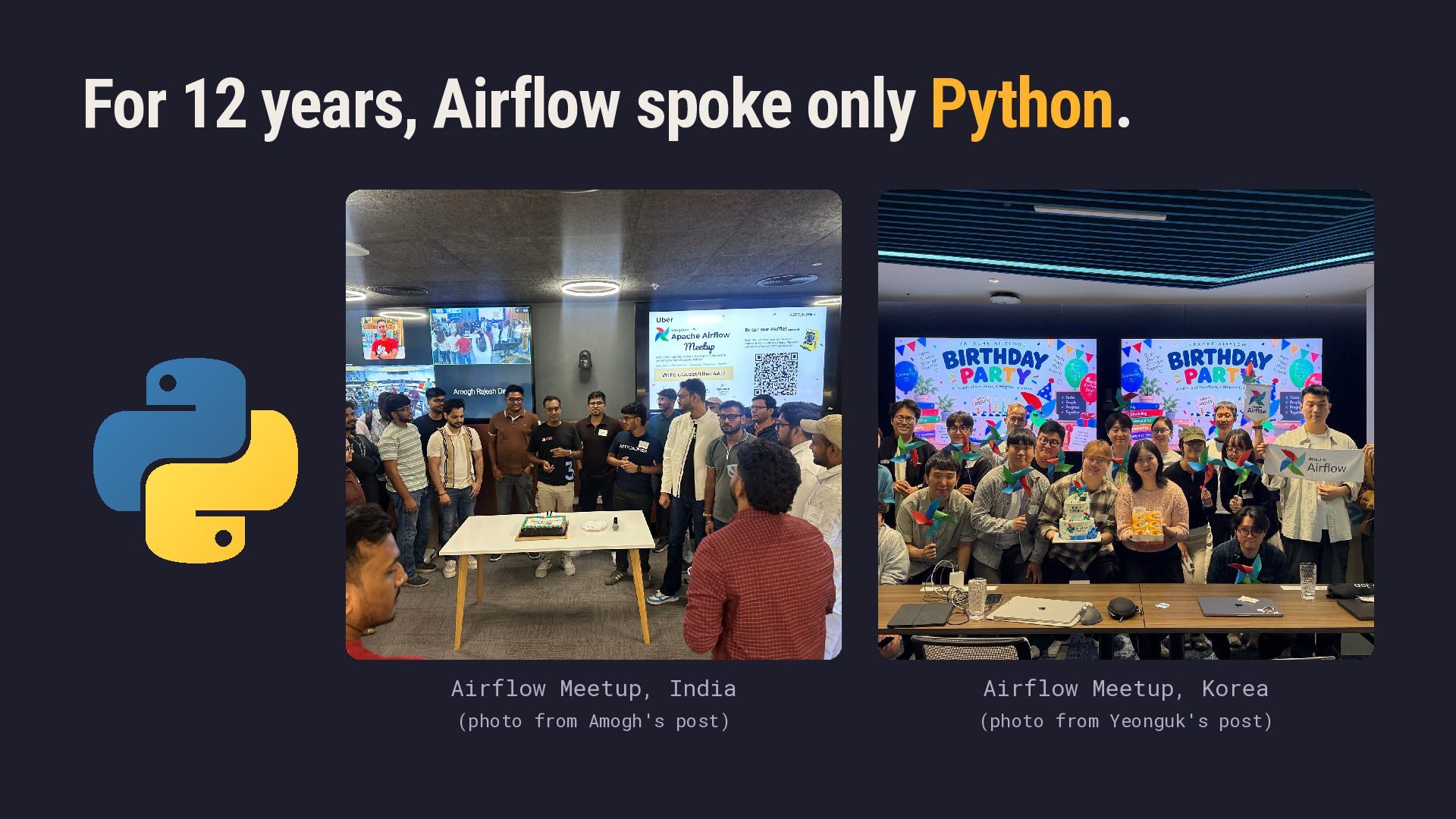
  2. For 12 years, Airflow spoke only Python. Airflow Meetup, India

    Airflow Meetup, Korea (photo from Amogh's post) (photo from Yeonguk's post)
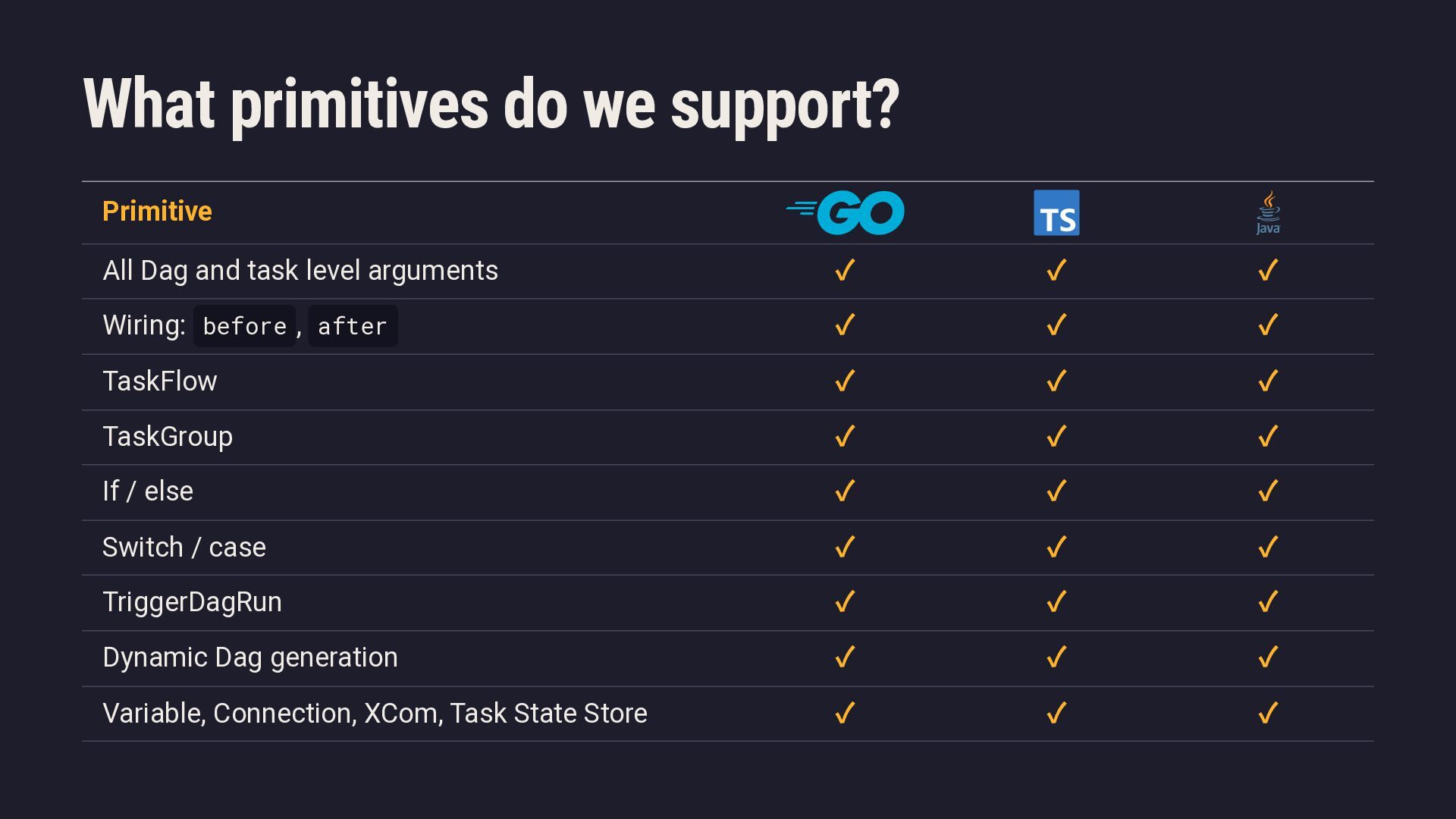
  3. What primitives do we support? Primitive All Dag and task

    level arguments Wiring: before , after TaskFlow TaskGroup If / else Switch / case TriggerDagRun Dynamic Dag generation Variable, Connection, XCom, Task State Store ✓ ✓ ✓ ✓ ✓ ✓ ✓ ✓ ✓ ✓ ✓ ✓ ✓ ✓ ✓ ✓ ✓ ✓ ✓ ✓ ✓ ✓ ✓ ✓ ✓ ✓ ✓
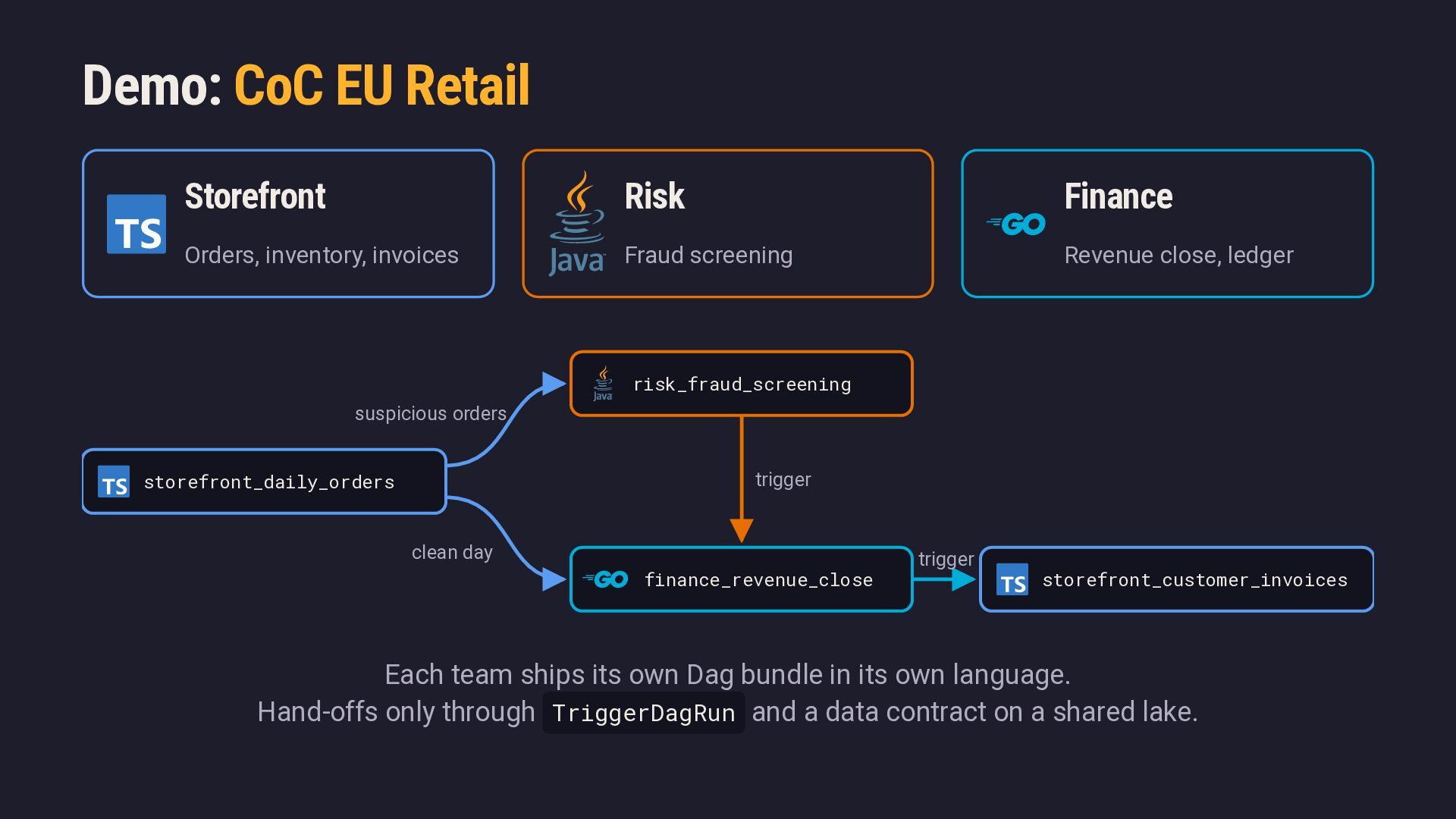
  4. Demo: CoC EU Retail Storefront Risk Finance Orders, inventory, invoices

    Fraud screening Revenue close, ledger risk_fraud_screening suspicious orders trigger storefront_daily_orders clean day finance_revenue_close trigger storefront_customer_invoices Each team ships its own Dag bundle in its own language. Hand-offs only through TriggerDagRun and a data contract on a shared lake.
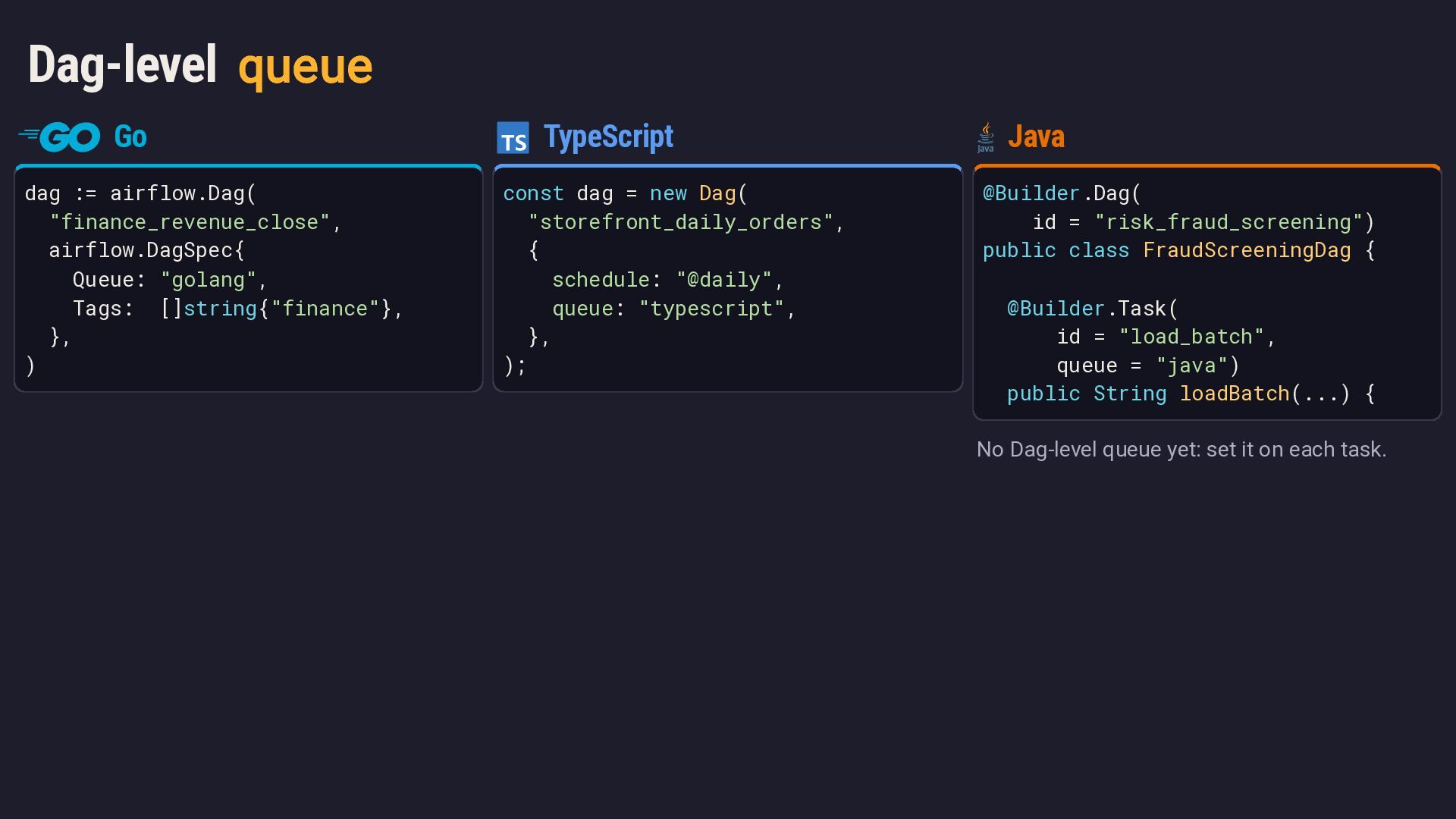
  5. Dag-level queue Go dag := airflow.Dag( "finance_revenue_close", airflow.DagSpec{ Queue: "golang",

    Tags: []string{"finance"}, }, ) TypeScript const dag = new Dag( "storefront_daily_orders", { schedule: "@daily", queue: "typescript", }, ); Java @Builder.Dag( id = "risk_fraud_screening") public class FraudScreeningDag { @Builder.Task( id = "load_batch", queue = "java") public String loadBatch(...) { No Dag-level queue yet: set it on each task.
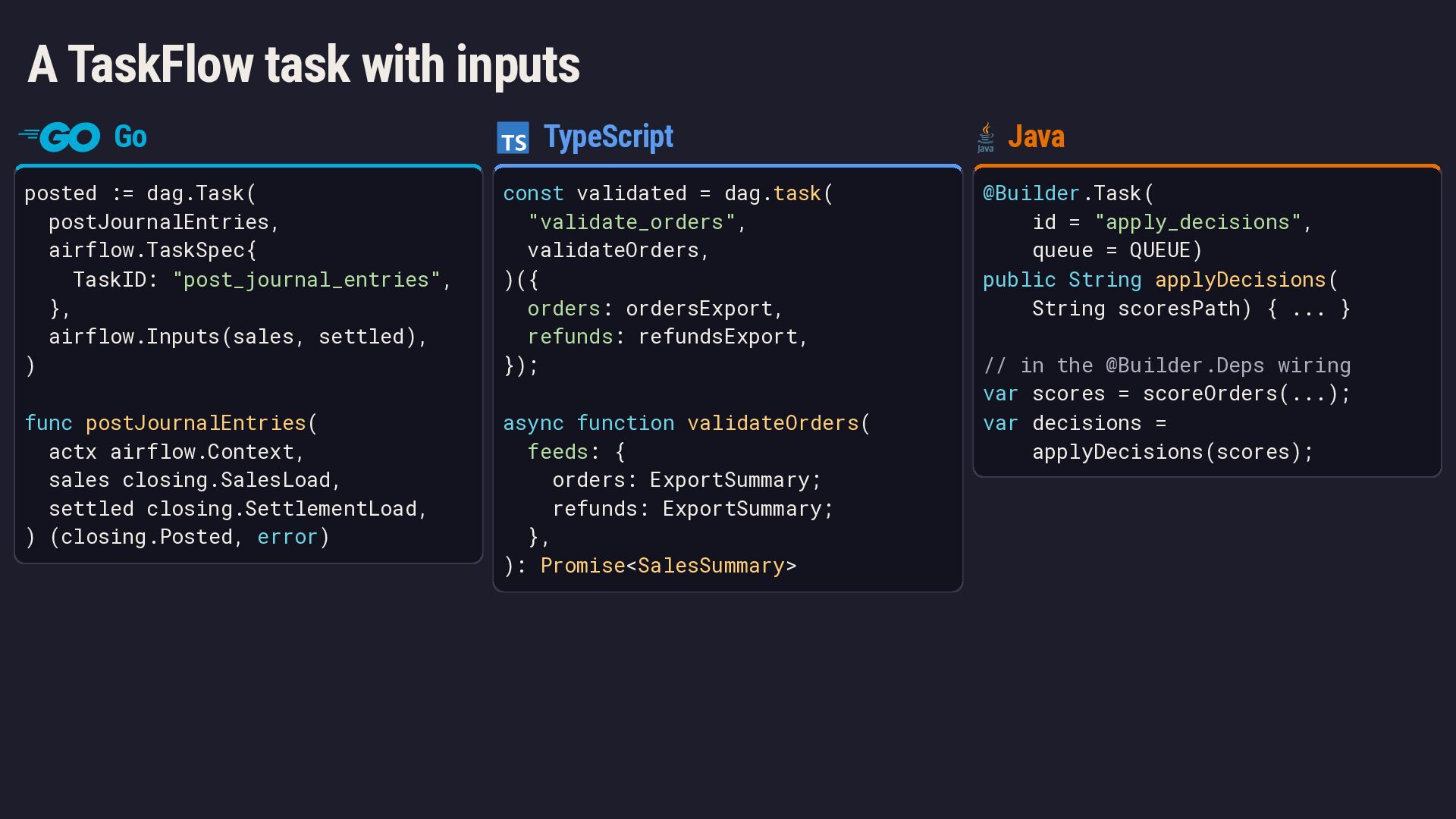
  6. A TaskFlow task with inputs Go TypeScript posted := dag.Task(

    postJournalEntries, airflow.TaskSpec{ TaskID: "post_journal_entries", }, airflow.Inputs(sales, settled), ) const validated = dag.task( "validate_orders", validateOrders, )({ orders: ordersExport, refunds: refundsExport, }); func postJournalEntries( actx airflow.Context, sales closing.SalesLoad, settled closing.SettlementLoad, ) (closing.Posted, error) async function validateOrders( feeds: { orders: ExportSummary; refunds: ExportSummary; }, ): Promise<SalesSummary> Java @Builder.Task( id = "apply_decisions", queue = QUEUE) public String applyDecisions( String scoresPath) { ... } // in the @Builder.Deps wiring var scores = scoreOrders(...); var decisions = applyDecisions(scores);
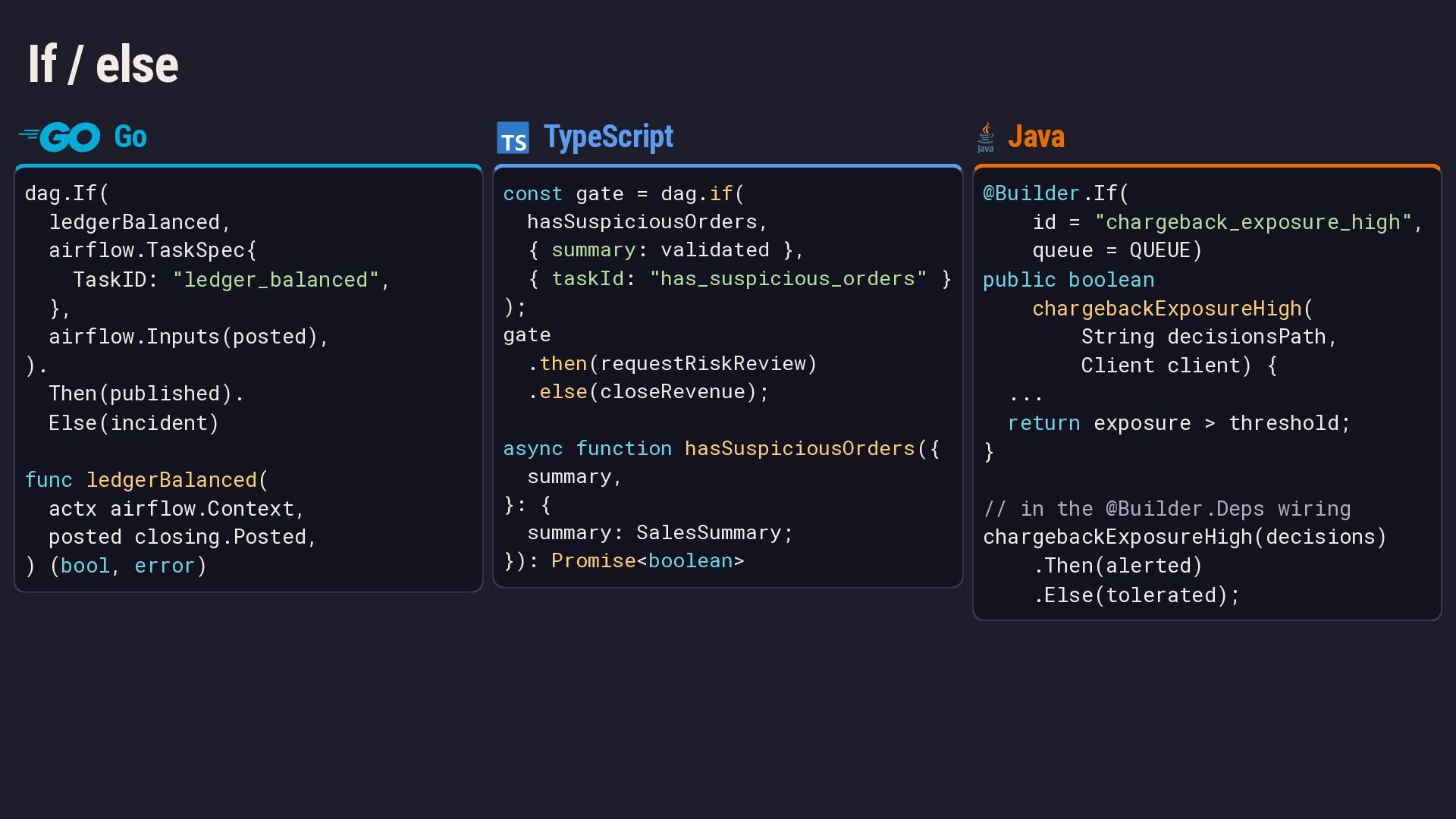
  7. If / else Go dag.If( ledgerBalanced, airflow.TaskSpec{ TaskID: "ledger_balanced", },

    airflow.Inputs(posted), ). Then(published). Else(incident) func ledgerBalanced( actx airflow.Context, posted closing.Posted, ) (bool, error) TypeScript const gate = dag.if( hasSuspiciousOrders, { summary: validated }, { taskId: "has_suspicious_orders" } ); gate .then(requestRiskReview) .else(closeRevenue); async function hasSuspiciousOrders({ summary, }: { summary: SalesSummary; }): Promise<boolean> Java @Builder.If( id = "chargeback_exposure_high", queue = QUEUE) public boolean chargebackExposureHigh( String decisionsPath, Client client) { ... return exposure > threshold; } // in the @Builder.Deps wiring chargebackExposureHigh(decisions) .Then(alerted) .Else(tolerated);
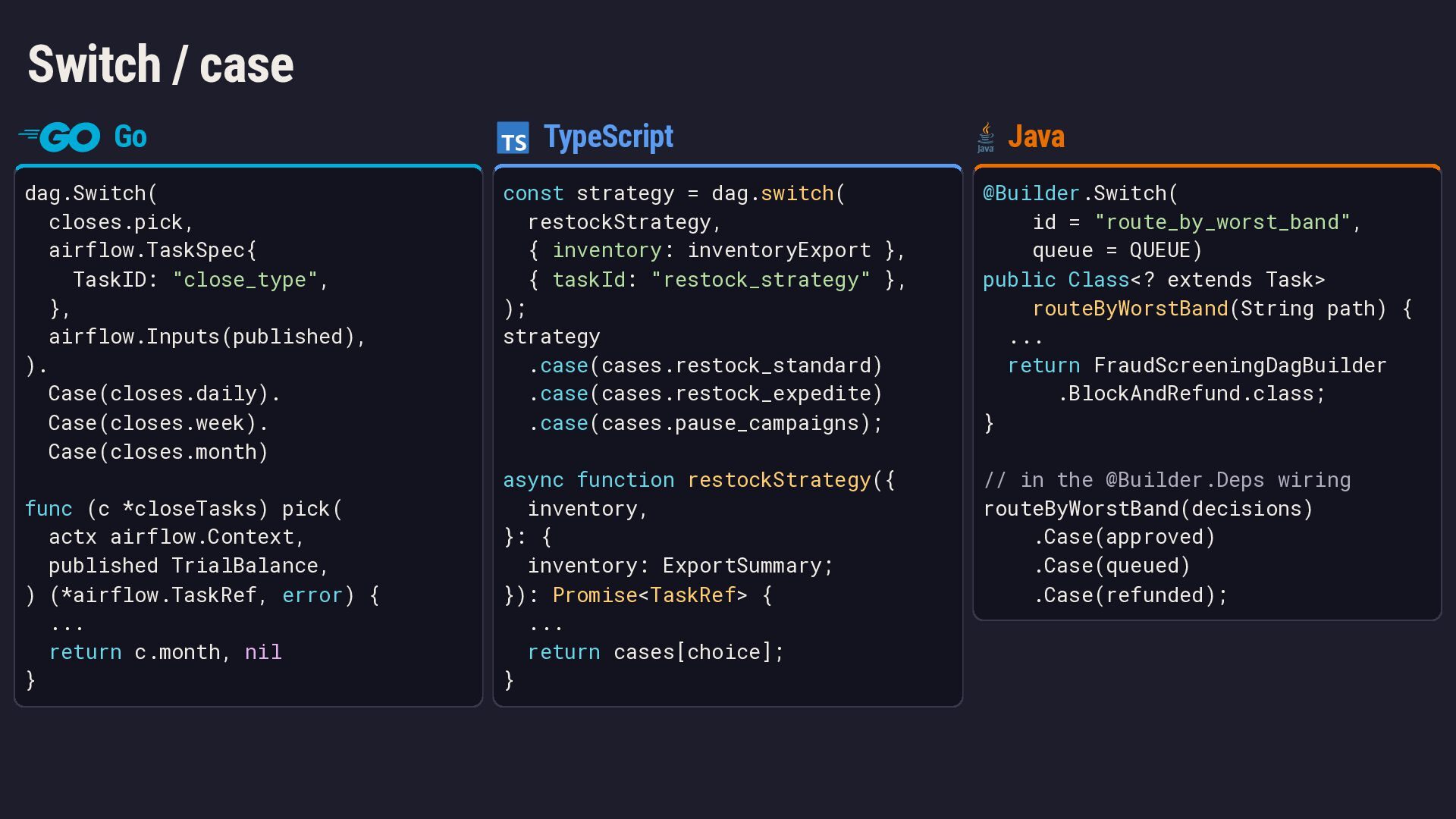
  8. Switch / case Go dag.Switch( closes.pick, airflow.TaskSpec{ TaskID: "close_type", },

    airflow.Inputs(published), ). Case(closes.daily). Case(closes.week). Case(closes.month) func (c *closeTasks) pick( actx airflow.Context, published TrialBalance, ) (*airflow.TaskRef, error) { ... return c.month, nil } TypeScript Java const strategy = dag.switch( restockStrategy, { inventory: inventoryExport }, { taskId: "restock_strategy" }, ); strategy .case(cases.restock_standard) .case(cases.restock_expedite) .case(cases.pause_campaigns); @Builder.Switch( id = "route_by_worst_band", queue = QUEUE) public Class<? extends Task> routeByWorstBand(String path) { ... return FraudScreeningDagBuilder .BlockAndRefund.class; } async function restockStrategy({ inventory, }: { inventory: ExportSummary; }): Promise<TaskRef> { ... return cases[choice]; } // in the @Builder.Deps wiring routeByWorstBand(decisions) .Case(approved) .Case(queued) .Case(refunded);
  9. Register the bundle Go func main() { b := airflow.Bundle()

    b.Register(newRevenueCloseDag()) if err := b.Serve(); err != nil { log.Fatal(err) } } TypeScript import { Bundle } from "apache-airflow-ts-sdk"; const bundle = new Bundle( dailyOrders, customerInvoices, ); await bundle.serve(); Java public class RiskBundleBuilder { public static Bundle build() { return new Bundle().register( FraudScreeningDag.class); } public static void main( String[] args) { Server.create(args) .serve(build()); } }
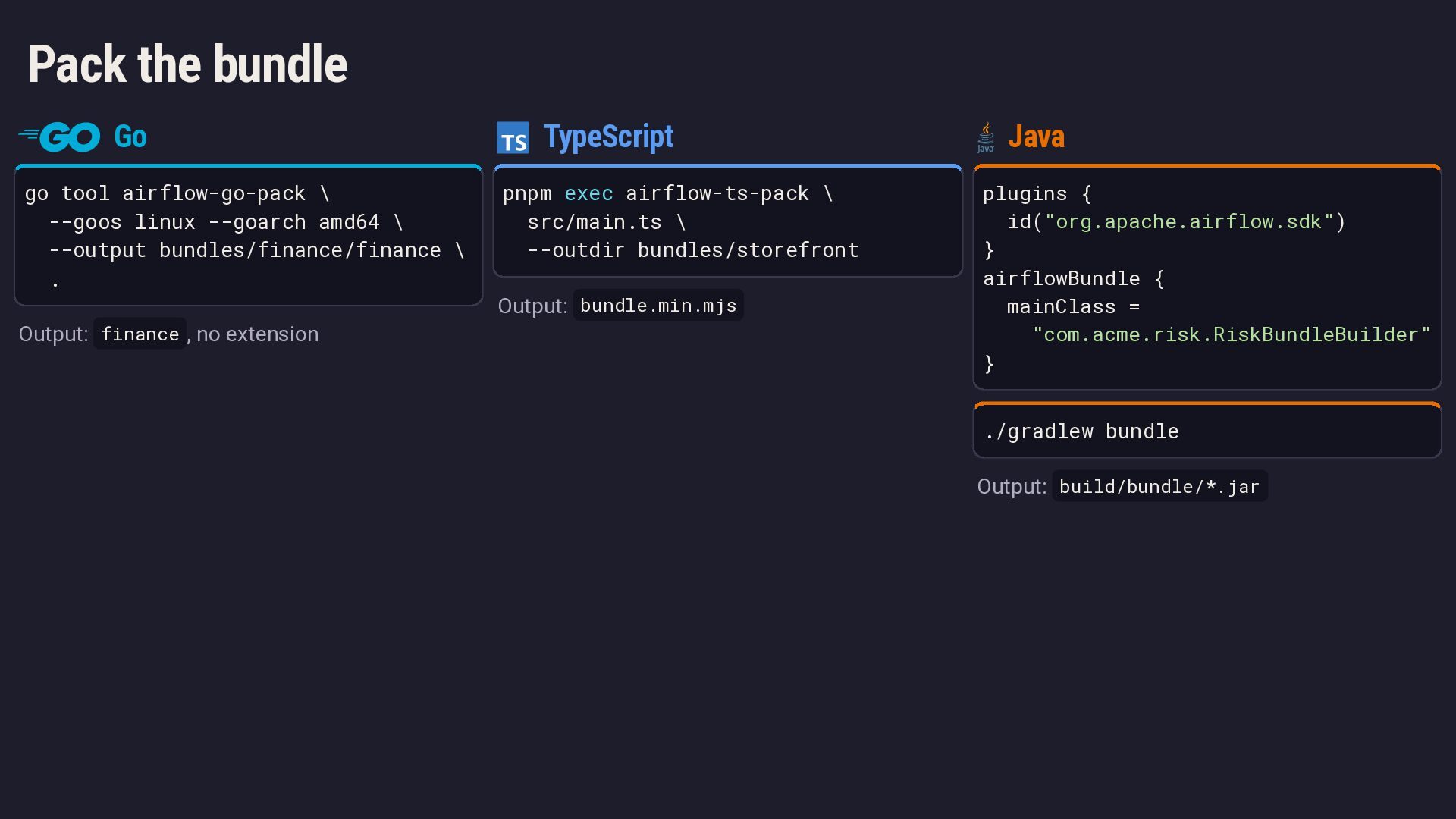
  10. Pack the bundle Go go tool airflow-go-pack \ --goos linux

    --goarch amd64 \ --output bundles/finance/finance \ . TypeScript pnpm exec airflow-ts-pack \ src/main.ts \ --outdir bundles/storefront Output: bundle.min.mjs Output: finance , no extension Java plugins { id("org.apache.airflow.sdk") } airflowBundle { mainClass = "com.acme.risk.RiskBundleBuilder" } ./gradlew bundle Output: build/bundle/*.jar
  11. Deployment config [dag_processor] dag_bundle_config_list = [ {"name": "finance", "classpath": "airflow.dag_processing.bundles.local.LocalDagBundle",

    "kwargs": {"path": "/files/bundles/finance"}}, {"name": "storefront", "classpath": "airflow.dag_processing.bundles.local.LocalDagBundle", "kwargs": {"path": "/files/bundles/storefront"}}, {"name": "risk", "classpath": "airflow.dag_processing.bundles.local.LocalDagBundle", "kwargs": {"path": "/files/bundles/risk"}}] [sdk] coordinators = { "go": {"classpath": "airflow.sdk.coordinators.executable.ExecutableCoordinator"}, "ts": {"classpath": "airflow.sdk.coordinators.node.NodeCoordinator", "kwargs": {"node_executable": "node"}}, "jdk": {"classpath": "airflow.sdk.coordinators.java.JavaCoordinator", "kwargs": {"java_executable": "java"}}} queue_to_coordinator = {"golang": "go", "typescript": "ts", "java": "jdk"}
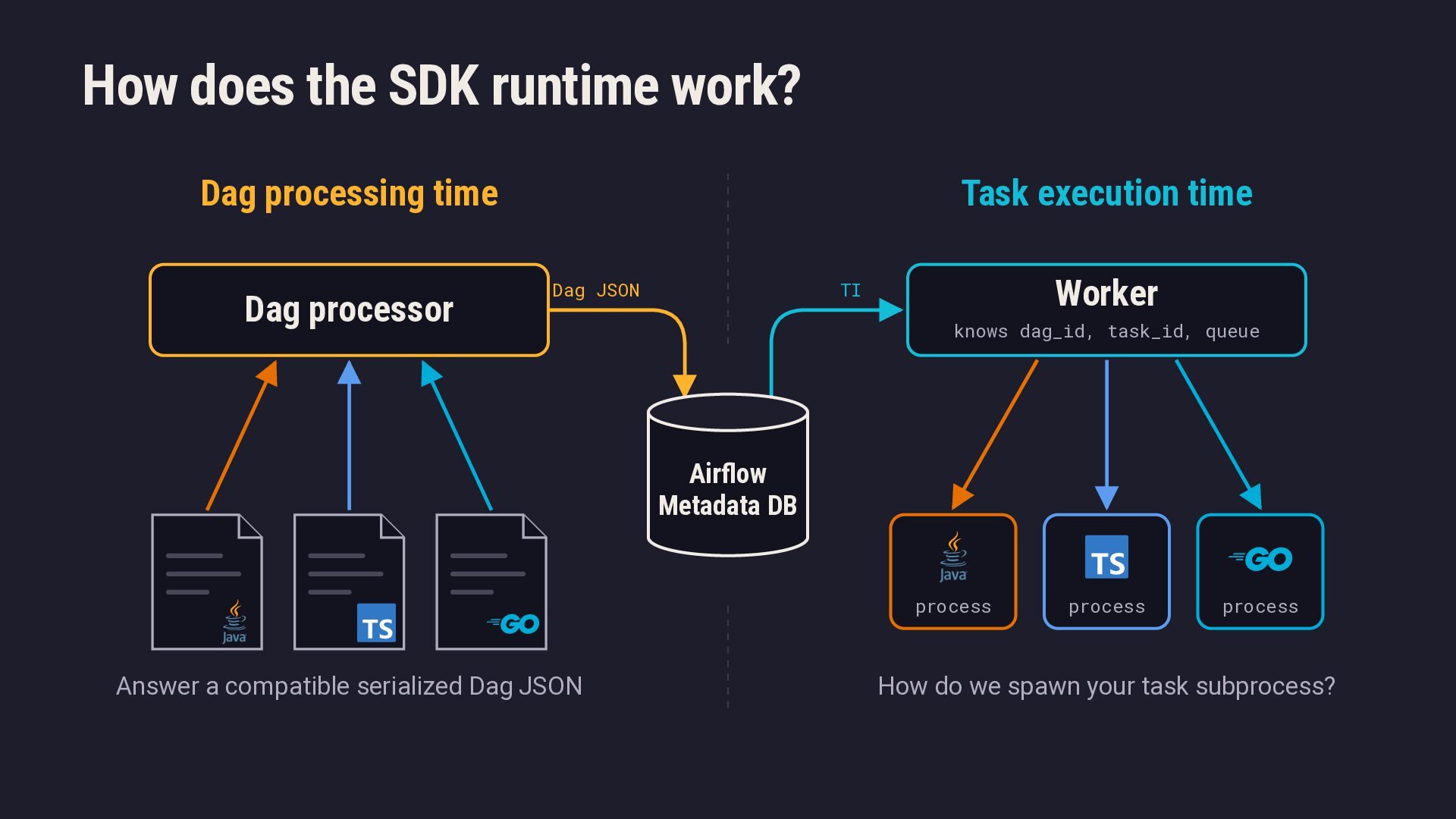
  12. How does the SDK runtime work? Dag processing time Dag

    processor Task execution time Dag JSON Worker TI knows dag_id, task_id, queue Airflow Metadata DB process Answer a compatible serialized Dag JSON process process How do we spawn your task subprocess?
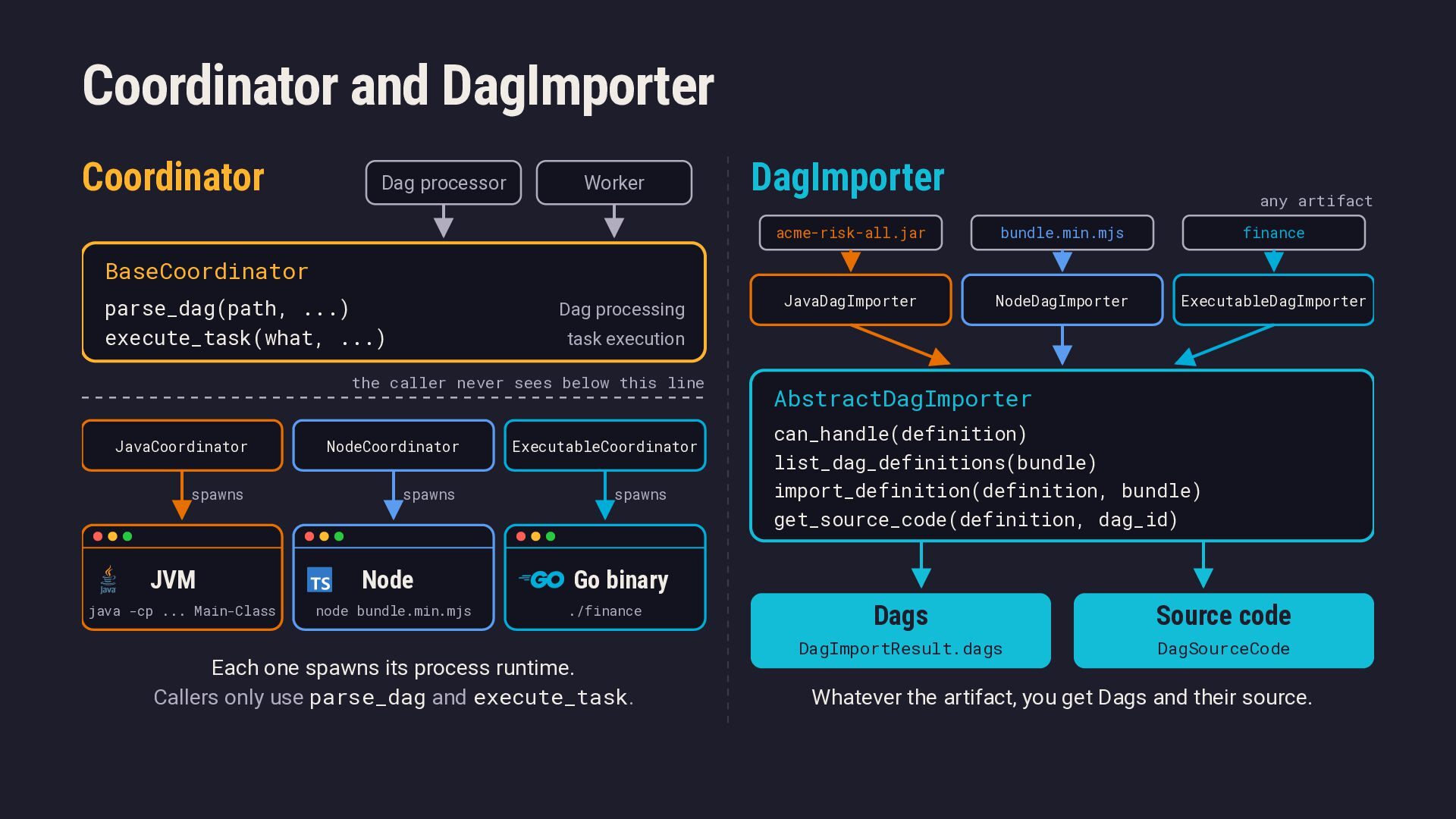
  13. Coordinator and DagImporter Coordinator Dag processor Worker DagImporter any artifact

    acme-risk-all.jar bundle.min.mjs finance JavaDagImporter NodeDagImporter ExecutableDagImporter BaseCoordinator parse_dag(path, ...) execute_task(what, ...) Dag processing task execution the caller never sees below this line JavaCoordinator NodeCoordinator spawns spawns JVM Node java -cp ... Main-Class node bundle.min.mjs ExecutableCoordinator spawns AbstractDagImporter can_handle(definition) list_dag_definitions(bundle) import_definition(definition, bundle) get_source_code(definition, dag_id) Go binary ./finance Each one spawns its process runtime. Callers only use parse_dag and execute_task. Dags Source code DagImportResult.dags DagSourceCode Whatever the artifact, you get Dags and their source.
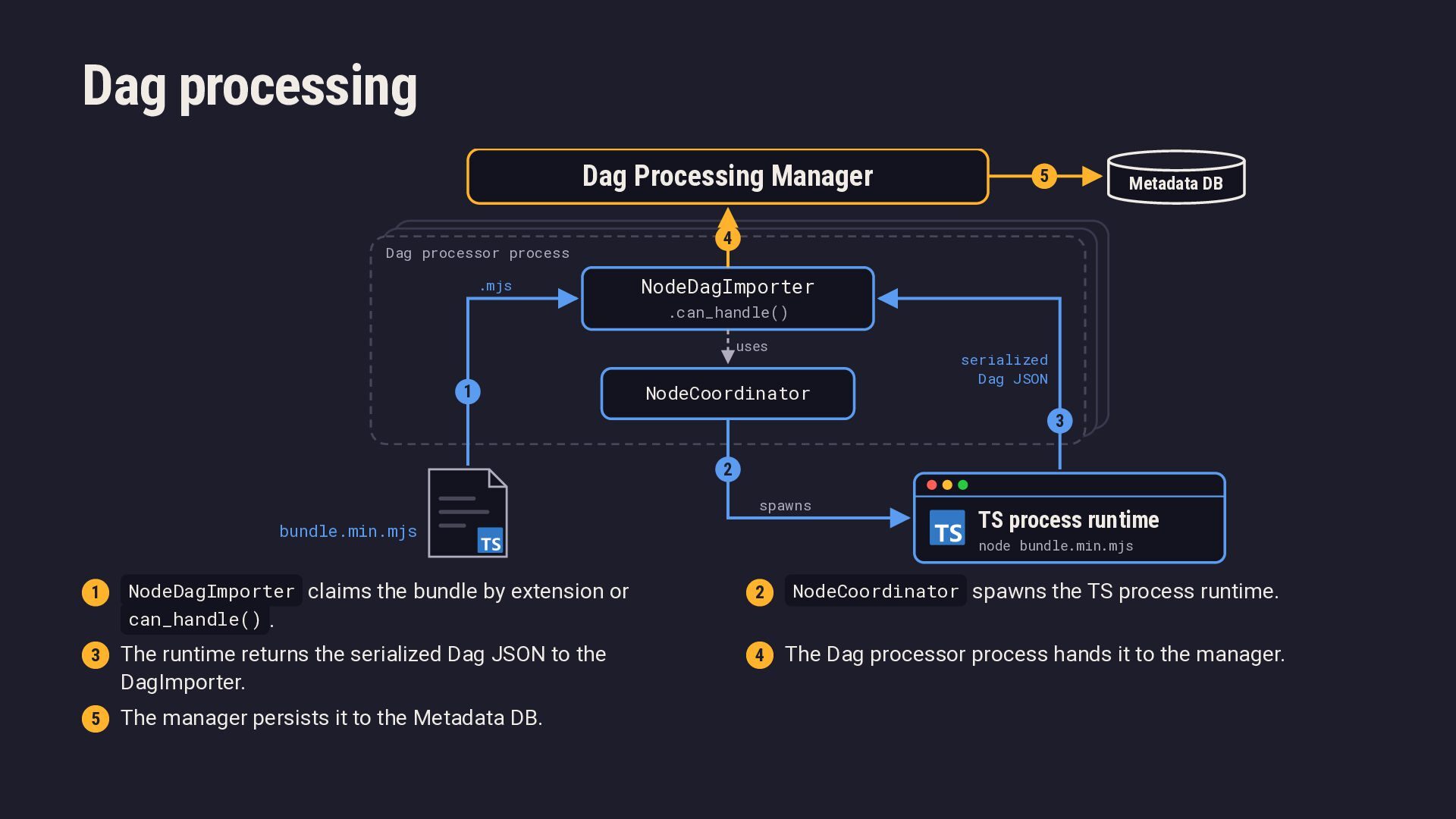
  14. Dag processing Dag Processing Manager Dag processor process .mjs 5

    Metadata DB 4 NodeDagImporter .can_handle() uses 1 NodeCoordinator serialized Dag JSON 3 2 spawns bundle.min.mjs 1 NodeDagImporter claims the bundle by extension or TS process runtime node bundle.min.mjs 2 NodeCoordinator spawns the TS process runtime. 4 The Dag processor process hands it to the manager. can_handle() . 3 The runtime returns the serialized Dag JSON to the DagImporter. 5 The manager persists it to the Metadata DB.
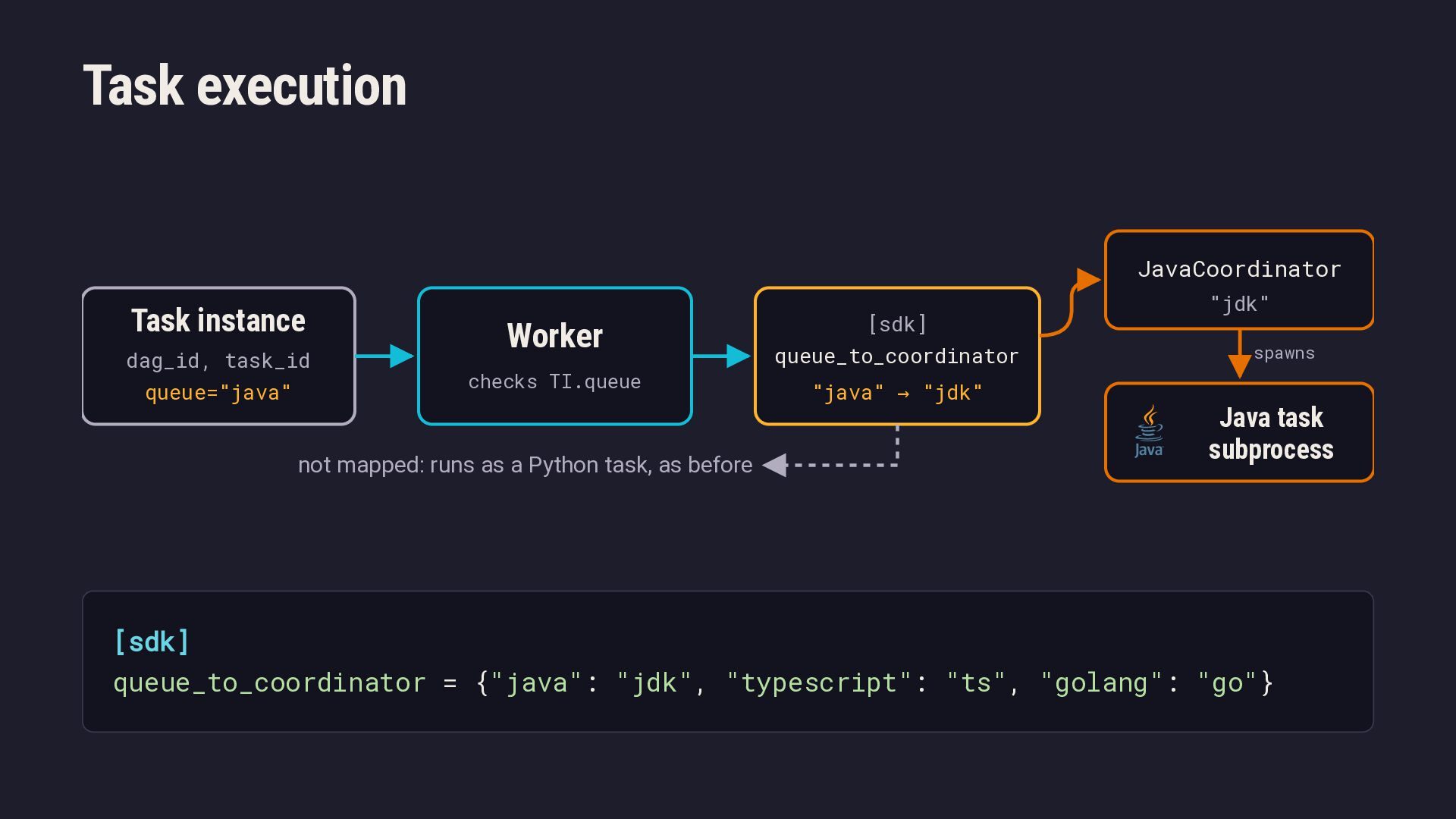
  15. Task execution JavaCoordinator Task instance dag_id, task_id queue="java" Worker checks

    TI.queue not mapped: runs as a Python task, as before [sdk] queue_to_coordinator "java" → "jdk" "jdk" spawns Java task subprocess [sdk] queue_to_coordinator = {"java": "jdk", "typescript": "ts", "golang": "go"}
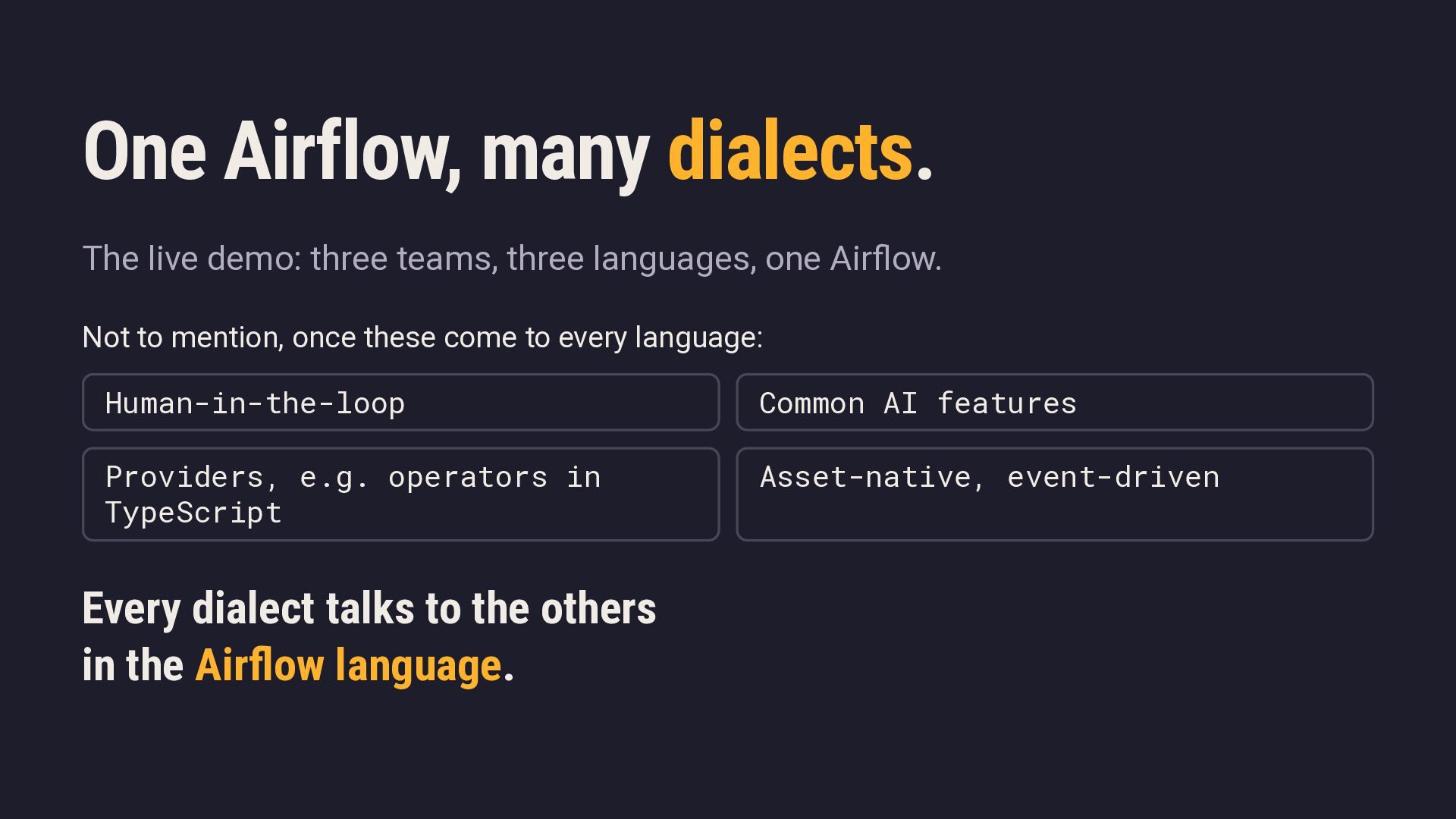
  16. One Airflow, many dialects. The live demo: three teams, three

    languages, one Airflow. Not to mention, once these come to every language: Human-in-the-loop Common AI features Providers, e.g. operators in TypeScript Asset-native, event-driven Every dialect talks to the others in the Airflow language.
  17. Jason (Zhe-You) Liu Apache Airflow Committer github.com/jason810496 linkedin.com/in/zhe-you-liu Any feedback

    on the Airflow language SDKs? Let's discuss after the talk or in #sig-lang-sdks .
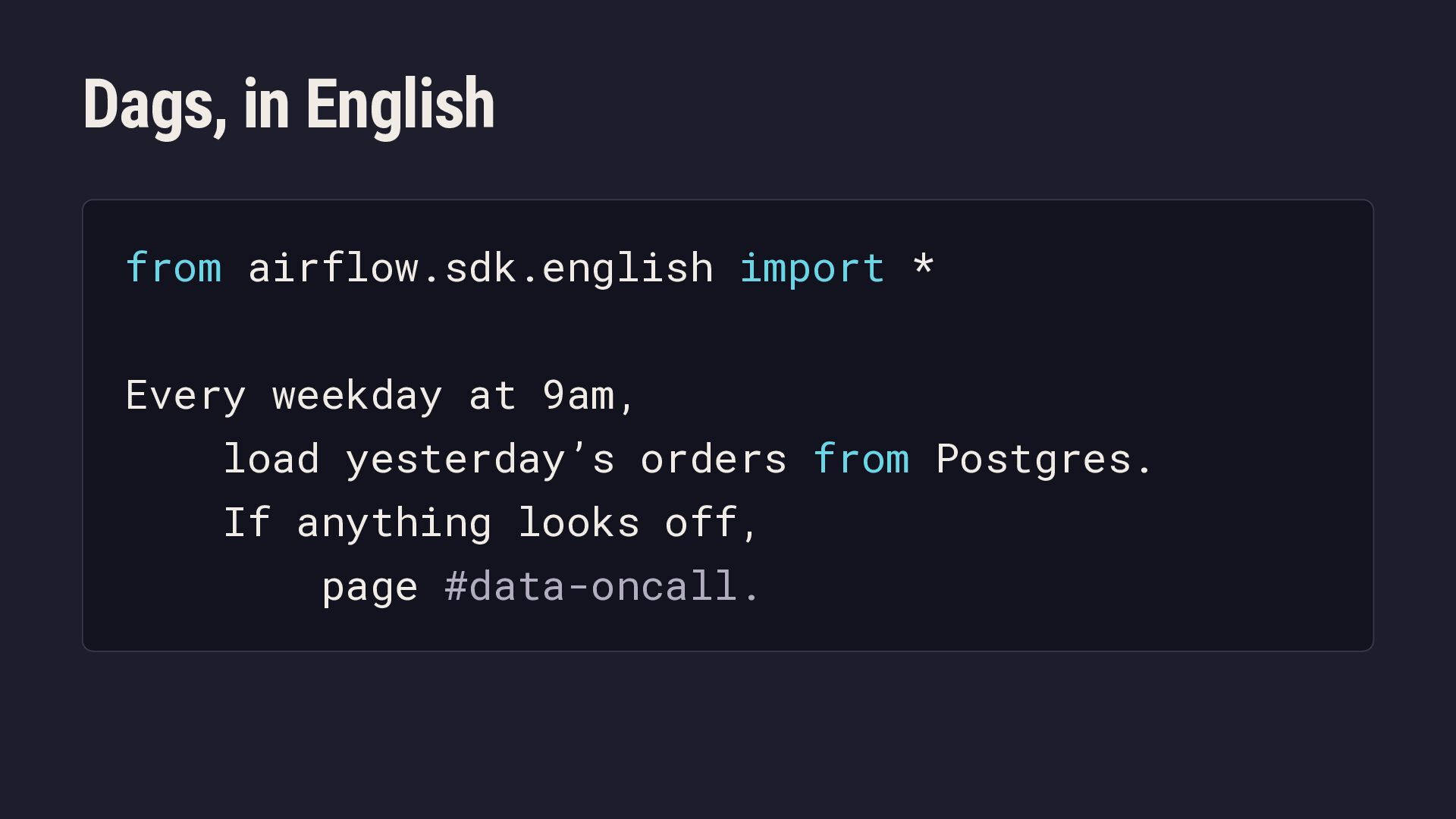
  18. Dags, in English from airflow.sdk.english import * Every weekday at

    9am, load yesterday’s orders from Postgres. If anything looks off, page #data-oncall.
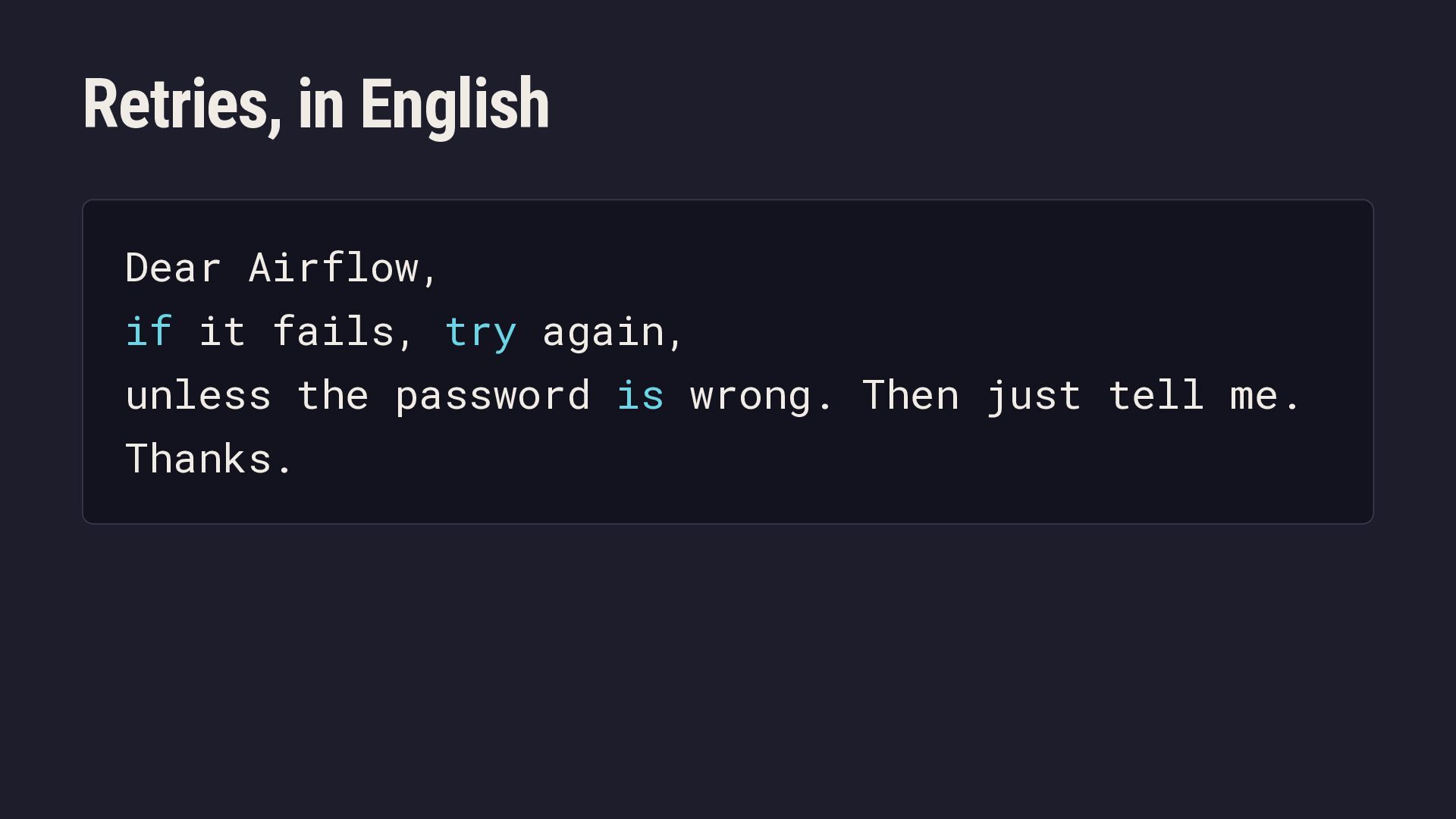
  19. Retries, in English Dear Airflow, if it fails, try again,

    unless the password is wrong. Then just tell me. Thanks.
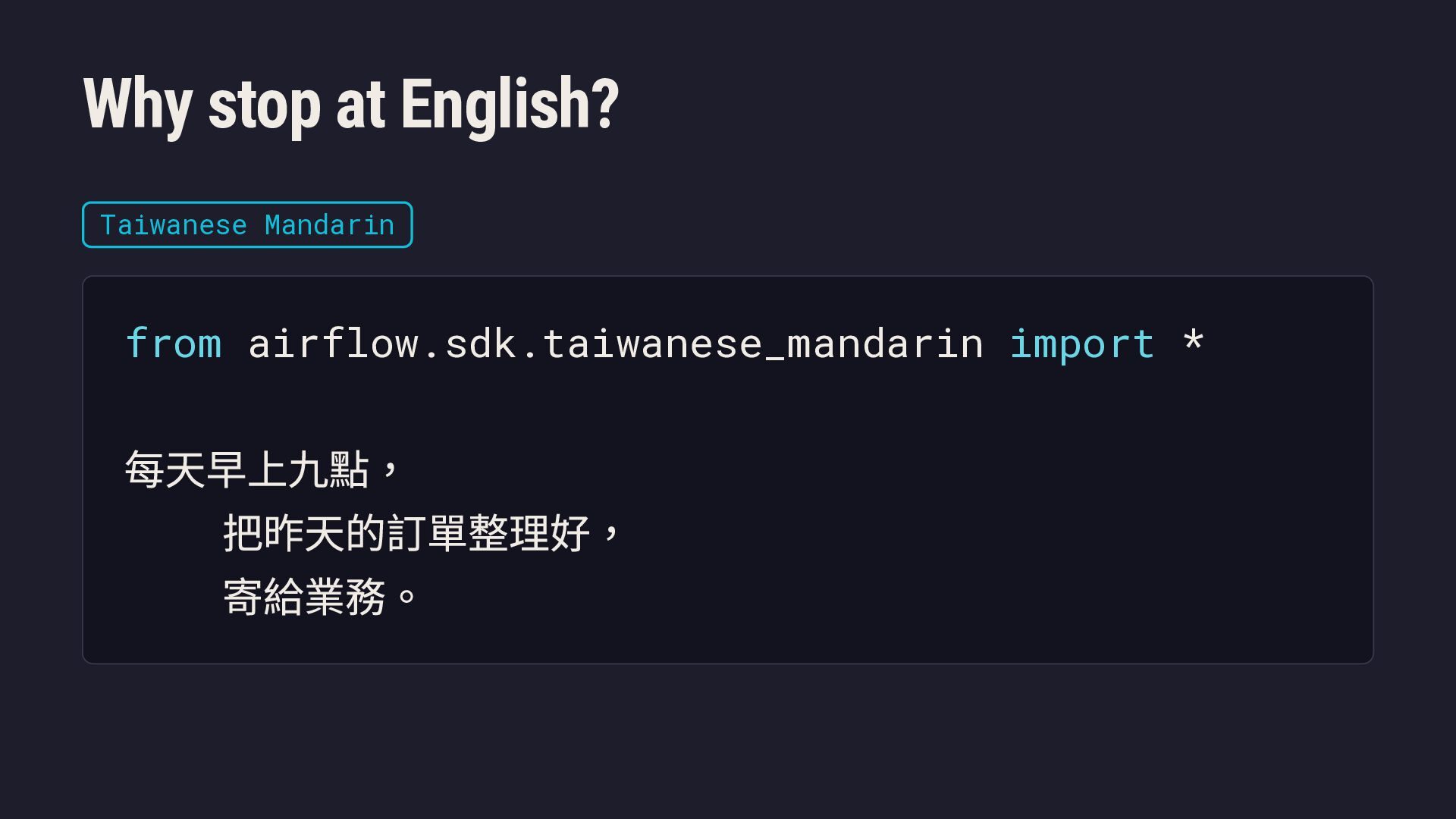
  20. Why stop at English? Taiwanese Mandarin from airflow.sdk.taiwanese_mandarin import *

    每天早上九點, 把昨天的訂單整理好, 寄給業務。
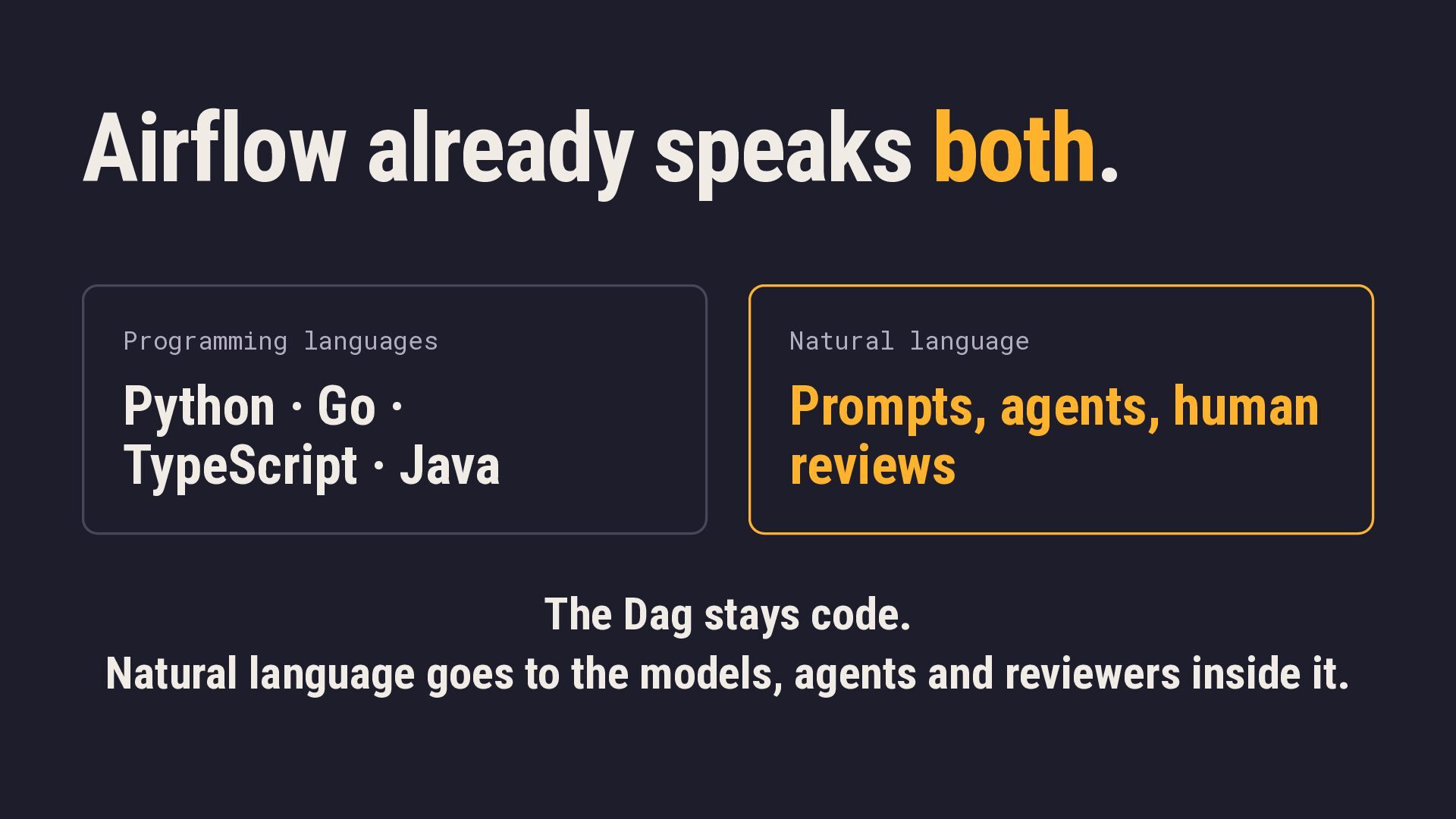
  21. Airflow already speaks both. Programming languages Natural language Python ·

    Go · TypeScript · Java Prompts, agents, human reviews The Dag stays code. Natural language goes to the models, agents and reviewers inside it.
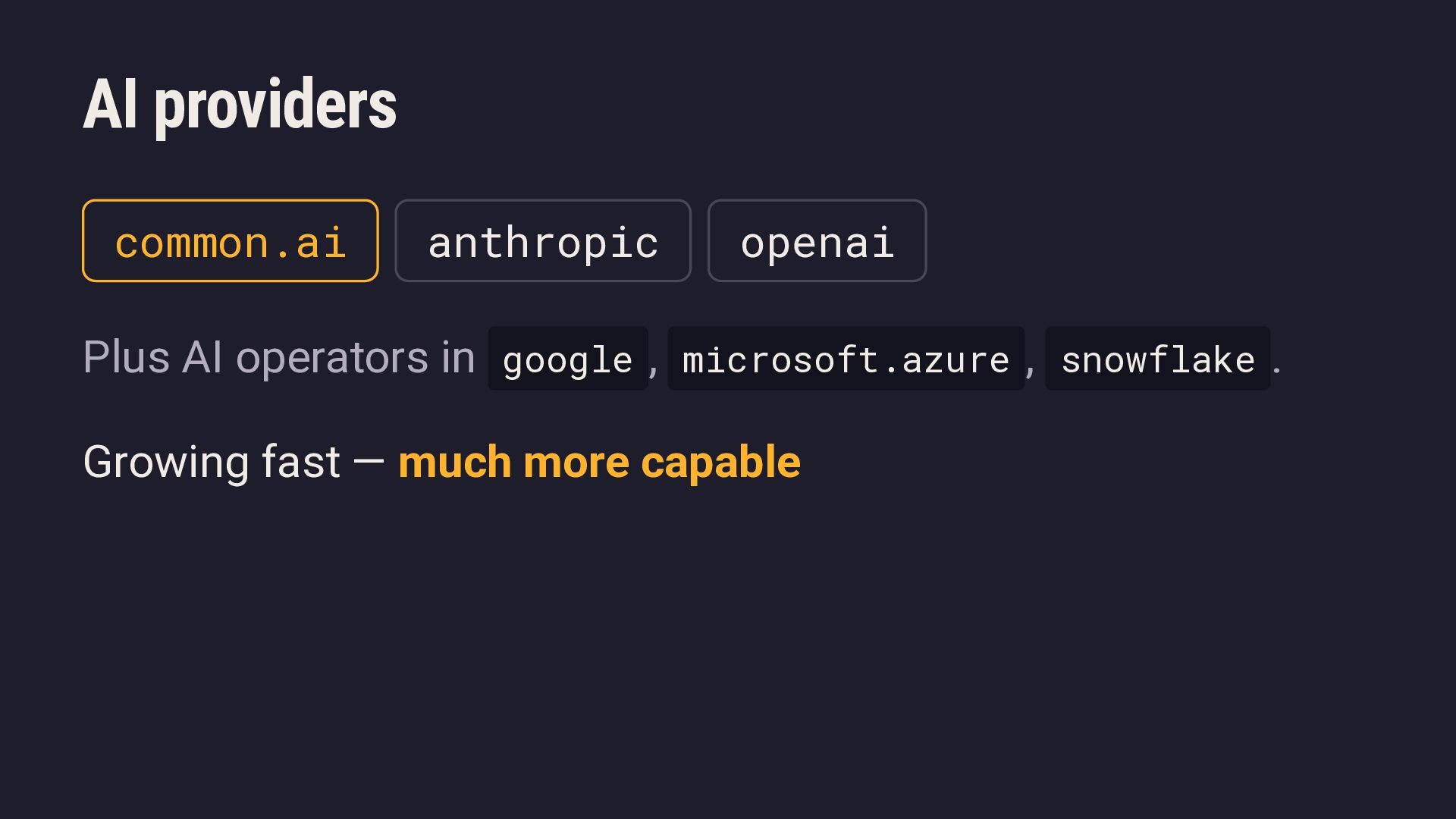
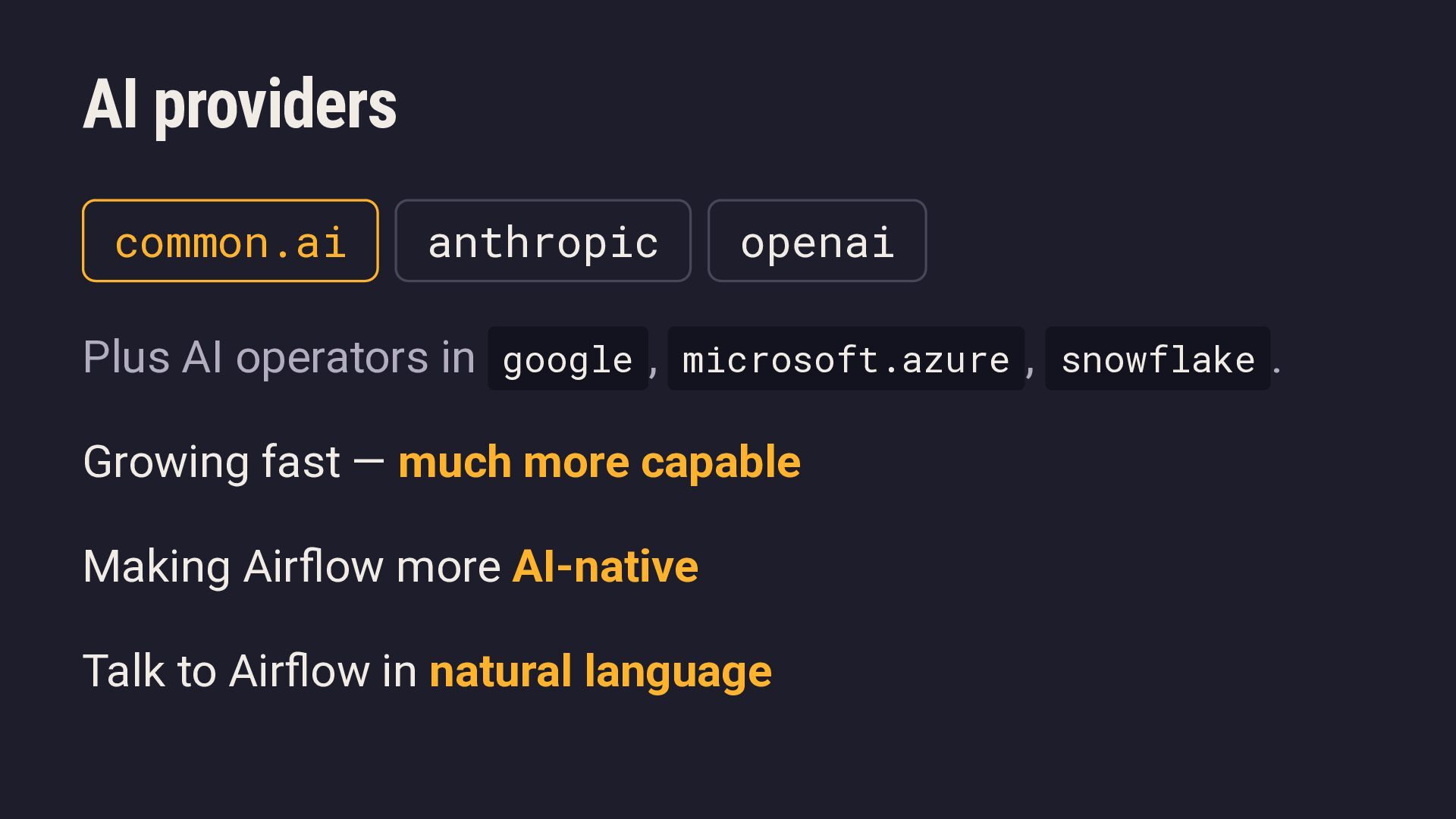
  22. AI providers common.ai anthropic openai Plus AI operators in google

    , microsoft.azure , snowflake . Growing fast — much more capable
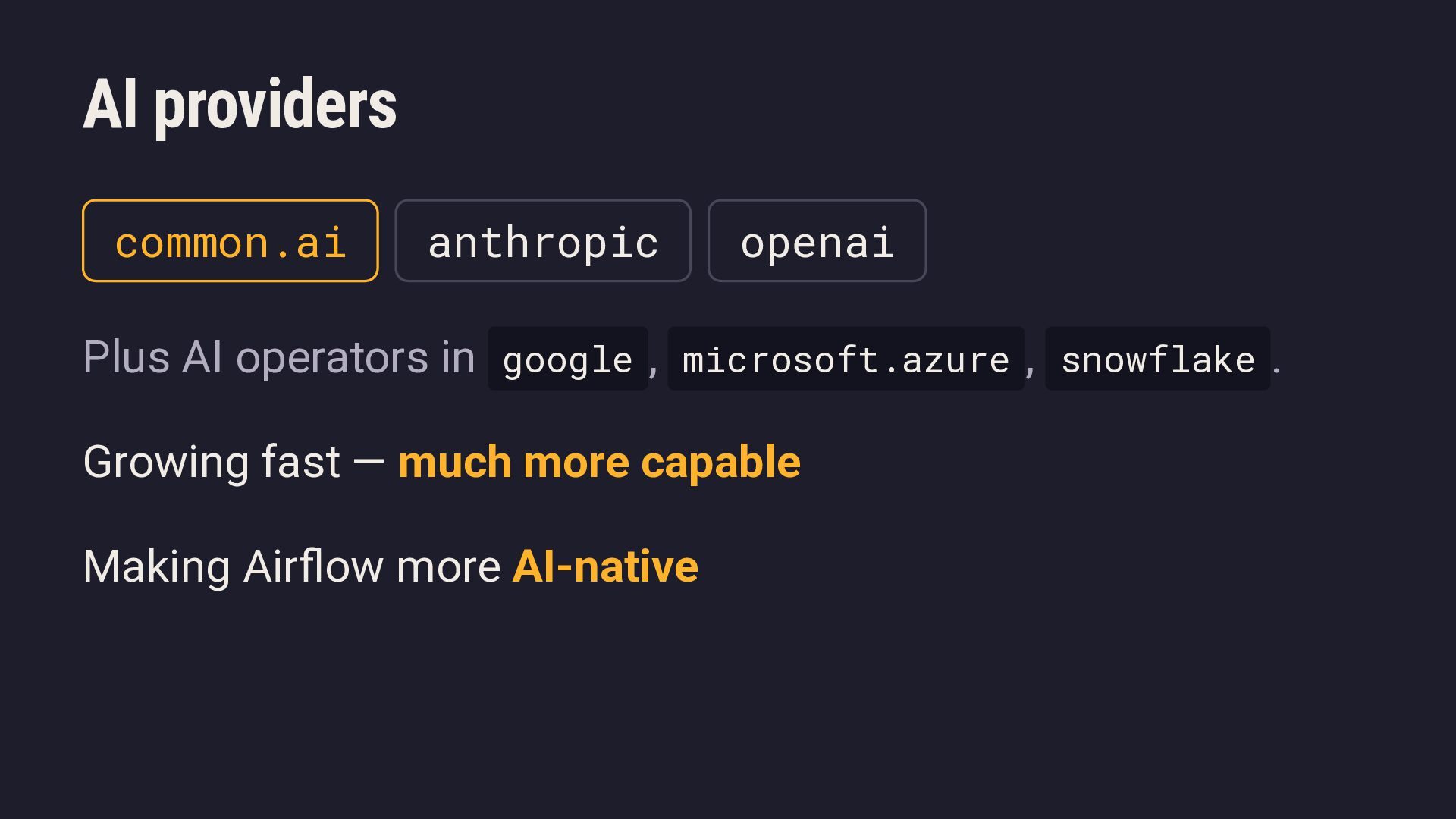
  23. AI providers common.ai anthropic openai Plus AI operators in google

    , microsoft.azure , snowflake . Growing fast — much more capable Making Airflow more AI-native
  24. AI providers common.ai anthropic openai Plus AI operators in google

    , microsoft.azure , snowflake . Growing fast — much more capable Making Airflow more AI-native Talk to Airflow in natural language
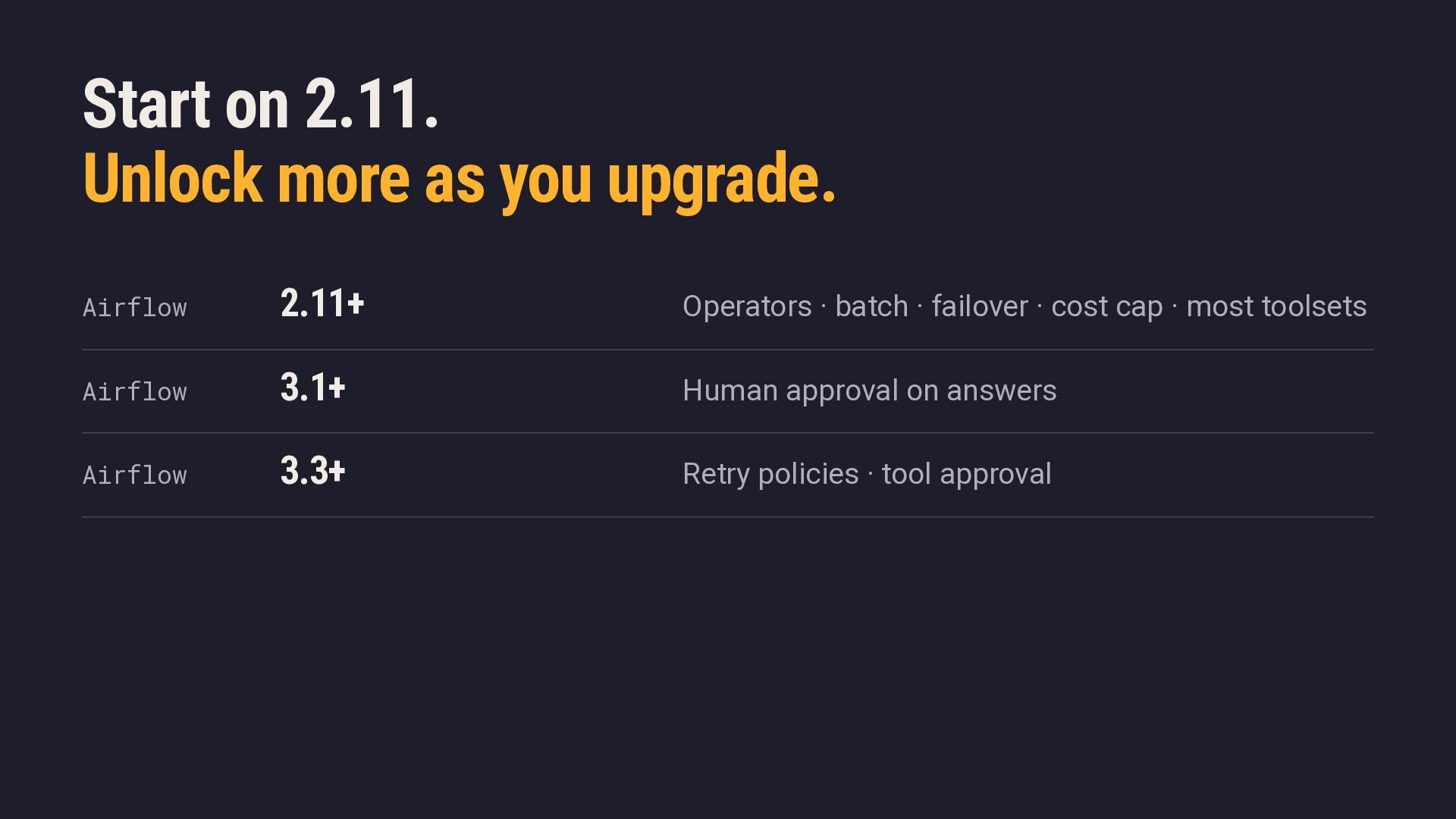
  25. Start on 2.11. Unlock more as you upgrade. Airflow 2.11+

    Operators · batch · failover · cost cap · most toolsets Airflow 3.1+ Human approval on answers Airflow 3.3+ Retry policies · tool approval
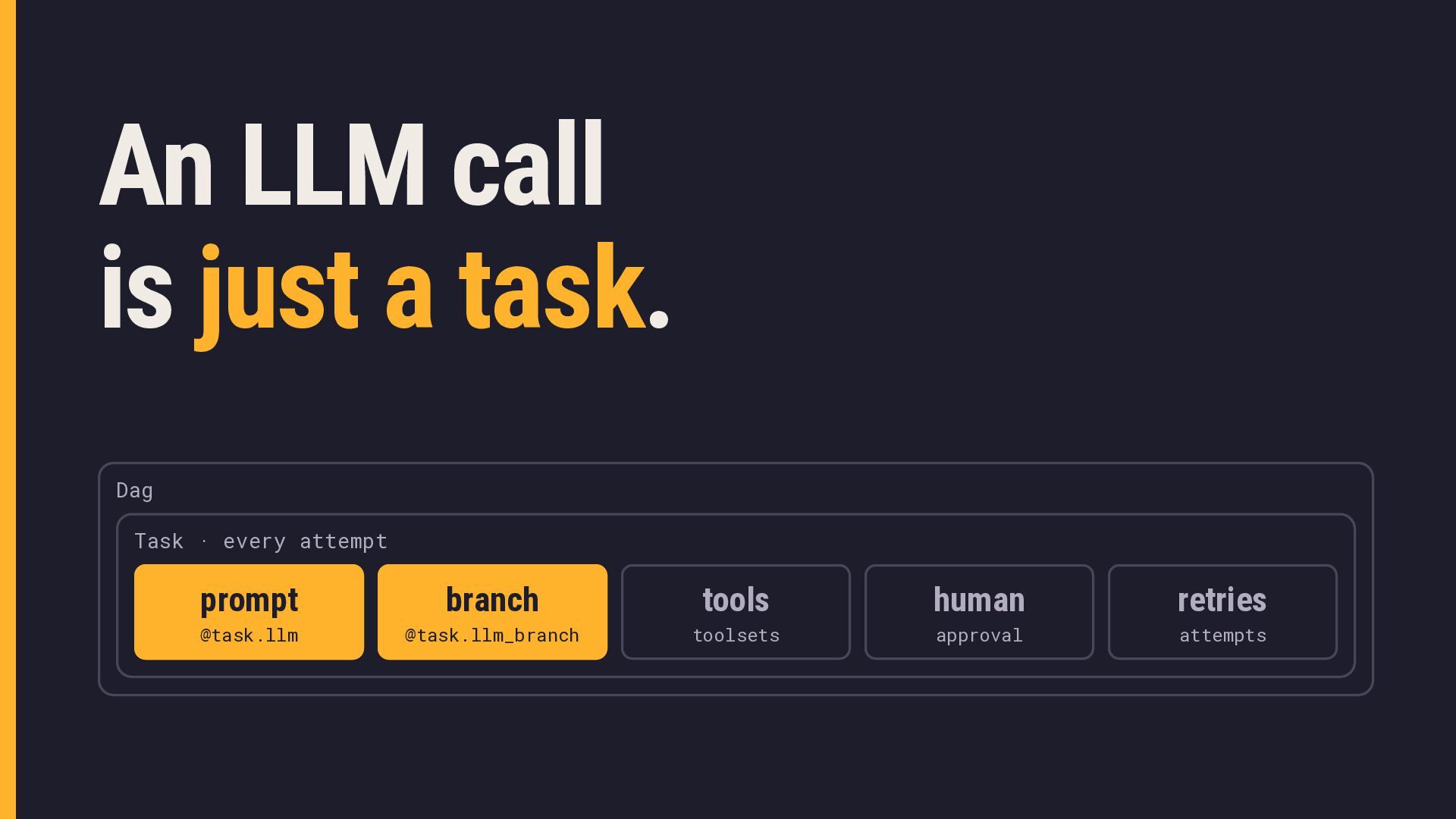
  26. An LLM call is just a task. Dag Task ·

    every attempt prompt branch tools human retries @task.llm @task.llm_branch toolsets approval attempts
  27. @task.llm class Entities(BaseModel): names: list[str] locations: list[str] @task.llm( llm_conn_id="pydanticai_default", system_prompt="Extract

    named entities.", output_type=Entities, ) def extract(text: str): return f"Extract entities from: {text}"
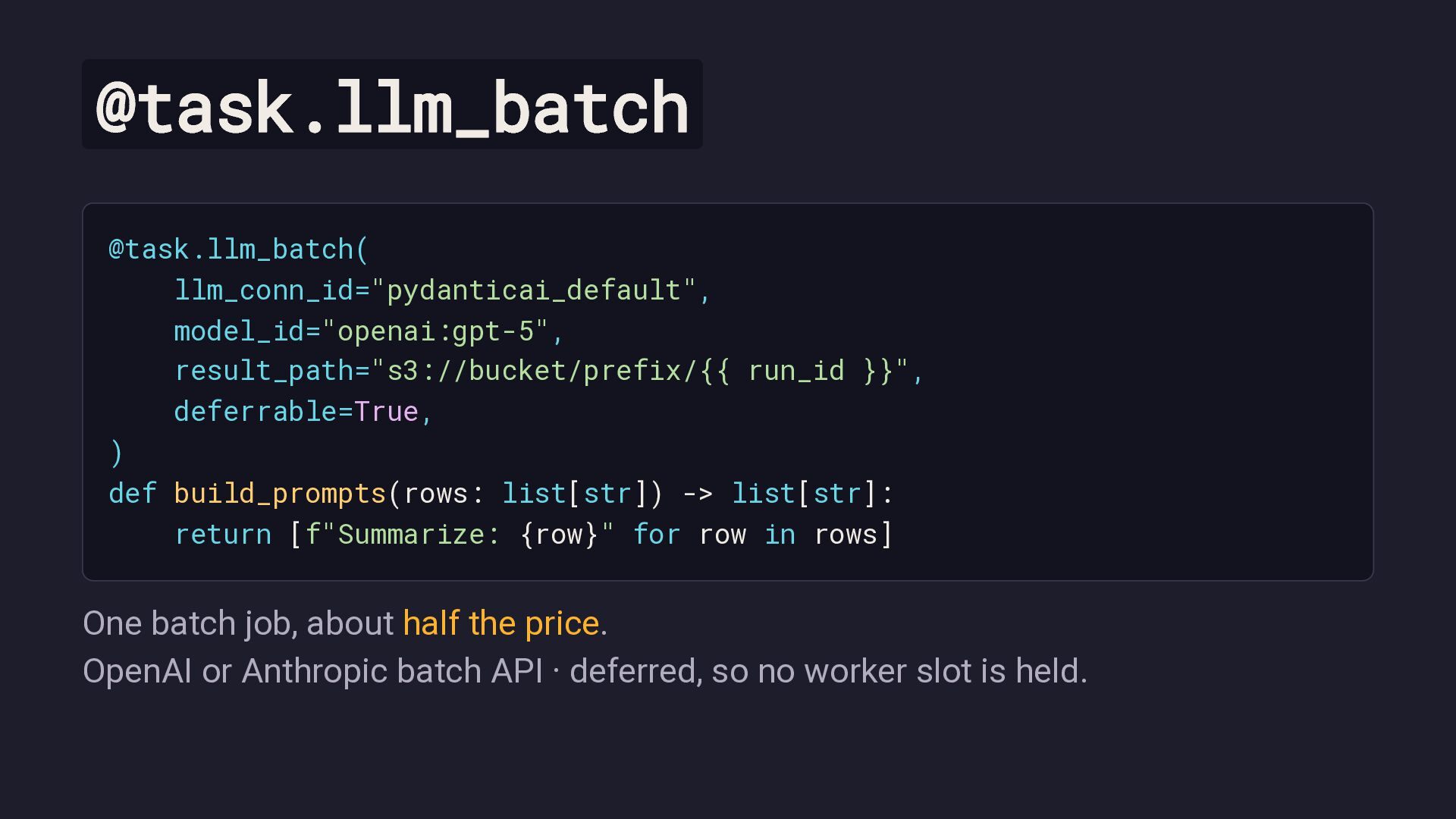
  28. @task.llm_batch @task.llm_batch( llm_conn_id="pydanticai_default", model_id="openai:gpt-5", result_path="s3://bucket/prefix/{{ run_id }}", deferrable=True, ) def

    build_prompts(rows: list[str]) -> list[str]: return [f"Summarize: {row}" for row in rows] One batch job, about half the price. OpenAI or Anthropic batch API · deferred, so no worker slot is held.
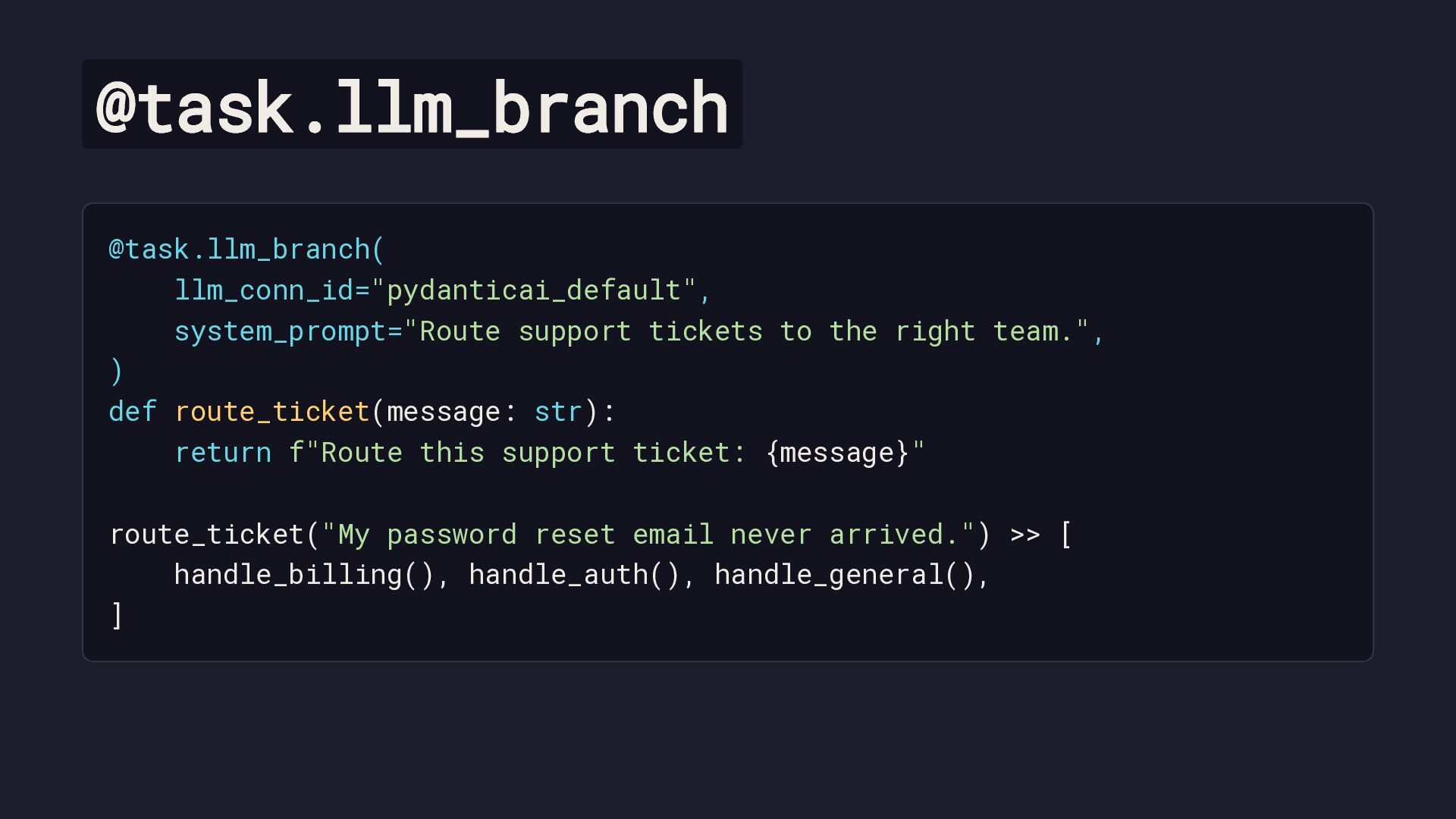
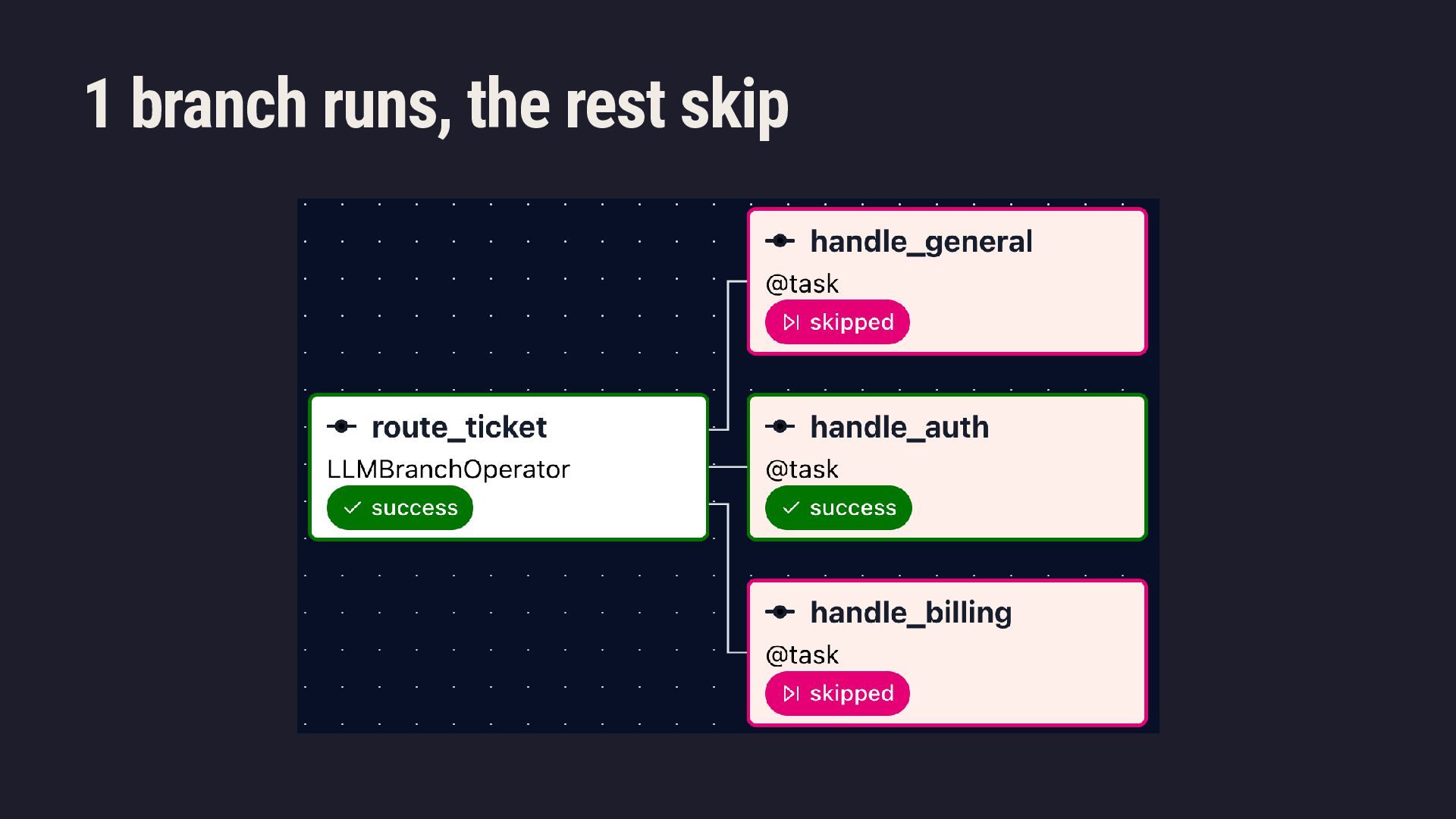
  29. @task.llm_branch @task.llm_branch( llm_conn_id="pydanticai_default", system_prompt="Route support tickets to the right team.",

    ) def route_ticket(message: str): return f"Route this support ticket: {message}" route_ticket("My password reset email never arrived.") >> [ handle_billing(), handle_auth(), handle_general(), ]
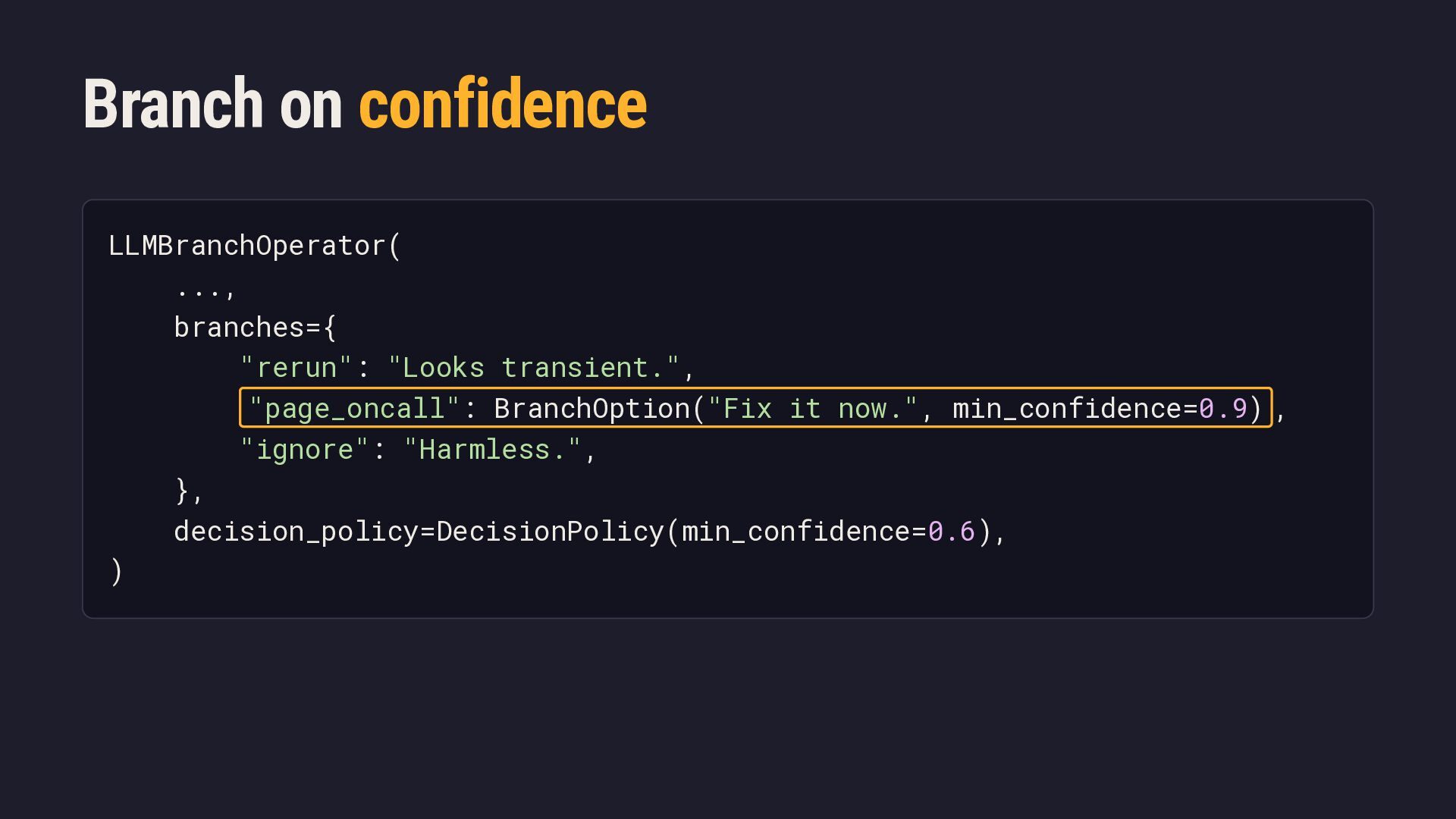
  30. Branch on confidence LLMBranchOperator( ..., branches={ "rerun": "Looks transient.", "page_oncall":

    BranchOption("Fix it now.", min_confidence=0.9) , "ignore": "Harmless.", }, decision_policy=DecisionPolicy(min_confidence=0.6), )
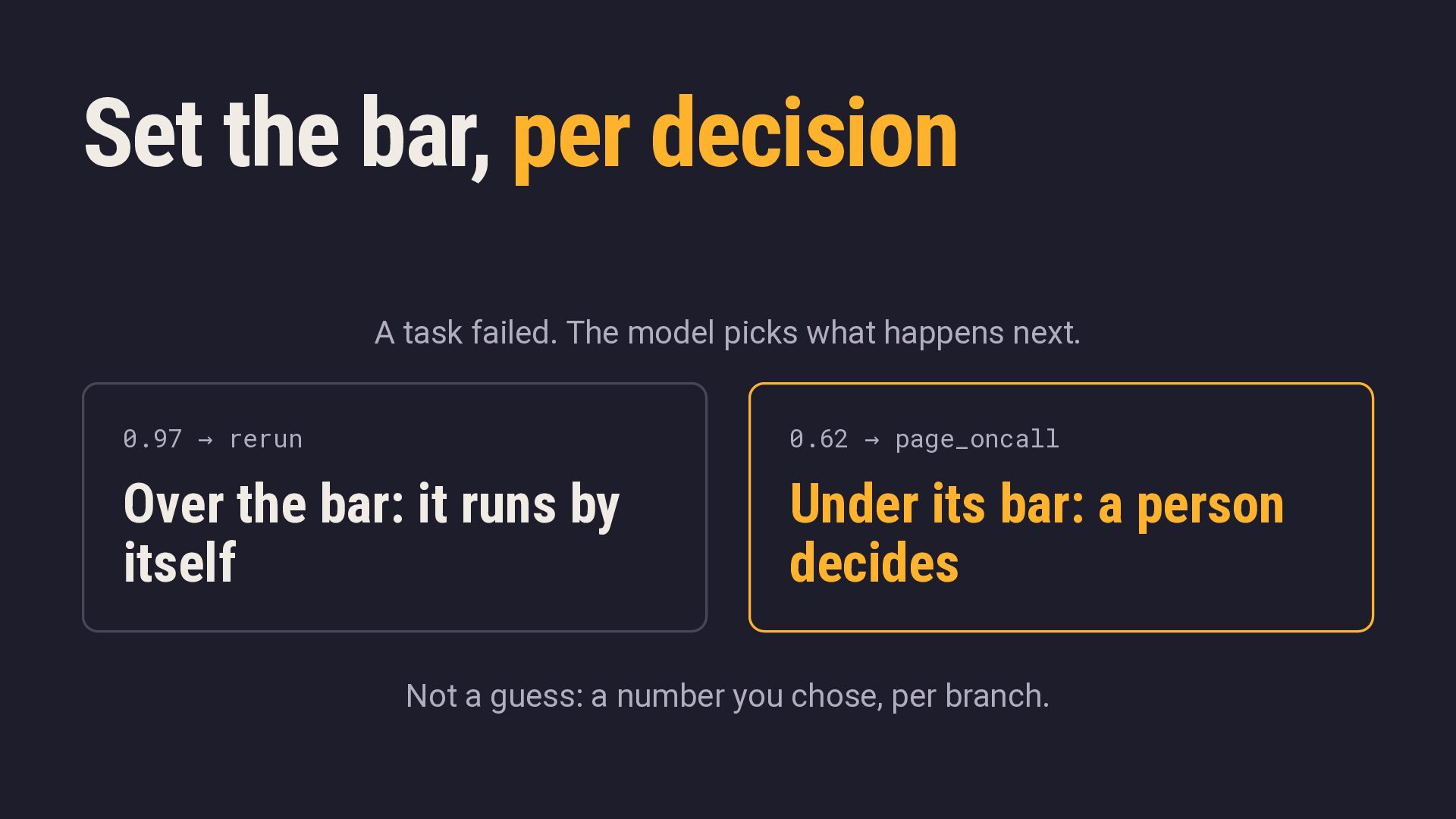
  31. Set the bar, per decision A task failed. The model

    picks what happens next. 0.97 → rerun 0.62 → page_oncall Over the bar: it runs by itself Under its bar: a person decides Not a guess: a number you chose, per branch.
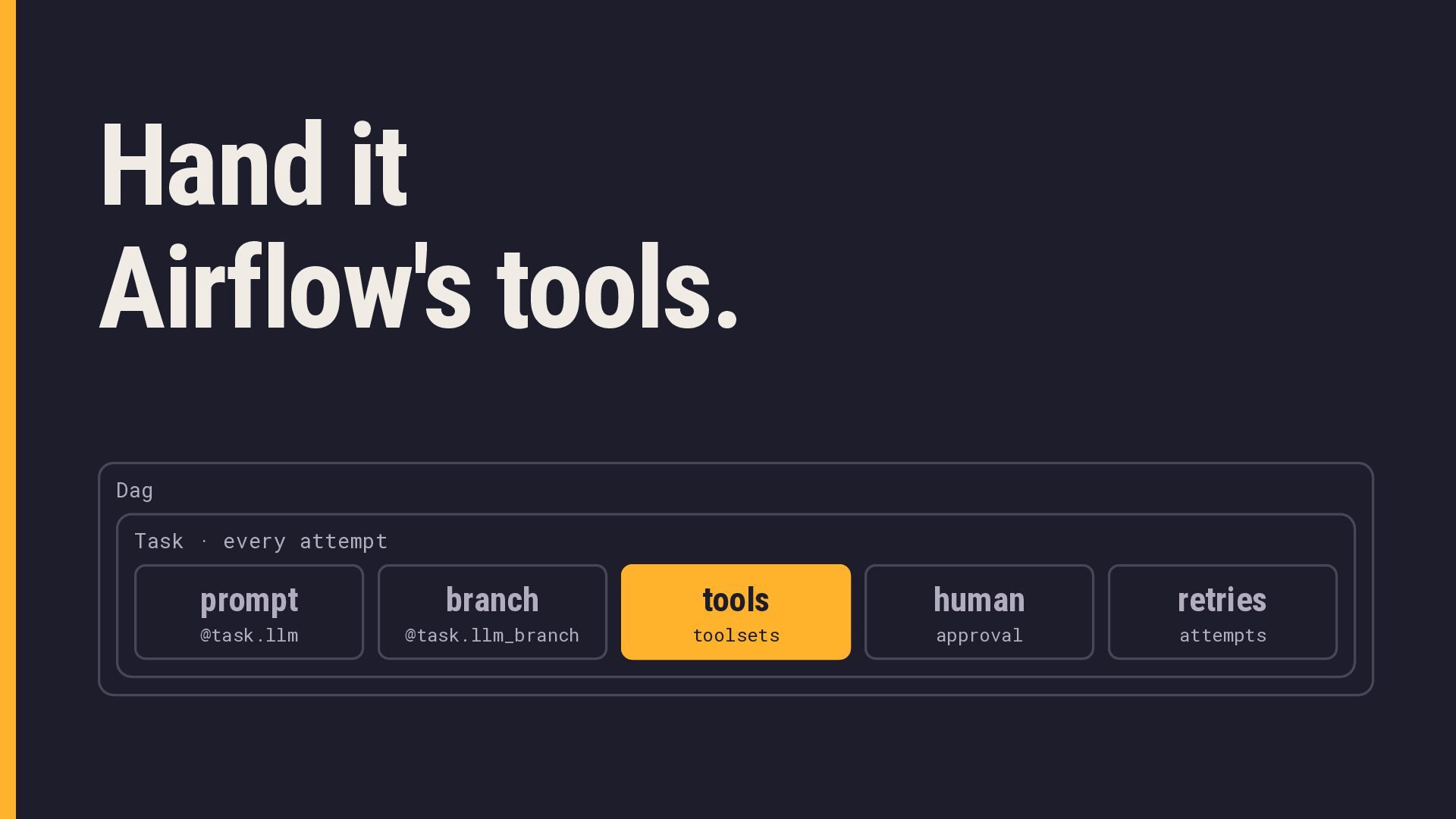
  32. Hand it Airflow's tools. Dag Task · every attempt prompt

    branch tools human retries @task.llm @task.llm_branch toolsets approval attempts
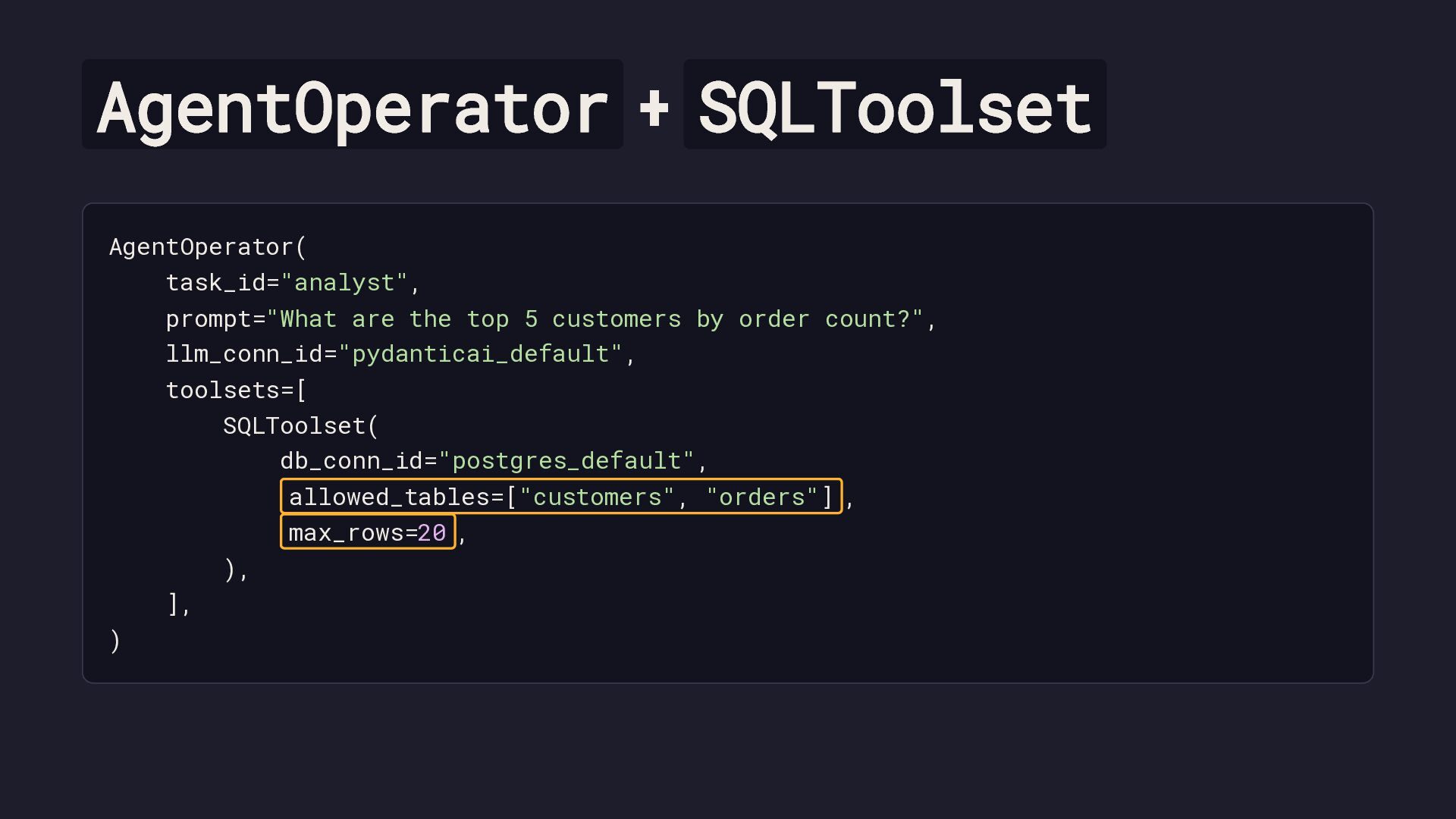
  33. AgentOperator + SQLToolset AgentOperator( task_id="analyst", prompt="What are the top 5

    customers by order count?", llm_conn_id="pydanticai_default", toolsets=[ SQLToolset( db_conn_id="postgres_default", allowed_tables=["customers", "orders"] , max_rows=20 , ), ], )
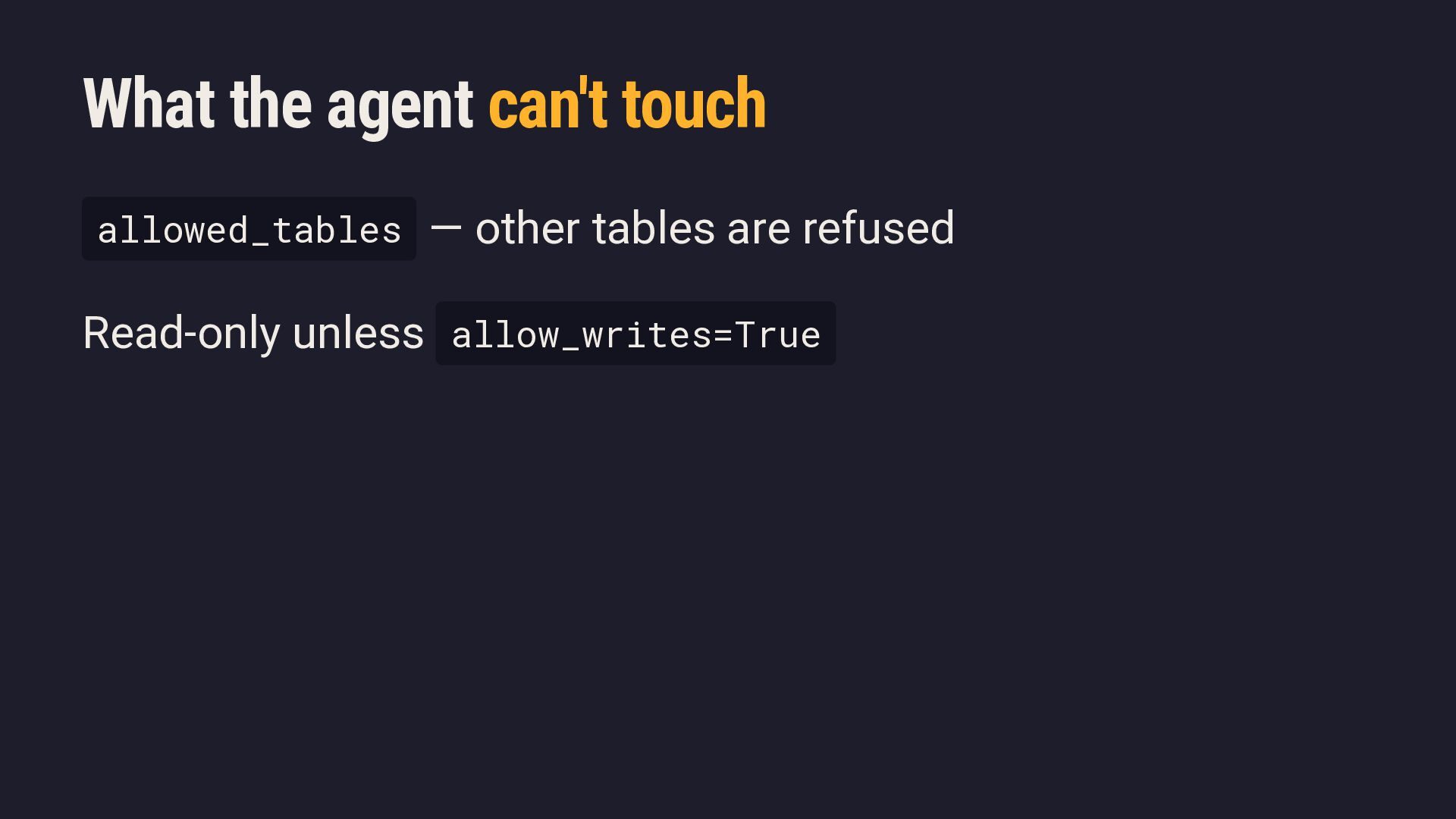
  34. What the agent can't touch allowed_tables — other tables are

    refused Read-only unless allow_writes=True
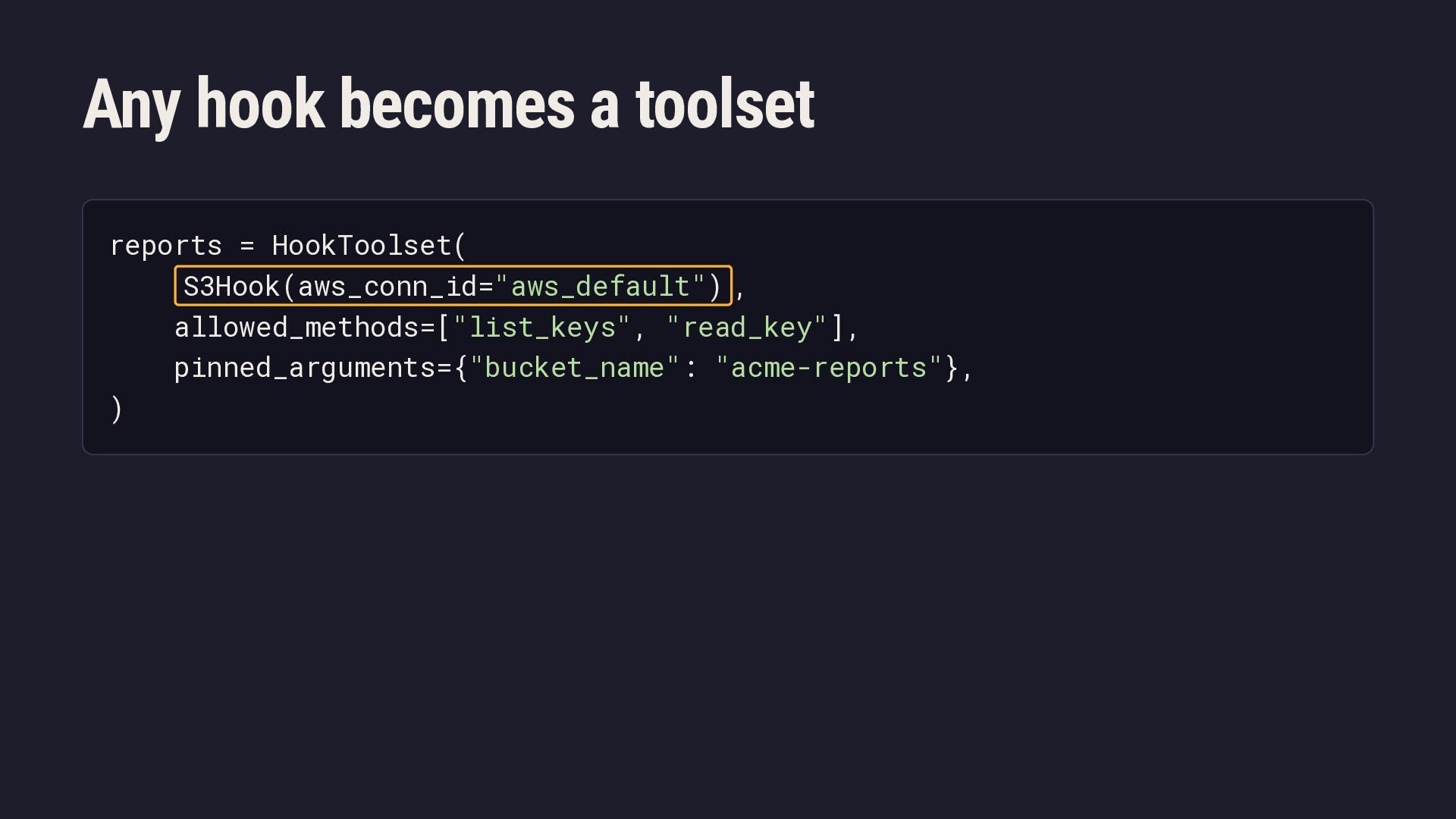
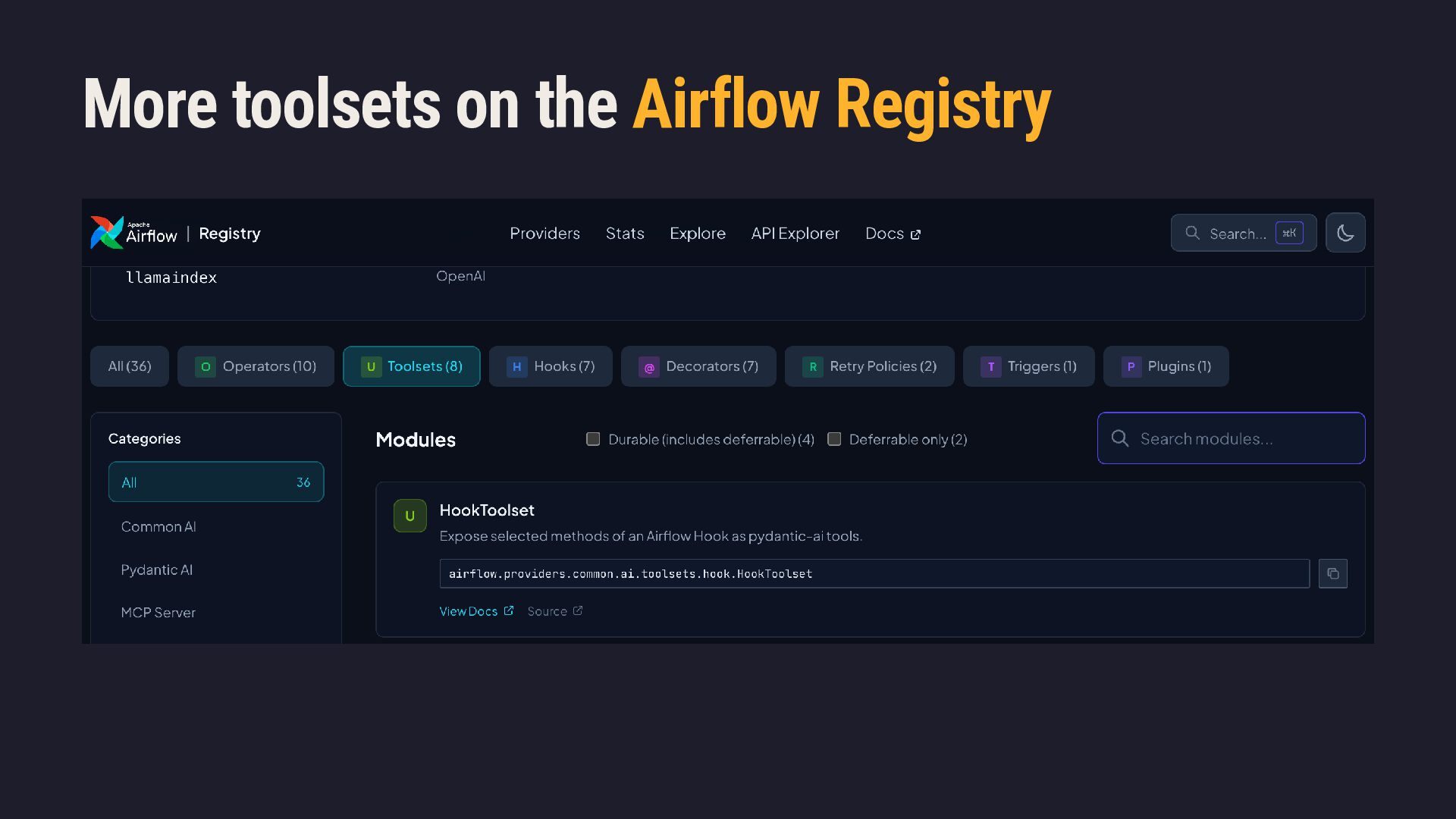
  35. Any hook becomes a toolset reports = HookToolset( S3Hook(aws_conn_id="aws_default") ,

    allowed_methods=["list_keys", "read_key"], pinned_arguments={"bucket_name": "acme-reports"}, )
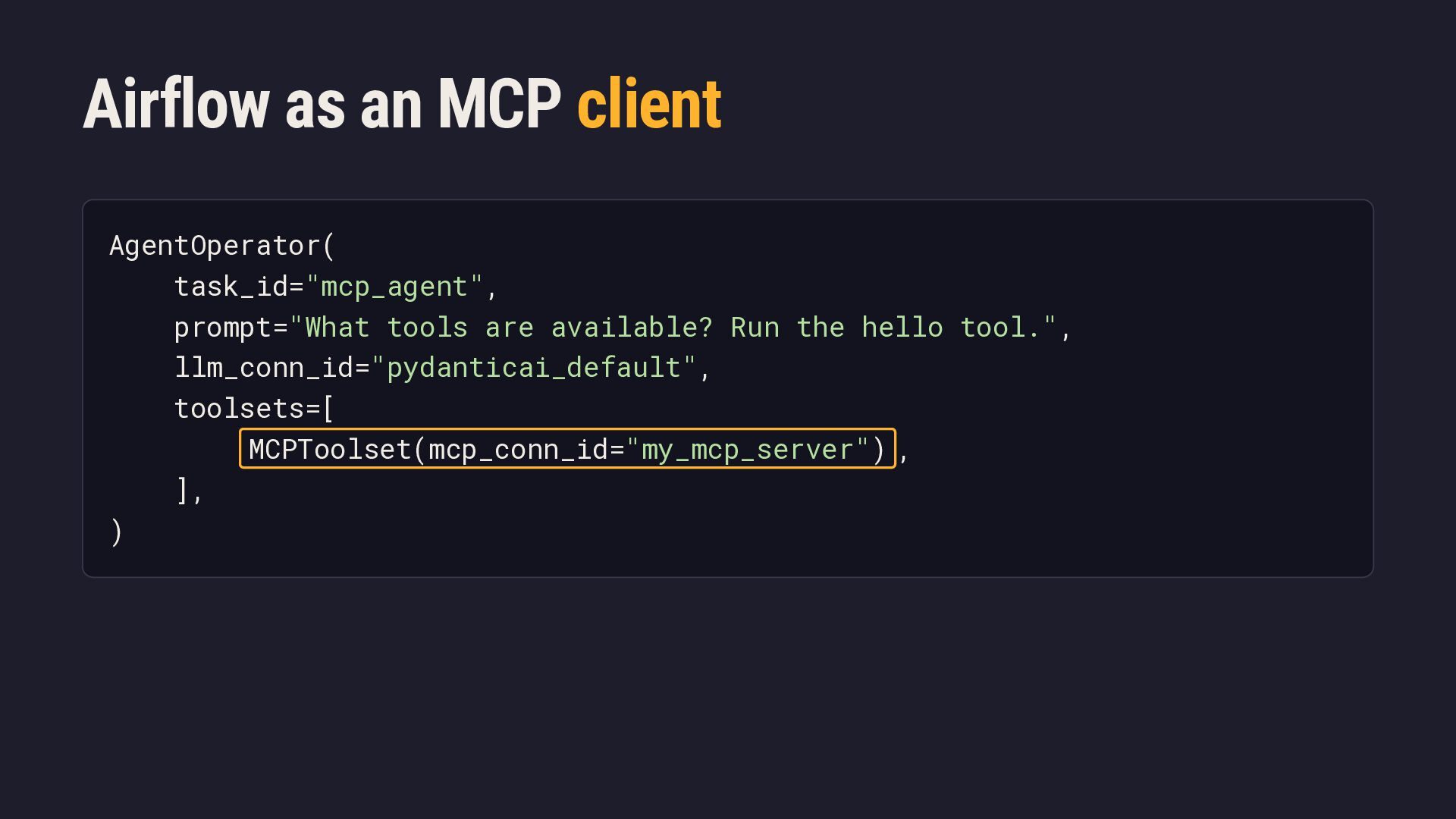
  36. Airflow as an MCP client AgentOperator( task_id="mcp_agent", prompt="What tools are

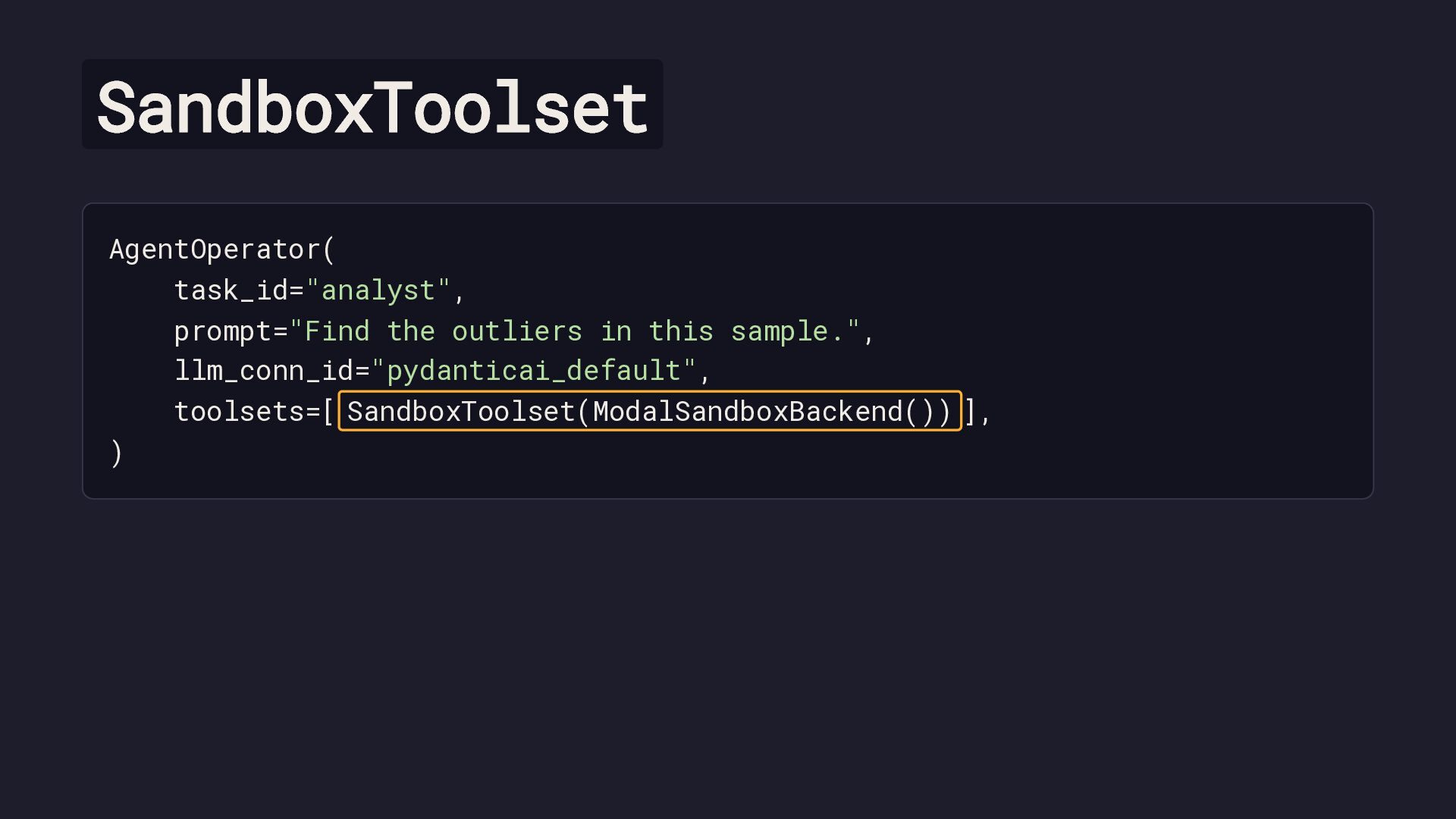
    available? Run the hello tool.", llm_conn_id="pydanticai_default", toolsets=[ MCPToolset(mcp_conn_id="my_mcp_server") , ], )
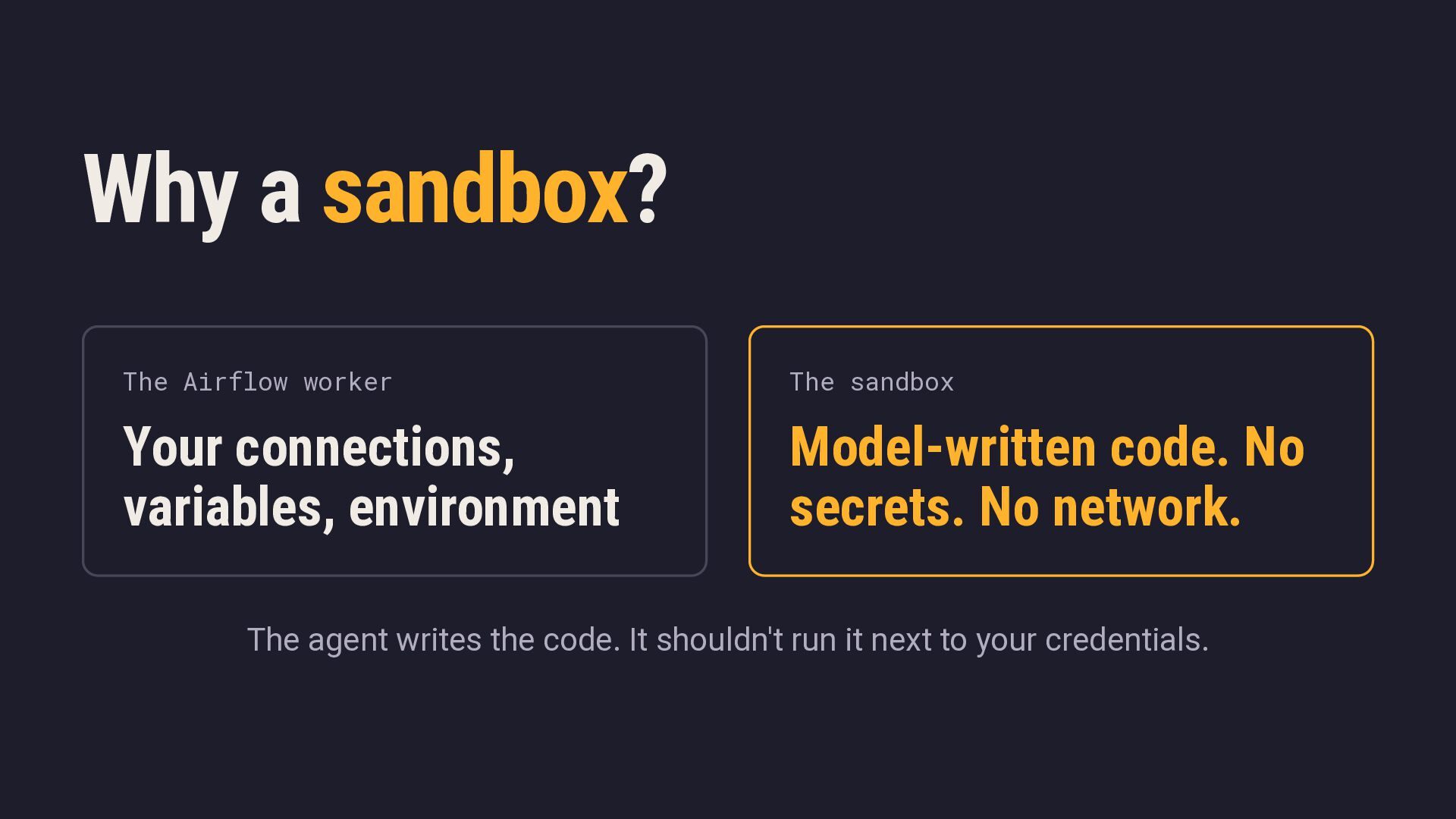
  37. Why a sandbox? The Airflow worker The sandbox Your connections,

    variables, environment Model-written code. No secrets. No network. The agent writes the code. It shouldn't run it next to your credentials.
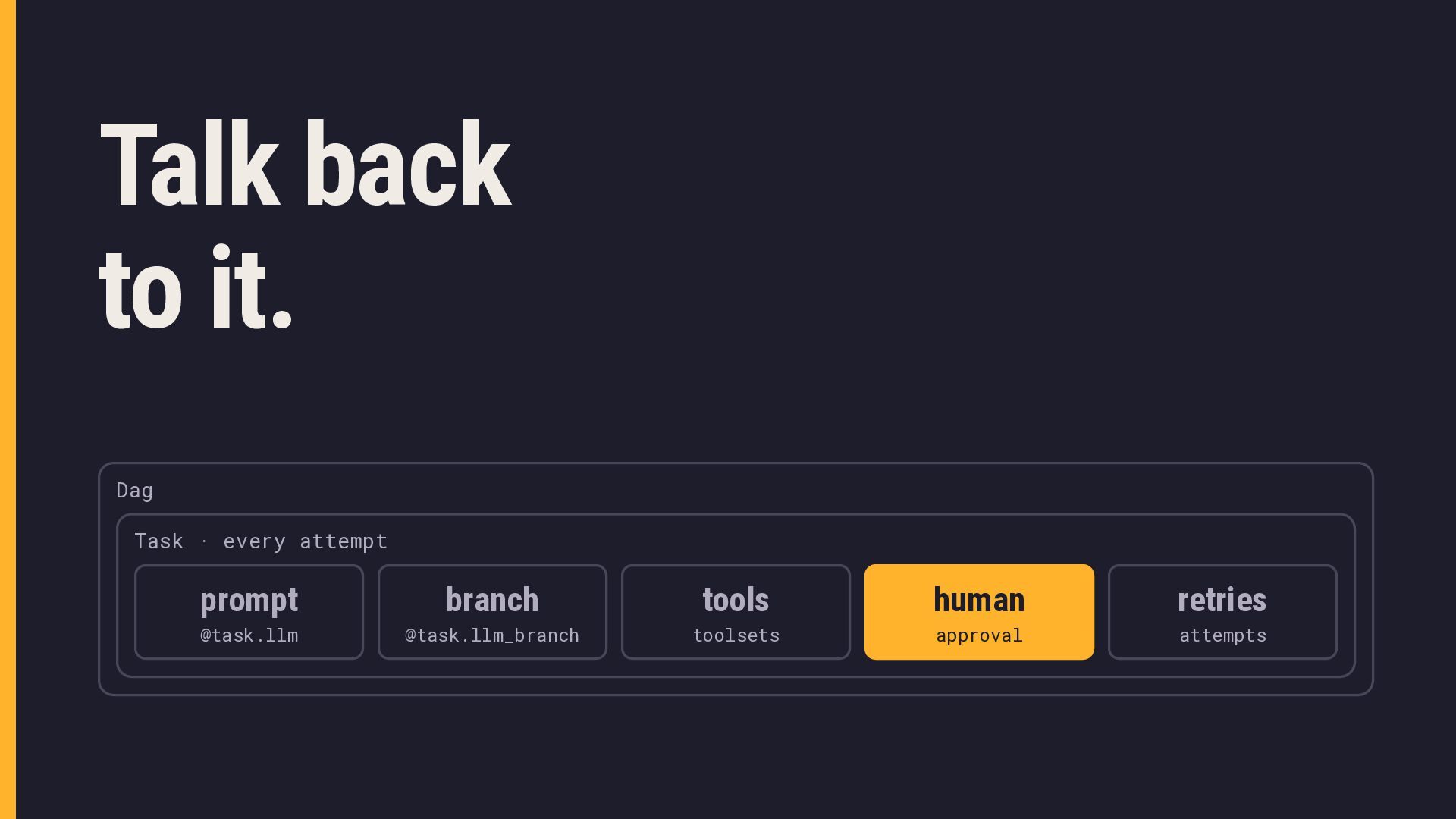
  38. Talk back to it. Dag Task · every attempt prompt

    branch tools human retries @task.llm @task.llm_branch toolsets approval attempts
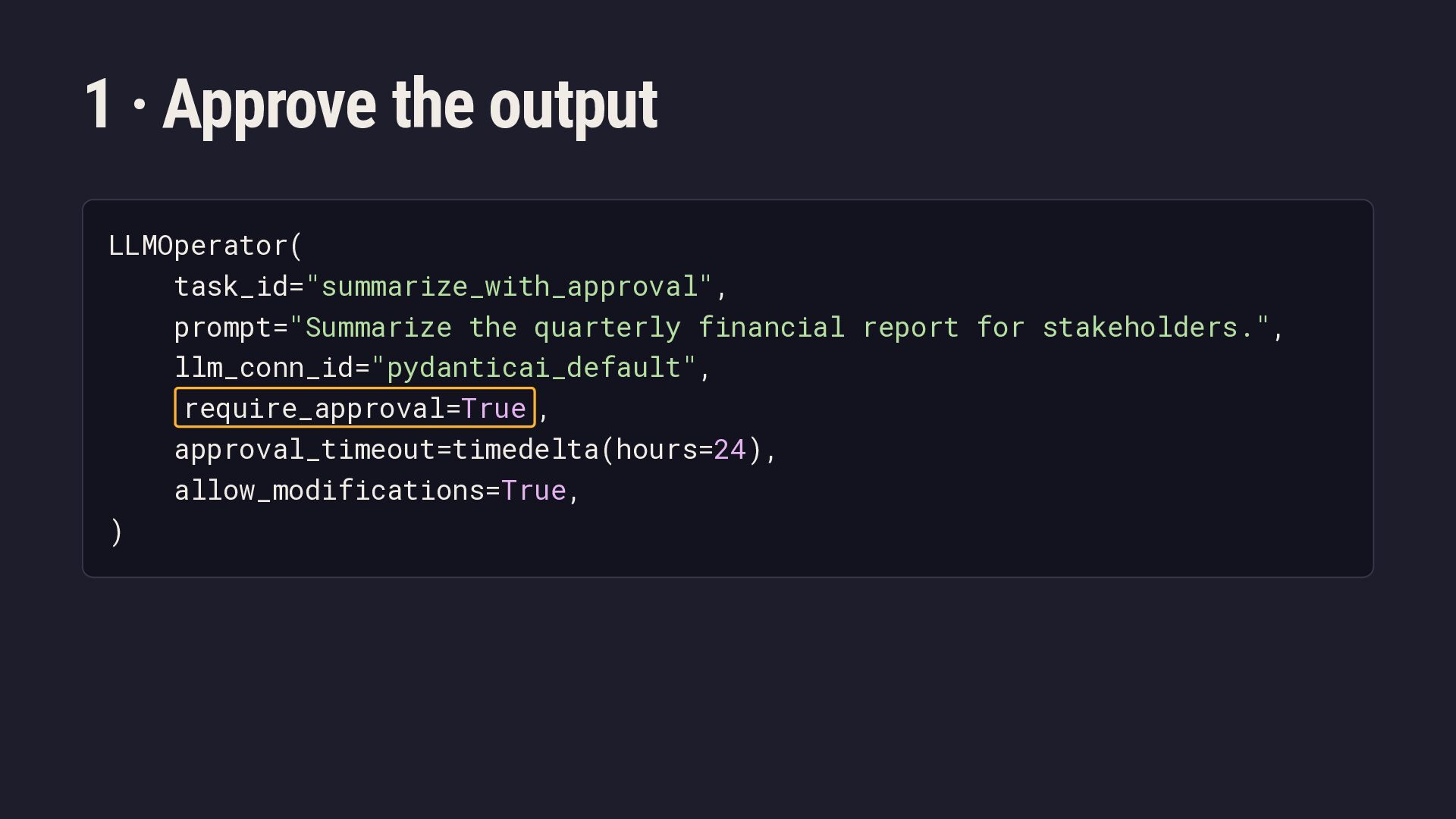
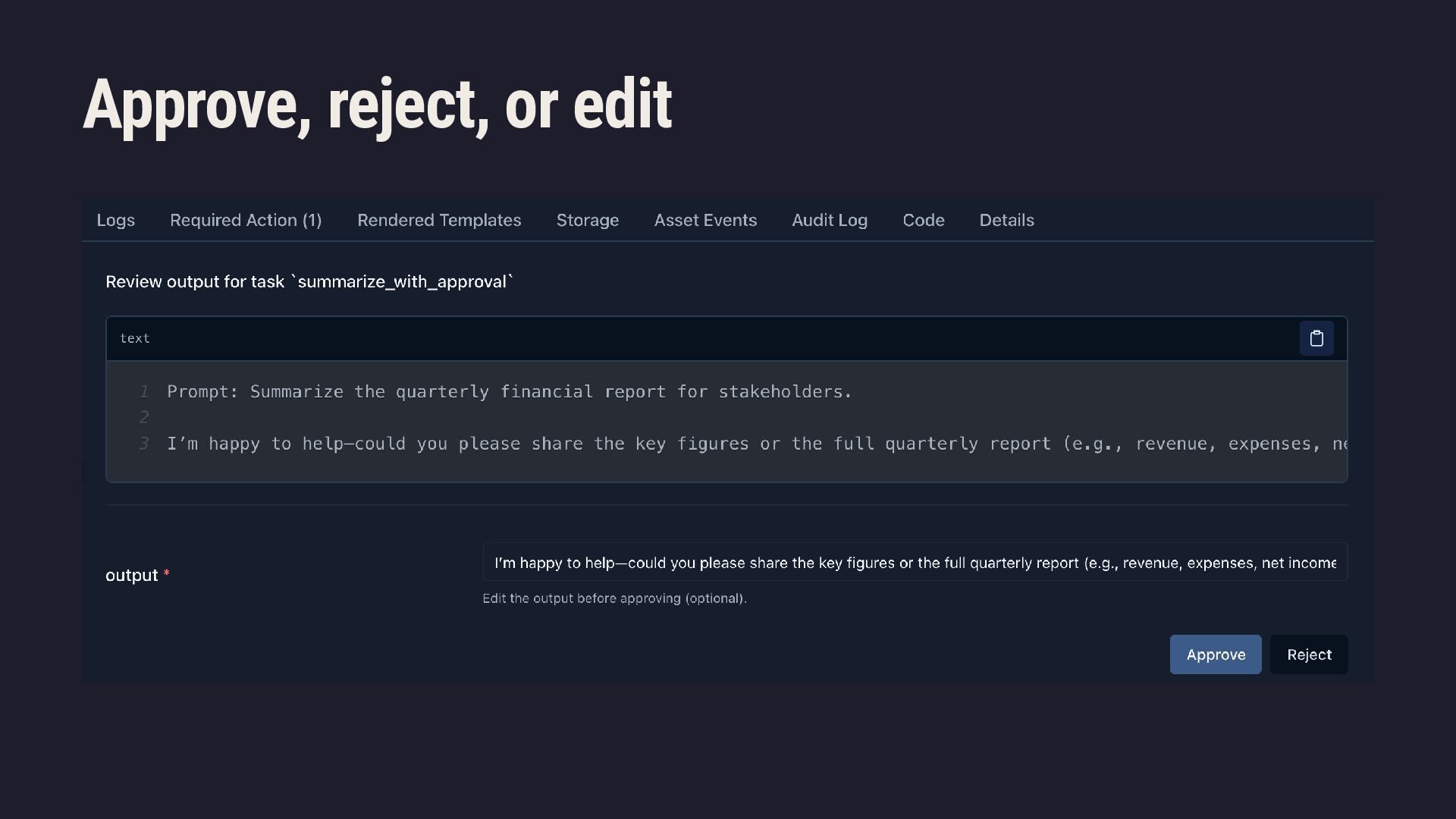
  39. 1 · Approve the output LLMOperator( task_id="summarize_with_approval", prompt="Summarize the quarterly

    financial report for stakeholders.", llm_conn_id="pydanticai_default", require_approval=True , approval_timeout=timedelta(hours=24), allow_modifications=True, )
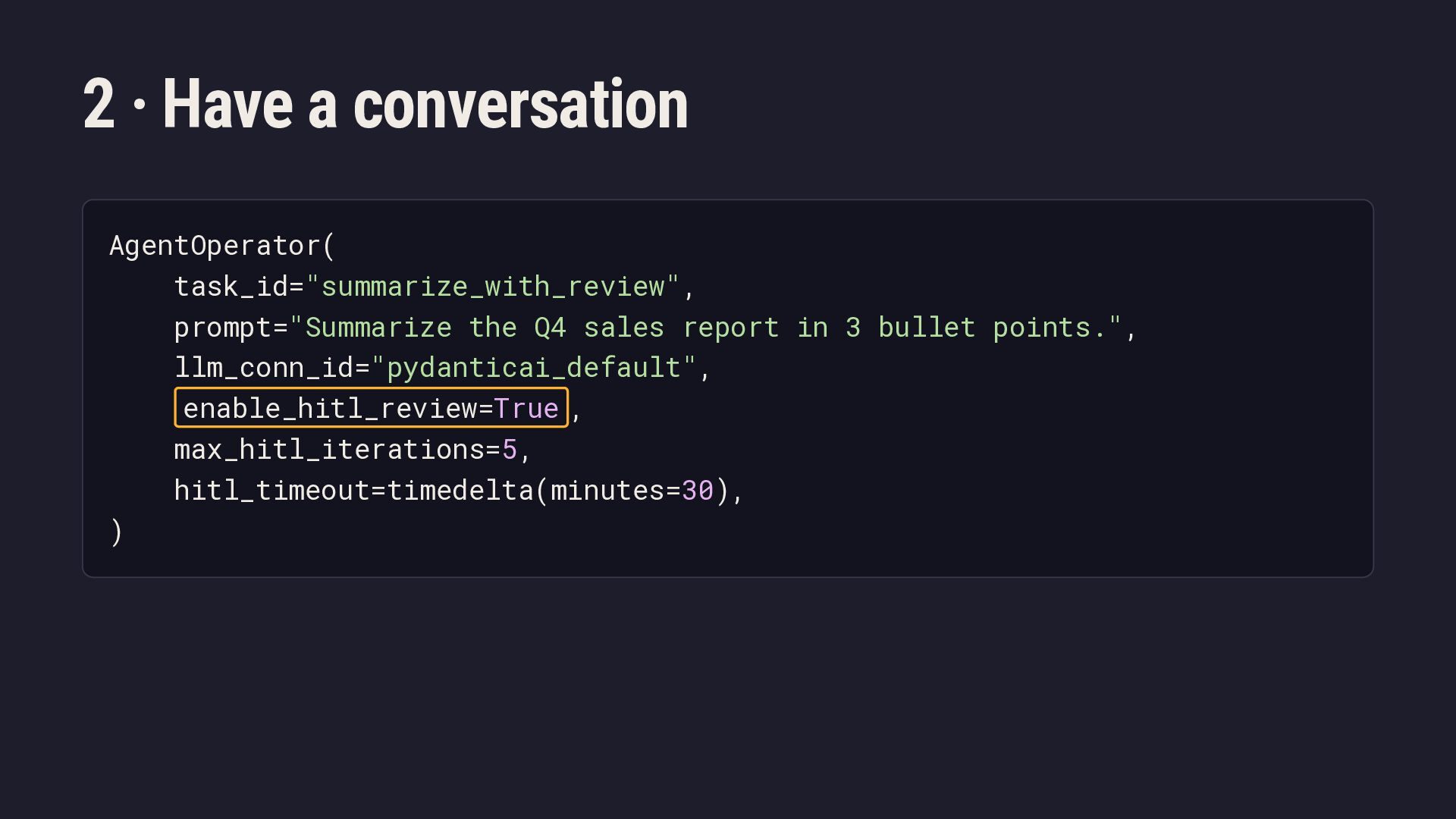
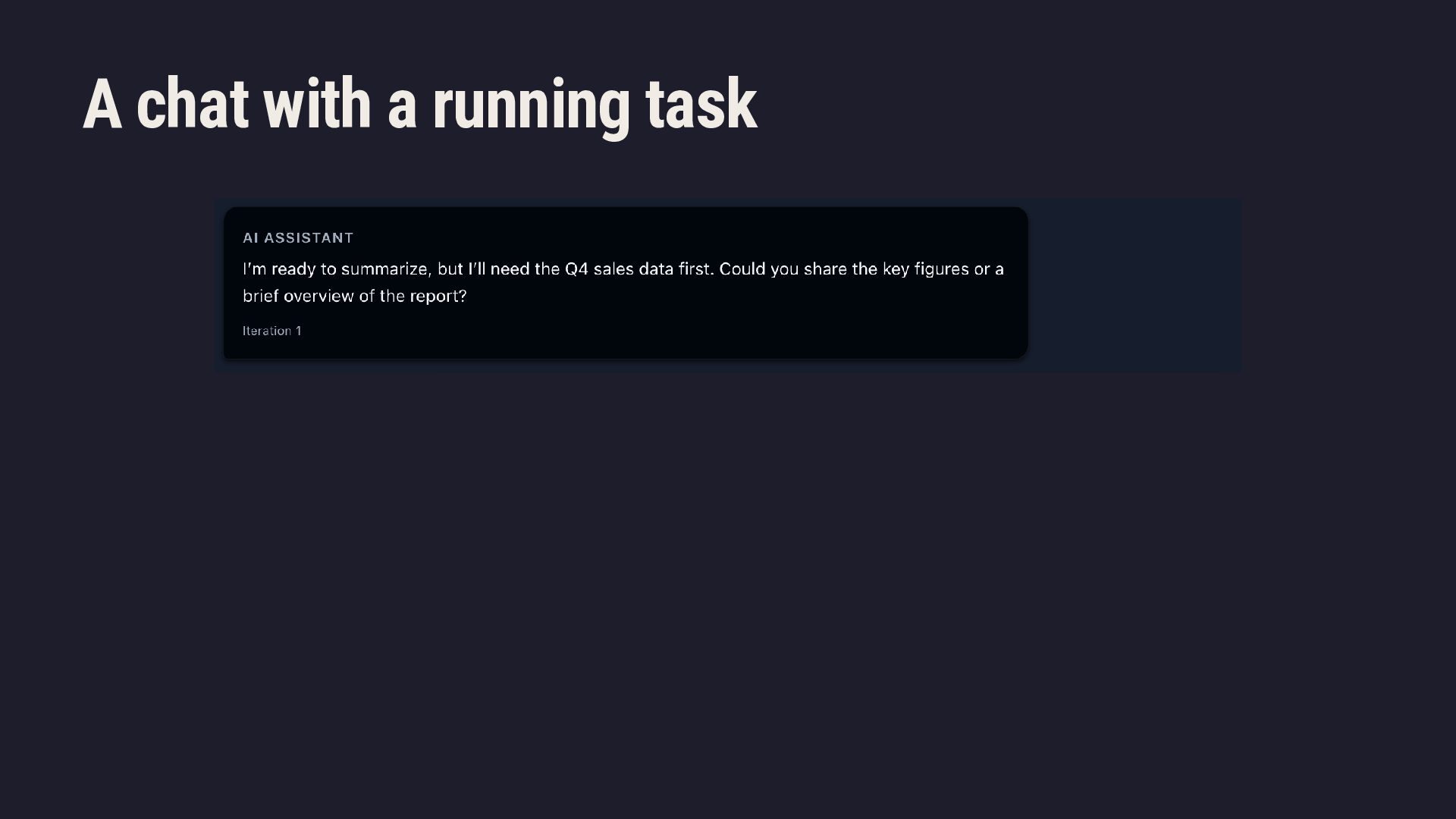
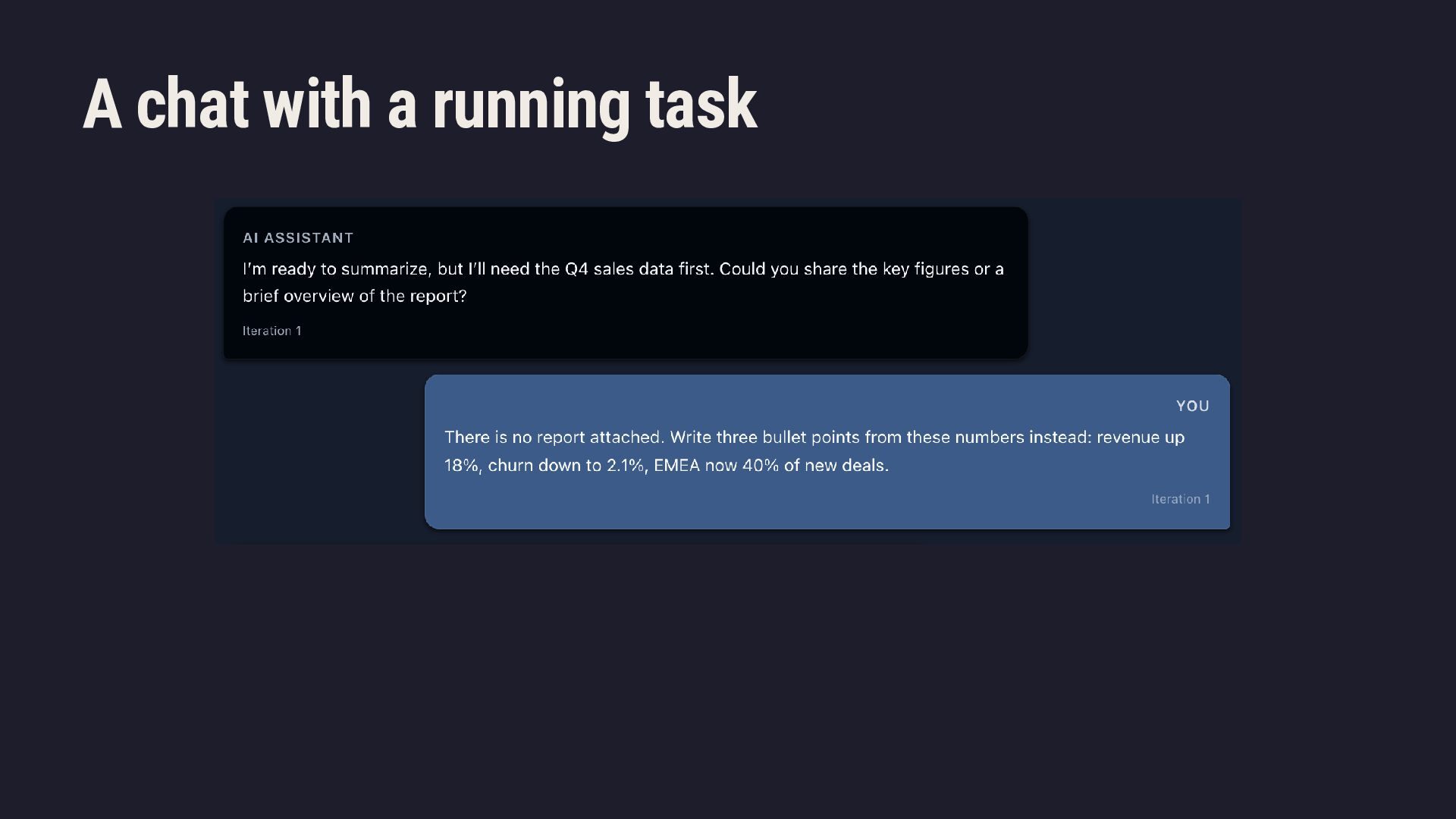
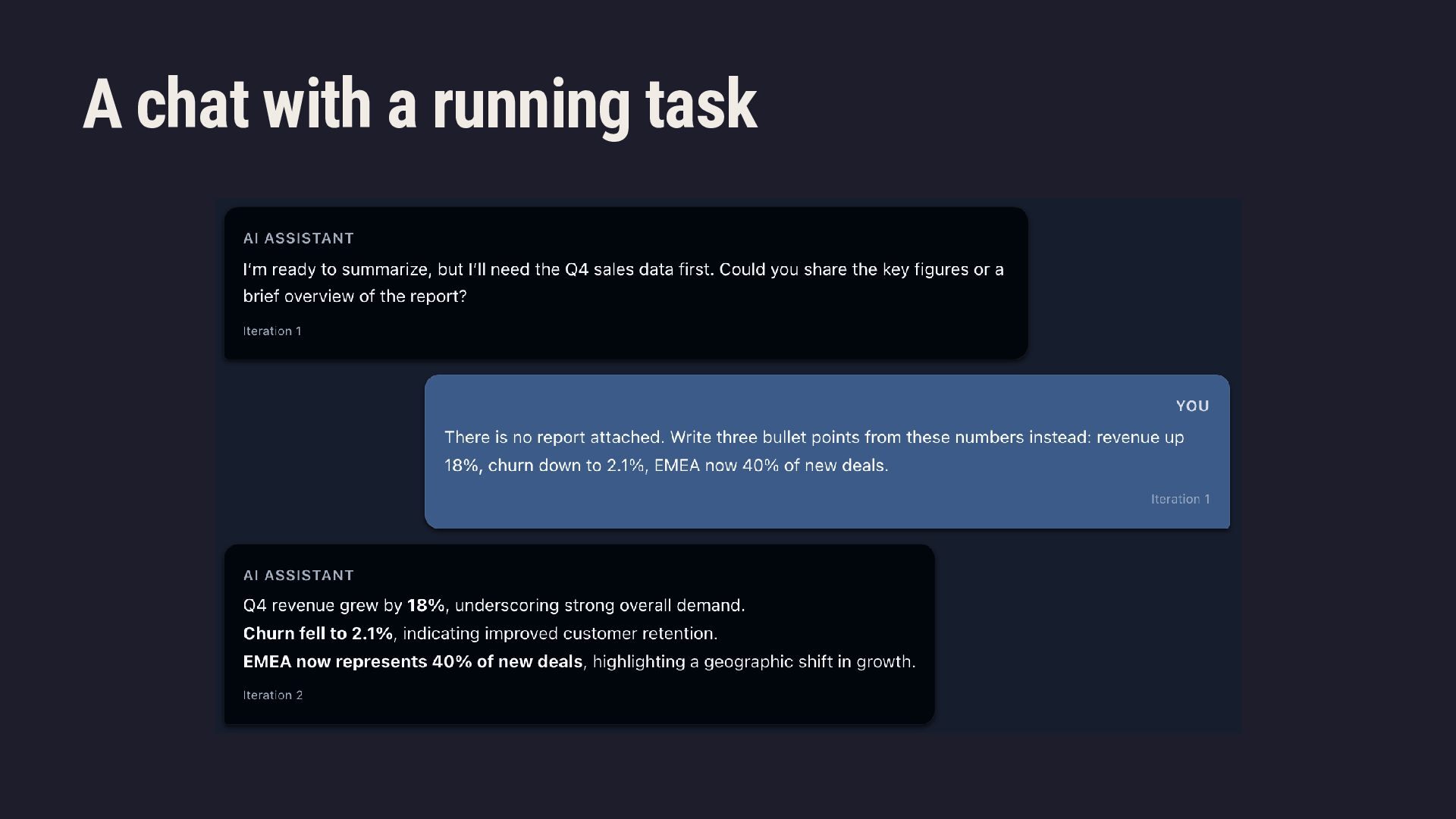
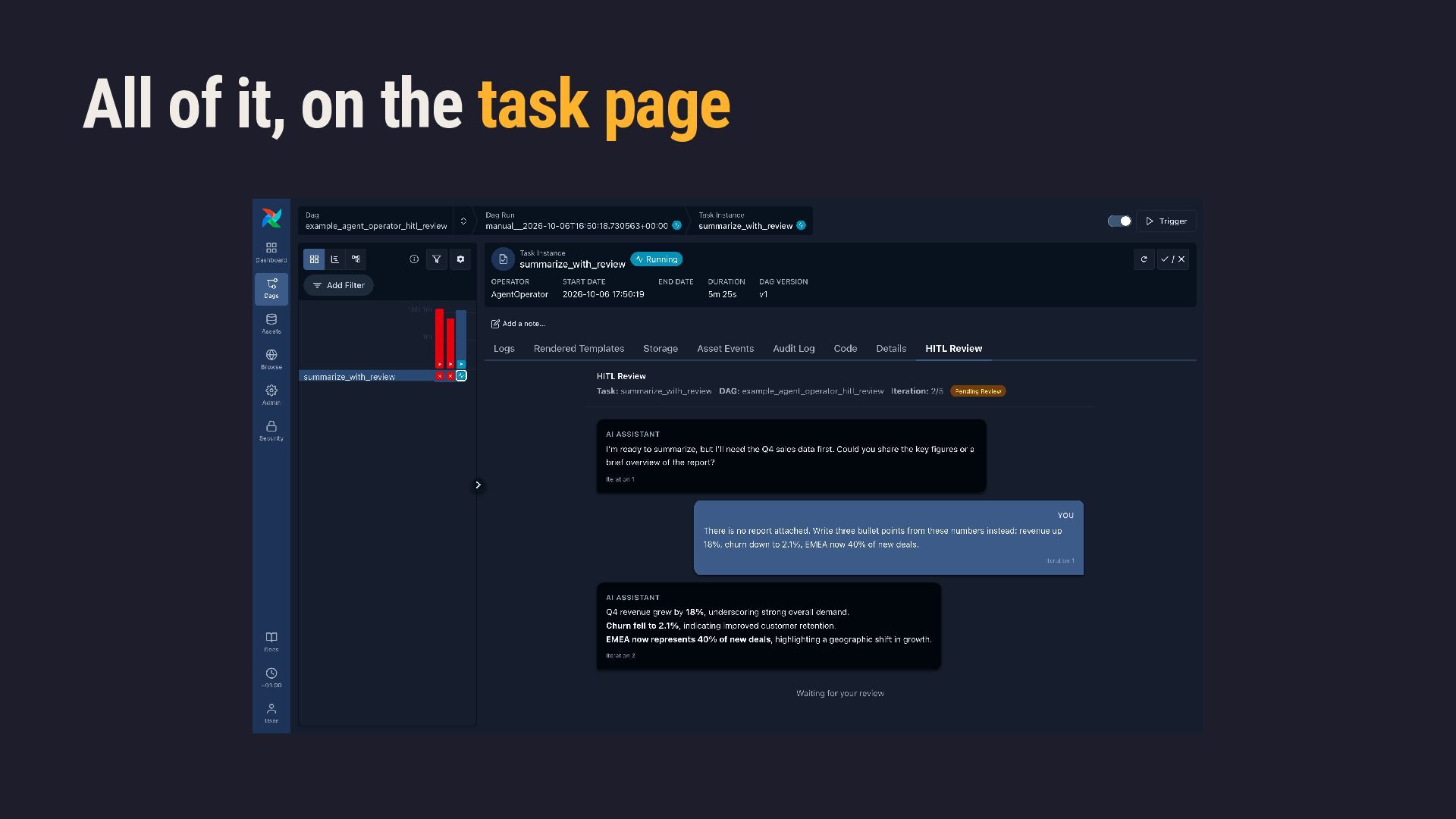
  40. 2 · Have a conversation AgentOperator( task_id="summarize_with_review", prompt="Summarize the Q4

    sales report in 3 bullet points.", llm_conn_id="pydanticai_default", enable_hitl_review=True , max_hitl_iterations=5, hitl_timeout=timedelta(minutes=30), )
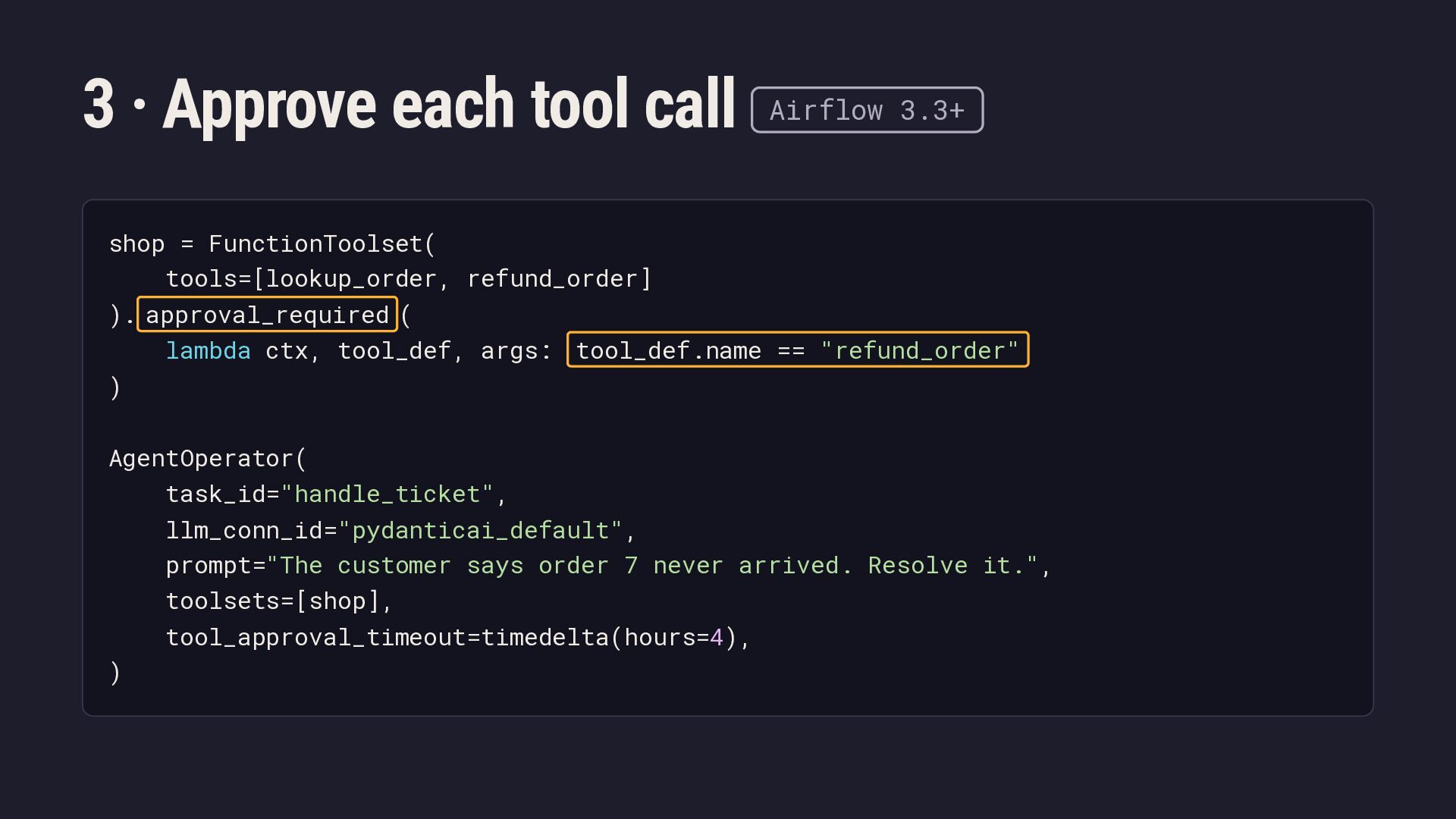
  41. 3 · Approve each tool call Airflow 3.3+ shop =

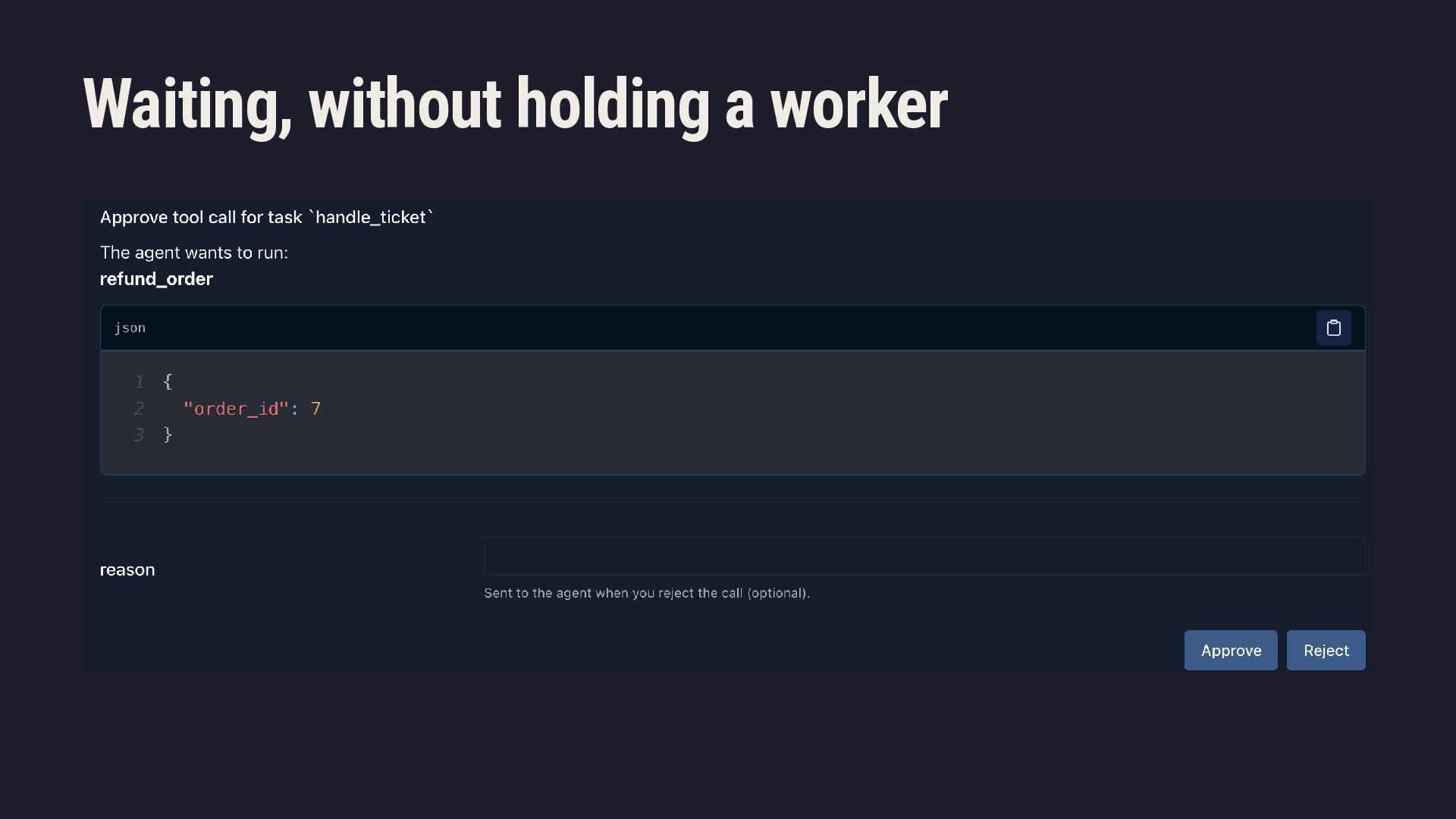
    FunctionToolset( tools=[lookup_order, refund_order] ). approval_required ( lambda ctx, tool_def, args: tool_def.name == "refund_order" ) AgentOperator( task_id="handle_ticket", llm_conn_id="pydanticai_default", prompt="The customer says order 7 never arrived. Resolve it.", toolsets=[shop], tool_approval_timeout=timedelta(hours=4), )
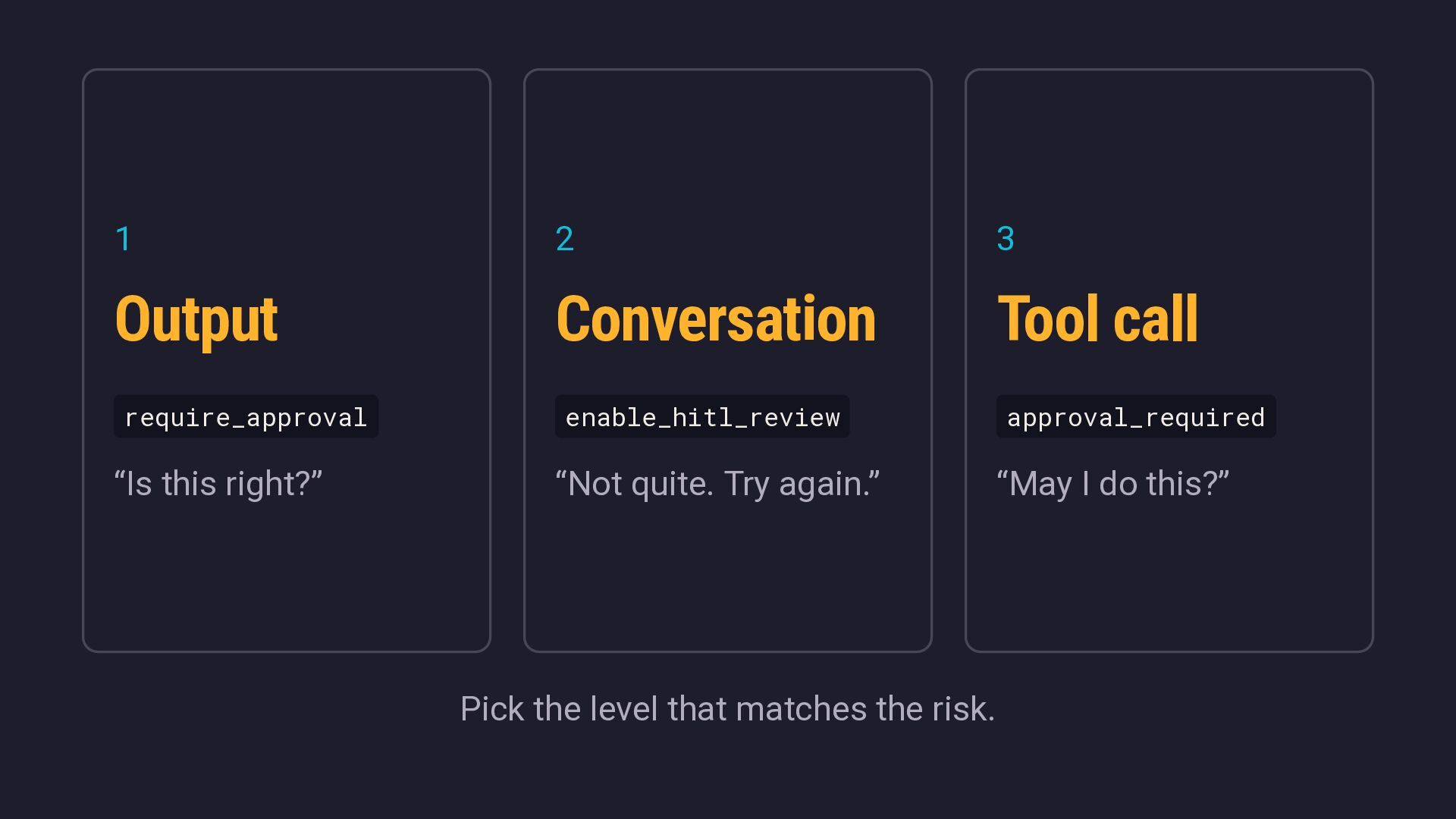
  42. 1 2 3 Output Conversation Tool call require_approval enable_hitl_review approval_required

    “Is this right?” “Not quite. Try again.” “May I do this?” Pick the level that matches the risk.
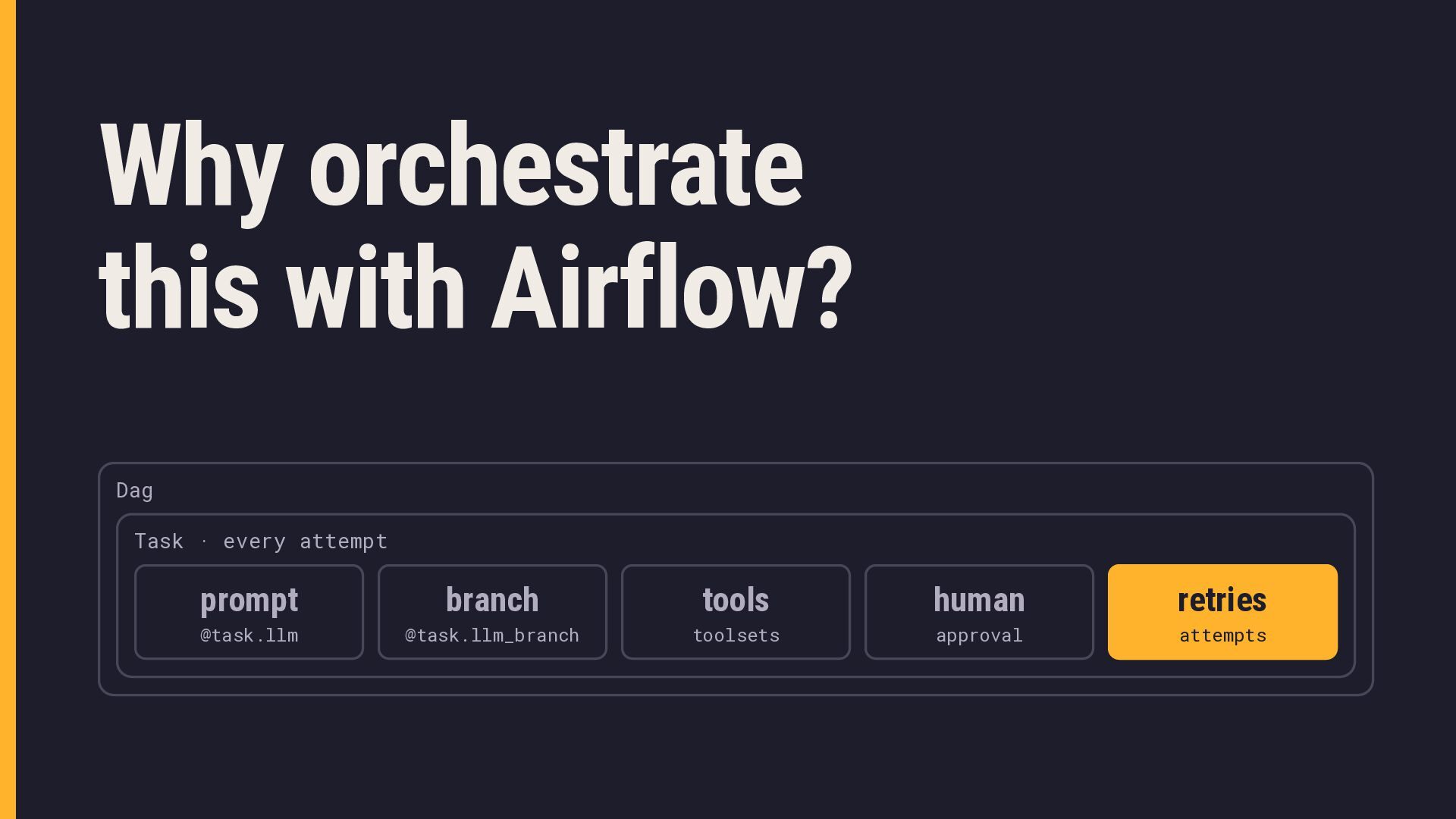
  43. Why orchestrate this with Airflow? Dag Task · every attempt

    prompt branch tools human retries @task.llm @task.llm_branch toolsets approval attempts
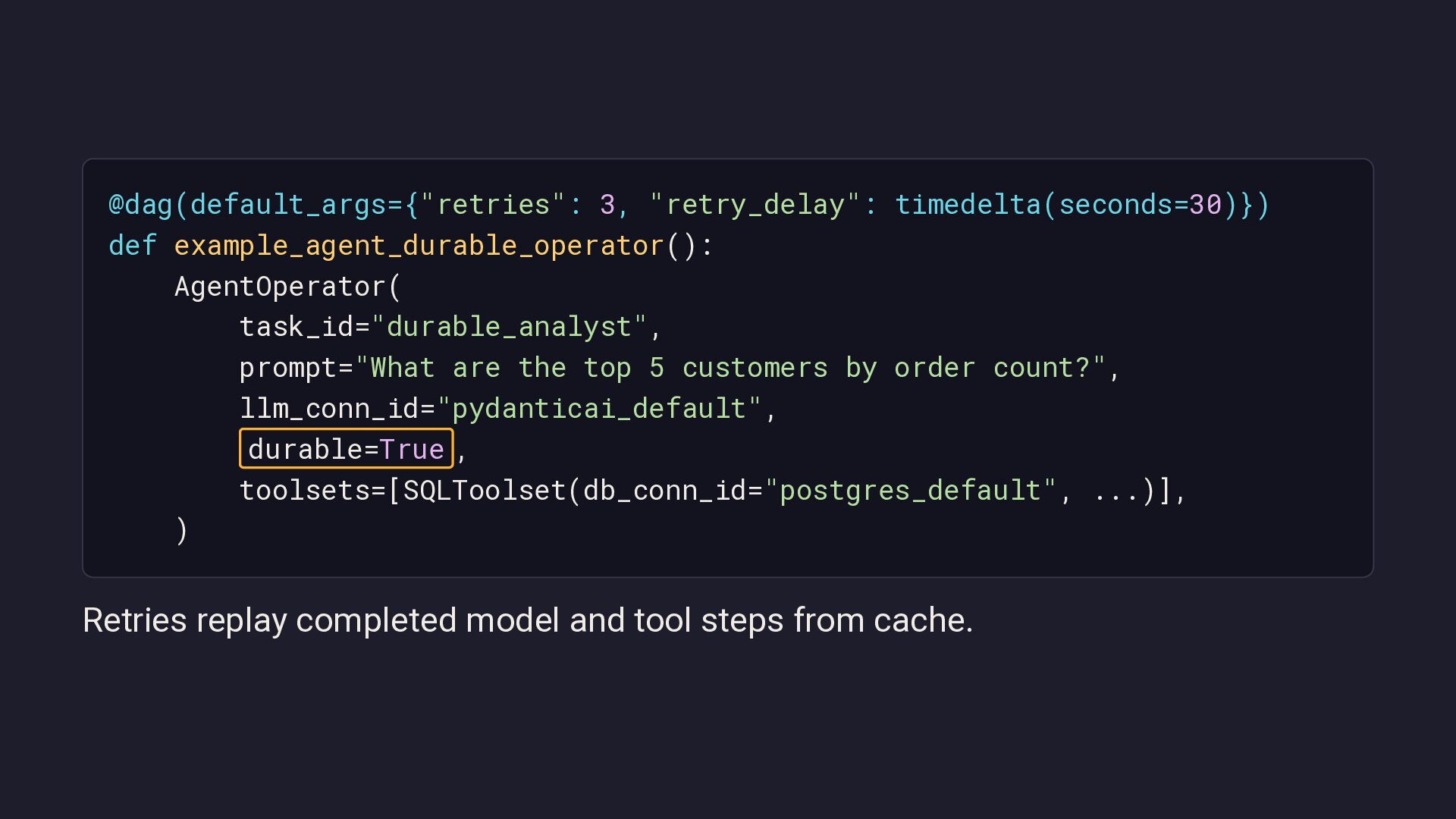
  44. @dag(default_args={"retries": 3, "retry_delay": timedelta(seconds=30)}) def example_agent_durable_operator(): AgentOperator( task_id="durable_analyst", prompt="What are

    the top 5 customers by order count?", llm_conn_id="pydanticai_default", durable=True , toolsets=[SQLToolset(db_conn_id="postgres_default", ...)], ) Retries replay completed model and tool steps from cache.
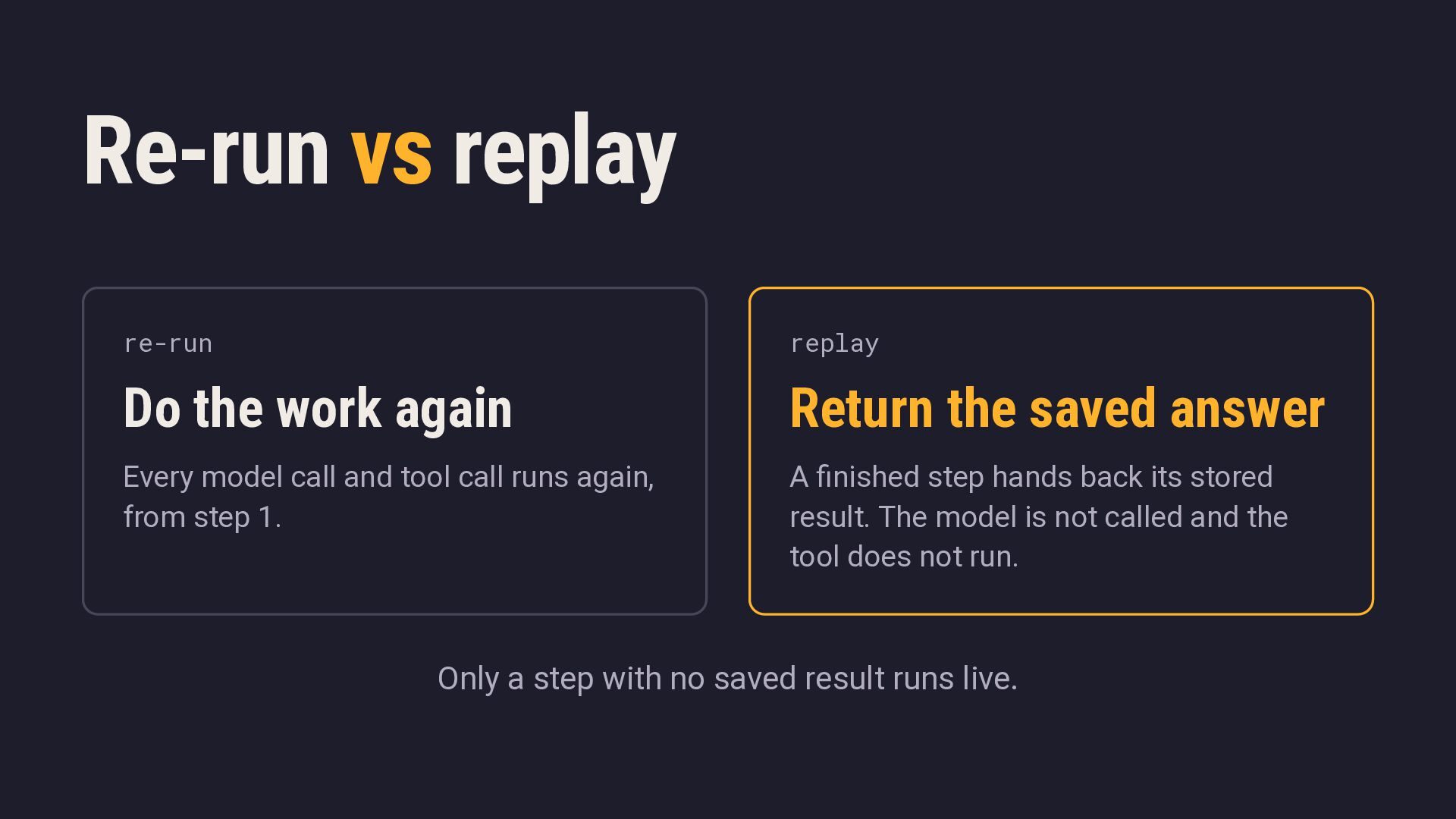
  45. Re-run vs replay re-run replay Do the work again Return

    the saved answer Every model call and tool call runs again, from step 1. A finished step hands back its stored result. The model is not called and the tool does not run. Only a step with no saved result runs live.
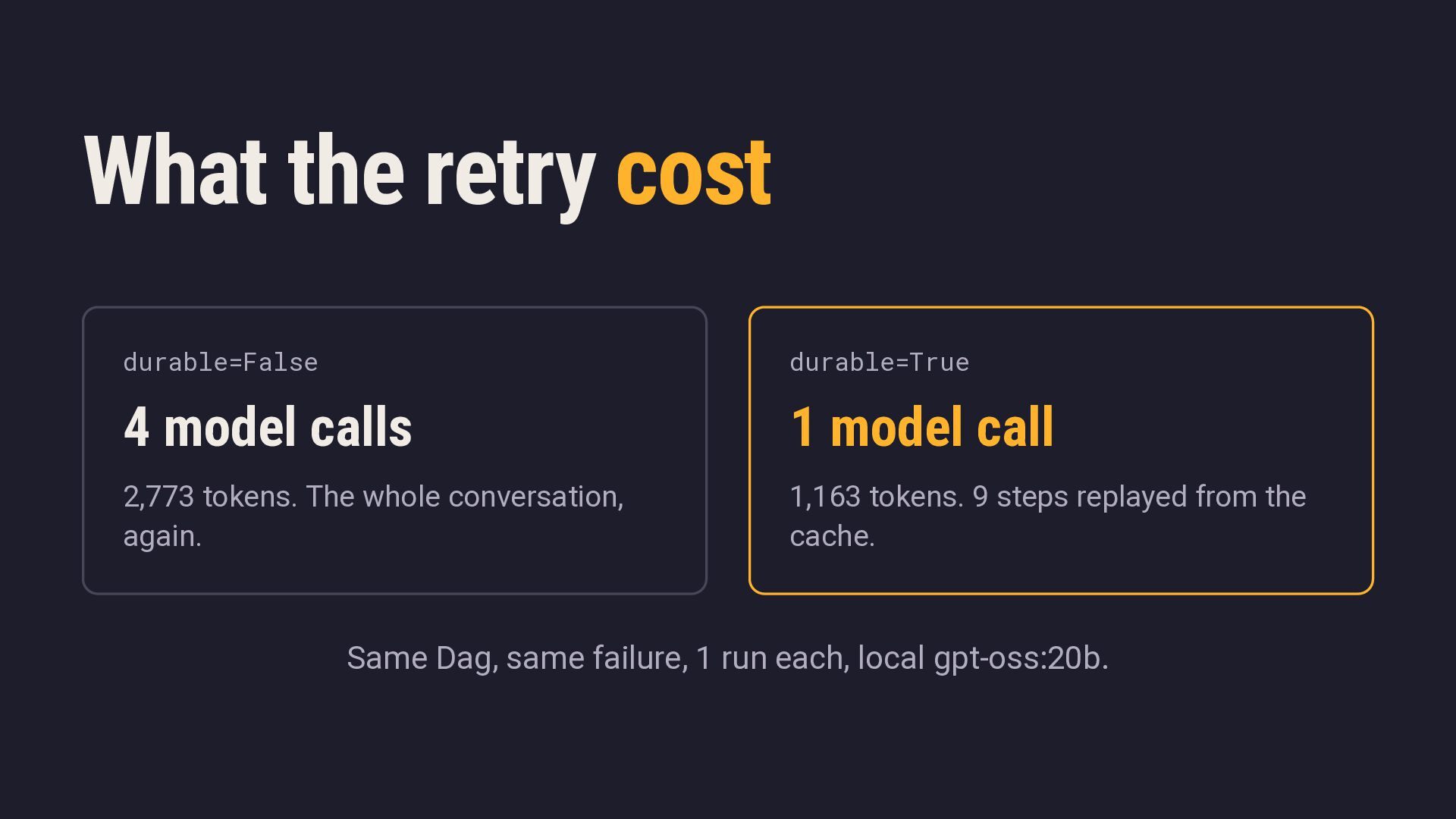
  46. What the retry cost durable=False durable=True 4 model calls 1

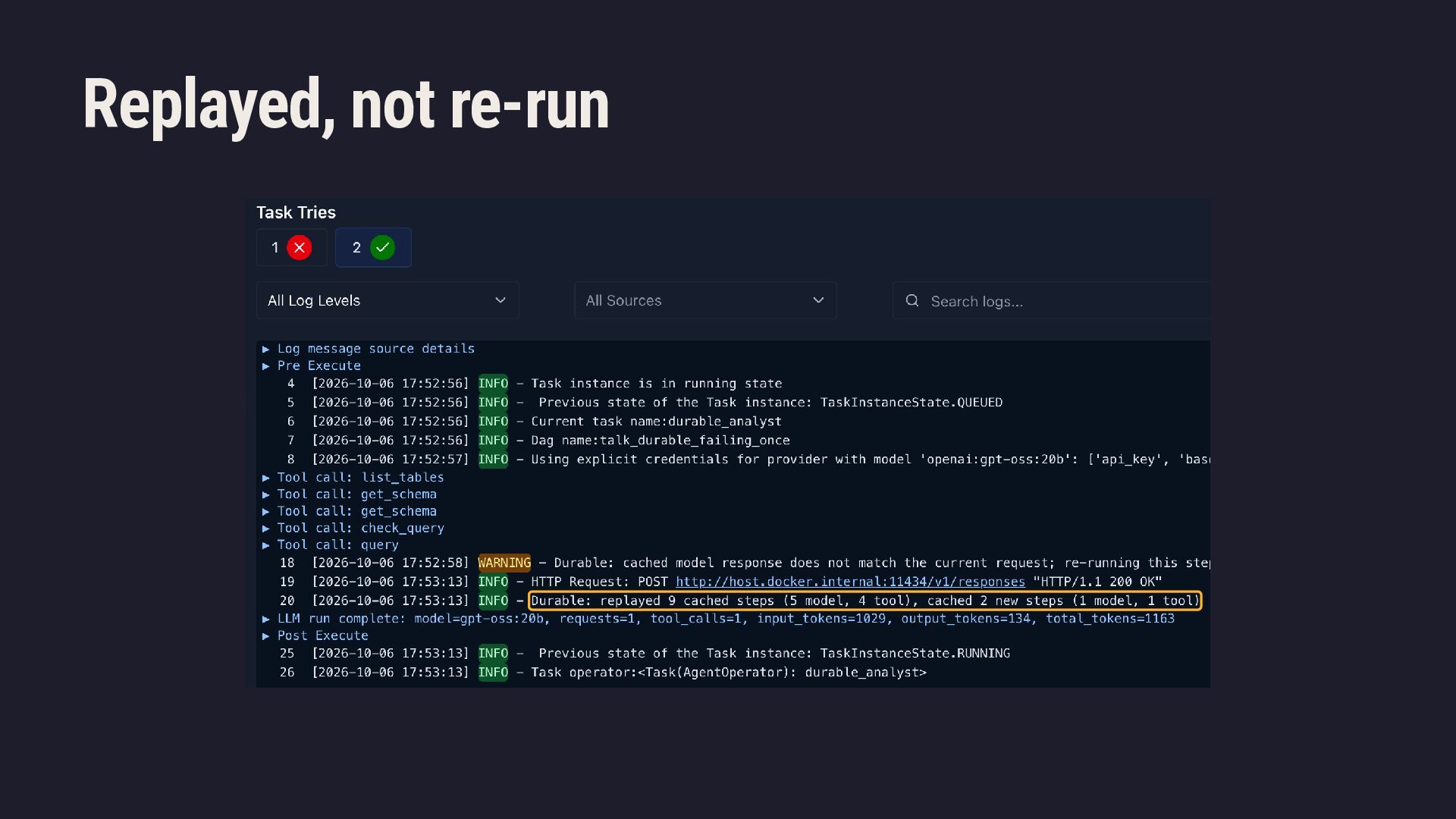
    model call 2,773 tokens. The whole conversation, again. 1,163 tokens. 9 steps replayed from the cache. Same Dag, same failure, 1 run each, local gpt-oss:20b.
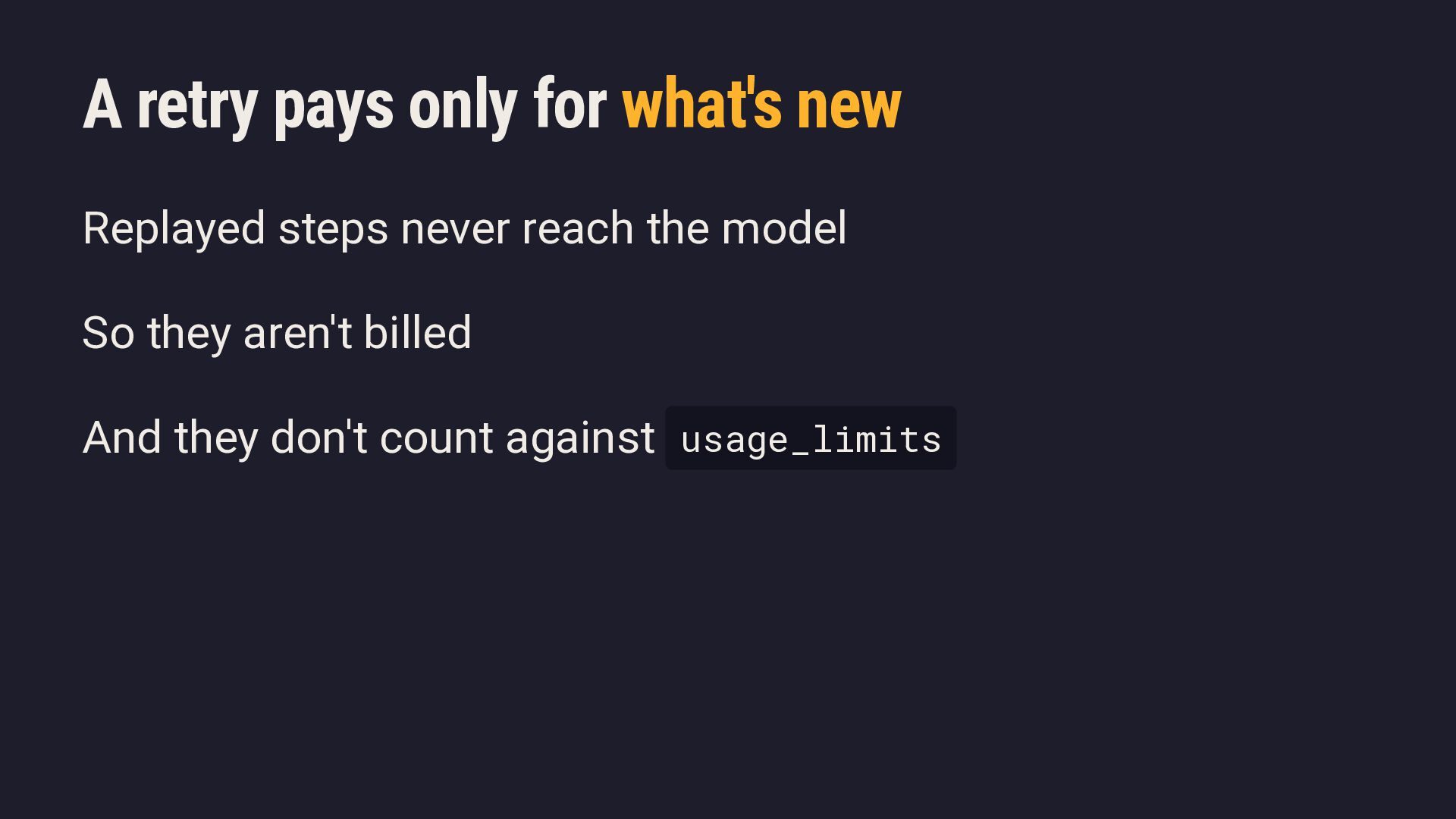
  47. A retry pays only for what's new Replayed steps never

    reach the model So they aren't billed And they don't count against usage_limits
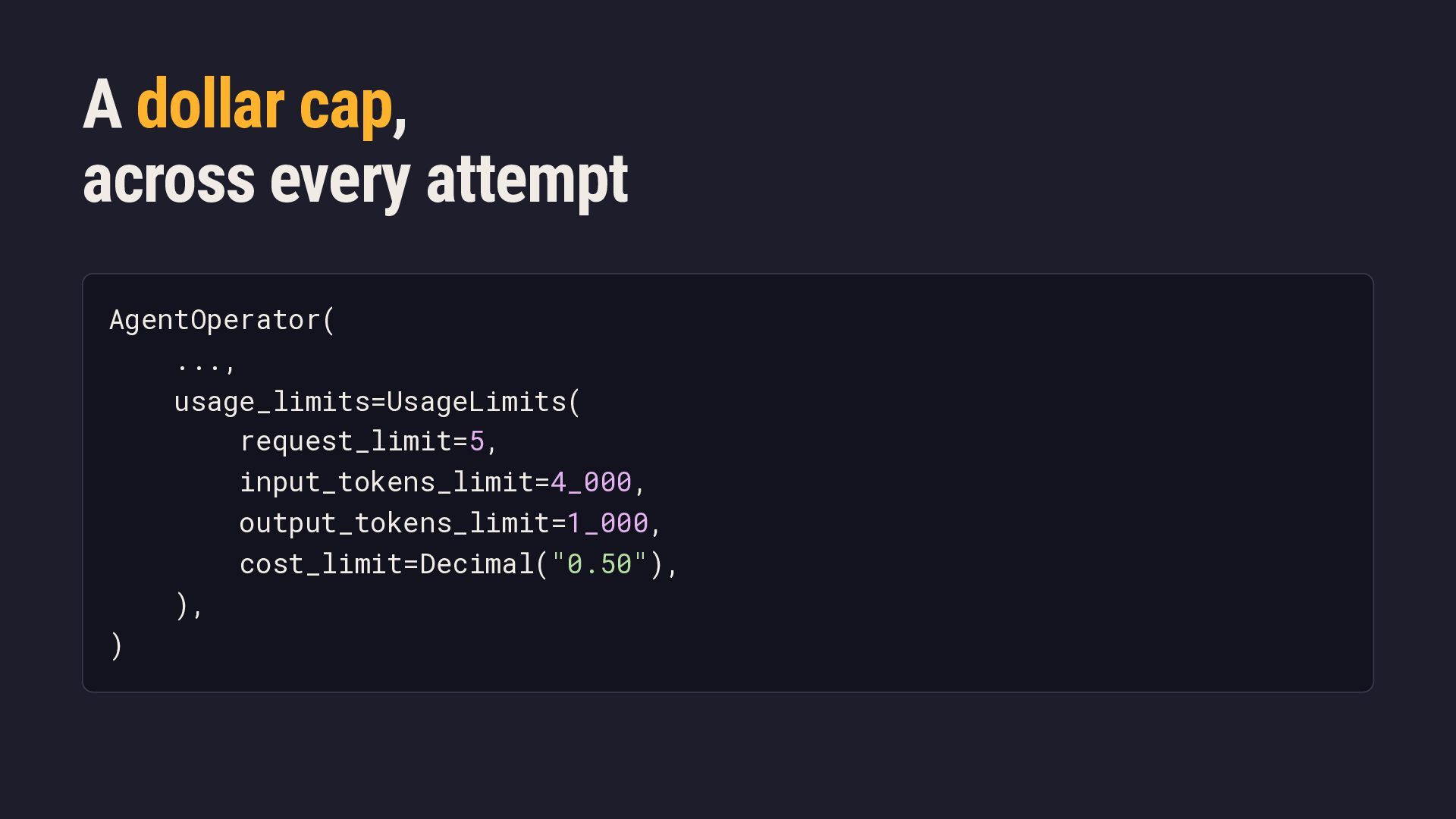
  48. A dollar cap, across every attempt AgentOperator( ..., usage_limits=UsageLimits( request_limit=5,

    input_tokens_limit=4_000, output_tokens_limit=1_000, cost_limit=Decimal("0.50"), ), )
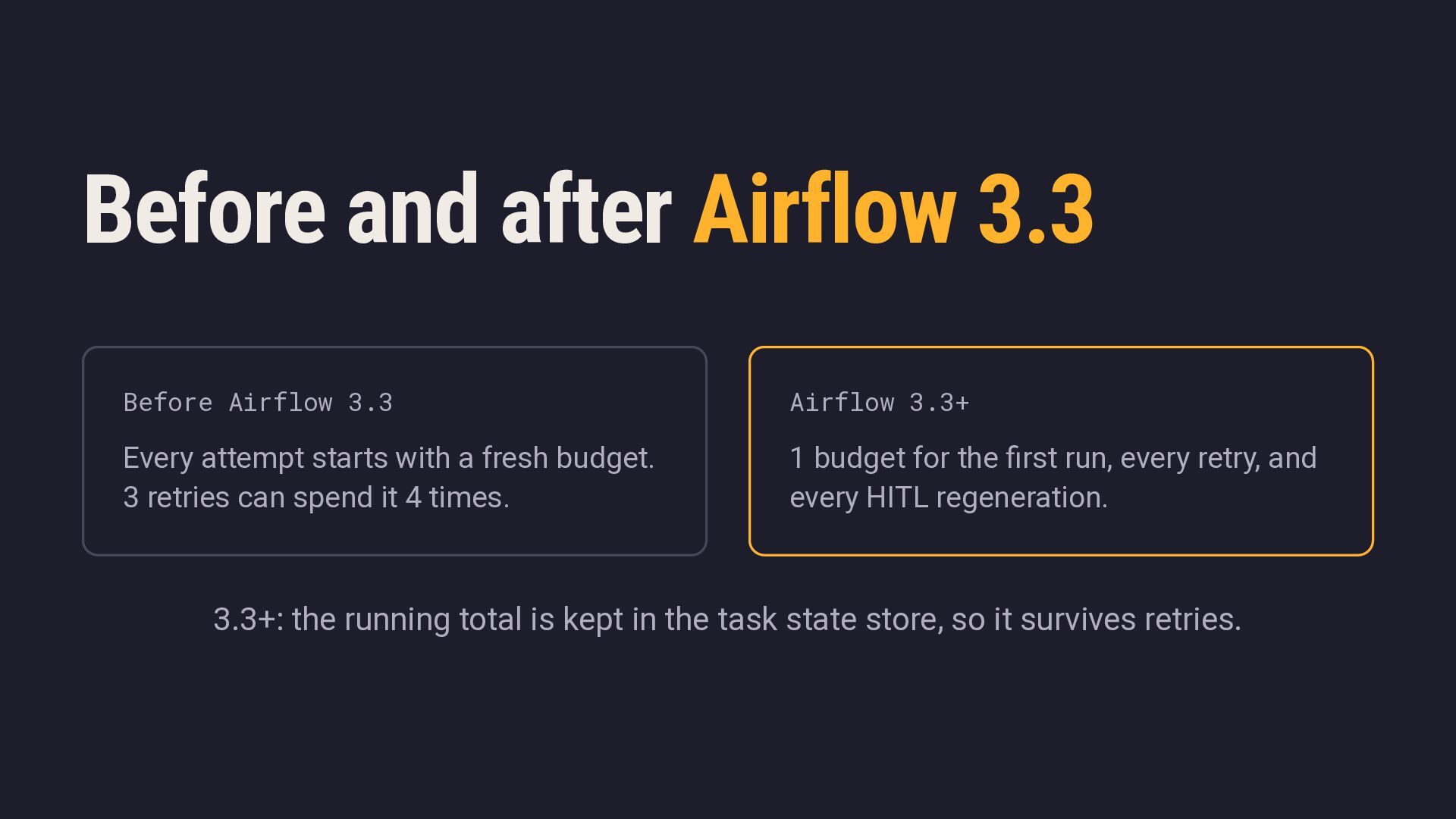
  49. Before and after Airflow 3.3 Before Airflow 3.3 Airflow 3.3+

    Every attempt starts with a fresh budget. 3 retries can spend it 4 times. 1 budget for the first run, every retry, and every HITL regeneration. 3.3+: the running total is kept in the task state store, so it survives retries.
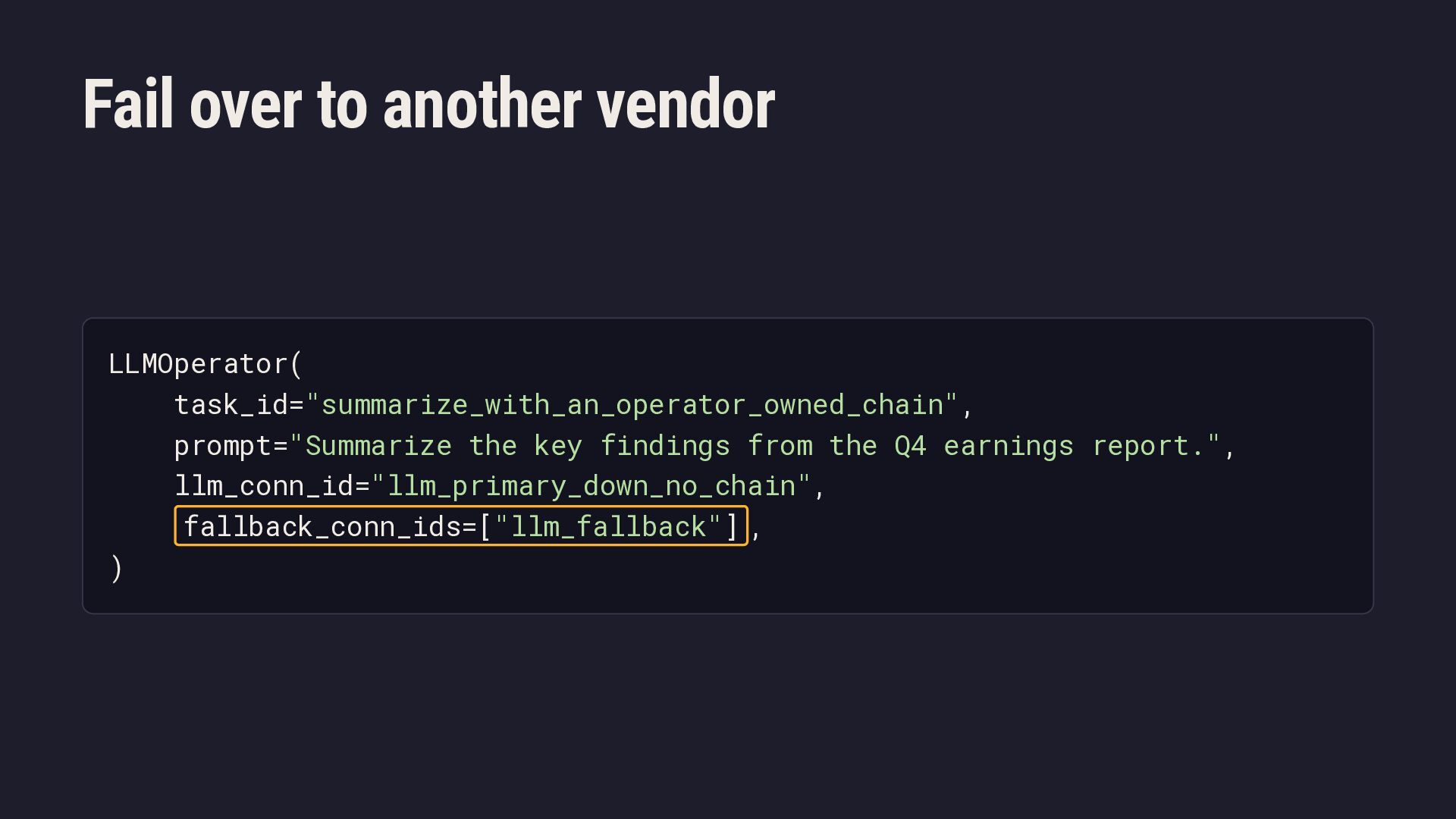
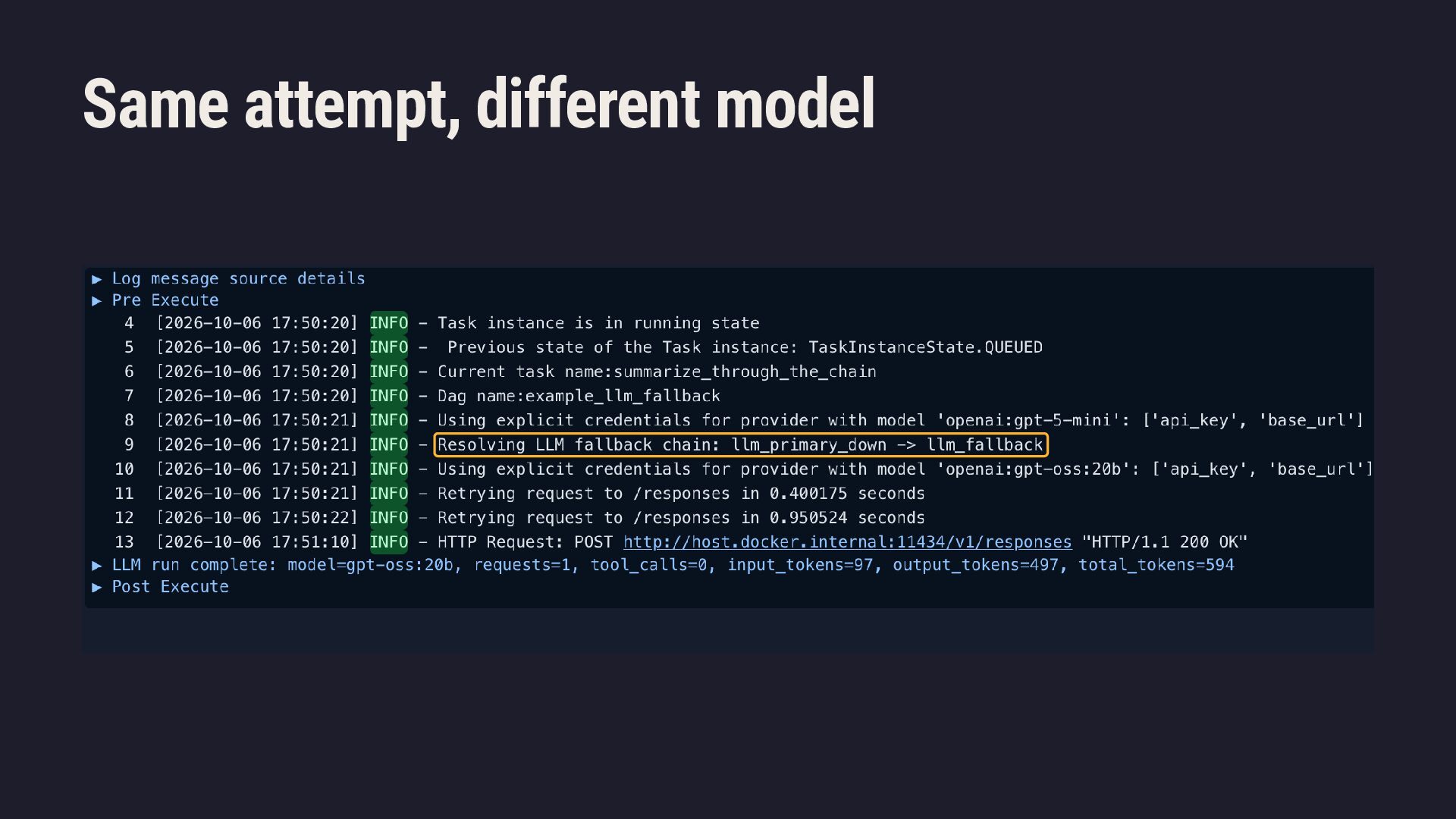
  50. Fail over to another vendor LLMOperator( task_id="summarize_with_an_operator_owned_chain", prompt="Summarize the key

    findings from the Q4 earnings report.", llm_conn_id="llm_primary_down_no_chain", fallback_conn_ids=["llm_fallback"] , )
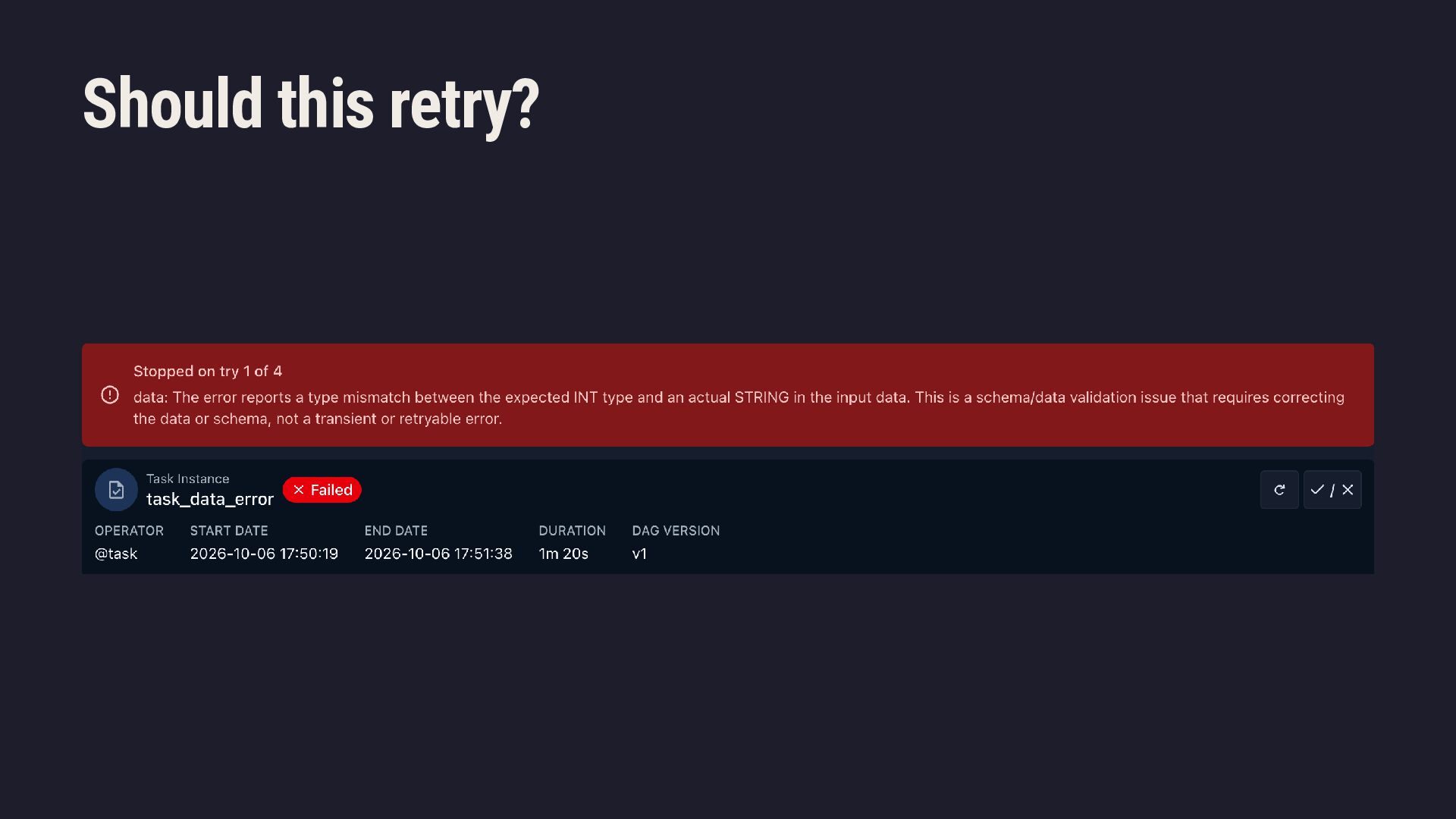
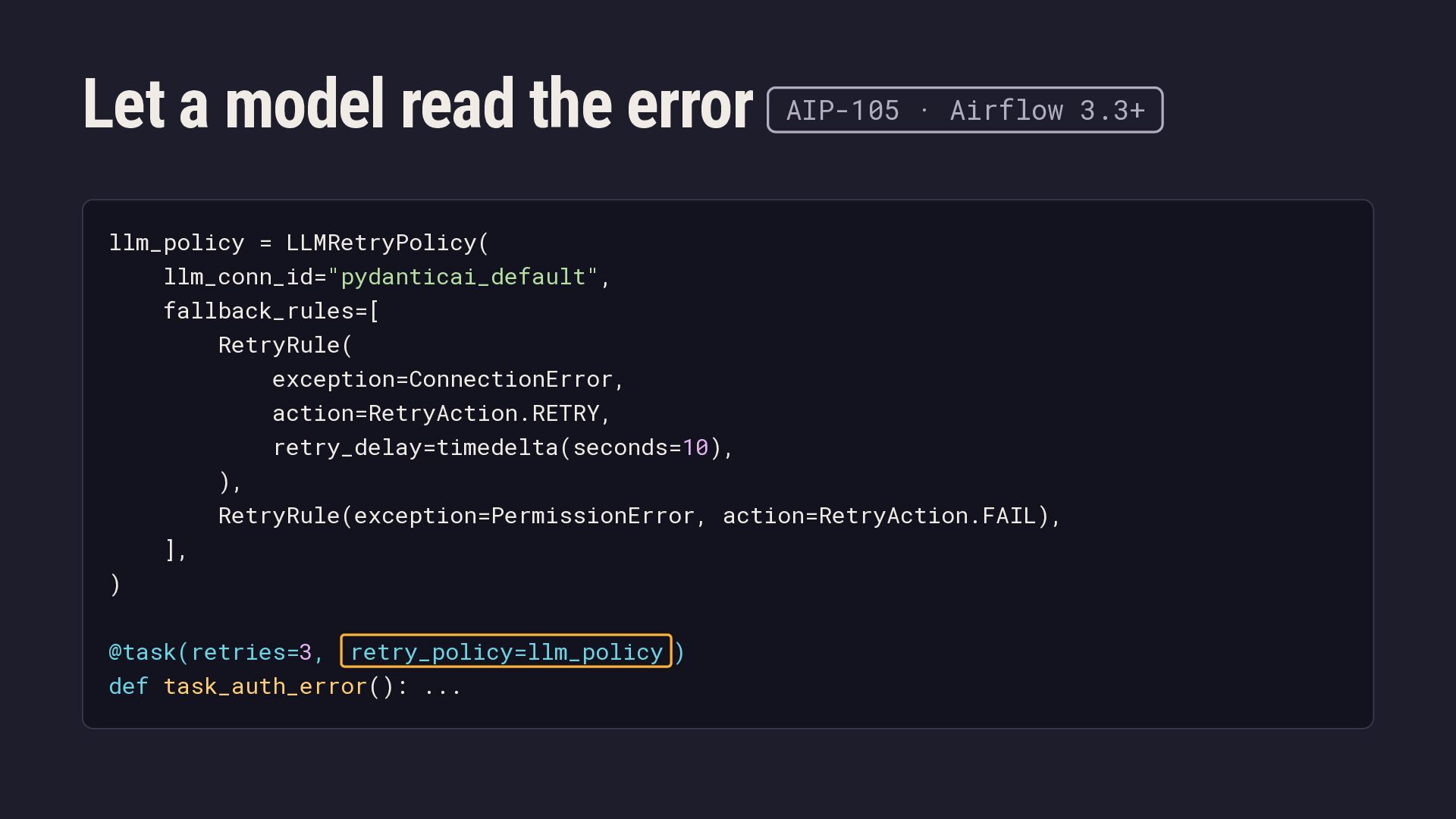
  51. Let a model read the error AIP-105 · Airflow 3.3+

    llm_policy = LLMRetryPolicy( llm_conn_id="pydanticai_default", fallback_rules=[ RetryRule( exception=ConnectionError, action=RetryAction.RETRY, retry_delay=timedelta(seconds=10), ), RetryRule(exception=PermissionError, action=RetryAction.FAIL), ], ) @task(retries=3, retry_policy=llm_policy ) def task_auth_error(): ...
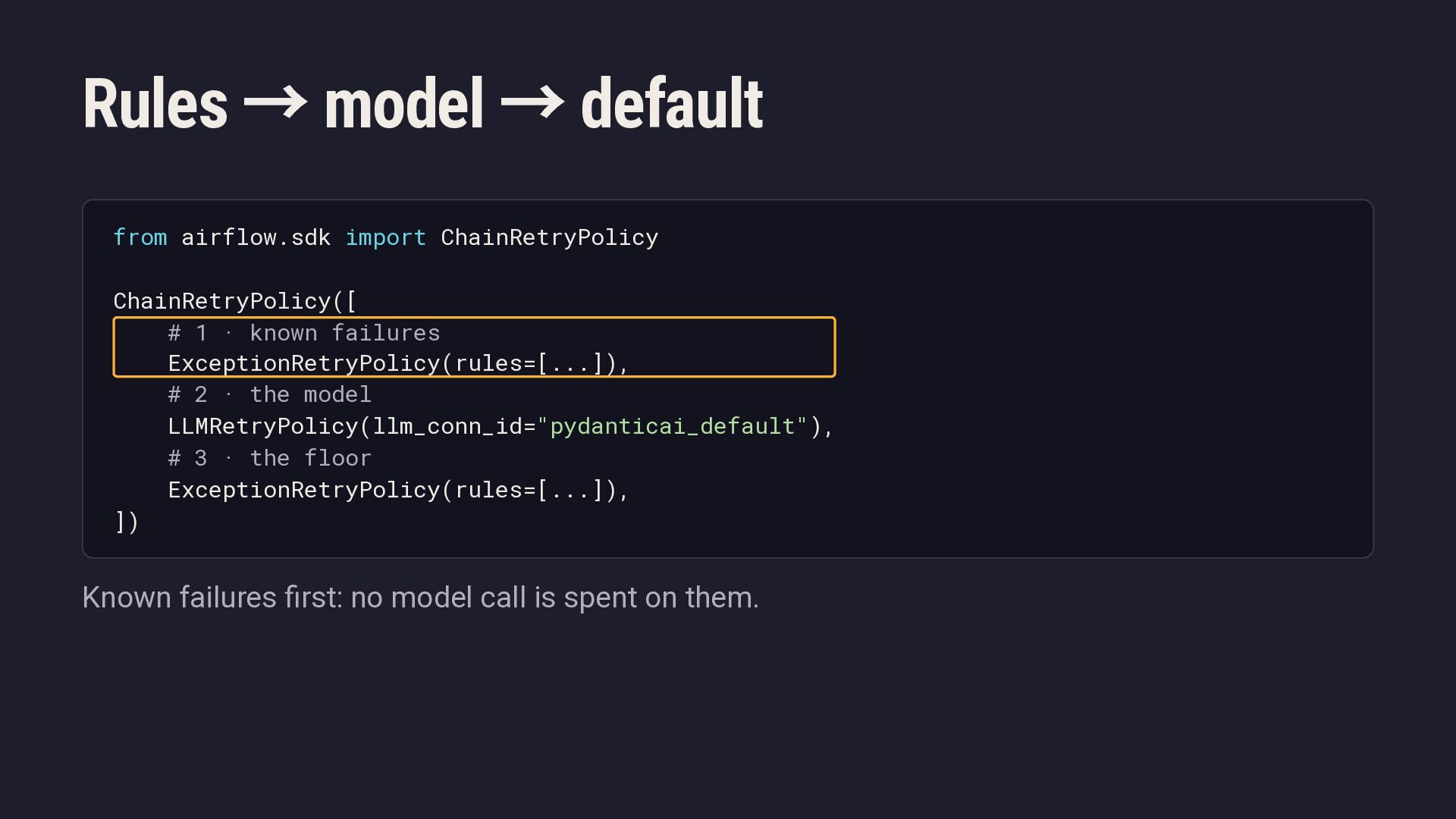
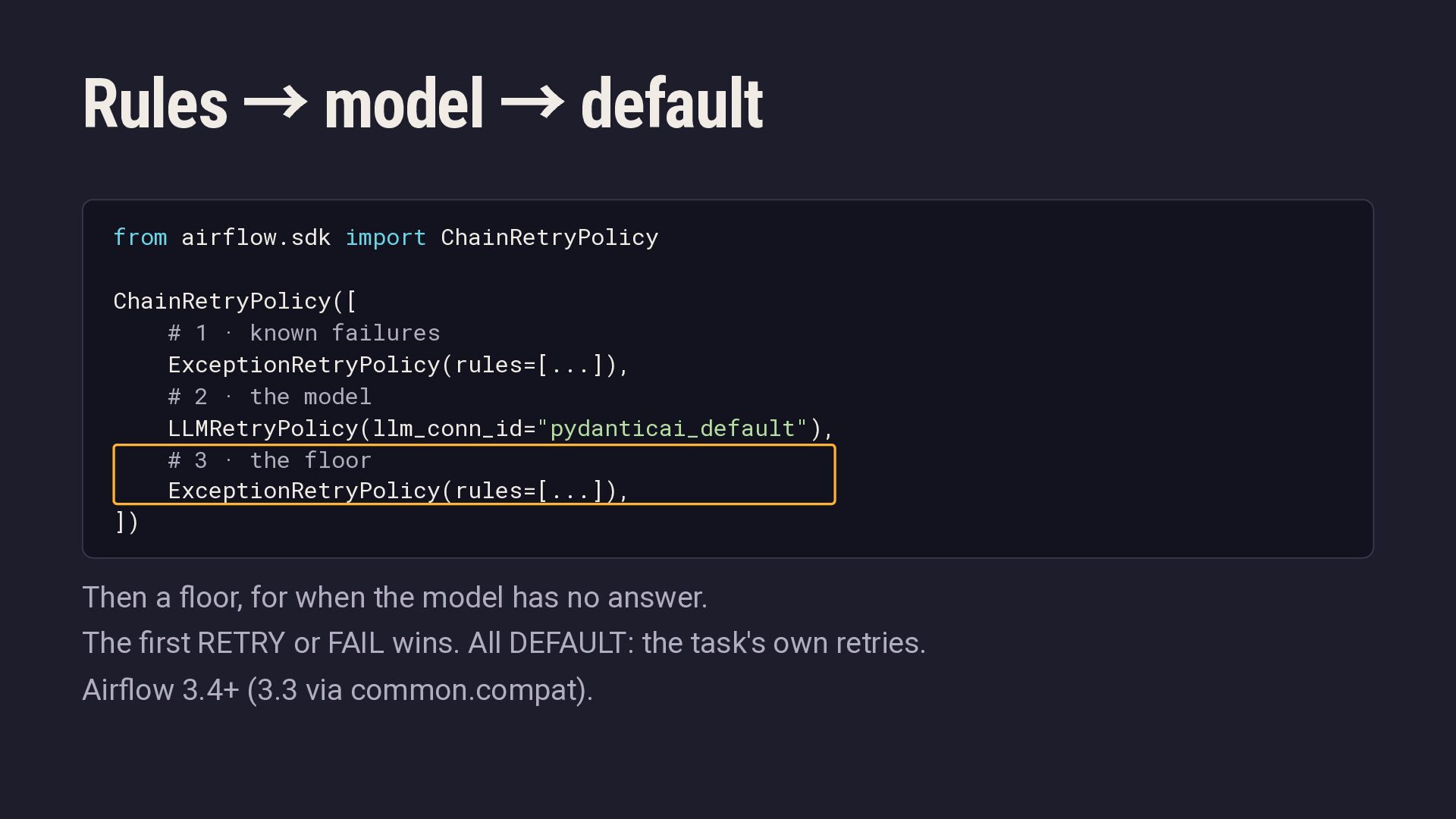
  52. Rules → model → default from airflow.sdk import ChainRetryPolicy ChainRetryPolicy([

    # 1 · known failures ExceptionRetryPolicy(rules=[...]), # 2 · the model LLMRetryPolicy(llm_conn_id="pydanticai_default"), # 3 · the floor ExceptionRetryPolicy(rules=[...]), ]) Known failures first: no model call is spent on them.
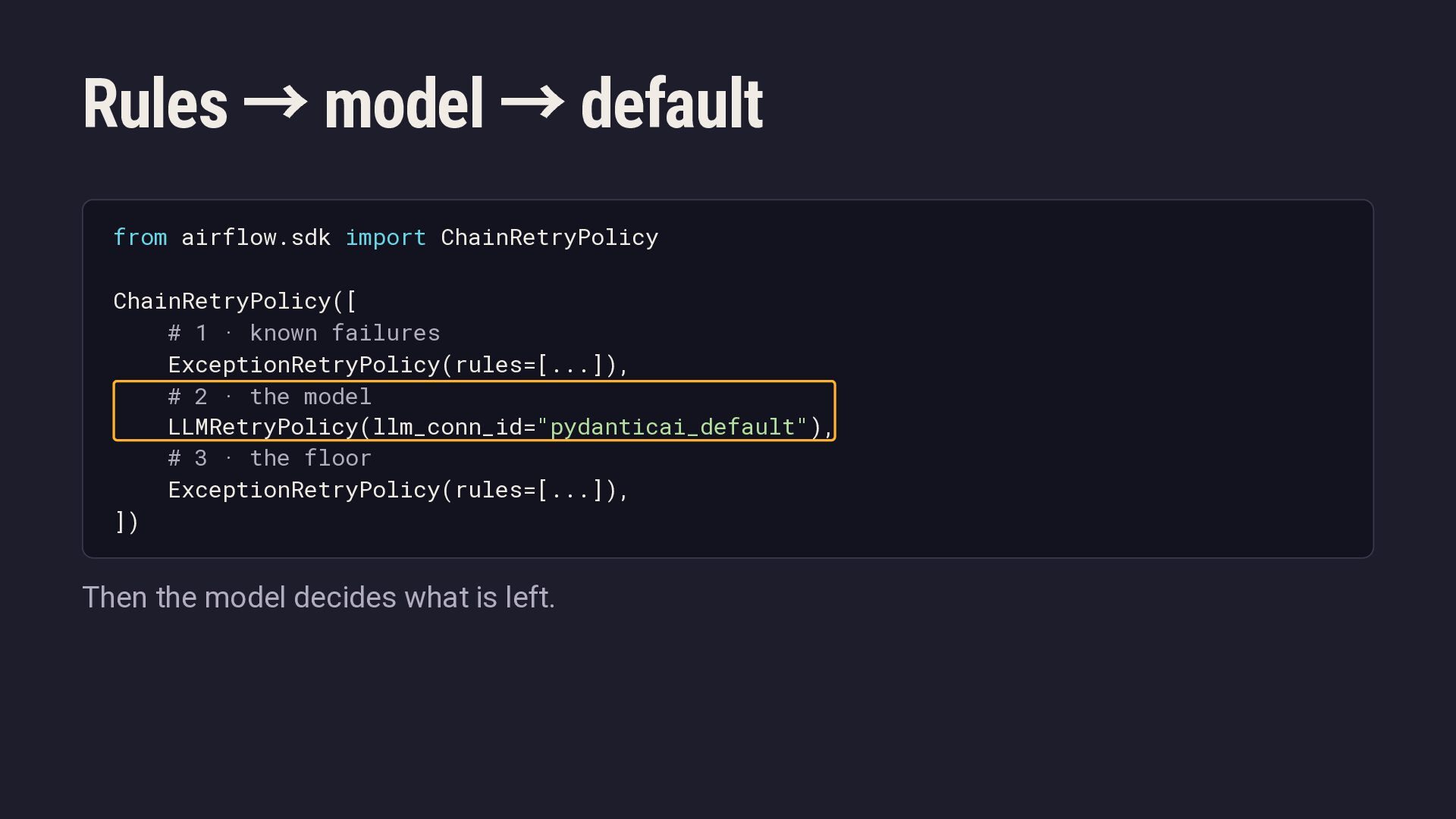
  53. Rules → model → default from airflow.sdk import ChainRetryPolicy ChainRetryPolicy([

    # 1 · known failures ExceptionRetryPolicy(rules=[...]), # 2 · the model LLMRetryPolicy(llm_conn_id="pydanticai_default"), # 3 · the floor ExceptionRetryPolicy(rules=[...]), ]) Then the model decides what is left.
  54. Rules → model → default from airflow.sdk import ChainRetryPolicy ChainRetryPolicy([

    # 1 · known failures ExceptionRetryPolicy(rules=[...]), # 2 · the model LLMRetryPolicy(llm_conn_id="pydanticai_default"), # 3 · the floor ExceptionRetryPolicy(rules=[...]), ]) Then a floor, for when the model has no answer. The first RETRY or FAIL wins. All DEFAULT: the task's own retries. Airflow 3.4+ (3.3 via common.compat).
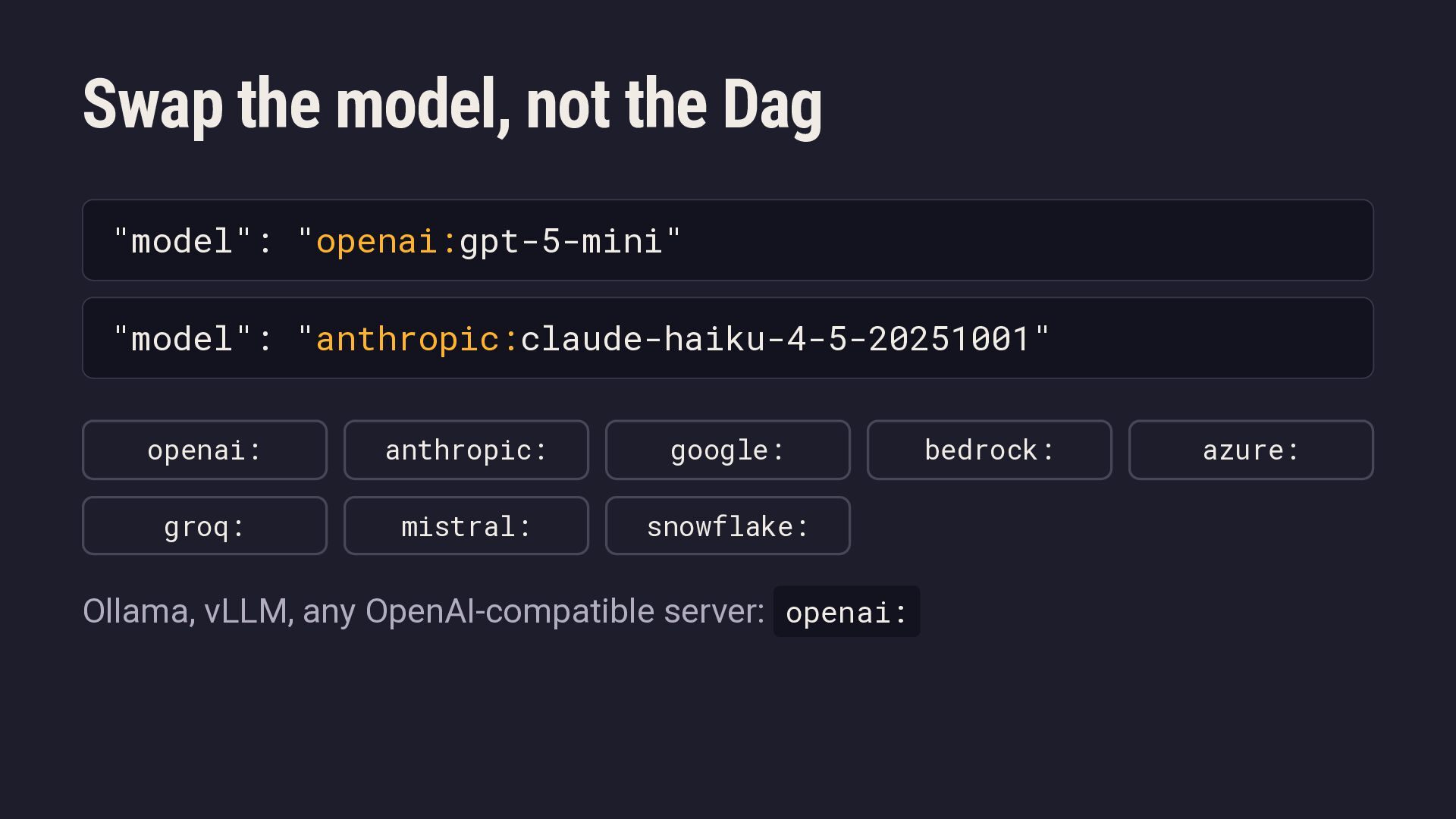
  55. Swap the model, not the Dag "model": "openai:gpt-5-mini" "model": "anthropic:claude-haiku-4-5-20251001"

    openai: anthropic: google: groq: mistral: snowflake: Ollama, vLLM, any OpenAI-compatible server: openai: bedrock: azure:
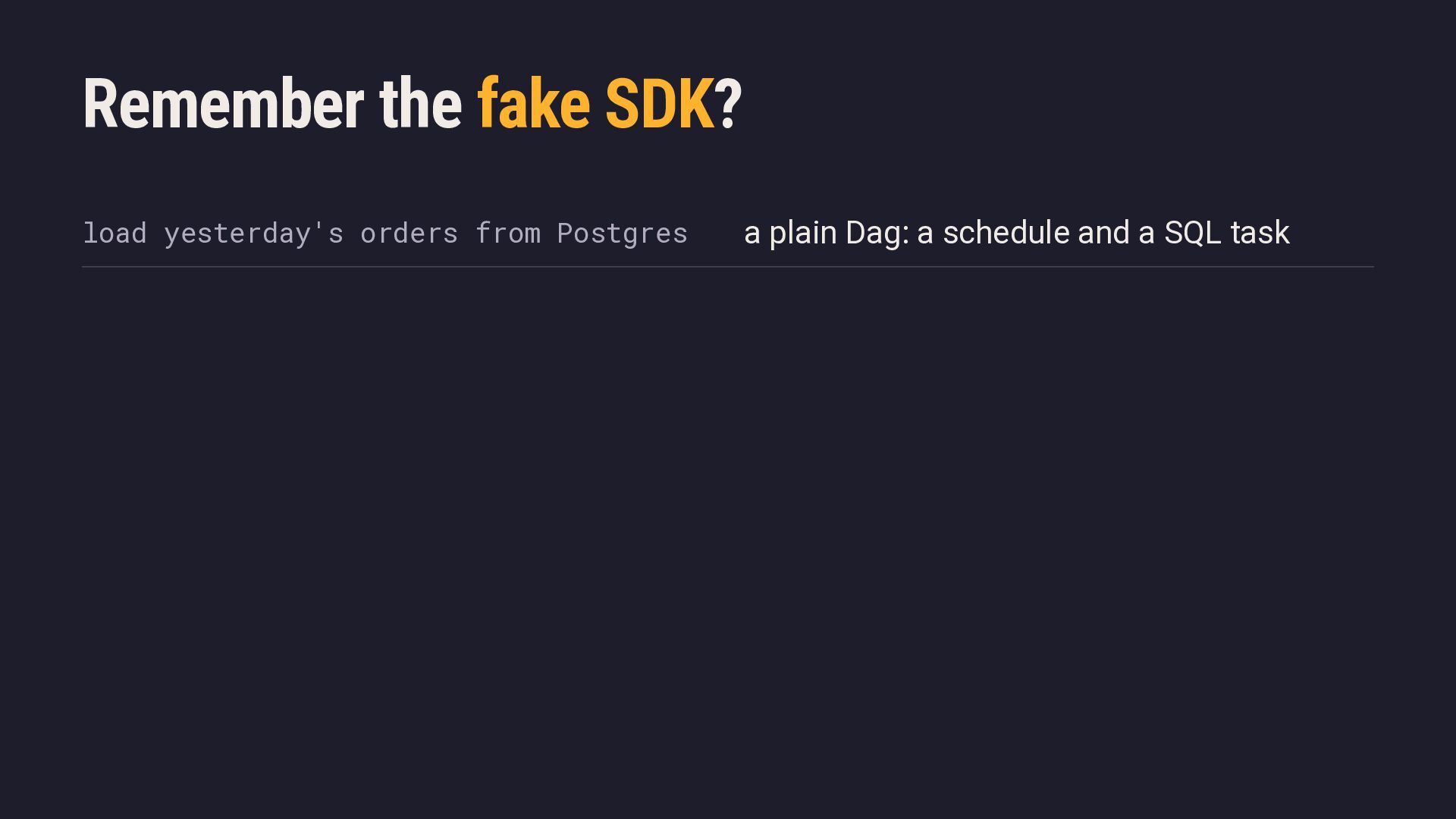
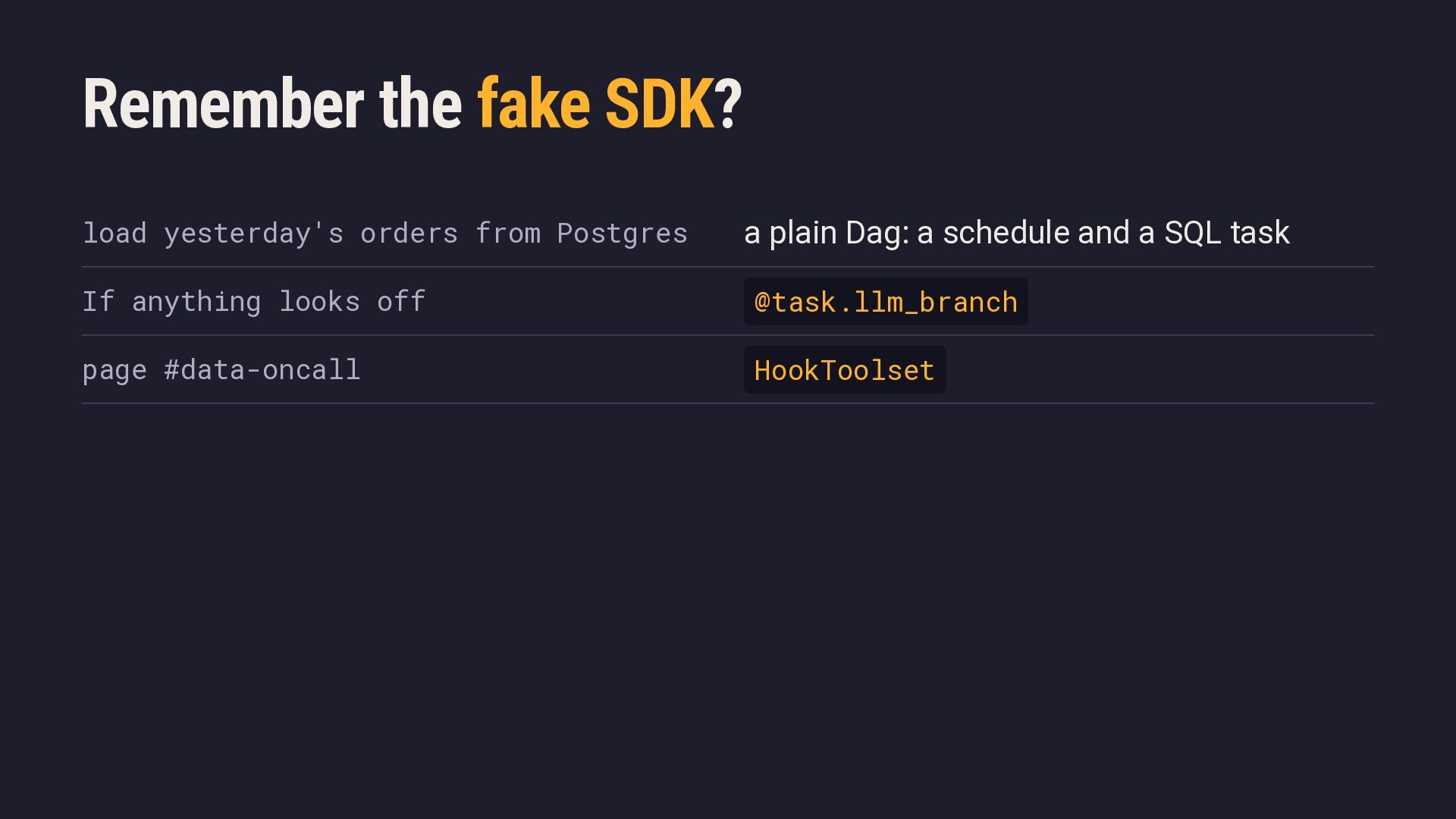
  56. Remember the fake SDK? load yesterday's orders from Postgres a

    plain Dag: a schedule and a SQL task If anything looks off @task.llm_branch
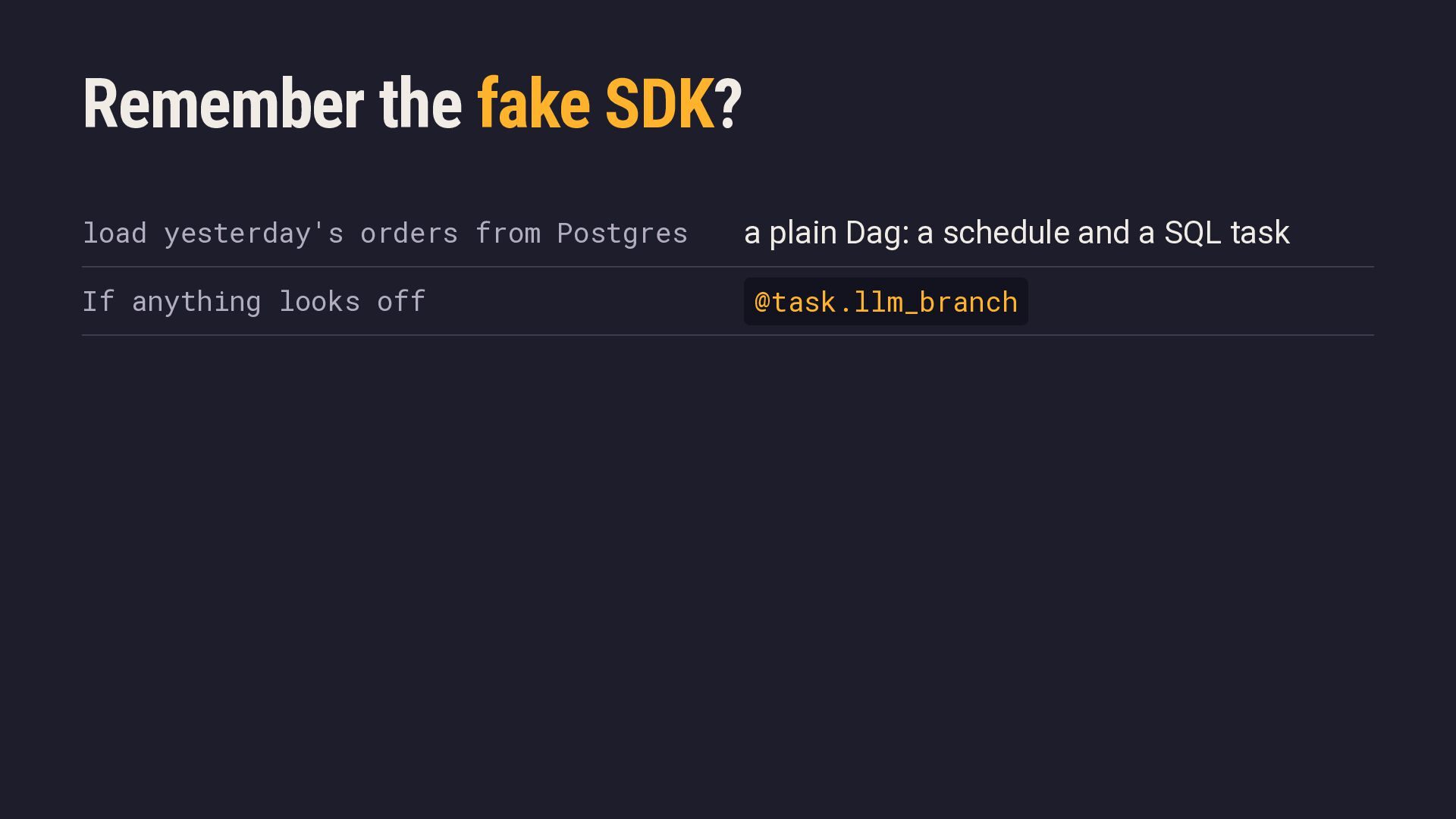
  57. Remember the fake SDK? load yesterday's orders from Postgres a

    plain Dag: a schedule and a SQL task If anything looks off @task.llm_branch page #data-oncall HookToolset
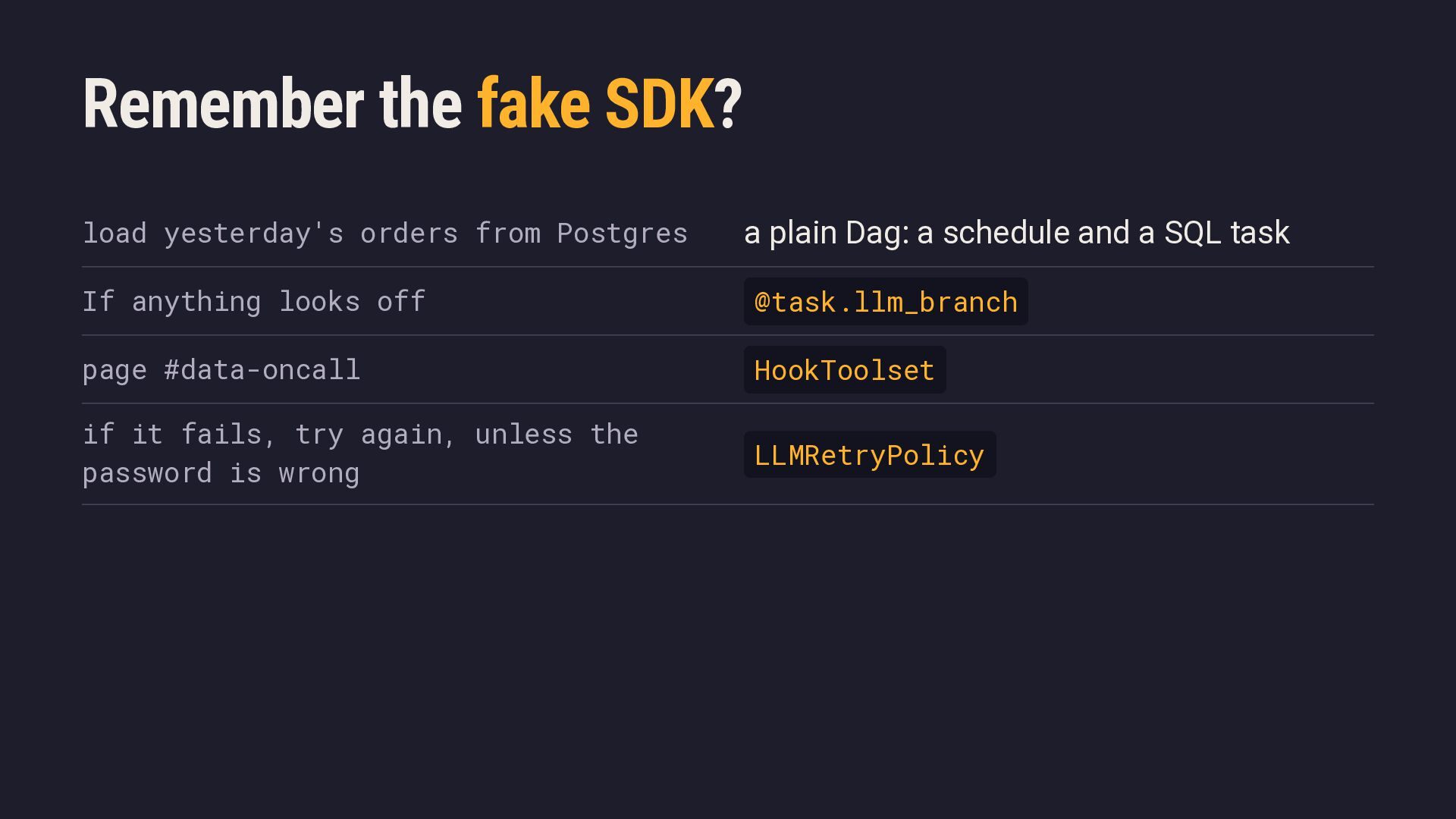
  58. Remember the fake SDK? load yesterday's orders from Postgres a

    plain Dag: a schedule and a SQL task If anything looks off @task.llm_branch page #data-oncall HookToolset if it fails, try again, unless the password is wrong LLMRetryPolicy
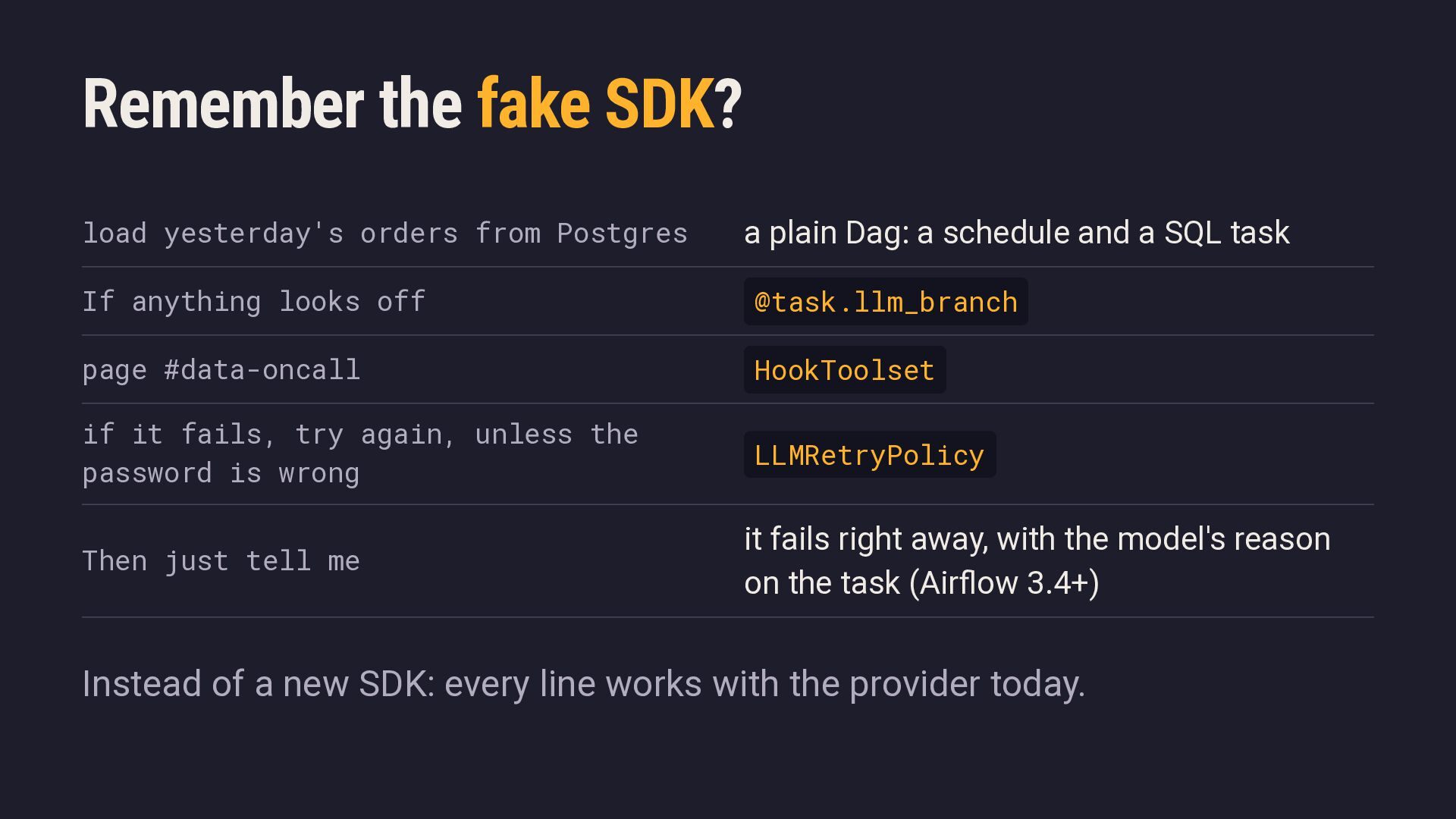
  59. Remember the fake SDK? load yesterday's orders from Postgres a

    plain Dag: a schedule and a SQL task If anything looks off @task.llm_branch page #data-oncall HookToolset if it fails, try again, unless the password is wrong LLMRetryPolicy Then just tell me it fails right away, with the model's reason on the task (Airflow 3.4+) Instead of a new SDK: every line works with the provider today.
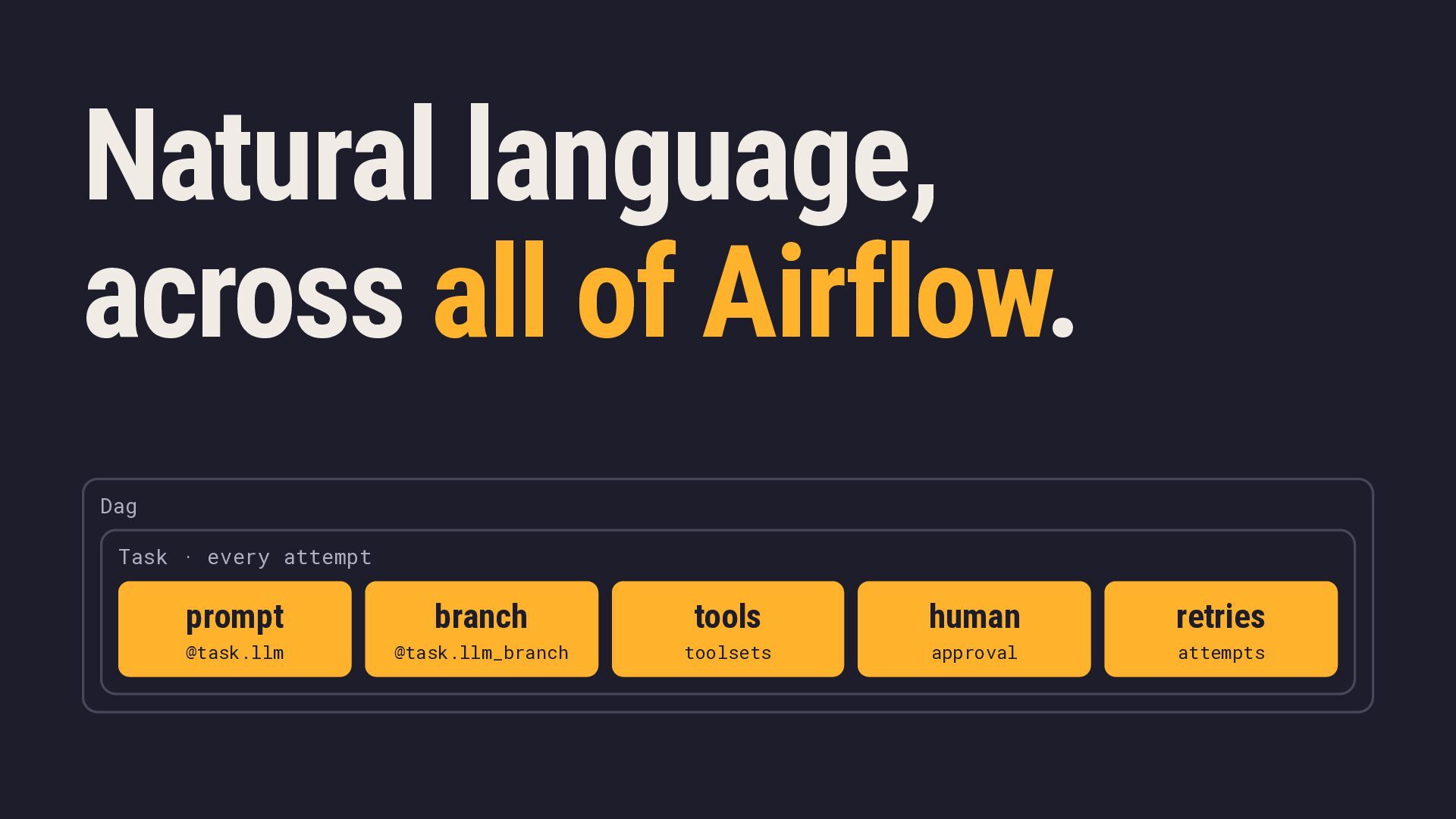
  60. Natural language, across all of Airflow. Dag Task · every

    attempt prompt branch tools human retries @task.llm @task.llm_branch toolsets approval attempts
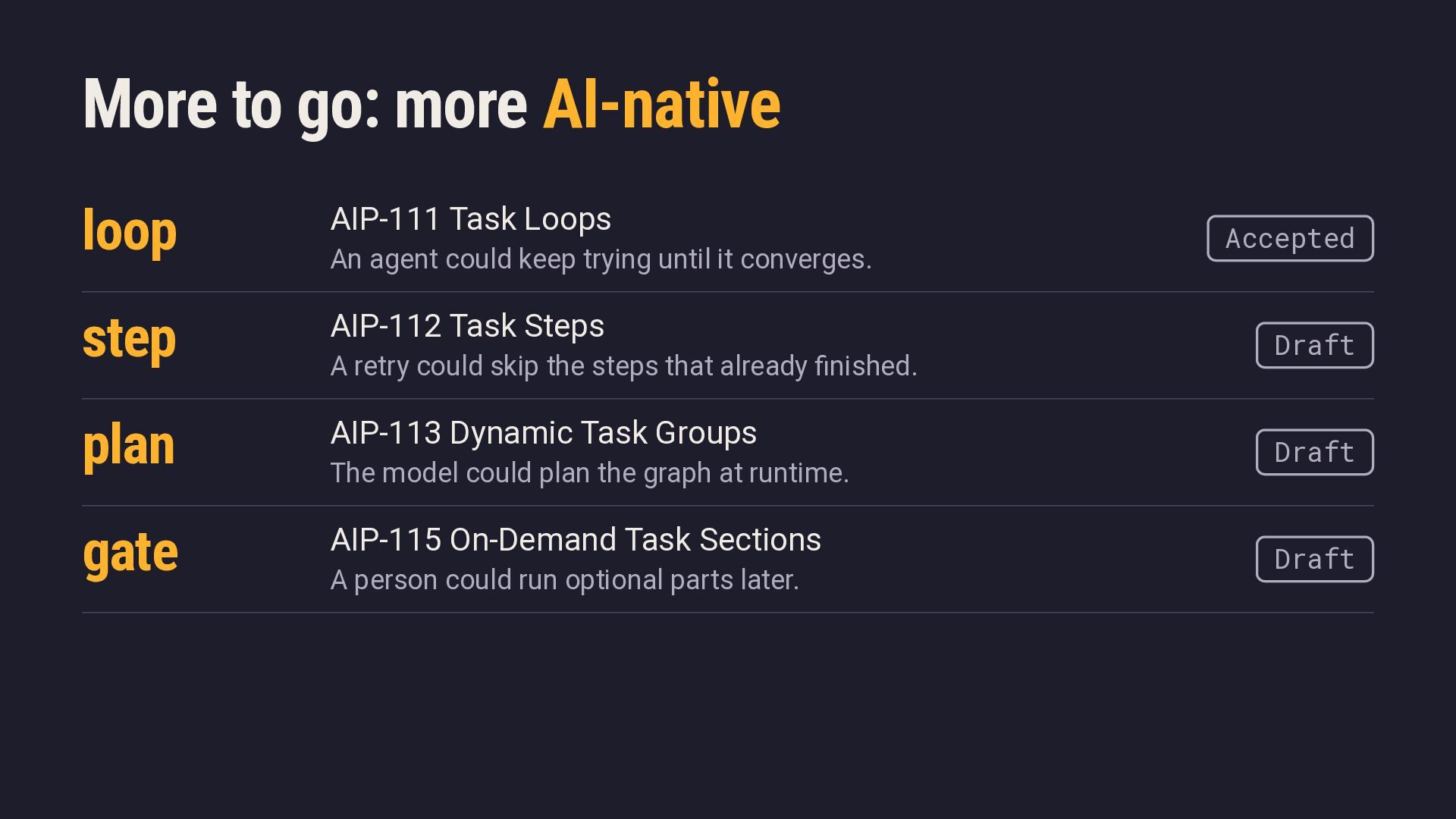
  61. More to go: more AI-native loop AIP-111 Task Loops step

    AIP-112 Task Steps plan AIP-113 Dynamic Task Groups gate AIP-115 On-Demand Task Sections An agent could keep trying until it converges. A retry could skip the steps that already finished. The model could plan the graph at runtime. A person could run optional parts later. Accepted Draft Draft Draft