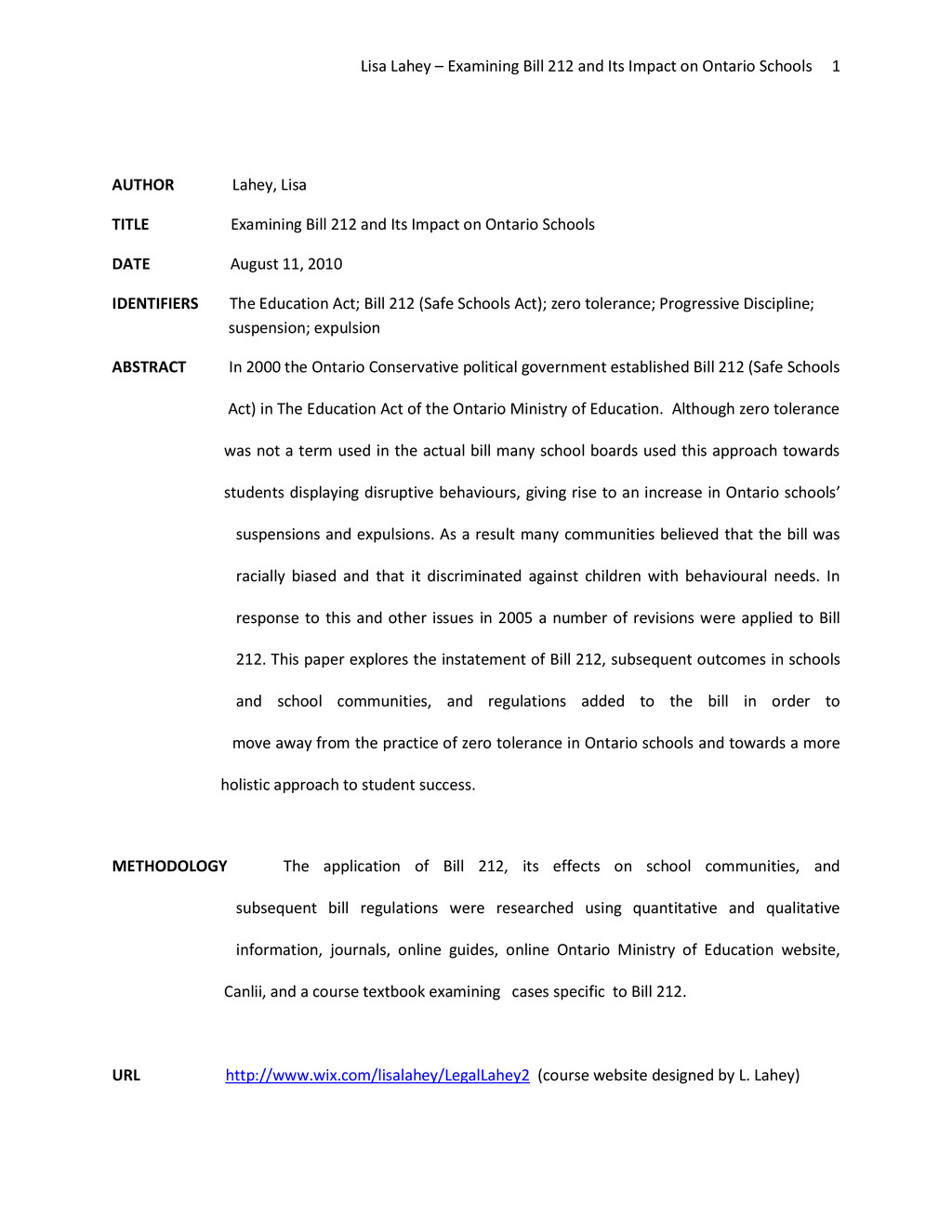
Ontario Schools 1 AUTHOR Lahey, Lisa TITLE Examining Bill 212 and Its Impact on Ontario Schools DATE August 11, 2010 IDENTIFIERS The Education Act; Bill 212 (Safe Schools Act); zero tolerance; Progressive Discipline; suspension; expulsion ABSTRACT In 2000 the Ontario Conservative political government established Bill 212 (Safe Schools Act) in The Education Act of the Ontario Ministry of Education. Although zero tolerance was not a term used in the actual bill many school boards used this approach towards students displaying disruptive behaviours, giving rise to an increase in Ontario schools’ suspensions and expulsions. As a result many communities believed that the bill was racially biased and that it discriminated against children with behavioural needs. In response to this and other issues in 2005 a number of revisions were applied to Bill 212. This paper explores the instatement of Bill 212, subsequent outcomes in schools and school communities, and regulations added to the bill in order to move away from the practice of zero tolerance in Ontario schools and towards a more holistic approach to student success. METHODOLOGY The application of Bill 212, its effects on school communities, and subsequent bill regulations were researched using quantitative and qualitative information, journals, online guides, online Ontario Ministry of Education website, Canlii, and a course textbook examining cases specific to Bill 212. URL http://www.wix.com/lisalahey/LegalLahey2 (course website designed by L. Lahey)
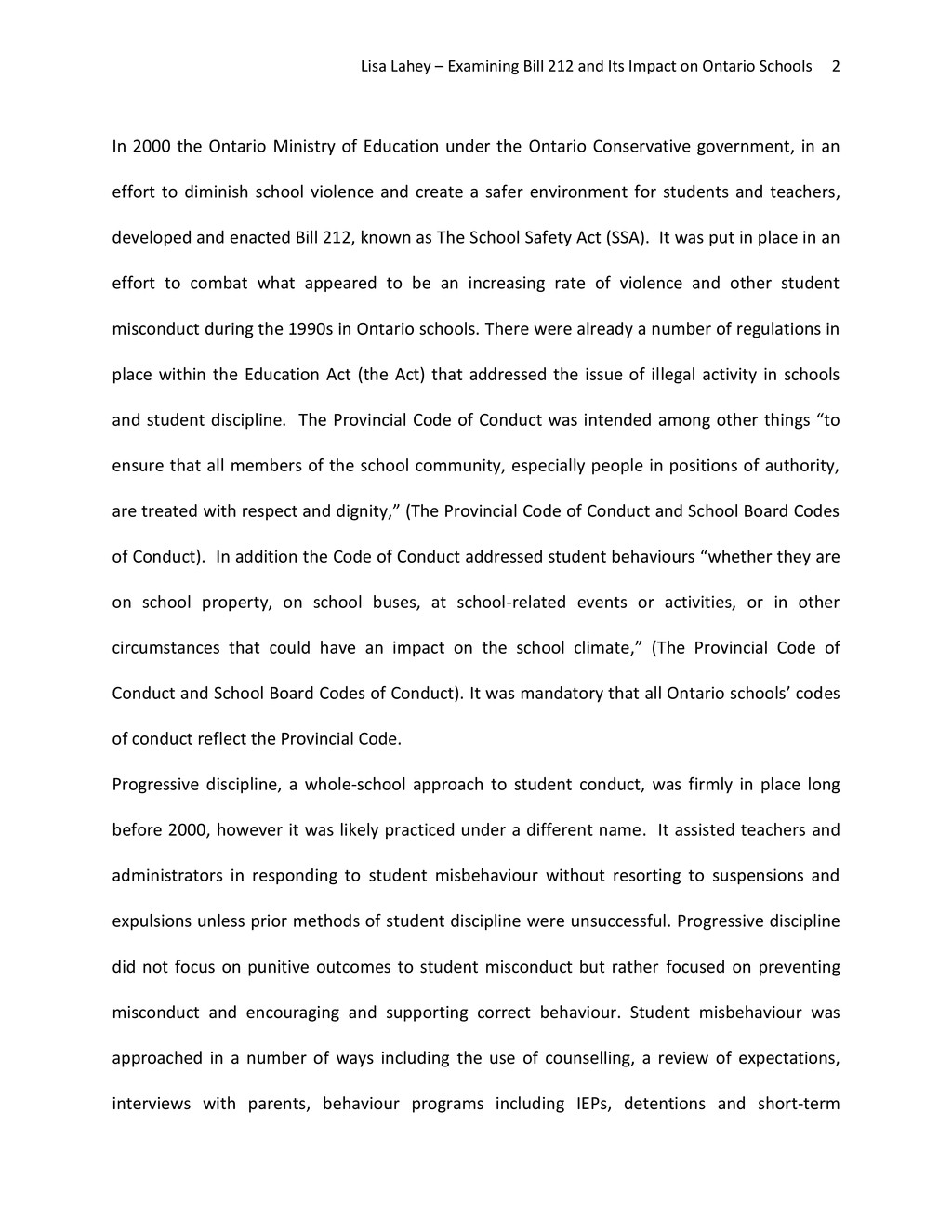
Ontario Schools 2 In 2000 the Ontario Ministry of Education under the Ontario Conservative government, in an effort to diminish school violence and create a safer environment for students and teachers, developed and enacted Bill 212, known as The School Safety Act (SSA). It was put in place in an effort to combat what appeared to be an increasing rate of violence and other student misconduct during the 1990s in Ontario schools. There were already a number of regulations in place within the Education Act (the Act) that addressed the issue of illegal activity in schools and student discipline. The Provincial Code of Conduct was intended among other things “to ensure that all members of the school community, especially people in positions of authority, are treated with respect and dignity,” (The Provincial Code of Conduct and School Board Codes of Conduct). In addition the Code of Conduct addressed student behaviours “whether they are on school property, on school buses, at school-related events or activities, or in other circumstances that could have an impact on the school climate,” (The Provincial Code of Conduct and School Board Codes of Conduct). It was mandatory that all Ontario schools’ codes of conduct reflect the Provincial Code. Progressive discipline, a whole-school approach to student conduct, was firmly in place long before 2000, however it was likely practiced under a different name. It assisted teachers and administrators in responding to student misbehaviour without resorting to suspensions and expulsions unless prior methods of student discipline were unsuccessful. Progressive discipline did not focus on punitive outcomes to student misconduct but rather focused on preventing misconduct and encouraging and supporting correct behaviour. Student misbehaviour was approached in a number of ways including the use of counselling, a review of expectations, interviews with parents, behaviour programs including IEPs, detentions and short-term
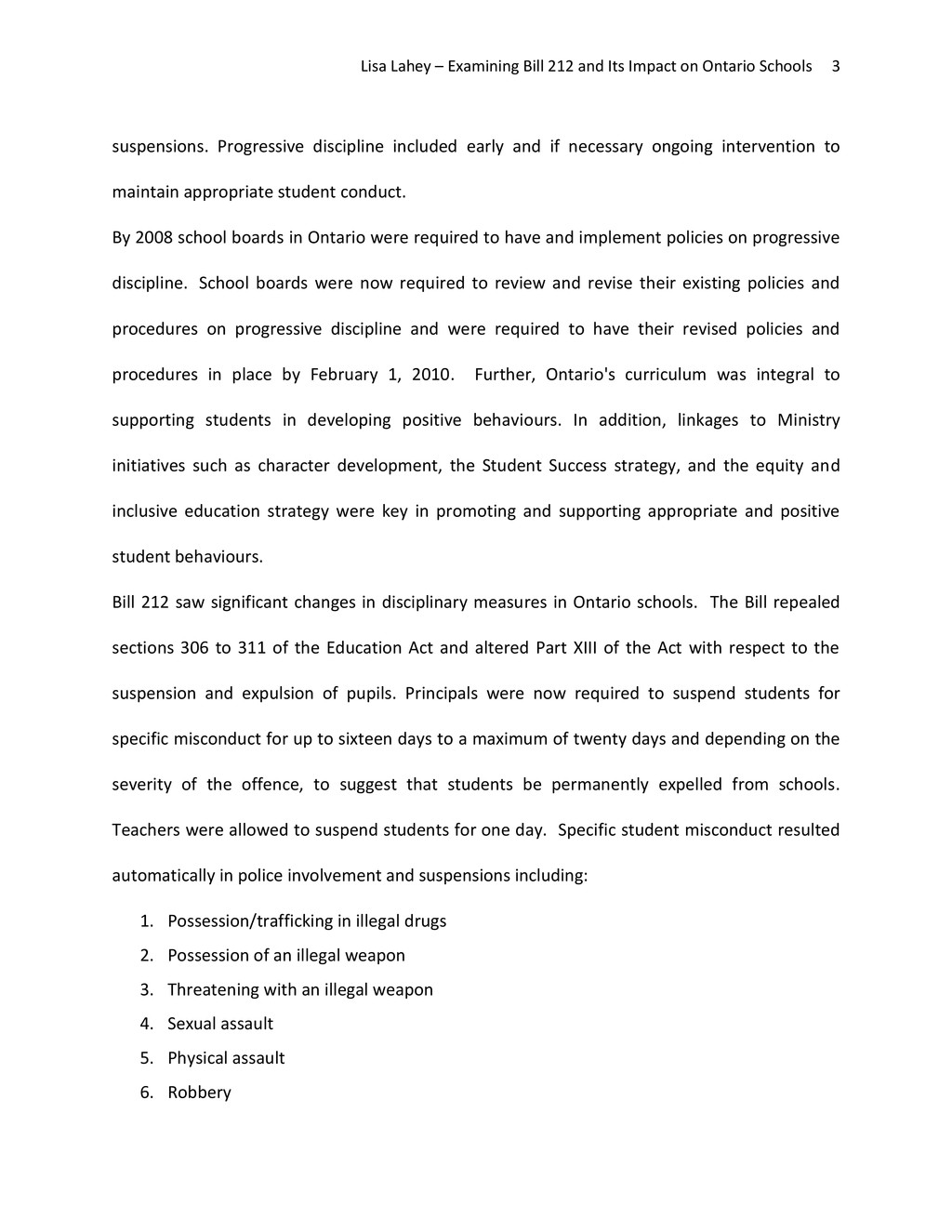
Ontario Schools 3 suspensions. Progressive discipline included early and if necessary ongoing intervention to maintain appropriate student conduct. By 2008 school boards in Ontario were required to have and implement policies on progressive discipline. School boards were now required to review and revise their existing policies and procedures on progressive discipline and were required to have their revised policies and procedures in place by February 1, 2010. Further, Ontario's curriculum was integral to supporting students in developing positive behaviours. In addition, linkages to Ministry initiatives such as character development, the Student Success strategy, and the equity and inclusive education strategy were key in promoting and supporting appropriate and positive student behaviours. Bill 212 saw significant changes in disciplinary measures in Ontario schools. The Bill repealed sections 306 to 311 of the Education Act and altered Part XIII of the Act with respect to the suspension and expulsion of pupils. Principals were now required to suspend students for specific misconduct for up to sixteen days to a maximum of twenty days and depending on the severity of the offence, to suggest that students be permanently expelled from schools. Teachers were allowed to suspend students for one day. Specific student misconduct resulted automatically in police involvement and suspensions including: 1. Possession/trafficking in illegal drugs 2. Possession of an illegal weapon 3. Threatening with an illegal weapon 4. Sexual assault 5. Physical assault 6. Robbery
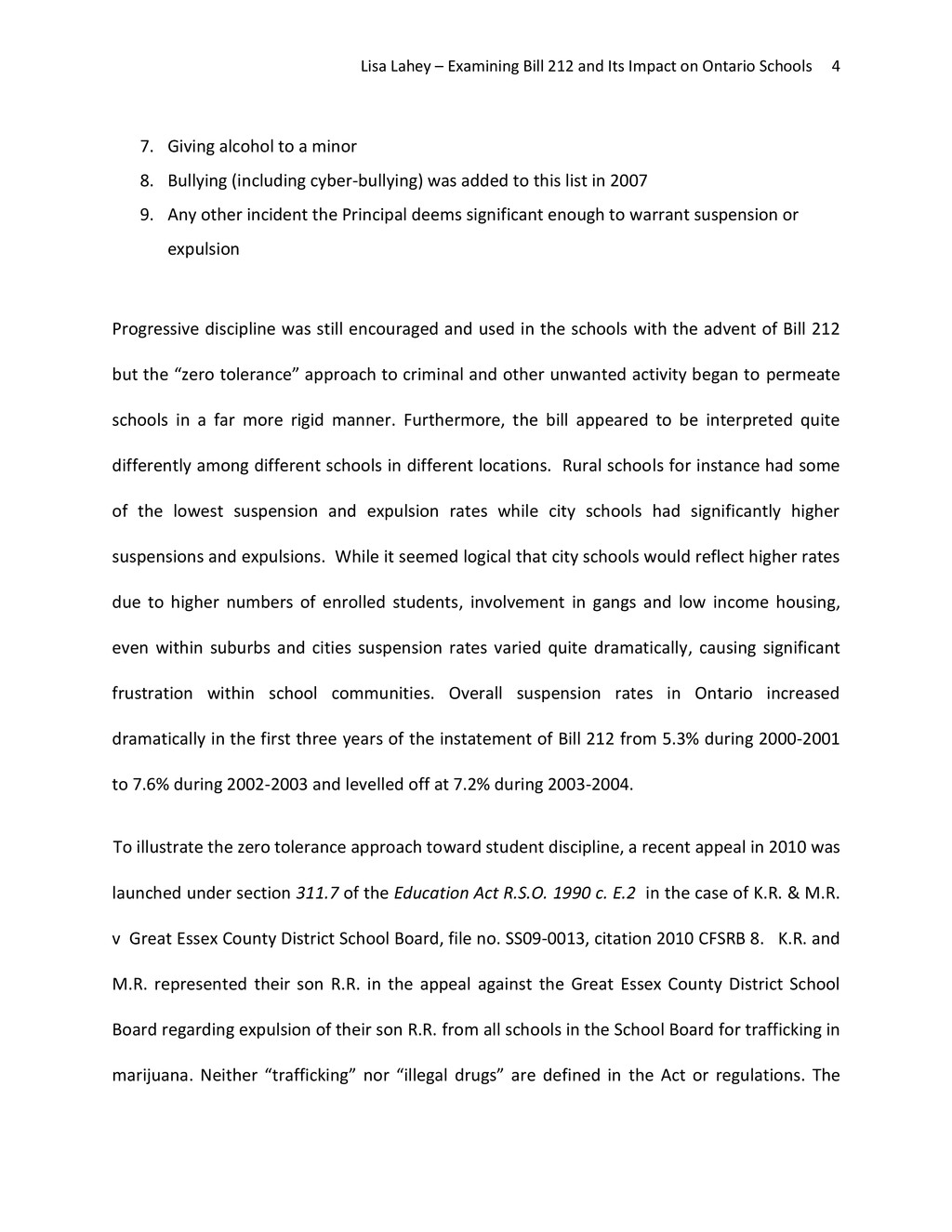
Ontario Schools 4 7. Giving alcohol to a minor 8. Bullying (including cyber-bullying) was added to this list in 2007 9. Any other incident the Principal deems significant enough to warrant suspension or expulsion Progressive discipline was still encouraged and used in the schools with the advent of Bill 212 but the “zero tolerance” approach to criminal and other unwanted activity began to permeate schools in a far more rigid manner. Furthermore, the bill appeared to be interpreted quite differently among different schools in different locations. Rural schools for instance had some of the lowest suspension and expulsion rates while city schools had significantly higher suspensions and expulsions. While it seemed logical that city schools would reflect higher rates due to higher numbers of enrolled students, involvement in gangs and low income housing, even within suburbs and cities suspension rates varied quite dramatically, causing significant frustration within school communities. Overall suspension rates in Ontario increased dramatically in the first three years of the instatement of Bill 212 from 5.3% during 2000-2001 to 7.6% during 2002-2003 and levelled off at 7.2% during 2003-2004. To illustrate the zero tolerance approach toward student discipline, a recent appeal in 2010 was launched under section 311.7 of the Education Act R.S.O. 1990 c. E.2 in the case of K.R. & M.R. v Great Essex County District School Board, file no. SS09-0013, citation 2010 CFSRB 8. K.R. and M.R. represented their son R.R. in the appeal against the Great Essex County District School Board regarding expulsion of their son R.R. from all schools in the School Board for trafficking in marijuana. Neither “trafficking” nor “illegal drugs” are defined in the Act or regulations. The
Ontario Schools 5 reference to “illegal” drugs requires reference to the criminal law,” (Canlii, 2010). At the time of the offence, R.R. was a special needs student, identified by the school’s IPRC as having Communication-Learning Disability and he had difficulty in visual processing. In addition to the learning disability R.R. took medications for ADHD. In November 2009, R.R. brought marijuana to the “smoke pit” that was off school property yet monitored by the Vice Principals at various times during the school day. The smoking pit was city property and not school property, meaning R.R. did not commit the infraction on school property. The school was aware that the smoke pit was a place where drug trafficking took place and took prompt actions when such activity was discovered. R.R. sold marijuana to a number of his peers, who then brought the marijuana into school with them. Two of the students attended class while “high” on the drug sold by R.R. The school administrator responded by suspending R.R. for twenty days then recommending expulsion from all schools in the Great Essex County District School Board. Expulsion from all schools in the board was upheld. R.R.’s appeal emphasized a number of relevant facts that may or may not have been considered in R.R.’s case. He had a good relationship with his special education teacher and displayed satisfactory attendance. He had no previous incidents involving illegal drugs on school property. R.R. attended drug counselling therapy during his suspension and it was noted that there was a lack of progressive discipline in relation to his offence. The Board decided that R.R.’s actions indeed impacted on the school climate but that his continued presence in the school would not create an unacceptable risk to anyone’s safety
Ontario Schools 6 adhering to section 2.3 of Regulation 472/07 under the Act wherein “the risk must be an ‘unacceptable’ one, ” (Canlii, 2010). This was not true of R.R.’s offence and character. Further, by allowing minors to use the pit for smoking the school also committed an illegal infraction which the Board recognized as a stronger risk than the pupil’s “one-time activity.” The Board quashed the expulsion, expunged it from R.R.’s student record and reinstated R.R. into the school. The most significant factor in this case was the lack of progressive discipline in response to R.R.’s offence and the Board decided this approach hearkened back to zero tolerance. Several complaints came forth from school communities in regard to the zero tolerance approach to education in Ontario. It was generally argued that students in low income housing, those who had behavioural disabilities and those students who were African-Canadian (black) males experienced the consequences of Bill 212 far more than privileged white students without behavioural challenges. In the appeal of K.B. and T.M. v. Toronto District School Board, 2008 CanLII 6875 (ON S.C.D.C.), the issue of race was emphasized in an effort to gain a judicial review transferring both K.B. and T.M. from Emergy Collegiate Institute. K.M., represented by his litigation guardian R.N. and T.M. represented by his litigation guardian P.A., were both African Canadian males. At the time of the offence K.M. was in grade nine and T.M. was in grade twelve. On November 1 2005, K.B. and T.M. assaulted a student named E.F. T.M. slapped E.F. in the face, and E.F. responded by punching T.M. K.B. kicked E.F. then T.M. threw E.F. into the window of a school door, shattering the glass. Two other students, A.B. and C.D. were in attendance. After T.M. threw E.F. he regained his footing and ran away.
Ontario Schools 7 E.F. attended the office informing the Vice Principal of the event and stated he wanted the police involved. The four assailants were called to the Principal’s office, who contacted police. The boys were arrested for assault under the Youth Criminal Justice Act, S.C. 2002 c.1. K.B. was also charged with threatening death with a weapon (in this case a loaded gun) and threatening bodily harm to E.F. at a pizza parlor two weeks prior to the school assault. With respect to this threat the Principal drove E.F. home and advised him not to return to school the following day. K.B. likely had access to guns since his older brother had been expelled for bringing a loaded gun to school. As a result of the assault against E.F., both appellants were suspended for a period of sixteen days. The Principal remained concerned about E.F.’s safety should the appellants’ return to Emery. A part of T.M.’s bail conditions were that he was not to come within 500 meters of E.F., thus the Principal was able to refuse T.M. entry into Emery and transfer him to another school. The Principal also did not want K.B. returning to Emery in order to protect E.F. and he transferred K.B. to another school. The Principal made arrangements for the applicants to receive work from Emery until the end of the semester and to write their exams. In addition, section 309 of the Act required a mandatory expulsion in the event of specified infractions. Relevant to this case were threatening death with an illegal weapon and physical assault. The principal was then obligated to impose “a limited expulsion of up to one year or refer the matter to the board (s. 309(7) and (14))”. Counsel for K.B. stated that his suspension had a “racially discriminatory impact”. The applicants argued that societal attitudes towards young, male, African-Canadian students were
Ontario Schools 8 not taken into account by the Principal when he transferred them to another school. They argued the decision was discriminatory, and that it violated the guarantee of equality in s. 15 of the Canadian Charter of Human Rights. However in order to present this argument successfully it was imperative that the appellants establish that legislation subjected them to differential treatment on the basis of a personal characteristic, such as race. They were also required to prove that an “enumerated or analogous ground of discrimination is the basis for the differential treatment,” (CanLii, 2007). The applicants failed to present the necessary evidence and the appeal was dismissed. Clearly the administrator did not demonstrate racial discrimination but this argument has been used inappropriately in a vast number of cases with the instatement of Bill 212. This is not to state that Bill 212 has not been inadequately interpreted or abused in public schools. A Harvard University Civil Rights Report entitled “The Devastating Consequences of Zero Tolerance and School Discipline Policies” detailed several extreme examples of the early use of Bill 212 including: 1. A ninth grade student was expelled from her school for one year and sent to an alternative school because she mistakenly brought “sparklers” to school in her book bag. 2. A kindergarten child was suspended for bringing a toy axe to school as part of his Halloween costume. 3. A six-year-old child was suspended for ten days for bringing a toenail clipper to school. 4. A 15-year-old female student told a teacher she was “going to whip *her+” and was expelled for the remainder of the school year. (Brown & Zuker, 2007, P. 251). This report was published in 2000, the year Bill 212 was enacted. Certainly Canadian
Ontario Schools 9 application of Bill 212 was less extreme than that of the United States however due to community backlash about the rigid application of Bill 212 in Ontario, the Liberal government reviewed the bill in 2005 as suggested by the previous government, and several regulations were added to the bill to prevent unwarranted and unduly harsh punitive measures against students. Working with the Ontario Human Rights Commission, the Liberal government emphasized certain regulations that were already in place in section XIII of the Act and instated new regulations to reduce exclusion of students exhibiting behavioural misconduct. It was acknowledged that emphasizing safety over education “accords neither with the overall purpose of Ontario’s Education Act, nor with the giving of proper weight to administrative law values, the fundamental values of Canadian society, or to the interests of the student,” (Brown & Zuker, 2007, p. 252). Ideally expulsion, ``which represents a complete lack of educational services without the benefit of alternative services provided by or for the educational program that expelled the child,`` (Brown & Zuker, 2007, p. 257) was to be used as a last resort in the ongoing process of progressive discipline in order to assist students to fully understand and avoid misconduct in the schools. In 2005 several changes were made to the bill ``in respect of behaviour, discipline, and safety,`` (Brown & Zuker, 2007, p.324). Some significant changes made to the bill included: 1. Eliminating the concept of ``limited and full expulsions``. School boards could not expel students from all Ontario schools. Rather the decision was made whether the student
Ontario Schools 10 should be expelled from his or her home school or from all schools within that student`s school board. 2. Students under suspension or expulsion were entitled to alternative education. (Brown & Zuker, 2007, p.326). 3. The context of cyber-bullying and other misconduct was particularly emphasized in student infractions that were committed off school property yet affected the school climate. 4. Specific ``mitigating factors`` under sections 2 and 3 of regulation 472-07 had to be considered by administrators when deciding whether to suspend or expel students. These mitigating factors included: a. Racial or other harassment of the student b. If progressive discipline was attempted c. The student`s age d. The safety of other students e. The impact of the suspension or expulsion on the student`s education f. Whether the misconduct was a manifestation of a student`s disability g. Whether the suspension or expulsion would aggravate the student`s misconduct (Brown & Zuker, 2007, pp .324 – 325) These and other mitigating factors were used specifically in a case involving cyber-bullying. With respect to cyber-bullying, moving into the twenty-first century and the advent of the Internet as a means of social-technological communication made bullying via social media possible. Cyber-bullying provided a clear example of student misconduct that had a “nexus to the school”, although a “clear definition of nexus has yet to be determined,” (CanLii, 2008). Although cyber-bullying does not have to take place on school grounds, if it affects students or the school climate in a negative manner it can meet with suspension or expulsion.
Ontario Schools 11 In R.T v. Durham Catholic District School Board (EA s.311.7 SS08-0007 2008 CFSRB 94, Mrs. R.T., the appellant, filed an appeal with the Child and Family Services Board when her daughter V.K. was expelled from all schools in the Durham Catholic District School Board for alleged cyber- bullying. During January 2008 V.K. disguised herself as a student whose identity Child A did not know and could not identify, and sent a message to Child A on Facebook stating, `YOU DON`T WANT TO GET ME MAD BECAUSE THEN ILL KILL YOU RIGHT IN YOUR SLEEP OR AT SCHOOL ON MONDAY`` and ``I am gonna come to school on Monday and kick ur ass. im gonna kill u. ok? ok!`` V.K. also contacted Child A`s friends on Facebook. Facebook had closed V.K.`s account three times and each time she re-opened them. During March 2008 under section 310 (1) of the Act, V.K. was suspended for ``engaging in activities or patterns of behavior on or off school property that caused the pupil`s continuing presence in the school to create an unacceptable risk to the physical or mental well-being of other person(s) in the school,`` (Canlii, 2008). Effects on Child A included difficulty sleeping, feeling isolated, fear, and a feeling of paranoia. Under subsection 311.1(1) the administrator was required to conduct an investigation and should he or she decide the infraction warranted expulsion, was required to recommend expulsion to the school board. The administrator in this case recommended that V.K. be expelled from all schools in the Durham Catholic District School Board. Under the new regulations to Bill 212, mitigating factors were taken into consideration where V.K.`s actions were concerned. The board reviewed whether or not V.K. could control her behavior and it was determined that she displayed socially acceptable behavior at school and maintained good grades. Therefore, she was easily able to control her own actions. The board
Ontario Schools 12 also examined whether or not V.K. had the ability to understand the foreseeable consequences of her actions. The appellant argued that her daughter did not anticipate suspension or expulsion as a result of her misconduct due to a Central Auditory Processing Difficulty (CAPD). She also argued that Facebook was a `fantasy`` for her daughter and she had no intention of following through on her threats against Child A. Mrs. A.O., the Superintendent of Safe Schools and a Special Education Specialist countered that V.K.`s learning and comprehension was unaffected by the diagnosis of CAPD, as evidenced by V.K.`s strong report cards, and furthermore that V.K. did not have an IEP. It was decided that V.K. had a clear understanding of her actions against Child A. Impact on the school climate was serious. Aside from the negative effect V.K.`s threats made against Child A, Child A`s sister was also affected by the threats. The board decided that since it was responsible for the safety of all students in the school it would be negligible to allow V.K. to continue her schooling at her home school and particularly when V.K.`s identity as the perpetrator was revealed to other students. A further mitigating factor in the case, whether the student committed such an act due to her own bullying and harassment by her peers was carefully examined. Mrs. R.T. argued that V.K. had been a victim of harassment during her entire enrollment at the school and that her actions against Child A were a response to her own bullying. In examining earlier report cards belonging to V.K. one report card from grade three mentioned V.K. becoming involved in ``conflicts`` with other students that she was able to rectify. In addition V.K.`s teacher stated that all of her students worked in groups, she made an effort to ensure no student was excluded and V.K. was
Ontario Schools 13 included as much as every other student in her class. Further, V.K. got along well in the groups to which she was assigned. The appellant also stated that V.K. did not have the advantage of progressive discipline. The board countered that the student`s actions were so serious that progressive discipline would keep the student at her home school, and it would not prove efficient enough to warrant this situation due to its negative impact on both Child A and the school climate. Since there was no evidence to indicate that V.K. was unable to control her behavior or to comprehend the consequences of her behavior, V.K.`s expulsion was upheld by the Child and Family Services Board. Policy/Program Memorandum No. 142 of the Act detailed the provision of alternate education programs for suspended and expelled students. As of February 1, 2008 the Act required school boards to: provide at least one program for students who have been expelled from all schools of the board; assign a student who has been expelled only from his or her school to another school of the board. provide a Student Action Plan (SAP) that outlined goals, objectives, and learning expectations, including provision for a review of the student's progress with regard to his or her SAP design a re-entry plan to assist with the student's transition back to school and integration in the school provide an SAP for every expelled student who makes a commitment to attend the board program for expelled students.
Ontario Schools 14 Policy/Program Memorandum No. 130 of the Act outlined requirements for placing students who received a full expulsion into alternate school providing strict-discipline programs in order for the students to ``continue their education and to deal with the underlying causes of their behaviour so that they may eventually return to school within the publicly funded school system,`` (Ontario Ministry of Education, 2008). Among several schools providing strict- discipline programs are the following English and French Language schools: 1. Algoma District School Board 2. Centre for Education and Training of the Peel District School Board and Dufferin-Peel Catholic District School Board 3. Durham District School Board and Durham Catholic District School Board 4. East Metro Youth Services and the Toronto District School Board 5. Conseil scolaire de district catholique de l'Est Ontarien, 6. Conseil scolaire de district catholique du Centre-Est de l'Ontario and Conseil des écoles publiques de l'Est de l'Ontario 7. Conseil scolaire de district catholique du Nouvel-Ontario and Conseil scolaire de district du Grand Nord de l'Ontario (Ontario Ministry of Education, 2008). Further changes to Bill 212 were enacted in Ontario during 2007. Education Minister Kathleen Wynne released a statement to the effect that ``the ministry will introduce changes to the safe schools provision of the Education Act that will involve a kinder, gentler approach to dealing with troubled students,`` (CBC News, 2007). If a student committed an infraction under the old section 309 of the Act the Principal was required to hold a prompt investigation and determine whether or not the student was to be suspended, as required under new section 310. After suspending the pupil the Principal was required under section 311.1 to determine whether or
Ontario Schools 15 not to recommend expulsion to the school board. Should expulsion not be recommended then the Principal was required to (a) confirm the suspension; (b) reduce its length or; (c) withdraw it. Should the Principal recommend expulsion he or she was required to prepare a report containing recommendations and findings in regard to the student`s misconduct. The board was then obligated to hold an expulsion hearing according to new section 311.3. Two types of expulsions had to be decided upon: expulsion of the student from his or her home school or expulsion from all schools in the school board altogether. The board was not permitted to enact an expulsion in the event that twenty school days had passed since the student was suspended. In the event that a student was expelled from his or her home school the board was obligated to find an alternative school for the student. A pupil expelled from all schools within the school board had to be placed in an alternative educational program provided by the board. The case of R.S. v. Dufferin-Peel CDSB (EA s.311.7) File number SS08-0006, Citation 2008 CFSRB 69, detailed both the types of expulsions applied to suspended and expelled students, and the provision of alternative schooling during student suspension. R.S. was the appellant of the expelled student, S.S who sought to have S.S.`s expulsion from all schools in the Dufferin-Peel Catholic School Board overturned after a particularly serious infraction. During February 2008 S.S. dragged a pupil, Ms. R.J., into his van and held a knife at her throat, making threats and holding her against her will. The Vice Principal approached the van and Ms. R.J. was able to escape. S.S. was suspended under sections 310(1) and (2) of the Act and subsequently expelled from all schools in the Dufferin-Peel Catholic District School Board although no reason for this decision was given by the Discipline Committee. The Child and Family Services Review Board
Ontario Schools 16 determined that S.S. and Ms. R.J. had been in a relationship which had ended and in spite of school counseling S.S. was distraught and was unable to resolve his dissatisfaction in a positive manner. It appeared that the decision to expel S.S. from all schools in the Dufferin-Peel Catholic District School Board was based entirely on the seriousness of the infraction and did not include a full investigation of the student`s history and any mitigating factors in the case. The Child and Family Services Review Board determined that ``the seriousness of the infraction does not, on its own, determine what discipline should be imposed. To impose an expulsion solely on this basis defeats the purpose of the recent amendments to the Education Act,`` (Canlii, 2008). In layman`s terms, zero tolerance seemed to be a factor in the decision to expel the student from all schools in his board in spite of efforts to retract zero tolerance from Bill 212. The Review Board examined all necessary mitigating factors in S.S.`s case and determined that S.S. had no other issues with other students in the school; he had full comprehension of the foreseeable consequences of his actions; he had no history of violence; progressive discipline was not offered to S.S.; and S.S. had performed well academically in the program in which he was enrolled during his suspension. As a result of these factors the Child and Family Services Review Board overturned the decision to expel S.S. from all schools in the Dufferin-Peel Catholic District School Board and instead expelled him from his home school. The argument has been made that zero tolerance is still used in many cases involving student misconduct, suspensions and expulsions. Lawyers and appeals to the Child and Family Review Services Board and the Ontario Human Rights Commission remained a part of the process when dealing with many suspended and expelled students. One of the harshest criticisms of Bill 212
Ontario Schools 17 was that students were entering into a “pipeline from school to prison,” (Contenta & Rankin, 2009) without proper progressive discipline and other measures that aided students to remain within regular school programs. When schools offered alternate schooling that suspended students chose to attend, the students’ feedback was that these small class sizes and the subsequent additional help from the instructors was particularly helpful. The smaller class sizes were indeed designed to assist students with behavioral issues but structuring regular class sizes in this particular manner under current legislation is impossible. It would require a change of legislation in the Act where class size is concerned in order to diminish regular class size and thereby assist behavioral and other students more effectively. This was not evidence of zero tolerance but rather a lack of funding for smaller classes and larger schools. In addition, whether or not a student attended an alternate program during her or his suspension was entirely the student’s choice. No Ontario school had the right to force a student to attend an alternate program. If suspended pupils chose not to attend then that was their right and certainly no fault of administrators or school boards. However, satisfying the ESAP criteria in order to return to the regular school system has been criticized as a catch-22 due to its challenging nature. In order to return to a regular school an expelled student must: 1. Demonstrate punctual and regular attendance 2. Participate in programs such as anger management 3. Earn credits consistent with a regular secondary school 4. Display three months of positive behavior
Ontario Schools 18 In addition to these criteria an expelled student might be required to meet the academic standards of a regular school in order to re-enroll, a situation that prevented many expelled students from re-enrollment. This criteria was not included in the Act but rather was a choice the Principal could make with individual students. Many parents, teachers, lawyers and students considered this approach to be a “loophole” in preventing expelled students from achieving success in an alternate educational program for the purpose of returning to regular schooling. (Contenta & Rankin, 2009.) Yet it would appear that many expelled and suspended students were not enthusiastic about returning to regular school after having enrolled in alternate education. The typical reaction to the latter was that “when I need help, I get it,” (Contenta & Rankin). Indeed many students who returned to regular schooling resumed former disruptive behaviours and academic failure presumably because they no longer had access to a school program designed specifically to meet their academic and non-academic needs. And once these same students were expelled or suspended again they were less likely to attend alternate schooling or to return to regular schooling. Perhaps it has been no accident that many prison inmates in Ontario were high school drop-outs and have never completed their education. (Contenta & Rankin, 2009). Be that as it may Ontario schools cannot be expected to provide 100% of students’ respect for self and authority, healthy participation in the school community and the avoidance of negative behaviors such as drug use, possession of illegal weapons, and involvement in gangs. At one time the most offensive behaviours in Ontario schools were occasional fights on the schoolyard, running in the halls and swearing at a teacher. What has happened to the days when students
Ontario Schools 19 weren’t required to “pass through metal detectors on their way to class, when hall monitors were other children, not armed guards, when students dressed for school without worrying about gang colours.” (Brown & Zuker, 2007, p. 254). Certainly advocating positive lifestyle choices should remain a mandatory part of the education system but students’ home lives and community, relationships with family and friends, and interaction with the law will always play a major role in successfully completing education programs and avoiding suspensions and expulsions. It is unrealistic and improbable to expect that the Ontario Ministry of Education must be entirely responsible for the development of student character. Moreover developments in a student’s home life is likely to have far more impact on that student than on any positive and preventative measures schools can present to him or her. Rather, the extended involvement and interaction with community agencies, religious affiliations, healthy role models at home, along with supportive and informative public education would appear to provide a more holistic and viable approach to forming a healthier and more successful generation of elementary and secondary school children.
Ontario Schools 20 References Brown, A. & Zuker, M. (2007). Education Law: Fourth Edition. Toronto: Thomson Carswell. Policy/Program Memorandum No. 145: Progressive Discipline and Promoting Positive Behaviour. (2009). Retrieved from http://www.edu.gov.on.ca/extra/eng/ppm/145.html Policy/Program Memorandum No. 128: The Provincial Code of Conduct and School Board Codes of Conduct. (2007). Retrieved from http://www.edu.gov.on.ca/eng/document/brochure/conduct/conduct.html Number and Percentage of Students Suspended in Ontario’s Public Schools. (2005). Retrieved from http://www.edu.gov.on.ca/eng/ssareview/prov-susp.pdf K.R. & M.R. v. Greater Essex County District School Board (EA s.311.7). (2010). Canadian Legal Information Institute. T.M. v. Toronto District School Board. (2008). Canadian Legal Information Institute. Martin, II, R.C. (2000). Zero Tolerance Policy Report. Retrieved from http://www.abanet.org/crimjust/juvjus/zerotolreport.html R.T v. Durham Catholic District School Board (EA s.311.7). (2008). Canadian Legal Information Institute. Policy/Program Memorandum 130: School Board Programs for Students who have Received a Full Expulsion. (2007). Retrieved from http://www.edu.gov.on.ca/extra/eng/ppm/130.html#b (2007, August, 13). Ontario Agrees to End Zero-Tolerance Policy. CBC News. Retrieved from http://www.cbc.ca/canada/toronto/story/2007/04/13/ontario-complaint-safeschools.html Contenta, S. & Rankin, J. (2009, June 6). Suspended Sentences: Forging a School to Prison Pipeline. The Star. Retrieved from http://www.parentcentral.ca/parent/article/646629


 lml
 ssmedikasda
 juanmartin2026
 yoshimura_datam
 jdbedics
 bunnchinn3
 signer
 matleenalaakso
 naochim2026
 pawan_pharm
 hiola
 hiragahh
 cromwellryan
 ipullrank
 brad_frost
 kastner
 aleyda
 yeseniaperezcruz
 tanoku
 stuffmc
 ryanjones
 lindahogenes
 jnunemaker