Upgrade to Pro — share decks privately, control downloads, hide ads and more …

How I Learn Datadog - What It Means to Learn Ob...

Sponsored · Your Podcast. Everywhere. Effortlessly. Share. Educate. Inspire. Entertain. You do you. We'll handle the rest. →
Avatar for iwa iwa
October 06, 2026

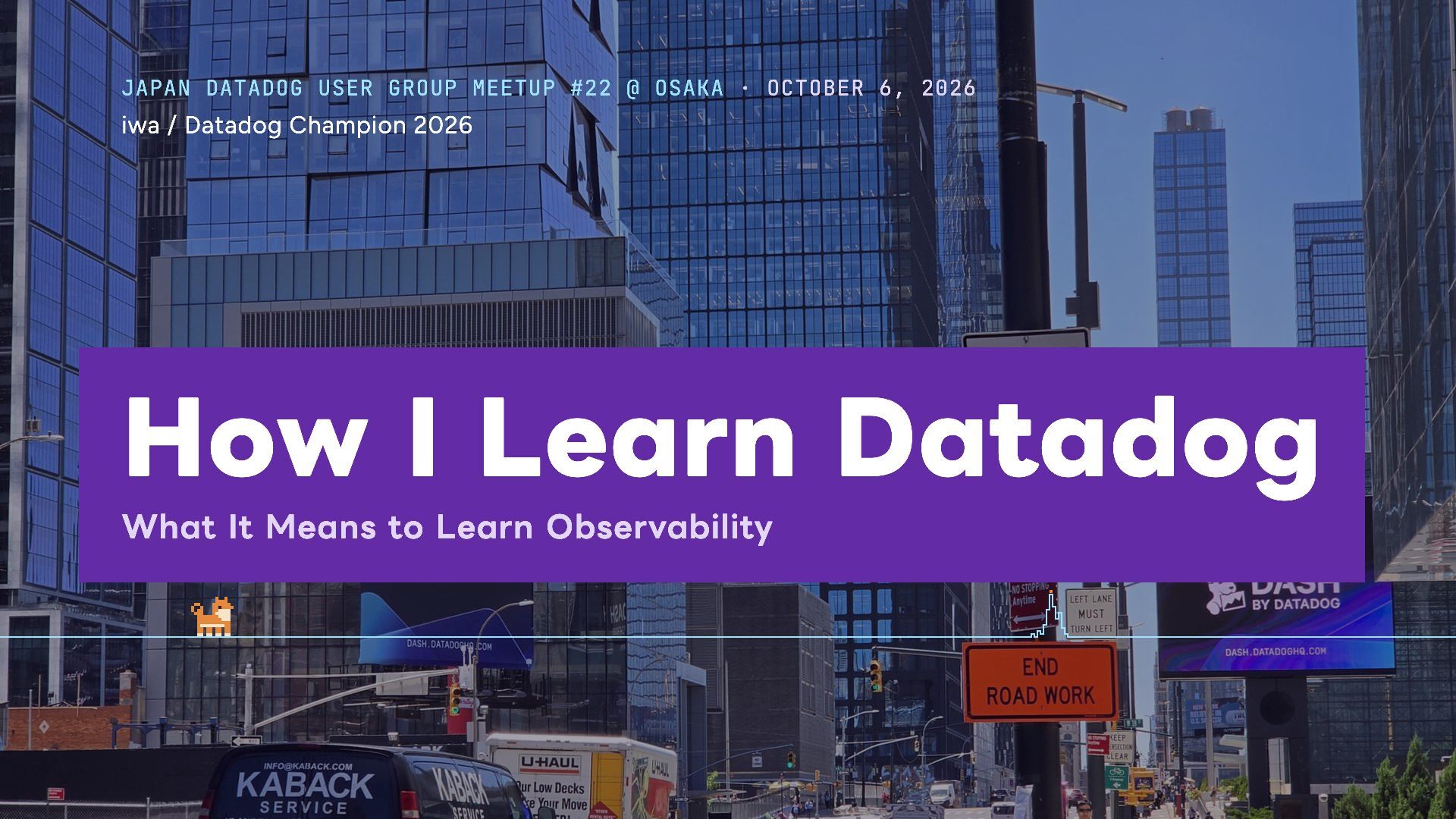
How I Learn Datadog - What It Means to Learn Observability

English version of my talk at Japan Datadog User Group Meetup #22 in Osaka on October 6, 2026.

As a Datadog Champion, I share how I learn through AI, self-paced resources, product updates, conversations, and structured study.

Learning observability means more than acquiring knowledge: it means applying that knowledge to your own systems and deepening your understanding through practice. This talk explores how to bring those lessons back to colleagues and communities, help others put their knowledge into practice, and build a cycle of learning that extends from individuals to the wider organization.

Original Japanese version:
https://speakerdeck.com/mananyuki/datadog-no-manabikata-aruiha-o-manabu-toha-nani-ka

Avatar for iwa

iwa

October 06, 2026

More Decks by iwa

Other Decks in Technology

Transcript

  1. JAPAN DATADOG USER GROUP MEETUP #22 @ OSAKA · OCTOBER

    6, 2026 iwa / Datadog Champion 2026 How I Learn Datadog What It Means to Learn Observability
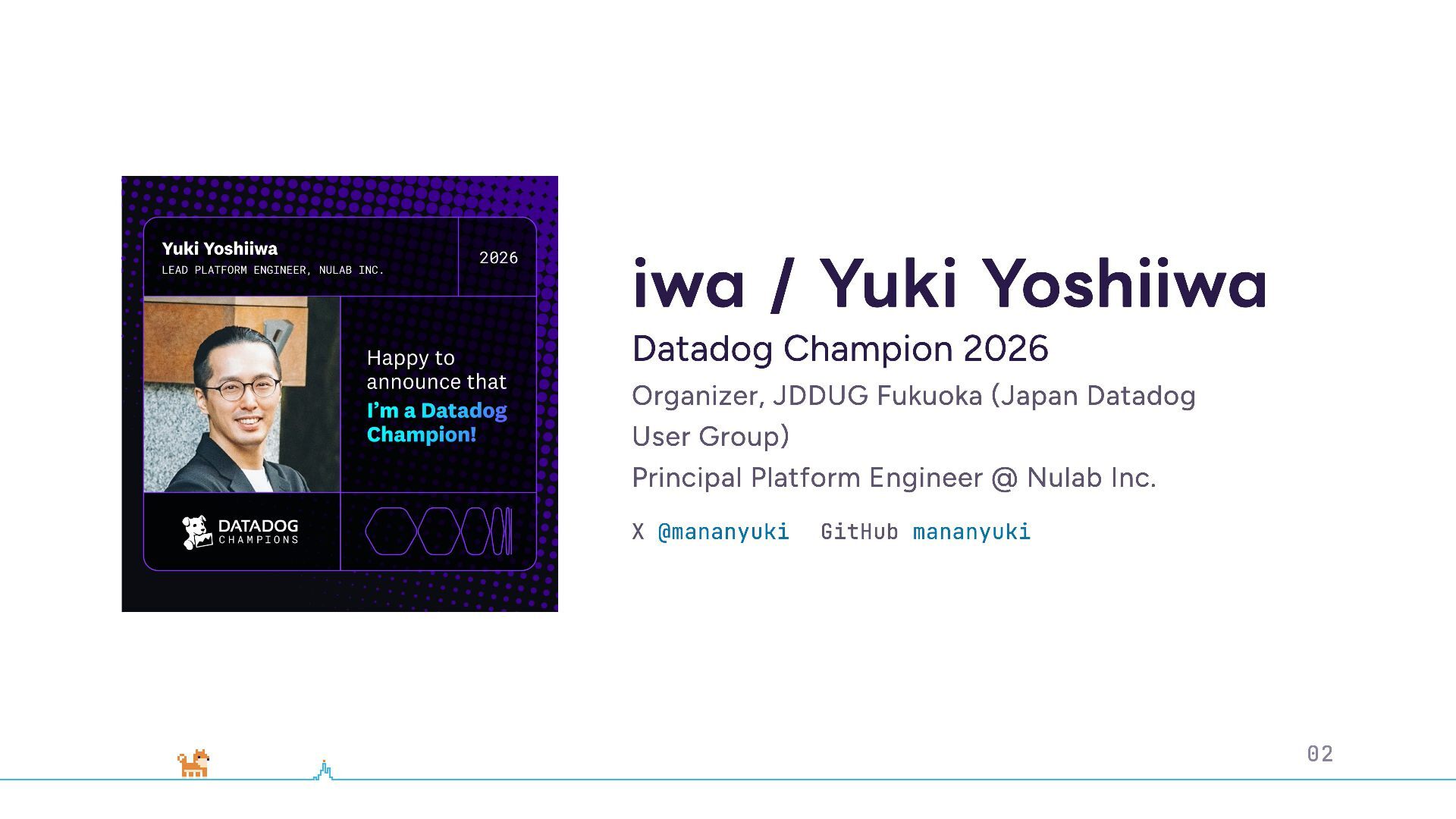
  2. iwa / Yuki Yoshiiwa Datadog Champion 2026 Organizer, JDDUG Fukuoka

    (Japan Datadog User Group) Principal Platform Engineer @ Nulab Inc. X @mananyuki GitHub mananyuki 02
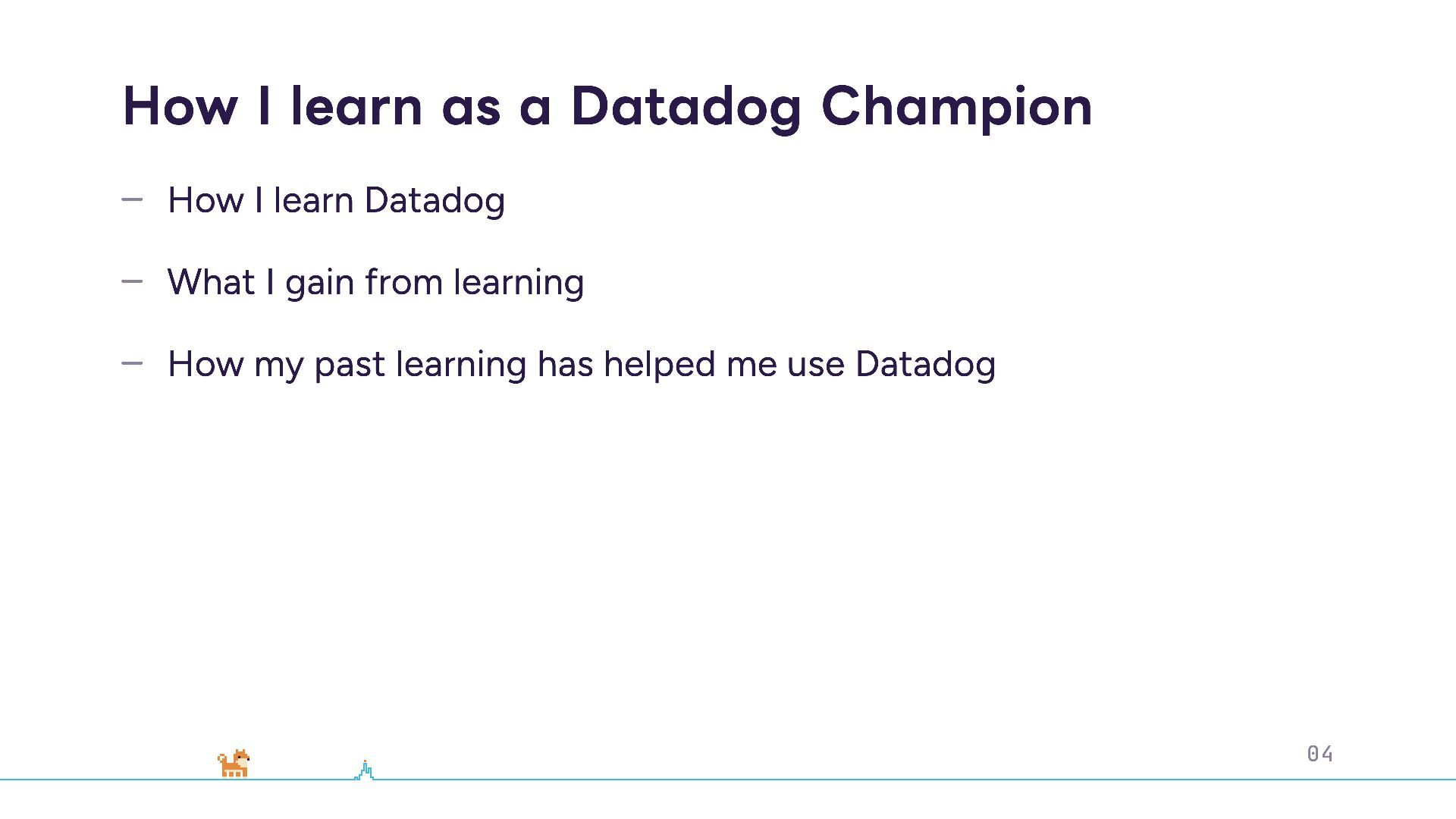
  3. How I learn as a Datadog Champion How I learn

    Datadog What I gain from learning How my past learning has helped me use Datadog 04
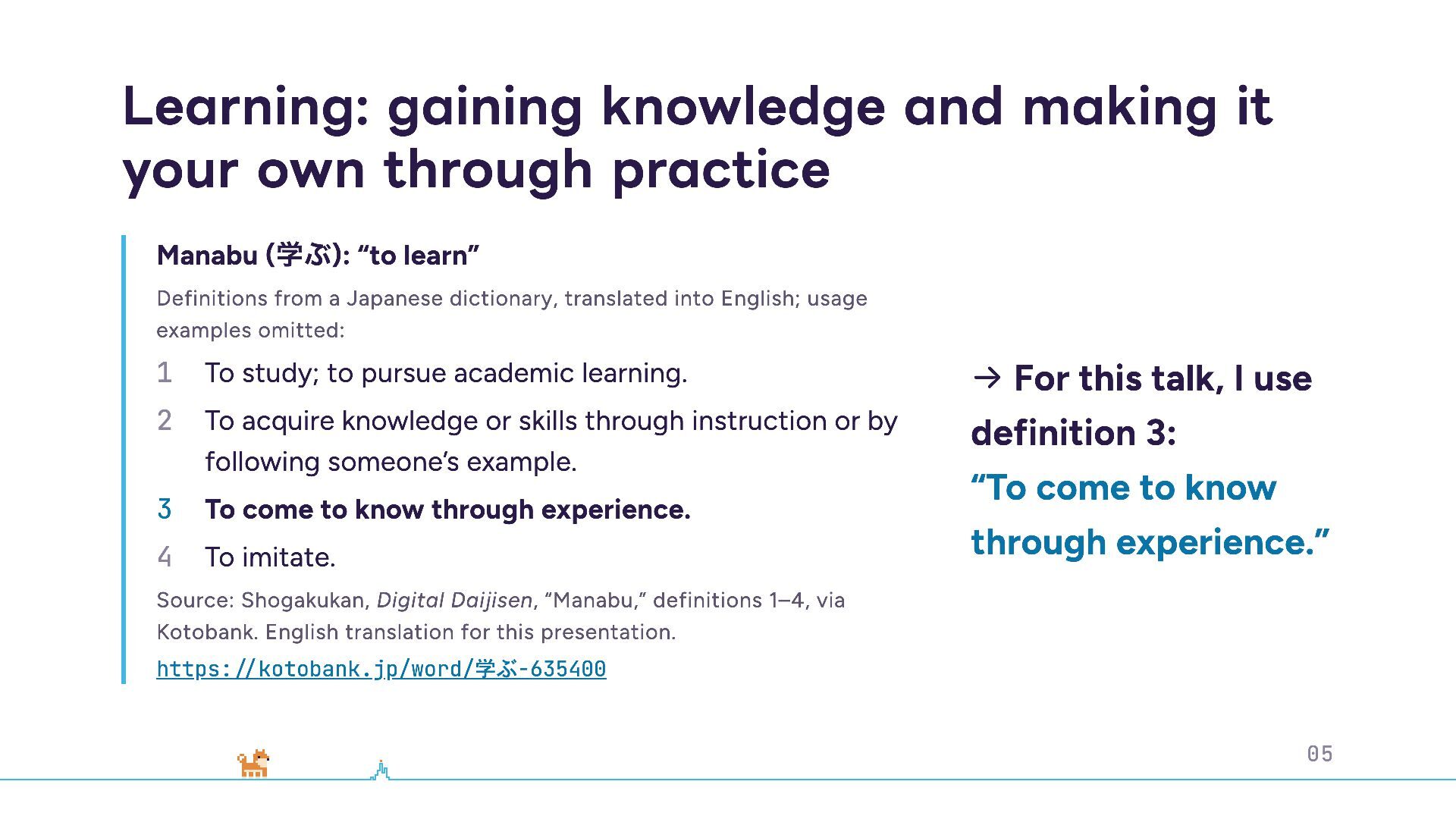
  4. Learning: gaining knowledge and making it your own through practice

    Manabu (学ぶ): “to learn” Definitions from a Japanese dictionary, translated into English; usage examples omitted: 1 To study; to pursue academic learning. 2 To acquire knowledge or skills through instruction or by following someone’s example. 3 To come to know through experience. 4 To imitate. → For this talk, I use definition 3: “To come to know through experience.” Source: Shogakukan, Digital Daijisen, “Manabu,” definitions 1–4, via Kotobank. English translation for this presentation. https://kotobank.jp/word/学ぶ-635400 05
  5. Learning: gaining knowledge and making it your own through practice

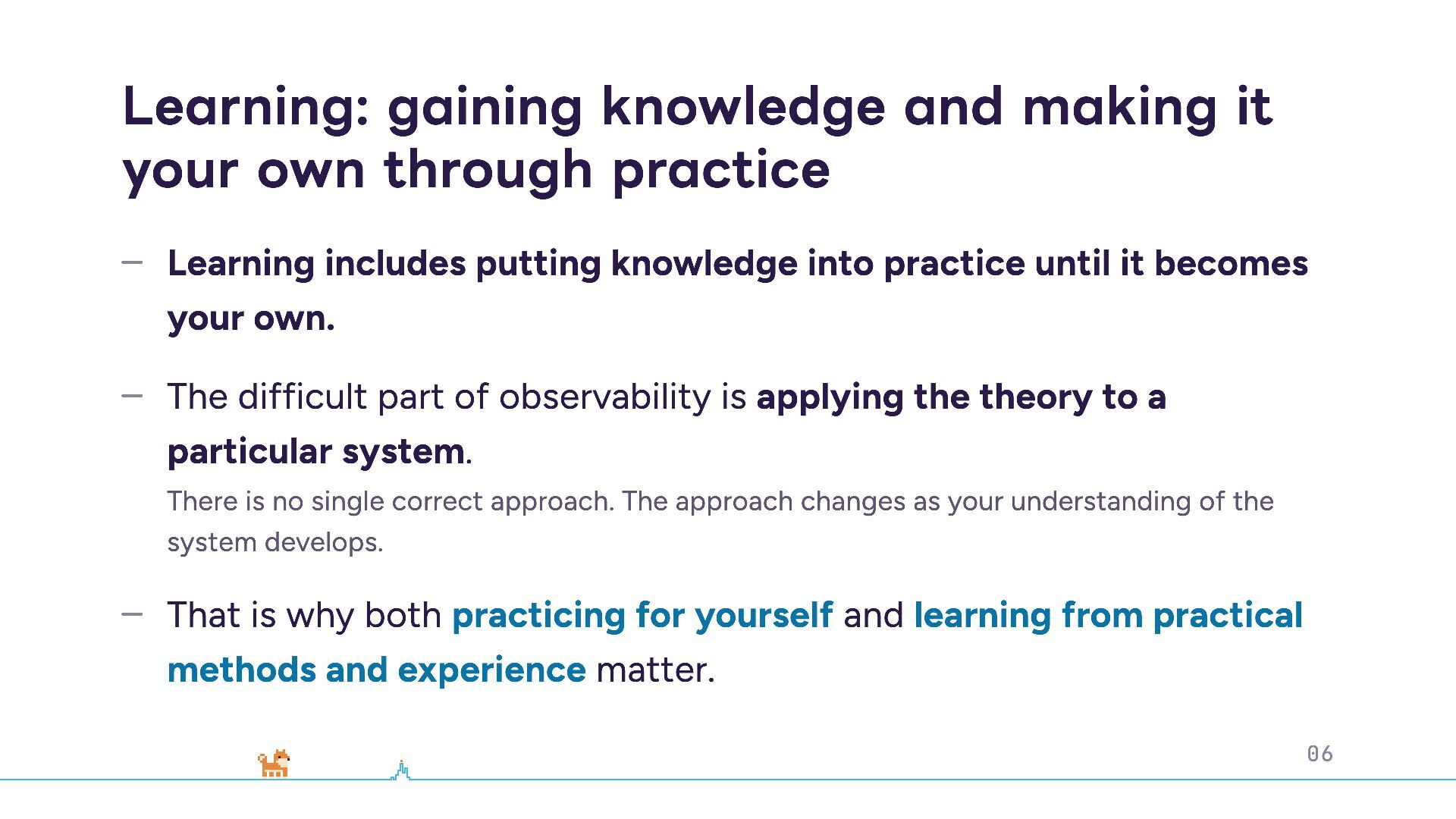
    Learning includes putting knowledge into practice until it becomes your own. The difficult part of observability is applying the theory to a particular system. There is no single correct approach. The approach changes as your understanding of the system develops. That is why both practicing for yourself and learning from practical methods and experience matter. 06
  6. Different ways to learn offer different benefits Learn with AI

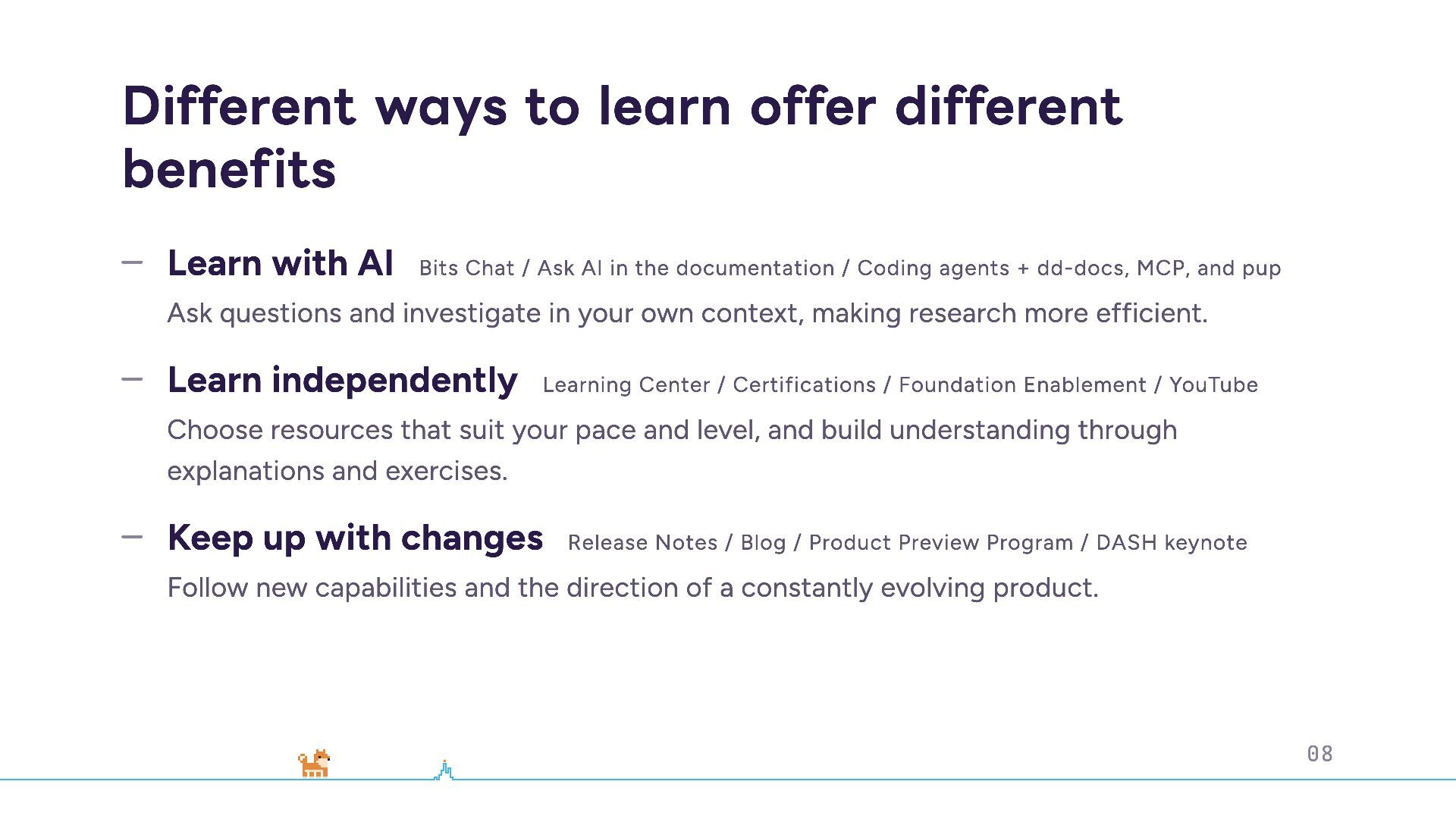
    Bits Chat / Ask AI in the documentation / Coding agents + dd-docs, MCP, and pup Ask questions and investigate in your own context, making research more efficient. Learn independently Learning Center / Certifications / Foundation Enablement / YouTube Choose resources that suit your pace and level, and build understanding through explanations and exercises. Keep up with changes Release Notes / Blog / Product Preview Program / DASH keynote Follow new capabilities and the direction of a constantly evolving product. 08
  7. Different ways to learn offer different benefits Learn through conversation

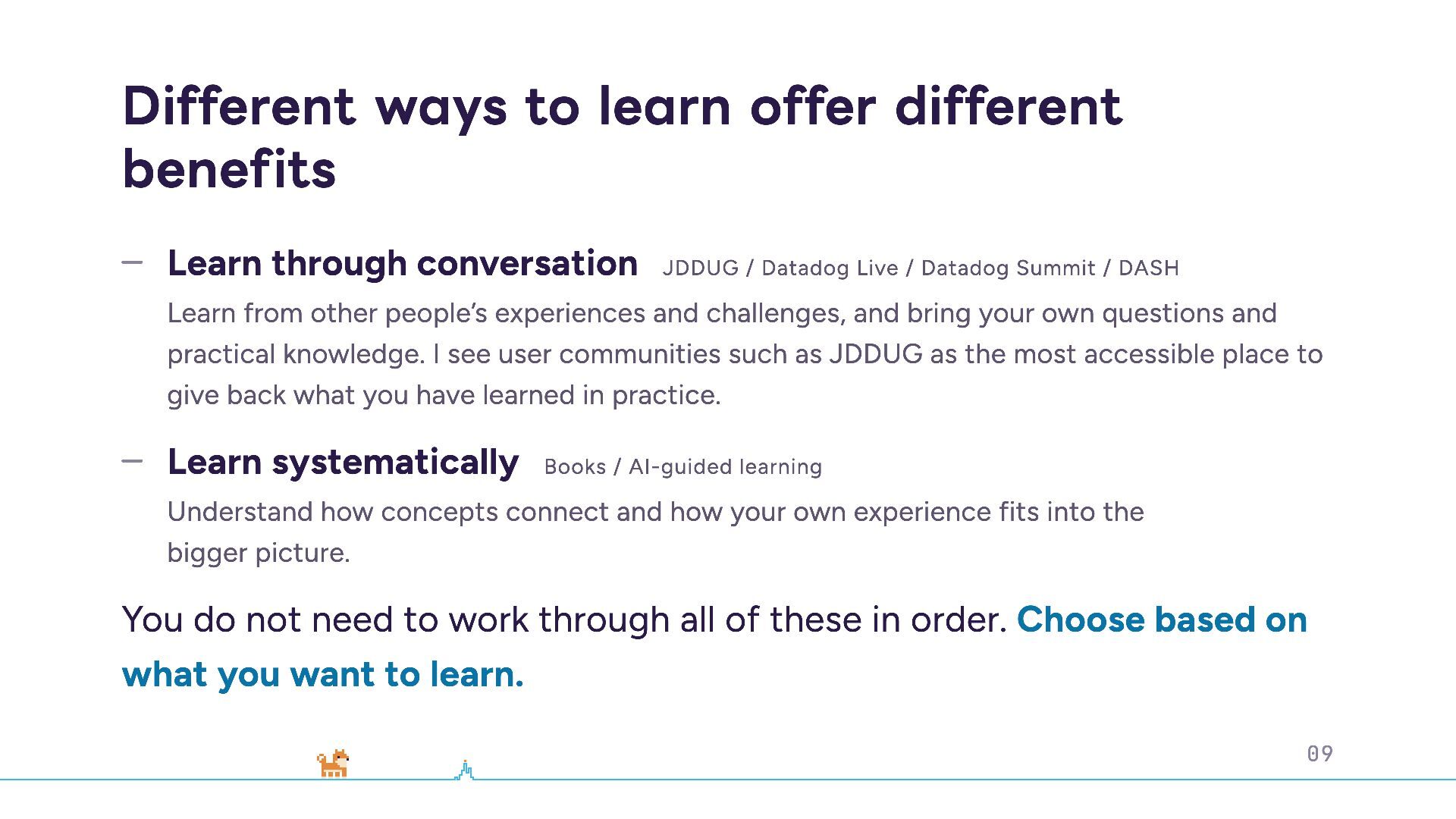
    JDDUG / Datadog Live / Datadog Summit / DASH Learn from other people’s experiences and challenges, and bring your own questions and practical knowledge. I see user communities such as JDDUG as the most accessible place to give back what you have learned in practice. Learn systematically Books / AI-guided learning Understand how concepts connect and how your own experience fits into the bigger picture. You do not need to work through all of these in order. Choose based on what you want to learn. 09
  8. Bits Chat docs.datadoghq.com/bits_ai/bits_chat/ Ask questions directly in Datadog, with context.

    Documentation, telemetry from your environment, and the screen you are viewing can all provide context. You can also get recommendations on best practices. Quickly create dashboards and notebooks. Capture an investigation in a notebook so you can refer back to it and reuse it later. Note: Usage-based billing through AI Credits. Check your organization’s usage and contract terms for details. 11
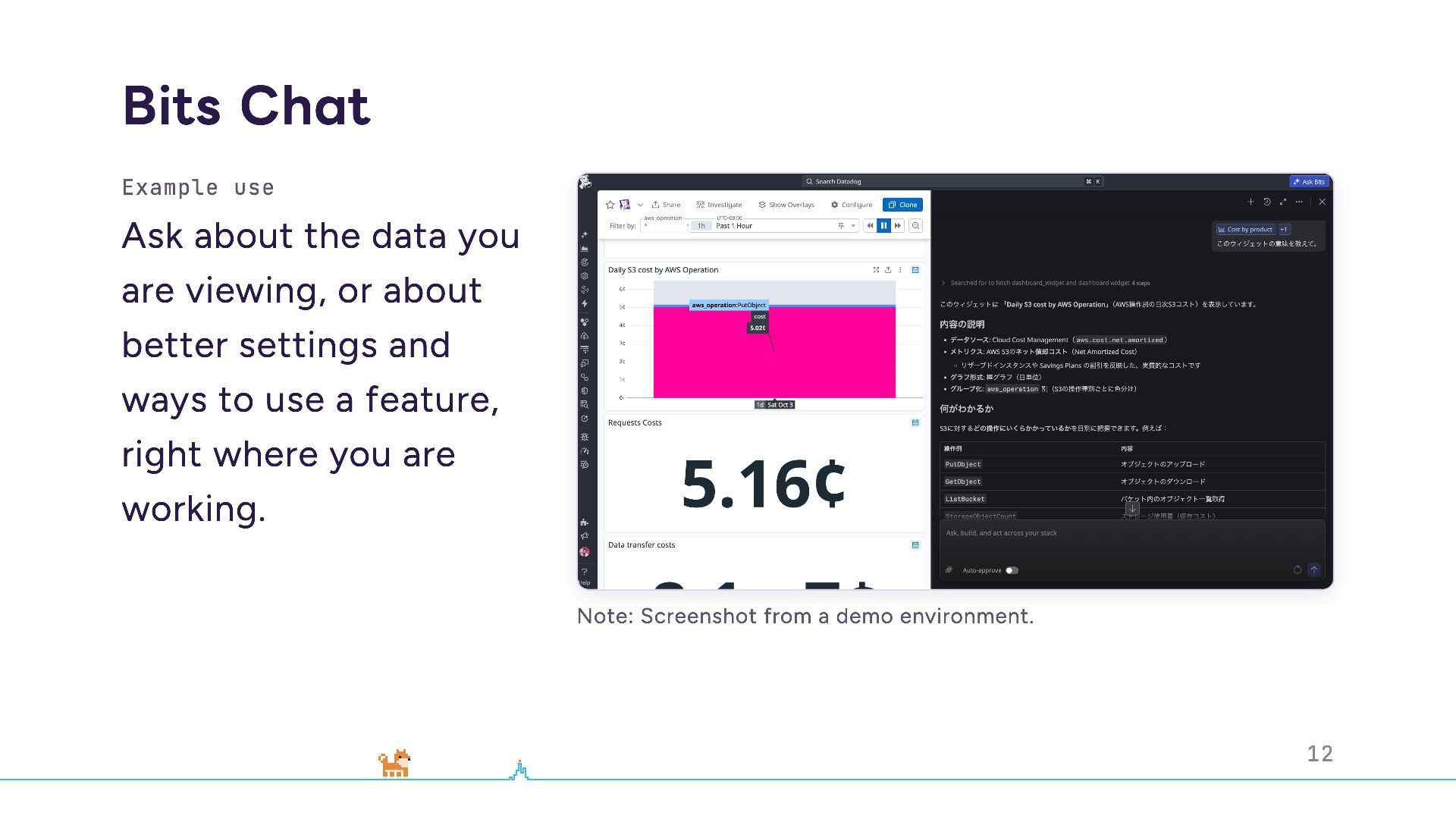
  9. Bits Chat Example use Ask about the data you are

    viewing, or about better settings and ways to use a feature, right where you are working. Note: Screenshot from a demo environment. 12
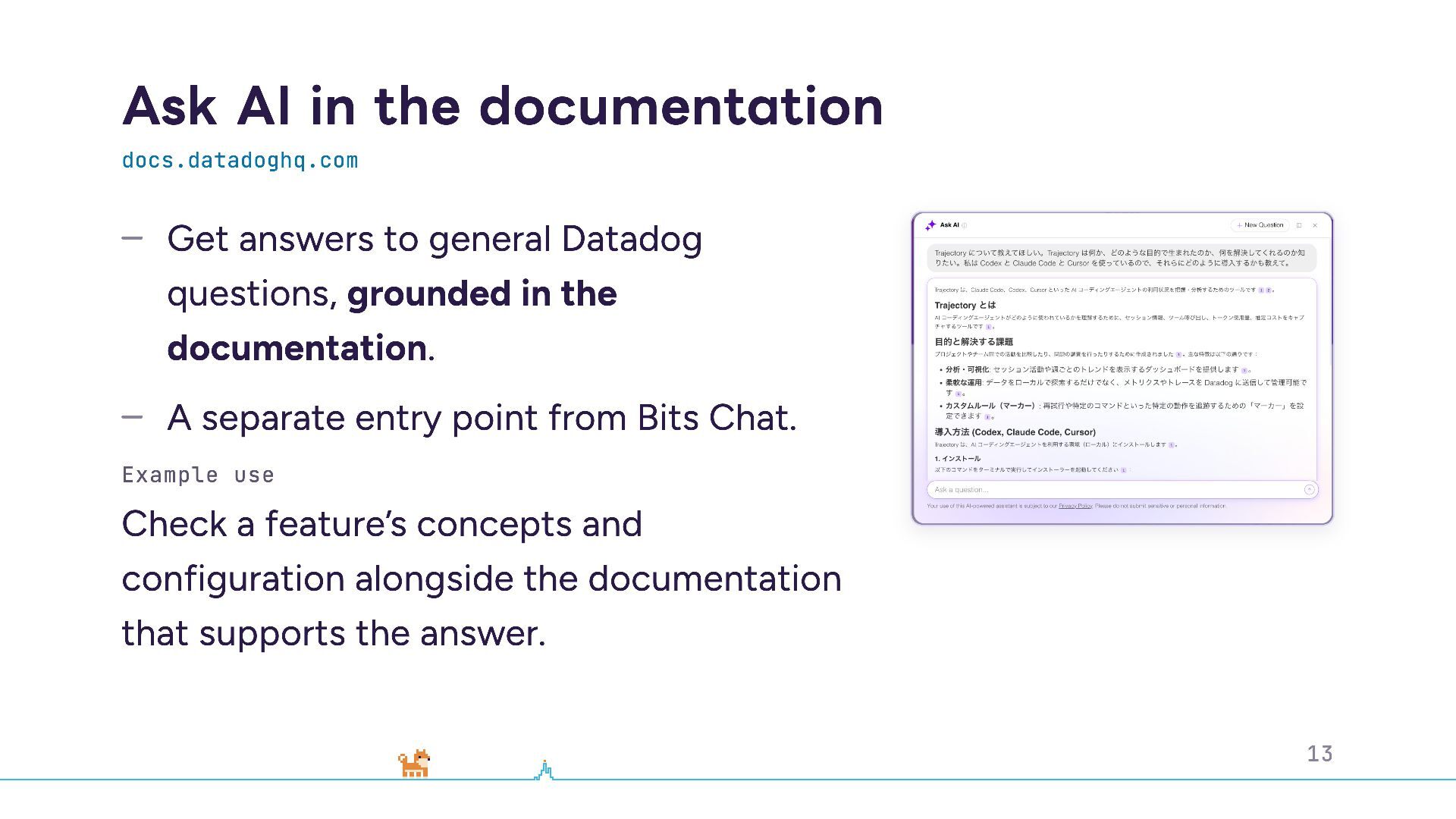
  10. Ask AI in the documentation docs.datadoghq.com Get answers to general

    Datadog questions, grounded in the documentation. A separate entry point from Bits Chat. Example use Check a feature’s concepts and configuration alongside the documentation that supports the answer. 13
  11. Coding agents Use your usual coding agent to investigate alongside

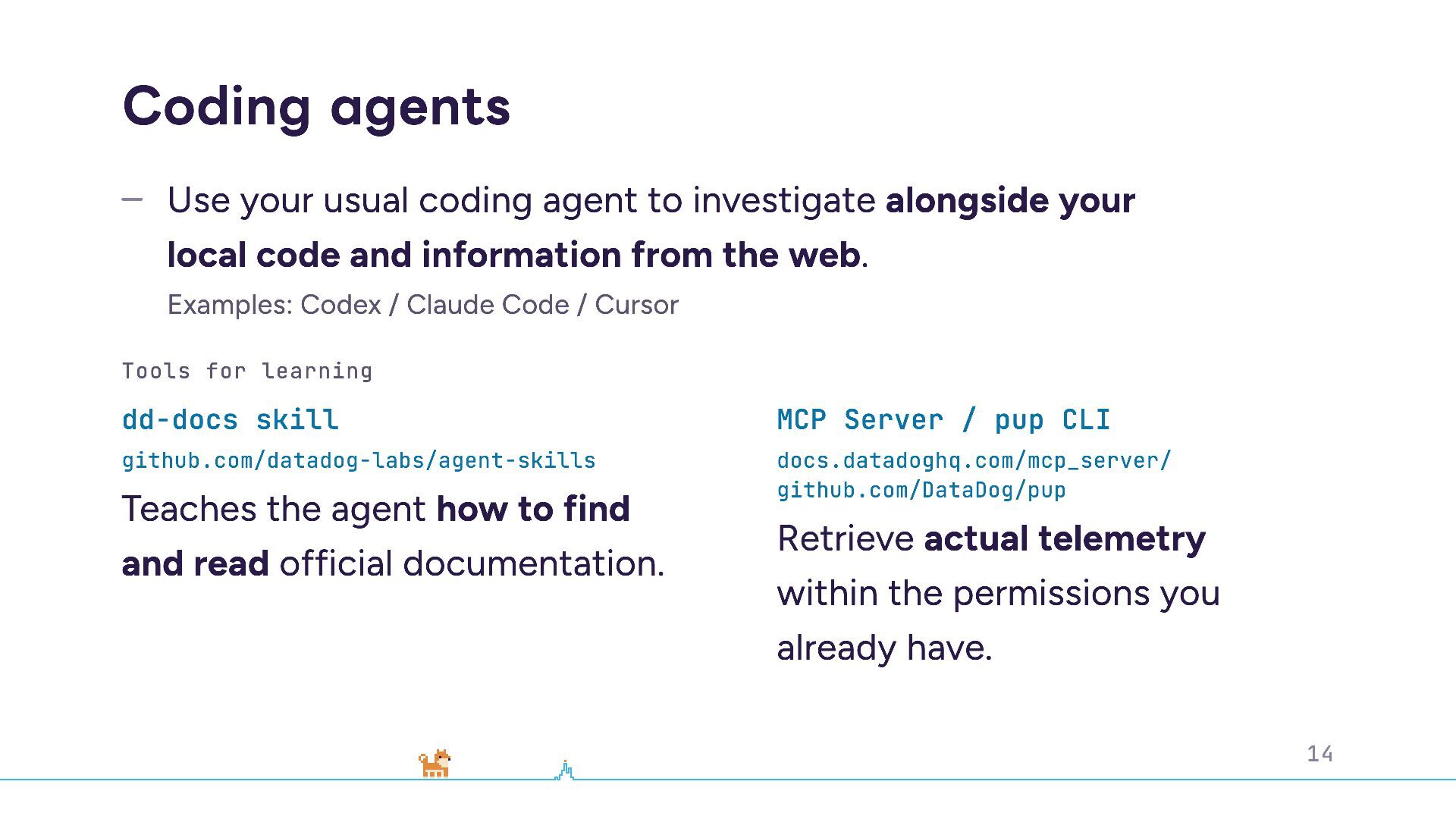
    your local code and information from the web. Examples: Codex / Claude Code / Cursor Tools for learning dd-docs skill MCP Server / pup CLI github.com/datadog-labs/agent-skills docs.datadoghq.com/mcp_server/ github.com/DataDog/pup Teaches the agent how to find and read official documentation. Retrieve actual telemetry within the permissions you already have. 14
  12. Coding agents Get suggestions tailored to your situation, based on

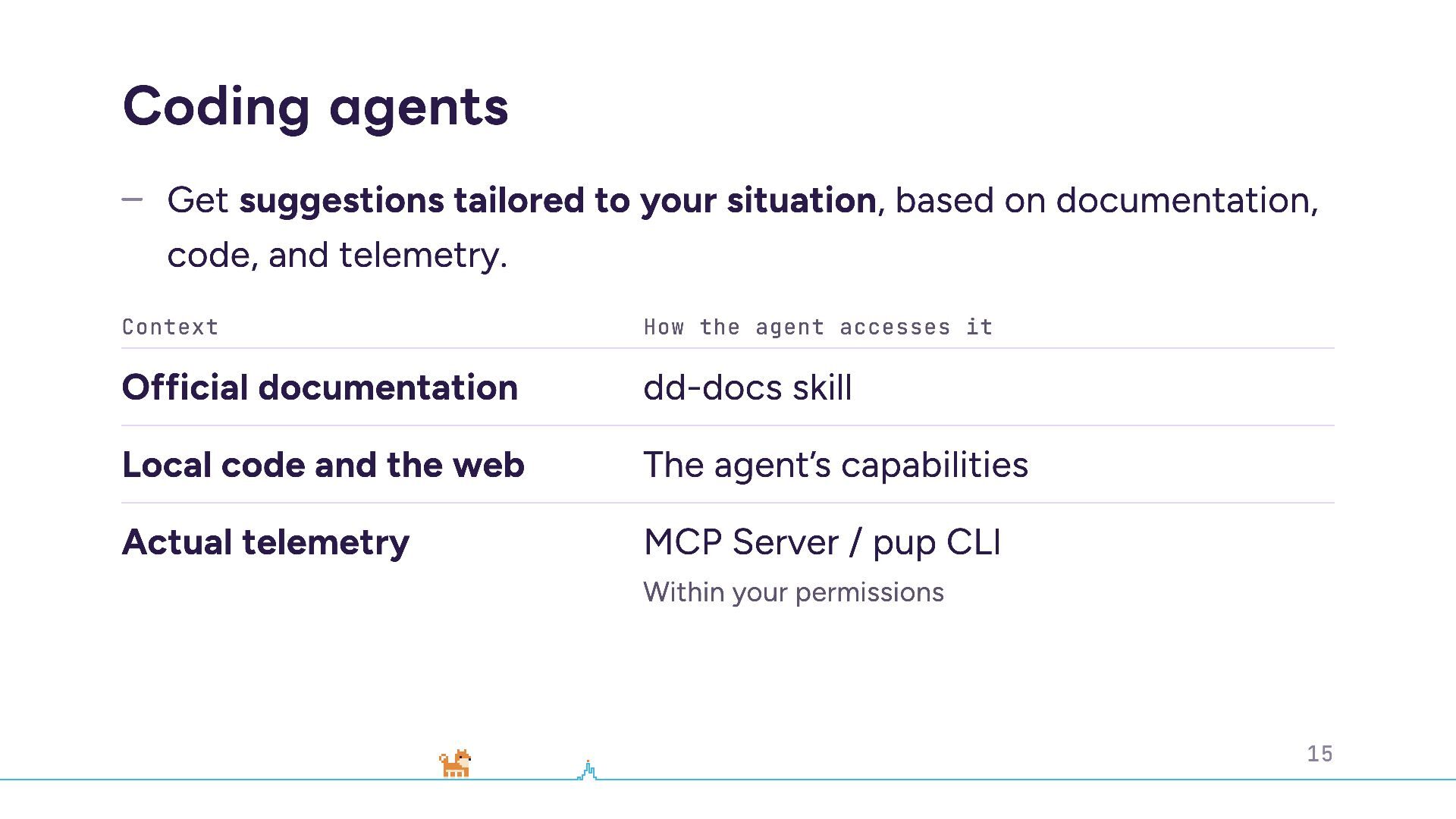
    documentation, code, and telemetry. Context How the agent accesses it Official documentation dd-docs skill Local code and the web The agent’s capabilities Actual telemetry MCP Server / pup CLI Within your permissions 15
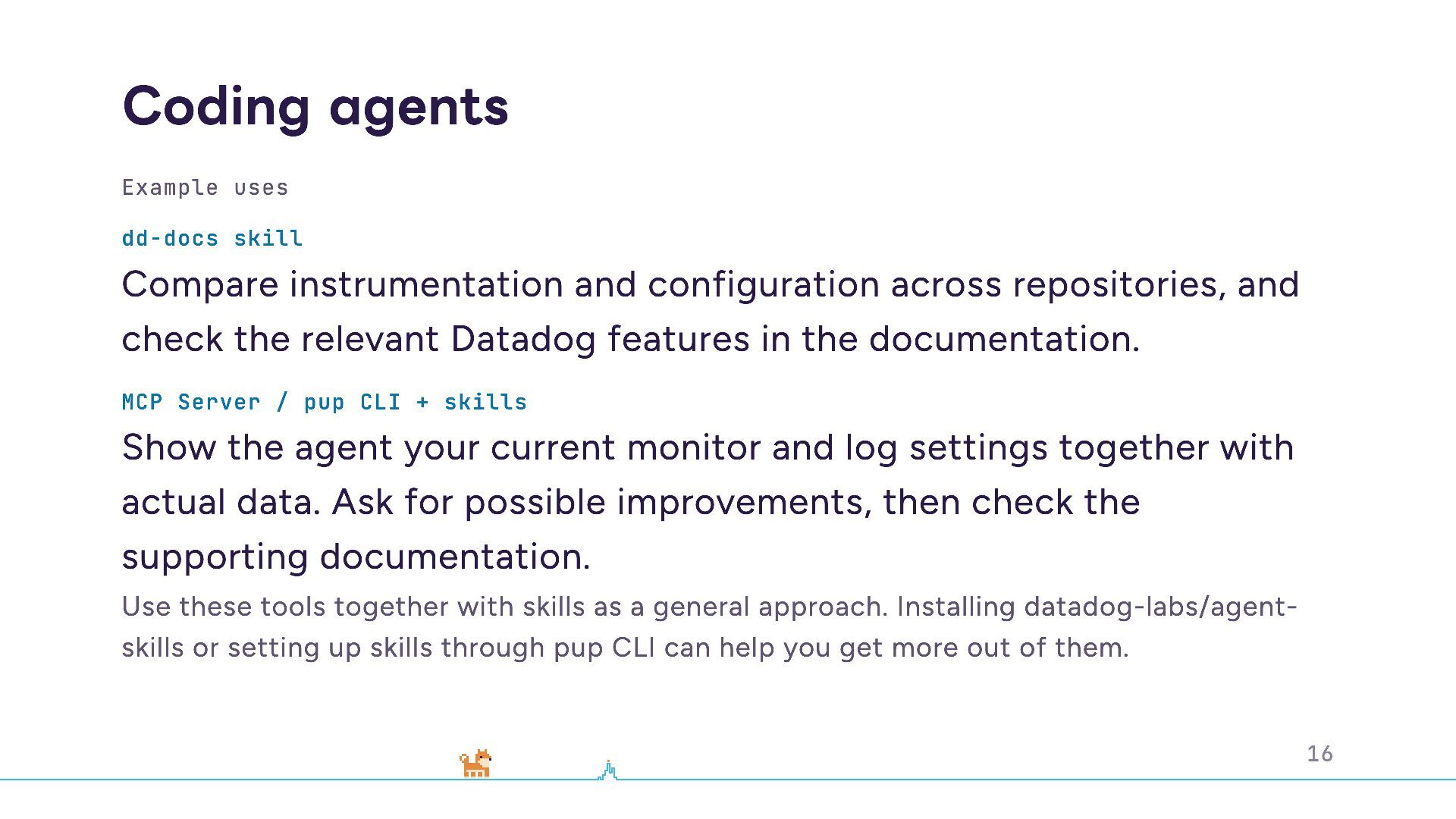
  13. Coding agents Example uses dd-docs skill Compare instrumentation and configuration

    across repositories, and check the relevant Datadog features in the documentation. MCP Server / pup CLI + skills Show the agent your current monitor and log settings together with actual data. Ask for possible improvements, then check the supporting documentation. Use these tools together with skills as a general approach. Installing datadog-labs/agentskills or setting up skills through pup CLI can help you get more out of them. 16
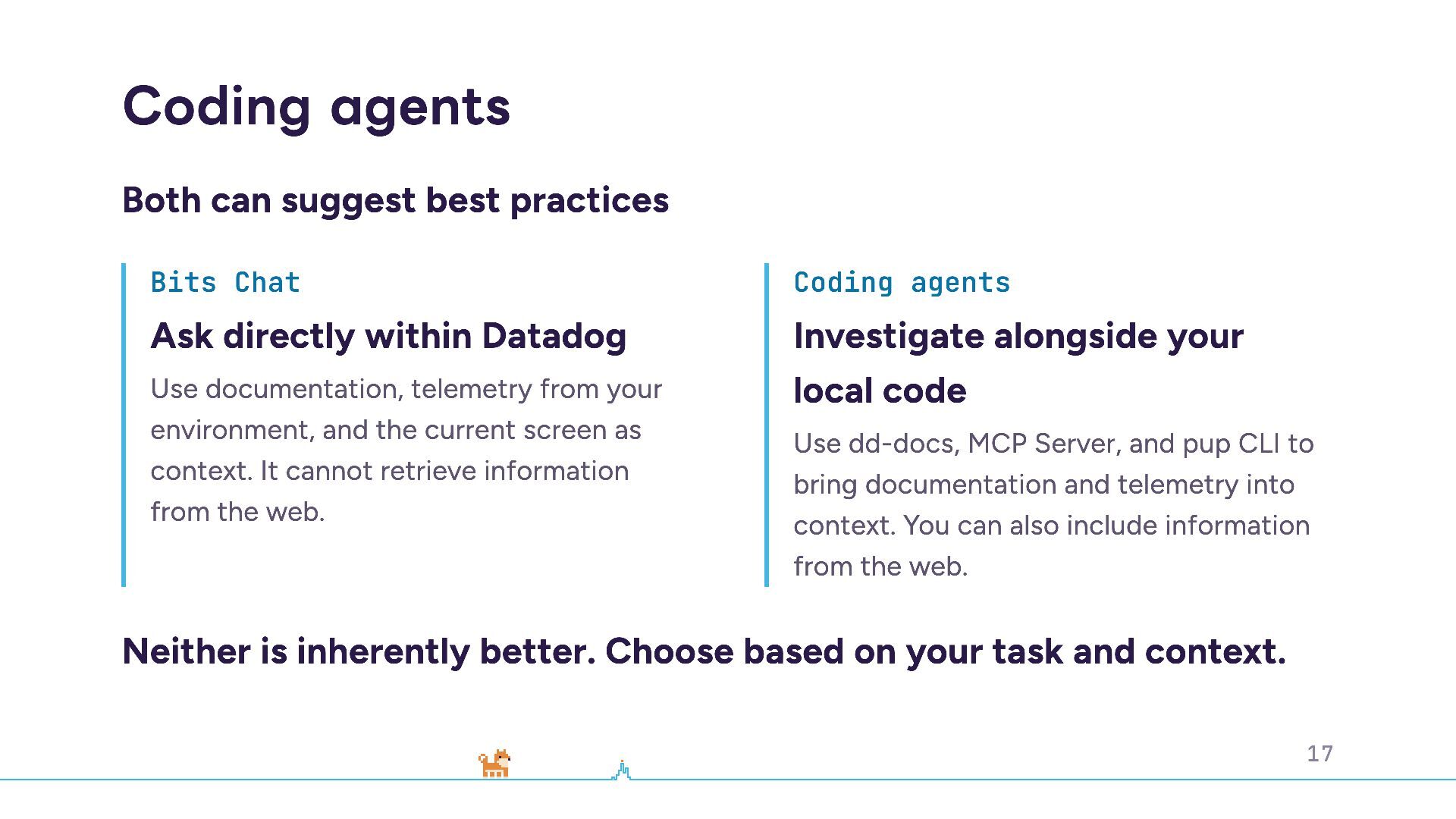
  14. Coding agents Both can suggest best practices Bits Chat Coding

    agents Ask directly within Datadog Investigate alongside your local code Use documentation, telemetry from your environment, and the current screen as context. It cannot retrieve information from the web. Use dd-docs, MCP Server, and pup CLI to bring documentation and telemetry into context. You can also include information from the web. Neither is inherently better. Choose based on your task and context. 17
  15. Learning Center learn.datadoghq.com A wide range of materials and a

    free lab environment let you learn by actually using Datadog. Earn Credly badges by completing Learning Paths. 19
  16. Certifications www.datadoghq.com/certification/overview/ Certification preparation materials are also available in Learning

    Center. Learning paths, exam guides, and practice exams are free to use. Certification exams normally require a fee. Insights from a conversation with @futahashi, a Datadog Ambassador with five certifications Certification exams serve as a tutorial and a way to assess a certain level of knowledge. Earning three certifications comes with a shiny gold Bits badge — a nice reward! 20
  17. Foundation Enablement www.datadoghq.com/technical-enablement/ Learn through instructor-led explanations and live demonstrations.

    From foundational to more advanced topics: choose sessions that match your understanding and what you want to learn. Sessions are also available in Japanese. Japanese-language sessions are led by engineers from Datadog Japan. General webinars are a useful way to discover new features. Webinars cover a wide range of topics. For learning at a level that suits you, I recommend Foundation Enablement. 21
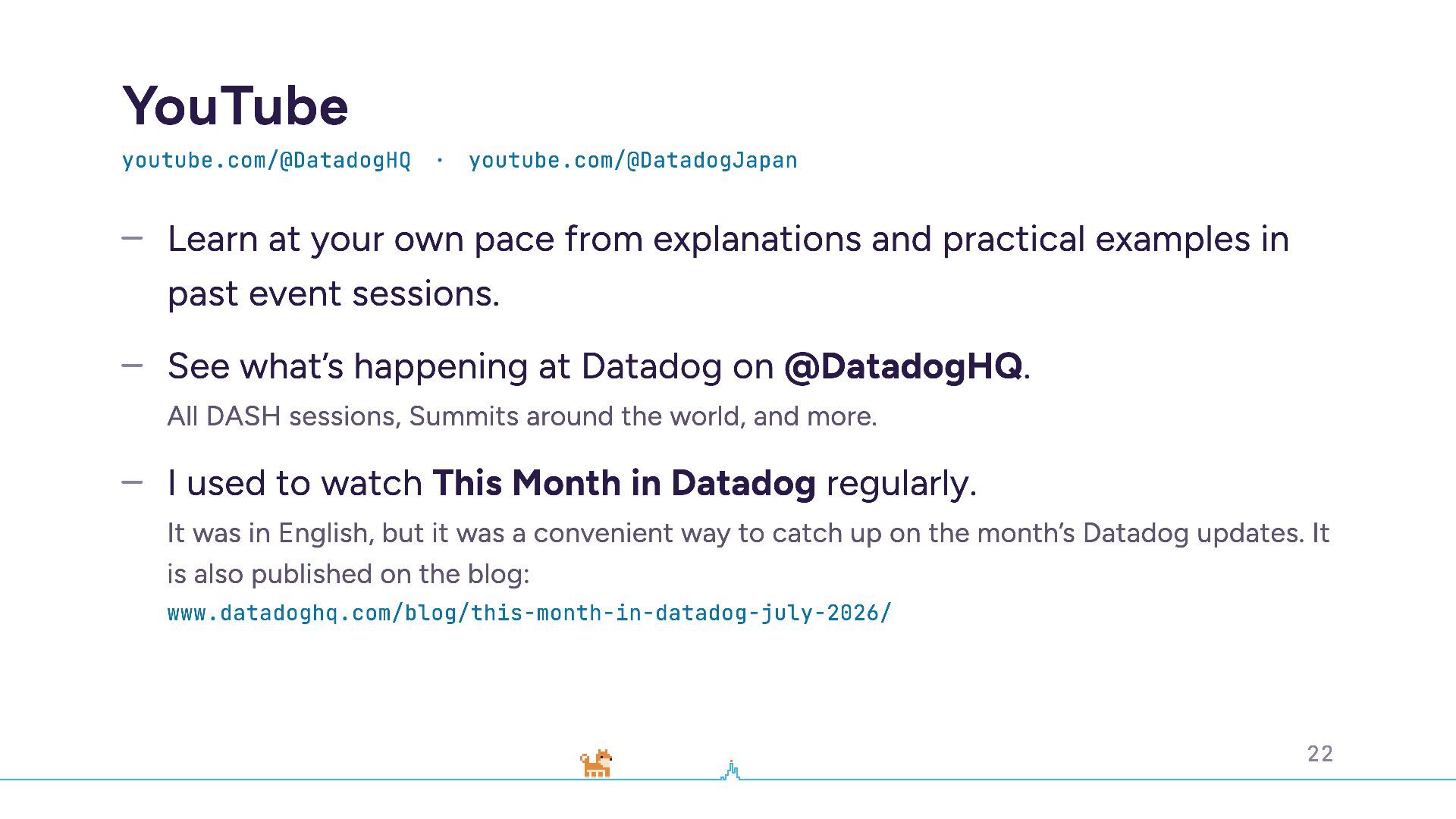
  18. YouTube youtube.com/@DatadogHQ · youtube.com/@DatadogJapan Learn at your own pace from

    explanations and practical examples in past event sessions. See what’s happening at Datadog on @DatadogHQ. All DASH sessions, Summits around the world, and more. I used to watch This Month in Datadog regularly. It was in English, but it was a convenient way to catch up on the month’s Datadog updates. It is also published on the blog: www.datadoghq.com/blog/this-month-in-datadog-july-2026/ 22
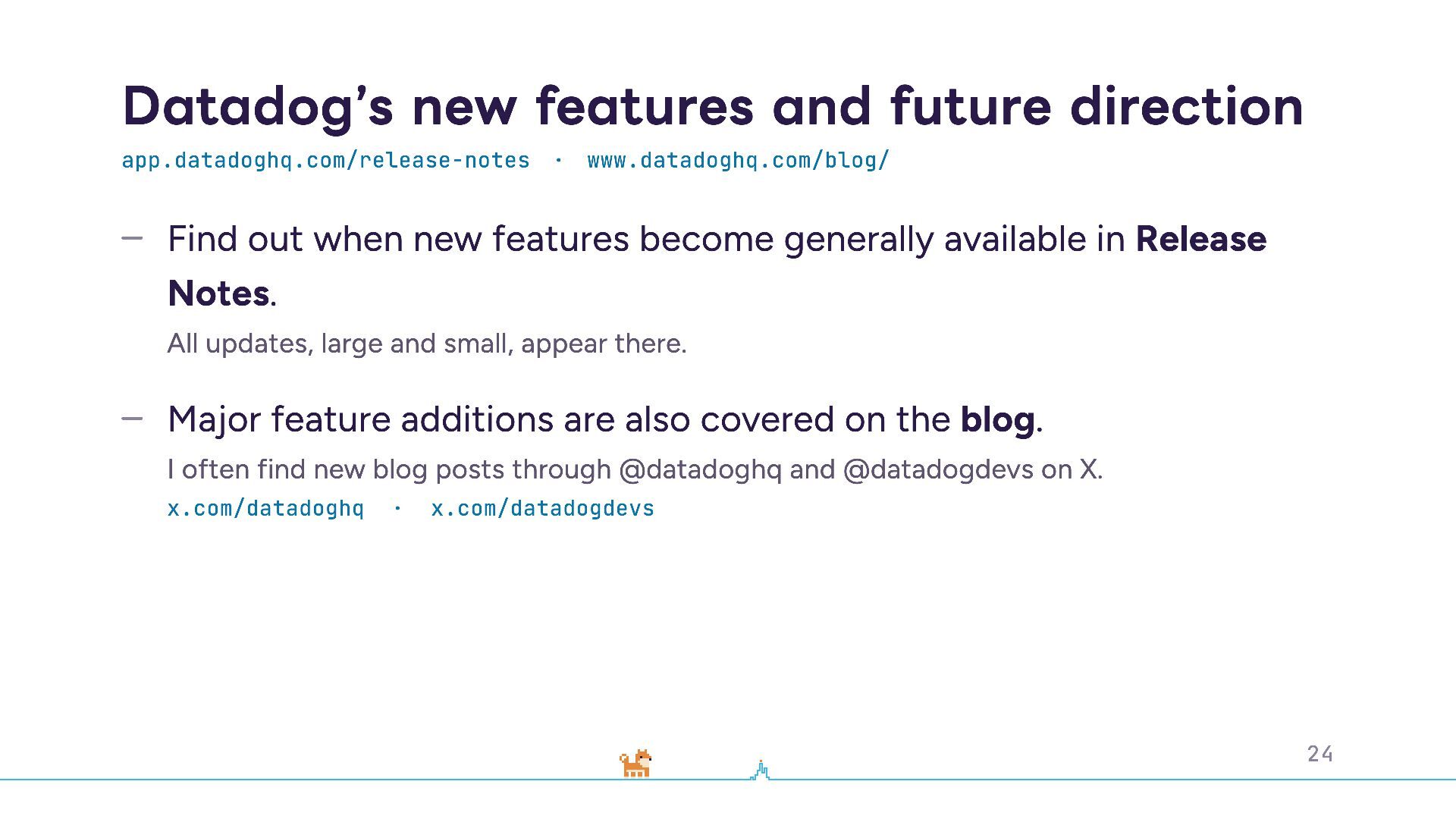
  19. Datadog’s new features and future direction app.datadoghq.com/release-notes · www.datadoghq.com/blog/ Find

    out when new features become generally available in Release Notes. All updates, large and small, appear there. Major feature additions are also covered on the blog. I often find new blog posts through @datadoghq and @datadogdevs on X. x.com/datadoghq · x.com/datadogdevs 24
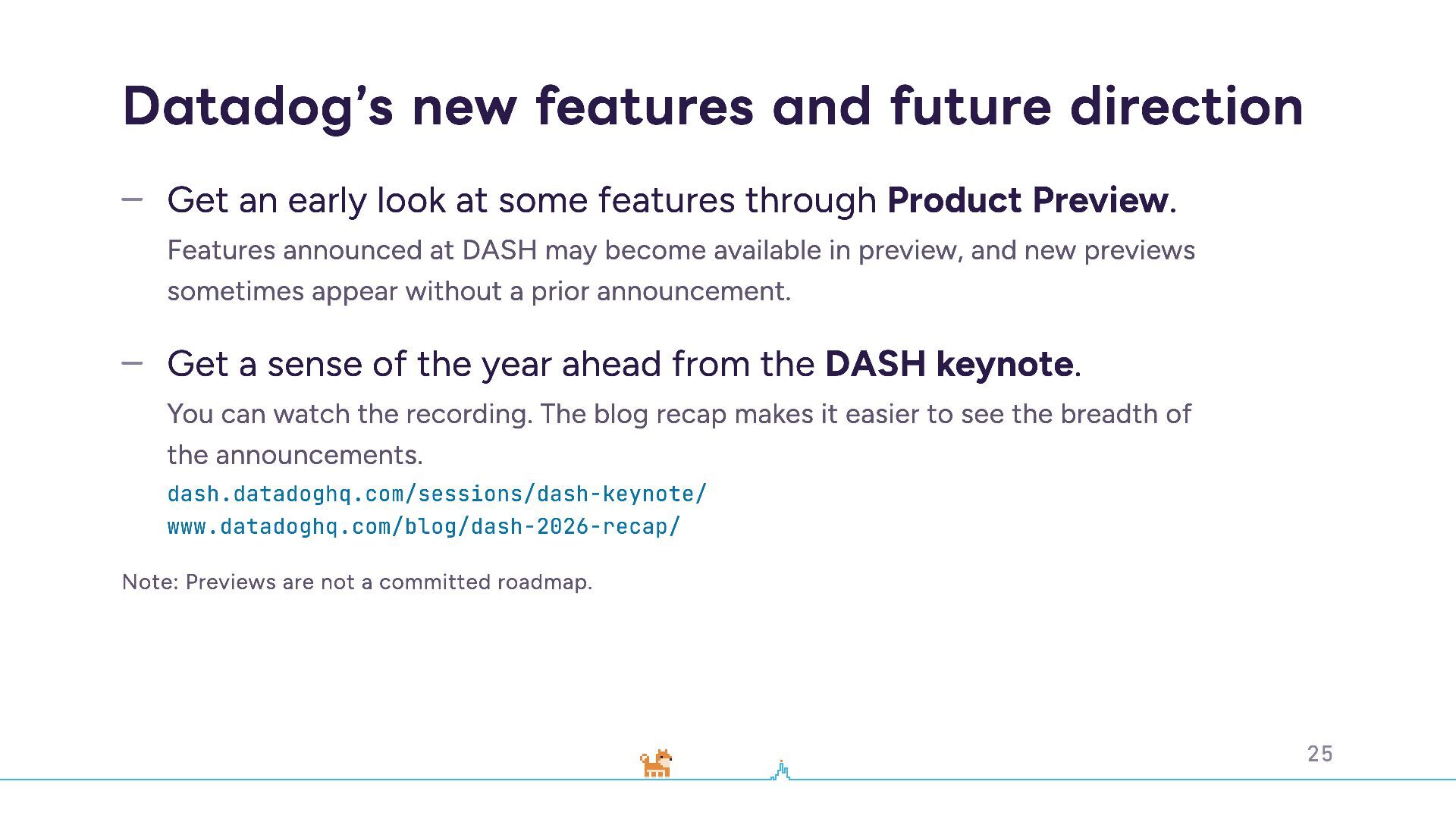
  20. Datadog’s new features and future direction Get an early look

    at some features through Product Preview. Features announced at DASH may become available in preview, and new previews sometimes appear without a prior announcement. Get a sense of the year ahead from the DASH keynote. You can watch the recording. The blog recap makes it easier to see the breadth of the announcements. dash.datadoghq.com/sessions/dash-keynote/ www.datadoghq.com/blog/dash-2026-recap/ Note: Previews are not a committed roadmap. 25
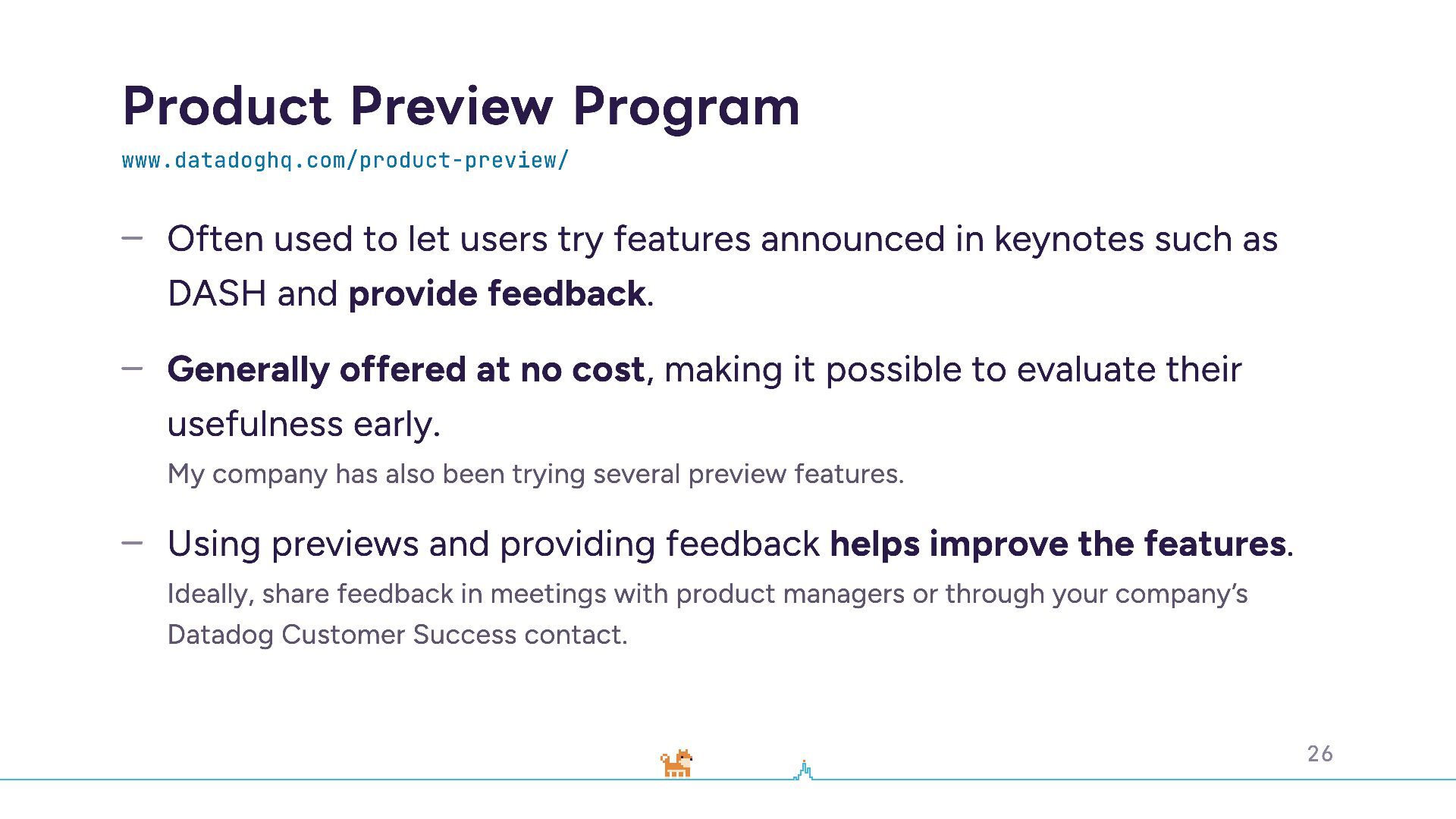
  21. Product Preview Program www.datadoghq.com/product-preview/ Often used to let users try

    features announced in keynotes such as DASH and provide feedback. Generally offered at no cost, making it possible to evaluate their usefulness early. My company has also been trying several preview features. Using previews and providing feedback helps improve the features. Ideally, share feedback in meetings with product managers or through your company’s Datadog Customer Success contact. 26
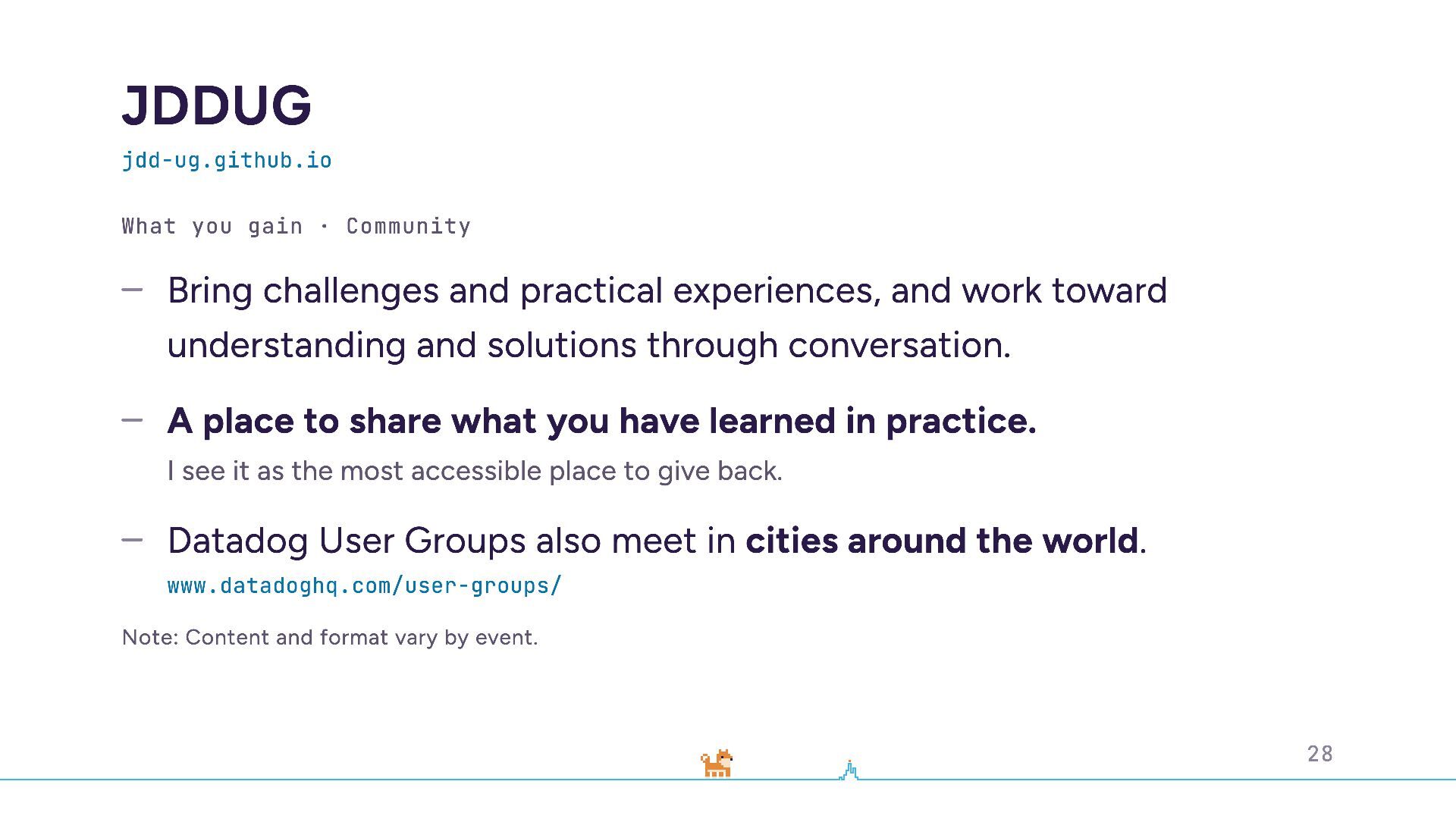
  22. JDDUG jdd-ug.github.io What you gain · Community Bring challenges and

    practical experiences, and work toward understanding and solutions through conversation. A place to share what you have learned in practice. I see it as the most accessible place to give back. Datadog User Groups also meet in cities around the world. www.datadoghq.com/user-groups/ Note: Content and format vary by event. 28
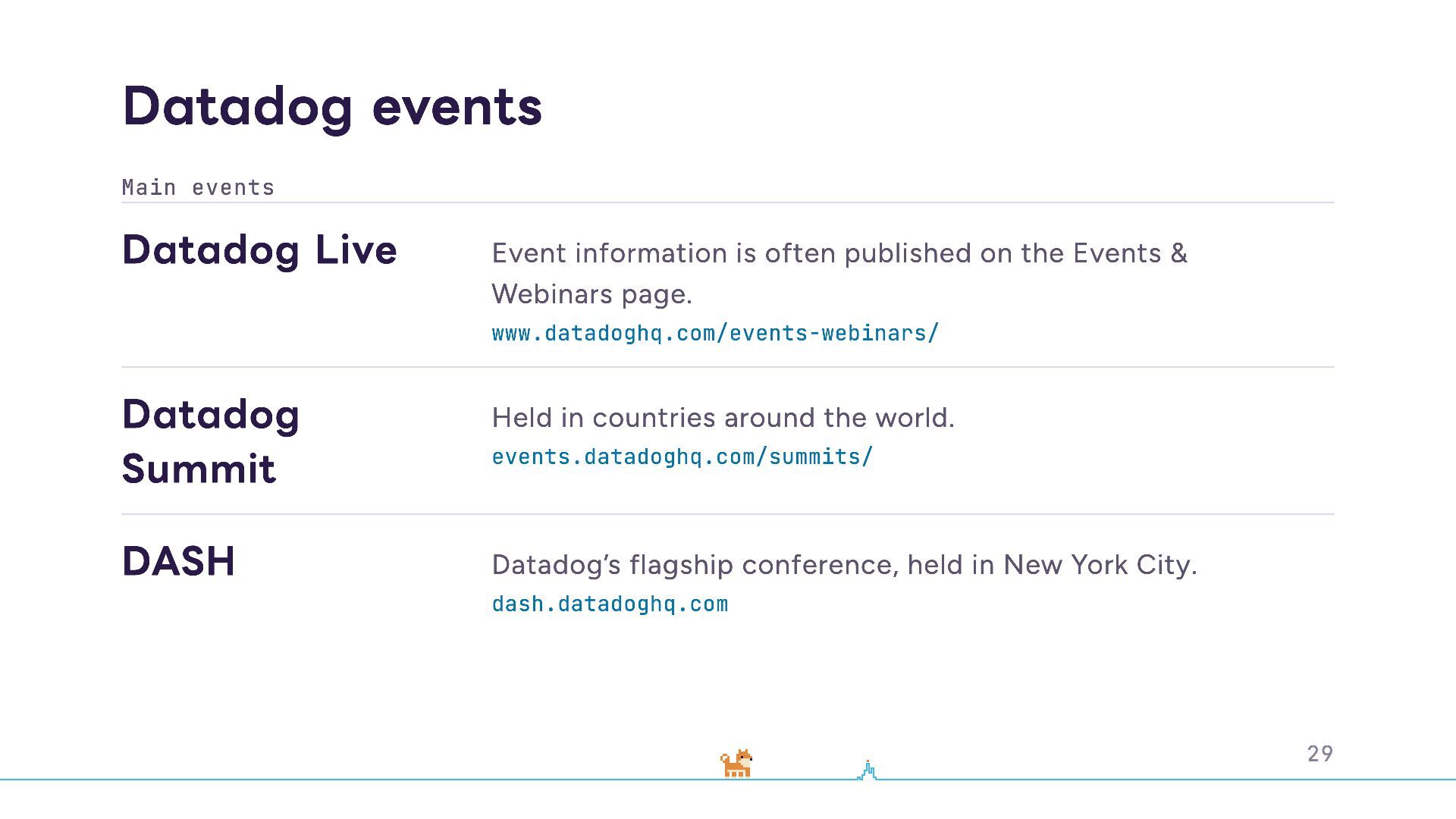
  23. Datadog events Main events Datadog Live Event information is often

    published on the Events & Webinars page. www.datadoghq.com/events-webinars/ Datadog Summit Held in countries around the world. DASH Datadog’s flagship conference, held in New York City. events.datadoghq.com/summits/ dash.datadoghq.com 29
  24. Datadog events What you gain · Datadog Live / Datadog

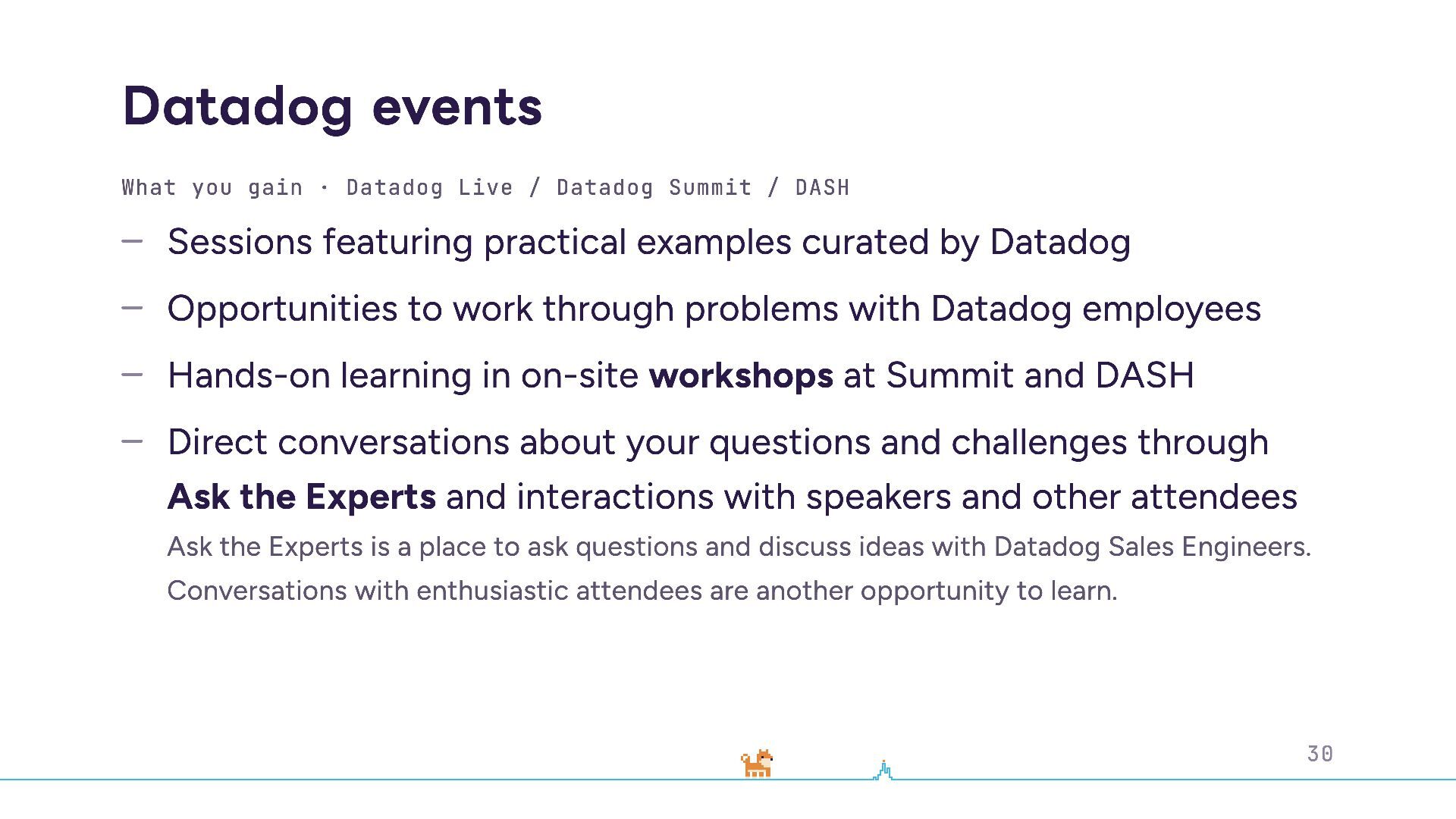
    Summit / DASH Sessions featuring practical examples curated by Datadog Opportunities to work through problems with Datadog employees Hands-on learning in on-site workshops at Summit and DASH Direct conversations about your questions and challenges through Ask the Experts and interactions with speakers and other attendees Ask the Experts is a place to ask questions and discuss ideas with Datadog Sales Engineers. Conversations with enthusiastic attendees are another opportunity to learn. 30
  25. Datadog events Start with a Summit that is easier for

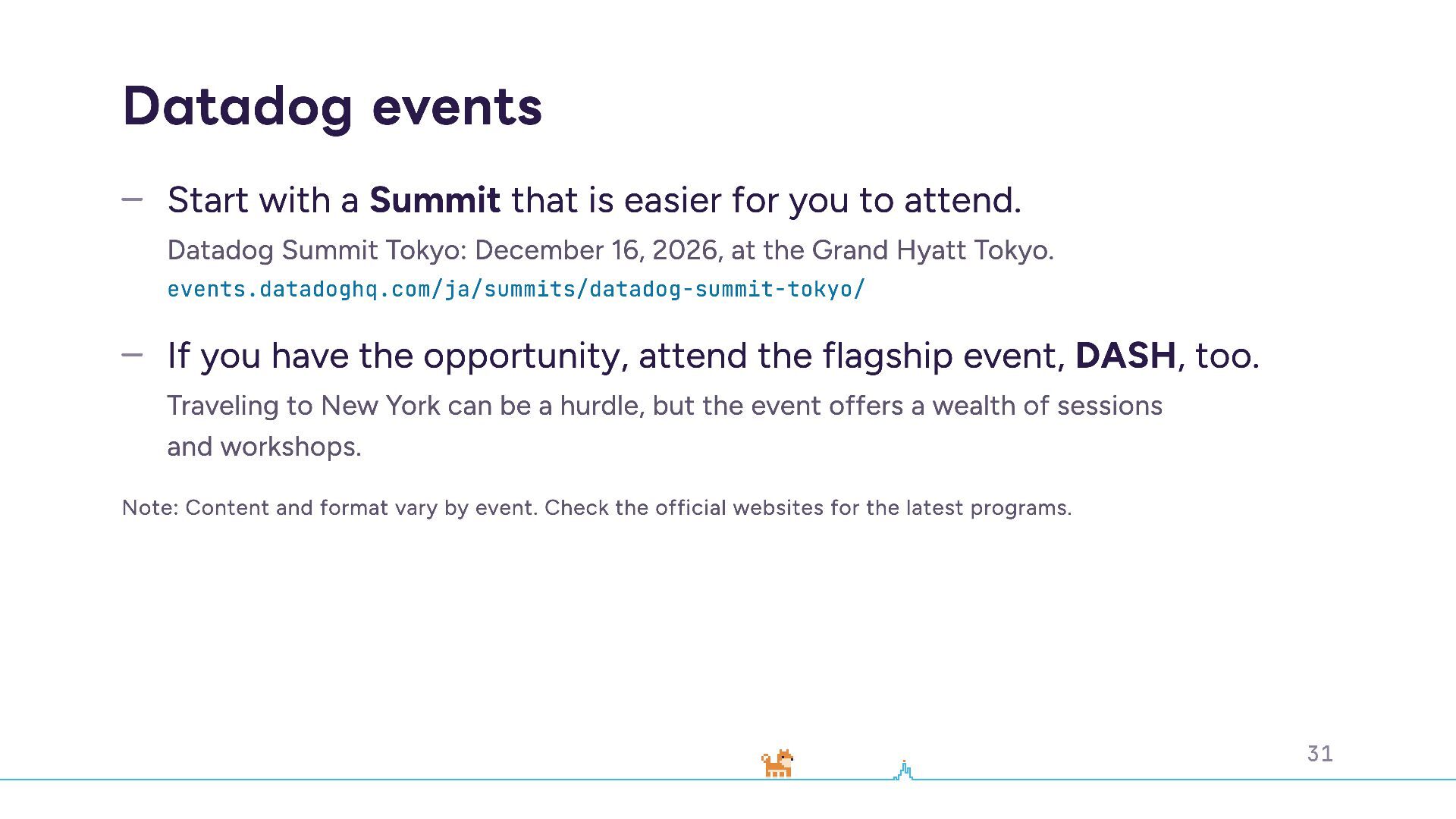
    you to attend. Datadog Summit Tokyo: December 16, 2026, at the Grand Hyatt Tokyo. events.datadoghq.com/ja/summits/datadog-summit-tokyo/ If you have the opportunity, attend the flagship event, DASH, too. Traveling to New York can be a hurdle, but the event offers a wealth of sessions and workshops. Note: Content and format vary by event. Check the official websites for the latest programs. 31
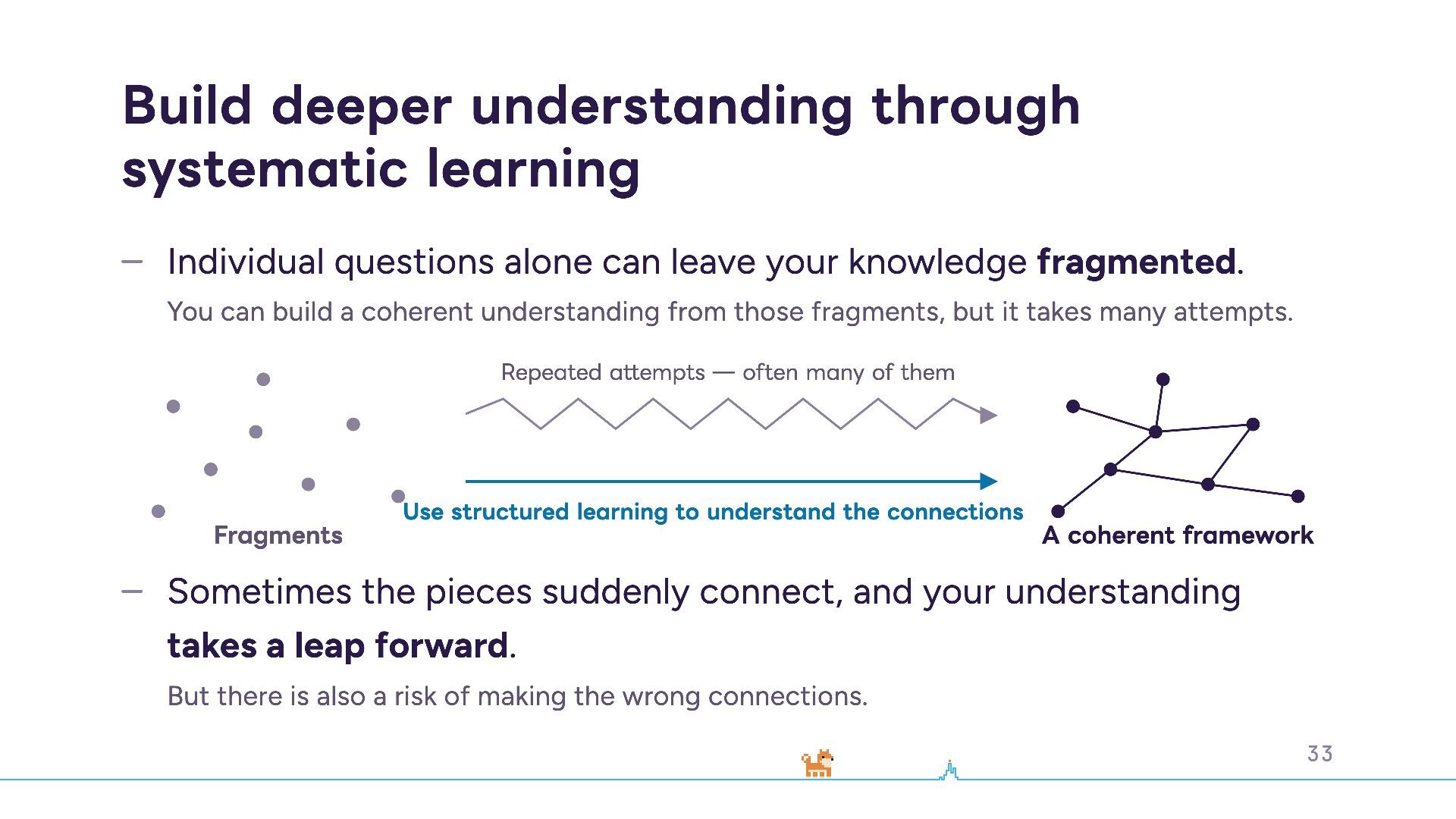
  26. Build deeper understanding through systematic learning Individual questions alone can

    leave your knowledge fragmented. You can build a coherent understanding from those fragments, but it takes many attempts. Sometimes the pieces suddenly connect, and your understanding takes a leap forward. But there is also a risk of making the wrong connections. 33
  27. Build deeper understanding through systematic learning Use structured ways of

    learning to develop deeper proficiency. For example, learn from books or follow an AI-guided learning path. Books help you understand how concepts connect and how your own experience fits into that framework. 34
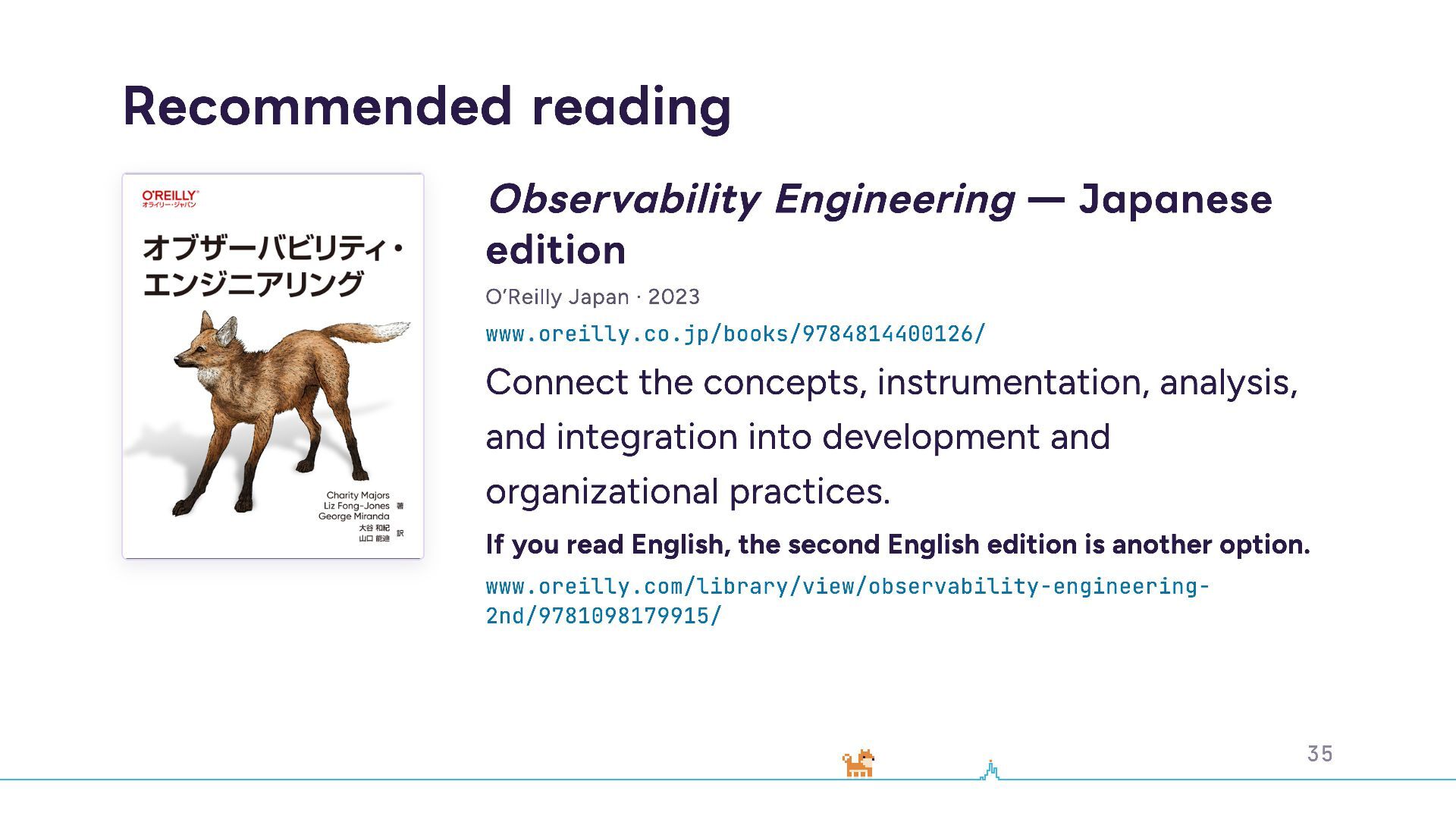
  28. Recommended reading Observability Engineering — Japanese edition O’Reilly Japan ·

    2023 www.oreilly.co.jp/books/9784814400126/ Connect the concepts, instrumentation, analysis, and integration into development and organizational practices. If you read English, the second English edition is another option. www.oreilly.com/library/view/observability-engineering2nd/9781098179915/ 35
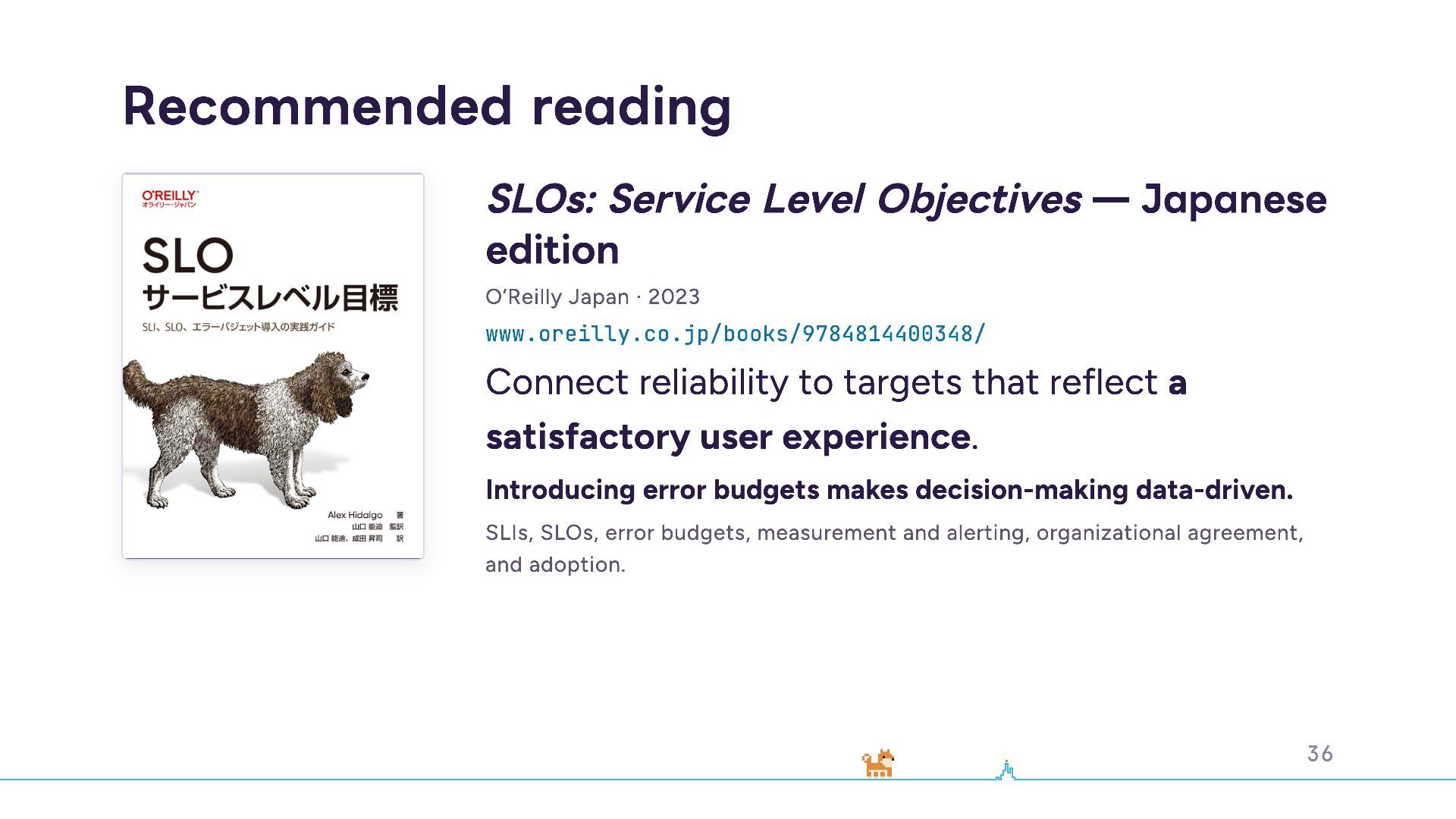
  29. Recommended reading SLOs: Service Level Objectives — Japanese edition O’Reilly

    Japan · 2023 www.oreilly.co.jp/books/9784814400348/ Connect reliability to targets that reflect a satisfactory user experience. Introducing error budgets makes decision-making data-driven. SLIs, SLOs, error budgets, measurement and alerting, organizational agreement, and adoption. 36
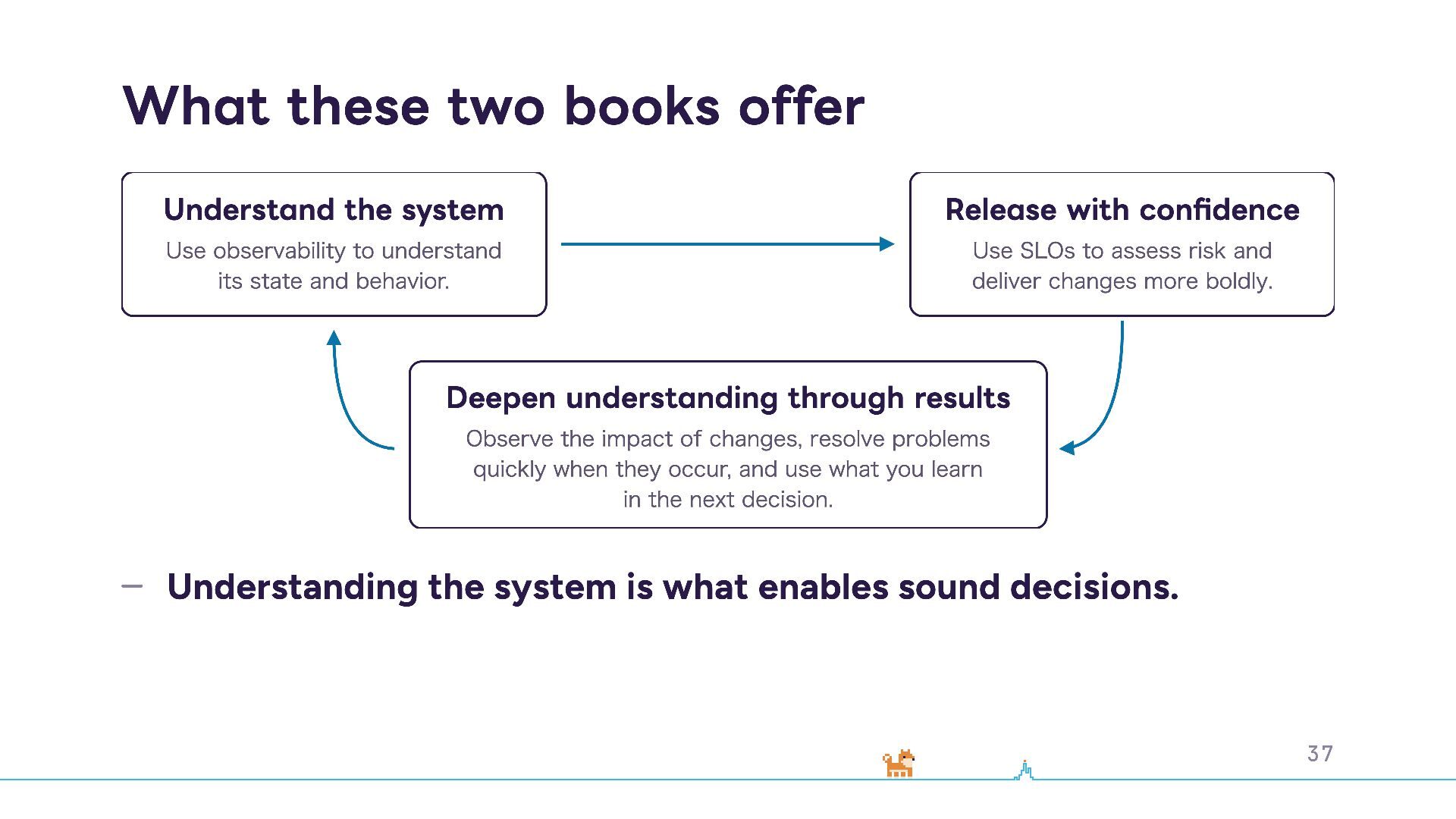
  30. What these two books offer Sound decisions require knowing your

    SLIs (service level indicators) under specific conditions. For example: what state the system is in, or whether a particular user can use it satisfactorily. You can get numbers without observability, but anticipating the metrics and logs you will need is costly. Capturing data in advance as wide events with high cardinality and many dimensions is one observability practice. 38
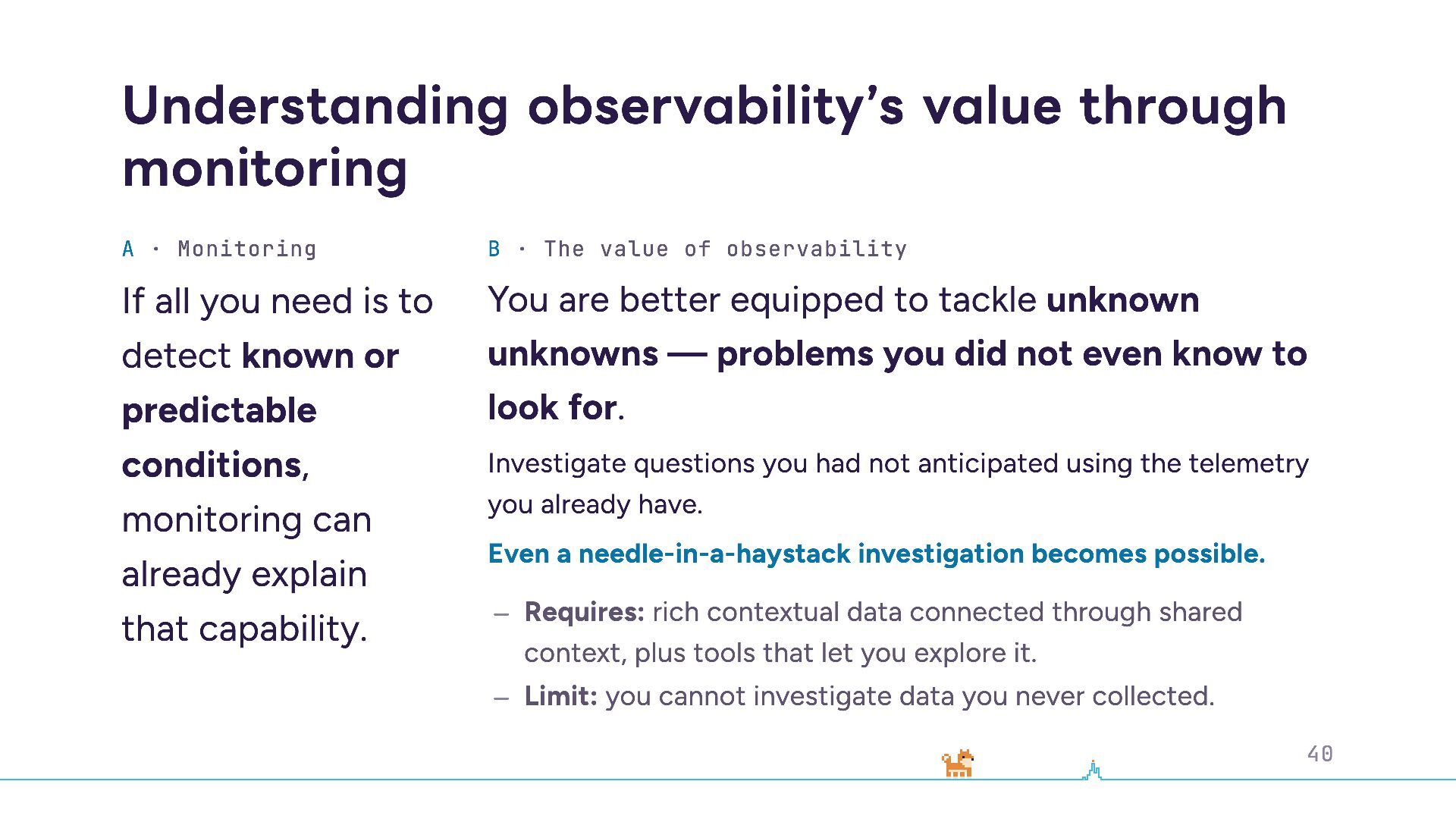
  31. Understanding observability’s value through monitoring A · Monitoring B ·

    The value of observability If all you need is to detect known or predictable conditions, monitoring can already explain that capability. You are better equipped to tackle unknown unknowns — problems you did not even know to look for. Investigate questions you had not anticipated using the telemetry you already have. Even a needle-in-a-haystack investigation becomes possible. Requires: rich contextual data connected through shared context, plus tools that let you explore it. Limit: you cannot investigate data you never collected. 40
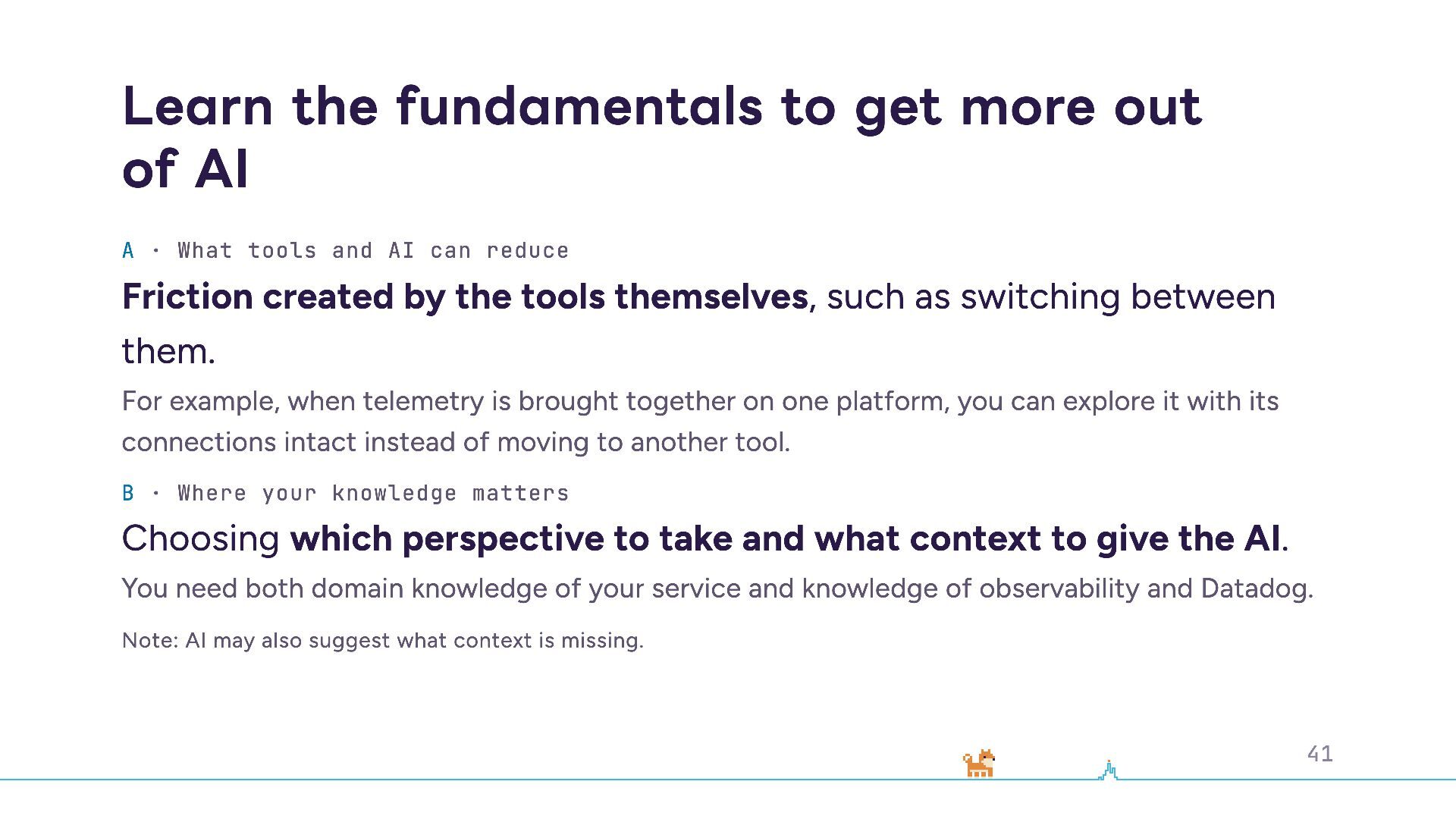
  32. Learn the fundamentals to get more out of AI A

    · What tools and AI can reduce Friction created by the tools themselves, such as switching between them. For example, when telemetry is brought together on one platform, you can explore it with its connections intact instead of moving to another tool. B · Where your knowledge matters Choosing which perspective to take and what context to give the AI. You need both domain knowledge of your service and knowledge of observability and Datadog. Note: AI may also suggest what context is missing. 41
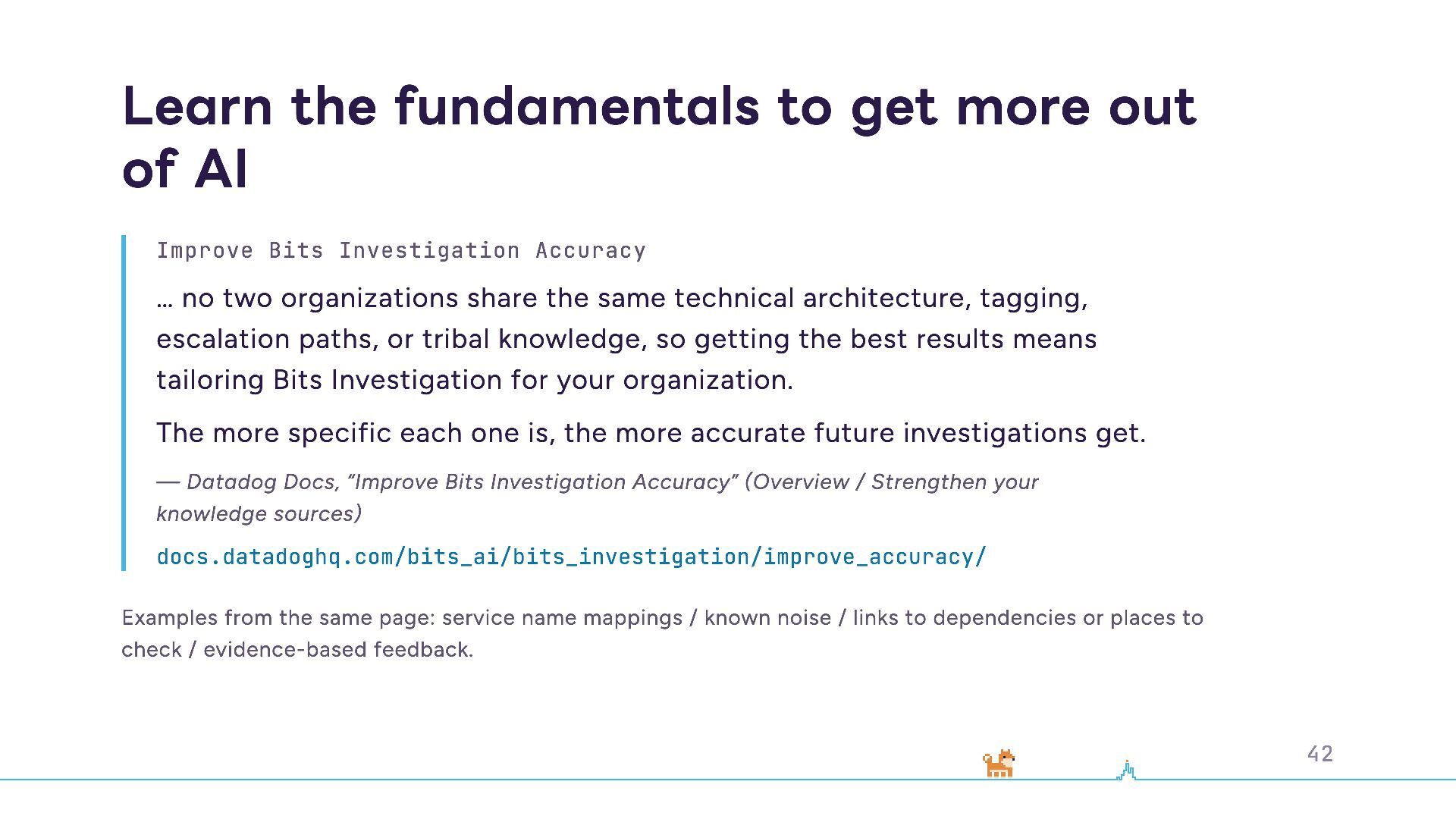
  33. Learn the fundamentals to get more out of AI Improve

    Bits Investigation Accuracy … no two organizations share the same technical architecture, tagging, escalation paths, or tribal knowledge, so getting the best results means tailoring Bits Investigation for your organization. The more specific each one is, the more accurate future investigations get. — Datadog Docs, “Improve Bits Investigation Accuracy” (Overview / Strengthen your knowledge sources) docs.datadoghq.com/bits_ai/bits_investigation/improve_accuracy/ Examples from the same page: service name mappings / known noise / links to dependencies or places to check / evidence-based feedback. 42
  34. Why do organizations struggle to get the most out of

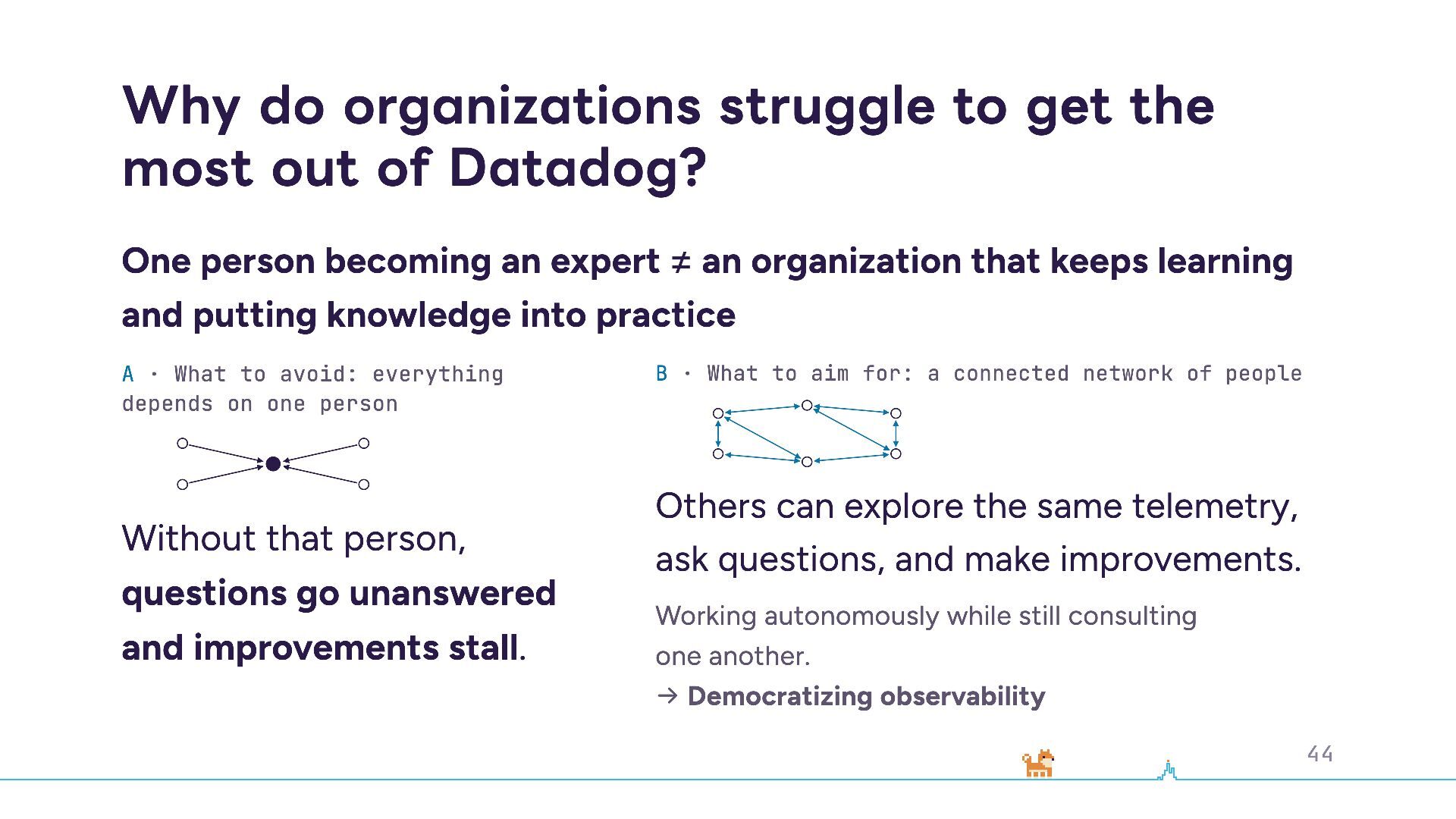
    Datadog? One person becoming an expert ≠ an organization that keeps learning and putting knowledge into practice A · What to avoid: everything depends on one person Without that person, questions go unanswered and improvements stall. B · What to aim for: a connected network of people Others can explore the same telemetry, ask questions, and make improvements. Working autonomously while still consulting one another. → Democratizing observability 44
  35. Help people focus on using the feature An approach I

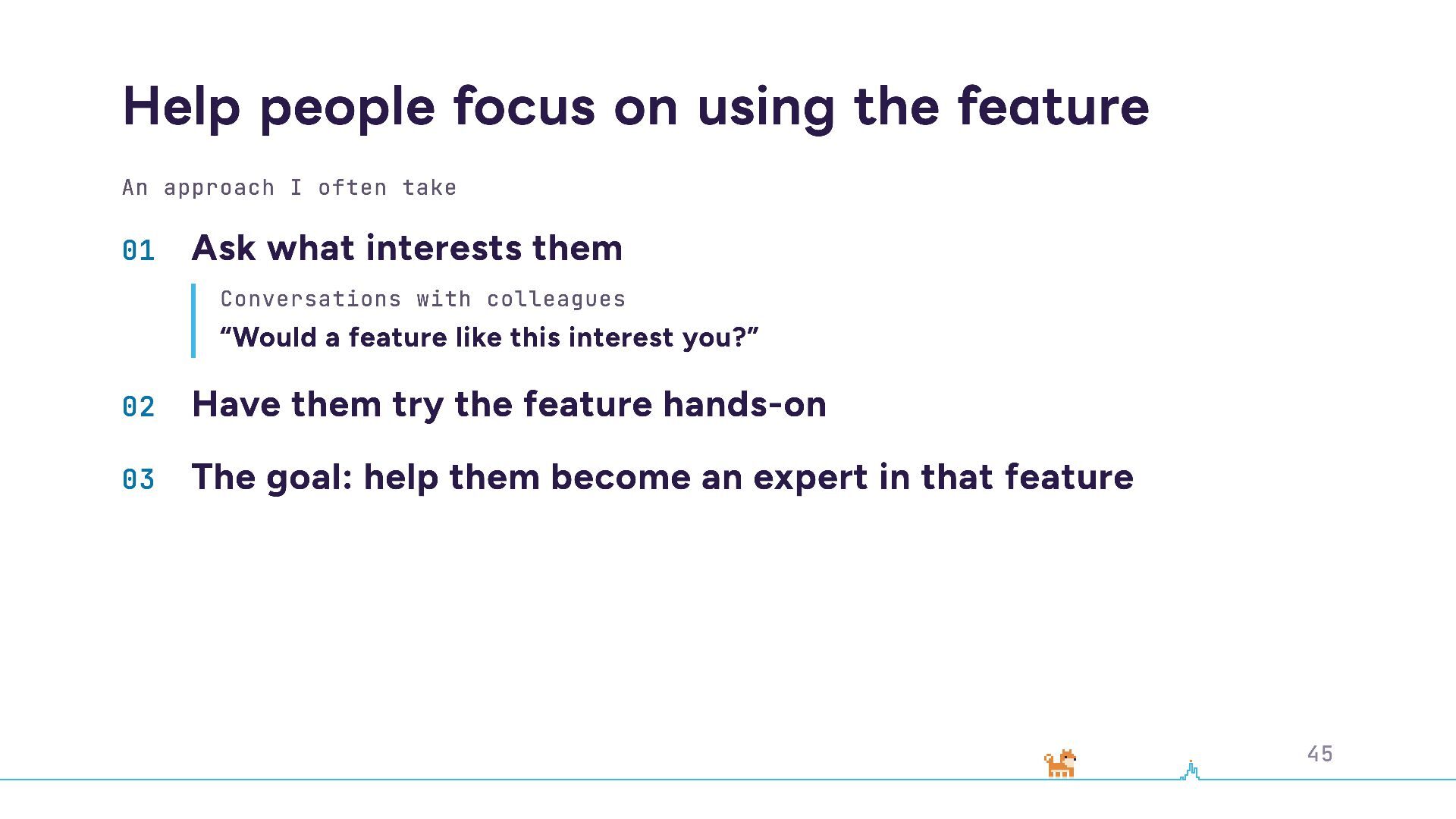
    often take 01 Ask what interests them Conversations with colleagues “Would a feature like this interest you?” 02 Have them try the feature hands-on 03 The goal: help them become an expert in that feature 45
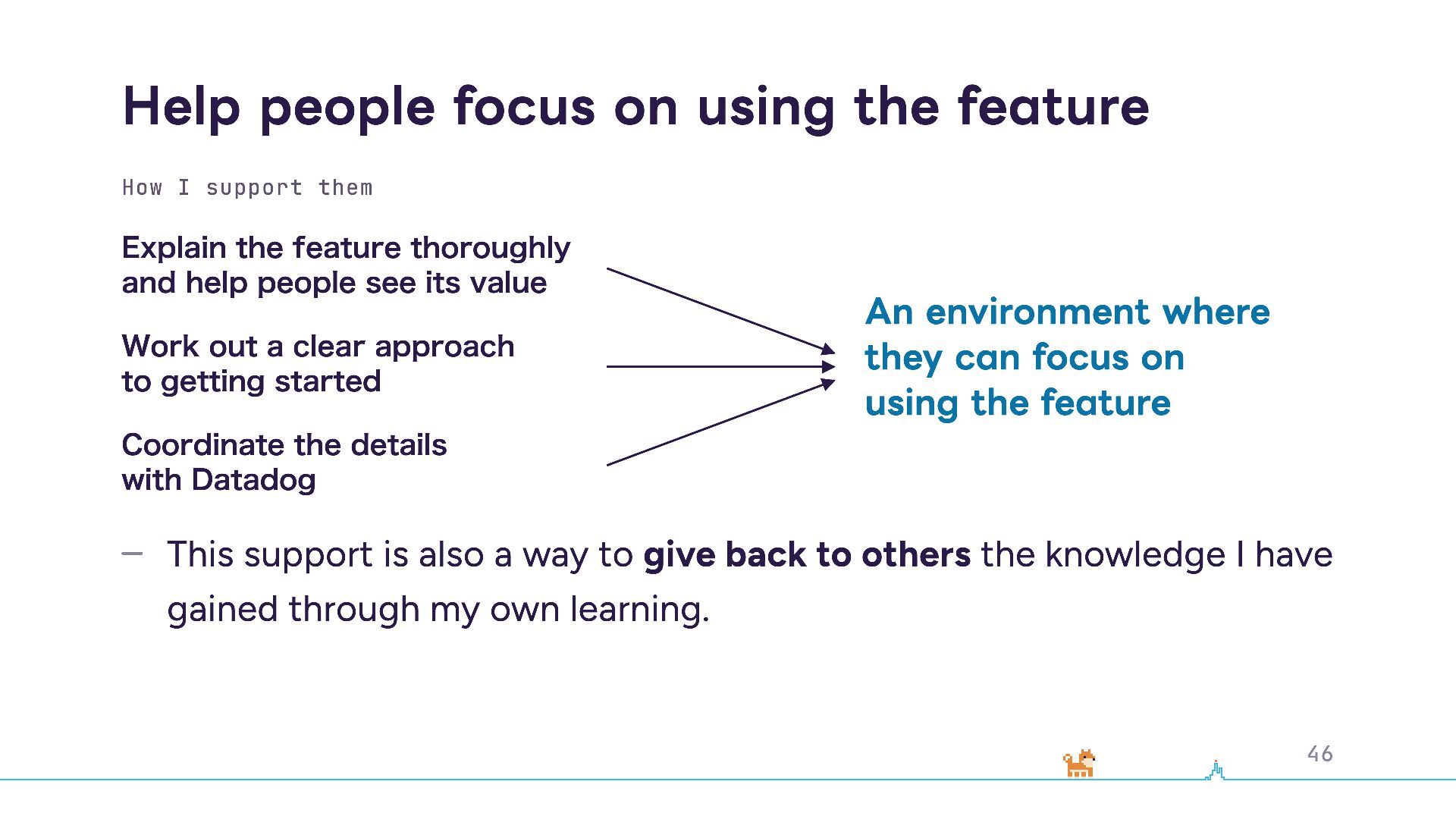
  36. Help people focus on using the feature How I support

    them This support is also a way to give back to others the knowledge I have gained through my own learning. 46
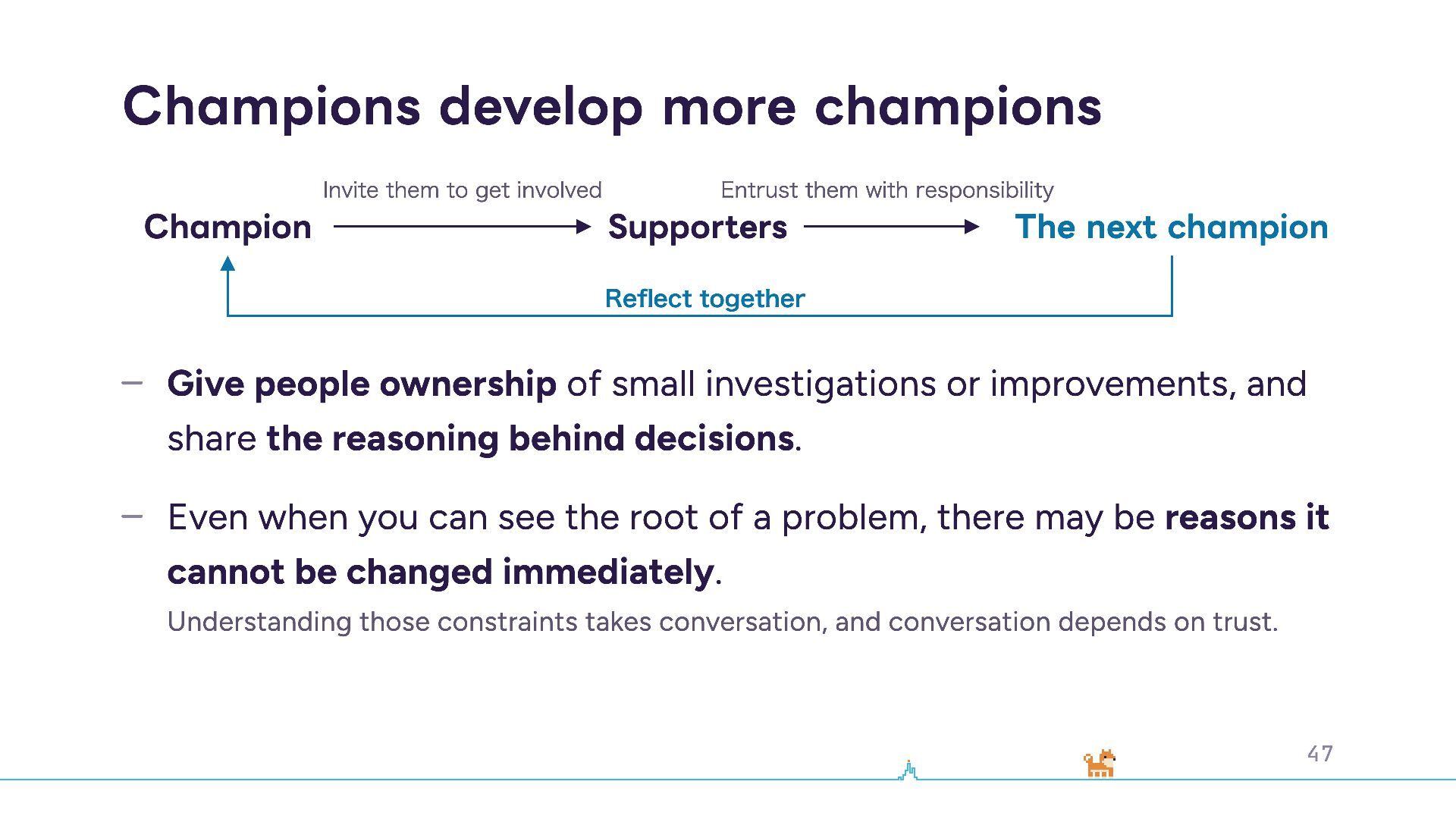
  37. Champions develop more champions Give people ownership of small investigations

    or improvements, and share the reasoning behind decisions. Even when you can see the root of a problem, there may be reasons it cannot be changed immediately. Understanding those constraints takes conversation, and conversation depends on trust. 47
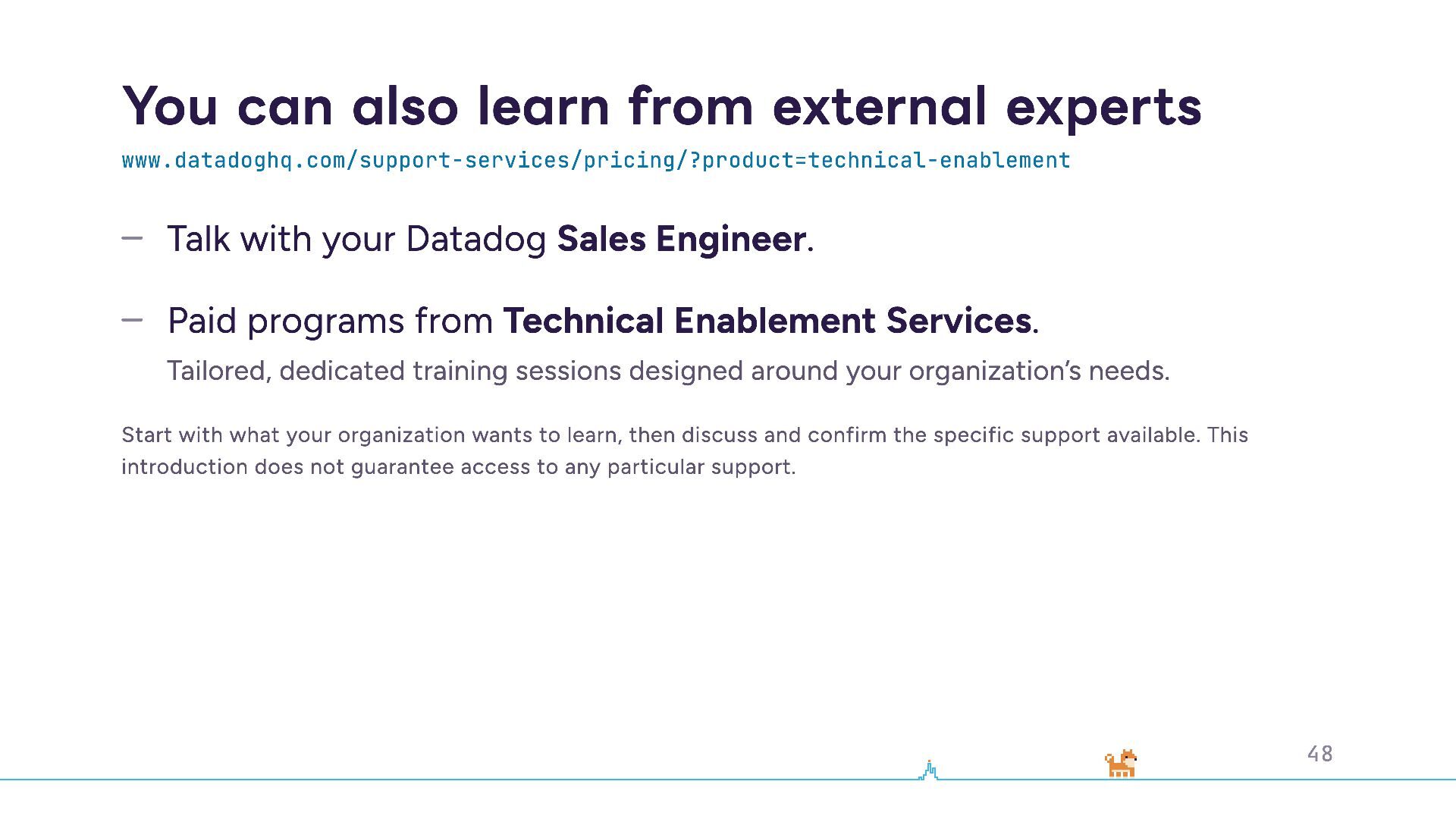
  38. You can also learn from external experts www.datadoghq.com/support-services/pricing/?product=technical-enablement Talk with

    your Datadog Sales Engineer. Paid programs from Technical Enablement Services. Tailored, dedicated training sessions designed around your organization’s needs. Start with what your organization wants to learn, then discuss and confirm the specific support available. This introduction does not guarantee access to any particular support. 48
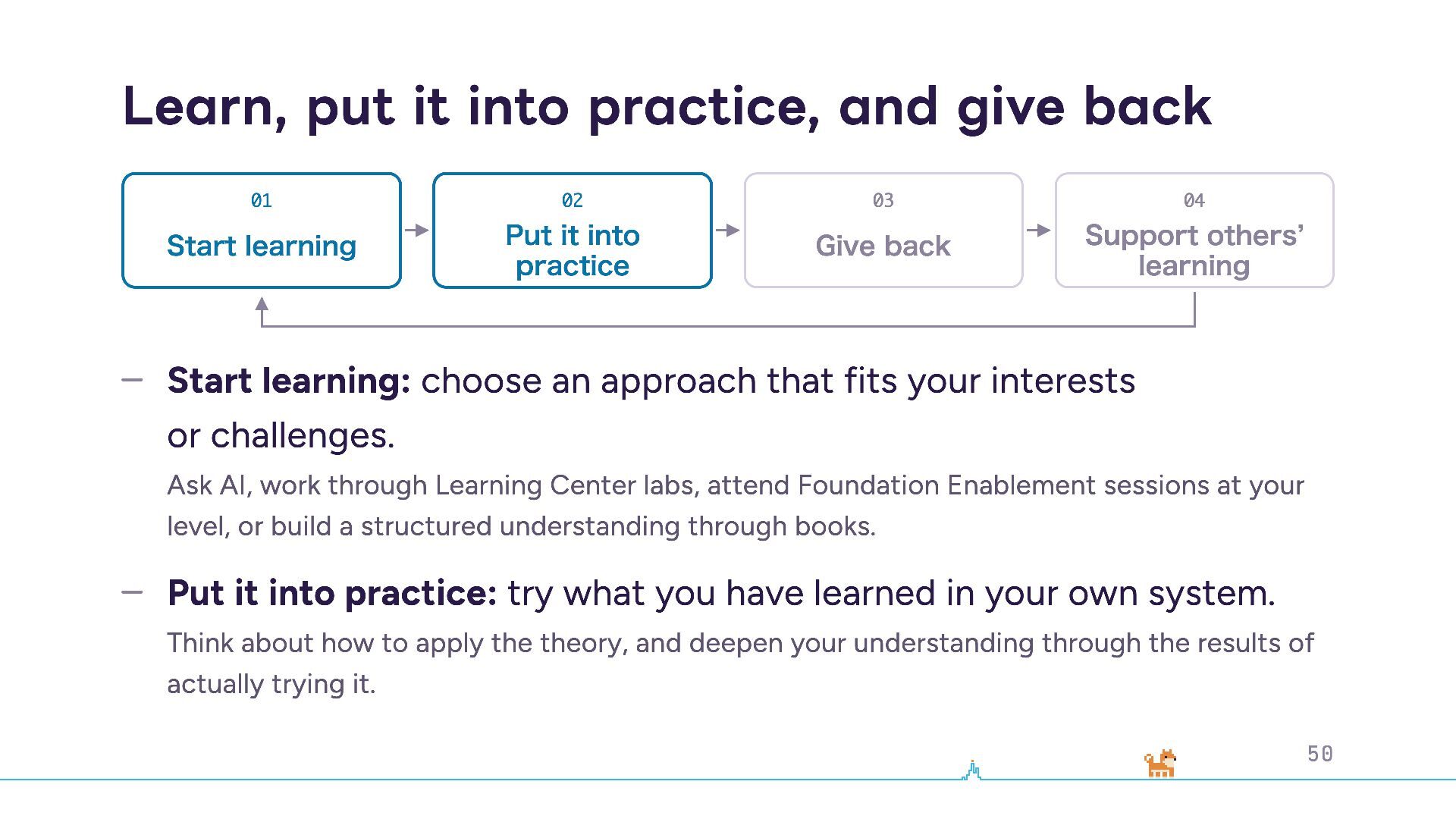
  39. Learn, put it into practice, and give back Start learning:

    choose an approach that fits your interests or challenges. Ask AI, work through Learning Center labs, attend Foundation Enablement sessions at your level, or build a structured understanding through books. Put it into practice: try what you have learned in your own system. Think about how to apply the theory, and deepen your understanding through the results of actually trying it. 50
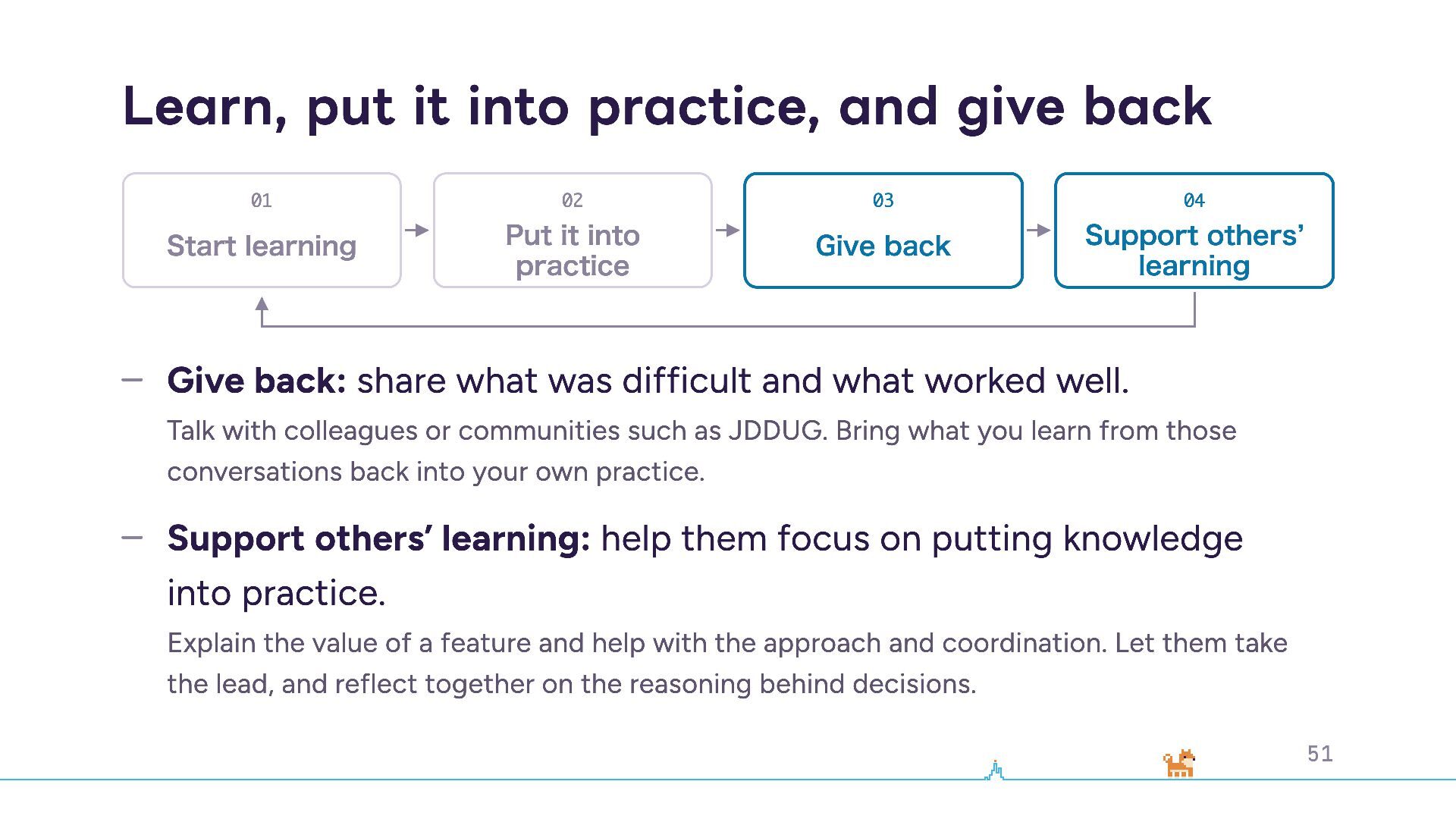
  40. Learn, put it into practice, and give back Give back:

    share what was difficult and what worked well. Talk with colleagues or communities such as JDDUG. Bring what you learn from those conversations back into your own practice. Support others’ learning: help them focus on putting knowledge into practice. Explain the value of a feature and help with the approach and coordination. Let them take the lead, and reflect together on the reasoning behind decisions. 51
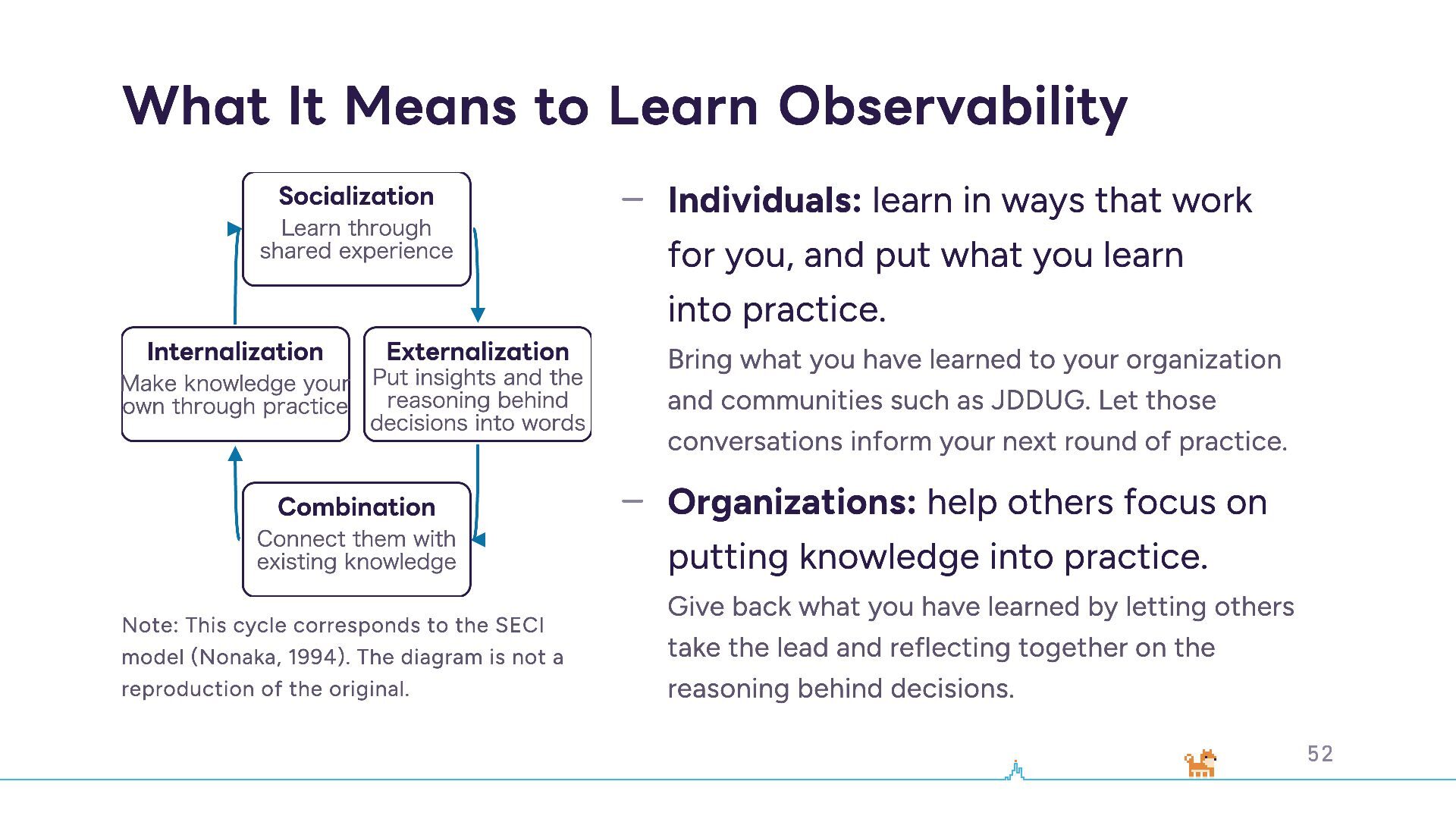
  41. What It Means to Learn Observability Individuals: learn in ways

    that work for you, and put what you learn into practice. Bring what you have learned to your organization and communities such as JDDUG. Let those conversations inform your next round of practice. Organizations: help others focus on putting knowledge into practice. Note: This cycle corresponds to the SECI model (Nonaka, 1994). The diagram is not a reproduction of the original. Give back what you have learned by letting others take the lead and reflecting together on the reasoning behind decisions. 52
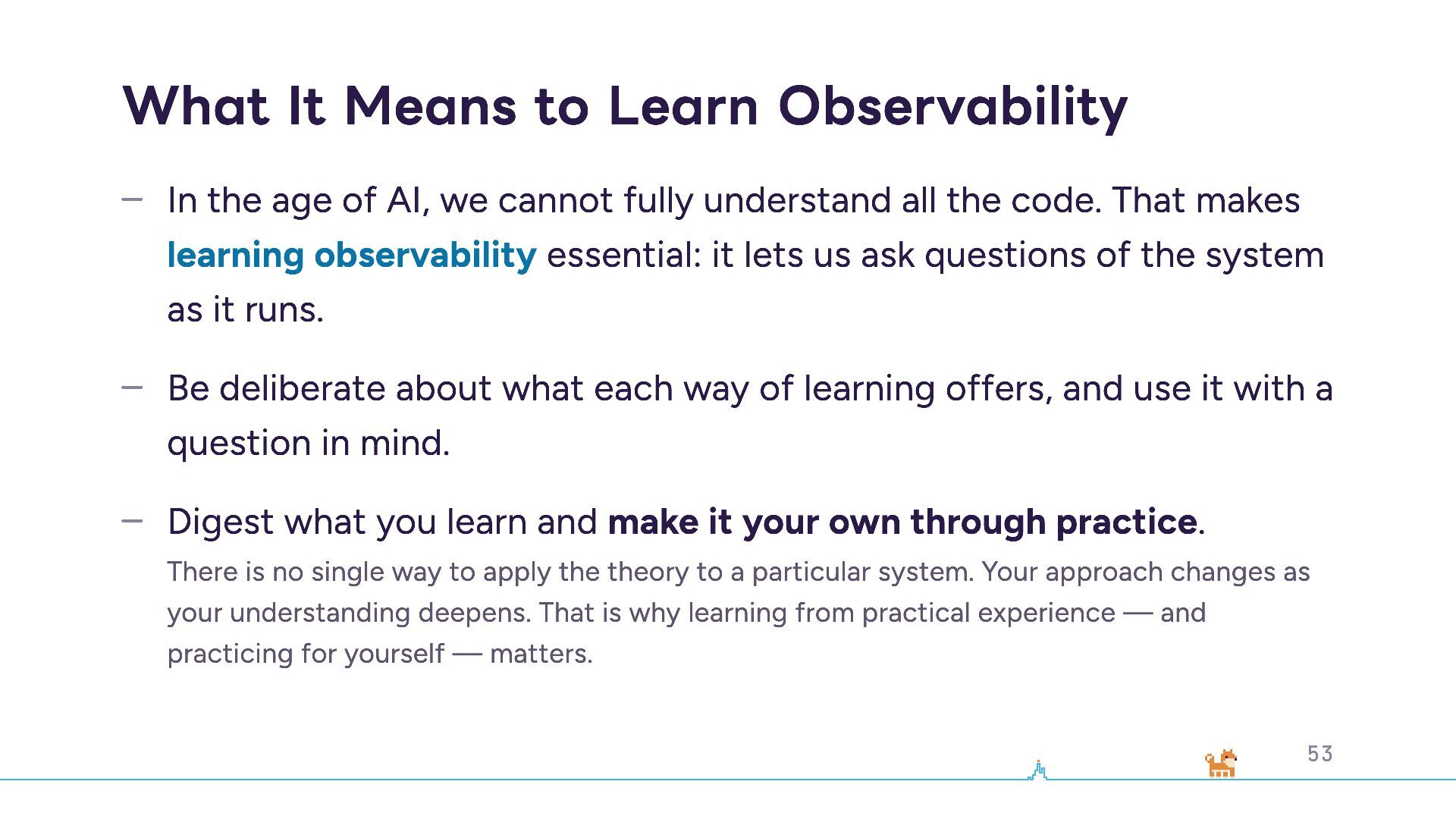
  42. What It Means to Learn Observability In the age of

    AI, we cannot fully understand all the code. That makes learning observability essential: it lets us ask questions of the system as it runs. Be deliberate about what each way of learning offers, and use it with a question in mind. Digest what you learn and make it your own through practice. There is no single way to apply the theory to a particular system. Your approach changes as your understanding deepens. That is why learning from practical experience — and practicing for yourself — matters. 53
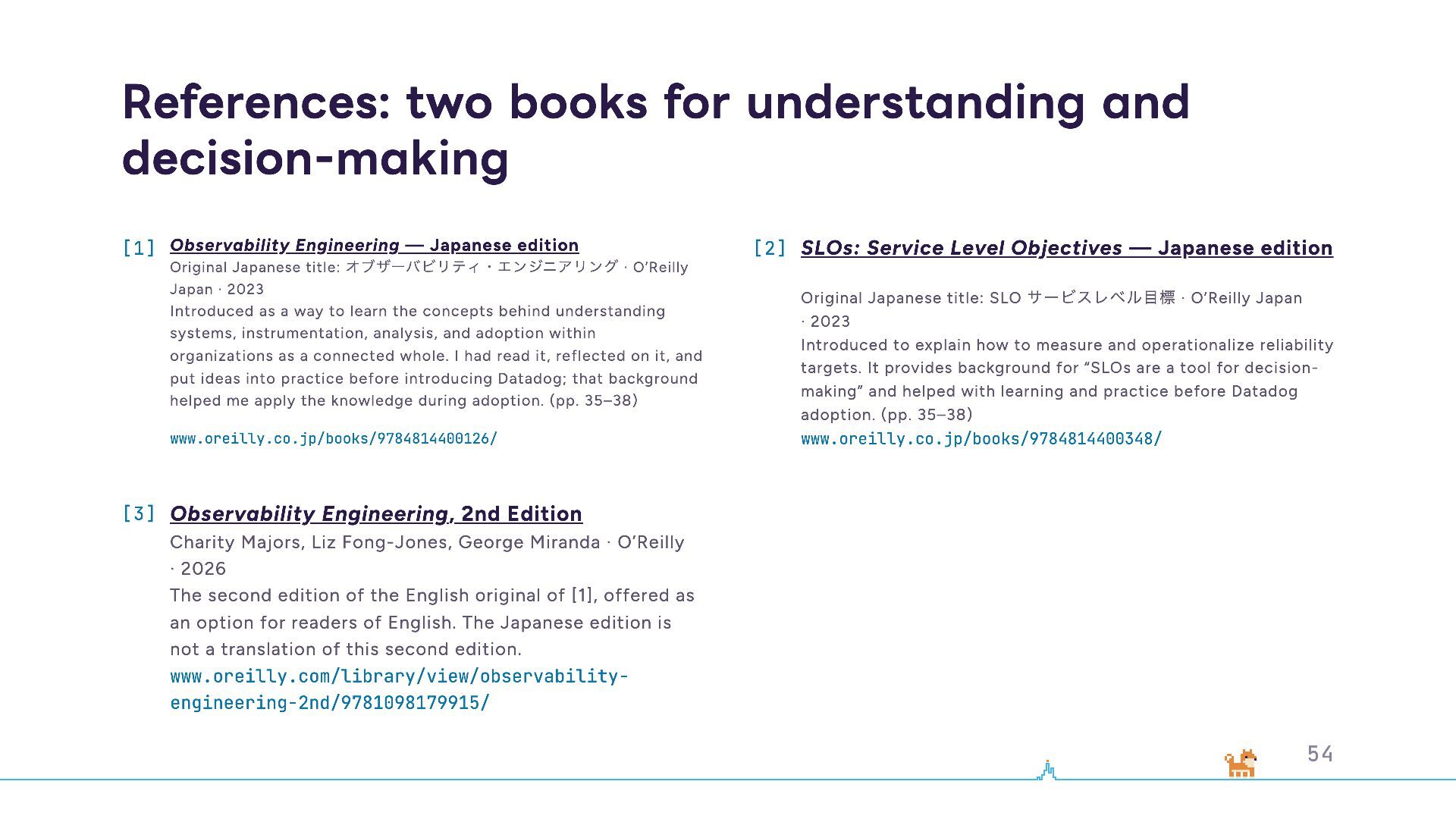
  43. References: two books for understanding and decision-making [1] Observability Engineering

    — Japanese edition [2] SLOs: Service Level Objectives — Japanese edition Original Japanese title: オブザーバビリティ・エンジニアリング · O’Reilly Japan · 2023 Introduced as a way to learn the concepts behind understanding systems, instrumentation, analysis, and adoption within organizations as a connected whole. I had read it, reflected on it, and Original Japanese title: SLO サービスレベル目標 · O’Reilly Japan · 2023 Introduced to explain how to measure and operationalize reliability put ideas into practice before introducing Datadog; that background helped me apply the knowledge during adoption. (pp. 35–38) targets. It provides background for “SLOs are a tool for decisionmaking” and helped with learning and practice before Datadog adoption. (pp. 35–38) www.oreilly.co.jp/books/9784814400126/ www.oreilly.co.jp/books/9784814400348/ [3] Observability Engineering, 2nd Edition Charity Majors, Liz Fong-Jones, George Miranda · O’Reilly · 2026 The second edition of the English original of [1], offered as an option for readers of English. The Japanese edition is not a translation of this second edition. www.oreilly.com/library/view/observabilityengineering-2nd/9781098179915/ 54
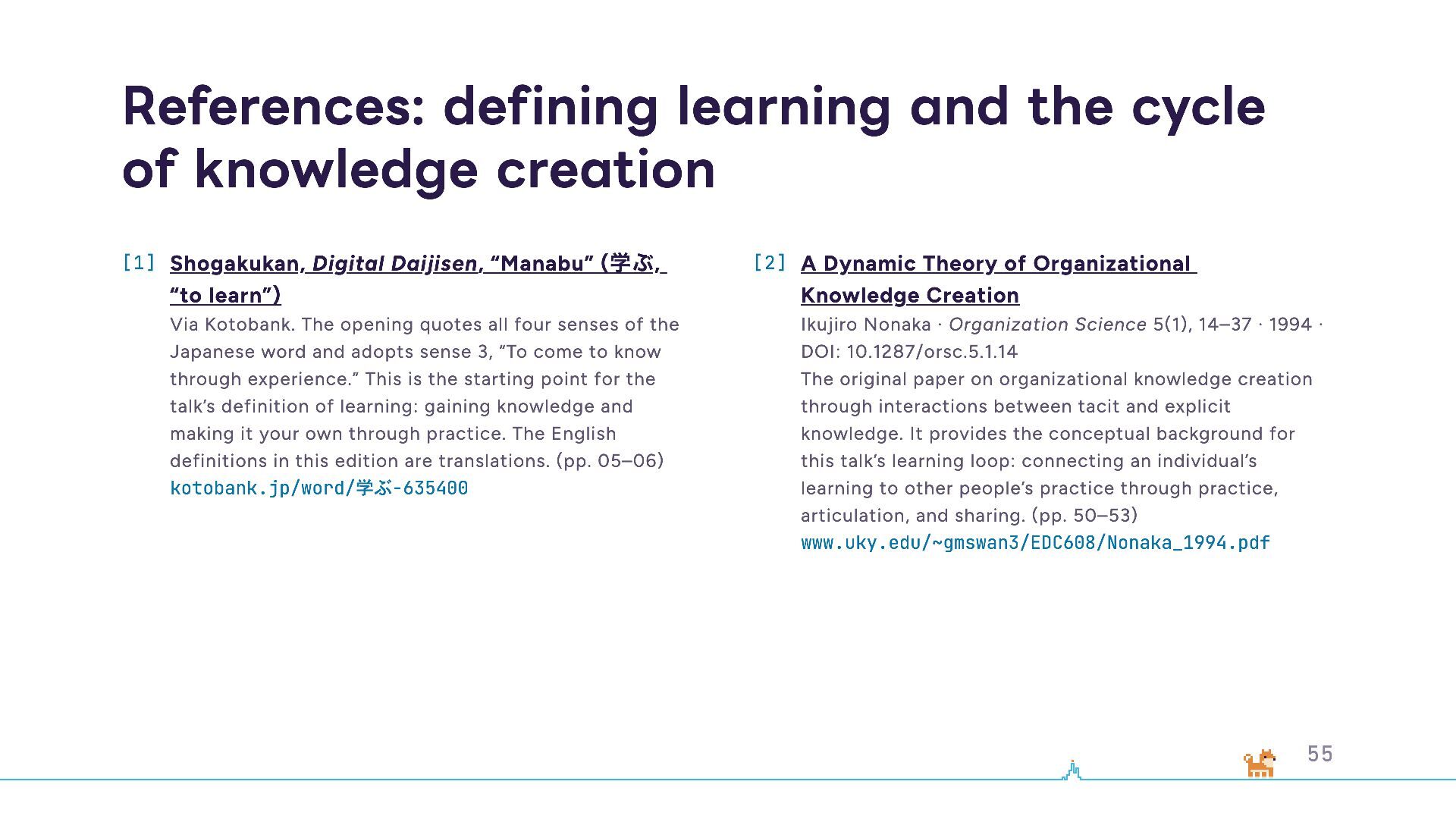
  44. References: defining learning and the cycle of knowledge creation [1]

    Shogakukan, Digital Daijisen, “Manabu” (学ぶ, [2] A Dynamic Theory of Organizational “to learn”) Knowledge Creation Via Kotobank. The opening quotes all four senses of the Japanese word and adopts sense 3, “To come to know through experience.” This is the starting point for the talk’s definition of learning: gaining knowledge and making it your own through practice. The English definitions in this edition are translations. (pp. 05–06) kotobank.jp/word/学ぶ-635400 Ikujiro Nonaka · Organization Science 5(1), 14–37 · 1994 · DOI: 10.1287/orsc.5.1.14 The original paper on organizational knowledge creation through interactions between tacit and explicit knowledge. It provides the conceptual background for this talk’s learning loop: connecting an individual’s learning to other people’s practice through practice, articulation, and sharing. (pp. 50–53) www.uky.edu/~gmswan3/EDC608/Nonaka_1994.pdf 55
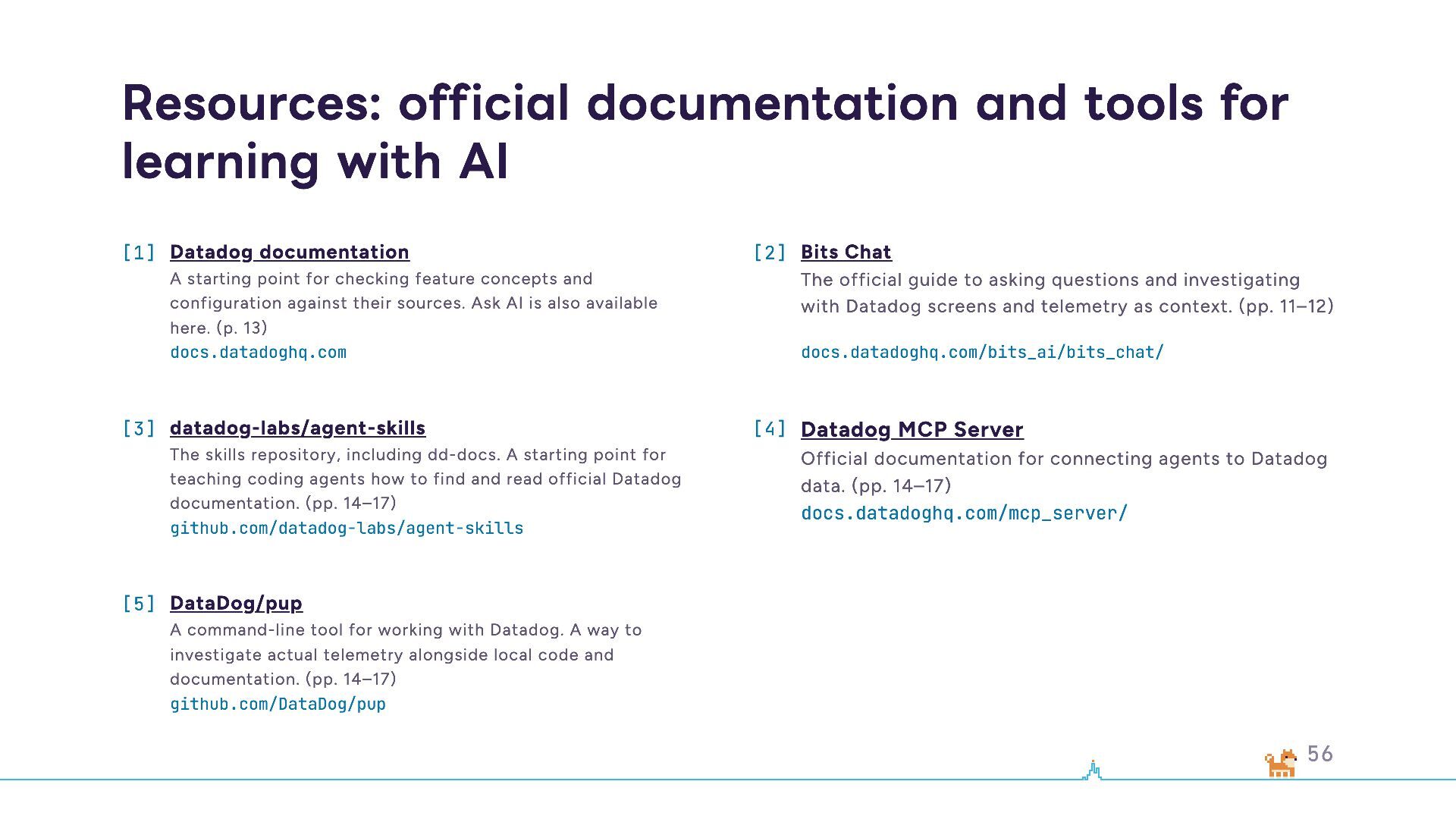
  45. Resources: official documentation and tools for learning with AI [1]

    Datadog documentation A starting point for checking feature concepts and configuration against their sources. Ask AI is also available [2] Bits Chat The official guide to asking questions and investigating with Datadog screens and telemetry as context. (pp. 11–12) here. (p. 13) docs.datadoghq.com [3] datadog-labs/agent-skills The skills repository, including dd-docs. A starting point for teaching coding agents how to find and read official Datadog documentation. (pp. 14–17) github.com/datadog-labs/agent-skills docs.datadoghq.com/bits_ai/bits_chat/ [4] Datadog MCP Server Official documentation for connecting agents to Datadog data. (pp. 14–17) docs.datadoghq.com/mcp_server/ [5] DataDog/pup A command-line tool for working with Datadog. A way to investigate actual telemetry alongside local code and documentation. (pp. 14–17) github.com/DataDog/pup 56