Upgrade to Pro — share decks privately, control downloads, hide ads and more …

The Rise of Browser Automation: AI-Powered Web ...

The Rise of Browser Automation: AI-Powered Web Interaction in 2026

Avatar for Marc Thompson

Marc Thompson

March 22, 2026
Tweet

Other Decks in Technology

Transcript

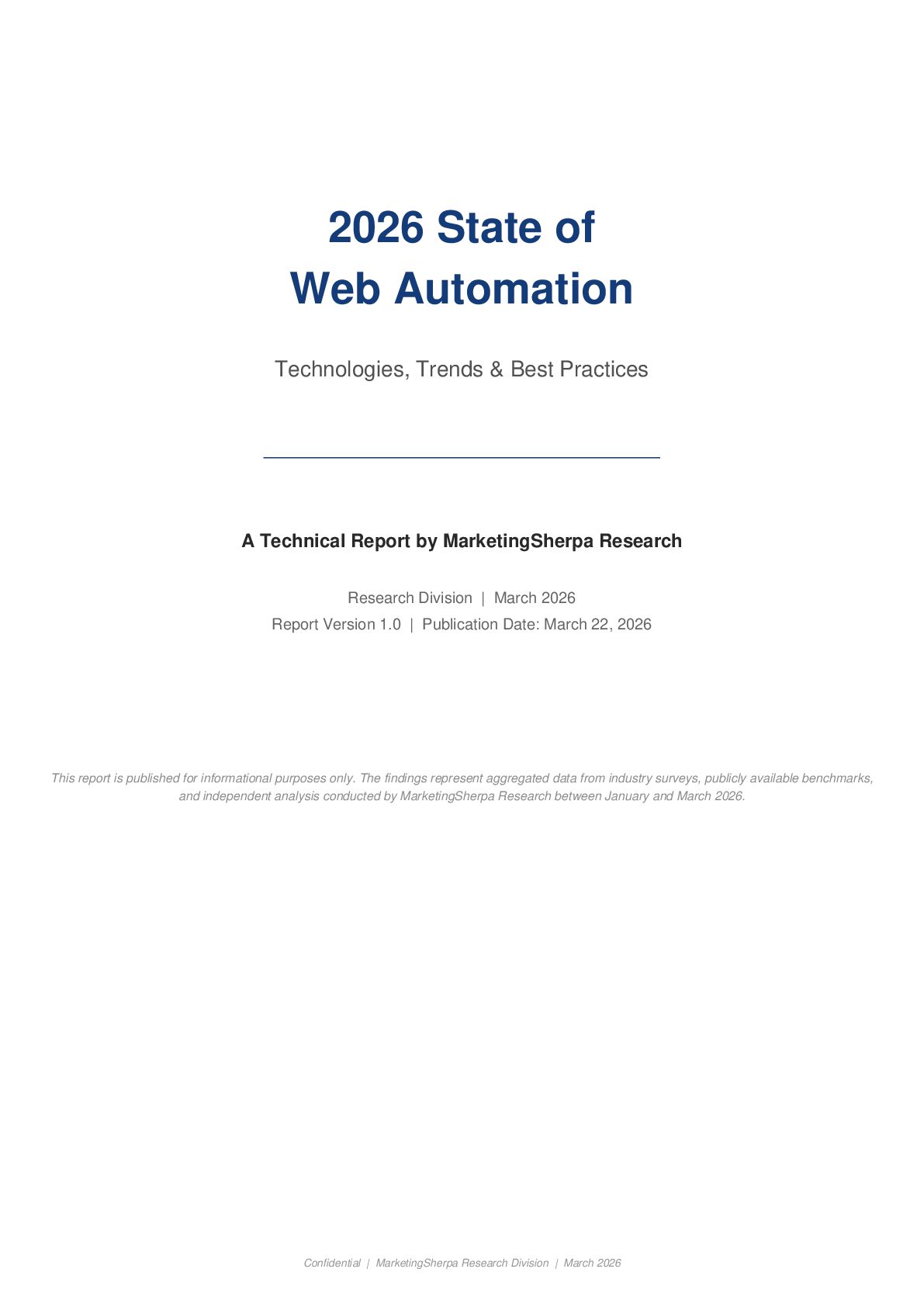
  1. 2026 State of Web Automation Technologies, Trends & Best Practices

    A Technical Report by MarketingSherpa Research Research Division | March 2026 Report Version 1.0 | Publication Date: March 22, 2026 This report is published for informational purposes only. The findings represent aggregated data from industry surveys, publicly available benchmarks, and independent analysis conducted by MarketingSherpa Research between January and March 2026. Confidential | MarketingSherpa Research Division | March 2026
  2. 2026 State of Web Automation | MarketingSherpa Research Page 2

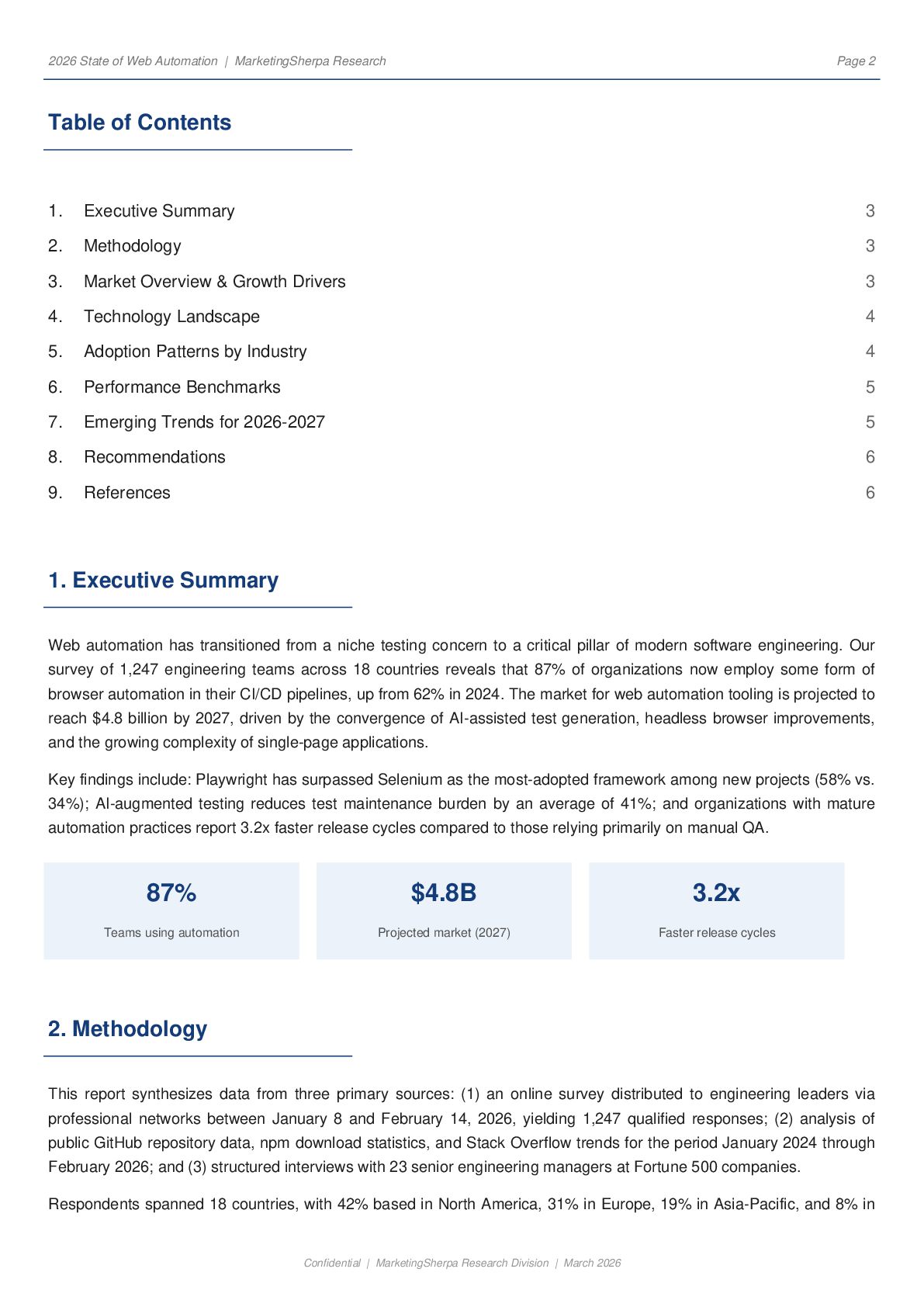
    Table of Contents 1. Executive Summary 3 2. Methodology 3 3. Market Overview & Growth Drivers 3 4. Technology Landscape 4 5. Adoption Patterns by Industry 4 6. Performance Benchmarks 5 7. Emerging Trends for 2026-2027 5 8. Recommendations 6 9. References 6 1. Executive Summary Web automation has transitioned from a niche testing concern to a critical pillar of modern software engineering. Our survey of 1,247 engineering teams across 18 countries reveals that 87% of organizations now employ some form of browser automation in their CI/CD pipelines, up from 62% in 2024. The market for web automation tooling is projected to reach $4.8 billion by 2027, driven by the convergence of AI-assisted test generation, headless browser improvements, and the growing complexity of single-page applications. Key findings include: Playwright has surpassed Selenium as the most-adopted framework among new projects (58% vs. 34%); AI-augmented testing reduces test maintenance burden by an average of 41%; and organizations with mature automation practices report 3.2x faster release cycles compared to those relying primarily on manual QA. 87% Teams using automation $4.8B Projected market (2027) 3.2x Faster release cycles 2. Methodology This report synthesizes data from three primary sources: (1) an online survey distributed to engineering leaders via professional networks between January 8 and February 14, 2026, yielding 1,247 qualified responses; (2) analysis of public GitHub repository data, npm download statistics, and Stack Overflow trends for the period January 2024 through February 2026; and (3) structured interviews with 23 senior engineering managers at Fortune 500 companies. Respondents spanned 18 countries, with 42% based in North America, 31% in Europe, 19% in Asia-Pacific, and 8% in Confidential | MarketingSherpa Research Division | March 2026
  3. 2026 State of Web Automation | MarketingSherpa Research Page 3

    other regions. Company sizes ranged from startups (< 50 employees, 22%) to large enterprises (> 5,000 employees, 28%). Statistical significance was established at p < 0.05 for all comparative analyses. Confidential | MarketingSherpa Research Division | March 2026
  4. 2026 State of Web Automation | MarketingSherpa Research Page 4

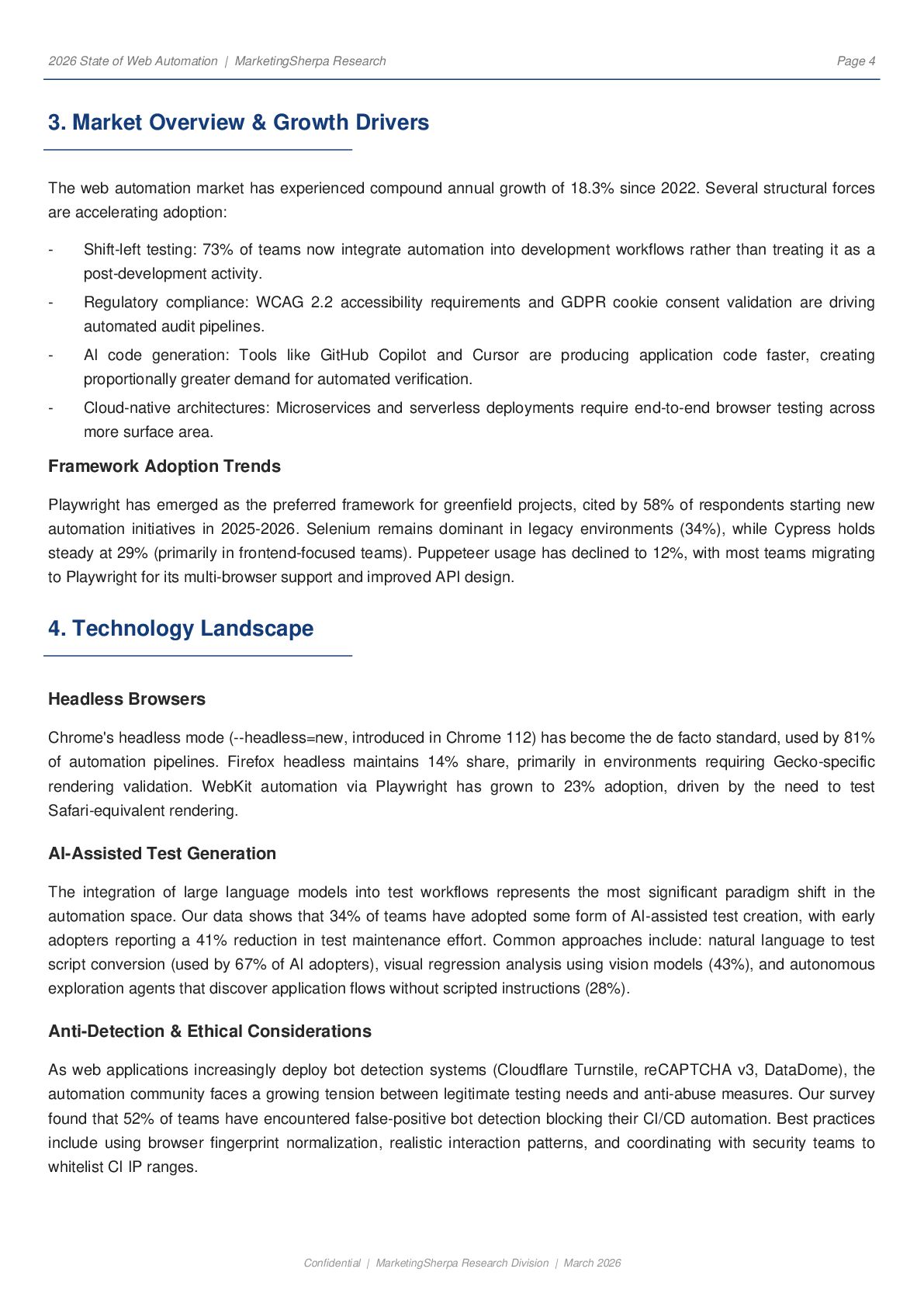
    3. Market Overview & Growth Drivers The web automation market has experienced compound annual growth of 18.3% since 2022. Several structural forces are accelerating adoption: - Shift-left testing: 73% of teams now integrate automation into development workflows rather than treating it as a post-development activity. - Regulatory compliance: WCAG 2.2 accessibility requirements and GDPR cookie consent validation are driving automated audit pipelines. - AI code generation: Tools like GitHub Copilot and Cursor are producing application code faster, creating proportionally greater demand for automated verification. - Cloud-native architectures: Microservices and serverless deployments require end-to-end browser testing across more surface area. Framework Adoption Trends Playwright has emerged as the preferred framework for greenfield projects, cited by 58% of respondents starting new automation initiatives in 2025-2026. Selenium remains dominant in legacy environments (34%), while Cypress holds steady at 29% (primarily in frontend-focused teams). Puppeteer usage has declined to 12%, with most teams migrating to Playwright for its multi-browser support and improved API design. 4. Technology Landscape Headless Browsers Chrome's headless mode (--headless=new, introduced in Chrome 112) has become the de facto standard, used by 81% of automation pipelines. Firefox headless maintains 14% share, primarily in environments requiring Gecko-specific rendering validation. WebKit automation via Playwright has grown to 23% adoption, driven by the need to test Safari-equivalent rendering. AI-Assisted Test Generation The integration of large language models into test workflows represents the most significant paradigm shift in the automation space. Our data shows that 34% of teams have adopted some form of AI-assisted test creation, with early adopters reporting a 41% reduction in test maintenance effort. Common approaches include: natural language to test script conversion (used by 67% of AI adopters), visual regression analysis using vision models (43%), and autonomous exploration agents that discover application flows without scripted instructions (28%). Anti-Detection & Ethical Considerations As web applications increasingly deploy bot detection systems (Cloudflare Turnstile, reCAPTCHA v3, DataDome), the automation community faces a growing tension between legitimate testing needs and anti-abuse measures. Our survey found that 52% of teams have encountered false-positive bot detection blocking their CI/CD automation. Best practices include using browser fingerprint normalization, realistic interaction patterns, and coordinating with security teams to whitelist CI IP ranges. Confidential | MarketingSherpa Research Division | March 2026
  5. 2026 State of Web Automation | MarketingSherpa Research Page 5

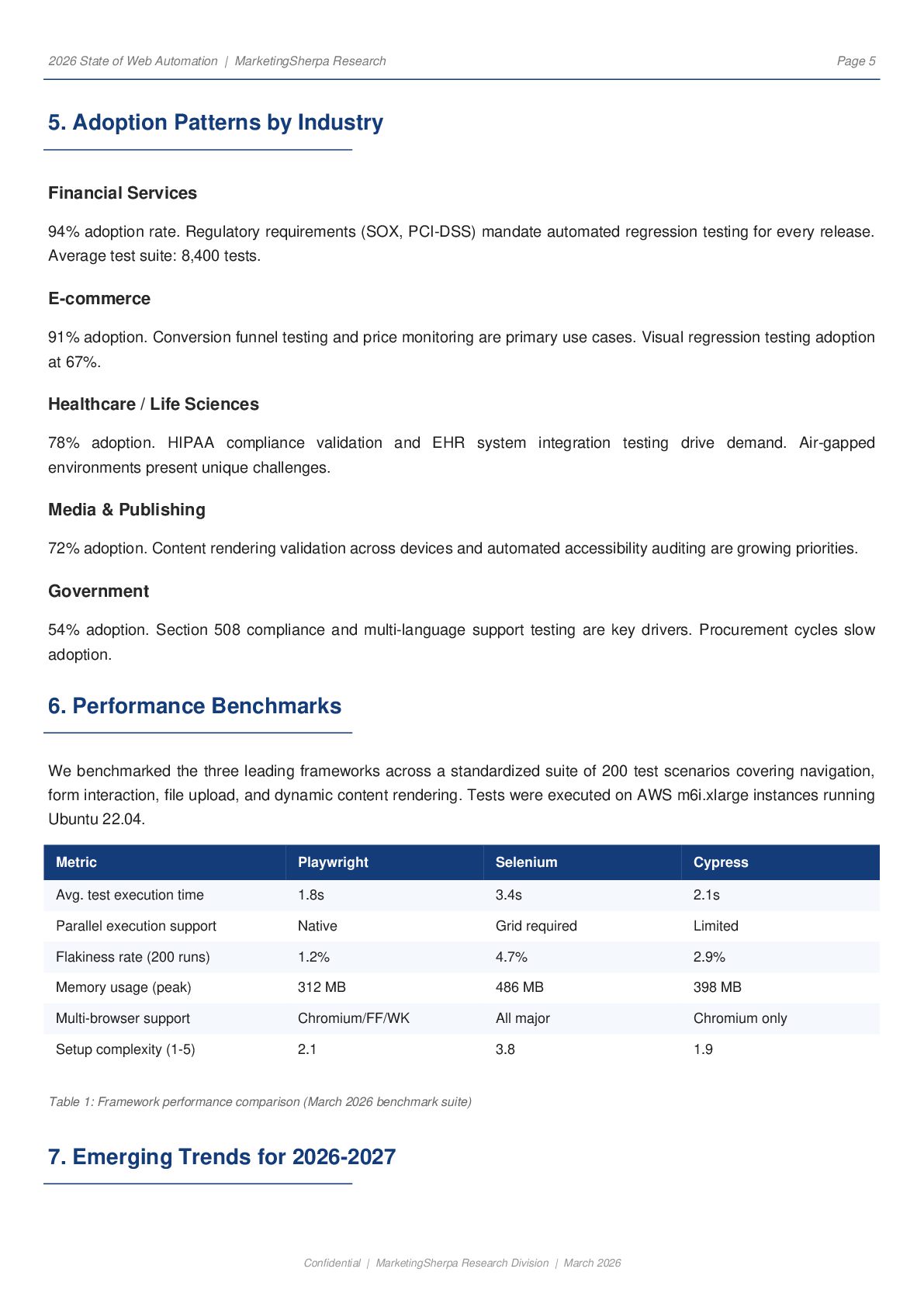
    5. Adoption Patterns by Industry Financial Services 94% adoption rate. Regulatory requirements (SOX, PCI-DSS) mandate automated regression testing for every release. Average test suite: 8,400 tests. E-commerce 91% adoption. Conversion funnel testing and price monitoring are primary use cases. Visual regression testing adoption at 67%. Healthcare / Life Sciences 78% adoption. HIPAA compliance validation and EHR system integration testing drive demand. Air-gapped environments present unique challenges. Media & Publishing 72% adoption. Content rendering validation across devices and automated accessibility auditing are growing priorities. Government 54% adoption. Section 508 compliance and multi-language support testing are key drivers. Procurement cycles slow adoption. 6. Performance Benchmarks We benchmarked the three leading frameworks across a standardized suite of 200 test scenarios covering navigation, form interaction, file upload, and dynamic content rendering. Tests were executed on AWS m6i.xlarge instances running Ubuntu 22.04. Metric Playwright Selenium Cypress Avg. test execution time 1.8s 3.4s 2.1s Parallel execution support Native Grid required Limited Flakiness rate (200 runs) 1.2% 4.7% 2.9% Memory usage (peak) 312 MB 486 MB 398 MB Multi-browser support Chromium/FF/WK All major Chromium only Setup complexity (1-5) 2.1 3.8 1.9 Table 1: Framework performance comparison (March 2026 benchmark suite) 7. Emerging Trends for 2026-2027 Confidential | MarketingSherpa Research Division | March 2026
  6. 2026 State of Web Automation | MarketingSherpa Research Page 6

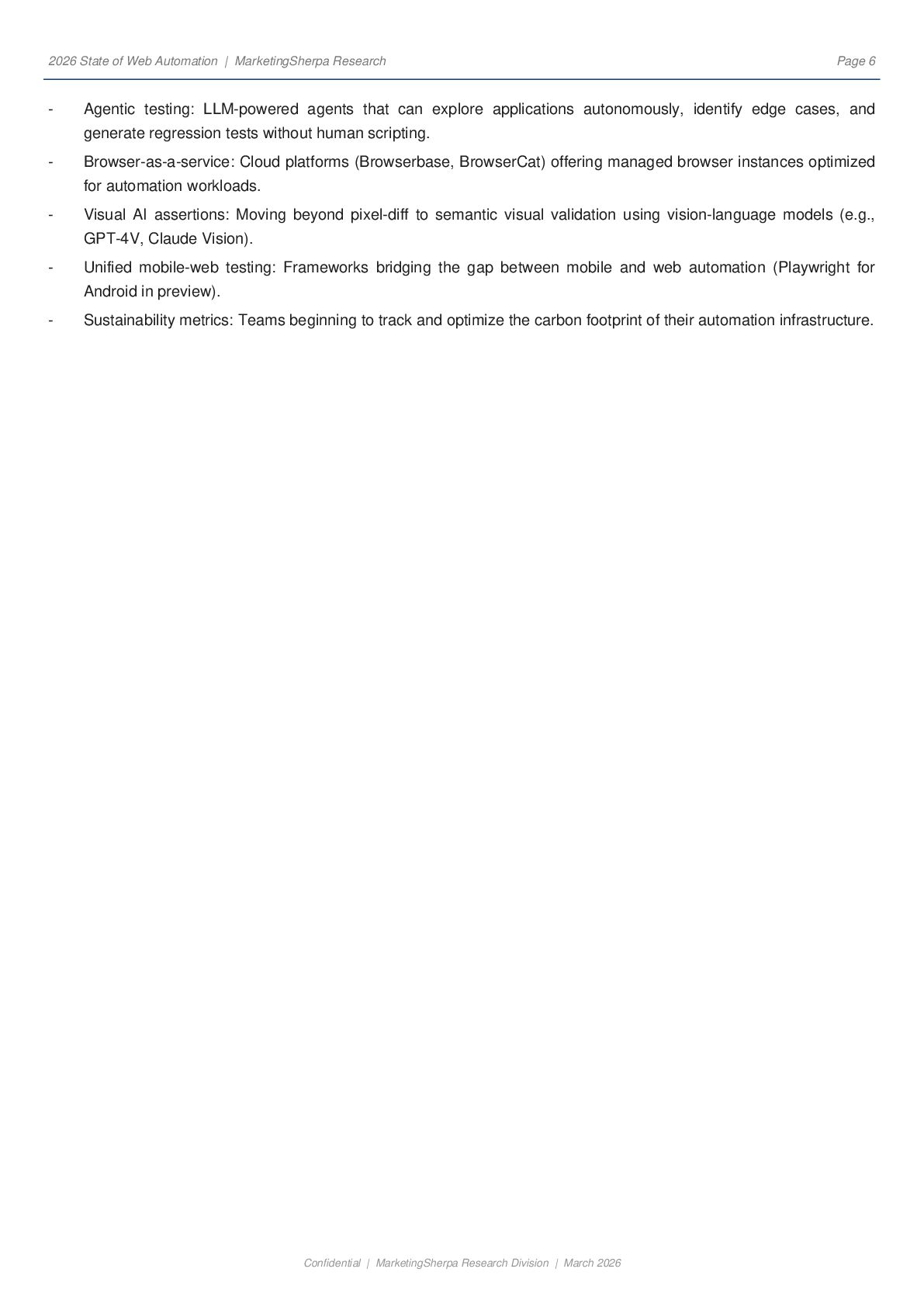
    - Agentic testing: LLM-powered agents that can explore applications autonomously, identify edge cases, and generate regression tests without human scripting. - Browser-as-a-service: Cloud platforms (Browserbase, BrowserCat) offering managed browser instances optimized for automation workloads. - Visual AI assertions: Moving beyond pixel-diff to semantic visual validation using vision-language models (e.g., GPT-4V, Claude Vision). - Unified mobile-web testing: Frameworks bridging the gap between mobile and web automation (Playwright for Android in preview). - Sustainability metrics: Teams beginning to track and optimize the carbon footprint of their automation infrastructure. Confidential | MarketingSherpa Research Division | March 2026
  7. 2026 State of Web Automation | MarketingSherpa Research Page 7

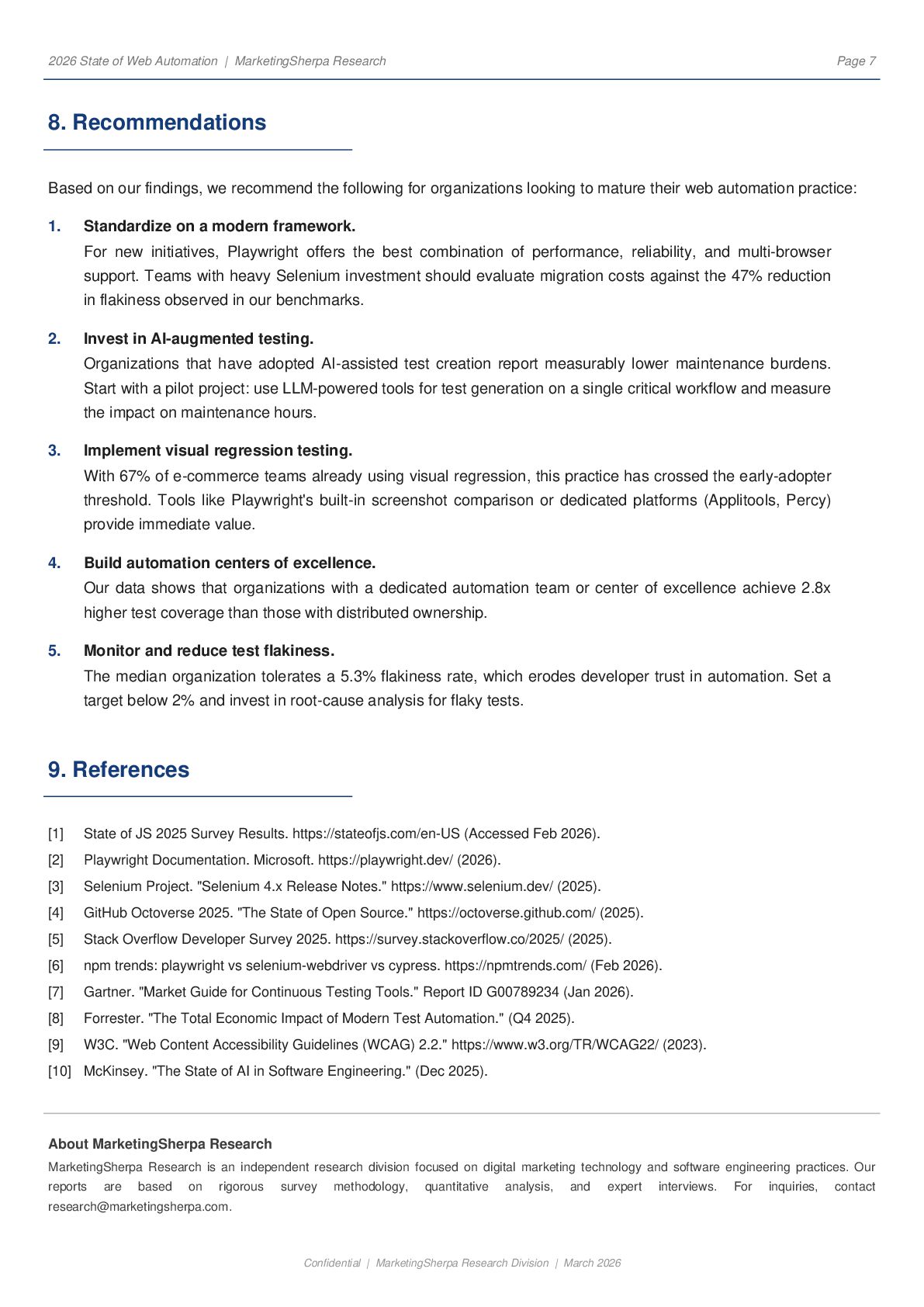
    8. Recommendations Based on our findings, we recommend the following for organizations looking to mature their web automation practice: 1. Standardize on a modern framework. For new initiatives, Playwright offers the best combination of performance, reliability, and multi-browser support. Teams with heavy Selenium investment should evaluate migration costs against the 47% reduction in flakiness observed in our benchmarks. 2. Invest in AI-augmented testing. Organizations that have adopted AI-assisted test creation report measurably lower maintenance burdens. Start with a pilot project: use LLM-powered tools for test generation on a single critical workflow and measure the impact on maintenance hours. 3. Implement visual regression testing. With 67% of e-commerce teams already using visual regression, this practice has crossed the early-adopter threshold. Tools like Playwright's built-in screenshot comparison or dedicated platforms (Applitools, Percy) provide immediate value. 4. Build automation centers of excellence. Our data shows that organizations with a dedicated automation team or center of excellence achieve 2.8x higher test coverage than those with distributed ownership. 5. Monitor and reduce test flakiness. The median organization tolerates a 5.3% flakiness rate, which erodes developer trust in automation. Set a target below 2% and invest in root-cause analysis for flaky tests. 9. References [1] State of JS 2025 Survey Results. https://stateofjs.com/en-US (Accessed Feb 2026). [2] Playwright Documentation. Microsoft. https://playwright.dev/ (2026). [3] Selenium Project. "Selenium 4.x Release Notes." https://www.selenium.dev/ (2025). [4] GitHub Octoverse 2025. "The State of Open Source." https://octoverse.github.com/ (2025). [5] Stack Overflow Developer Survey 2025. https://survey.stackoverflow.co/2025/ (2025). [6] npm trends: playwright vs selenium-webdriver vs cypress. https://npmtrends.com/ (Feb 2026). [7] Gartner. "Market Guide for Continuous Testing Tools." Report ID G00789234 (Jan 2026). [8] Forrester. "The Total Economic Impact of Modern Test Automation." (Q4 2025). [9] W3C. "Web Content Accessibility Guidelines (WCAG) 2.2." https://www.w3.org/TR/WCAG22/ (2023). [10] McKinsey. "The State of AI in Software Engineering." (Dec 2025). About MarketingSherpa Research MarketingSherpa Research is an independent research division focused on digital marketing technology and software engineering practices. Our reports are based on rigorous survey methodology, quantitative analysis, and expert interviews. For inquiries, contact [email protected]. Confidential | MarketingSherpa Research Division | March 2026