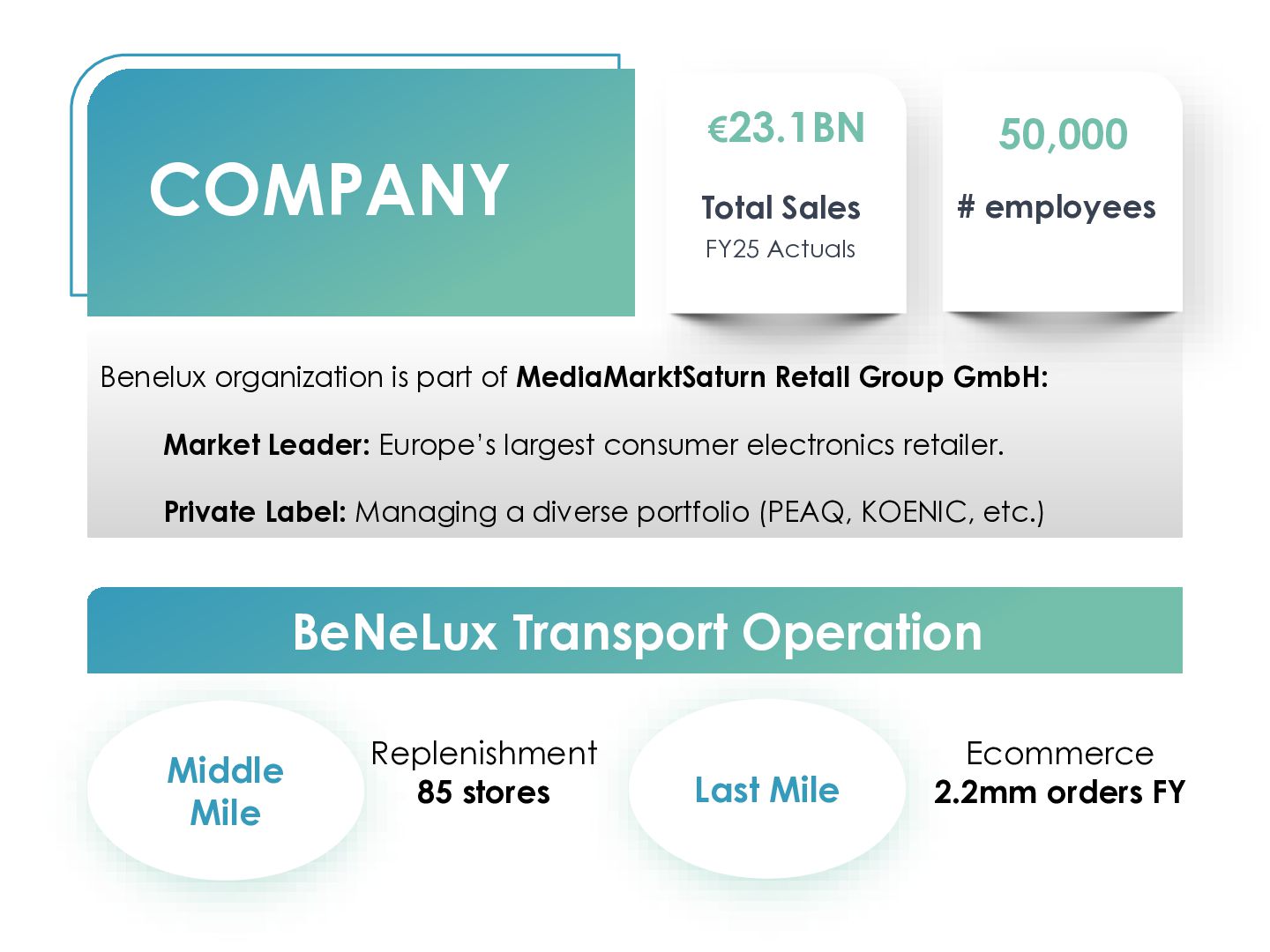
Leader: Europe’s largest consumer electronics retailer. Private Label: Managing a diverse portfolio (PEAQ, KOENIC, etc.) COMPANY Middle Mile Last Mile Replenishment 85 stores Ecommerce 2.2mm orders FY COMPANY BeNeLux Transport Operation €23.1BN Total Sales FY25 Actuals 50,000 # employees
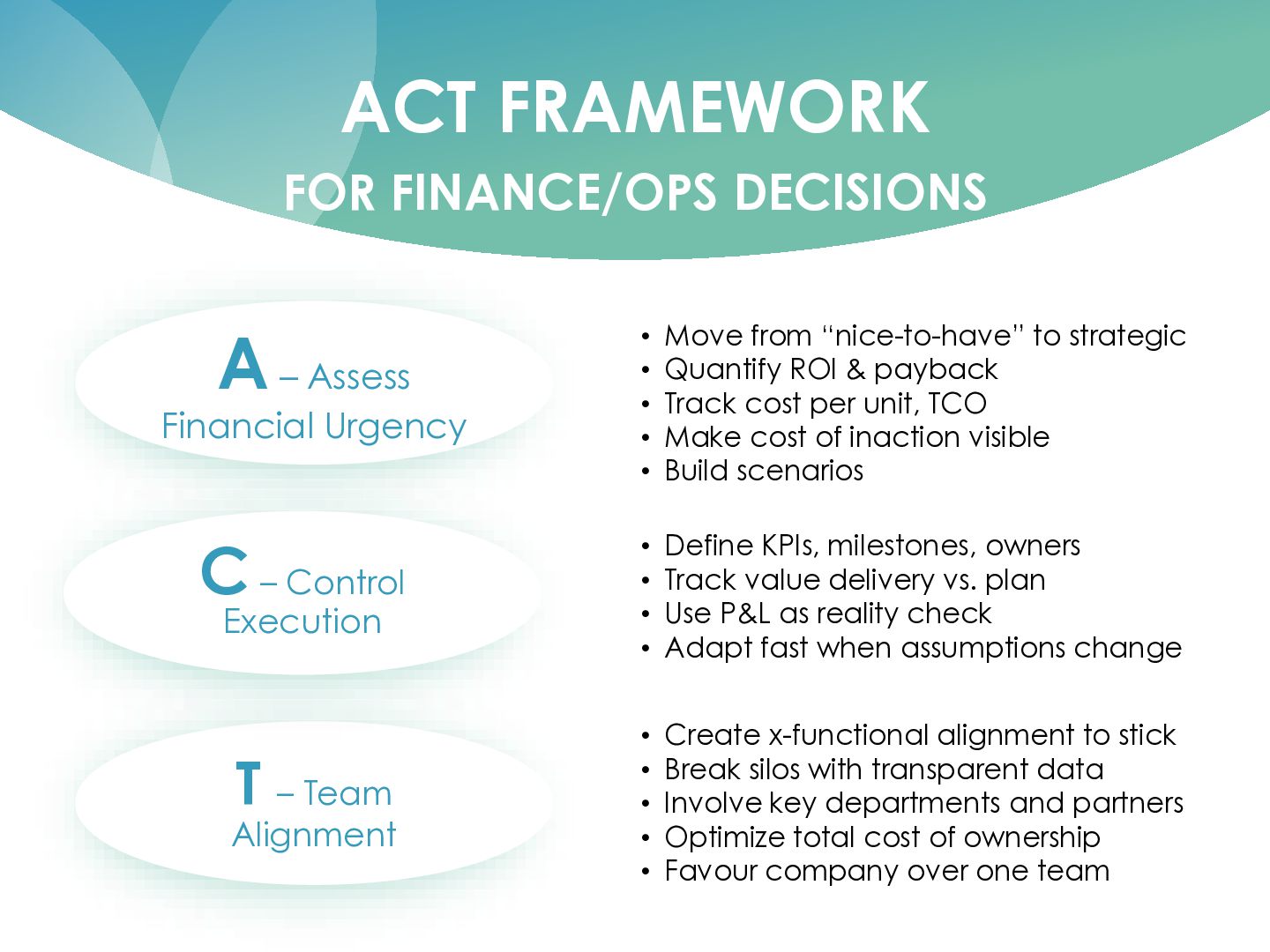
T – Team Alignment C – Control Execution • Move from “nice-to-have” to strategic • Quantify ROI & payback • Track cost per unit, TCO • Make cost of inaction visible • Build scenarios • Define KPIs, milestones, owners • Track value delivery vs. plan • Use P&L as reality check • Adapt fast when assumptions change • Create x-functional alignment to stick • Break silos with transparent data • Involve key departments and partners • Optimize total cost of ownership • Favour company over one team
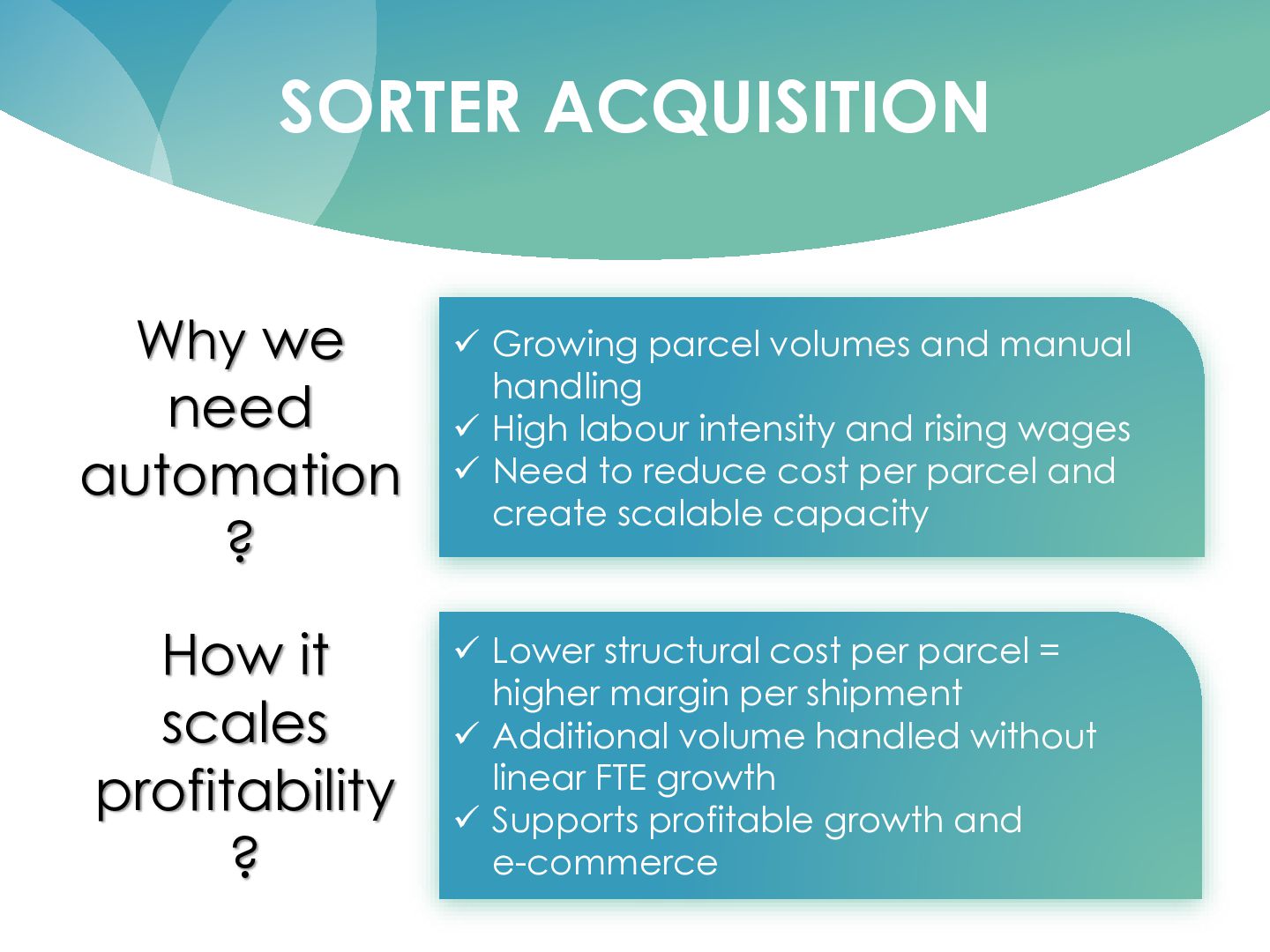
High labour intensity and rising wages ✓ Need to reduce cost per parcel and create scalable capacity ✓ Lower structural cost per parcel = higher margin per shipment ✓ Additional volume handled without linear FTE growth ✓ Supports profitable growth and e-commerce Why we need automation ? How it scales profitability ?
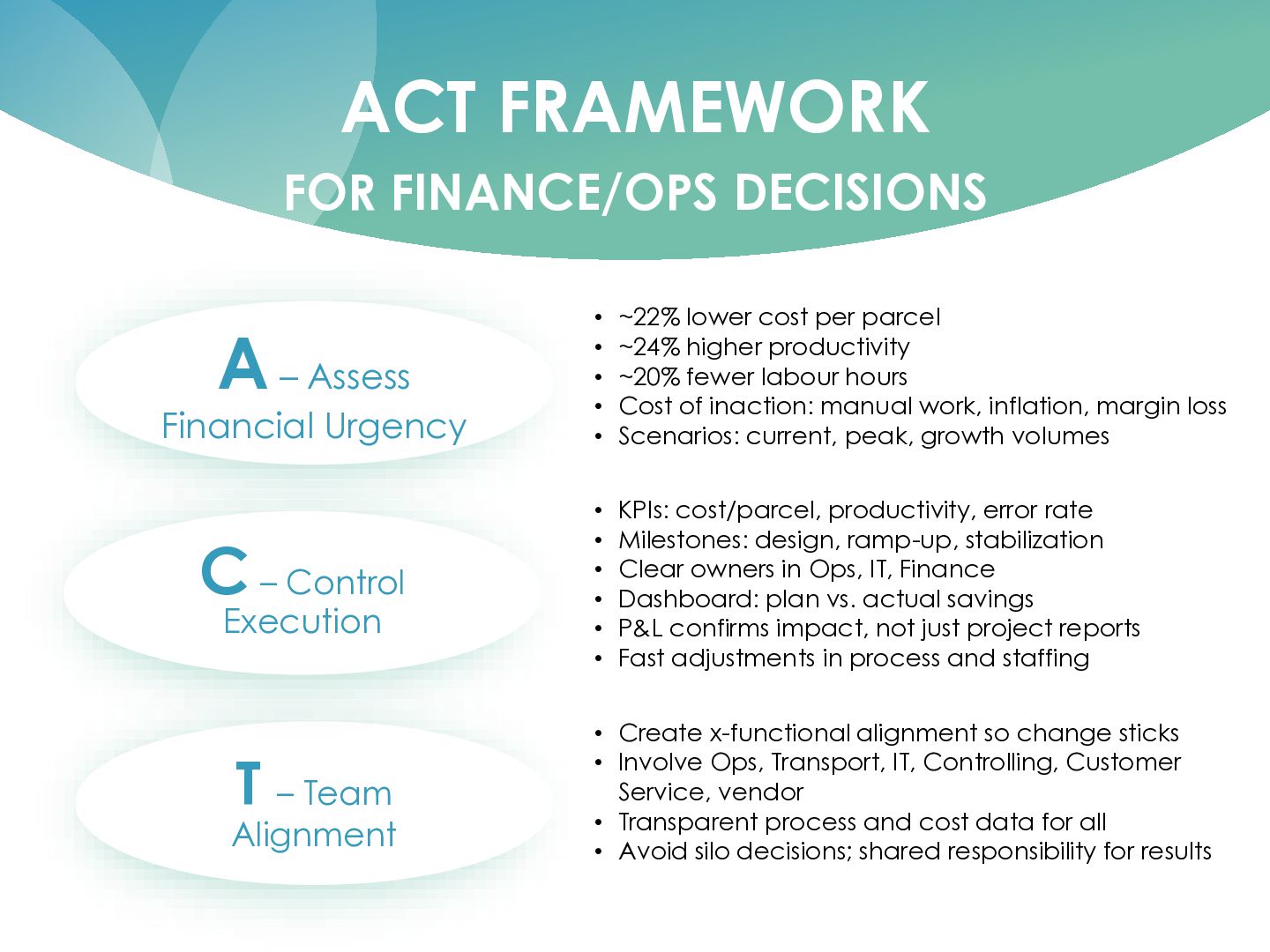
T – Team Alignment C – Control Execution • ~22% lower cost per parcel • ~24% higher productivity • ~20% fewer labour hours • Cost of inaction: manual work, inflation, margin loss • Scenarios: current, peak, growth volumes • KPIs: cost/parcel, productivity, error rate • Milestones: design, ramp-up, stabilization • Clear owners in Ops, IT, Finance • Dashboard: plan vs. actual savings • P&L confirms impact, not just project reports • Fast adjustments in process and staffing • Create x-functional alignment so change sticks • Involve Ops, Transport, IT, Controlling, Customer Service, vendor • Transparent process and cost data for all • Avoid silo decisions; shared responsibility for results
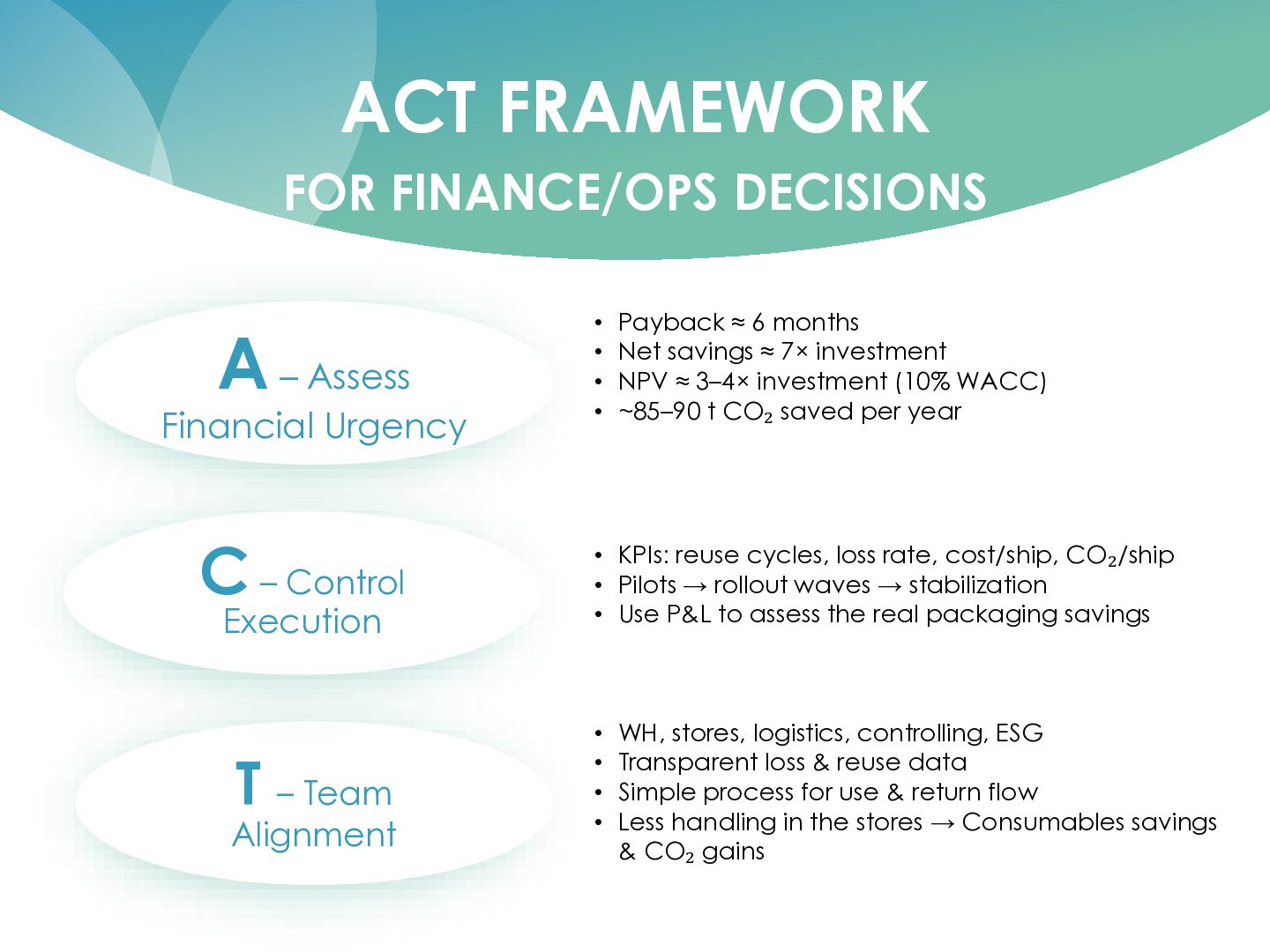
T – Team Alignment C – Control Execution • Payback ≈ 6 months • Net savings ≈ 7× investment • NPV ≈ 3–4× investment (10% WACC) • ~85–90 t CO₂ saved per year • KPIs: reuse cycles, loss rate, cost/ship, CO₂/ship • Pilots → rollout waves → stabilization • Use P&L to assess the real packaging savings • WH, stores, logistics, controlling, ESG • Transparent loss & reuse data • Simple process for use & return flow • Less handling in the stores → Consumables savings & CO₂ gains
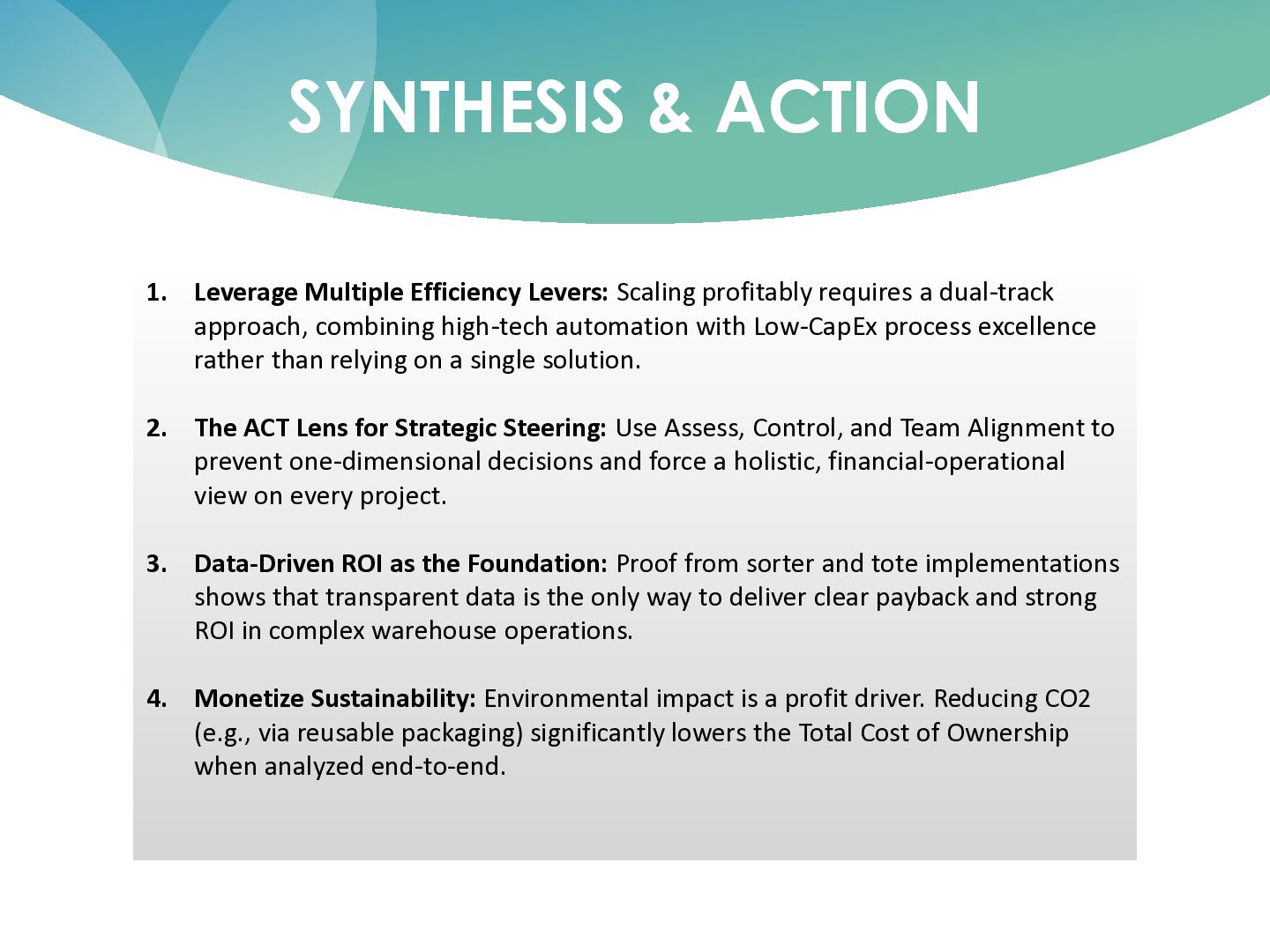
requires a dual-track approach, combining high-tech automation with Low-CapEx process excellence rather than relying on a single solution. 2. The ACT Lens for Strategic Steering: Use Assess, Control, and Team Alignment to prevent one-dimensional decisions and force a holistic, financial-operational view on every project. 3. Data-Driven ROI as the Foundation: Proof from sorter and tote implementations shows that transparent data is the only way to deliver clear payback and strong ROI in complex warehouse operations. 4. Monetize Sustainability: Environmental impact is a profit driver. Reducing CO2 (e.g., via reusable packaging) significantly lowers the Total Cost of Ownership when analyzed end-to-end.


 mark3t1ng
 bluesmoon
 keavy
keavy
 kevinliebholz
 soysaucechin
 davetheseo
 zakiyama
 lara
lara
 stephaniewalter
 schroneko
 palkan
 inesmontani
 csswizardry