$30 off During Our Annual Pro Sale. View Details »

A Linked Open Data Infrastructure for Promoting...

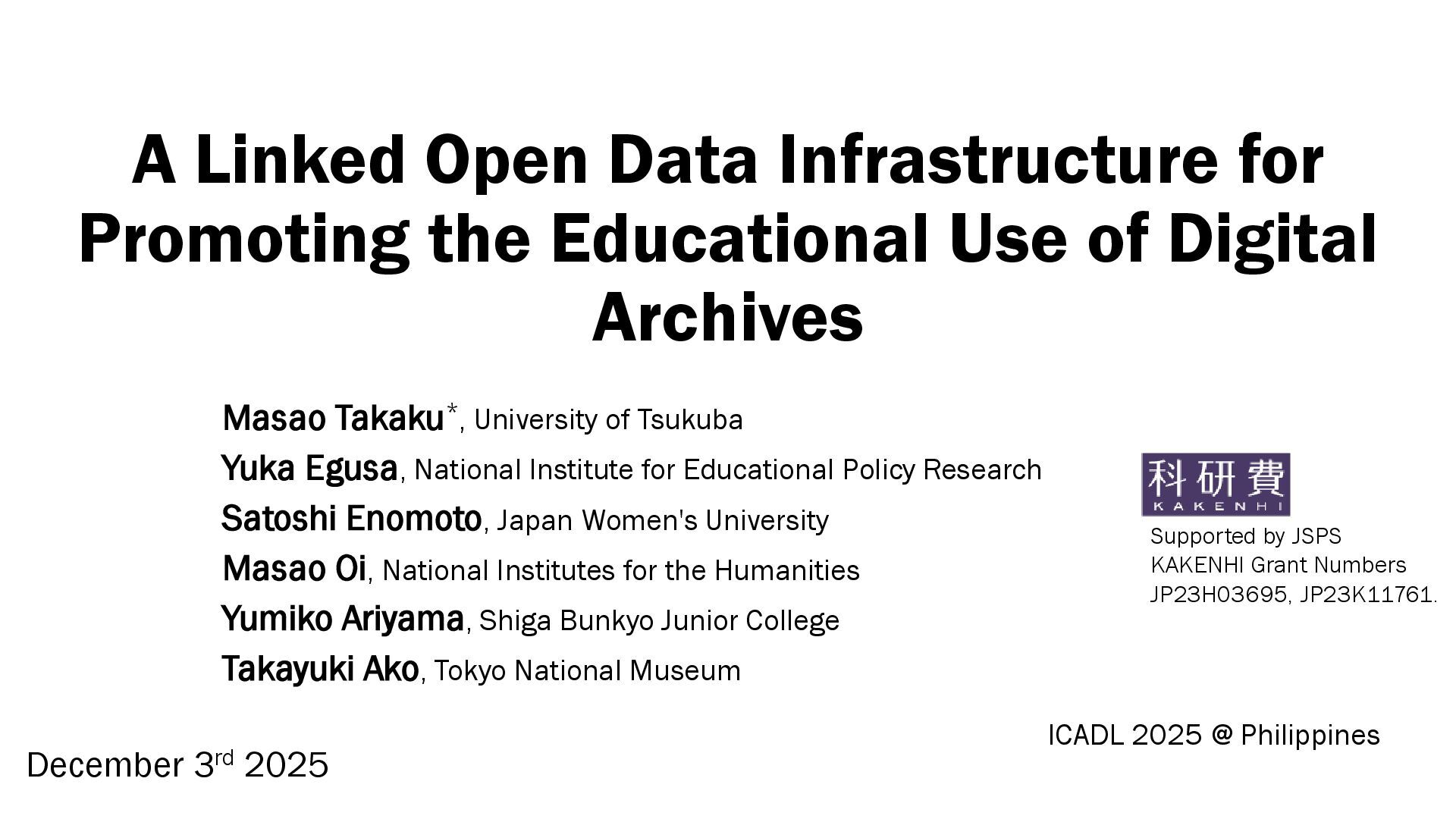
A Linked Open Data Infrastructure for Promoting the Educational Use of Digital Archives

Full paper presentation at the 27th International Conference on Asia-Pacific Digital Libraries (ICADL 2025)

Title: A Linked Open Data Infrastructure for Promoting the Educational Use of Digital Archives
Authors: Masao Takaku, Yuka Egusa, Satoshi Enomoto, Masao Oi, Yumiko Ariyama, Takayuki Ako
Location: Taguig, Metro Manila, Philippines
Proceedings papers: ICADL 2025 - The 27th International Conference on Asia-Pacific Digital Libraries
https://doi.org/10.1007/978-981-95-4861-3_14

Avatar for Masao Takaku

Masao Takaku

December 04, 2025
Tweet

More Decks by Masao Takaku

Other Decks in Education

Transcript

  1. A Linked Open Data Infrastructure for Promoting the Educational Use

    of Digital Archives Masao Takaku*, University of Tsukuba Yuka Egusa, National Institute for Educational Policy Research Satoshi Enomoto, Japan Women's University Masao Oi, National Institutes for the Humanities Yumiko Ariyama, Shiga Bunkyo Junior College Takayuki Ako, Tokyo National Museum ICADL 2025 @ Philippines December 3rd 2025 Supported by JSPS KAKENHI Grant Numbers JP23H03695, JP23K11761.
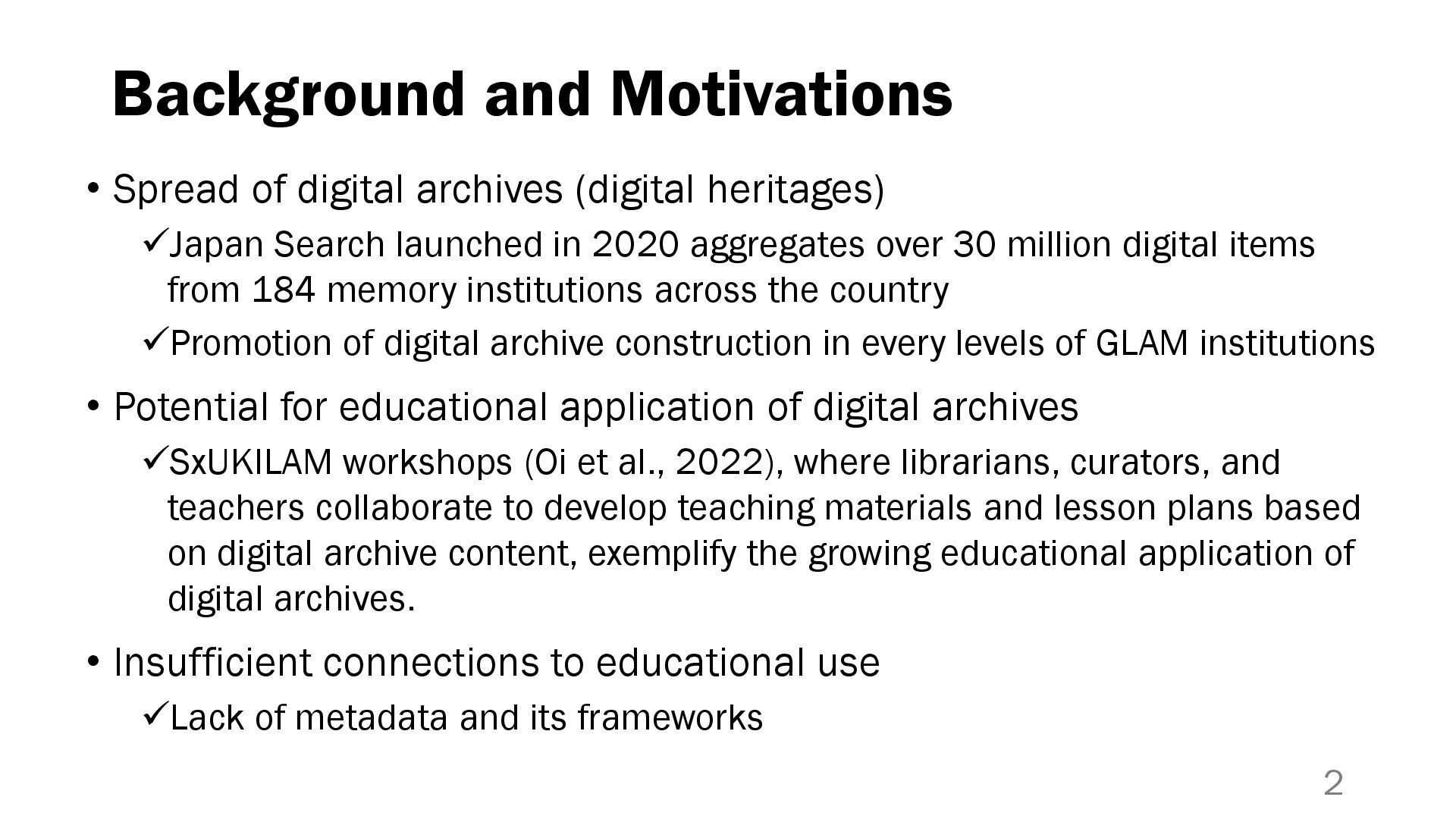
  2. Background and Motivations • Spread of digital archives (digital heritages)

    Japan Search launched in 2020 aggregates over 30 million digital items from 184 memory institutions across the country Promotion of digital archive construction in every levels of GLAM institutions • Potential for educational application of digital archives SxUKILAM workshops (Oi et al., 2022), where librarians, curators, and teachers collaborate to develop teaching materials and lesson plans based on digital archive content, exemplify the growing educational application of digital archives. • Insufficient connections to educational use Lack of metadata and its frameworks 2
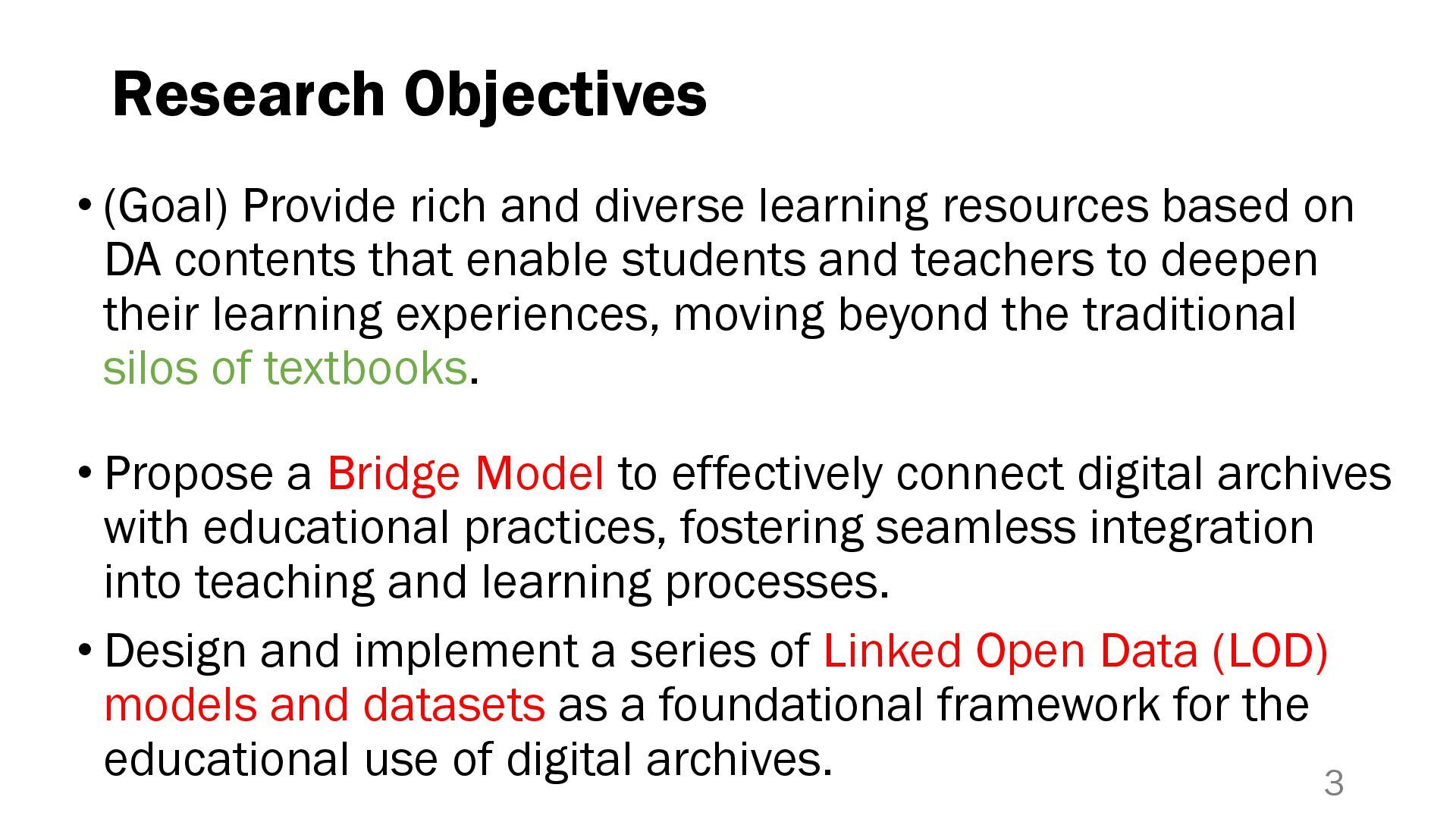
  3. Research Objectives • (Goal) Provide rich and diverse learning resources

    based on DA contents that enable students and teachers to deepen their learning experiences, moving beyond the traditional silos of textbooks. • Propose a Bridge Model to effectively connect digital archives with educational practices, fostering seamless integration into teaching and learning processes. • Design and implement a series of Linked Open Data (LOD) models and datasets as a foundational framework for the educational use of digital archives. 3
  4. Related Works •Use of digital archives in education American Memory[14,16,17,20,51],

    Teaching with Europeana[6], Maekawa[34], Oi et al.[41,43] A supporting framework for finding suitable teaching materials of DA content when practicing education •Metadata for education contents Learning Object Metadata (LOM)[11], OER (Open Educational Resources)[48] Relationships between DA contents and Course of Studies/Teaching Units 4
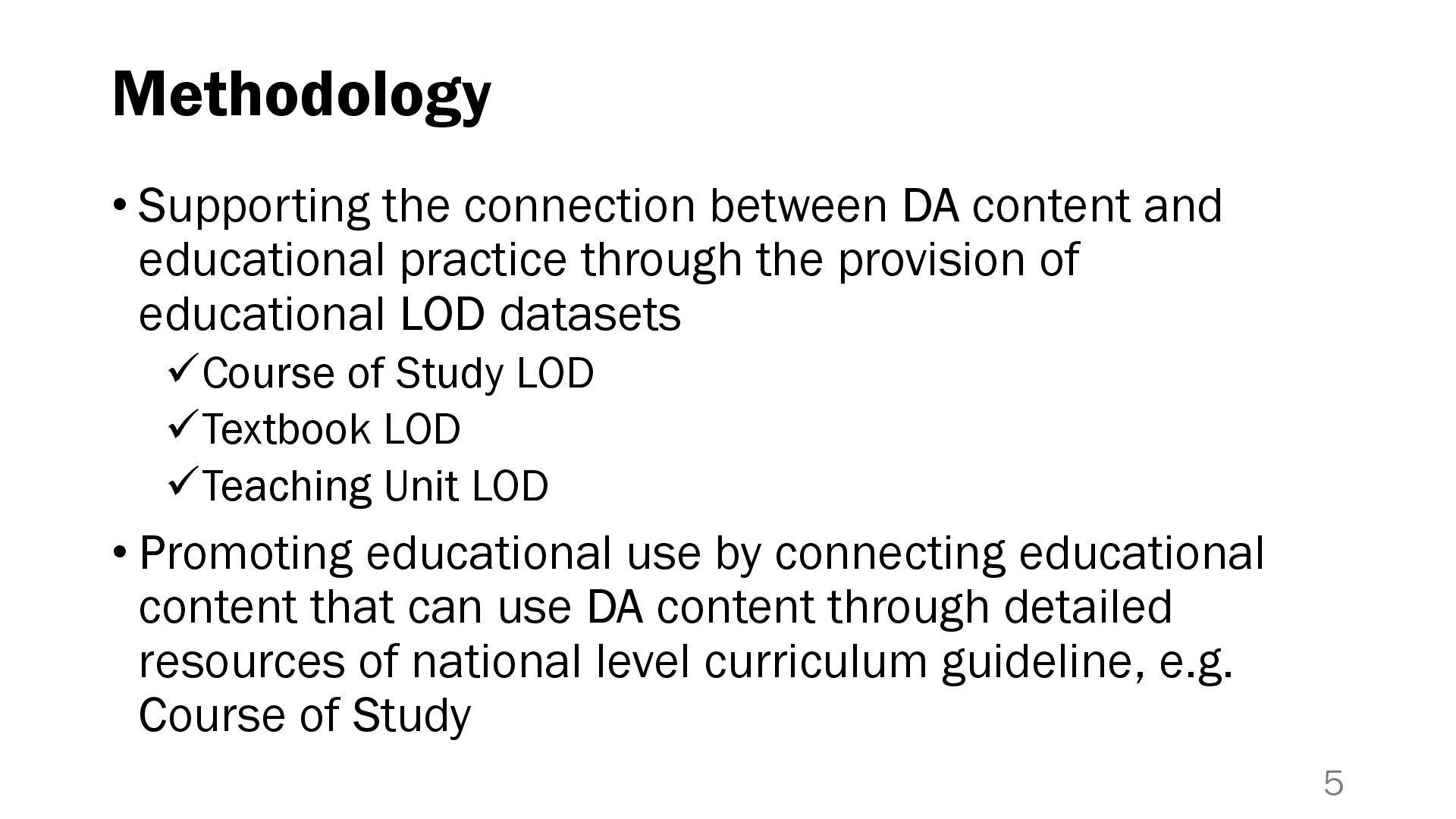
  5. Methodology • Supporting the connection between DA content and educational

    practice through the provision of educational LOD datasets Course of Study LOD Textbook LOD Teaching Unit LOD • Promoting educational use by connecting educational content that can use DA content through detailed resources of national level curriculum guideline, e.g. Course of Study 5
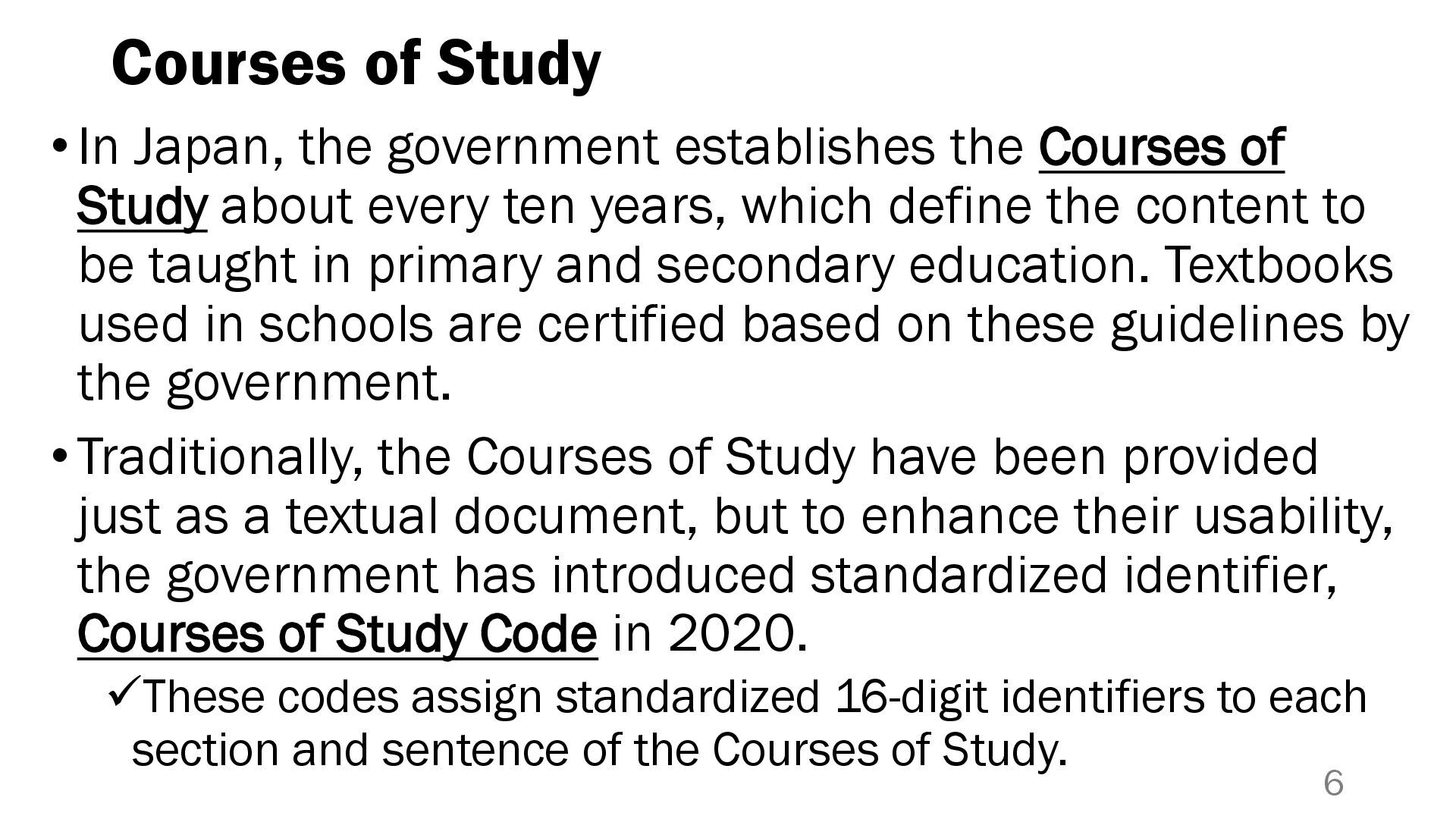
  6. Courses of Study •In Japan, the government establishes the Courses

    of Study about every ten years, which define the content to be taught in primary and secondary education. Textbooks used in schools are certified based on these guidelines by the government. •Traditionally, the Courses of Study have been provided just as a textual document, but to enhance their usability, the government has introduced standardized identifier, Courses of Study Code in 2020. These codes assign standardized 16-digit identifiers to each section and sentence of the Courses of Study. 6
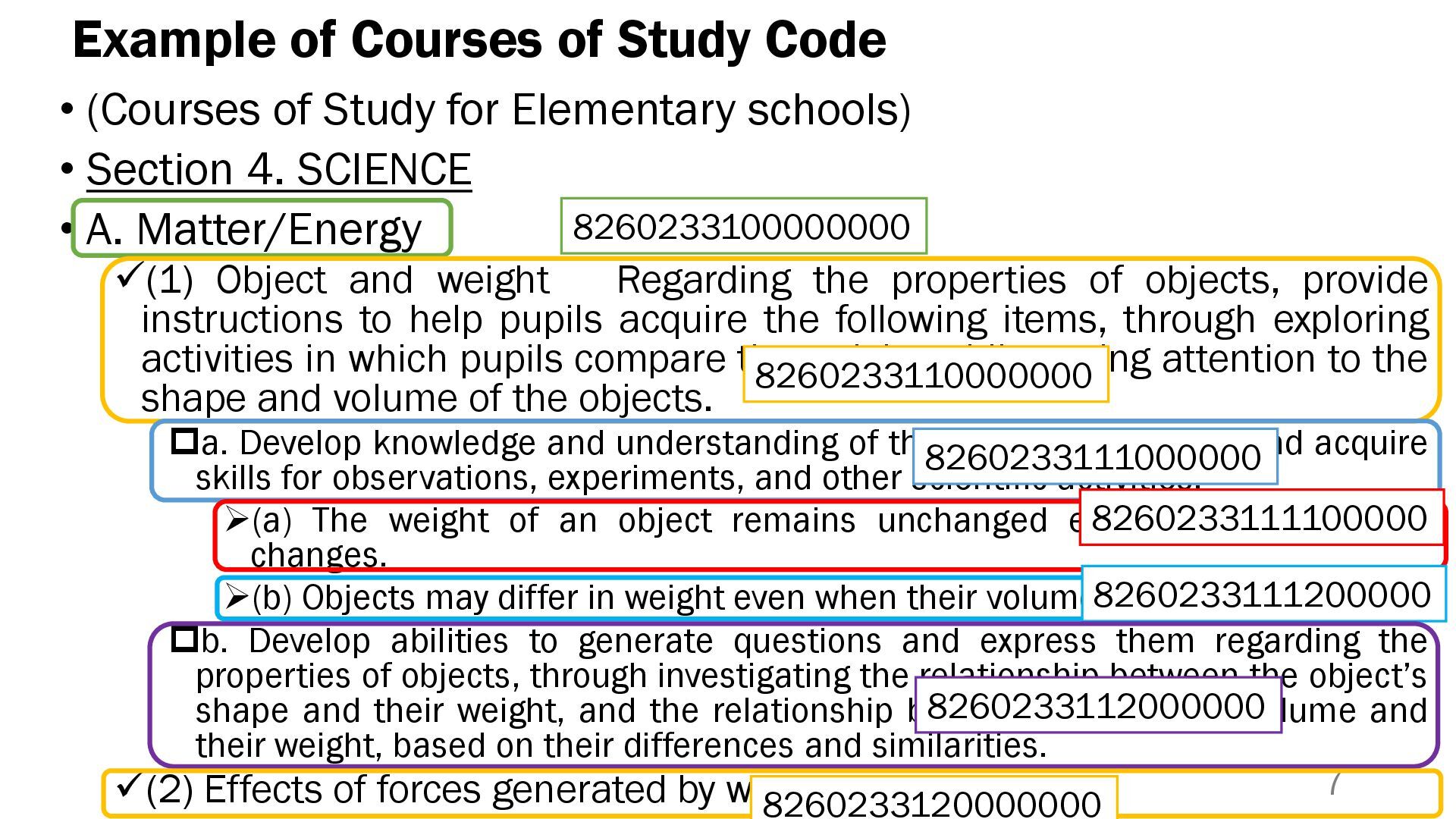
  7. Example of Courses of Study Code • (Courses of Study

    for Elementary schools) • Section 4. SCIENCE • A. Matter/Energy (1) Object and weight Regarding the properties of objects, provide instructions to help pupils acquire the following items, through exploring activities in which pupils compare the weight, while paying attention to the shape and volume of the objects. a. Develop knowledge and understanding of the following contents, and acquire skills for observations, experiments, and other scientific activities. (a) The weight of an object remains unchanged even when the shape changes. (b) Objects may differ in weight even when their volume is the same. b. Develop abilities to generate questions and express them regarding the properties of objects, through investigating the relationship between the object’s shape and their weight, and the relationship between the object’s volume and their weight, based on their differences and similarities. (2) Effects of forces generated by wind and rubber 7 8260233100000000 8260233110000000 8260233111000000 8260233111200000 8260233111100000 8260233112000000 8260233120000000
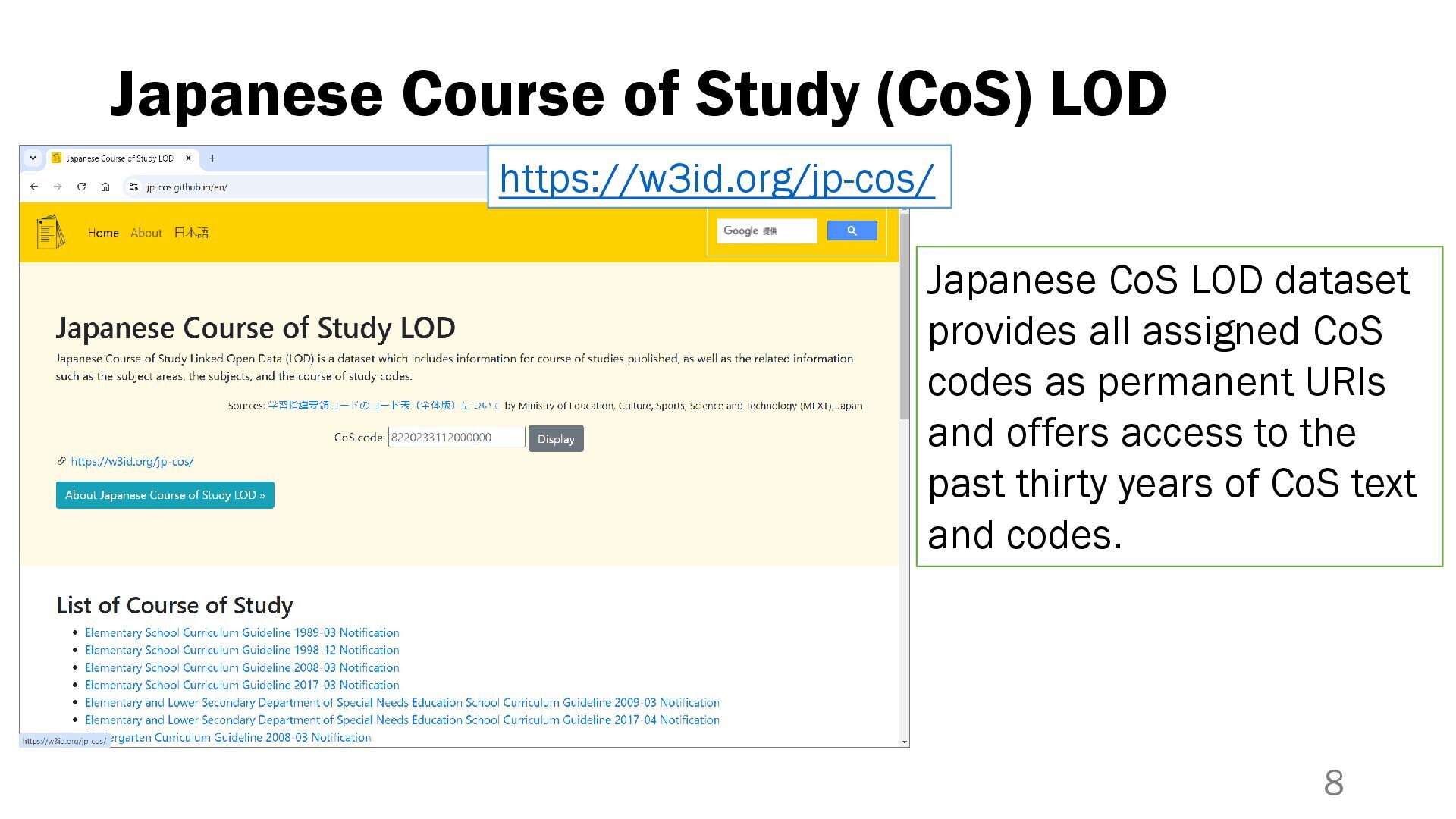
  8. Japanese Course of Study (CoS) LOD 8 https://w3id.org/jp-cos/ Japanese CoS

    LOD dataset provides all assigned CoS codes as permanent URIs and offers access to the past thirty years of CoS text and codes.
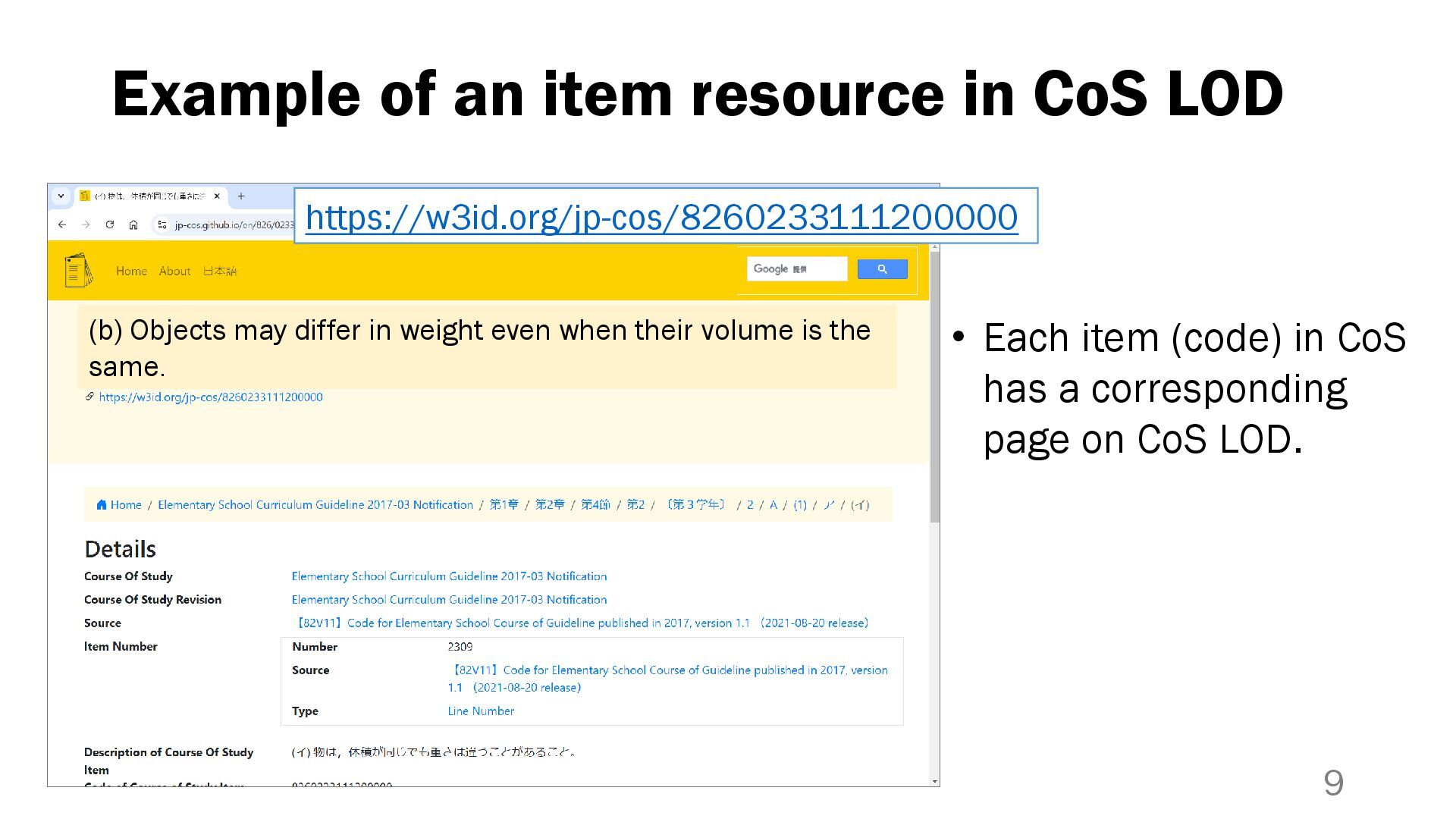
  9. Example of an item resource in CoS LOD 9 https://w3id.org/jp-cos/8260233111200000

    (b) Objects may differ in weight even when their volume is the same. • Each item (code) in CoS has a corresponding page on CoS LOD.
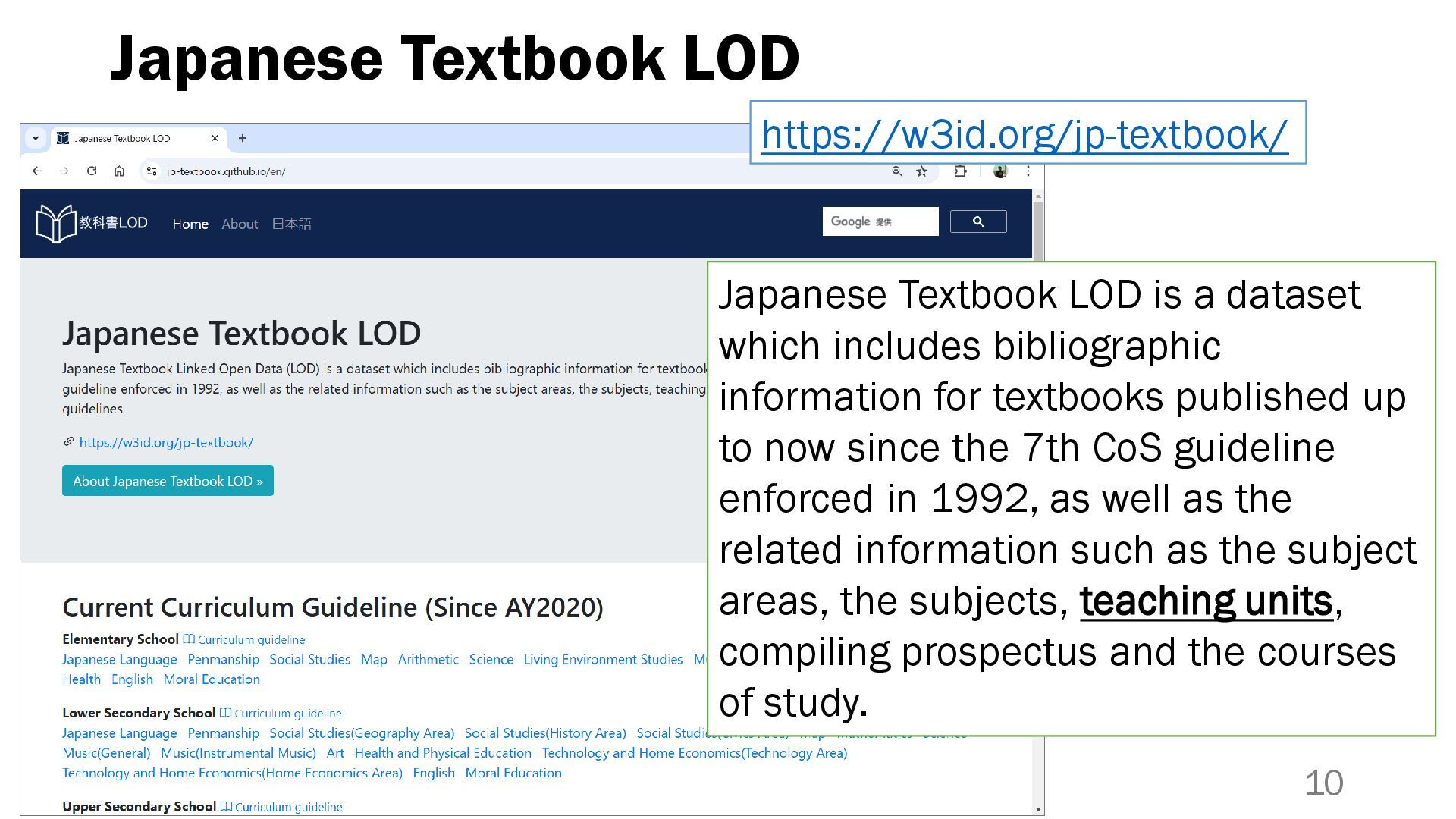
  10. Japanese Textbook LOD 10 Japanese Textbook LOD is a dataset

    which includes bibliographic information for textbooks published up to now since the 7th CoS guideline enforced in 1992, as well as the related information such as the subject areas, the subjects, teaching units, compiling prospectus and the courses of study. https://w3id.org/jp-textbook/
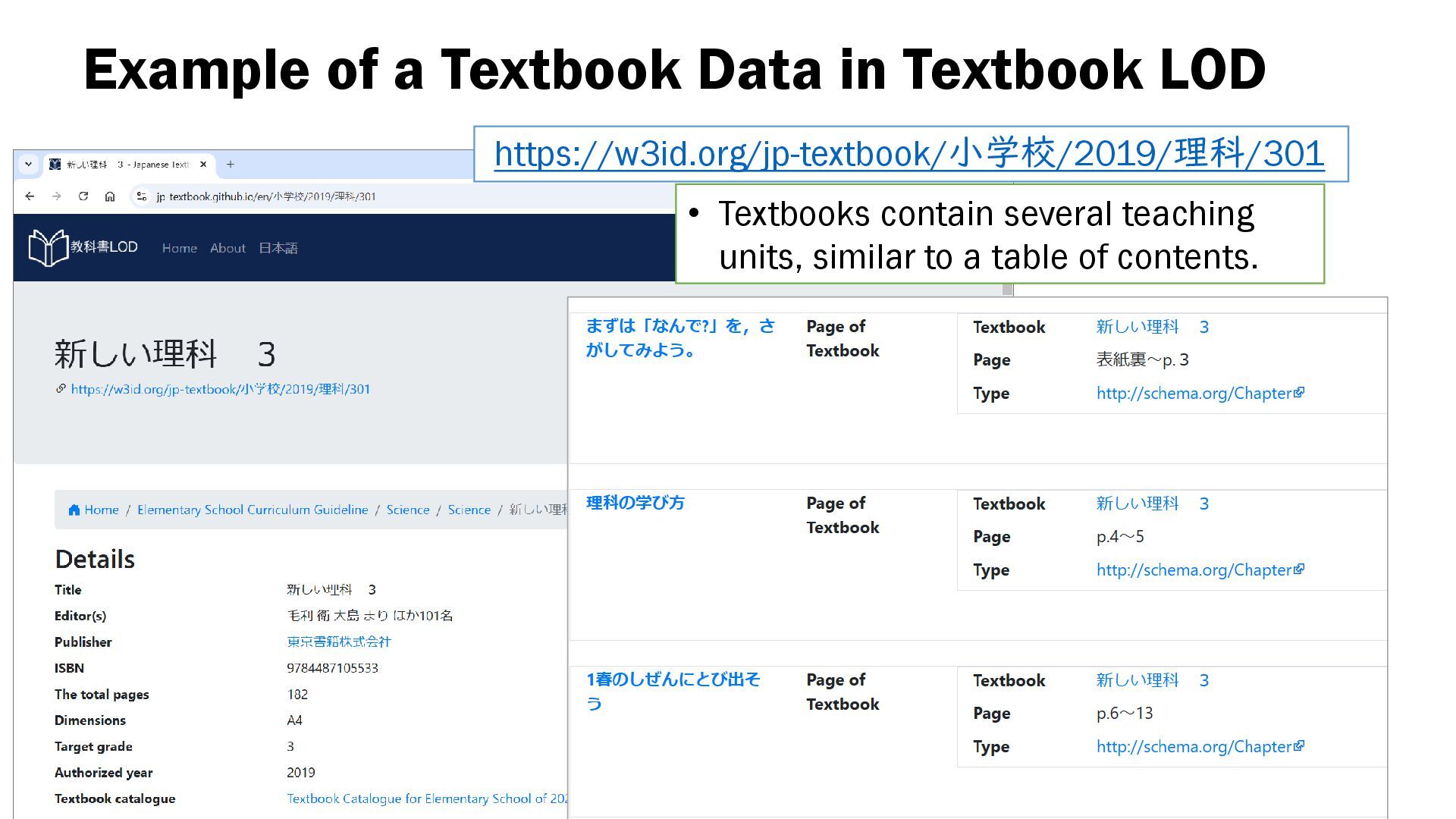
  11. Example of a Textbook Data in Textbook LOD 11 (b)

    Objects may differ in weight even when their volume is the same. https://w3id.org/jp-textbook/小学校/2019/理科/301 • Textbooks contain several teaching units, similar to a table of contents.
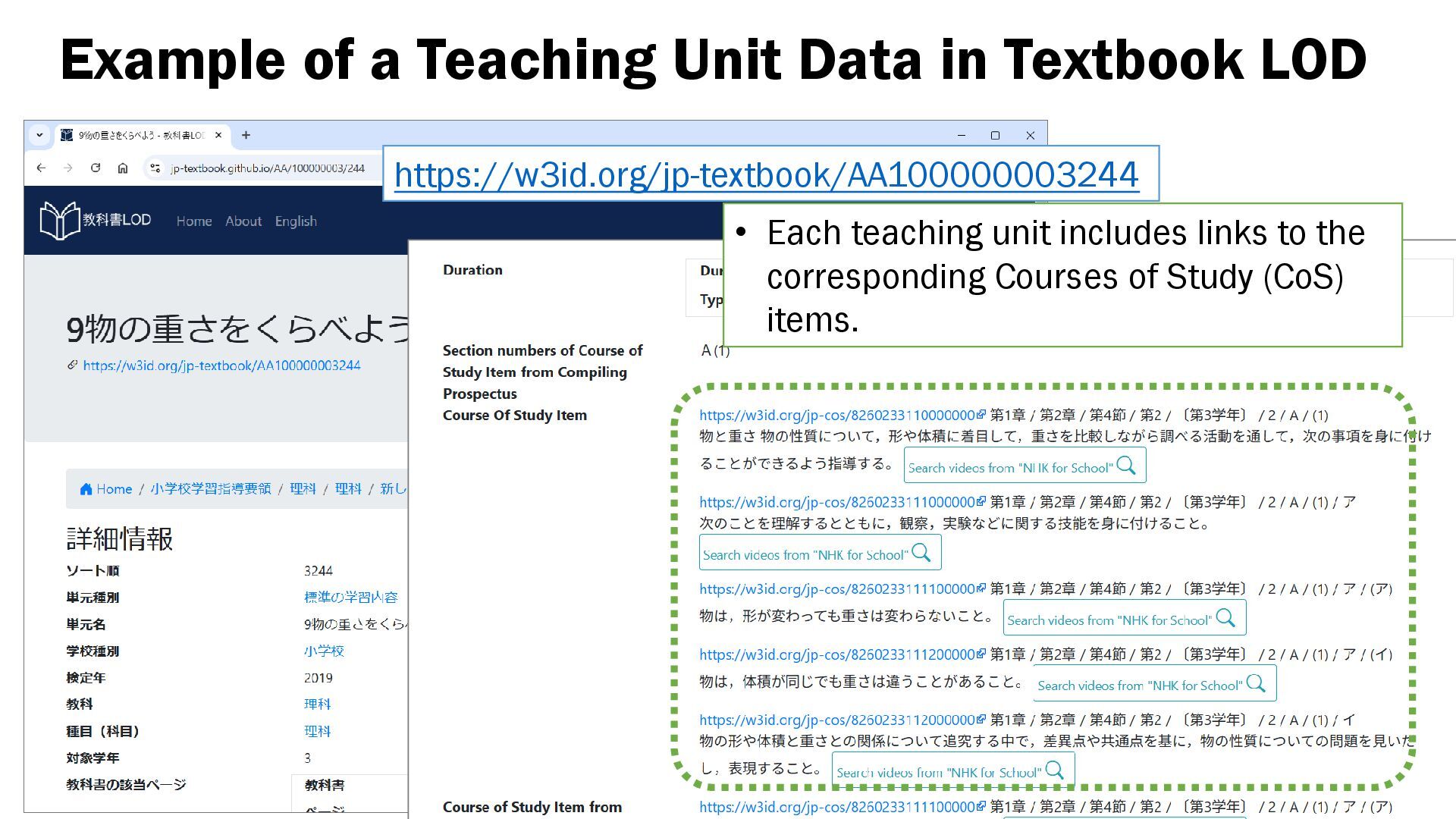
  12. Example of a Teaching Unit Data in Textbook LOD https://w3id.org/jp-textbook/AA100000003244

    • Each teaching unit includes links to the corresponding Courses of Study (CoS) items.
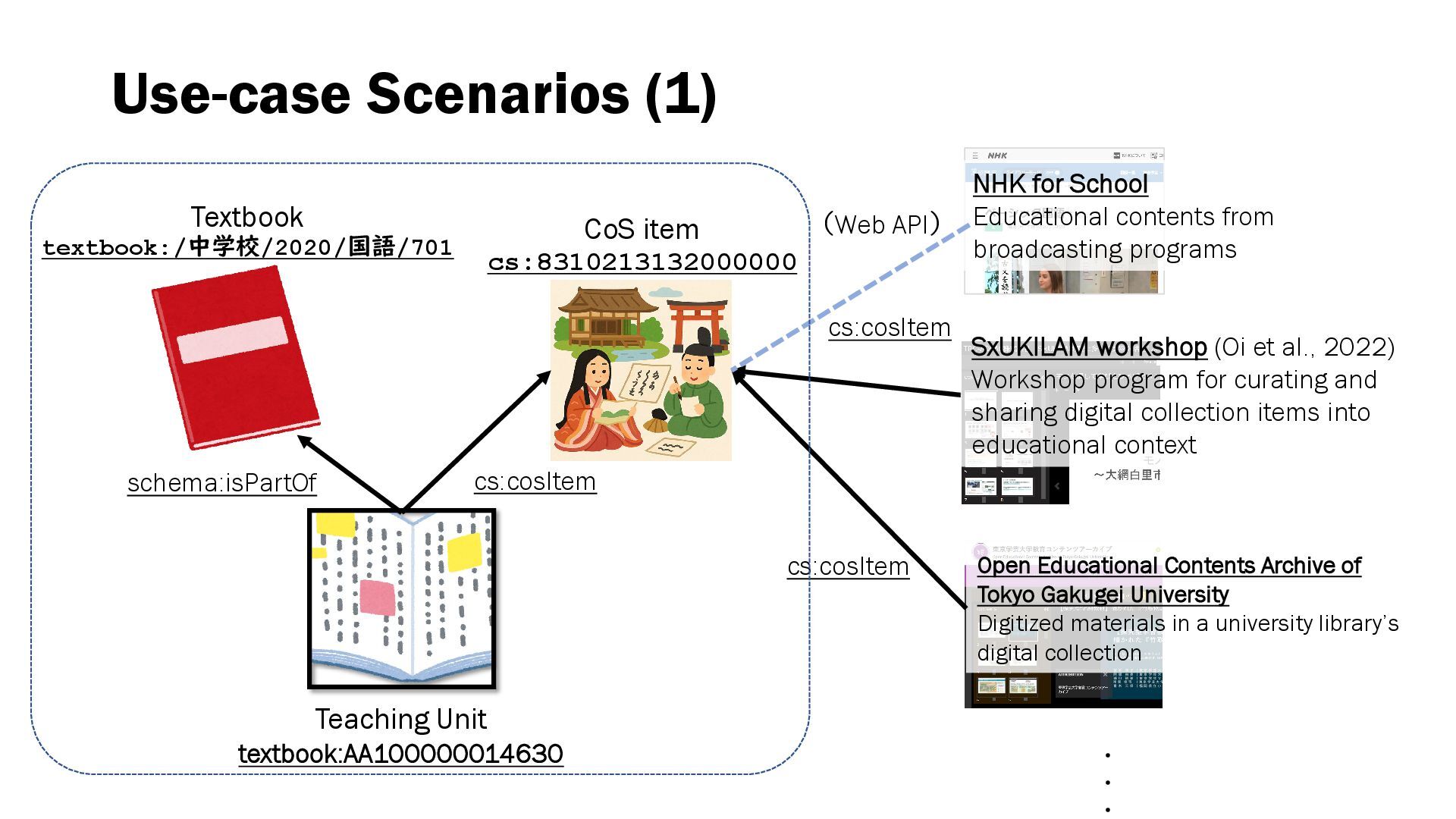
  13. Use-case Scenarios (1) Textbook textbook:/中学校/2020/国語/701 Teaching Unit textbook:AA100000014630 CoS item

    cs:8310213132000000 schema:isPartOf cs:cosItem NHK for School Educational contents from broadcasting programs cs:cosItem SxUKILAM workshop (Oi et al., 2022) Workshop program for curating and sharing digital collection items into educational context Open Educational Contents Archive of Tokyo Gakugei University Digitized materials in a university library’s digital collection cs:cosItem (Web API) ・ ・ ・
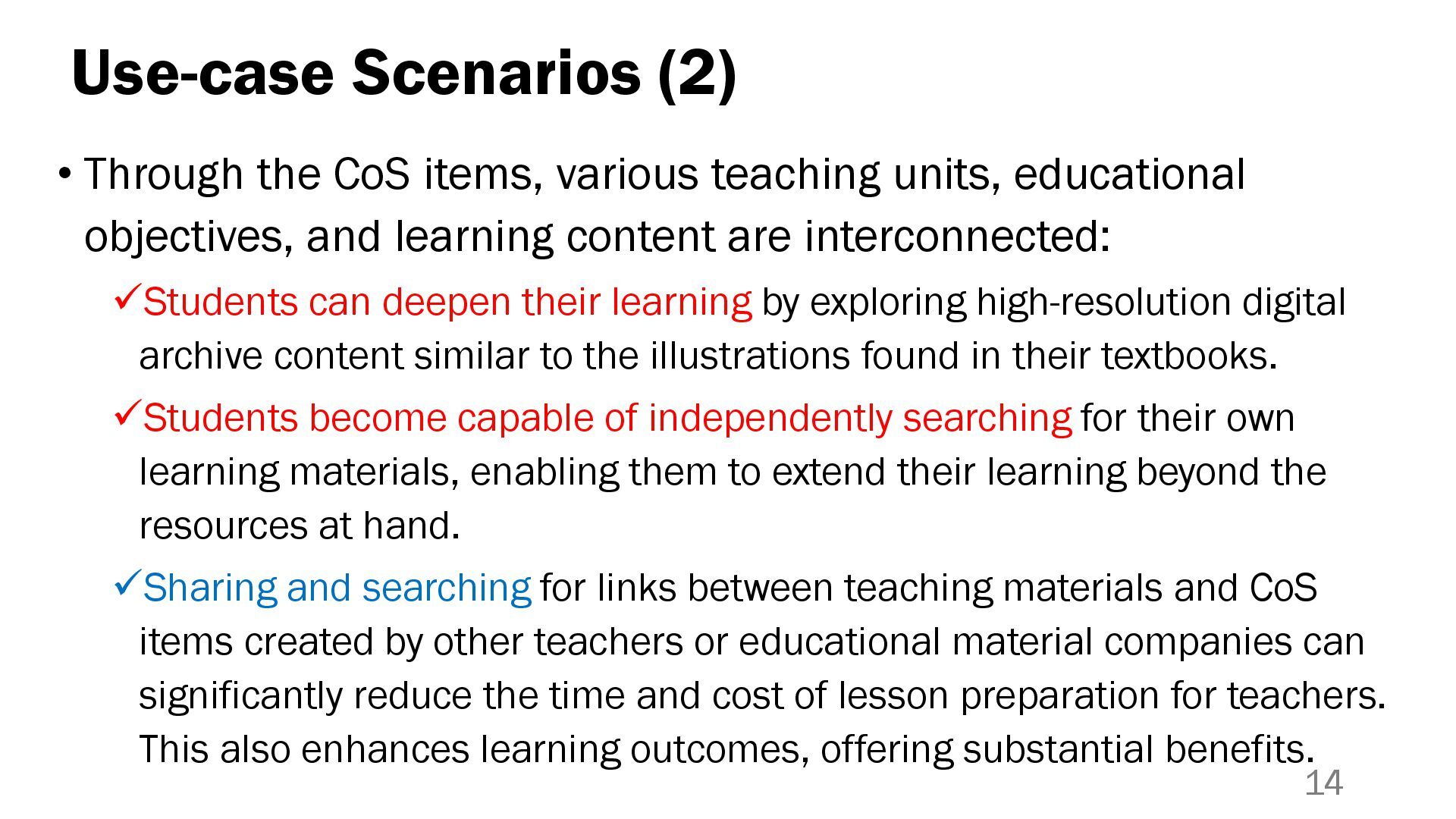
  14. Use-case Scenarios (2) • Through the CoS items, various teaching

    units, educational objectives, and learning content are interconnected: Students can deepen their learning by exploring high-resolution digital archive content similar to the illustrations found in their textbooks. Students become capable of independently searching for their own learning materials, enabling them to extend their learning beyond the resources at hand. Sharing and searching for links between teaching materials and CoS items created by other teachers or educational material companies can significantly reduce the time and cost of lesson preparation for teachers. This also enhances learning outcomes, offering substantial benefits. 14
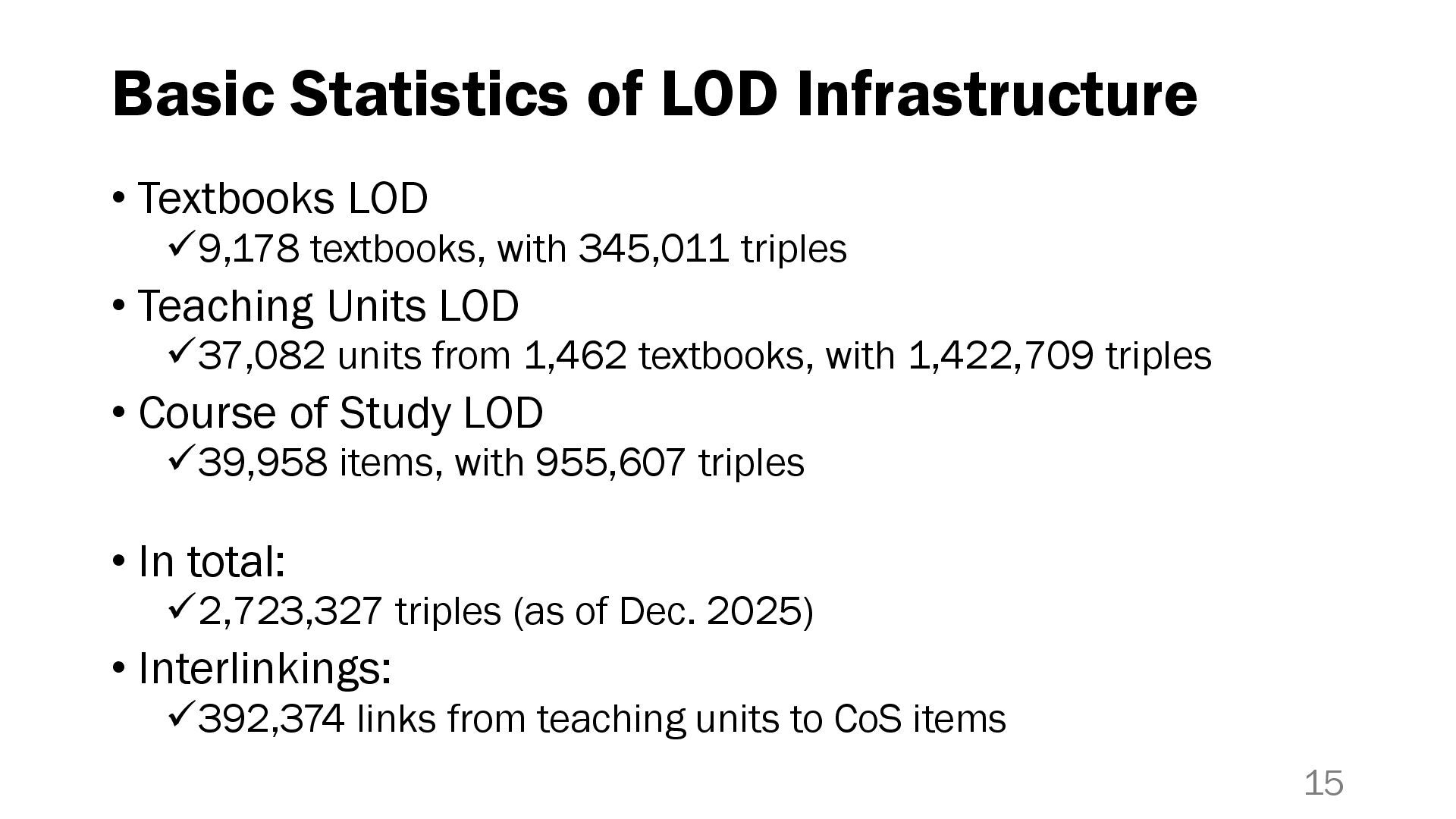
  15. Basic Statistics of LOD Infrastructure • Textbooks LOD 9,178 textbooks,

    with 345,011 triples • Teaching Units LOD 37,082 units from 1,462 textbooks, with 1,422,709 triples • Course of Study LOD 39,958 items, with 955,607 triples • In total: 2,723,327 triples (as of Dec. 2025) • Interlinkings: 392,374 links from teaching units to CoS items 15
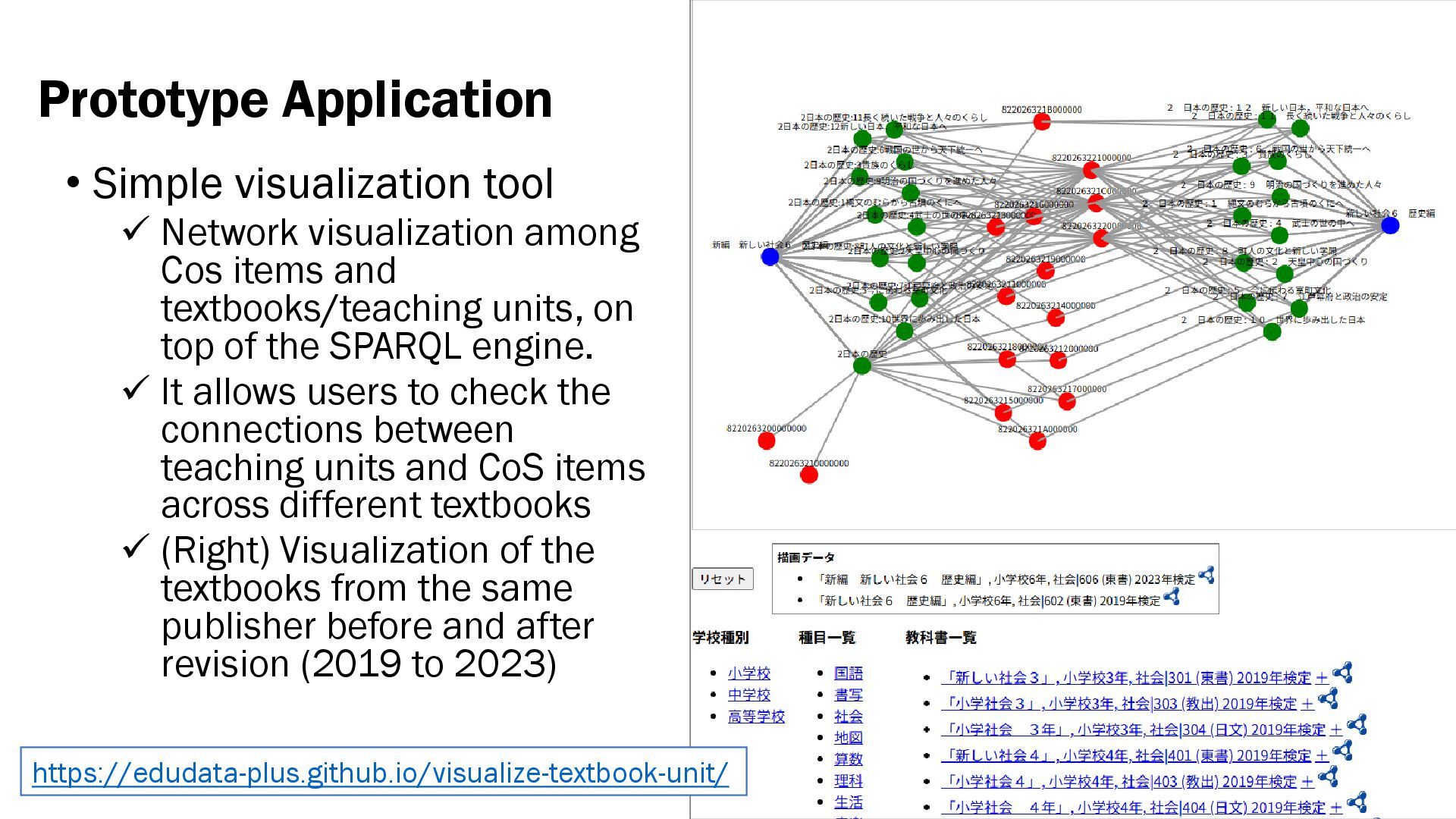
  16. Prototype Application • Simple visualization tool  Network visualization among

    Cos items and textbooks/teaching units, on top of the SPARQL engine.  It allows users to check the connections between teaching units and CoS items across different textbooks  (Right) Visualization of the textbooks from the same publisher before and after revision (2019 to 2023) 16 https://edudata-plus.github.io/visualize-textbook-unit/
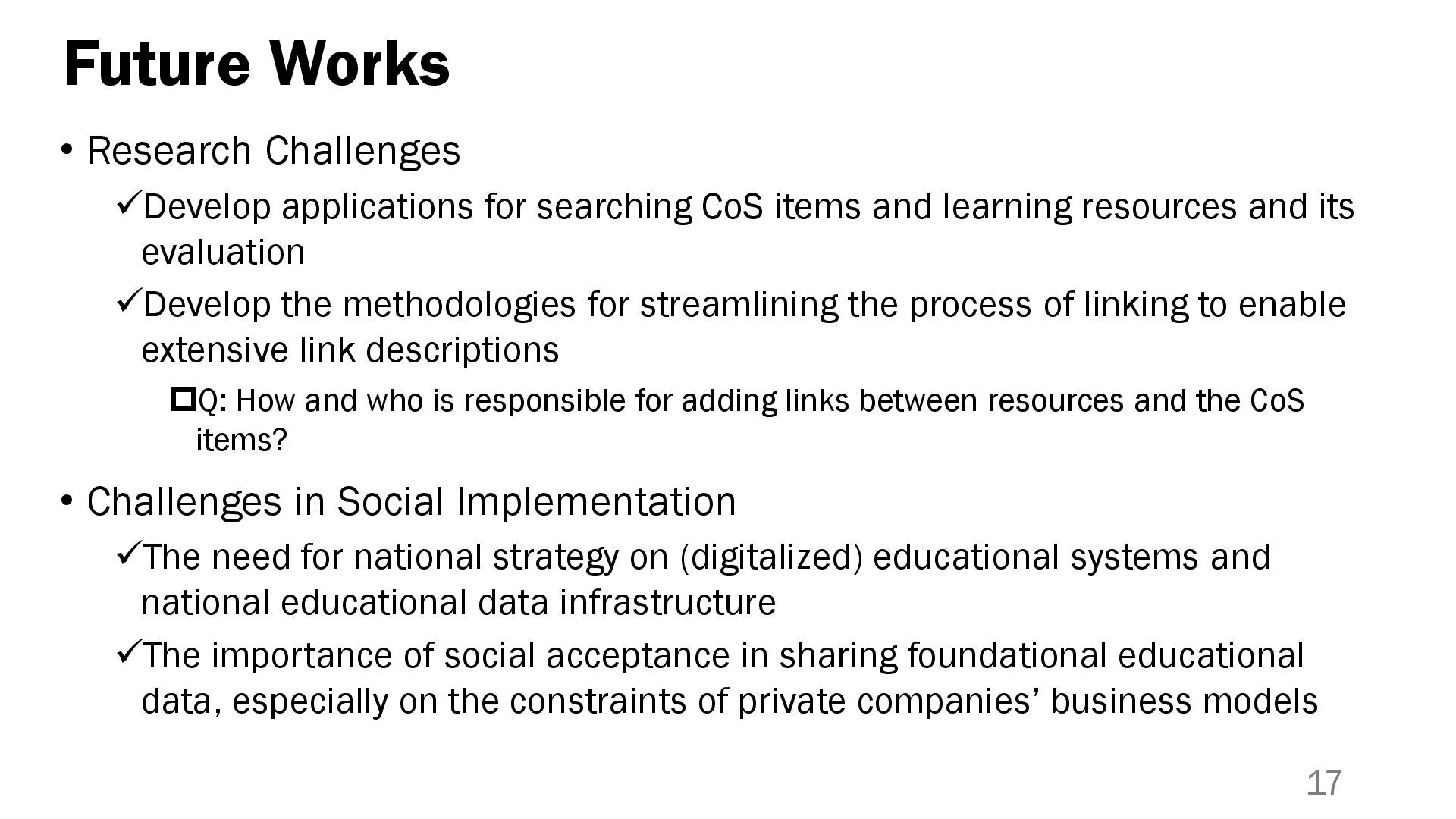
  17. Future Works • Research Challenges Develop applications for searching CoS

    items and learning resources and its evaluation Develop the methodologies for streamlining the process of linking to enable extensive link descriptions Q: How and who is responsible for adding links between resources and the CoS items? • Challenges in Social Implementation The need for national strategy on (digitalized) educational systems and national educational data infrastructure The importance of social acceptance in sharing foundational educational data, especially on the constraints of private companies’ business models 17
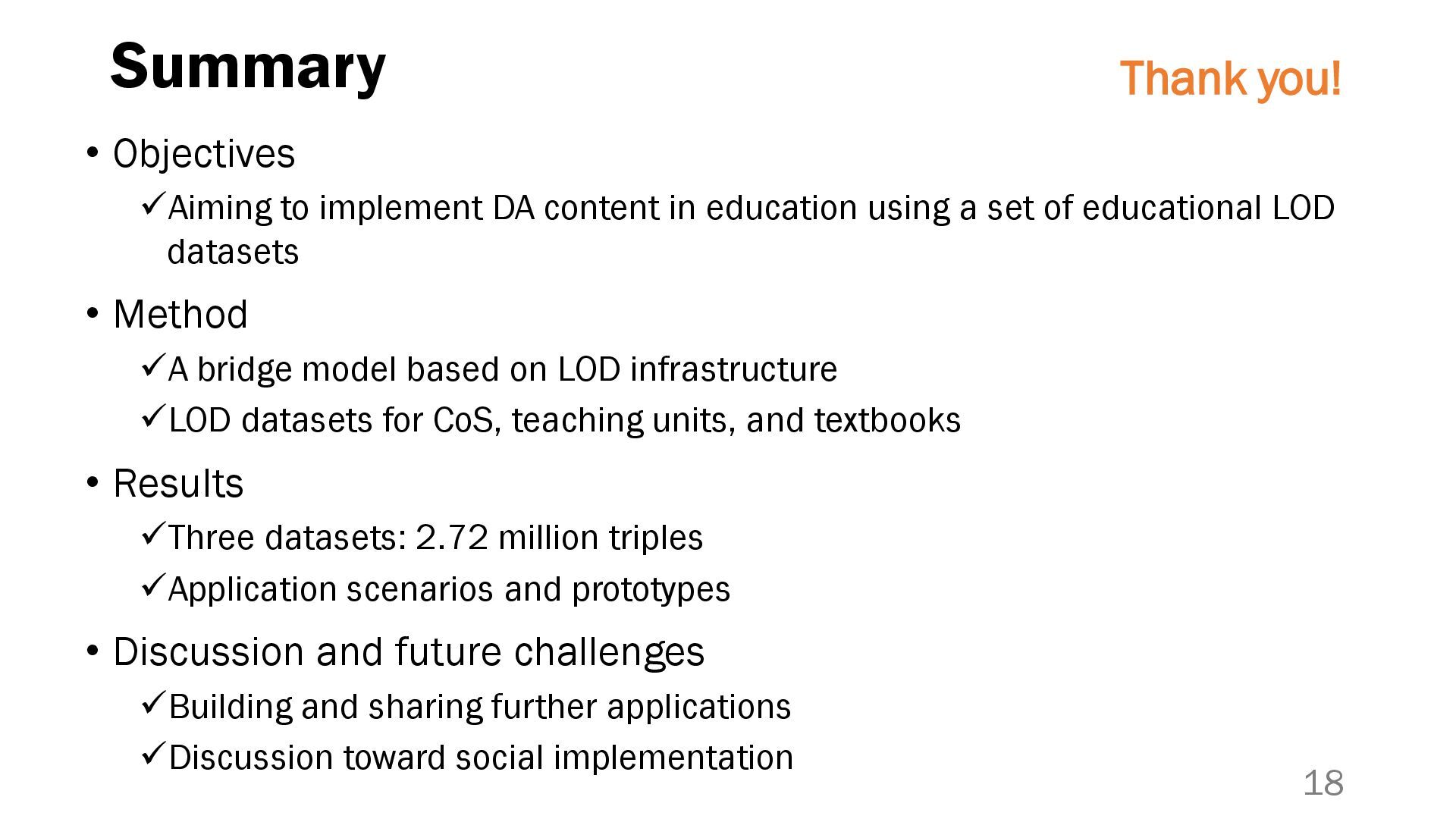
  18. Summary • Objectives Aiming to implement DA content in education

    using a set of educational LOD datasets • Method A bridge model based on LOD infrastructure LOD datasets for CoS, teaching units, and textbooks • Results Three datasets: 2.72 million triples Application scenarios and prototypes • Discussion and future challenges Building and sharing further applications Discussion toward social implementation 18 Thank you!
  19. 19

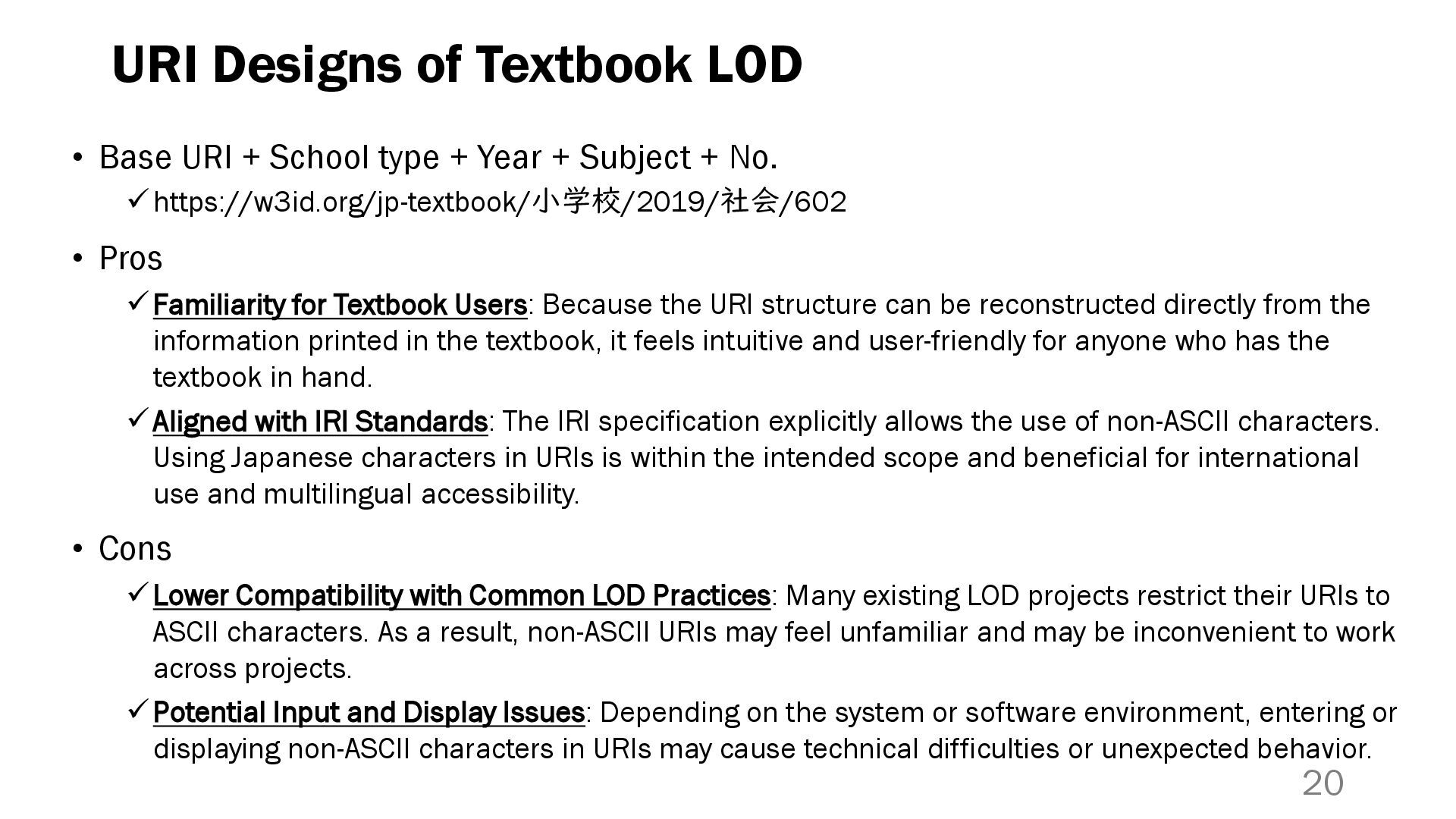
  20. URI Designs of Textbook LOD • Base URI + School

    type + Year + Subject + No. https://w3id.org/jp-textbook/小学校/2019/社会/602 • Pros Familiarity for Textbook Users: Because the URI structure can be reconstructed directly from the information printed in the textbook, it feels intuitive and user-friendly for anyone who has the textbook in hand. Aligned with IRI Standards: The IRI specification explicitly allows the use of non-ASCII characters. Using Japanese characters in URIs is within the intended scope and beneficial for international use and multilingual accessibility. • Cons Lower Compatibility with Common LOD Practices: Many existing LOD projects restrict their URIs to ASCII characters. As a result, non-ASCII URIs may feel unfamiliar and may be inconvenient to work across projects. Potential Input and Display Issues: Depending on the system or software environment, entering or displaying non-ASCII characters in URIs may cause technical difficulties or unexpected behavior. 20
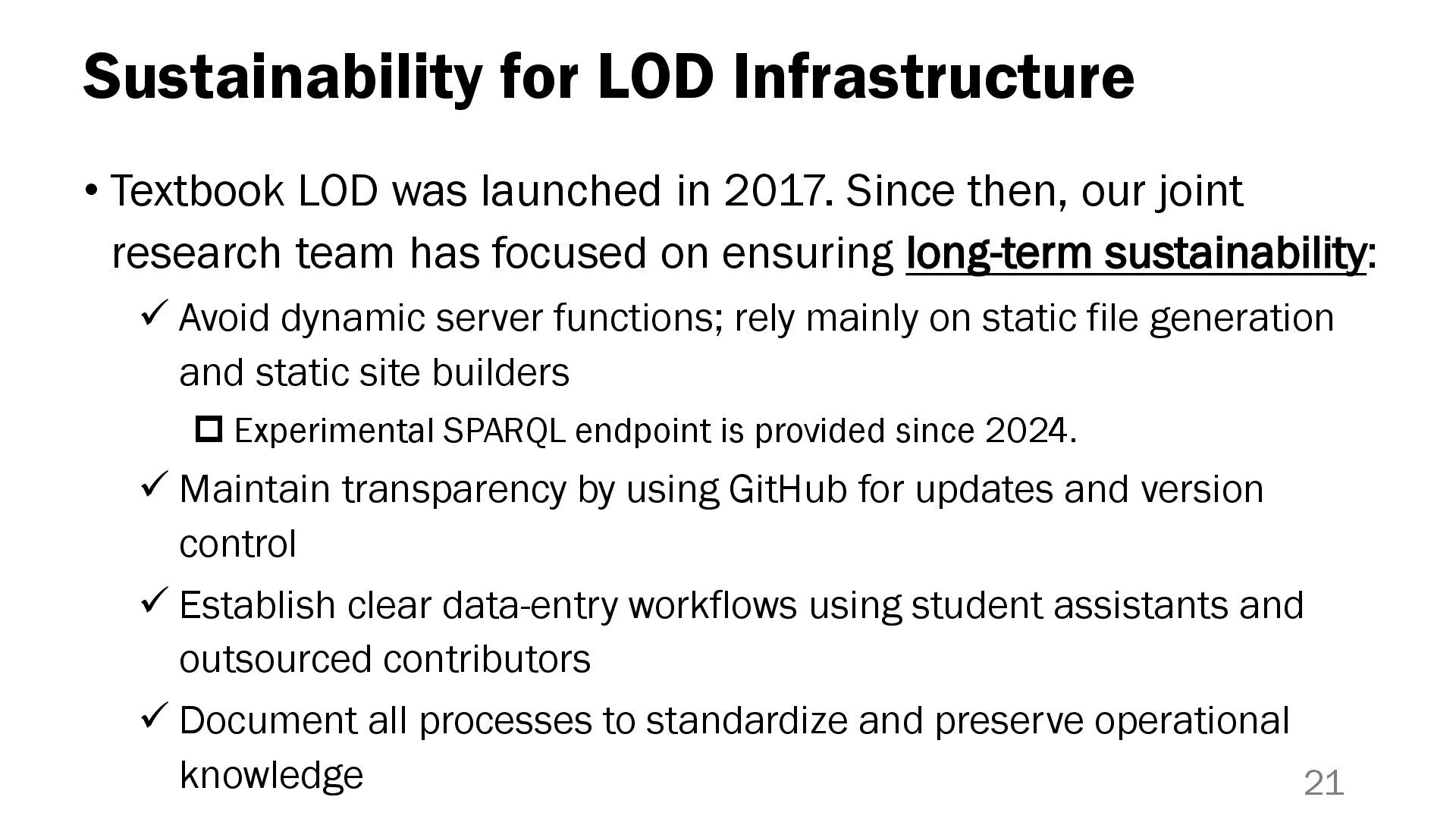
  21. Sustainability for LOD Infrastructure • Textbook LOD was launched in

    2017. Since then, our joint research team has focused on ensuring long-term sustainability:  Avoid dynamic server functions; rely mainly on static file generation and static site builders  Experimental SPARQL endpoint is provided since 2024.  Maintain transparency by using GitHub for updates and version control  Establish clear data-entry workflows using student assistants and outsourced contributors  Document all processes to standardize and preserve operational knowledge 21