Upgrade to Pro — share decks privately, control downloads, hide ads and more …

Polyglot Persistence with Ruby

Polyglot Persistence with Ruby

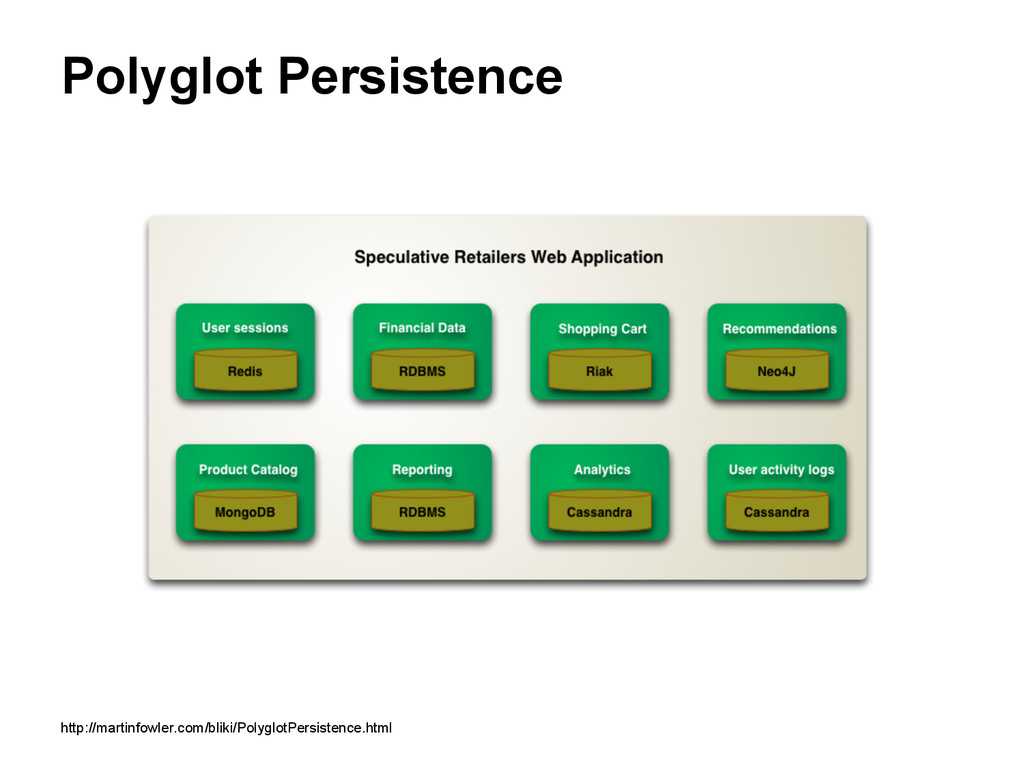
Modern web architectures now need more than a single data store to perform complex tasks. Polyglot Persistence, a term coined by Martin Fowler, revolves around the application of multiple types of data stores employed simultaneously. This talk is about good practices w.r.t. Polyglot Persistence in Ruby. Contents of this talk can be referred to as guidelines and are completely based on experiences by the Engineering team at Jombay.com.

Avatar for Nikhil Lanjewar
Nikhil Lanjewar

August 17, 2014

More Decks by Nikhil Lanjewar

Other Decks in Programming

Transcript

  1. Consumer Internet in 2014 Signup / Login Messages Email Chat

    Photo Sharing Discussions Ad-platform
  2. Consumer Internet in 2014 Signup / Login Messages Email Chat

    Photo Sharing Discussions Ad-platform Recommendations
  3. Consumer Internet in 2014 Signup / Login Messages Email Chat

    Photo Sharing Discussions Ad-platform Recommendations Geo-tagging
  4. Consumer Internet in 2014 Signup / Login Messages Email Chat

    Photo Sharing Discussions Ad-platform Recommendations Geo-tagging Developer API
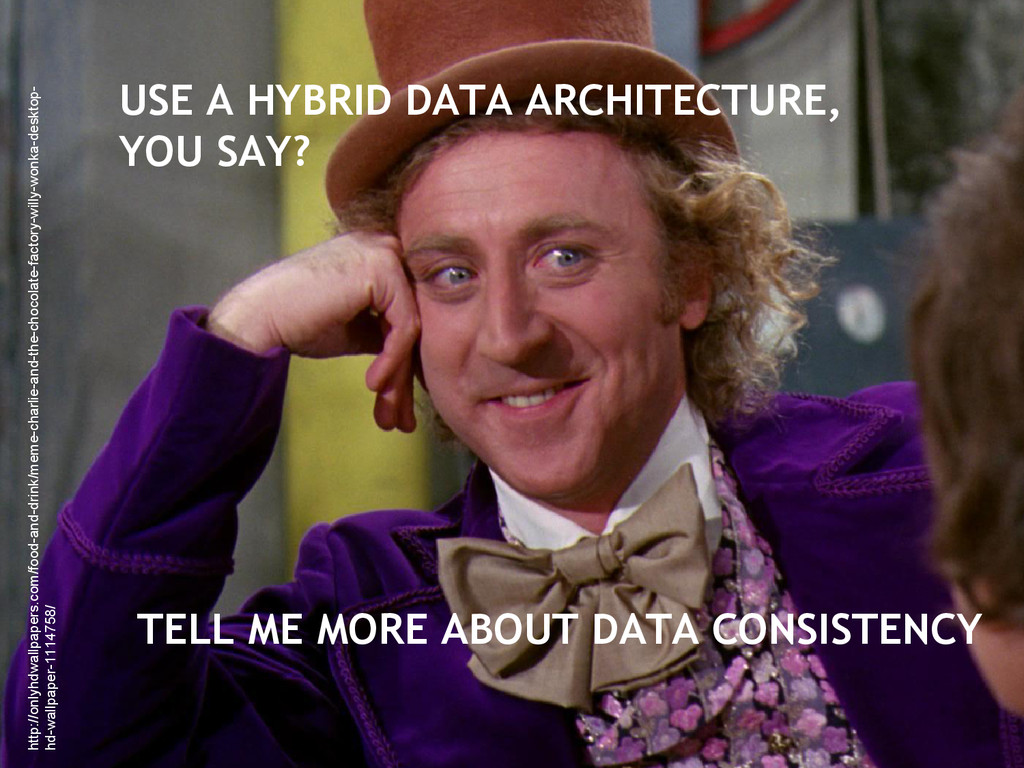
  5. USE A HYBRID DATA ARCHITECTURE, YOU SAY? TELL ME MORE

    ABOUT DATA CONSISTENCY http://onlyhdwallpapers.com/food-and-drink/meme-charlie-and-the-chocolate-factory-willy-wonka-desktop- hd-wallpaper-1114758/
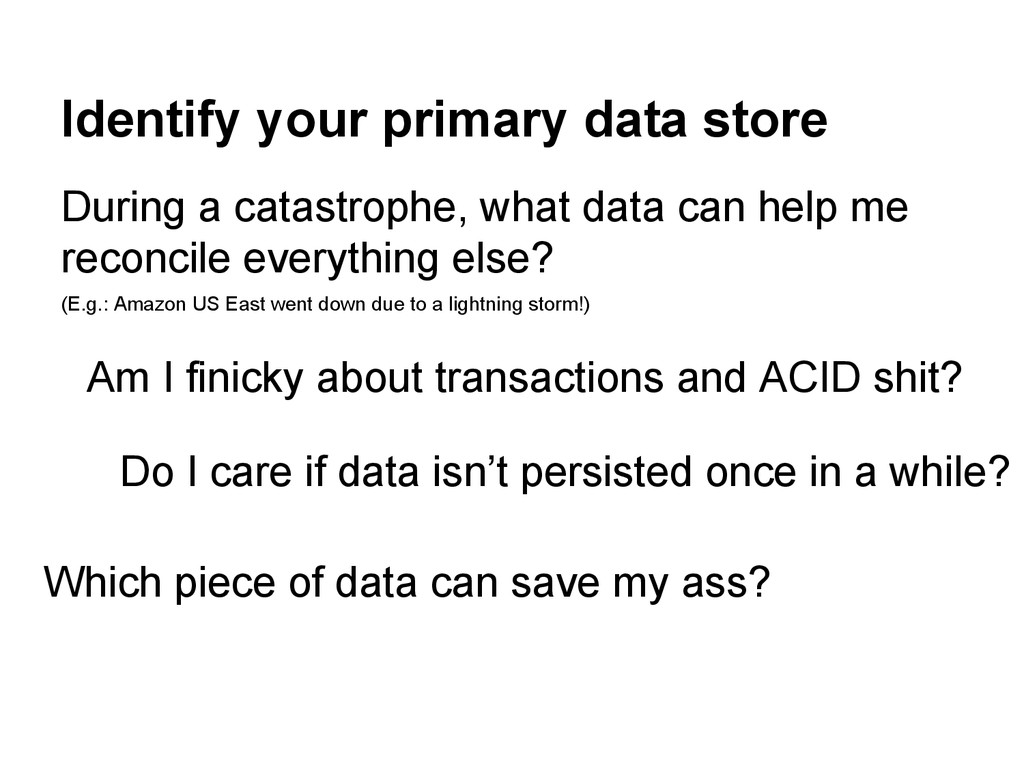
  6. Identify your primary data store Which piece of data can

    save my ass? During a catastrophe, what data can help me reconcile everything else? (E.g.: Amazon US East went down due to a lightning storm!) Am I finicky about transactions and ACID shit? Do I care if data isn’t persisted once in a while?
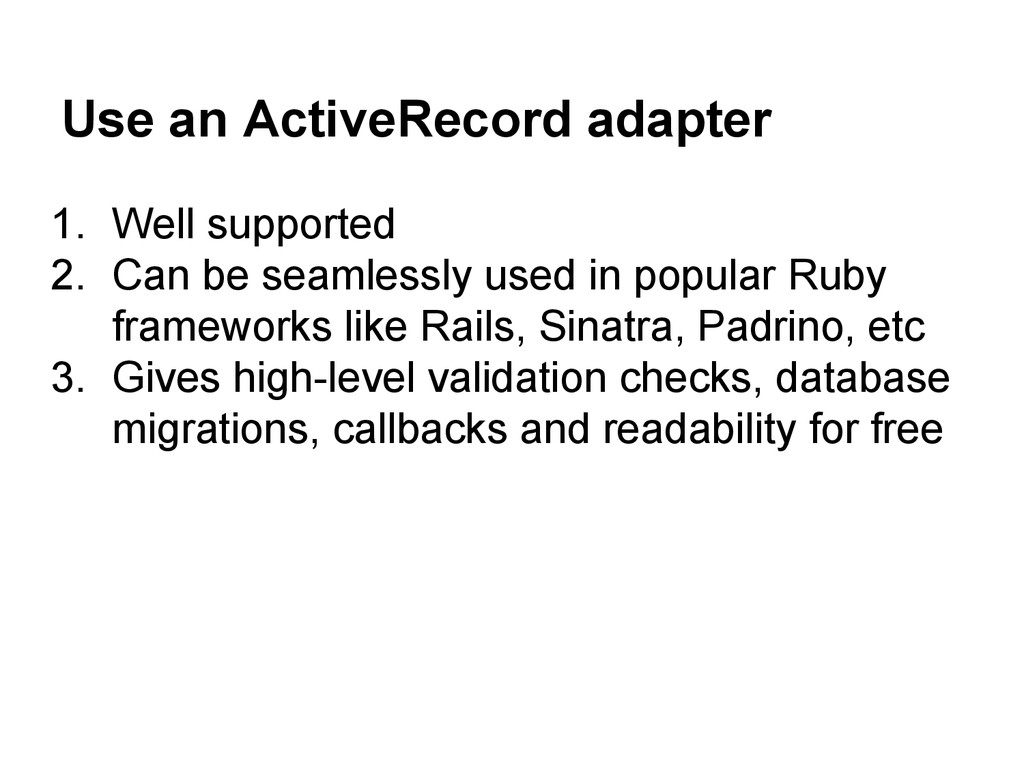
  7. Use an ActiveRecord adapter 1. Well supported 2. Can be

    seamlessly used in popular Ruby frameworks like Rails, Sinatra, Padrino, etc 3. Gives high-level validation checks, database migrations, callbacks and readability for free
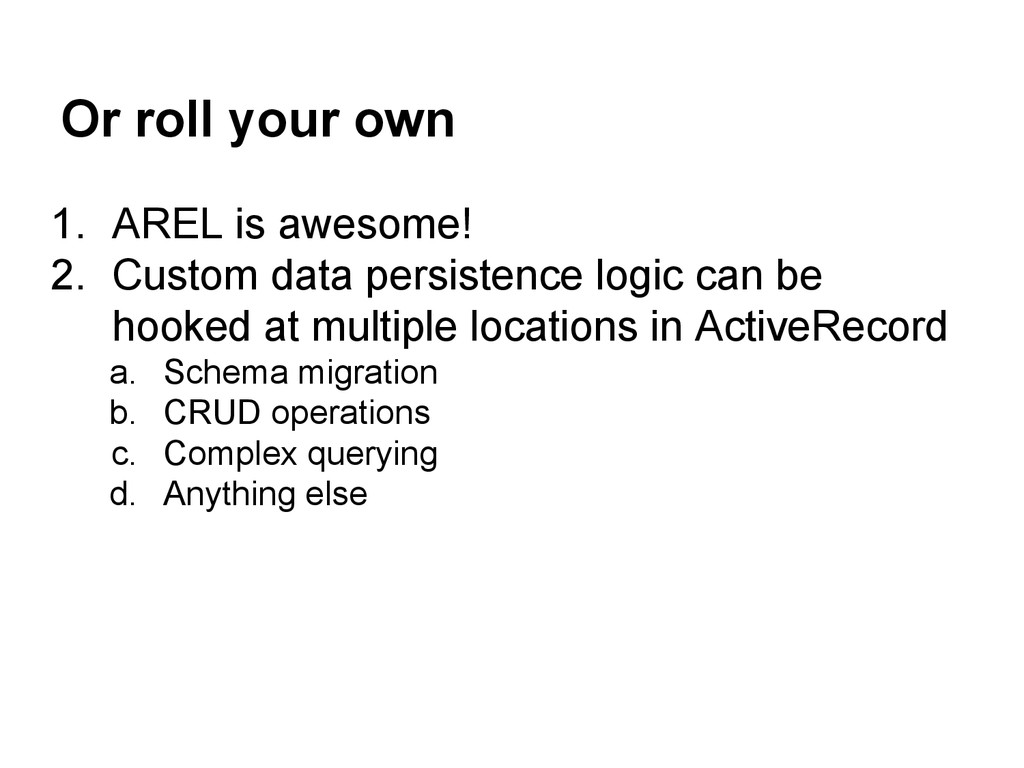
  8. Or roll your own 1. AREL is awesome! 2. Custom

    data persistence logic can be hooked at multiple locations in ActiveRecord a. Schema migration b. CRUD operations c. Complex querying d. Anything else
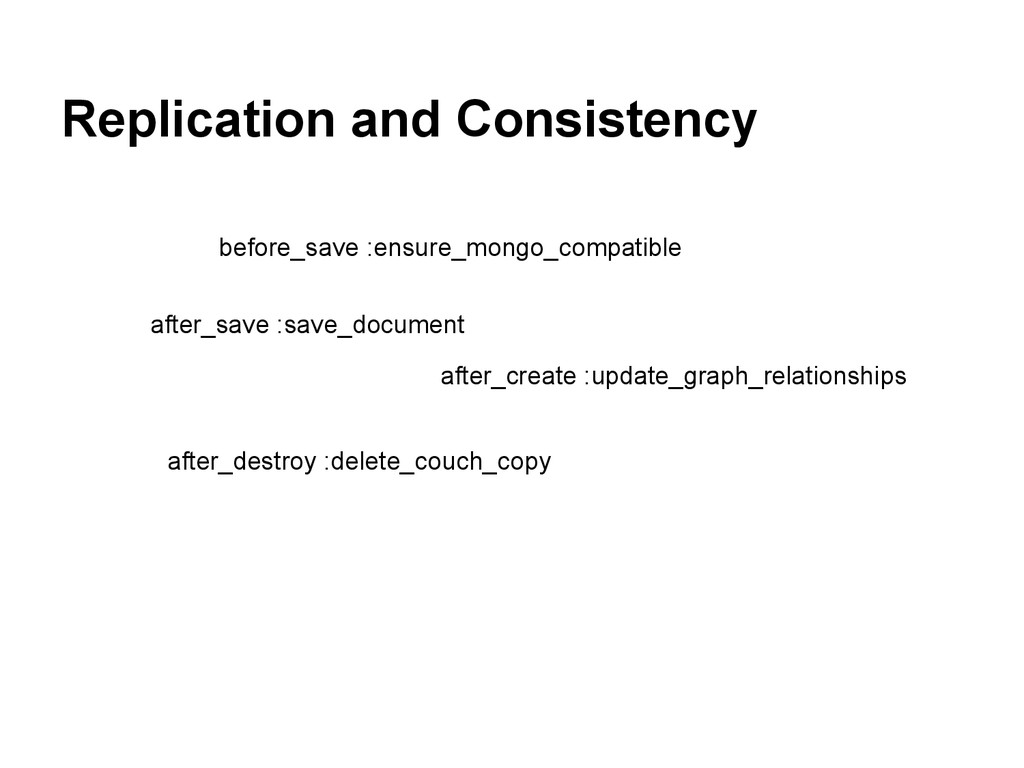
  9. Replication and Consistency KEEP CALM AND before_save :ensure_mongo_compatible after_save :save_document

    after_create :update_graph_relationships after_destroy :delete_couch_copy
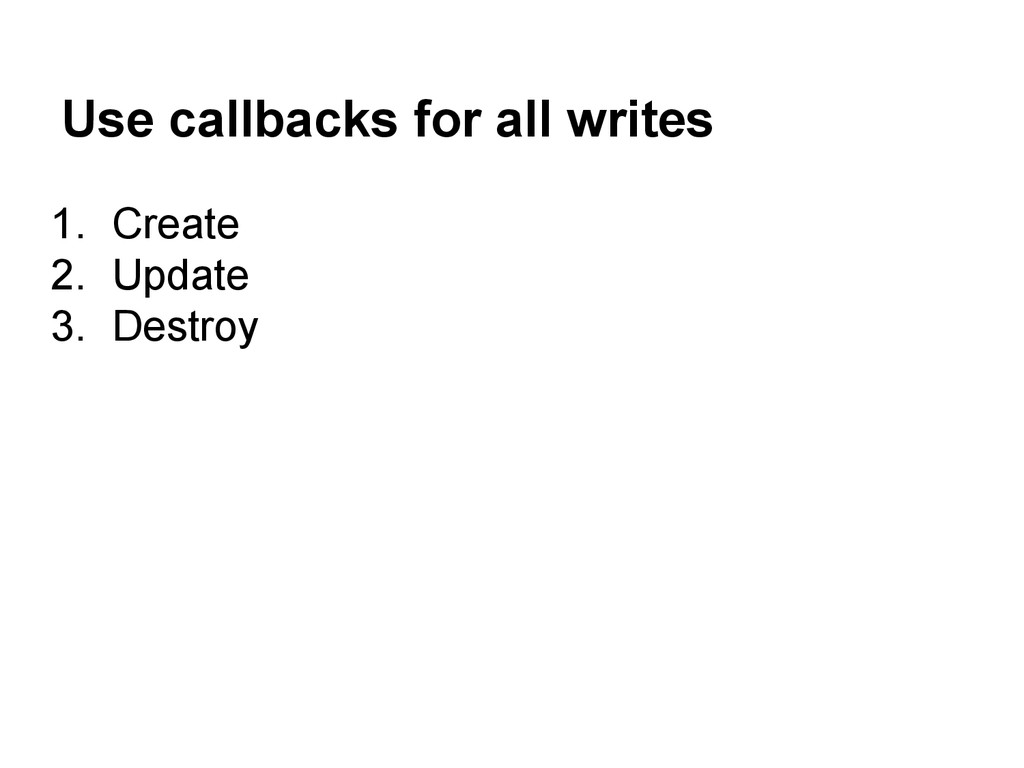
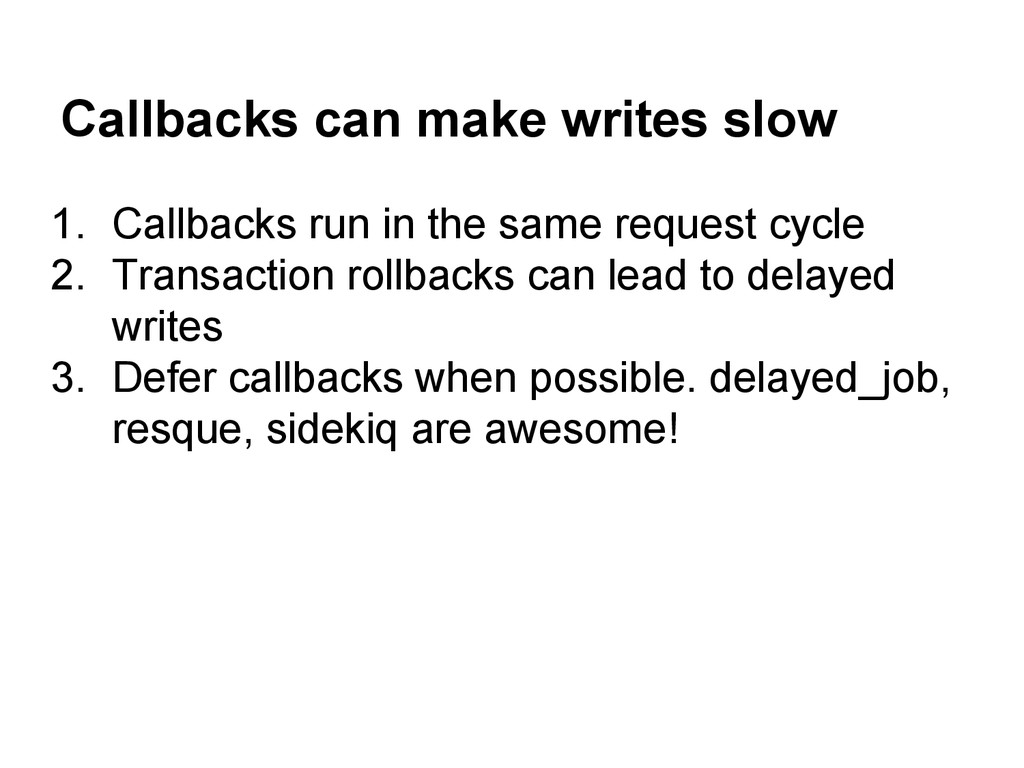
  10. Callbacks can make writes slow 1. Callbacks run in the

    same request cycle 2. Transaction rollbacks can lead to delayed writes 3. Defer callbacks when possible. delayed_job, resque, sidekiq are awesome!
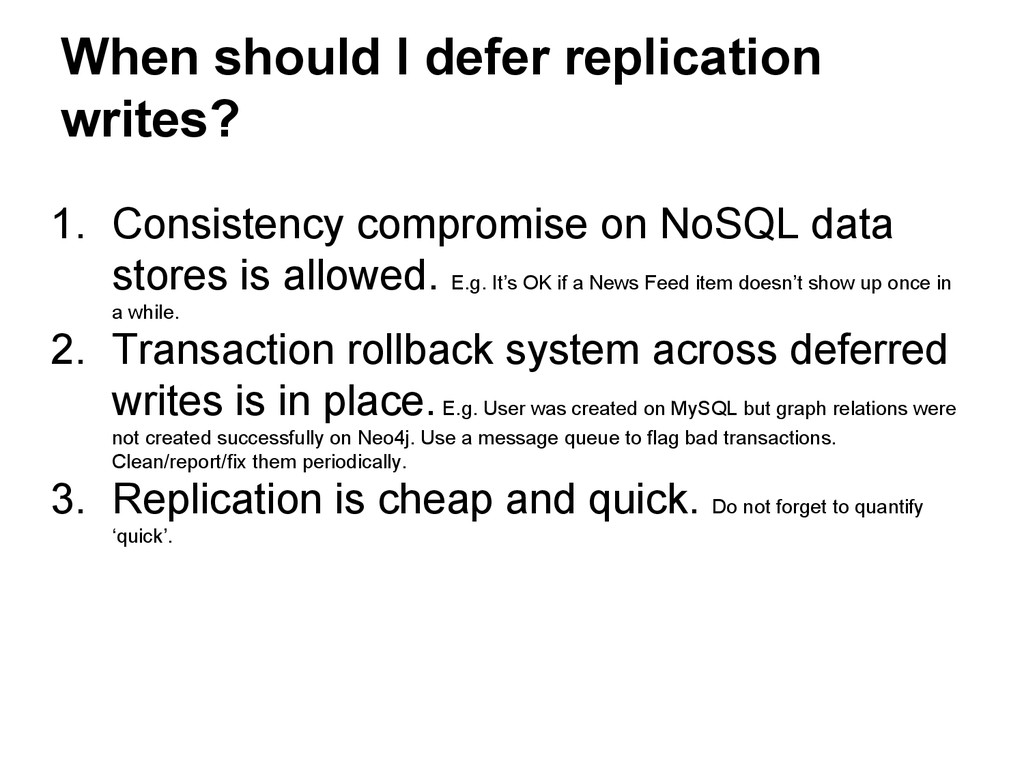
  11. When should I defer replication writes? 1. Consistency compromise on

    NoSQL data stores is allowed. E.g. It’s OK if a News Feed item doesn’t show up once in a while. 2. Transaction rollback system across deferred writes is in place. E.g. User was created on MySQL but graph relations were not created successfully on Neo4j. Use a message queue to flag bad transactions. Clean/report/fix them periodically. 3. Replication is cheap and quick. Do not forget to quantify ‘quick’.
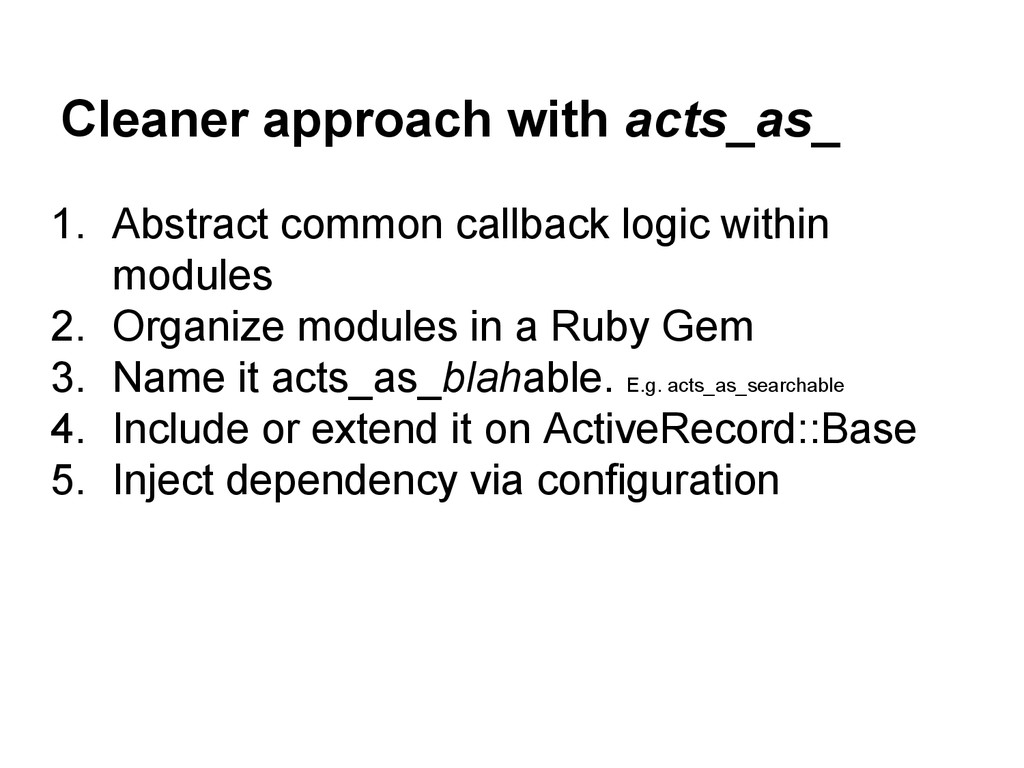
  12. Cleaner approach with acts_as_ 1. Abstract common callback logic within

    modules 2. Organize modules in a Ruby Gem 3. Name it acts_as_blahable. E.g. acts_as_searchable 4. Include or extend it on ActiveRecord::Base 5. Inject dependency via configuration
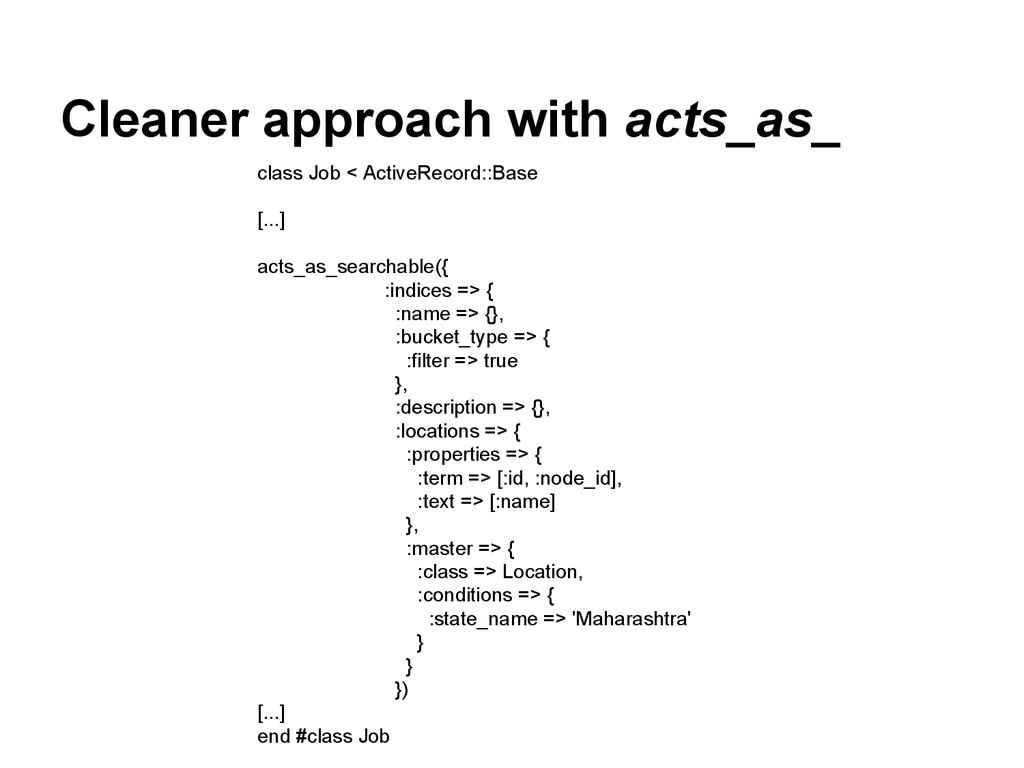
  13. Cleaner approach with acts_as_ class Job < ActiveRecord::Base [...] acts_as_searchable({

    :indices => { :name => {}, :bucket_type => { :filter => true }, :description => {}, :locations => { :properties => { :term => [:id, :node_id], :text => [:name] }, :master => { :class => Location, :conditions => { :state_name => 'Maharashtra' } } }) [...] end #class Job
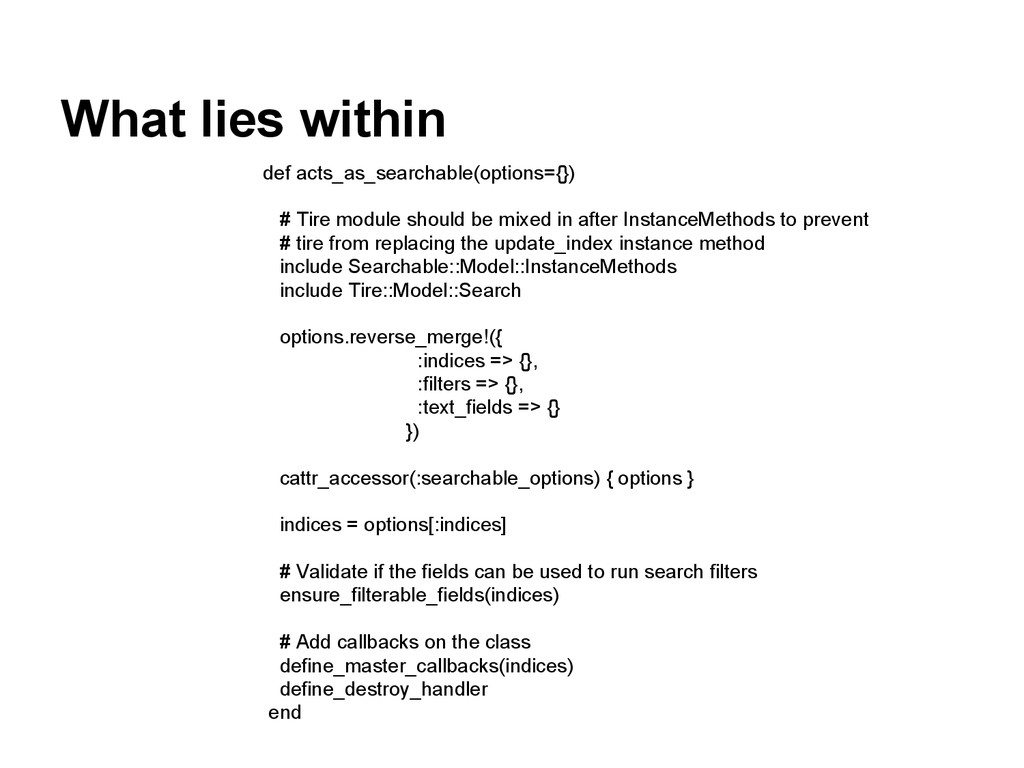
  14. What lies within def acts_as_searchable(options={}) # Tire module should be

    mixed in after InstanceMethods to prevent # tire from replacing the update_index instance method include Searchable::Model::InstanceMethods include Tire::Model::Search options.reverse_merge!({ :indices => {}, :filters => {}, :text_fields => {} }) cattr_accessor(:searchable_options) { options } indices = options[:indices] # Validate if the fields can be used to run search filters ensure_filterable_fields(indices) # Add callbacks on the class define_master_callbacks(indices) define_destroy_handler end
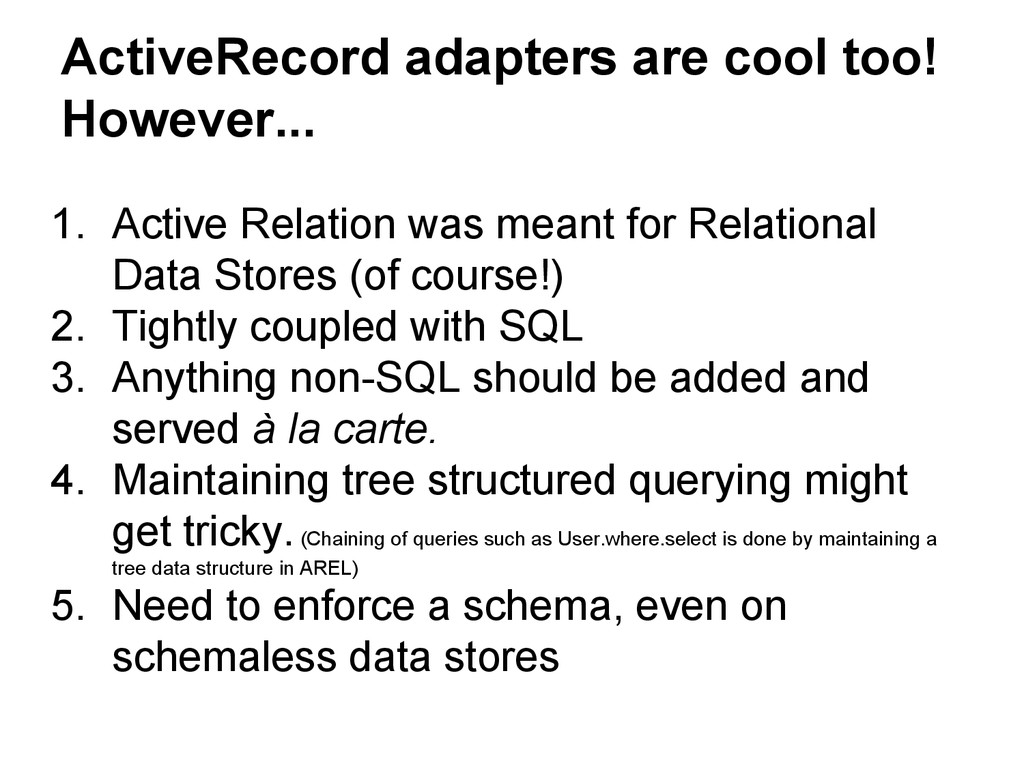
  15. ActiveRecord adapters are cool too! However... 1. Active Relation was

    meant for Relational Data Stores (of course!) 2. Tightly coupled with SQL 3. Anything non-SQL should be added and served à la carte. 4. Maintaining tree structured querying might get tricky. (Chaining of queries such as User.where.select is done by maintaining a tree data structure in AREL) 5. Need to enforce a schema, even on schemaless data stores
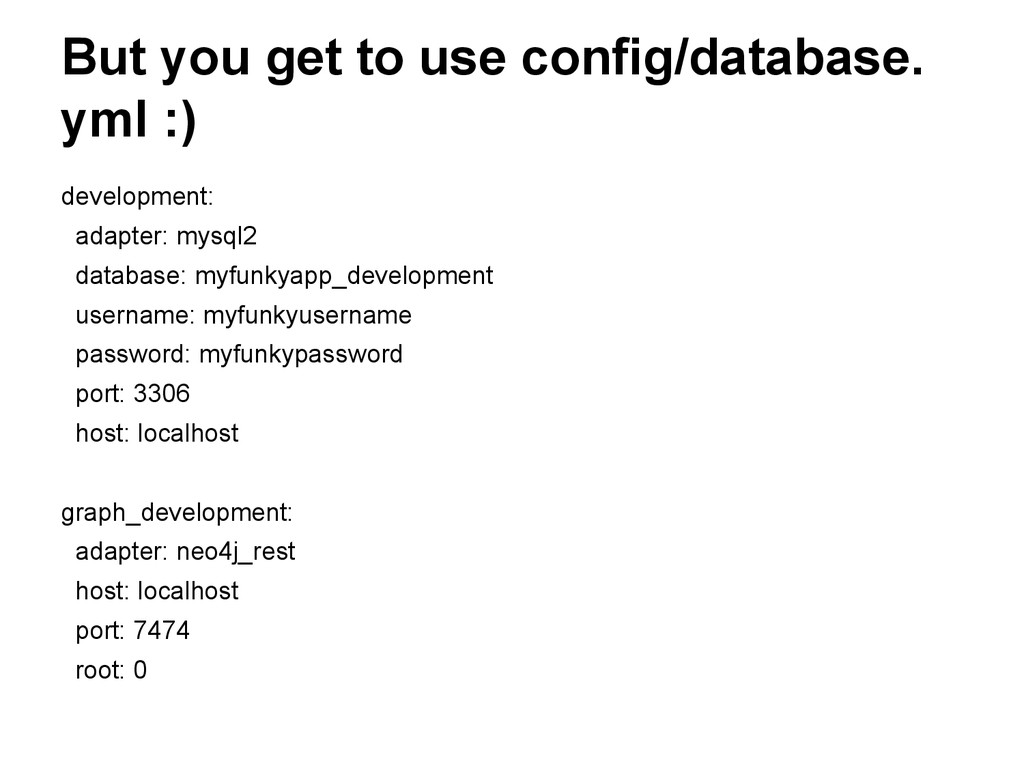
  16. But you get to use config/database. yml :) development: adapter:

    mysql2 database: myfunkyapp_development username: myfunkyusername password: myfunkypassword port: 3306 host: localhost graph_development: adapter: neo4j_rest host: localhost port: 7474 root: 0
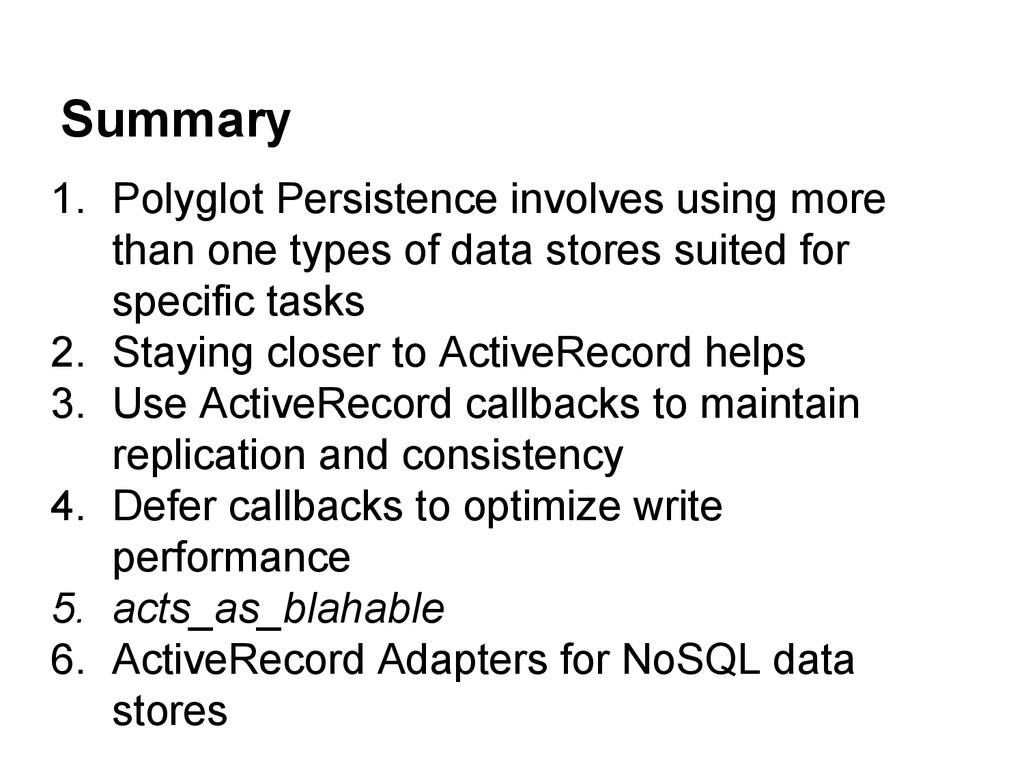
  17. Summary 1. Polyglot Persistence involves using more than one types

    of data stores suited for specific tasks 2. Staying closer to ActiveRecord helps 3. Use ActiveRecord callbacks to maintain replication and consistency 4. Defer callbacks to optimize write performance 5. acts_as_blahable 6. ActiveRecord Adapters for NoSQL data stores