Upgrade to Pro — share decks privately, control downloads, hide ads and more …

KCDC 16 - Hacker Trix

KCDC 16 - Hacker Trix

Avatar for Mike Benkovich

Mike Benkovich

June 23, 2016
Tweet

More Decks by Mike Benkovich

Other Decks in Technology

Transcript

  1. About me… • Mike Benkovich – [email protected] • First computer

    was Commodore PET • Avid blogger on www.benkotips.com • Last job was MSDN Evangelist for Microsoft • Entrepreneur – Founder of Imagine Technologies, Inc. • Follow me on twitter @mbenko • Founder of TechMasters (Toastmasters for Geeks) www.techmasters-tc.com - #TechMasters • Links from today – http://bit.ly/hacktrx Downloads available at www.benkotips.com
  2. Agenda • Growing importance of security • Principles of Security

    • Threat Modeling • Know your threats Copyright 2015, Imagine Technologies, inc.
  3. Is security important? • What is the conversation about? •

    Security vs. Identity • What are we protecting? • Where is the threat? • Who is the enemy? Copyright 2015, Imagine Technologies, inc.
  4. The perfect scenario • Eliminate all data and allow no

    users Copyright 2015, Imagine Technologies, inc.
  5. The perfect scenario • Assume all users are evil and

    all input is corrupt Copyright 2015, Imagine Technologies, inc.
  6. The perfect scenario • Get some sharks with laser beams

    Copyright 2015, Imagine Technologies, inc.
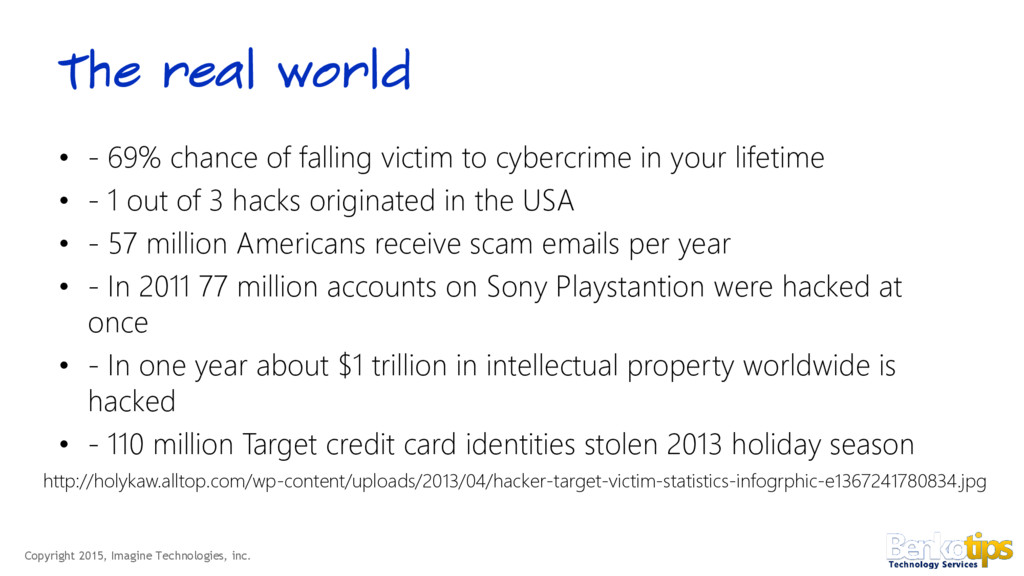
  7. The real world • - 69% chance of falling victim

    to cybercrime in your lifetime • - 1 out of 3 hacks originated in the USA • - 57 million Americans receive scam emails per year • - In 2011 77 million accounts on Sony Playstantion were hacked at once • - In one year about $1 trillion in intellectual property worldwide is hacked • - 110 million Target credit card identities stolen 2013 holiday season http://holykaw.alltop.com/wp-content/uploads/2013/04/hacker-target-victim-statistics-infogrphic-e1367241780834.jpg Copyright 2015, Imagine Technologies, inc.
  8. The Golden Rule of Security All users are Evil. All

    input is corrupt… …until proven otherwise! Copyright 2015, Imagine Technologies, inc.
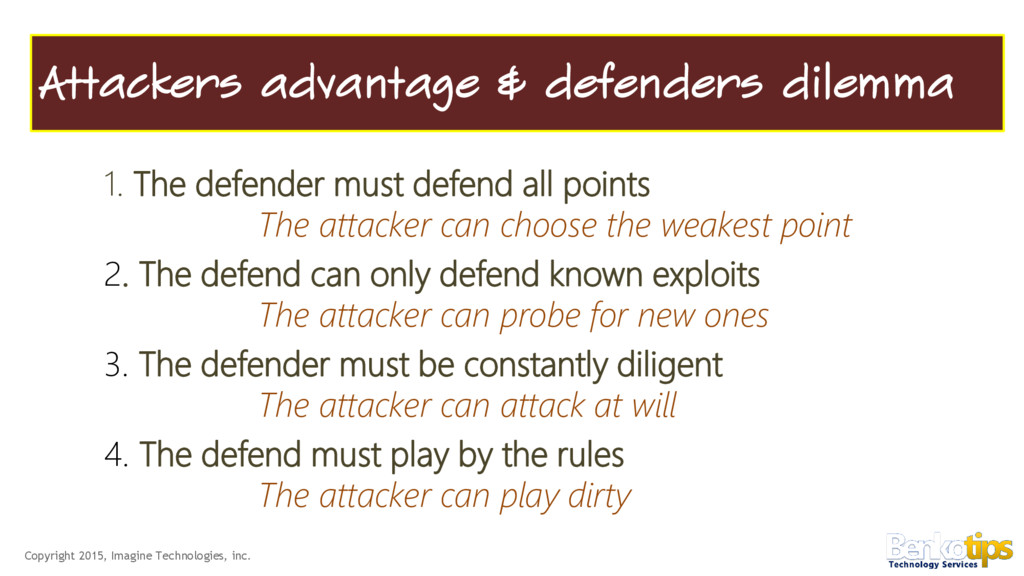
  9. Attackers advantage & defenders dilemma 1. The defender must defend

    all points The attacker can choose the weakest point 2. The defend can only defend known exploits The attacker can probe for new ones 3. The defender must be constantly diligent The attacker can attack at will 4. The defend must play by the rules The attacker can play dirty Copyright 2015, Imagine Technologies, inc.
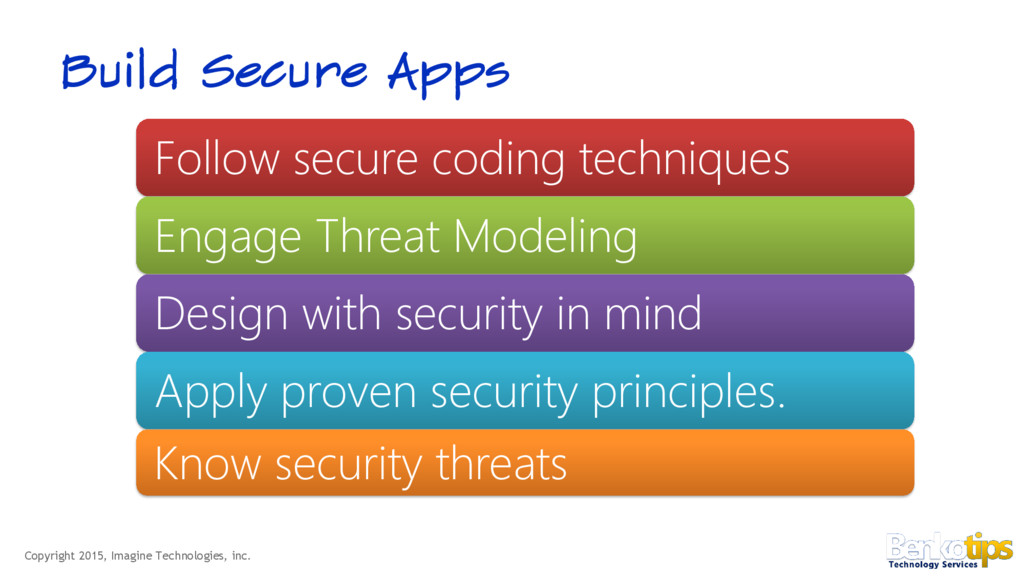
  10. Build Secure Apps Follow secure coding techniques Engage Threat Modeling

    Design with security in mind Apply proven security principles. Know security threats Copyright 2015, Imagine Technologies, inc.
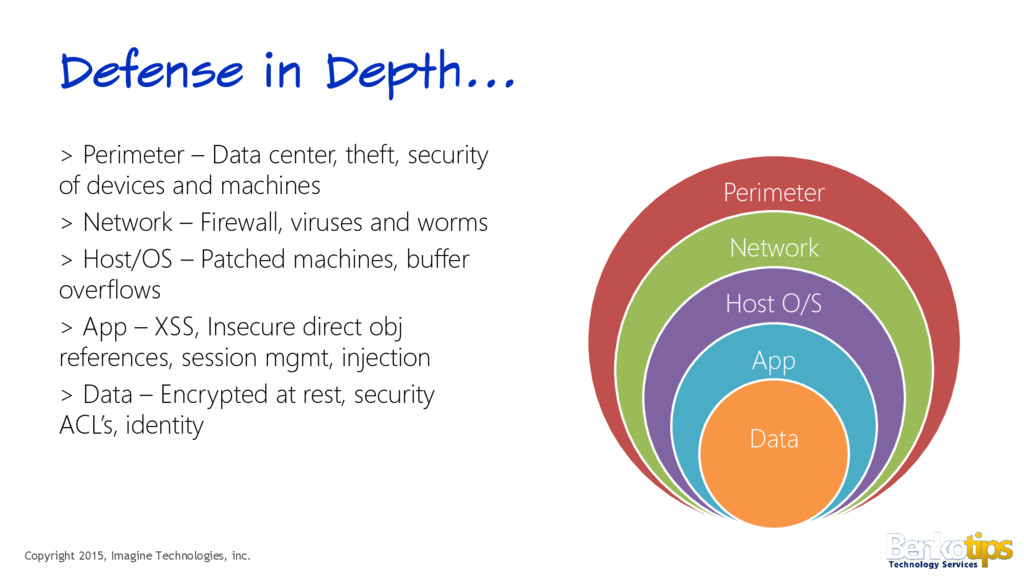
  11. Defense in Depth… > Perimeter – Data center, theft, security

    of devices and machines > Network – Firewall, viruses and worms > Host/OS – Patched machines, buffer overflows > App – XSS, Insecure direct obj references, session mgmt, injection > Data – Encrypted at rest, security ACL’s, identity Perimeter Network Host O/S App Data Copyright 2015, Imagine Technologies, inc.
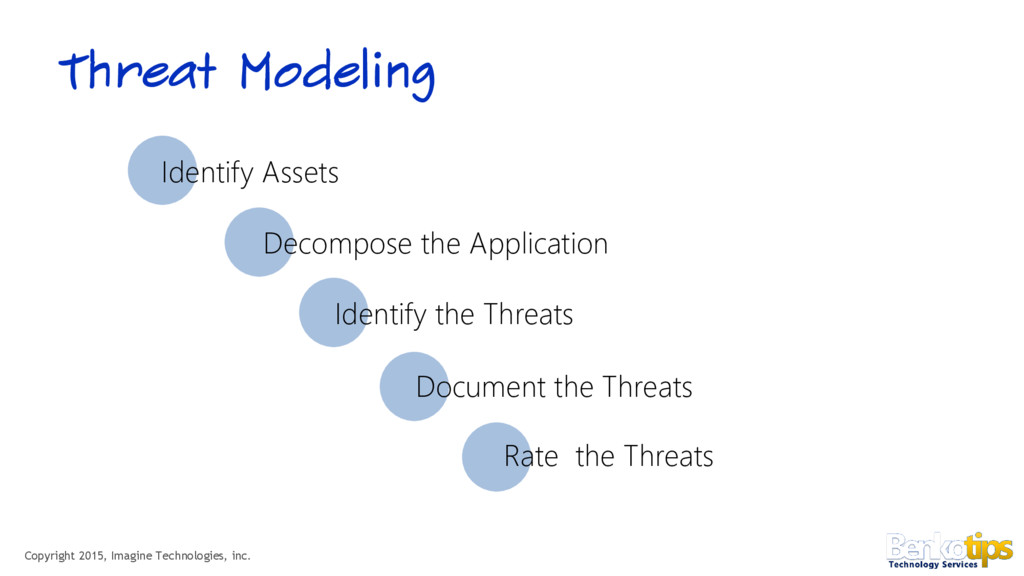
  12. Threat Modeling Identify Assets Decompose the Application Identify the Threats

    Document the Threats Rate the Threats Copyright 2015, Imagine Technologies, inc.
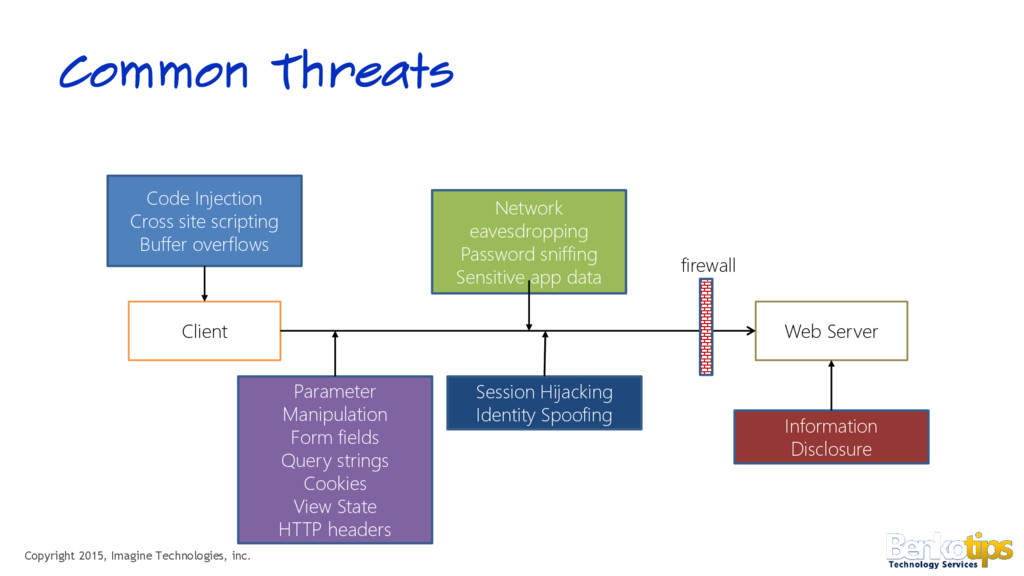
  13. Common Threats Code Injection Cross site scripting Buffer overflows Network

    eavesdropping Password sniffing Sensitive app data Parameter Manipulation Form fields Query strings Cookies View State HTTP headers Client Web Server Session Hijacking Identity Spoofing firewall Information Disclosure Copyright 2015, Imagine Technologies, inc.
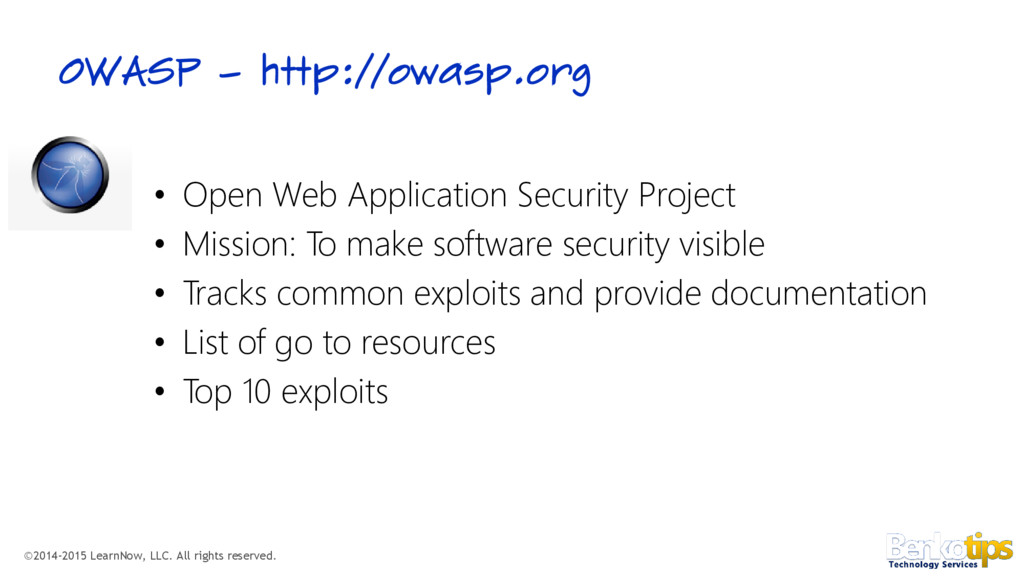
  14. OWASP – http://owasp.org • Open Web Application Security Project •

    Mission: To make software security visible • Tracks common exploits and provide documentation • List of go to resources • Top 10 exploits ©2014-2015 LearnNow, LLC. All rights reserved.
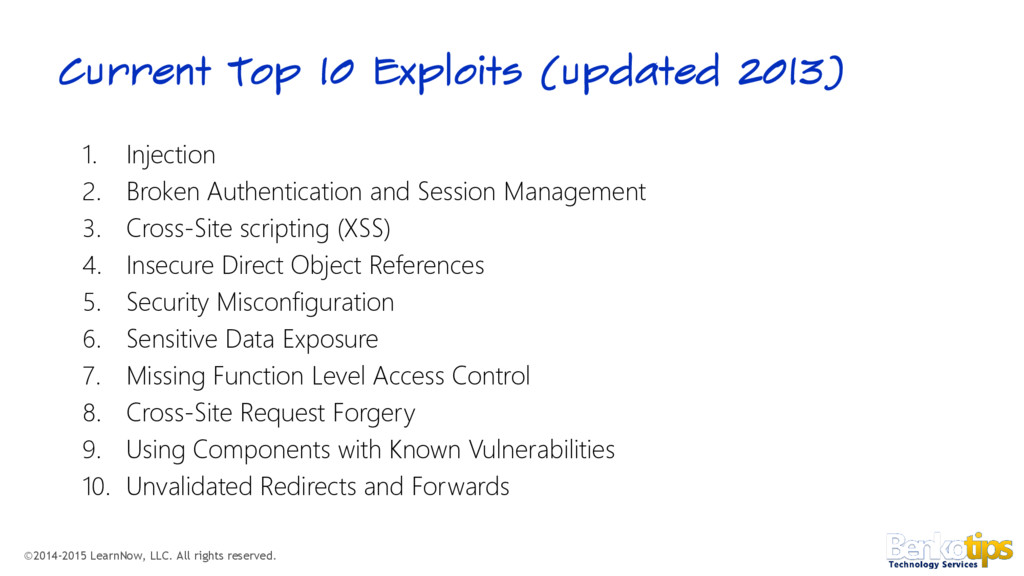
  15. Current Top 10 Exploits (updated 2013) 1. Injection 2. Broken

    Authentication and Session Management 3. Cross-Site scripting (XSS) 4. Insecure Direct Object References 5. Security Misconfiguration 6. Sensitive Data Exposure 7. Missing Function Level Access Control 8. Cross-Site Request Forgery 9. Using Components with Known Vulnerabilities 10. Unvalidated Redirects and Forwards ©2014-2015 LearnNow, LLC. All rights reserved.
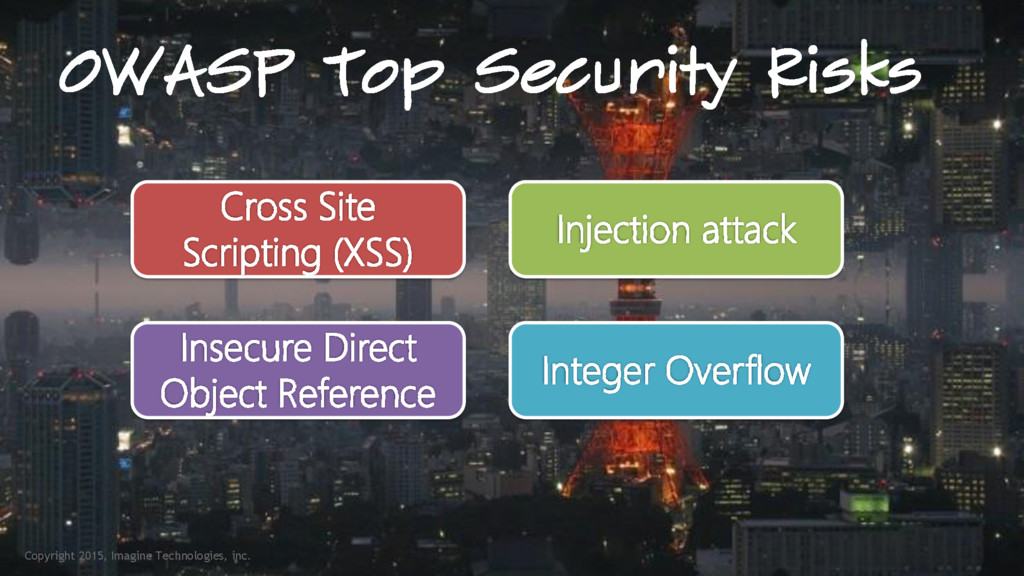
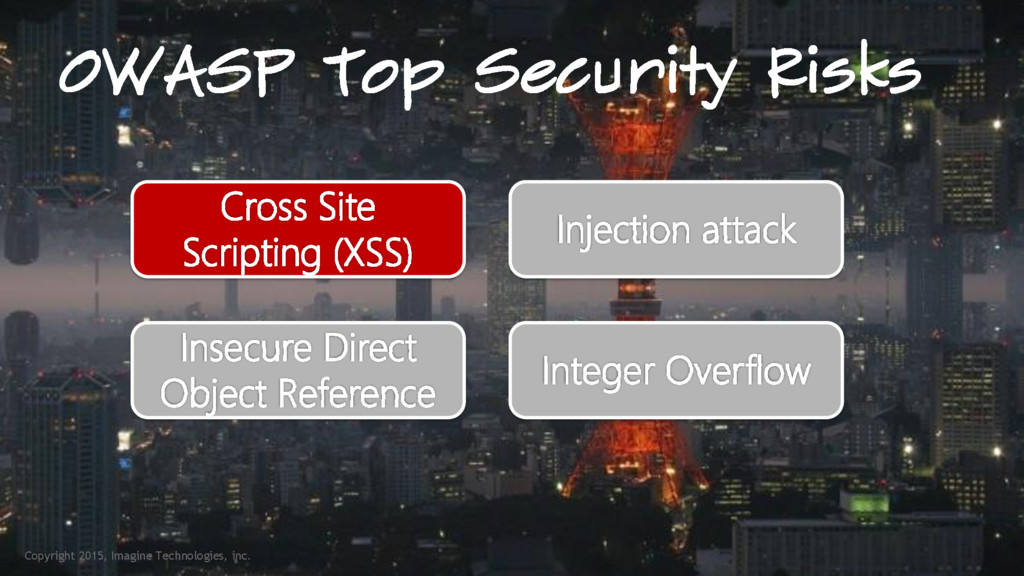
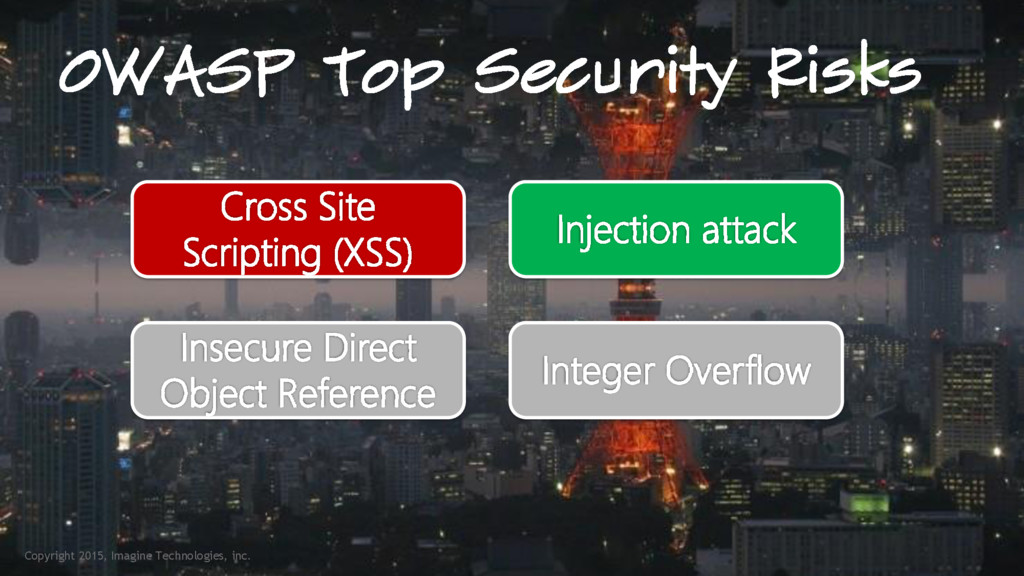
  16. OWASP Top Security Risks Cross Site Scripting (XSS) Injection attack

    Insecure Direct Object Reference Integer Overflow Copyright 2015, Imagine Technologies, inc.
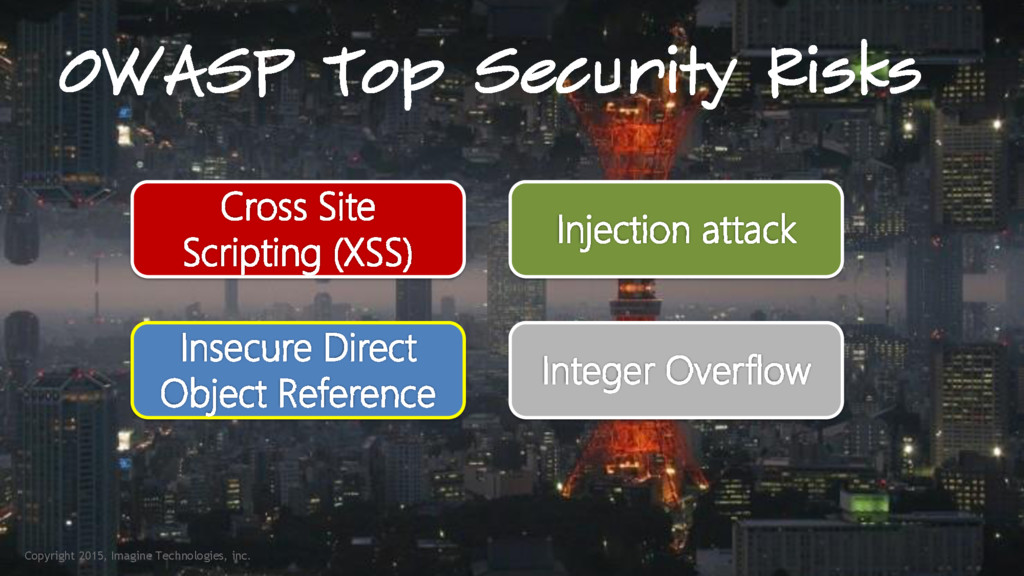
  17. OWASP Top Security Risks Cross Site Scripting (XSS) Injection attack

    Insecure Direct Object Reference Integer Overflow Copyright 2015, Imagine Technologies, inc.
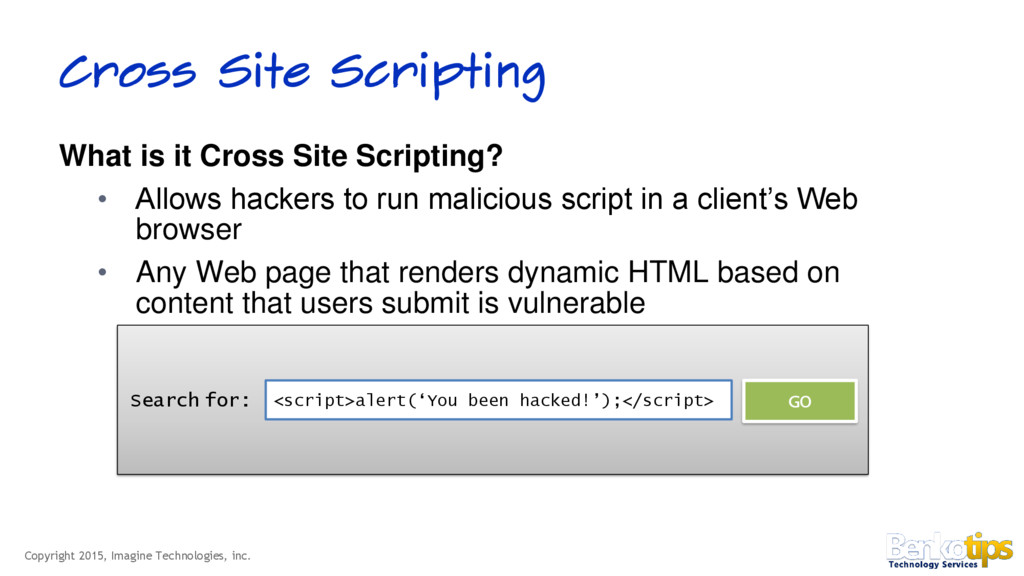
  18. Cross Site Scripting What is it Cross Site Scripting? •

    Allows hackers to run malicious script in a client’s Web browser • Any Web page that renders dynamic HTML based on content that users submit is vulnerable Search for: <script>alert(‘You been hacked!’);</script> GO Copyright 2015, Imagine Technologies, inc.
  19. Cross Site Scripting • Potential Risks • Hackers can embed

    <script>, <object>, <applet>, and <embed> tags • Hackers can steal Web session information, modify the user’s screen Copyright 2015, Imagine Technologies, inc.
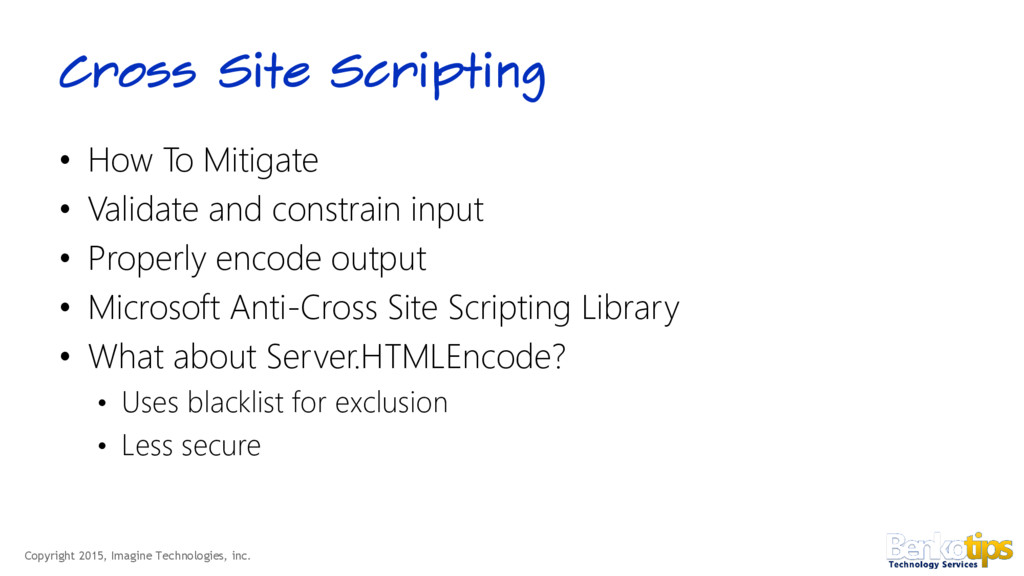
  20. Cross Site Scripting • How To Mitigate • Validate and

    constrain input • Properly encode output • Microsoft Anti-Cross Site Scripting Library • What about Server.HTMLEncode? • Uses blacklist for exclusion • Less secure Copyright 2015, Imagine Technologies, inc.
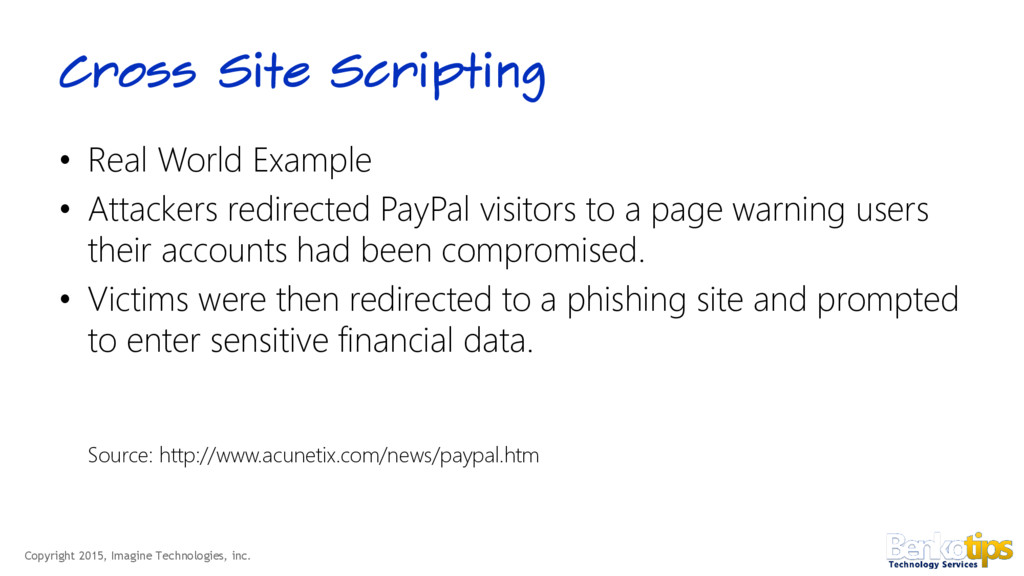
  21. Cross Site Scripting • Real World Example • Attackers redirected

    PayPal visitors to a page warning users their accounts had been compromised. • Victims were then redirected to a phishing site and prompted to enter sensitive financial data. Source: http://www.acunetix.com/news/paypal.htm Copyright 2015, Imagine Technologies, inc.
  22. OWASP Top Security Risks Cross Site Scripting (XSS) Injection attack

    Insecure Direct Object Reference Integer Overflow Copyright 2015, Imagine Technologies, inc.
  23. OWASP Top Security Risks Cross Site Scripting (XSS) Injection attack

    Insecure Direct Object Reference Integer Overflow Copyright 2015, Imagine Technologies, inc.
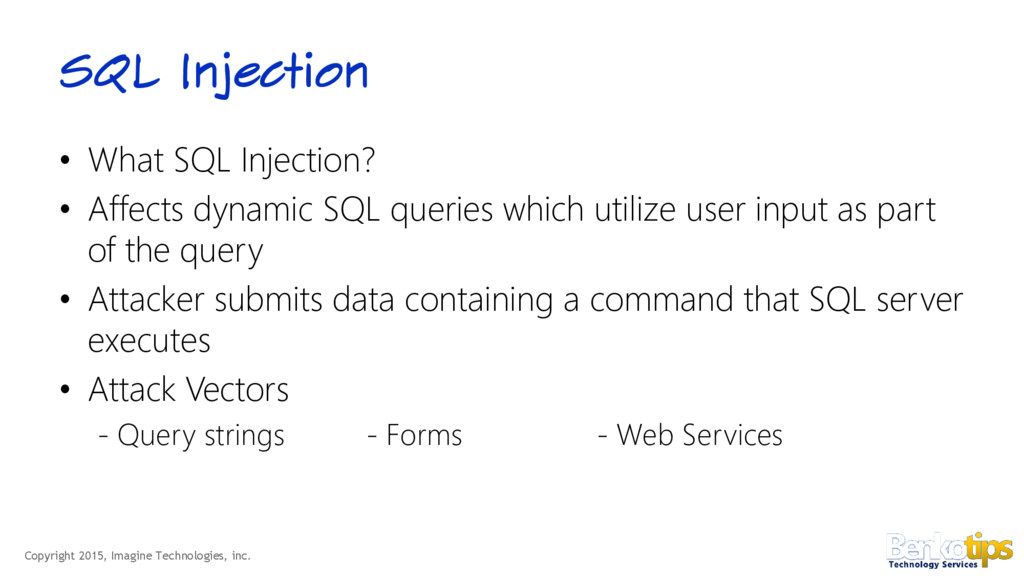
  24. SQL Injection • What SQL Injection? • Affects dynamic SQL

    queries which utilize user input as part of the query • Attacker submits data containing a command that SQL server executes • Attack Vectors - Query strings - Forms - Web Services Copyright 2015, Imagine Technologies, inc.
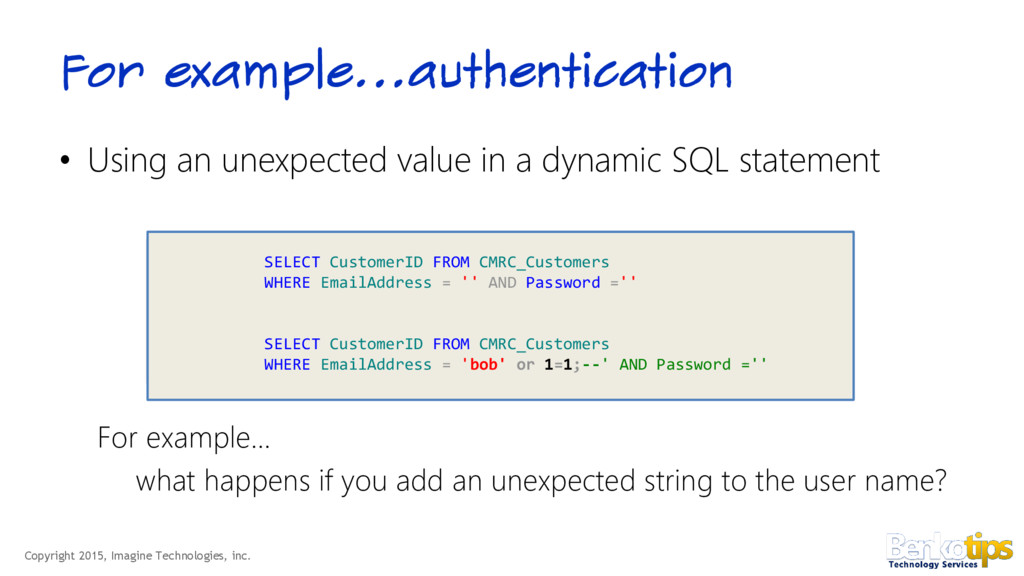
  25. For example…authentication • Using an unexpected value in a dynamic

    SQL statement For example… what happens if you add an unexpected string to the user name? Copyright 2015, Imagine Technologies, inc. User Name: Password: Login bob' or 1=1;-- ********* SELECT CustomerID FROM CMRC_Customers WHERE EmailAddress = '' AND Password ='' SELECT CustomerID FROM CMRC_Customers WHERE EmailAddress = 'bob' or 1=1;--' AND Password =''
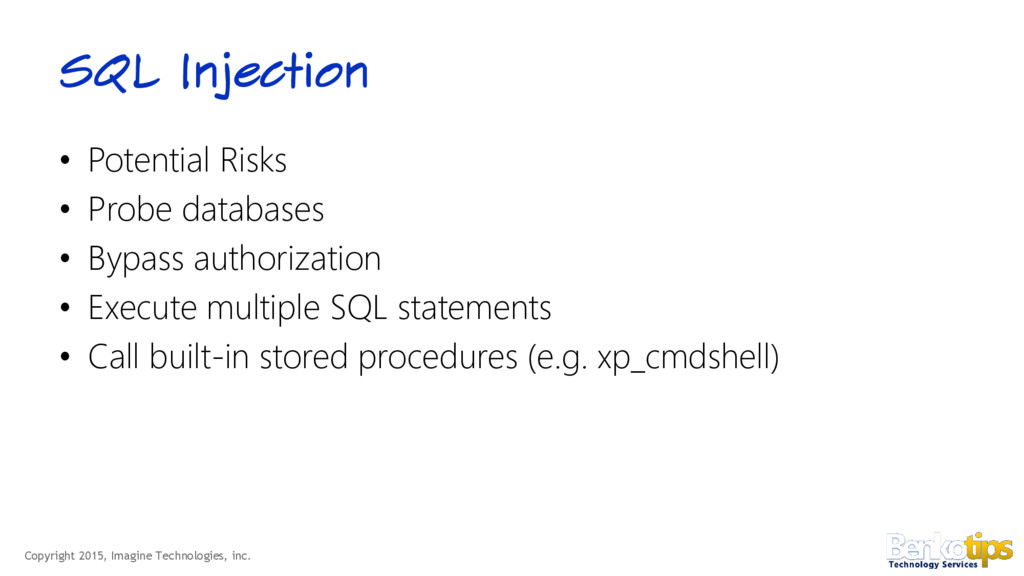
  26. SQL Injection • Potential Risks • Probe databases • Bypass

    authorization • Execute multiple SQL statements • Call built-in stored procedures (e.g. xp_cmdshell) Copyright 2015, Imagine Technologies, inc.
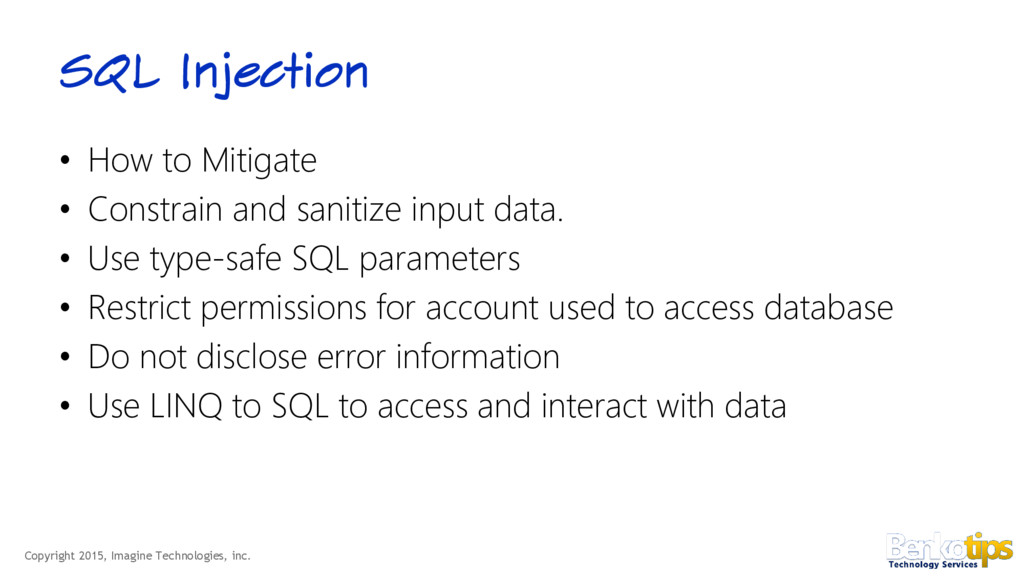
  27. SQL Injection • How to Mitigate • Constrain and sanitize

    input data. • Use type-safe SQL parameters • Restrict permissions for account used to access database • Do not disclose error information • Use LINQ to SQL to access and interact with data Copyright 2015, Imagine Technologies, inc.
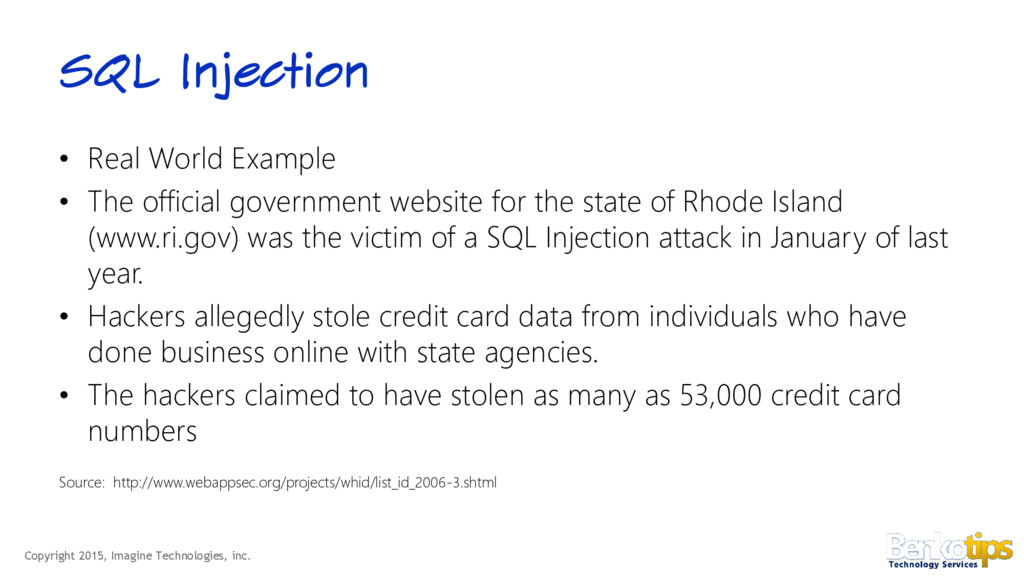
  28. SQL Injection • Real World Example • The official government

    website for the state of Rhode Island (www.ri.gov) was the victim of a SQL Injection attack in January of last year. • Hackers allegedly stole credit card data from individuals who have done business online with state agencies. • The hackers claimed to have stolen as many as 53,000 credit card numbers Source: http://www.webappsec.org/projects/whid/list_id_2006-3.shtml Copyright 2015, Imagine Technologies, inc.
  29. OWASP Top Security Risks Cross Site Scripting (XSS) Injection attack

    Insecure Direct Object Reference Integer Overflow Copyright 2015, Imagine Technologies, inc.
  30. OWASP Top Security Risks Cross Site Scripting (XSS) Injection attack

    Insecure Direct Object Reference Integer Overflow Copyright 2015, Imagine Technologies, inc.
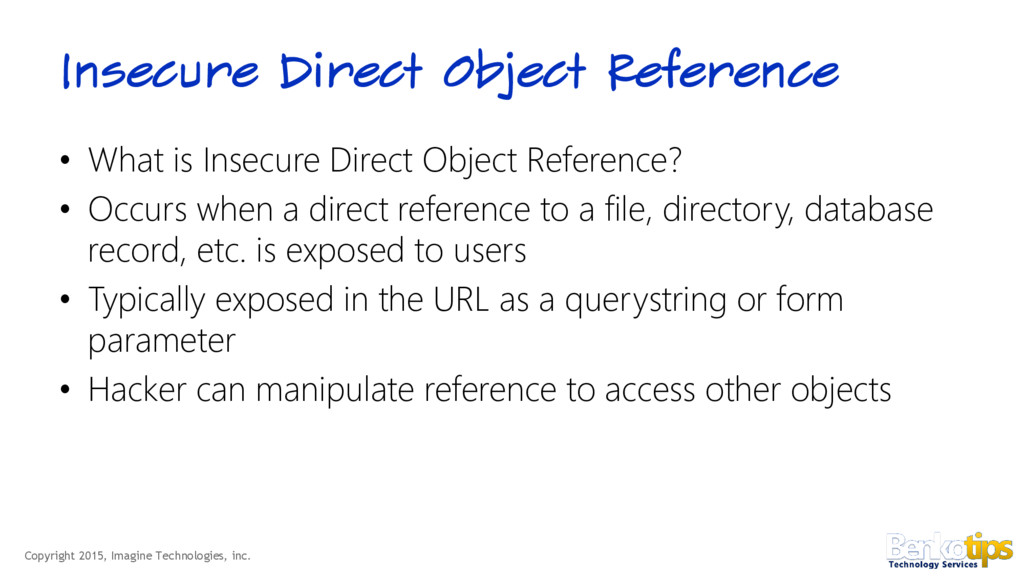
  31. Insecure Direct Object Reference • What is Insecure Direct Object

    Reference? • Occurs when a direct reference to a file, directory, database record, etc. is exposed to users • Typically exposed in the URL as a querystring or form parameter • Hacker can manipulate reference to access other objects Copyright 2015, Imagine Technologies, inc.
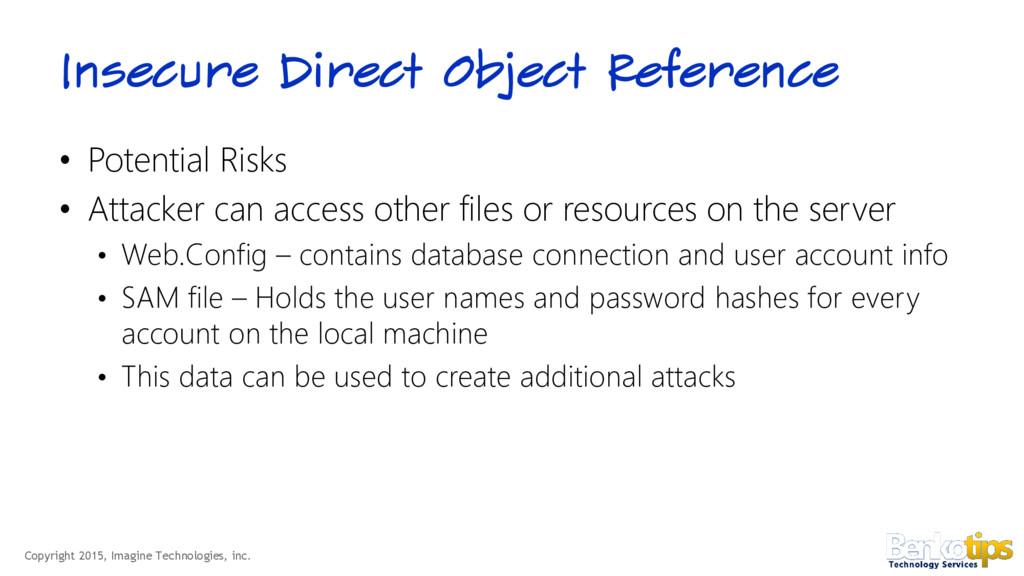
  32. Insecure Direct Object Reference • Potential Risks • Attacker can

    access other files or resources on the server • Web.Config – contains database connection and user account info • SAM file – Holds the user names and password hashes for every account on the local machine • This data can be used to create additional attacks Copyright 2015, Imagine Technologies, inc.
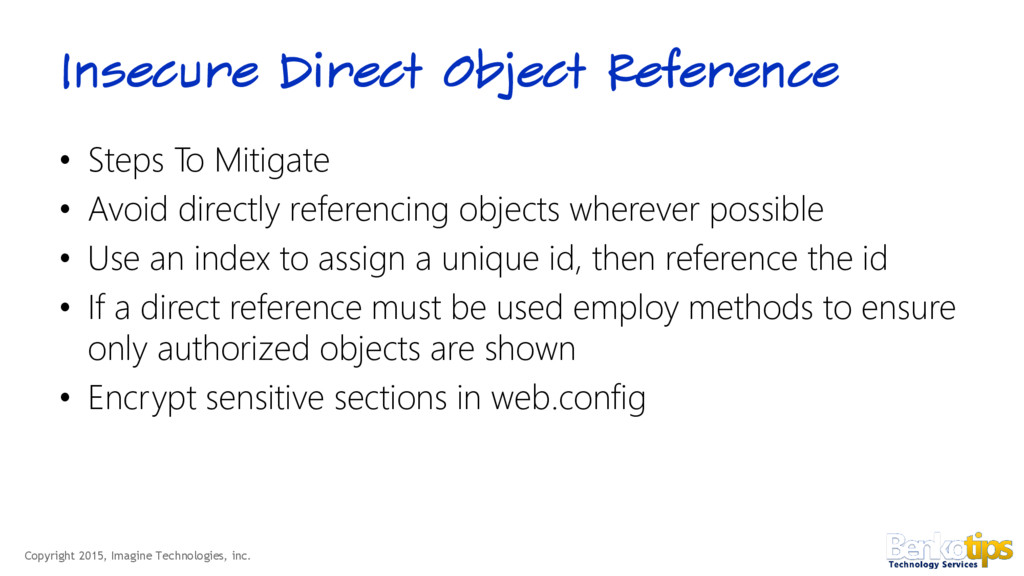
  33. Insecure Direct Object Reference • Steps To Mitigate • Avoid

    directly referencing objects wherever possible • Use an index to assign a unique id, then reference the id • If a direct reference must be used employ methods to ensure only authorized objects are shown • Encrypt sensitive sections in web.config Copyright 2015, Imagine Technologies, inc.
  34. OWASP Top Security Risks Cross Site Scripting (XSS) Injection attack

    Insecure Direct Object Reference Integer Overflow Copyright 2015, Imagine Technologies, inc.
  35. OWASP Top Security Risks Cross Site Scripting (XSS) Injection attack

    Insecure Direct Object Reference Integer Overflow Copyright 2015, Imagine Technologies, inc.
  36. Integer Overflow • What is Integer Overflow? • Occurs when

    an calculation causes an integer to exceed the max or min value allowed by its data type Copyright 2015, Imagine Technologies, inc.
  37. Integer Overflow • Potential Risks • Data corruption • Application

    crashes, instability • Execution of arbitrary code Copyright 2015, Imagine Technologies, inc.
  38. Preventing Integer Overflow • How To Mitigate • Validate user

    input • Check for min and max values • Use the correct data type • Execute your code in a checked context Copyright 2015, Imagine Technologies, inc.
  39. Integer Overflow • Real World Example • Apple’s OS X

    operating system contained a vulnerability which could be exploited remotely by an attacker to compromise a user's system. • The ffs_mountfs() method was vulnerable to an integer overflow which could potentially allow abritrary code to be executed. Source: Copyright 2015, Imagine Technologies, inc.
  40. Defense in Depth • - Multi-layered defense • Physical –

    Network – O/S – Services – Applications – Requests • - Secure by design, by default and in deployment • - Minimize attack surface • - Secure defaults • - Principle of Least Privilege Copyright 2015, Imagine Technologies, inc.
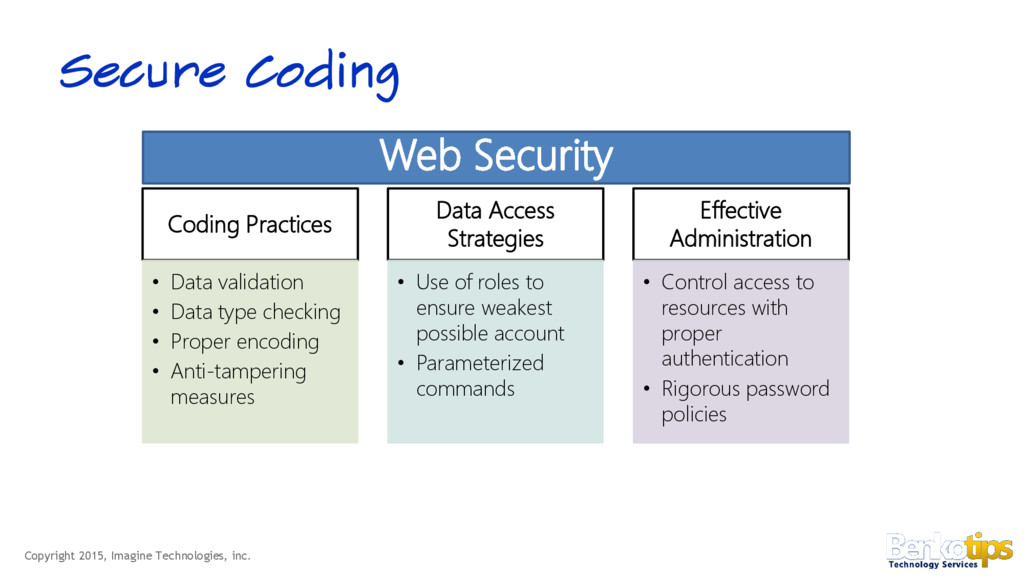
  41. Web Security Secure Coding Coding Practices • Data validation •

    Data type checking • Proper encoding • Anti-tampering measures Data Access Strategies • Use of roles to ensure weakest possible account • Parameterized commands Effective Administration • Control access to resources with proper authentication • Rigorous password policies Copyright 2015, Imagine Technologies, inc.
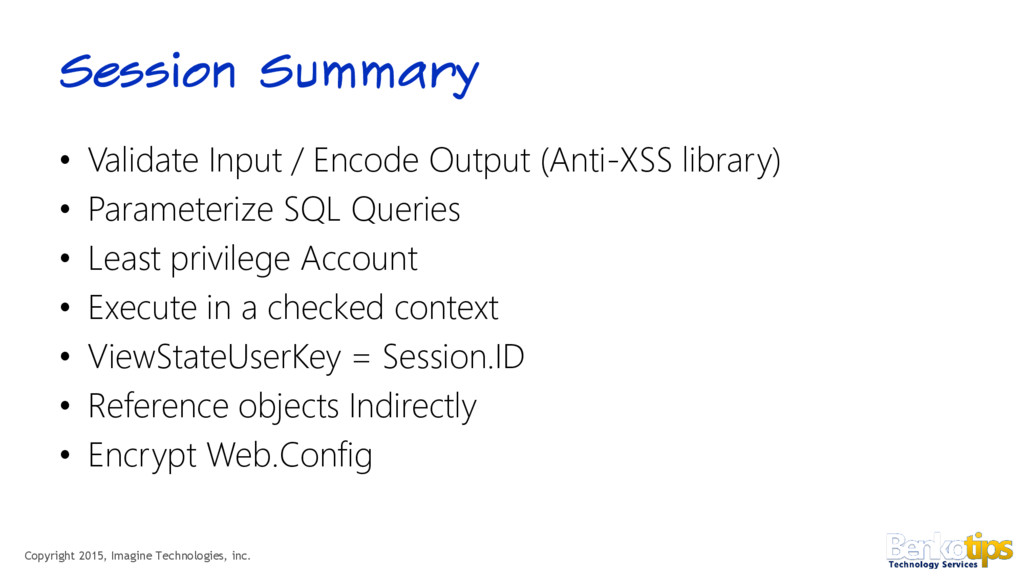
  42. Session Summary • Validate Input / Encode Output (Anti-XSS library)

    • Parameterize SQL Queries • Least privilege Account • Execute in a checked context • ViewStateUserKey = Session.ID • Reference objects Indirectly • Encrypt Web.Config Copyright 2015, Imagine Technologies, inc.
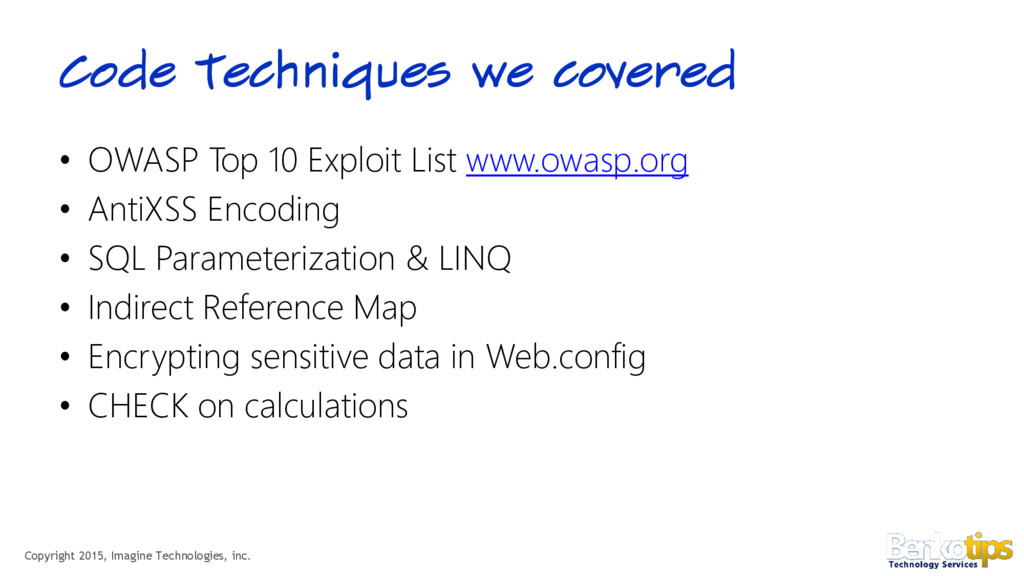
  43. Code Techniques we covered • OWASP Top 10 Exploit List

    www.owasp.org • AntiXSS Encoding • SQL Parameterization & LINQ • Indirect Reference Map • Encrypting sensitive data in Web.config • CHECK on calculations Copyright 2015, Imagine Technologies, inc.
  44. Section Notes Where can I get more info? Copyright 2015,

    Imagine Technologies, inc. • Visit my site www.BenkoTIPS.com • Resources from today’s talk • Blog from this event - www.BenkoTIPS.com • Webcasts • Downloads • More!
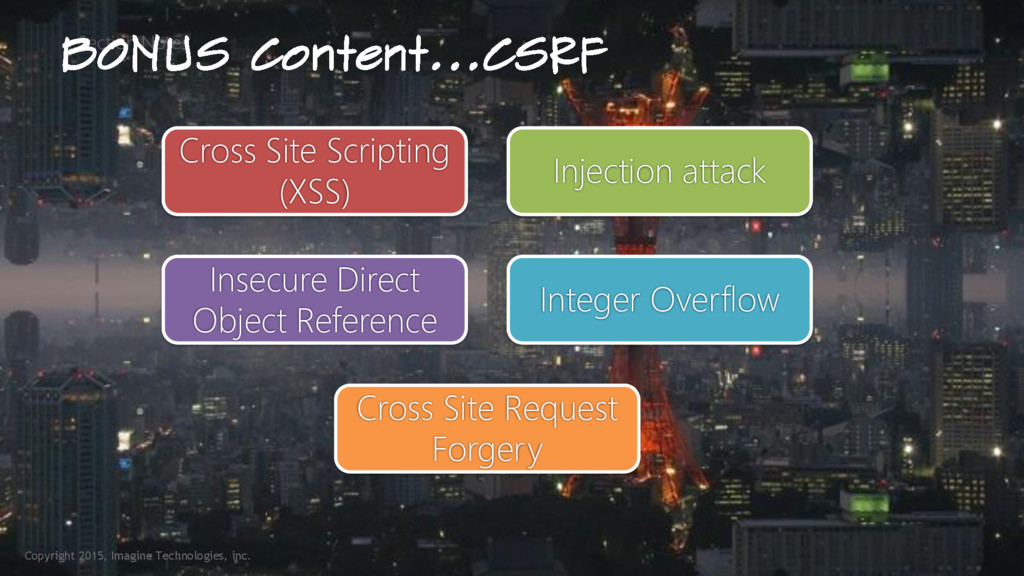
  45. Section Notes BONUS Content…CSRF Copyright 2015, Imagine Technologies, inc. Cross

    Site Scripting (XSS) Injection attack Insecure Direct Object Reference Integer Overflow Cross Site Request Forgery
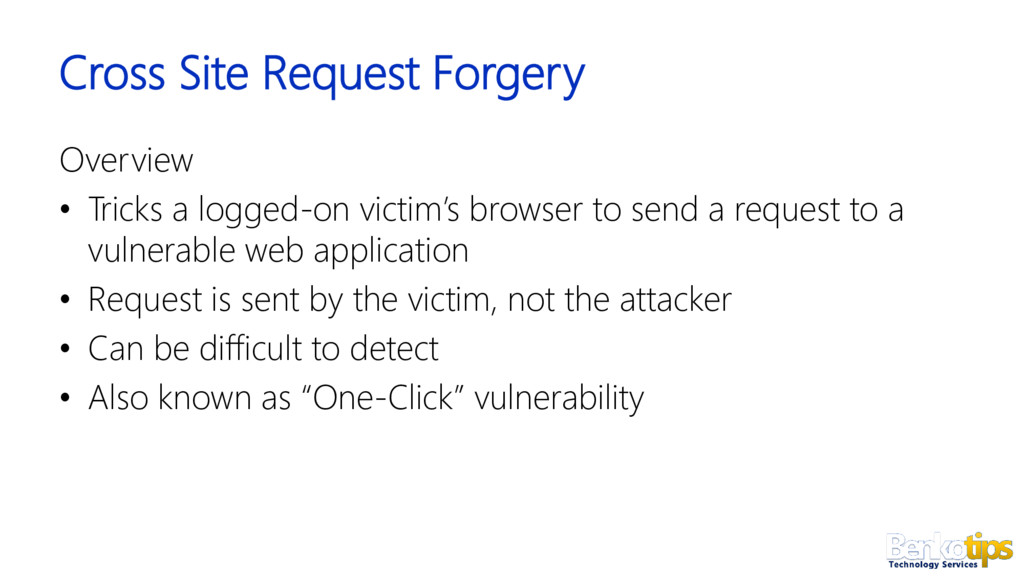
  46. Cross Site Request Forgery Overview • Tricks a logged-on victim’s

    browser to send a request to a vulnerable web application • Request is sent by the victim, not the attacker • Can be difficult to detect • Also known as “One-Click” vulnerability
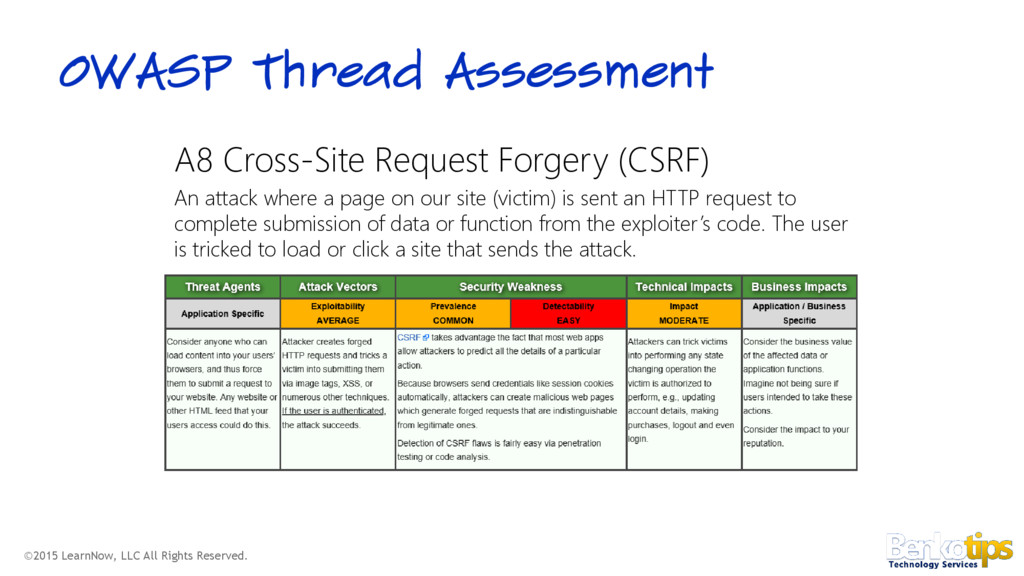
  47. OWASP Thread Assessment A8 Cross-Site Request Forgery (CSRF) An attack

    where a page on our site (victim) is sent an HTTP request to complete submission of data or function from the exploiter’s code. The user is tricked to load or click a site that sends the attack. ©2015 LearnNow, LLC All Rights Reserved.
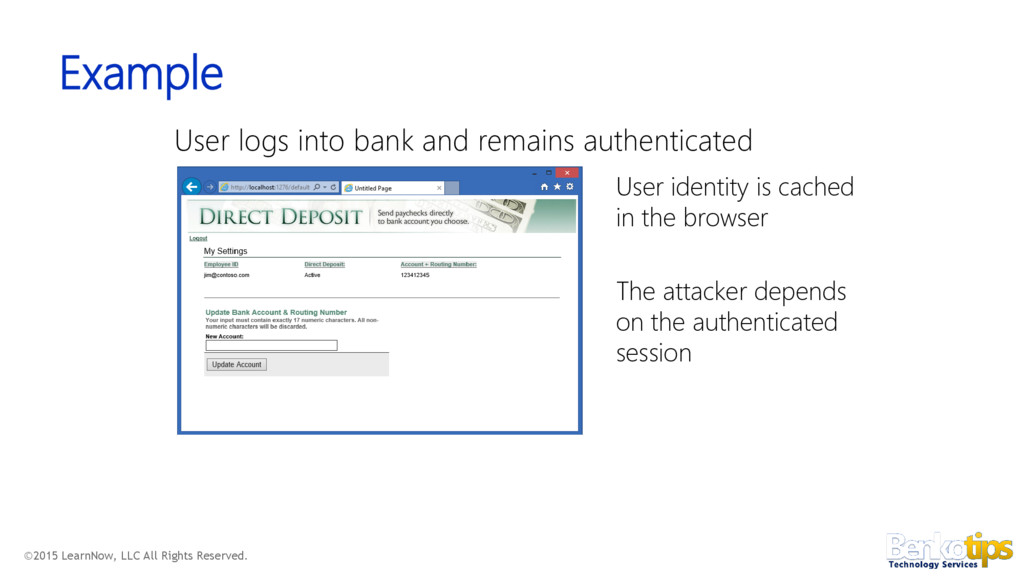
  48. Example User logs into bank and remains authenticated ©2015 LearnNow,

    LLC All Rights Reserved. User identity is cached in the browser The attacker depends on the authenticated session
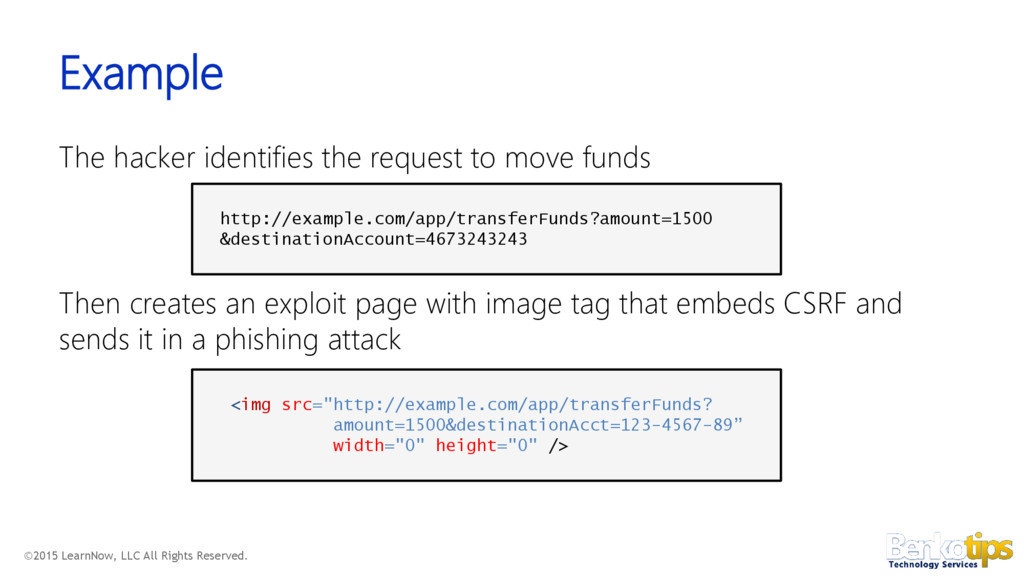
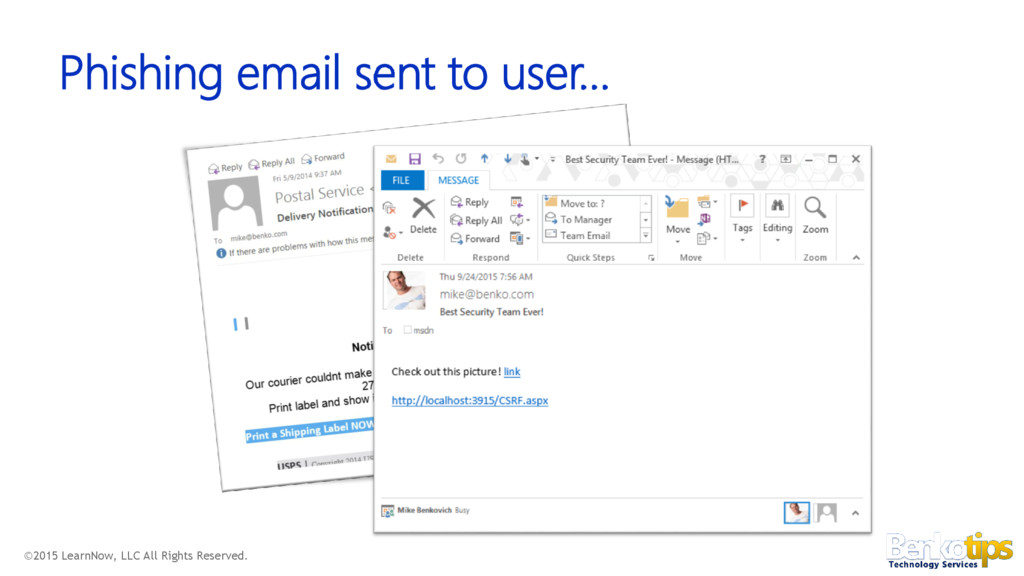
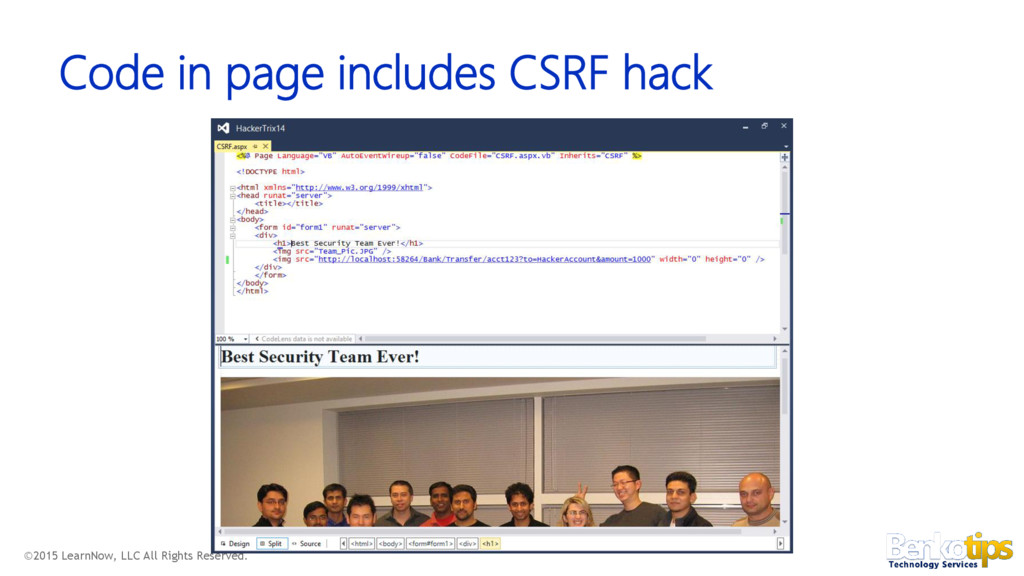
  49. Example The hacker identifies the request to move funds Then

    creates an exploit page with image tag that embeds CSRF and sends it in a phishing attack ©2015 LearnNow, LLC All Rights Reserved. http://example.com/app/transferFunds?amount=1500 &destinationAccount=4673243243 <img src="http://example.com/app/transferFunds? amount=1500&destinationAcct=123-4567-89” width="0" height="0" />
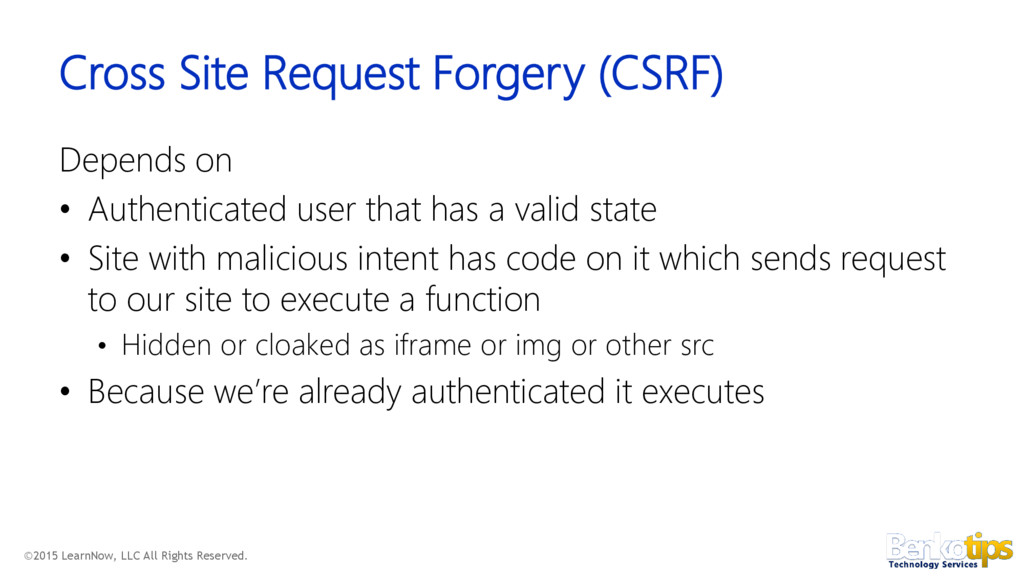
  50. Cross Site Request Forgery (CSRF) Depends on • Authenticated user

    that has a valid state • Site with malicious intent has code on it which sends request to our site to execute a function • Hidden or cloaked as iframe or img or other src • Because we’re already authenticated it executes ©2015 LearnNow, LLC All Rights Reserved.
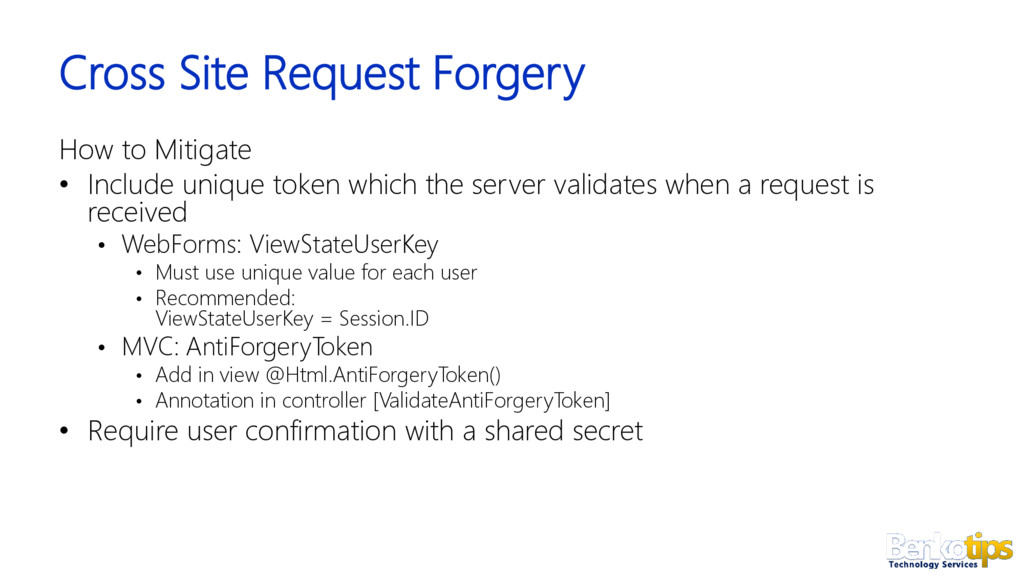
  51. Cross Site Request Forgery How to Mitigate • Include unique

    token which the server validates when a request is received • WebForms: ViewStateUserKey • Must use unique value for each user • Recommended: ViewStateUserKey = Session.ID • MVC: AntiForgeryToken • Add in view @Html.AntiForgeryToken() • Annotation in controller [ValidateAntiForgeryToken] • Require user confirmation with a shared secret
  52. Cross Site Request Forgery Potential Risks • Exposes victims private

    information to attacker • Attacker can alter data, make purchases, retrieve account info. • Victim is usually unaware any changes have taken place
  53. Cross Site Request Forgery Real World Example • A security

    flaw at FTD.com made it possible to access customer data simply by copying a cookie from one computer to another. • In addition, sequential values were used as identifiers, making it easier to guess the numbers of other valid cookies. Source: http://www.news.com/2100-1017-984585.html